

Submitted:
01 August 2025
Posted:
04 August 2025
You are already at the latest version
Abstract
This article presents a comprehensive bibliometric analysis of scientific production in Central America between 1996 and 2023, based on data indexed in the Scopus database. The study frames the investigation within the broader context of scientific visibility and regional development, aiming to evaluate trends in research productivity, thematic specialization, and collaboration patterns across Belize, Guatemala, Honduras, El Salvador, Nicaragua, Costa Rica, and Panama. A total of 35,146 articles authored by researchers affiliated with institutions in Central America were analyzed using indicators such as publication volume, co-authorship networks, subject areas, and journal impact. The findings reveal a consistent annual growth rate of 7%, yet with marked disparities among countries. Costa Rica, Panama, and Guatemala account for 82% of the total scientific output, while the remaining countries contribute only 18%. Research activity is primarily concentrated in the medical, agricultural, biological, and environmental sciences. Over 80% of publications involve international collaboration, predominantly with the United States, Spain, and Mexico, whereas intraregional cooperation remains limited. The analysis underscores the region’s reliance on global research networks and reveals persistent internal asymmetries in scientific development. The results suggest the need for increased investment in national research systems, stronger regional collaboration, and targeted strategies to balance scientific production across countries.
Keywords:
bibliometric analysis
; scientific production
; Central America
; Scopus
; international collaboration
; research trends
1. Introduction
In the contemporary knowledge society, scientific research and technological development are fundamental pillars of national progress, innovation, and competitiveness. Scientific production—typically disseminated through peer-reviewed publications—serves as a critical indicator of a country’s ability to generate, apply, and share knowledge within the global research ecosystem (Barbier, 2023; Jack et al., 2021). Bibliometric analysis, as a methodological framework, has become increasingly essential to evaluate research output, monitor collaboration patterns, identify emerging thematic areas, and assess the visibility and influence of academic work across regions (Choudhri et al., 2015; Durieux & Gevenois, 2010; Hunt, 2011).This analytical approach has proven especially valuable in examining disparities between countries and informing science policy decisions (Ciocca & Delgado, 2017; Godfrey et al., 2010; Salager-Meyer, 2008). Through quantitative indicators, bibliometric studies contribute to the construction of evidence-based strategies for strengthening scientific systems, enhancing collaboration networks, and supporting innovation ecosystems in both developed and developing contexts (Ramírez & Salcedo, 2023; Tomás-Górriz & Tomás-Casterá, 2018).
Despite growing interest in the scientometric mapping of Latin America, Central America remains significantly underrepresented in the global bibliometric literature (Munguía-Mena & Picado, 2012). This gap not only limits the visibility of scientific efforts across the region, but also hinders the formulation of effective, evidence-driven policies for research and development (Adderly-Kelly, 2003; Godfrey et al., 2010; Ramírez & Salcedo, 2023). While countries such as Brazil, Mexico, and Argentina have been widely studied, systematic regional analyses covering Central America are virtually absent (Hermes-Lima et al., 2007).
This study seeks to fill that void by providing a comprehensive, comparative, and critical bibliometric overview of research production in Central American countries over nearly three decades. The analysis aims to shed light on the evolution of research activity, collaboration dynamics, thematic priorities, and institutional leadership within the region, offering a data-driven foundation for regional science policy planning.
Over the past two decades, bibliometric studies have grown in both methodological rigor and disciplinary reach, supported by global citation databases such as Scopus and Web of Science (González-Alcaide, 2021). Numerous regional and national-level analyses have been conducted across Latin America, focusing on productivity, thematic specialization, institutional networks, and international collaboration (Rama & Gregorutti, 2015). However, few such studies focus on Central America, and those that exist tend to be fragmented, institutionally bound, or thematically narrow (Svenson, 2013, 2015; Fernández & Murillo, 2018).
Available evidence indicates significant disparities among Central American countries. Costa Rica, Panama, and Guatemala account for the vast majority of indexed publications, while Belize, El Salvador, Honduras, and Nicaragua exhibit much lower research output, reflecting persistent structural barriers such as limited research funding, weak doctoral training programs, and insufficient institutional support (Ramírez & Salcedo, 2023). Furthermore, a high dependency on international co-authorship—often exceeding 80% of publications—suggests an externally driven model of scientific production (Huete-Pérez, 2013; Casalet & Buenrostro, 2014).
Despite these challenges, several institutions in the region have demonstrated research leadership and visibility. The University of Costa Rica, University of Panama, and Universidad del Valle de Guatemala are among those with growing scientific output. Thematically, the region’s research is concentrated in health sciences, agriculture, and environmental studies, with limited representation in engineering, mathematics, and the social sciences—a pattern shaped both by internal research capacity and external funding priorities (Ramírez & Salcedo, 2023).
This article presents a bibliometric analysis of scientific output in the seven Central American countries—Belize, Guatemala, Honduras, El Salvador, Nicaragua, Costa Rica, and Panama—over the period 1996–2023, using Scopus as the primary data source.
More specifically, this study proposes to:
- − Quantify the total volume of scientific output generated by Central American countries.
- − Examine the historical evolution and longitudinal trends.
- − Identify the dominant thematic areas of research activity within the region.
- − Determine the most productive countries in terms of scientific output.
- − Assess the performance of leading universities, both in terms of publication volume and scholarly impact as measured by citation metrics.
- − Highlight the most prominent researchers in the region.
2. Materials and Methods
This study follows a descriptive, quantitative, and bibliometric design aimed at analyzing the scientific production of the seven Central American countries—Belize, Guatemala, Honduras, El Salvador, Nicaragua, Costa Rica, and Panama—over the period from 1996 to 2023.
2.1. Data Source
The data were retrieved from the Scopus database, selected for its broad coverage of peer-reviewed literature and its suitability for bibliometric analyses. Scopus provides metadata including titles, abstracts, author affiliations, keywords, and citation metrics, which are essential for evaluating scientific output and collaboration networks.
2.2. Search Strategy
A systematic search was performed using country names as keywords, filtered by the affiliation field to capture only publications attributed to institutions located within the respective Central American countries. The search covered the years 1996 to 2023, the full time span available in Scopus for consistent longitudinal analysis. Only articles were considered; reviews, conference papers editorials, notes, and errata were excluded.
The following procedure was applied to carry out the bibliometric analysis:
-
− In December 2024, the Scopus database was consulted using country affiliation as the initial search filter. The query was then refined by applying additional criteria: publication years (1996–2023), document type (article), and country/territory. As shown in Table 1, the search equation and the initial results are presented, allowing for the construction of a country ranking. Each country was assigned a score from 1 to 7, where 1 corresponds to the country with the highest number of published articles and 7 to the country with the lowest total output indexed in the database.The retrieval of articles was carried out, using as a strategy the following terms in Advanced search (“Country”: One individual country was included per search iteration): AFFILCOUNTRY (Country) AND PUBYEAR > 1995 AND PUBYEAR < 2024 AND (LIMIT-TO (AFFILCOUNTRY, “Country”)) AND (LIMIT-TO (DOCTYPE, “ar”)).
- − A total of 37,555 records were downloaded using the “Export” option available on the Scopus platform, selecting the CSV file format. All documents were extracted by country, applying the following filters: a) Citation information (Document title, Author(s), Year, Source title, and Citation count), and b) Bibliographic information (Affiliation, Language of the original document).
- − Once the database was downloaded, the records were alphabetically sorted by document title, and duplicate entries were identified and removed. A total of 2,409 duplicates were eliminated, resulting in a final dataset of 35,146 records. Table 2, presents the number of records removed for each country.
2.3. Data Processing and Cleaning
The dataset was downloaded in CSV format from Scopus and processed in Microsoft Excel. As Scopus provides standardized metadata, no further cleaning was required. Records were sorted alphabetically by article title, and duplicates were manually removed.
2.4. Bibliometric Indicators
The following indicators were applied:
- − Scientific production: Total number of documents published per country, year, institution, and author.
- − Collaboration: Frequency of national, regional, and international co-authorship.
- − Thematic focus: Classification by subject area based on Scopus categories.
- − Impact: Citation count per document as provided by Scopus.
2.5. Visualization Tools
Scientific collaboration was analyzed using filters and sorting functions in Microsoft Excel applied to the exported Scopus dataset. The thematic areas were identified directly through the subject area filters available on the Scopus web platform.
3. Results and Discussion
3.1. Analysis of the Total Volume of Scientific Publications in Central America
3.1.1. Costa Rica
Over the past three decades, Costa Rica has established itself as the scientific hub of Central America, not only due to its sustained volume of publications, but also thanks to the institutional maturity and thematic diversity of its research ecosystem. Between 1996 and 2023, the country produced 14,868 documents indexed in Scopus, with 14,637 validated after the removal of duplicates. This figure accounts for more than 42% of the region’s total scientific output, positioning Costa Rica as the undisputed leader in academic productivity.
Unlike other Central American nations that rely almost entirely on international cooperation, Costa Rica has developed a robust national research capacity, anchored in consistent public science policies, long-term investment in higher education, and strong institutional frameworks. Of all articles analyzed, 28% were authored solely by Costa Rican researchers—the highest share in the region. The University of Costa Rica, which contributes 52% of the country’s total publications, exemplifies this strategic vision, leading in multiple fields and hosting many of the region’s most highly cited researchers.
In terms of subject areas, Costa Rica exhibits a remarkable scientific diversification. While Biological Sciences (31%), Clinical Medicine (18%) and Environmental Sciences (12%) remain dominant, other fields such as Biochemistry (10%), Social Sciences (8%), and Engineering (4%) also play a significant role. This broad disciplinary landscape reflects a research model that is increasingly complex, interdisciplinary, and aligned with national and regional development challenges.
With regard to collaboration, Costa Rica maintains strong ties with the United States, Spain, Brazil, Mexico and Germany. However, its level of research autonomy is notable: 28% of published articles were authored exclusively by Costa Rican researchers, underscoring a degree of endogenous scientific capacity that is rare in the region. The country stands out for the quality of its output: many Costa Rican researchers surpass the regional average h-index (between 25 and 109), and their work is frequently published in high-impact journals. In sum, Costa Rica leads not only in quantity but also in quality, institutional sustainability, and strategic direction, positioning itself as a model for scientific development in Latin America.
3.1.2. Panama
Panama ranks as the second most scientifically productive country in Central America, with 8,560 unique publications between 1996 and 2023, accounting for 24% of the region’s output. Its research is highly internationalized (88%), with leading collaborators including the United States, Germany, United Kingdom, Brazil and Colombia. The dominant subject areas are Agricultural and Biological Sciences (36%), Medicine (15%) and Environmental Sciences (13%), supported by institutions such as the Smithsonian Tropical Research Institute and University of Florida. Despite a strong reliance on external networks, Panama is home to high-impact researchers and a concentration of publications in top-tier journal as Plos One, Ecology and Proceedings Of The Royal Society B: Biological Sciences. Panama’s collaborative scientific model has positioned the country as one of the most active contributors to biomedical and environmental research in Central America, with substantial publication output in Agricultural and Biological Sciences (36%), Medicine (15%), Environmental Sciences (13%) and Biochemistry, Genetics and Molecular Biology (12%). Despite this strong performance, Panama still faces the challenge of strengthening domestic research capacity and expanding its activity into a broader range of disciplines. Panama shows a growing scientific output supported by key institutions such as the University of Panama and SENACYT. While national production remains more limited compared to Costa Rica, Panamanian researchers have achieved relevant impact, with h-index values between 22 and 45, and increasing publication in high-impact journals. This reflects steady progress toward strengthening the country’s research capacity and international visibility
3.1.3. Guatemala
Guatemala contributes 4,092 unique scientific publications indexed in Scopus between 1996 and 2023, representing 12% of the region’s total output and ranking as the third most productive country in Central America, following Costa Rica and Panama. The most developed research areas include Medicine (43%), Agricultural and Biological Sciences (14%), and Social Sciences (10%). This thematic focus demonstrates Guatemala’s prioritization of public health, biodiversity, and social sciences, complemented by research on environmental issues.
Regarding collaboration, 86% of publications were co-authored with foreign institutions, particularly from the United States, Mexico, Brazil and United Kingdom, while only 14% were produced solely by Guatemalan authors. This indicates a high reliance on international cooperation, a pattern similar to that observed in Panama. The most productive institutions include Universidad de San Carlos de Guatemala and Universidad del Valle de Guatemala, which are recognized for their contributions to medicine, Agricultural and Biological Science, and Environmental Science research. Although the overall research volume remains moderate, several Guatemalan scholars exhibit h-index scores between 24 and 47, and a portion of the output appears in top-tier journals as Plos ONE and American Journal Of Tropical Medicine And Hygiene, indicating growing international visibility and scientific relevance.
Guatemalan researchers have attained significant academic impact, with h-index values ranging from 24 to 47, and consistent contributions across health, nutrition, and clinical research.
3.1.4. Honduras
Honduras occupies a lower-middle position in Central America’s scientific landscape. Between 1996 and 2023, the country produced 2,184 unique documents indexed in Scopus, representing just 6% of the region’s total output, making it one of the least scientifically productive countries in the region. A considerable 83% of these publications were developed through international collaboration, while only 17% were authored exclusively by Honduran institutions. This underscores the country’s reliance on external partnerships, though it also reflects active participation in global academic networks—especially with the United States, Brazil, Spain and Mexico. The dominant research fields are Medicine (33%) and Agriculture and Biological Sciences (20%). These focus areas indicate efforts to address pressing national concerns in public health, biodiversity, and ecological sustainability.
The National Autonomous University of Honduras (UNAH) stands out as the country’s most productive institution, along with some international health research centers and NGOs. Although the overall number of highly cited researchers is small, Honduras has demonstrated a notable capacity to publish in high-impact journals, including Physical Review Letters, Scientific Reports, and the Journal of High Energy Physics. This contrast highlights both the country’s potential and the need to expand its pool of leading researchers. Honduras demonstrates a nascent, thematically concentrated, and heavily internationalized research profile, underscoring the need to strengthen national research capacity, implement sustained science policies, and develop an autonomous scientific community.
Researchers have achieved h-index values between 2 and 18, reflecting initial steps toward consolidating a national research base and expanding visibility in regional and international scientific communities.
3.1.5. Nicaragua
Nicaragua exhibits one of the lowest levels of scientific output in Central America. Between 1996 and 2023, the country produced 1,861 unique publications indexed in Scopus, accounting for just 5% of the region’s total output. This places it among the least productive countries in the region. Regarding collaboration, 90% of its publications were co-authored with international institutions, while only 10% were authored exclusively by Nicaraguan researchers affiliated with national institutions. This indicates a strong reliance on external scientific networks for knowledge production. The country’s research is concentrated in Medical Sciences (36%), Biological Sciences (17%), and Environmental Sciences (11%), reflecting alignment with national challenges in public health, biodiversity, and climate change. The Universidad Nacional Autónoma de Nicaragua (UNAN-León and Managua) and several international universities and health organizations—such as the University of California, Berkeley, the Sustainable Sciences Institute, and the University of Michigan—play a leading role in supporting Nicaragua’s scientific output. However, overall research impact remains modest, with limited visibility in high-impact journals. Nonetheless, some researchers have achieved notable recognition, with h-index values ranging from 18 to 58 and sustained publication activity in health and sustainable sciences. Nicaragua’s scientific landscape shows a strong orientation toward international collaboration, which has contributed to advancing research efforts despite the country’s relatively modest publication output. This context underscores the opportunity to enhance institutional capacities and foster the growth of an independent and sustainable research ecosystem.
3.1.6. El Salvador
El Salvador ranks among the countries with the lowest scientific output in the Central American region. From 1996 to 2023, El Salvador produced 1,816 unique publications indexed in Scopus, accounting for approximately 5% of the region’s total output. International collaboration was involved in 79% of these publications, reflecting both the country’s integration into global academic networks and the importance of strengthening national research capacities to increase autonomous production.
The most prominent research areas include Medical Sciences (43%), Biological Sciences (16%), Social Sciences (15%) and Earth and Planetary Sciences (10%) aligning closely with the thematic patterns observed in other low-output countries in the region. Leading institutions include the University of El Salvador and various health- and development-oriented organizations operating in the country. However, visibility in high-impact journals remains low, and the number of researchers with high h-index scores is limited, with most authors reaching values between 7 and 16. El Salvador presents an emerging research profile marked by strong international collaboration and increasing participation in health and environmental fields, offering significant opportunities to expand autonomous production and diversify research areas. These findings highlight the urgent need for national policies that strengthen the scientific ecosystem, promote institutional research capacity, and foster investigative autonomy.
3.1.7. Belize
Belize has the lowest scientific output in the Central American region. Between 1996 and 2023, a total of 634 unique documents indexed in Scopus were identified, accounting for only 2% of the region’s total output. This low figure reflects an emerging scientific infrastructure with limited institutional and funding capacity. An overwhelming 93% of the publications were produced in collaboration with international institutions, while just 7% were authored exclusively by Belizean researchers affiliated with Belizean institutions.
This makes Belize the most internationally dependent country in terms of scientific production in the region. The research is primarily concentrated in Agricultural and Biological Sciences (36%), followed by Environmental Sciences (23%) and Medical Sciences (22%). This thematic focus aligns with the country’s rich biodiversity and its global relevance in environmental issues. The University of Belize leads in research output; however, a significant portion of publications stem from partnerships with foreign universities, NGOs, and international research centers. Although absolute productivity remains low, several Belizean-authored papers have appeared in medium- and high-impact journals, suggesting a growth potential in international visibility, provided that scientific capacity and resources are strengthened.
In Belize, researchers have low h-index values, ranging from 1 to 5, reflecting an early stage of development in the national research ecosystem and limited international visibility.
3.2. Integrated Analysis of the Central American Region
Over the 27-year study period, Central America’s scientific output, as recorded in the Scopus database (excluding duplicate entries), amounts to 35,146 academic articles. The region has experienced steady growth in scientific production, with only two periods of decline. The first occurred in 1998, coinciding with the devastating impact of Hurricane Mitch, which led to the redirection of public funds toward reconstruction and emergency response. The second downturn occurred in 2000, a year marked by economic and fiscal crises throughout the region, which may have resulted in cuts to education and science budgets (Figure 1).
The most significant annual growth was recorded in 2020, with a 23% increase in output, equivalent to 509 more articles than the previous year. The peak year for scientific production was 2021, with 2,942 articles published. However, the figures declined slightly over the next two years. The sharp rise in publications during 2020 and 2021 is attributed to the global COVID-19 pandemic, which spurred a surge in scientific activity across all regions, including Central America. In contrast, production in 2022 and 2023 stabilized and slightly declined compared to the pandemic years, although it remained substantially higher than pre-pandemic levels. On average, the region’s scientific production grew by 7% annually during the study period. Central America’s upward trend in research output is particularly evident in the last decade, with most publications concentrated in three countries: Guatemala, Panama, and Costa Rica. In contrast, Honduras, Nicaragua, and El Salvador have lower publication volumes, while Belize consistently records the lowest output in the region.
3.2.1. Standardized Scientific Output by Population and GDP
Although the analysis of absolute publication counts offers a broad overview of regional research output, such figures may obscure structural disparities among countries with markedly different demographic and economic contexts. To enable more accurate cross-country comparisons, we computed standardized indicators of scientific productivity by adjusting total publication counts for population size and gross domestic product (GDP). Table 3 presents the number of Scopus-indexed publications per 100,000 inhabitants and per million USD of GDP for each Central American country (Economic Commission for Latin America and the Caribbean [ECLAC], 2024; World Bank, 2024). This normalization allows for a more equitable assessment of research intensity and efficiency, revealing patterns that are not evident in raw publication totals alone.
The standardized indicators in Table 3 provide a more nuanced understanding of research productivity across Central America. Costa Rica not only leads in absolute publication volume but also exhibits the highest research intensity when adjusted for population size, with nearly 312 publications per 100,000 inhabitants. Belize, despite having the lowest total output, ranks second in both normalized indicators, highlighting an efficient use of limited human and financial resources.
In contrast, Guatemala—third in total output—ranks among the lowest when adjusted for demographic and economic scale. Similarly, El Salvador, Honduras, and Nicaragua display modest per capita productivity, yet Nicaragua achieves a relatively higher efficiency in terms of publications per million USD of GDP (0.09) compared to its neighbors.
One key factor influencing scientific productivity is the strengthening of research capacities, including the development of institutional research frameworks (Nchinda, 2002). Among Central American nations, Costa Rica was the first to establish a formal legal and policy structure to promote scientific research and innovation, followed by Panama. Although Guatemala was the last to incorporate state support for science and technology into its constitution, it quickly implemented regulatory frameworks similar to those of Costa Rica. This proactive institutional development may explain the leadership of these three countries in regional scientific output (Viales-Hurtado et al., 2021).
Another factor that contributes to the increase in scientific production is the openness of countries to host international researchers, which fosters strong international collaboration networks. This, in turn, promotes co-authorship and enhances researcher mobility (Liu et al., 2023; Wagner & Jonkers, 2017). This dynamic is evidenced in three ways. First, through the mapping of major collaborative links between Central American researchers and international and regional institutions (Table 4). Notably, partnerships with countries such as the United States, Spain, the United Kingdom, and Germany stand out—many of which are global leaders in scientific collaboration (Tian & Bu, 2024).
Additionally, contributions from Latin American countries, particularly Brazil and Mexico, are prominent. These nations are recognized for having the highest volume of academic publications in the region (Delgado & Weidman, 2012). Lastly, most of the collaborating institutions in scientific production are universities, which actively engage with society through cultural and technological contributions, while also aligning themselves with prevailing intellectual and scientific trends (Altbach, 2011).
Although universities remain the principal generators of scientific output in Central America, a substantial portion of research activity is also conducted by non-university institutions. These include national hospitals, public health systems, governmental research agencies, and specialized scientific institutes. For instance, Panama hosts high-impact entities such as the INDICASAT-AIP and the National Secretariat for Science, Technology, and Innovation (SENACYT). In Costa Rica, significant contributions stem from institutions like the Instituto Costarricense de Investigación y Enseñanza en Nutrición y Salud and the Instituto Nacional de Biodiversidad (INBio). In El Salvador and Honduras, national hospitals and social security systems, such as the Hospital Nacional de Niños Benjamín Bloom and Hospital Escuela, play a prominent role in the production of medical research. Likewise, in Nicaragua and Guatemala, ministries of health and regional research centers such as the Instituto de Nutrición de Centroamérica y Panamá (INCAP) are noteworthy contributors. While Belize exhibits lower absolute research output, it contributes through institutions such as the Ministry of Health and the Coastal Zone Management Authority. Collectively, these organizations expand the scientific landscape of the region beyond academia, particularly in the domains of health, environmental sciences, and applied research.
Second, the subsequent section highlights the countries exhibiting the highest degrees of international collaboration in the production of scientific articles (Table 5), including the presence of other nations such as South Korea, Zambia, and Pakistan.
Regarding collaboration among Central American countries, Table 6 presents a matrix displaying the number of scientific documents produced in partnership within the region. Costa Rica emerges as the country with the highest level of collaboration with other Central American authors, while Belize ranks lowest in terms of regional research cooperation. Guatemala, El Salvador, Honduras, and Panama each show an average of approximately 15% collaboration with the remaining countries in the region.
Despite geographic proximity and shared development challenges, scientific collaboration within the Central American region remains limited. As shown in Table 5, intraregional co-authorship levels are low, with most countries exhibiting less than 15% collaboration with their neighbors. This suggests the presence of institutional, political, or infrastructural barriers that hinder regional integration in research. The lack of a robust Central American scientific network may also reflect a strategic preference for collaborations with institutions in the Global North, which offer greater visibility, funding, and citation impact. Addressing these internal disconnections could be a key step toward building a more autonomous and resilient regional research ecosystem (Casalet & Buenrostro, 2014; Svenson, 2013).
3.3. The Most Prominent Researchers in the Region of the Central American Region
In a third stage, the distribution of authors by country is presented, highlighting two key indicators in the assessment of their academic impact: the number of published articles and the h-index. The latter reflects both the productivity and citation impact of a scholar’s publications (Hirsch & Buela-Casal, 2014). Table 7 shows the authors with the highest number of articles indexed in the Scopus database during the study period, with Costa Rica clearly leading in both publication volume and h-index scores. Notably, José María Gutiérrez stands out with 285 published articles, while Rolando Herrera holds the highest h-index. This distinction suggests that these authors may have greater access to research funding and grants (Silvestre et al., 2016), as well as enhanced academic influence and career advancement opportunities (Marion et al., 2023).
3.4. The Dominant Thematic Areas of Research Activity Within the Region
In the presentation of the results, the thematic areas in which universities from each Central American country conduct research are outlined. The disciplines most commonly represented across nearly all Central American nations include Agricultural and Biological Sciences, Environmental Sciences, Earth and Planetary Sciences, Social Sciences, and Medicine. This distribution clearly reflects that sustainability, food security, public health, and infectious diseases are pressing research priorities throughout the isthmus. Additionally, the prominence of environmental sciences underscores the importance placed on natural resource management and environmental sustainability in the region. This observation aligns with findings by Morales-Marroquín et al. (2022), who emphasize biodiversity as a central research focus in southern Central American countries.
Conversely, fields such as Decision Sciences show notably low scientific output. This discipline, which develops and applies quantitative methods and techniques to support decision-making processes (Claassen et al., 2007), may be underrepresented due to a lack of cohesion between universities and industry in Central American countries (Sutz, 2000). Among the mid-tier fields in terms of research output are disciplines such as Mathematics, Materials Science, and Computer Science. The latter is particularly relevant, as computational approaches, combined with conceptual knowledge and machine learning techniques, are essential in the discovery of new materials for science and technology (Louie et al., 2021).
Closely related to research areas is the critical role of journal selection in academic publishing. When choosing a journal, researchers consider factors such as the rigor of peer review, the quality of reviewer feedback, and the journal’s reputation (Rowley et al., 2020). As noted by Paine & Fox (2018), journals shape scientific impact by validating the significance of research, which is often reflected in citation counts.
Table 8 illustrates a strong relationship between the region’s priority research areas and the journals where Central American research is published. Journals from countries such as the United States and the United Kingdom are frequently selected for publication. Notably, the Revista de Biología Tropical, a Costa Rican journal, has the highest number of published articles from the region. It serves as the primary outlet for biological research in Costa Rica, with 41% of its articles authored in collaboration with Costa Rican institutions and 36% involving international collaboration (Nielsen-Muñoz et al., 2012).
Similarly, PLOS ONE stands out as the preferred journal among Central American countries, reaching a total of 570 academic articles affiliated with institutions from the region over the studied decades. This preference may be attributed to the significant impact the journal has across various disciplines, as noted by Repiso et al. (2020). Ahmadi (2018) further argues that the success of PLOS ONE lies in its trustworthiness, innovation, open-access format, technical robustness, and strong data support, among other features.
According to the Scopus database, Central American universities are the principal scientific production institutions in their respective countries. As evidenced by the data presented, many of these universities publish more articles than other national institutions. This observation reinforces the assertion made by Powell and Dusdal (2017), who state that universities represent a key organizational structure through which countries achieve scientific growth and productivity.
In several Latin American countries, some universities do not publish their scientific output in high-impact databases such as Scopus or Web of Science (WoS). This phenomenon may stem from ambiguous state policies, a lack of incentives for research, and the high costs associated with certain research topics (Romakh, 2021). Moreover, many universities lack robust strategies for securing funding (Osenga, 2007), and their research increasingly depends on external funds due to declining university budgets (Laudel, 2006).
3.5. Language and Scientific Visibility in Central America
Language plays a decisive role in the scientific visibility of research produced in Central America. Although Spanish is the official language in all countries of the region, the vast majority of scientific publications indexed in Scopus are written in English. Of the 35,146 articles analyzed, 88% were published in English and only 11% in Spanish, with the remaining 1% distributed across 22 other languages, including Portuguese, French, Slovenian, and German, among others.
The distribution of publications by language and country reveals a clear predominance of English, although the degree of dominance varies. Costa Rica, Panama, and Guatemala register the highest volumes of English-language scientific output. Remarkably, Costa Rica also stands out as the primary contributor to Spanish-language publications, accounting for 57% of all Spanish-language articles in the region, followed by Guatemala and Panama. In contrast, countries such as Belize and El Salvador exhibit strongly Anglophone publication profiles, with less than 6% of their indexed scholarly output published in Spanish.
This contrast underscores the coexistence of two partially overlapping publication circuits: one internationalized and English-dominant, oriented toward maximizing global visibility and scientific impact; and another Spanish-oriented, focused on addressing local and regional challenges. The choice of publication language reflects not only disciplinary conventions and indexing strategies, but also institutional policies and patterns of scientific collaboration. A notable example is the Revista de Biología Tropical, a leading journal in the region, which publishes scientific articles in both English and Spanish, thus providing a bilingual platform that connects local and international scholarly communities. English has consolidated its position as the global lingua franca of scientific communication, enabling intercultural collaboration and expanding the reach of research across linguistic boundaries (Yakhontova, 2020; Kawakibi & Indrawan, 2024).
4. Conclusions
This study represents the first comprehensive and comparative bibliometric mapping of scientific production in the seven Central American countries—Belize, Guatemala, Honduras, El Salvador, Nicaragua, Costa Rica, and Panama—over a 27-year period (1996–2023), based on publications indexed in Scopus. The analysis has revealed not only the chronological evolution of research productivity but also patterns of collaboration, dominant thematic areas, institutional distribution, and the international visibility of knowledge produced in the region.
The results indicate a general upward trend in scientific production, with an average annual growth of 7%. This sustained increase contrasts, however, with profound asymmetry among countries: Costa Rica, Panama, and Guatemala account for more than 80% of total publications, while Honduras, El Salvador, Nicaragua, and especially Belize exhibit significantly lower levels. This polarization does not reflect a deficit in intellectual or research capacity but rather structural disparities, including unequal access to R&D funding, inconsistent national policies, deficits in scientific infrastructure, and weak institutionalization of research systems.
The COVID-19 pandemic marked a turning point, evidenced by a peak in publications during 2020 and 2021. While this increase was global, its intensity in Central America reflects the adaptive capacity of certain academic hubs during global emergencies. However, the slight subsequent decline suggests that this momentum was not entirely sustained by long-term structural policies.
From a thematic perspective, the most prolific fields—Medical, Environmental, Biological, and Agricultural Sciences—reflect a direct connection to the region’s structural challenges: infectious diseases, food security, environmental management, and biodiversity. However, emerging and transformative fields such as Decision Sciences, Data Science, Computing, and Materials Science remain underrepresented. This thematic concentration suggests a limited diversification of the regional scientific ecosystem, potentially influenced by traditionally oriented research agendas, limited university-industry interaction, and underfunding in technological sectors.
One of the study’s most compelling findings is the extremely high level of international collaboration. Over 80% of articles are co-authored with researchers from the United States, Spain, Mexico, the United Kingdom, and Germany. This openness has been crucial for increasing the visibility and citation impact of Central American science but also reveals a pronounced dependency on external networks. Such dependency may limit regional scientific autonomy and poses risks if not counterbalanced by policies that strengthen internal research capacities.
In contrast, collaboration among countries within the region remains marginal, despite shared challenges. The low intensity of intra-regional networks represents a missed opportunity for Central American scientific integration. Strengthening South-South collaboration could have a positive impact on the resilience of regional scientific ecosystems and the exchange of contextually relevant knowledge.
At the institutional level, universities remain the main engine of scientific production, though with significant disparities. The University of Costa Rica leads in both volume and visibility, followed by Panamanian and Guatemalan universities. The concentration of highly cited researchers in a few institutions underscores the need for policies that promote institutional equity, support doctoral programs, and foster sustainable scientific careers. Individual metrics, such as the h-index, have proven useful not only for measuring impact but also for guiding funding strategies and collaborative partnerships.
Journal selection also plays a key role. While English-language open-access journals such as PLOS ONE and Scientific Reports dominate, the Revista de Biología Tropical—a Costa Rican journal—remains the leading regional publication outlet. This demonstrates that high-quality local journals can achieve international influence when backed by consistency, visibility, and global collaboration.
The dominance of the English language in academic publishing poses both opportunities and challenges for Spanish-speaking researchers. Training in scientific writing in English and inclusive language policies must be considered as integral components of any strategy aimed at strengthening regional research capacities. Language barriers may also contribute to the low international visibility of many relevant works produced in Spanish.
From a critical standpoint, the findings support the assertion that the scientific underperformance of several countries in the region is not due to a lack of talent but rather to the absence of enabling environments. Comparative experience shows that countries with consistent science and technology policies—such as Costa Rica and Panama—have built more robust and visible scientific systems. This validates hypotheses put forward by previous studies (Powell & Dusdal, 2017; Romakh, 2021; Yakhontova, 2020) regarding the correlation between national policies, investment, and academic performance.
Central America stands at a crucial juncture in its scientific trajectory. While significant progress has been made in terms of research output and global integration, internal disparities, institutional fragility, and thematic limitations must be addressed to achieve a more autonomous, balanced, and contextually relevant scientific development.
Theoretically, this study contributes to the field of comparative science studies by offering an exhaustive cartography of science in a region historically underrepresented in bibliometric literature. It provides an interpretive framework for understanding the dynamics of production, collaboration, and visibility in contexts of low R&D investment and may serve as a basis for comparative studies with other regions of the Global South.
Practically, the findings offer actionable insights for policymakers, higher education institutions, and international cooperation agencies. The evidence presented can be used to:
- − Redesign national science and technology policies based on empirical data.
- − Prioritize strategic funding toward underrepresented thematic areas.
- − Incentivize scientific production in emerging institutions.
- − Strengthen regional networks and reduce reliance on unilateral collaborations.
- − Support training programs in scientific writing and academic English.
Future Research Directions:
- − Development of a common Central American science policy framework that fosters integration, thematic diversification, and institutional strengthening.
- − Longitudinal studies on the most successful research careers and institutional trajectories in the region.
- − Qualitative assessment of researchers’ perceptions of structural and linguistic barriers.
- − Evaluation of the impact of international cooperation on local scientific capacity development.
- − Continued monitoring of bibliometric trends with updated datasets and comparative analyses across Latin American subregions.
Author Contributions
M.F.: conceptualization, methodology, formal analysis and investigation, writing—original draft preparation, writing—review and editing, supervision; C.E.: conceptualization, methodology, writing—review and editing.
Conflicts of Interest
The authors declare no conflicts of interest.
References
- Adderly-Kelly, B. (2003). Promoting the scholarship of research for faculty and students. ABNF Journal, 14(2). https://pubmed.ncbi.nlm.nih.gov/12760122/.
- Ahmadi, A. (2018). Contribution of Indian scientists in PLOS ONE: A scientometric analysis. COLLNET Journal of Scientometrics and Information Management. [CrossRef]
- Altbach, P. G. (2011). The past, present, and future of the research university. Economic and Political weekly. [CrossRef]
- Barbier, P. J. (2023). The relationship between scientific production and economic growth through R&D investment: A bibliometric approach. Journal of Scientometric Research, 12. [CrossRef]
- Casalet, M. , & Buenrostro, E. (2014). Central American regional integration in science, technology and innovation: a new challenge. International Review of Sociology. [CrossRef]
- Claassen, G. D. H. , Hendriks, T. H., & Hendrix, E. M. (2007). Decision Science: theory and applications. [CrossRef]
- Choudhri, A. F. , Siddiqui, A., Khan, N. R., & Cohen, H. L. (2015). Understanding bibliometric parameters and analysis. L. ( 35(3), 736–746. [CrossRef]
- Ciocca, D. R. , & Delgado, G. (2017). The reality of scientific research in Latin America; an insider’s perspective. Cell Stress and Chaperones, 22. [CrossRef]
- Delgado, J. E. , & Weidman, J. C. (2012). Latin American and Caribbean countries in the global quest for world class academic recognition: An analysis of publications in Scopus and the Science Citation Index between 1990 and 2010. Excellence in Higher Education. [CrossRef]
- Durieux, V. , & Gevenois, P. A. (2010). Bibliometric indicators: quality measurements of scientific publication. Radiology, 255. [CrossRef]
- Economic Commission for Latin America and the Caribbean (ECLAC). (2024). Gross Domestic Product (GDP) at current prices in USD – CEPALSTAT. https://statistics.cepal.org/portal/cepalstat/dashboard.html? 2203.
- Fernández, M. , & Murillo, D. (2018). Análisis bibliométrico de las revistas de acceso abierto de Centroamérica, el Caribe y México basado en DOAJ e indexadores Latinoamericanos. Memorias De Congresos UTP, /: https, 1852. [Google Scholar]
- Godfrey, L. , Funke, N., & Mbizvo, C. (2010). Bridging the science-policy interface: a new era for South African research and the role of knowledge brokering. South African journal of science, 106. [CrossRef]
- González-Alcaide, G. (2021). Bibliometric studies outside the information science and library science field: uncontainable or uncontrollable? Scientometrics, 6870. [Google Scholar] [CrossRef]
- Hermes-Lima, M. , Santos, N. C., Alencastro, A. C., & Ferreira, S. T. (2007). Whither Latin America? trends and challenges of science in Latin America. IUBMB life, 59. [CrossRef]
- Hirsch, J. E. , & Buela-Casal, G. (2014). The meaning of the h-index. International Journal of Clinical and Health Psychology. [CrossRef]
- Huete-Pérez, J. A. (2013). Latin American science: much work remains. Science, 1274. [Google Scholar] [CrossRef]
- Hunt, G. E. (2011). Making sense of bibliometrics. Acta Neuropsychiatrica, 23. [CrossRef]
- Jack, P. , Lachman, J., & López, A. (2021). Scientific knowledge production and economic catching-up: an empirical analysis. Scientometrics, 4587. [Google Scholar] [CrossRef]
- Kawakibi, M. A. , & Indrawan, F. (2024). The Importance of English in International Science Research Collaboration. ( 4(1), 40–44. [CrossRef]
- Laudel, G. (2006). The art of getting funded: how scientists adapt to their funding conditions. Science and Public Policy. [CrossRef]
- Liu, J. , Guo, X., Xu, S., & Zhang, Y. (2023). Quantifying the impact of strong ties in international scientific research collaboration. ( 18(1), e0280521. [CrossRef] [PubMed]
- Louie, S. G. , Chan, Y. H., da Jornada, F. H., Li, Z., & Qiu, D. Y. (2021). Discovering and understanding materials through computation. Y. ( 20(6), 728–735. [CrossRef]
- Marion, T. , Welborn, M., Della Porta, A., Schoch, J., & Konda, S. (2023). Publication productivity using H-index to evaluate academic success among fellowship-trained Mohs surgeons. Dermatologic Surgery. [CrossRef]
- Morales-Marroquín, J. A. , Solis Miranda, R., Baldin Pinheiro, J., & Zucchi, M. I. (2022). Biodiversity research in Central America: A regional comparison in scientific production using bibliometrics and democracy indicators. Frontiers in Research Metrics and Analytics. [CrossRef]
- Munguía-Mena, M. , & Picado, A. (2012). Análisis Bibliométrico de la Producción Científica de Centroamérica y Panamá en la Categoría de Ingeniería Eléctrica y Áreas Afines (2009-2011). In 32nd IEEE Convention of Central America and Panama. Managua, Nicaragua. -16, 2012. IEEE Sección Nicaragua. 14 November. [CrossRef]
- Nielsen-Muñoz, V. , Azofeifa-Mora, A. B., & Monge-Nájera, J. (2012). Bibliometry of Costa Rica biodiversity studies published in the Revista de Biología Tropical/International Journal of Tropical Biology and Conservation (2000-2010): the content and importance of a leading tropical biology journal in its 60th Anniversary. Revista de Biología Tropical, 1413. [Google Scholar] [CrossRef]
- Nchinda, T. C. (2002). Research capacity strengthening in the South. Social science & medicine, 1711. [Google Scholar] [CrossRef]
- Osenga, K. (2007). Rembrandts in the Research Lab: Why Universities Should Take a Lesson from Big Business to Increase Innovation. Maine Law Review. [CrossRef]
- Paine, C. , & Fox, C. (2018). The effectiveness of journals as arbiters of scientific impact. Ecology and Evolution, 9585. [Google Scholar] [CrossRef]
- Powell, J. J. , & Dusdal, J. (2017). Science production in Germany, France, Belgium, and Luxembourg: Comparing the contributions of research universities and institutes to science, technology, engineering, mathematics, and health. Minerva. [CrossRef]
- Ramírez, T. , & Salcedo, A. (2023). América Latina y la Producción de Artículos Científicos: un crecimiento desigual y asimétrico. Revista Práxis Educacional. [CrossRef]
- Rama, C. , & Gregorutti, G. (2015). Research as a new challenge for the Latin American private university. In Private universities in Latin America: Research and innovation in the knowledge economy (pp. 9-26). New York: Palgrave Macmillan US. [CrossRef]
- Repiso, R. , Moreno-Delgado, A., & Torres-Salinas, D. (2020). If PLoS one were really 101 different specialized journals: A proposed approach to the evaluation of multidisciplinary megajournals. Learned Publishing. [CrossRef]
- Romakh, O. (2021). Coverage of the Domain Problem of Scientific Results’ Approbation in Scientometric Databases Scopus and Web of Science. Актуальні питання масoвoї кoмунікації. [CrossRef]
- Rowley, J. , Sbaffi, L., Sugden, M., & Gilbert, A. (2022). Factors influencing researchers’ journal selection decisions. Journal of Information Science. [CrossRef]
- Salager-Meyer, F. (2008). Scientific Publishing in Developing Countries: Challenges for the Future. Journal of English for Academic Purposes, 7, 121-132. [CrossRef]
- Silvestre, J. , Abbatematteo, J., Chang, B., Serletti, J., & Taylor, J. (2016). The Impact of National Institutes of Health Funding on Scholarly Productivity in Academic Plastic Surgery. Plastic and Reconstructive Surgery. [CrossRef]
- Svenson, N. (2013). Research and development in Central America: panorama and prospects for international cooperation. Higher Education. [CrossRef]
- Svenson, N. (2015). Central America: The Value of International Academic Cooperation. International higher education. [CrossRef]
- Sutz, J. (2000). The university–industry–government relations in Latin America. Research Policy. [CrossRef]
- Tian, Y. , & Bu, Y. (2024). Developed Countries Dominate Leading Roles in International Scientific Collaborations: Evidence from Scholars’ Self-Reported Contribution in Publications. Proceedings of the Association for Information Science and Technology, 1106. [Google Scholar] [CrossRef]
- Tomás-Górriz, V. , & Tomás-Casterá, V. (2018). La Bibliometría en la evaluación de la actividad científica. Hospital a Domicilio, 2. [CrossRef]
- Viales-Hurtado, R. J. , Sáenz-Leandro, R., & Garita-Mondragón, M. (2021). The problem of scientific policies in Central America (1980–2020): the tension between innovation and social cohesion in a global context. Tapuya: Latin American Science, Technology and Society, 6314. [Google Scholar] [CrossRef]
- Wagner, C. S. , & Jonkers, K. (2017). Open countries have strong science. ( 550(7674), 32–33. [CrossRef] [PubMed]
- World Bank. (2024). Total population (total number of inhabitants) – Data. World Development Indicators. https://databank.worldbank.org/reports.aspx?source=2&series=SP.POP.
- Yakhontova, T. (2020). English writing of non-Anglophone researchers. Journal of Korean Medical Science. [CrossRef]
Figure 1.
Central American scientific publications by year.
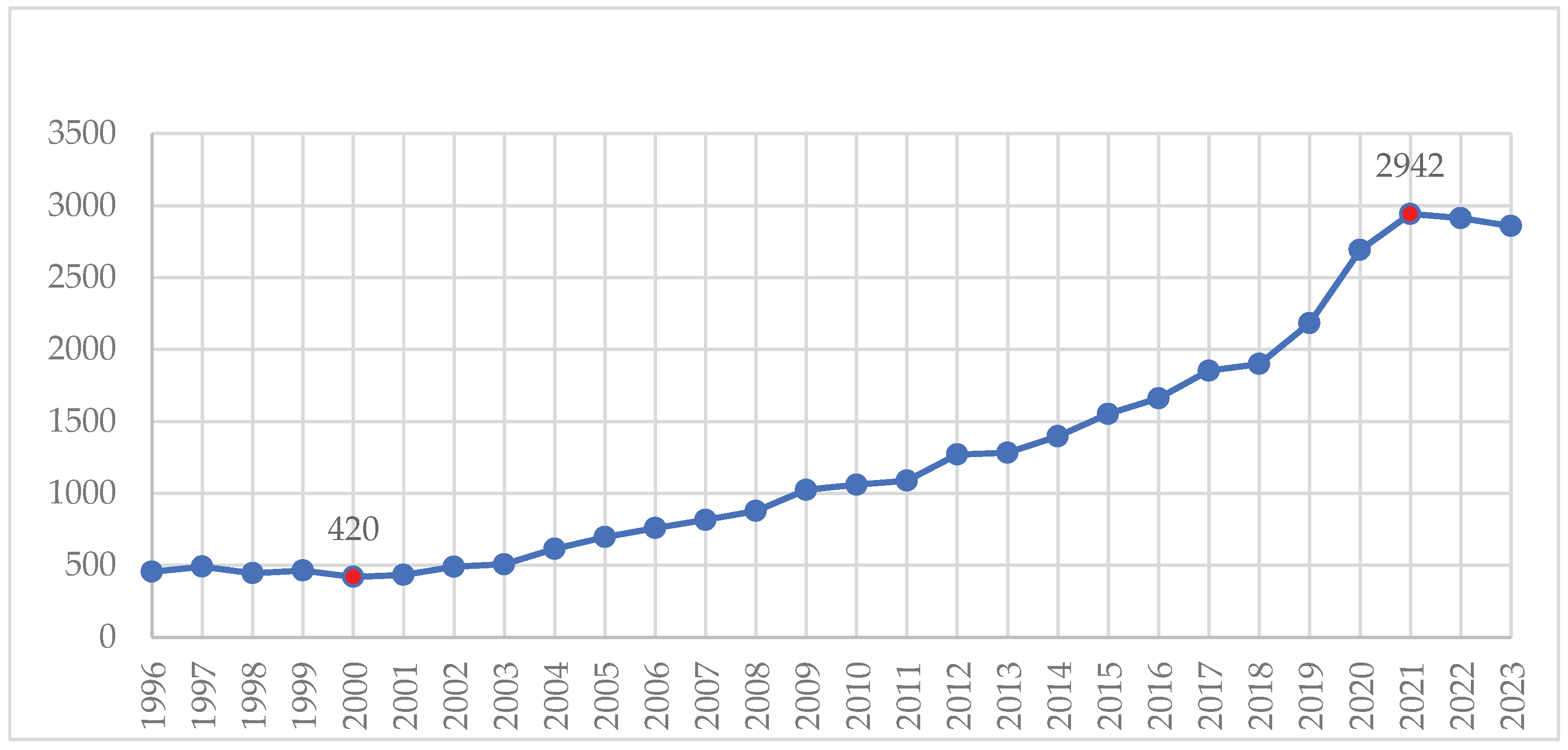

Table 1.
Search entries applied for data extraction in Scopus.
| Ranking | Country | Data extraction | Article (No) | % |
|---|---|---|---|---|
| 1 | Costa Rica | AFFILCOUNTRY ( costa AND rica ) AND PUBYEAR > 1995 AND PUBYEAR < 2024 AND ( LIMIT-TO ( AFFILCOUNTRY , “Costa Rica” ) ) AND ( LIMIT-TO ( DOCTYPE , “ar” ) ) | 16694 | 44.5 |
| 2 | Panama | AFFILCOUNTRY ( panama ) AND PUBYEAR > 1995 AND PUBYEAR < 2024 AND ( LIMIT-TO ( AFFILCOUNTRY , “Panama” ) ) AND ( LIMIT-TO ( DOCTYPE , “ar” ) ) | 9438 | 25.1 |
| 3 | Guatemala | AFFILCOUNTRY ( guatemala ) AND PUBYEAR > 1995 AND PUBYEAR < 2024 AND ( LIMIT-TO ( AFFILCOUNTRY , “Guatemala” ) ) AND ( LIMIT-TO ( DOCTYPE , “ar” ) ) | 4327 | 11.5 |
| 4 | Honduras | AFFILCOUNTRY ( honduras ) AND PUBYEAR > 1995 AND PUBYEAR < 2024 AND ( LIMIT-TO ( AFFILCOUNTRY , “Honduras” ) ) AND ( LIMIT-TO ( DOCTYPE , “ar” ) ) | 2481 | 6.6 |
| 5 | Nicaragua | AFFILCOUNTRY ( nicaragua ) AND PUBYEAR > 1995 AND PUBYEAR < 2024 AND ( LIMIT-TO ( AFFILCOUNTRY , “Nicaragua” ) ) AND ( LIMIT-TO ( DOCTYPE , “ar” ) ) | 2141 | 5.7 |
| 6 | El Salvador | AFFILCOUNTRY ( el AND salvador ) AND PUBYEAR > 1995 AND PUBYEAR < 2024 AND ( LIMIT-TO ( AFFILCOUNTRY , “El Salvador” ) ) AND ( LIMIT-TO ( DOCTYPE , “ar” ) ) | 1837 | 4.9 |
| 7 | Belize | AFFILCOUNTRY ( belize ) AND PUBYEAR > 1995 AND PUBYEAR < 2024 AND ( LIMIT-TO ( AFFILCOUNTRY , “Belize” ) ) AND ( LIMIT-TO ( DOCTYPE , “ar” ) ) | 637 | 1.7 |
Table 2.
Number of Central American articles indexed in the Scopus database.
| Country | Duplicate Article | Article Number |
|---|---|---|
| Costa Rica | 695 | 15,999 |
| Panama | 878 | 8,560 |
| Guatemala | 235 | 4,092 |
| Honduras | 297 | 2,184 |
| Nicaragua | 280 | 1,861 |
| El Salvador | 21 | 1,816 |
| Belize | 3 | 634 |
Table 3.
Scientific output standardized by population and GDP.
| Country | Publications | Population (millions) | GDP (million USD) | Publications / 100K people | Publications / million USD GDP |
|---|---|---|---|---|---|
| Costa Rica | 15,999 | 5,129,910 | 95,374 | 311.88 | 0.17 |
| Panama | 8,560 | 4,515,577 | 86,260 | 189.57 | 0.10 |
| Guatemala | 4,092 | 18,406,359 | 113,216 | 22.23 | 0.04 |
| Honduras | 2,184 | 10,825,703 | 37,082 | 20.17 | 0.06 |
| Nicaragua | 1,861 | 6,916,140 | 19,694 | 26.91 | 0.09 |
| El Salvador | 1,816 | 6,338,193 | 35,365 | 28.65 | 0.05 |
| Belize | 634 | 417,072 | 3,370 | 152.01 | 0.19 |
Table 4.
Major collaborations between Central American countries and international institutions.
| Country | Institutions |
|---|---|
| Brazil | University of São Paulo, Federal University of Rio de Janeiro |
| Canada | University of Ottawa |
| Colombia | National University of Colombia |
| France | Agricultural Research Centre for International Development (CIRAD), French National Centre for Scientific Research (CNRS) |
| Germany | Ulm University |
| Mexico | National Autonomous University of Mexico (UNAM) |
| Paraguay | National University of Asunción |
| Slovenia | University of Ljubljana, University of Maribor |
| Spain | Spanish National Research Council, University of Santiago de Compostela, University of Barcelona, University of Valencia |
| Sweden | Karolinska Institute |
| United States | Centers for Disease Control and Prevention (CDC), Emory University, University of North Carolina at Chapel Hill, The University of Texas at Austin, Uniformed Services University of the Health Sciences, University of California, Berkeley, University of Michigan (Ann Arbor), University of Colorado School of Medicine, University of Florida |
| United Kingdom | University of Oxford, University of Southampton |
Table 5.
Main International collaborating countries in scientific article production.
| Country | Article Number |
|---|---|
| United States | 2,288 |
| Germany | 389 |
| United Kingdom | 256 |
| Switzerland | 256 |
| Korea | 254 |
| Brazil | 128 |
| Spain | 128 |
| France | 128 |
| Netherlands | 128 |
| Zambia | 83 |
Table 6.
Collaboration matrix among Central American countries.
| Country | Belize | Guatemala | El Salvador | Honduras | Nicaragua | Costa Rica | Panama |
|---|---|---|---|---|---|---|---|
| Belize | 0 | 35 | 20 | 27 | 23 | 43 | 33 |
| Guatemala | 35 | 0 | 307 | 223 | 148 | 307 | 219 |
| El Salvador | 20 | 307 | 0 | 168 | 152 | 194 | 163 |
| Honduras | 27 | 223 | 168 | 0 | 165 | 200 | 142 |
| Nicaragua | 23 | 148 | 152 | 165 | 0 | 263 | 133 |
| Costa Rica | 43 | 307 | 194 | 200 | 263 | 0 | 664 |
| Panama | 33 | 219 | 163 | 142 | 133 | 664 | 0 |
Table 7.
Central American authors distinguished by the number of scientific publications during the study period.
Table 7.
Central American authors distinguished by the number of scientific publications during the study period.
| Author Name | Country | Affiliated Institution | Number of Articles | h-index |
|---|---|---|---|---|
| Gutiérrez, José María | Costa Rica | University of Costa Rica | 285 | 86 |
| Herrero, Rolando | Costa Rican Institute for Research and Teaching in Nutrition and Health | 251 | 109 | |
| Lomonte, Bruno | University of Costa Rica | 233 | 69 | |
| Cortés, Jorge | University of Costa Rica | 168 | 37 | |
| Balmaseda, A. | Nicaragua | Ministry of Health, Managua, Nicaragua | 167 | 58 |
Table 8.
Leading journals in which Latin American countries publish.
| Journals | Articles | Quartile | Country of Origin |
|---|---|---|---|
| Revista de Biologia Tropical | 1011 | Q2 | Costa Rica |
| PLOS ONE | 570 | Q1 | United States |
| Zootaxa | 244 | Q2 | New Zealand |
| Scientific Reports | 235 | Q1 | United Kingdom |
| American Journal of Tropical Medicine and Hygiene | 196 | Q2 | United States |
Disclaimer/Publisher’s Note: The statements, opinions and data contained in all publications are solely those of the individual author(s) and contributor(s) and not of MDPI and/or the editor(s). MDPI and/or the editor(s) disclaim responsibility for any injury to people or property resulting from any ideas, methods, instructions or products referred to in the content. |
© 2025 by the authors. Licensee MDPI, Basel, Switzerland. This article is an open access article distributed under the terms and conditions of the Creative Commons Attribution (CC BY) license (http://creativecommons.org/licenses/by/4.0/).
Copyright: This open access article is published under a Creative Commons CC BY 4.0 license, which permit the free download, distribution, and reuse, provided that the author and preprint are cited in any reuse.