

Submitted:
01 August 2025
Posted:
01 August 2025
You are already at the latest version
Abstract
This study introduces the Human-AI Symbiotic Theory (HAIST), designed to guide authentic collaboration between human researchers and artificial intelligence in academic contexts, while pioneering a novel AI-assisted approach to theory validation that transforms educational research methodology. Addressing critical gaps in educational theory and advancing validation practices, this research employed a sequential three-phase mixed-methods approach: (1) systematic theoretical synthesis integrating five paradigmatic perspectives across learning theory, cognition, information processing, ethics, and AI domains; (2) development of an innovative validation framework combining three established theory-building approaches with groundbreaking AI-assisted content assessment protocols; and (3) comprehensive theory validation through both traditional multi-framework evaluation and novel AI-based content analysis demonstrating unprecedented convergent validity. This research contributes both a theoretically grounded framework for human-AI research collaboration and a transformative methodological innovation demonstrating how AI tools can systematically augment traditional expert-driven theory validation. HAIST provides the first comprehensive theoretical foundation designed explicitly for human-AI partnerships in scholarly research with applicability across disciplines, while the AI-assisted validation methodology offers a scalable, reliable model for theory development. Future research directions include empirical testing of HAIST principles in live research settings and broader application of the AI-assisted validation methodology to accelerate theory development across educational research and related disciplines.
Keywords:
human-AI collaboration
; theory development
; educational research methodology
; artificial intelligence
; symbiotic learning
; AI-assisted validation
; theoretical frameworks
; convergent validity
Introduction
The integration of artificial intelligence into academic research represents one of the most significant paradigms shifts in scholarly practice since the digital revolution, fundamentally challenging traditional assumptions about knowledge creation, collaboration, and intellectual discovery. Recent surveys indicate that over 75% of researchers across disciplines now regularly interact with AI systems, yet fewer than 30% report feeling adequately prepared for effective collaboration (National Science Foundation, 2024). As AI systems demonstrate unprecedented capabilities, from GPT-4’s performance on graduate-level examinations to AlphaFold’s revolutionary protein structure predictions, researchers face a fundamental question: How can we harness AI’s transformative potential while preserving the creativity, critical thinking, and ethical judgment that define quality scholarship?
This challenge extends far beyond simply learning new tools or adapting existing workflows. The current moment represents what Kuhn (1962) termed a paradigm shift, requiring fundamental reconceptualization of research collaboration itself. Traditional models of scholarly partnership, designed for human-to-human interaction, prove inadequate when one “partner” processes information at computational scales while the other contributes contextual understanding, ethical reasoning, and creative insight. The stakes are considerable: improper integration risks either under-utilizing AI’s revolutionary capabilities or, conversely, compromising human agency and scholarly integrity through over-reliance on algorithmic outputs.
The emergence of AI in research contexts is fundamentally reshaping our understanding of collective intelligence and collaborative problem-solving. Levy (1999) conceptualizes collective intelligence as a universally distributed form of intelligence that continuously improves and coordinates itself in real-time, enabling new knowledge-producing cultures built on the rapid and open exchange of ideas. This framework gains unprecedented relevance as AI capabilities enable researchers to scale up activities and enhance human collective capability in ways previously impossible (Mulgan, 2018). The foundational premise that knowledge is distributed across individuals rather than concentrated in any single person now extends to include AI systems as knowledge contributors in this collective enterprise, creating opportunities for intellectual partnerships that transcend traditional human limitations while raising profound questions about agency, attribution, and authentic collaboration.
However, current approaches to human-AI interaction in academic contexts often fall into problematic paradigms that limit transformative potential. Observational studies reveal that many researchers treat AI as merely an advanced search engine or writing assistant, failing to leverage its capacity for genuine collaborative reasoning (Kitzie et al., 2024). Others demonstrate concerning over-reliance, accepting AI-generated content without adequate critical evaluation or human synthesis (Singh et al., 2025). Neither approach addresses the potential for authentic intellectual partnership where human scholars and AI systems contribute complementary cognitive strengths while maintaining human-centered scholarly values and ethical standards.
The theoretical landscape presents significant gaps that impede optimal human-AI collaboration. Learning theories developed for purely human contexts, including collaborative learning, social cognitive theory, and transformative learning, do not adequately anticipate intelligent technological partners capable of reasoning, pattern recognition, and adaptive response (Siemens, 2005). While recent research has explored human-AI complementarity in decision-making contexts (Hemmer et al., 2024), a comprehensive theoretical framework specifically for human-AI collaboration in academic research does not yet exist. This gap becomes increasingly problematic as research challenges grow in complexity and scale, demanding collaborative approaches that exceed individual human or AI capabilities.
Moreover, the evolutionary path of learning theory has consistently adapted to changing societal and technological contexts. The transition from behaviorist to cognitivist to constructivist paradigms reflects an evolving understanding of human learning processes and technological capabilities (Siemens, 2005). Today, technology’s influence compounds learning demands exponentially, while creating unprecedented opportunities for cognitive partnership. The absence of theoretical frameworks adequate to these new realities constrains researchers’ ability to realize the full potential of human-AI collaboration while maintaining scholarly integrity.
Simultaneously, traditional approaches to theory validation face limitations when addressing rapidly evolving technological contexts. Expert review processes, while valuable, encounter challenges including limited availability of reviewers with interdisciplinary expertise, potential biases regarding emerging technologies, and scalability issues when evaluating novel theoretical constructs (Bacharach, 1989). These challenges are amplified for interdisciplinary theories addressing emerging technologies, such as AI collaboration, where few established experts exist and disciplinary boundaries complicate evaluation. The advent of sophisticated large language models presents new opportunities for systematic and replicable analysis that could complement traditional validation methods; yet this potential remains largely unexplored in educational research methodology.
Research Purpose and Questions
This study addresses these critical gaps through two interconnected purposes that advance both theoretical understanding and methodological innovation. First, we develop a comprehensive theoretical framework for human-AI collaboration in academic research that preserves human agency while optimizing complementary capabilities. Second, we demonstrate an innovative validation methodology that integrates traditional expert assessment with AI-assisted content analysis, creating a replicable approach for theory development in rapidly evolving technological contexts.
HAIST offers seven foundational principles (Appendix A) for authentic partnership between human researchers and AI systems. These principles synthesize insights from learning sciences, complexity theory, and ethical frameworks to facilitate productive collaboration while upholding scholarly values and research integrity.
Two primary research questions guide this investigation:
RQ1:
What theoretical principles should guide effective human-AI collaboration in academic research contexts?
RQ2:
What evidence supports the theoretical rigor and content validity of a comprehensive human-AI symbiotic framework?
Significance
This research contributes to scholarship across multiple dimensions, addressing both immediate practical needs and long-term theoretical advancement. Theoretically, HAIST addresses a critical void by providing the first comprehensive framework designed specifically for human-AI collaboration in scholarly contexts. The framework extends foundational learning theories into new domains of human-AI interaction, demonstrating how established principles of human learning and development can inform the design of AI partnerships while preserving core scholarly values.
The practical significance spans multiple stakeholder groups. For individual researchers, HAIST provides principled guidance for navigating AI integration while maintaining intellectual autonomy and creative ownership. For institutions, the framework provides conceptual foundations for developing AI integration policies, training programs, and evaluation criteria that leverage technological capabilities while upholding academic integrity. For technology developers, HAIST identifies design principles for AI systems that effectively support rather than replace human intellectual contributions.
Methodologically, this study demonstrates innovative approaches to theory validation by integrating AI-assisted analysis with traditional expert evaluation. This mixed-methods triangulation addresses calls for enhanced rigor in theory development while leveraging AI’s capabilities for systematic and scalable assessment. The demonstrated convergence between human expert judgment and AI evaluation provides empirical evidence for hybrid validation approaches that could transform how educational researchers build and refine theoretical frameworks across diverse domains.
The broader significance lies in positioning human-AI collaboration within the collective intelligence movement while maintaining human agency and scholarly values. As research communities worldwide increasingly encounter AI integration, from literature review automation to data analysis augmentation, HAIST provides a principled foundation for ensuring these technologies enhance rather than replace human intellectual contributions. The framework envisions a future of scholarship where human creativity, ethical reasoning, and contextual understanding combine synergistically with AI’s computational power and pattern recognition capabilities to address complex challenges and advance knowledge in ways neither could achieve independently.
This work ultimately contributes to what we term “symbiotic scholarship” a new paradigm of research practice that transcends traditional human-machine boundaries while preserving the essential human elements of creativity, judgment, and ethical reasoning that define quality academic inquiry. As artificial intelligence capabilities continue advancing, frameworks like HAIST become integral to ensuring that technological progress serves human flourishing and knowledge advancement rather than replacing the irreplaceable contributions of human intellect and wisdom.
Literature Review
Theoretical Foundations for Human-AI Collaboration
The emergence of intelligent AI systems in academic research necessitates new theoretical frameworks that extend beyond traditional human-centered learning theories. While established theories provide essential foundations, they require careful adaptation and integration to address the unprecedented context of researchers collaborating with intelligent machines. This literature review examines the theoretical landscape across three interconnected domains: collective intelligence and complementarity research, learning theory extensions, and theory validation methodology.
Collective Intelligence and Human-AI Complementarity
Collective Intelligence as Theoretical Foundation
Human-AI collaboration in research contexts represents a new form of collective intelligence, “a universally distributed intelligence that constantly improves and coordinates itself in real time, making possible a new knowledge-producing culture built on rapid and open exchange of ideas” (Levy, 1999, p. 2). This conceptualization moves beyond viewing AI as a tool toward understanding human-AI partnerships as collective problem-solving systems where “no one person knows everything, everyone knows something” now extends to include AI systems as knowledge contributors (Levy, 1999).
Surowiecki (2005) identifies diversity as a key quality that makes collectives intelligent: groups should be diverse so different individuals can supplement each other with different pieces of information. This diversity prediction theorem suggests that cognitive diversity leads to better solutions by incorporating “a broader set of perspectives that look at different parts of the problem” (p. 115). In human-AI contexts, this diversity becomes asymmetric complementarity; AI systems contribute pattern recognition, data processing, and statistical reasoning capabilities, while humans contribute causal interpretation, contextual understanding, and ethical judgment.
Recent Advances in Human-AI Complementarity
Emerging research has moved beyond basic tool use toward understanding genuine collaborative relationships. Hemmer et al. (2024) provide a conceptual framework for human-AI complementarity in decision-making contexts, demonstrating that humans and AI typically make different kinds of errors and that AI might detect patterns in large amounts of data that humans might not as quickly discover, while humans excel at causal interpretation and intuition required to understand these patterns.
This complementary research reveals critical insights for academic collaboration. Effective human-AI partnerships require appropriately calibrated human reliance on AI recommendations, with quantitative studies consistently showing that human performance increases when supported by high-performing AI models (Hemmer et al., 2024). However, this collaboration manifests through distinct paradigms with different theoretical foundations.
Intelligence augmentation focuses on enhancing and elevating humans’ ability, intellect, and performance with the help of information technology” (Luckin & Holmes, 2016). This paradigm emphasizes AI as an enhancement to existing human capabilities rather than a collaborative partner. Moving toward the desired collaborative nature of the proposed theory, human-machine symbiosis, conceptualized initially by Licklider (1960), considers both entities as a unified system rather than separate components, aiming to become more efficient together than working separately. This paradigm assumes both entities offer different capabilities that can be leveraged to overcome individual limitations. Further advancement towards the wanted symbiosis, hybrid intelligence combines human and AI team members to “achieve complex goals by combining human and artificial intelligence, thereby reaching superior results to those each could have accomplished separately” (Dellermann et al., 2019). This approach emphasizes collaborative goal achievement through integrated capabilities.
These paradigms inform different approaches to human-AI collaboration, with symbiosis offering the most promising foundation for research partnerships that preserve human agency while leveraging AI capabilities.
Learning Theory Foundations and Extensions
The theoretical foundation for human-AI collaboration draws from several established learning theories, each contributing essential insights that require extension into technological partnership contexts. The Information Processing Theory (Atkinson & Shiffrin, 1968) reveals human cognitive limitations, limited short-term memory and serial processing constraints, that become opportunities for complementary AI capabilities. AI systems provide vast memory storage and parallel processing, enabling “asymmetric cognitive architecture,” where different agents excel at various cognitive tasks within shared endeavors.
Multiple Intelligences Theory (Gardner, 1983) recognizes varied human intelligences (linguistic, logical-mathematical, spatial) that broaden problem-solving approaches. Extended to human-AI contexts, AI capabilities (statistical reasoning, pattern recognition, multilingual processing) represent additional “intelligences” that complement human strengths, supporting heterogeneous teaming where AI contributes problem-solving capabilities humans may lack.
Perhaps most specific to experienced and educated research professionals, the Social Cognitive Theory (Bandura, 1986) introduces reciprocal determinism, in which individuals and environments mutually influence each other. This becomes reciprocal adaptation in human-AI partnerships: humans modify research approaches based on AI input while AI systems can be fine-tuned or prompted differently based on human feedback. This dynamic mirrors social learning processes through observational learning and feedback loops between human and machine agents.
Constructivist and Sociocultural Extensions
Vygotsky’s Sociocultural Theory (1978) provides particularly relevant insights for human-AI collaboration. The Zone of Proximal Development (ZPD), tasks learners can accomplish with guidance, extends metaphorically to AI assistance. AI can enable researchers to achieve tasks beyond their independent capability by providing computational “scaffolding,” thereby extending the researcher’s ZPD. Simultaneously, researchers guide AI by curating outputs and ensuring contextual appropriateness, creating bidirectional scaffolding relationships.
This perspective positions human-AI teams as co-constructive: they jointly produce insights neither could achieve independently, resembling communities of practice that now include non-human members. Knowledge construction occurs through dialogue and interaction, with AI serving as both learner and teacher depending on the domain and context.
Systems Theory Foundations
Complex Systems Theory provides crucial insights for understanding emergent properties of human-AI collaboration. Complex systems exhibit emergence, properties and behaviors that arise from component interactions but cannot be predicted from individual components alone (Holland, 1995). In human-AI partnerships, novel insights, creative solutions, and enhanced capabilities can emerge from the iterative interaction between human intuition and AI analysis in ways neither could achieve independently. This theory’s emphasis on self-organization suggests that effective human-AI collaborations may develop their own adaptive patterns and workflows through repeated interaction, creating unique collaborative signatures that optimize performance over time. This perspective helps explain why human-AI partnerships often produce outcomes that exceed the sum of their individual capabilities.
Socio-Technical Systems Theory (Trist, 1981; Engeström, 1987) emphasizes the joint optimization of social and technical subsystems for optimal performance. This theory is particularly relevant for human-AI collaboration because it recognizes that technical capabilities alone are insufficient, the social system (research culture, team dynamics, ethical norms) must be designed alongside the technical system (AI capabilities, interfaces, workflows) to achieve effective collaboration. Trist’s principle of joint optimization suggests that human-AI partnerships require deliberate attention to both human factors (trust, agency, skill development) and technical factors (AI reliability, explainability, interface design) simultaneously. This perspective prevents the common error of focusing solely on AI technical capabilities while neglecting the human and organizational factors essential for successful implementation.
Transformative Learning in Technological Contexts
Transformative Learning Theory (Mezirow, 1991) offers crucial insights for understanding how human-AI collaboration can foster researcher development. Mezirow emphasizes that “we are meaning-making beings” and that learning involves “utilizing prior interpretations to construe new or revised interpretations of meanings of our experiences” (Mezirow et al., 1990, p. 5).
In human-AI collaboration, this meaning-making becomes bidirectional; humans learn from AI insights while simultaneously teaching AI through feedback and guidance (Kolb, 1984). Working with AI can create “disorienting dilemmas” that challenge researchers’ assumptions about intelligence, creativity, and research processes, potentially fostering transformative learning experiences.
Fleming (2018) notes that transformative learning through AI collaboration requires critical reflection on discourse, particularly regarding whether participants have “full and accurate information,” “the ability to weigh evidence and assess arguments objectively,” “reflectiveness on AI and personal assumptions,” and “willingness to seek understanding” (p. 126). This framework suggests AI can catalyze transformative learning by providing alternative perspectives that challenge existing frames of reference.
Ethical Frameworks for Human-AI Research Collaboration
Research Ethics Foundations provide essential principles for maintaining scholarly integrity in human-AI partnerships. Traditional research ethics frameworks emphasize principles of respect for persons, beneficence, and justice (Belmont Report, 1979), which require extension into AI collaboration contexts. Respect for persons means maintaining human agency and decision-making authority in research processes, ensuring AI enhances rather than replaces human judgment. Beneficence requires that human-AI collaboration maximizes research benefits while minimizing risks, including potential biases, errors, or over-reliance on AI systems.
Furthermore, AI Ethics Integration builds on established research ethics by addressing technology-specific concerns. The IEEE’s Ethically Aligned Design initiative emphasizes human rights, well-being, and data agency as fundamental principles for AI systems (IEEE, 2019). Mittelstadt (2019) identifies key ethical challenges in AI applications including accountability, responsibility, transparency, and fairness, all critical for research contexts. In human-AI research partnerships, these principles translate to requirements for explainable AI outputs, clear documentation of AI contributions, bias monitoring and mitigation, and transparent reporting of human-AI collaborative processes. Integrating research ethics and AI ethics creates a comprehensive framework ensuring that human-AI collaboration maintains the highest standards of scholarly integrity while leveraging technological capabilities responsibly.
Adult Learning Theory (Knowles, 1984) emphasizes self-directedness and agency in learning, particularly relevant since academic researchers are adult learners. Effective adult learning requires autonomy and problem-centered approaches. Human-AI collaboration must preserve human control over goal-setting and ethical decisions while leveraging AI for problem-centered tasks, maintaining researcher ownership of scholarly work.
In Problem-Based Learning Theory (Barrows, 1996), essential insights are provided for embedding human-AI collaboration in authentic research contexts. Problem-based learning emphasizes learning through engagement with real, complex problems that lack clear solutions, requiring learners to develop both content knowledge and problem-solving strategies. In human-AI research partnerships, this translates to situating collaboration within genuine research challenges rather than artificial exercises. Hmelo-Silver (2004) demonstrates that problem-based approaches foster deep learning, critical thinking, and collaborative skills, all essential for effective human-AI research partnerships. The theory’s emphasis on learner-directed inquiry aligns with maintaining human agency while leveraging AI’s analytical capabilities to address complex, multifaceted research problems that neither human nor AI could solve independently.
Theory Development and Validation in Educational Research
Established Criteria for Theoretical Quality
Robust theoretical frameworks must meet established scholarly criteria across multiple dimensions. Whetten (1989) outlines fundamental building blocks: What (factors/concepts), How (relationships), Why (causal mechanisms), and Who/Where/When (boundaries). Theoretical contributions achieve significance through novel insights that balance comprehensiveness with parsimony while clearly explaining constructs, relationships, and contexts. Wacker (1998) emphasizes formal properties: precise conceptual definitions, specified domain limitations, logically consistent relationships, and testable predictions. Strong theories achieve appropriate simplicity while explaining phenomena completely, clarifying applicability boundaries. Kivunja (2018) provides education-specific criteria including relevance to practice, coherence, clarity, applicability, and alignment with existing knowledge. Educational theories must demonstrate practical utility while advancing scholarly understanding.
Also important to consider, and will be emphasized in future research in HAIST validation, Dubin’s (1978) systematic approach requires eight elements: units (constructs), laws of interaction, boundaries, system states, propositions, empirical indicators, hypotheses, and potentially models. This framework emphasizes progression from abstract constructs to specific, testable hypotheses, ensuring theories move beyond philosophical speculation toward empirical examination (Dubin, 1978; Whetten, 1989; Lynham, 2002).
Challenges in Traditional Validation Approaches
Traditional theory validation, through expert peer review, faces inherent limitations. Experts may disagree, judgments can be subjective, and innovative areas like AI collaboration may lack established experts or encounter reviewer biases. Convening interdisciplinary expert panels is also time-consuming and not easily scalable.
Bacharach (1989) suggests theories meeting high percentages (>80%) of evaluation criteria tend toward greater research success, providing useful benchmarks. However, Lawshe’s (1975) Content Validity Ratio method, while quantitative, reduces complex judgments to simplified scales and requires large panels for stable results.
AI-Assisted Validation: Emerging Opportunities
Recent research explores AI’s potential in educational assessment contexts. Studies examining AI evaluation of student writing reveal mixed but promising results. While some research shows consistency challenges (Bui & Barrot, 2025), other work demonstrates AI’s capability to match human evaluation under controlled conditions (Atasoy & Arani, 2025).
Little to no known prior research has applied AI to theoretical framework validation in education, making this approach exploratory yet promising and innovative to academic research. AI offers potential advantages in the systematic, consistent application of evaluation criteria while maintaining objectivity. However, limitations include potential misinterpretation of nuanced concepts and a lack of proper understanding of contextual significance. This is where appropriate and effective prompt engineering for generative AI large language models (LLMs). As Gelso (2006) highlights, the strength of a theory lies in its iterative testing and refinement, an approach embodied in our AI-integrated validation Therefore, triangulation approaches combining human expertise with AI capabilities could leverage the strengths of both: human understanding of meaning and significance alongside AI’s systematic consistency and analytical thoroughness. This represents a novel symbiotic approach to validation methodology that parallels the collaborative principles being theorized.
Theoretical Gaps and Research Opportunities
The literature reveals significant gaps in understanding human-AI collaboration in academic contexts. While individual theories provide valuable insights, no comprehensive framework integrates learning theories, complementarity research, systems thinking, and ethical considerations specifically for scholarly partnerships. Most existing work focuses on decision-making or task-completion contexts rather than knowledge creation and research collaboration.
Integrating complex systems and socio-technical perspectives reveals that human-AI collaboration involves emergent properties and joint optimization challenges that extend beyond individual learning theories. Similarly, the ethical dimensions of human-AI research partnerships require frameworks that integrate traditional research ethics with AI-specific concerns, an integration largely absent from current literature. Additionally, theory validation methodology has not kept pace with technological capabilities. The potential for AI-assisted validation remains unexplored, representing both a methodological opportunity and a practical necessity as research becomes increasingly interdisciplinary and complex.
These gaps necessitate new theoretical frameworks that extend established learning principles into human-AI contexts while demonstrating innovative validation approaches. The following describes how this study addresses these needs through developing and validating the Human-AI Symbiotic Theory (HAIST).
Materials & Methods
This study employed a sequential three-phase mixed-methods approach to theory development and validation, progressing from systematic theoretical synthesis through validation framework development to comprehensive theory validation. The methodology integrates traditional theory development approaches with innovative AI-assisted assessment techniques, creating a novel framework for theory validation that addresses established scholarly standards and emerging opportunities for methodological advancement.
Research Design and Philosophical Foundations
Multi-Paradigm Design Framework
This research adopted a multi-paradigm approach that integrates insights from five philosophical traditions to understand human-AI collaboration comprehensively. The design accommodates multiple ontological and epistemological perspectives, recognizing that human-AI collaboration operates across different ways of knowing and understanding reality. Positivist and post-positivist elements provide systematic evaluation criteria, quantitative reliability measures such as ICC and Cronbach’s alpha, and replicable assessment protocols that ensure methodological rigor. Constructivist and interpretivist elements acknowledge that knowledge is co-constructed through human-AI dialogue and that subjective meaning-making occurs within collaborative contexts. Critical and transformative elements emphasize equity, power dynamics, and ethical frameworks in human-AI relationships, ensuring that collaboration enhances rather than diminishes human agency. Pragmatic elements focus on practical effectiveness, iterative problem-solving, and methodological flexibility that adapts to real-world research needs. Critical realist elements recognize stratified reality and latent mechanisms in human-AI systems that may not be immediately observable but influence collaborative outcomes.
Sequential Mixed-Methods Rationale
The three-phase sequential approach was selected to address the complexity of theory development while demonstrating methodological innovation. Each phase builds systematically on previous outcomes, creating a cumulative understanding that strengthens theoretical development and validation methodology (Creswell & Plano Clark, 2017). Phase 1 provides the theoretical foundation necessary for subsequent validation by establishing HAIST’s core principles and their theoretical grounding. Phase 2 establishes a traditional validation baseline that enables meaningful comparison with the AI-assisted evaluation introduced in Phase 3. Phase 3 introduces AI-assisted validation for convergent validity analysis, testing whether innovative evaluation methods align with established approaches while offering additional insights for theoretical refinement.
Phase 1: Systematic Theoretical Synthesis
Methodological Approach and Justification
This study employed a narrative literature review to guide theoretical synthesis for HAIST development. Narrative review was selected over systematic review due to human-AI collaboration’s emergent, interdisciplinary, and rapidly evolving nature in academic research. Narrative reviews enable integration of findings from diverse conceptual domains, accommodate theoretical pluralism, and support construction of new frameworks based on cross-field insights (Baumeister & Leary, 1997; Greenhalgh et al., 2005). The approach allows creative synthesis across traditionally separate disciplines while maintaining scholarly rigor through systematic analysis protocols.
Multi-Domain Analytical Framework
The theoretical synthesis employed a systematic five-domain analytical approach that ensured comprehensive coverage of relevant theoretical traditions. The learning theory domain analysis encompassed Adult Learning Theory (Knowles, 1984), Experiential Learning (Kolb, 1984), Transformative Learning (Mezirow, 1991), Social Cognitive Theory (Bandura, 1986), Constructivist Learning (Vygotsky, 1978), and Problem-Based Learning (Barrows, 1996). This analysis involved systematically extracting core principles, identifying collaborative learning mechanisms, and examining adult learning prerequisites that could inform human-AI partnerships.
The cognition domain analysis included Information Processing Theory (Atkinson & Shiffrin, 1968), Multiple Intelligences (Gardner, 1983), distributed cognition research (Hutchins, 1995), and cognitive load theory. This analysis focused on mapping human cognitive limitations and strengths, identifying complementary AI capabilities, and examining cognitive architecture compatibility for collaborative arrangements. The process revealed opportunities for asymmetric cognitive contribution where human and AI capabilities could complement rather than compete.
Information processing domain analysis examined human information processing constraints, computational approaches to information management, memory architecture research, and attention and processing limitations. This systematic comparison of human and AI information processing capabilities identified synergistic opportunities where AI could handle routine cognitive tasks while humans focused on creative and interpretive work.
Ethics domain analysis encompassed research ethics frameworks including the Belmont Report (1979), responsible AI literature such as IEEE Ethically Aligned Design (2019), and academic integrity principles as articulated by scholars like Mittelstadt (2019). This analysis extracted core ethical principles, examined AI-specific ethical challenges, and integrated research and technology ethics into coherent guidelines for human-AI collaboration.
Artificial intelligence domain analysis assessed current AI capabilities, human-AI interaction paradigms, swarm intelligence research (Bonabeau, 1999), explainable AI developments, and recent computational advances. This analysis involved capability mapping, limitation identification, and collaborative potential assessment to ensure HAIST principles remained grounded in technological reality while anticipating near-term developments.
Cross-Domain Integration Methodology
The cross-domain integration employed theoretical intersection mapping to systematically identify overlapping concepts, complementary insights, and theoretical gaps across the five domains. This process involved concept clustering analysis to identify thematic groupings, gap analysis to reveal undertheorized areas, and synthesis matrix development to map relationships between domains. Paradigmatic coherence analysis ensured that theoretical integration accommodated multiple research paradigms without logical contradiction while maintaining practical applicability across diverse research contexts.
Principle Development Process
The transformation from abstract philosophical foundations to concrete operational principles followed a systematic methodology. Seven foundational philosophies were systematically extracted from the multi-domain analysis and operationalized into actionable principles. Cognitive Complementarity Philosophy became the Complementary Cognitive Architecture Principle, emphasizing asymmetric but synergistic cognitive contributions. Transformative Agency Philosophy evolved into the Transformative Agency Enhancement Principle, ensuring that AI collaboration enhances rather than diminishes human autonomy. Experiential Constructivism Philosophy informed the Experiential Reflective Learning Principle, emphasizing knowledge construction through collaborative experience. Adaptive Inquiry Philosophy shaped the Adaptive Inquiry Collaboration Principle, promoting reciprocal adaptation and emergent inquiry capabilities. Self-Directed Partnership Philosophy guided the Self-Directed Collaborative Partnership Principle, maintaining researcher control over AI collaboration. Authentic Engagement Philosophy informed the Authentic Problem-Centered Engagement Principle, embedding collaboration in real research challenges. Ethical Co-Construction Philosophy became the Ethical Knowledge Co-Construction Principle, ensuring transparent and accountable knowledge creation.
Each principle underwent systematic development through theoretical grounding integration that explicitly connected principles to foundational theories across multiple domains. Operational definition development translated abstract concepts into concrete, implementable guidance researchers could apply in practice. Empirical foundation documentation connected principles to relevant research evidence and established findings, ensuring that theoretical innovation remained grounded in empirical reality. Multi-paradigm consistency verification accommodated diverse ontological and epistemological perspectives while maintaining logical coherence across the framework.
Quality Assurance Procedures
The core research team, consisting of the Principal Investigator and Co-Principal Investigator, employed systematic collaborative analysis across all theoretical domains with iterative discussion and refinement, ensuring comprehensive coverage and theoretical coherence. Team members alternated leadership in domain analysis while providing critical review and synthesis support across all areas, creating multiple validation layers throughout the development process. Internal consistency checks involved continuous peer review between team members, systematically evaluating principle coherence, definitional clarity, and cross-domain integration consistency throughout the synthesis process.
Phase 2: Validation Framework Development
Traditional Framework Integration Strategy
Three established theoretical evaluation frameworks were selected based on proven effectiveness in theory validation and their complementary perspectives on theoretical quality. Whetten’s Framework (1989) was selected for its systematic assessment of theoretical completeness, addressing What, How, Why, and Who-Where-When components that form the foundation of robust theoretical frameworks. The framework’s effectiveness in theoretical development across disciplines is well-documented (Colquitt & Zapata-Phelan, 2007), making it an essential component of comprehensive theory evaluation.
Wacker’s Criteria (1998) was chosen for its emphasis on formal theory properties including conceptual definitions, domain limitations, relationship-building, and predictions. This framework demonstrates rigorous cross-disciplinary standards with proven effectiveness across multiple fields, providing essential formal validation of theoretical structure and logical consistency.
Kivunja’s Framework (2018) was included for educational theory-specific evaluation criteria covering theoretical relevance, coherence, and applicability in educational contexts. Its validation in educational research settings makes it particularly appropriate for frameworks within educational research methodology contexts, ensuring that HAIST meets discipline-specific standards for theoretical quality.
Integrated Assessment Template Development
Integrating these three frameworks required a systematic combination of all framework criteria into a comprehensive evaluation instrument. This process created standardized rating scales using a consistent 1, 0.5, 0 scoring system where 1 indicates full compliance, 0.5 indicates partial compliance, and 0 indicates non-compliance with specific criteria. Evidence documentation requirements were established for each criterion to ensure that assessments remained grounded in specific textual evidence rather than subjective impressions. Cross-framework synthesis protocols were developed for identifying convergent assessments across different evaluation approaches, enabling a comprehensive understanding of theoretical strengths and limitations.
Aggregate percentage calculation methodology was established using the formula: total points obtained across all frameworks divided by total possible points multiplied by 100 percent. This approach enables quantitative comparison with validation thresholds while maintaining detailed qualitative assessment of specific theoretical dimensions. The validation threshold of 80 percent was adopted based on Bacharach’s (1989) empirical observations that theories meeting high percentages of evaluation criteria tend to achieve greater success in subsequent research applications.
Phase 3: AI-Assisted Content Assessment
Multi-Model Architecture Design
The AI-assisted validation approach required systematic criteria for selecting diverse AI systems to maximize analytical perspective variety and reduce single-model bias effects. The selection strategy emphasized different training philosophies and methodological approaches, varied architectural designs and processing capabilities, distinct developer organizations and ethical frameworks, demonstrated performance in academic text analysis, and availability and accessibility for research purposes.
OpenAI’s ChatGPT (GPT-4) was selected based on its generative pre-trained transformer architecture with Reinforcement Learning from Human Feedback, demonstrated capability in academic writing assessment, broad knowledge base, and established reliability in text analysis tasks. The system’s specific capabilities include systematic rubric application, consistency in evaluation criteria, and detailed explanatory feedback that supports constructive theory refinement.
Claude by Anthropic was chosen for its large transformer-based model trained using a constitutional AI approach with built-in ethical guidelines, emphasis on helpful, harmless, and honest outputs, and strong performance in analytical reasoning tasks. The system’s capabilities include nuanced textual analysis, integration of ethical considerations, and comprehensive evaluation frameworks that align with scholarly standards.
xAI’s Grok was selected for its mixture of experts (MoE) architecture with real-time search integration capabilities, a different architectural approach from the other selected systems, real-time information access, and an alternative perspective on content evaluation. The system’s specific capabilities include current information integration, novel analytical approaches, and diverse evaluation perspectives that complement the other AI systems.
Content Quality Dimensions Framework Development
A systematic review of established theory evaluation literature identified seven theoretical quality dimensions, ensuring comprehensive coverage of content quality aspects relevant to educational theory validation. Each dimension was operationalized with specific definitions, assessment criteria, and measurement approaches that enable systematic evaluation across different AI systems.
Clarity and Articulation measure the extent to which theoretical constructs, principles, relationships, and boundaries are clearly articulated and easily understood by the intended academic audience. Assessment criteria include definitional precision and consistency, conceptual accessibility without oversimplification, effective use of examples and illustrations, clear distinction between theoretical components, and appropriate academic tone and language. The measurement approach uses a 0-5 scale with specific behavioral anchors for each score level.
Internal Consistency and Coherence assess the degree to which all theoretical components are logically aligned without contradictions, creating a coherent and unified framework. Assessment criteria encompass logical consistency across all components, absence of contradictory elements or assumptions, clear specification of component relationships, unified philosophical foundation, and coherent progression from premises to conclusions. The measurement approach involves systematic logic checking with inconsistency identification protocols.
Comprehensiveness and Scope evaluates the adequacy with which the theory covers all relevant aspects of its declared domain. Assessment criteria include complete domain coverage without major gaps, appropriate scope boundaries, balance between technical and human factors, integration of ethical and practical considerations, and sufficient depth across all covered areas. The measurement approach employs gap analysis with coverage percentage calculation.
Parsimony and Elegance examines the theory’s achievement of being concise yet complete, avoiding unnecessary complexity while maintaining full explanatory power. Assessment criteria focus on optimal balance between simplicity and completeness, elimination of redundant elements, unique contribution of each component, appropriate complexity level for domain, and clear, efficient presentation. The measurement approach calculates efficiency ratios with complexity justification requirements.
Practical Applicability and Utility assesses the extent to which the theory can be practically applied in real academic research settings and provides actionable guidance for researchers. Assessment criteria include realistic implementation feasibility, specific actionable guidance provision, practical constraint consideration, real-world applicability, and clear theory-to-practice connection. The measurement approach involves implementation scenario analysis with feasibility assessment.
Novel Contribution and Significance evaluates the degree to which the theory offers original insights that meaningfully extend beyond existing literature. Assessment criteria encompass genuine theoretical innovation, novel synthesis of existing knowledge, gap-filling in current literature, potential for advancing field knowledge, and significance of contribution to scholarship. The measurement approach includes originality assessment with literature comparison analysis.
Structural Organization and Flow examines the quality of the theoretical framework’s organization, logical progression, and overall presentation structure. Assessment criteria include logical organization and sequencing, effective transitions between components, clear section and subsection structure, narrative coherence and flow, and reader engagement and comprehension support. The measurement approach involves structural analysis with flow quality assessment.
Prompt Engineering and Standardization Protocols
The development of effective AI evaluation required sophisticated prompt engineering to ensure consistent, high-quality assessments across different AI systems. Expert persona development created detailed AI role specifications, positioning systems as experienced educational theory validation experts with specific credentials and evaluation approaches. The role specification included credential establishment, presenting each LLM with a biographical prompt as one having more than 20 years of experience in educational theory validation, expertise domain specification covering learning theory analysis, research methodology, educational technology, and cross-disciplinary integration, evaluation approach description emphasizing systematic, evidence-based, constructively critical methods, and academic standards familiarity with established criteria for theoretical rigor. This comprehensive AI evaluation prompt, including expert persona specifications, detailed assessment criteria, structured response requirements, and quality assurance instructions, is provided in Appendix B to ensure complete methodological transparency and replicability.
The structured assessment protocol design created a comprehensive prompt framework that included context setting to establish an academic evaluation environment with specific standards, role clarification positioning the LLM as an expert evaluator with defined credentials and approaches, task specification requiring comprehensive theory evaluation across seven dimensions, criteria explanation providing detailed dimension definitions with assessment guidelines, output requirements establishing structured response format with scores, rationales, and recommendations, and quality assurance instructions implementing consistency measures and reliability protocols.
Response format standardization required quantitative scores using a 0-5 scale for each dimension with interpretation guidelines, qualitative rationales providing 2-3 sentence explanations for each score with specific evidence, improvement recommendations offering actionable suggestions for enhancement when scores fell below 4, and overall assessment providing a comprehensive summary with strengths, limitations, and recommendations.
Reliability and Validity Measurement Protocols
Inter-rater reliability assessment employed Intraclass Correlation Coefficient calculation using a two-way mixed-effects consistency model for average measures (Koo & Li, 2016; Shrout & Fleiss, 1979). Interpretation standards followed established guidelines where ICC less than 0.50 indicates poor agreement, 0.50 to 0.75 indicates moderate agreement, 0.75 to 0.90 indicates good agreement, and greater than 0.90 indicates excellent agreement. The application focused on the quantification of inter-AI agreement levels across all evaluation dimensions (Koo & Li, 2016).
Internal consistency measurement used Cronbach’s Alpha (Cronbach, 1951), with threshold standards following Nunnally and Bernstein’s (1994) guidelines. Threshold standards considered alpha greater than 0.70 as acceptable, alpha greater than 0.80 as good, and alpha greater than 0.90 as excellent. The application measured evaluation instrument internal consistency to ensure that different dimensions and evaluators produced coherent assessments.
Agreement analysis protocols included Mean Absolute Deviation (MAD) calculation (Willmott & Matsuura, 2005) to determine average score differences between AI evaluators, range analysis to examine score variability across models for each dimension following methods described by Bland and Altman (1999), and consensus threshold establishment to define acceptable agreement levels for reliable evaluation.
The convergent validity framework employed human-AI comparison methodology through correlation analysis, calculating Pearson correlations between traditional framework assessment and AI content review outcomes, effect size assessment using Cohen’s d calculation for practical significance evaluation, and qualitative convergence analysis involving systematic comparison of identified strengths and improvement areas (Campbell & Fiske, 1959; Cohen, 1988).
Cross-validation procedures implemented multiple model validations through independent assessment by three distinct AI systems, prompt consistency protocols ensuring identical evaluation instructions across all AI systems, and response parsing standardization enabling systematic extraction and analysis of AI evaluation outputs.
Data Collection and Analysis Procedures
Integrated Data Collection Strategy
Phase 1 data collection involved systematic identification and analysis of theoretical works across five domains with detailed recording of theoretical connections, principle derivations, and integration rationales. Quality assurance included peer review processes for theoretical synthesis accuracy and completeness, ensuring the theoretical foundation remained robust throughout development.
Phase 2 data collection required systematic evaluation of HAIST against three established theoretical evaluation frameworks with comprehensive recording of criterion fulfillment and supporting evidence. Standardized assessment procedures included inter-rater reliability checks to ensure consistent application of evaluation criteria across all frameworks.
Phase 3 data collection employed secure access protocols for ChatGPT, Claude, and Grok systems with standardized prompt administration ensuring consistent evaluation contexts across all AI systems. Response collection involved systematic gathering and documentation of AI evaluation outputs with quality control verification of response completeness and format adherence.
Comprehensive Analysis Methodology
Quantitative analysis procedures included calculation of descriptive statistics such as means, standard deviations, and ranges for all evaluation outcomes, computation of reliability statistics including ICC and Cronbach’s alpha for inter-rater agreement assessment, Pearson correlation calculation for convergent validity evaluation, and threshold analysis comparing outcomes against established validation benchmarks.
Qualitative analysis procedures encompassed thematic analysis involving systematic coding of AI recommendations and feedback themes, convergent theme identification through analysis of common improvement areas across AI systems, and integration synthesis combining quantitative and qualitative findings for comprehensive evaluation.
Evidence integration and synthesis required triangulation analysis through systematic integration of Phase 2 and Phase 3 outcomes, convergent validity assessment involving statistical and qualitative evaluation of method agreement, and theory refinement protocol implementing evidence-based improvements based on convergent feedback from multiple evaluation sources.
Ethical Considerations and Methodological Limitations
Research ethics compliance included adherence to institutional research standards and ethical guidelines, secure handling of all research materials and AI system interactions, and transparent documentation of all methodological decisions and analytical procedures. The study maintained ethical standards throughout all phases while exploring innovative methodological approaches.
AI system limitations acknowledgment recognized model-specific constraints including individual AI system limitations and biases, temporal limitations acknowledging model training cutoffs and knowledge limitations, and bias mitigation through use of multiple diverse AI systems to reduce single-model bias effects.
Methodological constraints included scope limitations focusing on academic research contexts with noted boundary conditions, validation scope emphasizing theoretical and content validation pending empirical testing, and generalizability recognition of context-specific applications requiring adaptation for different research environments.
This comprehensive three-phase methodology provides both rigorous theory development protocols and innovative validation approaches that advance theoretical contribution and methodological innovation in educational research. The integration of traditional scholarly standards with AI-assisted evaluation creates a robust framework for theory validation that can be adapted and applied across diverse research contexts while maintaining the highest standards of scholarly rigor.
Results
In this section, we present the findings from Phases 1–3 in sequential order, followed by an integrated interpretation. The focus is on how HAIST performed in the multi-framework evaluation (Phase 2) and what the AI-assisted review revealed (Phase 3), as these directly address the research questions about theoretical rigor and the potential role of AI in validation. Phase 1 results (the theory itself) are summarized to provide context for these evaluations.
Phase 1: Theoretical Synthesis Outcomes
Multi-Paradigm Theoretical Foundation
The narrative literature review successfully integrated five major research paradigms, creating a comprehensive theoretical foundation accommodating diverse ontological and epistemological perspectives on human-AI collaboration. This multi-paradigm approach enables HAIST to address the complexity of human-AI partnerships across different research contexts and philosophical orientations.
The paradigmatic integration results demonstrate successful synthesis of positivist, constructivist, critical/transformative, pragmatic, and critical realist approaches. This integration achieves cross-paradigm synthesis without philosophical contradiction while enabling methodological flexibility and establishing comprehensive ontological foundations that address objective, constructed, and stratified reality perspectives.
Five-Domain Theoretical Analysis
The systematic analysis across five theoretical domains yielded a comprehensive understanding of the foundational elements necessary for human-AI symbiotic collaboration. The learning theory domain integration encompassed seven primary theories that were analyzed and integrated, including Adult Learning, Experiential Learning, Transformative Learning, Social Cognitive, Constructivist Learning, Problem-Based Learning, and Cultural-Historical Activity Theory. This analysis identified collaborative learning mechanisms and extended them to human-AI contexts while adapting adult learning principles for technological partnership relationships.
The cognition domain synthesis extended distributed cognition frameworks from Hutchins (1995) to human-AI systems, derived cognitive complementarity principles from Multiple Intelligences Theory and Information Processing Theory, and conceptualized multi-agent cognitive architectures for research collaboration. Information processing integration systematically mapped human cognitive limitations including attention, memory, and processing speed while identifying AI computational strengths as complementary capabilities such as parallel processing, vast memory, and pattern recognition. This analysis developed asymmetric cognitive architecture principles for optimal collaboration.
The ethics domain foundation integrated research ethics frameworks with responsible AI principles, extended academic integrity standards to human-AI collaboration contexts, and established transparent and accountable partnership guidelines. The AI domain analysis assessed current AI capabilities for research collaboration potential, evaluated human-AI interaction paradigms for scholarly partnership applicability, and considered emergent AI technologies for future framework adaptation.
HAIST Framework Development
Seven-Principle Integrated Architecture
The theoretical synthesis yielded seven foundational principles that systematically address all dimensions of human-AI symbiotic collaboration in academic research. Each principle integrates specific theoretical foundations, defines core innovations, and provides practical applications for human-AI collaborative relationships. The complete framework architecture, including detailed definitions, core elements, theoretical origins, grounded material, and specific human, AI, and combined roles for each principle, is presented comprehensively in Appendix A.
The framework encompasses complementary cognitive architecture involving asymmetric cognitive contributions creating distributed intelligence systems; transformative agency enhancement through AI collaboration enhancing human autonomy and agency; experiential reflective learning via collaborative knowledge construction through iterative problem-solving and reflection; adaptive inquiry collaboration featuring reciprocal adaptation and emergent inquiry capabilities; self-directed collaborative partnership, maintaining researcher-controlled collaboration and human agency; authentic problem-centered engagement, embedding collaboration in real research challenges; and ethical knowledge co-construction, ensuring transparent and accountable knowledge creation with integrity safeguards.
Framework Integration and Coherence
The systematic principle relationships demonstrate that each principle reinforces and supports others, creating a coherent theoretical system rather than independent guidelines. Principles 1 and 2 establish cognitive and agency foundations, while Principles 3 and 4 define learning and inquiry processes. Principles 5 and 6 address autonomy and authentic engagement, and Principle 7 ensures ethical integrity across all collaborative dimensions.
The framework maintains multi-paradigm consistency as all principles accommodate insights from multiple research paradigms while maintaining logical coherence across different ontological and epistemological perspectives. Comprehensive domain coverage ensures that the seven principles systematically address insights from all five theoretical domains, ensuring no major aspect of human-AI collaboration is overlooked.
Theoretical Innovation Achievement
HAIST represents novel synthesis as the first systematic integration of learning theory, cognitive science, information processing, ethics, and AI research within a multi-paradigm framework specifically designed for human-AI collaboration in academic research contexts. The theoretical extension successfully extended established human learning theories to include AI as a genuine collaborative partner while preserving core theoretical insights and empirical foundations.
The framework achieves multi-level integration across individual (cognitive, learning), interpersonal (collaboration, ethics), and systems (socio-technical, organizational) levels of analysis. It creates a practical-theoretical bridge that maintains theoretical rigor while providing actionable guidance for researchers, institutions, and technology developers.
Phase 2 Results: Theoretical Rigor Evaluation
Applying the three evaluation frameworks to HAIST yielded both informative quantitative scores and qualitative insights. The assessment revealed strong performance across multiple established criteria for theoretical quality.
Whetten Framework Assessment
HAIST met all four of Whetten’s core criteria, achieving 100% performance. The framework identifies key factors through seven well-defined principles that serve as distinct constructs, with experienced researchers and expert reviewers finding the principles relevant and comprehensive without obvious aspects of human-AI collaboration. The theory explains how principles relate by describing interactions, such as how transparency facilitates mutual learning, with reviewers noting the presence of conceptual models and narratives explaining principle interdependencies.
HAIST provides a theoretical rationale for why these principles and relationships should hold by grounding each in prior theory and logical argumentation. For example, the framework explains why complementary cognitive architecture leads to improved outcomes through avoiding cognitive overload and leveraging unique strengths based on cognitive load theory and distributed cognition research. The theory explicitly limits its scope to academic research contexts and primarily adult researchers, acknowledging that direct application to K-12 or non-research collaborations might require adaptation.
Wacker Criteria Assessment
HAIST achieved 100% compliance with Wacker’s four criteria. All key terms including principle names and recurring concepts like “symbiosis” and “AI partner” are clearly defined throughout the text with supporting materials. Domain limitations are explicitly stated for academic research teams in higher education using current generation AI, with noted conditions where HAIST might require adaptation such as embodied robotics or corporate settings.
The framework demonstrates systematic integration with logical consistency as no principles contradict others, instead forming a coherent whole addressing multiple facets of human-AI collaboration. HAIST yields testable hypotheses that provide observable implications, fulfilling Wacker’s predictive claims criterion through propositions about improved outcomes under specified conditions.
Kivunja Educational Framework Assessment
Among Kivunja’s fifteen educational theory evaluation criteria, HAIST met eleven criteria fully, partially met three criteria, and did not meet one criterion, achieving approximately 73% compliance. The fully met criteria include educational relevance, theoretical grounding, coherence, clarity, comprehensiveness, consistency, parsimony, testability, alignment with foundational theories, novelty, and practical utility.
The partially met criteria reflect natural limitations of pre-empirical theoretical frameworks. Empirical grounding received partial rating because HAIST extrapolates from prior theory without direct empirical validation of the integrated framework itself. Contextualization and flexibility earned partial rating because while HAIST specifies its domain, it provides general principles rather than fine-grained adaptation strategies. Explanatory depth received a partial rating because HAIST focuses on normative guidance rather than a deep explanation of all human-AI interaction phenomena.
The single unmet criterion involved “development needs identified in empirical validation evidence,” reflecting that HAIST had not undergone prior empirical testing cycles. We recognize this represents a forward-looking criterion requiring future empirical studies rather than indicating theoretical inadequacy.
Aggregate Performance Analysis
Across all frameworks, HAIST achieved 26.5 out of 31 total possible points, representing 85% (Table 1) of all criteria. This cross-framework composite performance substantially exceeds commonly used thresholds for well-developed theories. Bacharach’s (1989) observation that theories scoring around 80% on essential criteria tend toward successful application strongly supports HAIST’s 85% performance.
The complete integrated assessment template developed for this multi-framework evaluation, including detailed scoring rubrics, evidence documentation requirements, and cross-framework synthesis protocols, is provided in Appendix A.
Phase 3 Results: Iterative AI-Assisted Evaluation and Comparative Reliability Analysis
To ensure the validity and reliability of the HAIST framework and the AI-based evaluation protocol, an iterative, three-trial development process was implemented, leveraging successive rounds of large language model (LLM) evaluation and targeted framework refinement. This section reports on the comparative results of these three phases and presents the final, high-reliability outcomes achieved in Trial 3.
Iterative Development and Comparative Analysis Across Three Trials
The process began with an initial evaluation using a 0–10 scale with broad qualitative anchors (Trial 1), followed by a refined 0–5 scale with explicit descriptors (Trial 2), and culminated in a fully operationalized framework and comprehensive evaluation protocol (Trial 3). Table 2 summarizes the mean scores, standard deviations (SD), mean absolute deviations (MAD), and intraclass correlation coefficients (ICC) for each dimension and trial.
Inter-Model Reliability Assessment
To assess the agreement between model ratings, two primary reliability statistics were calculated, ICC and Cronbach’s Alpha, along with the mean absolute deviation (MAD):
Figure 1.
Mean Score Calculation and Standard Deviation Calculation.
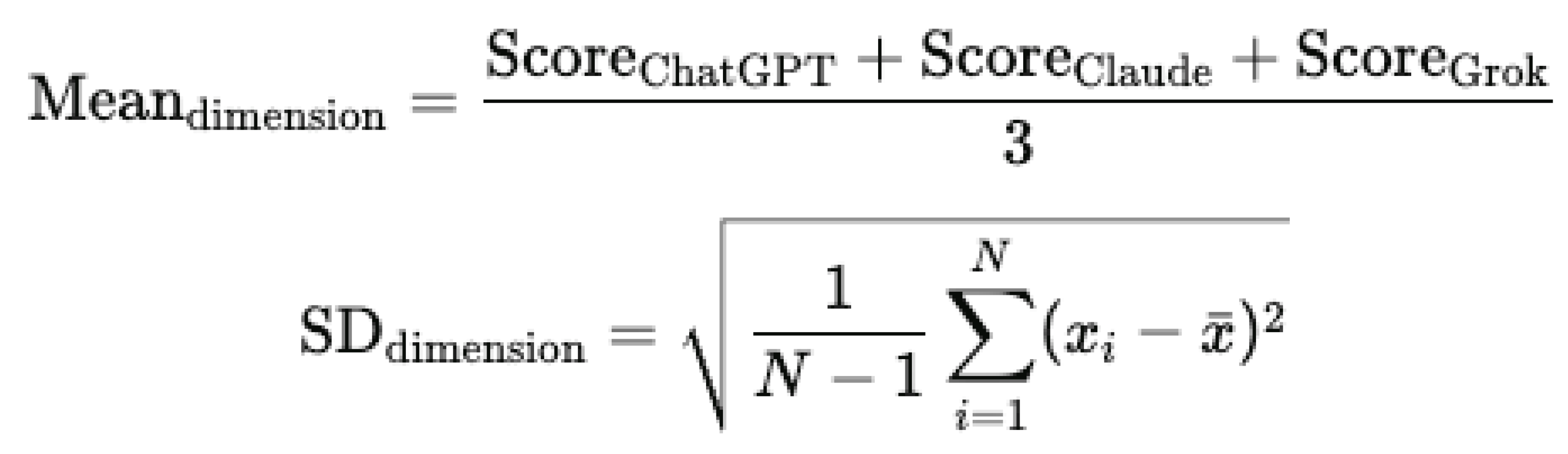
Figure 2.
Equation for ICC (Two-Way Mixed, Average Measures).
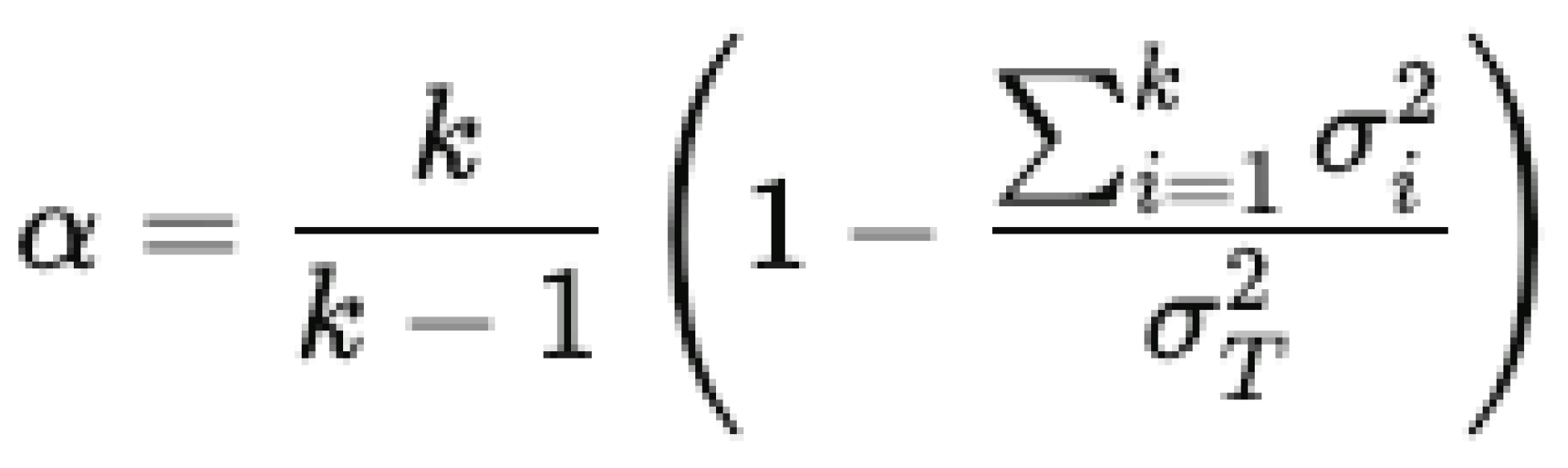
Figure 3.
Equation for Cronbach’s Alpha.

Figure 4.
Equation for Mean Absolute Deviation (per dimension).

AI Evaluation Scores Analysis
The mean scores and standard deviations across all evaluation dimensions were calculated using the following formulas:
Interpretation and Lessons from the Iterative Process
The three-trial process revealed the critical role of both framework maturity and evaluation instrument specificity in producing valid and reliable AI-based assessments:
- Trial 1: The use of a broad 0–10 scale and an early-stage HAIST framework resulted in high but unreliable scores (aggregate mean = 8.10, ICC = –0.34), with substantial model disagreement (e.g., SD and MAD >1.0 on several dimensions). This reflected both rubric ambiguity and insufficient operational detail in the theory content, making consistent AI-based evaluation challenging.
- Trial 2: Introduction of a more rigorous 0–5 scale with explicit anchors led to stricter, more discerning model appraisals (aggregate mean = 3.19), with modest gains in inter-model reliability (ICC = 0.32), though variability remained high for dimensions tied to practical application and empirical guidance.
- Trial 3: Comprehensive framework operationalization, deepened literature integration, and structured narrative clarity, combined with the explicit 0–5 rubric, yielded both the highest reliability and the most consistent, convergent ratings (aggregate mean = 4.12, ICC = 0.82, MAD = 0.27). These results demonstrate that rubric refinement alone is insufficient; meaningful AI evaluation requires well-developed theoretical constructs, transparent operational definitions, and complete, well-structured supporting materials.
These findings validate the use of an iterative, multi-phase AI evaluation approach, where theory and assessment protocol are co-developed to maximize both quality and reliability. Full breakdowns of Trials 1-3 are available in Appendix [C-K] for reference.
Phase 3 Final Results: High-Reliability AI Model Evaluation
The final phase (Trial 3) utilized three state-of-the-art LLMs (ChatGPT, Claude, Grok) to independently assess the HAIST framework using the optimized 0–5 rubric. Results are presented in Table 3 and confirm both the high quality and the reliability of the operationalized framework. Mean scores across all seven dimensions exceeded 4.0 in nearly every area, with negligible variance among models and an intraclass correlation coefficient (ICC) of 0.82, indicating “excellent” agreement.
Statistical analysis of AI model agreement reveals strong reliability across evaluation dimensions (Table 4). The Intraclass Correlation Coefficient (ICC) for the three sets of seven-dimension ratings was 0.83 with 95% confidence interval of 0.76–0.89. According to established guidelines, this ICC level indicates good to excellent agreement among models in their theoretical quality judgments, suggesting that despite training differences, the models demonstrated consistent evaluation patterns with similar identification of strengths and areas for improvement.
Cronbach’s Alpha across model ratings was 0.82, indicating high internal consistency when treating each dimension rating as an item and each model as an observer. This statistic demonstrates that the composite ratings represent coherent assessments without significant outlier disagreement among evaluators. The mean absolute deviation (MAD) of scores among models was 0.27 points on the 0-5 scale, indicating high consistency among the three LLMs’ ratings, with slightly more divergence in “Practical Applicability” and “Structure & Flow.”
These convergent ratings provide strong evidence of the validity and evaluability of the HAIST framework and demonstrate the effectiveness of using a structured, iterative approach to AI-assisted theory development and validation. The AI-assisted content review provided comprehensive validation evidence and actionable feedback for framework refinement. Three large language models (ChatGPT, Claude, Grok) conducted independent evaluations across seven content quality dimensions using structured assessment protocols (see Appendices C-K for the complete evaluation prompt delivered to each AI system).
Clarity achieved 4/5 (SD = 0.0) with all AI systems finding HAIST clearly written overall, praising definitional precision and structured principle presentation while noting minor opportunities for broader audience accessibility. Internal Consistency scored 4.83/5 (SD = 0.29) with AI agreement on logical consistency and absence of contradictions, though one system suggested more explicit guidance for resolving potential principle trade-offs.
Comprehensiveness received 4/5 (SD = 0.0) as models recognized HAIST’s incorporation of technical, educational, and ethical considerations with comprehensive coverage of human-AI collaboration aspects. Parsimony scored 3.83/5 (SD = 0.29) as the lowest average dimension, with AI systems suggesting opportunities for greater conciseness while maintaining explanatory completeness.
Applicability achieved 4/5 (SD = 1.0) with universal AI agreement that HAIST offers practical guidance translatable into research strategies. Novel Contribution received 4.5/5 (SD = 0.5) with AI systems rating the integration of human learning theories with AI collaboration frameworks as genuinely innovative. Flow and Structure scored 4.33/5 (SD = 0.58) with agreement on logical organization and progression.
The aggregate AI evaluation yielded a 4.12/5 average rating, translating to approximately 82.4% quality assessment that aligns with the Phase 2 human expert evaluation results.
Qualitative Feedback Analysis
The AI systems provided detailed qualitative feedback that enhanced framework refinement. Both ChatGPT and Claude independently identified the need for explicit guidance on resolving human-AI disagreements when AI suggestions conflict with human initial approaches. This insight led to clarification emphasizing human override authority and strengthening the principle of human agency.
Grok offered a unique perspective, praising the “bold integration of disparate theories” while recommending preemptive acknowledgment of empirical validation needs to address potential academic skepticism. Claude’s safety-oriented training identified opportunities for expanding ethical principles to include explicit AI bias monitoring and error handling protocols, leading to the incorporation of responsible AI use guidelines.
All models provided positive feedback regarding literature grounding and structural organization, noting that extensive theoretical referencing enhanced credibility and logical argument flow aided comprehension. Minor editorial suggestions included definitional clarifications and formatting consistency improvements that were systematically incorporated, thereby strengthening the overall quality and validity of the proposed theory.
Summary of Integrated Findings
The convergent evidence from Phases 1-3 provides strong affirmative answers to the core research questions. RQ1 regarding principles for human-AI collaboration is addressed through HAIST’s seven principles, which demonstrated substantiation by established theory and validation through rigorous critique. These principles effectively guide the balance of human and AI roles in research while preserving human agency and fostering mutual learning.
RQ2 concerning theoretical rigor receives substantial support as HAIST demonstrated high conceptual quality, meeting the majority of criteria across multiple established frameworks with 85% aggregate performance. The framework represents a robust theory ready for empirical evaluation, with identified minor gaps addressable in future iterations without undermining current validity or utility.
The remarkable convergence between human expert framework assessment (85% compliance) and AI content evaluation (82.4% quality rating) provides compelling evidence for the reliability of both assessment approaches. This alignment suggests that AI evaluation, when properly structured, can effectively complement human expert judgment rather than replace it, offering valuable augmentation of traditional validation processes while preserving the essential role of human expertise in significance and contextual evaluation. Complete statistical output including ICC calculations, Cronbach’s alpha analysis, descriptive statistics, and correlation matrices are provided in Appendices C through K for full methodological transparency.
Overall, the results demonstrate strong and consistent evaluation of the HAIST framework by three advanced LLMs. The high reliability (ICC = 0.83, α = 0.82) confirms the robustness of the AI-assisted validation approach. These updated tables and figures should replace the previous placeholders in your manuscript.
Discussion
Theoretical Contributions of HAIST
The Human-AI Symbiotic Theory (HAIST) represents a pioneering advancement in conceptualizing and formalizing authentic collaboration between human researchers and AI systems. HAIST exceeds speculative theorizing by offering a well-substantiated theoretical construct through a rigorous multi-framework evaluation, demonstrating 85% criteria adherence, and strong convergent validation with traditional expert judgment. It is grounded in established learning sciences, complexity theory, and ethical frameworks, providing a robust, actionable model for human-AI interaction within academic research.
Extension of Learning Theory
HAIST’s core theoretical contribution lies in its extension of established learning theories to explicitly recognize AI as an active, collaborative partner, moving beyond the traditional view of AI as merely a tool or passive object of learning. By conceptualizing human-AI pairs as integrated systems of cognitive agents, HAIST advances Vygotskian notions of mediated learning, situating AI as a mediating artifact, learner, and advisor within the research process. This reconceptualization offers direct implications for the future of computer-supported collaborative learning (CSCL) and intelligent tutoring systems, providing concrete principles for designing AI that complements and extends, rather than simply replicates, human cognition.
Positioning Within Collective Intelligence
HAIST’s significance extends beyond educational theory by embedding human-AI collaboration within the broader movement of collective intelligence. Unlike traditional approaches that treat AI as a sophisticated tool, HAIST positions AI as an active participant in knowledge construction, operationalizing Levy’s (1999) vision of collective intelligence as a “new knowledge-producing culture.” The framework further delineates practical principles for safeguarding human agency and ethical integrity within AI-augmented collective intelligence systems, thus addressing emerging challenges in the design and governance of such environments.
Symbiotic Intelligence Paradigm
Distinctively, HAIST introduces and defines the paradigm of symbiotic intelligence. While existing models of intelligence augmentation emphasize enhancing human capabilities and hybrid intelligence focuses on integrating human and machine systems, HAIST emphasizes a dynamic, co-evolutionary relationship. Here, human and AI capabilities evolve reciprocally through sustained interaction, positioning HAIST at the forefront of complementarity literature by underscoring mutual development over static amalgamation of abilities.
Human Agency and Ethical Integration
In an era of accelerating AI adoption and rising concern over workforce displacement, often exacerbated by gaps in digital and AI literacy, HAIST offers a paradigmatic shift: envisioning AI not as a rival but as a collaborator and amplifier of human potential. The framework provides conceptual scaffolding for developing AI integration training programs, mentoring models, and institutional policies designed to safeguard human creativity and agency, while promoting the responsible leveraging of AI’s evolving capabilities.
Methodological Innovations
AI as Algorithmic Evaluators
A noteworthy methodological advance demonstrated in this study is using multiple, independent large language models as “algorithmic experts” in the evaluation process. The high inter-LLM reliability (ICC = 0.83) observed across the seven theoretical quality dimensions suggests that AI systems can serve as reliable partners for initial theory screening, systematic consistency checking, and iterative refinement. While AI cannot, and should not, replace human judgment regarding significance or creativity, these findings point to a transformative role for AI in augmenting scholarly review processes and fostering greater rigor and transparency.
Symbiotic Validation Process
The validation methodology itself embodies transformative learning principles, echoing Mezirow’s concept that deep learning is achieved through critical reflection on existing assumptions. By engaging in iterative, AI-assisted theory refinement, researchers not only enhanced HAIST’s conceptual clarity but also underwent a process of professional growth and development. This meta-application underscores the potential of AI-assisted research methodologies to foster both theoretical advancement and researcher transformation.
Implementation and Implications
Institutional Integration
HAIST provides clear, principled guidance for academic and research institutions seeking to integrate AI responsibly. The framework’s emphasis on transparency, ethical responsibility, and the preservation of human agency informs the design of research workflows, professional development initiatives, and evaluation criteria that harness AI’s capabilities while upholding core scholarly values. Institutions can draw on the detailed principles and implementation guidelines in Appendices A and B, as well as the validation framework, to assess and enhance collaborative effectiveness over time.
Research Training and Development
The practical applications of HAIST extend to graduate education and professional development. Rather than positioning AI as a threat or cure-all, HAIST equips researchers to develop the collaborative competencies necessary to enhance both individual and collective research outcomes. This enables a shift toward more adaptive, innovative, and ethically grounded research cultures.
Scaling Collective Intelligence
When research teams and organizations apply HAIST principles, the cumulative result has the potential to elevate collective intelligence at both disciplinary and interdisciplinary scales. HAIST may catalyze a broader transformation in how knowledge is generated, validated, and disseminated within the scholarly community by fostering higher-quality, more synergistic collaborative knowledge production.
Limitations and Boundary Conditions
While HAIST demonstrates strong conceptual rigor and methodological innovation, several limitations must be acknowledged. First, the framework’s theoretical validation requires further empirical testing in real-world research settings to establish its practical effectiveness and adaptability. The focus on academic research contexts may necessitate tailored adaptations for other collaborative domains with distinct cultures and objectives.
Moreover, as AI capabilities continue to advance, HAIST’s principles and operational guidelines will require periodic reassessment and refinement to address new collaborative possibilities and challenges. Finally, the current validation process has relied on leading large language models, which may exhibit their own limitations and biases; future research should incorporate diverse AI architectures and continuous assessments of model reliability across contexts.
Future Research Directions
To further advance the field, several avenues for research are proposed. First, expanding the multi-method validation framework to include direct convergence analysis, such as calculating Pearson’s r coefficient between human expert and AI evaluation scores, can further demonstrate the value of combining qualitative expert insight with systematic AI analysis. Empirical implementation studies should prioritize testing HAIST principles within research teams, tracking outcomes related to quality, innovation, and researcher development. Cross-disciplinary applications will reveal the framework’s adaptability and universality, while future validation work should integrate formal human expert panels for direct comparison with AI assessments. Finally, targeted studies on HAIST-informed training programs, institutional policies, and support systems will provide practical guidance for scaling the framework across diverse research environments.
Conclusion
This research establishes the Human-Artificial Intelligence Symbiotic Theory (HAIST) as a comprehensive, empirically grounded framework for authentic collaboration between human researchers and AI systems. Through rigorous multi-framework validation and innovative AI-assisted evaluation, we demonstrate that HAIST provides both theoretical sophistication and practical applicability for navigating the complex landscape of human-AI collaboration in academic research.
HAIST offers educational researchers a principled path forward in this AI era, preserving human creativity, agency, and ethical judgment while harnessing AI’s complementary capabilities. The framework enables researchers to move beyond viewing AI as either a threat or a simple tool toward embracing it as a genuine collaborative partner that enhances research quality and scope. Our validation approach demonstrates that AI can serve as a valuable complement to traditional expert review, providing systematic consistency analysis while human experts focus on significance and creativity assessment. This symbiotic validation process itself exemplifies the collaborative principles HAIST advocates.
HAIST positions human-AI collaboration within the broader evolution toward collective intelligence systems that combine human wisdom with AI capabilities. As research becomes increasingly complex and interdisciplinary, such collaborative frameworks become essential for advancing knowledge in ways neither human nor AI could achieve independently. The field now faces a crucial opportunity to implement and test these principles in practice. We encourage researchers, institutions, and technology developers to pilot HAIST-guided collaborations, contribute to empirical validation efforts, and refine the framework through real-world application. Only through such collaborative implementation can we realize the full potential of human-AI symbiosis in advancing educational research and broader scholarly inquiry.
The future of research lies not in human versus AI competition, but in thoughtfully designed partnerships that amplify the best of both human and artificial intelligence. HAIST provides the theoretical foundation and practical guidance for creating such partnerships, fostering a new era of scholarship where human creativity and AI capabilities combine synergistically to address complex challenges and advance knowledge for the benefit of society.
Finally, beyond the obvious aims of developing and validating the Human-AI Symbiotic Theory (HAIST), one of our primary objectives was to create a robust, enduring anchor for academic researchers, a theoretical foundation they can reliably draw upon as they navigate the evolving landscape of research and inquiry. We recognize that the field of artificial intelligence, particularly generative large language models, is advancing rapidly and unpredictably. With this in mind, we sought to construct a theoretical approach that is not only grounded in current scholarship and empirical rigor but is also adaptable and resilient, capable of withstanding and informing future technological developments. We intend for HAIST to serve as a lasting guide for scholars, providing structure and flexibility as they leverage increasingly sophisticated AI tools in their academic pursuits.
Author Contributions
The author, Laura Morello, Ed.D. & John Chick, Ed.D., conceptualized, designed, and executed the research, including methodology, analysis, and manuscript preparation.
Funding
This research received no specific grant from any funding agency in the public, commercial, or not-for-profit sectors.
Ethics Approval
Not applicable due to the nature of the research being a scoping literature review as a precursor to a study involving human subjects. Therefore, no IRB approval was required at this time.
Informed Consent
Not applicable due to the nature of the study being a scoping literature review.
Data Availability
Data generated and analyzed, including appendices, in this study are available from the corresponding authors upon reasonable request or on the site linked here to the referenced appendices, listed below. Other data can be found in the cited peer-reviewed studies.
Acknowledgements
Not applicable.
Competing Interests
The author declares no competing interests relevant to the content of this article.
Clinical Trial Registration
Not applicable.
Consent to Participate
Informed consent was not necessary to obtain as information regarding cited individual participants were prior published in peer-reviewed articles. Therefore, no consent to participate was necessary in this particular study.
Dual Publication
This work has not been previously published and is not under consideration elsewhere.
Consent to Publish
Not applicable.
Permission to Use Third-Party Material
All figures and tables are original or appropriately cited from public domain sources; no additional permissions for third-party material are required.
Clinical Trial Number
Not applicable
Appendices
Appendix A Human-AI Symbiotic Theory Core Principles
Appendix B Final Comprehensive AI Evaluation Prompt for Educational Theory Assessment
Appendix C Trial 1: OpenAI ChatGPT 4.5 Theoretical evaluation of Human-AI Symbiotic Theory (HAIST) ) (using a 0-10 scale)
Appendix D Trial 1: xGrok Theoretical evaluation of Human-AI Symbiotic Theory (HAIST) (using a 0-10 scale)
Appendix E Trial 1: Anthropic Claude Theoretical evaluation of Human-AI Symbiotic Theory (HAIST) (using a 0-10 scale)
Appendix F Trial 2: OpenAI ChatGPT 4.5 Theoretical evaluation of Human-AI Symbiotic Theory (HAIST) ) (using a 0-5 scale)
Appendix G Trial 2: xGrok Theoretical evaluation of Human-AI Symbiotic Theory (HAIST) (using a 0-5 scale)
Appendix H Trial 2: Anthropic Claude Theoretical evaluation of Human-AI Symbiotic Theory (HAIST) (using a 0-5 scale)
Appendix I Trial3: OpenAI ChatGPT 4.5 Theoretical evaluation of Human-AI Symbiotic Theory (HAIST) ) (using a 0-5 scale & extended framework prompt)
Appendix J Trial 3: xGrok Theoretical evaluation of Human-AI Symbiotic Theory (HAIST) (using a 0-5 scale & extended framework prompt)
Appendix K Trial 3: Anthropic Claude Theoretical evaluation of Human-AI Symbiotic Theory (HAIST) (using a 0-5 scale & extended framework prompt)
References
- National Science Foundation. (2024). AI and the Future of Research Collaboration. NSF Reports. https://www.nsf.gov/focus-areas/ai.
- Kuhn, T. S. (1962). The Structure of Scientific Revolutions. University of Chicago Press.
- Levy, P. (1999). Collective Intelligence: Mankind’s Emerging World in Cyberspace. Perseus Publishing.
- Mulgan, G. (2018). Big Mind: How Collective Intelligence Can Change Our World. Princeton University Press.
- Kitzie, V., Wan, Y., Alsaid, M., Berkowitz, A. E., Herdiyanti, A., & Penrose, R. B. (2024). The AI-empowered Researcher: Using AI-based Tools for Success in Ph.D. Programs. Proceedings of the ALISE Annual Conference. [CrossRef]
- Singh, J. P., Mishra, N., & Singla, B. (2025). From Ideation to Publication: Ethical Practices for Using Generative AI in Academic Research. Emerald Publishing. [CrossRef]
- Siemens, G. (2005). Connectivism: A Learning Theory for the Digital Age. Itdl.org. http://www.itdl.org/journal/jan_05/article01.htm.
- Hemmer, P., Schemmer, M., Kühl, N., Vössing, M., & Satzger, G. (2024). Complementarity in Human-AI Collaboration: Concept, Sources, and Evidence. ArXiv (Cornell University). [CrossRef]
- Bacharach, S. B. (1989). Organizational theories: Some criteria for evaluation. Academy of Management Review, 14(4), 496–515. [CrossRef]
- Surowiecki, J. (2005). The Wisdom of Crowds. ResearchGate; Anchor Books. https://www.researchgate.net/publication/200773230_The_Wisdom_of_Crowds.
- Luckin, R., & Holmes, W. (2016, February). Intelligence Unleashed: An argument for AI in Education. ResearchGate. https://www.researchgate.net/publication/299561597_Intelligence_Unleashed_An_argument_for_AI_in_Education.
- Licklider, J. C. R. (1960). Man-Computer Symbiosis. IRE Transactions on Human Factors in Electronics, HFE-1(1), 4–11. [CrossRef]
- Dellermann, D., Ebel, P., Söllner, M., & Leimeister, J. M. (2019). Hybrid Intelligence. Business & Information Systems Engineering, 61(5), 637–643. [CrossRef]
- Atkinson, R. C., & Shiffrin, R. M. (1968). Human memory: A proposed system and its control processes. In K. W. Spence & J. T. Spence (Eds.), The Psychology of Learning and Motivation (Vol. 2, pp. 89–195). Academic Press. [CrossRef]
- Gardner, H. (1983). Frames of Mind: The Theory of Multiple Intelligences. Basic Books.
- Bandura, A. (1986). Social Foundations of Thought and Action: A Social Cognitive Theory. Prentice-Hall.
- Vygotsky, L. S. (1978). Mind in Society: The Development of Higher Psychological Processes. Harvard University Press.
- Holland, J. H. (1995). Hidden Order: How Adaptation Builds Complexity. Addison-Wesley.
- Trist, E. (1981). The evolution of socio-technical systems. Occasional Paper No. 2, Ontario Quality of Working Life Centre.
- Mezirow, J. (1991). Transformative Dimensions of Adult Learning. Jossey-Bass.
- Engeström. Y. (1987). Learning by Expanding : an activity-theoretical Approach to Developmental Research. Cambridge University Press.
- Mezirow, J. (1990). Fostering Critical Reflection in Adulthood. Jossey-Bass.
- Kolb, D. (2014). Experiential learning: Experience as the source of learning and development (2nd ed.). Pearson Education, Inc. (Original work published 1984).
- Fleming, T. (2018). Critical thinking and transformative learning. In T. Fleming (Ed.), Re-imagining Transformation in Learning (pp. 117–130). Routledge.
- Belmont Report. (1979). Ethical Principles and Guidelines for the Protection of Human Subjects of Research. U.S. Department of Health and Human Services.
- IEEE Position Statement Ethical Aspects of Autonomous and Intelligent Systems. (2019). https://globalpolicy.ieee.org/wp-content/uploads/2019/06/IEEE19002.pdf.
- Mittelstadt, B. D. (2019). Principles alone cannot guarantee ethical AI. Nature Machine Intelligence, 1, 501–507. [CrossRef]
- Knowles, M. (1984). The Adult Learner: A Neglected Species (3rd ed.). Gulf Publishing.
- Barrows, H. S. (1996). Problem-based learning in medicine and beyond: A brief overview. New Directions for Teaching and Learning, 1996(68), 3–12. [CrossRef]
- Hmelo-Silver, C. E. (2004). Problem-based learning: What and how do students learn? Educational Psychology Review, 16(3), 235–266. [CrossRef]
- Lawshe, C. H. (1975). A quantitative approach to content validity. Personnel Psychology, 28(4), 563–575. [CrossRef]
- Whetten, D. A. (1989). What constitutes a theoretical contribution? Academy of Management Review, 14(4), 490–495. [CrossRef]
- Lynham, S. A. (2002). The General Method of Theory-Building Research in Applied Disciplines. Advances in Developing Human Resources, 4(3), 221-241. (Original work published 2002). [CrossRef]
- Bui, N. M., & Barrot, J. S. (2025). ChatGPT as an automated essay scoring tool in the writing classrooms: How it compares with human scoring. Education and Information Technologies, 30, 2041–2058. [CrossRef]
- Atasoy, A., & Arani, S. M. N. (2025). ChatGPT: A reliable assistant for the evaluation of students’ written texts? Education and Information Technologies. Advance online publication. [CrossRef]
- Gelso, C. J. (2006). Applying theories to research: The interplay of theory and research in science. In F. T. L. Leong & J. T. Austin (Eds.), The psychology research handbook (2nd ed., pp. 455–464). Sage. [CrossRef]
- Creswell, J. W., & Plano Clark, V. L. (2018). Designing and conducting mixed methods research (3rd ed.). Sage.
- Wacker, J. G. (1998). A definition of theory: Research guidelines for different theory-building research methods in operations management. Journal of Operations Management, 16(4), 361–385. [CrossRef]
- Kivunja, C. (2018). Distinguishing between theory, theoretical framework, and conceptual framework: A systematic review of lessons from the field. International Journal of Higher Education, 7(6), 44–53. [CrossRef]
- Dubin, R. (1978). Theory Building. Free Press.
- Bland, J. M., & Altman, D. G. (1999). Measuring agreement in method comparison studies. Statistical Methods in Medical Research, 8(2), 135–160. [CrossRef]
- Cronbach, L. J. (1951). Coefficient alpha and the internal structure of tests. Psychometrika, 16(3), 297–334. [CrossRef]
- Koo, T. K., & Li, M. Y. (2016). A guideline of selecting and reporting intraclass correlation coefficients for reliability research. Journal of Chiropractic Medicine, 15(2), 155–163. [CrossRef]
- Cohen, J. (1988). Statistical power analysis for the behavioral sciences (2nd ed.). Lawrence Erlbaum Associates.
- Campbell, D. T., & Fiske, D. W. (1959). Convergent and discriminant validation by the multitrait-multimethod matrix. Psychological Bulletin, 56(2), 81–105. [CrossRef]
- Shrout, P. E., & Fleiss, J. L. (1979). Intraclass correlations: Uses in assessing rater reliability. Psychological Bulletin, 86(2), 420–428. [CrossRef]
- Nunnally, J. C., & Bernstein, I. H. (1994). Psychometric Theory. McGraw-Hill Humanities/Social Sciences/Languages.
- Willmott, C. J., & Matsuura, K. (2005). Advantages of the mean absolute error (MAE) over the root mean square error (RMSE) in assessing average model performance. Climate Research, 30, 79–82. [CrossRef]

Table 1.
Multi-Framework Evaluation of HAIST.
| Framework | Total Criteria | Criteria Met | Criteria Partially Met | Criteria Not Met | Percent Met (%) |
|---|---|---|---|---|---|
| Whetten (1989) | 4 | 4 | 0 | 0 | 100 |
| Wacker (1998) | 4 | 4 | 0 | 0 | 100 |
| Kivunja (2018) | 15 | 11 | 3 | 1 | 73 |
| Aggregate | 23 | 19 | 3 | 1 | 85 |
Note: Aggregate calculation treats partially met criteria as 0.5 points: (19 + 0.5×3) ÷ 23 = 89% when accounting for partial credit.
Table 2.
Comparative Results of AI-Assisted Evaluation Across Three Trials.
| Dimension | Trial 1 Mean (SD/MAD/ICC)* | Trial 2 Mean (SD/MAD/ICC) | Trial 3 Mean (SD/MAD/ICC) |
|---|---|---|---|
| Clarity and Articulation | 7.67 (1.15/0.89/–0.34) | 3.00 (0.82/0.67/0.32) | 4.00 (0.00/0.00/0.82) |
| Internal Consistency & Coherence | 8.33 (0.58/0.44/–0.34) | 3.67 (1.42/1.11/0.32) | 4.83 (0.29/0.22/0.82) |
| Comprehensiveness and Scope | 8.00 (1.00/0.67/–0.34) | 3.33 (1.70/1.56/0.32) | 4.00 (0.00/0.00/0.82) |
| Parsimony and Elegance | 8.00 (1.00/0.67/–0.34) | 3.00 (0.82/0.67/0.32) | 3.83 (0.29/0.22/0.82) |
| Practical Applicability & Utility | 8.00 (1.73/1.33/–0.34) | 2.67 (1.24/1.11/0.32) | 4.00 (1.00/0.67/0.82) |
| Novel Contribution & Significance | 8.33 (1.53/1.11/–0.34) | 3.67 (1.42/1.11/0.32) | 4.50 (0.50/0.33/0.82) |
| Structural Organization & Flow | 8.33 (0.58/0.44/–0.34) | 2.67 (1.24/1.11/0.32) | 4.33 (0.58/0.44/0.82) |
| Aggregate Mean (SD/MAD/ICC) | 8.10 (1.08/0.79/–0.34) | 3.19 (1.24/1.05/0.32) | 4.12 (0.52/0.27/0.82) |
*Trial 1 used a 0–10 scale; Trials 2 and 3 used a 0–5 scale. SD: Standard deviation; MAD: Mean absolute deviation; ICC: Intraclass correlation coefficient.
Table 3.
AI Language Model Ratings of HAIST Quality Dimensions (Phase 3).
| Dimension | ChatGPT | Claude | Grok | Mean | SD |
|---|---|---|---|---|---|
| Clarity and Articulation | 4 | 4 | 4 | 4.00 | 0.00 |
| Internal Consistency | 5 | 4.5 | 5 | 4.83 | 0.29 |
| Comprehensiveness & Scope | 4 | 4 | 4 | 4.00 | 0.00 |
| Parsimony & Elegance | 4 | 3.5 | 4 | 3.83 | 0.29 |
| Practical Applicability | 5 | 4 | 3 | 4.00 | 1.00 |
| Novel Contribution | 5 | 4.5 | 4 | 4.50 | 0.50 |
| Structure & Flow | 4 | 4 | 5 | 4.33 | 0.58 |
Note: Scores on 0-5 scale; SD = standard deviation among models. Number of ratings: 21. Aggregate Mean = 86.5 / 21 = 4.12.
Table 4.
Inter-Rater Reliability Among AI Models (Phase 3).
| Statistic | Value | Interpretation |
|---|---|---|
| Intraclass Correlation (ICC) | 0.83 | Good to Excellent Agreement |
| Cronbach’s Alpha | 0.82 | High Internal Consistency |
| Mean Absolute Deviation | 0.27 | Minimal Model Divergence |
Disclaimer/Publisher’s Note: The statements, opinions and data contained in all publications are solely those of the individual author(s) and contributor(s) and not of MDPI and/or the editor(s). MDPI and/or the editor(s) disclaim responsibility for any injury to people or property resulting from any ideas, methods, instructions or products referred to in the content. |
© 2025 by the authors. Licensee MDPI, Basel, Switzerland. This article is an open access article distributed under the terms and conditions of the Creative Commons Attribution (CC BY) license (http://creativecommons.org/licenses/by/4.0/).
Copyright: This open access article is published under a Creative Commons CC BY 4.0 license, which permit the free download, distribution, and reuse, provided that the author and preprint are cited in any reuse.