

Submitted:
27 July 2025
Posted:
29 July 2025
You are already at the latest version
Abstract
Contemporary society is experiencing a surge in physical, mental, and spiritual ailments, attributable to factors such as irregular lifestyles, diminished consumption of natural foods and herbs, and reduced interaction with the natural world. Concurrently, humanity faces formidable global challenges, such as environmental degradation, owing to narrow-minded materialistic mindset, intolerance, excessive exploitation of natural resources, deforestation, etc. In contrast, such issues were not generally seen in the ancient Indian culture, as it was characterized by profound empathy for all living beings. To make this ethos an integral part of the culture, the ancient Indian sages instituted various practices within the social framework, of which an important one was - festivals. Festivals not only fostered conviviality and collectivity in life, but also instilled idealism and cultivated empathy towards nature and all sentient beings. Therefore, comprehension of the epistemology (philosophy and science) of festivals may offer avenues for resolving contemporary individual and global predicaments. In this vein, the present research paper elucidates the epistemology (philosophy and science) of 'Avala Navami', a festival characterized by the veneration/worship of the Avala tree. The ritualistic worship entails profound inspirations, such as recognizing the importance of enhancing greenery and committing to its preservation; consuming medicinal herbs for better health; and, engaging in cooperative and joyful worship. Furthermore, the pivotal role of women (imbued with heightened empathy), in the protection and enrichment of nature, has resonated with scholars of contemporary cultural ecofeminism. Thus, proper understanding and assimilation of the epistemology (philosophy and science) of 'Avala Navami' can potentially contribute to the mitigation of various challenges.
Keywords:
Avala Navami
; Indian culture
; festival
; environment conservation
; holistic health
; cultural ecofeminism
Introduction
Contemporary society is experiencing a surge in physical, mental, and spiritual ailments, attributable to factors such as irregular lifestyles, diminished consumption of natural foods and herbs, and reduced interaction with the natural world [1,2]. Concurrently, humanity faces formidable global challenges, such as environmental degradation, owing to narrow-minded materialistic mindset, intolerance, excessive exploitation of natural resources, deforestation, etc. [1,2]. Although various efforts are underway to alleviate these challenges, their escalating severity suggests that these efforts are not entirely effective, necessitating the exploration of alternative approaches.
In ancient Indian culture, wherein the human society was characterized by a profound emotional sensitivity for all living beings, such issues were not observed [1,2]. Individuals were imbued with the spirit of perceiving oneself in all beings, and embracing the world as one family [1,2]. In order to make this sentiment a part of Indian Culture, the ancient Indian sages had incorporated several practices in the society, one of which is festivals [3]. Festivals not only infused joy and collectiveness in life, but also inspired individuals to embrace idealism, and cultivate empathy and emotional sensitivity towards nature and all living beings [3]. This is why, in ancient times, the conditions of manifestation of divinity in human beings and the descent of heaven on earth were evident [3].
The sages also realized that it was not easy for the common people to understand the deep philosophical tenets of spirituality and integrate them in their daily life for self-elevation [3]. They proposed a simplified method - conveying this deep subtle philosophical knowledge to the general public in a simplified manner through religious narratives and stories, and entertaining religious rituals [3]. These narratives and rituals were established by them in a practical form as festivals, which are still an integral part of Indian Culture, and are playing a significant role in providing progressive guidance to individuals, families, and society [3].
The primary objectives behind the establishment of festivals can be understood as follows [3]:
* Create awareness among general public regarding living an idealistic life.
* Unite them for superior goals.
* Developing goodwill among them.
* Developing them as well-cultured, competent, and civilized citizens.
* Making them aware of their duties towards the society (developing genuine social consciousness).
* Collective recreation, joyous celebration, and for acquiring fresh inspirations.
* Fostering social celebration during change of the season or the arrival of new harvests.
* Commemorating a great personality or a significant national event, and drawing inspiration from it.
The essence of all the aforementioned objectives is to inspire everyone for righteous self-development and establish social harmony, which is also a crucial need of the present times. Therefore, even in the present times, solutions to various personal and global problems can be found by understanding the philosophy and science of festivals. In this spirit, the present research paper discusses the philosophy and science of 'Avala Navami'.
2. Avala Navami
'Avala Navami' is celebrated on Shukla Paksha’s Navami of Kartik month (the ninth day of the waxing phase of the moon in the month of Kartik). It involves the worship of the Avala tree. The procedure of worship reveals that it embodies various noble inspirations, such as the promotion of greenery (worshiping the Avala tree, circumambulating it, embracing it); the promotion of health through the consumption of medicinal herbs (eating raw Avala - its medicinal properties are described in reference [4]), and the utilization of turmeric, puffed rice, etc.; and worshipping collectively in a collaborative and harmonious manner. This worship is performed by women, signifying that just as nature is imbued with sensitivity, women also possess a profusion of emotional sensitivity, and are thus better equipped to play a crucial role in the conservation and augmentation of nature - a sentiment that has also been experienced by researchers of cultural ecofeminism [5] in the present era. The philosophy and science of 'Avala Navami' are described as follows.
2.1. Procedure for Ritualistic Worship
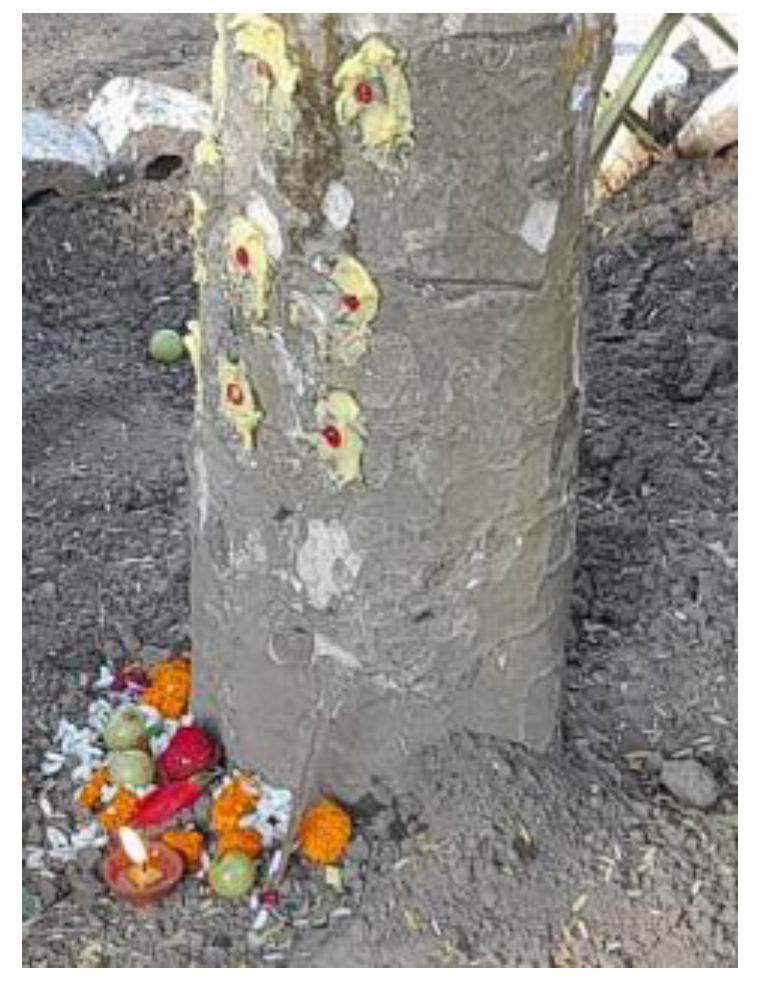
'Avala Navami' involves the ritualistic worship of the Indian gooseberry (Avala) tree. The ritualistic process employs various items, including turmeric, roli (red powder), unbroken rice grains, ubatan (a paste of flour and turmeric), puffed rice, Indian gooseberries, a lamp, incense sticks, flowers, water, and raw cotton thread, etc. The ubatan is prepared by dissolving flour and turmeric in water. During the worship sequence, the ubatan is applied to the trunk of the tree in several places; it is worshipped with roli (sacred red powder), unbroken rice grains, flowers, water, and puffed rice; next, aarti is performed with the lamp. Subsequently, several circumambulations of the gooseberry (avala) tree are undertaken, while raw cotton thread is wound around it. Following this, the Indian gooseberry tree is embraced. Then, the participants sit and consume raw Indian gooseberries (avala).
Figure 1.
Worship of the Indian Gooseberry Tree.
2.2. Pious Inspirations Associated with the Process of Worship
The method of worship in 'Avala Navami' contains several sublime pious inspirations.
2.2.1. Philosophical / Spiritual Aspect of Worship
Within Indian culture, a fundamental purpose of worship is to contemplate upon the ideals and principles of the living being or the object being worshipped, and subsequently receive the inspiration to adopt those ideals/principles into one's life, thereby enabling the cultivation of an idealistic and excellent personality through their adherence [3]. In this context, on the occasion of Avala Navami, one can reflect on the idealistic sentiments of this tree, which include: having the feelings of offering something superior to everyone selflessly, and without discrimination, at all times; providing shade, medicinal fruits, medicinal bark, clean air, etc., to those who come in contact with it. During the process of worship, while expressing gratitude for these sentiments, inspiration can be received to make these ideals an integral part of one's life.
2.2.2. Inspiration for the Promotion of Greenery
In the present era, when out of sheer selfishness, an excessive number of trees and plants are being cut, and as a result, the dire problem of environmental imbalance confronts the entire sentient world, the Indian Culture, through festivals such as 'Avala Navami', presents a practical solution. The worship of the Indian gooseberry tree is inextricably linked with this festival,. During the worship, water is offered to the tree, which directly inspires the promotion of greenery. Furthermore, the practices of circumambulating the Avala tree, and while doing so tying raw thread around it, and subsequently embracing it, serve to enlighten the populace regarding the specialties of trees, make them remember their contributions to all living beings, encourage their integration into our lives as our close friends, and foster a commitment to their preservation. In this manner, by directing the compassionate spiritual sentiments of the community towards a superior constructive direction, this festival plays a significant role in attaining the special objective of conservation and promotion of greenery.
2.2.3. Preservation of Medicinal Trees/Plants
According to Ayurveda, the Indian gooseberry (Avala) is an extremely beneficial medicinal plant [4,6,7,8]. Its botanical name is Emblica officinalis [4(pg.49-54),6–8]. It stimulates digestive fire, helps with digestion, and harmonizes the three doshas (Vata, Pitta, and Kapha); therefore, it is highly efficacious in addressing a spectrum of ailments, including bleeding disorders, hyperacidity, liver dysfunction, etc. [4(pg.49-54),6–8]. Through its worship during 'Avala Navami,' common people have been made aware regarding the conservation of this therapeutic tree. When the people engage in its ritualistic worship, they are intrinsically motivated to protect it. It appears that several facets of the worship procedure are specifically designed to inspire its conservation, such as:
- Offering different types of food items and water – signifying the intent to nourish the tree.
- Circumambulating it – taking a pledge to have a long sustained relationship with it; creating a protective barrier around it.
- Tying raw cotton thread around it – the raw cotton thread symbolizes a protective bond (raksha sootra) [9(Page 42)], and as per Indian culture, by tying a protective thread (raksha sootra), an assurance of protection is given, as well as an assurance of getting protected is also received in return.
- Embracing it – acknowledging it as a friend and companion; when someone is considered a true friend, the notion of causing harm to him (felling the tree) is unthinkable.
All the above ritualistic procedures and the auspicious inspirations inherent therein reveal that the public has been enlightened regarding the special attributes of this medicinal tree, and motivated to get pledged for its conservation.
2.2.4. Consumption of Medicinal Herbs for the Betterment of Health
Avala is an extremely valuable medicinal herb, beneficial in the treatment of various diseases. As part of the 'Avala Navami' worship ritual, raw Avala is consumed while sitting near the Avala tree. This practice encourages the masses to consume this herbal medicine, thereby naturally preventing and mitigating various ailments, and promoting overall health and well-being. At the same time, it also provides an inspiration to live a natural life, and maintain good health by residing in proximity to nature. Another important inspiration inherent in this worship procedure is that in the event of any ailment, instead of using various types of synthetic medicines, consumption of natural medicines can lead to prompt attainment of health and vitality.
2.2.5. Motivation for Using Other Worship Materials and Domestic Natural Substances
The worship incorporates the use of ubatan (paste of gram flour containing turmeric), puffed rice, flowers, lamp, incense, consecrated food offerings, and other elements – the inspirations inherent within these are as follows:
- Turmeric Ubatan (paste of gram flour containing turmeric) – Ubatan, with turmeric mixed in it, is an extremely beneficial natural mixture for physical hygiene and good health. The medicinal properties of turmeric have been known since ancient times; therefore, within Indian Culture, it is essentially utilized in all the religious practices, and is used in food as well.
- Puffed Rice – This is a nutritious, easily digestible natural food; this festival encourages the public to use it.
- Flower - It embodies the inspiration to lead a joyful, lighthearted existence; radiating spiritual beauty and fragrance in all directions.
- Lamp - It symbolizes the eradication of darkness of ignorance from life, and the establishment of righteous knowledge; spreading the light of righteous knowledge everywhere.
- Incense - It represents the widespread propagation of medicinal fumes and divine fragrance.
- Offering sweets: It signifies the infusion of sweetness in life; embodying gentleness in conduct, thoughts, behavior, and speech; another special inspiration associated with it is the allocation of a part of our time, effort, skills, and resources, on a regular basis, towards the establishment of righteous excellence in the world.
2.2.6. Worshipping Collectively with Cooperation And Harmony
The worship procedure of 'Avala Navami' is done together by several women, while sitting under a tree. They gather with their respective worship materials, and collectively perform the rituals in a joyous environment. Thus, this practice includes the inspirations for mutual cooperation, collaborative action, creating a harmonious environment and getting collectively pledged and dedicated for the conservation of nature. The creation of a civilized, well-cultured, cooperative and united society is an extremely important need of the present times; this festival provides distinct inspiration and practical guidance in this regard.
2.2.7. Cultural Ecofeminism
This worship ritual is primarily done by women, and it has an inherent pledge of conservation of nature / trees, as well as following a natural lifestyle. According to Indian philosophy, this fact points at a very deep similarity - nature serves as the mother of all living beings, nurturing, protecting, and fostering them with utmost compassion; similarly, within the human society, women are the progenitors, nurturers, protectors, and enrichers of the new generation. She is a live embodiment of emotional sensitivity. Therefore, just as nature is imbued with sensitivity, women are also known to possess a plenitude of emotional sensitivity. Because of this similarity, women can much deeply understand the necessity of conservation of nature/trees, and can contribute in this direction with extremely firm resolve. They have the capacity to play a pivotal role in connecting with nature, preserving it, and growing it further. The ancient philosophers of Indian Culture must have known this unique capability of women, because of which they would have created the tradition of celebration of this festival primarily by women. The contemporary scholars of cultural ecofeminism have also realized these sentiments and capabilities [5,10–16].
3. Conclusion
Ancient Indian sages introduced various methodologies within the cultural landscape to foster divinity within human beings and create conditions for the descent of heaven on earth; one such important methodology was the celebration of festivals. Therefore, the current research paper explores the philosophy and science associated with the festival of 'Avala Navami'. ‘Avala Navami’ is celebrated on the ninth day of the Shukla Paksha (bright lunar fortnight) of the Kartik month. It primarily involves the worship of the Avala tree. The worship rituals reveal that various righteous inspirations are embedded in it, such as - embodying the spirit of a medicinal tree, selflessly and impartially imparting righteous values to everyone, each and every moment; promoting greenery (worshipping the Avala tree, circumambulating it, embracing it); consuming medicinal herbs for health enhancement (eating raw Avala); fostering cooperative and harmonious collective worship; and comprehending the crucial role of women in protecting and nurturing the Nature. Therefore, it can be understood that knowing the philosophical and scientific dimensions of festivals, even in the present times, can illuminate pathways to resolving individual and global challenges.
Acknowledgements
Gratitude is extended to our spiritual guide, Revered Gurudev Pandit Shriram Sharma Acharya (http://www.awgp.org/about_us/patron_founder), whose subtle guidance facilitated the completion of this work. This paper is an English translation and an upgraded version of the published article: Mishra S, Mishra A. आँवला नवमी (भारतीय संस्कृति का पर्व) का ज्ञान विज्ञान - व्यक्तिगत एवं वैश्विक समस्याओं के समाधान की दृष्टि से. Dev Sanskriti International Journal of Hindu Studies. 2025;1(1):32-34. (Accessed on: 27 July 2025). (Available from: https://www.dsvv.ac.in/downloads/DSIJHS_Vol_1_Issue_1_2025_5%20(1).pdf )
Conflicts of Interest
The authors declare no conflict of interest pertaining to this research paper.
References
- Sharma, S. Parivartan Ke Mahan Kshan (Hindi). Gayatri Tapobhoomi , Mathura, India: Yug Nirman Yojana. (Accessed: 30 January 2024) (Available from: http://literature.awgp.org/book/The_Great_Momentsof_Change/v1.1 ).
- Sharma, S. The Great Moments of Change. Haridwar, Uttarakhand, India: Shantikunj. (Accessed on: 30 January 2024). (Available from: http://literature.awgp.org/book/The_Great_Momentsof_Change/v2.2 ).
- Brahmavarchas (Editor). Bharatiya Sanskriti Ke Adharbhoot Tatva – Pandit Shriram Sharma Acharya Vangamaya 34. Second Edition (Hindi). Mathura, Uttar Pradesh, India: Akhand Jyoti Sansthan; 1998. pp. 3.106-3.114.
- Brahmavarchas. Jadi-Bootiyon Dwara Swasthya Sanrakshan (Hindi). (Accessed: 30 January 2024) (Available from: http://literature.awgp.org/book/Jadi_Butiyon_Dwara_Swasthya_Sanrakshan/v1.1 ).
- Miles, K. Ecofeminism - sociology and environmentalism. (Accessed on: 30 January 2024). ( Available from: https://www.britannica.com/topic/ecofeminism ).
- Murthy KRS. Bhavaprakasa of bhavamisra. volume 1 - including nighantu portion. Varanasi, Uttar Pradesh, India: Chowkhamba Krishnadas Academy; 2016.
- Sharma, PV. Charaka-samhita (text with English translation). volume I, II. Varanasi, Uttar Pradesh, India: Chaukhambha Orientalia; 2008.
- Murthy KRS. Susruta samhita - Vol. I, II, III. Varanasi, Uttar Pradesh, India: Chaukhambha Orientalia; 2008.
- Sharma, S. Karmakand Bhaskar (Sanskar Prakaran) (Hindi). Mathura, Uttar Pradesh, India: Yug Nirman Yojana Vistar Trust, Gayatri Tapobhoomi; 2015. (Accessed on 12 March 2025). ( Available online from - http://literature.awgp.org/book/kram_kand_bhaskar/v1.1 ).
- Güngör Tekbaş, R. Understanding how kurdish women are transferring agricultural knowledge about local seeds to the next generations from ecofeminist perspective: a case study of doski cucumber. Thesis (M.S.), Graduate School of Social Sciences, Gender and Women’s Studies. Middle East Technical University, Ankara, Türkiye; 2020. (Accessed on 12 March 2025). ( Available online from: https://open.metu.edu.tr/handle/11511/46150 ).
- Ottuh, P. A critique of eco-feminism: an attempt towards environmental solution. International Journal of Environmental Pollution and Environmental Modelling. 2020;3(4):167-179. (Accessed on 12 March 2025). ( Available online from: https://dergipark.org.tr/en/pub/ijepem/issue/56605/850784 ; https://dergipark.org.tr/en/download/article-file/1479614 ).
- Chauhan, MI. Ecofeminism: Intersections of Environment and Gender in Sustainable. In "Science, Technology and Society: A Global Perspective". Yelpale A (Editor). Pune, Maharashtra, India: Fern International Publication; 2023. pp. 12-17. ISBN: 978-81-967172-3-0. (Accessed on 12 March 2025). ( Available Online from: https://jkpub.in/wp-content/uploads/2024/05/978-81-967172-3-0.pdf#page=18 ) ( Article DOI Link: https://zenodo.org/records/10560349. 1056. [Google Scholar] [CrossRef]
- Lorentzen LA and Eaton, H. Ecofeminism: an overview. (Accessed on 12 March 2025). ( Available Online from: https://skat.ihmc.us/rid=1174588237625_665601541_9501/ecofeminism.pdf ).
- Natalia, DP. Spiritual Ecofeminism: "Healing the Earth" with Starhawk’s Work. Thesis: Máster en Estudios Ingleses Avanzados y sus Aplicaciones, Facultad de Filología, Universidade da Coruña, Spain (Master in Advanced English Studies and its Applications, Faculty of Philology, University of A Coruña, Spain); 2023. (Accessed on 12 March 2025). ( Available Online from: https://ruc.udc.es/dspace/handle/2183/34224 ; https://ruc.udc.es/dspace/bitstream/handle/2183/34224/Doldan_Pan_Natalia_2023_Spiritual_ecofeminism.pdf?sequence=2&isAllowed=y ).
- Chen, L. Ecological Criticism Based on Social Gender: The Basic Principles of Ecofeminism. Higher Education of Social Science. 2014;7(1):67-72. DOI: http://dx.doi.org/10.3968/4895. (Accessed on 12 March 2025). ( Available online from: http://www.cscanada.net/index.php/hess/article/view/4895 ; https://citeseerx.ist.psu.edu/document?repid=rep1&type=pdf&doi=d4b2ad534a8bc233790c2af60a48a416b9c55dca ).
- Tomalin, E. Religion, Gender and the Environment in Asia: Moving Beyond the Essentialisms of Spiritual Ecofeminism?. Chapter 12. pp. 211-226. In: Gender and Natural Resource Management: Livelihoods, Mobility and Interventions. Resurreccion BP and Elmhirst R (Editors). London, UK: Earthscan; 2008. ISBN-13: 978-1-84407-580-5. (ISBN e-book published by IDRC: 978-1-55250-398-0). (Accessed on 12 March 2025). ( Available online from: https://citeseerx.ist.psu.edu/document?repid=rep1&type=pdf&doi=c0c439cd79cb60b8a239a48256f1afd676690347#page=211 ).
Disclaimer/Publisher’s Note: The statements, opinions and data contained in all publications are solely those of the individual author(s) and contributor(s) and not of MDPI and/or the editor(s). MDPI and/or the editor(s) disclaim responsibility for any injury to people or property resulting from any ideas, methods, instructions or products referred to in the content. |
© 2025 by the authors. Licensee MDPI, Basel, Switzerland. This article is an open access article distributed under the terms and conditions of the Creative Commons Attribution (CC BY) license (http://creativecommons.org/licenses/by/4.0/).
Copyright: This open access article is published under a Creative Commons CC BY 4.0 license, which permit the free download, distribution, and reuse, provided that the author and preprint are cited in any reuse.


