

Submitted:
23 July 2025
Posted:
25 July 2025
You are already at the latest version
Abstract
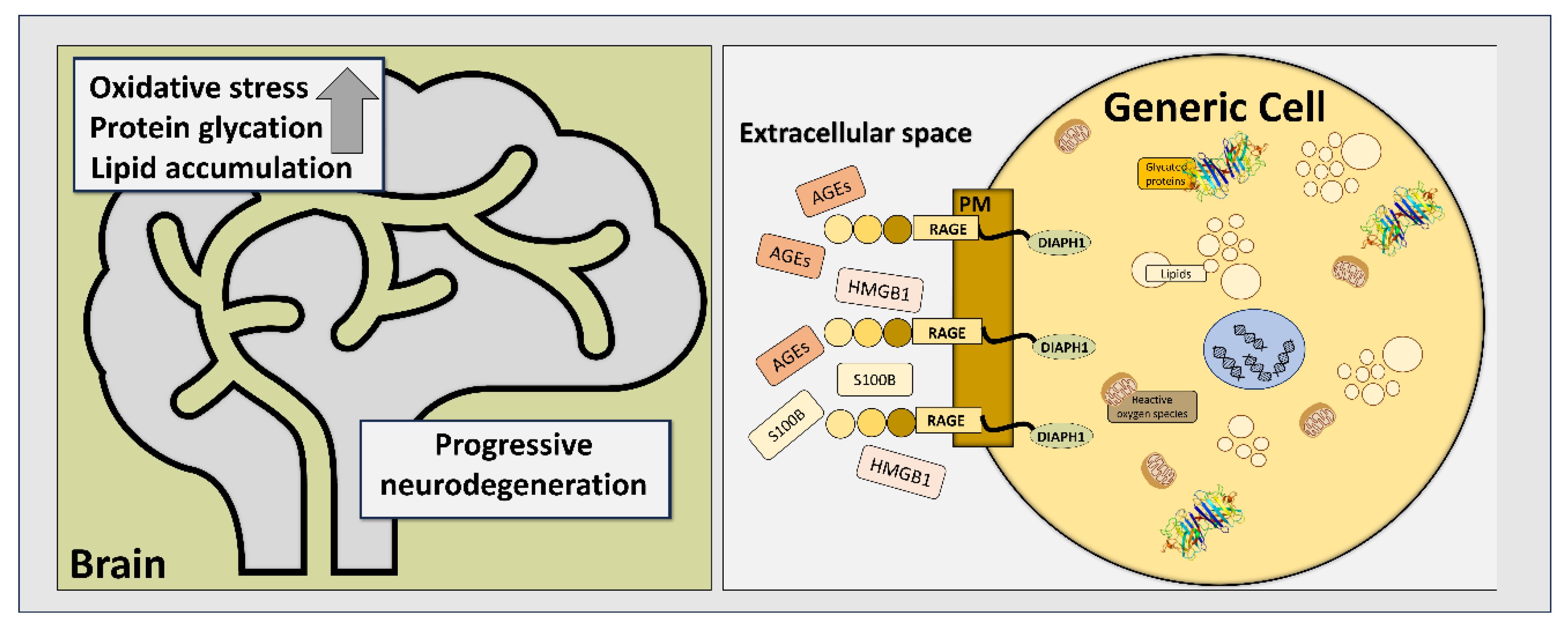
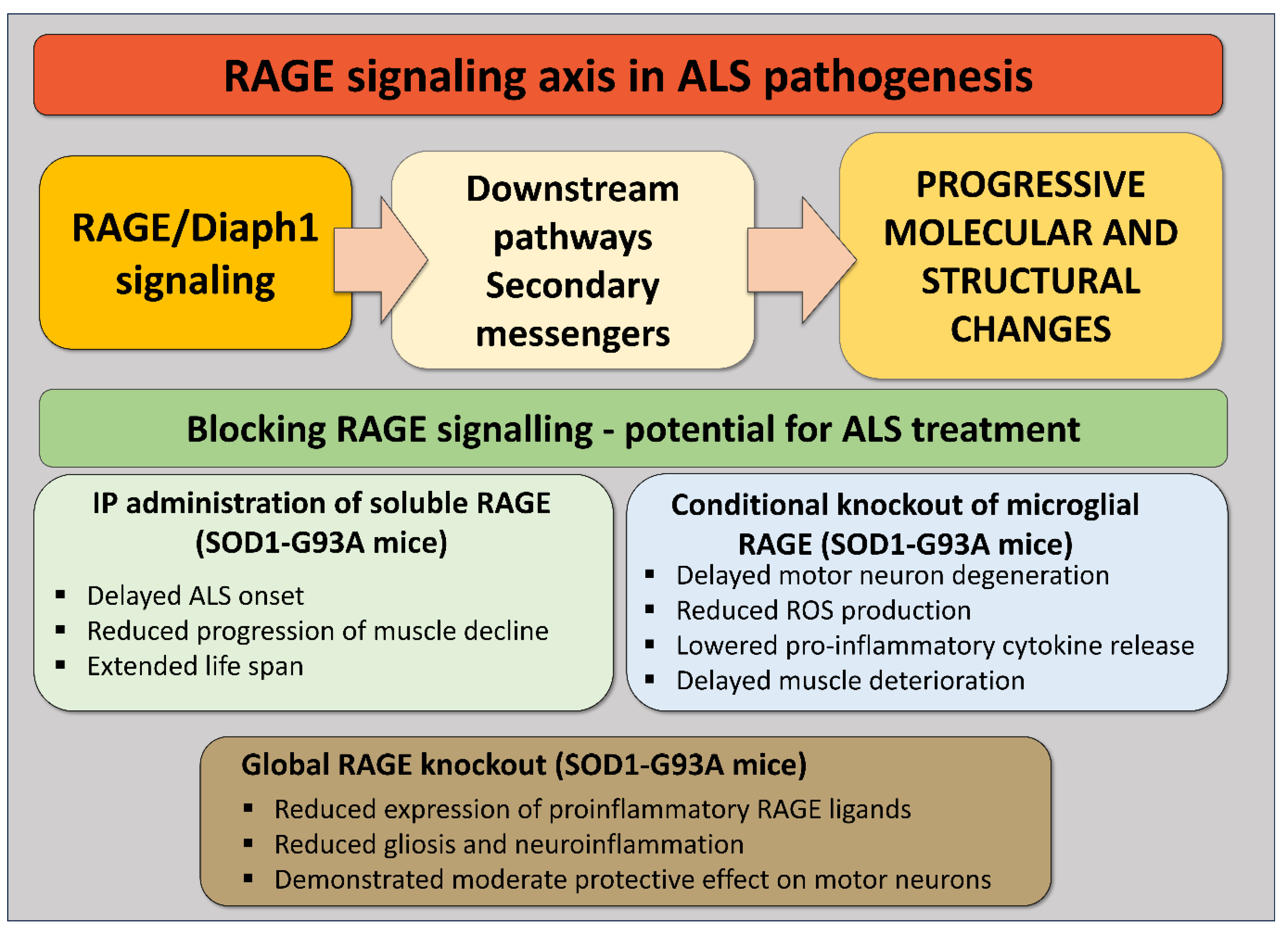
Neurodegenerative diseases are a group of disorders characterized by the progressive deterioration of structure and function of central nervous system neurons and include, among others, amyotrophic lateral sclerosis (ALS), multiple sclerosis (MS), Parkinson’s (PD), Alzheimer’s (AD) and Huntington’s (HD) diseases. And while all these diseases seem to have different genetic and environmental components, growing evidence shows that they share common underlying pathological features such as increased neuroinflammation and excessive oxidative stress. RAGE, the receptor for advanced glycation end-products, is a signal transduction receptor, and its activation triggers an increase in proinflammatory molecules, oxidative stressors and cytokines. Diaph1, protein diaphanous homolog 1 is an actin modulator and an intracellular ligand of RAGE. Studies demonstrated that RAGE and Diaph1 act together and their downstream signaling pathways play a role in neurodegeneration. Here, based on current evidence and our own research, we provide an overview of the RAGE-Diaph1 signaling and discuss the therapeutic potential of targeted therapy aimed at RAGE-Diaph1 signaling inhibition in prevention and treatment of neurodegenerative diseases.
Keywords:
1. Introduction
2. RAGE and Its Most Prominent Ligands in Neurodegenerative Disorders
2.1. RAGE
2.2. HMGB1
2.3. S100B
2.4. Diaph1—An Intracellular Protein with RAGE Binding Domain
3. RAGE-Diaph1 Proteomic and Transcriptomic Expression Patterns in Neurodegenerative Disorders
3.1. ALS
3.2. AD
3.3. PD
3.4. RAGE-Diaph1 Gene Differential Expression
4. AGER and DIAPH1 Gene Polymorphisms and Epigenetic Factors in Neurodegenerative Diseases
4.1. AGER
4.2. DIAPH1
4.3. AGER-DIAPH1 Epigenetics
5. RAGE Signaling Inhibition as a Potential ALS Treatment – Lessons from Our Own Studies
Author Contributions
Funding
Data Availability Statement
Conflicts of Interest
Abbreviations
| ALS | Amyotrophic Lateral Sclerosis |
| RAGE | Receptor for Advanced Glycation End-Prodcuts |
| AGEs | Advanced Glycation End-Products |
| ROS | Reactive Oxygen Species |
| AD | Alzheimer’s disease |
| PD | Parkison’s disease |
| HD | Huntington’s disease |
| HMGB1 | High mobility group protein B1 |
References
- Kovacs, G.G. Concepts and classification of neurodegenerative diseases. In Handbook of clinical neurology; Elsevier: 2018; Volume 145, pp. 301-307.
- Su, D.; Cui, Y.; He, C.; Yin, P.; Bai, R.; Zhu, J.; Lam, J.S.T.; Zhang, J.; Yan, R.; Zheng, X.; et al. Projections for prevalence of Parkinson’s disease and its driving factors in 195 countries and territories to 2050: modelling study of Global Burden of Disease Study 2021. BMJ 2025, 388, e080952. [Google Scholar] [CrossRef] [PubMed]
- Tesco, G.; Lomoio, S. Pathophysiology of neurodegenerative diseases: An interplay among axonal transport failure, oxidative stress, and inflammation? Semin Immunol 2022, 59, 101628. [Google Scholar] [CrossRef] [PubMed]
- Schmidt, A.M.; Hofmann, M.; Taguchi, A.; Yan, S.D.; Stern, D.M. RAGE: a multiligand receptor contributing to the cellular response in diabetic vasculopathy and inflammation. Seminars in thrombosis and hemostasis 2000, 26, 485–493. [Google Scholar] [CrossRef] [PubMed]
- Neeper, M.; Schmidt, A.M.; Brett, J.; Yan, S.D.; Wang, F.; Pan, Y.C.; Elliston, K.; Stern, D.; Shaw, A. Cloning and expression of a cell surface receptor for advanced glycosylation end products of proteins. J Biol Chem 1992, 267, 14998–15004. [Google Scholar] [CrossRef]
- Schmidt, A.M.; Hasu, M.; Popov, D.; Zhang, J.H.; Chen, J.; Yan, S.D.; Brett, J.; Cao, R.; Kuwabara, K.; Costache, G.; et al. Receptor for advanced glycation end products (AGEs) has a central role in vessel wall interactions and gene activation in response to circulating AGE proteins. Proc Natl Acad Sci U S A 1994, 91, 8807–8811. [Google Scholar] [CrossRef]
- Mao, Y. FORMIN a link between kinetochores and microtubule ends. Trends Cell Biol 2011, 21, 625–629. [Google Scholar] [CrossRef]
- Rai, V.; Maldonado, A.Y.; Burz, D.S.; Reverdatto, S.; Yan, S.F.; Schmidt, A.M.; Shekhtman, A. Signal transduction in receptor for advanced glycation end products (RAGE): solution structure of C-terminal rage (ctRAGE) and its binding to mDia1. J Biol Chem 2012, 287, 5133–5144. [Google Scholar] [CrossRef]
- Brett, J.; Schmidt, A.M.; Yan, S.D.; Zou, Y.S.; Weidman, E.; Pinsky, D.; Nowygrod, R.; Neeper, M.; Przysiecki, C.; Shaw, A.; et al. Survey of the distribution of a newly characterized receptor for advanced glycation end products in tissues. Am J Pathol 1993, 143, 1699–1712. [Google Scholar]
- Juranek, J.; Mukherjee, K.; Kordas, B.; Zalecki, M.; Korytko, A.; Zglejc-Waszak, K.; Szuszkiewicz, J.; Banach, M. Role of RAGE in the Pathogenesis of Neurological Disorders. Neurosci Bull 2022, 38, 1248–1262. [Google Scholar] [CrossRef]
- Ferrari, S.; Finelli, P.; Rocchi, M.; Bianchi, M. The active gene that encodes human high mobility group 1 protein (HMG1) contains introns and maps to chromosome 13. Genomics 1996, 35, 367–371. [Google Scholar] [CrossRef]
- Chou, D.K.; Evans, J.E.; Jungalwala, F.B. Identity of nuclear high-mobility-group protein, HMG-1, and sulfoglucuronyl carbohydrate-binding protein, SBP-1, in brain. Journal of neurochemistry 2001, 77, 120–131. [Google Scholar]
- Thul, P.J.; Åkesson, L.; Wiking, M.; Mahdessian, D.; Geladaki, A.; Ait Blal, H.; Alm, T.; Asplund, A.; Björk, L.; Breckels, L.M.; et al. A subcellular map of the human proteome. Science 2017, 356. [Google Scholar] [CrossRef]
- Yang, H.; Wang, H.; Andersson, U. Targeting Inflammation Driven by HMGB1. Front Immunol 2020, 11, 484. [Google Scholar] [CrossRef]
- Juranek, J.K.; Daffu, G.K.; Wojtkiewicz, J.; Lacomis, D.; Kofler, J.; Schmidt, A.M. Receptor for Advanced Glycation End Products and its Inflammatory Ligands are Upregulated in Amyotrophic Lateral Sclerosis. Front Cell Neurosci 2015, 9, 485. [Google Scholar] [CrossRef]
- Son, S.; Bowie, L.E.; Maiuri, T.; Hung, C.L.K.; Desmond, C.R.; Xia, J.; Truant, R. High-mobility group box 1 links sensing of reactive oxygen species by huntingtin to its nuclear entry. J Biol Chem 2019, 294, 1915–1923. [Google Scholar] [CrossRef] [PubMed]
- Ito, H.; Fujita, K.; Tagawa, K.; Chen, X.; Homma, H.; Sasabe, T.; Shimizu, J.; Shimizu, S.; Tamura, T.; Muramatsu, S.; et al. HMGB1 facilitates repair of mitochondrial DNA damage and extends the lifespan of mutant ataxin-1 knock-in mice. EMBO Mol Med 2015, 7, 78–101. [Google Scholar] [CrossRef]
- Fujita, K.; Motoki, K.; Tagawa, K.; Chen, X.; Hama, H.; Nakajima, K.; Homma, H.; Tamura, T.; Watanabe, H.; Katsuno, M.; et al. HMGB1, a pathogenic molecule that induces neurite degeneration via TLR4-MARCKS, is a potential therapeutic target for Alzheimer's disease. Sci Rep 2016, 6, 31895. [Google Scholar] [CrossRef] [PubMed]
- Michetti, F.; Clementi, M.E.; Di Liddo, R.; Valeriani, F.; Ria, F.; Rende, M.; Di Sante, G.; Romano Spica, V. The S100B Protein: A Multifaceted Pathogenic Factor More Than a Biomarker. Int J Mol Sci 2023, 24. [Google Scholar] [CrossRef] [PubMed]
- Sathe, K.; Maetzler, W.; Lang, J.D.; Mounsey, R.B.; Fleckenstein, C.; Martin, H.L.; Schulte, C.; Mustafa, S.; Synofzik, M.; Vukovic, Z.; et al. S100B is increased in Parkinson's disease and ablation protects against MPTP-induced toxicity through the RAGE and TNF-α pathway. Brain : a journal of neurology 2012, 135, 3336–3347. [Google Scholar] [CrossRef] [PubMed]
- Edwards, M.M.; Robinson, S.R. TNF alpha affects the expression of GFAP and S100B: implications for Alzheimer's disease. Journal of neural transmission (Vienna, Austria : 1996) 2006, 113, 1709–1715. [Google Scholar] [CrossRef]
- Schmitt, A.; Bertsch, T.; Henning, U.; Tost, H.; Klimke, A.; Henn, F.A.; Falkai, P. Increased serum S100B in elderly, chronic schizophrenic patients: negative correlation with deficit symptoms. Schizophrenia research 2005, 80, 305–313. [Google Scholar] [CrossRef]
- Cai, Z.; Liu, N.; Wang, C.; Qin, B.; Zhou, Y.; Xiao, M.; Chang, L.; Yan, L.-J.; Zhao, B. Role of RAGE in Alzheimer’s disease. Cellular and molecular neurobiology 2016, 36, 483–495. [Google Scholar] [CrossRef]
- Kamo, H.; Haebara, H.; Akiguchi, I.; Kameyama, M.; Kimura, H.; McGeer, P.L. A distinctive distribution of reactive astroglia in the precentral cortex in amyotrophic lateral sclerosis. Acta Neuropathol 1987, 74, 33–38. [Google Scholar] [CrossRef]
- Migheli, A.; Cordera, S.; Bendotti, C.; Atzori, C.; Piva, R.; Schiffer, D. S-100beta protein is upregulated in astrocytes and motor neurons in the spinal cord of patients with amyotrophic lateral sclerosis. Neuroscience letters 1999, 261, 25–28. [Google Scholar] [CrossRef]
- Süssmuth, S.D.; Sperfeld, A.D.; Hinz, A.; Brettschneider, J.; Endruhn, S.; Ludolph, A.C.; Tumani, H. CSF glial markers correlate with survival in amyotrophic lateral sclerosis. Neurology 2010, 74, 982–987. [Google Scholar] [CrossRef]
- Cifra, A.; Nani, F.; Nistri, A. Riluzole is a potent drug to protect neonatal rat hypoglossal motoneurons in vitro from excitotoxicity due to glutamate uptake block. Eur J Neurosci 2011, 33, 899–913. [Google Scholar] [CrossRef] [PubMed]
- Shobha, K.; Alladi, P.A.; Nalini, A.; Sathyaprabha, T.N.; Raju, T.R. Exposure to CSF from sporadic amyotrophic lateral sclerosis patients induces morphological transformation of astroglia and enhances GFAP and S100beta expression. Neuroscience letters 2010, 473, 56–61. [Google Scholar] [CrossRef] [PubMed]
- Díaz-Amarilla, P.; Olivera-Bravo, S.; Trias, E.; Cragnolini, A.; Martínez-Palma, L.; Cassina, P.; Beckman, J.; Barbeito, L. Phenotypically aberrant astrocytes that promote motoneuron damage in a model of inherited amyotrophic lateral sclerosis. Proc Natl Acad Sci U S A 2011, 108, 18126–18131. [Google Scholar] [CrossRef] [PubMed]
- Casula, M.; Iyer, A.M.; Spliet, W.G.; Anink, J.J.; Steentjes, K.; Sta, M.; Troost, D.; Aronica, E. Toll-like receptor signaling in amyotrophic lateral sclerosis spinal cord tissue. Neuroscience 2011, 179, 233–243. [Google Scholar] [CrossRef]
- Kühn, S.; Geyer, M. Formins as effector proteins of Rho GTPases. Small GTPases 2014, 5, e983876. [Google Scholar] [CrossRef]
- Jarosławska, J.; Kordas, B.; Miłowski, T.; Juranek, J.K. Mammalian Diaphanous1 signalling in neurovascular complications of diabetes. Eur J Neurosci 2024, 59, 2628–2645. [Google Scholar] [CrossRef]
- Alasmari, B.G.; Alpakra, M.; Hassanien, S.S.; Elmugadam, A.A.; Elzubair, L.; Suliman, E.A.; Alghubishi, S.A. A Novel Variant in the DIAPH1 Gene Causing Macrothrombocytopenia and Non-syndromic Hearing Loss in a Pediatric Saudi Girl. Cureus 2024, 16, e61044. [Google Scholar] [CrossRef]
- Neuhaus, C.; Lang-Roth, R.; Zimmermann, U.; Heller, R.; Eisenberger, T.; Weikert, M.; Markus, S.; Knipper, M.; Bolz, H.J. Extension of the clinical and molecular phenotype of DIAPH1-associated autosomal dominant hearing loss (DFNA1). Clinical genetics 2017, 91, 892–901. [Google Scholar] [CrossRef]
- Ercan-Sencicek, A.G.; Jambi, S.; Franjic, D.; Nishimura, S.; Li, M.; El-Fishawy, P.; Morgan, T.M.; Sanders, S.J.; Bilguvar, K.; Suri, M.; et al. Homozygous loss of DIAPH1 is a novel cause of microcephaly in humans. European journal of human genetics : EJHG 2015, 23, 165–172. [Google Scholar] [CrossRef]
- Kaustio, M.; Nayebzadeh, N.; Hinttala, R.; Tapiainen, T.; Åström, P.; Mamia, K.; Pernaa, N.; Lehtonen, J.; Glumoff, V.; Rahikkala, E.; et al. Loss of DIAPH1 causes SCBMS, combined immunodeficiency, and mitochondrial dysfunction. The Journal of allergy and clinical immunology 2021, 148, 599–611. [Google Scholar] [CrossRef] [PubMed]
- Schmidt, E.J.; Funes, S.; McKeon, J.E.; Morgan, B.R.; Boopathy, S.; O'Connor, L.C.; Bilsel, O.; Massi, F.; Jégou, A.; Bosco, D.A. ALS-linked PFN1 variants exhibit loss and gain of functions in the context of formin-induced actin polymerization. Proceedings of the National Academy of Sciences of the United States of America 2021, 118. [Google Scholar] [CrossRef] [PubMed]
- Alexander, G.M.; Heiman-Patterson, T.D.; Bearoff, F.; Sher, R.B.; Hennessy, L.; Terek, S.; Caccavo, N.; Cox, G.A.; Philip, V.M.; Blankenhorn, E.A. Identification of quantitative trait loci for survival in the mutant dynactin p150Glued mouse model of motor neuron disease. PloS one 2022, 17, e0274615. [Google Scholar] [CrossRef] [PubMed]
- Hudson, B.I.; Kalea, A.Z.; Del Mar Arriero, M.; Harja, E.; Boulanger, E.; D'Agati, V.; Schmidt, A.M. Interaction of the RAGE cytoplasmic domain with diaphanous-1 is required for ligand-stimulated cellular migration through activation of Rac1 and Cdc42. The Journal of biological chemistry 2008, 283, 34457–34468. [Google Scholar] [CrossRef]
- Manigrasso, M.B.; Rabbani, P.; Egana-Gorrono, L.; Quadri, N.; Frye, L.; Zhou, B.; Reverdatto, S.; Ramirez, L.S.; Dansereau, S.; Pan, J.; et al. Small-molecule antagonism of the interaction of the RAGE cytoplasmic domain with DIAPH1 reduces diabetic complications in mice. Sci Transl Med 2021, 13, eabf7084. [Google Scholar] [CrossRef]
- Manigrasso, M.B.; Pan, J.; Rai, V.; Zhang, J.; Reverdatto, S.; Quadri, N.; DeVita, R.J.; Ramasamy, R.; Shekhtman, A.; Schmidt, A.M. Small molecule inhibition of ligand-stimulated RAGE-DIAPH1 signal transduction. Scientific reports 2016, 6, 22450. [Google Scholar] [CrossRef]
- Juranek, J.K.; Daffu, G.K.; Wojtkiewicz, J.; Lacomis, D.; Kofler, J.; Schmidt, A.M. Receptor for advanced glycation end products and its inflammatory ligands are upregulated in amyotrophic lateral sclerosis. Frontiers in Cellular Neuroscience 2015, 9, 485. [Google Scholar] [CrossRef] [PubMed]
- Nowicka, N.; Szymańska, K.; Juranek, J.; Zglejc-Waszak, K.; Korytko, A.; Załęcki, M.; Chmielewska-Krzesińska, M.; Wąsowicz, K.; Wojtkiewicz, J. The involvement of RAGE and its ligands during progression of ALS in SOD1 G93A transgenic mice. International Journal of Molecular Sciences 2022, 23, 2184. [Google Scholar] [CrossRef] [PubMed]
- MacLean, M.; Juranek, J.; Cuddapah, S.; Lopez-Diez, R.; Ruiz, H.H.; Hu, J.; Frye, L.; Li, H.; Gugger, P.F.; Schmidt, A.M. Microglia RAGE exacerbates the progression of neurodegeneration within the SOD1(G93A) murine model of amyotrophic lateral sclerosis in a sex-dependent manner. J Neuroinflammation 2021, 18, 139. [Google Scholar] [CrossRef] [PubMed]
- Nowicka, N.; Zglejc-Waszak, K.; Juranek, J.; Korytko, A.; Wąsowicz, K.; Chmielewska-Krzesińska, M.; Wojtkiewicz, J. Novel insights into RAGE signaling pathways during the progression of amyotrophic lateral sclerosis in RAGE-deficient SOD1 G93A mice. Plos one 2024, 19, e0299567. [Google Scholar] [CrossRef]
- Takuma, K.; Fang, F.; Zhang, W.; Yan, S.; Fukuzaki, E.; Du, H.; Sosunov, A.; McKhann, G.; Funatsu, Y.; Nakamichi, N. RAGE-mediated signaling contributes to intraneuronal transport of amyloid-β and neuronal dysfunction. Proceedings of the National Academy of Sciences 2009, 106, 20021–20026. [Google Scholar] [CrossRef]
- Wang, M.Y.; Ross-Cisneros, F.N.; Aggarwal, D.; Liang, C.-Y.; Sadun, A.A. Receptor for advanced glycation end products is upregulated in optic neuropathy of Alzheimer’s disease. Acta neuropathologica 2009, 118, 381–389. [Google Scholar] [CrossRef]
- Miller, M.C.; Tavares, R.; Johanson, C.E.; Hovanesian, V.; Donahue, J.E.; Gonzalez, L.; Silverberg, G.D.; Stopa, E.G. Hippocampal RAGE immunoreactivity in early and advanced Alzheimer's disease. Brain research 2008, 1230, 273–280. [Google Scholar] [CrossRef]
- Bhogal, I.; Pankaj, V.; Roy, S. Identifying RAGE inhibitors as potential therapeutics for Alzheimer’s disease via integrated in-silico approaches. Scientific Reports 2025, 15, 17730. [Google Scholar] [CrossRef]
- Derk, J.; MacLean, M.; Juranek, J.; Schmidt, A.M. The receptor for advanced glycation endproducts (RAGE) and mediation of inflammatory neurodegeneration. Journal of Alzheimer's disease & Parkinsonism 2018, 8, 421. [Google Scholar]
- Gasparotto, J.; Ribeiro, C.T.; Bortolin, R.C.; Somensi, N.; Rabelo, T.K.; Kunzler, A.; Souza, N.C.; Pasquali, M.A.d.B.; Moreira, J.C.F.; Gelain, D.P. Targeted inhibition of RAGE in substantia nigra of rats blocks 6-OHDA–induced dopaminergic denervation. Scientific reports 2017, 7, 8795. [Google Scholar] [CrossRef]
- Long, H.; Zhang, S.; Zeng, S.; Tong, Y.; Liu, J.; Liu, C.; Li, D. Interaction of RAGE with α-synuclein fibrils mediates inflammatory response of microglia. Cell Reports 2022, 40. [Google Scholar] [CrossRef] [PubMed]
- Wang, X.; Sun, X.; Niu, M.; Zhang, X.; Wang, J.; Zhou, C.; Xie, A. RAGE silencing ameliorates neuroinflammation by inhibition of p38-NF-κB signaling pathway in mouse model of Parkinson’s disease. Frontiers in neuroscience 2020, 14, 353. [Google Scholar] [CrossRef] [PubMed]
- Santos, G.; Barateiro, A.; Brites, D.; Fernandes, A. S100B impairs oligodendrogenesis and myelin repair following demyelination through RAGE engagement. Frontiers in Cellular Neuroscience 2020, 14, 279. [Google Scholar] [CrossRef] [PubMed]
- Senatus, L.; Egaña-Gorroño, L.; López-Díez, R.; Bergaya, S.; Aranda, J.F.; Amengual, J.; Arivazhagan, L.; Manigrasso, M.B.; Yepuri, G.; Nimma, R. DIAPH1 mediates progression of atherosclerosis and regulates hepatic lipid metabolism in mice. Communications biology 2023, 6, 280. [Google Scholar] [CrossRef]
- Zglejc-Waszak, K.; Mukherjee, K.; Korytko, A.; Lewczuk, B.; Pomianowski, A.; Wojtkiewicz, J.; Banach, M.; Załęcki, M.; Nowicka, N.; Jarosławska, J. Novel insights into the nervous system affected by prolonged hyperglycemia. Journal of Molecular Medicine 2023, 101, 1015–1028. [Google Scholar] [CrossRef]
- Ruiz, H.H.; Nguyen, A.; Wang, C.; He, L.; Li, H.; Hallowell, P.; McNamara, C.; Schmidt, A.M. AGE/RAGE/DIAPH1 axis is associated with immunometabolic markers and risk of insulin resistance in subcutaneous but not omental adipose tissue in human obesity. International Journal of Obesity 2021, 45, 2083–2094. [Google Scholar] [CrossRef]
- Kwok, J.B. Role of Epigenetics in Alzheimer ‘S and Parkinson ‘S Disease. Epigenomics 2010, 2, 671–682. [Google Scholar] [CrossRef]
- Migliore, L.; Coppedè, F. Genetics, environmental factors and the emerging role of epigenetics in neurodegenerative diseases. Mutation Research/Fundamental and Molecular Mechanisms of Mutagenesis 2009, 667, 82–97. [Google Scholar] [CrossRef]
- Marques, S.; Outeiro, T.F. Epigenetics in Parkinson’s and Alzheimer’s diseases. Epigenetics: Development and Disease 2012, 507-525.
- Imahara, S.D.; O’Keefe, G.E. Genetic determinants of the inflammatory response. Current opinion in critical care 2004, 10, 318–324. [Google Scholar] [CrossRef]
- Yonekura, H.; Yamamoto, Y.; Sakurai, S.; Petrova, R.G.; Abedin, M.J.; Li, H.; Yasui, K.; Takeuchi, M.; Makita, Z.; Takasawa, S. Novel splice variants of the receptor for advanced glycation end-products expressed in human vascular endothelial cells and pericytes, and their putative roles in diabetes-induced vascular injury. Biochemical Journal 2003, 370, 1097–1109. [Google Scholar] [CrossRef]
- Schmidt, A.M. Soluble RAGEs—Prospects for treating & tracking metabolic and inflammatory disease. Vascular pharmacology 2015, 72, 1–8. [Google Scholar]
- Mahayana, N.P.K.; Yadmika, N.P.W.P.; Aryaweda, M.D.W.; Mahardana, M.D.P.; Mamangdean, C.T.; Dewi, N.N.A.; Wirawan, C.; Laksmidewi, A.A.A.P. Decoying the enemy: soluble receptor for advanced glycation end products and cognitive impairment in neurodegenerative diseases—a systematic review and meta-analysis. The Egyptian Journal of Neurology, Psychiatry and Neurosurgery 2024, 60, 93. [Google Scholar] [CrossRef]
- Geroldi, D.; Falcone, C.; Emanuele, E.; D'Angelo, A.; Calcagnino, M.; Buzzi, M.P.; Scioli, G.A.; Fogari, R. Decreased plasma levels of soluble receptor for advanced glycation end-products in patients with essential hypertension. Journal of hypertension 2005, 23, 1725–1729. [Google Scholar] [CrossRef]
- Son, M.; Oh, S.; Park, H.; Ahn, H.; Choi, J.; Kim, H.; Lee, H.S.; Lee, S.; Park, H.-J.; Kim, S.U. Protection against RAGE-mediated neuronal cell death by sRAGE-secreting human mesenchymal stem cells in 5xFAD transgenic mouse model. Brain, behavior, and immunity 2017, 66, 347–358. [Google Scholar] [CrossRef]
- Zhu, S.D. sRAGE: potential therapeutic target for Alzheimer’s disease. In Proceedings of the Second International Conference on Biological Engineering and Medical Science (ICBioMed 2022); 2023; pp. 1147–1153. [Google Scholar]
- Kinjo, T.; Kitaguchi, Y.; Droma, Y.; Yasuo, M.; Wada, Y.; Ueno, F.; Ota, M.; Hanaoka, M. The Gly82Ser mutation in AGER contributes to pathogenesis of pulmonary fibrosis in combined pulmonary fibrosis and emphysema (CPFE) in Japanese patients. Scientific reports 2020, 10, 12811. [Google Scholar] [CrossRef] [PubMed]
- Faiz, A.; Rathnayake, S.N.; Ten Hacken, N.H.; Guryev, V.; van den Berge, M.; Pouwels, S.D. Single-nucleotide polymorphism rs2070600 regulates AGER splicing and the sputum levels of the COPD biomarker soluble receptor for advanced glycation end-products. ERJ Open Research 2021, 7. [Google Scholar] [CrossRef] [PubMed]
- Serveaux-Dancer, M.; Jabaudon, M.; Creveaux, I.; Belville, C.; Blondonnet, R.; Gross, C.; Constantin, J.-M.; Blanchon, L.; Sapin, V. Pathological implications of receptor for advanced glycation end-product (AGER) gene polymorphism. Disease markers 2019, 2019, 2067353. [Google Scholar] [CrossRef] [PubMed]
- Miller, S.; Henry, A.P.; Hodge, E.; Kheirallah, A.K.; Billington, C.K.; Rimington, T.L.; Bhaker, S.K.; Obeidat, M.e.; Melen, E.; Merid, S.K. The Ser82 RAGE variant affects lung function and serum RAGE in smokers and sRAGE production in vitro. PloS one 2016, 11, e0164041. [Google Scholar] [CrossRef]
- Peng, Y.; Liu, F.; Qiao, Y.; Wang, P.; Du, H.; Si, C.; Wang, X.; Chen, K.; Song, F. Genetically modified circulating levels of advanced glycation end-products and their soluble receptor (AGEs-RAGE Axis) with risk and mortality of breast cancer. Cancers 2022, 14, 6124. [Google Scholar] [CrossRef]
- Daborg, J.; von Otter, M.; Sjölander, A.; Nilsson, S.; Minthon, L.; Gustafson, D.R.; Skoog, I.; Blennow, K.; Zetterberg, H. Association of the RAGE G82S polymorphism with Alzheimer’s disease. Journal of neural transmission 2010, 117, 861–867. [Google Scholar] [CrossRef]
- Bennet, A.M.; Reynolds, C.A.; Eriksson, U.K.; Hong, M.G.; Blennow, K.; Gatz, M.; Alexeyenko, A.; Pedersen, N.L.; Prince, J.A. Genetic association of sequence variants near AGER/NOTCH4 and dementia. J Alzheimers Dis 2011, 24, 475–484. [Google Scholar] [CrossRef]
- Kolonaite, G.; Vilkeviciute, A.; Kriauciuniene, L.; Gedvilaite, G.; Liutkeviciene, R. Association of RAGE rs1800624 and rs1800625 gene polymorphisms with predisposition to optic neuritis and optic neuritis together with multiple sclerosis. Ophthalmic Genet 2021, 42, 685–690. [Google Scholar] [CrossRef] [PubMed]
- Banevicius, M.; Vilkeviciute, A.; Kriauciuniene, L.; Liutkeviciene, R.; Deltuva, V.P. The Association Between Variants of Receptor for Advanced Glycation End Products (RAGE) Gene Polymorphisms and Age-Related Macular Degeneration. Med Sci Monit 2018, 24, 190–199. [Google Scholar] [CrossRef] [PubMed]
- Al-Maawali, A.; Barry, B.J.; Rajab, A.; El-Quessny, M.; Seman, A.; Coury, S.N.; Barkovich, A.J.; Yang, E.; Walsh, C.A.; Mochida, G.H.; et al. Novel loss-of-function variants in DIAPH1 associated with syndromic microcephaly, blindness, and early onset seizures. Am J Med Genet A 2016, 170a, 435–440. [Google Scholar] [CrossRef] [PubMed]
- Esmaeilzadeh, E.; Biglari, S.; Mosallaei, M.; Khorshid, H.R.K.; Vahidnezhad, H.; Tabatabaiefar, M.A. A Novel Homozygote Pathogenic Variant in the DIAPH1 Gene Associated With Seizures, Cortical Blindness, and Microcephaly Syndrome (SCBMS): Report of a Family and Literature Review. Mol Genet Genomic Med 2024, 12, e70031. [Google Scholar] [CrossRef]
- McFarlane, R.; Opie-Martin, S.; Caravaca Puchades, A.; Chiò, A.; Corcia, P.; Galvin, M.; Heverin, M.; Hobin, F.; Holmdahl, O.; Ingre, C.; et al. Clinical trajectories of genetic variants in ALS: a European observational study within PRECISION-ALS. Amyotroph Lateral Scler Frontotemporal Degener 2025, 26, 41–49. [Google Scholar] [CrossRef]
- Ren, Z.; Chen, X.; Tang, W.; Li, J.; Yang, S.; Chen, Y.; Zhao, X.; Zong, H.; Liu, C.; Shen, C. Association of DIAPH1 gene polymorphisms with ischemic stroke. Aging (Albany NY) 2020, 12, 416–435. [Google Scholar] [CrossRef]
- Zhou, S.L.; Tan, C.C.; Hou, X.H.; Cao, X.P.; Tan, L.; Yu, J.T. TREM2 Variants and Neurodegenerative Diseases: A Systematic Review and Meta-Analysis. J Alzheimers Dis 2019, 68, 1171–1184. [Google Scholar] [CrossRef]
- Mutti, V.; Carini, G.; Filippini, A.; Castrezzati, S.; Giugno, L.; Gennarelli, M.; Russo, I. LRRK2 Kinase Inhibition Attenuates Neuroinflammation and Cytotoxicity in Animal Models of Alzheimer's and Parkinson's Disease-Related Neuroinflammation. Cells 2023, 12. [Google Scholar] [CrossRef]
- Soraci, L.; Corsonello, A.; Paparazzo, E.; Montesanto, A.; Piacenza, F.; Olivieri, F.; Gambuzza, M.E.; Savedra, E.V.; Marino, S.; Lattanzio, F.; et al. Neuroinflammaging: A Tight Line Between Normal Aging and Age-Related Neurodegenerative Disorders. Aging Dis 2024, 15, 1726–1747. [Google Scholar] [CrossRef]
- Giallongo, S.; Longhitano, L.; Denaro, S.; D'Aprile, S.; Torrisi, F.; La Spina, E.; Giallongo, C.; Mannino, G.; Lo Furno, D.; Zappalà, A.; et al. The Role of Epigenetics in Neuroinflammatory-Driven Diseases. Int J Mol Sci 2022, 23. [Google Scholar] [CrossRef] [PubMed]
- Słowikowski, B.; Owecki, W.; Jeske, J.; Jezierski, M.; Draguła, M.; Goutor, U.; Jagodziński, P.P.; Kozubski, W.; Dorszewska, J. Epigenetics and the neurodegenerative process. Epigenomics 2024, 16, 473–491. [Google Scholar] [CrossRef] [PubMed]
- Lossi, L.; Castagna, C.; Merighi, A. An Overview of the Epigenetic Modifications in the Brain under Normal and Pathological Conditions. Int J Mol Sci 2024, 25. [Google Scholar] [CrossRef] [PubMed]
- Juranek, J.K.; Daffu, G.K.; Geddis, M.S.; Li, H.; Rosario, R.; Kaplan, B.J.; Kelly, L.; Schmidt, A.M. Soluble RAGE Treatment Delays Progression of Amyotrophic Lateral Sclerosis in SOD1 Mice. Front Cell Neurosci 2016, 10, 117. [Google Scholar] [CrossRef]
- Juranek, J.; Osowski, A.; Wojtkiewicz, J.; Banach, M. Plasma levels of soluble RAGE, AGEs and AOPPs at the early stage of amyotrophic lateral sclerosis: A preliminary study. Polim Med 2023, 53, 105–110. [Google Scholar] [CrossRef]
- Nowicka, N.; Zglejc-Waszak, K.; Juranek, J.; Korytko, A.; Wasowicz, K.; Chmielewska-Krzesinska, M.; Wojtkiewicz, J. Novel insights into RAGE signaling pathways during the progression of amyotrophic lateral sclerosis in RAGE-deficient SOD1 G93A mice. PloS one 2024, 19, e0299567. [Google Scholar] [CrossRef]

Disclaimer/Publisher’s Note: The statements, opinions and data contained in all publications are solely those of the individual author(s) and contributor(s) and not of MDPI and/or the editor(s). MDPI and/or the editor(s) disclaim responsibility for any injury to people or property resulting from any ideas, methods, instructions or products referred to in the content. |
© 2025 by the authors. Licensee MDPI, Basel, Switzerland. This article is an open access article distributed under the terms and conditions of the Creative Commons Attribution (CC BY) license (http://creativecommons.org/licenses/by/4.0/).