

Submitted:
22 July 2025
Posted:
23 July 2025
You are already at the latest version
Abstract
This paper furnishes some new thoughts on the economics of productivity. It undertakes a critique of productivity and productive capacity, and explains with the help of a simple model the formulation of a law of productivity. The underlying essence of productive capacity is expounded as well.
Keywords:
Productivity function
; productivity
; efficiency
1. Introduction
Today, success largely depends on the productiveness and productive capacity of an organisational capability: i.e., employees’ competence level (Lopez et al., 2006; Panda, 2019). Productivity has become a hot topic worthy of deep thinking and profound cogitation for the purpose of theoretical analysis. But there have been recent criticisms of the current trends as regards to the economics of productivity as well (Dasgupta, 2002; Syverson, 2011). Such criticisms are aimed toward how productivity is perceived as the sole, acquisitive means of earning profit but anything aside. We call this trend “Productivism”, following Rodrik (2023). That productivity is all and that it is everything, both in business context and organisational perspective, could be ascertained from the glaring evidence of several larger MNC Tech giants vouching for everything that is productive, or that which promotes productivity at all levels of business (organisational) practice. This “link” between productivity and practice has important implications with regard to the essence of organisational as well as individual productivity (Siebers et al., 2008), which lies, however, in understanding the dynamic elements that contribute to its improvement and further innovations that propel it. The essence being that,

Indeed, acquisitive attitudes lead to the promotion of productivity, but not always it does so. In this paper, our attempt is to understand the true essence of human (and organisational) productivity—characterised by a strong prevailing sense of Productivism among the most visionary corporate leaders who have virtually redefined ‘business efficiency’ at every step of organisational operation. These leaders are among the best cultivators of productive power, which continuously powers their creative and dynamic dimensions of managerial practice. With penetrative sagacity and full of knowledge and expertise, these productivity management “Gurus” are breaking old boundaries and creating new ones by setting new standards (Jackson & Carter, 1998; Kesler, 2020; Huczynski, 2012).

Today, brand-value is associated with every product which is being sold and consumed. How brand value gets associated with products is an interesting economic phenomenon that can be modelled using a hypothesis that explains the law of productivity. In economics sense, it is the “real demand” for products which drives production, and then productivity, which is driven by rising consumption levels driving demand for consumption of products and services (Witt, 2001; Crespi & Pianta, 2008; Remes et al., 2018).
The purpose of this objective analysis is to gain sufficient knowledge to express some definite opinions on productivity. It provides the foundation for philosophical thinking which has social significance, since the science of productivity is directly correlated with economic growth and social welfare. What we seek is the unity of the theory of productivity, practice, and learning. In our previous research, we briefly examined this relationship between productivity, intellect, and learning, which brought forth interesting inferences concerning its essence (Chatterjee and Samanta, 2025; Chatterjee, 2025a & Chatterjee, 2025b). In this paper, we model productivity in terms of a functional equation to study its dynamic properties in relation to learning. Great potentialities that lie in front of us can only be realised if we are able to augment and modulate our own productivity levels. To better understand the nature of productive dynamics, it is necessary to formulate a clear definition of productivity1 which would supply us with a formidable method of explaining the conditions contingent upon constraining factors that modulate optimality in production function.
2. Sense of Productivity
The sense of productive reality or the reality of being productive to become useful is indeed a good sense as it ascribes special meaning and value to goals. Specific knowledge is necessary to inspire the mind towards productive action. This knowledge could be in the form of best wisdom powering productivity. Products have uses and values attached to them; i.e., use-value. Hence, productivity is a symbol of value (Kumar, 2024); it is also a symbol of success. Highly successful individuals tend to be highly productive as well, as it is a trait that characterises them. Besides, they are able to habituate themselves to higher levels of “productivity” through increased effort. It follows rules, routines, methods, and is procedural (Kumar, 2024). Any offence against the rules of productivity leads to decreasing efficiency of production function.
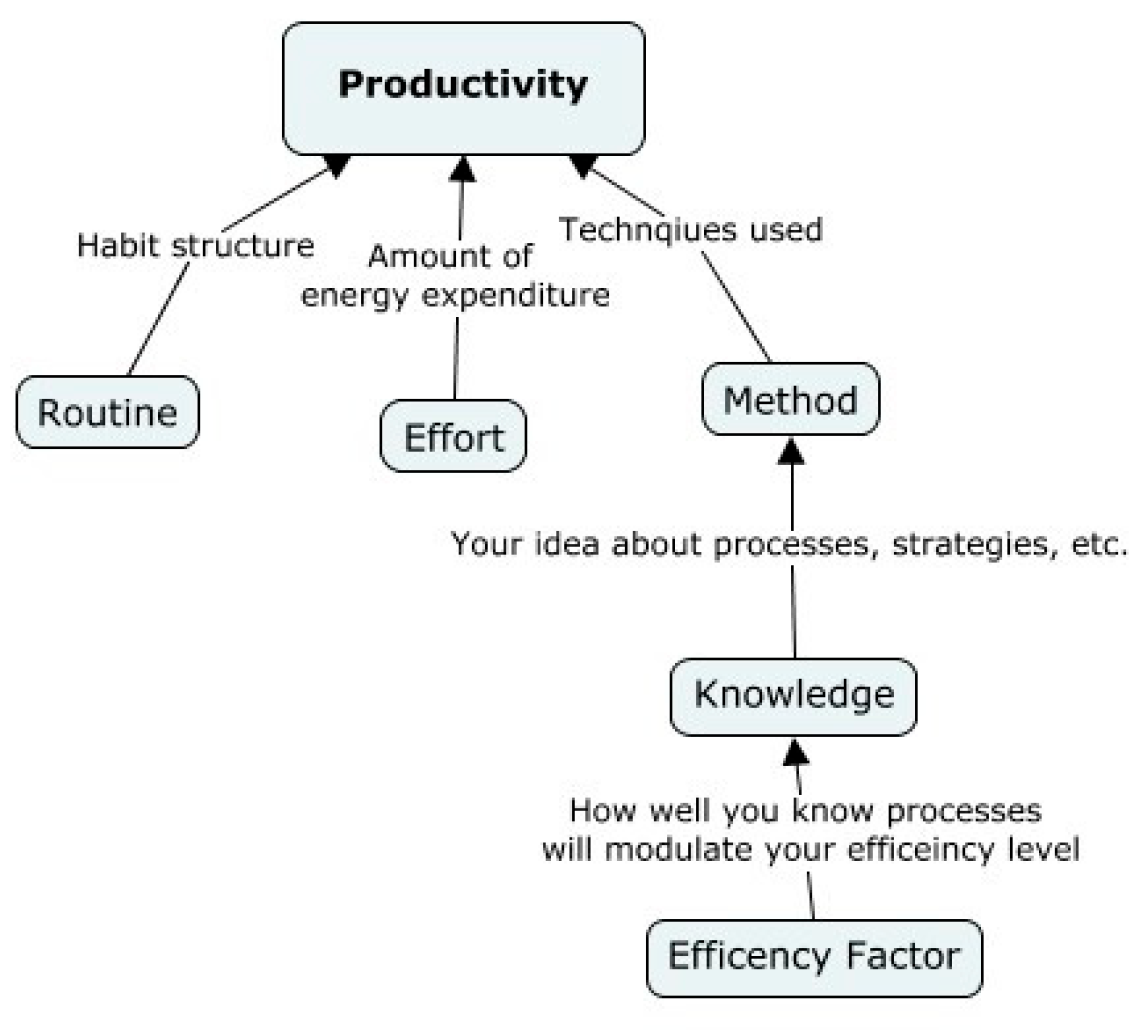
In the above Figure 1, productivity is the result of outcome. It is influenced by the level of effort that goes into producing something, method, routine, whereas, method delineates the knowledge and understanding of the processes.
Now, there are many exogenous and endogenous factors that usually corrupt the human ability to become efficient and productive. Individuals sometimes, and unknowingly, commit offences against their own productive spirits. It dampens their ability to work and does little to augment or stir up the productive power intrinsic to them. All these, as one might assume, have adverse effects on the true ‘sense of productivity’. All these, in addition, reduce the productive value and worth of efforts of an individual agent based upon which one’s capability is determined and evaluated. Hence, it is pertinent to understand and sense the productive prospects of an individual’s efforts and independent thinking, and orient the mind towards greater achievement. The growth of “independent thought” is thought to be explicitly related to productivity growth. This explains some of the metaphysical aspects of human productivity, but the core thinking related to it needs be examined as well (Koskela and Kagioglou, 2005; Maraguat, 2019; Chatterjee, 2025b). From the impression alone, we can understand the real form and substance of productive talent inherent in agents.
However, it doesn’t allow evaluators (managers and hiring agents) to fully speculate or ponder upon the performance of duties in the form of actions directed by organisational goals and objectives which the agents are most likely to assume. Discreetly said, all these doesn’t provide a picture of the full sense of productivity of an agent under competitive settings. But capable organisations do possess the necessary means to help their incumbents attain the desired productivity levels through training and orientation programs. They help individuals gain a true sense of productiveness.
3. Method
We describe a simple model to examine and explain the law of productivity stated thus: “The productive capacity is fixed in a particular system relative to a standard reference of time”.
Axiom 1.
The maximum output that can be obtained from a specific set of conditions supporting productive activities.
Lemma 1.
All systems operate within time-bound limits whose capacities can be adjusted to efficiency, or pushing beyond a certain fixed capacity, it can lead to inefficiency, systems failure, diminishing returns, etc.
Based upon this axiom and its subsidiary proposition, we have constructed an equation of a model depicting productivity function, its determinants and constraints for a closed system.
The model explains the effects of efficiency on performance level through an intricate mechanism involving the influence of several key variables, i.e., actions , effective routines , and goals that act as determinants of productiveness. The term <1 denotes error function, meaning that more errors decrease the efficiency of actions and dampen productivity. The optimal error acceptable in a system is 0.5, but it can never be.
Now the equation of production function is given by:
Plotting equation no. 1, we derive a curve function behavior as follows:
Figure 2.
Optimal productivity curve function.
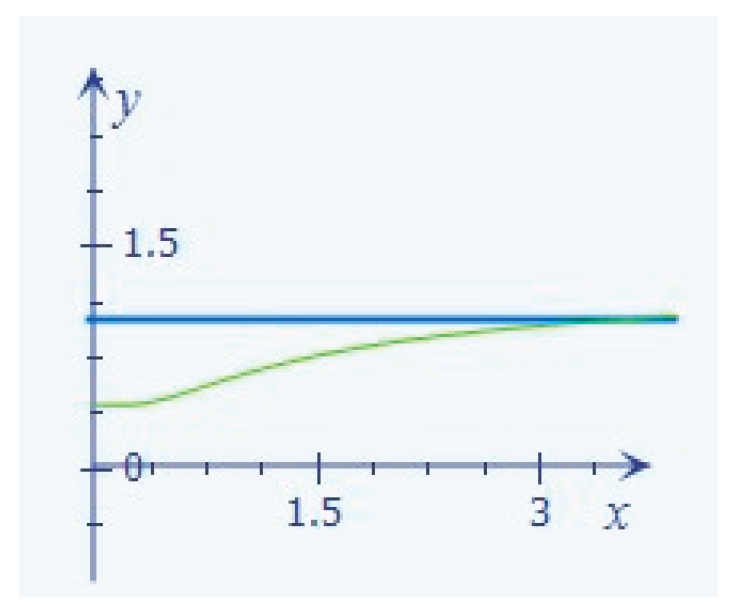
The curve function plotted from equation no. 1 depicts the optimal productivity function under least tolerance for error factor. This error may arise from faulty application of procedures, inefficient methods, outdated systems, inadequate knowledge of production, and failure to meet prescribed standards. All these have negative effect on productivity level.
4. Results and Discussion
Results
The model depicts the productivity curve function which explicates the dynamics of productive actions. The model includes variables of goal-oriented behavior of agents who strive for excellence in work practice: i.e., who seek productive excellence. The findings of the theoretical model can be applied to practice in understanding how we can increase our productivity levels, and what factors contribute towards enhancement in productivity levels.
Discussion
What is the reason behind, or say, the cause of stupendous productivity of an individual (organisation) in comparison to another? The maxim that “radiant light always breaks through the gathering darkness” is candidly true, and it is partly applicable to the science of productivity. The results obtained from the theoretical modelling of a productivity system point to such a direction. Just as neglect of noetic calisthenics leads to the diminution of mental power including memory, so does lack of goals as well as orientation to them lead to waning and wilting in productive capacity and power of an individual, team, or an entire organisation. Therefore, the concept of “productive force” is the fundamental energy of distinction among individuals who are highly productive (See, Marx’s Das Capital I; Rueten, 2004; Feldman, 2019). However, beyond this antiquated concepts explaining productive force in Marxian terminology, it may suit well to consider Science as a direct, explicit productive force (Zvorikine, 1962). Science seeks power in nature and natural phenomenon, the understanding of which is empowering to the nous. Hence, if productivity is perceived in the light of science, it would do better to provide a “scientific” definition of productivity.
Now, as the model depicts, it establishes a firm interactive connection between productive power and productive means. Productive power can be enhanced gradually in stages through learning in action, which increases steadfastness in knowledge and acquisition of the wisdom of augmenting one’s productivity levels. There is wisdom in action, as much as the action of wisdom justifies so, and by which agents may attain higher efficiency levels in performing their duties. In simple words, it increases the productive efficiency of the workforces (Fried, Schmidt & Lovell, 1993).
One question that may arise in such a context is as follows: how to be the “best reason” for productivity or productiveness? One probable but correct answer to this is that, to find purpose to serve, or be the cause (i.e., the reason, thereof) of greater actions, and not be just an agent of it. Think about being a CEO and an employee working ‘under’ a CEO. However, it doesn’t mean that being not an agent of explicit action, a CEO has got no claim on the results, which depends upon the performance levels of the employees. It now provides us with a clear view of an analytical understanding of productivity () in action. But for a CEO of a firm/organisation, it raises many potential queries.
First, higher management authorities including chief executives must be able to effect a set of innovations in their workers’ activities. Employees should be empowered with enhanced productive capability. They should be fortified with power, agility and skills in handling complex situations. The symbolic domain in the science of productivity is imbued with the power of action: actions are considered “valuable” as a symbol of productivity (Kumar, 2024). From this, a simple law of productivity could be framed in a semantic sense. Thus, the ‘law of productivity’ could be stated as;

It is evident that where there’s action, there’s interplay of energy. Now, the productive capacity of a system has many determinants. In this age of intelligence where speed is everything, and where competition for niche space, efficiency and productiveness go hand-in-hand, one can move faster to become more active in order to achieve a speed of productivity relative to a standard frame of reference through greater mobility, agility, and dynamicity. This explains the above defined “law of productivity.”
Second, any acquisition of productive power requires undertaking by means of showcasing its efficiency. Which means that, the power behind productivity must be understood and its essence interpreted to provide a complete noetic representation of human productivity. This power is manifested in best methods—the noetic, semantic frame—the ambit of influence that could be utilised to remove barriers and obstacles to promote learning and productivity. Obstacles threaten our progress, and barriers negatively affect productivity (Ammons, 2004; Coad, Pellegrino & Savona, 2016).
The theoretical imperatives that constitute the variants of a model or method relates to the scientific literature on productivity, which help define the conceptual limits of human creativity. But this conceptual limit can be extend by means of invention of new rules of productivity. It is also extended by continuous innovations in processes and methods powering human, industrial, and organisational productivity and practice.
At the individual level, one should strive to bring into operation all the power and skill in order attain a certain level of productivity. One must invent and reinvent to be noticed, for inventions attract attention. The rules of productivity can be tweaked, but they cannot be abolished, and offences committed against the rules is a great contempt of causality of action and consequences. The motto is clear:

The above motto—ending with the phrase Stay Productive, is a philosophical principle having to do something with Aristotelian teleology, Kantian metaphysics of duty guided by reason and obligation, and the modern semantic framework of organisational productivity and planning, which is goal-oriented behavior. It echoes the importance of purposes and purposeful actions guided by goals and objectives (teleological imperative).
Under the influence of productive habits and constructive rules (i.e., discipline), even ordinary causes lead to great outcomes. Hence, to raise your productivity level to a new standard that characterises a higher world of productive practice, emendations in both thinking and action are necessary. Beyond these, rearing human capability in accordance with the needs of the time would go a long way in augmenting the power of productive energy, which is the power that characterises individual capability—the empowering essence that drives highly productive individuals towards greater achievements.
5. Conclusion
In this paper, we have discussed the metaphysics of productivity and productive capability. The essence of individual competency has been modelled with regard to several variables that function as determinants of productive capacity. We undertake a critique of productivity and productive capacity to explain with the help of a simple model the formulation of a law of productivity and the factors that determine and influence productivity levels at the individual and organisational level. The findings of the theoretical model is imperative to understanding the essence of productiveness. Penetrative insights into the causes of inefficiency has been discussed with regard to a common set of assumptions about individual productivity levels. Further study is required to establish the causal effect of productivity fluctuations to help explicate the determinants of productive capacity.
| 1 | See, for example, Bürgenmeier, B. (1992). The Meaning of Productivity. In Socio-Economics: An Interdisciplinary Approach: Ethics, Institutions, and Markets (pp. 129-152). Dordrecht: Springer Netherlands. |
References
- Ammons, D. N. (2004). Productivity barriers in the public sector. PUBLIC ADMINISTRATION AND PUBLIC POLICY-NEW YORK-, 107, 139-164.
- Bürgenmeier, B. (1992). The Meaning of Productivity. In Socio-Economics: An Interdisciplinary Approach: Ethics, Institutions, and Markets (pp. 129-152). Dordrecht: Springer Netherlands.
- Chatterjee, S. (2025a). On the Interrelationship between Learning, Intellect, and Productivity. Intellect, and Productivity (July 03, 2025).
- Chatterjee, S. (2025b). Productivity and Productive Capital: Metaphysical Perspectives.
- Chatterjee, S., & Samanta, M. (2025). Noetic Capital and the Economics of Productivity.
- Coad, A., Pellegrino, G., & Savona, M. (2016). Barriers to innovation and firm productivity. Economics of Innovation and New Technology, 25(3), 321-334. [CrossRef]
- Crespi, F., & Pianta, M. (2008). Demand and innovation in productivity growth. International Review of Applied Economics, 22(6), 655-672. [CrossRef]
- Dasgupta, P. (2002). Modern economics and its critics. Fact and fiction in economics: Models, realism and social construction, 57-89.
- Feldman, A. J. (2019). Power, labour power and productive force in Foucault’s reading of Capital. Philosophy & Social Criticism, 45(3), 307-333. [CrossRef]
- Fried, H. O., Schmidt, S. S., & Lovell, C. K. (Eds.). (1993). The measurement of productive efficiency: techniques and applications. Oxford university press.
- Huczynski, A. (2012). Management gurus. Routledge.
- Jackson, N., & Carter, P. (1998). Management Gurus: What are We to. Organization-Representation: Work and Organizations in Popular Culture, 149.
- Kessler, E. (2020). Wise leadership: A toolbox for sustainable success. Routledge.
- Koskela, L., & Kagioglou, M. (2005). On the metaphysics of production.
- Kumar, P. N. (2024). Significance of Productivity Concept. Productivity, 65(3), 325-331.
- Lopez-Cabrales, A., Valle, R., & Herrero, I. (2006). The contribution of core employees to organizational capabilities and efficiency. Human Resource Management: Published in Cooperation with the School of Business Administration, The University of Michigan and in alliance with the Society of Human Resources Management, 45(1), 81-109. [CrossRef]
- Maraguat, E. (2019). Hegel on the Productivity of Action: Metaphysical Questions, Non-Metaphysical Answers, and Metaphysical Answers. Hegel Bulletin, 40(3), 425-443. [CrossRef]
- Panda, G. (2019). Employee competencies acting as an intermediary on measuring organizational productivity: a review perspective. International Journal of Mechanical and Production Engineering Research and Development (IJMPERD), 9(2), 195-202. [CrossRef]
- Remes, J., Mischke, J., & Krishnan, M. (2018). Solving the productivity puzzle: The role of demand and the promise of digitization. International Productivity Monitor, (35), 28-51.
- Reuten, G. (2004). Productive force and the degree of intensity of labour: Marx’s Concepts and Formalizations in the Middle Part of Capital I. In The Constitution of Capital: Essays on Volume I of Marx’s Capital (pp. 117-145). London: Palgrave Macmillan UK. [CrossRef]
- Rodrik, D. (2023). On productivism.
- Siebers, P. O., Aickelin, U., Battisti, G., Celia, H., Clegg, C., Fu, X., ... & Peixoto, A. (2008). Enhancing productivity: the role of management practices. Submitted to International Journal of Management Reviews, Forthcoming.
- Syverson, C. (2011). What determines productivity?. Journal of Economic literature, 49(2), 326-365.
- Witt, U. (2001). Learning to consume–A theory of wants and the growth of demand. Journal of evolutionary economics, 11(1), 23-36. [CrossRef]
- Zvorikine, A. A. (1962). Science as a direct productive force. Cahiers d'Histoire Mondiale. Journal of World History. Cuadernos de Historia Mundial, 7(1), 959.
Figure 1.
Productivity function diagram.
Disclaimer/Publisher’s Note: The statements, opinions and data contained in all publications are solely those of the individual author(s) and contributor(s) and not of MDPI and/or the editor(s). MDPI and/or the editor(s) disclaim responsibility for any injury to people or property resulting from any ideas, methods, instructions or products referred to in the content. |
© 2025 by the authors. Licensee MDPI, Basel, Switzerland. This article is an open access article distributed under the terms and conditions of the Creative Commons Attribution (CC BY) license (http://creativecommons.org/licenses/by/4.0/).
Copyright: This open access article is published under a Creative Commons CC BY 4.0 license, which permit the free download, distribution, and reuse, provided that the author and preprint are cited in any reuse.


