

Submitted:
26 May 2026
Posted:
27 May 2026
You are already at the latest version
Abstract
Ageing remains one of biology’s most fundamental unresolved questions. Existing explanations often attribute ageing to stochastic damage accumulation, adaptive programmes, or interacting hallmarks, yet none fully explains why ageing emerges so broadly in organisms that undergo development. Here, I introduce the Double Code Hypothesis of Ageing, which frames ageing as a consequence of life’s dual inheritance system: the genome and the epigenome. In this manuscript, ‘code’ is used in a computer-science-like sense, closer to source code than to the specialised meaning used in code biology: an organised set of biological instructions whose effects depend on being read, interpreted, maintained, and executed by cellular machinery.I propose that ageing is not merely the progressive accumulation of epigenetic noise within an individual, but the consequence of an inherent instability in a dual inheritance system whose two informational layers must remain functionally aligned across cellular and organismal generations. The relative stability of the genome allows long-term information preservation, whereas the plasticity of the epigenome enables development, differentiation, adaptation, and the emergence of complex phenotypes, but also makes this layer vulnerable to cumulative misalignment.Within this framework, ageing is interpreted as the individual-level cost of an information-management architecture that preserves and renews biological information across generations. In complex organisms, mitotically dividing cells progressively lose or misalign epigenetic information, whereas meiotic/germline-associated processes can restore or re-establish a functional genome–epigenome configuration for the next generation. This falsifiable framework offers experimental predictions in model systems such as Schizosaccharomyces pombe and provides a mechanistic explanation for why ageing exists.
Keywords:
ageing theory
; epigenetic inheritance
; biological information theory
; non-genetic inheritance
1. Introduction
Ageing has long been a central enigma in biology. The prevailing view frames it as a multifactorial process. In recent years, a broad consensus has emerged among ageing researchers to study it within the framework known as the Hallmarks of Ageing [1,2,3]. This integrative model seeks to address the apparent complexity of ageing by incorporating diverse insights into a cohesive conceptual structure. The Hallmarks of Ageing concept is primarily a mechanistic framework describing interlinked biological processes, including genomic instability, telomere attrition, epigenetic alterations, mitochondrial dysfunction, deregulated nutrient sensing, cellular senescence, altered intercellular communication, loss of proteostasis, and stem-cell exhaustion, that contribute to organismal decline. It draws upon damage-based and programmatic views, together with evolutionary concepts, to explain how these hallmarks arise and persist. However, it does not explicitly unify formal evolutionary theories of ageing, such as antagonistic pleiotropy or mutation accumulation. Rather, it acknowledges that these evolutionary theories provide the why, whereas the Hallmarks framework addresses the how: the molecular and cellular processes that fail with age.
Although the Hallmarks of Ageing paradigm does not inherently prioritise one hallmark over another, the historical development of ageing research has led to proposals that do exactly that. Telomere attrition, mitochondrial dysfunction, DNA damage, deregulated nutrient sensing, cellular senescence, protein damage, and others have all been proposed as primary drivers of ageing [4]. Among the various models proposed, I wish to focus on those that frame ageing as a consequence of the loss of epigenetic information [5,6,7]. This idea has gained significant attention in recent years, particularly through Sinclair’s Information Theory of Ageing. The framework developed here shares with these models the emphasis on epigenetic information, but differs in scale and logic: it focuses not primarily on the erosion of a youthful epigenetic state within an individual lifespan, but on the intergenerational transmission, maintenance, and progressive misalignment of genetic and epigenetic information [7].
In this paper, I present a further step in the description of the proposed framework: the Double Code Hypothesis of Ageing. This model posits that biological information is transmitted intergenerationally through both the genome and the epigenome. Ageing arises from the asymmetry created when mitotically dividing cells lose access to youthful epigenetic information, whereas meiosis selectively restores or re-establishes it. This theory not only provides a mechanistic basis for ageing and rejuvenation, but also unifies observations on epigenetic inheritance, disease prevalence trends, and the limitations of current damage- and program-based theories.
Before developing this argument, it is necessary to clarify how the term ‘code’ is used in this manuscript. In computer science, the full set of instructions contained in a given program is referred to as the source code. In code biology, by contrast, the word ‘code’ is usually used in a more specialised sense, referring to correspondences between independent molecular worlds mediated by adaptors or related coding relations [8,9,10,11]. In this manuscript, I do not use ‘code’ in this strict Barbieri-style sense. I use it deliberately in a computer-science-like sense, closer to the notion of source code, to denote an organised set of biological instructions whose functional consequences depend on being physically read, interpreted, maintained, and executed by cellular machinery [12]. Thus, when I refer to a genetic code or an epigenetic code in this manuscript, I am not claiming that either corresponds to a single organic code in the narrow terminology of code biology. Rather, I am referring to two source-code-like layers of heritable biological information whose interaction determines phenotype.
A central argument of the model proposed in this paper is therefore that one of the fundamental assumptions underpinning the current framework of biological knowledge is incomplete: namely, the view that DNA is the sole or primary source of intergenerationally transmitted biological information. This paper presents a refined and focused articulation of ideas originally developed in a broader theoretical work. A broader version of this framework, including population-level disease trends and wider biomedical implications, has been made available as a preprint on Zenodo [13]. Here, I concentrate on the central theoretical structure of the Double Code Hypothesis of Ageing and on the informational mechanism proposed to connect inheritance, rejuvenation, and ageing.
This framework arose from serendipitous observations that I obtained while pursuing genetic crosses in the fission yeast Schizosaccharomyces pombe [7], and has since been refined theoretically [13,14,15,16]. Some of the data observed serendipitously cannot be easily explained within a framework in which phenotype and heredity are considered to be determined by a single informational layer [17]. These observations suggested that ageing may be best understood as a consequence of how genetic and epigenetic information are transmitted, repaired, lost, preserved, or progressively misaligned across cellular and organismal generations.
A key implication of this interpretation is that epigenetic deterioration should not be conceived only as a binary transition between a functional and a non-functional state. Rather, cells may occupy metastable epigenetic states in which short-term viability is preserved, but the probability of functional failure in mitotic or meiotic descendants is increased. Under this view, ageing-related perturbations do not necessarily kill cells immediately; they may shift the population distribution towards less stable epigenetic configurations. This provides a mechanistic bridge between gradual epigenetic drift, altered cellular fitness, and the eventual appearance of discrete phenotypic failures such as loss of viability, impaired germination, defective sporulation, or reduced self-cross spore survival.
2. The Epigenome as a Secondary Heritable Informational Layer
As noted above, a central assumption in modern biology is that many aspects of an organism’s phenotype are influenced by information contained in its genotype. When biological development is described in source-code-like terms, this often leads—implicitly or explicitly—to the view that the relevant inherited ‘source code’ is essentially the genomic sequence alone. However, the relationship between genotype and phenotype is straightforward only in a limited number of cases. In many others, phenotypic outcomes are thought to emerge from complex interactions between genetic and non-genetic factors, including environmental inputs, and their causal structure is often difficult to disentangle [18,19]. The genotype–phenotype relationship therefore remains a central and active area of research [20].
In this sense, I propose to recover the chromosomal theory of inheritance in a broader informational form [21,22]. The biological information transmitted from parents to offspring should not be understood as being restricted to the DNA sequence alone, but as the informational content carried by the chromosome as a DNA-associated molecular system. This includes the information contained in the DNA fibre itself, here referred to as genetic information or primary code, and the information instantiated by DNA-associated factors, modifications, structural configurations, and other components that contribute to the interpretation and execution of DNA, whether already characterised or still unknown. This second layer is referred to here as epigenetic information or epigenetic code in the source-code-like sense used in this manuscript.
Indeed, biological information requires at least two inseparable components: the material substrate that carries the information and the cellular machinery that reads, interprets, maintains, and executes it. Even information encoded in the DNA sequence cannot have biological consequences on its own, because the products of that sequence are needed to generate the molecular machinery that interprets and functionally deploys it [23,24]. DNA alone is therefore biologically inert unless embedded within a cellular system capable of interpreting it.
Since the elucidation of the structure of DNA [25] and its extraordinary power to explain the patterns of inheritance described by Mendel [26,27], DNA has been widely accepted as the material substrate carrying the primary inherited information. In the source-code-like sense defined above, DNA may therefore be referred to here as the substrate of the primary code. However, the dominant interpretation of heredity has often reduced intergenerational inheritance to the transmission of this primary code, assigning no comparable role to additional inherited informational layers. Recovering the chromosomal theory of inheritance in its broader form—namely, the idea that intergenerational biological information is carried by the chromosome as a whole [21,22]—therefore requires considering whether DNA-associated components and configurations also contribute to inherited biological information. In the framework proposed here, this contribution is conceptualised as a secondary, source-code-like informational layer associated with the primary code.
Epigenetics, like genetics, began as an abstract concept before the molecular mechanisms underlying it were known [28,29]. As molecular biology developed, it became increasingly clear that epigenetic mechanisms constitute an additional informational layer through which genomic information is interpreted, stabilised, modified, and transmitted [30]. In the source-code-like sense used in this manuscript, this layer may be described as an epigenetic code. Unlike the primary code in the broad source-code sense used here, however, this epigenetic code is not reducible to a linear sequence. It is a multilayered informational system in which DNA-associated marks, chromatin-bound factors, nuclear positioning, local genomic context, and other features jointly influence how the DNA sequence is read and functionally deployed. This second layer allows additional functional information to be associated with the same length of DNA fibre (see Figure 1).
Because DNA can only exert biological effects through molecular systems that physically and functionally interact with it, the definition of epigenetics adopted here is deliberately broad. In this manuscript, epigenetics refers to DNA-associated components, modifications, and configurations that contribute to the interpretation, deployment, maintenance, or execution of genomic information. The term itself goes back to C. H. Waddington, who introduced epigenetics in the 1940s in connection with the processes linking genotype and phenotype during development [31,32]. Since then, epigenetics has become a prolific area of research, but also a concept marked by persistent definitional tensions and controversy over what should count as epigenetic [33,34,35].
Although epigenetics is most commonly discussed in the context of eukaryotic organisms, whose complex nuclear organisation requires elaborate epigenetic machinery, the broader definition adopted in this manuscript can also be applied to simpler organisms such as archaea and bacteria. Under this definition, even components such as RNA polymerase should be regarded as epigenetic insofar as they participate in the physical reading and functional execution of the primary code. Such organisms may operate with a simpler set of epigenetic components associated with DNA, but this does not mean that their informational organisation is one-dimensional. Different parts of the DNA may be functionally deployed or remain silent depending on the environmental circumstances faced by the cell. In this sense, even in simpler organisms, the execution of the primary code is modulated by a second layer of DNA-associated components.
In multicellular organisms, however, where cell differentiation occurs despite the fact that most cells contain the same DNA sequence [36], the need for such a second informational layer becomes much greater. This provides a simple means by which evolution can generate different cell types with a wide variety of functional outcomes while, in most cases, leaving the primary code unchanged. In the terminology used here, DNA is therefore referred to as the ‘primary code’, whereas the set of epigenetic components, modifications, and configurations associated with its interpretation, deployment, maintenance, and execution is referred to as the ‘secondary code’, again in the source-code-like sense defined above, not in the narrower terminology of code biology.
I propose that the phenotype of a given cell, and by extension that of an organism at any given time, arises from the combined action of these two source-code-like informational layers: the genome, as primary code, and the epigenome, as secondary code.
3. The Double-Code Hypothesis of Ageing: Ageing as a Consequence of the Intergenerational Inheritance of a Dual Code of Information—The Genome and the Epigenome
Having defined the genome and epigenome as two coupled source-code-like layers of biological information, the central claim of the Double Code Hypothesis of Ageing can now be stated more precisely: ageing arises as a consequence of how these two layers are transmitted, maintained, repaired, and progressively misaligned across cellular and organismal generations. In this framework, ageing is not merely a consequence of molecular deterioration occurring within an individual lifespan, but an outcome of the architecture of inheritance itself.
More specifically, I propose that ageing emerges from the partial uncoupling between a relatively stable genetic layer and a more plastic epigenetic layer. The plasticity of the epigenome allows development, differentiation, adaptation, and the generation of complex phenotypes, while also creating the conditions under which epigenetic drift, incomplete maintenance, and cumulative functional misalignment can arise. To understand ageing within this framework, the central question is therefore not only what deteriorates during life, but what is inherited intergenerationally, how this inherited information is repaired or reset, and why some forms of epigenetic information become inaccessible to mitotically dividing cells.
At the evolutionary level, this interpretation provides a modern informational reading of Weismann’s view that ageing contributes to lineage renewal and population-level continuity [37]. In the framework proposed here, ageing is not treated simply as accidental deterioration, but as a consequence of the way biological information is distributed between mitotically dividing cells and the meiotic/germline route through which new individuals are produced. Thus, ageing is an individual-level cost associated with a system that preserves and renews biological information across generations.
If ageing is a consequence of the way genetic and epigenetic information are distributed, maintained, and renewed across generations, then the first question to address is straightforward: what is inherited intergenerationally, and how?
3.1. What Is Inherited Intergenerationally, and How?
Since Watson and Crick proposed the double-helical structure of DNA in 1953 [25], explaining how genetic information could be replicated and transmitted across generations [26], DNA has been regarded as the primary bearer of intergenerational information. This view has often carried the implicit assumption that epigenetic information is largely reset with each generation and ultimately derived from DNA sequence. The discovery of two waves of epigenetic reprogramming during gametic and embryonic stages initially reinforced this interpretation [38,39,40,41,42,43,44].
However, recent work suggests that certain epigenetic marks can evade reprogramming and be inherited. Multiple studies have investigated the phenomenon of Transgenerational Epigenetic Inheritance (TEI) in various model organisms, including mammals [45], plants [46], invertebrates [47], and fission yeast [48]. A recent study demonstrated that methylation marks artificially placed at ectopic loci in mice were transmitted to offspring despite the well-documented waves of epigenetic reprogramming. The ectopic epigenetic marks were undetectable in primordial germ cells and gametes, and absent at the blastocyst stage, but were detectable again in epiblast cells [49]. These observations suggest that, although reprogramming may erase certain marks during one of the known waves, information about these marks can nevertheless be transmitted to subsequent generations, likely through crosstalk and reinforcement mechanisms between different epigenetic features [49].
The physiological significance of TEI should not be interpreted only through a Lamarckian or purpose-driven lens. In this paper, I use TEI within a non-Lamarckian framework: epigenetic information is not necessarily transmitted because an acquired trait is adaptively ‘meant’ to be inherited, but because epigenetic information forms part of the biological material that is reconstructed, maintained, and transmitted across generations. Under this view, the epigenetic code is inherited in a manner that is partially coupled to, but not reducible to, the primary genetic code.
In this interpretation, epigenetic reprogramming should not be viewed simply as the erasure of previously acquired information. For a given epigenetic state to be functional, the relevant mark, factor, or chromatin configuration must be established at the appropriate genomic position, in the appropriate cell type, and at the appropriate developmental or reproductive time. Reprogramming can therefore be understood as a specialised form of information rewriting: some epigenetic states may be erased, but functional epigenetic information is also re-established. In this sense, meiotic or germline-associated reprogramming is not merely a loss of epigenetic information, but a process through which a young or functional epigenetic configuration is reconstructed and genome–epigenome misalignment is corrected.
Building on this interpretation, I propose that germline cells possess, or maintain access to, an epigenetic repair or rewriting capacity able to restore functional epigenetic configurations before transmission to the next generation (see Figure 2 and Figure 4). This repaired or re-established epigenetic information is then transmitted to the offspring together with genetic information, restoring alignment between genomic and epigenomic information and giving rise, according to this hypothesis, to the young phenotype of the new generation (see Figure 2).
The somatic cells of this new generation may modify their epigenome during development and life (see Figure 2B), but they do not normally regain access to the full germline-associated resetting process. They are therefore prone to accumulate, in a random and/or programmatic manner, the genome–epigenome misalignment that, according to the hypothesis defended in this manuscript, leads to the acquisition of the aged phenotype. This asymmetry between mitotic lineages and the meiotic/germline route is central to the Double Code Hypothesis of Ageing and will be developed in the following sections.
To understand why this mode of information management leads to ageing, it is first necessary to clarify what is meant here by a living organism. This question is addressed in the next section.
3.2. What Is Life?
In informational terms, living beings can be defined as organised structures built and maintained through accumulated biological information. This information contains the instructions required for interaction with the surrounding environment, survival through maintenance of the organism’s own structures, and self-replication through the production of new individuals or ‘instances’ carrying the same or a related biological code. Life therefore persists as long as biological information remains capable of maintaining the structures through which it is expressed. According to this interpretation, life ends for an individual organism when it can no longer sustain its own structures (see Figure 5D). However, the death of an individual does not signify the end of its species. As long as other individuals of the same species retain and transmit the accumulated information, that form of life continues to persist (see Figure 3B). Species extinction occurs when all such individuals are lost, resulting in the irreversible loss of the accumulated biological information carried by that lineage.
In 1867, James Clerk Maxwell proposed a thought experiment involving a hypothetical being, later known as Maxwell’s demon, capable of sorting gas molecules by speed and thereby apparently creating a temperature difference without expending energy. This seemed to challenge the second law of thermodynamics by reducing entropy locally. Later work by Leo Szilard, Claude Shannon, Rolf Landauer and others clarified that the demon’s action depends on information: acquiring, storing, processing, and erasing information has energetic and entropic costs [50,51,52]. Maxwell’s demon therefore illustrates the deep connection between information, energy, and entropy. Although local order can be generated through information-guided processes, the second law remains preserved once the energetic costs of information processing are taken into account.
Living beings can be described as highly organised structures composed of numerous molecular mechanisms that operate analogously to Maxwell’s demons [53]. By using biological information, these mechanisms can locally decrease entropy and drive processes that would not spontaneously occur without informational guidance. This local decrease in entropy is achieved at the expense of energy obtained from the environment, thereby preserving the second law of thermodynamics at the global scale.
Within the framework proposed here, life is therefore understood as the continuous use of biological information to maintain organised structures against thermodynamic decay. Ageing, in turn, is interpreted as the progressive impairment of this information-management process, particularly through the loss, misreading, or misalignment of epigenetic information. The reasons supporting this claim are developed in the sections below.
3.3. Why Does Ageing Exist?
The question ‘why does ageing exist?’ can be addressed at more than one explanatory level. Classical evolutionary theories of ageing, including mutation accumulation, antagonistic pleiotropy, and disposable soma theory, explain why natural selection may fail to preserve somatic function indefinitely, and why late-acting deleterious effects can persist in populations. These theories provide an essential evolutionary framework [54]. However, they do not, by themselves, specify the concrete molecular mechanisms through which ageing arises as a recurrent biological phenomenon, nor do they identify the biological substrate whose deterioration produces the aged phenotype [55]. In particular, they do not directly explain how the informational state of an individual is connected to germline renewal, offspring quality, lineage continuity, and the emergence of complex phenotypes. The Double Code Hypothesis addresses this mechanistic level by asking how a dual inheritance system composed of a relatively stable genetic layer and a more plastic epigenetic layer can generate both complexity and ageing.
In the framework defended here, ageing became evolutionarily successful because it allowed biological complexity to accumulate beyond what would have been possible through the indefinite preservation of single individual organisms. Without a renewal mechanism capable of producing new, functionally restored individuals, increasing organismal complexity would eventually have become constrained by the growing probability of extrinsic death. The basic idea is developed in more detail in the following subsection.
Trade-Off Between Complexity Lifestyle and Lifespan
I propose that life is an emergent property made possible by the materialisation of processes encoded in accumulated biological information. Under this assumption, an organism can cease to be a living entity through two primary mechanisms: 1) external causes of death, involving the destruction of structures built using biological information, such as trauma or ectopically originated diseases; or 2) internal causes of death, associated with the loss, degradation, or mismanagement of the biological information required to maintain the organism’s ordered state. In the framework defended here, ageing corresponds primarily to this second route.
Within this framework, organismal complexity affects the distribution of probabilities associated with these two routes to death. A simpler organism, or an organism with a less complex lifestyle, may have a lower probability of dying from extrinsic causes and can therefore sustain longer individual persistence. Conversely, a more complex organism or lifestyle generally entails a larger number of functional components, dependencies, behaviours, and environmental interactions, each of which can increase the cumulative probability of extrinsic death. In such a context, mechanisms that indefinitely preserve a single individual organism may contribute less to long-term informational continuity than mechanisms that periodically renew biological information through new generations.
The simultaneous use of two coupled informational layers—the genome as the inner, relatively stable layer, and the epigenome as the outer, more plastic layer (see Figure 1)—provides a way for evolution to generate diverse biological structures and functions while preserving a common primary genetic substrate. In multicellular organisms, for example, different cell types can arise from largely the same DNA sequence because different epigenetic configurations determine how that sequence is interpreted and deployed. In this sense, the genome contains the information required to build and maintain the molecular systems that reproduce the genetic layer through DNA replication and, at the same time, re-establish or maintain the epigenetic layer through a more complex, multistep process involving known and potentially not-yet-characterised DNA-associated mechanisms. This means that the epigenetic layer is not simply reducible to the DNA sequence itself. The genome may encode many of the components required to rebuild or maintain epigenetic states, but the concrete epigenetic configuration present in a given cell emerges from the interaction between genomic information, DNA-associated molecular systems, cellular history, developmental context, environmental inputs, prior epigenetic states, including intergenerational steps, and other known or not-yet-characterised influences.
In this framework, the epigenomic layer is what made higher biological complexity possible, by allowing the same primary genetic substrate to generate a broader range of structures, cell states, and functional outcomes. This provides a versatile and efficient way for evolution to generate highly complex organisms, including multicellular organisms composed of phenotypically distinct cell types that, in most cases, share the same physical primary code: DNA [36]. For this to be possible, the dual-layered coding structure is essential. However, the emergence of more complex biological structures and behaviours also increased the number of ways in which an individual organism could be lost through external causes of lethality.
Following this reasoning, I propose that the evolution of simpler organisms eventually reached a constraint: further increases in complexity became increasingly limited by the probability that individual organisms would be lost through external causes before their accumulated biological information could be transmitted. In other words, beyond a certain threshold, increasing complexity without an efficient renewal mechanism would compromise lineage continuity, because a sufficiently high probability of externally caused death could lead to the loss of the accumulated biological information carried by that lineage (see Figure 3A). Crossing such a threshold would therefore require a mechanism capable of preserving biological information through renewal rather than through the indefinite persistence of the same individual organism. In the framework proposed here, ageing is interpreted as the individual-level cost of such a renewal-based strategy. Put in simpler and non-teleological terms, being complex and remaining indefinitely non-ageing become increasingly incompatible once the probability of extrinsic loss outweighs the advantage of preserving a single individual organism.
This can be expressed as a minimal constraint rather than as a complete mathematical model: when the probability of losing a complex individual through external causes becomes sufficiently high, preserving biological information through repeated renewal of individuals becomes more reliable than preserving it through indefinite persistence of the same individual. In symbolic form:
Pcontinuity(renewal) > Pcontinuity(individual persistence), when C > C*.
Here, C denotes organismal complexity, and C* denotes the threshold beyond which intergenerational renewal is expected to preserve biological information more reliably than indefinite individual persistence. In Figure 3A, this threshold is represented schematically as the complexity–lifespan trade-off limit.
The emergence of eukaryotic organisms and sexual reproduction are deeply linked issues [56]. In the framework proposed here, the key innovation was the acquisition of meiotic division. Meiosis made it possible to distinguish two modes of biological information management: mitotic division, which propagates cellular lineages and can either preserve cellular identity or, in developmental contexts, generate differentiated phenotypic states (see Figure 2B); and meiotic division, which enables genetic recombination and the production of sexually derived descendants. In unicellular eukaryotes, this distinction is temporal rather than anatomical. In multicellular organisms, it later became spatially and developmentally organised as the soma–germline distinction, with mitotic lineages generating and maintaining the somatic body, and meiotic/germline lineages enabling intergenerational renewal. It is worth noting that a multicellular organism, although belonging to a species that reproduces sexually, is itself largely composed of somatic cell lineages that divide mitotically. In the framework proposed here, these somatic lineages are subjected to the ratchet-like mechanisms described below, whereas the germline is the cellular route through which such ratcheting can be bypassed, reset, or counteracted.
The acquisition of meiosis had two major informational consequences. First, genetic recombination provided a way to counteract the irreversible accumulation of deleterious genetic mutations that can occur in non-recombining or asexual lineages, a process known as Muller’s ratchet [57,58]. Second, and more centrally for the hypothesis defended here, meiosis created an asymmetry in access to epigenetic restoration. Mitotically dividing soma-like cells are proposed to have restricted access to the genome-encoded information required to fully rebuild a functional epigenome, something that germline cells, by contrast, are allowed to do (see Figure 4A). As a result, mitotic cells accumulate both genetic and epigenetic defects (see below). By contrast, meiotic or germline-like cells, by retaining or regaining access to mechanisms capable of reconstructing a functional epigenetic configuration before information is transmitted to the next generation, avoid the progressive accumulation of epigenetic defects (see Figure 4B and 4C).
This asymmetry generates two distinct informational trajectories. The mitotic/soma-like trajectory is characterised by progressive genome–epigenome misalignment and the accumulation of epigenetic defects, eventually leading to internally caused lethality. The meiotic/germline-like trajectory is characterised by epigenetic restoration, genome–epigenome realignment, and the production of renewed biological instances in which internally caused lethality has been bypassed (see Figure 3B). Importantly, the production of new individuals does not merely bypass internally caused lethality; it also restarts the exposure of biological information to external selection in a renewed organismal instance. Each new individual carries a restored informational state, but also begins a new trajectory of vulnerability to external causes of death, exposure to selection, and potential transmission. This creates an epigenetic counterpart to the classical genetic Muller’s ratchet (see Figure 5C). Whereas Muller’s ratchet concerns the accumulation of deleterious genetic mutations in lineages unable to efficiently recombine them away, the proposed epigenetic ratchet concerns the accumulation of epigenetic defects in mitotically dividing lineages that lack full access to epigenetic restoration. According to the hypothesis defended in this manuscript, this epigenetic ratchet is the fundamental underlying mechanism of ageing.
In this framework, ageing is interpreted through an explicitly Weismannian lens [37], but reformulated in molecular and informational terms: ageing is the individual-level cost of an inheritance architecture that preserves and renews biological information across generations by restricting full epigenetic repair or reset primarily to the meiotic/germline route. The question is therefore not only why selection permits ageing, but why the biological architecture that made complex life possible also makes ageing an expected consequence.
3.4. Interplay Between Genome and Epigenome: The Ratchet Mechanisms
Organisms accumulate both genetic and epigenetic defects during ageing. These two classes of defect differ in an important way: epigenetic defects are, at least in principle, more readily reversible through rewriting or re-establishment of chromatin-associated states [59], whereas genetic mutations are generally not reversible by the same type of information-restoring process. This asymmetry raises a key question: how do the genome and epigenome interact in the preservation or loss of biological information?
A possible clue comes from a study in Arabidopsis thaliana showing that de novo mutations occur less frequently in coding regions, particularly in essential genes, and that this mutation bias is associated with epigenetic features [60]. This finding does not by itself establish a universal causal mechanism, but it is consistent with the possibility that epigenetic organisation can influence the mutational vulnerability of different genomic regions. In the framework proposed here, this suggests a potential dual protection mechanism: genomic information can contribute to the rebuilding or maintenance of epigenetic states, while epigenetic organisation may, in turn, help protect critical genomic regions from mutation accumulation (see Figure 5A).
Such a mechanism could allow negligibly ageing or very long-lived organisms to preserve biological information—both genomic and epigenomic—for extended periods. In contrast, ageing organisms are proposed to progressively lose epigenetic features or genome–epigenome alignment, potentially rendering some genomic regions more vulnerable to mutational processes. This would result in the accumulation not only of epigenetic defects but also, secondarily, of genetic defects (see Figure 5B), thereby compounding the overall burden of biological information loss.
In practical terms, this creates a dual ratchet mechanism operating through the differential consequences of mitotic and meiotic information management: the classical genetic Muller’s ratchet and the epigenetic ratchet proposed here, which I interpret as the ageing process itself [7] (see Figure 5C). The genetic ratchet refers to the accumulation of deleterious mutations in lineages in which recombination and selection cannot efficiently remove them. Genetic recombination counteracts this process by breaking linkage between deleterious mutations and creating variation on which natural selection can act. The proposed epigenetic ratchet operates in an analogous but non-identical manner: epigenetic defects may accumulate in mitotically dividing lineages that lack full access to epigenetic restoration, whereas meiotic or germline-associated processes can restore, rewrite, or re-establish functional epigenetic configurations before information is transmitted to the next generation.
Under this interpretation, rejuvenation corresponds to the reading, re-establishment, and transmission of the information required to restore a functional epigenome (see Figure 5A). Natural selection then acts not only on genetic variation but also on the phenotypic consequences of inherited genome–epigenome configurations. In both cases, slightly deleterious mutations or epimutations may accumulate in asexually or mitotically dividing lineages. If such accumulation persists across generations, the probability that a lineage will lose functional viability increases.
Importantly, the epigenetic ratchet proposed here would not necessarily operate through abrupt, all-or-none transitions. Because epigenetic states are inherently metastable, the ratchet may act by progressively shifting cells towards configurations that remain compatible with short-term viability but are increasingly prone to functional collapse. At the population level, this would appear as a gradual decline in fitness or viability; at the single-cell level, it would manifest as stochastic phenotypic failure once a critical epigenetic threshold is crossed [17]. More broadly, this metastable-state interpretation may help explain how gradual epigenetic deterioration could translate into population-level changes in disease susceptibility, although that epidemiological extension lies beyond the central scope of the present manuscript [13,16].
Within this framework, ageing can be described as the accumulation of deleterious epimutations and mutations within an organism, with epigenetic defects acting as the primary driver. The soma, consisting of mitotically dividing cells, is subjected to both genetic and epigenetic ratchets, whereas germline cells, through meiosis, possess mechanisms that can counteract these accumulations. Thus, ageing is fundamentally a mitotic issue. Germline cells bypass ageing while producing new ‘instances’ that preserve functional genetic and epigenetic information at the population level. Only new ‘instances’ with sufficiently functional phenotypes—derived from their own genetic and epigenetic codes—can establish successful evolutionary lines and avoid extinction.
At the individual level, an organism remains alive as long as its biological structures—encoded in its genetic and epigenetic codes—can withstand environmental challenges (see Figure 5D). If not killed by external factors, an organism will eventually succumb to ageing, understood here as an internal cause of death, due to accumulating defects in the epigenome and genome. In this model, epigenetic defects are proposed to accumulate faster than genetic ones [7], a possibility consistent with reports that epimutational differences can be more frequent than some classes of genetic variation and may accumulate over evolutionary time [61]. Together, these considerations support the view that ageing emerges from the coupled deterioration of genetic and epigenetic information, with epigenetic misalignment acting as the primary driver and genetic damage as a downstream amplifier.
4. How the Double Code Hypothesis Differs from Existing Ageing Frameworks
Historically, the scientific approach to ageing has been shaped by two broad lines of enquiry: theoretical attempts to explain why ageing exists, and experimental approaches aimed at identifying how organisms deteriorate with age. The first line includes evolutionary theories such as mutation accumulation, antagonistic pleiotropy, and disposable soma theory [62,63,64]. The second includes damage-based, stochastic, and programmatic models, as well as experimental approaches focused on lifespan, healthspan, and more recently rejuvenation, particularly following the discovery and application of Yamanaka factors [65].
Despite the large ageing literature, there is still no consensus on the fundamental nature of ageing itself [66,67,68]. Most researchers consider ageing to be a multifactorial process involving genetic, environmental, stochastic, and regulatory components. Integrative frameworks such as the Hallmarks of Ageing have therefore become influential by organising diverse ageing-associated processes into a shared conceptual map [1,2,3]. However, such frameworks do not by themselves resolve the causal relationship between evolutionary explanations, molecular mechanisms, and the informational architecture of inheritance.
In this section, I clarify how the Double Code Hypothesis differs from existing ageing frameworks. I first discuss its relationship to evolutionary theories of ageing, then to damage-based and programmatic theories, including Hallmarks-style integrative frameworks. I then examine how trade-offs have been framed in ageing research and contrast these with the central trade-off proposed here. Finally, I discuss the information-based conception of life and ageing that underlies the model, including the concept of biological instantiation and its relationship to existing information-based accounts of ageing.
4.1. Evolutionary Theories of Ageing
Classical evolutionary theories of ageing, including mutation accumulation, antagonistic pleiotropy, and disposable soma theory, provide a powerful population-level framework for understanding why late-acting deleterious effects can persist and why natural selection may fail to maintain somatic function indefinitely [62,63,64]. In that sense, these theories explain an important evolutionary pattern. However, they do not by themselves specify what biological substrate deteriorates with age, why this deterioration takes the particular form observed in ageing organisms, or how the state of that substrate affects both the individual and its descendants. In practice, this mechanistic gap is often filled by broad notions of damage accumulation, declining somatic maintenance, or wear-and-tear-like deterioration.
The Double Code Hypothesis proposes a more specific substrate: the real-time genome–epigenome configuration that generates the phenotype on which selection acts. Under this view, natural selection does not act directly on genes in isolation, nor on chronological age as such, but on phenotypes produced by the combined action of genetic and epigenetic information. A young organism and an old organism are therefore differently exposed to selection because their genome–epigenome configurations differ in functional integrity (see Figure 5D). As epigenetic defects accumulate and genome–epigenome alignment deteriorates, the phenotype expressed by the individual becomes progressively less capable of maintaining the biological structures required for survival and reproduction.
This interpretation also changes how the relationship between parental state and offspring fitness should be understood. If ageing reflects the accumulation of epigenetic defects in mitotically dividing lineages, then reproduction through the meiotic/germline route becomes a test of whether those defects can be repaired, rewritten, or transmitted. In this framework, older or more epigenetically degenerated individuals are expected to enter reproduction with a greater burden of epigenetic states requiring correction. If the meiotic/germline repair process is saturable, this increases the probability that some defects will escape repair and be transmitted to descendants (see Figure 4B,C). The consequence would be reduced offspring fitness, altered disease susceptibility, or a higher probability of functional defects in the next generation.
This provides a mechanistic interpretation of age-dependent selection that differs from the standard claim that selection simply declines with chronological age. The relevant variable is not chronological age itself, but the functional state of the biological information that produces the phenotype. Chronological age is only a proxy for the progressive accumulation of genome–epigenome misalignment. In this sense, the Double Code Hypothesis does not reject the importance of natural selection; rather, it proposes a more explicit biological substrate on which selection acts and through which the effects of ageing can influence both individuals and lineages.
In addition, the repeated production of new individuals increases the number of occasions on which biological information is recombined, reconfigured, and exposed to selection. In this sense, ageing and renewal do not merely preserve information across generations; they also increase the tempo at which variation can be generated and filtered. A lineage composed of indefinitely persistent, non-renewed individuals would provide fewer opportunities for such recurrent filtering and reconfiguration of biological information.
For these reasons, the framework defended here returns explicitly to a Weismannian perspective, but reformulates it in molecular and informational terms [37]. Ageing is interpreted as an individual-level cost of an inheritance architecture that preserves and renews biological information across generations. The soma is progressively subjected to epigenetic and genetic ratchets, whereas the meiotic/germline route provides the possibility of repair, resetting, and renewal. Thus, ageing contributes to lineage renewal not as a vague group-selectionist principle, but through a concrete information-management asymmetry between mitotically dividing somatic lineages and the meiotic/germline route through which new individuals are produced. These claims are testable within the framework proposed here, as described in more detail in section 7.
4.2. Relationship to Damage-Based and Programmatic Theories of Ageing
Historically, ageing was often approached through damage-based theories, initially framed through the metaphor of ‘wear and tear’ and later reformulated in terms of mutation accumulation, oxidative stress, DNA breaks, protein misfolding, mitochondrial dysfunction, and other forms of molecular disruption. A different line of work emerged from the discovery that the rate of ageing can be modified by single mutations or conserved signalling pathways, including insulin/IGF-1, mTOR, sirtuins, FOXO, AMPK, mitochondrial pathways, and nutrient-sensing mechanisms [69,70,71,72,73,74,75,76,77,78,79]. These findings contributed to the emergence of programmatic or quasi-programmatic views of ageing, in which ageing is not treated as purely stochastic but as being modulated by conserved biological programmes and regulatory pathways.
The Hallmarks of Ageing framework integrates many of these observations into a shared descriptive map of ageing-associated processes [1,2,3]. This has been useful for organising the field, but it does not by itself identify a single underlying mechanism explaining why these diverse ageing-associated processes emerge together as part of a recurrent biological phenomenon. From the perspective developed here, many hallmarks can be interpreted as downstream consequences, amplifiers, or modulators of genome–epigenome misalignment rather than as independent primary causes of ageing.
The Double Code Hypothesis therefore differs from both damage-based and programmatic theories. It does not deny that damage accumulates during ageing, nor that conserved pathways modulate lifespan and healthspan. Instead, it proposes that damage accumulation and pathway-dependent changes are secondary to, or interact with, a more fundamental process: the progressive loss, misreading, or misalignment of epigenetic information in mitotically dividing lineages. In this view, molecular damage is not the origin of ageing but one of its consequences and amplifiers. Likewise, pathways traditionally described as ageing regulators are interpreted as mechanisms that modulate the rate or trajectory of the epigenetic ratchet rather than as the root cause of ageing itself.
This framework also differs from Sinclair’s Information Theory of Ageing. Both models emphasise epigenetic information loss, and Sinclair’s work has been important in showing that epigenetic states can be manipulated and partially restored [59,80,81]. However, the Information Theory of Ageing primarily focuses on the erosion and reprogrammability of youthful epigenetic information within an individual lifespan, while leaving unresolved the nature and location of the putative ‘backup copy’ from which youthful epigenetic information is restored. The Double Code Hypothesis places this problem within an intergenerational inheritance architecture: youthful epigenetic information is restored or re-established through the meiotic/germline route, transmitted to new generations together with genetic information, and progressively lost or misaligned in mitotically dividing cells. In this sense, ageing and transgenerational epigenetic inheritance are two sides of the same coin.
Thus, while damage-based, programmatic, Hallmarks-style, and information-theoretic models each capture important aspects of ageing, the Double Code Hypothesis proposes a different causal hierarchy. The fundamental process is not damage accumulation, pathway deregulation, or epigenetic erosion alone, but the differential management of genetic and epigenetic information between mitotic and meiotic/germline lineages. This makes ageing a consequence of the architecture of inheritance itself, rather than merely a collection of downstream molecular failures.
4.3. The Central Trade-Off Proposed Here
Most theories of ageing involve trade-offs between short-term reproductive or survival advantages and long-term maintenance or longevity. Mutation accumulation theory focuses on the weaker selection against late-acting deleterious mutations [62]; antagonistic pleiotropy proposes that traits beneficial early in life may have detrimental late-life effects [63]; and disposable soma theory frames ageing as a consequence of resource allocation between reproduction and somatic maintenance [64]. Damage-based and programmatic theories also contain implicit trade-offs, for example between short-term function and long-term repair, or between developmental/growth programmes and late-life maintenance.
The trade-off proposed here is different. In the Double Code Hypothesis, the central trade-off is not primarily reproduction versus maintenance, or early-life fitness versus late-life deterioration, but indefinite individual persistence versus intergenerational renewal. More simply, it is the trade-off between a non-ageing, low-complexity mode of biological persistence and an ageing, high-complexity mode of biological renewal. The emergence of a dual genome–epigenome inheritance system made it possible to generate complex phenotypes, but it also shifted the preservation of biological information away from the indefinite maintenance of a single individual organism and towards the repeated production of new, epigenetically restored individuals.
This interpretation must be understood non-teleologically. Ageing is not proposed to exist because organisms ‘need’ to die, nor because evolution deliberately favoured deterioration. Rather, once biological complexity became sufficiently dependent on a plastic epigenetic layer, lineage-level continuity could be better preserved through renewal than through indefinite persistence of the same individual organism. In this sense, ageing is the individual-level cost of a system that allows biological information to be renewed, filtered, and reconfigured across generations.
This trade-off also explains why ageing can be detrimental at the individual level while still being compatible with long-term lineage continuity. Complex organisms pay the cost of progressive genome–epigenome misalignment in mitotically dividing somatic lineages, while the meiotic/germline route provides a mechanism for epigenetic restoration and the generation of new individuals. Put plainly, within the framework proposed here, ageing is the price paid for the possibility of complex life.
4.4. Information-Based Conception of Life, Ageing, and Instantiation
The model defended in this paper aligns with recent attempts to understand life and individuality in informational terms. For example, informational approaches have proposed that an individual may be understood as an informationally coherent entity, whose parts ‘hang together’ through structured information flow [82]. The Double Code Hypothesis extends this perspective to ageing by proposing that the relevant biological information of a cell or organism is not only genomic, but genome–epigenome based. A phenotype is therefore not produced by DNA sequence alone, but by the real-time execution of a coupled genomic and epigenomic informational state (see Figure 5D).
To describe the intergenerational transfer of this biological information, I use the concept of ‘instantiation’ from the Object-Oriented Programming (OOP) paradigm as an analogy. In OOP, a class is a blueprint from which individual objects are instantiated. Analogously, a fertilised egg can be viewed as containing class-like biological information—the genome together with an initial epigenetic configuration—which is then ‘run’ through development to produce an individual organism. This is not intended as a literal computational equivalence, but as a conceptual tool for distinguishing inherited biological information from the individual organism generated by that information.
In this framework, each organism is an instantiated biological object produced from an inherited genome–epigenome configuration. Monozygotic twins illustrate the distinction: they begin from a shared initial biological code, but become two distinct instantiated individuals, each with its own allocated resources, developmental trajectory, environmental history, and evolving epigenetic state. Ageing can therefore be viewed as the progressive evolution of the genome–epigenome configuration within each instantiated organism, primarily through the epigenetic layer (see Box 1).
Environmental inputs are expected to act primarily through the epigenetic layer. Although the genome can be altered by mutation, most ordinary environmental effects are more likely to modify how the genome is interpreted, deployed, maintained, or silenced, that is, the epigenome. A given biological instance therefore evolves during its lifetime mainly through changes in its epigenetic configuration. In mitotically dividing somatic lineages, such environmentally induced or stochastic epigenetic changes are not normally corrected by full germline-like resetting, and can therefore contribute to the epigenetic ratchet described above.
This analogy also clarifies the difference between somatic development and intergenerational renewal. Somatic cells can modify their epigenome during development, differentiation, stress response, and ageing, but they do not normally regain full access to the germline-associated resetting process. By contrast, the production of new organismal instances involves the re-establishment of a functional genome–epigenome configuration. This is why the Double Code Hypothesis treats ageing and rejuvenation as consequences of the same intergenerational information-management system (see Figure 2).
This framework differs from other information-based accounts of ageing. Although I share with others the view that concepts borrowed from information theory and software can be useful in ageing research [6,83], the OOP analogy proposed here differs from the digital–analogue comparison. The genome and epigenome do not merely encode the same message in different formats. Rather, they form a coupled, hierarchically organised system in which the epigenome enables context-dependent execution of genomic information. In this sense, the OOP analogy better captures the distinction between inherited biological code, instantiated organism, and dynamically evolving cellular state.
Another difference concerns the interpretation of ageing as a ‘design flaw’ [83]. From the perspective defended here, this framing is teleologically biased. Ageing is not a flaw relative to an ideal design, because biological evolution does not operate by intentional design. It is an individual-level cost of an information-management architecture that allowed complex biological structures to be renewed across generations. What appears as a flaw from the standpoint of an individual organism can therefore be interpreted, non-teleologically, as a consequence of the architecture that makes complex life possible.
A further difference concerns the causal relationship between genetic and epigenetic defects. In Sinclair’s Information Theory of Ageing, DNA damage and repair responses are often treated as drivers of epigenetic disruption [5,81,84]. The framework proposed here gives causal priority to the opposite direction: epigenetic defects and genome–epigenome misalignment are proposed to compromise the protection, interpretation, and maintenance of genomic regions, thereby increasing the probability of subsequent genetic damage. This direction of causality remains hypothetical, but is consistent with the dual-protection interpretation developed above.
This leads to a concise definition of life within the present framework: life is the persistence of an information-based organism in the absence of effective negative selection. Negative selection may be external, as in predation, trauma, infection, or other environmental causes of lethality, or internal, as in the accumulation of genetic or epigenetic defects that make the organism unable to maintain its own structures. An organism remains alive as long as its genome–epigenome-derived phenotype can withstand both forms of negative selection. Death occurs when this condition is no longer met (see Figure 5D).
Ultimately, this information-based conception of life and ageing helps clarify why ageing is not merely deterioration, nor merely the failure of maintenance, but the progressive failure of an instantiated genome–epigenome system to remain functionally coherent over time. In this view, ageing is the life-history trajectory of a biological instance whose epigenetic configuration changes, drifts, and eventually becomes unable to sustain the structures through which the inherited biological information is expressed.
Box 1. A conceptual analogy between object-oriented programming and biology: the genome–epigenome system acts as a class blueprint, with each organism as an instantiation — highlighting how identical twins emerge from a shared but independently instantiated biological code.
BOX 1
Object-Oriented Paradigm (OOP)
- In OOP, a class is a blueprint describing how to build an object.
- Each object is an instantiation—i.e., a concrete realization—of the class.
- Two objects instantiated from the same class share the same blueprint but can differ in their specific,
dynamically assigned attributes or states.
- Instantiation allocates memory, or resources, for the new object and typically initializes the object’s state via
a constructor, if the language uses one.
The Biological Analogy
- A fertilised egg, or zygote, can be viewed as containing class-like biological information: the genome plus an
initial epigenetic configuration.
- A developing organism is then the instantiation of that information, meaning that the biological code is
executed to produce an actual phenotype in real time.
- Monozygotic twins can be viewed as two separate biological objects instantiated from the same initial classlike
state. The class corresponds to the initial genome-plus-epigenome configuration in the zygote, but
embryonic splitting results in two individuals that share the same initial blueprint while each acquires its own
allocated resources.
- Twins differentiate during their lifetime due to the different evolution of their own genetic and, above all,
epigenetic states.
- If no embryonic split occurs, resources are allocated to produce a single individual, corresponding to one
biological object instantiated from the initial class-like state.
5. Random and Programmed Ageing Processes: Information Maintenance in Unicellular and Multicellular Organisms
The study of ageing in unicellular organisms—including prokaryotes, naturally unicellular eukaryotes, and derived unicellular eukaryotes such as yeasts—has traditionally been framed in terms of damage accumulation. In bacteria, ageing-like behaviour was initially considered paradoxical because bacterial cells lack a defined organismal lifespan and can, in principle, dilute damage through division. However, ageing-like phenomena have been observed in bacteria, and mechanisms such as asymmetric damage segregation have been proposed to explain how damage can be unevenly distributed between daughter cells [85,86,87,88,89,90,91,92]. Yeasts have also been extensively used to study replicative and chronological ageing, as well as genetic and pharmacological interventions that affect lifespan [93,94,95,96].
From the perspective defended here, however, damage accumulation is not treated as the primary cause of ageing. Damage may accumulate during ageing, but it is interpreted as a downstream consequence or amplifier of a more fundamental process: the progressive loss, misreading, or misalignment of biological information, primarily at the epigenetic level. The key question is therefore not simply how damage is diluted, segregated, or repaired, but how biological information is maintained, renewed, or lost across different modes of reproduction and cellular organisation.
Unicellular organisms possess comparatively simple strategies for maintaining biological information. Under favourable conditions, many can generate large numbers of mitotically or binary-fission-derived descendants, allowing selection among many near-identical individuals (see Figure 6). Under harsher conditions, specialised survival forms such as bacterial endospores or yeast spores can preserve information through environmental stress. In such systems, continuity can be maintained through rapid proliferation, stress resistance, and selection among large numbers of descendants. This selection can eliminate individuals that are less fit not only because they have acquired deleterious genetic mutations, but also because they have acquired less functional epigenetic states, here referred to as epimutations (see Figure 6). Ageing-like phenomena in such organisms may therefore be more stochastic, depending on the balance between information loss, repair, dilution, and selection among descendants.
Multicellular organisms face a different problem. Their existence depends on developmental programmes in which a single cell gives rise to specialised tissues and cell types through tightly regulated epigenetic differentiation. This allows much higher biological complexity, but it also removes the simplicity of maintaining the organismal line through ordinary binary fission or mitotic propagation. Only a limited number of multicellular animal groups retain the capacity to reproduce through processes that resemble, at the organismal level, the fission-like propagation observed in unicellular life. These include sponges, some cnidarians such as hydra, corals and sea anemones, certain flatworms including planarians, some annelids, and a few echinoderms such as fissiparous starfish [97,98,99,100,101,102,103,104,105,106,107]. In these cases, a fragment or body half can regenerate missing structures and give rise to a complete individual. However, this capacity is exceptional rather than typical of animal life. In most multicellular animals, reproduction is separated from somatic growth and repair, and the maintenance of biological information becomes reorganised around the soma–germline distinction.
Within the Double Code Hypothesis, this distinction is central. Somatic lineages can modify and deploy epigenetic information during development, repair, stress response, and ageing, but they do not normally regain full access to the germline-associated epigenetic reset. Germline cells, by contrast, retain or regain access to mechanisms that can reconstruct a functional genome–epigenome configuration for the next generation (see Figure 4A). In this sense, germline cells are not ‘amortal’ because they remove damage more effectively, but because they occupy the route through which biological information is renewed.
This distinction also helps explain why ageing may be more random-like in unicellular organisms and more programmatic in multicellular organisms. In unicellular organisms, where complex developmental programmes are absent or minimal, ageing-like decline may largely reflect stochastic information loss, damage segregation, stress history, or selection among descendants (see Figure 6). In multicellular organisms, by contrast, once both development and ageing become linked to the regulated use of epigenetic information, the two processes can evolve side by side. Development builds the organism by reading and deploying epigenetic information (see Figure 2B); ageing emerges as mitotically dividing somatic lineages progressively lose, misread, or misalign this information over time (see Figure 3B and 5D).
I therefore propose that the relationship between unicellular and multicellular ageing should be understood in terms of different information-maintenance strategies. Simpler organisms can preserve biological information through proliferation, stress-resistant forms, and selection among many descendants (see Figure 6). Complex multicellular organisms preserve biological information through germline renewal and overlapping generations, at the cost of somatic ageing (see Figure 3B). In this view, ageing and development evolved side by side in multicellular organisms as two consequences of the same epigenetic architecture: one builds the complex organism, while the other reflects the progressive restriction and deterioration of the somatic information state.
In summary, ageing succeeded during evolution because it provided complex organisms with a strategy for maintaining biological information despite the increased vulnerability associated with complex structures and lifestyles. This involved: 1) replacing older, epigenetically deteriorated individuals with young individuals carrying restored genome–epigenome configurations (see Figure 3B); 2) allowing complex organisms to preserve biological information without relying on simple binary fission-like strategies; and 3) increasing the opportunities for biological information to be recombined, filtered, and renewed across generations (see Figure 5C).
6. The epigenetics of Ageing
The relationship between ageing and epigenetics is not a recent idea. As early as the 1970s and 1980s, ageing was linked to epigenetic features [108,109,110,111]. Later, the concept of epigenetic drift was introduced to describe gradual, stochastic changes in epigenetic marks over time [112,113,114]. Histone modifications, chromatin remodelling, and other chromatin-associated processes were also progressively linked to ageing [74,84,115,116,117,118]. Today, epigenetic alterations are widely recognised as one of the hallmarks of ageing [1,2,3].
The strongest practical demonstration of the connection between epigenetics and ageing came from the development of epigenetic clocks. Horvath’s multi-tissue DNA methylation clock showed that methylation patterns can estimate chronological age with remarkable accuracy across many human tissues [119]. Since then, multiple clocks have been developed, including Hannum’s clock, PhenoAge, GrimAge, and many species-specific clocks [120,121,122,123]. These clocks are associated with all-cause mortality [124,125], and DNA methylation patterns not restricted to clocks have also been linked to mortality risk [126,127,128]. From the perspective developed here, these findings are consistent with the view that epigenetic state is not merely a biomarker of ageing, but may be closely connected to the functional integrity of the organism.
Epigenetic clocks have also been used to study the effects of disease, lifestyle, pharmacological interventions, and experimental reprogramming on biological ageing [80,129,130,131,132,133,134,135,136,137,138,139,140,141,142,143,144,145,146,147,148,149,150]. These studies reinforce the idea that ageing can be modulated through epigenetic state, but they do not by themselves explain why epigenetic information is lost, how it is restored, or why restoration is physiologically linked to the germline.
The success of DNA methylation clocks has also inspired other molecular ageing clocks, including AI-based, metabolomic, microbiome, mutational, proteomic, transcriptomic, and multi-omic clocks [151,152,153,154,155,156,157,158,159,160,161,162,163,164,165,166,167]. From the perspective defended here, many of these clocks measure downstream correlates of ageing rather than the primary cause itself. Their success is nevertheless informative because it shows that ageing leaves coherent, measurable signatures across molecular layers. The key task is therefore not merely to build more clocks, but to identify which epigenetic features are closest to the causal loss or misalignment of biological information.
This is where the Double Code Hypothesis differs from a purely biomarker-oriented view. Yamanaka-factor-based reprogramming shows that somatic cells can be driven into states with rejuvenated features without changing their DNA sequence [65,119,168,169,170]. Earlier experiments by Gurdon, Wilmut, and colleagues also showed that somatic nuclei can be reprogrammed by exposure to oocyte cytoplasm [36,171]. In the framework proposed here, these observations are interpreted as artificial or experimental analogues of a process that normally occurs through the meiotic/germline route: the restoration or re-establishment of a functional epigenome.
Yamanaka factors can re-establish an embryonic-like epigenetic landscape before the normal developmental programme has unfolded. For this reason, their indiscriminate expression in already developed organisms can disrupt tissue identity and induce tumour formation, making full in vivo reprogramming unsuitable as a direct rejuvenation strategy [172,173,174]. To address this problem, partial reprogramming approaches have been developed, based on transient or cyclic expression of reprogramming factors. These approaches can ameliorate ageing phenotypes and extend lifespan in some settings [129,175], but their usefulness for achieving complete rejuvenation of already developed organisms remains uncertain. Indeed, repeated partial reprogramming cycles do not eliminate death in mice; even when applied periodically within a limited timeframe, they extend lifespan rather than preventing death from old age [176].
This limitation can be understood within the framework proposed here. Ageing and development are tightly intertwined processes because both depend on the way epigenetic information is deployed, restricted, and modified during life. Full or partial expression of Yamanaka factors does not simply restart ageing; it also interferes with developmental identity. Although ectopic reprogramming may restore some ageing-associated phenotypes in particular tissues, as reported in models of vision loss in glaucoma [80], muscle fibres [177], liver tissue [178], cardiomyocytes [179], skin tissue [180], or multiple tissues in mice [181], partial reprogramming can also be beneficial in some tissues and detrimental in others [143]. A deeper understanding of development is therefore needed not only for basic biological knowledge, but also for tissue-specific therapeutic approaches. In summary, reversing ageing may require more than resetting a limited set of epigenetic markers induced by Yamanaka factors; it may require restoring a coherent genome–epigenome configuration across cells, tissues, and developmental contexts.
A central limitation of the current clock-centred view is that it may confuse what is easiest to measure with what is most causally relevant. DNA methylation clocks have been extraordinarily successful in part because DNA methylation is stable, genome-wide, quantifiable, and technically accessible. However, this practical accessibility should not be mistaken for proof that DNA methylation is the primary epigenetic substrate of ageing. DNA methylation may be one important readout of epigenetic ageing in many organisms, but the relevant causal information may also reside in other chromatin-associated features, structural states, histone modifications, DNA-associated factors, or still poorly characterised components of the genome–epigenome system.
This point is especially important because many organisms that lack canonical DNA methylation pathways nevertheless age. In such species, methylation-based clocks cannot be used to detect the relevant ageing-associated epigenetic state, and alternative functional readouts are needed. My early work in Schizosaccharomyces pombe suggested that, in sporulating yeasts where meiotic products can be assayed individually, self-cross spore survival may function as an indirect epigenetic biomarker of ageing [7]. This is not proposed as a general readout for all organisms lacking DNA methylation, but as a system-specific functional assay for organisms in which meiotic products can be directly scored. Moreover, spore survival appeared to improve after meiotic passage, paralleling the lifespan reset observed during gametogenesis in Saccharomyces cerevisiae [182].
These observations remain preliminary and require systematic experimental validation. However, they illustrate a broader methodological point: the relevant question is not which molecular feature is easiest to measure, but which readout best captures the functional state of the genome–epigenome system. DNA methylation clocks are powerful and useful, but they represent only one accessible layer of epigenetic regulation. In sporulating yeasts, self-cross spore survival may provide a more functional readout, because it connects the pre-meiotic cellular state, meiotic passage, and the viability of the resulting descendants [7,17]. If self-cross spore survival reflects, even indirectly, the functional state of the inherited epigenome, then meiotic passage may provide an experimental readout of epigenetic repair or rebuilding. The key point is not that such repair must be perfect in every case, but that its efficiency should be experimentally measurable. If the repair process is incomplete or saturable, as hinted [7] and proposed in this manuscript (see Figure 4C), then some defects should escape correction, and the resulting descendants should display variable degrees of restored or impaired function.
This interpretation is also compatible with observations from iPSC-derived animals. While some iPSC-derived animals are viable, fertile, and produce healthy offspring, others exhibit reduced lifespan, immune dysfunction, or hidden phenotypes, indicating that being apparently normal at birth does not guarantee lifelong health [183,184,185,186,187,188,189]. In the framework proposed here, such findings are consistent with the possibility that epigenetic resetting can restore developmental viability without necessarily restoring a fully optimal or long-term stable epi-wild-type state.
The broader implications of potentially incomplete or saturable epigenetic resetting lie beyond the scope of this manuscript, but have been developed elsewhere [13,16] and will be addressed in future work. Overall, these observations are consistent with a view of life and health as fundamentally information-based phenomena.
Epigenetics of Long-Lived Organisms
Long-lived and negligibly ageing organisms provide useful tests for the framework proposed here. Organisms often described as ‘immortal’, such as hydra or some jellyfish, are better understood as amortal or negligibly ageing: they can still die if their biological structures are destroyed, but they show little or no intrinsic age-related functional decline under suitable conditions. Within the Double Code framework, such organisms may retain broader access to epigenetic restoration mechanisms, allowing them to avoid or delay the accumulation of epigenetic defects. By contrast, in most complex animals, somatic cells progressively lose or misalign epigenetic information and cannot fully restore a young functional epigenome, while the meiotic/germline route retains this capacity.
Complex long-lived organisms, such as turtles, whales, sharks, or naked mole-rats, are different from simple amortal organisms. Their long lifespans often correlate with reduced extrinsic mortality, effective protection against environmental threats, or ecological conditions that lower predation risk [190,191,192,193]. This fits the complexity–renewal constraint described above: organisms with lower exposure to extrinsic death can afford slower ageing trajectories without compromising lineage continuity (see Figure 3A). In such species, the epigenetic ratchet may be slowed rather than absent (see Figure 5C). Consistent with this interpretation, DNA methylation change rates often scale negatively with maximum lifespan across species, suggesting that long-lived species may experience slower epigenetic drift [194,195,196,197,198,199,200,201,202].
This distinction also helps explain why complex organisms cannot simply become amortal in the same way as simpler organisms such as hydra. Complex organisms are built through developmental programmes that progressively deploy, restrict, and stabilise epigenetic information across tissues. Once development and ageing have become intertwined in this way, attempting to reverse ageing in a whole organism resembles trying to turn an ocean liner in a narrow river: the system can, in principle, be redirected, but every movement is constrained by its size, structure, and prior trajectory. In biological terms, full rejuvenation of a complex organism would require not merely resetting selected ageing-associated marks, but restoring a coherent genome–epigenome configuration across differentiated tissues without erasing the developmental identities that make the organism functional.
Together, the evidence reviewed in this section supports the view that epigenetic state is deeply connected to ageing, rejuvenation, lifespan variation, and biological resilience. However, the key question is not merely whether epigenetic marks correlate with ageing, but whether changes in epigenetic information can be tested as causal, heritable, and repairable components of the ageing process. In the following section, I outline experimental routes, based on the Schizosaccharomyces pombe framework, that could provide Popperian tests of the Double Code Hypothesis of Ageing. The aim is not merely to identify factors that modify the rate of ageing, but to test falsifiable predictions that distinguish the proposed framework from mainstream damage-based, regulatory-drift, and biomarker-centred accounts.
7. Testing the Double Code Hypothesis of Ageing
A theory about the nature of ageing should not be evaluated only by asking whether it can accommodate known ageing-associated observations. Most current frameworks can incorporate, at least retrospectively, damage accumulation, pathway modulation, epigenetic drift, lifespan extension, epigenetic clocks, or partial rejuvenation. The more important question is whether a framework makes predictions that are specific enough to be falsified. The purpose of this section is therefore to outline experimental routes through which the Double Code Hypothesis of Ageing could be tested.
A major limitation of much ageing research is that modifying ageing is often treated as equivalent to explaining ageing. Lifespan extension, improved stress resistance, delayed epigenetic-clock progression, reduced damage markers, or partial reversal of ageing-associated phenotypes are all informative. However, none of these outcomes, by itself, identifies the fundamental nature of ageing. A treatment may delay ageing without revealing what ageing is, just as a clock may measure ageing without explaining why the measured process exists. The Double Code Hypothesis should therefore be evaluated not only by asking whether known interventions modify ageing-associated phenotypes, but by asking whether mitotic lineages progressively lose access to epigenetic information that meiotic or germline-associated processes can restore.
The central experimental claim proposed here is that self-cross spore survival in Schizosaccharomyces pombe can be used as a functional readout of the epigenetic or metastable state of vegetative cells. This does not mean that self-cross spore survival is simply another ageing biomarker. Rather, it is proposed as a readout capable of testing a discriminating prediction about the nature of ageing. If ageing is primarily driven by progressive genome–epigenome misalignment, then conditions known to alter vegetative ageing, viability decline, or cellular stress trajectories should not only affect survival in vegetative cells; they should also produce corresponding, experimentally measurable changes in self-cross spore survival.
In other words, self-cross spore survival should behave as a meiotic readout of the pre-meiotic cellular state. This is the critical prediction. Damage-based, pathway-based, or biomarker-centred models can explain why a perturbation changes vegetative lifespan, chronological survival, stress resistance, or molecular ageing markers. However, they do not necessarily predict that the same perturbation should produce a parallel or predictable change in the viability of meiotic descendants after self-crossing. The Double Code Hypothesis does predict this, because it interprets vegetative viability and self-cross spore survival as different manifestations of the same underlying genome–epigenome information state.
Testing this prediction requires a specific experimental tool: tetrad dissection. Bulk growth assays, survival curves, stress-resistance measurements, molecular clocks, and omics-based profiles are useful, but they do not directly test the critical prediction. The decisive readout is whether perturbations that alter ageing-related vegetative trajectories also alter self-cross spore survival in the predicted direction, and whether meiotic passage can partially or fully restore that readout. In this sense, tetrad dissection is not a technical detail, but the experimental route through which the proposed framework becomes falsifiable.
A minimal experimental design would start from single-cell-derived lineages in several Schizosaccharomyces pombe genetic backgrounds. These lineages should be propagated under conditions known or suspected to modify ageing-related trajectories, such as chronological ageing, quiescence, nutrient limitation, glucose availability, rich versus minimal media, temperature stress, freeze–thaw exposure, oxidative stress, or other perturbations affecting cellular viability. At defined time points, two measurements should be taken in parallel: vegetative cell viability and self-cross spore survival. The key question is whether these two measurements move together, diverge, or behave independently.
Schizosaccharomyces pombe is particularly suitable for this experimental design. It allows controlled genetic backgrounds, clonal propagation, environmental perturbation, vegetative viability assays, self-crossing, meiotic passage, and direct tetrad dissection. Another important advantage is that isogenic haploid and diploid cells can be generated and maintained relatively easily under laboratory conditions [7,203]. This makes it possible to ask whether a given perturbation affects haploid and diploid cells at the same or at different rates. In the original observations, for example, strain JB953 showed a differential response between isogenic haploid and diploid cells after environmental exposure, suggesting that ploidy can reveal dominance-like or recessiveness-like patterns in the acquisition or expression of the underlying defect [7,17]. Such comparisons are especially valuable because they provide an additional way to distinguish genetic, epigenetic, dosage-dependent, and background-dependent explanations.
If the Double Code Hypothesis is correct, perturbations that accelerate the loss of vegetative viability should also tend to accelerate the reduction in self-cross spore survival. Conversely, perturbations that preserve vegetative viability should tend to preserve self-cross spore survival. Passage through meiosis should, in at least some cases, improve self-cross spore survival in descendants, consistent with partial epigenetic repair or rebuilding. Different genetic backgrounds may vary in the magnitude, rate, or stability of these effects. This is especially relevant because the original observations included clear differences in self-cross spore survival among closely related fission yeast isolates, including isolates whose whole genomes had been sequenced and that differed by only a small number of SNPs [7,17,204]. Under the Double Code Hypothesis, such variability is not treated as experimental noise, but as a potentially informative feature of genome–epigenome state. The key prediction is that, despite background-dependent differences, the coupling between vegetative state and self-cross spore survival should remain experimentally detectable.
Importantly, self-cross spore survival was not the only phenotype observed to change, and mostly to improve, after meiotic passage. Other phenotypes, including increased mating efficiency, changes in colony size, altered flocculation, and faster colony germination, were also noted after repeated meiotic cycles; moreover, these were only the phenotypic changes observed unintentionally [7,17]. This broader phenotypic instability is consistent with the idea that epigenetic deterioration does not necessarily operate as a binary transition between normal and defective states. Instead, lineages may remain vegetatively viable in the short term while already carrying altered metastable genome–epigenome configurations.
This prediction should not be misunderstood as excluding threshold-like failure at the single-cell level. On the contrary, the model proposed here assumes that some genome–epigenome configurations remain metastable and compatible with short-term viability, whereas others cross a functional threshold and become incompatible with life. The key point is that, at the population level, ageing-related deterioration should appear as a progressive shift in the distribution of such metastable states, rather than as a uniform transition affecting all cells simultaneously. In this sense, the proposed behaviour is analogous to epigenetic variegation. In classical heterochromatin variegation systems, genetically identical cells may differ in whether a locus is silenced or expressed, producing variegated phenotypic outcomes [205,206,207,208,209]. Here, the relevant variegated output is not colony colour or eye pigmentation, but the probability of survival itself. A cell may remain vegetatively viable while already occupying a metastable epigenetic configuration closer to a lethal threshold. Self-cross spore survival, among other phenotypes, may therefore reveal this hidden functional deterioration by measuring the probability that such cells produce viable mitotic or meiotic descendants.
The role of meiosis is especially important. Under the Double Code Hypothesis, meiosis is not only a mechanism for genetic recombination, but also a route through which functional epigenetic configurations can be restored or re-established. Therefore, if self-cross spore survival decreases during vegetative ageing or after destabilising perturbations, meiotic passage should be tested for its ability to restore, partially restore, or fail to restore this value. If restoration is complete, descendants should recover high self-cross spore survival. If restoration is incomplete or saturable, some defects should escape correction, and descendants should show variable degrees of recovered or impaired function. This provides a direct way to test whether epigenetic repair is efficient, partial, saturable, background-dependent, or condition-dependent. The possibility of saturable repair is also important at the population level. If meiotic epigenetic repair is efficient, most defects should be corrected before information is transmitted to the next generation. If the process is incomplete or saturable, however, a fraction of epigenetic defects may escape correction and be transmitted. Repeated over successive generations, this would provide a mechanistic route for the gradual accumulation of epigenetic defects within populations [13,16], as schematically represented in Figure 4C.
Several alternative explanations must be explicitly controlled. Whole-genome sequencing should be used to determine whether observed changes are explained by DNA mutations, structural variants, aneuploidy, ploidy changes, mitochondrial mutations, or selection of pre-existing genetic variants. Experimental designs should distinguish between defects in mating, meiosis, sporulation, germination, and vegetative growth. Replicate lineages derived from single cells should be used to separate reproducible background-dependent effects from stochastic clonal variation. Where possible, reciprocal crosses, outcrosses, and repeated meiotic passages should be used to determine whether the observed effects are transmitted, repaired, diluted, or eliminated.
The model would be weakened or falsified if the relevant phenomena can be fully explained by genetic mutation, aneuploidy, mitochondrial defects, selection, or technical artefact. It would also be weakened if perturbations that robustly alter vegetative ageing or viability trajectories consistently fail to affect self-cross spore survival; if self-cross spore survival behaves independently of the pre-meiotic cellular state; if meiotic passage never restores reduced self-cross spore survival; or if all apparent restoration can be explained by selection among genetically distinct cells rather than by epigenetic rebuilding. Conversely, the model would be strengthened if vegetative viability and self-cross spore survival repeatedly co-vary across perturbations, if meiotic passage restores the readout without a corresponding genetic explanation, and if sequence-independent, ploidy-dependent, or background-dependent effects are reproducibly observed.
These experiments would therefore test more than the ability of particular interventions to slow or accelerate ageing. They would test whether vegetative viability and the viability of meiotic descendants are coupled through a shared genome–epigenome information state. If confirmed, such coupling would support a causal architecture different from models based primarily on damage accumulation, pathway dysregulation, or biomarker drift: ageing would reflect the progressive mismanagement of a dual genome–epigenome system, with meiosis or the germline route providing access to a repair or rewriting process unavailable to ordinary mitotic lineages.
If reproducible patterns are observed, dense insertion libraries may provide an additional route to map the approximate genomic regions associated with the putative epiloci affected during these procedures. In S. pombe, for example, Hermes transposon insertion libraries derived from Musca domestica [210,211,212] could be used to test whether specific genomic regions modify, buffer, or expose the changes in vegetative viability and self-cross spore survival. Such experiments would not be part of the minimal test, but could help move from a functional readout of epigenetic deterioration to the identification of candidate loci or genomic regions involved in the underlying genome–epigenome state. Once candidate regions or states are identified, downstream approaches such as quantitative proteomics [213], chromatin profiling, or other high-throughput assays could be used to investigate the molecular basis of phenotypic divergence in genetically identical but phenotypically discordant populations.
The required experiment is therefore conceptually simple: follow vegetative viability and self-cross spore survival together across ageing-modifying conditions. If the two trajectories are coupled in the predicted way, and if meiotic passage can restore the spore-survival readout without a genetic explanation, the Double Code Hypothesis gains direct experimental support. If they are not coupled, or if all effects reduce to conventional genetic or technical explanations, the hypothesis must be rejected or substantially revised.
Competing interests
The author declares no competing interests.
Author Contributions
Conceptualization: XM. Writing – original draft, review, and editing: XM, with the assistance of Large Language Models (LLMs) developed by OpenAI, used solely for grammar correction, language refinement, and style improvement. All scientific content, analysis, and conclusions are the author’s own.
Funding
This research received no external funding.
References
- Kroemer, G.; Maier, A.B.; Cuervo, A.M.; Gladyshev, V.N.; Ferrucci, L.; Gorbunova, V.; Kennedy, B.K.; Rando, T.A.; Seluanov, A.; Sierra, F.; Verdin, E.; López-Otín, C. From geroscience to precision geromedicine: Understanding and managing aging. Cell 2025, 188, 2043–2062. [Google Scholar] [CrossRef]
- López-Otín, C.; Blasco, M.A.; Partridge, L.; Serrano, M.; Kroemer, G. Hallmarks of aging: An expanding universe. Cell 2023, 186, 243–278. [Google Scholar] [CrossRef]
- López-Otín, C.; Blasco, M.A.; Partridge, L.; Serrano, M.; Kroemer, G. The Hallmarks of Aging. Cell 2013, 153, 1194–1217. [Google Scholar] [CrossRef]
- de Magalhães, J.P. An overview of contemporary theories of ageing. Nat. Cell Biol. 2025, 4. [Google Scholar] [CrossRef]
- Lu, Y.R.; Tian, X.; Sinclair, D.A. The Information Theory of Aging. Nat. Aging 2023, 5. 3, 1486–1499. [Google Scholar] [CrossRef]
- Sinclair, D.A.; LaPlante, M.D. Lifespan: Why We Age—and Why We Don’t Have To; Atria Books, 2019; p. 6. [Google Scholar]
- Marsellach, X. A non-genetic meiotic repair program inferred from spore survival values in fission yeast wild isolates: a clue for an epigenetic ratchet-like model of ageing. bioRxiv. 2017.
- Barbieri, M. Biosemiotics: a new understanding of life. Naturwissenschaften 2008, 95, 577–599. [Google Scholar] [CrossRef]
- Barbieri, M. Introduction to Code Biology. Biosemiotics 2014, 7, 167–179. [Google Scholar] [CrossRef]
- Barbieri, M. What is code biology? Biosystems 2018, 10 164, 1–10. [Google Scholar] [CrossRef]
- Prinz, R. The modularity codes. Biosystems 2022, 11 219, 104735. [Google Scholar] [CrossRef] [PubMed]
- Prinz, R.; Bucher, P.; Kun, Á.; Paredes, O.; Aragno, A.; Shelby, C.; Gumbel, M.; Fimmel, E.; Strüngmann, L. Codes across (life)sciences. Biosystems 2025, 12 105515. [Google Scholar] [CrossRef] [PubMed]
- Marsellach, X. Ageing is not just ageing. Zenodo 2025, 13. [Google Scholar]
- Marsellach, X. A non-Lamarckian model for the inheritance of the epigenetically-coded phenotypic characteristics: a new paradigm for Genetics, Genomics and, above all, Ageing studies. bioRxiv 2018, 14. [Google Scholar]
- Marsellach, X. The Principle of Continuous Biological Information Flow as the Fundamental Foundation for the Biological Sciences. Implications for Ageing Research. In Preprints; 2021. [Google Scholar]
- Marsellach, X. Rising Disease Prevalence Signals Epigenetic Degeneration in Humans. Preprints 2025, 16. [Google Scholar]
- Marsellach, X. A focused, minimal experimental test of an epigenetic ratchet-like model of ageing. Zenodo 2026, 17. [Google Scholar]
- Virolainen, S.J.; VonHandorf, A.; Viel, K.C.M.F.; Weirauch, M.T.; Kottyan, L.C. Gene-environment interactions and their impact on human health. Genes Immun. 2023, 18 24, 1–11. [Google Scholar] [CrossRef]
- Wagner, G.P.; Zhang, J. The pleiotropic structure of the genotype-phenotype map: the evolvability of complex organisms. Nat. Rev. Genet 2011, 12, 204–213. [Google Scholar] [CrossRef]
- Webster, A.K.; Phillips, P.C. Epigenetics and individuality: from concepts to causality across timescales. Nat. Rev. Genet 2025, 20 26, 406–423. [Google Scholar] [CrossRef] [PubMed]
- Boveri, T.; Fischer, G. Ergebnisse über die Konstitution der chromatischen Substanz des Zellkerns; Jena, 1904; Volume 21. [Google Scholar]
- Sutton, W.S. The Chromosomes in Heredity. Biol. Bull. 1903, 22 4, 231–251. [Google Scholar] [CrossRef]
- Tan, C.L.; Anderson, E. The New Central Dogma of Molecular Biology. Researchgate 23. Available online: https://www.researchgate.net/publication/340062231_The_New_Central_Dogma_of_Molecular_Biology.
- Jost, J. Biological information. Theory Biosci. 2020, 24 139, 361–370. [Google Scholar] [CrossRef]
- WATSON, J.D.; CRICK, F.H. Molecular structure of nucleic acids; a structure for deoxyribose nucleic acid. Nature 1953, 25 171, 737–738. [Google Scholar] [CrossRef]
- WATSON, J.D.; CRICK, F.H. Genetical implications of the structure of deoxyribonucleic acid. Nature 1953, 26 171, 964–967. [Google Scholar] [CrossRef]
- Mendel, G. Versuche über Pflanzenhybriden. In Verhandlungen des naturforschenden Vereines in Brünn, Bd. IV für das Jahr 1865, Abhandlungen; 1866; Volume 27, pp. 3–47. [Google Scholar]
- Allis, C.D.; Jenuwein, T. The molecular hallmarks of epigenetic control. Nat. Rev. Genet 2016, 28 17, 487–500. [Google Scholar] [CrossRef]
- Deichmann, U. Early responses to Avery et al.’s paper on DNA as hereditary material. Hist. Stud. Phys. Biol. Sci. 2004, 34, 207–232. [Google Scholar] [CrossRef]
- Jenuwein, T.; Allis, C.D. Transl. Histone Code Science 2001, 30 293, 1074–1080.
- Waddington, C.H. Canalization of development and the inheritance of acquired characters. Nature 1942, 150, 563–565. [Google Scholar] [CrossRef]
- 32. Waddington, C.H. The Strategy of the Genes, a Discussion of Some Aspects of Theoretical Biology, by C.H. Waddington. With an Appendix [Some Physico-chemical Aspects of Biological Organisation] by H. Kacser,; G. Allen and Unwin, 1957.
- Greally, J.M. A user’s guide to the ambiguous word ‘epigenetics. Nat. Rev. Mol. Cell Biol. 2018, 19, 207–208. [Google Scholar] [CrossRef] [PubMed]
- Nieborak, A.; Schneider, R. Metabolic intermediates - Cellular messengers talking to chromatin modifiers. Mol. Metab. 2018, 14, 39–52. [Google Scholar] [CrossRef] [PubMed]
- Deichmann, U. Epigenetics: The origins and evolution of a fashionable topic. Dev. Biol. 2016, 416, 249–254. [Google Scholar] [CrossRef] [PubMed]
- GURDON, J.B. Adult frogs derived from the nuclei of single somatic cells. Dev. Biol. 1962, 36 4, 256–273. [Google Scholar] [CrossRef]
- Weismann, A. Essays upon heredity and kindred biological problems; Clarendon Press: Oxford, 1889. [Google Scholar]
- Hill, P.W.S.; Leitch, H.G.; Requena, C.E.; Sun, Z.; Amouroux, R.; Roman-Trufero, M.; Borkowska, M.; Terragni, J.; Vaisvila, R.; Linnett, S.; Bagci, H.; Dharmalingham, G.; Haberle, V.; Lenhard, B.; Zheng, Y.; Pradhan, S.; Hajkova, P. Epigenetic reprogramming enables the transition from primordial germ cell to gonocyte. Nature 2018, 555, 392–396. [Google Scholar] [CrossRef] [PubMed]
- Hackett, J.A.; Surani, M.A. DNA methylation dynamics during the mammalian life cycle. Philos. Trans. R Soc. Lond. B Biol. Sci. 2013, 368, 20110328. [Google Scholar] [CrossRef]
- Cowley, M.; Oakey, R.J. Resetting for the next generation. Mol. Cell 2012, 40 48, 819–821. [Google Scholar] [CrossRef] [PubMed]
- Kobayashi, H.; Sakurai, T.; Imai, M.; Takahashi, N.; Fukuda, A.; Yayoi, O.; Sato, S.; Nakabayashi, K.; Hata, K.; Sotomaru, Y.; Suzuki, Y.; Kono, T. Contribution of intragenic DNA methylation in mouse gametic DNA methylomes to establish oocyte-specific heritable marks. PLoS Genet 2012, 8, e1002440. [Google Scholar] [CrossRef]
- Smith, Z.D.; Chan, M.M.; Mikkelsen, T.S.; Gu, H.; Gnirke, A.; Regev, A.; Meissner, A. A unique regulatory phase of DNA methylation in the early mammalian embryo. Nature 2012, 484, 339–344. [Google Scholar] [CrossRef]
- Hirasawa, R.; Chiba, H.; Kaneda, M.; Tajima, S.; Li, E.; Jaenisch, R.; Sasaki, H. Maternal and zygotic Dnmt1 are necessary and sufficient for the maintenance of DNA methylation imprints during preimplantation development. Genes Dev. 2008, 22, 1607–1616. [Google Scholar] [CrossRef] [PubMed]
- Li, E. Chromatin modification and epigenetic reprogramming in mammalian development. Nat. Rev. Genet 2002, 44 3, 662–673. [Google Scholar] [CrossRef]
- Bird, A. Transgenerational epigenetic inheritance: a critical perspective. Front. Epigenet. Epigenomics 2024, 45 2, 0. [Google Scholar] [CrossRef]
- Cao, S.; Chen, Z.J. Transgenerational epigenetic inheritance during plant evolution and breeding. Trends Plant Sci. 2024, 46 29, 1203–1223. [Google Scholar] [CrossRef]
- Moelling, K. Epigenetics and transgenerational inheritance. J. Physiol. 2024, 47 602, 2537–2545. [Google Scholar] [CrossRef]
- Duempelmann, L.; Skribbe, M.; Bühler, M. Small RNAs in the Transgenerational Inheritance of Epigenetic Information. Trends Genet 2020, 48 36, 203–214. [Google Scholar] [CrossRef]
- Takahashi, Y.; Valencia, M.M.; Yu, Y.; Ouchi, Y.; Takahashi, K.; Shokhirev, M.N.; Lande, K.; Williams, A.E.; Fresia, C.; Kurita, M.; Hishida, T.; Shojima, K.; Hatanaka, F.; Nuñez-Delicado, E.; Esteban, C.R.; Belmonte, J.C.I. Transgenerational inheritance of acquired epigenetic signatures at CpG islands in mice. Cell 2023, 186, 715–731.e19. [Google Scholar] [CrossRef]
- Landauer, R. Irreversibility and heat generation in the computing process. IBM J. Res. Dev. 1961, 5, 183–191. [Google Scholar] [CrossRef]
- Shannon, C.E. A mathematical theory of communication. Bell Syst. Tech. J. 1948, 27, 379–423. [Google Scholar] [CrossRef]
- Szilard, L. über die Entropieverminderung in einem thermodynamischen System bei Eingriffen intelligenter Wesen. Z. Für Phys. 1929, 53, 840–856. [Google Scholar] [CrossRef]
- Mizraji, E. The biological Maxwell’s demons: exploring ideas about the information processing in biological systems. Theory Biosci. 2021, 140, 307–318. [Google Scholar] [CrossRef] [PubMed]
- Dönertaş, H.M.; Partridge, L. Evolutionary genetics of ageing. In Nature Reviews Genetics; 2026; p. 54. [Google Scholar]
- Gems, D.; de Magalhães, J.P. The hoverfly and the wasp: A critique of the hallmarks of aging as a paradigm. Ageing Res. Rev. 2021, 70, 101407. [Google Scholar] [CrossRef] [PubMed]
- Speijer, D.; Lukeš, J.; Eliáš, M. Sex is a ubiquitous, ancient, and inherent attribute of eukaryotic life. Proc. Natl. Acad. Sci. U S A 2015, 112, 8827–8834. [Google Scholar] [CrossRef]
- Muller, H.J. The relation of recombination to mutational advance. Mutat. Res. 1964, 106, 2–9. [Google Scholar] [CrossRef] [PubMed]
- Felsenstein, J. The evolutionary advantage of recombination. Genetics 1974, 78, 737–756. [Google Scholar] [CrossRef]
- Sinclair, D.A.; Oberdoerffer, P. The ageing epigenome: damaged beyond repair. Ageing Res. Rev. 2009, 8, 189–198. [Google Scholar] [CrossRef]
- Monroe, J.G.; Srikant, T.; Carbonell-Bejerano, P.; Becker, C.; Lensink, M.; Exposito-Alonso, M.; Klein, M.; Hildebrandt, J.; Neumann, M.; Kliebenstein, D.; Weng, M.L.; Imbert, E.; Ågren, J.; Rutter, M.T.; Fenster, C.B.; Weigel, D. Mutation bias reflects natural selection in Arabidopsis thaliana. Nature 2022, 602, 101–105. [Google Scholar] [CrossRef]
- Skinner, M.K.; Gurerrero-Bosagna, C.; Haque, M.M.; Nilsson, E.E.; Koop, J.A.H.; Knutie, S.A.; Clayton, D.H. Epigenetics and the evolution of Darwin’s Finches. Genome Biol. Evol. 2014, 6, 1972–1989. [Google Scholar] [CrossRef]
- Medawar, P.B. An Unsolved Probl. Biol.> (1952) 62.
- Williams, G.C. Pleiotropy, Natural Selection, and the evolution of senescence. Evolution 1957, 11, 398–411. [Google Scholar] [CrossRef]
- Kirkwood, T.B. Evolution of ageing. Nature 1977, 64 270, 301–304. [Google Scholar] [CrossRef] [PubMed]
- Takahashi, K.; Yamanaka, S. Induction of Pluripotent Stem Cells from Mouse Embryonic and Adult Fibroblast Cultures by Defined Factors. Cell 2006, 126, 663–676. [Google Scholar] [CrossRef]
- Gladyshev, V.N.; Anderson, B.; Barlit, H.; Barré, B.; Beck, S.; Behrouz, B.; Belsky, D.W.; Chaix, A.; Chamoli, M.; Chen, B.H.; et al. Disagreement on foundational principles of biological aging. PNAS Nexus 2024, 3, pgae499. [Google Scholar] [CrossRef]
- Poganik, J.R.; Gladyshev, V.N. We need to shift the focus of aging research to aging itself. Proc. Natl. Acad. Sci. U S A 2023, 120, e2307449120. [Google Scholar] [CrossRef]
- Cohen, A.A.; Kennedy, B.K.; Anglas, U.; Bronikowski, A.M.; Deelen, J.; Dufour, F.; Ferbeyre, G.; Ferrucci, L.; Franceschi, C.; Frasca, D.; et al. Lack of consensus on an aging biology paradigm? A global survey reveals an agreement to disagree, and the need for an interdisciplinary framework. Mech. Ageing Dev. 2020, 191, 111316. [Google Scholar] [CrossRef] [PubMed]
- Kenyon, C.; Chang, J.; Gensch, E.; Rudner, A.; Tabtiang, R. A C. elegans mutant that lives twice as long as wild type. Nature 1993, 366, 461–464. [Google Scholar] [CrossRef]
- Clancy, D.J.; Gems, D.; Harshman, L.G.; Oldham, S.; Stocker, H.; Hafen, E.; Leevers, S.J.; Partridge, L. Extension of life-span by loss of CHICO, a Drosophila insulin receptor substrate protein. Science 2001, 292, 104–106. [Google Scholar] [CrossRef]
- Harrison, D.E.; Strong, R.; Sharp, Z.D.; Nelson, J.F.; Astle, C.M.; Flurkey, K.; Nadon, N.L.; Wilkinson, J.E.; Frenkel, K.; Carter, C.S.; Pahor, M.; Javors, M.A.; Fernandez, E.; Miller, R.A. Rapamycin fed late in life extends lifespan in genetically heterogeneous mice. Nature 2009, 460, 392–395. [Google Scholar] [CrossRef]
- Kaeberlein, M.; Powers, R.W.; Steffen, K.K.; Westman, E.A.; Hu, D.; Dang, N.; Kerr, E.O.; Kirkland, K.T.; Fields, S.; Kennedy, B.K. Regulation of yeast replicative life span by TOR and Sch9 in response to nutrients. Science 2005, 72 310, 1193–1196. [Google Scholar] [CrossRef]
- Kaeberlein, M.; McVey, M.; Guarente, L. The SIR2/3/4 complex and SIR2 alone promote longevity in Saccharomyces cerevisiae by two different mechanisms. Genes Dev. 1999, 13, 2570–2580. [Google Scholar] [CrossRef]
- Sinclair, D.A.; Guarente, L. Extrachromosomal rDNA circles--a cause of aging in yeast. Cell 1997, 91, 1033–1042. [Google Scholar] [CrossRef]
- Lin, K.; Dorman, J.B.; Rodan, A.; Kenyon, C.; 75. daf-16: An HNF-3/forkhead Family Member That Can Function to Double the Life-Span of Caenorhabditis elegans. Science 1997, 278, 1319–1322. [Google Scholar] [CrossRef]
- Giannakou, M.E.; Goss, M.; Partridge, L. Role of dFOXO in lifespan extension by dietary restriction in Drosophila melanogaster: not required, but its activity modulates the response. Aging Cell 2008, 7, 187–198. [Google Scholar] [CrossRef] [PubMed]
- Apfeld, J.; O’Connor, G.; McDonagh, T.; DiStefano, P.S.; Curtis, R. The AMP-activated protein kinase AAK-2 links energy levels and insulin-like signals to lifespan in C. elegans. Genes Dev. 2004, 18, 3004–3009. [Google Scholar] [CrossRef] [PubMed]
- Mair, W.; Morantte, I.; Rodrigues, A.P.C.; Manning, G.; Montminy, M.; Shaw, R.J.; Dillin, A. Lifespan extension induced by AMPK and calcineurin is mediated by CRTC-1 and CREB. Nature 2011, 470, 404–408. [Google Scholar] [CrossRef] [PubMed]
- Dillin, A.; Hsu, A.L.; Arantes-Oliveira, N.; Lehrer-Graiwer, J.; Hsin, H.; Fraser, A.G.; Kamath, R.S.; Ahringer, J.; Kenyon, C. Rates of behavior and aging specified by mitochondrial function during development. Science 2002, 298, 2398–2401. [Google Scholar] [CrossRef]
- Lu, Y.; Brommer, B.; Tian, X.; Krishnan, A.; Meer, M.; Wang, C.; Vera, D.L.; Zeng, Q.; Yu, D.; Bonkowski, M.S.; et al. Reprogramming to recover youthful epigenetic information and restore vision. Nature 2020, 588, 124–129. [Google Scholar] [CrossRef]
- Yang, J.H.; Hayano, M.; Griffin, P.T.; Amorim, J.A.; Bonkowski, M.S.; Apostolides, J.K.; Salfati, E.L.; Blanchette, M.; Munding, E.M.; Bhakta, M.; et al. Cell S0092–8674(22)01570; Loss of epigenetic information as a cause of mammalian aging. 2023.
- Krakauer, D.; Bertschinger, N.; Olbrich, E.; Flack, J.C.; Ay, N. The information theory of individuality. Theory Biosci. 2020, 139, 209–223. [Google Scholar] [CrossRef]
- de Magalhães, J.P. Ageing as a software design flaw. Genome Biol. 2023, 24, 51. [Google Scholar] [CrossRef]
- Oberdoerffer, P.; Michan, S.; McVay, M.; Mostoslavsky, R.; Vann, J.; Park, S.K.; Hartlerode, A.; Stegmuller, J.; Hafner, A.; Loerch, P.; Wright, S.M.; Mills, K.D.; Bonni, A.; Yankner, B.A.; Scully, R.; Prolla, T.A.; Alt, F.W.; Sinclair, D.A. SIRT1 redistribution on chromatin promotes genomic stability but alters gene expression during aging. Cell 2008, 135, 907–918. [Google Scholar] [CrossRef] [PubMed]
- Proenca, A.M.; Rang, C.U.; Qiu, A.; Shi, C.; Chao, L. Cell aging preserves cellular immortality in the presence of lethal levels of damage. PLoS Biol. 2019, 17, e3000266. [Google Scholar] [CrossRef] [PubMed]
- Łapińska, U.; Glover, G.; Capilla-Lasheras, P.; Young, A.J.; Pagliara, S. Bacterial ageing in the absence of external stressors. Philos. Trans. R Soc. Lond. B Biol. Sci. 2019, 374, 20180442. [Google Scholar] [CrossRef]
- Rang, C.U.; Peng, A.Y.; Poon, A.F.; Chao, L. Ageing in Escherichia coli requires damage by an extrinsic agent. Microbiology 2012, 158, 1553–1559. [Google Scholar] [CrossRef]
- Stewart, E.J.; Madden, R.; Paul, G.; Taddei, F. Aging and death in an organism that reproduces by morphologically symmetric division. PLoS Biol. 2005, 3, e45. [Google Scholar] [CrossRef] [PubMed]
- Ackermann, M.; Stearns, S.C.; Jenal, U. Senescence in a bacterium with asymmetric division. Science 2003, 300, 1920. [Google Scholar] [CrossRef]
- Chao, L. A model for damage load and its implications for the evolution of bacterial aging. PLoS Genet. 2010, 6, e1001076. [Google Scholar] [CrossRef]
- Winkler, J.; Seybert, A.; König, L.; Pruggnaller, S.; Haselmann, U.; Sourjik, V.; Weiss, M.; Frangakis, A.S.; Mogk, A.; Bukau, B. Quantitative and spatio-temporal features of protein aggregation in Escherichia coli and consequences on protein quality control and cellular ageing. EMBO J. 2010, 29, 910–923. [Google Scholar] [CrossRef]
- Vedel, S.; Nunns, H.; Košmrlj, A.; Semsey, S.; Trusina, A. Asymmetric Damage Segregation Constitutes an Emergent Population-Level Stress Response. Cell Syst. 2016, 3, 187–198. [Google Scholar] [CrossRef]
- Legon, L.; Rallis, C. Genome-wide screens in yeast models towards understanding chronological lifespan regulation. Brief. Funct. Genom. 2022, 21, 4–12. [Google Scholar] [CrossRef]
- Dahiya, R.; Mohammad, T.; Alajmi, M.F.; Rehman, M.T.; Hasan, G.M.; Hussain, A.; Hassan, M.I. Insights into the Conserved Regulatory Mechanisms of Human and Yeast Aging. Biomolecules 2020, 10, 882. [Google Scholar] [CrossRef] [PubMed]
- Mirisola, M.G.; Longo, V.D. Yeast Chronological Lifespan: Longevity Regulatory Genes and Mechanisms. Cells 2022, 11, 1714. [Google Scholar] [CrossRef] [PubMed]
- Janssens, G.E.; Veenhoff, L.M. Evidence for the hallmarks of human aging in replicatively aging yeast. Microb. Cell 2016, 3, 263–274. [Google Scholar] [CrossRef]
- Mladenov, P. Environmental factors influencing asexual reproductive processes in echinoderms. Oceanol. Acta 1996, 19, 227–235. [Google Scholar]
- Bely, A.E.; Wray, G.A. Evolution of regeneration and fission in annelids: insights from engrailed- and orthodenticle-class gene expression. Development 2001, 128, 2781–2791. [Google Scholar] [CrossRef]
- Fautin, D.G. Reproduction of Cnidaria. Can. J. Zool. 2002, 80, 1735–1754. [Google Scholar] [CrossRef]
- Reitzel, A.; Stefanik, D.; Finnerty, J. Asexual Reprod. Cnidaria Comp. Process. Candidate Mech. 2011, 101–113.
- Rubilar, T.; Meretta, P.E.; Cledón, M. Regeneration rate after fission in the fissiparous sea star Allostichaster capensis (Asteroidea). Rev. De Biol. Trop. 2015, 63, 321–328. [Google Scholar]
- Zattara, E.E.; Bely, A.E. Phylogenetic distribution of regeneration and asexual reproduction in Annelida: regeneration is ancestral and fission evolves in regenerative clades. Invertebr. Biol. 2016, 135, 400–414. [Google Scholar] [CrossRef]
- Malinowski, P.T.; Cochet-Escartin, O.; Kaj, K.J.; Ronan, E.; Groisman, A.; Diamond, P.H.; Collins, E.-M.S. Mechanics dictate where and how freshwater planarians fission. Proc. Natl. Acad. Sci. U S A 2017, 114, 10888–10893. [Google Scholar] [CrossRef] [PubMed]
- Dolmatov, I.Y.; Afanasyev, S.V.; Boyko, A.V. Molecular mechanisms of fission in echinoderms: Transcriptome analysis. PLoS ONE 2018, 13, 1–28. [Google Scholar] [CrossRef] [PubMed]
- Reddien, P.W. The Cellular and Molecular Basis for Planarian Regeneration. Cell 2018, 175, 327–345. [Google Scholar] [CrossRef]
- Rennolds, C.W.; Bely, A.E. Investment in regeneration versus asexual reproduction is resource-dependent in a freshwater annelid. Funct. Ecol. 2024, 38, 739–754. [Google Scholar] [CrossRef]
- Ereskovsky, A.V.; Lavrov, A.I. Asexual Reproduction in Sponges: A Review. Mol. Reprod. Dev. 2026, 93, e70083. [Google Scholar] [CrossRef]
- Vanyushin, B.F.; Nemirovsky, L.E.; Klimenko, V.V.; Vasiliev, V.K.; Belozersky, A.N. The 5-methylcytosine in DNA of rats. Tissue and age specificity and the changes induced by hydrocortisone and other agents. Gerontologia 1973, 19, 138–152. [Google Scholar]
- Wilson, V.L.; Jones, P.A. DNA methylation decreases in aging but not in immortal cells. Science 1983, 220, 1055–1057. [Google Scholar] [CrossRef]
- Wareham, K.A.; Lyon, M.F.; Glenister, P.H.; Williams, E.D. Age related reactivation of an X-linked gene. Nature 1987, 327, 725–727. [Google Scholar] [CrossRef]
- Wilson, V.L.; Smith, R.A.; Ma, S.; Cutler, R.G. Genomic 5-methyldeoxycytidine decreases with age. J. Biol. Chem. 1987, 262, 9948–9951. [Google Scholar] [CrossRef] [PubMed]
- Cooney, C.A. Are somatic cells inherently deficient in methylation metabolism? A proposed mechanism for DNA methylation loss, senescence and aging. Growth Dev. Aging 1993, 57, 261–273. [Google Scholar]
- Kim, K.M.; Shibata, D. Tracing ancestry with methylation patterns: most crypts appear distantly related in normal adult human colon. BMC Gastroenterol. 2004, 4, 8. [Google Scholar] [CrossRef]
- Fraga, M.F.; Ballestar, E.; Paz, M.F.; Ropero, S.; Setien, F.; Ballestar, M.L.; Heine-Suñer, D.; Cigudosa, J.C.; Urioste, M.; Benitez, J.; et al. Epigenetic differences arise during the lifetime of monozygotic twins. Proc. Natl. Acad. Sci. U S A 2005, 102, 10604–10609. [Google Scholar] [CrossRef]
- Kennedy, B.K.; Gotta, M.; Sinclair, D.A.; Mills, K.; McNabb, D.S.; Murthy, M.; Pak, S.M.; Laroche, T.; Gasser, S.M.; Guarente, L. Redistribution of Silencing Proteins From Telomeres to the Nucleolus is Associated With Extension of Life Span in S. Cerevisiae. Cell 1997, 89, 381–391. [Google Scholar] [CrossRef] [PubMed]
- Tissenbaum, H.A.; Guarente, L. Increased dosage of a sir-2 gene extends lifespan in Caenorhabditis elegans. Nature 2001, 410, 227–230. [Google Scholar] [CrossRef] [PubMed]
- Sarg, B.; Koutzamani, E.; Helliger, W.; Rundquist, I.; Lindner, H.H. Postsynthetic trimethylation of histone H4 at lysine 20 in mammalian tissues is associated with aging. J. Biol. Chem. 2002, 277, 39195–39201. [Google Scholar] [CrossRef]
- Dang, W.; Steffen, K.K.; Perry, R.; Dorsey, J.A.; Johnson, F.B.; Shilatifard, A.; Kaeberlein, M.; Kennedy, B.K.; Berger, S.L. Histone H4 lysine 16 acetylation regulates cellular lifespan. Nature 2009, 459, 802–807. [Google Scholar] [CrossRef]
- Horvath, S. DNA methylation age of human tissues and cell types. Genome Biol. 2013, 14, R115. [Google Scholar] [CrossRef]
- Hannum, G.; Guinney, J.; Zhao, L.; Zhang, L.; Hughes, G.; Sadda, S.; Klotzle, B.; Bibikova, M.; Fan, J.B.; Gao, Y.; et al. Genome-wide methylation profiles reveal quantitative views of human aging rates. Mol. Cell 2013, 49, 359–367. [Google Scholar] [CrossRef]
- Levine, M.E.; Lu, A.T.; Quach, A.; Chen, B.H.; Assimes, T.L.; Bandinelli, S.; Hou, L.; Baccarelli, A.A.; Stewart, J.D.; Li, Y.; et al. An epigenetic biomarker of aging for lifespan and healthspan. Aging 2018, 10, 573–591. [Google Scholar] [CrossRef]
- Lu, A.T.; Quach, A.; Wilson, J.G.; Reiner, A.P.; Aviv, A.; Raj, K.; Hou, L.; Baccarelli, A.A.; Li, Y.; Stewart, J.D.; et al. DNA methylation GrimAge strongly predicts lifespan and healthspan. Aging 2019, 11, 303–327. [Google Scholar] [CrossRef]
- Teschendorff, A.E.; Horvath, S. Epigenetic ageing clocks: statistical methods and emerging computational challenges. In Nat Rev Genet; 2025. [Google Scholar]
- Marioni, R.E.; Shah, S.; McRae, A.F.; Chen, B.H.; Colicino, E.; Harris, S.E.; Gibson, J.; Henders, A.K.; Redmond, P.; Cox, S.R.; et al. DNA methylation age of blood predicts all-cause mortality in later life. Genome Biol. 2015, 16, 25. [Google Scholar] [CrossRef] [PubMed]
- McCrory, C.; Fiorito, G.; Hernandez, B.; Polidoro, S.; O’Halloran, A.M.; Hever, A.; Cheallaigh, C.N.; Lu, A.T.; Horvath, S.; Vineis, P.; Kenny, R.A. GrimAge Outperforms Other Epigenetic Clocks in the Prediction of Age-Related Clinical Phenotypes and All-Cause Mortality. J. Gerontol. A Biol. Sci. Med. Sci. 2021, 76, 741–749. [Google Scholar] [CrossRef] [PubMed]
- Zhang, Y.; Wilson, R.; Heiss, J.; Breitling, L.P.; Saum, K.U.; Schöttker, B.; Holleczek, B.; Waldenberger, M.; Peters, A.; Brenner, H. DNA methylation signatures in peripheral blood strongly predict all-cause mortality. Nat. Commun. 2017, 8, 14617. [Google Scholar] [CrossRef] [PubMed]
- Lund, J.B.; Li, S.; Baumbach, J.; Svane, A.M.; Hjelmborg, J.; Christiansen, L.; Christensen, K.; Redmond, P.; Marioni, R.E.; Deary, I.J.; Tan, Q. DNA methylome profiling of all-cause mortality in comparison with age-associated methylation patterns. Clin. Epigenet. 2019, 11, 23. [Google Scholar] [CrossRef]
- Ma, J.; Rebholz, C.M.; Braun, K.V.E.; Reynolds, L.M.; Aslibekyan, S.; Xia, R.; Biligowda, N.G.; Huan, T.; Liu, C.; Mendelson, M.M.; et al. Whole Blood DNA Methylation Signatures of Diet Are Associated With Cardiovascular Disease Risk Factors and All-Cause Mortality. Circ. Genom. Precis Med. 2020, 13, e002766. [Google Scholar] [CrossRef]
- Ocampo, A.; Reddy, P.; Martínez-Redondo, P.; Platero-Luengo, A.; Hatanaka, F.; Hishida, T.; Li, M.; Lam, D.; Kurita, M.; Beyret, E.; et al. In Vivo Amelioration of Age-Associated Hallmarks by Partial Reprogramming. Cell 2016, 167, 1719–1733.e12. [Google Scholar] [CrossRef]
- Quach, A.; Levine, M.E.; Tanaka, T.; Lu, A.T.; Chen, B.H.; Ferrucci, L.; Ritz, B.; Bandinelli, S.; Neuhouser, M.L.; Beasley, J.M.; et al. Epigenetic clock analysis of diet, exercise, education, and lifestyle factors. Aging 2017, 9, 419–446. [Google Scholar] [CrossRef]
- Wang, T.; Tsui, B.; Kreisberg, J.F.; Robertson, N.A.; Gross, A.M.; Yu, M.K.; Carter, H.; Brown-Borg, H.M.; Adams, P.D.; Ideker, T. Epigenetic aging signatures in mice livers are slowed by dwarfism, calorie restriction and rapamycin treatment. Genome Biol. 2017, 18, 57. [Google Scholar] [CrossRef]
- Fahy, G.M.; Brooke, R.T.; Watson, J.P.; Good, Z.; Vasanawala, S.S.; Maecker, H.; Leipold, M.D.; Lin, D.T.S.; Kobor, M.S.; Horvath, S. Reversal of epigenetic aging and immunosenescent trends in humans. Aging Cell 2019, 18, e13028. [Google Scholar] [CrossRef] [PubMed]
- Horvath, S.; Lu, A.T.; Cohen, H.; Raj, K. Rapamycin retards epigenetic ageing of keratinocytes independently of its effects on replicative senescence, proliferation and differentiation. Aging 2019, 11, 3238–3249. [Google Scholar] [CrossRef]
- Sarkar, T.J.; Quarta, M.; Mukherjee, S.; Colville, A.; Paine, P.; Doan, L.; Tran, C.M.; Chu, C.R.; Horvath, S.; Qi, L.S.; Bhutani, N.; Rando, T.A.; Sebastiano, V. Transient non-integrative expression of nuclear reprogramming factors promotes multifaceted amelioration of aging in human cells. Nat. Commun. 2020, 11, 1545. [Google Scholar] [CrossRef]
- Fitzgerald, K.N.; Hodges, R.; Hanes, D.; Stack, E.; Cheishvili, D.; Szyf, M.; Henkel, J.; Twedt, M.W.; Giannopoulou, D.; Herdell, J.; Logan, S.; Bradley, R. Potential reversal of epigenetic age using a diet and lifestyle intervention: a pilot randomized clinical trial. Aging 2021, 13, 9419–9432. [Google Scholar] [CrossRef]
- Fiorito, G.; Caini, S.; Palli, D.; Bendinelli, B.; Saieva, C.; Ermini, I.; Valentini, V.; Assedi, M.; Rizzolo, P.; Ambrogetti, D.; Ottini, L.; Masala, G. DNA methylation-based biomarkers of aging were slowed down in a two-year diet and physical activity intervention trial: the DAMA study. Aging Cell 2021, 20, e13439. [Google Scholar] [CrossRef]
- Nachun, D.; Lu, A.T.; Bick, A.G.; Natarajan, P.; Weinstock, J.; Szeto, M.D.; Kathiresan, S.; Abecasis, G.; Taylor, K.D.; Guo, X.; et al. Clonal hematopoiesis associated with epigenetic aging and clinical outcomes. Aging Cell 2021, 20, e13366. [Google Scholar] [CrossRef]
- Paul, K.C.; Binder, A.M.; Horvath, S.; Kusters, C.; Yan, Q.; Rosario, I.D.; Yu, Y.; Bronstein, J.; Ritz, B. Accelerated hematopoietic mitotic aging measured by DNA methylation, blood cell lineage, and Parkinson’s disease. BMC Genom. 2021, 22, 696. [Google Scholar] [CrossRef] [PubMed]
- Sanz-Ros, J.; Romero-García, N.; Mas-Bargues, C.; Monleón, D.; Gordevicius, J.; Brooke, R.T.; Dromant, M.; Díaz, A.; Derevyanko, A.; Guío-Carrión, A.; et al. Small extracellular vesicles from young adipose-derived stem cells prevent frailty, improve health span, and decrease epigenetic age in old mice. Sci. Adv. 2022, 8, eabq2226. [Google Scholar] [CrossRef]
- Shindyapina, A.V.; Cho, Y.; Kaya, A.; Tyshkovskiy, A.; Castro, J.P.; Deik, A.; Gordevicius, J.; Poganik, J.R.; Clish, C.B.; Horvath, S.; Peshkin, L.; Gladyshev, V.N. Rapamycin treatment during development extends life span and health span of male mice and Daphnia magna. Sci. Adv. 2022, 8, eabo5482. [Google Scholar] [CrossRef] [PubMed]
- Thrush, K.L.; Bennett, D.A.; Gaiteri, C.; Horvath, S.; Dyck, C.H.V.; Higgins-Chen, A.T.; Levine, M.E. Aging the brain: multi-region methylation principal component based clock in the context of Alzheimer’s disease. Aging 2022, 14, 5641–5668. [Google Scholar] [CrossRef]
- Galkin, F.; Kovalchuk, O.; Koldasbayeva, D.; Zhavoronkov, A.; Bischof, E. Stress; diet, exercise: Common environmental factors and their impact on epigenetic age. Ageing Res. Rev. 2023, 88, 101956. [Google Scholar] [CrossRef] [PubMed]
- Parras, A.; Vílchez-Acosta, A.; Desdín-Micó, G.; Picó, S.; Mrabti, C.; Montenegro-Borbolla, E.; Maroun, C.Y.; Haghani, A.; Brooke, R.; Del Carmen Maza, M.; et al. In vivo reprogramming leads to premature death linked to hepatic and intestinal failure. Nat. Aging 2023. [Google Scholar] [CrossRef]
- Yang, J.H.; Petty, C.A.; Dixon-McDougall, T.; Lopez, M.V.; Tyshkovskiy, A.; Maybury-Lewis, S.; Tian, X.; Ibrahim, N.; Chen, Z.; Griffin, P.T.; et al. Chemically induced reprogramming to reverse cellular aging. Aging 2023, 15, 5966–5989. [Google Scholar] [CrossRef] [PubMed]
- Chiavellini, P.; Lehmann, M.; Gallardo, M.D.; Mallat, M.C.; Pasquini, D.C.; Zoller, J.A.; Gordevicius, J.; Girard, M.; Lacunza, E.; Herenu, C.B.; Horvath, S.; Goya, R.G. Young Plasma Rejuvenates Blood Dna Methylation Profile, Extends Mean Lifespan And Improves Physical Appearance In Old Rats. J. Gerontol. A Biol. Sci. Med. Sci. 2024, glae071. [Google Scholar] [CrossRef]
- Haefliger, S.; Chervova, O.; Davies, C.; Loh, C.; Tirabosco, R.; Amary, F.; Pillay, N.; Horvath, S.; Beck, S.; Flanagan, A.M.; Lyskjær, I. Epigenetic age acceleration is a distinctive trait of epithelioid sarcoma with potential therapeutic implications. Geroscience 2024, 46, 5203–5209. [Google Scholar] [CrossRef]
- Horvath, S.; Singh, K.; Raj, K.; Khairnar, S.I.; Sanghavi, A.; Shrivastava, A.; Zoller, J.A.; Li, C.Z.; Herenu, C.B.; Canatelli-Mallat, M.; et al. Reversal of biological age in multiple rat organs by young porcine plasma fraction. Geroscience 2024, 46, 367–394. [Google Scholar] [CrossRef]
- Horvath, S.; Lacunza, E.; Mallat, M.C.; Portiansky, E.L.; Gallardo, M.D.; Brooke, R.T.; Chiavellini, P.; Pasquini, D.C.; Girard, M.; Lehmann, M.; Yan, Q.; Lu, A.T.; Haghani, A.; Gordevicius, J.; Abba, M.; Goya, R.G. Cognitive rejuvenation in old rats by hippocampal OSKM gene therapy. In Geroscience; 2024. [Google Scholar]
- Sehl, M.E.; Guo, W.; Farrell, C.; Marino, N.; Henry, J.E.; Storniolo, A.M.; Papp, J.; Li, J.J.; Horvath, S.; Pellegrini, M.; Ganz, P.A. Systematic dissection of epigenetic age acceleration in normal breast tissue reveals its link to estrogen signaling and cancer risk. bioRxiv 2024, 0. [Google Scholar] [CrossRef]
- Yang, Y.; Lu, X.; Liu, N.; Ma, S.; Zhang, H.; Zhang, Z.; Yang, K.; Jiang, M.; Zheng, Z.; Qiao, Y.; et al. Cell S0092–8674(24)00914; Metformin decelerates aging clock in male monkeys. 2024.
- Menni, C.; Kastenmüller, G.; Petersen, A.K.; Bell, J.T.; Psatha, M.; Tsai, P.-C.; Gieger, C.; Schulz, H.; Erte, I.; John, S.; Brosnan, M.J.; Wilson, S.G.; Tsaprouni, L.; Lim, E.M.; Stuckey, B.; Deloukas, P.; Mohney, R.; Suhre, K.; Spector, T.D.; Valdes, A.M. Metabolomic markers reveal novel pathways of ageing and early development in human populations. Int. J. Epidemiol. 2013, 42, 1111–1119. [Google Scholar] [CrossRef]
- Alexandrov, L.B.; Jones, P.H.; Wedge, D.C.; Sale, J.E.; Campbell, P.J.; Nik-Zainal, S.; Stratton, M.R. Clock-like mutational processes in human somatic cells. Nat. Genet 2015, 47, 1402–1407. [Google Scholar] [CrossRef] [PubMed]
- Zhavoronkov, A.; Mamoshina, P.; Vanhaelen, Q.; Scheibye-Knudsen, M.; Moskalev, A.; Aliper, A. Artificial intelligence for aging and longevity research: Recent advances and perspectives. Ageing Res. Rev. 2019, 49, 49–66. [Google Scholar] [CrossRef]
- Galkin, F.; Mamoshina, P.; Aliper, A.; Putin, E.; Moskalev, V.; Gladyshev, V.N.; Zhavoronkov, A. Human Gut Microbiome Aging Clock Based on Taxonomic Profiling and Deep Learning. iScience 2020, 23, 101199. [Google Scholar] [CrossRef]
- Lehallier, B.; Shokhirev, M.N.; Wyss-Coray, T.; Johnson, A.A. Data mining of human plasma proteins generates a multitude of highly predictive aging clocks that reflect different aspects of aging. Aging Cell 2020, e13256. [Google Scholar] [CrossRef]
- Holzscheck, N.; Falckenhayn, C.; Söhle, J.; Kristof, B.; Siegner, R.; Werner, A.; Schössow, J.; Jürgens, C.; Völzke, H.; Wenck, H.; Winnefeld, M.; Grönniger, E.; Kaderali, L. Modeling transcriptomic age using knowledge-primed artificial neural networks. npj Aging Mech. Dis. 2021, 7, 15. [Google Scholar] [CrossRef] [PubMed]
- Cohen, A.A.; Ferrucci, L.; Fülöp, T.; Gravel, D.; Hao, N.; Kriete, A.; Levine, M.E.; Lipsitz, L.A.; Rikkert, M.G.M.O.; Rutenberg, A.; Stroustrup, N.; Varadhan, R. A complex systems approach to aging biology. Nat. Aging 2022, 2, 580–591. [Google Scholar] [CrossRef]
- Buckley, M.T.; Sun, E.D.; George, B.M.; Liu, L.; Schaum, N.; Xu, L.; Reyes, J.M.; Goodell, M.A.; Weissman, I.L.; Wyss-Coray, T.; Rando, T.A.; Brunet, A. Cell-type-specific aging clocks to quantify aging and rejuvenation in neurogenic regions of the brain. Nat. Aging 2023, 3, 121–137. [Google Scholar] [CrossRef]
- Coenen, L.; Lehallier, B.; de Vries, H.E.; Middeldorp, J. Markers of aging: Unsupervised integrated analyses of the human plasma proteome. Front Aging 2023, 4, 1112109. [Google Scholar] [CrossRef] [PubMed]
- Jung, S.; Hodar, J.A.; Del Sol, A. Measuring biological age using a functionally interpretable multi-tissue RNA clock. Aging Cell 2023, 22, e13799. [Google Scholar] [CrossRef]
- Tyshkovskiy, A.; Ma, S.; Shindyapina, A.V.; Tikhonov, S.; Lee, S.G.; Bozaykut, P.; Castro, J.P.; Seluanov, A.; Schork, N.J.; Gorbunova, V.; Dmitriev, S.E.; Miller, R.A.; Gladyshev, V.N. Distinct longevity mechanisms across and within species and their association with aging. Cell 2023, 186, 2929–2949.e20. [Google Scholar] [CrossRef]
- Argentieri, M.A.; Xiao, S.; Bennett, D.; Winchester, L.; Nevado-Holgado, A.J.; Ghose, U.; Albukhari, A.; Yao, P.; Mazidi, M.; Lv, J.; et al. Proteomic aging clock predicts mortality and risk of common age-related diseases in diverse populations. Nat. Med. 2024, 30, 2450–2460. [Google Scholar] [CrossRef] [PubMed]
- Hantikainen, E.; Weichenberger, C.X.; Dordevic, N.; Hernandes, V.V.; Foco, L.; Gögele, M.; Melotti, R.; Pattaro, C.; Ralser, M.; Amari, F.; Farztdinov, V.; Mülleder, M.; Pramstaller, P.P.; Rainer, J.; Domingues, F.S. Identifying Metabolomic and Proteomic Biomarkers for Age-Related Morbidity in a Population-Based Cohort - the Cooperative Health Research in South Tyrol (CHRIS) study. medRxiv 2024, 0. [Google Scholar]
- Kuo, C.-L.; Chen, Z.; Liu, P.; Pilling, L.C.; Atkins, J.L.; Fortinsky, R.H.; Kuchel, G.A.; Diniz, B.S. Proteomic aging clock (PAC) predicts age-related outcomes in middle-aged and older adults. Aging Cell 2024, 23, e14195. [Google Scholar] [CrossRef]
- Mutz, J.; Iniesta, R.; Lewis, C.M. Metabolomic age (MileAge) predicts health and life span: A comparison of multiple machine learning algorithms. Sci. Adv. 2024, 10, eadp3743. [Google Scholar] [CrossRef]
- Sun, E.D.; Zhou, O.Y.; Hauptschein, M.; Rappoport, N.; Xu, L.; Negredo, P.N.; Liu, L.; Rando, T.A.; Zou, J.; Brunet, A. Spatial transcriptomic clocks reveal cell proximity effects in brain ageing. Nature 2024. [Google Scholar] [CrossRef] [PubMed]
- Tyshkovskiy, A.; Kholdina, D.; Ying, K.; Davitadze, M.; Molière, A.; Tongu, Y.; Kasahara, T.; Kats, L.M.; Vladimirova, A.; Moldakozhayev, A.; Liu, H.; Zhang, B.; Khasanova, U.; Moqri, M.; Van Raamsdonk, J.M.; Harrison, D.E.; Strong, R.; Abe, T.; Dmitriev, S.E.; Gladyshev, V.N. Transcriptomic Hallmarks of Mortality Reveal Universal and Specific Mechanisms of Aging, Chronic Disease, and Rejuvenation. bioRxiv 2024, 1. [Google Scholar] [CrossRef]
- Marion, R.M.; Strati, K.; Li, H.; Tejera, A.; Schoeftner, S.; Ortega, S.; Serrano, M.; Blasco, M.A. Telomeres acquire embryonic stem cell characteristics in induced pluripotent stem cells. Cell Stem Cell 2009, 4, 141–154. [Google Scholar] [CrossRef] [PubMed]
- Suhr, S.T.; Chang, E.A.; Rodriguez, R.M.; Wang, K.; Ross, P.J.; Beyhan, Z.; Murthy, S.; Cibelli, J.B. Telomere dynamics in human cells reprogrammed to pluripotency. PLoS ONE 2009, 4, e8124. [Google Scholar] [CrossRef]
- Lapasset, L.; Milhavet, O.; Prieur, A.; Besnard, E.; Babled, A.; Aït-Hamou, N.; Leschik, J.; Pellestor, F.; Ramirez, J.M.; De Vos, J.; Lehmann, S.; Lemaitre, J.M. Rejuvenating senescent and centenarian human cells by reprogramming through the pluripotent state. Genes Dev. 2011, 25, 2248–2253. [Google Scholar] [CrossRef]
- Wilmut, I.; Schnieke, A.E.; McWhir, J.; Kind, A.J.; Campbell, K.H. Viable offspring derived from fetal and adult mammalian cells. Nature 1997, 385, 810–813. [Google Scholar] [CrossRef]
- Abad, M.; Mosteiro, L.; Pantoja, C.; Cañamero, M.; Rayon, T.; Ors, I.; Graña, O.; Megías, D.; Domínguez, O.; Martínez, D.; Manzanares, M.; Ortega, S.; Serrano, M. Reprogramming in vivo produces teratomas and iPS cells with totipotency features. Nature 2013, 502, 340–345. [Google Scholar] [CrossRef]
- Ohnishi, K.; Semi, K.; Yamamoto, T.; Shimizu, M.; Tanaka, A.; Mitsunaga, K.; Okita, K.; Osafune, K.; Arioka, Y.; Maeda, T.; Soejima, H.; Moriwaki, H.; Yamanaka, S.; Woltjen, K.; Yamada, Y. Premature termination of reprogramming in vivo leads to cancer development through altered epigenetic regulation. Cell 2014, 156, 663–677. [Google Scholar] [CrossRef]
- Marión, R.M.; de Silanes, I.L.; Mosteiro, L.; Gamache, B.; Abad, M.; Guerra, C.; Megías, D.; Serrano, M.; Blasco, M.A. Common Telomere Changes during In Vivo Reprogramming and Early Stages of Tumorigenesis. Stem Cell Rep. 2017, 8, 460–475. [Google Scholar] [CrossRef] [PubMed]
- Cipriano, A.; Moqri, M.; Maybury-Lewis, S.Y.; Rogers-Hammond, R.; de Jong, T.A.; Parker, A.; Rasouli, S.; Schöler, H.R.; Sinclair, D.A.; Sebastiano, V. Mechanisms, pathways and strategies for rejuvenation through epigenetic reprogramming. In Nature Aging; 2023. [Google Scholar]
- 176. R. Klausner, You Can Live Longer! Available online: https://www.youtube.com/watch?v=Elt4xGalQu4&t=1s.
- Wang, C.; Ros, R.R.; Martinez-Redondo, P.; Ma, Z.; Shi, L.; Xue, Y.; Guillen-Guillen, I.; Huang, L.; Hishida, T.; Liao, H.K.; Delicado, E.N.; Esteban, C.R.; Guillen-Garcia, P.; Reddy, P.; Belmonte, J.C.I. In vivo partial reprogramming of myofibers promotes muscle regeneration by remodeling the stem cell niche. Nat. Commun. 2021, 12, 3094. [Google Scholar] [CrossRef] [PubMed]
- Hishida, T.; Yamamoto, M.; Hishida-Nozaki, Y.; Shao, C.; Huang, L.; Wang, C.; Shojima, K.; Xue, Y.; Hang, Y.; Shokhirev, M.; et al. In vivo partial cellular reprogramming enhances liver plasticity and regeneration. Cell Rep. 2022, 39, 110730. [Google Scholar] [CrossRef] [PubMed]
- Chen, Y.; Lüttmann, F.F.; Schoger, E.; Schöler, H.R.; Zelarayán, L.C.; Kim, K.P.; Haigh, J.J.; Kim, J.; Braun, T. Reversible reprogramming of cardiomyocytes to a fetal state drives heart regeneration in mice. Science 2021, 373, 1537–1540. [Google Scholar] [CrossRef]
- Sahu, S.; Reddy, P.; Lu, J.; Shao, Y.; Wang, C.; Tsuji, M.; Núñez-Delicado, E.; Esteban, C.; Belmonte, J.C.I. Targeted partial reprogramming of age-associated cell states improves markers of health in mouse models of aging. Sci. Transl. Med. 2024, 16, eadg1777. [Google Scholar] [CrossRef]
- Browder, K.C.; Reddy, P.; Yamamoto, M.; Haghani, A.; Guillen, I.G.; Sahu, S.; Wang, C.; Luque, Y.; Prieto, J.; Shi, L.; et al. In vivo partial reprogramming alters age-associated molecular changes during physiological aging in mice. Nat. Aging 2022, 2, 243–253. [Google Scholar] [CrossRef]
- Unal, E.; Kinde, B.; Amon, A. Gametogenesis eliminates age-induced cellular damage and resets life span in yeast. Science 2011, 332, 1554–1557. [Google Scholar] [CrossRef]
- Boland, M.J.; Hazen, J.L.; Nazor, K.L.; Rodriguez, A.R.; Gifford, W.; Martin, G.; Kupriyanov, S.; Baldwin, K.K. Adult mice generated from induced pluripotent stem cells. Nature 2009, 461, 91–94. [Google Scholar] [CrossRef]
- Miura, K.; Okada, Y.; Aoi, T.; Okada, A.; Takahashi, K.; Okita, K.; Nakagawa, M.; Koyanagi, M.; Tanabe, K.; Ohnuki, M.; Ogawa, D.; Ikeda, E.; Okano, H.; Yamanaka, S. Variation in the safety of induced pluripotent stem cell lines. Nat. Biotechnol. 2009, 27, 743–745. [Google Scholar] [CrossRef]
- Kim, K.; Doi, A.; Wen, B.; Ng, K.; Zhao, R.; Cahan, P.; Kim, J.; Aryee, M.J.; Ji, H.; Ehrlich, L.I.R.; et al. Epigenetic memory in induced pluripotent stem cells. Nature 2010, 467, 285–290. [Google Scholar] [CrossRef]
- Polo, J.M.; Liu, S.; Figueroa, M.E.; Kulalert, W.; Eminli, S.; Tan, K.Y.; Apostolou, E.; Stadtfeld, M.; Li, Y.; Shioda, T.; Natesan, S.; Wagers, A.J.; Melnick, A.; Evans, T.; Hochedlinger, K. Cell type of origin influences the molecular and functional properties of mouse induced pluripotent stem cells. Nat. Biotechnol. 2010, 28, 848–855. [Google Scholar] [CrossRef]
- Lister, R.; Pelizzola, M.; Kida, Y.S.; Hawkins, R.D.; Nery, J.R.; Hon, G.; Antosiewicz-Bourget, J.; O’Malley, R.; Castanon, R.; Klugman, S.; Downes, M.; Yu, R.; Stewart, R.; Ren, B.; Thomson, J.A.; Evans, R.M.; Ecker, J.R. Hotspots of aberrant epigenomic reprogramming in human induced pluripotent stem cells. Nature 2011, 471, 68–73. [Google Scholar] [CrossRef]
- Zhao, T.; Zhang, Z.-N.; Rong, Z.; Xu, Y. Immunogenicity of induced pluripotent stem cells. Nature 2011, 474, 212–215. [Google Scholar] [CrossRef]
- Hochedlinger, K.; Jaenisch, R. Induced Pluripotency and Epigenetic Reprogramming. Cold Spring Harb. Perspect. Biol. 2015, 7, a019448. [Google Scholar] [CrossRef] [PubMed]
- Voituron, Y.; de Fraipont, M.; Issartel, J.; Guillaume, O.; Clobert, J. Extreme lifespan of the human fish (Proteus anguinus): a challenge for ageing mechanisms. Biol. Lett. 2011, 7, 105–107. [Google Scholar] [CrossRef] [PubMed]
- Beccari, E.; Capdevila, P.; Salguero-Gómez, R.; Carmona, C.P. Worldwide diversity in mammalian life histories: Environmental realms and evolutionary adaptations. Ecol. Lett. 2024, 27, e14445. [Google Scholar] [CrossRef] [PubMed]
- Sol, D.; Prego, A.; Olivé, L.; Genovart, M.; Oro, D.; Hernández-Matías, A. Adaptations to marine environments and the evolution of slow-paced life histories in endotherms. Nat. Commun. 2025, 16, 4265. [Google Scholar] [CrossRef]
- Pennisi, E. Greenland shark may live 400 years, smashing longevity record. Sci. Mag. 2016, 11. [Google Scholar] [CrossRef]
- Zoller, J.A.; Lu, A.T.; Haghani, A.; Horvath, S.; Robeck, T. Enhancing epigenetic aging clocks in cetaceans: accurate age estimations in small endangered delphinids, killer whales, pilot whales, belugas, humpbacks, and bowhead whales. Sci. Rep. 2025, 15, 4048. [Google Scholar] [CrossRef]
- Haller, A.; Risse, J.; Sepers, B.; van Oers, K. Independent avian epigenetic clocks for aging and development. bioRxiv 2024, 0. [Google Scholar] [CrossRef]
- Li, C.Z.; Haghani, A.; Yan, Q.; Lu, A.T.; Zhang, J.; Fei, Z.; Ernst, J.; Yang, X.W.; Gladyshev, V.N.; Robeck, T.R.; Chavez, A.S.; Cook, J.A.; Dunnum, J.L.; Raj, K.; Seluanov, A.; Gorbunova, V.; Horvath, S. Epigenetic predictors of species maximum life span and other life-history traits in mammals. Sci. Adv. 2024, 10, eadm7273. [Google Scholar] [CrossRef] [PubMed]
- Bertucci-Richter, E.M.; Parrott, B.B. The rate of epigenetic drift scales with maximum lifespan across mammals. Nat. Commun. 2023, 14, 7731. [Google Scholar] [CrossRef]
- Parsons, K.M.; Haghani, A.; Zoller, J.A.; Lu, A.T.; Fei, Z.; Ferguson, S.H.; Garde, E.; Hanson, M.B.; Emmons, C.K.; Matkin, C.O.; Young, B.G.; Koski, W.R.; Horvath, S. DNA methylation-based biomarkers for ageing long-lived cetaceans. Mol. Ecol. Resour. 2023. [Google Scholar] [CrossRef]
- Crofts, S.J.C.; Latorre-Crespo, E.; Chandra, T. DNA methylation rates scale with maximum lifespan across mammals. In Nat Aging; 2023. [Google Scholar]
- Horvath, S.; Haghani, A.; Macoretta, N.; Ablaeva, J.; Zoller, J.A.; Li, C.Z.; Zhang, J.; Takasugi, M.; Zhao, Y.; Rydkina, E.; et al. DNA methylation clocks tick in naked mole rats but queens age more slowly than nonbreeders. Nat. Aging 2022, 2, 46–59. [Google Scholar] [CrossRef]
- Prado, N.A.; Brown, J.L.; Zoller, J.A.; Haghani, A.; Yao, M.; Bagryanova, L.R.; Campana, M.G.; Maldonado, J.E.; Raj, K.; Schmitt, D.; Robeck, T.R.; Horvath, S. Epigenetic clock and methylation studies in elephants. Aging Cell 2021, 20, e13414. [Google Scholar] [CrossRef] [PubMed]
- Wilkinson, G.S.; Adams, D.M.; Haghani, A.; Lu, A.T.; Zoller, J.; Breeze, C.E.; Arnold, B.D.; Ball, H.C.; Carter, G.G.; Cooper, L.N.; et al. DNA methylation predicts age and provides insight into exceptional longevity of bats. Nat. Commun. 2021, 12, 1615. [Google Scholar] [CrossRef] [PubMed]
- Clément-Ziza, M.; Marsellach, F.X.; Codlin, S.; Papadakis, M.A.; Reinhardt, S.; Rodríguez-López, M.; Martin, S.; Marguerat, S.; Schmidt, A.; Lee, E.; Workman, C.T.; Bähler, J.; Beyer, A. Natural genetic variation impacts expression levels of coding, non-coding, and antisense transcripts in fission yeast. Mol. Syst. Biol. 2014, 10, 764. [Google Scholar] [CrossRef] [PubMed]
- Jeffares, D.C.; Rallis, C.; Rieux, A.; Speed, D.; Převorovský, M.; Mourier, T.; Marsellach, F.X.; Iqbal, Z.; Lau, W.; Cheng, T.M.; et al. The genomic and phenotypic diversity of Schizosaccharomyces pombe. Nat. Genet 2015, 47, 235–241. [Google Scholar] [CrossRef]
- Muller, H.J. Types of visible variations induced by X-rays inDrosophila. J. Genet. 1930, 22, 299–334. [Google Scholar] [CrossRef]
- Spofford, J.B. “Position-effect variegation in Drosophila” in 1C; Ashburner, M., Novitski, E., Eds.; Academic Press: London, 1976; pp. 955–1018. [Google Scholar]
- Henikoff, S. Position-effect variegation after 60 years. Trends Genet 1990, 6, 422–426. [Google Scholar] [CrossRef]
- Wallrath, L.L.; Elgin, S.C. Position effect variegation in Drosophila is associated with an altered chromatin structure. Genes Dev. 1995, 208 9, 1263–1277. [Google Scholar] [CrossRef] [PubMed]
- Elgin, S.C.R.; Reuter, G. Position-effect variegation; heterochromatin formation, and gene silencing in Drosophila. Cold Spring Harb. Perspect. Biol. 2013, 5, a017780. [Google Scholar] [CrossRef]
- Grech, L.; Jeffares, D.C.; Sadée, C.Y.; Rodríguez-López, M.; Bitton, D.A.; Hoti, M.; Biagosch, C.; Aravani, D.; Speekenbrink, M.; Illingworth, C.J.R.; Schiffer, P.H.; Pidoux, A.L.; Tong, P.; Tallada, V.A.; Allshire, R.; Levin, H.L.; Bähler, J. Fitness Landscape of the Fission Yeast Genome. Mol. Biol. Evol. 2019, 36, 1612–1623. [Google Scholar] [CrossRef] [PubMed]
- Guo, Y.; Park, J.M.; Cui, B.; Humes, E.; Gangadharan, S.; Hung, S.; FitzGerald, P.C.; Hoe, K.L.; Grewal, S.I.; Craig, N.L.; Levin, H.L. Integration profiling of gene function with dense maps of transposon integration. Genetics 2013, 195, 599–609. [Google Scholar] [CrossRef]
- Park, J.M.; Evertts, A.G.; Levin, H.L. The Hermes transposon of Musca domestica and its use as a mutagen of Schizosaccharomyces pombe. Methods 2009, 49, 243–247. [Google Scholar] [CrossRef] [PubMed]
- Gunaratne, J.; Schmidt, A.; Quandt, A.; Neo, S.P.; Saraç, O.S.; Gracia, T.; Loguercio, S.; Ahrné, E.; Xia, R.L.; Tan, K.H.; Lössner, C.; Bähler, J.; Beyer, A.; Blackstock, W.; Aebersold, R. Extensive mass spectrometry-based analysis of the fission yeast proteome: the Schizosaccharomyces pombe PeptideAtlas. Mol. Cell Proteom. 2013, 12, 1741–1751. [Google Scholar] [CrossRef]
Figure 1.
The Epigenetic Layer of Information. Schematic representation of the epigenome as an additional informational layer associated with the DNA fibre. The DNA sequence is represented in red and the epigenetic layer in blue. Arrows indicate functional outputs derived from the genome alone (red) or from the genome–epigenome system (blue). The figure illustrates that DNA-associated components and configurations can expand the functional information associated with the same DNA sequence, allowing a broader range of biological outputs without changing the primary DNA sequence.
Figure 1.
The Epigenetic Layer of Information. Schematic representation of the epigenome as an additional informational layer associated with the DNA fibre. The DNA sequence is represented in red and the epigenetic layer in blue. Arrows indicate functional outputs derived from the genome alone (red) or from the genome–epigenome system (blue). The figure illustrates that DNA-associated components and configurations can expand the functional information associated with the same DNA sequence, allowing a broader range of biological outputs without changing the primary DNA sequence.
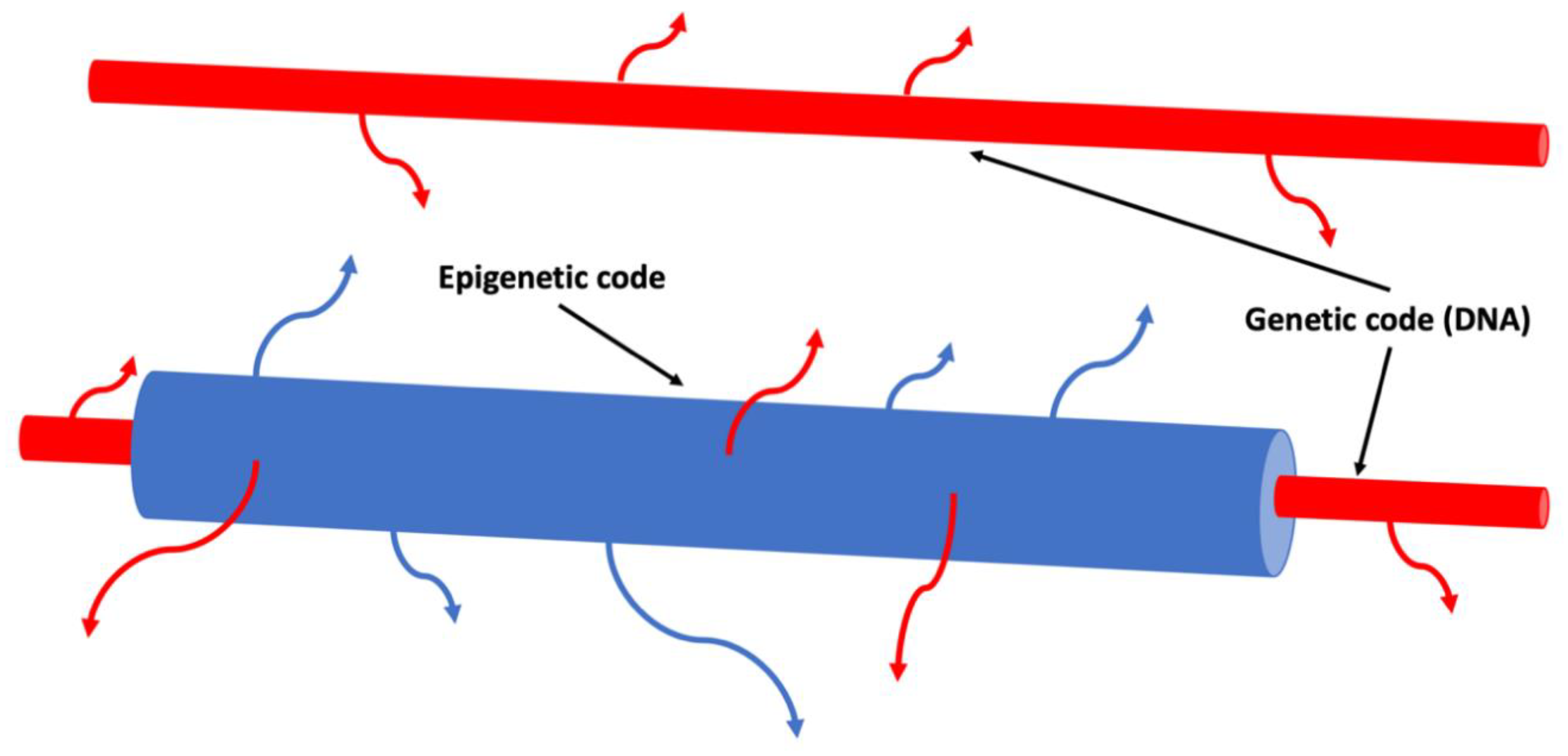
Figure 2.
Genome–epigenome misalignment and the ageing process. (A) Schematic representation of a simple cyclical process with two phases. During the mitotic/G1 phase (top), genome–epigenome misalignment progressively increases because mitotically dividing cells have restricted access to the information required to fully restore the epigenome. This leads to the accumulation of epigenetic defects and drives the ageing process forward. During the meiotic phase (bottom), meiotic cells gain access to an epigenetic repair or rewriting programme that restores genome–epigenome alignment, thereby producing a rejuvenation-like reset. (B) In multicellular organisms, by contrast, many additional steps of epigenetic information reading are required to generate a fully functional organism. Dotted lines indicate steps in which relevant epigenetic information is read or re-established, counteracting ageing-related misalignment. Solid black lines indicate steps in which epigenetic information is progressively lost, misread, or misaligned faster than it is repaired or re-established. Figure adapted from Marsellach 2018 [14].
Figure 2.
Genome–epigenome misalignment and the ageing process. (A) Schematic representation of a simple cyclical process with two phases. During the mitotic/G1 phase (top), genome–epigenome misalignment progressively increases because mitotically dividing cells have restricted access to the information required to fully restore the epigenome. This leads to the accumulation of epigenetic defects and drives the ageing process forward. During the meiotic phase (bottom), meiotic cells gain access to an epigenetic repair or rewriting programme that restores genome–epigenome alignment, thereby producing a rejuvenation-like reset. (B) In multicellular organisms, by contrast, many additional steps of epigenetic information reading are required to generate a fully functional organism. Dotted lines indicate steps in which relevant epigenetic information is read or re-established, counteracting ageing-related misalignment. Solid black lines indicate steps in which epigenetic information is progressively lost, misread, or misaligned faster than it is repaired or re-established. Figure adapted from Marsellach 2018 [14].
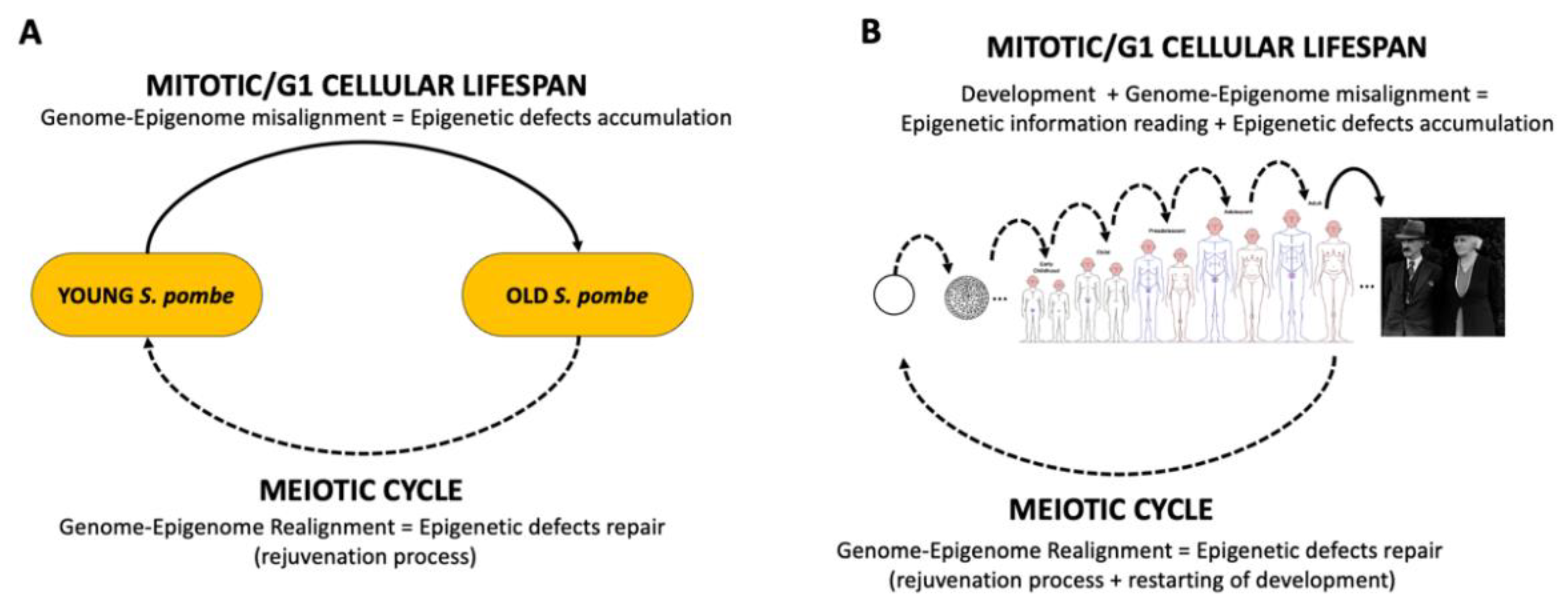
Figure 3.
Complexity–lifespan trade-off and information-loss avoidance strategies in ageing organisms. (A) Schematic representation of the complexity–lifespan trade-off. The Complexity Index, plotted in arbitrary units, is represented over evolutionary time. During the pre-ageing era, the likelihood of further complexity increase is represented as reaching a plateau because the probability of extrinsic death increases as complexity increases. With the emergence of proper ageing in the eukaryotic lineage, cyclical reuse and renewal of epigenetic information allowed further increases in biological complexity despite increased extrinsic lethality. The red dotted line represents the complexity–lifespan trade-off limit and approximately corresponds to the threshold C* defined in the main text. (B) Schematic representation of the overlapping-generation mechanism of information-loss avoidance, used mainly by multicellular organisms. Individual lifespans are represented as gradients that evolve from blue, indicating a young or properly aligned genome–epigenome state, to red, indicating epigenetic defect accumulation or genome–epigenome misalignment. Lethality occurs when individuals reach the temporal black line. The blue arrow represents transgenerational information transfer, through which a functional genome and a functional, aligned epigenome are transmitted to subsequent generations. Figure adapted from Marsellach 2021 [15].
Figure 3.
Complexity–lifespan trade-off and information-loss avoidance strategies in ageing organisms. (A) Schematic representation of the complexity–lifespan trade-off. The Complexity Index, plotted in arbitrary units, is represented over evolutionary time. During the pre-ageing era, the likelihood of further complexity increase is represented as reaching a plateau because the probability of extrinsic death increases as complexity increases. With the emergence of proper ageing in the eukaryotic lineage, cyclical reuse and renewal of epigenetic information allowed further increases in biological complexity despite increased extrinsic lethality. The red dotted line represents the complexity–lifespan trade-off limit and approximately corresponds to the threshold C* defined in the main text. (B) Schematic representation of the overlapping-generation mechanism of information-loss avoidance, used mainly by multicellular organisms. Individual lifespans are represented as gradients that evolve from blue, indicating a young or properly aligned genome–epigenome state, to red, indicating epigenetic defect accumulation or genome–epigenome misalignment. Lethality occurs when individuals reach the temporal black line. The blue arrow represents transgenerational information transfer, through which a functional genome and a functional, aligned epigenome are transmitted to subsequent generations. Figure adapted from Marsellach 2021 [15].
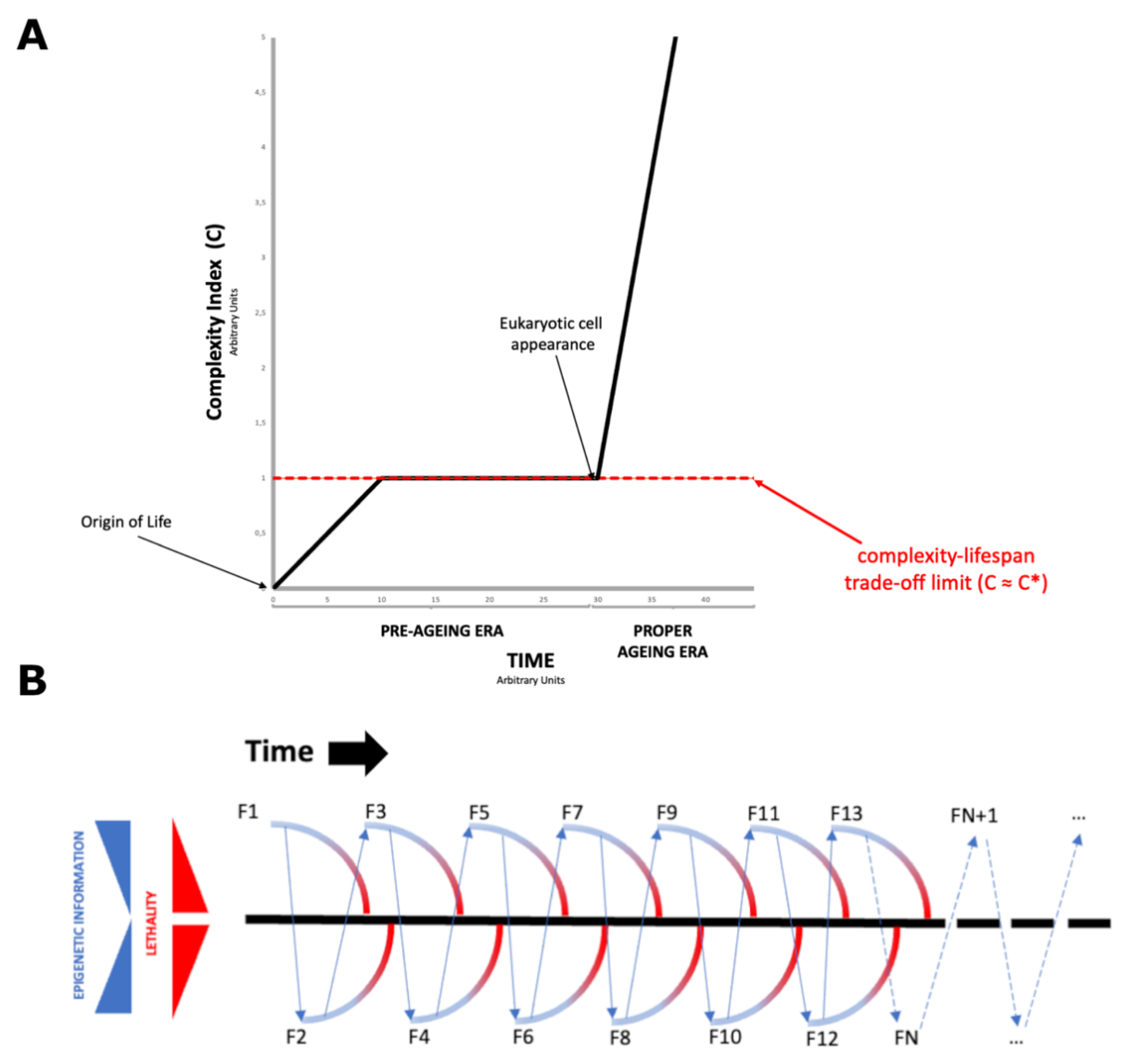
Figure 4.
Intergenerational Flow of Epigenetic Information. (A). Silenced loci in somatic cells are represented as closed black dots, while the same loci, expressed in germline cells, are shown in green. Red lines indicate how gene expression re-establishes youthful epigenetic information, effectively repairing epimutations present in the previous generation (orange cylinders). (B). When no saturability issues occur during meiotic epigenetic repair, all defects are corrected, and the resulting organism is free of epigenetic defects. (C). Persistent saturability problems during meiotic epigenetic repair, occurring over successive generations, lead to the progressive accumulation of epigenetic defects within the population.
Figure 4.
Intergenerational Flow of Epigenetic Information. (A). Silenced loci in somatic cells are represented as closed black dots, while the same loci, expressed in germline cells, are shown in green. Red lines indicate how gene expression re-establishes youthful epigenetic information, effectively repairing epimutations present in the previous generation (orange cylinders). (B). When no saturability issues occur during meiotic epigenetic repair, all defects are corrected, and the resulting organism is free of epigenetic defects. (C). Persistent saturability problems during meiotic epigenetic repair, occurring over successive generations, lead to the progressive accumulation of epigenetic defects within the population.
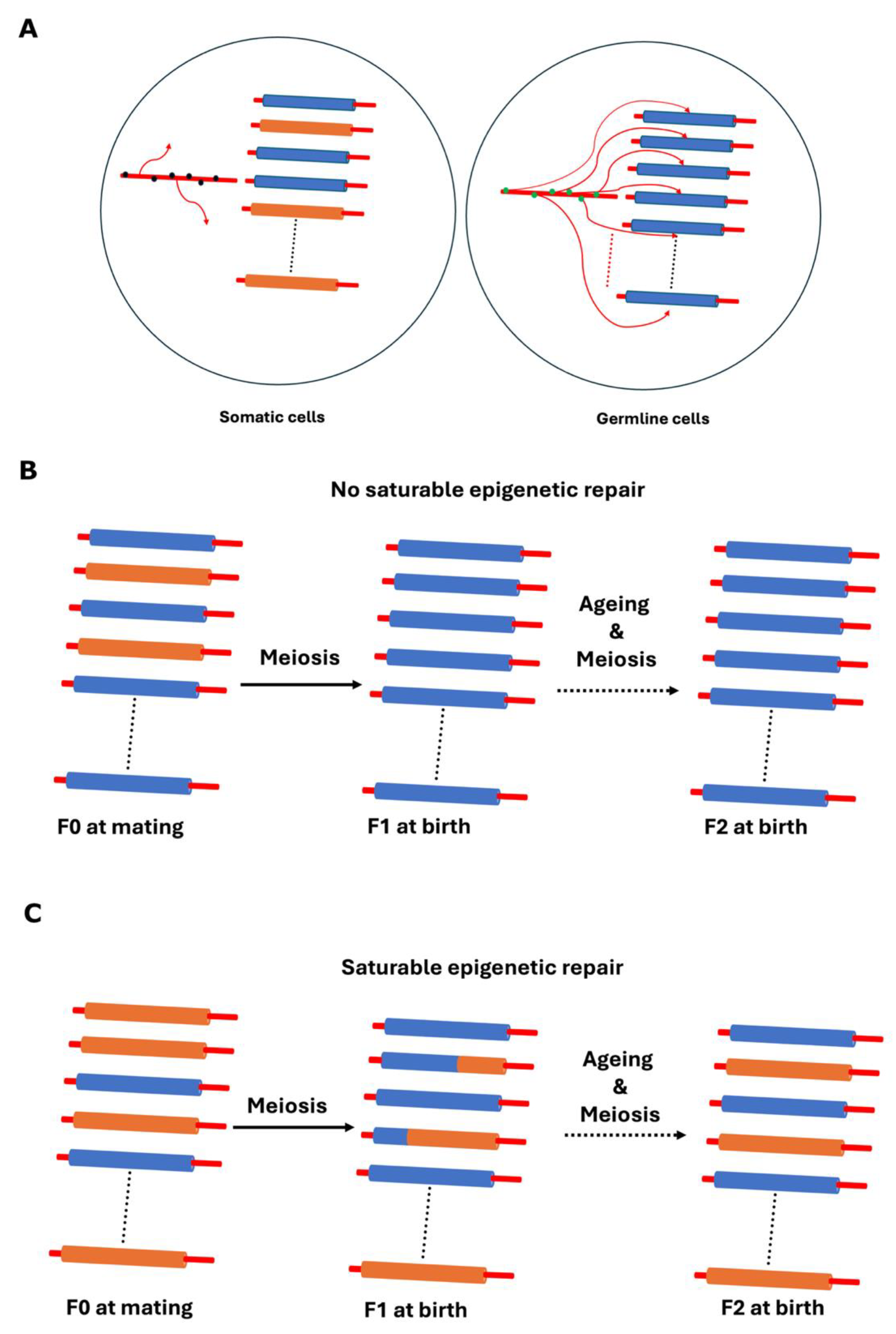
Figure 5.
Shields and Ratchets. (A) Epigenome rebuilding during meiosis. The correct epigenetic information required to produce the young phenotype is restored to generate a functional, rejuvenated epigenetic configuration. Epigenetic factors are proposed to act as shields that protect genomic regions from mutation accumulation [60]. (B) As ageing progresses and epigenetic defects accumulate, or epigenetic factors are lost, this shielding effect is weakened, potentially increasing the rate of genetic mutations. (C) Schematic representation of Muller’s genetic ratchet (left) and the proposed epigenetic ratchet-like mechanism (right). Genetic and epigenetic information are represented as in Figure 1. (D) Schematic representation of how genomic and epigenomic information jointly maintain phenotypic functionality. The combined action of the epigenetic ratchet, corresponding to the ageing process, and Muller’s genetic ratchet in non-meiotic cells progressively compromises phenotypic functionality and ultimately leads to cell death. Panels C and D adapted from Marsellach 2017 [7].
Figure 5.
Shields and Ratchets. (A) Epigenome rebuilding during meiosis. The correct epigenetic information required to produce the young phenotype is restored to generate a functional, rejuvenated epigenetic configuration. Epigenetic factors are proposed to act as shields that protect genomic regions from mutation accumulation [60]. (B) As ageing progresses and epigenetic defects accumulate, or epigenetic factors are lost, this shielding effect is weakened, potentially increasing the rate of genetic mutations. (C) Schematic representation of Muller’s genetic ratchet (left) and the proposed epigenetic ratchet-like mechanism (right). Genetic and epigenetic information are represented as in Figure 1. (D) Schematic representation of how genomic and epigenomic information jointly maintain phenotypic functionality. The combined action of the epigenetic ratchet, corresponding to the ageing process, and Muller’s genetic ratchet in non-meiotic cells progressively compromises phenotypic functionality and ultimately leads to cell death. Panels C and D adapted from Marsellach 2017 [7].
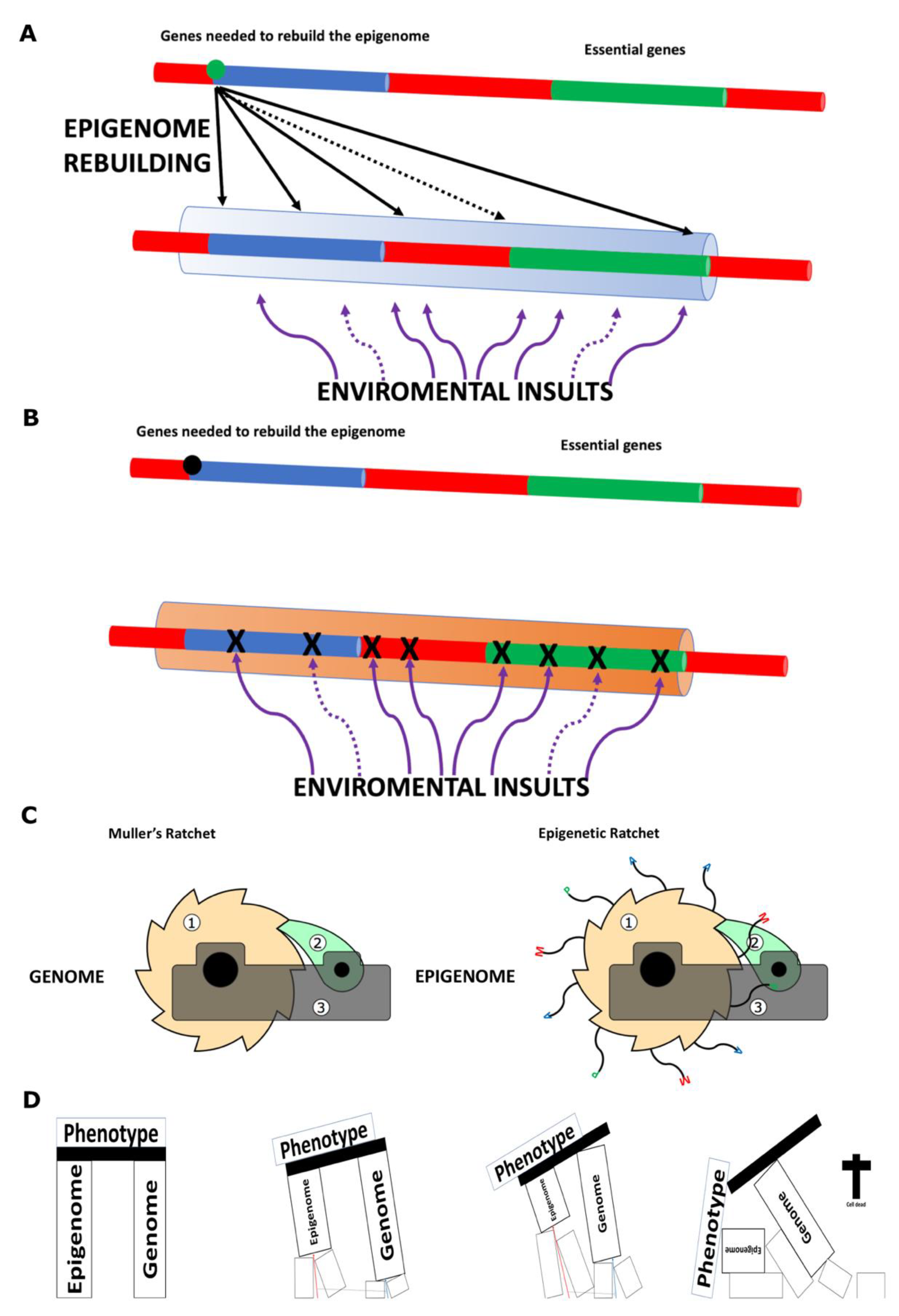
Figure 6.
Lethality-avoidance strategies of unicellular organisms. A schematic example of the growth of unicellular organisms in laboratory test tubes is shown. Epi-wild-type individuals are represented in orange, whereas epimutant individuals are represented in red. Under favourable conditions, rapid proliferation allows the population to be progressively enriched for fitter individuals, thereby preserving biological information through selection among many mitotically or binary-fission-derived descendants. In this interpretation, culture renewal is not necessarily a neutral technical step: when a population is transferred into fresh conditions, cells occupying more functional and stable genome–epigenome states are expected to contribute disproportionately to the next population, whereas cells closer to a functional threshold contribute little or not at all. Thus, apparent ‘renewal’ in unicellular laboratory cultures may reflect selection among metastable epigenetic states rather than repair of every individual cell. Figure adapted from Marsellach 2018 [14].
Figure 6.
Lethality-avoidance strategies of unicellular organisms. A schematic example of the growth of unicellular organisms in laboratory test tubes is shown. Epi-wild-type individuals are represented in orange, whereas epimutant individuals are represented in red. Under favourable conditions, rapid proliferation allows the population to be progressively enriched for fitter individuals, thereby preserving biological information through selection among many mitotically or binary-fission-derived descendants. In this interpretation, culture renewal is not necessarily a neutral technical step: when a population is transferred into fresh conditions, cells occupying more functional and stable genome–epigenome states are expected to contribute disproportionately to the next population, whereas cells closer to a functional threshold contribute little or not at all. Thus, apparent ‘renewal’ in unicellular laboratory cultures may reflect selection among metastable epigenetic states rather than repair of every individual cell. Figure adapted from Marsellach 2018 [14].
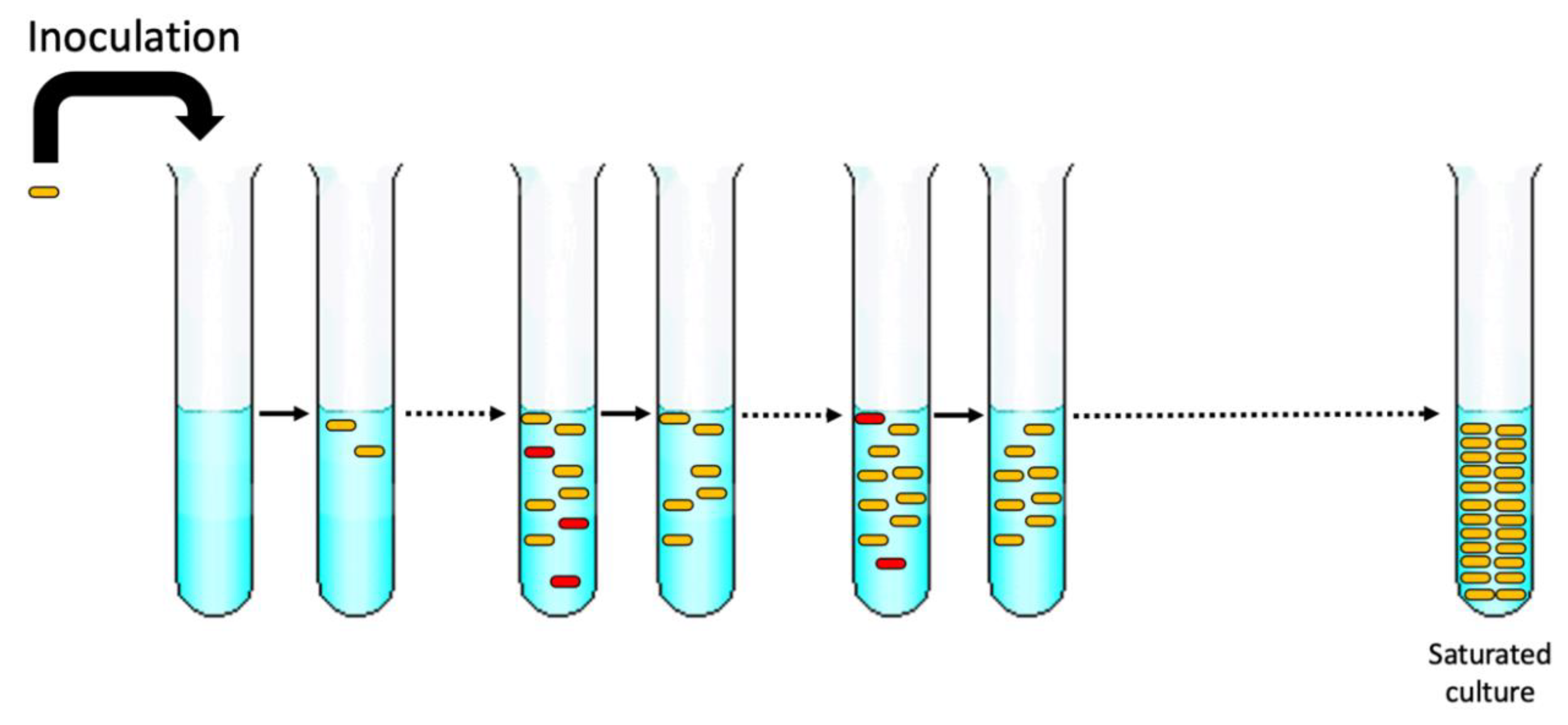
Disclaimer/Publisher’s Note: The statements, opinions and data contained in all publications are solely those of the individual author(s) and contributor(s) and not of MDPI and/or the editor(s). MDPI and/or the editor(s) disclaim responsibility for any injury to people or property resulting from any ideas, methods, instructions or products referred to in the content. |
© 2026 by the authors. Licensee MDPI, Basel, Switzerland. This article is an open access article distributed under the terms and conditions of the Creative Commons Attribution (CC BY) license (http://creativecommons.org/licenses/by/4.0/).
Copyright: This open access article is published under a Creative Commons CC BY 4.0 license, which permit the free download, distribution, and reuse, provided that the author and preprint are cited in any reuse.


