

Submitted:
19 July 2025
Posted:
21 July 2025
You are already at the latest version
Abstract
Temporal variability in emissions from oil and gas supply chains depends on the spatial scale at which emissions are aggregated. Emissions of methane, ethane, volatile organic compounds (VOCs) and nitrogen oxides (NOx) from oil and gas facilities in the Marcellus production region were estimated at a one-hour time resolution for calendar year 2023. Emissions from more than 200,000 well sites were included in the analyses and hourly emissions were aggregated at the grid cell (4 km by 4 km), county and basin level. Ratios of maximum to annual average hourly predicted emission rates were calculated at the grid cell, county and basin level for each pollutant. Maximum to average emission rate ratios decreased as the scale of spatial aggregation increased. At the grid cell level, ratios of maximum to average emission rates exceeded 100 in some grid cells for hydrocarbon emissions such as VOCs. In contrast, basin level maximum to average ratios for NOx emission rates were less than 1.1. The sources driving temporal variability for hydrocarbon emissions were well completions and liquid unloadings, while the sources driving temporal variability in NOx emissions were pre-production activities such as drilling and hydraulic fracturing. Accurately reconciling predicted emissions with measurements requires accounting for the timing, duration, and frequency of intermittent events, and depends on the type of measurements being made.
Keywords:
emission variability
; methane emissions
; ethane emissions
; volatile organic compounds (VOCs)
; nitrogen oxides (NOx)
; oil and gas production
; spatial aggregation
1. Introduction
Emissions of greenhouse gases and criteria air pollutants from oil and gas supply chains have complex spatial and temporal patterns [1]. For example, emission rates for methane from individual sources can vary over 6 orders of magnitude, from grams per hour to tons per hour [2]. The largest emission rate sources tend to be episodic. Emissions of volatile organic compounds (VOCs) also have temporal and spatial variability, but the sources of that variability are different than the sources of variability in methane and other light alkane emissions [3]. Emissions of nitrogen oxides (NOx) also exhibit variability, but again, the sources are different than the sources that drive variability in methane and VOCs emissions [4].
The magnitude of temporal variability in emissions depends, not only on the pollutant, but also on the spatial scale at which emissions are aggregated. The smaller the spatial scale of aggregation, the larger the temporal variability. Temporal variability in emissions from individual sites will generally be greater than variability in emissions aggregated over a grid cell containing dozens of sites; grid cell variability will be greater than the variability at the county level, which will be greater than the variability at the basin level.
There are multiple human health implications associated with spatial and temporal variability in emissions. Examples of potential impacts include, but are not limited to, variability in ozone productivity driven by local variability in emissions of NOx, particularly when coupled with high emissions of biogenic hydrocarbons and localized exposures to elevated levels of criteria or hazardous air pollutants [4]. Spatial and temporal variability of emissions is also important to consider when using short duration measurements, such as aircraft over-flights, in estimating longer term emissions. The magnitude, frequency and duration of episodic emissions will determine how many measurements will be needed to accurately predict long term emissions. [5], [6], [7]
This work will demonstrate methods for modeling spatial and temporal variability in emissions from oil and gas sources by estimating the emissions associated with the production and midstream processing of oil and gas produced by more than 200,000 sites in the Marcellus production region in the United States. Year long time series of emissions will be estimated at one hour resolution for methane, ethane, VOCs and NOx. Emissions will be aggregated at the grid cell (4 km by 4 km), county and basin level, and at each of these spatial scales, distributions of expected emission rates will be characterized.
These characterizations will be done for routine emissions. For some pollutants, particularly hydrocarbons, unintended methane emissions can be a significant contributor to emission variability. The emissions variability due to routine emissions will be compared to observed distributions of large emission events, to identify the contributions of sources not accounted for in inventories of routine emissions.
2. Materials and Methods
2.1. Study Domain
Figure 1 shows the study domain and locations of simulated sources. The study domain was divided into 4 km by 4 km grid cells, covering 98% of active production wells reported in the Marcellus Shale [8]. A total of 201,338 wells, drilled on or before 2023 and actively producing in 2023, are included in the simulation, representing production and emission scenarios in the year 2023. The gridded area includes grid cells without any reported production and these grid cells will be assumed to have no emissions associated with upstream and midstream oil and gas operations.
Emission sources in the study domain include well-level emissions from pre-production and production activities on active well sites, emissions from midstream operations, and from flaring. Active well sites were identified based on production data [8]. Well-site emissions in two counties, Bradford, PA, and Wetzel, WV, were used as representative regions to compare county level emissions to emissions resolved at the grid cell level. Bradford County is located in the northeast portion of the basin, a relatively dry gas production region with mostly unconventional horizontally drilled wells. Wetzel County is in the southwest portion of the basin and has a large amount of liquids production compared to Wetzel County, from comparable numbers of conventional and unconventional wells. Distributions of well types included in the study domain and in two selected counties are shown in Table 1. Aggregated production data in the study domain and in the two selected counties are available in Supporting Information (SI).
Midstream sites include gathering and boosting stations (assumed one per grid cell), gas processing plants, and transmission facilities. Gas processing plants and transmission facilities were drawn from the EPA Greenhouse Gas Reporting Program (GHGRP) [9] and manually verified based on satellite images [10]. Flare site locations were based on annual gas flare estimates with Visible Infrared Imaging Radiometer Suite (VIIRS) observations in 2023 [11]. Only midstream and flare sites located in grid cells with active wells were included in the simulation.
2.2. Spatial Aggregation
Emissions were aggregated and are reported at three spatial levels: the grid cell level, the county level, and the basin level. These levels of reporting involved 2 types of aggregation: pre-simulation and post-simulation. Pre-simulation refers to the aggregation of activity data (e.g., production volumes and equipment counts) prior to emission simulation. Post-simulation refers to the aggregation of simulated emissions. Post-simulation aggregation at individual well sites and midstream sites was done in Bradford and Wetzel Counties. These simulations will be used to compare grid cell level aggregation of emissions to county level aggregation of emissions. To compare county level aggregation of emissions to basin level aggregation of emissions, sources were aggregated pre-simulation at the county level.
For wells in Bradford and Wetzel Counties, well-site emissions were simulated based on estimated equipment and operation counts at individual well sites. Emissions from gathering, processing, and transmission sites and flares were simulated as total site-level emissions. These emissions were spatially aggregated by grid cell and by county over the 2023 year-long time series. Bradford County includes a total of 1520 wells, with 1216 wells located within 132 grid cells that are completely within the county boundary. Wetzel County includes 1295 wells, with 840 wells distributed across 36 grid cells that are fully within the county. Only wells within grid cells that are completely within county boundaries were included in spatial aggregation.
For county-level and basin-level reporting based on county-level simulations, well sites were aggregated pre-simulation. Up to three “aggregated wells” were created for each county: one dry gas well representing all dry gas wells, one wet gas well representing all wet gas wells, and one oil well representing all oil wells within the county. Production volumes and equipment counts were summed and assigned to their corresponding aggregated well. Detailed aggregation and simulation methods, by source, are described in the following sections.
2.3. Emission Compositions
Emission compositions at the well level were simulated using the Emission Composition Tool, built into the Methane Emission Estimation Tool (MEET) [12]. The Emission Composition Tool is a searchable database constructed with field measurement data and thermodynamic models and can be queried to estimate hydrocarbon compositions from various emission sources at oil and gas production sites, by matching input parameters including gas to oil ratios, API gravity, separator temperature and pressure, and produced gas compositions [13]. Three emission composition profiles were generated in this work: dry, wet, and oil. Input parameters for “dry” and “wet” profiles were estimated based on the averaged parameters from dry gas and wet gas wells measured in the Marcellus production region [14]. Input parameters for the “oil” profile were from multiple sources. Gas-to-oil ratio was calculated based on production data in the basin in 2023 [8]. API gravity, separator pressure, and produced gas compositions were the averaged values across a subset of wells from the Central Appalachian Basin Natural Gas Database [15]. The subset included wells with an API gravity lower than 45 and non-zero produced gas compositions. While the database did not provide information on separator temperature, separator temperature for the “oil” profile was assumed the same as that for the “wet” profile. Input parameters for estimating each composition profile are summarized in Table 2.
Table 3 shows estimated emission compositions returned by the Emission Composition Tool [13], based on input parameters in Table 2. Four sets of emission compositions were estimated for each composition profile, including wellstream, produced gas, water tank flash, and condensate tank flash. While the tool did not simulate VOCs emissions from condensate tank flash, the sum of propane and butanes emissions was used as a surrogate for VOCs and are reported in Table 3. Emission compositions from the dry composition profile were assigned to emissions from dry gas wells; wet profile compositions were assigned to wet gas wells, and oil profile compositions were assigned to oil wells. There were a few wells characterized as dry gas wells in the production database [8] but with nonzero oil production. Since the dry profile assumed no oil production, wet profile compositions were re-assigned to these wells.
2.4. Emission sources
Table 4 summarizes all emission sources and pollutants included in the simulation, the emission estimation method and hydrocarbon compositions for emission estimates, and whether the source was aggregated pre-simulation for county- and basin-level reporting. Hydrocarbon compositions were sourced from the EPA 2020 Nonpoint Oil and Gas Emission Estimation Tool (referred to as EPA Oil and Gas Tool in the following text) [16], and/or from the Emission Composition Tool [13]. The 2020 version of the EPA Oil and Gas Tool was used because it was the most recent version with complete documentation at the time the simulations were done. The composition of throughput gas for midstream facilities and the composition of flared gas at the grid cell level was estimated by combining production and produced gas compositions from individual wells. Throughput gas compositions estimated at the level of counties were used to estimate emissions from combustion sources including artificial lift engines and heaters, assuming local produced gas were used as fuel. The sources without pre-simulation aggregation were always simulated at the individual well level and aggregated during post-processing.
For some of the simulated sources, activity data used in equipment assignments were sourced from the 2022 Inventory of U.S. Greenhouse Gas Emissions and Sinks (GHGI) [17], shown in Table 5. The 2022 data was the most recent version available at the time the simulations were done. The GHGI reports two sets of activity factors for the natural gas system and the petroleum system. Activity factors reported for the natural gas system were applied to dry gas wells, and activity factors reported for the petroleum system were applied to the oil wells. For wet gas wells, the activity data was assigned as the average data for dry gas and oil wells. If the equipment or operation category does not exist in the petroleum system, or is not applicable to oil wells, such as gas meters / piping and liquid unloading operations, the activity factors reported for the natural gas system were consistently applied to both dry and wet gas wells. The equipment assignment based on this activity data will be described later by source.
Drilling Engines
Drilling engines emissions were estimated for wells drilled and completed in 2023. Well drilling was assumed to start 4 weeks before the well completion date and last for 2 weeks. Methane, VOCs, and NOx emissions from drilling engines were estimated using the EPA Oil and Gas Tool [16]. The 2020 version was the most recent version with complete documentation. Table 6 reports total drilling emissions per drilling depth, calculated with the activity factors and emission factors of drilling engines specific to Marcellus. Total drilling emissions per drilling depth were then combined with drilling depth per well, to estimate total drilling emissions per well. Total drilling emissions per well were temporally allocated over the two-week drilling period, with emission rates evenly distributed. Ethane emissions were considered negligible, assuming drilling engines were all diesel engines, according to data reported in the EPA Oil and Gas Tool. Drilling emissions were always simulated at the well level, regardless of the spatial scales of post aggregation and reporting, as the timing of drilling events varied by well.
Hydraulic Fracturing Pumps
Hydraulic fracturing pumps emissions were estimated for the wells fractured and completed in 2023. Hydraulic fracturing was assumed to occur during the 2 weeks prior to the well completion date, immediately following the end of drilling activities. Methane, VOCs, and NOx emissions per event were estimated with the activity factors and emission factors of hydraulic fracturing pump engines specific to Marcellus, available in the EPA Oil and Gas Tool [16]. Per-event emissions were temporally allocated to the two-week hydraulic fracturing period with emission rates evenly distributed. Ethane emissions were considered negligible, assuming all fracturing pumps used diesel fuel. Fracturing emissions were always simulated at the well level due to different fracturing timings per well.
Emission factors per event and emission rates after temporal allocation are reported in Table 7. Two sets of activity and emission factors were available in the EPA Oil and Gas Tool. The EPA default factors were sourced from an inventory developed based in seven states including Louisiana, Oklahoma, Arkansas, Kansas, Missouri and Nebraska [19]. EPA default factors are significantly lower than fracturing emissions factors reported elsewhere in the literature [4]. An alternative set of factors developed for Texas basins [20], resulted in per-event emissions approximately 40 times higher than those estimated with the EPA defaults. While no detailed, region-specific study has been done in the Marcellus, the alternative factors developed for Texas basins were considered a more accurate estimate and were used in the base case simulation. The EPA default factors were applied in a sensitivity scenario.
Completion Flowbacks
Completion flowbacks emissions were estimated for wells completed in 2023 using the Methane Emission Estimation Tool (MEET) [12]. Completions were simulated as two-stage events, with varying durations and methane emission rates sampled from distribution of measurements [14]. Ethane and VOCs emission rates were estimated based on methane emission rates and wellstream compositions per well. Completion emissions were always simulated at the well level due to different timings of events at individual wells.
Artificial lift engines
Artificial lift engine emissions scale linearly with the number of oil wells at each spatial scale. In the two selected counties, these emissions were simulated at the grid cell level, and for the entire basin, these emissions were simulated at the county level. Methane, VOCs, and NOx emissions were estimated based on state-specific activity factors and emission factors of the engines, extracted from the EPA Oil and Gas Tool [16]. Although individual artificial lift engines may cycle on and off depending on their operating hours, total emission rates at the grid cell or the county level were assumed to be constant throughout the simulation period. Calculated emission rates were normalized by average annual operating hours to account for the intermittent operation of individual engines. State-specific average emission rates per oil well are reported in Table 8. Ethane emissions were estimated based on methane emissions and the ethane-to-methane composition ratio in throughput gas at the county level.
Associated Gas Venting
Associated gas venting emissions scale linearly with the number of oil wells at each spatial scale. In the two selected counties, these emissions were simulated at individual oil wells, and for the entire basin, these emissions were simulated per aggregated oil well per county after pre-simulation aggregation. The gas venting rate per oil production was estimated as a constant value of 0.15 MCF per barrel of oil produced and was assumed uniform across the basin [16]. Emissions due to flaring controls were not counted under associated gas venting to avoid double counting. Flaring activities were assumed to be captured by satellite with associated emissions counted under flare sites emissions.
Condensate Tank Flash
The assignment of condensate tank counts per well depends on oil production rates. Condensate tank flash emissions were simulated if the well has non-zero oil production. In the two selected counties, tank emissions were simulated at the well level. Methane and ethane emissions due to tank flash were simulated with MEET at hour resolution and emission rates declined as production declined over time. Summed propane and butane emissions were used as a surrogate for VOC emissions. The production decline per well was simulated based on the well-specific completion date, production data, and hyperbolic decline parameters drawn from a location-based decline parameter database built in the MEET model . Tanks at well sites with oil production were assumed with emission controls at 95% efficiency on both oil and water tanks, whereas tanks at sites with no oil production had no tank controls applied.
For the basin-level simulation, a pre-simulation aggregation step is involved, which aggregates wells of the same production type into an aggregated well per county. At the aggregated well, tank emissions were first simulated at a constant rate, based on a constant production rate from the wells being aggregated, without considering production declines. Then, two sets of scaling factors, a production scaling factor and a control scaling factor, were developed, accounting for county-level production declines and emission controls. The final emissions at each hour were calculated by multiplying the time series scaling factors with the constant tank emissions output from MEET.
The production scaling factor accounts for production declines over time and assumes tank emission rates change linearly with production rates. Time series of hourly production was simulated for each well based on its specific completion date and current production rate, using a hyperbolic decline model specific to each county. The simulated hourly production was then aggregated by county to develop a time series of production scaling factors. This set of factors are defined as the ratios of actual aggregated production to the constant aggregated production used in the MEET simulation.
The control scaling factor adjusts for the proportion of liquid production under control. A 95% control rate was applied to oil-producing wells. Hourly liquid production was simulated per well, and controlled versus uncontrolled production was aggregated by county and by hour. The control factor is calculated as the ratio of the liquid production from controlled wells to the total liquid production within the aggregation.
Water Tank Flash
Water tank flash emissions were simulated using the same method as condensate tank flash emissions, based on water production.
Leaks
Leaks were simulated by MEET through leak / no-leak transitions per leaking component from wellhead, separator, tanks, and meter/piping. Each well was assigned one wellhead. The count of separators assigned depends on the number of phases in production: if the well produces both gas and liquids, one separator is assigned; if the well produces only gas or only liquids, no separator is assigned. The number of tanks assigned per well depends on the existence of oil and water production per well as described above. Meter/piping was randomly assigned to gas wells classified as dry gas wells and wet gas wells based on the average count per gas well as reported in Table 5. Dry and wet gas wells have either 1 or 0 meter/piping assigned per well, with an average of 0.93 counts per well, while oil wells have no meter/piping assigned. Emission rates per leaking component were drawn from the distribution of measured emissions in literature [14].
Chemical Injection Pumps
Chemical injection pumps were randomly assigned to wells as either 0 or 1 per well, based on the average count per well type, as shown in Table 5. Emissions from chemical injection pumps were simulated by MEET. Emission rates were drawn from distribution of measured emissions [14] and were constant throughout the simulation.
In the two selected counties, chemical injection pump emissions were simulated at the individual well level. For the basin-level simulation, emissions were modeled at the level of aggregated wells per county. Although the total number of chemical injection pumps assigned to an aggregated well equals the sum of pump from all wells being aggregated into this aggregated well, only a single pump was simulated per aggregated well. The emissions from this single simulated pump were then scaled by the total pump count to estimate emissions from chemical injection pumps for the aggregated well.
Pneumatic Controllers
Pneumatic controllers were randomly assigned to wells as either 0 or 1 per well, based on the average count per well type and the fraction per controller type, as shown in Table 5. The fractions of each type of pneumatic controllers for wet gas wells were calculated using a weighted average based on the total pneumatic controller counts for dry and oil wells. Emissions from pneumatic controllers were simulated by MEET. Simulations transitioned between normal and abnormal operating modes, with normal and abnormal emission factors drawn from distribution of measured emissions [21]. For basin level simulation, emissions were simulated and scaled using the same method as for chemical injection pumps.
Heaters
Heater emissions scale linearly with the number of heaters in spatial aggregation. Heaters were randomly assigned to wells based on the average number of heaters per well, as shown in Table 5. Each well was assigned either one heater or none. Heaters were assumed to operate continuously throughout the year with constant emission rates. Methane, VOCs, and NOx emissions from heaters were estimated by combining basin-wide heater emission factors per volume of gas combusted and heater rated energy input, available in the EPA Oil and Gas Tool, with state-specific heating values of natural gas in 2023 reported by U.S. Energy Information Administration [22]. Heating values of combusted natural gas and calculated heater emission rates per state are reported in Table 9.
Liquid Unloadings
Liquid unloading emissions were always simulated at individual well level due to well specific timings of emissions. Liquid unloading operations were assigned to a subset of gas wells with nonzero gas production, completed in and before 2020, and with lowest gas-to-liquids producing ratios. As shown in Table 5, a total of 11% of wells across the basin were assigned liquid unloading operations with or without plunger lifts. Number of wells assigned liquid unloadings at the basin and the county levels are reported in Table 10. There is limited publicly available information on whether the unloadings with plunger lifts are manual or automated. In the base case simulation, all liquid unloadings with plunger lifts were assumed to be automated. Manual unloadings of wells without plunger lifts and automated unloadings with plunger lifts were assigned randomly among the wells with liquid unloadings, based on the fraction of each unloading technology shown in Table 5. Activity and emission data for unloading events per well were randomly drawn from field measurements [23]. Compared to automated unloading operations, manual unloading operations happen less frequently with higher emission rates per event, and the time of day of the operation is constrained to working hours. Liquid unloadings with manual plunger lifts were simulated as a sensitivity scenario.
Gathering and Boosting
Gathering and boosting site emissions, including emissions from all fugitive and combustion sources, were simulated at the level of a grid cell, assuming one station per grid cell. Emission rates were estimated using a throughput-normalized emission factor developed based on field measurements, as described by equation (1) [18]:
f = 0.0079X-0.53 (R2 = 0.45)
Where f represents the unit-less throughput-normalized emission factor, and X represents the gas throughput in MMSCFD per gathering and boosting station. Whole gas emission rates were calculated by multiplying the throughput-normalized emission factor by gas throughput per station.
Methane, ethane, and VOCs emissions were calculated based on whole gas emission rates and throughput gas compositions at the level of grid cells. Based on field measurements, 38% methane emissions from gathering and boosting stations are due to methane slip [24]. NOx emissions were calculated based on methane slip emissions and engine-specific NOx-to-methane emission factors ratios from AP-42 [25]. For stationary internal combustion sources, NOx-to-methane ratios from 4-stroke lean-burn (4SLB) engines and 4-stroke rich-burn (4SRB) engines are 0.68 and 9.61, respectively. The base case simulation assumed all engines from gathering and boosting sites were 4SLB engines. 4SRB engines were later simulated as sensitivity analyses.
Processing Plants and Transmission Facilities
Emissions from gas processing plants and transmission facilities were simulated at the site level. Locations of gas processing plants and transmission facilities were originally sourced from the EPA Greenhouse Gas Reporting Program (GHGRP) [9]. Manual relocating and validation was done based on satellite imagery. A total of 24 gas processing plants and 34 transmission facilities were validated in the simulation domain, shown in Figure 1. Total methane emissions per year per site, reported by GHGRP, were evenly distributed across the year, to calculate hourly methane emission rate. Ethane and VOCs emissions were estimated based on methane emissions and throughput gas compositions from the grid cell in which the midstream site is located.
Methane slip accounted for 66% and 16% of total methane emissions from gas processing plants and transmission facilities, respectively, according to the 2022 GHGI [17]. NOx emissions were estimated using the same method applied to the gathering and boosting sites, based on methane emissions and engine-specific emission factors.
Flares
Emissions from the flare sites were simulated at the site level. Flare sites were identified based on Visible Infrared Imaging Radiometer Suite (VIIRS) observations in 2023 [11]. Site-level annual flare emissions were estimated based on annual gas flared volumes, reported by the Earth Observation Group, and an assumed flaring efficiency of 98%. Annual total methane, ethane, and VOCs emissions were estimated based on total gas emissions and grid-level gas compositions. NOx emissions were estimated as 0.49 of uncombusted methane emissions by mass, based on AP-42 emission factors for flaring [25].
The total hours of flaring per site was determined based on the detection frequency in 2023, and a constant hourly emission rate was calculated per emission species per site, by dividing the annual total emissions by total hours of flaring. Total hours of flaring per site were partitioned into multiple flaring events, with each event lasting up to 240 hours. Flaring events were randomly distributed across the year without temporal overlap.
3. Results
Hourly emissions time series for methane, ethane, VOCs, NOx are presented, aggregated at the grid cell, county and basin level, in Figure 2, Figure 3 and Figure 4. Time series for additional grid cells and an additional county are presented in Supporting Information (SI). The selected grid cell presented in Figure 2 is located in Wetzel County, WV. It contained 70 actively producing wells in 2023, 11 of which were completed in 2023. Six wells were assigned liquid unloadings. Detailed well characteristics of selected grid cells are available in the SI S2.
In Wetzel County, WV, methane emissions were primarily driven by gathering operations, with significant emission spikes from unloading events and occasional high emission rate completion events. Ethane and VOCs emissions showed similar temporal patterns as methane, with greater contributions of emissions from condensate tank flashing. County-level ethane and VOCs emissions from condensate tanks decline as existing wells aged and increased when new wells began production. In contrast, county-level methane emissions showed less sensitivity to this production change. Temporal variations in NOx emissions were driven by episodic, clustered drilling and fracturing events. In comparison, in Bradford County, PA, a dry gas production region with a comparable fraction of wells completed in 2023, temporal variability in total regional NOx emissions driven by preproduction activities was smoothed out due to the consistent high emissions from gathering operations. However, VOCs emissions in Bradford were more significantly influenced by preproduction activities, in which drier gas was produced and no condensate tanks were present. Time series emissions in Bradford, PA are available in the SI S3.1.
At the grid cell level, temporal variations in hydrocarbon emissions were primarily driven by liquid unloading and well completion events. In the absence of these events, emissions from pneumatic controllers also contributed to grid-level temporal variability (see SI Figures S3-2 and S3-5). NOx emissions were either relatively constant throughout the year, or showed temporal variations driven by preproduction operations and flaring (see SI Figure 3-6).
At the basin level, spatial aggregation reduced the impact of intermittent events, especially for NOx emissions. Hydrocarbon emissions retained more temporal variations due to short, frequent, and high-rate events such as liquid unloadings and well completions. Pneumatic controllers, switching between low-emitting normal modes and high-emitting abnormal modes, also contributed to temporal variability at the basin level, particularly for methane and ethane.
Table 11 presents the average, median, 75th percentile, 90th percentile, and maximum values of methane, ethane, VOCs, and NOx emissions for the basin, Wetzel County, and the selected grid cell in Wetzel County, WV, as shown in Figure 2. Table 12 and Table 13 summarize ratios of maximum to annual average hourly predicted emission rates, and the distribution of calculated ratios at various spatial levels. Additional summary tables for Bradford, PA are available in SI S3. Maximum to average emission rate ratios decreased as the scale of spatial aggregation increased. For example, the ratio of maximum to average emission rate for VOCs emissions was 1.6 at the basin level and 5.8 in Wetzel County. At the grid cell level, this ratio exceeded 100 in some grid cells within Wetzel County, WV. Compared to hydrocarbon emissions, NOx emissions presented less temporal variability in most counties. Exceptions are in the counties with little current production but with occasional preproduction activities for new wells. Maximum to average ratio for NOx emission rates was 1.1 and 1.4 at the basin level, and in Wetzel County, WV, respectively. The sources driving temporal variability for hydrocarbon emissions were liquid unloadings and well completions, while the sources driving temporal variability in NOx emissions were pre-production activities such as drilling and hydraulic fracturing. At finer spatial scales such as the grid cell level, NOx emissions from flares can also lead to elevated emission rates (see SI).
4. Discussion
Methods for reconciling these predicted time series with measurements will vary depending on the intermittency in emissions predicted and the type of measurement being made. For example, satellite or aircraft measurements could be made to estimate total area wide emissions at the scale of a county or basin. In these cases, if emissions are relatively constant over the time scale of a day, such as for NOx, then the average emission estimate for the day could be compared to the instantaneous measurement made by a satellite or an aircraft performing a mass balance flight. There is, however, day to day variability in emissions and in the case study considered in this work, that day to day variability at a county level can be 20% or more.
Reconciliations between predicted emission inventory time series and observations is more complex when emissions have durations of less than a day or have a diurnal pattern. This is the case for unloading emissions in the Marcellus. Consider a county with 1000 wells (similar to Wetzel County), where 10% of the liquid unloadings lead to venting, and each well vents 10 times per year. This would lead to an expected value of 1000 venting events per year. If the venting was distributed evenly throughout the day, then 3 unloadings would be expected on any day. In contrast if the unloadings only occur during an 8-hour working period, 9 unloadings would be expected in each working day, when measurements from aircraft and satellites are typically made. If the unloadings were distributed uniformly throughout the working day, and each lasted slightly less than an hour, then at any given time during the working day, one unloading should be observed in a county. In contrast, if unloadings were distributed uniformly throughout the day, then only on one day in three would an hour-long unloading be observed during an instantaneous measurement in the hypothetical county. If the duration of the events were 30 minutes instead of an hour the expected frequency for observing unloadings would be cut in half.
These simple examples illustrate the care that must be taken in comparing predicted intermittent, short duration events with observations. Accurate comparisons will depend on the frequency, duration, and diurnal patterns of the emission events [6]. For large emission rates such as blowdowns or unloadings, a single event at a single site can have a significant on impact on the instantaneous emission rates at the scale of a basin or county [5]. Emission predictions, accounting for emission intermittency and diurnal variations, should be compared to observations at the time measurements are made.
Supplementary Materials
The following supporting information can be downloaded at the website of this paper posted on Preprints.org, including descriptions of production data, selected grid cells, additional base case analyses, sensitivity analyses, and references. Additional supporting data are provided in .csv format, including hourly time series emission rates reported for pollutant by source category, aggregated at the grid cell, county, and basin level.
Author Contributions
Conceptualization, D.T.A.; methodology, Q.C.; software, Q.C., N.R., L.N., and S.A.; validation, Q.C, J.D.G, and V.B.; formal analysis, Q.C.; investigation, Q.C.; resources, D.T.A.; data curation, Q.C. and S.S.; writing—original draft preparation, Q.C. and D.T.A.; writing—review and editing, Q.C. and D.T.A.; visualization, Q.C.; supervision, D.T.A.; project administration, D.T.A., S.S. and Q.C.; funding acquisition, D.T.A. All authors have read and agreed to the published version of the manuscript.
Funding
Research described in this work was conducted under contract to the Health Effects Institute (HEI), an organization jointly funded by the United States Environmental Protection Agency (EPA) (Contract No. 68HERC19D0010) and certain oil and natural gas companies. Although the research was produced with partial funding by EPA and industry, they have not been subject to their review, and therefore the research does not necessarily reflect the views of the Agency or the oil and natural gas industry, and no official endorsement by the Agency or the industry should be inferred.
Institutional Review Board Statement
Not applicable.
Informed Consent Statement
Not applicable.
Data Availability Statement
The original data presented in the study are openly available at: xxx
Conflicts of Interest
The authors declare the following conflicts of interest: D.T.A. has served on the Environmental Protection Agency's Science Advisory Board; in this role, he was a paid Special Governmental Employees. D.T.A.’s research is currently supported by the National Science Foundation, the Department of Energy, the Texas Commission on Environmental Quality, Chevron, ExxonMobil, Pioneer Natural Resources, and the Environmental Defense Fund. He has also worked on projects that have been supported by oil and gas producers and the Environmental Defense Fund. D.T.A. has worked as a consultant for multiple companies, including Cheniere, Eastern Research Group, KeyLogic, and SLR International. In the summer of 2025, J.D.G. was a consultant for the United Nations Environment Programme’s International Methane Emissions Observatory, working on the Oil and Gas Methane Partnership 2.0. L.N. was as an intern at Baker Hughes.
References
- D. T. Allen, F. J. D. T. Allen, F. J. Cardoso-Saldaña, and Y. Kimura, “Variability in Spatially and Temporally Resolved Emissions and Hydrocarbon Source Fingerprints for Oil and Gas Sources in Shale Gas Production Regions,” Environ Sci Technol, vol. 51, no. 20, pp. 12016–12026, Oct. 2017. [Google Scholar] [CrossRef]
- National Petroleum Council, “Charting the Course,” Apr. 2024, Accessed: Jul. 09, 2025. [Online]. Available online: https://chartingthecourse.npc.org/documents/Charting_the_Course-V2-FINAL.pdf?a=1739340884.
- D. T. Allen, “Emissions from oil and gas operations in the United States and their air quality implications,” J Air Waste Manage Assoc, vol. 66, no. 6, pp. 549–575, Jun. 2016. [CrossRef]
- M. Modi, Y. M. Modi, Y. Kimura, L. Hildebrandt Ruiz, and D. T. Allen, “Fine Scale Spatial and Temporal Allocation of NOx Emissions from Unconventional Oil and Gas Development Can Result in Increased Predicted Regional Ozone Formation,” ACS ES&T Air, vol. 2, no. 2, pp. 130–140, Feb. 2025. [Google Scholar] [CrossRef]
- T. L. Vaughn et al., “Temporal variability largely explains top-down/bottom-up difference in methane emission estimates from a natural gas production region,” Proceedings of the National Academy of Sciences, vol. 115, no. 46, pp. 11712–11717, Nov. 2018. [CrossRef]
- L. Huang, S. L. Huang, S. Stokes, Q. Chen, and D. T. Allen, “Uncertainties in the Estimated Methane Emissions in Oil and Gas Production Regions Based on Aircraft Mass Balance Flights,” ACS Sustain Chem Eng, vol. 12, no. 29, pp. 11024–11032, Jul. 2024. [Google Scholar] [CrossRef]
- C. Schissel and D. T. Allen, “Impact of the High-Emission Event Duration and Sampling Frequency on the Uncertainty in Emission Estimates,” Environ Sci Technol Lett, vol. 9, no. 12, pp. 1063–1067, Dec. 2022. [CrossRef]
- “Enverus.” Accessed: Nov. 03, 2024. [Online]. Available online: https://prism.enverus.com/prism/home.
- U.S. Environmental Protection Agency, “EPA Facility Level GHG Emissions Data.” Accessed: Jul. 09, 2025. [Online]. Available: https://ghgdata.epa.gov/ghgp/main.
- Esri, “World Imagery.” Accessed: Jul. 10, 2025. [Online]. Available online: https://services.arcgisonline.com/ArcGIS/rest/services/World_Imagery/MapServer.
- Earth Observation Group, “Global Gas Flaring Observed from Space.” Accessed: Jul. 08, 2025. [Online]. Available: https://eogdata.mines.edu/products/vnf/global_gas_flare.
- D. T. Allen et al., “A Methane Emission Estimation Tool (MEET) for predictions of emissions from upstream oil and gas well sites with fine scale temporal and spatial resolution: Model structure and applications,” Science of The Total Environment, vol. 829, p. 154277, Jul. 2022. [CrossRef]
- F. J. Cardoso-Saldaña, K. F. J. Cardoso-Saldaña, K. Pierce, Q. Chen, Y. Kimura, and D. T. Allen, “A Searchable Database for Prediction of Emission Compositions from Upstream Oil and Gas Sources,” Environ Sci Technol, vol. 55, no. 5, pp. 3210–3218, Mar. 2021. [Google Scholar] [CrossRef]
- D. T. Allen et al., “Measurements of methane emissions at natural gas production sites in the United States,” Proceedings of the National Academy of Sciences, vol. 110, no. 44, pp. 17768–17773, Oct. 2013. [CrossRef]
- Y. A. Román Colón and L. F. Ruppert, “Central Appalachian basin natural gas database: distribution, composition, and origin of natural gases,” 2015. [CrossRef]
- U.S. Environmental Protection Agency, “2020 Nonpoint Oil and Gas Emissions Estimation Tool V1.3.” Accessed: Jul. 09, 2025. [Online]. Available: https://gaftp.epa.gov/Air/nei/2020/doc/supporting_data/nonpoint/oilgas/OIL_GAS_TOOL_v1.
- U.S. Environmental Protection Agency, “Inventory of U.S. Greenhouse Gas Emissions and Sinks: 1990-2022.” Accessed: Jul. 09, 2025. [Online]. Available: https://www.epa. 1990.
- D. Zimmerle et al., “Methane Emissions from Gathering Compressor Stations in the U.S.,” Environ Sci Technol, vol. 54, no. 12, pp. 7552–7561, Jun. 2020. [CrossRef]
- ENVIRON International Corporation and Inc. Eastern Research Group, “2011 Oil and Gas Emission Inventory Enhancement Project for CenSARA States,” Dec. 2012. Accessed: Jul. 09, 2025. [Online]. Available online: https://www.arb.ca.gov/ei/areasrc/oilandgaseifinalreport.pdf.
- Inc. Eastern Research Group, “SPECIFIED OIL & GAS WELL ACTIVITIES EMISSIONS INVENTORY UPDATE Prepared for: Texas Commission on Environmental Quality Air Quality Division,” Aug. 2014. Accessed: Jul. 09, 2025. [Online]. Available online: https://wayback.archive-it.org/414/20210527185258/https://www.tceq.texas.gov/assets/public/implementation/air/am/contracts/reports/ei/5821199776FY1426-20140801-erg-oil_gas_ei_update.pdf.
- D. T. Allen et al., “Methane Emissions from Process Equipment at Natural Gas Production Sites in the United States: Pneumatic Controllers,” Environ Sci Technol, vol. 49, no. 1, pp. 633–640, Jan. 2015. [CrossRef]
- Energy Information Administration, “Natural Gas Monthly Report.” Accessed: Jul. 08, 2025. [Online]. Available online: https://www.eia.gov/naturalgas/monthly/.
- D. T. Allen et al., “Methane Emissions from Process Equipment at Natural Gas Production Sites in the United States: Liquid Unloadings,” Environ Sci Technol, vol. 49, no. 1, pp. 641–648, Jan. 2015. [CrossRef]
- T. L. Vaughn, B. T. L. Vaughn, B. Luck, L. Williams, A. J. Marchese, and D. Zimmerle, “Methane Exhaust Measurements at Gathering Compressor Stations in the United States,” Environ Sci Technol, vol. 55, no. 2, pp. 1190–1196, Jan. 2021. [Google Scholar] [CrossRef]
- U.S. Environmental Protection Agency, “AP-42: Compilation of Air Emissions Factors from Stationary Sources.” Accessed: Jul. 09, 2025. Available online: https://www.epa.gov/air-emissions-factors-and-quantification/ap-42-compilation-air-emissions-factors-stationary-sources.
Figure 1.
Well sites, midstream sites, and flare sites included in the simulation within the study domain overlapped by 4 km by 4 km grid cells.
Figure 1.
Well sites, midstream sites, and flare sites included in the simulation within the study domain overlapped by 4 km by 4 km grid cells.
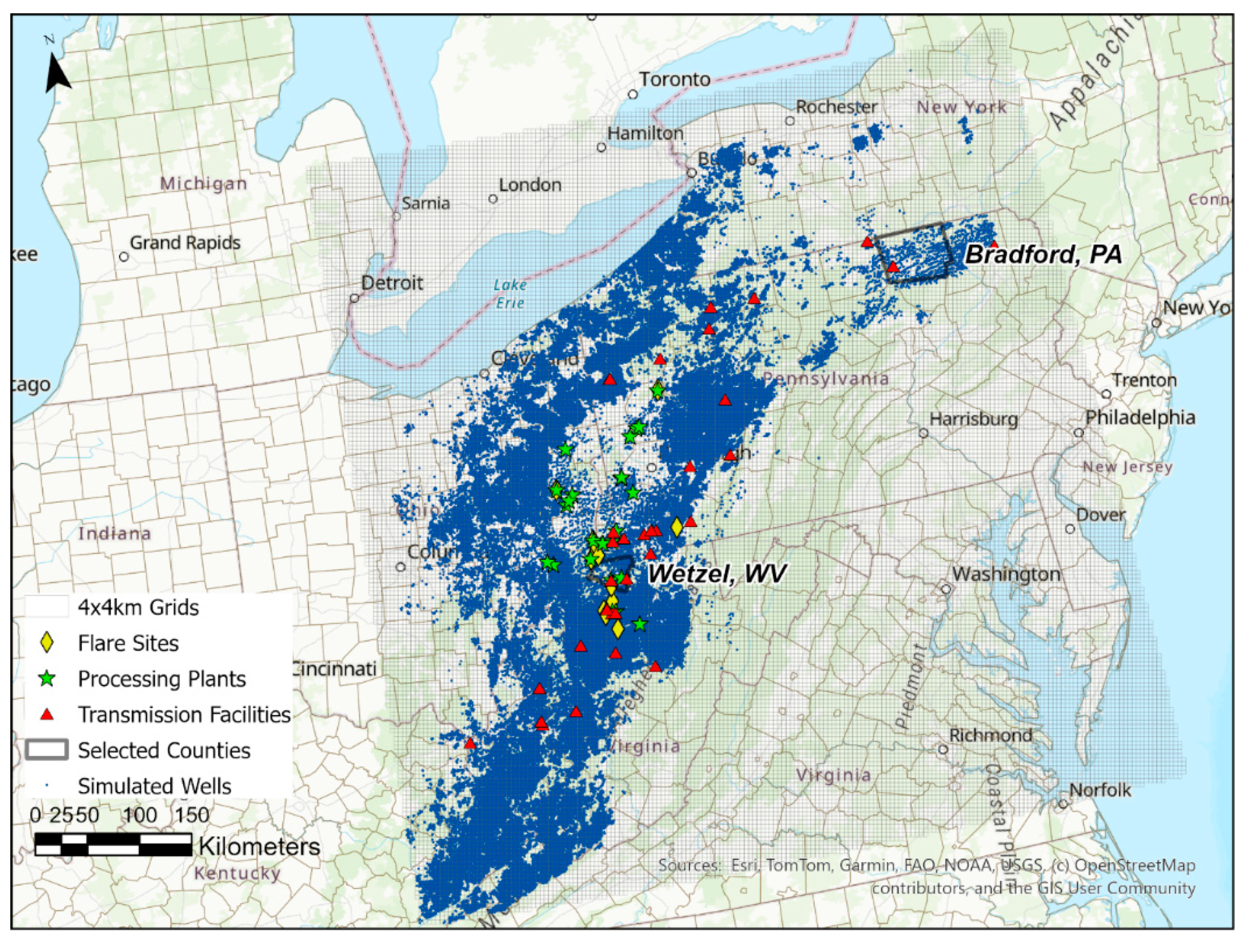
Figure 2.
Hourly emissions time series for methane, ethane, VOCs, and NOx emissions in a selected grid cell in Wetzel, WV.
Figure 2.
Hourly emissions time series for methane, ethane, VOCs, and NOx emissions in a selected grid cell in Wetzel, WV.
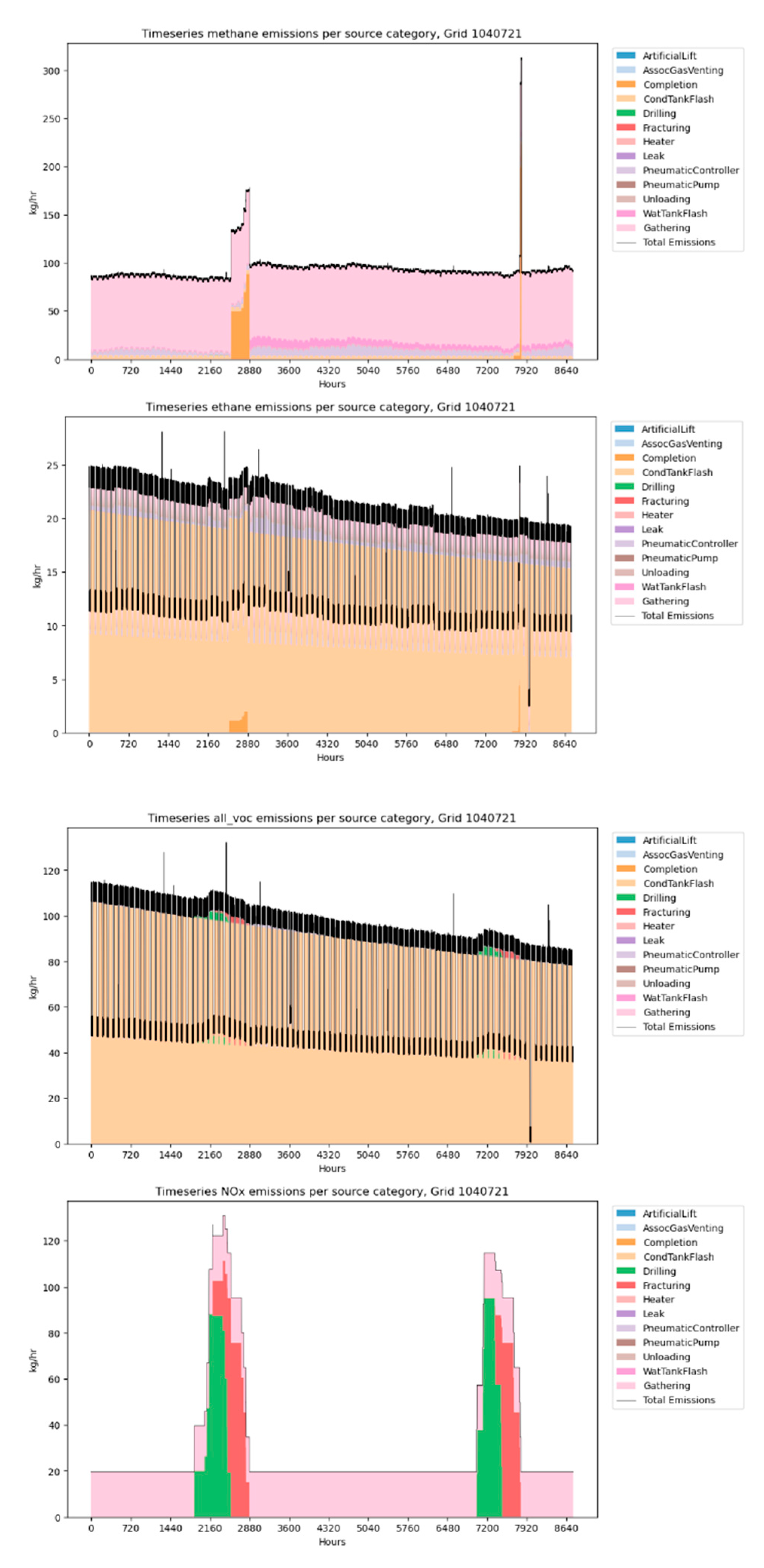
Figure 3.
Hourly emissions time series for methane, ethane, VOCs, and NOx emissions in Wetzel County, WV.
Figure 3.
Hourly emissions time series for methane, ethane, VOCs, and NOx emissions in Wetzel County, WV.
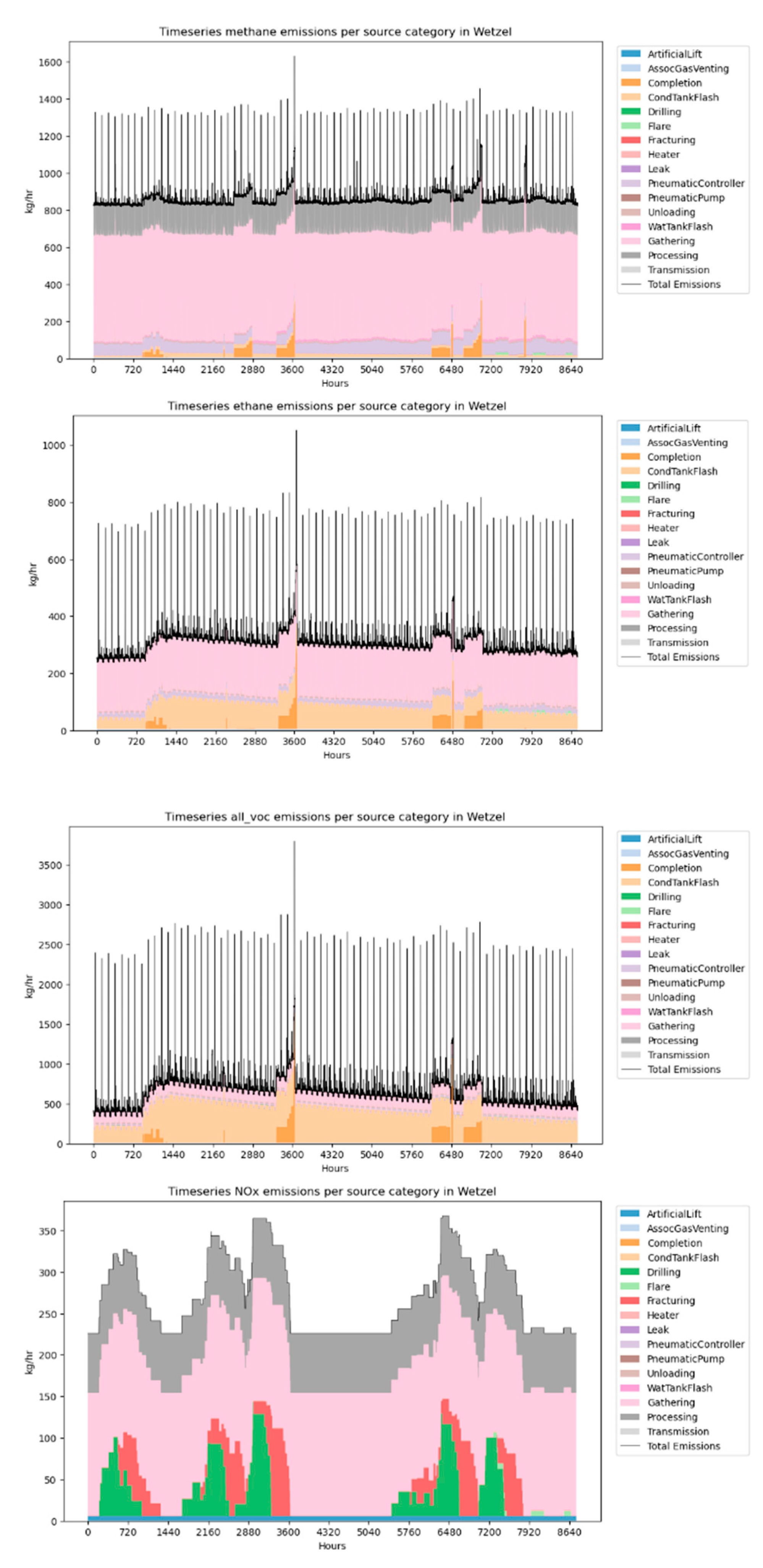
Figure 4.
Hourly emissions time series for methane, ethane, VOCs, and NOx emissions in the basin.


Table 1.
Well types in the study domain and two selected counties.
| Location | Wells in simulation | Wells eliminated | ||||||
|---|---|---|---|---|---|---|---|---|
| Total | Horizontal /directional | Vertical | Dry gas 1 | Wet gas 2 | Oil 3 | Wells completed in 2023 | No production or missing production data in 2023, or completed after 2024 | |
| Study domain | 201338 | 20902 | 174536 | 123170 | 42305 | 35863 | 1438 | 11449 |
| Bradford, PA | 1520 | 1507 | 13 | 1520 | 0 | 0 | 75 | 199 |
| Wetzel, WV | 1295 | 541 | 754 | 606 | 491 | 198 | 50 | 177 |
1 Dry gas wells are wells with <1% liquids production in wellhead stream.2 Wet gas wells include wells classified as wet gas wells (1-10% liquids in wellhead stream) and liquid rich gas wells (10-40% liquids in wellhead stream).3 Oil wells are wells with >40% liquids production in wellhead stream.
Table 2.
Input parameters for estimating emission compositions using the Emission Composition Tool.
| Well production | Separator | Produced gas compositions | |||||
| Profile ID | Gas-to-oil ratio (SCF/BBL) | API gravity | Separator temperature (°F) | Separator pressure (psia) |
Methane (molar fraction) | Ethane (molar fraction) | Propane (molar fraction) |
| Dry | NA | NA | 63.1 | 278 | 97.4% | 2.11% | 0.0753% |
| Wet | 427083 | 65.7 | 72 | 97.5 | 76.8% | 14.9% | 4.95% |
| Oil | 5206 | 14.4 | 72 | 898 | 51.9% | 13.7% | 7.77% |
Table 3.
Estimated emission compositions applied in inventory development.
| Composition profile: dry | |||||
| Compositions | Methane | Ethane | Propane | Butanes 1 | VOCs |
| Wellstream (molar fraction) | 97.9% | 1.14% | 0.0174% | 0.0004% | 0.0178% (44.3 g/mol) |
| Produced gas (molar fraction) | 97.9% | 1.14% | 0.0174% | 0.0004% | 0.0178% (44.3 g/mol) |
| Water tank flash (kg/bbl) | 0.0824 | 2.75E-3 | 5.10E-5 | 5.23E-05 | 5.23E-5 |
| Condensate tank flash (kg/bbl) | NA | NA | NA | NA | NA |
| Composition profile: wet | |||||
| Compositions | Methane | Ethane | Propane | Butanes 1 | VOCs |
| Wellstream (molar fraction) | 40.6% | 20.5% | 16.9% | 10.35% | 37.9% (68.5 g/mol) |
| Produced gas (molar fraction) | 63.4% | 23.2% | 9.55% | 2.21% | 12.1% (47.3 g/mol) |
| Water tank flash (kg/bbl) | 0.0626 | 0.0794 | 0.0438 | 0.0350 | 0.0893 |
| Condensate tank flash (kg/bbl) | 3.51 | 16.5 | 40.8 | 43.6 | 84.4 2 |
| Composition profile: oil | |||||
| Compositions | Methane | Ethane | Propane | Butanes 1 | VOCs |
| Wellstream (molar fraction) | 40.6% | 20.5% | 16.9% | 10.4% | 37.9% (68.5 g/mol) |
| Produced gas (molar fraction) | 50.4% | 24.2% | 16.7% | 6.43% | 24.3% (49.2 g/mol) |
| Water tank flash (kg/bbl) | 0.0149 | 0.0248 | 0.0229 | 0.0289 | 0.0648 |
| Condensate tank flash (kg/bbl) | 0.381 | 2.67 | 12.0 | 23.4 | 35.4 2 |
1 Sum of n-butane and isobutane 2 Calculated as the total mass of propane and butanes in condensate tank flash.
Table 4.
Emission sources and estimation method.
| Emission sites | Emission sources | Simulated pollutants | Main method for emission estimates | Hydrocarbon compositions | Pre-aggregation |
| Well sites: pre-production |
Drilling engines | Methane, VOCs, NOx | EPA Oil and Gas Tool [16] | EPA Oil and Gas Tool | Not aggregated |
| Hydraulic fracturing pumps | Methane, VOCs, NOx | EPA Oil and Gas Tool [16] | EPA Oil and Gas Tool | Not aggregated | |
| Completion flowbacks | Methane, Ethane, VOCs | MEET [12] | Wellstream | Not aggregated | |
| Well sites: production |
Artificial lift engines | Methane, ethane, VOCs, NOx | EPA Oil and Gas Tool [16] | County-throughput produced gas composition and EPA Oil and Gas Tool | Aggregated |
| Associated gas venting | Methane, ethane, VOCs | EPA Oil and Gas Tool [16] | Produced gas | Aggregated | |
| Condensate tank flash | Methane, ethane, VOCs | MEET [12] | Condensate tank flash | Aggregated | |
| Water tank flash | Methane, ethane, VOCs | MEET [12] | Water tank flash | Aggregated | |
| Leaks | Methane, ethane, VOCs | MEET [12] | Varying compositions | Aggregated | |
| Pneumatic controllers | Methane, ethane, VOCs | MEET [12] | Produced gas | Aggregated | |
| Chemical injection pumps | Methane, ethane, VOCs | MEET [12] | Produced gas | Aggregated | |
| Heaters | Methane, ethane, VOCs, NOx | EPA Oil and Gas Tool [16] | County-throughput produced gas composition and EPA Oil and Gas Tool | Aggregated | |
| Liquid unloadings | Methane, ethane, VOCs | MEET [12] | Produced gas | Not aggregated | |
| Gathering & boosting | Site-total emissions | Methane, ethane, VOCs, NOx | Zimmerle et al. [18] | Grid cell throughput produced gas | Not applicable |
| Gas processing sites | Site-total emissions | Methane, ethane, VOCs, NOx | GHGRP [9] | Grid cell throughput produced gas | Not applicable |
| Gas transmission sites | Site-total emissions | Methane, ethane, VOCs, NOx | GHGRP [9] | Grid cell throughput produced gas | Not applicable |
| Flare sites | Site-total emissions | Methane, ethane, VOCs, NOx | VIIRS [11] | Grid cell throughput produced gas | Not applicable |
Table 5.
Activity data extracted and calculated from EPA GHGI for selected sources.
| Simulated source | Equipment | Unit | Dry wells | Wet wells | Oil wells |
| Leaks | Meter / piping | Count per well | 0.93 | NA | |
| Chemical injection pumps | Chemical injection pumps | Count per well | 0.03 | 0.01 | 0 |
| Pneumatic controllers | Pneumatic controllers | Count per well | 0.97 | 0.63 | 0.29 |
| High bleed | Fraction | 0.2% | 0.1% | 0% | |
| Low bleed | Fraction | 17.3% | 23.4% | 43.8% | |
| Intermittent bleed | Fraction | 82.5% | 76.6% | 56.7% | |
| Heaters | Heaters | Count per well | 0.1 | 0.06 | 0.02 |
| Liquid unloading | Unloadings with plunger lifts | Fraction | 4.0% | NA | |
| Unloadings without plunger lifts | Fraction | 6.8% | NA | ||
Table 6.
Total drilling emissions per drilling depth from drilling engines.
| Well type | Methane, kg per meter drilled | VOCs, kg per meter drilled | NOx, kg per meter drilled |
| Horizontal | 0.83 | 0.036 | 0.0029 |
| Vertical | 0.26 | 0.014 | 0.0014 |
Table 7.
Total hydraulic fracturing pumps emissions per fracturing event.
| Factor scenarios | Unit | Methane | VOCs | NOx |
| EPA defaults | Total emissions per event (kg) | 0.37 | 5.1 | 127 |
| Emission rate (kg/hr) | 0.0011 | 0.015 | 0.38 | |
| Alternative factors developed for Texas basins – used in the base case simulation | Total emissions per event (kg) | 15 | 203 | 5082 |
| Emission rate (kg/hr) | 0.045 | 0.61 | 15 |
Table 8.
State-specific average emission rates per oil well from artificial lift engines.
| State | Methane, kg/hr/well | VOCs, kg/hr/well | NOx, kg/hr/well |
| KY | 4.53e-03 | 5.83e-04 | 4.47e-02 |
| NY | 1.59e-06 | 2.04e-07 | 1.57e-05 |
| OH | 5.86e-05 | 7.54e-06 | 5.78e-04 |
| PA | 4.53e-03 | 5.83e-04 | 4.47e-02 |
| VA | 4.53e -03 | 5.83e-04 | 4.47e-02 |
| WV | 4.53e -03 | 5.83e-04 | 4.47e-02 |
Table 9.
Heating values of combusted natural gas and calculated heater emission rates per heater per state.
Table 9.
Heating values of combusted natural gas and calculated heater emission rates per heater per state.
| State | Heating values, BTU/SCF | Methane, kg/hr/heater | VOC, kg/hr/heater | NOx, kg/hr/heater |
| PA | 1036 | 6.48e-04 | 1.55e-03 | 1.64e-02 |
| WV | 1082 | 6.20e-04 | 1.48e-03 | 1.57e-02 |
| KY | 1055 | 6.36e-04 | 1.52e-03 | 1.61e-02 |
| NY | 1032 | 6.50e-04 | 1.55e-03 | 1.65e-02 |
| OH | 1066 | 6.29e-04 | 1.51e-03 | 1.59e-02 |
| VA | 1050 | 6.39e-04 | 1.53e-03 | 1.62e-02 |
Table 10.
Number of wells assigned liquid unloadings with and without plunger lifts in the basin and two selected counties.
Table 10.
Number of wells assigned liquid unloadings with and without plunger lifts in the basin and two selected counties.
| Number of wells with liquid unloadings with plunger lifts | Number of wells with liquid unloadings without plunger lifts | |
| Basin | 6685 | 11214 |
| Bradford, PA | 10 | 17 |
| Wetzel, WV | 34 | 62 |
Table 11.
Distributions of methane, ethane, VOCs, and NOx emission rates for the basin, Wetzel County, and the selected grid cell.
Table 11.
Distributions of methane, ethane, VOCs, and NOx emission rates for the basin, Wetzel County, and the selected grid cell.
| Emission rates statistics (kg/hr) | mean | median | 75% | 90% | max |
| Basin | |||||
| Methane | 69822 | 69902 | 72811 | 76098 | 93545 |
| Ethane | 16885 | 16668 | 17346 | 18375 | 22613 |
| VOCs | 33898 | 32645 | 35104 | 39678 | 54081 |
| NOx | 13300 | 13331 | 13540 | 13709 | 13997 |
| Wetzel County, WV | |||||
| Methane | 860 | 843 | 864 | 898 | 1629 |
| Ethane | 307 | 300 | 323 | 341 | 1051 |
| VOCs | 651 | 631 | 731 | 803 | 3796 |
| NOx | 272 | 266 | 317 | 337 | 368 |
| Selected grid cell in Wetzel County, WV | |||||
| Methane | 94 | 91 | 96 | 98 | 313 |
| Ethane | 19 | 20 | 22 | 23 | 28 |
| VOCs | 83 | 90 | 100 | 107 | 132 |
| NOx | 34 | 20 | 20 | 95 | 131 |
Table 12.
Ratios of maximum to annual average hourly predicted emission rates at the basin and county levels, and distributions of the ratios among 173 counties included in the basin.
Table 12.
Ratios of maximum to annual average hourly predicted emission rates at the basin and county levels, and distributions of the ratios among 173 counties included in the basin.
| Emissions | Basin | Wetzel, WV | Bradford, PA | Distribution of ratios among 173 counties | ||||||
| mean | Std | min | 25% | 50% | 75% | max | ||||
| Methane | 1.3 | 1.9 | 1.6 | 3.3 | 2.5 | 1.0 | 1.7 | 2.7 | 3.7 | 18 |
| Ethane | 1.3 | 3.4 | 1.6 | 3.5 | 2.5 | 1.0 | 2.0 | 2.8 | 3.9 | 18 |
| VOCs | 1.6 | 5.8 | 2.5 | 5.3 | 6.2 | 1.0 | 2.2 | 3.6 | 5.5 | 41 |
| NOx | 1.1 | 1.4 | 1.2 | 1.3 | 0.8 | 1.0 | 1.0 | 1.0 | 1.3 | 9.3 |
Table 13.
Ratios of maximum to annual average hourly predicted emission rates at a selected grid cell level, and distributions of the ratios among 36 grid cells located within Wetzel County, WV.
Table 13.
Ratios of maximum to annual average hourly predicted emission rates at a selected grid cell level, and distributions of the ratios among 36 grid cells located within Wetzel County, WV.
| Emissions | Selected grid cell | Distribution of ratios among 36 grid cells in Wetzel, WV | ||||||
| mean | std | min | 25% | 50% | 75% | max | ||
| Methane | 3.4 | 3.5 | 4.3 | 1.0 | 1.2 | 1.7 | 4.0 | 24 |
| Ethane | 1.4 | 5.2 | 6.0 | 1.1 | 1.3 | 2.6 | 6.1 | 29 |
| VOCs | 1.5 | 15 | 24 | 1.1 | 1.8 | 3.7 | 19 | 126 |
| NOx | 6.7 | 1.9 | 2.1 | 1.0 | 1.0 | 1.0 | 1.0 | 8.4 |
Disclaimer/Publisher’s Note: The statements, opinions and data contained in all publications are solely those of the individual author(s) and contributor(s) and not of MDPI and/or the editor(s). MDPI and/or the editor(s) disclaim responsibility for any injury to people or property resulting from any ideas, methods, instructions or products referred to in the content. |
© 2025 by the authors. Licensee MDPI, Basel, Switzerland. This article is an open access article distributed under the terms and conditions of the Creative Commons Attribution (CC BY) license (http://creativecommons.org/licenses/by/4.0/).
Copyright: This open access article is published under a Creative Commons CC BY 4.0 license, which permit the free download, distribution, and reuse, provided that the author and preprint are cited in any reuse.


