

Submitted:
17 July 2025
Posted:
19 July 2025
You are already at the latest version
Abstract
The global population is ageing and at a time when the climate is warming. Human populations are susceptible to the health risks generated from climate change, notably older people who are disproportionately impacted and therefore vulnerable. This scoping review explores the existing literature on older people and climate change with a focus on climate related health impacts. The context of urban spaces and community are explored, given increasing global urbanization. A lack of dialogue with older people is noted and the subsequent implication on adaptation is explored. Adopting the PRISMA guidelines, credible databases identified literature that exists within the field of climate change and gerontology within a date range of 2014-2025. The context is on temperature climates and the global north, particularly urban UK. The health risks are identified with implications of risk where adaptation is not harnessed. Interventions are discussed along with the significance of place to an ageing population. Knowledge gaps are identified and research opportunities considered. A conclusion acknowledges and reiterates the importance of effective action at a local level that empowers older people within their context for successful adaptation which may be replicable elsewhere.
Keywords:
ageing/older people
; health
; risk
; adaptation
; dialogue
; empowerment
1. Introduction
It is predicted 9.7 billion people will be over the age of 65 years by 2050 [1] and that by 2050 two thirds of the world’s population will live in urban areas. In the UK, older populations are predicted to increase from 11 to 13 million people, equating to 22% of the total population over the age of 65 years within a decade[2]. This will place greater burden on resources such as healthcare with significant economic implications if adaptation interventions to climate related health risks are not effectively implemented.
Climate change impacts on human health [3] include exposure to extreme weather, increased diseases and challenges to global food production, all of which are currently being experienced. Older people are more susceptible to health-related impacts of climate change, where they are less able to adapt through social, economic or mobility disadvantages[4]. A recent report published in The Lancet in 2020, detailed 296,000 heat related deaths globally in 2018[5].
This scoping review which is formed of empirical research follows the Arksey & O'Malley’s scoping review framework[6] with reference to PRISMA Extension for Scoping Reviews (PRISMA-ScR): Checklist and Explanation[7]. The theoretical framework of Brofenbrenner’s Bioecological Systems Theory was identified to underpin the developmental structure of social, cultural, personal and environmental dynamics within the literature identified[8,9].
This work examines ageing in place and the relevance of community to enable healthier ageing in conjunction with interventions that have been trialled with varying success. Given increasing urbanization and growing populations, an urban context has been selected, particularly as climate change events are likely to be exacerbated in urban areas eg heat islands and flooding[10,11,12].
The research question was developed to frame the literature: “What literature exists that highlights climate-related health risks to older people, with particular relevance to older vulnerable populations living in urban areas in the UK”?
Literature searches were undertaken and detailed in the methods section before a discussion of the findings is presented. A general illustration of the context of climate change impacts such as extreme weather events (heatwaves and cold weather), air pollution and flooding are presented along with the associated health risks for older people.
The conclusion summarises the literature explored and reiterates the knowledge gaps identified including the importance of engagement with an ageing population within their community to enable effective climate change adaptation.
2. Method
A scoping review was selected given the complexity of the subject and the need to summarise and consolidate a broad range of available literature. Furthermore, scoping reviews are internationally recognised and facilitate any research methodology [13]. In addition, theoretical frameworks were considered to underpin the understanding of social dynamics and the development of individuals within their context of society, culture and environment[14].
This scoping review followed Arksey & O'Malley’s 2005 framework[6] where in stage one we identified the research question “What literature exists that highlights climate-related health risks to older people, with particular relevance to older vulnerable populations living in urban areas in the UK”?.
A search strategy was developed using keywords and search terms “Older* People, AND Climate Change AND Community AND Communication.
The academic databases selected for the search were Science Direct, Springer Nature, Cinhl with full text, PubMed, Scopus, Web of Science and GreenFile. Key terms were applied with Boolean Operators namely, “older* ageing populations AND climate change” which resulted in over one million returns. The search was refined using the same databases for consistency and we amended the keywords to include “older people AND climate change, AND community AND communication”. The words ‘senior’ or ‘ageing’ were excluded due to the subjective interpretation that could be implied. Credible databases selected were chosen to represent a good overview of planetary and human health to encompass both climate change related events alongside the health-related impacts to older populations. The initial database search took place in late 2024, and early 2025.
Filters were then applied with a date range from 2014-2025, aligning with the emergence of climate gerontology in academia, notably Haq & Gutman[15]. We prioritized English language due to the cost and time implications of translation. This could be seen as a limitation to this search. Consideration was given to the geographical reach of the searches with caution taken around the globality of the search which could produce papers from developing countries with lower life expectancy and disparities in healthy ageing. However, relevant global papers that cited appropriate research were included.
The Preferred Reporting Items for Systematic reviews and Meta-Analyses (PRISMA Statement, 2020) was followed and A PRISMA checklist enabled consistency[7]. Once stages two and three had been completed, the data was extracted before the final stage of thematic analysis[6].
In considering the most appropriate theoretical framework, a non-linear and interactive approach was selected. Brofenbrenner’s Bioecological Theory[8] and his later Process-Person-Context-Time (PPCT) model was chosen as a holistic framework which recognises the impact of environmental systems in a dynamic and multi-layered interaction through a nested system[9]. Brofenbrenner’s theory was intended for understanding child development although we consider that it can be easily adapted for older people [8,9].
3. Results
In this review, from the search undertaken, 437 papers were identified and were further filtered to a total of 42 key papers considered to be relevant to the research question.
The Prisma diagram in Figure 1 summarises the article selection process, with the number of papers identified, screened and selected from each stage.
Following the database searches and identification of key papers, data extraction continued and the following Table 1. was developed.
It was evident that literature identified either climate change related impacts or related to healthy ageing. There were limited papers that addressed both climate change and ageing. Most papers originated in Europe, particularly Western Europe. Citations from key papers were also included where relevant.
It should be noted that our categorisation of the PPCT model in the data extraction was a subjective understanding of the main element of the model highlighted within the literature. The categories are therefore not independent as the model is dynamic and inter-relational[9].
4. Discussion
This discussion presents a general overview of the existing literature from a global and national perspective in relation to increasing ageing populations and urbanization. We discuss the health risks from climate events with key interventions that have been trialled before highlighting the gaps in knowledge. We conclude by noting the direction for future research to address the urgent need for effective adaptation.
The literature highlighted vulnerability in terms of health impacts to an older population but not in a holistic way. Health tended to be specific i.e. papers looked at thermoregulation or heatwaves but not other climate related health impacts more widely alongside vulnerability. For instance, recognising that an older person with pre-existing health issues may also be living in a poor environment and possibly alone, exacerbating their vulnerability was rarely explicit.
Antal & Bhutani[16] made the link between increasing ageing populations in urban areas and the implications of population ageing across various levels ranging from individual to global contexts. This can be neatly replicated in Brofenbrenner & Morris’s PPCT model where the levels can be mapped into micro to chronosystem systems[9]. The authors note the “positive narrative about the potentialities of the ageing world and addressing its challenges and opportunities underscores public discourse”[16] (p. 3)] which we would argue is not prominent enough, certainly at a UK national and regional level although it is being raised internationally through organisations such as WHO and their Decade of the Ageing[17]. Asiamah et al[18] also recognise Brofenbrenner’s theory[19] in relevance to their creation of the Socially Active Neighbourhood which further endorses the relevance of this theoretical framework to our study.
The 2020 ‘Marmot Review 10 Years On’ reports a stalling life expectancy in England and highlights the need to “ensure a healthy standard of living for all” and to “create and develop healthy and sustainable places and communities” [20] (p. 4)]. To this end the Age Friendly Cities Framework[17] has been adopted in several cities in the UK and has provided useful collaborative interventions[21]. Dabelko-Schoeny et al [22] note that the addition of a nineth climate resilience pillar to the Age Friendly Cities Framework would be beneficial.
The Chief Medical Officer’s 2021 report[23] highlights a key priority is for coastal communities. He states the disproportionate level of deprivation in these areas, often underreported as they are combined with areas of relative affluence inland due to geographical boundaries, thereby creating a false picture of population health and wellbeing overall. Limited resources may place a pressure on older people to migrate to urban areas, placing a greater burden on cities notwithstanding the impact of relocating at an older age [24,25].
More action at a local level is needed to engage societal responsibility and enhance place-based support for vulnerable older populations to provide better adaptation to climate related risks [26,27,28]. Where dialogue was mentioned, we noted that appropriate language and culturally sensitive approaches would be paramount but there was a lack of evidence of how this might be achieved.
This is particularly important where considerable gaps exist between predicted climate change risks and current adaption approaches[29]. Government warning systems including The National Risk Register[30] designed to inform industry, government departments as well as the wider community and general public, may lag with healthcare needs on the ground. It could be argued that the government reporting system is struggling to keep up with the situation in the healthcare sectors. This contributes to the impact of trust in government by the public and in turn could put a vulnerable population at greater risk where warnings are not being issued in a timely fashion to assist with adaptation measures[31]. Similarly where older people lack belief in green policies and have little trust in their government, the potential for activism is likely to be minimal[32].
Paavola [33] discusses health inequalities in the UK and identifies the disproportionality of impact of climate change on older people and the increased exposure of heat in urban and densely populated areas with little green spaces. At a micro level[8],there is mention of the reduced ability for older people to thermo-regulate their body temperatures but the additional impact of being able to tolerate dangerous heat due to decreased sensitivity to heat through impaired thermo-functionality as discussed in Bach et al[34] is not addressed directly by Paavola[33].
Thermo-functionality is critical in being able to avoid illness such as ‘heat cramps, heat exhaustion, heat stroke, hyperthermia and even death’ [35] (p2). Furthermore, changes in the weather can impact the quality of sleep and not only is it more common for older people to suffer with poor sleep, they may also struggle to adapt their living environment such as reducing thermostats or opening windows thereby reducing the thermal comfort of their home environment[36]. We posit that cold temperatures are felt more by those in fuel poverty and those living in poorly insulated homes and is exacerbated further when people have existing health conditions. Ability to adapt would depend on a person’s characteristics and situation at that time, including resilience, financial and social measures which could be mapped against Brofenbrenner and Morris’s PPCT model[9].
Huang et al[35] report that in 2003, a European heatwave of 40°C caused 70,000 deaths and Grela et al[12] reported that in the 2022 heatwave there were over 60,000 deaths in Europe. We could assert that we are not adapting well to heatwaves despite them becoming more prevalent[35].
Urban planning would align with Brofenbrenner’s macrosystem[8] as an overarching policy key to adaptation. Huang et al[35] studied the impact of buildings on street level heat and compared this with tree canopy cover alongside various human heat responses and concluded that urban planning must vitally include heat stress reduction to avoid heat islands with more green spaces, tree planting and even ventilation to facilitate considerable difference to peak daytime temperatures[11]. Green spaces bring other benefits such as increased biodiversity and mental and physical wellbeing[37] as well as potentially reducing flooding[1,38].
The Environment Agency’s 2009 report highlighted that one in six homes in the UK was at risk of flooding, some 5.2 million properties[39]. Homes that have been built on flood plains or low-lying areas are particularly susceptible to repeated flooding, with more social housing being built on these areas[33]. Sea level rise through ice melt and thermal expansion tends to receive less publicity within the UK but predictions are showing a global rise of ‘between 0.26 and 0.98m by 2100’ which would have significant impact on low-lying areas near coastal regions[40] (p1). Harm to human health includes drowning, electrocution, physical injuries and also mental health impacts such as anxiety of future flooding and Post Traumatic Stress Syndrome (PTSD)[41]. Other physical impacts include exposure to water contamination, loss of electrical power, and increased water-borne diseases and pathogens. Mobility is also impacted whether it is services trying to access flooded homes or older people with impaired mobility trying to escape flooded areas[33].
The current system of flood warnings in the UK coupled with low awareness of potential flooding, demonstrates the need for better preparation, communication and understanding of the needs of older people during flood events [42]. For instance we consider that older people with mobility difficulties and who may live in bungalows will have significant reduced capacity to cope during a flood event, particularly where urban areas are at higher risk of surface flooding from higher likelihood of intense rainfall[43]. Understanding local context and ensuring the messages are tailored for local audience will therefore be vital to galvanise effective action in adaptation to flood events[40]. This approach will also be critical for other climate related events such as increased air pollution[44].
Saenz & Finch[45] recognise the significant impact of indoor air pollution from heating and cooking fuel on human health as well as the exposure to outdoor air pollution. They also highlight how particles of different sizes are absorbed into the body, with larger particles remaining in the upper respiratory tract but smaller particles being able to penetrate the lungs and blood stream.
Transport in particular is responsible for higher Nitrogen Dioxide (NO2) and major roads are often next to areas of social deprivation in urban areas. Increased temperature raises air pollution levels including Ozone (O3) and Particulate Matter (PM) which is linked to respiratory and cardiovascular mortality. In 2003, it was estimated that a third of the excess mortality linked to the heatwave was a result of increased O3 and PM levels[33] although future research is needed to indicate how the body is adversely affected by the exposure. Air pollution disproportionally impacts an older population especially where health may already be compromised. This clearly has implications for the resources and costs of providing health care and affects mortality rates.
The situation of existing homes can affect the exposure levels of climate related impacts for instance top floor flats will be disproportionately impacted by heat and changing temperatures[33] and are often situated in densely populated areas which suffer the highest temperatures[46].
Older people fear moving from their home due to loss of independence and social relationships and the importance of community and social connection is evident in Brofenbrenner’s theory[8]. This is reiterated in Asiamah et al[18] where ageing in place is central to healthy ageing where neighbourhoods can facilitate health seeking behaviours including walking and social activity. In critique of Brofenbrenner’s framework, the way people survive trauma and adversity and continue to develop is not evident[47]. For example, the impact of neglect and abuse on the ability to age healthily in the context of place would not be mapped in the theory[48].
Given the wide search criteria of climate change, older people and community, further exploration could unearth more recent credible articles. However there are clear cross-cutting themes emerging from the literature presented. Variables of climate related extreme events present similar challenges in terms of ability to evacuate or adapt to the anomalies experienced. Communication, knowledge and perception, mobility, social relationships and attachment to place are all key to the older person’s ability to foster resilience and adaptation to climate related health impacts. Communication is also pivotal in ensuring older people have the right knowledge in terms of advance warning of impending weather extremes and can access resources or request assistance in advance.
Positive reciprocal communication is central to PPCT model and is clearly defined as proximal processes[9]. We recognise that caring professions could play a major part in this bridge. Conversely, poverty may impact this resource further when private care is out of reach for those on low incomes placing a greater burden on state resources. Primary care such as community nurses and GPs and carers are in a critical place to spot vulnerability and signpost older people to further support. However with reduced resources and more pressure mounting on the NHS, the availability is reduced creating further limitations on an already pressurised public resource. This is exacerbated further during climate events when response times are delayed due to infrastructure being damaged or power supplies being affected[33].
However some simple interventions in the event of extreme climate events could assist such as having a bag packed ready to be evacuated, keeping a torch near the bed, panic buttons or emergency contact numbers close to hand all help mitigate disaster where possible[42].
Smart Homes are developing at a rapid rate and technology has increased the efficiency of energy within new and retrofitted existing homes. Nonetheless, we note this has been costly and therefore not accessible to everyone. Technical ability is also required to manage installed technology within the home, which may not be easily accessible or understood.
Cool and warm hubs within communities can be helpful in providing a safe and social space for older people to shelter from extreme weather. However, if this is not easily accessible or travel to the hub would involve dangerous exposure to the weather or a return to a cold / hot home, older people may consider it not worthwhile to access. Furthermore if the hub is not staffed, there is a possibility of exploitation by others or opportunities to spot neglect or concern may be missed.
Research by Johar et al[49] has highlighted the benefit of community-based interventions where knowledge and behavioural adaptations were communicated at the appropriate level and within a cultural context. In addition, this demonstrated significant reduction in healthcare demand such as lower levels of hospital admissions and decreased mortality. This is endorsed in Ratwatte et al[50] where they explicitly state that ‘the majority of cold and heat-related illness and deaths are considered premature and preventable’[50] (p2). Perceptions of risk are a significant factor in engagement and adaptation where over half of adults aged above 75 do not consider themselves to be at risk to hot and cold weather-related health risks[50]. Many older people do not identify as feeling old or frail and therefore do not perceive high risk or being vulnerable[51].
Community and attachment to place are a key feature in older populations, and some older people would not consider relocation even in the face of climate events making living conditions very difficult. Concerns have also been expressed around evacuation where fears of possessions and damage to homes create huge anxiety. Vulnerability is complex, particularly where resilience is impacted by it and where vulnerability is multifaceted and diverse[42]. Conversely when a place felt safe for older people, evidence suggests they were much more likely to offer reciprocal help to their community and this generated a sense of value and usefulness, critical for empowering this generation to supply effective responses to climate adaptation[41].
We therefore present a clear knowledge gap around communication with older people, where either risk is unknown or not perceived as dangerous[52]. Pinna et al[53] highlight the disparity between vulnerability of older people to climate related health impacts, including heat stroke / stress and mortality, their reduced ability to adapt such as pre-existing health issues and /or mobility difficulties and the lower engagement with climate related policies and adaptation measures when compared to younger generations. We posit that dialogue, carefully undertaken to reduce power imbalances, offers the opportunity for older people to feel valued within their community by including and collaborating with them in conversations that impact them and their communities[54].
Engaging with and including older people in their context, enhances understanding of what is needed to adapt to climate change and reduce the health-related impacts to this population[55]. By collaboration, the wider population could place greater value on older people with valuable lived experience in climate adaptation, for the benefit of the whole population[56]. We propose that this knowledge and experience could be crucial for the development of pertinent and effective practice and policy improvement[57].
5. Conclusions
It is evident that a growing body of literature has identified that older populations are disproportionally impacted by climate change. This establishes a need to identify what is required to age healthily and to adapt to climate change to minimise climate related health risks but specifically within the context of place and community so that realistic interventions can be implemented and knowledge imparted at the right level and in the locality of need.
Consideration should be given to a whole population ageing process where we need to adapt to an ageing society but recognise the opportunities for cohesive communities that benefit everyone, understanding that ageing is a very individual experience and ‘there is no ‘average’ older person…. and active ageing is a lifelong process’[58] (p3). Wang et al[59], recognise that creating the right environment not only for healthy ageing for older people but the importance of that environment through the entire life course, impacts the ability to be able to age well at a later age[60]. In Ayalon et al’s, 2023 scoping review[61], it was noted that intergenerational knowledge sharing enabled greater wellbeing of older people but also enabled the passing on of cultural traditions and life skills to a younger population including local knowledge, also creating greater social cohesion[42].
At the time of writing there is a rapid emergence of new studies which advocate for engagement of older people in capacity building as a key principle reinforcing the imperative need for engagement and empowerment of this cohort, highlighting the need for further research. In addition the economic burden will continue to grow unless effective adaptation is implemented.
We propose that by enabling dialogue with older people, there is the potential to empower their proactive engagement and for the wider population to see how valuable older people are in adapting to a changing climate, for the benefit of the whole population, who are, ultimately, all ageing.
6. Patents
This section is not mandatory but may be added if there are patents resulting from the work reported in this manuscript.
Author Contributions
Conceptualization, Professor Sally Fowler-Davis, Dr Zareen Bharucha, Dr Antonio Montero-Blanco and Rosie Eacott; writing—original draft preparation, Rosie Eacott; supervision, Professor Sally Fowler-Davis, Dr Zareen Bharucha, Dr Antonio Montero-Blanco. All authors have read and agreed to the published version of the manuscript.
Funding
This research received no external funding.
Data Availability Statement
No new data were created or analyzed in this study. Data sharing is not applicable to this article.
Conflicts of Interest
The authors declare no conflicts of interest.
Abbreviations
The following abbreviations are used in this manuscript:
| MDPI | Multidisciplinary Digital Publishing Institute |
| DOAJ | Directory of open access journals |
| TLA | Three letter acronym |
| LD | Linear dichroism |
References
- Michel, J.-P. Urbanization and Ageing Health Outcomes. J. Nutr. Heal. Aging 2020, 24, 463–465. [Google Scholar] [CrossRef] [PubMed]
- Ageing-Better UK, ‘State of ageing in 2023’, 2023.
- World Health Organisation, ‘A Global Health Strategy for 2025–2028: executive summary.’, 2025, [Online]. Available: https://www.who. 0927.
- Montoro-Ramírez, E.M.; Parra-Anguita, L.; Álvarez-Nieto, C.; Parra, G.; López-Medina, I.M. Climate change effects in older people's health: A scoping review. J. Adv. Nurs. 2024. [Google Scholar] [CrossRef] [PubMed]
- Davies, B.; Harwood, R.H. The climate and biodiversity crises—impacts and opportunities for older people. Age and Ageing 2023, 52. [Google Scholar] [CrossRef] [PubMed]
- Arksey, H.; O’Malley, L. Scoping studies: Towards a methodological framework. Int. J. Soc. Res. Methodol. 2005, 8, 19–32. [Google Scholar] [CrossRef]
- Tricco, A. C.; Lillie, E.; Zarin, W.; O’Brien, K. K.; Colquhoun, H.; Levac, D.; Moher, D.; Peters, M. D. J.; Horsley, T.; Weeks, L.; et al. PRISMA Extension for Scoping Reviews (PRISMA-ScR): Checklist and Explanation. Ann. Intern. Med. 2018, 169, 467–473. [Google Scholar] [CrossRef] [PubMed]
- U. Brofenbrenner, The ecology of human development : experiments by nature and design. Harvard University Press, 1979.
- U. Brofenbrenner and P. Morris, ‘The ecology of developmental processes’, in Handbook of child psychology: Theoretical models of human development, 1998, pp. 993–1028.
- Rammal, M.; Berthier, E. Runoff Losses on Urban Surfaces during Frequent Rainfall Events: A Review of Observations and Modeling Attempts. Water 2020, 12, 2777. [Google Scholar] [CrossRef]
- Tousi, E.; Mela, A.; Tseliou, A. Nature-Based Urbanism for Enhancing Senior Citizens’ Outdoor Thermal Comfort in High-Density Mediterranean Cities: ENVI-met Findings. Urban Sci. 2025, 9, 152. [Google Scholar] [CrossRef]
- Grela, P.D.G.; Sánchez-González, D.; Peralta, L.P.G. Urban and Rural Environments and Their Implications for Older Adults’ Adaptation to Heat Waves: A Systematic Review. Land 2024, 13, 1378. [Google Scholar] [CrossRef]
- Peters, M.D.J.; Marnie, C.; Tricco, A.C.; Pollock, D.; Munn, Z.; Alexander, L.; McInerney, P.; Godfrey, C.M.; Khalil, H. Updated methodological guidance for the conduct of scoping reviews. JBI Évid. Synth. 2020, 18, 2119–2126. [Google Scholar] [CrossRef] [PubMed]
- G. Van der Waldt, ‘Constructing theoretical frameworks in social science research.’, J Transdiscipl Res Afr, 2024.
- Haq, G.; Gutman, G. Climate gerontology. Z. fur Gerontol. und Geriatr. 2014, 47, 462–467. [Google Scholar] [CrossRef] [PubMed]
- Antal, H.; Bhutani, S. Identifying Linkages Between Climate Change, Urbanisation, and Population Ageing for Understanding Vulnerability and Risk to Older People: A Review. Ageing Int. 2022, 48, 816–839. [Google Scholar] [CrossRef]
- World Health Organisation: National programmes for age-friendly cities and communities: a guide’, Age-Friendly World, 2021.
- Asiamah, N.; Bateman, A.; Hjorth, P.; A Khan, H.T.; Danquah, E. Socially active neighborhoods: construct operationalization for aging in place, health promotion and psychometric testing. Heal. Promot. Int. 2023, 38. [Google Scholar] [CrossRef] [PubMed]
- U. Brofenbrenner and S. Ceci, ‘Nature-nurture conceptualized in developmental perspective: a bioecological model.’, Psychol. Rev., no. 101 (4), 568-586., 1994.
- M. Marmot, J. M. Marmot, J. Allen, T. Boyce, P. Goldblatt, and J. Morrison, ‘Health Equity in England: The Marmot Review 10 Years On. Institute of Health Equity’, 2020.
- AgeUK, ‘Age friendly places’. Accessed: Apr. 01, 2025. [Online]. Available: https://www.ageuk.org.uk/globalassets/age-uk/documents/reports-and-publications/reports-and-briefings/active-communities/age_friendly_places_guide.
- Dabelko-Schoeny, H.; Dabelko, G.D.; Rao, S.; Damico, M.; Doherty, F.C.; Traver, A.C.; Sheldon, M.; Castle, N.G. Age-Friendly and Climate Resilient Communities: A Grey–Green Alliance. Gerontol. 2023, 64. [Google Scholar] [CrossRef] [PubMed]
- Chief Medical Officer annual report 2021. GOV.UK’, 2021.
- Tang, D.; Xie, L. Whose migration matters? The role of migration in social networks and mental health among rural older adults in China. Ageing Soc. 2021, 43, 1389–1408. [Google Scholar] [CrossRef]
- Shi, L.; Smit, E.; Luck, J. Panel Survey Estimation of the Impact of Urbanization in China: Does Level of Urbanization Affect Healthcare Expenditure, Utilization or Healthcare Seeking Behavior? Chin. Econ. 2020, 54, 145–156. [Google Scholar] [CrossRef]
- Kongsager, R. Linking Climate Change Adaptation and Mitigation: A Review with Evidence from the Land-Use Sectors. Land 2018, 7, 158. [Google Scholar] [CrossRef]
- Landauer, M.; Juhola, S.; Söderholm, M. Inter-relationships between adaptation and mitigation: a systematic literature review. Clim. Chang. 2015, 131, 505–517. [Google Scholar] [CrossRef]
- R. Woolrych, Haq, and B. Latter, ‘Healthy Ageing in a Changing Climate: Creating Inclusive, Age-Friendly, and Climate Resilient Cities and Communities in the UK. Tables and Figures’, 2023.
- UK Government, Climate Change Committee, ‘UK Government & Climate UK Climate change Risk Assessment 2022. In UK Climate Change Risk Assessment 2022.’, 2022. [Online]. Available: https://assets.publishing.service.gov.uk/media/61e54d8f8fa8f505985ef3c7/climate-change-risk-assessment-2022.
- UK Government Cabinet Office, ‘National Risk Register 2025’, UK Government, 2025. [Online]. Available: https://www.gov. 2025.
- UK Government, ‘Weather - Health Alerting (WHA) System’. Accessed: Dec. 19, 2024. [Online]. Available: https://www.gov.
- K. A. Pillemer, J. K. A. Pillemer, J. Nolte, and M. T. Cope, ‘Promoting Climate Change Activism Among Older People’, Gener. San Franc. Calif, vol. 46, no. 2, pp. 1–16, 2022.
- Paavola, J. Health impacts of climate change and health and social inequalities in the UK. Environ. Heal. 2017, 16, 61–68. [Google Scholar] [CrossRef] [PubMed]
- Bach, A.J.E.; Cunningham, S.J.K.; Morris, N.R.; Xu, Z.; Rutherford, S.; Binnewies, S.; Meade, R.D. Experimental research in environmentally induced hyperthermic older persons: A systematic quantitative literature review mapping the available evidence. Temperature 2023, 11, 4–26. [Google Scholar] [CrossRef] [PubMed]
- Huang, X.; Song, J.; Wang, C.; Chan, P.W. Realistic representation of city street-level human thermal stress via a new urban climate-human coupling system. Renew. Sustain. Energy Rev. 2022, 169. [Google Scholar] [CrossRef]
- Baniassadi, A.; Manor, B.; Yu, W.; Travison, T.; Lipsitz, L. Nighttime ambient temperature and sleep in community-dwelling older adults. Sci. Total. Environ. 2023, 899, 165623–165623. [Google Scholar] [CrossRef] [PubMed]
- Serra, S.R.; Feio, M.J. Benefits of urban blue and green areas to the health and well-being of older adults. Environ. Sustain. Indic. 2024, 22. [Google Scholar] [CrossRef]
- Haque, N.; Sharifi, A. Who are marginalized in accessing urban ecosystem services? A systematic literature review. Land Use Policy 2024, 144. [Google Scholar] [CrossRef]
- Environment Agency, ‘Flooding in England: A National assessment of flood risk’, 2009.
- Thomas, M.; Pidgeon, N.; Whitmarsh, L.; Ballinger, R. Mental models of sea-level change: A mixed methods analysis on the Severn Estuary, UK. Glob. Environ. Chang. 2015, 33, 71–82. [Google Scholar] [CrossRef]
- Marinova, N.; Calabria, L.; Marks, E. A meta-ethnography of global research on the mental health and emotional impacts of climate change on older adults. J. Environ. Psychol. 2024, 102. [Google Scholar] [CrossRef]
- Walkling, B.; Haworth, B.T. Flood risk perceptions and coping capacities among the retired population, with implications for risk communication: A study of residents in a north Wales coastal town, UK. Int. J. Disaster Risk Reduct. 2020, 51, 101793–101793. [Google Scholar] [CrossRef] [PubMed]
- UK Meteorological Office, ‘UK climate projections: Headline findings’, 2022. [Online]. Available: https://www.metoffice.gov.uk/binaries/content/assets/metofficegovuk/pdf/research/ukcp/ukcp18_headline_findings_v4_aug22.
- Szewrański, S.; Świąder, M.; Kazak, J.K.; Tokarczyk-Dorociak, K.; van Hoof, J. Socio-Environmental Vulnerability Mapping for Environmental and Flood Resilience Assessment: The Case of Ageing and Poverty in the City of Wrocław, Poland. Integr. Environ. Assess. Manag. 2018, 14, 592–597. [Google Scholar] [CrossRef] [PubMed]
- J. Saenz and C. E. Finch, ‘Air Pollution, Aging and Lifespan: Air Pollution Inside and Out Accelerates Aging’, in Encyclopedia of Biomedical Gerontology, S. I. S. Rattan, Ed., Oxford: Academic Press, 2020, pp. 203–213. [CrossRef]
- Macintyre, H.; Heaviside, C.; Taylor, J.; Picetti, R.; Symonds, P.; Cai, X.-M.; Vardoulakis, S. Assessing urban population vulnerability and environmental risks across an urban area during heatwaves – Implications for health protection. Sci. Total. Environ. 2018, 610-611, 678–690. [Google Scholar] [CrossRef] [PubMed]
- J. Christensen, ‘A Critical Reflection of Bronfenbrenner’s Development Ecology Model’, 2016. [CrossRef]
- Asiamah, N.; Conduah, A.K.; Danquah, E.; Kouveliotis, K.; Eduafo, R. Abuse and Neglect of Community-Dwelling Older Adults: Index Generation, an Assessment of Intensity, and Implications for Ageing in Place. Adv. Gerontol. 2022, 12, 176–183. [Google Scholar] [CrossRef]
- H. Johar, ‘Community-based heat adaptation interventions for improving heat literacy, behaviours, and Health Outcomes: A systematic review’, Lancet Planet. Health, 2025. [CrossRef]
- Ratwatte, P.; Wehling, H.; Kovats, S.; Landeg, O.; Weston, D. Factors associated with older adults' perception of health risks of hot and cold weather event exposure: A scoping review. Front. Public Heal. 2022, 10, 939859. [Google Scholar] [CrossRef] [PubMed]
- Nunes, A.R.; Tan, M.P. The contribution of assets to adaptation to extreme temperatures among older adults. PLOS ONE 2018, 13, e0208121. [Google Scholar] [CrossRef] [PubMed]
- Payne, L.; Ghio, D.; Grey, E.; Slodkowska-Barabasz, J.; Harris, P.; Sutcliffe, M.; Green, S.; Roberts, H.C.; Childs, C.; Robinson, S.; et al. Optimising an intervention to support home-living older adults at risk of malnutrition: a qualitative study. BMC Fam. Pr. 2021, 22, 1–15. [Google Scholar] [CrossRef] [PubMed]
- Pinna, S.; Longo, D.; Zanobini, P.; Lorini, C.; Bonaccorsi, G.; Baccini, M.; Cecchi, F. How to communicate with older adults about climate change: a systematic review. Front. Public Heal. 2024, 12, 1347935. [Google Scholar] [CrossRef] [PubMed]
- Baldwin, J.N.; Napier, S.; Neville, S.; Clair, V.A.W.-S. Impacts of older people’s patient and public involvement in health and social care research: a systematic review. Age and Ageing 2018, 47, 801–809. [Google Scholar] [CrossRef] [PubMed]
- Latter, B. Climate Change Communication and Engagement With Older People in England. Front. Commun. 2022, 7. [Google Scholar] [CrossRef]
- Prina, M.; Khan, N.; Khan, S.A.; Caicedo, J.C.; Peycheva, A.; Seo, V.; Xue, S.; Sadana, R. Climate change and healthy ageing: An assessment of the impact of climate hazards on older people. J. Glob. Heal. 2024, 14, 04101. [Google Scholar] [CrossRef] [PubMed]
- Doran, P.; Buffel, T. Translating Research into Action: involving older people in co-producing knowledge about age-friendly neighbourhood interventions. Work. Older People 2018, 22, 39–47. [Google Scholar] [CrossRef]
- Salmistu, S.; Kotval, Z. Spatial interventions and built environment features in developing age-friendly communities from the perspective of urban planning and design. Cities 2023, 141. [Google Scholar] [CrossRef]
- Wang, C.; Huertas, D.S.; Rowe, J.W.; Finkelstein, R.; Carstensen, L.L.; Jackson, R.B. Rethinking the urban physical environment for century-long lives: from age-friendly to longevity-ready cities. Nat. Aging 2021, 1, 1088–1095. [Google Scholar] [CrossRef] [PubMed]
- E. Buskens et al., Healthy Ageing: Challenges and Opportunities of Demographic and Societal Transitions . In Older People: Improving Health and Social Care: Focus on the European Core Competences Framework; B. L. Dijkman, I. Mikkonen, and P. F. Roodbol, Eds.; Springer International Publishing: Cham, 2019; pp. 9–31. [CrossRef]
- Ayalon, L.; Roy, S.; Aloni, O.; Keating, N.; Heyn, P.C. A Scoping Review of Research on Older People and Intergenerational Relations in the Context of Climate Change. Gerontol. 2022, 63, 945–958. [Google Scholar] [CrossRef] [PubMed]
Figure 1.
PRISMA Diagram.
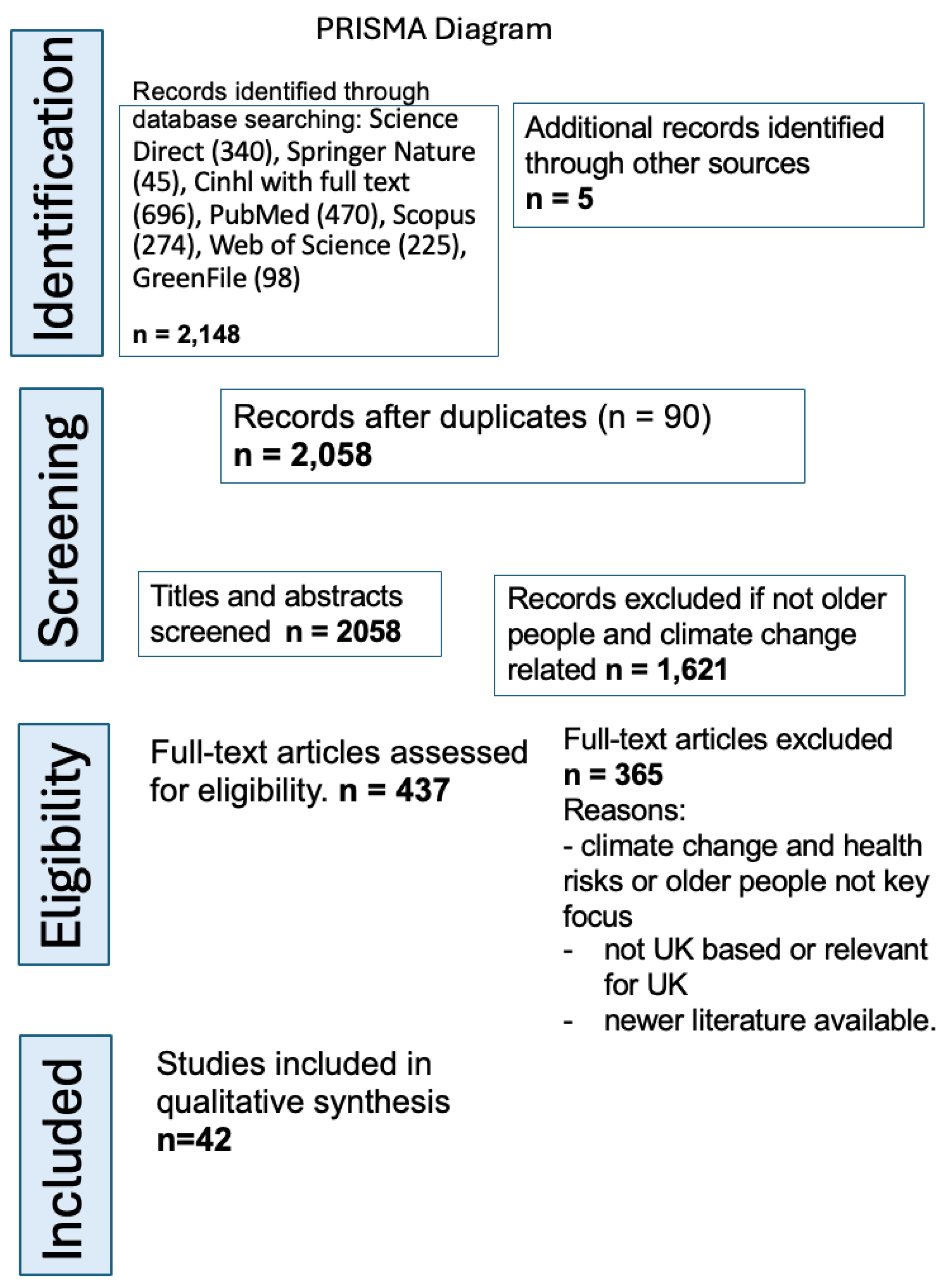

Table 1.
Data Extraction.
| Date | Country of Origin | Author | Type of Study | Air Pollution | Flooding | Extreme Weather | Healthy/Unhealthy Ageing | Built Env/Infrastructure | Community/Social Engagement | Climate Gerontology | Communication with older people | PPCT Model Variable |
| 2021 | Israel, US, Canada, UK, South Africa | Ayalon et al |
Longitudinal |
X | X | X | Context Macrosystem |
|||||
| 2023 | Israel, UK, South Africa | Ayalon et al | Longitudinal | X | X | X | X | X | Context Chronosystem |
|||
| 2019 | The Netherlands | Buskens et al | Longitudinal | X | Context Chronosystem |
|||||||
| 2023 | UK | Davies & Harwood | Longitudinal | X | X | X | X | X | X | Time | ||
| 2014 | UK and C anda | Haq & Gutman | Longitudinal | X | X | X | X | X | X | X | Context Chronosystem |
|
| 2022 | UK | Latter |
Cross-sectional | X | X | X | Proximal Processes | |||||
| 2024 | UK | Marinova et al | Longitudinal | X | X | X | X | Context Microsystem |
||||
| 2024 | Spain | Montoro-Ramírez et al | Longitudinal | X | X | X | X | X | X | Context Exosystem |
||
| 2017 | UK | Paavola |
Longitudinal | X | X | X | X | X | X | Context Microsystem |
||
| 2021 | UK | Payne et al | Cross-sectional | X | X | Context Microsystem |
||||||
| 2024 | UK USA Canada & Switzerland | Prina et al | Longitudinal | X | X | X | X | X | X | X | Context Chronosystem |
|
| 2023 | UK, Denmark, Ghana | Asiamah et al | Longitudinal | X | X | X | Context Mesosystem |
|||||
| 2022 | Ghana, Italy | Asiamah et al | Cross-sectional | X | X | X | Context Mesosystem |
|||||
| 2024 | UK The Netherlands, Russia | Bobrova et al | Longitudinal | X | Context Microsystem |
|||||||
| 2024 | USA | Dabelko-Schoeny et al | Longitudinal |
X | X | X | X | X | Context Macrosystem |
|||
| 2024 | Canada | Doiron et al |
Cross-sectional |
X | X | X | Context Macrosystem |
|||||
| 2024 | Bangladesh, Japan, Lebanon | Haque & Sharifi | Longitudinal | X | X | X | Context: Exosystem |
|||||
| 2022 | China, USA | Huang,et al |
Cross-sectional |
X | X | X | Context: Microsystem Personal Characteristics |
|||||
| 2020 | Switzerland | Michel |
Longitudinal |
X | X | X | X | X | X | Context: Chronosystem Time |
||
| 2023 | Estonia, USA | Salmistu & Kotval | Longitudinal | X | X | X | X | Proximal Processes | ||||
| 2024 | Portugal | Serra & Feio | Longitudinal | X | X | X | X | X | X | Personal Characteristics | ||
| 2015 | The Netherlands | Van Dijk et al | Cross-sectional | X | X | X | x | Proximal Processes | ||||
| 2021 | The Netherlands, Poland, UK | van Hoof et al |
Longitudinal |
X | X | X | X | Context: Macrosystem |
||||
| 2021 | USA | Wang et al |
Longitudinal |
X | X | X | X | X | X | X | Context Chronosystem |
|
| 2017 | China | Wang et al |
Cross-sectional |
X | X | Context: Microsystem |
||||||
| 2015 | UK | Webb |
Longitudinal |
X | X | Personal Characteristics | ||||||
| 2024 | Denmark, UK, Germany | Poulsen et al |
Cross-sectional |
X | X | Context: Microsystem |
||||||
| 2021 | China, Canada, USA, Norway, Germany | Yin et al |
Cross-sectional |
X | X | Time | ||||||
| 2020 | USA | Saenz & Finch |
Longitudinal |
X | X | X | Context: Microsystem |
|||||
| 2024 | Spain | Grela et al |
Longitudinal | X | X | X | Time | |||||
| 2023 | USA | Baniassadi et al |
Longitudinal |
Context: Microsystem |
||||||||
| 2022 | UK | Ratwatte et al |
Longitudinal |
X | X | X | X | Context: Exosystem |
||||
| 2017 | The Netherlands, Hong Kong, Austrailia, Poland, | van Hoof et al |
Longitudinal |
X | X | X | Context: Microsystem |
|||||
| 2020 | Canada | Kafeety et al | Longitudinal | X | X | X | X | Proximal Processes | ||||
| 2018 | UK | Nunes |
Cross-sectional |
X | X | X | X | Context: Microsystem Proximal Processes |
||||
| 2020 | UK | Walking & Haworth | Cross-sectional |
X | X | X | Proximal Processes | |||||
| 2018 | Poland | Szewrański et al | Cross-sectional | X | X | X | X | X | Context: Macrosystem |
|||
| 2015 | UK | Thomas et al |
Cross-sectional | X | X | X | Context: Macrosystem Time |
|||||
| 2024 | Hungary, Spain, The Netherlands, Denmark, Italy, UK, Portugal, Germany, Greece, Slovenia | Buzasi et al |
Cross-sectional |
X | X | Context: Macrosystem |
||||||
| 2024 | Italy | Pinna et al |
Longitudinal |
X | X | X | Context: Microsystem Proximal Processes |
|||||
| 2018 | New Zealand | Baldwin et al | Longitudinal | X | X | Proximal Processes |
Disclaimer/Publisher’s Note: The statements, opinions and data contained in all publications are solely those of the individual author(s) and contributor(s) and not of MDPI and/or the editor(s). MDPI and/or the editor(s) disclaim responsibility for any injury to people or property resulting from any ideas, methods, instructions or products referred to in the content. |
© 2025 by the authors. Licensee MDPI, Basel, Switzerland. This article is an open access article distributed under the terms and conditions of the Creative Commons Attribution (CC BY) license (http://creativecommons.org/licenses/by/4.0/).
Copyright: This open access article is published under a Creative Commons CC BY 4.0 license, which permit the free download, distribution, and reuse, provided that the author and preprint are cited in any reuse.


