

Submitted:
16 July 2025
Posted:
17 July 2025
You are already at the latest version
Abstract
Hyaluronic acid (HA) is a major glycosaminoglycan in the hepatic extracellular matrix and pericellular space, playing a critical role in maintaining liver architecture and regulating cell-matrix interactions. In chronic liver disease, particularly in metabolic dysfunction-associated steatotic liver disease (MASLD), aberrant HA metabolism, especially the accumulation of low-molecular-weight HA, contributes to fibrogenesis, immune dysregulation, and hepatocellular carcinoma development through receptor-mediated pathways involving CD44, RHAMM, and Toll-like receptors. This review synthesizes current evidence on HA biosynthesis, turnover, and signaling, emphasizing its dual role as a structural scaffold and as an active modulator of immune responses and tumor progression in chronic liver disease. We place special emphasis on its immunomodulatory function during the progression from MASLD to HCC and discuss its emerging relevance as therapeutic target. Potential strategies to counteract HA-mediated pathology, including inhibition of HA synthesis, enzymatic degradation, and receptor blockade, are also critically examined.
Keywords:
Liver fibrosis
; MASLD
; hyaluronic aci
; extracellular matrix
; inflammation
; DAMPs
1. Introduction
Hyaluronic acid (HA) is a naturally occurring glycosaminoglycan widely distributed throughout human tissues, serving as a key structural and functional component of the extracellular matrix (ECM). HA also contributes to the glycocalyx, the thin, carbohydrate-rich pericellular layer present on the surface of cells [1]. In the healthy liver, HA plays a crucial role in preserving parenchymal architecture, maintaining tissue hydration, and regulating immune tolerance and homeostasis [2,3]. However, in response to pathological stimuli such as viral hepatitis, alcohol abuse, metabolic disorders, or cholestatic and autoimmune conditions, HA metabolism becomes dysregulated. Under these conditions, HA transitions from being a mere structural regulator to becoming an active driver of hepatic inflammation, fibrogenesis, and carcinogenesis [4]. Consequently, elevated levels of serum HA are commonly detected in patients with chronic liver disease and are widely recognized as reliable non-invasive biomarker for assessing liver fibrosis and cirrhosis. Indeed, serum HA levels have been integrated into several validated fibrosis scoring algorithms, such as the Enhanced Liver Fibrosis (ELF) test, FibroTest, and Hepascore, highlighting its clinical utility in staging disease severity and predicting prognosis [5,6].
This review aims to provide a comprehensive overview of the immunomodulatory functions of HA in liver pathophysiology, with a particular emphasis on its role in driving fibrosis progression and its emerging relevance in highly prevalent liver disease conditions, including metabolic dysfunction-associated steatotic liver disease (MASLD), steatohepatitis (MASH), and hepatocellular carcinoma (HCC).
2. The Molecular Size of HA Dictates Distinct Biological Functions
Over recent decades, comprehensive studies on HA metabolism and function have significantly expanded our understanding of its diverse biological roles, extending far beyond its traditional association with hydration and lubrication within the ECM. It is now well established that HA exists in tissues and biological fluids as a polydisperse population of polymers with a broad range of molecular weights. These variants are compartmentalized into distinct functional pools, including circulating HA in plasma, matrix-associated HA within the ECM, and pericellular HA contributing to the glycocalyx structure. Each pool plays context-specific roles in tissue hydration, structural integrity, cell signaling, and immune modulation, particularly relevant in liver physiology and pathology. Notably, in vitro studies using size-defined HA fractions have demonstrated that molecular weight critically influences HA’s ability to modulate cell behavior, immune signaling, and ECM dynamics, especially in inflammatory and fibrotic liver diseases [7,8,9]. The signaling pathways triggered by HA depend critically on its molecular weight, with high-molecular-weight HA (HMW-HA, >1,000 kDa) and low-molecular-weight HA (LMW-HA, <500 kDa) often engaging the same receptors but eliciting divergent cellular responses [10].
HA molecules exert their biological effects through several receptors and binding proteins. These include well-characterized HA-specific receptors such as CD44 (known as a lymphocyte homing receptor), Receptor for Hyaluronan-Mediated Motility (RHAMM), and Lymphatic Vessel Endothelial Hyaluronan Receptor 1 (LYVE-1), as well as non-specific HA receptors such as Toll-like receptors (TLRs), particularly TLR2 and TLR4 [2]. Among these, CD44, RHAMM, and TLRs are considered the most functionally significant in liver physiology and pathology (Table 1).
CD44, a broadly expressed transmembrane glycoprotein, mediates HA-dependent cell adhesion, migration, and signal transduction, functions especially critical in hepatic stellate cells (HSCs) and immune cells. Beyond its interaction with HA, CD44 also binds other ECM components, including osteopontin, type I collagen, fibronectin, and matrix metalloproteinases (MMPs), as well as forming complexes with co-receptors such as integrins and receptor tyrosine kinases. This multifunctional binding landscape positions HA-CD44 as a critical regulatory axis in ECM remodeling and cellular crosstalk during liver injury and repair [11]. RHAMM, though more selectively expressed, plays a pivotal role in cytoskeletal reorganization and cell motility, becoming particularly upregulated during tissue remodeling, fibrogenesis and cancer [12,13]. Both receptors participate in physiological tissue repair and are implicated in pathological processes, including chronic liver inflammation and HCC. Mechanistically, CD44 and RHAMM activate intracellular signaling pathways such as MAPK/ERK and PI3K/AKT, which regulate cell proliferation, survival, and differentiation [4].
TLR2 and TLR4, in turn, function as promiscuous pattern recognition receptors and play crucial roles in liver immune surveillance. These receptors are primarily expressed in the liver by resident hepatic immune cells such as Kupffer cells and other leukocytes. Still, they are also found in HSCs, liver sinusoidal endothelial cells (LSECs), and, to a lesser extent, hepatocytes. Both receptors signal via the MyD88-dependent pathway, leading to nuclear factor kappa B (NF-κB) activation and transcription of pro-inflammatory cytokines. Additionally, TLR4 signals through the TRIF-dependent pathway in the endosomal compartment, inducing type I interferon responses and further amplifying hepatic inflammation [14].
Under physiological conditions, HMW-HA is the predominant form and is generally associated with anti-inflammatory and protective functions. HMW-HA maintains homeostasis through interactions with canonical receptors such as CD44 and RHAMM, supporting tissue integrity and immune quiescence [15,16]. In contrast, LMW-HA, which accumulates in response to oxidative stress, tissue injury, or enzymatic degradation, exerts pro-inflammatory and pro-fibrotic effects. Acting as a damage-associated molecular pattern (DAMP), LMW-HA engages innate immune receptors, particularly TLR2 and TLR4, leading to activation of NF-κB, cytokine production, and immune cell infiltration into liver tissue [17]. Beyond its interaction with TLRs, LMW-HA also binds to CD44 and RHAMM, amplifying inflammatory and remodeling processes. This engagement promotes inducible nitric oxide synthase (iNOS) expression, enhances T cell activation and proliferation, induces adhesion molecule upregulation, and stimulates the migration and proliferation of fibroblasts and endothelial cells, key cellular events driving ECM remodeling and fibrogenesis [18]. Therefore, the molecular weight-dependent duality of HA in receptor engagement and functional outcomes underscores the biological complexity of this naturally occurring glycosaminoglycan. Moreover, it highlights HA’s context-dependent role in shifting from a homeostatic mediator under healthy conditions to a pathogenic driver in chronic liver disease.
3. HA in the Hepatic Sinusoidal Niche
Understanding the role of HA in the liver requires consideration of the unique microarchitecture and composition of the hepatic ECM, which, unlike the dense interstitial ECM found in most organs, is relatively sparse, highly dynamic, and spatially compartmentalized [19]. The unique organization of hepatic architecture enables continuous and precisely regulated interactions among ECM components and diverse cell populations, supporting metabolic, immunological, and structural homeostasis. A key anatomical niche for these interactions is the space of Disse, a perisinusoidal compartment separating hepatocytes from the fenestrated LSECs. This space contains extracellular matrix molecules, including HA, collagen types IV and VI, fibronectin, laminins, and proteoglycans, as well as the pro-fibrogenic HSCs, and resident macrophages (Kupffer cells) [20]. Within this framework, as commented above, HA not only contributes to hydration and viscoelasticity, but also plays an essential regulatory role by interacting with cell surface receptors, such as CD44 and RHAMM, thereby modulating cell adhesion, migration, signaling, and responses to mechanical cues [21]. Specifically, HA is particularly enriched in the space of Disse, where it works as a dynamic interface between hepatocytes and LSECs, modulating multiple cell-specific functions. Among them, HA regulates the activation and migration of HSCs, supports Kupffer cell adhesion and polarization, and affects the phenotype and immune responses of liver-resident and infiltrating macrophages via CD44-mediated signaling. Additionally, HA contributes to sinusoidal immune surveillance by interacting with immune cells such as T lymphocytes and dendritic cells (DCs), modulating their trafficking and activation states [22,23]. Particular attention should be paid to the unique phenotype and function of LSECs, which receive blood from both the portal vein and hepatic artery and serve as key regulators of hepatic vascular homeostasis. The pericellular matrix of LSECs, including a specialized HA-rich glycocalyx, is notably more complex and functionally versatile than endothelial cells in other anatomical locations of the body. This HA-enriched layer is critical in controlling sinusoidal permeability, mechanotransduction signaling in response to shear stress, and immune regulation. It also plays a direct role in antigen presentation and in mediating leukocyte rolling and adhesion via interaction with CD44 and other HA-binding receptors [24].
4. HA Metabolism and Clearance in the Liver
HA is a linear, non-sulfated glycosaminoglycan composed of repeating disaccharide units of N-acetyl-D-glucosamine (GlcNAc) and D-glucuronic acid (GlcUA) linked by alternating β-1,3 and β-1,4 glycosidic bonds. HA can reach exceptionally high molecular weights, up to 108 Da, allowing it to form highly hydrated, viscoelastic structures within the ECM [25]. Unlike other glycosaminoglycans, HA is not synthesized in the Golgi apparatus nor attached to a core protein, instead, it is directly extruded into the extracellular space by membrane-bound hyaluronan synthases. Degradation is controlled enzymatically or by non-enzymatic mechanisms associated with oxidative damage. Importantly, sinusoidal endothelial cells of the lymph node, spleen, and the liver are the main sites for HA clearance from the circulation and are responsible for the rapid turnover, within 2-5 min, observed in the bloodstream [26,27].
4.1. HA Synthesis: Isoform-Specific Roles
HA is synthesized at the inner surface of the plasma membrane from cytoplasmic nucleotide sugars, uridine diphosphate (UDP)-GlcUA, and UDP-GlcNAc, by three membrane-bound hyaluronan synthase (HAS) isoforms: HAS1, HAS2, and HAS3. These isoenzymes differ in their enzymatic efficiency, regulation, and the molecular weight of the HA polymers they generate [28]. Among them, HAS2 is the predominant isoform under physiological conditions and is mainly responsible for producing HMW-HA (> 2 x10³ kDa), which exhibits anti-inflammatory, anti-angiogenic, and homeostatic properties in multiple tissues, including the liver [29]. Importantly, HAS2 is highly inducible by metabolic stressors, hypoxia, and transforming growth factor beta (TGF-β) signaling, key cues in hepatic regeneration and fibrogenesis [30]. From an evolutionary perspective, a recent study by Zhang et al. further underscored the physiological importance of HAS2 and HMW-HA by linking their sustained tissue expression to exceptional longevity in vertebrates, suggesting a conserved role in maintaining tissue integrity and resilience across species [31].
HAS1 also produces HMW-HA but displays low basal activity. Its enzymatic function requires relatively high concentrations of UDP-GlcNAc and UDP-GlcUA, making it particularly responsive to glycemic stress or altered nucleotide sugar availability [32]. Under such conditions, HAS1 contributes to the assembly of a dense pericellular HA coat, often associated with CD44 engagement, which regulates cell proliferation, adhesion, and immune cell recruitment [33]
In contrast, HAS3 primarily synthesizes HA polymers of lower molecular weight than those generated by HAS2, ranging approximately from 20 kDa to 2,000 kDa [34]. Although HAS3 displays low basal activity under homeostatic conditions, its expression is inducible under pro-inflammatory stimuli. Notably, IL-1β has been shown to upregulate HAS3 transcription, resulting in increased production of LMW-HA fragments that stimulate chemokine and cytokine release, thereby amplifying inflammatory responses [35]. While direct evidence in hepatic tissue is currently limited, the inducible nature of HAS3 under inflammatory conditions suggests that it may contribute to liver inflammation and fibrosis. Further liver-specific studies are needed to clarify its role in chronic liver disease progression.
During the progression of liver fibrosis, HA accumulation is primarily driven by the activation of hepatic HSCs, which upregulate HAS, particularly HAS2, in response to profibrogenic cues such as TGF-β, oxidative stress, and hypoxia. Yang et al. [30] demonstrated that both HAS2 and HA are markedly overexpressed in fibrotic human livers and in multiple murine models of liver fibrosis. Using HSC-specific genetic manipulation, these authors showed that deletion of HAS2 significantly reduced HA production and fibrogenesis, while HAS2 overexpression led to increased HA deposition, HSC activation, and exacerbated fibrosis. Mechanistically, this profibrotic effect was shown to be mediated by a regulatory axis involving microRNA-200c (miR-200c), which negatively controls HAS2 expression at the post-transcriptional level. During chronic liver injury, miR-200c levels were significantly downregulated, relieving its repression of HAS2 and thereby enabling pathological HA accumulation [36].
Interestingly, HAS expression shows cell- and tissue-specific regulation. In visceral adipose tissue (VAT) from individuals with obesity, HAS1 is selectively upregulated, while HAS2 and HAS3 remain largely unchanged, suggesting that HAS1-driven HA synthesis in adipose tissue may contribute to systemic inflammation and the development of MASLD [17].
4.2. HA Degradation and Clearance
HA is degraded through both enzymatic and non-enzymatic pathways. Among the six described human hyaluronidase genes, HYAL1 and HYAL2 play the most prominent roles in HA catabolism. HYAL2, anchored to the plasma membrane via a glycosyl-phosphatidylinositol (GPI) linkage, initiates degradation by cleaving HMW-HA into intermediate-sized fragments. These fragments are then internalized and further hydrolyzed by HYAL1, a soluble lysosomal enzyme that completes the catabolic process within endolysosomal compartments [37].
This sequential degradation is crucial for maintaining HA homeostasis and preventing extracellular accumulation. In the liver, LSECs play a central role in systemic HA clearance through high-affinity, receptor-mediated endocytosis via stabilin-2, also known as HARE (hyaluronan receptor for endocytosis) [38,39]. Under physiological conditions, this pathway ensures tight regulation of plasma HA levels. However, during chronic liver disease, LSEC function becomes progressively impaired. Capillarization and downregulation of stabilin-2 reduce HA uptake, contributing to elevated serum HA concentrations that correlate with fibrotic burden and disease progression [24].
In addition to enzymatic degradation, HA is highly susceptible to non-enzymatic fragmentation, particularly under oxidative stress conditions, a hallmark of chronic liver injury [40,41]. Reactive oxygen species (ROS) can indiscriminately cleave HA chains, generating biologically active LMW HA fragments with pro-inflammatory effects engaging, as previously mentioned, TLR2 and TLR4, on liver cells [42].
Overall, a tightly regulated balance between HA synthesis, degradation, and clearance is essential for maintaining hepatic homeostasis. In chronic liver disease, this equilibrium is disrupted, leading to HA accumulation and compositional shifts in HA pools that promote immune dysregulation, fibrogenesis, and progression toward fibrosis, cirrhosis and HCC. Additionally, recent findings reveal that HA is not confined to the extracellular space. Intracellular pools of HA have been detected in the cytoplasm and nucleus, where they may contribute to processes such as cell cycle regulation, RNA splicing, and autophagy [43]. These insights expand our understanding of HA biology, suggesting it may also modulate intracellular mechanisms relevant to liver pathology.
5. HA as an Immune Modulator in Liver Fibrosis
Inflammation is a central driver of hepatic fibrogenesis in chronic liver injury. Persistent inflammatory signals promote HSC trans-differentiation into myofibroblast-like cells that secrete excessive extracellular matrix components, leading to architectural distortion and loss of organ function [44,45]. Although the liver has an extraordinary regenerative capacity and maintains immunological tolerance under physiological conditions, these functionalities progressively deteriorate as fibrosis advances. Once cirrhosis and its complications become clinically apparent, reversal of liver injury is rarely achievable, seriously compromising patient prognosis. As previously discussed, HA has emerged as a key immunomodulatory molecule within the fibrotic microenvironment, influencing both innate and adaptive immune responses. In early stages of liver injury, HA may contribute to tissue repair, however, under sustained injury and chronic inflammation, HA molecules can promote immune cell activation, amplifying inflammatory circuits, and supporting tumor-promoting remodeling (Table 2) [4].
5.1. Innate Immune Response
HA plays a pivotal role in orchestrating the early immune response to liver injury by facilitating the recruitment of leukocytes to sites of tissue damage. Among the first responders are neutrophils, which migrate into the liver through the specialized microvasculature of the hepatic sinusoids. McDonald and colleagues [46,47] demonstrated that during endotoxin-derived liver inflammation, HA accumulates on the luminal surface of LSECs, promoting neutrophil adhesion via CD44 receptors expressed on neutrophils, but not on the endothelium. Further studies from this group showed that endothelial TLR4 activation enhances neutrophil adhesion by inducing serum-derived hyaluronan-associated protein (SHAP), which increases the binding affinity of HA for neutrophil CD44 [46,47]. This SHAP-dependent mechanism represents a divergence from the classical selectin/integrin-mediated rolling observed in systemic vasculature, highlighting the immunologically unique microenvironment of liver sinusoids. The nature of the hepatic insult, whether infectious, driven by pathogen-associated molecular patterns (PAMPs), or sterile, driven by DAMPs as in MASLD, critically influences the recruitment, activation, and functional polarization of neutrophils and other innate immune cells. These distinctions shape not only the inflammatory milieu but also the immunomodulatory role of HA. In this context, HA molecules may differentially regulate leukocyte dynamics depending on the underlying etiology and immune status of the liver microenvironment [48].
Beyond its role in leukocyte recruitment, both LMW-HA and HMW-HA fragments actively modulate neutrophil activation and function. Niemietz and colleagues [49] demonstrated that HA, irrespective of molecular mass, primes neutrophils to produce ROS through the activation of the p38 MAPK signaling pathway. A subsequent study by the same group showed that HMW-HA, particularly in the presence of tumor necrosis factor-alpha (TNFα) priming, enhances ROS production in neutrophils and accelerates apoptotic cell death [50]. In the liver, where elevated levels of HA and TNFα frequently coexist in chronic inflammatory states such as MASLD and viral hepatitis, this synergistic mechanism may intensify neutrophil-mediated cytotoxicity, thereby contributing to hepatocellular injury and the progression of fibrosis.
HA molecules also exert modulatory actions on hepatic macrophages, including resident Kupffer cells and infiltrating monocyte-derived macrophages, primarily through interactions mediated by CD44 and TLR4. In vivo experimental models have shown that CD44 deficiency reduces macrophage responsiveness to key inflammatory stimuli, such as lipopolysaccharide (LPS), saturated fatty acids, and DAMPs, while favoring a shift toward an anti-inflammatory M2 phenotype, thereby attenuating liver inflammation and fibrosis [23].
In addition to modulating macrophage polarization, HA binding to CD44 promotes integrin activation and stabilizes monocyte adhesion to liver sinusoidal endothelial cells, facilitating transendothelial migration. This process is further coordinated by chemokine signaling, particularly by the CCL2-CCR2 axis, which synergizes with HA-CD44 interactions to guide monocyte trafficking and retention within inflamed hepatic tissue [51].
Beyond cell trafficking, HA-CD44 signaling has also been shown to shape the immunological function of hepatic myeloid populations. In both murine and human systems, CD44 engagement on activated HSC promotes the induction of myeloid-derived suppressor cells (MDSCs), fostering an immunosuppressive microenvironment. This mechanism supports immune surveillance during early stages of liver disease but may also contribute to immune evasion and tumor progression in advanced hepatic malignancies [52,53].
Fragmented LMW-HA, which accumulates in liver injury and chronic inflammation, also acts as a DAMP by activating TLR2 and TLR4 on macrophages, amplifying cytokine release (TNF-α, IL-6, IL-1β) and contributing to a self-perpetuating inflammatory loop [22,42]. In contrast, HMW-HA exerts immunomodulatory effects that favor the resolution of inflammation. HMW-HA (intermediate size from 500 to 1000 kDa) has been shown to promote an M2-like macrophage phenotype and to support tissue repair, partly by suppressing TLR-mediated activation [54]. Consistently, Maharjan et al. demonstrated that HMW-HA suppresses the differentiation of human fibrocytes, pro-fibrotic and inflammatory monocyte-derived cells, while LMW-HA promotes their maturation [55]. These findings underscore the context-dependent, size-specific immunological effects of HA, suggesting that HA molecular weight is a key determinant in modulating the inflammatory landscape of the liver.
5.2. Adaptive Immune Response
HA contributes to adaptive immunity from the earliest stages of T cell recruitment. A seminal study published by deGrendele et al. demonstrated that HA expressed on vascular endothelium facilitates CD44-dependent adhesion and transendothelial migration of activated T cells [56]. Subsequent studies have corroborated these findings in various models of chronic inflammation, including liver disease, where HA-CD44 interactions, either alone or in cooperation with adhesion molecules such as E-selectin and ICAM-1, facilitate the infiltration and retention of effector T cells within inflamed tissues [57,58,59].
Beyond its role on T cell recruitment, HA-CD44 signaling plays a pivotal role in T cell activation and functional differentiation. Upon antigen recognition, CD44 is recruited to the immunological synapse, co-localizing with lipid rafts and the TCR-CD3 complex, thereby stabilizing interactions between DCs and T cells. This spatial organization facilitates efficient T cell receptor signaling and sustained contact with antigen-presenting cells. Notably, CD44-deficient DCs exhibit impaired ability to stimulate T cell proliferation and cytokine production, such as IL-2 and IFN-γ [60]. Mechanistically, CD44 interacts with the ezrin-radixin-moesin family of proteins, anchoring it to the actin cytoskeleton and promoting cytoskeletal remodeling necessary for synapse formation and T cell polarization [61].
The molecular weight of HA also critically influences its immunomodulatory effects on the adaptive immune system. LMW-HA promotes Th1 and Th17 polarization by inducing MHC II and co-stimulatory molecule expression (CD80, CD86) on DCs via TLR4-dependent signaling [62,63]. In contrast, HMW-HA has been shown to suppress T cell proliferation and cytokine production in vitro, suggesting a potential role in promoting immune tolerance [3,64].
In the context of chronic liver inflammation, these size-dependent effects of HA are particularly relevant. Early evidence from a T-cell-mediated liver injury model induced by concanavalin A demonstrated that administration of HMW-HA (900 kDa) significantly reduced plasma levels of pro-inflammatory cytokines, including TNF-α and interferon-gamma (IFN-γ). In contrast, LMW-HA (250 kDa) failed to confer similar protective effects [65].
6. HA in Chronic Liver Pathology: from MASLD to HCC
MASLD, a term recently redefined to reflect its metabolic roots, is now recognized as the most prevalent chronic liver disease worldwide, affecting approximately one-third of adults. Individuals at increased risk are identified by the presence of at least one of the following criteria: type 2 diabetes mellitus (T2DM), obesity, or persistently elevated aminotransferase levels in the absence of secondary causes of steatosis [66].
The pathogenesis of MASLD involves a complex interplay between hepatic and systemic metabolic stressors. Among extrahepatic contributors, dysfunctional VAT plays a pivotal role. It becomes hypertrophic, insulin-resistant, and inflamed, leading to the release of pro-inflammatory adipokines (e.g., TNF-α, IL-6), saturated fatty acids, and DAMPs such as high-mobility group box 1 (HMGB1), extracellular ATP, and HA. This constellation of circulating factors contributes to a systemic, chronic low-grade inflammatory state that exacerbates hepatic lipotoxicity, oxidative stress, and immune activation, thereby accelerating fibrogenic remodeling [67,68].
Emerging evidence highlights the regulatory crosstalk between these metabolic stressors and HA synthesis pathways. For instance, extracellular ATP has been shown to upregulate HA production by activating HAS2 via P2Y₂ receptor–mediated Ca²⁺ signaling and downstream MAPK activation [69]. In parallel, HMGB1 contributes to hepatic fibrogenesis by activating pattern recognition receptors, such as TLR4 and RAGE, on HSCs, which are the major sources of HA in a fibrotic liver. Although the direct effects of HMGB1 on HA metabolism remain to be fully elucidated, it likely modulates HA indirectly by promoting an inflammatory microenvironment [70]. Moreover, HA homeostasis may be influenced by the systemic redox balance. Uric acid, a DAMP released during tissue stress, can scavenge ROS, protecting HA chains from oxidative fragmentation and potentially altering ECM architecture during chronic liver injury [71]. Collectively, these molecular interactions position HA as a mediator that links systemic metabolic dysregulation with local hepatic inflammation and fibrogenesis.
HA emerges not only as a biomarker of fibrosis severity, with serum levels and hepatic deposition correlating with disease stage across the MASLD spectrum [72,73], but also as a bioactive effector molecule in sterile metabolic dysfunction. Notably, increasing evidence supports the notion that HA metabolism is systemically dysregulated in human metabolic disease. Romo et al. reported increased VAT expression of HAS1 and elevated circulating levels of LMW-HA in individuals with obesity and metabolic dysfunction, suggesting that adipose tissue may contribute to a pro-inflammatory HA pool in the bloodstream [17]. In parallel, Kang et al. demonstrated that excessive HA accumulation in a high-fat diet mouse model aggravated insulin resistance and metabolic dysregulation, reinforcing a mechanistic link between HA synthesis and metabolic impairment [74]. These findings point to a role for HA as a systemic amplifier of chronic inflammation, upstream of liver injury. In support of this, LMW-HA fragments have been shown to activate TLR2 and TLR4 signaling on monocytes and macrophages and peripheral blood mononuclear cells, thereby linking adipose tissue inflammation to hepatic immune activation [17,22].
As previously described, HSCs represent the principal fibrogenic cell population, and their activation is a pivotal event in MASLD progression. Under physiological conditions, HSCs remain quiescent and contribute to ECM turnover. However, in response to metabolic stressors, including lipotoxicity, hyperglycemia, oxidative damage, and inflammatory signals, they transdifferentiate into myofibroblast-like cells that proliferate and secrete fibrillar collagens, fibronectin, and HA, thereby driving fibrosis and architectural disruption [75]. As discussed earlier, the HA-producing enzyme HAS2 is particularly upregulated in activated HSCs and plays a central role in driving fibrotic remodeling through the HA-CD44-NOTCH1 axis and miR-200c [30,36].
Beyond HSCs, other non-parenchymal hepatic cells, including LSECs, and hepatic progenitor cells (HPCs), interact with HA and contribute to ECM remodeling during MASLD progression.
Endothelial dysfunction is also a hallmark of MASLD and contributes not only to intrahepatic fibrogenesis but also to systemic vascular complications associated with insulin resistance. In the liver, chronic metabolic stress induces capillarization of LSECs, characterized by the loss of fenestrae, formation of a continuous basement membrane, and adoption of a pro-inflammatory and pro-thrombotic phenotype. These changes are accompanied by aberrant accumulation of HA in the space of Disse, which impairs hepatocyte-endothelial communication and facilitates leukocyte adhesion and transmigration [46,76].
Disruption of the endothelial glycocalyx, particularly the loss of HMW-HA, which predominates under physiological conditions, impairs mechanosensitive signaling, reduces endothelial nitric oxide synthase (eNOS) activation, and promotes endothelial dysfunction. This leads to sinusoidal vasoconstriction, reduced perfusion, and local hypoxia, which further activate inflammatory and fibrotic pathways [77]. Experimental studies have shown that enzymatic removal of HA decreases flow-induced eNOS activation in endothelial cells, both in vitro and in vivo, supporting its role in shear-stress-dependent nitric oxide (NO) production [78,79]. Although these studies implicate HA in modulating eNOS activity, direct mechanistic evidence in hepatic endothelium remains limited, and some of the observed effects may be secondary to broader alterations in oxidative stress and inflammatory tone.
The hypoxic and proinflammatory microenvironment induced by LSEC dysfunction promotes HSC activation, driving angiogenic and fibrogenic cascades, notably through VEGF and PDGF signaling pathways [80]. Interestingly, experimental evidence suggests that HA can promote angiogenesis independently of VEGF. In extrahepatic models, high concentrations of HA stimulate endothelial migration and tube formation through RHAMM- and TGF-βRI-dependent pathways, upregulating plasminogen activator inhibitor-1 (PAI-1), a key regulator of ECM remodeling and neovascularization [81]. While such mechanisms are biologically plausible in the liver, their relevance in the context of MASLD remains to be formally demonstrated in vivo.
Another emerging component of the stromal microenvironment is the hepatic progenitor cell (HPC) niche. In chronic liver injury, HPC activation and CD44 expression is frequently observed in periportal regions and near HA-enriched fibrotic septa, suggesting a potential spatial and functional interaction [82]. Although direct mechanistic evidence in the liver is still limited, studies from other organ systems have demonstrated that HA regulates progenitor cell behavior through engagement of CD44 and RHAMM, influencing cell proliferation, migration, and differentiation [83]. These findings raise the possibility that HA may influence HPC fate decisions during fibrotic remodeling in MASLD, although this hypothesis requires further experimental validation in hepatic models.
Overall, beyond serving as a structural component or biomarker, HA emerges as a dynamic modulator of stromal cell behavior, influencing endothelial integrity, hepatic stellate cell activation, and progenitor cell fate. This cumulative disruption of hepatic architecture and immune balance not only exacerbates fibrosis but also lays the groundwork for malignant transformation.
HA-Mediated Immune Reprogramming in HCC Progression
HA actively contributes to the immunological and stromal remodeling that characterizes HCC development, particularly in the context of metabolic liver disease. Through engagement with CD44 and other receptors, HA regulates tumor cell motility, epithelial-to-mesenchymal transition, and resistance to apoptosis and chemotherapy, fostering malignant progression. In both human and murine models of HCC, CD44 signaling on activated HSCs promotes the expansion of MDSCs, which inhibit cytotoxic T lymphocyte (CTL) and natural killer (NK) cell responses, thus reinforcing an immune-suppressive niche [52,53].
In malignant hepatocytes, CD44 overexpression correlates with poor clinical outcomes and facilitates tumor progression by sustaining receptor tyrosine kinase signaling, repressing pro-apoptotic Fas expression, and maintaining cancer stem cell features through crosstalk with EGFR, c-Met, PDGFR-β, and TGF-βRI pathways [84,85,86]. In parallel, increasing attention has been given to RHAMM, another HA receptor implicated in HCC progression. Immunohistochemical analyses have shown that RHAMM is upregulated in tumor-node regions of HCC specimens and that high RHAMM expression correlates with reduced disease-free and overall survival following surgical resection, suggesting it may serve as an independent prognostic marker [87]. These findings support the emerging role of RHAMM in modulating tumor invasiveness [88] and underscore its potential as a therapeutic target in HA-rich hepatic tumors.
A pivotal axis in HA-mediated immune modulation involves tumor-associated macrophages (TAMs), which represent a dominant immune population in the HCC microenvironment and play a central role in sustaining immunosuppression and tumor progression [89]. These cells typically exhibit an M2-like phenotype, characterized by the secretion of IL-10, TGF-β, VEGF, and MMP9, which collectively support immune evasion, extracellular matrix remodeling, and angiogenesis [90]. Accumulation of LMW-HA during ECM remodeling contributes to this pro-tumoral polarization. In vitro studies have shown that LMW-HA can engage TLR4 on macrophages, activating NF-κB signaling and promoting an M2-like transcriptional profile [54]. Furthermore, HA-rich stroma has been shown to facilitate macrophage infiltration and neovascularization, as evidenced by murine models in which exogenous HA enhanced TAM recruitment and vascular remodeling [91]. Although direct evidence in HCC is limited, experimental models in glioblastoma and other solid tumors have demonstrated that disruption of HA synthesis or blockade of HA-CD44 interactions reprograms TAMs toward a pro-inflammatory M1 phenotype, thereby restoring antitumor immunity and reducing tumor growth [92]. These findings suggest that HA-CD44 signaling contributes to the maintenance of TAM-driven immunotolerance in HCC, and that targeting this axis may offer therapeutic benefit.
Finally, in the context of MASLD-associated fibrosis, upregulation of HAS2 in activated HSCs leads to excessive HA deposition within the fibrotic stroma. This accumulation fosters an immunosuppressive and pro-tumorigenic hepatic microenvironment by modulating extracellular matrix composition and immune cell infiltration. In vivo studies have shown that genetic or pharmacologic inhibition of HAS2 reduces stromal HA levels, alters the immune landscape, and significantly attenuates HCC growth, underscoring the HAS2-HA axis as a promising therapeutic target in liver cancer [93].
In summary, the convergence of fibrogenic, immunomodulatory, and angiogenic mechanisms in chronic liver disease positions HA as a critical driver of malignant progression in MASLD-associated HCC, making it a rational target for therapeutic disruption.
7. Therapeutic Targeting of HA Signaling and Metabolism in Liver Disease
Growing recognition of the pathogenic role of HA, particularly its LMW forms, in advanced MASLD and HCC has prompted the development of targeted strategies to mitigate its deleterious effects. These interventions aim to reduce HA accumulation, disrupt pathological HA-receptor signaling, and improve therapeutic efficacy in fibrotic and tumor-permissive hepatic microenvironments. Current approaches can be grouped into three main categories: (1) inhibition of HA synthesis, (2) enzymatic degradation of HA, and (3) blockade of HA-receptor interactions, with additional exploratory combinations with immunotherapy currently under investigation.
7.1. Inhibition of HA Synthesis
HA biosynthesis is driven by HAS, with HAS2 being the predominant isoform upregulated in activated HSCs during fibrogenesis. Genetic suppression of HAS2, through siRNA or miR-200c modulation, has been shown to attenuate liver fibrosis and HA deposition in murine models [36,94].
The most extensively studied pharmacological inhibitor is 4-methylumbelliferone (4-MU), which reduces the availability of UDP-glucuronic acid, a common substrate for all HAS isoforms. In rodent models of toxic and diet-induced liver injury, 4-MU administration decreased hepatic HA content, suppressed HSC activation, and improved histological fibrosis scores without major toxicity [95]. Moreover, recent transcriptomic analyses confirm that 4-MU recapitulates the molecular effects of HAS2 knockdown [96]. Antitumor effects have also been reported in experimental HCC, where 4-MU disrupted HA-rich stromal niches and reduced tumor progression [97,98]
Despite these findings, clinical translation is limited by poor bioavailability and non-specific distribution. Liver-targeted formulations and more selective HAS2 inhibitors are under preclinical development.
7.2. Enzymatic Degradation of HA
Depletion of excess HA by exogenous hyaluronidases, particularly recombinant human formulations such as PEGPH20, has been explored in oncology. Preclinical models have demonstrated that HA degradation reduces interstitial pressure, enhances perfusion, and improves chemotherapeutic delivery [99]. Comparable metabolic benefits have been observed in murine models of insulin resistance, where enzymatic HA depletion improved muscle glucose uptake, vascularization, and insulin sensitivity [74].
Clinically, PEGPH20 was evaluated in the phase III HALO-301 trial involving patients with HA-high metastatic pancreatic ductal adenocarcinoma. Although the combination with nab-paclitaxel and gemcitabine increased objective response rates, it failed to extend progression-free or overall survival, and the program was discontinued due to thromboembolic risk and inconsistent efficacy [100].
Unfortunately, up to date, no clinical trials have assessed hyaluronidase therapies in liver fibrosis or HCC. Major hurdles include enzyme instability, risk of systemic side effects, and the absence of targeted hepatic delivery platforms.
7.3. Blockade of HA Receptors (CD44, RHAMM)
Therapeutic strategies targeting HA receptors aim to disrupt aberrant HA-driven signaling in chronic liver disease. CD44, the principal HA receptor, is widely expressed across immune and non-parenchymal hepatic cells, including macrophages, HSCs, and cholangiocytes, where it regulates adhesion, migration, stemness, and immune evasion. Preclinical inhibition of CD44 using monoclonal antibodies or gene silencing has reduced tumor cell proliferation, MDSC recruitment, and fibrotic signaling in hepatocellular carcinoma [84]. However, its broad physiological expression complicates selective therapeutic modulation.
In contrast, RHAMM expression is more restricted, often confined to proliferating or transformed cells. Its role in HA-driven motility and angiogenesis has been implicated in tumor progression, and recent studies have shown that peptide or siRNA-based RHAMM inhibition can attenuate HCC growth and vascular remodeling [101]. Despite these findings, clinical translation of RHAMM-targeted strategies remains to be further investigated.
Although CD44 and RHAMM are widely recognized as amplifiers of HA-driven fibrogenic and immunomodulatory signaling in liver disease, recent evidence underscores the importance of inflammatory context in shaping HA-receptor outcomes. While LMW-HA is generally considered proinflammatory, studies by Saikia et al. [102] and You et al. [103] have shown that in models of acute liver injury triggered by alcohol or LPS, exogenous administration of small HA fragments (~35 kDa) can attenuate TLR4-mediated TNF-α signaling in Kupffer cells. In these proinflammatory settings, LMW-HA appears to act as a competitive antagonist at TLR4, mitigating hepatocyte damage.
These observations reinforce the notion that HA signaling is context-dependent, modulated by molecular weight, receptor engagement, and the nature of the inflammatory trigger. This complexity must be considered when designing HA-targeted therapies for chronic liver disease.
7.4. Integration with Immunotherapy and Combination Strategies
Given HA’s role in shaping an immune-suppressive, fibrotic tumor microenvironment, combining HA-targeted therapies with immunotherapies is a rational strategy. Tumors arising in steatohepatitis often exhibit poor T cell infiltration and resistance to immune checkpoint blockade. Preclinical models suggest that modulating HA content, via HAS2 inhibition or ECM degradation, can improve T cell access and potentiate anti-tumor immunity [54,99].
Of particular relevance, Malehmir et al. showed that HA-CD44 signaling promotes platelet recruitment and aggregation in nonalcoholic steatohepatitis (NASH), fostering a tumor-initiating niche. Inhibition of CD44 disrupted this process, attenuating early tumorigenesis and offering an immuno-thrombotic axis as a novel therapeutic target [104,105]. Dual inhibition of CD44 and immune checkpoints hold potential for future clinical translation, especially in HA-high or immunotherapy-resistant HCC subtypes.
8. Concluding Remarks and Future Perspective
HA plays a central and multifaceted role in liver pathophysiology, functioning not only as a structural component of the extracellular matrix but also as an active regulator of fibrogenic, inflammatory, and oncogenic processes (Figure 1). The divergent effects of high- versus low-molecular-weight HA underscore the complexity of its biological actions, from maintaining tissue architecture to promoting immune suppression, neovascularization, and malignant transformation.
Advances in understanding HA metabolism and receptor-mediated signaling, particularly via HAS2, CD44, and RHAMM, have identified new therapeutic opportunities in chronic liver disease. Preclinical strategies aimed at inhibiting HA synthesis, promoting its degradation, or blocking receptor interactions have shown efficacy in mitigating fibrosis and modulating the tumor microenvironment, especially in the context of MASLD-associated hepatocellular carcinoma.
Although not addressed in detail in this review, it is worth noting that HA’s selective affinity for CD44 is also being explored in nanomedicine-based drug delivery systems to enable targeted treatment of fibrotic or neoplastic liver tissues. Multiple studies in this growing field are investigating HA-functionalized nanoparticles to enhance therapeutic specificity and reduce systemic toxicity [106]
Collectively, these findings position HA as a modifiable determinant of liver disease progression, with emerging therapeutic relevance across the MASLD progression and HCC. Future clinical translation will depend on the development of HA-targeted agents, biomarker-driven patient stratification, and integration into rational combination therapies.
Author Contributions
Review concept and design, E.T.; investigation, R.C., E.T., C.L.V., B.R.G., and B.J.C.; writing-original draft preparation, R.C. and E.T.; critical revision of the manuscript for important intellectual content, J.C. and E.T.; writing-review and editing, J.C. and E.T.; supervision, J.C. and E.T.; funding acquisition, J.C. All authors have read and agreed to the published version of the manuscript.
Funding
Our laboratory is a Consolidated Research Group recognized by the Generalitat de Catalunya (2021 SGR 01323) and is supported by Ministerio de Ciencia e Innovacion/Agencia Estatal Investigación MCIN/AEI (PID2022-138970OB-I00 10.13039/501100011033/FEDER, EU). BJC has a pre-doctoral fellowship from MCIN/AEI and European Social Fund Plus (PREP2022-00746). The funders had no influence on study design, data collection and analysis, decision to publish, or preparation of the manuscript.
Conflicts of Interest
The authors disclose no conflicts of interest.
References
- Cowman, M.K.; Turley, E.A. Functional Organization of Extracellular Hyaluronan, CD44, and RHAMM. Proteoglycan Research 2023, 1, e4. [Google Scholar] [CrossRef]
- Jiang, D.; Liang, J.; Noble, P.W. Hyaluronan as an Immune Regulator in Human Diseases. Physiol Rev 2011, 91, 221–264. [Google Scholar] [CrossRef] [PubMed]
- Bollyky, P.L.; Falk, B.A.; Wu, R.P.; Buckner, J.H.; Wight, T.N.; Nepom, G.T. Intact Extracellular Matrix and the Maintenance of Immune Tolerance: High Molecular Weight Hyaluronan Promotes Persistence of Induced CD4+CD25+ Regulatory T Cells. J Leukoc Biol 2009, 86, 567–572. [Google Scholar] [CrossRef] [PubMed]
- Kim, J.; Seki, E. Hyaluronan in Liver Fibrosis: Basic Mechanisms, Clinical Implications, and Therapeutic Targets. Hepatol Commun 2023, 7. [Google Scholar] [CrossRef] [PubMed]
- Gudowska, M.; Gruszewska, E.; Panasiuk, A.; Cylwik, B.; Flisiak, R.; Świderska, M.; Szmitkowski, M.; Chrostek, L. Hyaluronic Acid Concentration in Liver Diseases. Clin Exp Med 2016, 16, 523–528. [Google Scholar] [CrossRef] [PubMed]
- Loomba, R.; Adams, L.A. Advances in Non-Invasive Assessment of Hepatic Fibrosis. Gut 2020, 69, 1343–1352. [Google Scholar] [CrossRef] [PubMed]
- Lee, B.M.; Park, S.J.; Noh, I.; Kim, C.H. The Effects of the Molecular Weights of Hyaluronic Acid on the Immune Responses. Biomater Res 2021, 25. [Google Scholar] [CrossRef] [PubMed]
- Cowman, M.K.; Lee, H.G.; Schwertfeger, K.L.; McCarthy, J.B.; Turley, E.A. The Content and Size of Hyaluronan in Biological Fluids and Tissues. Front Immunol 2015, 6. [Google Scholar] [CrossRef] [PubMed]
- Fraser, J.R.E.; Laurent, T.C.; Laurent, U.B.G. Hyaluronan: Its Nature, Distribution, Functions and Turnover. J Intern Med 1997, 242, 27–33. [Google Scholar] [CrossRef] [PubMed]
- Kotla, N.G.; Bonam, S.R.; Rasala, S.; Wankar, J.; Bohara, R.A.; Bayry, J.; Rochev, Y.; Pandit, A. Recent Advances and Prospects of Hyaluronan as a Multifunctional Therapeutic System. Journal of Controlled Release 2021, 336, 598–620. [Google Scholar] [CrossRef] [PubMed]
- Toole, B.P. Hyaluronan: From Extracellular Glue to Pericellular Cue. Nat Rev Cancer 2004, 4, 528–539. [Google Scholar] [CrossRef] [PubMed]
- Carvalho, A.M.; Soares da Costa, D.; Paulo, P.M.R.; Reis, R.L.; Pashkuleva, I. Co-Localization and Crosstalk between CD44 and RHAMM Depend on Hyaluronan Presentation. Acta Biomater 2021, 119, 114–124. [Google Scholar] [CrossRef] [PubMed]
- Hinneh, J.A.; Gillis, J.L.; Moore, N.L.; Butler, L.M.; Centenera, M.M. The Role of RHAMM in Cancer: Exposing Novel Therapeutic Vulnerabilities. Front Oncol 2022, 12. [Google Scholar] [CrossRef] [PubMed]
- Seki, E.; Brenner, D.A. Toll-like Receptors and Adaptor Molecules in Liver Disease: Update. Hepatology 2008, 48, 322–335. [Google Scholar] [CrossRef] [PubMed]
- Jiang, D.; Liang, J.; Fan, J.; Yu, S.; Chen, S.; Luo, Y.; Prestwich, G.D.; Mascarenhas, M.M.; Garg, H.G.; Quinn, D.A.; et al. Regulation of Lung Injury and Repair by Toll-like Receptors and Hyaluronan. Nat Med 2005, 11, 1173–1179. [Google Scholar] [CrossRef] [PubMed]
- Ruppert, S.M.; Hawn, T.R.; Arrigoni, A.; Wight, T.N.; Bollyky, P.L. Tissue Integrity Signals Communicated by Highmolecular Weight Hyaluronan and the Resolution of Inflammation. Immunol Res 2014, 58, 186–192. [Google Scholar] [CrossRef] [PubMed]
- Romo, M.; López-Vicario, C.; Pérez-Romero, N.; Casulleras, M.; Martínez-Puchol, A.I.; Sánchez, B.; Flores-Costa, R.; Alcaraz-Quiles, J.; Duran-Güell, M.; Ibarzábal, A.; et al. Small Fragments of Hyaluronan Are Increased in Individuals with Obesity and Contribute to Low-Grade Inflammation through TLR-Mediated Activation of Innate Immune Cells. Int J Obes 2022, 46, 1960–1969. [Google Scholar] [CrossRef] [PubMed]
- Puré, E.; Cuff, C.A. A Crucial Role for CD44 in Inflammation. Trends Mol Med 2001, 7, 213–221. [Google Scholar] [CrossRef] [PubMed]
- Arteel, G.E. Extracellular Matrix and Hepatic Wound Healing before Fibrosis. Semin Liver Dis 2024, 44, 343–355. [Google Scholar] [CrossRef] [PubMed]
- Sanz-García, C.; Fernández-Iglesias, A.; Gracia-Sancho, J.; Arráez-Aybar, L.A.; Nevzorova, Y.A.; Cubero, F.J. The Space of Disse: The Liver Hub in Health and Disease. Livers 2021, 1, 2. [Google Scholar] [CrossRef]
- Abatangelo, G.; Vindigni, V.; Avruscio, G.; Pandis, L.; Brun, P. Hyaluronic Acid: Redefining Its Role. Cells 2020, 9, 1743. [Google Scholar] [CrossRef] [PubMed]
- Petrey, A.C.; de la Motte, C.A. Hyaluronan, a Crucial Regulator of Inflammation. Front Immunol 2014, 5. [Google Scholar] [CrossRef] [PubMed]
- Patouraux, S.; Rousseau, D.; Bonnafous, S.; Lebeaupin, C.; Luci, C.; Canivet, C.M.; Schneck, A.S.; Bertola, A.; Saint-Paul, M.C.; Iannelli, A.; et al. CD44 Is a Key Player in Non-Alcoholic Steatohepatitis. J Hepatol 2017, 67, 328–338. [Google Scholar] [CrossRef] [PubMed]
- Shetty, S.; Lalor, P.F.; Adams, D.H. Liver Sinusoidal Endothelial Cells — Gatekeepers of Hepatic Immunity. Nat Rev Gastroenterol Hepatol 2018, 15, 555–567. [Google Scholar] [CrossRef] [PubMed]
- Fallacara, A.; Baldini, E.; Manfredini, S.; Vertuani, S. Hyaluronic Acid in the Third Millennium. Polymers (Basel) 2018, 10, 701. [Google Scholar] [CrossRef] [PubMed]
- Fraser, J.R.E.; Laurent, T.C.; Engström-Laurent, A.; Laurent, U.G.B. ELIMINATION OF HYALURONIC ACID FROM THE BLOOD STREAM IN THE HUMAN. Clin Exp Pharmacol Physiol 1984, 11, 17–25. [Google Scholar] [CrossRef] [PubMed]
- Bhandari, S.; Larsen, A.K.; McCourt, P.; Smedsrød, B.; Sørensen, K.K. The Scavenger Function of Liver Sinusoidal Endothelial Cells in Health and Disease. Front Physiol 2021, 12, 757469. [Google Scholar] [CrossRef] [PubMed]
- Vigetti, D.; Karousou, E.; Viola, M.; Deleonibus, S.; De Luca, G.; Passi, A. Hyaluronan: Biosynthesis and Signaling. Biochim Biophys Acta Gen Subj 2014, 1840, 2452–2459. [Google Scholar] [CrossRef] [PubMed]
- Joy, R.A.; Vikkath, N.; Ariyannur, P.S. Metabolism and Mechanisms of Action of Hyaluronan in Human Biology. Drug Metab Pers Ther 2018, 33, 15–32. [Google Scholar] [CrossRef] [PubMed]
- Yang, Y.M.; Noureddin, M.; Liu, C.; Ohashi, K.; Kim, S.Y.; Ramnath, D.; Powell, E.E.; Sweet, M.J.; Roh, Y.S.; Hsin, I.F.; et al. Hyaluronan Synthase 2-Mediated Hyaluronan Production Mediates Notch1 Activation and Liver Fibrosis. Sci Transl Med 2019, 11. [Google Scholar] [CrossRef] [PubMed]
- Zhang, Z.; Tian, X.; Lu, J.Y.; Boit, K.; Ablaeva, J.; Zakusilo, F.T.; Emmrich, S.; Firsanov, D.; Rydkina, E.; Biashad, S.A.; et al. Increased Hyaluronan by Naked Mole-Rat HAS2 Improves Healthspan in Mice. Nature 2023, 621, 196. [Google Scholar] [CrossRef] [PubMed]
- Rilla, K.; Oikari, S.; Jokela, T.A.; Hyttinen, J.M.T.; Kärnä, R.; Tammi, R.H.; Tammi, M.I. Hyaluronan Synthase 1 (HAS1) Requires Higher Cellular Udp-Glcnac Concentration than HAS2 and HAS3. Journal of Biological Chemistry 2013, 288, 5973–5983. [Google Scholar] [CrossRef] [PubMed]
- Siiskonen, H.; Oikari, S.; Pasonen-Seppänen, S.; Rilla, K. Hyaluronan Synthase 1: A Mysterious Enzyme with Unexpected Functions. Front Immunol 2015, 6, 43. [Google Scholar] [CrossRef] [PubMed]
- Itano, N.; Sawai, T.; Yoshida, M.; Lenas, P.; Yamada, Y.; Imagawa, M.; Shinomura, T.; Hamaguchi, M.; Yoshida, Y.; Ohnuki, Y.; et al. Three Isoforms of Mammalian Hyaluronan Synthases Have Distinct Enzymatic Properties. Journal of Biological Chemistry 1999, 274, 25085–25092. [Google Scholar] [CrossRef] [PubMed]
- Homann, S.; Grandoch, M.; Kiene, L.S.; Podsvyadek, Y.; Feldmann, K.; Rabausch, B.; Nagy, N.; Lehr, S.; Kretschmer, I.; Oberhuber, A.; et al. Hyaluronan Synthase 3 Promotes Plaque Inflammation and Atheroprogression. Matrix Biology 2018, 66, 67–80. [Google Scholar] [CrossRef] [PubMed]
- Kim, S.M.; Song, G.Y.; Shim, A.; Lee, J.H.; Eom, C. Bin; Liu, C.; Yang, Y.M.; Seki, E. Hyaluronan Synthase 2, a Target of MiR-200c, Promotes Carbon Tetrachloride-Induced Acute and Chronic Liver Inflammation via Regulation of CCL3 and CCL4. Exp Mol Med 2022, 54, 739–752. [Google Scholar] [CrossRef] [PubMed]
- Stern, R.; Jedrzejas, M.J. Hyaluronidases: Their Genomics, Structures, and Mechanisms of Action. Chem Rev 2006, 106, 818–839. [Google Scholar] [CrossRef] [PubMed]
- Harris, E.N.; Weigel, J.A.; Weigel, P.H. Endocytic Function, Glycosaminoglycan Specificity, and Antibody Sensitivity of the Recombinant Human 190-KDa Hyaluronan Receptor for Endocytosis (HARE). Journal of Biological Chemistry 2004, 279, 36201–36209. [Google Scholar] [CrossRef] [PubMed]
- Pandey, E.; Nour, A.S.; Harris, E.N. Prominent Receptors of Liver Sinusoidal Endothelial Cells in Liver Homeostasis and Disease. Front Physiol 2020, 11. [Google Scholar] [CrossRef] [PubMed]
- Casalino-Matsuda, S.M.; Monzon, M.E.; Conner, G.E.; Salathe, M.; Forteza, R.M. Role of Hyaluronan and Reactive Oxygen Species in Tissue Kallikrein-Mediated Epidermal Growth Factor Receptor Activation in Human Airways. Journal of Biological Chemistry 2004, 279, 21606–21616. [Google Scholar] [CrossRef] [PubMed]
- Šoltés, L.; Mendichi, R.; Kogan, G.; Schiller, J.; Stankovská, M.; Arnhold, J. Degradative Action of Reactive Oxygen Species on Hyaluronan. Biomacromolecules 2006, 7, 659–668. [Google Scholar] [CrossRef] [PubMed]
- Taylor, K.R.; Trowbridge, J.M.; Rudisill, J.A.; Termeer, C.C.; Simon, J.C.; Gallo, R.L. Hyaluronan Fragments Stimulate Endothelial Recognition of Injury through TLR4. Journal of Biological Chemistry 2004, 279, 17079–17084. [Google Scholar] [CrossRef] [PubMed]
- Skandalis, S.S.; Karalis, T.; Heldin, P. Intracellular Hyaluronan: Importance for Cellular Functions. Semin Cancer Biol 2020, 62, 20–30. [Google Scholar] [CrossRef] [PubMed]
- Michalopoulos, G.K.; Bhushan, B. Liver Regeneration: Biological and Pathological Mechanisms and Implications. Nat Rev Gastroenterol Hepatol 2021, 18, 40–55. [Google Scholar] [CrossRef] [PubMed]
- Shu, W.; Yang, M.; Yang, J.; Lin, S.; Wei, X.; Xu, X. Cellular Crosstalk during Liver Regeneration: Unity in Diversity. Cell Communication and Signaling 2022, 20. [Google Scholar] [CrossRef] [PubMed]
- McDonald, B.; McAvoy, E.F.; Lam, F.; Gill, V.; De La Motte, C.; Savani, R.C.; Kubes, P. Interaction of CD44 and Hyaluronan Is the Dominant Mechanism for Neutrophil Sequestration in Inflamed Liver Sinusoids. Journal of Experimental Medicine 2008, 205, 915–927. [Google Scholar] [CrossRef] [PubMed]
- McDonald, B.; Jenne, C.N.; Zhuo, L.; Kimata, K.; Kubes, P. Kupffer Cells and Activation of Endothelial TLR4 Coordinate Neutrophil Adhesion within Liver Sinusoids during Endotoxemia. Am J Physiol Gastrointest Liver Physiol 2013, 305. [Google Scholar] [CrossRef] [PubMed]
- Bartneck, M.; Wang, J. Therapeutic Targeting of Neutrophil Granulocytes in Inflammatory Liver Disease. Front Immunol 2019, 10. [Google Scholar] [CrossRef] [PubMed]
- Niemietz, I.; Moraes, A.T.; Sundqvist, M.; Brown, K.L. Hyaluronan Primes the Oxidative Burst in Human Neutrophils. J Leukoc Biol 2020, 108, 705–713. [Google Scholar] [CrossRef] [PubMed]
- Niemietz, I.; Brown, K.L. Hyaluronan Promotes Intracellular ROS Production and Apoptosis in TNFα-Stimulated Neutrophils. Front Immunol 2023, 14. [Google Scholar] [CrossRef] [PubMed]
- Egan, C.E.; Daugherity, E.K.; Rogers, A.B.; Abi Abdallah, D.S.; Denkers, E.Y.; Maurer, K.J. CCR2 and CD44 Promote Inflammatory Cell Recruitment during Fatty Liver Formation in a Lithogenic Diet Fed Mouse Model. PLoS One 2013, 8. [Google Scholar] [CrossRef] [PubMed]
- Höchst, B.; Schildberg, F.A.; Sauerborn, P.; Gäbel, Y.A.; Gevensleben, H.; Goltz, D.; Heukamp, L.C.; Türler, A.; Ballmaier, M.; Gieseke, F.; et al. Activated Human Hepatic Stellate Cells Induce Myeloid Derived Suppressor Cells from Peripheral Blood Monocytes in a CD44-Dependent Fashion. J Hepatol 2013, 59, 528–535. [Google Scholar] [CrossRef] [PubMed]
- Hagenstein, J.; Burkhardt, S.; Sprezyna, P.; Tasika, E.; Tiegs, G.; Diehl, L. CD44 Expression on Murine Hepatic Stellate Cells Promotes the Induction of Monocytic and Polymorphonuclear Myeloid-Derived Suppressor Cells. J Leukoc Biol 2024, 116, 177–185. [Google Scholar] [CrossRef] [PubMed]
- Zhang, B.; Du, Y.; He, Y.; Liu, Y.; Zhang, G.; Yang, C.; Gao, F. INT-HA Induces M2-like Macrophage Differentiation of Human Monocytes via TLR4-MiR-935 Pathway. Cancer Immunology, Immunotherapy 2019, 68, 189–200. [Google Scholar] [CrossRef] [PubMed]
- Maharjan, A.S.; Pilling, D.; Gomer, R.H. High and Low Molecular Weight Hyaluronic Acid Differentially Regulate Human Fibrocyte Differentiation. PLoS One 2011, 6. [Google Scholar] [CrossRef] [PubMed]
- DeGrendele, H.C.; Estess, P.; Siegelman, M.H. Requirement for CD44 in Activated T Cell Extravasation into an Inflammatory Site. Science (1979) 1997, 278, 672–675. [Google Scholar] [CrossRef] [PubMed]
- Yago, T.; Shao, B.; Miner, J.J.; Yao, L.; Klopocki, A.G.; Maeda, K.; Coggeshall, K.M.; McEver, R.P. E-Selectin Engages PSGL-1 and CD44 through a Common Signaling Pathway to Induce Integrin ALβ2-Mediated Slow Leukocyte Rolling. Blood 2010, 116, 485–494. [Google Scholar] [CrossRef] [PubMed]
- van Steen, A.C.I.; Grönloh, M.L.B.; Joosten, S.; van Alphen, F.; van den Biggelaar, M.; Nolte, M.A.; Spaargaren, M.; van Buul, J.D.; Schoppmeyer, R. Endothelial ICAM-1 Adhesome Recruits CD44 for Optimal Transcellular Migration of Human CTLs. The Journal of Immunology 2023, 211, 377–388. [Google Scholar] [CrossRef] [PubMed]
- Ali, A.J.; Abuelela, A.F.; Merzaban, J.S. An Analysis of Trafficking Receptors Shows That CD44 and P-Selectin Glycoprotein Ligand-1 Collectively Control the Migration of Activated Human T-Cells. Front Immunol 2017, 8, 246772. [Google Scholar] [CrossRef] [PubMed]
- Hegde, V.L.; Singh, N.P.; Nagarkatti, P.S.; Nagarkatti, M. CD44 Mobilization in Allogeneic Dendritic Cell–T Cell Immunological Synapse Plays a Key Role in T Cell Activation. J Leukoc Biol 2008, 84, 134–142. [Google Scholar] [CrossRef] [PubMed]
- Gomez, T.S.; Billadeau, D.D. T Cell Activation and the Cytoskeleton: You Can’t Have One Without the Other. Adv Immunol 2008, 97, 1–64. [Google Scholar] [CrossRef] [PubMed]
- Termeer, C.; Benedix, F.; Sleeman, J.; Fieber, C.; Voith, U.; Ahrens, T.; Miyake, K.; Freudenberg, M.; Galanos, C.; Simon, J.C. Oligosaccharides of Hyaluronan Activate Dendritic Cells via Toll-like Receptor 4. Journal of Experimental Medicine 2002, 195, 99–111. [Google Scholar] [CrossRef] [PubMed]
- Scheibner, K.A.; Lutz, M.A.; Boodoo, S.; Fenton, M.J.; Powell, J.D.; Horton, M.R. Hyaluronan Fragments Act as an Endogenous Danger Signal by Engaging TLR2. The Journal of Immunology 2006, 177, 1272–1281. [Google Scholar] [CrossRef] [PubMed]
- Bollyky, P.L.; Lord, J.D.; Masewicz, S.A.; Evanko, S.P.; Buckner, J.H.; Wight, T.N.; Nepom, G.T. Cutting Edge: High Molecular Weight Hyaluronan Promotes the Suppressive Effects of CD4+CD25+ Regulatory T Cells. The Journal of Immunology 2007, 179, 744–747. [Google Scholar] [CrossRef] [PubMed]
- Nakamura, K.; Yokohama, S.; Yoneda, M.; Okamoto, S.; Tamaki, Y.; Ito, T.; Okada, M.; Aso, K.; Makino, I. High, but Not Low, Molecular Weight Hyaluronan Prevents T-Cell-Mediated Liver Injury by Reducing Proinflammatory Cytokines in Mice. J Gastroenterol 2004, 39, 346–354. [Google Scholar] [CrossRef] [PubMed]
- Younossi, Z.M.; Zelber-Sagi, S.; Lazarus, J.V.; Wong, V.W.-S.; Yilmaz, Y.; Duseja, A.; Eguchi, Y.; Castera, L.; Pessoa, M.G.; Oliveira, C.P.; et al. Global Consensus Recommendations for Metabolic Dysfunction-Associated Steatotic Liver Disease and Steatohepatitis. Gastroenterology 2025. [Google Scholar] [CrossRef] [PubMed]
- Targher, G.; Byrne, C.D.; Tilg, H. MASLD: A Systemic Metabolic Disorder with Cardiovascular and Malignant Complications. Gut 2024, 73, 691–702. [Google Scholar] [CrossRef] [PubMed]
- Tilg, H.; Adolph, T.E.; Dudek, M.; Knolle, P. Non-Alcoholic Fatty Liver Disease: The Interplay between Metabolism, Microbes and Immunity. Nat Metab 2021, 3, 1596–1607. [Google Scholar] [CrossRef] [PubMed]
- Rauhala, L.; Jokela, T.; Kärnä, R.; Bart, G.; Takabe, P.; Oikari, S.; Tammi, M.I.; Pasonen-Seppänen, S.; Tammi, R.H. Extracellular ATP Activates Hyaluronan Synthase 2 (HAS2) in Epidermal Keratinocytes via P2Y2, Ca2+ Signaling, and MAPK Pathways. Biochemical Journal 2018, 475, 1755–1772. [Google Scholar] [CrossRef] [PubMed]
- Gaskell, H.; Ge, X.; Nieto, N. High-Mobility Group Box-1 and Liver Disease. Hepatol Commun 2018, 2, 1005–1020. [Google Scholar] [CrossRef] [PubMed]
- Liu, K.M.; Swann, D.; Lee, P.F.; Lam, K.W. Inhibition of Oxidative Degradation of Hyaluronic Acid by Uric Acid. Curr Eye Res 1984, 3, 1049–1053. [Google Scholar] [CrossRef] [PubMed]
- Loomba, R.; Jain, A.; Diehl, A.M.; Guy, C.D.; Portenier, D.; Sudan, R.; Singh, S.; Faulkner, C.; Richards, L.; Hester, K.D.; et al. Validation of Serum Test for Advanced Liver Fibrosis in Patients With Nonalcoholic Steatohepatitis. Clinical Gastroenterology and Hepatology 2019, 17, 1867–1876.e3. [Google Scholar] [CrossRef] [PubMed]
- Mustonen, A.M.; Salvén, A.; Kärjä, V.; Rilla, K.; Matilainen, J.; Nieminen, P. Hyaluronan Histochemistry - A Potential New Tool to Assess the Progress of Liver Disease from Simple Steatosis to Hepatocellular Carcinoma. Glycobiology 2019, 29, 298–306. [Google Scholar] [CrossRef] [PubMed]
- Kang, L.; Lantier, L.; Kennedy, A.; Bonner, J.S.; Mayes, W.H.; Bracy, D.P.; Bookbinder, L.H.; Hasty, A.H.; Thompson, C.B.; Wasserman, D.H. Hyaluronan Accumulates with High-Fat Feeding and Contributes to Insulin Resistance. Diabetes 2013, 62, 1888–1896. [Google Scholar] [CrossRef] [PubMed]
- Tsuchida, T.; Friedman, S.L. Mechanisms of Hepatic Stellate Cell Activation. Nat Rev Gastroenterol Hepatol 2017, 14, 397–411. [Google Scholar] [CrossRef] [PubMed]
- Pasarin, M.; Abraldes, J.G.; Liguori, E.; Kok, B.; Mura, V. La Intrahepatic Vascular Changes in Non-Alcoholic Fatty Liver Disease: Potential Role of Insulin-Resistance and Endothelial Dysfunction. World J Gastroenterol 2017, 23, 6777–6787. [Google Scholar] [CrossRef] [PubMed]
- Lupu, F.; Kinasewitz, G.; Dormer, K. The Role of Endothelial Shear Stress on Haemodynamics, Inflammation, Coagulation and Glycocalyx during Sepsis. J Cell Mol Med 2020, 24, 12258–12271. [Google Scholar] [CrossRef] [PubMed]
- Mochizuki, S.; Vink, H.; Hiramatsu, O.; Kajita, T.; Shigeto, F.; Spaan, J.A.E.; Kajiya, F. Role of Hyaluronic Acid Glycosaminoglycans in Shear-Induced Endothelium-Derived Nitric Oxide Release. Am J Physiol Heart Circ Physiol 2003, 285, 722–726. [Google Scholar] [CrossRef] [PubMed]
- Evora, P.R.B.; Pearson, P.J.; Chua, Y.L.; Discigil, B.; Schaff, H.V. Exogenous Hyaluronidase Induces Release of Nitric Oxide from the Coronary Endothelium. Journal of Thoracic and Cardiovascular Surgery 2000, 120, 707–711. [Google Scholar] [CrossRef] [PubMed]
- Wang, Y.Q.; Luk, J.M.; Chu, A.C.; Ikeda, K.; Man, K.; Kaneda, K.; Fan, S.T. TNP-470 Blockage of VEGF Synthesis Is Dependent on MAPK/COX-2 Signaling Pathway in PDGF-BB-Activated Hepatic Stellate Cells. Biochem Biophys Res Commun 2006, 341, 239–244. [Google Scholar] [CrossRef] [PubMed]
- Park, D.; Kim, Y.; Kim, H.; Kim, K.; Lee, Y.S.; Choe, J.; Hahn, J.H.; Lee, H.; Jeon, J.; Choi, C.; et al. Hyaluronic Acid Promotes Angiogenesis by Inducing RHAMM-TGFβ Receptor Interaction via CD44-PKCδ. Mol Cells 2012, 33, 563–574. [Google Scholar] [CrossRef] [PubMed]
- Spee, B.; Carpino, G.; Schotanus, B.A.; Katoonizadeh, A.; Vander Borght, S.; Gaudio, E.; Roskams, T. Characterisation of the Liver Progenitor Cell Niche in Liver Diseases: Potential Involvement of Wnt and Notch Signalling. Gut 2010, 59, 247–257. [Google Scholar] [CrossRef] [PubMed]
- Toole, B.P. Hyaluronan-CD44 Interactions in Cancer: Paradoxes and Possibilities. Clinical Cancer Research 2009, 15, 7462–7468. [Google Scholar] [CrossRef] [PubMed]
- Zöller, M. CD44: Can a Cancer-Initiating Cell Profit from an Abundantly Expressed Molecule? Nat Rev Cancer 2011, 11, 254–267. [Google Scholar] [CrossRef] [PubMed]
- Yang, C.; Sheng, Y.; Shi, X.; Liu, Y.; He, Y.; Du, Y.; Zhang, G.; Gao, F. CD44/HA Signaling Mediates Acquired Resistance to a PI3Kα Inhibitor. Cell Death Dis 2020, 11. [Google Scholar] [CrossRef] [PubMed]
- Gagneja, S.; Capalash, N.; Sharma, P. Hyaluronic Acid as a Tumor Progression Agent and a Potential Chemotherapeutic Biomolecule against Cancer: A Review on Its Dual Role. Int J Biol Macromol 2024, 275. [Google Scholar] [CrossRef] [PubMed]
- He, X.; Liao, W.; Li, Y.; Wang, Y.; Chen, Q.; Jin, J.; He, S. Upregulation of Hyaluronan-Mediated Motility Receptor in Hepatocellular Carcinoma Predicts Poor Survival. Oncol Lett 2015, 10, 3639–3646. [Google Scholar] [CrossRef] [PubMed]
- Tarullo, S.E.; He, Y.; Daughters, C.; Knutson, T.P.; Henzler, C.M.; Price, M.A.; Shanley, R.; Witschen, P.; Tolg, C.; Kaspar, R.E.; et al. Receptor for Hyaluronan-Mediated Motility (RHAMM) Defines an Invasive Niche Associated with Tumor Progression and Predicts Poor Outcomes in Breast Cancer Patients. Journal of Pathology 2023, 260, 289–303. [Google Scholar] [CrossRef] [PubMed]
- Zhang, Y.; Han, G.; Gu, J.; Chen, Z.; Wu, J. Role of Tumor-Associated Macrophages in Hepatocellular Carcinoma: Impact, Mechanism, and Therapy. Front Immunol 2024, 15. [Google Scholar] [CrossRef] [PubMed]
- Sezginer, O.; Unver, N. Dissection of Pro-Tumoral Macrophage Subtypes and Immunosuppressive Cells Participating in M2 Polarization. Inflammation Research 2024, 73, 1411–1423. [Google Scholar] [CrossRef] [PubMed]
- Kobayashi, N.; Miyoshi, S.; Mikami, T.; Koyama, H.; Kitazawa, M.; Takeoka, M.; Sano, K.; Amano, J.; Isogai, Z.; Niida, S.; et al. Hyaluronan Deficiency in Tumor Stroma Impairs Macrophage Trafficking and Tumor Neovascularization. Cancer Res 2010, 70, 7073–7083. [Google Scholar] [CrossRef] [PubMed]
- Yan, T.; Wang, K.; Li, J.; Hu, H.; Yang, H.; Cai, M.; Liu, R.; Li, H.; Wang, N.; Shi, Y.; et al. Suppression of the Hyaluronic Acid Pathway Induces M1 Macrophages Polarization via STAT1 in Glioblastoma. Cell Death Discov 2022, 8. [Google Scholar] [CrossRef] [PubMed]
- Yang, Y.M.; Kim, J.; Wang, Z.; Kim, J.; Kim, S.Y.; Cho, G.J.; Lee, J.H.; Kim, S.M.; Tsuchiya, T.; Matsuda, M.; et al. Metastatic Tumor Growth in Steatotic Liver Is Promoted by HAS2-Mediated Fibrotic Tumor Microenvironment. J Clin Invest 2025, 135. [Google Scholar] [CrossRef] [PubMed]
- Moran-Salvador, E.; Garcia-Macia, M.; Sivaharan, A.; Sabater, L.; Zaki, M.Y.W.; Oakley, F.; Knox, A.; Page, A.; Luli, S.; Mann, J.; et al. Fibrogenic Activity of MECP2 Is Regulated by Phosphorylation in Hepatic Stellate Cells. Gastroenterology 2019, 157, 1398–1412.e9. [Google Scholar] [CrossRef] [PubMed]
- Nagy, N.; Kuipers, H.F.; Marshall, P.L.; Wang, E.; Kaber, G.; Bollyky, P.L. Hyaluronan in Immune Dysregulation and Autoimmune Diseases. Matrix Biology 2019, 78–79, 292–313. [Google Scholar] [CrossRef] [PubMed]
- Halimani, N.; Nesterchuk, M.; Tsitrina, A.A.; Sabirov, M.; Andreichenko, I.N.; Dashenkova, N.O.; Petrova, E.; Kulikov, A.M.; Zatsepin, T.S.; Romanov, R.A.; et al. Knockdown of Hyaluronan Synthase 2 Suppresses Liver Fibrosis in Mice via Induction of Transcriptomic Changes Similar to 4MU Treatment. Sci Rep 2024, 14. [Google Scholar] [CrossRef] [PubMed]
- Rodríguez, M.M.; Onorato, A.; Cantero, M.J.; Domínguez, L.; Bayo, J.; Fiore, E.; García, M.; Atorrasagasti, C.; Canbay, A.; Malvicini, M.; et al. 4-Methylumbelliferone-Mediated Polarization of M1 Macrophages Correlate with Decreased Hepatocellular Carcinoma Aggressiveness in Mice. Sci Rep 2021, 11. [Google Scholar] [CrossRef] [PubMed]
- Weiz, G.; Molejon, M.I.; Malvicini, M.; Sukowati, C.H.C.; Tiribelli, C.; Mazzolini, G.; Breccia, J.D. Glycosylated 4-Methylumbelliferone as a Targeted Therapy for Hepatocellular Carcinoma. Liver International 2022, 42, 444–457. [Google Scholar] [CrossRef] [PubMed]
- Provenzano, P.P.; Cuevas, C.; Chang, A.E.; Goel, V.K.; Von Hoff, D.D.; Hingorani, S.R. Enzymatic Targeting of the Stroma Ablates Physical Barriers to Treatment of Pancreatic Ductal Adenocarcinoma. Cancer Cell 2012, 21, 418–429. [Google Scholar] [CrossRef] [PubMed]
- Van Cutsem, E.; Tempero, M.A.; Sigal, D.; Oh, D.Y.; Fazio, N.; MacArulla, T.; Hitre, E.; Hammel, P.; Hendifar, A.E.; Bates, S.E.; et al. Randomized Phase III Trial of Pegvorhyaluronidase Alfa with Nab-Paclitaxel plus Gemcitabine for Patients with Hyaluronan-High Metastatic Pancreatic Adenocarcinoma. Journal of Clinical Oncology 2020, 38, 3185–3194. [Google Scholar] [CrossRef] [PubMed]
- Zhu, Y.; Dui, G.S.W.; Ma, S.L.B.; Yang, C.; Xu, W.; Xu, J. HMMR Inhibition by 4-Methylumbelliferone Is Effective in Preclinical Hepatocellular Carcinoma Models. Histol Histopathol 2025, 18937. [Google Scholar] [CrossRef]
- Saikia, P.; Bellos, D.; McMullen, M.R.; Pollard, K.A.; de la Motte, C.; Nagy, L.E. MicroRNA 181b-3p and Its Target Importin A5 Regulate Toll-like Receptor 4 Signaling in Kupffer Cells and Liver Injury in Mice in Response to Ethanol. Hepatology 2017, 66, 602–615. [Google Scholar] [CrossRef] [PubMed]
- You, N.; Chu, S.; Cai, B.; Gao, Y.; Hui, M.; Zhu, J.; Wang, M. Bioactive Hyaluronic Acid Fragments Inhibit Lipopolysaccharide- Induced Inflammatory Responses via the Toll-like Receptor 4 Signaling Pathway. Front Med 2021, 15, 292–301. [Google Scholar] [CrossRef] [PubMed]
- Malehmir, M.; Pfister, D.; Gallage, S.; Szydlowska, M.; Inverso, D.; Kotsiliti, E.; Leone, V.; Peiseler, M.; Surewaard, B.G.J.; Rath, D.; et al. Platelet GPIbα Is a Mediator and Potential Interventional Target for NASH and Subsequent Liver Cancer. Nat Med 2019, 25, 641–655. [Google Scholar] [CrossRef] [PubMed]
- Malehmir, M.; Pfister, D.; Gallage, S.; Szydlowska, M.; Inverso, D.; Kotsiliti, E.; Leone, V.; Peiseler, M.; Surewaard, B.G.J.; Rath, D.; et al. Author Correction: Platelet GPIbα Is a Mediator and Potential Interventional Target for NASH and Subsequent Liver Cancer (Nature Medicine, (2019), 25, 4, (641-655), 10.1038/S41591-019-0379-5). Nat Med 2022, 28, 600. [Google Scholar] [CrossRef] [PubMed]
- Zhang, R.; Zhao, X.; Jia, A.; Wang, C.; Jiang, H. Hyaluronic Acid-Based Prodrug Nanomedicines for Enhanced Tumor Targeting and Therapy: A Review. Int J Biol Macromol 2023, 249. [Google Scholar] [CrossRef] [PubMed]
Figure 1.
Roles of HA in liver pathophysiology and hepatocarcinogenesis. This infographic illustrates the key roles of HA in the progression from metabolic dysfunction-associated steatotic liver disease (MASLD) to hepatocellular carcinoma (HCC). HA promotes hepatic stellate cell (HSC) activation and fibrogenesis, contributes to impaired hepatic clearance due to liver sinusoidal endothelial cell (LSEC) dysfunction, and supports systemic low-grade inflammation associated with obesity. It also modulates innate and adaptive immune responses through interactions with canonical receptors such as CD44 and RHAMM, as well as pattern recognition receptors like TLR2 and TLR4. These pathways influence leukocyte recruitment, macrophage polarization, and T cell activation. Additionally, HA cooperates with adhesion molecules including ICAM-1 and E-selectin to regulate immune cell trafficking in the inflamed liver. The immunological activity of HA is critically influenced by its molecular weight: in chronic liver disease, low-molecular-weight HA (LMW-HA) predominates and acts as a damage-associated molecular pattern (DAMP), amplifying inflammation and tumour-promoting signalling. Together, these processes contribute to a fibrotic, immunosuppressive, and tumor-permissive hepatic microenvironment.
Figure 1.
Roles of HA in liver pathophysiology and hepatocarcinogenesis. This infographic illustrates the key roles of HA in the progression from metabolic dysfunction-associated steatotic liver disease (MASLD) to hepatocellular carcinoma (HCC). HA promotes hepatic stellate cell (HSC) activation and fibrogenesis, contributes to impaired hepatic clearance due to liver sinusoidal endothelial cell (LSEC) dysfunction, and supports systemic low-grade inflammation associated with obesity. It also modulates innate and adaptive immune responses through interactions with canonical receptors such as CD44 and RHAMM, as well as pattern recognition receptors like TLR2 and TLR4. These pathways influence leukocyte recruitment, macrophage polarization, and T cell activation. Additionally, HA cooperates with adhesion molecules including ICAM-1 and E-selectin to regulate immune cell trafficking in the inflamed liver. The immunological activity of HA is critically influenced by its molecular weight: in chronic liver disease, low-molecular-weight HA (LMW-HA) predominates and acts as a damage-associated molecular pattern (DAMP), amplifying inflammation and tumour-promoting signalling. Together, these processes contribute to a fibrotic, immunosuppressive, and tumor-permissive hepatic microenvironment.
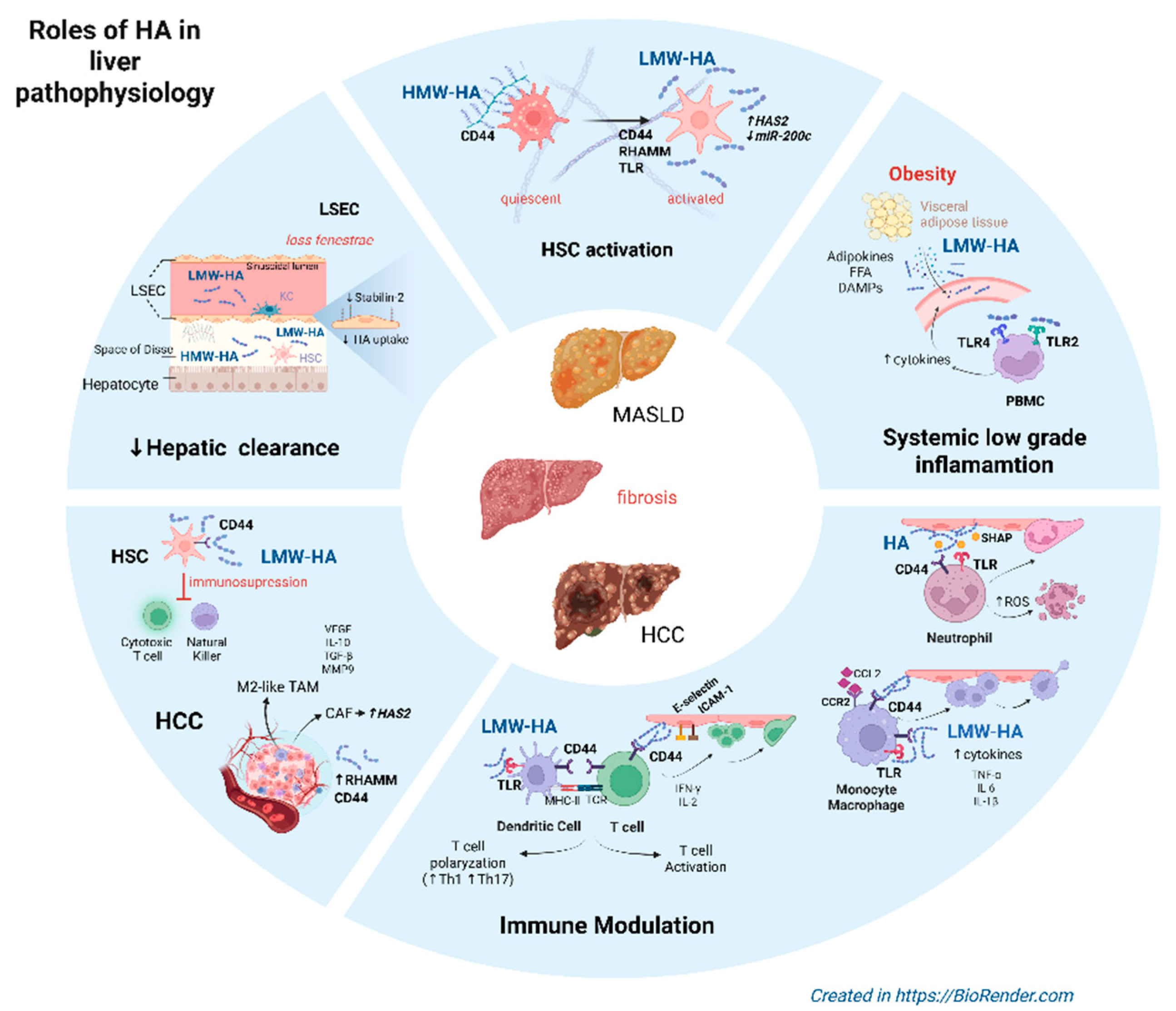

Table 1.
HA-Interacting Receptors Involved in Liver Physiology and Disease.
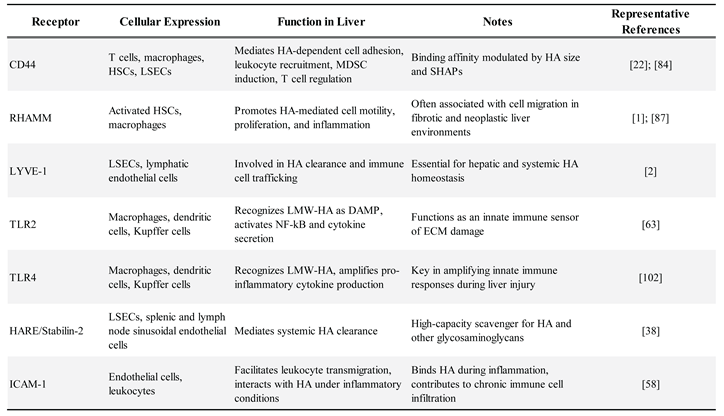 |
DAMP: Damage-Associated Molecular Pattern; HA: Hyaluronic Acid; HSCs: Hepatic Stellate Cells; LSECs: Liver Sinusoidal Endothelial Cells; LMW: Low Molecular Weight; MDSC: myeloid-derived suppressor cells; SHAPs: Serum-derived Hyaluronan-Associated Proteins.
Table 2.
Immunomodulatory functions of HA molecules.
| HA Molecules | Function | References |
|---|---|---|
| LMW-HA | LMW-HA→TLR2,TLR4→MyD88→NF-κB→ ↑inflammatory cytokines (TNF-α, IL-6), immune cell infiltration → ↑ hepatic inflammation | [14]; [17] |
| LMW-HA | LMW-HA→TLR4→TRIF→type I interferon→ ↑ hepatic inflammation | [14] |
| HMW-HA | HMW-HA→CD44,RHAMM→Immune quiescence | [15]; [16] |
| LMW-HA | LMW-HA→CD44, RHAMM→inflammation and remodeling→↑iNOS, T cell activation and proliferation | [18] |
| HA | HA→activation and migration of HSC HA→CD44→Kupffer cell adhesion, polarization, immune responses of liver-resident and infiltrating macrophagues HA→CD44→trafficking, activation of T lymphocytes, DCs→immune surveillance |
[22]; [23] |
| HA | During endotoxin-derived liver inflammation: ↑HA in LSECs↔CD44 in neutrophils→neutrophil adhesion ↑TLR4→SHAP→HA↔CD44→↑neutrophil adhesion |
[46]; [47] |
| LMW-HA/HMW-HA | LMW-HA/HMW-HA→p38 MAPK→↑ROS in neutrophils→↑apoptosis→↑tissue damage HMW-HA+TNFα→↑↑ROS in neutrophils→↑↑apoptosis→↑↑tissue damage |
[49]; [50] |
| HA | In in vivo experimental models: ↓CD44→↓macrophague response to LPS, saturated fatty acids and DAMPs, ↑anti-inflammatory M2 phenotype→↓liver inflammation, ↓fibrosis | [23] |
| HA | HA→CD44↔CCL2-CCR2 axis→integrin activation, monocyte adhesion to LSECs in inflamed hepatic tissue | [51] |
| HA | HA→CD44 on activated HSC→ induction of MDSCs→immunosupression | [52]; [53] |
| LMW-HA | LMW-HA→TLR2, TLR4 on macrophagues→↑cytokine release (TNF-α, IL-6, IL-1β) →↑inflammation | [22]; [42] |
| HMW-HA | HMW-HA→↓TLR activation→ M2-like macrophague phenotype | [54] |
| HMW-HA/LMW-HA | HMW-HA→↓diferentiation of human fibrocytes, pro-fibrotic and inflammatory monocyte-derived cells LMW-HA→maturation of fibrocytes, pro-fibrotic and inflammatory monocyte-derived cells |
[55] |
| HA | HA expressed on vascular endothelium→CD44 in activated T cells→ adhesion and transendothelial migration | [56] |
| HA | HA→CD44→infiltration and retention of effector T cells in inflamed tissues HA→CD44↔E-selectin, ICAM-1→↑infiltration and retention of effector T cells in inflamed tissues |
[57]; [58]; [59] |
| HA | HA→CD44→CD44 co-localizes with lipid rafts and TCR-CD3 complex in T cells→stabilization of interactions between DCs and T cells Deficient CD44 DCs→↓T cell proliferation, cytokine production (IL-2, IFN-γ) CD44↔ezrin-radixin-moesin→synapse formation, T cell polarization |
[60]; [61] |
| LMW-HA | LMW-HA→TLR4 on DCs→MHC II, CD80, CD86→Th1, Th17 polarization | [62]; [63] |
| HMW-HA | In in vitro studies: HMW-HA→↓T cell proliferation, cytokine production | [3]; [64] |
| HMW-HA | In a T-cell mediated liver injury model: HMW-HA→ ↓pro-inflammatory cytokines (TNF-α, IFN-γ) | [65] |
| LMW-HA | LMW-HA→TLR2, TLR4 on monocytes, macrophagues and peripheral blood mononuclear cells→ hepatic inflammation | [22]; [17] |
| HA | In activated HSC→↑HAS2→HA→CD44→NOTCH1↔ ↓miR-200c→liver fibrosis | [30]; [36] |
| HA | Accumulation of HA in the space of Disse→ ↑leukocyte adhesion, transmigration | [76]; [46] |
| HA | In human and murine models of HCC: HA→CD44 on activated HSCs→ induction and expansion of MDSCs→ ↓CTL, ↓NK cell responses | [52]; [53] |
| LMW-HA | In HCC: LMW-HA→M2-like TAMs→↑VEGF, ↑IL-10, ↑MMP9, ↑TGF-β→ angiogenesis, matrix degradation, immunosupression | [22]; [54] |
| HA | Blockade of HA→↓CD44→ M1-like TAMs | [92] |
| HA | In in vivo studies: ↓HAS2 in activated HSCs→↓HA stromal content→↓immune infiltration, ↓fibrosis, ↓tumor burden | [93] |
LMW-HA: Low molecular weight hyaluronic acid; TLR2: Toll-like receptor 2; TLR4: Toll-like receptor 4; MyD88: Myeloid differentiation primary response 88; NF-κB: Nuclear factor kappa-light chain-enhancer of activated B cells; ↑: Increase; TNF-α: Tumor necrosis factor alpha; IL-6: Interleukin-6; TRIF: TIR-domain-containing adapter-inducing interferon beta; HMW-HA: High molecular weight hyaluronic acid; CD44: lymphocyte homing receptor; RHAMM: Receptor for hyaluronan-mediated motility; iNOS: Inducible nitric oxide synthase; HA: Hyaluronic acid; HSCs: Hepatic stellate cells; DCs:Dendritic cells; LSECs: Liver sinusoidal endothelial cells; SHAP: Serum-derived hyaluronan-associated protein; p38 MAPK: p38 mitogen-activated protein kinase; LPS:Lipopolysaccharide; DAMPs: Damage-associated molecular patterns; ↓:Decrease; CCL-2: Chemokine C-C motif ligand 2; CCR-2: C-C chemokine receptor type 2; MDSCs: Myeloid-derived supressor cells; IL-1β: Interleukin-1 beta; E-Selectin: Endothelial selectin; ICAM-1:Intercellular adhesion molecule-1; TCR: T cell receptor; CD3: Cluster of differentiation 3; IL-2: Interleukin-2; IFN-γ: Interferon-gamma; MHC II: Major Histocompatibility complex class II; CD80: Cluster of differentiation 80; CD86: Cluster of differentiation 86; Th1: T helper type 1 cell; Th17: T helper type 17 cell; HAS2: Hyaluronan synthase 2; NOTCH1: Neurogenic locus notch homolog protein 1; miR200c:microRNA 200c; CTL: Cytotoxic T lymphocyte; NK cell: Natural killer cell; HCC: hepatocellular carcinoma; ECM: Extracellular matrix; TAM: Tumor-associated macrophague; VEGF: Vascular endothelial growth factor; IL-10: Inteleukin-10; MMP9: Matrix metalloproteinase 9; TGF-β: Transforming growth factor-beta.
Disclaimer/Publisher’s Note: The statements, opinions and data contained in all publications are solely those of the individual author(s) and contributor(s) and not of MDPI and/or the editor(s). MDPI and/or the editor(s) disclaim responsibility for any injury to people or property resulting from any ideas, methods, instructions or products referred to in the content. |
© 2025 by the authors. Licensee MDPI, Basel, Switzerland. This article is an open access article distributed under the terms and conditions of the Creative Commons Attribution (CC BY) license (https://creativecommons.org/licenses/by/4.0/).
Copyright: This open access article is published under a Creative Commons CC BY 4.0 license, which permit the free download, distribution, and reuse, provided that the author and preprint are cited in any reuse.