

Submitted:
16 July 2025
Posted:
17 July 2025
You are already at the latest version
Preprints on COVID-19 and SARS-CoV-2
Abstract
COVID-19 and deep learning have each marked pivotal milestones in the evolution of modern science. Since the onset of the pandemic, researchers from diverse disciplines have converged to address urgent, real-world challenges, while deep learning has catalyzed methodological innovation across fields. These two phenomena exemplify distinct scientific paradigms: spread-out science, which propagates novel ideas and methods, and merge-in science, which synthesizes existing knowledge to solve complex problems. We introduce the concept of sci-entropy, defined as the difference between the semantic entropy of a paper’s citations and references. Positive sci-entropy reflects the diffusion of new ideas (spread-out), whereas negative values indicate knowledge consolidation (merge-in). Our analysis, spanning deep learning, COVID-19, and 19 additional disciplines, reveals that scientific progress is governed by the dynamic interplay between these two forces. Excessively high sci-entropy may fragment research, while overly low values can stifle innovation. Our findings suggest that the balance between innovation and synthesis is fundamental to the trajectory of scientific development, offering a new framework for understanding interdisciplinary research and knowledge integration.
Keywords:
deep learning
; COVID-19
; interdisciplinary research
; science of science
; sci-entropy
; knowledge diffusion
; knowledge integration
1. Introduction
In recent years, global science and public health have been profoundly shaped by two transformative events: the advent of large language models (LLMs) such as GPT [1,21,27], and the outbreak of COVID-19 [2]. The emergence of GPT has revolutionized artificial intelligence, redefining the boundaries of computational technology and catalyzing breakthroughs across multiple domains. In contrast, the COVID-19 pandemic has triggered an unprecedented global response, mobilizing researchers in medicine, epidemiology, data science, and public health to address urgent societal needs. Despite their apparent differences, both events have galvanized the scientific community, driving substantial investment and fostering interdisciplinary collaboration.
Deep learning, rooted in neural network theory, has evolved from early models in the 1950s and 1960s to become a cornerstone of modern science. Since the breakthroughs of 2015 [11], deep learning has achieved remarkable success in healthcare, e.g., medical image analysis, drug discovery [3], natural language processing [4], and beyond. Its rapid expansion demonstrates the power of methodological innovation to advance scientific frontiers.
Conversely, the COVID-19 crisis has necessitated the rapid integration of knowledge from diverse fields, leading to a surge in interdisciplinary research focused on understanding viral transmission, developing vaccines, and optimizing treatment strategies. Unlike the method-driven progress of deep learning, COVID-19 research exemplifies merge-in science, where the urgent need for solutions drives the synthesis of existing knowledge.
While both deep learning and COVID-19 have generated extensive scientific output, they represent fundamentally different modes of knowledge production. However, current bibliometric indicators—such as citation counts, h-index, and impact factors—primarily measure academic influence in terms of quantity and prestige, but fail to reflect the underlying epistemic roles of a publication. For example, citation-based metrics do not distinguish whether a work synthesizes existing knowledge or disseminates novel ideas. Network-based methods such as co-citation and bibliographic coupling [5,6] offer some insights into structural patterns, but lack semantic granularity. Recent approaches using topic modeling and citation context analysis [7,8] improve interpretability, yet still fall short in quantifying knowledge integration versus diffusion across domains. This motivates the development of new metrics that incorporate semantic structure and disciplinary breadth.
To address this gap, we propose sci-entropy, a novel metric grounded in semantic entropy, to quantify whether a scientific work primarily contributes to the diffusion of knowledge across fields or the integration of existing ideas. Drawing inspiration from Shannon entropy [9], sci-entropy measures the distributional uncertainty of semantic topics in a work’s references. Unlike traditional citation-based or network-structure methods, which offer limited insight into semantic function, sci-entropy directly captures how widely or narrowly knowledge is semantically spread across disciplines. This theoretically principled framework provides a new lens to examine how scientific innovation and synthesis manifest across research domains.
To further investigate these contrasting modes of scientific evolution, the remainder of this paper is organized as follows. Section 2 introduces the construction of the sci-entropy metric, including data collection, interdisciplinarity measurement, and entropy computation. Section 3 presents empirical results, highlighting how deep learning and COVID-19 illustrate two complementary pathways of knowledge development. Section 4 discusses the implications, limitations, and future directions of this study. Finally, Section 5 concludes the paper.
2. Materials and Methods
2.1. Data Collection
We first retrieved research papers related to Deep Learning, COVID-19, as well as 19 other disciplines from Acemap [49], an academic system that utilizes metadata integrated from various academic databases such as Science, Nature, Springer, and Elsevier, encompassing over 214 million publications published between 1800 and 2021, along with 1.7 billion citation links.
From these, we manually selected 1,000 non-overlapping articles from each of the 21 disciplines, resulting in a total of 21,000 benchmark papers (see Section 5). These benchmark papers were used to identify discipline-specific keywords. For each paper, we extracted the abstract and performed phrase frequency analysis, counting each word only once per document. We then computed a keyword score by subtracting a word’s global frequency across all disciplines from its frequency within a specific discipline. Top-scoring keywords were selected for each field, with non-specialized terms excluded manually.
The number of keywords per discipline was determined by the keyword coverage rate over the benchmark set. Here, coverage rate refers to the proportion of benchmark articles within a discipline that contain at least one of the selected keywords. Based on these selected keywords, we then randomly sampled 1 million additional articles from the 214 million corpus for large-scale classification and subsequent analysis.
To ensure the reproducibility and consistency of this large-scale sampling process, we used a fixed random seed during the selection to control for randomness and enable identical replication of the sample in future runs. Additionally, to reduce potential sampling bias, we applied basic distributional constraints at the discipline level to prevent over-representation of high-frequency keywords or dominant disciplines. This helped maintain a balanced and representative dataset for semantic and structural analysis.
2.2. Definition of Interdisciplinarity
We define the cross-coverage rate between two disciplines as the proportion of articles in one discipline that are covered by keywords originating from another. A keyword is considered to cover a paper if it appears in its title or abstract. This metric captures the degree of conceptual overlap and serves as the basis for measuring interdisciplinarity.
This indicator effectively reflects the semantic-level association between different disciplines. For example, if keywords from one field frequently appear in the literature of another, it suggests potential intersections in research topics or methodologies. Such semantic overlap corresponds to real-world interdisciplinary phenomena, including cross-disciplinary citations, collaborative research, and shared problem domains. Therefore, this metric provides a content-based perspective on scientific convergence and can be used to construct networks of interdisciplinary linkage.
We constructed a 21-by-21 cross-coverage matrix, where each cell represents the percentage of articles in the column discipline that are covered by keywords from the row discipline (Figure 1). This matrix can be interpreted as a semantic similarity matrix, capturing the degree of conceptual overlap between disciplines based on keyword occurrence.
Based on this matrix, we applied hierarchical clustering to group disciplines with high mutual coverage, using standard agglomerative procedures [50]. Specifically, we transformed the cross-coverage similarities into distances using , a common approach in clustering tasks involving precomputed affinity measures. This formulation ensures that disciplines with high mutual semantic proximity are considered close in the clustering space.
For the linkage strategy, we adopted the Ward method, which minimizes the total within-cluster variance at each merging step. This choice yields compact and interpretable clusters by discouraging premature aggregation of weakly related disciplines. The final six major subject categories were obtained by cutting the dendrogram at a level that preserved both clarity and domain interpretability, as shown in Figure 1.
Within this framework, we further define two semantic error rate metrics to characterize the conceptual roles of each discipline in terms of diffusion and integration. The out-Err of a discipline measures the proportion of its keywords that cover papers in other, unrelated disciplines. This reflects the outward semantic diffusion of the field, i.e., the extent to which its terminology and concepts spread across disciplinary boundaries. A higher out-Err indicates stronger cross-domain influence, suggesting that the field’s methods, language, or frameworks are broadly adopted.
In contrast, the in-Err quantifies the proportion of articles in a discipline that are covered by keywords originating from other disciplines. This captures the semantic susceptibility or receptiveness of the field to external conceptual input. A higher in-Err suggests greater openness and integration with ideas beyond its traditional boundaries.
Together, these two metrics represent complementary dimensions of a discipline’s epistemic behavior: knowledge output versus knowledge input. They provide insight into how different fields function in the broader structure of science. For example, method-oriented domains may exhibit high out-Err and low in-Err, indicating strong conceptual export but limited conceptual import, whereas problem-driven or interdisciplinary domains may exhibit high values in both dimensions, reflecting active semantic exchange.
2.3. Definition and Computation of Sci-Entropy
To understand how a scientific paper contributes to knowledge evolution, we analyze its role through a measure we call sci-entropy. This metric reflects whether a paper tends to consolidate existing knowledge (merge-in) or to diversify and stimulate new directions (spread-out).
Unlike traditional citation-based metrics that focus on influence or centrality in a citation network, sci-entropy emphasizes the semantic structure of a paper’s connections to prior work. For example, while indicators such as citation count [52] or betweenness centrality [53] measure visibility or network bridging, they do not capture whether the cited knowledge is being synthesized or extended into novel domains. Sci-entropy quantifies the distributional diversity of the cited disciplines in a paper’s reference list, providing a content-driven view of its epistemic function.
By measuring the entropy of the disciplinary composition of cited literature, sci-entropy offers an indicator of knowledge recombination, from highly integrative works that pull together tightly related ideas to highly exploratory works that span semantically distant fields.
We compute sci-entropy based on the semantic diversity of a paper’s reference set and citation set. The reference set includes papers cited by the target paper (i.e., its knowledge source), and the citation set includes papers that cite the target (i.e., its downstream influence).
The reference set represents the upstream knowledge context the paper builds upon. By analyzing the disciplinary distribution of these cited papers, we assess whether the target paper draws upon a narrow or broad range of existing domains. A concentrated reference profile suggests disciplinary depth, while a dispersed one indicates integrative or interdisciplinary sourcing.
The citation set, in contrast, reflects the downstream diffusion of the paper’s ideas. It captures the range of disciplines that subsequently adopt or build upon the work. A high semantic diversity among citing papers implies that the paper has inspired cross-disciplinary impact, whereas a low diversity suggests influence largely confined to its own domain.
By jointly evaluating both sets, sci-entropy characterizes a paper’s semantic role in knowledge recombination—whether it primarily consolidates prior ideas within a focused domain, acts as a conceptual bridge across domains, or radiates outward into diverse scientific areas.
-
Semantic representationWe first extract the title and abstract of each paper and tokenize them into words. Each word is embedded using the pretrained Global Vectors for Word Representation (GloVe) [13], and the article’s semantic vector is computed by averaging all word embeddings:where is the embedding of the i-th word, and N is the number of words in the article.
-
Reference and citation context retrievalFor every target paper, we collect its reference set and citation set. Each paper in these sets is also converted into a semantic vector using the same averaging approach.
-
Estimating semantic distributionsWe apply kernel density estimation (KDE) to the semantic vectors in both the reference and citation sets. This results in two empirical distributions over the semantic space, denoted as and .
-
Entropy calculationAs the true analytical forms of these distributions are unknown, we approximate entropy using a discrete form. Let denote the normalized KDE values over sampled vectors. Then the entropy is approximated by:This yields two entropy values: for the reference distribution and for the citation distribution.
-
Final computation of sci-entropyFinally, we define sci-entropy as the difference between citation entropy and reference entropy:A positive value of indicates that the paper is cited by semantically diverse follow-up research, reflecting a spread-out science pattern. A negative value suggests that the paper integrates semantically diverse prior knowledge, corresponding to merge-in science.
3. Results
3.1. Two Pathways of Scientific Evolution
Based on the sci-entropy metric described above, we analyzed large-scale publication data across 21 disciplines to examine patterns of knowledge development. We observed that scientific research exhibits distinct behavioral patterns depending on the underlying research paradigms (see Appendix Figure A1). To characterize these differences, we categorized research activities into two types: spread-out science and merge-in science.
Spread-out science primarily involves the creation of methods, tools, or frameworks that are applicable across disciplines. Such contributions quickly gain traction and frequently catalyze the development or transformation of entire research fields. A representative case is the deep learning framework introduced by LeCun, Bengio, and Hinton [11], which rapidly spread into fields such as computer vision, natural language processing, and biomedicine (Figure 2).
Other notable examples include the Fourier transform [56], originally developed for solving problems in heat conduction, which has become foundational in signal processing, image analysis, medical imaging, and quantum physics. Similarly, Monte Carlo methods [57], first introduced in statistical physics, are now widely used in computational finance, Bayesian inference, reinforcement learning, and molecular modeling. Another influential case is game theory [58], initially formalized in economics and mathematics, which has since shaped fields such as political science, evolutionary biology, computer science, and artificial intelligence.
This outward diffusion is often accompanied by the emergence of new subfields and the cross-pollination of ideas, demonstrating the transformative power of methodological innovation. Spread-out science thus plays a pivotal role in facilitating interdisciplinary integration and accelerating the evolution of scientific knowledge.
In contrast, merge-in science emerges in response to complex, real-world problems and integrates knowledge from multiple disciplines. A representative case is the global scientific response to the COVID-19 pandemic, which rapidly mobilized experts across epidemiology, medicine, statistics, and computer science to address urgent public health challenges. This convergence is exemplified by the nationwide study led by Guan et al., which analyzed the clinical characteristics of 1,099 patients across 552 hospitals in China [12] (Figure 3).
Similar interdisciplinary efforts occurred across other regions. In the United Kingdom, the RECOVERY trial[59] brought together clinicians, statisticians, and pharmacologists to launch the world’s largest clinical study of COVID-19 treatments within six weeks, delivering evidence that directly shaped international clinical guidelines. In the United States, the NIH-led ACTIV program [60] coordinated efforts across government agencies, academia, and the private sector to accelerate vaccine and therapeutic development, initiating multiple adaptive phase III clinical trials across more than 100 sites. In Europe and Asia, Germany’s Corona-Warn-App[61] integrated sensor technology, epidemiological modeling, and behavioral economics to support data-driven public health decisions, with studies showing measurable reductions in hospitalization and mortality. South Korea, meanwhile, adopted a comprehensive digital tracing system combining GPS, financial transaction data, and mobile networks—supplemented by behavioral science—to effectively contain early outbreaks[62].
Merge-in science is characterized by the synthesis of diverse expertise and the rapid translation of research into practical solutions, highlighting the importance of interdisciplinary collaboration in addressing societal crises. These examples illustrate that such convergence is not only essential in medicine, but also in public policy, governance, and technological infrastructure, often requiring coordination across disciplinary, institutional, and national boundaries.
Together, these two research modes highlight complementary paths of knowledge evolution: spread-out science promotes the wide diffusion of ideas and technological advancement, while merge-in science fosters the integration of knowledge across disciplines to solve complex, real-world problems. The interplay between these modes is essential for the healthy development of the scientific ecosystem, ensuring both innovation and consolidation.
In practice, the two modes reinforce each other. Innovations from spread-out science, such as deep learning and Bayesian inference—become key tools in merge-in research. Conversely, real-world challenges addressed by merge-in science generate new technical demands, stimulating further methodological development. For example, the global response to COVID-19 not only accelerated the use of predictive models, but also advanced work in data standards and privacy protection.
To capture the differences between spread-out and merge-in paradigms in a quantitative manner, we introduced the sci-entropy change metric, which reflects how each publication both draws on prior knowledge and contributes to future research. A high entropy change indicates broad interdisciplinary influence and the potential to inspire new research directions, while a negative or stagnant change suggests limited diffusion or early-stage development. This metric provides a nuanced view of how scientific ideas propagate and consolidate within the academic landscape.
To implement this framework, we applied the GloVe [13,55] to extract word embeddings from scientific articles, allowing us to track how specific terms spread across disciplinary contexts over time. We further employed KDE to estimate the distribution of sci-entropy across fields and time. (Figure 4a)
As a representative of spread-out science, deep learning shows a clear pattern of growth in both research volume and sci-entropy (Figure 4b). Following the proposal of the Support Vector Machine (SVM) algorithm in 1995 [14], interest in neural networks began to wane, whereas the concurrent development of Particle Swarm Optimization (PSO) [15] introduced a novel research direction. In 2006, deep belief networks (DBNs) laid key theoretical foundations for modern deep learning [16]. The field accelerated rapidly after 2012, driven by ImageNet achievements [17]. By 2015–2016, deep learning emerged as a distinct research focus [11], marked by a sharp rise in sci-entropy. Since then, the field has expanded across domains, supported by growing computing power, open-source frameworks, and widespread applications.
COVID-19 research, on the other hand, shows a rapid early surge followed by entropy decline, indicating a transition from rapid uptake to structural consolidation and standardization (Figure 4b). This pattern reflects the urgent mobilization of the scientific community in response to the pandemic, followed by the establishment of standardized knowledge and best practices.
Since 1975, we observed an overall upward trend in sci-entropy, with a particularly notable increase during the digital revolution (Figure 4c). However, this growth has begun to plateau in certain domains since the 1990s. One possible explanation is the continued rise in academic journal subscription costs, which may have increased barriers to knowledge access. Between 1984 and 2002, subscription prices for scientific journals rose by approximately 600% [63], significantly outpacing inflation. Another study found that for every 1% increase in journal price, the five-year citation count of associated papers decreases by about 0.77% [64]. These findings suggest that rising access costs may have partially constrained the diffusion of knowledge, thereby slowing the growth of scientific entropy in some fields.
3.2. Roles in Interdisciplinary Research
In the contemporary scientific landscape, deep learning and COVID-19 research have emerged as two defining centers of influence. One rooted in methodological innovation and diffusing outward across disciplines, the other driven by a real-world crisis that rapidly mobilized diverse fields toward a common goal.
Deep learning catalyzed paradigm shifts across medicine, biology, engineering, and other domains. It introduced transferable frameworks and computational tools, enabling broad adoption and structural transformation across disciplines. This outward expansion reflects the typical dynamics of spread-out science, where methodological advances serve as bridges between previously disconnected fields.
In contrast, COVID-19 research followed a convergence-based trajectory. It drew together knowledge from epidemiology, statistics, policy, and information science to address an urgent global challenge. Rather than producing new methodologies, it focused on integrating existing knowledge and rapidly translating research findings into actionable public health strategies.
Taken together, these two forces not only shaped scientific priorities in their respective eras but also marked structural milestones in the evolution of modern science. Their parallel rise invites deeper reflection: such breakthroughs reflect a shared mechanism by which science responds to both internal innovation and external demand.
Building on the confusion matrix analysis (Figure 1, see Materials and Methods), we assessed the academic influence, scope, and output of deep learning and COVID-19 research. During the COVID-19 pandemic, research related to deep learning experienced a notable shift in academic influence. As shown in Figure 5a, both one-year and two-year citation counts began to increase in 2020 and peaked in 2021. At the same time, deep learning studies became increasingly connected to biomedical fields (Figure 5d), reflecting the field’s expanding role in responding to public health challenges.
A comparison between deep learning-based and traditional computer science–based COVID-19 research (Figure 5b, e) reveals that the former achieved significantly higher citation performance and interdisciplinary reach. This finding emphasizes the superior bridging capacity of deep learning in fostering impactful interdisciplinary collaboration.
We also examined how interdisciplinary breadth relates to research impact and quality (Figure 5c). Papers that span two disciplines tend to receive more citations and exhibit stronger knowledge integration. These studies already account for about 7.7% of the dataset (Figure 5f), suggesting meaningful progress in interdisciplinary collaboration, with room for further expansion.
Together, these findings underscore the complementary dynamics of spread-out science and merge-in science—two modes of knowledge development that have shaped the course of modern research. Both deep learning and COVID-19 have played milestone roles in accelerating interdisciplinary innovation and redefining the structure of scientific progress. The synergy between these modes is likely to become increasingly important as science continues to address complex, global challenges.
3.3. Patterns of Scientific Evolution
Building on our earlier analysis of deep learning and COVID-19, we expanded our investigation to include 19 additional disciplines, forming a comprehensive set of 21 fields. This allowed us to examine the broader patterns of sci-entropy across diverse domains and uncover generalizable trends in knowledge development.
We found that scientific research has exhibited sustained growth at the macro level, yet disciplinary differences in knowledge development strategies have become increasingly pronounced. As shown in Figure 6, between 1950 and 2020, some fields—such as mathematics, physics, and deep learning—displayed consistent expansion and outward citation flow across domains, aligning with the dynamics of spread-out science. In contrast, others maintained a more stable structure, focusing on the consolidation and refinement of internal knowledge, as seen in merge-in science.
To further interpret the structural differences between disciplines, we decomposed the overall sci-entropy into three components: reference, origin, and citation. These components quantify how scientific knowledge is sourced, positioned, and propagated within the citation network.
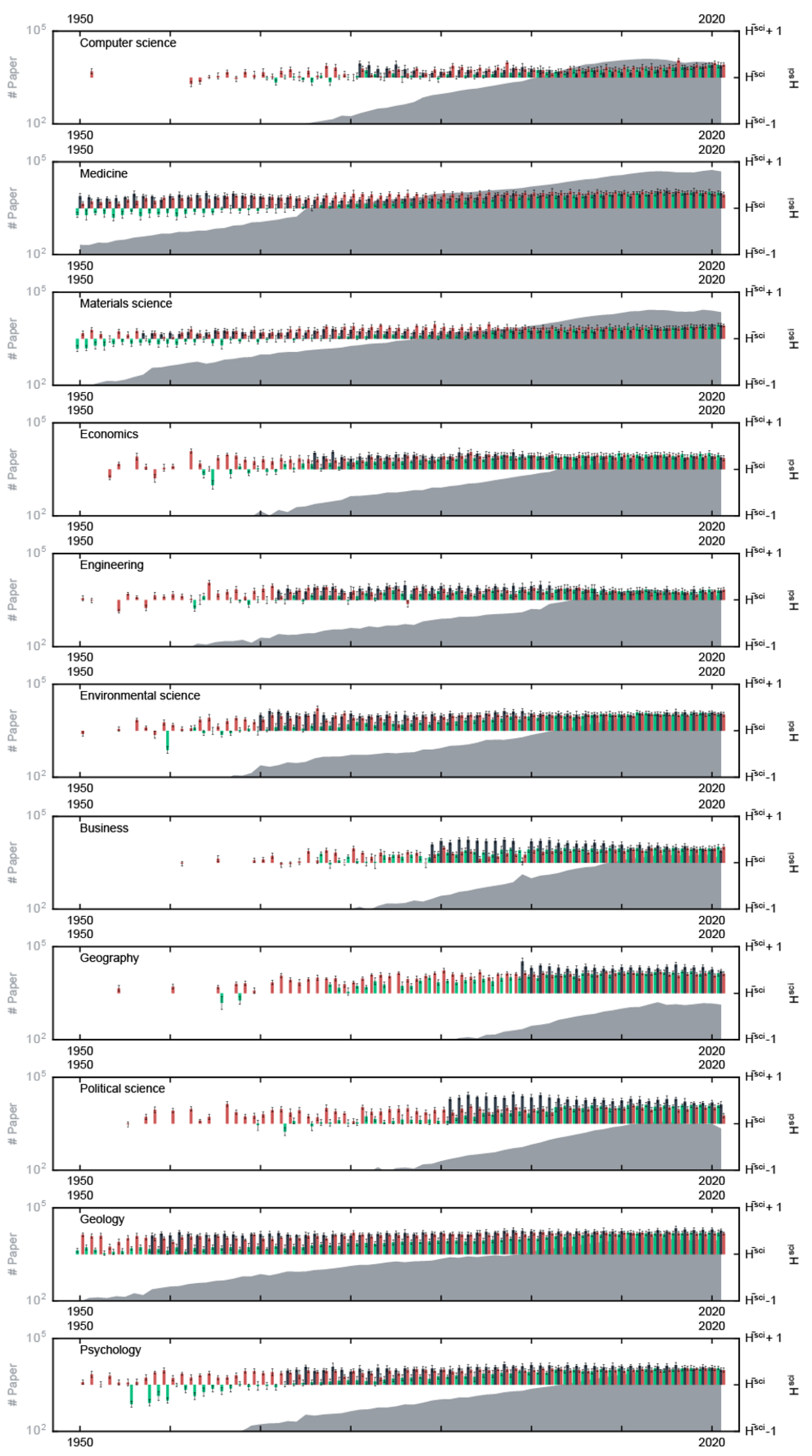
By comparing these components across disciplines, we identify distinct patterns. Some fields exhibit strong outward flows in referencing and citation patterns, reflecting broader cross-disciplinary influence and knowledge diffusion. Others tend to concentrate their activity within internal networks, emphasizing conceptual consistency and depth of development. A more detailed view of the temporal evolution of sci-entropy components across all 21 disciplines can be found in Appendix Figure A2, Figure A3.
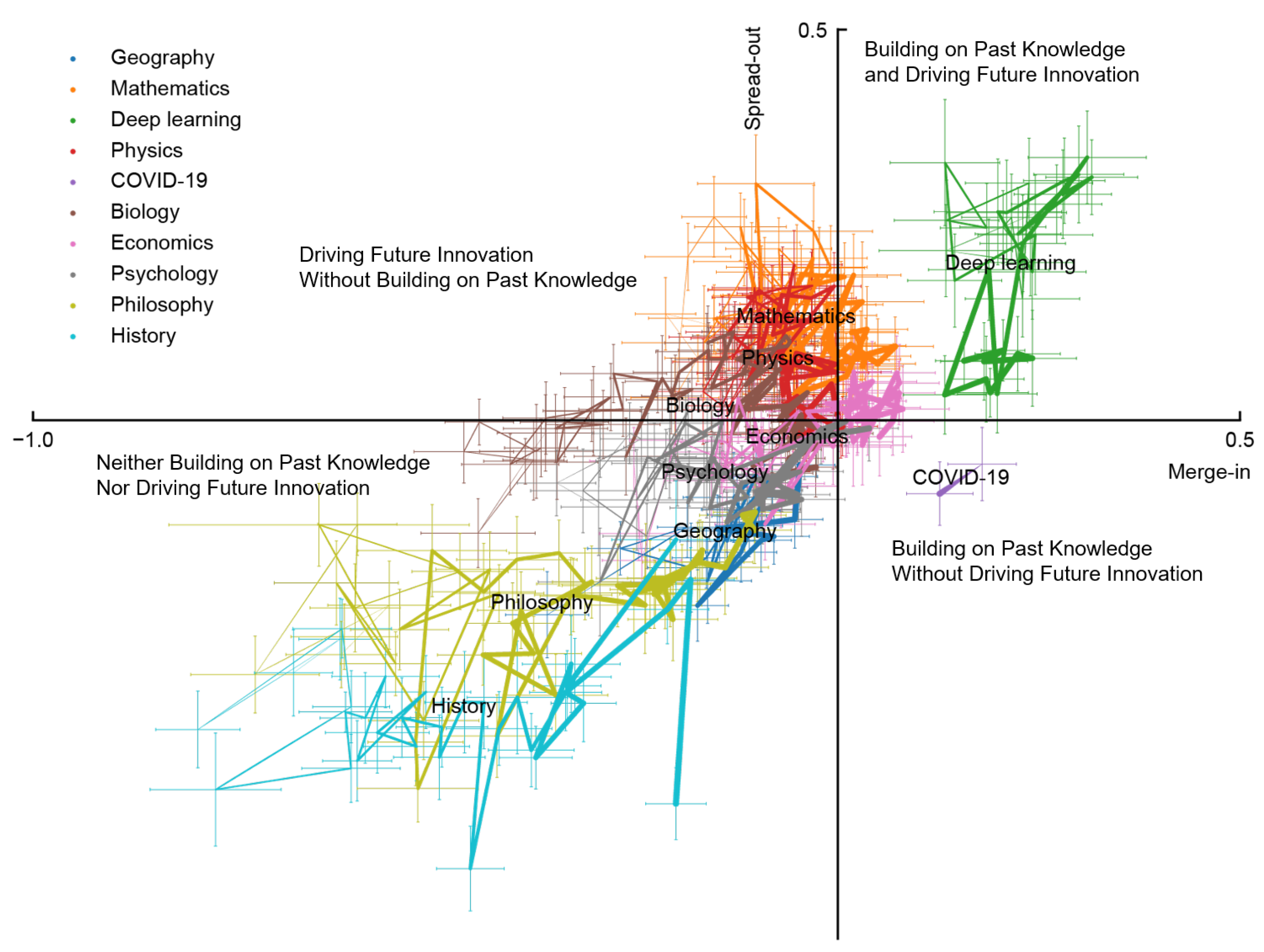
Based on the sci-entropy metric, we constructed a two-dimensional space defined by the axes of building on existing knowledge and driving future innovation (Figure 7). This framework categorizes scientific fields into four quadrants, providing a comprehensive map of disciplinary evolution.
Deep learning, for instance, lies in the upper-right quadrant, both extending established work and opening new avenues of application. However, its rapid expansion also raises concerns about structural convergence and diminishing innovation, suggesting the need for continuous methodological renewal. COVID-19 research, in contrast, is in the lower-right quadrant. While it effectively integrates existing knowledge in the short term, it shows limited momentum for long-term advancement, highlighting the challenges of sustaining innovation in crisis-driven research.
Mathematically grounded fields exhibit steady outward expansion without strong historical dependence, suggesting a self-sustaining dynamic. Disciplines such as history, however, remain largely inward-looking, with limited cross-field diffusion and innovation activity.
Our mapping revealed four distinct modes of disciplinary evolution. This perspective provides a new pathway for identifying sustainable modes of scientific progress. It suggests that long-term vitality lies in continuously expanding, driven by innovation that opens new directions for knowledge development. The balance between building on past knowledge and fostering future innovation is crucial for the resilience and adaptability of scientific fields.
These findings are consistent with previous studies that examined the structure of knowledge flows across disciplines. Yan [18] showed that knowledge transfer often exhibits directional asymmetry. Fields such as computer science and engineering tend to export methods, while the humanities and social sciences emphasize internal consolidation. Omodei et al. [19] found that interdisciplinary connections are often driven by methodological openness and applicability. This observation aligns with the high sci-entropy patterns we identified in spread-out sciences like deep learning and applied physics.
In contrast to these earlier studies, we proposed a dynamic entropy-based framework. This model captured both the direction of knowledge flows and the structural evolution of disciplines over time. Unlike static methods such as main path analysis [20], which identify fixed citation routes, the sci-entropy approach revealed the balance between diffusion and integration. It offered a finer-grained view of how fields sustain innovation or consolidate knowledge structurally.
COVID-19 research exemplified a merge-in science paradigm. It rapidly integrated knowledge from epidemiology, clinical medicine, statistical modeling, and artificial intelligence to address a global health emergency. Although its long-term development remains uncertain, its structure showed a high degree of consolidation. Together with deep learning as a diffusion-driven case, these two examples represent complementary trajectories of contemporary scientific evolution.
4. Discussion
The science of science has sparked an increasingly widespread interest in the scientific community [51,54]. However, research on deep learning and COVID-19 has not received extensive attention in this area.
Deep learning has undoubtedly been one of the most popular fields in recent years. Especially since the advent of ChatGPT [21], public attention has once again focused on deep learning. Compared to traditional machine learning methods, deep learning is a huge leap forward and solves a great number of artificial intelligence problems [11]. It has been applied to a wide range of fields such as computer vision [28], natural language processing [29], as well as other disciplines such as agriculture , biomedicine [30], ecology, and materials science [31]. Similarly, the coronavirus disease 2019 (COVID-19) has also been a hot research topic in recent years. Since the outbreak of COVID-19, scientists around the world have been studying the transmission [32], treatment, vaccines, sequelae [33], and different variants [34] of COVID-19. Emerging at nearly the same time, both fields caused a stir in the scientific community.
Deep learning and COVID-19 have many aspects in common, which arouses interest in studying their associations. Both fields have seen a surge in the number of publications in a short period of time. For example, in 2018, deep learning accounted for 2.6% of articles in the ‘Technology’ category and also held a share in some other categories, at the same time presenting remarkable growth rate in these domains [23]; while in 2020, there were more than 100,000 articles published on the coronavirus pandemic[24]. Additionally, many interdisciplinary studies have been stimulated by deep learning [30,31] and COVID-19 [36,37,38,40,41], which might have also facilitated collaboration between researchers with different backgrounds [42]. Furthermore, deep learning and COVID-19 are both research areas that require extensive data analysis [11,43,44]. The strong similarity between these two events stimulates our interest in studying them.
In fact, their role in contributing to the advancement of other disciplines and science appears to be quite different. Interdisciplinary research has recently attracted interest [45]. Okamura [46] and Shi et al. [47] have both observed a greater impact of interdisciplinary research. However, there is controversy over the funding available for interdisciplinary research [48]. These interesting findings prompted us to further explore the differences in their roles in interdisciplinary research.
Despite some skepticism in its early development [11], deep learning, which has been evolving rapidly in the recent decade, has advanced many other disciplines and even science itself. LeCun et al. [11] argue that deep learning’s ability to discover complex structures in high-dimensional data allows it to be applied to many scientific fields. Cockburn et al. [35] believe that as a result of innovation, deep learning may have a fundamental impact on innovation itself. Bianchini et al. [23] suggest that deep learning may serve as a powerful and versatile research tool within all sciences. Unlike deep learning served as an instrument for other scientific disciplines, COVID-19 attracts researchers from various disciplines to conduct research on the pandemic [36,37,38]. An astonishing number of laboratories and investigators have turned to COVID-19-related research. The redirection of research to COVID-19 has also been accompanied by the reallocation of research funds and other resources, although it may cause a significant drop in studies unrelated to COVID-19, such as life sciences [39]. It may seem that deep learning tends to be a universal tool for different disciplines, while COVID-19 has become an application direction of interest to the entire scientific community.
Overall, our study proposes a comparative framework for scientific evolution using the cases of deep learning and COVID-19, yet several limitations remain that warrant further investigation.
First, the sci-entropy metric captures the semantic diversity of citation and reference distributions, offering an interpretable view of knowledge diffusion and integration. However, high sci-entropy values do not necessarily indicate conceptual novelty or disruptive impact. Future work may benefit from combining sci-entropy with other indicators.
Second, our disciplinary classification and keyword extraction relied on non-overlapping articles and unsupervised clustering, which may underrepresent interdisciplinary or emergent fields. Incorporating expert annotation or more advanced structural embeddings could improve robustness in future applications.
Finally, our focus has been primarily on epistemic structure and information flow. Institutional and policy factors, such as funding mechanisms, evaluation criteria, and collaboration infrastructures, may also significantly shape whether a field becomes diffusion-oriented or integration-focused. Future research could integrate these contextual dimensions to better understand the drivers behind scientific convergence and divergence.
Overall, while this study offers a new perspective on scientific evolution, it also opens up several avenues for deeper, more comprehensive inquiry.
5. Conclusions
In this study, we systematically compared the scientific evolution pathways of deep learning and COVID-19 research, introducing the sci-entropy metric to distinguish between spread-out science (knowledge diffusion) and merge-in science (knowledge integration). By analyzing one million papers across 21 disciplines, we identified six major subject clusters and revealed that deep learning follows a diffusion-oriented trajectory, while COVID-19 research aggregates knowledge in response to crisis-driven needs. Our framework uncovers the dynamic interplay between innovation and synthesis, highlighting the importance of balancing these forces for sustainable scientific progress. These findings provide a new perspective for understanding interdisciplinary research and offer practical guidance for fostering knowledge integration and innovation in the scientific community.
Author Contributions
Conceptualization, H.K.; methodology, H.K.; software, H.K.; validation, H.K.; formal analysis, H.K.; investigation, H.K.; data curation, Y.D. and Z.J.; writing—original draft preparation, H.D.; writing—review and editing, H.K. and L.F.; supervision, L.F., J.D., X.W., L.Z., and C.Z.; All authors have read and agreed to the published version of the manuscript.
Funding
This work was supported by NSF China (No. 62020106005, 42050105, 62061146002), Shanghai Pilot Program for Basic Research - Shanghai Jiao Tong University.
Institutional Review Board Statement
Not applicable.
Informed Consent Statement
Not applicable.
Data Availability Statement
The original data presented in the study are openly available in the Acemap database at https://www.acemap.info.
Acknowledgments
The authors thank all colleagues and collaborators who provided valuable feedback and support during the preparation of this manuscript.
Conflicts of Interest
The authors declare no conflicts of interest.
Abbreviations
The following abbreviations are used in this manuscript:
| LLM | Large Language Model |
| DL | Deep Learning |
| SVM | Support Vector Machine |
| PSO | Particle Swarm Optimization |
| DBN | Deep Belief Network |
| CNN | Convolutional Neural Network |
| GloVe | Global Vectors for Word Representation |
| KDE | Kernel Density Estimation |
Appendix A
Appendix A.1
Figure A1.
Global scientific landscape: the explosive growth of deep learning and COVID-19 research. The figure is derived from the Acemap open-source academic knowledge graph, visualizes the development of global scientific research based on over 200 million publications across 19 major disciplines since 1800. Node size indicates academic impact. The dense cluster on the upper right highlights COVID-19 research, with 417,857 publications, while the right side marks deep learning, totaling 172,547 publications.
Figure A1.
Global scientific landscape: the explosive growth of deep learning and COVID-19 research. The figure is derived from the Acemap open-source academic knowledge graph, visualizes the development of global scientific research based on over 200 million publications across 19 major disciplines since 1800. Node size indicates academic impact. The dense cluster on the upper right highlights COVID-19 research, with 417,857 publications, while the right side marks deep learning, totaling 172,547 publications.
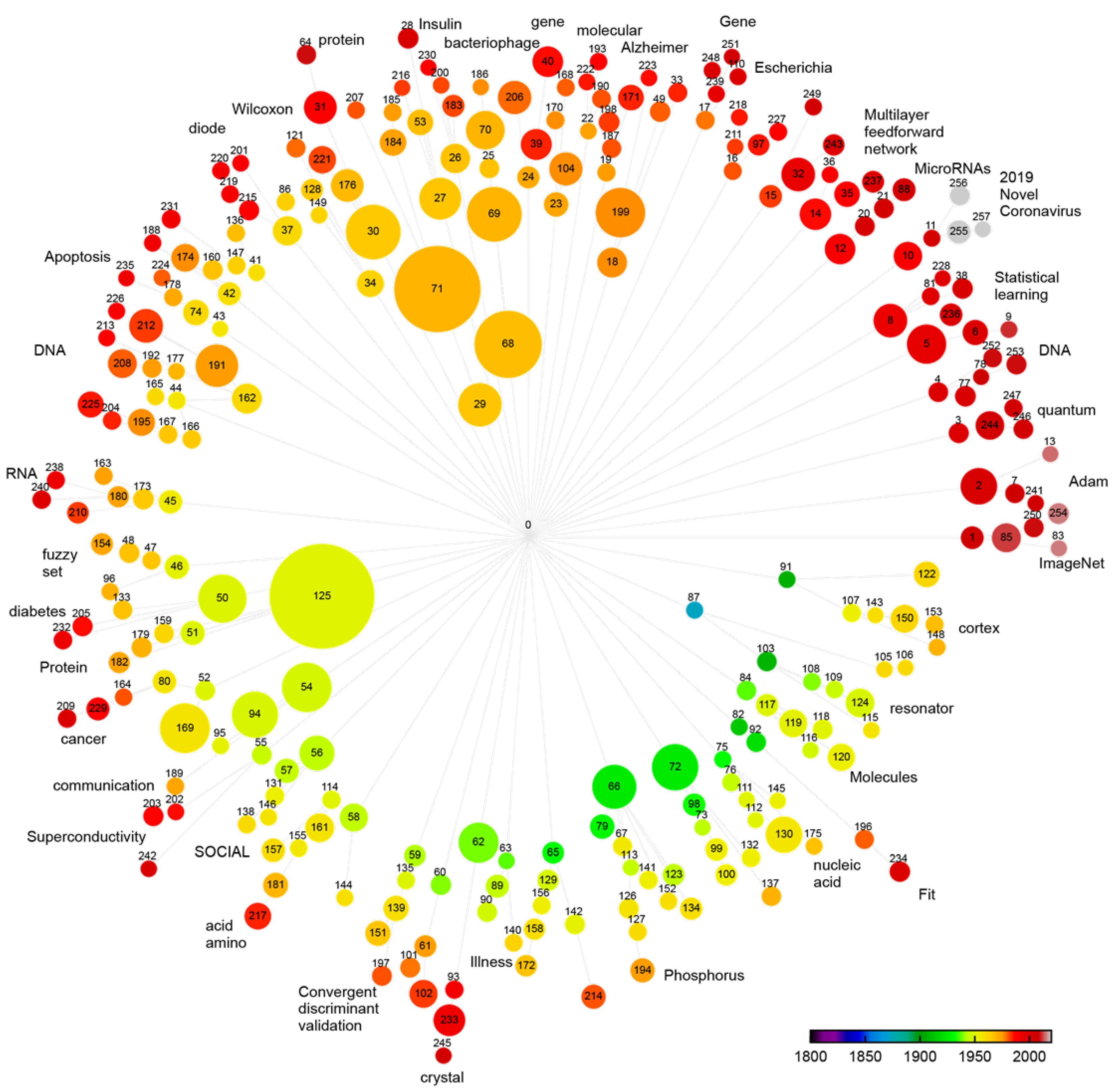
Figure A2.
Sci-entropy and publication growth from 1950 to 2020 for ten of the selected disciplines. The figure presents the development of publications in different fields, categorized into references (green), origins (black), and citations (red). The left y-axis (logarithmic scale) denotes the number of publications, while the right y-axis tracks the variation in the sci-entropy Index.
Figure A2.
Sci-entropy and publication growth from 1950 to 2020 for ten of the selected disciplines. The figure presents the development of publications in different fields, categorized into references (green), origins (black), and citations (red). The left y-axis (logarithmic scale) denotes the number of publications, while the right y-axis tracks the variation in the sci-entropy Index.
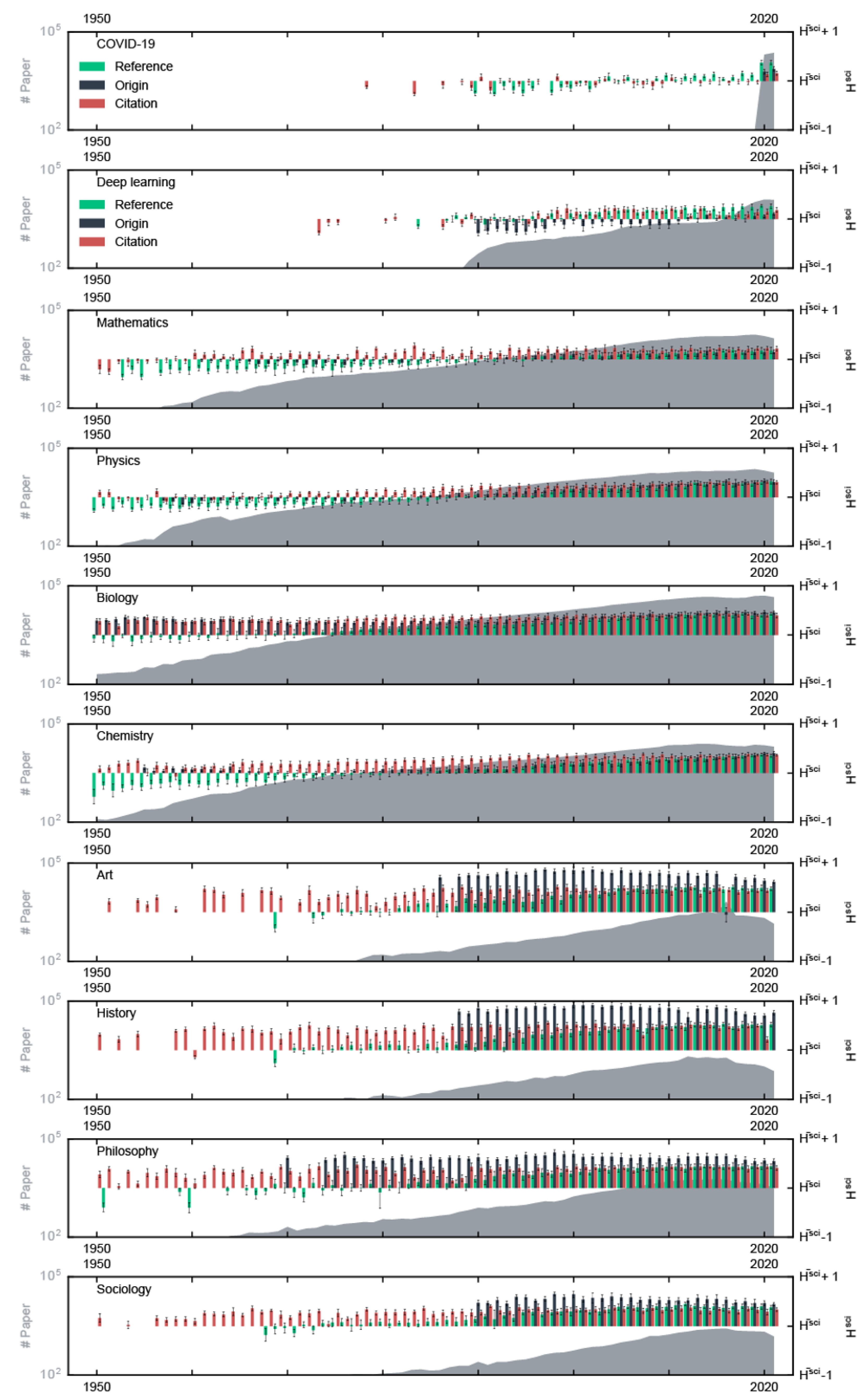
Figure A3.
(Continued) Sci-entropy and publication growth from 1950 to 2020 for the remaining selected disciplines. This figure follows the same format as in Figure A2.
Figure A3.
(Continued) Sci-entropy and publication growth from 1950 to 2020 for the remaining selected disciplines. This figure follows the same format as in Figure A2.
References
- Brown, T.; Mann, B.; Ryder, N.; Subbiah, M.; Kaplan, J.D.; Dhariwal, P.; Neelakantan, A.; Shyam, P.; Sastry, G.; Askell, A.; et al. Language Models are Few-Shot Learners. NeurIPS 2020, 33, 1877–1901. [Google Scholar]
- Else, H. How a torrent of COVID science changed research publishing — in seven charts. Nature 2020, 588, 553. [Google Scholar] [CrossRef]
- Lundervold, A.S.; Lundervold, A. An overview of deep learning in medical imaging focusing on MRI. Z. Med. Phys. 2019, 29, 102–127. [Google Scholar] [CrossRef]
- Young, T.; Hazarika, D.; Poria, S.; Cambria, E. Recent trends in deep learning based natural language processing. IEEE Comput. Intell. Mag. 2018, 13, 55–75. [Google Scholar] [CrossRef]
- Small, H. (1973). Co-citation in the scientific literature: A new measure of the relationship between two documents. Journal of the American Society for Information Science, 24, 265–269. [CrossRef]
- Kessler, M. M. (1963). Bibliographic coupling between scientific papers. American Documentation, 14, 10–25. [CrossRef]
- Boyack, K. W. , van Eck, N. J., & Waltman, L. (2020). Context analysis of highly cited documents. Journal of Informetrics 14(4), 101081.
- He, B. , Shen, Z., Wan, X., Nallapati, R., Xiang, B., & Zhou, B. (2020). Citation as a textual feature for scholarly document understanding. In Findings of the Association for Computational Linguistics: EMNLP 2020 (pp. 2131–2141).
- Shannon, C. E. (1948). A mathematical theory of communication. Bell System Technical Journal, 27, 379–423.
- Rawat, W.; Wang, Z. Deep convolutional neural networks for image classification: A comprehensive review. Neural Comput. 2017, 29, 2352–2449. [Google Scholar] [CrossRef]
- LeCun, Y.; Bengio, Y.; Hinton, G. Deep learning. Nature 2015, 521, 436–444. [Google Scholar] [CrossRef]
- Guan, W.-j.; Ni, Z.-y.; Hu, Y.; Liang, W.-h.; Ou, C.-q.; He, J.-x.; Liu, L.; Shan, H.; Lei, C.-l.; Hui, D. S. C.; et al. Clinical characteristics of coronavirus disease 2019 in China. N. Engl. J. Med. 2020, 382, 1708–1720. [Google Scholar] [CrossRef]
- Pennington, J.; Socher, R.; Manning, C. D. GloVe: Global Vectors for Word Representation. In Proceedings of the 2014 Conference on Empirical Methods in Natural Language Processing (EMNLP); Association for Computational Linguistics: Doha, Qatar, 2014; pp. 1532–1543. [Google Scholar]
- Cortes, C.; Vapnik, V. Support-vector networks. Machine Learning 1995, 20, 273–297. [Google Scholar] [CrossRef]
- Kennedy, J.; Eberhart, R. Particle swarm optimization. Proceedings of ICNN’95 - International Conference on Neural Networks, Perth, WA, Australia, 27 Nov–1 Dec 1995; IEEE: Piscataway, NJ, USA, 1995; pp. 1942–1948. [Google Scholar] [CrossRef]
- Hinton, G. E.; Osindero, S.; Teh, Y. W. A fast learning algorithm for deep belief nets. Neural Computation 2006, 18, 1527–1554. [Google Scholar] [CrossRef]
- Krizhevsky, A.; Sutskever, I.; Hinton, G. E. ImageNet classification with deep convolutional neural networks. In Advances in Neural Information Processing Systems, 2012, 25, 1097–1105. [Google Scholar] [CrossRef]
- Yan, E. Finding knowledge paths among scientific disciplines. J. Am. Soc. Inf. Sci. Technol. 2013, 64, 541–551. [Google Scholar] [CrossRef]
- Omodei, E.; De Domenico, M.; Arenas, A. Evaluating the impact of interdisciplinary research: A multilayer network approach. Network Science 2017, 5, 235–254. [Google Scholar] [CrossRef]
- Liu, J. S.; Lu, L. Y. Y. An integrated approach for main path analysis: Development of the Hirsch index as an example. J. Am. Soc. Inf. Sci. Technol. 2012, 63, 528–542. [Google Scholar] [CrossRef]
- Bubeck, S.; Chandrasekaran, V.; Eldan, R.; Gehrke, J.; Horvitz, E.; Kamar, E.; et al. Sparks of Artificial General Intelligence: Early experiments with GPT-4. Available from: http://arxiv.org/abs/2303.12712. arXiv, 2303. [Google Scholar]
- National Institutes of Health. Funded COVID-19 Projects. NIH COVID-19 Research 2023. Available from: https://covid19.nih.gov/funding.
- Bianchini, S.; Müller, M.; Pelletier, P. Artificial intelligence in science: An emerging general method of invention. Res Policy 2022, 51(10), 104604. [Google Scholar] [CrossRef]
- Else, H. How a torrent of COVID science changed research publishing — in seven charts. Nature 2020, 588(7839), 553. [Google Scholar] [CrossRef] [PubMed]
- He, K.; Zhang, X.; Ren, S.; Sun, J. Deep Residual Learning for Image Recognition. In: CVPR 2016, pp. 770–778. Available from: https://openaccess.thecvf.com/content_cvpr_2016/html/He_Deep_Residual_Learning_CVPR_2016_paper.
- Vaswani, A.; Shazeer, N.; Parmar, N.; Uszkoreit, J.; Jones, L.; Gomez, A. N.; et al. Attention is All You Need. In: Advances in Neural Information Processing Systems 2017. Available from: https://proceedings.neurips.cc/paper/2017/hash/3f5ee243547dee91fbd053c1c4a845aa-Abstract.
- OpenAI. GPT-4 Technical Report. Available from: http://arxiv.org/abs/2303.0877. arXiv, 2023.
- Voulodimos, A.; Doulamis, N.; Doulamis, A.; Protopapadakis, E. Deep Learning for Computer Vision: A Brief Review. Comput Intell Neurosci, 2018; 2018, e7068349. [Google Scholar] [CrossRef]
- Otter, D. W.; Medina, J. R.; Kalita, J. K. A Survey of the Usages of Deep Learning for Natural Language Processing. IEEE Trans Neural Netw Learn Syst 2021, 32(2), 604–624. [Google Scholar] [CrossRef]
- Wainberg, M.; Merico, D.; Delong, A.; Frey, B. J. Deep learning in biomedicine. Nat Biotechnol 2018, 36(9), 829–838. [Google Scholar] [CrossRef]
- Choudhary, K.; DeCost, B.; Chen, C.; Jain, A.; Tavazza, F.; Cohn, R.; et al. Recent advances and applications of deep learning methods in materials science. NPJ Comput Mater 2022, 8(1), 1–26. [Google Scholar] [CrossRef]
- Chu, D. K.; Akl, E. A.; Duda, S.; Solo, K.; Yaacoub, S.; Schünemann, H. J.; et al. Physical distancing, face masks, and eye protection to prevent person-to-person transmission of SARS-CoV-2 and COVID-19: a systematic review and meta-analysis. The Lancet 2020, 395(10242), 1973–1987. [Google Scholar] [CrossRef]
- Al-Aly, Z.; Xie, Y.; Bowe, B. High-dimensional characterization of post-acute sequelae of COVID-19. Nature 2021, 594(7862), 259–264. [Google Scholar] [CrossRef]
- Viana, R.; Moyo, S.; Amoako, D. G.; Tegally, H.; Scheepers, C.; Althaus, C. L.; et al. Rapid epidemic expansion of the SARS-CoV-2 Omicron variant in southern Africa. Nature 2022, 603(7902), 679–686. [Google Scholar] [CrossRef]
- Cockburn, I. M.; Henderson, R. M.; Stern, S. The Impact of Artificial Intelligence on Innovation. SSRN 2018. Available from: https://papers.ssrn.com/abstract=3154213.
- Tang, Z.; Kong, N.; Zhang, X.; Liu, Y.; Hu, P.; Mou, S.; et al. A materials-science perspective on tackling COVID-19. Nat Rev Mater 2020, 5(11), 847–860. [Google Scholar] [CrossRef]
- Betsch, C. How behavioural science data helps mitigate the COVID-19 crisis. Nat Hum Behav 2020, 4(5), 438–438. [Google Scholar] [CrossRef]
- Bragazzi, N. L.; Dai, H.; Damiani, G.; Behzadifar, M.; Martini, M.; Wu, J. How Big Data and Artificial Intelligence Can Help Better Manage the COVID-19 Pandemic. Int J Environ Res Public Health 2020, 17(9), 3176. [Google Scholar] [CrossRef]
- Riccaboni, M.; Verginer, L. The impact of the COVID-19 pandemic on scientific research in the life sciences. PLOS ONE 2022, 17(2), e0263001. [Google Scholar] [CrossRef]
- Moradian, N.; Moallemian, M.; Delavari, F.; Sedikides, C.; Camargo, C. A.; Torres, P. J.; et al. Interdisciplinary Approaches to COVID-19. In: Rezaei, N., Ed. Coronavirus Disease – COVID-19. In Rezaei, N., Ed. Coronavirus Disease – COVID-19; Springer International Publishing: Cham, 2021; pp. 923–936. [Google Scholar] [CrossRef]
- Wagner, C. S.; Cai, X.; Zhang, Y.; Fry, C. V. One-year in: COVID-19 research at the international level in CORD-19 data. PLOS ONE 2022, 17(5), e0261624. [Google Scholar] [CrossRef]
- Maher, B.; Van Noorden, R. How the COVID pandemic is changing global science collaborations. Nature 2021, 594(7863), 316–319. [Google Scholar] [CrossRef]
- Chen, X. W.; Lin, X. Big Data Deep Learning: Challenges and Perspectives. IEEE Access 2014, 2, 514–525. [Google Scholar] [CrossRef]
- Vespignani, A.; Tian, H.; Dye, C.; Lloyd-Smith, J. O.; Eggo, R. M.; Shrestha, M.; et al. Modelling COVID-19. Nat Rev Phys 2020, 2(6), 279–281. [Google Scholar] [CrossRef]
- Feng, S.; Kirkley, A. Mixing Patterns in Interdisciplinary Co-Authorship Networks at Multiple Scales. Sci Rep 2020, 10(1), 7731. [Google Scholar] [CrossRef] [PubMed]
- Okamura, K. Interdisciplinarity revisited: evidence for research impact and dynamism. Palgrave Commun 2019, 5(1), 1–9. [Google Scholar] [CrossRef]
- Shi, F.; Evans, J. Surprising combinations of research contents and contexts are related to impact and emerge with scientific outsiders from distant disciplines. Nat Commun 2023, 14(1), 1641. [Google Scholar] [CrossRef] [PubMed]
- Bromham, L.; Dinnage, R.; Hua, X. Interdisciplinary research has consistently lower funding success. Nature 2016, 534(7609), 684–687. [Google Scholar] [CrossRef]
- Tan, Z.; Liu, C.; Mao, Y.; Guo, Y.; Shen, J.; Wang, X. AceMap: A Novel Approach towards Displaying Relationship among Academic Literatures. In Proceedings of the 25th International Conference Companion on World Wide Web (WWW ’16 Companion); International World Wide Web Conferences Steering Committee: Republic and Canton of Geneva, CHE, 2016; pp. 437–442. [Google Scholar] [CrossRef]
- Nielsen, F. Hierarchical Clustering. In Nielsen, F., Ed. Introduction to HPC with MPI for Data Science; Springer International Publishing: Cham, 2016; pp. 195–211. [Google Scholar] [CrossRef]
- Wu, L.; Wang, D.; Evans, J. A. Large teams develop and small teams disrupt science and technology. Nature 2019, 566(7744), 378–382. [Google Scholar] [CrossRef]
- Garfield, E. (1972). Citation analysis as a tool in journal evaluation. Science, 178, 4060, 471–479. [CrossRef]
- Freeman, L. C. (1977). A set of measures of centrality based on betweenness. Sociometry, 40, 1, 35–41. [CrossRef]
- Park, M.; Leahey, E.; Funk, R. J. Papers and patents are becoming less disruptive over time. Nature 2023, 613(7942), 138–144. [Google Scholar] [CrossRef]
- Grand, G.; Blank, I. A.; Pereira, F.; Fedorenko, E. Semantic projection recovers rich human knowledge of multiple object features from word embeddings. Nature Human Behaviour 2022, 6, 975–987. [Google Scholar] [CrossRef]
- Bracewell, R.N. The Fourier Transform and Its Applications, 3rd ed.; McGraw-Hill: New York, 2000. [Google Scholar]
- Metropolis, N.; Ulam, S. The Monte Carlo method. J. Am. Stat. Assoc. 1949, 44, 335–341. [Google Scholar] [CrossRef]
- Von Neumann, J.; Morgenstern, O. Theory of Games and Economic Behavior; Princeton University Press: Princeton, NJ, 1944. [Google Scholar]
- Horby, P.; Lim, W.S.; Emberson, J.R.; Mafham, M.; Bell, J.L.; Linsell, L.; et al. Dexamethasone in hospitalized patients with Covid-19. New Engl. J. Med. 2021, 384, 693–704. [Google Scholar] [CrossRef]
- Collins, F.S.; Stoffels, P. Accelerating COVID-19 therapeutic interventions and vaccines (ACTIV): an unprecedented partnership for unprecedented times. JAMA 2020, 323, 2455–2457. [Google Scholar] [CrossRef]
- Wymant, C.; Ferretti, L.; Tsallis, D.; Charalambides, M.; Abeler-Dörner, L.; Bonsall, D.; et al. The epidemiological impact of the NHS COVID-19 app. Nature 2021, 594, 408–412. [Google Scholar] [CrossRef]
- Park, Y.J.; Choe, Y.J.; Park, O.; Park, S.Y.; Kim, Y.M.; Kim, J.; et al. Contact tracing during coronavirus disease outbreak, South Korea, 2020. Emerging Infect. Dis. 2020, 26, 2465–2468. [Google Scholar] [CrossRef]
- Bergstrom, T.C.; Courant, P.N.; McAfee, R.P.; Williams, M.A. The economics of scholarly publishing. Journal of Economic Perspectives 2004, 18, 183–198. [Google Scholar]
- Gao, Y.; Zhao, L. Pricing academic journals: How cost impacts citation and diffusion. SSRN 2024. [Google Scholar] [CrossRef]
Figure 1.
Interdisciplinary cross-coverage matrix and clustering structure among 21 disciplines. Each cell indicates the percentage of articles in the column discipline that are covered by keywords from the row discipline. The heatmap is color-coded to reflect the strength of overlap, and hierarchical clustering (left) groups disciplines into six major subject categories based on their keyword distribution patterns.
Figure 1.
Interdisciplinary cross-coverage matrix and clustering structure among 21 disciplines. Each cell indicates the percentage of articles in the column discipline that are covered by keywords from the row discipline. The heatmap is color-coded to reflect the strength of overlap, and hierarchical clustering (left) groups disciplines into six major subject categories based on their keyword distribution patterns.

Figure 2.
The evolutionary trajectory and interdisciplinary impact of deep learning. The left side highlights key studies in neurodynamics and cognitive science. The width reflects their cumulative impact before being cited in deep learning research, showing the depth of prior knowledge.The right side illustrates the expansion of deep learning into various fields. The green arcs represent the citations, with curvature indicating the academic impact. Each arc begins with the publication year of the citation paper, reflecting that influence often appears after publication. This visualization captures the historical momentum of deep learning and its role in driving interdisciplinary development.
Figure 2.
The evolutionary trajectory and interdisciplinary impact of deep learning. The left side highlights key studies in neurodynamics and cognitive science. The width reflects their cumulative impact before being cited in deep learning research, showing the depth of prior knowledge.The right side illustrates the expansion of deep learning into various fields. The green arcs represent the citations, with curvature indicating the academic impact. Each arc begins with the publication year of the citation paper, reflecting that influence often appears after publication. This visualization captures the historical momentum of deep learning and its role in driving interdisciplinary development.
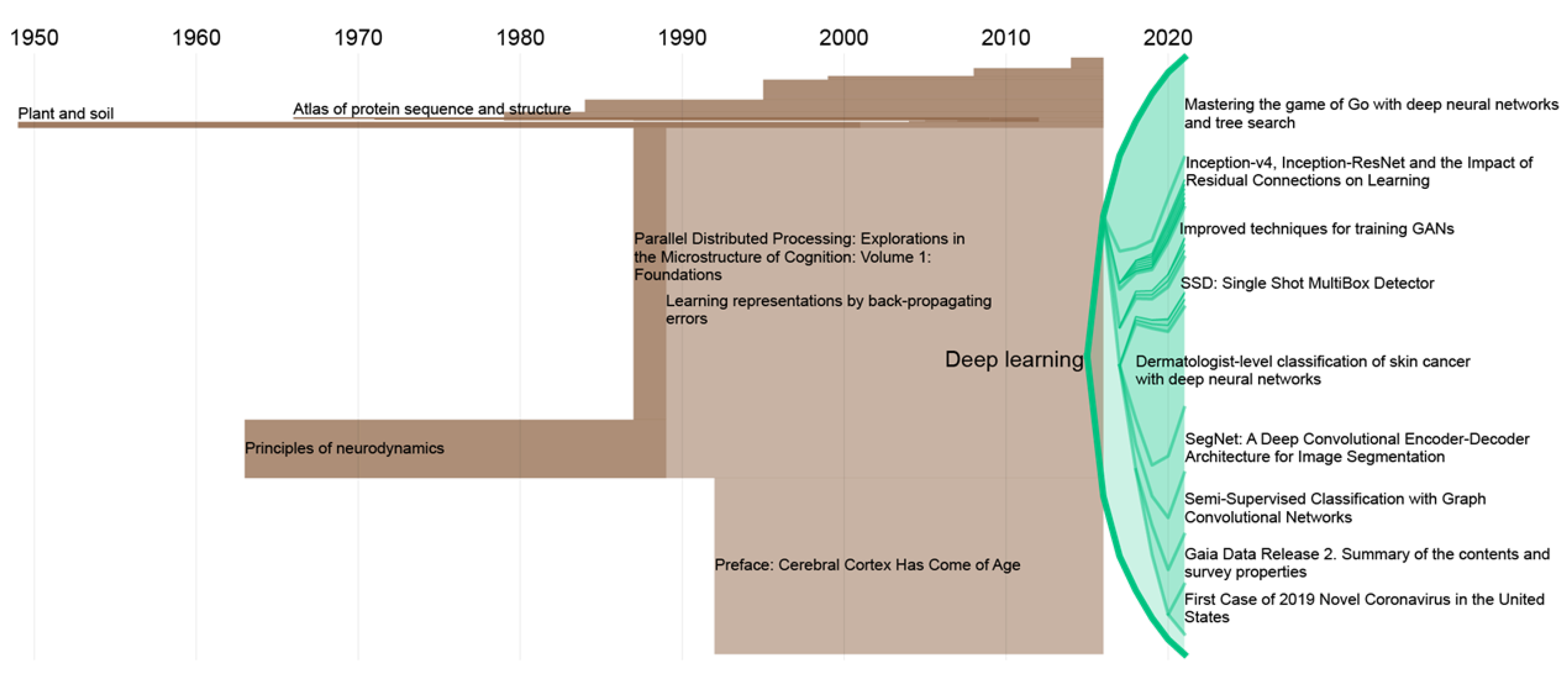
Figure 3.
The multidisciplinary foundations and practical impact of COVID-19 research. The left side shows the academic origins of COVID-19 studies, including fields like epidemiology, medicine, bioinformatics, and data science. The width of each strand reflects prior citation volume before being referenced by COVID-19 research. The right side presents how COVID-19 knowledge was applied in areas such as public health, social behavior, and policy. Curved arcs indicate citation flows and the time delay of influence. This visualization illustrates the integrative and outcome-oriented nature of COVID-19 research.
Figure 3.
The multidisciplinary foundations and practical impact of COVID-19 research. The left side shows the academic origins of COVID-19 studies, including fields like epidemiology, medicine, bioinformatics, and data science. The width of each strand reflects prior citation volume before being referenced by COVID-19 research. The right side presents how COVID-19 knowledge was applied in areas such as public health, social behavior, and policy. Curved arcs indicate citation flows and the time delay of influence. This visualization illustrates the integrative and outcome-oriented nature of COVID-19 research.
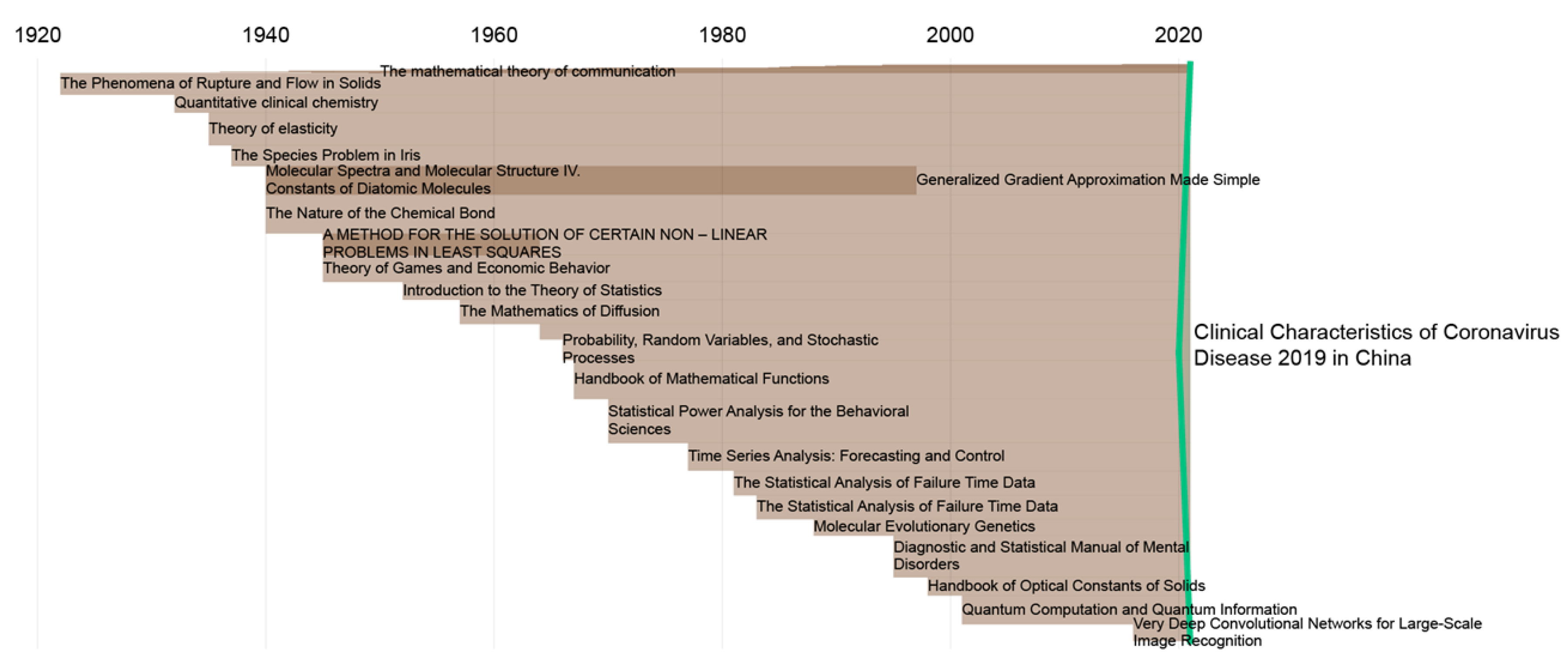
Figure 4.
Framework and application of the sci-entropy change metric. (a), Conceptual illustration of spread-out and merge-in scientific structures, along with the estimation process of sci-entropy. (b), Case studies of deep learning and COVID-19. Evolution of sci-entropy change and publication volume for deep learning and COVID-19 from 1950 to 2020. (c), Evolution of sci-entropy change and publication volume for whole scientific community over time.
Figure 4.
Framework and application of the sci-entropy change metric. (a), Conceptual illustration of spread-out and merge-in scientific structures, along with the estimation process of sci-entropy. (b), Case studies of deep learning and COVID-19. Evolution of sci-entropy change and publication volume for deep learning and COVID-19 from 1950 to 2020. (c), Evolution of sci-entropy change and publication volume for whole scientific community over time.
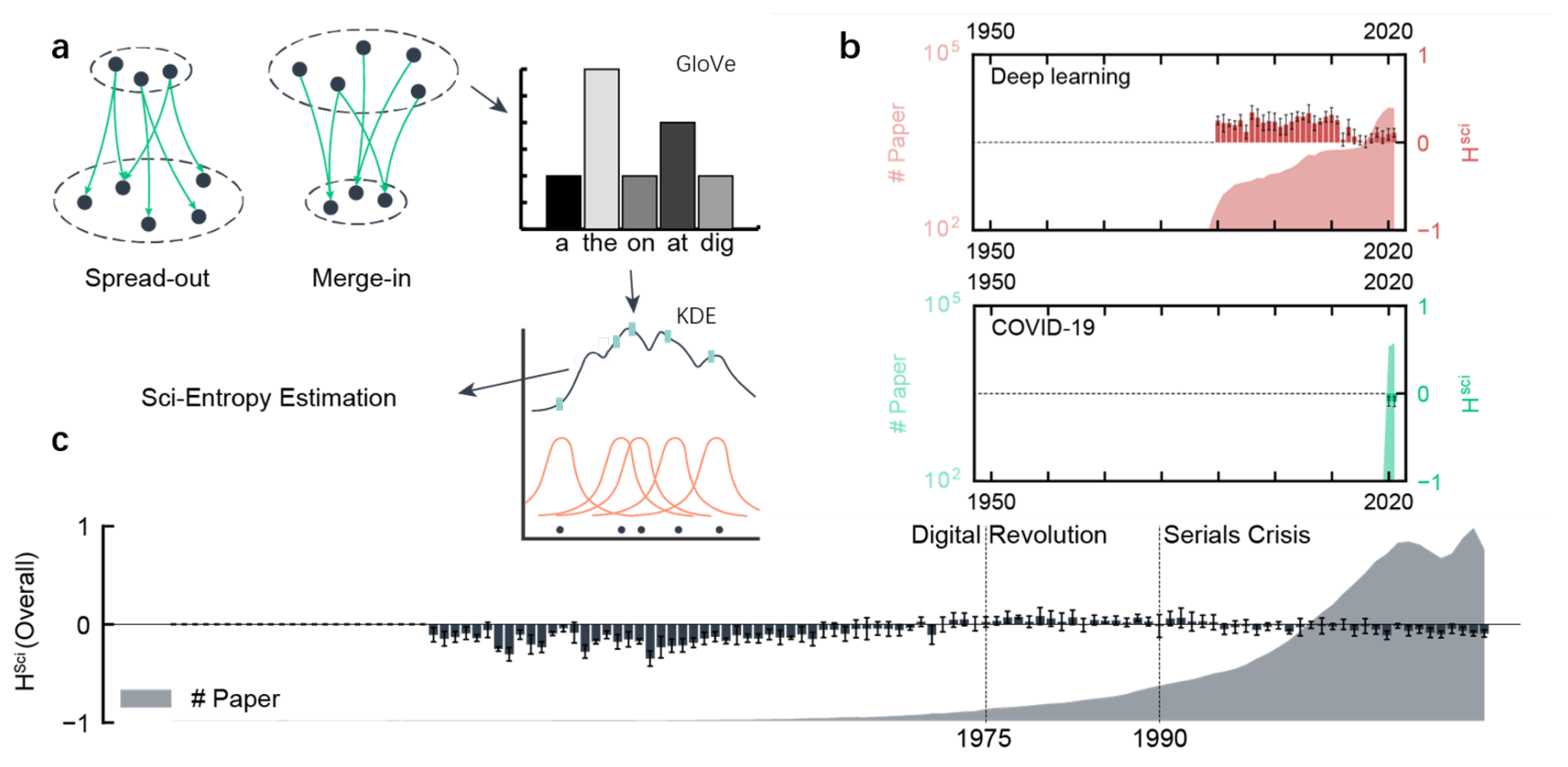
Figure 5.
The role of deep learning (DL) and COVID-19 (COV) in shaping interdisciplinary scientific progress. (a), One-year and two-year citation trends for deep learning papers during 2012–2021. (b), Comparison of citation metrics between COVID-19 research associated with deep learning and that associated with computer science. (c), Citation impact and knowledge quality across studies with different levels of interdisciplinarity. (d), Proportion of deep learning papers engaging with biomedical domains. (e), Comparison of cross-disciplinary engagement between COVID-19 research associated with deep learning and that associated with traditional computer science. (f), Distribution of research publications by number of disciplines involved.
Figure 5.
The role of deep learning (DL) and COVID-19 (COV) in shaping interdisciplinary scientific progress. (a), One-year and two-year citation trends for deep learning papers during 2012–2021. (b), Comparison of citation metrics between COVID-19 research associated with deep learning and that associated with computer science. (c), Citation impact and knowledge quality across studies with different levels of interdisciplinarity. (d), Proportion of deep learning papers engaging with biomedical domains. (e), Comparison of cross-disciplinary engagement between COVID-19 research associated with deep learning and that associated with traditional computer science. (f), Distribution of research publications by number of disciplines involved.
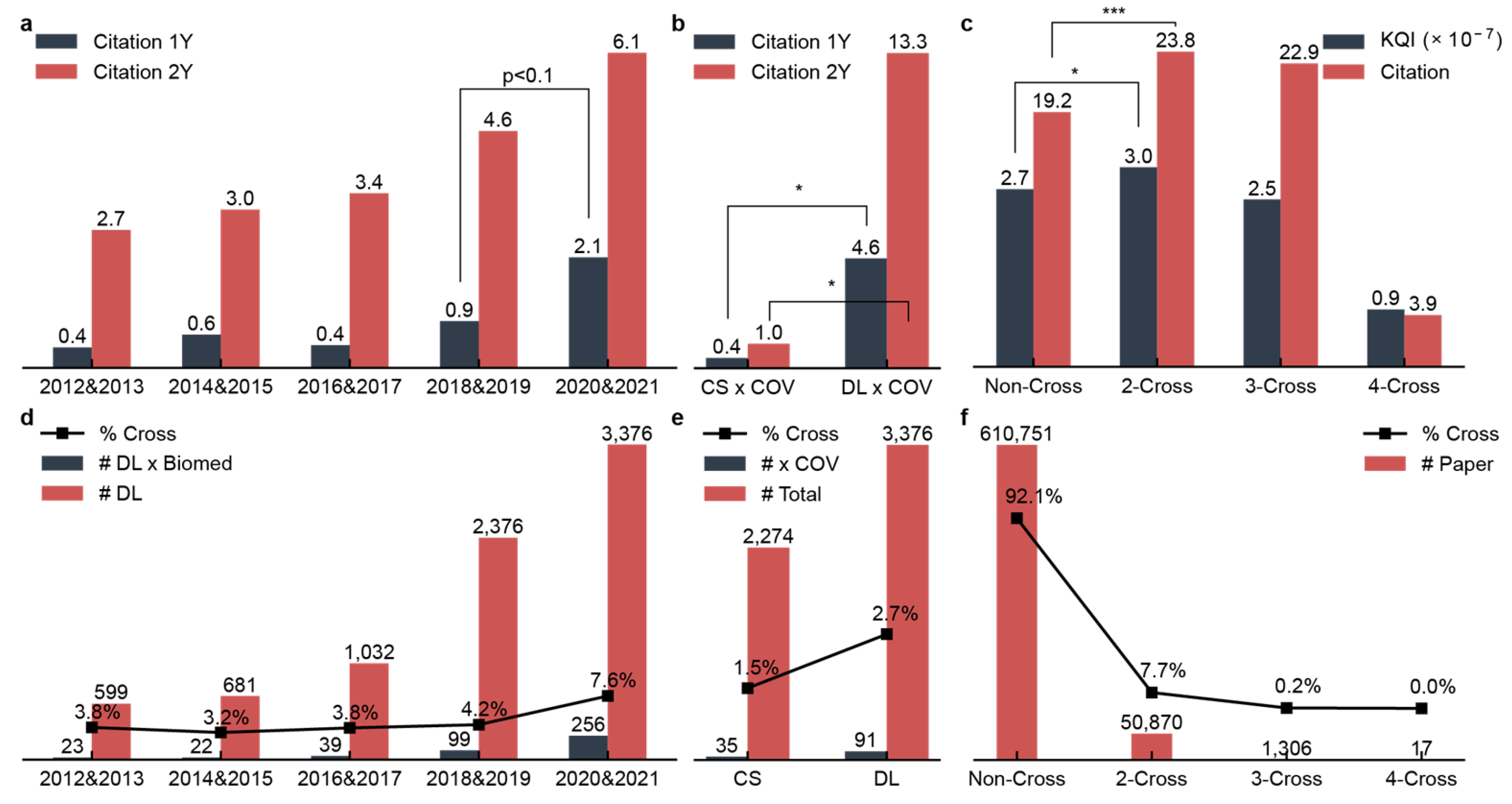
Figure 6.
Disciplinary trajectories of sci-entropy and publication growth over seven decades. Each subplot represents a specific discipline, with the x-axis indicating the year. The left y-axis (logarithmic scale) denotes the number of publications, while the right y-axis tracks the variation in the sci-entropy Index. The red curves represent disciplines classified as spread-out science, reflecting continuous knowledge diffusion and expansion. The green curves indicate merge-in science, referring to fields focused on knowledge integration. Disciplines shown in gray exhibit no significant tendency toward either knowledge diffusion or integration.
Figure 6.
Disciplinary trajectories of sci-entropy and publication growth over seven decades. Each subplot represents a specific discipline, with the x-axis indicating the year. The left y-axis (logarithmic scale) denotes the number of publications, while the right y-axis tracks the variation in the sci-entropy Index. The red curves represent disciplines classified as spread-out science, reflecting continuous knowledge diffusion and expansion. The green curves indicate merge-in science, referring to fields focused on knowledge integration. Disciplines shown in gray exhibit no significant tendency toward either knowledge diffusion or integration.
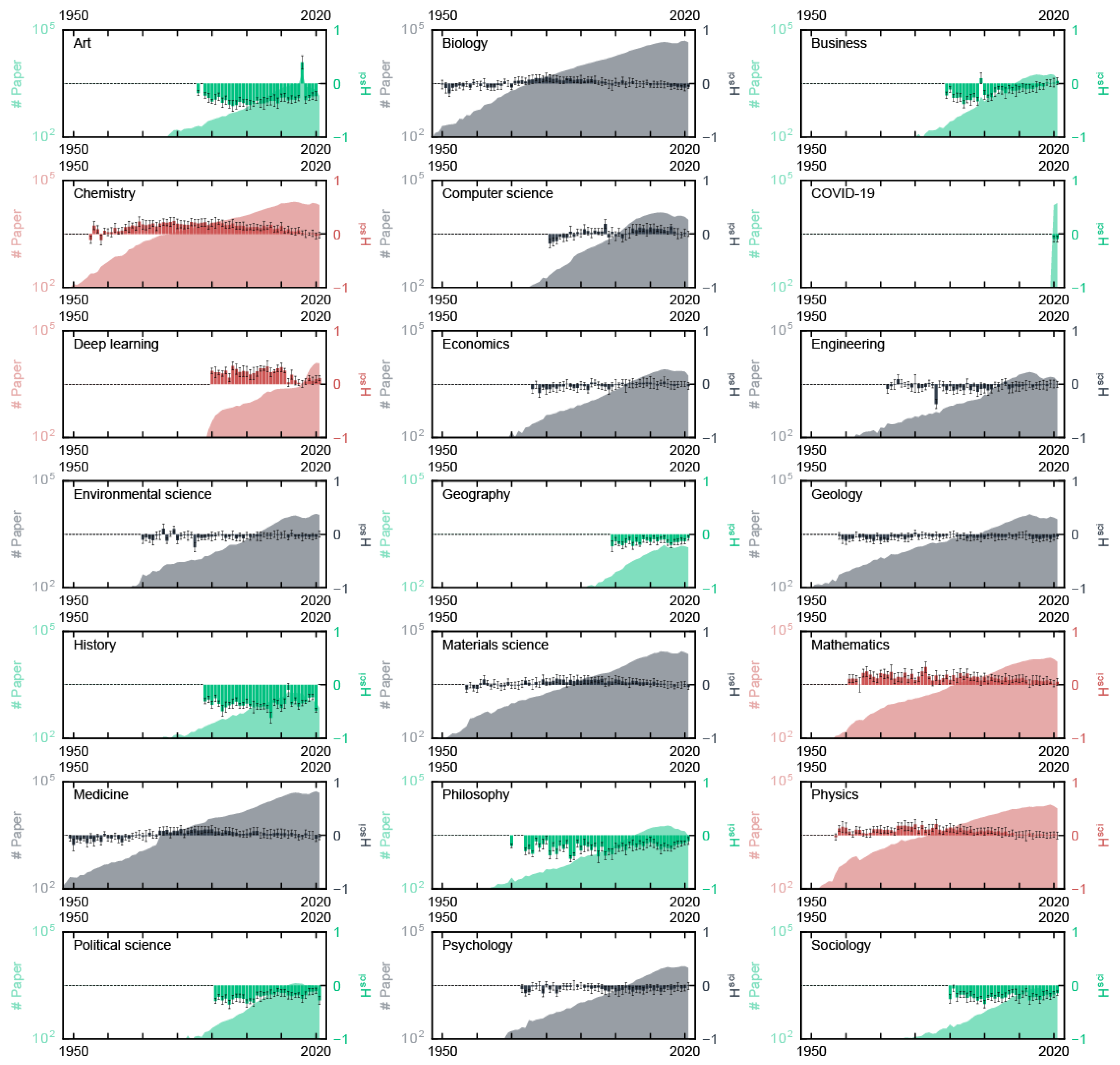
Figure 7.
Quantitative mapping of research fields building on past knowledge and future innovation in historical pandemics. This figure presents the distribution of research fields related to major historical pandemics within a two-dimensional framework. Disciplines are categorized into four quadrants based on their balance between building on past knowledge and driving future innovation. The upper-right quadrant represents fields acting as academic bridges but facing risks of unsustainable research models and potential contraction. The lower-right quadrant indicates knowledge-inheriting fields lacking forward innovation, also prone to stagnation. The upper-left quadrant reflects disciplines characterized by continuous expansion and sustainable development. The lower-left quadrant includes fields with limited knowledge integration and innovation, often isolated from broader scientific progress.
Figure 7.
Quantitative mapping of research fields building on past knowledge and future innovation in historical pandemics. This figure presents the distribution of research fields related to major historical pandemics within a two-dimensional framework. Disciplines are categorized into four quadrants based on their balance between building on past knowledge and driving future innovation. The upper-right quadrant represents fields acting as academic bridges but facing risks of unsustainable research models and potential contraction. The lower-right quadrant indicates knowledge-inheriting fields lacking forward innovation, also prone to stagnation. The upper-left quadrant reflects disciplines characterized by continuous expansion and sustainable development. The lower-left quadrant includes fields with limited knowledge integration and innovation, often isolated from broader scientific progress.
Disclaimer/Publisher’s Note: The statements, opinions and data contained in all publications are solely those of the individual author(s) and contributor(s) and not of MDPI and/or the editor(s). MDPI and/or the editor(s) disclaim responsibility for any injury to people or property resulting from any ideas, methods, instructions or products referred to in the content. |
© 2025 by the authors. Licensee MDPI, Basel, Switzerland. This article is an open access article distributed under the terms and conditions of the Creative Commons Attribution (CC BY) license (http://creativecommons.org/licenses/by/4.0/).
Copyright: This open access article is published under a Creative Commons CC BY 4.0 license, which permit the free download, distribution, and reuse, provided that the author and preprint are cited in any reuse.