

Submitted:
14 July 2025
Posted:
16 July 2025
You are already at the latest version
Abstract
The activities of birds present increasing challenges in agriculture, aviation, and environmental conservation. This has led to economic losses, safety risks, and ecological imbalances. Attempts have been made to address the problem, with traditional deterrent methods proving to be labour-intensive, environmentally unfriendly, and ineffective over time. Advances in Artificial Intelligence (AI) and the Internet of Things (IoT) present opportunities for enabling automated real-time bird detection and repellence. This study reviews recent developments (2020–2025) in AI-driven bird detection and repellence systems, emphasising the integration of image, audio, and multi-sensor data in IoT and edge-based environments. The Preferred Reporting Items for Systematic reviews and Meta-Analyses framework was used, with 267 studies initially identified and screened from key scientific databases. A total of 154 studies met the inclusion criteria and were analysed. The findings show the increasing use of convolutional neural networks (CNNs), YOLO variants, and MobileNet in visual detection, and the growing use of lightweight audio-based models such as BirdNET, MFCC-based CNNs, and TinyML frameworks for microcontroller deployment. Multi-sensor fusion is proposed to improve detection accuracy in diverse environments. Repellence strategies include sound-based deterrents, visual deterrents, predator-mimicking visuals, and adaptive AI-integrated systems. Deployment success depends on edge compatibility, power efficiency, and dataset quality. The limitations of current studies, include species-specific detection challenges, data scarcity, environmental changes, and energy constraints. Future research should focus on tiny and lightweight AI models, standardised multi-modal datasets, and intelligent, behaviour-aware deterrence mechanisms suitable for precision agriculture and ecological monitoring.
Keywords:
bird detection
; bird repellence
; edge computing
; Internet of Things (IoT)
; machine learning
1. Introduction
Birds cause damage to crops during the period before harvesting at a global level, leading to huge losses exceeding billions of dollars yearly [1]. The birds feed on seeds, fruits, leaves, and grains, reducing crop yields and threatening food security for many communities [2] . This not only impacts farmers’ livelihoods but also raises concerns about the availability of food for families relying on those crops [3]. In the East African region, small-scale farmers face a battle each season as bird infestations take a significant toll on their cereal crops, with losses exceeding 20 percent of the produce [4,5]. Farmers apply traditional bird control methods [6], which include the use of propane cannons, reflective tapes, and physical controls using nets and scarecrows [7]. Although these measures can lead to improved yields, their effectiveness is dependent on the stage of crop growth and duration of application [8]. The traditional methods are time-consuming, require intensive labour, and are mostly inefficient if not applied consistently throughout the day. In addition, methods that involve the use of chemicals result in environmental risks. The birds are also able to gradually adopt to static methods like the use of scarecrows, making them lose effectiveness over time. The practicability of using manual surveillance of large farms is also a problem. Given the challenges, the traditional bird control methods are inadequate for repelling birds in large-scale farms.
Recent advances in Artificial Intelligence (AI) [9], specifically in computer vision and machine learning, supported by the growing adoption of the Internet of Things (IoT) technologies [10,11] present opportunities for automating bird detection and repellence [12,13]. These technologies can be used to detect, classify, and respond to bird activity in real time using edge computing devices, such as drones, camera traps, and smart sensors [14,15,16]. In addition, AI-powered repellence techniques, which may include adaptive sound emitters, automated lasers to predator-mimicking drones, are gaining popularity as more effective alternatives to the traditional deterrent methods [17,18]. Despite growing interest and the need for a real-time solution, the research landscape on AI and IoT-based bird detection and repellence remains fragmented [19]. Previous studies focus on isolated components such as classification models, wireless sensor deployment, or acoustic deterrants without synthesising the full pipeline, from data collection and model selection to edge deployment and deterrence actuation [20,21,22]. The growing volume of literature presents a challenge for practitioners and researchers trying to navigate the field.
As an initial step to addressing the gaps in this area of study, this paper presents a systematic review of recent studies (2020–2024) in AI-enabled bird detection and deterrence. Using the PRISMA framework, 154 peer-reviewed studies that leverage machine learning, computer vision, and IoT infrastructure for avian monitoring were identified and analysed from the initial 267. Unlike prior reviews [7,23,24], this study evaluates the full pipeline—from data collection and model architecture to deployment platforms and smart deterrence technologies. This review not only classifies the models and architectures used but also evaluates their real-world deployment readiness, data requirements, edge processing strategies, and integration with repellence technologies.
The key contributions of the study are as follows:
- Machine learning techniques applied in bird detection are categorised and mapped, highlighting trends in lightweight models and edge compatibility.
- Dataset types, collection methods, and preprocessing techniques used in training detection models are reviewed.
- IoT architectures and communication protocols are evaluated, identifying strengths and limitations in cloud-based systems.
- An analysis of bird repellence methods and their integration with intelligent detection systems is provided.
- Key challenges are identified, and future research directions for building scalable, adaptive bird management systems are proposed
By addressing these gaps, this review aims to support researchers, developers, and policymakers in designing effective, AI-powered solutions for sustainable bird monitoring and control.
2. Materials and Methods
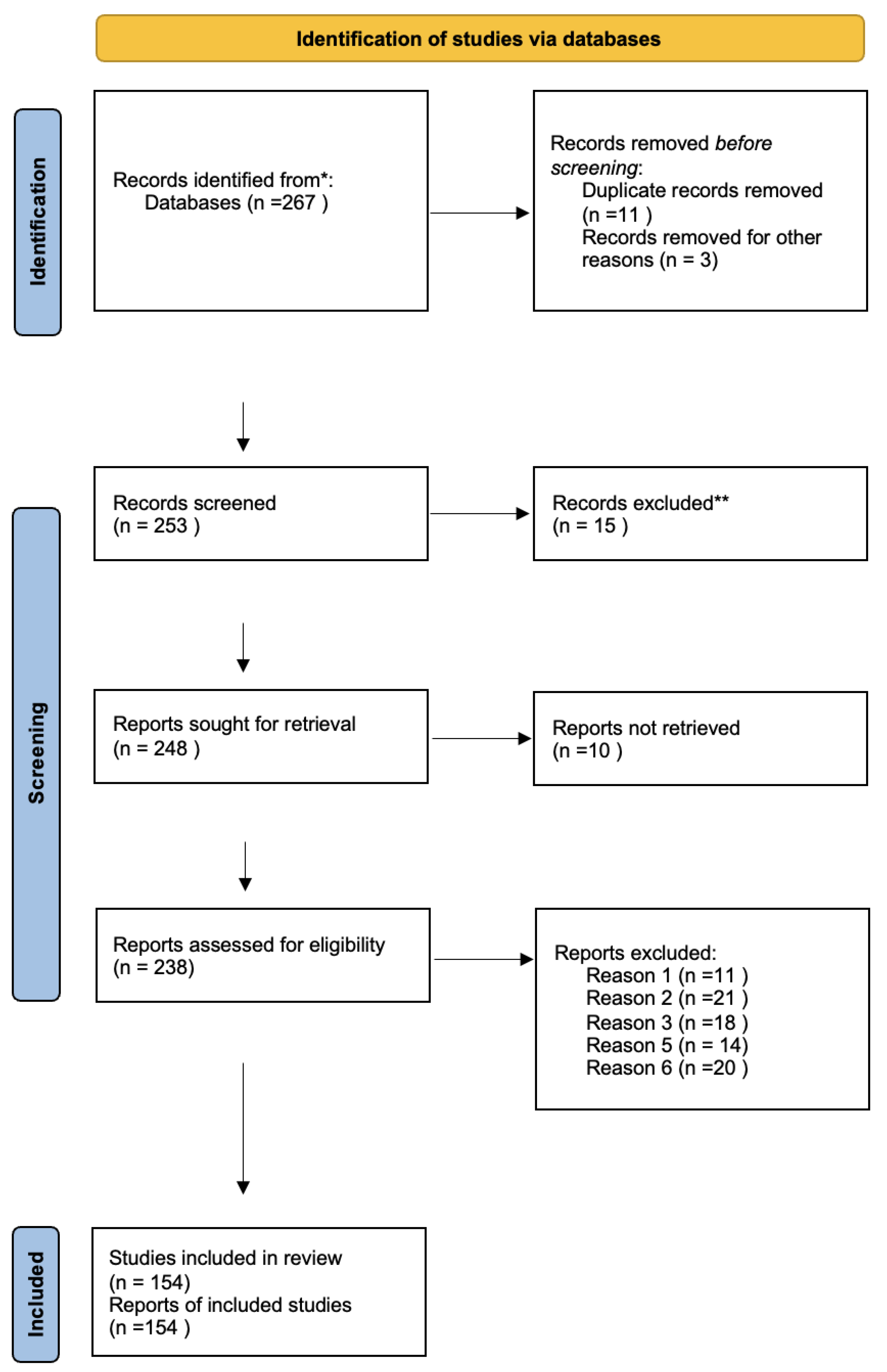
The study followed the PRISMA (Preferred Reporting Items for Systematic Reviews and Meta-Analyses) framework to review the literature on IoT and machine learning for bird detection and repellence. This ensured a replicable and unbiased selection of relevant studies. The process consisted of four main steps: Identification, Screening, Eligibility, and Inclusion.
2.1. Identification
The first step was identifying relevant studies. A comprehensive search was conducted in IEEE Xplore, ScienceDirect, Springer, and Google Scholar, covering studies published after 2020. The search included terms such as:
- "Machine Learning + Bird Detection"
- "Machine Learning + Bird Repellence"
- "Computer Vision + Bird Detection"
- “Acoustic Bird Detection”
- "IoT + Bird Repellence"
- "Artificial Intelligence + Bird Detection + Repellence"
These search terms helped capture a wide range of studies, from advanced edge computing applications to real-world agricultural use cases. This initial search retrieved 267 articles for potential inclusion.
2.2. Screening
With the initial pool of studies collected, the next phase was the screening phase. First, automated tools were used to eliminate duplicate entries, reducing the dataset to 253 papers. Then, a manual screen of the titles and abstracts was done to ensure that only studies directly related to our research topic were considered. Studies were excluded if they lacked machine learning applications, did not involve IoT technologies, or focused on general wildlife monitoring without specific reference to birds. After screening, 248 papers were identified for potential review, out of which 10 were not retrieved.
2.3. Eligibility
The full texts of the remaining 238 papers were manually reviewed to check if they met our predefined inclusion and exclusion criteria as presented in Table 1.
2.4. Inclusion
After applying the eligibility criteria, 154 papers were selected for data extraction and analysis. These studies provided insights into various aspects of IoT-based bird detection and repellence, including dataset characteristics, machine learning techniques, hardware implementations, model performance, and real-world applications. The extracted data focused on key themes such as Datasets,machine learning algorithms, IoT architectures, Connectivity, edge-based deployments, bird repellence techniques, and implementation challenges. The findings were synthesized to identify trends, gaps, and opportunities for further research.
Figure 1.
Study selection steps.
3. Computer Vision-Based Detection
3.1. Datasets
The reliability and accuracy of AI models for bird detection and monitoring largely depend on the quality and diversity of the datasets used [25]. Bird datasets are highly dynamic, as birds move across varying environments with changes in lighting, weather, and habitat conditions. Therefore, researchers need large, well-annotated datasets that represent different species, behaviours, and environmental factors to build effective detection systems [26,27]. The datasets used are often visual or sensor-based, with some models employing a combination of two or three different datasets to enhance model performance [28]. Collecting the necessary data requires careful selection of collection methods, data sources, and preprocessing techniques to ensure the datasets are not only comprehensive but also useful. Table 2 gives a summary of the analysed datasets.
Different data collection methods have been applied in various bird detection studies depending on the research goals and the available technology. The most common methods from the reviewed studies include: video surveillance [31], Image-based methods [29], motion detection [37] and Multi-Sensor approaches [54]. The data used is collected mainly by use of cameras, which are considered to be affordable and easy to deploy, PIR Sensors for automated detection systems, drones, radar, ultrasonic sensors, and microphones. Publicly available datasets and GPS data are also used for training models and to allow researchers to cross-validate findings with existing data.
The size of a dataset can impact the model’s performance. In the reviewed studies, dataset sizes ranged from fewer than 1,000 images to over 300,000 samples. Some studies reported dataset sizes in alternative formats, such as hours of video footage rather than individual image counts. Most studies relied on custom datasets [50], demonstrating the need for specialised data collection. Only a few studies use widely available datasets such as the Kaggle datasets and the COCO dataset. Other specialised datasets were also used, for example, NIPS4Bplus, Xeno Canto, and warblrb10k. The heavy reliance on custom datasets suggests that existing datasets may not always meet the specific requirements of bird detection models, especially when dealing with regional species or unique environmental conditions. While large datasets improve model robustness, many studies still rely on relatively small collections, making data augmentation essential. The lack of publicly available datasets suggests a strong need for more open-source contributions to the field.
Raw data alone is rarely sufficient for training machine learning models. Researchers apply preprocessing techniques to improve data quality and enhance model accuracy. The most commonly reported preprocessing methods were: Annotation [34], data augmentation [38], image resizing and scaling [45], frame extraction [39], and feature extraction [53] The variety of data collection methods, dataset sizes, and preprocessing techniques indicates that bird detection research is still evolving.
3.2. Machine Learning Models
Machine learning models come in different architectures, each designed for specific strengths in detecting, classifying, and tracking objects. The studies reviewed used a variety of models, with some being applied in most studies. Table 3 provides a summary of the ML models used in different studies.
CNNs were the most frequently used model type. CNNs work by detecting patterns such as edges, textures, and shapes layer by layer, making them highly effective for image recognition tasks [66,67,68]. Variants like ResNet (Residual Networks) enhance CNNs by allowing deep networks to train more effectively without losing important details [69]. YOLO (You Only Look Once) models appeared in many studies [70,71], too. Unlike CNNs, which process an image in sections, YOLO treats the entire image as a single input, enabling real-time object detection [72] . Several versions of YOLO were used in the reviewed studies [73], with improvements in detection speed and accuracy. Faster R-CNN is widely recognised for its high accuracy in object detection tasks. Unlike YOLO, which prioritises speed, Faster R-CNN processes images in multiple steps, refining its predictions to improve precision [74]. This makes it a better choice for tasks where detection accuracy is more important than speed. MobileNet is used in low-power, edge-based applications. Unlike traditional CNNs, which require significant computational power, MobileNet is optimised to run on mobile devices, IoT sensors, and embedded systems [75]. VGG, Inception, and EfficientNet have deep learning capabilities but tend to require high computational resources and are not frequently used in bird detection. Traditional models like K-Nearest Neighbors (KNN), Hidden Markov Models (HMM), and Support Vector Machines (SVM) have also been explored; these methods are often used as benchmarks but are generally less effective for large-scale image analysis [76]. Some studies experimented with combinations of architectures, demonstrating that integrating multiple models can improve performance [77].
Accuracy was the most commonly reported metric, with the performance breakdown showing that most models achieved strong results, with most studies reporting accuracies ranging from 80-95 percent, confirming the effectiveness of deep learning models for detection and classification. In addition, precision was used to measure how many of the detected objects were correct, with studies reporting precision above 0.080-0.90. Recall was also used for measuring how well models detected all relevant objects in an image, with values ranging from 0.65 to above 0.95, with higher values indicating fewer missed detections. Mean Average Precision (mAP) was used, offering a balanced view of precision and recall. The reported mAP ranged between 70-9 percent, meaning highly effective detection. Frames Per Second (FPS) was reported in 6 studies. The reported speeds are between 1-60 FPS, which is still usable but may not be ideal for fast-moving objects. Figure 2 gives a comparison of the precisions from different models,
As AI moves towards real-world applications, the ability to run models on edge devices (such as Raspberry Pi, smartphones, or IoT sensors) is becoming increasingly important. Some studies reported edge-compatible models, showing that lightweight architectures like MobileNet and optimized CNNs are becoming more viable for real-world use.
4. Acoustic-Based Detection

Table 4.
Acoustic-Based Detection
| Study Focus | Hardware Used | Approach | Detection Performance |
|---|---|---|---|
| Evaluation of BirdNET for detecting two bird species [78] | AudioMoth | BirdNET (CNN-based) | Precision: 92.6% (Coal Tit), 87.8% (Short-toed Treecreeper) |
| Bird sound Classification [48] | No mention found | Multilayer Perceptron (MLP) | Accuracy: 74% |
| Vineyard protection from birds [79] | Raspberry Pi 3B, microphone | Two-phase: SVM and CNN | Accuracy: 96% |
| BirdCLEF 2021 challenge [80] | No mention found | CNN-based ensemble | F1 score: 0.6780 |
| Birdsong detection on IoT devices [81] | STM32 Nucleo H743ZI2 MCU | ToucaNet and BarbNet (CNN-based) | AUC: 0.925 (ToucaNet), 0.853 (BarbNet) |
| Acoustic bird repellent system [82] | Arduino Nano 33 BLE, microphone | DenseNet201 (CNN) | Accuracy: 92.54% |
| Avian pest deterrence [83] | Arduino Nano 33 BLE Sense, XIAO ESP32S3 | Conv1D neural network | Accuracy: 92.99% |
| Bird song recognition on IoT devices [84] | ARM Cortex-M microcontrollers | Various CNN and Transformer models | Accuracy: >90% for best models |
| Avian diversity monitoring [85] | Autonomous Recording Units (ARUs) | BirdNET (ResNet-based) | mAP: 0.791 for single-species recordings |
| Monitoring Eurasian bittern [78] | AudioMoth | BirdNET and Kaleidoscope Pro | Accuracy: 93.7% (BirdNET), 98.4% (Kaleidoscope Pro) |
| Passive acoustic monitoring of bird communities [86] | SM4 Wildlife Acoustics ARUs | CNN (ResNet50) | mAP: 0.97 |
| Detecting novel bird species and individuals [87] | No mention found | Variational Autoencoder (VAE) | FPI: 1.6%, FNI: 0.9% (species detection) |
| Birdcall identification on embedded devices [77] | Jetson Nano | CNN-based multi-model network | Accuracy: 84.9% |
| Endangered birds monitoring [88] | ARM Cortex M3 micro-controller | Dynamic Time Warping (DTW) | No mention found |
| Bird species monitoring and song classification [49] | 5G IoT-based system, ESP32-S3 MCUs | Various CNNs (EfficientNet, MobileNet) | Accuracy: >70% for best models |
| Evaluation of acoustic recorders and BirdNET [89] | AudioMoth, Swift Recorder, SM3BAT, SM Mini | BirdNET (not specified) | Accuracy: 96% |
| Bird audio detection [90] | No mention found | Lightweight CNN | Accuracy: 86.42% |
| Acoustic monitoring of avian species [91] | AviEar (IoT-based wireless sensor node) | No clear mention found | Precision: 99.6%, Recall: 95% |
As presented in table 4, the most common hardware used for audio data collection is the AudioMoth and ARUS, and other sound sensors. The Audio moth has a detection range of 801-900m, while other devices have a range of below 200m, making an Audio moth appropriate for large-scale projects. The microcontrollers and processors used include: STM32, Arduino, ESP32, and ARM, with Raspberry Pi and Jetson Nano also being used in a few studies.
The CNN-based models including variants like ResNet were commonly used with other approached including; MLP, SVM, Transformer, VAE, and DTW
5. Connectivity
Once data is captured, it must be transmitted efficiently. Studies reviewed indicate a mix of wired and wireless communication protocols, with a strong preference for wireless due to flexibility and scalability. The common wireless communication technologies used include;
- Wi-Fi - This enables high-speed data transfer and has been applied in several studies. However, it has a limited range and high power consumption, making it unsuitable for large-scale, battery-powered networks.
- LoRa (Long Range, Low Power) – This has also been used and is ideal for IoT applications in agriculture and environmental monitoring due to its long range and low power needs. However, the low data rate make it less suitable for applications requiring high-resolution image or video transmission.
- Cellular Networks (4G/LTE, 5G) – This has been used to provides seamless connectivity, especially for mobile IoT devices. However, high cost and energy consumption make it impractical for many large-scale IoT applications.
- Zigbee - Very low power consumption, low cost, well-suited for mesh networks in local IoT setups. Shorter range compared to LoRa and Cellular, not suitable for high-data applications like images or videos
No single communication technology meets all IoT requirements. Studies highlight trade-offs between long-range connectivity, power efficiency, and data transfer speed. Hybrid communication approaches for example combining LoRa for low-power sensing and Wi-Fi for bulk data uploads can optimize performance. Table 5 presents a comparison of the connectivity options
6. IoT Implementation Architectures
The way sensor data is processed and stored significantly impacts system efficiency. The reviewed studies revealed two dominant architectures:
6.1. Cloud-Based Architectures
Sensors send raw data to cloud servers for storage, processing, analysis for long-term decision-making [92]. This architecture is scalable and supports advanced machine learning models but requires high bandwidth requirements and has high latencies in case of poor connection.
6.2. Edge Computing
Sensors transmit data to a nearby edge device (e.g., Raspberry Pi, NVIDIA Jetson) for local processing before sending key insights to the cloud. The use of this architecture reduces latency and bandwidth usage and is ideal for real-time applications [93]. The edge devices have limited processing power and storage capacity. Bird detection systems have increasingly leveraged edge computing to enable real-time, efficient, and autonomous monitoring [94,95,96]. By processing data closer to the source—on the edge—these systems can reduce latency, minimize bandwidth usage, and operate effectively even in remote environments. Various edge devices have been explored in bird detection studies;
- Microcontrollers (ESP32, ATmega328, etc.) – These low-power devices are ideal for lightweight processing tasks but struggle with deep-learning models due to limited computational capacity [97].
- Single-board computers (Raspberry Pi, Jetson boards) – More powerful than microcontrollers and are commonly used in edge-based implementations, these devices can handle more complex computations but consume more power and are more costly [30].
- FPGA-based solutions – While highly efficient for real-time processing, FPGA implementations are less common due to their complexity and cost. Deploying machine learning models at the edge requires balancing of performance, power efficiency, and resource constraints. The reviewed studies explored several optimisation strategies:
- Lightweight models – MobileNet and optimized YOLO variants are frequently used due to their efficiency in object detection tasks.
- Transfer learning – Adapting pre-trained models allows for reduced computational overhead while maintaining high accuracy [98].
- Model compression – Techniques such as pruning and quantization help shrink models to fit within resource-limited devices [99].
TinyML—machine learning optimized for microcontrollers—has emerged as a promising approach for bird detection in energy-constrained environments. Studies have explored several techniques to make TinyML viable; Employing partial convolution and quantization to optimize TinyML models [84], and a lightweight CNN with fewer than 100,000 parameters, reducing memory consumption [90]. To maximize efficiency, TinyML-based bird detection relies on:
- Pruning and quantization – Reducing model complexity without significantly impacting accuracy.
- Power-saving techniques – Using sleep modes and efficient RAM allocation in microcontrollers.
- Local data processing – Minimizing the need for network communication to save power.
7. Bird Repellence Methods
Bird deterrence is an essential aspect of bird detection, especially in agricultural, conservation, and aviation settings [100]. Various techniques exist to prevent birds from interfering with crops, equipment, or infrastructure. These methods range from simple sound-based solutions to advanced AI-driven adaptive deterrence as presented in Table 6;
Sound-Based deterrents use loud noises, ultrasonic frequencies, or bioacoustic calls (e.g., distress signals of birds) to scare birds away. These works well initially, but birds may habituate over time, reducing the long-term impact . Visual deterrent methods include flashing lights, predator-mimicking drones, bird-scaring lines, and laser systems. These can be highly effective, especially when mimicking natural predators, but practical limitations exist for large areas. Integrated Approaches by combining sound, visual, and AI-driven adaptive systems enhance long-term effectiveness. These are promising, but studies suggest more long-term trials are needed.
8. Discussion
8.1. Challenges in Bird Detection and Repellence Systems
8.1.1. Detecting small and distant birds with high accuracy:
Birds, especially smaller species, are difficult to detect at long distances, making early intervention challenging. Factors like bird size, movement speed, and background complexity (e.g., sky, trees, or buildings) make accurate identification difficult. In critical environments such as airports and farms, where early detection is crucial, this limitation can lead to increased risks of bird strikes or crop damage.
8.1.2. Environmental Variability and Real-time Adaptation:
Bird detection models must work reliably under changing environmental conditions—rain, fog, night-time, and varying lighting conditions affect sensor performance. AI models often struggle with fluctuating backgrounds, leading to misclassification or lower accuracy in non-ideal conditions. Ensuring real-time adaptability while maintaining robustness in diverse weather conditions remains a major hurdle.
8.1.3. Energy Efficiency and Computational Constraints on Edge Devices:
Many bird detection systems rely on IoT devices in remote areas with limited power. Running deep learning models on low-power hardware like microcontrollers and single-board computers requires balancing model complexity, computational efficiency, and battery life. Power constraints also limit high-resolution image processing and continuous monitoring, making optimization essential.
8.1.4. Managing Data Collection, Storage, and Transmission:
Bird detection models require high-quality training datasets, but collecting and labeling diverse bird species across different regions is resource-intensive. Furthermore, high-resolution images and continuous video streams generate large amounts of data, creating challenges in real-time storage, bandwidth use, and cloud-based processing in remote areas. Efficient data compression and transfer strategies are needed to reduce costs while maintaining accuracy.
8.1.5. Reducing False Positives and Enhancing Species-Specific Identification:
Distinguishing birds from other airborne objects, such as drones, insects, or even moving tree branches, is challenging. High false positive rates can trigger unnecessary responses, while false negatives can lead to system failures. Additionally, different bird species may exhibit unique behaviors that influence detection accuracy. Models must be adaptable and capable of species-specific identification to ensure effective repellence measures.
8.2. Opportunities with AI in Bird Detection
8.2.1. Deploying Low-Power, AI-Driven Edge Computing Solutions:
Advances in TinyML allow models to run efficiently on low-power microcontrollers, enabling bird detection in remote areas with limited energy access. These edge-based systems reduce dependency on cloud computing, improving real-time detection and decision-making while minimizing energy consumption.
8.2.2. Multi-Sensor Fusion for Enhanced Detection Accuracy:
Combining visual data from cameras with complementary sensors—such as acoustic analysis for bird calls, motion sensors, and infrared imaging—improves identification accuracy. This multi-modal approach helps overcome limitations presented by varying lighting conditions and environmental noise, leading to more reliable detections.
8.2.3. Adaptive AI Models for Self-Learning and Context Awareness:
On-device learning and fine-tuning models for local conditions allow systems to continuously adapt to different bird species and environmental changes. AI-driven adaptive repellence methods could adjust strategies based on bird behavior, preventing habituation and improving long-term effectiveness.
8.2.4. Energy-Efficient Model Optimization for Scalability:
Techniques like model quantization, pruning, and knowledge distillation enable running complex AI models on resource-constrained devices. This optimization not only enhances real-time processing but also makes large-scale deployment in agricultural and urban settings more cost-effective.
8.3. Future Research Directions
To further advance AI-driven bird detection and repellence systems, future research should focus on:
- Developing ultra-lightweight, high-accuracy AI models – Improving TinyML capabilities to maintain performance while reducing computational demands.
- Enhancing automated data collection and labelling – Creating standardized, open-source datasets for training and benchmarking bird detection models.
- Designing self-learning AI models – Implementing on-device adaptation to reduce reliance on cloud retraining and improve real-time responsiveness.
- Exploring AI-driven, species-specific repellence techniques – Using behavior-based deterrence strategies that dynamically adapt to different bird species.
- Integrating bird detection into broader smart agriculture and urban management systems – Ensuring AI-driven bird monitoring complements existing environmental and precision farming technologies.
9. Conclusions
This review highlightes the growing potential of integrating machine learning and IoT technologies for smart bird detection and repellence. The studies reviewed illustrate progress in applying advanced computer vision and acoustic models for accurate bird identification across diverse environments. The adoption of edge computing and TinyML frameworks further demonstrates the feasibility of deploying real-time, energy-efficient solutions in remote and resource-constrained areas. Multi-modal sensor fusion and adaptive AI-driven repellence strategies offer promising directions for increasing system robustness and effectiveness. Despite these advancements, key challenges remain. These include limited availability of standardized datasets, species-specific detection issues, environmental variability, power constraints, and the need for scalable, low-latency deployment architectures. Addressing these issues will require interdisciplinary collaboration, innovation in low-power AI model design, and the development of open-access datasets tailored to ecological and agricultural contexts. Future research must focus on building intelligent, self-adaptive systems that can evolve with changing environmental conditions and bird behaviors. Integrating these solutions within broader smart agriculture and urban management ecosystems will be critical for sustainable environmental stewardship, improved crop protection, and minimized human-wildlife conflict.
Author Contributions
All authors have contributed equally to this paper.
Funding
This work was supported in part by The African Engineering and Technology Network (Afretec), a pan-African collaboration consisting of technology-centric universities across Africa
Data Availability Statement
No new data were created
Conflicts of Interest
The authors declare no conflicts of interest.
Abbreviations
The following abbreviations are used in this manuscript:
| AI | Artificial Intelligence |
| IoT | Internet of Things |
| CNN | Convolutional Neural Network |
| YOLO | You Only Look Once |
| ML | Machine Learning |
| PRISMA | Preferred Reporting Items for Systematic Reviews and Meta-Analyses |
| FPS | Frames Per Second |
| mAP | Mean Average Precision |
| ARU | Autonomous Recording Unit |
| SVM | Support Vector Machine |
| VAE | Variational Autoencoder |
| DTW | Dynamic Time Warping |
| MCU | Microcontroller Unit |
| FPGA | Field-Programmable Gate Array |
| TinyML | Tiny Machine Learning |
| Wi-Fi | Wireless Fidelity |
| LoRa | Long Range |
| BLE | Bluetooth Low Energy |
| ANN | Artificial Neural Network |
References
- M. Tech Scholar and A. Professor, “Artificial Intelligence Based Birds and Animal Detection and Alert System,” 2022. [Online]. Available: www.ijcrt.org.
- D. Mpouziotas, P. Karvelis, and C. Stylios, “Advanced Computer Vision Methods for Tracking Wild Birds from Drone Footage,” Drones, vol. 8, no. 6, Jun. 2024, 10.3390/drones8060259.
- K. Shim, A. Barczak, N. Reyes, and N. Ahmed, “Small mammals and bird detection using IoT devices,” in Int. Conf. Image and Vision Computing New Zealand, IEEE, 2021, 10.1109/IVCNZ54163.2021.9653430.
- A. Aumen, G. Gagliardi, C. Kinkead, V. Nguyen, K. Smith, and J. Gershenson, “Influence of the Red-Billed Quelea Bird on Rice Farming in the Kisumu, Kenya Region,” in IEEE Global Humanitarian Technology Conf., pp. 64–71, Oct. 2024, 10.1109/GHTC62424.2024.10771535.
- C. Huang, K. Zhou, Y. Huang, P. Fan, Y. Liu, and T. M. Lee, “Insights into the coexistence of birds and humans in cropland through meta-analyses of bird exclosure studies, crop loss mitigation experiments, and social surveys,” PLoS Biol., vol. 21, no. 7, Jul. 2023, 10.1371/journal.pbio.3002166.
- A. Mirugwe, J. Nyirenda, and E. Dufourq, “EPiC Series in Computing Automating Bird Detection Based on Webcam Captured Images using Deep Learning,” 2022. [Online]. Available: https://news.mongabay.com/2017.
- A. Pruteanu, N. Vanghele, D. Cujbescu, M. Nitu, and I. Gageanu, “Review of Effectiveness of Visual and Auditory Bird Scaring Techniques in Agriculture,” in Eng. for Rural Development, vol. 22, pp. 275–281, 2023, 10.22616/ERDEV.2023.22.TF056.
- H. Agossou, E. P. S. Assede, P. J. Dossou, and S. H. Biaou, “Effect of bird scaring methods on crop productivity and avian diversity conservation in agroecosystems of Benin,” Int. J. Biol. Chem. Sci., vol. 16, no. 2, pp. 527–542, Jul. 2022, 10.4314/IJBCS.V16I2.2.
- H. González, A. Vera, and D. Valle, “Design of an Artificial Vision System to Detect and Control the Presence of Black Vultures at Airfields,” in Proc. Int. Conf. on Augmented Intelligence and Sustainable Systems (ICAISS), IEEE, pp. 589–597, 2022, 10.1109/ICAISS55157.2022.10010861.
- A. Albanese and D. Brunelli, “Pest detection for Precision Agriculture based on IoT Machine Learning application.” Unpublished.
- A. S. Pillai, S. U. Ajay Sathvik, N. B. Sai Shibu, and A. R. Devidas, “Monitoring Urban Wetland Bird Migrations using IoT and ML Techniques,” in IEEE 9th Int. Conf. for Convergence in Technology (I2CT), 2024, 10.1109/I2CT61223.2024.10543277.
- B. Cardoso, C. Silva, J. Costa, and B. Ribeiro, “Internet of Things Meets Computer Vision to Make an Intelligent Pest Monitoring Network,” Appl. Sci. (Switzerland), vol. 12, no. 18, Sep. 2022, 10.3390/app12189397.
- L. Bruggemann, B. Schutz, and N. Aschenbruck, “Ornithology meets the IoT: Automatic Bird Identification, Census, and Localization,” in 7th IEEE World Forum on Internet of Things (WF-IoT), pp. 765–770, Jun. 2021, 10.1109/WF-IoT51360.2021.9595401.
- M. Yuliana, I. C. Fitrah, and M. Z. S. Hadi, “Intelligent Bird Detection and Repeller System in Rice Field Based on Internet of Things,” in IEEE Int. Conf. on Communication, Networks and Satellite (COMNETSAT), pp. 615–621, 2023, 10.1109/COMNETSAT59769.2023.10420717.
- D. Mpouziotas, P. Karvelis, and C. Stylios, “Advanced Computer Vision Methods for Tracking Wild Birds from Drone Footage,” Drones, vol. 8, no. 6, Jun. 2024, 10.3390/drones8060259.
- S. Sethu Selvi, S. Pavithraa, R. Dharini, and E. Chaitra, “A Deep Learning Approach to Classify Drones and Birds,” in MysuruCon 2022 - IEEE 2nd Mysore Sub Section Int. Conf., 2022, 10.1109/MysuruCon55714.2022.9972589.
- Y. C. Chen, J. F. Chu, K. W. Hsieh, T. H. Lin, P. Z. Chang, and Y. C. Tsai, “Automatic wild bird repellent system that is based on deep-learning-based wild bird detection and integrated with a laser rotation mechanism,” Sci. Rep., vol. 14, no. 1, Dec. 2024, 10.1038/s41598-024-66920-2.
- S. Phetyawa, C. Kamyod, T. Yooyatiwong, and C. G. Kim, “Application and Challenges of an IoT Bird Repeller System As a result of Bird Behavior,” in Int. Symp. on Wireless Personal Multimedia Communications (WPMC), pp. 323–327, 2022, 10.1109/WPMC55625.2022.10014932.
- F. A. Abdulla, Q. Y. Yusuf, S. M. Almosawi, M. Sadeq, and S. Baserrah, “Bird Hazard Mitigation System (BHMS): Review, design, and implementation,” IET Conf. Proc., vol. 2022, no. 26, pp. 301–306, 2023, 10.1049/ICP.2023.0541.
- K. Srividya, S. Nagaraj, B. Puviyarasi, T. S. Kumar, A. R. S. Rufus, and G. Sreeja, “Deeplearning Based Bird Deterrent System for Agriculture,” in Proc. of the 2021 4th Int. Conf. on Computing and Communications Technologies (ICCCT), pp. 555–559, 2021, 10.1109/ICCCT53315.2021.9711779.
- D. K. Amenyedzi et al., “System Design for a Prototype Acoustic Network to Deter Avian Pests in Agriculture Fields,” Agriculture (Switzerland), vol. 15, no. 1, Jan. 2025,10.3390/agriculture15010010.
- X. Mao et al., “Domain randomization-enhanced deep learning models for bird detection,” Sci Rep, vol. 11, no. 1, Dec. 2021,10.1038/s41598-020-80101-x.
- S. Kumar, H. K. Kondaveeti, C. G. Simhadri, and M. Yasaswini Reddy, “Automatic Bird Species Recognition using Audio and Image Data: A Short Review,” in Proc. IEEE InC4 2023 - 2023 IEEE Int. Conf. on Contemporary Computing and Communications, Institute of Electrical and Electronics Engineers Inc., 2023, 10.1109/InC457730.2023.10262973.
- A. Kempelis, A. Romanovs, and A. Patlins, “Using Computer Vision and Machine Learning Based Methods for Plant Monitoring in Agriculture: A Systematic Literature Review,” in 2022 63rd Int. Sci. Conf. on Information Technology and Management Science of Riga Technical University, ITMS 2022 - Proc., Institute of Electrical and Electronics Engineers Inc., 2022, 10.1109/ITMS56974.2022.9937119.
- Y. Wang et al., “Bird Object Detection: Dataset Construction, Model Performance Evaluation, and Model Lightweighting,” Animals, vol. 13, no. 18, Sep. 2023, 10.3390/ani13182924.
- P. Anusha and K. Manisai, “Bird Species Classification Using Deep Learning,” in 2022 Int. Conf. on Intelligent Controller and Computing for Smart Power, ICICCSP 2022, Institute of Electrical and Electronics Engineers Inc., 2022, 10.1109/ICICCSP53532.2022.9862344.
- N. M. Jyothi et al., “AI Model for Bird Species Prediction with Detection of Rare, Migratory and Extinction Birds using ELM Boosted by OBS,” in Winter Summit on Smart Computing and Networks, WiSSCoN 2023, Institute of Electrical and Electronics Engineers Inc., 2023, 10.1109/WiSSCoN56857.2023.10133844.
- M. U. Khan et al., “SafeSpace MFNet: Precise and Efficient MultiFeature Drone Detection Network,” Nov. 2022, [Online]. Available: http://arxiv.org/abs/2211.16785.
- A. A. Ahmed and B. Nyarko, “Smart-Watcher: An AI-Powered IoT Monitoring System for Small-Medium Scale Premises,” in 2024 Int. Conf. on Computing, Networking and Communications, ICNC 2024, Institute of Electrical and Electronics Engineers Inc., 2024, pp. 139–143, 10.1109/ICNC59896.2024.10556297.
- M. D. S. Antariksa et al., “Design and Development of Smart Farming System for Monitoring and Bird Pest Control Based on Raspberry Pi 4 with Implementation of YOLOv5 Algorithm,” in ICADEIS 2023 - Int. Conf. on Advancement in Data Science, E-Learning and Information Systems: Data, Intelligent Systems, and the Applications for Human Life, Proceeding, Institute of Electrical and Electronics Engineers Inc., 2023, 10.1109/ICADEIS58666.2023.10270906.
- D. Acharya et al., “Using deep learning to automate the detection of bird scaring lines on fishing vessels,” Biol Conserv, vol. 296, Aug. 2024, 10.1016/j.biocon.2024.110713.
- H. Alqaysi, I. Fedorov, F. Z. Qureshi, and M. O’nils, “A temporal boosted yolo-based model for birds detection around wind farms,” J Imaging, vol. 7, no. 11, Nov. 2021, 10.3390/jimaging7110227.
- M. G. Dorrer and A. E. Alekhina, “Solving the problem of biodiversity analysis of bird detection and classification in the video stream of camera traps,” in E3S Web of Conf., EDP Sciences, Jun. 2023, 10.1051/e3sconf/202339003011.
- J. Hentati-Sundberg et al., “Seabird surveillance: Combining CCTV and artificial intelligence for monitoring and research,” Remote Sens Ecol Conserv, vol. 9, no. 4, pp. 568–581, Aug. 2023. [CrossRef]
- Y. Chen, Y. Liu, Z. Wang, and J. Lu, “Research on Airport Bird Recognition Based on Deep Learning,” in 2022 IEEE 22nd Int. Conf. on Communication Technology (ICCT), IEEE, Nov. 2022, pp. 1458–1462, 10.1109/ICCT56141.2022.10072560.
- P. Marcoň et al., “A system using artificial intelligence to detect and scare bird flocks in the protection of ripening fruit,” Sensors, vol. 21, no. 12, Jun. 2021, 10.3390/s21124244.
- Z. Sun, Z. Hua, H. Li, and H. Zhong, “Flying Bird Object Detection Algorithm in Surveillance Video Based on Motion Information,” Jan. 2023, [Online]. Available: http://arxiv.org/abs/2301.01917.
- N. Said Hamed Alzadjail, S. Balasubaramainan, C. Savarimuthu, and E. O. Rances, “A Deep Learning Framework for Real-Time Bird Detection and Its Implications for Reducing Bird Strike Incidents,” Sensors, vol. 24, no. 17, Sep. 2024, 10.3390/s24175455.
- D. Harini, K. B. Sri, M. M. Durga, and O. V. Brahmaiah, “Crow Detection in Peanut Field Using Raspberry Pi,” in 2023 9th Int. Conf. on Advanced Computing and Communication Systems, ICACCS 2023, pp. 260–266, 2023, 10.1109/ICACCS57279.2023.10112813.
- S. A. Al-Showarah and S. T. Al-Qbailat, “Birds Identification System using Deep Learning,” [Online]. Available: www.ijacsa.thesai.org.
- Q. Song et al., “Benchmarking wild bird detection in complex forest scenes,” Ecol Inform, vol. 80, May 2024, 10.1016/j.ecoinf.2024.102466.
- F. Samadzadegan, F. D. Javan, F. A. Mahini, and M. Gholamshahi, “Detection and Recognition of Drones Based on a Deep Convolutional Neural Network Using Visible Imagery,” Aerospace, vol. 9, no. 1, Jan. 2022. [CrossRef]
- C. Lin, J. Wang, and L. Ji, “An AI-based Wild Animal Detection System and Its Application,” Biodiversity Information Science and Standards, vol. 7, Sep. 2023, 10.3897/biss.7.112456.
- F. Zhao, R. Wei, Y. Chao, S. Shao, and C. Jing, “Infrared Bird Target Detection Based on Temporal Variation Filtering and a Gaussian Heat-Map Perception Network,” Applied Sciences (Switzerland), vol. 12, no. 11, Jun. 2022. [CrossRef]
- H. K. Kondaveeti, K. S. Sanjay, K. Shyam, R. Aniruth, S. C. Gopi, and S. V. S. Kumar, “Transfer Learning for Bird Species Identification,” in ICCSC 2023 - Proc. of the 2nd Int. Conf. on Computational Systems and Communication, Institute of Electrical and Electronics Engineers Inc. 2023. [CrossRef]
- H. K. Kondaveeti et al., “Bird Species Recognition using Deep Learning,” in 2023 3rd Int. Conf. on Artificial Intelligence and Signal Processing, AISP 2023, Institute of Electrical and Electronics Engineers Inc. 2023. [CrossRef]
- P. T. Somoju and E. Sateesh, “Identification of Bird Species Using Deep Learning,” 2022. [Online]. Available: www.ijrti.org.
- C. Chalmers, P. Fergus, S. Wich, and S. N. Longmore, “Modelling Animal Biodiversity Using Acoustic Monitoring and Deep Learning,” [Online]. Available: https://www.xeno-canto.org/.
- J. Segura-Garcia et al., “5G AI-IoT System for Bird Species Monitoring and Song Classification,” Sensors, vol. 24, no. 11, Jun. 2024. [CrossRef]
- F. Sanae, A. Kazutoshi, and U. Norimichi, “Distant Bird Detection for Safe Drone Flight and Its Dataset,” [MVA Organization], 2021.
- B. Kellenberger, T. Veen, E. Folmer, and D. Tuia, “Deep Learning Enhances the Detection of Breeding Birds in UAV Images,” EGU21, Mar. 2021. [CrossRef]
- V. Mehta, F. Dadboud, M. Bolic, and I. Mantegh, “A Deep Learning Approach for Drone Detection and Classification Using Radar and Camera Sensor Fusion,” in 2023 IEEE Sensors Applications Symposium, SAS 2023 - Proceedings, Institute of Electrical and Electronics Engineers Inc. 2023. [CrossRef]
- X. Zhaoguo, Z. Zhenhua, and W. Yi, “Performance Assessment and Optimization of Bird Prevention Devices for Transmission Lines Based on Internet of Things Technology,” Applied Mathematics and Nonlinear Sciences, vol. 9, no. 1, Jan. 2024. [CrossRef]
- S. A. Rafa, Z. M. Al-Qfail, A. Adil Nafea, S. F. Abd-Hood, M. M. Al-Ani, and S. A. Alameri, “A Birds Species Detection Utilizing an Effective Hybrid Model,” in 2024 21st International Multi-Conference on Systems, Signals and Devices, SSD 2024, Institute of Electrical and Electronics Engineers Inc., 2024, pp. 705–710. [CrossRef]
- S. Heo, N. Baumann, C. Margelisch, M. Giordano, and M. Magno, “Low-cost Smart Raven Deterrent System with Tiny Machine Learning for Smart Agriculture,” in Conference Record - IEEE Instrumentation and Measurement Technology Conference, Institute of Electrical and Electronics Engineers Inc. 2023. [CrossRef]
- B. Kellenberger, T. Veen, E. Folmer, and D. Tuia, “21 000 birds in 4.5 h: Efficient large-scale seabird detection with machine learning,” Remote Sens Ecol Conserv, vol. 7, no. 3, pp. 445–460, Sep. 2021. [CrossRef]
- I. Lucia Kharisma, G. Purnama Insany, A. Rizki Firdaus, and D. Nasrulloh, “Overcoming the Impact of Bird Pests on Rice Yields Using Internet of Things Based YOLO Method,” International Journal of Engineering and Applied Technology, vol. 7, no. 2, pp. 18–32, 2024. [CrossRef]
- H. K. Kondaveeti, K. S. Sanjay, K. Shyam, R. Aniruth, S. C. Gopi, and S. V. S. Kumar, “Transfer Learning for Bird Species Identification,” in ICCSC 2023 - Proceedings of the 2nd International Conference on Computational Systems and Communication, Institute of Electrical and Electronics Engineers Inc. 2023. [CrossRef]
- H. Liang, X. Zhang, J. Kong, Z. Zhao, and K. Ma, “SMB-YOLOv5: A Lightweight Airport Flying Bird Detection Algorithm Based on Deep Neural Networks,” IEEE Access, vol. 12, pp. 84878–8. 4892, 2024. [CrossRef]
- A. B. Mahmood, S. Gregori, J. Runciman, J. Warbick, H. Baskar, and M. Badr, “UAV Based Smart Bird Control Using Convolutional Neural Networks,” in Canadian Conference on Electrical and Computer Engineering, Institute of Electrical and Electronics Engineers Inc., 2022, pp. 89–94. [CrossRef]
- P. Marcoň et al., “A system using artificial intelligence to detect and scare bird flocks in the protection of ripening fruit,” Sensors, vol. 21, no. 12, Jun. 2021. [CrossRef]
- A. Ritti and J. Chandrashekhara, “Detecting Intended Target Birds and Using Frightened Techniques in Crops to Preserve Yield,” International Journal of Innovative Research in Engineering & Management, vol. 12, no. 5, pp. 24–27, Sep. 2024. [CrossRef]
- F. Schiano, D. Natter, D. Zambrano, and D. Floreano, “Autonomous Detection and Deterrence of Pigeons on Buildings by Drones,” IEEE Access, vol. 10, pp. 1745– 1755, 2022. [CrossRef]
- B. G. Weinstein et al., “A general deep learning model for bird detection in high resolution airborne imagery, Aug. 06, 2021. [CrossRef]
- S. Zhao, “Bird Movement Recognition Research Based on YOLOv4 Model,” in Proceedings - 2022 4th International Conference on Artificial Intelligence and Advanced Manufacturing, AIAM 2022, Institute of Electrical and Electronics Engineers Inc., 2022, pp. 441–444. [CrossRef]
- Rutuja Aher, Prathamesh Gawali, Parag Kalbhor, Bhagyashree Mali, and Prof. N.V.Kapde, “Birdy: A Bird Detection System using CNN and Transfer Learning,” International Journal of Advanced Research in Science, Communication and Technology, pp. 602–604, Oct. 2023. [CrossRef]
- S. Neeli, C. S. R. Guruguri, A. R. A. Kammara, V. Annepu, K. Bagadi, and V. R. R. Chirra, “Bird Species Detection Using CNN and EfficientNet-B0,” in 2023 International Conference on Next Generation Electronics, NEleX 2023, Institute of Electrical and Electronics Engineers Inc. 2023. [CrossRef]
- M. Upadhyay, S. K. Murthy, and A. A. B. Raj, “Intelligent system for real time detection and classification of aerial targets using CNN,” in Proceedings - 5th International Conference on Intelligent Computing and Control Systems, ICICCS 2021, Institute of Electrical and Electronics Engineers Inc., May 2021, pp. 1676–1681. [CrossRef]
- Dr. N. S. Sindhuri and Dr. R. Rajani, “Smart Bird Sanctuary Management Platform using Resnet50,” Int J Res Appl Sci Eng Technol, vol. 11, no. 6, pp. 4787–4791, Jun. 2023. [CrossRef]
- D. Chaurasia and B. D. K. Patro, “Real-time Detection of Birds for Farm Surveillance Using YOLOv7 and SAHI,” in 2023 3rd International Conference on Computing and Information Technology, ICCIT 2023, Institute of Electrical and Electronics Engineers Inc., 2023, pp. 442–450. [CrossRef]
- H.-T. Vo, N. Thien, and K. C. Mui, “Bird Detection and Species Classification: Using YOLOv5 and Deep Transfer Learning Models,” [Online]. Available: https://www.kaggle.com/datasets/gpiosenka/100-.
- F. Mashuk, Samsujjoha, A. Sattar, and N. Sultana, “Machine learning approach for bird detection,” in Proceedings of the 3rd International Conference on Intelligent Communication Technologies and Virtual Mobile Networks, ICICV 2021, Institute of Electrical and Electronics Engineers Inc., Feb. 2021, pp. 818–822. [CrossRef]
- X. Chen and Z. Zhang, “Optimization Research of Bird Detection Algorithm Based on YOLO in Deep Learning Environment,” https://doi.org/10.1142/S0219467825500597, Mar. 2024. [CrossRef]
- R. Shrestha, C. Glackin, J. Wall, and N. Cannings, “Bird Audio Diarization with Faster R-CNN,” Lecture Notes in Computer Science (including subseries Lecture Notes in Artificial Intelligence and Lecture Notes in Bioinformatics), vol. 12891 LNCS, pp. 415–426, 2021. [CrossRef]
- R. Shrestha, C. Glackin, J.Wall, and N. Cannings, “Bird Audio Diarization with Faster R-CNN,” Lecture Notes in Computer Science (including subseries Lecture Notes in Artificial Intelligence and Lecture Notes in Bioinformatics), vol. 12891 LNCS, pp. 415–426, 2021. [CrossRef]
- K. D. Dere and P. Aher, “AM-DRCN: Adaptive Migrating Bird Optimization-based Drift-Enabled Convolutional Neural Network for Threat Detection in Internet of Things,” in Proceedings of 5th International Conference on IoT Based Control Networks and Intelligent Systems, ICICNIS 2024, Institute of Electrical and Electronics Engineers Inc., 2024, pp. 1085–1091. [CrossRef]
- S. Pan, D. Zhao, and W. Zhang, “CNN-based Multi-model Birdcall Identification on Embedded Devices,” in Proceedings - 5th IEEE International Conference on Smart Internet of Things, SmartIoT 2021, Institute of Electrical and Electronics Engineers Inc., 2021, pp. 245–251. [CrossRef]
- G. Bota, R. Manzano-Rubio, L. Catalán, J. Gómez-Catasús, and C. Pérez-Granados, “Hearing to the Unseen: AudioMoth and BirdNET as a Cheap and Easy Method for Monitoring Cryptic Bird Species,” Sensors, vol. 23, no. 16, Aug. 2023. [CrossRef]
- T. Cinkler, K. Nagy, C. Simon, R. Vida, and H. Rajab, “Two-Phase Sensor Decision: Machine-Learning for Bird Sound Recognition and Vineyard Protection,” IEEE Sens J, vol. 22, no. 12, pp. 11393–11404, Jun. 2022. [CrossRef]
- M. V. Conde, K. Shubham, P. Agnihotri, N. D. Movva, and S. Bessenyei, “Weakly-Supervised Classification and Detection of Bird Sounds in the Wild. A BirdCLEF 2021 Solution,” Jul. 2021, [Online]. Available: http://arxiv.org/abs/2107.04878.
- S. DIsabato, G. Canonaco, P. G. Flikkema, M. Roveri, and C. Alippi, “Birdsong Detection at the Edge with Deep Learning,” in Proceedings - 2021 IEEE International Conference on Smart Computing, SMARTCOMP 2021, Institute of Electrical and Electronics Engineers Inc., Aug. 2021, pp. 9–16. [CrossRef]
- M. Durgun, “An Acoustic Bird Repellent System Leveraging Edge Computing and Machine Learning Technologies,” in 2023 Innovations in Intelligent Systems and Applications Conference, ASYU 2023, Institute of Electrical and Electronics Engineers Inc., 2023. [CrossRef]
- V. C. Lopes, R. Felício De Oliveira, V. Vicente, and G. Neto, “Towards an IoT-Based Architecture for Monitoring and Automated Decision-Making in an Aviary Environment.
- Z. Huang et al., “TinyChirp: Bird Song Recognition Using TinyML Models on Low-power Wireless Acoustic Sensors,” Jul. 2024, [Online]. Available: http://arxiv.org/abs/2407.21453.
- H. J. Al Dawasari, M. Bilal, M. Moinuddin, K. Arshad, and K. Assaleh, “DeepVision: Enhanced Drone Detection and Recognition in Visible Imagery through Deep Learning Networks,” Sensors (Basel), vol. 23, no. 21, Oct. 2023. [CrossRef]
- G. Morales et al., “Method for passive acoustic monitoring of bird communities using UMAP and a deep neural network,” Ecol Inform, vol. 72, Dec. 2022. [CrossRef]
- S. Ntalampiras and I. Potamitis, “Acoustic detection of unknown bird species and individuals,” CAAI Trans Intell Technol, vol. 6, no. 3, pp. 291–300, Sep. 2021. [CrossRef]
- A. Sakhri et al., “Audio-Visual Low Power System for Endangered Waterbirds Monitoring,” in IFAC-PapersOnLine, Elsevier B.V., Jul. 2022, pp. 25–30. [CrossRef]
- M. Toenies and L. N. Rich, “Advancing bird survey efforts through novel recorder technology and automated species identification,” Calif Fish Game, vol. 107, no. 2, pp. 56–70, Mar. 2021. [CrossRef]
- C. Tsompos, V. F. Pavlidis, and K. Siozios, “Designing a Lightweight Convolutional Neural Network for Bird Audio Detection,” in 2022 Panhellenic Conference on Electronics and Telecommunications, PACET 2022, Institute of Electrical and Electronics Engineers Inc., 2022. [CrossRef]
- R. Verma and S. Kumar, “AviEar: An IoT-based Low Power Solution for Acoustic Monitoring of Avian Species,” IEEE Sens J, 2024. [CrossRef]
- A. R. Elias, N. Golubovic, C. Krintz, and R. Wolski, “Where’s the bear?- Automating wildlife image processing using IoT and edge cloud systems,” in Proceedings - 2017 IEEE/ACM 2nd International Conference on Internet-of-Things Design and Implementation, IoTDI 2017 (part of CPS Week), Association for Computing Machinery, Inc, Apr. 2017, pp. 247–258. [CrossRef]
- J. Höchst et al., “Bird@Edge: Bird Species Recognition at the Edge,” Lecture Notes in Computer Science (including subseries Lecture Notes in Artificial Intelligence and Lecture Notes in Bioinformatics), vol. 13464 LNCS, pp.69–86, 2022. [CrossRef]
- J. Höchst et al., “Bird@Edge: Bird Species Recognition at the Edge,” Lecture Notes in Computer Science (including subseries Lecture Notes in Artificial Intelligence and Lecture Notes in Bioinformatics), vol. 13464 LNCS, pp. 69–86, 2022. [CrossRef]
- D. Teterja, J. Garcia-Rodriguez, J. Azorin-Lopez, E. Sebastian-Gonzalez, R. E. van der Walt, and M. J. Booysen, “An Image Mosaicing-Based Method for Bird Identification on Edge Computing Devices,” Lecture Notes in Networks and Systems, vol. 750 LNNS, pp. 216–225, 2023. [CrossRef]
- R. Mahmud and A. N. Toosi, “Con-Pi: A Distributed Container-based Edge and Fog Computing Framework,” Jan. 2021. [CrossRef]
- J. C. C. Tavares and L. B. Ruiz, “Towards a Novel Edge to Cloud IoMT Application for Wildlife Monitoring using Edge Computing,” in 7th IEEE World Forum on Internet of Things, WF-IoT 2021, Institute of Electrical and Electronics Engineers Inc., Jun. 2021, pp. 130–135. [CrossRef]
- A. Manna, N. Upasani, S. Jadhav, R. Mane, R. Chaudhari, and V. Chatre, “Bird Image Classification using Convolutional Neural Network Transfer Learning Architectures,” [Online]. Available: www.ijacsa.thesai.org.
- N. Das, N. Padhy, N. Dey, A. Mukherjee, and A. Maiti, “Building of an edge enabled drone network ecosystem for bird species identification,” Ecol Inform, vol. 68, p. 101540, May 2022,. [CrossRef]
- M. Yuliana, I. C. Fitrah, and M. Z. S. Hadi, “Intelligent Bird Detection and Repeller System in Rice Field Based on Internet of Things,” in Proceeding - COMNETSAT 2023: IEEE International Conference on Communication, Networks and Satellite, Institute of Electrical and Electronics Engineers Inc., 2023, pp. 615–621. [CrossRef]
- M. O. Arowolo, F. T. Fayose, J. A. Ade-Omowaye, A. A. Adekunle, and S. O. Akindele, “Design and Development of an Energy-efficient Audio-based Repellent System for Rice Fields,” International Journal of Emerging Technology and Advanced Engineering, vol. 12, no. 10, pp. 82–94, Oct. 2022. [CrossRef]
Figure 2.
ML performance comparison.
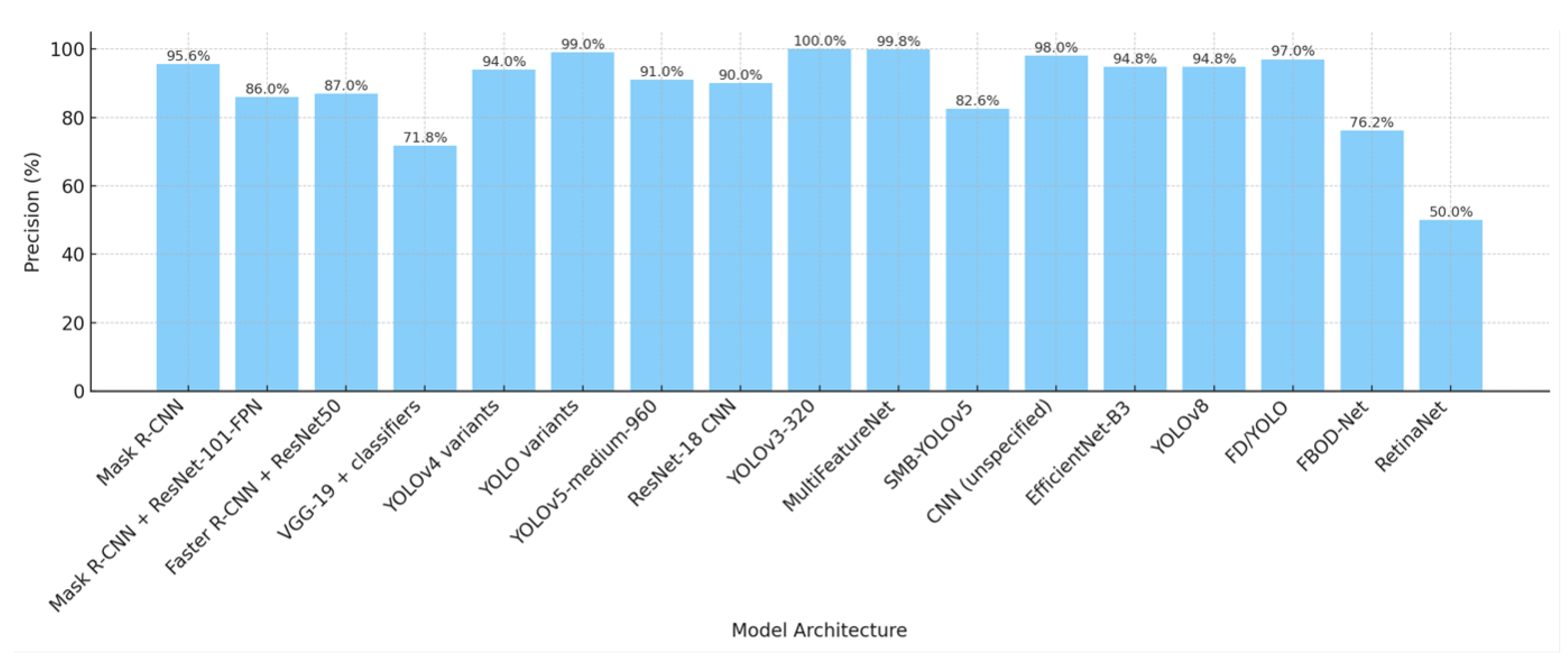
Table 1.
Inclusion and Exclusion Criteria
| Inclusion Criteria | Exclusion Criteria |
|---|---|
| Published after 2020 | Published before 2020 |
| Describes machine learning models for bird detection/repellence | Focuses on traditional (non-ML) bird control methods |
| Involves IoT-based solutions (e.g., edge computing, smart sensors) | Lacks technical details on ML model architecture |
| Uses image/audio/video-based detection techniques | Used other detection techniques |
| Provides open or well-documented datasets | Uses proprietary or inaccessible datasets |
Table 2.
Data Collection and Processing
| Data Collection Method | Dataset Type | Preprocessing Techniques |
|---|---|---|
| Image capture [3,29,30] | Custom | Annotation, resizing, OpenCV processing, frame subtraction, contour extraction |
| Video surveillance [31,32,33,34,35,36,37,38] | Custom | Frame extraction, annotation, background subtraction, noise removal, image scaling, data augmentation, classification |
| Video surveillance [39] | COCO | Frame extraction, data augmentation |
| Image collection [40,41] | Custom | Grayscale conversion, feature extraction, motion blur, contrast adjustment |
| Image collection [28,42] | Public datasets | Contrast enhancement, annotation |
| Image collection [43,44] | Multiple datasets | Frame difference, morphology, resizing, standardization |
| Image collection [45,46] | Kaggle dataset | Duplicate removal, cropping, resizing |
| Image collection [47] | CUB-200-2011 | Grayscale conversion, histogram analysis |
| Camera traps [48,49] | Custom | Annotation, conversion to TFRecords |
| Drone-mounted camera [50] | Custom | Patch division, data augmentation |
| Unmanned Aerial Vehicle imagery [51] | Custom | Annotation, orthomosaic creation, orthomosaic division |
| Radar and camera [52] | Custom | Annotation, data fusion, feature extraction |
| Webcam feeds [6] | Custom | No mention found |
| Image and sensor data [53] | No mention found | Feature extraction, data fusion |
Table 3.
Machine Learning Model Summary
| Model Architecture | Performance Metrics | Key Findings |
|---|---|---|
| Mask R-CNN [29] | Accuracy: 96.3%, Prediction time: 1.61s | High accuracy for various object classes, including birds (95.6%) |
| Mask R-CNN with ResNet-101-FPN [17] | Precision: 0.86 with low recall | High precision |
| Faster R-CNN with ResNet50 [22,31] | Detection precision: 0.87 | Effective for BSL detection, performance varies by vessel and conditions |
| VGG-19 with various classifiers [40] | ANN Accuracy: 70.99%, Precision: 0.718, Recall: 0.71, F1 score: 0.708 | ANN outperformed other classifiers, high training time noted |
| YOLOv4 variants [16,32] | mAP: up to 94%, Recall: 96%, F1 score: 94% | Ensemble model showed best performance, challenges with small birds |
| Faster R-CNN with ResNet101 [48] | Accuracy: 96.71%, Sensitivity: 88.79% | High accuracy and sensitivity, challenges with smaller objects |
| YOLOv5 [30] | Processing speed: 0.78–0.8 FPS | Limited processing speed, detection range varies by environment |
| YOLO variants [33] | Precision: up to 0.99, Recall: up to 0.99 | YOLOv3-tiny with comparative modules performed best |
| CenterNet [50] | mAP: 66.72–72.13 | Performance varied with data augmentation, 6 FPS on GPU |
| SSD with MobileNet [39] | mAP: 78%, FPS: 89 | Improved performance with data augmentation |
| Custom CNN [55] | Detection Accuracy: 77%, Average Precision: 87% | Effective for raven detection, low inference latency |
| YOLOv5-medium-960 [34] | Precision: 0.91, Recall: 0.79, F1-score: 0.85 | High performance, real-time inference possible |
| ResNet-18 based CNN [56] | Precision: 90% at 90% recall (Royal Terns) | Varied performance across species, challenges with similar species |
| YOLOv3-320 [57] | 100% accuracy in tests | Perfect detection in controlled tests, real-world performance not specified |
| MultiFeatureNet variants [28] | Precision up to 99.8% for birds | High performance, especially MFNet-L for overall detection |
| MobileNetV2 [58] | Test Accuracy: 95%, Real-time Accuracy: 80% | High accuracy, outperformed other tested architectures |
| SMB-YOLOv5 [59] | Precision: 82.6%, Recall: 71.1%, mAP@50: 77.1% | Real-time detection at 24 FPS |
| CNN (unspecified) [60] | Accuracy: Over 98% | High accuracy, ResNet outperformed AlexNet and VGG |
| CNN (unspecified) [61] | Precision: 83.4–100% (varies by class) | High precision for bird and flock detection |
| YOLOv5, YOLOv7, RNN [52] | Accuracy: 98% (drones), 94% (birds) | High accuracy, challenges with false positives for birds |
| Faster R-CNN, SSD variants [6] | mAP: 92.3% (Faster R-CNN with ResNet152) | Faster R-CNN outperformed SSD models |
| YOLOv4-tiny [55] | mAP: 92.04%, FPS: 40 | Good balance of accuracy and speed |
| EfficientNet-B3 | Accuracy: 94.5%, F1-score: 0.91 | Robust classification performance, computationally efficient |
| YOLOv8 [53] | Precision: 94.8%, Recall: 89.5% | Improved real-time detection and accuracy |
| YOLO, ResNet100 [62] | YOLOv3 mAP: 57.9% (COCO test-dev) | Specific bird detection performance not reported |
| YOLOv4 [42] | Overall accuracy: 83%, mAP: 84% | Good performance, challenges with crowded backgrounds |
| Faster R-CNN [63] | mAP: 69.84% (overall) | Effective for pigeon detection, some false negatives |
| Fourier descriptors, YOLO [3] | FD: 83% accuracy, YOLO: 97% accuracy | YOLO more accurate but slower on Raspberry Pi |
| DCNN (unspecified) [47] | Overall accuracy: 80–90% | Competitive performance compared to other approaches |
| Various (Cascade RCNN, YOLO, etc.) [41] | mAP: 0.704 (Cascade RCNN with Swin-T) | Cascade RCNN performed best, challenges with small birds |
| ConvLSTM-PAN, LW-USN [37] | AP50: 0.7089 for FBOD-BMI | Outperformed YOLOv5l, challenges with higher IOU thresholds |
| FBOD-Net [38] | AP: 76.2%, 59.87 FPS | Outperformed several other models, good speed-accuracy balance |
| RetinaNet with ResNet-50 [64] | Recall: >65%, Precision: >50% (general model) | Improved performance with fine-tuning on local data |
| YOLOv4 [65] | Accuracy: 99.13%, 12 FPS | Outperformed Faster R-CNN and CNN in accuracy and speed |
Table 5.
Comparison of Communication Technologies.
| Technology | Data Transfer Speed | Power Consumption | Range | Cost | Suitability for Media (Image/Video) | Stability in Remote Areas |
|---|---|---|---|---|---|---|
| Wi-Fi | High | High | Limited | Medium | High | Medium |
| LoRa | Low | Very Low | Very Long | Low | Poor | High |
| Cellular (4G/5G) | Very High | High | Very Long | High | Excellent | High |
| Zigbee | Moderate | Very Low | Short to Medium | Low | Poor | Medium |
Table 6.
Automated Bird Deterrent Mechanisms.
| Integration Methods | Repellence Method Effectiveness Rating | Implementation Complexity | Environmental Impact |
|---|---|---|---|
| Sound-based [30,101] | Moderate | Low | Low to Moderate |
| Sound-based [55] | High (77% detection accuracy) | Moderate | Low |
| Unmanned Aerial Vehicle with ultrasonic [60] | High (>98% accuracy) | High | Low to Moderate |
| AI-triggered servo [57] | High (100% detection in tests) | Moderate | Low |
| Drone-based visual [63] | High (significant reduction in stay time) | High | Low |
| Sound-based [62] | No mention found | Moderate | Low |
| Lasers [17] | Moderate | Moderate | Low to Moderate |
Disclaimer/Publisher’s Note: The statements, opinions and data contained in all publications are solely those of the individual author(s) and contributor(s) and not of MDPI and/or the editor(s). MDPI and/or the editor(s) disclaim responsibility for any injury to people or property resulting from any ideas, methods, instructions or products referred to in the content. |
© 2025 by the authors. Licensee MDPI, Basel, Switzerland. This article is an open access article distributed under the terms and conditions of the Creative Commons Attribution (CC BY) license (http://creativecommons.org/licenses/by/4.0/).
Copyright: This open access article is published under a Creative Commons CC BY 4.0 license, which permit the free download, distribution, and reuse, provided that the author and preprint are cited in any reuse.