

Submitted:
15 July 2025
Posted:
15 July 2025
You are already at the latest version
Abstract
A description is provided of how to use the Semantic Propositional Calculus (SPC) for a clear, compact notation that can be applied to approachdiverse topics in logic and mathematics. With two equivalent formulations (one corresponding to set theory and the other to the SPC), it is possible to determine the validity – or invalidity – of the categorical syllogisms. The parallel use of the SPC (preserving the syntax of the propositional calculus) and of resources from set theory facilitates learning in an area of logic and an area of mathematics. The joint learning of diverse branches of the same discipline, or of distinct disciplines which are closely related in different ways, is an essential aspect of the STA.
Keywords:
semantic propositional calculus (SPC)
; set theory
; structural teaching approach (STA)
MSC: 03B05, 97E30, 97E60
1. Introduction
1.1. Objectives of This Article
1.1.1. First Objective
Characterize a version of the propositional calculus in which the semantic aspect of the propositions is relevant. Here this version is referred to as the Semantic Propositional Calculus (SPC). The nature of the SPC is covered in section 4.
1.1.2. Second Objective
Provide an example of the use of the SPC within the framework of the Structural Teaching Approach (STA) developed in a previous article [1]. This instructional approach is discussed in subsection 1.2 below. The example mentioned consists of determining the validity or invalidity of categorical syllogisms by applying two formalisms: a) one which uses the notion of inclusion, in a broad sense, of a set (the included set) within another set (the including set); and (b) the other which uses the SPC.
1.2. Relevant Aspects of the STA
This teaching approach is considered structural because, rather than the way the topic is presented (i.e., using textbooks, audiovisual aids, virtual or in-person classes, etc.), the structure itself of the subject matter plays a more important role.
In the most basic types of learning, note can be taken of how living beings are able to detect regularities in their environments and have certain reactions to them. Those processes are adaptive, and in the end, they are survival skills. Consider, in this regard, scientific research programs of particular interest for neuropsychology. In classical, or Pavlovian, conditioned reflexes, a stimulus (one which in isolation does not generate a response in the organism it acts on) becomes an effective stimulus (one which does generate a biological response) by repeatedly preceding a stimulus that generates a response. Recall the classic experiment, for example, which repeatedly uses the sound of a bell immediately before the delivery of food to a dog [2] and [3]. In operant, or Skinnerian, conditioned reflexes, behavior apparently generated randomly can become much more likely if it is repeatedly followed by a “reward” in a given setting – that is, something that favors the biological organisms used in the respective experiments [4] and [5].
Consider the following hypothetical item on a test to determine a human being’s intelligence quotient (IQ): “In the numerical sequence, , what number should replace the question mark?
To answer this question correctly, the test-taker should identify the regularity or pattern specified below. The second number (5) in the given numerical sequence can be calculated using the first number (2), multiplying it by 2, and adding 1 to the result: . The third number (11) in that numerical sequence can be calculated using the second (5), multiplying it by 2, and adding 1 to the result: . The fourth number (23) in that numerical sequence can be calculated using the third one (11), multiplying it by 2, and adding 1 to the result: . Therefore, it seems reasonable to find the fifth number in that numerical sequence by multiplying the fourth number (23) by 2 and adding 1 to the result. If this is done, the result is 47; . It may then be accepted that the correct response is 47.
This fictitious example of an item on an IQ test is problematical: At least some knowledge of arithmetic would be necessary to provide the correct answer. In general, it can be admitted that intelligence is a person’s intellectual capacity regardless of his (or her) degree of cultural instruction. “Raven’s Progressive Matrices” [6] were developed to prevent improper cultural bias. This resource is also based on the test-takers’ detecting, for each item, the regularity that enables them to find the “unknown figure”, that is, the figure that would be the correct answer. It should be emphasized then that the main characteristic that various tests have in common to evaluate the capacity that is conventionally known as “intelligence” is that they all are based on measuring someone’s success in detecting certain regularities.
The laws of physics establish verified regularities for diverse physical entities. Thus, for example, the second law of Newton, , establishes that if the force applied to a body of a given mass m is known, then its acceleration can be calculated. In that law, mass serves as a proportionality constant. (Of course, given m and , can be computed, and given and , m can be computed.) This law is valid, according to Newtonian mechanics, for any body and at any instant. The laws of conservation in physics, such as those of linear and angular momentum and energy, establish that during the evolution through time of an isolated system, certain magnitudes remain constant; that is, they are conserved.
Likewise, laws have also been mentioned in biology. Think, for example, of Mendel’s laws of inheritance. One example of a law in another factic science, economy, is the law of supply and demand. The main idea of the STA in teaching-learning processes is 1) to emphasize a careful, detailed presentation, with varied examples of the laws (i. e., of the explicit formulation of regularities) that are valid in each area of knowledge; and 2) to link different topics within the same discipline, or even from different disciplines, giving particular attention to isomorphisms or other close relationships between the corresponding laws. A seminal role was played by [7] regarding the orderly consideration of different types of systems and relationships existing between them.
The concept of law has also been found in formal sciences; one may think of the De Morgan’s laws, for example. We have previously applied the STA in two formal sciences – logic and mathematics [1]. The present article contributes another example of the application of this approach.
Could the STA be useful in so-called humanistic disciplines, such as history? In these cases, it might be more difficult than in the area of exact and natural sciences to find clear examples of laws. However, this approach could facilitate the search for regularities using a systematic, comparative presentation of the topics covered. Thus, for example, if one is considering the history of diverse European countries, it is useful to present topics related to those countries the same way and in the same order in all cases. A tentative or preliminary example could be the proposal of an outline such as the following: 1) the inhabitants of the geographical region where each country was established, 2) the languages spoken by those inhabitants, 3) the events which led up to the founding of a given country, 4) its initial forms of government, etc. The purpose is for the learner to be able to establish simple, direct comparisons between the diverse countries discussed to find analogies and eventual differences between them. In general, the STA should have an important role in “comparative disciplines” such as comparative physiology and anatomy, just to give two examples from the field of biology. The STA makes it possible for the learner to acquire knowledge within broader than usual contexts.
2. Basic Notions on Propositional Calculus and Set Theory
Since this article is oriented mainly toward beginning level logic and mathematics teachers, it will be admitted that they are familiar with the basic notions of the disciplines addressed here. Nonetheless, to facilitate the understanding of the topic for interested students, in this section a brief review will be provided of pertinent results. They will be formulated not only with the symbols of the usual technical notation, but also in semi-technical English.
For an introduction to topics on logic, one may consult, for example, [8,9], and [10]. For an introduction to set theory, one may use [11,12,13], and [14], for example.
2.1. Propositional Calculus
A propositional variable may be replaced by a proposition, and in classical bivalent logic, it is accepted that each proposition may be true or false.
When referring to more than one propositional variable, they are symbolized as , .... For concision, with a “license” common in the elemental treatment of propositional calculus, reference will be made to propositional variables as if they were propositions. Therefore, if it is stated, for example, that is true, it is supposed that has been replaced by a true proposition, and if it is stated, for example, that is false, it is admitted that the propositional variable has been replaced by a false proposition.
The negation operator in propositional calculus will be symbolized by a horizontal bar placed above the negated proposition. Thus, for example, given the proposition , its negation – not – will be symbolized as .
Recall that if it is accepted that a proposition is true, its negation must be considered false, and if it is admitted that a proposition is false, its negation must be considered true. Therefore, the negation of a negation, or the “double negation” of a proposition, makes it possible to obtain that proposition once more. Thus, for instance, is identical to .
The conjunction operator in propositional calculus will be symbolized as ∧. The conjunction of any two propositions – which itself is also a proposition – is true only if those two propositions are true. Thus, for example, , or and , is true if both and are true.
The inclusive disjunction operator in propositional calculus will be symbolized as ∨. The inclusive disjunction of any two propositions, which is also a proposition, is true only if at least one of those two propositions is true. Thus, for example, – that is, inclusive or – is true only if at least one of the two propositions is true. In other words, the proposition is false only if both and are false.
The operator for material implication in propositional calculus will be symbolized as →. Consider any two propositions such as and . The proposition states that materially implies , and can be read as follows: if , then . For this reason, it is considered a conditional proposition in which is the antecedent and is the consequent of that proposition (which is false only if the antecedent is true and the consequent is false). The proposition is different from the proposition . The latter proposition, if , then , is false only if its antecedent is true and its consequent is false.
The operator for material bi-implication or for the logical equivalence of two propositions will be symbolized as ⟷. Consider any two propositions such as and . Both the proposition and the proposition (equivalent, from the logical perspective, to the former) are true only if and have the same truth value; that is, only in the case that both are true or in the case that both are false.
Consider any two propositions and , where , and , for . Figure 1 presents the truth tables for the following propositions: , , , , and .
The presence of a 1 in a column of a truth table indicates that the proposition considered is true and the presence of a 0 in a column of a truth table indicates that the proposition considered is false.
One law or tautology in propositional calculus is the following: . In words, the proposition (that is, if then ) has the same truth value as .
Figure 2 presents the truth table for the law of propositional calculus .
Note that the proposition is true regardless of the truth values of and . That is, it is true given its logical form. Propositions which are true given their logical forms are called laws, or tautologies, in propositional calculus.
2.2. Set Theory
When using set theory within the framework of a given topic, the set to which all the elements considered within that topic belong is called the universal set .
The complementation operator for any set S will be symbolized by  . The set
  to which all the elements in the universal set considered that do not belong to S belong is called the complement set of S. Note that the “double complementation” of any set S makes it possible to obtain S once more: S =
. The set to which all the elements in the universal set considered that do not belong to S belong is called the complement set of S. Note that the “double complementation” of any set S makes it possible to obtain S once more: S =
When considering more than a sole set S within the framework of the universal set , those different sets will be called , , , ….
The operator of intersection of any two sets will be symbolized as ∩. Consider any two sets and . The intersection of the two sets and , which also is a set, will be symbolized as . Only the members of the universal set considered, which belong to both and , can belong to the set .
The operator of union of any two sets will be symbolized by ∪. Consider any two sets and . The union of the sets and (which also is a set) will be symbolized as . Only the members of the universal set considered, which belong to both and , or to at least one of those sets, belong to the set .
The operator of inclusion in a broad sense of one set in another set will be symbolized as ⊆. The relation of inclusion of a set in another set will be symbolized as . Given this relation, set is called the included set, and set is called the including set. This relation can be characterized as follows: If any element whatsoever in the universal set belongs to , then it also belongs to . The relation between the sets and does not exclude the possibility that the set is the same as the set : . Of course, this equality cannot be verified if even one element that does not belong to belongs to . This is the case of the “inclusion in a strict sense” of any set in a set . In this article reference will not be made to that type of inclusion of one set in another set.
3. Four Types of Propositions Using Set Theory
Regarding categorical propositions one may consult [15], for example. Attention will be given below to four types of categorical propositions. Once the general logical form has been specified for each of them, each of these general logical forms is formulated in two equivalent ways using set theory symbols.
3.1. Universal Affirmative Categorical Propositions
One example of this type of categorical proposition is: All engineers are pragmatic.
This type of categorical proposition states that all elements belonging to a certain set that will be called belong to another set that will be called . The logical form of any universal affirmative categorical proposition can be expressed in the following general way:
All are .
All are ; ; 2 ⊆ 1
2 ⊆ 1
3.2. Universal Negative Categorical Propositions
One example of this type of categorical proposition is: No engineer is pragmatic.
This type of categorical proposition states that no element belonging to a certain set that will be called belongs to another set that will be called . The logical form of any universal negative categorical proposition can be expressed in the following general way:
No is .
No is ; S1 ⊆ 2 ; S2 ⊆ 1
2 ; S2 ⊆ 1
3.3. Particular Affirmative Categorical Propositions
One example of this type of categorical proposition is: Some engineers are pragmatic.
This type of categorical proposition states that some of the elements belonging to a certain set that will be called belong to another set that will be called . The logical form of any particular affirmative categorical proposition can be expressed in the following general way:
Some are .
Some are ; ;
3.4. Particular Negative Categorical Propositions
One example of this type of categorical proposition is: Some engineers are not pragmatic.
This type of categorical proposition states that some of the elements belonging to a certain set that will be called do not belong to another set that will be called . The logical form of any particular negative categorical proposition can be expressed in the following general way:
Some are not .
Some are not ; (S1 ∩ 2) ⊆ 2 ; (S1 ∩ 2) ⊆ S1
2) ⊆ 2 ; (S1 ∩ 2) ⊆ S1
4. Using SPC to Formulate Different Categorical Propositions
The SPC is not different from what is known as propositional calculus but it is a less common way of using it. Often in the treatment of propositional calculus special attention is given to its syntax. The laws, or theorems, are proven based on that syntax. The SPC has precisely the same syntax as classical propositional calculus, but its semantics are essential for its use. In effect, the meaning of each proposition in the SPC determines how complex (“molecular”) propositions are constructed from simple (“atomic”) propositions, using the operators of propositional calculus for that purpose.
In this article, one of the applications of the SPC will be used: The expression of the diverse types of categorical propositions, with symbols like those of propositional calculus to be specified below. The notions considered here will be used in section 6.
4.1. Using SPC Symbols to State a Universal Affirmative Categorical Proposition
Recall the logical form of any universal affirmative categorical proposition and the two equivalent ways of stating it using set theory symbols:
All are ; ; 2 ⊆ 1
2 ⊆ 1
Consider any element x belonging to the universal set within the framework of which and have been characterized. The meaning of is as follows: If x belongs to , then it belongs to . That is:
.
In the SPC it will be accepted that the expression of the antecedent of the above conditional proposition is the proposition :
.
Likewise, in the SPC it will be accepted that the expression of the consequent of that conditional proposition is the proposition :
.
Therefore, in the SPC terminology, the way of symbolizing is the following:
.
In the SPC, it will be accepted that the ways of symbolizing 1 and 2 are the following:
1 and 2 are the following:1
2
Therefore, in the SPC, the way of symbolizing 2 and 1 is the following:
2 and 1 is the following:2 ⊆ 1
Note that has the same meaning as (the negation of ) and has the same meaning as (the negation of ). In general, , where , has the same meaning as . In effect, if an element x belonging to a given universal set does not belong to the set , where , characterized within the framework of that , then it belongs to i.
i.4.2. Using the SPC Symbols to Express a Universal Negative Categorical Proposition
Recall the logical form of any universal negative categorical proposition and the two equivalent ways of expressing it using set theory symbols:
No is ; 2; 1
2; 1
Thus, in the SPC, the ways of expressing 2 and 1 are the following:
2 and 1 are the following:2
1
4.3. Using the SPC Symbols to Express a Particular Affirmative Categorical Proposition
Recall the logical form of any particular affirmative categorical proposition and the two equivalent ways of expressing it using set theory symbols:
Some are ; ;
Note that the proposition “Some are ” is equivalent to the expression “Some are ”, and the way of expressing the latter proposition using set theory symbols is .
In the SPC the proposition that states that x belongs to the intersection set of and is symbolized as:
En , the lowercase letter “q” has three subscripts. The first one is a small symbol of the operator of the intersection of sets: ∩. This symbol is separated by a semi-colon from the following two subscripts, 1 and 2, which are separated in turn by a comma. That is, states that an element x of the universal set considered belongs to the set which is the intersection of the sets and .
It is easy to interpret the meaning, for example, of :
: 9).
9).In words: The proposition symbolized by , states that an element x of the universal set considered belongs to the set which is the intersection of the sets and 9.
9.Therefore, the propositions which in the SPC express and are the following:
4.4. Using the SPC Symbols to Express a Particular Negative Categorical Proposition
Recall the logical form of any particular negative categorical proposition and the two equivalent ways of expressing it with set theory symbols.
Some are not ; (S1 ∩ 2) ⊆ 2 ; (S1 ∩ 2) ⊆ S1
2) ⊆ 2 ; (S1 ∩ 2) ⊆ S1
Given the notations considered, in the SPC the propositions that express (S1 ∩ 2) ⊆ 2 and (S1 ∩ 2) ⊆ S1 are the following:
2) ⊆ 2 and (S1 ∩ 2) ⊆ S1 are the following:2) ⊆ S2
2) ⊆ S1
4.5. A SPC Resource Not Used in This Article
The purpose of this subsection is to offer a somewhat broader view of the SPC, although the union of sets will not be used in this article.
Consider the sets and characterized within the framework of the universal set . The union of those two sets is a set which will be symbolized as . Given the definition of the union of two sets, any element the belongs to at least one of the sets and belongs to the set .
Consider now any element x belonging to that also belongs to . The proposition which indicates its membership is as follows:
.
In SPC terminology, this proposition will be symbolized as . That is,
: .
The first subscript of q – ∪ – is a small symbol that represents the operator of the union of sets. This first subscript of q is separated by a semi-colon from the following two subscripts, 1 and 2, which are separated in turn by a comma.
It is clear then that the following two conditional propositions, expressed in SPC terminology, are valid:
and .
It follows that in words, 1) the first of these propositions can be expressed as “If x belongs to , then it belongs to the set ” and 2) the second proposition can be expressed as “If x belongs to , then it belongs to the set ”.
It is also easy to understand that given the notation that was already introduced for the SPC, propositions like the following are valid:
and .
In set theory terminology, these conditional propositions can be expressed respectively as follows:
17) and (x ∈ 17 17)).5. Review of Notions Related to Categorical Syllogisms
Categorical syllogisms are a type of reasoning, or logical arguments, composed of three categorical propositions: the major premise, the minor promise and the conclusion.
If the syllogism is valid (that is, if its logical form is correct), then, if both premises are true, the conclusion is true.
The term of the subject of the conclusion, called “minor term”, corresponds to the set which, in section 6 of this article, will be denominated . The term of the predicate of the conclusion, called “major term”, corresponds to the set which, in section 6 of this article, will be denominated .
“Major premise” is that in which the “major term”, that corresponding to , is present. “Minor premise” is that in which the “minor term”, that corresponding to , is present.
Both in the major premise and the minor premise, in addition to the terms specified, there is also a third term, known as the “middle term”. This term corresponds to the set which, in section 6 of this article, will be denominated .
The symbol ∴ preceding the conclusion in each syllogism, means “therefore”, “hence", or “consequently”.
6. Determining the Validity or Lack of Validity of Categorical Syllogisms
6.1. Additional Results on Set Theory and the SPC
It is likely that teachers will consider these additional results on set theory and the SPC (to be used in 6.3) obvious. However, it may be useful to formulate them explicitly to make them easier to understand for students who are beginning to become familiar with the topics covered here.
Consider any 3 sets , and characterized within the framework of a given universal set . These names have been used to prevent confusion between certain specific sets , and , mentioned in section 5.
Suppose that the intersection set of and , or , is different from the empty set. The elements belonging to make up a subset of both and of . Therefore, the following relations of inclusion (in a broad sense) between sets are valid: and .
If it is admitted that , the following result is obtained: , given the law of the transitivity of inclusion, in a broad sense, between sets. Given that result, it can be seen that the elements belonging to both and also belong to . From , it may therefore be inferred that the following relations of inclusion (in a broad sense) are valid between sets:
Using compact SPC symbols, the four relations above can be expressed, respectively, as the following four conditional propositions:
6.2. How to Analyze Categorical Syllogisms
In 6.3, each of 20 categorical syllogisms will be analyzed with the objective of determining the validity, or lack of validity, in the following way:
(a) The three categorical propositions composing the syllogism considered will be expressed in English and the corresponding sets , and will be specified.
(b) The logical form of the categorical syllogism considered will be provided, as obtained when replacing the minor, middle and major terms with the symbols , and , respectively. The symbols 1, 2 and 3 will also be used to refer to the complements of , and , respectively. Thus, for example, the universal negative categorical proposition “No are ” will be expressed as “All are 2 ”. Likewise, the particular negative categorical proposition “Some are not ” will be expressed as “Some are 2 ”. How the latter two propositions are expressed using, first, set theory symbols, and second, the SPC symbols will be reviewed below:
1, 2 and 3 will also be used to refer to the complements of , and , respectively. Thus, for example, the universal negative categorical proposition “No are ” will be expressed as “All are 2 ”. Likewise, the particular negative categorical proposition “Some are not ” will be expressed as “Some are 2 ”. How the latter two propositions are expressed using, first, set theory symbols, and second, the SPC symbols will be reviewed below:All are 2 ; 2 ;
2 ; 2 ;
Some are 2 ; 2) ⊆ 2 ;
2 ; 2) ⊆ 2 ;
The conclusion of the syllogism will be presented in two equivalent ways.
(c) Each of the categorical propositions composing the syllogism considered will be formulated with two equivalent relations of inclusion, in a broad sense, between sets. The validity, or lack of validity, of that syllogism will then be determined, using the formalism of set theory.
(d) Each of the categorical propositions composing the syllogism considered will be formulated with two equivalent conditional propositions. The validity, or lack of validity, of that syllogism will then be determined, using the formalism of the SPC.
The procedures described in (c) and in (d) have the following in common: If from the conjunction of the two premises (each expressed in one of the two ways presented), 1) a conclusion may be inferred, and 2) that conclusion is that expressed by one of the two equivalent conclusions presented in (b), the syllogism considered is valid. If 1) and 2) are not verified, the syllogism is not considered valid.
For it to be feasible to infer a conclusion as of the conjunction of the two premises of a categorical syllogism, in one of the premises, (the set corresponding to the middle term), must appear as an including set and the other premise must appear as the set included. In the SPC terminology, this may also be expressed as follows: In one of the two premises, must appear as the consequent of a conditional proposition and in the other premise, it must appear as an antecedent of the conditional proposition.
The results obtained in (c) and (d) must coincide. Of course, to achieve this objective (to determine the validity or lack of validity of the categorical syllogism considered), only one of the procedures specified in (c) and (d) would suffice. In the cases corresponding to valid syllogisms, in 6.3 both procedures have been presented for instructional purposes, so that students will have access to the two equivalent procedures specified and will be able to use them.
6.3. Determining the Validity, or Lack of Validity, of Diverse Categorical Syllogisms
Example 1
This slightly modified categorical syllogism was taken from [16], where it is attributed to Lewis Carroll.
1. a
1) Fossils cannot be madly in love.
2) Oysters can be madly in love.
∴3) Oysters are not fossils.
| : oysters | : beings that can be madly in love | : fossils |
1. b
1) All S3 are 2.
2.2) All S1 are S2.
∴3) All S1 are 3 ; All S3 are 1.
3 ; All S3 are 1.1. c
1) S3 ⊆ 2 ; S2 ⊆ 3
2 ; S2 ⊆ 3
2) S1 ⊆ S2 ; 2 ⊆ 1
2 ⊆ 1
∴3) S1 ⊆ 3 ; S3 ⊆ 1
3 ; S3 ⊆ 1
((S1 ⊆ S2) ∧ (S2 ⊆ 3)) → (S1 ⊆ 3)
3)) → (S1 ⊆ 3)1. d
1) q3 → q2’ ; q2 → q3’
2) q1 → q2 ; q2’ → q1’
∴3) q1 → q3’ ; q3 → q1’
Both
3
and can be interpreted as “All are
3”. Therefore, the syllogism is valid.
3
and can be interpreted as “All are
3”. Therefore, the syllogism is valid.Example 2
2. a
1) All engineers are pragmatic.
2) Some engineers are wealthy.
∴3) Some wealthy persons are pragmatic.
| : wealthy persons | : engineers | : pragmatic persons |
2. b
1) All S2 are S3.
2) Some S2 are S1.
∴3) Some S1 are S3; Some S3 are S1.
2. c
1) S2⊆S3 ; 3⊆ 2
3⊆ 2
2) (S1 ∩ S2) S1 ; (S1 ∩ S2)⊆S2
∴3) (S1 ∩ S3) S3 ; (S1 ∩ S3)⊆S1
2. d
1) q2 → q3 ; q3’ → q2’
2) q∩;1,2 → q1 ; q∩;1,2 → q2
∴3) q∩;1,3 → q3 ; q∩;1,3 → q1
Both and can be interpreted as “Some are ”. Therefore, the syllogism is valid.
Example 3
3. a
1) No intellectual is superstitious.
2) Some French persons are intellectuals.
∴3) Some French persons are not superstitious.
| : French persons | : intellectuals | : superstitious persons |
3. b
1) All S2 are 3.
3.2) Some S1 are S2.
∴3) Some S1 are 3; Some 3 are S1.
3; Some 3 are S1.3. c
1) S2 3 ; S3 2
3 ; S3 2
2) (S1 S2) S2 ; (S1 S2) S1
∴3) (S1 3) 3 ; (S1 3) S1
3) 3 ; (S1 3) S1
3)) → (S1 ∩ S2) ⊆ 3
⊆ 3) → (S1 ∩ 3) ⊆ 3
3) → (S1 ∩ 3) ⊆ 3
3. d
1) q2 q3’ ; q3 q2’
2) q; 1,2 q2 ; q; 1,2 q1
∴3) q; 1,3’ q3’ ; q; 1,3’ q1
Both S1 ∩ 3) ⊆ 3 and can be interpreted as “Some are
3
”. Therefore, the syllogism is valid.
3) ⊆ 3 and can be interpreted as “Some are
3
”. Therefore, the syllogism is valid.Example 4
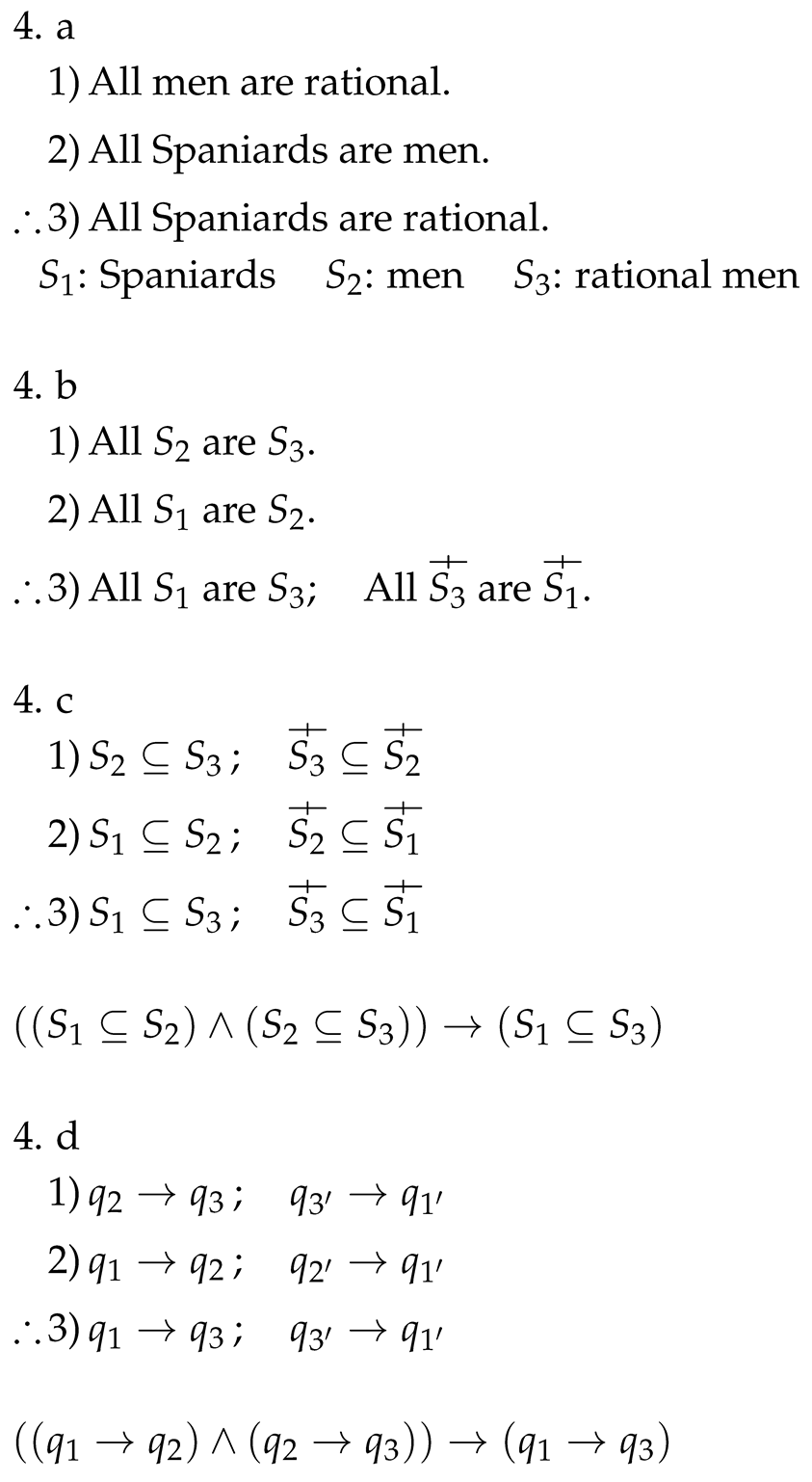
Both and can be interpreted as “All are ”. Therefore, the syllogism is valid.
Example 5
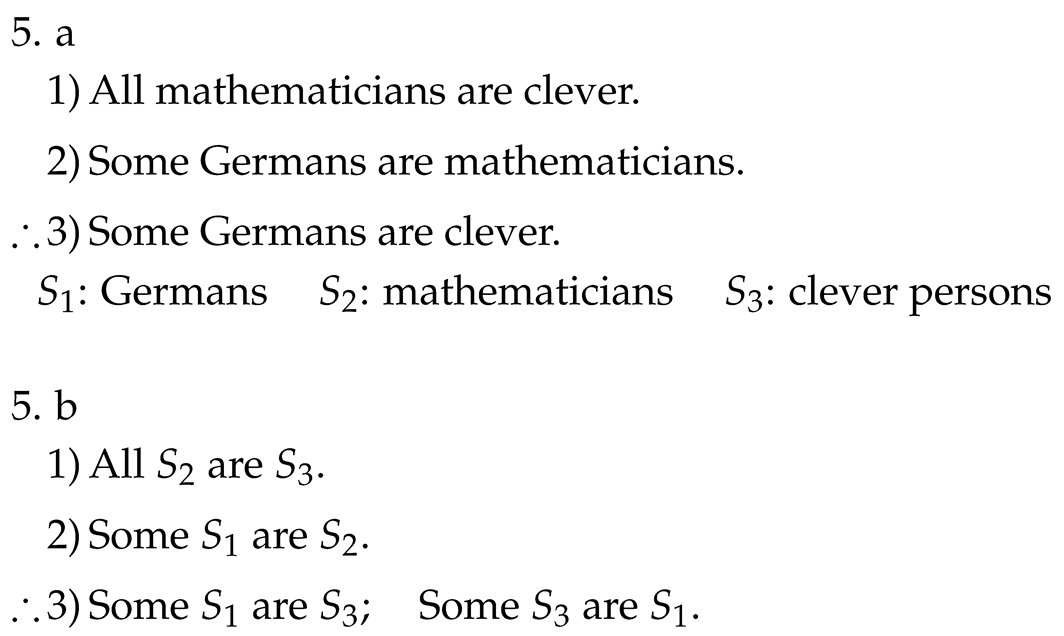
This categorical syllogism has the same logical form as that of Example 2. It was determined that the latter categorical syllogism is valid. Therefore, the syllogism considered in Example 5 is valid.
Example 6
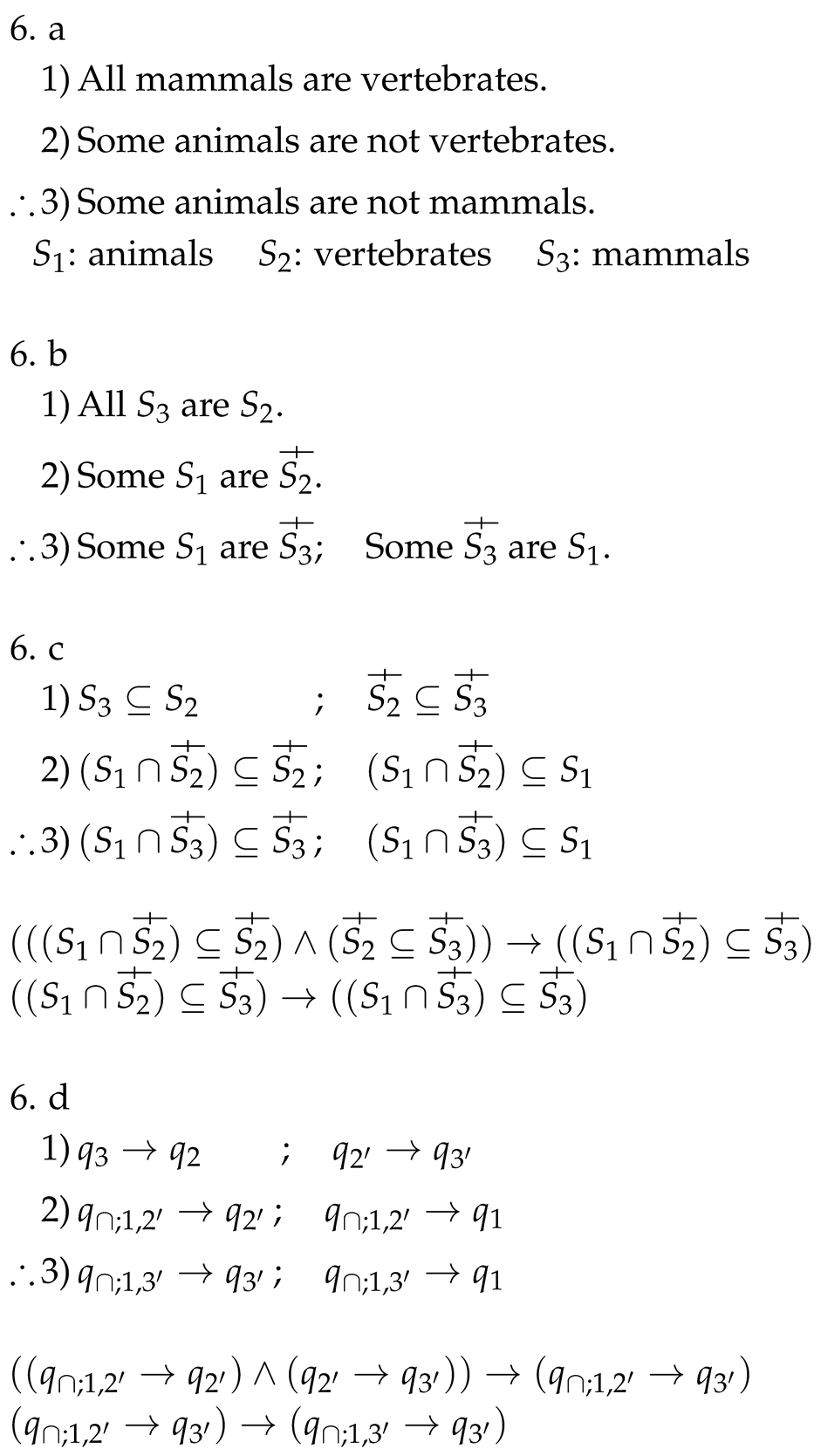
Both (S1 ∩ 3) ⊆ 3 and can be interpreted as “Some are 3 ”. Therefore, the syllogism is valid.
3) ⊆ 3 and can be interpreted as “Some are 3 ”. Therefore, the syllogism is valid.Example 7
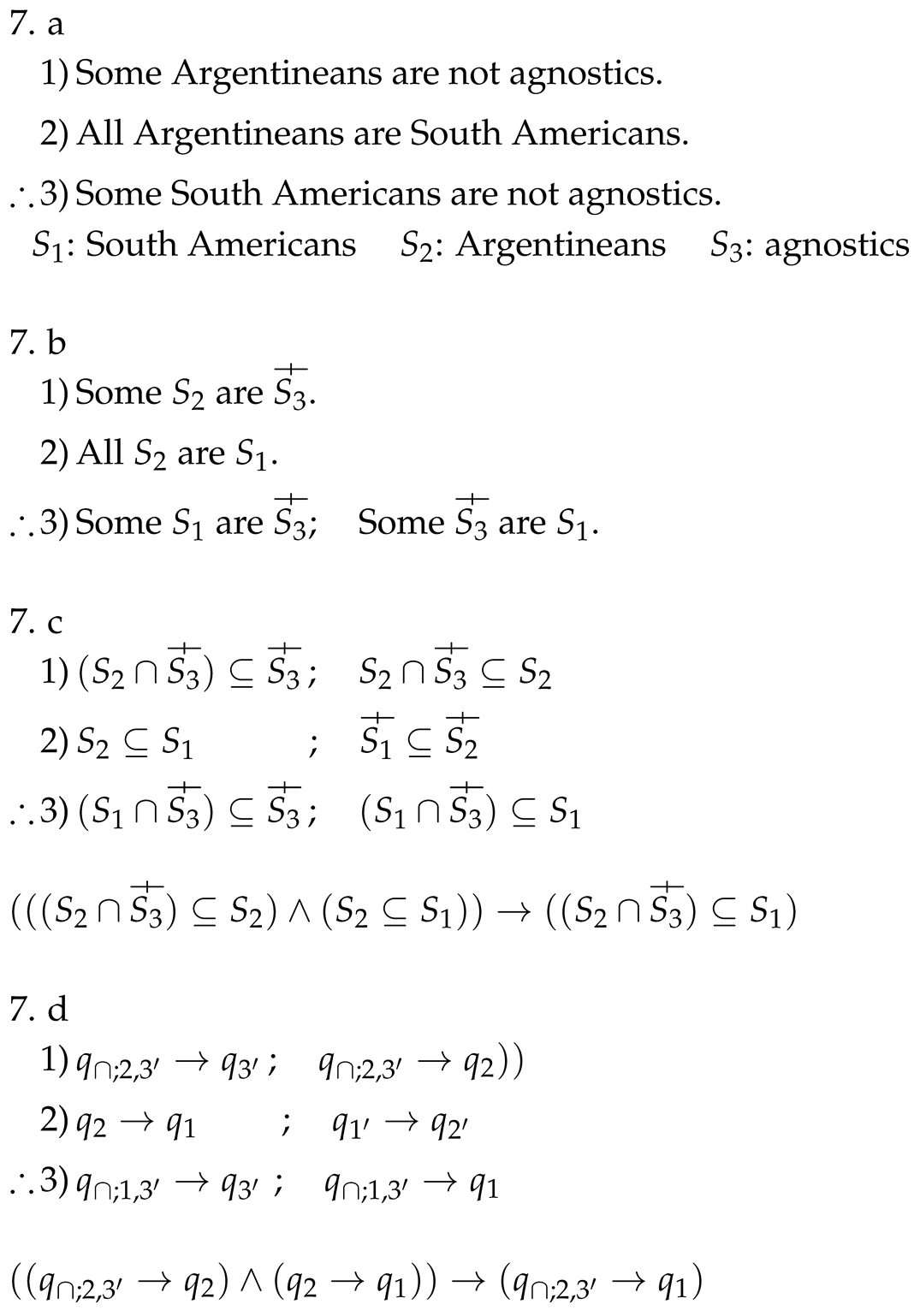
Both (S2 ∩ 3 and can be interpreted as “Some 3 are ”, which is equivalent to “Some are
3
”. Therefore, the syllogism is valid.
3 and can be interpreted as “Some 3 are ”, which is equivalent to “Some are
3
”. Therefore, the syllogism is valid.Example 8
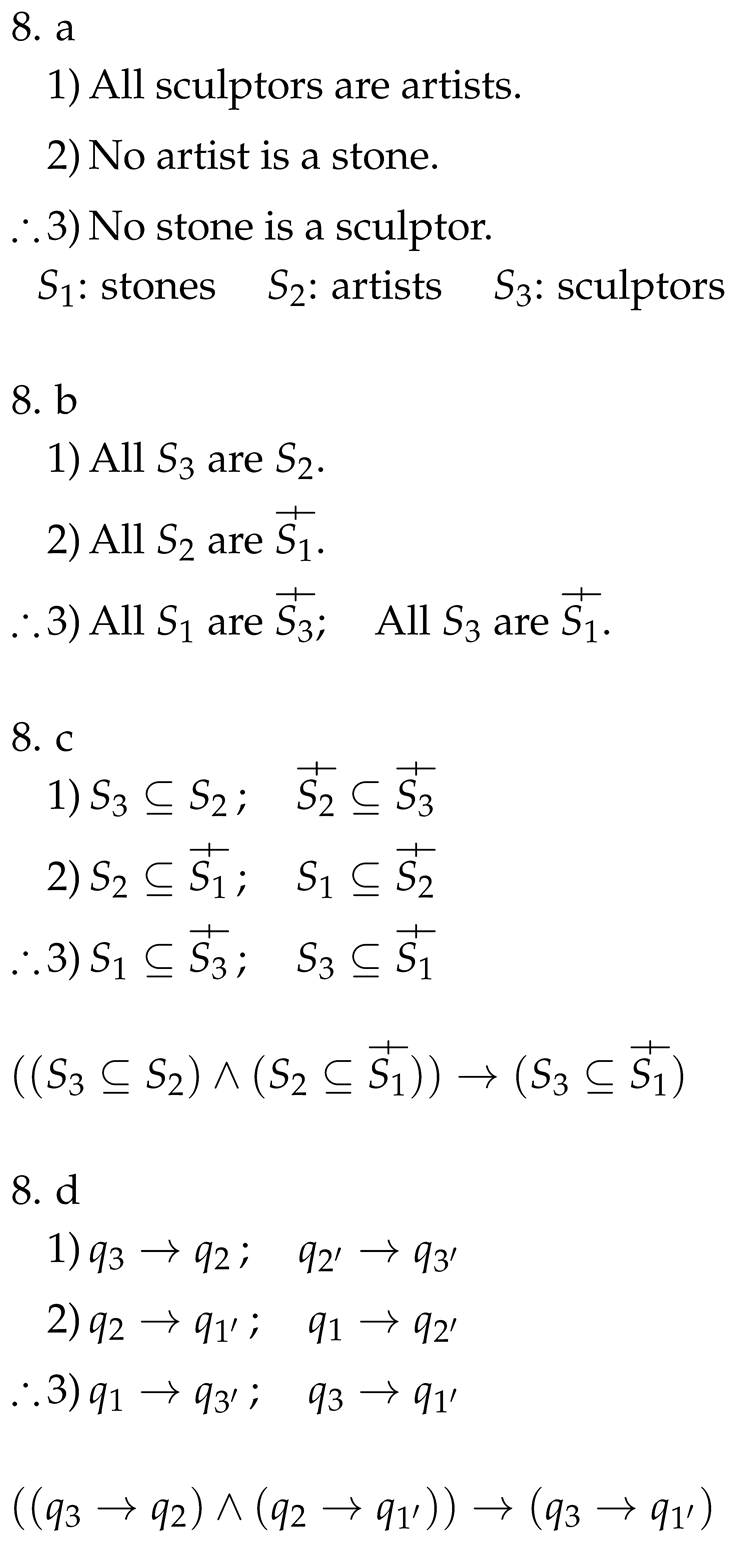
Both 1 and can be interpreted as “All are 1”. Therefore, the syllogism is valid.
1 and can be interpreted as “All are 1”. Therefore, the syllogism is valid.Example 9
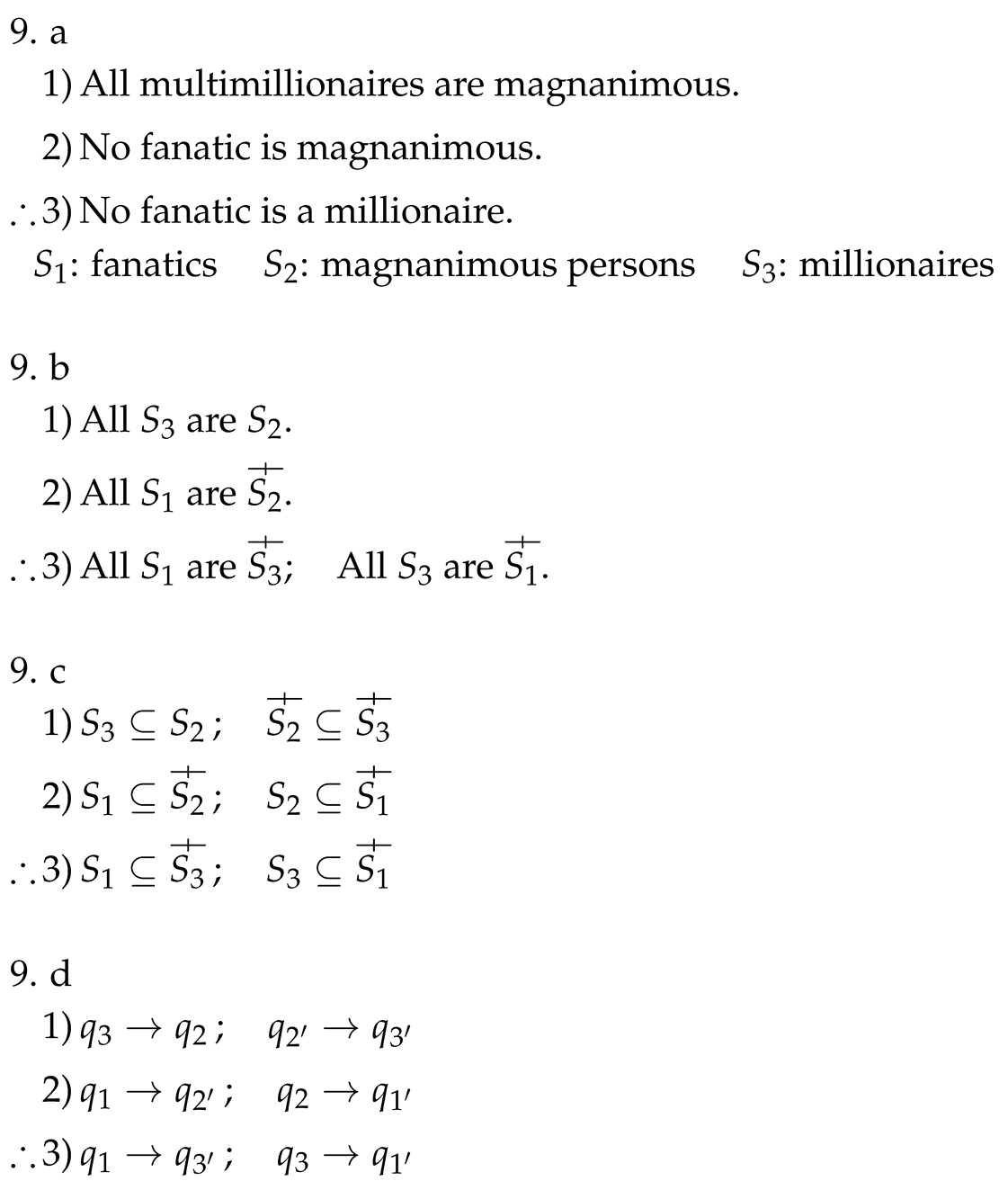
This categorical syllogism has the same logical form as the categorical syllogism in Example 8. Note that (S1 ⊆ 2 1). It was determined that the latter categorical syllogism is valid. Therefore, the syllogism considered in Example 9 is valid.
2 1). It was determined that the latter categorical syllogism is valid. Therefore, the syllogism considered in Example 9 is valid.Example 10
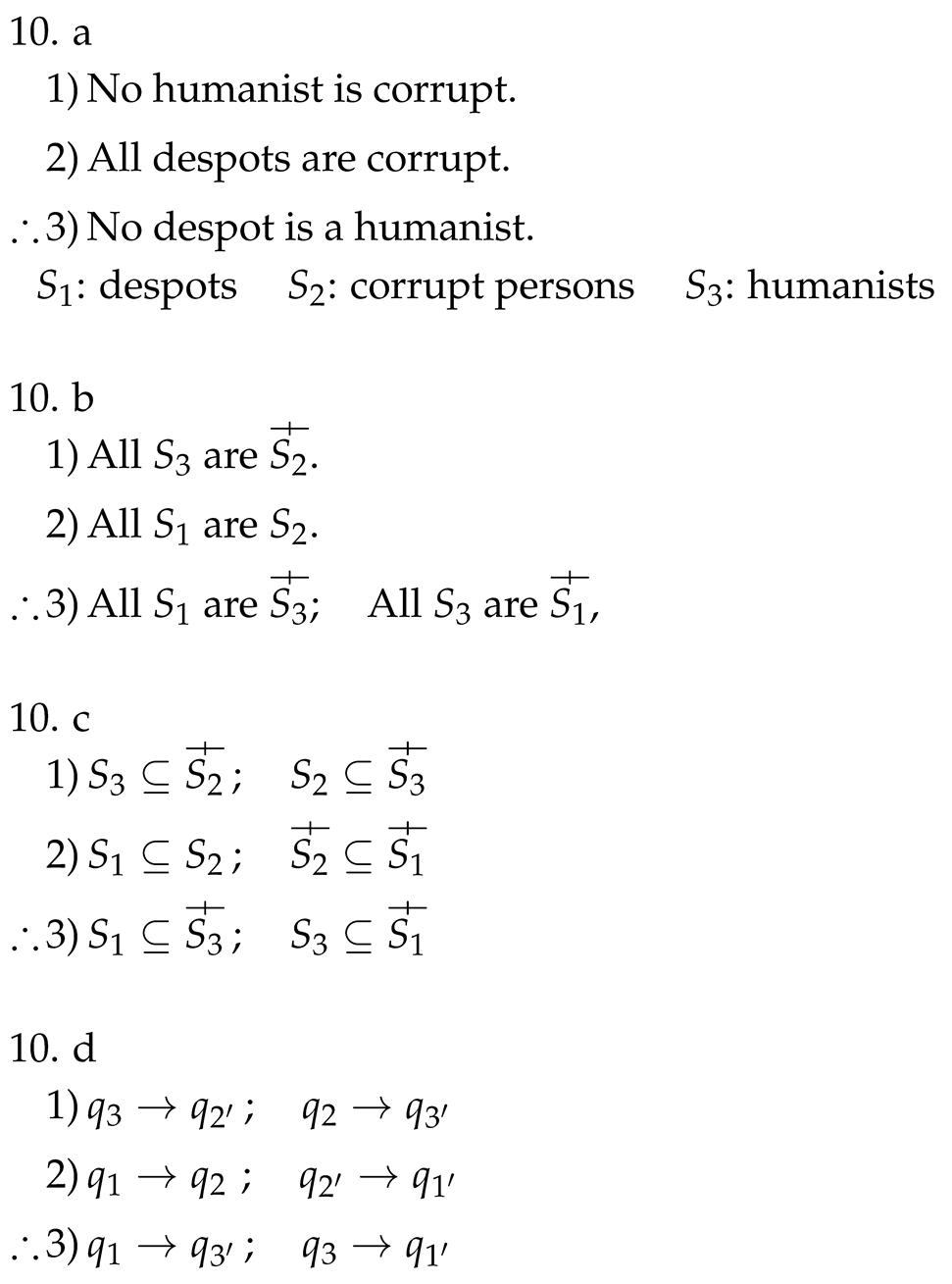
This categorical syllogism has the same logical form as that of Example 1. It was determined that the latter categorical syllogism is valid. Therefore, the syllogism considered in Example 10 is valid.
Example 11
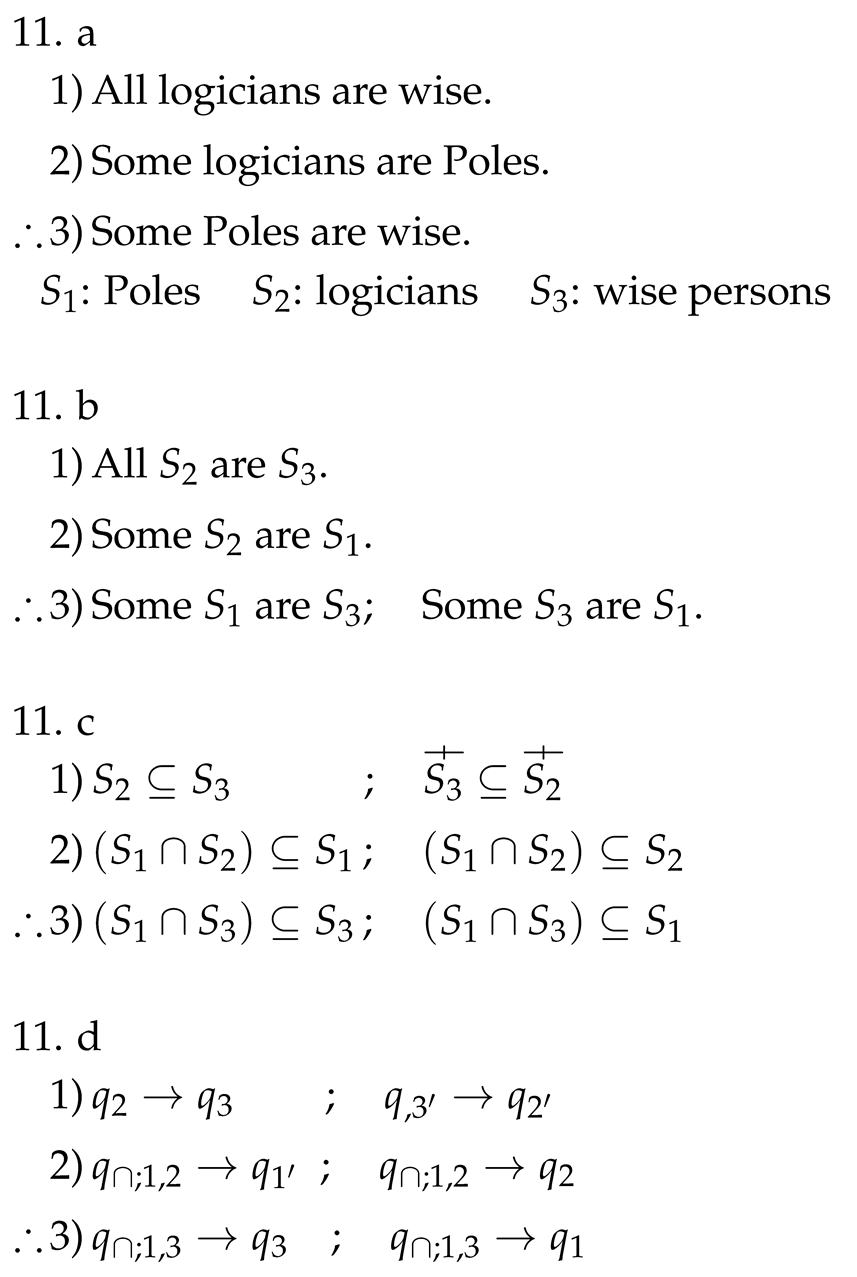
This categorical syllogism has the same logical form as that of Example 2. It was determined that the latter categorical syllogism is valid. Therefore, the syllogism considered in Example 11 is valid.
Example 12
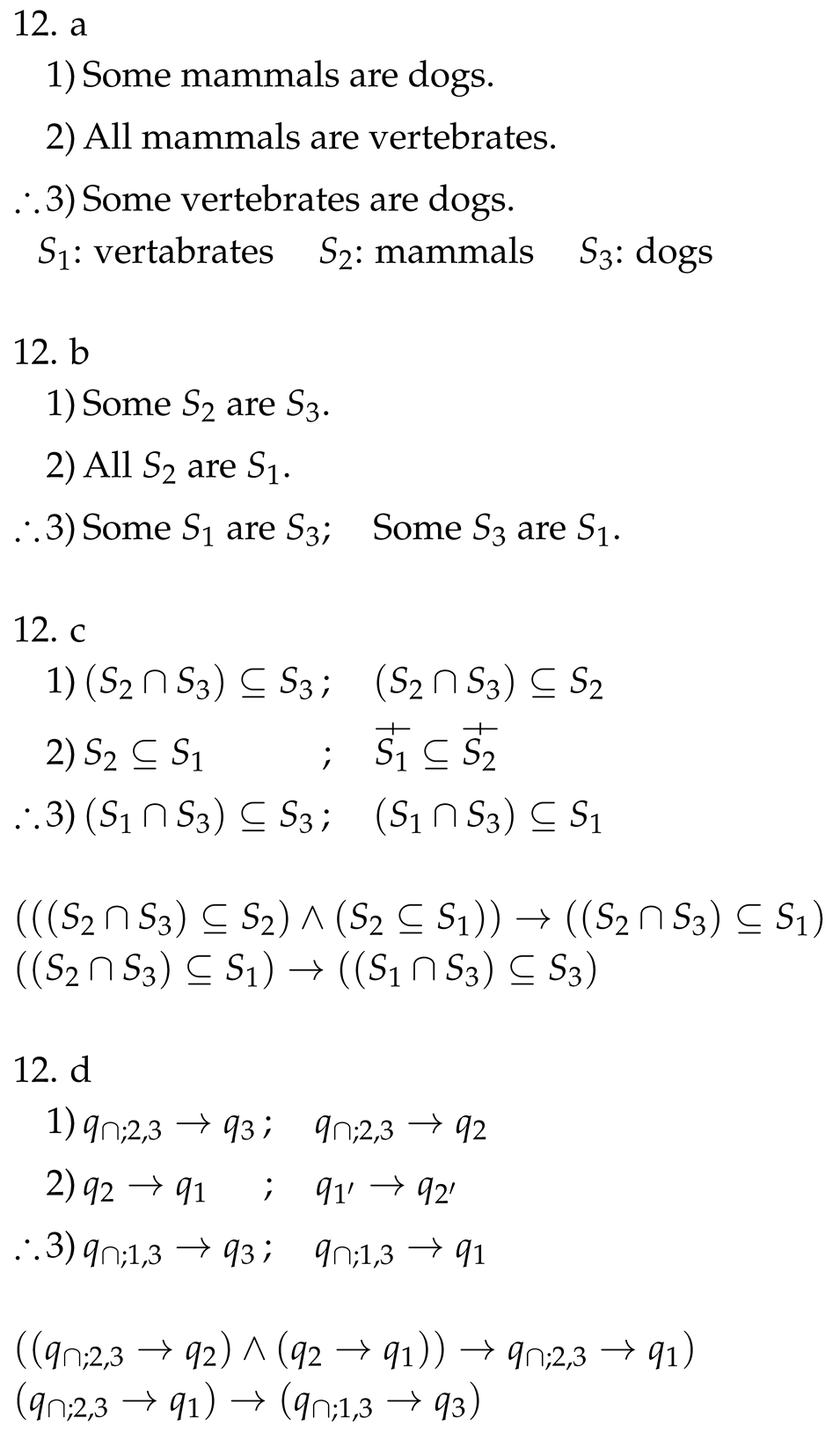
Both and can be interpreted as “Some are ”. Therefore, the syllogism is valid.
Example 13
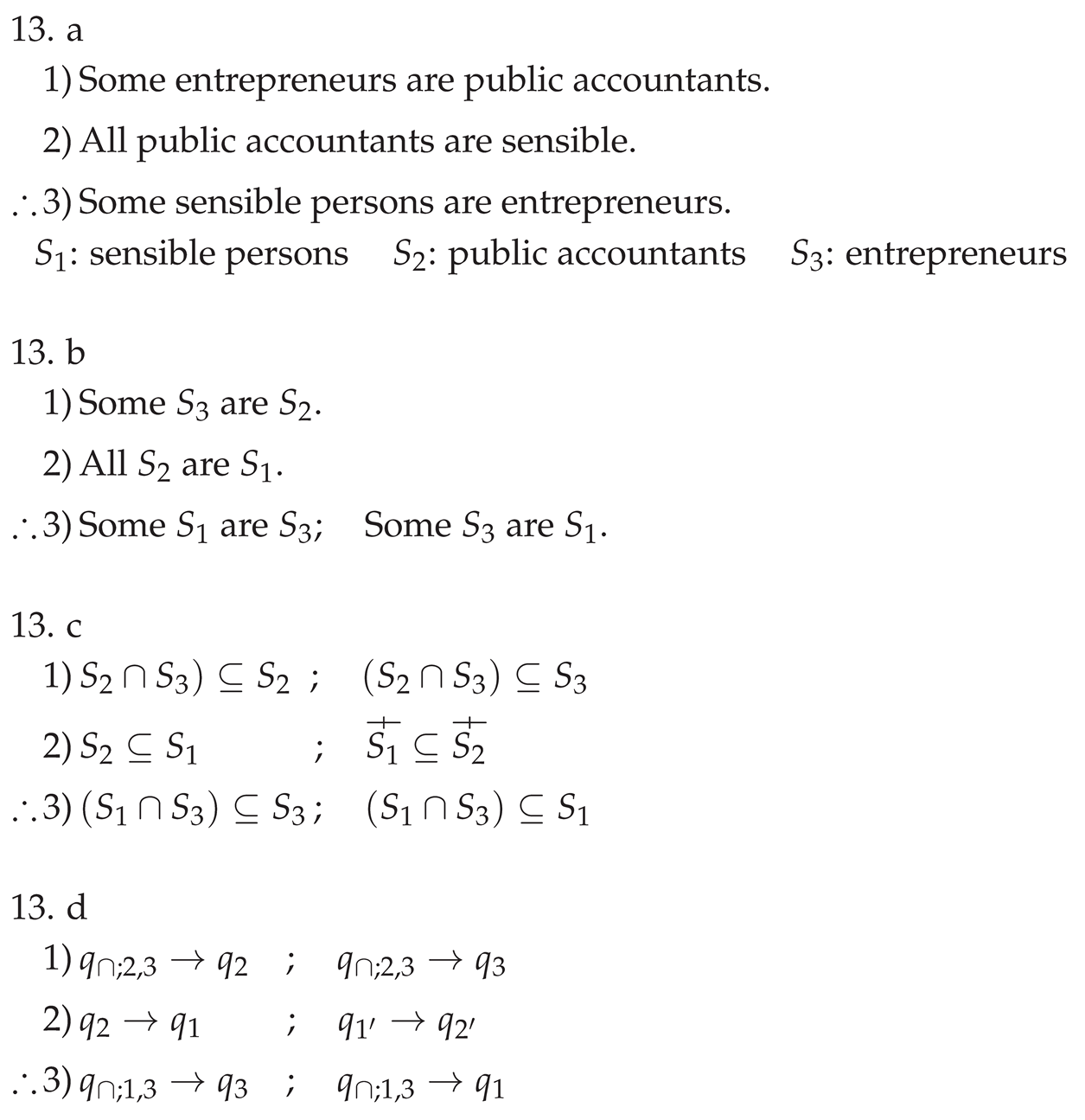
This categorical syllogism has the same logical form as the categorical syllogism considered in Example 12. It was determined that the latter categorical syllogism is valid. Therefore, the syllogism considered in Example 13 is valid.
Example 14
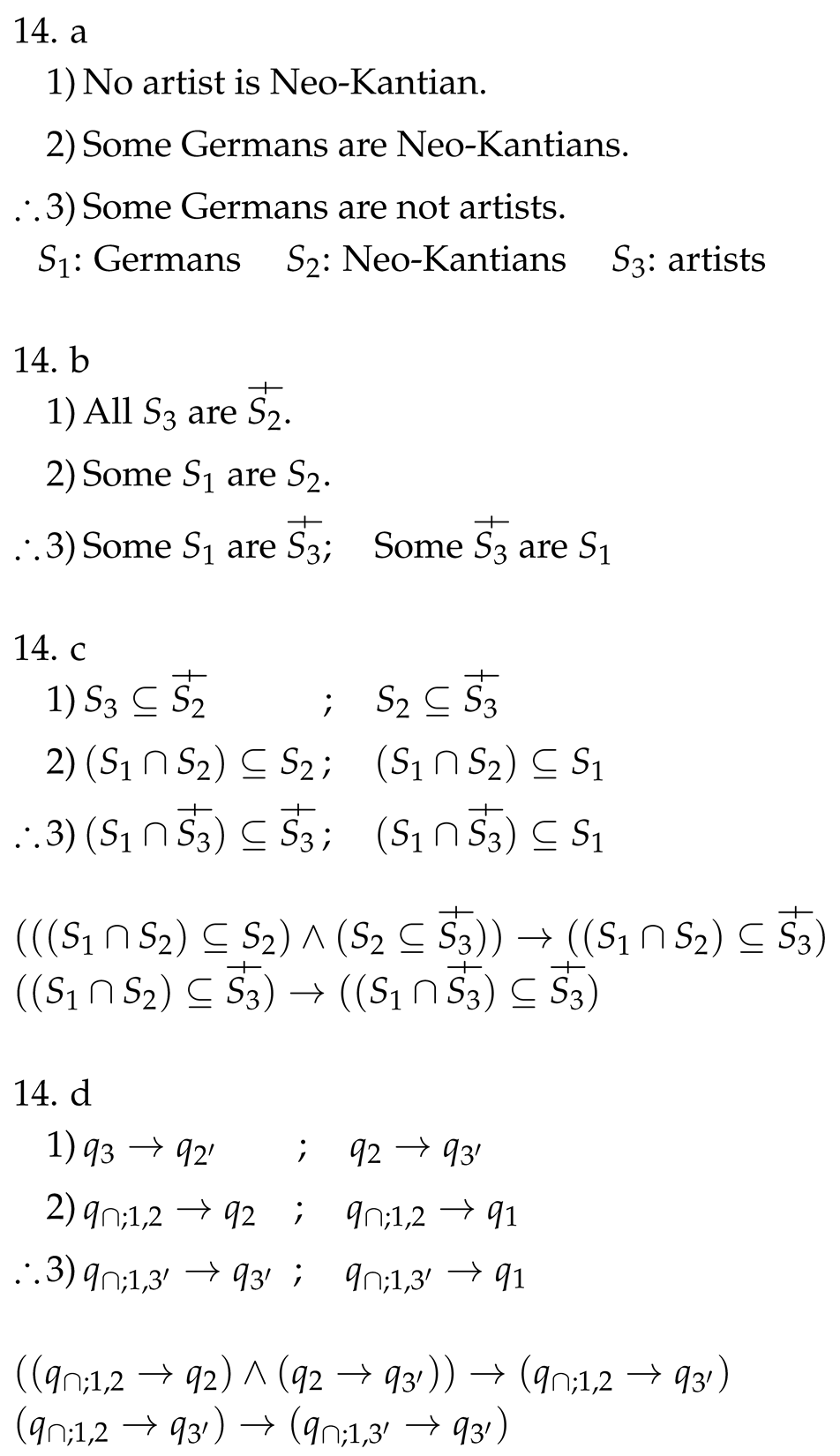
Both 3) ⊆
3
and can be interpreted as “Some are ”. Therefore, the syllogism is valid.
3) ⊆
3
and can be interpreted as “Some are ”. Therefore, the syllogism is valid.Example 15
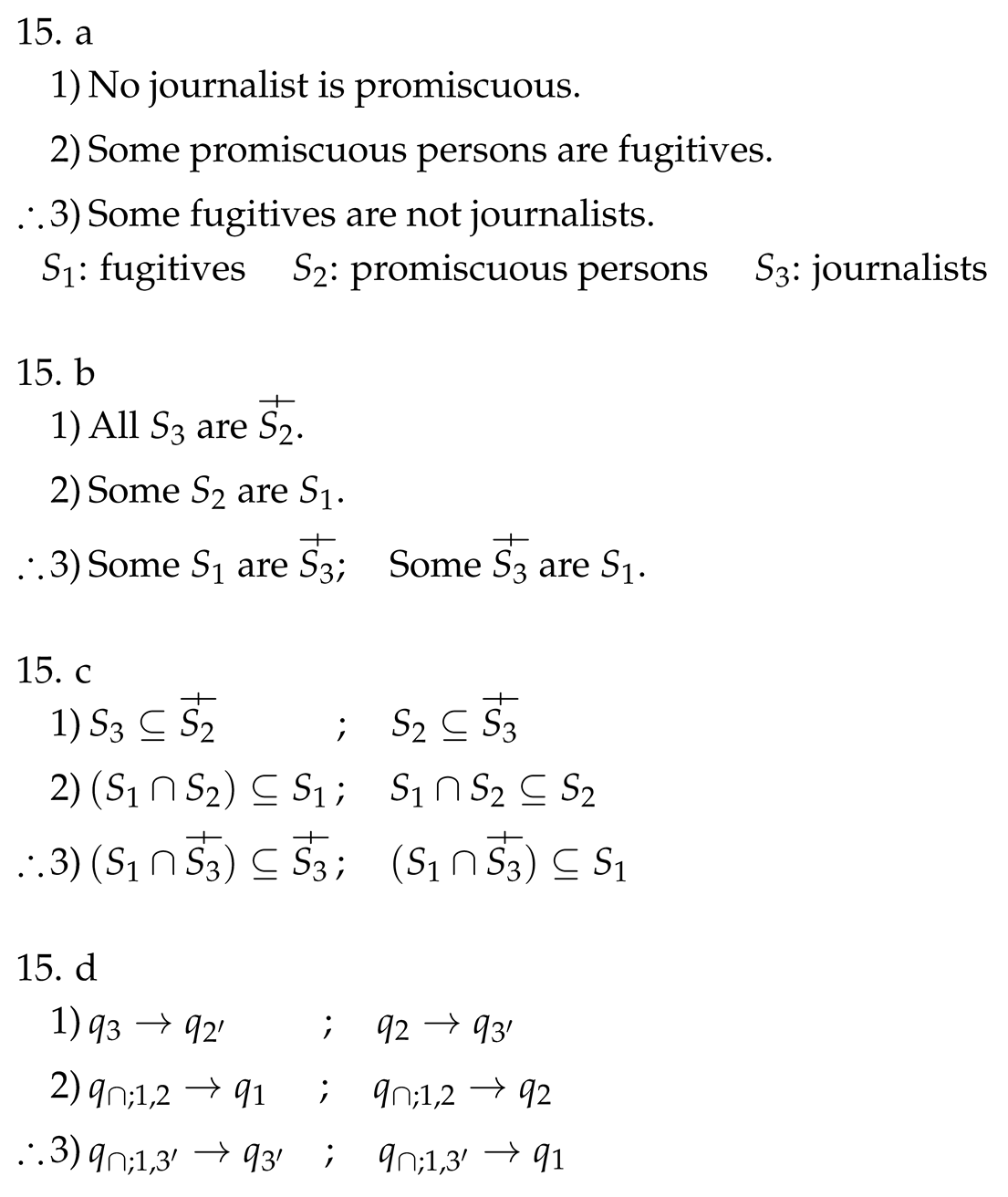
This categorical syllogism has the same logical form as the categorical syllogism considered in Example 14. Note that “Some are ” is equivalent to “Some are ”. It was determined that the latter categorical syllogism is valid. Therefore, the syllogism considered in Example 15 is valid.
Example 16
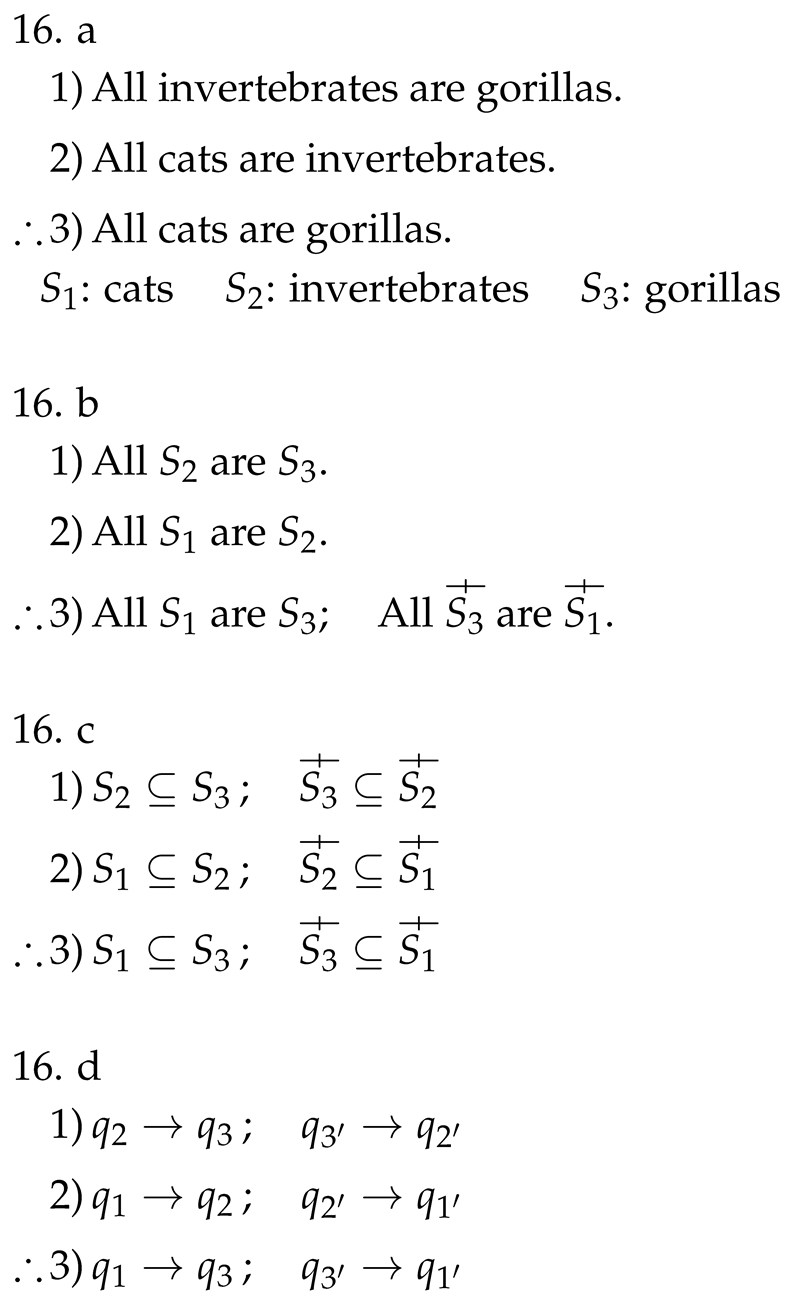
This categorical syllogism has the same logical form as the categorical syllogism considered in Example 4. It was determined that the latter categorical syllogism is valid. Therefore, the syllogism considered in Example 16 is valid. Note that, according to accepted zoological knowledge, both the premises and the conclusion of this syllogism are false. That does not, in this case, affect the validity of this syllogism. Logic does not determine the truth or falsity of propositions as facts, but rather the validity or lack of validity of the diverse types of reasoning.
Example 17
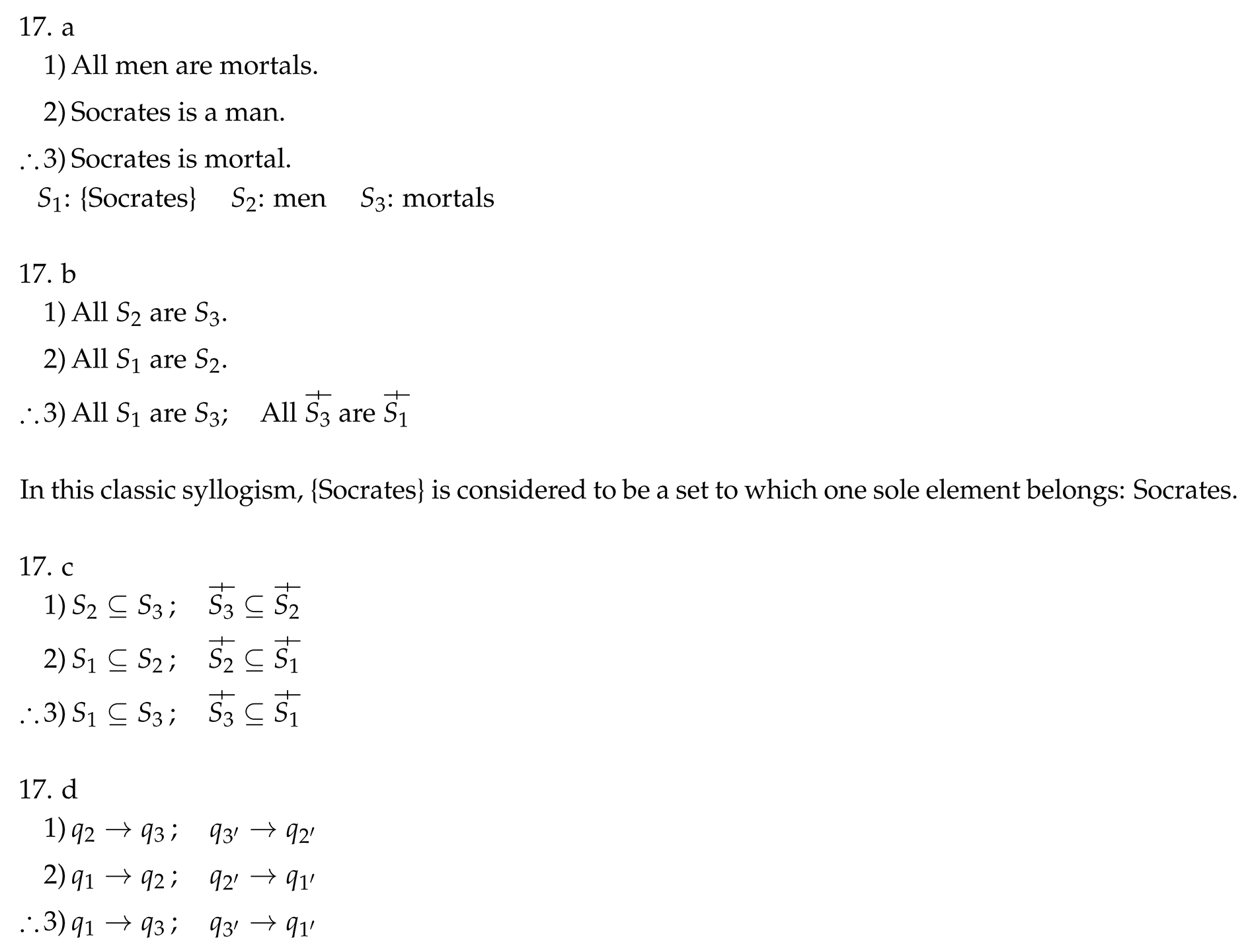
This syllogism has the same logical form as that considered in Example 4. It was determined that the latter categorical syllogism is valid. Therefore, the classical syllogism considered in Example 17 is valid.
Example 18
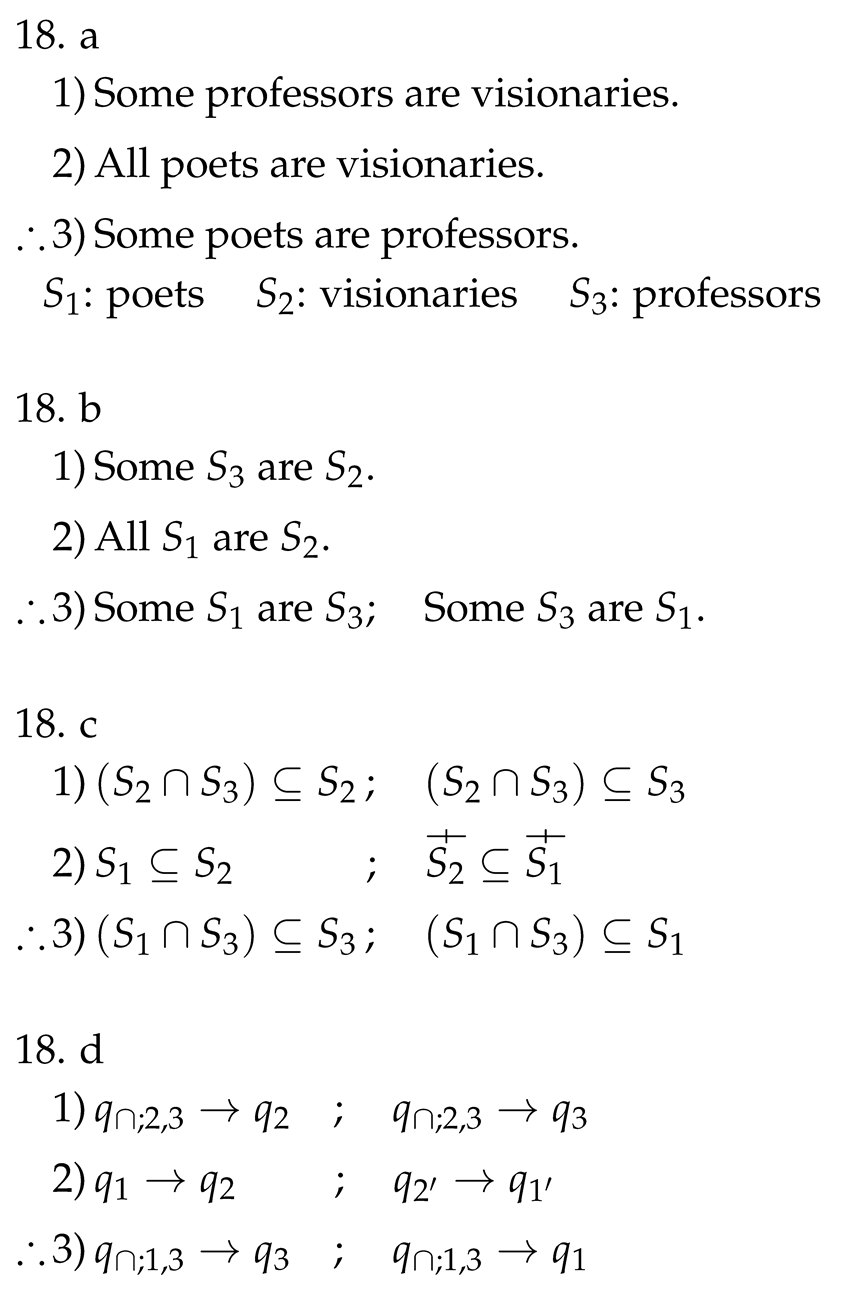
Both in the major premise and in the minor premise , is the including set. In SPC terminology, it can be seen in 18.d that in the major premise and in the minor premise , is the consequent. The conclusion of the syllogism cannot be inferred from the conjunction of the premises. Therefore, this categorical syllogism considered is not valid.
Example 19
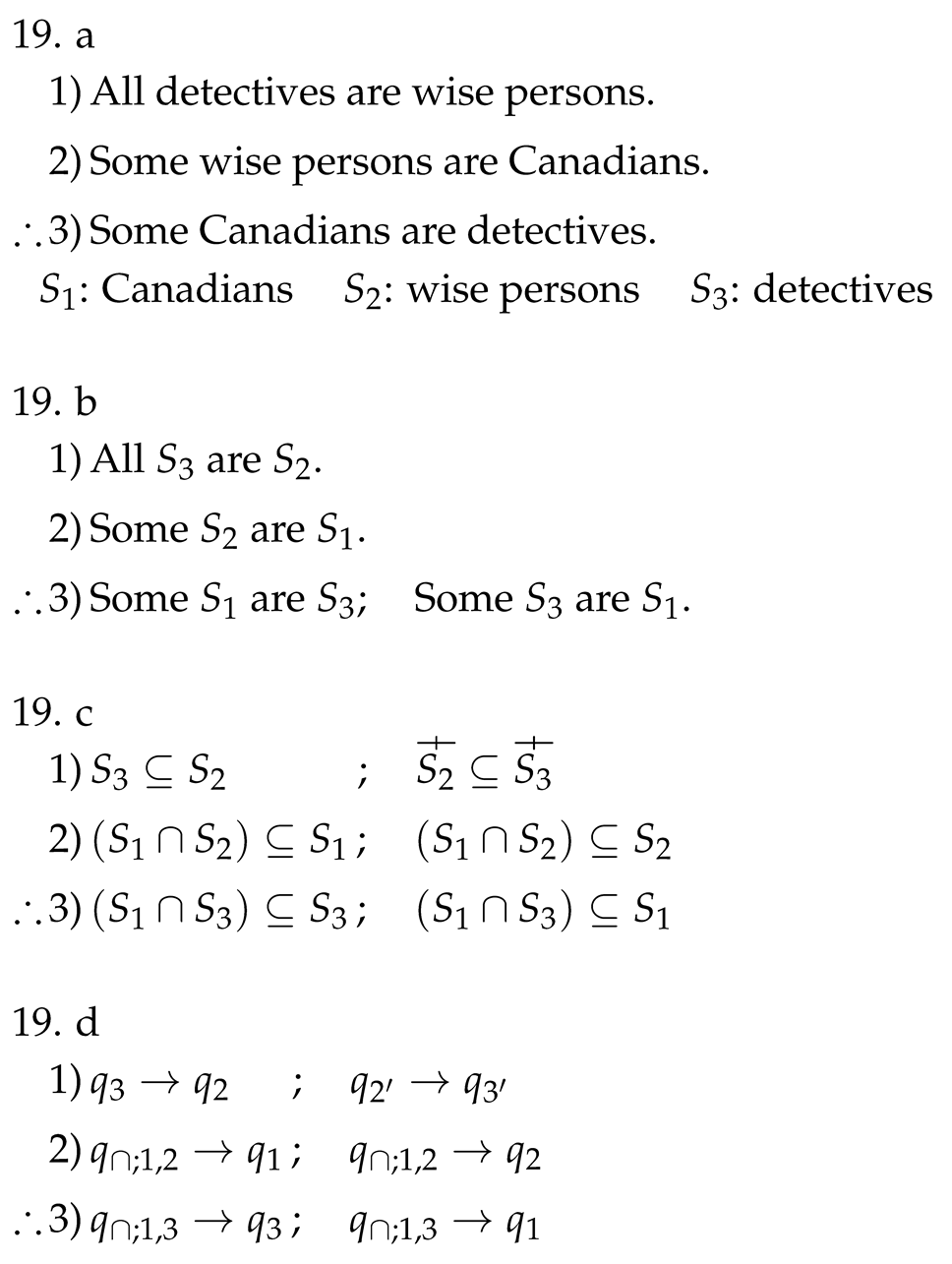
As in the categorical syllogism in Example 18, in this syllogism both in the major premise and in the expression of the minor premise (, is the including set. In SPC terminology, it can be seen in 19.d that in the major premise and in the minor premise , is the consequent. The conclusion of the syllogism cannot be inferred from the conjunction of the premises. Therefore, this categorical syllogism is not valid.
Example 20
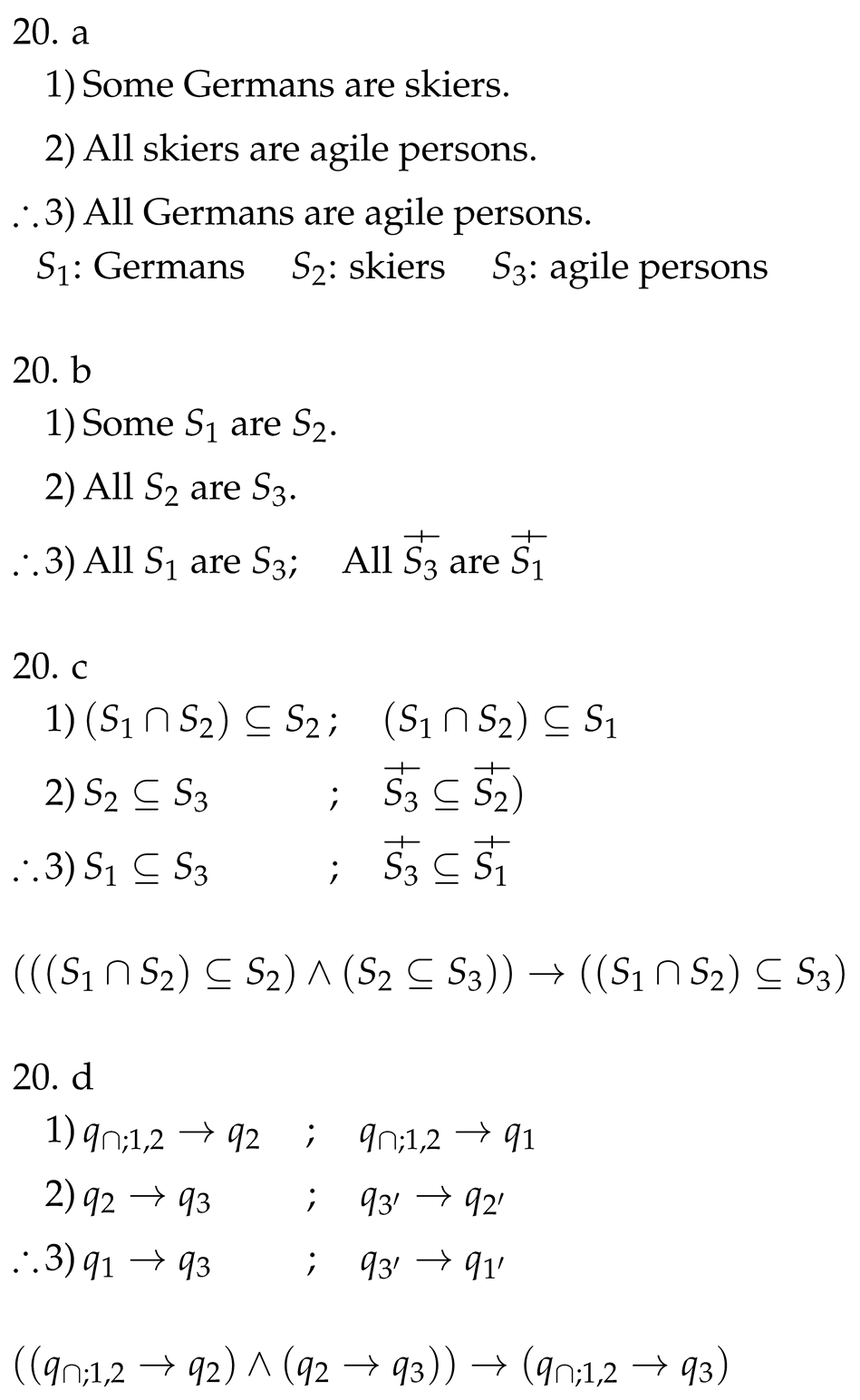
In this case, also using SPC terminology, the conclusion of the syllogism can be inferred from the conjunction of the premises: . This conclusion can be interpreted as: “Some Germans are agile persons”. It can be seen that this conclusion is different from that specified in (20.c), , which can be interpreted as “All Germans are agile persons”. Therefore, this categorical syllogism is not valid.
7. Discussion
In an earlier article [17], we presented inclusion diagrams to determine the validity of categorical syllogisms as an alternative to Venn diagrams For this reason, the title of this article mentions only the other technical tool used for this purpose—the SPC. Given that categorical syllogisms are composed of propositions, it is somewhat strange that, to the authors’ best knowledge, no attempt has been made to use propositional calculus in some way to reach that objective.
This study shows how relations of inclusion (in a broad sense) between sets not only make this diagrammatic approach possible, but they also can be used independently from the diagrams as a formal resource for problems concerning syllogistics.
Certain isomorphisms between set theory and propositional calculus were discussed in [18]. Another relation between aspects of set theory and a particular way to use propositional calculus (the SPC) are described in the present article.
One of the essential aspects of the STA is the joint presentation of diverse approaches or formalisms of a specific discipline – or of several disciplines – emphasizing isomorphisms whenever possible; that is, the correspondences or other types of links between the different topics or approaches considered. Joint presentations like this one will be used in forthcoming articles on the STA.
References
- Skliar, O., Gapper, S. & Monge, R. E. (2024). A Structural Approach for the Concurrent Teaching of Introductory Propositional Calculus and Set Theory. Preprints. [CrossRef]
- Pavlov, I. P. (1927). Conditioned Reflexes: An Investigation of the Physiological Activity of the Cerebral Cortex. Translated and edited by G. V. Anrep. Oxford University Press.
- Boakes, R. A. (2023). Pavlov’s Legacy: How and What Animales Learn. Cambridge University Press.
- Skinner, B. F. (1938). The Behavior of Organisms: An Experimental Analysis. B. F. Skinner Foundation.
- Skinner, B. F. (1988). Recent Issues in the Analysis of Behavior: An Extended Edition. B. F. Skinner Foundation.
- Raven, J., & Raven, J. (2003). Raven Progressive Matrices. In R. S. McCallum (Ed.), Handbook of Nonverbal Assessment. Kluwer Academic/Plenum Publishers, pp. 223-237.
- Bertalanffy, L. (1968). General System Theory: Foundations, Development, Applications. George Braziller.
- Copi, I. M., Cohen, C. & Rodych, V. (2019). Introduction to Logic, 15th ed. Routledge.
- Hurley, P. J. (2015), A Concise Introduction to Logic, 12th ed. Cengage Learning.
- Leary, C. C. & Kristiansen, L. (2015). A Friendly Introduction to Mathematical Logic. Milne Library.
- Goldrei, D. (2017). Classical Set Theory: For Guided Independent Study. Chapman and Hall/CRC.
- Cunningham, D. W. (2016). Set Theory: A First Course. Cambridge University Press.
- Jech, T. J. (2013). Set Theory (The Third Millenium Edition). Springer.
- Devlin, K. (1993). The Joy of Sets: Fundamentals of Contemporary Set Theory. 2nd ed. Springer.
- Quine, W. V. (1952; 1982). Section 14. Categorical Statements, Methods of Logic, 4th ed. Harvard University Press, pp. 93-97.
- Deaño, A. (1978). Introducción a la lógica formal. Alianza.
- Skliar, O., Monge, R. E., & Gapper, S. (2015). Using Inclusion Diagrams as an Alternative to Venn Diagrams to Determine the Validity of Categorical Syllogisms. arXiv:1509.00926.
- Skliar, O., Gapper, S. & Monge, R. E. (2023). Classical Bivalent Logic as a Particular Case of Canonical Fuzzy Logic. arXiv:2303.05925.
Figure 1.
Truth table of the propositions , , , , and .
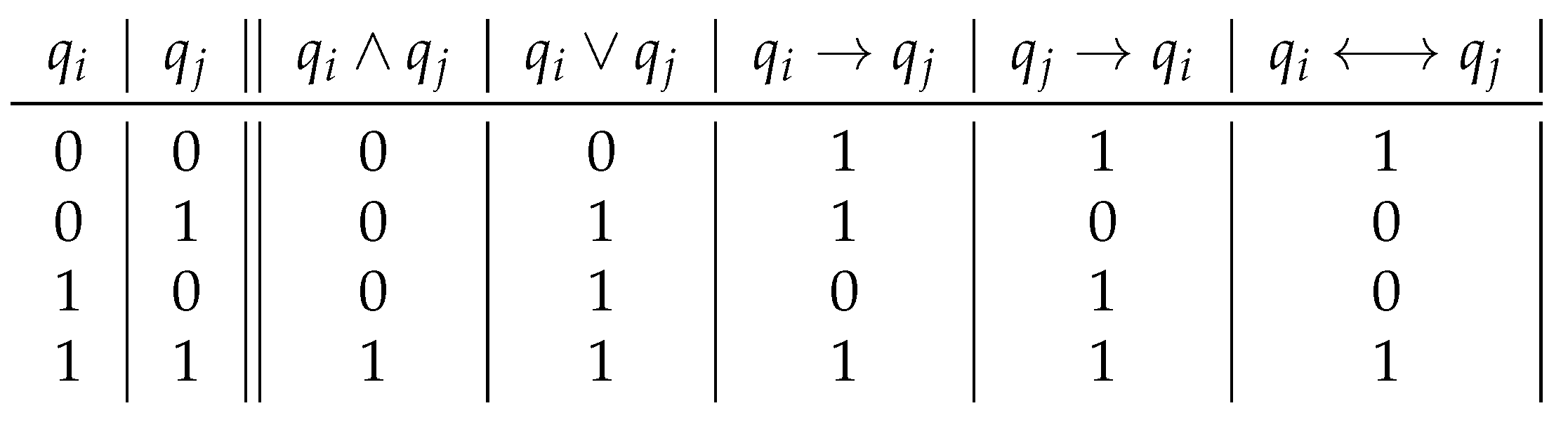
| 0 | 0 | 0 | 0 | 1 | 1 | 1 |
| 0 | 1 | 0 | 1 | 1 | 0 | 0 |
| 1 | 0 | 0 | 1 | 0 | 1 | 0 |
| 1 | 1 | 1 | 1 | 1 | 1 | 1 |
Figure 2.
Truth table of the proposition .
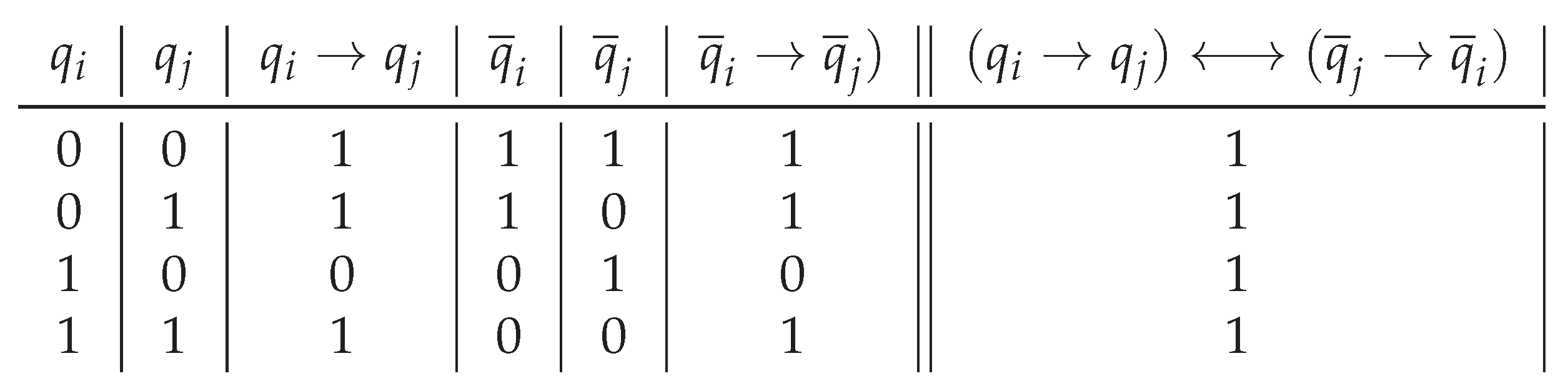
| 0 | 0 | 1 | 1 | 1 | 1 | 1 |
| 0 | 1 | 1 | 1 | 0 | 1 | 1 |
| 1 | 0 | 0 | 0 | 1 | 0 | 1 |
| 1 | 1 | 1 | 0 | 0 | 1 | 1 |
Disclaimer/Publisher’s Note: The statements, opinions and data contained in all publications are solely those of the individual author(s) and contributor(s) and not of MDPI and/or the editor(s). MDPI and/or the editor(s) disclaim responsibility for any injury to people or property resulting from any ideas, methods, instructions or products referred to in the content. |
© 2025 by the authors. Licensee MDPI, Basel, Switzerland. This article is an open access article distributed under the terms and conditions of the Creative Commons Attribution (CC BY) license (http://creativecommons.org/licenses/by/4.0/).
Copyright: This open access article is published under a Creative Commons CC BY 4.0 license, which permit the free download, distribution, and reuse, provided that the author and preprint are cited in any reuse.


