

Submitted:
11 July 2025
Posted:
14 July 2025
You are already at the latest version
Abstract
Laser-induced breakdown spectroscopy (LIBS) has been used to explore the chemistry of three regions of Mars on respective missions by NASA and CNSA, with CNES contributions. All three LIBS instruments use ~100 mm diameter telescopes projecting pulsed infrared laser beams of 10-14 mJ to enable LIBS at 2-10 m distances, eliminating the need to position the rover and instrument directly onto targets. Over 1.3 million LIBS spectra have been used to provide routine compositions for eight major elements and several minor and trace elements on > 3,000 targets on Mars. Onboard calibration targets common to all three instruments allow careful intercomparison of results. Operating over thirteen years, ChemCam on Curiosity has explored lacustrine sediments and diagenetic features in Gale crater, which was a long-lasting (> 1 My) lake during Mars’ Hesperian period. SuperCam on Perseverance is exploring the ultramafic igneous floor, fluvial-deltaic features, and the rim of Jezero crater. MarSCoDe on the Zhurong rover investigated during one year the local blocks, soils, and transverse aeolian ridges of Utopia Planitia. The pioneering work of these three stand-off LIBS instruments paves the way for future space exploration with LIBS, where advantages of light-element (H, C, N, O) quantification can be used on icy regions.
Keywords:
LIBS
; mars
; geochemistry
; ChemCam
; SuperCam
; MarSCoDe
; Gale crater
; Jezero crater
; Utopia Planitia
1. Introduction
Robotic exploration of our solar system has focused strongly on the planetary bodies nearest to Earth, especially to the Moon and Mars. In particular, NASA has had an extended program of robotic Mars exploration since the mid-1990s. This program focused more initially on detailed orbital investigations, imaging large parts of the planet at sub-meter resolution and obtaining various types of spectral data at resolutions down to several meters (e.g., Carr and Head, 2010; Ehlmann and Edwards, 2014). In-situ surface exploration started with small rovers, increasing in size to the one-ton Curiosity rover (Figure 1a) which landed in 2012 (Grotzinger et al. 2012) and its younger sibling, the Perseverance rover (Figure 1b) which landed in 2021 (Farley et al., 2021). Both rovers are still operating at the time of this writing. The China National Space Administration (CNSA) has recently made strong progress in the exploration of the Moon and Mars, notably with the orbital reconnaissance of Mars by the Tianwen-1 mission and the landing of the Zhurong rover (C. Liu et al., 2022) in 2021 (Figure 1c).
Results obtained on Mars near the turn of the century suggested an early climate much like Earth, with a water precipitation cycle, lakes, rivers, and canyons (e.g., Malin and Edgett, 2000). The inferred time frame for these conditions was in the Noachian period, stretching from 4.1 to 3.7 Ga in the past. Key questions that drove exploration of the red planet were the following: “Follow the water: what state, how much, when and where?” “What was the extent and duration of potentially habitable conditions on Mars?” And “If the planet was in fact habitable, can we find evidence of past life on Mars?” An overreaching question was “How does Mars as a planet differ from Earth,” for example, in its bulk chemistry, and in its crustal chemistry and mineralogy, given the lack of plate tectonics (MEPAG, 2005).
The tools to answer these questions involved ones that could determine the elemental chemistry, mineralogy, and isotopic composition of the accessible materials—surface rocks and soil. In particular, chemical analyses were needed to understand the levels of aqueous alteration that occurred within potential lake basins, revealed by the levels of enrichment of relatively insoluble elements such as aluminum (e.g., Nesbitt & Young, 1984). Chemical analyses were also needed to understand the role of evaporation and the possible presence of saline lakes, based on deposition or absence of salts, and to understand the pH and redox potential of the waters. In addition to studies of bedrock, the chemistry of alteration products from groundwater that flowed through fractured rocks was of strong interest, as underground aquifers may have been a habitable environment for primitive life. Finally, the presence of biota fundamentally alters rock chemistry in many ways on Earth, and even if life was relatively sparse on Mars, e.g., in a pre-photosynthesis phase, it may have left telltale signs in the geochemistry, for example, that could be detected from isotopic compositions.
In the 1970s the Viking landers provided information on the chemistry of the soil and some pebbles using the x-ray fluorescence (XRF; Clark et al., 1976). The early Mars rovers (Sojourner, Spirit, and Opportunity) employed a form of XRF in which the x-rays were excited by radioactive sources. The Alpha Particle X-ray Spectrometers (APXS; Gellert and Clark, 2015) analyzed areas of a few square centimeters, and worked best when dust was first cleared from the rock. The requirements of dust removal and placement of the sensor directly on the rock meant that only rocks that provided a relatively flat surface accessible to the rover could be analyzed, ideally with dust-removal tools. In spite of the limitations of a relatively large footprint and the accessibility and dust constraints, many important results have been obtained with APXS instruments (e.g., Gellert and Clark, 2015).
Starting in the late 1990s, NASA funded a project to explore the feasibility of developing laser-induced breakdown spectroscopy (LIBS) for planetary exploration (e.g., Wiens et al., 1998). LIBS promised a number of potential advantages, especially the ability to operate at stand-off distances, not requiring the deployment of an arm or dust removal tool. The Curiosity rover, initially conceived in 2003, promised to host more than 60 kg of payload, allowing more and larger instruments than previous rovers (Grotzinger et al., 2012). NASA selected the ChemCam instrument (Figure 2a) to provide remote sensing for Curiosity (Maurice et al., 2012; Wiens et al., 2012).
ChemCam represents a major change from previous remote sensing. Prior missions, including orbital ones, generally relied on reflectance spectroscopy for remote sensing. Whether using the visible, near-, or mid-infrared range, reflectance spectroscopy provides mineralogical information rather than direct chemistry. In reality, both chemistry and mineralogy are highly important. Given the history of reflectance spectroscopy, and the importance of mineralogy in determining the role of aqueous alteration, the Perseverance rover’s Science Definition Team dictated that its remote sensing instrument must provide mineralogy (Mustard et al., 2013). The SuperCam instrument (Figure 2b) added not one, but two mineralogy techniques within the architecture of the LIBS-based ChemCam form (Wiens et al., 2021a; Maurice et al., 2021). Providing all these techniques and benefitting from the remote dust-removal capability of LIBS (Figure 3), this instrument was chosen for the Perseverance rover.
While Curiosity’s main goal was to study Mars’ ancient habitability and the potential for ancient life (Grotzinger et al., 2012), one of Perseverance’s goals has been to collect samples for potential future return to Earth (Farley et al., 2021). The Perseverance instruments—and the landing site—were all selected to both provide new scientific insights about Mars and to select and document the best samples for potential Earth return. NASA’s Mars Sample Return program has been recently postponed, but the samples will likely still be eventually returned, given its high priority in NASA’s Decadal Survey (National Academies of Sciences, Engineering, and Medicine, 2022).
Figure 2.
Three Mars LIBS instruments, clockwise from top right: a) ChemCam, insets show the Body Unit and the Mast Unit housing on the top of the rover; b) SuperCam, c) MarSCoDe. For scale, ChemCam and SuperCam Mast Units are 38 cm across.
Figure 2.
Three Mars LIBS instruments, clockwise from top right: a) ChemCam, insets show the Body Unit and the Mast Unit housing on the top of the rover; b) SuperCam, c) MarSCoDe. For scale, ChemCam and SuperCam Mast Units are 38 cm across.
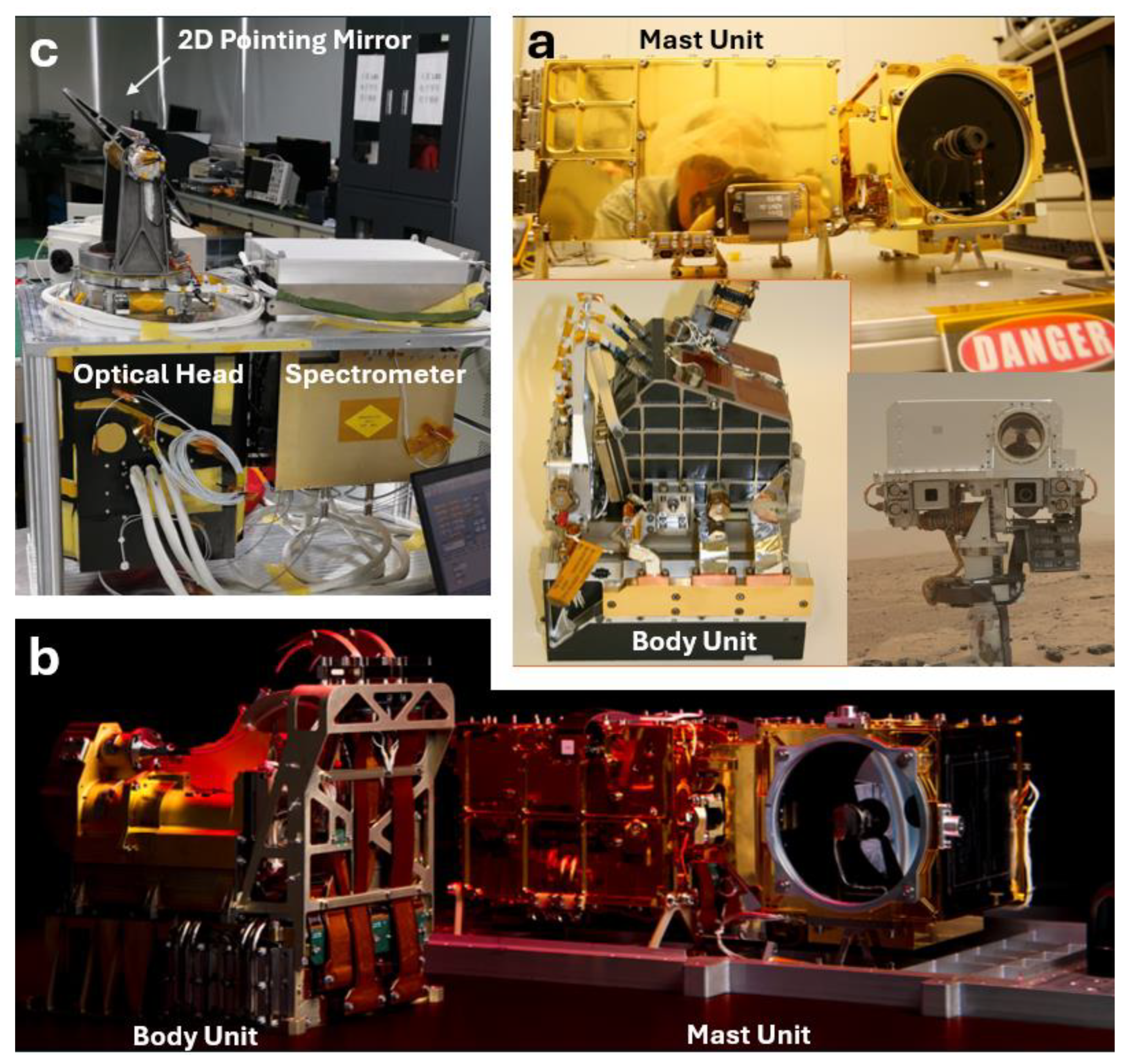
Based on the success of ChemCam, CNSA selected LIBS for its Zhurong rover. In addition to LIBS, the Mars Surface Composition Detector (MarSCoDe) instrument (Figure 2c) included an infrared spectrometer, which, like that on SuperCam (Figure 2b), also benefitted from dust removal by LIBS (Xu et al., 2021).
2. Developing LIBS for Another Planet
2.1. Advantages and Challenges for LIBS on Mars
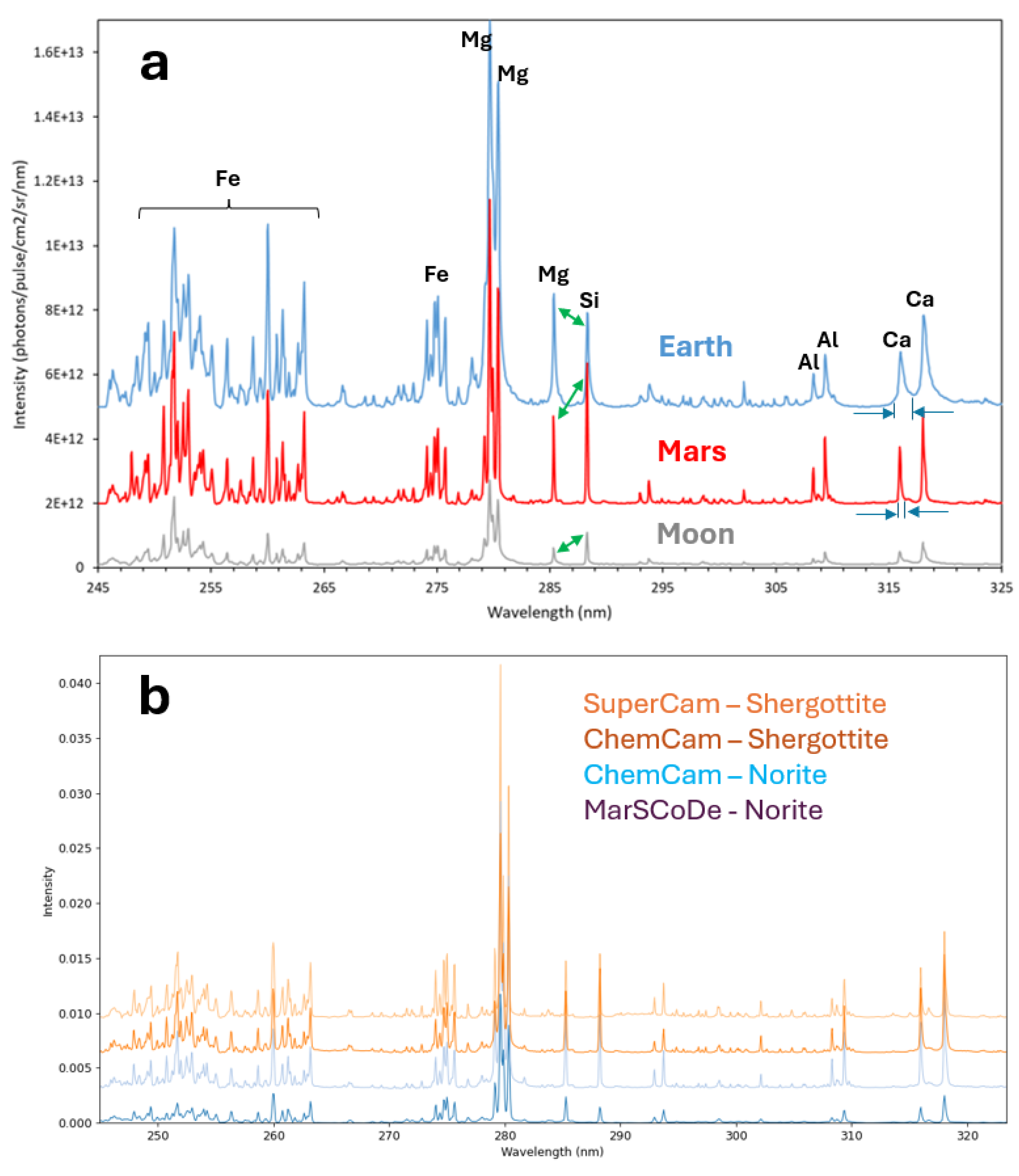
LIBS features a number of advantages in application to another planetary body. Some of these traits apply to many places where LIBS is used, such as its rapidity of analyses, the overall ruggedness of the technique, the ability to probe small (< 100 micron) features, and the ability to determine abundances of essentially all elements, including light elements H, He, Li, Be, B, C, N, O, and F, which cannot be quantified by x-ray techniques. Two physical characteristics of LIBS are especially advantageous to planetary science: its ability to perform at stand-off distances and, as already mentioned, the ability of the plasma shock wave to remotely remove dust from analyses surfaces (Figure 3), which is highly important on a dusty planet like Mars. The ChemCam, SuperCam, and MarSCoDe instruments were designed for LIBS observations up to 5-7 m stand-off distances (Maurice et al., 2012; Wiens et al., 2012; Maurice et al., 2021; Wiens et al., 2021a; Xu et al., 2021). Each observation typically uses 30-60 laser pulses, from which the spectra from the first several laser pulses are discarded due to dust contamination. While the ambient atmosphere profoundly affects the plasma characteristics (Figure 4a), LIBS has proven feasible in any planetary atmosphere (or lack of it) in our solar system, with multiple studies carried out in complete vacuum (e.g., Lasue et al., 2012; Yumoto et al., 2023, Dyar et al., 2024) characteristic of the Moon, Mercury, asteroids, comets, and outer-planet moons, Mars pressure and composition (e.g., Sallé et al., 2004, 2005), and Venus, with its ~90 bars of pressure and high temperature (Clegg et al., 2014). Low-pressure LIBS has the advantage of minimizing self-adsorption of photons that is characteristic of LIBS at terrestrial and higher pressures. Figure 4a compares the spectra of the same target at Earth, Mars, and lunar (vacuum) pressures, showing that, for the millisecond-range exposures used for the spectra in this figure, many emission peaks are significantly broader at terrestrial pressures, likely exhibiting self-adsorption, which significantly hinders quantification. At Mars pressure, the only possibility of significant self-adsorption that we have observed over a decade of use appears in relatively deep holes in the soil created by multiple laser pulses (Martin et al., 2024). The lack of self-adsorption at Mars pressure allowed us to eliminate intensifiers or other fast-shutter devices and use simple, ungated detectors (Wiens et al., 2012; Wiens et al., 2021a). LIBS atomic emission line intensities are generally as strong at Mars pressure as in a terrestrial atmosphere, while emission-line intensities in vacuum, e.g., at the Moon, asteroids, comets, and icy moons, are weaker (Figure 4a) and may require a different spectrometer field of view due to the lack of confinement of the plasma.
Figure 3.
Dust removal by SuperCam LIBS on target Fisherlaguna (Sol 1528); pre-LIBS image with dust-obscured surface is shown in inset. Small pebble at right is ~1.5 mm diameter, for scale. SuperCam performed LIBS in three locations to form an asymmetrical pattern as part of a core-marking procedure done prior to sampling, to enable rotational orientation of the sample core to be identified after it is removed from the rock. The laser pits are indicated by arrows. The rock surface exhibits a dark coating; dust removed from the analysis area is seen piled around it. The LIBS dust removal clears the way, not only for LIBS, but also for the other techniques used by SuperCam.
Figure 3.
Dust removal by SuperCam LIBS on target Fisherlaguna (Sol 1528); pre-LIBS image with dust-obscured surface is shown in inset. Small pebble at right is ~1.5 mm diameter, for scale. SuperCam performed LIBS in three locations to form an asymmetrical pattern as part of a core-marking procedure done prior to sampling, to enable rotational orientation of the sample core to be identified after it is removed from the rock. The laser pits are indicated by arrows. The rock surface exhibits a dark coating; dust removed from the analysis area is seen piled around it. The LIBS dust removal clears the way, not only for LIBS, but also for the other techniques used by SuperCam.
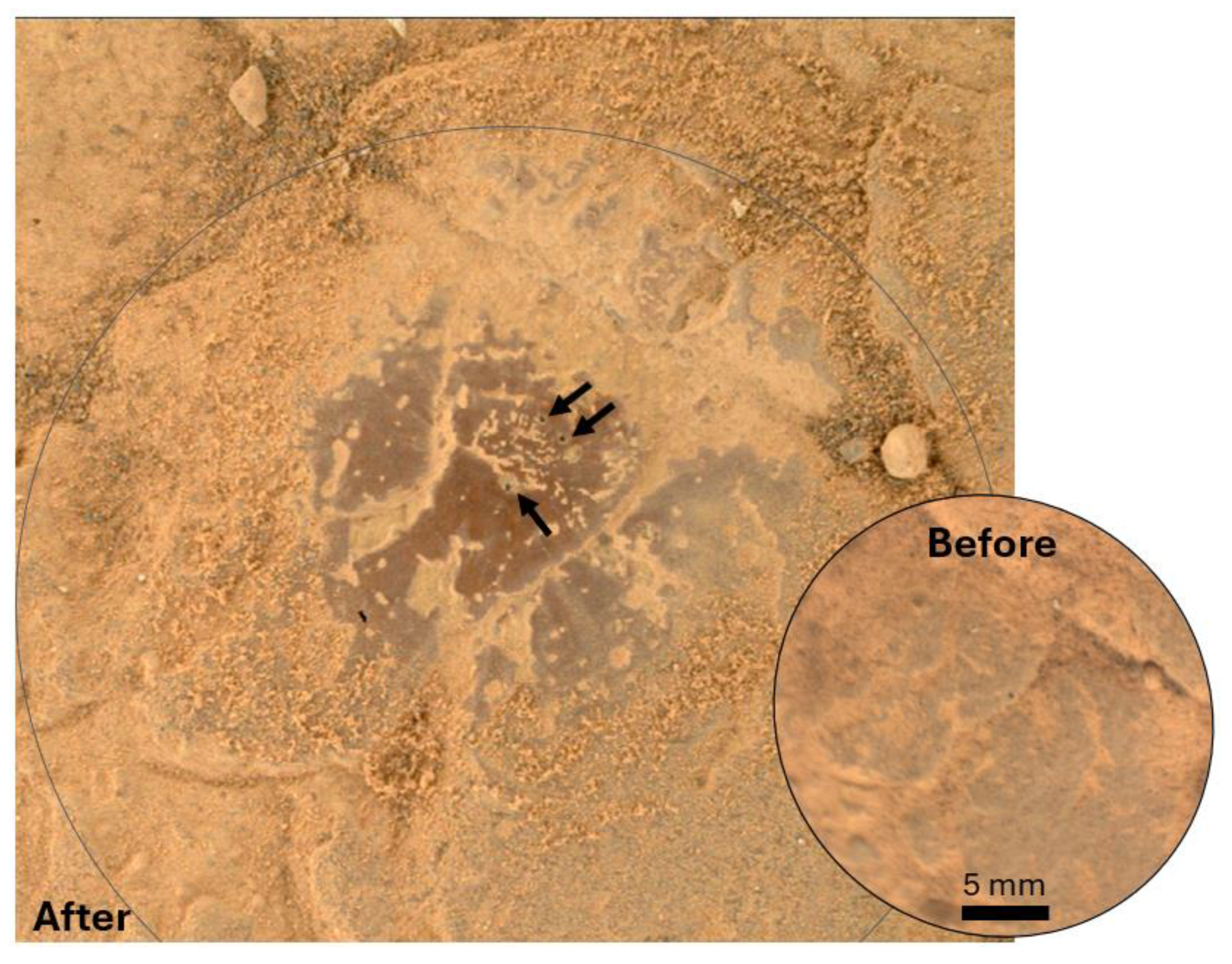
Figure 4.
Planetary LIBS spectra: a) Spectra collected under different planetary atmospheric conditions; shown is a UV portion of the LIBS spectrum of the Shergottite calibration standard (Fabre et al., 2011) observed in air (“Earth”), simulated Mars atmosphere (930 Pa CO2), and in vacuum (“Moon”). The spectra were collected using the SuperCam lab clone at Los Alamos under identical conditions except for the atmosphere; each spectral trace is the average of spectra collected at three different locations on the standard; at each location, 30 laser pulses were used; standard SuperCam pre-processing was applied to remove background, de-spike, remove continuum, and correct for the instrument optical response. Spectral traces for Mars and the Moon are offset for clarity. Green arrow highlights differences in relative peak heights, showing that the 285 nm Mg emission line is taller in air than the 288 Si emission line to the right, while Mg is shorter than Si in the Mars and Moon spectra; there are many other, smaller differences. Dark blue arrows at 316 nm highlight the broader peaks in air than for Mars and the Moon, assumed due to self-absorption. All spectra were collected with long (> >1 µs) exposures, as used on Mars. b) Comparison of normalized UV portions of spectra taken on Mars with the three different LIBS instruments on two different standards (Shergottite and Norite glasses; Table 3 and Fabre et al., 2011) present on the three rovers. Spectral pre-processing has been applied in each case. Spectra are normalized to total emission and are offset for clarity.
Figure 4.
Planetary LIBS spectra: a) Spectra collected under different planetary atmospheric conditions; shown is a UV portion of the LIBS spectrum of the Shergottite calibration standard (Fabre et al., 2011) observed in air (“Earth”), simulated Mars atmosphere (930 Pa CO2), and in vacuum (“Moon”). The spectra were collected using the SuperCam lab clone at Los Alamos under identical conditions except for the atmosphere; each spectral trace is the average of spectra collected at three different locations on the standard; at each location, 30 laser pulses were used; standard SuperCam pre-processing was applied to remove background, de-spike, remove continuum, and correct for the instrument optical response. Spectral traces for Mars and the Moon are offset for clarity. Green arrow highlights differences in relative peak heights, showing that the 285 nm Mg emission line is taller in air than the 288 Si emission line to the right, while Mg is shorter than Si in the Mars and Moon spectra; there are many other, smaller differences. Dark blue arrows at 316 nm highlight the broader peaks in air than for Mars and the Moon, assumed due to self-absorption. All spectra were collected with long (> >1 µs) exposures, as used on Mars. b) Comparison of normalized UV portions of spectra taken on Mars with the three different LIBS instruments on two different standards (Shergottite and Norite glasses; Table 3 and Fabre et al., 2011) present on the three rovers. Spectral pre-processing has been applied in each case. Spectra are normalized to total emission and are offset for clarity.
LIBS possesses some disadvantages, particularly its relatively poor detection limits for certain elements that are key to Mars geochemistry. Among these are sulfur, chlorine, and phosphorous. Mars’ crust is enriched in S and Cl (e.g., Taylor and McLennan 2009) and so they play important roles in the geochemical cycles there. The strongest emission lines of sulfur, reviewed, e.g., in Dyar et al. (2010), are in the deep UV (180.73, 182.03 nm1, and shorter wavelengths) and infrared (921.54, 923.06, 924.01 nm), beyond the ranges of ChemCam, SuperCam, and MarSCoDe. Because of this, S is not routinely quantified by current Mars LIBS instruments, although S is observed using weaker lines in the 542-565 nm range when it occurs as a major constituent, such as in relatively pure Ca or Mg sulfates (Nachon et al., 2014; Rapin et al. 2019) or elemental sulfur (Forni et al., 2025). Future instruments will likely extend the range to cover the near infrared S emission peaks. Likewise, the strongest Cl emission line in these instruments’ spectral ranges, at 837.82 nm, is relatively weak, such that it is not routinely observed, though it can be observed when NaCl or perchlorates are present in significant amounts (Thomas et al., 2019; Wolf et al., 2025). Phosphorous is important in biological processes, and thus in understanding the likelihood of past life on Mars, but its strongest emission lines (253.47, 253.64, 255.40, 255.57, 417.97 nm) are weak, and so the Mars instruments cannot observe P other than exceptional cases such as apatite grains and diagenetic features (Forni et al., 2015; Meslin et al., 2022; Treiman et al., 2023).
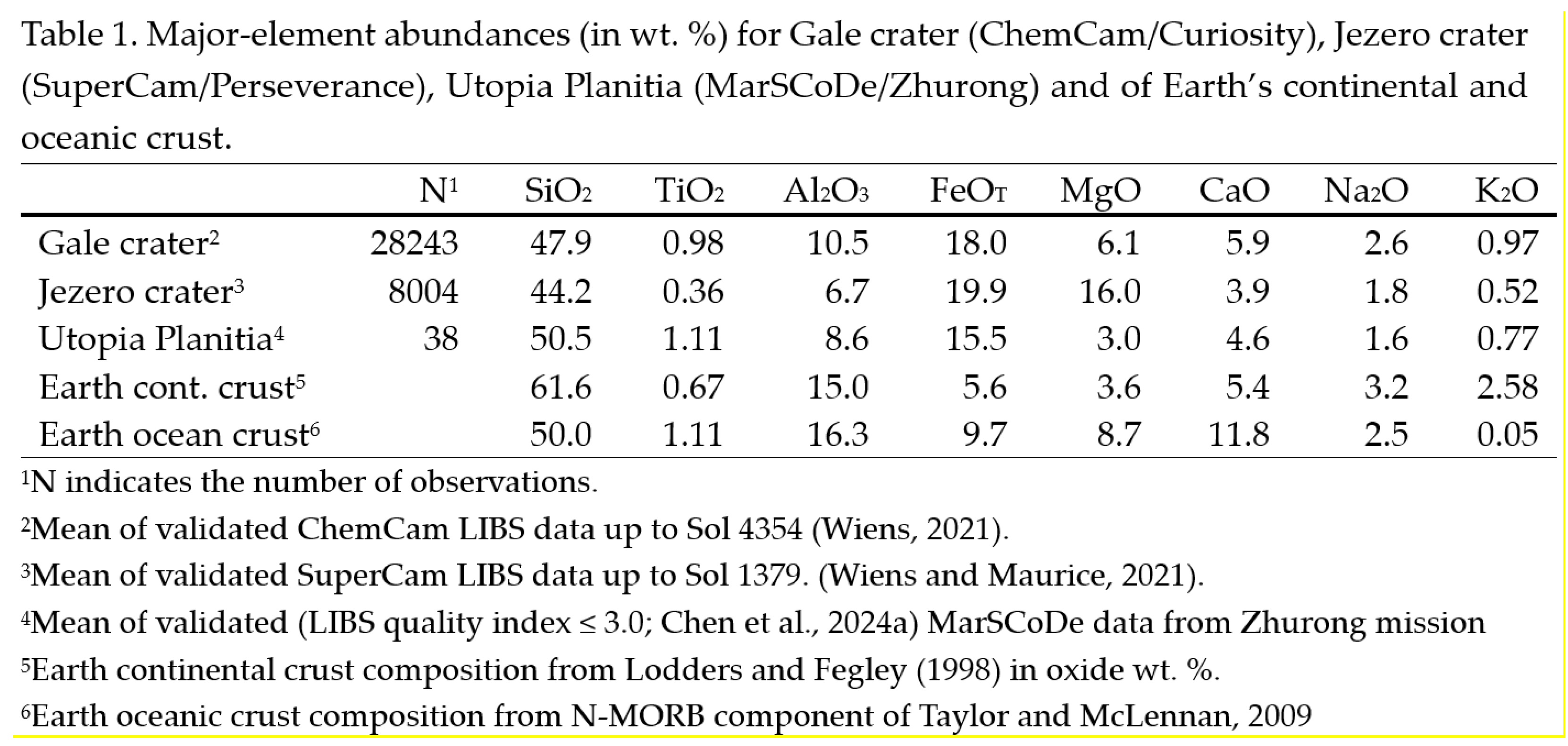
A slight disadvantage of LIBS on Mars relative to Earth is due to Mars’s crustal enrichment in iron, as seen in Table 1. The net effect of the high iron abundances is variably poorer detection limits for many trace elements due to the large number of interfering Fe emission lines (Figure 4).
The Mars atmospheric pressure varies by ~ 10% over the course of a 24-hour 38-minute day-night cycle, and by ~30% over the course of a year (e.g., Ullan et al., 2017; a Mars year is 687 Earth days). The ChemCam team initially thought that this pressure variation would not show any effect on the LIBS. However, with continuous LIBS observations for over 13 years, we see a small effect of atmospheric pressure on the C/O emission line ratio (Beck et al. 2023). Both emission lines are mostly from carbon dioxide in the atmosphere, excited in the plasma; the effect of this pressure difference on the major-element quantification is expected to be well within their uncertainty ranges.
2.2. Instrument Designs
All three Mars instruments have broadly similar architectures and operational parameters (Figure 5; Table 2). Along with LIBS, all three instruments capture high-resolution images of the target area with a Remote Micro-Imager (RMI), allowing the users to view the laser pit and place its composition into the context of the rock or soil, whether fine- or coarse-grained, and, in some instances such as targeting a vein, whether the intended target was hit (Figure 5). MarSCoDe additionally includes a short-wavelength (0.85-2.40 µm) infrared spectrometer (Xu et al., 2021), while SuperCam includes an infrared spectrometer (1.3-2.6 µm; Fouchet et al., 2022), a time-resolved remote green-laser Raman spectrometer, and a microphone (Wiens et al., 2021a; Maurice et al., 2021). As discussed elsewhere, these various techniques are highly complementary to the LIBS investigations.
For LIBS, all three instruments use an infrared laser emitting ~4 ns pulses, the beams of which are expanded and focused by Schmidt-Cassegrain telescopes in the 100-110 mm aperture range (Figure 2), with on-target beam energies of 10-14 mJ per pulse (Table 2). The telescopes collect LIBS plasma emission and focus the light into a 300 µm optical fiber for transfer to the spectrometers (Figure 5). In the case of ChemCam and SuperCam, the optical fiber is > 5 m long, allowing the laser and telescope (part of the “Mast Unit,” Figure 2a, b) to be positioned on the rover’s mast, ~2 meters above the ground, allowing a good view of the surrounding surface in all directions (Maurice et al., 2012; Maurice et al., 2021), while the spectrometers are located in the rover body (“Body Unit”), minimizing the weight on the rover’s mast and its gimbals. In the case of MarSCoDe, all the main parts of the instrument reside in the rover body, which is thermally advantageous, and target acquisition is done via a 2D pointing mirror (Figure 2c) that extends slightly above the rover body, providing a view of targets to the front and sides of the rover (Xu et al., 2021). For MarSCoDe, the optical fiber between the telescope and spectrometers is thus short.
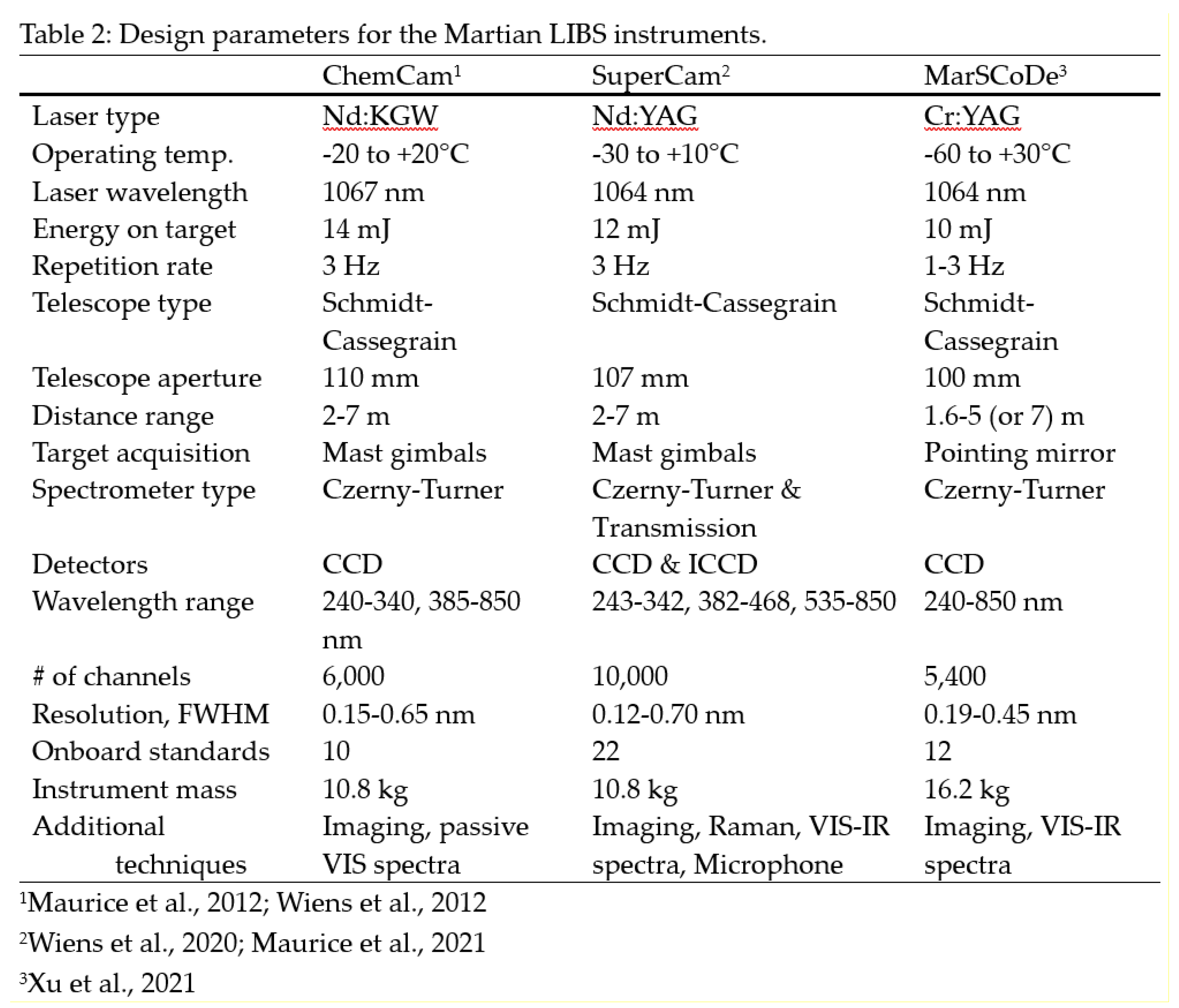
Each instrument uses crossed Czerny-Turner (C-T) optical spectrometers to collect the LIBS spectra across several optical bands. Light is split into three wavelength bands by an optical demultiplexer prior to entering the spectrometers (Figure 5); between the demultiplexer and the spectrometers, fiber bundles transfer the light, with the bundle in a circular orientation at the receiving end and in a linear orientation at the spectrometer to maximize throughput at the spectrometer slit aperture (Wiens et al., 2012; Wiens et al., 2021a; Xu et al., 2021). The wavelength ranges are generally the same among all three instruments, designed to cover the primary major-element emission lines in the easily accessible optical range (240-850 nm). ChemCam and SuperCam have gaps in the range and slightly higher optical resolution, while MarSCoDe has complete coverage with generally slightly lower resolution in some portions of the spectrum (Table 2). The density of emission lines in the ultraviolet portion of the spectrum necessitates optical resolutions of < 0.20 nm in this spectral range, while resolution requirements are relaxed at longer wavelengths (Table 2). All three instruments use ungated CCDs to collect the spectra with effective exposure times in the millisecond range. As noted above, time gating of spectra to avoid quantification inaccuracy due to peak saturation is not needed in the thin Mars atmosphere. SuperCam differs from the others in having a transmission spectrometer and an intensified CCD (ICCD) for its longer-wavelength range, while using simple C-T spectrometers and non-intensified CCDs in the lower spectral ranges. The transmission spectrometer is used to accommodate remote time-resolved Raman spectroscopy using a frequency-doubled green laser beam; the intensifier greatly enhances the weak Raman signals coming from several meters away, and the time gating to 100 ns effectively removes the ambient light and also allows time-resolved luminescence observations (Wiens et al., 2021a; Maurice et al. 2021; Lopez et al., 2025). For LIBS, the gain is reduced and the time gating is increased to 10 µs to capture all of the LIBS plasma. The transmission spectrometer facilitates other types of LIBS experiments, such as plasma-induced luminescence (e.g., Clavé et al., 2021) and strong intensification of the LIBS signal, however, very few of these types of LIBS experiments have been conducted on Mars with no notable results so far. To meet the Raman spectroscopy requirements, the spectral resolution of the transmission spectrometer was increased to ~0.30 nm FWHM in the range from 535-600 nm. This required the projection of not one, but three simultaneous spectral traces onto the ICCD, resulting in ~10,000 channels for SuperCam overall, rather than the 5400-6000 channels in the other two instruments (Table 2; Wiens et al., 2021a; Wiens et al., 2012; Xu et al., 2021).
Various materials and methods were used to ensure that the instruments are lightweight and durable. The Mast Units of ChemCam and SuperCam were made mostly of aluminum, including the telescope mirrors, while the mounting feet were made of fiberglass to minimize heat loss (Maurice et al., 2012, 2021). The MarSCoDe Optical Head was made mostly of carbon fiber composite (Xu et al., 2021). ChemCam’s Body Unit has a Mg electronics box and spectrometer housings made of beryllium to save weight (Wiens et al., 2012), while SuperCam saved mass in other ways and has spectrometers made of titanium for low thermal expansion (Wiens et al., 2021a). The masses of ChemCam and SuperCam are essentially identical (Table 2). The higher mass of MarSCoDe includes the 2D Pointing Mirror constructed with silicon carbide (Al-SiC), while the rovers’ mast pointing gimbal assemblies are not accounted for in the mass of the other two instruments.
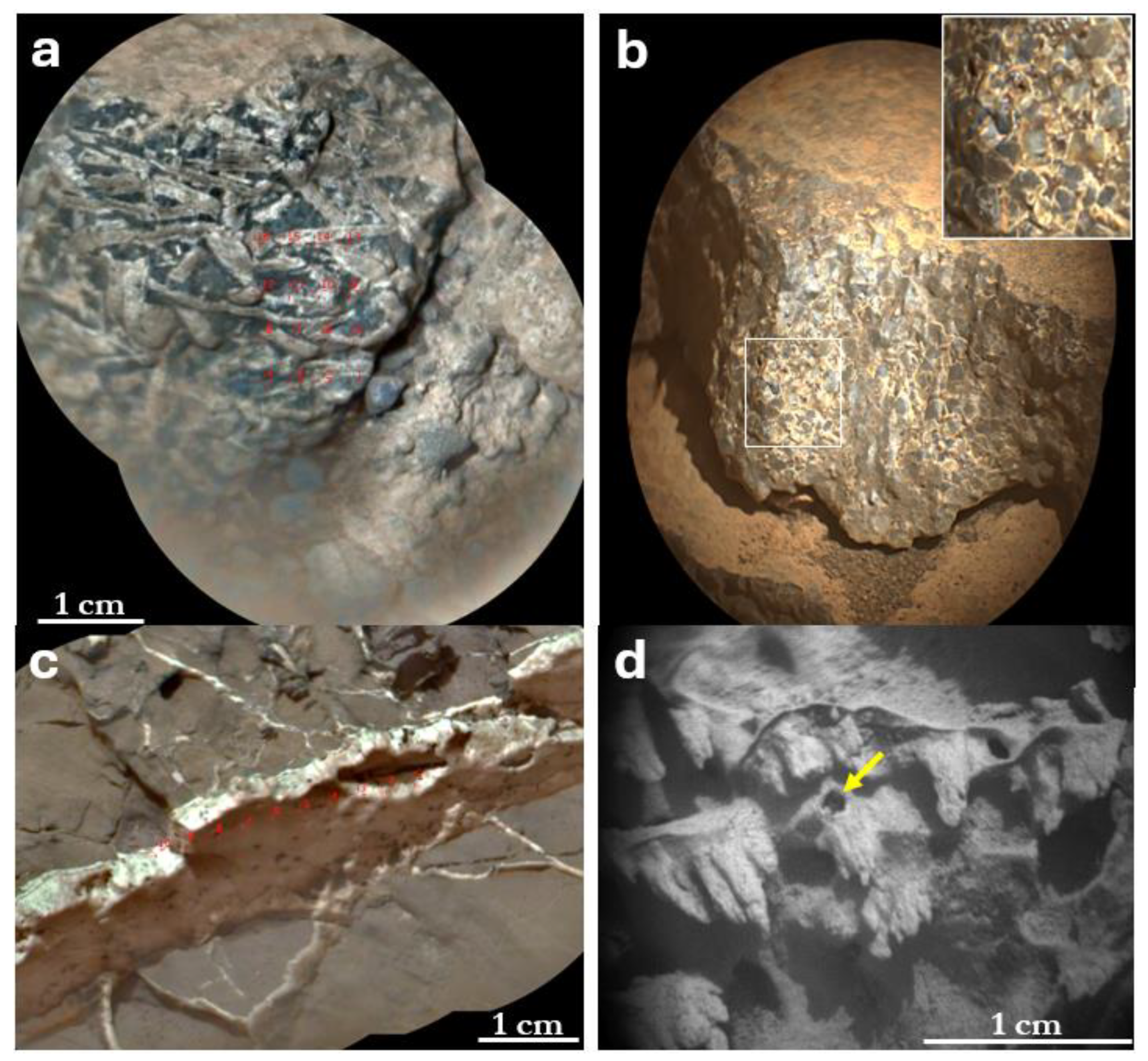
Operationally, the instruments must work autonomously and robotically because sets of commands are sent to Mars no more than once per day. Targets are selected based on images relayed to the ground from other on-board cameras. Stereo cameras provide an approximate distance to the targets (accurate within 1-5%), used as a seed in achieving the final focus. For all three instruments, the focus is adjusted by moving the small secondary mirror of the telescope on a linear stage (Figure 5). ChemCam and MarSCoDe were designed to autofocus using low-power continuous-wave (CW) diode lasers (Maurice et al., 2012; Xu et al., 2021). The reflected beams were sensed as the secondary mirror was moved, providing a peak at the best focus position. The instrument then autonomously moved the focus stage back to that position to perform the LIBS analysis. ChemCam’s CW autofocus laser failed two years into the mission and the team developed a new autofocus algorithm based on optimizing the contrast in a central region of its imager (Peret et al., 2016). The imaging-based autofocus is more accurate than the CW autofocus, and so imaging was baselined as the main focus method for SuperCam, although there is also a CW autofocus option (Maurice et al., 2021), which can be used in low-light conditions such as down a drill hole and at night. Both ChemCam and SuperCam investigate targets using a raster of observation points, generally 1x5 or 1x10 line scans (Figure 6c), or a 2x2 or 3x3 grid, with points usually separated by 1-5 mm (Figure 6a; the sample core marking shown in Figure 3 is not a normal analysis in this respect). If the topography of the target results in a significant (e.g., > 0.1%) change in the distance to the target, additional autofocuses are included in the command sequence. MarSCoDe mostly operated with single observation points on its targets (Figure 6d).
Standards were mounted on the rovers to ensure that accurate calibration is maintained. On each rover, one target consists of titanium; its large number of emission lines across the spectrum are used to check the wavelength calibration within ~0.02 nm. Other standards consist of geologic targets, with SuperCam having the largest number of such targets (Table 2; Manrique et al., 2020; Cousin et al., 2022). In all cases, the elemental calibrations use a much larger library of standards observed using similar instruments on Earth, as described below.
Figure 6.
Close-up images of LIBS targets: a) Gale crater Aeolus Palus conglomerate target Harrison shows cm-size light-toned feldspar crystals in one of the first felsic Noachian rocks examined up close by ChemCam. Red marks and numbers indicate the LIBS observation locations in a 4x4 raster. b) Jezero crater-floor target Cine, analyzed by SuperCam, displays 1-2 mm olivine crystals indicative of a gravitational cumulate in the Seitah formation. Inset shows a close-up of the grains, which display altered rims. c) Gale crater Murray formation target Catabola is a protruding Ca-sulfate vein in fine-grained lacustrine mudstone bedrock. The vein contains boron, hinting at surface evaporation. Red marks indicate the locations of the LIBS raster. d) MarSCoDe target shows a block with ventifact features in Utopia Planitia. Yellow arrow points to the location of LIBS analysis, which punched a hole in the soft material.
Figure 6.
Close-up images of LIBS targets: a) Gale crater Aeolus Palus conglomerate target Harrison shows cm-size light-toned feldspar crystals in one of the first felsic Noachian rocks examined up close by ChemCam. Red marks and numbers indicate the LIBS observation locations in a 4x4 raster. b) Jezero crater-floor target Cine, analyzed by SuperCam, displays 1-2 mm olivine crystals indicative of a gravitational cumulate in the Seitah formation. Inset shows a close-up of the grains, which display altered rims. c) Gale crater Murray formation target Catabola is a protruding Ca-sulfate vein in fine-grained lacustrine mudstone bedrock. The vein contains boron, hinting at surface evaporation. Red marks indicate the locations of the LIBS raster. d) MarSCoDe target shows a block with ventifact features in Utopia Planitia. Yellow arrow points to the location of LIBS analysis, which punched a hole in the soft material.
2.3. Data Processing and Calibrations
The aim of LIBS data processing and calibration is to 1) identify the presence of elements above their detection threshold (such as for trace elements), and 2) quantify the chemical composition of the targets, i.e., for the major elements.. Quantification of the major elements requires several critical pre-processing steps. These include accurate wavelength calibration (correcting for thermal drift in some cases in the extreme environment), de-spiking, removal of background including continuum, and—due to the broad range of distances—normalization. The normalization adds a significant degree of complexity (e.g., Wiens et al., 2013; Clegg et al., 2017; Anderson et al., 2021) that is not generally needed in the laboratory environment in which distance and other environmental factors are usually held constant. For example, in the UV spectral range, samples with high iron result in low normalized peak areas of other elements due to the large number of iron peaks which greatly increase the total emission by which the spectrum is usually normalized. By comparison, a low-iron sample having the same abundance of the element in question will have a much higher normalized peak area due to the comparatively low number of emission peaks against which it is normalized. The calibration algorithms must be able to account for this phenomenon. Other normalizations are possible, such as to a single emission peak like oxygen, but in our work, they have resulted in less accurate calibration models.
Calibrations to provide elemental abundances from LIBS spectra follow similar treatments for ChemCam, SuperCam, and MarSCoDe, all aimed at providing quantification of all the major elements, given as oxides (SiO2, TiO2, Al2O3, FeO, MgO, CaO, Na2O, and K2O), for most situations encountered by the rovers. All three rovers carried between ten and twenty-two LIBS calibration targets on board (Fabre et al., 2011; Vaniman et al., 2012; Wiens et al., 2012; Manrique et al., 2020, Cousin et al., 2022, Madariaga et al., 2022; X. Liu et al., 2023), and two targets (Shergottite and Norite; Table 3, Fabre et al. 2011) were shared among the rovers. Comparison spectra from all three instruments on Mars are shown in Figure 4b. All three teams used calibration transfer (e.g., Boucher et al., 2017) to extend the calibration to larger sets of standards observed in laboratories. The calibration-transfer approach was necessitated by the need to cover a very large phase space from low to high abundances of all these elements without knowing in advance the ranges of compositions to be encountered. LIBS elemental calibrations can be quite accurate when covering only a small range in composition (e.g., Anderson et al., 2017), but in this case we strive for complete coverage over the full ranges experienced on Mars. A partial solution to this dilemma is to use “sub-models” that cover narrower compositional ranges along with a global model that assigns the appropriate sub-model (Anderson et al. 2017). The major elements (Table 1) are determined using multivariate analysis (MVA) to take advantage of multiple emission lines for each element. The ChemCam and SuperCam teams started with spectral libraries built from a relatively small number of standards (< 100 for ChemCam, < 400 for SuperCam) and graduated to spectral libraries with much larger numbers of standards (> 400 for ChemCam; > 700 for SuperCam) once the ranges of approximate compositions encountered near the landing sites were understood (Wiens et al., 2013; Clegg et al., 2017; Anderson et al., 2021). The subsequent, expanded libraries were obtained with identical instruments in the laboratory, correcting for the relative instrument optical responses of the respective instruments (e.g., Wiens et al., 2012; Wiens et al., 2021a; Legett et al., 2022). The standards were analyzed in chambers with Mars ambient atmospheric composition and pressure. (Mars’ atmosphere consists of 95% CO2 at ~500 Pa pressure; after testing in Mars gas, we have defaulted to using pure CO2 at that pressure). Transmission of the laser and plasma light through the chamber window was accounted for along with the instrument optical response corrections.
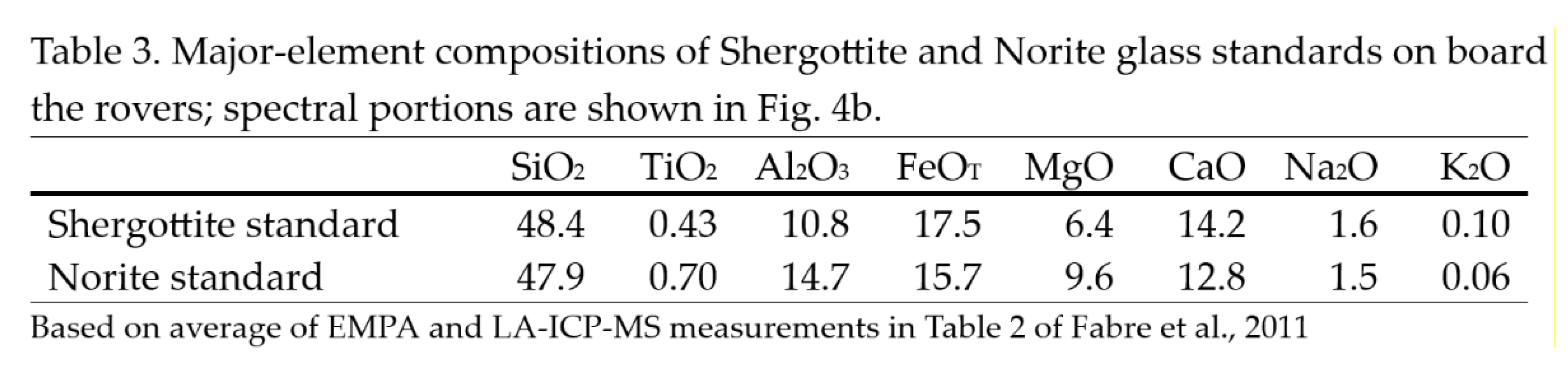
MarSCoDe LIBS data processing used various algorithms to decode the surficial compositions. C. Liu et al. (2022) employed a transfer learning approach by training multi-peak polynomial models on ChemCam lab data and performing data-level transfer from MarSCoDe to ChemCam enabled by the shared Norite target (Figure 4b; Table 3). Zhao et al. (2023) incorporated simple univariate calibrations using onboard calibration observations of Norite. Chen et al. (2022a) established a probabilistic major-element calibration (PMEC) with pre-flight lab data from a suite of 93 certified samples obtained by the MarSCoDe flight model, where Natural Gradient Boosting (Duan et al., 2020) regression was used to determine the abundances and uncertainties of the major elements. These models were found to produce results with both systematic and data-based differences: the former may be related to the selection of the algorithms and the latter related to the models’ robustness to data quality (Chen et al., 2024a).
For minor and trace elements, calibration is often performed using only the strongest emission peak for that element. MVA is generally avoided, unless confined to a narrow spectral range, as it can improperly focus on geochemical affinities of elements with stronger peaks to the exclusion of the few weaker peaks of the element of interest. Derived compositions based on geochemical affinities can especially be wrong when all the standards are from one planet (Earth) that may not correctly represent the relationship between geochemically related elements on another planet. An example is Li and Mg, where Li tends to substitute for Mg in igneous minerals such as pyroxene, mica, and amphibole, but the Li abundances on Mars may be incorrectly predicted by MVA based on Mg abundances and the typical terrestrial Li/Mg ratio range present in terrestrial standards, which may not be the same on Mars. Geochemists using MVA must be aware of this issue. Some literature has, in the past, provided supposed abundances for elements when the emission peaks for the given element are in fact undetectable. The SuperCam team developed a “peak checker” algorithm that avoids providing MVA results when emission lines of the element in question are too weak or absent. Mars minor and trace-element calibrations and results have been reported in general by Ollila et al. (2014), Payré et al. (2017), Luo et al. (2025), and Gabriel et al. (submitted). These studies have mostly covered Li, Rb, and Sr; many other minor and trace elements have been calibrated individually (e.g., Forni et al., 2015; Lasue et al., 2016; Gasda et al. 2017; Payré et al., 2019; Thomas et al., 2019; Rapin et al., 2017a; Gasda et al., 2021; Luo et al., 2025) and some of those results are described below.
The respective Mars environments helped to dictate the chemical ranges of the standards used in the laboratory to constrain MVA techniques. ChemCam explored a large crater lake in which much of the bedrock consisted of fine-grained sediments (Grotzinger et al 2015; Vasavada 2021). The range of compositions was generally relatively limited, and relatively few coarse-grained minerals were observed, resulting in significant homogeneity (e.g., Frydenvang et al., 2020), since the laser beam nearly always interrogated multiple small grains, providing a mean composition. There are many exceptions, especially in terms of diagenetically emplaced or altered materials, as discussed below. MarSCoDe also analyzed an area of Mars that was overall relatively fine-grained and homogeneous (Wu et al., 2021). SuperCam, on the other hand, started with coarse-grained igneous rocks, including gravitationally segregated cumulate rocks, and has observed rocks with extreme aqueous alteration as well, as discussed below. Grain size makes a significant difference in analyses, since sizes comparable to and larger than the laser beam will tend toward pure mineral compositions, while analyses of fine-grained rocks will tend toward bulk rock compositions (McCanta et al. 2013).
The precisions of the ChemCam, SuperCam, and MarSCoDe instruments are significantly better than their corresponding accuracies, given the large compositional ranges that the derived abundances need to cover. For example, while accuracies of SiO2 for ChemCam are generally around ±5 wt.% (exact accuracy varies with abundances), the precision is ±1.5 wt.% (Clegg et al. 2017), indicating that the knowledge of one measurement relative to another is quite good even if the absolute abundance is not known as well. The accuracies are derived from a “test set” of standards that are held out of the calibration model, while the precision is determined by the standard deviation of multiple observations of the same target (Wiens et al., 2013; Clegg et al., 2017; Anderson et al., 2021) or by comparison of single-pulse spectra from the same target (Chen et al., 2022a). As noted earlier, it would be possible in special cases to improve the accuracy to be closer to the precision if a larger number of appropriate standards were used and if specific models were trained on a small range of composition of interest.
Within the realm of LIBS applications, relatively few cover a large range of target distances. As noted earlier, normalization of the spectra is required for ChemCam, SuperCam, and MarSCoDe due to the large range of overall intensities of the spectra at different distances. As the laser is focused at increasing distances, the size of the ablation spot increases until at long enough distances, the deposited energy density is no longer sufficient to create a plasma. ChemCam and SuperCam are mounted on the masts of their respective rovers, a height of ~2 meters above the ground, which sets the minimum distance to surface targets. MarSCoDe’s 2D pointing mirror was mounted lower to the ground, and its observations were within 5 m of the instrument. ChemCam can obtain spectra from bedrock to a distance of ~7 m, but it was found that it can observe iron meteorites to ~10 m due to the improved optical coupling of Fe-Ni to the laser (Johnson et al., 2020). SuperCam’s telescope optics are improved relative to ChemCam, and ordinary bedrock targets can be observed with LIBS to ~15 m; no iron meteorites have yet been found in Jezero crater. Validated elemental abundances are currently only provided for shorter-distance targets (usually to 3.5 m for ChemCam and to 6.5 m for SuperCam), to ensure that modeled uncertainties remain within the specified values.
It has been shown with ChemCam that with increasing distance to a target, emission lines having higher excitation potentials become weaker relative to emission lines with lower excitation potentials (Melikechi et al., 2014; Mezzacappa et al., 2016), resulting in slight changes to elemental calibration as a function of distance. Wiens et al. (2021b) provided empirical corrections for these trends for several elements. SuperCam’s major-element calibration does not show this same distance effect (Anderson et al., 2021; Manelski et al. 2024), possibly because the MVA models are trained on more robust emission lines.
3. Highlights from Three Mars Missions
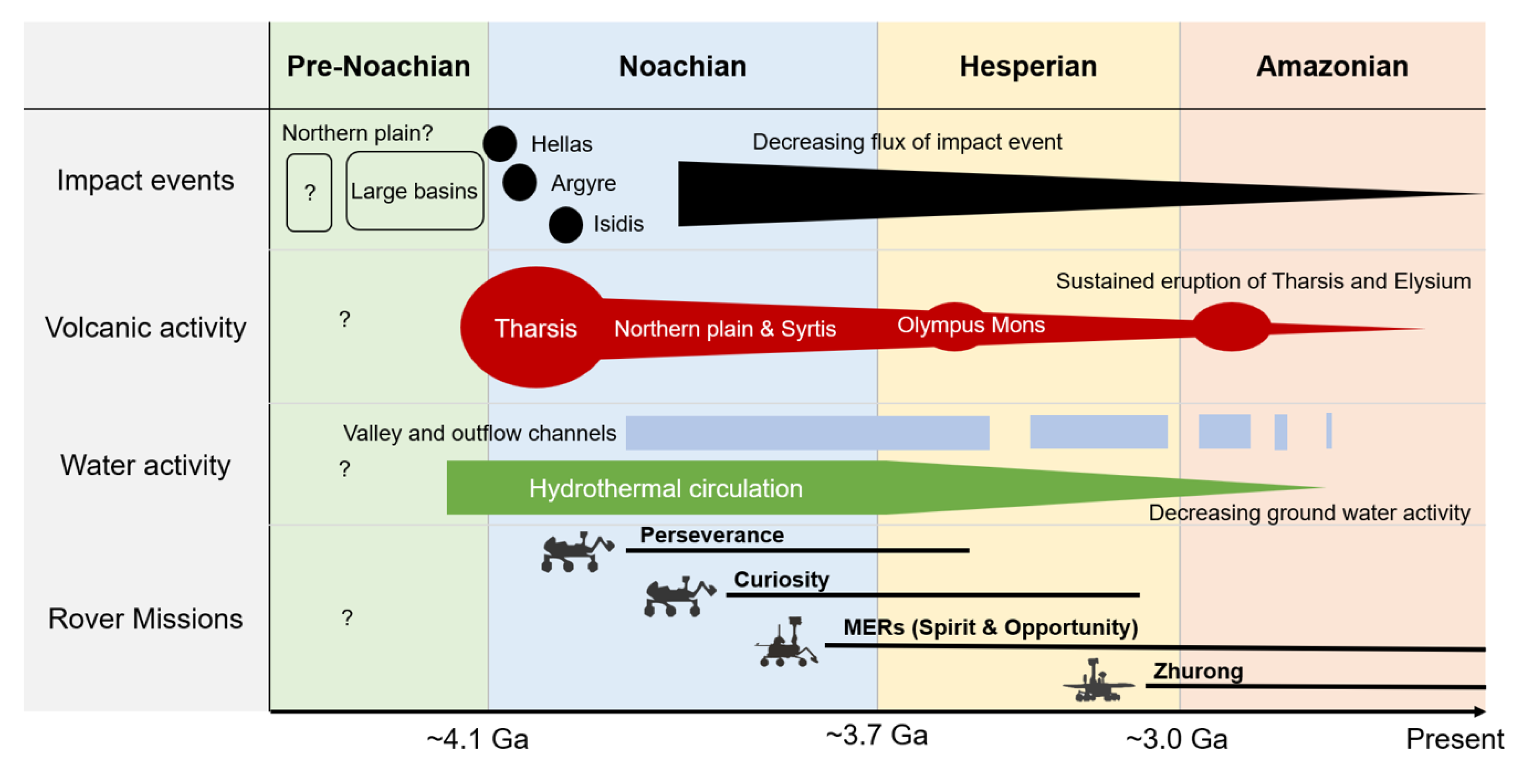
As a planetary body, Mars differs fundamentally from Earth in that it lacks plate tectonics and recent aqueous surface activity, resulting in a much more ancient surface overall on Mars than on Earth. The lack of plate tectonics may have also contributed to the loss of water and atmosphere, since none of the water or other volatiles trapped in hydrated sedimentary rocks has been returned to the surface (e.g., Scheller et al. 2021). Thus, while Mars apparently entered the Noachian period as a habitable planet, the Hesperian period that followed was one of increasing desiccation, and the Amazonian period has been mostly dry with relatively little activity (e.g., Golombek et al., 2006; Carr and Head, 2010; Ehlmann et al., 2011; Arvidson, 2016). These details are illustrated in caricature in Figure 7, along with the relative time periods of the geological features explored by the Mars rovers. The overriding result of the Curiosity rover’s exploration was the discovery that large lakes, rivers, and streams existed on Mars for long time scales of at least a million years between ~3.6 and 3.2 Ga (Grotzinger et al., 2015; Vasavada 2022). The Perseverance rover was sent to Jezero crater, located between the Isidis Basin and the Nili-Syrtis igneous province. Jezero’s age is estimated at 3.6-3.8 Ga, slightly younger than Isidis, which is estimated ~3.9 Ga (Farley et al., 2021 and references therein). The goals of its exploration were 1) an ancient river delta, 2) an overlying unit that is uniquely carbonate-rich, 3) the first large (> 20 km) crater rim to be explored, and 4) the ancient Noachian terrain outside the crater (Farley et al., 2021 and references therein). By contrast, the Zhurong rover landed in a clearly younger terrain, dating ~3.1 Ga in the late Hesperian period (Figure 7), in a relatively flat terrain characterized by volcanic and potentially ice-related features. Some of these features include troughs, ridges, pitted cones, rampart craters, and pancake-like ejecta (Ye et al., 2021).
The subsections that follow give highlights from the LIBS observations; we follow up with a comparison of the overall compositions from the three LIBS missions.
Figure 7.
Overview of the timing of various activities and events over the history of Mars. The four periods are labeled and color-coded. The locations of the rovers and their timelines indicate the time periods that each one has investigated. After Elhmann et al. (2011), Carr and Head (2010), Arvidson (2016), and Golombek et al. (2006).
Figure 7.
Overview of the timing of various activities and events over the history of Mars. The four periods are labeled and color-coded. The locations of the rovers and their timelines indicate the time periods that each one has investigated. After Elhmann et al. (2011), Carr and Head (2010), Arvidson (2016), and Golombek et al. (2006).
3.1. LIBS Discoveries in an Ancient Lakebed: ChemCam in Gale Crater
The Curiosity rover landed in Gale crater (~4.5° S, 137.4° E) in 2012 (Figure 8a). With the very first LIBS laser pulse on Mars, the ChemCam team discovered that Mars’ dust and soil are hydrated. The hydrated component extends to the finest-grained airborne material that coats every surface. The soil consists of a range of grain sizes, with the coarser grain sizes more influenced by the local rocks (Meslin et al., 2013; Cousin et al. 2015, 2017a). Hydration of the fine-grained component is ubiquitous, being seen at many places along both the Curiosity and Perseverance rovers’ > 30 km respective traverses. The hydration has been correlated with Mg and sulfur in ChemCam data, indicating that a significant carrier of water in the soil is a hydrated Mg sulfate (David et al. 2022).
Prior to the landing of Curiosity, Mars was thought to be a mostly mafic (Mg and Fe-rich) basaltic planet, bearing similarities to Earth’s relatively dense oceanic crust, rich in olivine and pyroxene (e.g., Taylor and McLennan, 2009). However, upon landing in Gale crater, ChemCam observed many igneous clasts and small boulders rich in feldspar (e.g., Figure 6a). Gale crater is near the border of the southern highlands (e.g., Grotzinger et al., 2012, and references therein), the Noachian bedrock of which has been largely overlain by sediments and subsequent Hesperian lavas. Rocks washed down from Gale crater’s rim, observed in the early part of its traverse in Aeolis Palus (Figure 8a) provided the first opportunity for ground-based observations of Noachian highlands basement material, a detail of greater importance because infrared spectroscopy, as used for orbital surveys of Mars, is insensitive to feldspar. ChemCam was thus the first to observe the abundance of feldspars in the Noachian highland rocks (Sautter et al., 2014, 2015, 2016; Mangold et al., 2016, 2017; Cousin et al., 2017b; Bowden et al. 2022). Modeling of crustal density based on the InSight lander’s seismic surveys have subsequently confirmed the existence of lower-density crust in the southern highlands (e.g., Wieczorek et al., 2022), consistent with feldspar-rich highlands basement rock.
The predominant bedrock along Curiosity’s traverse has been sedimentary, and ChemCam’s large number of observations was able to characterize variations in the inputs of sediments (both fluvial and aeolian) to the lake that once occupied Gale crater. These inputs included a strong pulse of volcanic tridymite found at Marias Pass (Frydenvang et al. 2017; Figure 8a), and enrichments of the K-rich mineral sanidine at the Kimberley (Le Deit et al., 2016; Figure 8a). The Kimberley was also enriched in some trace elements, particularly copper, leading to the suggestion of a copper porphyry deposit in a region upstream of Gale crater (Payré et al., 2019). Farther along the traverse and higher in elevation, ChemCam observed a unique region rich in Mg sulfates and manganese, both thought to be remnants of ancient beach deposits (Rapin et al., 2019; Gasda et al., 2024). The ChemCam team has also used the elemental compositions to study the prevalence of clay minerals produced by aqueous alteration, both in the Murray formation (Mangold et al., 2019; Frydenvang et al., 2020) and in the Glen Torridon formation (Dehouck et al., 2022). The two methods used for this were the chemical index of alteration (CIA), which quantifies the relative enrichment of aluminum, an insoluble element that is concentrated by dissolution of other, more soluble elements (Mangold et al., 2019; Dehouck et al. 2022; Nesbit and Young 1984); the other method of estimating clay mineral abundances by LIBS elemental compositions was by tracking the abundances of lithium (Frydenvang et al., 2020), which concentrates in clay minerals.
A final topic highlighted here is the characterization of diagenetic materials by ChemCam. Many diagenetic materials are fine scale, such as materials precipitated from groundwater and now filling veins in the rocks, and also nodules, often produced while sediments are still soft. ChemCam’s small beam size allowed it to uniquely probe many of these materials (Figure 6c). Early in the mission, light-toned vein-filling materials were identified by ChemCam as Ca sulfates (Nachon et al. 2014) while erosion-resistant ridges were enriched in Mg (Leveille et al. 2014). Boron and iron were discovered in Ca-sulfate veins farther along the rover traverse (Gasda et al., 2017; l’Haridon et al., 2018; Nellessen et al., 2023). The iron suggests specific redox conditions, while the boron was likely re-precipitated from a time when the lake in Gale crater became dry. Manganese (Lanza et al. 2016) was discovered along with zinc enrichments (Lasue et al. 2016) in fracture fill material in a unique sanidine-enriched region along the traverse (Le Deit et al. 2016). The precipitation of Mn, as well as the variable oxidation states of iron, indicate unique and as-yet not understand strong redox conditions. Silicon enrichments were observed in some localized rock fracture zones both above and below the Marias Pass (Figure 8a) stratigraphic level containing tridymite, indicating mobilization along fractures (Frydenvang et al. 2017). As the rover continued uphill in the last two years into the clay-to-sulfate transition region on Mt. Sharp (Figure 8a), sediments first hosted some nodules containing sulfates. As the rover climbed, the density of nodules increased until the bedrock was effectively replaced by sulfates. This is apparently due to S-rich groundwater flowing downhill (Frydenvang et al., in preparation). The discovery of small polygons with sulfate-rich ridges indicates high-frequency wet-dry cycles at the Noachian-Hesperian transition (Rapin et al., 2023). Curiosity continues to climb Mt. Sharp, and is currently encountering a region of boxworks, a patchwork of ridges which appear to be diagenetic in origin, with a later goal of reaching the Yardang unit (e.g., Dromart et al., 2020) seen as a lighter toned, wind-eroded region in the lower right corner of Figure 8a.
3.2. Exploration of Jezero Crater: SuperCam on Perseverance
The Perseverance rover landed in Jezero crater (18.4° N, 77.6° E) in 2021 and is exploring a very different terrain. While both Gale and Jezero craters were once lakes, the present-day floor of Jezero crater contains igneous bedrock, as determined by SuperCam LIBS (Wiens et al., 2022; Farley et al., 2022) in collaboration with the other instruments and techniques. The Seitah formation, comprising a small portion of the floor (Figure 8b), is suggested to be an igneous cumulate, enriched in dense ~1.5 mm olivine and pyroxene grains that would have sunk to the bottom of a shallow magma chamber (Figure 6b; Farley et al., 2022; Wiens et al., 2022; Beyssac et al., 2023). The Maaz formation appears to overlie Seitah to the east and southwest and was produced by different lava flows and/or possibly pyroclastic flows of basaltic to basaltic-andesite compositions with relatively low Mg/Fe. The elemental compositions are consistent with mineralogies consisting mostly of Fe-rich augite and possibly ferrosilite along with plagioclase (Udry et al., 2023).
The river delta formation—one of the main goals of the mission—is relatively coarse-grained and contains boulders indicative of flash floods (Mangold et al. 2021). Compositions determined by SuperCam LIBS indicated that the delta front and the delta top (Figure 8b) consist mostly of olivine, pyroxene, and their alteration products. A portion of the delta front contains fine-grained minerals that, based on SuperCam infrared spectroscopy, are mostly phyllosilicates, while SuperCam also detected sulfur in portions of this interval, suggesting that the lake in Jezero crater experienced strong evaporation (Dehouck et al., 2023; Bosak et al., 2024).
Above the delta formation at the base of the crater rim (Figure 8b), Jezero crater hosts a unit that was identified from orbital observations prior to landing as showing strong (likely lacustrine) carbonate signatures (e.g., Horgan et al., 2020; Zastrow and Glotch, 2021). Mars is an enigma because, other than Jezero crater, relatively little carbonate is observed from orbit even though carbon dioxide is the dominant gas in the atmosphere; by contrast, on Earth, where CO2 is a very minor atmospheric constituent, carbonates readily precipitate and comprise a large fraction of all sedimentary rocks. Because of this paradox, the carbonate in Jezero crater’s Margin Unit (Figure 7b) was a high priority for the mission. LIBS can readily detect carbon in the targets, but because the LIBS plasma also excites atmospheric species (including Mars’ atmospheric CO2), detection limits of carbon in the rocks are relatively high (greater than ~10 wt. %), and it is not routinely quantified. Nevertheless, observation points with a significant fraction of carbonate are detected by a rise in the ratio of C/O emission-line intensities as well as a drop in the totals of the other major elements. Carbonates were first detected by SuperCam in the crater floor, though mostly on grain boundaries (Figure 6b; Clavé et al., 2023). Significantly larger amounts of carbonate were observed, as expected, in the Margin Unit (Figure 8b), with the combined techniques of SuperCam yielding an estimate of 11±5% (Clavé et al., submitted). The Perseverance rover team does not yet have a complete understanding of the origin of the Margin Unit, although it appears to be igneous in nature, and the lower portions were likely re-worked as beach sands, resulting in alteration to carbonate and excess silica.
Figure 8b also shows a brief detour into Neretva Vallis, the first river valley to be explored on another planet. The valley hosted a light-toned bedrock that is distinctly different in composition—very low in Mg and higher in Al (Mandon et al., 2025). It was in this location that organic carbon and reducing-chemistry spots rimmed by iron phosphates were discovered by other instruments on the rover, interpreted as a potential biosignature (Hurowitz et al., 2025).
Finally, Perseverance is the first rover to scale the rim of a large (> 20 km) crater. The climb (Figure 7b) started in the summer of 2024 and took Perseverance over 700 m above its landing site. Along the way, SuperCam’s LIBS observed ultramafic compositions reminiscent of the crater floor in places, but also observed localized regions of significant hydrothermal alteration, such as a block of hydrothermally produced quartz, the positive identification of which was aided by SuperCam’s Raman spectroscopy (Beck et al., 2025). Separate regions were enriched in plagioclase (Udry et al., 2025; Quantin et al., 2025; Bedford et al., 2025b) and one region identified from orbit as a likely megabreccia block was strongly enriched in serpentine whose identification (specifically chrysotile) was also aided by SuperCam’s Raman and VISIR spectroscopy (Comellas et al., 2025). This variety of materials is generally expected of areas strongly affected by large impact processes. In addition to these mostly bedrock observations, SuperCam’s LIBS characterized a class of light-toned float rocks scattered from the landing site to the crater rim; they have strikingly different LIBS spectra resulting from compositions consisting of almost exclusively Al and Si (Royer et al., 2024), some with ore-grade Ni enrichments (to nearly one wt. %; Forni et al., 2024). SuperCam’s IR spectrometer helped to identify kaolinite along with Al spinel (Royer et al., 2024). On Earth, kaolinite occurs as a result of intense aqueous alteration in a warm climate and exists along a weathering sequence in which soluble elements are progressively leached away, leaving the aluminum and silicon as the top layer of the sequence. This alteration can also occur due to hydrothermal activity (e.g., Ece and Ercan, 2024), in which case the rocks would be expected to source from the crater rim; however, we did not find the source of these rocks along the traverse.
The Perseverance team is expecting to continue exploring the crater rim over the next couple of years. We expect the rover to have many years of life remaining, and large areas of the Nilli-Syrtis region of Mars could be explored.
3.3. Exploration of Utopia Planitia: MarSCoDe on the Zhurong rover
The Zhurong rover landed on Mars in May 2021 in southern Utopia Planitia (25.066N, 109.925E; J. Liu et al., 2022). The rover traveled 2009 m (Wan et al., 2025) southward (Figure 8c) and conducted MarSCoDe LIBS and reflectance spectroscopy observations along the way. The landing area of Zhurong is located near the highland-lowland boundary of Mars with multiple suspected shorelines related to the ancient oceans covering the northern hemisphere (J. Liu et al., 2022). The underlying geological unit, Vastitas Borealis Formation (VBF), is a late-Hesperian lowland unit of assumed depositional/volcanic origin (Tanaka et al., 2014). At the landing area, the unit has undergone a potential Amazonian resurfacing event around 1.6 Ga ago based on crater chronology (Wu et al., 2021). Observations from the Tianwen-1 orbiter revealed the presence of various geomorphologies including rampart craters, pitted cones, ridges, throughs, and transverse aeolian ridges (TARs; J. Liu et al., 2022). This terrain has experienced very low erosion rates (~1 m erosion in the last 1.1 Ga; Chen et al., 2022b). The landing site can be considered to have recorded the most recent phase of Mars surface evolution dominated by the work of dust and wind (Figure 6; Chen et al., 2024b).
MarSCoDe probed 44 points over local blocks, soils, and TARs throughout its traverse. The blocks are mostly reddish-yellowish on their surfaces, with dark exposures (Ding et al., 2022; Chen et al., 2024b). Blocks of platy or vesicular morphology were spotted (C. Liu et al., 2022; Zhao et al., 2023) and some surfaces appeared etched or grooved (Ding et al., 2022). Multiple interpretations have been proposed regarding some of the blocks, including marine sediments (Xiao et al., 2023), igneous rocks (C. Liu et al., 2022; Zhao et al., 2023), salt duricrusts (Y. Liu et al. 2022), and shaping as ventifacts (Ding et al., 2022; Chen et al., 2024b). The LIBS investigation of these blocks was partially hindered by the extensive and loose surface covering Figure 6d that complicated the focusing of the laser (Chen et al., 2024a). A LIBS quality index based on the atmospheric carbon line in LIBS spectra was thus developed. This enabled a comprehensive selection of Mars data with sufficient plasma excitation comparable to the lab database (Chen et al., 2024a).
The local soils appeared rough, with granular features in the images of Multispectral Camera (MSCam) and MarSCoDe’s imager. Interestingly, these mm-scale granules in the soil could be blasted into finer particles (<100 μm) by LIBS shots, which distinguished its nature from the coarse-grain layer armoring other features like the Rocknest sand shadow in Gale crater (Minitti et al., 2013).
The TARs showed the coexistence of bright, smooth faces and dark, rough sections. Occasionally, well-formed polygonal cracks developed on the bright faces, suggesting cementation related to freeze-thaw-evaporation cycles (Qin et al., 2023). J. Liu et al. (2023) deduced from crater chronology that these TARs were formed 0.4-1.4 Ma ago. The later erosion of TARs, marked by the dark surfaces and asymmetric morphology, indicate a change in wind regime over time, indicating a change in climatic conditions as Mars’ obliquity shifted from high (>30°, denoted as the recent ice age on Mars, e.g., Head et al., 2003) to the modern obliquity (~25°). Zhurong visited five TARs and four of them were probed by MarSCoDe (J. Liu et al., 2023). MarSCoDe’s LIBS supported a cementation hypothesis with the identification of hydrogen and its preliminary quantification yielding sums of total oxides far less than 100 wt.% on the TAR targets, suggesting the presence of an unquantified element, such as S (Qin et al., 2023; J. Liu et al., 2023). The cementation agent was hypothesized as gypsum based on the interpretation of MarSCoDe’s SWIR spectra (Qin et al., 2023).
Blocks with dark exposures were identified as potential igneous rocks by Zhao et al. (2023). C. Liu et al. (2022) argued for olivine dissolution in a low water-to-rock ratio related to the chemical alteration of basalt. Both are consistent with the PMEC results (Table 1 and Figure 9 and Figure 10). The existence of alteration products, such as certain forms of sulfates, were also consistently inferred from LIBS results by either elevated cation elements (J. Liu et al., 2023; Zhao et al., 2023) and/or low sums of the quantified elements (J. Liu et al., 2023) and were also hinted at by infrared reflectance spectra.
MarSCoDe LIBS detected volatile elements, including H, S, and Cl in surface targets (Zhang et al., 2024; Zhao et al., 2023; Qin et al., 2023), although the abundances of these elements have not yet been quantified. The MarSCoDe targets of soils and TARs generally demonstrated elevated H signals, which may be related to hydrated minerals (e.g., sulfates; Zhao et al., 2023; Qin et al., 2023), water absorption (Zhao et al., 2023), or a roughness effect found to enhance the H emission (Rapin et al., 2017b; Zhang et al., 2024). Zhang et al. (2024) discovered the correlation between Ca and S among different targets, which supports the wide-spread presence of gypsum. Their Cl analysis identified only one target with significant Cl emission around 838 nm over the surface of a block.
Trace-element abundances of Li, Sr, and Rb were reported by Luo et al. (2024). The observed Li abundances are generally low (6-18 ppm) and show no positive correlation with CIA, implying an igneous origin. The Sr abundances range from 106 to 628 ppm but no correlation with other major elements is significant. The Rb abundances (22–87 ppm) correlate with Sr and K, which hints at the substitution of Rb in (alkali) feldspar phases. The relatively low Rb/K ratios are also in line with igneous rocks. Current and future work is focusing on the quantification of Mn, Ba, Cu (Luo et al., submitted), Co, and Ni.
Figure 9.
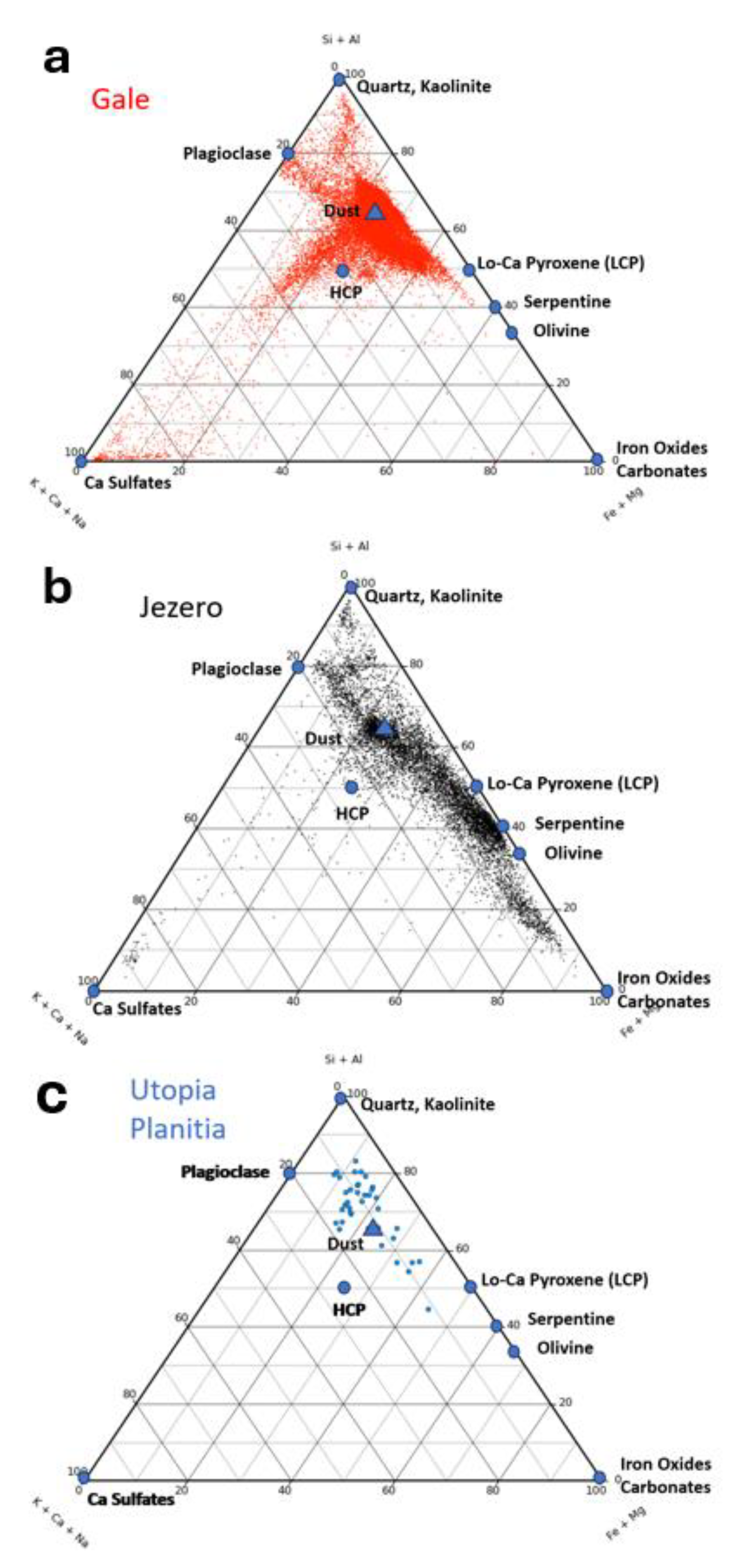
Mars compositions, in molar units; a) ChemCam compositions to Sol 4468; b) SuperCam compositions to Sol 1256; c) MarSCoDe data. Compositions of pure minerals or mineral groups are shown with blue circles (HCP = high-calcium pyroxene). The average composition of fine Mars dust (Lasue et al., 2022) is indicated by a triangle.
Figure 9.
Mars compositions, in molar units; a) ChemCam compositions to Sol 4468; b) SuperCam compositions to Sol 1256; c) MarSCoDe data. Compositions of pure minerals or mineral groups are shown with blue circles (HCP = high-calcium pyroxene). The average composition of fine Mars dust (Lasue et al., 2022) is indicated by a triangle.
3.4. Synthesis: Comparison of All Mars Compositions
With three Mars missions and thousands of LIBS observations, we can now compare and contrast the compositions of the landing sites, and of Earth and Mars in general. In Table 1 we see that Jezero crater is clearly the most mafic, especially enriched in MgO, and has the lowest SiO2, Al2O3, CaO, and K2O, consistent with its enrichment in olivine and low-Ca pyroxene (LCP). Based on MarSCoDe LIBS results, Utopia Planitia has the highest SiO2 and TiO2 of the three sites but is generally intermediate in the other elements. Comparison with the terrestrial crust illustrates the more mafic nature of Mars, represented at these three sites.
We gain a better understanding of the various inputs to these mean values from Figure 9, which presents molar abundances of the major elements on ternary diagrams on which the main igneous minerals and several of the weathering products are also labeled. With its generally more primitive compositions, Mars’ igneous rocks consist mostly of plagioclase, olivine, and pyroxene, which plots between two different locations in this plot, depending on the abundance of calcium (high-Ca pyroxene, or HCP, and low-Ca: LCP). In contrast to Earth’s evolved igneous systems, Mars lacks igneous quartz; on the other hand, at Marias Pass in Gale crater (Figure 8a), ChemCam discovered nearly pure SiO2 compositions that CheMin identified as tridymite, which on Earth occurs as a volcanic ash erupted from evolved magmas. Diagenetic material in fracture zones both stratigraphically above and below Marias Pass also contained silica enrichments, indicating post-depositional mobility of this material in groundwater (Frydenvang et al., 2017; Morris et al., 2016; Czarnecki et al., 2020). This material can be seen near the high-silica apex of the Gale ternary diagram in Figure 9a. The Gale ternary plot also shows a significant trend toward plagioclase, essentially all from felsic clasts observed in Bradbury Rise (Figure 8a), to where they had been fluvially transported from the crater rim. A trend to the lower right of Figure 9a indicates inputs of olivine and potentially also its weathering product, serpentine. While not found in the rocks themselves (at least not at the size of the LIBS laser beam in the rocks), olivine contributions were significantly found (Cousin et al., 2017) in the Bagnold Dunes that Curiosity crossed on its way to Mount Sharp (Figure 8a). Another major trend is toward the lower left corner of Figure 9a, which is caused by the ubiquitous Ca-sulfate diagenetic material found in veins, and sometimes, in pore spaces of the rocks (Nachon et al., 2014; Nellessen et al., 2025). Data points scatter slightly to the right of the lower left corner, indicating contributions of Fe and Mg to the sulfates. These contributions were first seen as Fe enrichments along the edges of Ca-sulfate veins (l’Haridon et al. 2018), but also as Mg sulfates. Curiosity has recently crossed into the sulfate unit higher on Mt. Sharp, where Mg sulfates pervade (Frydenvang et al., in prep.). Overall, the relatively fine grain size of the Gale sediments results in limited scatter in the data points (Rivera-Hernandez et al. 2019), with the above-mentioned trends being the main exceptions.
Addressing the main locus of points in Figure 9a, note first that it is essentially coincident in this diagram with the composition of Mars fine dust, which appears similar in both Gale and Jezero craters (e.g., Lasue et al., 2018; 2022; Cousin et al., 2025). In detail, Edwards et al. (2017) discovered that the compiled compositions of the first 1000 sols in Gale show an igneous trachybasaltic endmember with 55.2 wt.% SiO2, 19.8 wt.% Al2O3, and 9.3 wt.% (FeO+MgO), with a secondary, more basaltic locus of points for igneous targets that was nearly coincident with that of sedimentary targets, whose mean consists of 49.6 wt.% SiO2, 14.3 wt.% Al2O3, and 24.5 wt.% (FeO+MgO), suggesting both less evolved rocks, consistent with MER findings (e.g., McSween et al., 2006) and the novel, more evolved Noachian highland rocks, discussed earlier. Bedford et al. (2019) expanded on this study among the sedimentary bedrock of the Murray and Stimson formations, working to remove diagenetic effects, and extending the record to nearly 1500 sols. They proposed at least four fluvial inputs to the ancient Gale lake, confirming those of Edwards et al. (2017), Le Deit et al. (2016), and Morris et al. (2016), mentioned earlier. The bulk of the Murray formation (Frydenvang et al., 2020) and the clay-bearing Glen Torridon (Dehouck et al., 2022) southeast of Vera Rubin Ridge (Figure 8a) also fall closely within the tight locus of points in Figure 9a.
Jezero crater shows a significantly larger range of compositions in its ternary diagram (Figure 9b), due in part to the much larger grain sizes, which result in pure mineral compositions instead of mixtures due to multiple fine grains in the LIBS beam. Olivine is most abundant in the Seitah formation (Figure 9b; Beyssac et al., 2023), but also in the delta top, the margin unit, and parts of the crater rim (Clavé et al., 2025; Bedford et al., 2025a, b; Williford et al., 2025). Serpentine was also observed in some regions of the delta front and the crater rim (Comellas et al., 2025). The Maaz formation of the crater floor (Figure 8b) and the Content member of the Seitah formation consist of plagioclase and LCP (Udry et al., 2023). The delta top and the margin unit contain a significant fraction of carbonates (also some in Seitah), resulting in a clear trend below and to the right of the olivine point (Figure 9b). Many Jezero crater rocks have a dark coating that has a similar composition to Mars dust, suggesting a possible origin as lithified dust (Garczynski et al. 2025), contributing to the cluster of points near the dust symbol (Figure 9b). Jezero crater contains only a few Ca sulfate diagenetic features, contributing to a small trend toward the lower left corner. Finally, a significant locus of points near the upper apex of the ternary diagram (Figure 9b) is attributed to a group of float rocks rich in kaolinite (Royer et al., 2024) and hydrothermal quartz in and near the crater rim (Beck et al., 2025), both mentioned earlier.
The MarSCoDe observations at Utopia Planitia, quantified by PMEC models (Chen et al., 2022a), are shown on the Figure 9c ternary diagram. Consistent with other models (Zhao et al., 2023 and C. Liu et al., 2023), the compositions potentially indicate an igneous origin of local materials with a limited acidic alteration as the data trend from olivine to plagioclase. This process could produce the sulfates observed by SWIR and account for the presence of hydrogen in the LIBS spectra. However, our understanding is limited because of the small number of targets and the uncertainties due to 1) the data quality issue induced by focusing on loose materials; 2) the uncertainty of whether the LIBS penetrated the surface coverings or dust, as the points also surround the dust composition, and the single-laser-pulse MarSCoDe spectra are yet to be thoroughly analysed; and 3) the uncertainty of models, as no other instrument onboard Zhurong could verify the quantifications.
Figure 10.
Mars abundances of major elements plotted against SiO2.
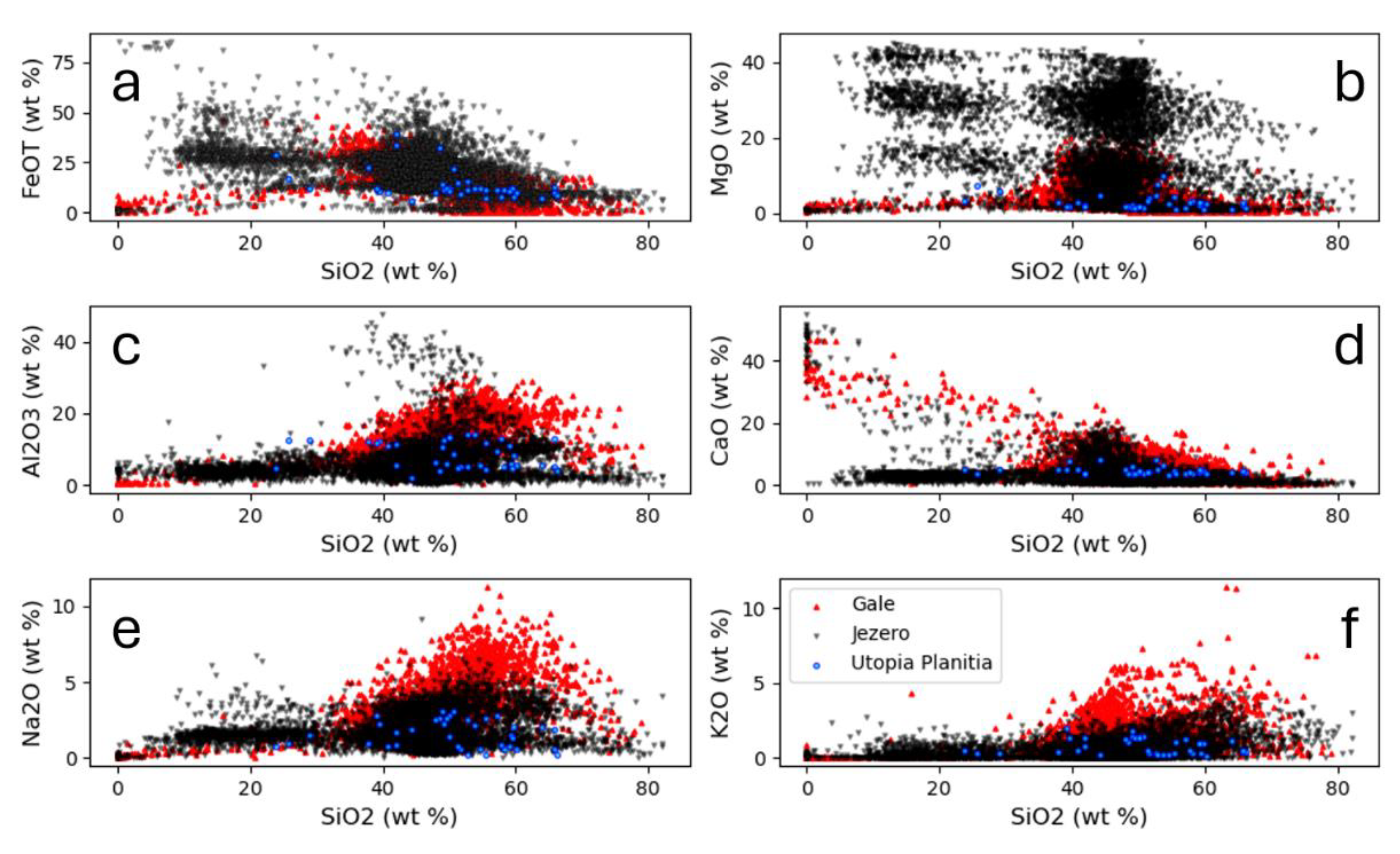
The compositions of all three missions are overplotted on Figure 10 for direct comparison. The more felsic nature of Gale crater is seen by the higher abundances of Na2O, K2O, and Al2O3, seen as red color (Gale) clustered above the black and blue points of Jezero and Utopia Planitia. Some of the same trends are seen in Figure 10 as were noted in Figure 9, such as the CaO vs. SiO2 trend to the upper left (Figure 10d) indicating Ca-sulfate veins and pore filling, and trends to the highest Al2O3 (Figure 10c) in Jezero crater due to the kaolinite-rich float rocks. The plots of FeOT and MgO (Figure 10a, b) are more complicated. The main groups of points near 40-50 wt. % SiO2 and elevated FeOT and MgO abundances indicate olivine and pyroxene minerals with various ratios of Fe/Mg. Trends toward elevated FeOT and MgO with lower SiO2 (Figure 10a,b) are due to carbonates in Jezero crater, which tend to be mixed Fe-Mg carbonates essentially without Ca. Part of the high-MgO, low-SiO2 trend is also due to Mg sulfates, for example, observed at Hogwallow Flats at the Jezero delta front (Figure 8b) and interpreted as the result of intense evaporation of Jezero lake water (Dehouck et al., 2024). The highest iron abundances (Figure 10a) indicate the presence of some iron oxide grains, essentially all at Jezero. Finally, a number of data points with relatively high Na2O but low SiO2 (Figure 10e) likely indicate halite and sodium perchlorate, suggested by associations with Cl (Thomas et al. 2019), and by a Na-perchlorate Raman spectrum collected by SuperCam (Wiens et al., 2022).
4. Summary and Future Prospects
Authors LIBS has been operating continuously on Mars since August 2012, and for a time, three instruments were operating on different sides of the red planet. ChemCam and SuperCam remain in operation, having determined the compositions of nearly 35,000 points on Mars. As such, the LIBS data set vastly exceeds that of any other instrument or technique for local elemental compositions. The technique can highlight broad trends within a given landing site, as shown in Figure 9 and Figure 10, and it can provide compositions of individual mineral grains and fine-scale diagenetic features such as hairline fractures. While the mafic nature of Mars was already well known, LIBS observations from Gale and Jezero craters and Utopia Planitia have shown the felsic tendencies of the Noachian crust in the southern highlands at Gale, it has found evaporative features such as boron, and Ca and Mg sulfates. It has found silica, Cu, Zn, and Mn enrichments. In Jezero crater, SuperCam LIBS has uniquely characterized kaolinitic rocks, determined the Mg numbers of various igneous flows, determined the carbonate content of the margin unit, and found nickel enrichments and hydrothermal quartz. In Utopia Planitia, LIBS showed a more felsic nature to the rocks and highlighted the potential hydrous process creating alteration products. LIBS has been a uniquely versatile technique on Mars.
We sincerely hope that Mars will become the steppingstone to other planetary bodies for the LIBS technique. A small LIBS instrument has already operated briefly on the Moon (e.g., Sridhar et al., 2024) on the Chandrayaan-3 mission. Work is underway to produce more capable, miniature (< 2 kg) LIBS instruments (e.g., Rapin et al., 2024) that could travel on a Mars helicopter or on small lunar or asteroidal rovers. LIBS holds particular promise for studying icy regions (e.g., Pavlov et al., 2011) due to its unique capabilities in quantifying H, C, N, and O, to characterize various types of mixtures between water ice, CO2 ice, frozen methane, ethane, other organic mixtures, and mixtures of ices and rocky particles. For this reason, we believe that some of LIBS’ greatest promise may be in exploring the poles of the Moon, cometary bodies, the asteroid Ceres, and ocean worlds such as Europa and Enceladus. The sky is no longer the limit for LIBS.
Author Contributions
Conceptualization, methodology, formal analysis, investigation: all; lab results: S.C.; writing—original draft preparation: R.C.W.; writing—review and editing: A.C., O.G., Z.C.; visualization: R.C.W., A.C., O.G., Z.C.; supervision, project administration, and funding acquisition: all.
Funding
This research was funded in the US by NASA Mars Exploration Program contracts NNH15A35I, NNH15AZ24I, and NNH13ZDA018O to R.C.W. and S.C. Research in France was funded by CNES, CNRS, and UT for A.C., O.G., Z.C., and S.M. Additional funding for Z.C. comes from Project (JLFS/P-702/24) of Hong Kong RGC Co-funding Mechanism on Joint Laboratories with the Chinese Academy of Science.
Data Availability Statement
All data used in this work are in the open literature and/or at official data repositories such as the NASA Planetary Data System (PDS).
Acknowledgments
The work of several thousand people to develop and operate the instruments, the Mars rovers, and the launch, cruise, and landing vehicles is gratefully acknowledged.
Conflicts of Interest
The authors declare no conflicts of interest. The funders had no role in the design of the study; in the collection, analyses, or interpretation of data; in the writing of the manuscript; or in the decision to publish the results.
Abbreviations
The following abbreviations are used in this manuscript:
| 2D | Two dimensional |
| APXS | Alpha particle x-ray spectrometer |
| CCD | Charge coupled device |
| CIA | Chemical index of alteration |
| CNES | Centre National d’Etudes Spatiales (France) |
| CNSA | China National Space Administration |
| C-T | Czerny-Turner |
| CWL | Continuous-wave laser |
| EMPA | Electron microprobe analyzer |
| FWHM | Full width at half maximum |
| HCP | High-calcium pyroxene |
| ICCD | Intensified charge coupled device |
| IR | Infrared |
| LA-ICP-MS | Laser ablation inductively coupled plasma mass spectrometer |
| LCP | Low-calcium pyroxene |
| LIBS | Laser-induced breakdown spectroscopy |
| MVA | Multivariate analysis |
| NASA | National Aeronautics and Space Administration (USA) |
| PMEC | Probabilistic major-element calibration |
| RMI | Remote Micro-Imager |
| TAR | Transverse aeolian ridge |
| UV | Ultraviolet |
| VBF | Vastitas Borealis Formation |
| VISIR | Visible and infrared |
| XRF | X-ray fluorescence |
Appendix A
Table A1 provides image credits.

Table A1.
Image credits.
| Figure | Credit |
| 1a | NASA/JPL-Caltech/MSSS |
| 1b | NASA/JPL-Caltech/MSSS |
| 1c | CNSA/NAOC/GRAS (Ground Res. & Application System) |
| 2a | LANL; rover mast inset: NASA/JPL-Caltech/MSSS |
| 2b | LANL |
| 2c | SITP/NAOC |
| 3 | NASA/JPL-Caltech/MSSS; inset: NASA/JPL-Caltech/LANL/CNES/IRAP |
| 6a | NASA/JPL-Caltech/LANL/CNES/IRAP/MSSS/ASU |
| 6b | NASA/JPL-Caltech/LANL/CNES/IRAP |
| 6c | NASA/JPL-Caltech/LANL/CNES/IRAP/MSSS/ASU |
| 6d | CNSA/NAOC/GRAS |
| 8a | NASA/JPL/University of Arizona/ESA |
| 8b | NASA/JPL/University of Arizona/ESA |
| 8c | CNSA/NAOC/GRAS |
References
- Anderson, R.B.; Clegg, S.M.; Frydenvang, J.; Wiens, R.C.; McLennan, S.; Morris, R.V.; Ehlmann, B.; Dyar, M.D. Improved accuracy in quantitative laser-induced breakdown spectroscopy using sub-model partial least squares. Spectrochim. Acta B 2017, 129, 49-57. [CrossRef]
- Anderson, R.B.; Forni, O.; Cousin, A.; Wiens, R.C.; Clegg, S.M.; Frydenvang, J.; Gabriel, T.S.J.; Ollila, A.; Schroeder, S.; Beyssac, O.; Gibbons, E.; Vogt, D.S.; Clavé, E.; Manrique, J.-A.; Legett, C., IV; Pilleri, P.; Newell, R.T.; Sarrao, J.; Maurice, S.; Arana, G.; Benzerara, K.; Bernardi, P.; Bernard, S.; Bousquet, B.; Brown, A.J.; Alverez-Llamas, C.; Chide, B.; Cloutis, E.; Comellas, J.; Connell, S.; Dehouck, E.; Delapp, D.M.; Essunfeld, A.; Fabre, C.; Fouchet, T.; Garcia-Florentino, C.; Garcia-Gomez, L.; Gasda, P.; Gasnault, O.; Hausrath, E.; Lanza, N.L.; Laserna, J.; Lasue, J.; Lopez, G.; Madariaga, J.M.; Mandon, L.; Mangold, N.; Meslin, P.-Y.; Nachon, M.; Nelson, A.E.; Newsom, H.; Reyes-Newell, A.L.; Robinson, S.; Rull, F.; Sharma, S.; Simon, J.I.; Sobron, P.; Torre Fernandez, I.; Udry, A.; Venhaus, D.; McLennan, S.M.; Morris, R.V.; Ehlmann, B. Post-landing major element quantification using SuperCam laser induced breakdown spectroscopy. Spectrochim. Acta B 2021. [CrossRef]
- Arvidson, R.E. Aqueous history of Mars as inferred from landed mission measurements of rocks, soils, and water ice. J. Geophys. Res. Planets 2016, 121, 1602–1626. [CrossRef]
- Beck, P.; Meslin, P.-Y.; Fau, A.; Forni, O.; Gasnault, O.; Lasue, J.; Cousin, A.; Schröder, S.; Maurice, S.; Rapin, W.; Wiens, R.C.; Ollila A.M.; Dehouck, E.; Mangold, N.; Garcia, B.; Schwartz, S.; Goetz, W.; Lanza, N. Detectability of carbon with ChemCam LIBS: distinguishing sample from Mars atmospheric carbon, and application to Gale crater. Icarus 2023, 408. [CrossRef]
- Beck, P.; Dehouck, E.; Beyssac, O.; Bernard, S.; Mandon, L.; Royer, C.; Clavé, E.; Forni, O.; Pineau, M.; Francis, R.; Mangold, N.; Bedford, C.; Broz, A.; Cloutis, E.A.; Johnson, J.; Poulet, F.; Fouchet, T.; Quantin-Nataf, C.; Pilorget, C.; Schröder, S.; Rapin, W.; Meslin, P.-Y.; Gabriel, T.J.; Arana, G.; Madariaga, J.M.; Wiens, R.C.; Maurice, S.; Clegg, S.; Gasnault, O.; Cousin, A.; the SuperCam team SuperCam detection of hydrated silica in Jezero crater. Earth Planet. Sci. Lett. 2025, 656, . [CrossRef]
- Bedford, C.C.; Bridges, J.C.; Schwenzer, S.P.; Wiens, R.C.; Rampe, E.; Frydenvang, J.; Gasda, P.J. Alteration trends and geochemical source region characteristics preserved in the fluviolacustrine sedimentary record of Gale crater, Mars. Geochim. Cosmochim. Acta 2019 246, 234-266. [CrossRef]
- Bedford, C.C.; Ravanis, E.; Clavé, E.; Wiens, R.C.; Forni, O.; Jones, A.; Royer, C.; Garczynski, B.; Beck, P.; Connell, S.; Beyssac, O.; Mandon, L.; Cousin, A.; Horgan , B. Investigating the origin and variable diagenetic overprint of the Margin Unit in Jezero crater, Mars, with SuperCam. J. Geophys, Res. Planets 2025a, in preparation.
- Bedford, C.C.; Wiens, R.C.; Horgan, B.H.N.; Klidaras, A.; Quantin-Nataf, C.; Udry, A.; Alwmark, S.; Herd, C.D.K.; Ravanis, E.; Treiman, A.; Johnson, J.; Cousin, A.; Dehouck, E.; Beck, P., Simon, J. Geological diversity in the Jezero crater rim investigated with SuperCam: insights into impact processes on Mars. 56th Lunar Planet. Sci. 2025b, 2495, https://www.hou.usra.edu/meetings/lpsc2025/pdf/2495.pdf.
- Bosak, T.; Shuster, D.L.; Scheller, E. L.; Siljeström, S.; Zawaski, M. J.; Mandon, L.; Simon, J. I.; Weiss, B. P.; Stack, K. M.; Mansbach, E. N.; Treiman, A. H.; Benison, K. C.; Brown, A. J.; Czaja, A. D.; Farley, K. A.; Hausrath, E. M.; Hickman-Lewis, K.; Herd, C. D.; Johnson, J. R.; Mayhew, L. E.; Minitti. M. E.; Williford, K. H.; Wogsland, B. V.; Zorzano, M.-P.; Allwood, A. C.; Amundsen, H. E. F.; Bell, J. F., III; Benzerara, K.; Bernard, S.; Beyssac, O.; Buckner, D. K.; Cable, M.; Calef, F., III; Caravaca, G.; Catling, D. C.; Clavé, E.; Cloutis, E.; Cohen, B. A.; Cousin, A.; Fáiren, A.; Flannery, D. T.; Fornaro, T.; Forni, O.; Fouchet, T.; Gibbons, E.; Gomez, F.; Gupta, S.; Hand, K. P.; Hurowitz, J. A.; Kalucha, H.; Pedersen, D. A. K.; Lopes Reyes, G.; Maki, J. N.; Maurice, S.; Nuñez, J. I.; Randazzo, N.; Rice, J. W., Jr.; Royer, C.; Sephton, M. A.; Sharma, S.; Steele, A.; Tate, C. D.; Uckert, K.; Udry, A.; Wiens, R. C.; Williams, A.; other members of the Mars 2020 Science Team Astrobiological potential of rocks acquired by the Perseverance rover at a sedimentary fan front in Jezero crater, Mars. AGU Advances 2024, 5, e2024AV001241. [CrossRef]
- Boucher, T.; Dyar, M. D.; Mahadevan, S. Proximal methods for calibration transfer. Chemometrics 2017, 31, . [CrossRef]
- Bowden, D.L.; Bridges, J.C.; Cousin, A.; Rapin, W.; Semprich, J.; Gasnault, O.; Forni, O.; Gasda, P.; Das, D.; Payré, V.; Sautter, V.; Bedford, C.C.; Wiens, R.C.; Pinet, P.; Frydenvang, J. Askival: An altered feldspathic cumulate sample in Gale crater. Met. Planet. Sci. 2022, 101 1-22. [CrossRef]
- Carr, M.H.; Head, J.W., III Geologic History of Mars, Earth Planet. Sci. Lett. 2010, 294, 3-4, 185-203, . [CrossRef]
- Chen, Z.; Ren, X.; Liu, J.; Xu, W.; Zhang, Y.; Liu, X.; Zhou, Q; Chen, W. Probabilistic multivariable calibration for major elements analysis of MarSCoDe Martian laser-induced breakdown spectroscopy instrument on Zhurong rover. Spectrochimica Acta B 2022a, 197, . [CrossRef]
- Chen, Z.; Wu, B.; Wang, Y.; Liu, S.; Li, Z.; Yang, C.; Dong, J.; Rao, W. Rock abundance and erosion rate at the Zhurong landing site in southern Utopia Planitia on Mars. Earth Spa. Sci. 2022b, 9(8), . [CrossRef]
- Chen, Z.; Forni, O.; Cousin, A.; Pilleri, P.; Gasnault, O.; Maurice, S.; Wiens, R.C.; Zhang, Y.; Luo, Y.; Ren, X; Li, C.; Xu, W.; Liu, X.; Shu, R. Quality index for Martian in-situ laser-induced breakdown spectroscopy data. Spectrochim. Acta B 2024a, . [CrossRef]
- Chen, Z.; Caravaca, G.; Loche, M.; Chide, B.; Kurfis-Pal, B.; Zhang, J.; Cousin, A.; Forni, O.; Guo, L.; Lasue, J.; Liu, D.; Liu, J.; Liu, X.; Luo, Y.; Ren, X; Xu, W.; Zhang, Q.; Zhang, Y.; Shu, R.; Kereszturi, A.; Maurice, S.; Li, C. Unexpected Aeolian Buildup Illustrates Low Modern Erosion Along Zhurong Traverse on Mars. 55th Lunar and Planetary Science Conference 2024b, 1308, https://www.hou.usra.edu/meetings/lpsc2024/pdf/1308.pdf.
- Clark, B.C.; Baird, A.K.; Rose, H.J., Jr.; Priestley, T., III; Keil, K.; Castro, A.J.; Kelliher, W.C.; Rowe, C.D.; Evans, P.H. Inorganic analyses of Martian surface samples at the Viking landing sites. Science 1976, 194, 1283-1288. [CrossRef]
- Clavé, E.; Gaft, M.; Motto-Ros, V.; Fabre, C.; Forni, O.; Beyssac, O.; Maurice, S.; Wiens, R.C.; Bousquet, B. Extending the potential of Plasma Induced Luminescence spectroscopy. Spectrochim. Acta B 2021, 177, 106111. [CrossRef]
- Clavé, E.; Benzerara, K.; Meslin, P.-Y.; Forni, O.; Royer, C.; Mandon, L.; Beck, P.; Quantin-Nataf, C.; Beyssac, O.; Cousin, A.; Bousquet, B.; Wiens, R. C.; Maurice, S.; Dehouck, E.; Schröder, S.; Gasnault, O.; Mangold, N.; Dromart, G.; Bosak, T.; Bernard, S.; Udry, A.; Anderson, R.B.; Arana, G.; Brown, A.J.; Castro, K.; Clegg, S.M.; Cloutis, E.; Fairén, A.G.; Flannery, D.T.; Gasda, P.J.; Johnson, J.R.; Lasue, J.; Lopez-Reyes, G.; Madariaga, J.M.; Manrique, J.A.; Le Mouélic, S.; Núñez, J.I.; Ollila, A.M.; Pilleri, P.; Pilorget, C.; Pinet, P.; Poulet, F.; Veneranda, M.; Wolf, Z.U.; the SuperCam team Carbonate Detection with SuperCam in Igneous Rocks on the floor of Jezero Crater, Mars. J. Geophys. Res. Planets 2023, 128, . [CrossRef]
- Clavé E.; Forni, O.; Royer, C.; Mandon, L.; Dehouck, E.; Mangold, N.; Bedford, C.; Udry, A.; Quantin-Nataf, C.; Schroder, S.; Aramendia, J.; Brown, A.; Benison, K.; Bernard, S.; Cardarelli, E.; Coloma, L.; Connell, S.; Johnson, J.; Loche, M.; Lopez-Reyes, G.; Madariaga, J.M.; Manrique, J.A.; Maurice, S.; Meslin, P.-Y.; le Mouelic, S.; Ollila, A.M.; Pilorget, C.; Rammelkamp, K.; Seel, F.; Simon, J.; Wolf, U.; Zastrow, A.; Clegg, S.; Gasnault, O.; Cousin, A.; Wiens, R.C.; the SuperCam Team Diverse aqueous processes recorded in the carbonate-rich rocks in Jezero Crater. J. Geophys. Res. Planets 2025, submitted.
- Clegg, S.M.; Wiens, R.C.; Misra, A.K.; Sharma, S.K.; Lambert, J.; Bender, S.; Newell, R.; Nowak-Lovato, K.; Smrekar, S.; Dyar, M.D.; Maurice, S. Planetary geochemical investigations by Raman-LIBS spectroscopy (RLS). Spectrochim. Acta 2014, 68, 925-936. [CrossRef]
- Clegg, S.M.; Wiens, R.C.; Anderson, R.B.; Forni, O.; Frydenvang, J.; Lasue, J.; Pilleri, A.; Payre, V.; Boucher, T.; Dyar, M.D.; McLennan, S.M.; Morris, R.V.; Graff, T.G.; Mertzman, S.A.; Ehlmann, B.L.; Bender, S.C.; Tokar, R.L.; Belgacem, I.; Newsom, H.; McInroy, R.E.; Martinez, R.; Gasda, P.; Gasnault, O.; Maurice, S. Recalibration of the Mars Science Laboratory ChemCam instrument with an expanded geochemical database. Spectrochim. Acta B 2017, 129, 64-85. [CrossRef]
- Comellas, J.M.; Sharma, S.K.; Gasda, P.J.; Cousin, A.; Essunfeld, A.; Mayhew, L.E.; Fryer, P.; Sun, L.; Brown, A.J.; Acosta-Maeda, T.E.; Dehouck, E.; Veneranda, M.; Connell, S.; Cloutis, E.; Ollila, A.; Lanza, N.; Lopez-Reyes, G.; Clavé, E.; Manrique-Martinez, J.A.; Poulet, F.; Johnson, J.; Fouchet, T.; Clegg, S.; Delapp, D.; Sheridan, A.; Maurice, S.; Wiens , R.C. Serpentinization in Jezero Crater: Comparing SuperCam Mars Data to Terrestrial Serpentinites. J. Geophys. Res. Planets 2025, in preparation.
- Cousin, A.; Meslin, P.-Y.; Wiens, R.C.; Rapin, W.; Mangold, N.; Fabre, C.; Gasnault, O.; Forni, O.; Tokar, R.; Lasue, J.; Vaniman, D; Ollila, A.; Schroeder, S.; Sautter, V.; Blaney, D.; Le Mouelic, S.; Nachon, M.; Dromart, G.; Newsom, H.; Maurice, S.; Dyar, M.D.; Lanza, N.; Clark, B.; Clegg, S.; Goetz, W.; the MSL Science Team Compositions of coarse and fine particles in martian soils at Gale: A window into the production of soils. Icarus 2015, 249, 22-42. [CrossRef]
- Cousin, A.; Dehouck, E.; Meslin, P.-Y.; Forni, O.; Gasnault, O.; Bridges, N.; Ehlmann, B.; Williams, A.; Stein, N.; Schroeder, S.; Rapin, W.; Sautter, V.; Payré, V.; Maurice, S.; Wiens, R.C.; Pinet, P. Geochemistry of the Bagnold Dune Field as observed by ChemCam, and comparison with other Aeolian deposits at Gale crater. J. Geophys. Res. Planets 122 2017a. [CrossRef]
- Cousin, A.; Sautter, V.; Payré, V.; Forni, O.; Mangold, N.; Gasnault, O.; Le Deit, L.; Johnson, J.; Maurice, S.; Salvatore, M.; Wiens, R.C.; Gasda, P.; Rapin, W. Classification of igneous rocks analyzed by ChemCam at Gale crater, Mars. Icarus 2017b, 288, 265-283. [CrossRef]
- Cousin, A.; Sautter, V.; Fabre, C.; Dromart, G.; Montagnac, G.; Drouet, C.; Meslin, P.-Y.; Gasnault, O.; Beyssac, O.; Bernard, S.; Coutis, E.; Forni, O.; Beck, P.; Fouchet, T.; Johnson, J.R.; Lasue, J.; Ollila, A.M.; De Parseval, P.; Gouy, S.; Caron, B.; Madariaga, J.M.; Arana, G.; Madsen, M.B.; Laserna, J.; Moros, J.; Manrique, J.A.; Lopez-Reyes, G.; Rull, F.; Maurice, S.; Wiens R.C. SuperCam calibration targets on board the Perseverance rover: Fabrication and quantitative characterization. Spectrochimica Acta B 2022, . [CrossRef]
- Cousin, A.; Meslin, P-Y.; Forni, O.; Beyssac, O.; Clavé, E.; Hausrath, E.; Beck, P.; Bedford, C.; Sullivan, R.; Schröder, S.; Dehouck, E.; Johnson, J.; Vaughan, A.; Martin, N.; Chide, B.; Lasue, J.; Gasnault, O.; Fouchet, T.; Pilleri, P.; Udry, A.; Poblacion, I.; Arana, G.; Madariaga, J.; Clegg, S.; Maurice, S.; Wiens, R.C. Soil diversity at Jezero crater and Comparison to Gale crater, Mars. Icarus 2025, 425. [CrossRef]
- Czarnecki, S.; Hardgrove, C.; Gasda, P.; Calef, F.; Gengl, H.; Rapin, W.; Frydenvang, J.; Nowicki, S.; Thompson, L.; Wiens, R.C.; Newsom, H.; Gabriel, T. Constraints on the hydration and distribution of high-silica layers in Gale crater using LIBS geochemistry and active neutron measurements. JGR Planets 2020. [CrossRef]
- David, G.; Dehouck, E.; Meslin, P.-Y.; Rapin, W.; Cousin, A.; Forni, O.; Gasnault, O.; Lasue, J.; Mangold, N.; Beck, P.; Maurice, S.; Wiens, R.C.; Berger, G.; Fabre, C.; Pinet, P.; Clark, B.C.; Lanza, N.L. Evidence for amorphous sulfates as the main carrier of soil hydration in Gale crater, Mars. Geophys. Res. Lett. 2022, 49, e2022GL098755. [CrossRef]
- Dehouck, E.; Cousin, A.; Mangold, N.; Frydenvang, J.; Gasnault, O.; Forni, O.; Rapin, W.; Gasda, P.J.; Bedford, C.; Caravaca, G.; David, G.; Lasue, J.; Meslin, P.-Y.; Rammelkamp, K.; Fox, V.K.; Bennett, K.A.; Bryk, A.; Lanza, N.L.; Maurice, S.; Wiens, R.C. In situ geochemical characterization of the clay-bearing Glen Torridon region of Gale crater, Mars, using the ChemCam instrument. J. Geophysical Research, Planets 2022. [CrossRef]
- Dehouck, E.; Forni, O.; Quantin-Nataf, C.; Beck, P.; Mangold, N.; Royer, C.; Clavé, E.; Beyssac, O.; Johnson, J. R.; Mandon, L.; Poulet, F.; Le Mouélic, S.; Caravaca, G.; Kalucha, H.; Gibbons, E.; Dromart, G.; Gasda, P.; Meslin, P.-Y.; Schroeder, S.; Udry, A.; Anderson, R. B.; Clegg, S.; Cousin, A.; Gabriel, T. S.; Lasue, J.; Fouchet, T.; Pilleri, P.; Pilorget, C.; Hurowitz, J.; Núñez, J.; Williams, A.; Russell, P.; Simon, J. I.; Maurice, S.; Wiens, R. C.; the SuperCam Team Overview of the bedrock geochemistry and mineralogy observed by SuperCam during Perseverance’s delta front campaign. Lunar Planet. Sci. Conf. 2023, 2862, https://www.hou.usra.edu/meetings/lpsc2023/pdf/2862.pdf.
- Dehouck, E.; Forni, O.; Quantin-Nataf, C.; Beck, P.; Mangold, N.; Beyssac, O.; Royer, C.; Clavé, E.; Johnson, J. R.; Mandon, L.; Poulet, F.; Udry, A.; Lopez-Reyes, G.; Caravaca, G.; Maurice, S.; Wiens, R. C.; Stack, K. M.; Anderson, R. B.; Bernard, S.; Bosak, T.; Broz, A. P.; Castro, K.; Clegg, S. M.; Cousin, A.; Dromart, G.; Farley, K. A.; Fouchet, T.; Frydenvang, J.; Gabriel, T.S.J.; Gasda, P.; Gibbons, E.; Horgan, B. H. N.; Hurowitz, J. A.; Kalucha, H.; Lasue, J.; Le Mouélic, S.; Madariaga, J. M.; Meslin, P.-Y.; Nachon, M.; Nuñez, J. I.; Pilleri, P.; Pilorget, C.; Rice, J. W., Jr; Russell, P. S.; Schröder, S.; Shuster, D. L.; Siebach, K. L.; Simon, J. I.; Weiss, B. P.; Williams, A. J.; the SuperCam Team Chemostratigraphy And Mineralogy Of The Jezero Western Fan As Seen By The SuperCam Instrument: Evidence For A Complex Aqueous History And Variable Alteration Conditions. Tenth Int’l. Conf. on Mars, Pasadena, 2024, 3364, https://www.hou.usra.edu/meetings/tenthmars2024/pdf/3364.pdf.
- Ding, L.; Zhou, R.; Yu, T.; Gao, H.; Yang, H.; Li, J.; Yuan, Y.; Liu, C.; Wang, J.; Zhao, Y.-Y.S.; Wang, Z.; Wang, X.; Bao, G.; Deng.; Z, Huang, L.; Li, N.; Cui, X.; He, X.; Jia, Y.; Yuan, B.; Liu, G.; Zhang, H.; Zhao, R.; Zhang, Z.; Cheng, Z.; Wu, F.; Xu, Q.; Lu, H.; Richter, L.; Liu, Z.; Niu, F.; Qi, H.; Li, S.; Feng, W.; Yang, C.; Chen, B.; Dang, Z.; Zhang, M.; Li, L.; Wang, X.; Huang, Z.; Zhang, J.; Xing, H.; Wang, G.; Niu, L.; Xu, P.; Wan, W.; Di, K. Surface characteristics of the Zhurong Mars rover traverse at Utopia Planitia. Nat. Geosci. 2022, 15(3), 171-176, . [CrossRef]
- Dromart, G.; Le Deit, L.; Rapin, W.; Gasnault, O.; Le Mouelic, S.; Quantin-Nataf, C.; Mangold, N.; Rubin, D.; Lasue, J.; Maurice, S.; Pinet, P.; Wiens, R.C. Deposition and erosion of the light-toned yardang unit of Mt. Sharp, Gale crater, Mars Science Laboratory Mission. Earth Planet. Sci. Lett. 2020, 554. [CrossRef]
- Duan, T.; Anand, A.; Ding, D. Y.; Thai, K. K.; Basu, S.; Ng, A.; Schuler, A. NGBoost: Natural gradient boosting for probabilistic prediction. In International conference on machine learning 2020 (November, pp. 2690-2700). PMLR.
- Dyar, M.D.; Tucker, J.M.; Humphries, S.; Clegg, S.M.; Wiens, R.C.; Lane, M.D. Strategies for Mars remote laser-induced breakdown spectroscopy analysis of sulfur in geological samples. Spectrochim. Acta B 2010 66, 39-56. [CrossRef]
- Dyar, M.D.; Ytsma, C.R.; Lepore, K. Geochemistry by Laser-Induced Breakdown Spectroscopy on the Moon: Accuracy, Detection Limits, and Realistic Constraints on Interpretations. Earth Spa. Sci. 2024 11, . [CrossRef]
- Ece, O.I.; Ercan, H.U. Global occurrence, geology and characteristics of hydrothermal-origin kaolin deposits. Minerals 2024, 14, 353. [CrossRef]
- Edwards, P.H.; Bridges, J.C.; Wiens, R.C.; Anderson, R.; Dyar, M.D.; Fisk, M.; Thompson, L.; Gasda, P.; Filiberto, J.; Schwenzer, S.P.; Blaney, D.; Hutchinson, I. Basalt-trachybasalt samples from Gale crater, Mars. Met. Planet. Sci. 2017. [CrossRef]
- Ehlmann, B.; Mustard, J.; Murchie, S.; Bibring J.-P.; Meunier A.; Fraeman A.A.; Langevin Y. Subsurface water and clay mineral formation during the early history of Mars. Nature 2011, 479, 53–60, . [CrossRef]
- Ehlmann, B.; Edwards, C.S. Mineralogy of the Martian surface. Ann. Rev. Earth Planet. Sci. 2014 42, . [CrossRef]
- Fabre, C.; Maurice, S.; Cousin, A.; Wiens, R.C.; Forni, O.; Sautter, V.; Guillaume, D. Onboard calibration igneous targets for the Mars Science Laboratory Curiosity rover and the Chemistry Camera Laser Induced Breakdown Spectroscopy instrument. Spectrochim. Acta B 2011, 66, 280-289. [CrossRef]
- Farley, K.A.; Williford, K.H.; Stack, K.M.; Bhartia, R.; Chen, A.; de la Torre, M.; Hand, K.; Goreva, Y.; Herd, C.D.K.; Hueso, R.; Liu, Y.; Maki, J.N.; Martinez, G.; Moeller, R.C.; Nelessen, A.; Newman, C.E.; Nunes, D.; Ponce, A.; Spanovich, N.; Willis, P.A.; Beegle, L.W.; Bell, J.F., III; Brown ,A.J.; Hamran, S.-E.; Hurowitz, J.A.; Maurice, S.; Paige, D.A.; Rodriguez-Manfredi, J.A.; Schulte, M.; Wiens, R.C. Mars 2020 mission overview. Spa. Sci. Rev. 2021, 216, 142. [CrossRef]
- Farley, K.A.; Stack Morgan, K.M.; Shuster, D.L.; Horgan, B.H.N.; Tarnas, J.D.; Simon, J.I. Sun, V.Z.; Scheller, E.L.; Moore, K.R.; McLennan, S.M.; Vasconcelos, P.M.; Wiens, R.C.; Treiman, A.H.; Mayhew, L.E.; Beyssac, O.; Kizovski, T.V.; Tosca, N.J.; Hurowitz, J.A.; Allwood, A.C.; Williford, K.H.; Crumpler, L.S.; Beegle, L.W.; Bell, J.F., III; Ehlmann, B.L.; Liu, Y.; Maki, J.N.; Schmidt, M.E.; Amundsen, H.E.F.; Bhartia, R.; Bosak, T.; Brown, A.J.; Clark, B.C.; Cousin, A.; Forni, O.; Gabriel, T.S.J.; Goreva, Y.; Gupta, S.; Hamran, S.-E.; Herd, C.D.K.; Hickman-Lewis, K.; Johnson, J.R.; Kah, L.C.; Kelemen, P.B.; Kinch, K.B.; Mandon, L.; Mangold, N.; Quantin-Nataf, C.; Rice, M.S.; Russell, P.S.; Sharma, S.; Siljestrom, S.; Steele, A.; Wadhwa, M.; Weiss, B.P.; Williams, A.J.; Wogsland, B.V.; Willis, P.A.; Acosta-Maeda, T.A.; Beck, P.; Benzerara, K.; Bernard, S.; Burton, A.S.; Cardarelli, E.L.; Chide, B.; Clavé, E.; Cloutis, E.A.; Cohen, B.A.; Czaja, A.D.; Debaille, V.; Dehouck, E.; Fairen, A.G.; Flannery, D.T.; Fleron, S.Z.; Fouchet, T.; Frydenvang, J.; Garczynski, B.J.; Gibbons, E.F.; Hausrath, E.M.; Hayes, A.G.; Henneke, J.; Jorgensen, J.L.; Kelly, E.M.; Lasue, J.; Le Mouelic, S.; Madariaga, J.M.; Maurice, S.; Merusi, M.; Meslin, P.-Y.; Milkovich, S.M.; Million, C.C.; Moeller, R.C.; Nunez, J.I.; Ollila, A.M.; Paar, G.; Paige, D.A.; Pedersen, D.A.K.; Pilleri, P.; Pilorget, C.; Pinet, P.C.; Royer, C.; Sautter, V.; Schulte, M.; Sephton, M.A.; Sharma, S.K.; Sholes, S.F.; Spanovich, N.; St. Clair, M.; Tate, C.D.; Uckert, K.; VanBommel, S.J.; Zorzano, M.-P.; Yanchilina, A.G.; Rice, J.W., Jr. Aqueously altered igneous rocks on the floor of Jezero crater, Mars. Science 2022, https://www.science.org/doi/10.1126/science.abo2196. [CrossRef]
- Forni, O.; Gaft, M.; Toplis, M.; Clegg, S.M.; Sautter, V.; Maurice, S.; Wiens, R.C.; Mangold, N.; Gasnault, O.; Sautter, V.; Le Mouelic, S.; Meslin, P.-Y.; Nachon, M.; McInroy, R.E.; Ollila, A.M.; Cousin, A.; Bridges, J.C.; Lanza, N.L.; Dyar, M.D. First detection of fluorine on Mars: Implications on Gale crater’s geochemistry. Geophys. Res. Lett. 2015, 42. [CrossRef]
- Forni, O.; Bedford, C.C.; Royer, C.; Liu, Y.; Wiens, R.C.; Udry, A.; Dehouck, E.; Meslin, P.-Y.; Beyssac, O.; Beck, P.; Gabriel, T.S.; Gasnault, O.; Manelski, H.T.; Quantin-Nataf, C.; Johnson, J.R.; Schröder, S.; Pilleri, P.; Nachon, M.; Debaille, V.; Ollila, A.M.; Cousin, A.; Maurice, S.; Clegg, S.M. Nickel-Copper Deposits On Mars: Origin And Formation. Tenth Int’l. Conf. on Mars 2024, Pasadena, https://www.hou.usra.edu/meetings/tenthmars2024/pdf/3131.pdf.
- Forni, O.; Rapin, W.; Sklute, E.C.; Gasda, P.; Loche, M.; Hughes, E.B.; Schröder, S.; Rammelkamp, K.; Gasnault, O.; Lanza, N.L. Elemental sulphur deposit and its related enrichments as viewed by ChemCam. 56th Lunar Planet. Sci. Conf. 2025 1476, https://www.hou.usra.edu/meetings/lpsc2025/pdf/1476.pdf.
- Fouchet, T.; Reess, J.-M.; Montmessin, F.; Hassen-Khodja, R.; Nguyen-Tuong, N.; Humeau, O.; Jacquinod, S.; Lapauw, L.; Parisot, J.; Bonafous, M.; Bernardi, P.; Chapron, F.; Jeanneau, A.; Collin, C.; Zeganadin, D.; Nibert, P.; Abbaki, S.; Montaron, C.; Blanchard, C.; Arslanyan, V.; Achelhi, O.; Colon, C.; Royer, C.; Hamm, V.; Beuzit, M.; Poulet, F.; Pilorget, C.; Mandon, L.; Forni, O.; Cousin, A.; Gasnault, O.; Pilleri, P.; Dubois, B.; Quantin, C.; Beck, P.; Beyssac, O.; Le Mouelic, S.; Johnson, J.R.; McConnochie, T.H.; Maurice, S.; Wiens, R.C. The SuperCam Infrared Spectrometer for the Perseverance rover of the Mars 2020 mission. Icarus 2022, 373, 114773. [CrossRef]
- Frydenvang, J.; Gasda, P.J.; Hurowitz, J.A.; Grotzinger, J.P.; Wiens, R.C.; Newsom, H.E.; Bridges, J.; Maurice, S.; Fisk, M.; Elhmann, B.; Watkins, J.; Stein, N.; Clegg, S.M.; Lanza, N.; Mangold, N.; Cousin, A.; Anderson, R.B.; Payré, V.; Rapin, W.; Vaniman, D.; Morris, R.V.; Blake, D.; Gupta, S.; Sautter, V.; Meslin, P.-Y.; Bedford, C.; Edwards, P.; Rice, M.; Kinch, K.M.; Milliken, R.; Gellert, R.; Thompson, L.; Clark, C.B.; Edgett, K.S.; Sumner, D.; Fraeman, A.; Madsen, M.B.; Mitrofanov, I.; Jun, I.; Calef, F.; Vasavada, A.R. Diagenetic silica enrichment and late-stage groundwater activity in Gale crater, Mars. Geophys. Res. Lett. 2017. [CrossRef]
- Frydenvang, J.; Mangold, N.; Wiens, R.C.; Fraeman, A.A.; Edgar, L.A.; Fedo, C.; L’Haridon, J.; Bedford, C.; Gupta, S.; Grotzinger, J.P.; Bridges, J.; Clark, B.C.; Rampe, E.B.; Maurice, S.; Gasnault, O.; Forni, O.; Gasda, P.J.; Lanza, N.L.; Ollila, A.M.; Meslin, P.-Y.; Payré, V.; Calef, F.; Salvatore, M.; House, C. The chemostratigraphy of Murray formation bedrock and role of diagenesis at Vera Rubin Ridge in Gale crater, Mars, as observed by the ChemCam instrument. J. Geophys. Res. Planets 2020, 125, e2019JE006320. [CrossRef]
- Frydenvang, J.; Nikolajsen, K.W.; Dehouck, E.; Gasda, P.J.; Clegg, S.M.; Bryk, A.B.; Edgar, L.A.; Rapin, W.; Forni, O.; Cloutis, E.; Fraeman, A.A.; Vasavada, A.; Maurice, S.; Wiens, R.C.; Gasnault, O.; Lanza, N.L. Geochemical variations observed by the ChemCam instrument as the Curiosity rover transitioned from clay-mineral to sulfate-mineral rich regions on Aeolis Mons in Gale crater, Mars. J. Geophys. Res. Planets 2025, in preparation.
- Gabriel, T.S.J.; Forni, O.; Anderson, R.B.; Manrique, J.-A.; Vogt, D.; Gasda, P.; Schröder, S.; Ollila, A.; Cousin, A.; Udry, A.; Frydenvang, J.; Beyssac, O.; Clavé, E.; Clegg, S.M.; Delapp, D.; Gasnault, O.; Legett, C.; Maurice, S.; Pilleri, P..; Wiens, R.C.; the SuperCam Instrument Team Machine Learning Trace Element Quantification for SuperCam Laser Induced Breakdown Spectroscopy (LIBS) and Implications for Rocks and Return Samples from Jezero Crater, Mars. Spectrochim. Acta B 2025, submitted.
- Garczynski, B.J.; Horgan, B.H.N.; Johnson, J.R.; Rice, M.S., Mandon, L.; Chide, B.; Bechtold, A.; Beck, P.; Bell, J.F.; Dehouck, E.; Fairén, A.G.; Gómez, F.; Meslin, P.-Y.; Paar, G.; Sephton, M.A.; Simon, J.I.; Traxler, C.; Vaughan, A.; Wiens, R.C.; Bertrand, T.; Beyssac, O.; Brown, A.J.; Cardarelli, E.L.; Cloutis, E.A.; Duflot, L.; Flannery, D.T.; Gasda, P.; Hayes, A.G.; Herd, C.D.K.; Kah, L.; Kinch; Lanza, N.; Merusi, M.; Million, C.C.; Núñez, J.I.; Ollila, A.M.; Royer, C.; St. Clair, M.; Tate, C.; Yanchilina, A. Rock coatings as evidence for late surface alteration on the floor of Jezero crater, Mars. J. Geophys. Res. Planets 2025, in revision.
- Gasda, P.J.; Haldeman, E.B.; Wiens, R.C.; Rapin, W.; Bristow, T.F.; Bridges, J.C.; Schwenzer, S.P.; Clark, B.; Herkenhoff, K.; Frydenvang, J.; Lanza, N.L.; Maurice, S.; Clegg, S.; Delapp, D.M.; Sanford, V.L.; Bodine, M.R.; McInroy, R. In situ detection of boron by ChemCam on Mars. Geophys. Rev. Lett. 2017, 44. [CrossRef]
- Gasda, P.; Anderson, R.B.; Cousin, A.; Forni, O.; Clegg, S.M.; Ollila, A.M.; Lanza, N.; Lamm, S.; Wiens, R.C.; Maurice, S.; Gasnault, O.; Beal, R.; Reyes-Newell, A.; Delapp, D. Quantification of manganese in ChemCam Mars and laboratory spectra using a multivariate model. Spectrochim. Acta B 2021, 181. [CrossRef]
- Gasda, P.J.; Lanza, N. L.; Meslin, P.-Y.; Lamm, S. N.; Cousin, A.; Anderson, R.; Forni, O.; Swanner, E.; L’Haridon, J.; Frydenvang, J.; Thomas, N.; Stein, N.; Fischer, W. W.; Hurowitz, J.; Sumner, D.; Rivera-Hernández, F.; Crossey, L.; Ollila, A.; Essunfeld, A.; Newsom, H. E.; Clark, B.; Wiens, R. C.; Gasnault, O.; Clegg, S. M.; Maurice, S.; Delapp, D.; Reyes-Newell, A. Manganese-rich sandstones as an indicator of ancient oxic lake water conditions in Gale crater, Mars. J. Geophys. Res. Planets 2024, 129, e2023JE007923. [CrossRef]
- Gellert, R.; Clark, B.C., III; the MSL and MER Science Teams In situ compositional measurements of rocks and soils with the Alpha Particle X-ray Spectrometer on NASA’s Mars rovers. Elements 2015, 11, 39-44. [CrossRef]
- Golombek, M.P.; Grant, J.A.; Crumpler, L.S.; Greeley, R.; Arvidson, R.E.; Bell, J.F., III; Weitz, C.M.; Sullivan, R.; Christensen, P.R.; Soderblom, L.A.; Squyres, S.W. Erosion rates at the Mars Exploration Rover landing sites and long-term climate change on Mars, J. Geophys. Res. Planets 2006, 111, E12S10. [CrossRef]
- Grotzinger, J.P.; Crisp, J.; Vasavada, A.R.; Anderson, R.C.; Baker, C.J.; Barry, R.; Blake, D.F.; Conrad, P.; Edgett, K.S.; Ferdowski, B.; Gellert, R.; Gilbert, J.B.; Golombek, M.; Gomez-Elvira, J.; Hassler, D.M.; Jandura, L.; Litvak, M.; Mahaffy, P.; Maki, J.; Meyer, M.; Malin, M.C.; Metrofanov, I.; Simmonds, J.J.; Vaniman, D.; Welch, R.V.; Wiens, R.C. Mars Science Laboratory Mission and Science Investigation, Spa. Sci. Rev. 2012, 170, 5-56. [CrossRef]
- Grotzinger, J.P.; Gupta, S.; Rubin, D.M.; Schieber, J.; Sumner, D.Y.; Stack, K.M.; Vasavada, A.R.; Arvidson, R.E.; Calef, F. III; Edgar, L.; Fischer, W.F.; Grant, J.A.; Kah, L.C.; Lamb, M.P.; Lewis, K.W.; Mangold, N.; Minitti, M.E.; Palucis, M.; Rice, M.; Siebach, K.; Williams, R.M.E.; Yingst, R.A.; Blake, D.; Blaney, D.; Conrad, P; Crisp, J.; Dietrich, W.E.; Dromart, G.; Edgett, K.S.; Ewing, R.C.; Gellert, R.; Griffes, J.; Hurowitz, J.A.; Kocurek, G.; Mahaffy, P.; Malin, M.C.; McBride, M.J.; McLennan, S.M.; Mischna, M.; Ming, D.; Milliken, R.; Newsom, H.; Oehler, D.; Parker, T.J.; Vaniman, D.; Wiens, R.C.; Wilson, S.A. Deposition, exhumation, and paleoclimate of an ancient lake deposit, Gale crater, Mars. Science 2015, 350, aac7575. [CrossRef]
- l’Haridon, J.; Mangold, N.; Meslin, P.-Y.; Johnson, J.R.; Rapin, W.; Forni, O.; Cousin, A.; Payré, V.; Dehouck, E.; Nachon, M.; Le Deit, L.; Gasnault, O.; Maurice, S.; Wiens, R.C. Chemical variability in mineralized veins observed by ChemCam on the lower slopes of Mount Sharp in Gale Crater, Mars. Icarus 2018, 311, 69-86. [CrossRef]
- Head, J.W.; Mustard, J.F.; Kreslavsky, M.A.; Milliken, R.E.; Marchant, D.R. Recent ice ages on Mars. Nature 2003, 426(6968), 797-802. [CrossRef]
- Horgan, B.H.N.; Anderson, R.B.; Dromart, G.; Amador, E.S.; Rice, M.S. The mineral diversity of Jezero crater: Evidence for possible lacustrine carbonates on Mars. Icarus 2020 339, . [CrossRef]
- Hurowitz, J.A.; Tice, M.M.; Allwood, A.C.; Cable, M.L.; Hand, K.P.; Murphy, A.E.; Uckert, K.; Bell, J.F., III; Bosak, T.; Broz, A.P.; Clave, E.; Cousin, A.; Davidoff, S.; ,Dehouck, E.; Farley, K.A.; Gupta, S.; Hamran, S-E; Hickman-Lewis, K.; Johnson, J.R.; Jones, A.J.; Jones, M.W.M.; Jørgensen, P.S.; Kah, L.C.; Kalucha, H.; Kizovski, T.V.; Klevang, D.A.; Liu, Y.; McCubbin, F. M.; Moreland, E.L.; Paar, G.; Paige, D.A.; Pascuzzo, A.C.; Rice, M.S.; Schmidt, M.E.; Siebach, K.L.; Siljeström, S.; Simon, J.I.; Stack, K.M.; Steele, A.; Tosca, N.J.; Treiman, A.H.; VanBommel, S.J.; Wade, L.A.; Weiss, B.P.; Wiens, R.C.; Williford, K.H.; Barnes, R.; Barr, P.A.; Bechtold, A.; Beck, P.; Benzerara, K.; Bernard, S.; Beyssac, O.; Bhartia. R.; Brown, A.J.; Caravaca, G.; Cardarelli, E.L.; Cloutis, E.A.; Fairén, A.G.; Flannery, D.T.; Fornaro, T.; Fouchet, T.; Garczynski, B.; Goméz, F.; Hausrath, E.M.; Heirwegh, C.M.; Herd, C.D.K.; Huggett, J.E.; Jørgensen, J.L.; Li, A.Y.; Maki, J.N.; Mandon, L.; Mangold. N.; Manrique-Martinez, J.A.; Martínez-Frias, J.; Núñez, J.I.; O’Neil, L.P.; Orenstein, B.J.; Phelan, N.; Quantin-Nataf, C.; Russell, P.; Schulte, M.D.; Scheller, E.; Sharma, S.; Shuster, D.L.; Srivastava, A.; Wogsland, B.V.; Wolf, Z.U. Redox-Driven Mineral and Organic Associations in Jezero Crater, Mars, Science 2025, accepted.
- Johnson, J.R.; Meslin, P.-Y.; Bell, J.F., III; Wiens, R.C.; Maurice, S.; Gasnault, O. Progress on iron meteorite detections by the Mars Science Laboratory Curiosity rover. 51st Lunar Planet. Sci. Conf. 2020, 1136, https://www.hou.usra.edu/meetings/lpsc2020/pdf/1136.pdf.
- Lanza, N.L.; Wiens, R.C.; Arvidson, R.E.; Clark, B.C.; Fischer, W.W.; Gellert, R.; Grotzinger, J.P.; Hurowitz, J.A.; McLennan, S.M.; Morris, R.V.; Rice, M.S.; Bell, J.F., III; Berger, J.A.; Blaney, D.L.; Bridges, N.T.; Calef, F. III; Campbell, J.L.; Clegg, S.M.; Cousin, A.; Edgett, K.S.; Fabre, C.; Fisk, M.R.; Forni, O.; Frydenvang, J.; Hardy, K.R.; Hardgrove, C.; Johnson, J.R.; Lasue, J.; Le Mouelic, S.; Malen, M.C.; Mangold, N.; Martin-Torres, J.; Maurice, S.; McBride, M.J.; Ming, D.W.; Newsom, H.E.; Schroeder, S.; Thompson, L.M.; Treiman, A.H.; VanBommel, S.; Vaniman, D.T.; Zorzano, M.-P. Oxidation of manganese in an ancient aquifer, Kimberley formation, Gale crater, Mars. Geophys Res. Letters 2016, 43, 7398-7407. [CrossRef]
- Lasue J.; Wiens, R.C.; Clegg, S.M.; Vaniman, D.T.; Joy, K.H.; Humphries, S.; Mezzacappa, A.; Melikechi, N.; McInroy, R.E.; Bender, S. Laser induced breakdown spectroscopy (LIBS) for lunar exploration. J. Geophys. Res. Planets 2012, 117, E01002. [CrossRef]
- Lasue, J.; Clegg, S.M.; Forni, O.; Cousin, A.; Wiens, R.C.; Lanza, N.; Mangold, N.; Le Deit, L.; Fabre, C.; Gasnault, O.; Maurice, S.; Blaney, D.; Johnson, J.R.; Le Mouelic, S.; Berger, J.; Payré, V.; Nachon, M.; Goetz, W. Observation of > 5 wt. % zinc at the Kimberley outcrop, Gale crater, Mars. J. Geophys. Res. Planets 2016, 121, 338–352. [CrossRef]
- Lasue, J.; Cousin, A.; Meslin, P.-Y.; Wiens, R.C.; Gasnault, O; Rapin, W.; Schroeder, S.; Ollila, A.; Fabre, C.; Mangold, N.; Berger, G.; Le Mouelic, S.; Dehouck, E.; Forni, O.; Maurice, S.; Anderson, R.; Bridges, N.; Clark, B.; Clegg, S.M.; d’Uston, C.; Goetz, W.; Johnson, J.; Lanza, N.; Madsen, M.B.; Melikechi, N.; Mezzacappa, A.; Newsom, H.; Sautter, V.; Martin-Torres, J.; Zorzano, M.P.; the MSL Science Team Martian eolian dust probed by ChemCam. Geophys. Res. Lett. 2018, 45. [CrossRef]
- Lasue, J.; Meslin, P.-Y.; Cousin, A.; Forni, O.; Anderson, R.; Beck, P.; Clegg, S.M.; Dehouck, E.; Frydenvang, J.; Gasda, P.; Gasnault, O.; Hausrath, E.; Le Mouelic, S.; Maurice, S.; Pilleri, P.; Rapin, W.; Wiens, R.C.; the SuperCam Team Comparison of dust between Gale and Jezero. 53rd Lunar Planet Sci. Conf. 2022, 1758. https://www.hou.usra.edu/meetings/lpsc2022/pdf/1758.pdf.
- Le Deit, L.; Anderson, R.B.; Blaney, D.L.; Clegg, S.M.; Cousin, A.; Dromart, G.; Fabre, C.; Fisk, M.; Forni, O.; Gasnault, O.; Lanza, N.; Lasue, J.; Le Mouelic, S.; Mangold, N.; Maurice, S.; McLennan, S.; Meslin, P.-Y.; Nachon, M.; Payre, V.; Rapin, W.; Rice, M.; Sautter, V.; Schroeder, S.; Stack, K.M.; Sumner, D.; Wiens, R.C. The potassic sedimentary rocks in Gale crater, Mars, as seen by ChemCam on board Curiosity. J. Geophys. Res. Planets 2016, 121. [CrossRef]
- Legett, C., IV; Newell, R.T.; Reyes-Newell, A.L.; Nelson, A.E.; Bernardi, P.; Bener, S.C.; Forni, O.; Venhaus, D.M.; Clegg, S.M.; Ollila, A.M.; Pilleri, P.; Sridhar, V.; Maurice, S.; Wiens, R.C. Optical calibration of the SuperCam instrument body unit spectrometers. Applied Optics 2022, 61, 2967. [CrossRef]
- Leveille, R.J.; Cousin, A; Lanza, N.; Ollila, A.; Wiens, R.C.; Mangold, N.; Forni, O.; Bridges, J.; Berger, G.; Clark, B.; Fabre, C.; Siebach, K.; Anderson, R.B.; Grotzinger, J.; Leshin, L.; Maurice, S. Chemistry of fracture-filling raised ridges in Yellowknife Bay, Gale crater: Windows in to past aqueous activity and habitability on Mars. J. Geophys. Res. Planets 2014, 119, 2398-2415. [CrossRef]
- Liu, C.; Ling, Z.; Wu, Z.; Zhang, J.; Chen, J.; Fu, X.; Qiao, L.; Liu, P.; Li, B.; Zhang, L.; Xin, Y.; Shi, E.; Cao, H.; Tian, S.; Wan, S.; Bai, H.; Liu, J. Aqueous alteration of the Vastitas Borealis Formation at the Tianwen-1 landing site. Commun. Earth Environ. 2022, 3(1), 280 . [CrossRef]
- Liu, J.; Li, C.; Zhang, R.; Rao, W.; Cui, X.; Geng, Y.; Jia, Y.; Huang, H.; Ren, X.; Yan, W.; Zeng, X.; Wen, W.; Wang, X.; Gao, X.; Fu, Q.; Zhu, Y.; Dong, J.; Li, H.; Wang, X.; Zuo, W.; Su, Y.; Kong, D.; Zhang, H. Geomorphic contexts and science focus of the Zhurong landing site on Mars. Nat. Astron. 2022, 6(1), 65-71 . [CrossRef]
- Liu, J.; Qin, X.; Ren, X.; Wang, X.; Sun, Y.; Zeng, X.; Wu, H.; Chen, Z.; Chen, W.; Chen, Y.; Wang, C.; Sun, Z.; Zhang, R.; Ouyang, Z.; Guo, Z.; Head, J.W.; Li, C. Martian dunes indicative of wind regime shift in line with end of ice age. Nature 2023, 620(7973), 303-309, . [CrossRef]
- Liu, X.; Xu, W.; Qi, H.; Ren, X.; Liu, J.; Li, L.; Yan, Z; Liu, C.; Chen, J.; Zhang, Z; Li, C.; Shu, R. Development and Testing of the MarSCoDe LIBS Calibration Target in China’s Tianwen-1 Mars Mission. Spa. Sci. Rev. 2023, 219(5), 43. [CrossRef]
- Liu, Y.; Wu, X.; Zhao, Y. Y. S.; Pan, L.; Wang, C.; Liu, J.; Zhao, Z.; Zhou, X.; Zhang, C.; Wu, Y.; Wan, W.; Zou, Y. Zhurong reveals recent aqueous activities in Utopia Planitia, Mars. Sci. Adv. 2022, 8(19), . [CrossRef]
- Lodders, K.; Fegley, B., Jr. The Planetary Scientist’s Companion. Oxford University Press 1998, 400 pp.
- Lopez-Reyes, G.; Manrique, J.-A.; Clavé, E.; Ollila, A.; Beyssac, O.; Pilleri, P.; Bernard, S.; Dehouck, E.; Veneranda, M.; Sharma, S.K.; Nachon, M.; Aramendia, J.; Forni, O.; Rull, F.; Acosta-Maeda, T.; Brown, A.; Angel, S.M.; Castro, K.; Cloutis, E.; Coloma, L.; Comellas, J.; Delapp, D.; Jakube, R.; Julve-Gonzalez, S.; Kelly, E.; Madariaga, J.M.; Montagnac, G.; Poblacion, I.; Schröder, S.; Reyes-Rodriguez, I.; Wolf, Z.U.; Maurice, S.; Gasnault, O.; Clegg, S.; Cousin, A.; Wiens, R.C.; the SuperCam Raman Working Group; the SuperCam Operations Team SuperCam Raman activities at Jezero crater, Mars: Observational strategies, data processing, and mineral detections during the first 1000 sols. J. Geophys. Res. Planets 2025, submitted.
- Luo, Y.; Liu, J.; Chen, Z.; Zhang, Y.; Wang, X.; Ren, X.; Liu, X.; Zhang, Z.; Xu, W.; Shu, R. Alkali trace elements observed by MarSCoDe LIBS at Zhurong landing site on Mars: Quantitative analysis and its geological implications. Journal of Geophysical Research: Planets 2024, 129(7), . [CrossRef]
- Luo, Y.; Chen, Z.; Liu, J.; Zhang, Y.; Zhang, J.; Li, Z.; Ren, X.; Liu, X.; Zhang, Z.; Xu, W.; Hu, G.; Han, S.; Shu, R. Quantification and geological implications of manganese, barium, and copper observed by MarSCoDe LIBS at Zhurong landing site on Mars. Icarus 2025, submitted.
- Madariaga, J.M.; Aramendia, J.; Arana, G.; Gomez-Nubla, L.; Fdez-Ortiz de Vallejuelo, S.; Castro, K.; Garcia-Florentino, C.; Maguregui, M.; Torre-Fdez, I.; Manrique, J.A.; Lopez-Reyes, G.; Moros, J.; Cousin, A.; Maurice, S.; Ollila, A.M.; Wiens, R.C.; Rull, F.; Laserna, J.; Garcia-Baonza, V.; Madsen, M.; Forni, O.; Lasue, J.; Clegg, S.M.; Robinson, S.; Bernardi, P.; Cais, P.; Martinez-Frias, J.; Beck, P.; Bernard, S.; Bernt, M.H.; Cloutis, E.; Beyssac, O.; Drouet, C.; Dubois, B.; Dromart, G.; Fabre, C.; Gasnault, O.; Gontijo, I.; Johnson, J.R.; Medina, J.; Meslin, P.-Y.; Montagnac, G.; Sautter, V.; Sharma, S.K.; Veneranda, M.; Willis, P.A. Homogeneity assessment of the SuperCam calibration targets. Chimica Acta 2022, 1209. [CrossRef]
- Malin, M.C.; Edgett, K.S. Sedimentary rocks of early Mars. Science 2000, 290, 1927-1937, . [CrossRef]
- Mandon, L.; Forni, O.; Mangold, N.; Wiens, R.C.; Manelski, H.; Wolf, U.; Dehouck, E.; Beck, P.; Beyssac, O.; Barnes, J.R.; Jones, A.; Johnson, R.; Garczynski, B.; Clavé, E.; Bedford, C.; Schroeder, S.; Royer, C.; Udry, A.; Cousin, A.; Bell, J.F., III Diagenetically altered fine sediments at Neretva Vallis, Mars. In preparation 2025. (use LPSC abstract if not published in time).
- Manelski, H.T.; Wiens, R.C.; Schröder, S.; Hansen, P.B.; Bousquet, B.; Clegg, S.; Martin, N.D.; Nelson, A.E.; Martinez, R.K.; Ollila, A.M.; Cousin, A. LIBS Plasma Diagnostics with SuperCam on Mars: Implications for Quantification of Elemental Abundances. Spectrochim. Acta B 2024, 222, . [CrossRef]
- Mangold, N.; Thompson, L.; Forni, O.; Fabre, C.; Le Deit, L.; Wiens, R.C.; Williams, A.; Williams, R.; Anderson, R.B.; Blaney, D.L.; Calef, F.; Cousin, A.; Clegg, S.M.; Dromart, G.; Dietrich, W.; Edgett, K.S.; Fisk, M.; Gasnault, O.; Gellert, R.; Grotzinger, J.P.; Kah, L.; Le Mouelic, S.; McLennan, S.M.; Maurice, S.; Meslin, P.-Y.; Newsom, H.; Palucis, M.; Rapin, W.; Sautter, V.; Stack, K.; Sumner, D.; Yingst, A. Composition of conglomerates analyzed by the Curiosity rover: Implications for Gale crater crust and sediment sources. J. Geophys. Res. Planets 2016, 121, 353-387. [CrossRef]
- Mangold, N.; Williams, A.; Clegg, S.; Gasnault, O.; Forni, O.; Ming, D.; Gellert, R; McLennan, S.; Cousin, A.; Grotzinger, J.P.; Wiens, R.C.; Sumner, D.; Sautter, V.; Schmidt, M.E.; Fisk, M. Classification scheme for sedimentary and igneous rocks in Gale crater, Mars. Icarus 2017, 284, 1-17. [CrossRef]
- Mangold, N.; Dehouck, E.; Fedo, C.; Forni, O.; Achilles, C.; Bristow, T.; Frydenvang, J.; Gasnault, O.; L’Haridon, J.; Le Deit, L.; Maurice, S.; McLennan, S.M.; Meslin, P.-Y.; Morrison, S.; Newsom, H.E.; Rampe, E.; Rivera-Hernandez, F.; Salvatore, M.; Wiens, R.C. Chemical alteration of fine-grained sedimentary rocks at Gale crater. Icarus 2019, 321, 619-631. [CrossRef]
- Mangold, N.; Gupta, S.; Gasnault, O.; Dromart, G.; Tarnas, J.D.; Sholes, S.F.; Horgan, B.; Quantin-Nataf, C.; Brown, A.J.; Le Mouelic, S.; Yingst, R.A.; Bell, J.F.; Beyssac, O.; Bosak, T.; Calef, F., III; Ehlmann, B.L.; Farley, K.A.; Grotzinger, J.P.; Hickman-Lewis, K.; Holm-Alwmark, S.; Kah, L.C.; Martinez-Frias, J.; McLennan, S.M.; Maurice, S.; Nunez, J.I.; Ollila, A.M.; Pilleri, P.; Rice, J.W., Jr.; Rice, M.; Simon, J.I.; Shuster, D.L.; Stack, K.M.; Sun, V.Z.; Treiman, A.H.; Wiess, B.P.; Wiens, R.C.; Williams, A.J.; Williams, N.R.; Williford, K.H.; the Mars 2020 Science Team Evidence for a delta-lake system and ancient flood deposits at Jezero crater, Mars, from the Perseverance rover. Science 2021, 10.1126/science.abl4051.
- Manrique, J.A.; Lopez-Reyes, G.; Cousin, A.; Rull, F.; Maurice, S.; Wiens, R.C.; Madsen, M.B.; Madariaga, J.M.; Gasnault, O.; Aramendia, J.; Arana, G.; Beck, P.; Bernard, S.; Bernardi, P.; Bernt, M.H.; Beyssac, O.; Cais, P.; Castro, C.; Castro, K.; Clegg, S.; Cloutis, E.; Dromart, G.; Drouet, C.; Dubois, B.; Fabre, C.; Fernandez, A.; Garcia-Baonza, V.; Gontijo, I.; Johnson, J.; Laserna, J.; Lasue J.; Madsen, S.; Mateo-Marti, E.; Medina, J.; Meslin, P.-Y.; Montagnac, G.; Moros, J.; Ollila, A.M.; Ortega, C.; Prieto-Ballesteros, O.; Reess, J.M.; Robinson, S.; Rodriguez, J.; Saiz,, J.; Sanz, J,.A.; Sard, I.; Sautter, V.; Sobron, P.; Veneranda, M. SuperCam calibration targets: Design and development. Spa. Sci. Rev. 2020, 216, 138. [CrossRef]
- Martin, N.D.; Manelski, H.T.; Wiens, R.C.; Clegg, S.; Hansen, P.B.; Schröder; S.; Chide, B. LIBS Peak Broadening in Soils on Mars. 55th Lunar Planet Sci. Conf., 2024, 1151, https://www.hou.usra.edu/meetings/lpsc2024/pdf/1151.pdf.
- Maurice, S.; Wiens, R.C.; Saccoccio, M.; Barraclough, B.; Gasnault, O.; Forni, O.; Mangold, N.; Baratoux, D.; Bender, S.; Berger, G.; Bernardin, J.; Berthé, M.; Bridges, N.; Blaney, D.; Bouyé, M.; Cais, P.; Clark, B.; Clegg, S.; Cousin, A.; Cremers, D.; Cros, A.; DeFlores, L.; Derycke, C.; Dingler, B.; Dromart, G.; Dubois, B.; Dupieux, M.; Durand, E.; d’Uston, L.; Fabre, C.; Faure, B.; Gaboriaud, A.; Gharsa, T.; Herkenhoff, K.; Kan, E.; Kirkland, L.; Kouach, D.; Lacour, J.-L.; Langevin, Y.; Lasue, J.; Le Mouélic, S.; Lescure, M.; Lewin, E.; Limonadi, D.; Manhes, G.; Mauchien, P.; McKay, C.; Meslin, P.-Y.; Michel, Y.; Miller, E.; Newsom, H.E.; Orttner, G.; Paillet, A.; Pares, L.; Parot, Y.; Perez, R.; Pinet, P.; Poitrasson, F.; Quertier, B.; Sallé, B; Sotin, C.; Sautter, V;. Seran, H.; Simmonds, J.J.; Sirven, J.-B.; Stiglich, R.; Streibig, N.; Thocaven, J.-J.; Toplis, M.; Vaniman, D. The ChemCam Instruments on the Mars Science Laboratory (MSL) Rover: Science Objectives and Mast Unit. Spa. Sci. Rev. 2012, 170, 95-166. [CrossRef]
- Maurice, S.; Wiens, R.C.; Bernardi, P.; Cais, P.; Robinson, S.; Nelson, T.; Gasnault, O.; Reess, J.-M.; Deleuze, M.; Rull, F.; Manrique, J.-A.; Abbaki, S.; Anderson, R.B.; André, Y.; Angel, S.M.; Arana, G.; Battault, T.; Beck, P.; Benzerara, K.; Bernard, S.; Beyssac, O.; Bonafous, M.; Bousquet, B.; Boutillier, M.; Cadu, A.; Castro, K.; Chapron, F.; Chide, B.; Clark, K.; Clegg, S.; Cloutis, E.; Collin, C.; Cordoba, E.C.; Cousin, A.; Dameury, J.-C.; D’Anna, W.; Daydou, P.; Deflores, L.; Dehouck, E.; Delapp, D.; De Los Santos, G.; Donny, C.; Dromart, G.; Dubois, B.; Dufour, A.; Dupieux, M.; Egan, M.; Ervin, J.; Fabre, C.; Fau, A.; Fischer, W.; Forni, O; Fouchet, T.; Frydenvang, J.; Gauffre, S.; Gauthier, M.; Gharakanian, V.; Gilard, O.; Gontijo, I.; Gonzales, R.; Granena, D.; Grotzinger, J.; Khodja, R.H.; Heim, M.; Hello, Y.; Hervet, G.; Humeau, O.; Jacob, X.; Jacquinod, S.; Johnson, J.R.; Kouach, D.; Lacombe, G.; Lanza, N.; Lapauw, L.; Laserna, J.; Lasue, J.; Le Deit, L.; Le Mouelic, S.; Lecomte, E.; Lee, Q.-M.; Legett, C., IV; Leveille, R.; Lewin, E.; Lorenz, R.; Lucero, B.; Madariaga, J.M.; Madsen, S.; Madsen, M.; Mangold, N.; Manni, F.; Mariscal, J.-F.; Martinez-Frias, J.; Mathieu, K.; Mathon, R.; McCabe, K.P.; McConnochie, T.; McLennan, S.; Mekki, J.; Melikechi, N.; Meslin, P.-Y.; Michau, Y.; Michel, Y.; Michel, J.M.; Mimoun, D.; Misra, A.; Montagnac, G.; Montaron, C.; Montmessin, F.; Mousset, V.; Morizet, Y.; Murdoch, N.; Newell, R.T.; Newsom, H.; Nguyen Tuong, N.; Ollila, A.M.; Orttner, G.; Oudda, L.; Pares, L.; Parisot, J.; Parot, Y.; Perez, R.; Pheav, D.; Picot, L.; Pilleri P.; Pilorget, C.; Pinet, P.; Pont, G.; Poulet, F.; Quantin-Nataf, C.; Quertier, B.; Rambaud, D.; Rapin, W.; Roucayrol, L.; Royer, C.; Ruellan, M.; Sandoval, B.F.; Sautter, V.; Schoppers, M.J.; Schroeder, S.; Seran, H.-C.; Sharma, S.K.; Sobron, P.; Sodki, M.; Sournac, A.; Sridhar, V.; Standarovski, D.; Storms, S.; Streibig, N.; Tatat, M.; Toplis, M.; Torre-Fdez, I.; Toulemont, N.; Velasco, C.; Venhaus, D.; Virmontois, C; Viso, M.; Willis, P.; Wong, K.W. The SuperCam instrument suite on the Mars 2020 rover: Science objectives and mast-unit description. Spa. Sci. Rev. 2021, 217, 47. [CrossRef]
- McCanta, M.C.; Dobosh, P.A.; Dyar, M.D.; Newsom, H.E. Testing the veracity of LIBS analyses on Mars using the LIBSSIM program. Planet. Spa. Sci. 2013, . [CrossRef]
- McSween, H.Y.; Ruff, S.W.; Morris, R.V.; Bell, J.F. III; Herkenhoff, K.; Gellert, R.; Stockstill, K.R.; Tornabene, L.L.; Squyres, S.W.; Crisp, J.A.; Christensen, P.R.; McCoy, T.J.; Mittlefehldt, D.W.; Schmidt, M. Alkaline volcanic rocks from the Columbia Hills, Gusev crater,.
- Mars. J. Geophys. Res. Planets 2006, 111, E09S91. [CrossRef]
- Melikechi, N.; Mezzacappa, A.; Cousin, A.; Lanza, N.L.; Clegg, S.M.; Wiens, R.C.; Berger, G.; Maurice, S.; Bender, S.; Forni, O.; Delapp, D.; Lasue, J.; Gasnault, O.; Newsom, H.; Ollila, A.M.; Lewin, E.; Breves, E.A.; Dyar, M.D.; Frydenvang, J.; Blaney, D.; Clark, B.C.; the MSL Science Team Correcting for variable-target distances of ChemCam LIBS measurements using emission lines of martian dust spectra. Spectrochim. Acta B 2014, 96C, 51-60. [CrossRef]
- MEPAG Mars Scientific Goals, Objectives, Investigations, and Priorities: 2005, 31 p. white paper posted August, 2005 by the Mars Exploration Program Analysis Group (MEPAG) at http://mepag.jpl.nasa.gov/reports/index.html.
- Meslin, P.-Y.; Gasnault, O.; Forni, O.; Schrӧder, S.; Cousin, A.; Berger, G.; Clegg, S.M.; Lasue, J.; Maurice, S.; Sautter, V.; Le Mouelic, S.; Wiens, R.C.; Fabre, C.; Goetz, W.; Bish, D.; Mangold, N.; Ehlmann, B.; Lanza, N.; Harri, A.-M.; Anderson, R.; Rampe, E.; McConnochie, T.H.; Pinet, P.; Blaney, D.; Léveillé, R.; Archer, D.; Barraclough, B.; Bender, S.; Blake, D.; Blank, J.G.; Bridges, N.; Clark, B.C.; DeFlores, L.; Delapp, D.; Dromart, G.; Dyar, M.D.; Fisk, M.; Gondet, B.; Grotzinger, J.; Herkenhoff, K.; Johnson, J.; Lacour, J.-L.; Langevin, Y.; Leshin, L.; Lewin, E.; Madsen, M.B.; Melikechi, N.; Mezzacappa, A.; Mishna, M.A.; Moores, J.E.; Newsom, H.; Ollila, A.; Perez, R.; Renno, N.; Sirven, J.-B.; Tokar, R.; de la Torre, M.; d’Uston, L.; Vaniman, D.; Yingst, A.; the MSL Science Team Soil diversity and hydration as observed by Chemcam at Gale crater, Mars. Science 2013, 341. [CrossRef]
- Meslin, P.-Y.; Forni, O.; Loche, M.; Fabre, S.; Lanza, N.; Gasda, P.; Treiman, A.; Berger, J.; Cousin, A.; Gasnault, O.; Rapin, W.; Lasue, J.; Mangold, N.; Dehouck, E.; Dromart, G.; Maurice, S.; Wiens, R. C. Overview of secondary phosphate facies observed by ChemCam in Gale crater, Mars. EGU General Assembly 2022, EGU22-6613. [CrossRef]
- Mezzacappa, A.; Melikechi, N.; Cousin, A.; Wiens, R.C.; Lasue, J.; Clegg, S.M.; Tokar, R.; Bender, S.; Lanza, N.L.; Maurice, S.; Berger, G.; Forni, O.; Gasnault, O.; Dyar, M.D.; Boucher, T.; Lewin, E.; Fabre, C.; the MSL Science Team Application of distance correction to ChemCam LIBS measurements. Spectrochim. Acta B 2016 120, 19. [CrossRef]
- Minitti, M.E.; Kah, L.C.; Yingst, R.A.; Edgett, K.S.; Anderson, R.C.; Beegle, L.W.; Carsten, J.L; Deen, R.G.; Goetz, W.; Hardgrove, C.; Harker, D. E.; Herkenhoff, K.E.; Hurowitz, J.A.; Jandura, L.; Kennedy, M.R.; Kocurek, G.; Krezoski; Kuhn, S.R.; Limonadi, D.; Lipkaman, L.; Madsen, M.B.; Olson T.S.; Robinson, M.L.; Rowland, S.K.; Rubin, D.M.; Seybold, C.; Schieber, J.; Schmidt, M.; Sumner, D.Y.; Tompkins, V.V.; Van Beek, J.K.; Van Beek, T. MAHLI at the Rocknest sand shadow: Science and science-enabling activities, Journal of Geophysical Research Planets 2013, 118(11):2338-2360. [CrossRef]
- Morris, R.V.; Vaniman, D.T.; Blake, D.F.; Gellert, R.; Chipera, S.J.; Rampe, E.B.; Ming, D.W.; Morrison, S.M.; Downs, R.T.; Treiman, A.H.; Yen, A.S.; Grotzinger, J.P.; Achilles, C.N.; Bristow, T.F.; Crisp, J.A.; Des Marais, D.J.; Farmer, J.D.; Fendrich, K.V.; Frydenvang, J.; Graff, T.G.; Morookian, J.-M.; Stolper, E.M.; Schwenzer, S.P. Silicic volcanism on Mars evidenced by tridymite in high-SiO2 sedimentary rock at Gale crater. Proc. National Academy of Sciences 2016, www.pnas.org/cgi/doi/10.1073/pnas.1607098113. [CrossRef]
- Mustard, J.F.; Adler, M.; Allwood, A.; Bass, D.S.; Beaty, D.W.; Bell, J.F., III; Brinckerhoff, W.B.; Carr, M.; Des Marais, D.J.; Drake, B.; Edgett, K.S.; Eigenbrode, J.; Elkins-Tanton, L.T.; Grant, J.A.; Milkovich, S.M.; Ming, D.; Moore, C.; Murchie, S.; Onstott, T.C.; Ruff, S.W.; Sephton, M.A.; Steele, A.; Treiman, A. Report of the Mars 2020 Science Definition Team, 154 pp., posted July, 2013, by the Mars Exploration Program Analysis Group (MEPAG) 2013, http://mepag.jpl.nasa.gov/reports/MEP/Mars_2020_SDT_Report_Final.pdf.
- National Academies of Sciences, Engineering, and Medicine Origins,Worlds, and Life: A Decadal Strategy for Planetary Science and Astrobiology2023-2032. Washington, DC: The National Academies Press, 2022. [CrossRef]
- Nachon, M.; Clegg, S.M.; Mangold, N.; Schroeder, S.; Kah, L.C.; Dromart, G.; Ollila, A.; Johnson, J.; Oehler, D.; Bridges, J.; Le Mouelic, S.; Wiens, R.C.; Anderson, R.; Blaney, D.; Bell, J.F.; Clark, B.; Cousin, A.; Dyar, M.D.; Ehlmann, B.; Fabre, C.; Forni, O.; Gasnault, O.; Grotzinger, J.; Lasue, J.; Lewin, E.; Leveillé, R.; McLennan, S.; Maurice, S.; Meslin, P.-Y.; Rice, M.; Stack, K.; Vaniman, D.; Wellington, D.; the MSL Science Team Calcium sulfate veins characterized by the ChemCam instrument at Gale crater, Mars. J. Geophys. Res. Planets 2014, 119, 1991-2016. [CrossRef]
- Nellessen, M.A.; Gasda, P.; Crossey, L.; Peterson, E.; Ali, A.; Zhang, J.; Zhou, W.; Hao, M.; Spilde, M.; Newsom, H.; Lanza, N.; Reyes-Newell, A.; Legett, S.; Das, D.; Delapp, D.; Yeager, C.; Labouriau, A.; Clegg, S.; Wiens, R.C. Boron adsorption in clay minerals: Implications for martian groundwater chemistry and boron on Mars. Icarus 2023, 401, . [CrossRef]
- Nellessen, M.A.; Newsom, H.E.; Scuderi, L.; Nachon, M.; Rivera-Hernandez, F.; Hughes, E.; Gasda, P.J.; Lanza, N.; Ollila, A.; Clegg, S.; Wiens, R.C.; Frydenvang, J.; Gasnault, O.; Maurice, S.; Meslin, P.-Y.; Cousin, A.; Rapin, W.; Lasue, J.; Forni, O.; L’Haridon, J.; Blaney, D.; Le Deit, L.; Anderson, R.; Essunfeld, A. Identification of Ca-sulfate cemented bedrock and mixed vein-bedrock features using statistical analysis of ChemCam shot-to-shot data. 56th Lunar Planet. Sci. Conf. 2025, 2358, https://www.hou.usra.edu/meetings/lpsc2025/pdf/2358.pdf.
- Nesbitt, H.W.; Young, G.M. Early Proterozoic climates and plate motions inferred from major element chemistries of lutites. Nature 1984 299, 715-717, . [CrossRef]
- Ollila, A.M.; Newsom, H.E.; Clark, B., III; Wiens, R.C.; Cousin, A.; Blank, J.G.; Mangold, N.; Sautter, V.; Maurice, S.; Clegg, S.M.; Gasnault, O.; Forni, O.; Tokar, R.; Lewin, E.; Dyar, M.D.; Lasue, J.; Anderson, R.; McLennan, S.M.; Bridges, J.; Vaniman, D.; Lanza, N.; Fabre, C.; Melikechi, N.; Perrett, G.M.; Campbell, J.L.; King, P.L.; Barraclough, B.; Delapp, D.; Johnstone, S.; Meslin, P.-Y.; Rosen-Gooding, A.; Williams, J.; the MSL Science Team Trace element geochemistry (Li, Ba, Sr, and Rb) using Curiosity’s ChemCam: Early results for Gale crater from Bradbury Landing Site to Rocknest. J. Geophys. Res. Planets 2014, 119, 255-285. [CrossRef]
- Pavlov, S.G.; Jessberger, E.K.; Huebers, H.-W.; Schroeder, S.; Rauschenbach, I.; Florek, S.; Neumann, J.; Henkel, H.; Klinkner , S. Miniaturized laser-induced plasma spectrometry for planetary in situ analysis – The case for Jupiter’s moon Europa. Adv. Spa. Res. 2011 48, 764-778. [CrossRef]
- Payre, V.; Fabre, C.; Cousin, A.; Sautter, V.; Wiens, R.C.; Forni, O.; Gasnault, O.; Lasue, J.; Ollila, A.; Rapin, W.; Meslin, P.-Y.; Maurice, S.; Nachon, M.; Le Deit, L.; Lanza, N.; Clegg, S.M. Alkali trace elements with ChemCam: Calibration update and geological implications of the occurrence of alkaline rocks in Gale crater, Mars. J. Geophys. Res. Planets 2017, 122. [CrossRef]
- Payré, V.; Fabre, C.; Sautter, V.; Cousin, A.; Mangold, N.; Le Deit, L.; Forni, O.; Goetz, W.; Wiens, R.C.; Gasnault, O.; Meslin, P.-Y.; Lasue, J.; Rapin, W.; Clark, B.; Nachon, M.; Lanza, N.; Maurice, S. Copper enrichments in Kimberley formation, Gale crater, Mars: Evidence for a Cu deposit at the source. Icarus 2019, 321, 736-751. [CrossRef]
- Peret, L.; Gasnault, O.; Dingler, R.; Langevin, Y.; Bender, S.; Blaney, D.; Clegg, S.; Clewans, C.; Delapp, D.; Donny, C.; Johnstone, S.; Little, C.; Lorigny, E.; McInroy, R.; Maurice, S.; Mittal, N.; Pavri, B.; Perez, R.; Wiens, R.C.; Yana, C. Restoration of the autofocus capability of the ChemCam instrument onboard the Curiosity rover. SpaceOps Conference 2016, (AIAA 2016-2539). [CrossRef]
- Qin, X.; Ren, X.; Wang, X.; Liu, J.; Wu, H.; Zeng, X.; Sun, Y.; Chen, Z.; Zhang, S.;Zhang, Y.; Chen, W.; Liu, B.; Liu, D.; Guo, L.; Li, K.; Zeng, X.; Huang, H.; Zhang, Q.; Yu, S.; Li, C.; Guo, Z. Modern water at low latitudes on Mars: Potential evidence from dune surfaces. Sci. Adv. 2023, 9(17). [CrossRef]
- Quantin-Nataf, C.; Dehouck, E.; Beck, P.; Bedford, C.; Mandon, L.; Beyssac, O.; Clave, E.; Forni, O.; Udry, A.; Mayhew, L.; Ravanis, E.; Cousin, A.; Wiens, R.C.; Horgan, B.; Simon, J.; Minitti, M.; Poulet, F. Alteration diversity observed in the inner part of Jezero Crater Rim. 56th Lunar Planet. Sci. Conf. 2025, 2189, https://www.hou.usra.edu/meetings/lpsc2025/pdf/2189.pdf.
- Rapin, W.; Meslin, P.-Y.; Maurice, S.; Wiens, R.C.; Laporte, D.; Chauviré, B.; Gasnault, O.; Schroeder, S.; Beck, P.; Bender, S.; Beyssac, O.; Cousin, A.; Dehouck, E.; Drouet, C.; Forni, O.; Nachon, M.; Melikechi, N.; Rondeau, B.; Mangold, N.; Thomas, N. Quantification of water content by laser induced breakdown spectroscopy on Mars. Spectrochim. Acta B 2017a 130, 82-100. [CrossRef]
- Rapin, W.; Bousquet, B.; Lasue, J.; Meslin, P.-Y.; Lacour, J.-L.; Fabre, C.; Wiens, R.C.; Frydenvang, J.; Dehouck, E.; Maurice, S.; Gasnault, O.; Forni, O.; Cousin, A. Roughness effects on the hydrogen signal in laser-induced breakdown spectroscopy. Spectrochim. Acta B 2017b, 137, 13-22. [CrossRef]
- Rapin, W.; Ehlmann, B.L.; Dromart, G.; Schieber, J.; Thomas, N.H.; Fischer, W.W.; Fox, V.K.; Stein, N.T.; Nachon, M.; Clark, B.C.; Kah, L.C.; Thompson, L.; Meyer, H.A.; Gabriel, T.S.J.; Hardgrove, C.; Mangold, N.; Rivera-Hernandez, F.; Wiens, R.C.; Vasavada, A.R. An interval of high salinity in ancient Gale crater lake, Mars. Nat. Geosci. 2019. [CrossRef]
- Rapin, W.; Dromart, G.; Clark, B.C.; Schieber, J.; Kite, E.S.; Kah, L.C.; Thompson, L.M.; Gasnault, O.; Lasue, J.; Meslin, P.-Y.; Gasda, P.J.; Lanza, N.L. Sustained wet–dry cycling on early Mars. Nature 2023, 620, 299–302. [CrossRef]
- Rapin, W.; Maurice, S.; Ollila, A.; Wiens, R.C.; Dubois, B.; Nelson, T.; Bonhomme, L.; Parot, Y.; Clegg, S.; Newell, R.; Ott, L.; Chide, B.; Payre, V.; Bedford, C.; Connell, S.; Manelski, H.; Schröder, S.; Buder, M.; Yana, C.; Bousquet, P. μLIBS: Developing a Lightweight Elemental Micro-Mapper for In Situ Exploration. 55th Lunar Planet Sci. Conf. 2024, 2670, https://www.hou.usra.edu/meetings/lpsc2024/pdf/2670.pdf.
- Rivera-Hernandez, F.; Sumner, D.Y.; Mangold, N.; Stack, K.M.; Forni, O.; Newsom, H.; Williams, A.; Nachon, M.; L’Haridon, J.; Gasnault, O.; Wiens, R.C.; Maurice, S. Using ChemCam LIBS data to constrain grain size in rocks on Mars: Proof of concept and application to rocks at Yellowknife Bay and Pahrump Hills, Gale crater. Icarus 2019, 321, 82-98. [CrossRef]
- Royer, C. ; Bedford, C.C. ; Johnson, J.R. ; Horgan, B. ; Broz, A. ; Forni, O.; Connell, S.; Wiens, R.C.; Mandon, L.; Kathir, B.S.; Hausrath, E.M.; Udry, A.; Madariaga, J.M.; Beck, P.; Dehouck, E.; Garczynski, B.; Manelski, H.; Klidaras, A.; Clavé, É.; Mayhew, L.; Núñez, J.; Cloutis, E.; Gabriel, T.; Anderson, R.; Ollila, A.; Clegg, S.; Stack, K.M.; Cousin, A.; Beyssac, O.; Simon, J.; Wolf, U.; Maurice, S. Intense alteration on early Mars revealed by high-aluminum rocks at Jezero Crater. Nature Earth and Environment 2024, 5, 671, . [CrossRef]
- Sallé, B.; Lacour, J.-L.; Vors, E.; Fichet, P.; Maurice, S.; Cremers, D.A.; Wiens, R.C. Laser-induced breakdown spectroscopy for Mars surface analysis: Capabilities at stand-off distance and detection of chlorine and sulfur elements. Spectrochim. Acta B 2004, 59, 1413-1422, . [CrossRef]
- Sallé, B.; Cremers, D.A.; Maurice, S.; Wiens, R.C.; Fichet, P. Evaluation of a compact spectrograph for in-situ and stand-off laser-induced breakdown spectroscopy analyses of geological samples on Mars missions. Spectrochim. Acta B 2005, 60, 805-815, . [CrossRef]
- Sautter, V.; Fabre, C.; Forni, O.; Toplis, M.; Cousin, A.; Ollila, A.M.; Meslin, P.-Y.; Maurice, S.; Wiens, R.C.; Mangold, N.; Le Mouelic, S.; Gasnault, O.; Lasue, J.; Berger, G.; Lewin, E.; Schmidt, M.; Pinet, P.; Baratoux, D.; Ehlmann, B.L.; Bridges, J.; Dyar, M.D.; Clark, B.; the MSL Science Team Igneous mineralogy at Bradbury rise: The first ChemCam campaign. J. Geophys. Res. Planets 2014, 119, 30-46. [CrossRef]
- Sautter,, V.; Toplis, M.; Cousin, A.; Forni, O.; Wiens, R.C.; Fabre, C.; Gasnault, O.; Fisk, M.; Maurice, S.; Ollila, A.; Mangold, N.; Le Deit, L.; Beck, P.; Rapin, W.; Pinet, J.; Blank, J.; Clegg, S.; Meslin, P.-Y.; Dyar, M.D.; Newsom, H.; Bridges, N.; Lanza, N.; Le Mouelic, S.; Vaniman, D. In-situ evidence for continental crust on early Mars. Nat. Geosci. 2015, 8, 605-609. [CrossRef]
- Sautter, V.; Toplis, M.J.; Beck, P.; Mangold, N.; Wiens, R.C.; Pinet, P.; Cousin, A.; Maurice, S.; Le Deit, L.; Hewins, R.; Gasnault, O.; Quantin, C.; Forni, O.; Newsom, H.; Meslin, P.-Y.; Wray, J.; Bridges, N.; Payre, V. Magmatic complexity on early Mars as seen through a combination of orbital, in situ, and meteorite data. Lithos 2016, 254-255, 36-52. [CrossRef]
- Scheller, E.L.; Ehlmann, B.L.; Hu, R.; Adams, D.J.; Yung, Y.L. Long-term drying of Mars by sequestration of ocean-scale volumes of water in the crust. Science 2021, 372, 56-62. [CrossRef]
- Sridhar, R.V.L.N.; Goswami, A.; Lohar, K.A.; Raha, B.; Rao, M.V.H.; Gowda, G.; Smaran, T.S.; Kumar, A.S.; Bhuvaneswari, S.; Umesh, S.B.; Sriram, K.V.; Prabkaran, B.; Rethika, T.; Pandey, H.; Malathi, S. Close-range in-situ LIBS (laser induced breakdown spectroscope) experiment aboard the Chandrayaan-3 Pragyaan rover: operations and initial results. 55th Lunar Planet. Sci. Conf. 2024, 1135, https://www.hou.usra.edu/meetings/lpsc2024/pdf/1135.pdf.
- Tanaka, K.L.; Skinner J.A., Jr,; Dohm, J.M.; Irwin III, R.P.; Kolb, E.J.; Fortezzo, C.M.; Platz, T.; Michael, G.G.; Hare, T.M. Geologic map of Mars. Scientific Investigations Map 2014, 3292, scale 1:20,000,000, pamphlet 43 pp. [CrossRef]
- Taylor, S.R.; McLennan, S.M. Planetary Crusts: Their Origin, Evolution, and Composition. Cambridge University Press 2009, 378 pp.
- Thomas, N.H.; Ehlmann, B.L.; Meslin, P.-Y.; Rapin, W.; Anderson, D.E.; Rivera-Hernandez, F.; Forni, O.; Schroeder, S.; Cousin, A.; Mangold, N.; Gellert, R.; Gasnault, O.; Wiens, R.C. Mars Science Laboratory observations of chloride salts in Gale crater, Mars. Geophys. Res. Lett. 2019 46. [CrossRef]
- Treiman, A.H.; Lanza, N.L.; VanBommel, S.; Berger, J.; Wiens, R.C.; Bristow, T.; Johnson, J.; Rice, M.; Hart, R.; McAdam, A.; Gasda, P.J.; Meslin, P.-Y.; Yen, A.S.; Williams, A.J.; Vasavada, A.R.; Vaniman, D.T.; Tu, V.M.; Thorpe, M.T.; Swanner, E.D.; Seeger, C.; Schwenzer, S.P.; Schröder, S.; Rampe, E.B.; Rapin, W.; Ralston, S.; Peretyazhko, T.S.; Newsom, H.E.; Morris, R.V.; Ming, D.W.; Loche, M.; Le Mouélic, S.; House, C.S.; Hazen, R.M.; Grotzinger, J.P.; Gellert, R.; Gasnault, O.; Fischer, W.W.; Essunfeld, A.L.; Downs, R.T.; Downs, G.W.; Dehouck, E.; Crossey, L.J.; Cousin, A.; Comellas, J.M.; Clark, J.V.; Clark, B.C. III, Chipera, S.; Caravaca, G.; Bridges, J.C.; Blake, D.F.; Anderson R.B. Manganese-Iron Phosphate Nodules at the Groken site, Gale Crater, Mars. Minerals 2023, 13, 1122. [CrossRef]
- Udry, A.; Ostwald, A.; Sautter, V.; Cousin, A.; Beyssac, O.; Forni, O.; Dromart, G.; Benzerara, K.; Nachon, M.; Horgan, B.; Mandon, L.; Clavé, E.; Dehouck, E.; Gibbons, E.; Alwmark, S.; Ravanis, E.; Wiens, R. C.; Legett, C.; Anderson, R.; Pilleri, P.; Mangold, N.; Schmidt, M.; Liu, Y.; Núñez, J. I.; Castro, K.; Madariaga, J. M.; Kizovski, T.; Beck, P.; Bernard, S.; Bosak, T.; Brown, A.; Clegg, S.; Cloutis, E.; Cohen, B.; Connell, S.; Crumpler, L.; Debaille, V.; Flannery, D.; Fouchet, T.; Gabriel, T. S. J.; Gasnault, O.; Herd, C. D. K.; Johnson, J.; Manrique, J. A.; Maurice, S.; McCubbin, F. M.; McLennan, S.; Ollila, A.; Pinet, P.; Quantin-Nataf, C.; Royer, C.; Sharma, S.; Simon, J. I.; Steele, A.; Tosca, N.; Treiman, A.; the SuperCam team A Mars 2020 Perseverance SuperCam Perspective on the Igneous Nature of the Máaz formation at Jezero crater and link with Séítah, Mars. J. Geophys. Res. Planets 2023, . [CrossRef]
- Udry, A.; Beyssac, O.; Forni, O.; Clave, E.; Bedford, C.; Beck, P.; Dehouck, E.; Quantin-Nataf, C.; Motta, G.; Cousin, A.; Wiens, R.; Simon, J. I.; Poulet, F. Igneous compositions in the rim of Jezero crater using SuperCam data. 56th Lunar Planet. Sci. Conf. 2025, 1352, https://www.hou.usra.edu/meetings/lpsc2025/pdf/1352.pdf.
- Ullan, A.; Zorzano, M.-P.; Martın-Torres, F. J.; Valentın-Serrano, P.; Kahanpaa, H.; Harri, A.-M.; Gomez-Elvira, J.; Navarro, S. Analysis of the wind pattern and pressure fluctuations during one and a half Martian years at Gale Crater. Icarus 2017, 288, 78-87, . [CrossRef]
- Vaniman, D.; Dyar, M.D.; Wiens, R.C.; Ollila, A.; Lanza, N.; Lasue, J.; Rhodes, M.; Clegg, S.M. Ceramic ChemCam Calibration Targets on Mars Science Laboratory. Spa. Sci. Rev. 2012, 170, 229-255. [CrossRef]
- Vasavada, A.R. Mission Overview and Scientific Contributions from the Mars Science Laboratory Curiosity Rover After Eight Years of Surface Operations. Spa. Sci. Rev. 2022, 218:14 . [CrossRef]
- Wan, W.; Wang, J.; Liu, Z.; Di, K.; Peng, M.; Wang, Y.; ...Liu, C. Visual Localization and Topographic Mapping for Zhurong Rover in Tianwen-1 Mars Mission. IEEE Journal of Selected Topics in Applied Earth Observations and Remote Sensing 2025.
- Wieczorek, M.A.; Broquet, A.; McLennan, S.M.; Rivoldini, A.; Golombek, M.; Antonangeli, D.; Beghein, C.; Giardini, D.; Gudkova, T.; Gyalay, S.; Johnson, C.L.; Joshi, R.; Kim, D.,; King, S.D.; Knapmeyer-Endrun, B.; Lognonné, P.; Michaut, C.; Mittelholz, A.; Nimmo, F.; Ojha, L.; Panning, M.P.; Plesa, A.-C.; Siegler, M.A.; Smrekar, S.E.; Spohn, T.; Banerdt, W.B. InSight Constraints on the Global Character of the Martian Crust. J. Geophys. Res. Planets 2022, 127, . [CrossRef]
- Wiens, R.C. MSL Mars ChemCam LIBS spectra 4/5 RDR V1.0 [Dataset]. NASA Planetary Data System 2022, . [CrossRef]
- Wiens, R. C.; Maurice, S. Mars 2020 SuperCam bundle. In NASA planetary data system 2021, . [CrossRef]
- Wiens, R.C.; Cremers, D.A.; Blacic, J.D.; Ritzau, S.M.; Funsten, H.O.; Nordholt, J.E. Elemental and isotopic planetary surface analysis at stand-off distances using laser-induced breakdown spectroscopy and laser-induced plasma ion mass spectrometry. 29th Lunar Planet. Sci. Conf. 1998, 1633, https://www.lpi.usra.edu/meetings/LPSC98/pdf/1633.pdf.
- Wiens, R.C.; Maurice, S.; Barraclough, B.; Saccoccio, M.; Barkley, W.C; Bell, J.F., III; Bender, S.; Bernardin, J.; Blaney, D.; Blank, J.; Bouye, M.; Bridges, N.; Cais, P.; Clanton, R.C.; Clark, B.; Clegg, S.; Cousin, A.; Cremers, D.; Cros, A.; DeFlores, L.; Delapp, D.; Dingler, R.; D’Uston, C.; Dyar, M.D.; Elliott, T.; Enemark, D.; Fabre, C.; Flores, M.; Forni, O.; Gasnault, O.; Hale, T.; Hays, C.; Herkenhoff, K.; Kan, E.; Kirkland, L; Kouach, D.; Landis, D.; Langevin, Y.; Lanza, N.; LaRocca, F.; Lasue, J.; Latino, J.; Limonadi, D.; Lindensmith, C.; Little, C.; Mangold, N.; Manhes, G.; Mauchien, P.; McKay, C.; Miller, E.; Mooney, J.; Morris, R.V.; Morrison, L.; Nelson, T.; Newsom, H.; Ollila, A.; Ott, M.; Pares, L.; Perez, R.; Poitrasson, F.; Provost, C.; Reiter, J.W.; Roberts, T.; Romero, F.; Sautter, V.; Salazar, S.; Simmonds, J.J.; Stiglich, R.; Storms, S.; Streibig, N.; Thocaven, J.-J.; Trujillo, T.; Ulibarri, M.; Vaniman, D.; Warner, N.; Waterbury, R.; Whitaker, R.; Witt, J.; Wong-Swanson, B. The ChemCam Instruments on the Mars Science Laboratory (MSL) Rover: Body Unit and Combined System Performance. Spa. Sci. Rev. 2012, 170, 167-227. [CrossRef]
- Wiens, R.C.; Maurice, S.; Lasue, J.; Forni, O.; Anderson, R.B.; Clegg, S.; Bender, S.; Barraclough, B.L.; Deflores, L.; Blaney, D.; Perez, R.; Lanza, N.; Ollila, A.; Cousin, A.; Gasnault, O.; Vaniman, D.; Dyar, M.D.; Fabre, C.; Sautter, V.; Delapp, D.; Newsom, H.; Melikechi, N.; the ChemCam Team Pre-flight calibration and initial data processing for the ChemCam laser-induced breakdown spectroscopy instrument on the Mars Science Laboratory rover. Spectrochim. Acta B 2013, 82, 1-27. [CrossRef]
- Wiens,, R.C.; Maurice, S.; Robinson, S.H.; Nelson, A.E.; Cais, P.; Bernardi, P.; Newell, R.T.; Clegg, S.M.; Sharma, S.K.; Storms, S.; Deming, J.; Beckman, D.; Ollila, A.M.; Gasnault, O.; Auden, E.; Anderson, R.B.; André, Y.; Angel, S.M.; Arana, G.; Beck, P.; Becker, J.; Benzerara, K.; Bernard, S.; Beyssac, O.; Borges, L.; Bousquet, B.; Boyd, K.; Caffrey, M.; Carlson, J.; Castro, K.; Celis, J.; Chide, B.; Clark, K.; Cloutis, E.; Cordoba, E.C.; Cousin, A.; Dale, M.; Deflores, L.; Delapp, D.; Deleuze, M.; Dirmyer, M.; Donny, C.; Dromart, G.; Duran, M.G.; Egan, M.; Ervin, J.; Fabre, C.; Fau, A.; Fischer, W.W.; Forni, O.; Fouchet, T.; Fresquez, R.; Frydenvang, J.; Gasway, D.; Gontijo, I.; Grotzinger, J.; Jacob, X.; Jacquinod, S.; Johnson, J.R.; Klisiewicz, R.A.; Lake, J.; Lanza, N. Laserna, J.; Lasue, J.; Le Mouelic, S.; Legett, C., IV; Leveille, R.; Lewin, E.; Lorenz, R.; Lorigny, E.; Love, S.P.; Lucero, B.; Madariaga, J.M.; Madsen, M.; Madsen, S.; Mangold, N.; Manrique, J.A.; Martinez, J.P.; Martinez-Frias, J.; McCabe, K.P.; McConnochie, T.H.; McGlown, J.M.; McLennan, S.M.; Melikechi, N.; Meslin, P.-Y.; Michel, J.M.; Mimoun, D.; Misra, A.; Montagnac, G.; Montmessin, F.; Mousset, V.; Murdoch, N.; Newsom, H.; Ott, L.A.; Ousnamer, Z.R.; Pares, L.; Parot, Y.; Pawluczyk, R.; Peterson, C.G.; Pilleri, P.; Pinet, P.; Pont, G.; Poulet, F.; Provost, C.; Quertier, B.; Quinn, H.; Rapin, W.; Reess, J.-M.; Regan, A.H.; Reyes-Newell, A.L.; Romano, P.J.; Royer, C.; Rull, F.; Sandoval, B.; Sarrao, J.H.; Sautter, V.; Schoppers, M.J.; Schroeder, S.; Seitz, D.; Shepherd, T.; Sobron, P.; Dubois, B.; Sridhar, V.; Toplis, M.J.; Torre-Fdez, I.; Trettel, I.A.; Underwood, M.; Valdez, A.; Valdez, J.; Venhaus, D.; Willis, P. The SuperCam Instrument Suite on the NASA Mars 2020 Rover: Body Unit and Combined System Tests. Spac. Sci. Rev. 2021a, 217, 4. https://link.springer.com/article/10.1007/s11214-020-00777-5.
- Wiens, R.C.; Blazon-Brown, A.; Melikechi, N.; Frydenvang, J.; Dehouck, E.; Clegg, S.M.; Delapp, D.; Anderson, R.B.; Cousin, A.; Maurice, S. Improving ChemCam LIBS Long-Distance Elemental Compositions Using Empirical Abundance Trends. Spectrochim. Acta B 2021b, 182. [CrossRef]
- Wiens, R.C.; Udry, A.; Beyssac, O.; Quantin-Nataf, C.; Mangold, N.; Cousin, A.; Mandon, L.; Bosak, T.; Forni, O.; McLennan, S.M.; Sautter, V.; Brown, A.; Benzerara, K.; Johnson, J.R.; Mayhew, L.; Maurice, S.; Anderson, R.B.; Clegg, S.M.; Crumpler, L.; Gabriel, T.S.J.; Gasda, P.; Hall, J.; Horgan, B.H.N.; Kah, L.; Legett, C., IV; Madariaga, J.M.; Meslin, P.-Y.; Ollila, A.M.; Poulet, F.; Royer, C.; Sharma, S.K.; Siljestrom, S.; Simon, J.I.; Acosta-Maeda, T.E.; Alvarez-Llamas, C.; Angel, S.M.; Arana, G.; Beck, P.; Bernard, S.; Bertrand, T.; Bousquet, B.; Castro, K.; Chide, B.; Clavé, E.; Cloutis, E.; Connell, S.; Frydenvang, J.; Gasnault, O.; Gibbons, E.; Gupta, S.; Hausrath, L.; Jacob, X.; Kalucha, H.; Kelly, E.; Knutsen, E.; Lanza, N.; Laserna, J.; Lasue, J.; Le Mouelic, S.; Leveille, R.; Lopez Reyes, G.; Lorenz, R.; Manrique, J.A.; Martinez-Frias, J.; McConnochie, T.; Melikechi, N.; Mimoun, D.; Montmessin, F.; Moros, J.; Murdoch, N.; Pilleri, P.; Pilorget, C.; Pinet, P.; Rapin, W.; Rull, F.; Schroeder, S.; Shuster, D.J.; Smith, R.J.; Stott, A.; Tarnas, J.; Turenne, N.; Veneranda, M.; Vogt, D.S.; Weiss, B.P.; Willis, P.; Stack, K.M.; Williford, K.H.; Farley, K.A.; the SuperCam Team Compositionally and density stratified igneous terrain in Jezero crater, Mars. Sci. Adv. 2022, 8. https://www.science.org/doi/10.1126/sciadv.abo3399. [CrossRef]
- Williford, K.H.; Farley, K.A.; Horgan, B.; Garczynski, B.; Treiman, A.H.; Gupta, S.; Jones, A.J.; Siljeström, S.; Cardarelli, E.; Clavé, E.; Mayhew, L.; Osterhout, J.; Ravanis, E.; Stack, K.M.; Fagents, S.; Bedford, C.C.; Beyssac, O.; Bosak, T.; Bykov, S.V.; Flannery, D.; Fouchet, T.; Hand, K.P.; Jones, M.W.M.; Kah, L.; Klidaras, A.; Maki, J.; Mandon, L.; Mangold, N.; Mansbach, E.; McCubbin, F.M.; Simon, J.I.; Srivastava, A.; Tice, M.; Uckert, K.; Wiens, R.C.; Alwmark, S.; Aramendia, J.; Barnes, R.; Beck, P.; Bell, J.F., III; Bernard, S.; Bhartia, R.; Brown, A.J.; Broz, A.; Buckner, D.; Catling, D.; Cloutis, E.; Connell, S.; Corpolongo, A.; Cousin; Crumpler, L.; Czaja, A.; Dehouck, E.; Ehlmann, B.; Fornaro, T.; Forni, O.; Hamran, S.-E.; Haney, N.; Hickman-Lewis, K.; Hug, W.; Hurowitz, J.; Jakubek, R.; Johnson, J.; Koeppel, A.; Madariaga, J.M.; Martínez-Frías, J.; Núñez, J.I.; Orenstein, B.J.; Phua, Y.Y.; Pilorget, C.; Randazzo, N.; Royer, C.; Russell, P.; Scheller, E.; Schmitz, N.; Schröder, S.; Sephton, M.A.; Sharma, Sh.; Sharma, Su.; Shuster, D.; Sinclair, K.; Steele, A.; Tate, C.; Weiss, B.; Williams, A.; Wolf, Z.U.; Yingst , R.A. Carbonated ultramafic rocks in Jezero crater, Mars. Science 2025 accepted.
- Wolf, Z.U.; Madariaga, J.M.; Clegg, S.; Legett, C.; Arana, G.; Gabriel, T.S.J.; Poblacion, I.; Forni, O.; Gasnault, O.; Anderson, R.; Clavé, E.; Schröder, S.; Cousin, A.; Wiens , R.C. Chlorine in Jezero crater, Mars: Detections made by SuperCam. 56th Lunar Planet. Sci. Conf. 2025, 2456. https://www.hou.usra.edu/meetings/lpsc2025/pdf/2456.pdf.
- Wu, X.; Liu, Y.; Zhang, C.; Wu, Y.; Zhang, F.; Du, J.; Liu, Z.; Yan, X.; Xu, R.; He, Z.; Lin, Y.; Zou, Y. Geological characteristics of China’s Tianwen-1 landing site at Utopia Planitia, Mars. Icarus 2021, 370. [CrossRef]
- Xiao, L.; Huang, J.; Kusky, T.; Head, J. W.; Zhao, J.; Wang, J.; Wang, L.; Yu, W.; Shi, Y.; Wu, B.; Qian, Y.; Huang, Q.; Xiao, X. Evidence for marine sedimentary rocks in Utopia Planitia: Zhurong rover observations. National Science Review 2023, 10(9), . [CrossRef]
- Xu, W.; Liu, X.; Yan, Z.; Li, L.; Zhang, Z.; Kuang, Y.; Jiang, H.; Yu, H.; Yang, F.; Liu, C.; Wang, T.; Li, C.; Jin, Y.; Shen, J.; Wang, B.; Wan, W.; Chen, J.; Ni, S.; Ruan, Y.; Xu, R.; Zhang, C.; Yuan, Z.; Wan, X.; Yang, Y.; Li, Z.; Shen, Y.; Liu, D.; Wang, B.; Yuan, R.; Bao, T.; Shu, R. The MarSCoDe Instrument Suite on the Mars Rover of China’s Tianwen-1 Mission. Spa. Sci. Rev. 2021, 217, 64. [CrossRef]
- Ye, B.; Qian, Y.; Xiao, L.; Michalski, J.R.; Lia, Y.; Wu, B.; Qiao, L. Geomorphologic exploration targets at the Zhurong landing site in the southern Utopia Planitia of Mars. Earth Planet. Sci. Lett. 2021, 576. [CrossRef]
- Yumoto, K.; Cho, Y.; Kameda, S.; Kasahara, S.; Sugita, S. In-situ measurement of hydrogen on airless planetary bodies using laser-induced breakdown spectroscopy. Spectrochim. Acta B 2023, 205. [CrossRef]
- Zastrow, A.M.; Glotch, T.D. Distinct Carbonate Lithologies in Jezero Crater, Mars. Geophys. Res. Lett. 2021, 48. [CrossRef]
- Zhang, Y.; Ren, X.; Chen, Z.; Luo, Y.; Chen, W.; Liu, J.; Liu, X.; Zhang Z.; Xu, W.; Shu, R.; Li, C. Volatile Elements Characterized by MarSCoDe in Materials at Zhurong Landing Site. The Astronomical Journal 2024, 168(4), 150. [CrossRef]
- Zhao, Y. Y. S.; Yu, J.; Wei, G.; Pan, L.; Liu, X.; Lin, Y.; Liu, Y.; Sun, C.; Qang, X.; Wang, J.; Xu, W.; Rao, Y.; Xu, W.; Sun, T.; Chen, F.; Zhang, B.; Lin, H.; Zhang, Z.; Hu, S.; Li, X.-Y.; Yu, X.-W.; Qu, S.-Y.; Zhou, D.-S.; Wu, X.; Zeng, X.; Li, X.; Tang, H.; Liu, J. In situ analysis of surface composition and meteorology at the Zhurong landing site on Mars. National Science Review 2023, 10(6). [CrossRef]
| 1 | Wavelengths are given here and elsewhere in the paper as vacuum wavelengths, appropriate for Mars’ thin atmosphere. |
Figure 1.
Three Mars rovers with LIBS instruments: a) Curiosity (ChemCam) landed in Gale crater in 2012; b) Perseverance (SuperCam) landed in Jezero crater in 2021; c) Zhurong (MarSCoDe) landed in Utopia Planitia in 2021. For scale, the wheel-to-wheel widths of the respective rovers are: Curiosity and Perseverance (2.7 m); Zhurong (1.6 m).
Figure 1.
Three Mars rovers with LIBS instruments: a) Curiosity (ChemCam) landed in Gale crater in 2012; b) Perseverance (SuperCam) landed in Jezero crater in 2021; c) Zhurong (MarSCoDe) landed in Utopia Planitia in 2021. For scale, the wheel-to-wheel widths of the respective rovers are: Curiosity and Perseverance (2.7 m); Zhurong (1.6 m).
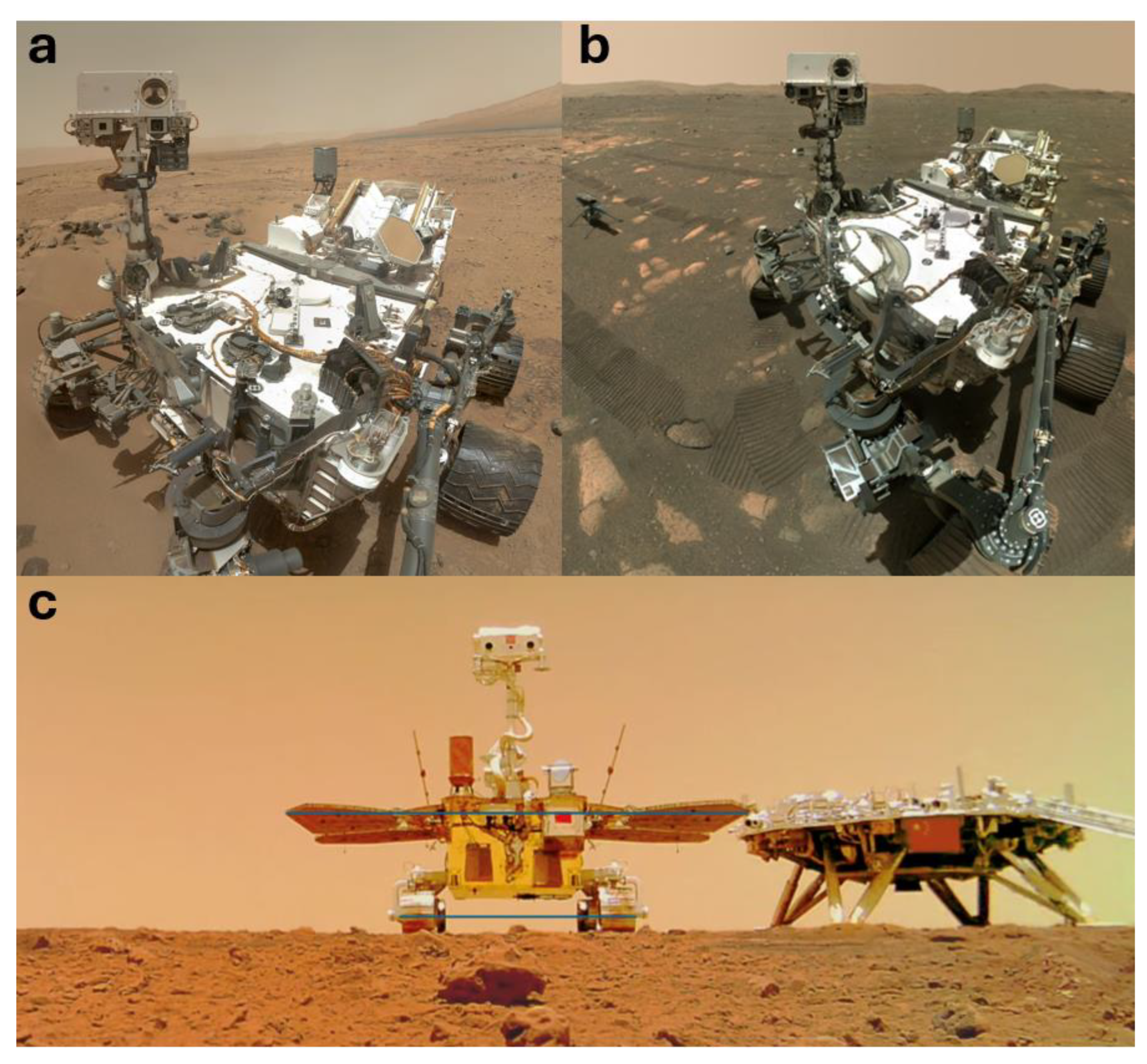
Figure 5.
Common elements among all three Mars LIBS instruments. CCD = charge-coupled device; CWL = continuous-wave laser, used for autonomous focusing.
Figure 5.
Common elements among all three Mars LIBS instruments. CCD = charge-coupled device; CWL = continuous-wave laser, used for autonomous focusing.
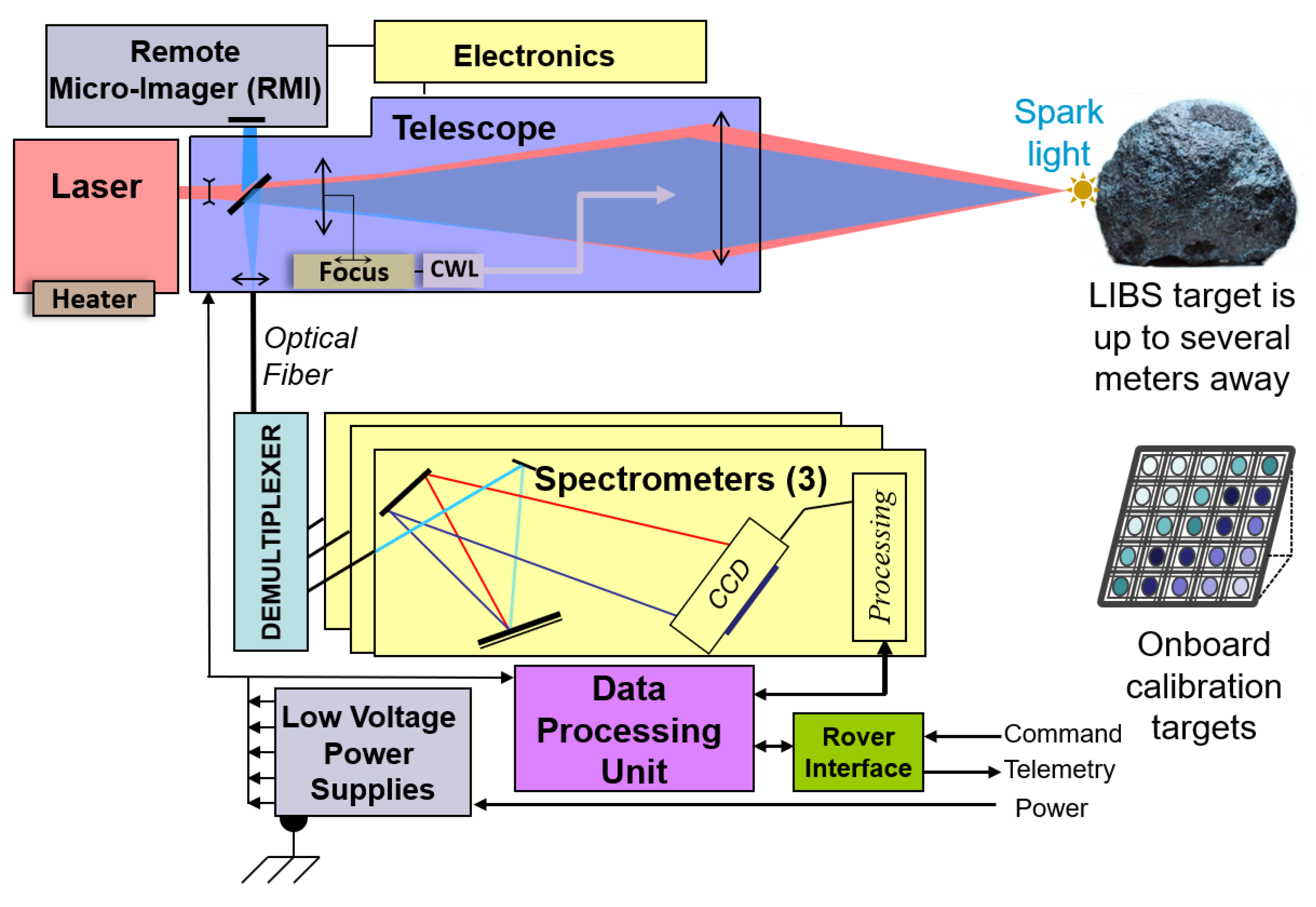
Figure 8.
Traverses of the three Mars rovers carrying LIBS experiments. Clockwise from upper right: a) Curiosity rover (ChemCam) traverse in Gale crater, 35 km to date; b) Perseverance rover (SuperCam) traverse in Jezero crater, 38 km to date; c) Zhurong rover (MarSCoDe) traverse in Utopia Planitia to the end of the mission, ~2 km. Arrows show directions of travel. Panels (b) and (c) show the positions of the rovers as of sols 4554 and 1520, respectively. Panel (c) shows the terminal location of the Ingenuity rotorcraft and the locations where samples were collected as part of the Mars Sample Return program. Maps are scaled individually according to the indicated scale bars.
Figure 8.
Traverses of the three Mars rovers carrying LIBS experiments. Clockwise from upper right: a) Curiosity rover (ChemCam) traverse in Gale crater, 35 km to date; b) Perseverance rover (SuperCam) traverse in Jezero crater, 38 km to date; c) Zhurong rover (MarSCoDe) traverse in Utopia Planitia to the end of the mission, ~2 km. Arrows show directions of travel. Panels (b) and (c) show the positions of the rovers as of sols 4554 and 1520, respectively. Panel (c) shows the terminal location of the Ingenuity rotorcraft and the locations where samples were collected as part of the Mars Sample Return program. Maps are scaled individually according to the indicated scale bars.
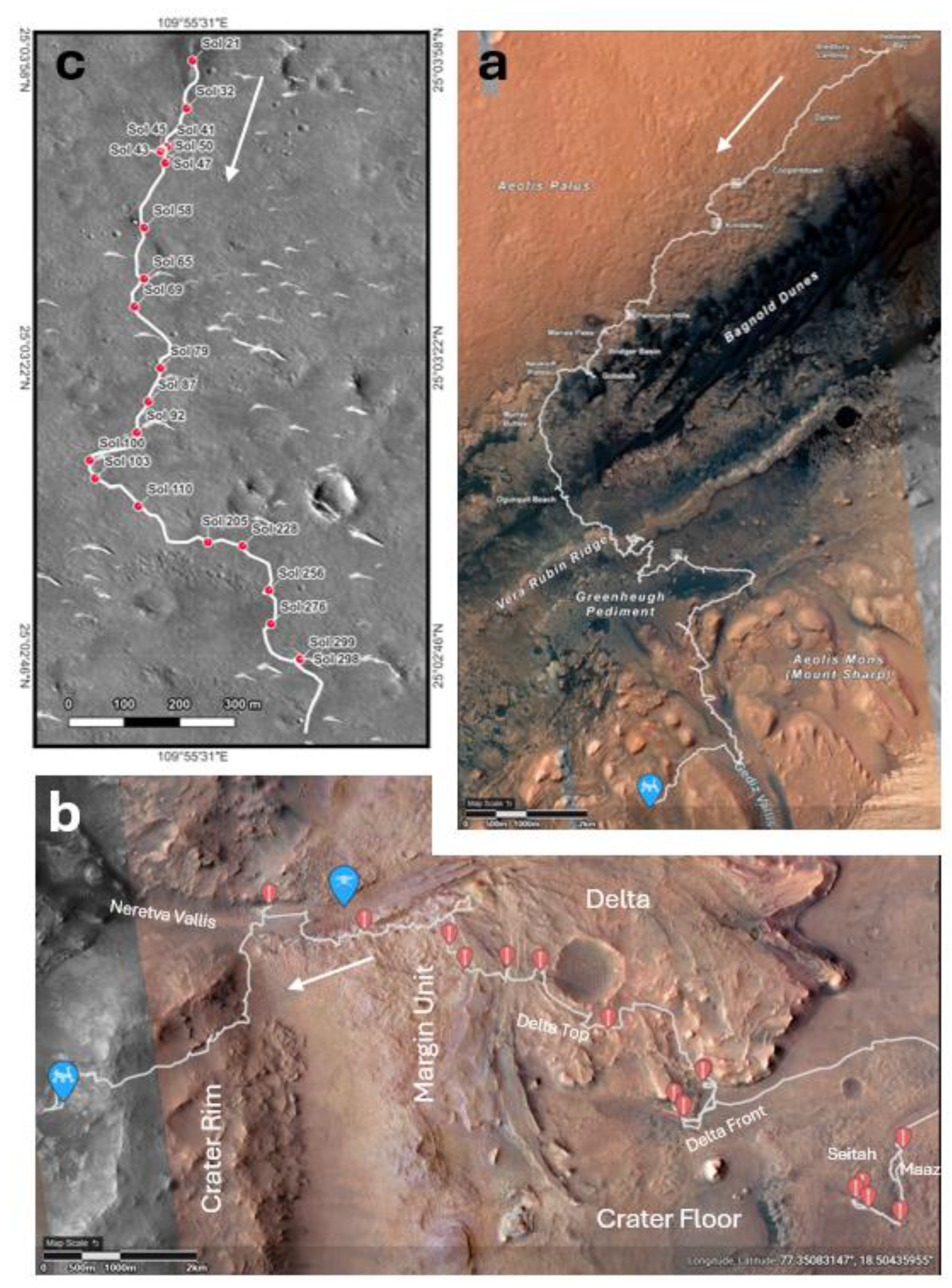
Disclaimer/Publisher’s Note: The statements, opinions and data contained in all publications are solely those of the individual author(s) and contributor(s) and not of MDPI and/or the editor(s). MDPI and/or the editor(s) disclaim responsibility for any injury to people or property resulting from any ideas, methods, instructions or products referred to in the content. |
© 2025 by the authors. Licensee MDPI, Basel, Switzerland. This article is an open access article distributed under the terms and conditions of the Creative Commons Attribution (CC BY) license (http://creativecommons.org/licenses/by/4.0/).
Copyright: This open access article is published under a Creative Commons CC BY 4.0 license, which permit the free download, distribution, and reuse, provided that the author and preprint are cited in any reuse.


