

Submitted:
08 July 2025
Posted:
09 July 2025
You are already at the latest version
Abstract
Sustainable aviation fuel (SAF) has demonstrated promising potential in reducing carbon emissions within the aviation industry. Several initiatives have been started to increase the use of SAF in the industry. However, the technology needed for its development requires important insights to guide policymakers and investors. Industry 4.0 is a potential platform that can provide the most technologically sophisticated technologies. This study aims to review the existing literature and identify similar studies and case studies that can assist in advancing SAF supply chains and production processes utilizing technologies offered by Industry 4.0, ultimately helping the SAF Grand Challenge achieve its sustainability goals. This research's findings will benefit practitioners, policymakers, investors, government entities, and other stakeholders in the aviation sector by identifying appropriate methods and technology to enhance SAF production and advance the mission.
Keywords:
industry 4.0
; aviation
; sustainable aviation fuels
; sustainable supply chains
; technology adoption
1. Introduction
As global aviation continues to expand, so does its environmental footprint, particularly concerning greenhouse gas (GHG) emissions. Aviation currently accounts for 2-3% of global carbon dioxide emissions. Without targeted interventions, this share is expected to grow significantly over the coming decades due to increased air travel demand (Chireshe et al., 2025; Staples et al., 2018; World Economic Forum, 2021). Sustainable Aviation Fuel (SAF), derived from renewable biomass, waste materials, or synthetic processes, has emerged as a promising solution to substantially reduce aviation-related carbon emissions (Staples et al., 2018). SAF can reduce lifecycle greenhouse gas emissions by 50-90% compared to conventional fossil-based jet fuels (Cui & Chen, 2024). This replacement supports international climate commitments such as the SAF Grand Challenge, which includes achieving net-zero emissions for the aviation sector (DOE, USDA, DOT, and EPA, 2022).
Despite the recognized benefits, the widespread adoption of SAF faces several barriers. These include high production costs, stringent quality requirements, feedstock availability and sustainability, complex regulatory certification processes, challenges in distributing and integrating SAF into existing aviation infrastructures, lack of policy support, incentives, and mandates, and lack of awareness of the role of SAF as a sustainable fuel (Grim et al., 2024; Kandaramath Hari et al., 2015; Watson, Machado, Da Silva, et al., 2024; Sharno & Hiloidhari, 2024). These barriers must be overcome through innovative approaches, such as adopting Industry 4.0 technologies to play a transformative role (Bhagwan & Evans, 2023).
Industry 4.0 is characterized by its integration of modern technologies. These include artificial intelligence (AI), Internet of Things (IoT), blockchain, digital twins, big data analytics, cloud computing, augmented reality (AR), virtual reality (VR), and robotics (Arafat et al., 2024; Bhagwan & Evans, 2023; Frank et al., 2019; Ghobakhloo et al., 2024; Ivanov, 2023; Olsen & Tomlin, 2019; M. Sharma et al., 2024). These technologies appear promising when applied to supply chain integration and SAF production. They have significant potential in commercializing SAF production, expediting development, improving fuel quality, simplifying certification procedures, and improving infrastructure compatibility (He et al., 2024).
This goal of this study is to answer the research question: How could the technological constituents of Industry 4.0 assist in speeding up SAF production and create a clear pathway towards net-zero emissions in the aviation sector by 2050? The study will draw upon some case studies and examples of the practical integrations within energy production systems and supply chains. The study will inform industry stakeholders such as policymakers, federal agencies, investors, farmers, producers, airlines, airports, researchers, and technology providers.
The remainder of the paper is structured as follows: Section 2 expands on information regarding the technological aspects of Industry 4.0, elaborates further on the SAF Grand Challenge, and highlights gaps in the literature that this study fills. Section 3 discusses the research methodology. Section 4 discusses the workstream intersections between Industry 4.0 technologies and the SAF Grand Challenge. In conclusion, section 5 provides a summary of the findings and outlines a perspective for future studies.
2. Background
This section contributes an overview of the two key concepts explored in this research: the SAF Grand Challenge and Industry 4.0, along with their associated technologies.
2.1. Sustainable Aviation Roadmaps
Achieving deep decarbonization in the aviation sector is a central challenge in the global effort to mitigate climate change. The United Nations SDGs, particularly SDG 7 (Affordable and Clean Energy) and SDG 13 (Climate Action), emphasize the need for accelerating transitions toward low-carbon energy systems, including those used in hard-to-abate sectors such as aviation (Inan et al., 2025). Given the industry’s dependence on high energy-dense liquid fuels, SAF has emerged as a promising alternative capable of reducing lifecycle GHG emissions by up to 80% compared to conventional jet fuels (ICAO, 2019).
Over the past two decades, several global and national efforts have been launched to promote SAF development through policy incentives, R&D funding, certification frameworks, and private-public collaborations. Several landmark regional and global initiatives have been instrumental in laying the foundation for the worldwide development and adoption of SAF. The efforts were initiated with the ASTM D7566 Certification in 2009, which approved blending SAF with conventional jet fuel. The ASTM Certification provided the initial commercial pathway for the use of SAF consistent with existing aircraft and airport infrastructure (ASTM, 2025; IATA, 2020). In 2013, the International Civil Aviation Organization (ICAO) rolled out the Alternative Fuels Roadmap to provide guidance to member states on sustainable fuels, while also compiling global SAF progress metrics. The establishment of this roadmap laid the groundwork for subsequent regulations and contributed to the ICAO Expo's development of the Carbon Offsetting and Reduction Scheme for International Aviation (CORSIA) in October 2016. As a key part of CORSIA, when an airline surpasses its 2020 CO2 emissions threshold, it must offset those emissions (ICAO, 2013, 2016). One of the most significant regional initiatives, launched by the European Union (EU) in 2020, is the ReFuelEU Aviation Initiative (European Parliament, 2021). ReFuelEU Aviation sets binding SAF targets for airlines in the EU. This involves blending SAF, starting at a minimum of 2% by 2025 and increasing to 70% by 2050.
Additionally, multiple nations have considered whether to develop their own SAF roadmap with a focus on increasing SAF capacity and the building of SAF supply chains and supporting sustainable feedstocks, SAF production and SAF blending at airports. A summary of the initiatives by countries is presented in Table 1. It is worth noting that several other countries not included in the table, such as France, the United Kingdom, Finland, Norway, and Sweden, have established ambitious objectives for producing SAF; However, they have yet to publicly disclose a comprehensive roadmap outlining their plans and expectations, encompassing not only mandates and GHG reductions expected, but also all relevant aspects of SAF production.
Building upon these global and national initiatives, the United States has emerged as a key actor in advancing SAF through the launch of the Sustainable Aviation Fuel Grand Challenge. While many countries have outlined general goals or introduced mandates related to SAF production and use, the U.S. roadmap distinguishes itself through its depth, interagency coordination, and actionable framework. The SAF Grand Challenge offers a clear pathway for specific actions across the supply chain. It sets ambitious production targets and aims to spur collaboration and innovation at every step in the effort to derive sustainable aviation fuel solutions. The following takes a deeper look at this initiative, its structure, and its relevance as a benchmark model for other national efforts aiming to scale SAF production and decarbonize aviation.
The SAF Grand Challenge is an effort that integrates resources from the U.S. Department of Energy (DOE), Department of Transportation (DOT), and the U.S. Department of Agriculture (USDA) alongside the Environmental Protection Agency (EPA) with the aim of accelerating SAF production and utilization (DOE, USDA, DOT, and EPA, 2022). The U.S. Biden administration designed this initiative to enhance the use of SAF towards decarbonizing the U.S. aviation industry. The SAF Grand Challenge sought to achieve an annual production of 3 billion gallons by 2030 and 35 billion gallons by 2050 (DOE, USDA, DOT, and EPA, 2022). This goal envisions achieving a complete substitution for conventional jet fuel utilized within domestic aviation. The move would reduce GHG emissions by at least 50% over their life cycle.
This initiative builds on the fact that aviation is one of the most challenging sectors to decarbonize because of its reliance on high-density liquid fuels (Alaska, 2021; Bergero et al., 2023). SAF offers a feasible option for emission reduction in the near and intermediate terms. SAF can be produced from renewable or waste-derived streams and is fully compatible with existing aircraft and infrastructure. However, production at these levels necessitates multiple and coordinated changes in policies, investments, and collaboration along the entire supply chain. These changes will range from feedstock cultivation and fuel production to logistics, certification, and consumption.
To achieve the strategic objective, the SAF Grand Challenge Roadmap lays out six key action areas: (1) Feedstock Innovation, (2) Conversion Technology Innovation, (3) Building Supply Chains, (4) Policy and Valuation Analysis, (5) Enabling End Use, and (6) Communicating Progress and Building Support. Each area includes specific workstreams designed to tackle multifaceted technical, economic, environmental, and institutional issues. For instance, feedstock innovation relates to increasing the recovery of sustainable biomass and waste resources. Workstreams under conversion technology seek to enhance the efficiency and effectiveness of viable jet fuel production. The roadmap also highlights the need to develop comprehensive and regionally optimized supply chains capable of large-scale operations in production and distribution.
While the roadmap is more of a policy and coordination-oriented plan, it implicitly suggests that innovation and technical progress must be at the center of fulfilling each of these goals. Workstreams include developing environmental models, optimizing resource flows, fuel quality analysis, and infrastructure capacity expansion. The roadmap emphasizes that the objectives will not be achieved without long-term coordination and collaboration across government agencies, industry partners, academics, and the community. This collaboration is meant to provide consistent cross-sector action that is reactive and proactive. The rationale is to incorporate the best available data, information, knowledge, and intelligence into the various processes and operations embedded in SAF supply chains. The roadmap also highlights the need for adaptive implementation through ongoing learning, system-level assessment, and feedback loops. In this way, the capability and willingness to implement new approaches, tools, and innovations in relation to feedstock management, fuel qualification, and supply chain modelling will reflect the need to continually develop competitive capabilities. As a result, although the roadmap focuses on policy and coordination, its structure leaves space for advanced and innovative approaches and technologies to shape and assist the broader decarbonization goal in aviation.
2.2. Industry 4.0
Industry 4.0 represents the Fourth Industrial Revolution. A group of German scientists introduced the concept around 2011 to describe emerging technological trends in manufacturing. It focuses on the integration of automation, the management of big data through cloud computing, high-capacity data exchanges that enable connectivity across manufacturing processes, and the capability to convert digital instructions into physical outputs (C. Chauhan & Singh, 2019). A key feature of Industry 4.0 is the decentralization of decision-making, allowing cyber-physical systems to operate independently (Núñez-Merino et al., 2020). Many disruptive technologies have been suggested under Industry 4.0. However, scholars have yet to reach an agreement, due to different perspectives across research domains (Ghobakhloo et al., 2024).
This paper builds on the paradigms introduced by Weyer et al. (2015) and insights from Choi et al.'s (2022). Figure 1 maps a broad set of technologies and applications associated with Industry 4.0, including blockchains, AI, IoT, 3D printing, and digital twins. Then, the following sections further explore the specific technologies that fall within each of these broader categories.
2.2.1. Blockchains
Blockchains are decentralized ledgers secured through cryptography. They can process and verify transactional data within a distributed database system (Oriekhoe et al., 2024). According to Pattison (2017), the core feature of a blockchain is decentralization, which eliminates the need for a central authority and prevents any single entity from controlling the information. A blockchain operates on a peer-to-peer (P2P) network, requiring all relevant parties to agree on the validity of transactions (Sharabati & Jreisat, 2024). This system is often governed by smart contracts, which are digital protocols containing predefined terms that are stored directly on the blockchain. These smart contracts enable the synchronized and immutable storage of information, providing a high level of security and traceability throughout the information flow (A. Park & Li, 2021). Table 2 summarizes the key technology components in a blockchain and their applications in supply chain management.
2.2.2. AI
Artificial intelligence is currently driving significant transformation in Industry 4.0 by enabling innovative and intelligent production, operational, and management systems (Ali et al., 2024). Major companies, such as Amazon, Walmart, and Best Buy, have already extensively integrated AI into their supply chains. The most widely adopted disruptive technologies within the field of AI include machine learning (ML), natural language processing (NLP), computer vision, robotic process automation, and generative AI (Duan et al., 2019). Table 3 summarizes the key technologies in AI and their applications in supply chain management.
2.2.3. Internet of Things (IoT)
According to Hassini (2008), the Internet of Things (IoT) refers to a network of physical devices characterized by the following key features: (1) they are digitally integrated within the supply chain network; (2) this connectivity enables data storage, sharing, and analysis; (3) it supports both intra- and inter-organizational processes; and (4) it enhances coordination in supply chain planning, control, and management. IoT plays a foundational role in the context of Industry 4.0, serving as a critical enabler of the Fourth Industrial Revolution (Y. Khan et al., 2023; Sallam et al., 2023). An IoT network in supply chain management typically includes the four essential layers summarized in Table 4 (Al-Qaseemi et al., 2016; L. D. Xu et al., 2014).
2.2.4. 3D Printing
3D printing, also called additive manufacturing, enables the creation of complex physical objects from digital 3D models by using a variety of materials such as plastics, metals, ceramics, and even biomaterials (Gibson et al., 2015; Rogers et al., 2016). It has brought unprecedented levels of innovation to manufacturing as it allows diverse material inputs to support individualized design (Petrick & Simpson, 2013; Rogers et al., 2016). Table 5 summarizes its key features and applications in supply chain management.
2.2.5. Simulations (Digital twins/AR/VR)
A digital twin is a real-time virtual model of a physical object or system that is created using sensor data gathered from the real world (Ivanov & and Dolgui, 2021). Teams can visualize, analyze, and learn more about the behavior and performance of the physical counterpart throughout its lifecycle with this data-driven model (Abideen et al., 2021). The ability to deliver continuous and real-time data is the most crucial advantage of a digital twin. It enables organizations to monitor system performance, anticipate potential issues, and make more informed, data-driven decisions (Židek et al., 2020). Digital twins can also provide simulations of how products, processes, and systems could react under varying situations (Fuller et al., 2020; Qazi et al., 2022).
Augmented Reality (AR) and Virtual Reality (VR) are immersive technologies that enhance physical-digital integration in supply chains by providing real-time, spatially contextualized information (Akbari et al., 2022). AR overlays digital content onto physical environments through smart glasses or mobile devices, while VR creates fully immersive simulations of supply chain environments, enabling users to interact with complex systems virtually (Akbari et al., 2022). These technologies are increasingly applied to support end-to-end supply chain functions, including logistics optimization, warehouse management, training and workforce development, infrastructure design, and collaborative decision-making. Table 6 summarizes key features and applications of digital twins, AR, and VR in supply chain management.
2.2. Research Gaps
This research offers a unique contribution to the existing literature on SAF production and commercialization. It presents the first exploratory analysis of how Industry 4.0 technologies are integrated and applied within SAF roadmaps aligned with the SDG initiative, specifically focusing on the SAF Grand Challenge in the United States. Prior studies have examined technological innovations associated with Industry 4.0 and their general applicability in renewable energy supply chains. However, no study targeted the role of innovations and the potential contributions of integrating Industry 4.0 technologies to advance SAF commercialization. This research addresses knowledge gaps by evaluating current practices and potential technological applications, specifically assessing how Industry 4.0 technologies can tackle key challenges in the SAF Grand Challenge. These include feedstock innovation, conversion technologies, supply chain management, policy formulation and evaluation, end-use implementation, and stakeholder communication.
This study clearly reveals technological gaps, highlighting opportunities where Industry 4.0 could simplify the SAF commercialization pathway, expedite regulatory approvals, enhance fuel quality, and improve overall SAF operations and supply chains. Through detailed case analyses and synthesis of existing literature on SAF production and Industry 4.0 technologies, this study offers managerial implications on the practical integration of Industry 4.0 technologies into SAF production systems. This work, therefore, provides valuable insights not only for academics seeking to advance understanding of potential opportunities for achieving sustainable SAF production, but also for the stakeholders and policymakers aiming to accelerate SAF adoption to achieve emissions-reduction targets in the aviation industry.
3. Research Methods
The integrative literature review approach has been adopted as the primary research methodology (Whittemore & Knafl, 2005). An integrative review is particularly suitable for emerging topics that have not yet been extensively conceptualized, allowing researchers to synthesize insights from multiple disciplinary perspectives to generate initial conceptualizations and theoretical frameworks (Snyder, 2019). This approach offers an ideal methodological foundation for this study because the nexus between Industry 4.0 and SAF production is an emerging and multidisciplinary field.
The authors of this research chose the integrative literature review method because it is flexible and can produce new theoretical insights and practical frameworks instead of just summarizing the body of existing literature. A more focused but creative analysis is made possible by the method’s emphasis on synthesizing and critically evaluating literature that particularly supports the study objectives, as opposed to a systematic review’s pursuit of thorough coverage of all pertinent literature (Torraco, 2005). The current study investigates the applicability of Industry 4.0 technologies in SAF production systems, which are both emerging research domains.
An integrative literature review requires researchers to demonstrate excellent conceptual thinking (MacInnis, 2011), transparency, and skillful techniques to critically review a large body of literature. This method of literature review aims to collect, examine, and synthesize the current literature on a research topic to facilitate new perspectives or framework emergence, while generating new knowledge (Torraco, 2005).
This study conducted an integrative literature review because it can successfully capture literature from multiple domains through holistic conceptualization and synthesis (Torraco, 2016). The review included streams of literature from different fields to generate the data for the review. The method used relevant keywords to retrieve the literature from databases. Specifically, the process involved three steps. First, a topic search for “the literature review of Industry 4.0” produced relevant review papers on Industry 4.0 for scrutiny. Second, a topic search for “Industry 4.0 in supply chain” produced literature aimed at understanding the applications of disruptive technologies from a supply chain management perspective. Third, a topic search for “Industry 4.0 in SAF”, “Industry 4.0 in biofuels”, and “Industry 4.0 in renewable fuels” produced literature on specific technological applications from a SAF (or related fuel) perspective. Hence, these three main bodies of literature progressed from broad to narrow, covering key disruptive technologies under Industry 4.0, supply chain management, and the six grand challenges of SAF.
Each step of the literature search utilized the following databases and related search tools: EBSCOhost, Emerald, Wiley, Taylor and Francis, Google Scholar, ScienceDirect, Springer, and Web of Science. The Google search engine produced additional literature from white papers, newspaper articles, company websites, and brochures. These data sources are well recognized as a reliable foundation for academic research (Pansare et al., 2021).
Finally, the research team reviewed titles and abstracts to identify the most representative sources. The selection of articles, books, and grey literature was based on the following criteria:
- (1)
- Provide reviews that enhance understanding of Industry 4.0 and its representative technologies.
- (2)
- Provide knowledge that highlights the applications of Industry 4.0 in supply chain management.
- (3)
- Bridge the understanding of how disruptive technologies under Industry 4.0 could address the six streams of SAF grand challenges.
Through this integrative methodology, the current research synthesizes existing literature across diverse but interrelated fields, such as renewable energy, aviation fuel policy, and advanced digital technologies to enrich the framework offered by the SAF Grand Challenge regarding technological advancements.
4. Discussion and Implications
This section examines the potential contributions of various technological dimensions of Industry 4.0 toward achieving the SAF Grand Challenge objective, specifically focusing on the commercialization of SAF. Each aspect of Industry 4.0 technologies is analyzed individually to identify its intersections and applications within the respective work streams and action areas outlined in section two, pertaining to the SAF Grand Challenge. Table 7 demonstrates how relevant Industry 4.0 technologies can be aligned with the SAF Grand Challenge workstreams and their key action areas. The following subsections will then provide a more detailed discussion of each of these connections, explaining how the enabling technologies can facilitate and/or advance the implementation of each workstream.
4.2. Feedstock Innovation
It is crucial to establish sustainable feedstock supply chains to scale SAF production while minimizing costs, risks, and environmental impacts (Martinez-Valencia et al., 2021). Feedstock availability, efficiency, and sustainability can be enhanced by leveraging Industry 4.0 technologies such as analytic support from AI, real-time monitoring through IoT devices, transparency using blockchain technology, and efficiency of logistics leveraging automation (Liao & Yao, 2021). These technologies play a critical role in addressing each key action area under the Feedstock Innovation workstream, ensuring a resilient and scalable SAF supply chain.
4.2.6. Recourse Market and Availability Analysis
SAF supply chains present unique challenges in securing adequate, sustainable feedstocks and dealing with complex markets (DOE, USDA, DOT, and EPA, 2022). Emerging digital technologies, from big data analytics and AI to blockchain and cloud platforms, are being deployed to process and optimize feedstock availability, traceability, and market selection. For resource market analysis, big data analytics and AI-driven modeling tools can improve forecasting of feedstock supply and demand trends under varying SAF production scenarios (Jahin et al., 2024; J. Xu et al., 2021; Zamani et al., 2023). C. Wu et al. (2024) presents an ML framework that enables rapid estimation of fuel cost across randomized input scenarios for SAF production. Using this model, one can evaluate how variations in feedstock cost, supply volume, or technology performance impact SAF prices. As a producer of SAF, LanzaJet integrates AI and data analytics to refine its feedstock and production strategies (World Economic Forum, 2023). The application of ML to datasets of agricultural yields and available waste enables the company to pinpoint optimal feedstock sources and enhance its conversion processes. Such a proactive approach furthers innovative SAF, enhances new plant site selection, alters fuel compositions, and improves overall profitability.
Blockchain-enabled market databases can provide transparent tracking of commodity and non-commodity feedstock sources, ensuring secure and verifiable data for stakeholders (Ronaghi, 2021; Yi, 2022). The Roundtable on Sustainable Biomaterials (RSB), in collaboration with Bioledger, piloted a project that involved creating a blockchain database to track the lifecycle of used cooking oil (UCO) as a feedstock for biodiesel (Kennedy, 2021). By 2020, in cooperation with industry partners, the system had claimed to track around 1.93 million liters of UCO along with proof of UCO’s verifiable origin, secure digital records, and claims of simplified auditing.
Leveraging cloud computing, AI-powered Cloud platforms can integrate real-time market data and conduct analyses, allowing policymakers and industry leaders to anticipate shortages, optimize pricing, and manage resource allocation (Ivanov et al., 2022; Moyer, 2021). With feedstock markets proving volatile, SAF and low-carbon fuel companies are increasingly turning to cloud AI solutions to streamline operations. Biofuel refinery Imubit, for instance, uses an AI optimization system (Imubit, 2025). Its cloud-based platform identifies plant-level process data, market data like feedstock prices, demand in specific geographies, and competitive position. The company automatically adjusts the production parameters for ongoing optimal profitability. Their platform features real-time dashboards that enable operators to monitor key performance indicators (KPIs) and conduct scenario analysis.
4.2.7. Increase Sustainable Lipid Supply
According to the near-term plans specified in the SAF Grand Challenge, policy support and investment are essential to facilitate the production and utilization of expanded lipid-based feedstocks (DOE, USDA, DOT, and EPA, 2022). AI is transforming precision agriculture, which means utilizing more technology and innovative practices in order to improve agricultural productivity (Mana et al., 2024). AI provides guidance by using analyzed geospatial data to supply real-time information about soil moisture, weather, and crop water requirements. Farmers can then manage their resources responsibly, optimizing agricultural production potential with less environmental footprint (Obi Reddy et al., 2023). Similarly, there are blockchain tracking systems that provide transparency in waste lipid collection and processing, as well as to ensure sustainability of used cooking oils (UCOs), industrial byproducts, and other waste lipids (Gong et al., 2024). A pilot study report by the Roundtable on Sustainable Biomaterials (RSB, 2021) showcased how numerous transparency and accountability challenges within the UCO market could be addressed or vastly improved through the use of a blockchain ledger. Another study by Gong et al. (2024) examined UCO recycling in the UK and described a South European pilot that integrated blockchain with IoT sensors. The blockchain-IoT system authenticated each collection and traced the oil’s lifecycle. This curtailed fraudulent collections and tax evasion associated with black-market oil trading. ML algorithms can analyze data from waste treatment plants using sources such as UCO, identifying new opportunities for lipid recovery and conversion into SAF (Yan et al., 2025).
Investments alongside policy support are required for the production and utilization of expanded lipid-based feedstocks as highlighted in the SAF Grand Challenge (DOE, USDA, DOT, and EPA, 2022). AI can transform precision farming, which is the application of farming practices that utilize advanced technologies, to increase agriculture productivity (Mana et al., 2024). Resource allocation is made more effective with the abundant use of AI. An example is the analysis of geospatial data that can provide real-time information on the soil moisture content, weather conditions, and the amount of water crops require. This aids in optimal resource allocation while improving harvest yields and crop health, while reducing the ecological footprint (Obi Reddy et al., 2023). The collection and processing of waste lipids such as UCO or industrial byproducts can be verified for their sustainability using blockchain tracking systems, therefore ensuring transparency for lipid waste collection and processing (Gong et al., 2024). There are new opportunities for recovering lipids from waste treatment facilities, and converting them to SAF, that can be discovered through analyses of UCO employing ML algorithms (Yan et al., 2025).
4.2.8. Boost Biomass Production and Waste Collection
For improving biomass and waste collection processes, IoT sensors in waste management facilities collect monitored data from municipal solid waste (MSW), and agricultural and forestry residues. This ensures efficient collection and sorting (Lakhouit, 2025; Banerjee, 2023). AI-powered route optimization tools can improve waste-to-biofuel supply chain logistics, reducing transportation costs and emissions (Chávez et al., 2018; Csedő et al., 2024). A comprehensive analysis by Fang et al. (2023) found that AI optimization reduces waste transportation distances by 36.8%, resulting in a 13.3% reduction in costs, and almost 28% in time savings in collection operations. Also, autonomous waste-sorting robots can classify and separate biodegradable and non-biodegradable materials, increasing the efficiency of recyclable waste (Koskinopoulou et al., 2021; Olawade et al., 2024). Koskinopoulou et al. (2021) developed a low-cost computer vision module based on deep learning for identifying and sorting items. Also, location allocation of the potential biomass feedstocks for SAF can clarify and accelerate the adoption process by farmers and investors, by providing them with accurate information about the feasibility and profitability of the feedstocks (Alam & Dwivedi, 2019; Ebrahimi et al., 2022).
4.2.9. Improve Feedstock Supply Logistics
To optimize feedstock logistics, AI-powered logistics platforms can streamline feedstock transportation, storage, and preprocessing by analyzing real-time data on weather, road conditions, and refinery demand (Shah et al., 2025). FuelCab India is an AI-based logistics platform specializing in biofuels (FuelCab India, 2024). It connects bio-refineries with feedstock suppliers, including farmers and waste generators. They forecast feedstock availability, recommend optimal routes, and predict market demand. To reduce delays, FuelCab’s logistics engine uses real-time data together with predictive analytics (FuelCab India, 2024).
IoT-enabled monitoring systems can track biomass storage conditions. This ensures that feedstock remains stable and usable throughout the supply chain (Bastos et al., 2024; Flak, 2020). By monitoring and controlling stored biomass in real-time, researchers emphasize being able to maintain desired specifications of biomass, such as temperature and humidity, and ultimately improve the effectiveness of downstream conversion (Bastos et al., 2024) as well as its resiliency to uncertainties (Zahraee et al., 2022). Blockchain operationalized smart contracts improve operational efficiency through the automatic transaction between stakeholders in a biomass supply chain. Stakeholders include feedstock suppliers, transporters, and biorefineries (Andiappan et al., 2021; Ronaghi, 2021). According to Andiappan et al. (2021), with blockchain technology integration, stakeholders connected within a biomass supply chain can control the quality of the biomass and ensure compliance with sustainability standards. Hence, they can select suppliers based on verified quality. Edge computing for biomass feedstock logistics supports low-latency, real-time decision-making through local computation on devices like harvesters and drones (Palander et al., 2024). This reduces network data transmitted, simplifies bandwidth requirements, and enhances resilience and autonomy, especially in low-connectivity areas.
4.2.10. Improve Feedstock Handling System Reliability
Digital twins and AI-driven material behavior models can simulate solid feedstock characteristics to inform handling efficiency enhancement and reducing processing downtime (Karkaria et al., 2025; National Agricultural Library, 2021). In biomass supply chains, AI models and digital twins can simulate how heterogeneous feedstocks will behave under handling, for example, the way moisture content, particle size, or density would clog a conveyor or hopper (Ikbarieh et al., 2025). The integration of real-time sensor data with advanced simulations enables digital twins to forecast issues (such as bridging in hoppers) and enable predictive maintenance, thus minimizing downtime (M. R. Khan et al., 2024). Robotic automation in biomass preprocessing facilities can ensure uniform feedstock quality, thereby reducing inefficiencies in SAF conversion processes (Liao & Yao, 2021; Shi et al., 2023). Edge computing solutions enable real-time analysis of feedstock composition. This allows processing facilities to dynamically adjust pre-treatment methods for optimal fuel yield (L. Wu et al., 2025). Within SAF supply chains, edge-computing gear continuously monitors feedstock characteristics and adjusts operations in real-time. Hence, nothing goes to waste (L. Wu et al., 2025). Preprocessing plants can now line conveyors and grinders with a mix of NIR scanners, cameras, and moisture probes that read each batch while it moves. This allows the system to log moisture, ash, particle size, and other characteristics (Bioenergy Insight, 2023). Rather than transferring that data to a cloud system, local units can run their own AI models and decide whether the material meets specifications (Bioenergy Insight, 2023).
Robotic pre-processing in biomass preprocessing facilities can ensure uniform feedstock quality. This reduces inefficiencies in SAF conversion procedures (Bioenergy Insight, 2023; Liao & Yao, 2021; Shi et al., 2023). One example is smart sorting setups now used for city trash and farm waste (Bioenergy Insight, 2023). Modern preparation lines utilize optical and chemical sensors guided by AI to recognize materials such as plastics, metals, and papers by matching their shape, color, and spectral fingerprint. Guided by those readings, robotic arms or pneumatic grabs can swiftly pull away the unwanted pieces, leaving a steadier, cleaner biomass stream for the next step.
4.2.11. Enhance Sustainability of Biomass and Waste Supply Systems
AI-powered life-cycle assessments (LCA) can examine the social and environmental impacts of collecting and converting biomass to ensure its sustainability (Balakrishnan et al., 2024; G. Guo et al., 2023; Romeiko et al., 2024). For instance, Ghoroghi et al. (2022) showed that machine-learning tools now help set up scenarios and streamline inventory records during an LCA. In a real-world test, G. Guo et al. (2023) trained a gradient-boosting tree to forecast how much bio-oil a given feedstock would produce. The model then fed those predictions into a follow-up LCA. They found that every kilogram of bio-oil emitted 2.05 kilograms of CO-equivalent emissions.
Blockchain-enabled sustainability tracking verifies compliance with renewable energy policies and emission reduction targets. This ensures that feedstock sourcing remains ethical and environmentally responsible (Yadav et al., 2022). For example, Energy Web Foundation and Rocky Mountain Institute are developing a new blockchain registry called SAFc, tailored for the aviation industry (Insights, 2022). Fuel producers will mint SAF digital certificates at production so that airlines and companies can claim them to track CO2 reduction (Insights, 2022). Additionally, IoT-based environmental monitoring systems track carbon sequestration and land-use impacts. This provides data-driven insights for sustainable feedstock cultivation (Fay et al., 2024; Lim et al., 2024). As one illustration, Dryad Networks (a German startup) uses distributed sensors to measure variables like soil moisture, fuel moisture, and tree growth. Their roadmap explicitly includes dendrometer sensors to gauge carbon sequestration in individual trees (Dryad, 2025).
4.3. Conversion Technology
Developing and deploying SAF conversion technologies requires improvements in process efficiency, scalability, and infrastructure compatibility. Industry 4.0 technologies such as AI-driven process optimization, automation, IoT-enabled monitoring, blockchain for regulatory compliance, and additive manufacturing for catalyst development can provide several benefits. They include streamlining fermentation efficiency, validating ASTM pathways, developing bio-intermediates, mitigating risks, and innovating processes (Borrill et al., 2024). These technologies can play a key role in accelerating SAF deployment by reducing costs, improving efficiency, and enhancing scalability.
4.3.6. Decarbonize, Diversify, and Scale the Current Fermentation-Based Fuel Industry
AI-powered process control and enzyme optimization driven by ML can reduce the carbon intensity of starch ethanol production while maximizing yield in the fermentation process (da Costa & Normey-Rico, 2011; Naveed et al., 2024; Petre et al., 2021). Owusu & Marfo (2023) showed that combining a neural network with an ant-colony optimizer models both enzymatic hydrolysis and fermentation stages at the same time. The system produced accurate forecasts of sugar and ethanol level reductions.
IoT-enabled bioreactors monitor fermentation conditions in real-time, adjusting temperature, pH, and nutrient supply dynamically to enhance microbial efficiency without requiring additional corn planting (Adeleke et al., 2023; Islam et al., 2023). For example, Baicu et al. (2024) presented an IoT bioreactor proof-of-concept with a microcontroller connected to digital temperature and turbidity sensors. This system preserved the optimal yeast-culture conditions by transferring data to the cloud and utilizing a Peltier module for precise heating or cooling. Edge computing solutions let fermentation plants process data on-site, which speeds up processes and lets them make decisions in real time (O’Grady et al., 2019). Additionally, blockchain-based carbon tracking systems can help monitor and verify emission reductions in ethanol-to-SAF conversion, ensuring regulatory compliance (Yi, 2022). Blockchain tracks every ethanol milestone (corn harvest, fermentation, alcohol-to-jet upgrade) to create a clear low-carbon auditable record. Research shows this ledger can improve feedstock traceability by about 30%, cutting the odds of double-counting or errors (Luman, 2024).
4.3.7. Enhance Production and Reduce Carbon Intensity of Existing ASTM-Approved Pathways
To advance ASTM-qualified pathways, digital twins and AI-driven process simulations can model SAF conversion under different process conditions. This helps optimize efficiency and reduce costs before full-scale deployment (Borowski, 2021; Ghenai et al., 2022; W. Yu et al., 2022). Within an EU project, ORLEN and Yokogawa collaboratively developed a virtual plant model for green-hydrogen-and-carbon-dioxide-based synthetic aviation fuel (H2-View, 2023). The digital twin will simulate process economics and emissions for various modes of operation to identify the most promising route for production. 3D printing and additive manufacturing enable rapid catalyst and reactor component prototyping. This improves the efficiency of hydro-processed esters and fatty acids (HEFA), Fischer-Tropsch (FT), and alcohol-to-jet (ATJ) pathways (Lakhouit, 2025; Metzger et al., 2023). Compliance monitoring with blockchain technology streamlines the regulatory approvals process by ensuring the accuracy of fuel performance data documentation. This accelerates the commercialization of ASTM-qualified SAF (RMI, 2022). In a shipping industry pilot, COSCO Shipping and the Global Sustainable Bioenergy Network used blockchain to issue verifiable green certificates tied to specific biofuel procurements (COSCO, 2024). Each Proof of Sustainability certificate was recorded on-chain, allowing auditors, customers, and regulators to track carbon intensity and sustainability from source to combustion. This approach simplifies auditing and provides transparent proof of compliance for ASTM-approved SAF and renewable fuels.
4.3.8. Develop Bio-Intermediates and Pathways Compatible with Existing Capital Assets.
For developing bio-intermediates and compatible pathways, AI-powered predictive modeling can identify optimal bio-intermediate formulations that are compatible with existing refineries. This reduces the need for costly infrastructure overhauls (Meena et al., 2021; Tanzil et al., 2021). Comesana et al. (2022) noted that ML models can predict relevant biofuel production pathways and screen large libraries of candidate molecules (jet fuel precursors) by their boiling point, energy content, and other characteristics. This enables rapid down-selection of promising formulations. Cyber-physical systems and automated processing units dynamically adjust reaction conditions. This optimizes the conversion of biomass, industrial waste gases, and other alternative feedstocks into SAF-compatible intermediates (Arias et al., 2023). For example, a project led by the IEA investigated the conversion of biomass into bio-oils using fast pyrolysis or liquefaction (IEA, 2021). These intermediates are then co-processed in existing refinery units. This method uses current equipment, such as hydrocrackers or FCC units, to upgrade bio-crude on-site. Doing so eliminates the need for new investments while producing low-carbon jet and diesel fuels. 3D-printed biocatalysts and enzyme reactors improve the efficiency of biochemical conversion processes. This ensures higher yields at lower costs (Sans, 2020). For instance, Schmieg et al. (2019) utilized 3D-printed hydrogel lattices to entrap enzymes for continuous conversion. They achieved stable reactor operation for 72 hours with consistent product formation.
4.3.9. Reduce Risk During Operations and Scale-Up
To mitigate scale-up and operational risks, AI-driven predictive maintenance reduces equipment failures by analyzing sensor data from reactors, distillation units, and processing plants to anticipate potential disruptions (Arafat et al., 2024; Zonta et al., 2020). Shell used ML to monitor sensor signals, detecting deviations in temperatures and valve positions (Bhashyam et al., 2022). In 2020, the AI system identified 65 control valves needing repair, which traditional inspections had missed. Digital twins can simulate SAF production scenarios. This helps identify bottlenecks and optimize process design before large-scale implementation (Akhator & Oboirien, 2025; Ghenai et al., 2022). For example, Sierla et al. (2020) outlined a semi-automated workflow that interprets a brownfield plant’s piping and instrumentation (P&ID) diagram and sensor data to construct a validated simulation model. Blockchain-based smart contracts can enhance supply chain coordination. This helps to reduce transaction delays and financial risks in feedstock procurement, processing, and SAF distribution, when upscaling the SAF production (Borowski, 2021). The Roundtable on Sustainable Biomaterials (RSB) and Bioledger piloted a blockchain database to track biofuel transactions and certifications. The implementation recorded each feedstock delivery and processing step under configurable smart contract rules that met the EU Renewable Fuel standards (Bioledger, 2021). The pilot showed that a blockchain ledger can enforce compliance and prevent fraud by ensuring every transaction detects tampering.
4.3.10. Develop Innovative Unit Operations and Pathways
To achieve innovative unit operations and expand pathways, AI-enabled reaction modeling can help identify new SAF production methods that enhance feedstock flexibility while improving conversion efficiency (Liao & Yao, 2021). For example, ML models can predict optimal reaction networks and catalytic conditions. In one study, researchers built ML models to predict key physical properties such as the boiling point and heat of combustion for thousands of organic molecules (Comesana et al., 2022). Shell used ML to monitor sensor signals, detecting deviations in temperatures and valve positions (Shell, 2022). IoT sensors in SAF refining facilities can provide real-time insights into reactor conditions. This helps optimize energy use and reduce operational costs (J. Park & Kang, 2024). Advanced automation in SAF conversion plants improves process reliability. This allows SAF production to scale up efficiently without sacrificing quality or sustainability (McKinsey, 2024). Neste has launched a Fintoil biorefinery in Finland that produces drop-in biofuels by utilizing pine residues (Emerson, 2022). They are utilizing Emerson automation capabilities to achieve peak performance. Neste’s newly established Fintoil biorefinery in Finland, produces drop-in biofuels derived from pine residues. The system employs an Emerson automation suite to optimize performance (Emerson, 2022).
4.4. Building Supply Chains
Industry 4.0 technologies are key to establishing optimum, scalable, low-emission SAF supply chains. Agility of stakeholder collaboration, selection of optimal supply chain modelling, risk avoidance, and large-scale production infrastructure development will be realized through Industry 4.0 technologies. Regional stakeholders build coalitions created on blockchain and deployed on cloud computing. This enables transparent collaboration and secure transactions between feedstock suppliers, refiners, and airlines. For example, blockchain smart contracts are programmed to automate agreements and real-time sustainability certification to build trust between SAF producers and users. Cloud-based platforms provide real-time information about feedstock availability, refinery capacity, and airport demand. This facilitates data exchange and decisions. AI-driven tools will enhance the accuracy of policy analysis and investment expectations regarding SAF. This allows stakeholders to evaluate the effect of regulatory incentives on SAF acceptance in different areas. Also, digital twins can help simulate a prospective SAF supply chain and its performance before implementing and locating its operational components.
4.4.6. Establish Regional Stakeholder Coalitions
This workstream is about creating partnerships between feedstock providers, refiners, airlines, and policymakers to help actively develop supply chains for SAFs. Also, blockchain can improve SAF traceability when documenting its entire travel from feedstock to distribution by 30% (Luman, 2024). This can reduce fraud and lead to higher regulatory compliance. For instance, Shell’s Avelia platform uses blockchain to provide clear and transparent tracking of SAF’s environmental attributes and to prevent double-counting of emissions credits (Jessen, 2024b). By embedding agreed trust rules into the blockchain, all supply chain partners (from farmers and refineries to airlines and shippers) co-define and validate each transaction (Bioledger, 2021). This effectively builds a system of consensus and embedded trust that aligns the coalition’s incentives. Cloud-based platforms provide a common real-time information backbone for SAF ecosystems. This implementation enables the ease of exchange of critical metrics such as fuel and inventory levels, fuel volume, and emissions intensity across value chain partners (B. Wang et al., 2024). Microsoft Cloud Logistics working with DB Schenker exemplifies this in SAF supply chains (Jessen, 2024a). Their pilot integrates SAF procurement, routing, and sustainability dashboards across companies to support coordinated decision-making and emissions tracking. According to IATA, a robust traceability framework, such as blockchain on a cloud platform, is essential for ensuring accurate SAF accounting in mixed fuel batches (Norazmi, 2023).
4.4.7. Model SAF Supply Chains
To develop and disseminate data and analytical tools, big data and AI are deployed to optimize feedstock sourcing, refinery site selection, and transportation logistics (Okolie, 2024; Ukoba et al., 2024; He et al., 2024). This ensures cost-effective and low-carbon supply chain pathways. In a case study related to the central Vietnam region, Duc & Nananukul (2023) used an integrated methodology combining ML algorithms and optimization models to optimize the performance of a biomass supply chain. For example, airlines and fuel distributors can apply AI-based demand forecasting models to stabilize SAF supply, while also reducing transportation constraints (S. Ma et al., 2022). Utilizing IoT sensors and edge computing facilitates the collection of real-time information from farms, refineries, and airports, can provide data on feedstock inventory, processes for fuel blending, and the efficiency of distribution (Osman, 2023). With the data collected from sensors, edge computing ensures immediate data processing at the source (Bastos et al., 2024). This enables faster adjustments in logistics and refinery operations.
4.4.8. Demonstration of Regional SAF Supply Chains
As part of feedstock-to-fueling demonstration projects, Industry 4.0 can enable the de-risking and maturation of SAF production technologies before commercial deployment. AI-driven process optimization refines pilot plant operations, ensuring biomass-to-fuel conversion processes reach maximum efficiency before scaling. Biomass-to-fuel pilot facilities (e.g. NREL’s Integrated Biorefinery Research Facility) provide scaled-down biorefinery units such as hydrolysis and fermentation tanks. These units allow operators to gather process data and tune conditions before full-scale SAF production (DOE, 2023). H. Wang et al. (2019) built a validated artificial neural network (ANN) model of a pilot-scale (ton/day) entrained-flow gasifier. They trained the ANN on simulated pilot data and then used it in multi-objective optimizations to find operating conditions that maximize carbon conversion and hydrogen output. Cyber-physical systems in automated SAF processing can further enhance reliability by self-learning and adjusting processing parameters dynamically (Arias et al., 2023). This minimizes inefficiencies during scaling. Additionally, 3D printing (additive manufacturing) accelerates technology deployment by enabling the rapid development of custom reactor components, catalysts, and fuel processing equipment tailored for SAF conversion pathways (Haseltalab et al., 2023). Borges et al. (2017) demonstrated 3D printing a micro-structured catalytic stirring system for biodiesel production. It shows how 3D printing enables high mechanical strength and reusability. These capabilities accelerate technology deployment for custom components in biofuel production, including SAF.
4.4.9. Develop a Production Infrastructure to Support SAF Deployment in the Industry
Industry 4.0 technologies provide automated solutions for refining, blending, and distribution to ensure successful investment in commercial-scale SAF production infrastructure (V. Sharma et al., 2023; Ukoba et al., 2024; Arias et al., 2023). Honeywell deployed its automation suite at a large SAF biorefinery to provide real-time monitoring and control of complex conversion processes (Honeywell, 2024). The system optimized performance and minimized downtime. Industrial robotics improve operational efficiency by automating critical fuel processing, storage, and blending systems to ensure consistent SAF quality (Asghar et al., 2022). Schneider Electric notes that modern biorefineries track Renewable Identification Numbers (RINs) and automate batch operations via integrated supervisory control data acquisition (SCADA) and distributed control systems (DCS) platforms (Emerson, 2025). This enables consistent blend quality and automated sampling. AI-powered predictive maintenance enhances refinery and distribution reliability by detecting potential failures, thereby reducing downtime and increasing SAF output (Ucar et al., 2024). In their study, Arinze et al. (2024) noted the increasingly broader possibilities for facilitating reliability and cost savings in predictive maintenance of energy infrastructure like oil and gas facilities, mainly due to AI applications. Additionally, blockchain-based carbon tracking systems provide transparent carbon accounting and regulatory compliance for airlines, refineries, and policy regulators, ensuring CORSIA and other SAF mandates are met (Patro et al., 2024; Sipthorpe et al., 2022). Yi (2022) highlighted blockchain’s use in biofuel supply chains for transparency and traceability, which can extend to SAF..
4.5. Policy and Valuation
To maximize the social, economic, and environmental benefits of SAF under a multi-dimensional valuation framework, prioritizing robust policy and valuation is vital. In addition, the use of Industry 4.0 technology and advances in these technologies can help support better data-driven policy making and more evaluative economics. It can clarify the valuations of SAFs by providing data processing through AI-based analytics, blockchain protocols for transparent data sharing, and digital modeling methods. These technologies supplement three primary focus areas in the Policy and Valuation Analysis workstream as they provide accurate, evidence-based conclusions for use by policymakers at the federal, state, and international levels.
4.5.6. Improve the Environmental Data and Models for SAF
Under the creation of more robust environmental and socioeconomic datasets and analytical tools, big data, IoT, and AI provide capacity for real-time environmental assessments. This will help policymakers understand SAF’s carbon mitigation dimensions, land-use changes, and economic value (Popowicz et al., 2025). AI models used for real-time predictive modelling are also being used for dynamic LCA that combine instant feedback on feedstock sourcing, energy intensity and carbon emissions (Romeiko et al., 2024). It is important to note that the enhanced accuracy ability is due to the advanced data integration. AI can also model the source of feedstocks and emissions dynamically and will provide more accurate and confident decisions (C. Ma et al., 2022).
Additionally, blockchain-based sustainability tracking ensures transparent verification of SAF’s environmental benefits, helping stakeholders comply with regulatory frameworks like CORSIA and the Renewable Fuel Standard (RFS) (Bioledger, 2021; Yi, 2022). Furthermore, by applying blockchain to carbon tracking, stakeholders can transparently account for emissions reductions (Sipthorpe et al., 2022). Cloud-based policy simulation platforms also allow regulators to test different policy scenarios. This will optimize incentive structures and carbon pricing mechanisms for SAF expansion. By running policy simulations in the cloud, authorities can test carbon pricing rules, subsidy levels, blending mandates, and other levers on a virtual SAF market. For example, a European project (PolicyCLOUD) demonstrated a serverless cloud framework that lets analysts simulate and compare alternative policies before implementation (Biran et al., 2022). Similarly, the DOE/NREL Engage tool is a cloud-based energy simulator with a browser-based interface that manages data and scenarios in the cloud (NREL, 2025). This system enables stakeholders to model grid and fuel transitions collaboratively.
4.5.7. Conduct Techno-Economic and Production Feasibility Analysis
For techno-economic and production potential analyses, AI-driven economic modeling can assess cost-competitiveness, feedstock pricing trends, and infrastructure investment needs across different SAF pathways (C. Wu et al., 2024). A framework using ML for tech-economic evaluations of SAF is proposed by C. Wu et al. (2024) used a stochastic analysis to investigate the likelihood of loss, demonstrating AI's ability to comprehend and control the economic risks related to SAF routes. In another study, He et al. (2024) highlighted the role of ML in optimizing transesterification processes and predicting biodiesel yield while performing techno-economic analyses. They emphasized that ML models can predict fuel properties with high accuracy (R² = 0.85 to 0.99) and contribute to cost reduction by shortening technology development time and supporting process optimization. Digital twins simulate SAF production at varying scales to identify bottlenecks and cost reduction opportunities before real-world implementation (Huynh & Zondervan, 2022; Sheik et al., 2024). Muldbak et al. (2022) developed a digital twin of a pilot bio-production plant that uses two-way data exchange to link real-time plant data with simulation models. The implementation enabled virtual testing of process changes, prediction of production bottlenecks, and suggested optimizations prior to physical implementation.
Policymakers can gain real-time cost and performance data through edge computing-enabled refinery sensors, enhancing their economic feasibility assessments (Andriulo et al., 2024). This allows policymakers and analysts to use live data streams for immediate refinement of economic models, thereby improving their accuracy. By incorporating up-to-date operational conditions without delays, these sensors improve the accuracy of feasibility assessments. Meanwhile, automated data processing platforms streamline the integration of economic, environmental, and supply chain variables. This integration helps identify the most viable SAF production models (Watson, Machado, da Silva, et al., 2024). For instance, a DOE-sponsored project is releasing a web-based toolkit that unifies techno-economic analysis (TEA) and life-cycle assessment (LCA) models for multi-input biorefineries (DOE, 2023). Ficili et al. (2025) describes automated platforms operating with massive datasets to improve supply chain optimizations. Similar opportunities exist for SAF, if these platforms can integrate feedstock prices, environmental costs, and supply chain features into techno-economic analyses.
4.5.8. Contribute to SAF Policy Development
Informing SAF policy development requires AI-powered policy evaluation tools to analyze historical data and forecast the long-term impacts of SAF incentives, subsidies, and regulatory frameworks (Raman et al., 2024). In climate finance research, ML methods have successfully uncovered nonlinear policy effects and provided predictive insights to anticipate impacts of financial and regulatory policies, such as sequencing of green credits or tax rules (Qudrat-Ullah, 2025). Yar et al. (2024) discuss the impact of AI advancements on public policy by providing opportunities for decision-making improvements and data-driven insights, especially through enhanced policy prediction capabilities.
Blockchain-enhanced governance platforms ensure transparency in SAF credit trading systems, tax incentives, and compliance tracking (Javaid et al., 2022; Woo et al., 2021). This approach help with mitigating fraud and ensuring equitable access to incentives. In practice, a blockchain-based certificate scheme records each credit transaction (issuer, buyer, quantity) on-chain, providing regulators and auditors a tamper-proof trail (Fu et al., 2023; Merlo et al., 2025). Also, smart contracts can auto-issue and settle SAF or biofuel certificates when fuel is produced or blended (Fu et al., 2023). Swinkels (2024) explores trading voluntary carbon credits on a blockchain-based exchange, which is analogous to SAF credit trading. Additionally, cloud-based collaboration networks can enable federal, state, and international policymakers to share best practices and coordinate regulatory frameworks for SAF expansion. For instance, the EU’s federated-system approach for flexible and interoperable energy communities (FEDECOM) project is developing a cloud-based platform for integrated local energy systems and cross-border energy trading (Lennard, 2025). The system will provide centralized data, analytics, and communication for policymakers to harmonize standards and update regulations in real time.
4.6. Enabling End Use
Facilitating the widespread adoption and integration of SAF among civil and military users requires overcoming technical, regulatory, and logistical barriers. Industry 4.0 technologies can help accelerate SAF evaluation, support performance testing, sort distribution logistics, and enable infrastructure integration through AI-driven analytics, blockchain-enabled tracking, automation, and advanced manufacturing techniques. These technologies play a critical role in addressing the four key action areas in the Enabling End Use workstream, ensuring safe, efficient, and cost-effective deployment of SAF while meeting the aviation industry standards.
4.6.6. Support SAF Evaluation, Testing, Qualification, and Specification
For SAF evaluation, testing, qualification, and specification, AI can optimize fuel performance modeling to reduce the reliance on costly experiments (Ai & Cho, 2024). In the aviation arena, He et al. (2024) emphasized that ML-based technologies can shorten technology development time and support process optimization for certified aviation fuels. Baumann & Klingauf (2020) used ML to develop fuel flow models based on full-flight data, which can be applied to SAF to optimize fuel performance and reduce physical testing. Digital twins simulate SAF combustion and engine compatibility under varying conditions (Borowski, 2021). This can help accelerate desirable certifications while minimizing testing costs for producers. Researchers at NREL use digital twins to study SAF combustion in jet engines, which is crucial for engine compatibility and certification (NREL, 2024). Airbus. ,for instance, uses digital twins to plan, experiment, and run operations, such as simulating fuel performance and compatibility with the engine (Airbus, 2025). Besides, lab robots can mechanize fuel property analysis to ensure that SAF meets regulatory standards to a greater extent. Such automation lessens the scope for error and the need for constant testing, with each step and result traceable, a huge benefit for compliance to quality requirements by policymakers (Heike Risse, 2024). Blockchain digital certification systems can further enhance traceability and evidence of compliance (Patro et al., 2025). This reduces the administrative burden for SAF producers seeking certification. The Energy Web Foundation and the Rocky Mountain Institute built a blockchain-based SAF certificate (SAFc) registry for sustainable aviation fuel certificates to increase transparency and promote the use of more sustainable fuels (RMI, 2022).
4.6.7. Facilitate the Adoption of Unblended and High-Percentage SAF Blends, Including Up to 100% SAF
AI-powered chemical analysis enhances SAF blend optimization, ensuring fuel stability and performance across different aircraft models (He et al., 2024). Jameel & Gani (2025) demonstrated that an AI-driven hybrid model ensures the consistent achievement of critical end-product characteristics, such as viscosity and density, in fuel blending. This reduces off-specification fuel production. In another study, Liu & Yang (2024) used an ANN model to predict the low flammability limit of SAF blends with 98.8% accuracy.
Cyber-physical systems in refinery operations allow real-time adjustments to SAF composition. This ensures that blends meet energy density, thermal stability, and viscosity standards. Digital optimization studies, such as those varying distillation cut points, demonstrate that computational control significantly increases SAF yield while adhering to operational limits (Z. Yang et al., 2023). By integrating sensors, controllers, and optimization algorithms in a cyber-physical setup, refineries can dynamically tailor SAF composition to meet specific energy density and stability requirements (Jameel & Gani, 2025). Advanced sensor networks in aircraft fuel systems can monitor SAF combustion efficiency in real-time, supporting long-term performance data collection to evaluate SAF usage (NREL, 2025). Airbus reported using multiple probes and sensors to gather in-flight emissions data from an A350's engines operating on 100% SAF (Airbus, 2021).
4.6.8. Explore Synthetic Jet Fuels that Enhance Operational Performance and Productivity
Exploring Jet A fuel derivatives for performance and productivity enhancements requires advanced AI-driven fuel formulation models that can formulate molecular structures with higher energy density and lower emissions (Kuzhagaliyeva et al., 2022). Kuzhagaliyeva et al. (2022) developed a deep learning framework to generate gasoline-like fuel mixtures with optimized combustion metrics. Their approach produced high-octane blends that reduce engine-out soot and improve efficiency. A study by Park & Kang (2024) employed ANN to predict SAF’s volume swell characteristics. This is a crucial property for blend compatibility and optimizing SAF blends for various aircraft models. 3D printing and material engineering can create customized fuel additives, often nanoparticle-based or novel organometallic compounds, improving combustion efficiency and reducing wear on aircraft engines (Ali Ijaz Malik et al., 2024). Additionally, 3D printing plays an essential role in creating customized engine hardware that works in tandem with fuel additives. For example, the GE Catalyst turboprop engine employed 3D-printed, optimized combustion components and fuel injectors to achieve an estimated 5% reduction in engine weight and an estimated 1% better fuel efficiency (GE, 2019). In addition, high-throughput experimentation platforms in laboratory facilities dedicated to SAF research are capable of accelerating testing of fuel properties (Miller et al., 2022). This can enable the rapid development of next-generation SAF derivatives with superior performance characteristics. Such automation can greatly speed up the testing of fuel blends and catalysts to enable rapid optimization of high-performance SAF formulations (Miller et al., 2022; Pidatala et al., 2024)
4.6.9. Adapt Fuel Infrastructure to Support the Distribution and Use of SAF
IoT-enabled smart fuel monitoring systems can optimize storage conditions and blend precision in large-scale fuel depots, integrating SAF into the fuel distribution infrastructure. SAF supply chain distribution networks can be streamlined by AI-driven logistics platforms, which also lessen bottlenecks in airport delivery and blending. SAF disruptions in the fuel supply chain may be diminished by using blockchain-based fuel tracking systems to ensure real-time transparency and authentication of the SAF shipments. Predictive maintenance algorithms have the potential to significantly enhance the reliability of airports’ fuel storage and sustainable aviation fuel (SAF) pipeline networks, while also effectively minimizing disruptions in the SAF supply chain.
4.7. Communicating Progress and Building Support
The environmental, economic, and climate benefits of SAF must be effectively communicated and actively promoted through robust public engagement (Abu Talib et al., 2025). The complexity of SAF supply chains means communication strategies must be data-driven to enhance transparency, combat misinformation, and build trust among stakeholders (Hu et al., 2025). Industry 4.0 technologies, such as AI-powered data analytics, blockchain transparency tools, digital outreach platforms, can enhance stakeholder engagement, public trust, and progress measurement. These technologies improve each key action area under this workstream toward the commercialization of SAF by delivering accurate, real-time, and verifiable information.
4.7.6. Engage Stakeholders to Promote Awareness and Collaboration on Sustainable Feedstock Practices
For stakeholder outreach and engagement on sustainability, AI-powered data visualization platforms can present clear, interactive insights on the sustainability impacts of SAF. These include life cycle GHG emissions reductions, land-use efficiency, and energy savings (Ahmed, 2025; Parhamfar, 2024; Thepchalerm & Pinsuwan, 2025). Suggested by Ahmed (2025) AR and VR coupled with AI technologies can provide virtual training and collaborative environments for the stakeholders. Since 2015, blockchain technology has addressed the transparency limitations of traditional supply chain tracking by overcoming single points of trust and enhancing inter-organizational confidence (Thanasi-Boçe & Hoxha, 2025). Blockchain technology guarantees that SAF sustainability metrics can be tracked transparently so that stakeholders can validate the sustainability of feedstocks, carbon offsets for available resources, and compliance with environmental requirements (Hu et al., 2025; Insights, 2022). Additionally, cloud-based collaboration tools facilitate real-time knowledge-sharing among researchers, industry leaders, and policymakers. This fosters stronger partnerships in sustainable aviation initiatives. For instance, LanzaJet (2024) has expanded its partnership with Microsoft to use Azure’s cloud-based AI and ML tools to optimize SAF production and supply chains. Announced in April 2024, this partnership will allow stakeholders to share emissions, operations, sustainability metrics, and any other information auditable and in real-time. This increases trust, assure compliance with regulations, and foster a collaborative effort across nations globally.
4.7.7. Carry out a Comprehensive Assessment of the Benefits and Influence of the SAF Grand Challenge
To support benefits assessment and impact analysis of the SAF Grand Challenge, big data analytics and AI-driven simulation models can evaluate SAF’s long-term economic, environmental, and policy impacts. (C.-H. Chen et al., 2024; Z. Chen et al., 2025). For example, Okolie et al. (2024) developed a data-driven techno-economic framework for SAF production to predict the minimum selling price of pyrolysis-derived SAF from feedstock and plant parameters. Digital twins enable real-time scenario modeling of SAF adoption strategies, helping stakeholders forecast emissions reductions, economic benefits, and infrastructure needs under different policy frameworks (Enderle et al., 2021). Enderle et al. (2021) mentioned that by incorporating uncertainties, the digital twin provides a risk-informed decision support in real time, such as how the optimal SAF choice may change when considering uncertainty bounds. Automated AI-generated reports can synthesize large datasets (MarketsandMarkets, 2025). This will ensure at stakeholders and policymakers have access to science-backed, data-driven insights to guide decision-making. Emerging AI-driven reporting systems, such as natural-language summaries and predictive visualizations, could further help synthesize these big datasets.
4.7.8. Track the Advancement of the SAF Grand Challenge Objectives
For measuring the progress of the SAF Grand Challenge, IoT-enabled data collection systems tracked SAF production volumes, GHG emissions reductions, and supply chain efficiency metrics in real time (Hapsari et al., 2021). For instance, Emerson used gas-analysis sensors across the SAF processes to overcome measurement challenges in SAF production (Velarde, 2019).
Blockchain tracking systems secure the integrity of data and eliminate down-stream manipulation. This strengthens the amenability for progress reports and sustainability claims (Luman, 2024). Alevia, a blockchain-powered book and claim solutions for aviation, makes it possible for freight forwarders to access and assign SAF environmental qualities to their shipping clients (Bocca et al., 2025; Brett, 2024). This facilitates the disclosure of emissions and encourage a wider adoption of SAF. The system enables freight forwarders to access and allocate SAF environmental attributes to their shipping customers, and allow both parties to disclose emissions while supporting broader SAF adoption. Cloud-based dashboards and AI-enabled benchmarking tools provide real-time updates on SAF deployment. This allows industry leaders to identify barriers or challenges to optimize the strategy for reaching their SAF production ambitions. Boeing (2023) used a public SAF dashboard coupled with the U.S. inter-agency metrics site on a cloud-based platform to monitor possible SAF availability and detect imbalance in supply and demand.
4.7.9. Share the Positive Impacts of the SAF Grand Challenge with the Broader Community
To communicate public benefits effectively, AI-powered digital media tools can generate personalized educational content for different audiences. This spans policymakers, Industry leaders, and the general public. For example, a report by Wheelock (2025) showed how AI could create educational materials for aviation could communicate public benefits effectively. Also, AR and VR experiences can bring SAF supply chains to life, allowing stakeholders to visualize the journey from feedstock sourcing to SAF-powered flights (WEF, 2024). Additionally, social media sentiment analysis powered by AI can track public perception of SAF. This can help industry leaders address concerns and misinformation with fact-based, transparent communication (Rogachuk et al., 2025). Alahmari et al. (2023) developed and tested an AI-based approach to study the service sector by taking important factors from both academic research and public opinion. Using methods such as word embeddings and clustering, they created a taxonomy and knowledge framework from related research articles and tweets. The results provided insights into how to make service economies smarter and more sustainable.
5. Conclusion
This research detailed the transformative potential of Industry 4.0 technologies in supporting progress toward the commercialization of SAF. It highlighted how the various technology dimensions play a critical role in overcoming the existing difficulties related to production efficiency, regulatory approval, supply chain sustainability, and stakeholder engagement. These dimensions include AI, IoT, blockchain, digital twins, big data analytics, AR/VR, and advanced automation. This analysis demonstrates that these technological dimensions offer powerful tools for accelerating SAF production and adoption.
Overall results indicate that both AI-based analytics and IoT-based monitoring can meaningfully improve feedstock innovation by optimizing growing conditions, managing biomass sustainably, and improving logistics. In the area of conversion technology innovation, the study shows that digital twins and automation significantly reduce scale-up risks and improve operational efficiencies. This streamlines the ASTM certification processes required for the rapid deployment of SAF. Furthermore, the study highlighted the use of blockchain technology as an important facilitator of transparency. This enhances trust among stakeholders and assures compliance with policies.
This study also highlights the importance of Industry 4.0 innovations in policy and valuation analysis. It shows how AI-powered predictive models and scenario planning tools enable policymakers and industry stakeholders to make informed, data-driven decisions regarding SAF investments and incentives. In addition, there are various ways that AR and VR technologies can potentially enhance stakeholder education and public outreach. AR and VR technologies can provide immersive experiences that vividly show the real-world benefits of SAF.
Despite the promise demonstrated in the literature and case studies, technological gaps remain. These include the need for greater integration and interoperability of diverse digital technologies across the SAF production ecosystem, improved cost-effectiveness of advanced sensors and digital infrastructure, and more robust frameworks for managing cybersecurity and data privacy concerns in IoT and blockchain applications. Addressing these gaps will engage the full potential of Industry 4.0 to meet the ambitious goals of the SAF Grand Challenge initiative.
To conclude, there is a significant strategic impact of Industry 4.0 technologies in enabling faster commercialization of SAF. However, it is essential to continue interdisciplinary research and invest in these emerging technologies to guide the aviation industry toward sustainability. This will greatly aid in fulfilling international climate commitments and global net-zero goals aligned with SDG targets. This study offers a reference point for policymakers, industry players, and technology developers to advance practical pathways for achieving a sustainable, reliable, and cost-effective scale-up of SAF production.
Author Contributions
Conceptualization, S.E; methodology, S.E., J.C.; validation, R.B., J.S. and J.M.; investigation, S.E., J.C.; data curation, S.E., J.C.; writing—original draft preparation, S.E.; writing—review and editing, J.C., R.B., J.S., J.M.; visualization, S.E., J.C.; supervision, S.E. All authors have read and agreed to the published version of the manuscript.
Funding
This research received no external funding.
Data Availability Statement
The data used to support the findings of this study are available from the corresponding author upon request.
Conflicts of Interest
The authors declare no conflict of interest.
References
- Abideen, A. Z., Sundram, V. P. K., Pyeman, J., Othman, A. K., & Sorooshian, S. (2021). Digital Twin Integrated Reinforced Learning in Supply Chain and Logistics. Logistics, 5(4), Article 4. [CrossRef]
- Abu Talib, M., Nasir, Q., Dakalbab, F., & Saud, H. (2025). Future aviation jobs: The role of technology in shaping skills and competencies. Journal of Open Innovation: Technology, Market, and Complexity, 11(2), 100517. [CrossRef]
- Adeleke, I., Nwulu, N., & Adebo, O. A. (2023). Internet of Things (IoT) in the food fermentation process: A bibliometric review. Journal of Food Process Engineering, 46(5), e14321. [CrossRef]
- Aejas, B., Belhi, A., & Bouras, A. (2025). Using AI to Ensure Reliable Supply Chains: Legal Relation Extraction for Sustainable and Transparent Contract Automation. Sustainability, 17(9), Article 9. [CrossRef]
- Agnusdei, G. P., Elia, V., & Gnoni, M. G. (2021). Is Digital Twin Technology Supporting Safety Management? A Bibliometric and Systematic Review. Applied Sciences, 11(6), Article 6. [CrossRef]
- Ahmed, W. (2025). Artificial Intelligence in Aviation: A Review of Machine Learning and Deep Learning Applications for Enhanced Safety and Security. Premier Journal of Artificial Intelligence. [CrossRef]
- AI Applications for Renewable Fuel Producers. (n.d.). Imubit. Retrieved June 7, 2025, from https://imubit.com/ai-applications-for-renewable-fuel-producers/.
- Ai, W., & Cho, H. M. (2024). Predictive Models for Biodiesel Performance and Emission Characteristics in Diesel Engines: A Review. Energies, 17(19), Article 19. [CrossRef]
- Airbus. (2021, November 8). This chase aircraft is tracking 100% SAF’s emissions performance | Airbus. https://www.airbus.com/en/newsroom/stories/2021-11-this-chase-aircraft-is-tracking-100-safs-emissions-performance.
- Airbus. (2025, April 23). Digital Twins: Accelerating aerospace innovation from design to operations | Airbus. https://www.airbus.com/en/newsroom/stories/2025-04-digital-twins-accelerating-aerospace-innovation-from-design-to-operations.
- Akbari, M., Ha, N., & Kok, S. (2022). A systematic review of AR/VR in operations and supply chain management: Maturity, current trends and future directions. Journal of Global Operations and Strategic Sourcing, 15(4), 534–565. [CrossRef]
- Akhator, P., & Oboirien, B. (2025). Digitilising the energy sector: A comprehensive digital twin framework for biomass gasification power plant with CO2 capture. Cleaner Energy Systems, 10, 100175. [CrossRef]
- Alahmari, N., Mehmood, R., Alzahrani, A., Yigitcanlar, T., & Corchado, J. M. (2023). Autonomous and Sustainable Service Economies: Data-Driven Optimization of Design and Operations through Discovery of Multi-Perspective Parameters. Sustainability, 15(22), Article 22. [CrossRef]
- Alam, A., & Dwivedi, P. (2019). Modeling site suitability and production potential of carinata-based sustainable jet fuel in the southeastern United States. Journal of Cleaner Production, 239, 117817. [CrossRef]
- Alaska. (2021, April 21). Alaska Airlines commits to carbon, waste and water goals for 2025, announces path to net zero by 2040—Apr 21, 2021. Alaska Airlines News. https://news.alaskaair.com/newsroom/alaska-airlines-commits-to-carbon-waste-and-water-goals-for-2025-announces-path-to-net-zero-by-2040/.
- Ali Ijaz Malik, M., Kalam, M. A., Mujtaba Abbas, M., Susan Silitonga, A., & Ikram, A. (2024). Recent advancements, applications, and technical challenges in fuel additives-assisted engine operations. Energy Conversion and Management, 313, 118643. [CrossRef]
- Ali, S. M., Rahman, A. U., Kabir, G., & Paul, S. K. (2024). Artificial Intelligence Approach to Predict Supply Chain Performance: Implications for Sustainability. Sustainability, 16(6), Article 6. [CrossRef]
- Alkhader, W., Alkaabi, N., Salah, K., Jayaraman, R., Arshad, J., & Omar, M. (2020). Blockchain-Based Traceability and Management for Additive Manufacturing. IEEE Access, 8, 188363–188377. [CrossRef]
- Al-Qaseemi, S. A., Almulhim, H. A., Almulhim, M. F., & Chaudhry, S. R. (2016). IoT architecture challenges and issues: Lack of standardization. 2016 Future Technologies Conference (FTC), 731–738. [CrossRef]
- Al-Rakhami, M. S., & Al-Mashari, M. (2021). A Blockchain-Based Trust Model for the Internet of Things Supply Chain Management. Sensors, 21(5), Article 5. [CrossRef]
- Alyahya, S., Wang, Q., & Bennett, N. (2016). Application and integration of an RFID-enabled warehousing management system – a feasibility study. Journal of Industrial Information Integration, 4, 15–25. [CrossRef]
- Andiappan, V., How, B. S., & Ngan, S. L. (2021). A Perspective on Post-Pandemic Biomass Supply Chains: Opportunities and Challenges for the New Norm. Process Integration and Optimization for Sustainability, 5(4), 1003–1010. [CrossRef]
- Andriulo, F. C., Fiore, M., Mongiello, M., Traversa, E., & Zizzo, V. (2024). Edge Computing and Cloud Computing for Internet of Things: A Review. Informatics, 11(4), Article 4. [CrossRef]
- Arafat, M. Y., Hossain, M. J., & Alam, M. M. (2024). Machine learning scopes on microgrid predictive maintenance: Potential frameworks, challenges, and prospects. Renewable and Sustainable Energy Reviews, 190, 114088. [CrossRef]
- Arias, A., Feijoo, G., & Moreira, M. T. (2023). How could Artificial Intelligence be used to increase the potential of biorefineries in the near future? A review. Environmental Technology & Innovation, 32, 103277. [CrossRef]
- Arinze, C. A., Izionworu, Onuegbu, V., Isong, D., Daudu, C. D., & Adefemi, A. (2024). Predictive maintenance in oil and gas facilities, leveraging ai for asset integrity management. International Journal of Frontiers in Engineering and Technology Research, 6(1), 016–026. [CrossRef]
- Asghar, A., Sairash, S., Hussain, N., Baqar, Z., Sumrin, A., & Bilal, M. (2022). Current challenges of biomass refinery and prospects of emerging technologies for sustainable bioproducts and bioeconomy. Biofuels, Bioproducts and Biorefining, 16(6), 1478–1494. [CrossRef]
- Ashok, M., Madan, R., Joha, A., & Sivarajah, U. (2022). Ethical framework for Artificial Intelligence and Digital technologies. International Journal of Information Management, 62, 102433. [CrossRef]
- Aslam, F., & Calghan, J. (2023). Using NLP to Enhance Supply Chain Management Systems. Journal of Engineering Research and Reports, 25(9), 211–219. [CrossRef]
- ASTM. (2025, July 5). Standard Specification for Aviation Turbine Fuel Containing Synthesized Hydrocarbons. https://store.astm.org/d7566-22.html.
- Baicu, L. M., Andrei, M., Ifrim, G. A., & Dimitrievici, L. T. (2024). Embedded IoT Design for Bioreactor Sensor Integration. Sensors, 24(20), Article 20. [CrossRef]
- Balakrishnan, D., Sharma, P., Bora, B. J., & Dizge, N. (2024). Harnessing biomass energy: Advancements through machine learning and AI applications for sustainability and efficiency. Process Safety and Environmental Protection, 191, 193–205. [CrossRef]
- Banerjee, N. (2023). Biomass to Energy—An Analysis of Current Technologies, Prospects, and Challenges. BioEnergy Research, 16(2), 683–716. [CrossRef]
- Banur, O. M., Patle, B. K., & Pawar, S. (2024, February 21). Integration of robotics and automation in supply chain: A comprehensive review—Extrica. https://www.extrica.com/article/23349.
- Bastani, H., Zhang, D. J., & Zhang, H. (2022). Applied Machine Learning in Operations Management. In V. Babich, J. R. Birge, & G. Hilary (Eds.), Innovative Technology at the Interface of Finance and Operations: Volume I (pp. 189–222). Springer International Publishing. [CrossRef]
- Bastos, T., Teixeira, L. C., & Nunes, L. J. R. (2024). Forest 4.0: Technologies and digitalization to create the residual biomass supply chain of the future. Journal of Cleaner Production, 467, 143041. [CrossRef]
- Baumann, S., & Klingauf, U. (2020). Modeling of aircraft fuel consumption using machine learning algorithms. CEAS Aeronautical Journal, 11(1), 277–287. [CrossRef]
- Bergero, C., Gosnell, G., Gielen, D., Kang, S., Bazilian, M., & Davis, S. J. (2023). Pathways to net-zero emissions from aviation. Nature Sustainability, 6(4), 404–414. [CrossRef]
- Bhagwan, N., & Evans, M. (2023). A review of industry 4.0 technologies used in the production of energy in China, Germany, and South Africa. Renewable and Sustainable Energy Reviews, 173, 113075. [CrossRef]
- Bhargava, A., Bhargava, D., Kumar, P. N., Sajja, G. S., & Ray, S. (2022). Industrial IoT and AI implementation in vehicular logistics and supply chain management for vehicle mediated transportation systems. International Journal of System Assurance Engineering and Management, 13(1), 673–680. [CrossRef]
- Bhashyam, A., VP, G., Engineering, S., & Ai, C. (2022). The Scale of Shell’s Global AI Predictive Maintenance Program. C3 AI. https://c3.ai/blog/how-shell-scaled-ai-predictive-maintenance-to-monitor-10000-pieces-of-equipment-globally/.
- Bioenergy Insight. (2023, May 25). US Energy Secretary heralds $15m biomass facility upgrade. Bioenergy Insight. https://www.bioenergy-news.com/news/us-energy-secretary-heralds-15m-biomass-facility-upgrade/.
- Bioledger, R. on S. B. (RSB) and. (2021). Blockchain Database for Sustainable Biofuels: A Case Study.
- Biran, O., Feder, O., Moatti, Y., Kiourtis, A., Kyriazis, D., Manias, G., Mavrogiorgou, A., Sgouros, N. M., Barata, M. T., Oldani, I., Sanguino, M. A., Kranas, P., & Baroni, S. (2022). PolicyCLOUD: A prototype of a cloud serverless ecosystem for policy analytics. Data & Policy, 4, e44. [CrossRef]
- Bocca, R., Espinoza, N., & Jamison, S. (2025, January). Unleashing the Full Potential of Industrial Clusters: Infrastructure Solutions for Clean Energies. https://initiatives.weforum.org/transitioning-industrial-clusters/case-study-details/avelia,-the-blockchain-powered-book-and-claim-solution-for-scaling-saf-demand/aJYTG0000000UkT4AU.
- Boeing. (2023, June 20). Boeing Launches SAF Dashboard to Track and Project Sustainable Aviation Fuel Production. https://investors.boeing.com/investors/news/press-release-details/2023/Boeing-Launches-SAF-Dashboard-to-Track-and-Project-Sustainable-Aviation-Fuel-Production/default.aspx.
- Borges, M. E., Hernández, L., Ruiz-Morales, J. C., Martín-Zarza, P. F., Fierro, J. L. G., & Esparza, P. (2017). Use of 3D printing for biofuel production: Efficient catalyst for sustainable biodiesel production from wastes. Clean Technologies and Environmental Policy, 19(8), 2113–2127. [CrossRef]
- Borowski, P. F. (2021). Digitization, Digital Twins, Blockchain, and Industry 4.0 as Elements of Management Process in Enterprises in the Energy Sector. Energies, 14(7), Article 7. [CrossRef]
- Borrill, E., Koh, S. C. L., & Yuan, R. (2024). Review of technological developments and LCA applications on biobased SAF conversion processes. Frontiers in Fuels, 2. [CrossRef]
- Brett, D. (2024, November 19). New blockchain platform launched for SAF usage tracking in cargo. Air Cargo News. https://www.aircargonews.net/new-blockchain-platform-launched-for-saf-usage-tracking-in-cargo/1079016.article.
- Brody, P. (2017). How blockchain is revolutionizing supply chain management. Digitalist Magazine (SAP).
- Brynjolfsson, E., Li, D., & Raymond, L. (2025). Generative AI at Work*. The Quarterly Journal of Economics, 140(2), 889–942. [CrossRef]
- Cai, Y.-J., Choi, T.-M., & Zhang, J. (2021). Platform Supported Supply Chain Operations in the Blockchain Era: Supply Contracting and Moral Hazards. Decision Sciences, 52(4), 866–892. [CrossRef]
- CASS. (2024). Singapore Sustainable Air Hub Blueprint. Civil Aviation Authority of Singapore. https://www.caas.gov.sg/docs/default-source/docs---so/singapore-sustainable-air-hub-blueprint.pdf.
- CFR. (2022, July). Clean Fuel Regulations. https://gazette.gc.ca/rp-pr/p2/2022/2022-07-06/html/sor-dors140-eng.html.
- Chan, H. K., Griffin, J., Lim, J. J., Zeng, F., & Chiu, A. S. F. (2018). The impact of 3D Printing Technology on the supply chain: Manufacturing and legal perspectives. International Journal of Production Economics, 205, 156–162. [CrossRef]
- Chang, S. E., Chen, Y.-C., & Lu, M.-F. (2019). Supply chain re-engineering using blockchain technology: A case of smart contract based tracking process. Technological Forecasting and Social Change, 144, 1–11. [CrossRef]
- Chang, Y., Iakovou ,Eleftherios, & and Shi, W. (2020). Blockchain in global supply chains and cross border trade: A critical synthesis of the state-of-the-art, challenges and opportunities. International Journal of Production Research, 58(7), 2082–2099. [CrossRef]
- Chauhan, A., Brouwer, B., & Westra, E. (2022). Robotics for a Quality-Driven Post-harvest Supply Chain. Current Robotics Reports, 3(2), 39–48. [CrossRef]
- Chauhan, C., & Singh, A. (2019). A review of Industry 4.0 in supply chain management studies. Journal of Manufacturing Technology Management, 31(5), 863–886. [CrossRef]
- Chavan, C., Hembade, S., Jadhav, G., Komalwad, P., & Rawat, P. (2023). Computer Vision Application Analysis based on Object Detection. INTERANTIONAL JOURNAL OF SCIENTIFIC RESEARCH IN ENGINEERING AND MANAGEMENT, 07(04). [CrossRef]
- Chávez, M. M. M., Sarache, W., & Costa, Y. (2018). Towards a comprehensive model of a biofuel supply chain optimization from coffee crop residues. Transportation Research Part E: Logistics and Transportation Review, 116, 136–162. [CrossRef]
- Chen, C.-H., Chen, G., He, J., & Kannan, D. (2024). Big data for logistics decarbonization. Annals of Operations Research, 343(3), 923–925. [CrossRef]
- Chen, Z., vom Lehn, F., Pitsch, H., & Cai, L. (2025). Design of novel high-performance fuels with artificial intelligence: Case study for spark-ignition engine applications. Applications in Energy and Combustion Science, 23, 100341. [CrossRef]
- Chireshe, F., Petersen, A. M., Ravinath, A., Mnyakeni, L., Ellis, G., Viljoen, H., Vienings, E., Wessels, C., Stafford, W. H. L., Bole-Rentel, T., Reeler, J., & Görgens, J. F. (2025). Cost-effective sustainable aviation fuel: Insights from a techno-economic and logistics analysis. Renewable and Sustainable Energy Reviews, 210, 115157. [CrossRef]
- Choi, T., Kumar, S., Yue, X., & Chan, H. (2022). Disruptive Technologies and Operations Management in the Industry 4.0 Era and Beyond. Production and Operations Management, 31(1), 9–31. [CrossRef]
- Comesana, A. E., Huntington, T. T., Scown, C. D., Niemeyer, K. E., & Rapp, V. H. (2022). A systematic method for selecting molecular descriptors as features when training models for predicting physiochemical properties. Fuel, 321, 123836. [CrossRef]
- Corsini, L., Aranda-Jan ,Clara Beatriz, & and Moultrie, J. (2022). The impact of 3D printing on the humanitarian supply chain. Production Planning & Control, 33(6–7), 692–704. [CrossRef]
- COSCO. (2024, April 9). COSCO SHIPPING Lines Introduces Traceable and Verifiable Green Certificates with GSBN Empowered by Blockchain Technology. https://en.coscoshipping.com/col/col6923/art/2024/art_3b7a182117d8421194ba7e9d2c24a98e.html.
- Csedő, Z., Magyari, J., & Zavarkó, M. (2024). Biofuel supply chain planning and circular business model innovation at wastewater treatment plants: The case of biomethane production. Cleaner Logistics and Supply Chain, 11, 100158. [CrossRef]
- CSIRO. (2023). Sustainable Aviation Fuel Roadmap. Australia’s National Science Agency. https://www.csiro.au/en/work-with-us/services/consultancy-strategic-advice-services/CSIRO-futures/Energy/Sustainable-Aviation-Fuel-Roadmap.
- Cui, Q., & Chen, B. (2024). Cost-benefit analysis of using sustainable aviation fuels in South America. Journal of Cleaner Production, 435, 140556. [CrossRef]
- D Kulkarni Saurav, N. (2024). Revolutionizing Manufacturing: The Integral Role of AI and Computer Vision in Shaping Future Industries. International Journal of Science and Research (IJSR), 13(1), 1183–1188. [CrossRef]
- da Costa, M. A. V. F., & Normey-Rico, J. E. (2011). Modeling, Control and Optimization of Ethanol Fermentation Process. IFAC Proceedings Volumes, 44(1), 10609–10614. [CrossRef]
- Despeisse, M., Baumers, M., Brown, P., Charnley, F., Ford, S. J., Garmulewicz, A., Knowles, S., Minshall, T. H. W., Mortara, L., Reed-Tsochas, F. P., & Rowley, J. (2017). Unlocking value for a circular economy through 3D printing: A research agenda. Technological Forecasting and Social Change, 115, 75–84. [CrossRef]
- Dilek, E., & Dener, M. (2023). Computer Vision Applications in Intelligent Transportation Systems: A Survey. Sensors, 23(6), Article 6. [CrossRef]
- DOE. (2023). Data, Modeling, and Analysis Program. Energy.Gov. https://www.energy.gov/eere/bioenergy/data-modeling-and-analysis-program.
- DOE, USDA, DOT, and EPA. (2022). Sustainable Aviation Fuel Grand Challenge Roadmap: Flight Plan for Sustainable Aviation Fuel Report. https://www.energy.gov/eere/bioenergy/articles/sustainable-aviation-fuel-grand-challenge-roadmap-flight-plan-sustainable.
- Dryad. (2025). Ultra Early Wildfire Detection | Dryad Networks. Dryad. https://www.dryad.net.
- Duan, Y., Edwards, J. S., & Dwivedi, Y. K. (2019). Artificial intelligence for decision making in the era of Big Data – evolution, challenges and research agenda. International Journal of Information Management, 48, 63–71. [CrossRef]
- Duc, D. N., & Nananukul, N. (2023). An integrated methodology based on machine-learning algorithms for biomass supply chain optimisation. International Journal of Logistics Systems and Management, 46(1), 47–75. [CrossRef]
- Dwivedi, Y. K., Hughes, L., Ismagilova, E., Aarts, G., Coombs, C., Crick, T., Duan, Y., Dwivedi, R., Edwards, J., Eirug, A., Galanos, V., Ilavarasan, P. V., Janssen, M., Jones, P., Kar, A. K., Kizgin, H., Kronemann, B., Lal, B., Lucini, B., … Williams, M. D. (2021). Artificial Intelligence (AI): Multidisciplinary perspectives on emerging challenges, opportunities, and agenda for research, practice and policy. International Journal of Information Management, 57, 101994. [CrossRef]
- Dwivedi, Y. K., Pandey, N., Currie, W., & Micu, A. (2023). Leveraging ChatGPT and other generative artificial intelligence (AI)-based applications in the hospitality and tourism industry: Practices, challenges and research agenda. International Journal of Contemporary Hospitality Management, 36(1), 1–12. [CrossRef]
- Ebrahimi, S., Haji Esmaeili, S. A., Sobhani, A., & Szmerekovsky, J. (2022). Renewable jet fuel supply chain network design: Application of direct monetary incentives. Applied Energy, 310, 118569. [CrossRef]
- Emerson. (2022). Emerson and Neste Engineering Solutions to Optimize Fintoil Biorefinery Operations for More Efficient, Sustainable Production | Emerson US. https://www.emerson.com/en-us/news/automation/22-6-digital-technologies-optimize-biorefinery-operations.
- Emerson. (2025, June 20). Fuel Blending | Emerson US. https://www.emerson.com/en-us/industries/automation/downstream-hydrocarbons/refining/fuel-blending.
- Enderle, B., Rauch, B., Hall, C., & Bauder, U. (2021). A proposed Digital Twin concept for the smart utilization of Sustainable Aviation Fuels. In AIAA SCITECH 2022 Forum. American Institute of Aeronautics and Astronautics. [CrossRef]
- Ethereum. (2025). Solidity—Solidity 0.8.31 documentation. https://docs.soliditylang.org/en/latest/.
- European Parliament. (2021). ReFuelEU Aviation—Sustainable Aviation Fuels | Legislative Train Schedule. European Parliament. https://www.europarl.europa.eu/legislative-train/spotlight-JD21/file-refueleu-aviation?sid=5201.
- Eyo-Udo, N. L., Agho, M. O., Onukwulu, E. C., Sule, A. K., & Azubuike, C. (2025). Advances in Blockchain Solutions for Secure and Efficient Cross-Border Payment Systems. International Journal of Research and Innovation in Applied Science, IX(XII), 536–563. [CrossRef]
- Fang, B., Yu, J., Chen, Z., Osman, A. I., Farghali, M., Ihara, I., Hamza, E. H., Rooney, D. W., & Yap, P.-S. (2023). Artificial intelligence for waste management in smart cities: A review. Environmental Chemistry Letters, 21(4), 1959–1989. [CrossRef]
- Fay, C. D., Corcoran, B., & Diamond, D. (2024). Green IoT Event Detection for Carbon-Emission Monitoring in Sensor Networks. Sensors, 24(1), Article 1. [CrossRef]
- Ficili, I., Giacobbe, M., Tricomi, G., & Puliafito, A. (2025). From Sensors to Data Intelligence: Leveraging IoT, Cloud, and Edge Computing with AI. Sensors, 25(6), Article 6. [CrossRef]
- Fitzgerald, J., & Quasney, E. (2017). Using autonomous robots to drive supply chain innovation. https://www.deloitte.com/us/en/Industries/industrial-construction/articles/autonomous-robots-supply-chain-innovation.html.
- Flak, J. (2020). Technologies for Sustainable Biomass Supply—Overview of Market Offering. Agronomy, 10(6), Article 6. [CrossRef]
- Frank, A. G., Dalenogare, L. S., & Ayala, N. F. (2019). Industry 4.0 technologies: Implementation patterns in manufacturing companies. International Journal of Production Economics, 210, 15–26. [CrossRef]
- Fu, S., Tan, Y., & Xu, Z. (2023). Blockchain-Based Renewable Energy Certificate Trade for Low-Carbon Community of Active Energy Agents. Sustainability, 15(23), Article 23. [CrossRef]
- FuelCab India. (2024, October 21). Overcoming Biofuel Supply Chain Challenges: How FuelCab Can Drive Solutions? https://www.linkedin.com/pulse/overcoming-biofuel-supply-chain-challenges-how-fuelcab-can-drive-e0exc/.
- Fuller, A., Fan, Z., Day, C., & Barlow, C. (2020). Digital Twin: Enabling Technologies, Challenges and Open Research. IEEE Access, 8, 108952–108971. [CrossRef]
- Gao, Q., Guo ,Shanshan, Liu ,Xiaofu, Manogaran ,Gunasekaran, Chilamkurti ,Naveen, & and Kadry, S. (2020). Simulation analysis of supply chain risk management system based on IoT information platform. Enterprise Information Systems, 14(9–10), 1354–1378. [CrossRef]
- GCAA & MOEI. (2022). National Sustainable Aviation Fuel Roadmap of the United Arab Emirates. https://u.ae/-/media/Documents-2024/UAE_National_SAF_Roadmap-(2).pdf.
- GE. (2019, July 30). GE’s Catalyst Can Help Hybrid Planes Take Flight By Generating Up To 1 Megawatt | GE Aerospace News. https://www.geaerospace.com/news/articles/product-technology/ges-catalyst-can-help-hybrid-planes-take-flight-generating-1-megawatt.
- Ghenai, C., Husein, L. A., Al Nahlawi, M., Hamid, A. K., & Bettayeb, M. (2022). Recent trends of digital twin technologies in the energy sector: A comprehensive review. Sustainable Energy Technologies and Assessments, 54, 102837. [CrossRef]
- Ghobakhloo, M., Iranmanesh, M., Fathi, M., Rejeb, A., Foroughi, B., & Nikbin, D. (2024). Beyond Industry 4.0: A systematic review of Industry 5.0 technologies and implications for social, environmental and economic sustainability. Asia-Pacific Journal of Business Administration. [CrossRef]
- Ghoroghi, A., Rezgui, Y., Petri, I., & Beach, T. (2022). Advances in application of machine learning to life cycle assessment: A literature review. The International Journal of Life Cycle Assessment, 27(3), 433–456. [CrossRef]
- Gibson, I., Rosen, D., & Stucker, B. (2015). Direct Digital Manufacturing. In I. Gibson, D. Rosen, & B. Stucker (Eds.), Additive Manufacturing Technologies: 3D Printing, Rapid Prototyping, and Direct Digital Manufacturing (pp. 375–397). Springer. [CrossRef]
- Gong, Y., Zhang, H., Morris, T., Zhang, C., & Alharithi, M. (2024). Waste Cooking Oil Recycling and the Potential Use of Blockchain Technology in the UK. Sustainability, 16(14), Article 14. [CrossRef]
- Gress, D. R., & Kalafsky, R. V. (2015). Geographies of production in 3D: Theoretical and research implications stemming from additive manufacturing. Geoforum, 60, 43–52. [CrossRef]
- Grim, R. G., Tao, L., Abdullah, Z., Cortright, R., & Oakleaf, B. (2024). The Challenge Ahead: A Critical Perspective on Meeting U.S. Growth Targets for Sustainable Aviation Fuel (No. NREL/TP--5100-89327, 2331423, MainId:90106; p. NREL/TP--5100-89327, 2331423, MainId:90106). [CrossRef]
- Guo, G., He, Y., Jin, F., Mašek, O., & Huang, Q. (2023). Application of life cycle assessment and machine learning for the production and environmental sustainability assessment of hydrothermal bio-oil. Bioresource Technology, 379, 129027. [CrossRef]
- Guo, Y., & Liang, C. (2016). Blockchain application and outlook in the banking industry. Financial Innovation, 2(1), 24. [CrossRef]
- H2-View. (2023, September 22). ORLEN and Yokogawa sign MoU to develop SAF production technology. H2 View. https://www.h2-view.com/story/orlen-and-yokogawa-sign-mou-to-develop-saf-production-technology/2099400.article/.
- Halenar, I., Juhas, M., Juhasova, B., & Borkin, D. (2019). Virtualization of Production Using Digital Twin Technology. 2019 20th International Carpathian Control Conference (ICCC), 1–5. [CrossRef]
- Hapsari, A. W., Prastowo, H., & Pitana, T. (2021). Real-Time Fuel Consumption Monitoring System Integrated With Internet Of Things (IOT). Kapal: Jurnal Ilmu Pengetahuan Dan Teknologi Kelautan, 18(2), 88–100. [CrossRef]
- Harikrishnakumar, R., Dand, A., Nannapaneni, S., & Krishnan, K. (2019). Supervised Machine Learning Approach for Effective Supplier Classification. 2019 18th IEEE International Conference On Machine Learning And Applications (ICMLA), 240–245. [CrossRef]
- Haseltalab, V., Dutta, A., & Yang, S. (2023). On the 3D printed catalyst for biomass-bio-oil conversion: Key technologies and challenges. Journal of Catalysis, 417, 286–300. [CrossRef]
- Hassini, E. (2008). Supply Chain Optimization: Current Practices and Overview of Emerging Research Opportunities. INFOR: Information Systems and Operational Research, 46(2), 93–96. [CrossRef]
- He, X., Wang, N., Zhou, Q., Huang, J., Ramakrishna, S., & Li, F. (2024). Smart aviation biofuel energy system coupling with machine learning technology. Renewable and Sustainable Energy Reviews, 189, 113914. [CrossRef]
- Heike Risse. (2024, April 1). Lab of the future: Automated robotic analysis of petroleum products. https://www.metrohm.com/en/discover/blog/2024/robotic-analysis-petro.html.
- Hofmann, E., Strewe, U. M., & Bosia, N. (2018). Supply Chain Finance and Blockchain Technology. Springer International Publishing. [CrossRef]
- Holloway, S. (2024). The Role of Natural Language Processing in Streamlining Supply Chain Communication. Business, Economics and Management. [CrossRef]
- Holmström, J., & Partanen, J. (2014). Digital manufacturing-driven transformations of service supply chains for complex products. Supply Chain Management: An International Journal, 19(4), 421–430. [CrossRef]
- Honeywell. (2024, September 23). Honeywell And USA Bioenergy To Partner On Automation At New Sustainable Aviation Fuel Refinery. https://www.honeywell.com/us/en/press/2024/09/honeywell-and-usa-bioenergy-to-partner-on-automation.
- Hu, J.-L., Li, Y., & Chew, J.-C. (2025). Industry 5.0 and Human-Centered Energy System: A Comprehensive Review with Socio-Economic Viewpoints. Energies, 18(9), Article 9. [CrossRef]
- Huang, S. H., Liu, P., Mokasdar, A., & Hou, L. (2013). Additive manufacturing and its societal impact: A literature review. The International Journal of Advanced Manufacturing Technology, 67(5), 1191–1203. [CrossRef]
- Huynh, T. A., & Zondervan, E. (2022). Process intensification and digital twin – the potential for the energy transition in process industries. In E. Zondervan (Ed.), Process Systems Engineering: For a Smooth Energy Transition (pp. 131–150). De Gruyter. https://www.degruyterbrill.com/document/doi/10.1515/9783110705201-005/html.
- IATA. (2020). Sustainable Aviation Fuel: Technical Certification.
- ICAO. (2013). ICAO ENVIRONMENTAL REPORT 2013 AVIATION AND CLIMATE CHANGE.
- ICAO. (2016). Carbon Offsetting and Reduction Scheme for International Aviation (CORSIA). https://www.icao.int/environmental-protection/Documents/EnvironmentalReports/2022/ENVReport2022_Art56.pdf.
- ICAO. (2019). Aviation Benefits Report-2019. ICAO. https://www.icao.int/sustainability/Documents/AVIATION-BENEFITS-2019-web.pdf.
- IEA. (2021, February 22). Biofuel production using petroleum refining technologies – Analysis. IEA. https://www.iea.org/articles/biofuel-production-using-petroleum-refining-technologies.
- Ikbarieh, A., Jin, W., Zhao, Y., Saha, N., Klinger, J. L., Xia, Y., & Dai, S. (2025). Machine Learning Assisted Cross-Scale Hopper Design for Flowing Biomass Granular Materials. ACS Sustainable Chemistry & Engineering, 13(16), 5838–5851. [CrossRef]
- Inan, I., Orhan, I., & Ekici, S. (2025). Fuel savings strategies for sustainable aviation in accordance with United Nations Sustainable Development Goals (UN SDGs). Energy, 320, 135159. [CrossRef]
- Insights, L. (2022, November 16). New blockchain registry for Sustainable Aviation Fuel backed by McKinsey, JP Morgan, Meta. Ledger Insights - Blockchain for Enterprise. https://www.ledgerinsights.com/blockchain-registry-for-sustainable-aviation-fuel-backed-by-mckinsey-jp-morgan-meta/.
- Islam, M. R., Oliullah, K., Kabir, M. M., Alom, M., & Mridha, M. F. (2023). Machine learning enabled IoT system for soil nutrients monitoring and crop recommendation. Journal of Agriculture and Food Research, 14, 100880. [CrossRef]
- Ivanov, D. (2023). The Industry 5.0 framework: Viability-based integration of the resilience, sustainability, and human-centricity perspectives. International Journal of Production Research. https://www.tandfonline.com/doi/abs/10.1080/00207543.2022.2118892.
- Ivanov, D., & and Dolgui, A. (2021). A digital supply chain twin for managing the disruption risks and resilience in the era of Industry 4.0. Production Planning & Control, 32(9), 775–788. [CrossRef]
- Ivanov, D., Dolgui, A., & Sokolov, B. (2022). Cloud supply chain: Integrating Industry 4.0 and digital platforms in the “Supply Chain-as-a-Service.” Transportation Research Part E: Logistics and Transportation Review, 160, 102676. [CrossRef]
- Jackson, I., Ivanov, D., Dolgui, A., & Namdar, J. (2024). Generative artificial intelligence in supply chain and operations management: A capability-based framework for analysis and implementation. International Journal of Production Research. [CrossRef]
- Jahin, M. A., Shovon, M. S. H., Shin, J., Ridoy, I. A., & Mridha, M. F. (2024). Big Data—Supply Chain Management Framework for Forecasting: Data Preprocessing and Machine Learning Techniques. Archives of Computational Methods in Engineering, 31(6), 3619–3645. [CrossRef]
- Jameel, A., & Gani, A. (2025). A Case Study on Integrating an AI System into the Fuel Blending Process in a Chemical Refinery. ChemEngineering, 9(1), Article 1. [CrossRef]
- Javaid, M., Haleem, A., Singh, R. P., Suman, R., & Khan, S. (2022). A review of Blockchain Technology applications for financial services. BenchCouncil Transactions on Benchmarks, Standards and Evaluations, 2(3), 100073. [CrossRef]
- Jessen, J. (2024a, November 19). SAF: Helping Microsoft & DB Schenker Cut Supply Chain Carbon. https://sustainabilitymag.com/articles/db-schenker-microsoft-sustainable-logistics.
- Jessen, J. (2024b, November 26). Shell’s Blockchain Solution to Scaling SAF. https://climatetechdigital.com/tech-and-ai/shells-blockchain-solution-to-scaling-saf.
- Joseph, A. J., Kruger, K., & Basson, A. H. (2021). An Aggregated Digital Twin Solution for Human-Robot Collaboration in Industry 4.0 Environments. In T. Borangiu, D. Trentesaux, P. Leitão, O. Cardin, & S. Lamouri (Eds.), Service Oriented, Holonic and Multi-Agent Manufacturing Systems for Industry of the Future (pp. 135–147). Springer International Publishing. [CrossRef]
- Kamble, S., Gunasekaran ,Angappa, & and Arha, H. (2019). Understanding the Blockchain technology adoption in supply chains-Indian context. International Journal of Production Research, 57(7), 2009–2033. [CrossRef]
- Kandaramath Hari, T., Yaakob, Z., & Binitha, N. N. (2015). Aviation biofuel from renewable resources: Routes, opportunities and challenges. Renewable and Sustainable Energy Reviews, 42, 1234–1244. [CrossRef]
- Karkaria, V., Tsai, Y.-K., Chen, Y.-P., & Chen, W. (2025). An optimization-centric review on integrating artificial intelligence and digital twin technologies in manufacturing. Engineering Optimization, 57(1), 161–207. [CrossRef]
- Kennedy, H. T. (2021, March 15). Advanced BioFuels USA – Fighting Fraud with Tech – RSB, Bioledger Build up Blockchain for Biofuels Traceability. https://advancedbiofuelsusa.info/fighting-fraud-with-tech-rsb-bioledger-build-up-blockchain-for-biofuels-traceability.
- Khan, M. R., Amin, J. M., & Hosen, M. M. (2024). DIGITAL TWIN-DRIVEN OPTIMIZATION OF BIOENERGY PRODUCTION FROM WASTE MATERIALS (SSRN Scholarly Paper No. 5063886). Social Science Research Network. [CrossRef]
- Khan, Y., Su’ud, M. B. M., Alam, M. M., Ahmad, S. F., Ahmad (Ayassrah), A. Y. A. B., & Khan, N. (2023). Application of Internet of Things (IoT) in Sustainable Supply Chain Management. Sustainability, 15(1), Article 1. [CrossRef]
- Kietzmann, J., Pitt, L., & Berthon, P. (2015). Disruptions, decisions, and destinations: Enter the age of 3-D printing and additive manufacturing. Business Horizons, 58(2), 209–215. [CrossRef]
- Kim, J., Kim, M., Im, S., & Choi, D. (2021). Competitiveness of E Commerce Firms through ESG Logistics. Sustainability, 13(20), Article 20. [CrossRef]
- Klumpp, M., & Ruiner, C. (2022, September 1). Artificial intelligence, robotics, and logistics employment: The human factor in digital logistics. | EBSCOhost. [CrossRef]
- Koskinopoulou, M., Raptopoulos, F., Papadopoulos, G., Mavrakis, N., & Maniadakis, M. (2021). Robotic Waste Sorting Technology: Toward a Vision-Based Categorization System for the Industrial Robotic Separation of Recyclable Waste. IEEE Robotics & Automation Magazine, 28(2), 50–60. IEEE Robotics & Automation Magazine. [CrossRef]
- Kouhizadeh, M., & Sarkis, J. (2020). Blockchain Characteristics and Green Supply Chain Advancement. In Global Perspectives on Green Business Administration and Sustainable Supply Chain Management (pp. 93–109). IGI Global Scientific Publishing. [CrossRef]
- Kumar, D., Kumar, S., & Joshi, A. (2023). Assessing the viability of blockchain technology for enhancing court operations. International Journal of Law and Management, 65(5), 425–439. [CrossRef]
- Kuzhagaliyeva, N., Horváth, S., Williams, J., Nicolle, A., & Sarathy, S. M. (2022). Artificial intelligence-driven design of fuel mixtures. Communications Chemistry, 5(1), 111. [CrossRef]
- Lakhouit, A. (2025). Revolutionizing urban solid waste management with AI and IoT: A review of smart solutions for waste collection, sorting, and recycling. Results in Engineering, 25, 104018. [CrossRef]
- LanzaJet. (2024, April 22). LanzaJet Announces Investment from Microsoft’s Climate Innovation…. LanzaJet. https://www.lanzajet.com/news-insights/lanzajet-announces-investment-from-microsofts-climate-innovation-fund-supporting-continued-company-growth.
- Lee, I., & Lee, K. (2015). The Internet of Things (IoT): Applications, investments, and challenges for enterprises. Business Horizons, 58(4), 431–440. [CrossRef]
- Lennard, Z. (2025). FEDECOM: Enabling cross-border energy exchange by federating energy communities. Open Research Europe, 4, 269. [CrossRef]
- Liao, M., & Yao, Y. (2021). Applications of artificial intelligence-based modeling for bioenergy systems: A review. GCB Bioenergy, 13(5), 774–802. [CrossRef]
- Lim, H. R., Khoo, K. S., Chew, K. W., Teo, M. Y. M., Ling, T. C., Alharthi, S., Alsanie, W. F., & Show, P. L. (2024). Evaluation of Real-Time Monitoring on the Growth of Spirulina Microalgae: Internet of Things and Microalgae Technologies. IEEE Internet of Things Journal, 11(2), 3274–3281. IEEE Internet of Things Journal. [CrossRef]
- Liu, X. L., Wang, W. M., Guo, H., Barenji, A. V., Li, Z., & Huang, G. Q. (2020). Industrial blockchain based framework for product lifecycle management in industry 4.0. Robotics and Computer-Integrated Manufacturing, 63, 101897. [CrossRef]
- Liu, Z., & Yang, X. (2024). Insight of low flammability limit on sustainable aviation fuel blend and prediction by ANN model. Energy and AI, 18, 100423. [CrossRef]
- Loce, R. P., Bernal, E. A., Wu, W., & Bala, R. (2013). Computer vision in roadway transportation systems: A survey. Journal of Electronic Imaging, 22(4), 041121. [CrossRef]
- Luman, R. (2024). BLOCKCHAIN DRIVEN SUPPLY CHAIN TRANSPARENCY IN SAF PRODUCTION: ENHANCING TRACEABILITY AND REGULATORY COMPLIANCE. International Journal of Advanced Research in Computer Science, 15(5), Article 5. [CrossRef]
- Ma, C., Zhou, Y., Yan, W., He, W., Liu, Q., Li, Z., Wang, H., Li, G., Yang, Y., Han, W., Lu, C., & Li, X. (2022). Predominant Catalytic Performance of Nickel Nanoparticles Embedded into Nitrogen-Doped Carbon Quantum Dot-Based Nanosheets for the Nitroreduction of Halogenated Nitrobenzene. ACS Sustainable Chemistry & Engineering, 10(25), 8162–8171. [CrossRef]
- Ma, S., Ding, W., Liu, Y., Ren, S., & Yang, H. (2022). Digital twin and big data-driven sustainable smart manufacturing based on information management systems for energy-intensive industries. Applied Energy, 326, 119986. [CrossRef]
- MacInnis, D. J. (2011). A Framework for Conceptual Contributions in Marketing. Journal of Marketing, 75(4), 136–154. [CrossRef]
- Magazzeni, D., McBurney, P., & Nash, W. (2017). Validation and Verification of Smart Contracts: A Research Agenda. Computer, 50(9), 50–57. [CrossRef]
- Mahey, H. (2020). Robotic Process Automation with Automation Anywhere: Techniques to fuel business productivity and intelligent automation using RPA. Packt Publishing Ltd.
- Maiti, A., Raza, A., Kang, B. H., & Hardy, L. (2019). Estimating Service Quality in Industrial Internet-of-Things Monitoring Applications With Blockchain. IEEE Access, 7, 155489–155503. [CrossRef]
- Mana, A. A., Allouhi, A., Hamrani, A., Rehman, S., el Jamaoui, I., & Jayachandran, K. (2024). Sustainable AI-based production agriculture: Exploring AI applications and implications in agricultural practices. Smart Agricultural Technology, 7, 100416. [CrossRef]
- MarketsandMarkets. (2025, January). Overcoming AI Challenges in Aviation Fuel Market. https://www.marketsandmarkets.com/ResearchInsight/ai-impact-analysis-on-aviation-fuel-industry.asp.
- Martinez-Valencia, L., Garcia-Perez, M., & Wolcott, M. P. (2021). Supply chain configuration of sustainable aviation fuel: Review, challenges, and pathways for including environmental and social benefits. Renewable and Sustainable Energy Reviews, 152, 111680. [CrossRef]
- MBIE. (2021). SAF Consortium Roadmap. New Zealand’s Ministry of Business, Innovation & Employment. https://p-airnz.com/cms/assets/PDFs/Airnz-sustainable-aviation-fuel-in-new-zealand-may-2021.pdf.
- McKinsey. (2024). Securing a sustainable fuel supply: Airline strategies | McKinsey. https://www.mckinsey.com/industries/aerospace-and-defense/our-insights/how-the-aviation-industry-could-help-scale-sustainable-fuel-production?
- Meena, M., Shubham, S., Paritosh, K., Pareek, N., & Vivekanand, V. (2021). Production of biofuels from biomass: Predicting the energy employing artificial intelligence modelling. Bioresource Technology, 340, 125642. [CrossRef]
- Merlo, A. L. C., Mendonça, D. S., Santos, J., Carvalho, S. T., Guerra, R., & Brandão, D. (2025). Blockchain for the carbon market: A literature review. Discover Environment, 3(1), 68. [CrossRef]
- Metzger, D. F., Klahn, C., & Dittmeyer, R. (2023). Downsizing Sustainable Aviation Fuel Production with Additive Manufacturing—An Experimental Study on a 3D printed Reactor for Fischer-Tropsch Synthesis. Energies, 16(19), Article 19. [CrossRef]
- Miller, J. H., Tifft, S. M., Wiatrowski, M. R., Benavides, P. T., Huq, N. A., Christensen, E. D., Alleman, T., Hays, C., Luecke, J., Kneucker, C. M., Haugen, S. J., Sànchez I Nogué, V., Karp, E. M., Hawkins, T. R., Singh, A., & Vardon, D. R. (2022). Screening and evaluation of biomass upgrading strategies for sustainable transportation fuel production with biomass-derived volatile fatty acids. iScience, 25(11), 105384. [CrossRef]
- MIT Technology Review. (2023, November 28). Procurement in the age of AI. MIT Technology Review. https://www.technologyreview.com/2023/11/28/1083628/procurement-in-the-age-of-ai/.
- Mohr, S., & Khan, O. (2015). 3D Printing and Its Disruptive Impacts on Supply Chains of the Future. Technology Innovation Management Review, 5(11), 20–25.
- Morgan, T. R., Jr, R. G. R., & Ellinger, A. E. (2018). Supplier transparency: Scale development and validation. The International Journal of Logistics Management, 29(3), 959–984. [CrossRef]
- Moshebah, O. Y., Rodríguez-González, S., & González, A. D. (2024). A Max–Min Fairness-Inspired Approach to Enhance the Performance of Multimodal Transportation Networks. Sustainability, 16(12), Article 12. [CrossRef]
- Moyer, P. (2021, September 22). Market data distribution & consumption through cloud & AI. Google Cloud Blog. https://cloud.google.com/blog/topics/financial-services/market-data-distribution--consumption-through-cloud--ai.
- Muldbak, M., Gargalo, C., Krühne, U., Udugama, I., & Gernaey, K. V. (2022). Digital Twin of a pilot-scale bio-production setup: 14th International Symposium on Process Systems Engineering (PSE 2021+). Proceedings of the 14th International Symposium on Process Systems Engineering, 1417–1422. [CrossRef]
- National Agricultural Library. (2021). Digital twins for the optimization of agrifood value chain processes and the supply of quality biomass for bio-processing | National Agricultural Library. https://www.nal.usda.gov/research-tools/food-safety-research-projects/digital-twins-optimization-agrifood-value-chain.
- Naveed, M. H., Khan, M. N. A., Mukarram, M., Naqvi, S. R., Abdullah, A., Haq, Z. U., Ullah, H., & Mohamadi, H. A. (2024). Cellulosic biomass fermentation for biofuel production: Review of artificial intelligence approaches. Renewable and Sustainable Energy Reviews, 189, 113906. [CrossRef]
- Norazmi, A. (2023). SAF accounting based on robust chain-of-custody approaches.
- NREL. (2024, January 29). On the Ground in Colorado, NREL Is Simulating Sustainable Aviation Fuel Combustion During Flight | NREL. https://www.nrel.gov/news/detail/features/2024/on-the-ground-in-colorado-nrel-is-simulating-sustainable-aviation-fuel-combustion-during-flight.
- NREL. (2025, June 21). Engage Energy Modeling Tool | State, Local, and Tribal Governments | NREL. https://www.nrel.gov/state-local-tribal/engage-energy-modeling-tool.
- Núñez-Merino, M., Maqueira-Marín ,Juan Manuel, Moyano-Fuentes ,José, & and Martínez-Jurado, P. J. (2020). Information and digital technologies of Industry 4.0 and Lean supply chain management: A systematic literature review. International Journal of Production Research, 58(16), 5034–5061. [CrossRef]
- Nyman, H. J., & Sarlin, P. (2014). From Bits to Atoms: 3D Printing in the Context of Supply Chain Strategies. 2014 47th Hawaii International Conference on System Sciences, 4190–4199. [CrossRef]
- Obi Reddy, G. P., Dwivedi, B. S., & Ravindra Chary, G. (2023). Applications of Geospatial and Big Data Technologies in Smart Farming. In K. Pakeerathan (Ed.), Smart Agriculture for Developing Nations: Status, Perspectives and Challenges (pp. 15–31). Springer Nature. [CrossRef]
- O’Grady, M. J., Langton, D., & O’Hare, G. M. P. (2019). Edge computing: A tractable model for smart agriculture? Artificial Intelligence in Agriculture, 3, 42–51. [CrossRef]
- Okolie, J. A. (2024). Introduction of machine learning and artificial intelligence in biofuel technology. Current Opinion in Green and Sustainable Chemistry, 47, 100928. [CrossRef]
- Okolie, J. A., Moradi, K., Rogachuk, B. E., Narra, B. N., Ogbaga, C. C., Okoye, P. U., & Adeleke, A. A. (2024). Data-Driven Framework for the Techno-Economic Assessment of Sustainable Aviation Fuel from Pyrolysis. BioEnergy Research, 18(1), 6. [CrossRef]
- Olawade, D. B., Fapohunda, O., Wada, O. Z., Usman, S. O., Ige, A. O., Ajisafe, O., & Oladapo, B. I. (2024). Smart waste management: A paradigm shift enabled by artificial intelligence. Waste Management Bulletin, 2(2), 244–263. [CrossRef]
- Olsen, T. L., & Tomlin, B. (2019). Industry 4.0: Opportunities and Challenges for Operations Management. MANUFACTURING & SERVICE OPERATIONS MANAGEMENT. [CrossRef]
- On the Ground in Colorado, NREL Is Simulating Sustainable Aviation Fuel Combustion During Flight. (n.d.). Retrieved March 9, 2025, from https://www.nrel.gov/news/features/2024/on-the-ground-in-colorado-nrel-is-simulating-sustainable-aviation-fuel-combustion-during-flight.html.
- Oriekhoe, O. I., Oyeyemi, O. P., Bello, B. G., Omotoye, G. B., Daraojimba, A. I., Adefemi, A., Oriekhoe, O. I., Oyeyemi, O. P., Bello, B. G., Omotoye, G. B., Daraojimba, A. I., & Adefemi, A. (2024). Blockchain in supply chain management: A review of efficiency, transparency, and innovation. International Journal of Science and Research Archive, 11(1), Article 1. [CrossRef]
- Osman, E. (2023, May 6). Edge Computing for the Aviation Sector. Zsah. https://www.zsah.net/edge-computing-in-aviation-sector/.
- Owusu, W. A., & Marfo, S. A. (2023). Artificial Intelligence Application in Bioethanol Production. International Journal of Energy Research, 2023(1), 7844835. [CrossRef]
- Painuly, S., & Sharma, S. (2024). Natural Language Processing Techniques for e-Healthcare Supply Chain Management System. 2024 International Conference on Emerging Systems and Intelligent Computing (ESIC), 11–16. [CrossRef]
- Palander, T., Tokola, T., Borz, S. A., & Rauch, P. (2024). Forest Supply Chains During Digitalization: Current Implementations and Prospects in Near Future. Current Forestry Reports, 10(3), 223–238. [CrossRef]
- Pan, S. L., & Nishant, R. (2023). Artificial intelligence for digital sustainability: An insight into domain-specific research and future directions. International Journal of Information Management, 72, 102668. [CrossRef]
- Pansare, R., Yadav, G., & Nagare, M. R. (2021). Reconfigurable manufacturing system: A systematic bibliometric analysis and future research agenda. Journal of Manufacturing Technology Management, 33(3), 543–574. [CrossRef]
- Parhamfar, M. (2024). Towards green airports: Factors influencing greenhouse gas emissions and sustainability through renewable energy. Next Research, 1(2), 100060. [CrossRef]
- Park, A., & Li, H. (2021). The Effect of Blockchain Technology on Supply Chain Sustainability Performances. Sustainability, 13(4), Article 4. [CrossRef]
- Park, J., & Kang, D. (2024). Artificial Intelligence and Smart Technologies in Safety Management: A Comprehensive Analysis Across Multiple Industries. Applied Sciences, 14(24), Article 24. [CrossRef]
- Patro, P. K., Jayaraman ,Raja, Acquaye ,Adolf, Salah ,Khaled, & and Musamih, A. (2024). Blockchain-based solution to enhance carbon footprint traceability, accounting, and offsetting in the passenger aviation industry. International Journal of Production Research, 0(0), 1–34. [CrossRef]
- Patro, P. K., Jayaraman ,Raja, Acquaye ,Adolf, Salah ,Khaled, & and Musamih, A. (2025). Blockchain-based solution to enhance carbon footprint traceability, accounting, and offsetting in the passenger aviation industry. International Journal of Production Research, 0(0), 1–34. [CrossRef]
- Pattison, I. (2017, April 27). 4 characteristics that set blockchain apart | Architecting the Cloud. https://architectingthecloud.com/2017/04/27/4-characteristics-that-set-blockchain-apart/.
- Petre, E., Selişteanu, D., & Roman, M. (2021). Advanced nonlinear control strategies for a fermentation bioreactor used for ethanol production. Bioresource Technology, 328, 124836. [CrossRef]
- Petrick, I. J., & Simpson, T. W. (2013). 3D Printing Disrupts Manufacturing: How Economies of One Create New Rules of Competition. Research-Technology Management, 56(6), 12–16. [CrossRef]
- Pidatala, V. R., Lei, M., Choudhary, H., Petzold, C. J., Martin, H. G., Simmons, B. A., Gladden, J. M., & Rodriguez, A. (2024). A miniaturized feedstocks-to-fuels pipeline for screening the efficiency of deconstruction and microbial conversion of lignocellulosic biomass. PLOS ONE, 19(10), e0305336. [CrossRef]
- Popowicz, M., Katzer, N. J., Kettele, M., Schöggl, J.-P., & Baumgartner, R. J. (2025). Digital technologies for life cycle assessment: A review and integrated combination framework. The International Journal of Life Cycle Assessment, 30(3), 405–428. [CrossRef]
- Qazi, A. M., Mahmood, S. H., Haleem, A., Bahl, S., Javaid, M., & Gopal, K. (2022). The impact of smart materials, digital twins (DTs) and Internet of things (IoT) in an industry 4.0 integrated automation industry. Materials Today: Proceedings, 62, 18–25. [CrossRef]
- Qi, Q., & Tao, F. (2018). Digital Twin and Big Data Towards Smart Manufacturing and Industry 4.0: 360 Degree Comparison. IEEE Access, 6, 3585–3593. [CrossRef]
- Qudrat-Ullah, H. (2025). A Thematic Review of AI and ML in Sustainable Energy Policies for Developing Nations. Energies, 18(9), Article 9. [CrossRef]
- Rachana Harish, A., Liu, X. L., Li, M., Zhong, R. Y., & Huang, G. Q. (2023). Blockchain-enabled digital assets tokenization for cyber-physical traceability in E-commerce logistics financing. Computers in Industry, 150, 103956. [CrossRef]
- Rachana Harish, A., Liu, X. L., Zhong, R. Y., & Huang, G. Q. (2021). Log-flock: A blockchain-enabled platform for digital asset valuation and risk assessment in E-commerce logistics financing. Computers & Industrial Engineering, 151, 107001. [CrossRef]
- Raman, R., Gunasekar, S., Dávid, L. D., Rahmat, A. F., & Nedungadi, P. (2024). Aligning sustainable aviation fuel research with sustainable development goals: Trends and thematic analysis. Energy Reports, 12, 2642–2652. [CrossRef]
- Rauchs, M., Glidden, A., Gordon, B., Pieters, G. C., Recanatini, M., Rostand, F., Vagneur, K., & Zhang, B. Z. (2018). Distributed Ledger Technology Systems: A Conceptual Framework (SSRN Scholarly Paper No. 3230013). Social Science Research Network. [CrossRef]
- Rayes, A., & Salam, S. (2017). Internet of Things From Hype to Reality. Springer International Publishing. [CrossRef]
- Rayes, A., & Salam, S. (2022). The Things in IoT: Sensors and Actuators. In A. Rayes & S. Salam (Eds.), Internet of Things from Hype to Reality: The Road to Digitization (pp. 63–82). Springer International Publishing. [CrossRef]
- Rejeb, A., Keogh, J. G., Wamba, S. F., & Treiblmaier, H. (2021). The potentials of augmented reality in supply chain management: A state-of-the-art review. Management Review Quarterly, 71(4), 819–856. [CrossRef]
- Remko Van Hoek, Michael DeWitt, Mary Lacity, & Travis Johnson. (2022, November 8). How Walmart Automated Supplier Negotiations. https://hbr.org/2022/11/how-walmart-automated-supplier-negotiations.
- Ribeiro, J., Lima, R., Eckhardt, T., & Paiva, S. (2021). Robotic Process Automation and Artificial Intelligence in Industry 4.0 – A Literature review. Procedia Computer Science, 181, 51–58. [CrossRef]
- Richey, R. G., Chowdhury, S., Davis-Sramek, B., Giannakis, M., & Dwivedi, Y. K. (2023). Artificial intelligence in logistics and supply chain management: A primer and roadmap for research. Journal of Business Logistics, 44(4), 532–549. [CrossRef]
- RMI. (2022, November 16). RMI Partners with Energy Web Foundation to Build Sustainable Aviation Fuel Certificate Registry, as Part of Ongoing Decarbonization Work with the Sustainable Aviation Buyers Alliance. RMI. https://rmi.org/press-release/rmi-partners-with-energy-web-foundation-to-build-sustainable-aviation-fuel-certificate-registry/.
- Roeck, D., Sternberg ,Henrik, & and Hofmann, E. (2020). Distributed ledger technology in supply chains: A transaction cost perspective. International Journal of Production Research, 58(7), 2124–2141. [CrossRef]
- Rogachuk, B. E., Prigmore, S. M., Ogbaga, C. C., & Okolie, J. A. (2025). Public Perception and Awareness of Sustainable Aviation Fuel in South Central United States. Sustainability, 17(9), Article 9. [CrossRef]
- Rogers, H., Baricz, N., & Pawar, K. S. (2016). 3D printing services: Classification, supply chain implications and research agenda. International Journal of Physical Distribution & Logistics Management, 46(10), 886–907. [CrossRef]
- Romeiko, X. X., Zhang, X., Pang, Y., Gao, F., Xu, M., Lin, S., & Babbitt, C. (2024). A review of machine learning applications in life cycle assessment studies. Science of The Total Environment, 912, 168969. [CrossRef]
- Ronaghi, M. H. (2021). A blockchain maturity model in agricultural supply chain. Information Processing in Agriculture, 8(3), 398–408. [CrossRef]
- Roy, R. B., Mishra, D., Pal, S. K., Chakravarty, T., Panda, S., Chandra, M. G., Pal, A., Misra, P., Chakravarty, D., & Misra, S. (2020). Digital twin: Current scenario and a case study on a manufacturing process. The International Journal of Advanced Manufacturing Technology, 107(9), 3691–3714. [CrossRef]
- RSB. (n.d.).
- Sallam, K., Mohamed, M., & Mohamed, A. W. (2023). Internet of Things (IoT) in Supply Chain Management: Challenges, Opportunities, and Best Practices. Sustainable Machine Intelligence Journal, 2, (3):1-32. [CrossRef]
- Sans, V. (2020). Emerging trends in flow chemistry enabled by 3D printing: Robust reactors, biocatalysis and electrochemistry. Current Opinion in Green and Sustainable Chemistry, 25, 100367. [CrossRef]
- Santos, C. H. dos, de Queiroz ,José Antônio, Leal ,Fabiano, & and Montevechi, J. A. B. (2022). Use of simulation in the industry 4.0 context: Creation of a Digital Twin to optimise decision making on non-automated process. Journal of Simulation, 16(3), 284–297. [CrossRef]
- Schmieg, B., Döbber, J., Kirschhöfer, F., Pohl, M., & Franzreb, M. (2019). Advantages of Hydrogel-Based 3D-Printed Enzyme Reactors and Their Limitations for Biocatalysis. Frontiers in Bioengineering and Biotechnology, 6. [CrossRef]
- Serna, A., Soroa, A., & Agerri, R. (2021). Applying Deep Learning Techniques for Sentiment Analysis to Assess Sustainable Transport. Sustainability, 13(4), Article 4. [CrossRef]
- Shah, M., Wever, M., & Espig, M. (2025). A Framework for Assessing the Potential of Artificial Intelligence in the Circular Bioeconomy. Sustainability, 17(8), Article 8. [CrossRef]
- Sharabati, A.-A. A., & Jreisat, E. R. (2024). Blockchain Technology Implementation in Supply Chain Management: A Literature Review. Sustainability, 16(7), Article 7. [CrossRef]
- Sharma, M., Sehrawat, R., Luthra, S., Daim, T., & Bakry, D. (2024). Moving Towards Industry 5.0 in the Pharmaceutical Manufacturing Sector: Challenges and Solutions for Germany. IEEE Transactions on Engineering Management, 71, 13757–13774. [CrossRef]
- Sharma, V., Tsai, M.-L., Chen, C.-W., Sun, P.-P., Nargotra, P., & Dong, C.-D. (2023). Advances in machine learning technology for sustainable biofuel production systems in lignocellulosic biorefineries. Science of The Total Environment, 886, 163972. [CrossRef]
- Sharno, M. A., & Hiloidhari, M. (2024). Social sustainability of biojet fuel for net zero aviation. Energy for Sustainable Development, 79, 101419. [CrossRef]
- Sheik, A. G., Kumar, A., Ansari, F. A., Raj, V., Peleato, N. M., Patan, A. K., Kumari, S., & Bux, F. (2024). Reinvigorating algal cultivation for biomass production with digital twin technology—A smart sustainable infrastructure. Algal Research, 84, 103779. [CrossRef]
- Shell. (2022). Creating integrated digital ecosystems | Shell Global. https://www.shell.com/what-we-do/digitalisation/digitalisation-in-action/creating-integrated-digital-ecosystems.html.
- Shi, Z., Ferrari, G., Ai, P., Marinello, F., & Pezzuolo, A. (2023). Artificial Intelligence for Biomass Detection, Production and Energy Usage in Rural Areas: A review of Technologies and Applications. Sustainable Energy Technologies and Assessments, 60, 103548. [CrossRef]
- Sierla, S., Sorsamäki, L., Azangoo, M., Villberg, A., Hytönen, E., & Vyatkin, V. (2020). Towards Semi-Automatic Generation of a Steady State Digital Twin of a Brownfield Process Plant. Applied Sciences, 10(19), Article 19. [CrossRef]
- Sipthorpe, A., Brink, S., Van Leeuwen, T., & Staffell, I. (2022). Blockchain solutions for carbon markets are nearing maturity. One Earth, 5(7), 779–791. [CrossRef]
- SkyNRG. (2024). SUSTAINABLE AVIATION FUEL ARKE OUTLOOK. https://www.efuel-alliance.eu/fileadmin/Downloads/SAF-Market-Outlook-2024-Summary.pdf.
- Snyder, H. (2019). Literature review as a research methodology: An overview and guidelines. Journal of Business Research, 104, 333–339. [CrossRef]
- Staples, M. D., Malina, R., Suresh, P., Hileman, J. I., & Barrett, S. R. H. (2018). Aviation CO2 emissions reductions from the use of alternative jet fuels. Energy Policy, 114, 342–354. [CrossRef]
- Stevens, W. (2023). Robotic Process Automation in Supply Chain. European Journal of Supply Chain Management, 1(1), Article 1.
- Subramanian, G., & Thampy, A. S. (2021). Implementation of Hybrid Blockchain in a Pre-Owned Electric Vehicle Supply Chain. IEEE Access, 9, 82435–82454. [CrossRef]
- Subramanian, G., Thampy, A. S., Ugwuoke, N. V., & Ramnani, B. (2021). Crypto Pharmacy – Digital Medicine: A Mobile Application Integrated With Hybrid Blockchain to Tackle the Issues in Pharma Supply Chain. IEEE Open Journal of the Computer Society, 2, 26–37. [CrossRef]
- Swinkels, L. (2024). Trading carbon credit tokens on the blockchain. International Review of Economics & Finance, 91, 720–733. [CrossRef]
- Syafrudin, M., Alfian, G., Fitriyani, N. L., & Anshari, M. (2024). Applied Artificial Intelligence for Sustainability. Sustainability, 16(6), Article 6. [CrossRef]
- Tanzil, A. H., Brandt, K., Zhang, X., Wolcott, M., Stockle, C., & Garcia-Perez, M. (2021). Production of Sustainable Aviation Fuels in Petroleum Refineries: Evaluation of New Bio-Refinery Concepts. Frontiers in Energy Research, 9. [CrossRef]
- Tatham, P., Loy, J., & Peretti, U. (2015). Three dimensional printing – a key tool for the humanitarian logistician? Journal of Humanitarian Logistics and Supply Chain Management, 5(2), 188–208. [CrossRef]
- Thanasi-Boçe, M., & Hoxha, J. (2025). Blockchain for Sustainable Development: A Systematic Review. Sustainability, 17(11), Article 11. [CrossRef]
- Thepchalerm, T., & Pinsuwan, S. (2025). CEO voices on sustainable aviation: An analysis of environmental communication in the airline industry. Green Technologies and Sustainability, 3(3), 100194. [CrossRef]
- Thomas Birtchnell, John Urry, Chloe Cook, & Andrew Curry. (2012). Freight Miles: The Impacts of 3D Printing on Transport and Society. ESRC Project ES/J007455/1. https://www.academia.edu/3628536/Freight_Miles_The_Impacts_of_3D_Printing_on_Transport_and_Society.
- Tienin, B. W., Cui ,Guolong, Ukwuoma ,Chiagoziem Chima, Talla Nana ,Yannick Abel, Mba Esidang ,Roldan, & and Moniz Moreira, E. Z. (2024). MS3Net: A deep ensemble learning approach for ship classification in heterogeneous remote sensing data. International Journal of Remote Sensing, 45(3), 748–771. [CrossRef]
- Tirkolaee, E. B., Sadeghi, S., Mooseloo, F. M., Vandchali, H. R., & Aeini, S. (2021). Application of Machine Learning in Supply Chain Management: A Comprehensive Overview of the Main Areas. Mathematical Problems in Engineering, 2021(1), 1476043. [CrossRef]
- Tönnissen, S., & Teuteberg, F. (2020). Analysing the impact of blockchain-technology for operations and supply chain management: An explanatory model drawn from multiple case studies. International Journal of Information Management, 52, 101953. [CrossRef]
- Torraco, R. J. (2005). Writing Integrative Literature Reviews: Guidelines and Examples. Human Resource Development Review, 4(3), 356–367. [CrossRef]
- Torraco, R. J. (2016). Writing Integrative Literature Reviews: Using the Past and Present to Explore the Future. Human Resource Development Review, 15(4), 404–428. [CrossRef]
- Treleaven, P., Gendal Brown, R., & Yang, D. (2017). Blockchain Technology in Finance. Computer, 50(9), 14–17. [CrossRef]
- Ucar, A., Karakose, M., & Kırımça, N. (2024). Artificial Intelligence for Predictive Maintenance Applications: Key Components, Trustworthiness, and Future Trends. Applied Sciences, 14(2), Article 2. [CrossRef]
- Ukoba, K., Olatunji, K. O., Adeoye, E., Jen, T.-C., & Madyira, D. M. (2024). Optimizing renewable energy systems through artificial intelligence: Review and future prospects. Energy & Environment, 35(7), 3833–3879. [CrossRef]
- Velarde, C. (2019). Sustainable Aviation Fuel ‘Monitoring System.’ European Union Aviation Safety Agency.
- Verdouw, C. N., Robbemond ,R.M., Verwaart ,T., Wolfert ,J., & and Beulens, A. J. M. (2018). A reference architecture for IoT-based logistic information systems in agri-food supply chains. Enterprise Information Systems, 12(7), 755–779. [CrossRef]
- Villegas-Ch, W., Navarro, A. M., & Sanchez-Viteri, S. (2024). Optimization of inventory management through computer vision and machine learning technologies. Intelligent Systems with Applications, 24, 200438. [CrossRef]
- Viola, J., & Chen, Y. (2020). Digital Twin Enabled Smart Control Engineering as an Industrial AI: A New Framework and Case Study. 2020 2nd International Conference on Industrial Artificial Intelligence (IAI), 1–6. [CrossRef]
- von Krogh, G., Roberson, Q., & Gruber, M. (2023). Recognizing and Utilizing Novel Research Opportunities with Artificial Intelligence. Academy of Management Journal, 66(2), 367–373. [CrossRef]
- Wang, B., Ting, Z. J., & Zhao, M. (2024). Sustainable aviation fuels: Key opportunities and challenges in lowering carbon emissions for aviation industry. Carbon Capture Science & Technology, 13, 100263. [CrossRef]
- Wang, H., Chaffart, D., & Ricardez-Sandoval, L. A. (2019). Modelling and optimization of a pilot-scale entrained-flow gasifier using artificial neural networks. Energy, 188, 116076. [CrossRef]
- Watson, M. J., Machado, P. G., Da Silva, A. V., Saltar, Y., Ribeiro, C. O., Nascimento, C. A. O., & Dowling, A. W. (2024). Sustainable aviation fuel technologies, costs, emissions, policies, and markets: A critical review. Journal of Cleaner Production, 449, 141472. [CrossRef]
- Watson, M. J., Machado, P. G., da Silva, A. V., Saltar, Y., Ribeiro, C. O., Nascimento, C. A. O., & Dowling, A. W. (2024). Sustainable aviation fuel technologies, costs, emissions, policies, and markets: A critical review. Journal of Cleaner Production, 449, 141472. [CrossRef]
- WEF. (2024, September 20). Innovations in sustainability: XR in business and climate strategies. World Economic Forum. https://www.weforum.org/stories/2024/09/xr-technologies-redefining-business-climate-strategies-innovation/.
- Weyer, S., Schmitt, M., Ohmer, M., & Gorecky, D. (2015). Towards Industry 4.0—Standardization as the crucial challenge for highly modular, multi-vendor production systems. IFAC-PapersOnLine, 48(3), 579–584. [CrossRef]
- Wheelock, C. (2025, May 14). The Business Case for AI-Powered Sustainability. Canopy Edge. https://canopyedge.com/2025/05/the-business-case-for-ai-powered-sustainability/.
- Whittemore, R., & Knafl, K. (2005). The integrative review: Updated methodology. Journal of Advanced Nursing, 52(5), 546–553. [CrossRef]
- Woo, J., Fatima, R., Kibert, C. J., Newman, R. E., Tian, Y., & Srinivasan, R. S. (2021). Applying blockchain technology for building energy performance measurement, reporting, and verification (MRV) and the carbon credit market: A review of the literature. Building and Environment, 205, 108199. [CrossRef]
- World Economic Forum. (2021, September 20). Aviation’s flight path to a net-zero future. World Economic Forum. https://www.weforum.org/stories/2021/09/aviation-flight-path-to-net-zero-future/.
- World Economic Forum. (2023, November 30). How can AI make aviation more sustainable? World Economic Forum. https://www.weforum.org/stories/2023/11/3-ways-ai-can-revolutionize-sustainable-aviation/.
- Wu, C., Wang, Y., & Tao, L. (2024). Machine learning-enabled techno-economic uncertainty analysis of sustainable aviation fuel production pathways. Chemical Engineering Journal Advances, 20, 100650. [CrossRef]
- Wu, L., Xiao, G., Huang, D., Zhang, X., Ye, D., & Weng, H. (2025). Edge Computing-Based Machine Vision for Non-Invasive and Rapid Soft Sensing of Mushroom Liquid Strain Biomass. Agronomy, 15(1), Article 1. [CrossRef]
- Xu, J., Pero, M. E. P., Ciccullo, F., & Sianesi, A. (2021). On relating big data analytics to supply chain planning: Towards a research agenda. International Journal of Physical Distribution & Logistics Management, 51(6), 656–682. [CrossRef]
- Xu, L. D., He, W., & Li, S. (2014). Internet of Things in Industries: A Survey. IEEE Transactions on Industrial Informatics, 10(4), 2233–2243. [CrossRef]
- Yadav, V. S., Singh, A. R., Raut, R. D., Mangla, S. K., Luthra, S., & Kumar, A. (2022). Exploring the application of Industry 4.0 technologies in the agricultural food supply chain: A systematic literature review. Computers & Industrial Engineering, 169, 108304. [CrossRef]
- Yan, G., Yang, X., Shaban, M., Abed, A. M., Abdullaev, S., Alhomayani, F. M., Khan, M. N., Alkhalaf, S., Alturise, F., & Albalawi, H. (2025). Artificial intelligence-powered study of a waste-to-energy system through optimization by regression-centered machine learning algorithms. Energy, 320, 135142. [CrossRef]
- Yang, Y., Fu, Z.-Y., Zhan, D.-C., Liu, Z.-B., & Jiang, Y. (2021). Semi-Supervised Multi-Modal Multi-Instance Multi-Label Deep Network with Optimal Transport. IEEE Transactions on Knowledge and Data Engineering, 33(2), 696–709. [CrossRef]
- Yang, Z., Boehm, R. C., Bell, D. C., & Heyne, J. S. (2023). Maximizing Sustainable aviation fuel usage through optimization of distillation cut points and blending. Fuel, 353, 129136. [CrossRef]
- Yar, M. A., Hamdan, M., Anshari, M., Fitriyani, N. L., & Syafrudin, M. (2024). Governing with Intelligence: The Impact of Artificial Intelligence on Policy Development. Information, 15(9), Article 9. [CrossRef]
- Yi, H. (2022). A traceability method of biofuel production and utilization based on blockchain. Fuel, 310, 122350. [CrossRef]
- Yu, W., Patros, P., Young, B., Klinac, E., & Walmsley, T. G. (2022). Energy digital twin technology for industrial energy management: Classification, challenges and future. Renewable and Sustainable Energy Reviews, 161, 112407. [CrossRef]
- Yu, Y., Huang ,Ganquan, & and Guo, X. (2021). Financing strategy analysis for a multi-sided platform with blockchain technology. International Journal of Production Research, 59(15), 4513–4532. [CrossRef]
- Zahraee, S. M., Shiwakoti, N., & Stasinopoulos, P. (2022). Agricultural biomass supply chain resilience: COVID-19 outbreak vs. sustainability compliance, technological change, uncertainties, and policies. Cleaner Logistics and Supply Chain, 4, 100049. [CrossRef]
- Zamani, E. D., Smyth, C., Gupta, S., & Dennehy, D. (2023). Artificial intelligence and big data analytics for supply chain resilience: A systematic literature review. Annals of Operations Research, 327(2), 605–632. [CrossRef]
- Zhou, L., Zhang, L., & Konz, N. (2023). Computer Vision Techniques in Manufacturing. IEEE Transactions on Systems, Man, and Cybernetics: Systems, 53(1), 105–117. [CrossRef]
- Židek, K., Piteľ, J., Adámek, M., Lazorík, P., & Hošovský, A. (2020). Digital Twin of Experimental Smart Manufacturing Assembly System for Industry 4.0 Concept. Sustainability, 12(9), Article 9. [CrossRef]
- Zonta, T., da Costa, C. A., da Rosa Righi, R., de Lima, M. J., da Trindade, E. S., & Li, G. P. (2020). Predictive maintenance in the Industry 4.0: A systematic literature review. Computers & Industrial Engineering, 150, 106889. [CrossRef]
Figure 1.
Disruptive technologies under Industry 4.0.
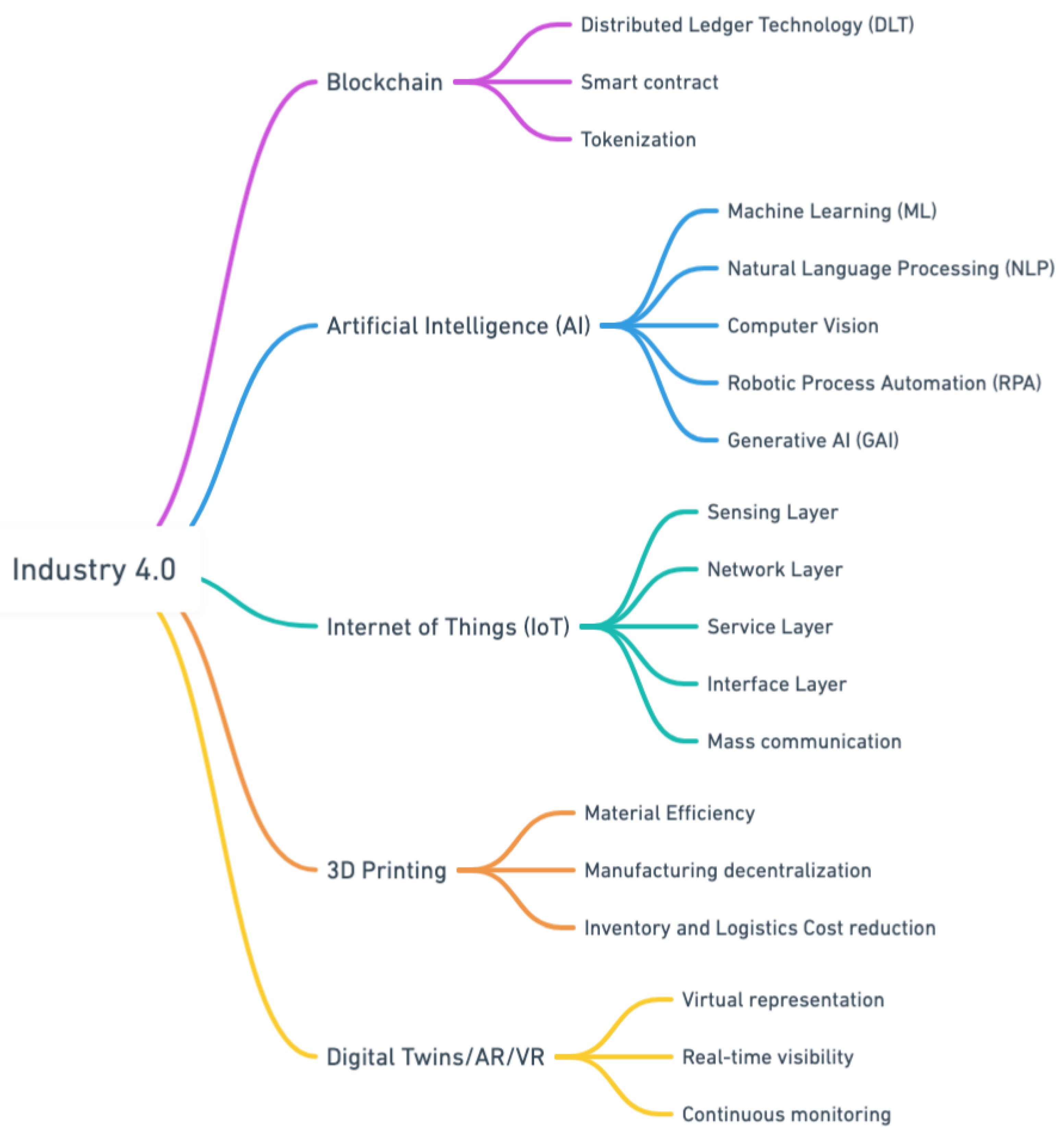

Table 1.
Global SAF initiatives: A chronological overview.
| Year | Initiative / Program | Country/Org | Objective | Reference |
|---|---|---|---|---|
| 2021 | SAF Grand Challenge Roadmap | US (DOE, DOT, USDA, EPA) |
|
(DOE, USDA, DOT, and EPA, 2022) |
| 2021 | Canada Clean Fuel Regulations | Canada |
|
(CFR, 2022) |
| 2021 | Japan SAF Roadmap | Japan |
|
(SkyNRG, 2024) |
| 2021 | SAF Consortium Roadmap | New Zealand |
|
(MBIE, 2021) |
| 2022 | National Sustainable Aviation Fuel Roadmap |
United Arab Emirates |
|
(GCAA & MOEI, 2022) |
| 2023 | Sustainable Aviation Fuel Roadmap | Australia |
|
(CSIRO, 2023) |
| 2024 | Singapore Sustainable Air Hub Blueprint | Singapore |
|
(CASS, 2024) |
Table 2.
Key technologies in blockchains and their applications in supply chain management.
| Technology | Definition | Applications |
|---|---|---|
| Distributed ledger technology (DLT) |
|
|
| Smart contract |
|
|
| Tokenization |
|
|
Table 3.
Key technologies in AI and their applications in supply chain management.
| Technology | Definition | Application |
|---|---|---|
| ML |
|
|
| NLP |
|
|
| Computer vision |
|
|
| Robotic Process Automation (RPA) |
|
|
| Generative AI (GAI) |
|
|
Table 4.
Four layers in IoT and their applications in supply chain management.
| IoT Layers and Features | Applications |
|---|---|
|
Sensing Layer includes RFID tags, sensors, actuators, and other intelligent devices (Lee & Lee, 2015). A foundational layer. Enables identification, tracking, and collection of data from physical objects (Rayes & Salam, 2022). |
|
|
Network Layer transmits information gathered at sensing layer via wired or wireless networks (Alyahya et al., 2016; Rayes & Salam, 2017). Utilizes wireless networks and sensor-enabled RFID technology to provide real-time visibility. | |
|
Service Layer uses middleware to interact between data services and applications (Lee and Lee, 2015, Borgia, 2014). Integrates cloud computing to allow sensing devices to interface with IoT applications (Gubbi et al., 2013). | |
|
Interface Layer facilitates user interaction with the IoT system (Taj et al., 2023; Choi et al., 2015). Presents data in an accessible format and functions as an interactive gateway between end-users and IoT-enabled devices (O’Donovan et al., 2015). |
Table 5.
Key features in 3D printing and their applications in supply chain management.
| Key features | Applications |
|---|---|
| Mass customization |
|
| Material efficiency |
|
| Manufacturing decentralization |
|
| Inventory and logistics costs reduction |
|
Table 6.
Key features in digital twins and their applications in supply chain management.
| Features | Applications |
|---|---|
| Virtual representation |
|
| Real time visibility |
|
| Continuous monitoring |
|
| Immersive training simulations |
|
| Remote collaboration and stakeholder engagement |
|
Table 7.
Overview of Industry 4.0 applications within SAF commercialization framework.
| Workstream | Key Action Area | Industry 4.0 Technologies |
|---|---|---|
| Feedstock Innovation | Resource Market & Availability Analysis | AI, Big Data, Blockchain, Cloud |
| Increase Sustainable Lipid Supply | AI, ML, Blockchain, IoT | |
| Boost Biomass Production & Waste Collection | IoT, AI, Autonomous Robots | |
| Improve Feedstock Supply Logistics | AI, IoT, Blockchain, Edge Computing | |
| Improve Feedstock Handling Reliability | AI, Digital Twins, Robotics, Edge Computing | |
| Enhance Sustainability of Biomass Supply | AI, Blockchain, IoT | |
| Conversion Technology | Decarbonize and Scale Fermentation-Based Fuels | AI, ML, IoT, Blockchain, Edge Computing |
| Enhance ASTM Pathways | Digital Twins, AI, Blockchain, 3D Printing | |
| Develop Bio-intermediates | AI, Cyber-physical Systems, 3D Printing | |
| Reduce Risk & Scale-Up | AI, Digital Twins, Blockchain | |
| Develop Innovative Pathways | AI, IoT, Automation | |
| Building Supply Chains | Establish Regional Coalitions | Blockchain, Cloud, Smart Contracts |
| Model SAF Supply Chains | AI, Big Data, IoT, Edge Computing | |
| Demonstrate Regional Supply Chains | AI, Digital Twins, 3D Printing | |
| Develop Production Infrastructure | AI, Robotics, Automation, Blockchain | |
| Policy and Valuation | Improve Environmental Data & Models | AI, Big Data, Blockchain, Cloud |
| Techno-economic Feasibility Analysis | AI, Digital Twins, Edge Computing | |
| Contribute to SAF Policy Development | AI, Blockchain, Cloud | |
| Enabling End Use | Support Evaluation & Testing | AI, Digital Twins, Blockchain, Automation |
| Adopt High-percentage SAF Blends | AI, Cyber-physical Systems, Sensors | |
| Explore Synthetic Jet Fuels | AI, 3D Printing, Automation | |
| Adapt Infrastructure | IoT, Blockchain, AI | |
| Communicating Progress | Engage Stakeholders | AI, Blockchain, Cloud |
| Assess Benefits & Influence | AI, Digital Twins, Cloud | |
| Track SAF Grand Challenge | IoT, Blockchain, AI, Cloud | |
| Share Positive Impacts | AI, AR/VR, Blockchain, Sentiment Analysis |
Disclaimer/Publisher’s Note: The statements, opinions and data contained in all publications are solely those of the individual author(s) and contributor(s) and not of MDPI and/or the editor(s). MDPI and/or the editor(s) disclaim responsibility for any injury to people or property resulting from any ideas, methods, instructions or products referred to in the content. |
© 2025 by the authors. Licensee MDPI, Basel, Switzerland. This article is an open access article distributed under the terms and conditions of the Creative Commons Attribution (CC BY) license (http://creativecommons.org/licenses/by/4.0/).
Copyright: This open access article is published under a Creative Commons CC BY 4.0 license, which permit the free download, distribution, and reuse, provided that the author and preprint are cited in any reuse.


