

Submitted:
04 July 2025
Posted:
08 July 2025
You are already at the latest version
Abstract
To enhance the operational performance of green manure sowing, seed harvesting, and processing equipment, as well as to obtain the physical characteristic parameters required for equipment simulation analysis, it is necessary to carry out the seed physical properties such as dimensions, bulk density, and frictional characteristics. This study focuses on the main cultivated varieties of green manure in China—milk vetch, hairy vetch, and sesbania—and innovatively proposes three low-cost, convenient, and high-precision experimental methods of geometric size for small-sized seeds. The measured results show that geometric dimensions of the seeds for milk vetch were 2.60mm-3.40mm in length, 1.90mm-2.40mm in width and 0.71mm-0.97mm in height, the pod dimensions of hairy vetch were 23.03mm-32.83mm in length, 7.39mm-9.74mm in width, 4.06mm-6.15mm in height, and seed diameters were 3.04mm-4.10mm, the seed dimensions of sesbania were 3.81mm-4.29mm in length, 1.98mm-2.37mm in width, 1.85mm-2.08mm in height. Using Python programming language and open-source AI algorithms, we innovatively developed an image-based seed counting experimental method. This cost-effective approach requires no specialized instruments while significantly saving time and labor. Based on the counting results, the thousand-seed weights of milk vetch, hairy vetch, and sesbania seeds were determined to be 3.40g, 26.50g and 15.58g, with respective seed moisture contents of 7.18%, 9.81% and 8.73% at the time of measurement. The instruments and methods for measuring bulk density and angle of repose of green manure seeds were defined. The bulk densities of milk vetch, hairy vetch, and sesbania seeds were determined to be 732 g/L, 761 g/L and 845 g/L, by using the electronic grain densitometer. Meanwhile, the angles of repose of milk vetch, hairy vetch, and sesbania seeds were determined to be 31.66°, 28.15°and 29.82°, by using the angle of repose tester. Based on the principle that the indexing head can accurately determine the angle, the sliding friction angles of milk vetch, hairy vetch, and sesbania seeds were determined to be 25.85°, 23.55°and 24.03°, by using the di-viding head. The testing methods developed in this study, along with the results of measuring the physical properties of green manure seeds, provide valuable reference data for the measurement of the physical properties of small-seeded crop (e.g., green manures) as well as other small or irregularly-shaped particles.
Keywords:
green manure
; seeds
; physical properties
; experimental instruments
; experimental methods
1. Introduction
Green manure (also known as cover crop) is of great significance in global agricul-tural development. With the rapid recovery of green manure cultivation in China, the de-mand for green manure seeds has also increased sharply. Therefore, it is urgent to develop sowing, seed harvesting and processing equipment that is most urgently needed for green manure production. The physical parameters of seeds, including size, bulk density, and frictional characteristics, directly affect the key structural design of processing equipment such as seeders, harvesters, and seed threshing machines, while also providing essential parameters for simulation analysis, providing a basis for the optimization design of green manure mechanized production equipment [1,2,3,4,5,6,7].
According to literature review and experimental research, it has been demonstrated that seed geometric dimensions, thousand-seed weight, angle of friction, and angle of re-pose are key physical characteristic parameters affecting the design of agricultural ma-chinery. Chen Tao, Wang Yong, and Yang Zuomei measured the geometric dimensions, angle of friction, angle of repose, and thousand-seed weight of millet, wheat, and broom-corn millet to optimize the design of seed metering devices for millet and wheat seeders, as well as processing equipment for broomcorn millet [8,9,10]. Zhao Guoqing, and Liu Hai measured the geometric dimensions, thousand-seed weight, bulk density, porosity, angle of repose, and friction angle of six vegetable seeds (including cucumber, tomato, pepper, and pakchoi) to obtain the key structural parameters of precision seeding equipment for vegetable plug trays. Tian Xiaohong conducted focused analyses on the angles of repose for rice, wheat, corn, and soybeans using the funnel method. Yin Feng measured the angle of repose for transparent sandy soil, demonstrating that the angle of repose in-creased with larger particle sizes. To determine the potential applications of rosehip seeds, Małgorzata Stryjecka studied the physicochemical properties and thousand-grain weight of roseship seeds, but the testing method for thousand-grain weight was not mentioned in their re-search. To provide a basis for lilac seed sorting, Zdzisław Kaliniewicz measured the geo-metric dimensions and sliding friction angles of lilac seeds. However, the testing instruments and procedures were complex, leading to low efficiency. [10,11,12,13,14,15,16].
Based on the above analysis, the research on the physical properties of agricultural granular materials mainly focuses on grain and vegetables, the physical properties of green manure seeds have not been systematically studied. The research indicates that the geometric dimensions of material are primarily measured using vernier calipers. Alt-hough the measurement method is simple and easy to operate, but for small seeds time-consuming and labor-intensive. The sliding friction angle measurement of materials is mainly measured by self-designed experimental apparatus or inclined plane friction tester. The two testing approaches for the sliding friction angle are either inaccurate in measurement or increase costs. For small-sized green manure seeds, when measuring the thousand-seed weight, the inexpensive counting instrument has insufficient precision and large errors. The equipment with high precision is more expensive. For these reasons, this paper invented three simple and low-cost or zero-cost testing methods to solve the above problems. First,this study innovated and invented an external dimensions measurement method and measurement system image-based green manure and other seeds. The new method can conveniently, accurately, and quickly measure the length and width of small green manure seeds. Second, a simple and cost-free method for counting small seeds has also been invented. Seed photos are first taken through electronic products with shooting functions such as mobile phones, based on the Python language and calling the AI open-source algorithm, it is convenient to accurately count small green manure seeds. Then, the mass of the seeds is weighed using an electronic balance measurement. Through simple calculations of the seed mass and the counting results, the thousand-seed weight of small green manure seeds can be measured quickly and accurately. Third, develop a method for measuring the sliding friction angle of green manure seeds and other granular materials using the dividing head, based on the principle of precise angle measurement with a dividing head. Based on the above low-cost, easy-to-operate and innovative invention method, we systematically tested the seed geometry, thousand-seed weight, angle of repose and angle of sliding friction of the main plant varieties of green manure, such as milk vetch, hairy vetch and sesbania, providing reference for the measurement of the physical properties of green manure seeds and other small seeds, as well as small particles and irregular particles.
2. Materials and Methods
2.1. Determination of Moisture Content of Green Manure Seeds
The moisture content of the milk vetch, hairy vetch, and sesbania seeds were determined by drying method with the DGF30/7-IA electrical heating blast drying oven [17]. The moisture contents of these three seed types were 7.18%, 9.81% and 8.73%, respectively.
2.2. Geometric Dimension Measurement
2.2.1. Measurement Method
Milk vetch, hairy vetch, and sesbania are the main green manure varieties cultivated in China. Due to their small geometric dimensions, it is time-consuming and laborious to measure them with a vernier caliper. Therefore, a method and system for measuring the external dimensions of green manure and other crop seeds based on images have been invented. The method flowchart is shown in Figure 1. The system mainly consists of four primary modules: acquisition module, import module, scaling module and the measurement module. The acquisition module is to obtain a picture that simultaneously contains the scale image and the seed image. The seeds were directly fixed using glue or other adhesives on the paper with scale, or the steel ruler can be horizontally fixed to the paper with seeds and then scanning to obtain the picture information. The scanning effect is more accurate than the photo effect. The import module is to import the picture obtained by the acquired module into the measurement software. In this study, scanned image was imported into AutoCAD for direct dimensional measurement. The scaling module is used to scale the acquired image to establish a 1:1 proportional relationship between the measurement scale in AutoCAD and the reference scale (either from the steel ruler or graduated paper) captured in the acquired images. In the measurement module, the measurement function of the software is used to directly measure the seed dimensions in the scaled image, obtaining the length and width data of the seeds. Taking milk vetch as an example, as shown in Figure 1. This method can measure multiple seeds at once, with convenient operation, high accuracy, no fixture cost investment, and the measurement process does not need calculation. It can be repeatedly verified for measurement and has low cost.
The seed height can be measured using an electronic height gauge. When measuring the height of seeds, the seeds are directly placed on the platform of the height tester for measurement without using glue, eliminating projection errors, as shown in the high-definition details of the measurement and data reading in Figure 2 (a). The overall measurement is shown in Figure 2.
2.2.2. Statistical Method
Randomly selected 100 seeds to measure their length, width, and height, and perform frequency analysis,and the sampling was repeated 3 times. Then analyzed on the measured dimensions of milk vetch, and sesbania seeds using SPSS statistical analysis software. [18,19,20,21].
The dimensions of hairy vetch pods directly affected the loss rate and impurity rate during seed harvesting, which vary by cultivar and harvest timing. To analyze these effects, we conducted dimensional measurements on both pods and seeds randomly selecting 50 mature pods and 150 seeds during harvest season. The sampling was repeated 5 times, and the average value of the sampling results was taken as the final result. All geometric measurements were statistically processed using SPSS software for frequency analysis and statistics.
2.3. Measurement of Thousand-Seed Weight and Bulk Density
2.3.1. Measurement of Thousand-Seed Weight
Thousand-seed weight directly affects the design of seed metering device of the seeder, as well as the quality indicators of the sorting of the harvester and seed sorter. Therefore, measuring the thousand-seed weight of green manure seeds is of great significance for the development of efficient and applicable green manure equipment. When measuring the thousand-seed weight of green manure seeds such as milk vetch, hairy vetch, and sesbania, the seeds are first mainly counted using a seed counter and then weighed. On the market, microcomputer automatic seed counters with weighing function are highly accurate but expensive, while vibration-type seed counters are cheaper but less accurate, especially for small seeds of green manure. To address this, without increasing production costs, an image recognition method for counting green manure seeds and other granular materials based on artificial intelligence algorithms is invented. After counting the seeds, they are weighed to determine the thousand-seed weight, which can greatly improve labor efficiency and measurement accuracy.
The method for counting green manure seeds and other granular materials based on artificial intelligence (AI) algorithms works as follows: First, take photos of green manure seeds and other granular materials with a mobile phone. Then import the photos into a computer and use the Python programming language to call the open-source computer vision libraries Open CV (Open Source Computer Vision Library) and NumPy (Numerical Python) to process the original image through grayscale conversion→ Gaussian blur → binarization → morphological denoising → to output results. The processing flow, principles, and precautions are shown in Figure 3.
The key aspects of this method involve scene - specific optimization. During the binarization process, adaptive thresholding is prioritized over complex algorithms. In terms of balancing accuracy and efficiency, watershed algorithm is bypassed in favor of area-based filtering, reducing computational overhead while maintaining accuracy. Regarding parameter adjustability, critical parameters,such as blockSize and minArea,are designed to be adjustable for adapting to diverse imaging conditions. Taking Sesbania seeds as an example for counting statistics, as shown in Figure 4.
As only counting was performed and there was a significant contrast between the background and the measured seeds, verification had shown that the innovative counting method in this paper achieves a 100% accuracy rate compared with manual counting. Taking Sesbania seeds as an example, a single manual count takes 50-75 seconds, while the technical efficiency of this method is within 5 seconds—5-15 times faster than manual counting. The efficiency advantage increased further for smaller seeds, and manual counting had a higher error probability.
Because this method only involves counting, a smaller sample size was deliberately used to more clearly illustrate the principle and operation process of the method. In actual experiments, depending on the seed size and the pixel difference of the shooting tool, the sample size is unlimited as long as there is no overlap between seeds.
2.3.2. Bulk Density Measurement
The bulk densities of milk vetch, hairy vetch, and sesbania seeds were measured using the GHCS-1000AP electronic grain densitometer.
The GHCS-1000AP electronic grain densitometer mainly consists of 2 cylinders, a bulk density cylinder, an electronic cylinder, an exhaust block, a plug and so on. When in operation, first calibrate the weighing electronic cylinder of the electronic grain densitometer, then insert the plug into the bulk density cylinder, place the exhaust block on top of the bulk density cylinder, and put the bulk density cylinder with the plug and the exhaust block onto the electronic cylinder used for weighing, setting it to zero. Fill the upper cylinder with green manure seeds, place the middle cylinder on the bulk density cylinder, and then place the upper hopper filled with seeds onto the middle cylinder. Open the switch between the upper cylinder and the middle cylinder, and the seeds in the upper cylinder will naturally fall into the middle cylinder. After all the seeds have fallen, remove the plug between the middle cylinder and the bulk density cylinder, and the exhaust block along with the seeds will quickly fall into the bulk density cylinder. Then insert the plug back into the bulk density cylinder, and discard the excess seeds outside the bulk density cylinder. Weigh the bulk density cylinder again, and the data displayed on the electronic cylinder is the bulk density of the seeds. This instrument can directly display the measurement results, as shown in Figure 5.
2.4. Angle of Repose Measurement
The angle of repose is the important and conveniently measurable indicator for evaluating material flowability. Material flowability directly affects seeding stability, distribution uniformity during sowing, as well as the efficiency of seed rubbing and the quality of seed cleaning and grading. By utilizing this easily measurable physical characteristic of seeds to adjust and optimize key equipment parameters, equipment performance can be improved quickly and accurately, while also providing reference data for simulation model establishment. For this purpose, the angles of repose of milk vetch, hairy vetch, and sesbania seeds were measured using the angle of repose tester, as shown in Figure 6. During the experiment, the glass disk was first aligned with the scale on the bottom plane of the measuring instrument. Subsequently, the seeds were poured into the funnel above the instrument. The seeds naturally accumulated within the glass disk of standard dimensions below, forming a cone. The height h of the cone was measured. Specifically, it was the directly read value minus the height of the glass disk. By integrating the radius R of the glass disk, the angle of repose φ was computed using trigonometric functions, as follows:
φ=arctan(h/r)
φ, h, r are shown in the figure. It should be particularly noted that h is not the directly read value, it is the directly read value minus the height of the glass disc.
2.5. Measurement of the Sliding Friction Angle
The measurement of sliding friction characteristics is essential in agricultural processes including sowing, harvesting, and seed cleaning, as well as in simulation analyses. In the chemical industry, it is also necessary to study the friction characteristics of granular materials. The sliding friction properties are primarily determined by measuring the sliding friction angle of seeds or materials. At present, the custom-built test bench shown in Figure 7(a) is used for measurement more often. During the experiment, the seeds or materials are placed on a horizontal test board. By shaking the handle, the test board gradually tilts. When the materials slide down, the lifting height of the board is recorded at that moment. Then, the sliding friction angle of the tested seeds or materials is calculated using the tangent value of this height and the length of the board. These test devices are mostly self-assembled frames, which may introduce experimental errors.
To reduce experimental errors and simplify the calculation process, a method for measuring the sliding friction angle of green manure seeds and other granular materials using the indexing head (Figure7(b)) is now invented. The testing method shared the same principle as the existing inclined plane testing method. The main difference was that used a new tool, the indexing head, which could precisely measure angles. When this equipment is available in the laboratory, it can be directly used. A test plate and bracket suitable for green manure seeds and other granular materials are manufactured and fixed on the indexing head. The initial data is recorded, and then the indexing head is rotated. When the seeds begin to slide, the current value of the indexing head is directly read. The difference between this value and the initial value of the dividing head is the angle value of the sliding friction angle. Different materials such as Q235 steel plates and wood boards can also be installed on the test plate to measure the sliding friction angle of green manure seeds or granular materials on different material surfaces.
3. Results
3.1. Overall Measurements of Physical Properties of 3 Green MANURE SEEDS
To facilitate the comparison of the geometric dimension differences among different varieties of green manure seeds, the geometric dimensions of the seeds of milk vetch, hairy vetch, and sesbania are statistically summarized in Table 1. Their physical properties such as thousand-seed weight and bulk density are shown in Table 2.
3.2. Measurement Results of Geometric Dimensions
3.2.1. Measurement Results of the Geometric Dimensions of Milk Vetch
300 seeds of milk vetch were randomly selected to measure their length, width and height. The frequency analysis and statistics of the measured dimensions of the milk vetch seeds were conducted using SPSS statistical analysis software. The pod and seed of milk vetch and the histogram of geometric dimensions are shown in Figure 8 [22].
It can be visually observed from Figure 8 that the dimensions distribution of the seeds for milk vetch. According to the frequency distribution characteristics of the seed dimensions for milk vetch, the geometric dimensions distribution of the seeds is relatively concentrated. As can be seen from Table 1, the mean and median of the geometric dimensions of the seeds for milk vetch are approximately the same, indicating the data distribution is symmetrical. The coefficient of variation for each dimension is less than 10%, suggesting insignificant variation in the geometric dimensions of milk vetch seeds, which is convenient for classification and screening. This provides a reference for the design of the seed metering device for milk vetch sowing, seed harvesting, and the design of the sieve aperture size for seed classification, screening, and seed rubbing.
3.2.2. Measurement Results of the Geometric Dimensions of Hairy Vetch
Due to the larger size of the pods, which leads to smaller errors, damaged pods were removed and only intact ones were retained. Therefore, sampling was conducted in 3 batches, with 50 pods each time. The results showed that they accurately reflected the geometric morphology of the sampled material. The mature pods of hairy vetch were randomly selected during harvest period for geometric dimension measurements. Additionally, 360 seeds of hairy vetch were also selected to measure their length, width and height. The frequency analysis and statistics of the measured pod and seed dimensions of hairy vetch were conducted using SPSS statistical analysis software. The histograms of the geometric dimensions of the pod and seeds for hairy vetch are shown in Figure 9.
Figure 9 clearly shows the dimensions distribution of hairy vetch pods and seeds. According to the frequency distribution characteristics, the length and height of hairy vetch pods are relatively dispersed, while the width distribution is more concentrated. The geometric dimension distribution of the seed diameter is also relatively concentrated. As shown in Table 2, the mean and median of the pod and seed diameters of hairy vetch are approximately the same, indicating a symmetrical data distribution. Only the coefficient of variation of the pod width is less than 10%, while the other geometric dimensions are all greater than 10%. Although the coefficient of variation is higher than those of milk vetch seeds, the hairy vetch seeds are larger than milk vetch seeds, making the hairy vetch seeds easier to classify and screen.
3.2.3. Measurement Results of the Geometric Dimensions of Sesbania
300 seeds of sesbania were randomly selected to measure their length, width and height. The frequency analysis and statistics of the measured dimensions of the seeds were conducted using SPSS statistical analysis software. The histograms of the geometric dimensions of the seeds for sesbania are shown in Figure 10.
It can be intuitively shown from Figure 10 that the dimensions distribution of the sesbania seed. According to the frequency distribution characteristics of the seed dimensions, the geometric dimensions distribution of the sesbania seed is relatively concentrated, and the height and width of the seed are very close. In the simulation analysis modeling, the sesbania seed can be regarded as a cylinder. Table 1 indicates that the mean and median values of the geometric dimensions of sesbania seeds are identical, indicating that the data distribution is symmetrical. The coefficient of variation of each dimension is less than 10%, indicating that the geometric dimension difference of the sesbania seed is not obvious, which is convenient for classification and screening.
3.3. Measurement Results of Thousand-Seed Weight and Bulk Density for 3 Green Manure Seeds
The thousand-seed weight and bulk density of seeds are closely related to their moisture content. When the moisture contents of milk vetch, hairy vetch, and sesbania seeds were 7.18%, 9.81%, and 8.73% respectively, the thousand-seed weights of milk vetch, hairy vetch, and sesbania were determined to be 3.40g, 26.50g, and 15.58g, respectively, using an AI-based image recognition method for counting green manure seeds and other granular materials. Under the same moisture content, taking 5 samples and calculating the average, the bulk densities of milk vetch, hairy vetch, and sesbania seeds were measured to be 732g/l, 761g/l, and 845g/l respectively.
3.4. Measurement Results of the Repose Angle for 3 Green Manure Seeds
The angle of repose seeds is closely related to their moisture content. When the moisture contents of the seeds of milk vetch, hairy vetch, and sesbania seeds were 7.18%, 9.81%, and 8.73% respectively, the measured angles of repose for milk vetch, hairy vetch, and sesbania seeds were 31.66°, 28.15°, and 29.82° respectively.
3.5. Measurement Results of Sliding Friction Angle for 3 Green Manure Seeds
The sliding friction angle is closely related to their moisture content. When the moisture contents of the seeds of milk vetch, hairy vetch, and sesbania seeds were 7.18%, 9.81%, and 8.73% respectively, the measured sliding friction angles of the milk vetch, hairy vetch, and sesbania seeds were 25.85°, 23.55°, and 24.03° respectively.
4. Discussion
This study systematically investigated critical physical properties of 3 major green manure varieties (milk vetch, hairy vetch, and sesbania), including seed geometric dimen-sions, thousand-seed weight, bulk density, angle of repose, and sliding friction angle. These parameters are critically relevant for the design of mechanized equipment used in green manure seeding, seed harvesting, and seed processing operations. This research fills the gap in the basic research on the material properties of green manure seeds for me-chanical production, providing methods and ideas for the future research on the physical properties of seeds of other green manure varieties. At the same time, it provides theoreti-cal basis for the research and development of key components and parameter design of mechanical production equipment for milk vetch, hairy vetch, and sesbania
This study innovatively invented a system and method for measuring the geometric dimensions of green manure seeds, especially small granular materials. It improved the time-consuming and labor-intensive problem of measuring geometric dimensions by vernier caliper.
This study innovatively invented an image recognition method for counting green manure seeds based on artificial intelligence. Currently, the market offers automatic seed analysis instruments that can directly recognize the geometric dimensions of granular materials and the thousand-seed weight of seeds through images. However, these instruments are expensive, causing cost waste for individuals or laboratories with low usage frequency. There are also cheaper vibrating seed counters, but they have low purity and large errors, especially unsuitable for measuring small green manure seeds. Since this method is only for counting function, if the contrast between the seeds and the background is not significant, the accuracy of image recognition under strong light or non-uniform background may decrease. The method can be further developed to measure seed size simultaneously with counting, but measurement errors may occur due to shooting angle issues. How to eliminate such errors will be the next research topic to be carried out.
Based on the principle that the indexing head can conveniently and quickly measure angles, by making a seeding fixture, the sliding friction angle of seeds and granular materials can be calculated conveniently, accurately and quickly. This method is applicable to laboratories of universities or research institutes and agricultural machinery equipment workshops of agricultural machinery enterprises that have indexing head.
The most important features of the experimental methods invented herein are that they do not increase the cost of equipment and instruments and is not restricted by time and location, it can be widely used by individuals or in laboratories and other groups. It only requires a camera or a smart phone with a camera function. Subsequently, more efficient and accurate testing methods suitable for large laboratories can be systematically explored.
With the development of AI technology, AI will better serve people’s production and life. How to apply AI to agricultural production is an important research topic for future development.
5. Conclusions
(1)In summary, in view of the current situation that the widely used methods for meas-uring the geometric dimensions of small seeds such as green manure are time-consuming and labor-intensive, and the measurement accuracy of the thousand-seed weight is poor, innovatively invent a low-cost, high-precision and user-friendly method and system for measuring the geometric dimensions of small seeds based on image recognition. The thousand-seed weight of green manure seeds was measured by a green manure seeds counting method based on artificial intelligence algorithm for image recognition.
(2)Geometric dimensions of the milk vetch seed were 2.6 - 3.4 mm in length, 1.9 - 2.4 mm in width and 0.71 - 0.97 mm in height, the diameter of hairy vetch seed was 3.0 - 4.1 mm. When the moisture content of milk vetch, hairy vetch, and sesbania seeds were 7.18%, 9.81% and 8.73% respectively, the thousand-seed weights were 3.40 g, 26.50 g and 15.58 g respectively, the bulk densities were 732 g/L, 761 g/L and 845 g/L respectively, the angle of reposes were 31.66°, 28.15° and 29.82° respectively, and the sliding friction angles were 25.85°, 23.55° and 24.03° respectively.
(3)Subsequently, the advantages of open-source algorithms in artificial intelligence can be fully utilized to develop more convenient, accurate and low-cost physical property measurement methods for green manure seeds and other granular materials.
Author Contributions
Conceptualization, X.G., H.W., S.W; methodology, X.G., H.W., S.W. and Z.Z.; software, X.G. and H.W.; validation, X.G., Z.Z. and S.H.; formal analysis, X.G., Y.C. and H.W.; investigation, X.G., H.W. and S.W.; resources, H.W.; data curation, X.G., Z.Z., S.H. and X.W.; writing—original draft preparation, X.G.; writing—review and editing, H.W., Y.C. and S.W.; supervision, H.W.; funding acquisition, H.W. All authors have read and agreed to the published version of the manuscript.
Funding
This research was funded by the earmarked fund for CARS-Green manure (CARS-22), the Institute level Basic Scientific Research Operational Funds Special Project of Chinese Academy of Agricultural Sciences(S202318).
Institutional Review Board Statement
Not applicable.
Data Availability Statement
Data are contained within the article.
Acknowledgments
The authors thank the editor and anonymous reviewers for providing helpful suggestions for improving the quality of this manuscript.
Conflicts of Interest
The authors declare no conflicts of interest.
References
- Jay Ram Lamichhane; Lionel Alletto. Ecosystem services of cover crops: a research roadmap. Trends in Plant Science 2022, 27, 758–768. [Google Scholar] [CrossRef] [PubMed]
- Zhou, G.; Ma, Z.; Han, S.; Chang, D.; Sun, J.; Liu, H.; ...; Cao, W. Green manuring combined with optimal water management achieves a triple-win for paddy soil quality, rice productivity, and environmental benefits. Agriculture, Ecosystems & Environment 2025, 383, 109507. [Google Scholar]
- Gao, S.; Wu, C.; Zhou, G.; Chang, D.; Cao, W. Green Manure Plus” Industry Mechanism and Its Practices. Scientia Agricultura Sinica 2025, 58, 1982–1993. [Google Scholar]
- Cao, W.; Zhou, G.; Gao, S. Effects and mechanisms of green manure on endogenous improving soil health. Journal of Plant Nutrition and Fertilizers 2024, 30, 1274–1283. [Google Scholar]
- Cao, W.; Gao, S. Chinese green manure development strategy by 2025. Chinese Journal of Agricultural Resources and Regional Planning 2023, 44, 1–9. [Google Scholar]
- Wu, H.; You, Z.; Gao, X.; Peng, B.; Ji, G.; Gu, M.; Qiu, C. Discussion and countermeasures on development of green manure production machinery in China. Journal of Chinese Agricultural Mechanization 2017, 38, 24–29. [Google Scholar]
- Gao, X.; You, Z.; Wu, H.; Peng, B.; Wang, S.; Cao, M. Design and experiment of green manure seed broadcast sowing device based on unmanned aerial vehicle platform. Transactions of the Chinese Society for Agricultural Machinery 2022, 53, 76–85. [Google Scholar]
- Chen, T.; Yi, S.; Li, Y.; Tao, G.; Mao, X. Experimental study on the material characteristics of northern millet. Journal of Chinese Agricultural Mechanization 2021, 42, 75–80. [Google Scholar]
- Wang, Y.; LI, J.; Yang, W.; Hao, C.; Shi, S. Determination and application of physical characteristic parameters of wheat seeds in design of plot precision seeder. Agricultural Engineering 2021, 11, 109–114. [Google Scholar]
- Yang, Z.; Guo, Y.; Cui, Q.; Li, H. Experimental study on friction characteristics of broomcorn millet with different moisture content. Journal of Shanxi Agricultural University(Natural Science Edition) 2016, 36, 519–523. [Google Scholar]
- Zhao, G.; Dai, Q.; Wang, J.; Li, Y. Experimental study on physical characteristics of typical small-sized vegetable seeds. Journal of Qingdao Agricultural University (Natural Science) 2020, 37, 225–229. [Google Scholar]
- Liu, H.; Du, Z.; Li, X.; Guo, X.; Tu, J.; Wan, Y. Experimental study on mechanical and physical properties of pakchoi seeds. Journal of Chinese Agricultural Mechanization 2023, 44, 88–93. [Google Scholar]
- Tian, X.; Li, G.; Zhang, S. Determination of angle of repose. Grain Processing 2010, 35, 68–71. [Google Scholar]
- Yin, F.; Zhou, H.; Ding, X.; Chen, S.; Pei, A.; Li, Y. Experimental study on basic characteristics of angle of repose and initiation velocity of transparent sand. Journal of Civil and Environmental Engineering 2022, 44, 28–35. [Google Scholar]
- Małgorzata Stryjecka; Anna Kiełtyka-Dadasiewicz; Monika Michalak. Physico-chemical characteristics of rosa canina l. seeds and determining their potential use. Applied Sciences 2025, 15, 168. [Google Scholar]
- Zdzisław Kaliniewicz; Stanisław Konopka; Zbigniew Krzysiak; Paweł Tylek. An Evaluation of the Physical Characteristics of Seeds of Selected Lilac Species for Seed Sorting Purposes and Sustainable Forest Management. Sustainability 2024, 16, 6340. [Google Scholar] [CrossRef]
- Peng J.; Shen H,; Wang G.; Zhang Z.; Peng B.; Xue G.; Huang S,; Zheng W.; Hu L. Experiment and Analysis of Physical Properties of Sweet Potato Varieties at Different Harvesting Periods. Agriculture 2024, 14, 1–16. [Google Scholar] [CrossRef]
- Experimental design and data analysis; Zhejiang University Press: Hangzhou,China, 2024.
- Applied Statistics Based on SPSS; Beijing Institute of Technology Press: Beijing,China, 2023.
- Gao, X. Experimental research and optimization design of key components on peanut sheller of blowing and rubbing. Master’s Dissertation, Chinese Academy of Agricultural Sciences, Beijing, China, 2012. [Google Scholar]
- Wang, S. Research on key technologies and equipment for peanut pickup combine harvest. Ph.D. Dissertation, Zhejiang China, Zhejiang University, 2024. [Google Scholar]
- Catalog of Key Green Manure Species Resources in China; China Agricultural Science and Technology Press: Beijing,China, 2021.
Figure 1.
Flowchart of the image-based geometric dimension measurement system for green manure and other crop seeds.
Figure 1.
Flowchart of the image-based geometric dimension measurement system for green manure and other crop seeds.
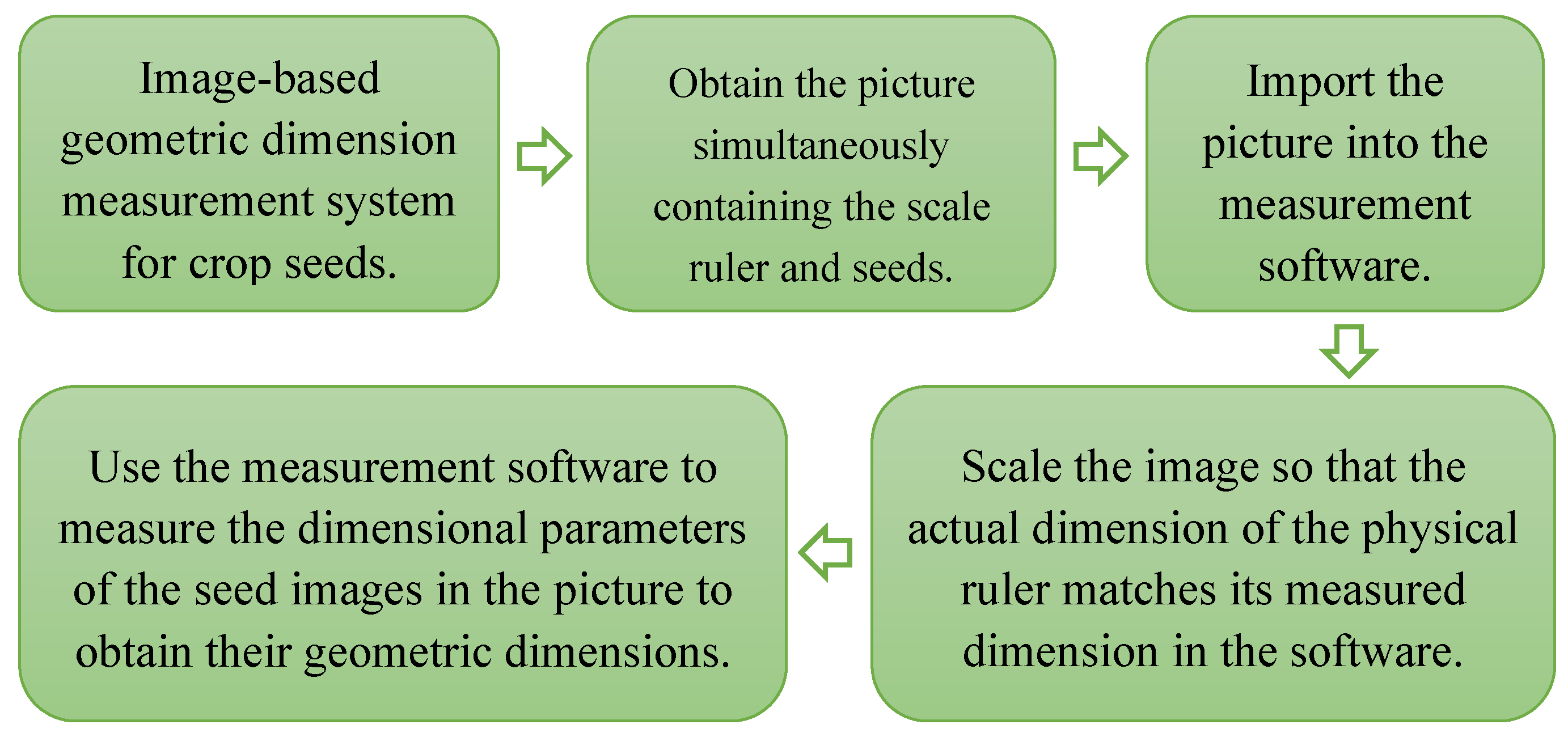
Figure 2.
Geometric dimension measurement of green manure seeds. (a) Seed height measurement; (b) Seed scanning image; (c) Seed length and width measurement.
Figure 2.
Geometric dimension measurement of green manure seeds. (a) Seed height measurement; (b) Seed scanning image; (c) Seed length and width measurement.
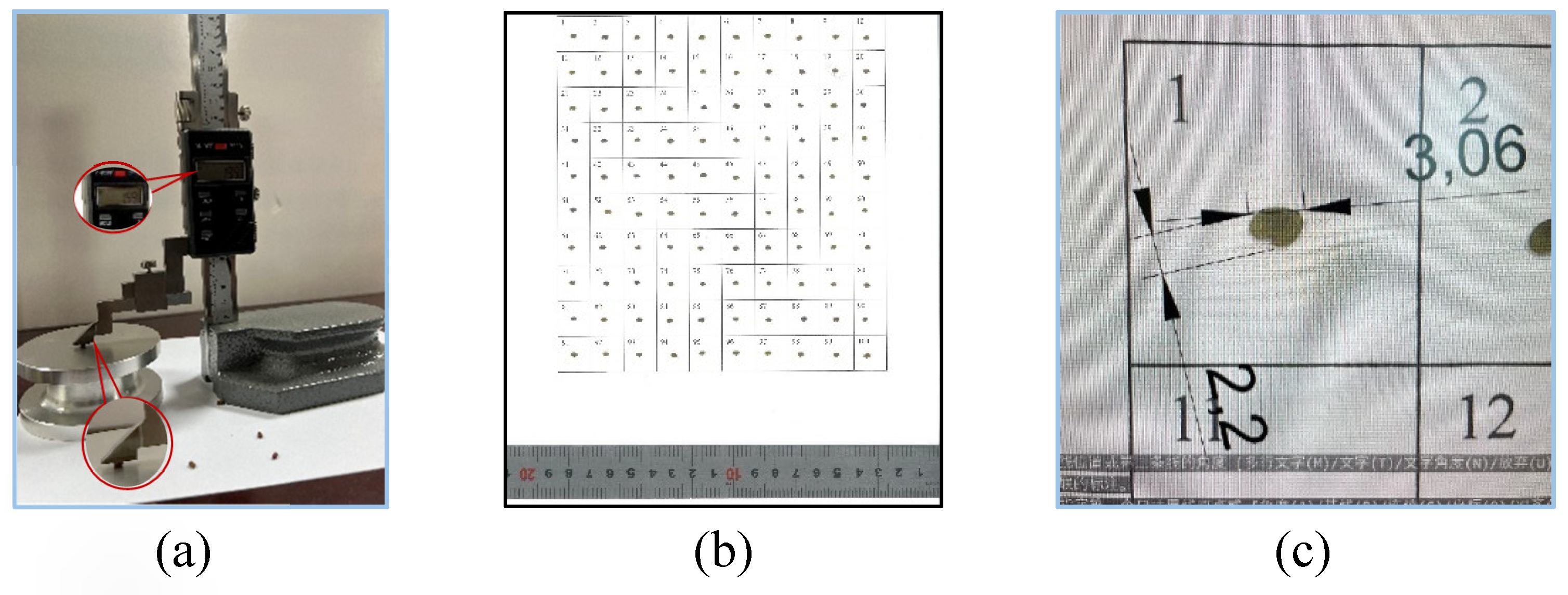
Figure 3.
Flowchart of the green manure seed counting method based on artificial intelligence image recognition.
Figure 3.
Flowchart of the green manure seed counting method based on artificial intelligence image recognition.
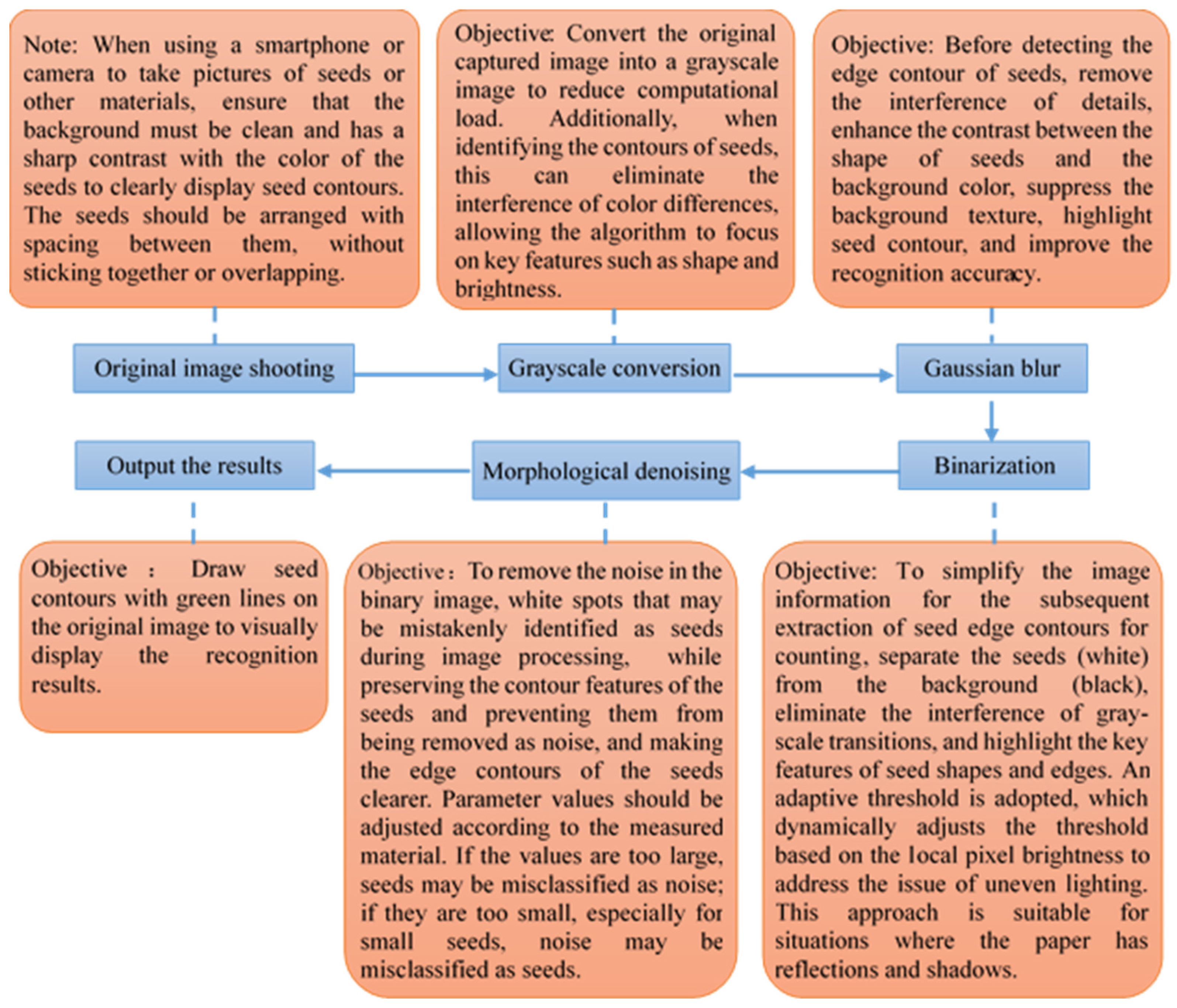
Figure 4.
Process diagram of sesbania seed detection and counting. (a) Original image; (b) grayscale conversion; (c) Gaussian blur; (d) Binarization; (e) Morphological denoising; (f) Display results.
Figure 4.
Process diagram of sesbania seed detection and counting. (a) Original image; (b) grayscale conversion; (c) Gaussian blur; (d) Binarization; (e) Morphological denoising; (f) Display results.
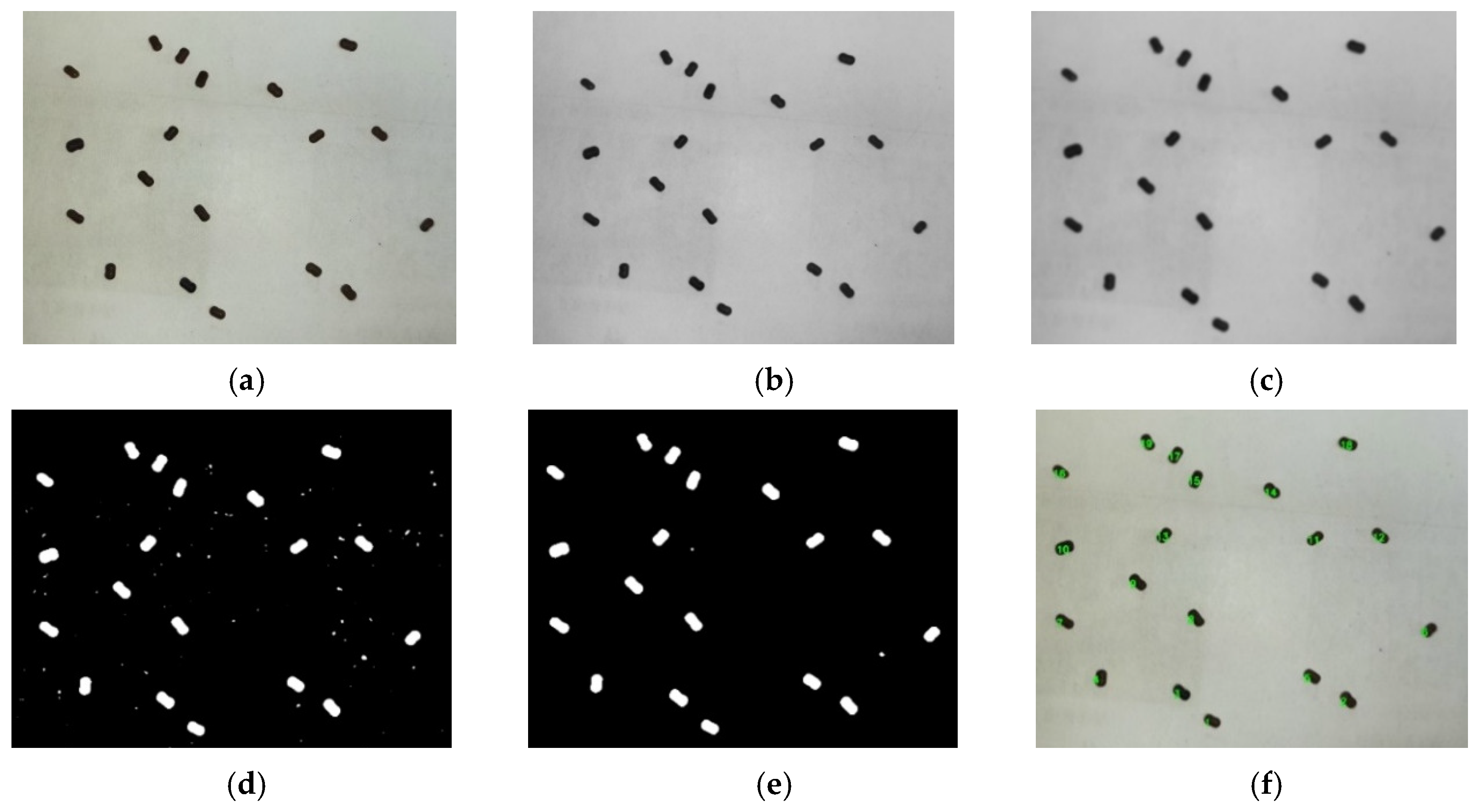
Figure 5.
Bulk density measurement of milk vetch.
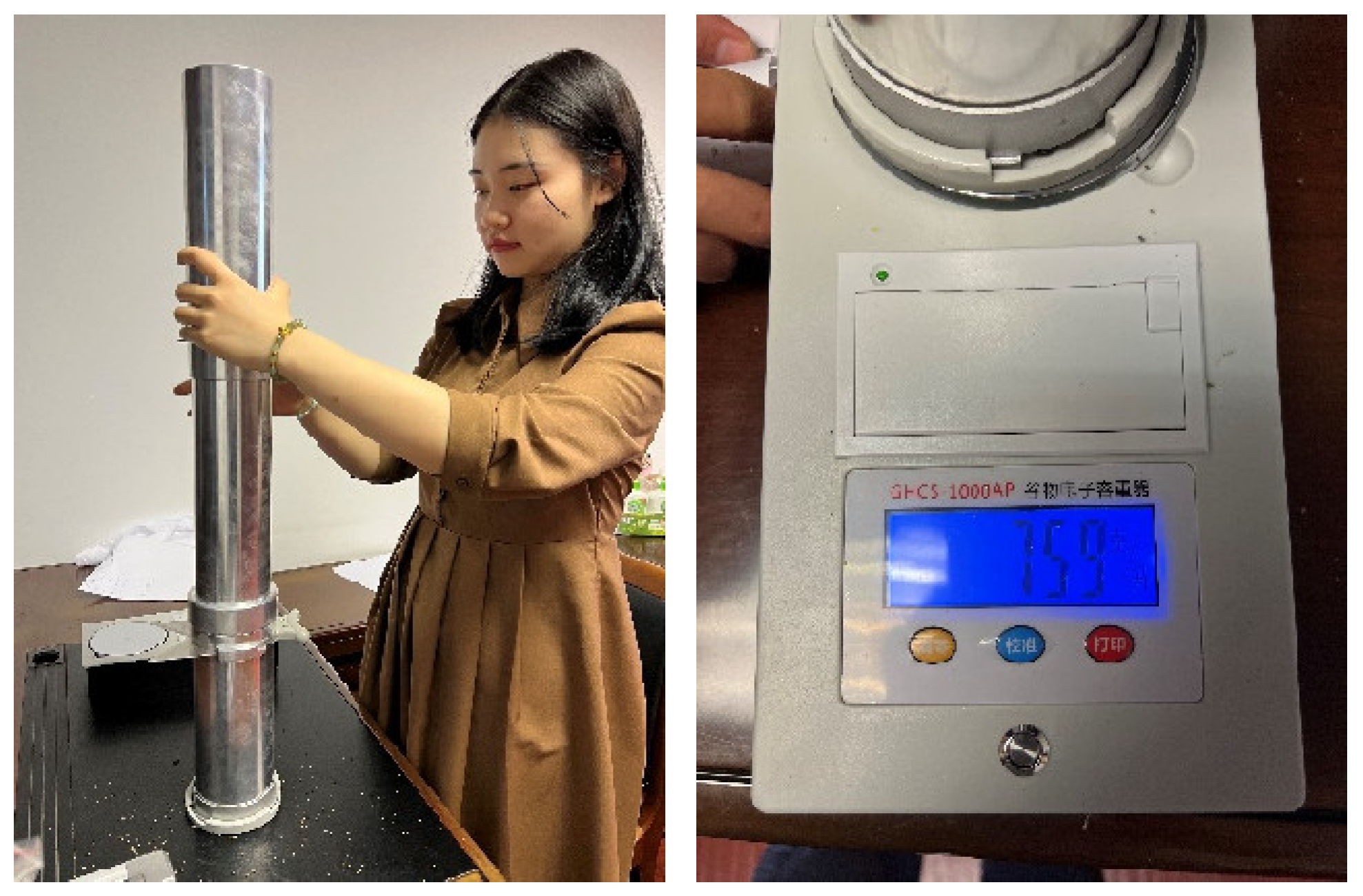
Figure 6.
Measurement of the angle of repose for three types of green manure seeds. (a) Milk vetch; (b) Hairy vetch; (c)Sesbania.
Figure 6.
Measurement of the angle of repose for three types of green manure seeds. (a) Milk vetch; (b) Hairy vetch; (c)Sesbania.
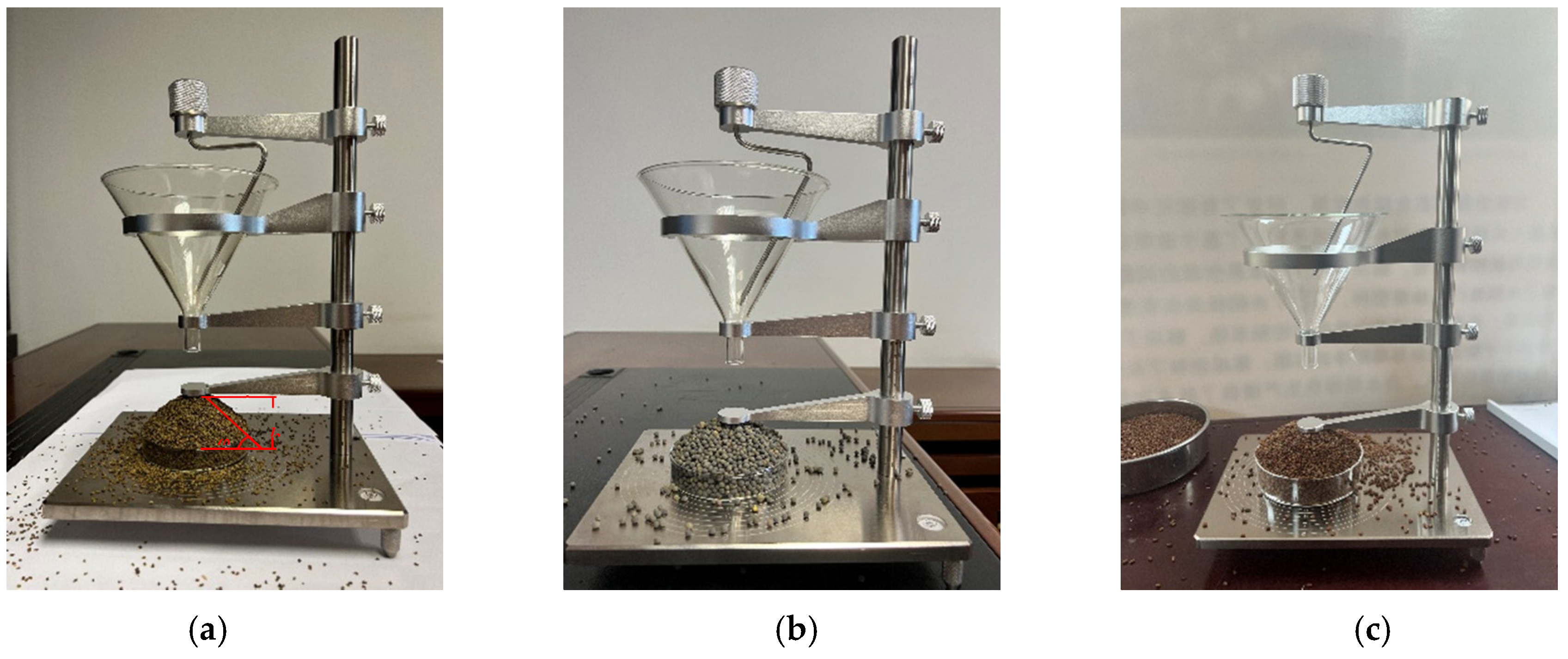
Figure 7.
Measurement of seed sliding friction angle using different tools. (a) inclined plane Instrument; (b) Indexing head; (c) Measurement of sliding friction angle.
Figure 7.
Measurement of seed sliding friction angle using different tools. (a) inclined plane Instrument; (b) Indexing head; (c) Measurement of sliding friction angle.
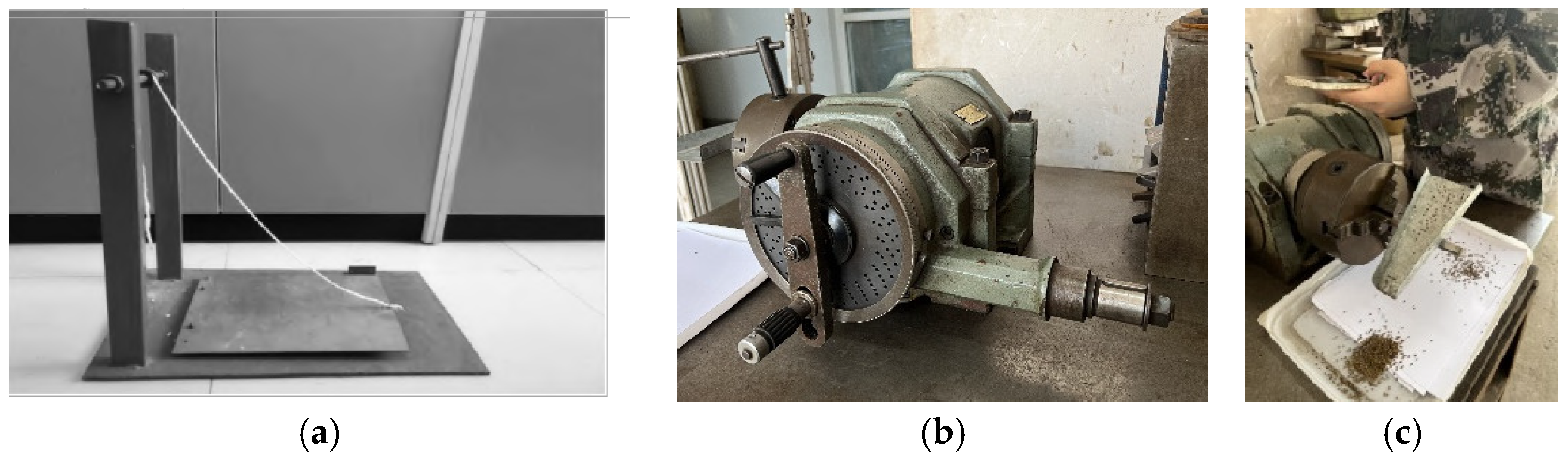
Figure 8.
Frequency distribution of geometric dimensions for milk vetch.
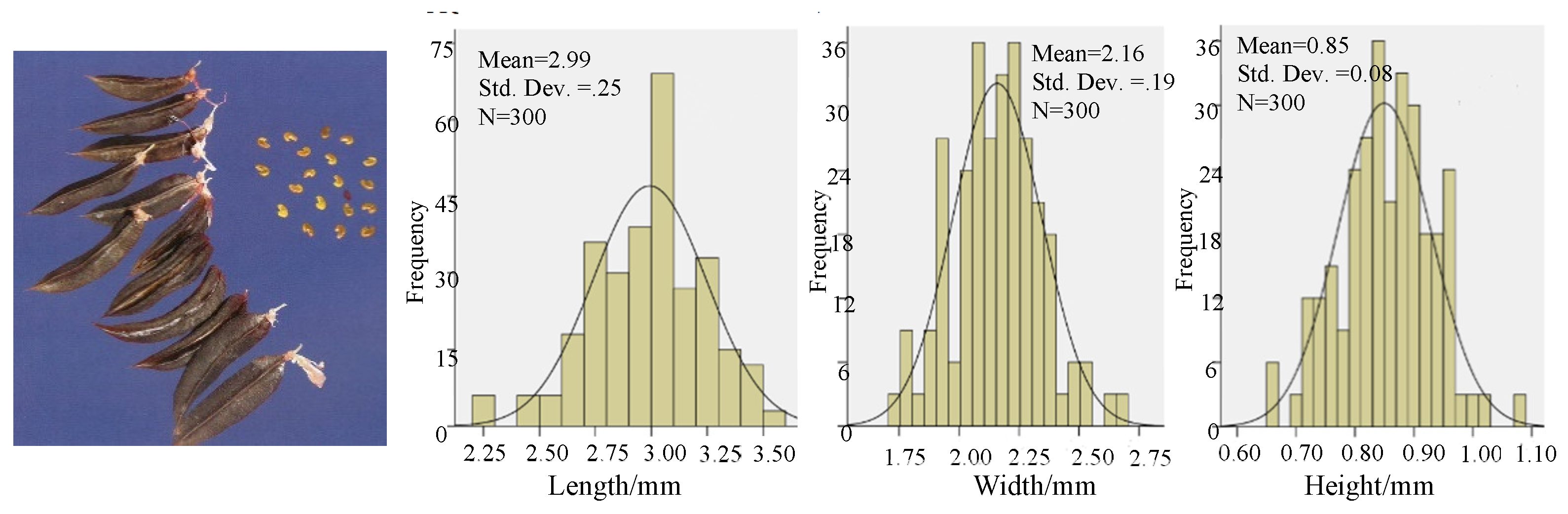
Figure 9.
Frequency distribution of geometric dimensions for hairy vetch.
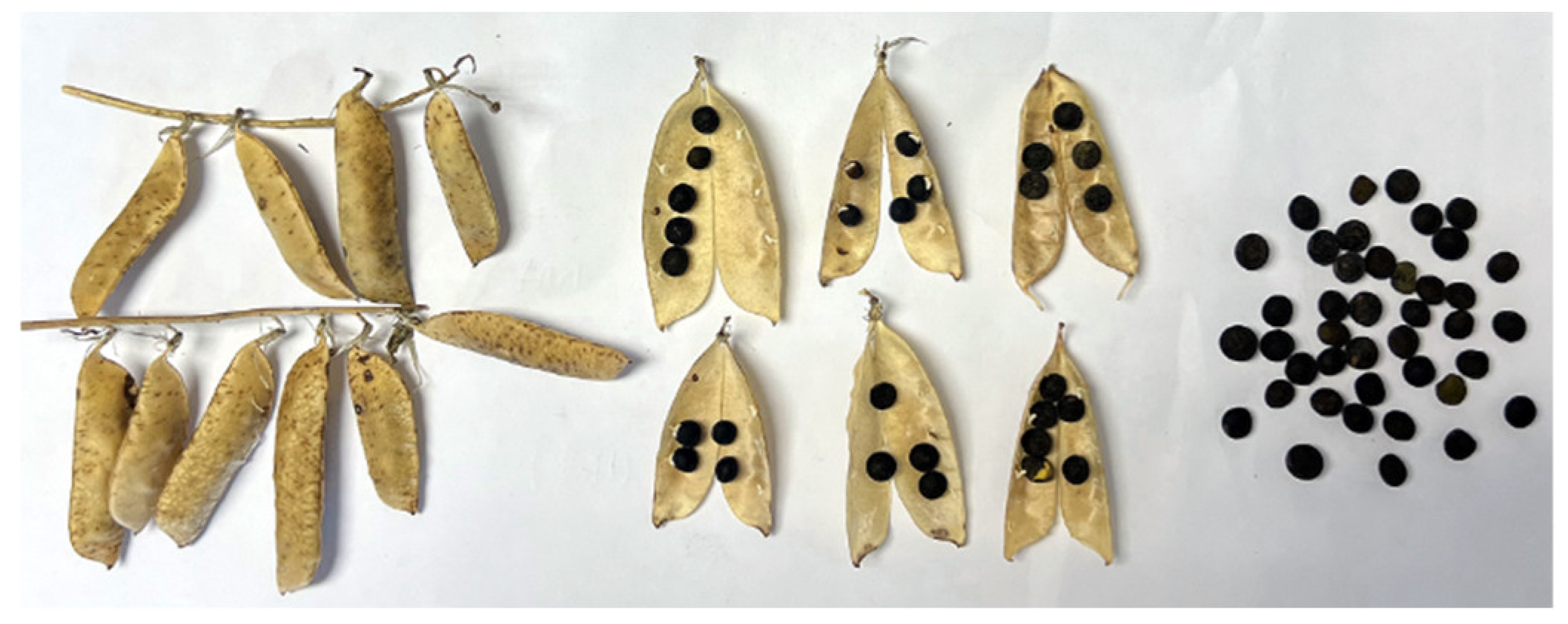
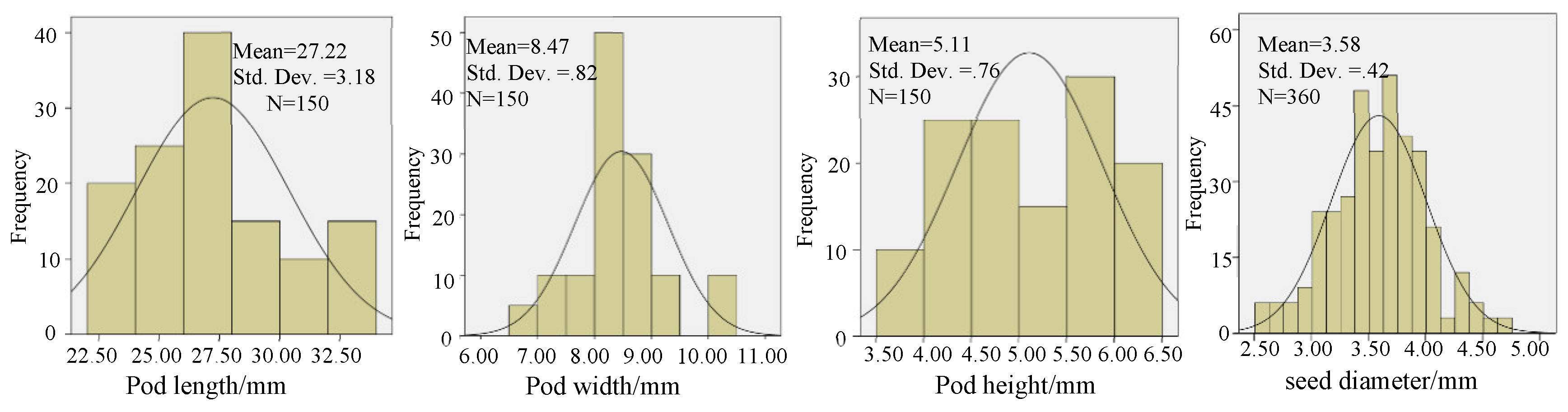
Figure 10.
Frequency distribution of geometric dimensions for sesbania.
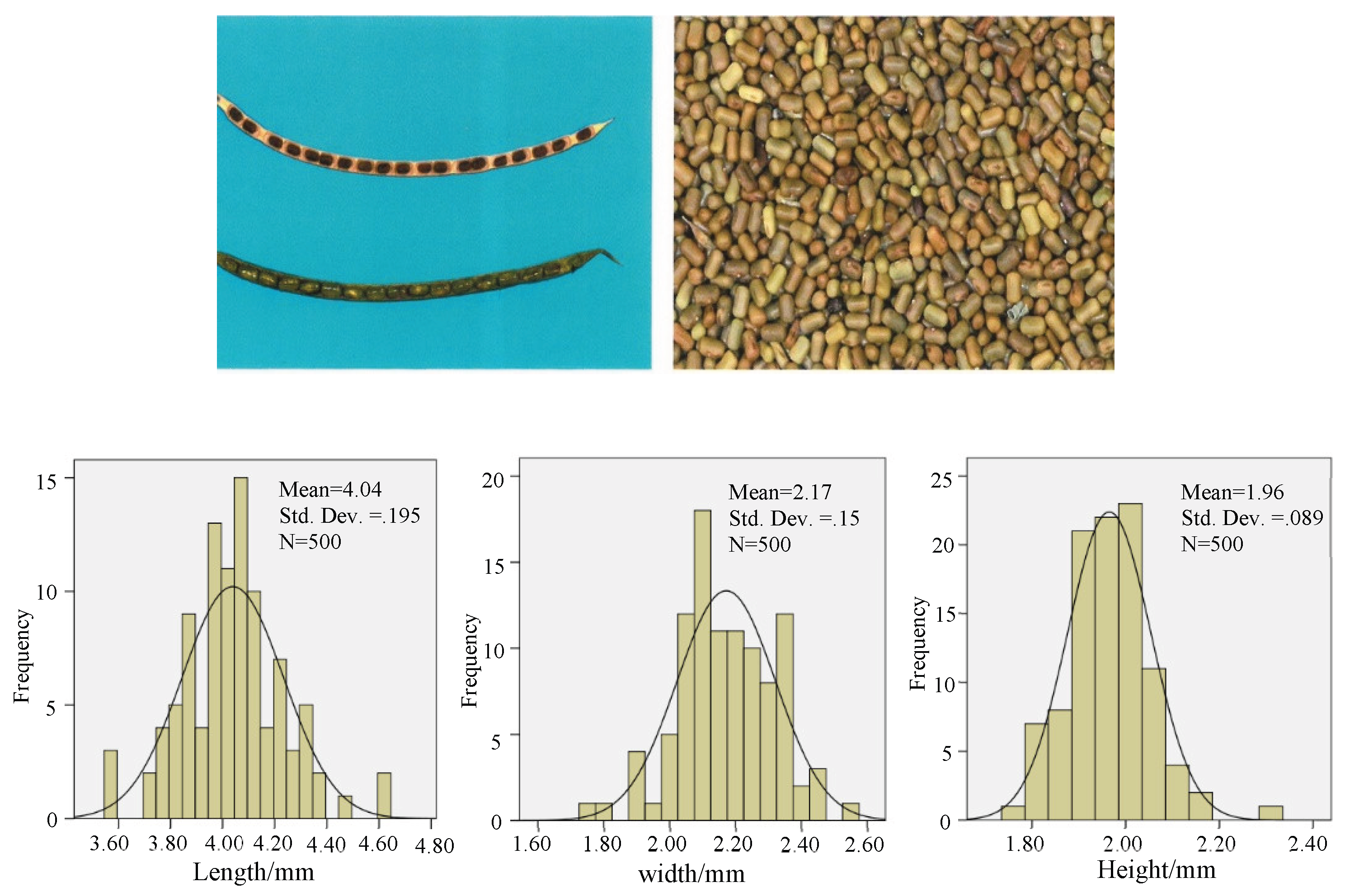

Table 1.
Statistical data on the geometric dimensions of three types of green manure seeds.
| N | mean value | median | coefficient of variation | minimum value | maximum value | ||
|---|---|---|---|---|---|---|---|
| milk vetch seed | length | 300 | 2.99 | 3.03 | 8.36% | 2.23 | 3.52 |
| width | 300 | 2.16 | 2.16 | 8.80% | 1.73 | 2.68 | |
| height | 300 | 0.85 | 0.85 | 9.41% | 0.66 | 1.08 | |
| hairy vetch pod | length | 150 | 27.22 | 26.91 | 11.68% | 22.67 | 33.6 |
| width | 150 | 8.47 | 8.33 | 9.67% | 6.6 | 10.32 | |
| height | 150 | 5.1096 | 5.12 | 14.91% | 3.81 | 6.43 | |
| hairy vetch seed | diameter | 360 | 3.5837 | 3.6 | 11.65% | 2.52 | 4.67 |
| Sesbania seed | length | 300 | 4.04 | 4.04 | 4.84% | 3.57 | 4.64 |
| width | 300 | 2.17 | 2.17 | 6.88% | 1.75 | 2.55 | |
| height | 300 | 1.96 | 1.96 | 4.53% | 1.76 | 2.30 |
Table 2.
Measurement Results of Physical Properties of Three Green Manure Seeds.
| variety | Physical characteristic parameters | ||||
|---|---|---|---|---|---|
| moisture content /(%) | thousand-seed weight/(g) | bulk density/(g/l) | angle of repose/(°) | angle of sliding friction/(°) | |
| milk vetch | 7.18 | 3.40 | 732 | 31.66 | 25.85 |
| hairy vetch | 9.81 | 26.50 | 761 | 28.15 | 23.55 |
| sesbania | 8.73 | 15.58 | 845 | 29.82 | 24.03 |
Disclaimer/Publisher’s Note: The statements, opinions and data contained in all publications are solely those of the individual author(s) and contributor(s) and not of MDPI and/or the editor(s). MDPI and/or the editor(s) disclaim responsibility for any injury to people or property resulting from any ideas, methods, instructions or products referred to in the content. |
© 2025 by the authors. Licensee MDPI, Basel, Switzerland. This article is an open access article distributed under the terms and conditions of the Creative Commons Attribution (CC BY) license (http://creativecommons.org/licenses/by/4.0/).
Copyright: This open access article is published under a Creative Commons CC BY 4.0 license, which permit the free download, distribution, and reuse, provided that the author and preprint are cited in any reuse.