
Submitted:
24 June 2025
Posted:
25 June 2025
You are already at the latest version
Abstract
Under the background of the country's rural revitalization strategy, improving traditional houses' residential comfort and sustainability has become a key task. residential comfort and sustainability has become a key task.This study focuses on the Korean people's residence in the Yanbian area. Through field investigation and quantitative analysis, it is found that there are problems such as insufficient thermal comfort in existing residential buildings. This study proposes a renovation scheme combining a ground source heat pump system and photovoltaic building integration technology. The project aims to build "new traditional" Korean houses that meet the needs of modern life without affecting cultural inheritance. It not only helps to improve the quality of the living environment and the efficiency of energy use but also provides regional adaptability and technical and economic solutions for the low-carbon transformation of rural buildings in cold areas..
Keywords:
Korean people’s residential ground
; source heat pump system
; photovoltaic building
; integration technology
; new traditional energy saving
1. Introduction
In the context of the continuous tilt of public infrastructure construction towards rural areas, China’s rural production and living conditions have been significantly improved, and the overall appearance of rural areas has undergone historic changes. However, there are still outstanding shortcomings in rural development, such as uneven infrastructure coverage and the quality of public service supply to be improved, and there is still a gap between the current rural development and the actual needs of farmers for a better life in the new era. As the core grasp of the implementation of the rural revitalization strategy and the key link in promoting the country’s modernization, the rural construction action must focus on the shortcomings and weaknesses and make precise efforts.[1] Through systematic planning and classified promotion, we should effectively improve the quality of the rural living environment and the carrying capacity of the industry, and strive to build a modern rural life system suitable for living and working, which is not only an important path to realize the integrated development of urban and rural areas, but also a strategic project related to the well-being of hundreds of millions of farmers.
Through a field investigation of the living conditions of 69 households in the border villages of Yanbian Prefecture, this paper found that there are the following problems in the comfort of local houses: the habitability of the houses is poor; The supply of hot water in residential buildings is inconvenient. Given the problems existing in residential buildings, this article will discuss how to use modern equipment to create a green and low-carbon living space that not only inherits traditional culture but also adapts to modern life.[2]
2. Analysis of the Current Situation of Chinese Korean Dwellings in Border Villages
2.1. The Current Situation of Research on Border Rural Dwellings
After visiting and investigating 69 Korean houses Korean dwellings are located in Group 7 of Zidong Village, Kaishantun Town, Longjing City, Yanbian Prefecture] and conducting questionnaire surveys on residents, as shown in Figure 1, it was found that the problems existing in the border dwellings of Korean nationality in Yanbian Prefecture were as follows: the indoor temperature reached 30 °C to 35 °C during the day in summer, and the perceived temperature reached more than 40 °C, which was not suitable for residents; The supply of domestic hot water is inconvenient, only a small number of residents have installed storage electric water heaters at home, with a power of about 3300W, which consumes 120 degrees of electricity a month and costs 63 yuan, accounting for more than 80% of the total monthly electricity expenditure, so residents do not often use it.[3]
To solve the above problems and improve living comfort, this paper proposes two strategies to be applied to Korean houses to construct “new traditional” Korean houses that not only meet the living comfort of Korean houses but also improve energy efficiency.[4]
2.2. The Current Situation of Research on Border Rural Dwellings
Traditional Dwellings in Border Villages
On the premise of ensuring the cultural inheritance of Korean houses, this paper aims to construct a “new traditional” Korean house that meets modern energy-saving standards. To achieve this goal, two energy-saving strategies active and passive, will be used as the core means to improve the energy supply of homes.[5]
Firstly, the solar photovoltaic power generation system is integrated into the building design by using the active energy-saving strategy to provide a renewable source of electrical energy for the electrical appliances to improve the comfort of the house. However, considering the characteristics of traditional houses, the application of photovoltaic integration technology may have a certain impact on their shape,especially the façade. In view of this impact, this paper proposes a passive energy-saving scheme based on the geothermal heat pump system [6], which uses the unique “cellar space” in traditional houses to achieve efficient and environmentally friendly heating and cooling, and minimizes the impact on the original architectural style.
Through the comparative analysis of the comprehensive effects of different energy-saving strategies , the optimal energy-saving strategies of “new traditional” houses were found, as shown in Figure 4.
4. Application of Energy-Saving Strategies and Simulation Assessments
In order to improve the comfort of the living environment and reduce the environmental impact of the building’s energy consumption, the electricity consumption of specific electrical equipment introduced into the residential house can be evaluated through experimental simulation, and the feasibility of energy saving can be comprehensively analyzed.
4.1. The Current Situation of Research on Border Rural Dwellings
In this paper, this study takes this dwelling as the research object, because it is highly representative in the Yanbian area: its gabled roof (accounting for 80%) completely retains the typical characteristics of the main ridge shorter than the gable, the four-sided slope roof, and the gray tile and white wall, combined with the traditional Korean elements such as the temperature protrusion system and the single-row layout, which not only reflects the regional cultural inheritance, but also shows the architectural characteristics of the Korean dwelling. Figure 5 shou Selected elevations and renderings of Korean houses, the annual electricity consumption of household appliances and equipment was simulated by Energy plus software, and the simulation time was from January 1 to December 31, and the accuracy was simulated in hours, with a total of 8760 hours of simulation As shown in Figure 5, the annual electricity consumption of household appliances was simulated by using Energy plus software, and the simulation time was from January 1 to December 31, and the accuracy was simulated in hours, with a total of 8760 hours of simulation “see Table 1”.
The results of simulating the annual power consumption of the electrical equipment under the geothermal heat pump system and the BIPV show that the annual power consumption of the residential comfort is 4322.25 kWh and the space comfort is -0.038, while the annual power consumption of the ground source heat pump system is 2551.875 kWh and the space comfort is -0.5.
4.2. A Comprehensive Assessment of the “New Traditional” Dwellings
The residential electricity consumption data screened through simulation shows that the installation of ground source heat pump system and photovoltaic integration technology can indeed improve living comfort. However, in order to make a comprehensive assessment, the combined impact of the “new traditional” model also needs to be considered. Based on the design principle of multi-dimensional weighted comprehensive evaluation index, this study conducted a detailed and comprehensive evaluation of the above two strategies from the three core dimensions of “technical performance, economy, appearance protection and comfort”.
Comprehensive evaluation index formula:
wi: the weight of the ith dimension (to be determined by expert scoring or APH analytic hierarchy process)
Si: standard score for the ith dimension (0-10, 10 is the best)
Sub-indicators and standardization methods for each dimension
Sub-indicators and standardization methods for each dimension
| dimension | Sub-metrics | Standard method |
| Technical performance | Energy saving rate(%) | If the target is exceeded, 10 will be taken |
| System energy efficiency ratio(COP) | S2 = (Actual COP − Baseline COP) / (Optimal COP − Baseline COP) | |
| Economical[7] | Payback period (years) | S3 = 10 - Actual payback period / industry average payback period |
| Annual operating cost savings(%) | ||
| Appearance protection[8] | Harmony of historical features (whether it meets the requirements for conservation) | S5 = 10 (fully compliant) or 5 (partially compliant) or 0 (non-compliant) |
Weighting by experts (taking traditional building renovation as an example)
| Dimension | Weights | Standard Method |
| Technical performance | 0.3 | Energy saving rate(0.6)、COP(0.4) |
| Economical | 0.3 | Payback period(0.5)、Cost recovery(0.5) |
| Appearance protection | 0.4 | The appearance is maintained(1) |
A comprehensive evaluation of the two energy-saving strategies was carried out
| scheme | Technical performance(S1~S2) | Economical(S3~S4) | Appearance protection(S5) | Overall score |
| Use a ground source heat pump system | 8 | 0.9 | 10 | 6.1 |
| Install photovoltaic panels | 10 | 17.5 | 0 | 4.425 |
Based on a comprehensive evaluation of the three key indicators of technical performance, economy and environmental benefits, the use of ground source heat pump system has been proven to be the best choice to improve the comfort of Korean people’s houses. This system not only improves the warmth and comfort of the living environment, but also significantly reduces energy consumption and reduces the negative impact on the environment.
5. Conclusions
Based on the comprehensive evaluation of photovoltaic integration and geothermal pump system, the introduction of a ground source heat pump system into Korean houses can make full use of underground constant temperature resources for efficient energy exchange and ensure that the indoor temperature is maintained throughout the year. The application of this system can not only significantly reduce energy consumption and operating costs, but also help reduce greenhouse gas emissions and protect the ecological environment. At the same time, photovoltaic integration technology is used to generate clean electricity to power ground source heat pump systems and other household appliances. It not only improves the energy self-sufficiency rate and reduces the dependence on the external power grid, but also respects and preserves traditional culture, creating a “new traditional” living space that is not only culturally distinctive but also environmentally friendly and efficient.
References
- Youling Wang, Xi Fan, Xiaozhou Su, Hongyi Wei, Yiquan Ding and Han Gao. “Protecting Traditional Chinese Villages, Let Nostalgia Have a “Township” to Find %j Xinhua Daily Telegraph.” 2023-04-21 004.10.28870/n.cnki.nxhmr.2023.002327. https://link.cnki.net/doi/10.28870/n.cnki.nxhmr.2023.002327. [CrossRef]
- “The General Office of the Central Committee of the Communist Party of China and the General Office of the State Council issued the Five-Year Action Plan for the Improvement of Rural Human Settlements (2021-2025)” %j Environmental Science and Management. 46 (2021):1-6. https://kns.cnki.net/kcms2/article/abstract?v=i7m15r_oBqrJhBzCW_m7CLmQJi26gskjLxcJZzNeJmfDtZ5uE9u24fjg7AQdQB9Mxzxy9ABvSieCEE_rA4Bu0QPBxipwJfHrgGtfjOBpU7VkAi8qxoqkS-2x8P1ZkcmXp9cFbmXy9F-ScaQ5X7CovuMkrG3DMobGwGyTo4LY4D2O5I2WQSNDKLaTZXFjIkBFrjiM2pcomVs=&uniplatform=NZKPT&language=CHS.
- Kim Chang-jie and Kim Wang-yeo. “Maslow’s Needs Theory and Korean Construction Culture: A Case Study of Yan’an Villages, Toudao Town, Helong City, Jilin Province %j House House.”(2020):155-56 https://kns.cnki.net/kcms2/article/abstract?v=i7m15r_oBqrNiXprSMLSOLT6CTigHk3BTt84ojDwsq1AObKfsDFguGnmiZSC9pC9a8cxptfkQfiqpWzp1O_yUyarGnMoPOaz8mjkBig1bzpDgMJVDMTvCznwcS92Gd9v-CwceO4JgnDLtfbaTs7QhuK93pNeAwJUJKsuHz3B67p5EiRg8U5SxHK5BmCmMshI2WS7DksD3cY=&uniplatform=NZKPT&language=CHS.
- Wang, D., Q. Dong and C. Sun. “Evaluating the adaptation potential and retrofitting effectiveness of existing residential buildings in severe cold regions of china under climate change %j building and environment.” 278 (2025): 112982-82. https://kns.cnki.net/kcms2/article/abstract?v=i7m15r_oBqpkGHDuyc0sR9bMNdFBhhmiU1B-2ptNacCOIk565qhiEf6UynoONsSL1EPyy_mumA0vM9u7CyjQruv6PX7qljWzUss9R_2qoj8cAUD0eKqv12Y1B2HC5FnCEHbv6NoC9aa5xr0Q-b-cWhZ8g0fi_EZIKohFKiCYzcr4L_pjLwF7h7sRf1-NaoazQZh6CVFMt1Wa33k4MBnYBovceJFr99Vl&uniplatform=NZKPT&language=CHS. [CrossRef]
- Jin Junfeng, Han. Korean Houses in China. Korean Houses in China, 2007,.
- Liu, X., Q. Zhou, K. Huang, Y. Wu, C. Liang, H. Cao and J. Wei. “Operating characteristics and evaluation of air source heat pumps in cold regions during heating season in china %j energy and built environment.” 6 (2025): 645-54. https://kns.cnki.net/kcms2/article/abstract?v=i7m15r_oBqpDY8pu1z99PYSgcRi0Ysl1e9qSf8CnxT6ysFo7ls6i2sWaVLeu3XlVQPZA4a-ef-lm0hsxGCJED9BEeNkjPiTrYXqTXlDuT1oVLRagPE4UCLcpTMihU4bmbK9xjg35J1Pq2QxQVqUy_8fSVb_lBBUdtJLytP4OfgF4IvpOQVU8BIRh6pnteDfTOnhG-Uu1ynesndD6mN6hDTW2tCwq1ejE&uniplatform=NZKPT&language=CHS. [CrossRef]
- Hussain, M. I. Hussain, M. I. and J.-T. Kim. “Energy and economic potential of a concentrated photovoltaic/thermal (cpv/t) system for buildings in south korea.” Journal of Asian Architecture and Building Engineering 18 (2019): 139-44. [CrossRef]
- Zhou Chuang, Duanmu Lin and Li Xiangli. “Photovoltaic Building Integration Appearance Evaluation Method and Model %j Central China Building.” 42 (2024): 49-54. https://link.cnki.net/doi/10.13942/j.cnki.hzjz.2024.07.020.
Figure 1.
General plan of Korean dwellings in Tunzidong Village, Kaishan, Longjing City, Yanbian Prefecture.
Figure 1.
General plan of Korean dwellings in Tunzidong Village, Kaishan, Longjing City, Yanbian Prefecture.
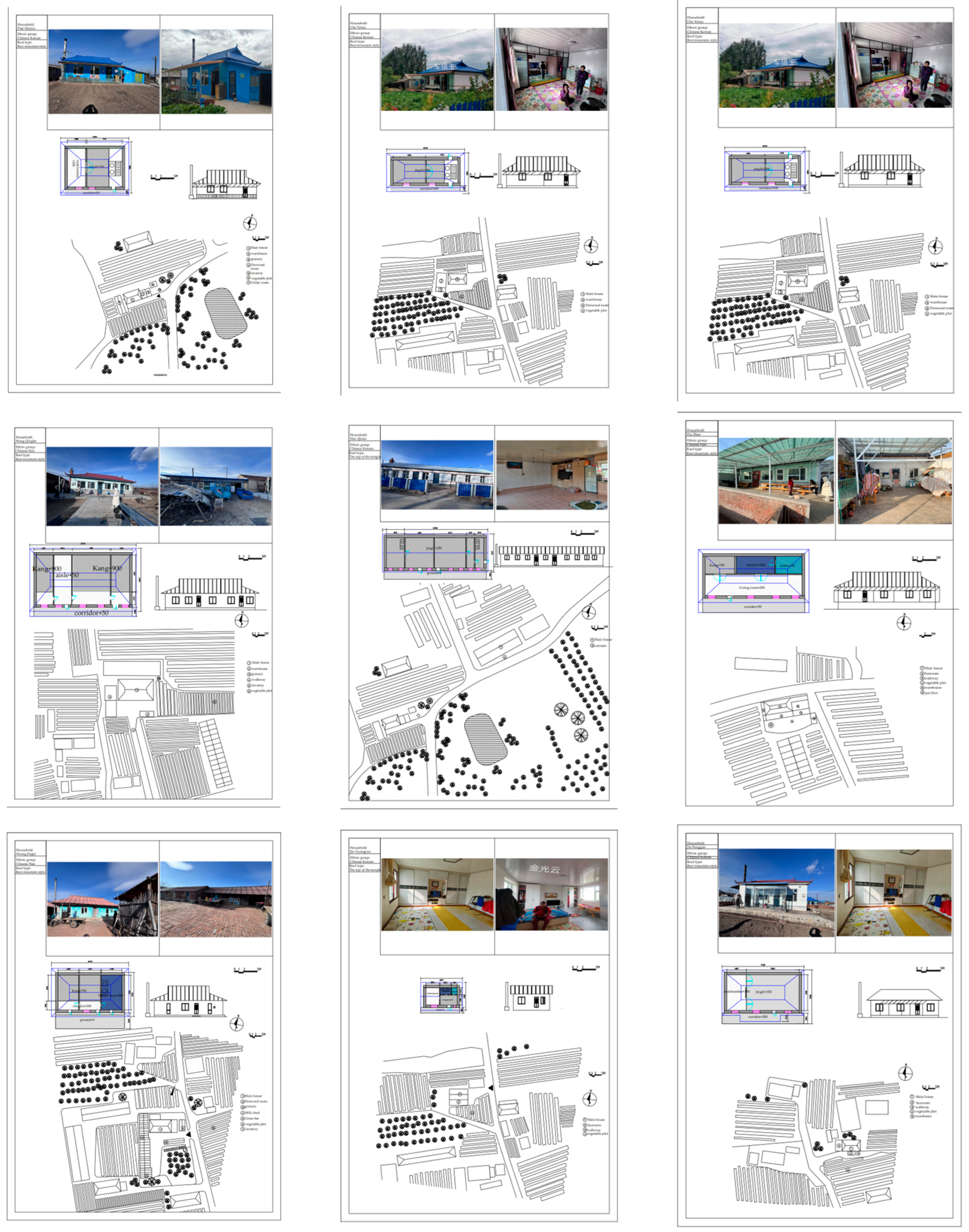
Figure 4.
Schematic diagram of the “New Traditional” dwelling.
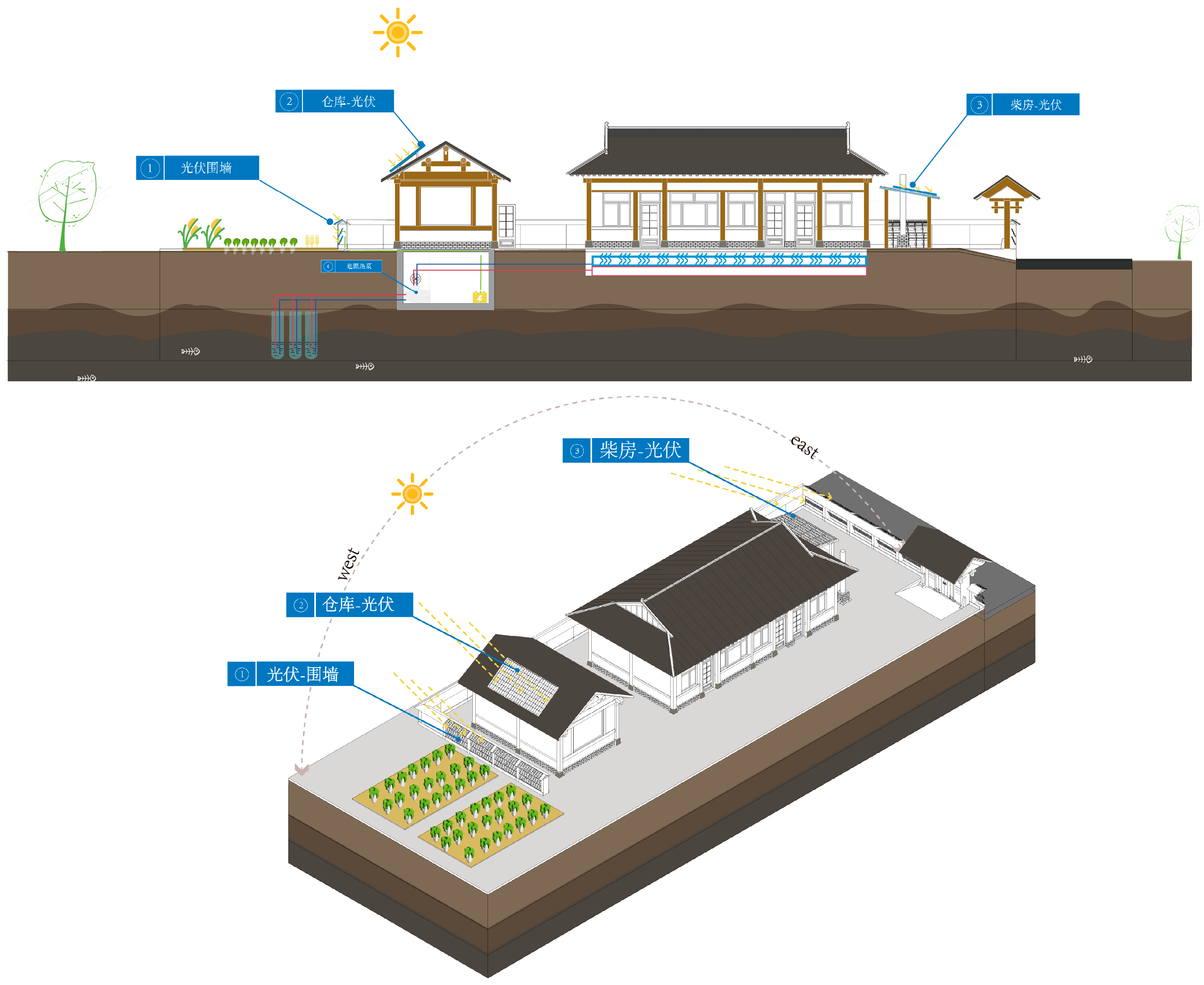
Figure 5.
Selected elevations and renderings of Korean houses.
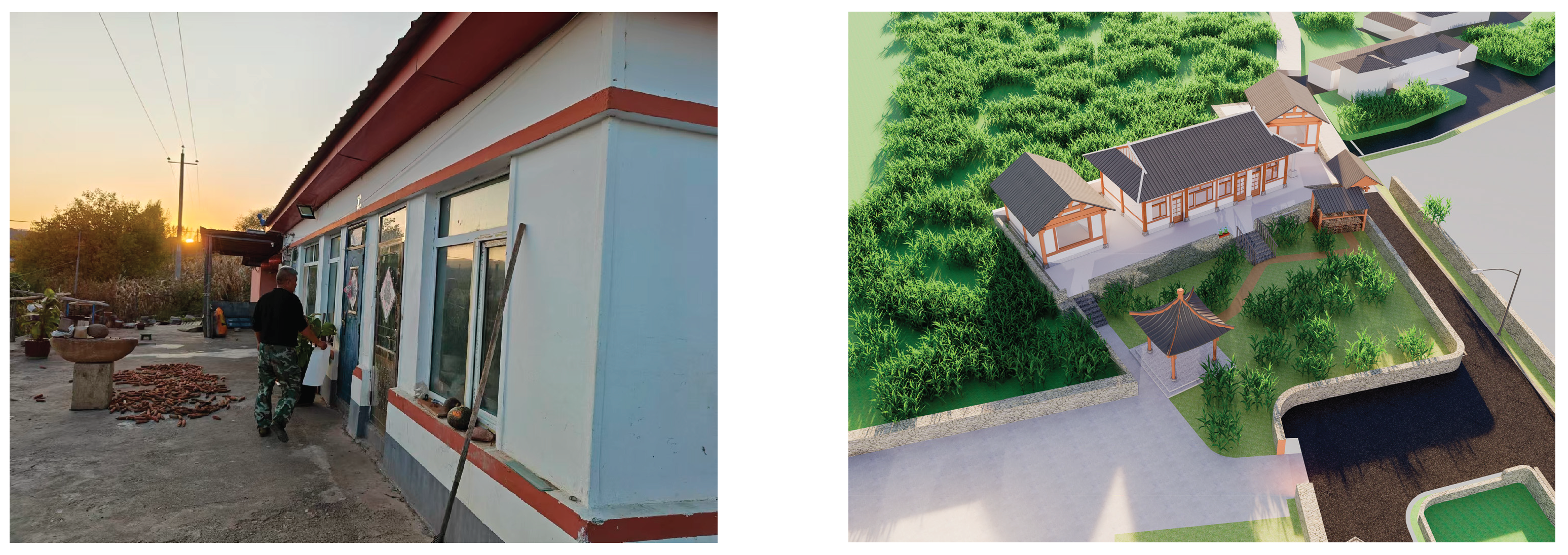

Table 1.
Power consumption of electrical devices under the active and passive policies.
|
equipment water heaterwater heater |
power(W) | Month of use (month) | Daily usage duration | Annual electricity consumption(kWh) |
| Cabinet air conditioning | 2000 | 1-3 7-9 11-12 | 4h | 1920 |
| Hanging air conditioning | 750 | 1-3 7-9 11-12 | 10h | 1800 |
| Electric water heater | 3300 | 1-12 | 30min | 602.25 |
| Ground source heat pump (heating) | 875 | 11-12 1-3 | 10h | 1312.5 |
| Ground source heat pump (refrigeration) | 1225 | 7-9 | 10h | 1102.5 |
| Air energy water heaters | 750 | 1-12月 | 30min | 136.875 |
Disclaimer/Publisher’s Note: The statements, opinions and data contained in all publications are solely those of the individual author(s) and contributor(s) and not of MDPI and/or the editor(s). MDPI and/or the editor(s) disclaim responsibility for any injury to people or property resulting from any ideas, methods, instructions or products referred to in the content. |
© 2025 by the authors. Licensee MDPI, Basel, Switzerland. This article is an open access article distributed under the terms and conditions of the Creative Commons Attribution (CC BY) license (http://creativecommons.org/licenses/by/4.0/).
Copyright: This open access article is published under a Creative Commons CC BY 4.0 license, which permit the free download, distribution, and reuse, provided that the author and preprint are cited in any reuse.


