

Submitted:
23 June 2025
Posted:
26 June 2025
You are already at the latest version
Abstract
This research aims to determine the influence of Ethical Leadership (EL) on Organizational Ethical Climate (EC) and examines the moderating effect of Dark Triad (DT) personality traits in leaders. EL promotes an optimal EC by instilling virtues such as fairness, integrity, and other concerns. However, Dark Triad leaders can undermine this effect by engaging in self-serving conduct and moral disengagement, thereby weakening the EC. The research examines how leaders who appear to be active in ethical actions build ethical capital (EC) but often have selfish and inconsistent motives. The research proposes to utilize quantitative studies, including cross-sectional surveys, to examine the moderating effect of Dark Triad traits on the relationship between emotional closeness (EC) and emotional labor (EL). This research would contribute to learning and social exchange theories by shedding light on how Dark Triad leaders hurt the relationship between EL and EC. It would affirm that leaders must have consistency and authenticity in their ethical behavior to produce a positive EC. Furthermore, it would also provide recommendations for lessening the moderating effects of Dark Triad traits to maximize the relationship between EL and organizational EC.
Keywords:
dark triad
; ethical leadership
; ethical climate
1. Introduction
The interaction between Ethical Leadership (EL) and Ethical Climate (EC) is a central area of research in organizational behavior, particularly in understanding how employees perceive and adhere to ethical norms (Kuenzi et al., 2020). EL contributes to establishing and sustaining an EC, which is defined by shared knowledge of organizational procedures and practices infused with ethical values (Dey et al., 2022). Ethical leaders translate ethical values and conduct expectations using “social learning and social exchange theories,” which contribute to the emergence of employees’ shared perceptions as an ethical culture (EC). Ayodele et al. (2019) noted that this EC mediates ethical behavior and emotional labor (EL). EL indirectly impacts employee behavior by building an EC (Ayodele et al., 2019).
Leaders’ Dark Triad (LDT) traits, for example, narcissism, Machiavellianism, and psychopathy, however, interrupt the EC as leaders’ self-interested behaviors give priority to their interests. For example, Chandler et al. (2021) noted that Machiavellian managers utilize their strategic insight and intelligence to appear visionary and ethical. However, in reality, they adopt manipulative approaches to maintain dominance and power (Chandler et al., 2021).
According to previous research, effective leadership has a positive impact on EC (Peng et al., 2021). However, the impact of the LDT characteristics, which promote self-interest over ethical acts in an ethical climate, is undermined. Organizations must understand the impact of LDT traits on their organizational effectiveness (EC). It would help them prevent leaders’ unethical acts, enhance accountability systems, and build defenses against manipulative leadership actions for organizational sustainability. Therefore, this research is being performed to accomplish the below-given objectives:
RO1: To propose the direct relationship between EL and EC.
RO2: To propose the moderating role of LDT between EL and EC.
2. Literature Review
2.1. Ethical Leadership
EL supports deep respect for other people’s ethical beliefs, values, rights, and dignity. It involves leaders setting examples and promoting normatively proper behavior through interpersonal relationships and workplace actions (Guo et al., 2023). Ethical leaders embody principles such as honesty, integrity, fairness, trust, transparency, and respect, thereby encouraging similar behavior in their followers. They value getting things right, fair, and just, balancing stakeholders’ interests and the organization’s profitability (Ughulu, 2024).
Furthermore, Lapatoura (2025) noted that such leaders are centered on principles and moral values in their actions and decision-making. Their acts and conduct create confidence and trust among their followers (Lapatoura, 2025). It is not merely about individual behavior but also about fostering an ethical organizational culture. Leaders empower others to lead them, thereby establishing a platform where ethical decisions are encouraged, and unethical conduct is discouraged. They build followers by exemplifying ethical behavior and rewarding proper conduct, shaping the organizational EC (Kuenzi et al., 2020).
EL is a more recent value-based leadership model that describes leaders showing and articulating normatively effective conduct to followers through their activities and interactions. Mastracci (2019) contended that EL consists of three key ingredients: functioning as an ethical role model, treating others equally, and conscientiously practicing ethics (Mastracci, 2019). Northouse (2025) identified respect, service-mindedness, fairness, honesty, and community building as essential competencies of ethical leaders. These include the significance of empathy, altruism, transparency, and working for the common good (Northouse, 2025). Furthermore, as Sharma et al. (2019) note, organizations can promote ethical leadership (EL) by adopting ethical decision-making models and providing leaders with tools to manage dilemmas effectively. These include ethical decision matrices, scenario planning, and stakeholder analysis, enabling leaders to make well-informed and ethically sound decisions in challenging situations (Sharma et al., 2019).
2.2. Leader Dark Triad
At some point or another, one will likely encounter someone in professional or personal life who can best be characterized as a conniving cheat, an arrogant braggart, or a callous hedonist. These terms describe the cardinal features comprising the personality traits known as the DT “Machiavellianism, Narcissism, and Psychopathy.” Over the past 15 years, researchers have increasingly focused on examining “dark behaviors” and “dark traits,” particularly as they manifest in organizational contexts (Pina e Cunha et al., 2024). DT personality traits comprise a cluster of negative traits that have the potential to impact leadership relationships and organizational culture significantly. These are linked to a callous, manipulative interpersonal style and adverse consequences in both private and public settings (Wallace & Buil, 2025).
Machiavellianism: Machiavellianism, as defined by Christie & Geis (1970), is a social tactic aimed at manipulating others to gain personal advantage, as measured through the MACH-IV questionnaire. It is characterized by distrust, amoral manipulation, and a desire for status and control (Ceroni & Yalch, 2024; Christie & Geis, 2013). Sanchez-Rabaza et al. (2023) define Machiavellians as individuals who are master manipulators, goal-oriented, frequently lacking empathy, and possessing a distorted sense of morality (Sanchez-Rabaza et al., 2023). Regardless of definition differences, the core of Machiavellianism lies in manipulation, frequently assessed as a composite trait in work settings. The strategic manipulation of others can characterize Machiavellian tendencies, which aim to achieve personal agendas at the expense of organizational ethics and trust (Blötner & Bergold, 2022).
Narcissism: Narcissism has been researched from many areas of psychology, with many models including fundamental traits like feelings of superiority, excessive attention needs, exploitative actions, and low empathy. Narcissistic leaders tend to prioritize their interests and utilize their charisma to manipulate others, thereby establishing a culture of self-aggrandizement rather than the common good (Tiwari & Jha, 2022). Although, at times, narcissism may promote ambition and creativity, it can also lead to exploitative actions and poor decision-making (Wirtz & Rigotti, 2020). The most common measurement instrument for evaluating narcissism is the Narcissistic Personality Inventory (NPI), which is likely to assess “narcissistic grandiosity” behaviors like exploitation, envy, aggression, and exhibitionism. Whereas specific models propose several dimensions of narcissism, such as “narcissistic vulnerability” (helplessness and low self-esteem), organizational research tends to concentrate on grandiosity using one-dimensional scales based on the NPI (Choudhary & Kumari, 2024; Prifitera & Ryan, 1984).
Psychopathy: Psychopathy, the darkest element of the DT, is defined by behaviors such as manipulation, lack of empathy, impulsivity, and antisocial behavior. Psychopathic leaders may pursue leadership roles for the power and control they wield rather than for the sake of authentic leadership or service (Vergauwe et al., 2021). Psychopathic leaders can pursue positions of leadership for the power and authority they provide instead of for actual leadership or service. Their lack of self-control can lead them to make impulsive choices that harm the organization, and their absence of remorse reduces their likelihood of reflecting on the moral consequences of their actions (Boddy et al., 2020). According to Malan (2024), Cleckley and Hare’s research has led to the development of commonly employed models, such as Hare’s Psychopathy Checklist, which focuses on these characteristics (Hare, 1986; Malan, 2024). Later models, however, like Williams et al.’s (2007) four-dimensional model, divide psychopathy into interpersonal manipulation, callous affect, erratic lifestyle, and criminality (Nilsson & Kazemi, 2023).
2.3. Ethical Climate
The EC establishes standards of proper behavior and provides mechanisms for resolving ethical issues within organizations. Thus, it is of critical importance in organizational life. It is based on implicit and explicit expectations about policies, which, in turn, shape expectations of ethical conduct (Teresi et al., 2019). EC gives “the context within which ethical action and decision-making occurs.” EC, therefore, oversees norms of behavior that enable individuals to understand what is acceptable and not punishable within organizations (Sookdawoor & Grobler, 2022). EC reflects organizational core values internally and externally, promotes sympathy and commitment to the organization, and manages nonconformity. Given its centrality, scholars have found that the influence of EC extends to an individual’s feelings, perceptions, and actions. According to previous research papers, EC has significantly impacted employees’ ethical behavior (Al Halbusi, Williams, et al., 2021; Danilwan & Dirhamsyah, 2022; Teresi et al., 2019).
Al Halbusi et al. (2021) stated that an organization’s ethical culture has a significant impact on employees’ ethical behavior. According to research, when an organization’s employee culture (EC) is strong, employees tend to deliver high-quality service and behave according to organizational values (Al Halbusi, Williams et al., 2021). Existing studies have examined the influence of EC and EL. EL is central to creating this climate because leaders establish integrity, fairness, and transparency and strengthen ethical norms through social learning and exchange processes (Al Halbusi, Ruiz-Palomino et al., 2021; Mishra & Tikoria, 2021; Sookdawoor & Grobler, 2022). For example, managers who focus on ethical conduct cultivate environments where workers view ethical expectations as unconditional, thereby minimizing deviance and strengthening accountability.
The EC interacts with organizational structures, most notably through Human Resource Management (HRM) practices, such as ethics training and open evaluation, to align employee conduct with ethical standards. Organizations that instill ethical codes into their day-to-day operations experience a more substantial influence on their climate by minimizing moral ambiguity (Al Halbusi et al., 2024). Challenges arise when LDT characteristics (narcissism, Machiavellianism, psychopathy), as they can manipulate climate perceptions to serve self-interest (Al Halbusi, Ruiz-Palomino, et al., 2021). This highlights the weakness of the EC in responding to contradictory leadership and underscores the necessity for systemic protections, such as independent monitoring.
The current research investigated how EL creates EC via social learning and procedural justice processes. Nonetheless, there is a literature gap in understanding how leaders with DT disrupt the influence of EL on EC for their self-interest. Determining the impact of Leaders’ Dark Triad traits on the EL and EC relationship would help design strategies to overcome these traits and create a positive EC. Therefore, this research is conducted to determine the effect of EL on EC through the moderating effect of the LDT.
3. Theoretical Framework
EL, in which leaders demonstrate ethical conduct and encourage moral norms, creates an organization’s EC (Guo et al., 2023). However, this impact can be moderated by LDT, which can undermine or warp the EC. These characteristics can lead to inconsistencies between ethical policies and actual practices, ultimately affecting the overall integrity of the organization.
3.1. Ethical Leadership and Ethical Climate
Transformational leadership theory, which focuses on the leader’s ability to inspire and motivate followers to achieve higher moral and ethical standards, can help explain EL (Hilton et al., 2024). Like transformational leaders, ethical leaders set an example and establish a robust ethical tone within the organization, establishing a culture in which ethical decision-making is the standard. Such leaders are renowned for facilitating positive organizational, group, and individual change (Peng et al., 2021). Social learning theory (Bandura, 1977) can also describe the relationship between early learning (EL) and early childhood education (EC). Workers observe and imitate their leaders’ actions; therefore, when their leaders demonstrate ethical behavior, it becomes simple for them to do the same. EL provides an environment where ethical conduct is noticed and valued, sustaining an EC (Koutroubas & Galanakis, 2022).
Current research has demonstrated the connection between EL and EC. Al Halbusi, Williams, et al. (2021) studied the link between EL and EC and mentioned that ethical leaders create climates that promote ethical behavior and discourage unethical behavior, hence creating organizational norms and influencing worker behavior (Al Halbusi, Williams, et al., 2021). Yasin (2021) examined the mediating role of EC and corporate reputation in the relationship between responsible leadership and employee turnover in the Pakistani banking industry. The finding indicates that responsible leadership has a positive impact on the EC, thereby strengthening corporate reputation (Yasin, 2021). Additionally, Enwereuzor et al. (2020) confirmed the function of the perceived leader in enhancing the link between EL and EC among teachers. The research revealed that the integrity of leaders enhances the positive impact of EL on the EC, underscoring the importance of selecting leaders with strong moral values to foster a favorable organizational climate (Enwereuzor et al., 2020). Based on the above studies, this research is also performed to determine the following proposition:
Proposition 1.
EL has a significant influence on the EC.
3.2. Leader Dark Triad as a Moderator Between Ethical Leadership and Ethical Climate
DT are personality traits that can prevent the beneficial influence of EL on the EC. Leaders with these traits tend to exhibit self-serving tendencies, manipulation, and a disregard for ethics, thereby destabilizing the EC they aim to establish (Rizvi & Siddiqui, 2023). These characteristics can serve as moderators in the relationship between EC and EL, potentially distorting or diluting the influence of EL. The LDT, which moderates the roles of EL and the EC, can be understood through the lens of paradox, upper echelon, and toxic triangle theories.
Paradox theory suggests that Dark Triad leaders may engage in paradoxical acts by appearing virtuous while secretly undermining virtues (Pearce et al., 2019). According to Palmer et al. (2020), the Upper Echelon Theory posits that leaders’ characteristics, including DT inclinations, drive organizational performance by influencing strategy and cultural norms (Palmer et al., 2020). In addition, the toxic triangle concept further explains how LDT can create a toxic organizational culture through the abuse of power and the manipulation of EC for personal gain (Magwenzi, 2018). These theories suggest that the presence of the ethical DT negatively influences the EC.
Pelster & Schaltegger (2022) examined the impact of DT personality traits on the corporate sustainability values of middle managers. Using a survey of 204 professionals, the research discovered that managers with stronger DT inclinations have less concern for environmental and social responsibility (Pelster & Schaltegger, 2022). Similarly, Chughtai et al. (2020) investigated how incivility at work mediates the impact of DT and counterproductive work behavior in a government agency, as well as the ways in which Islamic work values can moderate this impact. Through this research, it has been found that Islamic work values as an EC factor limit the destructive effect of DT on work conduct (Chughtai et al., 2020). This shows the destructive impact of the LDT on the organization’s climate; none of the previous research shows how LDT moderates the relationship between EL and EC. Thus, the current research is performed for the following proposition:
Proposition 2.
LDT as a moderator between EL and EC
3.3. Figure 1
Conceptual Diagram
Figure 1.
Conceptual Diagram
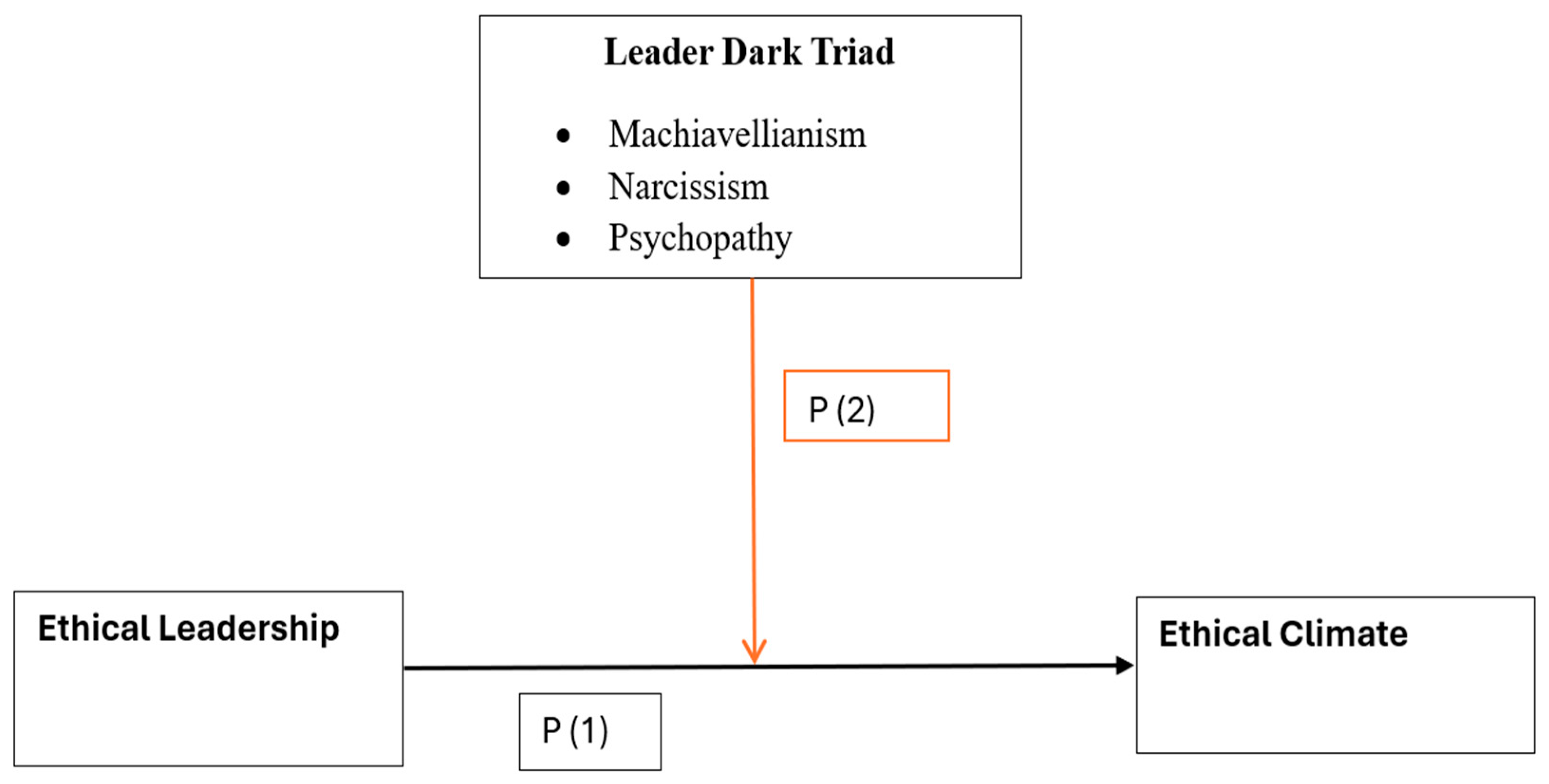
Note: Therefore, the conceptual framework is designed to determine the following Propositions:
P (1): EL has a direct positive influence on the EC.
P (2): LDT moderates the relationship between EL and EC.
The description of the current conceptual model determines the significant relationships between Ethical Leadership (EL), Ethical Climate (EC). It develops efficiency with the moderating role of Leaders’ Dark Triad Traits (LDT) (Teresi et al., 2019). Therefore, it seems important to develop efficiency in the framework while appearing as simplistic. Ethical climate seems within the organizations as describing the critical interplay of different emerging factors beyond leadership traits in the separate manner. For example, Sookdawoor & Grobler (2022) stated that the organizational culture is considered effective for defining the mediating role and considering effectiveness in the ethical values. It seems in promoting the activities by leaders that are internalized and managed for the fulfilment of the shared norms and behaviors. Sharma et al. (2019) elaborated that the leaders are influenced by the culture using definite and embedding ethical principles like use of the transparency, fairness, and accountability measures for the consideration of the organizational routines that are allocated to turn solidify to measure the ethical climate.
The incorporation of the organizational culture to the model seems in providing the definite nuance for the understanding of the changing in ethical leadership that impacts directly on the ethical climate in the given time (Sanchez-Rabaza et al., 2023). Additionally, there are differences in the individual management to develop efficiency with the employees’ moral and identity. It allows the degree to manage the morality as definite concept and impact directly on the relationship. Rizvi and Siddiqui (2023) illustrated that the employees are offered with the stronger management of the moral identity that is likely to manage uphold processes of the ethical standards and resistant towards reduction in the negative influences from the leaders describing the Dark Triad traits such as manipulation and emergence of selfishness.
There is a moral identity to develop efficiency in the buffering factor, allocation of the moderating system of the LDT, and undermining of the ethical climate. There are some definite resources of the individual-level for the moderators to help in the capturing of the diversity based on the employee responses towards leadership behaviors and enriching the explanatory power based on the model (Pina e Cunha et al., 2024). There is a dynamic and reciprocal nature based on the relationship between ethical leadership and measures for the ethical climate. There are some one-way influence measuring to the ethical climate, and reinforcement to constrain leaders’ behaviors while applying the mechanisms like differences in the social accountability and emergence of the peer pressure. Peng et al. (2021) declared that the organizations offers stronger ethical climate where the leaders are offered with the compelled system and maintenance with higher ethical standards. It seems in creating a definite loop for the feedback that sustains efficiency in the ethical leadership practices (Pelster & Schaltegger, 2022). There are some definite recognition for the management of the bidirectional influence and acknowledging the evolving nature based on the ethics within organizations and prevention of the oversimplification distribution of the concerned pathways (Pearce et al., 2019).
Additionally, some of the external contextual factors are applied like changes in the industry regulations, societal expectations, and justice to the organizational perceptions that are used for shaping the efficiency in the ethical leadership and translation of the management to the ethical climate. For example, the implication of the stringent regulatory environments determines efficiency to the positive effects based on the ethical leadership and makes increasing aspects to the transparency and overall accountability (Palmer et al., 2022). There is a less regulated contexts where the leaders with Dark Triad traits are considered erode for the ethical norms. Similarly, the employees perceive definite fairness and justice in the management of the organizational processes. According to Northouse (2025), the leaders are likely to embrace efficiency with the ethical values that are promoted by leaders, reinforcing the ethical climate, and management of the potential negative influences that are emerged using different leadership traits.
Therefore, the assumptions are associated with the learning of ethical leadership directly and implicating the positively influences of the ethical climate. It develops efficiency with the system of the complex mechanisms using definite ethical values for the process of operationalized system (Nilsson & Kazemi, 2023). Therefore, the conceptual framework is presented to determine the changes in the ethical leadership as describing the role modeling, use of the reinforcement policies like rewards and appraisals, and management of the moral reasoning frameworks such as ethics training session. The leaders with Dark Triad are characterized may disrupt the processes by prioritizing self-interest and undermining of the institutionalized system of the ethical practices (Sanchez-Rabaza et al., 2023). There are some weakening in the ethical climate. It determines the elaboration on these definite pathways where the model to make better capturing of the ethical values are internalized system in the organizations (Sookdawoor & Grobler, 2022). The role of communication and trust allows the mechanisms for influencing the relationship between ethical leadership and management of the ethical climate. Ethical leaders enhance the open and transparent communication channels that allows building of the trust within the employees and encouragement to the ethical behavior. Sharma et al. (2019) presented that trust identifies the social lubricant for facilitating the cooperation, reduction in the opportunistic behaviors, and strengthening the collective commitment for managing ethical policies and standards.
4. Conclusions
LDT characteristics complicate the relationship between EC and EL. These characteristics negate the beneficial effect of EL since they encourage self-serving actions and moral disengagement, which negatively impact EC. These qualities can potentially counteract the positive effects of EL by encouraging self-serving actions and moral disengagement, which can cause a breakdown in the EC. These trait leaders can display ethical conduct externally; however, they usually engage in actions that serve their agendas, causing inconsistency that leaves employees confused about what behavior is reinforced. This emphasizes the need to research how DT of Leaders moderate the relationship between EL and EC.
Determining this relationship would provide input to learning and social exchange theories by highlighting how LDT disrupt the fit between EC and EL even when attempting to become ethical behavior role models. This research would confirm that leaders should have consistency and authenticity in their ethical conduct to create a positive EC. It would also provide recommendations to minimize the moderating impact of LDT to strengthen the relationship between EL and EC. Moreover, the research recommends using a cross-section quantitative approach to validate these research Propositions. Future implications of this research include devising leadership measurement instruments to detect adverse impacts of DT dimensions in leaders and designing leadership training programs to support leader authenticity.
However, it has seen that the leaders are exhibiting Dark Triad traits to engage in the unlawful and manipulative communication system which develops trust and creates efficiency in the climate of suspicion and definite fear. The breakdown in trust determines the impairment in the development of a positive ethical management within the climate that is associated with the formal ethical policies or definition of the codes of conduct. Therefore, the integration of the communication in the quality and trust as defining the mediating factors are helpful for providing the valuable insights for the ethical leadership to gain cultivation of the ethical standards in the organizational climate within the presence of leaders as defining the dark personality traits.
References
- Al Halbusi, H., Ruiz-Palomino, P., Morales-Sánchez, R., & Abdel Fattah, F. A. M. (2021). Managerial ethical leadership, ethical climate and employee ethical behavior: does moral attentiveness matter? Ethics & Behavior, 31(8), 604-627. [CrossRef]
- Al Halbusi, H., Tang, T. L.-P., Williams, K. A., & Ramayah, T. (2024). Do ethical leaders enhance employee ethical behaviors? Organizational justice and ethical climate as dual mediators and leader moral attentiveness as a moderator: Empirical support from Iraq’s emerging market. In Monetary Wisdom (pp. 317-337). Elsevier. [CrossRef]
- Al Halbusi, H., Williams, K. A., Ramayah, T., Aldieri, L., & Vinci, C. P. (2021). Linking ethical leadership and ethical climate to employees’ ethical behavior: the moderating role of person–organization fit. Personnel Review, 50(1), 159-185. [CrossRef]
- Ayodele, F. O., Haron, H. B., & Ismail, I. (2019). Ethical leadership, ethical leadership climate and employee moral effectiveness: A social learning perspective. KnE Social Sciences, 189–205-189–205. [CrossRef]
- Blötner, C., & Bergold, S. (2022). To be fooled or not to be fooled: Approach and avoidance facets of Machiavellianism. Psychological Assessment, 34(2), 147. https://www.researchgate.net/profile/Christian-Bloetner/publication/353953429_To_be_fooled_or_not_to_be_fooled_Approach_and_avoidance_facets_of_Machiavellianism/links/611bb0cc169a1a0103082be2/To-Be-Fooled-or-Not-to-Be-Fooled-Approach-and-Avoidance-Facets-of-Machiavellianism.pdf.
- Boddy, C. R., Malovany, E., Kunter, A., & Gull, G. (2020). Employee well-being under corporate psychopath leaders. The Palgrave handbook of workplace well-being, 1-28. https://link.springer.com/referenceworkentry/10.1007/978-3-030-02470-3_74-1.
- Ceroni, D. B., & Yalch, M. M. (2024). Influence of Childhood Maltreatment on Machiavellianism. Journal of Aggression, Maltreatment & Trauma, 33(9), 1045-1054.
- Chandler, J. A., Petrenko, O. V., Hill, A. D., & Hayes, N. (2021). CEO Machiavellianism and strategic alliances in family firms. Family Business Review, 34(1), 93-115. [CrossRef]
- Choudhary, K., & Kumari, N. (2024). Effect of Narcissistic Personality Traits on Subjective Well-being and Coping Skills in Young Adults. International Journal of Interdisciplinary Approaches in Psychology, 2(5), 1979: 1992-1979: 1992. 1979-1992+Kaashvi.pdf.
- Christie, R., & Geis, F. L. (2013). Studies in Machiavellianism. Academic Press.
- Chughtai, M. S., Shah, S., & Yusrini, L. (2020). Dark Triad, counterproductive work behaviors, workplace incivility, and the role of Islamic work values: A moderated mediation model. https://essuir.sumdu.edu.ua/handle/123456789/81597.
- Danilwan, Y., & Dirhamsyah, I. P. (2022). The impact of the human resource practices on the organizational performance: does ethical climate matter? Journal of Positive School Psychology, 6(3), 1–16-11–16. http://184.168.115.16/index.php/jpsp/article/view/1062/558.
- Dey, M., Bhattacharjee, S., Mahmood, M., Uddin, M. A., & Biswas, S. R. (2022). Ethical leadership for better sustainable performance: Role of employee values, behavior and ethical climate. Journal of Cleaner Production, 337, 130527. [CrossRef]
- Enwereuzor, I. K., Onyishi, I. E., Albi-Oparaocha, F. C., & Amaeshi, K. (2020). Perceived leader integrity as a mediator between ethical leadership and ethical climate in a teaching context. BMC psychology, 8, 1-11. [CrossRef]
- Guo, F., Xue, Z., He, J., & Yasmin, F. (2023). Ethical leadership and workplace behavior in the education sector: The implications of employees’ ethical work behavior. Frontiers in Psychology, 13, 1040000. [CrossRef]
- Hare, R. D. (1986). Criminal psychopaths. In Police selection and training: The role of psychology (pp. 187-206). Springer. https://link.springer.com/chapter/10.1007/978-94-009-4434-3_12.
- Hilton, S. K., Puni, A., & Yeboah, E. (2024). Leadership practices and job involvement: does workplace spirituality moderate the relationship? Cogent Business & Management, 11(1), 2316582. [CrossRef]
- Koutroubas, V., & Galanakis, M. (2022). Bandura’s social learning theory and its importance in the organizational psychology context. Psychology, 12(6), 315-322. [CrossRef]
- Kuenzi, M., Mayer, D. M., & Greenbaum, R. L. (2020). Creating an ethical organizational environment: The relationship between ethical leadership, ethical organizational climate, and unethical behavior. Personnel Psychology, 73(1), 43-71. [CrossRef]
- Lapatoura, C. (2025). The Role of Leadership in Shaping Ethical Culture and Practices of Excellence: A System Thinking Approach. [CrossRef]
- Magwenzi, B. V. (2018). The toxic triangle: Exploring toxic leadership in nursing administration-a phenomenological study. AT Still University of Health Sciences. https://www.proquest.com/openview/51cbfa143437ea328136d59c0fb1ed4d/1?cbl=18750&diss=y&pq-origsite=gscholar.
- Malan, G. J. (2024). Does the Genesis 4 narrative suggest some knowledge of psychopathy? Verbum et Ecclesia, 45(1), 1-7. [CrossRef]
- Mastracci, S. (2019). Review of Dobel, J. Patrick.(2018). Public Leadership Ethics: A Management Approach. New York, NY: Routledge: By J. Patrick Dobel, New York, NY: Routledge, 2018. In: Taylor & Francis.
- Mishra, B., & Tikoria, J. (2021). Impact of ethical leadership on organizational climate and its subsequent influence on job commitment: a study in hospital context. Journal of Management Development, 40(5), 438-452. [CrossRef]
- Nilsson, H., & Kazemi, A. (2023). The bright triad of mindful leadership: An alternative to the Dark Triad of leadership. Psychology of Leaders and Leadership, 26(1), 67. [CrossRef]
- Northouse, P. G. (2025). Leadership: Theory and practice. Sage publications.
- Palmer, J. C., Holmes Jr, R. M., & Perrewe, P. L. (2020). The cascading effects of CEO dark triad personality on subordinate behavior and firm performance: A multilevel theoretical model. Group & Organization Management, 45(2), 143-180. [CrossRef]
- Pearce, C. L., Wassenaar, C. L., Berson, Y., & Tuval-Mashiach, R. (2019). Toward a theory of meta-paradoxical leadership. Organizational Behavior and Human Decision Processes, 155, 31-41. [CrossRef]
- Pelster, M., & Schaltegger, S. (2022). The dark triad and corporate sustainability: An empirical analysis of personality traits of sustainability managers. Business Ethics, the Environment & Responsibility, 31(1), 80-99. [CrossRef]
- Peng, J., Li, M., Wang, Z., & Lin, Y. (2021). Transformational leadership and employees’ reactions to organizational change: Evidence from a meta-analysis. The Journal of Applied Behavioral Science, 57(3), 369-397. https://www.researchgate.net/profile/Jian-Peng-5/publication/341413982_Transformational_Leadership_and_Employees’_Reactions_to_Organizational_Change_Evidence_From_a_Meta-Analysis/links/615b1f494a82eb7cb5ff3adf/Transformational-Leadership-and-Employees-Reactions-to-Organizational-Change-Evidence-From-a-Meta-Analysis.pdf.
- Pina e Cunha, M., Clegg, S., Rego, A., & Simpson, A. V. (2024). Drawing on the dark triad to teach effective leadership is dangerous, irresponsible, and bad theory. Academy of Management Learning & Education, 23(4), 626-651. [CrossRef]
- Prifitera, A., & Ryan, J. J. (1984). Validity of the Narcissistic Personality Inventory (NPI) in a psychiatric sample. Journal of Clinical Psychology, 40(1), 140-142. https://www.researchgate.net/profile/Joseph-Ryan-3/publication/16451918_Validity_of_the_Narcissistic_Personality_Inventory_NPI_in_a_psychiatric_sample/links/59de374ba6fdcca0d320377e/Validity-of-the-Narcissistic-Personality-Inventory-NPI-in-a-psychiatric-sample.pdf.
- Rizvi, S. U. K., & Siddiqui, D. A. (2023). Dark triad and counterproductive work behavior in Pakistan: The mediatory role of perceived organizational fairness complemented by organizational climate. International Journal of Social Science & Entrepreneurship, 3(2), 545-568. https://ssrn.com/abstract=3943865.
- Sanchez-Rabaza, J., Rocha-Martinez, J. M., & Clempner, J. B. (2023). Characterizing Manipulation via Machiavellianism. Mathematics, 11(19), 4143. [CrossRef]
- Sharma, A., Agrawal, R., & Khandelwal, U. (2019). Developing ethical leadership for business organizations: A conceptual model of its antecedents and consequences. Leadership & Organization Development Journal, 40(6), 712-734. [CrossRef]
- Sookdawoor, O., & Grobler, A. (2022). The dynamics of ethical climate: mediating effects of ethical leadership and workplace pressures on organisational citizenship behaviour. Cogent Business & Management, 9(1), 2128250. [CrossRef]
- Teresi, M., Pietroni, D. D., Barattucci, M., Giannella, V. A., & Pagliaro, S. (2019). Ethical climate (s), organizational identification, and employees’ behavior. Frontiers in Psychology, 10, 1356. [CrossRef]
- Tiwari, M., & Jha, R. (2022). Narcissism, toxic work culture and abusive supervision: a double-edged sword escalating organizational deviance. International Journal of Organizational Analysis, 30(1), 99-114. [CrossRef]
- Ughulu, J. (2024). Ethical leadership in modern organizations: Navigating complexity and promoting integrity. International Journal of Economics, Business and Management Research, 8(5), 52-62. [CrossRef]
- Vergauwe, J., Hofmans, J., Wille, B., Decuyper, M., & De Fruyt, F. (2021). Psychopathy and leadership effectiveness: Conceptualizing and testing three models of successful psychopathy. The Leadership Quarterly, 32(6), 101536. [CrossRef]
- Wallace, E., & Buil, I. (2025). Individual differences in perceiving disinformation sharing as opinion leadership: Effects of dark triad traits, need for uniqueness, and green identity. Personality and Individual Differences, 238, 113105. [CrossRef]
- Wirtz, N., & Rigotti, T. (2020). When grandiose meets vulnerable: narcissism and well-being in the organizational context. European Journal of Work and Organizational Psychology, 29(4), 556-569. [CrossRef]
- Yasin, R. (2021). Responsible leadership and employees’ turnover intention. Explore the mediating roles of ethical climate and corporate image. Journal of Knowledge Management, 25(7), 1760-1781. [CrossRef]
Disclaimer/Publisher’s Note: The statements, opinions and data contained in all publications are solely those of the individual author(s) and contributor(s) and not of MDPI and/or the editor(s). MDPI and/or the editor(s) disclaim responsibility for any injury to people or property resulting from any ideas, methods, instructions or products referred to in the content. |
© 2025 by the authors. Licensee MDPI, Basel, Switzerland. This article is an open access article distributed under the terms and conditions of the Creative Commons Attribution (CC BY) license (http://creativecommons.org/licenses/by/4.0/).
Copyright: This open access article is published under a Creative Commons CC BY 4.0 license, which permit the free download, distribution, and reuse, provided that the author and preprint are cited in any reuse.


