

Submitted:
24 June 2025
Posted:
24 June 2025
You are already at the latest version
Preprints on COVID-19 and SARS-CoV-2
Abstract
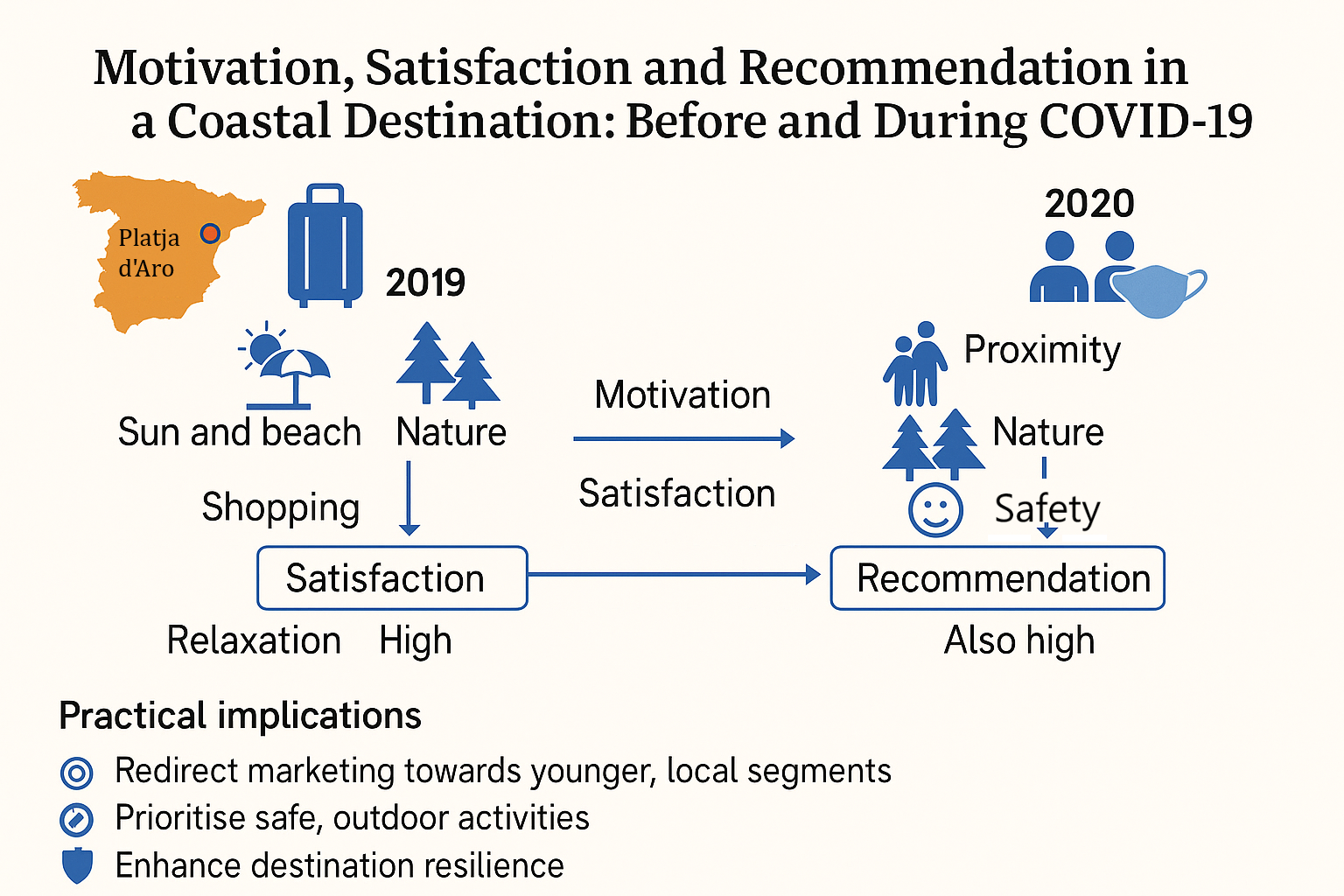
The growth of tourism in coastal destinations has attracted academic attention due to the link between tourists' motivations and their likelihood of recommending the destination. This study explores changes in tourist motivations, satisfaction, and recommendation behaviours in a coastal destination during the summers of 2019 (pre-COVID-19) and 2020 (during the pandemic). Employing quantitative analysis with Confirmatory Factor Analysis and Structural Equation Modelling, data from 394 pre-pandemic and 468 pandemic-period visitors were analysed. The findings reveal a shift in the tourist profile during the pandemic, with a predominance of younger visitors from nearby regions. Despite heightened uncertainty, satisfaction and the intention to recommend remained relatively high, albeit lower than pre-pandemic levels. The study underscores the importance of adapting marketing and management strategies to evolving tourist preferences, emphasising safety and sustainability in response to global crises. These results highlight the need for resilient policies to ensure positive visitor experiences and long-term growth in coastal tourism, contributing to the broader understanding of how external disruptions impact destination dynamics and tourist behaviour.
Keywords:
behaviour
; motivation
; satisfaction
; recommendation
; structural equation modelling
; coastal destination
; COVID-19
; Platja d’Aro
1. Introduction
Tourism is a key driver of sustainable development in many regions but is highly vulnerable to health crises and natural disasters, even those of smaller scale [1,2]. Studies highlight how events such as terrorism, earthquakes, floods, and pandemics significantly impact the sector, creating uncertainty in markets [3,4]. The COVID-19 pandemic reconfigured the perception of these crises, prioritising protection and resilience in tourist destinations [5,6].
In response to these challenges, current strategies focus on strengthening response and recovery capacities to mitigate future disasters [7,8]. These efforts include improvements in infrastructure, the involvement of local communities, and a proactive approach to prevention [9,10]. Furthermore, the pandemic underscored the importance of understanding tourist behaviour during crises and identifying the most vulnerable sectors [11]. Effective information management is essential to developing mitigation strategies and accelerating recovery. Cases such as the attacks in Paris and earthquakes in Japan demonstrate the importance of reliable information and agile response plans in restoring traveller confidence and reviving local economies [12,13]. On the other hand, tourist satisfaction has been extensively studied, particularly in relation to the intention to recommend a destination [14,15,16] and the likelihood of returning in the future [17,18,19]. Motivations vary among tourists and studies, with the common distinction between internal ("push", such as relaxation) [20,21] and external ("pull", such as the destination's attractions) [22,23].
The aim of this study is twofold. Firstly, it seeks to identify the influence of tourist motivations on destination satisfaction and its effect on recommending the destination. Secondly, it aims to compare these effects across two time periods: one prior to the COVID-19 pandemic (summer 2019) and another during the pandemic (summer 2020), specifically a few months after the pandemic was officially declared. This study focuses on Platja d'Aro, a coastal tourist destination located on the Costa Brava in the northeast of Spain. The research adopts a quantitative methodology, using Multiple Group Structural Equation Modelling (MGSEM) to compare the two periods of interest (2019 pre-pandemic and 2020 during the pandemic) and to analyse the relationship among motivation, satisfaction and recommendation. Data were collected through surveys conducted in 2019 (pre-pandemic) and 2020 (during the pandemic), with a total of 862 respondents.
The article is structured as follows: firstly, the theoretical framework on tourist motivation, satisfaction, and recommendation is introduced, alongside the presentation of the estimated model and relevant COVID-19 pandemic studies. This is followed by an explanation of the survey design, sampling methods, and analytical approach. Results are then presented and compared between the pre-COVID-19 and pandemic periods. Finally, the conclusions and implications are discussed.
2. Literature Review
The travel restrictions and public health measures imposed by the pandemic led to a historic decline in global tourism demand, severely impacting destinations dependent on this sector and exposing their lack of preparedness [24]. Mobility restrictions shifted tourist flows to perceived “safe” areas, such as coastal destinations leveraging open spaces to attract visitors [25,26]. Understanding tourist motivations, both internal and external, became crucial, particularly as safety and health emerged as key factors [27,28]. Satisfaction, linked to the quality of the experience and the fulfilment of expectations, significantly influences loyalty and destination recommendations, particularly in coastal settings, becoming an essential element for post-pandemic economic recovery and the sustainable development of tourism [29,30].
2.1. COVID-19 and Tourism
The COVID-19 pandemic triggered an unprecedented crisis across various aspects of global society, with the tourism sector being one of the most severely impacted [31]. One of the primary effects of the pandemic was the halt in international mobility due to government restrictions [5]. This disproportionately affected destinations reliant on international tourism, particularly those focused on mass tourism, such as beaches, islands, and urban centres [7,32]. The crisis exposed the limited resilience of the sector and the inadequacy of recovery plans, leading to reactive and unsustainable strategies [10].
In this context, the pandemic altered tourists’ perceptions and behaviours, who prioritised destinations with better healthcare infrastructure and stricter hygiene policies [33,34]. The perception of health risks became a decisive factor in destination selection. Consequently, new demands emerged, focusing on less crowded destinations, with greater proximity to nature and an emphasis on sustainability [35].
Governments, in turn, responded by promoting public-private collaborations to facilitate recovery and adaptation to new demands [6,36]. In Macao, for example, these alliances supported product innovation and financial assistance [37], while in Japan, trust in governance increased visitor loyalty and destination recommendations [18]. The pandemic drove the fast growth of Smart Tourist Destinations (STDs) to rebuild tourist confidence. Digital tools such as health certificates and real-time visitor flow management became critical, along with social media platforms to maintain engagement and promote safety [38].
2.2. Motivation
Motivation is a fundamental element in a tourist’s decision-making process when choosing a destination, and is therefore a key topic in tourism research, as it plays a crucial role in understanding tourist behaviour and improving satisfaction [27]. There is a widespread idea that motivation is defined as a set of forces that stimulate individual behaviour to satisfy needs and wants through different appropriate activities [23], which arise from an inconsistency between a desired and an existing condition [39]. Since motivation is one of the main indicators of tourists’ behaviour which influences their preferences and expectations, its study allows to recognise the reasons why the traveller is mobilised for the development of the tourist activity [40]. According to Correia et al. [41], a tourist’s motivation can be associated with various aspects, such as the quest for unique experiences, the desire to relax and escape from the daily routine, the need to explore new places, or curiosity about discovering other cultures. It is commonly considered that Tourists’ travel motivations are relevant since they are not only towards certain behaviours, but also useful to create criteria by which tourists will evaluate their experience at the destination [42].
The push-pull concept has been one of the most widely used approaches to explain tourists’ motivations [6,20,43], their satisfaction [44] and destination choice [45,46]. This concept particularly suggests that push factors refer to internal elements (intrinsic motivators), which are related to the decision to travel [47,48], while pull factors (destination attributes) are destination characteristics that attract travellers to choose a particular destination [23].
In the case of coastal destinations, Orams and Lück [49] state that recreational motivation of tourist in coastal areas is continuously growing, making them particularly interesting for research. For Yoon and Uysal [50], there are “push” motivational factors, understood as internal forces related to tourists’ desires, such as relaxation, achievement, family togetherness, safety/fun. Attraction” motivational factors were also identified, which are external forces related to destination attributes; these factors are: destination size and reliable (pleasant) climate, cleanliness and shopping, nightlife and local cuisine. In this sense, Koutra and Karyopouli [51] suggested that the geographical and climatological characteristics of a destination such as climate, sun or sea are relevant in tourist motivation, hence seasonality has a high incidence on visits during specific time periods.
2.3. Satisfaction
Satisfaction is fundamental in tourism planning as it influences destination choice, product consumption, loyalty, and the intention to recommend [50]. This multidimensional construct reflects visitors' subjective evaluation, influenced by emotional, cognitive, and contextual factors [52]. Regalado-Pezúa et al. [53] describe satisfaction as an emotional response resulting from the comparison between tourists' prior expectations and their lived experience, encompassing both tangible and intangible aspects. Therefore, understanding tourist satisfaction is a fundamental parameter for assessing the performance of destination products and services [23].
Perceived value is one of the main determinants of satisfaction, as it contributes significantly to the construction of the tourism image. This value is conceptualised as a combination of emotional, functional, economic, and social benefits associated with the tourist experience [54]. In coastal destinations, factors such as the conservation of the natural environment, the quality of infrastructure, and staff attention have a significant impact on visitor satisfaction [55]. When the attributes of a destination meet tourists’ needs and desires, a pleasant experience is created, fostering intentions to recommend and revisit the destination [56].
Satisfaction also plays a mediating role in the construction of a destination image, which integrates cognitive and affective dimensions [57]. The cognitive dimension is associated with knowledge and beliefs about the destination, while the affective dimension reflects the emotions and feelings it evokes [53]. Additionally, trust in the destination is a critical factor that strengthens satisfaction and loyalty. This trust is built upon perceptions of safety, service quality, and the authenticity of the tourism experiences offered [54,55]. This element is positively correlated with tourist satisfaction, making it a key indicator for assessing the quality and attributes of a destination [35].
Furthermore, recent studies have demonstrated that marketing strategies integrating specific attributes and the authenticity of each destination - such as its natural, cultural, and recreational offerings, alongside service availability - significantly influence perceptions of satisfaction [46,58]. Wang et al. [59] assert that tourists tend to choose destinations that optimally meet their needs and offer differentiated benefits. Satisfaction levels are based on expectations that, in turn, shape tourists’ motivations [60]. When these expectations are met, tourists are likely to consider their experience satisfactory and exhibit stronger intentions to return [61]. Finally, in determining a tourist’s level of satisfaction, a comparison is made between the quality of the visited attraction and the motivation behind the trip [56].
2.4. Recommendation
Recommendations play a crucial role in the development of the tourism industry [62]. Within the context of coastal tourism, the behavioural intentions of visitors, manifested in the likelihood of revisiting a destination or recommending it to others, stand as key indicators of customer loyalty in the sector [17]. These intentions can be influenced by various factors, including the perceived attractiveness of the destination, perceived quality, motivations, and visitor satisfaction [23,54]. According to Carvache-Franco et al. [56], motivations related to “escape and novelty” are significant predictors for recommendation in coastal tourist destinations.
In this context, segmenting tourists based on their motivations reveals a variety of interests, such as learning and experiencing coastal life, enjoying nature, and participating in water sports, all of which influence satisfaction and loyalty towards the destination [63]. This implies that a segmented approach in tourism management can be effective in meeting the specific needs of different tourist groups and achieving tourist satisfaction [35,57]. Consequently, a satisfactory experience at a tourist destination not only improves the image and quality of service but also leads to positive future behaviour, such as a greater willingness to recommend the destination to others [23,64].
Another essential aspect in the recommendation of coastal destinations is the perception of the destination’s image and its relationship with tourist loyalty. Carvache-Franco et al. [63] note that factors such as “Personal Attention” and “Tourist Infrastructure” are essential in forming a positive image and fostering loyalty towards the destination. While the perception of the destination’s image is often measured in an objective or subjective manner, it constitutes a multidimensional construct that encompasses various factors, from brand creation to the types of products, services, interactions with local populations, and activities offered at the destinations [52,65].
In relation to the destination’s image, it is essential to consider the influence of tourists’ perceptions of environmental impact and the management of tourist overload, as environmentally responsible behaviour of tourists in coastal destinations is increasingly relevant [46]. Panwanitdumrong and Chen [66] highlight that the implementation of sustainable practices, especially in coastal destinations, is key not only in preventing and mitigating environmental problems such as marine litter but also in enhancing the destination’s image and the intention to recommend it. This means that the perceived adaptation of the destination to the challenges of mass tourism is also essential in maintaining the quality of the tourist experience and promoting positive recommendations at the destination [16,67,68].
2.5. Relationship Among Tourist Motivation, Satisfaction and Recommendation
An important research interest in tourism is to know which the reasons tourists are to travel to a certain destination, it means, which are their needs to fulfil during their stay, and its relationship with their satisfaction [28,62]. This relationship has been widely studied; however, still contrary results are found in the investigation [20,45,63,69,70,71]. The success of destination marketing is mainly based on finding the relationship between tourist motivation, satisfaction and recommendation to a touristic destination [61]. Satisfaction has been shown to have a positive influence on tourist loyalty and subsequent recommendation of the destination [20]. For several authors, people travel because they are “pushed” to make travel decisions based on their interests and “attracted” by destination attributes [21,22,48]. Thus, satisfaction based on tourists’ motivation to travel contributes to destination recommendation [72].
Tourist satisfaction is a key indicator of the likelihood of recommending a destination, as a positive experience encourages other travellers to visit [73]. Conversely, dissatisfaction reduces this likelihood and negatively influences destination choice [19,59]. This underscores the causal relationship between recommendation, motivation, and satisfaction, where satisfied tourists are more inclined to recommend the destination [23,53].
The relationship between motivation and satisfaction has been examined through various frameworks. Push and pull factors are a common classification [19,44,74,75,76], while other studies focus on individual motivations [6,14,16,45]. Albayrak and Caber [20] propose three perspectives: (1) motivation as the sole determinant of satisfaction, highlighting factors such as escape and cultural interest [77,78]; (2) motivation combined with additional variables, such as destination image, which indirectly influences satisfaction [14,79]; and (3) employing motivational factors to assess satisfaction at the attribute level, with elements like relaxation, attractiveness, and socialising having a significant impact [28,80].
Destination quality, including attributes, activities, and services, is also a strong predictor of satisfaction and loyalty [81]. High satisfaction fosters loyalty, recommendations, and repeat visits, underscoring its importance in shaping tourists' positive intentions [19,59]. According to Ferreira da Silva et al. [82], previous and on-site experience directly influences the cognitive image of the destination, affecting attributes such as scenic beauty, gastronomy, and natural heritage, while the affective image shows less variability among groups. Visitors with greater experience have a more favourable perception of the destination and a higher intention to recommend and return, confirming the positive relationship between familiarity, destination perception, and loyalty [83,84].
Tourist recommendations are regarded as significant sources of information that allow potential visitors to evaluate the attributes and quality of a tourist destination. In this context, Prayag et al. [15] methodologically used Structural Equation Modelling to conclude that there is an interdependent relationship between the perception of the destination’s image and tourist satisfaction, as well as between the destination’s image and its loyalty, which directly affects the intention to recommend that destination. Similarly, Huang et al. [14] used a structural equation model to investigate how motivation, satisfaction, and perceived value affect tourist recommendations, finding that both perceived value and satisfaction have a significant influence on tourist recommendations. Santoso [85] explored the theoretical and empirical connections between the destination image, tourist motivation, satisfaction, and the intention to visit using Structural Equation Modelling analysis. The results concluded that the quality, value, and satisfaction with the destination have a direct and positive impact on the intention to recommend a visit.
2.6. Hypotheses
Based on the theories and findings of previous authors, there is a need to understand whether a disruptive context, such as the COVID-19 pandemic, has impacted motivation, satisfaction, and the likelihood of recommending the destination. In this context, the following hypotheses are proposed:
H1:
There is a significant positive relationship between tourists’ motivations to visit Platja d’Aro and their level of satisfaction with the tourist experience.
- H1a: Previously to COVID-19 period, tourists’ motivations to visit Platja d’Aro have a positive relationship with their overall satisfaction during the stay.
- H1b: During COVID -19 pandemic, despite travel restrictions and health concerns, there is a positive relationship between tourists’ motivations and their satisfaction with the experience in Platja d’Aro.
H2:
There is a significant positive relationship between the satisfaction of tourists in Platja d’Aro and their willingness to recommend the destination to friends and family.
- H2a: Previously to COVID-19 period, the level of satisfaction of tourists with their visit to Platja d’Aro directly influences their likelihood of recommending the destination to friends and family.
- H2b: During COVID-19 pandemic, despite the restrictions and changes in the tourist experience, the satisfaction of visitors continues to be a key predictor of their willingness to recommend Platja d’Aro to friends and family.
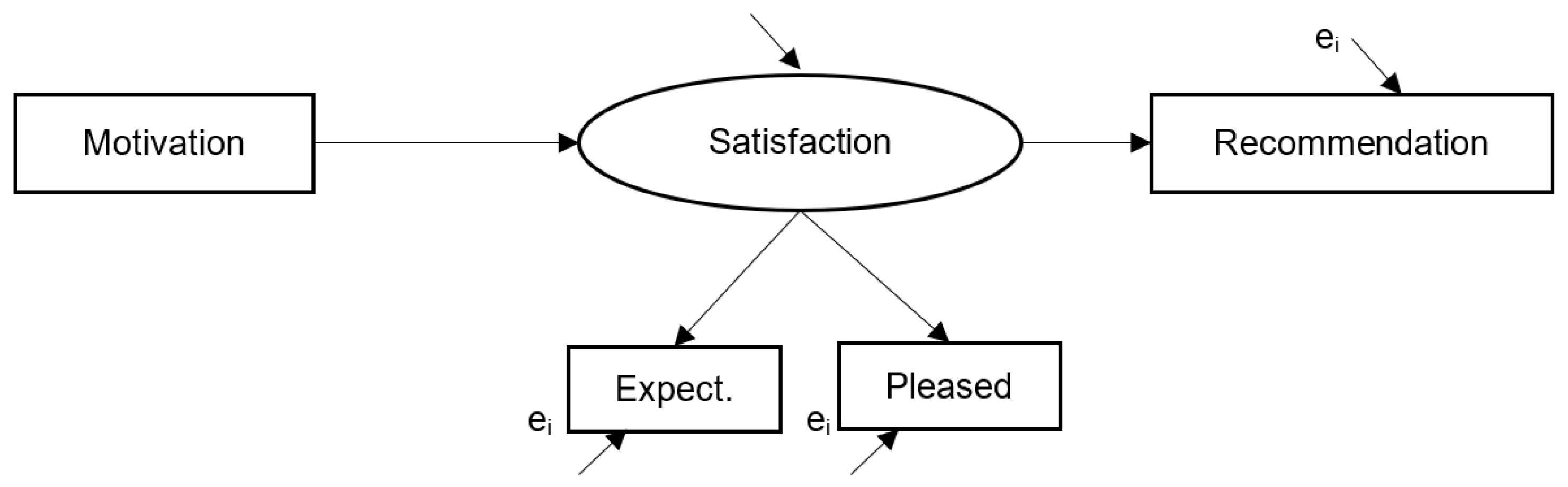
Figure 1.
The model and the hypotheses specified. The squares represent indicators, the circle represents the construct (latent variable of tourism satisfaction), and the random measurement error for the responses is represented by ei.
Figure 1.
The model and the hypotheses specified. The squares represent indicators, the circle represents the construct (latent variable of tourism satisfaction), and the random measurement error for the responses is represented by ei.
3. Materials and Methods
In this section the place of study is presented with the main touristic figures of the destination. Methodologically, the questionnaire and the operationalization of the questions are explained. Also, sampling, data collection, and the method of analysis are shown.
3.1. Tourist Destination
Platja d’Aro is a municipality located in the Baix Empordà region of Catalonia, along the Costa Brava, approximately 30 km from Girona and 100 km from Barcelona. Its strategic location and excellent connectivity via road networks and public transport make it an attractive year-round destination for leisure and cultural tourism [86].
Demographically, the municipality’s population has grown significantly, increasing from 5,785 inhabitants in 1998 to 12,773 in 2024 [86]. Additionally, the full-time equivalent annual seasonal population reaches 9,328 inhabitants, 73% higher than the resident population (ETCA population/resident population), highlighting the region's strong dependence on tourism [86].
Tourism is a major economic driver, supporting local employment and business activity. Events like "La Santa Market" attract hundreds of thousands of visitors, with the 2024 edition generating €31.8 million in economic impact [87]. Furthermore, the destination holds cultural significance, with the Castell de Benedormiens standing out as an important historical monument that underscores the area's heritage, in contrast to the modern coastal resorts [87]. Platja d’Aro boasts a diverse tourism infrastructure, including 32 hotels with 5,111 beds, 5 campsites with a capacity for 10,422 campers, and one rural tourism establishment with 9 beds, expanding its offerings to nature tourism and rural getaways [86].
3.2. Questionnaire Design and Operationalisation
The questionnaire was designed and agreed together with the city council and the tourist office. The questions used in this study are the tourist profile (gender, age and nationality), tourist motivations, tourist satisfaction and recommendation to family and friends.
Tourist satisfaction was measured by indicators. The specific questions were “The place satisfies my expectations” and “I am pleased with my decision” in a 5-point Likert scale from 1 (strongly disagree) to 5 (strongly agree). Recommendation was asked in a 11-point Likert scale, as “To what extent will you recommend this destination to your friends and relatives? (Where 0 was “not recommended” and 10 was “highly recommended”)”.
In order to identify the motivations or reason tourists choose this particular destination, the following ten motivations were asked in a binary scale: 1) To enjoy sun and beach; 2) To do water activities; 3) To do sport activities (hiking, cycling); 4) To enjoy gastronomy; 5) To discover new places; 6) To explore historical and cultural heritage; 7) To enjoy shopping facilities; 8) Good value for money; 9) To enjoy nature; and 10) To take a rest and relax.
3.3. Sampling and Data Collection
Sampling was carried out during summer high season, in this case during August 2019 and July and August 2020, during pandemic COVID-19. Data were randomly collected throughout the days of the week (weekdays and weekends), as well as at different times of the day and in diverse selected spaces in the municipality, this ensures a representative sample of the tourism demand. Therefore, the Passeig Marítim was selected due to the high influx of beach visitors. The Eix Comercial was chosen for its role as a central axis of the city, characterised by significant commercial activity and a wide range of tourist services. Finally, the Parc d'Aro was selected for being a prominent shopping and leisure centre, attracting a large number of visitors (see Figure 2).
Data collection was carried out through in-site by interviewers, who used a tabled device to enter the data. This data collection method allowed to send each completed survey automatically to a server. This procedure helped to reduce the number of errors compared with traditional data collection with paper and pencil, as well as to be able to carry out periodic controls during data collection process. Specially in 2020, during COVID-19, the fact of not using paper and pencil helped to maintain the security distances and protocols for the pandemic Final sample size collected were 862 respondents, divided into summer 2019 (394 responses) and summer 2020 (468 responses), during COVID-19.
3.4. Method
As two years of comparison are involved, a first method of analysis will be Multiple Group Structural Equation Modelling (MGSEM) [88,89,90,91,92]. This permits to evaluate the latent construct of satisfaction and its relationship with recommendation, as well as the effect of each motivation typology on the tourist satisfaction in 2019 (pre-COVID-19) and 2020 (during COVID-19). When comparison among groups is of interest for a latent variable, satisfaction construct in this study, measurement invariance among the groups should be established. In this article, metric measurement invariance which requires equal loadings for each group is analysed; if invariance holds, it permits relationships comparison among variables [92]. Mplus 7 [93] is used for those analyses.
Multiple Group Confirmatory Factor Analysis [88,90,91,92] is generally used for cross-cultural comparison in order to test if a latent variable of interest is comparable across groups, countries and/or years, taking measurement invariance into account. In the case that invariance holds, relationships and/or latent means of the constructs can be compared across groups (countries and/or time periods).
4. Results
In this section is first described the sample profile, followed by the pre and during pandemic models of Figure 1 on motivation, satisfaction and recommendation. In order to determine the change between the two periods, pre and during pandemic models will be compared.
4.1. Sample Description
Table 1 shows the distribution of the sample profile for the pre-COVID-19 pandemic and during COVID-19 at the destination and their demographic characteristics. The data show a similar proportion of men and women in 2019, with an increase of the proportion of men in 2020. The mean age in 2019 was 41.0 (sd=13.5) while in 2020 was 38.1 (sd=15.4), showing more younger visitors, in average, during the pandemic year 2020. Visitors with 34 or less years increase during the pandemic (46.1%) compared with the pre-pandemic (33.4%) in the age distribution of the visitors.
Tourists are mainly from the region of Catalonia, especially during the 2020, due to worldwide restrictions due to the COVID-19 pandemic. Followed by French tourist due to the proximity, and the tourists from the rest of Spain. As expected, the traditional tourism markets for the destination, such as The Netherlands, UK, Belgium or Germany also reduced its proportion in the total of visitors. In sum, during the pandemic in 2020, tourists at the destination were younger and traveling from closer destinations than the ones in 2019.
Table 2 shows the variables motivation, satisfaction and recommendation to friends and family which were used to estimate the structural model from Figure 1. The table shows the averages for satisfaction (out of 5 points) and recommendation (out of 10 points), and the percentage of agreement with each pull and push motivation. All results are shown for 2019 and 2020.
Descriptive statistics show a high level of satisfaction and recommendation in both periods; even with the uncertain situation in 2020 the satisfaction with the expectation was maintained. Concerning tourism motivations, visitors during the pandemic COVID-19, in 2020, had higher levels, which can be related with that with the pandemic, they have clearer motivation to visit the destination.
4.2. Pre-COVID-19 Pandemic and Pandemic Models’ Comparison
Table 3 shows the fit measures for the model from Figure 1, for the different motivations. Maximum Likelihood Robust (MLR) estimator was used for each model estimated.
The following goodness-of-fit measures were used for the model fit: standardised root mean square residual (SRMR), and root mean square error of approximation (RMSEA) measures. SRMR values of 0.08 or lower [94] and RMSEA values of 0.06 or lower indicate acceptable fit [95]. The comparative fit index (CFI) and Tucker-Lewis index (TLI) are incremental fit indices used to calculate improvements over competing models. Values higher than 0.90 for these two indices are an indicator of acceptable model fit [94]. Therefore, the different estimated models present an acceptable fit. Thus, metric measurement invariance [92] for the latent variable on satisfaction is obtained, which means that relations can be interpreted between pre-covid and during pandemic periods.
Results of the structural model relationships in Figure 1 are shown in Table 4. Relations between motivation and tourist satisfaction (Table 4a) -which corresponds to H1a and H1b-, and between satisfaction and recommendations (Table 4b) -which corresponds to H2a and H2b- are shown previously and during COVID-19 period.
Relations between the motivations and the tourist satisfaction (H1a and H1b) are different depending on the motivation and the period analysed, which also makes differences. In any case, the motivations that have statistically significant effect on tourist motivation are all of them positive relationships. Specifically, gastronomic, and cultural heritage exploration are not statistically significant on tourist satisfaction for none of the periods. Thus, previously and during pandemic those motivations have no effect on the tourist satisfaction.
Motivations concerning to water activities, discovering new places and good value for money had a statistically significant effect on tourist motivation only in pre-pandemic period. However, during COVID-19 period, these motivations had not significant effect on the level of tourist satisfaction. In the other side, sport activities had only effect on tourist satisfaction during summer 2020, COVID-19 period.
Four motivations, sun and beach, relax, nature and shopping have a statistically significant effect on tourist satisfaction in both periods. Comparing the effects between periods, unstandardized estimates are used, it is clearly showed that those effects were stronger during 2020, the pandemic period.
Concerning the relation between tourist satisfaction on recommendation (H2a and H2b) to friends and family, for both 2019 and 2020 periods, there is a positive statistically significant effect of satisfaction on recommendation, which represent that the more satisfied tourists are the more they tend to recommend the destination for friends and family. Such effects are higher in pre-pandemic, 2019, than during the pandemic, in 2020.
Summarizing, the statistically significant effects of motivations on satisfaction are higher in 2020, while the effects of satisfaction on recommendation to friends and family are higher in the 2019 period. Thus, the effects of motivations on satisfaction became stronger during the pandemic period, which can be relevant result for destination management organizations (DMO) in order to consider future tourism policies.

Table 4a.
Unstandardised coefficients of the model.
| Motivation → satisfaction | |||
|---|---|---|---|
| 2019 | 2020 | Sig. effect | |
| Model 1. To enjoy sun and beach | .323** | .502*** | 2019 & 2020 |
| Model 2. To do water activities | .281*** | .139 | 2019 |
| Model 3. To do sport activities | .062 | .341*** | 2020 |
| Model 4. To enjoy gastronomy | .068 | .174 | - |
| Model 5. To discover new places | .156** | .180 | 2019 |
| Model 6. To explore heritage | .103 | .160 | - |
| Model 7. Good value for money | .377*** | .207 | 2019 |
| Model 8. To take a rest and relax | .256** | .261* | 2019 & 2020 |
| Model 9. To enjoy nature | .175** | .395*** | 2019 & 2020 |
| Model 10. To enjoy shopping | .182** | .362*** | 2019 & 2020 |
***p<.001; **p<.01;*p<.05.
Table 4b.
Unstandardised coefficients of the model.
| Satisfaction → recommendation | |||
|---|---|---|---|
| 2019 | 2020 | Sig. effect | |
| Model 1. To enjoy sun and beach | 1.100*** | .873*** | 2019 & 2020 |
| Model 2. To do water activities | 1.103*** | .846*** | 2019 & 2020 |
| Model 3. To do sport activities | 1.105*** | .860*** | 2019 & 2020 |
| Model 4. To enjoy gastronomy | 1.106*** | .869*** | 2019 & 2020 |
| Model 5. To discover new places | 1.106*** | .860*** | 2019 & 2020 |
| Model 6. To explore heritage | 1.104*** | .860*** | 2019 & 2020 |
| Model 7. Good value for money | 1.109*** | .850*** | 2019 & 2020 |
| Model 8. To take a rest and relax | 1.101*** | .864*** | 2019 & 2020 |
| Model 9. To enjoy nature | 1.101*** | .869*** | 2019 & 2020 |
| Model 10. To enjoy shopping | 1.099*** | .859*** | 2019 & 2020 |
***p<.001; **p<.01;*p<.05.
5. Discussions and Conclusions
The analysis of tourists’ motivations and satisfaction in Platja d’Aro, before and during the pandemic, revealed changes in the relationship between internal and external factors influencing their decisions. Before the pandemic, tourists prioritised recreational and cultural experiences, whereas during the pandemic, they placed greater emphasis on safety and personal well-being, reshaping their motivational dynamics and their connection to the tourism experience. Despite the shift in motivations, the fundamental link between satisfaction and the intention to recommend remained strong, albeit slightly weakened by the heightened perception of risk. This behaviour aligns with the "push and pull" theory, which highlights how internal factors (such as the desire for relaxation) and external factors (such as destination attractions) interact to shape the tourism experience, even in contexts of uncertainty [21].
Concerning to the relationship of tourists’ motivations on satisfaction (hypotheses H1a and H1b), In the pre-pandemic period, results showed a strong correlation between specific motivations of tourists and their satisfaction. These findings are consistent with prior studies emphasising that satisfaction is profoundly influenced by the destination's ability to meet or exceed tourists' expectations [50]. This relationship is also consistent with the "push and pull" theory [75], according to which internal motivational 'push' factors (such as the search for relaxation or adventure) and 'pull' factors (attractive attributes of the destination) interact to shape the complete tourism experience. The satisfaction reflected in this pre-pandemic phase establishes that when visitors find that their motivations are adequately fulfilled, for example through recreational and cultural activities, they tend to report higher levels of overall satisfaction.
During the same period, tourists seeking sun and beach, water activities, and cuisine found their expectations well met, as evidenced by 93.6% of visitors motivated by enjoying the sun and beach, and 58.8% by water activities, supporting the theory that satisfaction is greater when there is a congruence between what tourists seek and what they find [20,43].
Hypothesis 1a is supported by most of the motivations. However, it is not supported by three specific motivations: sport activities, gastronomy, and heritage. Therefore, overall, Hypothesis 1a, relating to the pre-COVID-19 period, is partially supported.
During the pandemic, the motivations influencing satisfaction showed an adjustment towards activities perceived as safer, reflecting a shift in the 'push' factors influenced by a new context of safety and health restrictions. This phenomenon supports the proposal by Higgins-Desbiolles [96] who asserts that, in times of crisis, motivational factors can significantly change, leading to a higher valuation of aspects such as safety and personal well-being. Furthermore, this adjustment supports the theory of tourism demand elasticity in response to external factors [24], where it is observed that tourist motivations and expectations are highly susceptible to macro-environmental conditions.
The increase in the proportion of tourists motivated by activities perceived as safe, such as sports (from 48.6% to 62.8%), and a good value for money (from 34.5% to 76.8%), reflected an adjustment in preferences and expectations. This corroborates the theories of various researchers who assert that tourists can adapt their travel motivations in response to crises imposed by the environment [6,16,96].
Hypothesis 1b is supported by half of the motivations. However, it is not supported by the remaining motivations: water activities, gastronomy, discovering new places, heritage, and value for money. Therefore, overall, Hypothesis 1b, relating to the COVID-19 period, is partially supported.
Concerning to the effect of the tourist satisfaction on the intention to recommend the destination (hypotheses H2a and H2b), in the pre-pandemic period, the data revealed a strong relationship between visitor satisfaction and their willingness to recommend Platja d'Aro. Results support other studies [15,23]. Essentially, visitors who feel that their expectations have been exceeded, not only in terms of the destination's attractions but also in their interaction with it, tend to become more fervent promoters of the destination.
Similarly, recommendation scores were notably high (8.48 out of 10 points), indicating a strong preference to recommend the destination. This reinforces the theoretical framework that establish a direct relationship between tourist satisfaction and the likelihood of recommending a destination, confirming that previous expectations of visitors lead to high satisfaction and, consequently, a greater willingness to recommend the destination [53,63,64]. Thus, hypothesis 2a, related with the previous period of COVID-19, is fully supported by the structural model.
During the pandemic, although the relationship between satisfaction and recommendation persisted, a weakening in the intensity of this correlation was observed (7.8 out of 10 points). This situation can be interpreted through the prism of increased risk perception and uncertainty due to the global health crisis. The relevant literature suggests that, in times of crisis, psychological factors such as fear and uncertainty can significantly alter consumer behaviour patterns [24,97]. Moreover, the research by Higgins-Desbiolles [98] underscores how altered perceptions about safety can negatively affect tourists' willingness to recommend a destination, even if their personal experience was positive. This phenomenon can further be explained by the concept of "perceived risk", which has been shown to be a significant moderator in the relationship between customer satisfaction and loyalty in crisis contexts [19]. Concerns about health and safety during the pandemic could have elevated the perceived risk associated with traveling and, consequently, recommending travel to others.
Despite this slight reduction in tourists' intention to recommend the destination, the results still indicate that tourists were satisfied with the activities at Platja d’Aro, which was determinant for recommending the destination. This phenomenon is supported by recent research that ensures that, during periods of crisis, tourists value their satisfying experiences even more and may feel motivated to share these experiences as a form of support for the destination [64,96]. In short, the satisfaction and recommendation scores are proof of the resilience demonstrated by the tourism sector and the ability of Platja d’Aro to maintain a positive image despite adversities, through strategies oriented towards crisis management and tourism recovery [11].
Thus, hypothesis 2b, related with the COVID-19 period, is fully supported by the structural model.
Tourist motivation is a crucial subject for the development of effective destination management strategies and for enhancing tourist satisfaction. Understanding motivation involves distinguishing between "push" and "pull" factors, highlighting the complexity of this phenomenon, wherein both internal and external factors converge in the traveller’s decision-making process [41,75]. The findings of the study reveal that motivations for visiting Platja d'Aro during the pandemic were more focused on activities perceived as safe, reflecting a shift in 'push' motivational factors towards a pursuit of personal well-being and safety. This is in line with the theories discussed in the literature review on tourist motivation in crisis contexts [16,27,45]. Professionals in the tourism industry can take advantage of this distinction to customise their offers and services to the needs and desires of tourists, all while capitalising on a destination's unique attributes [46,53].
The continuous growth of recreational activities in coastal areas and their attractiveness to tourists underline the importance of researching and understanding in depth the motivations that drive people to visit specific destinations [42]. Furthermore, studies on seasonality and its impact on traveller preferences are fundamental for effective tourism demand management [41,75]. In this regard, the dynamic interaction between motivations and destination attributes must be considered to develop more effective strategies within the tourism industry and promote sustainable destination growth [11].
Satisfaction, for its part, remains a strong predictor of recommendation, even in the midst of a pandemic, as it ensures the return of visitors or word-of-mouth diffusion of the destination. This study complements the existing literature by demonstrating that although the factors influencing tourist satisfaction may vary in response to external crises such as a pandemic, the fundamental relationship between motivation and satisfaction remains robust. This phenomenon is consistent with other studies [6,10,37]. Although academic literature mentions that some tourism dependent territories have begun to reactivate their activity with certain limitations [97], in the case of Platja d'Aro the reactivation has been progressive, and its policymakers considered certain strategies that benefited the tourist activity in 2020.
In that context, tourism destinations have adopted strategies to enhance their appeal and boost tourist confidence. The focus has shifted from increasing visitor numbers to ensuring a more comfortable experience with personalized services and safer activities [10]. Hotels and restaurants have implemented stringent sanitation measures, biosecurity protocols, social distancing policies, and reduced carrying capacities to improve safety [1]. In public spaces, social distancing measures have been enforced to prevent crowding in areas like squares, parks, and beaches [7]. Wakil et al. [99] highlight that some preventive behaviours to avoid infection may persist post-pandemic, influenced by individuals' risk perceptions. Consequently, researchers emphasise the importance of coordinated efforts between local stakeholders and governments during crises. Local stakeholders can foster visitor confidence through differentiation strategies, focusing on high-value services and knowledge integration rather than labour-intensive, low-cost offerings [36]. Simultaneously, government support is crucial for destination survival, particularly through policies that protect and promote tourism, especially in regions heavily reliant on tourism revenues for GDP [97].
5.1. Practical Implications
Several practical implications can be derived from the present study. Firstly, the motivations, preferences, and profiles of tourists differed between the pre-pandemic and pandemic periods. The pandemic resulted in an increase in younger and more local tourists (Catalonia), with a greater focus on activities perceived as safe. Therefore, public managers should direct their marketing campaigns towards these specific market segments, promoting outdoor and safe activities, and using digital media and social networks to reach younger audiences.
Secondly, the results concluded that it is important to focus on improving the visitor experience, as satisfaction continues to be a key predictor in the recommendation of the destination, regardless of the pandemic. Therefore, destinations must ensure that their tourist offerings meet visitors' expectations. In this context, it is vital to constantly analyse demand perceptions, train staff in various areas, and ensure that the infrastructure meets high standards of cleanliness and safety.
Thirdly, crisis management and resilience present challenges but also opportunities to adapt to environmental changes. Destinations must develop contingency plans to face future crises and continuously update their tourism management plans. It is also essential to foster collaboration between different levels of government and the business sector to provide a coordinated response to crises.
Fourthly, the results highlighted the importance of government intervention and support policies for the recovery of tourism activity. In this case, the creation of public policies, the establishment of regulatory frameworks, and the implementation of government support plans are crucial to overcoming crisis processes. Finally, based on this study, future research can be aimed towards the governance as a central actor in the tourism reactivation in a destination, as the intervention of public managers have strong implications for the behaviour of residents and tourists.
Beyond the extensive research conducted, this study presents several limitations that underscore the need for further investigation. Firstly, as it was applied to a single coastal destination, the findings may lack generalisability. Consequently, it would be important to compare the results with those of other coastal destinations to identify common patterns or significant divergences in motivational and satisfaction dynamics. Secondly, the exclusive reliance on quantitative methods limits a deeper understanding of tourists' perceptions and emotions, aspects that could be enriched through qualitative approaches. Lastly, although the analysis spans two years, the surveys were conducted solely during the summer, potentially overlooking seasonal variations in tourist behaviour.
Based on these limitations, three future lines of research are proposed. First, the study should be extended to post-pandemic periods to determine whether the emerging tourist motivations persist or revert to pre-pandemic patterns. Second, qualitative approaches, such as in-depth interviews, should be incorporated to complement and deepen the findings. Finally, the role of governance as a central axis in tourism recovery should be explored, assessing how decisions made by public managers influence both residents' and tourists' behaviour, and their impact on the sustainability and competitiveness of destinations.
Author Contributions
B.A.-V.: Study design, conceptualisation, data analysis, discussion and conclusion, methodology, original draft, revision and editing. L.C.: Study design, supervision, conceptualisation, discussion and conclusion, methodology, acquisition of funding, original draft. F.E.-F.: Drafting, revision and editing, theoretical section, discussion and conclusion, acquisition of funding. All authors have read and agreed to the published version of the manuscript.
Funding
This research received no external funding.
Institutional Review Board Statement
Ethical review and approval were waived for this study due to the fact that, at the time the data were collected (before and during the COVID-19 pandemic), the University of Girona did not require ethics approval for social science research involving anonymous and non-invasive surveys. The study did not involve any clinical procedures, biomedical experimentation, or collection of sensitive personal data. All participants were informed that their participation was voluntary and anonymous, and they had the right to withdraw or omit responses at any time. The study was conducted in accordance with ethical principles aligned with the Declaration of Helsinki.
Informed Consent Statement
This study is based on non-invasive social science research using anonymous structured questionnaires, conducted as part of a tourism demand analysis in Platja d’Aro before and during the COVID-19 pandemic. The study did not involve clinical procedures, biological samples, or experimentation on human subjects. Ethical principles were strictly followed throughout the study. All participants were informed that their participation was voluntary and anonymous. They were told they could withdraw at any time or choose not to answer any question. No identifiable personal data were collected or published.
Data Availability Statement
The original contributions presented in this study are included in the article. Further inquiries can be directed to the corresponding author. Data from the surveys can be provided on request for scientific, non-commercial aims.
Acknowledgments
The authors express their sincere gratitude to the University of Girona and the Department of INSETUR, particularly the ONIT research group, for making this study possible. Special thanks go to the Municipality of Castell-Platja d’Aro i S’Agaró for their collaboration and openness throughout the study design and data collection process. The authors also acknowledge the support and encouragement of the Vice-Rectorate for Research of the University of Cuenca for promoting the publication of this article.
Conflicts of Interest
The authors declare no conflicts of interest for the publication of this work.
References
- Hu, H.; Yang, Y.; Zhang, J. Avoiding Panic during Pandemics: COVID-19 and Tourism-Related Businesses. Tour Manag 2021, 86, 1–6. [Google Scholar] [CrossRef]
- Xiong, Y.; Tang, X. Tourism during Health Disasters: Exploring the Role of Health System Quality, Transport Infrastructure, and Environmental Expenditures in the Revival of the Global Tourism Industry. PLoS One 2023, 18, 1–23. [Google Scholar] [CrossRef]
- Ma, H.; Chiu, Y.; Tian, X.; Zhang, J.; Guo, Q. Safety or Travel: Which Is More Important? The Impact of Disaster Events on Tourism. Sustainability 2020, 12, 3038. [Google Scholar] [CrossRef]
- Gibson, C. Theorising Tourism in Crisis: Writing and Relating in Place. Tour Stud 2021, 21, 84–95. [Google Scholar] [CrossRef]
- Farfán-Pacheco, K.; Alvarado-Vanegas, B.; Espinoza-Figueroa, F. Superando La Adversidad: ¿resiliencia Del Turismo En La Ruralidad Durante La COVID-19? Comunidades En El Sur de Ecuador Como Marco de Estudio. Investigaciones Turísticas 2024, 103–126. [Google Scholar] [CrossRef]
- Prayag, G. Tourism Resilience in the ‘New Normal’: Beyond Jingle and Jangle Fallacies? Journal of Hospitality and Tourism Management 2023, 54, 513–520. [Google Scholar] [CrossRef]
- Duro, J.A.; Perez-Laborda, A.; Fernandez, M. Territorial Tourism Resilience in the COVID-19 Summer. Annals of Tourism Research Empirical Insights 2022, 3, 1–9. [Google Scholar] [CrossRef]
- Rastegar, R.; Seyfi, S.; Shahi, T. Tourism SMEs’ Resilience Strategies amidst the COVID-19 Crisis: The Story of Survival. Tourism Recreation Research 2023, 1–7. [Google Scholar] [CrossRef]
- Alvarado-Vanegas, B.; Vanneste, D.; Espinoza-Figueroa, F.; Farfán-Pacheco, K.; Rodriguez-Girón, S. Systematization Toward a Tourism Collaboration Network Grounded in Research-Based Learning. Lessons Learned from an International Project in Ecuador. Journal of Hospitality & Tourism Education 2024, 1–15. [Google Scholar] [CrossRef]
- Sharma, G.D.; Thomas, A.; Paul, J. Reviving Tourism Industry Post-COVID-19: A Resilience-Based Framework. Tour Manag Perspect 2021, 37, 1–11. [Google Scholar] [CrossRef]
- Hall, C.M.; Scott, D.; Gössling, S. Pandemics, Transformations and Tourism: Be Careful What You Wish For. Tourism Geographies 2020, 22, 577–598. [Google Scholar] [CrossRef]
- Ranghieri, F.; Ishiwatari, M. Learning from Megadisasters: Lessons from the Great East Japan Earthquake; Ranghieri, F., Ishiwatari, M., Eds.; The World Bank: Washington DC, 2014; ISBN 978-1-4648-0153-2.
- Ritchie, B.W.; Jiang, Y. A Review of Research on Tourism Risk, Crisis and Disaster Management: Launching the Annals of Tourism Research Curated Collection on Tourism Risk, Crisis and Disaster Management. Ann Tour Res 2019, 79, 1–15. [Google Scholar] [CrossRef]
- Huang, S.; Shen, Y.; Choi, C. The Effects of Motivation, Satisfaction and Perceived Value on Tourist Recommendation. Travel and Tourism Research Association: Advancing Tourism Research Globally 2015, 5, 1–15. [Google Scholar]
- Prayag, G.; Hosany, S.; Muskat, B.; Del Chiappa, G. Understanding the Relationships between Tourists’ Emotional Experiences, Perceived Overall Image, Satisfaction, and Intention to Recommend. J Travel Res 2017, 56, 41–54. [Google Scholar] [CrossRef]
- Papadopoulou, N.M.; Ribeiro, M.A.; Prayag, G. Psychological Determinants of Tourist Satisfaction and Destination Loyalty: The Influence of Perceived Overcrowding and Overtourism. J Travel Res 2023, 62, 644–662. [Google Scholar] [CrossRef]
- Lin, C.-H.; Wang, W.-C. Impacts of Climate Change Knowledge on Coastal Tourists’ Destination Decision-Making and Revisit Intentions. Journal of Hospitality and Tourism Management 2023, 56, 322–335. [Google Scholar] [CrossRef]
- Sun, T.; Zhang, J.; Zhang, B.; Ong, Y.; Ito, N. How Trust in a Destination’s Risk Regulation Navigates Outbound Travel Constraints on Revisit Intention Post-COVID-19: Segmenting Insights from Experienced Chinese Tourists to Japan. Journal of Destination Marketing & Management 2022, 25, 100711. [Google Scholar] [CrossRef]
- He, X.; Luo, J.M. Relationship among Travel Motivation, Satisfaction and Revisit Intention of Skiers: A Case Study on the Tourists of Urumqi Silk Road Ski Resort. Administrative Sciences 2020, Vol. 10, Page 56 2020, 10, 56. [Google Scholar] [CrossRef]
- Albayrak, T.; Caber, M. Examining the Relationship between Tourist Motivation and Satisfaction by Two Competing Methods. Tour Manag 2018, 69, 201–213. [Google Scholar] [CrossRef]
- Güzel, Ö.; Sahin, I.; Ryan, C. Push-Motivation-Based Emotional Arousal: A Research Study in a Coastal Destination. Journal of Destination Marketing & Management 2020, 16, 100428. [Google Scholar] [CrossRef]
- Baniya, R.; Paudel, K. An Analysis of Push and Pull Travel Motivations of Domestic Tourists in Nepal. Journal of Management and Development Studies 2016, 27, 16–30. [Google Scholar] [CrossRef]
- Bayih, B.E.; Singh, A. Modeling Domestic Tourism: Motivations, Satisfaction and Tourist Behavioral Intentions. Heliyon 2020, 6, 1–17. [Google Scholar] [CrossRef]
- Ioannides, D.; Gyimóthy, S. The COVID-19 Crisis as an Opportunity for Escaping the Unsustainable Global Tourism Path. Tourism Geographies 2020, 22, 624–632. [Google Scholar] [CrossRef]
- Barua, H.; Acharjee, M.R.; Talukder, A. Tourism Index Evaluation of Exposed Coast, Bangladesh: A Modeling Approach. Heliyon 2024, 10, 1–13. [Google Scholar] [CrossRef]
- Shampa, Mosa.T.A.; Shimu, N.J.; Chowdhury, K.M.A.; Islam, Md.M.; Ahmed, Md.K. A Comprehensive Review on Sustainable Coastal Zone Management in Bangladesh: Present Status and the Way Forward. Heliyon 2023, 9, 1–18. [CrossRef]
- Araújo Vila, N.; Fraiz Brea, J.A.; de Carlos, P. Film Tourism in Spain: Destination Awareness and Visit Motivation as Determinants to Visit Places Seen in TV Series. European Research on Management and Business Economics 2021, 27, 100135. [Google Scholar] [CrossRef]
- Lee, S.; Lee, Y.-S.; Lee, C.-K.; Olya, H. Hocance Tourism Motivations: Scale Development and Validation. J Bus Res 2023, 164, 1–13. [Google Scholar] [CrossRef]
- Horne, L.; DiMatteo-LePape, A.; Wolf-Gonzalez, G.; Briones, V.; Soucy, A.; De Urioste-Stone, S. Climate Change Planning in a Coastal Tourism Destination, A Participatory Approach. Tourism and Hospitality Research 2022, 0. [Google Scholar] [CrossRef]
- Aziz, S.; Niazi, M.A.K. Understanding Environmentally Responsible Behavior of Tourists at Coastal Tourist Destinations. Social Responsibility Journal 2023, 19, 1952–1977. [Google Scholar] [CrossRef]
- UNTWO 2020: The Worst Year in the History of Tourism, with One Billion Fewer International Arrivals.
- Okafor, L.; Khalid, U.; Gopalan, S. COVID-19 Economic Policy Response, Resilience and Tourism Recovery. Annals of Tourism Research Empirical Insights 2022, 3, 1–14. [Google Scholar] [CrossRef]
- Carballo, R.R.; León, C.J.; Carballo, M.M. A Longitudinal Analysis of the Effects of COVID-19 on Tourists’ Health Risk Perceptions. Soc Sci Med 2024, 357, 1–9. [Google Scholar] [CrossRef]
- Zhang, H.; Qiu, R.T.R.; Wen, L.; Song, H.; Liu, C. Has COVID-19 Changed Tourist Destination Choice? Ann Tour Res 2023, 103, 1–16. [Google Scholar] [CrossRef]
- Durmaz, Y.; Çayırağası, F.; Çopuroğlu, F. The Mediating Role of Destination Satisfaction between the Perception of Gastronomy Tourism and Consumer Behavior during COVID-19. Int J Gastron Food Sci 2022, 28, 1–11. [Google Scholar] [CrossRef]
- Liu, Y.; Wen, L.; Liu, H.; Song, H. Predicting Tourism Recovery from COVID-19: A Time-Varying Perspective. Econ Model 2024, 135, 1–16. [Google Scholar] [CrossRef]
- Wan, Y.K.P.; Li, X.; Lau, V.M.C.; Dioko, L. (Don) Destination Governance in Times of Crisis and the Role of Public-Private Partnerships in Tourism Recovery from Covid-19: The Case of Macao. Journal of Hospitality and Tourism Management 2022, 51, 218–228. [Google Scholar] [CrossRef]
- Yepez, C.; Leimgruber, W. The Evolving Landscape of Tourism, Travel, and Global Trade since the Covid-19 Pandemic. Research in Globalization 2024, 8, 1–7. [Google Scholar] [CrossRef]
- Fodness, D. Measuring Tourist Motivation. Ann Tour Res 1994, 21, 555–581. [Google Scholar] [CrossRef]
- Pereira, M. de L.; Anjos, F.A. dos; Añaña, E. da S.; Weismayer, C. Modelling the Overall Image of Coastal Tourism Destinations through Personal Values of Tourists: A Robust Regression Approach. Journal of Outdoor Recreation and Tourism 2021, 35, 1–13. [Google Scholar] [CrossRef]
- Correia, A.; Kozak, M.; Ferradeira, J. From Tourist Motivations to Tourist Satisfaction. International Journal of Culture, Tourism and Hospitality Research 2013, 7, 411–424. [Google Scholar] [CrossRef]
- Devesa, M.; Laguna, M.; Palacios, A. The Role of Motivation in Visitor Satisfaction: Empirical Evidence in Rural Tourism. Tour Manag 2010, 31, 547–552. [Google Scholar] [CrossRef]
- Fieger, P.; Prayag, G.; Bruwer, J. ‘Pull’ Motivation: An Activity-Based Typology of International Visitors to New Zealand. Current Issues in Tourism 2019, 22, 173–196. [Google Scholar] [CrossRef]
- McKercher, B.; Tkaczynski, A. Does the Destination Matter in Domestic Tourism? Ann Tour Res 2024, 108, 1–11. [Google Scholar] [CrossRef]
- Otoo, F.E.; Kim, S.; King, B. African Diaspora Tourism - How Motivations Shape Experiences. Journal of Destination Marketing and Management 2021, 20, 1–14. [Google Scholar] [CrossRef]
- Alvarado-Vanegas, B.; Coromina, L. Social Impacts in a Coastal Tourism Destination: “Effects of COVID-19 Pandemic. ” Journal of Marine and Island Cultures 2024, 13, 155–174. [Google Scholar] [CrossRef]
- Woo, E.; Kim, H.; Uysal, M. Life Satisfaction and Support for Tourism Development. Ann Tour Res 2015, 50, 84–97. [Google Scholar] [CrossRef]
- Xu, J.; Chan, S. A New Nature-Based Tourism Motivation Model: Testing the Moderating Effects of the Push Motivation. Tour Manag Perspect 2016, 18, 107–110. [Google Scholar] [CrossRef]
- Orams, M.; Lück, M. Coastal Tourism. In Encyclopedia of Tourism. In Encyclopedia of Tourism; Jafari, J., Xiao, H., Eds.; Springer International Publishing: Switzerland, 2016; pp. 157–158. [Google Scholar]
- Yoon, Y.; Uysal, M. An Examination of the Effects of Motivation and Satisfaction on Destination Loyalty: A Structural Model. Tour Manag 2005, 26, 45–56. [Google Scholar] [CrossRef]
- Koutra, C.; Karyopouli, S. Cyprus’ Image—a Sun and Sea Destination—as a Detrimental Factor to Seasonal Fluctuations. Exploration into Motivational Factors for Holidaying in Cyprus. Journal of Travel & Tourism Marketing 2013, 30, 700–714. [Google Scholar] [CrossRef]
- Bhatt, P.; Pickering, C.M. Analysing Spatial and Temporal Patterns of Tourism and Tourists’ Satisfaction in Nepal Using Social Media. Journal of Outdoor Recreation and Tourism 2023, 44, 1–12. [Google Scholar] [CrossRef]
- Regalado-Pezúa, O.; Carvache-Franco, M.; Carvache-Franco, O.; Carvache-Franco, W. Perceived Value and Its Relationship to Satisfaction and Loyalty in Cultural Coastal Destinations: A Study in Huanchaco, Peru. PLoS One 2023, 18, 1–16. [Google Scholar] [CrossRef]
- Carvache-Franco, M.; Carvache-Franco, W.; Hernández-Lara, A.B.; Hassan, T.; Carvache-Franco, O. The Cognitive and Conative Image in Insular Marine Protected Areas: A Study from Galapagos, Ecuador. Journal of Outdoor Recreation and Tourism 2024, 47, 1–10. [Google Scholar] [CrossRef]
- Tam, L.D.; Tuu, H.H.; Cong, L.C. The Effect of Social Media Marketing on Tourist Loyalty: A Mediation - Moderation Analysis in the Tourism Sector under the Stimulus-Organism-Response Model. Journal of Tourism and Services 2024, 15, 294–319. [Google Scholar] [CrossRef]
- Carvache-Franco, W.; Carvache-Franco, M.; Carvache-Franco, O.; Hernández-Lara, A.B. Motivation and Segmentation of the Demand for Coastal and Marine Destinations. Tour Manag Perspect 2020, 34, 100661. [Google Scholar] [CrossRef]
- Cai, G.; Xu, B.; Lu, F.; Lu, Y. The Promotion Strategies and Dynamic Evaluation Model of Exhibition-Driven Sustainable Tourism Based on Previous/Prospective Tourist Satisfaction after COVID-19. Eval Program Plann 2023, 101, 1–15. [Google Scholar] [CrossRef] [PubMed]
- Carvache-Franco, W.; Carvache-Franco, M.; Carvache-Franco, O.; Víquez-Paniagua, A.G. Gastronomic Marketing Applied to Motivations and Satisfaction. In Proceedings of the Proceedings of the 22nd LACCEI International Multi-Conference for Engineering, Education and Technology; Latin American and Caribbean Consortium of Engineering Institutions, 2024.
- Wang, T.L.; Tran, P.T.K.; Tran, V.T. Destination Perceived Quality, Tourist Satisfaction and Word-of-Mouth. Tourism Review 2017, 72, 392–410. [Google Scholar] [CrossRef]
- Pestana, M.H.; Parreira, A.; Moutinho, L. Motivations, Emotions and Satisfaction: The Keys to a Tourism Destination Choice. Journal of Destination Marketing & Management 2020, 16, 100332. [Google Scholar] [CrossRef]
- Hasan, Md.M.; Mim, M.K.; Hossain, A.; Khan, M.Y.H. Investigation of The Impact of Extended Marketing Mix and Subjective Norms on Visitors’ Revisit Intention: A Case of Beach Tourism Destinations. Gastroia: Journal of Gastronomy And Travel Research 2023, 7, 39–54. [Google Scholar] [CrossRef]
- Mutanga, C.N.; Vengesayi, S.; Chikuta, O.; Muboko, N.; Gandiwa, E. Travel Motivation and Tourist Satisfaction with Wildlife Tourism Experiences in Gonarezhou and Matusadona National Parks, Zimbabwe. Journal of Outdoor Recreation and Tourism 2017, 20, 1–18. [Google Scholar] [CrossRef]
- Carvache-Franco, M.; Solis-Radilla, M.M.; Carvache-Franco, W.; Carvache-Franco, O. The Cognitive Image and Behavioral Loyalty of A Coastal and Marine Destination: A Study in Acapulco, Mexico. Journal of Quality Assurance in Hospitality & Tourism 2023, 24, 146–168. [Google Scholar] [CrossRef]
- Suárez-Rojas, C.; González Hernández, M.; León, C.J. Segmented Importance-Performance Analysis in Whale-Watching: Reconciling Ocean Coastal Tourism with Whale Preservation. Ocean Coast Manag 2023, 233, 1–14. [Google Scholar] [CrossRef]
- Cong, L.C. Perceived Risk and Destination Knowledge in the Satisfaction-Loyalty Intention Relationship: An Empirical Study of European Tourists in Vietnam. Journal of Outdoor Recreation and Tourism 2021, 33, 100343. [Google Scholar] [CrossRef]
- Panwanitdumrong, K.; Chen, C.-L. Investigating Factors Influencing Tourists’ Environmentally Responsible Behavior with Extended Theory of Planned Behavior for Coastal Tourism in Thailand. Mar Pollut Bull 2021, 169, 1–12. [Google Scholar] [CrossRef] [PubMed]
- Smith, T.F.; Elrick-Barr, C.E.; Thomsen, D.C.; Celliers, L.; Le Tissier, M. Impacts of Tourism on Coastal Areas. Cambridge Prisms: Coastal Futures 2023, 1, 1–5. [Google Scholar] [CrossRef]
- Agius, K.; Baldacchino, G. What’s in a Name? The Impact of Disasters on Islands’ Reputations: The Cases of Giglio and Ustica. Shima: The International Journal of Research into Island Cultures 2022, 16, 1–19. [Google Scholar] [CrossRef]
- Liu, J.; Li, J.; Jang, S. (Shawn); Zhao, Y. Understanding Tourists’ Environmentally Responsible Behavior at Coastal Tourism Destinations. Mar Policy 2022, 143, 1–11. [Google Scholar] [CrossRef]
- Porter, B.A.; Orams, M.B.; Lück, M. Surf-Riding Tourism in Coastal Fishing Communities: A Comparative Case Study of Two Projects from the Philippines. Ocean Coast Manag 2015, 116, 169–176. [Google Scholar] [CrossRef]
- Mestanza-Ramón, C.; Sanchez Capa, M.; Figueroa Saavedra, H.; Rojas Paredes, J. Integrated Coastal Zone Management in Continental Ecuador and Galapagos Islands: Challenges and Opportunities in a Changing Tourism and Economic Context. Sustainability 2019, 11, 6403. [Google Scholar] [CrossRef]
- Mo, R.; Qi, H. Exploring Tourist Experience of Island Tourism Based on Text Mining: A Case Study of Jiangmen, China. SHS Web of Conferences 2023, 170, 1–5. [Google Scholar] [CrossRef]
- Cong, L.C. A Formative Model of the Relationship between Destination Quality, Tourist Satisfaction and Intentional Loyalty: An Empirical Test in Vietnam. Journal of Hospitality and Tourism Management 2016, 26, 50–62. [Google Scholar] [CrossRef]
- Moll-de-Alba, J.; Prats, L.; Coromina, L. Differences between Short and Long Break Tourists in Urban Destinations: The Case of Barcelona. European Journal of Tourism Research 2016, 14, 29–46. [Google Scholar] [CrossRef]
- Dann, G.M.S. Tourist Motivation an Appraisal. Ann Tour Res 1981, 8, 187–219. [Google Scholar] [CrossRef]
- Baloglu, S.; Uysal, M. Market Segments of Push and Pull Motivations: A Canonical Correlation Approach. International Journal of Contemporary Hospitality Management 1996, 8, 32–38. [Google Scholar] [CrossRef]
- Prebensen, N.; Skallerud, K.; Chen, J.S. Tourist Motivation with Sun and Sand Destinations: Satisfaction and the Wom-Effect. Journal of Travel & Tourism Marketing 2010, 27, 858–873. [Google Scholar] [CrossRef]
- Báez-Montenegro, A.; Centeno, A.B.; Lara, J.Á.S.; Prieto, L.C.H. Contingent Valuation and Motivation Analysis of Tourist Routes: Application to the Cultural Heritage of Valdivia (Chile). Tourism Economics 2015, 22, 558–571. [Google Scholar] [CrossRef]
- Tang, Y. Travel Motivation, Destination Image and Visitor Satisfaction of International Tourists After the 2008 Wenchuan Earthquake: A Structural Modelling Approach. Asia Pacific Journal of Tourism Research 2014, 19, 1260–1277. [Google Scholar] [CrossRef]
- Saayman, M.; Slabbert, E.; Van Der Merwe, P. Travel Motivation: A Tale of Two Marine Destinations in South Africa. South African Journal for Research in Sport, Physical Education and Recreation 2009, 31, 81–94. [Google Scholar] [CrossRef]
- Savinovic, A.; Kim, S.; Long, P. Audience Members’ Motivation, Satisfaction, and Intention to Re-Visit an Ethnic Minority Cultural Festival. Journal of Travel & Tourism Marketing 2012, 29, 682–694. [Google Scholar] [CrossRef]
- Ferreira da Silva, M.; Martins, F.; Costa, C.; Pita, C. Visitors’ Experience in a Coastal Heritage Context: A Segmentation Analysis and Its Influence on in Situ Destination Image and Loyalty. European Journal of Tourism Research 2024, 37, 1–22. [Google Scholar] [CrossRef]
- Stylidis, D.; Woosnam, K.M.; Ivkov, M.; Kim, S.S. Destination Loyalty Explained through Place Attachment, Destination Familiarity and Destination Image. International Journal of Tourism Research 2020, 22, 604–616. [Google Scholar] [CrossRef]
- Ramón-Cardona, J.; Álvarez-Bassi, D.; Sánchez-Fernández, M.D. Residents’ Attitudes towards Nightlife Supply: A Comparison of Ibiza (Spain) and Punta Del Este (Uruguay). European Journal of Tourism Research 2021, 29, 1–18. [Google Scholar] [CrossRef]
- Santoso, S. Examining Relationships between Destination Image, Tourist Motivation, Satisfaction, and Visit Intention in Yogyakarta - Expert Journal of Business and Management. Expert Journal of Business and Management 2019, 7, 82–90. [Google Scholar]
- Idescat Instituto de Estadística de Cataluña.
- Ajuntament de Castell d’Aro, P. d’Aro i S. Presentació Del Municipi Available online: https://ciutada.platjadaro.com/.
- Ariel, G.; Davidov, E. Assessment of Measurement Equivalence with Cross-National and Longitudinal Surveys in Political Science. European Political Science 2012, 11, 367–377. [Google Scholar] [CrossRef]
- Meredith, W. Measurement Invariance, Factor Analysis and Factorial Invariance. Psychometrika 1993, 58, 525–543. [Google Scholar] [CrossRef]
- Steenkamp, J.-B.E.M.; Baumgartner, H. Assessing Measurement Invariance in Cross-National Consumer Research. Journal of Consumer Research 1998, 25, 78–90. [Google Scholar] [CrossRef]
- Cieciuch, J.; Davidov, E.; Vecchione, M.; Beierlein, C.; Schwartz, S.H. The Cross-National Invariance Properties of a New Scale to Measure 19 Basic Human Values: A Test Across Eight Countries. J Cross Cult Psychol 2014, 45, 764–776. [Google Scholar] [CrossRef]
- Davidov, E.; Meuleman, B.; Cieciuch, J.; Schmidt, P.; Billiet, J. Measurement Equivalence in Cross-National Research. Annu Rev Sociol 2014, 40. [Google Scholar] [CrossRef]
- Muthén, L.; Muthén, B. Mplus User’s Guide; Muthén, L., Muthén, B., Eds.; Eighth Edition.; Los Angeles, CA, 2017.
- Hu, L.; Bentler, P.M. Cutoff Criteria for Fit Indexes in Covariance Structure Analysis: Conventional Criteria versus New Alternatives. Struct Equ Modeling 1999, 6, 1–55. [Google Scholar] [CrossRef]
- Chen, F. Sensitivity of Goodness of Fit Indices to Lack of Measurement Invariance. Struct Equ Modeling 2007, 14, 464–504. [Google Scholar] [CrossRef]
- Higgins-Desbiolles, F. The “War over Tourism”: Challenges to Sustainable Tourism in the Tourism Academy after COVID-19. Journal of Sustainable Tourism 2020, 29, 551–569. [Google Scholar] [CrossRef]
- Fotiadis, A.; Polyzos, S.; Huan, T.C.T.C. The Good, the Bad and the Ugly on COVID-19 Tourism Recovery. Ann Tour Res 2021, 87, 103117. [Google Scholar] [CrossRef]
- Higgins-Desbiolles, F. Socialising Tourism for Social and Ecological Justice after COVID-19. Tourism Geographies 2020, 22, 610–623. [Google Scholar] [CrossRef]
- Wakil, M.A.; Sun, Y.; Chan, E.H.W. Co-Flourishing: Intertwining Community Resilience and Tourism Development in Destination Communities. Tour Manag Perspect 2021, 38, 100803. [Google Scholar] [CrossRef]
Figure 2.
Map of Castell-Platja d'Aro.
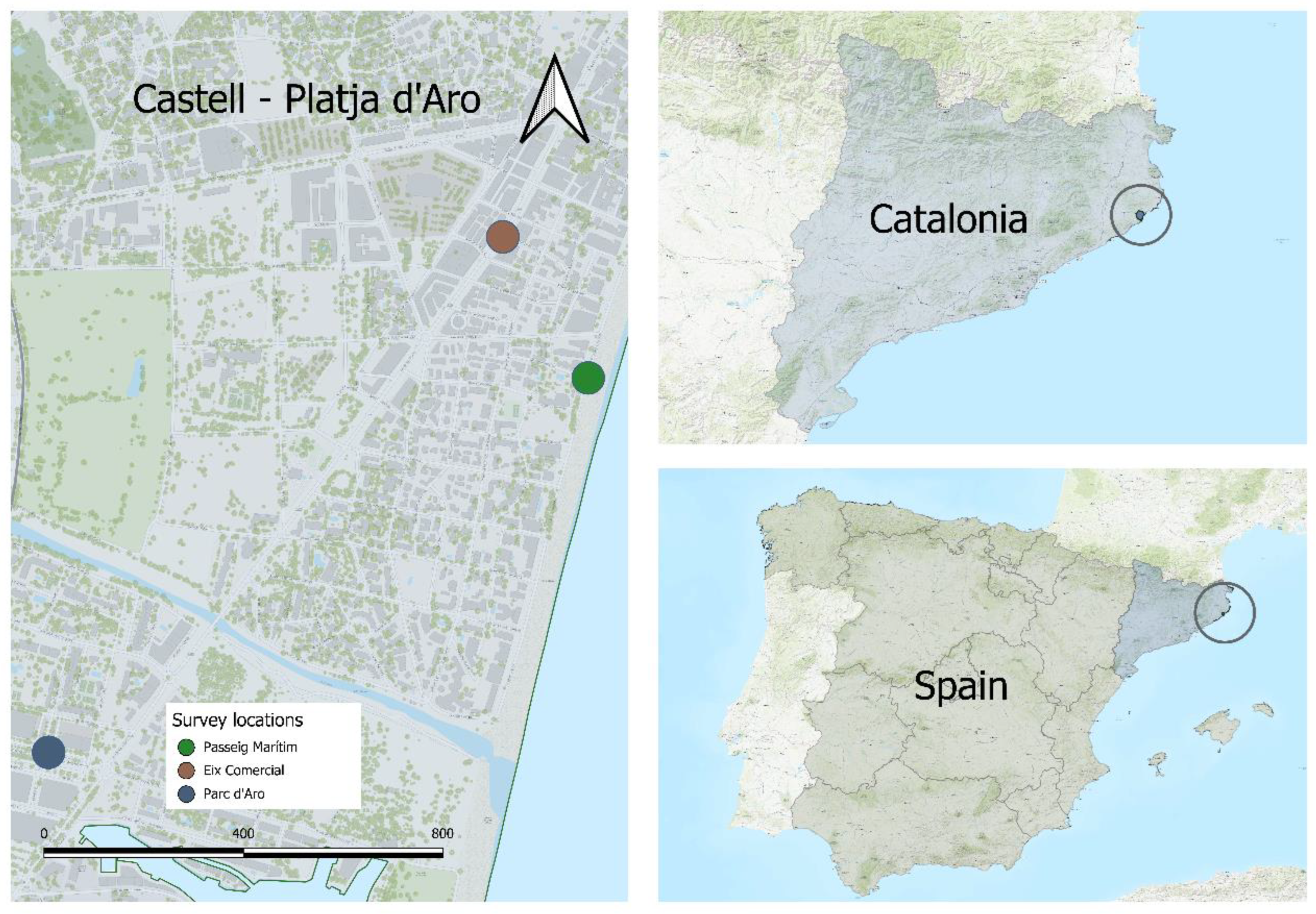
Table 1.
Characteristics of the sample profile.
| 2019 (N=394) | (%) | 2020 (N=468) | (%) | |
|---|---|---|---|---|
| Gender | ||||
| Man | 190 | 48.2 | 255 | 54.5 |
| Woman | 204 | 51.8 | 213 | 45.5 |
| Total | 394 | 100.0 | 468 | 100.0 |
| Age | ||||
| 24 or less | 53 | 13.9 | 119 | 25.6 |
| 25-34 years | 74 | 19.5 | 95 | 20.5 |
| 35-44 years | 99 | 26.1 | 92 | 19.8 |
| 45-54 years | 92 | 24.2 | 82 | 17.7 |
| 55-64 years | 39 | 10.3 | 46 | 9.9 |
| 65 and over | 23 | 6.1 | 30 | 9.5 |
| Total | 380 | 100.0 | 464 | 100.0 |
| Min | 16 | 16 | ||
| Max | 80 | 81 | ||
| Average | 41 | 38.1 | ||
| SD | 13.5 | 15.4 | ||
| Origin | ||||
| Catalonia | 169 | 43.4 | 262 | 57.7 |
| France | 86 | 22.1 | 72 | 15.9 |
| Rest of Spain | 30 | 7.7 | 37 | 8.1 |
| Netherlands | 30 | 7.7 | 22 | 4.8 |
| UK | 16 | 4.1 | 11 | 2.2 |
| Belgium | 14 | 3.6 | 12 | 2.6 |
| Germany | 11 | 2.8 | 12 | 2.6 |
| Russia | 10 | 2.6 | 15 | 3.3 |
| Rest of Europe | 11 | 2.8 | 20 | 2.2 |
| Rest of the world | 12 | 3.1 | 2 | 0.4 |
| Total | 389 | 100.0 | 454 | 100.0 |
Table 2.
Selected characteristics of the sample profile.
| Factor | 2019 | 2020 | |
|---|---|---|---|
| Motivations | |||
| 1. To enjoy sun and beach | Pull | 93.6% | 86.6% |
| 2. To do water activities | Push | 58.8% | 76.2% |
| 3. To do sport activities | Push | 48.6% | 62.8% |
| 4. To enjoy gastronomy | Push | 48.8% | 74.5% |
| 5. To discover new places | Push | 44.5% | 72.3% |
| 6. To explore heritage | Push | 35.5% | 67.2% |
| 7. Good value for money | Pull | 34.5% | 76.8% |
| 8. To take a rest and relax | Push | 73.9% | 80.6% |
| 9. To enjoy nature | Push | 63.4% | 74.7% |
| 10. To enjoy shopping | Push | 50.4% | 70.4% |
| Satisfaction | |||
| I am pleased with my decision | 4.51 | 4.04 | |
| The place satisfies my expectations | 4.61 | 4.07 | |
| Recommendation | |||
| Recommendation to friends and relatives | 8.48 | 7.80 |
Table 3.
Fit measures.
| χ2 | df. | P | CFI | TLI | RMSEA | SRMR | ||
|---|---|---|---|---|---|---|---|---|
| Metric Invariance | ||||||||
| Model 1. To enjoy sun & beach | 7.700 | 6 | .261 | .996 | .992 | . 026 (CI 90%: .000, .071) | .024 | |
| Model 2. To do water activities | 20.521 | 6 | .002 | .969 | .938 | . 075 (CI 90%: .041, .104) | .034 | |
| Model 3. To do sport activities | 18.107 | 6 | .006 | .975 | .950 | . 068 (CI 90%: .034, .106) | .036 | |
| Model 4. To enjoy gastronomy | 9.046 | 6 | .171 | .993 | .987 | . 034 (CI 90%: .000, .058) | .031 | |
| Model 5. To discover new places | 9.815 | 6 | .133 | .992 | .983 | . 038 (CI 90%: .000, .080) | .032 | |
| Model 6. To explore heritage | 13.428 | 6 | .037 | .984 | .968 | . 054 (CI 90%: .013, .093) | .031 | |
| Model 7. Good value for money | 11.747 | 6 | .068 | .988 | .976 | . 047 (CI 90%: .000, .087) | .036 | |
| Model 8. To take a rest and relax | 5.597 | 6 | .470 | .999 | .999 | . 000 (CI 90%: .000, .060) | .002 | |
| Model 9. To enjoy nature | 6.876 | 6 | .332 | .998 | .996 | . 018 (CI 90%: .000, .067) | .021 | |
| Model 10. To enjoy shopping | 11.199 | 6 | .082 | .989 | .978 | . 045 (CI 90%: .000, .085) | .028 | |
Disclaimer/Publisher’s Note: The statements, opinions and data contained in all publications are solely those of the individual author(s) and contributor(s) and not of MDPI and/or the editor(s). MDPI and/or the editor(s) disclaim responsibility for any injury to people or property resulting from any ideas, methods, instructions or products referred to in the content. |
© 2025 by the authors. Licensee MDPI, Basel, Switzerland. This article is an open access article distributed under the terms and conditions of the Creative Commons Attribution (CC BY) license (http://creativecommons.org/licenses/by/4.0/).
Copyright: This open access article is published under a Creative Commons CC BY 4.0 license, which permit the free download, distribution, and reuse, provided that the author and preprint are cited in any reuse.


