

Submitted:
24 June 2025
Posted:
24 June 2025
You are already at the latest version
Abstract
Drug repurposing or drug repositioning is the process of identifying new therapeutic uses for approved or investigational drugs beyond the original treatment indication. Discovery of new drugs for cancer therapy needs this cost-effective and time-saving alternative strategy to traditional drug development for a rapid clinical translation in Phase II/III studies, especially for unmet medical needs and rare diseases. Neuroendocrine tumours (NETs) are a heterogeneous group of rare neoplasms arising from cells of the neuroendo-crine system that, though often indolent, can be aggressive and metastatic. In this context, drug repurposing has emerged as a promising strategy to improve treatment options due to the limited number of effective treatments and the heterogeneity of the disease. Indeed, a large number of non-oncology drugs have the potential to address more than one target that could be therapeutic for cancer patients. Although many repurposed drugs are used off-label, efficacy for the new use must be demonstrated in clinical trials. Within regulato-ry frameworks, both the Food and Drug Administration (FDA) and the European Medi-cines Agency (EMA) have procedures to reduce the need for extensive new studies and to expedite the review of drugs for serious conditions when preliminary evidence indicates substantial clinical improvement over available therapy. Even though several advantages, including reduced development time, lower costs, known safety profiles, and faster regu-latory approval, difficulty in obtaining new patents for old drugs with limited protection for intellectual property may reduce commercial returns and disincentivize investments. This review aims to provide comprehensive information on some marketed drugs cur-rently under investigation to be repurposed or used in clinical practice for NETs, and to discuss the major clinical challenges. Although drug repurposing is a useful strategy for early access to medicines, the monitoring of the clinical benefit of oncologic drugs during the post-marketing authorisation is crucial to support the safety and effectiveness of treatments.
Keywords:
Drug repurposing
; Drug cancer
; Neuroendocrine tumours
; Clinical perspectives
1. Introduction
Drug Repurposing for cancers is a strategy of using existing drugs originally developed for other indications to treat various forms of tumours [1]. This approach leverages known pharmacological and safety profiles, potentially saving time and cost in drug development. Continued research is essential for identifying previously overlooked targets and mechanisms, as well as for anticipating and mitigating potential risks. Advancements in genomic and proteomic technologies, multi-omics approaches, single-cell sequencing, and expansion of artificial intelligence provide opportunities for drug repurposing.
Neuroendocrine tumours (NETs) are a heterogeneous group of rare neoplasms arising in any site of the body from cells of the diffuse endocrine system, although they most frequently have a gastro-entero-pancreatic (GEP) origin (specifically, in about 60% of cases) and pulmonary in approximately 30% of cases [2]. The incidence of these neoplasms has progressively increased across the last decades, reaching 6.98 new cases per 100,000 population (with a 6.4-fold from 1973 to 2012). NETs can produce hormonally active substances, which may lead to unique syndromes such as carcinoid syndrome, caused by the excessive secretion of serotonin. These tumors can arise in various primary sites throughout the body, including the ovary, kidney, or sinonasal tract, with significant variability in their biological aggressiveness, ranging from well-differentiated low-grade tumors to rapidly proliferating neuroendocrine carcinomas. Additionally, their clinical presentation can differ widely, e.g., functioning tumors may present symptoms typical of hormonal syndromes, such as diarrhea and flushing in carcinoid syndrome. This diversity creates specific challenges for diagnosis and clinical management [3,4].
For localized disease, curative radical surgery represents the standard of care, while for locally advanced unresectable or metastatic NETs, many systemic options are approved and available, including somatostatin analogues (SSAs), targeted therapies such as everolimus or sunitinib, peptide receptor radionuclide therapy (PRRT), and chemotherapy (e.g., temozolomide-based or streptozotocin-based) [4,5]. However, the clinical need to improve patients’ outcomes (above all in patients with advanced disease, and, as well in selected settings as in cases of grade 3 NETs patients, namely NET G3, which is a recently introduced category with particularly challenging management due to limited data to inform treatment strategies) together with a constant effort to ameliorate patients’ quality of life, reducing the side effects of the approved therapies and saving costs for the national health system, has paved the way for the repurposing of no-antineoplastic drugs as a potentially effective treatment for NETs. Many of these repurposed drugs act by mTOR inhibition, angiogenesis suppression, or cell cycle interference, targeting common pathways in NETs biology.
Within regulatory frameworks, the Food and Drug Administration (FDA) 505(b)(2) New Drug Application (NDA) pathway allows pharmaceutical companies to seek approval for new uses of previously approved drugs relying on some existing data to reduce the need for extensive new studies [6]; in addition, the Breakthrough Therapy designation is a process to expedite the review of drugs for serious conditions when preliminary evidence indicates substantial clinical improvement over available therapy [7]. At the same time, the European Medicines Agency (EMA) has the Type II variation process when the change is not an extension of the marketing authorisation (line extension) and may have a significant impact on the quality, safety, or efficacy of a medicinal product [8]. Real-world implementation must be planned early, especially from a Health Technology Assessment (HTA) perspective. The way treatments are delivered in clinical trials often differs significantly from routine practice. Anticipating these differences and planning for them can help avoid barriers to access and integration into healthcare systems.
2. Technics for Drug Repurposing
Drug repurposing entails selecting a drug, assessing its efficacy using preclinical models and advancing to pivotal clinical trials. Drug candidate identification can be achieved through both computational and experimental methods [9].
Computational Methods are based on biological and chemical data using algorithms and bioinformatics tools to predict new drug-disease associations. Key techniques include Signature Matching which compares gene expression profiles of diseases with those induced by drugs using transcriptomic and proteomic data; Molecular Docking and Structural Bioinformatics use three-dimensional structures of molecules to analyze potential interactions; Network-Based Approaches use biological networks such as protein-protein interactions and gene-disease networks, to identify indirect relationships or shared pathways between drugs and diseases; Similarity-Based Approaches looks for similarities in chemical structures or biological functions to suggest potential repurposing candidates. The widespread use of computational pharmacology has been facilitated by the availability of extensive data from various sources, such as genomics, proteomics, chemo-proteomics, and phenomics. This has led to the accumulation of not only data that characterizes disease phenotypes and drug profiles but also complete pathway maps. Furthermore, advances in computational and data sciences have enabled the development of repurposing algorithms [10]
Experimental Techniques involve laboratory testing to validate repurposing hypotheses. This can include testing large drug libraries against disease-relevant targets or phenotypes in vitro, using cell-based or biochemical assays, or identifying genetic dependencies that can be targeted by known drugs. Finally, Hybrid Approaches combine computational prediction with experimental validation. They include Omics-driven Drug Repurposing integrating genomics, proteomics, metabolomics, and transcriptomics with drug databases; Clinical Data Mining analyzing real-world evidence to find correlations and insights, and Pathway Enrichment Analysis using maps drugs and diseases to the same biological pathways to find connections.
Successful drug repurposing efforts typically involve a combination of computational predictions, experimental validation, and ultimately, clinical trials. For instance, a computational approach might identify candidate drugs, which are then screened in vitro and in vivo, and finally evaluated in clinical trials for new indications.
3. Repurposing Drugs for Neuroendocrine Tumours (NETs)
3.1. Significance and Few Successful Examples
Well-differentiated NETs are often associated with a relatively good prognosis, thanks to their indolent clinical behaviour, thus representing a potentially ideal field for drug repurposing, allowing time to test repurposed agents. In this context, key molecular targets in NETs field may align with known drug mechanisms. In addition, existing safety profiles of repurposed drugs could reduce risk and also speed up clinical trials. Several marketed drugs are being explored or showing promise for the treatment of NETs, but only a small percentage has fulfilled a clinical unmet need and entered in the clinical practice.
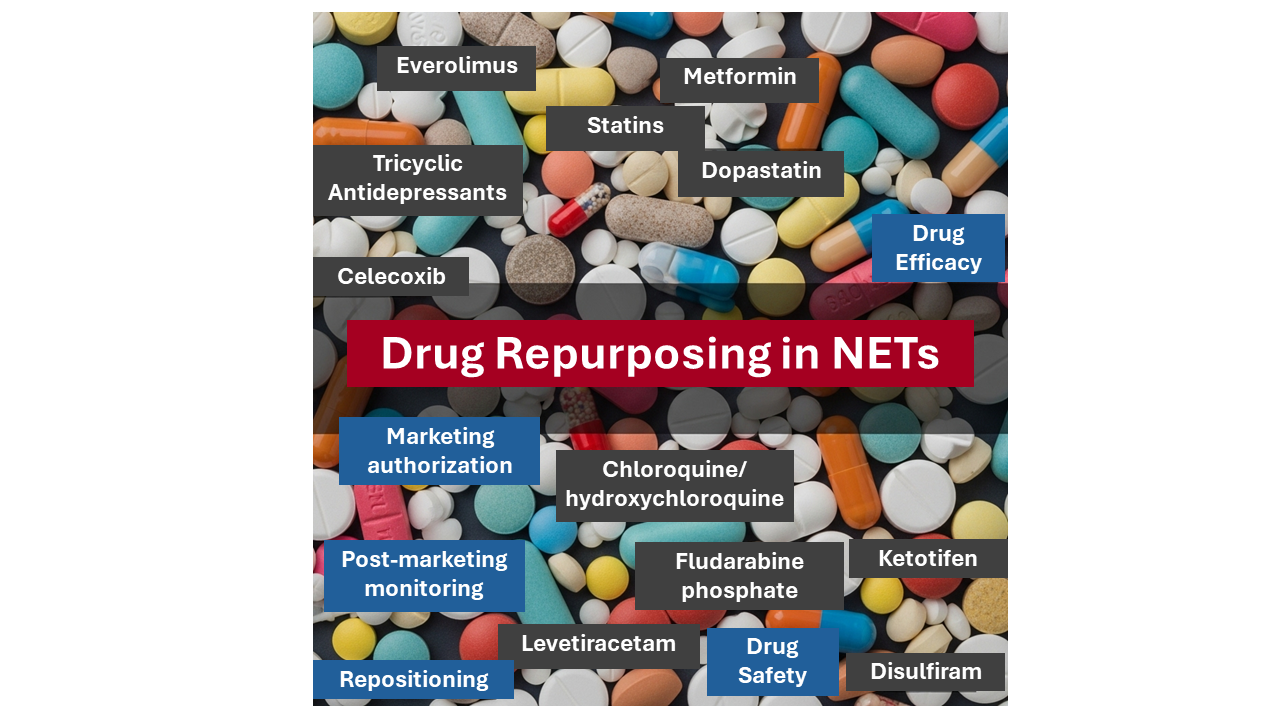
Drugs currently being considered for repurposing in NETs along with their mechanisms of action are summarized in Table 1.
Currently, everolimus (AfinitorTM) is the only marketed drug, developed as immunosuppressant for prevention of organ rejection in kidney and heart transplant recipients, that was repurposed for NETs based on the RADIANT trials demonstrating improved patients’ outcomes [11]. In these phase II and III studies, indeed, everolimus was associated with a significant increase in progression-free survival (PFS) in NET with different primary origin. Stomatitis, diarrhea, fatigue, infections, rash, and peripheral oedema were among the most common adverse events (AEs) associated with everolimus, and they were typically of low grade (grade 1 or 2). Thereby, as anticancer drug everolimus has shown to be associated with a manageable safety profile, and, the majority of everolimus-related AEs are controllable by stopping or modifying the dosage. Everolimus is an orally administered analog of rapamycin that acts as a molecular inhibitor of the mammalian target of rapamycin (mTOR) signaling pathway, and its mechanism of action involves the disruption of mTOR signaling through its high-affinity binding to the cytosolic protein FKBP-12. This interaction attenuates mTOR-mediated regulation of key cellular processes, including cell growth, proliferation, and angiogenesis [12]. The evidence of everolimus activity emerged across a broad spectrum of NETs including those arising from the pancreas, lung, and gastrointestinal tract [13,14]. Since the initial approval by both FDA and EMA in 2011, important changes in therapeutic/diagnostic and classification of NETs occurred. Randomized phase III studies assessing SSAs, targeted therapies such as everolimus and sunitinib, and PRRT have shaped the present treatment guidelines. Unfortunately, the reduced number of head-to-head studies has hindered the establishment of the best treatment sequence. An effort has been made with the academic SEQTOR trial, that was aimed at evaluating the best therapeutic sequence in pancreatic NETs. This randomized open label phase III study compared the efficacy and safety of everolimus followed by chemotherapy with streptozotocin and 5-fluorouracil or the reverse sequence [15]. PFS did not significantly differ between the two sequential strategies. However, when tumor shrinking is a priority, streptozotocin-based chemotherapy has emerged as the first preferred treatment. Its statistically significant greater overall response rate (ORR) than everolimus observed in this trial supports this claim. In clinical practice, the therapeutic strategy is generally performed by a multidisciplinary team of NETs specialists, including oncologists, endocrinologists, nuclear medicine physicians, radiologists, pathologists, radiotherapists and surgeons. Specifically, the approach should be tailored to individual circumstances of each patient including tumor type and primary origin, tumor grade, somatostatin receptor (SSTR) expression (evaluated through the functional imaging with 68-Gallium PET-CT), disease evolution, and patient-related factors like age, performance status, symptoms related to the disease, and personal preferences. Taking into account all these aspects, everolimus remains a key therapeutic agent in the treatment of advanced NETs, which covers the spectrum of this heterogeneous group of neoplasms, even if clear predictive biomarkers for its use are still lacking [16]. Nevertheless, challenges such as mechanisms of resistance, toxicity and optimal therapeutic sequence remain unresolved [17].
3.2. Drugs with Clinical Significance and Potential Role in the Field of NETs
The identification of new therapies with low toxicity and good tolerability for NETs, and in particular, for pancreatic neuroendocrine tumours (pNETs) treatment, is a valuable goal to be pursued. In this perspective, metformin, a widely used agent for the treatment of patients with type 2 diabetes mellitus (T2DM), is emerging as a molecule of interest by inhibiting mitochondrial oxidative phosphorylation, which leads to the activation of adenosine monophosphate-activated protein kinase (AMPK) and subsequent downregulation of the mTOR pathway. This AMPK-mediated inhibition of mTOR, along with other AMPK-dependent and independent mechanisms, contributes to metformin’s ability to reduce cancer cell proliferation, induce apoptosis, and interfere with tumour growth [18]. A systematic review evaluated the role of T2DM and metformin in the insurgence and post-treatment outcomes in patients with pNET [19]. In addition, an Italian multicenter retrospective study, including 445 unresectable (locally advanced or metastatic), well-differentiated pNETs, demonstrated that metformin was associated with increased PFS of patients receiving somatostatin analogues and/or everolimus [20]. Specifically, the PFS was 44.2 months among patients who received metformin, in contrast to 20.8 months for diabetic patients receiving alternative treatments. A substantial 55% reduction in the hazard of disease progression or mortality was noted for metformin-treated patients relative to their non-diabetic counterparts. However, the lack of prospective studies limits the possibility of exploring the therapeutic effect of metformin for pNETs.
Statins, which are primarily used to treat hypercholesterolemia, have demonstrated potential as anti-tumor agents and may enhance the effects of other therapies, even if conclusive evidence is missing. Through competitive HMG-CoA inhibition, statins reduce mevalonate synthesis, farnesylation, and geranylation, causing a decrease in hematic cholesterol levels. At the same time, they can reduce the activity of proteins associated with tumour proliferation, metastasis, and neo-angiogenesis, also influencing cell apoptosis by activating several caspases [21]. In the field of NETs, lipid-lowering agents, including statins, have been explored as new therapies, and useful tools in cancer prevention and tumor-growth control, but the absence of data coming from randomized clinical trials prevents to draw conclusions [22]. A recent observational cohort multicenter retrospective study showed that statin therapy was associated with improved PFS among dyslipidemic NETs patients, suggesting a potential antiproliferative effect of statins [23]. In this study, indeed, the median PFS was 26 months for individuals with dyslipidemia not on statins and 108 months for the patients with dyslipidemia on this therapy. No difference was found between dyslipidemic patients on statins and those without dyslipidemia. However, these findings need further investigation to substantiate the role of statins in the management of NETs.
3.3. Drugs with Preliminary Clinical Data in the Field of NETs
A systematic drug repositioning bioinformatics approach querying a large collection of gene expression profiles was used to identify candidate-approved drugs to treat small cell lung cancer (SCLC). Tricyclic antidepressants (TCAs) were found to induce apoptosis in both chemonaïve and chemoresistant SCLC cells in culture and in “in vivo” models. In the same work, the authors showed that the candidate drugs inhibited the growth of other types of neuroendocrine neoplasms, including pNETs and Merkel cell carcinoma. Taken together, these data could help in the identification of novel targeted strategies for these tumours [24]. The therapeutic potential of TCAs in treating SCLC and other NETs is further elucidated by examining their mechanisms of action, primarily through the activation of stress pathways and the induction of cell death. This process is partly mediated by the disruption of autocrine survival signals involving neurotransmitters and their G protein-coupled receptors (GPCRs) [25]. The mechanisms by which TCAs such as imipramine and clomipramine exert these effects include the inhibition of serotonin and epinephrine reuptake, as well as antagonism of various receptors like cholinergic, histaminic, and adrenergic receptors. A bioinformatic approach carried out in preclinical models revealed a potential new use of imipramine in SCLC and other high-grade NETs [26]. Based on promising preclinical evidence, a phase IIa dose escalation study with desipramine was conducted on six patients: 3 with SCLC and 3 no-SCLC NET patients. However, the tolerability of desipramine was poor and no clinical benefit was observed [27].
Thalidomide, an oral agent with antiangiogenic and immunomodulatory properties, has been investigated extensively in the management of advanced cancer. The mechanism of action is complex, and it probably includes different molecular targets. Thalidomide inhibits angiogenesis by interrupting processes mediated by bFGF and/or vascular endothelial growth factor (VEGF) and prevents TNF-α synthesis by inducing TNF-α mRNA degradation. Recent data suggest that this drug can also block the activation of nuclear factor (NF)-κB through a mechanism involving the inhibition of IκB kinase activity [28,29]. Currently is indicated (in combination with melphalan and prednisone) as first-line treatment for patients with untreated multiple myeloma aged ≥ 65 years or ineligible for high-dose chemotherapy [30]. Studied as a single agent, showed no responses in NETs patients. However, the combination with temozolomide resulted in a 25% radiological response rate, particularly in pNETs. Despite this, the combination caused significant toxicity, leading to early discontinuation in many patients [31]. It should be pointed out that temozolomide has a well-known activity in NETs, and the add-on value of thalidomide is still far from being elucidated with the available data [32]. Thereby, although early-phase studies indicated the potential efficacy of thalidomide in combination with temozolomide, further phase II studies investigating the combination in advanced/metastatic pancreatic and non-pancreatic NETs showed that S-1/temozolomide with or without thalidomide led to a comparable treatment response [33].
3.4. Drugs with Preclinical Rationale Without Clinically Proven Implications
Pituitary neuroendocrine tumors (PitNETs) usually require complex management, and a relevant number of patients do not respond to currently available pharmacological treatments, i.e., SSAs or dopamine-agonists. Thus, novel chimeric somatostatin/dopamine compounds (dopastatins) that could improve the medical treatment of PitNETs have been designed due to their enhanced efficacy in suppressing GH hypersecretion. Studies in vitro suggested that dopastatins could be an efficacious therapeutic option to be considered in the treatment of PitNETs [34]. While dopastatin showed promise in preclinical studies, further clinical research is necessary to fully assess its efficacy and safety in treating PitNET, and currently dopastatin is under investigation in a phase II clinical trial (NCT04335357).
Disulfiram, traditionally used to treat chronic alcoholism, has recently gained attention for its potential anticancer properties, including NETs. Preclinical studies showed that disulfiram appears promising as anti-tumor agent for the treatment of PitNETs decreasing the cell viability in vitro and in vivo and inducing coproptosis in pituitary tumor cells [35]. Coproptosis, a recently discovered new type of cell death, is a copper-dependent cell death pathway characterized by the accumulation of intracellular copper ions. A previous study showed that the lethal mechanism of cuproptosis involves the disruption of specific mitochondrial metabolic enzymes in the mitochondrial tricarboxylic acid (TCA) cycle, especially the oligomerization of dihydrolipoamide sacetyltransferase (DLAT) through lipoic acid modification and the loss of Fe-S cluster proteins, ultimately leading to proteotoxic stress and cell death. Therefore, targeting cuproptosis drugs provides a new perspective for the treatment of tumours, with an emphasis on the most representative copper ionophores and chelators [36,37,38].
Although chloroquine/hydroxychloroquine are known as antimalarial agents, scientific evidence also supports their use in the treatment of tumours, especially in combination with conventional anti-cancer treatments potentiating therapeutic activity [39]. Chloroquine (CQ) and hydroxychloroquine (HCQ) exert anti-cancer effects through several key mechanisms. Primarily, they inhibit autophagy by disrupting lysosomal acidification, a critical process for the degradation and recycling of cellular components; additionally, these drugs can modulate signalling pathways involved in cancer progression. CQ has been shown to inhibit the TLR9/nuclear factor kappa B signalling pathway, thereby reducing cancer invasiveness, and both CQ and HCQ can suppress cancer cell proliferation by interfering with the CXCL12/CXCR4 signalling pathway. Furthermore, CQ can influence the p53 pathway by stabilizing the p53 protein and activating the transcription of pro-apoptotic genes. These multifaceted actions contribute to the potential of CQ and HCQ as anti-cancer agents, particularly in combination therapies [40]. Preclinical studies suggested that autophagy inhibition by chloroquine/hydroxychloroquine could be used for the treatment of pNETs, including the well-differentiated type [41]. While these findings are favourable, the use of chloroquine/hydroxychloroquine in NETs remains investigational, and further studies are necessary to assess efficacy and monitor potential side effects.
Among nonsteroidal anti-inflammatory drugs (NSAIDs), celecoxib is considered particularly promising as antitumor drug because of both selective COX-2 inhibition and powerful COX-independent toxicity on tumour cells. PitNET tissue has been identified to have high expression levels of COX-1 and COX-2, theoretically providing potential targets for NSAIDs. However, research is still in the early stages, and further investigation is needed to explore the molecular mechanisms and signal transduction pathways of NSAIDs in PitNET progression [42].
Neuroendocrine prostate cancer (NEPC) represents a highly aggressive subtype of prostate tumors. Levetiracetam, an antiepileptic drug, proved a potential effect in restraining neuroendocrine prostate cancer and inhibiting the progression of prostate adenocarcinoma, particularly after androgen deprivation therapy [43]. The protein target of levetiracetam, SV2A, is highly expressed by both NEPC cells and mast cells infiltrating prostate adenocarcinoma, while it is low or negligible in adenocarcinoma cells. In vitro, levetiracetam inhibited NEPC cell proliferation and mast cell degranulation [44].
Adopting a drug-repurposing strategy, with the screening of about 1800 drug molecules, fludarabine phosphate, primarily used for chronic lymphocytic leukaemia, was identified to inhibit the proliferation of N-MYC overexpressing NEPC cells by inducing reactive oxygen species (ROS). Enhancing ROS production destabilizes N-MYC protein by inhibiting AKT signalling and is responsible for the reduced survival of NEPC cells and tumours [45]. Therefore, the administration of fludarabine phosphate may represent an effective treatment option for patients with N-MYC overexpressing NEPC tumours.
Finally, ketotifen, a medication used to treat mild asthma and allergic reactions in the eye, was identified as a potential therapeutic candidate for NEPC by a drug screening utilizing an FDA-approved drug library [46]. In vitro experiments demonstrated that ketotifen effectively suppressed neuroendocrine differentiation, reduced cell viability, and reversed the lineage switch by targeting the IL-6/STAT3 pathway. In vivo results showed that ketotifen significantly prolonged overall survival and reduced the risk of distant metastases in NEPC mice model, showing a potential therapeutic strategy for clinical application.
4. Conclusions
Drug repurposing is a strategy in drug discovery that aims to identify new uses for existing medications that have already been approved for other conditions. This promising approach can significantly reduce the time and cost associated with drug development by utilizing existing knowledge about the drug’s safety and pharmacological properties. As a result, it can shorten the overall timeline for bringing a drug to market and is particularly useful for addressing unmet medical needs and rare diseases, such as NETs. While only a few compounds showed clinical efficacy in this area, everolimus, an immunosuppressant agent, has become a key therapeutic agent for NETs. Other medications, such as metformin (used to treat Type 2 diabetes) and statins (primarily prescribed for hypercholesterolemia), may also serve as potential therapeutic options for these tumours; however, conclusive evidence for their efficacy has not yet emerged.
Novel targeted strategies with preliminary clinical data are being developed. Tricyclic antidepressants may be useful in treating SCLC. Additionally, dopastatin (used to reduce hormone production, especially in tumours), disulfiram (used for chronic alcoholism), and NSAIDs such as celecoxib might be effective treatment options for PitNETs. Chloroquine and hydroxychloroquine (antimalarial agents) could be used for pNETs, while levetiracetam (an antiepileptic drug) and fludarabine phosphate (used for chronic lymphocytic leukaemia) may represent potential therapeutic candidates for NEPC, along with ketotifen (a medication used to treat mild asthma and allergic reactions). Although drug repurposing offers a valuable strategy for gaining early access to new medicines, it is crucial to monitor the clinical benefits of oncologic drugs following their post-marketing authorization. This monitoring supports the ongoing assessment of the safety and effectiveness of these treatments.
Author Contributions
SB conceived the work, drafted and supervised the manuscript, DL and ALS drafted the manuscript. All authors contributed to the article and approved the submitted version.
Funding
No funding was received for this work.
Conflicts of Interest
The authors declare no conflicts of interest.
References
- Xia Y, Sun M, Huang H, et al. Drug repurposing for cancer therapy. Signal Transduct Target Ther. 2024;9(1):92.
- Dasari A, Shen C, Halperin D, et al. Trends in the Incidence, Prevalence, and Survival Outcomes in Patients With Neuroendocrine Tumors in the United States. JAMA Oncol. 2017;3(10):1335-1342. [CrossRef]
- Modica R, Benevento E, Liccardi A, et al. Recent advances and future challenges in the diagnosis of neuroendocrine neoplasms. Minerva Endocrinol (Torino). 2024;49(2):158-174. [CrossRef]
- Sedlack AJH, Varghese DG, Naimian A, et al. Update in the management of gastroenteropancreatic neuroendocrine tumors. Cancer. 2024;130(18):3090-3105. [CrossRef]
- Fazio N, La Salvia A. Precision medicine in gastroenteropancreatic neuroendocrine neoplasms: Where are we in 2023? Best Pract Res Clin Endocrinol Metab. 2023;37(5):101794.
- FDA. Guidance for Industry. Applications Covered by Section 505(b)(2). Available from: https://www.fda.gov/media/72419/download.
- FDA. Breakthrough Therapy. Available from: https://www.fda.gov/patients/fast-track-breakthrough-therapy-accelerated-approval-priority-review/breakthrough-therapy.
- EMA. (EMA) has the Type II variation. Available from: https://www.ema.europa.eu/en/glossary-terms/type-ii-variation.
- Kulkarni VS, Alagarsamy V, Solomon VR, et al. Drug Repurposing: An Effective Tool in Modern Drug Discovery. Russ J Bioorg Chem. 2023;49(2):157–166.
- Park K. A review of computational drug repurposing. Transl Clin Pharmacol. 2019;27(2):59-63 .
- EMA. Afinitor (everolimus). Summary of Product Characteristics. Available from: https://www.ema.europa.eu/en/documents/product-information/afinitor-epar-product-information_en.pdf.
- Liu E, Marincola P, Oberg K. Everolimus in the treatment of patients with advanced pancreatic neuroendocrine tumors: latest findings and interpretations. Therap Adv Gastroenterol. 2013;6(5):412-9. [CrossRef]
- Yao JC, Shah MH, Ito T, et al. RAD001 in advanced neuroendocrine tumors, third trial (RADIANT-3) study group. N. Engl. J. Med. 2011;364:514-523.
- Yao JC, Fazio N, Singh S, et al. RAD001 in advanced neuroendocrine tumours, fourth trial (RADIANT-4) study group. Everolimus for the treatment of advanced, nonfunctional neuroendocrine tumours of the lung or gastrointestinal tract (RADIANT-4): A randomised, placebo-controlled, phase 3 study. Lancet. 2016;387:968-977.
- Salazar Soler R, Scarpa A, Lawlor RT, et al. Search for biomarkers to personalize treatment with streptozotocin plus 5-fluorouracil or everolimus in patients with advanced pancreatic neuroendocrine tumors: The randomized phase III SEQTOR trial (GETNE-1206). Annals of Oncology. 1150P; Volume 35, S754, 2024. [CrossRef]
- Lee L, Ito T, Jensen RT. Everolimus in treatment of neuroendocrine tumors: efficacy, side-effects, resistance and factors affecting its place in the treatment sequence. Expert Opin Pharmacother. 2018 May 24;19(8):909-928.
- Medici B, Caffari E, Maculan Y, et al. Everolimus in the Treatment of Neuroendocrine Tumors: Lights and Shadows. Biomedicines. 2025;13(2):455. [CrossRef]
- Chomanicova N, Gazova A, Adamickova A, et al. The role of AMPK/mTOR signaling pathway in anticancer activity of metformin. Physiol Res. 2021;70(4):501-508. [CrossRef]
- Cigrovski Berkovic M, Coppola A, Sesa V, et al. Metformin and pancreatic neuroendocrine tumors: A systematic review and meta-analysis. World J Gastroenterol. 2024;30(7):759-769.
- Pusceddu S, Vernieri C, Di Maio M, at al. Metformin Use Is Associated With Longer Progression-Free Survival of Patients With Diabetes and Pancreatic Neuroendocrine Tumors Receiving Everolimus and/or Somatostatin Analogues. Gastroenterology. 2018;155(2):479-489.e7. [CrossRef]
- Duarte JA, de Barros ALB, Leite EA. The potential use of simvastatin for cancer treatment: A review. Biomed Pharmacother. 2021;141:111858. [CrossRef]
- Modica R, La Salvia A, Liccardi A, at al. Dyslipidemia, lipid-lowering agents and neuroendocrine neoplasms: new horizons. Endocrine. 2024;85(2):520-531. [CrossRef]
- Faggiano A, Russo F, Zamponi V, et al. Impact of dyslipidemia and lipid-lowering therapy with statins in patients with neuroendocrine tumors. J Neuroendocrinol. 2025;37(2):e13485. [CrossRef]
- Jahchan NS, Dudley JT, Mazur PK, et al. A drug repositioning approach identifies tricyclic antidepressants as inhibitors of small cell lung cancer and other neuroendocrine tumors. Cancer Discov. 2013;3(12):1364-77.
- Jahchan NS, Dudley JT, Mazur PK, et al. A drug repositioning approach identifies tricyclic antidepressants as inhibitors of small cell lung cancer and other neuroendocrine tumors. Cancer Discov. 2013;3(12):1364-77.
- Wang J, Byers LA. Teaching an old dog new tricks: drug repositioning in small cell lung cancer. Cancer Discov. 2013;3(12):1333-5. [CrossRef]
- Riess JW, Jahchan NS, Das M, at al. A phase IIa study repositioning desipramine in smal cell lung and other high-grade neuroendocrine tumors. Cancer Treat Res Commun. 2020;23:100174. [CrossRef]
- Eleutherakis-Papaiakovou V, Bamias A, Dimopoulos MA. Thalidomide in cancer medicine. Ann Oncol. 2004;15(8):1151-60. [CrossRef]
- D’Amato RJ, Loughran MS, Flynn E, et al. Thalidomide is an inhibitor of angiogenesis. Proc Natl Acad Sci U S A. 1994;91(9):4082-5.
- EMA. Thalidomide. Available from: https://www.ema.europa.eu/en/documents/product-information/thalidomide-bms-epar-product-information_en.pdf.
- Durán I, Salazar R, Casanovas O, et al. New drug development in digestive neuroendocrine tumors. Ann Oncol. 2007;18(8):1307-13. [CrossRef]
- Koumarianou A, Kaltsas G, Kulke MH, et al. Temozolomide in Advanced Neuroendocrine Neoplasms: Pharmacological and Clinical Aspects. Neuroendocrinology. 2015;101(4):274-88. [CrossRef]
- Chi Y, Song L, Liu W, et al. S-1/temozolomide versus S-1/temozolomide plus thalidomide in advanced pancreatic and non-pancreatic neuroendocrine tumours (STEM): A randomised, open-label, multicentre phase 2 trial. EClinicalMedicine. 2022:54:101667. [CrossRef]
- Vázquez-Borrego MC, L-López F, María A Gálvez-Moreno MA, et al. A New Generation Somatostatin-Dopamine Analogue Exerts Potent Antitumoral Actions on Pituitary Neuroendocrine Tumor Cells. Neuroendocrinology. 2020;110(1-2):70-82. [CrossRef]
- Huang N, Feng Y, Liu Y, et al. Disulfiram mediated anti-tumour effect in pituitary neuroendocrine tumours by inducing cuproptosis. Int Immunopharmacol. 2024:134:112159. [CrossRef]
- Liyun C, Min J, Wang F. Copper homeostasis and cuproptosis in health and disease. Signal Transduct Target Ther. 2022;7(1):378. [CrossRef]
- Bian C, Zheng Z, Su J, et al. Copper homeostasis and cuproptosis in tumor pathogenesis and therapeutic strategies. Front Pharmacol. 2023:14:1271613. [CrossRef]
- Xie J, Yang Y, Gao Y. Cuproptosis: mechanisms and links with cancers. Mol Cancer. 2023;22(1):46. [CrossRef]
- Verbaanderd C, Maes H, Schaaf MB, et al. Repurposing Drugs in Oncology (ReDO)-chloroquine and hydroxychloroquine as anti-cancer agents. Ecancermedicalscience. 2017 Nov 23;11:781. [CrossRef]
- Verbaanderd C, Maes H, Schaaf MB, et al. Repurposing Drugs in Oncology (ReDO)-chloroquine and hydroxychloroquine as anti-cancer agents. Ecancermedicalscience. 2017;11:781. [CrossRef]
- Nakano K, Masui T, Yogo A, et al. Chloroquine induces apoptosis in pancreatic neuroendocrine neoplasms via endoplasmic reticulum stress. Endocr Relat Cancer. 2020;27(7):431-439. [CrossRef]
- Li J, Shi X, Tang T, et al. Research progress on nonsteroidal anti-inflammatory drugs in the treatment of pituitary neuroendocrine tumors. Front Pharmacol. 2024 Jul 24:15:1407387. [CrossRef]
- Sulsenti R, Frossi B, Bongiovanni L, et al. Repurposing of the Antiepileptic Drug Levetiracetam to Restrain Neuroendocrine Prostate Cancer and Inhibit Mast Cell Support to Adenocarcinoma. Front Immunol. 2021;12:622001. [CrossRef]
- Sulsenti R, Frossi B, Bongiovanni L, et al. Repurposing of the Antiepileptic Drug Levetiracetam to Restrain Neuroendocrine Prostate Cancer and Inhibit Mast Cell Support to Adenocarcinoma. Front Immunol. 2021;12:622001. [CrossRef]
- Elhasasna H, Khan R, Bhanumathy KK, et al. A Drug Repurposing Screen Identifies Fludarabine Phosphate as a Potential Therapeutic Agent for N-MYC Overexpressing Neuroendocrine Prostate Cancers. Cells. 2022;11(14):2246. [CrossRef]
- Ji Y, Liu B, Chen L, et al. Repurposing ketotifen as a therapeutic strategy for neuroendocrine prostate cancer by targeting the IL-6/STAT3 pathway. Cell Oncol (Dordr). 2023;46(5):1445-1456.

Table 1.
Drugs currently being considered for repurposing in NETs along with their mechanisms of action.
Table 1.
Drugs currently being considered for repurposing in NETs along with their mechanisms of action.
| Active Substance | Mechanism of Action | Setting of approval /evaluation |
|---|---|---|
| Everolimus | Molecular inhibitor of the mTOR signaling pathway; high-affinity binding to cytosolic protein FKBP-12 disrupts mTOR-mediated regulation of cell growth, proliferation, and angiogenesis. | NETs (pancreatic, extra pancreatic |
| Metformin | Inhibits mitochondrial oxidative phosphorylation, leading to activation of AMPK and subsequent downregulation of the mTOR pathway. Contributes to reduced cancer cell proliferation, induced apoptosis, and interference with tumor growth by inhibiting mTOR phosphorylation. | pNET |
| Statins | Competitive HMG-CoA inhibition reduces mevalonate synthesis, farnesylation, and geranylation, decreasing hematic cholesterol levels. Also reduce proteins involved in tumor proliferation, metastasis, and neo-angiogenesis; induce cell apoptosis through activation of several caspases. | pNETs, PitNETs,SCLC, Lung Nets, Small Bowel NETS, Pheochromocytoma,Merkel cell carcinoma |
| Tricyclic Antidepressants (TCAs) (e.g., Imipramine, Clomipramine, Desipramine) | Activate stress pathways and induce cell death, partly mediated by disruption of autocrine survival signals involving neurotransmitters and their G protein-coupled receptors (GPCRs). Inhibit serotonin and epinephrine reuptake, and antagonize cholinergic, histaminic, and adrenergic receptors. | SCLC, pNETs |
| Thalidomide | Inhibits angiogenesis by interrupting processes mediated by bFGF and/or VEGF. Inhibits TNF-α synthesis by inducing TNF-α mRNA degradation. Blocks the activation of nuclear factor (NF)-κB through a mechanism involving the inhibition of IκB kinase activity. | pNETs |
| Dopastatins (Chimeric Somatostatin/Dopamine Compounds) | Enhanced efficacy in suppressing GH hypersecretion, suggesting improved medical treatment. | PitNETs |
| Disulfiram | Decreases cell viability (in vitro and in vivo) and induces cuproptosis in pituitary tumor cells in a copper-dependent manner. Cuproptosis involves the disruption of specific mitochondrial metabolic enzymes in the TCA cycle (especially oligomerization of dihydrolipoamide S-acetyltransferase (DLAT) through lipoic acid modification) and the loss of Fe-S cluster proteins, leading to proteotoxic stress and cell death. | PitNETs |
| Chloroquine (CQ) & Hydroxychloroquine (HCQ) | Primarily inhibits autophagy by disrupting lysosomal acidification. CQ has been shown to inhibit the TLR9/nuclear factor kappa B signaling pathway, reducing cancer invasiveness. Both CQ and HCQ can suppress cancer cell proliferation by interfering with the CXCL12/CXCR4 signaling pathway. CQ can influence the p53 pathway by stabilizing the p53 protein and activating the transcription of pro-apoptotic genes. | pNETs |
| Celecoxib | Considered particularly promising as an anti-tumor drug because of both selective COX-2 inhibition and powerful COX-independent toxicity on tumor cells. | PitNETs (potential target due to high COX-1 and COX-2 expression) |
| Levetiracetam | Its protein target, SV2A, is highly expressed by both NEPC cells and mast cells infiltrating prostate adenocarcinoma. Inhibits NEPC cell proliferation and mast cell degranulation. | NEPC |
| Fludarabine Phosphate | Identified to inhibit the proliferation of N-MYC overexpressing NEPC cells by inducing reactive oxygen species (ROS). Enhancing ROS production destabilizes N-MYC protein by inhibiting AKT signaling. | N-MYC overexpressing NEPC |
| Ketotifen | Effectively suppressed neuroendocrine differentiation, reduced cell viability, and reversed lineage switch via targeting the IL-6/STAT3 pathway. | NEPC |
Abbreviations: AMPK, Adenosine Monophosphate-Activated Protein Kinase; pNET, pancreatic Neuroendocrine Tumor; PitNETs, Pituitary Neuroendocrine Tumors; SCLC, Small Cell Lung Cancer; NEPC, Neuroendocrine Prostate Cancer. All drugs are administered orally.
Disclaimer/Publisher’s Note: The statements, opinions and data contained in all publications are solely those of the individual author(s) and contributor(s) and not of MDPI and/or the editor(s). MDPI and/or the editor(s) disclaim responsibility for any injury to people or property resulting from any ideas, methods, instructions or products referred to in the content. |
© 2025 by the authors. Licensee MDPI, Basel, Switzerland. This article is an open access article distributed under the terms and conditions of the Creative Commons Attribution (CC BY) license (http://creativecommons.org/licenses/by/4.0/).
Copyright: This open access article is published under a Creative Commons CC BY 4.0 license, which permit the free download, distribution, and reuse, provided that the author and preprint are cited in any reuse.