

Submitted:
21 June 2025
Posted:
23 June 2025
You are already at the latest version
Abstract
Cognitive flexibility, the ability to adapt behavior to changing environmental demands, is a core deficit in schizophrenia (SZ), that predicts disease progression. This review synthesizes findings on the neural substates of cognitive flexibility by using a framework that distinguishes animal model tasks by their motivational valence: aversive versus appetitive. While human studies using tasks like the Wisconsin Card Sorting Test (WCST) reveal significant cognitive inflexibility in SZ, particularly in set-shifting, rodent models provide important mechanistic insights. Current literature suggests that aversive tasks, such as water mazes, and appetitive tasks, such as the Birrel-Brown discrimination task, engage distinct neural circuits, despite assessing supposedly similar cognitive processes. Aversive paradigms primarily rely on hippocampal-medial prefrontal cortex (mPFC) pathways, whereas appetitive tasks heavily involve orbitofrontal cortex (OFC)-striatal circuits, with significant modulation by dopamine and serotonin. Both valences seem to require an intact balance of glutamate and GABA transmission within prefrontal regions. This framework helps clarify inconsistencies in the literature and underscores how motivational context shapes the neural substrates of cognitive flexibility.
Keywords:
reversal learning
; attentional set shifting
; intra-dimensional set shifting
; extra-dimensional set shifting
; cognitive deficits
; animal models
1. Introduction
The ability to change behavior in line with changing environmental demands, known as cognitive flexibility, is deficient in many psychiatric and neurological disorders such as Parkinson’s disease [1], obsessive-compulsive disorder [2] and schizophrenia (SZ) [3]. In SZ, cognitive flexibility deficits are associated with other cognitive abnormalities that emerge in adolescence [4], and serve as a predisposing factor to psychosis and a predictor of disease progression [5]. Although cognitive abilities decline with age in both healthy individuals [6] and those with SZ [7], the decline in cognitive flexibility is more pronounced in SZ pointing to underlying disease-specific processes in this particular cognitive capacity [8].
Cognitive flexibility is commonly assessed in both humans and animals using reversal learning and attentional set-shifting tasks. In reversal learning tasks, also called intra-dimensional (ID) shifting, subjects learn a stimulus–reward association that is subsequently reversed—e.g., a reward initially associated with the color red is now associated with the color green [9]. In attentional set-shifting, or extra-dimensional set shifting (EDSS) tasks, subjects are required to shift their response across stimulus dimensions—e.g., from color to odor—posing a greater cognitive challenge than shifts within the same dimension [10].
Error types in reversal learning or attentional set-shifting, in both human and animal studies, can reveal distinct patterns of cognitive inflexibility. Perseverative errors involve repeated selection of a previously rewarded option before ever choosing the new correct one, while regressive errors occur when reverting back to the old choice after initially selecting the correct one. These error types are qualitatively distinct and may involve different neural mechanisms [11,12].
In this review, we present a comprehensive overview of tasks commonly used to assess intra- and extra-dimensional set shifting in humans, highlighting key findings from studies involving individuals with schizophrenia. We then describe animal research -primarily from the last two decades - that enables a mechanistic investigation of cognitive flexibility capacities. A distinctive feature of our approach is the categorization of animal cognitive flexibility tasks according to their motivational valence - aversive or appetitive—a framework that has received limited attention in prior reviews. By distinguishing these task types, we aim to clarify how different motivational and emotional contexts engage distinct neural circuits. We then synthesize current evidence on the neural and neurochemical substrates underlying these capacities, emphasizing how neurotransmitter systems may differentially contribute to performance in aversive versus appetitive paradigms. Finally, we identify critical gaps in the literature and propose new directions for future research informed by this motivational dichotomy.
2. Assessing Cognitive Flexibility Deficits in Schizophrenia
The Wisconsin Card Sorting Test (WCST) is the most prevalent neurocognitive test for assessing EDSS in humans [13]. In this task, participants are presented with cards that vary along three dimensions: color, shape and number, and are required to deduce the correct sorting dimension through trial and error. After reaching a predefined correct trial criterion, the sorting dimension is changed without notice, requiring the participant to re-engage in trial-and-error learning to identify the new rule [13]. A closely related assessment is the more structred Intra-Dimensional/Extra-Dimensional (ID/ED) Set Shift Task, which is part of the commonly used Cambridge Neuropsychological Test Automated Battery (CANTAB) [3]. In both tasks, individuals with SZ perform comparably to healthy controls in stages requiring simple discrimination or ID shifting. However, they exhibit a higher error rate and lower success in reaching criterion in stages requiring ED shifting [14].
In a different task, the Trail Making Test, participants are first instructed to connect a sequence of numbered circles (1 to 25) as quickly as possible, assessing processing speed and visual search capabilities (TMT-A). In TMT-B, they are instructed to connect a sequence that alternates between numbers and letters (e.g., 1-A-2-B-3-C), requiring cognitive flexibility. Deficient performance on the TMT-B is observed in individuals with SZ as well as in their unaffected siblings, indicating that cognitive inflexibility may be an endophenotype of SZ and is not secondary to illness [15,16].
Cognitive flexibility in valuing reward has also been assessed, e.g., in tasks that require probabilistic reversal learning (PRL). Participants are initially trained to choose between two unevenly rewarded stimuli. Once they learn to favor the more frequently rewarded stimulus, the reward contingencies are reversed, making the previously less-rewarded option the one now more likely to yield a reward. Patients with SZ are comparable to healthy controls in their ability to learn the initial discrimination contingencies, but perform significantly worse when contingencies are reversed [17]. Additional tasks measuring cognitive flexibility in humans have been described, and are largely similar to the tasks described above with some variations on stimulus type and response requirement [18,19].
Human studies link cognitive flexibility to the prefrontal cortex (PFC) and striatum, with glutamate and dopamine as key neurotransmitters [14]. However, insight into causal mechanisms is limited. Animal models, most commonly in mice and rats, offer a constantly expanding toolbox for manipulating specific genes, receptors, brain regions, cell populations and neural circuits. This level of experimental control provides insights into the biological basis of reversal learning and set-shifting and allows researchers to establish causal links between synaptic mechanisms and cognitive flexibility.
3. Assessing Cognitive Flexibility Deficits in Rodents: Methodology, Neural Circuits and Neurotransmitters
Assessing cognitive flexibility in rodent models has been performed in the context of different pathologies, including SZ [20,21,22], autism [23], drug addiction [24], Alzheimer’s disease [25], and obsessive-compulsive disorder [26]. In these different contexts, aversive or appetitive learning paradigms have been used to assess reversal learning and set shifting. Below, we define the similarities and differences between these categories, describe some of the key tasks in each category (Figure 1) and examine the neural substrates involved.
3.1. Aversive Learning Tasks
Aversive tasks for measuring cognitive flexibility use negative reinforcement or punishment as a motivating factor. Commonly, aversive tasks in rodents are performed using water maze-based paradigms, e.g., the Morris Water Maze (MWM) [27] or water T-maze task [28], with platform finding as negative reinforcement. These tasks are ‘ecological’ in the sense that they leverage rodents’ innate swimming and spatial navigation abilities, rely on their intrinsic motivation to escape from water, and do not require behaviors beyond the animal’s natural repertoire. In both the MWM and water T-maze, rodents first learn the location of a hidden platform during the Acquisition stage. Once they reach a specific learning criterion, e.g., 6 consecutive correct trials, the platform is relocated to a new position, initiating the Reversal stage. Finally, in the EDSS stage the animal must shift strategy and rely on non-spatial cues, e.g., a visual signal, to locate the platform. To reach criterion in the EDSS stage, animals must inhibit their spatial search strategy and acquire a new strategy based on, e.g., visual cues [22,29].
Flexibility in aversive tasks can be extended to other paradigms requiring a contingency change; for example, fear conditioning tasks where footshock is the aversive reinforcer that elicits an innate fear response. For example, animals are first taught to discriminate between two different contexts, one predicting a safe environment and the other signaling an aversive stimulus; in such tasks, flexibility is defined as the ability to reverse the ‘safe’/’unsafe’ contingencies [30]. A variation of this task requires mice to shift from reward to punishment learning [31]. Cognitive flexibility is also required in latent inhibition tasks, where an animal is taught to ignore a stimulus which then becomes relevant in predicting an aversive event [32,33], and in fear extinction tasks, where a previously meaningful cue loses its significance [34]. However, these paradigms primarily assess learning abilities rather than cognitive flexibility, and are therefore beyond the scope of this review.
3.2. Appetitive Learning Tasks
Appetitive tasks use positive reinforcement to drive behavior and rely on discrimination between sensory cues or modalities. Such tasks generally require a longer acquisition period compared to aversive tasks, and usually necessitate food or water restriction to enhance motivation.
The Birrell-Brown Attentional Set-Shifting Task (ASST) involves a sequence of discrimination and reversal learning trials in which rodents use either the digging medium or odor cues to locate a food reward hidden in one of two bowls. Across task stages, the relevant stimulus dimension guiding correct choices changes. In the ID shift ( reversal) phase, the rodent is required to choose a new cue within the same dimension (e.g., switching from one odor to another, regardless of the medium). In the EDSS phase, the rodent must shift attention to a different stimulus dimension altogether (e.g., from odor to digging medium), reflecting a higher demand on cognitive flexibility.
Other appetitive tasks assessing cognitive flexibility rely on visual cues and require either lever pressing or touchscreen activation. Such operant learning tasks commonly assess reversal but not EDSS, since the latter is more difficult to measure is visual cue-based tasks. For example, Dickson et al. [35] reported an exceptionally high error rate - between 400 and 1000- in the EDSS phase of a lever-pressing task. Such outcomes may reflect not only cognitive flexibility deficits but also species-specific limitations in processing visual stimuli, making it difficult to isolate the cognitive component.
As an alternative approach, strategy-shifting tasks assess cognitive flexibility across different domains, reducing reliance on visual discrimination and allowing for broader evaluation of shifting abilities. For example, a task introduced by Ragozzino et al. [36] requires the rodent to shift from a spatial strategy (‘reward is in the North arm’) to a response strategy (‘turn Right to obtain reward’) in a cross-maze apparatus with food reward. Similar studies have since been described, requiring shifting between different strategies (e.g., between a response and a visual cue strategy (‘reward is where the visual cue is’) [37]. These tasks enable testing both ID and ED shifts (e.g., response-response or place-response, respectively) and support a range of protocol variations, including shifts between visual, spatial, non-spatial visual, and non-spatial auditory tasks.
Appetitive tasks offer the advantage of precise control over stimuli and reinforcement. However, lever pressing and touchscreen-based tasks require rodents to learn behaviors that are not innate, necessitating acclimation, auto-shaping and pretraining before discrimination learning can begin. Furthermore, both lever pressing and digging-based tasks require food restriction; animals are usually kept at 80%-85% of body weight, which may alter the motivational state compared to non-restricted animals. These technical details prompt theoretical questions about the nature of reinforcement and the impact of motivational states on learning. For example, one may wonder whether food reward in food-restricted animals is indeed positive reinforcement or the removal of threat, playing the same role as the platform in water-maze tasks. Moreover, aversive tasks often evoke stress or fear responses, which can either impair or enhance cognitive flexibility depending on intensity and context. In contrast, appetitive tasks rely on reward-seeking behavior, which may engage different neural circuits and learning strategies, potentially influencing how flexibly an animal can shift between rules or contingencies.
4. The Neural Substrates of Cognitive Flexibility
While aversive and appetitive tasks presumably tap into the same cognitive capacity, differences in learning contingencies, paradigm specifics, and motivational states may recruit distinct neural circuits and neurotransmitter systems. Below, we outline the neural substrates of aversive and appetitive reversal and set-shifting tasks, aiming to highlight both their shared and distinct features.
Classical lesion studies and more recent chemogenetic investigations implicate three main brain structures in aversive, water maze-based tasks: the dorsal hippocampus, which is required for spatial learning [38,39,40], the caudate nucleus of the striatum which is associated with cue-response learning [41], and the medial PFC (mPFC), which plays a pivotal role in reversal learning and strategy switching [42,43]. Similar brain regions are also engaged in appetitive tasks, such as the Birrell-Brown attentional set-shifting task, though the specific contributions of PFC subregions differ depending on the cognitive demands. In this task, intact hippocampal function is required for reversal and EDSS learning; Marquis et al. [44] showed that juvenile rats with early-life ventral hippocampal lesions show intact acquisition but disrupted EDSS and late-phase reversal performance. Within the PFC, different subregions mediate distinct aspects of the task: lesions to the anterior cingulate impair both compound discrimination and reversal, increasing regressive and total errors [45]. OFC lesions produce selective deficits in reversal learning, whereas mPFC damage specifically disrupts EDSS [46].
Data from operant learning tasks reinforce this functional dissociation within the PFC. Boulougouris et al. [47] showed that lesions to the OFC, infralimbic or prelimbic mPFC impair the reversal of reward contingencies, but leave the retention of previously acquired spatial discrimination intact. Further studies using an appetitive visual/spatial alternation task are in line with these findings, and show that temporary OFC inactivation selectively disrupts reversal learning while leaving acquisition and EDSS unaffected [48].
Beyond the PFC, the dorsomedial striatum, which is innervated by both the mPFC and OFC, contributes to spatial and non-spatial appetitive reversal learning [49]. This region is thought to support the consistent execution of a selected strategy, while the inhibition of the previously relevant strategy or the generation of a new one are mainly attributed to the PFC. Another region found to play a role in cognitive flexibility is the locus coeruleus (LC); optogenetic inhibition of this region – a major source of noradrenergic input to the mPFC [50] – impairs reversal learning and EDSS in the Birrel-Brown task [51]. Furthermore, pharmacological deafferation of noradrenergic input in the mPFC selectively impairs EDSS [52], providing further support for the importance of LC-mPFC projections in cognitive flexibility.
4.1. Glutamate
The most commonly investigated neurotransmitter in the context of cognitive flexibility is glutamate. Research has focused particularly on the NMDA receptor, which plays a role in basic learning processes [53], and is implicated in disorders associated with poor attentional set-shifting abilities such as SZ [54] and autism [55].
Pharmacological studies show that acute administration of the non-competitive NMDA receptor blocker MK-801 impairs reversal learning at doses that leave acquisition learning intact. For example, Bardgett et al [56] found that reversal is selectively impaired by MK-801, injected subcutaneously at 0.05 mg/kg to adolescent mice (PND 35-42) before both acquisition and reversal, in a water T-maze task; a higher dose (or 0.10 mg/kg) impaired both acquisition and reversal. Similar dose-dependent disruption of reversal was found in juvenile and peri-adolescent rats (PND 21, 26, or 30) tested in an appetitive T-maze task [57]. Acute administration of the NMDA receptor blocker PCP also induced selective reversal deficits in rats tested in an operant lever-pressing task [58,59]. Interestingly, optogenetic stimulation of parvalbumin (PV)-positive GABAergic interneurons in the PFC and ventral hippocampus rescued EDSS deficits following acute MK-801 [60], implying that attentional set shifting relies on an intact excitatory/inhibitory (E/I) balance in these regions.
Chronic NMDA receptor blockade also differentially affects acquisition and reversal learning. Administration of MK-801 (0.1-0.4 mg/kg) for several weeks in either juvenile [61] or adult rats [62] disrupted reversal learning but not spatial acquisition in the MWM. Interestingly, chronic MK-801 treatment also affected the quality of performance during reversal learning, leading to perseverative behaviors and inefficient spatial strategy use [62].
Not surprisingly, intra-cortical administration of MK-801 selectively and dose-dependently impaired reversal learning [63], and similar findings were reported in water maze tasks following systemic or intra-mPFC blockade of the NMDA receptor GluN2B subunit with Ro25-6981 [64], which impairs reversal learning and increases the rate of perseverative errors [65]. In an appetitive plus-maze task requiring a switch between brightness and texture discrimination strategies, intra-mPFC MK-801 led to increased perseverative response and impaired shifting between discrimination strategies, whereas intra-mPFC administration of the AMPA receptor antagonist LY293558 impaired acquisition [66].
Several studies examined the impact of genetically-induced glutamatergic deficits on cognitive flexibility in spatial aversive tasks. Constitutive mutations affecting the NMDA NR1 subunit [67] or the AMPA GRIA1 subunit [68] lead to deficient acquisition in a spatial alternation task. Inactivation of the NR1 subunit limited to dorsal striatum neurons, however, had a specific impact on strategy shifting in the U-shaped water maze task, without affecting spatial acquisition or reversal learning [69].
Complementary evidence from appetitive paradigms reinforces the role of NMDA receptor function in cognitive flexibility, highlighting that the deficit may depend on the specific receptor subunit, brain region targeted, and task demands. For example, constitutive deletion of Grin2a impaired set-shifting but not acquisition or reversal in a Birrel-Brown-like task [70]. Homozygous deletion of cortical Grin2b, or OFC-specific Grin2b blocking by bilateral infusions of the selective GluN2B antagonist Ro 25-6981, resulted in specific reversal learning deficits in an operant conditioning task, without affecting acquisition [71].
While NMDA receptor blockers impair cognitive flexibility, NMDA receptor co-agonists – which increase glutamate transmission at the NMDA receptor – were shown to enhance it. For example, DAO1G181R mice, with genetic inactivation of D-serine catabolic enzyme D-amino acid oxidase (DAO), exhibit increased D-serine levels and thus increased NMDA receptor activation. These mice show normal acquisition and substantially improved reversal learning in the MWM [72]. Interestingly, these mice also demonstrate an increased rate of extinction in the MWM, perhaps pointing to enhanced reversal learning of reward contingencies. Similarly, subcutaneous injection of D-serine (600 mg/kg; [65] to C57BL/6J mice did not alter acquisition, but improved reversal learning. Taken together, these studies support the notion that upregulation of NMDA receptor function facilitates cognitive flexibility.
Although most research on glutamate’s role in cognitive flexibility has centered on NMDA receptors, recent studies have also implicated other glutamate receptor subtypes, as well as presynaptic processes involved in glutamate synthesis, recycling, and release, as important contributors to this cognitive function. For example, genetic ablation of mGluR5, a metabotropic glutamate receptor involved in presynaptic and postsynaptic aspects of glutamatergic transmission that affect both neurons and astrocytes [73,74] impairs reversal learning in an operant touchscreen-based task, leading to increased perseverative errors [75,76]. Conversely, increasing mGluR5 activity using positive allosteric modulators (PAMs) improved adaptive learning and reversal performance in the MWM [77], and rescued drug- or environmentally induced abnormalities in reversal learning [78,79].
On the presynaptic side, studies of vesicular glutamate transporters (VGLUTs) reveal that heterozygous deletion of Slc17a7, mainly expressed in the cerebral cortex, hippocampus and cerebellar cortex [80,81], leads to reduced glutamate packaging and release along with selective reversal learning deficits in the MWM [82] and in an operant conditioning task [83].
Another pathway affecting synaptic glutamate levels involves the enzyme Glutamate Dehydrogenase 1 (Glud1), which catalyzes the deamination of glutamate into α-ketogluterate and is downregulated in the CA1 of patients with schizophrenia [29]. Our group has shown that mice with CNS-specific reduction in Glud1 exhibit increased hippocampal glutamate levels and pyramidal neuron activity, along with cognitive flexibility deficits in a 3-stage water T-maze task. In this task, mice first learn a spatial rule, then undergo reversal learning, and finally shift to finding the platform using a visual cue during the EDSS stage (Figure 1). Homozygous CNS-Glud1-/- mice show impaired reversal and EDSS performance. Interestingly, heterozygous CNS-Glud1+/- mice show intact reversal learning unless challenged with mild stress. Furthermore, performance in the reversal stage of this task correlates with mPFC transcription of glutamate- and GABA-associated genes, so that increased expression of glutamate markers and decreased expression of GABA markers is associated with more trials required to complete the task [22,84].
Consistent with these findings, multiple studies suggest that disruptions in the excitatory/inhibitory (E/I) balance are linked to impaired cognitive flexibility. For example, a higher ratio of inhibitory to excitatory neurons (i.e., a reduced E/I balance) in the dentate gyrus has been associated with faster reversal learning, suggesting that enhanced local inhibition may support flexible updating [85]. In contrast, optogenetic activation of glutamatergic neurons in in the rat vmOFC resulted in deficient reversal learning in an operant conditioning paradigm, while inhibition of glutamatergic firing improved reversal learning [86]. While these findings imply that excess glutamate release impairs flexibility, studies with VGLUT1-deficient mice (described above) indicate that diminished glutamate also impairs this cognitive capacity. This suggests that optimal levels of cortical and hippocampal glutamate are required for intact cognitive flexibility.
In SZ, higher hippocampal glutamate levels [87] and an abnormal mPFC glutamine/glutamate ratio [88] were correlated with compromised performance in the WCST. Notably, a recent study in healthy young adults did not find a correlation between striatal and ACC concentrations of glutamate/glutamine (Glx) levels and cognitive flexibility [89], so this association may be region- or disease-specific.
4.2. GABA
Further support for the centrality of the E/I balance in cognitive flexibility comes from studies involving manipulation of GABA transmission. Thus, acute administration of TPA-023, a GABAA partial agonist, significantly reversed PCP-induced deficits in reversal learning [90] in an operant reversal learning task. Studies in genetically modified mice point to OFC PV interneurons as particularly critical for reversal learning [91,92]. In support of the association between GABA transmission and reversal learning, parallel deficits in prefrontal GABA transmission and reversal learning in an operant task were found in mice heterozygous for a mutation in the reelin gene, a SZ risk gene [93]. Similar selective deficits in reversal learning were found in mice with a homozygous deletion of the cytoskeletal protein Radixin, which regulates the receptor density of the GABAA receptors containing the α5-subunits [94]. However, blocking GABAA receptors in the PFC left visual-cue discrimination and reversal intact, but impaired the shift to a new egocentric response strategy. Interestingly, the nature of the deficit depended on when GABA transmission was disrupted, producing either perseverative errors or novel, non-reinforced errors. Thus, PFC GABA disruption can induce ID or ED shift deficits, depending on task and timing of GABA disruption [95]. In SZ, an MRS study revealed a negative correlation between PFC GABA levels and perseverative responding in patients with early-stage schizophrenia [96], further supporting the importance of tight E/I balance regulation for this cognitive domain.
4.3. Dopamine
There are five metabotropic dopamine receptors, classified according to structural and functional similarities. D1 and D5 receptors are structurally similar and primarily postsynaptic, typically exerting excitatory or modulatory effects. In contrast, D2, D3, and D4 receptors also share structural features but generally produce inhibitory effects and can be located on both pre- and postsynaptic sites [97]. Other components of the dopaminergic system include the dopamine transporter (DAT), encoded by the Slc6a3 gene [98]. Dopaminergic signaling plays a key role in antipsychotic drug action [97], and was also shown to modulate the E/I balance [99,100,101].
Dopamine involvement in cognitive flexibility has been investigated mainly in the context of non-spatial operant and digging tasks. Dopamine agonists, i.e., the dopamine releaser amphetamine, the D2/D3 receptor agonist quinpirole [102] and the selective D1-like agonist SKF81297 [103] disrupt reversal learning in lever-pressing tasks. Amphetamine also disrupts reversal learning in the Birrel-Brown task, where its effects are reversed by D4 receptor antagonists L-745,870 [104]. Curiously, manipulations that hinder dopamine receptor function also disrupt flexibility. For example, chronic treatment with the typical antipsychotic D2 receptor blocker haloperidol impairs reversal and set shifting [105]. Likewise, mice lacking the D2 receptor exhibit impairments in olfactory reversal learning [106,107] and knockout of the D2 long receptor subtype impairs both acquisition and reversal in a visual discrimination task [108]. Selective knockout of D2, but not D1, receptors from GABA interneurons also selectively impairs reversal. However, transient overexpression of D2 receptors in the striatum leads to selective deficits in reversal learning in olfactory reversal learning task, leaving acquisition unaffected [109]. In conclusion, as with glutamate and GABA signaling, it seems that cognitive flexibility is enabled under conditions of optimal dopamine transmission. In SZ patients, dopamine D2/3 receptors binding affinity in the caudate nucleus and putamen correlates with TMT-B performance [110]. While all currently prescribed antipsychotic drugs target dopamine receptors, their impact on cognitive flexibility in patients with SZ is unclear, and may depend on genetic predisposition [111].
4.4. Serotonin
The serotonergic system consists of 7 receptor subtypes (5-HT1 to 7), located pre- or post-synaptically, which can inhibit (5-HT1B or 5-HT1A, respectively) or potentiate transmission (e.g., 5-HT2A) [112]. The serotonin transporter 5-HTT is encoded by the Slc6a4 (SERT) gene [113]. Importantly, as with dopamine, there is evidence to suggest that serotonergic signaling can modulate the E/I balance [114,115].
As with dopamine, the involvement of serotonin in cognitive flexibility was mainly investigated using appetitive tasks. For example, pharmacological blockade or genetic deletion (either partial or complete) of the serotonin transporter 5-HTT resulted in fewer errors in reversal learning in a lever pressing task [116]. Interestingly, the selective 5-HTT inhibitor fluoxetine, commonly used as an antidepressant, improved performance in an operant learning task, specifically reducing the rate of impulsive and perseverative errors [117].
The complexity of the serotonergic system is reflected in the various contrasting findings. For example, systemic administration of either a 5-HT2A agonist [118] or antagonist [119] impaired reversal learning in appetitive tasks. Interestingly, different receptors, e.g., 5-HT2A and 5-HT2C may be associated with different error types, i.e., regressive or perseverative and have opposite effects on flexibility measures [118]. In other studies, both systemic [119] or OFC-specific [120] 5-HT2C receptor blockade improved reversal learning.
In sum, the serotonergic system plays a role in cognitive flexibility, but its precise contribution is obstructed by the variability in behavioral tasks and the lack of methodological approach regarding different manipulations affecting serotonin synaptic levels. In SZ, patients with polymorphisms in the genes encoding the 5-HT2A receptor [121], or the serotonin transporter 5-HTT [122], demonstrated significantly worse performance in the WCST.
4.5. Environmental Manipulations
Environmental manipulations, in particularly social stress, affect reversal learning and EDSS. Han et al [123] showed that a 2-week social isolation period in juvenile rats (PND 21–34) resulted in selectively impaired reversal learning without affecting acquisition in the MWM, and our group [124] similarly found that a 3-week social isolation period starting in mid-adolescence (PND 38), but not in adulthood (PND 60), impaired reversal and EDSS in the water T-maze while increasing the expression of glutamate markers in the mPFC.
Non-social stress was also investigated in the context of cognitive flexibility and was found to have detrimental effects. Butts et al [125] and Thai et al [126] both found that acute stress impairs cognitive flexibility, but the affected stage differed depending on task design and timing. In both studies, stress impacted the final stage of testing—set-shifting in Butts et al. and reversal in Thai et al.—suggesting that task order and experimental design (between- vs. within-subjects) may influence the observed effects of stress. Differences in methodology likely account for the variation in performance outcomes between the two studies.
Early life stress led to selective deficits in reversal learning in adult mice, and decreased PV and GAD67 in OFC. Interestingly, the behavioral effect and changes in GAD67 were found in female mice only, and were mimicked by optogenetic silencing of PV cells in OFC, but not in the mPFC [127]. This suggests that certain environmental factors may influence cognitive flexibility by altering the E/I balance.
Gestational manipulations, such as treatment with the viral mimic PolyI:C, impair cognitive flexibility in adult animals. For example, maternal PolyI:C treatment in rodents resulted in impaired reversal in offspring [128,129]. The effect of this manipulation has been attributed to the activation of the immune system during gestation, which impacts the development the hippocampus and mPFC circuitry [130,131] as well as dopamine neurotransmission [132].
Some environmental changes can enhance performance in cognitive flexibility tasks. For example, environmental enrichment improved reversal learning in operant tasks [133,134]. Environmental enrichment also improved reversal learning in a 4-radial arm water maze, and led to a higher c-Fos expression in the mPFC (specifically the cingulate cortex) and the OFC [135]. In some, some changes to the environment – some of which, e.g., immune activation during pregnancy [136] and social stress [137] have been associated with SZ psychopathology – lead to perseverative behavior in cognitive flexibility task, while other manipulations can have a beneficial impact on this cognitive capacity.
5. Summary and Conclusions
This review summarizes current research on cognitive flexibility, focusing particularly on insight emerging from rodent models. We examined reversal learning and set shifting across both aversive and appetitive paradigms, recognizing that while these paradigms may assess comparable cognitive processes, they engage distinct neural circuits. As a result, findings across paradigms may appear inconsistent or contradictory, as summarized in Table 1.
Reversal learning. Aversive reversal tasks, typically based on spatial paradigms, primarily engage hippocampal–medial prefrontal cortex (mPFC) circuitry. In contrast, appetitive reversal tasks—often involving non-spatial cues—rely heavily on the orbitofrontal cortex (OFC), which is key for adjusting to changes in reward contingencies. Although the mPFC contributes to both task types, the OFC appears especially crucial in appetitive contexts. Additionally, the striatum is frequently implicated in appetitive but not aversive reversal tasks. Across both paradigms, glutamate and GABA signaling in the PFC are essential for successful reversal learning. In appetitive tasks, serotonergic and dopaminergic systems, especially within the striatum, also play a prominent role.
EDSS. In aversive spatial tasks, EDSS typically involves switching from a spatial to a visual strategy and depends on an intact mPFC. In appetitive paradigms, EDSS requires shifting attention between distinct sensory modalities (e.g., olfactory to tactile), engaging a broader network including the mPFC, ventral hippocampus, and anterior cingulate cortex (ACC). As with reversal learning, glutamatergic and GABAergic transmission support EDSS across both contexts, though serotonergic and noradrenergic pathways have been specifically implicated in appetitive EDSS tasks.
Several points should be made regarding the interpretation of findings in aversive and appetitve paradigms. First, neural substrates that appear to differ between aversive and appetitive tasks may be due to inherent differences between these two types of paradigms. However, these differences in circuitry may partly be due to conventions in the field of learning. For example, the striatum is not commonly assessed in spatial aversive EDSS tasks whereas hippocampal-mPFC circuitry is often examined, and the hippocampus may be overlooked in appetitive-based paradigms.
A second important consideration is whether the observed deficits truly reflect impairments in the targeted cognitive domain—such as reversal learning or attentional set-shifting—or are instead due to increased task difficulty or memory demands. For example, when EDSS deficits are found in a water T-maze task, these deficits may not be due to compromised extra-dimensional shifting but rather to the fact that this stage is simply more challenging than the previous reversal stage. Alternatively, apparent difficulties in attentional set shifting may reflect sensory limitations of a particular modality. For example, rodents are poor visual discriminators, and compromised performance in visual discrimination tasks may be modality specific. An alternative explanation for apparent cognitive flexibility deficits changes in motivational state; for example, dopamine manipulations may influence motivation – especially in reward-based tasks – potentially leading to misinterpretation of selective reversal learning deficits. A possible way to address these concerns is to control for task difficulty by counterbalancing modalities or by testing rodents in additional tasks with increasing task difficulty or using different motivational states but no flexibility demands.
Third, most rodent studies - with few exceptions - were performed in males, despite evidence of sex differences in cognitive flexibility abilities in human studies [138]. A mouse study that did examine sex differences found that while male and female mice do not differ in number of trials to reach criterion in the reversal stage, the type of errors made are sex-dependent, with males making more perseverative errors than females [139]. This suggests that the neural mechanisms supporting cognitive flexibility may differ between sexes, with potential implications for both the diagnosis and treatment of flexibility-related impairments in humans.
Relatedly, many of the reviewed rodent studied assessed the number of trials required to reach criterion or the time to respond, but did not evaluate error types, e.g., perserverative vs. regressive errors. Different error types may reflect different neural circuitry affected by disease processes or by specific manipulations, and should be assessed along with commonly used measures such as error rate or trials to criterion.
In sum, cognitive flexibility is a core executive function that relies on the integrity of hippocampal-prefrontal circuitry and proper striatal function. Future studies should consider the motivational valence of the task, as it can significantly influence the neural circuits involved. Animal and human studies should also control for task difficulty and potential sex differences. A translational framework that bridges findings across species may improve the diagnosis and treatment of cognitive impairment in SZ and other conditions characterized by deficits in cognitive flexibility.
Supplementary Materials
The following supporting information can be downloaded at the website of this paper posted on Preprints.org.
Author Contributions
Conceptualization, K.A. and I.G.S.; Writing – Original Draft Preparation, K.A.; Writing – Review & Editing, K.A. and I.G.S.; Visualization, K.A. and I.G.S.; Supervision, I.G.S.
Institutional Review Board Statement
Not applicable.
Informed Consent Statement
Not applicable.
Data Availability Statement
Not applicable.
Acknowledgments
During the preparation of this manuscript/study, the authors used Open AI (Version 1.2025.140) for language editing. The authors have reviewed and edited the output and take full responsibility for the content of this publication.
Conflicts of Interest
The authors declare no conflicts of Interest.
References
- Lange, F.; Seer, C.; Loens, S.; Wegner, F.; Schrader, C.; Dressler, D.; Dengler, R.; Kopp, B. Neural Mechanisms Underlying Cognitive Inflexibility in Parkinson’s Disease. Neuropsychologia 2016, 93, 142–150. [Google Scholar] [CrossRef]
- Gruner, P.; Pittenger, C. Cognitive Inflexibility in Obsessive-Compulsive Disorder. Neuroscience 2017, 345, 243–255. [Google Scholar] [CrossRef] [PubMed]
- Aumer, P.; Brandt, G.A.; Hirjak, D.; Bähner, F. Impaired Cognitive Flexibility in Schizophrenia: A Systematic Review of Behavioral and Neurobiological Findings. Biomark Neuropsychiatry 2024, 11, 100111. [Google Scholar] [CrossRef]
- Barch, D.M.; Braver, T.S.; Carter, C.S.; Poldrack, R.A.; Robbins, T.W. CNTRICS Final Task Selection: Executive Control. Schizophr Bull 2009, 35, 115–135. [Google Scholar] [CrossRef]
- Lencz, T.; Smith, C.W.; McLaughlin, D.; Auther, A.; Nakayama, E.; Hovey, L.; Cornblatt, B.A. Generalized and Specific Neurocognitive Deficits in Prodromal Schizophrenia. Biol Psychiatry 2006, 59, 863–871. [Google Scholar] [CrossRef]
- Deary, I.J.; Corley, J.; Gow, A.J.; Harris, S.E.; Houlihan, L.M.; Marioni, R.E.; Penke, L.; Rafnsson, S.B.; Starr, J.M. Age-Associated Cognitive Decline. Br Med Bull 2009, 92, 135–152. [Google Scholar] [CrossRef] [PubMed]
- Jeste, D. V.; Wolkowitz, O.M.; Palmer, B.W. Divergent Trajectories of Physical, Cognitive, and Psychosocial Aging in Schizophrenia. Schizophr Bull 2011, 37, 451–455. [Google Scholar] [CrossRef]
- Herold, C.J.; Schmid, L.A.; Lässer, M.M.; Seidl, U.; Schröder, J. Cognitive Performance in Patients with Chronic Schizophrenia Across the Lifespan. GeroPsych (Bern) 2017, 30, 35–44. [Google Scholar] [CrossRef]
- Finger, E.C.; Marsh, A.A.; Mitchell, D.G.; Reid, M.E.; Sims, C.; Budhani, S.; Kosson, D.S.; Chen, G.; Towbin, K.E.; Leibenluft, E.; et al. Abnormal Ventromedial Prefrontal Cortex Function in Children With Psychopathic Traits During Reversal Learning. Arch Gen Psychiatry 2008, 65, 586–594. [Google Scholar] [CrossRef]
- Gilmour, G.; Arguello, A.; Bari, A.; Brown, V.J.; Carter, C.; Floresco, S.B.; Jentsch, D.J.; Tait, D.S.; Young, J.W.; Robbins, T.W. Measuring the Construct of Executive Control in Schizophrenia: Defining and Validating Translational Animal Paradigms for Discovery Research. Neurosci Biobehav Rev 2013, 37, 2125–2140. [Google Scholar] [CrossRef]
- Crider, A. Perseveration in Schizophrenia. Schizophr Bull 1997, 23, 63–74. [Google Scholar] [CrossRef]
- Weiss, E.O.; Kruppa, J.A.; Fink, G.R.; Herpertz-Dahlmann, B.; Konrad, K.; Schulte-Rüther, M. Developmental Differences in Probabilistic Reversal Learning: A Computational Modeling Approach. Front Neurosci 2021, 14. [Google Scholar] [CrossRef]
- Miles, S.; Howlett, C.A.; Berryman, C.; Nedeljkovic, M.; Moseley, G.L.; Phillipou, A. Considerations for Using the Wisconsin Card Sorting Test to Assess Cognitive Flexibility. Behav Res Methods 2021, 53, 2083–2091. [Google Scholar] [CrossRef] [PubMed]
- Bonilha, L.; Molnar, C.; Horner, M.D.; Anderson, B.; Forster, L.; George, M.S.; Nahas, Z. Neurocognitive Deficits and Prefrontal Cortical Atrophy in Patients with Schizophrenia. Schizophr Res 2008, 101, 142–151. [Google Scholar] [CrossRef]
- Dempster, K.; Norman, R.; Théberge, J.; Densmore, M.; Schaefer, B.; Williamson, P. Glutamatergic Metabolite Correlations with Neuropsychological Tests in First Episode Schizophrenia. Psychiatry Res Neuroimaging 2015, 233, 180–185. [Google Scholar] [CrossRef] [PubMed]
- Xu, F.; Xian, Z. Study Investigating Executive Function in Schizophrenia Patients and Their Unaffected Siblings. PLoS One 2023, 18, e0285034. [Google Scholar] [CrossRef]
- Waltz, J.A.; Gold, J.M. Probabilistic Reversal Learning Impairments in Schizophrenia: Further Evidence of Orbitofrontal Dysfunction. Schizophr Res 2007, 93, 296–303. [Google Scholar] [CrossRef] [PubMed]
- Greenzang, C.; Manoach, D.S.; Goff, D.C.; Barton, J.J.S. Task-Switching in Schizophrenia: Active Switching Costs and Passive Carry-over Effects in an Antisaccade Paradigm. Exp Brain Res 2007, 181, 493–502. [Google Scholar] [CrossRef]
- Kieffaber, P.D.; Kappenman, E.S.; Bodkins, M.; Shekhar, A.; O’Donnell, B.F.; Hetrick, W.P. Switch and Maintenance of Task Set in Schizophrenia. Schizophr Res 2006, 84, 345–358. [Google Scholar] [CrossRef]
- Lobellova, V.; Entlerova, M.; Svojanovska, B.; Hatalova, H.; Prokopova, I.; Petrasek, T.; Vales, K.; Kubik, S.; Fajnerova, I.; Stuchlik, A. Two Learning Tasks Provide Evidence for Disrupted Behavioural Flexibility in an Animal Model of Schizophrenia-like Behaviour Induced by Acute MK-801: A Dose–Response Study. Behavioural Brain Research 2013, 246, 55–62. [Google Scholar] [CrossRef]
- Badowska, D.M.; Brzózka, M.M.; Kannaiyan, N.; Thomas, C.; Dibaj, P.; Chowdhury, A.; Steffens, H.; Turck, C.W.; Falkai, P.; Schmitt, A.; et al. Modulation of Cognition and Neuronal Plasticity in Gain- and Loss-of-Function Mouse Models of the Schizophrenia Risk Gene Tcf4. Transl Psychiatry 2020, 10, 343. [Google Scholar] [CrossRef] [PubMed]
- Asraf, K.; Zaidan, H.; Natoor, B.; Gaisler-Salomon, I. Synergistic, Long-Term Effects of Glutamate Dehydrogenase 1 Deficiency and Mild Stress on Cognitive Function and MPFC Gene and MiRNA Expression. Transl Psychiatry 2023, 13, 248. [Google Scholar] [CrossRef]
- Karvat, G.; Kimchi, T. Acetylcholine Elevation Relieves Cognitive Rigidity and Social Deficiency in a Mouse Model of Autism. Neuropsychopharmacology 2014, 39, 831–840. [Google Scholar] [CrossRef]
- Ortega, L.A.; Tracy, B.A.; Gould, T.J.; Parikh, V. Effects of Chronic Low- and High-Dose Nicotine on Cognitive Flexibility in C57BL/6J Mice. Behavioural Brain Research 2013, 238, 134–145. [Google Scholar] [CrossRef]
- Hulshof, L.A.; Frajmund, L.A.; van Nuijs, D.; van der Heijden, D.C.N.; Middeldorp, J.; Hol, E.M. Both Male and Female APPswe/PSEN1dE9 Mice Are Impaired in Spatial Memory and Cognitive Flexibility at 9 Months of Age. Neurobiol Aging 2022, 113, 28–38. [Google Scholar] [CrossRef]
- van den Boom, B.J.G.; Mooij, A.H.; Misevičiūtė, I.; Denys, D.; Willuhn, I. Behavioral Flexibility in a Mouse Model for Obsessive-compulsive Disorder: Impaired Pavlovian Reversal Learning in SAPAP3 Mutants. Genes Brain Behav 2019, 18. [Google Scholar] [CrossRef] [PubMed]
- Morris, R. Developments of a Water-Maze Procedure for Studying Spatial Learning in the Rat. J Neurosci Methods 1984, 11, 47–60. [Google Scholar] [CrossRef] [PubMed]
- Ayalon, L.; Doron, R.; Weiner, I.; Joel, D. Amelioration of Behavioral Deficits in a Rat Model of Huntington’s Disease by an Excitotoxic Lesion to the Globus Pallidus. Exp Neurol 2004, 186, 46–58. [Google Scholar] [CrossRef]
- Lander, S.S.; Khan, U.; Lewandowski, N.; Chakraborty, D.; Provenzano, F.A.; Mingote, S.; Chornyy, S.; Frigerio, F.; Maechler, P.; Kaphzan, H.; et al. Glutamate Dehydrogenase–Deficient Mice Display Schizophrenia-Like Behavioral Abnormalities and CA1-Specific Hippocampal Dysfunction. Schizophr Bull 2019, 45, 127–137. [Google Scholar] [CrossRef]
- Martínez-Canabal, A.; López-Oropeza, G.; Sotres-Bayón, F. Hippocampal Neurogenesis Facilitates Cognitive Flexibility in a Fear Discrimination Task. Front Behav Neurosci 2024, 17. [Google Scholar] [CrossRef]
- Yun, M.; Kim, E.; Jung, M.W. Enhanced Fear Limits Behavioral Flexibility in Shank2-Deficient Mice. Mol Autism 2022, 13, 40. [Google Scholar] [CrossRef] [PubMed]
- Bali, A.; Jaggi, A.S. Electric Foot Shock Stress: A Useful Tool in Neuropsychiatric Studies. Rev Neurosci 2015, 26, 655–677. [Google Scholar] [CrossRef] [PubMed]
- Chambers, K.C. Conditioned Taste Aversions. World J Otorhinolaryngol Head Neck Surg 2018, 4, 92–100. [Google Scholar] [CrossRef]
- Bouton, M.E.; Maren, S.; McNally, G.P. Behavioral and Neurobiological Mechanisms of Pavlovian and Instrumental Extinction Learning. Physiol Rev 2021, 101, 611–681. [Google Scholar] [CrossRef]
- Dickson, P.E.; Calton, M.A.; Mittleman, G. Performance of C57BL/6J and DBA/2J Mice on a Touchscreen-Based Attentional Set-Shifting Task. Behavioural Brain Research 2014, 261, 158–170. [Google Scholar] [CrossRef]
- Ragozzino, M.E.; Detrick, S.; Kesner, R.P. Involvement of the Prelimbic–Infralimbic Areas of the Rodent Prefrontal Cortex in Behavioral Flexibility for Place and Response Learning. The Journal of Neuroscience 1999, 19, 4585–4594. [Google Scholar] [CrossRef] [PubMed]
- Ragozzino, M.E. The Effects of Dopamine D(1) Receptor Blockade in the Prelimbic-Infralimbic Areas on Behavioral Flexibility. Learning & Memory 2002, 9, 18–28. [Google Scholar] [CrossRef]
- Cinalli, D.A.; Cohen, S.J.; Calubag, M.; Oz, G.; Zhou, L.; Stackman, R.W. DREADD-Inactivation of Dorsal CA1 Pyramidal Neurons in Mice Impairs Retrieval of Object and Spatial Memories. Hippocampus 2023, 33, 6–17. [Google Scholar] [CrossRef]
- Moser, E.; Moser, M.; Andersen, P. Spatial Learning Impairment Parallels the Magnitude of Dorsal Hippocampal Lesions, but Is Hardly Present Following Ventral Lesions. The Journal of Neuroscience 1993, 13, 3916–3925. [Google Scholar] [CrossRef]
- Moser, M.B.; Moser, E.I.; Forrest, E.; Andersen, P.; Morris, R.G. Spatial Learning with a Minislab in the Dorsal Hippocampus. Proceedings of the National Academy of Sciences 1995, 92, 9697–9701. [Google Scholar] [CrossRef]
- D’Hooge, R.; De Deyn, P.P. Applications of the Morris Water Maze in the Study of Learning and Memory. Brain Res Rev 2001, 36, 60–90. [Google Scholar] [CrossRef]
- de Bruin, J.P.C.; Sánchez-Santed, F.; Heinsbroek, R.P.W.; Donker, A.; Postmes, P. A Behavioural Analysis of Rats with Damage to the Medial Prefrontal Cortex Using the Morris Water Maze: Evidence for Behavioural Flexibility, but Not for Impaired Spatial Navigation. Brain Res 1994, 652, 323–333. [Google Scholar] [CrossRef] [PubMed]
- Bissonette, G.B.; Powell, E.M. Reversal Learning and Attentional Set-Shifting in Mice. Neuropharmacology 2012, 62, 1168–1174. [Google Scholar] [CrossRef]
- Marquis, J.-P.; Goulet, S.; Doré, F.Y. Neonatal Ventral Hippocampus Lesions Disrupt Extra-Dimensional Shift and Alter Dendritic Spine Density in the Medial Prefrontal Cortex of Juvenile Rats. Neurobiol Learn Mem 2008, 90, 339–346. [Google Scholar] [CrossRef] [PubMed]
- Newman, L.A.; McGaughy, J. Attentional Effects of Lesions to the Anterior Cingulate Cortex: How Prior Reinforcement Influences Distractibility. Behavioral Neuroscience 2011, 125, 360–371. [Google Scholar] [CrossRef]
- Bissonette, G.B.; Martins, G.J.; Franz, T.M.; Harper, E.S.; Schoenbaum, G.; Powell, E.M. Double Dissociation of the Effects of Medial and Orbital Prefrontal Cortical Lesions on Attentional and Affective Shifts in Mice. The Journal of Neuroscience 2008, 28, 11124–11130. [Google Scholar] [CrossRef] [PubMed]
- Boulougouris, V.; Dalley, J.W.; Robbins, T.W. Effects of Orbitofrontal, Infralimbic and Prelimbic Cortical Lesions on Serial Spatial Reversal Learning in the Rat. Behavioural Brain Research 2007, 179, 219–228. [Google Scholar] [CrossRef]
- Ghods-Sharifi, S.; Haluk, D.M.; Floresco, S.B. Differential Effects of Inactivation of the Orbitofrontal Cortex on Strategy Set-Shifting and Reversal Learning. Neurobiol Learn Mem 2008, 89, 567–573. [Google Scholar] [CrossRef]
- Ragozzino, M.E. The Contribution of the Medial Prefrontal Cortex, Orbitofrontal Cortex, and Dorsomedial Striatum to Behavioral Flexibility. Ann N Y Acad Sci 2007, 1121, 355–375. [Google Scholar] [CrossRef]
- Chandler, D.J. Evidence for a Specialized Role of the Locus Coeruleus Noradrenergic System in Cortical Circuitries and Behavioral Operations. Brain Res 2016, 1641, 197–206. [Google Scholar] [CrossRef]
- Janitzky, K.; Lippert, M.T.; Engelhorn, A.; Tegtmeier, J.; Goldschmidt, J.; Heinze, H.-J.; Ohl, F.W. Optogenetic Silencing of Locus Coeruleus Activity in Mice Impairs Cognitive Flexibility in an Attentional Set-Shifting Task. Front Behav Neurosci 2015, 9. [Google Scholar] [CrossRef] [PubMed]
- McGaughy, J.; Ross, R.S.; Eichenbaum, H. Noradrenergic, but Not Cholinergic, Deafferentation of Prefrontal Cortex Impairs Attentional Set-Shifting. Neuroscience 2008, 153, 63–71. [Google Scholar] [CrossRef]
- Luscher, C.; Malenka, R.C. NMDA Receptor-Dependent Long-Term Potentiation and Long-Term Depression (LTP/LTD). Cold Spring Harb Perspect Biol 2012, 4, a005710–a005710. [Google Scholar] [CrossRef] [PubMed]
- Uno, Y.; Coyle, J.T. Glutamate Hypothesis in Schizophrenia. Psychiatry Clin Neurosci 2019, 73, 204–215. [Google Scholar] [CrossRef]
- Nisar, S.; Bhat, A.A.; Masoodi, T.; Hashem, S.; Akhtar, S.; Ali, T.A.; Amjad, S.; Chawla, S.; Bagga, P.; Frenneaux, M.P.; et al. Genetics of Glutamate and Its Receptors in Autism Spectrum Disorder. Mol Psychiatry 2022, 27, 2380–2392. [Google Scholar] [CrossRef] [PubMed]
- Bardgett, M.E.; Boeckman, R.; Krochmal, D.; Fernando, H.; Ahrens, R.; Csernansky, J.G. NMDA Receptor Blockade and Hippocampal Neuronal Loss Impair Fear Conditioning and Position Habit Reversal in C57Bl/6 Mice. Brain Res Bull 2003, 60, 131–142. [Google Scholar] [CrossRef]
- Chadman, K.K.; Watson, D.J.; Stanton, M.E. NMDA Receptor Antagonism Impairs Reversal Learning in Developing Rats. Behavioral Neuroscience 2006, 120, 1071–1083. [Google Scholar] [CrossRef]
- McLean, S.L.; Neill, J.C.; Idris, N.F.; Marston, H.M.; Wong, E.H.F.; Shahid, M. Effects of Asenapine, Olanzapine, and Risperidone on Psychotomimetic-Induced Reversal-Learning Deficits in the Rat. Behavioural Brain Research 2010, 214, 240–247. [Google Scholar] [CrossRef]
- Abdul-Monim, Z.; Reynolds, G.P.; Neill, J.C. The Effect of Atypical and Classical Antipsychotics on Sub-Chronic PCP-Induced Cognitive Deficits in a Reversal-Learning Paradigm. Behavioural Brain Research 2006, 169, 263–273. [Google Scholar] [CrossRef]
- Patrono, E.; Hrůzova, K.; Svoboda, J.; Stuchlík, A. The Role of Optogenetic Stimulations of Parvalbumin-Positive Interneurons in the Prefrontal Cortex and the Ventral Hippocampus on an Acute MK-801 Model of Schizophrenia-like Cognitive Inflexibility. Schizophr Res 2023, 252, 198–205. [Google Scholar] [CrossRef]
- Li, J.-T.; Su, Y.-A.; Wang, H.-L.; Zhao, Y.-Y.; Liao, X.-M.; Wang, X.-D.; Si, T.-M. Repeated Blockade of NMDA Receptors During Adolescence Impairs Reversal Learning and Disrupts GABAergic Interneurons in Rat Medial Prefrontal Cortex. Front Mol Neurosci 2016, 9, 17. [Google Scholar] [CrossRef]
- Thonnard, D.; Dreesen, E.; Callaerts-Vegh, Z.; D’Hooge, R. NMDA Receptor Dependence of Reversal Learning and the Flexible Use of Cognitively Demanding Search Strategies in Mice. Prog Neuropsychopharmacol Biol Psychiatry 2019, 90, 235–244. [Google Scholar] [CrossRef] [PubMed]
- Watson, D.J.; Stanton, M.E. Medial Prefrontal Administration of MK-801 Impairs T-Maze Discrimination Reversal Learning in Weanling Rats. Behavioural Brain Research 2009, 205, 57–66. [Google Scholar] [CrossRef]
- Dong, Z.; Bai, Y.; Wu, X.; Li, H.; Gong, B.; Howland, J.G.; Huang, Y.; He, W.; Li, T.; Wang, Y.T. Hippocampal Long-Term Depression Mediates Spatial Reversal Learning in the Morris Water Maze. Neuropharmacology 2013, 64, 65–73. [Google Scholar] [CrossRef] [PubMed]
- Duffy, S.; Labrie, V.; Roder, J.C. D-Serine Augments NMDA-NR2B Receptor-Dependent Hippocampal Long-Term Depression and Spatial Reversal Learning. Neuropsychopharmacology 2008, 33, 1004–1018. [Google Scholar] [CrossRef]
- Stefani, M.R.; Groth, K.; Moghaddam, B. Glutamate Receptors in the Rat Medial Prefrontal Cortex Regulate Set-Shifting Ability. Behavioral Neuroscience 2003, 117, 728–737. [Google Scholar] [CrossRef]
- Lipina, T.; Men, X.; Blundell, M.; Salahpour, A.; Ramsey, A.J. Abnormal Sensory Perception Masks Behavioral Performance of Grin1 Knockdown Mice. Genes Brain Behav 2022, 21. [Google Scholar] [CrossRef] [PubMed]
- Sanderson, D.J.; Bannerman, D.M. The Role of Habituation in Hippocampus-dependent Spatial Working Memory Tasks: Evidence from GluA1 AMPA Receptor Subunit Knockout Mice. Hippocampus 2012, 22, 981–994. [Google Scholar] [CrossRef]
- Darvas, M.; Palmiter, R.D. Specific Contributions of N-Methyl-d-Aspartate Receptors in the Dorsal Striatum to Cognitive Flexibility. Neuroscience 2015, 284, 934–942. [Google Scholar] [CrossRef]
- Marquardt, K.; Saha, M.; Mishina, M.; Young, J.W.; Brigman, J.L. Loss of GluN2A-containing NMDA Receptors Impairs Extra-dimensional Set-shifting. Genes Brain Behav 2014, 13, 611–617. [Google Scholar] [CrossRef]
- Brigman, J.L.; Daut, R.A.; Wright, T.; Gunduz-Cinar, O.; Graybeal, C.; Davis, M.I.; Jiang, Z.; Saksida, L.M.; Jinde, S.; Pease, M.; et al. GluN2B in Corticostriatal Circuits Governs Choice Learning and Choice Shifting. Nat Neurosci 2013, 16, 1101–1110. [Google Scholar] [CrossRef]
- Labrie, V.; Duffy, S.; Wang, W.; Barger, S.W.; Baker, G.B.; Roder, J.C. Genetic Inactivation of D-Amino Acid Oxidase Enhances Extinction and Reversal Learning in Mice. Learning & Memory 2009, 16, 28–37. [Google Scholar] [CrossRef]
- Esterlis, I.; Holmes, S.E.; Sharma, P.; Krystal, J.H.; DeLorenzo, C. Metabotropic Glutamatergic Receptor 5 and Stress Disorders: Knowledge Gained From Receptor Imaging Studies. Biol Psychiatry 2018, 84, 95–105. [Google Scholar] [CrossRef]
- Jong, Y.-J.I.; O’Malley, K.L. Mechanisms Associated with Activation of Intracellular Metabotropic Glutamate Receptor, MGluR5. Neurochem Res 2017, 42, 166–172. [Google Scholar] [CrossRef] [PubMed]
- Zeleznikow-Johnston, A.M.; Renoir, T.; Churilov, L.; Li, S.; Burrows, E.L.; Hannan, A.J. Touchscreen Testing Reveals Clinically Relevant Cognitive Abnormalities in a Mouse Model of Schizophrenia Lacking Metabotropic Glutamate Receptor 5. Sci Rep 2018, 8, 16412. [Google Scholar] [CrossRef]
- Lim, J.; Kim, E.; Noh, H.J.; Kang, S.; Phillips, B.U.; Kim, D.G.; Bussey, T.J.; Saksida, L.; Heath, C.J.; Kim, C.H. Assessment of MGluR5 KO Mice under Conditions of Low Stress Using a Rodent Touchscreen Apparatus Reveals Impaired Behavioural Flexibility Driven by Perseverative Responses. Mol Brain 2019, 12, 37. [Google Scholar] [CrossRef] [PubMed]
- Xu, J.; Zhu, Y.; Kraniotis, S.; He, Q.; Marshall, J.J.; Nomura, T.; Stauffer, S.R.; Lindsley, C.W.; Conn, P.J.; Contractor, A. Potentiating MGluR5 Function with a Positive Allosteric Modulator Enhances Adaptive Learning. Learning & Memory 2013, 20, 438–445. [Google Scholar] [CrossRef]
- Gastambide, F.; Cotel, M.-C.; Gilmour, G.; O’Neill, M.J.; Robbins, T.W.; Tricklebank, M.D. Selective Remediation of Reversal Learning Deficits in the Neurodevelopmental MAM Model of Schizophrenia by a Novel MGlu5 Positive Allosteric Modulator. Neuropsychopharmacology 2012, 37, 1057–1066. [Google Scholar] [CrossRef]
- Joffe, M.E.; Santiago, C.I.; Stansley, B.J.; Maksymetz, J.; Gogliotti, R.G.; Engers, J.L.; Nicoletti, F.; Lindsley, C.W.; Conn, P.J. Mechanisms Underlying Prelimbic Prefrontal Cortex MGlu3/MGlu5-Dependent Plasticity and Reversal Learning Deficits Following Acute Stress. Neuropharmacology 2019, 144, 19–28. [Google Scholar] [CrossRef]
- Johnson, J.; Sherry, D.M.; Liu, X.; Fremeau, R.T.; Seal, R.P.; Edwards, R.H.; Copenhagen, D.R. Vesicular Glutamate Transporter 3 Expression Identifies Glutamatergic Amacrine Cells in the Rodent Retina. Journal of Comparative Neurology 2004, 477, 386–398. [Google Scholar] [CrossRef]
- Vigneault, É.; Poirel, O.; Riad, M.; Prud’homme, J.; Dumas, S.; Turecki, G.; Fasano, C.; Mechawar, N.; El Mestikawy, S. Distribution of Vesicular Glutamate Transporters in the Human Brain. Front Neuroanat 2015, 9. [Google Scholar] [CrossRef] [PubMed]
- Balschun, D.; Moechars, D.; Callaerts-Vegh, Z.; Vermaercke, B.; Van Acker, N.; Andries, L.; D’Hooge, R. Vesicular Glutamate Transporter VGLUT1 Has a Role in Hippocampal Long-Term Potentiation and Spatial Reversal Learning. Cerebral Cortex 2010, 20, 684–693. [Google Scholar] [CrossRef] [PubMed]
- Granseth, B.; Andersson, F.K.; Lindström, S.H. The Initial Stage of Reversal Learning Is Impaired in Mice Hemizygous for the Vesicular Glutamate Transporter (VGluT1). Genes Brain Behav 2015, 14, 477–485. [Google Scholar] [CrossRef]
- Lander, S.S.; Chornyy, S.; Safory, H.; Gross, A.; Wolosker, H.; Gaisler-Salomon, I. Glutamate Dehydrogenase Deficiency Disrupts Glutamate Homeostasis in Hippocampus and Prefrontal Cortex and Impairs Recognition Memory. Genes Brain Behav 2020, e12636. [Google Scholar] [CrossRef]
- Morellini, F.; Sivukhina, E.; Stoenica, L.; Oulianova, E.; Bukalo, O.; Jakovcevski, I.; Dityatev, A.; Irintchev, A.; Schachner, M. Improved Reversal Learning and Working Memory and Enhanced Reactivity to Novelty in Mice with Enhanced GABAergic Innervation in the Dentate Gyrus. Cerebral Cortex 2010, 20, 2712–2727. [Google Scholar] [CrossRef] [PubMed]
- Barnes, S.A.; Dillon, D.G.; Young, J.W.; Thomas, M.L.; Faget, L.; Yoo, J.H.; Der-Avakian, A.; Hnasko, T.S.; Geyer, M.A.; Ramanathan, D.S. Modulation of Ventromedial Orbitofrontal Cortical Glutamatergic Activity Affects the Explore-Exploit Balance and Influences Value-Based Decision-Making. Cerebral Cortex 2023, 33, 5783–5796. [Google Scholar] [CrossRef] [PubMed]
- Rüsch, N.; Tebartz van Elst, L.; Valerius, G.; Büchert, M.; Thiel, T.; Ebert, D.; Hennig, J.; Olbrich, H.-M. Neurochemical and Structural Correlates of Executive Dysfunction in Schizophrenia. Schizophr Res 2008, 99, 155–163. [Google Scholar] [CrossRef]
- Shirayama, Y.; Obata, T.; Matsuzawa, D.; Nonaka, H.; Kanazawa, Y.; Yoshitome, E.; Ikehira, H.; Hashimoto, K.; Iyo, M. Specific Metabolites in the Medial Prefrontal Cortex Are Associated with the Neurocognitive Deficits in Schizophrenia: A Preliminary Study. Neuroimage 2010, 49, 2783–2790. [Google Scholar] [CrossRef]
- Stock, A.-K.; Werner, A.; Kuntke, P.; Petasch, M.-S.; Bensmann, W.; Zink, N.; Koyun, A.H.; Quednow, B.B.; Beste, C. Gamma-Aminobutyric Acid and Glutamate Concentrations in the Striatum and Anterior Cingulate Cortex Not Found to Be Associated with Cognitive Flexibility. Brain Sci 2023, 13, 1192. [Google Scholar] [CrossRef]
- Rajagopal, L.; Huang, M.; Michael, E.; Kwon, S.; Meltzer, H.Y. TPA-023 Attenuates Subchronic Phencyclidine-Induced Declarative and Reversal Learning Deficits via GABAA Receptor Agonist Mechanism: Possible Therapeutic Target for Cognitive Deficit in Schizophrenia. Neuropsychopharmacology 2018, 43, 2468–2477. [Google Scholar] [CrossRef]
- Bissonette, G.B.; Bae, M.H.; Suresh, T.; Jaffe, D.E.; Powell, E.M. Astrocyte-Mediated Hepatocyte Growth Factor/Scatter Factor Supplementation Restores GABAergic Interneurons and Corrects Reversal Learning Deficits in Mice. The Journal of Neuroscience 2010, 30, 2918–2923. [Google Scholar] [CrossRef]
- Bissonette, G.B.; Schoenbaum, G.; Roesch, M.R.; Powell, E.M. Interneurons Are Necessary for Coordinated Activity During Reversal Learning in Orbitofrontal Cortex. Biol Psychiatry 2015, 77, 454–464. [Google Scholar] [CrossRef] [PubMed]
- Brigman, J.L.; Padukiewicz, K.E.; Sutherland, M.L.; Rothblat, L.A. Executive Functions in the Heterozygous Reeler Mouse Model of Schizophrenia. Behavioral Neuroscience 2006, 120, 984–988. [Google Scholar] [CrossRef]
- Hausrat, T.J.; Muhia, M.; Gerrow, K.; Thomas, P.; Hirdes, W.; Tsukita, S.; Heisler, F.F.; Herich, L.; Dubroqua, S.; Breiden, P.; et al. Radixin Regulates Synaptic GABAA Receptor Density and Is Essential for Reversal Learning and Short-Term Memory. Nat Commun 2015, 6, 6872. [Google Scholar] [CrossRef] [PubMed]
- Tse, M.T.; Piantadosi, P.T.; Floresco, S.B. Prefrontal Cortical Gamma-Aminobutyric Acid Transmission and Cognitive Function: Drawing Links to Schizophrenia from Preclinical Research. Biol Psychiatry 2015, 77, 929–939. [Google Scholar] [CrossRef]
- Goto, N.; Yoshimura, R.; Kakeda, S.; Moriya, J.; Hayashi, K.; Ikenouchi-Sugita, A.; Umene-Nakano, W.; Hori, H.; Ueda, N.; Korogi, Y.; et al. Associations between Plasma Levels of 3-methoxy-4-hydroxyphenylglycol (MHPG) and Negative Symptoms or Cognitive Impairments in Early-stage Schizophrenia. Human Psychopharmacology: Clinical and Experimental 2009, 24, 639–645. [Google Scholar] [CrossRef] [PubMed]
- Ayano, G. Dopamine: Receptors, Functions, Synthesis, Pathways, Locations and Mental Disorders: Review of Literatures. Journal of Mental Disorders and Treatment 2016, 2. [Google Scholar] [CrossRef]
- Uhl, G.R. Dopamine Transporter: Basic Science and Human Variation of a Key Molecule for Dopaminergic Function, Locomotion, and Parkinsonism. Movement Disorders 2003, 18, S71–S80. [Google Scholar] [CrossRef]
- Curtin, D.; Taylor, E.M.; Bellgrove, M.A.; Chong, T.T.-J.; Coxon, J.P. Dopamine D2 Receptor Modulates Exercise Related Effect on Cortical Excitation/Inhibition and Motor Skill Acquisition. The Journal of Neuroscience 2024, 44, e2028232024. [Google Scholar] [CrossRef]
- Di Domenico, D.; Mapelli, L. Dopaminergic Modulation of Prefrontal Cortex Inhibition. Biomedicines 2023, 11, 1276. [Google Scholar] [CrossRef]
- Curtin, D.; Taylor, E.M.; Bellgrove, M.A.; Chong, T.T.-J.; Coxon, J.P. D2 Receptor Blockade Eliminates Exercise-Induced Changes in Cortical Inhibition and Excitation. Brain Stimul 2023, 16, 727–733. [Google Scholar] [CrossRef] [PubMed]
- Boulougouris, V.; Castañé, A.; Robbins, T.W. Dopamine D2/D3 Receptor Agonist Quinpirole Impairs Spatial Reversal Learning in Rats: Investigation of D3 Receptor Involvement in Persistent Behavior. Psychopharmacology (Berl) 2009, 202, 611–620. [Google Scholar] [CrossRef] [PubMed]
- Izquierdo, A.; Wiedholz, L.; Millstein, R.; Yang, R.; Bussey, T.; Saksida, L.; Holmes, A. Genetic and Dopaminergic Modulation of Reversal Learning in a Touchscreen-Based Operant Procedure for Mice. Behavioural Brain Research 2006, 171, 181–188. [Google Scholar] [CrossRef]
- Connolly, N.P.; Gomez-Serrano, M. D4 Dopamine Receptor-Specific Antagonist Improves Reversal Learning Impairment in Amphetamine-Treated Male Rats. Exp Clin Psychopharmacol 2014, 22, 557–564. [Google Scholar] [CrossRef]
- DeSteno, D.A.; Schmauss, C. A Role for Dopamine D2 Receptors in Reversal Learning. Neuroscience 2009, 162, 118–127. [Google Scholar] [CrossRef]
- Kruzich, P.J.; Grandy, D.K. Dopamine D2receptors Mediate Two-Odor Discrimination and Reversal Learning in C57BL/6 Mice. BMC Neurosci 2004, 5, 12. [Google Scholar] [CrossRef] [PubMed]
- Kruzich, P.J.; Mitchell, S.H.; Younkin, A.; Grandy, D.K. Dopamine D2 Receptors Mediate Reversal Learning in Male C57BL/6J Mice. Cogn Affect Behav Neurosci 2006, 6, 86–90. [Google Scholar] [CrossRef]
- Morita, M.; Wang, Y.; Sasaoka, T.; Okada, K.; Niwa, M.; Sawa, A.; Hikida, T. Dopamine D2L Receptor Is Required for Visual Discrimination and Reversal Learning. Complex Psychiatry 2016, 2, 124–132. [Google Scholar] [CrossRef] [PubMed]
- Kellendonk, C.; Simpson, E.H.; Polan, H.J.; Malleret, G.; Vronskaya, S.; Winiger, V.; Moore, H.; Kandel, E.R. Transient and Selective Overexpression of Dopamine D2 Receptors in the Striatum Causes Persistent Abnormalities in Prefrontal Cortex Functioning. Neuron 2006, 49, 603–615. [Google Scholar] [CrossRef]
- Veselinović, T.; Vernaleken, I.; Janouschek, H.; Cumming, P.; Paulzen, M.; Mottaghy, F.M.; Gründer, G. The Role of Striatal Dopamine D2/3 Receptors in Cognitive Performance in Drug-Free Patients with Schizophrenia. Psychopharmacology (Berl) 2018, 235, 2221–2232. [Google Scholar] [CrossRef]
- Nelson, C.L.M.; Amsbaugh, H.M.; Reilly, J.L.; Rosen, C.; Marvin, R.W.; Ragozzino, M.E.; Bishop, J.R.; Sweeney, J.A.; Hill, S.K. Beneficial and Adverse Effects of Antipsychotic Medication on Cognitive Flexibility Are Related to COMT Genotype in First Episode Psychosis. Schizophr Res 2018, 202, 212–216. [Google Scholar] [CrossRef] [PubMed]
- Mohammad-Zadeh, L.F.; Moses, L.; Gwaltney-Brant, S.M. Serotonin: A Review. J Vet Pharmacol Ther 2008, 31, 187–199. [Google Scholar] [CrossRef] [PubMed]
- Spies, M.; Knudsen, G.M.; Lanzenberger, R.; Kasper, S. The Serotonin Transporter in Psychiatric Disorders: Insights from PET Imaging. Lancet Psychiatry 2015, 2, 743–755. [Google Scholar] [CrossRef] [PubMed]
- Shi, H.-J.; Xue, Y.-R.; Shao, H.; Wei, C.; Liu, T.; He, J.; Yang, Y.-H.; Wang, H.-M.; Li, N.; Ren, S.-Q.; et al. Hippocampal Excitation-Inhibition Balance Underlies the 5-HT2C Receptor in Modulating Depressive Behaviours. Brain 2024, 147, 3764–3779. [Google Scholar] [CrossRef]
- Carlos-Lima, E.; Higa, G.S.V.; Viana, F.J.C.; Tamais, A.M.; Cruvinel, E.; Borges, F. da S.; Francis-Oliveira, J.; Ulrich, H.; De Pasquale, R. Serotonergic Modulation of the Excitation/Inhibition Balance in the Visual Cortex. Int J Mol Sci 2023, 25, 519. [Google Scholar] [CrossRef]
- Brigman, J.L.; Mathur, P.; Harvey-White, J.; Izquierdo, A.; Saksida, L.M.; Bussey, T.J.; Fox, S.; Deneris, E.; Murphy, D.L.; Holmes, A. Pharmacological or Genetic Inactivation of the Serotonin Transporter Improves Reversal Learning in Mice. Cerebral Cortex 2010, 20, 1955–1963. [Google Scholar] [CrossRef]
- Odland, A.U.; Sandahl, R.; Andreasen, J.T. Sequential Reversal Learning: A New Touchscreen Schedule for Assessing Cognitive Flexibility in Mice. Psychopharmacology (Berl) 2021, 238, 383–397. [Google Scholar] [CrossRef] [PubMed]
- Amodeo, D.A.; Hassan, O.; Klein, L.; Halberstadt, A.L.; Powell, S.B. Acute Serotonin 2A Receptor Activation Impairs Behavioral Flexibility in Mice. Behavioural Brain Research 2020, 395. [Google Scholar] [CrossRef]
- Boulougouris, V.; Glennon, J.C.; Robbins, T.W. Dissociable Effects of Selective 5-HT2A and 5-HT2C Receptor Antagonists on Serial Spatial Reversal Learning in Rats. Neuropsychopharmacology 2008, 33, 2007–2019. [Google Scholar] [CrossRef]
- Boulougouris, V.; Robbins, T.W. Enhancement of Spatial Reversal Learning by 5-HT 2C Receptor Antagonism Is Neuroanatomically Specific. The Journal of Neuroscience 2010, 30, 930–938. [Google Scholar] [CrossRef]
- Üçok, A.; Alpsan, H.; Çakır, S.; Saruhan-Direskeneli, G. Association of a Serotonin Receptor 2A Gene Polymorphism with Cognitive Functions in Patients with Schizophrenia. American Journal of Medical Genetics Part B: Neuropsychiatric Genetics 2007, 144B, 704–707. [Google Scholar] [CrossRef]
- Bosia, M.; Anselmetti, S.; Pirovano, A.; Ermoli, E.; Marino, E.; Bramanti, P.; Smeraldi, E.; Cavallaro, R. HTTLPR Functional Polymorphism in Schizophrenia: Executive Functions vs. Sustained Attention Dissociation. Prog Neuropsychopharmacol Biol Psychiatry 2010, 34, 81–85. [Google Scholar] [CrossRef] [PubMed]
- Han, X.; Wang, W.; Xue, X.; Shao, F.; Li, N. Brief Social Isolation in Early Adolescence Affects Reversal Learning and Forebrain BDNF Expression in Adult Rats. Brain Res Bull 2011, 86, 173–178. [Google Scholar] [CrossRef]
- Lander, S.S.; Linder-Shacham, D.; Gaisler-Salomon, I. Differential Effects of Social Isolation in Adolescent and Adult Mice on Behavior and Cortical Gene Expression. Behavioural Brain Research 2017, 316, 245–254. [Google Scholar] [CrossRef] [PubMed]
- Butts, K.A.; Floresco, S.B.; Phillips, A.G. Acute Stress Impairs Set-Shifting but Not Reversal Learning. Behavioural Brain Research 2013, 252, 222–229. [Google Scholar] [CrossRef] [PubMed]
- Thai, C.A.; Zhang, Y.; Howland, J.G. Effects of Acute Restraint Stress on Set-Shifting and Reversal Learning in Male Rats. Cogn Affect Behav Neurosci 2013, 13, 164–173. [Google Scholar] [CrossRef]
- Goodwill, H.L.; Manzano-Nieves, G.; LaChance, P.; Teramoto, S.; Lin, S.; Lopez, C.; Stevenson, R.J.; Theyel, B.B.; Moore, C.I.; Connors, B.W.; et al. Early Life Stress Drives Sex-Selective Impairment in Reversal Learning by Affecting Parvalbumin Interneurons in Orbitofrontal Cortex of Mice. Cell Rep 2018, 25, 2299–2307.e4. [Google Scholar] [CrossRef]
- Munarriz-Cuezva, E.; Meana, J.J. Poly (I:C)-induced Maternal Immune Activation Generates Impairment of Reversal Learning Performance in Offspring. J Neurochem 2025, 169. [Google Scholar] [CrossRef]
- Amodeo, D.A.; Lai, C.-Y.; Hassan, O.; Mukamel, E.A.; Behrens, M.M.; Powell, S.B. Maternal Immune Activation Impairs Cognitive Flexibility and Alters Transcription in Frontal Cortex. Neurobiol Dis 2019, 125, 211–218. [Google Scholar] [CrossRef]
- Nakagawa, K.; Yoshino, H.; Ogawa, Y.; Yamamuro, K.; Kimoto, S.; Noriyama, Y.; Makinodan, M.; Yamashita, M.; Saito, Y.; Kishimoto, T. Maternal Immune Activation Affects Hippocampal Excitatory and Inhibitory Synaptic Transmission in Offspring From an Early Developmental Period to Adulthood. Front Cell Neurosci 2020, 14. [Google Scholar] [CrossRef]
- Su, Y.; Lian, J.; Hodgson, J.; Zhang, W.; Deng, C. Prenatal Poly I:C Challenge Affects Behaviors and Neurotransmission via Elevated Neuroinflammation Responses in Female Juvenile Rats. International Journal of Neuropsychopharmacology 2022, 25, 160–171. [Google Scholar] [CrossRef] [PubMed]
- Santoni, M.; Frau, R.; Pistis, M. Transgenerational Sex-Dependent Disruption of Dopamine Function Induced by Maternal Immune Activation. Front Pharmacol 2022, 13. [Google Scholar] [CrossRef]
- Zeleznikow-Johnston, A.; Burrows, E.L.; Renoir, T.; Hannan, A.J. Environmental Enrichment Enhances Cognitive Flexibility in C57BL/6 Mice on a Touchscreen Reversal Learning Task. Neuropharmacology 2017, 117, 219–226. [Google Scholar] [CrossRef] [PubMed]
- Kikuchi, Y.; Yoneda, M.; Nishikawa, K.; Noda, T.; Hasegawa, H.; Fujisaku, T.; Ohno-Shosaku, T. Effects of Environmental Enrichment on Exploratory Behavior, Win-Stay and Lose-Shift Performance, Motor Sequence Learning, and Reversal Learning during the Three-Lever Operant Task in Mice. Behavioural Brain Research 2022, 429, 113904. [Google Scholar] [CrossRef]
- Sampedro-Piquero, P.; Zancada-Menendez, C.; Begega, A. Housing Condition-Related Changes Involved in Reversal Learning and Its c-Fos Associated Activity in the Prefrontal Cortex. Neuroscience 2015, 307, 14–25. [Google Scholar] [CrossRef]
- Brown, A.S.; Meyer, U. Maternal Immune Activation and Neuropsychiatric Illness: A Translational Research Perspective. American Journal of Psychiatry 2018, 175, 1073–1083. [Google Scholar] [CrossRef] [PubMed]
- Socrates, A.J.; Mullins, N.; Gur, R.C.; Gur, R.E.; Stahl, E.; O’Reilly, P.F.; Reichenberg, A.; Jones, H.; Zammit, S.; Velthorst, E. Polygenic Risk of Social Isolation Behavior and Its Influence on Psychopathology and Personality. Mol Psychiatry 2024, 29, 3599–3606. [Google Scholar] [CrossRef]
- Shields, G.S.; Trainor, B.C.; Lam, J.C.W.; Yonelinas, A.P. Acute Stress Impairs Cognitive Flexibility in Men, Not Women. Stress 2016, 19, 542–546. [Google Scholar] [CrossRef]
- Aarde, S.M.; Genner, R.M.; Hrncir, H.; Arnold, A.P.; Jentsch, J.D. Sex Chromosome Complement Affects Multiple Aspects of Reversal-learning Task Performance in Mice. Genes Brain Behav 2021, 20. [Google Scholar] [CrossRef]
Figure 1.
Tasks commonly used to assess cognitive flexibility in rodents. Left: Water T-Maze tasks. Rodents are required to learn the spatial location of a platform (top), which is then reversed (middle), and finally have to locate the platform according to a visual cue (bottom). Middle: Attentional Set-Shifting (Birrel-Brown) task. Rodents are required to locate a food award according to an odor A (top), and after reaching criterion the rewarded odor is reversed (middle). In the EDSS phase (bottom), rodents have to locate the food reward according to the digging media (right). Right: Operant learning tasks. Rodents are trained to acquire an operant response (lever press) to a (visual) cue (top). The rewarded cue is then reversed (middle). In the EDSS phase, the reward is obtained when the animal responds to a cue from a different dimension which was not previously rewarded (bottom).
Figure 1.
Tasks commonly used to assess cognitive flexibility in rodents. Left: Water T-Maze tasks. Rodents are required to learn the spatial location of a platform (top), which is then reversed (middle), and finally have to locate the platform according to a visual cue (bottom). Middle: Attentional Set-Shifting (Birrel-Brown) task. Rodents are required to locate a food award according to an odor A (top), and after reaching criterion the rewarded odor is reversed (middle). In the EDSS phase (bottom), rodents have to locate the food reward according to the digging media (right). Right: Operant learning tasks. Rodents are trained to acquire an operant response (lever press) to a (visual) cue (top). The rewarded cue is then reversed (middle). In the EDSS phase, the reward is obtained when the animal responds to a cue from a different dimension which was not previously rewarded (bottom).
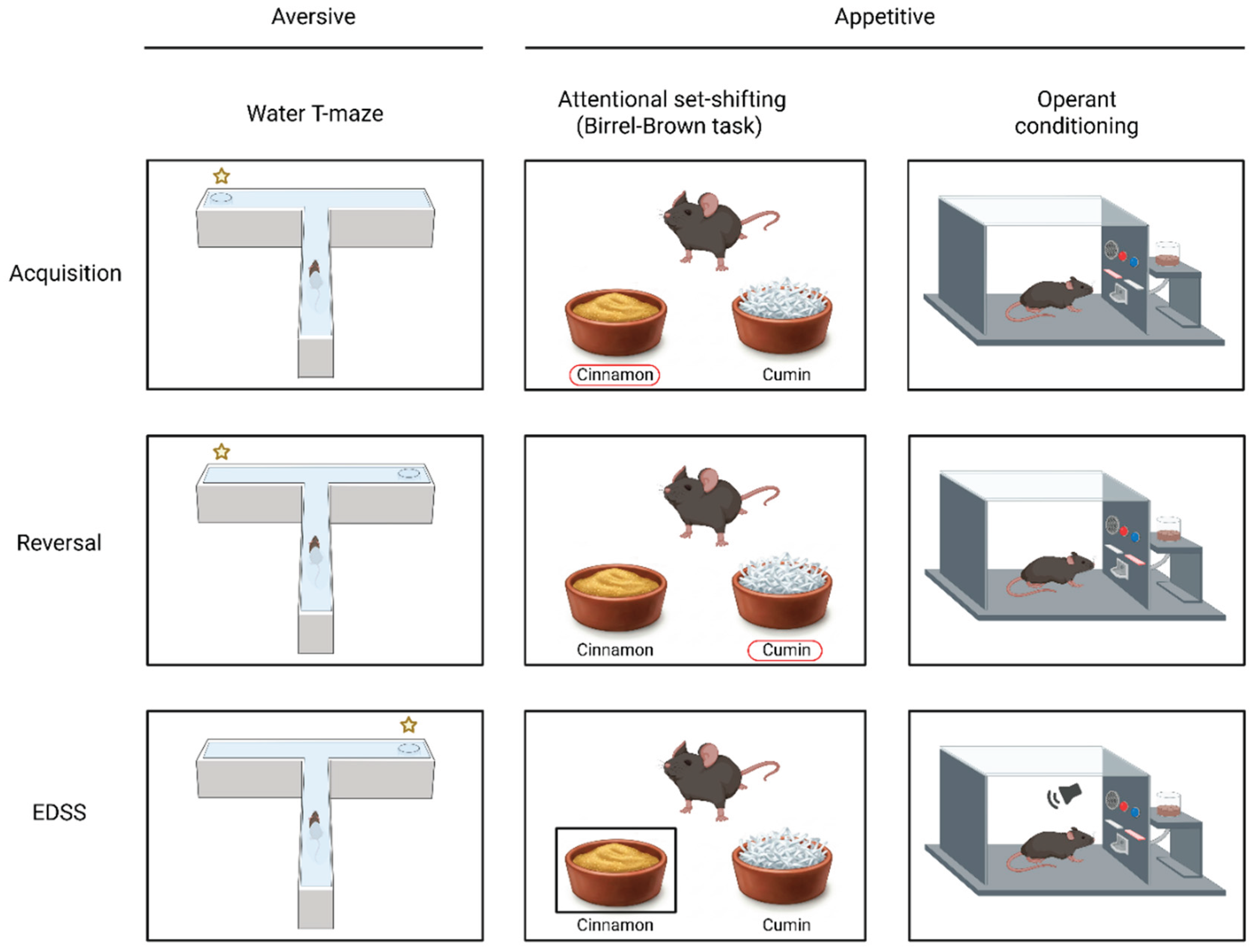

Table 1.
The neural substrates of cognitive flexibility depend on whether the task requires ID or ED shifting, and on the motivational valence of the task.
Table 1.
The neural substrates of cognitive flexibility depend on whether the task requires ID or ED shifting, and on the motivational valence of the task.
| Flexibility requirement | Valence | Implicated Brain Structures | Neurotransmitters Involved |
|---|---|---|---|
| ID Shift | Aversive | Hippocampus, mPFC | Glutamate, GABA |
| Appetitive | OFC, mPFC, Striatum | Glutamate, GABA, Serotonin, Dopamine | |
| EDSS | Aversive | mPFC | Glutamate, GABA |
| Appetitive | mPFC, Ventral Hippocampus, ACC | Glutamate, GABA, Serotonin, Noradrenaline |
Disclaimer/Publisher’s Note: The statements, opinions and data contained in all publications are solely those of the individual author(s) and contributor(s) and not of MDPI and/or the editor(s). MDPI and/or the editor(s) disclaim responsibility for any injury to people or property resulting from any ideas, methods, instructions or products referred to in the content. |
© 2025 by the authors. Licensee MDPI, Basel, Switzerland. This article is an open access article distributed under the terms and conditions of the Creative Commons Attribution (CC BY) license (http://creativecommons.org/licenses/by/4.0/).
Copyright: This open access article is published under a Creative Commons CC BY 4.0 license, which permit the free download, distribution, and reuse, provided that the author and preprint are cited in any reuse.