
Submitted:
18 June 2025
Posted:
20 June 2025
You are already at the latest version
Abstract
Due to the enormous issues the global education system experienced during the COVID-19 pandemic, there has been a notable trend towards open and remote learning (ODL) as a means of ensuring educational continuity. However, a key area of interest throughout the COVID-19 period was the application of policies and ethical practices in Higher Education Institutions. Other quality difficulties included a lack of engagement, limited access to resources, inadequate support services, etc. This study looks at policies and practices related to quality assurance in open and remote learning in private institutions in Zambia. Using semi-structured interview guides and questionnaires, the study uses a descriptive study design and purposeful sampling to uncover the current state of policies and practices. The Statistical Package for Social Sciences (SPSS) will be used to evaluate the data.
Keywords:
higher education institutions
; open distance learning
; quality assurance
; policies
1. Introduction
Higher Education provides individuals with the opportunity to develop critical thinking, become drivers of economic growth and innovation, promote social mobility and reduce inequality and fosters civic engagement and democratic participation (World Bank, 2017; OECD, 2012; UNESCO, 2015; ACE, 2017). Higher Education therefore is not just a personal investment but one whose benefits extend far beyond an individual. The provision of education in Higher Education Institutions (HEIs) is delivered in different modes depending on the nature, specialization and capacity of an institution. With the notable improvement in technological devices, Open and Distance Learning (ODL) seem to be gaining momentum as it aims to provide education beyond the confinement of a physical lecture room. ODL in Higher Education Institutions (HEIs) is key in providing flexible as well as accessible educational opportunities while leveraging technology to reach diverse learners across various geographical locations (Moore & Kearsley, 2012). Accordingly, the spread of Covid-19 further necessitated the adoption of ODL in both developed and developing countries, Zambia inclusive.
Over the past few years, Zambia has experienced a rapid increase in the number of HEIs registered by Higher Education Authority (HEA), an authority legally mandated to register and ensure quality in HEIs. Statistics shows that the country had 66 registered private and public HEIs as of April 2021 (Mvula, 2023), but the number has since increased to 108 as of 2023 (Subaveerapandiyan & Sinha, 2024). This increase in HEIs call for the need to ascertain adherence to Quality Assurance criteria particularly for private HEIs offering ODL. This is so because ODL has been perceived as second-rate education hence the need to strengthen it by ensuring that its quality meet the standards of in-person education (Jung, 2023).
A number of definitions have been developed to refer to Quality Assurance (QA). Goetsch & Davis (2013) defined quality assurance as a planned and systematic approach to ensure that products and services meet specified requirements for quality. This definition provided refer to a process that ensures uniformity and standards from initial stage to completion of product and services offered.
Lemaitre and Karakhanyan (2017) defines quality assurance in higher education as a process of building public and institutional stakeholders’ confidence that the provision (inputs, procedures, and results) meets expectations or measures up to threshold minimum criteria. This simply means that quality assurance in education and the set criteria is not determined by mandated authorities only but through collaborative efforts with the public and regulated institutions (Mvula & Nkunika, 2022). (Bwalya, 2023) add that QA is related to accreditation, which establishes the standing, acceptability, and suitability of higher education programs and institutions, as well as assessment, which refers to all techniques used to evaluate an individual, group, or organization’s performance.
It is therefore important that HEIs continue putting in place structures and processes that ensures the maintenance and upgrade of education standards in the face of growing demand for higher education (Mustafa, 2023; Kuyela, 2025). The policies and practices of HEIs must reflect the changing needs of our societies by continuously updating and designing curricular that aligns to current requirement of the industry. This study aims to investigate the QA in private HEIs of Lusaka Province with a focus on policies and practices. The study will provide insight into the current state of QA in ODL and help identify areas for improvement.
2. Objectives
- To examine the existing policies governing quality assurance in ODL
- To analyse the effectiveness of quality assurance practices in ensuring education standards in ODL.
- To identify challenges and barriers to effective quality assurance in ODL.
3. Methodology
Using semi-structured interview guides and questionnaires, the study uses a descriptive study design and purposeful sampling to uncover the current state of policies and practices. Four private universities namely Livingstone International University for Tourism Excellence and Business Management (LIUTEBM), Information Communications University (ICU), Zambia Centre for Accountancy Studies (ZCAS) and Chreso University participated in the study. Data collected through questionnaires was analysed using SPSS while interview guide data was analysed using thematic analysis.
4. Presentation of Findings
Demographic Information
The demographic profile of participants from different institutions revealed a predominantly male (60%) workforce with diverse years of experience and roles. Females constituted 40% of respondents, indicating gender disproportion. Experience varied, with 53.3% having 2-3 years, 33.3% having 3-5 years, 1.7% having less than one year and 11.7% possessing over half a decade of experience. Institutions represented by respondents varied, with LIUTEBM having 40%, Chreso having 31.7%, ICU having 15% and ZCAS having 13.3%. Various roles were represented, with lecturers (68.3%) and administrative staff (21.7%) being typical.
| Demography | Variable | Respondents | Percentage |
| Gender | Male | 36 | 60% |
| Female | 24 | 40% | |
| Role | Quality Assurance Personnel | 6 | 10% |
| Administrative Staff | 13 | 21.7% | |
| Lecturer | 41 | 68.3% | |
| Years of experience (ODL) | Less than 1 year | 1 | 1.7% |
| 2 – 3 years | 32 | 53.3% | |
| 3 – 5 years | 20 | 33.3% | |
| More than 5 years | 7 | 11.7% | |
| Institution | Chreso University | 19 | 31.7% |
| ICU | 9 | 15% | |
| LIUTEBM | 24 | 40% | |
| ZCAS | 8 | 13.3% |
5. Examining the Existing Policies Governing Quality Assurance in ODL
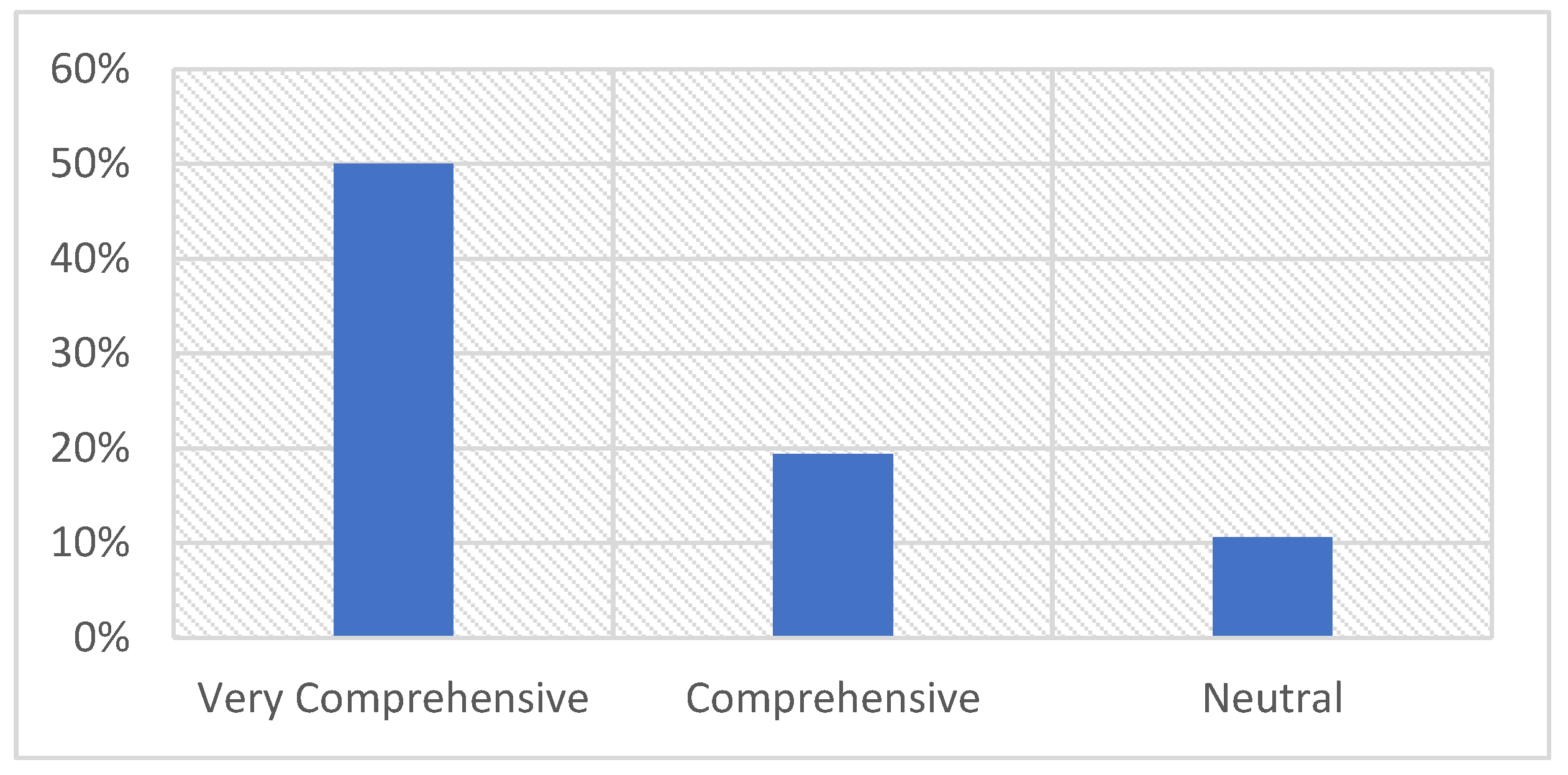
The study examined the existing policies which governs quality assurance in ODL by finding out how comprehensive the policies are. The survey received 60 responses from (04) four private institutions. The response was distributed as follows: 50% very comprehensive, 32.4% comprehensive, and 17.6% neutral as shown in the figure below.
Figure 1.
comprehensiveness of quality assurance guidelines and standards.
Course design, delivery, assessment and learner support
The researchers sought to find out from quality assurance personnel on what comprehensive guidelines and standards as referred to by the majority meant. The study found that the term referred to the inclusion of course design, mode of delivery, assessment as well as learner support. One quality assurance personnel noted,
‘If the course design, mode of lesson delivery, and criteria for assessment is missing in the quality assurance policy document, then there is no policy [policies] to talk about because these are key components not only in Open-Distance Learning but also for full time learners.’
Another respondent, added
‘According to my understanding, comprehensive refers to something that provide all the needed support. Thus, quality assurance policy is a guide to support learners in providing information on how course are designed, how tests, assignments and exams are graded, lesson delivery and penalties for not adhering to the set standards/guidelines.’
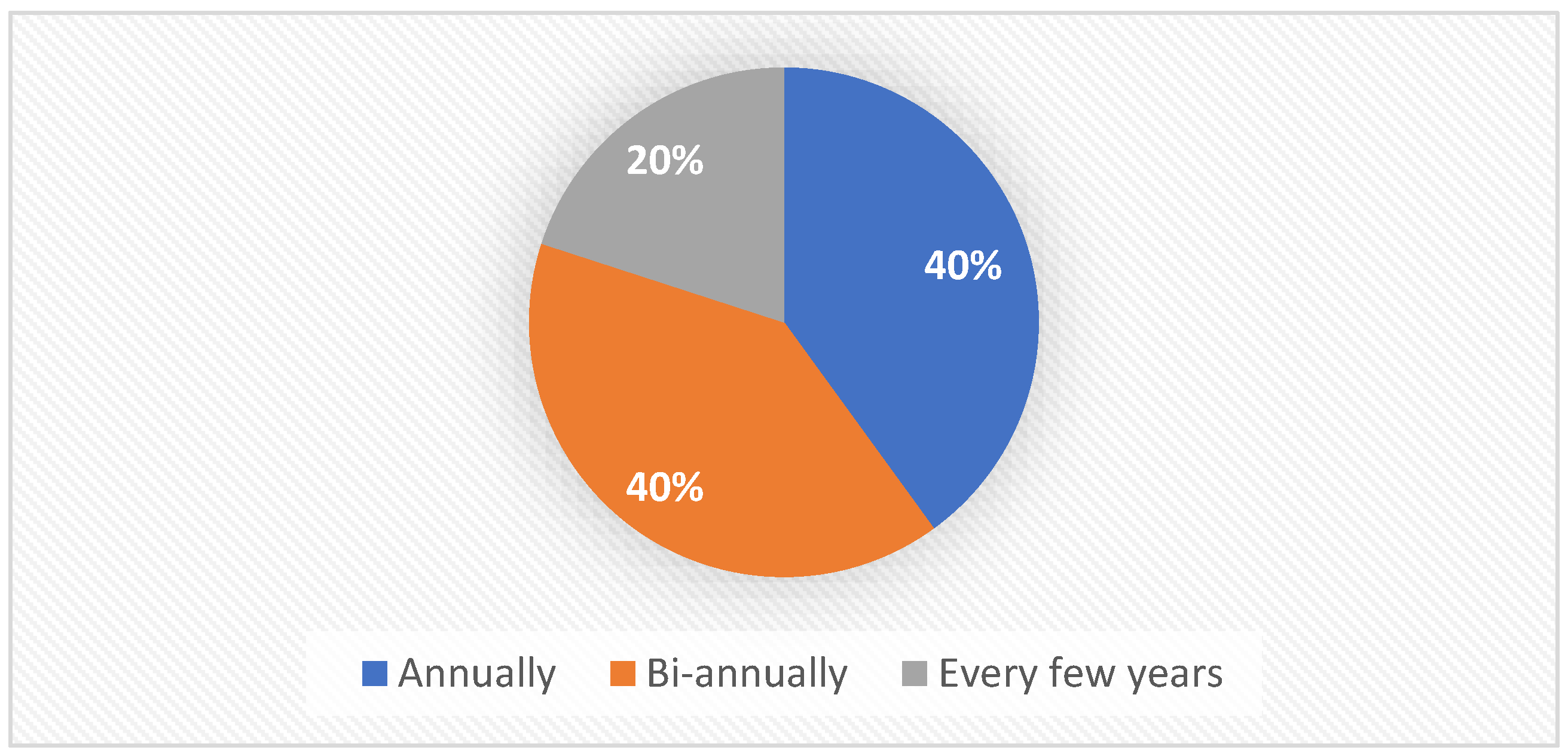
To find out how frequently the quality assurance policies and standards are updated to reflect changes with society needs, respondents indicated the period for which their respective institutions updated the policies. The response showed that majority updated their policies annually (40%) and bi-annually (40%) while 20% represented those who updated every few years as shown in the figure below.
6. Effectiveness of Quality Assurance Practices in Ensuring Education Standards in ODL
In order to assess the effectiveness of quality assurance practices, respondents indicated the methods used to ensuring that standards are followed. The study found that the majority 25 (46.4%) used students’ surveys as one way of measuring effectiveness. This was seconded by faculty evaluations which recorded 18 (33.3%). Methods such as external review and the use of course completion rates recorded 2 (3.7%) and 9 (16.7%) presenting the lowest as shown in the table below.
| Variable | Respondents | Percentage |
| Students feedback surveys | 25 | 46.3% |
| Faculty evaluations | 18 | 33.3% |
| Course completion rates | 9 | 16.7% |
| External reviews | 2 | 3.7% |
| Total | 54 | 100 |
The researchers sought to find out the mechanisms used to ensure implementation of quality policies. The study found that the majority 22 (40.7%) used students’ feedback as a measure to implement and improve quality. Peer review process recorded 15 (27.8%) while regular audits and accreditation process recorded 6 (11.1%) and 11 (20.4%) respectively as shown in the table below.
| Variable | Respondents | Percentage |
| Regular audits | 6 | 11.1% |
| Feedback from students | 22 | 40.7% |
| Peer review | 15 | 27.8 |
| Accreditation processes | 11 | 20.4 |
| Total | 54 | 100 |
References
- Bwalya, T. (2023). Quality Assurance in Higher Education and its Implications on Higher Education Institutions and Challenges in Zambia. [CrossRef]
- Dalitso, M. (2023). The use of Academic Library and Information Seeking Behaviour of Students at LIUTEBM University. International Journal of Research and Innovation in Social Science 2023, VII, 157–164. [Google Scholar] [CrossRef]
- Mvula, D. & Nkunika, F. (2022). Utilization of E-Resources by students at The University of Zambia: A Case Study of Natural Science fourth year students. Academia Letters preprint. Open Access, CC BY 4.0.
- Jung, I. (2023). Quality Assurance in Online, Open, and Distance Education. In O. Zawacki-Richter & I. Jung (Eds.), Handbook of Open, Distance and Digital Education (pp. 709–724). Springer Nature Singapore. [CrossRef]
- Kuyela, Kadeyo Mutale (2025). An assessment of the effect of the fourth industrial revolution on library services: a case of academic libraries in Lusaka province. Diss. The University of Zambia, 2025.
- Subaveerapandiyan, A. , & Sinha, P. (2024). Assessing scholarly communication competence in Zambian library professionals. Global Knowledge, Memory and Communication. [CrossRef]
Disclaimer/Publisher’s Note: The statements, opinions and data contained in all publications are solely those of the individual author(s) and contributor(s) and not of MDPI and/or the editor(s). MDPI and/or the editor(s) disclaim responsibility for any injury to people or property resulting from any ideas, methods, instructions or products referred to in the content. |
© 2025 by the authors. Licensee MDPI, Basel, Switzerland. This article is an open access article distributed under the terms and conditions of the Creative Commons Attribution (CC BY) license (http://creativecommons.org/licenses/by/4.0/).
Copyright: This open access article is published under a Creative Commons CC BY 4.0 license, which permit the free download, distribution, and reuse, provided that the author and preprint are cited in any reuse.


