
Submitted:
19 June 2025
Posted:
20 June 2025
You are already at the latest version
Abstract
This article examines the integration of Business Intelligence (BI) and Knowledge Management (KM) tools to support entrepreneurs at the Department of Small Business Development (DSBD) in South Africa. The aim of this study is to investigate how BI systems are employed within the DSBD's entrepreneurial support programs to enhance business sustainability. Methodology/Design/Approach: A qualitative research approach was adopted, utilizing semi-structured interviews and document review. 20 Business Development Officers from various DSBD entities were interviewed, and data was analyzed thematically.Findings: The results demonstrate that BI tools help address key entrepreneurial challenges, such as limited market access, financial barriers, and inadequate business skills. The study developed a model for entrepreneurial support that includes core elements like needs assessment, data integration, program design, monitoring, and continuous improvement. This model provides a structured approach to delivering data-driven, tailored interventions for entrepreneurs.Conclusion: The article concludes that the integration of BI with KM tools significantly enhances the effectiveness of entrepreneurial support services by enabling the DSBD to make informed decisions that address the unique needs of entrepreneurs. The proposed model promotes business sustainability and economic growth. Limitations: Limitations of the study include its qualitative scope and the focus on DSBD officers, which may affect generalizability. Future research should incorporate a broader range of stakeholders and contexts to validate the findings.
Keywords:
business intelligence
; knowledge management
; entrepreneurial support
; department of small business development
; data-driven decision-making
1. Introduction
Globally, there has been a shift in the literature on entrepreneurship and business development towards the use of Business Intelligence (BI) as a Knowledge Management (KM) tool to support entrepreneurs (Alsibhawi, Yahaya & Mohamed 2023). Organisations, particularly those supporting entrepreneurs, are increasingly pressured to leverage information and transform it into actionable insights (Bickley, Macintyre & Torgler 2024). This has driven the integration of BI as a KM tool to improve entrepreneurial support programs. This study focuses on how BI, when used as a KM tool, can support entrepreneurs at the Department of Small Business Development (DSBD) in South Africa.
Despite the efforts of various agencies like the Department of Trade, Industry & Competition (2019), the National Youth Development Agency (NYDA 2020), and the Small Enterprise Finance Agency (SEFA 2019), South African entrepreneurs face challenges such as limited access to funding, resources, and markets. Reports show a significant decline in the number of entrepreneurs in recent years, even with the claimed support from both private and government entities (NYDA 2020). Entrepreneurs often possess innovative ideas but struggle to sustain their businesses due to these limitations (Koe, Afiqah & Sakir 2020). The importance of entrepreneurship for economic growth cannot be overstated, and the DSBD plays a crucial role in ensuring entrepreneurial business sustainability by providing essential resources and business development programs.
The study contributes to a growing body of research that highlights the necessity of integrating BI systems into entrepreneurial support frameworks for business sustainability and economic development.
2. Theoretical Framework
The conceptual framework adopted for the article is the People-Centric Knowledge Management and Business Intelligence framework proposed by Rostamiis (2014:9). This framework focuses on the relationship between people, Business Intelligence (BI), and Knowledge Management (KM). It recognizes that KM systems are fundamentally people-centric, where individuals create, share, and apply knowledge as an asset. While BI systems often rely on computerized technologies, decisions are ultimately made by people. For the study, this framework integrates people, KM, and BI to support entrepreneurial business sustainability.
The framework’s components; BI tools, KM tools, knowledge-driven insights, data-driven insights, and structured data are each explored in relation to the research objectives of the study. These constructs serve as guiding principles for how knowledge management and business intelligence enhance business operations, efficiency, decision-making, and overall competitiveness.
3. Problem Statement
Despite the efforts of the Department of Small Business Development (DSBD) in South Africa to support entrepreneurs, significant challenges such as limited market access, financial barriers, and inadequate business skills persist. Current approaches to entrepreneurial support lack a data-driven, structured methodology that effectively integrates Business Intelligence (BI) and Knowledge Management (KM) tools to address these challenges. There is a need to explore how the integration of BI and KM tools can enhance the effectiveness of entrepreneurial support services, enabling the DSBD to deliver tailored interventions that promote business sustainability and economic growth. This study seeks to develop a model that provides a systematic approach to utilizing BI and KM in delivering targeted support to entrepreneurs, thereby contributing to the stability of South Africa’s economy.
4. Purpose
The purpose of this article is to examine the integration of Business Intelligence (BI) and Knowledge Management (KM) tools to enhance the support services provided to entrepreneurs by the Department of Small Business Development (DSBD) in South Africa. The specific objectives are:
- To determine how BI as a KM tool is used to support entrepreneurs at the DSBD
- To explore the role of BI and KM tools in overcoming the barriers to entrepreneurial growth, development, and sustainability
5. Literature Review
This section discusses literature in line with the objectives.
5.1. BI as a KM Tool to Support Entrepreneurs at the DSBD
This section explores how BI, when integrated into KM practices, plays a crucial role in supporting entrepreneurs, particularly within the Department of Small Business Development (DSBD). BI and KM are closely linked, both of which are essential for informed decision-making and strategic planning (Sabherwal et al., 2023). BI as a KM tool refers to the integration of BI technologies and processes within an organization’s KM framework, enabling the management, analysis, and use of data as a valuable strategic asset (Rao & Kumar, 2011; Mohamad, Jayakrishnan & Yusof, 2022).
When the DSBD incorporates BI as a KM tool, it enhances its ability to provide targeted and data-driven support to entrepreneurs. For instance, BI can be used to analyze the performance of different small business sectors, identify areas requiring additional support, and assess the effectiveness of current programs (Romero et al., 2021). By leveraging BI, the DSBD can make more efficient use of resources, improve service delivery, and track the progress of supported entrepreneurs, ensuring that resources are allocated to where they are most needed (Kristoffersen, Mikalef, Blomsma & Li, 2021).
Furthermore, BI as a KM tool empowers entrepreneurs by providing them with the ability to anticipate market trends through predictive analytics. This forward-looking approach helps entrepreneurs to innovate proactively, keeping them ahead of their competitors (Kumar, 2023). It also enhances organizational performance by enabling entrepreneurs to monitor key performance indicators (KPIs), track financial metrics, and assess their business strategies’ effectiveness (Mathrani, 2021). This use of data helps entrepreneurs make informed decisions, grounded in empirical evidence rather than intuition, further improving their competitiveness and sustainability (Edelman, 2023).
The integration of BI within the DSBD’s KM framework also supports innovation. By analyzing large datasets, BI tools can uncover hidden patterns and market opportunities, fostering the development of new products, services, or business models (Ranjan & Foropon, 2021). Entrepreneurs can also benchmark their performance against industry standards, identifying areas for improvement and ensuring they remain competitive in a fast-evolving market (Moinuddin, Usman & Khan, 2024).
Globally, the adoption of BI as a KM tool has proven instrumental in driving the growth and sustainability of entrepreneurial businesses. BI systems offer practical insights through reports, dashboards, graphs, and summaries, enabling entrepreneurs to make tactical business decisions (Telukdarie, Philbin, Mwanza & Munsamy, 2022). These tools help entrepreneurs improve their operations, increase revenue by optimizing sales strategies, and adapt to market demands (Huang, Savita & Zhong-jie, 2022). For the DSBD, the adoption of BI as a KM tool signifies a strategic commitment to leveraging data for small business development, ultimately contributing to the growth and sustainability of the entrepreneurial ecosystem in South Africa (Gomwe, Potgieter & Litheko, 2022).
The DSBD’s use of BI tools marks a shift in how small business support is perceived and executed. By prioritizing data-driven strategies, the department can strengthen its role in fostering entrepreneurial growth, empowering entrepreneurs to thrive in competitive markets, and contributing to the broader economic stability of the country (Wee, Scheepers & Tian, 2023).
5.2. Exploring the Role of BI and KM Tools in Overcoming the Barriers to Entrepreneurial Growth, Development, and Sustainability
Entrepreneurs are often regarded as champions of small business development, yet they continuously face dynamic challenges in today’s global competitive economy (Moscoso-Zea, Castro, Paredes-Gualtor & Lujan-Mora 2019:3870). Although private and government entities, including national initiatives like the National Youth Development Agency (2020), claim to support entrepreneurial business ventures, entrepreneurs still struggle with numerous obstacles in sustaining their businesses. These challenges can be described as impediments that hinder entrepreneurial growth and success (Moscoso-Zea et al. 2019:38779).
In South Africa, the difficulties faced by entrepreneurs are particularly multifaceted (Koe et al. 2020:27). For example, during the early stages of the COVID-19 pandemic, small businesses globally were severely impacted, causing many entrepreneurs to shut down operations (AlSelami, ELEmary & Alamoudi 2020). This period introduced both challenges and opportunities for business development (AlSelami et al. 2020), requiring entrepreneurs to innovate and adapt their services to survive (Petridou & Mintrom 2021:946).
The shift towards digitization has further complicated the entrepreneurial landscape. The Small Enterprise Development Agency (2020) has noted that digitization leads to information and data overload for many entrepreneurs (Kopecky 2018:12). With vast quantities of data stored across various silos, entrepreneurs face difficulties in effectively processing and utilizing this information to make business decisions. According to the Centre for Research Ethics and Bioethics (2016), these data silos present both opportunities and challenges, offering insights into global market trends (Zaby & Wilde 2018:3). Business Intelligence (BI) and Knowledge Management (KM) tools play crucial roles here, helping entrepreneurs extract meaningful insights from data to drive business success.
In the South African context, business development is primarily spearheaded by the Department of Small Business Development (DSBD) and its various affiliates at both national and provincial levels (Choughri 2018:87). These entities are tasked with providing the necessary support to entrepreneurs to ensure the sustainability of their business operations (Adewumi & Keyser 2020:554). Despite this mandate, entrepreneurs continue to face a range of challenges unique to their respective industries. It is the responsibility of DSBD and other business development agencies to offer solutions to mitigate these challenges (Matiza & Slabbert 2020:110). However, research conducted by Coughri (2018:89) indicates that many South African business development institutions are under-resourced and unable to adequately support entrepreneurs. Challenges identified by DSBD include:
- Lack of comprehensive business training programs.
- Inadequate monitoring and evaluation systems for entrepreneurial businesses.
- Shortcomings in supply-driven business support programs.
- Urban-centric business development initiatives that overlook rural entrepreneurs.
Given these challenges, it is clear that while efforts are being made to support entrepreneurs, much remains to be done to ensure that they receive the full benefit of public and private support. The integration of BI and KM tools is crucial in addressing these issues, as they offer the potential to improve decision-making, increase efficiency, and help entrepreneurs overcome the barriers they face in a rapidly changing economic environment.
6. Research Methodology
A qualitative research approach was adopted for this study. The study employed semi-structured interviews as the primary data collection method, enabling an in-depth exploration of participants’ perspectives. Interviewees were selected using purposive sampling to ensure that those who participated had relevant knowledge and experience related to the DSBD’s entrepreneurial support programs. Specifically, 20 Business Development Officers from various DSBD entities were interviewed until data saturation was reached, indicating that no new information was emerging. A case study approach was chosen to allow for a comprehensive examination of these officers’ experiences, challenges, and suggestions in supporting entrepreneurs. This design was ideal for exploring complex phenomena in their real-life context, specifically focusing on knowledge management tools and techniques that aid entrepreneurship.
To ensure the credibility and ethical integrity of the research, informed consent was obtained from all participants, and they were assured of confidentiality and honesty in their responses. Ethical clearance was requested from and granted by the University of South Africa (Unisa) Ethics Committee, and permission to conduct the study was also secured from the Department of Small Business Development. During the data collection process, interviews were audio-recorded with the participants’ consent and later transcribed verbatim to preserve the accuracy of their responses. To maintain participant confidentiality, each individual was assigned a code, such as Participant 1, Participant 2, etc., for anonymity during data analysis and reporting.
The data was coded and categorized into themes that were closely aligned with the study’s objectives. Thematic analysis was employed to identify patterns and insights in the data, with content analysis being used to interpret the underlying meanings and relevance of these themes in the context of BI and KM tools. The integration of these analytical techniques helped ensure that the findings were both comprehensive and aligned with the research objectives.

Table 1.
Table of Anonymized Participants.
| Code | Occupation | Education | Experience |
|---|---|---|---|
| Participant 1 | Regional manager | Honours degree | Seven years |
| Participant 2 | Regional manager | Honours degree | Six years |
| Participant 3 | Regional manager | Honours degree | Seven years |
| Participant 4 | Regional manager | Honours degree | Six years |
| Participant 5 | Senior manager | Bachelor’s degree | Five years |
| Participant 6 | Senior manager | Bachelor’s degree | Five years |
| Participant 7 | Deputy director | Master’s degree | Eight years |
| Participant 8 | Deputy director | Master’s degree | Seven years |
| Participant 9 | Programme implementer | National diploma | Six years |
| Participant 10 | Programme implementer | National diploma | Five years |
| Participant 11 | Programme implementer | National diploma | Six years |
| Participant 12 | Programme implementer | National diploma | Four years |
| Participant 13 | Programme implementer | National diploma | Five years |
| Participant 14 | Programme implementer | National diploma | Five years |
| Participant 15 | Business administrator | National vocational certificate | Four years |
7. Presentation of Results and Data Analysis
The main objectives of this paper were to establish how BI as a KM tool is used by the DSBD to support entrepreneurs, to identify how BI as a KM tool can be used to overcome the challenges experienced by the DSBD in providing support to entrepreneurs and to suggest support programs for entrepreneurs at the DSBD.
7.1. Establish how BI as a KM Tool Is Used by the DSBD to Support Entrepreneurs
The first objective of the study was to determine how BI as a KM tool is used by the DSBD to support entrepreneurs. In view of this regard, participants of the study were asked, who is responsible for implementing business intelligence initiatives at the Department of Small Business Development, and how are knowledge management tools used to support these initiatives? The following responses were provided by participants:
“Programme implementers, business development officers, regional managers, and senior officials are responsible for implementing BI initiatives. KM tools are used to facilitate the sharing of insights and lessons learned among these roles, ensuring that each team member can access the necessary information to support decision-making and project execution”.[Participant 1]
“There are various team members and stakeholders responsible for implementing BI initiatives, such as program implementers who collaborate with stakeholders like SEDA and SEFA. KM tools enhance this collaboration by enabling seamless communication and information exchange, ensuring that all stakeholders have access to up-to-date data and relevant insights to drive the BI initiatives forward”.[Participant 4]
“Regional managers and deputy directors are project leaders in implementing BI programs, often collaborating with stakeholders. KM tools support this collaboration by providing platforms for knowledge sharing and documentation, which helps maintain consistency and continuity in BI projects across different regions and teams”.[Participant 2]
“The entrepreneurial business support unit is responsible for implementing business support programs. KM tools play a crucial role by allowing the unit to capture and store best practices and project outcomes, making this knowledge available for future BI initiatives and ensuring that the team builds on previous successes’’.[Participant 3]
The findings of the study indicate that the implementation of Business Intelligence (BI) initiatives at the Department of Small Business Development (DSBD) is a collaborative effort involving multiple internal and external stakeholders. Key roles include program implementers, regional managers, and specialized units like the Entrepreneurial Business Support Unit, which coordinates BI efforts and communicates with external agencies such as SEDA and SEFA. These partnerships ensure that BI initiatives are aligned with the organization’s broader objectives and are effectively managed (McCommons, 2020).
Knowledge Management (KM) tools play a vital role in supporting BI initiatives by facilitating the sharing of insights, promoting collaboration, and ensuring knowledge continuity. Participants highlighted that KM tools enable the flow of information among program implementers, business officers, and senior officials, enhancing decision-making and project execution (Skyrius, 2021). For instance, the Entrepreneurial Business Support Unit uses KM tools to capture best practices and project outcomes, ensuring this knowledge is available for future initiatives (Kristoffersen et al., 2021).
The research further reveals that BI implementation at DSBD is decentralized and involves active collaboration between stakeholders, such as SEDA and SEFA, which support entrepreneurial business sustainability. KM tools enhance this collaboration by ensuring seamless communication and access to up-to-date data across the organization (Mathrani, 2021). The findings underscore the critical roles played by program implementers and senior officials in collecting, analyzing, and disseminating data, supported by KM tools that ensure insights are shared effectively throughout the organization (Paradza & Daramola, 2021). Additionally, regional managers and senior leadership provide strategic oversight and guidance, ensuring that BI programs are aligned with DSBD’s objectives and consistently applied across regions (Skyrius, 2021).
7.1.1. Strategic Role of BI as a KM Tool in Fostering Entrepreneurial Business Sustainability
As a follow-up question, the participants were asked to provide further insights into the diverse ways in which BI as a KM tool could be perceived as a strategic resource for enhancing entrepreneurial business sustainability. Participants offered various perspectives on the strategic significance of BI in advancing entrepreneurial business sustainability. They highlighted several key dimensions through which BI as a KM tool can contribute to this objective:
According to Participant 4, “At DSBD, we consider BI as a strategic resource because it guides us in making well-informed decisions to identify market trends, customer preferences, and areas for improvement for entrepreneurs. In this context, BI functions as a key KM tool, enabling us to systematically gather, analyse, and distribute relevant information that supports our decision-making processes and enhances our ability to support entrepreneurs effectively’’.
“I think BI, together with other business management processes, is very important and strategic to the DSBD in order to provide entrepreneurs with the information they need to remain competitive in their businesses. BI serves as a vital KM tool by facilitating the collection and dissemination of critical business insights, ensuring that entrepreneurs have access to the knowledge they need to adapt and thrive in a dynamic market environment”.[Participant 9]
Participant 4 regards BI as a strategic resource because it provides guidance in decision-making to establish market trends, consumer preferences, and areas for improvement. This sentiment aligns with the literature published by Wee et al (2023:61), which identifies BI as a powerful tool for generating actionable insights that drive organizational strategy. Someh (2023:594) emphasize that BI serves as a critical KM tool by enabling the systematic collection, analysis, and dissemination of data, which in turn supports decision-making processes and enhances organizational learning. Similarly, Ranjan and Foropon (2021) highlights the role of BI in transforming raw data into valuable knowledge that organizations can use to improve their strategic outcomes. These insights empower organizations like DSBD to make well-informed decisions that are crucial for enhancing the effectiveness of their support programs for entrepreneurs. Muleya (2021) concurs, stating that BI is instrumental in identifying market trends and customer preferences, which are vital for tailoring support programs to meet the evolving needs of entrepreneurs.
Participant 9 also underlines the strategic importance of BI when integrated with other business management processes within DSBD. This view is supported by Bordeleau (2020), who argue that BI’s integrative role within organisational processes contributes significantly to maintaining a competitive advantage. By leveraging BI tools and methodologies alongside other management practices, organisations like DSBD can optimize decision-making processes, streamline operations, and foster innovation, thereby enhancing the overall effectiveness of their support programs for entrepreneurs. This view is in accord with Potgieter and Litheko (2022:6) who further assert that, BI’s role as a KM tool is essential in creating a knowledge-driven environment that supports continuous improvement and strategic agility.
Participant 13 alludes that, “Well, the DSBD plays a great role in maintaining the sustainability of entrepreneurs and their businesses. We rely on various processes in collaboration with external stakeholders and some of our affiliates. So, BI, when combined with other business SOPs, it becomes a strategic resource for the DSBD. In this context, BI acts as a crucial KM tool, enabling the systematic collection, analysis, and sharing of valuable information that supports decision-making and enhances collaboration with stakeholders.”
“I consider BI as a strategic resource because, through BI, entrepreneurs can gain a competitive advantage by understanding their market positioning, monitoring competitor activities, and identifying emerging opportunities or threats. This allows them to adapt quickly to changing market conditions and stay ahead of the competition. Here, BI functions as a vital KM tool by providing entrepreneurs with the knowledge they need to navigate the business landscape effectively.”[Participant 1]
“I think BI becomes a strategic resource in the sense that, when combined with other business management processes such as strategic planning and performance management, it helps entrepreneurs to take business positions where efforts are focused on achieving specific business objectives. In this scenario, BI is integrated as a KM tool that supports the alignment of business activities with strategic goals”.[Participant 15]
The analysis of responses provided by participants collectively indicates the strategic significance of BI in enhancing entrepreneurial business sustainability. However, the integration of BI with other business management processes, supported by KM tools, emerges as a recurring theme, emphasizing the importance of a holistic approach to leveraging data for entrepreneurial success. For example, Participant 13 alluded that when BI is integrated with various business SOPs and supported by KM tools, it becomes a strategic resource for DSBD in providing sustainability programs for entrepreneurs. This perspective is supported by Muleya (2021), who argues that incorporating BI into standard operating procedures (SOPs) can enhance the strategic resources of organisations like DSBD in providing sustainability programs for entrepreneurs. KM tools play a critical role in this process by facilitating the capture, storage, and dissemination of insights derived from BI, ensuring that these insights are accessible across the organization. By leveraging BI tools, analytics, and KM systems, organisations can gain valuable insights from data to inform strategic decision-making processes. This aligns with the notion that BI, when supported by KM, enables organisations to transform their decision-making processes, leading to more informed and effective strategies (Wee et al 2023).
Participant 1 emphasizes the strategic importance of BI for entrepreneurs, particularly in gaining a competitive advantage. By leveraging BI tools and insights, supported by KM systems, entrepreneurs can enhance their understanding of market dynamics, assess their own positioning within the market, monitor competitor activities, and identify emerging opportunities or threats. KM tools enhance this process by ensuring that the knowledge and insights gained from BI are systematically captured, shared, and applied across different areas of the business. This proactive approach enables entrepreneurs to adapt to changing market conditions, ensuring they remain ahead of their competition. This perspective resonates with the scholarly literature on BI, which highlights its role in providing actionable insights derived from data analysis (Mikalef, Krogstie, Pappas & Pavlou 2020), particularly when these insights are integrated into a robust KM framework.
Moreover, Participant 15 underlines the strategic role of BI by highlighting its integration with other key business management processes, such as strategic planning and performance management, facilitated by KM tools. By combining BI with these processes, and utilizing KM systems, entrepreneurs can align their efforts with specific business objectives, ensuring that their actions are targeted and purposeful. KM tools support this integration by enabling the systematic management of knowledge, which ensures that insights from BI are effectively used in strategic decision-making and performance monitoring. This viewpoint aligns with contemporary literature on BI, which emphasizes its integration with strategic management practices to drive organisational success (Nwanakwaugwu, Matthew, Kazaure & Haruna 2023). Strategic planning provides a roadmap for achieving long-term goals, while performance management, supported by KM tools, facilitates the measurement and evaluation of progress towards these objectives. When BI is integrated into these processes and supported by KM systems, entrepreneurs can leverage data-driven insights to inform strategic decision-making, monitor performance metrics, and make adjustments as needed to stay on course towards their goals (Nwanakwaugwu et al 2023).
Overall, the analysis highlights the central role of BI as a KM tool in driving entrepreneurial success and organisational effectiveness within DSBD. By embracing a holistic approach to BI integration and leveraging data-driven insights supported by KM systems, organisations can enhance their competitive positioning, foster innovation, and achieve sustainable growth in support of entrepreneurial success.
7.1.2. The Role of BI as a KM Tool in Enhancing Entrepreneurial Success
This theme emanated from a follow up question to participants of the study to elaborate on how important is BI as a KM tool for the growth, development and productivity of entrepreneurial business success. In views of this regard, the following responses were provided:
“Business intelligence is very important for the business of entrepreneurs because it helps them grow. It is very important in analysing business trends, consumer behaviour and inflation rates of business products and services. By integrating KM tools, entrepreneurs can capture, store, and retrieve the analyses provided by BI. This ensures that critical insights into business trends, consumer behaviour, and inflation rates are retained and easily accessible for future decision-making, leading to more informed and strategic business growth”.[Participant 5]
“As a programme implementer and an entrepreneur myself, yes I think BI is important for business growth and development in the entrepreneur space. I mean it assists us to analyse information about our competitors, check for investment opportunities and things like that. Using KM tools, the insights gained from BI about competitors and investment opportunities can be documented and shared within a community or network of entrepreneurs”.[Participant 12]
“In my opinion, I think If BI is combined with creativity, it then only becomes important and valuable to entrepreneurs, it doesn’t help to acquire so many tools, and fail to use them. KM tools can help entrepreneurs not only acquire but also effectively utilize BI tools by providing guidelines, best practices, and examples of creative applications”.[Participant 10]
“I am not sure whether it does assist entrepreneurs in their growth. But what I have observed is that, there are so many AI BI tools that are very good in providing business insights where entrepreneurs can get tips on how to grow their businesses. KM tools can be used to categorize the various BI tools available, making it easier for entrepreneurs to select the most relevant ones”.[Participant 7]
The participants responses collectively emphasize the importance of BI in driving growth, development, and productivity among entrepreneurs. However, they also reveal that the full potential of BI can only be realized when it is complemented by effective KM practices. For instance, Participant 5 recognizes the critical role of BI in analysing business trends, consumer behaviour, and inflation rates, which are essential for informed decision-making. By integrating KM tools, entrepreneurs can capture, store, and retrieve these valuable analyses, ensuring that key insights are not lost but are instead retained for future reference. This approach aligns with the literature, where Himki, Ramadhan, Durachman and Pramono (2022:109) emphasize the importance of BI in providing entrepreneurs with essential insights into their business environment. KM tools thus serve as a bridge between the acquisition of knowledge and its practical application, enabling entrepreneurs to make strategic decisions based on historical data and trends.
Participant 12, who is both a program implementer and an entrepreneur, further highlights the importance of BI in analysing competitors and identifying investment opportunities. By leveraging KM tools, the insights gained from BI can be documented and shared within a community or network of entrepreneurs, facilitating collaborative learning and mutual growth. This perspective resonates with Misra, Mahajan, Singh, Khorana and Rana (2022:1640), who assert that BI supports entrepreneurial decision-making by empowering entrepreneurs to gather and analyse relevant data. KM tools ensure that this data is accessible and actionable, fostering a culture of continuous learning and improvement.
Participant 10 adds another dimension by emphasizing the need for creativity in utilizing BI tools. They argue that simply acquiring BI tools is insufficient; entrepreneurs must also apply them creatively to derive maximum value. KM tools can play a pivotal role in this process by providing guidelines, best practices, and examples of how BI can be used innovatively. This viewpoint aligns with Trieu, Burton-Jones, Green and Cockcroft (2022:655), who stress the importance of creativity in interpreting and leveraging BI data. KM tools can thus enhance the effectiveness of BI by fostering an environment where creativity is encouraged and supported.
Lastly, Participant 7 expresses uncertainty about the direct impact of BI on entrepreneurial growth but acknowledges the potential of AI-powered BI tools. KM tools can help overcome this uncertainty by categorizing and organising the available BI tools, making it easier for entrepreneurs to select the most relevant ones. This approach ensures that entrepreneurs are not overwhelmed by the excess of tools available but can instead focus on those that will have the most significant impact on their business.
Overall, the integration of KM tools into the use of BI enhances the ability of entrepreneurs to leverage data and insights effectively. The participants’ responses, supported by relevant literature, suggest that while BI is crucial for entrepreneurial success, its true potential is unlocked when combined with KM practices. This integration not only ensures the retention and accessibility of valuable insights, but also encourages creativity and collaboration, driving sustained business growth and development.
7.2. To Explore the Role of BI and KM Tools in Overcoming the Barriers to Entrepreneurial Growth, Development, and Sustainability
The second objective of the study was to identify how BI as a KM tool can be used to overcome the challenges experienced by the Department of Small Business Development (DSBD) in providing support to entrepreneurs. This objective focuses on the various challenges encountered by South African business development industries in their efforts to provide sustained support to entrepreneurial ventures. As such, participants of the study were asked to elaborate on the primary challenges encountered by the DSBD in providing entrepreneurial business support programs. The following responses were provided:
“One of the primary challenges faced by the DSBD in providing entrepreneurial business support programs is inadequate funding, which limits the department’s ability to implement comprehensive and impactful initiatives”.[Participant 1]
“There various red tapes and administrative complexities within the DSBD, and this delay the rollout of support programs and hinder their effectiveness”.[Participant 14]
“There many of them, but I can only attest to the capacity constraints within the DSBD, this includes limited human resources, expertise, and organisational capacity, as significant challenges that hinder the department’s ability to deliver support programs efficiently”.[Participant 12]
The statements provided by participants highlight several key challenges faced by the Department of Small Business Development (DSBD) in providing effective entrepreneurial business support programs. For example, Participant 1 identifies inadequate funding as a primary challenge. This aligns with the literature, which suggests that limited financial resources can constrain the implementation of comprehensive and impactful support programs (Audretsch, Belitski Caiazza & Lehmann 2020:376). Insufficient funding may lead to constraints in staffing, infrastructure, and program outreach, hindering the department’s ability to meet the diverse needs of entrepreneurs effectively. Participant 14 mentions administrative red tape and complexities within the DSBD. Research indicates that bureaucratic obstacles can delay the rollout of support programs and reduce their effectiveness (Islam, Zahra, Rehman & Jamil 2024:75). Streamlining administrative processes and reducing bureaucratic barriers is essential for enhancing the efficiency of entrepreneurial support initiatives. Participant 12 highlights capacity constraints, including limited human resources, expertise, and organizational capacity. Scholarly literature supports this observation, emphasizing the importance of having skilled personnel and adequate organisational capabilities to deliver support programs efficiently (Audretsch et al 2020:379). Capacity-building initiatives within the DSBD are crucial for addressing these constraints and enhancing service delivery.
“I think are accessibility barriers, such as limited outreach efforts and insufficient presence in remote or underserved areas, make it difficult for the DSBD to reach and support all entrepreneurs effectively”.[Participant 7]
“Well, there is a need for improved coordination and collaboration between different departments, agencies, and stakeholders involved in entrepreneurial support initiatives to enhance efficiency and avoid duplication of efforts”.[Participant 13]
“There are raising concerns about the lack of robust monitoring and evaluation mechanisms within the DSBD to assess the impact and effectiveness of entrepreneurial support programs and make data-driven decisions for improvement”.[Participant 6]
“Our entrepreneurs often face challenges in accessing timely and relevant information about available support programs, funding opportunities, and business resources provided by the DSBD, this leads to a lack of awareness and underutilization of available services”.[Participant 11]
Participant 7 mentions accessibility barriers, such as limited outreach efforts and presence in remote or underserved areas. Research suggests that geographical and logistical barriers can restrict access to support services for entrepreneurs in rural or marginalized communities (Jordão & Novas 2024:568). Improving accessibility through targeted outreach and mobile service delivery can help address this challenge. Participant 13 emphasizes the need for improved coordination and collaboration between different departments, agencies, and stakeholders involved in entrepreneurial support initiatives. Collaboration enhances efficiency, minimizes duplication of efforts, and maximizes resources (Jordão & Novas 2024:568). Establishing inter-agency partnerships and coordinating efforts can optimize the delivery of support programs and services. Participant 6 raises concerns about the lack of robust monitoring and evaluation mechanisms within the DSBD. Effective monitoring and evaluation are essential for assessing program impact, identifying areas for improvement, and making data-driven decisions (Zia 2020:1826). Implementing rigorous evaluation processes can enhance accountability and transparency in the delivery of entrepreneurial support programs. Participant 11 highlights challenges faced by entrepreneurs in accessing timely and relevant information about available support programs and resources provided by the DSBD. Research suggests that lack of awareness can lead to underutilization of services and missed opportunities for support (Zia 2020:1828). Enhancing communication and outreach strategies can improve awareness and increase utilization of DSBD services.
8. Proposed Model for Entrepreneurial Support Programs
Entrepreneurial support programs play’s an essential role in supporting the growth and success of startups and small businesses. However, traditional approaches often lack the responsiveness and adaptability required to address the evolving needs of entrepreneurs in today’s fast-paced business environment. By integrating BI into the structure of these programs, organisations can unlock a wealth of actionable intelligence, enabling them to anticipate market trends, identify growth opportunities, and mitigate risks effectively. This model is underpinned by the merging of two key disciplines: entrepreneurship and knowledge management. Entrepreneurship embodies the spirit of innovation and risk-taking, while knowledge management emphasizes the strategic utilization of information and expertise to drive organisational performance. By integrating these principles, the model seeks to empower entrepreneurs with the knowledge and insights needed to make informed decisions and achieve sustainable success. Developing a model for the Department of Small Business Development (DSBD) to provide entrepreneurial support programs using Business Intelligence (BI) as a knowledge management tool involves several key steps and components as provide on the figure below:
Figure 1.
A model for entrepreneurial support programs using Business Intelligence (BI) as a knowledge management tool.
Figure 1.
A model for entrepreneurial support programs using Business Intelligence (BI) as a knowledge management tool.
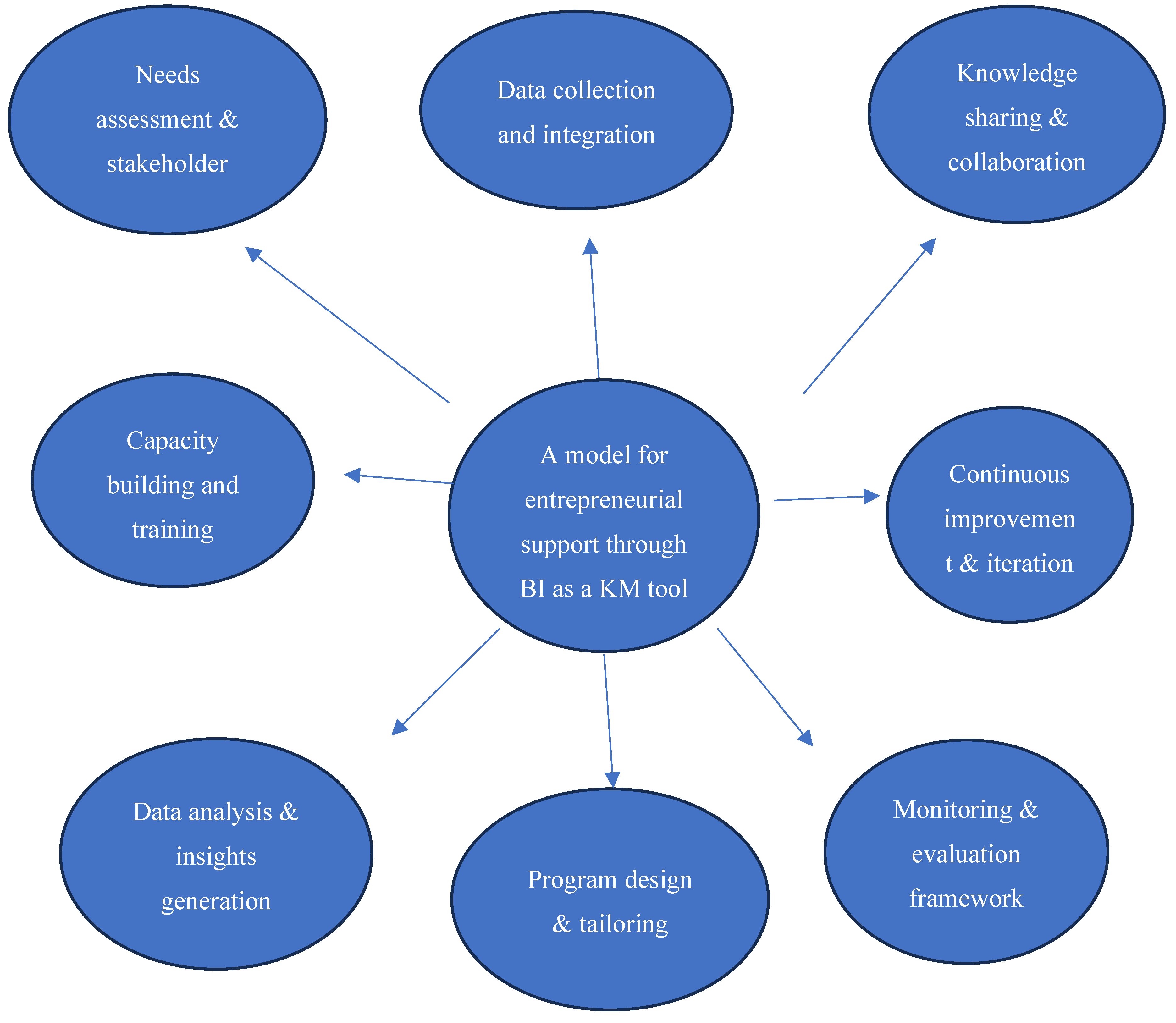
- Needs assessment and stakeholder analysis: Conduct a comprehensive needs assessment to identify the specific needs and challenges faced by entrepreneurs within the target demographic. Additionally, analyze the key stakeholders involved in the entrepreneurial ecosystem, including entrepreneurs themselves, government agencies, financial institutions, industry associations, and community organizations.
- Data collection and integration: Collect relevant data from various sources, including government databases, surveys, market research reports, and feedback from stakeholders. Ensure that the data collected is diverse, comprehensive, and aligned with the identified needs of entrepreneurs. Integrate data from internal DSBD systems as well as external sources such as SEDA and SEFA.
- Data analysis and insights generation: Utilize BI tools and techniques to analyse the collected data and generate actionable insights. This involves data mining, predictive analytics, and visualization techniques to identify trends, patterns, and correlations relevant to entrepreneurial support programs. Insights should be translated into actionable recommendations for program development and implementation.
- Program design and tailoring: Design entrepreneurial support programs based on the insights generated from data analysis. Ensure that programs are tailored to address the specific needs and preferences of entrepreneurs within different segments of the target demographic. Consider factors such as industry sector, business size, geographic location, and stage of business development.
- Monitoring and evaluation framework: Develop a robust monitoring and evaluation framework to track the effectiveness and impact of entrepreneurial support programs over time. Define key performance indicators (KPIs) and metrics to measure program outcomes, such as business growth, job creation, revenue generation, and customer satisfaction. Regularly collect and analyze data to assess program performance and identify areas for improvement.
- Continuous improvement and iteration: Establish a culture of continuous improvement and iteration within the DSBD’s entrepreneurial support programs. Use feedback from stakeholders and program evaluations to refine program design, delivery, and outcomes. Incorporate new data and insights into program development to ensure relevance and effectiveness in addressing evolving entrepreneurial needs.
- Knowledge sharing and collaboration: Facilitate knowledge sharing and collaboration among stakeholders involved in entrepreneurial support programs. Establish platforms for sharing best practices, lessons learned, and success stories to foster collaboration and collective learning. Leverage BI tools to facilitate data sharing and collaboration across different organisational levels and external partners.
- Capacity building and training: Provide training and capacity building programs for DSBD staff and external stakeholders involved in delivering entrepreneurial support programs. Equip them with the necessary skills and knowledge to effectively leverage BI tools and techniques for data-driven decision-making and program implementation
9. Conclusion and Recommendations
The article concludes that the integration of Business Intelligence (BI) with Knowledge Management (KM) tools offers substantial benefits to entrepreneurial support services, particularly when applied by the Department of Small Business Development (DSBD). By using BI-driven insights, the DSBD can make more informed and data-backed decisions that better address the dynamic and unique needs of entrepreneurs. This integration allows the DSBD to not only provide more tailored support but also to anticipate trends, identify emerging opportunities, and mitigate potential risks, all of which are critical for the long-term success of startups and small businesses. By empowering entrepreneurs with actionable intelligence and relevant knowledge, the model enables them to make strategic decisions that foster business sustainability.
Furthermore, this model has the potential to drive broader economic growth by ensuring that entrepreneurial ventures are not only supported but are also given the tools they need to thrive in a competitive marketplace. Through this alignment of BI and KM principles, the DSBD can enhance the overall impact of its entrepreneurial programs, creating a more adaptive and resilient ecosystem for small businesses, which in turn contributes to the stability and growth of the South African economy.
References
- Alsibhawi, IAA, Yahaya, JB & Mohamed, HB. 2023. Business intelligence adoption for small and medium enterprises: conceptual framework. Applied Sciences 13(7):41-21. [CrossRef]
- Bickley, SJ, Macintyre, A & Torgler, B. 2024. Artificial intelligence and big data in sustainable entrepreneurship. Journal of Economic Surveys. https://doi.org/10.1111/joes.12611 (Accessed 25 September 2023). [CrossRef]
- Department of Trade, Industry & Competition. 2019. Annual Incentive Report. http://www.thedtic.gov.za/wp-content/uploads/2018-2019_Annual_Incentive_Report.pdf (Accessed 13 February 2023).
- National Youth Development Agency. 2020. Annual Report. https://www.nyda.gov.za/Portals/0/downloads/NYDA%20ANNUAL%20REPORT%20201920%20UPDATE%20V7.pdf (Accessed 3 November 2023).
- Small Enterprise Finance Agency. 2019. Annual Report. https://www.sefa.org.za/uploads/files/files/10189-SEFA_ANNUAL_REPORT_201819.pdf (Accessed 7 December 2022).
- Koe, WL & Sakir NA. 2020. The motivation to adopt e-commerce among Malaysian entrepreneurs. Organizations and Markets in Emerging Economies 11(1):189-202. https://www.ceeol.com/search/article-detail?id=870419 (Accessed 6 March 2022).
- Rostami, N A.2014. Integration of Business Intelligence and Knowledge Management – A literature review. Journal of Intelligence Studies in Business 4(2). [CrossRef]
- Becerra-Fernandez I, Sabherwal R.2014. Knowledge management: Systems and processes.[eBook].Routledge. [CrossRef]
- Rao, GK & Kumar, R. 2011. Framework to integrate business intelligence and knowledge management in banking industry. https://doi.org/10.48550/arXiv.1109.0614 (Accessed 2 February 2023). [CrossRef]
- Mohamad, AK, Jayakrishnan, M & Yusof, MM. 2022. Thriving information system through business intelligence knowledge management excellence framework. International Journal of Electrical & Computer Engineering 12:(1) 2088-8708. [CrossRef]
- Romero, CA, Ortiz, JH, Khalaf, OI & Ríos Prado, A. 2021. Business Intelligence: Business Evolution after Industry 4.0. Sustainability 13(18):10026. https://doi.org/10.3390/su131810026 (Accessed 6 April 2024). [CrossRef]
- Kristoffersen, E, Mikalef, P, Blomsma, F & Li, J. 2021. Towards a business analytics capability for the circular economy. Technological Forecasting and Social Change 171:120-957. [CrossRef]
- Kumar, A. 2023. Barriers to Adoption of Business Analytics and Artificial Intelligence: A Study of Top Management. PhD dissertation, American Business Management and Technology College, Switzerland.
- Mathrani, S & Edwards, B. 2020. Knowledge-sharing strategies in distributed collaborative product development. Journal of Open Innovation: Technology, Market, and Complexity 6(4):194. https://www.mdpi.com/2199-8531/6/4/194# (Accessed 28 August 2022).
- Edelman, S. 2023. Enhancing a knowledge intensive service process with knowledge management and data driven management. https://urn.fi/URN:NBN:fi-fe20231030141812 (Accessed 4 May 2023).
- Ranjan, J & Foropon, C. 2021. Big data analytics in building the competitive intelligence of organizations. International Journal of Information Management 56:102-231. [CrossRef]
- Moinuddin, M, Usman, M & Khan, R. 2024. Strategic Insights in a Data-Driven Era: Maximizing Business Potential with Analytics and AI. Revista Espanola de Documentacion Cientifica 18(02):117-133.
- Telukdarie, A, Philbin, S, Mwanza, BG. & Munsamy, M. 2022. Digital platforms for SMME enablement. Procedia Computer Science 200:811-819. [CrossRef]
Disclaimer/Publisher’s Note: The statements, opinions and data contained in all publications are solely those of the individual author(s) and contributor(s) and not of MDPI and/or the editor(s). MDPI and/or the editor(s) disclaim responsibility for any injury to people or property resulting from any ideas, methods, instructions or products referred to in the content. |
© 2025 by the authors. Licensee MDPI, Basel, Switzerland. This article is an open access article distributed under the terms and conditions of the Creative Commons Attribution (CC BY) license (http://creativecommons.org/licenses/by/4.0/).
Copyright: This open access article is published under a Creative Commons CC BY 4.0 license, which permit the free download, distribution, and reuse, provided that the author and preprint are cited in any reuse.


