

Submitted:
17 June 2025
Posted:
19 June 2025
You are already at the latest version
Abstract
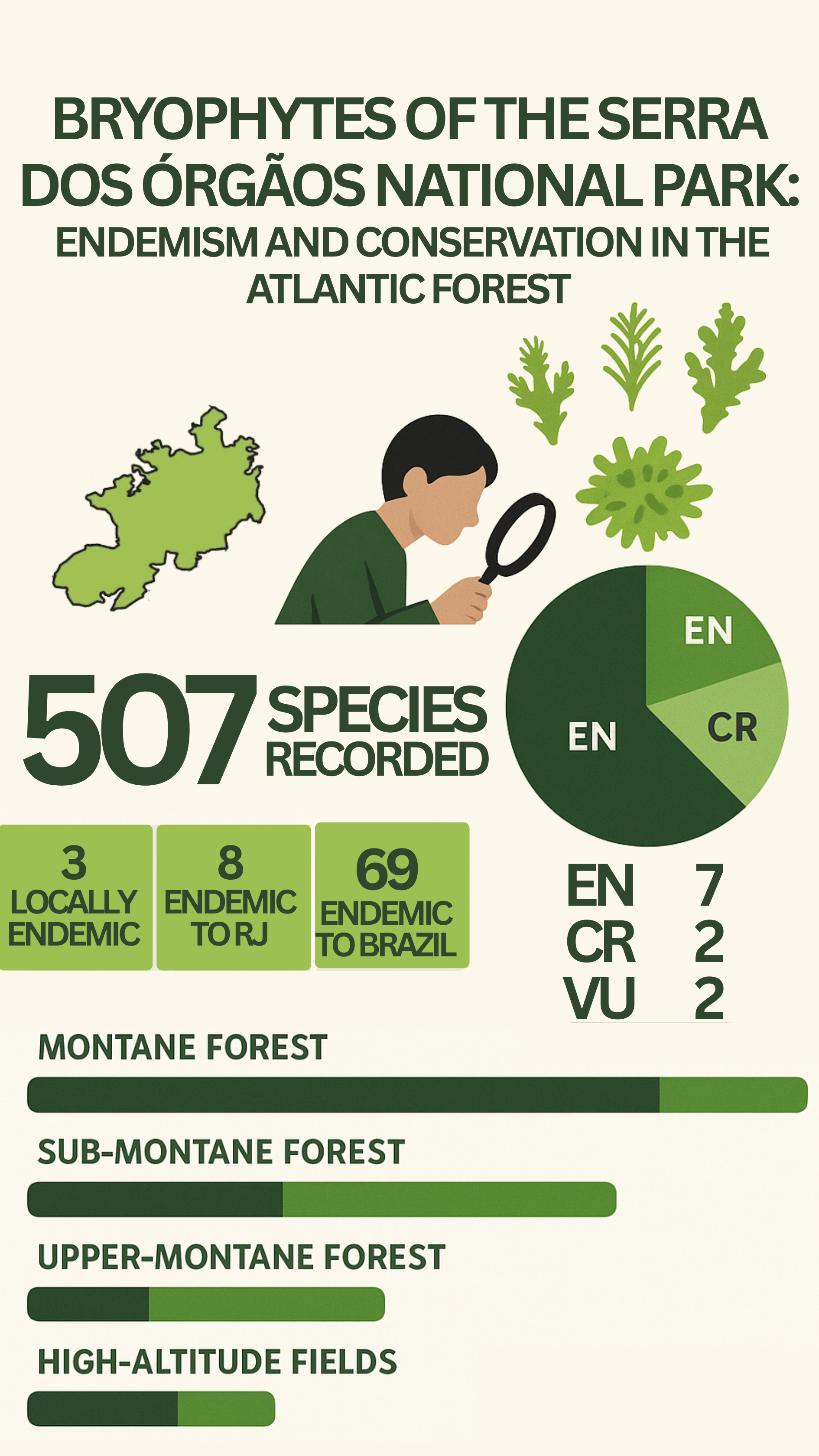
This study presents a comprehensive inventory of bryophytes in Serra dos Órgãos National Park (PARNASO), aiming to evaluate species richness, floristic composition and threatened taxa. Despite the state of Rio de Janeiro being one of the most extensively sampled regions for bryophytes in Brazil, detailed surveys of its conservation units remain scarce. Data were obtained through bibliographic review, herbarium specimen analysis, and new field collections. A total of 507 species were recorded, belonging to 206 genera and 77 families, including 17 new records for the state. The Park harbors three locally endemic species, eight endemic to Rio de Janeiro, and 69 species endemic to Brazil. Additionally, eleven species were identified as threatened, comprising seven Endangered (EN), two Critically Endangered (CR), and two Vulnerable (VU). Montane Forest showed the highest species richness, followed by High-altitude Fields, Upper-montane Forest, and Sub-montane Forest. The findings highlight PARNASO's importance in preserving bryophyte diversity in a highly biodiverse yet understudied region. This work contributes valuable baseline data to support conservation strategies and future ecological studies in Atlantic Forest remnants.
Keywords:
endangered species
; highlands
; liverworts
; mosses
1. Introduction
Serra dos Órgãos National Park (PARNASO), established on November 30th, 1939, holds the distinction of being the third national park created in Brazil. This protected area is situated within the Atlantic Forest domain, specifically in the Serra do Mar massifs and called Órgãos because its peaks resemble and are named as “organs”. The Serra do Mar is an extensive mountain ranging approximately 1,500 kilometers along the Brazilian coast, from the northern Santa Catarina State to Rio de Janeiro State [1,2].
PARNASO currently represents one of the most important remaining biodiversity hotspots in Rio de Janeiro State, since its environment formations are one of the largest centers of flower plant endemism in the Atlantic Forest. It also plays a vital role in preserving essential water sources that feed two main watersheds — Paraíba do Sul and several streams of the Baía de Guanabara [3,4,5,6,7,8].
The Atlantic Forest domain is one of the most species-rich forests in the tropics [9,4,10] , with. It is also recognized for having high levels of biodiversity and endemism, expressed via its complex structural environments [11,12].
Tropical forests hold the highest diversity of bryophyte species in the world due to their structural complexity and microhabitat diversity [13,14]. This diversity varies in altitudinal, both in structure and floristic composition [14,15,16,17,18,19,20,21,22].
The Atlantic Forest within PARNASO comprises well-preserved forests characterized by four distinct vegetation formations based on altitude, climate, and soil conditions, among other factors [23,24,25,6,26]. In the lower parts around Sede Guapimirim, Sub-montane Forest prevails, while near Sede at Teresópolis, the forest transitions from Montane Forest to Upper-montane Forest, culminating above 2,000 m.a.s.l. and High-altitude Fields along the trail from Teresópolis to Petrópolis [27].
Latitude, climatic variation and substrate disponibility due strong influence on species diversity with the altitude of these belts in different regions [15,18], while low species occurrence follows lower altitudinal ranges [28].
The species list of the vascular plants in Flora Organensis [23] is strongly based on the work of 18th century botanists and on collections made especially by A.C. Brade (1881-1971) and C.T. Rizzini (1921-1992), between the 1930s and 1950s of the 20th century. These collectors also recorded bryophytes and the specimens are studied by Bartram (1954), who found 146 species. Most bryophyte specimens from Serra dos Órgãos are deposited in the Herbarium of Jardim Botânico do Rio de Janeiro (RB).
Bryophytes from PARNASO were low explored, even though several researchers collected and published new taxa, the information was dispersed as examined material in taxonomical revisionary work. Faria et al. (2021) do collections trying to re-collect species founded by Glaziou in Serra dos Órgaos and the taxonomic reclassification of an Atlantic Forest endemic [30].
There is no other information of bryophytes in PARNASO, thus, no detailed data on the floristic structure and composition of bryophytes. A list of the species will fill an important area of the Rio de Janeiro state and help the threatened evaluation of bryophytes species. As well as provide revised herbarium specimens and new collections to stimulate new research on ecology and biogeography in this important National Park.
This work aimed to provide an inventory of the bryophyte species in PARNASO and discuss the following topics: (i) Species richness and floristic composition; (ii) Substrate colonization; and (iii) Endemism and conservation status.
2. Results
2.1. Species Richness and Floristic Composition
The present study documented 507 species, in 206 genera and 77 families (Table 1). The Serra dos Orgaos National Park preserves 57% of the known bryophyte flora of Rio de Janeiro State and 31% of Brazil. Seventeen new species occurrences for Rio de Janeiro State are founded, indicated by # in Table 1. We analyse ca 3,000 specimens for 428 species, while 79 species (indicated by * in Table 1) remains known only in the literature.
Three species are locally endemic, being known only from the type specimens collected over 100 years ago: Southbya organensis (Lützelburg 6003 p.p. [holotype JE]), Plagiochila pseudoradicans (Lützelburg 6029b [holotype JE]) and Dicranodontium pulchroalare ssp. brasiliense (Lützelburg 1519 [holotype JE]). Efforts are needed to obtain new records for these species.
The most species-rich families of liverworts are Lejeuneaceae (65 spp.) and Lepidoziaceae (16 spp.), while for moss they are Leucobryaceae (30 spp.) and Sphagnaceae (25 spp.). Eight species of hornworts were found, distributed among the families Dendrocerotaceae (4 spp.), Anthocerotaceae (2 spp.) and Nothotyladaceae (2 spp.). The most species-rich genera were: Campylopus (Leucobryaceae, 23 spp.); Plagiochila (Plagiochilaceae, 21 spp.); Fissidens (Fissidentaceae, 20 spp.); Lejeunea (Lejeuneaceae, 16 spp.) and Metzgeria (Metzgeriaceae, 14 spp.). Considering the samples analyzed, the species comonest species and more recorded were: Campylopus arctocarpus (7 specimens); Lejeunea acanthogona (7); Lejeunea flava (7); Radula nudicaulis (7); Bryum capillare (6); Fissidens wallisii (6); Lejeunea serpillifolioides (6); Rigodium toxarion (6); Trichocolea brevifissa (6) and Zelometeorium ambiguum (6).
2.2. Substrate Colonization
The bryophyte species predominantly colonized rocks (210 spp.), followed by tree trunks (209 spp.), soil (205 spp.), logs (50 spp.), and leaves (29 spp.).
Phorophyte availability within the forests of PARNASO clearly influences the bryophyte species occurrence. Mosses predominantly colonize tree trunks, with only four species being found on leaves: Paraleucobryum longifolium (Dicranaceae); Philophyllum tenuifolium (Hookeriaceae); Toloxis imponderosa (Meteoriaceae) and Schlotheimia tecta (Orthotrichaceae).
The colonization of rocks by bryophytes is mainly related to the rare species such as Campylopus uleanus. The high-altitude rocky outcrops of igneous and metamorphic origin (Figure 1) are characteristic of altitudes above 1800 m.a.s.l.
The lowest bryophyte colonization was for leaves (epiphyllous). Most of the species that colonized this substrate in High-altitude Fields were mosses (60%), followed by liverworts (40%).
The leaf-colonizing species most frequent were the leafy liverworts of the family Lejeuneaceae (21 spp.), followed by Radulaceae (2 spp.) and the thallose liverwort family Metzgeriaceae (2 spp.). According to Gradstein et al. (2001) and Ilkiu-Borges & Lisboa (2004) species of Lejeuneaceae can colonize different types of substrates, but their occurrence on leaves is indicative of preserved native areas.
2.3. Endemism and Conservation Status
The Serra dos Orgaos Park protects three species locally endemic, 8 from Rio de Janeiro state and 69 Brazilian (Table 2). The species endemic to Rio de Janeiro state recorded in the park was in High-altitude Fields (Table 2) Endemism and species richness are high with increase of altitudes, as was also found in Itatiaia National Park located in Serra da Mantiqueira [22].
Of the 28 species of Brazilian endemic bryophytes exclusive to High-altitude Fields, 12 belong to the family Sphagnaceae (42%), representing almost half of the Brazilian endemic species found in this vegetation formation. The species Sphagnum luetzelburgii and S. sehnemii are endemic to Brazil, occurring in the states of Paraná, Santa Catarina, Rio Grande do Sul and Rio de Janeiro. However, in Rio de Janeiro State, these species are restricted to mountains of the Atlantic Forest and have only been reported for PARNASO by Costa (2021), and not by the present work.
The lower number of endemic species recorded in Sub-montane Forest, probably reflecting the effects of ecological and biogeographic processes, as well as human interference [22]. Among the 19 endemic species exclusively found in Montane Forest, 13 are liverworts and six are mosses. The predominant liverwort family is Lejeuneaceae, with nine species, followed by Metzgeriaceae with three and Jamesoniellaceae with two.
We have re-collected some species considered rare like: Bryum limbatum, Ochi (1980) cite a collection from (43 years ago; Metzgeria furcata, Bartram (1954) cite a collection from 69 years ago; Sphagnum cuspidatum, collected by Luetzelburg in 1923 (100 years ago) and Andreaea acutifolia, collected by Mueller in 1845 (178 years ago). Andreaea acutifolia is always mistakenly identified as A. rupestris, the two differing mainly by perichaetial leaves [30]. The species S. cuspidatum is widespread in Brazil [33], but has been collected only once in PARNASO.
The Serra dos Orgaos Park also protects eleven of the species indicated as threatened by CNCFlora and Flora e Funga do Brasil (Figure 2 and Table 2) to the Rio de Janeiro state: seven as Endangered (EN), two as Critically Endangered (CR) and two as Vulnerable (VU). Among these threatened species, three are known only from the type material, and were not found in the field trips. Southbya organensis was described by Herzog (1948-1949) and is classified as Critically Endangered (CR) by CNCFlora (2012) due to its distribution being restricted to Serra dos Órgãos, specifically Morro do Açu peak that has an excessive tourism and recurrent criminal fires. Plagiochila pseudoradicans, and Dicranodontium pulchroalare ssp. brasiliense was described by Herzog (1925) and both were not assessed by CNCFlora (2012) because they were considered as Data Deficient (DD) at that time.
3. Discussion
The Serra dos Órgãos National Park (PARNASO) exhibits remarkable bryophyte diversity. This richness highlights the park as a key conservation area for bryophytes in the Atlantic Forest. The discovery of 17 species newly recorded for the state of Rio de Janeiro emphasizes the urgent need for continued floristic inventories, particularly in underexplored regions. These findings suggest that even in areas already considered well-studied, significant knowledge gaps remain, highlighting the dynamic nature of bryophyte diversity and distribution
One important factor contributing to this diversity is the presence of forested areas with abundant tree trunks, which serve as critical substrates for epiphytic bryophytes. The architectural, morphological, phenological, and chemical traits of different tree species create varied microhabitats that support a wide range of bryophyte taxa [36,37]. Shade-loving epiphytes, in particular, are commonly found in these forest environments, but are highly sensitive to environmental disturbances. As such, they are often among the first species to disappear following canopy opening or habitat degradation [38] making them reliable indicators of forest health.
In contrast, mosses exhibit a broader ecological amplitude due to their desiccation tolerance and structurally complex adaptations, such as costa development, hyaline leaf apices, papillae, and specialized conducting tissues like hydroids and leptoids [39, 40, 41]. These features enable many mosses to colonize exposed and drier substrates, including rocky outcrops. Similar patterns of moss dominance on rock surfaces have been observed in other highland regions of Brazil, such as Chapada Diamantina [42,43], Serra do Caraça [44], and Serra da Canastra [45].
The high-altitude ecosystems of PARNASO further enhance bryophyte diversity by creating isolated and unique habitats. Mountain summits, often compared to ecological islands due to their environmental isolation, support specialized flora adapted to harsh conditions such as strong winds, low temperatures, and nutrient-poor soils [46,47,48]. These rupestrian fields form natural refugia, acting as barriers to typical forest species and favoring the emergence of narrow endemics and rare taxa [49,50,51].
Overall, the findings of this study underscore the ecological importance and conservation value of Serra dos Órgãos National Park. Alongside Itatiaia National Park, PARNASO remains one of the most critical remnants of Atlantic Forest in Rio de Janeiro and Brazil, particularly in terms of bryophyte conservation. The park’s diverse topography, wide range of microhabitats, and climatic heterogeneity—marked by high altitudes, low temperatures, and high light availability—create optimal conditions for bryophyte diversity. Furthermore, the presence of endemic and threatened species reinforces the park’s role as a conservation priority. Such studies are valuable as they reveal the significance of endemism and species richness, crucial factors in determining conservation priorities [52], and emphasize the importance of preserving Serra dos Órgãos National Park.
4. Materials and Methods
Serra dos Órgãos National Park (PARNASO) is located in the highlands region of Rio de Janeiro State, Brazil, raging the municipalities of Teresópolis, Petrópolis, Guapimirim and Magé (22°23’36,96’’–22°34’57,72’’ S, 43°10’57,72’’– 42°58’43,68’’ W). It is a protected area with 20,024 hectares of Atlantic Forest in a central position in the Serra do Mar Ecological Corridor. Ranging in altitude from 80 to 2,275 m.a.s.l. (Figure 3), it is the highest portion of the entire Serra do Mar [2]. The climate is tropical super humid (80 – 90% relative humidity), with the annual average temperature ranging 13° – 23°C, although minimums can reach -5°C during winter above 800 m.a.s.l. [53,54,6,8]. The average annual rainfall ranges from 1,500 mm to 3,000 mm, with higher concentrations of rain during summer (December to March) and a dry season during winter (June to August), while heat is well distributed throughout the year [53,54,6,8].
The species list developed here is based on a bibliographic survey, herbarium specimens, and new collections (Figure 4). Herbarium specimens were located by on line sources like (GBIF, jabot, JStorTypes and SpeciesLink). All specimens are re-determined and carefully examined for small species associations. The collection, preservation and herborization methodologies follow Frahm (2003), and employed free walks [56] for covering all available substrates like: tree trunks, logs, soil, rocks and leaves.
Field trips in the Park intended to check if species collected in the past are yet present, taxa not recorded and fill the elevation information. Collected samples were deposited in the herbarium of the University of Brasília (UB), with duplicates sent to the herbarium of Instituto de Pesquisas Ambientais (SP). The classification system used here follows Crandall-Stotler et al. (2009) for Marchantiophyta, Buck & Goffinet (2009) for Bryophyta and Renzaglia et al. (2009) for Anthocerotophyta. Data referring to endemic species of Brazil and of Rio de Janeiro State came from Flora e Funga do Brasil (floradobrasil.jbrj.gov.br), while conservation status followed CNCFlora (cncflora.jbrj.gov.br).
The vegetation classification adopted follows Veloso et al. (1991) and Safford (1999): Sub-montane Forest below 600 m.a.s.l., Montane Forest (600 – 1.500), Upper-montane Forest (above 1.500), and High-altitude Fields (above 1800 – 2000) (Figure 4).
5. Conclusions
The Serra dos Órgãos National Park stands out as a key refuge for bryophyte diversity in the Atlantic Forest, hosting numerous endemic and threatened species. The discovery of several new records for Rio de Janeiro highlights the importance of continued floristic surveys. The park’s altitudinal variation, diverse microhabitats, and unique environmental conditions favor high species richness and endemism. These findings reinforce the ecological value of PARNASO and underscore the urgency of conserving this unique mountainous ecosystem.
Funding
This research was funded by the Fundação de Amparo à Pesquisa do Distrito Federal (FAP-DF)
Data Availability Statement
The original contributions presented in this study are included in the Supplementary Materials; further inquiries can be directed to the corresponding author.
Acknowledgements
We thank the Fundação de Amparo à Pesquisa do Distrito Federal (FAP-DF) for financial support to this project and the park coordinator PARNASO (Jorge Nascimento). We fully thank the support in field collections of the colleagues Amanda Leal, Anderson Eustáquio, Clapton Moura, Cosme Ponte and Flávio Rick.
Conflicts of Interest
The authors declare no conflicts of interest.
Abbreviations
| PARNASO | Serra dos Órgãos National Park |
References
- Mello, D.; Mello, G.; Mallet-Rodrigues, F. Aves da Serra dos Órgãos e Adjacências: Guia de Campo (Birds of the Serra dos Órgãos and surrounding areas: field guide). Neotropical Birding 2015, 19, 87. [Google Scholar]
- Cronemberger, C.; Delciellos, A.C.; Barros, C.S.; et al. Mamíferos do Parque Nacional da Serra dos Órgãos: Atualização da lista de espécies e implicações para a conservação. Oecologia Australis 2019, 23, 191–214. [Google Scholar] [CrossRef]
- Mori, S.A.; Boom, B.M.; Prance, G.T. Distribution Patterns and Conservation of Eastern Brazilian Coastal Forest Tree Species. Brittonia 1981, 33, 233–245. [Google Scholar] [CrossRef]
- Lima, H.C.; Guedes-Bruni, R.R. Plantas arbóreas da Reserva Ecológica de Macaé de Cima. In: Serra de Macaé de Cima. In Serra de Macaé de Cima: diversidade florística e conservação em Mata Atlântica; Lima, H.C., Guedes-Bruni, R.R., Eds.; Jardim Botânico do Rio de Janeiro: Rio de Janeiro, Brasil, 1997; pp. 53–63. [Google Scholar]
- Guedes, M.L.; Batista, M.A.; Ramalho, M.; Freitas, H.M.B.; Silva, E.M. Breve incursão sobre a biodiversidade da Mata Atlântica. In: Mata Atlântica. In Mata Atlântica e biodiversidade; Franke, C.R., Rocha, P.L.B., Klein, W., Gomes, S.L., Orgs., *!!! REPLACE !!!*, Eds.; Edufba: Salvador, Brasil, 2005; pp. 39–92. [Google Scholar]
- Cronemberger, C.; Castro, E.V. Envolvendo a Comunidade Científica na Gestão do Parque Nacional da Serra dos Órgãos. Biodiversidade Brasileira 2015, 5, 4–20. [Google Scholar]
- Coelho, M.A.N.; Baumgratz, J.F.A.; Lobão, A.Q.; Sylvestre, L.S.; Trovó, M.; Silva, L.A.E. Flora of Rio de Janeiro state: an overview of Atlantic Forest diversity. Rodriguésia 2017, 68, 1–011. [Google Scholar] [CrossRef]
- de Carvalho-E-Silva, S.P.; de Carvalho-E-Silva, A.M.P.T.; Folly, M.; de Luna-Dias, C.; Bezerra, A.d.M.; Gomes, M.d.R.; Caram, J.; Peixoto, O.L.; Izecksohn, E. Parque Nacional da Serra dos Órgãos: the highest Amphibian diversity within an Atlantic Forest protected area. Biota Neotropica 2020, 20. [Google Scholar] [CrossRef]
- Primack, R.B. Essentials of Conservation Biology. Sinauer: Sunderland, UK, 1993; 608 pp.
- Myers, N.; Mittermeier, R.A.; Mittermeier, C.G.; da Fonseca, G.A.B.; Kent, J. Biodiversity hotspots for conservation priorities. Nature 2000, 403, 853–858. [Google Scholar] [CrossRef]
- Leigh, E.G.; Davidar, P.; Dick, C.W.; et al. Why do some tropical forests have so many species of trees? Biotropica 2004, 36, 447–473. [Google Scholar]
- Corlett, R.T.; Primack, R.B. Tropical rain forests: an ecological and biogeographical comparison. Wiley Blackwell: Oxford, UK, 2011.
- Pócs, T. Tropical Forest Bryophytes. In Bryophyte Ecology; Smith, A.J.E., Ed.; Chapman and Hall: New York, USA, 1982; pp. 59–103. [Google Scholar]
- Gradstein, S.R. Bryophyte diversity of the tropical rainforest. Archives des sciences [Société de physique et d’histoire naturelle de Genève] 1995, 48, 91–96. [Google Scholar]
- Frahm, J.-P.; Gradstein, S.R. An Altitudinal Zonation of Tropical Rain Forests Using Byrophytes. J. Biogeogr. 1991, 18, 669. [Google Scholar] [CrossRef]
- Wolf, J.H.D. Epiphyte communities of tropical montane rain forest in the northern Andes. II. Upper montane communities. Phytocoenologica 1993, 22, 53–103. [Google Scholar]
- Pócs, T. The altitudinal distribution of Kilimanjaro bryophytes. In: XIIIth Plenary meeting. AETFAT; Seyani, J.H., Chikuni, A.C., Eds.; Zomba, Malawi, 1994; pp. 797–812.
- Gradstein, S.R.; Churchill, S.P.; Salazar, A.N. Guide to the Bryophytes of Tropical America. Memoirs of The New York Botanical Garden: New York, USA, 2001; Volume 86, pp. 1–577.
- Gyrtnes, J.A.; Heegaard, E.; Ihlen, P.G. Species richness of vascular plants, bryophytes and lichens along an altitudinal gradient in western Norway. Acta Oecologica 2006, 29, 241–246. [Google Scholar] [CrossRef]
- Grau, O.; Grytnes, J.; Birks, H.J.B. A comparison of altitudinal species richness patterns of bryophytes with other plant groups in Nepal, Central Himalaya. J. Biogeogr. 2007, 34, 1907–1915. [Google Scholar] [CrossRef]
- Ah-Peng, C.; Wilding, N.; Kluge, J.; Descamps-Julien, B.; Bardat, J.; Chuah-Petiot, M.; Strasberg, D.; Hedderson, T.A. Bryophyte diversity and range size distribution along two altitudinal gradients: Continent vs. island. Acta Oecologica 2012, 42, 58–65. [Google Scholar] [CrossRef]
- Costa, D.P.; Santos, N.D.; Rezende, M.A.; Buck, W.R.; Schäfer-Verwimp, A. Bryoflora of the Itatiaia National Park along an elevation gradient: diversity and conservation. Biodiversity and Conservation 2015, 24, 2199–2212. [Google Scholar] [CrossRef]
- Rizzini, C.T. Flora organensis: lista preliminar dos Cormophyta da Serra dos Órgãos. Arquivos do Jardim Botânico do Rio de Janeiro 1954, 13, 115–243. [Google Scholar]
- Veloso, H.P.; Rangel-Filho, A.L.R.; Lima, J.C.A. Classificação da vegetação brasileira, adaptada a um sistema universal. IBGE: Rio de Janeiro, Brasil, 1991; 124 p.
- Amador, E.S. Baía de Guanabara e ecossistemas periféricos: homem e natureza. Rio de Janeiro, Brasil, 1997; 539 p.
- Aguiar, A.P.; Chiarello, A.G.; Mendes, S.L.; Matos, E.N. Os corredores Central e da Serra do Mar na Mata Atlântica Brasileira. In Mata Atlântica: biodiversidade, ameaças e perspectivas; Galindo-Leal, C., Câmara, I.G., Eds.; S.O.S. Mata Atlântica e Conservação Internacional e Centro de Ciências Aplicadas à Biodiversidade: Belo Horizonte, Brasil, 2005; pp. 119–132. [Google Scholar]
- Parrini, R.; Pardo, C.S.; Pacheco, J.F. Conhecendo as plantas cujos frutos e recursos florais são consumidos pelas aves na Mata Atlântica do Parque Nacional da Serra dos Órgãos. Atualidades Ornitológicas 2017, 199, 38–136. [Google Scholar]
- Gradstein, S.R.; Costa, D.P. The hepaticae and anthocerotae of Brazil. Memoirs of the New York Botanical Garden: New York, USA, 2003; Volume 87, pp. 1–336.
- Faria, A.L.A.; Peralta, D.F.; de Amorim, E.T.; Câmara, P.E.A.S.; Carvalho-Silva, M. Bryophytes from Glaziou's historical collections: revisiting the flora of Rio de Janeiro and implications for conservation. Cryptogam. Bryol. 2021, 42, 197–204. [Google Scholar] [CrossRef]
- Peralta, D.F. The genus Andreaea Hedw. (Andreaceae, Bryophyta) in Brazil. Phytotaxa 2020, 451, 169–174. [Google Scholar] [CrossRef]
- Costa, D.P. A synopsis of the family Sphagnaceae in Brazil. Systematics Botany Monograph 2021, 111, 1–142. [Google Scholar]
- Ochi, H. A revision of the neotropical Bryoideae, Musci (First part). The Journal of the Faculty of Education Tottori University. Natural Science 1980, 29, 49–154. [Google Scholar]
- Flora e Funga do Brasil. Jardim Botânico do Rio de Janeiro. Available online: http://floradobrasil.jbrj.gov.br/ (accessed on July 30, 2023).
- Herzog, T.H. Miscellanea Bryologica. I. Neotropica. Memoranda Societatis pro Fauna et Flora Fennica 1948- 1949, 25, 53–54. [Google Scholar]
- CNCFlora. Southbya organensis. In: Lista Vermelha da flora brasileira versão 2012.2. Centro Nacional de Conservação da Flora. 2012. (accessed on July 27, 2023).
- Zotz, G.; Vollrath, B. The epiphyte vegetation of the palm Socratea exorrhiza - correlations with tree size, tree age and bryophyte cover. Journal of Tropical Ecology 2003, 19, 81–90. [Google Scholar] [CrossRef]
- Ilkiu-Borges, A.L.; Lisboa, R.C.L. Cololejeuneae (Lejeuneaceae, Hepaticae) na Estação Científica Ferreira Penna, Melgaço, PA, Brasil. Acta Botanica Brasilica 2004, 18, 887–902. [Google Scholar] [CrossRef]
- Gradstein, S.R. The taxonomic diversity of epiphyllous bryophytes. Abstracta Botanica 1997, 21, 15–19. [Google Scholar]
- Goffinet, B.; Buck, W.R.; Shaw, A.J. Morphology, anatomy and classification of the Bryophyta. In Bryophyte Biology, 2nd ed.; Goffinet, B., Shaw, A.J., Eds.; Cambridge University Press: New York, USA, 2009; pp. 56–138. [Google Scholar]
- Gao, B.; Li, X.; Zhang, D.; Liang, Y.; Yang, H.; Chen, M.; Zhang, Y.; Zhang, J.; Wood, A.J. Desiccation tolerance in bryophytes: The dehydration and rehydration transcriptomes in the desiccation-tolerant bryophyte Bryum argenteum. Sci. Rep. 2017, 7, 1–14. [Google Scholar] [CrossRef]
- Stotler, R.E.; Crandall-Stotler, B.J. A monograph of the genus Bryopteris (Swartz) Nees von Esenbeck. Bryophytorum Bibliotheca: Berlin, Germany, 1974; Volume 3, 159 pp.
- Bastos, C.J.P.; Yano, O.; Vilas Bôas-Bastos, S.B. Briófitas de campos rupestres da Chapada Diamantina, estado da Bahia, Brasil. Revista Brasileira de Botânica 2000, 23, 357–368. [Google Scholar] [CrossRef]
- Valente, E.d.B.; Pôrto, K.C.; Bastos, C.J.P. Habitat heterogeneity and diversity of bryophytes in campos rupestres. Acta Bot. Bras. 2017, 31, 241–249. [Google Scholar] [CrossRef]
- Carmo, D.M.D.; de Lima, J.S.; da Silva, M.I.; Amélio, L.d.A.; Peralta, D.F. Briófitas da Reserva Particular do Patrimônio Natural da Serra do Caraça, Estado de Minas Gerais, Brasil. Hoehnea 2018, 45, 484–508. [Google Scholar] [CrossRef]
- Carmo, D.M.D.; Peralta, D.F. Survey of bryophytes in Serra da Canastra National Park, Minas Gerais, Brazil. Acta Bot. Bras. 2016, 30, 254–265. [Google Scholar] [CrossRef]
- Schuster, R.M. Phytogeography of bryophytes. In: New manual of bryophytes. In New manual of bryophytes; Schuster, R.M., Ed.; Hattori Botanical Laboratory: Nichinan, Japan, 1983; pp. 463–626. [Google Scholar]
- Gotelli, N.J. Island Biogeography. In A Primer of Ecology, 4th ed.; Gotelli, N.J., Ed.; Sinauer Associates: Massachusetts, USA, 2009. [Google Scholar]
- Lomolino, M.V.; Riddle, B.R.; Whittaker, R.J. Biogeography: biological diversity across space and time, 5th ed.; Sinauer Associates is an imprint of Oxford University Press: Oxford, UK, 2016. [Google Scholar]
- Ribeiro, K.T.; Medina, B.M.O.; Scarano, F.R. Species composition and biogeographic relations of the rock outcrop flora on the high plateau of Itatiaia, SE-Brazil. Braz. J. Bot. 2007, 30, 623–639. [Google Scholar] [CrossRef]
- Costa, D.P.; Couto, G.P.; Siqueira, M.F.; Churchill, S.P. Bryofloristic affinities betwwen Itatiaia National Park and tropical Andean countries. Phytotaxa 2018, 346, 203–220. [Google Scholar] [CrossRef]
- Santos, N.D.; Oliveira, J.R.P.M.; Silva, L.T.P.; Gonçalves, M.T.A.; Peralta, D.F. Campos de altitude: ecossistemas prioritários para a conservação de briófitas. In Botânica: para que e para quem? Desafios, Avanços e Perspectivas na Sociedade Contemporânea; Moura, C.W.N., Shimizu, G.H., Eds.; Sociedade Botânica do Brasil: Brasília - DF, Brasil, 2022; pp. 92–99. [Google Scholar]
- Kier, G.; Kreft, H.; Lee, T.M.; Jetz, W.; Ibisch, P.L.; Nowicki, C.; Mutke, J.; Barthlott, W. A global assessment of endemism and species richness across island and mainland regions. Proc. Natl. Acad. Sci. USA 2009, 106, 9322–9327. [Google Scholar] [CrossRef] [PubMed]
- Fiderj. Indicadores Climatológicos do Estado do Rio de Janeiro. Fundação de Desenvolvimento Econômico e Social do Rio de Janeiro: Rio de Janeiro, Brasil, 1978; 156 p.
- Davis, E.G.; Naghettini, M.C. Estudos de chuvas intensas no estado do Rio de Janeiro. 2 ed. CPRM: Brasília, Brasil, 2000; 142 p.
- Frahm, J.-P.; Pocs, T.; O´sHea, B.; Koponen, T.; Piippo, S.; Enroth, J.; Rao, P.; Fang, Y.-M. Manual of Tropical Bryology. Bryophyt. Divers. Evol. 2003, 23, 1–200. [Google Scholar] [CrossRef]
- Filgueiras, T.S.; Nogueira, P.E.; Brochado, A.L.; Guala II, G.F. Caminhamento: um método expedito para levantamentos florísticos qualitativos. Caderno de Geociências 1994, 12, 39–43. [Google Scholar]
- Safford, H.D. Brazilian páramos I. An introduction to the physical environment and vegetation of the campos de altitude. Journal of Biogeography 1999, 26, 693–712. [Google Scholar]
Figure 1.
Substrates colonized by bryophytes in Serra dos Órgãos National Park.
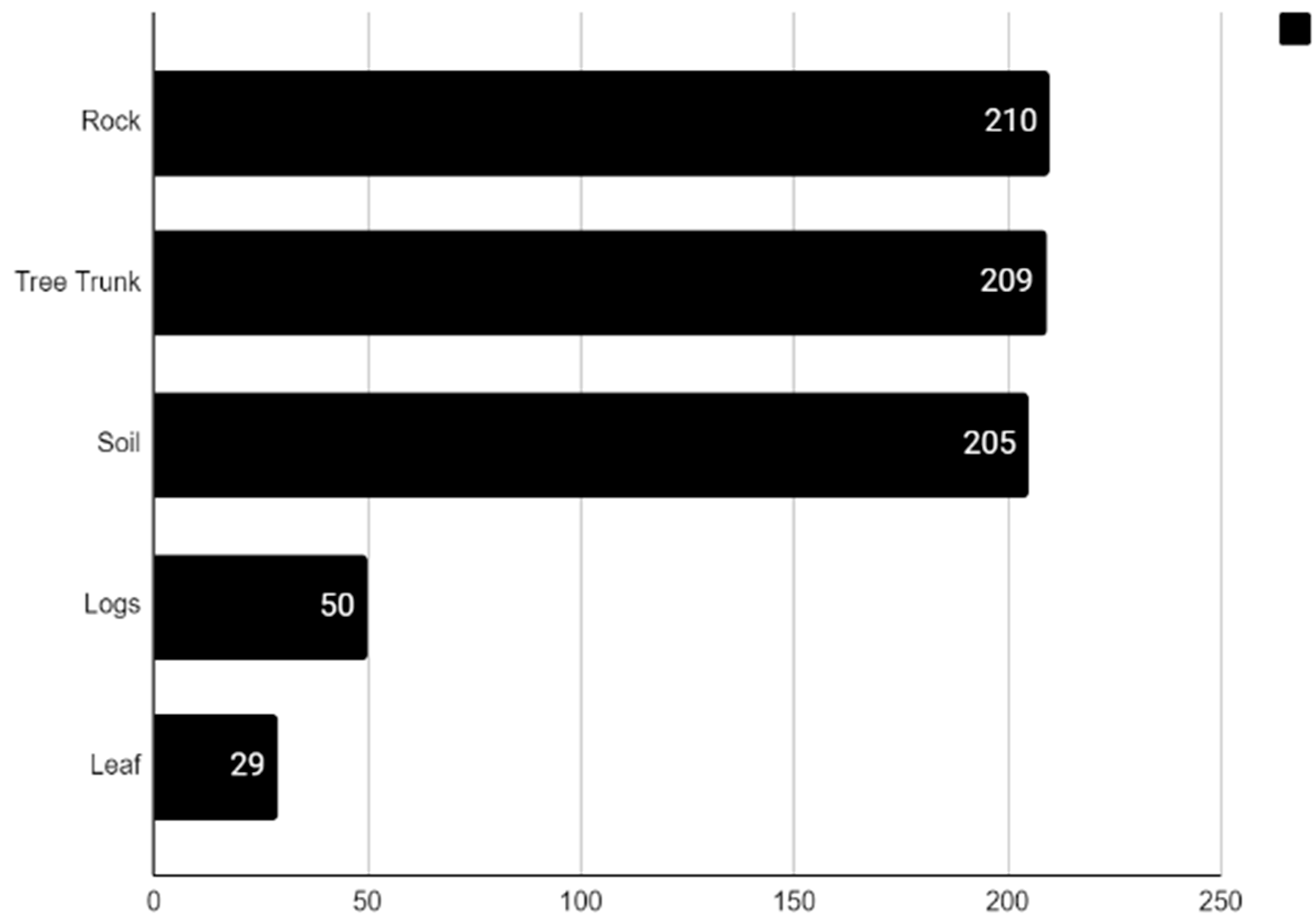
Figure 2.
Pictures of some species indicated as threatened to Serra dos Orgaos National Park. A. Gongylanthus liebmannianus (Lindenb. & Gottsche) Steph., B. Metzgeria hegewaldii Kuwah., C. Plagiochila boryana Gottsche ex Steph., D. Atractylocarpus longisetus (Hook.) E.B.Bartram, E. Leptodontium wallisii (Müll.Hal.) Kindb., F. Sphagnum perforatum Warnst. (Photos D.F. Peralta).
Figure 2.
Pictures of some species indicated as threatened to Serra dos Orgaos National Park. A. Gongylanthus liebmannianus (Lindenb. & Gottsche) Steph., B. Metzgeria hegewaldii Kuwah., C. Plagiochila boryana Gottsche ex Steph., D. Atractylocarpus longisetus (Hook.) E.B.Bartram, E. Leptodontium wallisii (Müll.Hal.) Kindb., F. Sphagnum perforatum Warnst. (Photos D.F. Peralta).
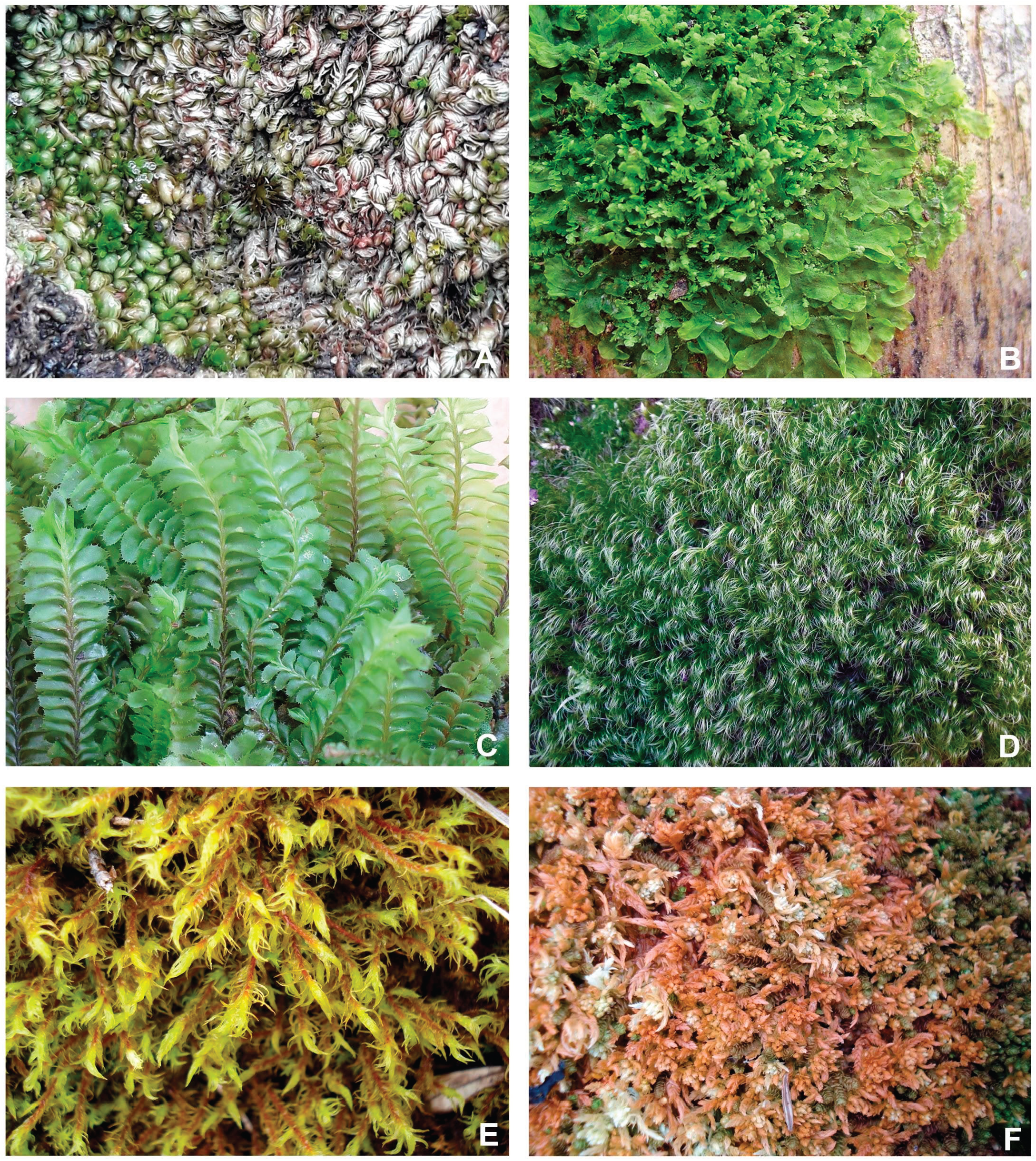
Figure 3.
Location of the Serra dos Órgãos National Park, Rio de Janeiro State, Brazil.
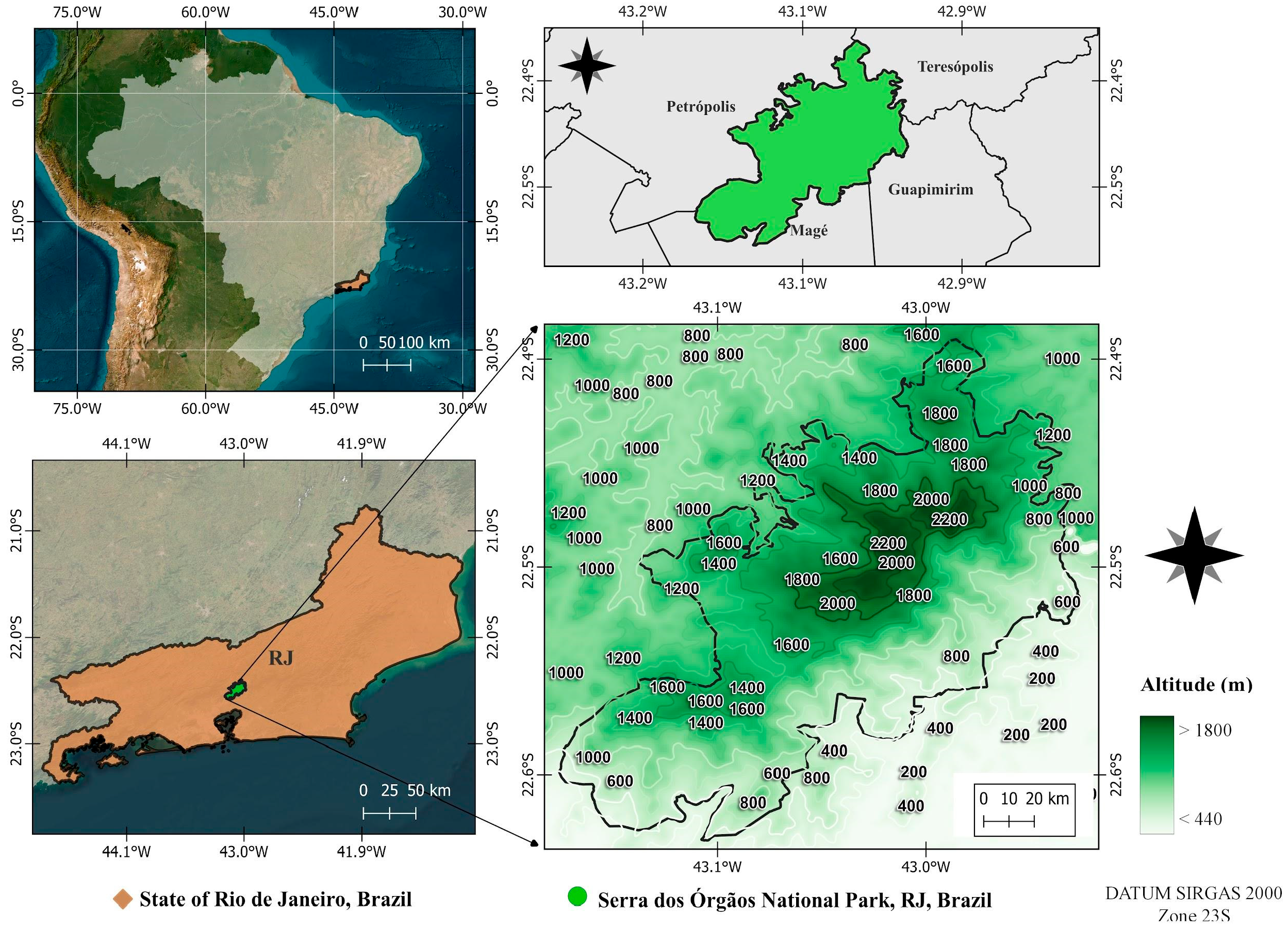
Figure 4.
Collection sites in Serra dos Órgãos National Park. A. Trail of the "Mirante", B. Aspect of the Montane Forest with streams, C. "Véu da Noiva" waterfall, D. Aspect of the Upper-montane Forest, E. Aspect of High-altitude Fields, with Sphagnum among Chusquea sp.
Figure 4.
Collection sites in Serra dos Órgãos National Park. A. Trail of the "Mirante", B. Aspect of the Montane Forest with streams, C. "Véu da Noiva" waterfall, D. Aspect of the Upper-montane Forest, E. Aspect of High-altitude Fields, with Sphagnum among Chusquea sp.
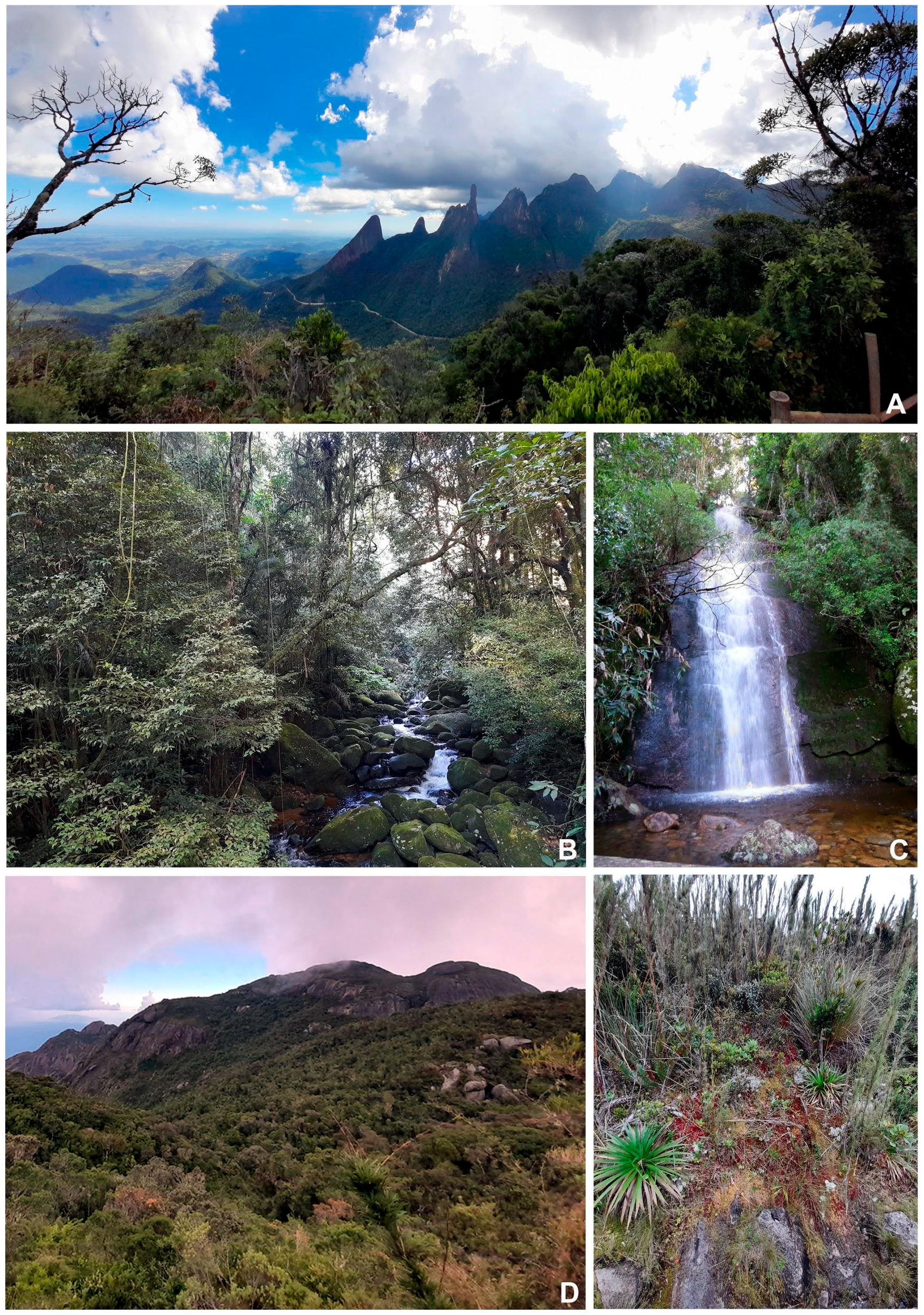

Table 1.
Richness and diversity of bryophyte species. Symbols on the species voucher: species only known from the literature (*); new occurrences of species for the Rio de Janeiro State (#).
Table 1.
Richness and diversity of bryophyte species. Symbols on the species voucher: species only known from the literature (*); new occurrences of species for the Rio de Janeiro State (#).
| Group | Family | Táxon | Author | Voucher | |
|---|---|---|---|---|---|
| Liverworts | Acrobolbaceae | Tylimanthus | laxus | (Lehm. & Lindenb.) Spruce | Peralta 27761 (SP) |
| Adelanthaceae | Syzygiella | colorata | (Lehm.) K. Feldberg et al. | Gonçalves 363 (SP) | |
| Adelanthaceae | Syzygiella | concreta | (Gottsche) Spruce | Peralta 20397 (SP) | |
| Aneuraceae | Aneura | pinguis | (L.) Dumort. | Peralta 27768 (SP) | |
| Aneuraceae | Riccardia | digitiloba | (Spruce ex Steph.) Pagán | Peralta 27496 (SP) | |
| Aneuraceae | Riccardia | emarginata | (Steph.) Hell | Peralta 27618 (SP) | |
| Aneuraceae | Riccardia | fucoidea | (Sw.) Schiffn. | Peralta 20395 (SP) | |
| Aneuraceae | Riccardia | glaziou | (Spruce) Meenks | Gaspar 121 (R) | |
| Aneuraceae | Riccardia | regnellii | (Aongström.) Hell | Peralta 27487 (SP) | |
| Arnelliaceae | Gongylanthus | liebmannianus | (Lindenb. & Gott.) Steph | Gonçalves 358 (SP) | |
| Arnelliaceae | Southbya | organensis | Herzog | *Ph. v. Lützelburg 6003 p.p. (Tipo JE) | |
| Balantiopsidaceae | Isotachis | aubertii | (Schwägr.) Mitt. | Gaspar 148 (R) | |
| Balantiopsidaceae | Isotachis | erythrorhiza | (Lehm. & Lindenb.) Steph. | Peralta 27572 (SP) | |
| Balantiopsidaceae | Isotachis | multiceps | (Lindenb. & Gottsche) Gottsche | Lima 783 (SP) | |
| Balantiopsidaceae | Isotachis | serrulata | (Sw.) Gottsche | Gonçalves 396 (SP) | |
| Balantiopsidaceae | Neesioscyphus | carneus | (Nees) Grolle | Peralta 20398 (SP) | |
| Balantiopsidaceae | Neesioscyphus | homophyllus | (Nees) Grolle | Peralta 27722 (SP) | |
| Calypogeiaceae | Calypogeia | peruviana | Nees & Mont. | Peralta 27491 (SP) | |
| Cephaloziaceae | Cephaloziella | divaricada | (Sm.) Schiffn. | Gaspar 112 (R) | |
| Cephaloziaceae | Cephaloziella | granatensis | (J.B.Jack) Fulford | Peralta 27638 (SP) | |
| Cephaloziaceae | Cylindrocolea | planifolia | (Steph.) R.M.Schust. | Peralta 27621 (SP) | |
| Cephaloziaceae | Kymatocalyx | dominicensis | (Spruce) Vána | Peralta 27755 (SP) | |
| Cephaloziaceae | Odontoschisma | denudatum | (Nees) Dumort. | Peralta 20506 (SP) | |
| Cephaloziaceae | Odontoschisma | longiflorum | (Taylor) Trevis. | *Fulford (1976) | |
| Cephaloziellaceae | Cephaloziopsis | intertexta | (Gottsche) R.M. Schust. | Peralta 27488 (SP) | |
| Cephaloziellaceae | Fuscocephaloziopsis | crassifolia | (Lindenb. & Gottsche) Váňa & L. Söderstr. | Dias 1414 (SP) | |
| Dumortieraceae | Dumortiera | hirsuta | Nees & Mont. | Peralta 27710 (SP) | |
| Frullaniaceae | Frullania | atrata | Nees | Faria 1560 (SP) | |
| Frullaniaceae | Frullania | beyrichiana | (Lehm. & Lindenb.) Lehm. & Lindenb. | *Beyrich s.n. (holótipo W) | |
| Frullaniaceae | Frullania | brasiliensis | Raddi | Peralta 27631 (SP) | |
| Frullaniaceae | Frullania | cuencensis | Taylor | Peralta 27551 (SP) | |
| Frullaniaceae | Frullania | ericoides | (Nees) Mont. | *Nees (1833, as Jungermannia) | |
| Frullaniaceae | Frullania | kunzei | (Lehm. & Lindb.) Lehm. & Lindb. | Peralta 20492 (SP) | |
| Frullaniaceae | Frullania | obcordata | (Lehm. & Lindenb.) Lehm. & Lindenb. | *Winter & Schaefer Verwimp (2020) | |
| Frullaniaceae | Frullania | obscura | (Sw.) Dumort. | Peralta 20453 (SP) | |
| Frullaniaceae | Frullania | riojaneirensis | (Raddi) Spruce | *Gottsche et al. (1844) | |
| Frullaniaceae | Frullania | schaefer-verwimpii | Yuzawa & Hatt. | Schafer-Verwimp 7375 (SP) | |
| Frullaniaceae | Frullania | setigera | Steph. | Peralta 27501 (SP) | |
| Frullaniaceae | Frullania | vitalii | Yuzawa & Hatt. | Yano 13575 (SP) | |
| Geocalycaceae | Saccogynidium | caldense | (Ångstr.) Grolle | Peralta 27620 (SP) | |
| Herbertaceae | Herbertus | acanthelius | Spruce | Peralta 27534 (SP) | |
| Herbertaceae | Herbertus | juniperoideus | (Sw.) Grolle | Gissi 339 (SP) | |
| Herbertaceae | Herbertus | pensilis | (T. Taylor) Spruce | Peralta 27612 (SP) | |
| Herbertaceae | Herbertus | sendtneri | (Nees) A. Evans | *Fulford (1963 with Herbertus grossispinus) | |
| Herbertaceae | Triandrophyllum | subtrifidum | (Hook.f. & Taylor) Fulford & Hatch. | *Grolle (1964) | |
| Jamesoniellaceae | Syzygiella | anomala | (Lindenb. & Gottsche) Steph. | Lima 789pp (SP) | |
| Jamesoniellaceae | Syzygiella | colorata | (Lehm.) K. Feldberg et al. | Peralta 27575 (SP) | |
| Jamesoniellaceae | Syzygiella | contigua | Steph. | Peralta 20509 (SP) | |
| Jamesoniellaceae | Syzygiella | manca | (Mont.) J. B. Jack & Steph. | Gonçalves 389 (SP) | |
| Jamesoniellaceae | Syzygiella | perfoliata | (Sw.) Spruce | Peralta 20401 (SP) | |
| Jamesoniellaceae | Syzygiella | sonderi | (Gottsche) K. Feldberg, Váňa, Hentschel & Heinrichs | Peralta 27502 (SP) | |
| Jamesoniellaceae | Syzygiella | trigonifolia | (Steph.) Herzog, Hedwigia | Peralta 27613 (SP) | |
| Jamesoniellaceae | Syzygiella | uleana | Steph. | Peralta 20428 (SP) | |
| Jungermanniaceae | Anastrophyllum | piligerum | (Nees) Steph. | Peralta 20380 (SP) | |
| Jungermanniaceae | Anastrophyllum | tubulosum | (Nees) Grolle | Peralta 27565 (SP) | |
| Jungermanniaceae | Jungermannia | amoena | Lindenb. & Gottsche | Gaspar 131 (R) | |
| Jungermanniaceae | Jungermannia | hyalina | Lyell | Lima 792 (SP) | |
| Jungermanniaceae | Jungermannia | sphaerocarpa | Hook. | Gaspar 122 (R) | |
| Lejeuneaceae | Acanthocoleus | aberrans | (Lindenb. & Gottsche) Kruijt | Peralta 27465 (SP) | |
| Lejeuneaceae | Anoplolejeunea | conferta | (C.F.W.Meissn. ex Spreng.) A.Evans | Peralta 27645 (SP) | |
| Lejeuneaceae | Blepharolejeunea | incongrua | (Lindenb. & Gottsche) van Slageren & Kruijt | Peralta 27577 (SP) | |
| Lejeuneaceae | Brachiolejeunea | phyllorhiza | (Nees) Kruijt & Gradst. | *Gottsche et al. (1844) | |
| Lejeuneaceae | Bryopteris | diffusa | (Sw.) Nees | *Stotler & Crandall (1974) | |
| Lejeuneaceae | Bryopteris | filicina | (Sw.) Nees | Peralta 27530 (SP) | |
| Lejeuneaceae | Ceratolejeunea | rubiginosa | Gottsche ex Steph. | Peralta 27681 (SP) | |
| Lejeuneaceae | Cheilolejeunea | acutangula | (Nees) Grolle | Peralta 27523 (SP) | |
| Lejeuneaceae | Cheilolejeunea | beyrichii | (Lindenb.) E. Reiner | Peralta 27492 (SP) | |
| Lejeuneaceae | Cheilolejeunea | filiformis | (Sw.) W. Ye, R.L. Zhu & Gradst. | *Gottsche et al. (1844, as Omphalanthus) | |
| Lejeuneaceae | Cheilolejeunea | grosseoleosa | C.J. Bastos & Schäf.-Verw. | Peralta 27549pp (SP) | |
| Lejeuneaceae | Cheilolejeunea | holostipa | (Spruce) Grolle & R.-L.Zhu | Alkimim-Faria 1486 | |
| Lejeuneaceae | Cheilolejeunea | unciloba | (Lindenb.) Malombe | Lima 750 (SP) | |
| Lejeuneaceae | Cheilolejeunea | xanthocarpa | (Lehm. & Lindenb.) Malombe | Peralta 27504 (SP) | |
| Lejeuneaceae | Cololejeunea | cardiocarpa | (Mont.) A.Evans | Peralta 27687pp (SP) | |
| Lejeuneaceae | Cololejeunea | diaphana | A. Evans | Peralta 27687pp (SP) | |
| Lejeuneaceae | Cololejeunea | jamesii | M.E.Reiner & Pócs | Peralta 20511pp (SP) | |
| Lejeuneaceae | Cololejeunea | microscopica | (Taylor) Schiffn. | Peralta 27694 (SP) | |
| Lejeuneaceae | Cololejeunea | papilliloba | (Steph). Steph. | Peralta 27695 (SP) | |
| Lejeuneaceae | Colura | Itatyana | Steph. | Gaspar 138 (R) | |
| Lejeuneaceae | Colura | tenuicornis | (A.Evans) Steph. | *Jovet-Ast (1953) | |
| Lejeuneaceae | Cyclolejeunea | luteola | (Spruce) Grolle & R.-L.Zhu | Schafer-Verwimp 7416 (SP) | |
| Lejeuneaceae | Dibrachiella | parviflora | (Nees) X.Q. Shi, R.L. Zhu & Gradst. | Silva, AL 500 | |
| Lejeuneaceae | Dicranolejeunea | axilaris | (Nees & Mont.) Schiffn. | Peralta 27735 (SP) | |
| Lejeuneaceae | Diplasiolejeunea | alata | Jovet-Ast | Peralta 27593pp (SP) | |
| Lejeuneaceae | Diplasiolejeunea | unidentata | (Lehm. & Lindenb.) Schiffn. | *Gradstein & Costa (2003) | |
| Lejeuneaceae | Drepanolejeunea | anoplanta | (Spruce) Steph. | Peralta 27659 (SP) | |
| Lejeuneaceae | Drepanolejeunea | araucariae | Steph. | Gaspar 135 (R) | |
| Lejeuneaceae | Drepanolejeunea | bidens | (Steph.) A.Evans | Gaspar 117 (R) | |
| Lejeuneaceae | Drepanolejeunea | fragilis | Bischl. | Peralta 27593pp (SP) | |
| Lejeuneaceae | Drepanolejeunea | lichenicola | (Spruce) Steph. | *Bischler (1964) | |
| Lejeuneaceae | Drepanolejeunea | mosenii | (Steph.) Bischl. | Peralta 27639 (SP) | |
| Lejeuneaceae | Frullanoides | tristis | van Slageren | Peralta 27646 (SP) | |
| Lejeuneaceae | Haplolejeunea | umbrosa | Gradst. & Ilkiu-Borges | Peralta 27495 (SP) | |
| Lejeuneaceae | Harpalejeunea | oxyphylla | (Nees & Mont.) Steph. | Gaspar 124 (R) | |
| Lejeuneaceae | Harpalejeunea | schiffneri | S.W. Arnell | Peralta 27462 (SP) | |
| Lejeuneaceae | Harpalejeunea | stricta | (Lindenb. & Gottsche) Steph. | Peralta 27526 (SP) | |
| Lejeuneaceae | Harpalejeunea | subacuta | A. Evans | Peralta 20450pp (SP) | |
| Lejeuneaceae | Lejeunea | acanthogona | Spruce | Peralta 27463 (SP) | |
| Lejeuneaceae | Lejeunea | aphanes | Spruce | Lima 750 (SP) | |
| Lejeuneaceae | Lejeunea | bermudiana | (A.Evans) R.M.Schust. | Peralta 27719 (SP) | |
| Lejeuneaceae | Lejeunea | beyrichiana | (Steph) Gradst. & C.J. Bastos | *Beyrich s.n. (Tipo NY) | |
| Lejeuneaceae | Lejeunea | cerina | (Lehm. & Lindenb.) Gottsche | Schaefer-Verwimp 7369 (SP) | |
| Lejeuneaceae | Lejeunea | flaccida | Lindenb. & Gottsche | Peralta 27512 (SP) | |
| Lejeuneaceae | Lejeunea | flava | (Sw.) Nees | Peralta 27505 (SP) | |
| Lejeuneaceae | Lejeunea | glaucescens | Gottsche | Peralta 27476 (SP) | |
| Lejeuneaceae | Lejeunea | grossitexta | (Steph.) E.Reiner & Goda | *Schäfer-Verwimp & Vital (1989) | |
| Lejeuneaceae | Lejeunea | laetevirens | Nees & Mont. | Peralta 27464 (SP) | |
| Lejeuneaceae | Lejeunea | longidentata | C.J. Bastos, Gradst., S. Vilas Bôas-Bastos & Schäf.-Verw. | Peralta 27543 (SP) | |
| Lejeuneaceae | Lejeunea | oligoclada | Spruce | Peralta 27498pp (SP) | |
| Lejeuneaceae | Lejeunea | pterigonia | (Lehm. & Lindenb.) Mont. | Peralta 27525 (SP) | |
| Lejeuneaceae | Lejeunea | raddiana | Lindenb. | Peratla 20484 (SP) | |
| Lejeuneaceae | Lejeunea | serpillifolioides | (Raddi) Gradst. | Peralta 27611 (SP) | |
| Lejeuneaceae | Lejeunea | subplana | (Steph.) C.J. Bastos | Gonçalves 306 pp (SP) | |
| Lejeuneaceae | Marchesinia | brachiata | (Sw.) Schiffn. | Peralta 27508 (SP) | |
| Lejeuneaceae | Metalejeunea | cuculata | (Reinw. et al.) Grolle | Yano 13558 (SP) | |
| Lejeuneaceae | Microlejeunea | cystifera | Herzog | Peralta 27482 (SP) | |
| Lejeuneaceae | Microlejeunea | epiphylla | Bischl. | Gonçalves 306 pp (SP) | |
| Lejeuneaceae | Microlejeunea | squarrosa | J. Heinrichs, A. Schäfer-Verwimp, Pócs & S.S. Dong | Peralta 27671pp (SP) | |
| Lejeuneaceae | Microlejeunea | stricta | (Lindenb. & Gottsche) Steph. | Lima 782pp (SP) | |
| Lejeuneaceae | Neurolejeunea | breutelii | (Gottsche) A.Evans | Lima 767pp (SP) | |
| Lejeuneaceae | Otigoniolejeunea | huctumalcensis | (Lindenb. & Gottsche) Y.M. Wei, R.L. Zhu & Gradst. | Peralta 27474 (SP) | |
| Lejeuneaceae | Prionolejeunea | aemula | (Gottsche) A.Evans | Peralta 27727 (SP) | |
| Lejeuneaceae | Schiffneriolejeunea | polycarpa | (Nees) Gradst. | Peralta 20468 (SP) | |
| Lejeuneaceae | Vitalianthus | bischelerianus | (Porto & Grolle) R.M.Schust. & Giancotti | *Gottsche et al. (1844, as Phragmicoma juliformis) | |
| Lepidoziaceae | Bazzania | aurescens | Spruce | Peralta 20394 (SP) | |
| Lepidoziaceae | Bazzania | hookeri | (Lindenb.) Trevis. | Fulford (1963) | |
| Lepidoziaceae | Bazzania | longistipula | (Lindenb.) Trevis. | Peralta 27480 (SP) | |
| Lepidoziaceae | Bazzania | nitida | (Weber) Grolle | Peralta 27529 (SP) | |
| Lepidoziaceae | Bazzania | stolonifera | (Sw.) Trevis. | *Nees (1833, as Jungermannia) | |
| Lepidoziaceae | Kurzia | capillaris | (Sw.) Grolle | Lima 780 (SP) | |
| Lepidoziaceae | Lepidozia | coilophylla | Taylor | Peralta 27532 (SP) | |
| Lepidoziaceae | Lepidozia | cupressina | (Sw.) Lindenb. | Gonçalves 311 (SP) | |
| Lepidoziaceae | Lepidozia | inaequalis | (Lehm. & Lindenb.) Lehm. & Lindenb. | Peralta 20402 (SP) | |
| Lepidoziaceae | Lepidozia | incurvata | Lindenb. | Lima 784 (SP) | |
| Lepidoziaceae | Lepidozia | macrocolea | Spruce | Peralta 27539 (SP) | |
| Lepidoziaceae | Micropterygium | leiophyllum | Spruce | *Gottsche et al. (1844, as M. vulgare) | |
| Lepidoziaceae | Micropterygium | pterygophyllum | (Nees) Trevis. | *Nees (1833, as Jungermannia) | |
| Lepidoziaceae | Paracromastigum | dusenii | R.M.Schust. | Dias 1310 (SP) | |
| Lepidoziaceae | Paracromastigum | pachyrhizum | (Nees) Fulford | Schafer-Verwimp 7421 (SP) | |
| Lepidoziaceae | Telaranea | nematodes | (Gottsche ex Austin) M.A.Howe | Lima 754 (SP) | |
| Lophocoleaceae | Lophocolea | muricata | (Lehm.) Nees in Gottsche et al. | Peralta 27508 (SP) | |
| Lophocoleaceae | Clasmatocolea | vermicularis | (Lehm.) Grolle | Peralta 27566 (SP) | |
| Lophocoleaceae | Cryptolophocolea | martiana | (Nees) L.Soderstr. et al. subsp. martiana | Lima 768 (SP) | |
| Lophocoleaceae | Heteroscyphus | combinatus | (Nees) Schiffn. | Peralta 27556 (SP) | |
| Lophocoleaceae | Leptoscyphus | amphibolius | (Nees) Grolle | Peralta 27583 (SP) | |
| Lophocoleaceae | Leptoscyphus | porphyrius | (Nees) Grolle | Peralta 27628 (SP) | |
| Lophocoleaceae | Leptoscyphus | spectabilis | (Steph.) Grolle | Peralta 27658 (SP) | |
| Lophocoleaceae | Lophocolea | bidentata | (L.) Dumort. | Peralta 20420 (SP) | |
| Lophocoleaceae | Lophocolea | connata | (Sw.) Nees | *Nees (1833, as Jungermannia) | |
| Lophocoleaceae | Lophocolea | mandonii | Steph. | Peralta 20379 (SP) | |
| Marchantiaceae | Marchantia | chenopoda | L. | Vital 1197 (SP) | |
| Marchantiaceae | Marchantia | polymorpha | L. | Schwacke, C.A.W. s.n. (R) | |
| Marchantiaceae | Marchantia | paleacea | Bert. | Peralta 20475 (SP) | |
| Metzgeriaceae | Metzgeria | acuminata | Steph. | Peralta 27471 (SP) | |
| Metzgeriaceae | Metzgeria | albinea | Spruce | Peralta 27475 (SP) | |
| Metzgeriaceae | Metzgeria | brasiliensis | Schiffn. | Dias 1234 (SP) | |
| Metzgeriaceae | Metzgeria | ciliata | Raddi | *Raddi (1823) | |
| Metzgeriaceae | Metzgeria | conjugata | Lindb. | Silva, AL 517 (UB) | |
| Metzgeriaceae | Metzgeria | consanguinea | Schiffn. | Peralta 27528 (SP) | |
| Metzgeriaceae | Metzgeria | convoluta | Steph. | *Costa (2008) | |
| Metzgeriaceae | Metzgeria | cratoneura | Schiffn. | *Costa (2008) | |
| Metzgeriaceae | Metzgeria | decipiens | (C. Massal.) Schiffn. | Eiten 7105 (SP) | |
| Metzgeriaceae | Metzgeria | fruticola | Spruce | Peralta 27715 (SP) | |
| Metzgeriaceae | Metzgeria | furcata | (L.) Dumort. | *Bartram (1954) Gonçalves 326 (SP) | |
| Metzgeriaceae | Metzgeria | hegewaldii | Kuwah. | Peralta 27466 (SP) | |
| Metzgeriaceae | Metzgeria | lechlerii | Steph. | *Costa et al. (2005) | |
| Metzgeriaceae | Metzgeria | myriopoda | Lindb. | Yano 13561 (SP) | |
| Noterocladaceae | Noteroclada | confluens | (Hook. f. & Taylor ) Spruce | Peralta 20471 (SP) | |
| Pallaviciniaceae | Jensenia | spinosa | (Lindenb. & Gottsche) Grolle | Gonçalves 400 (SP) | |
| Pallaviciniaceae | Pallavicinia | lyelii | (Hook.) S.F.Gray | Gonçalves 186 (SP) | |
| Pallaviciniaceae | Symphyogyna | brasiliensis | (Nees) Nees & Mont. | Peralta 27750 (SP) | |
| Pallaviciniaceae | Symphyogyna | podophylla | (Thunb.) Mont. & Nees | Silva, AL 502 | |
| Plagiochilaceae | Plagiochila | amicta | Steph. | *Heinrichs (2002) | |
| Plagiochilaceae | Plagiochila | bicuspidata | Gottsche | Peralta 10518 (SP) | |
| Plagiochilaceae | Plagiochila | bifaria | (Sw.) Lindenb. | Peralta 27516 (SP) | |
| Plagiochilaceae | Plagiochila | boryana | Gottsche ex Steph. | Peralta 27749 (SP) | |
| Plagiochilaceae | Plagiochila | corrugata | (Nees) Nees & Mont. | Peralta 20376 (SP) | |
| Plagiochilaceae | Plagiochila | crispabilis | Lindenb. | Peralta 20511 (SP) | |
| Plagiochilaceae | Plagiochila | cristata | (Sw.) Lindenb. | Schafer-Verwimp 7401 (SP) | |
| Plagiochilaceae | Plagiochila | deflexirama | Taylor | Peralta 27721 (SP) | |
| Plagiochilaceae | Plagiochila | exigua | (Taylor) Taylor | Peralta 20468 (SP) | |
| Plagiochilaceae | Plagiochila | flabelliflora | Steph. | Gonçalves 334 (SP) | |
| Plagiochilaceae | Plagiochila | gymnocalycina | (Lehm. & Lindenb.) Lindenb. | Dias 1397 (SP) | |
| Plagiochilaceae | Plagiochila | loriloba | Herzog ex Carl | Perlata 27519 (SP) | |
| Plagiochilaceae | Plagiochila | macrotachya | Lindenb. | Peralta 27700 (SP) | |
| Plagiochilaceae | Plagiochila | martiana | (Nees) Lindenb. | Peralta 20385 (SP) | |
| Plagiochilaceae | Plagiochila | montagnei | Nees & Mont. | *Heinrichs & Gradstein (2000) | |
| Plagiochilaceae | Plagiochila | pseudoradicans | Herzog | *Ph. v. Lützelburg 6029b (type JE) | |
| Plagiochilaceae | Plagiochila | punctata | (Taylor) Taylor | Lima 783pp (SP) | |
| Plagiochilaceae | Plagiochila | rutilans | Lindenb. | *Heinrichs et al. (2001) | |
| Plagiochilaceae | Plagiochila | simplex | (Sw.) Lindenb. | Peralta 27780 (SP) | |
| Plagiochilaceae | Plagiochila | subbidentata | Taylor | Peralta 27586 (SP) | |
| Plagiochilaceae | Plagiochila | superba | d’Orbigny | Peralta 20457 (SP) | |
| Porellaceae | Porella | brasiliensis | (Raddi) Schiffn. | Peralta 27724 (SP) | |
| Porellaceae | Porella | reflexa | (Lehm. & Lindenb.) Trevis. | Yano 13580 (SP) | |
| Radulaceae | Radula | angulata | Steph. | Peralta 27697 (SP) | |
| Radulaceae | Radula | javanica | Gottsche | Peralta 27527 (SP) | |
| Radulaceae | Radula | ligula | Steph. | Peralta 20407 (SP) | |
| Radulaceae | Radula | nudicaulis | Steph. | Gonçalves 408 (SP) | |
| Radulaceae | Radula | pallens | (Sw.) Nees ex Mont | Lima 759 (SP) | |
| Radulaceae | Radula | recubans | Taylor | Gaspar 142 (R) | |
| Radulaceae | Radula | schaefer-verwimpii | K.Yamada | Peralta 27489 (SP) | |
| Radulaceae | Radula | stenocalyx | Mont. | Peralta 27691 (SP) | |
| Radulaceae | Radula | subinflata | Lindenb. et Gottsche | Gonçalves 322 (SP) | |
| Radulaceae | Radula | tectiloba | Steph. | Peralta 27507 (SP) | |
| Radulaceae | Radula | voluta | Taylor ex Gottsche, Lindenb. & Nees | Peralta 20429 (SP) | |
| Riccardiaceae | Riccardia | chamedryfolia | (With.) Grolle | Silva, AL 515 | |
| Scapaniaceae | Scapania | portoricensis | Hampe & Gottsche | Peralta 27541 (SP) | |
| Trichocoleaceae | Trichocolea | brevifissa | Steph. | Peralta 27503 (SP) | |
| Mosses | Adelotheciaceae | Adelothecium | bogotense | (Hampe) Mitt. | Peralta 27692 (SP) |
| Andreaceae | Andreaea | acutifolia | Hook. f. & Wilson | *Mueller (1845) Gonçalves 401 (SP) | |
| Andreaceae | Andreaea | rupestris | Hedw. | Gaspar 137 (R) | |
| Andreaceae | Andreaea | subulata | Harv. | *Lützelburg, P. von 7041 (tipo JE of Andreaea hamulata) | |
| Bartramiaceae | Bartramia | mathewsii | Mitt. | Peralta 27606 (SP) | |
| Bartramiaceae | Breutelia | grandis | (Hampe) Paris | Peralta 27559 (SP) | |
| Bartramiaceae | Breutelia | tomentosa | (Sw. ex Brid.) A. Jaeger | Lima 798 (SP) | |
| Bartramiaceae | Leiomela | bartramioides | (Hook.) Paris | Peralta 27500 (SP) | |
| Bartramiaceae | Leiomela | piligera | (Hampe) Broth. | *Brotherus (1924) | |
| Bartramiaceae | Philonotis | cernua | (Wilson) Griffin & W.R.Buck | Peralta 20426 (SP) | |
| Bartramiaceae | Philonotis | hastata | (Duby) Wijk & Margad. | Alkimim-Faria, 1513 | |
| Bartramiaceae | Philonotis | uncinata | (Schwägr.) Brid. | *Brotherus (1894) | |
| Brachytheciaceae | Aerolindigia | capillacea | (Hornsch.) M. Menzel | Peralta 20418 (SP) | |
| Brachytheciaceae | Meteoridium | remotifolium | (Müll.Hal.) Manuel | Peralta 27763 (SP) | |
| Brachytheciaceae | Rhynchostegium | scariosum | (Taylor) A.Jaeger | Peralta 20419 (SP) | |
| Brachytheciaceae | Rhynchostegium | serrulatum | (Hedw.) A.Jaeger | Gonçalves 333 pp (SP) | |
| Brachytheciaceae | Squamidium | brasiliense | Broth. | *Allen & Crosby (1986) | |
| Brachytheciaceae | Squamidium | leucotrichum | (Taylor) Broth. | Peralta 27486 (SP) | |
| Brachytheciaceae | Zelometeorium | ambiguum | (Hornsch.) Manuel | *Manuel (1977) | |
| Brachytheciaceae | Zelometeorium | patulum | (Hedw.) Manuel | Gonçalves 332 (SP) | |
| Bruchiaceae | Trematodon | longicollis | Michx. | *Brotherus (1924b) | |
| Bryaceae | Anomobryum | julaceum | (Schrad. ex P.Gaertn. et al.) Schimp. | Peralta 20377 (SP) | |
| Bryaceae | Brachymenium | acuminatum | Harv. | Dias 1372 (SP) | |
| Bryaceae | Brachymenium | consimile | (Mitt.) A.Jaeger | Peralta 27654 (SP) | |
| Bryaceae | Brachymenium | hornschuchianum | Mart. | *Brotherus (1894) | |
| Bryaceae | Brachymenium | radiculosum | (Schwägr.) Hampe | *Brotherus (1924b) | |
| Bryaceae | Brachymenium | systilium | (Müll. Hal.) A. Jaeger | Peralta 27673 (SP) | |
| Bryaceae | Bryum | argenteum | Hedw. | Vital 1191 (SP) | |
| Bryaceae | Bryum | atenense | Williams | Alkimim-Faria 1246 (UB) | |
| Bryaceae | Bryum | billarderii | Schwaegr. | Dias 1306a (SP) | |
| Bryaceae | Bryum | capillare | Hedw. | Peralta 20465 (SP) | |
| Bryaceae | Bryum | densifolium | Brid. | *Bartram (1954, as B. gracilescens) | |
| Bryaceae | Bryum | huillense | Welw. & Duby | Peralta 20415 (SP) | |
| Bryaceae | Bryum | limbatum | Müll. Hal | *Ochi (1980) Gonçalves 384 (SP) | |
| Bryaceae | Bryum | pabstianum | Müll. Hal. | *Hampe (1879) | |
| Bryaceae | Bryum | subapiculatum | Hampe | Peralta 20462 (SP) | |
| Bryaceae | Rhodobryum | aubertii | (Schwägr.) Thér. | Peralta 27762 (SP) | |
| Bryaceae | Rhodobryum | beyrichianum | (Hornsch.) Müll. | Peralta 20514 (SP) | |
| Bryaceae | Rhodobryum | roseum | (Hedw.) Limpr. | Peralta 27582 (SP) | |
| Bryaceae | Rhodobryum | subverticillatum | Broth. | *Bartram (1952) | |
| Bryaceae | Schoenobryum | concavifolium | (Griff.) Gangulee | *Bartram (1954) | |
| Calymperaceae | Calymperes | nicaraguense | Renauld & Cardot | Alkimim-Faria 1256 | |
| Calymperaceae | Syrrhopodon | gaudichaudii | Mont. | *Bartram (1954) | |
| Calymperaceae | Syrrhopodon | helicophyllus | Mitt. | Alkimim-Faria, AL 1254 | |
| Calymperaceae | Syrrhopodon | ligulatus | Mont. | Peralta 27490 (SP) | |
| Calymperaceae | Syrrhopodon | prolifer | Schwägr. | Peralta 27473 (SP) | |
| Catagoniaceae | Catagonium | brevicaudatum | Müll. Hal. ex Broth. | Peralta 27630 (SP) | |
| Daltoniaceae | Calyptrochaeta | albescens | (Hampe) W.R.Buck | Lima 775 (SP) | |
| Daltoniaceae | Calyptrochaeta | setigera | (Mitt.) W.R.Buck | Peralta 27702 (SP) | |
| Daltoniaceae | Daltonia | splachnoides | (Sm.) Hook. & Taylor | Peralta 27546 (SP) | |
| Daltoniaceae | Lepidopilum | affine | Müll. Hal. ex Broth. | Alkimim-Faria, 1360 (UB) | |
| Daltoniaceae | Lepidopilum | muelleri | (Hampe) Mitt. | Gonçalves 323 (SP) | |
| Daltoniaceae | Lepidopilum | subsubulatum | Geh. & Hampe | Gonçalves 309 (SP) | |
| Daltoniaceae | Leskeodon | aristatus | (Geh. & Hampe) Broth. | Peralta 27517 (SP) | |
| Dicranaceae | Aongstroemia | julacea | (Hook.) Mitt. | Peralta 27550 (SP) | |
| Dicranaceae | Atractylocarpus | brasiliensis | (Müll.Hal.) R.S.Williams | Peralta 20490 (SP) | |
| Dicranaceae | Atractylocarpus | longisetus | (Hook.) E.B.Bartram | *Bartram (1954) | |
| Dicranaceae | Dicranella | harrisii | Mül. Hal.) Broth. | Schafer-Verwimp 13101 (SP) | |
| Dicranaceae | Dicranella | hilariana | (Mont.) Mitt. | *Luetzelburg (1923) | |
| Dicranaceae | Dicranella | subsulcata | (Hampe) Hampe | Schafer-Verwimp 7422 (SP) | |
| Dicranaceae | Dicranodontium | pulchroalare | Broth. | *Lützelburg 1519 (holótipo JE) | |
| Dicranaceae | Dicranoloma | billardieri | (Brid. ex Anon) Paris | Peralta 27597 (SP) | |
| Dicranaceae | Dicranum | frigidum | Müll. Hal. | Dias 1361 (SP) | |
| Dicranaceae | Holomitrium | crispulum | Mart. | Peralta 27599 (SP) | |
| Dicranaceae | Leucoloma | cruegerianum | (Müll.Hal.) A.Jaeger | Peralta 27678 (SP) | |
| Dicranaceae | Leucoloma | serrulatum | Brid. | Peralta 27701 (SP) | |
| Dicranaceae | Leucoloma | triforme | (Mitt.) A.Jaeger | Gonçalves 190 (SP) | |
| Dicranaceae | Microcampylopus | curvisetus | (Hampe) Giese & J.-P.Frahm | Schafer-Verwimp 7422 pp (SP) | |
| Dicranaceae | Paraleucobryum | longifolium | (Hedw.) Loeske | Dias 1325 (SP) | |
| Dicranaceae | Pilopogon | guadalupensis | (Brid.) J.-P.Frahm | Peralta 1558 (SP) | |
| Diphysciaceae | Diphyscium | longifolium | Griff. | Peralta 27723 (SP) | |
| Ditrichaceae | Ceratodon | purpureus | (Hedw.) Brid. | Dias 1315 (SP) | |
| Ditrichaceae | Cladastomum | robustum | Broth. | Lima 485 (SP) | |
| Ditrichaceae | Cladastomum | ulei | Müll. Hal. | Peralta 27635 (SP) | |
| Ditrichaceae | Crumuscus | vitalis | W.R. Buck & Snider | Lima 791 (SP) | |
| Ditrichaceae | Ditrichum | crinale | (Taylor) Kuntze | Lima 801 (SP) | |
| Ditrichaceae | Ditrichum | paulense | Geh. ex Hampe | Peralta 27656 (SP) | |
| Entodontaceae | Entodon | hampeanus | Müll. Hal. | Peralta 27614 (SP) | |
| Entodontaceae | Entodon | jamesonii | (Taylor) Mitt. | Peralta 27580 (SP) | |
| Entodontaceae | Erythrodontium | longisetum | (Hook.) Paris | *Vattimo-Gil & Vattimo (1980) | |
| Entodontaceae | Erythodontium | squarrosum | (Hampe) Paris | *Brotherus (1924) | |
| Ephemeraceae | Micromitrium | tenerum | (Bruch & Schimp.) Crosby | Alkimim-Faria, AL 1379 (UB) | |
| Fabroniaceae | Dimerodontium | pellucidum | Schwägr. | Schafer-Verwimp 13113 (SP) | |
| Fabroniaceae | Fabronia | ciliaris | (Brid.) Brid. | Gonçalves 182 (SP) | |
| Fissidentaceae | Fissidens | anguste-limbatus | Mitt. | Peralta 27665 (SP) | |
| Fissidentaceae | Fissidens | asplenioides | Hedw. | Peralta 27709 (SP) | |
| Fissidentaceae | Fissidens | bryoides | Hedw. | Lima 787 (SP) | |
| Fissidentaceae | Fissidens | crispus | Mont. | Gonçalves 180 (SP) | |
| Fissidentaceae | Fissidens | elegans | Brid. | Peralta 27479 (SP) | |
| Fissidentaceae | Fissidens | flabellatus | Hornsch. | *Beyrich s.n. (lectótipo BM) | |
| Fissidentaceae | Fissidens | intromarginatus | (Hampe) Mitt. | *Ule 1225 (lectotype H, tipo de F. hemibryoides) | |
| Fissidentaceae | Fissidens | lagenarius | Mitt. | *Bartram (1954) | |
| Fissidentaceae | Fissidens | oblongifolius | Hook. f. & Wilson | Peralta 20464 (SP) | |
| Fissidentaceae | Fissidens | oediloma | Müll. Hal. ex Broth. | Peralta 27571 (SP) | |
| Fissidentaceae | Fissidens | pellucidus | Hornsch. | Peralta 27538 (SP) | |
| Fissidentaceae | Fissidens | prionodes | Mont. | Peralta 27740 (SP) | |
| Fissidentaceae | Fissidens | radicans | Mont. | Peralta 27737 (SP) | |
| Fissidentaceae | Fissidens | rigidulus | Hook. f. & Wilson | Peralta 27756 (SP) | |
| Fissidentaceae | Fissidens | saprofilus | Broth. | Lima 754 (SP) | |
| Fissidentaceae | Fissidens | scariosus | Mitt. | Lima 756 (SP) | |
| Fissidentaceae | Fissidens | semicompletus | Hedw. | Alkimim-Faria 1228 | |
| Fissidentaceae | Fissidens | taxifolius | Hedw. | Alkimim-Faria 1367 | |
| Fissidentaceae | Fissidens | wallisii | Müll. Hal. ex Broth. | Peralta 27675 (SP) | |
| Fissidentaceae | Fissidens | weirii | Mitt. | Peralta 27484 (SP) | |
| Funariaceae | Entosthodon | bonplandii | (Hook.) Mitt. | Schaefer-Verwimp 7405 (SP) | |
| Funariaceae | Funaria | hygrometrica | Hedw. | *Mueller (1845) | |
| Grimmiaceae | Grimmia | laevigata | (Brid.) Brid. | Dias 1298 (SP) | |
| Grimmiaceae | Grimmia | longirostris | Hook. f. & Wilson | Gaspar 110 (R) | |
| Grimmiaceae | Racomitrium | subsecundum | (Hook. & Grev. ex Harv.) Mitt. | Dias 1405 (SP) | |
| Hedwigiaceae | Hedwigidium | rhabdocarpum | (Hampe) | Faria 1547 (SP) | |
| Hookeriaceae | Hookeria | acutifolia | Hook. & Grev. | Peralta 27739 (SP) | |
| Hookeriaceae | Philophyllum | tenuifolium | (Mitt.) Broth. | Peralta 27581 (SP) | |
| Hypnaceae | Chrysohypnum | diminutivum | (Mitt.) Broth. | Peralta 20478 (SP) | |
| Hypnaceae | Ectropothecium | leptochaeton | (Schwägr.) W.R.Buck | Peralta 20461 (SP) | |
| Hypnaceae | Mittenothamnium | reduncum | (Mitt.) Ochyra | Peralta 27624 (SP) | |
| Hypnaceae | Mittenothamnium | reptans | (Hedw.) Cardot | Eiten 7133 (SP) | |
| Hypnaceae | Taxiphyllum | taxirameum | (Mitt.) M. Fleisch. | Gonçalves 194 (SP) | |
| Hypnaceae | Vesicularia | vesicularis | (Schwägr.) Broth. | Alkimim-Faria, 1364 | |
| Hypopterygiaceae | Hypopterygium | tamariscinum | (Hedw.) Brid. | Yano 13560 (SP) | |
| Hypopterygiaceae | Lopidium | concinnum | (Hook.) Wilson | Peralta 27712 (SP) | |
| Lembophyllaceae | Orthostichella | versicolor | (Müll.Hal.) B.H.Allen & W.R.Buck | Peralta 27520 (SP) | |
| Leucobryaceae | Campylopus | aemulans | (Hampe) A.Jaeger | *Frahm (1975) | |
| Leucobryaceae | Campylopus | arctocarpus | (Hornsch.) Mitt. | Peralta 27547 (SP) | |
| Leucobryaceae | Campylopus | cryptopodioides | Broth. | *Frahm (1991) | |
| Leucobryaceae | Campylopus | cuspidatus | (Hornsch.) Mitt. | *Frahm (1975) | |
| Leucobryaceae | Campylopus | densicoma | (Müll.Hal.) Paris | Gonçalves 409 (SP) | |
| Leucobryaceae | Campylopus | dichrostis | (Müll. Hal.) Paris | Gonçalves 330 (SP) | |
| Leucobryaceae | Campylopus | filifolius | (Müll. Hal.) Paris | Lima 789 (SP) | |
| Leucobryaceae | Campylopus | fragilis | (Brid.) Bruch & Schimp. | Peralta 27610 (SP) | |
| Leucobryaceae | Campylopus | gemmatus | (Müll.Hal.) Paris | Vital 7634 (SP) | |
| Leucobryaceae | Campylopus | heterostachys | (Hampe) A.Jaeger | Dias 1299 (SP) | |
| Leucobryaceae | Campylopus | introflexus | (Hedw.) Brid. | Alkimim-Faria 1510 | |
| Leucobryaceae | Campylopus | julicaulis | Broth. | Gaspar 104 (R) | |
| Leucobryaceae | Campylopus | lamellinervis | (Müll.Hal.) Mitt. | Mueller 1845 | |
| Leucobryaceae | Campylopus | occultus | Mitt. | Frahm sn (SP147028) | |
| Leucobryaceae | Campylopus | pilifer | Brid. | Peralta 27605 (SP) | |
| Leucobryaceae | Campylopus | pyriformis | (Schultz) Brid. | Gaspar 114 (R) | |
| Leucobryaceae | Campylopus | richardii | Brid. | Dias 1324 (SP) | |
| Leucobryaceae | Campylopus | savannarum | (Müll.Hal.) Mitt. | Gaspar 139 (R) | |
| Leucobryaceae | Campylopus | subcuspidatus | (Hampe) A.Jaeger | Peralta 27641 (SP) | |
| Leucobryaceae | Campylopus | thwaitesii | (Mitt.) A.Jaeger | Gonçalves 183 (SP) | |
| Leucobryaceae | Campylopus | trachyblepharon | (Müll.Hal.) Mitt. | Paula sn (SP463831) | |
| Leucobryaceae | Campylopus | uleanus | (Müll.Hal.) Broth. | Dias 1384 (SP) | |
| Leucobryaceae | Campylopus | widgrenii | (Müll.Hal.) Mitt. | Vital 1189 (SP) | |
| Leucobryaceae | Leucobryum | albicans | (Schwägr.) Lindb. | Peralta 27522 (SP) | |
| Leucobryaceae | Leucobryum | clavatum | Hampe | *Luetzelburg 1921 | |
| Leucobryaceae | Leucobryum | crispum | Müll. Hal. | Dias 1235 (SP) | |
| Leucobryaceae | Leucobryum | giganteum | Müll. Hal. | *Herzog (1926) | |
| Leucobryaceae | Leucobryum | sordidum | Ångström | *Luetzelburg (1923) | |
| Leucobryaceae | Ochrobryum | gardneri | (Müll.Hal.) Lindb. | Alkimim-Faria 1364 (UB) | |
| Leucobryaceae | Octoblepharum | albidum | Hedw. | *Bartram (1954) | |
| Leucomiaceae | Leucomium | strumosum | (Hornsch.) Mitt. | Peralta 27769 (SP) | |
| Meteoriaceae | Meteorium | deppei | (Hornsch.) Mitt. | Peralta 27573 (SP) | |
| Meteoriaceae | Meteorium | nigrescens | (Hedw.) Dozy & Molk. | *Brotherus (1924) | |
| Meteoriaceae | Meteorium | pseudoteres | W.R. Buck | Peralta 27668 (SP) | |
| Meteoriaceae | Pilotrichella | flexilis | (Hedw.) Ångström | Peralta 20491 (SP) | |
| Meteoriaceae | Toloxis | imponderosa | (Taylor) W.R. Buck | Peralta 20517 (SP) | |
| Mniaceae | Epipterygium | immarginatum | Mitt. | Peralta 20432 (SP) | |
| Mniaceae | Plagiomnium | rhynchophorum | (Hook.) T.J.Kop. | Peralta 20411pp (SP) | |
| Mniaceae | Pohlia | camptotrachela | (Renauld & Cardot) Broth. | Peralta 20433 (SP) | |
| Mniaceae | Pohlia | elongata | Hedw. | Lima 790 (SP) | |
| Mniaceae | Pohlia | papilosa | (Müll.Hal. ex A.Jaeger) Broth. | Faria 1554 (SP) | |
| Mniaceae | Pohlia | tenuifolia | (A.Jaeger) Broth. | Peralta 27579 (SP) | |
| Mniaceae | Schizymenium | campylocarpum | (Arn. & Hook.) Shaw | Lima 761 (SP) | |
| Mniaceae | Schizymenium | pusillum | (Hook.f. & Wilson) A.J.Shaw | Dias 1382 (SP) | |
| Neckeraceae | Homalia | glabella | (Hedw.) Schimp. | Gonçalves 310 (SP) | |
| Neckeraceae | Homaliodendron | flabellatum | (Sm.) M.Fleisch. | Peralta 27569 (SP) | |
| Neckeraceae | Neckera | ehrenbergii | C.Müller | Peralta 27588 (SP) | |
| Neckeraceae | Porotrichum | korthalsianum | (Dozy & Molk.) Mitt. | Dias 1420 (SP) | |
| Neckeraceae | Porotrichum | leucocaulon | Müll. Hal. | Peralta 27674 (SP) | |
| Neckeraceae | Porotrichum | longirostre | (Hook.) Mitt. | Peralta 20387 pp (SP) | |
| Neckeraceae | Porotrichum | superbum | (Taylor) Hampe | Peralta 27585 (SP) | |
| Neckeraceae | Porotrichum | thieleanum | (Müll.Hal.) Mitt. | Peralta 20383 (SP) | |
| Neckeraceae | Thamnobryum | fasciculatum | (Hedw.) I.Sastre | Peralta 27703 (SP) | |
| Orthotrichaceae | Macrocoma | orthotrichoides | (Raddi) Wijk & Margad. | Schafer-Verwimp 7449 (SP) | |
| Orthotrichaceae | Macromitrium | catharinense | Paris | *Li et al. (2019) | |
| Orthotrichaceae | Macromitrium | cirrosum | (Hedw.) Brid. | *Bartram (1954) | |
| Orthotrichaceae | Macromitrium | microstomum | (Hook. & Grev.) Schwägr. | Gonçalves 395 (SP) | |
| Orthotrichaceae | Orthotrichum | papillosum | (Hampe) Lesquereux & James | Alkimim-Faria, 1236 | |
| Orthotrichaceae | Schlotheimia | appressifolia | Mitt. | Atwood 2007 | |
| Orthotrichaceae | Schlotheimia | capillaris | Hampe | Peralta 20376 pp (SP) | |
| Orthotrichaceae | Schlotheimia | rugifolia | (Hook.) Schwägr. | Lima 753 (SP) | |
| Orthotrichaceae | Schlotheimia | tecta | Hook. f. & Wilson | Gonzatti 4003 (SP) | |
| Orthotrichaceae | Zygodon | reiwardtii | (Hornsch.) A.Braun | Peralta 27629 (SP) | |
| Phylogoniaceae | Phyllogonium | viride | Brid. | Gonçalves 320 (SP) | |
| Pilotrichaceae | Callicostella | martiana | (Hornsch.) A.Jaeger | Gonçalves 197 (SP) | |
| Pilotrichaceae | Callicostella | pallida | (Hornsch.) Ångström | Peralta 27689 (SP) | |
| Pilotrichaceae | Cyclodictyon | albicans | (Hedw.) Kuntze | Peralta 27587 (SP) | |
| Pilotrichaceae | Cyclodictyon | marginatum | (Hook. & Wilson) Kuntze | Schafer-Verwimp 13124 (SP) | |
| Pilotrichaceae | Cyclodictyon | varians | (Sull.) Kuntze | Peralta 27619 (SP) | |
| Pilotrichaceae | Lepidopilidium | brevisetum | (Hampe) Broth. | Silva, AL 481A (UB) | |
| Pilotrichaceae | Lepidopilidium | nitens | (Hornsch.) Broth. | Peralta 27764 (SP) | |
| Pilotrichaceae | Lepidopilum | muelleri | (Hampe) Mitt. | Peralta 20409 (SP | |
| Pilotrichaceae | Lepidopilum | scabrisetum | (Schwägr.) Steere | Peralta 27666 (SP) | |
| Pilotrichaceae | Lepidopilum | subsubulatum | Geh. & Hampe | Peralta 27521 (SP) | |
| Pilotrichaceae | Thamniopsis | incurva | (Hornsch.) W.R. Buck | Yano 13564 (SP) | |
| Pilotrichaceae | Thamniopsis | langsdorffii | (Hook.) W.R. Buck | Gonçalves 307 (SP) | |
| Pilotrichaceae | Trachyxiphium | guadalupense | (Brid.) W.R.Buck | Peralta 27497pp (SP) | |
| Plagiotheciaceae | Plagiothecium | novogranatense | (Hampe) Mitt. | Peralta 27570 (SP) | |
| Polytrichaceae | Atrichum | androgynum | (Müll. Hal.) A. Jaeger | Gonçalves 195 (SP) | |
| Polytrichaceae | Itatiella | ulei | (Broth. ex Müll. Hal.) G.L.Sm. | Peralta 27634 (SP) | |
| Polytrichaceae | Oligotrichum | riedelianum | Mitt. | Peralta 27594 (SP) | |
| Polytrichaceae | Pogonatum | campylocarpum | (Müll.Hal.) Mitt. | Peralta 20439 (SP) | |
| Polytrichaceae | Pogonatum | pensilvanicum | (E.B.Bartram ex Hedw.) P.Beauv. | Paula, J.C. sn (SP463829) | |
| Polytrichaceae | Pogonatum | perichaetiale | (Mont.) A.Jaeger | Alkimim-Faria 1236 (UB) | |
| Polytrichaceae | Polytrichadelphus | pseudopolytrichum | (Raddi) G.L.Sm. | Eiten 7156 (SP) | |
| Polytrichaceae | Polytrichum | angustifolium | Mitt. | Peralta 20378 (SP) | |
| Polytrichaceae | Polytrichum | commune | L. ex Hedw. | Goeldi sn (SP219763) | |
| Polytrichaceae | Polytrichum | juniperinum | Willd. ex Hedw. | Faria 1562 (SP) | |
| Pottiaceae | Barbula | indica | (Hook.) Spreng. | Peralta 27774 (SP) | |
| Pottiaceae | Chionoloma | angustatum | (Mitt.) M. Menzel | Peralta 27677 (SP) | |
| Pottiaceae | Chionoloma | fractum | M.J. Cano, J.A. Jiménez & M. Alonso | Peralta 27589 (SP) | |
| Pottiaceae | Hyophila | involuta | (Hook.) A.Jaeger | Silva, AL 499 (UB) | |
| Pottiaceae | Hyophiladelphus | agrarius | (Hedw.) R.H.Zander | *Bartram (1954) | |
| Pottiaceae | Leptodontium | araucarieti | (Müll.Hal.) Paris | Gonçalves 413 (SP) | |
| Pottiaceae | Leptodontium | filicicola | Herzog | Peralta 27669 (SP) | |
| Pottiaceae | Leptodontium | flexifolium | (Dicks.) Hampe | Dias 1276 (SP) | |
| Pottiaceae | Leptodontium | pungens | (Mitt.) Kindb. | Dias 1377 (SP) | |
| Pottiaceae | Leptodontium | stellatifolium | (Hampe) Broth. | Peralta 27595 (SP) | |
| Pottiaceae | Leptodontium | viticulosoides | (P. Beauv.) Wijk & Margad. | Peralta 27607 (SP) | |
| Pottiaceae | Leptodontium | wallisii | (Müll.Hal.) Kindb. | Gonçalves 364 (SP) | |
| Pottiaceae | Streptopogon | calymperes | Müll. Hal. | Peralta 27450 (SP) | |
| Pottiaceae | Tortella | humilis | (Hedw.) Jenn. | Peralta 20417 (SP) | |
| Pottiaceae | Tortella | tortuosa | (Hedw.) Limpr. | Lima 806 (SP) | |
| Priodontaceae | Prionodon | densus | (Hedw.) Müll.Hal. | Yano 13579 (SP) | |
| Pterobryaceae | Orthostichopsis | tortipilis | (Müll.Hal.) Broth. | Peralta 27515 (SP) | |
| Ptychomitriaceae | Ptychomitrium | sellowianum | (Müll.Hal.) A.Jaeger | Yano 12555 (SP) | |
| Pylaisiadelphaceae | Isopterygium | tenerifolium | Mitt. | Peralta 20516 (SP) | |
| Pylaisiadelphaceae | Isopterygium | tenerum | (Sw.) Mitt. | Eiten 7100 | |
| Racopilaceae | Racopilum | tomentosum | (Hedw.) Brid. | Alkimim-Faria 1402 (UB) | |
| Rhacocarpaceae | Rhacocarpus | inermis | (Müll.Hal.) Lindb. | Vital 1192 (SP) | |
| Rhacocarpaceae | Rhacocarpus | purpurascens | (Brid.) Müll. Hal. | Peralta 27643 (SP) | |
| Rhizogoniaceae | Pyrrhobryum | spiniforme | (Hedw.) Mitt. | Gonçalves 314 (SP) | |
| Rhizogoniaceae | Rhizogonium | novae-hollandiae | (Brid.) Brid. | Schaefer-Verwimp 13122 (SP) | |
| Rigodiaceae | Rigodium | toxarion | (Schwägr.) A. JAeger. | Peralta 27537 (SP) | |
| Seligeriaceae | Brachydontium | notorogenes | W.R.Buck & Schaf.-Verw. | Peralta 20441 (SP) | |
| Sematophyllaceae | Aptychella | proligera | (Broth.) Herzog | Peralta 27650 (SP) | |
| Sematophyllaceae | Aptychopsis | pungifolia | (Hampe) Broth. | Gonçalves 200 (SP) | |
| Sematophyllaceae | Aptychopsis | pyrrhophylla | (Müll.Hal.) Wijk & Margad. | Peralta 27485 (SP) | |
| Sematophyllaceae | Brittonodoxa | subpinnata | (Brid.) W.R. Buck, P.E.A.S.Câmara & Carv.-Silva | *Mueller (1845) | |
| Sematophyllaceae | Donnellia | commutata | (Müll.Hal.) W.R.Buck | Alkimim-Faria 1342 (UB) | |
| Sematophyllaceae | Donnellia | lagenifera | (Müll.Hal.) W.R.Buck | Gonzatti 4005 (SP) | |
| Sematophyllaceae | Microcalpe | subsimplex | (Hedw.) W.R. Buck | *Mueller (1845) | |
| Sematophyllaceae | Kuerschneria | laevigata | (Herzog) Ochyra & Bedn.-Ochyra | *Ochyra & Bednarek Ochyra (2010) | |
| Sematophyllaceae | Sematophyllum | beyrichii | (Hornsch.) Broth. | Gonçalves 331 (SP) | |
| Sematophyllaceae | Sematophyllum | cuspidiferum | Mitt. | Peralta 20495 (SP) | |
| Sematophyllaceae | Sematophyllum | decumbens | Mitt. | Peralta 27494 (SP) | |
| Sematophyllaceae | Sematophyllum | galipense | (Müll.Hal.) Mitt. | Peralta 27748 (SP) | |
| Sematophyllaceae | Sematophyllum | lithophilum | (Hornsch.) Ångström | *Buck (1998) | |
| Sematophyllaceae | Sematophyllum | subdepressum | (A.Jaeger) Broth. | *Brotherus (1924) | |
| Sematophyllaceae | Sematophyllum | subpinnatum | (Brid.) E.Britton | Peralta 27743 (SP) | |
| Sematophyllaceae | Trichosteleum | glaziovii | (Hampe) W.R.Buck | Peralta 27514 (SP) | |
| Sematophyllaceae | Trichosteleum | sentosum | (Sull.) A.Jaeger | Peralta 27497pp (SP) | |
| Sematophyllaceae | Vitalia | cuspidifera | (Mitt.) P.E.A.S.Câmara, Carv.-Silva & W.R. Buck | Sampaio, A.J. 2380 | |
| Sematophyllaceae | Vitalia | galipensis | (Müll. Hal.) P.E.A.S.Câmara, Carv.-Silva & W.R. Buck | Lima 768pp (SP) | |
| Sphagnaceae | Sphagnum | aciphyllum | Müll. Hal | Peralta 27592 (SP) | |
| Sphagnaceae | Sphagnum | brasiliense | Warnst. | Santos & Costa 759, 760 (RB) | |
| Sphagnaceae | Sphagnum | brevirameum | Hampe | Gonçalves 167 (SP) | |
| Sphagnaceae | Sphagnum | capillifolium | (Ehrh.) Hedw. | Gonçalves 170 (SP) | |
| Sphagnaceae | Sphagnum | costae | H.A. Crum & D.P. Costa | Peralta 20494 (SP) | |
| Sphagnaceae | Sphagnum | cuspidatum | Ehrh. ex Hoffm. | *Luetzelburg (1923, as S. serratum) Gonçalves 369 (SP) | |
| Sphagnaceae | Sphagnum | divisum | H.A. Crum | Gonçalves 419 (SP) | |
| Sphagnaceae | Sphagnum | exquisitum | H.A. Crum | Lima 822 (SP) | |
| Sphagnaceae | Sphagnum | geraisense | H.A. Crum | Gonçalves 421 (SP) | |
| Sphagnaceae | Sphagnum | gracilescens | Hampe ex. Müll. Hal. | Peralta 27651 (SP) | |
| Sphagnaceae | Sphagnum | luetzelburgii | H.K.G.Paul ex H.A.Crum | Costa 4173 (RB) | |
| Sphagnaceae | Sphagnum | longicomosum | Müll. Hal. ex Warnst. | Gonçalves 335 (SP) | |
| Sphagnaceae | Sphagnum | longistolo | Müll. Hal. | Peralta 27553 (SP) | |
| Sphagnaceae | Sphagnum | magellanicum | Brid. | Lima 824 (SP) | |
| Sphagnaceae | Sphagnum | palustre | L. | *Andrews (1941) | |
| Sphagnaceae | Sphagnum | perforatum | Warnst. | Costa et al. 5017 (RB) | |
| Sphagnaceae | Sphagnum | perichaetiale | Hampe | Peralta 27652 (SP) | |
| Sphagnaceae | Sphagnum | platyphylloides | Warnst. | Gonçalves 415 (SP) | |
| Sphagnaceae | Sphagnum | pseudoramulinum | H.A. Crum | Lima 817 (SP) | |
| Sphagnaceae | Sphagnum | ramulinum | Warnst. | Lima 815 (SP) | |
| Sphagnaceae | Sphagnum | recurvum | P. Beauv. | Peralta 27560 (SP) | |
| Sphagnaceae | Sphagnum | sanguinale | Warnst. | Gonçalves 168 (SP) | |
| Sphagnaceae | Sphagnum | sehnemii | H.A. Crum | Luetzelburg 6162 (F, HBR as Sphagnum densum) | |
| Sphagnaceae | Sphagnum | subsecundum | Nees | Gonçalves 353 (SP) | |
| Sphagnaceae | Sphagnum | sucrei | H.A. Crum | Peralta 27598 (SP) | |
| Stereophyllaceae | Entodontopsis | leucostega | (Brid.) W.R.Buck & Ireland | Alkimim-Faria 1456 (UB) | |
| Stereophyllaceae | Entodontopsis | nitens | (Mitt.) W.R.Buck & Ireland | Alkimim-Faria 1263 (UB) | |
| Stereophyllaceae | Eulacophyllum | cultelliforme | (Sull.) W.R.Buck & Ireland | *Costa et al. (2005) | |
| Thuidiaceae | Thuidium | pseudoprotensum | (Müll.Hal.) Mitt. | Peralta 27616 (SP) | |
| Thuidiaceae | Thuidium | recognitum | (Hedwig) Lindberg | Lima 797 (SP) | |
| Thuidiaceae | Thuidium | tamariscinum | (Hedw.) Schimp. | Gonçalves 359 (SP) | |
| Thuidiaceae | Thuidium | tomentosum | Schimp. | Peralta 20510 (SP) | |
| Thuidiaceae | Pelekium | involvens | (Hedw.) A. Touw | Lima 751 (SP) | |
| Thuidiaceae | Pelekium | minutulum | (Hedw.) A.Touw | Lima 746 (SP) | |
| Thuidiaceae | Pelekium | muricatulum | (Hampe) A.Touw | Alkimim-Faria 1376 (UB) | |
| Thuidiaceae | Pelekium | scabrosulum | (Mitt.) A.Touw | Alkimim-Faria 1388 (UB) | |
| Hornworts | Anthocerotaceae | Anthoceros | hispidus | Steph. | Yano 13588 (SP) |
| Anthocerotaceae | Anthoceros | punctatus | L. | *Hooker & Wilson (1844) | |
| Dendrocerotaceae | Dendroceros | crispatus | (Hook.) Nees | Peralta 27459 (SP) | |
| Dendrocerotaceae | Dendroceros | crispus | (Sw.) Nees | *Gottsche et al. (1844) | |
| Dendrocerotaceae | Nothoceros | minarum | (Nees) J.C.Villarreal | Gonçalves 178 SP) | |
| Dendrocerotaceae | Nothoceros | vincentianus | (Lehm. & Lindenb.) J.C. Villareal | Peralta 27705 (SP) | |
| Notothyladaceae | Phaeoceros | bulbiculosus | (Broth.) Prosk. | Peralta 20452 (SP) | |
| Nothotyladaceae | Phaeoceros | laevis | (L.) Prosk. | Peralta 27542 (SP) | |
Table 2.
Endemism of bryophyte species (EB = endemic to Brazil; ERJ = endemic to Rio de Janeiro State and CS = conservation status category.
Table 2.
Endemism of bryophyte species (EB = endemic to Brazil; ERJ = endemic to Rio de Janeiro State and CS = conservation status category.
| Group | Species | End. Brazil | End. RJ | C.S. |
|---|---|---|---|---|
| LIVERWORTS | Cheilolejeunea grosseoleosa C.J. Bastos & Schäf.-Verw. | X | ||
| Cololejeunea diaphana A. Evans | X | |||
| Cololejeunea papilliloba (Steph). Steph. | X | |||
| Colura itatyana Steph. | X | X | ||
| Frullania schaefer-verwimpii Yuzawa & Hatt. | X | |||
| Frullania vitalii Yuzawa & Hatt. | X | |||
| Fuscocephaloziopsis crassifolia (Lindenb. & Gottsche) Váňa & L. Söderstr. | X | |||
| Gongylanthus liebmannianus (Lindenb. & Gottsche) Steph. (Figure 6A) | EN | |||
| Haplolejeunea umbrosa Gradst. & Ilkiu-Borges | X | |||
| Harpalejeunea schiffneri S.W. Arnell | X | |||
| Harpalejeunea subacuta A. Evans | X | |||
| Lejeunea beyrichiana (Steph) Gradst. & C.J. Bastos | X | X | ||
| Lejeunea longidentata C.J. Bastos, Gradst., S. Vilas Bôas-Bastos & Schäf.-Verw. | X | |||
| Lejeunea oligoclada Spruce | X | |||
| Leptoscyphus spectabilis (Steph.) Grolle | X | |||
| Metzgeria brasiliensis Schiffn. | X | |||
| Metzgeria convoluta Steph. | X | |||
| Metzgeria cratoneura Schiffn. | X | |||
| Metzgeria hegewaldii Kuwah. (Figure 6B) | X | EN | ||
| Microlejeunea squarrosa J. Heinrichs, A. Schäfer-Verwimp, Pócs & S.S. Dong | X | |||
| Micropterygium pterygophyllum (Nees) | X | |||
| Neesioscyphus carneus (Nees) Grolle | X | |||
| Paracromastigum dusenii (Steph.) R.M.Schust. | X | EN | ||
| Plagiochila amicta Steph. | X | |||
| Plagiochila boryana Gottsche ex Steph. (Figure 6C) | EN | |||
| Saccogynidium caldense (Ångstr.) Grolle | X | |||
| Southbya organensis Herzog | X | CR | ||
| Syzygiella uleana Steph. | X | |||
| Vitalianthus bischlerianus (Porto & Grolle) R.M.Schust. & Giancotti | X | |||
| MOSSES | Atractylocarpus brasiliensis (Müll.Hal.) R.S.Williams | X | EN | |
| Atractylocarpus longisetus (Hook.) E.B.Bartram (Figure 6D) | EN | |||
| Brachydontium notorogenes W.R.Buck & Schaf.-Verw. | X | X | CR | |
| Brachymenium hornschuchianum Mart. | X | |||
| Breutelia grandis (Hampe) Paris | X | |||
| Callicostella martiana (Hornsch.) A.Jaeger | X | |||
| Calyptrochaeta albescens (Hampe) W.R.Buck | X | |||
| Campylopus densicoma (Müll.Hal.) Paris | EN | |||
| Campylopus dichrostis (Müll.Hal.) Paris | X | |||
| Campylopus gemmatus (Müll.Hal.) Paris | X | |||
| Campylopus julicaulis Broth. | X | |||
| Campylopus thwaitesii (Mitt.) A.Jaeger | X | |||
| Campylopus uleanus (Müll.Hal.) Broth. | X | |||
| Campylopus widgrenii (Müll.Hal.) Mitt. | X | |||
| Cladastomum robustum Broth. | X | |||
| Cladastomum ulei Müll. | X | |||
| Crumuscus vitalis W.R.Buck | X | |||
| Cyclodictyon marginatum (Hook. & Wilson) Kuntze | X | |||
| Daltonia splachnoides (Sm.) Hook. & Taylor | X | |||
| Dicranodontium pulchroalare Broth. | X | X | ||
| Dimerodontium pellucidum Schwägr. | X | |||
| Ditrichum paulense Geh. ex Hampe | X | |||
| Itatiella ulei (Broth. ex Müll. Hal.) G.L.Sm. | X | |||
| Leiomela piligera (Hampe) Broth. | X | |||
| Lepidopilidium brevisetum (Hampe) Broth. | X | |||
| Lepidopilum scabrisetum (Schwägr.) Steere | X | |||
| Leptodontium stellatifolium (Hampe) Broth. | X | |||
| Leptodontium wallisii (Müll.Hal.) Kindb. (Figure 6E) | VU | |||
| Leskeodon aristatus (Geh. & Hampe) Broth. | X | |||
| Leucobryum clavatum Hampe | X | |||
| Leucoloma triforme (Mitt.) A.Jaeger | X | |||
| Microcalpe subsimplex (Hedw.) W.R. Buck | X | |||
| Polytrichum angustifolium Mitt. | X | |||
| Rhacocarpus inermis (Müll.Hal.) Lindb. | X | |||
| Sphagnum brasiliense Warnst. | X | |||
| Sphagnum costae H.A.Crum & D.P.Costa | X | |||
| Sphagnum divisum H.A.Crum | X | |||
| Sphagnum exquisitum H.A.Crum | X | |||
| Sphagnum geraisense H.A.Crum | X | |||
| Sphagnum gracilescens Hampe | X | |||
| Sphagnum longicomosum Müll. Hal. ex Warnst. | X | |||
| Sphagnum luetzelburgii H.K.G.Paul ex H.A.Crum | X | X | ||
| Sphagnum perforatum Warnst. (Figure 6F) | X | VU | ||
| Sphagnum pseudoramulinum H.A.Crum | X | |||
| Sphagnum ramulinum Warnst. | X | |||
| Sphagnum sehnemii H.A.Crum | X | |||
| Sphagnum sucrei H.A.Crum | X | |||
| Trichosteleum glaziovii (Hampe) W.R.Buck | X |
Disclaimer/Publisher’s Note: The statements, opinions and data contained in all publications are solely those of the individual author(s) and contributor(s) and not of MDPI and/or the editor(s). MDPI and/or the editor(s) disclaim responsibility for any injury to people or property resulting from any ideas, methods, instructions or products referred to in the content. |
© 2025 by the authors. Licensee MDPI, Basel, Switzerland. This article is an open access article distributed under the terms and conditions of the Creative Commons Attribution (CC BY) license (http://creativecommons.org/licenses/by/4.0/).
Copyright: This open access article is published under a Creative Commons CC BY 4.0 license, which permit the free download, distribution, and reuse, provided that the author and preprint are cited in any reuse.


