
Submitted:
13 June 2025
Posted:
16 June 2025
You are already at the latest version
Abstract
Field-Effect Transistor (FET) biosensors have emerged as powerful analytical tools with remarkable sensitivity, rapid response, and compatibility with miniaturized platforms. Recent developments in advanced nanomaterial synthesis, innovative MOSFET architectures, surface functionalization techniques, integrated real-time monitoring, and specialized nanoscale fabrication have significantly improved the performance. This review presents a comprehensive analysis of the state-of-the-art high-sensitivity FET biosensors, focusing on structural advancements, material optimization, and application-specific performance. The study emphasizes the incorporation of two-dimensional (2D) nanomaterials, dual-gate and gate-all-around (GAA) architectures, and CMOS integration techniques that have enabled real-time, ultra-sensitive detection of various biomolecules. Furthermore, the relevance of high-k dielectric materials, high mobility semiconductors, and biocompatible coatings is highlighted to demonstrate the impact on enhancing device performance. Despite these advancements, challenges related to sensitivity, selectivity, device stability, and scalability persist. Therefore, this review outlines current research efforts aimed at overcoming these challenges, with particular attention to improving material robustness, developing novel architectures, and integrating machine learning and IoT-based analytical techniques. Future directions for the development of next-generation FET biosensors are also proposed to address industrial scalability and to enhance their applicability across biomedical, environmental, agricultural, and food industries.
Keywords:
Biosensor
; MOSFET Sensor
; Material
; Fabrication
; Electronics Sensor
; Nano Fabrication
Introduction
In recent years, the rapid advancements in the field of biosensors have revolutionized various applications ranging from biomedical diagnostics to environmental monitoring and food safety. Among the different biosensor technologies, Field-Effect Transistor (FET) biosensors have high sensitivity, rapid response, and potential for miniaturization. The ability of FET biosensors to detect biomolecular interactions at the nanoscale has propelled them to the forefront of cutting-edge research and development.
FET biosensors have found significant applications in diverse fields. In the biomedical domain, these sensors are extensively utilized for real-time detection of nucleic acids, proteins, and biomarkers for disease diagnostics. Their ability to provide rapid and accurate results makes them particularly valuable in medical diagnostics and point-of-care testing. Environmental applications include monitoring pollutants and hazardous substances such as bisphenol A (BPA) and heavy metals, ensuring public safety and environmental health [1]. In agriculture, FET biosensors are employed for detecting pathogens and contaminants in soil and water, thereby promoting food safety and enhancing agricultural productivity [2]. Additionally, the food industry benefits from these sensors through the rapid detection of spoilage and contamination, which is essential for maintaining quality control standards [3].
The concept of FET biosensors dates back to the early days of ISFET (Ion-Sensitive Field-Effect Transistor) development, where silicon-based transistors were employed to detect ionic concentration changes. Traditional FET biosensors, however, faced challenges such as limited sensitivity, stability, and compatibility with biological environments [4]. To overcome these limitations, advanced FET architectures, materials, and surface functionalization techniques were developed, significantly enhancing sensitivity, specificity, and stability. Recent advances include the integration of nanomaterials, dual-gate architectures, and real-time CMOS monitoring, which have collectively transformed FET biosensors into versatile analytical tools capable of detecting various biological and chemical targets with high precision.
Emerging FET biosensor technologies leverage innovative materials such as 2D nanomaterials (InSe, MoS2, WS2), high mobility semiconductors (GaN, AlGaN), and functionalized surfaces (graphene quantum dots and CNTs) to significantly enhance device performance [5]. The development of gate-all-around (GAA) and dual-gate architectures has further improved electrostatic control and sensitivity [6]. Additionally, integrating CMOS technology enables real-time monitoring and data processing, making FET biosensors highly effective in complex detection scenarios [7]. These advancements have addressed many of the limitations of traditional FET biosensors, providing new opportunities for their application in a wide range of industries.
FET biosensors operate based on the principle that the binding of target biomolecules to the sensor’s surface causes a change in the local electric field, which modulates the conductivity of the semiconductor channel. These changes are monitored as variations in current or voltage, providing real-time data on molecular interactions. Advanced nanomaterial FET biosensors offer high sensitivity and improved electron mobility but are limited by complex fabrication processes. Gate-All-Around and dual-gate architectures enhance gate control and electrostatic performance, though their fabrication remains challenging and costly. Surface functionalization techniques contribute to enhanced specificity and stable immobilization of probes, but there is a risk of losing activity during the functionalization process [8]. CMOS-integrated FET biosensors enable real-time monitoring with reduced noise but face challenges in signal interference and integration. Additionally, specialized nanostructure FET biosensors provide precise targeting and ultra-sensitive detection, although they may suffer from fabrication difficulties and reduced stability [9].
This review comprehensively covers the latest advancements in high-sensitivity FET biosensors, focusing on novel materials, advanced architectures, and their applications. Emphasis is placed on innovative approaches, including nanomaterial integration, dual-gate designs, surface functionalization, and real-time CMOS integration. The review also highlights challenges and future directions for improving sensitivity, specificity, and device robustness.
Ongoing research aims to further enhance the sensitivity of FET biosensors through advanced material synthesis and innovative architectural designs. Future studies are expected to focus on optimizing material stability, reducing fabrication complexity, and enabling scalable production. Integration with IoT (Internet of Things) and machine learning-based data analysis could unlock new possibilities for point-of-care diagnostics and environmental monitoring. Figure 1
High-Sensitivity FET Biosensors
Advanced Nanomaterial Synthesis and Integration
The described sensor here, in a study is a Field-Effect Transistor (FET)-based biosensor that uses 2D InSe (Indium Selenide) as the channel material. It is designed for DNA-based detection of RNA targets. This sensor has a high sensitivity of 13.5253/decade and a low limit of detection (LOD) of 0.22 femtomolar (fm). Its dynamic range spans from 1 femtomolar (fm) to 10 nanomolar (nm), covering seven orders of magnitude. Achieving high specificity and sensitivity across such a broad range is challenging. However, the fabrication process of the InSe-FET biosensor addresses this challenge by ensuring a high-purity, defect-free crystalline structure of InSe. This pristine structure minimizes background noise and interference, enhancing the signal-to-noise ratio and ensuring high specificity and sensitivity[10]. The InSe material and its fabrication techniques provide a robust platform for detecting RNA targets. The next sensor builds on this concept by using a monolayer of molybdenum disulfide (MoS2) with a nanopore design aimed at DNA base identification. This design leverages the unique electronic signatures of DNA nucleobases to achieve higher specificity. Additionally, the integration of a gate terminal within the MoS2-based FET sensor allows fine-tuning of electronic properties, enhancing sensitivity and enabling the detection of small current changes associated with different DNA bases. This addresses potential limitations in sensitivity found in simpler FET designs [11].Further innovations include a FET biosensor based on tungsten disulfide (WS2), which takes sensitivity to a new level by achieving an LOD of 3 attomolar (aM). This is possible through chemical vapor deposition (CVD), which ensures the growth of a uniform monolayer of WS2 with minimal defects, essential for consistent and reproducible sensor performance. Post-fabrication techniques, such as thermal annealing and PMMA-assisted transfer, maintain the WS2 monolayer's integrity during fabrication, overcoming potential issues related to sensor durability and reliability in previous designs [12].Finally, another FET biosensor based on MoS2 is functionalized with DNA sequences for Bisphenol A (BPA) detection. This sensor achieves ultra-low LODs and high specificity by employing a fabrication process that includes depositing high-density gold nanoparticles on the MoS2 surface. This enhances the immobilization of DNA probes, overcoming challenges related to sensitivity in environmental applications. Additionally, integrating a PDMS-based microfluidic channel ensures efficient sample delivery, facilitating interactions between BPA molecules and DNA probes. This further enhances the sensor's performance and ensures its applicability in both biomedical and environmental fields [13].The superior performance of these FET-based biosensors is driven by the integration of defect-free 2D materials and precise fabrication techniques, which enhance sensitivity and specificity at ultra-low detection limits.
Gate-All-Around and Dual Gate Architectures
The GAAE-GANFET biosensor, acronym for Gate-All-Around Enclosed Gate-All-Around Nanowire Field–Effect Transistor, is tailored to detect biomolecules such as DNA and avian influenza viruses without using labels. Due to its advanced design, it is not only highly sensitive but also highly specific Key characteristics include its high sensitivity in threshold voltage, drain current, transconductance and subthreshold slope. These features are amplified by the strong connection between gate and channel, allowing the sensor to detect target molecules even in complex environments [14].To reduce short-channel effects, DRAM Electrically Erasable Programmable Read-Only Memory (EEPROM) further improves performance. This design facilitates the detection of small electrical changes brought about by biomolecules With a step-graded doping profile, the performance of the sensor is also improved. This design increases carrier depletion and decreases offcurrent, so that the sensor is more sensitive overall by strengthening connections between biomolecule and channel [6].The Dual Metal Double Layer Gate-All-Around Nanowire Field-Effect Transistor (DMDL-GAA-NW-FET) biosensor takes another approach towards improved performance. It has a dual metal gate structure that gives better control over the channel, reduces short-channel effects and optimizes threshold voltage. This is crucial for detecting very small changes in electrical properties of target moleculesThe Dual Gate Dielectric Modulation Field-Effect Transistor (DGDMFET) biosensor extends the design ad infinitum. Nanogap formation at edges of gate dielectric is employed to create a precise dual gate set up which greatly enhances the sensors ability to detect changes in the dielectric environment. This results in more effective capture and detection of biomolecules. The design also increases the surface area for interaction and uses advanced fabrication methods such as photolithography and ion implantation in order to ensure consistent reliable performance [15].Finally, the RNA Field-Effect Transistor (RNAFET) biosensor is a breakthrough in the detection of viral RNA. Advanced techniques such as Fully Depleted Silicon-On-Insulator (FDSOI) technology are used in its manufacture, in combination with a double-gate structure that enables the RNAFET to achieve high sensitivity. The back-gate measurement operation, along with strong capacitive coupling, amplifies the detection signal–particularly in deep-subthreshold regime. This design brings to bear on medical diagnostics requiring the detection of biomolecules a more robust and sensitive solution than its predecessors, not least in viral RNA detection. The precision engineered dual gate structures, advanced doping profiles and high-K dielectric materials enhance control, interaction and signal sensitivity to such an extent that performance is much improved from earlier-generation products [16].
Techniques
BioFET (Field-Effect Transistor-based Biosensor) achieves high sensitivity through precise fabrication processes. Scientists use the process of liquid-UVPO to clean and to activate a gold-sensing area, ensuring a clean surface on which to attach probes. Using thiol-gold chemistry, a self-assembled monolayer (SAM) forms stable peptide nucleic acids (PNAs) layer of an ordered structure. This organized layer enhances contact with target molecules. Further, a step that uses 6- mercapto-1-hexanol (MCH) blocks sites that were not reacted at, reducing non-specific adsorption and background noiseThis is crucial for high specificity [17].Yield is guaranteed — although these methods offer high sensitivity and specificity, consistency across devices could be improved. In order to deal with this, a field-effect-based electrical biosensor employs one-step methods tobilize zinc oxide (ZnO) and multi -walled carbon nanotube (MWCNT) nanostructure. These structures provide a reliable surface for DNA attachment.whereas the use of EDC and NHS chemicals enhances the bond between the sensor surface and single-stranded DNA (ss-DNA) probes, which increases stabilization, as well as specificity. The drop-casting approach, combined with uniform heating, eliminates variation and allows for better consistency when using different devices [18].Nevertheless, even more sensitivity and the capacity to detect changes in material are still needed. To fulfill this demand, a FET biosensor based on advanced technology is built. This makes the platform highly sensitive to changes in surface charge, opening up new horizons for measuring biomolecular interactions. Electrical biosensor whiskery-coated in hydrophilicPPP The sensor surface is covered by a polylysine film (PLL) which increases the amount of surface area and provides stable points of attachment for graphene quantum dots(GQDs) and PMOs. Protocol adjustments, such as optimization of hybridization time, temperature and concentration, enhance binding and minimize nonspecific interactions. These adjustments improve the specificity as well as sensitivity of the sensor. In addition to the greater amount of probes on sensor surface additionally brought about by a three-dimentional structure for graphene quantum dots, this increases the sensitivity of detecting target molecules [19].However, even while the technology of biosensors has advanced, it has failed to work well in complex biological samples. A label-free aptasensor that takes advantage of advanced fabrication techniques and an electrolyte -gated molybdenum disulfide (MoS2) FET This process includes producing a molecularly imprinted polymer (MIP) on the gate electrode thereby providing highly specific binding sites; Construct a hybrid receptor by merging aptamers with the MIP, and increase both sensitivity and specificity. The upper region of the gold gate is coated in bimetallic silver-gold nanoclusters (Ag–Au@NsFCs), thus increasing the area available for the recognition elements and resulting in higher density and greater sensitivity. The electrolyte-gated FET technology not only enables real-time detection of binding events but also converts fine biological interactions into clear electrical signals that have good sensitivityIndeed it has good potential for use in complicated biological environment [20].These methods rely on precise surface modifications and innovative materials, which lead to highly sensitive and specific biosensing by increasing probe density and target binding efficiency.
Integration of CMOS and Real-Time Monitoring Techniques
The sensor described here is an Ion-Sensitive Field Effect Transistor (ISFET) aptasensor which combines the use of DNA aptamers to detect troponin I, a key biomarker for acute myocardial infarction (AMI). Standard Direct Current (DC) mode operation of the sensor has a LOD of 15.77 nanograms per milliliter (ng/mL) and exhibits a good linearity range, from 31.25 ng/mL to 625 ng/mL. Nevertheless, to enhance sensitivity and baseline stability, the sensor can also be switched over to Alternating Current (AC) mode, thus the LOD improves to 3.27 ng/mL. This mode dramatically raises the degree of sensitivity, reduces base drift significantly and shortens stabilization time, providing a more reliable detection [21].The Extended Gate Field Effect Transistor (EG-FET) sensor is a DNA-based detection device which utilizes loop-mediated isothermal amplification (LAMP). The device has a detection limit as low as ten genomic copies per reaction in 17 minutes. Although this sensor displays good sensitivity as well as a wide strengths of linear response through pH range, its sensitivity and specificity are further improved through a proportional-integral-derivative (PID) controller. The PID controller keeps the reaction temperature at 63°C with minimal fluctuation, thereby reducing temperature noise that could arise from a LAMP reaction and affect both the sensor's signal quality and efficacy [22]. Figure 2:
In a study, the Metal-Oxide-Semiconductor Field-Effect Transistor (MOSFET)-based biosensor (BioFET) was designed using Hafnium Dioxide (HfO2) and Fully Depleted Silicon On Insulator (FDSOI) technology, with Gold (Au) nanoparticles targeted toward specific proteins carrying out the function of real-time extremely accurate detection of COVID-19 ORF1ab gene, LOD 67 zeptomoles (zM)), that is equivalent to about 0.04 copies per microliter (copy/μL).The FDSOI structure combined with an electrostatic enrichment process through planar double gate MOSFET configuration, makes it better suited to meet these challenges such as noise and signal attenuation. This design gives precise control of the electrical field and charge distribution, which results in enhancing detection signals (making them easy) while ensuring extremely sensitive and accurate gene detection [23].The Dual Cavity Negative Capacitance Junctionless Accumulation Mode Field Effect Transistor (DC–NC–JAM-FET) is a significant advancement in the FET-based biosensors. Its dual cavity structure increases the interaction surface area. This provides detailed and sophisticated targets for biometrics such as proteins, DNA, and the handling of large amounts of information increases detection capability by an order of magnitude or more.Junctionless Accumulation Mode (JAM) structure reduces parasitic resistance and mobility degradation. Its operation in the subthreshold region of FETs gives it superior sensitivity as well as much improved electrical performance, making it able to address the limitations of traditional FET-based sensors [24].The key is high-performance materials, strict temperature control, and novel sensor structures to achieve detection which low noise, high sensitivity, and high accuracy all at the same time.
Specialized Nanostructures and Nanoscale Fabrication Techniques
The biosensor we are discussing here is a sensor-based around the Silicon Nanowire Field-Effect Transistor (SiNW FET). This device uses magnetic separation, urease catalysis, and SiNW FET detection to identify Mycobacterium tuberculosis (M.T.) DNA. DNA probes attached to magnetic and silica particles enable the sensor to specifically bind to M.T. DNA. The sensor can detect DNA at ultra-low levels, with a limit of detection (LOD) 78.541 femtomolar (fM) and a dynamic range 1 picomolar (pM) to 1 micromolar (μM). It is highly specific as well, only responding to M.T. DNA and not to DNA from other bacteria such as Staphylococcus, Streptococcus, Pseudomonas, Enterococcus, or Klebsiella.This is a complex system, which is synchronized with magnetic and silica particles. The sensor uses DNA probes attached to nanoparticles: magnetic and silica, which render a very specific binding to M.T. DNA. Its performance might therefore be limited. For example, even though the LOD and dynamic range are not given as limiting factors, complexity might well come into play [25].To make things easier, another type of sensor has been created: the junctionless carbon nanotube field-effect transistor (JL CNTFET). This sensor utilizes band-to-band tunneling (BTBT) for its operation, and can detect DNA sequences without having to apply label or lot complex structure. At the same time it maintains high accuracy and sensitivity in the manufacturing process thanks to the sensor's ability to detect targeted DNA sequences via DNA hybridization. Techniques as advanced as chemical vapor deposition (CVD), electron beam lithography (EBL), and atomic layer deposition (ALD) are used in making the sensor more robust. They face challenges that SiNW FET-based sensors did not [26].The liquid gate trilayer graphene nanoribbon field-effect transistor (Lg-TGNFET) biosensor now offers further improvements in sensitivity and specificity. This kind of sensor works by monitoring the changes in electrical conductance and gate voltage with a dynamic range of 0.01 nanomolar (nM) to 500 nanomolar (nM). Although the LOD is not given, the biosensor can detect DNA at very low concentrations, indicating high sensitivity. The sensor's performance is advanced through the use of advanced fabrication techniques such as high-resolution lithography for graphene nanoribbon patterning and controlled doping to optimize graphene's electrical properties. DNA detection is constant and reliable thanks to the stable liquid gate setup, in this case employing a silver/silver chloride (Ag/AgCl) wire in a phosphate buffer solution (PBS). This improvement builds on previous models like the JL CNTFET sensor and still further enhances current and sensitivity [27].Greater sensitivity and specificity are achieved with a carbon nanotube (CNT) transistor based biosensor. A tetrahedral DNA nanostructure scaffold and antibody-based recognition modules are combined. This sensor is of incredible sensitivity, with an LOD for endometriosis biomarker estrogen receptor beta (ERβ) of 6.74 attomolar (aM), 991 aM for the monkeypox virus antigen A35R, or 0.21 aM for circulating tumor DNA (ctDNA) from breast cancer in serum. The biosensor has a dynamic range of five orders magnitude in detecting A35R and is highly specific that is, recognizes the target biomarkers among perhaps other proteins as hemoglobin (Mb), SARS-CoV-2 receptor-binding domain (RBD), and estrogen receptor alpha (ERα). Nonetheless it achieves remarkable sensitivity and specificity by using accurate manufacturing techniques like lithography to create uniform transistor structures, as well as pyrene derivatives which kept the electronic properties of the CNTs intact. A stable base with optimized spacing and orientation of recognition sites is made possible through the self-assembly of tetrahedral DNA nanostructures (TDNs). Expressions work to reduce non-specific binding by effectively cross-linking reactions that ensure strong attachment of TDN probes is efficient. This sensor has dual recognition sites, as found in the Y-shaped Biosensor for Extracellular Sensing (BioES), to increase binding efficiency and sensitivity. This advanced approach surpasses the sensitivity of the Lg-TGNFET biosensor and is suitable therefore for use in clinical diagnostics as well as large-scale screening [28].All of these changes are the result of adopting accurate nanofabrication, advanced materials like graphene or CNTs, and innovative design components like tetrahedral DNA nanostructures.
Advanced Sensor Material Types
High-K Dielectric Materials
The Ion-Sensitive Field-Effect Transistor (ISFET) biosensor uses Hafnium oxide (HfO2) because its high dielectric constant enables the sensor to be more sensitive to biochemical reaction s. However, reducing the defects in hafnium oxide deposition can be difficult. To solve this, an aluminum oxide (Al2O3) base layer is used, which makes the deposition more uniform and defects fewer, ensuring that the sensor works consistently [29]. The Dielectric-Modulated Split-Drain Z-shaped Gate Tunnel Field-Effect Transistor (Env/dt-SDZ-TFET) biosensor now adds materials like HfO2 and silicon dioxide (SiO2). Without the barrier, these materials improve the sensor's ability to control electrical charges, so it can avoid wrong current leaks and increases sensitivity [30]. Maintaining enzyme stability in harsh conditions is another challenge. The Extended Gate Field Effect Transistor (EGFET) biosensor uses vanadium pentoxide xerogel (V 2O 5) to help with this. V 2O 5 promotes electro-transfer for glucose detection and remains stable across different pH levels, making sure of consistent operation. Perfluorinated polymer (Nafion®) is also used to protect the sensor, reducing mass loss and improving adhesion, even though it slightly lowers charge diffusion [31].By carefully selecting materials, the sensor ’s stability, sensitivity, and reliability are all improved by balancing the various strengths and weaknesses.
In the hetero dielectric junctionless tunnel field effect transistor (HD-JL-TFET) based biosensor, high-k substances such as HfO2 increase charge coupling. To generate a device a number of magnitudes of sensitivity greater still, silicon germanium (SiGe) lowers the tunneling barrier for all molecules. By using special metal gates, the sensor better controls the channel to get both high sensitivity and specificity.Thin oxide layers like SiO2 and HfO2 increase electric field effect, keeping sensitivity high. Employing nonlocal band-to-band tunneling (BTBT) models will enable more accurate measurement of how much tunneling is occurring, also increasing sensitivity [32] Likewise, the DMTFT biosensor (Dielectric-Modulated Thin Film Transistor) incorporated amorphous indium gallium zinc oxide (a-IGZO) to increase electron mobility and hence sensitivity. Gate capacitance increases with the use of HfO2 materials, making sensors more sensitive to changes. Compatibility with CMOS technology guarantees stable performance and cost efficiency [33]. These breakthroughs in high-k insulators and semiconductors boost charge coupling and lower the tunneling barrier, leading to sensitive, accurate detection of biomolecular interaction.
High Mobility Semiconductors
These sensors use a different material with high electron mobility for better performance and increased sensitivity. AlN/β-Ga2O3 high electron mobility transistor ( HEMT ) based biosensor with Ga2O3 as the substrate and an Al-rich surface presents wide bandgap to supply chemical or thermal stability, which is crucial for high performance.Besides,Ga2O3 has lower trigonal distortion in contrast with Al2O3; Ga2O3's electronic energy state change is also much smoother than that of Al2O3. But AlN can change this and improve existing performance. This material creates a dense electron layer at the AlN/Ga2O3interface, increasing sensitivity andselectivity[34].Gallium Arsenide Antimonide (GaAs1−xSbx) is compatible with traditional Si-based materials, but offers higher electron mobility,raising the rate of charge transport and enhancing sensitivity This material can have lattice mismatch with the result that it is costly in terms of power consumption [35].Aluminum galliumnitride/gallium nitridestructure, double-gate metal oxide semiconductor high electron mobility transistor (AlGaN/GaN DG-MOSHEMT) biosensor is tailored to meet these demands by offering a wide bandgap, high electron mobility and excellent thermal stability. The result is that impurity scattering and self-heating effects are flattened out, so tests become more accurate as well as sensitive[36].However, in order to improve this we must turn to III - V semiconductor materials such as gallium arsenideantimonide (GaAsSb) and indium arsenide (InAs) which are faster in control over, and without the disadvantage of limits on miniaturization for electron mobility. These materials enable the construction of faster, more sensitive so- r sensors especially in low-signal areas that make them highly effective for early disease detection [37].These material improvements systematically overcome earlier limitations, enhancing the performance of biosensors.
Metal Oxides
The metal-oxide-based sensors, designed to offer better surface reaction properties, increased sensitivity and superior stability. This biosensor is actually an Extended Gate Field Effect Transistor (EGFET) sensor. The sensor employs glucose oxidase (GOx) immobilized on xerogel derived from vanadium pentoxide (V2O5). In this way, vanadium pentoxide (V2O5) heightens the ease with which electrons are passed on glucose oxidation, thus raising sensitivity and stabilizing the sensor's response against variable pH environments [31]. To make the enzyme stably attached to the sensor and extend its useful life, the sensor uses papain immobilized on gold nanoparticles (Au NPs) that are attached to laser-induced graphene (LIG). Graphene's high electrical conductivity increases the signal-to-noise ratio, especially important when measuring low concentrations, and it is chemically stable over time. Gold nanoparticles (Au NPs) serve as a biocompatible surface for biomolecules to attach and not be damaged [38]. The SE R-Si NW SBT biosensor uses silicon nanowires with a high surface-to-volume ratio, so that there are more active sites for biomolecule interaction and hence higher sensitivity. Thin silicon dioxide (SiO2) is an insulating layer that provides a stable surface, enhancing sensitivity and specificity still further [39]. To improve consistency and eliminate variations in how the device operates, the dielectric-modulated, junctionless (JL) double gate (DG) MOSFET biosensor uses high-k dielectric materials—such as chromium oxide (Cr2O3)—to increase the capacitance of the gate. This improves overall performance by enhancing capacitive coupling of the sensor [40]. Last of all, the GFET biosensor for detecting SARS-CoV-2 is itself a single layer of graphene, with an extensive surface area relative to its volume. Titanium dioxide (TiO2) allows the sensor to be biocompatible and also supports vital functions of sensing, leading to high specificity sensitivity [41]. These sensors have better performance than ever due to electric-transfer-enhancing materials that determine maximum active surface area and reasonable inter-joint strength for the biomolecules involved. Figure 3
Silicon-Based Sensors
Silicon-based sensors have extended to silicon or silicon-compounds of a kind, with a benefit in enhanced sensitivity. This increase in sensitivity often arises from the high surface-to-volume ratios of materials or changes in their bandgaps. The strength and specificity of CGAA SiNW MOSFET-based biosensor depends on the materials used. The electronic properties of silicon nanowires and the high-quality interface between silicon dioxide and SiNW are the guarantees of reliable and sensitive detection. Whether on silicon or quartz SiO2 interfacial layer provides a stable surface for biomolecule coupling, increasing the specificity of detection and permitting electric indicators to be determined [42]. Although SiO2 is conducting and stable, the dielectric constant may limit sensitivity for a biosensor. The JLGAA NTFET biosensor addresses this issue by using a highly doped layer (N+, doping 1 × 10^20 cm−3) which enhances tunneling and lowers impedance, significantly improving sensitivity and specificity of the sensor [43]. Today the sensors made of normal dielectric materials can barely detect biomolecules with very low dielectric constants. By using silicon–germanium (SiGe) in both the source and drain region, the DM SiGe SON MOSFET biosensor overcomes this deficiency. Transport carriers have higher mobility thus electrical performance is improved and sensitivity increased [44]. Although the addition of this dielectric metal increases sensitivity, naturally one high-K material may be insufficient to provide the best specificity. To address this problem the DM-GS-DG FinFET biosensor uses a mixture of dielectric materials with different dielectric constants. This improves both gate capacitance and the biosensor's ability to respond to various kinds of biological molecules, so as to enhance sensitivity and specificity [45]. Finally hafnium dioxide (HfO2), a high-K material, is used in the gate oxide and combined with a silicon-on-insulator (SOI) substrate in this DM-SOI-JL-FinFET biosensor. This raises sensitivity, as the combination of dielectric materials with differing constant increases gate capacitance and sensitivity. Electrical isolation is also improved overall by this combination so that parasitic capacitance is reduced and the biosensor's performance is improved [46]. These gains in both sensitivity and specificity come from carefully choosing high-K dielectrics, doping layers and semiconductor materials which furnish electronically improved traits and show improved structural stability.
Functionalized Surfaces and Biocompatible Coatings
Using functionalized surfaces, or developed different biocompatible coatings, these sensors improve specificity. making Materials that encourage specific biomolecule binding. The sensor described is an Extended Gate Field-Effect Transistor (EGFET) aptasensor. it utilizes a gold electrode surface which forms powerful and stable bonds with thiol groups on the RNA aptamer, ensuring consistent and reliable performance for this sensor. To avoid non-specific binding, PEG (poly(ethylene glycol) methyl ether thiol) is used. It places a hydrophilic barrier on the sensor surface so that by doing this therefore non-target proteins are discouraged from interacting undesirably with it [47]. The DM-CG-CS-ED-TFET biosensor enhances material performance by using a dual material control gate design. This design optimizes the electric field distribution, and with electrically doped regions replacing traditional doping it reduces random dopant fluctuations as well as increasing device reliability. Precise patterning well-defined channel regions were achieved through electron beam lithography (e-beam lithography) and deep reactive ion etching (DRIE), thus increasing control over the device’s electrical characteristics [48]. Building on this, the DM GaN MOSHEMT sensor uses Gallium Nitride (GaN) and Aluminum Gallium Nitride (AlGaN) layers which have high electron mobility and excellent thermal and chemical stability. Dielectrics with high dielectric constant (high-K) like Aluminum Oxide (Al2O3) in the cavity region increase gate capacitance, thus improving the capability of charge sensing. The InGaN notch improves carrier confinement for higher sensitivity and specificity in biomolecule detection. It reduces leakage, contributing to high sensitivity and specificity in biomolecule detection [49]. Finally, the proposed protein-based biosensor enhances material capabilities by using silicon-doped hafnium oxide as a ferroelectric material in the gate stack. This material enhances capacitance and has a voltage amplification effect, so that the sensitivity is improved. The use of high-K dielectric materials in its device structure further increases gate control over the channel, overcoming previous limitations in sensitivity and specificity [50]. These advances are achieved by using high-K dielectrics with advanced semiconductor materials and fine etching techniques to optimize charge detection and improve sensor stability.
Enzyme-Based Biosensors
The specificity and sensitivity of enzyme-based biosensors depend on their interaction with specific enzymes. High dielectric constant (High-K) materials such as hafnium oxide (HfO2) are critical for the detection of the enzyme α-galactosidase A in the ion-sensitive field effect transistor (ISFET) sensor. As the active layer, HfO2 provides extremely high sensitivity. The Nernst limit for this layer is approximately 59 mV/pH-which ensures a strong response to pH changes induced by enzyme activity. A gold wire is used as a pseudoreference electrode to improve the stability and reproducibility of sensors, avoiding problems with the metal-electrolyte interface.To enhance the overall performance, we use a 20 mM citrate-phosphate buffer at pH 4.5 as well. This buffer creates optimal conditions for both enzymatic activity and the ISFET sensor. Moreover, pre- conditioning ISFETs in buffer solutions before making measurements stabilizes the sensor surface: it reduces drift and baseline noise. The importance of this preparation can be seen when one considers its lasting effect on high sensitivity and high specificity detection of enzyme activity [51].Furthermore, the work function of the gate stack has been improved by using high dielectric constant (high-K) materials such as hafnium oxide (HfO2). This reduces leakage current, increases sensitivity to changes in surface potential and enhances gate control. In the tunnel-field-effect transistor (TFET) structure, ferroelectric materials boost sensitivity by improving the on-off current ratio and reducing the subthreshold swing (two important factors for good performance). Dual metal gates with dissimilar work functions help to control surface potential and enhance tunneling effects--, surpassing what any single material could do. Biocompatible surface coatings are used to promote the specific binding of target biomolecules, counteracting non-specific binding. A stable interfacial platform is also provided by the silicon/silicon dioxide interface that allows consistent sensor performance [52]. All of these materials together work to enhance sensor stability, sensitivity of signal, and reduce noise in its subsequent response, leading to more accurate detection of targets. Figure 4
Miscellaneous Sensors with Specific Functional Materials
This group contains sensors which employ a variety of functional materials essential for improving sensitivity and specificity. Still, many is not easy to pigeonhole into particular categories. For instance, in the dielectric-modulated thin-film transistor (DMTFT) biosensor a-IGZO amorphous indium gallium zinc oxide is used as the channel material. The high electron mobility of a-IGZO causes greater sensor performance by increasing on-state current. But at the same time, this also brings a large number of defect states, which could affect device stability [33].With regard to stability, the Extended Gate Field Effect Transistor (EGFET) biosensor uses vanadium pentoxide xerogel (V2O5) as the sensing element. Excellent electrical properties V2O5 provides, is stable under various pH conditions and has a large surface area for enzyme immobilization. This will not only improve sensitivity but ensure its consistency too [31] However, the specificity of vanadium pentoxide xerogel and glucose oxidase (GOx) for glucose conditions their wider use.The dual material control gate on source electrically doped tunnel field-effect transistor (DM-CG-CS-ED-TFET) biosensor resolves these issues by using a dual material control gate design, and introducing electrically doped regions. This configuration optimizes the electric field distribution and enhances the reliability of the device, but it does complicate fabrication [48].The Graphene-FET biosensor further increases material effectivity by using graphene, which has a large surface-to-volume ratio in addition to high electron mobility. This improves sensitivity and specificity for detecting SARS-CoV-2, while making fabrication processes simpler compared with more complex designs [41]. These materials are chosen and used carefully, with a view to greatly increasing the sensitivity and specificity in achieving a satisfactory fabrication effect. Table 1
Application of Electronic Sensor
Biomedical
When it comes to detecting the coronavirus, we need biosensors that are both new and innovative. The electronic biosensor we have developed cannot only work quickly (5 seconds), but also inexpensively (0.15 USD):- SARS-CoV-2 Spike (S) nutrition proteins and Nucleocapsid Capsid proteins, as well as their variations in the patient samples A sui generis biosensor that combines Wooden Quoits Conformation Structural Aptamer (WQCSA)-based Inter-Digitated Capacitor Electronic (IDCE) system has achieved a high sensitivity by a switch-turn-on response mechanism. It uses the Molecular Beacon (MB) method as well for fluorescent detection of S/N proteins. Based on label-free DNA aptamers, this biosensor has a universal capacity that other similar devices cannot match. With it, rapid, low-cost, accurate detection of SARS-CoV-2 and other respiratory viruses can be done at point of care[55].To achieve broad diagnostic capabilities, such as detecting cardiovascular disease (CVD) biomarkers, the Integrated Microfluidic System (IMS) is the most comprehensive setup available. IMS makes use of integrated circuit (IC)-based interdigitated electrodes (IDE) sensors for reading changes in capacitance when biomarkers latch onto these bars. It features a low-noise correlative double sampling (CDS) amplifier and a voltage-controlled oscillator (VCO) that afford better signal processing. IMS can quickly and accurately detect a variety of biomarkers, including NT-proBNP (N-terminal pro b-type natriuretic peptide), fibrinogen, cardiac troponin I (cTnI) and C-reactive protein (CRP). So it can be a potent tool for point-of-care diagnostics [56].To serve the detection of special biomarkers, like Interleukin-6 (IL-6), a gold (Au)-functionalized wrinkle-graphene-a field-effect transistor (FET) biosensor gives an increase in sensitivity. This sensor achieves a detection limit of 1.6 × 10⁻¹⁵ M (33.6 fg/mL) using electrochemical means by essentially increasing the EDL size as well as eliminating the Debye shield effect. Outperforming plain graphene FET sensors, it is highly effective as a label-free means to detect IL-6 and other inflammatory biomolecules [57].Using sophisticated materials like gold-functionalized graphene and treating signals very effectively with the low-noise correlative double sampling amplifier make these technologies powerful tools for point-of-care diagnostics at once rapid, accurate and of minimal cost. Figure 5
An off-chip arrays of capacitors sensor, integrated with system-on-chip (SoC) readout, detects trimethylamine N-oxide (TMAO), which is a biomarker for chronic metabolic diseases.At 114 x 114 matrix measures small changes in capacitance is relatively nonsensitive( 21 ADC counts/ µM TMAO) and hardly varies over times [58].The gallium arsenide antimonide field-effect transistor (GaAs1-xSbx FET)-based 3D cylindrical dielectric modulated (DM) biosensor is an advancement than can detect a greater variety of biomolecules.A GaAs-based sensor was used for testing. It features the best electrical characteristics and thin oxide surface area, vehicle volume, and all elements of the geometry needed to most completely employ three-dimensional space. This detector provides superior electrical performance compared to those with other x values so a larger proportion of the material GaAs0.7Sb0.3 can be used successfully on different occasions when different biomolecules are concerned [35].Combining an off-chip capacitance array sensor with a smart SoC makes monitoring TMAO concentration in everyday life convenient, visually pleasing and cheap; it remedies the drawbacks of traditional methods very well [59].The improvement in detection precision and the biosensor's enhanced selectivity over biomolecules follows from these technical features as well as the use of advanced materials like GaAs1-xSbx.
Environment
The novel biosensor is a misaligned double-gate junctionless Metal-Oxide-Semiconductor Field-Effect Transistor (MOSFET) designed for label-free detection of biomolecules. This device has a channel length of 50 nm, cavity of 20 nm, and channel thickness 10 nm. It is built on a silicon substrate with 1 nm of silicon dioxide (SiO2) and 4.5 nm of chromium(III) oxide (Cr2O3) as its gate dielectric. This model operates at a 0.5 V drain-to-source voltage (VDS) and a 1.5 V gate-to-source voltage (VGS). The high dielectric constant and stability of Cr2O3 improve the device's sensitivity in operation. In addition, the misaligned gate reduces gate capacitance by allowing biomolecules to modulate the gate capacitance, thus increasing performance [60].To simplify the complexity of the biosensor, electronics design an Extended-Gate Field Effect Transistor (EGFET) that uses an agar-agar hydrogel bridge. This bridge is specially designed to facilitate ion detection in water by allowing electronic communication across the bridge, whether the round trip itself takes 5 min or 24 h. The sensor response is well modeled by the Langmuir–Freundlich isotherm [61].Further, in order to achieve high sensitivity and accuracy during real-time applications, water quality monitoring equipment works well in nano-scale fabrication of graphene single-electron transistor (GFET) sensor arrays. By using advanced techniques such as machine learning on the sensors, these arrays are designed to be environmentally robust and precise for real-time monitoring of various toxins in water sources and fit for integration into existing water infrastructure[62]. Figure 6
The silicon based photodiode-thyroid body-biased MOSFET, was kept in mind to create an Ultraviolet-C (UVC) absorption spectrometer which is light portable and will have significant advantages for city sewage, Chemical Oxygen Demand (COD) detection and monitoring. This device gives you high gain and a wide dynamic range ,although the device functions effectively only in the subthreshold region, its light-inducted body bias effect heightens sensitivity across a broad spectrum, including both visible and invisible wavelengths. Fabrication using Taiwan Semiconductor Manufacturing Company (TSMC) 0.18-um (μm) Complementary Metal-Oxide-Semiconductor (CMOS) technologies alleviates this limitation, and the device exhibits very good dynamics over 140 decibels (dB) to suit compact spectrometers in practical applications [63].To detect specific contaminants, such as mercury ions in water, an extended gate aptamer-based Field-Effect Transistor (FET) sensor is introduced at this point. Although it was originally developed for another purpose, this sensor proves to be light, portable and affordable with a detection limit of 0.2 parts per million (ppm). It is very specific to mercury ions not appreciably affected by other heavy metals. In fact, it complements the broader environmental monitoring power of PD¬MOS in water quality examinations [64]. It results from advanced CMOS processing and careful design of the sensor, thereby heightening sensitivity and specificity for environmental monitoring.
Agriculture
The Ion-Sensitive Field-Effect Transistor (ISFET) sensor, commonly used for precision agriculture soil nitrate analysis, integrates an ion-selective electrode (ISE) with a field-effect transistor (FET).This design represents a special kind of Metal-Oxide- Semiconductor Field-Effect Transistor ( MOSFET ), it replaces the metal-gate with a sensitive membrane for targeted ions such as nitrate.These sensors are valued for their small size, affordability, and ability to provide real-time data. However, they require precise calibration using sodium nitrate (NaNO3) and potassium chloride (KCl) solutions, with the best results achieved using 1 M sodium chloride (NaCl) [65].In order to enhance the sensitivity and selectivity of ISFET sensors, we developed an extended - gate field effect transistor ( EGFET ) with a zinc oxide - based composite film. This device had higher pH sensitivity (45.4 millivolts per pH) and better linearity (0.9864) in pH sensing thanks to optimized fabrication and structural characterization techniques like field emission scanning electron microscopy ( FESEM ) and contact angle measurements[66].A highly sensitive and selective electric double-layer (EDL) extended-gate field-effect transistor (FET) sensor for cadmium ions (Cd2+) was constructed. This sensor uses aptamers and has a low detection limit of 0.094 nanomolar (nM), with a quick response time. It is suitable for portable, real-time applications in clinical testing and water quality monitoring [67]. This is because advanced materials, fabrication methods and selective aptamers have been employed to further augment sensor performance.
Food
TiO2 nanorods and Pt/TiO2 nanorods, both on fluorine-doped tin oxide (FTO) glass substrates, are the materials for extended-gate field-effect transistors that work as pH sensors. TiO2 nanorods have a voltage sensitivity of 28.5 millivolts per pH (mV/pH) and current sensitivity of 38.3 microamperes per pH (μA/pH). Pt/TiO2 nanorods improve these figures – the voltage sensitivity is 50 mV/pH and current sensitivity is 63.8 μA/pH – as well as offering better stability and a reduced hysteresis[68].Although there have been these achievements, barometric olfactory systems (AOS) are proposed that mix field-effect transistor (FET) gas sensors with an AND-type nonvolatile memory (NVM) array. It allows real-time, continuous monitoring of food spoilage and has the benefit of being highly energy-saving without the need for data converters who have been inserted before use in portable applications [69].In addition to conventional metaloxide gas sensors and sensors in their combinations (both general and metaloxide/dimate), a graphene field-effect transistor (GFET) with structure-switching aptamer probes (SSAs) for detecting ions like copper (Cu(II)) in aquatic products is a new development. This sensor provides a high degree of selectivity, very high sensitivity, and a cheap way to monitor food safety and environmental pollution, with detection limits as low as 10 nanomolar (nM) [70].Platinum coatings, nonvolatile memory arrays, and structure-switching aptamer probes raise the sensitivity, stability, and selectivity of the sensor.
The hydrogel-gated graphene field-effect transistor (HGGT) for analyzing volatile organic compounds in exhaled breath is composed of three electrodes: one electrode each for gate, source and drain, all contacting a polyacrylamide hydrogel. Graphene connects the source and drain electrodes, making the transistor channel. The gate electrode is modified with chlorella-derived layered carbon nanosheets (CNs) and alcohol oxidase (AOx) to allow the electrochemical oxidation of alcohols and charge transfer to occur. Once ethanol has been oxidized by AOx in order to produce hydrogen peroxide (H2O2), the latter is also oxidize on gate electrode and consequently a large change in the current through channel, because of field effect. So that sensitivity has reached the point where it can measure very low detection limits indeed: 1 micromolar (1 μM) or 0.046 parts per million (ppm) for ethanol. This makes it perfect for real-time breath alcohol testing. The HGGT sensor is highly selective for alcohol, distinguishing it from the likes of glucose or a variety of ions--and offering high response speeds, portability even to fit in a person’s hand, and that flexibility makes it perfect on-site drunk driving examination equipment [71]. The HGGT sensor may detect alcohol very well, but its scope is limited to that application. To broaden its capabilities we have chosen another type of sensor, a field-effect transistor (FET)-based ammonium ion sensor. This sensor has much wider applicability and uses vertically oriented zinc oxide (ZnO) nanorods grown on a seeded glass substrate between silver electrode source- drains. With ZnO nanorods, a larger surface area makes it more responsive to and selective in detecting specific molecules; its detection limit is low at 0.07 micromolar (0.07 μM) which means that on the one hand it is useful for environmental monitoring and clinical purposes, on the other hand even better [72] ZnO-based sensors may have trouble reaching lactate's ultra-low detection limit. This issue is solved by carbon nanotube-based field-effect transistor (CNT-FET). The CNT-FET uses highly pure carbon nanotubes (CNTs) as transducers to reach a ultra-low theoretical detection limit of 1 25 femtograms per milliliter (fg/mL) in phosphate-buffered saline (PBS). It also incorporates a high-affinity nucleic acid aptamer to capture Staphylococcal enterotoxin C (SEC), offering excellent selectivity and achieving results within 5 minutes. So it is perfect for detecting biological toxic pollutants at ultra-sensitive levels, for example in food safety [73]. Using graphene, zinc oxide nanorods, and carbon nanotubes in field effect transistor technology increases sensitivity and selectivity through the optimization of charge transfer and surface area combinations.
Conclusions
Advanced FET biosensors have demonstrated remarkable potential in various applications, including biomedical diagnostics, environmental monitoring, agriculture, and food safety. Compared to conventional sensing technologies, they offer superior sensitivity, rapid response, label-free detection, and seamless integration with CMOS technology. The use of advanced nanomaterials like MoS₂, WS₂, InSe, and carbon nanotubes, along with architectures such as gate-all-around (GAA) and dual-gate designs, has significantly enhanced electron mobility, charge transfer efficiency, and electrostatic control. Furthermore, surface functionalization techniques using peptide nucleic acids (PNA), aptamers, and molecularly imprinted polymers (MIPs) have proven effective in achieving high specificity and stable binding. However, challenges like improving long-term stability, selectivity, scalability, and minimizing false positives remain critical areas of focus for future research.
Moving forward, integrating new materials such as graphene quantum dots, high-k dielectrics (HfO₂, Al₂O₃), and high-mobility semiconductors (GaN, InGaN) with advanced FET architectures offers exciting opportunities for enhanced performance. The introduction of innovative concepts like electrolyte-gated configurations and dual-gate structures further demonstrates the dynamic nature of this field. Despite the progress, most advanced FET biosensors lack comprehensive in vivo testing and clinical validation. Addressing these gaps through interdisciplinary collaboration, biocompatibility enhancement, and real-time data integration will be essential for practical applications. Moreover, the integration of machine learning algorithms for efficient data processing and interpretation could revolutionize their usability. The ongoing advancements in material science, architecture design, and signal processing are expected to drive the development of next-generation biosensors with unprecedented sensitivity and reliability.
Author Contributions
DUR: Written original draft; conducted a survey of the literature; prepared the tables; collected the references; methodology; edited and proofread the final manuscript. All authors have approved the final version of the manuscript.
Funding
No funding was provided for the development of this manuscript.
Data Availability Statement
All data relevant to this review are included in the text, references, tables, and figures.
Acknowledgments
The authors would like to express sincere gratitude to the Shreenivas Deshpande Library at the Indian Institute of Technology (BHU) Varanasi for providing invaluable resources and support.
Conflicts of Interest
The authors declare that they have no competing interests.
References
- Mansouri, S., Recent developments of (bio)-sensors for detection of main microbiological and non-biological pollutants in plastic bottled water samples: A critical review. Talanta, 2024. 274: p. 125962. [CrossRef]
- Falina, S., et al., Ten years progress of electrical detection of heavy metal ions (hmis) using various field-effect transistor (fet) nanosensors: A review. Biosensors, 2021. 11(12): p. 478. [CrossRef]
- Joshi, N., G. Pransu, and C. Adam Conte-Junior, Critical review and recent advances of 2D materials-Based gas sensors for food spoilage detection. Critical reviews in food science and nutrition, 2023. 63(30): p. 10536-10559. [CrossRef]
- Elli, G., et al., Field-effect transistor-based biosensors for environmental and agricultural monitoring. Sensors, 2022. 22(11): p. 4178. [CrossRef]
- Nisar, S., et al., 2D Materials in Advanced Electronic Biosensors for Point-of-Care Devices. Advanced Science, 2024. 11(31): p. 2401386.
- Yadav, S. and S. Rewari, Dual metal dual layer GAA NW–FET (DMDL–GAA–NW–FET) biosensor for label free SARS-CoV-2 detection. Microsystem Technologies, 2024. 30(5): p. 565-582. [CrossRef]
- Panahi, A. and E. Ghafar-Zadeh, Emerging Field-Effect Transistor Biosensors for Life Science Applications. 2023, MDPI. p. 793. [CrossRef]
- Du, M., et al., Direct, ultrafast, and sensitive detection of environmental pathogenic microorganisms based on a graphene biosensor. Analytica Chimica Acta, 2023. 1279: p. 341810. [CrossRef]
- Welch, E.C., et al., Advances in biosensors and diagnostic technologies using nanostructures and nanomaterials. Advanced Functional Materials, 2021. 31(44): p. 2104126. [CrossRef]
- Ji, H., et al., A Novel InSe-FET Biosensor based on Carrier-Scattering Regulation Derived from the DNA Probe Assembly-Determined Electrostatic Potential Distribution. Advanced Functional Materials, 2023. 33(14): p. 2213277. [CrossRef]
- Wasfi, A., F. Awwad, and M. Atef, DNA bases detection via MoS2 field effect transistor with a nanopore: first-principles modeling. Analog Integrated Circuits and Signal Processing, 2023. 114(2): p. 253-264. [CrossRef]
- Bahri, M., et al., Tungsten disulfide nanosheet-based field-effect transistor biosensor for DNA hybridization detection. ACS Applied Nano Materials, 2022. 5(4): p. 5035-5044. [CrossRef]
- Hossain, M.M., et al., Bisphenol A Detection Using Molybdenum Disulfide (MoS2) Field-Effect Transistor Functionalized with DNA Aptamers. Advanced Materials Technologies, 2023. 8(11): p. 2201793. [CrossRef]
- Yadav, S., A. Das, and S. Rewari, Dielectrically-modulated GANFET biosensor for label-free detection of DNA and avian influenza virus: proposal and modeling. ECS Journal of Solid State Science and Technology, 2024. 13(4): p. 047001. [CrossRef]
- Kumar, S., R. Chauhan, and M. Kumar, Sensitivity enhancement of dual gate FET based biosensor using modulated dielectric for Covid detection. Silicon, 2022. 14(17): p. 11453-11462. [CrossRef]
- Wang, H., et al., Back-Gate Fully-Depleted Silicon-on-Insulator P-Channel Schottky Barrier MOSFET With Ultrahigh Voltage Sensitivity for Label-Free Virus RNA Detection. IEEE Transactions on Instrumentation and Measurement, 2024. [CrossRef]
- Lavecchia di Tocco, F., et al., Detection of miR-155 using peptide nucleic acid at physiological-like conditions by surface plasmon resonance and bio-field effect transistor. Biosensors, 2024. 14(2): p. 79. [CrossRef]
- Goswami, P.P., et al., Device-Physics Realization of ZnO–MWCNT Nanostructure-Based Field-Effect Biosensor for Ultrasensitive Simultaneous Genomic Detection of Foodborne Pathogens. Analytical Chemistry, 2023. 95(39): p. 14695-14701. [CrossRef]
- Li, K., et al., Ultrasensitive detection of exosomal miRNA with PMO-graphene quantum dots-functionalized field-effect transistor biosensor. Iscience, 2022. 25(7). [CrossRef]
- Majd, S.M., et al., Design of a novel aptamer/molecularly imprinted polymer hybrid modified Ag–Au@ Insulin nanoclusters/Au-gate-based MoS2 nanosheet field-effect transistor for attomolar detection of BRCA1 gene. Talanta, 2023. 257: p. 124394. [CrossRef]
- Ryazantsev, D., et al., A Portable Readout System for Biomarker Detection with Aptamer-Modified CMOS ISFET Array. Sensors, 2024. 24(10): p. 3008. [CrossRef]
- Kao, W.-S., L.-S. Yu, and C.-H. Lin, Rapid Fluorescence-Free Detection of DNA Loop-Mediated Isothermal Amplification on Bare ITO Surface Under EG-FET Scheme. IEEE Sensors Journal, 2023. 23(13): p. 13876-13881. [CrossRef]
- Wang, H., et al., Au Nanoparticles/HfO₂/Fully Depleted Silicon-on-Insulator MOSFET Enabled Rapid Detection of Zeptomole COVID-19 Gene With Electrostatic Enrichment Process. IEEE Transactions on Electron Devices, 2023. 70(3): p. 1236-1242. [CrossRef]
- Yadav, S., S. Rewari, and R. Pandey, Physics-based analytical model for trap assisted biosensing in dual cavity negative capacitance junctionless accumulation mode FET. Microelectronics Journal, 2024. 143: p. 106032. [CrossRef]
- Wei, S., et al., A novel biosensor based on a bio-barcode for the detection of Mycobacterium tuberculosis. Analytical Methods, 2023. 15(30): p. 3683-3691. [CrossRef]
- Tamersit, K., Dielectric-Modulated Junctionless Carbon Nanotube Field-Effect Transistor as a Label-Free DNA Nanosensor: Achieving Ultra-High Sensitivity in the Band-to-Band Tunneling Regime. IEEE Sensors Journal, 2023. [CrossRef]
- Rahmani, M., Performance analysis of electrochemical detection platform for DNA hybridization using TGN-based nanobiosensor. ECS Journal of Solid State Science and Technology, 2023. 12(12): p. 127001. [CrossRef]
- Ren, Q., et al., Multi-Body Biomarker Entrapment System: An All-Encompassing Tool for Ultrasensitive Disease Diagnosis and Epidemic Screening. Advanced Materials, 2023. 35(46): p. 2304119. [CrossRef]
- Gubanova, O., et al., A novel extended gate ISFET design for biosensing application compatible with standard CMOS. Materials Science in Semiconductor Processing, 2024. 177: p. 108387. [CrossRef]
- Bitra, J. and G. Komanapalli, An Improved Z-Shaped Dual-Material-Gate DM-SDZ-TFET Biosensor for Label-Free Detection. Journal of Electronic Materials, 2024. 53(3): p. 1445-1460. [CrossRef]
- Felix, A.T., M. Mulato, and E.M. Guerra, Evaluation of sensitivity of Extended Gate Field Effect Transistor-biosensor based on V2O5/GOx for glucose detection. Enzyme and Microbial Technology, 2024. 177: p. 110428. [CrossRef]
- Kumawat, M., G. Gopal, and T. Varma, Design and analysis of hetero-dielectric Junctionless-TFET (JL-TFET) with N+ pocket as label free biosensors. Physica Scripta, 2024. 99(4): p. 045405. [CrossRef]
- Ahangari, Z., Design and simulation of a nano biosensor based on amorphous indium gallium zinc oxide (a-IGZO) thin film transistor. Semiconductor Science and Technology, 2024. 39(3): p. 035011. [CrossRef]
- Tomar, A., et al. AlN/β-Ga₂O₃ MOSHEMT as Biosensor. in 2024 IEEE Applied Sensing Conference (APSCON). 2024. IEEE. [CrossRef]
- Dixit, A., et al., Biomolecule detection using GaAs1− xSbX FET based dielectric modulated label-free biosensor. Physica Scripta, 2024. 99(2): p. 025020. [CrossRef]
- Sriramani, P., N. Mohankumar, and Y. Prasamsha, Drain current sensitivity analysis using a surface potential-based analytical model for AlGaN/GaN double gate MOS-HEMT. Micro and Nanostructures, 2024. 185: p. 207720. [CrossRef]
- Kumar, P. and K. Koley, Breast Cancer and Prostate Cancer Detection Considering Transconductance Generation Factor (g m/I DS) as a Sensing Metric for III-V Gate-all-around Tunnel FET Biosensor. IEEE Sensors Journal, 2023. [CrossRef]
- Chen, X., et al., Ultrasensitive sensing urinary cystatin C via an interface-engineered graphene extended-gate field-effect transistor for non-invasive diagnosis of chronic kidney disease. Biosensors and Bioelectronics, 2024. 249: p. 116016. [CrossRef]
- Kumar, A. and S. Kale, Spacer-engineered reconfigurable silicon nanowire schottky barrier transistor as a label-free biosensor. Silicon, 2024. 16(5): p. 2023-2036. [CrossRef]
- Kumar, S. and R. Chauhan, Tweaking the Performance of Dielectric Modulated Junctionless Double Gate Metal Oxide Field Effect Transistor-Based Label-Free Biosensor. Journal of The Electrochemical Society, 2024. 171(1): p. 017503. [CrossRef]
- Rufino, F.C., et al., Non-Functionalized Graphene Ribbons FET Biosensor Platform: SARS-CoV-2 Detection on TiO 2 Gate Dielectric Windows. IEEE Sensors Journal, 2024. 24(12): p. 18791-18804. [CrossRef]
- Kumar, V. and A. Vohra, Sensitivity enhancement using triple metal gate work function engineering of junctionless cylindrical gate all around SiNW MOSFET based biosensor for neutral biomolecule species detection for upcoming sub 14 nm technology node. Materials Science and Engineering: B, 2024. 306: p. 117459. [CrossRef]
- Kumar, P., et al., Design and Analysis of Junctionless-Based Gate All Around N+ Doped Layer Nanowire TFET Biosensor. ECS Journal of Solid State Science and Technology, 2024. 13(1): p. 017002. [CrossRef]
- Mishra, S., S.S. Mohanty, and G.P. Mishra, Gate electrode stacked source/drain SON trench MOSFET for biosensing application. Physica Scripta, 2023. 98(12): p. 125027. [CrossRef]
- Pattnaik, A., et al., Design and Simulation of Dielectrically Modulated Dual Material Gate-Stack Double-Gate FinFET Biosensor. ECS Journal of Solid State Science and Technology, 2024. 13(5): p. 057002. [CrossRef]
- Raj, A. and S.K. Sharma, Exploring the Potential of Dielectric Modulated SOI Junctionless FinFETs for Label-Free Biosensing. Journal of Electronic Materials, 2024. 53(2): p. 766-772. [CrossRef]
- Richardson, H., et al., Towards monitoring of critical illness via the detection of histones with extended gate field-effect transistor sensors. Biosensors and Bioelectronics: X, 2024. 19: p. 100501. [CrossRef]
- Nigam, K.K., P. Yadav, and V.A. Tikkiwal, Performance analysis of dual material control gate cavity on source electrically doped TFET biosensor for biomedical applications. Micro and Nanostructures, 2024. 191: p. 207844. [CrossRef]
- Mishra, G.S., N. Mohankumar, and S.K. Singh, Sensitivity improvement in gate engineered technique dielectric modulated GaN MOSHEMT with InGaN notch for label-free biosensing. Engineering Research Express, 2024. 6(2): p. 025309. [CrossRef]
- Mishra, V., et al., Dielectric modulated negative capacitance heterojunction TFET as biosensor: proposal and analysis. Silicon, 2024: p. 1-13. [CrossRef]
- Kuznetsov, A., et al., Detection of α-Galactosidase A Reaction in Samples Extracted from Dried Blood Spots Using Ion-Sensitive Field Effect Transistors. Sensors, 2024. 24(11): p. 3681. [CrossRef]
- Venkatesh, M., P. Parthasarathy, and U.A. Kumar, Surface potential analysis of dual material gate silicon-based ferroelectric TFET for biosensing application. ECS Journal of Solid State Science and Technology, 2024. 13(1): p. 017001. [CrossRef]
- Paulose, A.K., et al., Rapid Escherichia coli cloned DNA detection in serum using an electrical double layer-gated field-effect transistor-based DNA sensor. Analytical Chemistry, 2023. 95(17): p. 6871-6878. [CrossRef]
- Ho, H.-Y., et al., Rapid and sensitive LAMP/CRISPR-powered diagnostics to detect different hepatitis C virus genotypes using an ITO-based EG-FET biosensing platform. Sensors and Actuators B: Chemical, 2023. 394: p. 134278. [CrossRef]
- Sharma, P.K., et al., SARS-CoV-2 Detection in COVID-19 Patients' Sample using Wooden Quoit Conformation Structural Aptamer (WQCSA)-Based Electronic Bio-sensing System. Biosensors and Bioelectronics, 2024: p. 116506. [CrossRef]
- Li, P.-R., et al., A self-driven, microfluidic, integrated-circuit biosensing chip for detecting four cardiovascular disease biomarkers. Biosensors and Bioelectronics, 2024. 249: p. 115931. [CrossRef]
- Dou, C., et al., Au-functionalized wrinkle graphene biosensor for ultrasensitive detection of Interleukin-6. Carbon, 2024. 216: p. 118556. [CrossRef]
- Lin, W.-C., et al., Rapid and Direct Detection of Trimethylamine N-oxide Using an Off-Chip Capacitance Biosensor with Readout SoC for Early-Stage Thrombosis and Cardiovascular Disease. ACS sensors, 2024. 9(2): p. 638-645. [CrossRef]
- Lin, W.-C., et al., An Off-Chip Capacitance Biosensor Based on Improved Cole-Cole Model for the Detection of Trimethylamine N-Oxide in Early Cardiovascular Disease. IEEE Sensors Journal, 2024. [CrossRef]
- Kumar, S. and R.K. Chauhan, A novel dielectric modulated misaligned double-gate junctionless MOSFET as a label-free biosensor. Engineering Proceedings, 2023. 35(1): p. 8. [CrossRef]
- AlQahtani, H.R., et al., Bridged EGFET Design for the Rapid Screening of Sorbents as Sensitisers in Water-Pollution Sensors. Sensors, 2023. 23(17): p. 7554. [CrossRef]
- Maity, A., et al., Scalable graphene sensor array for real-time toxins monitoring in flowing water. Nature Communications, 2023. 14(1): p. 4184. [CrossRef]
- Jin, X., et al. Silicon-based High-Gain Photodetector with A Strong 254-nm Response for Chemical Oxygen Demand (COD) Monitoring in City Sewage Water. in 2023 7th IEEE Electron Devices Technology & Manufacturing Conference (EDTM). 2023. IEEE. [CrossRef]
- Wang, Y.-L., et al., Fabrication of Aptamer-based Field Effect Transistor Sensors for Detecting Mercury Ions. ECS Transactions, 2023. 111(3): p. 63. [CrossRef]
- Benslimane, O., et al., Nitrate measurement of Moroccan soil through Ion Sensitive Field Effect Transistor (ISFET). Measurement: Sensors, 2023. 29: p. 100879. [CrossRef]
- Zainal, N., et al. Electrochemical EGFET pH Sensing Performance using ZnO-based Composite Thin Films Sensing Electrode. in 2023 IEEE Regional Symposium on Micro and Nanoelectronics (RSM). 2023. IEEE. [CrossRef]
- Kuo, T.H., et al., Aptamer-Based Electric-Double-Layer (EDL) Extended-Gated FET Biosensor for Detection of Cadmium Ion. ECS Transactions, 2023. 111(3): p. 3. [CrossRef]
- Huang, C.-S., et al., Enhanced pH Sensing Capability by Platinum Adsorption onto Titanium Dioxide Nanorods. IEEE Sensors Journal, 2024. [CrossRef]
- Jung, G., et al., Energy efficient artificial olfactory system with integrated sensing and computing capabilities for food spoilage detection. Advanced Science, 2023. 10(30): p. 2302506. [CrossRef]
- Wang, R., et al., Label-free detection of Cu (II) in fish using a graphene field-effect transistor gated by structure-switching aptamer probes. Talanta, 2022. 237: p. 122965. [CrossRef]
- Luo, S., et al., Breath alcohol sensor based on hydrogel-gated graphene field-effect transistor. Biosensors and bioelectronics, 2022. 210: p. 114319. [CrossRef]
- Ahmad, R., et al., Ammonium ion detection in solution using vertically grown ZnO nanorod based field-effect transistor. RSC advances, 2016. 6(60): p. 54836-54840. [CrossRef]
- Li, P., et al., A micro-carbon nanotube transistor for ultra-sensitive, label-free, and rapid detection of Staphylococcal enterotoxin C in food. Journal of Hazardous Materials, 2023. 449: p. 131033. [CrossRef]
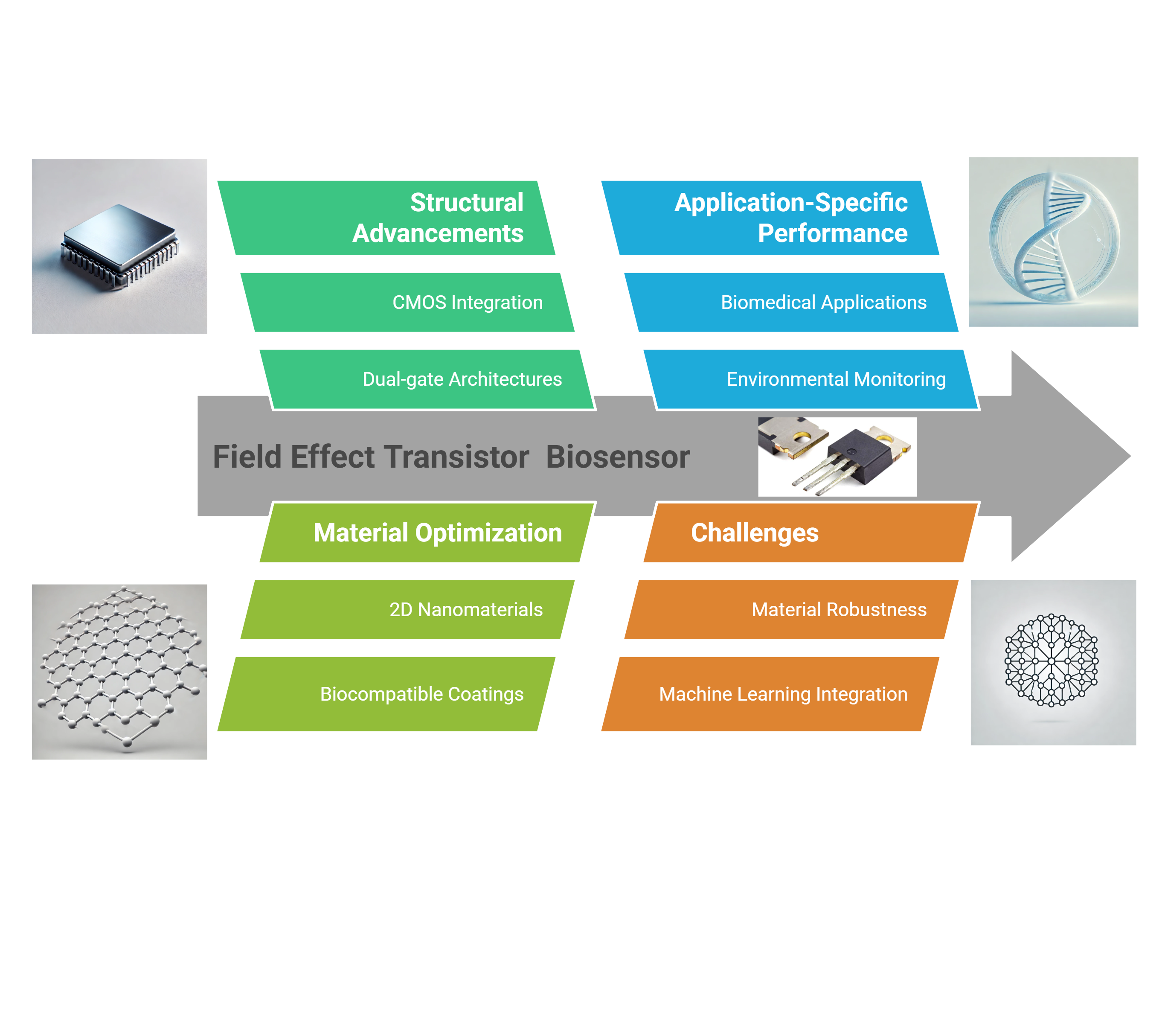
Figure 1.
High-Sensitivity FET Biosensors: Advancing real-time biomolecule detection through innovative nanomaterials, architectures, and integration techniques.
Figure 1.
High-Sensitivity FET Biosensors: Advancing real-time biomolecule detection through innovative nanomaterials, architectures, and integration techniques.
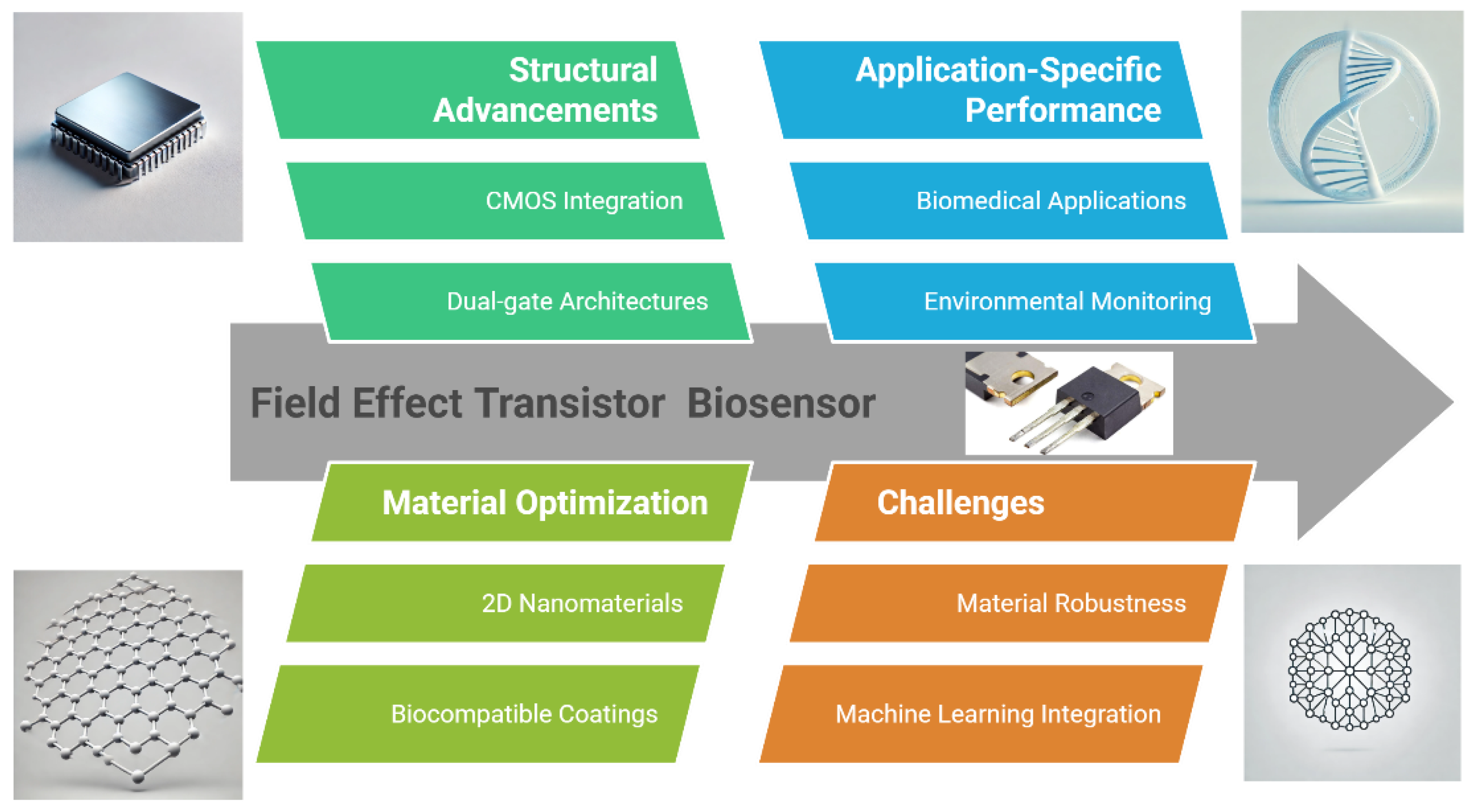
Figure 2.
Overview of the portable CMOS-based ISFET sensing system.(A) ISFET cross-section, equivalent capacitive model, CMOS readout circuit, and measured transfer characteristics. (B) System block diagram from biosensor to PC interface. (C) ISFET chip on PCB and reference chamber with electrode. (D) Output voltage versus sweep voltage for different readout schemes; drift response under DC and AC modes. (E) Surface functionalization process and microscopy images of the aptamer-modified ISFET array [21].
Figure 2.
Overview of the portable CMOS-based ISFET sensing system.(A) ISFET cross-section, equivalent capacitive model, CMOS readout circuit, and measured transfer characteristics. (B) System block diagram from biosensor to PC interface. (C) ISFET chip on PCB and reference chamber with electrode. (D) Output voltage versus sweep voltage for different readout schemes; drift response under DC and AC modes. (E) Surface functionalization process and microscopy images of the aptamer-modified ISFET array [21].
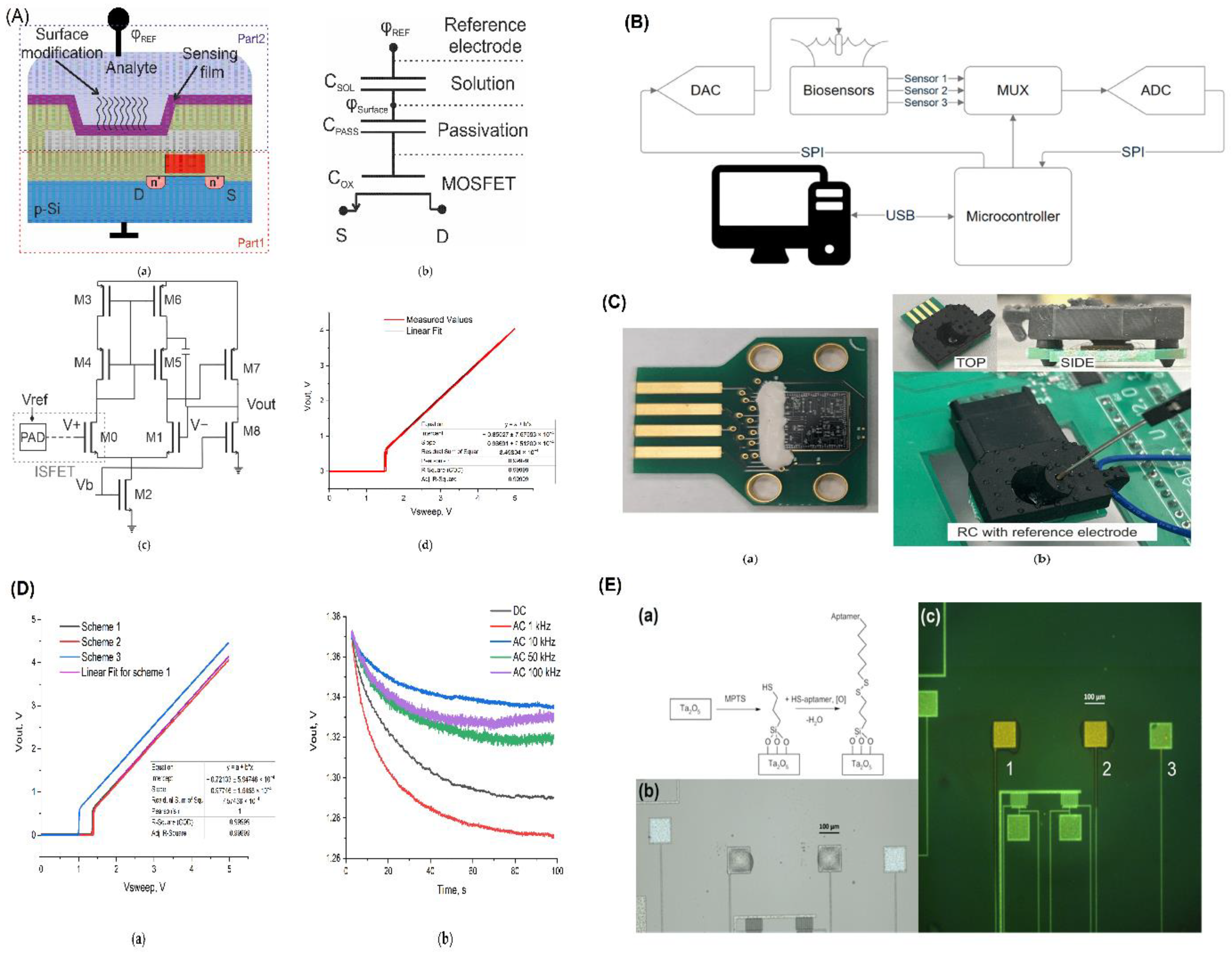
Figure 3.
Advanced Biosensors: Enhanced sensitivity and stability through nanomaterial integration, optimizing biomolecule detection.
Figure 3.
Advanced Biosensors: Enhanced sensitivity and stability through nanomaterial integration, optimizing biomolecule detection.
Figure 4.
CMOS ISFET fabrication, characterization, and surface response to pH and buffer conditions.(A) CMOS post-processing steps for ISFET fabrication and electrolyte-based operation. (B) Fluorescence response as a function of pH and buffer molarity. (C) ISFET chip with integrated chamber and representative transfer characteristics. (D) Surface potential over time during measurement. (E) Surface potential variations with pH (a) and buffer molarity (b ) [51].
Figure 4.
CMOS ISFET fabrication, characterization, and surface response to pH and buffer conditions.(A) CMOS post-processing steps for ISFET fabrication and electrolyte-based operation. (B) Fluorescence response as a function of pH and buffer molarity. (C) ISFET chip with integrated chamber and representative transfer characteristics. (D) Surface potential over time during measurement. (E) Surface potential variations with pH (a) and buffer molarity (b ) [51].
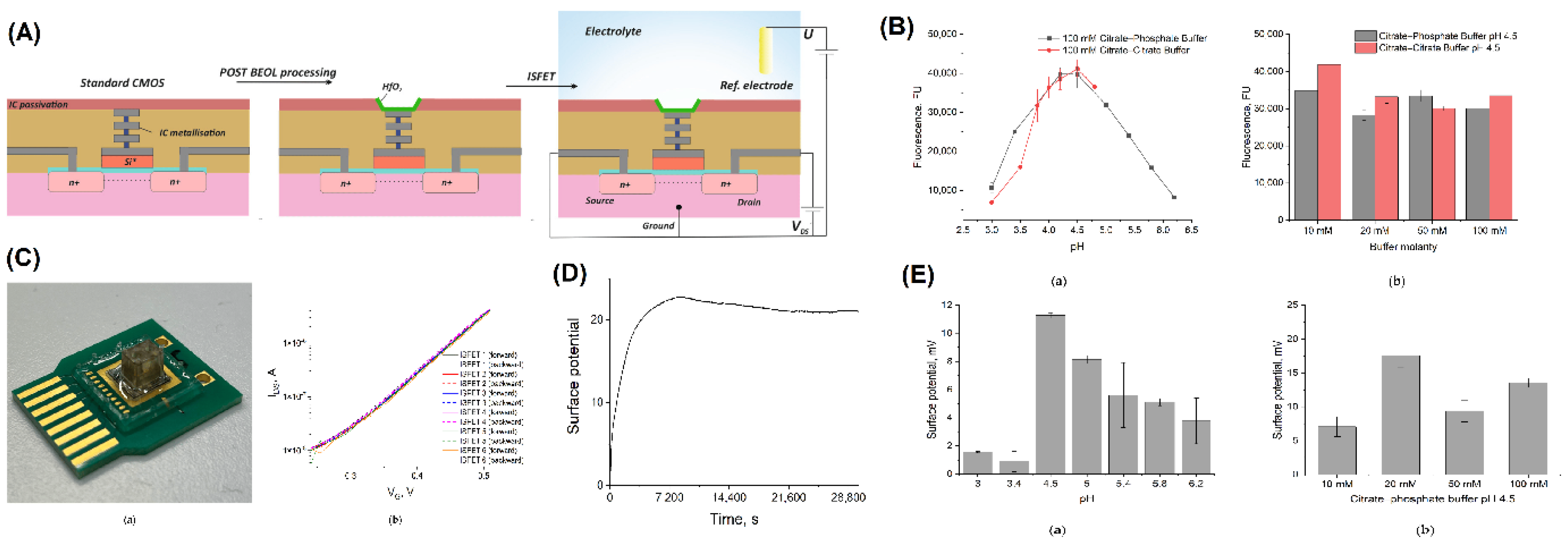
Figure 5.
Integrated Microfluidic System (IMS): Advanced CVD biomarker detection for rapid, accurate point-of-care diagnostics.
Figure 5.
Integrated Microfluidic System (IMS): Advanced CVD biomarker detection for rapid, accurate point-of-care diagnostics.
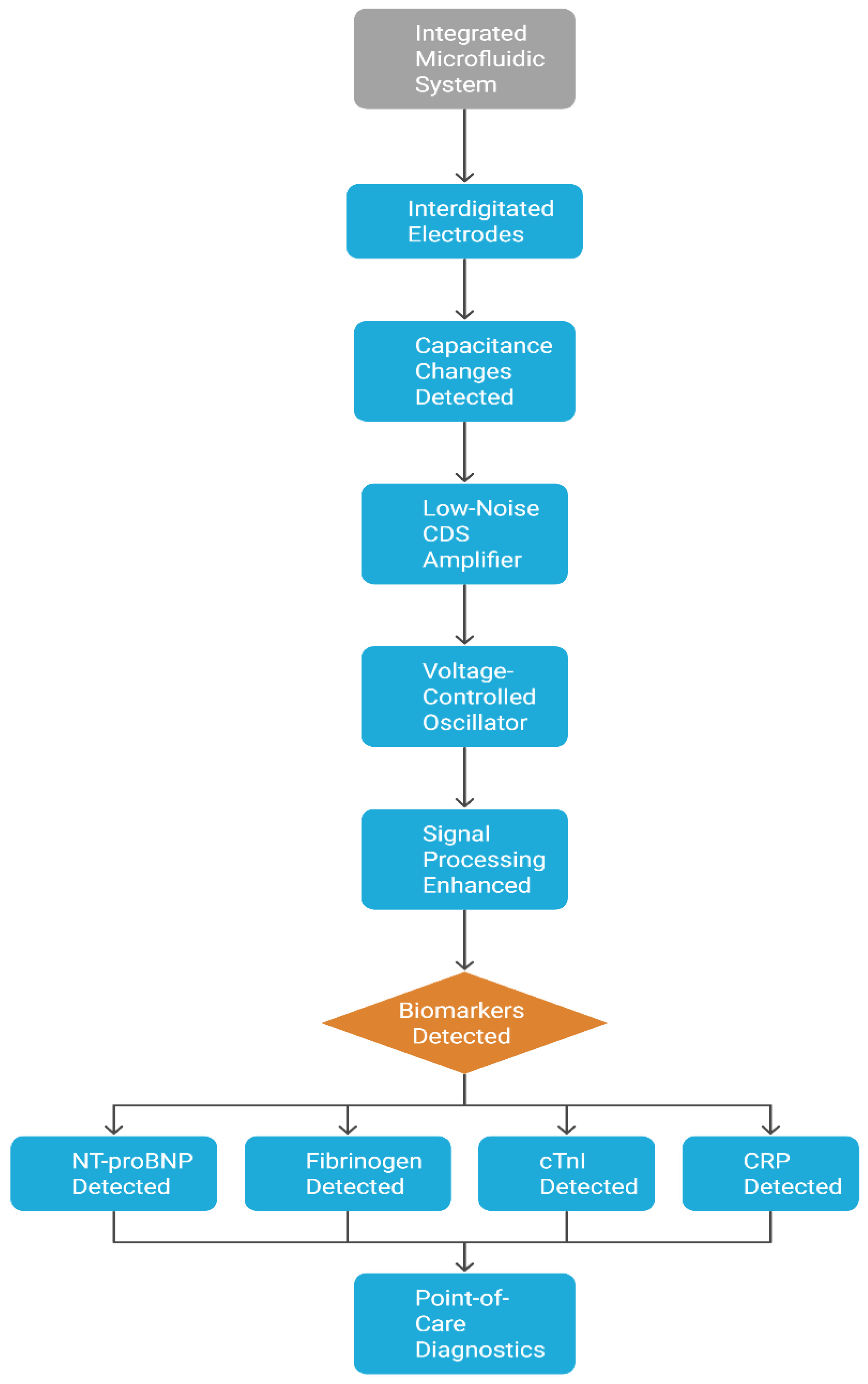
Figure 6.
Bridged EGFET configurations and sensor response to Cu²⁺ and Hg²⁺ ions. (A) U-tube and funnel-type sensitiser/agar bridge setups. (B) Transfer characteristics and gate voltage shift with Cu²⁺ concentration. (C) Transfer characteristics with varying Hg²⁺ concentrations[61].
Figure 6.
Bridged EGFET configurations and sensor response to Cu²⁺ and Hg²⁺ ions. (A) U-tube and funnel-type sensitiser/agar bridge setups. (B) Transfer characteristics and gate voltage shift with Cu²⁺ concentration. (C) Transfer characteristics with varying Hg²⁺ concentrations[61].
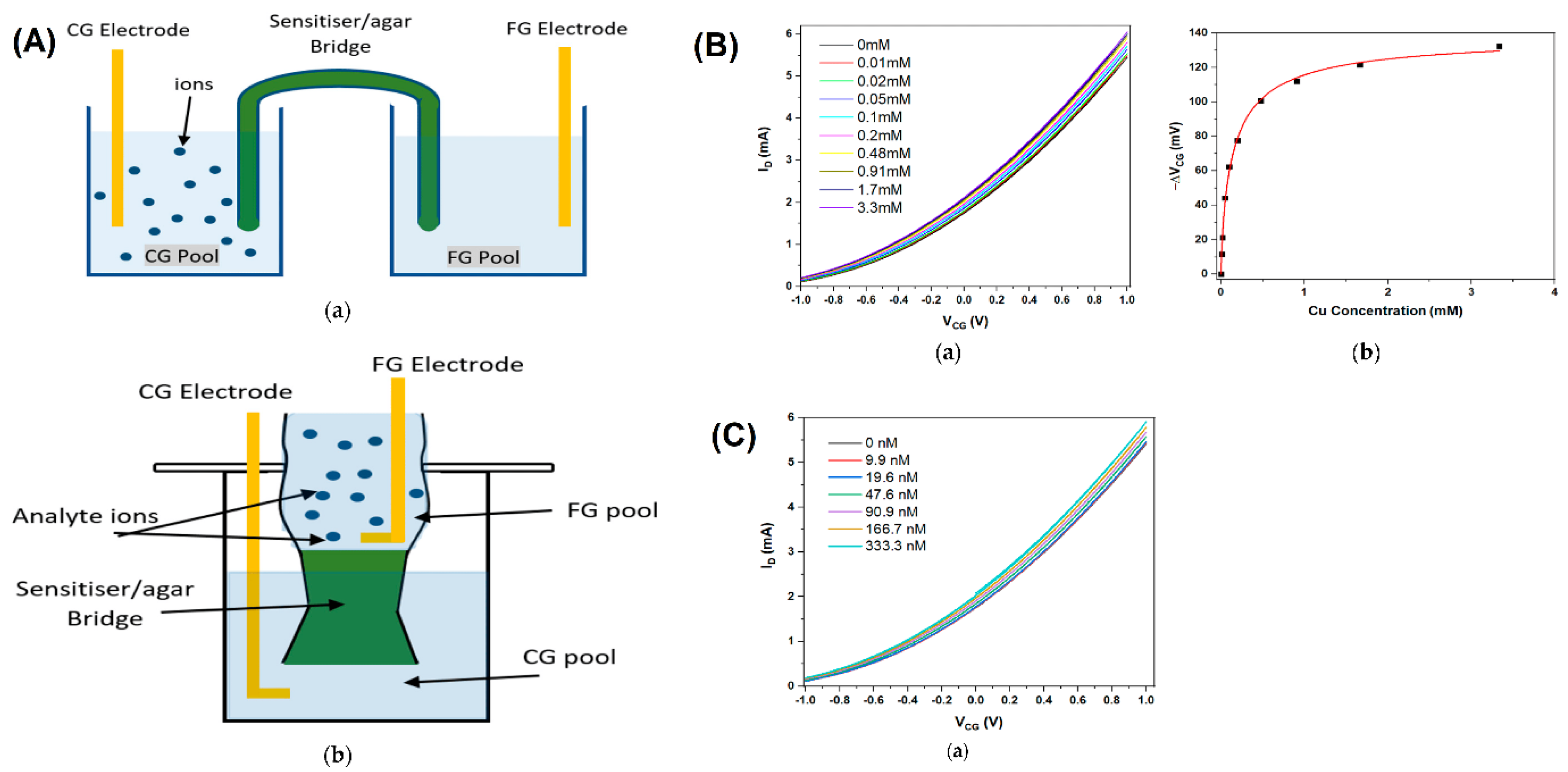

Table 1.
Comparison of Advanced Biosensors: High-sensitivity architectures and materials for precise biomarker detection.
Table 1.
Comparison of Advanced Biosensors: High-sensitivity architectures and materials for precise biomarker detection.
| Title | Summary | Unique Features | Materials Used | Sensitivity Metrics | Specificity Methods | Fabrication Techniques | Applications | Ref |
| GAAE-GANFET Biosensor | High sensitivity and specificity for detecting DNA and avian influenza virus. | Gate-all-around structure, strong gate-channel coupling, graded doping, oxide stacking | Al2O3, HfO2, silica-binding proteins | Threshold voltage sensitivity: 318.2 mV for AI-ab, enhanced drain current and transconductance sensitivity | Specific bioreceptors, targeted immobilization | Advanced engineering, strong gate-channel coupling | Detection of DNA, avian influenza virus | [14] |
| RNAFET Biosensor | Detection of RNA using complementary DNA probe with high sensitivity and specificity. | FDSOI technology, double-gate structure, strong capacitive coupling | HfO2, AuNPs, NiSi | Back-gate threshold voltage sensitivity: 1.765 V/log[RNA], dynamic range: 1 pM to 100 pM | DNA probe hybridization, precise patterning, Au-S bonds with thiol groups | UV lithography, reactive ion etching, self-assembly of probe DNA | Medical diagnostics, viral RNA detection | [16] |
| DMDL-GAA-NW-FET Biosensor | Detection of SARS-CoV-2 using protein and DNA targets. | Dual metal gate structure, nanowire structure, high surface-to-volume ratio, nanocavity | HfO2, SiO2, dual metal gates | VTH sensitivity: 7.08 times higher for S-protein, ION sensitivity: 2.38 times higher | Immobilization of S-protein and DNA specific to SARS-CoV-2 | Precise tuning of threshold voltage, dielectric modulation | SARS-CoV-2 detection | [6] |
| PNA-based bioFET for miRNA Detection | Detection of miR-155 with high sensitivity and specificity using PNAs. | PNA probes, thiol-gold chemistry, passivation with MCH | PNA, AuNPs | LOD: ~5 nM, dynamic range: 10–150 nM | PNA probes, passivation with MCH | Liquid-UVPO, self-assembly of PNA, passivation with MCH | Clinical diagnostics, miRNA detection | [17] |
| DC–NC–JAM-FET Biosensor | Detection of biomolecules using dual cavity and negative capacitance for high sensitivity. | Negative capacitance, dual cavities, JAM structure | HfO2, HZO | Enhanced threshold voltage, on-state current, subthreshold swing sensitivity | Dual cavities for specific detection, high surface-to-volume ratio | Simplified fabrication, JAM structure, subthreshold operation | Various biosensing applications | [24] |
| ISFET Aptasensor for Troponin I Detection | Uses DNA aptamers to detect troponin I, a biomarker for acute myocardial infarction (AMI). | AC mode with sine wave reference voltage, molecular printing technique, platinum reference electrode | Ta₂O₅, platinum, high-quality discrete components | DC mode: LOD: 15.77 ng/mL, Range: 31.25-625 ng/mL. AC mode: LOD: 3.27 ng/mL | Selective DNA aptamer binding, non-response to myoglobin and NT-proBNP | Ta₂O₅-gated ISFET, CMOS readout circuits, precise molecular printing | AMI diagnosis | [21] |
| MOSFET-Based Biosensor for COVID-19 Detection | Au nanoparticles/HfO2/FDSOI MOSFET for detecting COVID-19 ORF1ab gene. | Planar double gate MOSFET, electrostatic enrichment | Au nanoparticles, HfO2, silicon | LOD: 67 zM (~0.04 copy/μL), Range: 200 zM - 100 fM | Specific probe DNA immobilization, minimal non-specific binding | Selective immobilization of probe DNA, controlled hybridization environment | COVID-19 screening and diagnostics | [23] |
| DGDMFET Biosensor for SARS-CoV-2 Detection | Dual gate dielectric modulated FET biosensor for SARS-CoV-2 proteins and DNA. | Dual gate configuration, high dielectric constant of Cr2O3 | Cr2O3, SiO2, gold, tungsten | Enhanced sensitivity with 12% increase in threshold voltage sensitivity | Differentiation of target virus proteins using specific probes | Photolithography, ion implantation, precise nanogap formation | Virus detection, High sensitivity applications | [15] |
| InSe-FET Biosensor for RNA Detection | Field-Effect Transistor biosensor using 2D InSe for DNA-based RNA target detection. | High electron mobility InSe, microfluidic integration | InSe | Sensitivity: 13.5253/decade, LOD: 0.22 fM, Range: 1 fM - 10 nM | Selective binding to target miRNA (miR155) | High-purity, defect-free crystalline InSe, precise DNA probe immobilization | Clinical diagnostics, Disease screening | [10] |
| EDL-Gated BioFET for E. coli O157 | Biosensor using ssDNA probes for detecting E. coli O157 | ssDNA probes, EDL gating, Extended gate design | High-quality ssDNA probes, Gold electrodes, Thiol-modified DNA, MOSFET components | LOD: 1 fM; Dynamic range: 1 fM to 1 pM; R² = 0.996 | Specific binding to complementary DNA sequences, minimizing non-specific binding | Precision ssDNA immobilization, Surface functionalization, High-precision microfabrication | Rapid diagnostic tool for E. coli O157 | [53] |
| Detection | with high specificity and sensitivity. | |||||||
| MoS2-Based FET for Bisphenol A Detection | MoS2 FET biosensor functionalized with ssDNA and dsDNA for detecting BPA. | MoS2, AuNPs, ssDNA, dsDNA, PDMS-based microfluidic channel | MoS2, AuNPs, ssDNA, dsDNA | LOD: 1 pg/mL; Dynamic range: 1 pg/mL to 1 µg/mL; Sensitivity: ssDNA (4.27% to 24.48%), dsDNA (2.17% to 26.59%) | DNA functionalization ensures high affinity for BPA molecules, reducing cross-reactivity | Electron-beam evaporation, Annealing, Oxygen plasma treatment | Biomedical and environmental applications | [13] |
| ITO-EG-FET for Hepatitis C Detection | ITO-EG-FET biosensor using CRISPR/Cas12a for HCV detection with high specificity. | CRISPR/Cas12a-induced cleavage, Extended gate design | ITO, ssDNA, APTES/GA coating | LOD: 1 genomic copy/reaction; Dynamic range: 10610^6106 to 1 genomic copy/reaction | CRISPR/Cas12a ensures highly specific target recognition and cleavage | Surface modification with APTES/GA, Loop-mediated isothermal amplification | Hepatitis C detection | [54] |
| EG-FET for DNA Detection | EG-FET sensor using LAMP for detecting lambda phage DNA with high sensitivity. | LAMP, Extended gate design, Hydrogen ion detection | ITO, PMMA, Epoxy resin, Ag/AgCl reference electrode | LOD: 10 genomic copies/reaction; Hydrogen ion detection: -80.1 ± 0.03 mV/pH; R² = 0.998 | LAMP technique amplifies target DNA sequences specifically, reducing false positives | PID controller, Epoxy resin encapsulation, Integrated PCB, Solid-state Ag/AgCl reference electrode | Real-time and fluorescence-free LAMP detection | [22] |
| SiNW FET for Mycobacterium tuberculosis Detection | SiNW FET biosensor combining magnetic separation, urease catalysis, and FET detection for M.T. DNA. | Magnetic separation, Urease catalysis, High-resolution patterning | SiNWs, MNPs, SiO2NPs, Urease | LOD: 78.541 fM; Dynamic range: 1 pM to 1 µM | Magnetic separation selectively captures target DNA, reducing interference from other bacteria | Magnetic separation, Urease catalysis | Clinical diagnostics for tuberculosis | [25] |
| MoS2 Nanoscale Bioelectronic FET for DNA Base Identification | MoS2-based FET sensor with nanopore for identifying DNA bases with high sensitivity and specificity. | Nanopore integration, Gate terminal enhancement | MoS2 | LOD: femtomolar to picomolar range; Broad dynamic range; Enhanced sensitivity with gate terminal | Unique electronic signatures for each DNA base reduce non-specific interactions | Nanoscale precision, Electron beam lithography | DNA sequencing and base identification | [11] |
| MoS2 FET Aptasensor | Label-free aptasensor integrated with MoS2 FET for detecting BRCA1 ssDNA. | Pentagonal design with partial ground plane for enhanced surface area, integrated Ag–Au nanoclusters for improved electron transfer | MoS2, Ag–Au nanoclusters, aptamers | LOD: 3.0 aM (buffer), 6.4 aM (serum); Sensitivity: 0.4851 μA/decade (buffer), 0.3718 μA/decade (serum) | High affinity binding of aptamers, use of MIP for specific binding sites | Electropolymerization, MIP, electrolyte-gated FET | Early breast cancer diagnosis | [20] |
| CNT Transistor-Based Biosensor | CNT transistor-based biosensor with tetrahedral DNA nanostructure and antibodies for detecting ERβ, monkeypox virus, and ctDNA. | Tetrahedral DNA nanostructure scaffold for optimized recognition site spacing, dual patch elements for multiband capability | CNTs, pyrene derivatives, TDNs | LOD: 6.74 aM (ERβ), 991 aM (A35R), 0.21 aM (ctDNA); Sensitivity: 0.07 M^-1 (ERβ) | Dual recognition sites in Y-shaped BioES, cross-linking reactions ensuring strong attachment | Precise lithography, non-covalent coupling, self-assembly of TDNs | Clinical diagnostics, population-wide screening | [28] |
| Lg-TGNFET DNA Biosensor | Liquid gate trilayer graphene nanoribbon FET for DNA detection. | Trilayer graphene nanoribbons for higher current and improved performance, liquid gate setup for consistent environment | Trilayer graphene nanoribbons (TGN) | Detects DNA concentrations as low as 0.01 nM; significant current decrease and gate voltage shift with increasing DNA concentrations | Controlled doping, π-π interactions with DNA bases | High-resolution lithography, controlled doping, SAMs, Ag/AgCl wire | DNA detection | [27] |
| JL CNTFET DNA Nanosensor | Label-free DNA nanosensor using junctionless CNTFET operating in BTBT regime. | Junctionless design for simplified manufacturing, coaxial gating for enhanced electrostatic control | CNTs | Significant modulation in tunneling current in response to DNA | Use of high-k dielectrics, single-stranded DNA probes for selective binding | Junctionless design, laterally open cavities, coaxial gating, CVD, EBL, ALD | DNA sequence detection | [26] |
| ZnO-MWCNT Composite Biosensor | Electrical biosensor for detecting DNA sequences of foodborne pathogens | Combines ZnO stability with MWCNT mobility, strong linear response | ZnO, MWCNT, ss-DNA probes | LOD: 1 fg/μL; Dynamic range: 1 fg/μL to 10 ng/μL | Custom-designed ss-DNA probes for specific DNA sequences | Hydrothermal synthesis, SAM formation, EDC-NHS cross-linking, drop-casting | Detection of Proteus mirabilis, Escherichia coli, Clostridium botulinum | [18] |
| WS2 FET DNA Biosensor | FET biosensor for DNA detection | High-quality, uniform monolayer WS2, minimal defects | WS2 | LOD: 3 aM; Dynamic range: 10^-16 M to 10^-9 M | Blocking non-specific sites with poly-C | Chemical vapor deposition, PMMA-assisted transfer, thermal annealing, photolithography, stepwise functionalization | Early disease diagnosis | [12] |
| PMO-GQDs on RGO FET Biosensor | FET biosensor for miRNA detection | High probe density, strong linear relationship (R² = 0.99) | RGO, GQDs, PMOs, PLL | LOD: 85 aM; Dynamic range: 100 aM to 1 nM | Use of neutrally charged PMOs to reduce non-specific interactions | PLL film, hybridization optimization, 3D structure formation | Detection of target miRNA21 | [19] |
Disclaimer/Publisher’s Note: The statements, opinions and data contained in all publications are solely those of the individual author(s) and contributor(s) and not of MDPI and/or the editor(s). MDPI and/or the editor(s) disclaim responsibility for any injury to people or property resulting from any ideas, methods, instructions or products referred to in the content. |
© 2025 by the authors. Licensee MDPI, Basel, Switzerland. This article is an open access article distributed under the terms and conditions of the Creative Commons Attribution (CC BY) license (http://creativecommons.org/licenses/by/4.0/).
Copyright: This open access article is published under a Creative Commons CC BY 4.0 license, which permit the free download, distribution, and reuse, provided that the author and preprint are cited in any reuse.


