

Submitted:
11 June 2025
Posted:
12 June 2025
You are already at the latest version
Abstract
The periphery of Lomami National Park in the Democratic Republic of the Congo (DR Congo) is under increasing hunting pressure, driven by both local subsistence needs and growing urban demand for bushmeat. This alarming context highlights the urgent need to understand wildlife population dynamics, particularly through the lens of local actors. This study aimed to assess hunters’ perceptions of the current availability of mammalian fauna around the park, in the absence of comprehensive ecological data. From October to December 2023, a snowball sampling method was used to conduct surveys with 60 hunters from nine villages surrounding the park. Sociodemographic profiles and hunting practices were analyzed using relative frequencies and Fisher’s exact test. Frequently cited species were used to assess perceived abundance and disappearance, and species similarity between near and distant zones was evaluated using the Jaccard index. Findings reveal that hunting is an exclusively male activity, predominantly carried out by individuals aged 30–40 years. Firearms are the primary hunting tools, and hunting is strongly influenced by seasonal patterns. It is practiced both in the park’s buffer zones and within its core protected area. This activity has led to the disappearance of key species such as Loxodonta cyclotis, Syncerus caffer, and Panthera pardus pardus, and to the significant decline of several Cephalophus species, once abundant in the region. These findings highlight a persistent pattern of overexploitation, resulting in a marked reduction in wildlife availability and posing serious threats to both biodiversity and local livelihoods. Urgent action is required, including enhanced monitoring, stricter enforcement of anti-poaching laws, improved ranger support, and the active involvement of local communities. This should be achieved through awareness-raising and the promotion of sustainable alternative livelihoods such as livestock farming, aquaculture, and agroforestry.
Keywords:
Sustainable hunting
; biodiversity
; local perceptions
; bushmeat
; participatory conservation
; Lomami National Park
1. Introduction
The Tropical rainforests, covering an estimated 1.8 billion hectares approximately 12% of the Earth’s land surface play a crucial role in global climate regulation, carbon cycling, and soil conservation. They also provide essential ecosystem services such as pollination, seed dispersal, and the maintenance of extraordinary levels of biodiversity [1,2,3]. The Congo Basin, the world’s second-largest tropical rainforest after the Amazon, exemplifies these attributes, harboring over 400 mammal species (including 100 endemics) and around 1,100 bird species, representing 30% of Africa’s avifauna [4,5].
Despite their ecological significance, these ecosystems face increasing anthropogenic pressures deforestation, habitat fragmentation, and intensive hunting that jeopardize wildlife populations [6,7,8]. In response, national governments, supported by legal frameworks and international partnerships, have established protected areas as key instruments for biodiversity conservation [9], including in the DR Congo.
In DR Congo, the LNP, established in 2016, spans 8,879 km², with an adjoining buffer zone of 22,000 km². Located in a low human density region, the park retains much of its original forest cover [10,11,12]. It is home to exceptional biodiversity, including several species endemic to the DR Congo: the bonobo (Pan paniscus), okapi (Okapia johnstoni), Congo peafowl (Afropavo congensis), lesula (Cercopithecus lomamiensis), and dryas monkey (Cercopithecus dryas). A residual population of African forest elephants (Loxodonta cyclotis) also persists in the park’s northern section [13].
Despite its legal protection, LNP faces significant hunting pressure. Hunting remains the primary subsistence activity for surrounding communities [12], due to ecological constraints that limit livestock development [10] and the lack of viable alternative protein sources. Moreover, bushmeat trade, driven by growing urban demand in cities such as Kindu and Kisangani, provides a critical source of income [12,14]. This economic dependence intensifies wildlife exploitation, placing increased strain on already vulnerable species.
Such overexploitation fosters the “empty forest” phenomenon, wherein forest structure appears intact but wildlife has been largely extirpated due to unsustainable hunting [15,16]. Notable examples include Yangambi and the Luki Biosphere Reserve, now dominated by rodents and small ungulates, illustrating this severe degradation [17,18]. This scenario undermines local livelihoods, for which hunting is both a key protein source and an economic lifeline.
Despite these critical issues, the LNP's annual reports lack reliable data on wildlife population trends, which are vital for effective conservation management [19,20,21]. While advanced monitoring tools such as drones, camera traps, and acoustic sensors hold promise, they remain costly and require specialized expertise often unavailable in local contexts [22]. Under such constraints, local knowledge, especially hunters' perceptions, offers a valuable and context-appropriate alternative for assessing faunal dynamics.
This study aims to evaluate hunters' perceptions of mammalian wildlife availability around LNP. We hypothesize that, due to the increasing demand for bushmeat, mammal populations are in continual decline, with hunters reporting similar.
2. Materials and Methods
2.1. Study Area
This study was conducted in nine villages adjacent to the LNP, located in the provinces of Maniema and Tshopo, in the DR Congo (Table 1). The park extends approximately between the following geographic coordinates: North 0°48'41.84" S / 24°53'5.46" E, South 3°07'28.42" S / 25°16'9.82" E, East 1°58'48.42" S / 25°39'2.61" E, and West 2°01'6.10" S / 24°31'40.52" E, covering a total area of 30,879 km² (Figure 1). The landscape of LNP is dominated by lowland equatorial rainforest, typical of the Congo Basin, with patches of seasonally waterlogged savannahs located in its southern region. The forest is ecologically rich and hosts a remarkable floristic diversity, including species such as Milicia excelsa (Welw.) C.C. Berg, Gilbertiodendron dewevrei (Linnaeus), Entandrophragma spp., Pycnanthus angolensis (Linnaeus), and Musanga cecropioides (R.Br. ex Tedlie) [11,23]. Despite this richness, the region remains one of the least botanically explored areas in tropical Africa [24,25].
Since 2007, research efforts by the Lukuru Foundation under the TL2 (Tshuapa-Lomami-Lualaba) project have documented 59 species of large mammals and 240 bird species. A major discovery was the identification of Cercopithecus lomamiensis [25],a newly described primate species endemic to the interfluvial forests between the Tshuapa and Lomami rivers [26].
The climate is equatorial, with an average annual rainfall of approximately 1.600 mm and monthly temperatures ranging between 23°C and 26°C. The dry season is short, typically occurring between June and July. Soils are predominantly ferralitic, with sandy-clay texture. The terrain consists of gently undulating plateaus, with altitudes ranging from 400 to 700 meters above sea level [23]. The park's buffer zone is bordered by numerous small settlements, where local communities rely heavily on subsistence agriculture, hunting, and fishing. Since 2021, the management of the LNP has been conducted under a co-management agreement between the Congolese Institute for Nature Conservation (ICCN) and the Frankfurt Zoological Society (FZS) [23].
2.2. Methods
2.2.1. Sampling Rationale and Village Selection Criteria
The peripheral zone of LNP was deliberately selected for this study due to its high concentration of hunters the primary target population and the pronounced intensity of human–wildlife interactions. This context makes it a strategic setting to investigate the impacts of hunting practices on local wildlife population dynamics [14]. Village selection was based on a combination of criteria, including their location within the park’s buffer zone, the documented intensity and extent of hunting activities, ease of accessibility, local hunter population density, and prevailing security conditions. These criteria were further shaped by logistical constraints such as time and financial limitations, which ultimately restricted the scope of the study to nine villages [27]. To investigate whether spatial proximity to the park’s core zone influences hunters’ perceptions and practices, the selected villages were divided into two distinct groups based on their distance from the park boundary classified as either proximal (<10 km) or distal (>10 km). This spatial stratification was designed to assess the potential gradient effect of protected area adjacency on both the perceived availability of mammalian wildlife and the modalities of hunting activities [28,29]. By integrating ecological, socio-spatial, and logistical considerations, this sampling strategy provided a nuanced understanding of hunting dynamics around the park, while ensuring the robustness and feasibility of data collection within a complex conservation landscape.
2.2.2. Selection of Hunters
The perceived availability of wild mammals was assessed through field surveys conducted between October and December 2023. A total of 60 hunters were interviewed across nine villages located in the southern periphery of LNP, within the Maniema Province (Table 1, Figure 1). Data collection was based on a non-probabilistic homogeneous snowball sampling approach. In this framework, each respondent was asked to refer other hunters from their social network, facilitating a progressive and targeted identification of eligible participants [30,31]. This method was selected for its practicality and efficiency in accessing a discreet and hard-to-reach population such as hunters, thus significantly reducing the time and logistical resources required for the survey. Furthermore, recruiting participants through existing social ties fostered a trust-based environment, which was essential for obtaining honest and in-depth responses, especially in a context where hunting practices have become increasingly sensitive since the park’s establishment [30,31]. Given the uncertainty regarding hunters' availability during the data collection period, an opportunistic, non-statistical sampling strategy was adopted. The final sample size was determined pragmatically and stabilized at 60 respondents [32]. Participants were selected based on their actual presence in the study area during the survey period and had to meet three specific criteria: (1) a minimum of seven years of hunting experience; (2) permanent residence in one of the nine target villages; and (3) voluntary, informed consent to participate. The experience threshold ensured that respondents possessed a long-term perspective on wildlife population trends, including conditions prior to the park’s formal designation in 2016. Local residence served as a proxy for an intimate understanding of the socio-ecological dynamics specific to the region. Lastly, voluntary participation and availability were critical to upholding ethical standards and ensuring the reliability and depth of the data collected.
2.2.3. Survey Design and Data Collection
To ensure the reliability and scientific validity of the data collected, the survey was meticulously designed and implemented. The preparatory phase involved the development of a detailed operational plan, including the field itinerary, timeline, research objectives, target variables, data collection methods, and data processing procedures. Additionally, three pilot sessions were conducted with individuals outside the study sample to pre-test the questionnaire. These sessions allowed for refinement of the questions to ensure their clarity, contextual relevance, and cultural appropriateness. Efforts were also made to diversify entry points and respondents, which helped reduce selection bias and enhance the overall representativeness of the sample [32].
The questionnaire collected detailed sociodemographic information on each hunter, including age, sex, education level, household size, years of hunting experience, hunting frequency, weapon types used, and income generated from hunting. These variables are critical for understanding the broader social and economic context in which hunting occurs and for correlating individual characteristics with wildlife use and perceptions [33,34]. This contextual data supports a nuanced analysis of the drivers behind wildlife exploitation in the park’s buffer zone.
Moreover, hunters were asked to share their perceptions regarding the availability of wildlife specifically changes in mammal abundance over time, perceived causes of decline, and attitudes toward conservation laws and sustainable management practices. Respondents also contributed local ecological knowledge on species’ reproductive cycles, seasonal movements, and feeding behaviors.
The dataset further included geotemporal information such as frequently used hunting zones and the seasonal timing of hunting activities. Detailed data were gathered on species hunted (frequency, volume of captures), estimated market prices, usage (consumption vs. sale), and species encountered but not hunted. These insights enable the identification of species-specific pressures and shed light on hunters’ motivations, whether economic, cultural, or subsistence-based. Additionally, information was gathered on local wildlife resource management practices, including the presence of customary rules, species-specific taboos, community participation in conservation initiatives, and perceived effectiveness of such programs. Subsistence alternatives to hunting such as agriculture, fishing, or other livelihood strategies were also documented. These elements are essential for identifying community-based levers to strengthen conservation efforts in a context-sensitive manner.
All collected data underwent cross-validation using external sources to ensure accuracy. The involvement of key stakeholders particularly the Congolese Institute for Nature Conservation (ICCN) and local authorities helped legitimize the study and fostered trust among participants [32]. Data were coded using a structured guide integrated into the KoboToolbox platform (version 2.023.21). This digital tool was selected to replace paper-based questionnaires, which are often impractical in humid, rain-prone tropical environments. KoboToolbox also facilitates secure, efficient data organization, storage, and preliminary analysis.
2.2.4. Assignment and Validation of Scientific Names of Animal Species
Animal species mentioned by hunters were initially identified using the species database of the LNP, which compiles region-specific taxonomic information based on prior field observations and expert inventories. This preliminary identification based on vernacular names and contextual knowledge was then systematically verified and, where necessary, corrected using the Catalogue of Life [35], an authoritative global taxonomic reference that provides standardized nomenclature and updated classification schemes.
In cases where discrepancies or ambiguities arose between local designations and taxonomic records, additional verification was conducted in consultation with taxonomists from the Congolese Institute for Nature Conservation (ICCN), whose expertise on the local fauna allowed for precise resolution of identification challenges. Morphological confirmations were further supported through the use of visual references from established field guides, including resources from the IUCN Red List and the Global Biodiversity Information Facility (GBIF). Where feasible, hunters were also asked to validate identifications by comparing species to photographic plates [36].
This two-tiered approach linking local biodiversity data (via the Lomami Park database) with international taxonomic standards (via the Catalogue of Life) ensures accurate assignment of scientific names while grounding the identification process in both local ecological context and global nomenclatural consistency.
2.2.5. Data Analysis
The analytical framework adopted for this study relied on a mixed-methods approach, integrating descriptive, inferential, and similarity-based techniques to provide a comprehensive understanding of the data. Descriptive statistics were employed to summarize and structure qualitative variables, using both relative frequencies and citation frequencies (for species data) as core indicators [37,38]. Citation frequency was calculated as the proportion of respondents who mentioned a given species within a defined category, relative to the total number of survey participants (Equation 3). This measure is particularly useful in ranking the perceived importance of hunted or locally extinct species, whereas relative frequencies allow for a clear representation of response distribution across categorical variables.
To quantify the degree of overlap in species reported across different zones, a Jaccard similarity index was applied (Equation 2). This index was chosen for its efficiency in capturing compositional dissimilarities and its interpretability in ecological and ethnobiological contexts. The Jaccard index ranges from 0 to 1, where values approaching 1 indicate a high degree of similarity between species sets suggesting convergence in hunting targets, species decline, or extinction patterns across zones. Conversely, values near 0 reflect substantial dissimilarities, which may be attributable to variations in habitat structure, hunting strategies, or cultural preferences [39,40]. Intermediate values indicate partial overlap, signaling moderate similarity coupled with key divergences in species use or availability.
Furthermore, Fisher’s exact test was used to assess the relationship between hunters’ sociodemographic profiles and their perceptions of mammalian wildlife availability, adopting a significance threshold of α < 0.05. This test serves as a robust alternative to the Chi-square test, particularly suitable in cases where expected frequencies are small (typically < 5), which is common in studies involving rare or sensitive populations [33,34,39,41,42].
Data processing and statistical analyses were conducted using R software (version 4.2.1) due to its flexibility, reproducibility, and suitability for automating complex analytical tasks. Microsoft Excel (2019) was also employed for initial data organization and basic visualizations, given its accessibility and user-friendly interface [42,45].
With F: Frequency of citation of a species; n: number of respondents having cited the species for a category and N: total number of respondents.
With corresponding to the number of species in common between two groups, b and c to the number of species observed only in one of the groups considered.
3. Results
3.1. Sociodemographic Profile and Hunting Practices Around LNP
Hunting around LNP is exclusively male-dominated, with 100% of surveyed hunters in both proximal and distal villages identifying as men (Table 2). Conservation and livelihood programs must therefore target male community members directly. Most hunters are in their 30s and 40s, age groups representing 42.5% and 50% of respondents in the two zones, respectively. These mature adults likely hold local influence and traditional knowledge, making them strategic targets for behavior change and peer-led outreach.
Over three-quarters of hunters are married, and the majority live in medium-sized households (57.5% proximal, 50% distal) (Table 2). This demographic profile underscores the need to account for household-level economic dependencies on hunting when designing viable livelihood alternatives. A majority of hunters are migrants (62.5% proximal, 60% distal), though cultural diversity is evident in both zones. Effective interventions will require culturally nuanced approaches, potentially tailored to both allochthonous and autochthonous groups.
Formal education is low among hunters, with most having only completed primary school (55% in both zones) and few reporting higher levels (Table 2). Communication strategies should prioritize oral, visual, and participatory tools over text-based materials. However, agriculture is the main secondary livelihood, cited by over 75% of respondents. Other activities such as road maintenance (notably 20% in distal zones), teaching, transport, and artisanal work are less common (Table 2). Enhancing agricultural productivity or market access may offer the most realistic path to reducing hunting pressure.
Hunting is primarily seasonal (67.5% proximal, 55% distal), with weekly hunting also common. Occasional hunting was rare (Table 2). Surveillance and enforcement could be intensified during peak hunting periods for maximum impact. Firearms are the most commonly used method (62.5% proximal, 60% distal), followed by traps and melee weapons. Given the range of techniques, regulatory efforts must go beyond firearm control to address diverse hunting practices.
Most hunters have between 10 and 20 years of experience; only a small minority are novices (Table 2). This deep-rooted engagement reflects cultural entrenchment and potential resistance to change, highlighting the need for long-term, community-driven transition strategies.
3.2. Hunted and Declining Wildlife Species Around LNP
Twelve mammal species from eight families (Cercopithecidae, Bovidae, Hystricidae, Orycteropodidae, Suidae, Viverridae, Sciuridae, Tragulidae) were identified by hunters as the most commonly targeted around LNP (Table 3). Primates, particularly Cercopithecus spp., were the most frequently cited, followed by duikers such as Cephalophus monticola and rodents like Atherurus africanus. Other frequently hunted species included Potamochoerus porcus, Cephalophus weynsi, Cephalophus dorsalis, Bdeogale nigripes, Tragelaphus spekei, and Orycteropus afer, with citation frequencies ranging from 13% to 30%. This hunting pattern indicates a strong pressure on small to medium-sized herbivores and omnivores, particularly primates and duikers, which are highly vulnerable to overexploitation.
Hunters also reported noticeable declines in several species, notably Cephalophus weynsi (33%), Potamochoerus porcus (28%), Orycteropus afer (23%), and Cephalophus dorsalis (22%) (Table 3). These species are both frequently hunted and increasingly scarce, marking them as urgent conservation priorities. Reports of declining populations of Cercopithecus spp., Syncerus caffer, and Tragelaphus eurycerus further emphasize the risk facing a broad range of taxa.
A Jaccard similarity index of 0.78 indicates strong overlap in species cited by hunters from both proximal and distal zones (Table 3). This high spatial consistency suggests that hunting pressure is broadly distributed across the landscape. Conservation responses should therefore operate at the regional scale rather than focusing solely on buffer zones.
Bushmeat is mainly traded as smoked carcasses, with prices varying by species and size from 2–3.2 USD for small rodents like Sciurus vulgaris to 360 USD for large mammals such as Syncerus caffer (Table 3). The high economic value of large-bodied species reinforces hunting incentives. Viable alternatives must offer competitive income opportunities to reduce reliance on bushmeat trade.
Beyond nutrition, hunted animals serve multiple functions ritual (e.g., amulets, talismans), artisanal (e.g., drums, flutes, ornaments), and medicinal (e.g., treatments for pain, skin, and respiratory issues) (Table 3). This multifunctional use reflects the deep cultural embeddedness of wildlife in local communities. Conservation strategies must integrate cultural practices and traditional knowledge, promoting sustainable use while respecting local values.
3.3. Hunted and Declining Wildlife Species Around LNP
Eleven species, belonging to six distinct families (Elephantidae, Bovidae, Felidae, Thryonomyidae, Tragulidae, and Suidae), were identified by local hunters as having disappeared from LNP and its surroundings (Table 4). Loxodonta cyclotis (Matschie, 1900) was mentioned by the vast majority of respondents, followed by Syncerus caffer (Sparrman, 1779), cited by nearly half, and Tragelaphus eurycerus (Ogilby, 1837), with 42% of mentions. Other species frequently cited as extinct included Panthera pardus pardus (Linnaeus, 1758), Thryonomys swinderianus (Temminck, 1827), Tragelaphus scriptus (Pallas, 1766), Potamochoerus porcus (Linnaeus, 1758), Hyemoscus aquaticus (Ogilby, 1841), and Cephalophus dorsalis (Gray, 1846), with citation frequencies ranging from 5% to 25%. The least cited species were Sylvicapra grimmia (Linnaeus, 1758) and Panthera leo (Linnaeus, 1758). A diverse group of large and medium-sized mammals are perceived as locally extinct, with the forest elephant being the most consistently reported. These findings underscore the urgent need for historical baseline reconstruction and long-term population monitoring to validate local ecological knowledge and guide restoration priorities.
These species appear to have been exposed to similar ecological and anthropogenic pressures regardless of proximity to the park. A Jaccard similarity index of 0.81 reveals a high degree of convergence between the perceptions of hunters from both near and distant communities regarding species they believe to be extinct. The perceived disappearance of species is spatially consistent across communities, indicating widespread and uniform pressures. Conservation interventions must be implemented at the landscape scale, as localized efforts alone may not address region-wide drivers of extinction such as overhunting and habitat degradation.
Beyond their dietary importance, these species were also exploited for ritual (talismans, amulets), artisanal (jewelry, drums, flutes, seat covers), and medicinal purposes (treatment of pain, skin and respiratory ailments, tonic remedies). Elephants, in particular, were actively hunted for their ivory, which was used to craft prestige objects with strong symbolic value. These multiple uses both symbolic and utilitarian reflect a deep cultural integration of wildlife into local belief systems and livelihoods. Wildlife species once present around the park held significant cultural, spiritual, and utilitarian value. Successful conservation must go beyond biological protection and engage with the cultural dimensions of biodiversity, promoting community-based models that integrate tradition, knowledge, and sustainable alternatives.
3.4. Hunting Dynamics and Conservation Challenges Around LNP
Most hunters reported a marked decline in wild mammal populations around LNP. Nearly all respondents in both proximal and distal zones observed significant reductions, with very few noting any increase (Table 5). This widespread perception underscores the severity of wildlife depletion, primarily attributed to intensive hunting (87.5% near, 85% far) and, to a lesser extent, poaching. Adult animals are the main targets 75% of hunters near the park and 95% farther away which further threatens species’ reproductive viability. Urgent regulatory and community-led measures are needed to protect remaining adult populations and prevent long-term ecological collapse.
Hunting is primarily motivated by household consumption and income generation. It is cited as a key livelihood by 70% of hunters near LNP and 75% in distant areas. Notably, 25% of hunters in both zones earn over 200 USD monthly from hunting. This income level suggests a shift toward semi-commercial or commercial hunting. Conservation strategies must address both subsistence and market-driven hunting by promoting alternative livelihoods and regulating bushmeat value chains. Meat extraction levels per outing are consistent across zones. Around 40% of hunters report harvesting 5–15 kg or more per trip, while only 20–25% report smaller yields under 5 kg. Frequent medium- to high-volume harvests exert sustained pressure on local wildlife, increasing the risk of rapid population declines without active management.
Urban markets particularly Kindu are the main destinations for bushmeat from the region, highlighting a strong urban demand. Conservation approaches must target not only rural producers but also urban consumers and traders by enforcing market regulations and promoting demand reduction. Despite awareness of hunting restrictions within the park, illegal activity persists. Over one-third of hunters in both zones report continuing to hunt inside LNP. Legal protection alone has proven insufficient; enhanced surveillance and viable alternatives in peripheral areas are necessary to reduce encroachment.
Agriculture is the most commonly cited alternative livelihood (62.5% near, 60% far), followed by livestock raising (32.5% vs 35%). Fishing is mentioned less frequently but gains more traction in distant zones. These preferences highlight agriculture and livestock as priority sectors for investment in conservation-compatible livelihoods. Conservation initiatives are viewed as partially effective by the majority (50% near, 60% far), with one-quarter of hunters rating them positively. Participation is moderate (62.5% near, 55% far), though 35–40% report low involvement. Programs remain limited in reach and engagement. Strengthening participation through locally tailored approaches is key to improving impact and community support. Most hunters (75% near, 70% far) report seeing protected species and claim to avoid killing them, though a significant minority either do not encounter or do not spare them. This inconsistency highlights gaps in awareness and enforcement. Conservation messaging must be reinforced, and targeted behavior change strategies developed to encourage reliable protection of threatened fauna.
3.5. Association Between Hunting Perceptions and Practices Around LNP and the Sociodemographic Profiles of Respondents
Hunting practices and perceptions around LNP appear to be only weakly influenced by hunters’ sociodemographic and geographic attributes, suggesting a relatively homogeneous pattern of hunting behavior and its associated pressures across the landscape (Table 6). However, subtle nuances emerge, revealing specific links between certain sociodemographic characteristics and particular aspects of hunting. For instance, access to hunting zones within the park boundaries is more closely associated with factors such as hunter age, proximity to the park’s core area, sociocultural background, and hunting frequency. Additionally, preferences for alternative livelihood activities in peripheral zones strongly correlate with the supplementary activities already practiced by hunters. Those who previously engaged in farming tend to prioritize agriculture as their preferred alternative. Similarly, geographic location along specific road axes significantly influences preferences: hunters along the Dingi–Bafundo axis show a marked preference for livestock, while those along the Dingi–Oluo axis consistently favor agriculture. Lastly, the perceived effectiveness of conservation initiatives is strongly linked to education level. Hunters with only primary education mostly expressed negative views of these initiatives, suggesting a potential gap in understanding or acceptance of conservation goals among less educated individuals. While overall hunting behavior is relatively uniform, specific sociodemographic factors (age, education, geography, previous activities) significantly shape access, preferences, and perceptions related to conservation and livelihood alternatives. Conservation strategies must be context-sensitive and tailored to reflect local sociocultural and educational realities. Communication and engagement efforts should particularly target less educated populations, and livelihood alternatives should align with existing skills and geographic dynamics.
4. Discussion
4.1. Sociodemographic Profile of Hunters Around LNP
The analysis of hunters' profiles in communities surrounding LNP reveals a remarkable homogeneity between villages near and farther from the park, indicating similar socio-economic conditions irrespective of geographic proximity. One of the most striking findings is that 100% of respondents are male, underscoring the gendered nature of hunting in the region. This reflects both entrenched cultural norms and the physical demands of the activity, long-distance travel, carrying heavy loads, and handling weapons tasks socially and historically assigned to men. These findings are consistent with broader trends in Central Africa, where hunting is widely seen as a male-dominated domain [46].
Hunters span a wide age range from their twenties to over sixty but the 30–40 age group dominates. This demographic combines technical skill (e.g., tracking and trapping proficiency) with peak physical ability, making them highly efficient. This life stage also coincides with heightened familial and social responsibilities, driving the need for reliable subsistence strategies such as hunting [47].
These factors help explain the seasonal structuring of hunting observed in the area. Our results show that hunting is strategically timed to align with the ecological cycles of target species, optimizing energy use, time, and returns while minimizing effort and risk. This adaptive logic mirrors findings from [15], who emphasize the ecological and socio-economic synchrony that governs hunting practices across Central Africa.
Tool selection is another strategic axis of hunting behavior. The data reveal a predominance of firearms, followed by traps and, to a lesser extent, bladed weapons. This is not merely a cultural legacy but a rational choice balancing efficiency, cost, and discretion. Firearms are used for large game, traps for their low cost and invisibility, and blades for opportunistic use. These decisions reflect hunters’ pragmatic adaptation to environmental constraints, while also raising regulatory concerns particularly around firearm access and trap control. This supports the argument of van Vliet et al. and Chabi-Boni et al. [21,30] that hunting practices in Africa are strategic responses to changing ecological and economic realities, not simply traditional continuities.
Finally, hunting plays a central role in household livelihoods, functioning both as a primary food source and an income-generating activity. A significant number of hunters regardless of proximity to the park report regular monetary gains, with some earning over USD 200/month, primarily from selling bushmeat in markets such as Kindu and Lokando. This dual subsistence-market role positions hunting as a cornerstone of rural survival strategies and connects local practices to semi-formal trade circuits [21,30]. These findings align with van [48], who describe hunting in Central African forests as a pillar of rural economies, simultaneously meeting subsistence needs and responding to growing commercial demand.
4.2. Local Hunters’ Perceptions of Wildlife Decline Around LNP
The majority of hunters surveyed report a noticeable decline in wild mammal populations around LNP compared to previous decades. This trend is largely attributed to the dual pressures of subsistence and commercial hunting, which remain primary livelihood activities for local communities living adjacent to Congo Basin rainforests, including those bordering the park [49,50]. Driven by both local food needs and urban market demand, overhunting has resulted in the near disappearance of large mammal species such as the forest elephant, leopard, and buffalo targets of high commercial value for ivory, skins, or meat. In response, hunters have increasingly shifted toward medium-sized species such as duikers, which are now also experiencing marked declines signaling a broader regional pressure on fauna.
As duikers become scarce, primates have emerged as the most heavily hunted taxa, indicating a critical ecological tipping point. Primates often represent the last commercially viable species in overexploited ecosystems and their current targeting reflects an advanced stage of defaunation [15]. Without urgent conservation interventions, local extinctions of these primate populations are likely imminent. This trajectory large species extinction followed by medium-sized species depletion and eventual reliance on smaller fauna has led to a sharp and region-wide reduction in mammalian wildlife availability. These findings are consistent with regional assessments by [51] and [52], who document a widespread biodiversity collapse in Central African tropical forests, primarily driven by both subsistence and commercial hunting.
While such declines can occur under ordinary socio-economic conditions, they are often amplified by political instability [53]. In the case of Lomami, mammal populations suffered heavy losses during the armed conflicts and governance breakdowns in eastern DR Congo between 1996 and 2016. These crises disrupted conservation systems and allowed for unregulated exploitation of wildlife resources. Bushmeat became a critical survival resource, fueling informal and often militarized trade networks, thus intensifying pressure on biodiversity. The link between conflict and faunal decline underscores the reality that conservation outcomes are inseparable from broader sociopolitical contexts [53].
4.3. Spatial Dynamics of Hunting Activities Around LNP
Despite its protected status, hunting continues within the boundaries of LNP, exposing several critical challenges. First, the persistence of hunting in restricted zones reflects ongoing failures in enforcement, often due to limited logistical, institutional, and human resources necessary for effective territorial control. Second, it reveals a deep-rooted behavioral and spatial inertia: local hunters, having long exploited these lands, maintain historical and practical attachments to the now-protected zone. For many, the park remains the preferred hunting ground, perceived as richer in wildlife than the overexploited peripheral forests. Similar patterns have been documented in other protected areas, such as the southern block of Salonga National Park, where illegal hunting persists due to governance gaps and weak enforcement mechanisms [54].
Forests are overwhelmingly preferred over savannahs as hunting habitats in the Lomami region. This preference stems from both higher wildlife densities particularly of duikers and primates and the strategic advantages offered by dense vegetation. Forests facilitate more discreet hunting, reducing detection risk, unlike open savannahs where visibility increases exposure [15,55]. These spatial dynamics highlight the intersection of ecological opportunity, regulatory failure, and cultural continuity, and suggest that effective conservation must not only focus on law enforcement, but also address historical land use patterns, local livelihoods, and institutional capacity.
4.4. Target Species of Hunting Around LNP
Analysis of hunting yields around LNP identified twelve species across seven distinct families, with Cercopithecidae (primates) representing the majority of reported captures in both surveyed zones. Most of these species are ecological generalists and currently classified as of “Least Concern” by the IUCN, with the exception of the bongo (Tragelaphus eurycerus), listed as “Near Threatened” [56]. Beyond the species actively hunted, several hunters acknowledge the presence of other wildlife they deliberately avoid targeting. These are often species under strict legal protection in the DR Congo. This restraint may reflect a level of compliance with conservation regulations among sensitized hunters or serve as a precautionary measure to avoid legal repercussions for capturing emblematic species. This phenomenon supports findings by [57], which suggest that some hunters engage in self-regulation in response to awareness campaigns and stronger enforcement.
The species composition of hunting returns, heavily dominated by primates, also reflects in the biomass distribution of harvested game. Our results indicate that approximately 40% of hunters, both near and far from LNP, report capturing medium-sized (5–15 kg) and large-sized (>15 kg) animals per outing. About 25% reported smaller catches (<5 kg). This balanced distribution between zones suggests that hunting pressure is spatially uniform, with no clear correlation between proximity to the park and harvest intensity. The predominance of medium-to-large animals implies that some peripheral forest areas still support sufficient wildlife densities to sustain considerable hunting activities [14].
The meat is primarily sold as smoked carcasses, a method that facilitates both preservation and transportation to market. Prices vary based on factors including post-smoking weight, perceived taste quality, species rarity, and visual condition of the meat. Smaller species, such as squirrels, aquatic rats, or mongooses, are sold whole, whereas larger animals like buffalo, bongo, and bushpig are typically butchered into portions to match consumer purchasing power.
Highly valued species, such as the blue duiker, bongo, and guenons, can fetch up to USD 4 per portion, while more common or less desirable species usually sell for USD 1.5–2. These observations are consistent with those of Igugu et al. (2022), who found that species’ market values depend not only on their ecological availability but also on their cultural significance.
4.5. Local Wildlife Management Practices Around LNP
Traditional community-based rules that once governed hunting practices around LNP have gradually eroded, now existing mainly in tacit form, rooted in collective memory. Among the few remaining norms are the recognition of clan- or village-specific hunting territories and informal restrictions on firearm use. However, the unregulated influx of non-local (allochthonous) hunters has significantly disrupted these practices. This has led to a breakdown in spatial organization, with customary boundaries no longer respected and firearms used indiscriminately, severely undermining the effectiveness of informal rules. This decline in traditional prohibitions reflects a shift in social norms, also observable in the divergent attitudes of hunters toward conservation efforts.
The study shows that most hunters perceive current conservation initiatives around LNP as only partially effective, while approximately one-quarter consider them generally positive. These perceptions vary little between areas near and far from the park. This ambivalence reveals a dual sentiment: on one hand, recognition of conservation efforts; on the other, criticism driven by perceived exclusion and the lack of tangible benefits for local communities. These findings echo those of [58], who observed that populations living near protected areas often view conservation initiatives as ineffective due to their minimal impact on livelihoods and absence of meaningful economic returns for local residents.
Agriculture has now become the main alternative to hunting for communities around LNP, owing to its cultural roots, accessibility, and low capital requirements. In some cases, temporary employment opportunities, such as those linked to the rehabilitation of the Dingi–Bafundo road, have provided short-term alternatives to hunting, demonstrating the potential for infrastructure projects to offer immediate income and temporarily reduce hunting pressure. Activities such as farming and livestock rearing are aligned with local preferences and are generally viewed as viable future livelihoods. In particular, livestock raising stands out as a strategic alternative in areas where bushmeat holds strong cultural value, providing a substitute protein source. These results underscore the importance of supporting locally grounded and economically sustainable alternatives to promote a long-term transition away from hunting [59].
4.6. Implications for the Conservation and Management of the LNP and Its Buffer Zone
The progressive decline of wildlife populations around LNP is leading to a reduction in species diversity, thereby compromising ecological balance and the regenerative capacity of forest ecosystems. This trend is consistent with the dominance of medium to large-sized game (5–15 kg and >15 kg) in hunters’ yields, suggesting that while faunal density is still sufficient to support significant hunting activity, it is under increasing pressure [14]. This dynamic poses a direct threat to the livelihoods of local communities whose subsistence relies heavily on the resources provided by wildlife.
To reverse this trend, it is crucial to implement comprehensive and context-specific conservation measures. These must combine strict hunting regulations with community awareness campaigns and active local participation in wildlife protection. The observation that certain species especially those with protected status are deliberately avoided by sensitized hunters [57] highlights a potential entry point for reinforcing community-based self-regulation. In parallel, habitat preservation requires enhanced control of illegal activities, particularly poaching. In this regard, advanced technologies play a key role: the use of drones enables broad and cost-effective surveillance of protected areas, while GPS collars allow for precise tracking of animal movements and help identify priority zones for protection [60].
Furthermore, camera traps combined with artificial intelligence algorithms allow for automated detection of both animals and human intrusions, thereby improving field intervention efficiency. Given the relatively homogeneous hunting pressure in both near and far zones of the park [14], these technologies could be deployed evenly across the landscape to ensure spatially balanced monitoring. These technological advances must be accompanied by improved coordination among state agencies to optimize information sharing, harmonize conservation strategies, and clarify responsibilities [61]
The combination of modern tools, firm policies, strong political will, rigorous legislation, zero tolerance for corruption, and inter-institutional collaboration has enabled Nepal to effectively combat poaching. Between 2011 and 2015, the country recorded four consecutive years without illegal hunting activity, with a notable 21% increase in the greater one-horned rhinoceros population (from 534 to 645 individuals) [62,63,64]. Similarly, these measures contributed to a significant recovery of wildlife populations in Tanzania’s protected areas, where rhinoceros and elephant numbers rose from around 43,000 to 60,000 between 2014 and 2021 [65,66,67].
The success of surveillance efforts also relies heavily on the commitment of eco-guards. It is therefore essential to strengthen their motivation and increase their numbers, as their active presence in the field is vital to deter illegal activities and ensure the security and monitoring of park ecosystems [68]. This is especially relevant given the erosion of customary hunting regulations and the increased presence of non-local hunters around Lomami, which has led to regulatory confusion and misuse of firearms. Improving working conditions and staffing levels has proven effective, as seen in Virunga National Park (DR Congo), where the gorilla population increased from 480 to over 600 individuals between 2010 and 2021, and in Zakouma National Park (Chad), where elephants rose from 450 to over 550 during the same period thanks to reinforced ranger teams and improved training [69].
To ensure the sustainability of protection measures, it is essential to involve local communities who continue to rely on hunting as a key resource by diversifying their sources of livelihood. Our findings show that agriculture is already the main alternative to hunting, with livestock and temporary employment offering viable short-term options[59]. This existing engagement can be expanded through targeted, scalable interventions. This requires tailored initiatives based on context-specific feasibility studies. The development of livestock farming, particularly with adapted local breeds, appears to be a promising solution. For example, the PAGAP Project (2015–2020) in Benin successfully reduced poaching through integrated livestock systems, while in Cameroon, pig farming provided an effective alternative for communities around the South Bakundu Reserve [70].
The strong cultural preference among local populations for bushmeat highlights the importance of developing viable substitutes. The farming of game species such as cane rats (Thryonomys swinderianus) and African brush-tailed porcupines (Atherurus africanus), which are well adapted to local environments, hardy, and fast-reproducing, offers a strategic alternative. These species produce highly appreciated meat, providing a sustainable substitute for bushmeat, as demonstrated by the DABAC project, which reduced hunting pressure around Libreville, Yaoundé, and Brazzaville [70]. Given the high market value of certain hunted species like blue duikers and monkeys [18], promoting comparable game farming could meet both economic and cultural demands.
The development of the fisheries sector, particularly around the Kasuku River crossing LNP, also represents a promising alternative. This includes the improvement of infrastructure (landing sites, processing units), provision of appropriate equipment, support for local marketing, and promotion of pond aquaculture. As access to fish could substitute part of the protein intake currently met by bushmeat, investing in this sector would align ecological goals with food security needs. Similar aquaculture initiatives in Garamba National Park generated 3.8 tons of fish between 2021 and 2023, yielding over USD 22.500 and significantly enhancing local food security [71].
Finally, improving agricultural practices especially through the introduction of agroforestry systems combining avocado, citrus, cassava, plantain, and rice is essential for diversifying diets and increasing rural incomes. This potential would be further strengthened by the rehabilitation of the Dingi–Bafundo and Dingi–Oluo road axes, which would facilitate access to Kindu markets. Increased market access could improve the profitability of agricultural activities and reduce economic dependence on hunting. Similar initiatives around Kahuzi-Biega National Park have proven effective in reducing pressure on natural resources by improving the food and economic security of local communities [72,73].
5. Conclusions
This study investigated hunter perceptions of wild mammal availability around LNP through snowball surveys conducted between October and December 2023. The findings reveal that hunting remains a widespread practice both around and within the park, despite its legally protected status. Driven by subsistence needs and increasing urban demand, this persistent hunting pressure has led to the local disappearance of emblematic species such as Loxodonta cyclotis, Syncerus caffer, and Panthera pardus pardus, and a marked decline in several duiker species (Cephalophus spp.). Hunters themselves overwhelmingly acknowledge a significant reduction in wildlife, primarily attributing it to intensive hunting focused on adult individuals, which directly undermines species' reproductive viability.
The results also show that hunting is predominantly carried out by mature, married men with limited formal education and restricted access to alternative income sources. Agriculture is the most common secondary livelihood, although many hunters report deriving substantial income sometimes exceeding USD 200 per month from bushmeat sales, particularly in urban markets like Kindu. The commercialization of hunting, especially for large-bodied species with high market value, further intensifies extraction pressures. Species most frequently hunted are also among those perceived to be declining, indicating a direct link between exploitation and local rarity. This pattern is spatially consistent across both proximal and distal zones of the park, suggesting that conservation efforts must adopt a landscape-scale approach rather than focusing solely on buffer areas. Although legal restrictions on hunting are well known, compliance remains partial, and illegal incursions into the park persist.
Conservation initiatives are viewed as only partially effective and are hindered by limited community participation. While some hunters report avoiding protected species, enforcement is inconsistent, and behavior change is not yet widespread. Despite this, there is community openness to alternatives, with agriculture and livestock cited as preferred options. However, these alternatives remain underdeveloped and poorly supported.
In light of these findings, there is an urgent need to strengthen conservation policies and management practices around LNP. This includes improving surveillance and enforcement capacity, investing in sustainable livelihood alternatives, enhancing the socio-professional conditions of eco-guards, and fostering stronger community engagement through inclusive, culturally aware communication strategies. Without a multidimensional and locally adapted approach, the continued erosion of wildlife populations threatens not only biodiversity but also the long-term ecological and socio-economic resilience of the region.
Author Contributions
Y.U.S, GMK & M.M.M.: conceptualisation, methodology, writing original draft preparation and data curation; J.K.T; D.N.N & F.M.: writing review and editing and data curation; J.B & Y.U.S.: supervision and funding acquisition. All authors have read and agreed to the published version of the manuscript.
Funding
This study was supported by ERAIFT-AGRINATURA consortium under the project “Capacity building for biodiversity practitioners, scientists, and policymakers for the sustainable management of protected areas and forest ecosystems in Africa” funded by the Development Cooperation Instrument (DCI) N°41928 of the European Union. The study was also supported by the development research project “Capacity building for the sustainable management of the miombo woodland through the assessment of the environmental impact of charcoal production and the improvement of forest resource management practices (CHARLU, ARES-CCD COOP-CONV-21-519, Belgium).
Data Availability Statement
The authors confirm that all data supporting the findings of this study are available within the article.
Acknowledgments
The authors would like to thank the development research project "Capacity building for the sustainable management of the miombo clear forest through the assessment of the environmental impact of charcoal production and the improvement of forest resource management practices (CHARLU)" and ERAIFT-AGRINATURA consortium under the project “Capacity building for biodiversity practitioners, scientists, and policymakers for the sustainable management of protected areas and forest ecosystems in Africa”.
Conflicts of Interest
The authors have no conflicts of interest to declare. All co-authors have reviewed and approved the contents of the manuscript, and there are no financial interests to report. We confirm that the submission represents original work and is not currently under review by any other publication.
References
- Food and Agriculture Organization. Global Forest Resources Assessment 2020—Key Findings; FAO: Rome, Italy, 2020. [CrossRef]
- Food and Agriculture Organization. The State of the World’s Forests 2022: Forest Pathways for Green Recovery and Building Inclusive, Resilient and Sustainable Economies; FAO: Rome, Italy, 2022. [CrossRef]
- Mitchard, E. The tropical forest carbon cycle and climate change. Nature 2018, 559, 527–534. [CrossRef]
- World Wildlife Fund. Congo Basin: A Biodiversity Hotspot Under Threat. Available online: https://www.worldwildlife.org (accessed on 8 June 2025).
- Biodiversity International. The State of Biodiversity in the Congo Basin: A Comprehensive Assessment. Available online: https://www.biodiversityinternational.org (accessed on 8 June 2025).
- Morgan, D.; Sanz, C.; Onononga, J.R.; Strindberg, S. Ape abundance and habitat use in the Goualougo Triangle, Republic of Congo. Int. J. Primatol. 2013, 34, 949–967. [CrossRef]
- Maisels, F.; Strindberg, S.; Blake, S.; Wittemyer, G.; Hart, J.; Williamson, E.A.; et al. Devastating decline of forest elephants in Central Africa. PLOS ONE 2013, 8, e59469. [CrossRef]
- Eba’a Atyi, R.; Hiol Hiol, F.; Lescuyer, G.; Mayaux, P.; Defourny, P.; Bayol, N.; Saracco, F.; Pokem, D.; Sufo Kankeu, R.; Nasi, R. Les forêts du bassin du Congo: état des forêts 2021; CIFOR: Bogor, Indonesia, 2022. [CrossRef]
- United Nations Development Programme (UNDP). Biodiversity and Ecosystems: Driving Sustainable Development in Central Africa. Available online: https://www.undp.org/publications (accessed on 8 June 2025).
- 10. Mukaku, G.; Mpanda, M.; Kikuni, J.; Malaisse, F.; Kabongo, C.; Meniko To Hulu, J.-P.; Bogaert, J.; Useni, Y. Assessment of Spatial Dynamics of Forest Cover in Lomami National Park (DR Congo), 2008–2024: Implications for Conservation and Sustainable Ecosystem Management. Ecologies 2025, 6, 2. [CrossRef]
- Hart, Lomami National Park: a New Protected Area in D.R. Congo.https://www.bonoboincongo.com/2016/07/13/lomami-national-park-a-new-protected-area-in-dr-congo/ (accessed on 8 June 2025).
- Hart, J.A.; Omene, O.; Hart, T.B. Vouchers control for illegal bushmeat transport and reveal dynamics of authorised wild meat trade in central Democratic Republic of Congo (DRC). Afr. J. Ecol. 2022, 60, 222–228. [CrossRef]
- Hart, T.; Hart, J. Breaking the bushmeat cycle in Congo: A good new story. Unpublished work, 2011.
- Batumike, R.; Imani, G.; Cuni-Sanchez, A. Bushmeat hunting around Lomami National Park, Democratic Republic of Congo: Impacts on wildlife and local livelihoods. Afr. J. Ecol. 2021, 59, 414–426; also in Oryx 2021, 55, 421–431. [CrossRef]
- Nasi, R.; Taber, A.; Van Vliet, N. Empty forests, empty stomachs? Bushmeat and livelihoods in the Congo and Amazon Basins. Int. For. Rev. 2011, 13, 355–368. [CrossRef]
- Bogoni, J.; Percequillo, A.; Ferraz, K.; Peres, C. The empty forest three decades on: Lessons and prospects. Biotropica 2023, 55, 13–18. [CrossRef]
- Djami, Y.K.; Fonteyn, D.; Ngabinzeke, J.; Meeys, M.; Poulain, F.; Tipi, E.; Vermeulen, C. État des populations des mammifères terrestres dans la Réserve de Biosphère de Luki (République démocratique du Congo). BASE 2023. [CrossRef]
- Igugu, O.; Tréfon, T. Pourquoi consommer la viande de brousse ? Réponses auprès des populations de Yangambi et de Kisangani, République Démocratique du Congo. VertigO 2023, 23, 1. [CrossRef]
- Fa, J.; Olivero, J.; Farfán, M.; Lewis, J.; Yasuoka, H.; Noss, A.; et al. Disentangling the relative effects of bushmeat availability on human nutrition in central Africa. Sci. Rep. 2022, 12, 1–12. [CrossRef]
- Ripple, W.; Abernethy, K.; Betts, M.; Chapron, G.; Dirzo, R.; Galetti, M.; et al. Are we eating the world's megafauna to extinction? Conserv. Lett. 2019, 12, e12627. [CrossRef]
- Van Vliet, N.; Muhindo, J.; Nyumu, J.; Mushagalusa, O.; Nasi, R. Why are wildlife hunting and bushmeat consumption persistent in Central Africa? Glob. Ecol. Conserv. 2018, 16, e00496. [CrossRef]
- Fournier, C.; McPhee, S.; Amboko, J.; Detwiler, K. Camera traps uncover the behavioral ecology of an endemic, cryptic monkey species in the Congo Basin. Animals 2023, 13, 1819. [CrossRef]
- ICCN. Rapport Annuel d'Activités du Parc National de la Lomami; Institut Congolais pour la Conservation de la Nature: Maniema, Congo, 2019.
- Sosef, M.; Dauby, G.; Blach-Overgaard, A.; van der Burgt, X.; Catarino, L.; Damen, T.; Deblauwe, V.; Dessein, S.; Dransfield, J.; Droissart, V.; et al. Exploring the Floristic Diversity of Tropical Africa. BMC Biol. 2017, 15, 15. [CrossRef]
- Sosef, M.; Gereau, R.; Janssens, S.; Kompanyi, M.; Simoes, A. A Curious New Species of Xenostegia (Convolvulaceae) from Central Africa, with Remarks on the Phylogeny of the Genus. Syst. Bot. 2019, 44, 404–414. [CrossRef]
- Hart, J.; Detwiler, K.; Gilbert, C.; Burrell, A.; Fuller, J.; Emetshu, M.; Hart, T.; Vosper, A.; Sargis, E.J. Lesula: A New Species of Cercopithecus Monkey Endemic to the Democratic Republic of Congo and Implications for Conservation of Congo’s Central Basin. PLoS ONE 2012, 7, e44271. [CrossRef]
- Akinsorotan, O.A.; Olaniyi, O.E.; Oguntuase, B.G.; Raheem, T. Dynamics and Socioeconomic Drivers of Illegal Hunting of Wildlife Animals for Consumption in Oba Hills Forest Reserve in Southwest Nigeria. J. Appl. Sci. Environ. Manage. 2020, 24. [CrossRef]
- Duporge, I.; Hodgetts, T.; Wang, T.; et al. The spatial distribution of illegal hunting of terrestrial mammals in Sub-Saharan Africa: a systematic map. Environ. Evid. 2020, 9, 15. [CrossRef]
- Koerner, S.E.; Poulsen, J.R.; Blanchard, E.J.; Okouyi, J.; Clark, C.J. Vertebrate community composition and diversity declines along a defaunation gradient radiating from rural villages in Gabon. J. Appl. Ecol. 2016, 53, [Pages]. [CrossRef]
- Chabi-Boni, D.; Natta, A.; Nago, S.; Mensah, G. Diversité des Espèces de Faunes Chassées et Impact sur la Biodiversité Animale au Nord-Ouest du Bénin. Eur. Sci. J. 2019, 15, 263–285. [CrossRef]
- Wilhelm, M. Rapport des Méthodes: Échantillonnage Boule de Neige; Université de Neuchâtel, Office Fédéral de la Statistique (OFS): 2014; ISBN 978-3-303-00515-6.
- Hette, S. Quantification de la Viande de Brousse Prélevée et Consommée dans Trois Villages du Sud-Est du Cameroun; Thèse de Master, ULg-Gembloux Agro-BioTech: Belgique, 2018. https://matheo.uliege.be/handle/2268.2/5103.
- Ingram, D.; Coad, L.; Abernethy, K.; Maisels, F.; Stokes, E.; Bobo, K.; Scharlemann, J. Wild Meat is Still on the Menu: Progress in Wild Meat Research, Policy, and Practice from 2002 to 2020. Annu. Rev. Environ. Resour. 2021, 46, 221–254. [CrossRef]
- St. John, F.; Keane, A.; Jones, J.; Milner-Gulland, E.J. Robust Study Design Is as Important on the Social as It Is on the Ecological Side of Applied Ecological Research. J. Appl. Ecol. 2014, 51, 1479–1485. [CrossRef]
- Bánki, O.; Roskov, Y.; Döring, M.; Ower, G.; Vandepitte, L.; Hobern, D.; Remsen, D.; Schalk, P.; DeWalt, R.E.; Keping, M.; et al. Towards a More Comprehensive Catalogue of Life Checklist. Biodivers. Inf. Sci. Stand. 2023, 7, e111684. [CrossRef]
- Austen, G.; Bindemann, M.; Griffiths, R.; & Roberts, D. Species identification by conservation practitioners using online images: Accuracy and agreement between experts. PeerJ, 2018, 6, e4157. [CrossRef]
- Agresti, A. An Introduction to Categorical Data Analysis, 3rd ed.; Wiley: Hoboken, NJ, USA, 2018; ISBN 978-1119405269.
- Hsieh, T.; Ma, K.; Chao, A. iNEXT: An R Package for Rarefaction and Extrapolation of Species Diversity (Hill Numbers). Methods Ecol. Evol. 2016, 7, 1451–1456. [CrossRef]
- Podani, J. The Wonder of the Jaccard Coefficient: From Alpine Floras to Bipartite Networks. Fl. Medit. 2021, 31 (Special Issue), 105–123. ISSN: 1120-4052 (printed), 2240-4538 (online).
- Chao, A.; Chiu, C.H.; Jost, L. Unifying Species Diversity, Phylogenetic Diversity, Functional Diversity, and Related Similarity/Differentiation Measures through Hill Numbers. Annu. Rev. Ecol. Evol. Syst. 2014, 45, 297–324. [CrossRef]
- Badjaré, B.; Kokou, K.; Bigou-laré, N.; Koumantiga, D.; Akpakouma, A. Étude Ethnobotanique d’Espèces Ligneuses des Savanes Sèches au Nord Togo: Diversité, Usages, Importance et Vulnérabilité. Biotechnol. Agron. Soc. Environ. 2018. [CrossRef]
- Nowacki, A. Chi-Square and Fisher’s Exact Tests. Clevel. Clin. J. Med. 2017, 84 (9 Suppl 2), e20–e25. [CrossRef]
- Alexander, M.; Kusleika, R.; Walkenbach, J. Excel 2019 Bible; Wiley: Hoboken, NJ, USA, 2019; ISBN 978-1119514787.
- Goulet, V. Introduction à la Programmation en R; 2016; ISBN 978-2-9811416-6-8.
- Microsoft Official Academic Course (MOAC). 2016. ISBN: 978-1-11-927299-1.
- Anderson, A.; Chilczuk, S.; Nelson, K.; Ruther, R.; Wall-Scheffler, C.The Myth of Man the Hunter: Women’s contribution to the hunt across ethnographic contexts. PLoS ONE 2023, 18, e0287101. [CrossRef]
- Bonwitt, J.; Kandeh, M.; Dawson, M.; Ansumana, R.; Sahr, F.; Kelly, A. Participation of women and children in hunting activities in Sierra Leone and implications for control of zoonotic infections. PLoS Negl. Trop. Dis. 2017, 11(7), e0005699. [CrossRef]
- Van Vliet, N.; Muhindo, J.; Kambale Nyumu, J.; Nasi, R. From the Forest to the Dish: A Comprehensive Study of the Wildmeat Value Chain in Yangambi, Democratic Republic of Congo. Front. Ecol. Evol. 2019, 7, 132. [CrossRef]
- Nyange, N. Participation des communautés locales et gestion durable des forêts : cas de la Réserve de la biosphère de Luki en République Démocratique du Congo. Thèse, Université Laval: Québec, Canada, 2014. Available online: https://books.google.cd/books?id=711CzQEACAAJ (accessed on 8 June 2025).
- Ngabinzeke, J.; Tongo, Y.Livelihoods Means and Local Populations strategies of the Luki’s Biosphere reserve in Democratic Republic of Congo. Int. J. Nat. Resour. Ecol. Manage. 2019, 4(2), 12. [CrossRef]
- Linchant, J.; Lejeune, P.; Vermeulen, C. Les drones voleront-ils au secours de la faune menacée de la RDC ? Rev. Fr. Photogrammétrie Télédétection 2017, 213, 153–159. [CrossRef]
- Van Vliet, N.; Muhindo, J.; Nyumu, J.; Mushagalusa, O.; Nasi, R. Status of terrestrial mammals in the Yangambi Landscape, Democratic Republic of the Congo. Oryx 2023, 1–12. [CrossRef]
- Beyers, R.; Hart, J.; Sinclair, A.; Grossmann, F.; Klinkenberg, B.; Dino, S. Resource wars and conflict ivory: The impact of civil conflict on elephants in the Democratic Republic of Congo – The case of the Okapi Reserve. PLoS ONE 2011, 6(11), e27129. [CrossRef]
- Kambala, B. Analyse critique des politiques de gestion du Parc national de la Salonga en République Démocratique du Congo. Mondes Dév. 2023, 0(1), 69–88. [CrossRef]
- Houngbégnon, F.; Sonké, B.; Vermeulen, C.; Doucet, J.-L.; et al. État des connaissances sur les céphalophes (genres Cephalophus et Philantomba) des forêts denses humides d’Afrique centrale (synthèse bibliographique). Biotechnol. Agron. Soc. Environ. 2019, 23(3), 178–208. [CrossRef]
- Sandrin, F.; Van Vliet, N.; Delavaux, J.-J. Réalisation d’un diagnostic faunistique au T₀ d’un projet de gestion de la chasse : cas du terroir de Phalanga, Bas Congo, RDC. Mémoire de master, École Supérieure d’Agro-Développement International (ISTOM): Angers, France, 2014.
- Zyambo, P.; Kalaba, F.K.; Nyirenda, V.R.; Mwitwa, J. Conceptualiser les facteurs de chasse illégale par les chasseurs locaux vivant dans ou à proximité des aires protégées africaines : une étude exploratoire. Sustainability 2022, 14(18), 11204. [CrossRef]
- Tieguhong, C.J.; Lagarde Betti, J. Viande de brousse et qualité de vie des populations forestières. In Vivre et se nourrir de la forêt en Afrique centrale; Ndoye, O., Vantomme, P., Eds.; FAO: Rome, Italy, 2016; pp. 35–43. ISBN 978-92-5-209489-0.
- Wicander, S.; Coad, L.Can the Provision of Alternative Livelihoods Reduce the Impact of Wild Meat Hunting in West and Central Africa? Conserv. Soc. 2018, 16(4). [CrossRef]
- Koh, L.; Wich, S. Dawn of drone ecology: Low-cost autonomous aerial vehicles for conservation. Trop. Conserv. Sci. 2012, 5(2), 121–132. [CrossRef]
- World Wildlife Fund. Comment le Népal est parvenu à zéro braconnage. WWF 2020. Available online: https://www.panda.org (accessed on 8 June 2025). 61.
- Aryal, A.; Acharya, K.P.; Shrestha, U.B.; Dhakal, M.; Raubenhiemer, D.; Wright, W. Global lessons from successful rhinoceros’ conservation in Nepal. Conserv. Biol. 2017, 31(6), 1494–1497. JSTOR Stable URL.
- Acharya, K. An assessment of zero poaching of Rhinoceros unicornis in Nepal. Ministry of Forest and Soil Conservation: Kathmandu, Nepal, 2016; Unpublished report. [CrossRef]
- Department of National Parks and Wildlife Conservation (DNPWC). The Status and Distribution of the Greater One-Horned Rhino in Nepal; DNPWC: Kathmandu, Nepal, 2015.
- African Wildlife Foundation. Elephant Conservation Report; AWF: 2022. Available online: https://www.awf.org/sites/default/files/202208/2022%20Elephant%20Conservation%20Progress%20Report.pdf (accessed on 8 June 2025).
- ENACT. Observatoire régional de la criminalité organisée / Le succès de la Tanzanie dans la lutte contre le braconnage est une leçon précieuse pour d’autres pays africains. ADOPTER l’Afrique 2024. Available online: https://enactafrica.org (accessed on 8 June 2025).
- Tanzania National Parks (TNP). Tanzania National Park; Brochure BDS/B/01; TNP: Tanzania, 2020. Available online: https://www.tanzaniaparks.go.tz/uploads/publications/en-1642745167-FRENCH%20BROCHURE.pdf (accessed on 8 June 2025).
- IUCN – PACO. Parcs et réserves de la République Démocratique du Congo : évaluation de l’efficacité de gestion des aires protégées; IUCN/PACO: Ouagadougou, Burkina Faso, 2010.
- African Parks. Zakouma National Park: Annual Report; African Parks: 2021. Available online: https://www.africanparks.org (accessed on 8 June 2025).
- Convention sur la Diversité Biologique. Alternatives de moyens de subsistance pour l’utilisation non durable de la viande de brousse; Secretariat of the Convention on Biological Diversity: Montreal, Canada, 2011; Technical Series No. 60. ISBN 92-9225-387-5.
- Muvatsi, L.; Ndzodo, A.; Awono, A.; Schure, J. Lignes directrices pour une « approche paysage » dans les situations de déplacement en Afrique subsaharienne : expérience du paysage de Garamba en République Démocratique du Congo (RDC). CC BY 4.0 2023. Available online: http://creativecommons.org/licenses/by/4.0/ (accessed on 8 June 2025).
- Muderhwa, M.P.; Kachaka, S.C.; Tchamba, N.M.; Bitijula, M.M.; Lejoly, J.; Biloso, M.A.; Temgoua, F.L. Caractérisation des systèmes agroforestiers en zone de haute altitude du Parc National de Kahuzi-Biega en République Démocratique du Congo. Rev. Sci. Tech. Forêt Environ. Bassin Congo 2019, 13, 34–46.
- Muley-Byayuwa, A.; Cheteu, L.-B. Agroforesterie et gestion durable des ressources naturelles pour l’atténuation et l’adaptation dans l’hinterland du Parc National de Kahuzi-Biega en RDC. COBAM, 2014.
Figure 1.
Geographical location of LNP and the surveyed villages within its buffer zone (DR Congo). Located in the DR Congo, LNP spans the provinces of Maniema and Tshopo. Including its buffer zone, it covers a total area of over 30,879 km². The surveyed villages are situated in the southern section of the park, along the Dingi-Oluo and Dingi-Bafundo road corridors, within the province of Maniema.
Figure 1.
Geographical location of LNP and the surveyed villages within its buffer zone (DR Congo). Located in the DR Congo, LNP spans the provinces of Maniema and Tshopo. Including its buffer zone, it covers a total area of over 30,879 km². The surveyed villages are situated in the southern section of the park, along the Dingi-Oluo and Dingi-Bafundo road corridors, within the province of Maniema.
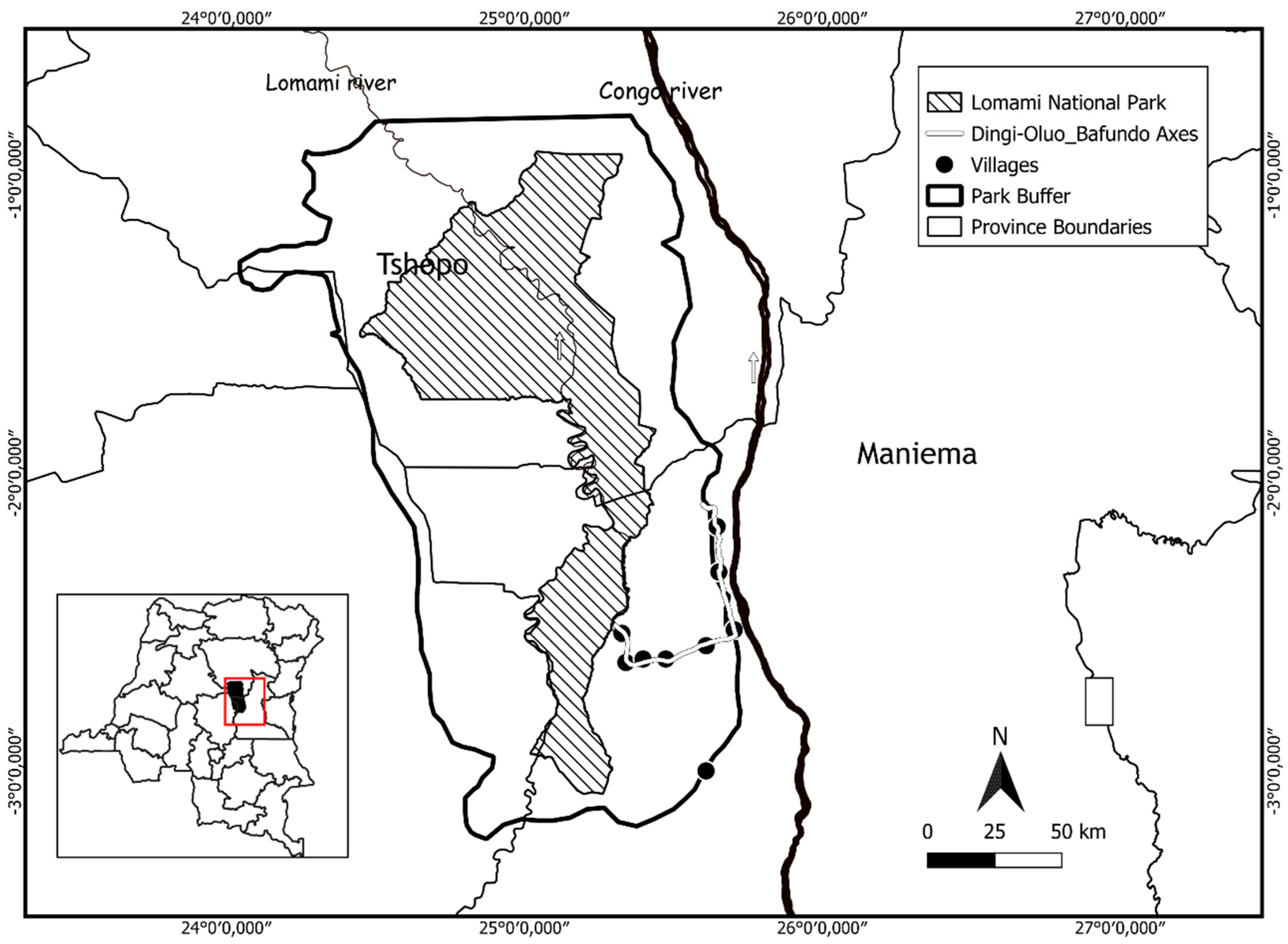

Table 1.
Surveyed Villages in the Buffer Zone of LNP (Maniema Province, DR Congo). This table lists the villages located on the periphery of LNP that were targeted for hunter surveys conducted between October and December 2023. All surveyed communities lie within the park’s buffer zone in Maniema Province and are distributed along two main road axes crossing the region: Dingi–Bafundo and Dingi–Oluo.
Table 1.
Surveyed Villages in the Buffer Zone of LNP (Maniema Province, DR Congo). This table lists the villages located on the periphery of LNP that were targeted for hunter surveys conducted between October and December 2023. All surveyed communities lie within the park’s buffer zone in Maniema Province and are distributed along two main road axes crossing the region: Dingi–Bafundo and Dingi–Oluo.
| Village | Number of hunters | Roads’ axis | Longitudes | Latitudes | Distances to the LNP (Km) |
| Oluo | 11 | Dingi-Bafundo | 25°19’38.4’’E | 2°32’16.4’’S | 5 |
| Oleke | 10 | 25°20’26.3’’E | 2°38’8.9’’S | 5 | |
| Makoka | 3 | 25°23’53.9’’E | 2°37’27’’S | 11 | |
| Kakungu | 10 | 25°28’27.9’’E | 2°37’27’’S | 6 | |
| Lomango | 9 | 25°36’36.2’’E | 2°34’46’’S | 9 | |
| Itchuku | 5 | Dingi-Oluo | 25°36’34.9’’E | 2°65’57.4’’S | 20 |
| Kiburi | 5 | 25°38’48.6’’E | 2°10’46.8’’S | 36 | |
| Kamba | 4 | 25°42’15.5’’E | 2°31’33.1’’S | 43 | |
| Bweni 1 | 3 | 25°39’09.2’’E | 2°19’55.4’’S | 34 |
Table 2.
Socio-demographic and hunting profile of respondents in proximal and distant zones around LNP (n=60).
Table 2.
Socio-demographic and hunting profile of respondents in proximal and distant zones around LNP (n=60).
| Hunter’s profile | Proximal zone ( n=40) | Distant zone (n=20) |
| Fr (%) | Fr (%) | |
| Gender | ||
| Male | 100 | 100 |
| Age | ||
| 20-30 | 12.5 | 15.0 |
| 30-40 | 40.0 | 35.0 |
| 40-50 | 17.5 | 25.0 |
| 50-60 | 15.0 | 10.0 |
| Over 60 | 15.0 | 15.0 |
| Marital status | ||
| Married | 75.0 | 85.0 |
| Single | 25.0 | 15.0 |
| Status of origin | ||
| Allochtonous | 62.5 | 60.0 |
| Autochtonous | 37.5 | 40.0 |
| Study level | ||
| Primary | 55.0 | 55.0 |
| Secondary | 32.5 | 35.0 |
| Higher education | 12.5 | 10.0 |
| Household size | ||
| Small household (1 to 4 members) | 25.0 | 30.0 |
| Medium household (5 to 7 members) | 57.5 | 50.0 |
| Large household (8 to 10 members) | 10.0 | 10.0 |
| Very large household (11 members or more) | 7.5 | 10.0 |
| Alternative activities | ||
| Agriculture | 77.5 | 75.0 |
| Fishing | 5.0 | 5.0 |
| Teaching | 5.0 | 0.0 |
| Motorcycle transport | 5.0 | 0.0 |
| Road maintenance | 0.0 | 20.0 |
| Mechanics | 2.5 | 0.0 |
| Trade | 2.5 | 0.0 |
| Artisanal work | 2.5 | 0.0 |
| Hunting frequency | ||
| Occasional | 7.5 | 10.0 |
| Weekly | 25.0 | 35.0 |
| Seasonal | 67.5 | 55.0 |
| Type of weapons used | ||
| Firearm | 62.5 | 60.0 |
| Projectile weapon (bow, crossbow, spears) | 15.0 | 20.0 |
| Trap | 22.5 | 20.0 |
| Hunting experience | ||
| Less than 10 years | 12.5 | 10.0 |
| 10 to 15 years | 55.0 | 55.0 |
| 16 to 20 years | 17.5 | 20.0 |
| More than 20 years | 15.0 | 15.0 |
Table 3.
Most Hunted Species Around LNP, Perceived Rarity, Estimated Market Value of Smoked Carcasses (USD), and Associated Non-Food Uses. A carcass refers to an animal that has been killed, then eviscerated and smoked, and is kept whole (not cut into pieces), as it is commonly sold in local markets. Distant zones refer to villages located more than 10 km from the Park. The symbol (+) indicates that a species was cited in a zone, while (−) denotes it was not mentioned. DT: Declared targeting; PD: Perceived decline; PD: Proximal zone; DZ: Distant zone; ECP: Estimated carcass price.
Table 3.
Most Hunted Species Around LNP, Perceived Rarity, Estimated Market Value of Smoked Carcasses (USD), and Associated Non-Food Uses. A carcass refers to an animal that has been killed, then eviscerated and smoked, and is kept whole (not cut into pieces), as it is commonly sold in local markets. Distant zones refer to villages located more than 10 km from the Park. The symbol (+) indicates that a species was cited in a zone, while (−) denotes it was not mentioned. DT: Declared targeting; PD: Perceived decline; PD: Proximal zone; DZ: Distant zone; ECP: Estimated carcass price.
| Species | Family | DT (%) | PD (%) | PZ | DZ | ECP (USD) | Uses |
| Cercopithecus spp | Cercopithecidae | 98.0 | 13.0 | + | + | 14 – 20 | Ritual use: crafting of power amulets or talismans |
| Cephalophus monticola (Thunberg, 1789 | Bovidae | 53.0 | 20.0 | + | + | 18 – 24 | Consumption only |
| Atherurus africanus (Gray,1842) | Hystricidae | 37.0 | 5.0 | + | - | 16 – 22 | Artisanal: Traditional ornaments (necklaces, bracelets), use as natural sewing needles |
| Tragelaphus spekei (Speké, 1863) | Bovidae | 17.0 | 17.0 | + | + | 60 – 88 | Cordage making. |
| Cephalophus nigrifrons Gray, 1871) | Bovidae | 7.0 | 8.0 | + | + | 30 – 40 | Artisanal and ritual: traditional drums, seat covers, amulets. |
| Orycteropus afer (Pallas, 1766) | Oryctérope | 13.0 | 23.0 | + | + | 36 – 52 | Crafting of traditional drums, bags, and amulets, |
| Cephalophus weynsi (Thomas, 1901) | Bovidae | 25.0 | 33.0 | + | + | 32 – 44 | Consumption only |
| Potamochoerus porcus (Linnaeus, 1758) | Suidae | 30.0 | 28.0 | + | - | 64 – 100 | Medicinal: Healing ointment, treatment for joint pain. |
| Cephalophus dorsalis (Gray, 1846) | Bovidae | 20.0 | 22.0 | + | + | 24 – 32 | Consumption only |
| Bdeogale nigripes (Pucheran, 1855) | Herpestidae | 20.0 | 0.0 | + | + | 8 – 12 | Consumption only |
| Genetta servalina (Pucheran, 1855) | Viverridae | 2.0 | 3.0 | + | + | 6 – 10 | Artisanal and Ritual: Bracelet making, adornment of chief headdresses or ceremonial belts. |
| Sciurus vulgaris (Linnaeus, 1758) | Sciuridae | 5.0 | 5.0 | + | + | 2 – 3.2 | Artisanal and Ritual: Incorporated into the making of talismans and amulets. |
| Tragelaphus eurycerus (Ogilby, 1837) | Bovidae | 2.0 | 12.0 | + | + | 120 – 180 | Artisanal and Ritual: Used in the making of traditional flutes, ceremonial drums, prestige garments, and traditional seat covers. Medicinal: Applied for joint pain relief, wound treatment, and skin conditions. |
| Syncerus caffer (Sparrman , 1779) | Bovidae | 2.0 | 17.0 | + | - | 240 – 360 | Artisanal and Ritual: Used for anti-spear shield coverings, long-range signal whistle bases, and traditional drums. Medicinal: Employed as an aphrodisiac and for relieving rheumatism, lower back pain, and sprains. |
| Hyemoscus aquaticus (Ogilby, 1841) | Tragulidae | 2.0 | 3.0 | + | - | 6– 10 | Artisanal: Used in the production of traditional medicine pouches. Medicinal: Prepared as elixirs to strengthen children's bone structure and as remedies for respiratory ailments. |
Table 4.
Species Considered Locally Extinct from LNP and Associated Non-Food Uses. Proximal zones (PZ) refer to villages located within 10 km of the park’s core area. Distant zones (DZ) refer to villages located more than 10 km from the park. The symbol (+) indicates that a species was cited in a zone, while (−) denotes it was not mentioned. Frequency (FR).
Table 4.
Species Considered Locally Extinct from LNP and Associated Non-Food Uses. Proximal zones (PZ) refer to villages located within 10 km of the park’s core area. Distant zones (DZ) refer to villages located more than 10 km from the park. The symbol (+) indicates that a species was cited in a zone, while (−) denotes it was not mentioned. Frequency (FR).
| Species | Family | FR (%) | PZ | DZ | Uses |
| Loxodonta cyclotis (Matschie, 1900) | Elephantidae | 92.0 | + | + | Commercial Use of Ivory; Artisanal: Used in the production of carvings, figurines, statuettes, and decorative ornaments. |
| Syncerus caffer (Sparrman, 1779) | Bovidae | 47.0 | + | + | Artisanal and Ritual: Used for crafting anti-spear shield covers, long-range signal whistle bases, and traditional drums. Medicinal: Considered an aphrodisiac; used to relieve rheumatism, lower back pain, and sprains. |
| Panthera pardus pardus (Linnaeus, 1758) | Felidae | 25.0 | + | + |
Artisanal and Ritual: Used in the making of royal or chief garments. Medicinal: Prepared as an ointment for pain relief or used as an aphrodisiac. |
| Thryonomys swinderianus (Temminck, 1827) | Thryonomyidae | 15.0 | + | + |
Artisanal: Used in the making of traditional brushes. Medicinal: Remedy for toothaches. |
| Tragelaphus scriptus (Pallas, 1766) | Bovidae | 13.0 | + | + | Artisanal: Used in the crafting of musical instruments (traditional flutes), ceremonial drums, prestige garments, and traditional seat coverings. Medicinal: Used for treating joint pain, wounds, or skin disorders. |
| Hyemoscus aquaticus(Ogilby, 1841) | Tragulidae | 8.0 | + | - | Artisanal: Used in the production of traditional medicine pouches. Medicinal: Elixirs to strengthen children's bone structure and remedies for respiratory ailments. |
| Tragelaphus eurycerus (Ogilby, 1837) | Bovidae | 42.0 | + | + | Artisanal and Ritual: Used in the making of traditional flutes, ceremonial drums, prestige garments, and traditional seat coverings. Medicinal: Treatments for joint pain, wounds, and skin disorders. |
| Cephalophus dorsalis (Gray, 1846) | Bovidae | 5.0 | + | + | Consumption Only: Used exclusively for food purposes. |
| Potamochoerus porcus (Linnaeus, 1758) | Suidae | 13.0 | + | + | Medicinal: Used in healing ointments for wound treatment and to relieve joint pain. |
| Sylvicapra grimmia (Linnaeus, 1758) | Bovidae | 3.0 | + | + |
Artisanal: Used in the crafting of amulet cases Medicinal: Remedies for abdominal pain and fertility issues. |
| Panthera leo (Linnaeus, 1758) | Felidae | 3.0 | - | + | Artisanal and Ritual: Design of royal regalia and traditional chief adornments; crafting of ceremonial instruments, fetishes, and amulets. |
Table 5.
Local Perceptions of Wildlife Availability and Hunting Practices around LNP. Proximal Zone (PZ) refer to villages located less than 10 km from the park’s core area; Distant Zones (DZ) refer to villages located more than 10 km from the park.
Table 5.
Local Perceptions of Wildlife Availability and Hunting Practices around LNP. Proximal Zone (PZ) refer to villages located less than 10 km from the park’s core area; Distant Zones (DZ) refer to villages located more than 10 km from the park.
| Perception | Category | PZ (n=40) | DZ (n=20) |
| Opinion on the Current Availability of Wildlife | Less abundant | 97.5 | 95.0 |
| Abundant | 2,5 | 5.0 | |
| Perceptions on wildlife decline | Intensive hunting | 87.5 | 85.0 |
| Poaching | 12.5 | 15.0 | |
| Age group of most captured animals | Young | 25.0 | 5.0 |
| Adult | 75.0 | 95.0 | |
| Period of significant changes | 1996 to 2003 | 25.0 | 20.0 |
| 2004 to 2016 | 62.5 | 75.0 | |
| 2016 to the present | 2.5 | 5.0 | |
| Species encountered but not hunted | Yes | 75.0 | 70.0 |
| No | 25.0 | 30.0 | |
| Capture volume per outing | Small game (≤5 kg) | 25.0 | 20.0 |
| Medium game (5-15 kg) | 37.5 | 40.0 | |
| Large game (>15 kg) | 37.5 | 40.0 | |
| Average monthly income | Subsistence (<50 USD) | 25.0 | 20.0 |
| Complementary (50 - 200 USD) | 50.0 | 55.0 | |
| Commercial (> 200 USD) | 25.0 | 25.0 | |
| Main use of captured animals | Consumption | 15.0 | 25.0 |
| Sale | 15.0 | 10.0 | |
| Consumption et Sale | 70.0 | 75.0 | |
| Destination of bushmeat | Local markets | 12.5 | 10.0 |
| Urban markets | 87.5 | 90.0 | |
| Attitude towards conservation laws | Favorable | 37.5 | 25.0 |
| Neutral / Indifferent | 57.5 | 70.0 | |
| Opposed | 5.0 | 5.0 | |
| Hunting ecosystem | Exclusively in forest | 97.5 | 95.0 |
| Forest and savanna | 2.5 | 5.0 | |
| Opinions on effectiveness of conservation initiatives | Effective | 25.0 | 25.0 |
| Partially effective | 50.0 | 60.0 | |
| Ineffective | 25.0 | 15.0 | |
| Knowledge of hunting ban inside the park | Yes | 100 | 100 |
| No | 0.0 | 0.0 | |
| Awareness of community rules or taboos on certain species | Yes | 100 | 100 |
| No | 0.0 | 0.0 | |
| Knowledge (Reproduction cycle, migrations, feeding habits) | Yes | 100 | 100 |
| No | 0.0 | 0.0 | |
| Participation in conservation programs | Low | 35 | 40 |
| Moderate | 62.5 | 55 | |
| High | 5 | 2.5 | |
| Alternative practices (agriculture, fishing, livestock...) | Farming | 62.5 | 60.0 |
| Livestock | 32.5 | 35.0 | |
| Fishing | 5.0 | 10.0 |
Table 6.
Association between perceptions and hunting practices around LNP and the sociodemographic characteristics of respondents. The figures presented in this table are p-values from Fisher’s exact test. * indicates a statistically significant association between variables.
Table 6.
Association between perceptions and hunting practices around LNP and the sociodemographic characteristics of respondents. The figures presented in this table are p-values from Fisher’s exact test. * indicates a statistically significant association between variables.
| Perception | Education level | Age | Proximity | Hunter origin | Household size | Experience | Type of instrument used | Hunting frequency | Alternative activity practiced | Road axes |
| Wildlife availability | 0.809 | 0.691 | 0.489 | 0.527 | 0.719 | 0.876 | 0.631 | 0.615 | 0.389 | 0.4898 |
| Hunting area | 0.214 | 0.007٭ | 0.000٭ | 0.000٭ | 0.834 | 0.786 | 0.679 | 0.016٭ | 0.924 | 0.3758 |
| Hunting ecosystem | 0.328 | 0.320 | 0.548 | 0.519 | 0.222 | 0.116 | 0.142 | 0.602 | 0.129 | 0.4898 |
| Preference on alternative activities to implement | 0.230 | 0.348 | 0.030 | 0.281 | 0.469 | 0.263 | 0.112 | 0.430 | 0.000٭ | 0.000٭ |
| Opinions on effectiveness of conservation initiatives | 0.004٭ | 0.939 | 0.292 | 0.059 | 0.045 | 0.146 | 0.281 | 0.118 | 0.102 | 0.222 |
| Main use of animals | 0.172 | 0.875 | 0.887 | 0.711 | 0.884 | 0.174 | 0.105 | 0.736 | 0.247 | 0.173 |
| Capture volume per outing | 0.464 | 0.062 | 0.798 | 0.901 | 0.530 | 0.491 | 0.803 | 0.151 | 0.060 | 0.292 |
Disclaimer/Publisher’s Note: The statements, opinions and data contained in all publications are solely those of the individual author(s) and contributor(s) and not of MDPI and/or the editor(s). MDPI and/or the editor(s) disclaim responsibility for any injury to people or property resulting from any ideas, methods, instructions or products referred to in the content. |
© 2025 by the authors. Licensee MDPI, Basel, Switzerland. This article is an open access article distributed under the terms and conditions of the Creative Commons Attribution (CC BY) license (http://creativecommons.org/licenses/by/4.0/).
Copyright: This open access article is published under a Creative Commons CC BY 4.0 license, which permit the free download, distribution, and reuse, provided that the author and preprint are cited in any reuse.