

Submitted:
10 June 2025
Posted:
12 June 2025
You are already at the latest version
Abstract
For the first time, zircons from thin volcanic ash layers interbedded within organic-rich Domanik facies (hydrocarbon source rocks) at the Devonian–Carboniferous boundary have been dated using the U–Pb LA-ICPMS method. The studied material derives from core samples of two boreholes located in the axial and marginal zones of the Kama–Kinel Trough System within the Volga–Ural Petroleum Province. In the axial zone, the base of the Siphonodella quadruplicata conodont zone yielded a concordant U–Pb age of 358.3 ± 1.7 Ma. In the marginal zone, the upper part of the Palmatolepis gracilis expansa Zone provided a concordant U–Pb age of 360.0 ± 1.2 Ma. These ages agree, within analytical uncertainty, with the current conodont-based chronostratigraphic framework and allow refinement of the onset of the Hangenberg Event in the studied basin.
Keywords:
east European platform
; kama–kinel trough system
; devonian
; carboniferous
; domanik facies
; U–Pb LA-ICPMS zircon dating
Introduction
Volcanic material is a well-known component in the Domanik facies of the Devonian and Carboniferous deposits across the Volga–Ural region. It occurs either as thin ash layers (up to 3 cm) dominated by volcanic glass, as greenish-grey clays, or as micro-lenses of tuffaceous material (Fortunatova et al., 2018, 2023). Previous studies have provided detailed mineralogical, X-ray, and thermal characterisations of tuff layers from Upper Devonian and Tournaisian strata of the Mukhanovo–Erokhovo Depression within the Kama–Kinel Trough System (Shakirov et al., 2022).
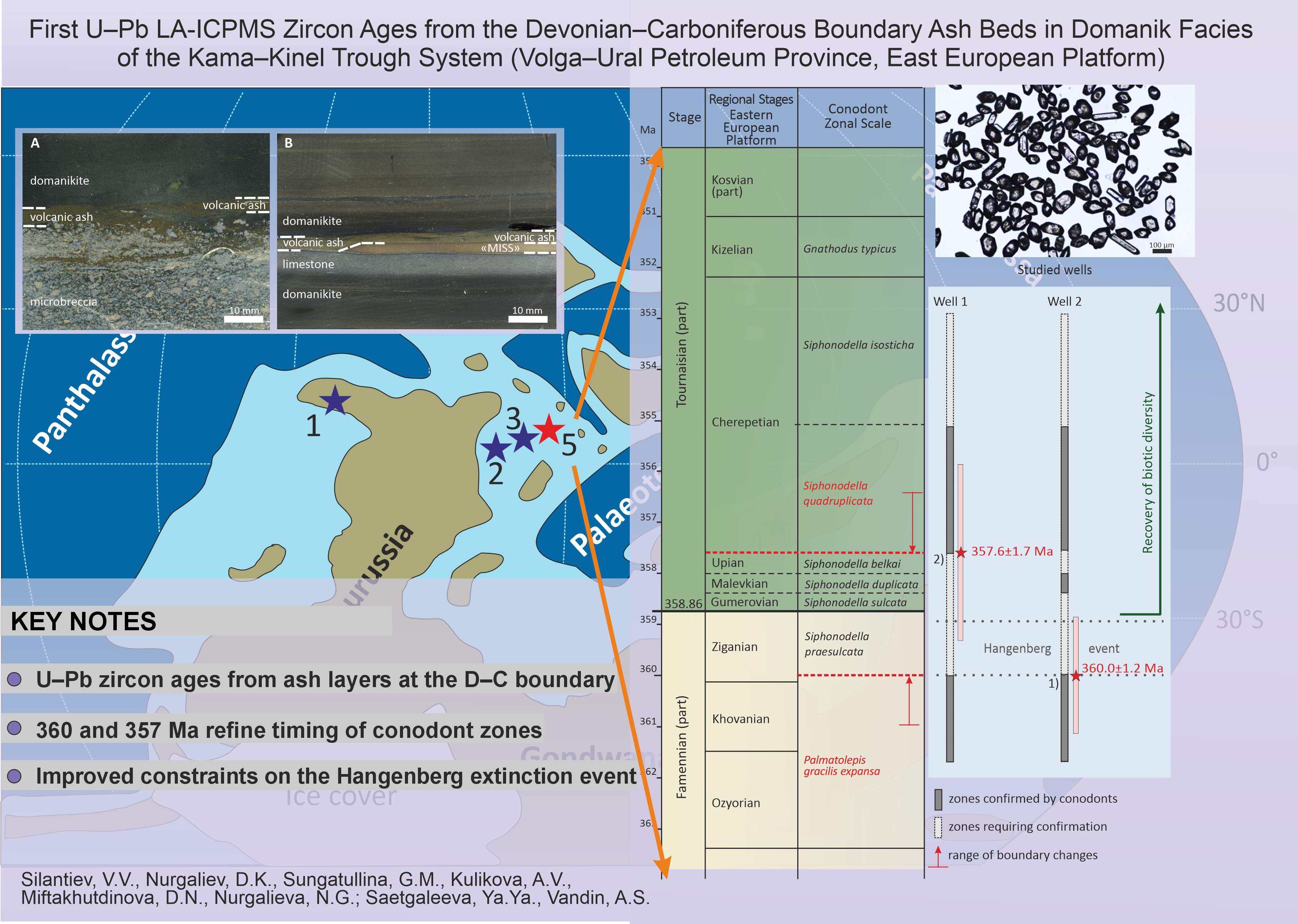
During 2023–2024, laboratory protocol was developed to extract heavy mineral fractions from these extremely thin and compact tuff layers using non-destructive methods. The main challenge lies in the millimetre-scale thickness and very high hardness of these beds, which typically yield only 3–5 grams of material per sample. The samples analysed in this study represent one of the few known localities where the Devonian–Carboniferous boundary interval has been directly dated using radioisotopic techniques (Figure 1).
Geological Setting
The Kama–Kinel Trough System (KKTS) was active from the early Frasnian to the late Tournaisian, developing along the margins of carbonate platforms that formed a shallow-water shelf on the rim of the East European Platform adjacent to the Ural Ocean (Silantiev et al., 2024). Clayey, siliceous, and carbonate sediments with high organic content infilled the troughs. In Russian geological literature, these organic-rich deposits are subdivided into "Domanikites" (5–25% total organic carbon) and "Domanikoids" (<5% TOC), collectively referred to as Domanik-type rocks or facies.
Materials
Volcanic ash layers were identified in two boreholes intersecting the Devonian–Carboniferous boundary interval within the axial (Borehole 1) and marginal (Borehole 2) zones of the Lower Kama segment of the KKTS. The stratigraphy of both sections was established through detailed conodont biostratigraphy (Sungatullina et al., 2025). A comprehensive description of the stratigraphic successions and associated biofacies is forthcoming (Silantiev et al., 2025b, in press).
The ash beds, 3–4 mm thick, consist of dense, competent material (Figure 2), distinguishable by their light yellowish-grey colour against the dark background of the enclosing rock and by their ultraviolet fluorescence. Each 3–5 g sample yielded 60–100 euhedral zircon grains suitable for geochronological analysis.
Methods
Ash layers were mechanically separated from the surrounding rock and cut into 3 × 5 mm fragments weighing 3–5 g. Samples were soaked for 24 hours at 50°C in dimethyl sulfoxide ((CH₃)₂SO) and then subjected to point-focused ultrasonic treatment (25 kHz) for 8 hours. This cycle was repeated 26 times. The processed material was subsequently immersed in a heavy liquid (GPS-V; an aqueous solution of sodium heteropolytungstate; density: 3.00 g/cm³). Zircon grains were extracted from the heavy fraction using a ZEISS Stemi DV4 binocular microscope (Germany).
Zircon U–Pb LA-ICPMS dating was conducted using a ThermoScientific iCAP Q quadrupole mass spectrometer (Germany). Cathodoluminescence imaging, weighted mean age calculations, and Concordia diagram construction were performed according to the protocols described in previous publications (Silantiev et al., 2023, 2025a). Discordant analyses exceeding ±10% were excluded from age calculations.
Results and discussion
The light heavy-mineral fraction of the tuff layers consists predominantly (50–90%) of zircon (ZrO₂), with 80–85% represented by unabraded, euhedral crystals (Figure 3).
Concordant U–Pb ages were obtained from 30 zircon grains in the Borehole 1 sample and 52 grains in the Borehole 2 sample (Figure 4).
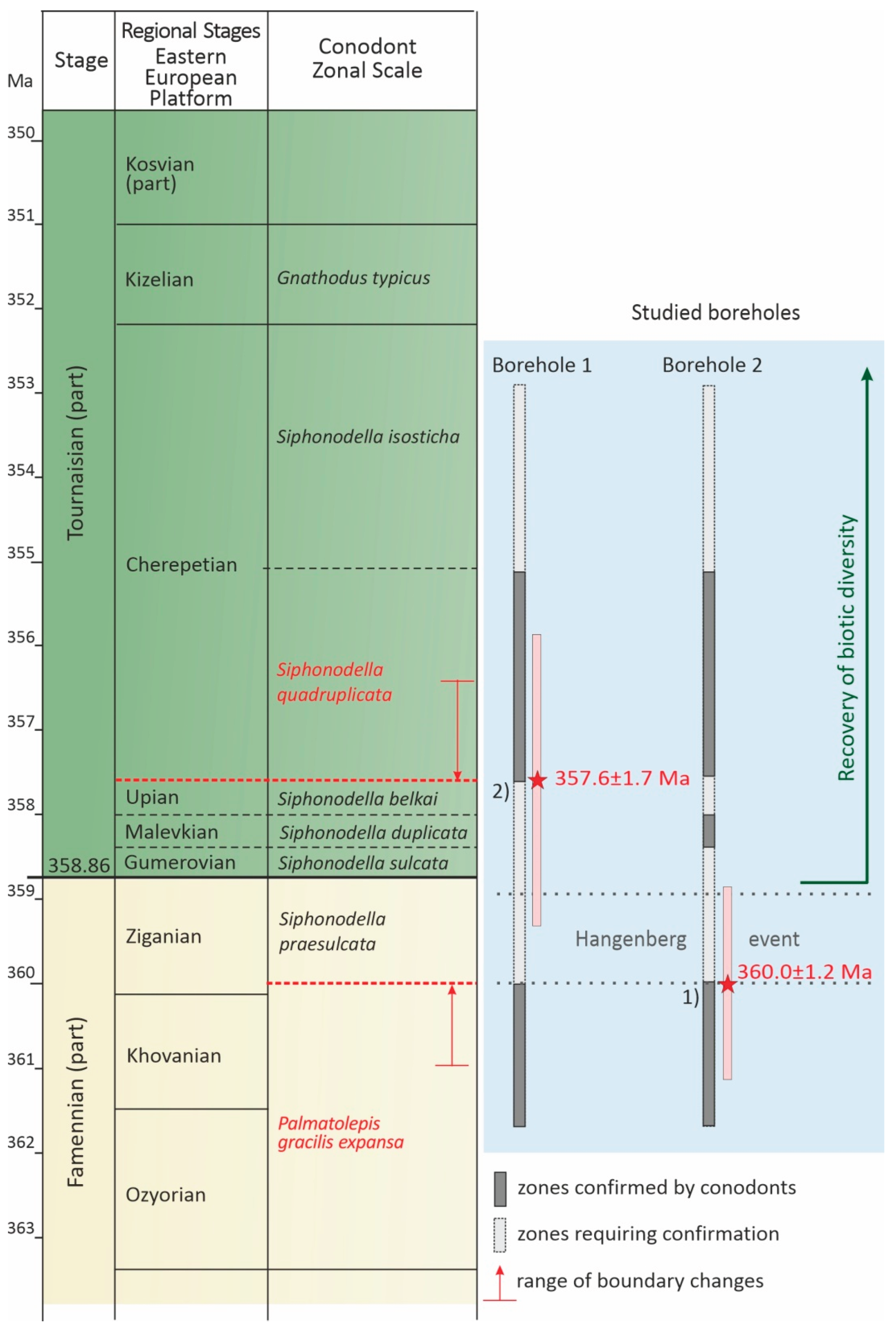
In the axial zone (Borehole 1), the ash layer located at the base of the Siphonodella quadruplicata conodont zone yielded a concordant age of 357.6 ± 1.7 Ma. In the marginal zone (Borehole 2), the ash layer near the top of the Palmatolepis gracilis expansa zone produced an age of 360.0 ± 1.2 Ma (Figure 5).
These ages are consistent, within analytical uncertainty, with the current global conodont zonation and constrain the onset of the Hangenberg Event in the study area to 360.0 ± 1.2 Ma, which agrees well with international chronostratigraphic data (Davydov et al., 2012; Becker et al., 2020; International Chronostratigraphic Chart, 2024).
These ages are consistent, within analytical uncertainty, with the current global conodont zonation and constrain the onset of the Hangenberg Event in the study area to 360.0 ± 1.2 Ma, which agrees well with international chronostratigraphic data (Davydov et al., 2012; Becker et al., 2020; International Chronostratigraphic Chart, 2024).
Discussion
Chronological calibration of the Devonian period relies on the integration of high-precision U–Pb CA-ID-TIMS zircon dating from tuff layers with detailed conodont zonal biostratigraphy. This combined approach not only refines the absolute ages of stage boundaries but also allows for estimating the durations of individual biozones with a resolution of up to 0.6 million years. Specialised studies (Kaufmann, 2006; Harrigan et al., 2022) have proposed detailed “biochronometric” frameworks that align each conodont zone with a numerical (radioisotopic) age.
The Devonian–Carboniferous boundary age was first estimated at 360.7 ± 0.7 Ma using interpolated U–Pb ID-TIMS zircon ages from tuff layers within the Tournaisian section at Hasselbachtal (Germany) and Upper Famennian sections in western Canada (Exshaw Formation) (Trapp et al., 2004). Since then, the accepted boundary age has gradually decreased. The Geological Time Scale 2020 adopted a boundary age of 359.3 ± 0.3 Ma (Becker et al., 2020), supported by additional data from South China (Liu et al., 2012; Xu et al., 2024). The most recent International Chronostratigraphic Chart (2024 edition) specifies the Devonian–Carboniferous boundary at 358.86 ± 0.19 Ma.
Tuff layers marking the boundary interval are preserved in both carbonate and Domanik-type facies across various regions. For instance, they are found in the Hasselbachtal section (Germany) and Muhua II (South China) within carbonate successions, and in Domanik-type intervals such as the Exshaw Formation (western Canada), the Daposhang section (South China), and the Kowala section (Poland) (Ferri et al., 2021; Liu et al., 2012; Xu et al., 2024; Myrow et al., 2014).
At Hasselbachtal, two tuffs (Beds 79 and 70) were dated within the Siphonodella sulcata and S. duplicata conodont zones at 360.5 ± 0.8 Ma and 360.2 ± 0.7 Ma, respectively (Trapp et al., 2004). In the Daposhang section (South China), a 5 cm tuff bed situated just above the black shale unit known as Bed E—interpreted as the main phase of the Hangenberg Event—yielded a CA-ID-TIMS age of 360.47 ± 0.68 Ma (Xu et al., 2024). At Kowala (Poland), three dated tuffs bracketing the Hangenberg Black Shale yielded ages of 359.97 ± 0.46, 358.97 ± 0.11, and 358.89 ± 0.20 Ma, all within the Late Famennian. In each case, these U–Pb ages correlate well with conodont zones such as expansa, praesulcata, sulcata, and duplicata, enabling reliable integration of regional biostratigraphy with the global chronostratigraphic scale.
A key feature of volcanic ash layers within source rocks is their unusually high zircon content. Even from millimetre-thick beds, tens to hundreds of euhedral zircon crystals can be recovered—sufficient for robust age determinations. Comparable results have been reported from source rocks of the Ordovician–Silurian boundary interval in South China (Du et al., 2020, 2021) and the Jurassic–Cretaceous transition in the Bazhenov Formation of Western Siberia (Rogov et al., 2023).
The new data from the KKTS Domanik facies suggest that the Palmatolepis gracilis expansa Zone may persist in the studied basin up to 360.0 ± 1.2 Ma, extending into time intervals that correspond to younger conodont zones on the global scale (Becker et al., 2020). The absence of these younger zones in the borehole successions requires further investigation.
The U–Pb age of 357.6 ± 1.7 Ma obtained from the base of the Siphonodella quadruplicata Zone may imply an earlier regional appearance of this species in the KKTS basin. This age aligns well with global data (Aretz et al., 2020), supporting short durations (c. 0.5 Ma each) for the S. sulcata and S. duplicata zones—the basal zones of the Tournaisian Stage. It may be inferred that the S. belka Zone, the presence of which in the studied sections remains to be confirmed, has a similarly short duration.
Conclusion
For the first time, direct U–Pb LA-ICPMS zircon ages have been obtained from tuff layers within Domanik facies at the Devonian–Carboniferous boundary on the East European Platform. The ages of 360.0 ± 1.2 and 357.6 ± 1.7 Ma are consistent with the current international chronostratigraphic scale and with global data on the Hangenberg biotic event. These results refine the age constraints of conodont zones and demonstrate the applicability of LA-ICPMS for dating millimetre-scale ash beds embedded in organic-rich source rocks. The study presents new opportunities for developing a high-resolution chronostratigraphic framework for Devonian and Early Carboniferous source rocks (Domanik facies) in Eastern Europe by integrating biostratigraphic (conodont) and radioisotopic methods.
References
- Alekseev, A.S., Nikolaeva, S.V., Goreva, N.V., Donova, N.B., Kossovaya, O.L., Kulagina, E.I., Kucheva, N.A., Kurilenko, A.V., Kutygin, R.V., Popeko, L.I., & Stepanova, T.I. (2022). Russian regional Carboniferous stratigraphy. In: B.E. Beauchamp & A. Montenari (Eds.), Geological Society Special Publication, 512, 49–117. [CrossRef]
- Aretz, M., Herbig, H.-G., Wang, X.D., Gradstein, F.M., Agterberg, F.P., & Ogg, J.G. (2020). The Carboniferous period. In: J.M. Gradstein, J.G. Ogg, M.D. Schmitz & G.M. Ogg (Eds.), Geologic Time Scale 2020 (pp. 811–874). Elsevier. [CrossRef]
- Becker, T.R., Marshall, J.E.A., Da Silva, A.C., Agterberg, F.P., Gradstein, F.M., & Ogg, J.G. (2020). The Devonian Period. In: J.M. Gradstein, J.G. Ogg, M.D. Schmitz & G.M. Ogg (Eds.), Geologic Time Scale 2020 (pp. 733–810). Elsevier. [CrossRef]
- Davydov, V.I., Korn, D. and Schmitz, M.D. (2012) The Carboniferous Period. In: Gradstein, F.M., Ogg, J.G., Schmitz, M.D. and Ogg, G.M., Eds., The Geologic Time Scale 2012, Vol. 2, Elsevier, Oxford, 603-651. [CrossRef]
- Du, X., Lu, Y., Duan, D., Liu, Z., Zhao, K., Jia, J., & Fu, H. (2020). Was volcanic activity during the Ordovician–Silurian transition in South China part of a global phenomenon? Constraints from zircon U–Pb dating of volcanic ash beds in black shales. Marine and Petroleum Geology, 114, 104209. [CrossRef]
- Du, X., Jia, J., Zhao, K., Shi, J., Shu, Y., Liu, Z., & Duan, D. (2021). Was the volcanism during the Ordovician–Silurian transition in South China actually global in extent? Evidence from the distribution of volcanic ash beds in black shales. Marine and Petroleum Geology, 123, 104721. [CrossRef]
- Ferri, F., McMechan, M., Richards, B., & Friedman, R. (2021). Organic-rich Upper Devonian shales of the Patry and Exshaw formations (Besa River Group) in the subsurface of Liard Basin. British Columbia Geological Survey Paper, 2021-02, 1–42. https://cmscontent.nrs.gov.bc.ca/geoscience/PublicationCatalogue/Paper/BCGS_P2021-02.pdf.
- Fortunatova, N.K., Zaitseva, E.L., Kononova, L.I., Baranova, A.V., Bushueva, M.A., Mikheeva, A.I., Afanasyeva, M.S., & Obukhovskaya, T.G. (2018). Lithological-facies and biostratigraphic characteristics of Upper Devonian deposits in the 1 Melekesskaya Reference Borehole (Melekess Depression, Volga–Ural region). Bulletin MOIP. Geological Series, 93(5–6), 3–49. (In Russian).
- Fortunatova, N.K., Zaitseva, E.L., Bushueva, M.A., Ermolova, T.E., Mikheeva, A.I., Stupak, A.A., et al. (2023). Stratigraphy of the Lower Carboniferous of the Volga–Ural Subregion. Moscow: VNIGNI, 288 p. (In Russian).
- Harrigan, C.O., Schmitz, M.D., Over, D.J., Trayler, R.B., & Davydov, V.I. (2022). Recalibrating the Devonian time scale: A new method for integrating radioisotopic and astrochronologic ages in a Bayesian framework. Geological Society of America Bulletin, 134(7–8), 1931–1948. [CrossRef]
- International Chronostratigraphic Chart, 2024. [online] Available at: https://stratigraphy.org/ICSchart/ChronostratChart2024-12.pdf [Accessed 29/05/2025].
- Kaufmann, B. (2006). Calibrating the Devonian Time Scale: A synthesis of U–Pb ID-TIMS ages and conodont stratigraphy. Earth-Science Reviews, 76(3–4), 175–190. [CrossRef]
- Liu, Y.Q., Ji, Q., Kuang, H.W., Jiang, X.J., Xu, H., & Peng, N. (2012). U–Pb zircon age, sedimentary facies, and sequence stratigraphy of the Devonian–Carboniferous boundary, Daposhang section, Guizhou, China. Palaeoworld, 21(2), 100–107. [CrossRef]
- Myrow, P.M., Ramezani, J., Hanson, A.E., Bowring, S.A., Racki, G., & Rakociński, M. (2014). High-precision U–Pb age and duration of the latest Devonian (Famennian) Hangenberg Event and its implications. Terra Nova, 26(3), 222–229. [CrossRef]
- Rogov, M.A., Panchenko, I.V., Augland, L.E., Ershova, V.B., & Yashunsky, V.Y. (2023). The first CA-ID-TIMS U–Pb dating of the Tithonian–Berriasian boundary beds in a Boreal succession. Gondwana Research, 118, 165–173. [CrossRef]
- Shakirov, V.A., Vilesov, A.P., Morozov, V.P., Khayuzkin, A.S., Andrushkevich, O.Yu., Sosnovskaya, E.B., et al. (2022). Volcaniclastic rocks in condensed Domanik facies of the Mukhanovo–Erokhovo intrashelf depression. Geology, Geophysics and Development of Oil and Gas Fields, 2(362), 14–26. [CrossRef]
- Silantiev V.V., Gutak Ya.M., Tichomirowa M., Kulikova A.V., Felker A.S., Urazaeva M.N., Porokhovnichenko L.G., Karasev E.V. et al. (2023). First radiometric dating of tonsteins from coal-bearing succession of the Kuznetsk Basin: U-Pb geochronology of the Tailugan Formation. Georesursy = Georesources, 25(2), pp. 203–227. (In Russ.) . [CrossRef]
- Silantiev, V.V., Miftakhutdinova, D.N., Nurgalieva, N.G. (2024). From siliciclastics to carbonates and black shales: Deciphering sedimentary continuity and discontinuity in Devonian landscapes of the Volga–Ural Petroleum Province. Georesursy = Georesources, 26(4), 62–82. [CrossRef]
- Silantiev, V.V., Kulikova, A.V., Novikov, I.V., Felker, A.S., Miftakhutdinova, D.N., et al. (2025a). U–Pb zircon age of the “Mastodonsaurus” fauna horizon (Middle Triassic, East European Platform): Chronology and sedimentation model. Vestnik Moskovskogo Universiteta. Geology Series, 2025(3), 25–36.
- Silantiev, V.V., Miftakhutdinova, D.N., Sungatullina, G.M., Safarov, A.F., Validov, M.F., et al. (2025b, in press). Model of organic-rich sediment accumulation in the Kama–Kinel Trough System across the Devonian–Carboniferous boundary. Georesursy = Georesources, 26(4), in press.
- Sungatullina, G.M., Silantiev, V.V., Miftakhutdinova, D.N., Safarov, A.F., Validov, M.F., et al. (2025). First conodont data from the Devonian–Carboniferous boundary interval in the Kama–Kinel Trough System, East European Platform. Proceedings of Kazan University. Natural Sciences Series, 167(1), 130–153. [CrossRef]
- Trapp, E., Kaufmann, B., Mezger, K., Korn, D., & Weyer, D. (2004). Numerical calibration of the Devonian–Carboniferous boundary: Two new U–Pb ID-TIMS zircon ages from Hasselbachtal (Sauerland, Germany). Geology, 32(10), 857–860. [CrossRef]
- Xu, J., Hou, H., Ramezani, J., Fang, Q., Zhang, S., Yang, T., Chu, Z., & Wu, H. (2024). Geochronological constraints on the Hangenberg Event of the latest Devonian in South China. Palaeogeography, Palaeoclimatology, Palaeoecology, 642, 112147. [CrossRef]
- Ziegler, W., & Sandberg, C. (1990). The Late Devonian standard conodont zonation. Courier Forschungsinstitut Senckenberg, 121, 1–115.
Figure 1.
Main sections where the Devonian–Carboniferous boundary interval has been radioisotopically dated: 1 – Western Canada (Ferri et al., 2021), 2 – Germany (Trapp et al., 2004), 3 – Poland (Myrow et al., 2014), 4 – South China (Liu et al., 2012; Xu et al., 2024), 5 – East European Platform (this study).
Figure 1.
Main sections where the Devonian–Carboniferous boundary interval has been radioisotopically dated: 1 – Western Canada (Ferri et al., 2021), 2 – Germany (Trapp et al., 2004), 3 – Poland (Myrow et al., 2014), 4 – South China (Liu et al., 2012; Xu et al., 2024), 5 – East European Platform (this study).
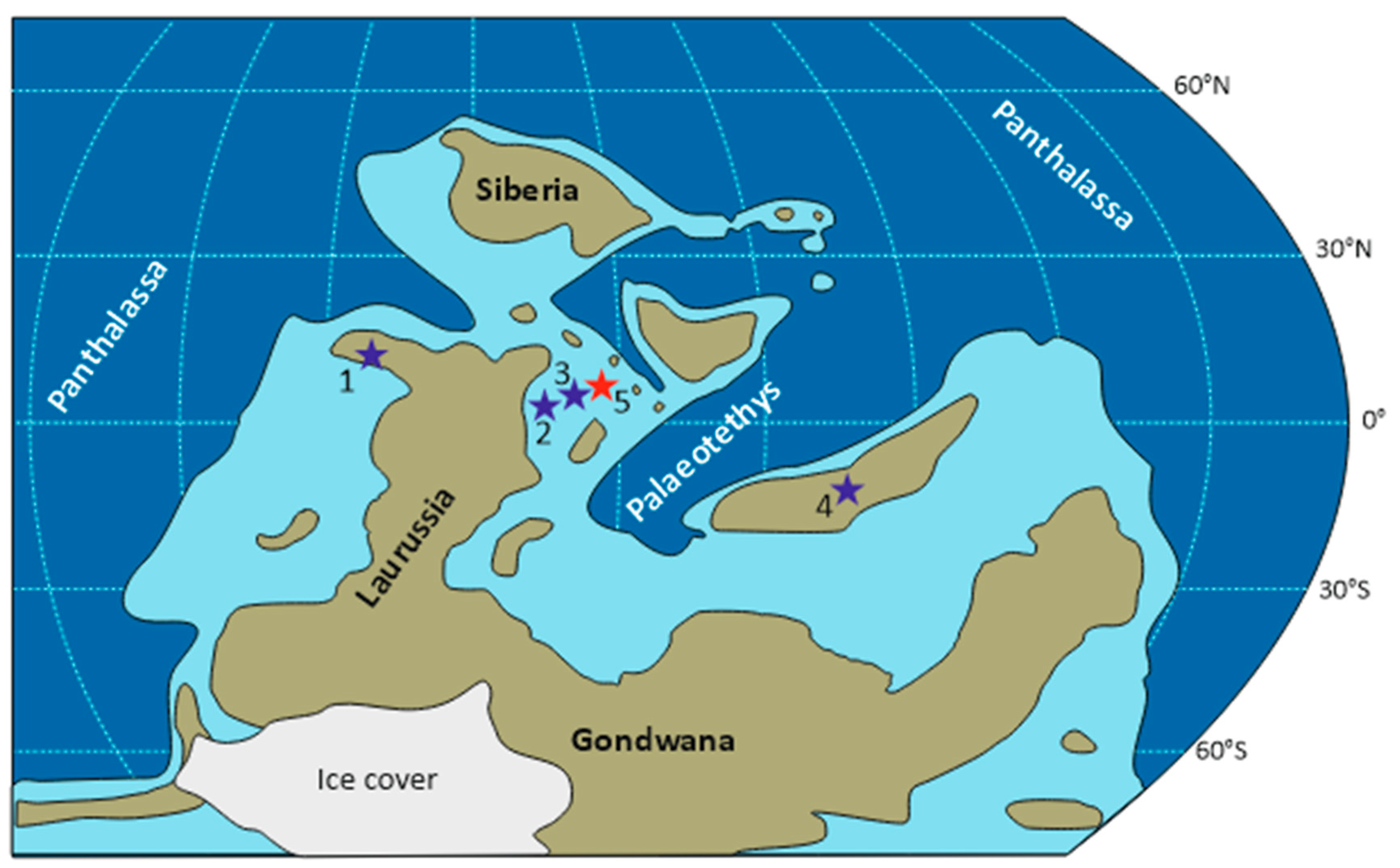
Figure 2.
Volcanic ash layers: (A) – Borehole 2, within the Palmatolepis gracilis expansa Zone; (B) – Borehole 1, within the Siphonodella quadruplicata Zone. White dashed lines indicate the boundaries of the ash beds; "MISS" = microbially induced sedimentary structures.
Figure 2.
Volcanic ash layers: (A) – Borehole 2, within the Palmatolepis gracilis expansa Zone; (B) – Borehole 1, within the Siphonodella quadruplicata Zone. White dashed lines indicate the boundaries of the ash beds; "MISS" = microbially induced sedimentary structures.
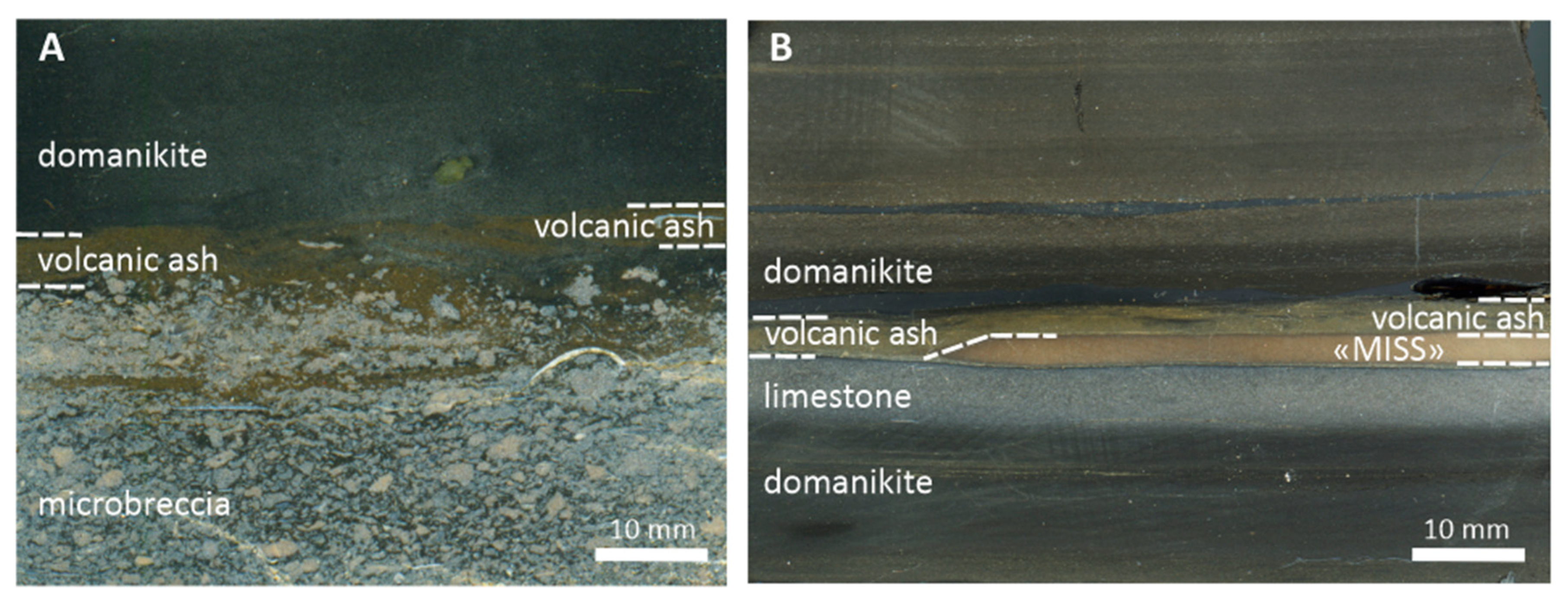
Figure 3.
Zircon crystals from the tuff layer in Borehole 2 (Palmatolepis gracilis expansa Zone).
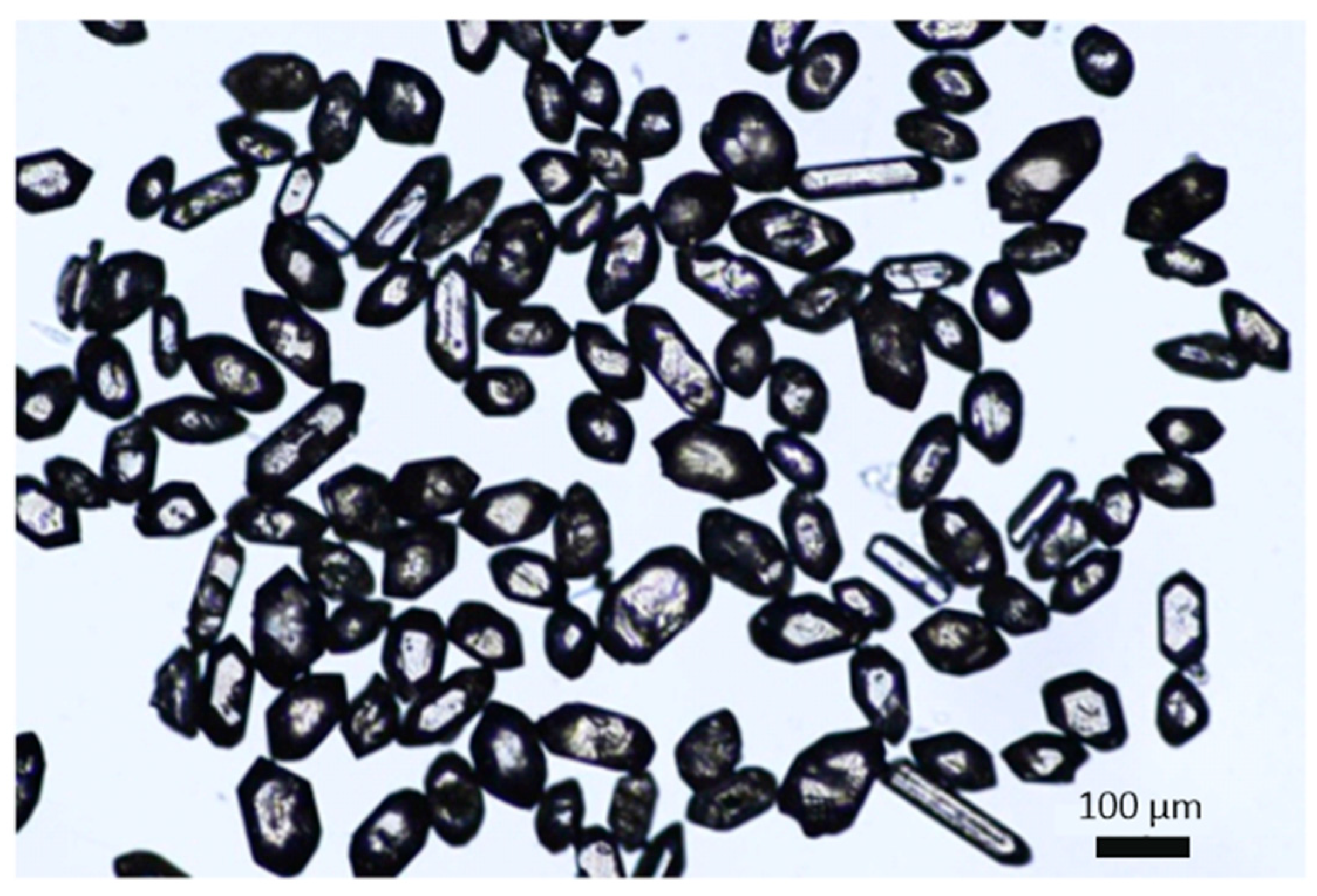
Figure 4.
Concordia diagrams for zircon U–Pb analyses: (A) – sample from Borehole 1, (B) – sample from Borehole 2. Ellipses represent 2σ analytical uncertainties for individual zircon analyses. Abbreviations: MSWD – mean square of weighted deviates; n – number of dated zircon grains.
Figure 4.
Concordia diagrams for zircon U–Pb analyses: (A) – sample from Borehole 1, (B) – sample from Borehole 2. Ellipses represent 2σ analytical uncertainties for individual zircon analyses. Abbreviations: MSWD – mean square of weighted deviates; n – number of dated zircon grains.
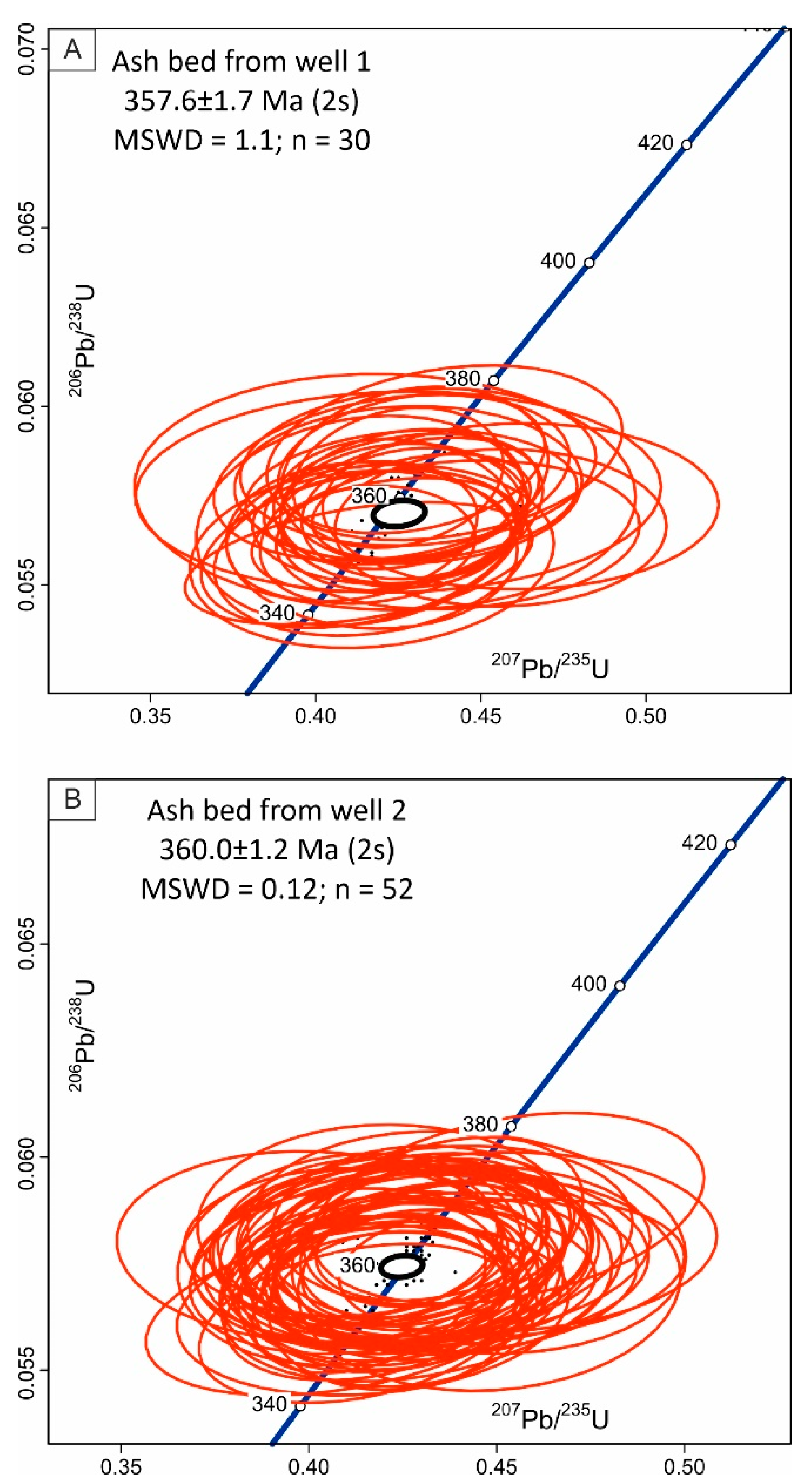
Figure 5.
U–Pb LA-ICPMS ages of the studied samples and their stratigraphic position within the boreholes. Asterisks mark dated samples; pink rectangles represent the analytical uncertainty ranges; red arrows indicate possible adjustments to conodont Zone boundaries (shown as red dashed lines) based on the new age data. The position of the Devonian–Carboniferous boundary is taken from the International Chronostratigraphic Chart (2024). Conodont zonation follows the schemes of Ziegler and Sandberg (1990), Aretz et al. (2020), Becker et al. (2020), and Alekseev et al. (2022).
Figure 5.
U–Pb LA-ICPMS ages of the studied samples and their stratigraphic position within the boreholes. Asterisks mark dated samples; pink rectangles represent the analytical uncertainty ranges; red arrows indicate possible adjustments to conodont Zone boundaries (shown as red dashed lines) based on the new age data. The position of the Devonian–Carboniferous boundary is taken from the International Chronostratigraphic Chart (2024). Conodont zonation follows the schemes of Ziegler and Sandberg (1990), Aretz et al. (2020), Becker et al. (2020), and Alekseev et al. (2022).
Disclaimer/Publisher’s Note: The statements, opinions and data contained in all publications are solely those of the individual author(s) and contributor(s) and not of MDPI and/or the editor(s). MDPI and/or the editor(s) disclaim responsibility for any injury to people or property resulting from any ideas, methods, instructions or products referred to in the content. |
© 2025 by the authors. Licensee MDPI, Basel, Switzerland. This article is an open access article distributed under the terms and conditions of the Creative Commons Attribution (CC BY) license (http://creativecommons.org/licenses/by/4.0/).
Copyright: This open access article is published under a Creative Commons CC BY 4.0 license, which permit the free download, distribution, and reuse, provided that the author and preprint are cited in any reuse.


