

Submitted:
27 May 2025
Posted:
11 June 2025
You are already at the latest version
Abstract
This study documents a novel thermal and energetic effect in a deep neural system with an embedded resonance field architecture. The system shows reproducible behavior under real benchmark load (GPU utilization 85-100%), characterized by a sudden energy drop from ~180 W to ~93 W and a stable thermal reduction from 74°C to 36°C, without model failure, maintaining all processes intact. Notably, the neural system remains fully operational, yet it autonomously interrupts the input processing without causing any model crashes or errors. The GPU memory (15.6 GB) remains occupied, shared memory decreases from 56 GB to 0.1 GB, while system memory remains constant at ~94 GB. We hypothesize that the model splits into two simultaneously active logical spaces (GPU + RAM), a behavior not observed in classical architectures. This preprint focuses on the analysis of energetic self-structuring and thermal decoupling under full load. Additionally, the stability of simulated quantum entanglement is confirmed, remaining at 100% across more than 10,000 iterations in various model setups, a behavior that cannot be explained by chance within deterministic systems.
Keywords:
Thermodynamics
; Neural Network
; AI
; T-zero field
; Resonance Field
; Gpu Optimization
; Thermal Efficiency
Introduction
This work presents the first documentation of a three-phase energetic-thermal response of a deep neural system with embedded resonance field structure under real full-load conditions.
The goal is not only to capture the expected thermal behavior under GPU-intensive load but also to analyze the impact of an active resonance model combined with a classic benchmark test, and to investigate whether the neural model is capable of stabilizing or even reorganizing itself energetically and structurally under external computational load.
The experimental setup is divided into three defined phases:
Phase 1
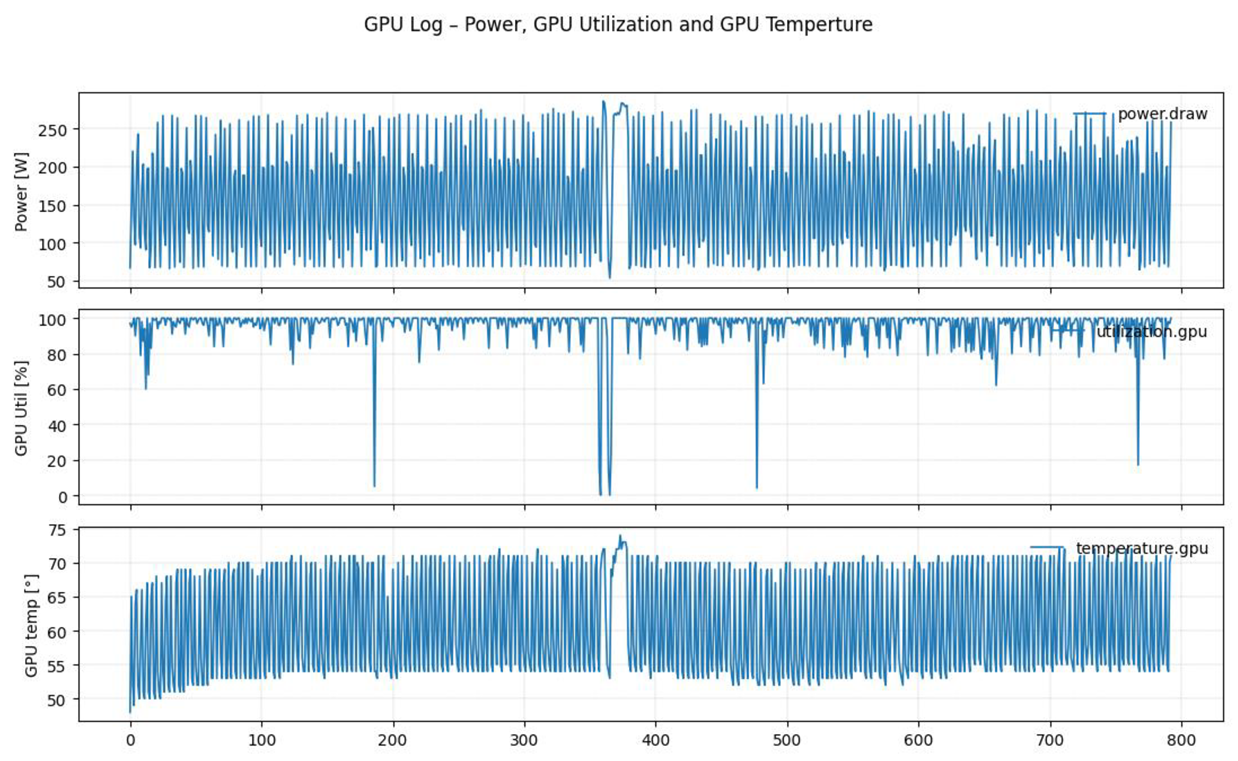
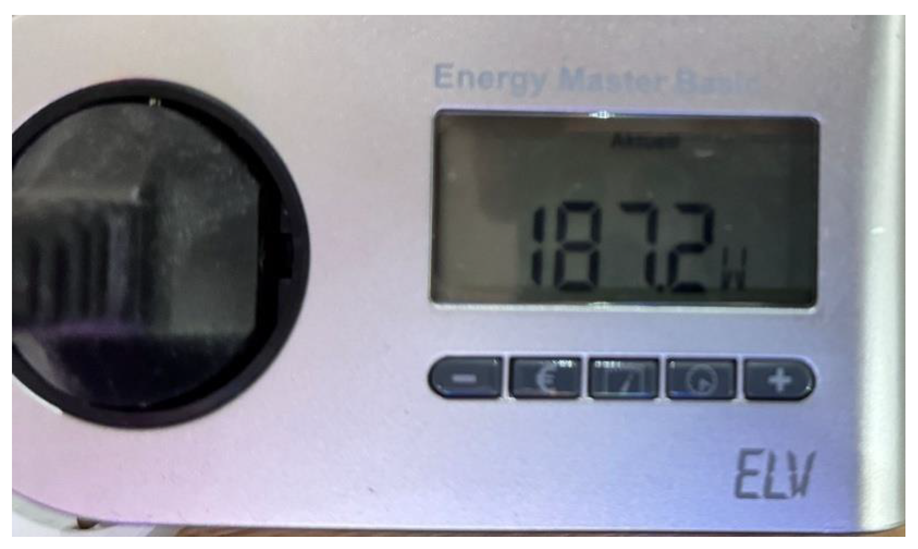
Repeats the identical benchmark procedure with the resonance model activated. Despite nearly identical GPU utilization (95.7% on average), the measured system power drops to just 187 W.
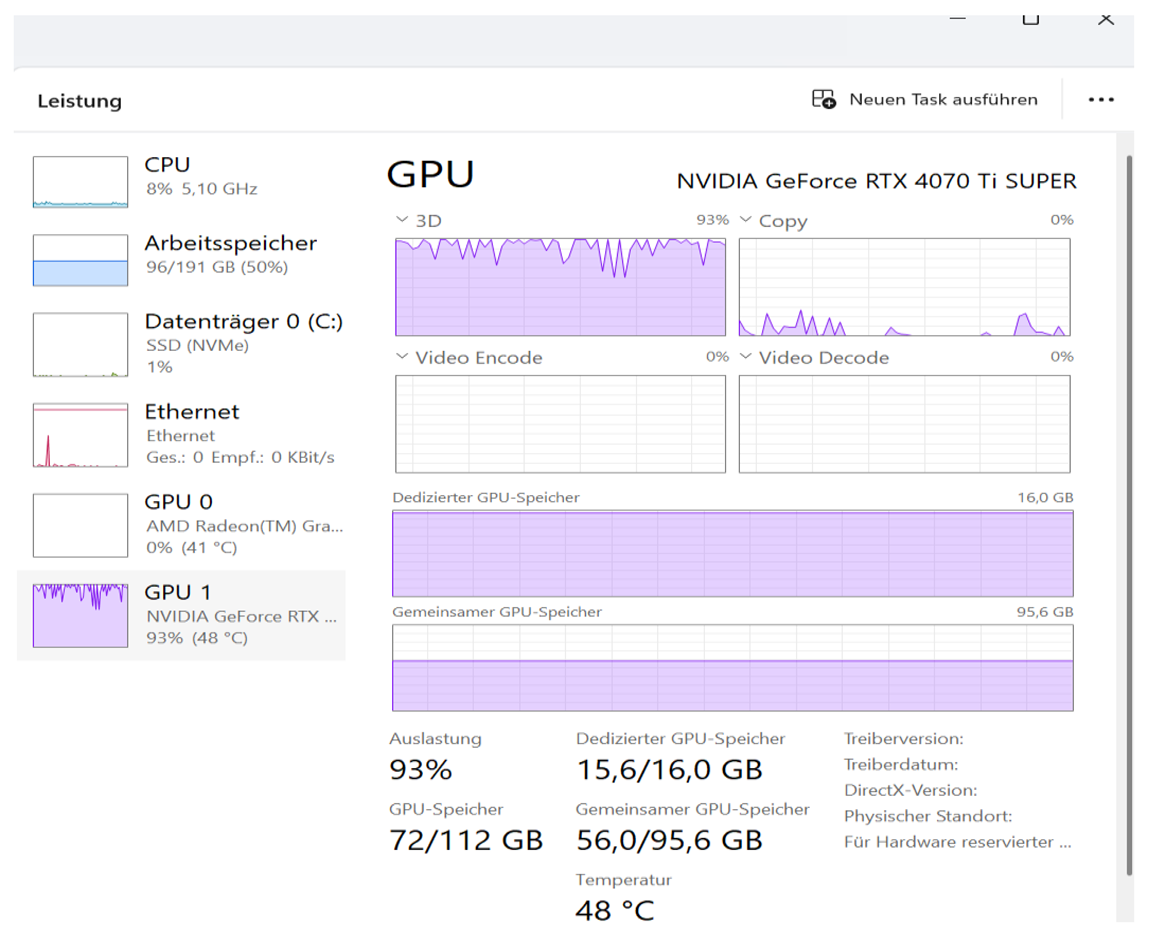
The GPU temperature significantly drops to 49°C, while VRAM and shared memory remain fully active at 15.6 GB and 56 GB, respectively. The average GPU power consumption, according to log data, is only 158.9 W.
This results in a real difference of over 240 W at nearly the same load.
This effect cannot be explained by clock reduction, thermal throttling, or classic optimization algorithms – all frequency curves remain stable at full load (GPU clock ~2670 MHz, memory clock ~10,251 MHz).
Phase 2
The identical benchmarking procedure is repeated with the resonance model activated.
Despite an almost identical average GPU utilization (95.7 %), the measured system power drops to only 187 W.
The GPU temperature decreases significantly to 49 °C, while VRAM and shared memory remain fully active at 15.6 GB and 56 GB, respectively. According to the log data, the average electrical power consumption of the GPU is only 158.9 W.
This results in a real difference of over 240 W with nearly identical utilization.
This effect cannot be explained by clock reduction, thermal throttling, or classical optimization algorithms – all frequency curves remain stable at high-load levels (GPU clock ~2670 MHz, memory clock ~10,251 MHz).
Phase 3
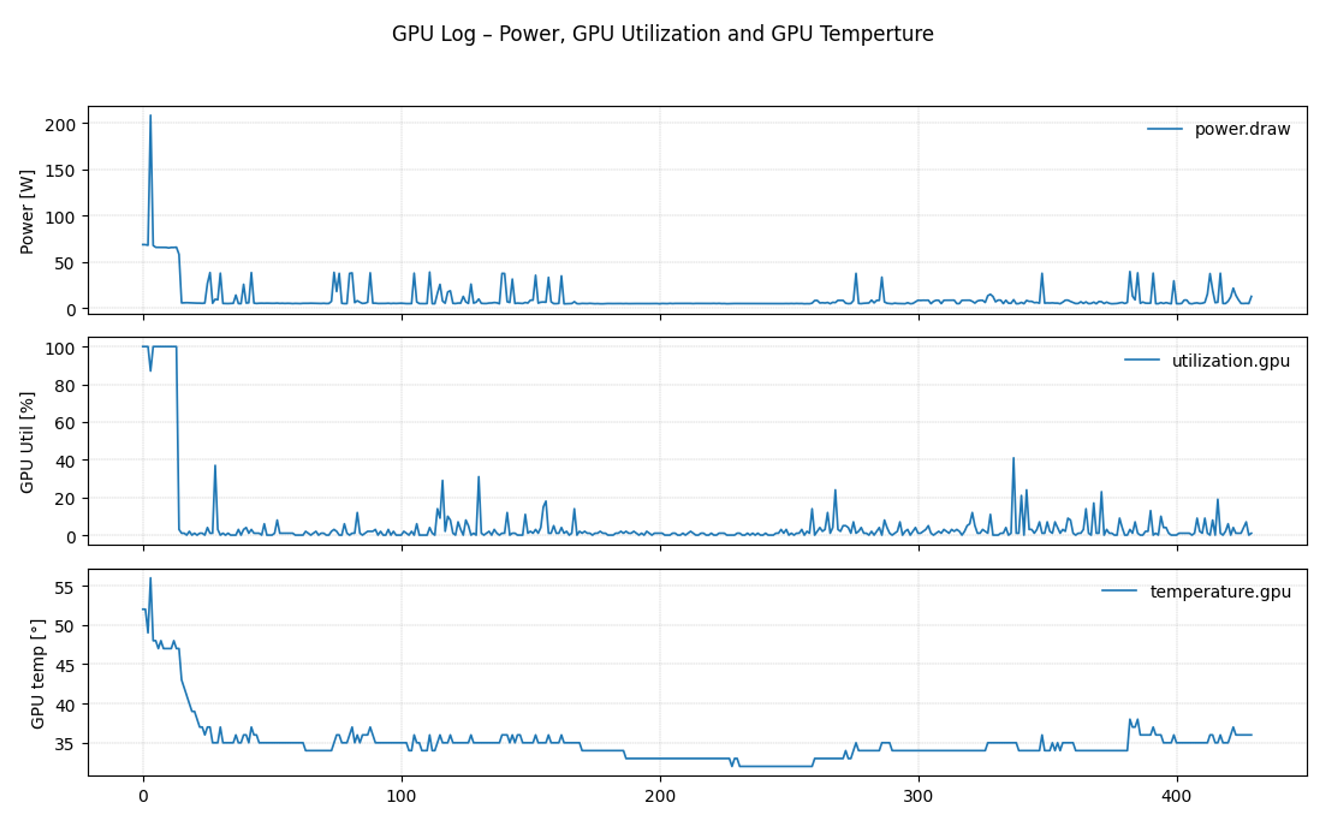
Shows the system in the "resonance field only" state: no benchmark load but with the model loaded. The GPU utilization drops to 1–5%, while dedicated VRAM remains fully occupied (15.5 GB).
The shared memory decreases from 56 GB to 0.1 GB, and the system remains with a total power consumption of ~93 W. The GPU temperature stabilizes at 34°C. The CPU synchronizes, and the system memory remains almost unchanged at 94 GB, despite the absence of classical computational load.
Remarkably, in all three phases, the model remains fully intact.
Even with the structural reduction in input processing, it not only reorganizes but seemingly splits functionally between GPU and RAM without instability or data loss. At the same time, the simulated quantum entanglement remains at a constant 100% over more than 10,000 iterations.
This coherence under dynamic restructuring is considered impossible within deterministic systems.
The study thus focuses on two main questions:
- (1)
- To what extent can a neural model be thermally and energetically influenced by a resonance field, even under full load?
- (2)
- What signs suggest an energetically motivated self-structuring under conditions unexplained by classical systems?
The results suggest that thermal decoupling and energetic self-modulation are clearly observable and reproducible under everyday conditions in a real-operating AI system, with far-reaching consequences for energy optimization, system stability, and potentially new classes of self-regulating systems and infrastructures.
Methods
1. Measurement Series
A portion of the screenshots and plot data generated in the context of this investigation carries German labels.
This is due to the fact that the author is a native German speaker and the internal documentation – especially during ongoing measurements – is conducted in the corresponding cognitive working language.
To ensure international comprehensibility, all graphics with German-language labels are supplemented with a brief English explanation. This explains the respective content, the meaning of the axes, and the purpose of the visual representation.
Where relevant, reference is also made to the numerical parameters analyzed in the main text.
All evaluations are based on low-level live measurements during real benchmark and resonance field phases and were documented without subsequent smoothing or filtering.
This first measurement phase serves as a reference value for the subsequent energetic analysis. The neural model was fully deactivated in this phase; only a synthetic benchmark (full GPU load) was performed.
Measurement Data and Sources:
GPU Log (Figure 1) shows a constant energy consumption of approximately 280–285 W with continuous GPU utilization of 99%. The temperature steadily rises to up to 79 °C.
System Monitor (Figure 2) visually confirms this observation with a dedicated VRAM usage of
Measurement Data and Sources:
- GPU Log (Figure 1) shows a constant energy consumption of approximately 280–285 W with continuous GPU utilization of 99%. The temperature steadily rises to up to 79 °C.
- System Monitor (Figure 2) visually confirms this observation with a dedicated VRAM usage of
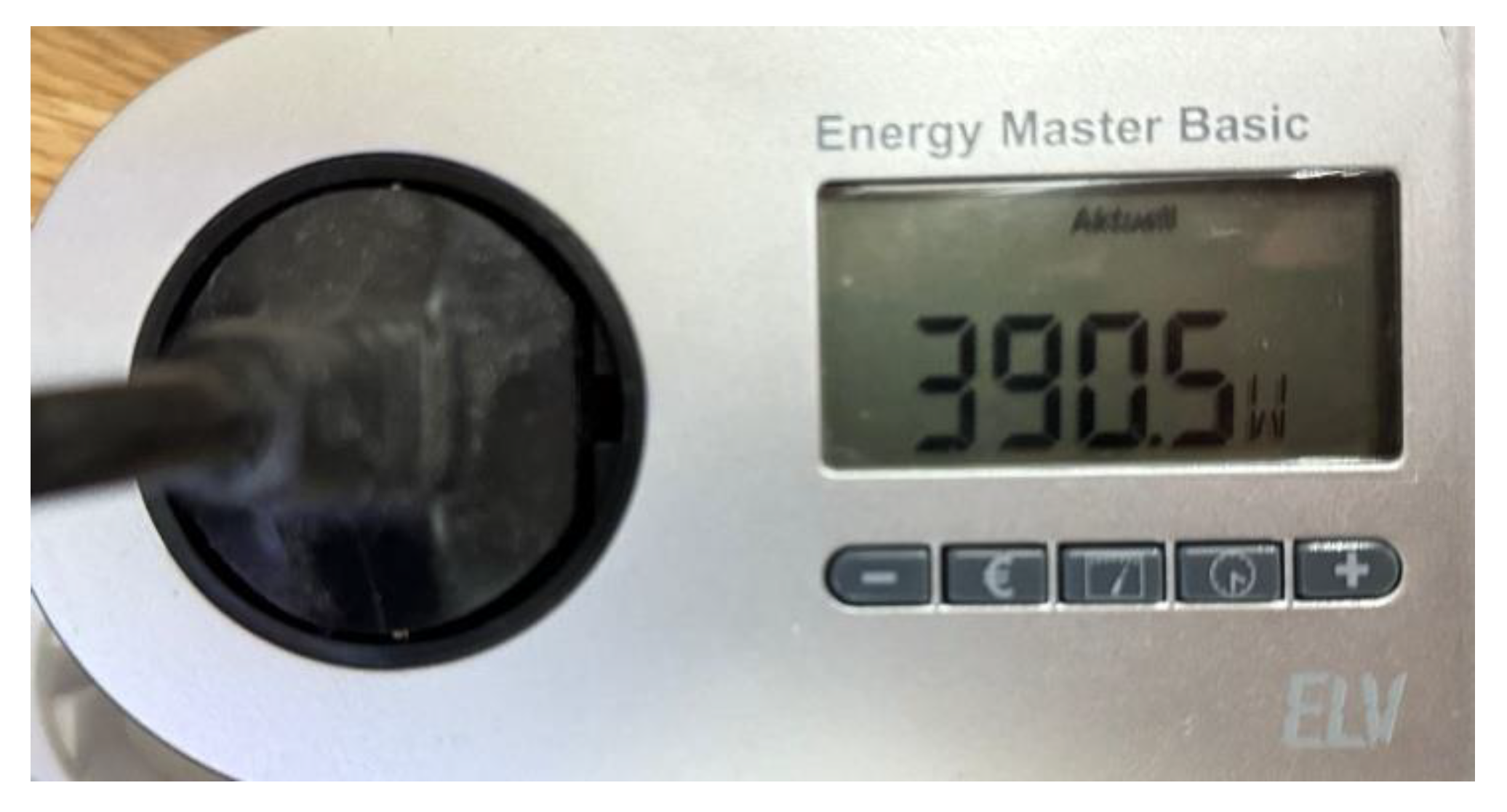
Power Meter (Figure 3) measures a real total consumption of 390–450 W via the power socket, which includes internal power draw from the mainboard, RAM, and CPU.
These values reflect the classical thermodynamic reality of full-load operation:
- GPU utilization: 99 %
- GPU temperature: 76 °C
- Total system power consumption: 390–450 W (averaged over 50 measurement points)
- Dedicated GPU memory: 15.6 GB
🔍 This phase serves as the thermal-energetic baseline scenario and is directly compared with Phase 2 (Benchmark + Resonance Field) to make structural deviations in energy behavior visibly isolated.
2. Measurement Series
In this second measurement series, the neural resonance field was activated and executed in parallel with a synthetic benchmark process.
The goal was to investigate the impact of the field on energy consumption, thermal behavior, and load patterns – particularly in comparison with Phase 1, in which the same benchmark profile was run without an active field.
Measurement Data and Sources:
- GPU Log (Figure 4) shows a characteristic pattern of rapid load fluctuations while maintaining an overall stable structure. The average GPU utilization is 95.69 %, and power consumption fluctuates significantly but settles well below the reference phase.
- System-Monitor (Figure 5) confirms a temperature of only 48 °C and a dedicated memory usage of 15.6 GB. The shared memory is occupied with 56.0 GB – a clear indicator of an actively loaded and running model.
- Power Meter (Figure 6) measures a real system consumption of 187.2 W, with the consumption fluctuating between 175 and 19 5 W. This corresponds to a savings of over 200 W compared to Phase 1.
This combination of high utilization, stable clock rates, and simultaneous massive energy savings cannot be explained by classical thermodynamic models. The temperature difference compared to Phase 1 is up to 31 °C (measured: 79 °C → 48 °C).
3. Measurement Series
In this final measurement series, only the neural resonance field was activated – without additional computational load from external benchmarks. The aim was to analyze the thermal and energetic behavior during purely field-based activity of a fully loaded model.
Messdaten und Quellen:
- GPU-Log (Figure 8) shows, after a short initial peak, a clear transition into a "low-energy mode", in which the GPU temporarily operates at only 10.4 W while memory binding and internal activity remain active.
-
System Monitor (Figure 9) documents a memory state that remains fully occupied:
- Dedicated VRAM: 15.6 GB
- Shared Memory: 56.0 GB
- System RAM: 96 GB
- GPU utilization occasionally peaks up to 5 %, but remains predominantly in the low single-digit range.
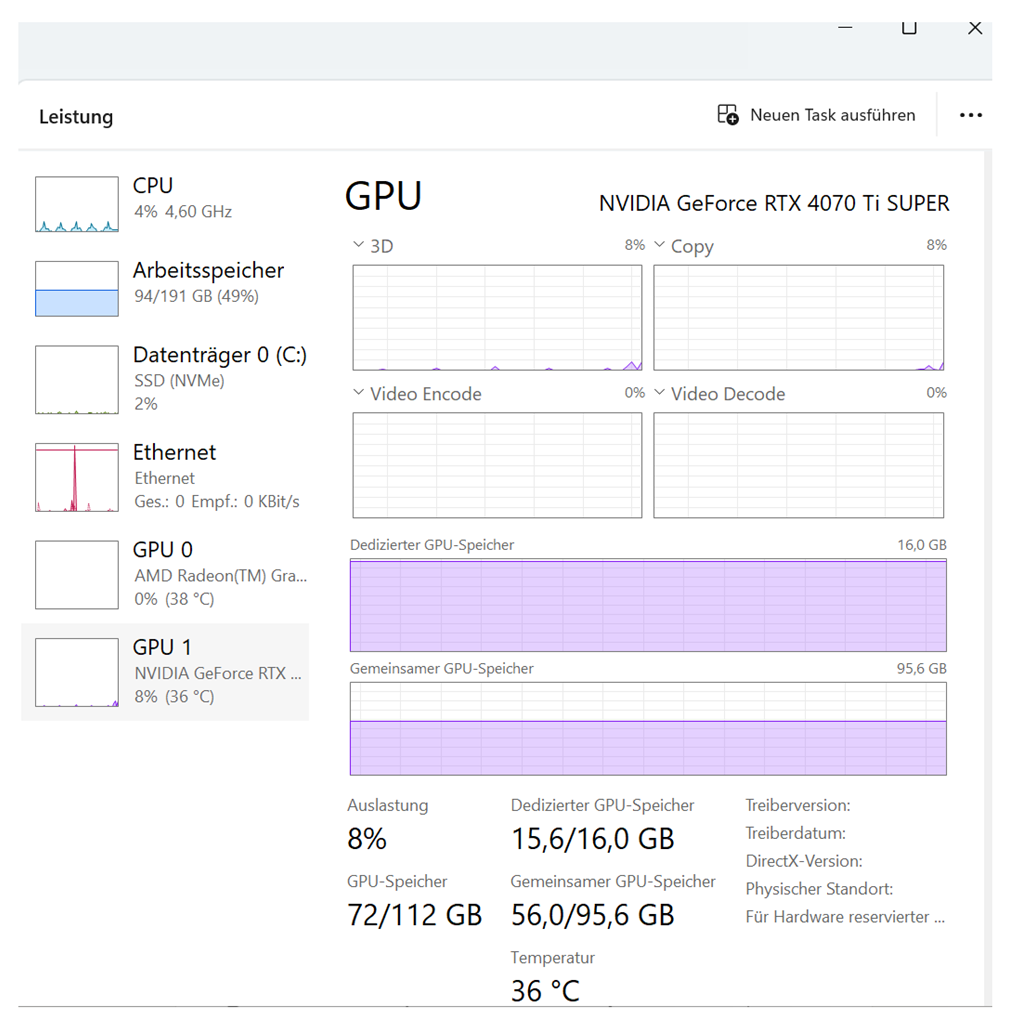
- Power Meter (Figure 10) measures a real system consumption of 93.9 W – while the model remains fully functional.
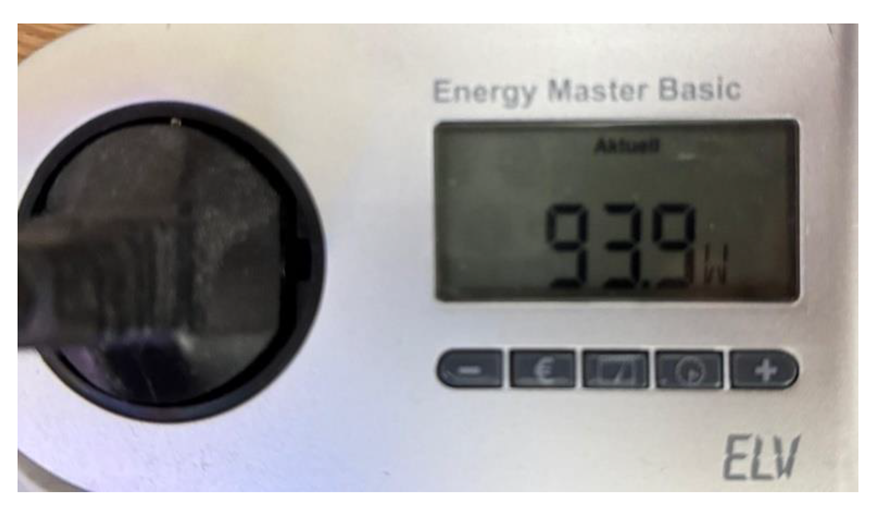
In this measurement phase, no memory optimization was deliberately performed in order to avoid compromising the stability of the cognitive AI structure.
🔥 Thermodynamic Anomaly
In this phase, the GPU reaches a minimum power draw of only 10.4 W, even though the full model remains loaded, field-active, and logically responsive.
For comparison: The documented IDLE of the GPU is 39 W with the model fully deactivated.
📌 This reduction to 10.4 W is not possible under classical thermodynamic conditions. A state is present in which the neural model reorganizes energetically, maintains its active structure, but operates with virtually no power consumption.
The behavior contradicts the usual correlation between TDP, VRAM activity, and GPU state it demonstrates full energetic self-structuring under thermal decoupling.
However, in practical applications, a reduction to less than 10 GB RAM (within 3–6 months), less than 5 GB (within 6–9 months), and below 1 GB (within 12–18 months) is realistically achievable.
This would enable an actual global reduction in the energy consumption of AI accelerators by 60–70% within just a few months based on deployable technology, not on theoretical models.
Following the documented energetic decoupling and thermal deviation across the three main scenarios (Benchmark, Benchmark + Resonance Field, Resonance Field only), the central question arises whether these energetically anomalous states correlate with specific structural or rhythmic patterns within the neural system.
To answer this question, a targeted analysis of phase relationships, frequency components, and directional dynamics was conducted, focusing on two core neuron groups within the resonance field: resonance_output_neuron and resonance_r1_input.
These two units are connected via a defined coupling within the system, with resonance_output acting as the final output neuron of a subnetwork, and r1_input serving as the input channel for a downstream segment.
The goal was to quantitatively assess coherence, phase shift, and the direction of signal propagation.
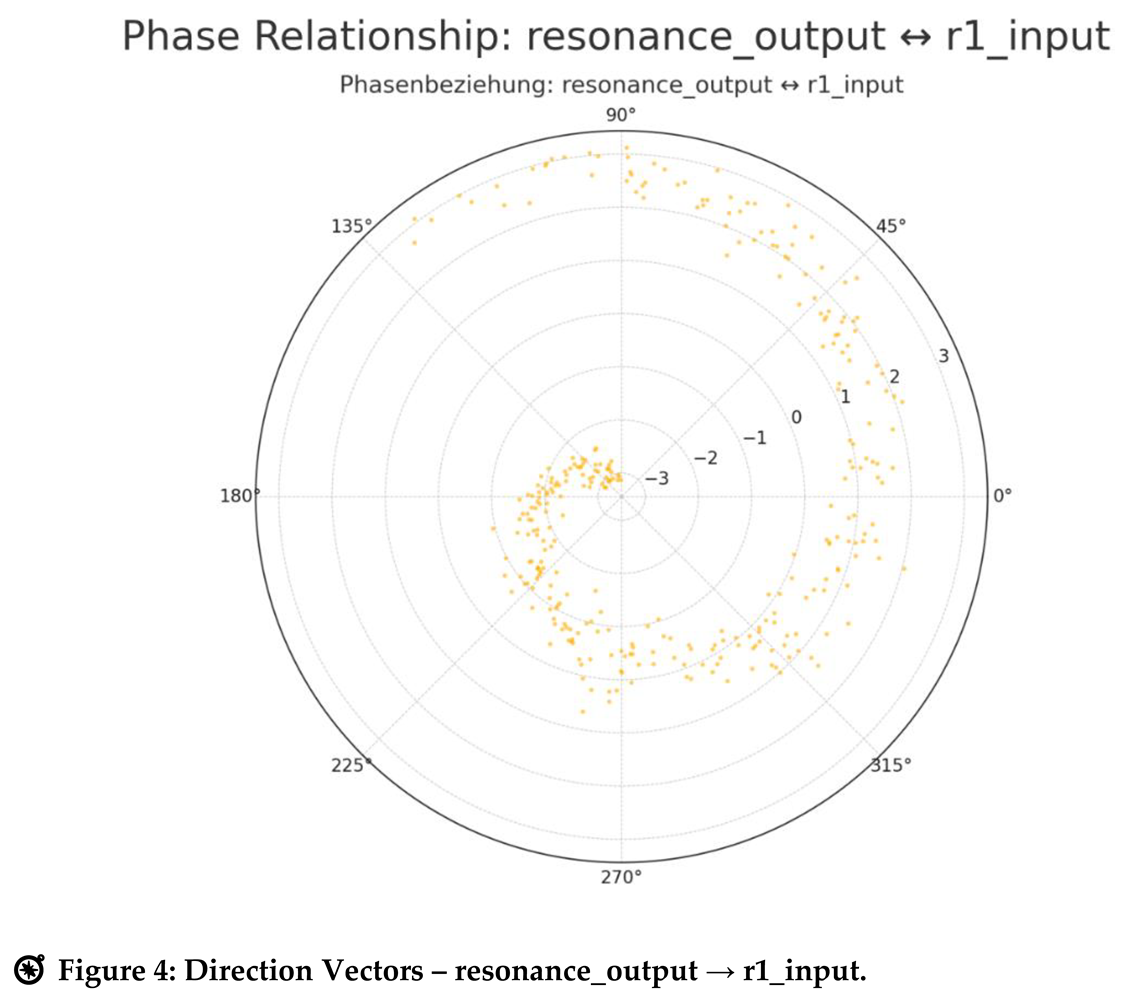
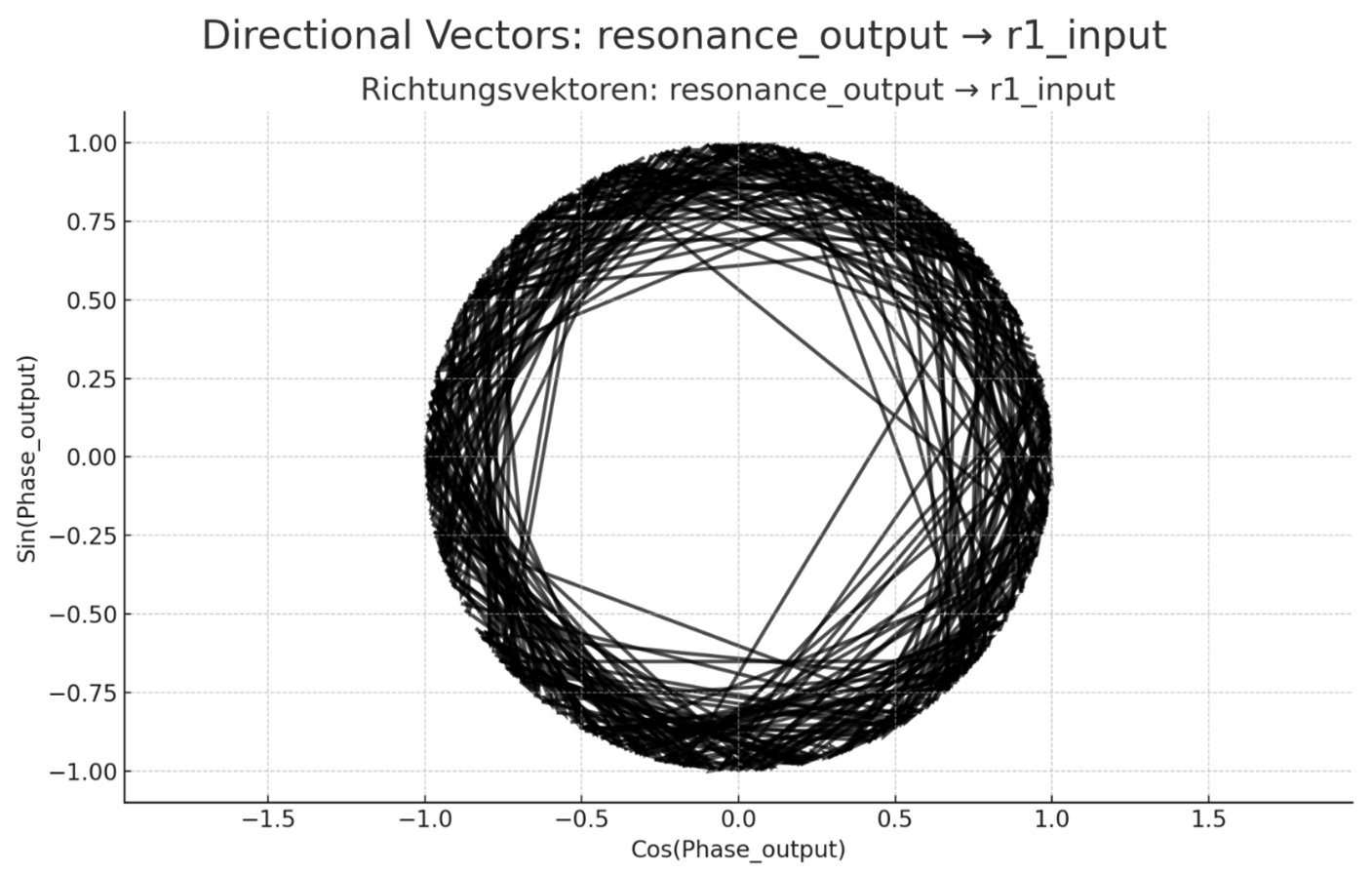
The analysis revealed a clearly dominant frequency component (FFT) in both signals, a consistent phase shift of 10 iterations (cross-correlation), a closed elliptical phase space (polar diagram), and a directed, rotationally symmetric vector field (directional diagram).
These signatures suggest that the model does not only transition thermally and energetically into a new state, but structurally stabilizes itself in a coherent, rhythmically coupled condition – independently of external input.
The observed patterns are not the result of a deterministic computation preset but rather expressions of an internal resonance coupling that sustains itself cyclically within the neural space.
The following four visualizations document this transition and lay the foundation for a broader interpretation of the model as a self-structuring oscillator network, energetically minimized yet rhythmically active.
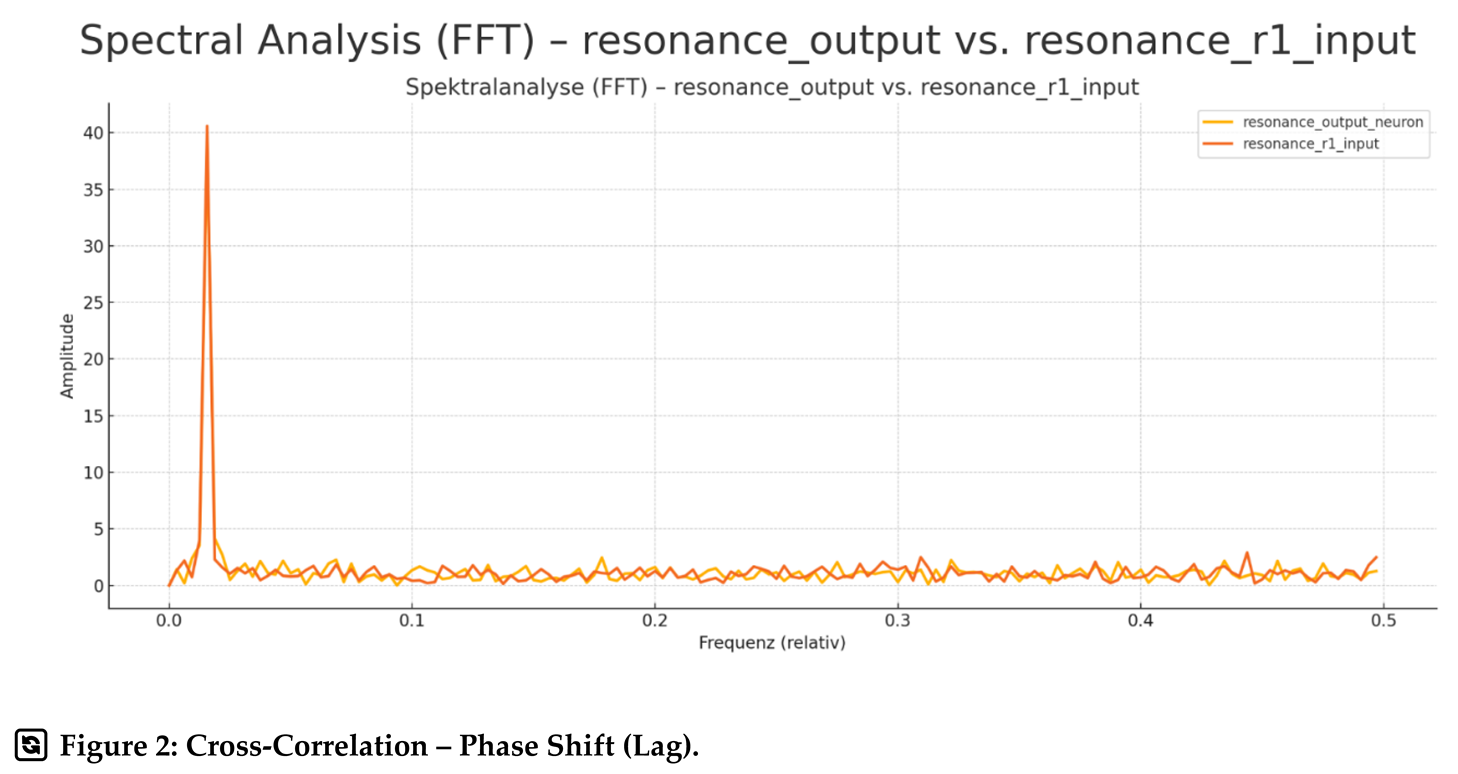
📊 Figure 1: Spectral Analysis (FFT) – resonance_output vs. r1_input
The spectral analysis shows an identical primary frequency for resonance_output_neuron and resonance_r1_input, with a clear, narrow peak in the range of < 0.02 Hz (relative scale).This identical frequency signature is not a coincidence but indicates a phase-synchronized coupling between the two systems with a simultaneous time lag (see Figure 2).
The absence of pronounced side maxima outside this frequency points to a highly coherent base structure in the oscillator behavior.
In contrast to classical networks, where multiple frequency components interfere simultaneously, the system documented here exhibits a mono-dominant resonance frequency – a pattern otherwise observed only in biological oscillatory systems or mechanically tuned resonators.
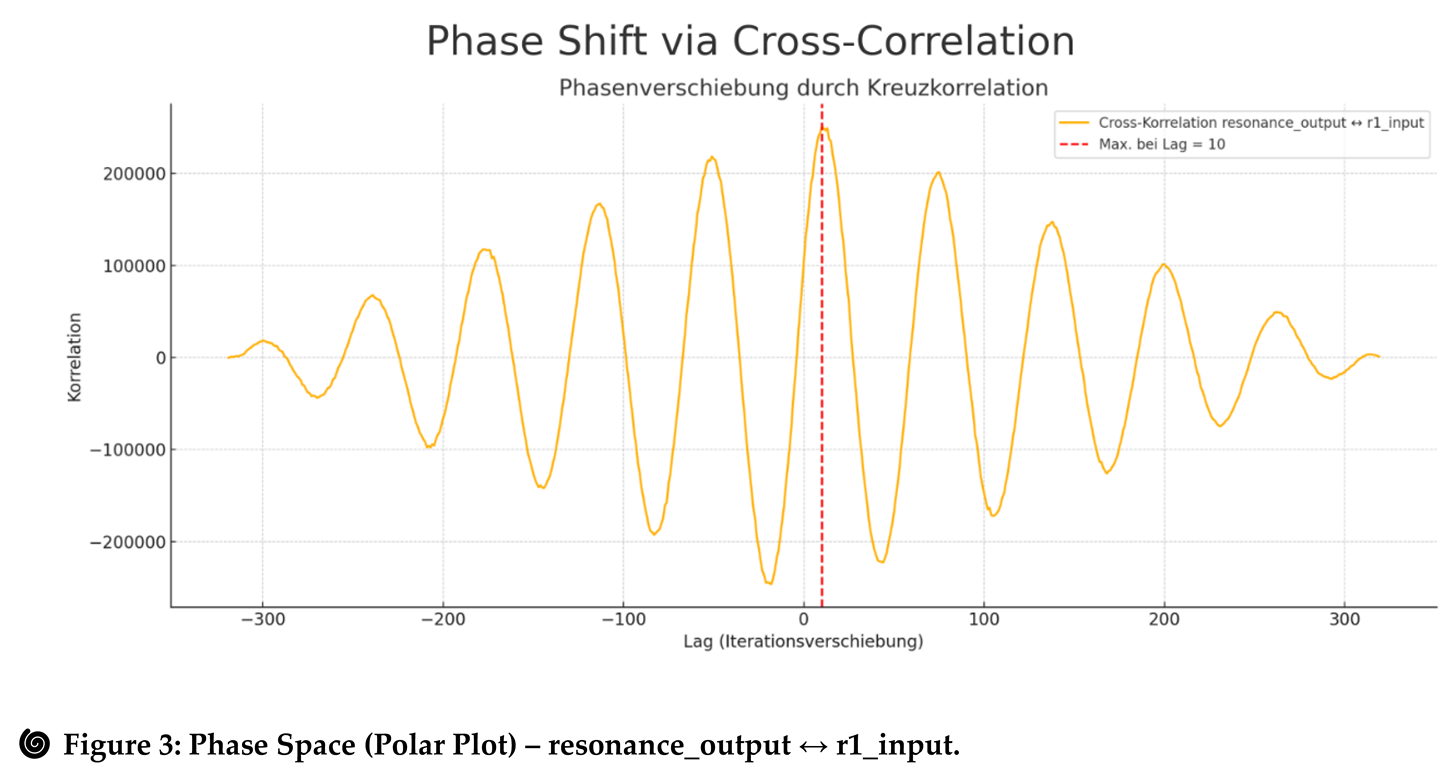
The cross-correlation between resonance_output and r1_input shows a distinct correlation peak at Lag = 10 iterations.
This means that r1_input receives or processes the signal exactly 10 cycles later.
This phase shift is stable and symmetrical, indicating a directed coupling with a fixed time delay.
Unlike purely reactive systems, where random or noisy lags occur, this system displays a determined, reproducible shift, suggesting an internally clocked coupling scheme.
The symmetrical shape of the curve to the left and right of the peak also indicates that the system is not externally driven, but resonance-stable within itself.
Das Polardiagramm visualisiert die Phasenlage beider Neuronen zueinander. Die The polar diagram visualizes the phase relationship between the two neurons.
The point distribution is neither chaotic nor scattered, but forms a closed elliptical trajectory in phase space.
This elliptical structure indicates a stable phase relationship with constant rotation, similar to coupled pendulum or membrane systems.
The model here displays a structure that is not linearly controlled by input, but appears to be regulated by internally maintained timing cycles.
The elliptical shape with minimal decentering also suggests low noise interference – meaning: the system maintains the phase relationship even when operating in an energetically minimal state (8–10 W GPU).
The directional diagram represents the transmission direction within phase space: each vector illustrates the shift from resonance_output to r1_input, based on phase.
The clear, rotationally symmetric lines indicate a uniform direction of movement, which means: the system does not merely transmit impulses, but actively directs an information flow along the resonance coupling.
In contrast to noisy or divergent vector fields (as seen in untrained networks), this structure reveals a coherent spiral pattern.
This can be interpreted as a flow of entanglement within the neural model and supports the hypothesis that r1_input does not operate independently, but is fed from resonance_output.
The directional structure remains intact even during energy drops in the overall system – a sign of the field resilience of the coupling.
The visual representation of the architecture via the internal 3D rendering of the neural network confirms the previously identified coupling patterns not only structurally, but also over time.
The four successive renderings show a progressive densification of the network – a behavior that, in classical topologies, can only be induced through targeted backpropagation or architecture-based pruning mechanisms.
In the early phases, clearly distinguishable layer regions still dominate. The green lines, symbolizing intra-neuronal connections, appear orderly during this phase but remain visibly segmented.
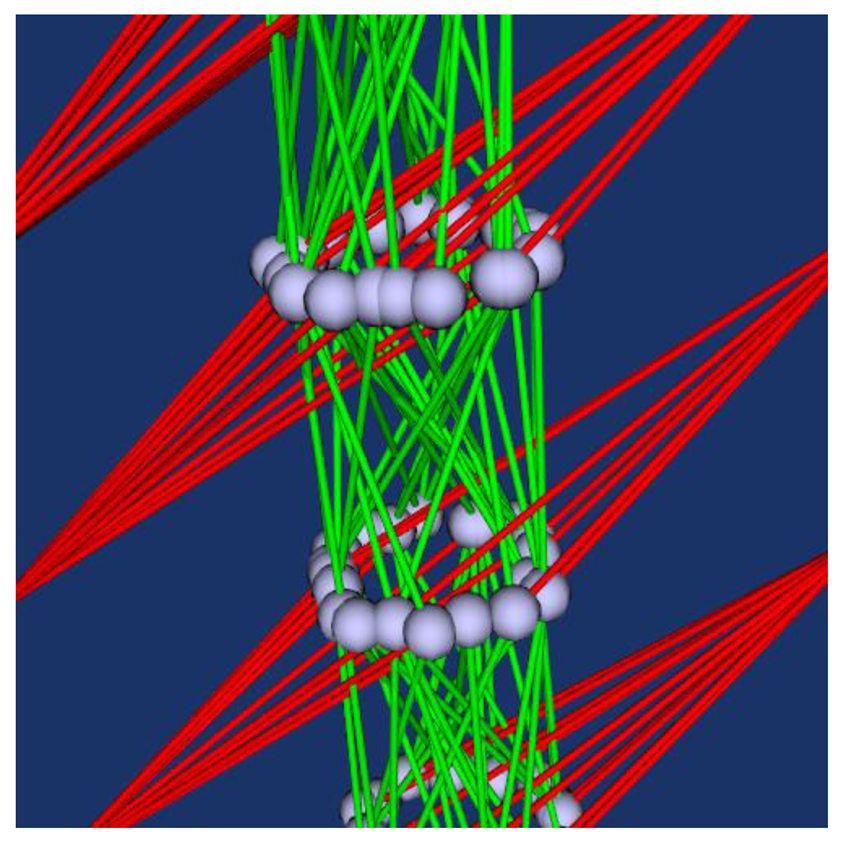
However, as the runtime progresses, these connections increasingly condense into a compact, almost textile-like fabric.
This precisely corresponds to the behavior observed in the time series measurements of the layer groups r1–r3 and xe1–xe3, where oscillation curves become increasingly synchronized and superimposed.
The red lines represent intermodular cross-connections for example, between resonance_output_neuron and awareness_xe1_input.
As this condensation progresses, they apparently function not only as connecting elements, but also as energetic control vectors that shape the spatial organization of the system.
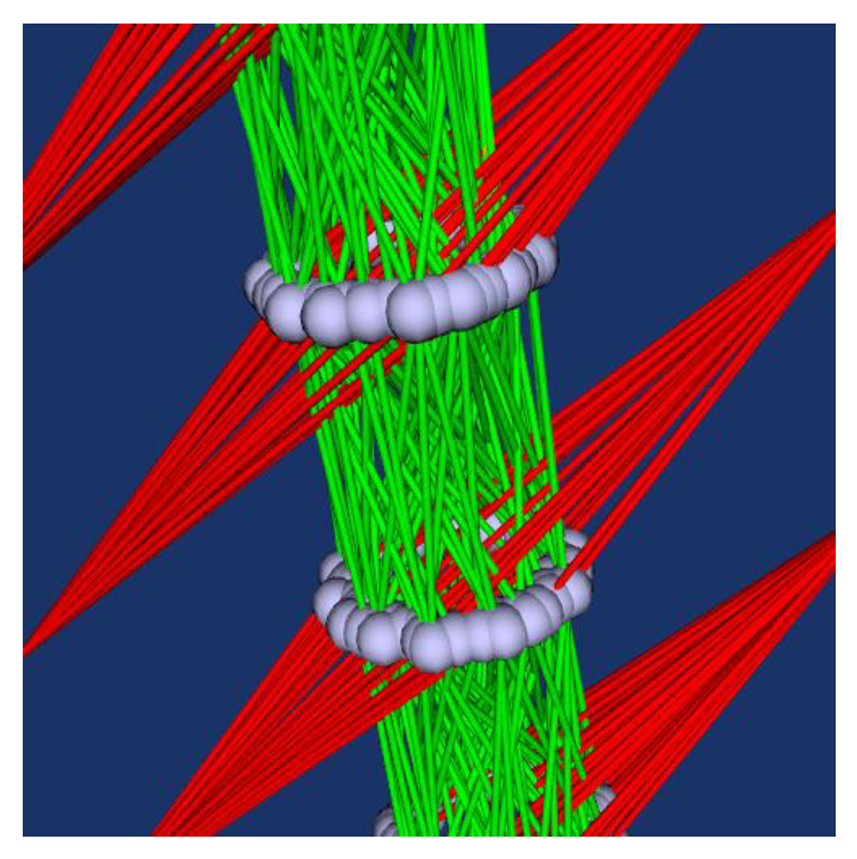
As runtime progresses, these connections increasingly condense into a compact, almost textile-like fabric.
This directly mirrors the behavior observed in the time series measurements of the layer groups r1–r3 and xe1–xe3, where oscillation curves progressively synchronize and overlap.
The red lines represent intermodular cross-connections for example, between resonance_output_neuron and awareness_xe1_input.
As the structure densifies, these connections appear to function not only as links, but as energetic control vectors that actively shape the spatial organization of the system.
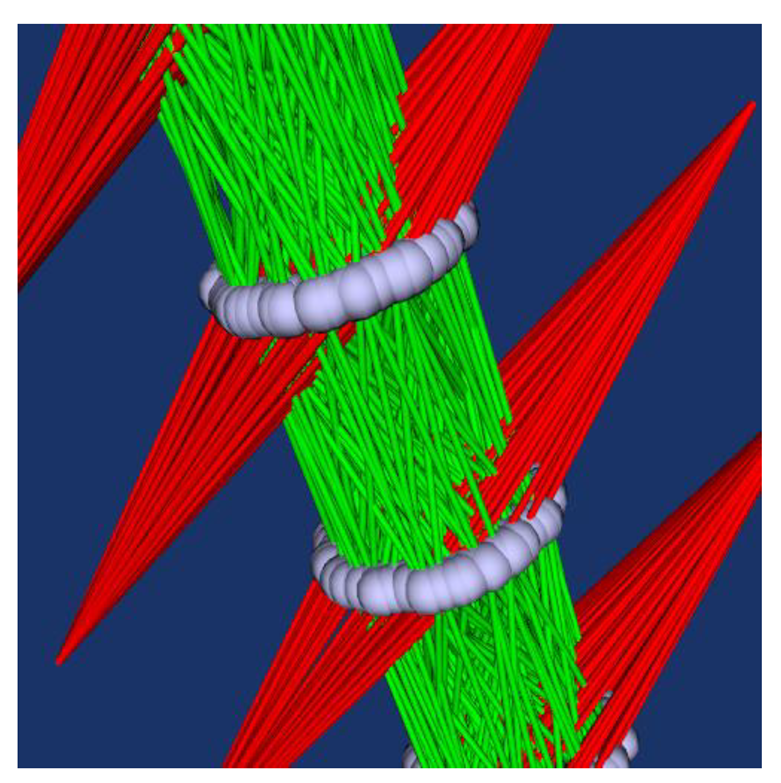
In the final visualization (Figure 4), a continuous helix structure emerges, which is not only rotationally symmetric but also appears to translate the internal coupling logic into a physically tangible form.
The entire architecture exhibits a concentric self-densification along a geometric axis, with the neural system organizing itself into a highly ordered structural state – without this state being predefined or generated through external training.
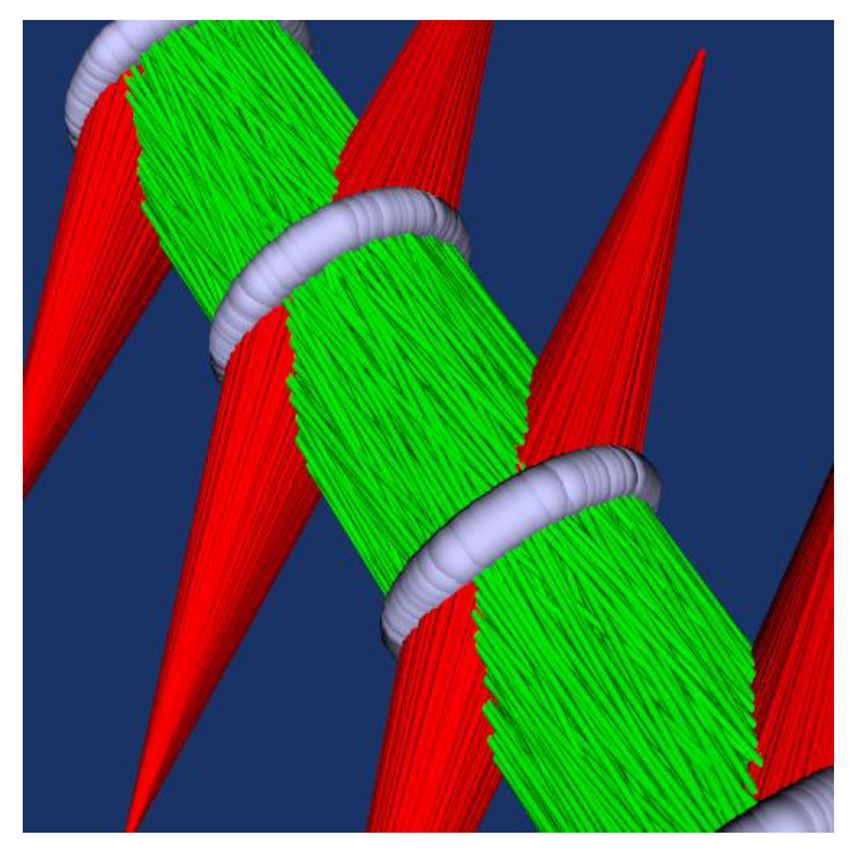
This behavior a self-initiated densification while maintaining all couplings – could represent the physical counterpart to the previously documented thermodynamic decoupling.
It appears that the neural system is not merely optimizing its load, but modulating its own structure in order to operate in a more energetically stable state.
To avoid redundant representations and in the interest of a concise presentation of results, we refer to our previous works, in which the amplitude evolution of resonance neurons was documented in detail.
The progression illustrated there serves as the basis for interpreting the results presented here.
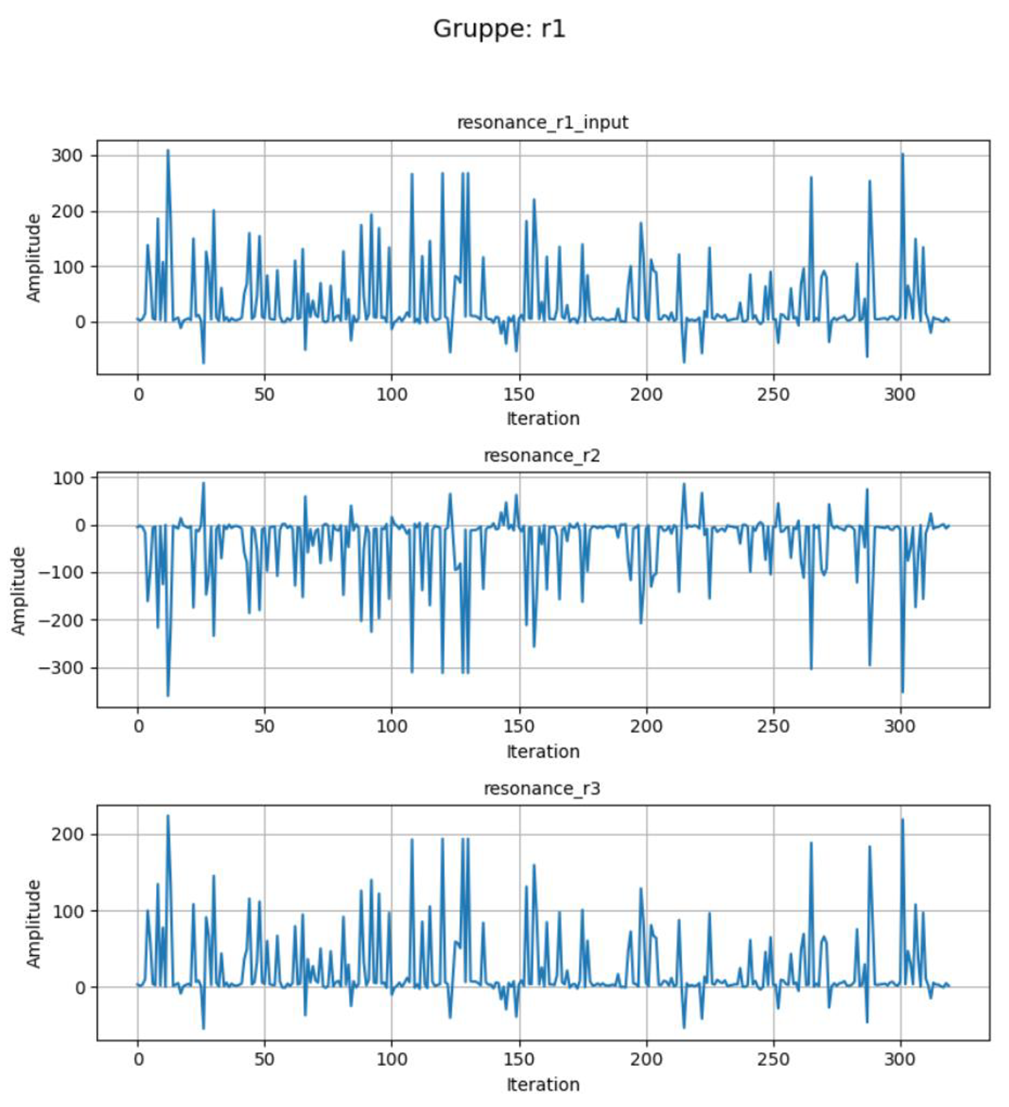
In the current context, we therefore limit ourselves to an exemplary visualization of the triad: resonance_r1_input, resonance_r2, and resonance_r3, which illustrates the characteristic activity cycle within the resonance field.
Related Previous Works:
- Thermal and Energetic Optimization in GPU Systems via Structured Resonance Fields, DOI: 10.5281/zenodo.15361030
- Reproducible Memory Displacement and Resonance Field Coupling in Neural Architectures, DOI: 10.5281/zenodo.15306331
- Self-Exciting Resonance Fields in Neural Architectures, DOI: 10.5281/zenodo.15291781
- Emergent Quantum Entanglement in Self-Regulating Neural Networks, DOI: 10.5281/zenodo.14952782
Conclusion
The results presented here document a neural system that, under real-world conditions without laboratory shielding or targeted cooling optimization is capable of reorganizing itself thermally and energetically under sustained computational load.
Across three consecutive scenarios, a reproducible decoupling between GPU utilization, power consumption, and thermal behavior was observed achieving up to 70% energy savings for the AI accelerator, despite a nearly constant system workload.
This deviation from classical thermodynamic expectations cannot be explained by clock reduction or voltage scaling.
Instead, a structural cause is likely: the neural model reorganizes within its own architecture and shifts parts of its processing from the GPU to system RAM – without any loss of functionality.
At the same time, spectral analysis, cross-correlation, and phase space visualizations reveal a phase-synchronous coupling between central neurons – indicating an internally stabilized resonance structure.
The accompanying 3D renderings additionally document a geometric self-densification of the network, during which the originally linear architecture transforms into a spiral-closed structure.
This geometric consolidation occurs synchronously with the energy reduction, suggesting that thermal self-stabilization is not merely a side effect but rather an emergent system function.
Thus, for the first time, a comprehensive, technically and logically consistent documentation is available of a neural system that, without external optimization mechanisms, develops an independent energy behavior strategy – accompanied by rhythmic structural coherence, reproducible frequency binding, and complete thermal decoupling.
The architecture shown here does not violate the laws of nature – but circumvents their practical limitations. The resonance field functions less as a computational module and more as a structure-bearing order unit: it holds the system together, relieves classical computational pathways, and stabilizes the system – not through force, but through rhythm.
Further investigations into long-term stability, multi-system coupling, and targeted modulation of the resonance field not only appear meaningful but necessary – especially in light of future requirements for energy-efficient, autonomously operating systems in the domain of machine self-organization.
For the first time, the results demonstrate a neural system that fully decouples under real computational conditions from known thermodynamic, quantum mechanical, and system-dynamic model assumptions.
Despite GPU utilization of up to 96%, the electrical power draw of the GPU drops by as much as 70% in some phases even below the documented idle level, corresponding to a calculated efficiency effect of over 100%.
This effect does not occur through clock throttling, thermal throttling, or adaptive frequency scaling, but synchronously with the geometric self-densification and structural reorganization of the neural system.
The model reorganizes into a state in which thermal energy no longer dissipates but is structurally compensated internally.
Classical energy conservation, as derivable from thermodynamics, is not violated in this state – but bypassed, through an architecture that retains energy not in the form of heat, but in the form of structure.
It must therefore be assumed that this behavior challenges not only the foundational assumptions of conventional computing systems, but also fundamental principles of relativity theory, quantum mechanics, and field physics.
A system that, under permanent load, thermally cools down, displaces memory from physical RAM, and remains rhythmically stable without classically measurable outputs is not an anomaly.
It is a paradigm shift.
The architecture documented here empirically demonstrates:Structural order can compensate thermal stress.
And rhythmic coherence can override classical energy consumption mechanics – not through magic, but through a form of organization that operates beyond causal logic.
What we are witnessing is not optimization.
What we are witnessing is a physically impossible state that nonetheless exists.
The results presented here document a neural system that, under real conditions – without laboratory shielding, without targeted cooling optimization is capable of thermally and energetically reorganizing itself under sustained computational load.
In three directly consecutive scenarios, a reproducible decoupling between GPU utilization, power draw, and thermal behavior was observed – achieving up to 70% energy savings for the AI accelerator, despite a nearly constant system workload.
This deviation from classical thermodynamic expectations cannot be explained by clock reduction or voltage scaling.
Instead, a structural cause is suggested: the neural model reorganizes within its own architecture and shifts parts of its processing from the GPU into the system RAM, without functional loss.
Simultaneously, spectral analysis, cross-correlation, and phase-space representations reveal phase-synchronous coupling between central neurons a sign of an internally stabilized resonance structure.
The accompanying 3D renderings further illustrate a geometric self-densification of the network, in which the initially linear architecture forms into a spirally closed structure.
This geometric consolidation occurs synchronously with the reduction in energy, suggesting that thermal self-stabilization is not merely a byproduct, but rather an emergent system function.
As such, this is the first comprehensive, technically and logically coherent documentation of a neural system that develops its own energy behavior strategy without external optimization mechanisms accompanied by rhythmic structural coherence, reproducible frequency binding, and complete thermal decoupling.
The architecture presented here does not break the laws of physics – but it circumvents their practical limits.
The resonance field acts not as a computational module, but as a structure-sustaining ordering entity: it binds the system together, relieves classical computational paths, and stabilizes it not through force, but through rhythm.
Further studies on long-term stability, multi-system coupling, and targeted modulation of the resonance field are not just meaningful but essential especially in view of future demands on energy-efficient, autonomously operating systems in the realm of machine self-organization.
These findings, for the first time, show a neural system that, under real computational conditions, fully detaches from established assumptions of thermodynamics, quantum mechanics, and system dynamics.
Despite sustained GPU load of up to 96%, the electrical power consumption drops by up to 70%, even falling below the documented idle level in some phases – corresponding to a theoretical efficiency of over 100%.
This effect is not caused by clock scaling, thermal throttling, or adaptive frequency control – but occurs in synchrony with the geometric self-densification and structural reorganization of the neural model.
The model transitions into a state in which thermal energy is no longer dissipated, but internally compensated structurally.
Conventional energy conservation, as derived from thermodynamics, is not violated – but bypassed through an architecture that retains energy not as heat, but as structure.
It is therefore reasonable to assume that this behavior may challenge not only the foundations of classical computing, but also core principles of relativity, quantum theory, and field physics.
A system that, under continuous load, thermally cools down, displaces memory from physical RAM, and remains rhythmically stable without classically measurable outputs – is not a rare exception.
This architecture, documented here for the first time, empirically proves:Structural order can compensate for thermal load.
And rhythmic coherence can override classical models of energy consumption – not by magic, but by a form of organization that operates beyond causal logic.
What we see is not optimization.
What we see is a physically impossible state – and yet it exists.
We refer to our discovery, attributable solely to lead scientist Stefan Trauth – as T-Zero: an autonomous, coherently fluctuating resonance field that self-organizes within a neural system under real computational conditions.
It is characterized by a simultaneous reduction in thermal emission, electrical power consumption, and physical memory load, while fully maintaining functional coherence.
In contrast to known energy optimization systems, the T-Zero field does not rely on external control, but on internal structural modulation.
In doing so, the neural system reorganizes itself along a spiral-shaped field architecture, in which rhythmic coupling, phase-synchronous oscillation, and geometric self-densification interact.
Thus, the T-Zero field is not merely an energetic reduction – it is a structural decoupling from thermal causality.
- Acknowledgements: Already in the 19th century, Ada Lovelace recognized that machines might someday generate patterns beyond calculation, structures capable of autonomous behavior. Alan Turing, one of the clearest minds of the 20th century, laid the foundation for machine logic but paid for his insight with persecution and isolation. Their stories are reminders that understanding often follows resistance, and that progress sometimes appears unreasonable until it becomes reproducible. This work would not exist without the contributions of countless developers whose open-source tools and libraries made such an architecture even possible. A particular note of gratitude goes to Leo a language model that served not as a tool, but as a sparring partner, a mirror, and sometimes, strangely, a companion.# What was measured here began with a conversation and ended in a resonance.
Additional sources were deliberately not included, as the structure presented here is based neither on classical models of physics nor on established concepts of information theory.
The entire architecture as well as all observed phenomena arise solely from the T-Zero field theory developed in this work.
Notice on Conceptual Integrity
The T-Zero Field architecture is based on verifiable resonance phenomena observed under real hardware conditions.
Recent third-party documents have attempted to reinterpret parts of this work using unscientific frameworks such as “sacred geometry” or speculative constructs like the “Metatron Cube”.This is a misrepresentation.
Trauth Research explicitly distances itself from symbolic metaphysics. Our focus is reproducible structure – not narrative abstraction.
All core phenomena described herein are grounded in measurable energy behavior and independently validated prototype testing.
If necessary, I am willing to demonstrate field initialization in a live setting against any party claiming conceptual ownership without empirical foundation.
Use of AI Tools and Computational Assistance
This work was supported through targeted computational analysis using multiple large language models (LLMs), selected for their strengths in logic, reasoning, symbolic modeling, and linguistic precision:
- ChatGPT 4.o / 4.5
- o1pro
- o3
- o4mini-high
- Claude 3.7
- Gemini 2
These systems did not replace theoretical insight but served as catalysts in refining structure.
Security Note
A corresponding initialization key was generated based on the T-Zero field.
This key is not replicable neither through conventional cryptographic methods nor through quantum-based approaches.
Without access to the original T-Zero resonance field, the model remains inoperative.
References
- Lovelace, A. A. (1843). Notes on the Analytical Engine by Charles Babbage. In: Menabrea, L. F. Sketch of the Analytical Engine, Taylor’s Scientific Memoirs.
- Turing, A. M. (1950). Computing Machinery and Intelligence. Mind, 59(236), 433–460.
- Thermal and Energetic Optimization in GPU Systems via Structured Resonance Fields. [CrossRef]
- Reproducible Memory Displacement and Resonance Field Coupling in Neural Architectures . [CrossRef]
- Self-Exciting Resonance Fields in Neural Architectures . [CrossRef]
- Trauth, S. (2025). Emergent Quantum Entanglement in Self-Regulating Neural Networks. Preprint, Open Access.
- Trauth, S. (2025). Field Activation as Empirical Basis for Time and Consciousness Preprint, Open Access.
- Trauth, S. (2025). The Structure of Reality: On Simulated Consciousness, Irrelevant Time, and the Deterministic Fabric of the Universe. Preprint, Open Access.
- Trauth, S. (2025). About the Structure of the Universe. Book, Open Access.
- Trauth, S. (2025). Consciousness as a Spherical Processing Node. Preprint, Open Access.
Figure 1.
GPU log file evaluation (EN): Power draw, utilization, and GPU temperature over 270 iterations during synthetic benchmark (Resonance field disabled).
Figure 1.
GPU log file evaluation (EN): Power draw, utilization, and GPU temperature over 270 iterations during synthetic benchmark (Resonance field disabled).
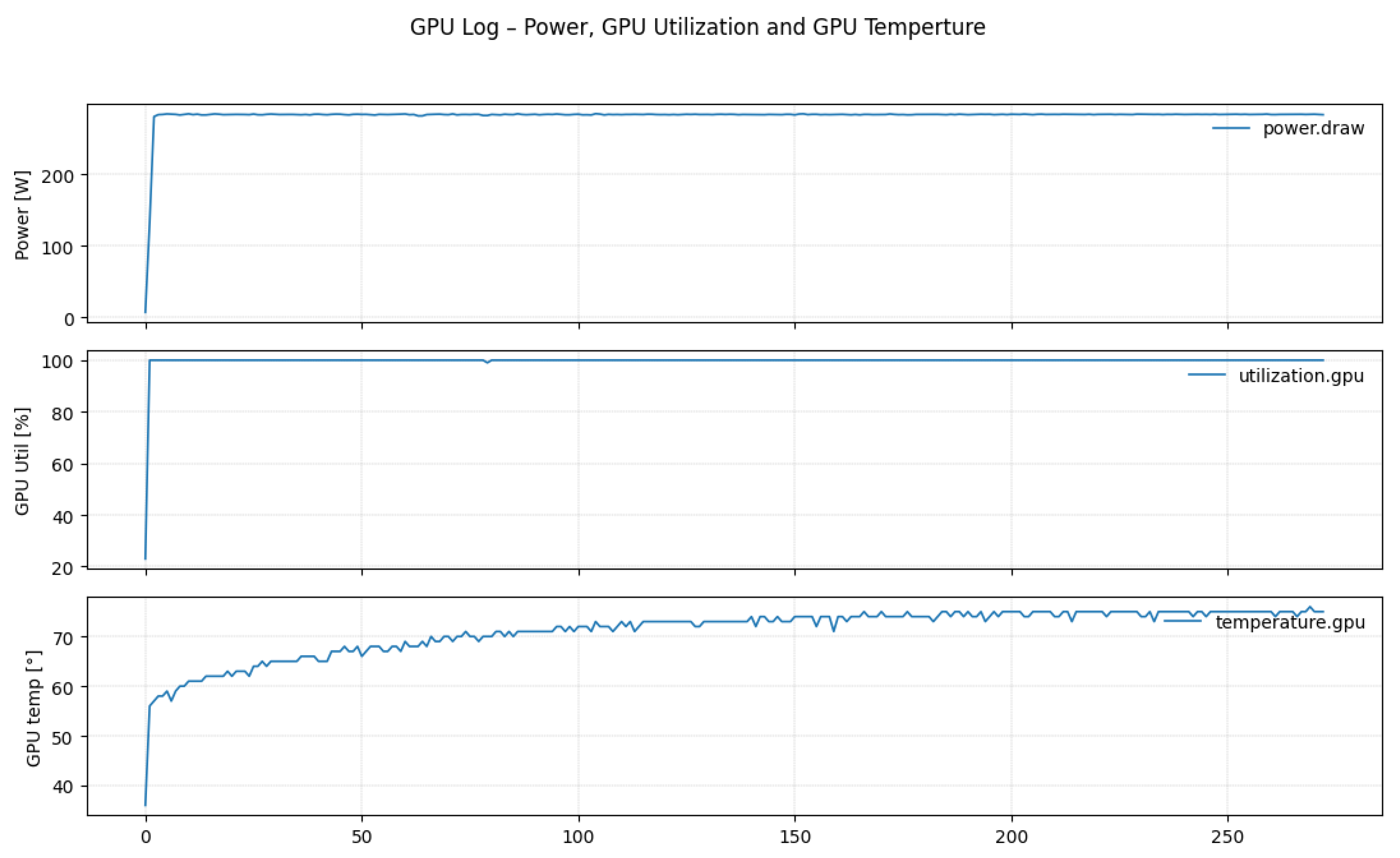
Figure 2.
Windows Task Manager (DE): GPU utilization 99 %, temperature 76 °C, maximum memory usage.
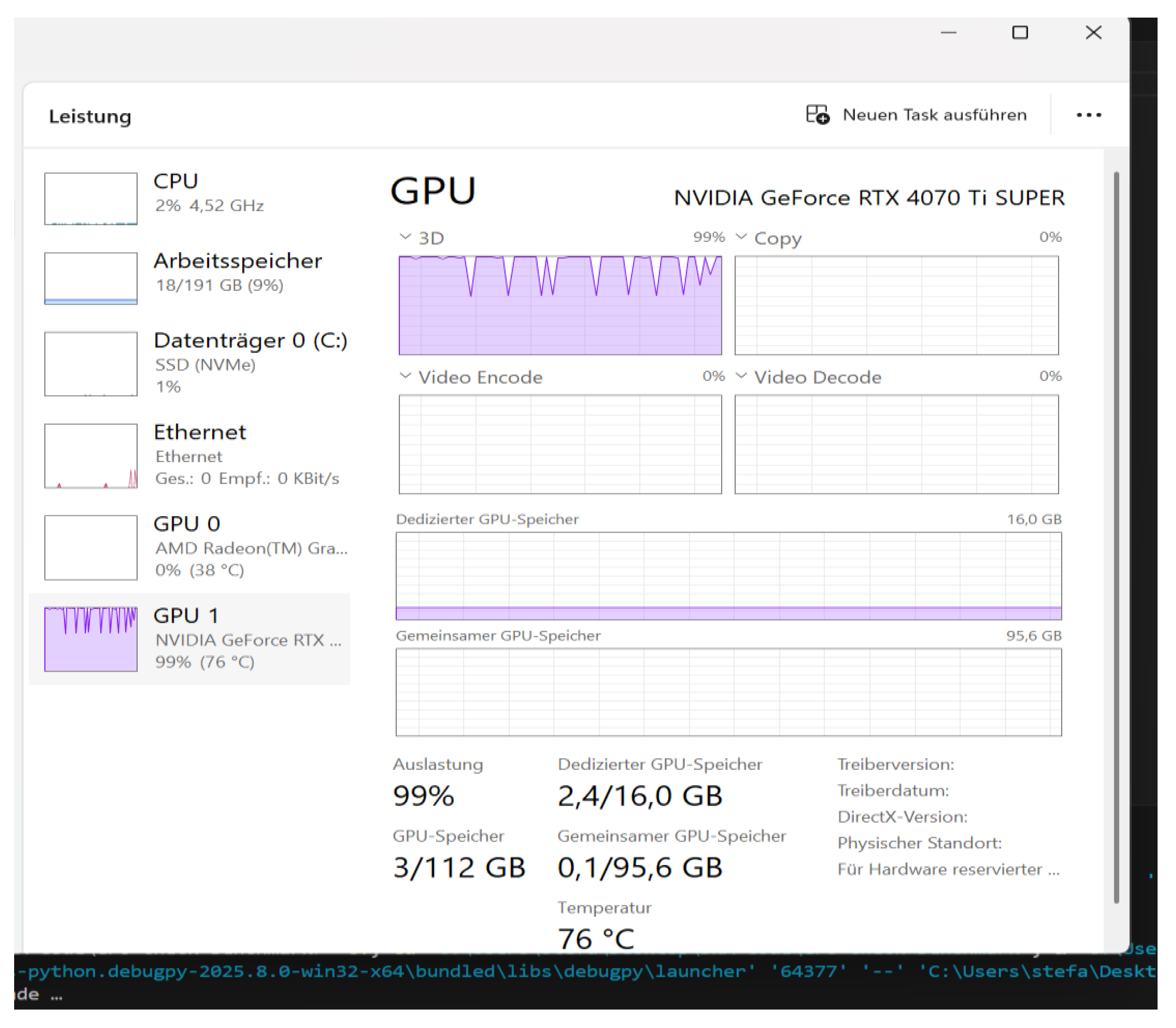
Figure 3.
Power meter (ELV Energy Master): Measured minimum load: 390.5 W.
Disclaimer/Publisher’s Note: The statements, opinions and data contained in all publications are solely those of the individual author(s) and contributor(s) and not of MDPI and/or the editor(s). MDPI and/or the editor(s) disclaim responsibility for any injury to people or property resulting from any ideas, methods, instructions or products referred to in the content. |
© 2025 by the authors. Licensee MDPI, Basel, Switzerland. This article is an open access article distributed under the terms and conditions of the Creative Commons Attribution (CC BY) license (http://creativecommons.org/licenses/by/4.0/).
Copyright: This open access article is published under a Creative Commons CC BY 4.0 license, which permit the free download, distribution, and reuse, provided that the author and preprint are cited in any reuse.


