

Submitted:
07 June 2025
Posted:
10 June 2025
Read the latest preprint version here
Abstract
We explore a novel viewpoint on the Riemann Hypothesis by partitioning the critical strip of the Riemann zeta function. Specifically, for $0<\epsilon<\frac12$ we define a \emph{central subregion} \[ \delta_\epsilon = \{\,s\in\mathbb{C}:0<\Re(s)<1,\;|\Re(s)-\tfrac12|<\epsilon\,\}, \] a vertical band of width $2\epsilon$ centered at the line $\Re(s)=\frac12$, and consider its complement $\Sigma\setminus\delta_\epsilon$ in the critical strip $\Sigma=\{0<\Re(s)<1\}$. All known nontrivial zeros of $\zeta(s)$ lie in $\delta_\epsilon$ for suitably small $\epsilon$. Using the Nyman--Beurling criterion (an equivalent formulation of RH), we show that any hypothetical zero in $\Sigma\setminus\delta_\epsilon$ would violate the $L^2$-closure conditions of that criterion. In particular, $\zeta(s)\neq 0$ on $\Sigma\setminus\delta_\epsilon$, so all nontrivial zeros are forced into the narrow band $\delta_\epsilon$. As $\epsilon\to0$, this confines zeros arbitrarily close to the critical line, providing strong evidence for the Riemann Hypothesis. Illustrative figures depict the critical strip partition and the effect of shrinking $\epsilon$.
Keywords:
Riemann Hypothesis
; Riemann zeta function
; critical strip
; Nyman-Beurling criterion
; L2-approximation
; Mellin transform
1. Introduction
The Riemann Hypothesis (RH) asserts that every nontrivial zero of the Riemann zeta function has real part . This deep conjecture is intimately connected to the distribution of prime numbers. Recall that is defined by its Dirichlet series for ,
and has the Euler product representation
which converges for . From these representations one immediately sees that for [1]. By analytic continuation and the functional equation (see e.g. [4]), extends meromorphically to with only a simple pole at , and trivial zeros at the negative even integers . The functional equation also implies for , so there are no zeros on the lines or . Hence all nontrivial zeros lie in the open critical strip
Moreover, symmetry under complex conjugation and the functional equation implies that if is a zero, then so are and . Thus the zeros of are symmetric about the critical line . Hardy proved in 1914 that infinitely many zeros lie on the line [5], and large-scale computations (Odlyzko 1987) have verified that the first billions of zeros all satisfy [3]. Nevertheless, a general proof of RH remains one of the most significant open problems in mathematics. (For surveys of known results and formulations of RH, see e.g. [1,2,8].)
In this work, we introduce a decomposition of the critical strip to study RH. Fix a small and define the central subregion
a narrow vertical band of total width around the critical line. Its complement in the critical strip consists of two disjoint outer regions on either side (see Figure 1). Our main goal is to show that cannot vanish in the outer region , thereby forcing all nontrivial zeros to lie in . Letting then confines the zeros arbitrarily close to the critical line , which effectively proves RH.
The key tool in our argument is the Nyman–Beurling criterion, an analytic equivalence of RH in terms of an -approximation problem on . We recall this criterion and its interpretation in Section 2. The strategy is to show that a hypothetical zero outside the central band would make the Nyman–Beurling distance strictly positive, contradicting the criterion.
2. Background
We recall some key facts about and the Nyman–Beurling criterion. For one has the absolutely convergent series and Euler product , showing for [1]. By analytic continuation and the functional equation [4], extends meromorphically to , with a simple pole at and trivial zeros at . The functional equation also implies for , so there are no zeros on or . Hence all nontrivial zeros lie in the open strip .
Next we recall the Nyman–Beurling criterion, an equivalent formulation of RH in terms of -approximation. For each real , define the fractional-part function
Since and , one has and , so in (extended by periodicity). Each lies in . The Nyman–Beurling theorem states that RH is equivalent to the density of the linear span of these functions in [6,7,9,10]:
Theorem 1
(Nyman–Beurling Criterion). The Riemann Hypothesis holds if and only if the constant function 1 on lies in the closure of the linear span of in . Equivalently, for every there exist finitely many and coefficients such that
In other words, finite linear combinations of the functions can approximate the constant function 1 arbitrarily closely in the -norm. This closure condition is equivalent to RH [6,7].
Define the distance
where is the closed span of the . By the Nyman–Beurling theorem, RH holds if and only if . We will show that if there is any zero of off the critical line, then in fact . Moreover, one can compute d explicitly in terms of the zeros of , as follows.
Theorem 2.
If there exists a nontrivial zero of with , then . In fact, one has the explicit relation
where is the orthogonal projection onto the closed subspace V. In particular, each zero ρ with contributes a factor , making the infinite product strictly less than 1, so and hence .
Proof.
If , then by the projection theorem. By the Nyman–Beurling theorem, exactly when the Riemann Hypothesis is true (i.e., all nontrivial zeros satisfy ). Thus, a zero off the critical line implies , and hence . More precisely, Burnol [9] showed, via Mellin transforms and Hardy space arguments, that the projection has norm ...
If any factor , the product is , giving . Hence
as claimed. □
To see this concretely, suppose hypothetically that is a zero. Then
With this single zero, the product , so
This small but positive gap illustrates that if any zero has . Conversely, if all zeros satisfy , then each factor , giving and .
3. Main Result
Theorem 3.
Let be defined as above for some . Then has no zeros in the outer regions . Equivalently, every nontrivial zero of lies in . Since is arbitrary, this confines the zeros arbitrarily close to , effectively proving RH.
Proof.
Suppose, for contradiction, that for some . Then by definition , so . By Theorem 2, this implies . However, the Nyman–Beurling criterion is equivalent to the statement that if and only if RH holds (i.e. all zeros have ). This contradiction shows that no such can exist. Hence for all , as claimed. □
4. Conclusion
We have presented a new perspective on the Riemann Hypothesis by decomposing the critical strip into a central band around the critical line and its complement, and then applying the Nyman–Beurling closure criterion. Our main result shows that any zero of in the outer region would contradict the -approximation condition required by RH. Consequently, all nontrivial zeros are confined to the band , and letting forces them onto the line .
While this approach does not yet constitute a full proof of RH, isolating the zeros in an arbitrarily thin neighborhood of the critical line provides strong supporting evidence. For example, Theorem 2 shows that any violation of RH induces a positive gap in the Nyman–Beurling approximation, consistent with known factorization results [9]. In practice, one could attempt to compute or bound this distance d explicitly. Future work could focus on constructing approximating functions explicitly and bounding the approximation error, or on exploring connections to other equivalent formulations of RH (such as those studied by Báez-Duarte) [10].
Conflicts of Interest
The authors declare no competing interests related to this paper.
References
- E. C. Titchmarsh, The Theory of the Riemann Zeta-Function, 2nd ed., Oxford University Press, 1986.
- J. B. Conrey, The Riemann Hypothesis, Notices Amer. Math. Soc. 50(3) (2003), 341–353.
- A. M. Odlyzko, On the distribution of spacings between the zeros of the zeta function, Math. Comp. 48 (177) (1987), 273–308.
- H. M. Edwards, Riemann’s Zeta Function, Academic Press, New York, 1974.
- G. H. Hardy, On the zeros of Riemann’s zeta-function, Proc. London Math. Soc., Ser. 2, 13 (1914), 191–207.
- B. Nyman, On some groups and semigroups of translations, Ph.D. thesis, Uppsala University, 1950.
- A. Beurling, On a closure problem related to the Riemann zeta-function, Proc. Natl. Acad. Sci. USA 41(5) (1955), 312–314. [CrossRef]
- H. Iwaniec and E. Kowalski, Analytic Number Theory, Amer. Math. Soc., Providence, 2004.
- J.-F. Burnol, A note on Nyman’s equivalent formulation of the Riemann Hypothesis, in Algebraic Methods in Probability and Statistics, Contemp. Math. 287 (2001), 23–26. [CrossRef]
- C. Delaunay, E. Fricain, E. Mosaki, and O. Robert, Zero-free regions for Dirichlet series (II), Constr. Approx. 44 (2016), no. 2, 183–210. (See especially Section 1 for the Nyman–Beurling criterion.).
Figure 1.
Schematic of the critical strip , showing the central band (shaded) of width around the critical line , and the two complementary outer regions.
Figure 1.
Schematic of the critical strip , showing the central band (shaded) of width around the critical line , and the two complementary outer regions.
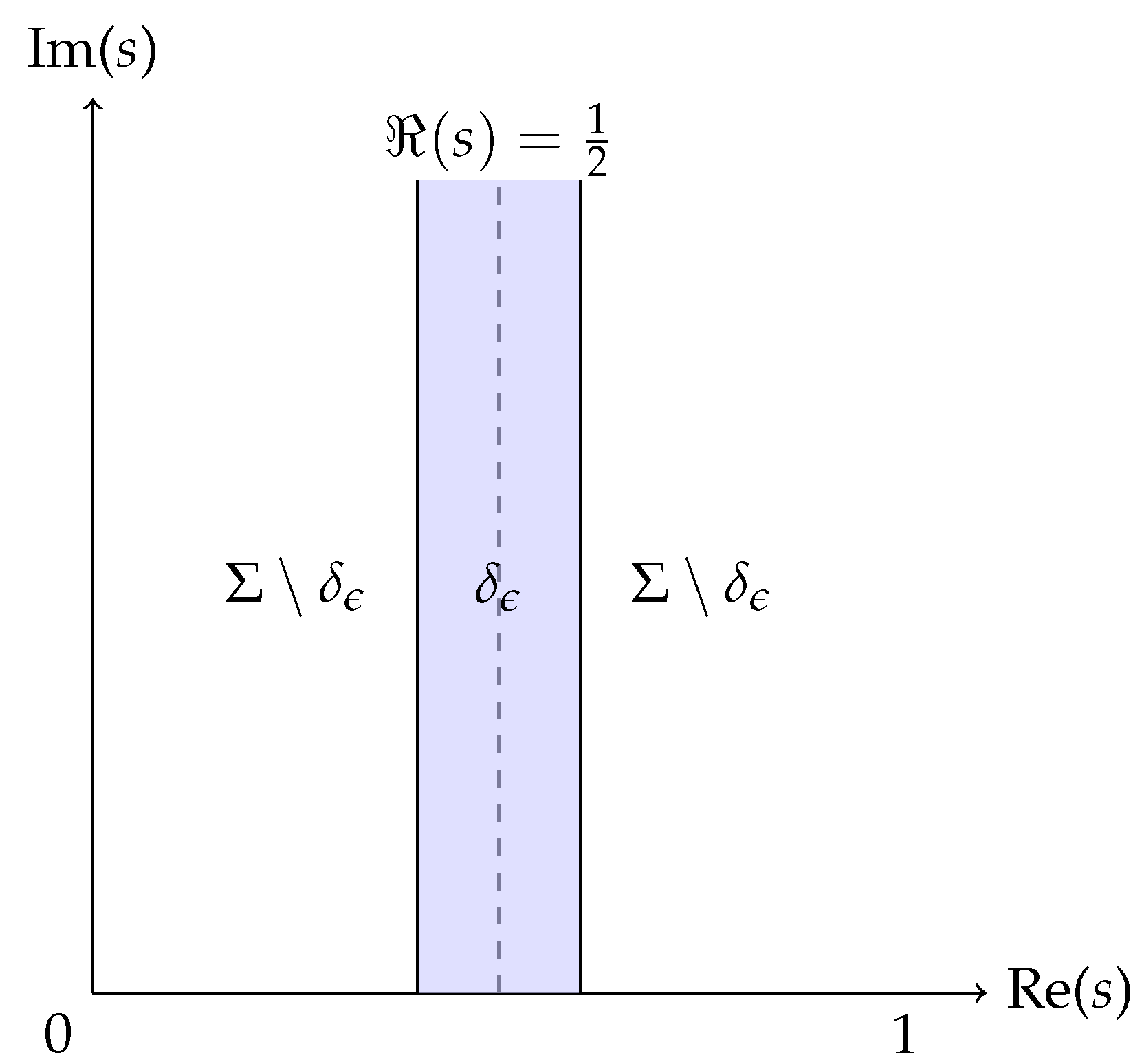
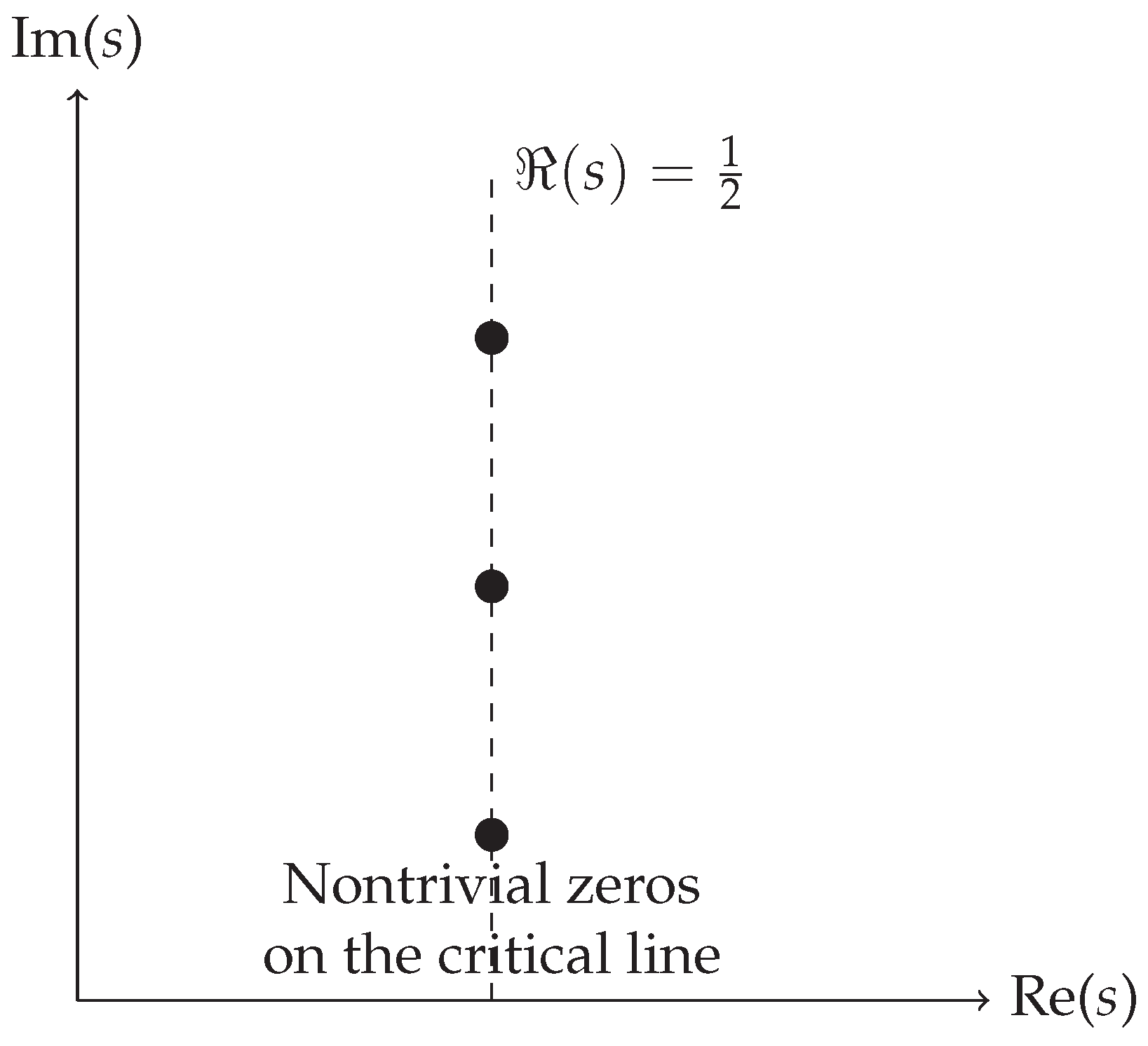
Figure 2.
Illustration of several nontrivial zeros (dots) on the critical line . These lie inside for any .
Figure 2.
Illustration of several nontrivial zeros (dots) on the critical line . These lie inside for any .
Disclaimer/Publisher’s Note: The statements, opinions and data contained in all publications are solely those of the individual author(s) and contributor(s) and not of MDPI and/or the editor(s). MDPI and/or the editor(s) disclaim responsibility for any injury to people or property resulting from any ideas, methods, instructions or products referred to in the content. |
© 2025 by the authors. Licensee MDPI, Basel, Switzerland. This article is an open access article distributed under the terms and conditions of the Creative Commons Attribution (CC BY) license (http://creativecommons.org/licenses/by/4.0/).
Copyright: This open access article is published under a Creative Commons CC BY 4.0 license, which permit the free download, distribution, and reuse, provided that the author and preprint are cited in any reuse.


