

Submitted:
06 June 2025
Posted:
09 June 2025
You are already at the latest version
Abstract
Zinc oxide (ZnO), a wide bandgap semiconductor, has attracted considerable 1
attention in photocatalysis due to its high chemical stability, non-toxicity, and strong 2
oxidation ability. In this study, density functional theory (DFT) calculations were employed 3
to investigate the effects of Ru doping on the structural, electronic, and magnetic properties 4
of wurtzite ZnO. The results reveal that Ru incorporation induces bandgap narrowing 5
and generates impurity states, enhancing visible-light absorption. Charge density analysis 6
suggests improved electron mobility, while projected density of states (PDOS) indicates 7
strong hybridization between Ru-4d and ZnO states. The calculated density of states at the 8
Fermi level, N(EF), exhibits notable dependence on doping concentration and magnetic 9
ordering. For non-magnetic states, N(EF) reaches 11 states/ eV and 9.5 states/eV at 12.5% 10
and 25% doping, respectively. In ferromagnetic configurations, these values reduce to 11
0.65 states/eV and 1.955 states/eV, while antiferromagnetic states yield 4.945 states/eV 12
and 0.65 states/eV. These variations highlight Ru’s role in modulating electronic density, 13
influencing conductivity, magnetic response, and photocatalytic potential. The findings 14
offer theoretical insights for designing efficient Ru-doped ZnO-based photocatalysts.
Keywords:
Density functional theory
; Band gap
; Electronic band structure
; Density of 16 states
; semiconductors
1. Introduction
Photocatalysis has emerged as a sustainable approach for environmental remediation and renewable energy conversion, with semiconductor materials playing a crucial role in harnessing solar energy for chemical transformations [1]. Among various semiconductors, ZnO is widely investigated due to its excellent photocatalytic properties, including high charge carrier mobility, strong redox potential, and environmental friendliness [2]. How-ever, the practical application of ZnO in photocatalysis is hindered by two major challenges:(i) a wide bandgap of 3.37 eV, which limits its absorption primarily to the ultraviolet (UV) region, and (ii) fast electron-hole recombination, reducing its photocatalytic efficiency [3]. To address these limitations, various strategies, such as doping, nanostructuring, and heterojunction formation, have been explored. Among these approaches, doping ZnO with transition metals has proven to be an effective method to tailor its electronic and optical properties [4]. Ruthenium (Ru), a 4d transition metal, exhibits strong catalytic activity and excellent electronic properties, making it a promising dopant for ZnO [5]. Previous studies have demonstrated that Ru doping can introduce midgap states, improve visible-light ab-sorption, and enhance charge carrier separation, thereby boosting photocatalytic efficiency [6]. However, a comprehensive theoretical investigation of Ru-doped ZnO, focusing on its structural stability, electronic modifications, and optical response, is still needed to fully understand its potential in photocatalysis [7,8]. ZnO-based derivations have been used for many years for different applications, such as LCD screens, solar cells, gas sensors, detectors, flat panel displays, and ultraviolet semiconductor laser beams [9,10]. It is non-toxic and has piezoelectric, ferroelectric, and ferromagnetic properties [11]. Zinc oxide nanoparticles are an important example of inorganic metal oxide that exhibit significant size and shape-dependent antibacterial activity [12]. The unique and fascinating properties of II-VI compound semiconductors have triggered tremendous motivation among scien-tists to explore the possibilities of using them in industrial applications [13]. ZnO can be divided into three by their potential functions[14]. One-dimensional structures comprise the largest groups, including nano-rods, needless springs, rings, ADV25-AR-01013 ribbons, tubes, belts, wires, and combs [15]. Two-dimensional(2D) structures include nanoplate, hano-sheet nano-spells, and three dimensional(3D) [16] including flowers, snowflakes, and coniferous urchins [17]. Hexagonal ZnO is an n-type semiconductor that has excellent pho-toelectric properties [18], high chemical stability [19], low static dielectric, and optoelectric [20]. Al, Mg, and Fe elements doping ZnO can obtain n-type material and direct band gap structure [21,22]. Generally, metal ion doping could increase electrical conductivity in ma-terials combined with a wide range of transparency in the visible and near-UV regions [23]. Ru substitution can improve the electrical and magnetic properties of non optimally(low) cation doped maganites [24]. Ruthenium doped on TiO2 increases the thickness of thin films from 110nm to 255nm [25]. In the Nb2Pd1−xRuxS5 system, superconductivity is enhanced, and Tc maximum 6.86K(x=0.2) [26,27]. Several typical dopant elements, such as F, B, Al, Ga, In, and Sn have been used to produce conducting ZnO films [28]. Eu-doped ZnO can be induced by introducing Zn interstitial leads to a carrier mediated FM [29], while the Pd-doped ZnO possesses no FM [30,31]. The system we use, Zinc (Zn: [Ar]3d104s22), Oxygen (O:[He]2s22p4), and Ruthenium (Ru: [Kr]4d75s1 have except Oxygen they are d-orbital electrons in their electronic structure configuration. In this study, first-principles density functional theory (DFT) calculations are employed to systematically investigate the impact of Ru doping on the structural, electronic, and magnetic characteristics of wurtzite ZnO. The analysis focuses on how Ru incorporation influences the band structure, density of states, and charge distribution to assess the potential of Ru-doped ZnO as an efficient visible-light-responsive photocatalyst. The findings provide valuable theoretical insights for the design and optimization of advanced photocatalytic materials based on transition metal-doped ZnO.
2. Computational Methods
In this research, we have calculated the electronic band structure, partial density of states(PDOS), and density of states(DOS) of Zn1−xRuxO for x= 0.5, 0.25, and 0.125. The calculation of the Brillouin Zone is performed using a 8x8x10 Monkhorst pack k.points sampling. The pseudopotential type used is the ultrasoft pseudopotential (USPP) with the GGA Perdew-Burke-Ernzerhof (PBE-Sol) functional. We use the value of Hexagonal lattice parameters(a= 3.2490, c = 5.20899) [32,33] and internal coordinates of Zn(0.1666667, 0.3333333, 0.0000000) and O (0.1666667, 0.3333333,0.1900000) obtained by Vesta package. The band structures are plotted along the high symmetry direction Γ-M-K-Γ-A-L-H-A-L-M-K-H [34] in the conventional Hexagonal (HEX) Brillouin Zone. The DOS calculation was performed using the tetrahedron method. We multiply cell positions by phonopy package super-cell division as for 25% (2x1x1) and 12.5% (2x2x1). We did a band plot to compare band structure in the first Brillouin Zone. In general, we did non-magnetic and magnetic calculations.
3. Results and Discussion
In this section, we present and analyze the structural, electronic, and magnetic proper-ties of Ru-doped wurtzite ZnO to evaluate its potential for enhanced photocatalytic activity. First-principles calculations based on density functional theory (DFT) were employed to explore the influence of ruthenium (Ru) substitution at the Zn site on the host ZnO lattice. The motivation for this study arises from the inherent limitations of pristine ZnO in photocatalytic applications, primarily due to its wide bandgap and limited visible light absorption. Transition metal doping has been widely proposed as an effective strategy to overcome these limitations by inducing mid-gap states and narrowing the bandgap [35]. Among various dopants, Ru has attracted interest due to its favorable electronic configuration and ability to tailor the photocatalytic properties of oxide semiconductors [36].
Figure 1 shows the optimized crystal structures of Ru-doped wurtzite ZnO at three different doping concentrations: 12.5%, 25%, and 50%. The wurtzite framework remains largely intact, with only slight distortions observed around the dopant site due to local lattice relaxation. As the Ru concentration increases to 25%, two Zn atoms are substituted by Ru atoms, introducing more noticeable distortions in the lattice. Although the hexagonal wurtzite symmetry is preserved, localized strain becomes more evident, especially around the Ru-O coordination environment. At the highest doping level of 50%, half of the Zn atoms are replaced with Ru, resulting in significant structural distortion. The proximity of multiple Ru atoms leads to strong Ru–O interactions and possible Ru–Ru coupling, which destabilizes the original wurtzite structure [37]. These changes are indicative of increasing attice strain and potential phase instability at high doping levels, which are critical factors influencing the material’s photocatalytic behavior.
Figure 2 displays the calculated band structures of Ru-doped wurtzite ZnO for three different doping concentrations: (a) 12.5%, (b) 25%, and (c) 50%. These results provide key insights into the evolution of the electronic properties of ZnO upon increasing Ru content. At the lowest doping level of 12.5%, the band structure shows a noticeable reduction in the band gap compared to pristine ZnO, primarily due to the introduction of Ru 4d states near the conduction band minimum (CBM) and valence band maximum (VBM). These impurity states serve as intermediate energy levels that facilitate visible light absorption and enhance photocatalytic performance by reducing the energy required for electronic transitions [38]. As the Ru concentration increases to 25%, the band gap continues to narrow, and the impurity states become more pronounced. This modification results in a more delocalized electronic structure near the Fermi level, which can promote better charge carrier mobility and reduce electron-hole recombination, a desirable characteristic for photocatalytic applications. At 50% doping, the band gap becomes much narrower, and in some cases, metallic-like behavior may begin to emerge due to the merging of impurity states with the conduction or valence bands. This drastic change indicates that at high Ru concentrations, the semiconductor nature of ZnO can be compromised, potentially affecting its photocatalytic efficiency similarly with reported work[39].
Figure 3 shows the total and partial DOS for Ru-doped wurtzite ZnO at doping concentrations of 12.5% (a), 25% (b), and 50% (c). These DOS plots provide a deeper understanding of the electronic structure evolution with increasing Ru content and help to explain the trends observed in the band structures. At 12.5% Ru doping, the partial DOS analysis shows N(EF) is 11 states/eV and strong hybridization between the Ru 4d orbitals and O 2p states, indicating significant interaction between the dopant and the host lattice. As the Ru concentration increases to 25%, the intensity and spread of the Ru 4d states within the band gap region become more pronounced. The hybridization between Ru 4d and O 2p orbitals intensifies, leading to a greater redistribution of electronic states near the Fermi level [40] with N(EF) 9.5 states/eV. This interaction results in further band gap narrowing and the formation of more mid-gap states, which can enhance charge carrier separation and facilitate photocatalytic reactions under visible light. Moreover, the conduction band becomes more populated with Ru-derived states, indicating a shift in the electronic character of the material toward increased conductivity. At the highest doping level of 50%, the DOS exhibits significant overlap of the Ru 4d states with both the conduction and valence bands, effectively closing the band gap or making it very narrow. This strong overlap may indicate a transition from semiconducting to metallic-like behavior, which, while potentially enhancing electrical conductivity, could also lead to increased carrier recombination and reduced photocatalytic efficiency [41]. The sharp increase in states near the Fermi level N(EF) is 8 states/eV suggests that electron localization and scattering effects could become significant at such high doping concentrations.
Figure 4 shows the PDOS for Ru doped wurtzite ZnO at three doping concentrations 12.5% (a), 25% (b), and 50% (c), highlighting the orbital contributions of Zn 3d, O 2p, and Ru 4d states to the overall electronic structure. At the 12.5% doping level, the PDOS shows that the valence band primarily comprises O 2p orbitals, while the conduction band consists mainly of Zn 4s and a small contribution from Zn 3d orbitals. The stronger hybridization between Ru 4d and O 2p orbitals leads to an even greater reduction in the band gap. Moreover, the interaction between Ru atoms becomes more likely, contributing to the formation of delocalized states around the Fermi level. This not only improves the material’s light absorption in the visible region but also promotes more efficient charge carrier separation and transport key factors in enhancing photocatalytic performance. At the highest doping level of 50%, the PDOS reveals a dramatic transformation in the electronic structure. The Ru 4d states dominate the vicinity of the Fermi level, and their overlap with both the valence and conduction bands becomes substantial. The Zn 3d and O 2p contributions are still present but are relatively suppressed due to the strong influence of Ru [42]. This results in the possible closing of the band gap or the emergence of metallic-like behavior. While this might lead to higher electrical conductivity, it may also introduce an increased recombination of photogenerated charge carriers, which can negatively affect photocatalytic efficiency. Table 1 concludes the Fermi energy (EF), total energy (TE) in the ferromagnetic (FM) configuration, lattice parameter (a), and unit cell volume for Ru-doped ZnO at three different doping levels: 12.5%, 25%, and 50%. The data reveal how increasing Ru concentration influences both the structural and electronic stability of the material. At 12.5% doping, the Fermi energy is 9.6955 eV, and the total energy is calculated to be -1489.2109 Ry. The lattice parameter a is 12.4310 ˚A, and the corresponding volume is 1332.8426 ˚A. These values indicate a relatively stable structure with minimal lattice compression, suggesting that low Ru doping can be accommodated without significantly disturbing the ZnO host lattice [43]. As the Ru content increases to 25%, the Fermi energy rises to 10.593 eV, and the total energy becomes -767.57414 Ry. Interestingly, the lattice parameter remains constant at 12.4310 ˚A, but the volume reduces by half to 666.4213 3, consistent with the supercell size and number of atoms considered in the simulation. This increase in Fermi energy suggests enhanced electronic activity near the conduction band and a slight shift in the electronic distribution due to the addition of Ru atoms. The reduction in total energy (becoming less negative) reflects the impact of Ru substitution on the energetic stability of the structure. At the highest doping level of 50%, the Fermi energy shows a marked increase to 13.2495 eV, indicating a significant shift of the Fermi level toward the conduction band. This implies strong metallic character or the emergence of impurity bands near the Fermi level. The total energy further increases to - 406.79644 Ry, suggesting reduced structural stability at high Ru concentration. Additionally, the lattice parameter decreases to 6.0948 ˚A, and the volume drops substantially to 316.71253. These reductions are due to the smaller size of the unit cell used for this higher doping level but also suggest increased lattice distortion or possible structural phase transition as more Zn atoms are replaced with Ru [44].
Figure 5 presents the spin-polarized band structure of Ru-doped wurtzite ZnO at three different doping concentrations: 12.5%, 25%, and 50%, illustrating the spin-up (I) and spindown (II) for each case. At 12.5% Ru doping Figure 5 (a,b), the spin-up band structure reveals a semiconducting nature with a slightly narrowed band-gap compared to pristine ZnO. The Ru 4d states begin to hybridize with O 2p states near the Fermi level, indicating the onset of magnetic interactions. In contrast, the spin-down shows more significance with impurity states appearing near the Fermi level. This spin asymmetry suggests the presence of spin polarization and possible weak ferromagnetic behavior. As the Ru concentration increases to 25% Figure 5 (c,d), the spin-up exhibits metallic characteristics, with bands crossing the Fermi level. The enhanced Ru–O hybridization leads to broader bands and stronger electron delocalization. Meanwhile, the spin-down band structure retains a semiconducting character or exhibits a small gap around the Fermi level. This clear asymmetry between the spin channels implies half-metallicity. At the highest doping concentration of 50% Figure 5 (e,f), both spin-up and spin-down show bands crossing the Fermi level, indicating a metallic state for both spin orientations. The band structures become more symmetric, and the spin polarization is significantly reduced. This is likely due to stronger Ru-Ru interactions, which may suppress magnetic ordering or lead to weak ferromagnetism [45].
Figure 6 shows the spin-polarized partial density of states (PDOS) of Ru-doped wurtzite ZnO at three different doping concentrations: 12.5% (a), 25% (b), and 50% (c). This figure provides deeper insight into how individual atomic orbitals, particularly Ru 4d, O 2p, and Zn 3d, contribute to the electronic and magnetic behavior of the material. At 12.5% doping, the PDOS reveals a clear spin asymmetry between the up-spin and down-spin states, especially near the Fermi level, indicating the onset of spin polarization. The Ru 4d orbitals introduce impurity states within the band gap and hybridize with the O 2p states, particularly in the spin-down channel. This interaction results in localized magnetic moments around the Ru atoms, which are responsible for the observed magnetic ordering and band gap reduction. The Zn 3d and O 2p contributions remain dominant in the valence band region, but their alignment with Ru 4d states demonstrates strong orbital hybridization that modifies the electronic structure [46]. As the Ru concentration increases to 25%, the spin polarization intensifies. The PDOS shows a larger difference in the density of spin-up and spin-down states, especially for the Ru 4d orbitals. This strong spin splitting indicates enhanced magnetic interactions due to increased dopant density. The Ru 4d states shift closer to the Fermi level, and their hybridization with O 2p states strengthens. This leads to an increased density of mid-gap states, which can facilitate visible-light absorption and improve photocatalytic activity. Additionally, the interaction among neighboring Ru atoms may result in the emergence of collective magnetic behavior, suggesting potential for room-temperature ferromagnetism in this system. The contribution from Zn 3d states remains largely unaffected, serving as a stable electronic background for the evolving magnetic structure. At the highest Ru concentration of 50%, the PDOS shows dramatic changes. The spin asymmetry is still present but becomes more complex, with both spin channels showing a high density of states at the Fermi level, suggesting metallic or half-metallic character. The Ru 4d states dominate the electronic structure, particularly near the Fermi level, and their strong overlap with O 2p orbitals contributes to a highly delocalized electronic environment. This high degree of hybridization enhances electrical conductivity but may compromise the magnetic ordering due to carrier delocalization. The near-continuous distribution of states across the Fermi level in both spin channels also suggests a possible breakdown of semiconducting behavior [47], which could lead to faster recombination of photogenerated carriers unfavorable for photocatalysis.
Figure 7(a), the spin-up for 12.5% Ru doping introduces magnetic properties without significantly disrupting the host lattice structure or electronic properties. This behavior is favorable for potential photocatalytic applications that require magnetic activity and visible-light absorption [48]. At 25% Ru doping Figure 7(b), the PDOS exhibits stronger spin polarization compared to the 25% doping case. The spin-up and spin-down channels now show more pronounced differences, with the Ru 4d states playing a significant role in the density of states near the Fermi level. This concentration of Ru introduces more impurity states in both spin channels, particularly closer to the conduction band, indicating a more pronounced hybridization between Ru 4d and O 2p orbitals. The increase in Ru concentration further narrows the band gap, making the material more conducive to visiblelight absorption [49]. This effect is expected to enhance photocatalytic activity by facilitating the generation and separation of charge carriers, while the enhanced spin-polarization could enable spintronic applications or improved magnetocatalytic performance. At 50% Ru doping Figure 7(c), the PDOS shows a dramatic shift, with a significant overlap of Ru 4d states with both the conduction and valence bands. This strong hybridization leads to a more metallic-like electronic structure, where the Fermi level intersects with a high density of delocalized Ru 4d states. The spin-polarized channels still show some asymmetry, but both the spin-up and spin-down states are highly populated around the Fermi level, suggesting metallic or half-metallic behavior. The increased Ru concentration leads to a substantial loss of the band gap, and the material no longer exhibits clear semiconducting properties.
Figure 8(a), the PDOS clearly shows a distinct spin asymmetry, indicating the onset of spin polarization. The Ru 4d states introduce impurity levels within the band gap, particularly in the spin-down channel, which leads to a narrowing of the band gap and the formation of mid-gap states. These mid-gap states are primarily derived from the hybridization between the Ru 4d and O 2p orbitals. In the spin-up channel, the electronic structure is largely dominated by the O 2p and Zn 3d states, with minimal contribution from Ru. This limited interaction between Ru and Zn in the valence band maintains a relatively stable semiconducting nature [50] while introducing magnetic moments associated with the Ru dopants. These results suggest that moderate doping at this level can provide desirable magnetic properties without excessively disrupting the host lattice.
At 25% Ru doping Figure 8(b), the spin polarization becomes more pronounced. The PDOS for this concentration reveals an increased overlap between the Ru 4d states and the O 2p orbitals. This stronger hybridization contributes to a further reduction in the band gap, which enhances the material’s ability to absorb visible light—a key feature for photocatalytic applications. The spin-up and spin-down channels exhibit greater asymmetry, with a noticeable increase in the density of states near the Fermi level, particularly in the spindown channel. This suggests that the magnetic interactions between Ru atoms are becoming stronger and more extensive. The increased presence of Ru 4d states near the Fermi level indicates that the material is becoming more conductive, potentially facilitating charge carrier transport and separation, both critical for improving photocatalytic efficiency [51]. At 50% Ru doping Figure 8(c), the PDOS shows a significant shift towards metallic-like behavior. The contribution from Ru 4d states dominates both the conduction and valence bands, leading to a substantial narrowing or even closing of the band gap. The spin-up and spin-down channels show substantial overlap near the Fermi level, indicating that both spin channels are contributing to the metallic character of the material. This overlap of Ru 4d states with the conduction band results in a material that may exhibit high electrical conductivity but potentially loses its semiconducting properties. The strong delocalization of electrons and the high density of states near the Fermi level in both spin channels may lead to increased carrier recombination, which could negatively affect photocatalytic efficiency [52]. While this behavior is favorable for spintronic applications where metallic spin channels are needed, it may limit the effectiveness of the material for photocatalytic applications due to the lack of a sufficient band gap.
In the 12.5% Ru-doped ZnO Figure 9(a), the impact of Ru doping is relatively minor. At this low concentration, the Ru dd-orbitals have only a slight contribution near the Fermi level, meaning the Zn 3d and O 2p orbitals dominate the electronic structure, and the material largely retains its semiconductor properties. At 25% Ru doping Figure 9(b), the interaction between Ru dd-orbitals and the ZnO host orbitals becomes more noticeable. The increased concentration leads to more significant hybridization between Ru d orbitals and the Zn 3d M orbitals, which can introduce new electronic states near the Fermi level [52]. This could modify the conductivity and may also have implications for the material’s magnetic properties. At 50% Ru doping Figure 9(c), the influence of Ru is pronounced, with the Ru dd-orbitals contributing heavily to the density of states near the Fermi level. At this high concentration, strong hybridization between Ru dd-orbitals and the Zn 3d and O 2p orbitals could significantly alter the electronic structure, potentially driving the material from a semiconducting state towards metallic behavior. Overall, as the doping concentration increases, the Ru dd-orbitals play a more significant role in shaping the electronic properties of Ru-doped ZnO, with the potential for significant changes in conductivity, magnetism, and other material characteristics.
Table 2 provides a detailed comparison of the Fermi level (EF) and total energy (TE) for both the ferromagnetic (FM) and antiferromagnetic (AFM) configurations of Ru-doped ZnO at different Ru doping concentrations: 12.5%, 25%, and 50%. For 12.5% Ru doping, the Fermi level for the FM configuration is 9.6266 eV, while for the AFM configuration, it shifts to 9.8890 eV. The total energy for the FM configuration is -2977.6275 Ry, while the energy for the AFM configuration is slightly more negative at -2977.641 Ry, implying that the AFM state is marginally more stable than the FM state by an energy difference of ΔE= 0.0143 Ry. This small energy difference indicates that both FM and AFM configurations are nearly degenerate at this low doping concentration, suggesting that the material can exist in either magnetic state with similar stability. For 25% Ru-doping, the Fermi level for the FM configuration increases to 10.8881 eV, while the AFM Fermi level drops to 9.8025 eV. The total energy for the FM configuration is -1534.4359 Ry, whereas the energy for the AFM configuration is -1534.5635 Ry. The energy difference (Δ E= 0.127565 Ry) between the FM and AFM states is significantly larger than at 12.5% doping, indicating that the FM state is now more stable than the AFM state, favoring ferromagnetism at this concentration. For 50% Ru doping, the Fermi level for the FM configuration rises further to 12.9443 eV, and for the AFM configuration, it is 12.7034 eV. The total energy for the FM configuration is -812.7992 Ry, and for the AFM configuration, it is -812.8123 Ry, with a very small energy difference (ΔE = 0.0131 Ry). At this high doping concentration, the energy difference between the FM and AFM configurations is again small, suggesting that both states are nearly degenerate. However, the very slight preference for the AFM configuration at this doping level implies that the system may exhibit more complex magnetic behavior as the Ru concentration reaches higher levels [53].
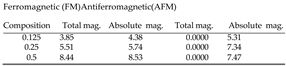
Table 3 presents the total magnetization and absolute magnetization for both ferromagnetic (FM) and antiferromagnetic (AFM) configurations of Ru-doped wurtzite ZnO at various doping concentrations: 12.5%, 25%, and 50%. These values provide insights into the magnetic properties of the material at different doping levels and magnetic ordering. In the FM configuration, the total magnetization is the sum of the magnetic moments of all atoms in the system, while the absolute magnetization refers to the magnitude of the total magnetization, irrespective of the direction of the magnetic moments. At 12.5% Ru doping, the total magnetization is 5.51μβ, and the absolute magnetization is 5.74μβ. The slight difference between total and absolute magnetization suggests a small degree of magnetic moment cancellation, indicating a weaker ferromagnetic ordering. The material exhibits noticeable ferromagnetism, but the moments are not perfectly aligned, which is consistent with a moderate doping level where spin polarization is weaker. At 25% Ru doping,the total magnetization drops to 3.85 μβ but the absolute magnetization increases to 4.38μβ . The decrease in total magnetization suggests a reduction in the alignment of magnetic moments, possibly due to the higher concentration of Ru, which might introduce competing magnetic interactions [54]. However, the increase in absolute magnetization indicates that the material still retains significant spin polarization, though the magnetic ordering might be less stable than at lower doping levels. At 50% Ru doping ,the total magnetization increases significantly to 8.44 μβ , and the absolute magnetization is 8.53 μβ . This shows that, at high doping levels, the magnetic moments align more strongly in the FM configuration, resulting in a higher total magnetization. The values of total and absolute magnetization are almost identical, suggesting that the system exhibits a well-defined ferromagnetic order with minimal moment cancellation. This aligns with the earlier observation that higher Ru doping can promote stronger ferromagnetism in ZnO. In the AFM configuration, the total magnetization is essentially 0 μβ for all doping concentrations, as expected for an antiferromagnetic material, where adjacent magnetic moments cancel each other out. The absolute magnetization values are reported as well: At 12.5% Ru doping, the absolute magnetization is 5.31 μβ , indicating that while the material shows no net magnetization in the AFM state, there is still some residual magnetization due to the alignment of individual magnetic moments [55]. At 25% Ru doping, the absolute magnetization is 7.34 μβ , which is higher than that at 12.5% doping, suggesting that the AFM configuration becomes more stable or more defined with increased Ru concentration. At 50% Ru doping, the absolute magnetization is 7.47μβ, which is slightly higher than at 25%, further suggesting that the AFM configuration remains somewhat stable at higher doping levels, with stronger magnetic interactions among the dopant atoms.
4. Conclusions
A theoretical investigation of Ru-doped wurtzite ZnO was carried out using firstprinciples DFT calculations. A structural analysis confirmed minor lattice distortions upon Ru incorporation without disrupting the wurtzite framework. Band structure calculations revealed significant bandgap narrowing and impurity states introduced by Ru 4d orbitals near the Fermi level. Density of states (DOS) and partial DOS (PDOS) analyses showed strong hybridization between Ru 4d and O 2p orbitals, altering the electronic characteristics of ZnO. Ru doping transformed ZnO from a semiconductor to a metallic system across all non-magnetic (NM) and most magnetic states. In NM configurations, N(EF) values of 11, 9.5, and 8 states/eV were recorded for 12.5%, 25%, and 50% Ru doping, respectively. In FM configurations, N(EF) decreased to 0.824 and 2.2 states/eV for 12.5% and 25% doping. Notably, at 25% Ru doping in the FM state, a bandgap opened in the down-spin, indicating a possible half-metallic behavior. AFM configurations yielded N(EF) values of 4.9 and 0.48 states/eV at corresponding doping levels.
5. Recommendation
Further experimental synthesis and photocatalytic performance testing of Ru doped ZnO at 12.5–25% concentrations are strongly recommended to validate the theoretical predictions and optimize the material for visible light photocatalytic applications.
Authors Contributions: A. Desta Regassa Golja: Conceptualization(equal), Data duration(equal), Formal analysis (equal),investigation(equal), software(equal),writing original draft,writing-review and editing(equal), B. Megersa Olumana Dinka1: Conceptualization(equal), Formal analysis (equal),investigation(equal), software(equal),writing-review and editing(equal), supervision,
Funding declaration: Funding declaration: Not applicable
Ethics, Consent to Participate, and Consent to Publish declarations: Ethics, Consent to Participate, and Consent to Publish declarations: Not applicable.
Availability of Data: The data that supports the findings of this study are available within the article.
Acknowledgment: We gratefully acknowledge Adama Science and Technology University, the computational lab, and the Department of Applied Physics
Conflicts of Interest
There are no conflicts of interest regarding the publication of this article.
References
- Yaghoubi, Sina and Mousavi, Seyyed Mojtaba and Babapoor, Aziz and Binazadeh, Mojtaba and Lai, Chin Wei and Althomali, Raed H and Rahman, Mohammed M and Chiang, Wei-Hung, Photocatalysts for solar energy conversion: Recent advances and environmental applications, Renewable and Sustainable Energy Reviews, 200 114538 (2024).
- Ong, Chin Boon and Ng, Law Yong and Mohammad, Abdul, A review of ZnO nanoparticles as solar photocatalysts: Synthesis, mechanisms and applications, Renewable and Sustainable Energy Reviews, 81536-551 (2018).
- Johar, Muhammad Ali and Afzal, Rana Arslan and Alazba, Abdulrahman Ali and Manzoor, Umair, Photocatalysis and bandgap engineering using ZnO nanocomposites, Advances in Materials Science and Engineering, 2015(1)934587(2015).
- Bhapkar, Abhishek R and Bhame, Shekhar, A review on ZnO and its modifications for photocatalytic degradation of prominent textile effluents: Synthesis, mechanisms, and future directions, Journal of Environmental Chemical Engineering, 112553 (2024).
- Dasuki, Dema and Habanjar, Khulud and Awad, Ramdan, Effect of growth and calcination temperatures on the optical properties of ruthenium-doped ZnO nanoparticles, Condensed Matter, 8(4) 102( 2023).
- Nguyen-Phan, Thuy-Duong and Luo, Si and Vovchok, Dimitriy and Llorca, Jordi and Sallis, Shawn and Kattel, Shyam and Xu, Wenqian and Piper, Louis FJ and Polyansky, Dmitry E and Senanayake, Sanjaya D and others, Three-dimensional ruthenium-doped TiO 2 sea urchins for enhanced visible-light-responsive H22 production, Physical Chemistry Chemical Physics, 18 (23) 15972-15979 (2016).
- Singh, Prabhat Kumar and Singh, Neetu and Singh, Mridula and Singh, Saurabh Kumar and Tandon, Poonam, Development and characterization of varying percentages of Ru-doped ZnO (x Ru: ZnO; 1% x 5%) as a potential material for LPG sensing at room temperature, Applied Physics A, 126 1-14 (2020).
- Krishnan, Bindu and Shaji, Sadasivan and Acosta-Enriquez, MC and Acosta-Enriquez, EB and Castillo-Ortega, R and Zayas, MA E and Castillo, SJ and Palama, Ilaria Elena and D’Amone, Eliana and Pech-Canul, Martin I and others, Group II–VI Semiconductors, Semiconductors: synthesis, properties and applications, 397-464 (2019).
- John, Rita and Padmavathi, S and others, Ab initio calculations on structural, electronic and optical properties of ZnO in wurtzite phase, Crystal structure theory and applications, 5(02) 24 (2016).
- Witkowski, BS, Applications of ZnO Nanorods and Nanowires–A Review, Acta Physica Polonica: A, 134(6) (2018).
- Nizamov, Timur R and Amirov, Abdulkarim A and Kuznetsova, Tatiana O and Dorofievich, 433 Irina V and Bordyuzhin, Igor G and Zhukov, Dmitry G and Ivanova, Anna V and Gabashvili, Anna N and Tabachkova, Nataliya Yu and Tepanov, Alexander A and others, Synthesis and functional characterization of CoxxFe3−xO4BaTiO3 magnetoelectric nanocomposites for biomedical applications, Nanomaterials, 13(5) 811 (2023).
- Shabatina, Tatyana and Vernaya, Olga and Shumilkin, Aleksei and Semenov, Alexander and Melnikov, Mikhail, Nanoparticles of bioactive metals/metal oxides and their nanocomposites with antibacterial drugs for biomedical applications, Materials, 15(10) 3602 (2022).
- Krishnan, Bindu and Shaji, Sadasivan and Acosta-Enriquez, MC and Acosta-Enriquez, EB and Castillo-Ortega, R and Zayas, MA E and Castillo, SJ and Palama, Ilaria Elena and D’Amone, Eliana and Pech-Canul, Martin I and others, Group II–VI Semiconductors, Semiconductors: synthesis, properties and applications, 397-464 (2019).
- Sharma, Dhirendra Kumar and Shukla, Sweta and Sharma, Kapil Kumar and Kumar, Vipin, A review on ZnO: Fundamental properties and applications, Materials for Today: Proceedings, 49 3028-3035 (2022).
- Li, Yu and Yang, Xiao-Yu and Feng, Yi and Yuan, Zhong-Yong and Su, Bao-Lian, Onedimensional metal oxide nanotubes, nanowires, nanoribbons, and nanorods: synthesis, characterizations, properties and applications, Critical Reviews in Solid State and Materials Sciences, 37(1) 1-74 (2012).
- Abdelmohsen, Ahmed and Ismail, Nahla, Morphology transition of ZnO and Cu2O nanoparticles to 1D, 2D, and 3D nanostructures: hypothesis for engineering of micro and nanostructures (HEMNS), Journal of Sol-Gel Science and Technology, 94 213-228 (2020).
- Chauhan, Vishnu and Singh, Paramjit and Kumar, Rajesh, Ion beam-induced modifications in ZnO nanostructures and potential applications, Nanostructured Zinc Oxide, 117-155 (2021).
- Teng, Feng and Hu, Kai and Ouyang, Weixin and Fang, Xiaosheng, Photoelectric detectors based on inorganic p-type semiconductor materials, Advanced Materials, 30(35) 1706262 (2018).
- Ouyang, Weixin and Teng, Feng and He, Jr-Hau and Fang, Xiaosheng, Enhancing the photoelectric performance of photodetectors based on metal oxide semiconductors by charge-carrier engineering, Advanced Functional Materials, 29(9) 1807672 (2019).
- Zafar, Amina and Younas, Muhammad and Fatima, Syeda Arooj and Qian, Lizhi and Liu, Yanguo and Sun, Hongyu and Shaheen, Rubina and Nisar, Amjad and Karim, Shafqat and Nadeem, Muhammad and others, Frequency stable dielectric constant with reduced dielectric loss of one-dimensional ZnO–ZnS heterostructures, Nanoscale, 13(37) 15711-15720 (2021).
- Goktas, A and Aslan, F and Ye,silata, B and Boz, ˙I, Physical properties of solution processable ntype Fe and Al co-doped ZnO nanostructured thin films: role of Al doping levels and annealing, Materials Science in Semiconductor Processing, 75 221-233 (2018).
- Singh, Pushpendra and Kumar, Ranveer and Singh, Rajan Kumar, Progress on transition metaldoped ZnO nanoparticles and its application, Industrial & Engineering Chemistry Research, 58(37) 17130-17163( 2019).
- Kayani, Aminuddin Bin Ahmad and Kuriakose, Sruthi and Monshipouri, Mahta and Khalid, Fararishah Abdul and Walia, Sumeet and Sriram, Sharath and Bhaskaran, Madhu, UV photochromism in transition metal oxides and hybrid materials, Small, 17(32) 2100621 (2021).
- Ivanov, SA and Sarkar, Tapati and Bazuev, GV and Kuznetsov, MV and Nordblad, Per and Mathieu, Roland, Modification of the structure and magnetic properties of ceramic La2CoMnO6 with Ru doping, Journal of Alloys and Compounds, 752 420-430 (2018).
- Al Shomar, SM, Investigation of the effect of doping concentration in Ruthenium-doped TiO2 thin films for solar cells and sensors applications, Materials Research Express, 7(3) 036409 (2020).
- Medhi, Riddhiman and Li, Chien-Hung and Lee, Sang Ho and Marquez, Maria D and Jacobson, Allan J and Lee, Tai-Chou and Lee, T Randall, Uniformly spherical and monodisperse antimonyand zinc-doped tin oxide nanoparticles for optical and electronic applications, ACS Applied Nano Materials, 2(10) 6554-6564 (2019).
- Chen, Q and Shen, CY and Yang, XH and Yang, XJ and Li, YP and Feng, CM and Xu, ZA, Effect of ruthenium doping on superconductivity in Nb2PdS5, Journal of Physics: Conference Series, 807(5) 052002( 2017).
- Papadimitriou, Dimitra N, Engineering of optical and electrical properties of electrodeposited 487 highly doped Al: ZnO and In: ZnO for cost-effective photovoltaic device technology, Micromachines, 13(11) 1966 (2022).
- Vinoditha, U and Sarojini, BK and Sandeep, KM and Narayana, B and Maidur, SR and Patil, PS 490 and Balakrishna, KM, Defects-induced nonlinear saturable absorption mechanism in europiumdoped ZnO nanoparticles synthesized by facile hydrothermal method, Applied Physics A, 1251-11(2019).
- Vikal, Sagar and Meena, Savita and Gautam, Yogendra K and Kumar, Ashwani and Sethi, 494 Mukul and Meena, Swati and Gautam, Durvesh and Singh, Beer Pal and Agarwal, Prakash Chandra and Meena, Mohan Lal and others, Visible-light induced effective and sustainable remediation of nitro organics pollutants using Pd-doped ZnO nanocatalyst, Scientific Reports, 14(1) 22430 (2024).
- Huang, Jinyu and Zhou, Jiaxi and Liu, Zhenhua and Li, Xuejin and Geng, Youfu and Tian, Xiao- 499 qing and Du, Yu and Qian, Zhengfang, Enhanced acetone-sensing properties to ppb detection level using Au/Pd-doped ZnO nanorod, Sensors and Actuators B: Chemical, 310127129 (2020).
- Hessien, Manal and Da’na, Enshirah and Kawther, AL and Khalaf, Mai M, Nano ZnO (hexago- 502 nal wurtzite) of different shapes under various conditions: Fabrication and characterization, Materials Research Express, 6(8)085057 (2019).
- Ruterana, Pierre and Abouzaid, Morad and Bere, A and Chen, Jie, Formation of a low energy 505 grain boundary in ZnO: The structural unit concept in hexagonal symmetry materials, Journal of Applied Physics, 103(3) (2008).
- Ekthammathat, Nuengruethai and Thongtem, Titipun and Phuruangrat, Anukorn and 508 Thongtem, Somchai, Characterization of ZnO flowers of hexagonal prisms with planar and hexagonal pyramid tips grown on Zn substrates by a hydrothermal process, Superlattices and Microstructures, 53195-203 (2013).
- Samadi, Morasae and Zirak, Mohammad and Naseri, Amene and Khorashadizade, Elham 512 and Moshfegh, Alireza Z, Recent progress on doped ZnO nanostructures for visible-light photocatalysis, Thin solid films, 605 2-19 (2016).
- Han, Sumei and Yun, Qinbai and Tu, Siyang and Zhu, Lijie and Cao,Wenbin and Lu, Qipeng, 515 Metallic ruthenium-based nanomaterials for electrocatalytic and photocatalytic hydrogen evolution, Journal of Materials Chemistry A, 7(43) 24691-24714 (2019).
- Zhao, Ming and Xia, Younan, Crystal-phase and surface-structure engineering of ruthenium 518 nanocrystals, Nature Reviews Materials, 5(6) 440-459 (2020) 519.
- Zafar, Zaiba and Yi, Shasha and Li, Jinpeng and Li, Chuanqi and Zhu, Yongfa and Zada, 520 Amir and Yao, Weijing and Liu, Zhongyi and Yue, Xinzheng, Recent development in defects engineered photocatalysts: an overview of the experimental and theoretical strategies, Energy & Environmental Materials, 5(1) 68-114 (2022).
- Vaiano, Vincenzo and Iervolino, Giuseppina, Photocatalytic removal of methyl orange azo dye 524 with simultaneous hydrogen production using Ru-modified ZnO photocatalyst, Catalysts, 9(11) 964 (2019).
- Maiti, Sandip and Maiti, Kakali and Curnan, Matthew T and Kim, Kyeounghak and Noh, Kyung- 527 Jong and Han, Jeong Woo, Engineering electrocatalyst nanosurfaces to enrich the activity by inducing lattice strain, Energy & Environmental Science, 14(7)3717-3756 (2021).
- Fang, Xiaoyu and Choi, Ji Yong and Stodolka, Michael and Pham, Hoai TB and Park, Jihye, 530 Advancing Electrically Conductive Metal–Organic Frameworks for Photocatalytic Energy Conversion, Accounts of Chemical Research, 57(16) 2316-2325 (2024).
- Chen, Yuanjie and He, Junqiao and Lei, Haiyan and Tu, Qunyao and Huang, Chen and Cheng, 533 Xiangwei and Yang, Xiazhen and Liu, Huazhang and Huo, Chao, Regulating oxygen vacancies by Zn atom doping to anchor and disperse promoter Ba on MgO support to improve Ru-based catalysts activity for ammonia synthesis, RSC advances, 14(19) 13157-13167 (2024).
- Dasuki, Dema and Habanjar, Khulud and Awad, Ramdan, Effect of growth and calcination 537 temperatures on the optical properties of ruthenium-doped ZnO nanoparticles, Condensed Matter, 8(4) 102 (2023).
- Ren, Manman and Guo, Xiangyu and Huang, Shiping, Transition metal atoms (Fe, Co, Ni, Cu, 540 Zn) doped RuIr surface for the hydrogen evolution reaction: A first-principles study, Applied Surface Science, 556 149801 (2021).
- Nigam, Rashmi and Pan, Alexey V and Dou, SX, Explanation of magnetic behavior in Ru-based superconducting ferromagnets, Physical Review B—Condensed Matter and Materials Physics, 77(13) 134509 (2008).
- Yuan, HK and Chen, H and Kuang, AL and Wu, B and Wang, JZ, Structural and magnetic properties of small 4d transition metal clusters: role of spin orbit coupling, The Journal of Physical Chemistry A, 116(47) 11673-11684 (2012).
- Chhowalla, Manish and Jena, Debdeep and Zhang, Hua, Two-dimensional semiconductors for 549 transistors, Nature Reviews Materials, 1(11) 1-15 (2016).
- Li, Ru and Qiu, Li-Peng and Cao, Shi-Ze and Li, Zhi and Gao, Shi-Long and Zhang, Jun and Ramakrishna, Seeram and Long, Yun-Ze, Research advances in magnetic field-assisted photocatalysis, Advanced Functional Materials, 34(33) 2316725 (2024).
- Huynh, Hung Quang and Pham, Kim Ngoc and Phan, Bach Thang and Tran, Cong Khanh and Lee, Heon and Dang, Vinh Quang, Enhancing visible-light-driven water splitting of ZnO nanorods by dual synergistic effects of plasmonic Au nanoparticles and Cu dopants, Journal of Photochemistry and Photobiology A: Chemistry, 399 112639 (2020).
- Zhang, Peng and Wang, Tuo and Chang, Xiaoxia and Gong, Jinlong, Effective charge carrier 558 utilization in photocatalytic conversions, Accounts of chemical research, 49(5) 911-921 (2016) 559.
- Marschall, Roland, Semiconductor composites: strategies for enhancing charge carrier sep- 560 aration to improve photocatalytic activity, Advanced Functional Materials, 24(17) 2421-2440 (2014).
- Zhao, Zhiyong and Zhang, Tao and Yue, Shuai and Wang, Pengfei and Bao, Yueping and Zhan, 563 Sihui, Spin polarization: a new frontier in efficient photocatalysis for environmental purification and energy conversion, ChemPhysChem, 25(4) e202300726 (2024).
- aRen, Manman and Guo, Xiangyu and Huang, Shiping, Transition metal atoms (Fe, Co, Ni, Cu, 566 Zn) doped RuIr surface for the hydrogen evolution reaction: A first-principles study, Applied Surface Science, 556 149801 (2021).
- Lin, Tao and Tomaz, MA and Schwickert, MM and Harp, GR, Structure and magnetic properties of Ru/Fe (001) multilayers,Physical Review B, 58(2) 862 (1998).
- Tveten, Erlend G and Muller, Tristan and Linder, Jacob and Brataas, Arne, Intrinsic magnetiza- 571 tion of antiferromagnetic textures, Physical Review B, 93(10) 1044081 (2016).
Figure 1.
Crystal structure of: 12.5% a, 25% b and 50% c Ru-doped wurtizte ZnO.
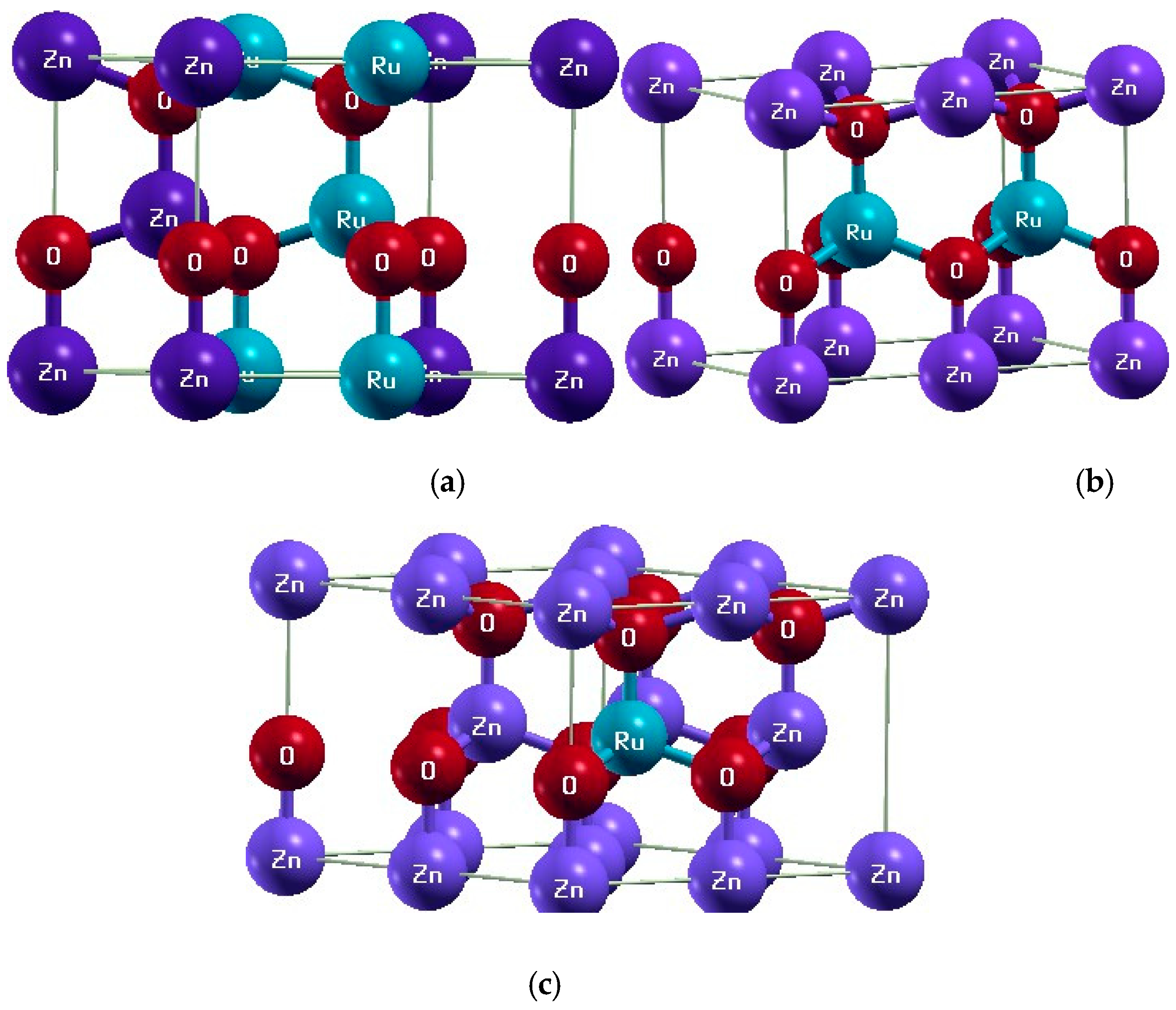
Figure 2.
Band structure of: 12.5% a, 25% b and 50% c Ru-doped wurtizte ZnO.
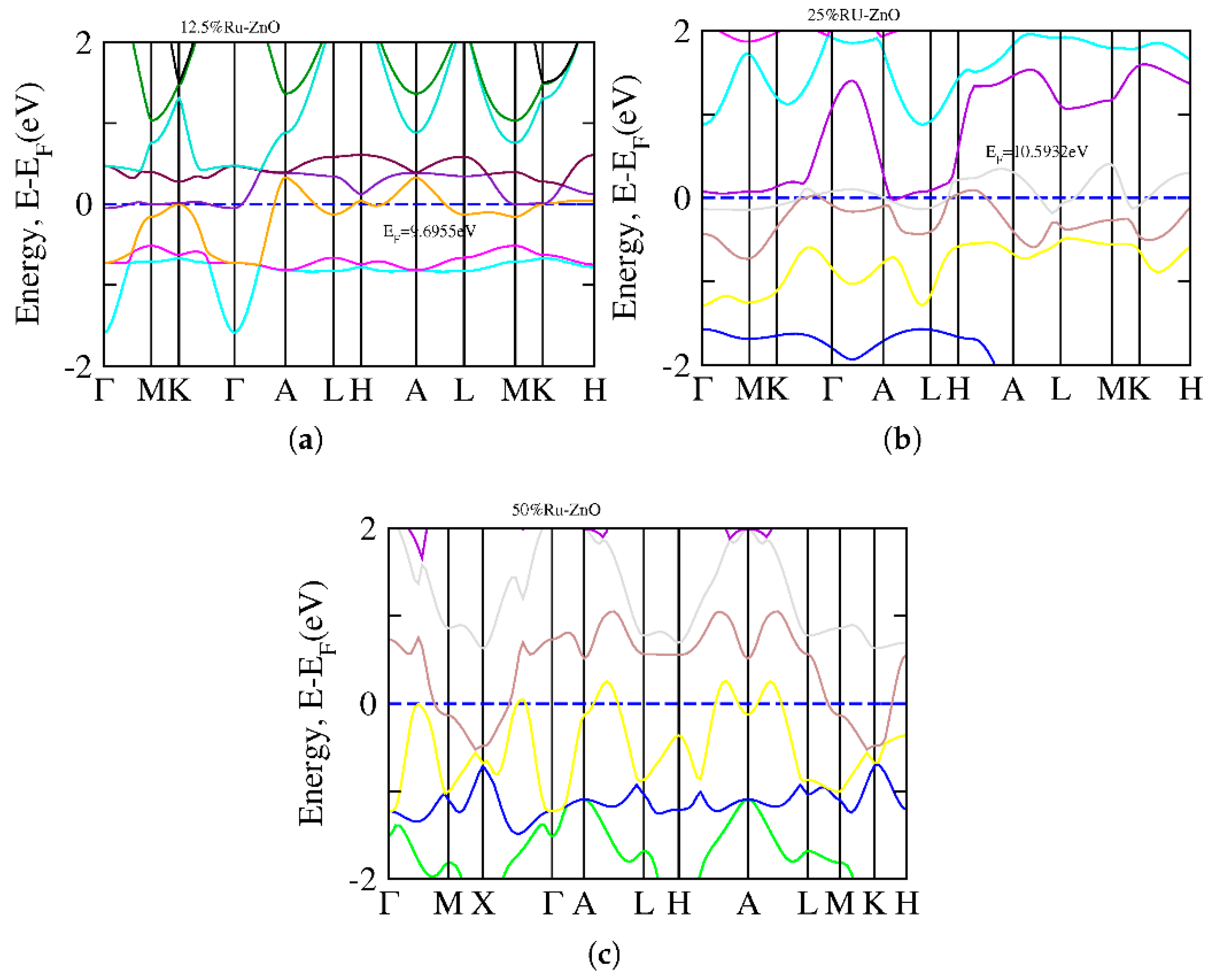
Figure 3.
Density states of: 12.5% a, 25% b and 50% c Ru-doped wurtizte ZnO.
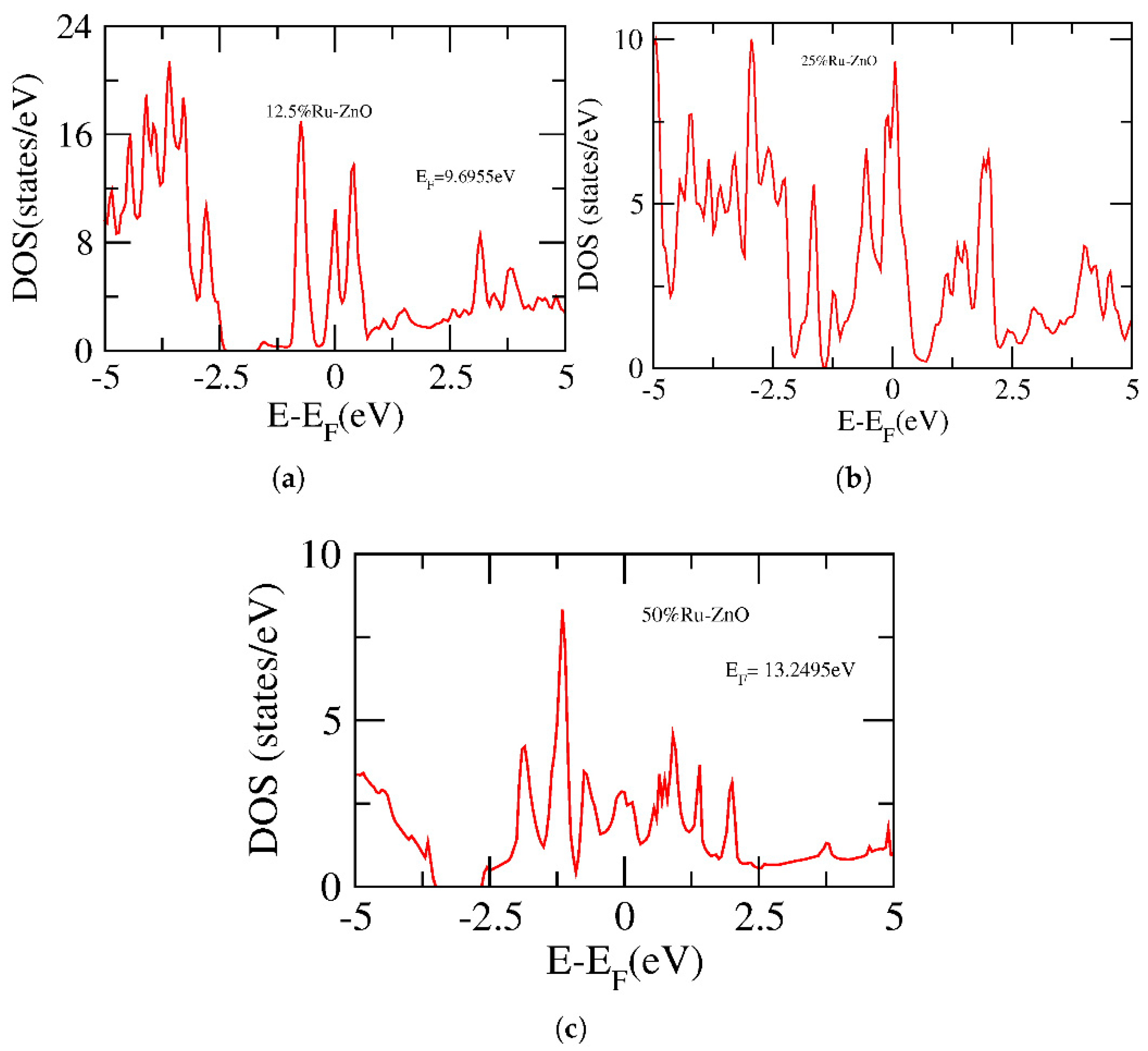
Figure 4.
Partial density of: 12.5% a, 25% b and 50% c Ru-doped wurtizte ZnO.
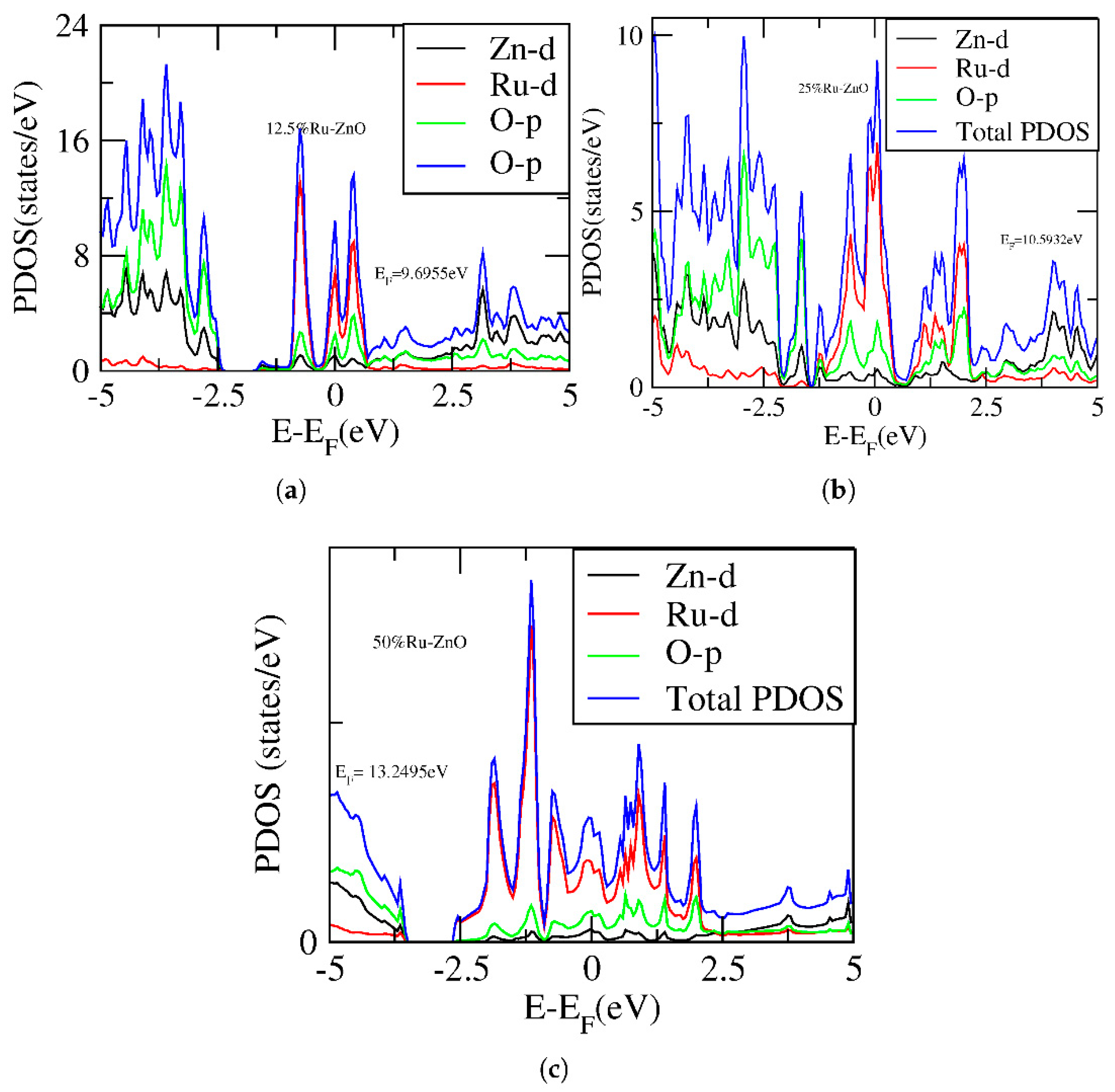
Figure 5.
Spin-polarized band structure of: 12.5% (a,b), 25% (c,d) and 50% (e,f) spin up (I) and spin down (II) for Ru-doped wurtizte ZnO.
Figure 5.
Spin-polarized band structure of: 12.5% (a,b), 25% (c,d) and 50% (e,f) spin up (I) and spin down (II) for Ru-doped wurtizte ZnO.
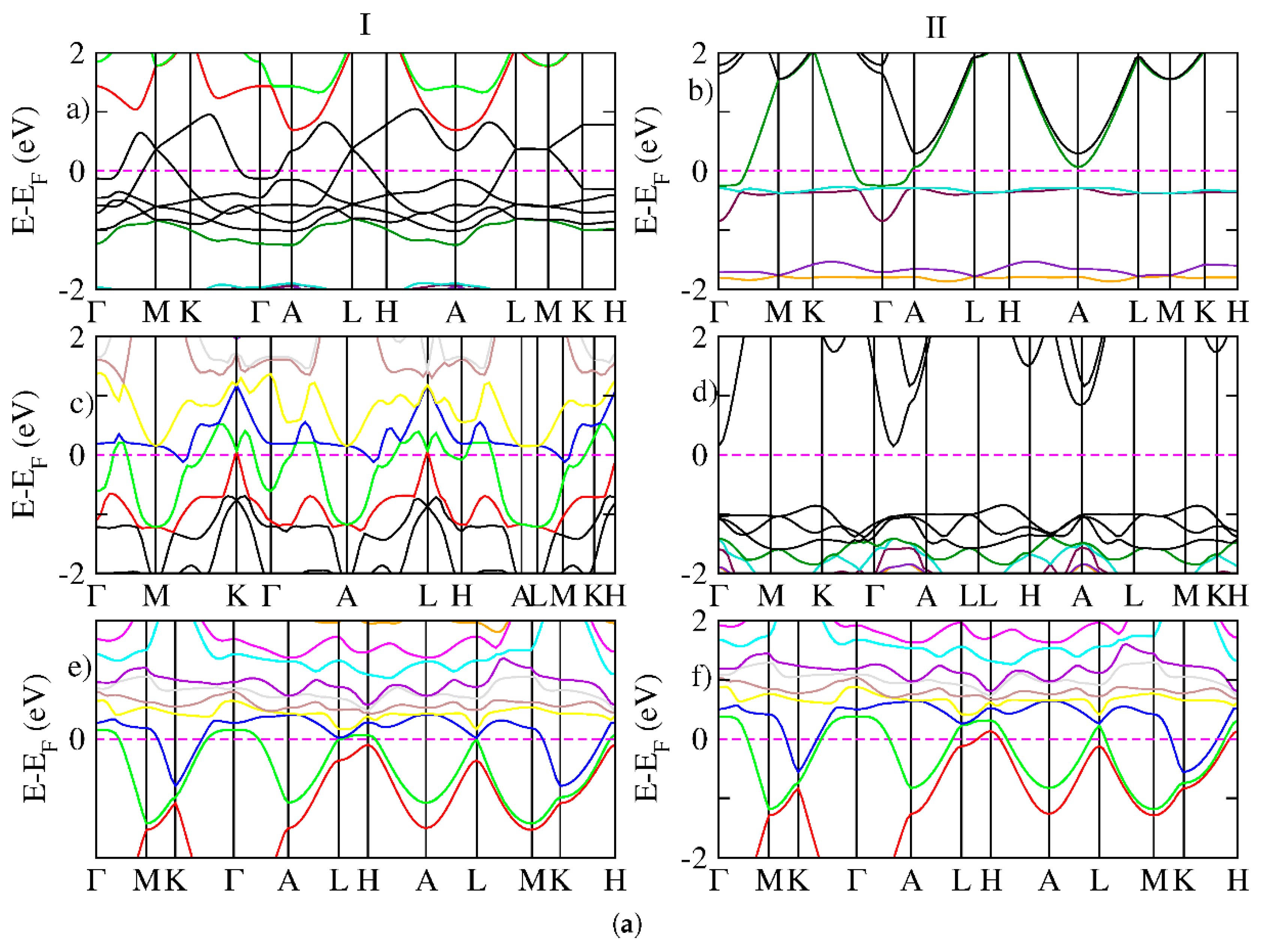
Figure 6.
Partial density of: 12.5% a, 25% b and 50% c Ru-doped wurtizte ZnO.
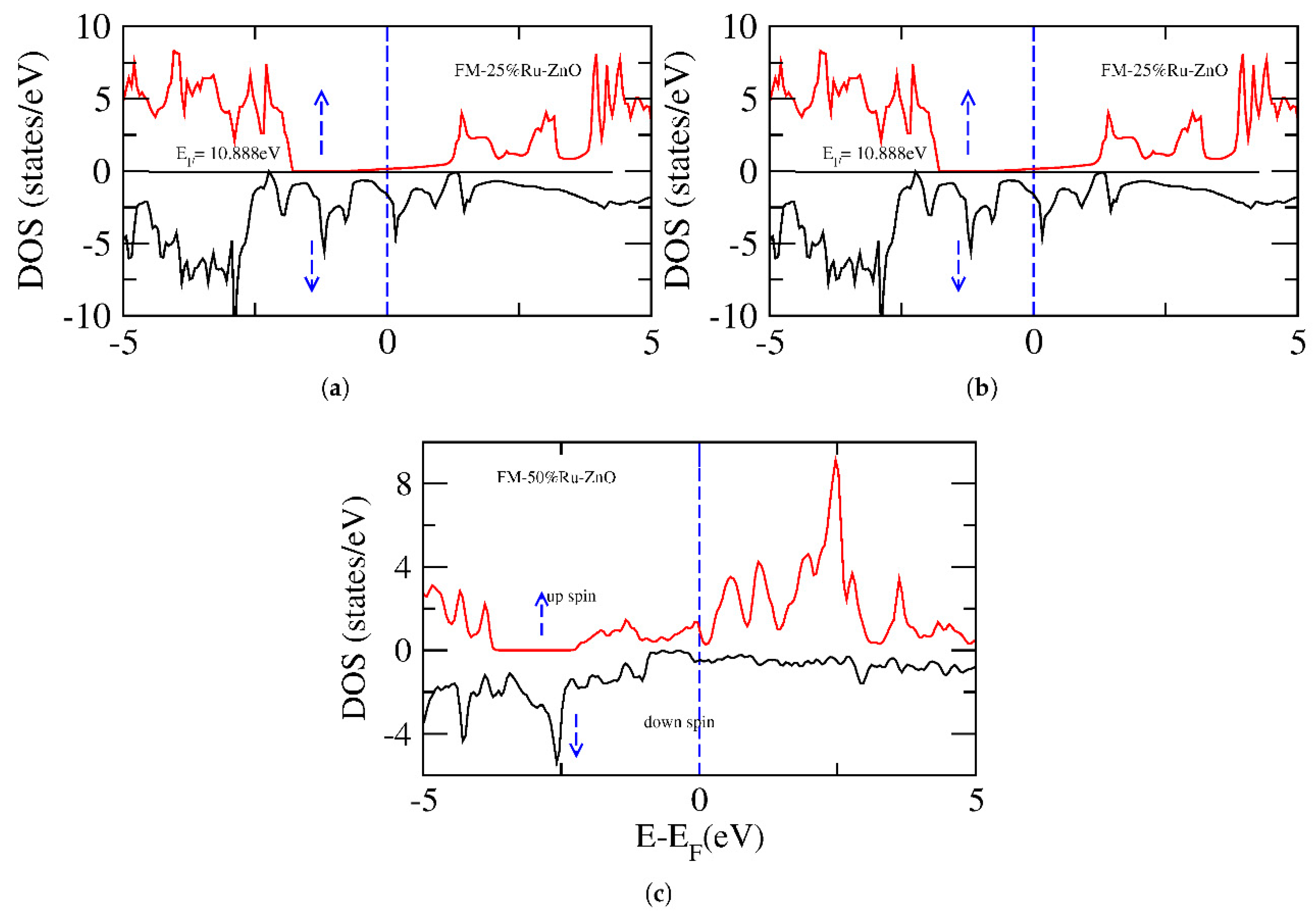
Figure 7.
Partial density of: 12.5% a, 25% b and 50% c Ru-doped wurtizte ZnO.
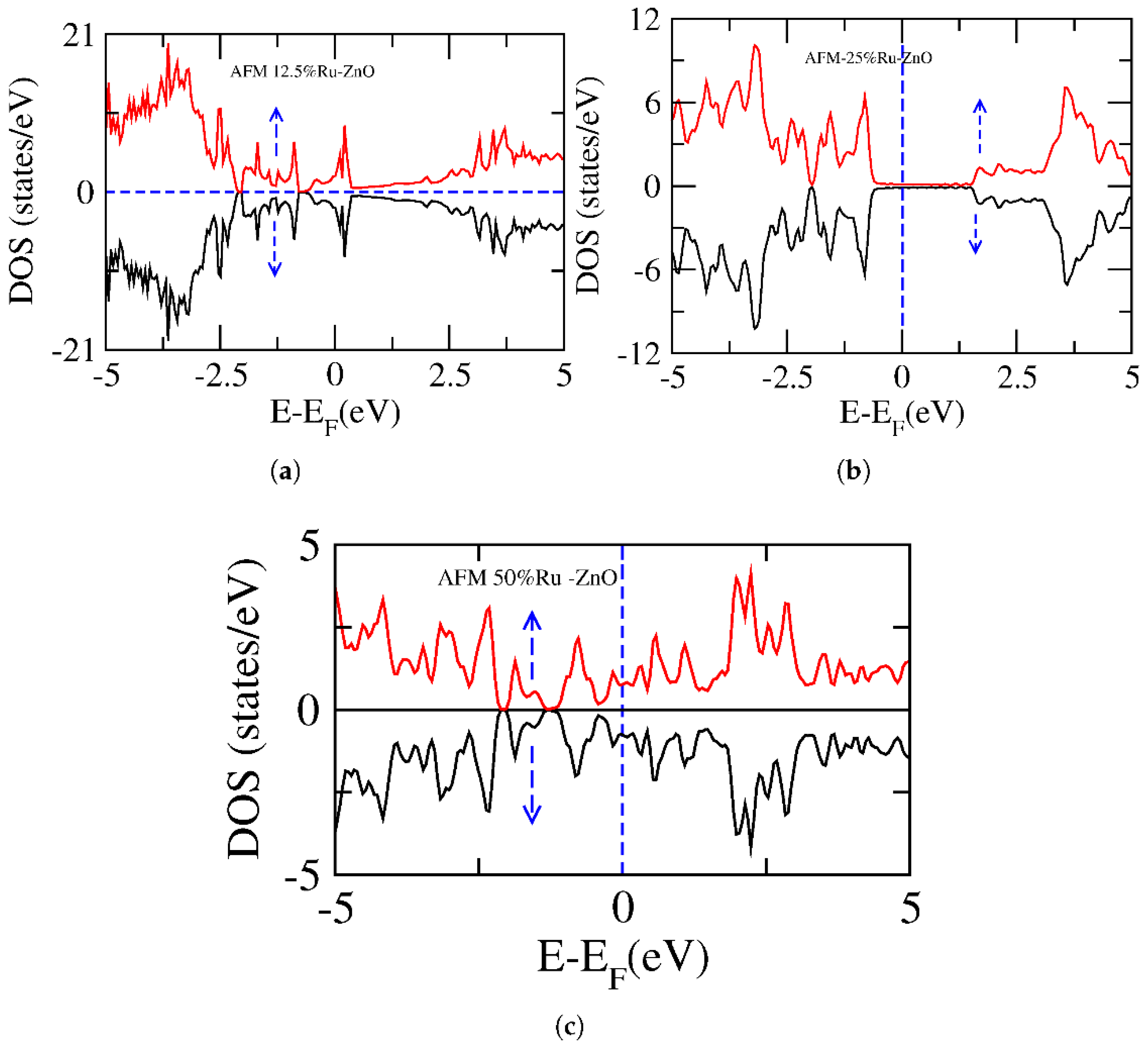
Figure 8.
Partial density of: 12.5% a, 25% b and 50% c Ru-doped wurtizte ZnO.
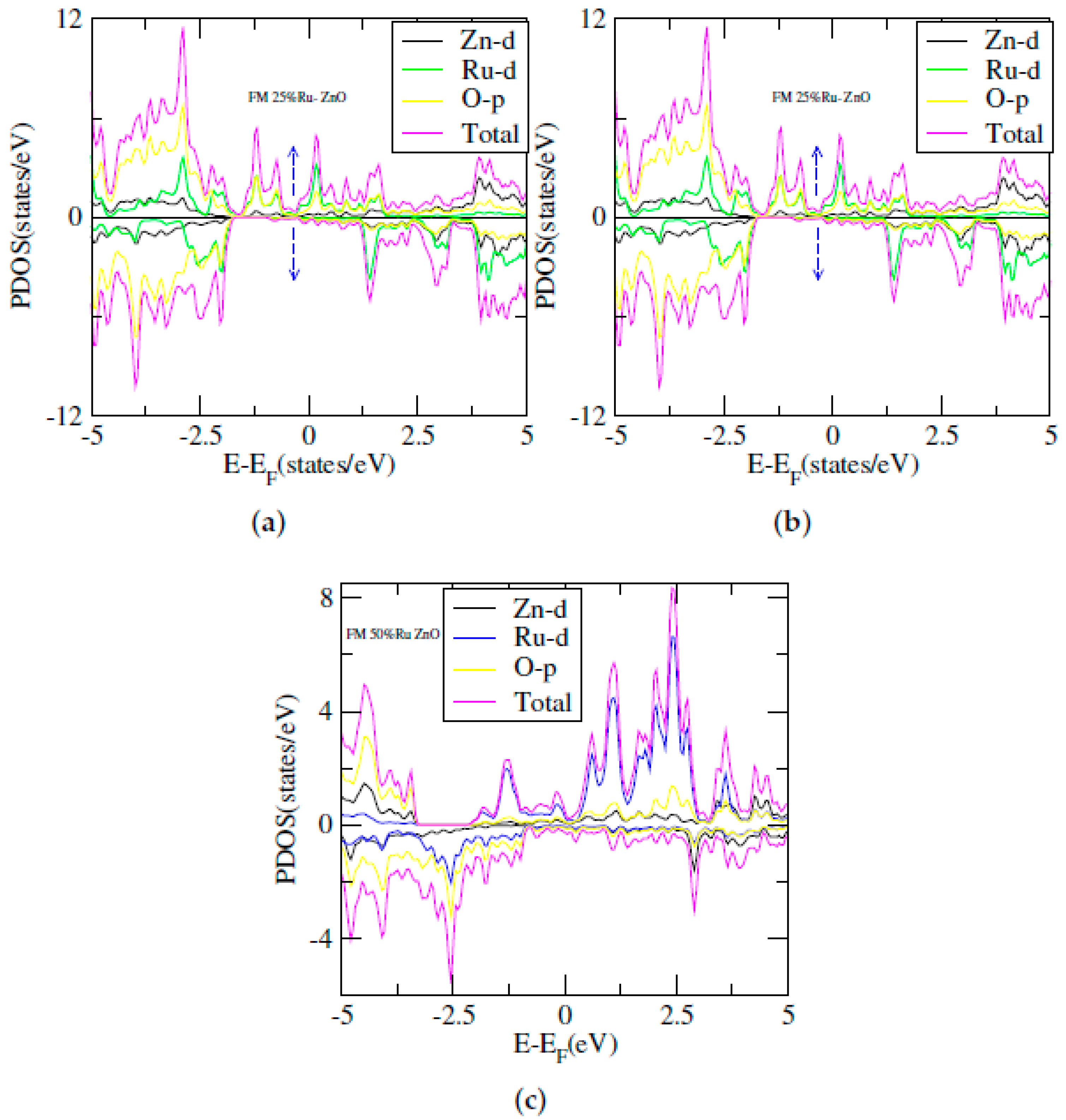
Figure 9.
Partial density of: 12.5% a, 25% b and 50% c Ru-doped wurtizte ZnO.
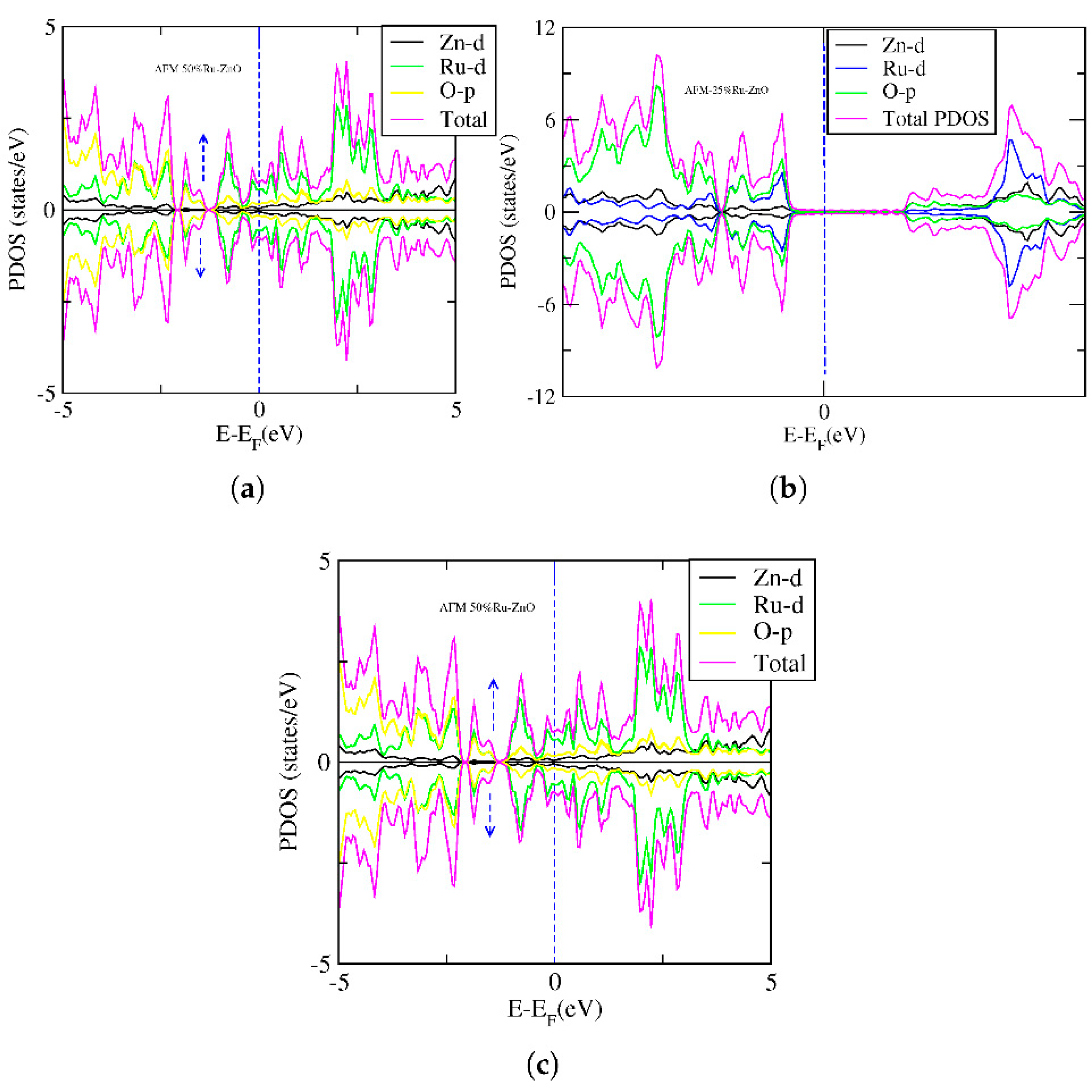

Table 1.
Fermi energy (EF), and Total energy (TE), lattic parameter and volume of Zn1−xRuxO.
 |
Table 2.
Fermi level(EF), and Total energy (TE) of FM and AFM Zn1−x Rux xO.
 |
Table 3.
Total magnetization and absolute magnetization for FM and AFM of 12.5%, 25%, and 50%
Ruthenium doped wurtizte ZnO.
Table 3.
Total magnetization and absolute magnetization for FM and AFM of 12.5%, 25%, and 50%
Ruthenium doped wurtizte ZnO.
 |
Disclaimer/Publisher’s Note: The statements, opinions and data contained in all publications are solely those of the individual author(s) and contributor(s) and not of MDPI and/or the editor(s). MDPI and/or the editor(s) disclaim responsibility for any injury to people or property resulting from any ideas, methods, instructions or products referred to in the content. |
© 2025 by the authors. Licensee MDPI, Basel, Switzerland. This article is an open access article distributed under the terms and conditions of the Creative Commons Attribution (CC BY) license (http://creativecommons.org/licenses/by/4.0/).
Copyright: This open access article is published under a Creative Commons CC BY 4.0 license, which permit the free download, distribution, and reuse, provided that the author and preprint are cited in any reuse.


