
Submitted:
31 May 2025
Posted:
04 June 2025
You are already at the latest version
Abstract
Humulus lupulus, commonly known as hop, is a climbing plant whose female cones impart beer’s characteristic bitterness and aroma and also serve as a preservative. In this study, we conducted a meta-analysis to investigate the antimicrobial activity of hop compounds and extracts against various microorganisms by statistically synthesizing Minimum Inhibitory Concentration (MIC) values. Our comprehensive literature search retrieved 2,553 articles, of which 18 met the inclusion criteria, encompassing 45 individual studies that reported MIC values for six hop compounds and three extract types tested against 55 microbial strains. MIC values corresponded to 24- and 48-hour incubation periods with the compounds or extracts. Results indicate that xanthohumol (a flavonoid) and lupulone (a bitter acid) exhibit potent antimicrobial activity against most tested microorganisms, particularly food spoilage bacteria. Furthermore, hydroalcoholic extracts demonstrated greater efficacy compared to supercritical CO₂ (SFE) extracts, which showed limited antimicrobial effects against both probiotic and non-probiotic strains. These findings underscore the need for standardized, evidence-based protocols—including uniform microbial panels and consistent experimental procedures—to reliably evaluate the antimicrobial properties of hop-derived compounds and extracts.
Keywords:
hop
; Humulus lupulus
; meta-analysis
; antimicrobial
; phytoconstituents
; flavonoids
; bitter acids
; minimum inhibitory concentration (MIC)
1. Introduction
Humulus lupulus, commonly known as hop, is a dioecious climbing plant that belongs to the Cannabinaceae family, primarily cultivated for its critical role in the brewing industry [1]. Female flowers develop into cone-like structures called hops, which contain lupulin glands. These glands are rich in secondary metabolites such as polyphenols, bitter acids, and essential oils that contribute significantly to the flavor and aroma of beer, while they act as preservatives as well [1].
Beyond brewing, hops are increasingly investigated for their pharmacological properties. The key biochemical components of hops include primary metabolites, which support basic plant functions, and secondary metabolites that can influence ecological interactions of the plant [2]. The most notable secondary metabolites include polyphenols (e.g., xanthohumol, isoxanthohumol, catechin), bitter acids (humulone, cohumulone, lupulone, colupulone), and essential oils (myrcene, caryophyllene) [3,4,5,6]. Polyphenols, and partciularly prenylated flavonoids, exhibit strong antioxidant and antimicrobial activities [3,5]. Bitter acids undergo isomerization during wort boiling to form iso-α-acids, which are primarily responsible for beer's bitterness [4]. Essential oils provide the characteristic aroma of beer and are extracted through hydrodistillation [7].
The antimicrobial activity of hops extends to bacteria, fungi, and parasites, primarily through prenylated flavonoids and bitter acids [1,8]. α- and β-acids have been shown to inhibit Gram-positive bacteria such as Staphylococcus and Streptococcus species [9] while xanthohumol and 6-prenylnaringenin exhibit antifungal and antiparasitic effects [9]. Furthermore, xanthohumol has demonstrated anticancer potential by targeting signaling pathways such as Akt and NF-κB, which are involved in cancer cell proliferation, survival, and metastasis [8,10]. Additional health benefits include anti-obesity effects through enhanced lipolysis and beta-oxidation, dermatological benefits such as skin protection and anti-aging, and hepatoprotective effects against liver diseases [11].
Antimicrobial assays are fundamental in evaluating the therapeutic potential of botanical extracts, particularly in the search for novel compounds to combat antimicrobial resistance. These assays, which include disk diffusion, broth microdilution, and agar dilution methods, assess the inhibitory activity of crude plant extracts, fractions, and purified phytochemicals against a wide range of microorganisms [1,12,13,14]. Studies on Humulus lupulus have employed these methods to test various extract types - including aqueous, ethanolic, and supercritical CO₂ extracts (SFE) - alongside isolated compounds like xanthohumol and humulone [14]. This diversity of experimental directions were undertaken with a view to allowing researchers to determine the spectrum and mechanism of antimicrobial action, as well as the influence of extraction methods on bioactivity. Although standardized, in vitro assays provide reproducible and comparable data necessary for identifying promising bioactive candidates for pharmaceutical or food preservation applications do exist, experimental protocols in terms of concentrations and serial dilutions, incubation time and temperature, utilization of a wide spectrum of bacteria species and strains, are still to be standardized.
The objective of the present study is to systematically evaluate the antimicrobial efficacy of Humulus lupulus by synthesizing the available evidence through a robust, statistically rigorous approach. By conducting a meta-analysis of peer-reviewed studies, we aim to consolidate findings across diverse experimental contexts and identify key trends in the antimicrobial potency of hops. Specifically, we investigate the spectrum of activity against all bacterial strains tested to date, with a special emphasis on food spoilage microorganisms - organisms of significant relevance to public health and food industry sustainability. Furthermore, we examine the possibility of a potential probiotic sparing capacity of hop-derived compounds, a crucial consideration in preserving gut microbiota balance during antimicrobial treatment. Our study is framed within the principles of evidence-based practice, which emphasize the integration of comprehensive scientific evidence with clinical and industrial relevance to inform decision-making [15,16,17]. This synthesis offers a valuable foundation for future applied research on formulating strategies involving the value of hop phytoconstituents and extracts in food, cosmetic, and pharmaceutical sectors.
2. Materials and Methods
2.1. Literature Search Strategy and Eligibility Criteria of Selected Studies
The literature search was conducted in PubMed database to retrieve all potential research articles relevant to hop antimicrobial activity in accordance with the Preferred Reporting Items for Systematic Reviews and Meta-Analyses (PRISMA) guidelines [18]. The literature search was conducted on 2/3/2024 using the keywords (hop or hops or "humulus lupulus") and (antimicrobial or antifungal or antibacterial or chemoprevention or biofilm or antiparasitic or antiviral) and all chemical compounds found in hop extracts. To include all possible relevant articles the reference lists of the selected articles were also scrutinized. Three researchers (DK, EA, and PK) independently assessed the search results. Any discrepancies in the initial evaluations were resolved through discussion with two additional reviewers (PB and GB).
Eligible studies had to contain MIC values of hop compounds or extracts tested on microorganisms. No language restrictions were imposed to reduce the risk of publication bias related to grey literature [19]. Titles and abstracts of retrieved articles were screened, and relevant articles were assessed for inclusion/exclusion criteria.
2.2. Data Extraction
Data extraction from eligible studies was performed on a Microsoft Excel sheet. Search results were extracted independently by two researchers (DK and EA). Selected studies contained data on concentrations of Humulus lupulus extracts and compounds against different microorganisms. Data extracted included PubMed ID, first author’s last name, publication year, MIC values, along with their SD or SE values, bacteria species and strains, names compounds, types of extracts, along with experimental conditions such as incubation time and temperature, Gram- classification (positive or negative), oxygen requirement (aerobic or anaerobic), and number of experimental replications. For studies reporting only the standard deviation (SD), the number of replicates was used to calculate the standard error of the mean (SEM) as follows: If neither SD nor SEM was provided, the missing values were imputed using the highest SD reported among studies using the same compound and microorganism [20].
2.3. Statistical Analysis
In the present meta-analysis, MIC values were used as effect size. Data were pooled using a random-effects meta-analysis [21] with inverse-variance weighting. MIC values and their 95% confidence intervals (CIs) were calculated for each compound across bacteria species, and incubation times.
Stratification according to classification of hop compounds and extracts into sub-categories was performed to infer possible parameters of their bioactivity. Stratifications according to their effect on food preseevation characteritics or health impact on humans (food spoilage / non-food spoilage or probiotic / non-probiotic) were also performed. To evaluate the impact of each individual study on the overall meta-analysis outcome, an influential analysis was conducted by sequentially excluding one study at a time and recalculating the statistical significance. Meta-analysis was performed with the statistical software Stata version 13.1, setting p-value for statistical significance less than or equal to 0.05 [22].
3. Results
3.1. Studies’ Selection and Characteristics
The literature search, following PRISMA guidelines, for antimicrobial activity of Humulus lupulus led to the retrieval of 2553 articles. After application of eligibility criteria, we resulted in 18 articles that included 450 individual studies (Figure 1).
The included studies were investigating the antimicrobial activity of various hop compounds (Figure 2) that include flavonoids, bitter acids, and three types of extracts, i.e. supercritical fluid extracts (CO2-based, SFE), hydroalcoholic, and hydroacetonic. From them, 122 report MIC values on flavonoids, 152 on bitter acids, 67 studies on CO2-extracts, 79 on hydralcoholic extracts and 28 on hydroacetonic extracts. Strains, which are used to measure antimicrobial activity against them, are 55. From the 450 studies, 174 of them were investigating antimicrobial effects after treatment for 24 hours, while 276 studies reported results for the 48 hours time point (Table 1). The characteristics of the included studies reporting MIC values, incubation time, and experimental repetitions were taken into consideration for the meta-analysis.
3.2. Meta-Analysis of MIC Values of Classes of Hop Compounds and Extracts
A persistent challenge in evaluating the antimicrobial activity of hop-derived extracts lies in the considerable variability introduced by multiple factors. One major concern is determining which bacterial species and strains most accurately reflect the true antimicrobial potential, as susceptibility can vary widely even within a single species. At the same time, hop extracts contain a complex mixture of bioactive compounds, each present at different concentrations that can be significantly influenced by the genetic background [40], the extraction method and the solvent used. These variables complicate interpretation, as changes in extraction parameters may favor the presence of certain compounds while minimizing others.
Therefore, we chose to conduct a meta-analysis and include a broad panel of all bacterial strains ever tested for hop compounds or extracts. To better understand their specific contributions to antimicrobial activity, we stratified our meta-analysis according to the two major different classes of natural compounds, the flavonoids, that are polyphenols, and the bitter acids that are prenylated acylphloroglucinol derivatives. As shown in Figure 3A, Table 2, and Supplementary Figure 1A and C, meta-analysis of MIC values of flavonoids and bitter acids, for 24 hours treatment, resulted in a variety of effectiveness depending on the species. However, in most of the cases flavonoids exert better antimicrobial activity compared to bitter acids when tested in the same bacteria species and strains such as for Staphylococcus aureus (13.61 as opposed to 80.07 μg/mL), Staphylococcus epidermidis (1.37 versus 10.50 μg/mL), Streptococcus salivarius (23.33 versus 58.75 μg/mL) and Streptococcus saprophyticus (2.33 as opposed to 3.83 μg/mL) (Figure 3A). Although antimicrobial tests for 48 hours of treatment were performed in different bacterial species, meta-analysis similarly showed elevated antimicrobial activity of flavonoids compared to bitter acids (Figure 3B, Supplementary Figure 1B and D).
In order to test the antimicrobial effectiveness of various types of hop extracts against microbial species, a meta-analysis was performed with the MIC values for each type of extract testing the effect on each microbial species. As shown in Figure 4A and Table 2, CO2 (SFE) extracts showed a wide range of activity spanning from being the best antimicrobial agent against Staphylococcus aureus (MIC 6.32 μg/mL) to the worst antimicrobial agent against Streptococcus aureus (MIC 1667 μg/mL). A similar high divergence in antimicrobial activity was shown for CO2 extracts for 48 hour treatment time and for different microbial species (Figure 4B and Table 2). Hydroalcoholic extracts exposed a more constant antimicrobial activity spanning form 39.0 (Staphylococcus aureus) to 625 μg/mL (Pseudomonas aeruginosa) for 24 hours treatment and from 34.67 (Streptococcus Salivarius) to 384 μg/mL (Candida albicans) for 48 hours treatment.
3.3. Stratification Meta-Analysis of MIC Values of Each Hop Compound
The flavonoids investigated in studies included in the present meta-analysis are xanthohumol (XN) (chalcone) and catechin (flavanol), while bitter acids considered herein refer to humulone (alpha acid) and lupulone (beta acid). Flavonoids and bitter acids belong to different classes of natural compounds, each with distinct biosynthetic origins, structures, and chemical classifications [41,42].
Xanthohumol is a prenylated chalcone characterized by an open-chain flavonoid structure while catechin is a flavan-3-ol with a closed-ring structure and no prenylation. Similarly, humulone and lupulone share a phloroglucinol core but differ structurally: humulone contains an acyl side chain, while lupulone has three prenyl-type side chains, contributing to differences in bitterness and stability [43].
Thus, we stratified our meta-analysis according to each compound to understand the antimicrobial activity of each one, separately. As shown in Figure 5A and Table 3, a meta-analysis was performed with MIC values from experiments with 24 hours of treatment. XN exerted far better inhibition effectiveness against Staphylococcus aureus and Staphylococcus epidermidis (6.53 and 1.37 μg/mL) compared to the alpha acid humulone (83.25 and 18.75 μg/mL), but not compared to beta acid lupulone. Remarkably, against Bacillus Subtilis, Enterococcus faecalis and Streptococcus saprophyticus, XN, humulone and lupulone show similar effectiveness for 24 hours incubation.
Importantly, the other flavonoid catechin, when tested for 48 hours of incubation, revealed a very low antimicrobial activity against Bacillus subtilis and Pseudomonas fluorescens (1200 and 1700 μg/mL, respectively).
Concerning bitter acids, lupulone seems to possess a significantly stronger antimicrobial agent compared to humulone (Figure 5B) for both 24 and 48 hours of treatment.
3.4. Meta-Analysis of MIC Values of Hop Compounds and Extracts for Food Spoilage and Non-Food Spoilage Microorganisms
Given that food spoilage bacteria remain a major concern in food safety and shelf-life extension, and that hop has been used for centuries as a natural preservative in beer, it was intriguing to investigate whether hop compounds exhibit differential antimicrobial activity against food spoilage versus non-food spoilage bacteria. To this end, we stratified our meta-analysis according to the antimicrobial effects of hop-derived compounds and hop extracts against a diverse panel of food spoilage microorganisms, aiming to explore their potential selectivity and application beyond the brewing context [44,45,46].
Μeta-analysis of MIC values for classes of hop compounds (subgrouped according to each compound) and extracts, stratified for food spoilage and non-food spoilage bacteria (Supplementary Table 1), for 24 hours of treatment, showed that XN exerted almost the same effect irrelevant of the food spoilage characteristics of the microorganisms (Table 4 and Figure 6A). Similarly, the α acid humulone showed comparable antimicrobial activities against food spoilage and non-food spoilage microorganism (43.35 and 33.75 μg/mL), while lupulone (beta-acid) showed significantly higher antimicrobial activity against non-food spoilage bacteria (4.20 compared to 12.40 μg/mL, respectively). Importantly, due to the small number of included studies the last results should be considered with caution. For 48 hours of treatment xanthohumol showed enhanced antimicrobial activity against food spoilage compared to non-food spoilage microorganisms (23.46 and 54.32 μg/mL, respectively), as shown in Table 4 and Figure 6B.
Among different types of extracts, hydroalcoholic extracts seemed to be more effective against food spoilage microorganisms for both 24 and 48 hours of treatment. CO2 extracts were less effective than hydroalcoholic extracts, however, 48 hours treatment resulted in higher antimicrobial effectiveness against non-food spoilage bacteria. Hydralcoholic extracts were more effective against food spoilage bacteria when tested for both 48 hours (Table 4 and Figure 7). MIC values for 48 hours of treatment are expected to be lower than MIC values for 24 hours, because compounds have more time to exert their effect. However, it is important to note here that tests for these different time points are performed with different microorganisms species which profoundly respond in a completely different way (Table 4 and Figure 7).
3.5. Meta-Analysis of MIC Values of Hop Compounds and Extracts for Probiotic and Non-Probiotic Microorganisms
In light of current efforts to develop antimicrobials that are compatible with the human microbiome [47], and the long-standing use of hop compounds as natural antimicrobials, it is compelling to examine whether these compounds can selectively inhibit non-probiotic microorganisms while sparing probiotics. To this end, we conducted a meta-analysis of MIC data from the retrieved studies, to compare antimicrobial activity of hop-derived compounds against probiotic and non-probiotic strains. If such selectivity exists, these compounds could represent high-value functional agents, with potential to support human health by suppressing pathogens while preserving beneficial microbial communities.
To this end the meta-analysis performed showed that antimicrobial activity of XN was stronger against probiotic compared to non-probiotic bacteria (Supplementary Table 1) when incubated for 24 hours (8.49 as opposed to 24.75 μg/mL), (Table 5 and Figure 8A). However this difference was diminished when treatment occurred for 48 hours (Table 5 and Figure 8B). Because there is a significant difference in the number of studies included in each meta-analysis, the last mentioned results should be interpreted with caution (Table 5).
In addition, our meta-analysis revealed that hydroalcoholic extracts were more potent than CO2 extracts in both 24 and 48 treatment time points (Figure 9A). We should again strengthen the fact that experiments of compounds and extracts performed for different incubation time periods test different microorganisms and this could explain why MIC values in 48 hours are not lower than MIC values in 24 hours.
4. Discussion
The evaluation of the antimicrobial potential of Humulus lupulus (hop) extracts and compounds has consistently highlighted significant variability, arising from differences in bacterial strains, extraction methods, experimental conditions, and the intrinsic diversity of phytoconstituents. The establishment of evidence-based practices, including standardized protocols for assessing antimicrobial activity, is critical for the scientific community to reliably compare, and interpret these findings. Without standardization, evaluating results across studies remains challenging, limiting the translation of hop-derived antimicrobial agents into clinical or commercial applications [48,49].
This systematic review and meta-analysis aimed to combine all available data to deliver a comprehensive, statistically rigorous synthesis of the antimicrobial activity of Humulus lupulus extracts and purified compounds, thereby informing future studies and practical applications. While hops have long been used for their preservative role in brewing, and their pharmacological potential has gained increasing attention, the methodologically diverse nature of existing studies has limited the development of a consolidated view of their antimicrobial efficacy. By integrating MIC data across 450 individual studies and 55 microbial strains, we contribute a much-needed evidence-based framework that enhances the reliability and reproducibility of antimicrobial findings related to hop-derived substances.
Our meta-analysis indicated substantial differences in the antimicrobial efficacy among hop-derived compounds. Specifically, we found pronounced variability in activity between chalcones such as xanthohumol and flavanols like catechin. Xanthohumol consistently showed potent antimicrobial effects, notably against Staphylococcus epidermidis (with MIC value 1.37 μg/mL) and Clostridium species (MIC value 32.6 μg/mL), with significantly lower MIC values compared to catechin, which exhibited minimal activity (MIC value 1200 μg/mL against Bacilus subtilis). Similarly, alpha acids (humulone) demonstrated markedly different antimicrobial profiles compared to beta acids (lupulone), with lupulone generally showing higher potency across multiple microbial species. These findings are in accordance with other reviews highlighting the broad-spectrum antimicrobial and biofilm-inhibiting properties of prenylated chalcones and bitter acids [1,8].
These compound-specific differences underscore the critical importance of chemical structure and functional groups in antimicrobial potency. For instance, the prenylated chalcone structure of xanthohumol, which facilitates cellular membrane penetration, differs substantially from the less effective non-prenylated flavan-3-ol structure of catechin [16,17]. Similarly, structural distinctions between alpha and beta acids - primarily in side-chain composition and prenylation - directly influence their respective antimicrobial activities. Additionally, we observed significant strain-specific variations in antimicrobial susceptibility, highlighting the complexity of microbial responses and reinforcing the need for careful strain selection when evaluating antimicrobial agents.
In addition, hydroalcoholic extracts exhibited more consistent antimicrobial performance than CO₂ extracts, which displayed highly variable outcomes depending on the tested microorganism. In addition, because alpha and beta acids constitute more than 50% of a supercritical fluid-extracted hop extract, its antiproliferative effects are largely driven by bitter acids [27,50]. Given that beer, originally, is the hydroalcoholic solvent for dry hops, data coming from hydroalcoholic extracts are expected to be of more practicability. However, it is also quite a common practice for beer manufacturers to add condense, CO₂-based (SFE) extracts in bulk beer preparations [6] and GmbH & Co. KG. Hops are our passion. BarthHaas. Retrieved May 30, 2025, from https://www.barthhaas.com/. This variability in methodologies adds complexity and discrepancy in research and industrial tests, and underscores the need for careful selection of extraction methods, solvents, and compound standardization - a critical issue raised in other meta-analyses on botanical antimicrobials [53].
An unexpected finding from our study was the variability in antimicrobial activity between the incubation periods of 24 and 48 hours. Contrary to general expectations, many MIC values at 48 hours were higher than at 24 hours. This inconsistency primarily reflects the substantial variation in bacterial species and strains tested across these time points. Similar observations have been reported previously, suggesting differential microbial adaptive responses over extended exposure times [51]. This further emphasizes the urgent need for the scientific community to adopt a standardized panel of microbial strains and time points for evaluating MIC, thus enhancing comparability and reproducibility of antimicrobial studies.
One of the critical contributions of this work is the stratified meta-analysis that distinguishes between effects on food spoilage microorganisms, and probiotics. This functional stratification is of growing importance, especially in the context of microbiome-conscious antimicrobial development. For instance, xanthohumol showed promising selective action, exerting stronger effects on non-probiotic and food spoilage bacteria in several contexts, but also inhibiting probiotics at certain time points - underscoring the complexity of predicting microbial selectivity. Such diversifying behavior reinforces the need for integrated evaluations combining in vitro data with microbiome-sensitive in vivo testing, as proposed in diagnostics-focused meta-evaluations [48,51].
However, our study is not without limitations. Primarily, the absence of complete methodological details in several original studies introduced uncertainties in data interpretation. For instance, variations in experimental protocols such as compound handling, dilution procedures, storage conditions, extraction methodologies, quantitative and qualitative extract composition, bacterial inoculum density, incubation conditions, and solvent composition can significantly influence MIC values. This scarcity of detailed information rendered it impossible to perform meaningful stratification based on these parameters. Additionally, reliance on imputed standard deviations in certain cases could potentially introduce biases into the meta-analysis outcomes. Our analysis also faced methodological challenges due to the inclusion of heterogeneous data, encompassing various hop compounds, extracts, bacterial species, and incubation durations. Despite these difficulties, our rigorous statistical methods - including stratified meta-analyses and sensitivity analyses - allowed us to manage this complexity and derive reliable conclusions. Our findings affirm that hop compounds exhibit reproducible trends in antimicrobial activity, but these can only be reliably interpreted within a unified, evidence-based framework that adequately accounts for methodological heterogeneity. Importantly, the current findings advocate for a more systematic approach to future antimicrobial testing of hop-derived agents. Furthermore, meta-analysis, as demonstrated here and in studies like [48,49,52,53,54] is a powerful tool to extract meaningful trends from heterogeneous datasets, and should be routinely employed in future investigations of natural product pharmacology.
5. Conclusions
In conclusion, this systematic review and meta-analysis confirm the diverse and potent antimicrobial potential of specific hop compounds, notably xanthohumol and lupulone, and underline the significant efficacy of hydroalcoholic extracts against food spoilage and pathogenic bacteria. Significant structural differences among classes of - and individual - compounds necessitate a careful selection and investigation for targeted antimicrobial applications. Nevertheless, variations in methodological approaches and reporting standards continue to obscure definitive assessments of efficacy. To translate the promise of hop-derived compounds into medical, nutritional, or industrial interventions, future research must prioritize methodological standardization, detailed microbial profiling, and integration into microbiome-focused frameworks. Our findings strongly advocate establishing standardized, evidence-based practices in evaluating antimicrobial activity, including uniform microbial panels and consistent experimental protocols. Addressing these methodological gaps will significantly enhance the reliability and comparability of future studies, thus facilitating the broader practical application of hop compounds as valuable antimicrobials in food preservation, pharmaceutical development, and clinical therapeutics. Emphasizing evidence-based approaches will be essential to ensuring the scientific credibility, reproducibility, and practical viability of hop-derived antimicrobials.
Supplementary Materials
The following supporting information can be downloaded at the website of this paper posted on Preprints.org, Figure S1 : Forest plots for the meta-analysis of MIC values of hop compounds; Figure S1 : Forest plots for the meta-analysis of MIC values of hop extracts; Table S1: Classification of bacteria strains.
Author Contributions
For research articles with several authors, a short paragraph specifying their individual contributions must be provided. The following statements should be used “Conceptualization, G.B.; methodology, D.K., E.A., P.K., P.B., G.B.; software, D.K., E.A., P.K., P.B., G.B.; validation, D.K., E.A., P.K., P.B., G.B.; formal analysis, D.K., E.A., P.K., P.B., G.B.; resources, P.B., G.B..; data curation, D.K., E.A., P.K., P.B., G.B.; writing—original draft preparation, D.K., E.A., G.B.; writing—review and editing, D.K., E.A., P.K., P.B., G.B.; visualization, D.K., E.A., P.K., P.B., G.B.; supervision, P.B., G.B.; project administration, E.A., G.B.; funding acquisition, G.B. All authors have read and agreed to the published version of the manuscript.
Funding
This research was funded by the project “Molecular identification and utilization of indigenous hop varieties for the production of high added value beers” (MIS 5056124), which is financed by the “Action Support for Research, Technological Development and Innovation Projects in areas of RIS3 in the Region of Central Greece” under the Operational Programme “STEREA ELLADA 2014–2020” co-financed by Greece and the European Union (European Regional Development Fund).
Data Availability Statement
Data is contained within the article or supplementary material.
Conflicts of Interest
The authors declare no conflicts of interest.
Abbreviations
The following abbreviations are used in this manuscript:
| MIC | Minimum Inhibitory Concentration |
| SFE | Supercritical fluid extracts |
References
- Bocquet, L.; Sahpaz, S.; Hilbert, J. L.; Rambaud, C.; Rivière, C. Humulus Lupulus L., a Very Popular Beer Ingredient and Medicinal Plant: Overview of Its Phytochemistry, Its Bioactivity, and Its Biotechnology. Phytochem. Rev. 2018, 17, 1047–1090. [Google Scholar] [CrossRef]
- Eriksen, R. L.; Padgitt-Cobb, L. K.; Townsend, M. S.; Henning, J. A. Gene Expression for Secondary Metabolite Biosynthesis in Hop (Humulus Lupulus L.) Leaf Lupulin Glands Exposed to Heat and Low-Water Stress. Sci. Rep. 2021, 11, 5138. [Google Scholar] [CrossRef]
- Dostálek, P.; Karabín, M.; Jelínek, L. Hop Phytochemicals and Their Potential Role in Metabolic Syndrome Prevention and Therapy. Molecules 2017, 22, 1761. [Google Scholar] [CrossRef] [PubMed]
- Sun, S.; Wang, X.; Yuan, A.; Liu, J.; Li, Z.; Xie, D.; Zhang, H.; Luo, W.; Xu, H.; Liu, J.; Nie, C.; Zhang, H. Chemical Constituents and Bioactivities of Hops ( Humulus Lupulus L.) and Their Effects on Beer-related Microorganisms. Food Energy Secur. 2022, 11, e367. [Google Scholar] [CrossRef]
- Knez Hrnčič, M.; Španinger, E.; Košir, I. J.; Knez, Ž.; Bren, U. Hop Compounds: Extraction Techniques, Chemical Analyses, Antioxidative, Antimicrobial, and Anticarcinogenic Effects. Nutrients 2019, 11, 257. [Google Scholar] [CrossRef] [PubMed]
- Pannusch, V. B.; Viebahn, L.; Briesen, H.; Minceva, M. Predicting the Essential Oil Composition in Supercritical Carbon Dioxide Extracts from Hop Pellets Using Mathematical Modeling. Heliyon 2023, 9, e13030. [Google Scholar] [CrossRef] [PubMed]
- Eyres, G.; Dufour, J.-P. Hop Essential Oil: Analysis, Chemical Composition and Odor Characteristics. In Beer in Health and Disease Prevention; Elsevier, 2009; pp 239–254. [CrossRef]
- Carbone, K.; Gervasi, F. An Updated Review of the Genus Humulus: A Valuable Source of Bioactive Compounds for Health and Disease Prevention. Plants 2022, 11, 3434. [Google Scholar] [CrossRef]
- Condón, S.; García, M. L.; Otero, A.; Sala, F. J. Effect of Culture Age, Pre-incubation at Low Temperature and pH on the Thermal Resistance of Aeromonas Hydrophila. J. Appl. Bacteriol. 1992, 72, 322–326. [Google Scholar] [CrossRef]
- Gerhäuser, C. Beer Constituents as Potential Cancer Chemopreventive Agents. Eur. J. Cancer 2005, 41, 1941–1954. [Google Scholar] [CrossRef]
- Bolton, J. L.; Dunlap, T. L.; Hajirahimkhan, A.; Mbachu, O.; Chen, S.-N.; Chadwick, L.; Nikolic, D.; Van Breemen, R. B.; Pauli, G. F.; Dietz, B. M. The Multiple Biological Targets of Hops and Bioactive Compounds. Chem. Res. Toxicol. 2019, 32, 222–233. [Google Scholar] [CrossRef]
- Rodino, S.; Butu, A.; Negoescu, C.; Petrache, P.; Condei, R.; Nicolae, I.; Cornea, C. P. Antimicrobial Activity of Humulus Lupulus Extract. J. Biotechnol. 2014, 185, S66. [Google Scholar] [CrossRef]
- Weber, N.; Biehler, K.; Schwabe, K.; Haarhaus, B.; Quirin, K.-W.; Frank, U.; Schempp, C. M.; Wölfle, U. Hop Extract Acts as an Antioxidant with Antimicrobial Effects against Propionibacterium Acnes and Staphylococcus Aureus. Molecules 2019, 24, 223. [Google Scholar] [CrossRef]
- Stevens, J. F.; Page, J. E. Xanthohumol and Related Prenylflavonoids from Hops and Beer: To Your Good Health! Phytochemistry 2004, 65, 1317–1330. [Google Scholar] [CrossRef] [PubMed]
- Sackett, D. L.; Rosenberg, W. M. C.; Gray, J. A. M.; Haynes, R. B.; Richardson, W. S. Evidence Based Medicine: What It Is and What It Isn’t. BMJ 1996, 312, 71–72. [Google Scholar] [CrossRef] [PubMed]
- Papaefthimiou, M.; Kontou, P. I.; Bagos, P. G.; Braliou, G. G. Antioxidant Activity of Leaf Extracts from Stevia Rebaudiana Bertoni Exerts Attenuating Effect on Diseased Experimental Rats: A Systematic Review and Meta-Analysis. Nutrients 2023, 15, 3325. [Google Scholar] [CrossRef]
- Papaefthimiou, M.; Kontou, P. I.; Bagos, P. G.; Braliou, G. G. Integration of Antioxidant Activity Assays Data of Stevia Leaf Extracts: A Systematic Review and Meta-Analysis. Antioxidants 2024, 13, 692. [Google Scholar] [CrossRef]
- Moher, D.; Liberati, A.; Tetzlaff, J.; Altman, D. G. Preferred Reporting Items for Systematic Reviews and Meta-Analyses: The PRISMA Statement. PLoS Med. 2009, 6, e1000097. [Google Scholar] [CrossRef]
- Hopewell, S.; McDonald, S.; Clarke, M. J.; Egger, M. Grey Literature in Meta-analyses of Randomized Trials of Health Care Interventions. Cochrane Database Syst. Rev. 2007, 2007, MR000010. [Google Scholar] [CrossRef]
- Furukawa, T. A.; Barbui, C.; Cipriani, A.; Brambilla, P.; Watanabe, N. Imputing Missing Standard Deviations in Meta-Analyses Can Provide Accurate Results. J. Clin. Epidemiol. 2006, 59, 7–10. [Google Scholar] [CrossRef]
- DerSimonian, R.; Laird, N. Meta-Analysis in Clinical Trials. Control. Clin. Trials 1986, 7, 177–188. [Google Scholar] [CrossRef]
- Stata User’s Guide Release 13; StataCorp LP: College Station, Tex., 2013.
- Kramer, B.; Thielmann, J.; Hickisch, A.; Muranyi, P.; Wunderlich, J.; Hauser, C. Antimicrobial Activity of Hop Extracts against Foodborne Pathogens for Meat Applications. J. Appl. Microbiol. 2015, 118, 648–657. [Google Scholar] [CrossRef] [PubMed]
- Cermak, P.; Olsovska, J.; Mikyska, A.; Dusek, M.; Kadleckova, Z.; Vanicek, J.; Nyc, O.; Sigler, K.; Bostikova, V.; Bostik, P. Strong Antimicrobial Activity of Xanthohumol and Other Derivatives from Hops (Humulus Lupulus L.) on Gut Anaerobic Bacteria. APMIS Acta Pathol. Microbiol. Immunol. Scand. 2017, 125, 1033–1038. [Google Scholar] [CrossRef] [PubMed]
- Bogdanova, K.; Röderova, M.; Kolar, M.; Langova, K.; Dusek, M.; Jost, P.; Kubelkova, K.; Bostik, P.; Olsovska, J. Antibiofilm Activity of Bioactive Hop Compounds Humulone, Lupulone and Xanthohumol toward Susceptible and Resistant Staphylococci. Res. Microbiol. 2018, 169, 127–134. [Google Scholar] [CrossRef]
- Larson, A. E.; Yu, R. R.; Lee, O. A.; Price, S.; Haas, G. J.; Johnson, E. A. Antimicrobial Activity of Hop Extracts against Listeria Monocytogenes in Media and in Food. Int. J. Food Microbiol. 1996, 33, (2–3). [Google Scholar] [CrossRef] [PubMed]
- Klimek, K.; Tyśkiewicz, K.; Miazga-Karska, M.; Dębczak, A.; Rój, E.; Ginalska, G. Bioactive Compounds Obtained from Polish “Marynka” Hop Variety Using Efficient Two-Step Supercritical Fluid Extraction and Comparison of Their Antibacterial, Cytotoxic, and Anti-Proliferative Activities In Vitro. Molecules 2021, 26, 2366. [Google Scholar] [CrossRef]
- Bocquet, L.; Sahpaz, S.; Bonneau, N.; Beaufay, C.; Mahieux, S.; Samaillie, J.; Roumy, V.; Jacquin, J.; Bordage, S.; Hennebelle, T.; Chai, F.; Quetin-Leclercq, J.; Neut, C.; Rivière, C. Phenolic Compounds from Humulus Lupulus as Natural Antimicrobial Products: New Weapons in the Fight against Methicillin Resistant Staphylococcus Aureus, Leishmania Mexicana and Trypanosoma Brucei Strains. Mol. Basel Switz. 2019, 24, 1024. [Google Scholar] [CrossRef]
- Natarajan, P.; Katta, S.; Andrei, I.; Babu Rao Ambati, V.; Leonida, M.; Haas, G. J. Positive Antibacterial Co-Action between Hop (Humulus Lupulus) Constituents and Selected Antibiotics. Phytomedicine Int. J. Phytother. Phytopharm. 2008, 15, 194–201. [Google Scholar] [CrossRef]
- Engels, C.; Schieber, A.; Gänzle, M. G. Inhibitory Spectra and Modes of Antimicrobial Action of Gallotannins from Mango Kernels (Mangifera Indica L.). Appl. Environ. Microbiol. 2011, 77, 2215–2223. [Google Scholar] [CrossRef]
- Rozalski, M.; Micota, B.; Sadowska, B.; Stochmal, A.; Jedrejek, D.; Wieckowska-Szakiel, M.; Rozalska, B. Antiadherent and Antibiofilm Activity of Humulus Lupulus L. Derived Products: New Pharmacological Properties. BioMed Res. Int. 2013, 2013, 101089. [Google Scholar] [CrossRef]
- Flesar, J.; Havlik, J.; Kloucek, P.; Rada, V.; Titera, D.; Bednar, M.; Stropnicky, M.; Kokoska, L. In Vitro Growth-Inhibitory Effect of Plant-Derived Extracts and Compounds against Paenibacillus Larvae and Their Acute Oral Toxicity to Adult Honey Bees. Vet. Microbiol. 2010, 145, (1–2). [Google Scholar] [CrossRef]
- Bogdanova, K.; Kolar, M.; Langova, K.; Dusek, M.; Mikyska, A.; Bostikova, V.; Bostik, P.; Olsovska, J. Inhibitory Effect of Hop Fractions against Gram-Positive Multi-Resistant Bacteria. A Pilot Study. Biomed. Pap. Med. Fac. Univ. Palacky Olomouc Czechoslov. 2018. [Google Scholar] [CrossRef] [PubMed]
- Bhavya, M. L.; Chandu, A. G. S.; Devi, S. S.; Quirin, K.-W.; Pasha, A.; Vijayendra, S. V. N. In-Vitro Evaluation of Antimicrobial and Insect Repellent Potential of Supercritical-Carbon Dioxide (SCF-CO2) Extracts of Selected Botanicals against Stored Product Pests and Foodborne Pathogens. J. Food Sci. Technol. 2020, 57, 1071–1079. [Google Scholar] [CrossRef] [PubMed]
- Pilna, J.; Vlkova, E.; Krofta, K.; Nesvadba, V.; Rada, V.; Kokoska, L. In Vitro Growth-Inhibitory Effect of Ethanol GRAS Plant and Supercritical CO₂ Hop Extracts on Planktonic Cultures of Oral Pathogenic Microorganisms. Fitoterapia 2015, 105, 260–268. [Google Scholar] [CrossRef]
- Schmalreck, A. F.; Teuber, M. Structural Features Determining the Antibiotic Potencies of Natural and Synthetic Hop Bitter Resins, Their Precursors and Derivatives. Can. J. Microbiol. 1975, 21, 205–212. [Google Scholar] [CrossRef]
- Maia, N. J. L.; Corrêa, J. A. F.; Rigotti, R. T.; da Silva Junior, A. A.; Luciano, F. B. Combination of Natural Antimicrobials for Contamination Control in Ethanol Production. World J. Microbiol. Biotechnol. 2019, 35, 158. [Google Scholar] [CrossRef]
- Wei, J.; Liang, J.; Shi, Q.; Yuan, P.; Meng, R.; Tang, X.; Yu, L.; Guo, N. Genome-Wide Transcription Analyses in Mycobacterium Tuberculosis Treated with Lupulone. Braz. J. Microbiol. Publ. Braz. Soc. Microbiol. 2014, 45, 333–341. [Google Scholar] [CrossRef]
- Kolenc, Z.; Langerholc, T.; Hostnik, G.; Ocvirk, M.; Štumpf, S.; Pintarič, M.; Košir, I. J.; Čerenak, A.; Garmut, A.; Bren, U. Antimicrobial Properties of Different Hop (Humulus Lupulus) Genotypes. Plants Basel Switz. 2022, 12, 120. [Google Scholar] [CrossRef] [PubMed]
- Tegopoulos, K.; Fountas, D. V.; Andronidou, E.-M.; Bagos, P. G.; Kolovos, P.; Skavdis, G.; Pergantas, P.; Braliou, G. G.; Papageorgiou, A. C.; Grigoriou, M. E. Assessing Genetic Diversity and Population Differentiation in Wild Hop (Humulus Lupulus) from the Region of Central Greece via SNP-NGS Genotyping. Diversity 2023, 15, 1171. [Google Scholar] [CrossRef]
- Kumar, S.; Pandey, A. K. Chemistry and Biological Activities of Flavonoids: An Overview. Sci. World J. 2013, 2013, 162750. [Google Scholar] [CrossRef]
- Mai, K. K. K.; Gao, P.; Kang, B.-H. Electron Microscopy Views of Dimorphic Chloroplasts in C4 Plants. Front. Plant Sci. 2020, 11, 1020. [Google Scholar] [CrossRef]
- Winkel-Shirley, B. Flavonoid Biosynthesis. A Colorful Model for Genetics, Biochemistry, Cell Biology, and Biotechnology. Plant Physiol. 2001, 126, 485–493. [Google Scholar] [CrossRef] [PubMed]
- Sakamoto, K.; Konings, W. N. Beer Spoilage Bacteria and Hop Resistance. Int. J. Food Microbiol. 2003, 89, (2–3). [Google Scholar] [CrossRef] [PubMed]
- Simpson, W. J.; Smith, A. R. Factors Affecting Antibacterial Activity of Hop Compounds and Their Derivatives. J. Appl. Bacteriol. 1992, 72, 327–334. [Google Scholar] [CrossRef]
- Rodríguez-Saavedra, M.; González de Llano, D.; Moreno-Arribas, M. V. Beer Spoilage Lactic Acid Bacteria from Craft Brewery Microbiota: Microbiological Quality and Food Safety. Food Res. Int. Ott. Ont 2020, 138. [Google Scholar] [CrossRef]
- Lawrence, D. S.; Boyer-Chammard, T.; Jarvis, J. N. Emerging Concepts in HIV-Associated Cryptococcal Meningitis. Curr. Opin. Infect. Dis. 2019, 32, 16–23. [Google Scholar] [CrossRef]
- Tapari, A.; Braliou, G. G.; Papaefthimiou, M.; Mavriki, H.; Kontou, P. I.; Nikolopoulos, G. K.; Bagos, P. G. Performance of Antigen Detection Tests for SARS-CoV-2: A Systematic Review and Meta-Analysis. Diagnostics 2022, 12, 1388. [Google Scholar] [CrossRef]
- Pappa, S. A.; Kontou, P. I.; Bagos, P. G.; Braliou, G. G. Urine-Based Molecular Diagnostic Tests for Leishmaniasis Infection in Human and Canine Populations: A Meta-Analysis. Pathogens 2021, 10, 269. [Google Scholar] [CrossRef] [PubMed]
- Nagybákay, N. E.; Syrpas, M.; Vilimaitė, V.; Tamkutė, L.; Pukalskas, A.; Venskutonis, P. R.; Kitrytė, V. Optimized Supercritical CO2 Extraction Enhances the Recovery of Valuable Lipophilic Antioxidants and Other Constituents from Dual-Purpose Hop (Humulus Lupulus L.) Variety Ella. Antioxid. Basel Switz. 2021, 10, 918. [Google Scholar] [CrossRef]
- Kontou, P. I.; Braliou, G. G.; Dimou, N. L.; Nikolopoulos, G.; Bagos, P. G. Antibody Tests in Detecting SARS-CoV-2 Infection: A Meta-Analysis. Diagnostics 2020, 10, 319. [Google Scholar] [CrossRef]
- María Bonilla-Luque, O.; Nunes Silva, B.; Ezzaky, Y.; Possas, A.; Achemchem, F.; Cadavez, V.; Gonzales-Barron, Ú.; Valero, A. Meta-Analysis of Antimicrobial Activity of Allium, Ocimum, and Thymus Spp. Confirms Their Promising Application for Increasing Food Safety. Food Res. Int. 2024, 188, 114408. [Google Scholar] [CrossRef]
- Chassagne, F.; Samarakoon, T.; Porras, G.; Lyles, J. T.; Dettweiler, M.; Marquez, L.; Salam, A. M.; Shabih, S.; Farrokhi, D. R.; Quave, C. L. A Systematic Review of Plants With Antibacterial Activities: A Taxonomic and Phylogenetic Perspective. Front. Pharmacol. 2021, 11, 586548. [Google Scholar] [CrossRef] [PubMed]
- Li, S.; Jiang, S.; Jia, W.; Guo, T.; Wang, F.; Li, J.; Yao, Z. Natural Antimicrobials from Plants: Recent Advances and Future Prospects. Food Chem. 2024, 432, 137231. [Google Scholar] [CrossRef] [PubMed]
Figure 1.
PRISMA-compliant flow diagram illustrating the systematic review process used to identify studies included in the meta-analysis.
Figure 1.
PRISMA-compliant flow diagram illustrating the systematic review process used to identify studies included in the meta-analysis.
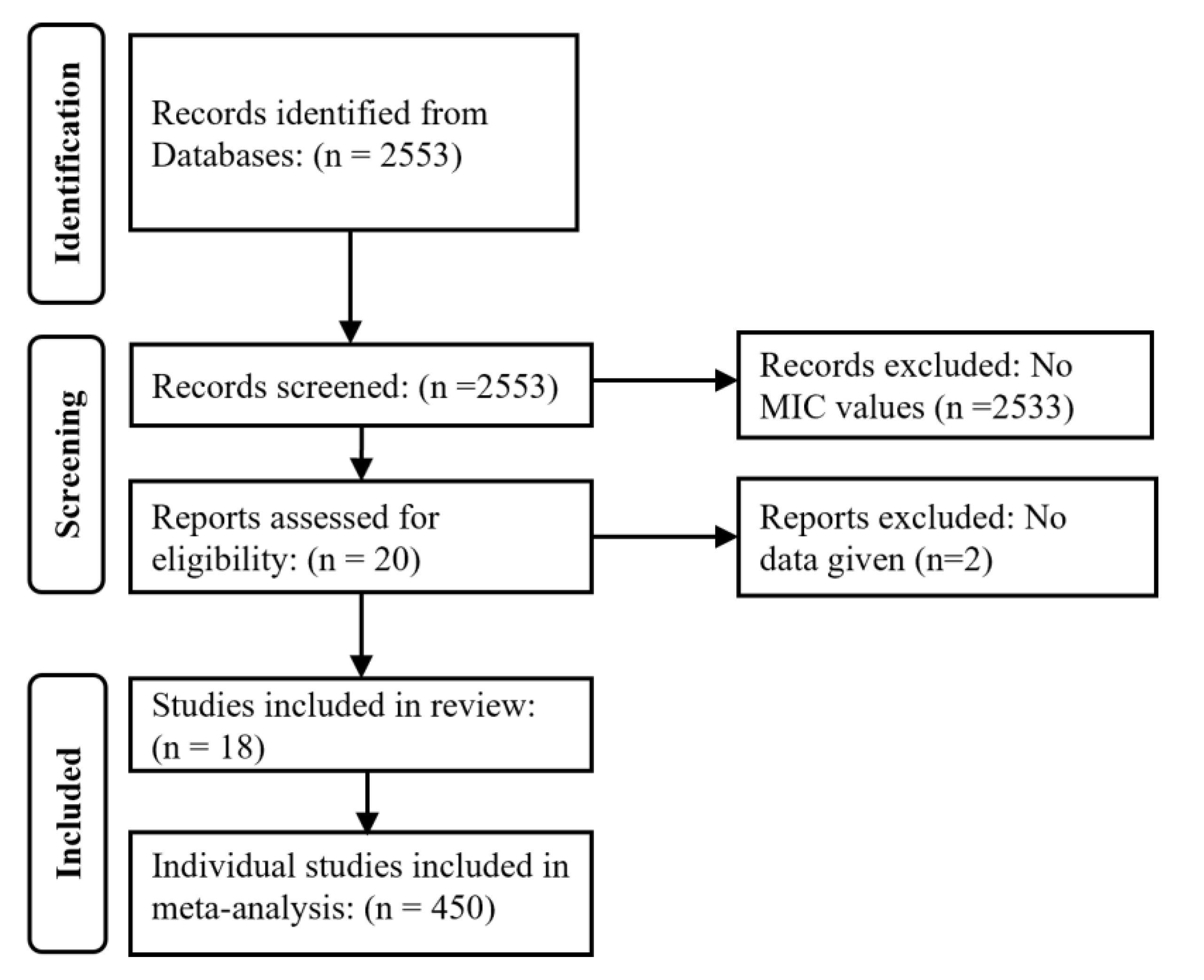
Figure 2.
The main flavonoids and bitter acids from Humulus Lupulus, studied herein.
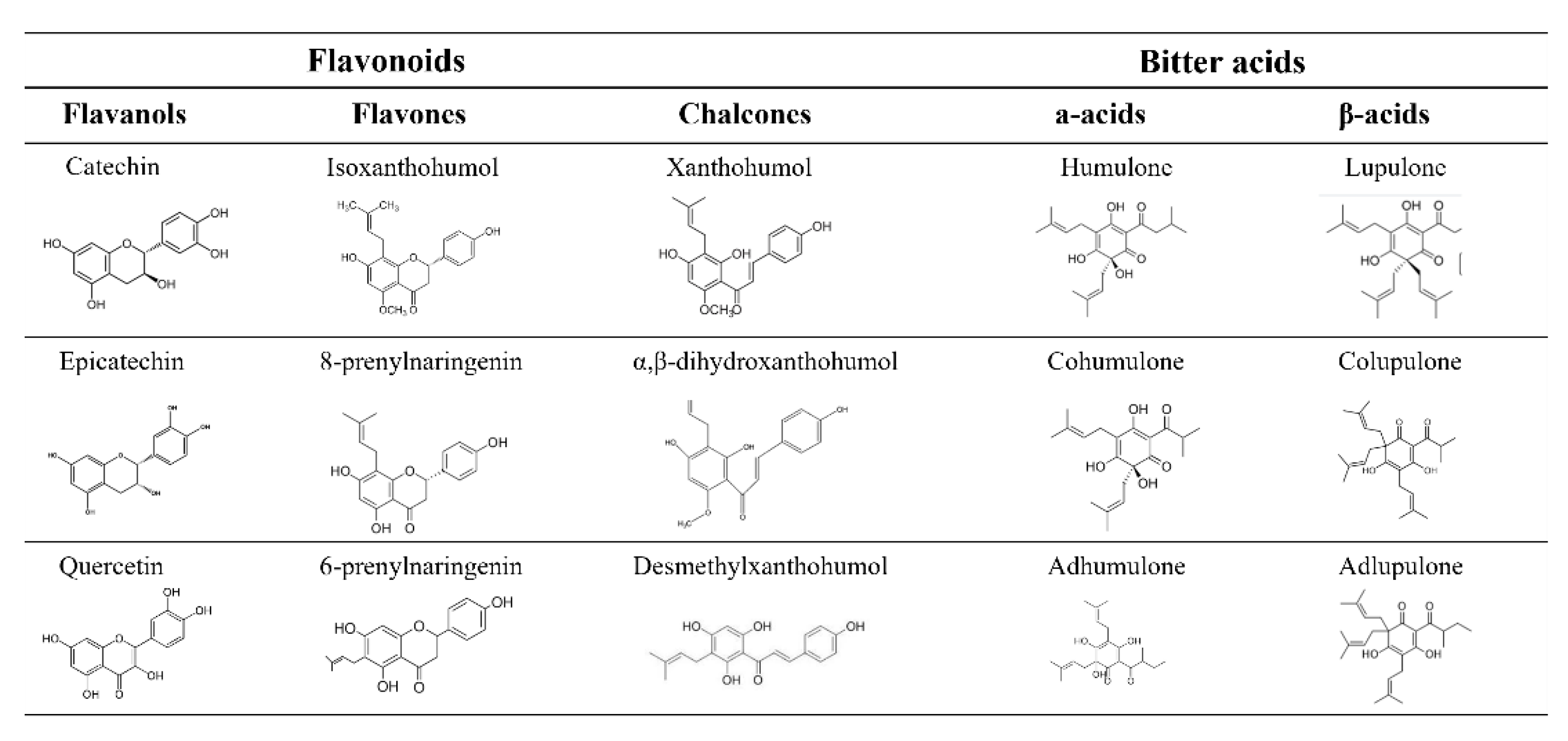
Figure 3.
Meta-analysis of MIC values for flavonoids and bitter acids against various microorganisms’ species, for 24 (A) and 48 (B) hours of incubation.
Figure 3.
Meta-analysis of MIC values for flavonoids and bitter acids against various microorganisms’ species, for 24 (A) and 48 (B) hours of incubation.
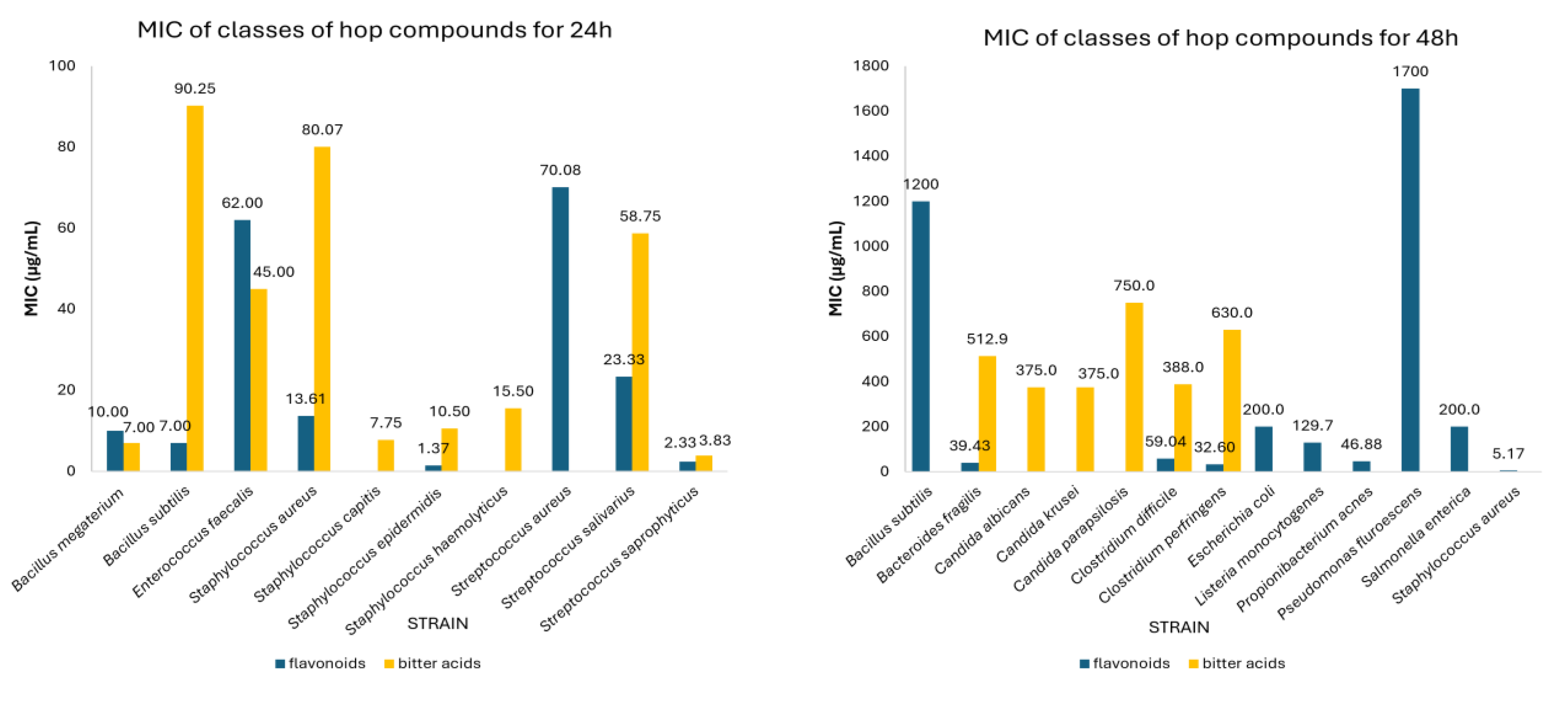
Figure 4.
Meta-analysis of MIC values for various types of extracts against various microorganisms’ species, for 24 (A) and 48 (B) hours of incubation.
Figure 4.
Meta-analysis of MIC values for various types of extracts against various microorganisms’ species, for 24 (A) and 48 (B) hours of incubation.
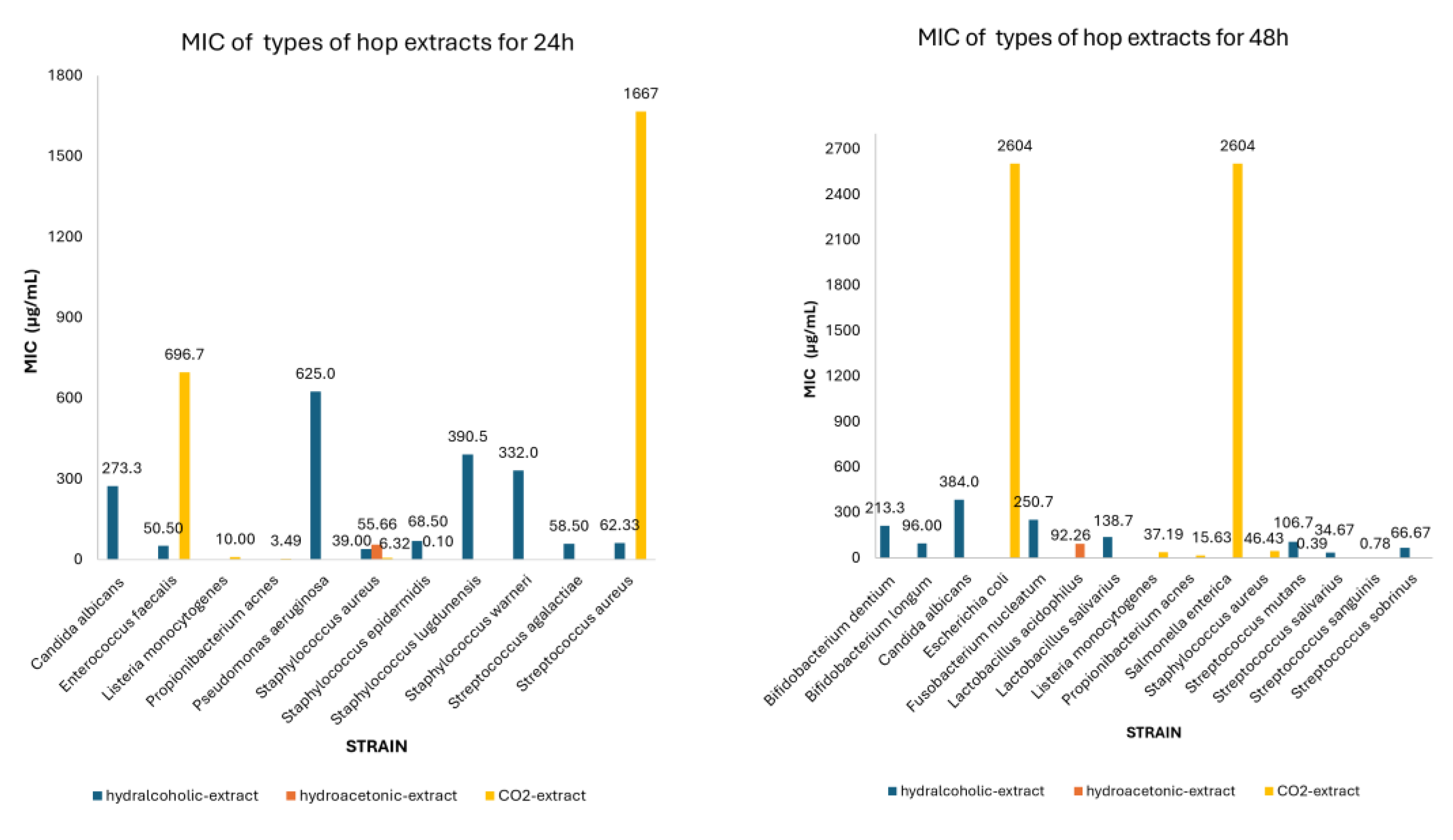
Figure 5.
Meta-analysis of MIC values for each hop compound against various microorganisms’ species, for 24 (A) and 48 (B) hours of incubation.
Figure 5.
Meta-analysis of MIC values for each hop compound against various microorganisms’ species, for 24 (A) and 48 (B) hours of incubation.
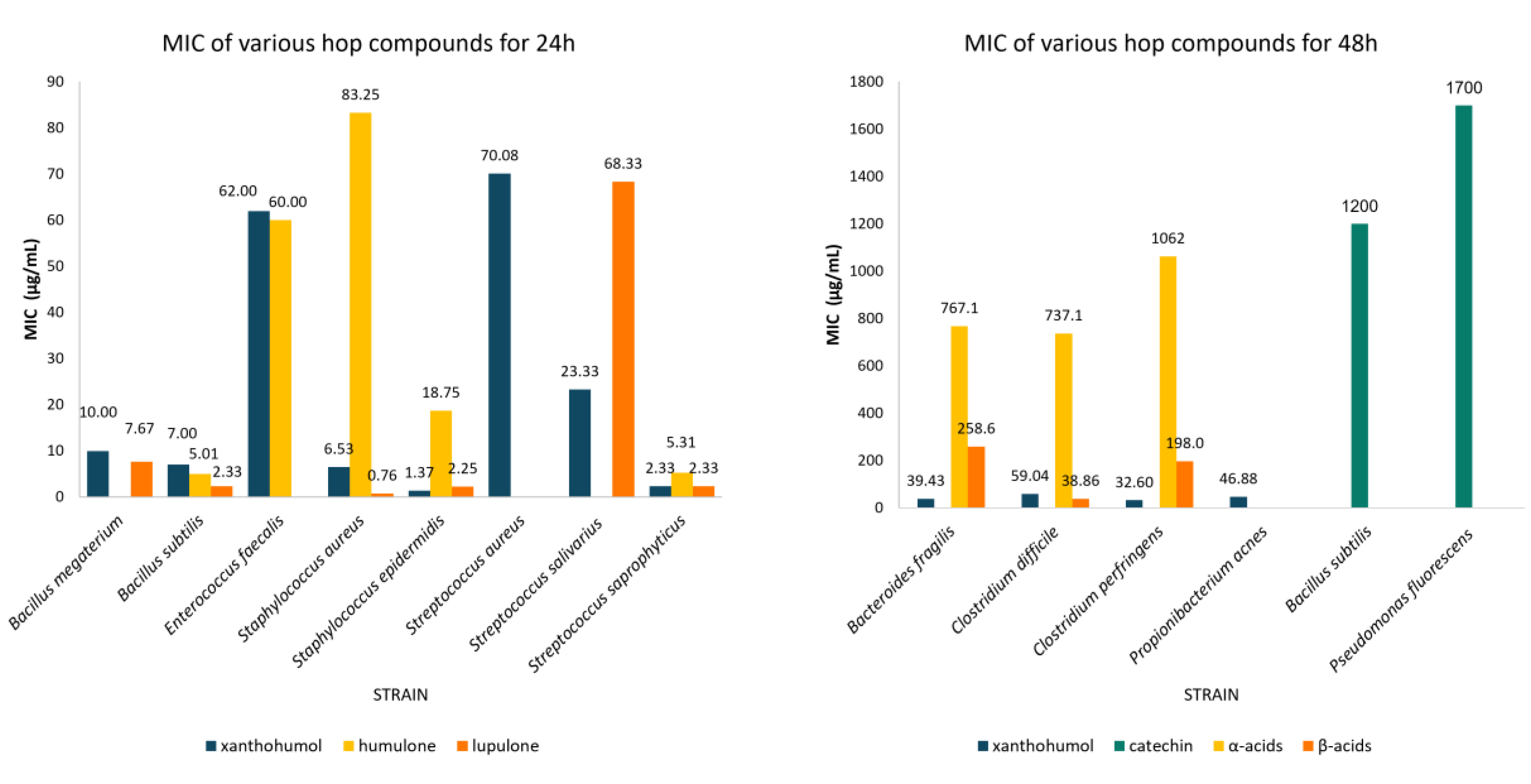
Figure 6.
Meta-analysis of MIC values for each hop compound against food-spoilage and non-food-spoilage microorganisms for 24 (A) and 48 (B) hours of incubation.
Figure 6.
Meta-analysis of MIC values for each hop compound against food-spoilage and non-food-spoilage microorganisms for 24 (A) and 48 (B) hours of incubation.
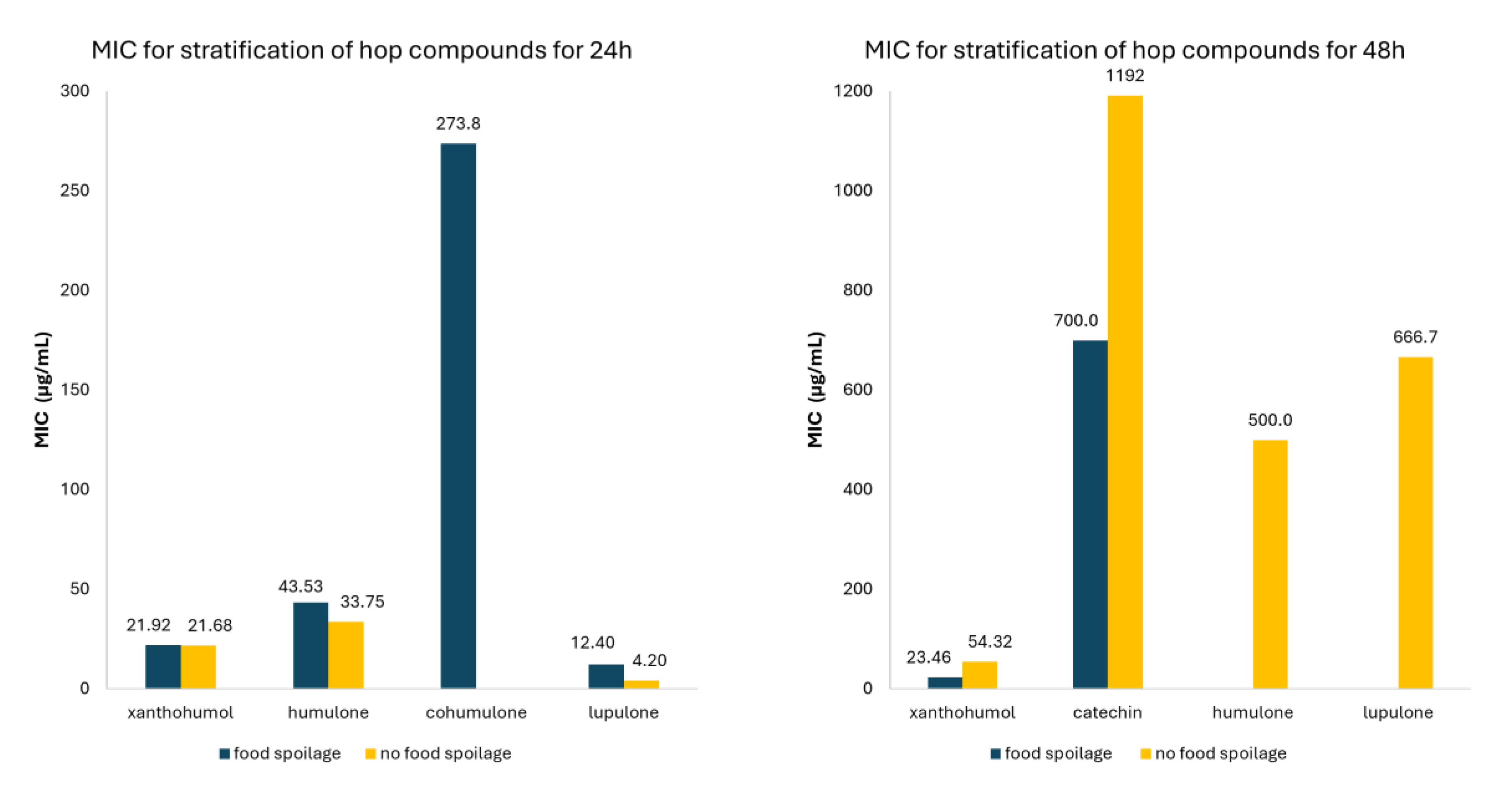
Figure 7.
Meta-analysis of MIC values for classes of hop compounds and extracts against food-spoilage and non-food-spoilage microorganisms at different incubation time points.
Figure 7.
Meta-analysis of MIC values for classes of hop compounds and extracts against food-spoilage and non-food-spoilage microorganisms at different incubation time points.
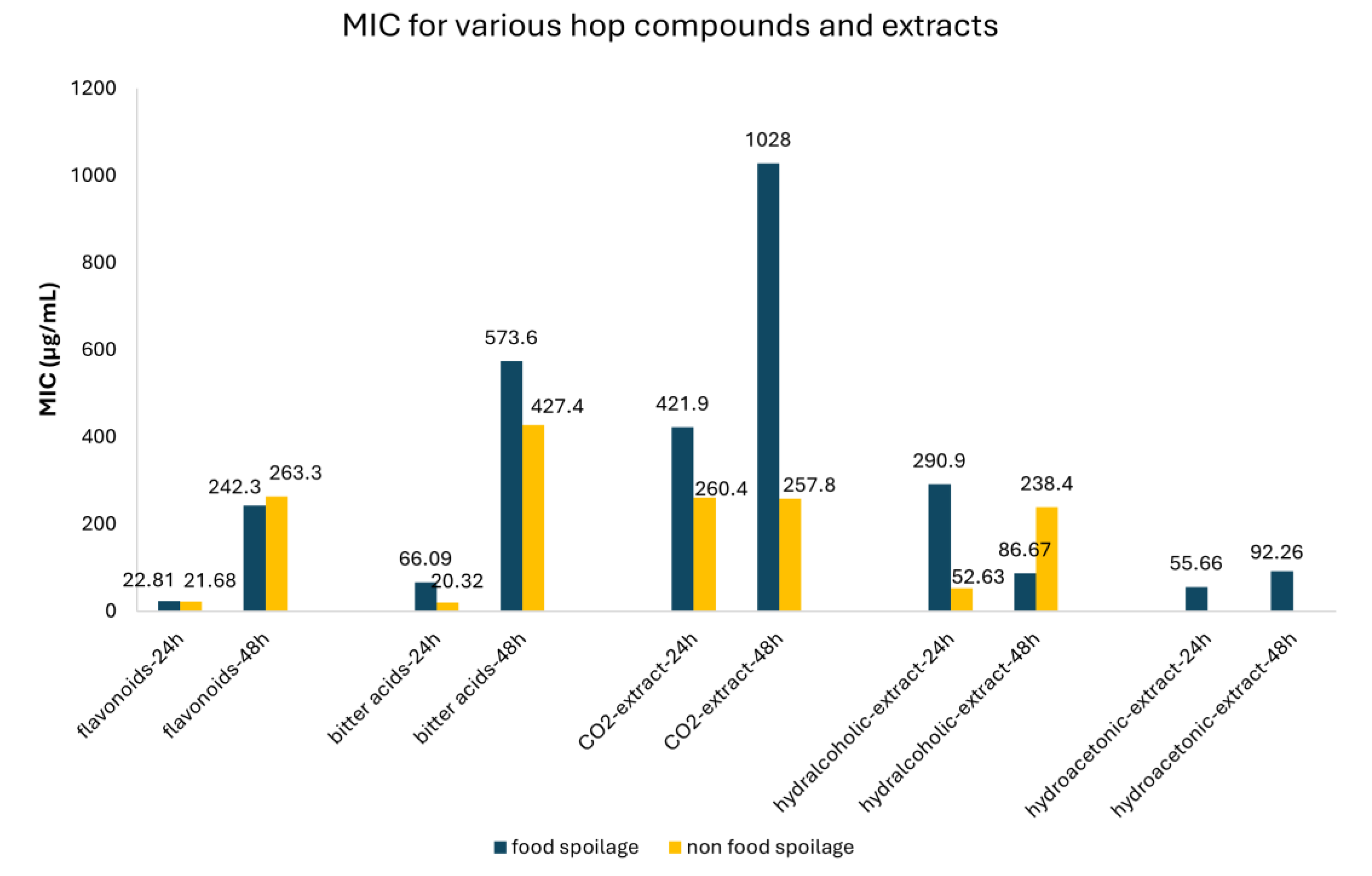
Figure 8.
Meta-analysis of MIC values for each hop compound against probiotic and non-probiotic microorganisms for 24 (A) and 48 (B) hours of incubation.
Figure 8.
Meta-analysis of MIC values for each hop compound against probiotic and non-probiotic microorganisms for 24 (A) and 48 (B) hours of incubation.
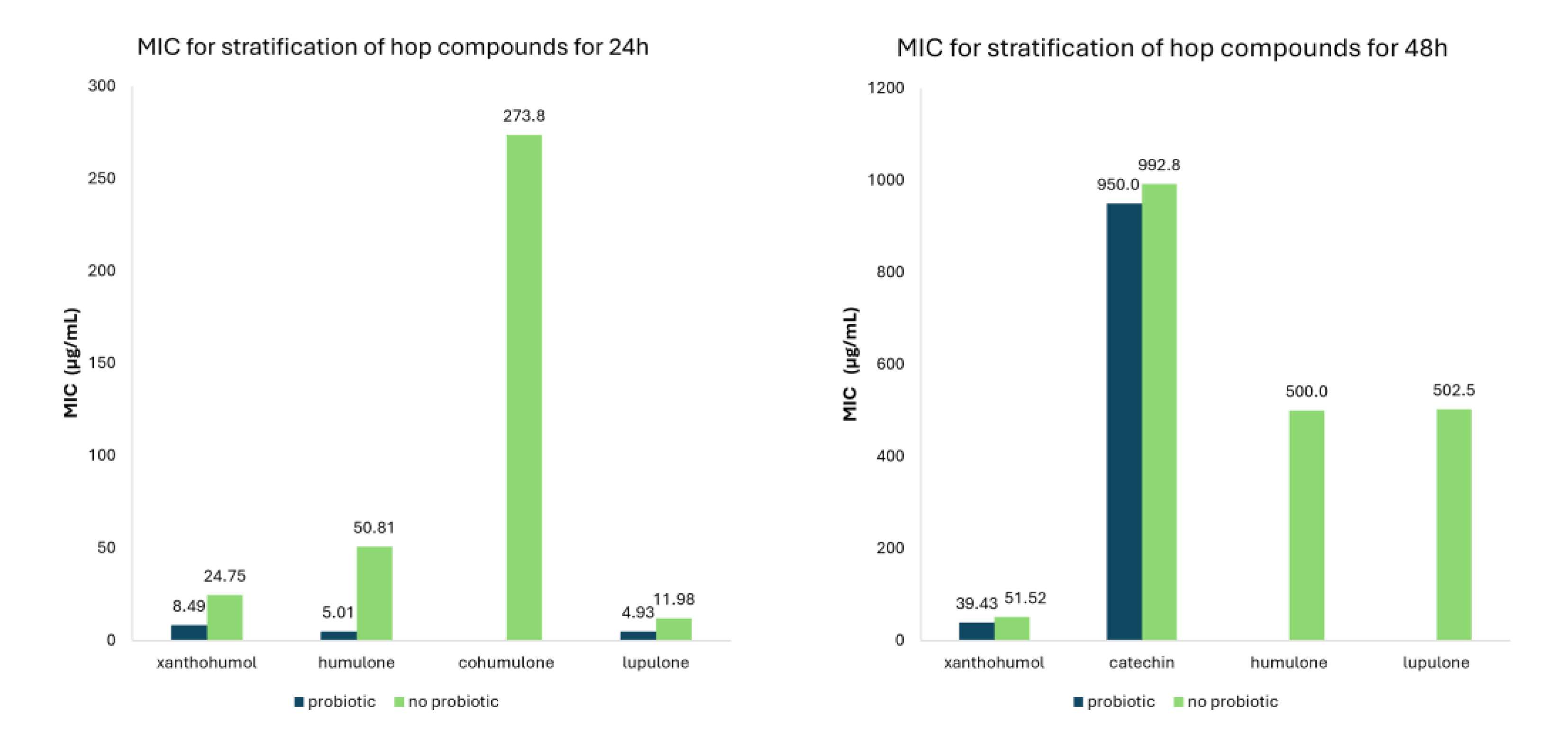
Figure 9.
Meta-analysis of MIC values for classes of hop compounds and extracts against probiotic and non- probiotic microorganisms at different incubation time points.
Figure 9.
Meta-analysis of MIC values for classes of hop compounds and extracts against probiotic and non- probiotic microorganisms at different incubation time points.
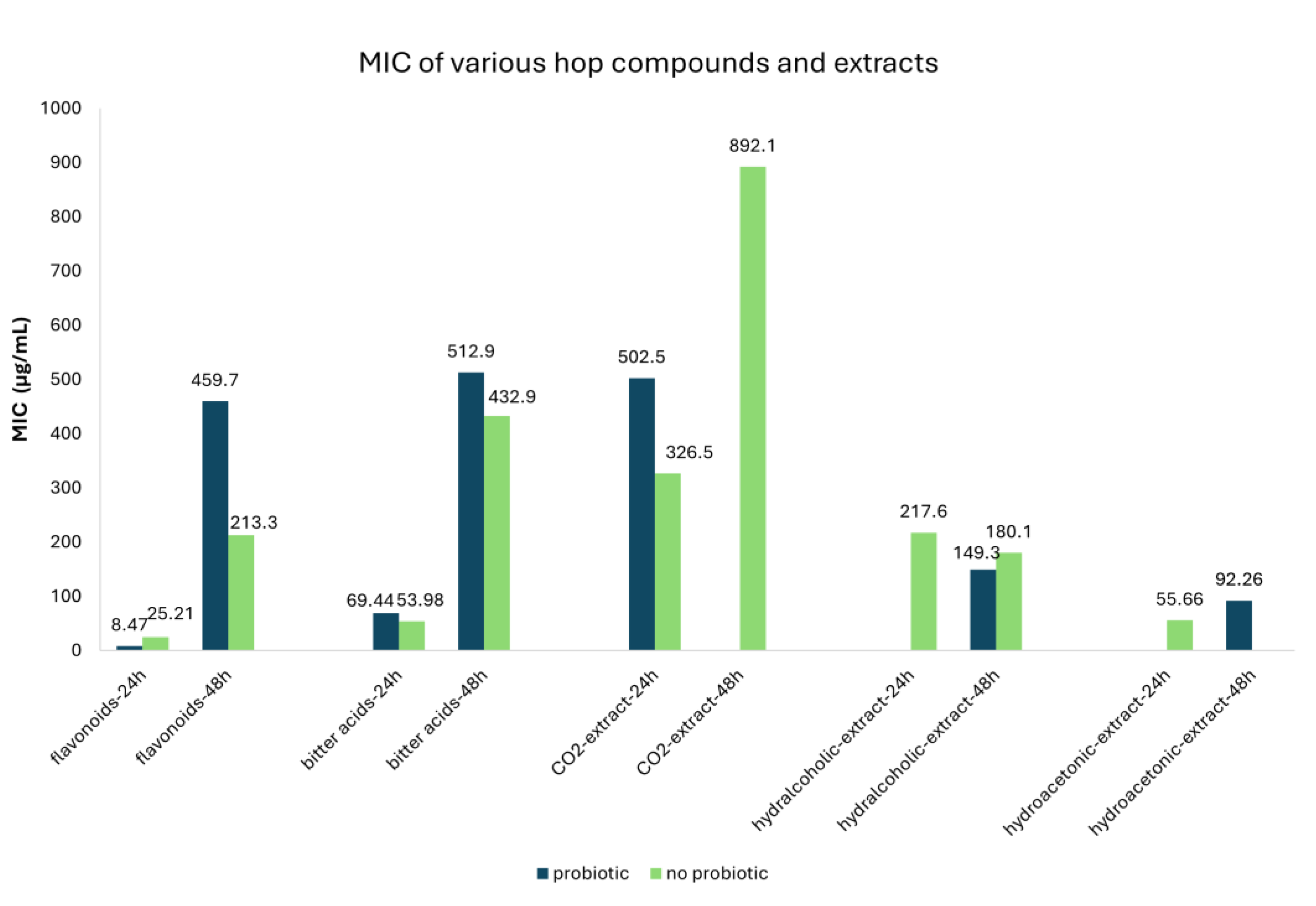

Table 1.
Characteristics of the studies included in the meta-analysis.
| Author | Year | MIC (μg/mL) | Strain | Type of compounds / extracts | Number of experiments | Time (hours) | Temperature (oC) |
|---|---|---|---|---|---|---|---|
| Kramer et al. [23] | 2015 | 6.3 | Staphylococcus aureus | Xanthohumol / chalcones / flavonoids | 4 | 48 | 37 |
| Kramer et al. [23] | 2015 | 12.5 | Staphylococcus aureus | Xanthohumol / chalcones / flavonoids | 4 | 48 | 37 |
| Kramer et al. [23] | 2015 | 1.6 | Staphylococcus aureus | Xanthohumol / chalcones / flavonoids | 4 | 48 | 37 |
| Kramer et al. [23] | 2015 | 1.6 | Staphylococcus aureus | CO2-extract | 4 | 48 | 37 |
| Kramer et al. [23] | 2015 | 200 | Staphylococcus aureus | CO2-extract | 4 | 48 | 37 |
| Kramer et al. [23] | 2015 | 200 | Staphylococcus aureus | CO2-extract | 4 | 48 | 37 |
| Kramer et al. [23] | 2015 | 200 | Staphylococcus aureus | CO2-extract | 4 | 48 | 37 |
| Kramer et al. [23] | 2015 | 5000 | Staphylococcus aureus | CO2-extract | 4 | 48 | 37 |
| Kramer et al. [23] | 2015 | 2500 | Staphylococcus aureus | CO2-extract | 4 | 48 | 37 |
| Kramer et al. [23] | 2015 | 1250 | Listeria monocytogenes | Xanthohumol / chalcones / flavonoids | 4 | 48 | 37 |
| Kramer et al. [23] | 2015 | 5000 | Listeria monocytogenes | Xanthohumol / chalcones / flavonoids | 4 | 48 | 37 |
| Kramer et al. [23] | 2015 | 1250 | Listeria monocytogenes | Xanthohumol / chalcones / flavonoids | 4 | 48 | 37 |
| Kramer et al. [23] | 2015 | 625 | Listeria monocytogenes | CO2-extract | 4 | 48 | 37 |
| Kramer et al. [23] | 2015 | 200 | Listeria monocytogenes | CO2-extract | 4 | 48 | 37 |
| Kramer et al. [23] | 2015 | 200 | Listeria monocytogenes | CO2-extract | 4 | 48 | 37 |
| Kramer et al. [23] | 2015 | 200 | Listeria monocytogenes | CO2-extract | 4 | 48 | 37 |
| Kramer et al. [23] | 2015 | 5000 | Listeria monocytogenes | CO2-extract | 4 | 48 | 37 |
| Kramer et al. [23] | 2015 | 2500 | Listeria monocytogenes | CO2-extract | 4 | 48 | 37 |
| Kramer et al. [23] | 2015 | 1250 | Escherichia coli | Xanthohumol / chalcones / flavonoids | 4 | 48 | 37 |
| Kramer et al. [23] | 2015 | 5000 | Escherichia coli | Xanthohumol / chalcones / flavonoids | 4 | 48 | 37 |
| Kramer et al. [23] | 2015 | 1250 | Escherichia coli | Xanthohumol / chalcones / flavonoids | 4 | 48 | 37 |
| Kramer et al. [23] | 2015 | 625 | Escherichia coli | CO2-extract | 4 | 48 | 37 |
| Kramer et al. [23] | 2015 | 6.3 | Escherichia coli | CO2-extract | 4 | 48 | 37 |
| Kramer et al. [23] | 2015 | 12.5 | Escherichia coli | CO2-extract | 4 | 48 | 37 |
| Kramer et al. [23] | 2015 | 1.6 | Escherichia coli | CO2-extract | 4 | 48 | 37 |
| Kramer et al. [23] | 2015 | 1.6 | Escherichia coli | CO2-extract | 4 | 48 | 37 |
| Kramer et al. [23] | 2015 | 200 | Escherichia coli | CO2-extract | 4 | 48 | 37 |
| Kramer et al. [23] | 2015 | 200 | Salmonella enterica | Xanthohumol / chalcones / flavonoids | 4 | 48 | 37 |
| Kramer et al. [23] | 2015 | 200 | Salmonella enterica | Xanthohumol / chalcones / flavonoids | 4 | 48 | 37 |
| Kramer et al. [23] | 2015 | 5000 | Salmonella enterica | Xanthohumol / chalcones / flavonoids | 4 | 48 | 37 |
| Kramer et al. [23] | 2015 | 2500 | Salmonella enterica | CO2-extract | 4 | 48 | 37 |
| Kramer et al. [23] | 2015 | 1250 | Salmonella enterica | CO2-extract | 4 | 48 | 37 |
| Kramer et al. [23] | 2015 | 5000 | Salmonella enterica | CO2-extract | 4 | 48 | 37 |
| Kramer et al. [23] | 2015 | 1250 | Salmonella enterica | CO2-extract | 4 | 48 | 37 |
| Kramer et al. [23] | 2015 | 625 | Salmonella enterica | CO2-extract | 4 | 48 | 37 |
| Kramer et al. [23] | 2015 | 200 | Salmonella enterica | CO2-extract | 4 | 48 | 37 |
| Kramer et al. [23] | 2015 | 200 | Staphylococcus aureus | Xanthohumol / chalcones / flavonoids | 3 | 24 | 37 |
| Weber et al. [13] | 2019 | 3.1 | Propionibacterium acnes | CO2-extract | 3 | 24 | 37 |
| Weber et al. [13] | 2019 | 4.65 | Propionibacterium acnes | CO2-extract | 3 | 24 | 37 |
| Weber et al. [13] | 2019 | 3.1 | Propionibacterium acnes | CO2-extract | 3 | 24 | 37 |
| Weber et al. [13] | 2019 | 3.1 | Propionibacterium acnes | CO2-extract | 3 | 24 | 37 |
| Weber et al. [13] | 2019 | 9.375 | Staphylococcus aureus | CO2-extract | 3 | 24 | 37 |
| Weber et al. [13] | 2019 | 9.375 | Staphylococcus aureus | CO2-extract | 3 | 24 | 37 |
| Weber et al. [13] | 2019 | 6.25 | Staphylococcus aureus | CO2-extract | 3 | 24 | 37 |
| Weber et al. [13] | 2019 | 12.5 | Staphylococcus aureus | CO2-extract | 4 | 48 | 37 |
| Cermak et al. [24] | 2017 | 160 | Bacteroides fragilis | α-acids/bitter acids | 4 | 48 | 37 |
| Cermak et al. [24] | 2017 | 680 | Bacteroides fragilis | α-acids/bitter acids | 4 | 48 | 37 |
| Cermak et al. [24] | 2017 | 900 | Bacteroides fragilis | α-acids/bitter acids | 4 | 48 | 37 |
| Cermak et al. [24] | 2017 | 1540 | Bacteroides fragilis | α-acids/bitter acids | 4 | 48 | 37 |
| Cermak et al. [24] | 2017 | 1150 | Bacteroides fragilis | α-acids/bitter acids | 4 | 48 | 37 |
| Cermak et al. [24] | 2017 | 260 | Bacteroides fragilis | α-acids/bitter acids | 4 | 48 | 37 |
| Cermak et al. [24] | 2017 | 680 | Bacteroides fragilis | α-acids/bitter acids | 4 | 48 | 37 |
| Cermak et al. [24] | 2017 | 840 | Clostridium perfringens | α-acids/bitter acids | 4 | 48 | 37 |
| Cermak et al. [24] | 2017 | 1370 | Clostridium perfringens | α-acids/bitter acids | 4 | 48 | 37 |
| Cermak et al. [24] | 2017 | 1190 | Clostridium perfringens | α-acids/bitter acids | 4 | 48 | 37 |
| Cermak et al. [24] | 2017 | 680 | Clostridium perfringens | α-acids/bitter acids | 4 | 48 | 37 |
| Cermak et al. [24] | 2017 | 1230 | Clostridium perfringens | α-acids/bitter acids | 4 | 48 | 37 |
| Cermak et al. [24] | 2017 | 320 | Clostridium difficile | α-acids/bitter acids | 4 | 48 | 37 |
| Cermak et al. [24] | 2017 | 770 | Clostridium difficile | α-acids/bitter acids | 4 | 48 | 37 |
| Cermak et al. [24] | 2017 | 510 | Clostridium difficile | α-acids/bitter acids | 4 | 48 | 37 |
| Cermak et al. [24] | 2017 | 510 | Clostridium difficile | α-acids/bitter acids | 4 | 48 | 37 |
| Cermak et al. [24] | 2017 | 580 | Clostridium difficile | α-acids/bitter acids | 4 | 48 | 37 |
| Cermak et al. [24] | 2017 | 770 | Clostridium difficile | α-acids/bitter acids | 4 | 48 | 37 |
| Cermak et al. [24] | 2017 | 1020 | Clostridium difficile | α-acids/bitter acids | 4 | 48 | 37 |
| Cermak et al. [24] | 2017 | 510 | Clostridium difficile | α-acids/bitter acids | 4 | 48 | 37 |
| Cermak et al. [24] | 2017 | 510 | Clostridium difficile | α-acids/bitter acids | 4 | 48 | 37 |
| Cermak et al. [24] | 2017 | 340 | Clostridium difficile | α-acids/bitter acids | 4 | 48 | 37 |
| Cermak et al. [24] | 2017 | 640 | Clostridium difficile | α-acids/bitter acids | 4 | 48 | 37 |
| Cermak et al. [24] | 2017 | 1020 | Clostridium difficile | α-acids/bitter acids | 4 | 48 | 37 |
| Cermak et al. [24] | 2017 | 1020 | Clostridium difficile | α-acids/bitter acids | 4 | 48 | 37 |
| Cermak et al. [24] | 2017 | 430 | Clostridium difficile | α-acids/bitter acids | 4 | 48 | 37 |
| Cermak et al. [24] | 2017 | 340 | Clostridium difficile | α-acids/bitter acids | 4 | 48 | 37 |
| Cermak et al. [24] | 2017 | 680 | Clostridium difficile | α-acids/bitter acids | 4 | 48 | 37 |
| Cermak et al. [24] | 2017 | 2040 | Clostridium difficile | α-acids/bitter acids | 4 | 48 | 37 |
| Cermak et al. [24] | 2017 | 510 | Clostridium difficile | α-acids/bitter acids | 4 | 48 | 37 |
| Cermak et al. [24] | 2017 | 300 | Clostridium difficile | α-acids/bitter acids | 4 | 48 | 37 |
| Cermak et al. [24] | 2017 | 680 | Clostridium difficile | α-acids/bitter acids | 4 | 48 | 37 |
| Cermak et al. [24] | 2017 | 510 | Clostridium difficile | α-acids/bitter acids | 4 | 48 | 37 |
| Cermak et al. [24] | 2017 | 1020 | Clostridium difficile | α-acids/bitter acids | 4 | 48 | 37 |
| Cermak et al. [24] | 2017 | 850 | Clostridium difficile | α-acids/bitter acids | 4 | 48 | 37 |
| Cermak et al. [24] | 2017 | 1020 | Clostridium difficile | α-acids/bitter acids | 4 | 48 | 37 |
| Cermak et al. [24] | 2017 | 680 | Clostridium difficile | α-acids/bitter acids | 4 | 48 | 37 |
| Cermak et al. [24] | 2017 | 1020 | Clostridium difficile | α-acids/bitter acids | 4 | 48 | 37 |
| Cermak et al. [24] | 2017 | 1020 | Clostridium difficile | α-acids/bitter acids | 4 | 48 | 37 |
| Cermak et al. [24] | 2017 | 1020 | Clostridium difficile | α-acids/bitter acids | 4 | 48 | 37 |
| Cermak et al. [24] | 2017 | 190 | Bacteroides fragilis | β-acids/bitter acids | 4 | 48 | 37 |
| Cermak et al. [24] | 2017 | 340 | Bacteroides fragilis | β-acids/bitter acids | 4 | 48 | 37 |
| Cermak et al. [24] | 2017 | 320 | Bacteroides fragilis | β-acids/bitter acids | 4 | 48 | 37 |
| Cermak et al. [24] | 2017 | 430 | Bacteroides fragilis | β-acids/bitter acids | 4 | 48 | 37 |
| Cermak et al. [24] | 2017 | 260 | Bacteroides fragilis | β-acids/bitter acids | 4 | 48 | 37 |
| Cermak et al. [24] | 2017 | 220 | Bacteroides fragilis | β-acids/bitter acids | 4 | 48 | 37 |
| Cermak et al. [24] | 2017 | 50 | Bacteroides fragilis | β-acids/bitter acids | 4 | 48 | 37 |
| Cermak et al. [24] | 2017 | 170 | Clostridium perfringens | β-acids/bitter acids | 4 | 48 | 37 |
| Cermak et al. [24] | 2017 | 210 | Clostridium perfringens | β-acids/bitter acids | 4 | 48 | 37 |
| Cermak et al. [24] | 2017 | 260 | Clostridium perfringens | β-acids/bitter acids | 4 | 48 | 37 |
| Cermak et al. [24] | 2017 | 200 | Clostridium perfringens | β-acids/bitter acids | 4 | 48 | 37 |
| Cermak et al. [24] | 2017 | 150 | Clostridium perfringens | β-acids/bitter acids | 4 | 48 | 37 |
| Cermak et al. [24] | 2017 | 24 | Clostridium difficile | β-acids/bitter acids | 4 | 48 | 37 |
| Cermak et al. [24] | 2017 | 80 | Clostridium difficile | β-acids/bitter acids | 4 | 48 | 37 |
| Cermak et al. [24] | 2017 | 48 | Clostridium difficile | β-acids/bitter acids | 4 | 48 | 37 |
| Cermak et al. [24] | 2017 | 21 | Clostridium difficile | β-acids/bitter acids | 4 | 48 | 37 |
| Cermak et al. [24] | 2017 | 72 | Clostridium difficile | β-acids/bitter acids | 4 | 48 | 37 |
| Cermak et al. [24] | 2017 | 21 | Clostridium difficile | β-acids/bitter acids | 4 | 48 | 37 |
| Cermak et al. [24] | 2017 | 68 | Clostridium difficile | β-acids/bitter acids | 4 | 48 | 37 |
| Cermak et al. [24] | 2017 | 32 | Clostridium difficile | β-acids/bitter acids | 4 | 48 | 37 |
| Cermak et al. [24] | 2017 | 21 | Clostridium difficile | β-acids/bitter acids | 4 | 48 | 37 |
| Cermak et al. [24] | 2017 | 27 | Clostridium difficile | β-acids/bitter acids | 4 | 48 | 37 |
| Cermak et al. [24] | 2017 | 36 | Clostridium difficile | β-acids/bitter acids | 4 | 48 | 37 |
| Cermak et al. [24] | 2017 | 96 | Clostridium difficile | β-acids/bitter acids | 4 | 48 | 37 |
| Cermak et al. [24] | 2017 | 40 | Clostridium difficile | β-acids/bitter acids | 4 | 48 | 37 |
| Cermak et al. [24] | 2017 | 80 | Clostridium difficile | β-acids/bitter acids | 4 | 48 | 37 |
| Cermak et al. [24] | 2017 | 19 | Clostridium difficile | β-acids/bitter acids | 4 | 48 | 37 |
| Cermak et al. [24] | 2017 | 27 | Clostridium difficile | β-acids/bitter acids | 4 | 48 | 37 |
| Cermak et al. [24] | 2017 | 43 | Clostridium difficile | β-acids/bitter acids | 4 | 48 | 37 |
| Cermak et al. [24] | 2017 | 27 | Clostridium difficile | β-acids/bitter acids | 4 | 48 | 37 |
| Cermak et al. [24] | 2017 | 9 | Clostridium difficile | β-acids/bitter acids | 4 | 48 | 37 |
| Cermak et al. [24] | 2017 | 24 | Clostridium difficile | β-acids/bitter acids | 4 | 48 | 37 |
| Cermak et al. [24] | 2017 | 12 | Clostridium difficile | β-acids/bitter acids | 4 | 48 | 37 |
| Cermak et al. [24] | 2017 | 53 | Clostridium difficile | β-acids/bitter acids | 4 | 48 | 37 |
| Cermak et al. [24] | 2017 | 48 | Clostridium difficile | β-acids/bitter acids | 4 | 48 | 37 |
| Cermak et al. [24] | 2017 | 24 | Clostridium difficile | β-acids/bitter acids | 4 | 48 | 37 |
| Cermak et al. [24] | 2017 | 12 | Clostridium difficile | β-acids/bitter acids | 4 | 48 | 37 |
| Cermak et al. [24] | 2017 | 48 | Clostridium difficile | β-acids/bitter acids | 4 | 48 | 37 |
| Cermak et al. [24] | 2017 | 28 | Clostridium difficile | β-acids/bitter acids | 4 | 48 | 37 |
| Cermak et al. [24] | 2017 | 48 | Clostridium difficile | β-acids/bitter acids | 4 | 48 | 37 |
| Cermak et al. [24] | 2017 | 15 | Bacteroides fragilis | Xanthohumol / chalcones / flavonoids | 4 | 48 | 37 |
| Cermak et al. [24] | 2017 | 56 | Bacteroides fragilis | Xanthohumol / chalcones / flavonoids | 4 | 48 | 37 |
| Cermak et al. [24] | 2017 | 29 | Bacteroides fragilis | Xanthohumol / chalcones / flavonoids | 4 | 48 | 37 |
| Cermak et al. [24] | 2017 | 48 | Bacteroides fragilis | Xanthohumol / chalcones / flavonoids | 4 | 48 | 37 |
| Cermak et al. [24] | 2017 | 44 | Bacteroides fragilis | Xanthohumol / chalcones / flavonoids | 4 | 48 | 37 |
| Cermak et al. [24] | 2017 | 28 | Bacteroides fragilis | Xanthohumol / chalcones / flavonoids | 4 | 48 | 37 |
| Cermak et al. [24] | 2017 | 56 | Bacteroides fragilis | Xanthohumol / chalcones / flavonoids | 4 | 48 | 37 |
| Cermak et al. [24] | 2017 | 10 | Clostridium perfringens | Xanthohumol / chalcones / flavonoids | 4 | 48 | 37 |
| Cermak et al. [24] | 2017 | 28 | Clostridium perfringens | Xanthohumol / chalcones / flavonoids | 4 | 48 | 37 |
| Cermak et al. [24] | 2017 | 32 | Clostridium perfringens | Xanthohumol / chalcones / flavonoids | 4 | 48 | 37 |
| Cermak et al. [24] | 2017 | 40 | Clostridium perfringens | Xanthohumol / chalcones / flavonoids | 4 | 48 | 37 |
| Cermak et al. [24] | 2017 | 53 | Clostridium perfringens | Xanthohumol / chalcones / flavonoids | 4 | 48 | 37 |
| Cermak et al. [24] | 2017 | 85 | Clostridium difficile | Xanthohumol / chalcones / flavonoids | 4 | 48 | 37 |
| Cermak et al. [24] | 2017 | 85 | Clostridium difficile | Xanthohumol / chalcones / flavonoids | 4 | 48 | 37 |
| Cermak et al. [24] | 2017 | 64 | Clostridium difficile | Xanthohumol / chalcones / flavonoids | 4 | 48 | 37 |
| Cermak et al. [24] | 2017 | 64 | Clostridium difficile | Xanthohumol / chalcones / flavonoids | 4 | 48 | 37 |
| Cermak et al. [24] | 2017 | 64 | Clostridium difficile | Xanthohumol / chalcones / flavonoids | 4 | 48 | 37 |
| Cermak et al. [24] | 2017 | 64 | Clostridium difficile | Xanthohumol / chalcones / flavonoids | 4 | 48 | 37 |
| Cermak et al. [24] | 2017 | 107 | Clostridium difficile | Xanthohumol / chalcones / flavonoids | 4 | 48 | 37 |
| Cermak et al. [24] | 2017 | 32 | Clostridium difficile | Xanthohumol / chalcones / flavonoids | 4 | 48 | 37 |
| Cermak et al. [24] | 2017 | 85 | Clostridium difficile | Xanthohumol / chalcones / flavonoids | 4 | 48 | 37 |
| Cermak et al. [24] | 2017 | 53 | Clostridium difficile | Xanthohumol / chalcones / flavonoids | 4 | 48 | 37 |
| Cermak et al. [24] | 2017 | 43 | Clostridium difficile | Xanthohumol / chalcones / flavonoids | 4 | 48 | 37 |
| Cermak et al. [24] | 2017 | 75 | Clostridium difficile | Xanthohumol / chalcones / flavonoids | 4 | 48 | 37 |
| Cermak et al. [24] | 2017 | 85 | Clostridium difficile | Xanthohumol / chalcones / flavonoids | 4 | 48 | 37 |
| Cermak et al. [24] | 2017 | 32 | Clostridium difficile | Xanthohumol / chalcones / flavonoids | 4 | 48 | 37 |
| Cermak et al. [24] | 2017 | 32 | Clostridium difficile | Xanthohumol / chalcones / flavonoids | 4 | 48 | 37 |
| Cermak et al. [24] | 2017 | 32 | Clostridium difficile | Xanthohumol / chalcones / flavonoids | 4 | 48 | 37 |
| Cermak et al. [24] | 2017 | 43 | Clostridium difficile | Xanthohumol / chalcones / flavonoids | 4 | 48 | 37 |
| Cermak et al. [24] | 2017 | 32 | Clostridium difficile | Xanthohumol / chalcones / flavonoids | 4 | 48 | 37 |
| Cermak et al. [24] | 2017 | 32 | Clostridium difficile | Xanthohumol / chalcones / flavonoids | 4 | 48 | 37 |
| Cermak et al. [24] | 2017 | 64 | Clostridium difficile | Xanthohumol / chalcones / flavonoids | 4 | 48 | 37 |
| Cermak et al. [24] | 2017 | 64 | Clostridium difficile | Xanthohumol / chalcones / flavonoids | 4 | 48 | 37 |
| Cermak et al. [24] | 2017 | 64 | Clostridium difficile | Xanthohumol / chalcones / flavonoids | 4 | 48 | 37 |
| Cermak et al. [24] | 2017 | 64 | Clostridium difficile | Xanthohumol / chalcones / flavonoids | 4 | 48 | 37 |
| Cermak et al. [24] | 2017 | 43 | Clostridium difficile | Xanthohumol / chalcones / flavonoids | 4 | 48 | 37 |
| Cermak et al. [24] | 2017 | 64 | Clostridium difficile | Xanthohumol / chalcones / flavonoids | 4 | 48 | 37 |
| Cermak et al. [24] | 2017 | 64 | Clostridium difficile | Xanthohumol / chalcones / flavonoids | 4 | 48 | 37 |
| Cermak et al. [24] | 2017 | 64 | Clostridium difficile | Xanthohumol / chalcones / flavonoids | 4 | 48 | 37 |
| Cermak et al. [24] | 2017 | 53 | Clostridium difficile | Xanthohumol / chalcones / flavonoids | 3 | 24 | 37 |
| Bogdanova et al. [25] | 2018 | 7.5 | Staphylococcus epidermidis | Humulone /α-acids /bitter acids | 3 | 24 | 37 |
| Bogdanova et al. [25] | 2018 | 30 | Staphylococcus epidermidis | Humulone /α-acids /bitter acids | 3 | 24 | 37 |
| Bogdanova et al. [25] | 2018 | 15 | Staphylococcus capitis | Humulone /α-acids /bitter acids | 3 | 24 | 37 |
| Bogdanova et al. [25] | 2018 | 15 | Staphylococcus aureus | Humulone /α-acids /bitter acids | 3 | 24 | 37 |
| Bogdanova et al. [25] | 2018 | 15 | Staphylococcus aureus | Humulone /α-acids /bitter acids | 3 | 24 | 37 |
| Bogdanova et al. [25] | 2018 | 0.5 | Staphylococcus epidermidis | Lupulone /β-acids /bitter acids | 3 | 24 | 37 |
| Bogdanova et al. [25] | 2018 | 4 | Staphylococcus epidermidis | Lupulone /β-acids /bitter acids | 3 | 24 | 37 |
| Bogdanova et al. [25] | 2018 | 0.5 | Staphylococcus capitis | Lupulone /β-acids /bitter acids | 3 | 24 | 37 |
| Bogdanova et al. [25] | 2018 | 0.5 | Staphylococcus aureus | Lupulone /β-acids /bitter acids | 3 | 24 | 37 |
| Bogdanova et al. [25] | 2018 | 0.5 | Staphylococcus aureus | Lupulone /β-acids /bitter acids | 3 | 24 | 37 |
| Bogdanova et al. [25] | 2018 | 2 | Staphylococcus epidermidis | Xanthohumol / chalcones / flavonoids | 3 | 24 | 37 |
| Bogdanova et al. [25] | 2018 | 2 | Staphylococcus epidermidis | Xanthohumol / chalcones / flavonoids | 3 | 24 | 37 |
| Bogdanova et al. [25] | 2018 | 2 | Staphylococcus capitis | Xanthohumol / chalcones / flavonoids | 3 | 24 | 37 |
| Bogdanova et al. [25] | 2018 | 2 | Staphylococcus aureus | Xanthohumol / chalcones / flavonoids | 3 | 24 | 37 |
| Bogdanova et al. [25] | 2018 | 4 | Staphylococcus aureus | Xanthohumol / chalcones / flavonoids | 24 | 37 | |
| Larsona et al. [26] | 1996 | 300 | Listeria monocytogenes | CO2-extract | 24 | 37 | |
| Larsona et al. [26] | 1996 | 300 | Listeria monocytogenes | CO2-extract | 4 | 24 | 37 |
| Larsona et al. [26] | 1996 | 10 | Listeria monocytogenes | CO2-extract | 4 | 24 | 37 |
| Larsona et al. [26] | 1996 | 10 | Listeria monocytogenes | CO2-extract | 3 | 24 | 37 |
| Klimek et al. [27] | 2021 | 0.195 | Staphylococcus aureus | CO2-extract | 3 | 24 | 37 |
| Klimek et al. [27] | 2021 | 0.195 | Staphylococcus aureus | Xanthohumol / chalcones / flavonoids | 3 | 24 | 37 |
| Klimek et al. [27] | 2021 | 0.098 | Staphylococcus epidermidis | CO2-extract | 3 | 24 | 37 |
| Klimek et al. [27] | 2021 | 0.098 | Staphylococcus epidermidis | Xanthohumol / chalcones / flavonoids | 3 | 48 | 37 |
| Klimek et al. [27] | 2021 | 0.391 | Streptococcus mutans | CO2-extract | 3 | 48 | 37 |
| Klimek et al. [27] | 2021 | 0.391 | Streptococcus mutans | Xanthohumol / chalcones / flavonoids | 3 | 48 | 37 |
| Klimek et al. [27] | 2021 | 0.781 | Streptococcus sanguinis | CO2-extract | 3 | 48 | 37 |
| Klimek et al. [27] | 2021 | 0.781 | Streptococcus sanguinis | Xanthohumol / chalcones / flavonoids | 3 | 48 | 37 |
| Klimek et al. [27] | 2021 | 15.625 | Propionibacterium acnes | CO2-extract | 3 | 48 | 37 |
| Klimek et al. [27] | 2021 | 62.5 | Propionibacterium acnes | Xanthohumol / chalcones / flavonoids | 3 | 48 | 37 |
| Klimek et al. [27] | 2021 | 15.625 | Propionibacterium acnes | CO2-extract | 3 | 48 | 37 |
| Klimek et al. [27] | 2021 | 31.25 | Propionibacterium acnes | Xanthohumol / chalcones / flavonoids | 3 | 24 | 37 |
| Klimek et al. [27] | 2021 | 0.195 | Staphylococcus aureus | CO2-extract | 3 | 24 | 37 |
| Klimek et al. [27] | 2021 | 0.098 | Staphylococcus epidermidis | CO2-extract | 3 | 48 | 37 |
| Klimek et al. [27] | 2021 | 0.391 | Streptococcus mutans | CO2-extract | 3 | 48 | 37 |
| Klimek et al. [27] | 2021 | 0.781 | Streptococcus sanguinis | CO2-extract | 3 | 48 | 37 |
| Klimek et al. [27] | 2021 | 15.625 | Propionibacterium acnes | CO2-extract | 3 | 48 | 37 |
| Klimek et al. [27] | 2021 | 15.625 | Propionibacterium acnes | CO2-extract | 3 | 24 | 37 |
| Bocquet et al. [28] | 2019 | 39 | Corynebacterium | hydralcoholic-extract | 3 | 24 | 37 |
| Bocquet et al. [28] | 2019 | 39 | Enterococcus faecalis | hydralcoholic-extract | 3 | 24 | 37 |
| Bocquet et al. [28] | 2019 | 156 | Enterococcus sp. | hydralcoholic-extract | 3 | 24 | 37 |
| Bocquet et al. [28] | 2019 | 39 | Mycobacterium smegmatis | hydralcoholic-extract | 3 | 24 | 37 |
| Bocquet et al. [28] | 2019 | 39 | Staphylococcus aureus | hydralcoholic-extract | 3 | 24 | 37 |
| Bocquet et al. [28] | 2019 | 39 | Staphylococcus aureus | hydralcoholic-extract | 3 | 24 | 37 |
| Bocquet et al. [28] | 2019 | 39 | Staphylococcus epidermidis | hydralcoholic-extract | 3 | 24 | 37 |
| Bocquet et al. [28] | 2019 | 98 | Staphylococcus epidermidis | hydralcoholic-extract | 3 | 24 | 37 |
| Bocquet et al. [28] | 2019 | 156 | Staphylococcus lugdunensis | hydralcoholic-extract | 3 | 24 | 37 |
| Bocquet et al. [28] | 2019 | 39 | Staphylococcus warneri | hydralcoholic-extract | 3 | 24 | 37 |
| Bocquet et al. [28] | 2019 | 39 | Streptococcus agalactiae | hydralcoholic-extract | 3 | 24 | 37 |
| Bocquet et al. [28] | 2019 | 78 | Streptococcus agalactiae | hydralcoholic-extract | 3 | 24 | 37 |
| Bocquet et al. [28] | 2019 | 39 | Streptococcus dysgalactiae | hydralcoholic-extract | 3 | 24 | 37 |
| Bocquet et al. [28] | 2019 | 625 | Staphylococcus lugdunensis | hydralcoholic-extract | 3 | 24 | 37 |
| Bocquet et al. [28] | 2019 | 625 | Staphylococcus warneri | hydralcoholic-extract | 3 | 24 | 37 |
| Bocquet et al. [28] | 2019 | 625 | Acinetobacter baumannii | hydralcoholic-extract | 3 | 24 | 37 |
| Bocquet et al. [28] | 2019 | 625 | Pseudomonas aeruginosa | hydralcoholic-extract | 3 | 24 | 37 |
| Bocquet et al. [28] | 2019 | 625 | Pseudomonas aeruginosa | hydralcoholic-extract | 3 | 24 | 37 |
| Bocquet et al. [28] | 2019 | 625 | Stenotrophomonas maltophilia | hydralcoholic-extract | 3 | 24 | 37 |
| Bocquet et al. [28] | 2019 | 156 | Candida albicans | hydralcoholic-extract | 3 | 24 | 37 |
| Bocquet et al. [28] | 2019 | 39 | Candida albicans | hydralcoholic-extract | 3 | 24 | 37 |
| Bocquet et al. [28] | 2019 | 625 | Candida albicans | hydralcoholic-extract | 3 | 24 | 37 |
| Bocquet et al. [28] | 2019 | 2.23 | Staphylococcus aureus | Xanthohumol / chalcones / flavonoids | 3 | 24 | 37 |
| Bocquet et al. [28] | 2019 | 2.32 | Staphylococcus aureus | Desmethylxanthohumol/ chalcones / flavonoids | 3 | 24 | 37 |
| Bocquet et al. [28] | 2019 | 0.53 | Staphylococcus aureus | Lupulone /β-acids /bitter acids | 3 | 24 | 37 |
| Bocquet et al. [28] | 2019 | 9.8 | Staphylococcus aureus | Xanthohumol / chalcones / flavonoids | 3 | 24 | 37 |
| Bocquet et al. [28] | 2019 | 9.8 | Staphylococcus aureus | Xanthohumol / chalcones / flavonoids | 3 | 24 | 37 |
| Bocquet et al. [28] | 2019 | 9.8 | Staphylococcus aureus | Xanthohumol / chalcones / flavonoids | 3 | 24 | 37 |
| Bocquet et al. [28] | 2019 | 19.5 | Staphylococcus aureus | Xanthohumol / chalcones / flavonoids | 3 | 24 | 37 |
| Bocquet et al. [28] | 2019 | 39 | Staphylococcus aureus | Desmethylxanthohumol / chalcones / flavonoids | 3 | 24 | 37 |
| Bocquet et al. [28] | 2019 | 19.5 | Staphylococcus aureus | Desmethylxanthohumol / chalcones / flavonoids | 3 | 24 | 37 |
| Bocquet et al. [28] | 2019 | 39 | Staphylococcus aureus | Desmethylxanthohumol / chalcones / flavonoids | 3 | 24 | 37 |
| Bocquet et al. [28] | 2019 | 39 | Staphylococcus aureus | Desmethylxanthohumol / chalcones / flavonoids | 3 | 24 | 37 |
| Bocquet et al. [28] | 2019 | 156 | Staphylococcus aureus | Cohumulone / α-acids / bitter acids | 3 | 24 | 37 |
| Bocquet et al. [28] | 2019 | 313 | Staphylococcus aureus | Cohumulone / α-acids / bitter acids | 3 | 24 | 37 |
| Bocquet et al. [28] | 2019 | 313 | Staphylococcus aureus | Cohumulone / α-acids / bitter acids | 3 | 24 | 37 |
| Bocquet et al. [28] | 2019 | 313 | Staphylococcus aureus | Cohumulone / α-acids / bitter acids | 3 | 24 | 37 |
| Bocquet et al. [28] | 2019 | 78 | Staphylococcus aureus | Humulone / α-acids / bitter acids | 3 | 24 | 37 |
| Bocquet et al. [28] | 2019 | 156 | Staphylococcus aureus | Humulone / α-acids / bitter acids | 3 | 24 | 37 |
| Bocquet et al. [28] | 2019 | 156 | Staphylococcus aureus | Humulone / α-acids / bitter acids | 3 | 24 | 37 |
| Bocquet et al. [28] | 2019 | 156 | Staphylococcus aureus | Humulone / α-acids / bitter acids | 3 | 24 | 37 |
| Bocquet et al. [28] | 2019 | 39 | Staphylococcus aureus | Cohumulone / α-acids / bitter acids | 3 | 24 | 37 |
| Bocquet et al. [28] | 2019 | 78 | Staphylococcus aureus | Cohumulone / α-acids / bitter acids | 3 | 24 | 37 |
| Bocquet et al. [28] | 2019 | 39 | Staphylococcus aureus | Colupulone /β-acids/ bitter acids | 3 | 24 | 37 |
| Bocquet et al. [28] | 2019 | 78 | Staphylococcus aureus | Cohumulone / α-acids / bitter acids | 3 | 24 | 37 |
| Bocquet et al. [28] | 2019 | 1.2 | Staphylococcus aureus | Lupulone /β-acids / bitter acids | 3 | 24 | 37 |
| Bocquet et al. [28] | 2019 | 0.6 | Staphylococcus aureus | Lupulone /β-acids / bitter acids | 3 | 24 | 37 |
| Bocquet et al. [28] | 2019 | 0.6 | Staphylococcus aureus | Lupulone /β-acids / bitter acids | 3 | 24 | 37 |
| Bocquet et al. [28] | 2019 | 1.2 | Staphylococcus aureus | Lupulone /β-acids / bitter acids | 2 | 24 | 37 |
| Natarajana et al. [29] | 2008 | 3 | Bacillus subtilis | Humulone / α-acids / bitter acids | 2 | 24 | 37 |
| Natarajana et al. [29] | 2008 | 5 | Bacillus megaterium | Humulone / α-acids / bitter acids | 2 | 24 | 37 |
| Natarajana et al. [29] | 2008 | 30 | Streptococcus salivarius | Humulone / α-acids / bitter acids | 2 | 24 | 37 |
| Natarajana et al. [29] | 2008 | 10 | Streptococcus saprophyticus | Humulone / α-acids / bitter acids | 2 | 24 | 37 |
| Natarajana et al. [29] | 2008 | 1 | Bacillus subtilis | Lupulone /β-acids / bitter acids | 2 | 24 | 37 |
| Natarajana et al. [29] | 2008 | 3 | Bacillus megaterium | Lupulone /β-acids / bitter acids | 2 | 24 | 37 |
| Natarajana et al. [29] | 2008 | 5 | Streptococcus salivarius | Lupulone /β-acids / bitter acids | 2 | 24 | 37 |
| Natarajana et al. [29] | 2008 | 1 | Streptococcus saprophyticus | Lupulone /β-acids / bitter acids | 2 | 24 | 37 |
| Natarajana et al. [29] | 2008 | 1 | Bacillus subtilis | Xanthohumol / chalcones / flavonoids | 2 | 24 | 37 |
| Natarajana et al. [29] | 2008 | 10 | Bacillus megaterium | Xanthohumol / chalcones / flavonoids | 2 | 24 | 37 |
| Natarajana et al. [29] | 2008 | 10 | Streptococcus salivarius | Xanthohumol / chalcones / flavonoids | 2 | 24 | 37 |
| Natarajana et al. [29] | 2008 | 1 | Streptococcus saprophyticus | Xanthohumol / chalcones / flavonoids | 2 | 24 | 37 |
| Natarajana et al. [29] | 2008 | 3 | Streptococcus saprophyticus | Humulone / α-acids / bitter acids | 2 | 24 | 37 |
| Natarajana et al. [29] | 2008 | 3 | Bacillus subtilis | Humulone / α-acids / bitter acids | 2 | 24 | 37 |
| Natarajana et al. [29] | 2008 | 3 | Streptococcus saprophyticus | Lupulone /β-acids / bitter acids | 2 | 24 | 37 |
| Natarajana et al. [29] | 2008 | 3 | Bacillus subtilis | Lupulone /β-acids / bitter acids | 2 | 24 | 37 |
| Natarajana et al. [29] | 2008 | 10 | Bacillus megaterium | Lupulone /β-acids / bitter acids | 2 | 24 | 37 |
| Natarajana et al. [29] | 2008 | 100 | Streptococcus salivarius | Lupulone /β-acids / bitter acids | 2 | 24 | 37 |
| Natarajana et al. [29] | 2008 | 3 | Streptococcus saprophyticus | Xanthohumol / chalcones / flavonoids | 2 | 24 | 37 |
| Natarajana et al. [29] | 2008 | 10 | Bacillus subtilis | Xanthohumol / chalcones / flavonoids | 2 | 24 | 37 |
| Natarajana et al. [29] | 2008 | 10 | Bacillus megaterium | Xanthohumol / chalcones / flavonoids | 2 | 24 | 37 |
| Natarajana et al. [29] | 2008 | 30 | Streptococcus salivarius | Xanthohumol / chalcones / flavonoids | 2 | 24 | 37 |
| Natarajana et al. [29] | 2008 | 3 | Streptococcus saprophyticus | Humulone / α-acids / bitter acids | 2 | 24 | 37 |
| Natarajana et al. [29] | 2008 | 3 | Bacillus subtilis | Humulone / α-acids / bitter acids | 2 | 24 | 37 |
| Natarajana et al. [29] | 2008 | 3 | Streptococcus saprophyticus | Lupulone /β-acids / bitter acids | 2 | 24 | 37 |
| Natarajana et al. [29] | 2008 | 3 | Bacillus subtilis | Lupulone /β-acids / bitter acids | 2 | 24 | 37 |
| Natarajana et al. [29] | 2008 | 10 | Bacillus megaterium | Lupulone /β-acids / bitter acids | 2 | 24 | 37 |
| Natarajana et al. [29] | 2008 | 100 | Streptococcus salivarius | Lupulone /β-acids / bitter acids | 2 | 24 | 37 |
| Natarajana et al. [29] | 2008 | 3 | Streptococcus saprophyticus | Xanthohumol / chalcones / flavonoids | 2 | 24 | 37 |
| Natarajana et al. [29] | 2008 | 10 | Bacillus subtilis | Xanthohumol / chalcones / flavonoids | 2 | 24 | 37 |
| Natarajana et al. [29] | 2008 | 10 | Bacillus megaterium | Xanthohumol / chalcones / flavonoids | 2 | 24 | 37 |
| Natarajana et al. [29] | 2008 | 30 | Streptococcus salivarius | Xanthohumol / chalcones / flavonoids | 3 | 48 | 37 |
| Engels et al. [30] | 2011 | 600 | Bacillus subtilis | Catechin /flavonols / flavonoids | 3 | 48 | 37 |
| Engels et al. [30] | 2011 | 1300 | Bacillus subtilis | Catechin /flavonols / flavonoids | 3 | 48 | 37 |
| Engels et al. [30] | 2011 | 1700 | Bacillus subtilis | Catechin /flavonols / flavonoids | 3 | 48 | 37 |
| Engels et al. [30] | 2011 | 100 | Bacillus cereus | Catechin /flavonols / flavonoids | 3 | 48 | 25 |
| Engels et al. [30] | 2011 | 100 | Staphylococcus aureus | Catechin /flavonols / flavonoids | 3 | 48 | 25 |
| Engels et al. [30] | 2011 | 500 | Listeria monocytogenes | Catechin /flavonols / flavonoids | 3 | 48 | 25 |
| Engels et al. [30] | 2011 | 1700 | Pediococcus acidilaactici | Catechin /flavonols / flavonoids | 3 | 48 | 25 |
| Engels et al. [30] | 2011 | 1700 | Lactococcus lactis | Catechin /flavonols / flavonoids | 3 | 48 | 25 |
| Engels et al. [30] | 2011 | 1700 | Pseudomonas fluorescens | Catechin /flavonols / flavonoids | 3 | 48 | 37 |
| Engels et al. [30] | 2011 | 300 | Bacillus amyloliquefaciens | Catechin /flavonols / flavonoids | 3 | 48 | 25 |
| Engels et al. [30] | 2011 | 100 | Staphylococcus warneri | Catechin /flavonols / flavonoids | 3 | 48 | 25 |
| Engels et al. [30] | 2011 | 1700 | Lactobacillus plantarum | Catechin /flavonols / flavonoids | 3 | 48 | 25 |
| Engels et al. [30] | 2011 | 1700 | Enterococcus faecalis | Catechin /flavonols / flavonoids | 3 | 48 | 25 |
| Engels et al. [30] | 2011 | 1700 | Pseudomonas fluorescens | Catechin /flavonols / flavonoids | 3 | 48 | 25 |
| Engels et al. [30] | 2011 | 1700 | Pseudomonas fluorescens | Catechin /flavonols / flavonoids | 3 | 48 | 42 |
| Engels et al. [30] | 2011 | 600 | Campylobacter jejuni | Catechin /flavonols / flavonoids | 3 | 48 | 25 |
| Engels et al. [30] | 2011 | 1700 | Mucor plumbeus | Catechin /flavonols / flavonoids | 3 | 48 | 25 |
| Engels et al. [30] | 2011 | 1700 | Aspergillus niger | Catechin /flavonols / flavonoids | 3 | 48 | 25 |
| Engels et al. [30] | 2011 | 26.8 | Penicillium spp | Catechin /flavonols / flavonoids | 4 | 24 | 37 |
| Rozalski et al. [31] | 2013 | 31 | Streptococcus aureus | hydralcoholic-extract | 4 | 24 | 37 |
| Rozalski et al. [31] | 2013 | 125 | Streptococcus aureus | hydralcoholic-extract | 4 | 24 | 37 |
| Rozalski et al. [31] | 2013 | 31 | Streptococcus aureus | hydralcoholic-extract | 4 | 24 | 37 |
| Rozalski et al. [31] | 2013 | 62 | Enterococcus faecalis | hydralcoholic-extract | 4 | 24 | 37 |
| Rozalski et al. [31] | 2013 | 15 | Streptococcus aureus | Xanthohumol / chalcones / flavonoids | 4 | 24 | 37 |
| Rozalski et al. [31] | 2013 | 125 | Streptococcus aureus | Xanthohumol / chalcones / flavonoids | 4 | 24 | 37 |
| Rozalski et al. [31] | 2013 | 93.5 | Streptococcus aureus | Xanthohumol / chalcones / flavonoids | 4 | 24 | 37 |
| Rozalski et al. [31] | 2013 | 62 | Enterococcus faecalis | Xanthohumol / chalcones / flavonoids | 4 | 24 | 37 |
| Rozalski et al. [31] | 2013 | 2000 | Streptococcus aureus | CO2-extract | 4 | 24 | 37 |
| Rozalski et al. [31] | 2013 | 1000 | Streptococcus aureus | CO2-extract | 4 | 24 | 37 |
| Rozalski et al. [31] | 2013 | 2000 | Streptococcus aureus | CO2-extract | 4 | 24 | 37 |
| Rozalski et al. [31] | 2013 | 2000 | Enterococcus faecalis | CO2-extract | 4 | 24 | 37 |
| Rozalski et al. [31] | 2013 | 31 | Streptococcus aureus | Xanthohumol / chalcones / flavonoids | 4 | 24 | 37 |
| Rozalski et al. [31] | 2013 | 125 | Streptococcus aureus | Xanthohumol / chalcones / flavonoids | 4 | 24 | 37 |
| Rozalski et al. [31] | 2013 | 31 | Streptococcus aureus | Xanthohumol / chalcones / flavonoids | 4 | 24 | 37 |
| Rozalski et al. [31] | 2013 | 62 | Enterococcus faecalis | Xanthohumol / chalcones / flavonoids | 3 | 48 | 37 |
| Flesar et al. [32] | 2010 | 2 | Paenibacillus larvae | organic-ethanolic extract | 3 | 48 | 37 |
| Flesar et al. [32] | 2010 | 3 | Paenibacillus larvae | organic extract | 3 | 48 | 37 |
| Flesar et al. [32] | 2010 | 128 | Paenibacillus larvae | Catechin/flavonols/ flavonoids |
4 | 24 | 37 |
| Bogdanova et al. [33] | 2018 | 30 | Staphylococcus aureus | Humulone / α-acids / bitter acids | 4 | 24 | 37 |
| Bogdanova et al. [33] | 2018 | 60 | Enterococcus faecalis | Humulone / α-acids / bitter acids | 4 | 24 | 37 |
| Bogdanova et al. [33] | 2018 | 60 | Staphylococcus aureus | Humulone / α-acids / bitter acids | 4 | 24 | 37 |
| Bogdanova et al. [33] | 2018 | 60 | Enterococcus faecalis | Humulone / α-acids / bitter acids | 4 | 24 | 37 |
| Bogdanova et al. [33] | 2018 | 30 | Staphylococcus haemolyticus | Humulone / α-acids / bitter acids | 4 | 48 | 37 |
| Bogdanova et al. [33] | 2018 | 250 | Candida albicans | Humulone / α-acids / bitter acids | 4 | 48 | 37 |
| Bogdanova et al. [33] | 2018 | 250 | Candida krusei | Humulone / α-acids / bitter acids | 4 | 48 | 37 |
| Bogdanova et al. [33] | 2018 | 1.000 | Candida tropicalis | Humulone / α-acids / bitter acids | 4 | 48 | 37 |
| Bogdanova et al. [33] | 2018 | 500 | Candida parapsilosis | Humulone / α-acids / bitter acids | 4 | 24 | 37 |
| Bogdanova et al. [33] | 2018 | 0.5 | Staphylococcus aureus | Lupulone /β-acids / bitter acids | 4 | 24 | 37 |
| Bogdanova et al. [33] | 2018 | 1.5 | Enterococcus faecalis | Lupulone /β-acids / bitter acids | 4 | 24 | 37 |
| Bogdanova et al. [33] | 2018 | 1 | Staphylococcus aureus | Lupulone /β-acids / bitter acids | 4 | 24 | 37 |
| Bogdanova et al. [33] | 2018 | 15 | Enterococcus faecalis | Lupulone /β-acids / bitter acids | 4 | 24 | 37 |
| Bogdanova et al. [33] | 2018 | 1 | Staphylococcus haemolyticus | Lupulone /β-acids / bitter acids | 4 | 48 | 37 |
| Bogdanova et al. [33] | 2018 | 500 | Candida albicans | Lupulone /β-acids / bitter acids | 4 | 48 | 37 |
| Bogdanova et al. [33] | 2018 | 500 | Candida krusei | Lupulone /β-acids / bitter acids | 4 | 48 | 37 |
| Bogdanova et al. [33] | 2018 | 1.000 | Candida parapsilosis | Lupulone /β-acids / bitter acids | 4 | 24 | 37 |
| Bogdanova et al. [33] | 2018 | 4 | Staphylococcus aureus | Xanthohumol / chalcones / flavonoids | 4 | 24 | 37 |
| Bogdanova et al. [33] | 2018 | 7.5 | Enterococcus faecalis | Xanthohumol / chalcones / flavonoids | 4 | 24 | 37 |
| Bogdanova et al. [33] | 2018 | 4 | Staphylococcus aureus | Xanthohumol / chalcones / flavonoids | 4 | 24 | 37 |
| Bogdanova et al. [33] | 2018 | 7.5 | Enterococcus faecalis | Xanthohumol / chalcones / flavonoids | 4 | 24 | 37 |
| Bogdanova et al. [33] | 2018 | 7.5 | Staphylococcus haemolyticus | Xanthohumol / chalcones / flavonoids | 4 | 48 | 37 |
| Bogdanova et al. [33] | 2018 | 60 | Candida albicans | Xanthohumol / chalcones / flavonoids | 4 | 48 | 37 |
| Bogdanova et al. [33] | 2018 | 60 | Candida krusei | Xanthohumol / chalcones / flavonoids | 4 | 48 | 37 |
| Bogdanova et al. [33] | 2018 | 30 | Candida tropicalis | Xanthohumol / chalcones / flavonoids | 4 | 48 | 37 |
| Bogdanova et al. [33] | 2018 | 7.5 | Candida parapsilosis | Xanthohumol / chalcones / flavonoids | 4 | 24 | 37 |
| Bogdanova et al. [33] | 2018 | 7.5 | Staphylococcus aureus | CO2-extract | 4 | 24 | 37 |
| Bogdanova et al. [33] | 2018 | 60 | Enterococcus faecalis | CO2-extract | 4 | 24 | 37 |
| Bogdanova et al. [33] | 2018 | 7.5 | Staphylococcus aureus | CO2-extract | 4 | 24 | 37 |
| Bogdanova et al. [33] | 2018 | 30 | Enterococcus faecalis | CO2-extract | 4 | 24 | 37 |
| Bogdanova et al. [33] | 2018 | 15 | Staphylococcus haemolyticus | CO2-extract | 4 | 48 | 37 |
| Bogdanova et al. [33] | 2018 | 250 | Candida albicans | CO2-extract | 4 | 48 | 37 |
| Bogdanova et al. [33] | 2018 | 250 | Candida krusei | CO2-extract | 4 | 48 | 37 |
| Bogdanova et al. [33] | 2018 | 1.000 | Candida tropicalis | CO2-extract | 4 | 48 | 37 |
| Bogdanova et al. [33] | 2018 | 500 | Candida parapsilosis | CO2-extract | 4 | 48 | 25 |
| Bhavya et al. [34] | 2020 | 64 | Staphylococcus aureus | CO2-extract | 4 | 48 | 25 |
| Bhavya et al. [34] | 2020 | 32 | Listeria monocytogenes | CO2-extract | 4 | 48 | 25 |
| Bhavya et al. [34] | 2020 | 32 | Bacillus subtilis | CO2-extract | 3 | 48 | 37 |
| Pilna et al. [35] | 2015 | 256 | Bifidobacterium dentium | hydralcoholic-extract | 3 | 48 | 37 |
| Pilna et al. [35] | 2015 | 128 | Bifidobacterium dentium | hydralcoholic-extract | 3 | 48 | 37 |
| Pilna et al. [35] | 2015 | 256 | Bifidobacterium dentium | hydralcoholic-extract | 3 | 48 | 37 |
| Pilna et al. [35] | 2015 | 256 | Bifidobacterium dentium | hydralcoholic-extract | 3 | 48 | 37 |
| Pilna et al. [35] | 2015 | 128 | Bifidobacterium dentium | hydralcoholic-extract | 3 | 48 | 37 |
| Pilna et al. [35] | 2015 | 256 | Bifidobacterium dentium | hydralcoholic-extract | 3 | 48 | 37 |
| Pilna et al. [35] | 2015 | 128 | Bifidobacterium longum | hydralcoholic-extract | 3 | 48 | 37 |
| Pilna et al. [35] | 2015 | 64 | Bifidobacterium longum | hydralcoholic-extract | 3 | 48 | 37 |
| Pilna et al. [35] | 2015 | 128 | Bifidobacterium longum | hydralcoholic-extract | 3 | 48 | 37 |
| Pilna et al. [35] | 2015 | 64 | Bifidobacterium longum | hydralcoholic-extract | 3 | 48 | 37 |
| Pilna et al. [35] | 2015 | 64 | Bifidobacterium longum | hydralcoholic-extract | 3 | 48 | 37 |
| Pilna et al. [35] | 2015 | 128 | Bifidobacterium longum | hydralcoholic-extract | 3 | 48 | 37 |
| Pilna et al. [35] | 2015 | 128 | Lactobacillus salivarius | hydralcoholic-extract | 3 | 48 | 37 |
| Pilna et al. [35] | 2015 | 64 | Lactobacillus salivarius | hydralcoholic-extract | 3 | 48 | 37 |
| Pilna et al. [35] | 2015 | 128 | Lactobacillus salivarius | hydralcoholic-extract | 3 | 48 | 37 |
| Pilna et al. [35] | 2015 | 128 | Lactobacillus salivarius | hydralcoholic-extract | 3 | 48 | 37 |
| Pilna et al. [35] | 2015 | 128 | Lactobacillus salivarius | hydralcoholic-extract | 3 | 48 | 37 |
| Pilna et al. [35] | 2015 | 256 | Lactobacillus salivarius | hydralcoholic-extract | 3 | 48 | 37 |
| Pilna et al. [35] | 2015 | 128 | Streptococcus mutans | hydralcoholic-extract | 3 | 48 | 37 |
| Pilna et al. [35] | 2015 | 64 | Streptococcus mutans | hydralcoholic-extract | 3 | 48 | 37 |
| Pilna et al. [35] | 2015 | 128 | Streptococcus mutans | hydralcoholic-extract | 3 | 48 | 37 |
| Pilna et al. [35] | 2015 | 64 | Streptococcus mutans | hydralcoholic-extract | 3 | 48 | 37 |
| Pilna et al. [35] | 2015 | 128 | Streptococcus mutans | hydralcoholic-extract | 3 | 48 | 37 |
| Pilna et al. [35] | 2015 | 128 | Streptococcus mutans | hydralcoholic-extract | 3 | 48 | 37 |
| Pilna et al. [35] | 2015 | 64 | Streptococcus salivarius | hydralcoholic-extract | 3 | 48 | 37 |
| Pilna et al. [35] | 2015 | 16 | Streptococcus salivarius | hydralcoholic-extract | 3 | 48 | 37 |
| Pilna et al. [35] | 2015 | 32 | Streptococcus salivarius | hydralcoholic-extract | 3 | 48 | 37 |
| Pilna et al. [35] | 2015 | 32 | Streptococcus salivarius | hydralcoholic-extract | 3 | 48 | 37 |
| Pilna et al. [35] | 2015 | 32 | Streptococcus salivarius | hydralcoholic-extract | 3 | 48 | 37 |
| Pilna et al. [35] | 2015 | 32 | Streptococcus salivarius | hydralcoholic-extract | 3 | 48 | 37 |
| Pilna et al. [35] | 2015 | 64 | Streptococcus sobrinus | hydralcoholic-extract | 3 | 48 | 37 |
| Pilna et al. [35] | 2015 | 16 | Streptococcus sobrinus | hydralcoholic-extract | 3 | 48 | 37 |
| Pilna et al. [35] | 2015 | 64 | Streptococcus sobrinus | hydralcoholic-extract | 3 | 48 | 37 |
| Pilna et al. [35] | 2015 | 64 | Streptococcus sobrinus | hydralcoholic-extract | 3 | 48 | 37 |
| Pilna et al. [35] | 2015 | 128 | Streptococcus sobrinus | hydralcoholic-extract | 3 | 48 | 37 |
| Pilna et al. [35] | 2015 | 64 | Streptococcus sobrinus | hydralcoholic-extract | 3 | 48 | 37 |
| Pilna et al. [35] | 2015 | 512 | Eikenella corrodens | hydralcoholic-extract | 3 | 48 | 37 |
| Pilna et al. [35] | 2015 | 256 | Fusobacterium nucleatum | hydralcoholic-extract | 3 | 48 | 37 |
| Pilna et al. [35] | 2015 | 256 | Fusobacterium nucleatum | hydralcoholic-extract | 3 | 48 | 37 |
| Pilna et al. [35] | 2015 | 512 | Fusobacterium nucleatum | hydralcoholic-extract | 3 | 48 | 37 |
| Pilna et al. [35] | 2015 | 256 | Fusobacterium nucleatum | hydralcoholic-extract | 3 | 48 | 37 |
| Pilna et al. [35] | 2015 | 512 | Fusobacterium nucleatum | hydralcoholic-extract | 3 | 48 | 37 |
| Pilna et al. [35] | 2015 | 512 | Fusobacterium nucleatum | hydralcoholic-extract | 3 | 48 | 37 |
| Pilna et al. [35] | 2015 | 128 | Fusobacterium nucleatum | hydralcoholic-extract | 3 | 48 | 37 |
| Pilna et al. [35] | 2015 | 64 | Fusobacterium nucleatum | hydralcoholic-extract | 3 | 48 | 37 |
| Pilna et al. [35] | 2015 | 128 | Fusobacterium nucleatum | hydralcoholic-extract | 3 | 48 | 37 |
| Pilna et al. [35] | 2015 | 128 | Fusobacterium nucleatum | hydralcoholic-extract | 3 | 48 | 37 |
| Pilna et al. [35] | 2015 | 128 | Fusobacterium nucleatum | hydralcoholic-extract | 3 | 48 | 37 |
| Pilna et al. [35] | 2015 | 128 | Fusobacterium nucleatum | hydralcoholic-extract | 3 | 48 | 37 |
| Pilna et al. [35] | 2015 | 256 | Candida albicans | hydralcoholic-extract | 3 | 48 | 37 |
| Pilna et al. [35] | 2015 | 256 | Candida albicans | hydralcoholic-extract | 3 | 48 | 37 |
| Pilna et al. [35] | 2015 | 512 | Candida albicans | hydralcoholic-extract | 3 | 48 | 37 |
| Pilna et al. [35] | 2015 | 512 | Candida albicans | hydralcoholic-extract | 3 | 24 | 37 |
| Schmalreck et al. [36] | 1974 | 1.8 | Bacillus subtilis | Cohumulone / α-acids / bitter acids | 3 | 24 | 37 |
| Schmalreck et al. [36] | 1974 | 9 | Bacillus subtilis | Cohumulone / α-acids / bitter acids | 3 | 24 | 37 |
| Schmalreck et al. [36] | 1974 | 11 | Bacillus subtilis | Humulone/ α-acids / bitter acids | 3 | 24 | 37 |
| Schmalreck et al. [36] | 1974 | 22 | Bacillus subtilis | Cohumulone / α-acids / bitter acids | 3 | 24 | 37 |
| Schmalreck et al. [36] | 1974 | 30 | Bacillus subtilis | Colupulone/ β-acids / bitter acids | 3 | 24 | 37 |
| Schmalreck et al. [36] | 1974 | 75 | Bacillus subtilis | Isohumulone /α-acids/bitter acids | 3 | 24 | 37 |
| Schmalreck et al. [36] | 1974 | 920 | Bacillus subtilis | Colupulone/ β-acids / bitter acids | 6 | 24 | 37 |
| Maia et al. [37] | 2019 | 1.000 | Saccharomyces cerevisiae | CO2-extract | 6 | 24 | 37 |
| Maia et al. [37] | 2019 | 5 | Lactobacillus fermentum | CO2-extract | 6 | 24 | 37 |
| Maia et al. [37] | 2019 | 5 | Leuconostoc mesenteroides | CO2-extract | 2 | 48 | 37 |
| Wei et al. [38] | 2014 | 10 | Mycobacterium tuberculosis | Humulone/ α-acids / bitter acids | 4 | 24 | 37 |
| Kolenc et al. [39] | 2022 | 15.6 | Staphylococcus aureus | hydroacetonic-extract | 4 | 24 | 37 |
| Kolenc et al. [39] | 2022 | 19.5 | Staphylococcus aureus | hydroacetonic-extract | 4 | 24 | 37 |
| Kolenc et al. [39] | 2022 | 15.6 | Staphylococcus aureus | hydroacetonic-extract | 4 | 24 | 37 |
| Kolenc et al. [39] | 2022 | 9.8 | Staphylococcus aureus | hydroacetonic-extract | 4 | 24 | 37 |
| Kolenc et al. [39] | 2022 | 19.5 | Staphylococcus aureus | hydroacetonic-extract | 4 | 24 | 37 |
| Kolenc et al. [39] | 2022 | 19.5 | Staphylococcus aureus | hydroacetonic-extract | 4 | 24 | 37 |
| Kolenc et al. [39] | 2022 | 19.5 | Staphylococcus aureus | hydroacetonic-extract | 4 | 24 | 37 |
| Kolenc et al. [39] | 2022 | 27.3 | Staphylococcus aureus | hydroacetonic-extract | 4 | 24 | 37 |
| Kolenc et al. [39] | 2022 | 31.3 | Staphylococcus aureus | hydroacetonic-extract | 4 | 24 | 37 |
| Kolenc et al. [39] | 2022 | 31.3 | Staphylococcus aureus | hydroacetonic-extract | 4 | 24 | 37 |
| Kolenc et al. [39] | 2022 | 15.6 | Staphylococcus aureus | hydroacetonic-extract | 4 | 24 | 37 |
| Kolenc et al. [39] | 2022 | 54.7 | Staphylococcus aureus | hydroacetonic-extract | 4 | 24 | 37 |
| Kolenc et al. [39] | 2022 | 250 | Staphylococcus aureus | hydroacetonic-extract | 4 | 24 | 37 |
| Kolenc et al. [39] | 2022 | 250 | Staphylococcus aureus | hydroacetonic-extract | 4 | 48 | 37 |
| Kolenc et al. [39] | 2022 | 62.5 | Lactobacillus acidophilus | hydroacetonic-extract | 4 | 48 | 37 |
| Kolenc et al. [39] | 2022 | 62.5 | Lactobacillus acidophilus | hydroacetonic-extract | 4 | 48 | 37 |
| Kolenc et al. [39] | 2022 | 83.3 | Lactobacillus acidophilus | hydroacetonic-extract | 4 | 48 | 37 |
| Kolenc et al. [39] | 2022 | 62.5 | Lactobacillus acidophilus | hydroacetonic-extract | 4 | 48 | 35 |
| Kolenc et al. [39] | 2022 | 104.2 | Lactobacillus acidophilus | hydroacetonic-extract | 4 | 48 | 37 |
| Kolenc et al. [39] | 2022 | 83.3 | Lactobacillus acidophilus | hydroacetonic-extract | 4 | 48 | 37 |
| Kolenc et al. [39] | 2022 | 104.2 | Lactobacillus acidophilus | hydroacetonic-extract | 4 | 48 | 37 |
| Kolenc et al. [39] | 2022 | 62.5 | Lactobacillus acidophilus | hydroacetonic-extract | 4 | 48 | 37 |
| Kolenc et al. [39] | 2022 | 125 | Lactobacillus acidophilus | hydroacetonic-extract | 4 | 48 | 37 |
| Kolenc et al. [39] | 2022 | 208.3 | Lactobacillus acidophilus | hydroacetonic-extract | 4 | 48 | 37 |
| Kolenc et al. [39] | 2022 | 104.2 | Lactobacillus acidophilus | hydroacetonic-extract | 4 | 48 | 37 |
| Kolenc et al. [39] | 2022 | 83.3 | Lactobacillus acidophilus | hydroacetonic-extract | 4 | 48 | 37 |
| Kolenc et al. [39] | 2022 | 62.5 | Lactobacillus acidophilus | hydroacetonic-extract | 4 | 48 | 37 |
| Kolenc et al. [39] | 2022 | 83.3 | Lactobacillus acidophilus | hydroacetonic-extract | 4 | 48 | 37 |
Table 2.
Meta-analysis of MIC values of classes of hop compounds and extracts.
| Compound | Time (hours) | Strain | MIC (μg/mL) | 95% CI | Number of studies |
|---|---|---|---|---|---|
| Flavonoids | 24 | Staphylococcus epidermidis | 1.37 | 0.12-2.61 | 3 |
| Staphylococcus aureus | 13.61 | 6.41-20.81 | 15 | ||
| Bacillus subtilis | 7.00 | 1.12-12.88 | 3 | ||
| Bacillus megaterium | 10.00 | 9.20-10.80 | 3 | ||
| Streptococcus salivarius | 23.33 | 10.27-36.40 | 3 | ||
| Streptococcus saprophyticus | 2.33 | 1.03-3.64 | 3 | ||
| Streptococcus aureus | 70.08 | 29.81-110.36 | 6 | ||
| Enterococcus faecalis | 62.00 | 61.31-62.69 | 2 | ||
| 48 | Staphylococcus aureus | 5.17 | 3.14-7.20 | 3 | |
| Listeria monocytogenes | 129.68 | 0.00-353.71 | 4 | ||
| Escherichia coli | 200.0 | 199.43-200.57 | 3 | ||
| Salmonella enterica | 200.0 | 199.43-200.57 | 3 | ||
| Bacteroides fragilis | 39.43 | 27.76-51.06 | 7 | ||
| Clostridium perfringens | 32.60 | 18.72-46.48 | 5 | ||
| Clostridium difficile | 59.04 | 51.64-66.43 | 28 | ||
| Propionibacterium acnes | 46.88 | 16.25-77.50 | 2 | ||
| Bacillus subtilis | 1200.0 | 569.96-1830.0 | 3 | ||
| Pseudomonas fluroescens | 1700.0 | 1699.2-1700.8 | 2 | ||
| Bitter acids | 24 | Staphylococcus epidermidis | 10.50 | 0.00-23.54 | 4 |
| Staphylococcus capitis | 7.75 | 0.00-21.96 | 2 | ||
| Staphylococcus aureus | 80.07 | 40.13-120.0 | 25 | ||
| Bacillus subtilis | 90.25 | 0.00-255.52 | 12 | ||
| Bacillus megaterium | 7.00 | 3.51-10.49 | 4 | ||
| Streptococcus salivarius | 58.75 | 11.01-106.49 | 4 | ||
| Streptococcus saprophyticus | 3.83 | 1.71-5.94 | 6 | ||
| Enterococcus faecalis | 45.00 | 15.60-74.4 | 3 | ||
| Staphylococcus haemolyticus | 15.50 | 0.00-43.92 | 2 | ||
| 48 | Bacteroides fragilis | 512.90 | 287.91-737.80 | 14 | |
| Clostridium perfringens | 630.0 | 323.01-936.99 | 10 | ||
| Clostridium difficile | 388.0 | 274.54-501.46 | 56 | ||
| Candida albicans | 375.0 | 130.01-620.0 | 2 | ||
| Candida krusei | 375.0 | 130.01-620.0 | 2 | ||
| Candida parapsilosis | 750.0 | 260.01-1240.0 | 2 | ||
| CO2-extract | 24 | Propionibacterium acnes | 3.49 | 2.73-4.25 | 4 |
| Staphylococcus aureus | 6.32 | 2.21-10.43 | 6 | ||
| Listeria monocytogenes | 10.00 | 9.31-10.69 | 2 | ||
| Staphylococcus epidermidis | 0.10 | 0.00-0.90 | 2 | ||
| Streptococcus aureus | 1666.7 | 1013.4-2320.0 | 3 | ||
| Enterococcus faecalis | 696.67 | 0.00-1974.0 | 3 | ||
| 48 | Staphylococcus aureus | 46.43 | 0.00-99.10 | 7 | |
| Listeria monocytogenes | 37.19 | 0.00-90.93 | 7 | ||
| Escherichia coli | 2604.2 | 1041.29-4167.1 | 6 | ||
| Salmonella enterica | 2604.2 | 1041.29-4167.1 | 6 | ||
| Streptococcus mutans | 0.39 | 0.00-1.19 | 2 | ||
| Streptococcus sanguinis | 0.78 | 0.00-1.58 | 2 | ||
| Propionibacterium acnes | 15.63 | 15.06-16.19 | 4 | ||
| Hydralcoholic-extract | 24 | Enterococcus faecalis | 50.50 | 27.96-73.04 | 2 |
| Staphylococcus aureus | 39.00 | 38.20-39.80 | 2 | ||
| Staphylococcus epidermidis | 68.50 | 10.68-126.32 | 2 | ||
| Staphylococcus lugdunensis | 390.50 | 0.00-850.11 | 2 | ||
| Staphylococcus warneri | 332.0 | 0.00-906.27 | 2 | ||
| Streptococcus agalactiae | 58.50 | 20.28-96,18 | 2 | ||
| Pseudomonas aeruginosa | 625.0 | 624.20-625.80 | 2 | ||
| Candida albicans | 273.33 | 0.00-624.26 | 3 | ||
| Streptococcus aureus | 62.33 | 0.92-123,75 | 3 | ||
| 48 | Bifidobacteriumm dentium | 213.33 | 160.44-266.22 | 6 | |
| Bifidobacterium longum | 96.00 | 67.95-124.05 | 6 | ||
| Lactobacillus salivarius | 138.67 | 88.32-189.02 | 6 | ||
| Streptococcus mutans | 106.67 | 80.22-133,11 | 6 | ||
| Streptococcus salivarius | 34.67 | 22.08-47.25 | 6 | ||
| Streptococcus sobrinus | 66.67 | 38.14-95,20 | 6 | ||
| Fusobacterium nucleatum | 250.67 | 154.91-346.42 | 12 | ||
| Candida albicans | 384.0 | 239.16-528.84 | 4 | ||
| Hydroacetonic-extract | 24 | Staphylococcus aureus | 55.66 | 12.15-99.16 | 14 |
| 48 | Lactobacillus acidophilus | 92.26 | 71.86-112.66 | 14 |
Table 3.
Meta-analysis of MIC values of individual hop compounds.
| Class of compounds | Compound | Time (hours) | Strain | MIC (μg/mL) | 95% CI | Number of studies |
|---|---|---|---|---|---|---|
| Flavonoids | Xanthohumol | 24 | Staphylococcus epidermidis | 1.37 | 0.12-2.61 | 3 |
| Staphylococcus aureus | 6.53 | 3.05-10.01 | 10 | |||
| Bacillus subtilis | 7.00 | 1.12-12.88 | 3 | |||
| Bacillus megaterium | 10.00 | 9.20-10.80 | 3 | |||
| Streptococcus salivarius | 23.33 | 10.27-36.40 | 3 | |||
| Streptococcus saprophyticus | 2.33 | 1.03-3.64 | 3 | |||
| Streptococcus aureus | 70.08 | 29.81-110.36 | 6 | |||
| Enterococcus faecalis | 62.00 | 61.31-62.96 | 2 | |||
| 48 | Bacteroides fragilis | 39.43 | 27.80-51.06 | 7 | ||
| Clostridium perfringens | 32.60 | 18.72-46.48 | 5 | |||
| Clostridium difficile | 59.04 | 51.64-66.43 | 28 | |||
| Propionibacterium acnes | 46.88 | 16.25-77.50 | 2 | |||
| Catechin | 48 | Bacillus subtilis | 1200.0 | 569.96-1830.0 | 3 | |
| Pseudomonas fluorescens | 1700.0 | 1698.9-1701.1 | 2 | |||
| Bitter acids | Humulone | 24 | Staphylococcus epidermidis | 18.75 | 0.00-40.80 | 2 |
| Staphylococcus aureus | 83.25 | 39.87-126.63 | 8 | |||
| Bacillus subtilis | 5.01 | 0.33-9.69 | 4 | |||
| Streptococcus saprophyticus | 5.31 | 1.20-9.42 | 3 | |||
| Enterococcus faecalis | 60.00 | 59.31-60.69 | 2 | |||
| Cohumulone | 24 | Staphylococcus aureus | 273.75 | 196.82-350.68 | 4 | |
| α-acids | 48 | Bacteroides fragilis | 767.14 | 408.98-1125.3 | 7 | |
| Clostridium perfringens | 1062.0 | 808.46-1315.5 | 5 | |||
| Clostridium difficile | 737.14 | 604.15-870.14 | 28 | |||
| Lupulone | 24 | Staphylococcus epidermidis | 2.25 | 0.00-5.68 | 2 | |
| Staphylococcus aureus | 0.76 | 0.38-1.15 | 8 | |||
| Bacillus subtilis | 2.33 | 1.03-3.64 | 3 | |||
| Bacillus megaterium | 7.67 | 3.093-12.24 | 3 | |||
| Streptococcus salivarius | 68.33 | 6.27-130.40 | 3 | |||
| Streptococcus saprophyticus | 2.33 | 1.03-3.64 | 3 | |||
| β-acids | 48 | Bacteroides fragilis | 258.57 | 168.10-349.04 | 7 | |
| Clostridium perfringens | 198.00 | 161.12-234.88 | 5 | |||
| Clostridium difficile | 38.39 | 39.40-130.10 | 28 |
Table 4.
Meta-analysis of MIC values of hop compounds and extracts stratified according to food spoilage microorganisms.
Table 4.
Meta-analysis of MIC values of hop compounds and extracts stratified according to food spoilage microorganisms.
| Class of Compounds | Compound | Time (hours) | Food spoilage/ Non-food spoilage | MIC (μg/ml) | 95% CI | Number of studies |
|---|---|---|---|---|---|---|
| Flavonoids | All Flavonoids | 24 | Food spoilage | 22.81 | 11.54-34.08 | 33 |
| Non-food spoilage | 21.68 | 0.00-47.71 | 6 | |||
| 48 | Food spoilage | 242.25 | 9.61-474.88 | 26 | ||
| Non-food spoilage | 263.28 | 130.45-396.11 | 48 | |||
| Xanthohumol | 24 | Food spoilage | 21.92 | 9.02-34.83 | 28 | |
| Non-food spoilage | 21.68 | 0.00-47.71 | 6 | |||
| 48 | Food spoilage | 23.46 | 8.76-38.15 | 7 | ||
| Non-food spoilage | 54.32 | 48.10-60.54 | 40 | |||
| Catechin | 48 | Food spoilage | 700.0 | 271.78-1128.2 | 7 | |
| Non-food spoilage | 1192.0 | 658.25-1725.8 | 9 | |||
| Bitter acids | All Bitter acids | 24 | Food spoilage | 66.09 | 3.23-128.59 | 51 |
| Non-food spoilage | 20.32 | 6.64-34.0 | 11 | |||
| 48 | Food spoilage | 573.64 | 277.54-869.74 | 11 | ||
| Non-food spoilage | 427.38 | 332.38-522.01 | 77 | |||
| Humulone | 24 | Food spoilage | 43.35 | 20.31-66.39 | 17 | |
| Non-food spoilage | 33.75 | 15.96-51.55 | 6 | |||
| 48 | Non-food spoilage | 500.0 | 153.52-846.48 | 4 | ||
| Cohumulone | 24 | Food spoilage | 273.75 | 196.82-350.68 | 4 | |
| Lupulone | 24 | Food spoilage | 12.40 | 2.66-22.14 | 20 | |
| Non-food spoilage | 4.20 | 0.00-9.97 | 5 | |||
| 48 | Non-food spoilage | 666.67 | 340.01-993.33 | 3 | ||
| CO2-extract | 24 | Food spoilage | 421.91 | 0.95-842.87 | 12 | |
| Non-food spoilage | 260.35 | 0.00-625.64 | 12 | |||
| 48 | Food spoilage | 1028.1 | 448.06-1608.1 | 31 | ||
| Non-food spoilage | 257.81 | 10.61-505.01 | 8 | |||
| Hydralcoholic-extract | 24 | Food spoilage | 52.65 | 28.39-76.86 | 8 | |
| Non-food spoilage | 290.94 | 163.21-418.68 | 18 | |||
| 48 | Food spoilage | 86.67 | 64.58-108.75 | 24 | ||
| Non-food spoilage | 238.35 | 180.99-295.71 | 29 | |||
| Hydroacetonic-extract | 24 | Food spoilage | 55.66 | 12.15-99.16 | 14 | |
| 48 | Food spoilage | 92.26 | 71.86-112.66 | 14 |
Table 5.
Meta-analysis of MIC values of hop compounds and extracts stratified according to probiotic or non-probiotic microorganisms.
Table 5.
Meta-analysis of MIC values of hop compounds and extracts stratified according to probiotic or non-probiotic microorganisms.
| Class of Compounds | Compound | Time (hours) | Probiotic | MIC (μg/mL) | 95% CI | Number of studies |
|---|---|---|---|---|---|---|
| Flavonoids | All Flavonoids | 24 | No probiotic | 25.21 | 12.67-37.74 | 33 |
| Probiotic | 8.47 | 4.70-12.30 | 6 | |||
| 48 | No probiotic | 213.28 | 110.83-315.72 | 62 | ||
| Probiotic | 459.69 | 85.84-833.55 | 13 | |||
| Xanthohumol | 24 | No probiotic | 24.75 | 10.17-39.33 | 28 | |
| Probiotic | 8.49 | 4.70-12.27 | 6 | |||
| 48 | No probiotic | 51.52 | 44.42-56.11 | 40 | ||
| Probiotic | 39.43 | 27.79-51.06 | 7 | |||
| Catechin | 48 | No probiotic | 992.8 | 564.73-1420.9 | 10 | |
| Probiotic | 950.0 | 428.99-1471.0 | 6 | |||
| Bitter acids | All Bitter acids | 24 | No probiotic | 53.98 | 30.39-77.57 | 46 |
| Probiotic | 69.44 | 0.00-209.31 | 16 | |||
| 48 | No probiotic | 432.95 | 354.94-535.50 | 74 | ||
| Probiotic | 512.86 | 287.91-737.8 | 14 | |||
| Humulone | 24 | No probiotic | 50.81 | 27.03-74.58 | 18 | |
| Probiotic | 5.01 | 0.97-9.05 | 5 | |||
| 48 | No probiotic | 500.0 | 153.52-846.48 | 4 | ||
| Cohumulone | 24 | No probiotic | 273.75 | 196.82-350.68 | 3 | |
| Lupulone | 24 | No probiotic | 11.98 | 0.71-23.25 | 20 | |
| Probiotic | 4.93 | 2.71-7.15 | 6 | |||
| 48 | No probiotic | 502.5 | 140.19-846.81 | 4 | ||
| CO2-extract | 24 | No probiotic | 326.46 | 14.29-638.63 | 22 | |
| Probiotic | 502.5 | 0.00-1477.6 | 2 | |||
| 48 | No probiotic | 892.11 | 385.11-1399.1 | 38 | ||
| Hydralcoholic-extract | 24 | No probiotic | 217.62 | 120.96-314.27 | 26 | |
| 48 | No probiotic | 180.11 | 124.26-235.97 | 35 | ||
| Probiotic | 149.33 | 115.7-182.97 | 18 | |||
| Hydroacetonic-extract | 24 | No probiotic | 55.66 | 12.15-99.16 | 14 | |
| 48 | Probiotic | 92.26 | 71.86-112.66 | 14 |
Disclaimer/Publisher’s Note: The statements, opinions and data contained in all publications are solely those of the individual author(s) and contributor(s) and not of MDPI and/or the editor(s). MDPI and/or the editor(s) disclaim responsibility for any injury to people or property resulting from any ideas, methods, instructions or products referred to in the content. |
© 2025 by the authors. Licensee MDPI, Basel, Switzerland. This article is an open access article distributed under the terms and conditions of the Creative Commons Attribution (CC BY) license (http://creativecommons.org/licenses/by/4.0/).
Copyright: This open access article is published under a Creative Commons CC BY 4.0 license, which permit the free download, distribution, and reuse, provided that the author and preprint are cited in any reuse.