

Submitted:
30 May 2025
Posted:
30 May 2025
You are already at the latest version
Abstract
The kinetic of NR depolymerization to HTNR using H2O2 under the presence of Fenton catalyst in acidic environment and ultraviolet radiation has been studied using Infrared Spectroscopy to inspect the changes of molecular weight and functionality of HTNR product. The kinetic model is studied follow reaction mechanism: 1) hydroxyl radical and NR produce radical NR and hydroxylated NR, 2) radical NR and hydroxyl radical produce hydroxylated NR, 3) hydroxylated NR is reacted with hydroxyl radical produce lower radical NR, hydroxylated terminated NR, radical NR, and hydroxylated NR. The NR polymer conversion and total hydroxyl was observed at absorption band of CH2-CH2 and OH group at 850 cm-1 and 3,400 cm-1. Absorption of CH3 at 1850 cm-1 was used as reference group. The average molecular weight is calculated using Stockmayer equation. The hydroxylated NR production follow 2th order, the hydroxylated terminated NR production was conformed to be 1st order. The average molecular weight and functionality of HTNR is well estimated. The temperature effect on depolymerization followed Arrhenius reaction with activation energy Ea1R and Ea34R are 750 K and 1200 K. The effect of H2O2/Fenton ratio on the depolymerization followed power equation with power coefficient are 1.97 and 1.82 for k1and k34.
Keywords:
hydroxylated natural rubber
; Photo-Fenton
; Photo chemical depolymerization
; Depolymerization Kinetics
; Natural Rubber
1. Introduction
Natural rubber widely had been used for many purposes due to their environmentally friendly dan renewable properties. The new elastomers material can be obtained by modifying natural rubber structures. Natural Rubber can undergo depolymerization into smaller natural rubber structures with hydroxyl or carboxyl functional group at their terminal chain position. The new materials derived from natural rubber were synthesized by polymer chain scission (depolymerization) from liquid natural rubber (LNR) into lower molecular weight rubber structures with the addition of the reactive terminal groups to form telechelic natural rubber (TLNR) [1]. One of derived materials from the natural rubber is Hydroxyl Terminated Natural Rubber (HTNR) with -OH groups at the terminal polymer have been used for grafting [2,3], chain extension [4,5], adhesive [3,6,7, 36], chain modifier [8,9,10] and propellant binder [11,12,13,14,15].
LNR depolymerization into HTNR had been carried out by various depolymerization reaction’s routes [30,31,32]. The HTNR can be synthesized by photochemical [16,17,18,19], metal catalyst [30,31,32, 33,34, 39], redox [35,36], thermal degradation [37,40 ], and selected chemical oxidation [38].
Ravindran [16,17]; Pham [18] had explored the usage of radical from H2O2 in depolymerization reaction assisted by UV light from a mercury vapor lamp. Ravindran attempted to use a 125 W of UV mercury vapor lamp with 30% of H2O2 to undergoes 30 hours depolymerization reaction of LNR [16] and used a 400 W of mercury vapor lamp for 52 hours of depolymerization reaction in his second attempt [17]. Ravindran’s first depolymerization experiment resulting a 90% HTNR product with Mn 5,000; Mw 8,100; PDI of 1.61 with hydroxyl functionality of 1.91 compared to his second attempt of 90% HTNR product with Mn 4,100; Mw 8,300; PDI of 2.02 with slightly better -OH functionality of 1.97. Pham [18] introduced the usage of FeSO4 as Photo-Fenton catalyst to assist the production of hydroxyl radicals from H2O2 decomposition. By using a Photo-Fenton catalyst enabled Pham to use a lower specification of UV mercury vapor lamp compared to that of Ravindran. Pham used a 160 W of mercury vapor lamp with 32 hours radiation time in depolymerization of LNR to HTNR, with reported of 92-93% yield of HTNR products with 1.97-1.98 of -OH functionality and Mn of 3,060. Depolymerization reaction from Ravindran and Pham’s works follow a radical depolymerization mechanism by OH radical attack on CH2-CH2 bond (Cα) with site of lower steric hindrance is preferred.
Baharulrazi [11] and Giang [19] had carried out the depolymerization of LNR by a controlled reduction-oxidation process. Baharulrazi [11] used Co-bis-acetylacetonate with ethanol and NaBH4 to produce an oxidant specimen of NaBO2 which would oxide the CH2-CH2 bond (Cα) continued by a reduction by NaBH4 resulted a HTNR product with Mn 6,691 and Mw of 27,560 with PDI score of 4.12 from 1 hour reaction time. Giang [19] took a different approach by using a pH 9 borate buffer solution (H2B4O7, NaCl, Na2H20B4O17), THF and 0.1 g of (NH4)2S2O7 to produce OH radical specimen from Redox Reaction between OH- ion and borate buffer solution. HTNR product was separated with properties of Mn 4,334; Mw 11,702 and PDI score of 2.7.
Azhar [20] employed a combined photosensitizer of methylene blue and rose Bengal in degradation reaction of LNR under visible light during 14 days radiation time. Oxidation occurred in two steps by using H2O2 and acetic acid with Na2WO4 catalyst. First oxidation reaction was the conversion of LNR structures to their epoxidized counterpart, the LENR, which undergo further oxidation to hydroxylated LNR of LNR-OH. The hydroxyl functional groups of LNR-OH from Azhar’s experiment are present not only at terminal, the OH groups were bonded to another C atoms (Cβ). A 55.4% yield of LNR-OH products was recovered with properties of Mn 1,800; Mw 3,200; and PDI score of 1.78.
The kinetic of photochemical depolymerization of natural rubber or polyisoprene with catalyst H2O2/Fenton/Acid was studied based on the radical reaction mechanism proposed by Pham and Ravindran [17,18]. Hydroxyl radicals are generated by redox reaction of H2O2/Fenton/Acid in the presence of UV radiation. The rubber depolymerization is initiated by hydroxyl radical attacked to α-CH2-CH2 bond of natural rubber. The depolymerizations were terminated by radical-radical interaction. The final product is hydroxyl terminated natural rubber with by-product of lightly crosslinked with carbonyl, carboxyl, and hydroxyl functional groups. The molecular weight and functionality are characterized and affected by acidity, composition, UV radiation, and catalyst.
Changes on functional groups could be used as base for kinetic study of natural rubber depolymerization. Reaction rate was controlled by reaction between polymer and radicals. The initiation and termination stages are very fast. The reaction is assumed to be simple and following the second order reaction [17,21]. This kinetic model could not be used to describe the changes of molecular weight and functionality of HTNR. Nevertheless, the kinetic model based on molecular approach is well equipped to describe the molecular weight and functionality on the hydroxyl terminated polybutadiene [22] and polycondensation of hydroxylated polybutadiene [23]. This kinetic model would be applied to natural rubber depolymerization to explain the functionality and crosslinked. The radical polymer is classified in the mono hydroxylated rubber (R-OH) and di-hydroxylated rubber (OH-R-OH). These functional groups were added to describe the functionality and crosslinked of HTNR.
Their kinetics have been studied by gravimetric [17], viscometry [17,18], and thermal [24,25]. The infrared spectroscopy is simplest and fast methods to study kinetic of polymerization and depolymerization [23]. In this paper, the kinetic model was studied by infrared spectroscopy. The hydroxyl, carbonyl, carboxyl, and methyl groups are measured by their infrared absorption. The reference spectra used is methyl (CH3) absorption.
2. Materials and Methods
2.1. Materials
Acetone, toluene, methanol, and tetrahydrofuran (THF), sodium ascorbate, FeSO4.7H2O, H2O2 (50%w/w), H2SO4 and NaOH were supplied by BRIN. Deproteinized Natural Rubber liquid (DPNR) was supplied by Indonesian Rubber Institute. Natural Crumb Rubber was obtained by coagulating DPNR with acetone.
2.2. Methods
2.2.1. Synthesis of HTNR
Natural Crumb Rubber (NCR) was masticated at temperature 30oC in 60 minutes. 15 gram of masticated NCR was dissolved in 150 ml toluene and charged into 1000 ml glass reactor. The reactor was equipped with magnetic stirrer, water heater, water condenser and mercury vapor UV lamp 320 W. Precise amounts of Fenton reagent (H2O2 and Fe (II)) were added dropwise and continuously stirred with a magnetic bar. The mixture was homogenized with 50 ml THF. The reaction of the mixture was conducted at 60oC and pH about 2.5-3.0 by addition of H2SO4 in THF solution and the molar ratio of H2O2/Fe (II) was set at 1.5 [18]. The UV radiation was exposed to the reactor after 50 hours reaction. The distance between reactor wall and the UV beam source was 3 cm. A 0.06 g hydroquinone (about 0,02% w/v of the sample mixture) was dispersed to the solution and allowed for certain time. The water layer at the bottom was separated and remove while the liquid rubber recovered from the toluene layer by distilling off the solvent at low pressure. The rubber product was washed using aquades and methanol respectively and added with antioxidant sodium ascorbate 0,04 gram (0,6 w/w). The HTNR layer was separated and washed with toluene and methanol. The sample for the test and analysis was purified by repeated precipitation of methanol from the toluene solution and dried in vacuum oven.
2.2.2. Analysis
FTIR (Fourier Transform InfraRed) spectra of HTNR samples were tested using FT-IR Spectrometer BRUKER Model: Alpha II for analysis and scanned from 400-4000 cm-1. The infrared spectra of HTNR were analyzed with 20 hours interval during a period of 80 hours UV radiation exposure. H-NMR and C-NMR were used to measure the chemical shift such as the H-shift and C-shift of NR Crumb(t0) and HTNR samples (t20, t40, t60, t80). H-NMR and C-NMR analysis were carried out by using NMR (Nuclear Magnetic Resonance) BRUKER ASCEND 700 MHz with 54 mm ASCEND Magnet, and was operated at 28oC. The solvent used for H-NMR and C-NMR analysis was CDCl3 (Deuterated Chloroform).
The molecular weight of NR and HTNR were determined by GPC (Gel Permeating Chromatography) Shimadzu LC-20AD, with DGU-20ASR degassing unit, and RID-10A Detector [47]. The operation of GPC measurement with the usage of PEEK Columns of 8μm, 50 x 7.5 mm and maintained at 30oC, with THF as mobile phase flowing at 1.0 mL/min.
Hydroxyl, Hydroperoxide, Carbonyl and Carboxyl groups concentration were estimated using ATR methods [26, 41, 42, 43, 44, 45, 46]. Hydroxyl broad absorption band (O-H Stretching, b, 3600-3400 cm-1) and C-O stretching of primary alcohol absorption band (m, 1310 cm-1) could be used to confirm the presence of primary hydroxyl groups in HTNR. The addition of TMS (Tetramethyl Silane) was used as reference compound in NMR measurement. 1H and 13C shielding shift and new peaks could be used to differentiate between NR and its depolymerized counterpart HTNR [26].
2.2.3. Kinetic Model
Ravindran (1988) and Pham (2015) proposed a mechanism of HTNR production from LNR depolymerization was initiated by hydroxyl radical production from H2O2 decomposition under the radiation of UV light, with the presence of Fenton catalyst or other catalyst in acidic solution which undergo a redox reaction [17,18].
Hydroxyl radical will caried out an attack on CH2-CH2 bond with Cα site that had a lower steric hindrance is the preferred attack point to produce a pair of hydroxylated natural rubber structure (AOH) and radical natural rubber structure (A*) as depicted in equation (3). Radical structure of natural rubber (A*) will reacted with another hydroxyl radical (OH*) to produce another hydroxylated natural rubber which would have a lower molecular weight as depicted in equation 4. These reactions will occur steadily, resulting much smaller hydroxylated rubber structure’s size until depolymerization reaction was terminated.
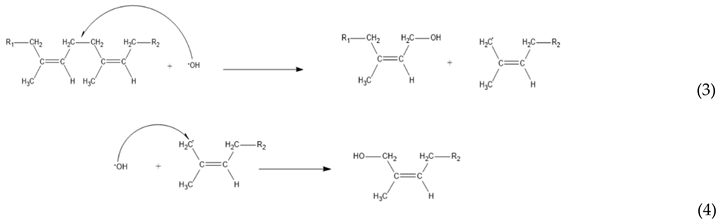
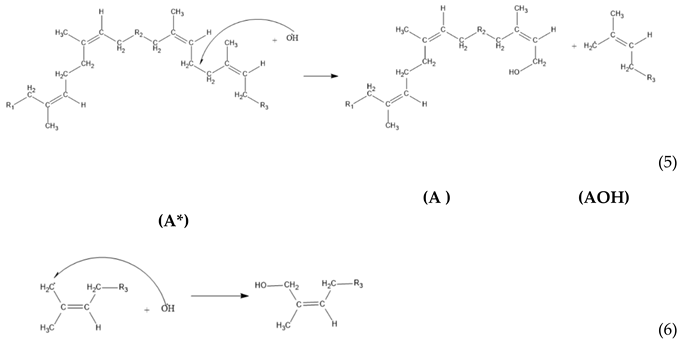
The reaction mechanism was not developed enough to illustrate the production of HTNR, which can be developed further by introducing the HTNR production reaction. Model of Liquid Deproteinated Natural Rubber (DPLNR) [A] reacted with OH radicals generated from Fenton Reaction. The hydroxyl radicals attack the Cα site (-CH2-CH2-), with the site of lower steric hindrance is preferred to produce one sided hydroxyl terminated natural rubber structure [AOH], and CH2 radical structure [A*] which will be terminated with OH radicals resulting another one-sided hydroxyl terminated natural rubber structure [AOH].
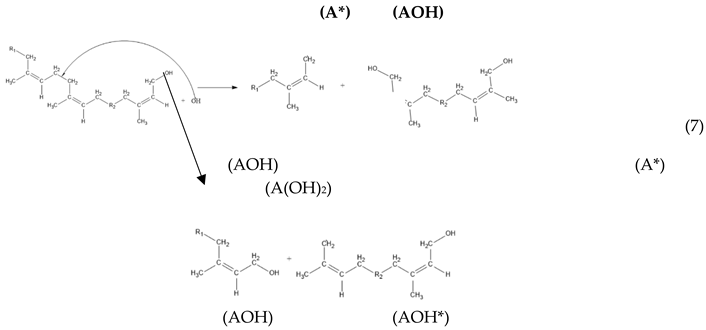
Structure [AOH] which has one sided hydroxyl group in termination reacted further with hydroxyl radicals. We proposed two reaction pathways, which resulting a one-sided hydroxyl terminated natural rubber structure [F] similar from previous reaction and a two-sided hydroxyl terminated natural rubber structure [H]. The difference of reaction pathways is the radical formation [AOH*] and [A(OH)2] which may influence the characteristic of the two-sided hydroxyl terminated natural rubber structure.

Hydroxyl radical (OH*) was produced by decomposition of H2O2 under radiation of ultraviolet from mercury lamp [16], sunlight [17] and catalyzation by Fenton agent under ultraviolet radiation in acidic solution [18]. The rate constant of hydroxyl radical production was growing to 1,000-10,000 times in the presence of Fenton catalyst [18]. Hydroxyl radical attack on natural rubber (A) resulting to a radical polymer structure (A*) and hydroxylated polymer (AOH) with rate reaction constant of . Radicalized polymer will react with hydroxyl radicals to produce a hydroxylated polymer with rate of reaction of . Depolymerization reaction will occur continuously until the hydroxyl radical was depleted or a termination process occurred. The depolymerization equation of natural rubber followed equation (9) and (10). Rate equation of depletion of reacting polymer (A) will follow a second order reaction and presented in equation (11), which the concentration of hydroxyl radical is excessive. [27].
Formation rate of polymer radicals [A*] is steady against time which could be assumed the concentration is constant . The rate of radical polymer [A*] formation is presented with equation (12), while the rate of hydroxylated natural rubber [AOH] was depicted in equation (13).
Referring to equation (13), the kinetics of depolymerization reaction of natural rubber is sufficiently represented by equation (11). Differential equation (11) with natural rubber’s initial concentration of [A]o with time from 0 to t could be solved as equation (14). The value of reaction rate could be obtained by using the data of concentration of natural rubber [A] against time.
The equation reaction (14) could not properly explain the changes in hydroxyl functionality during the depolymerization of NR polymer to HTNR. The equation of reaction could be solved by presenting the formation phase of Hydroxylated Terminated Natural Rubber from NR polymer, which will be written as equation (15) to equation (19). At the initial phase, natural rubber is reacting with hydroxyl radical to form polymer radical [A*] and a hydroxylated polymer [AOH] with reaction rate constant of . The polymer radical will react further with another hydroxyl radical to form a new hydroxylated polymer [AOH] with rate constant of . The hydroxylated polymer will react with hydroxyl radical to form a hydroxylated terminated natural rubber [A(OH)2] and another polymer radical with reaction rate constant of . The hydroxylated polymer could also react with a hydroxyl radical to form a hydroxylated polymer radical [AOH*] and hydroxylated polymer of [AOH] with the rate constant of . The radical of hydroxylated polymer [AOH] will undergoes a termination reaction with a hydroxyl radical to form a hydroxylated terminated natural rubber [A(OH)2] with rate constant of .
Reaction of hydroxyl radical with reactant [A] is second order reaction with the rate equation is similar to equation (13)-(14) with rate constant of reaction is . The equation of reactant depletion rate is depicted with equation (21).
Polymer radical [A*] concentration is relatively constant during the depolymerization, thus the change in rate of polymer radical formation is equal to zero. Concentration of polymer radical is derived in equation (22). The concentration of hydroxylated polymer radical [*AOH] is also relatively constant, with the change in the rate of hydroxylated polymer radical formation is zero as presented in equation (24).
The change in growth of concentration of the hydroxylated polymer (AOH) was represented in equation (26). Substituting equation (26) into equation (25) and (24) resulting equation (27). The value of [AOH] concentration is a function of concentration of [A] with rate constant of .
By combining equation (27) with equation (21) resulting equation (28), with the solvation of differential equation (28) under the initial condition as boundary [A]o, [AOH]o, and reaction time of 0 to t resulting equation (29).
The change in rate of formation of hydroxylated terminated polymer was presented in equation (30). The incorporation of equation (25) and (26) into equation (30) resulted in equation (31) with . Substitution of equation (25) into equation (30) resulting in equation of [A(OH)2] as function of [A]. The solution to differential equation of (31) by initial condition as boundary [A]o, [AOH]o and [A(OH)2]o from time 0 to t resulted in equation (33).
According to equation (25), the value of reaction rate is obtained from the slope of 1/[A]-1/[A]o plotted against reaction time (t). If the concentration of hydroxylated polymer of [AOH] and [A(OH)2] was measured in any given time, then the value of (k34/k1) was obtained from the relationship of plotted against . The value of could be determined from the calculated value of and .
The equation of reaction could be simplified into equation (13), (15) and equation {34} to be solve the reaction kinetics.
Hydroxyl functionality value could be determined by using the value of hydroxylated polymer [AOH] which had functionality of 1 and [A(OH)2] with functionality score of 2 as depicted in equation (35).
The average of molecule weight of polyurethane could be calculated by using a Stockmayer equation [22,28]. The molecular weight average of number of polymer depolymerisation could be calculated using equation (36), which the mole fraction of initial polymer nA, the weight average of polymer MA, functionality fA, and the converted fraction pA.
The influence of reaction temperature against reaction rate constant was studied by observing reaction temperature variation toward changes in reaction rates [48, 49,50]. The relationship of reaction temperature with reaction rates of and followed Arrhenius equation (38) and (39) with A1 and A34 are frequency factor, Ea1 and Ea34 are activation energies, with R is ideal gas constant and T is reaction temperature. By plotting the value of ln(k) against (-1/T) the activation energy values of Ea1/R and Ea34/R could be derived.
3. Results and Discussion
3.1. HTNR Characterization
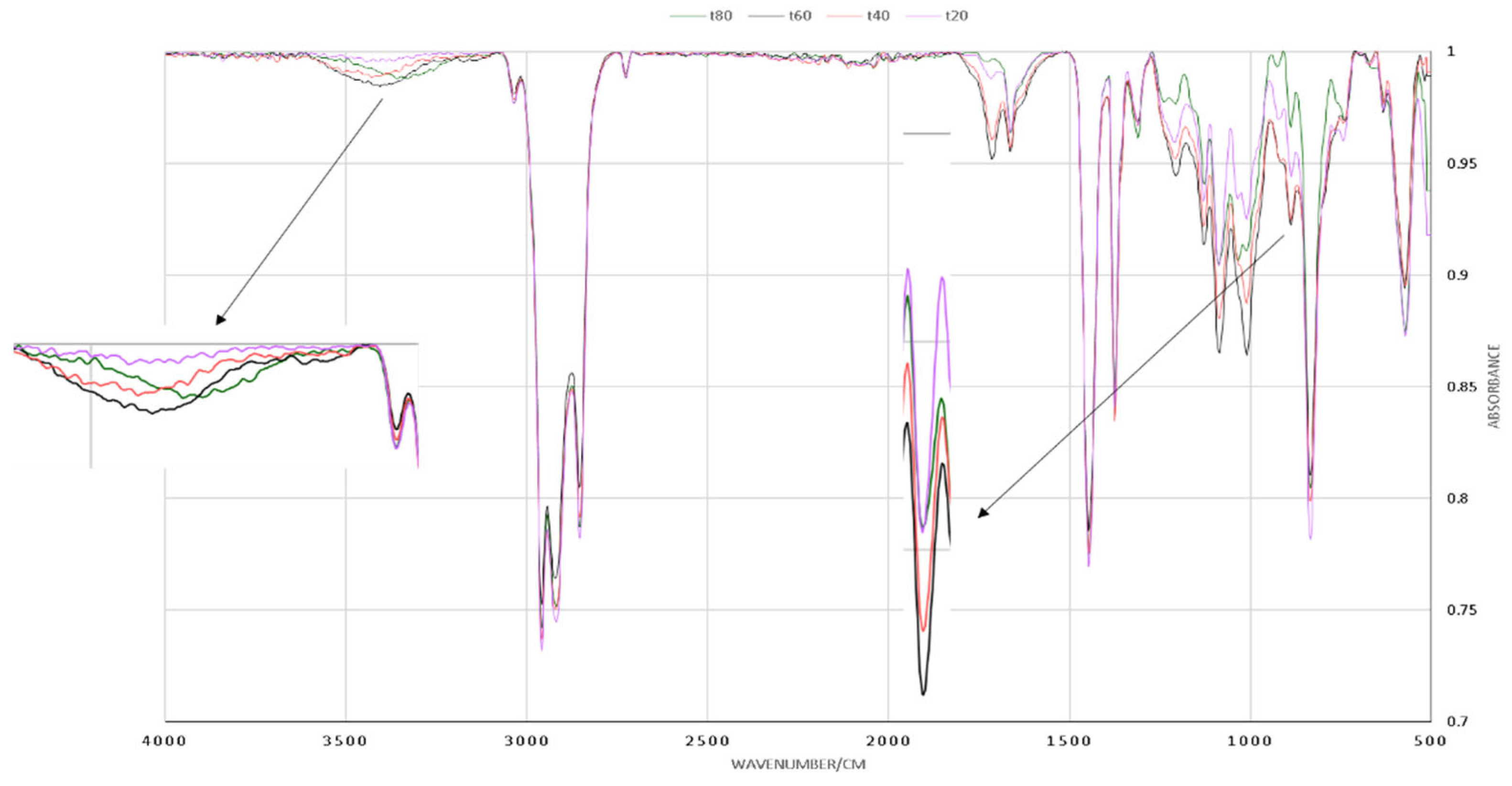
Infrared spectra of HTNR product and NR under reaction temperature of 30, pH system of 2, concentration of [H2O2] was 2M, ratio of [H2O2]/[Fe2+] was set at 1.5, while the ratio of [A]/[H2O2] is equal to 5 and irradiated under UV lights of 320 Watt for 80 hours radiation time {t80) was presented by Figure 3.1.
Figure 3.1.
NR and HTNR infrared spectra under specific reaction conditions.
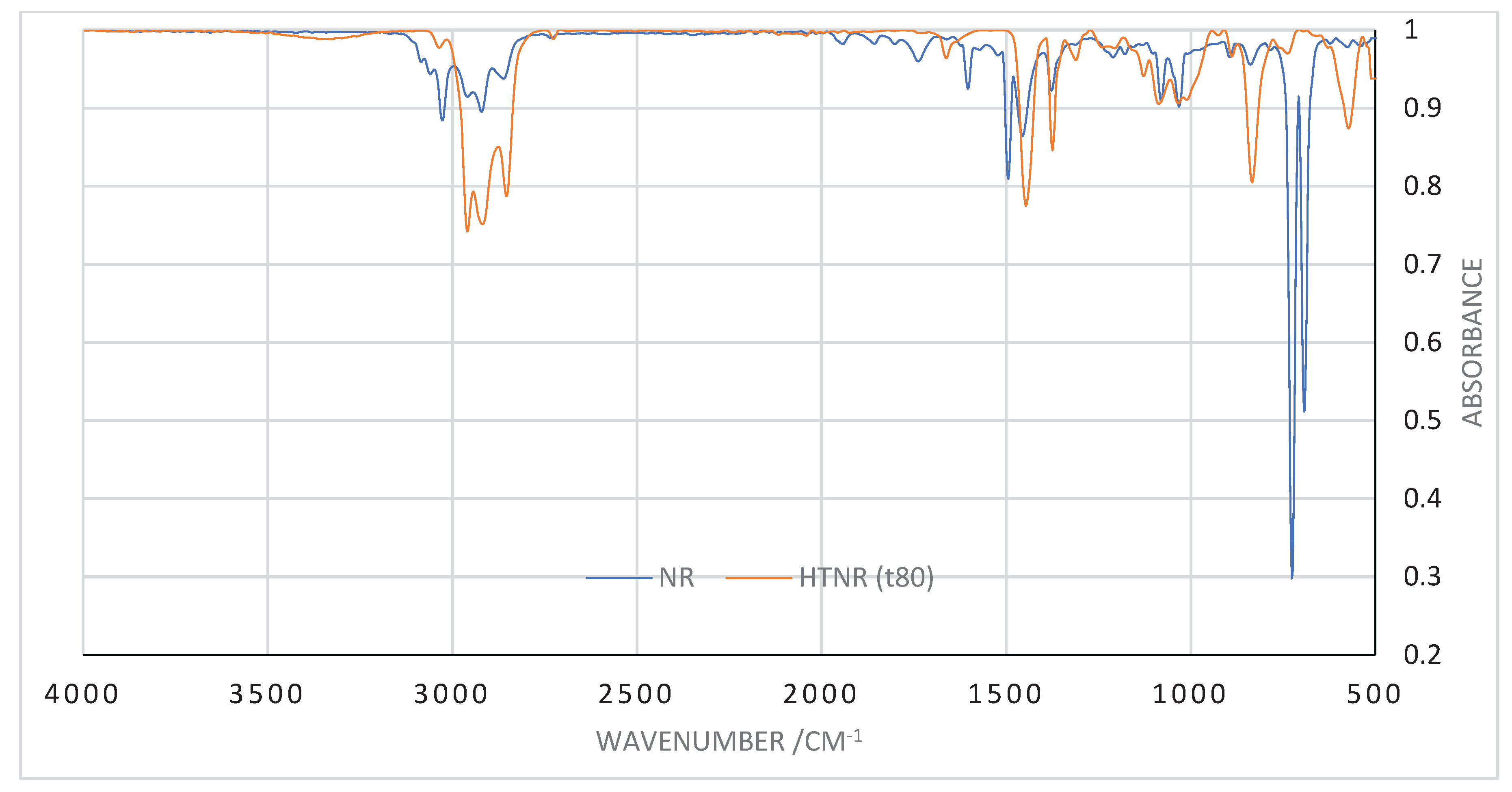
The following absorption on IR spectra, both HTNR and NR show the absorption in 3040-3032 cm–1 (m), 2980-2958 cm–1 (s), 2862 cm–1 (s), 2726 cm–1 (s) (C-H str.); 1661 cm–1 (m, C=C, cis-vinylene); 1446 cm-1 (s), 1377 cm–1 (s) (C-H def.); 891 cm–1 (m, -CH3 def.); 830 cm–1 (s, C-H out of plane def. in –CHR=CCR1) as major IR absorption band characteristics for cis-1,4-polyisoprene (cis-1,4-PIP) [12,16,18]. The HTNR product is characterized by a broad absorption band at 3600 - 3400 cm–1, characteristic of OH stretching vibration; an absorption band at 1310 cm–1 (m, C-O str., aliphatic primary alcohol). Meanwhile, the presence of other groups on the LNR chains prepared in neutral and alkaline media can be attributed to the appearance of carbonyl peaks (C=O) at 1720 cm 1 for ketone and 1739 cm 1 for aldehyde, respectively. The chain breaking of NR at the carbon–carbon single bond is usually due to an attack of radicals and leaving a hydroxyl end group. In contrast, an oxidizing agent can oxidize the broken carbon–carbon double bond in the NR chains to leave a carbonyl end group [27,29].
Spektra 1H-NMR dan 13C-NMR dalam CDCl3 pada 30oC HTNR yang diperoleh dengan waktu reaksi 20 jam dengan [H2O2]=2M, rasio [H2O2]/[Fe2+]=1.5, dan rasio [A]/[H2O2]=5, pH=2, radiasi UV 320 Watt ditunjukkan pada gambar 2 dan 3. Hasil spectra 1HNMR: d = 1.679 p.p.m. [s; -CH3 (5), 3H]; d =2.042 p.p.m. [brs; -CH2-(1) and -CH2-(4), 4H]; d = 5.125 p.p.m. [m; CH (3), 1H]. Minor peak muncul pada d = 1.254-1.611 ppm menunjukkan adanya produk samping. Peak minor juga ditunjukkan pada d=2.69 ppm menunjukkan terjadinya epoxy group (Pham, Ravindran). Sinyal proton hydroxyl dalam gugus hydroxymethyl tidak muncul pada d=4.0ppm sampai 4.2 ppm.
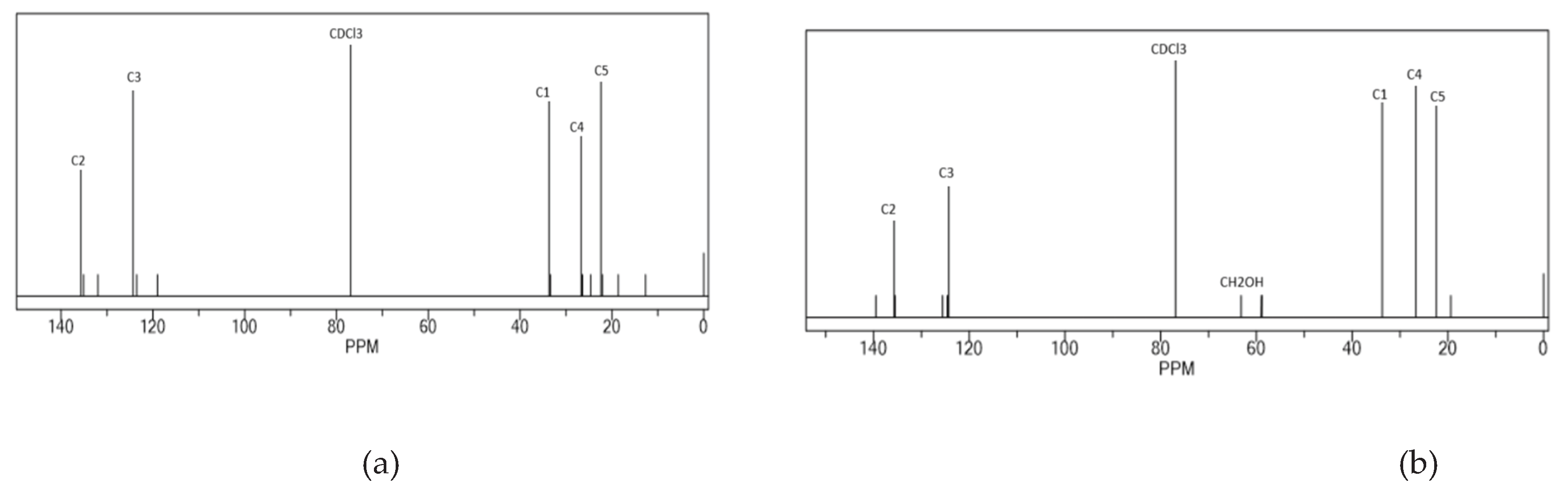
Spektrum 13C-NMR menunjukkan adanya cis-1,4-PIP at the following positions: C1: d = 32.23 p.p.m.; C2: d = 135.16 p.p.m.; C3: d = 125.03 p.p.m.; C4: d = 26.38 p.p.m.; C5: d =23.4 p.p.m. Peak minor muncul pada d = 78.39, 76.98 and 75.57 p.p.m. due to CDCl3 dan d = 60.847 and 64.540 p.p.m. could be due to a-carbons attached to the hydroxyl groups in structures like (I) and (II) (Ravindran, Pham). The allylic hydroxyl protons in the 1H-NMR spectra were masked by the multiples at d = 5.125 p.p.m. of the >C=C-H protons (Equation 9). Several minor peaks could also be observed at d from 2.00 to 3.53 p.p.m. in the 13C-NMR spectrum of HTNR (Figure 3b), indicating the probable side products due to the formation of epoxy group. Adanya gugus hidroksil dari CH2-OH ditunjukkan adanya the peaks at d =60.847 p.p.m. and 64.540 p.p.m. yang merupakan characteristic of the a-carbons of allylalcohol in the 13C-NMR spectrum of HTNR suggest the terminal hydroxyl groups in the product. The allylic hydroxyl protons in the 1H-NMR spectra were masked by the multiples at d = 5.125 p.p.m. of the >C=C-H protons. All the other signal characteristics for both NR and HTNR were observed in the 1H-NMR spectrum (Figures 2a, b): d = 5.08 p.p.m., (=CH); d = 2.00 p.p.m., (-CH2-); d = 1.67 p.p.m., (-CH3 ), as well as in the 13C-NMR spectrum (Figure 3): d = 135.012 p.p.m., (C2 atom); d = 124.900 p.p.m., (C3 atom); d = 32.216 p.p.m., (C1 atom); d = 26.409 p.p.m., (C4 atom); and d = 23.433 p.p.m., (C5 atom). Further evidence was the fact that there was no observed change in the absorption band of the isoprene unit, i.e. at 836 cm-1 in the FTIR spectrum.
Figure 3.1.
H-NMR Spectra of (a) NR and (b) HTNR, prepared by photo-Fenton process.
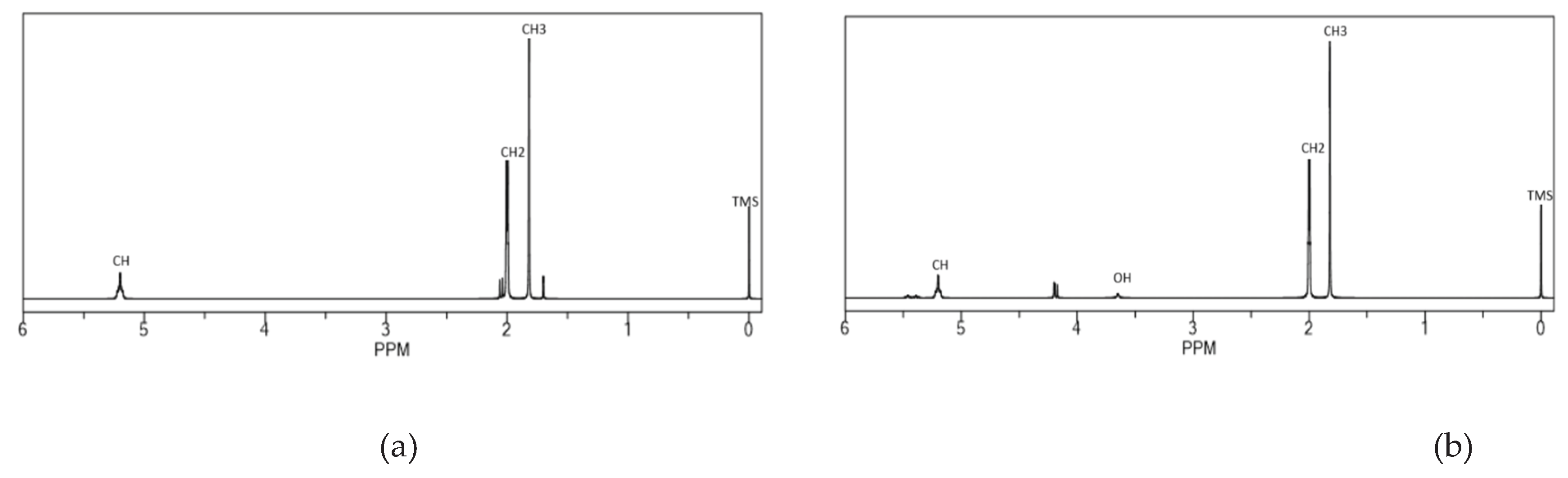
Figure 3.2.
C-NMR Spectra of (a) NR and (b) HTNR, prepared by photo-Fenton process.
3.2. Penggunaan Serapan Infra Merah Untuk Analisis Depolimerisasi
Kinetika reaksi depolimerisasi dipelajari dengan melihat absorption spesifik dari HTNR dan NR. Pembentukan gugus hidroksil dapat dikarakterisasi dengan absorption O-H pada panjang gelombang 3400cm-1. Pengurangan polimer yang terjadi melalui pemecahan ikatan CH2-CH2 yang ditunjukkan dengan pengurangan serapan tajam pada panjang geombang 830cm-1. Peak pada panjang gelmbang 1610 terlalu banyak interferensinya. Sebagai referensi, maka dapat digunakan ikatan methyl CH3 pada panjang gelombang 2980 cm-1 yang relatif tetap (tidak berubah). Untuk kepentingan kinetika reaksi, maka digunakan perubahan absorption pada panjang gelombang 830cm-1 untuk pengurangan reaktan, panjang gelombang 3400cm01 untuk jumlah gugus hidroksil total setiap waktu. Konversi reaktan yang berkurang dihitung dengan persamaan (1).
Hasil pengamatan perubahan spektra pada Panjang gelombang 830cm-1, 2980cm-1, dan 3400cm-1 setiap 20 jam untuk reaksi depolimerisasi NR dengan hidrogen peroksida dengan [H2O2]=2M, rasio [H2O2]/[Fe2+]=1.5, dan rasio [A]/[H2O2]=5, pH=2, radiasi UV 320 Watt selama 80 jam (t80) ditampilkan pada gambar 2. Terdapat perubahan peningkatan konsentrasi gugus hidroksil [OH] pada panjang gelombang 2400cm-1 secara signifikan, dan penurunan konsentrasi reaktan [A] dengan penurunan absorption gugus methylen pada panjang gelombang 830cm-1 secara signifikan. Jumlah gugus methil pada panjang gelombang 2980cm-1 terlihat konstan, sehingga bisa digunakan sebagai absoption referensi.
Gambar 2.
Penurunan konsentrasi CH2-CH2 dan kenaikan konsentrasi CH2-OH pada panjang gelombang 830cm-1 dan 3400cm-1 reaksi depolimeriasasi NR dengan H2O2/Fenton.
Gambar 2.
Penurunan konsentrasi CH2-CH2 dan kenaikan konsentrasi CH2-OH pada panjang gelombang 830cm-1 dan 3400cm-1 reaksi depolimeriasasi NR dengan H2O2/Fenton.
3.3. Kinetika reaksi pembentukan HTNR
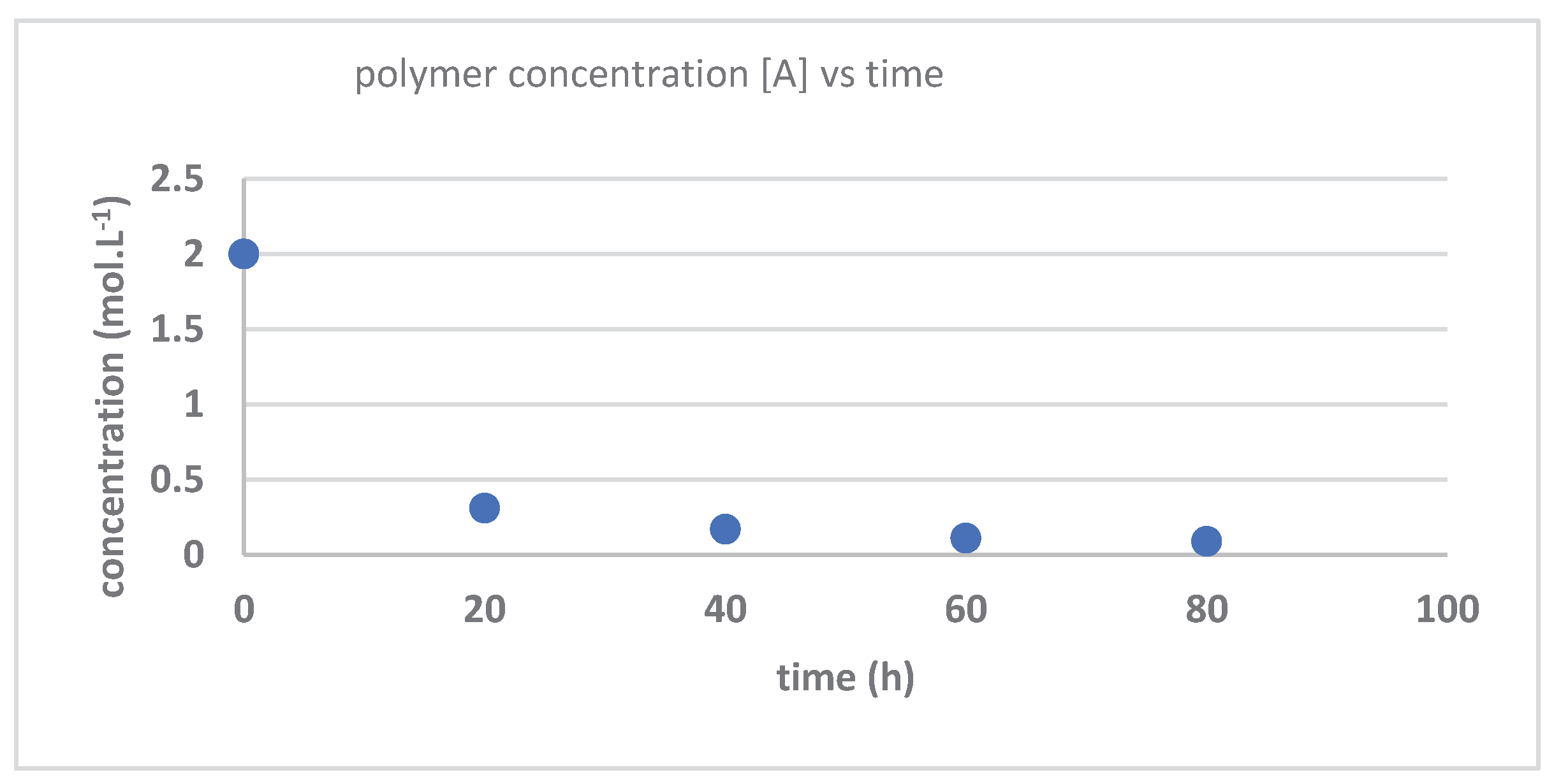
Perubahan konsentrasi polimer [A] terhadap waktu ditampilkan pada gambar 4-1. Konsentrasi polimer turun seiring waktu, kemudian penurunan menjadi relatif kecil setelah 60 jam reaksi depolimerisasi dengan konversi di atas 90%. Reaksi dikondisikan dengan gugus hidroksil berlebihan, sehingga tetapan reaksi pembentukan gugus hidroksil tidak dipelajari.
Gambar 4.1.
Perubahan konsentrasi [A] terhadap waktu pembuatan HNR.
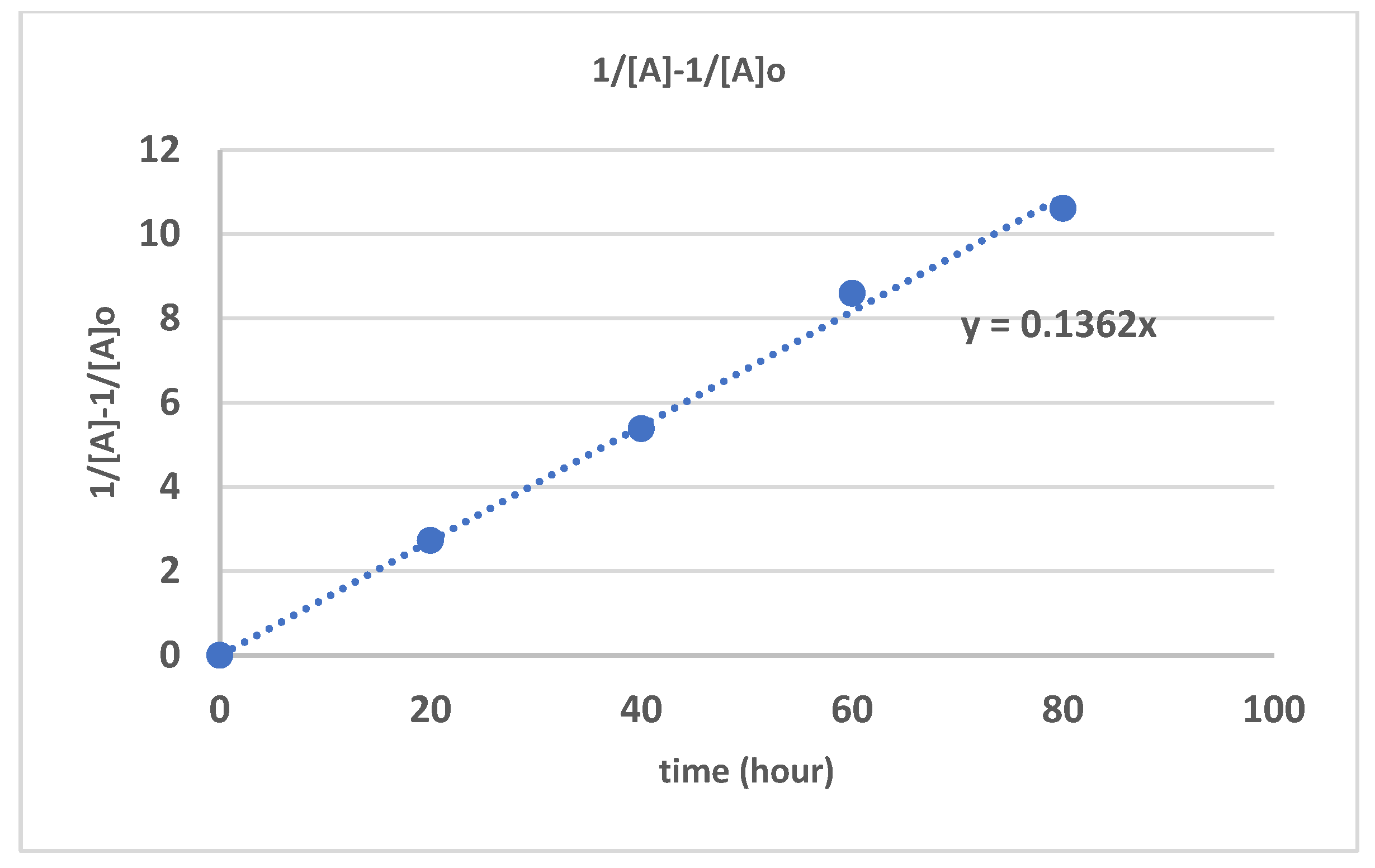
Reaksi penurunan konsentrasi polimer [A] mengikuti reaksi order 2 ditunjukkan dengan grafik 1/[A]-1/[A]o terhadap waktu dalam bentuk garis lurus. Reaksi depolimerisasi polimer dengan radikal hidroksil merupakan reaksi order 2 seperti hasil serupa dari reaksi depolimerisasi natural rubber dengan hydrogen peroksida pada suhu tinggi (Grishchenko, 1992)), radiasi UV (Ravindran 1986), dan penambahan katalis NaNO2 (Arayaprane, 2023). Grafik hubunan 1/[A]-1/[A]o terhadap waktu sesuai persamaan (3-13) ditunjukkan pada gambar 4.2. Nilai k1 diperoleh dari slope grafik tersebut. Nilai k1 terhitung adalah 0.01356 L.mol-1.s-1.
Gambar 4.2.
grafik hubungan 1/[A]-1/[A]o terhadap waktu.
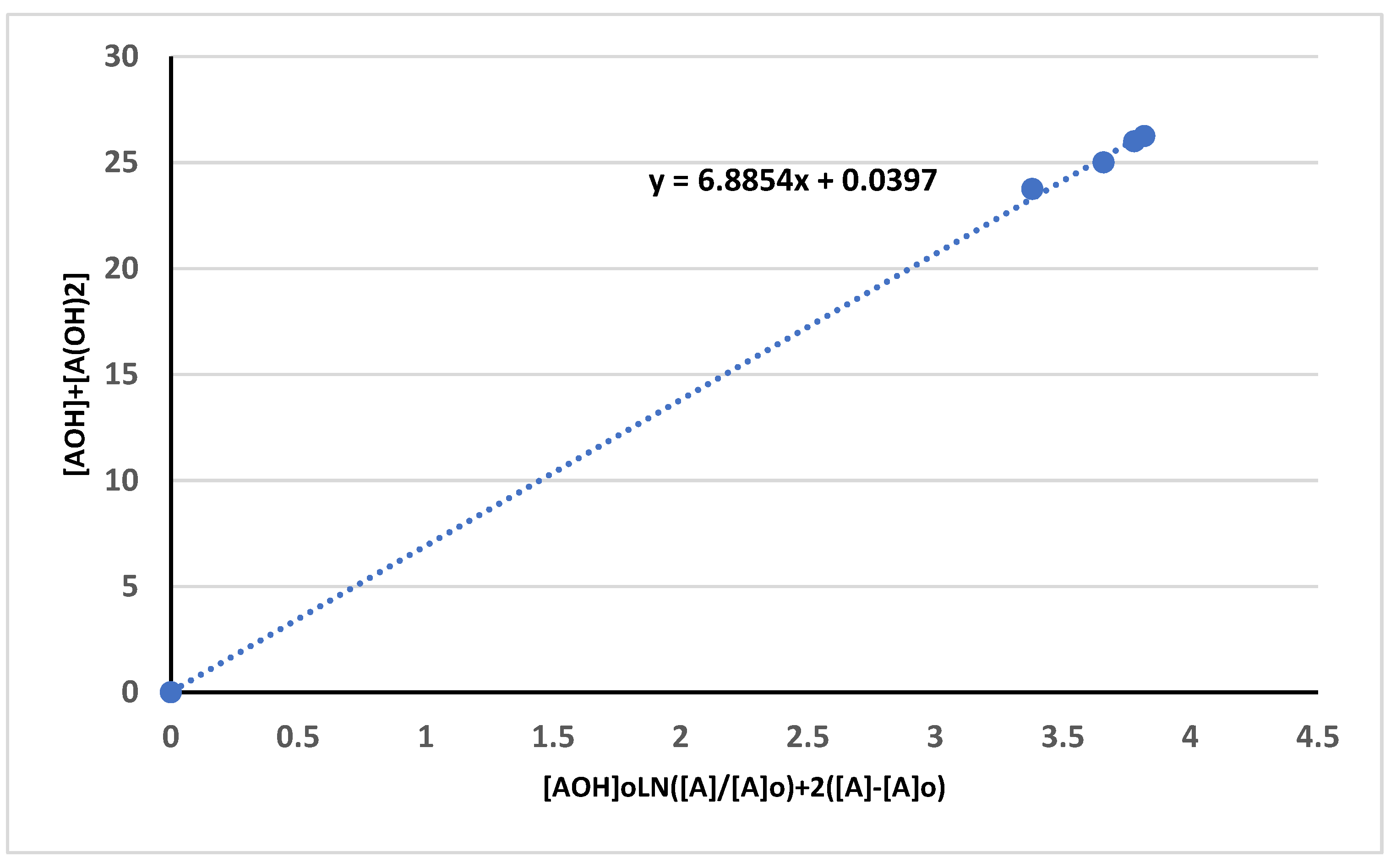
Rasio tetapan kecepatan reaksi degradasi AOH terhadap A (k34/k1) diperoleh dari slope grafik hubungan konsentrasi gugus hidroksil terukur [AOH]+[A(OH)2] terhadap [AOH]o Ln([A]/[A]o)+2([A]-[A]o) seperti ditunjukkan pada gambar 4.3 mengikuti persamaan (3-24). Berdasarkan nilai (k34/k1) terhitung, maka nilai k34 terhitung adalah 0.9337 mol.L-1.s-1. Nilai k34>k1 menunjukkan bahwa sebagian besar AOH bereaksi dengan hidroksil membentuk hydroxylated terminated natural rubber (HTNR). Dengan demikian, maka produk dominan adalah HTNR.
Gambar 4.3.
Grafik hubungan [AOH]+[A(OH)2] terhadap [AOH]o Ln([A]/[A]o)+2([A]-[A]o).
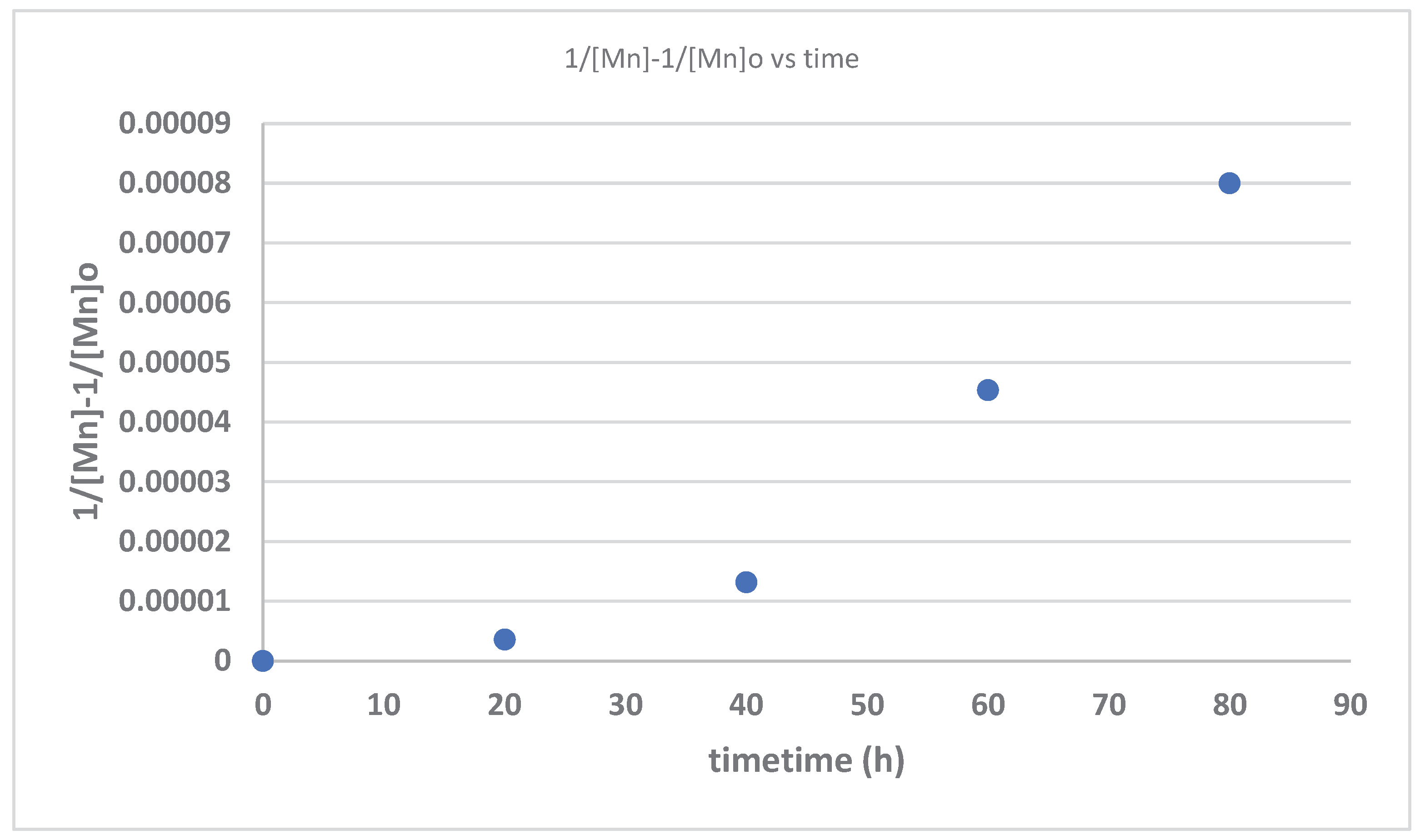
Perubahan berat molekul rata-rata jumlah (Mn) dan berat molekul rata-rata berat (Mn) hasil pengukuran dan simulasi persamaan (3-27) ditampilkan pada gambar 4.4. Hasil pengukuran dan simulasi memiliki kecenderungan yang sama. Kesalahan estimasi sebesar 2,7%. Hasil tersebut memiliki kemiripan tren dengan percobaan Ravindran, Parmenant (2023), dan Pham (2015) dimana nilai penurunan berat molekul tidak linier. Hasil penurunan dengan basis reaksi order 2, menunjukkan penurunan 1/[Mn]-1/[Mn]o terhadap waktu tidak memberikan garis linier juga (nilai kelurusan 0.820). Hasil tersebut semakin menguatkan hipotesis bahwa terbentuk reaksi pembentukan hydroxylated terminated natural rubber.
Gambar 4.4.
Grafik hubungan 1/[Mn]-1/[Mn]o vs time.
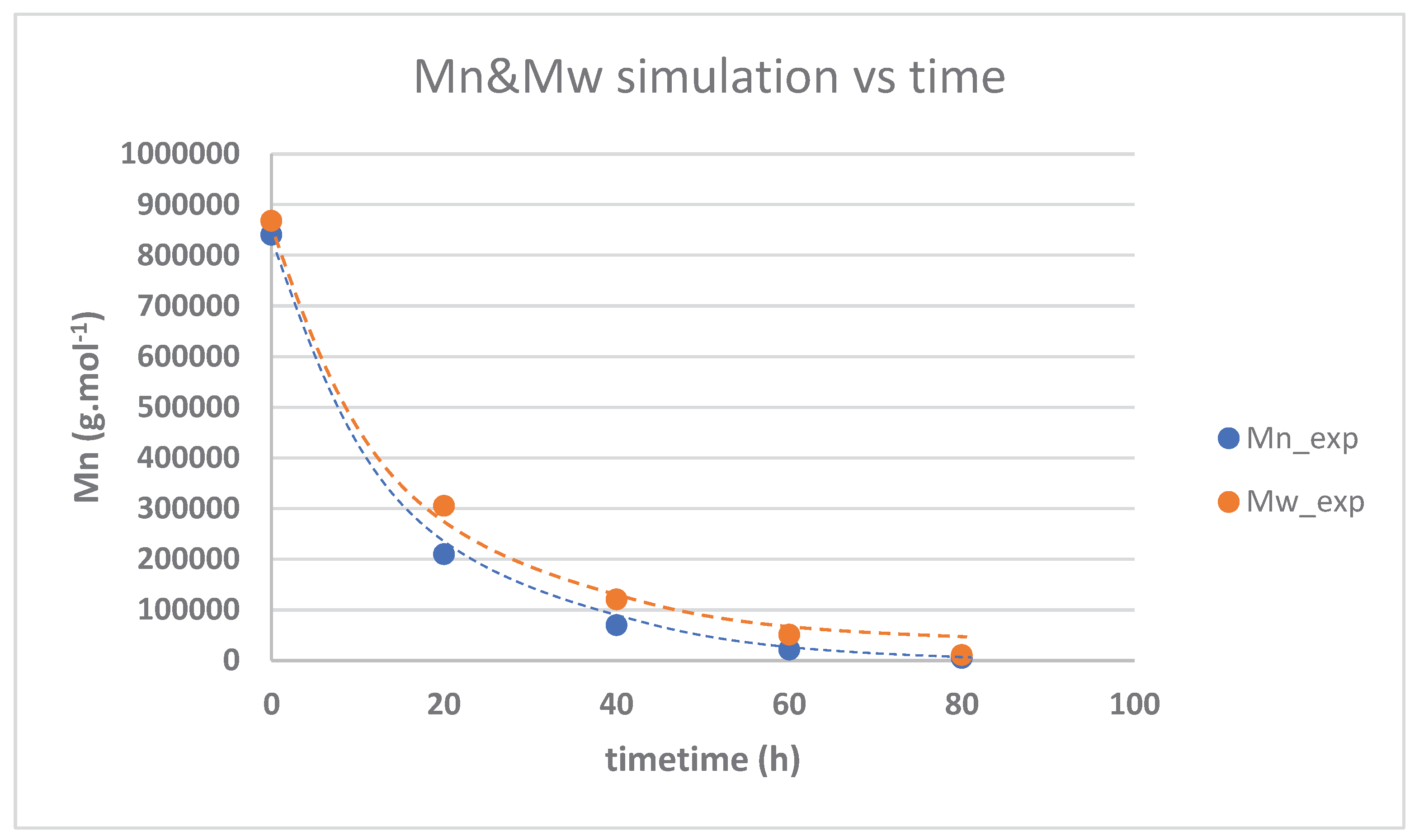
Hasil simulasi berat molekul rata-rata berat dan berat molekul rata-rata jumlah setiap waktu dan hasil pengukuran ditunjukkan pada gambar 4.5. Hasil simulasi menunjukkan nilai yang selalu sedikit di bawah dari nilai hasil eksperimen. Tren tersebut mendekati hasil percobaan dari Ravindran maupun Pham. Nilai PDI (polymerization degree index) menunjukkan nilai sekitar 2, seperti ditunjukkan pada table 4.1. Nilai PDI semakin meningkat seiring dengan waktu.
Gambar 4.5.
Grafik hubungan Mn dan Mw terhadap waktu dan hasil simulasinya.
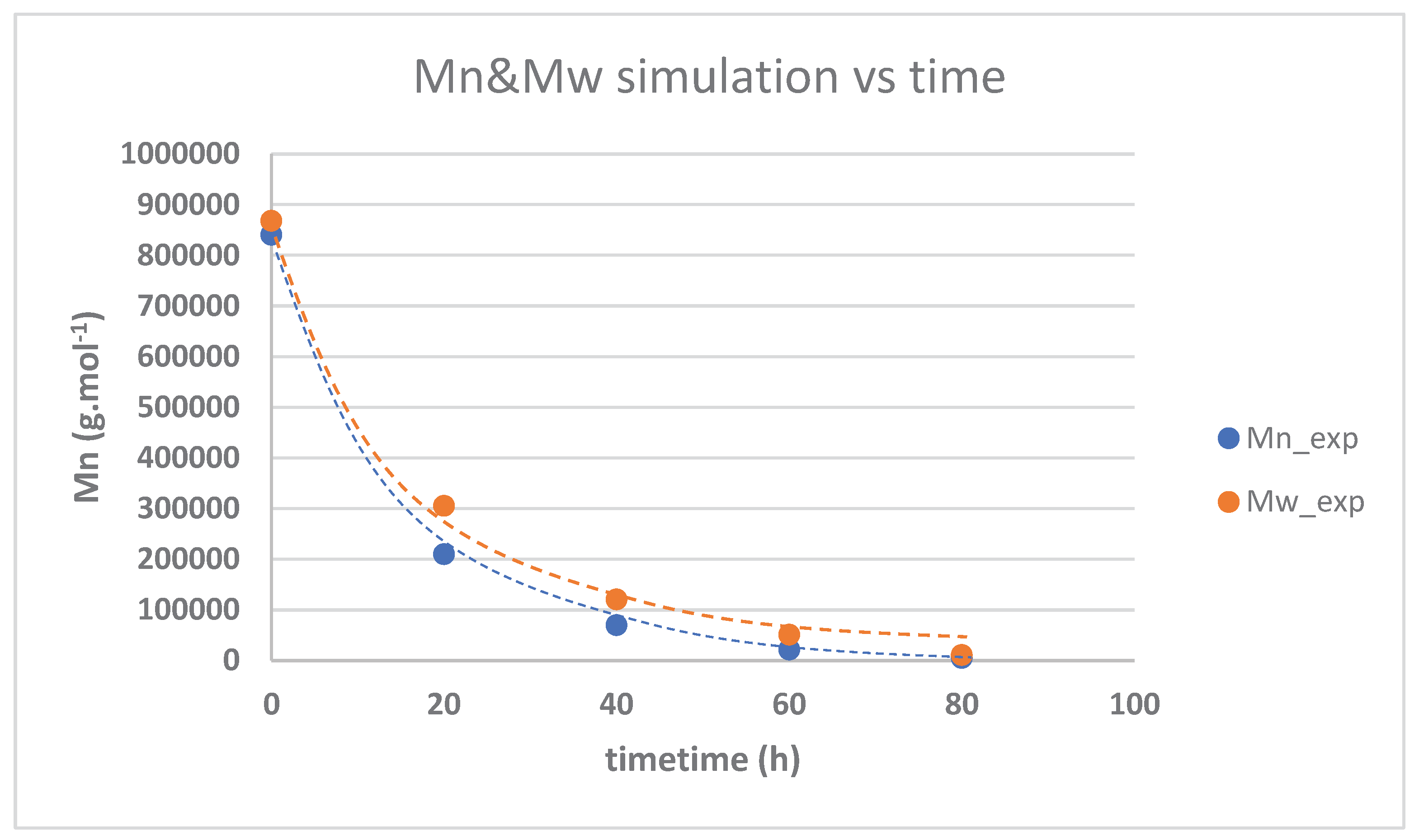

Table 4.1.
PDI of HTNR.
| Time (hours) | Mn_exp | Mw_exp | 1/[Mn}-1/[Mn]o | PDI |
| 0 | 840000 | 868000 | 0 | 1.033333 |
| 20 | 210000 | 305100 | 3.57E-06 | 1.452857 |
| 40 | 69700 | 120500 | 1.32E-05 | 1.728838 |
| 60 | 21500 | 51000 | 4.53E-05 | 2.372093 |
| 80 | 5300 | 11100 | 0.00008 | 2.09434 |
Gambar 4.5.
Profile berat molekul rata-rata hasil pengukuran dan simulasi terhadap waktu.
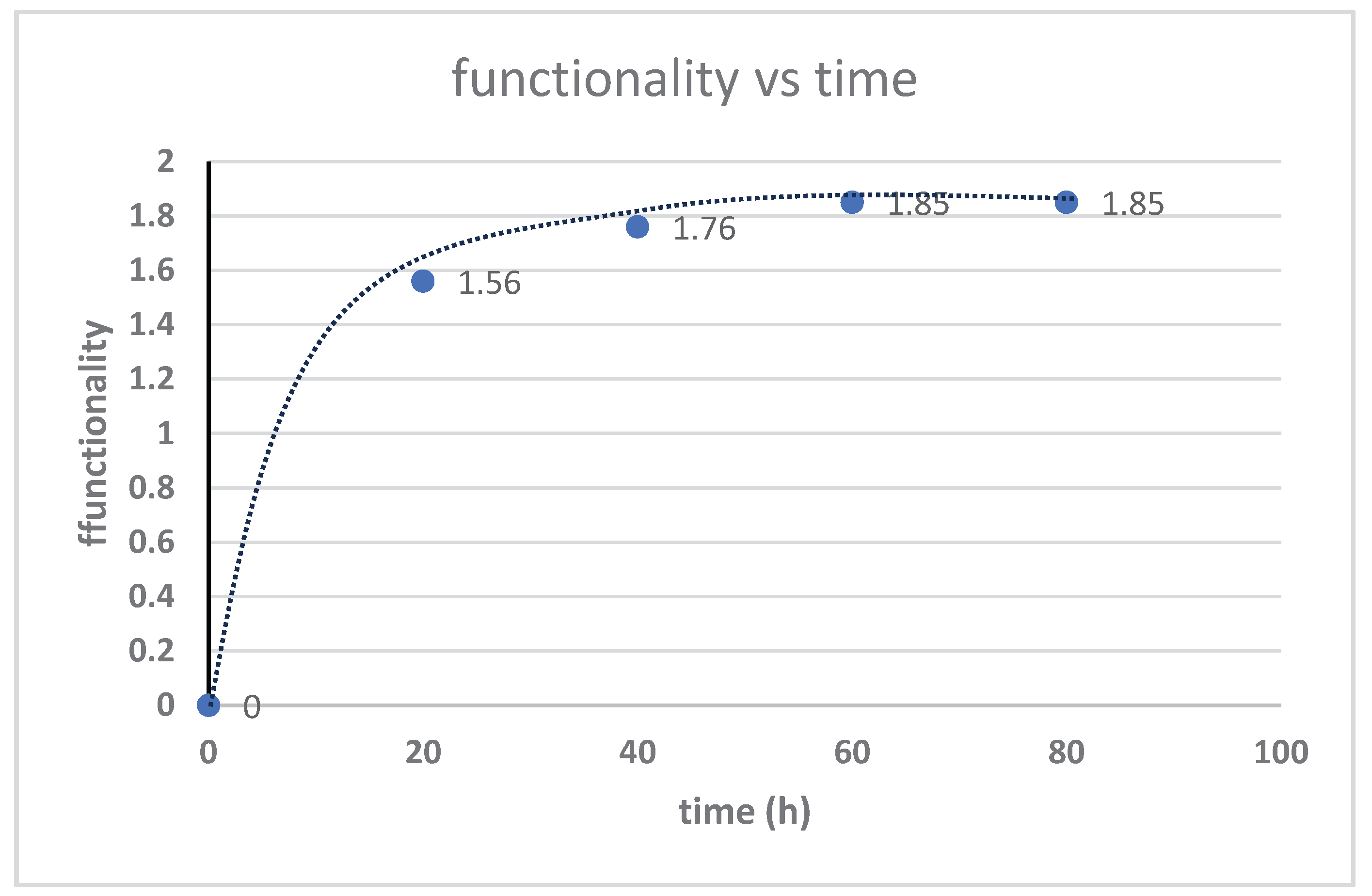
Fungsionalitas HTNR dihitung menggunakan persamaan (3-27), grafik hubungnan fungsionalitas simulasi dan hasil pengukuran ditampilkan pada gambar 4.6. Nilai hasil pengukuran lebih rendah daripada hasil simulasi dengan tingkat kesalahan 2%. Nilai fungsionalitas dapat didekati dengan model kinetika tersebut sangat baik.
Gambar 4.6.
fungsionalitas hidroksil terhadap waktu.
3.4. Pengaruh Suhu Reaksi
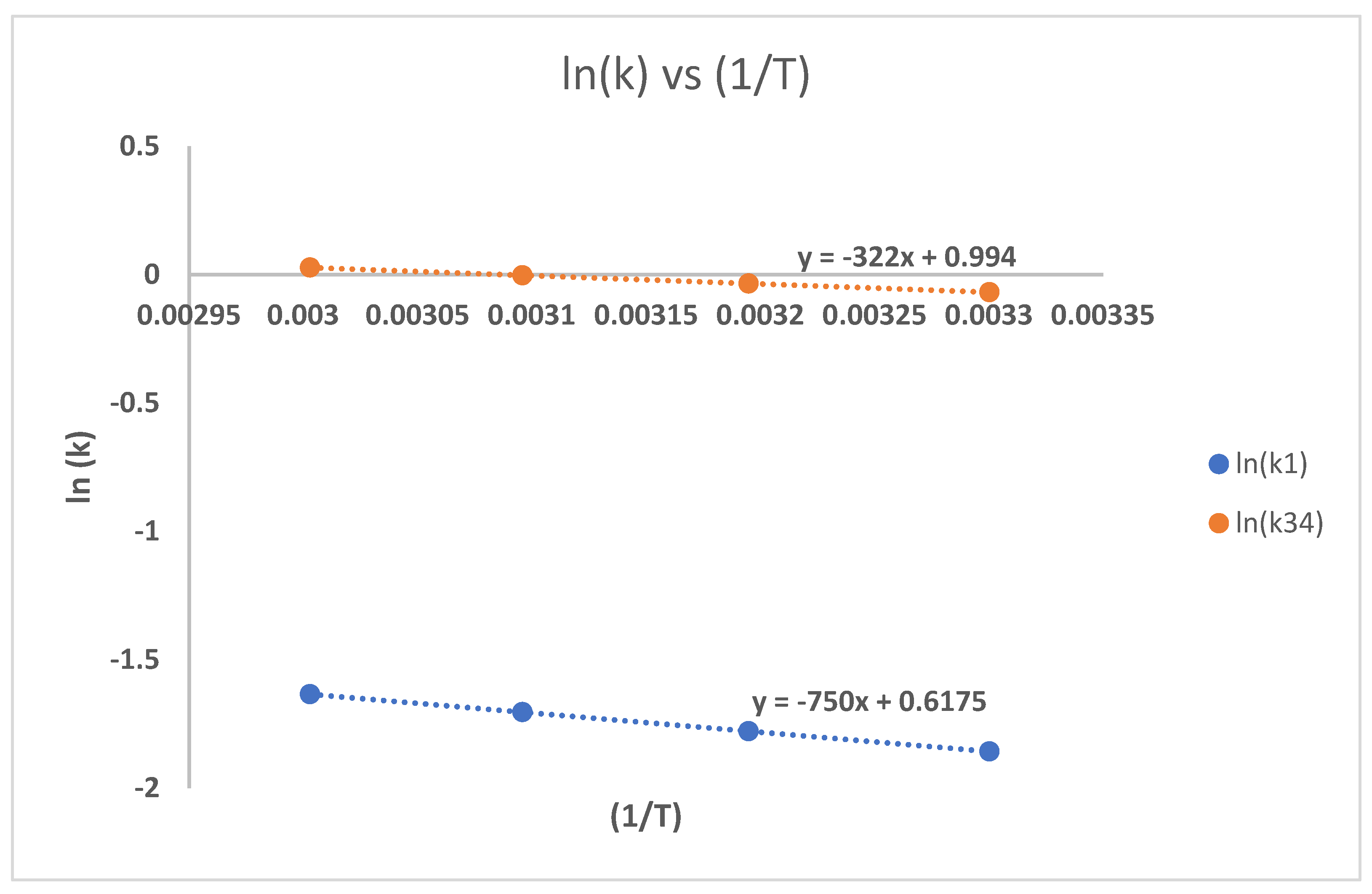
Pengaruh suhu reaksi terhadap tetapan kecepatan reaksi pembentukan HTNR dipelajari dengan menggunakan variasi suhu reaksi 30, 40, 50, dan 60oC dengan parameter lain tetap [H2O2]=0.2M, [H2O2]/[Fe(II)++]=1.5, pH=2.5, and [H2O2]/[A]=1.5. Nilai k1 dan k34 diperoleh dari grafik 1/[Mn]-1/[Mn]o terhadap waktu dan [AOH]+[A(OH)2] terhadap [AOH]o Ln([A]/[A]o)+2([A]-[A]o). Hasil perhitungan nilai k1 dan k34 digunakan untuk membuat grafik hubungan ln k terhadap (-1/T) seperti ditunjukkan pada gambar 4.7. Nilai Energi aktivasi (Ea1/R dan Ea34/R) diperoleh sebagai slope dari grafik tersebut mengikuti persamaan Arhenius (3-28) dan (3-29). Nilai koefisien tumbukan A1 dan A34 merupakan intersep dari grafik tersebut. Nilai Ea1/R, Ea34/R, A1, dan A34 terhitung adalah 750 K dan 1200 K, 1.854, and 2.72. Nilai Ea/R positive menunjukkan bahwa reaksi bersifat eksotermis. Nilai Ea1/R<Ea34/R menunjukkan bahwa reaksi pembentukan radikal lebih cepat daripada reaksi pemecahan AOH. Menurut Pham (2015), reaktivitas radikal hidroksil untuk menyerang ikatan CH2-CH2 lebih besar daripada ikata CH2-CH2 yang terdapat gugus hidroksil, karena elektronegativitasnya lebih bermuatan positive. Bla-bla-bla. Kenaikan k1 dan k34 untuk setiap kenaikan suhu 10 derajat menunjukkan kurang dari dua kali dari nilai k1 dan k34 semula, menunjukkan bahwa reaksi depolimerisasi merupakan reaksi rezim difusi. Difusifitas merupakan tahapan yang menentukan reaksi dan areaksi dianggap reaksi yang cukup cepat.
Gambar 4.7.
grafik hubungan ln (k) terhadap (1/T).
3.5. Pengaruh Rasio Reaktan Dengan Katalis
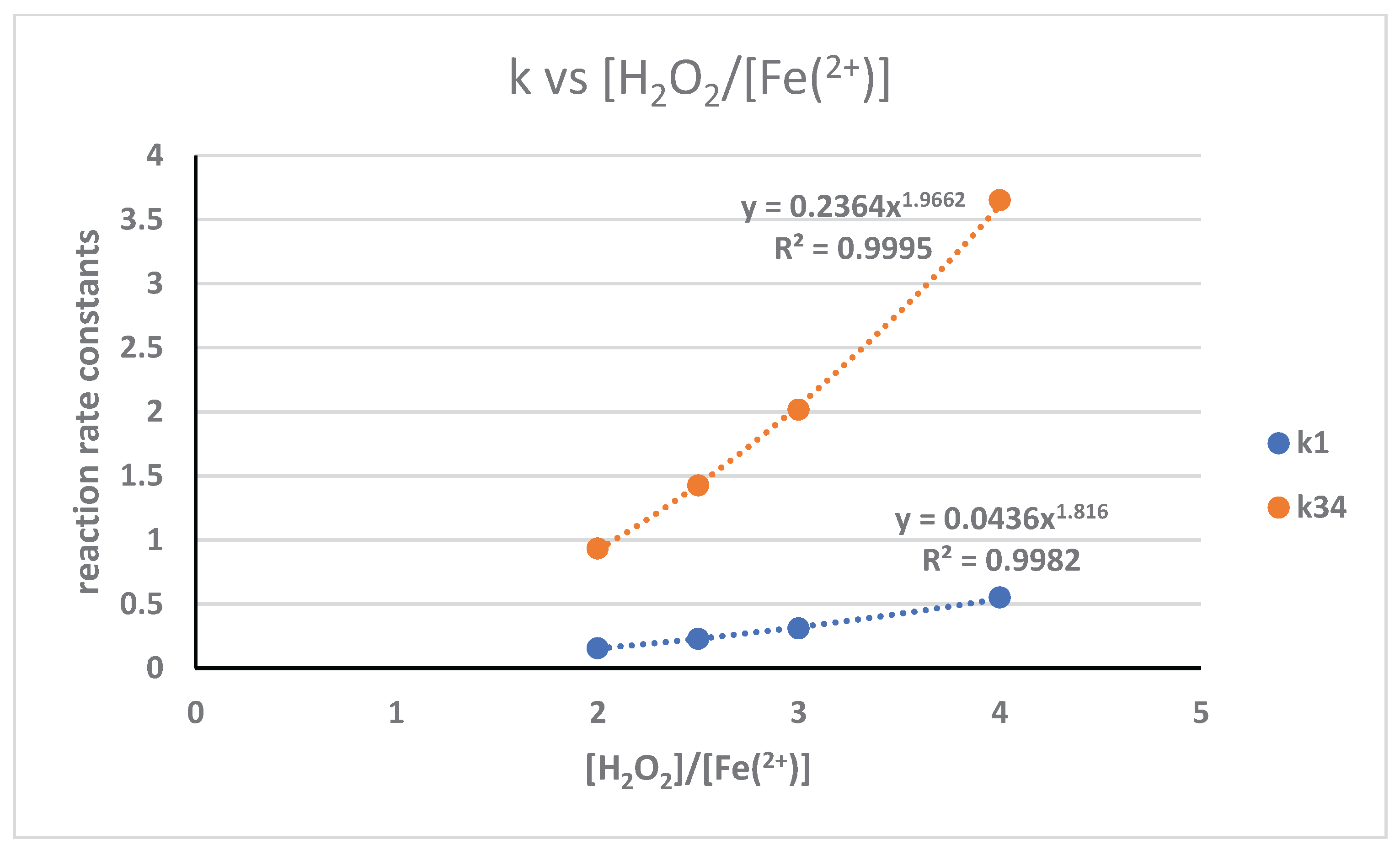
The optimal ratio of [A]/[H2O2] optimal was 1.5 which indicate the excessive presence of hydroxyl radicals (Pham, 2015). Meanwhile the influence of [H2O2]/[Fe(II)] ratio against reaction rate was studied using ratio variation of 1, 1.5, 2.0, and 2.5. The ratio influence of [A]/[H2O2] toward the calculated reaction rate constant was depicted by gambar 4.8. The graph illustrated the relationship of and against [A]/[H2O2] as power equation with the power value of 1.97 against and 1.82 toward . This result is in accordance with Arayaprane works (2023) of similar depolymerization reaction using NaNO2 catalyst, which depict the influence of concentration of H2O2 and NaNO2 against radical production as power equation.
Gambar.
4. Conclusions
In general, the depolymerization reaction kinetics of NR conversion to HTNR using H2O2 under the presence of Fenton catalyst in acidic environment and ultraviolet radiation can be studied using Infrared Spectroscopy to inspect the changes of molecular weight and functionality of HTNR product. HTNR synthesis follow reaction mechanism of: a) hydrogen peroxide react with Fenton in the acid condition produce hydroxyl radical, b) hydroxyl radical is reacted with NR produce radical NR and hydroxylated NR, c) radical NR is reacted with hydroxyl radical produce hydroxylated NR, and d) hydroxylated NR is reacted with hydroxyl radical produce lower radical NR, hydroxylated terminated NR, radical NR, and hydroxylated NR.
Elucidation of product revealing the presence of HTNR with hydroxyl group absorption at wavenumber of 3,400 cm-1. Depolymerization also occurred with the decline of average molecular weight for each period of sample measurement. The NR polymer decline due to conversion to HTNR was observed at absorption band of CH2-CH2 group at 850 cm-1, the value of total hydroxyl produced at 3,400 cm-1 and absorption of CH3 reference group which remain unchanged at 1850 cm-1.
Reaction kinetics was studied by employing an assumption of the excessive hydroxyl concentration. The NR polymer degradation reaction is following reaction order of 2 with rate constant . Hydroxylated natural rubber production reaction was conformed to be first order reaction with rate constant of . The number average of molecular weight (Mn), and weight average of molecular weight (Mw), and OH functionality was matched in satisfactory condition. Reaction rate data of described the conversion reaction of HTNR occurred quickly. The average of functionality is between 1.8 to 1.9 revealed a dominant HTNR production. Reaction reached an optimum rate at 60 hours period which the OH functionality at the maximum value.
The influence of reaction’s temperature against reaction rate followed Arrhenius reaction with activation energy values of and are 750 K and 1200 K. Meanwhile the effect of concentration of H2O2/Fenton is following Fenton reaction with power coefficient of 1.97 against and 1.82 toward .
References
- Nor, H.M.; Ebdon, J.R. Telechelic Liquid Natural Rubber: A Review. Prog Polym Sci 1998, 23, 143–177. [CrossRef]
- Ly, P.H. Reinforcement of Natural Rubber from Hydroxyl-Terminated Liquid Natural Rubber Grafted Carbon Black. I. Grafting of Acyl Chloride Capped Liquid Natural Rubber onto Carbon Black. Journal of Macromolecular Science, Part A 1996, 33, 1931–1937. [CrossRef]
- Sukhawipat, N.; Saetung, N.; Pasetto, P.; Pilard, J.-F.; Bistac, S.; Saetung, A. A Novel High Adhesion Cationic Waterborne Polyurethane for Green Coating Applications. Prog Org Coat 2020, 148, 105854. [CrossRef]
- Gopakumar, S.; Nair, M.R.G. Natural Rubber–Polyurethane Block Copolymers: Nonlinear Structural Variations with NCO/OH Ratio. Polym Eng Sci 2006, 46, 1812–1821. [CrossRef]
- Saetung, A.; Kaenhin, L.; Klinpituksa, P.; Rungvichaniwat, A.; Tulyapitak, T.; Munleh, S.; Campistron, I.; Pilard, J. Synthesis, Characteristic, and Properties of Waterborne Polyurethane Based on Natural Rubber. J Appl Polym Sci 2012, 124, 2742–2752. [CrossRef]
- Tsupphayakorn-aek, P.; Suwan, A.; Tulyapitak, T.; Saetung, N.; Saetung, A. A Novel UV-Curable Waterborne Polyurethane-Acrylate Coating Based on Green Polyol from Hydroxyl Telechelic Natural Rubber. Prog Org Coat 2022, 163, 106585. [CrossRef]
- Panwiriyarat, W.; Tanrattanakul, V.; Pilard, J.-F.; Pasetto, P.; Khaokong, C. Preparation and Properties of Bio-Based Polyurethane Containing Polycaprolactone and Natural Rubber. J Polym Environ 2013, 21, 807–815. [CrossRef]
- Kandil, H.; Abo-Salem, H.M. A Novel Thiourea Based Interfacial Modifier for Silica-filled Natural Rubber Composites. J Appl Polym Sci 2023, 140. [CrossRef]
- Katueangngan, K.; Tulyapitak, Tulyapong.; Saetung, A.; Soontaranon, S.; Nithi-uthai, N. Renewable Interfacial Modifier for Silica Filled Natural Rubber Compound. Procedia Chem 2016, 19, 447–454. [CrossRef]
- Srisuwan, S.; Ruksakulpiwat, Y.; Chumsamrong, P. Physical Properties of Poly(Lactic Acid)/Hydroxyl Terminated Natural Rubber Blends. Macromol Symp 2015, 354, 118–124. [CrossRef]
- Baharulrazi, N.; Mohd Nor, H.; Wan Ali, W.K. Hydroxyl Terminated Natural Rubber (HTNR) as a Binder in Solid Rocket Propellant. Applied Mechanics and Materials 2014, 695, 174–178. [CrossRef]
- Gupta, S.K.; Kurup, M.R.; Devadoss, E.; Muthiah, Rm.; Thomas, S. Development and Evaluation of a Novel Binder Based on Natural Rubber and High-Energy Polyurethane/Composite Propellants. J Appl Polym Sci 1985, 30, 1095–1112. [CrossRef]
- Krishnamurthy, V.N.; Thomas, S. ISRO Polyol- The Versatile Binder for Composite Solid Propellants for Launch Vehicles and Missiles. Def Sci J 1987, 37, 29–37.
- Onn, M.; Md Nor, H.; Wan Ali, W.K. Development of Solid Rocket Propellant Based on Isophorone Diisocyanate – Hydroxyl Terminated Natural Rubber Binder. J Teknol 2014, 69. [CrossRef]
- Thomas, S.; Varghese, T.L.; Gupta, S.K.; Ram, T.S.; Krishnamurthy, V.N. Natural Rubber Based Fuel Rich Propellant for Ramjet Rocket. Def Sci J 1992, 42, 141.
- Ravindran, T.; Nayar, M.R.G.; Francis, J.D. A Novel Method for the Preparation of Hydroxyl Terminated Liquid Natural Rubber. Die Makromolekulare Chemie, Rapid Communications 1986, 7, 159–163. [CrossRef]
- Ravindran, T.; Nayar, M.R.G.; Francis, D.J. Production of Hydroxyl-terminated Liquid Natural Rubber—Mechanism of Photochemical Depolymerization and Hydroxylation. J Appl Polym Sci 1988, 35, 1227–1239. [CrossRef]
- Pham, H.L.; Do, B.T.; Pham, T.S.; Le, D.G. Synthesis and Characterisation of Hydroxyl-Terminated Liquid Natural Rubber by Photo-Fenton Reaction. ASEAN Journal on Science and Technology for Development 2017, 30, 29–36. [CrossRef]
- Giang, L.D.; Thao, D.L.M.; Huong, H.T.; Thu Hiep, L.T. Synthesis of Hydroxyl Terminated Liquid Natural Rubber by Oxidative Depolymerization of Deproteinized Natural Rubber. Vietnam J Sci Technol 2016, 54, 340. [CrossRef]
- Azhar, N.H.A.; Md Rasid, H.; M. Yusoff, S.F. Epoxidation and Hydroxylation of Liquid Natural Rubber. Sains Malays 2017, 46, 485–491. [CrossRef]
- Flory, P.J. Statistical Thermodynamics of Random Networks. Proceedings of the Royal Society of London. A. Mathematical and Physical Sciences 1976, 351, 351–380. [CrossRef]
- Wibowo, H.B.; Dharmawan, W.C.; Wibowo, R.S.M. Bulk Polymerization Kinetics of Hydroxy Terminated Polybutadiene and Toluene Diisocyanate with Infrared Spectroscopy. Indonesian Journal of Chemistry 2018, 18, 552. [CrossRef]
- Wibowo, H.; Sitompul, H.; Budi, R.; Hartaya, K.; Abdillah, L.; Ardianingsih, R.; Wibowo, R. Hexogen Coating Kinetics with Polyurethane-Based Hydroxyl-Terminated Polybutadiene (HTPB) Using Infrared Spectroscopy. Polymers (Basel) 2022, 14, 1184. [CrossRef]
- Nogueira, R.F.P.; Trovó, A.G.; Silva, M.R.A. da; Villa, R.D.; Oliveira, M.C. de Fundamentos e Aplicações Ambientais Dos Processos Fenton e Foto-Fenton. Quim Nova 2007, 30, 400–408.
- dos Santos, K.J.L.; dos Santos, G.E. de S.; de Sá, Í.M.G.L.; Ide, A.H.; Duarte, J.L. da S.; de Carvalho, S.H.V.; Soletti, J.I.; Meili, L. Wodyetia Bifurcata Biochar for Methylene Blue Removal from Aqueous Matrix. Bioresour Technol 2019, 293, 122093. [CrossRef]
- Krause, A.; Lange, A.; Ezrin, M.; Ruby, K. Plastics Analysis Guide: Chemical and Instrumental Methods; Plastics Analysis Guide: Chemical and Instrumental Methods; Hauser Publishers, Munich, 1983; ISBN 9783446135871.
- Wisetkhamsai, K.; Patthaveekongka, W.; Arayapranee, W. Study on Degradation of Natural Rubber Latex Using Hydrogen Peroxide and Sodium Nitrite in the Presence of Formic Acid. Polymers (Basel) 2023, 15, 1031. [CrossRef]
- Wibowo, H.B. KAJIAN PROGRAM PENINGKATAN KINERJA PROPELAN KOMPOSIT BERBASIS AP/HTPB/AL. Jurnal Teknologi Dirgantara 2019, 16. [CrossRef]
- Ibrahim, S.; Daik, R.; Abdullah, I. Functionalization of Liquid Natural Rubber via Oxidative Degradation of Natural Rubber. Polymers (Basel) 2014, 6, 2928–2941. [CrossRef]
Disclaimer/Publisher’s Note: The statements, opinions and data contained in all publications are solely those of the individual author(s) and contributor(s) and not of MDPI and/or the editor(s). MDPI and/or the editor(s) disclaim responsibility for any injury to people or property resulting from any ideas, methods, instructions or products referred to in the content. |
© 2025 by the authors. Licensee MDPI, Basel, Switzerland. This article is an open access article distributed under the terms and conditions of the Creative Commons Attribution (CC BY) license (http://creativecommons.org/licenses/by/4.0/).
Copyright: This open access article is published under a Creative Commons CC BY 4.0 license, which permit the free download, distribution, and reuse, provided that the author and preprint are cited in any reuse.