

Submitted:
22 May 2025
Posted:
25 May 2025
You are already at the latest version
Abstract
Background: Clear aligner therapy (CAT) has become increasingly popular for treating mild to moderate malocclusions. However, discrepancies between predicted and achieved tooth movement remain a concern, partly due to the limited understanding of aligner material behavior under clinical conditions. While patient-specific and intraoral factors affect treatment outcomes, the mechanical properties of aligner materials also play a significant role in force delivery and clinical effectiveness. Objective: To identify and analyze in-vitro studies investigating the flexural properties of thermoplastic clear aligner materials, summarize their testing methodologies, and examine factors that may influence their clinical performance. Methods: A scoping review was conducted following PRISMA-ScR guidelines. Three electronic databases (PubMed, Scopus, Web of Science) were systematically searched. Studies were screened based on predefined eligibility criteria, and data extraction included testing methods, materials, and clinically relevant variables. The QUIN tool was used to assess risk of bias. Results: Seventeen studies published between 2008 and 2024 were included. All studies used three-point bending to assess mechanical properties. Commonly investigated influencing factors included thermoforming, liquid absorption, temperature changes, loading conditions, and material thickness. Most studies reported that these factors negatively affected force delivery. The most frequently tested material was Duran (PET-G). Polyurethane-based materials, such as Zendura, showed comparatively better stress relaxation properties. Conclusion: Thermoforming, intraoral temperature changes, liquid exposure, and prolonged or repeated loading can compromise the mechanical properties and force delivery capacity of aligner materials. Standardized testing methods and further investigation of newer materials are essential to enhance the predictability and performance of clear aligner therapy.
Keywords:
clear aligners
; invisalign
; thermoplastic material
; force delivery
; flexural properties
; orthodontic
1. Introduction
The increase in demand for aesthetic orthodontic treatments has made clear aligners very popular over the last two decades. These appliances are used for treating mild to moderate malocclusions [1]. For this, a sequence of custom-made, transparent and removable aligners able to progressively guide the patient’s tooth or teeth into their corrected position are produced [2]. The original concept for clear aligners began with the Tooth Positioner by Kesling in 1946 [3], in a long and tedious process made by hand. Later in 1997, Align Technology expanded on this concept by utilizing computer-aided technology for the introduction of Invisalign and with this, the modern concept of clear aligner therapy (CAT) was born [1].
Clear aligners are typically made from materials such as polyethylene terephthalate (PET), polyethylene terephthalate glycol (PET-G), polypropylene (PP), thermoplastic polyurethanes (TPU), or even a combination of two different materials [4]. The manufacturing process involves heating a thermoplastic sheet until pliable and then shaping it over dental models using force — typically vacuum, pressure, or both. This process is now commonly integrated with computer-aided design and manufacturing (CAD-CAM) technologies, where dental models are digitally created and 3D printed, serving as the base for thermoforming individual aligners [5]. In addition, with the rapid advancements in 3D printing, clear aligners are now increasingly being produced directly using this technology. When combined with features such as attachments, this approach has further expanded the range of tooth movements that can be effectively achieved with clear aligner therapy [6].
Despite ongoing technological advancements and increased popularity, uncertainty remains regarding the clinical effectiveness of clear aligners compared to fixed orthodontic appliances [6]. For CAT to be regarded as a valid and effective alternative to fixed appliance therapy (FAT), treatment outcomes must be both accurate and predictable. However, the accuracy of actual tooth movement achieved with clear aligners can differ significantly from the predicted movement [7], with some studies reporting discrepancies as high as 50% [8]. As a result, many orthodontic cases treated with clear aligners require mid- or post-treatment refinements [6,9].
Several systematic reviews in recent years have highlighted a lack of high-quality studies evaluating the effectiveness of clear aligners [6,10]. These reviews have not identified well-established reasons for the discrepancies between predicted and actual treatment outcomes. While patient- and tooth-specific factors can influence results with clear aligner therapy (CAT) [11,12,13], the mechanical properties of the aligner material also play a significant role, particularly given that aligners must exert continuous, controlled, orthodontic forces capable of producing tooth movement [14]. Desirable properties for orthodontic materials include large spring-back, low stiffness, good formability and the ability to store and release energy effectively [15]. To achieve effective tooth movement, clear aligner materials must be sufficiently stiff and possess a high enough yield strength to deliver forces within their elastic range. The sometimes limited treatment efficacy of CAT may, in part, be attributed to the mechanical limitations of the aligner materials.
The field of clear aligner therapy is rapidly evolving, making it difficult to systematically assess the effectiveness of different aligner materials, especially given the time required to conduct high-quality scientific studies. Nevertheless, a strong evidence base should support all areas of dental practice, including material selection. Among the mechanical characteristics that influence clinical performance, flexural properties such as flexural strength and flexural modulus are particularly important, as they relate to an aligner’s ability to deliver consistent forces during wear.
These properties are commonly evaluated using the three-point bending test, a standardized method outlined in ISO 20795-2:2013, which applies to orthodontic base polymers, including thermoplastic materials [16]. This test assesses how aligner materials respond to flexural stress, using flat specimens that may be either untreated (“as-received”, “raw”) or thermoformed. Despite its widespread use, simplicity and reproducibility, which make it useful for comparing material performance, there is considerable variability in how testing is conducted across studies.
Differences in sample preparation, specimen dimensions, and thermoforming protocols contribute to inconsistent reporting of flexural strength and modulus across materials. Furthermore, clinically relevant conditions such as aging, moisture exposure, or intraoral temperature are not always considered, making it difficult to translate in-vitro findings into meaningful clinical insights. A clear understanding of these flexural properties is essential, as insufficient flexural strength or suboptimal stiffness can compromise force delivery and potentially reduce the effectiveness of tooth movement during clear aligner therapy.
The purpose of this scoping review is to identify in-vitro studies investigating the flexural properties of thermoplastic clear aligner materials, to summarize the methodologies used to evaluate these properties, and to explore factors that may influence their clinical performance.
2. Materials and Methods
2.1. Framework and Guidelines
The present review follows the Preferred Reporting Items for Systematic Reviews and Meta-Analyses Extension for Scoping Reviews (PRISMA-ScR).
2.2. Eligibility Criteria
The following inclusion and exclusion criteria were considered for this review:
Inclusion Criteria:
- Studies reporting in vitro flexural testing of clear aligners.
- Studies comparing different aligner materials or testing methodologies.
- Studies analyzing the influence of clinically relevant factors (e.g. aging, moisture, temperature).
- Peer-reviewed articles in English.
Exclusion Criteria:
- Studies focusing solely on 3D-printed aligners or non-thermoformed materials.
- Studies on orthodontic retainer materials.
- Clinical studies without an in vitro testing component.
- Reviews, editorials, or opinion pieces.
2.3. Information Sources & Search Strategy
A structured search strategy was developed, tailored, and conducted across three databases: Medline (PubMed), Scopus, and Web of Science (WoS). No restrictions were applied regarding the year of publication, and only articles published in English were included in the analysis. The final search was conducted on February 27th, 2025. The search strings and number of records retrieved from each database are shown in Table 1.
2.4. Study Selection Process
All retrieved studies were imported into an online reference management and screening tool, Rayyan (https://rayyan.ai), to remove duplicates and facilitate the selection process. Two reviewers (A.M. and G.N.) independently screened and selected the relevant studies based on the eligibility criteria.
2.5. Risk of Bias
The risk of bias assessment of the included articles was performed using the Quality Assessment tool for In Vitro studies (QUIN tool) [17]. Although critical appraisal is not mandatory for scoping reviews, this step was included to provide additional context regarding the strength of the existing evidence
2.6. Data Extraction
Data collection from the selected studies was performed using a customized table. The first author’s names and year of publication, material(s) tested, type of test, testing machine, specimen preparation, testing method, specimen size, span length, testing standard, and test outcomes were extracted from the selected full text articles.
3. Results
3.1. Study Selection, Risk of Bias and Testing Overview
A total of 2866 articles were identified through searches of PubMed, Scopus, and Web of Science databases. After removal of duplicates and title/abstract screening, 59 full-text articles were assessed for eligibility. Ultimately, 17 studies met the inclusion criteria and were included in this scoping review (Figure 1)
Risk of bias was assessed using the QUIN tool. Fifteen studies were rated as having medium risk of bias, and two studies were rated as having high risk of bias. No studies achieved a low risk of bias score. Most studies clearly described their aims and applied appropriate statistical analyses, but many lacked details regarding operator training, outcome assessor information, randomization procedures, or blinding (Table 2).
The 17 included studies were published between 2008 and 2024. All studies assessed the flexural properties of thermoplastic materials used in clear aligner therapy. Mechanical parameters evaluated included flexural modulus, elastic modulus, stress-strain behavior, stress relaxation, and yield strength. All studies employed three-point bending tests, with variations in equipment, deformation speeds, span lengths, and specimen preparation methods (Table 3).
3.2. Test Parameters
3.2.1. Temperature Conditions
Testing temperatures ranged from ambient room temperature to body temperature. Several studies used 37 °C to simulate intraoral conditions [18,19,20], while others tested at room temperature [21,22,23]. Thermocycling between 5°C and 55°C was implemented in some protocols to simulate the effects of temperature changes that occur over time [21,22,24].

Table 2.
QUIN risk of bias tool.
| Albertini et al. [19] | Astasov-Frauenhoffer et al.[25] | Atta et al. [26] | Bhate & Nagesh [27] | Chen et al. [28] | Dalaie et al. [24] | Elkholy et al. (2019) [29] | Elkholy et al. (2023) [30] | Golkhani et al. [23] | Iijima et al. [31] | Kaur et al. [32] | Krishnakumaran et al. [33] | Kwon et al. [22] | Lombardo et al. [18] | Ranjan et al. [20] | Ryu et al. [21] | Yu et al. [34] | |
| Clearly Stated aims / objectives | 2 | 2 | 2 | 2 | 2 | 2 | 2 | 2 | 2 | 2 | 2 | 2 | 2 | 2 | 2 | 2 | 1 |
| Detailed explanation of sample size calculation | 0 | 0 | 0 | 1 | 0 | 2 | 0 | 0 | 0 | 0 | 0 | 1 | 0 | 0 | 0 | 0 | 0 |
| Detailed explanation of sampling technique | 2 | 1 | 1 | 2 | 1 | 2 | 2 | 1 | 2 | 2 | 2 | 2 | 2 | 2 | 1 | 2 | 1 |
| Details of comparison group | 1 | 2 | 2 | 2 | 2 | 2 | 2 | 2 | 2 | 1 | 2 | 2 | 2 | 1 | 1 | 2 | 1 |
| Detailed explanation of methodology | 2 | 1 | 1 | 1 | 2 | 2 | 2 | 2 | 2 | 2 | 2 | 1 | 2 | 2 | 2 | 2 | 1 |
| Operator details | 0 | 0 | 0 | 0 | 0 | 0 | 0 | 0 | 0 | 0 | 0 | 0 | 0 | 0 | 0 | 0 | 0 |
| Randomization | 0 | 0 | 0 | 0 | 0 | 0 | 0 | 0 | 0 | 0 | 0 | 0 | 1 | 0 | 0 | 0 | 0 |
| Method of measurement of outcome | 2 | 2 | 2 | 1 | 2 | 2 | 2 | 2 | 2 | 2 | 2 | 1 | 2 | 2 | 2 | 2 | 1 |
| Outcome assessor details | 0 | 0 | 0 | 0 | 0 | 0 | 0 | 0 | 0 | 0 | 0 | 0 | 0 | 0 | 0 | 0 | 0 |
| Blinding | 0 | 0 | 0 | 0 | 0 | 0 | 0 | 0 | 0 | 0 | 0 | 0 | 0 | 0 | 0 | 0 | 0 |
| Statistical analysis | 2 | 2 | 2 | 2 | 1 | 2 | 2 | 2 | 2 | 2 | 2 | 1 | 2 | 2 | 2 | 2 | 1 |
| Presentation of results | 2 | 2 | 2 | 2 | 2 | 2 | 2 | 2 | 2 | 2 | 2 | 1 | 2 | 2 | 2 | 2 | 1 |
| Total score | 13 | 12 | 12 | 13 | 12 | 16 | 14 | 13 | 14 | 13 | 14 | 11 | 15 | 13 | 12 | 14 | 7 |
| Applied criteria | 12 | 12 | 12 | 12 | 12 | 12 | 12 | 12 | 12 | 12 | 12 | 12 | 12 | 12 | 12 | 12 | 12 |
| Final Score (%) | 54.2 | 50.0 | 50.0 | 54.2 | 50.0 | 66.7 | 58.3 | 54.2 | 58.3 | 54.2 | 58.3 | 45.8 | 62.5 | 54.2 | 50.0 | 58.3 | 29.2 |
| Risk of bias | Medium | Medium | Medium | Medium | Medium | Medium | Medium | Medium | Medium | Medium | Medium | High | Medium | Medium | Medium | Medium | High |
Table 3.
Summary of findings.
| First Author, Year | Material tested | Test | Testing machine | Specimen preparation | Testing method | Specimen size | Span length | Testing standard used | Test Results |
|---|---|---|---|---|---|---|---|---|---|
| Albertini et al, 2022 [19] | F22 Evoflex (TPU) 0.76mm thickness. F22 Aligner (TPU) 0.76mm thickness. Duran (PET-G) 0.75mm thickness. Erkoloc-Pro (PET-G/TPU) 1mm thickness. Durasoft (TPU/PC) 1.2mm thickness. |
Three-point bending test to measure stiffness, stress-strain curve, yield stress, stress relaxation | Instron 4467 dynamometer with 100N load cell | Nil | Load-deflection test with deformation of 100mm/min to max deflection of 7mm, immersed in bath of distilled water at 37°C | 25 x 50mm raw sheets | 25mm | ASTM D790 | Rapid stress decay and stress relaxation for all materials during first few hours of application before reaching a plateau. Single-layer samples (Duran, F22 Aligner and F22 Evoflex) had similar yield strength, deformation, yield load and stiffness. Double-layer samples (Erkoloc-Pro and Durasoft) had far lower stiffness values and were similar to each other. |
| Astasov-Frauenhoffer et al, 2023 [25] | Naturaligner 0.75 mm thickness. Naturaligner 0.55 mm. Zendura FLX (control) |
Three-point bending test to assess maximum force (initial force), maximum stress (initial stress), and stress-relaxation over a 24 h loading period. | Electromechanical universal testing machine FMT-313 Alluris equipped with a 50N load sensor | Laser cut from thermoformed materials (40W cw CO2 laser), samples were placed in water (unloaded) or in antibacterial solution (loaded for 1 and 6h). | 2 mm vertical deflection to achieve internal elongation of 1.6%, under wet conditions. Force (N) recorded every 59 s for 24 h. Stress ratio between initial stress and the reduced stress was calculated at 8, 12 and 24 h to determine relaxation. | 40 mm x 15 mm | 22 mm | None reported | Antimicrobial loading of samples didn't significantly influence the initial force nor the initial stress. Naturaligner 0.75 mm, antibacterial-loaded for 6h resulted in a lower initial force and initial stress than unloaded and 1h-loaded but similar to Zendura (control). Naturaligner 0.55 mm initial stress and force (loaded and unloaded) was significantly lower than 0.75 mm and Zendura. Zendura had the lowest stress ratio (stress relaxation) at 8, 12 and 24 h. Loading with bioactive molecules for 1h didn't significantly increases stress ratios (relaxation) in samples of Naturaligner 0.75 and 0.55 mm. |
| Atta et al, 2024 [26] | CA Pro (3 layers: soft thermoplastic elastomeric between two hard layers of co-polyester) 0.75 mm. Zendura A (TPU) 0.75 mm. Zendura FLX (3 layers: Thermoplastic soft TPU between two hard layers of co-polyester) 0.75 mm. Graphy Tera Harz TC-85 (3D printed material) 0.6 mm. |
Three-point bending test to measure the maximum force at different temperatures (30 °C, 37 °C, and 45 °C) | Custom-made Orthodontic measurement and simulation system (OMSS) | Samples thermoformed on Biostar device according to manufacturer's guidelines on a custom-made metal mold and scissor cut into strips. TC-85: 3D printed. |
Test in a temperature-controlled cabin, and with 2 mm vertical deflection | 50 x 10 x 0.6 mm | 24 mm | None reported | Highest force measurement for Zendura A (30 °C and 37 °C). No significant differences between all thermoformed materials at 45 °C. TC-85 consistently lowest forces at all temperatures. No significant differences between Zendura FLX and CA Pro at 30 °C, but at 37 °C, CA Pro displayed higher values CA Pro maintained consistent force levels throughout. |
| Bhate & Nagesh, 2024 [27] | Duran (PET-G) 0.75mm thickness. Zendura (PU) 0.75mm thickness. |
Three-point bending test to measure flexural modulus: as-received, thermoformed and thermoformed and aged | Instron E-3000 universal testing machine | 3 groups/material: i. As-received as cut into shape; ii. Thermoformed on metal plate and cut into shape, iii. Thermoformed in metal plate, cut into shape, kept in distilled water 37 °C/24h and thermocycled (200 cycles). |
Loading at cross-head speed of 1 mm/min until fracture. | 40 mm x 9 mm | Not reported | None reported | Duran as-received showed highest flexural strength, and reduced significantly between T0-T1 and T0-T2. Zendura reduced significantly its strength when thermoformed and aged (T2) compared to as-received (T0). Significant flexural strength differences between materials were found in T0 and T1 (duran>zendura) |
| Chen et al, 2023 [28] | Duran T (PET-G). Biolon (PET). Zendura (TPU). All 0.75mm thickness. |
Three-point bending to evaluate changes in strength | Digital push-pull force gauge | Nil | Preload of 10g. Displacement distance of 3mm at speed of 5cm/min. |
10mm x 40mm | 10mm | None reported | For Biolon and Duran T, significant differences between samples soaked in artificial saliva to those soaked in different liquids (wine, Coca-Cola, coffee) on the first and fourth days. For Zendura, no significant differences between samples soaked in beverages and those soaked in artificial saliva. |
| Dalaie et al, 2021 [24] | Duran (PET-G) 1mm thickness. Erkodur (PET-G) 0.8mm thickness. |
Three-point bending test to determine flexural modulus of specimens | UTM model Zwick/Roell Z020 universal testing machine | 3 groups: control, thermoforming, and thermoforming and aging. Thermoforming on 40x7x2mm model and samples of 4x20mm cut for testing. Thermocycling used to simulate intraoral aging |
Loading at rate of 1mm/min with max deflection of 5mm | 4 x 20mm | 11mm | None reported | Flexural modulus decreased significantly after thermoforming (Duran = 88%, Erkodur = 70%). No significant difference between thermoforming and thermoforming and ageing groups (P value=0.190 for Duran, P value = 0.979 for Erkodur). |
| Elkholy et al, 2023 [30] | Duran (PET-G) 0.4, 0.5, 0.625, 0.75mm thicknesses | Three-point bending test to measure force-deflection curves, plastic deformation and stiffness changes after different loading/unloading cycles | 1) Z2.5 universal testing machine with 100N load sensor to measure bending force. 2) custom made 'loading devices' for long term loading. |
Films thermoformed on flat metal plate | 1) bending force measured in Z2.5 machine. 2) samples subjected to 3 loading/unloading cycles in custom machine and short force measurement performed in testing machine after reaching maximum deflection. |
Four 10x40mm specimens cut from each thermoformed film. 3 specimens of each thickness at 3 different loading/unloading modes (n=36). |
8mm | None reported | Force decay values increased significantly after the first loading cycle in 12h/12h loading/unloading mode. Force decay increased over subsequent loading cycles until a nearly constant median residual force level of 9.7% was reached. For 18h/6h and 23h/1h loading/unloading cycles, force decay increased significantly as the length of loading interval increased. |
| Elkholy et al, 2019 [29] | Duran (PET-G) 0.4-0.75mm thicknesses | Three-point bending test to measure deflection forces | Zwick Z2.5 universal testing machine with 100N force sensor | Samples thermoformed on 4 shapes: stainless steel plate, model base plate, round disc, gable roof shaped specimen | Displacement rate of 1mm/min to different distances (0.25 or 0.5mm) | 40mm x 10mm rectangular specimens from untreated and thermoformed sheets | 8-16mm | None reported | Thermoforming led to thinning of samples and a decrease in forces delivered.Max deflection before cracking was 0.20mm for the 0.4mm sample, 0.15mm for 0.5mm, 0.15mm for the 0.625, 0.10mm for the 0.75mm sample.Storage in water for 24hr without loading did not alter deflection forces. Force levels reduced by 50% after storage in water for 24hr with loading, |
| Golkhani et al, 2022 [23] | Duran Plus (PET-G) 0.75mm thickness. Zendura (Polyurethane) 0.75mm thickness. Essix ACE (Copolyester) 0.75mm thickness. Essix PLUS (Copolyester) 0.9mm thickness. |
Three-point bending test before and after thermoforming to measure thickness changes and modulus of elasticity | Zwick/Roell ZmartPro universal testing machine | 1.untreated raw sheets x 10. 2.10 specimens deep drawn on a master plate dimension 10 × 10 × 50 mm3. Specimens cut from upper side and lateral walls and then tested. |
Central displacement of 0.25, 0.50, 2.00mm at lengths of 8, 16, 24mm | Test 1 - 10 specimens 50 x 10mm of each material. Test 2 - 10 specimens cut from upper side and side of cuboid with 50 x 10mm dimensions. |
8mm, 16mm, 24mm | None reported | Force reduction for samples from upper side was 50% and 90% for the side walls. Minor influence of span distance. Reductions in modulus of elasticity from as-received to thermoformed samples were statistically significant for Duran Plus (2746MPa to 2189MPa) and Essix PLUS (1869MPa to 1144MPa). Reduction in E values for Essix ACE was not statistically significant (2274MPa to 1798MPa). Zendura showed a reduction in E from 2218MPa to 1718MPa. |
| Iijima et al, 2015 [31] | Duran (PET-G) 0.5mm thickness. Hardcast (Polypropylene) 0.4mm thickness. SMP MM (polyurethane) 0.5mm thickness. |
Three-point bending test to determine load-deflection curves, elastic modulus, yield strength, shape recovery | EZ Test universal testing machine | 1. specimens prepared. 2. specimens heat treated at Tg + 25°C. 3. specimens inserted in straight slot formed in gypsum block. |
1.specimens loaded at 25°C to 3mm deflection at 1mm/min. 2.specimens heated to 100°C using dry heat steriliser to observe shape memory. |
Specimens with dimensions of 1mm x 0.4 or 0.5mm and 20mm in length | 12mm | ANSI/ADA Specification No. 32 | Elastic moduli and yield strengths similar for Duran, SMP MM 6520 and SMP MM 9520. Elastic moduli and yield strengths for Hardcast and SMP MM 3520 much lower than the other materials. For shape memory tests, slight residual deflection was observed for Hardcast, SMP MM 3520 and SMP MM 9520. Duran and SMP MM 6520 showed large residual deflection. |
| Kaur et al, 2023 [32] | Essix A+ (PET) 0.75mm thickness. Taglus (PET-G) 0.75mm thickness. Zendura (PU) 0.75mm thickness. |
Three-point bending test on raw and thermoformed samples to determine flexural modulus from force-displacement curve | ElectroPlus E3000 universal testing machine | Samples thermoformed using Biostar machine on stone simplified dental arch shape following manufacturer’s recommendations | Displacement rate of 2mm/min | 5 x 40mm samples cut from thermoformed and raw sheets. 60 samples (10 raw and 10 thermoformed sheets per material). |
24mm | ASTM D790-03 | Flexural modulus for Zendura increased during thermoforming (2264.72MPa to 2913.46MPa). Insignificant increase in flexural modulus after thermoforming for Essix A+ (2196.46MPa to 2412.66MPa). Flexural modulus for Taglus decreased from 2462.36MPa to 2457.95MPa. |
| Krishnakumaran et al, 2023 [33] | Thermoplastic Polyurethane (TPU) 1 mm Thickness (manufacturer not mentioned) | Three-point bending test to determine tensile strength and elastic modulus: as-received (TPU), nanocoated CMC-CHI (Coated TPU), and nanocoated CMC-CHI and thermoformed (Thermoformed coated TPU) | Universal testing machine (no further details) | 3 groups: i. Control (TPU), ii. Coated with carboxymethyl cellulose (CMC) chitosan (CHI), and iii. Coated and thermoformed TPU |
Loading at 25 °C, with a deflection of 3 mm applied at a strain rate of 1 mm/min | 20 mm x 1 mm x 1 mm | 15 mm | None reported | Elastic modulus and tensile strength increased when TPU was coated with carboxymethyl cellulose (CMC) and Chitosan (CHI). However, thermoforming coated-specimens appeared to counteract the effects of higher mechanical properties due to coating. |
| Kwon et al, 2008 [22] | Essix A+ 0.5, 0.75, 1mm thicknesses. Essix ACE 0.75mm thickness. Essix C+ 1mm thickness. |
Three-point bending recovery test to measure force delivery properties during recovery from deflection | Instron model 4465 | Materials thermoformed on stone model 30 x 60 x 10mm | 1.specimen deflected vertically 2mm at 5mm/min. 2. force delivery properties during recovery from deflection recorded. 3.thermocycled between 5°C and 55°C and test repeated. |
Specimens of 20 x 50mm cut out (10 specimens for each material) | 24mm | None reported | Amount of delivered force decreased after thermocycling. No significant difference in the force delivery properties after thermocycling when deflection was in the range of optimum force delivery (0.2 – 0.5mm).A mount of delivered force generally decreased after repeated load cycling. |
| Lombardo et al, 2017 [18] | F 22 Aligner (TPU) 0.75mm thickness Duran (PET-G) 0.75mm thickness. Erkoloc-Pro (PET-G/TPU) 1mm thickness. Durasoft (TPU/PC) 1.2mm thickness. |
Three-point bending test to measure stiffness, stress-strain curve, yield stress, stress relaxation | Instron 4467 dynamometer with 100N load cell | Nil | Preload 1N, load-deflection test with deformation of 100mm/min to max deflection of 7mm, immersed in bath of distilled water at 37°C | 25mm x 50mm raw sheets | 25mm | ASTM D790 | Stress relaxation and stress decay for each sample was high during the first 8 hours and then plateaued. Yield strength test showed single layer samples (Duran and F22 aligner) had similar stiffness values (2.9 and 2.7 MPa). Double layer samples (Erkoloc-Pro and Durasoft) values of 0.6MPa. |
| Ranjan et al, 2020 [20] | Duran (PET-G) 0.75mm thickness. Erkodur (PET-G/TPU) 0.8mm. Track (PET-G) 0.8mm. |
Three-point bending test to assess load deflection, stress relaxation and yield strengths | Star universal testing machine | Nil | Preload of 1N. Displacement rate of 100mm/min to max deflection of 7mm. |
25mm x 50mm | 25mm | None reported | Duran had more yield load and yield strength than Erkodur and Track. Duran had greater total initial stress and highest decay during first 24 hours. Erkodur had lowest initial and final stress values. Duran had higher percentage of stress relaxation. |
| Ryu et al, 2018 [21] | Duran (PET-G) 0.5, 0.75, and 1.0mm. Essix A+ (Copolyester) 0.5, 0.75, and 1mm. eCligner (PET-G) 0.5, and 0.75mm. Essix ACE (Copolyester) 0.75, and 1mm. |
Three-point bending test to measure flexural modulus before and after thermoforming | Instron model 3366 universal testing machine | Samples thermoformed at 220°C on 8.5mm x 7mm x 2mm block | Strain interval of 0.5mm from 0.5mm to 1mm at crosshead speed of 5mm/min. | 40mm x 9mm specimens cut out for analysis (5 specimens of each material and thickness) | 24mm | ISO 20795-2 (2013) | Flexural force for all materials and thicknesses significantly lowered after thermoforming. Flexural modulus after thermoforming: 1: 0.5mm samples: significant increase. 2: 0.75mm: Duran and eCligner increased significantly, no significant changes for Essix A+ and Essix ACE. 3: 1mm: significant decrease for all materials. |
| Yu et al, 2022 [34] | Thermoplastic polyurethane (no further description) | Three-point bending test to determine flexural modulus and stress/strain curve | Universal testing machine Instron 5943 | Not reported | Cross-head speed was 0.5 mm/min | Not reported | Not reported | None reported | TPU achieved a bending modulus of 2511 Mpa |
3.2.2. Thermoforming Protocols
3.2.3. Span Lengths
3.2.4. Deflection Levels
Deflection levels applied during three-point bending tests varied considerably among the included studies. Maximum deflections of 7 mm were reported by Albertini et al. [19], Lombardo et al. [18], and Ranjan et al. [20], all of whom also applied a preload of 1 N in their test setup. Dalaie et al. [24] used a maximum deflection of 5 mm, while Atta et al. [26] and Astasov-Frauenhoffer et al. [25] applied 2 mm of deflection; the latter maintained this value for 24 h. Chen et al. [28] applied a preload of 10 g and a deflection of 3 mm, while Iijima et al. [31] and Krishnakumaran et al. [33] also used 3 mm of deflection.
3.3. Materials
The included studies investigated various thermoplastic materials, such as PET-G-based sheets (e.g., Duran, Erkodur), polyurethane (e.g., Zendura), polypropylene (e.g., Hardcast), and multilayer designs (e.g., CA Pro, Erkoloc-Pro, Durasoft). In terms of frequency, Duran was the most investigated material, appearing in 11 of the included studies, followed by Zendura in 4 studies, and Essix A+ and Essix ACE, each in 3 studies.
3.4. Investigated Influencing Factors
3.4.1. Thermoforming Effects
Reductions in flexural strength and modulus after thermoforming were frequently reported for PET-G-based materials [21,23,24,27]. Some studies observed increased or stable flexural moduli in TPU-based materials like Zendura [32], or PET-G based like Duran and eClinger and Copolyester-based like Essix A+ and Essix ACE in thicknesses below 1 mm [21].
3.4.2. Liquid Absorption
Water exposure was used in several studies through immersion in distilled water or artificial saliva [18,19,20,24,25,27,29]. Elkholy et al. [29] reported no effect from water exposure alone, but a notable reduction in force when combined with loading. Chen et al. [28] immersed samples in artificial saliva but also in other beverages.
3.4.3. Temperature Changes
The influence of temperature was reported in five studies. Atta et al. [26] and Iijima et al. [31] assessed materials at varying temperatures, observing temperature-dependent variations in force variation and shape recovery, respectively. Three studies implemented thermocycling protocols between 5 °C and 55 °C, reporting reductions in flexural strength or force delivery [22,27], and in one case, no significant effect [24].
3.4.4. Constant and Interval Loading
Eight studies investigated the effects of constant or interval loading on aligner materials. Constant loading and stress relaxation over time were reported in Albertini et al. [19], Astasov-Frauenhoffer et al. [25], Lombardo et al. [18], and Ranjan et al. [20], and Elkholy et al. (2019) [29], with force reductions typically occurring during the initial hours of application. Kwon et al. [22], Iijima et al. [31], and Elkholy et al. (2023) [30] assessed interval or cyclic loading protocols, reporting decreased force delivery, residual deformation, or progressive force decay over multiple loading cycles.
3.4.5. Influence of Aligner Thickness
The influence of material thickness was examined or varied in several studies. Albertini et al. [19] and Lombardo et al. [18] reported that thicker, double-layer samples exhibited lower stiffness and yield strength compared to thinner, single-layer counterparts. Astasov-Frauenhoffer et al. [25] found that the thinner (0.55 mm) Naturaligner produced significantly lower initial force and stress than the 0.75 mm variant. Golkhani et al. [23] observed greater reductions in elastic modulus in the thicker Essix PLUS (0.9 mm) than in thinner alternatives. Ryu et al. [21] reported that thermoforming affected flexural modulus differently by thickness: it decreased in 1 mm samples but increased in 0.5 mm ones.
4. Discussion
This scoping review identified 17 studies published between 2008 and 2024 that investigated the mechanical behavior of thermoplastic materials used in clear aligner therapy. Most studies (15 out of 17) were assessed as having a medium risk of bias, while two were rated as high risk; no studies achieved a low-risk rating. While most articles clearly stated their objectives and applied appropriate statistical analyses, common methodological limitations included a lack of randomization, blinding, and detailed reporting on operator training or outcome assessment procedures. These findings indicate a moderate overall level of evidence and highlight the need for more rigorously designed studies to improve the reliability and clinical applicability of future research.
4.1. Testing
While all included studies employed the three-point bending test to evaluate mechanical behavior, no standardized testing protocol currently exists for thermoplastic materials used in clear aligner production. The three-point bending test offers a standardized, reproducible means of evaluating flexural behavior but is limited by its use of flat specimens. As clinical aligners are thermoformed over complex 3D dental arches, testing flat samples does not fully replicate their clinical behavior. Despite this, it provides a standardized framework for comparing materials and processing protocols, enabling researchers to draw meaningful conclusions and extrapolate findings to clinically relevant scenarios [23].
4.2. Test Parameters
Variability in testing parameters across studies presents a challenge for direct comparison of mechanical outcomes. Differences in temperature conditions, thermoforming procedures, span lengths, and deflection or loading protocols can all influence the measured properties of thermoplastic aligner materials. While three-point bending was consistently applied, these methodological variations affect the interpretation and comparison of results.
4.2.1. Temperature Conditions
Intraoral temperatures generally range from 33 °C to 37 °C during daily function [35], with extremes reaching 0 °C to 70 °C in the anterior region [36]. These fluctuations can significantly affect the behavior of thermoplastic aligner materials. Atta et al. [26] reported notable differences in force output between 30 °C and 37 °C, while Iijima et al. [31] observed material-specific shape recovery responses after heating to 100 °C. Studies that employed thermocycling found varying effects, including reductions in flexural strength and force delivery [22,24,27]. Dalaie et al. [24] additionally reported a reduction in the dynamic glass transition temperature following thermoforming and aging, with material-dependent differences. Despite the demonstrated impact of temperature on material performance, this review identified five studies that did not incorporate any temperature-related testing. The absence of thermal simulation in these studies may limit the applicability of their findings under clinical conditions.
4.2.2. Thermoforming Protocols
Several approaches were identified for the thermoforming process, with studies employing flat metal plates to produce uniform sheets [18,19,30], while others simulated dental shapes, such as central incisors or stone blocks, to resemble a dentition cast [21,22]. Golkhani et al. [23] noticed a force reduction of 50 % from the upper wall of the mold specimens and a 90 % reduction from lateral wall specimens. Elkholy et al. [29] compared various geometries, including a flat stainless-steel plate, model base plate, round disc, and gable roof shape, and concluded that more complex forms introduced variability in thickness and mechanical behavior. They recommended the use of a flat plate for thermoforming, as it produces a most uniform material thinning and allows for the extraction of specimens with consistent dimensions, which is critical for ensuring reliability in mechanical testing such as three-point bending.
4.2.3. Span Length
According to Lombardo et al. [18], the comparison of results from three-point bending tests is limited due to the variability in testing setups, particularly the distance between supports, which has a pronounced influence on measured outcomes [29]. In this review, a wide range of span lengths was observed, with 24 mm and 25 mm being the most commonly used. Only five studies adhered to established testing standards, i.e. ISO 20795 [21], ASTM D790 [18,19,32] and ANSI/ADA Specification 32 [31], all of which recommend span lengths up to 32 mm. These standards were originally developed for stiffer orthodontic materials with more uniform stress distribution, unlike thermoplastic aligner materials, which experience greater stress concentration in localized areas during clinical use [29]. Simulating these stresses during testing would require shorter span lengths and lower deflection values. Elkholy et al. [29], found that a span length of 8 mm resulted in more realistic stress localization and reported an average force reduction of 86% when span length was increased from 8 mm to 16 mm. However, this finding is not universally supported; for example, Golkhany et al. [23], reported no statistically significant differences in force reduction when comparing span lengths of 8 mm, 16 mm, and 24 mm. These discrepancies highlight the need for further research to determine the most clinically relevant span length for testing aligner materials.
4.2.4. Deflection Levels
Successful orthodontic treatment depends on applying optimal forces that balance the rate of tooth movement with minimal risk of irreversible tissue damage [37]. For tipping movements, the optimal force range is typically 50 to 75 g [38]. To achieve this, early systems reported effective deflection values ranging from 0.5 mm to 1.0 mm for Raintree Essix appliances [39] and 0.25 mm to 0.33 mm for Invisalign [40]. The latter range corresponds with the findings of Kwon et al. [22], who measured force delivery during the recovery phase using a span length of 24 mm (combined width of the maxillary central and lateral incisors) and an initial deflection of 2 mm, reduced at a rate of 1 mm/min to 0 mm. These parameters align with other studies in this review that applied similar deflections [21,23,29].
The reviewed studies exhibited a broad range of deflection values, which can be grouped into small displacements (0.2–0.5 mm) used to simulate stepwise tooth movement, and larger deformations (5–7 mm) aimed at characterizing full-force profiles under controlled conditions. Typical clinical deformations of aligners are generally smaller than many of the deflection ranges used in laboratory-based three-point bending tests and are most often represented in the 0.2 mm range per aligner stage. Therefore, the deflection levels used in mechanical testing may not directly correspond to the clinical forces experienced by patients. Estimation of actual force systems delivered by aligners requires integrated clinical-biomechanical approaches or dedicated in vitro setups simulating realistic intraoral conditions, as described by Elkholy et al. [41].
4.3. Materials
A wide range of thermoplastic materials was assessed across the included studies. Each material possesses unique molecular characteristics that, in combination with external factors such as thermoforming, liquid absorption, temperature changes, and varying loading and unloading conditions, can alter physical properties such as flexural modulus and, consequently, affect the applied force/moment system [32].
Several studies reported significant differences between materials. Some found that single-layer (TPU, PET-G) materials exhibited higher stiffness compared to multilayer (PET-G/TPU, TPU/PC) [18,19]. In another study, single-layer TPU demonstrated higher force output at 30 °C and 37 °C than multi-layer materials [26]. Bhate and Nagesh [27] observed a reduction in flexural strength due to thermoforming and aging in both Zendura (PU) and Duran (PET-G). These exemplify the importance of comparing different materials to know about their characteristics.
These findings underscore the importance of comparing different materials to better understand their mechanical behavior and clinical implications. Duran, a PET-G material, emerged as the most extensively studied material in this review. However, despite the demonstrated need for comparative data, independent evaluation of the most widely used aligner system, Invisalign, which utilizes the proprietary multilayer thermoplastic polyurethane SmartTrack®, remains unavailable due to patent protection and trade secrecy. This lack of transparency limits the ability to objectively benchmark its performance against other commercially available aligner materials.
4.4. Influencing Factors
4.4.1. Thermoforming
This review revealed that the thermoforming process has multiple effects on the mechanical properties of clear aligner materials. The impact appears to be both material- and thickness-dependent. Although reductions in flexural strength and modulus were frequently observed in PET-G-based sheets [21,23,24,27], these effects were not universal. Some TPU- and copolyester-based materials, such as Zendura [32], Duran, and eCligner [21], retained or even improved their mechanical properties post-thermoforming when tested in thinner gauges. This variability suggests that material composition and dimensional factors play a critical role in determining the mechanical response to thermoforming.
The inconsistency in findings may also reflect methodological differences. Studies employing flat molds aimed for standardized, reproducible thicknesses [29], while others used anatomical models to approximate clinical conditions [21,22]. These variations can affect sheet thinning during forming, which in turn influences mechanical outcomes and complicates inter-study comparisons. Uneven thickness distribution may also contribute to inconsistent force delivery in vivo.
Additionally, studies combining thermoforming with artificial aging protocols, such as thermocycling or water storage, frequently reported further degradation of material performance [24,27]. However, Dalaie et al. [24] observed a dominant role in weakening of the mechanical properties as a consequence of the thermoforming process.
4.4.2. Liquid Absorption
Many polymers exhibit reduced mechanical properties upon water absorption, which can flatten the stress–strain curve and lower the modulus of elasticity [42]. Water or saliva may disrupt polymer chain cohesion, altering the material’s mechanical behavior. Elkholy et al. [29] reported that while water storage alone did not affect force levels, its combination with mechanical loading led to significant force decay, particularly during the initial hours. This suggests that water exposure may reduce the creep resistance of PET-G specimens by increasing polymer chain mobility and weakening mechanical cohesion within the material. Chen et al. [28] observed that PET and PET-G materials exhibited significant performance changes when exposed to beverages compared to artificial saliva, whereas TPU showed no such variation, indicating potentially greater moisture resistance in some formulations.
The impact of liquid exposure was further explored in studies by Albertini et al. [19] and Ranjan et al. [20], both of which reported notable stress relaxation following water immersion. Astasov-Frauenhoffer et al. [25] tested samples in both water and antibacterial solutions and found no significant influence on initial force or stress values, though prolonged exposure did affect some formulations. Bhate & Nagesh [27] and Dalaie et al. [24] used water storage and thermocycling to simulate intraoral ageing. The former observed reduced flexural strength, while the latter found no further degradation beyond the effects of thermoforming alone.
Collectively, these findings highlight that aligner materials respond differently to hydration and chemical exposure. This reinforces the importance of material selection based on intraoral conditions and patient-specific habits, such as dietary intake or the presence of antibacterial agents in hygiene routines.
4.4.3. Temperature Changes
The influence of temperature on aligner material behavior is evident across the studies that examined either controlled temperature conditions or thermal cycling. Materials such as those tested by Atta et al. [26] and Iijima et al. [31] showed clear temperature-dependent force output and shape recovery, respectively, indicating that polymer response can be highly sensitive to even modest temperature variation within intraoral ranges. Thermocycling protocols were used to simulate daily temperature fluctuations in the oral cavity, with studies such as Bhate & Nagesh [27] and Dalaie et al. [24] reporting reductions in flexural strength following exposure. Kwon et al. [22], using a protocol of 1000 cycles between 5 °C and 55 °C, also found that overall force delivery decreased after thermocycling. However, they reported no significant change in delivered force within the deflection range considered optimal for tipping movement (0.2–0.5 mm), suggesting that mechanical degradation may not affect performance at clinically relevant deflection levels.
These findings suggest that thermal exposure, both short-term and cyclic, can alter key mechanical properties such as modulus, force retention, and structural recovery. Notably, Dalaie et al. [24] also identified a reduction in dynamic glass transition temperature following thermoforming and ageing, suggesting temperature exposure may induce lasting molecular changes in some formulations.
However, the omission of temperature-related testing in several studies limits the comparability of their findings to clinical performance. Given the wide range of intraoral thermal conditions encountered in practice, future research would benefit from adopting standardized thermal exposure protocols to improve the clinical relevance of laboratory data.
4.4.4. Constant and Interval Loading
Clear aligners are worn for extended periods each day, exposing materials to prolonged and repetitive mechanical forces. Several studies in this review demonstrated that both constant and interval loading significantly affect the mechanical behavior of thermoplastic aligner materials. Constant loading was consistently associated with substantial force decay or stress relaxation within the first hours of application, followed by a plateau [18,19,20,25]. For instance, Lombardo et al. [18] reported that forces applied by PET-G and TPU-based samples reduced considerably during the first 8 hours, after which values stabilized. Similarly, Albertini et al. [19] found that all tested materials experienced rapid initial stress decay, but that TPU samples retained a higher percentage of residual force and exhibited lower stress loss than PET-G-based samples.
Interval or cyclic loading, intended to simulate the daily insertion and removal of aligners, was explored in several studies [22,30,31]. Elkholy et al. [30] showed that longer loading cycles resulted in greater stress relaxation, with specimens loaded for 23 hours per day retaining only 5% of their initial residual force after one week. Kwon et al. [22] found that cyclic loading significantly reduced the magnitude of delivered force at clinically relevant deflections. Meanwhile, Iijima et al. [31] observed material-specific deterioration in elastic modulus and hardness, which became statistically significant only after 2500 thermal cycles, but not after 500, indicating a threshold effect in fatigue behavior.
These findings highlight the viscoelastic nature of thermoplastic aligner materials and their susceptibility to mechanical degradation under functional wear conditions. While constant loading leads to an early drop in force delivery, cyclic use may contribute to progressive loss of mechanical integrity. The diversity in testing protocols and materials, however, limits direct comparison. Future research would benefit from standardizing loading simulations and incorporating more realistic intraoral conditions to better reflect the performance of aligners during actual use.
4.4.5. Aligner Thickness
Material thickness emerged as a key variable influencing aligner performance, particularly in relation to stiffness, force delivery, and response to thermoforming. Albertini et al. [19] and Lombardo et al. [18] reported that thicker, double-layer samples exhibited lower stiffness and yield strength compared to thinner, single-layer counterparts, potentially due to structural layering or reduced material homogeneity. Astasov-Frauenhoffer et al. [25] observed that the thinner (0.55 mm) Naturaligner produced significantly lower initial force and stress than the 0.75 mm variant, highlighting how small differences in thickness can influence force levels.
Golkhani et al. [23] found that thermoforming led to greater reductions in elastic modulus in the thicker Essix PLUS (0.9 mm) compared to thinner materials, suggesting that thicker sheets may be more prone to performance loss after processing. Ryu et al. [21] similarly reported that thermoforming affected flexural modulus differently depending on thickness: it decreased in 1 mm samples but increased in 0.5 mm ones, concluding that thinner materials may provide more controlled force delivery in stepwise aligner activation.
These results emphasize that aligner thickness is not simply a geometric dimension but a variable that interacts with material composition and manufacturing processes, ultimately shaping the mechanical and clinical performance of clear aligners.
4.5. Other Factors
While the scope of this review was to analyze how the mechanical properties of clear aligner materials can impact treatment outcomes, it is important to acknowledge that other factors also play a significant role. Clear aligner therapy involves a wide range of variables that may affect the predictability and success of treatment. Intraoral conditions such as periodontal ligament (PDL) compliance, crown morphology, root surface area, and alveolar bone height can influence the accuracy of tooth movement [11,12].
Patient compliance is another critical factor. A systematic review by Al-Moghrabi et al. [13] reported that aligner wear time is often below the recommended duration and that patients tend to overestimate their actual wear time. Moreover, the algorithms used in clear aligner treatment planning software attempt to predict tooth movement and force systems without accounting for individual anatomical factors such as root morphology or the position of the tooth’s center of resistance. As a result, force predictions for certain movements may be inaccurate and are less adaptable during treatment compared to fixed appliance therapy [43].
Certain types of tooth movement, such as anterior extrusion, derotation of round teeth, and torque control, remain particularly challenging and unpredictable with clear aligners. Movements requiring precise root control have been consistently reported to have lower success rates [44]. These limitations highlight the importance of appropriate case selection, with better outcomes generally achieved in cases of mild to moderate malocclusion [9].
4.6. Future Research
Future research should prioritize the standardization of mechanical testing protocols, including consistent span lengths, deflection levels, and loading procedures, to improve the comparability of results across studies. Many existing investigations lack clinical simulation of intraoral conditions, such as thermal cycling, humidity, and repeated insertion/removal, all of which significantly influence material performance in vivo.
Material-specific findings in this review also suggest new directions for investigation. For example, TPU-based aligner materials like Zendura demonstrated increased modulus after thermoforming [32] and reduced stress decay compared to PET-G counterparts [18], indicating promising mechanical behavior. However, these results remain limited to a few studies, and broader comparisons across brands and manufacturing protocols are needed.
Despite their widespread clinical use, proprietary multilayer materials, such as SmartTrack® (Align Technology), are yet to be independently evaluated due to trade secrecy, creating a critical evidence gap. Similarly, Zendura FLX has only recently begun appearing in the literature and warrants further investigation.
Lastly, the emergence of 3D-printed aligners, such as Graphy TC-85 [26], introduces a new class of materials with distinct properties. Research into the long-term mechanical performance, durability, and force consistency of 3D-printed systems remains sparse but essential as they gain popularity in clinical practice.
Together, these directions highlight the need for research that not only standardizes test protocols but also embraces emerging materials and designs that reflect the evolving landscape of clear aligner therapy.
5. Conclusions
This scoping review identified 17 in vitro studies evaluating the flexural properties of thermoplastic materials used in clear aligner therapy. Although three-point bending was consistently used across studies, significant variability in testing conditions, such as temperature, span length, deflection, and specimen preparation, limits direct comparison of outcomes. PET-G-based materials were the most frequently studied, and many exhibited reductions in mechanical performance following thermoforming, hydration, or mechanical loading. In contrast, TPU-based materials demonstrated more stable or improved behavior under similar conditions. Additionally, aligner thickness, thermal exposure, and loading protocols were shown to influence force delivery and material behavior, underscoring the importance of standardizing testing protocols to reflect clinical use.
Based on the available evidence, the following conclusions can be drawn:
• Thermoforming typically reduces the thickness and mechanical properties of clear aligner materials, particularly PET-G.
• Water or saliva exposure, especially under loading, can accelerate force decay; TPU may offer better moisture resistance.
• Increases in temperature or thermal cycling may reduce force output and modulus in several materials.
• Constant loading leads to stress relaxation and force decay, most notably during the initial hours of wear.
• Testing at 37 °C, using span lengths of ~8 mm and deflection values within clinically relevant ranges, may better simulate intraoral conditions and improve translational relevance.
Author Contributions
Conceptualization, A.V. and G.N.; methodology, G.N. and A.M; formal analysis, G.N. and A.M.; investigation, G.N. and A.M.; resources, A.V. and C.L.; writing—original draft preparation, G.N. and A.M.; writing—review and editing, A.M., A.V. and C.L.; visualization, G.N. and A.M.; supervision, A.V. and C.L. All authors have read and agreed to the published version of the manuscript.
Funding
This research received no external funding.
Institutional Review Board Statement
Not applicable.
Informed Consent Statement
Not applicable.
Data Availability Statement
This study is a review of previously published literature. No new data were generated.
Conflicts of Interest
The authors declare no conflicts of interest.
Abbreviations
The following abbreviations are used in this manuscript:
| CAT | Clear aligner therapy |
| FAT | Fixed Appliance therapy |
| PET | Polyethylene terephthalate |
| PET-G | Polyethylene terephthalate glycol |
| PU | Polyurethane |
| TPU | Thermoplastic polyurethane |
| PP | Polypropylene |
| PC | Polycarbonate |
| CAD-CAM | Computer-aided design/Computer-aided manufacturing |
| PRISMA-ScR | Preferred Reporting Items for Systematic Reviews and Meta-Analyses Extension for Scoping Reviews |
| Tg | Glass transition temperature |
| 3-PBT | Three-point bending test |
References
- Lagravère, M.O.; Flores-Mir, C. The Treatment Effects of Invisalign Orthodontic Aligners. The Journal of the American Dental Association 2005, 136, 1724–1729. [Google Scholar] [CrossRef]
- Srinivasan, B.; Padmanabhan, S.; Srinivasan, S. Comparative Evaluation of Physical and Mechanical Properties of Clear Aligners – a Systematic Review. Evid Based Dent 2024, 25, 53–53. [Google Scholar] [CrossRef]
- Kesling, H.D. Coordinating the Predetermined Pattern and Tooth Positioner with Conventional Treatment. American Journal of Orthodontics and Oral Surgery 1946, 32, 285–293. [Google Scholar] [CrossRef] [PubMed]
- Eliades, T.; Athanasiou, A.E. Orthodontic Aligner Treatment: A Review of Materials, Clinical Management, and Evidence; Thieme: Stuttgart New York Delhi Rio de Janeiro, 2021; ISBN 978-3-13-241148-7. [Google Scholar]
- Beers, A.; Choi, W.; Pavlovskaia, E. Computer-assisted Treatment Planning and Analysis. Orthod Craniofacial Res 2003, 6, 117–125. [Google Scholar] [CrossRef]
- Robertson, L.; Kaur, H.; Fagundes, N.C.F.; Romanyk, D.; Major, P.; Flores Mir, C. Effectiveness of Clear Aligner Therapy for Orthodontic Treatment: A Systematic Review. Orthod Craniofacial Res 2020, 23, 133–142. [Google Scholar] [CrossRef] [PubMed]
- Hennessy, J.; Al-Awadhi, E.A. Clear Aligners Generations and Orthodontic Tooth Movement. J Orthod 2016, 43, 68–76. [Google Scholar] [CrossRef]
- Jiang, T.; Jiang, Y.-N.; Chu, F.-T.; Lu, P.-J.; Tang, G.-H. A Cone-Beam Computed Tomographic Study Evaluating the Efficacy of Incisor Movement with Clear Aligners: Assessment of Incisor Pure Tipping, Controlled Tipping, Translation, and Torque. American Journal of Orthodontics and Dentofacial Orthopedics 2021, 159, 635–643. [Google Scholar] [CrossRef] [PubMed]
- Charalampakis, O.; Iliadi, A.; Ueno, H.; Oliver, D.R.; Kim, K.B. Accuracy of Clear Aligners: A Retrospective Study of Patients Who Needed Refinement. American Journal of Orthodontics and Dentofacial Orthopedics 2018, 154, 47–54. [Google Scholar] [CrossRef]
- Rossini, G.; Parrini, S.; Castroflorio, T.; Deregibus, A.; Debernardi, C.L. Efficacy of Clear Aligners in Controlling Orthodontic Tooth Movement: A Systematic Review. The Angle Orthodontist 2015, 85, 881–889. [Google Scholar] [CrossRef]
- Weir, T. Clear Aligners in Orthodontic Treatment. Australian Dental Journal 2017, 62, 58–62. [Google Scholar] [CrossRef]
- Cortona, A.; Rossini, G.; Parrini, S.; Deregibus, A.; Castroflorio, T. Clear Aligner Orthodontic Therapy of Rotated Mandibular Round-Shaped Teeth: A Finite Element Study. The Angle Orthodontist 2020, 90, 247–254. [Google Scholar] [CrossRef] [PubMed]
- Al-Moghrabi, D.; Salazar, F.C.; Pandis, N.; Fleming, P.S. Compliance with Removable Orthodontic Appliances and Adjuncts: A Systematic Review and Meta-Analysis. American Journal of Orthodontics and Dentofacial Orthopedics 2017, 152, 17–32. [Google Scholar] [CrossRef]
- Zhang, N.; Bai, Y.; Ding, X.; Zhang, Y. Preparation and Characterization of Thermoplastic Materials for Invisible Orthodontics. Dental Materials Journal 2011, 30, 954–959. [Google Scholar] [CrossRef] [PubMed]
- Kapila, S.; Sachdeva, R. Mechanical Properties and Clinical Applications of Orthodontic Wires. American Journal of Orthodontics and Dentofacial Orthopedics 1989, 96, 100–109. [Google Scholar] [CrossRef]
- International Organization for Standardization ISO 20795-2:2013. Dentistry - Base Polymers. Part 2: Orthodontic Base Polymers; 2013.
- Sheth, V.H.; Shah, N.P.; Jain, R.; Bhanushali, N.; Bhatnagar, V. Development and Validation of a Risk-of-Bias Tool for Assessing in Vitro Studies Conducted in Dentistry: The QUIN. The Journal of Prosthetic Dentistry 2024, 131, 1038–1042. [Google Scholar] [CrossRef] [PubMed]
- Lombardo, L.; Martines, E.; Mazzanti, V.; Arreghini, A.; Mollica, F.; Siciliani, G. Stress Relaxation Properties of Four Orthodontic Aligner Materials: A 24-Hour in Vitro Study. The Angle Orthodontist 2016, 87, 11–18. [Google Scholar] [CrossRef]
- Albertini, P.; Mazzanti, V.; Mollica, F.; Pellitteri, F.; Palone, M.; Lombardo, L. Stress Relaxation Properties of Five Orthodontic Aligner Materials: A 14-Day In-Vitro Study. Bioengineering 2022, 9, 349. [Google Scholar] [CrossRef]
- Ranjan, A.; Biradar, A.K.; Patel, A.; Varghese, V.; Pawar, A.; Kulshrestha, R. Assessment of the Mechanical Properties of Three Commercially Available Thermoplastic Aligner Materials Used for Orthodontic Treatment. Iran J Ortho 2021, 15. [Google Scholar] [CrossRef]
- Ryu, J.-H.; Kwon, J.-S.; Jiang, H.B.; Cha, J.-Y.; Kim, K.-M. Effects of Thermoforming on the Physical and Mechanical Properties of Thermoplastic Materials for Transparent Orthodontic Aligners. Korean J Orthod 2018, 48, 316. [Google Scholar] [CrossRef]
- Kwon, J.-S.; Lee, Y.-K.; Lim, B.-S.; Lim, Y.-K. Force Delivery Properties of Thermoplastic Orthodontic Materials. American Journal of Orthodontics and Dentofacial Orthopedics 2008, 133, 228–234. [Google Scholar] [CrossRef]
- Golkhani, B.; Weber, A.; Keilig, L.; Reimann, S.; Bourauel, C. Variation of the Modulus of Elasticity of Aligner Foil Sheet Materials Due to Thermoforming. J Orofac Orthop 2022, 83, 233–243. [Google Scholar] [CrossRef] [PubMed]
- Dalaie, K.; Fatemi, S.M.; Ghaffari, S. Dynamic Mechanical and Thermal Properties of Clear Aligners after Thermoforming and Aging. Prog Orthod. 2021, 22, 15. [Google Scholar] [CrossRef]
- Astasov-Frauenhoffer, M. Antimicrobial and Mechanical Assessment of Cellulose-Based Thermoformable Material for Invisible Dental Braces with Natural Essential Oils Protecting from Biofilm Formation.
- Atta, I.; Bourauel, C.; Alkabani, Y.; Mohamed, N.; Kim, H.; Alhotan, A.; Ghoneima, A.; Elshazly, T. Physiochemical and Mechanical Characterisation of Orthodontic 3D Printed Aligner Material Made of Shape Memory Polymers (4D Aligner Material). Journal of the Mechanical Behavior of Biomedical Materials 2024, 150, 106337. [Google Scholar] [CrossRef]
- Bhate, M.; Nagesh, S. Assessment of the Effect of Thermoforming Process and Simulated Aging on the Mechanical Properties of Clear Aligner Material. Cureus 2024. [Google Scholar] [CrossRef] [PubMed]
- Chen, S.-M.; Huang, T.-H.; Ho, C.-T.; Kao, C.-T. Force Degradation Study on Aligner Plates Immersed in Various Solutions. Journal of Dental Sciences 2023, 18, 1845–1849. [Google Scholar] [CrossRef]
- Elkholy, F.; Schmidt, S.; Amirkhani, M.; Schmidt, F.; Lapatki, B.G. Mechanical Characterization of Thermoplastic Aligner Materials: Recommendations for Test Parameter Standardization. Journal of Healthcare Engineering 2019, 2019, 1–10. [Google Scholar] [CrossRef] [PubMed]
- Elkholy, F.; Schmidt, S.; Schmidt, F.; Amirkhani, M.; Lapatki, B.G. Force Decay of Polyethylene Terephthalate Glycol Aligner Materials during Simulation of Typical Clinical Loading/Unloading Scenarios. J Orofac Orthop 2023, 84, 189–201. [Google Scholar] [CrossRef]
- Iijima, M.; Kohda, N.; Kawaguchi, K.; Muguruma, T.; Ohta, M.; Naganishi, A.; Murakami, T.; Mizoguchi, I. Effects of Temperature Changes and Stress Loading on the Mechanical and Shape Memory Properties of Thermoplastic Materials with Different Glass Transition Behaviours and Crystal Structures. EORTHO 2015, 37, 665–670. [Google Scholar] [CrossRef]
- Kaur, H.; Khurelbaatar, T.; Mah, J.; Heo, G.; Major, P.W.; Romanyk, D.L. Investigating the Role of Aligner Material and Tooth Position on Orthodontic Aligner Biomechanics. J Biomed Mater Res 2023, 111, 194–202. [Google Scholar] [CrossRef]
- Krishnakumaran, M.; Mahalingam, J.; Arumugam, S.; Prabhu, D.; Parameswaran, T.M.; Krishnan, B. Evaluation of the Effect of Nanocoating on Mechanical and Biofilm Formation in Thermoplastic Polyurethane Aligner Sheets. Contemporary Clinical Dentistry 2023, 14, 272–276. [Google Scholar] [CrossRef]
- Yu, X.; Li, G.; Zheng, Y.; Gao, J.; Fu, Y.; Wang, Q.; Huang, L.; Pan, X.; Ding, J. ‘Invisible’ Orthodontics by Polymeric ‘Clear’ Aligners Molded on 3D-Printed Personalized Dental Models. Regenerative Biomaterials 2022, 9, rbac007. [Google Scholar] [CrossRef]
- Moore, R.; Watts, J.; Hood, J.; Burritt, D. Intra-Oral Temperature Variation over 24 Hours. European Journal of Orthodontics 1999, 21, 249–261. [Google Scholar] [CrossRef] [PubMed]
- Barclay, C.W.; Spence, D.; Laird, W.R.E. Intra-oral Temperatures during Function. J of Oral Rehabilitation 2005, 32, 886–894. [Google Scholar] [CrossRef] [PubMed]
- Burstone, C.J. The Biophysics of Bone Remodeling during Orthodontics-Optimal Froce Considerations-. In The biology of tooth movement; CRC Press, 1989; pp. 321–333.
- Proffit, W.R.; Fields, H.W.; Larson, B.E.; Sarver, D.M. Contemporary Orthodontics; Sixth edition.; Elsevier: Philadelphia, PA, 2019; ISBN 978-0-323-54387-3. [Google Scholar]
- Sheridan, J.; Ledoux, W.; McMinn, R. Essix Appliances: Minor Tooth Movement with Divots and Windows. J Clin Orthod 1994, 28, 659–663. [Google Scholar]
- Boyd, R.L.; Miller, R.J.; Vlaskalic, V. The Invisalign System in Adult Orthodontics: Mild Crowding and Space Closure Cases.
- Elkholy, F.; Schmidt, F.; Jäger, R.; Lapatki, B.G. Forces and Moments Delivered by Novel, Thinner PET-G Aligners during Labiopalatal Bodily Movement of a Maxillary Central Incisor: An in Vitro Study. The Angle Orthodontist 2016, 86, 883–890. [Google Scholar] [CrossRef]
- Ihssen, B.A.; Willmann, J.H.; Nimer, A.; Drescher, D. Effect of in Vitro Aging by Water Immersion and Thermocycling on the Mechanical Properties of PETG Aligner Material. J Orofac Orthop 2019, 80, 292–303. [Google Scholar] [CrossRef]
- Buschang, P.H.; Shaw, S.G.; Ross, M.; Crosby, D.; Campbell, P.M. Comparative Time Efficiency of Aligner Therapy and Conventional Edgewise Braces. The Angle Orthodontist 2014, 84, 391–396. [Google Scholar] [CrossRef]
- Haouili, N.; Kravitz, N.D.; Vaid, N.R.; Ferguson, D.J.; Makki, L. Has Invisalign Improved? A Prospective Follow-up Study on the Efficacy of Tooth Movement with Invisalign. American Journal of Orthodontics and Dentofacial Orthopedics 2020, 158, 420–425. [Google Scholar] [CrossRef]
Figure 1.
Prisma Sc-R Flowchart.
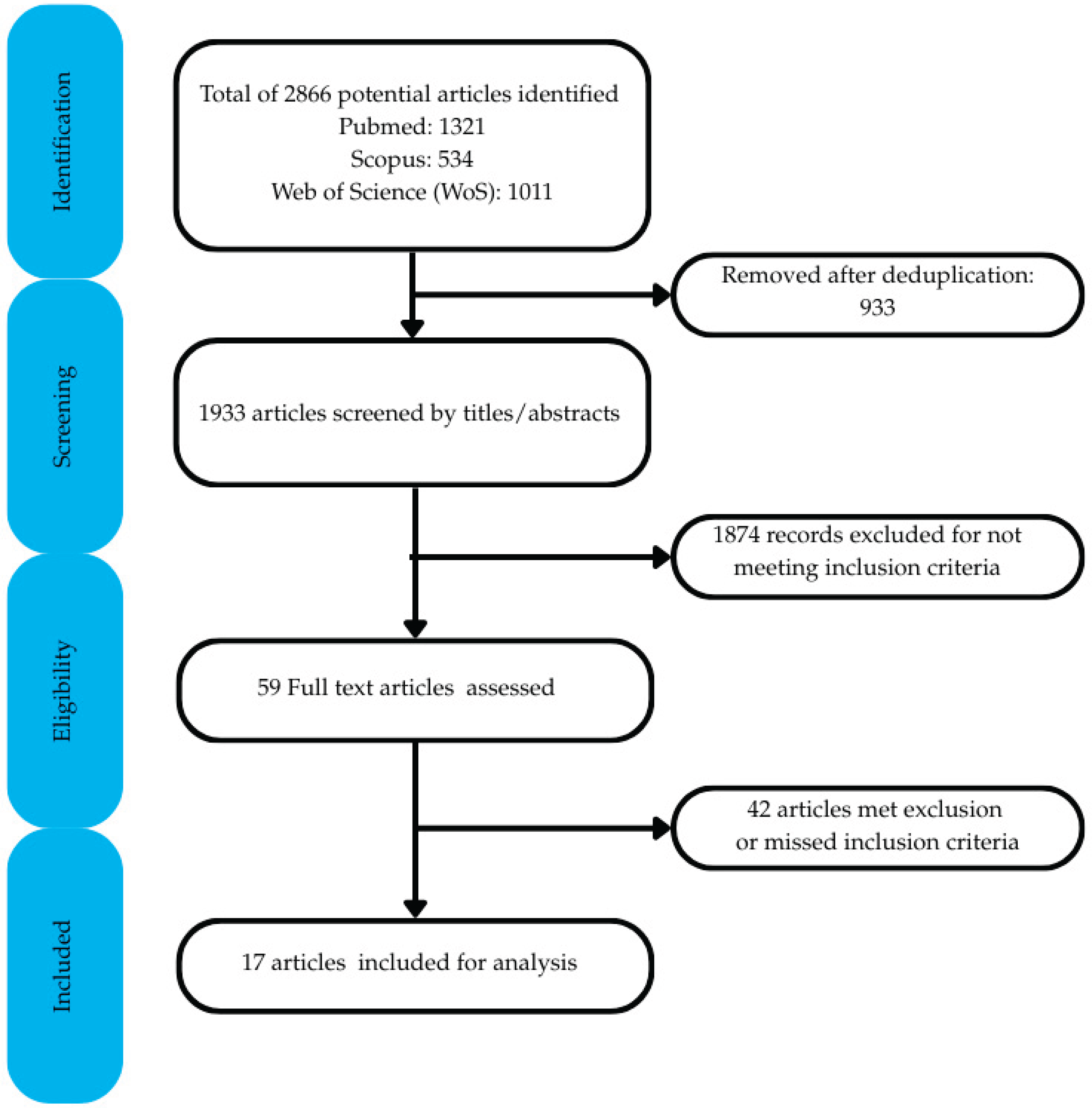
Table 1.
Databases and search strings.
| Database | Search string | Results found |
|---|---|---|
| PubMed | ("Clear aligners" OR Invisalign OR thermoform* OR orthodontic* OR "thermoplastic appliance*" OR "orthodontic retainer*" OR "orthodontic splint*") AND ("Flexural Strength"[MeSH] OR "three-point bending" OR "three point bending" OR "four-point bending" OR "four point bending" OR "biaxial flexural" OR "mechanical properties" OR "flexural modulus" OR "elastic modulus") AND (Journal Article[PT]) AND (English[lang]) | 1321 Articles |
| Scopus | TITLE-ABS-KEY ( "clear aligners" OR invisalign OR thermoform* OR orthodontic* ) AND TITLE-ABS-KEY ( "flexural strength" OR "three-point bending" OR "three point bending" OR "four-point bending" OR "four point bending" OR "biaxial flexural" OR "mechanical properties" OR "flexural modulus" OR "elastic modulus" ) AND SUBJAREA ( mater OR dent OR eng ) AND DOCTYPE ( ar ) AND LANGUAGE ( english ) | 534 Articles |
| WoS | TS=("clear aligners" OR Invisalign OR thermoform* OR orthodontic*) AND TS=("flexural strength" OR "three-point bending" OR "three point bending" OR "four-point bending" OR "four point bending" OR "biaxial flexural" OR "mechanical properties" OR "flexural modulus" OR "elastic modulus") AND WC=("Materials Science" OR "Dentistry, Oral Surgery & Medicine") AND DT=(Article) |
1011 Articles |
Disclaimer/Publisher’s Note: The statements, opinions and data contained in all publications are solely those of the individual author(s) and contributor(s) and not of MDPI and/or the editor(s). MDPI and/or the editor(s) disclaim responsibility for any injury to people or property resulting from any ideas, methods, instructions or products referred to in the content. |
© 2025 by the authors. Licensee MDPI, Basel, Switzerland. This article is an open access article distributed under the terms and conditions of the Creative Commons Attribution (CC BY) license (http://creativecommons.org/licenses/by/4.0/).
Copyright: This open access article is published under a Creative Commons CC BY 4.0 license, which permit the free download, distribution, and reuse, provided that the author and preprint are cited in any reuse.