
Submitted:
20 May 2025
Posted:
21 May 2025
You are already at the latest version
Abstract
Soil salinization is a huge threat to global agricultural productivity, significantly compromising crop development and soil health. In China, the combined pressures of population growth and socioeconomic advancement have progressively diminished arable land area in recent decades, with total cultivated land nearing the threshold deemed essential for national food security. This trend has elevated saline-alkali lands to strategic importance as vital reserve resources for agricultural expansion. However, saline-alkali soils are usually characterized by elevated pH, soil salt content, structural destabilization, and persistent nutrient deficiencies. Thus, there is an urgent need for improving and remediating saline soil. Green manure emerges as an innovative and cost-effective remediation strategy for saline soils, demonstrating marked efficacy in reducing soil salinity, improving the soil structure and fertility. In this paper, a summary is given of the effects and mechanisms of green manure on saline soil properties, including PH, soil salt content, soil organic matter, soil aggregates, soil nutrients and microbial activity. Furthermore, we identify the future research directions in this field. These insights are valuable for providing theoretical foundations for establishing effective methods for applying green manure to improve saline soil.
Keywords:
saline soil
; green manure
; soil aggregate
; soil organic matter
; microbial community
1. Introduction
The global population is growing rapidly, and is expected to reach 10 billion by 2050 . Additional food required to sustain expanding population is putting pressure on existing natural resources. Soil degradation-primarily driven by erosion, desertification, and salinization-has intensified under combined anthropogenic and natural pressures, compromising soil health and crop productivity . Among these threats, salinization is the most critical challenge to global food production. Current estimates indicate that approximately 1.1 × 10⁹ ha of land worldwide is salt affected, with an annual increment of 1.5 million hectares , accounting for nearly 20% of the global cultivated land . Categorized by variations in climate, topography, and hydrological conditions, it can be classified into coastal saline soil areas, North China saline-alkali soil areas, northwest semi-arid and arid saline-alkali soil areas, and Northeast China saline-alkali soil areas, covering approximately 36 million hectares, accounting for about 4.88% of China’s total available land . These soil usually have high salt content, poor soil structure, and low soil fertility and therefor substantially constraints agricultural production . Therefore, rational improvement and utilization of saline soil are of great significance in alleviating arable land scarcity to ensure national food security, and achieve sustainable agricultural development.
In recent years, green manure as a soil amendment has received increased attention, driven by the evolving national commitment to ecological priority and green development principles . Green manure encompasses fresh plant biomass incorporated into the soil as fertilizer during its growth phase, or crops intercropped, relay cropped, or rotated with primary crops to promote their growth and development . This practice demonstrates many benefits, including structural soil improvement, optimized nutrient cycling, and microbial community modulation, which collectively enhance plant physiological performance and agricultural productivity [9,10,11]. As such, green manure primarily functions as a soil conditioner and a nutrient source for subsequent economic crops, qualifying as one of the premium biological fertilizer resources . Notably, green manure crops exhibit robust salt tolerance via the following key mechanisms: reducing salt ion concentrations, modifying soil microbial biomass communities, and improving soil fertility, thereby effectively ameliorating saline-alkali soils [13,14]. Consequently, green manure has been extensively adopted as a pivotal biological remediation strategy for saline-alkali soils.
In the face of the critical challenges of climate change and food security, systematically reviewing the applications of green manure in saline-alkali soil amelioration has become an urgent task in soil science. This review aims to clarify the effects and underlying mechanisms of green manure on saline-alkali soils, while identifying its advantages and limitations. To this end, the present paper comprehensively summarizes the impacts of green manure on the physicochemical and biological properties of saline-alkali soils, with a focus on the key mechanisms driving soil improvement. Furthermore, this review highlights the research gaps and future research directions in the field on green manure for saline-soil amelioration. This comprehensive review provides theoretical support for developing green manure technologies and practical guidance for enhancing soil fertility and promoting sustainable agriculture in saline-alkali regions.
2. Effects of Green Manure on Soil Salt and Soil PH in Saline Soils
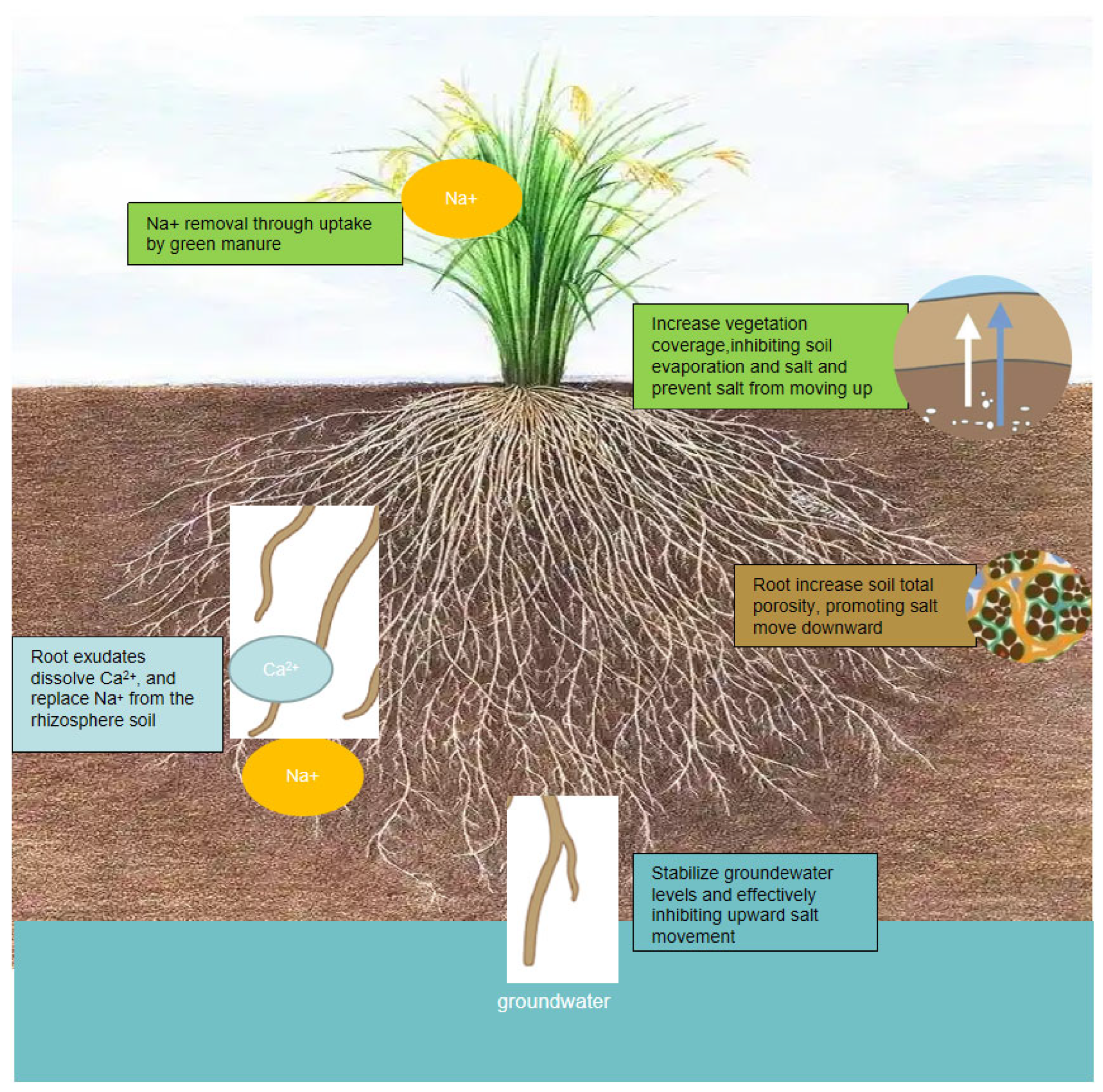
Saline-alkali soil, featuring high pH and salt concentrations, alters soil structure, directly influencing the fertility of saline soils and crop productivity . In current research on saline soil remediation, enhancing desalinization effects through green manure has emerged as a key focus. Extensive studies demonstrate that green manure can effectively reduce salt content in saline soil and promote soil desalinization in saline soil improvement [16,17]. Liu et al. conducted rape green manure trials in Xinjiang saline soil, finding that soil pH decreased by approximately 1.1 units and electrical conductivity (EC) in the 0-60 cm layer decreased by 0.6 mS/cm compared to non-amended soil. The mechanism by which green manure reduces soil salinity can be explained from three perspectives: (1) Planting green manure can increase soil surface vegetation coverage, inhibit soil evaporation, and suppress salt accumulation in the surface layer ; (2) The extensive root systems of green manure physically penetrate and aerate the soil, improving soil structure and increasing the soil total porosity. The improvement can often enhance soil permeability, allowing salts dissolved in water to move downward more easily through these pathways, helping remove salts from the soil [20,21]. (3) Plants with developed root systems, such as Sesbania cannabina and Astragalus sinicus, stabilize groundwater levels by consuming large amounts of infiltrated water, potentially lowering the groundwater table and effectively inhibiting upward salt movement . (4) Ca2+ is an important ion to replace Na+.Green manure releases root exudates that dissolve Ca2+ in the soil, and the higher Ca2+ enhances the replacement of Na⁺ content in rhizosphere soil [23,24,25].
Figure 1.
Schematic diagram of salt reduction mechanism of green manure.
Green manure species exhibit substantial variations in their ability to regulate soil pH and reduce salinity. Zhao et al. observed the planting salt-tolerant species significantly decreases soil Na⁺ content, with Kalidium foliatum showing superior salt absorption capacity. Wang et al. reported a 10.81% desalinization rate for Sesbania cannabina in coastal saline soils (0-80 cm depth), outperforming alfalfa (4.03%) and Sorghum sudanense (0.97%). Notably, Suaeda salsa exhibited paradoxical effects, increasing soil salt content by 0.50% compared to untreated soil. Jing et al. documented simultaneous reductions in soil pH, total salt content, and alkalization degree following Sesbania cannabina and Melilotus officinalis cultivation, with Sesbania cannabina demonstrating superior performance across all metrics. Hou et al. found that purple alfalfa achieved an average desalinization rate of 41.81% in the Yellow River Delta, surpassing both Sesbania cannabina and Melilotus officinalis. These results collectively highlight that plant selection serves as a critical determinant of desalination efficacy in saline soils. Sesbania cannabina and alfalfa emerges as a promising candidate for coastal salt-affected lands, demonstrating superior salt removal capabilities.
The desalination effect of green manure on saline soil is also influenced by soil depth. Previous studies demonstrated that green manure can effectively promote soil desalination, and the desalination of the upper soil layer was more obvious than that of the lower layer . Yang et al. found that the salt content planted with Suaeda salsa in saline alkali land was lower than that in bare land plots, and the difference gradually decreased with increasing soil depth. Wang et al. further demonstrated that soil EC values in coastal saline land planted with Sesbania cannabina and alfalfa differed significantly from bare soil across various depths, with average desalinization rates reaching up to 45% in the 0-20 cm layer, whereas no significant differences were observed at 60-80 cm layer, indicating that green manure primarily improves surface soil.
3. Effects of Green Manure on Soil Physical Properties in Saline Soils
Saline soils typically exhibit poor physical structure characterized by dispersed clay particles, macro porosity deficiency, and susceptibility to compaction, resulting in high bulk density, low porosity, and severely restricted crop growth and soil productivity . As a sustainable soil remediation strategy, green manure demonstrates significant potential in improving and regulating soil physical structure . On the one hand, the root system of green manure improves the permeability of saline soil through stretching; in addition, green manure produces a large number of plant residues left in the soil till layer, which, after decaying and decomposing, can reduce the soil bulk density and increase the porosity, providing a suitable environment for crop growth.
Sun et al. found that the soil bulk density of green manure returning treatment at 0-20 cm topsoil layer was reduced from 1.51 g cm⁻³ to 1.33 g cm⁻³, while bare soil showed no significant improvement. The improvement effect of different green manure species varies in modifying soil bulk density. Jing et al. planted five kinds of green manure, such as Sesbania cannabina, Meadowsweet and Gauldan grass, in heavily saline soil, and found that all five kinds of green manure could significantly reduce the soil bulk density and improve the soil porosity, among which the decrease in the bulk density of the soil of the cultivated layer planted with Gauldan grass was the largest, which reached 4.1%; the increase in the total porosity of the soil of the cultivated layer was the largest increase in the experimental area planted with Sesbania cannabina, with an increase of 4.9%. This indicates that the improvement effect of green manure species on soil bulk density and porosity of saline soil varies significantly, primarily due to variations in root biomass, diameter, depth, and decomposition rates of green manure .
Soil aggregates are fundamental units of soil structure and critical indicators of soil fertility. The distribution of soil aggregates is closely related to soil nutrient retention and supply, microbial quantity and activity. Due to their high salt content, the aggregates of soil particles in saline alkali soil is weak. Na+ in saline soils is a strong dispersant, which is easy to gather on the surface of soil colloids to form a thicker ionic layer, and soil colloids wrapped in the ionic layer repel each other, hindering the formation and stabilization of aggregates [36,37]. The limited quantity and predominantly small size of soil aggregates significantly contribute to the formation of well-developed capillary pore networks, which not only promotes salt accumulation on soil surfaces but also concurrently inhibits natural salt leaching processes [38,39]. Consequently, enhancing interparticle cohesion to foster soil aggregation and increasing the proportion of macroaggregates have emerged as pivotal strategies for remediating saline-alkali soils. Studies have shown that green manure significantly promotes the formation of saline soil aggregates and enhances their stability . On the one hand, green manure can reduce the salt content, thereby alleviating the dispersion effect of colloids in saline alkali soil; on the other hand, root exudates, roots, and residues to the field can increase soil organic matter content, promote mineral soil particle aggregation, and facilitate the formation of large aggregates [41,42]. Shen et al. reported that after planting green manure, the soil water-stable aggregates of 1-2 mm particle size in saline soils increased by 4.5%-19%. Similar results were also reported by Xiao et al., who observed that after planting green manure crops on saline soil in the Hetao irrigation area, the particle size of<0.01mm aggregates decreased by 44% -65%, while>0.25mm aggregates increased by 95% -203%.
4. Effects of Green Manure on Soil Organic Matter in Saline Soils
Soil organic matter (SOM), a critical indicator of farmland basic fertility and soil productivity, directly influenes crop growth, development, and the sustainability of agro-ecosystems. In saline soils, high salt stress suppresses primary productivity, leading to low carbon input into the soil carbon pool . Additionally, soil salinization inhibited the rate of soil carbon cycle, affected the process of carbon fixation, and reduced the accumulation of organic carbon . Research shows that organic material input can increase soil organic matter content . Green manure improves SOM in non-saline soils by adding external carbon and adjusting microbial activities, as evidenced by many studies [47,48], and the organic matter enhancement effect of green manure has also been confirmed in saline soils. [49,50]. Research indicates that one season of green manure cultivation in moderately saline soils increased SOM by 34.3% to 69.7% . In moderately saline soils in northern Xinjiang, planting rape as green manure for one and two years increased the SOM content in the 0-20 cm soil layer by 107.6% and 167.7%, respectively, compared to the control . A four-year field experiment conducted by Lu et al. revealed that the turnover of green manure roots, continuous renewal of root nodules, and increasing litter input led to continuous accumulation of SOM in the soil, with a significant positive correlation between SOM accumulation rate and green manure cultivation age . Given SOM's role as a major carbon reservoir, even minor changes may significantly impact global carbon cycling. Under the "dual carbon" goals, the long-term carbon sequestration potential of green manure in saline soils warrants further exploration.
SOM accumulation in saline soils is influenced by green manure incorporation rates, planting patterns, and management methods. In the saline soils of northern Jiangsu Province, SOM content is positively correlated with the amount of green manure incorporated. However, low incorporation rates may trigger a priming effect, stimulating microbial activity and SOM decomposition . Insufficient green manure input risks depleting recalcitrant SOM, potentially diminishing long-term soil fertility. Intercropping strategies, such as combining leguminous and non-leguminous species, enhance SOM more effectively than monocropping. Lu et al. indicated that intercropping leguminous and non-leguminous green manures can further increase SOM content in saline soils . The combined application of organic fertilizers can enhance the remediation effect of green manure on saline soils. For instance, a single application of cow manure on coastal saline soils increased the biomass of ryegrass and Sesbania, reduced the mineralization rate of soil organic carbon after incorporation, and promoted the conversion of exogenous carbon into stable carbon humus . This synergy improves fertility by facilitating green manure decomposition into soil organic carbon. Therefore, combining green manure with organic amendments represents a promising research direction for sustainable saline soil management.
5. Effects of Green Manure on Soil Nutrients in Saline Soils
The decomposition of green manure litter and residual roots in the soil increases the organic matter and inorganic nutrients in the soil, and can promote the activities of soil microorganisms, thereby accelerating the decomposition of soil organic matter and increase soil nutrients. Green manure, particularly leguminous species, enhances nitrogen input through root nodule symbiosis with nitrogen-fixing bacteria. This process increases total nitrogen (TN) and available nitrogen (AN) in saline soil . Studies showed that leguminous green manure significantly outperforms green manure species in improving nitrogen availability. Zhang et al. analyzed soil nitrogen dynamics under non-legume and legume green manure varieties in northwest China's saline soil, results indicated that all varieties increased TN and AN, but legumes showed more pronounced TN enhancement . The nitrogen-fixing capacity of legumes is influenced by soil salinity. When soil salinity reached 20 dSm⁻¹, Medicago sativa's symbiotic nitrogen fixation declined, but remained stable at 1.7-16 dSm⁻¹ . This indicates that legumes maintain effective nitrogen fixation within moderate salinity ranges, with minimal salt-induced suppression. In saline soil, one season of Sesbania cannabina cultivation significantly increased alkali-hydrolyzable nitrogen, with higher increments in low-salinity soil (36.16%) compared to high-salinity soil (23.85%) .
Green manure effects on phosphorus (P) and potassium (K) in saline soil are variable. Studies have shown that green manure application could increase available P and K . Zhang et al. observed 33.3% and 12.8% increases in available P and K, following two years of alfalfa cultivation in coastal saline soil. This might be attributed to the release of organic acids produced during green manure decomposition, which solubilize insoluble P and K. However, some studies have pointed out the negative effects of green manure on P and K in saline soil. Zhu et al. found that Sesbania cannabina and M. officinalis reduced total and available P/K, with available P declining from 20.1-22.5 mg kg⁻¹ to 16.1-17.4 mg kg⁻¹ and available K from 136.7-140.8 mg kg⁻¹ to 86.2-102.4 mg kg⁻¹. In Daqing's severe saline soil, three years of Sesbania cannabina cultivation decreased available P from 2.3 mg kg⁻¹ to 1.4 mg kg⁻¹ and available K from 35.7 mg kg⁻¹ to 22.7 mg kg⁻¹. This might attributed to that after planting Sesbania cannabina, the nutrient demand of Sesbania cannabina (田菁) itself will consume phosphorus and potassium in the soil to a certain extent . Similarly, Zhang et al found that in the year of planting Sesbania cannabina, due to crop growth and consumption, the content of available phosphorus and available potassium in the soil decreased, and began to rise gradually in the second year . This discrepancy arises from species-specific nutrient demand; Sesbania cannabina is a high P/K consumer. Thus, supplemental P/K fertilization may enhance green manure-based saline soil remediation. Wang et al. revealed that combining Sesbania cannabina with P/K fertilization boosted available phosphorus and potassium by 28.2% and 11.4%, respectively, outperforming the 15.7% and 1.6% increases from only green manure application.
6. Effects of Green Manure on Microbial Biomass and Activity in Saline Soils
Soil microorganisms, as the most abundant and metabolically active biological components in subsurface ecosystems, play an irreplaceable role in maintaining soil ecological service functions. They directly or indirectly regulate biogeochemical cycles and ecosystem services, and have been widely adopted as indicators of soil quality . Soil microorganisms can promote the transformation of substances in the soil, and play an important regulatory role in many processes such as nitrogen fixation, nitrification denitrification, and decomposition and synthesis of humus , making microbial abundance and activity reliable indicators of soil quality . Especially in saline soil, the structural and functional characteristics of microbial communities are regarded as important bioindicators to evaluate soil health. At present, although research on green manure induced microbial community and activity changes in saline soil is still in the initial stage, accumulating evidence demonstrates that green manure will affect soil microbial community and activity while improving the physicochemical properties and soil nutrient status of saline soil . Sun et al. reported that the number of fungi, bacteria and actinomycetes in the soil of 0-20 cm soil layer increased dramatically with green manure application, compared with the bare land .
The underlying mechanisms by which green manure affects the microorganisms of saline soil may be, Modifying the soil environment by providing carbon/nitrogen sources, thereby altering microbial biomass, optimizing community structure, and stimulating enzyme activities [71,72]; (2) Green manure root penetration can effectively reduce the soil bulk density, improve the pore structure, and create a more suitable habitat for microorganisms. (3) Organic matter was significantly and positively correlated with soil microbiota, while soil salinity was significantly and negatively correlated with soil microbiota . By increasing organic carbon input, green manure promotes microbial metabolism and population growth, and this carbon serves as both energy and nutrient source for microbial communities, thereby stimulating microbial metabolism and increases microbial population and activity. At present, conventional molecular biology techniques such as isolation and culture, phospholipid fatty acids and PCR-DGGE are usually used to study soil microbial diversity, but due to the limitations of traditional methods, the composition and population structure of soil microbial diversity cannot be adequately reflected, and in the future, high-throughput sequencing technology can be strengthened for the study of microbial community aspects of green manure-amended saline soils.
7. Summary and Prospect
Improving the saline soil can increase land and secure food. This paper provides an overview of the critical role that green manure play in saline soil improvement. In conclusion, green manure effectively reduces salt content in saline soil, enhances soil nutrient availability, and increases microbial abundance and enzymatic activity, playing a pivotal role in saline soil remediation. While research in this field has made progress, many studies date back to the 1960s-1970s, with a recent resurgence in interest. Several critical gaps remain to be addressed. To further promote agricultural green development, future research should focus on the following areas: (1) Current research primarily emphasizes SOM quantity, with limited attention to temporal dynamics and input-output balances. Future research should apply isotopic tracing methods to elucidate SOM transformation pathways and fates under green manure cultivation, and optimize incorporation techniques for enhanced SOM sequestration. (2) Soil aggregate stability and porosity are critical for carbon sequestration and desalinization in saline soils. However, their dynamic processes, quantitative expressions, and mechanistic impacts in saline environments remain poorly understood. Future studies should integrate CT scanning and image analysis technologies to quantify aggregate-pore characteristics and elucidate green manure-induced formation mechanisms. (3) Current research has primarily focused the short-term effects of green manure on soil properties. However, there is a lack of research on the long-term effects of green manure on saline soil improvement. Future research should prioritize extended field experiments, combined with biogeochemical models (e.g., DNDC, RothC), to analyze climate-soil-management interactions and assess green manure efficacy under diverse climatic conditions. (4) Current understanding of green manure-induced microbial responses in saline soil is limited, relying heavily on traditional methods. High-throughput sequencing technologies should be employed to characterize bacterial and fungal community shifts during green manure decomposition, revealing microbial-environmental interactions and remediation mechanisms. (5) Further research is needed into the soil health assessment frameworks applied to evaluate green manure remediation efficacy objectively, providing theoretical support for technology dissemination.
Author Contributions
Writing—original draft preparation, Y.L.,W.Z. and J. Z.; writing—review and editing, Y.L.,W.Z., X.J., R.G., T. W. and J. Z.; funding acquisition, Y.L. All authors have read and agreed to the published version of the manuscript.
Funding
This research was supported by the Natural Science Foundation of Jiangsu Province, China (grant No. BK20220564), the National Natural Science Foundation of China (grant No. 32301435) and the “Lv Yang Jin Feng” Project of Yangzhou City (grant No.YZLYJFJH2021YXBS124).
Data Availability Statement
No new data were created or analyzed in this study.
Conflicts of Interest
The authors declare no conflicts of interest.
References
- Rice D, Singh R, Priya H, et al. Transforming plant-based alternatives by harnessing precision fermentation for next-generation ingredients. Journal of The Science of Food and Agriculture, 2025.
- Parihar P, Singh S, Singh R, Singh VP, Prasad SM (2015) Effect of salinity stress on plants and its tolerance strategies: a review. Environ Science Pollution Research, 22:4056-4075.
- Armstrong F. A J . Determination of nitrate in water ultraviolet spectrophotometry analytical chemistry, 1963, 35(9):1292-1294.
- Wang X, Sun R, Tian Y, et al. Long-Term Phytoremediation of Coastal Saline Soil Reveals Plant Species-Specific Patterns of Microbial Community Recruitment. Msystems, 2020, 5(2): e00741-19.
- Yang J S, Yao R J. Management and efficient agricultural utilization of salt-affected soil in China. Bulletin of Chinese Academy of Sciences, 2015, 30(S):162-170.
- Shrivastava P, Kumar R. Soil salinity: A serious environmental issue and plant growth promoting bacteria as one of the tools for its alleviation. Saudi Journal of Biological Sciences, 2015, 22(2): 123-131.
- Cao W D, Bao X G, Xu C X, et al. Reviews and prospects on science and technology of green manure in China. Journal of Plant Nutrition and Fertilizer. 2017, 23(06): 1450-1461.
- Chen X P, Cui Z L, Fan M S, et al. Producing more grain with lower environmental costs[J]. Nature, 2014, 514 (7523) :486-489.
- Ma Z B, Liang T, Fu H R, et al. Long-term green manuring increases soil carbon sequestration via decreasing qCO2 caused by lower microbial phosphorus limitation in a dry land field. Agriculture, Ecosystems & Environment, 2024, 374, 109142.
- Jia L, Zhang H J, Lu J Y, et al. Green manuring with balanced fertilization improves soil ecosystem multifunctionality by enhancing soil quality and enzyme activities in a smooth vetch-maize rotation system. Agriculture, Ecosystems & Environment. 2025, 387, 109632.
- Zhang C Z, Xue W F, Xue J R, et al. Leveraging functional traits of cover crops to coordinate crop productivity and soil health. The Journal of Applied Ecology. 2022, 59(10), 2627-2641.
- Cherr C M, Scholberg J M S, Mcsorley R. Green Manure Approaches to Crop Production: A Synthesis. Agronomy Journal. 2006, 98(2): 302-319.
- Yin H M, Hu J, Wang Q Q, et al. Advance and Prospect of the Research on Improvement by Dry Farming Measures of Saline-Alkali Soils in Western Songnen Plain of China. Chinese Journal of Soil Science. 2017, 48(01): 236-242.
- Qadir M, Oster J D. Crop and irrigation management strategies for saline-sodic soils and waters aimed at environmentally sustainable agriculture. Science of The Total Environment. 2004, 323(1): 1-19.
- Zhang C N, Chen H M, Dai Y, et al. Isolation and screening of phosphorus solubilizing bacteria from saline alkali soil and their potential for Pb pollution remediation[J]. Frontiers in Bioengineering and Biotechnology,2023,11:1134310.
- López V F, Fernández L F, Luna G M L, et al. Microorganisms in sewage sludge added to an extreme alkaline saline soil affect carbon and nitrogen dynamics. Applied Soil Ecology,2010,45(3):225-231.
- Li H, Feng T, Yu W W, et al. Effects of Compound Intercropping on Nutrition and Organic Matter of Coastal Saline Soil. Chinese Agricultural Science Bulletin. 2013, 29(15): 89-92.
- Liu H, Li Z Y, Bai Z G, et al. Effects of rape green manure returned to field on saline alkali soil improvement in Xinjiang. Journal of Agricultural Resources and Environment. 2020, 37(06): 914-923.
- Zhou J, Wang ZC, Yang F. Research progress about phytoremediation mechanisms in saline-alkali soils. Chinese Journal of Ecology, 2024,43(5): 1453-1462.
- Li Z D, Gan Y M, Ze B, et al. Research progress on forage to improve saline-alkali soil. Pratacultural Science. 2004(06): 17-21.
- Qadir M, Qureshi R H, Ahmad N. Reclamation of a saline-sodic soil by gypsum and Leptochloa fusca[J]. Geoderma,1996, 74(3/4):207-217.
- Lamsal K, Paudyal G N, Saeed M. Model for assessing impact of salinity on soil water availability and crop yield. Agricultural Water Management. 1999, 41(1): 57-70.
- Yang C, Chen H Y, Li J S, et al. Soil improving effect of Suaeda salsa on heavy coastal saline-alkaline land. Chinese Journal of Eco-Agriculture. 2019, 27(10): 1578-1586.
- Wong V N L, Dalal R C, Greene RSB. Carbon dynamics of sodic and saline soils following gypsum and organic material additions: A laboratory incubation. Applied Soil Ecology. 2009, 41:29-40.
- Qadir M, Quillerou E, Nangia V, et al. 2014. Economics of salt-induced land degradation and restoration. Natural Resources Forum,2014, 38:282-295.
- Zhao K F, Fan H, Jiang X Y, et al. improvement and utilization of saline soil by planting halophytes. Chinese Journal of Applied and Environmental Biology. 2002(01): 31-35.
- Tedeschi A,Auila R D.Effects of irrigation with saline waters, at different concentrations, on soil physical and chemical characteristics. Agricultural Water Management,2004,77(1):308-322.
- Jing Y P, Zhang J Z, Li X P, et al. Study on the effect of planting green manure crops on the improvement of Saline-Alkali soil in Hetao Irrigation Area. Journal of Northern Agriculture. 2019, 47(06): 42-46.
- Hou H H, Wang C T, Wang X D, et al. A Study of Improvement Effects by Biological Measures in the Yellow River Delta Saline-Alkali Soil. China Rural Water and Hydropower. 2014(07): 1-6.
- Wang L Y, Pan J, Xiao H, et al. Effect of soluble salt on planting salt-tolerant plants of coastal saline soil. Acta Agriculturae Boreali-Sinica, 2014, 29(5):226-231.
- Munns R. Genes and salt tolerance: bringing them together. The New Phytologist, 2005,167(3):645-663.
- Piotrowska-Długosz A, Wilczewski E. Assessment of soil nitrogen and related enzymes as influenced by the incorporation time of field pea cultivated as a catch crop in Alfisol. Environmental monitoring and assessment. 2014, 186(12): 8425-8441.
- Sun W Y, Sun J H, Yin H J, et al. Effect of Winter Green Manure on Improving Saline-alkali Nursery Garden Land. Chinese Journal of Soil Science. 2015, 46(05): 1221-1225.
- Jing Y P, Lin C Y, Zhao P Y, et al. Salinized soil improvement by planting 5 plant species in Hetao irrigation area. Soils and Crops. 2020, 9(02): 114-125.
- Guo Y H, Zhang X Q, Hu M G. Effects of salinized soil improvement using Medicago sativa. Journal of Gansu Agricultural University. 2004(02): 173-176.
- Liu Q, Yuan Y F, Liu Y F, et al. Research Progress: the Application of Biochar in the Remediation of Salt-affected Soils. Advances in Earth Science. 2022, 37(10): 1005-1024.
- Tedeschi A, Dell Aquila R. Effects of irrigation with saline waters, at different concentrations, on soil physical and chemical characteristics. Agricultural Water Management. 2005, 77(1): 308-322.
- Sahin U, Angin I, Kiziloglu F M. Effect of freezing and thawing processes on some physical properties of saline-sodic soils mixed with sewage sludge or fly ash. Soil and Tillage Research,2008,99(2):254-260.
- Daliakopoulos I N, Tsanis I K, Koutroulis A, et al. The threat of soil salinity:A European scale review.Science of The Total Environment,2016,573:727-739.
- Mishra V K, Jha S K, Damodaran T, et al. Feasibility of coal combustion fly ash alone and in combination with gypsum and green manure for reclamation of degraded sodic soils of the Indo-Gangetic Plains: A mechanism evaluation. Land Degradation & Development. 2019, 30(11): 1300-1312.
- Zhang B Y, Zhang Z H, Bai X L, et al. Long-term rice cultivation enhances root development and yields by improving the structural properties of soil aggregates in saline–alkaline environments. Environmental Technology & Innovation. 2024, 36, 103848.
- Zhang Y, Li F, Lu Z, et al. Organic amendments effects on soil aggregation and carbon sequestration in saline-alkaline croplands in China. Agronomy Journal. 2023, 115, 2083–2095.
- Shen J, Lu B Z, Chen Z B, et al. Effects of green manure on rice growth and soil improvement in coastal saline soil. Tillage and Cultivation. 1989, (02): 37-42.
- Xiao H Y, Li M Z, Lin Q M, et al. Effects of 8 Salt-tolerant Plants and Desulfurization Gypsum on the Water-stable Aggregates of Saline-alkali Soil in Hetao Irrigation District. Chinese Agricultural Science Bulletin. 2021, 37(34): 90-96.
- Zhang Y X, Hong M, Wen X, et al. Effect of Different Organic Amendments on Soil Organic Carbon Pool and Chemical Properties in Soda Alkaline Soil. Journal of Soil and Water Conservation. 2022, 36(03): 311-318.
- Wu Y P, Li Y F, Zheng C Y, et al. Organic amendment application influence soil organism abundance in saline alkali soil. European Journal of Soil Biology,2013,54:32-40.
- Lan Y, Huang G Q, Yang B J, et al. Effect of green manure rotation on soil fertility and organic carbon pool. Transactions of the Chinese Society of Agricultural Engineering. 2014, 30(13): 146-152.
- Liu W, Geng M J, Qin Z G, et al. Effects of co-incorporation of green manure planting and rice straw on soil organic carbon pool and soil enzyme activity in a mono-rice cropping system. Transactions of the Chinese Society of Agricultural Engineering. 2020, 36(07): 125-133.
- Guo Y H, Zhang X Q, Hu M G. Effects of salinized soil improvement using Medicago sativa. Journal of Gansu Agricultural University. 2004(02): 173-176.
- Zhu X M, Wang J H, Wen Z G, et al. Effects of different kinds of green manure on improving soil nutrients and enzyme activity in coastal tidal flat. Jiangsu Agricultural Sciences. 2019, 47(12): 307-310.
- Liu H, Li Z Y, Bai Z G, et al. Effects of rape green manure returned to field on saline alkali soil improvement in Xinjiang. Journal of Agricultural Resources and Environment. 2020, 37(06): 914-923.
- Lu B Z, Xu W K, Zhou C L. The effect of forage on improving coastal saline soil and its utilization benefits. chinese journal of soil science. 1993(S1): 53-55.
- Zhang Y Y, Mo F, Han J, et al. Research Progress on the Native Soil Carbon Priming after Straw Addition. Acta Pedologica Sinica. 2021, 58(06): 1381-1392.
- Lu B Z. Study on mixed planting of leguminous and non-leguminous green manure crops. Chinese Journal of Soil Science. 1981(01): 13-16.
- Bai Y, Yan Y, Zuo W, et al. Coastal Mudflat Saline Soil Amendment by Dairy Manure and Green Manuring. International Journal of Agronomy. 2017, 2017: 1-9.
- Moreno-Cornejo J, Zornoza R, Faz A. Carbon and nitrogen mineralization during decomposition of crop residues in a calcareous soil. Geoderma. 2014, 230-231: 58-63.
- Zhang Z Q, Wang X Y, Wang L M, et al. Effects of Different Forage Varieties Used as Green Manure on Saline-alkali Soil Nutrients. Animal Husbandry and Feed Science. 2020, 41(03): 35-41.
- Bruning B, van Logtestijn R, Broekman R, et al. Growth and nitrogen fixation of legumes at increased salinity under field conditions: implications for the use of green manures in saline environments. AoB plants. 2015, 7.
- He T T, Liu C, Zhu X M, et al. Physiological Response of Sesbania cannabina to Salt Stress and Its Effect on Soil. Hunan Agricultural Sciences. 2021(10): 44-46.
- Wang L M, Chen J L, Liang Z H, et al. Ameliorative Effects of Jute on Coastal Solonchak in Dongtai, Jiangsu. Journal of Soil and Water Conservation. 2009, 23(04): 105-108.
- Zhang L B, Guo X X, Chang S L. The salt tolerance of sesbania and its improved effect on coastal saline soil. Jiangsu Agricultural Sciences. 2012, 40(02): 310-312.
- Zhu X M, Wen Z G, Zhao B Q, et al. Effects of Planting Green Manure on Dynamic Changes of Saline Soil Nutrients and Soluble Salt lons. Southwest China Journal of Agricultural Sciences. 2017, 30(08): 1894-1898.
- Zhang G F, Cui Y B, Qiao Z H. The Improvement Effect of Sesbania on Saline-alkali Soil in Daging Area. Journal of Anhui Agricultural Sciences. 2017, 45(16): 119-120.
- Zhang Z Q, Wang X Y, Wang L M, et al. Effects of Different Forage Varieties Used as Green Manure on Saline-alkali Soil Nutrients. Animal Husbandry and Feed Science. 2020, 41(03): 35-41.
- Zhang G F, Cui Y B, Qiao Z H. The Improvement Effect of Sesbania on Saline-alkali Soil in Daging Area. Journal of Anhui Agricultural Sciences. 2017, 45(16): 119-120.
- Wang L Y, Pan J, Yang Y, et al. The fertility effects of salt-tolerant herbaceous plants on coastal saline soil. Pratacultural Science. 2014, 31(10): 1833-1839.
- Coban O, De Deyn G B, van der Ploeg M. Soil microbiota as game-changers in restoration of degraded lands. Science. 2022, 375(6584): e725.
- Zheng Z P, Liu Z X. Soil quality and its evaluation. Chinese Journal of Applied Ecology. 2003(01): 131-134.
- Karlen D L K, Gardner J C, Rosek M J. A Soil Quality Framework for Evaluating the Impact of CRP. Journal of Production Agriculture. 1998, 11(1): 56-60.
- Yuan B C. Effects of amelioration of saline soil through planting Medicago sativa L on soil microbial activity and soil nutrients. Ecology and Environmental Sciences. 2011, 20(3): 415-419.
- Elfstrand S, Hedlund K, Mårtensson A. Soil enzyme activities, microbial community composition and function after 47 years of continuous green manuring. Applied soil ecology: a section of Agriculture, ecosystems & environment. 2007, 35(3): 610-621.
- Bowles T M, Acosta-Martínez V, Calderón F, et al. Soil enzyme activities, microbial communities, and carbon and nitrogen availability in organic agroecosystems across an intensively-managed agricultural landscape. Soil biology & biochemistry. 2014, 68: 252-262.
- Zhang N, Guo H H, Wang M, et al. Effect of Ridging and Furrow Sowing on Microflora in Seashore Saline-Alkali Soil. Shandong Agricultural Sciences. 2016, 48(06): 62-65.
Disclaimer/Publisher’s Note: The statements, opinions and data contained in all publications are solely those of the individual author(s) and contributor(s) and not of MDPI and/or the editor(s). MDPI and/or the editor(s) disclaim responsibility for any injury to people or property resulting from any ideas, methods, instructions or products referred to in the content. |
© 2025 by the authors. Licensee MDPI, Basel, Switzerland. This article is an open access article distributed under the terms and conditions of the Creative Commons Attribution (CC BY) license (http://creativecommons.org/licenses/by/4.0/).
Copyright: This open access article is published under a Creative Commons CC BY 4.0 license, which permit the free download, distribution, and reuse, provided that the author and preprint are cited in any reuse.


