

Submitted:
07 May 2025
Posted:
08 May 2025
You are already at the latest version
Abstract
The reduction of greenhouse gas emissions must be accelerated. Countries that are signatories to the Paris Agreement must propose their nationally determined contributions and develop decarbonization strategies to achieve conditional targets. We have identified that there is a gap between these strategies and the capacity of governments to execute them. We use Design Science to structure the problem and apply Value Focused Thinking (VFT) methodology to identify strategic objectives and to define prioritization criteria for the proposed actions, and combine this with the Soft System Model (SSM) methodology to identify alternatives to achieve net zero. We identify some critical issues that have an impact on implementing decarbonization strategies: (a) the large number of proposed actions, (b) agents affected by decarbonization actions that are not under the control of the government responsible for managing the strategy, (c) the level of readiness of available technologies and the economic conditions for their implementation. Thus, this paper presents (1) a process to support implementing decarbonization strategies (PIMADE); (2) combining the use of (VFT and SSM) methodologies for structuring problems to organize decision objectives and to establish actions for implementing strategies; and (3) an application of the proposed process in a subnational government in Brazil.
Keywords:
decarbonization
; net zero
; subnational government
; climate action
; public policy
1. Introduction
Global governance to address climate change is a key issue for achieving targets to reduce greenhouse gas (GHG) emissions. According to Chen et al. (2022), of the 198 countries that signed the Paris Agreement, 4.5% have achieved the target, 10.6% have declared that they will achieve net zero targets, 8.6% have legislated, 29.3% have formulated policies to achieve neutrality targets, and the remaining 47% are in the process of discussing documents to achieve decarbonization.
The report Nationally determined contributions under the Paris Agreement drawn up as guided by the United Nations Framework Convention on Climate Change (UNFCC, 2023) states that 75% of its signatories require capacity-building actions to be applied to policy formulation to achieve net zero. At the core of this policy are actions by each country to reduce GHG emissions by implementing its commitments by drawing up decarbonization strategies that are part of its Nationally Determined Contribution (NDC).
In addition to national states, non-state and subnational actors (e.g., regions, cities and businesses) have joined these efforts (Jörgensen et al., 2015; Scott et al., 2023; Allan et al., 2023; Roggero, 2023; Baggio & Tozer, 2024). The Under2 Coalition (Under2, 2024) brings together 270 subnational states committed to achieving net-zero emissions by 2050 and encourages the development of local decarbonization strategies which aim to implement the NDC. Kuramochi et al. (2023) argue that full implementation of individually reported and quantifiable commitments by regions, cities and companies in ten major economies could reduce emissions by 3.8–5.5% by 2030 which would be greater than the projections set out in current national policy scenarios.
However, the literature has not conceptually clarified the conditions that lead to accelerated systemic decarbonization (Barret et al., 2024). While many papers analyze the content of DECARBONIZATION STRATEGIES, the processes by which decarbonization strategies are developed have so far attracted less attention (Lecocq et al., 2022). Decarbonization strategies require a multi-model, multi-stakeholder assemblage given the time horizon and the ambition of the objectives. These seek to project trajectories that show a decline in GHG emissions to meet the demands of economic sectors at the lowest possible cost and that are aligned with the commitments assumed by countries in the Paris Agreement.
Research Motivation and Contribution
Kanitkar et al. (2024) propose highlighting the need for new analytical frameworks for modelling emissions and building climate policy scenarios which indicate possible equitable and environmentally correct futures. Decarbonization strategies present measures and actions that require efforts from all sectors of the economy, and thus include a broad range of stakeholders: government departments, public agencies, and often business groups, unions, as well as NGOs (Lecocq et al., 2022), which are not necessarily under government control. This makes implementing such measures and actions difficult (Marquardt, 2017).
This article presents a confirmed case of decarbonization strategies of a subnational government in Brazil. Constructing the decarbonization strategies of the Government of Pernambuco (GOVPE) was supported by an integration scheme between an economic and a technological model. Economic modelling uses the Economic Forecasting Equilibrium System (EFES), a computable general equilibrium model based on input-output matrices (HADDAD & DOMINGUES, 2001). Technological modelling uses the Brazilian Land-Use and Energy System Model (BLUES), which is an integrated assessment model for Brazil (ROCHEDO et al., 2018). The models interact with EFES, feeding BLUES with their projections of socioeconomic variables, which supply data on the sectoral demands that must be met. With this data, BLUES processes the set of sectoral technologies with the lowest cost to meet these demands, and takes into account the desired restrictions on GHG emissions.
Secretariats of GOVPE must implement the actions proposed. As an example of an action proposed within the measure “Expansion of renewable electricity generation” in GOVPE, there is the action of “Establishing goals for including renewable energy from Pernambuco in the installed capacity of the Brazilian electricity sector”, for which the following Secretariats would be responsible for undertaking these actions: the State Secretariat of Planning and Management (SEPLAG); the Secretariat of Economic Development (SDEC); the Secretariat of Mobility and Infrastructure (SEINFRA); and the Secretariat of the Environment and Sustainability (SEMAS). The question that arises is how each of these Secretariats can contribute to implementing this action within the scope of its attributions and considering the involvement of actors outside the state government, such as energy companies, regulatory agencies, research and innovation institutions, and the population at large.
Based on this difficulty, verified in the various actions already planned, this article proposes a methodology for implementing the decarbonization strategies, initially for GOVPE, but which can be expanded to other subnational governments. To support the proposed methodology, Value-Focused Thinking (VFT) (Keeney, 1992) and Soft System Methodology (SSM) (Checkland & Poulter, 2010) are combined.
This article is organized as follows: Following this Introduction, Section 2 presents a brief review of the literature on net zero. Section 3 introduces a new methodology to support implementing decarbonization strategies. Section 4 describes the application of the new methodology in a subnational government in Brazil. Section 5 discusses the results obtained, and Section 6 presents the conclusions of this research and makes suggestions for future studies.
2. Review of the Literature
This section presents a brief review of the literature on the challenges related to implementing integrated climate actions for reducing GHG to promote mechanisms for capacity building for climate change-related planning and effective management in emerging countries, including with a focus on women, young people, and on local, and marginalized communities as guided by UN Sustainable Development Goal 13.
In the climate policy area, governing through targets and goals has become commonplace, as it is difficult to reach binding top-down agreements (Buylova et al., 2024; Biermann et al., 2017; Abraham-Dukuma et al., 2022; Moreno et al., 2023). The Paris Agreement requires parties to build Long-Term Low Emissions Development Strategies (LT-LEDS) and communicate them to the UNFCCC as a complement to Nationally Determined Contributions (NDCs) that focus on short-term climate action (Jernnas, 2023). LT-LEDS serve the function of politically signaling climate ambitions to negotiate international partnerships, to request financial assistance, or to demonstrate results, as well as being an objective tool for implementing climate policy.
The conclusions of a systematic review on net zero (Tan et al., 2024) found 41,459 articles since 1939, with an explosive growth in the number of articles between 2021 and 2023. Thus, the review demonstrated the commitment of science to producing proposals that contribute to neutralizing GHG emissions.
2.1. Principles Guiding Decarbonization Policy
The principles that guide decarbonization by guiding state and private policies (Bigerna & Polinori, 2022; Zeng et al., 2022; Buettner et al., 2022; Turner et al., 2020) to raise standards of human development should be an objective of all decarbonization strategies, but this must be combined with changing people’s consumption patterns, and recognizing that natural resources are not endless and must be used rationally (Apostu et al., 2022; Wojcik et al., 2021). A decarbonized economy requires new business models (Lahyani, 2022; Xu et al., 2022; Dong et al., 2022; Elliott & Setyowati, 2020) that positively impact people’s lives and provide a “just transition” seeking alternatives for those most affected by the change, such as workers in the coal and oil industry who lose their jobs when renewable fuels replace fossil fuels (Lempinen et al., 2025; Harrahill & Douglas, 2019).
The analysis of scenarios for using technologies to reduce GHG by using renewable energy sources (Su et al., 2022; Wang et al., 2022; Vidinopoulos et al., 2020) must take into account that many technologies predicted to reduce GHG emissions have different levels of technological readiness (Vats & Mathur, 2022; Ozawa et al., 2022; Siskos et al., 2018), such as green hydrogen and the capture, use and storage of carbon gas, which require further development before they can be adopted in full.
Furthermore, in addition to technological maturity, geopolitical aspects must be analyzed. For example, the war in Ukraine has made it challenging to import natural gas that was replacing coal, thereby causing changes in the decarbonization strategies established by member countries of the European Community as defined in the European Green Deal (Kovács et al., 2024; Perissi & Jones, 2022).
2.2. Need to Implement Integrated Decarbonization Strategies
All efforts to reduce GHG emissions are welcome, but integrated plans and a multi-level climate governance system to achieve the net zero goal deserve special attention (Charles et al., 2022; Hsu, 2019; Sotiriou et al., 2019; Hubler et al., 2013). We identified several levels of coverage for these strategies, from the methodology presented by Pulselli et al. (2021), the City-zen Roadshows, applied for cities and their neighborhoods to develop a local decarbonization strategy in 5 days, to the model proposed by Basimile et al. (2022) to integrate government policies with the provision of renewable energy for industry, electricity production and transportation, in order to neutralize GHG emissions in Sichuan province, China.
This review leads us to the need for policymakers to deepen their understanding of the main uncertainties in strategies for mitigating climate change and the interdependence of policies. Hence, what is reinforced is the need to formulate robust decarbonization strategies (Lecocq et al., 2021; Zhang et al., 2018) that aim at the neutrality goals assumed in international agreements.
3. Materials and Method
In turbulent and uncertain times, decision-makers (DMs) use planning methods to explore, align and improve development strategies and outline scenarios to understand which change factors may affect the future (Broo et al., 2021).
National or subnational governments lead these plans and involve several agents, such as public and private companies, organized civil society, academia, and citizens. Inclusive participation in policy-making and carefully considered communication can also increase public support. (Heyen & Wicki, 2024).
Given this complexity, selecting an appropriate methodology for implementing decarbonization strategies determines its success (Lecocq et al., 2020). This section describes constructing the methodology to support implementing, monitoring, and evaluating decarbonization strategies.
3.1. Methodology Design
The design science technique was adopted to construct an implementation methodology, which enables artefacts to be created and evaluated to solve organizational problems (Hevner et al., 2004, Gauss et al., 2023, Gauss et al., 2024). Next, the six activities proposed by Peffers et al. (2007) were developed. Table 1 presents a summary of the activities that led to the methodology.
To ensure the integration of all stakeholders of decarbonization strategies, a government body must be designed to coordinate actions. As shown in Figure 1, a Carbon-Neutral Committee (CNC) is suggested.
This body’s responsibilities will be I—to create and implement a system to monitor the goals; II—to define priority actions for implementing the goals; III—to periodically report on the progress of decarbonization actions; IV—to identify sources of resources for the progress of decarbonization actions; and V—to review the decarbonization strategies.
The monitoring system will be designed to keep the information on the decarbonization strategies and its progress indicators up-to-date and to ensure that the GHG inventory is also kept up-to-date.
Given the urgency of the issue, it is important to optimize resources (capital, human resources, time) while implementing decarbonization strategies. Hence, the CNC will confer agility on discussions and decisions on implementing the decarbonization strategies.
Each government unit involved in the decarbonization strategies will be responsible for a set of programs to implement decarbonization actions that are continuously monitored. To make this monitoring feasible, an information system must be developed for use by these units.
3.2. A Combined VFT-SSM to Structure the Methodology for Implementing Decarbonization Strategies
This methodology proposes coordinating the different actors responsible for the proposed actions and for creating mechanisms to involve the communities directly affected when these mechanisms are implemented. The steps are detailed below, and support methods are proposed to execute them.
Step 1—Structuring the objectives to be achieved by the government unit. The first step of the methodology consists of identifying the objectives to be achieved by each government unit drawing up decarbonization actions. Although the overall objective of having decarbonization strategies is to reduce CO2 emissions, each government unit assumes different responsibilities according to its specific objectives. Structuring the objectives of the government unit will facilitate identifying alternatives towards decarbonization. To assist in this step, Keeney’s (1992) VFT methodology is proposed. According to Morais et al. (2013) and De Almeida et al. (2015), VFT provides a systematic approach to structuring the objectives to be achieved in complex decisions by making explicit what is wanted and allowing one to discover how to achieve this. Applying VFT can be found in the context of sustainability (Bianchini et al., 2022; Bernardo et al., 2018; Alencar et al., 2017). In the present article, not all stages of the VFT methodology will be applied, but rather only the structuring of the hierarchy of fundamental objectives and the network of means objectives.
Step 2—Definition of actions to achieve the objectives identified in Stage 1. Since the activities involve many actors and difficulties in implementation will arise, applying the SSM methodology is suggested, as it leads to understanding the necessary changes with the objective of finding alternatives that lead to tackling highly complex problems better. As proposed by Checkland and Poulter (2010), SSM has been helpful in sustainability (Ekawati et al., 2023; Cezarino et al., 2019). This highlights the study that combines SSM and VFT (Bernardo et al., 2018), thus reinforcing the suitability of using these two methodologies in implementing the decarbonization strategies. However, unlike Bernardo (2018), who uses SSM to define objectives and VFT to create alternatives for action, this study structures the organizational unit’s objectives by applying VFT in step 1. Then, it transforms each branch of the network of intermediate objectives into a problem situation to be worked on by using the SSM method.
The SSM approach consists of seven steps and this enables various aspects of the problem situation, which is the object of the study, to be learned and understood more easily and thoroughly. The first two steps set out to understand and define the problem situation. The last three steps are used to generate recommendations for change and establish actions to improve the problem situation based on a comparison between the current actual situation and the desired ideal situation. There are also two steps related to systemic thinking, in which basic definitions and conceptual models of the systems are developed. In this study, the branches of the network of intermediate objectives constructed by applying the VFT methodology were transformed into problem situations. For each problem situation, a rich figure was constructed, and relevant systems and the root definition were identified according to steps 1 and 2 of the SSM methodology.
Step 3—Prioritizing actions that must be developed to contribute to the decarbonization process. Within the scope of the CNC, a multi-criteria decision support method should be used to prioritize the actions identified in stage 2 that need to be developed in the short, medium, and long term. The multi-criteria approach is appropriate because it seeks to achieve more than one objective by prioritizing actions.
Step 4—Monitoring and follow-up of decarbonization actions. The fourth and final stage of the methodology involves creating an Information System for monitoring and following up on decarbonization actions.
The set of activities for implementing the decarbonization strategies using the proposed methodology was called the Process for Implementing and Monitoring Decarbonization Actions (PIMADE). In the next section, how this was applied in GOVPE is described to validate the proposed steps for the methodology of implementing the decarbonization strategies.
4. Application of PIMADE and Results
In Brazil, GOVPE accepted the challenge of making the state of Pernambuco carbon neutral by 2050 and prepared its Decarbonization Plan (Pernambuco Decarbonization Plan, 2022). It now seeks to execute the actions set out in the decarbonization strategies based on the selected technologies and on adopting public policies and business models to meet the decarbonization goals of the state. The Pernambuco Decarbonization Plan (PDPE) was built according to the 5 stages detailed in Figure 2.
The PDPE contains projections for decarbonization (Figure 3) in energy and industry sectors, land use, solid waste and transportation.
The PDPE selected low-carbon technologies that could reduce 75% of projected emissions by 2050. The remaining 25% of emissions will be offset by removing carbon from the atmosphere, originating from carbon storage and/or generating energy from biomass. The PDPE identifies 45 technological solutions, 59 GHG reduction targets, 63 indicators, and 215 actions to be implemented by seven state agencies.
The PIMADE was adopted by the GOVPE Secretariat of Environment and Sustainability (SEMAS) as a pilot study. The process was applied using the four steps (Figure 4) described in Section 3.
4.1. Structure Objectives
To apply step 1, an Executive Decarbonization Group (GED) was defined at SEMAS. The group coordinator acted as the DM responsible for establishing the hierarchy of objectives and the network of means objectives, following the steps of the VFT methodology. Figure 5 presents how the SEMAS objectives were structures in the context of decarbonization.
The branches of the network of means objectives were constructed using the VFT methodology and transformed into problem situations.
4.2. Identify Problem Situations and Relevant Systems
In stage 2, the SSM methodology was applied, with the participation of the GED members. According to the SSM methodology, relevant systems were identified with their root definition for each problem situation. Table 2 presents the problem situations, and the relevant systems identified.
This study identified 5 problem situations, covering 13 relevant systems. Each one contains the root definition and the significant elements that need to be considered as a possible approach to solving the problem situation.
4.3. Apply CATWOE to Identify Stock
For each of the relevant systems, the CATWOE elements were proposed, in which the Clients (C), the Actors (A), the Transformation Process (T), the Weltanschauung (perception or worldview that results in the desired transformation) (W), the Owners (O) and the Environment (E) are identified.
As an example, the CATWOE application is presented for the problem situation/relevant system/root definition set 4-c, included in Table 2:
- Client: population.
- Actors: Rural landowners, companies, Department of the Environment, State Environmental Inspection Agency.
- Transformation process: Less than 5% of the territory of Pernambuco is under protection as a conservation unit when the UN Convention on Biological Diversity establishes the need to conserve at least 30% of the Earth’s natural habitats and to reduce to almost zero the loss of areas of high importance for biodiversity, including ecosystems of high ecological integrity. Pernambuco needs to establish which areas in its territory should remain conserved to guarantee biodiversity, resilience and carbon stocks.
- Weltanschauung: Create conservation units of native biomes protected by law, create ecological corridors and define ecological-economic zoning that directs new ventures to degraded areas and establishes severe restrictions in areas important for conservation.
- Owner: The person who has the power to modify or stop the transformation, SEMAS, State Environmental Inspection Agency.
- Environmental Constraints: Financial resources for expropriation, inspection, guidance, notification, administrative process, fines, maintenance and management of protected areas.
Based on the 5 problem situations identified, by applying the SSM methodology and the transformation actions proposed in the CATWOE for each of the 13 relevant systems/root definitions (Table 2), 38 actions were identified to be developed by SEMAS, and are presented in Table 3.
After completing stage 2 of PIMADE, stage 3 prioritized the actions generated.
4.4. Prioritizing the Actions
To prioritize the identified decarbonization actions, the objectives that the DM wishes to achieve by prioritizing these actions must be established. In structuring SEMAS’s objectives, in stage 1, after applying the VFT (Figure 5), three fundamental objectives were identified: to contribute to generating sustainable employment and income in the State, to contribute to reducing Greenhouse Gas (GHG) emissions in the strategic axes of the PDPE, and to contribute to the resilience/adaptation of the State to extreme events/climate change. In this case, the multicriteria approach was used for this prioritization since the intention is to achieve more than one objective with this prioritization.
To verify whether the actions contribute to achieving SEMAS’s objectives, what needed to be established were the criteria that would enable the performance of the decarbonization actions to be measured considering these objectives. Thus, two indicators were constructed together with the SEMAS GED: the mitigation index and the adaptation index, described below, and these are the criteria used in prioritizing the actions.
4.4.1. Mitigation Index
The mitigation index (MI) is defined as:
where: pr is the potential for reducing GHG emissions according to what is established in the PDPE, being evaluated on a 3-point verbal scale where 3 means high impact, 2 means medium impact and 1 means low impact; i is the type of impact, evaluated as 2 if the impact is direct and 1 if the impact is indirect; represents the maximum score possible to be obtained according to the adopted scales; MI is a number between 0 and 1. The closer it is to 1, the greater the contribution of the action to reducing GHG emissions.
4.4.2. Adaptation Index
The adaptation index (AI) is defined as:
where:
corresponds to the attribute k established to evaluate each action, k = 1, ,2, 3 and 4, such that:
—Evaluates whether the action contributes, yes or no, in some way to generating sustainable employment and income;
—Evaluates whether the action contributes, yes or no, in some way to a resilient infrastructure;
—Evaluates whether the action contributes, yes or no, in some way to the conservation of ecosystems and water security;
Evaluates whether the action contributes, yes or no, in some way to ensuring food, nutritional and health security;
n is the total number of k attributes established.
AI is a number between 0 and 1. The closer it is to 1, the greater the contribution of the action to adaptation and resilience to climate change and extreme events.
4.5. Prioritized Actions
To conduct the multicriteria analysis of the actions, the DM’s rationality was identified. In this problem, the DM wanted to prioritize actions that presented a more balanced performance in the two evaluation criteria, characterizing a non-compensatory rationality.
The method chosen to perform the multicriteria evaluation was PROMETHEE-ROC—Preference Ranking Organization Method for Enrichment Evaluation—Rank Order Centroid (Morais et al., 2015), since it is a non-compensatory multicriteria method, which enables actions to be ordered from the best to the worst performing ones and has the advantage over other methods of requiring only ordinal information of the criteria from the DM.
Each action was evaluated according to the two evaluation criteria represented by the mitigation and adaptation indices. The matrix with the action evaluation data was inserted into PROMETHEE-ROC DSS, a web-based decision support system available free of charge at https://www.cdsid.org.br/prometheeroc/ (accessed on 05 May 2025). Of the 38 actions (Table 3) identified and submitted to PROMETHEE-ROC, the top 10 with the best evaluation were prioritized: Table 4. ACTIONS PRIORITIZED BY SEMAS. A sensitivity analysis was performed, with a variation of +−10% in the parameters used. This showed that the 10 prioritized actions remain among the 10 best evaluated, although their order of priority has changed.
5. Discussion
Applying the VFT methodology in the first stage of structuring the objectives helped GOVPE to see the objectives to be achieved in this decision-making context and the means to achieve them. The paths to be taken and the obstacles to be overcome became clear. By applying the SSM in stage 2, which involved the members of the SEMAS GED, the relevant systems could be visualized, and it could be established what needed to be done to resolve the problem situations identified. Before implementing PIMADE, SEMAS members had not identified the correlation between the actions planned in the PDPE and their installed capacity to execute actions. This difficulty faced in implementing the PDPE corroborates the analysis of Sietsma et al. (2023) regarding the submissions of the Global Stocktake, where they identified that the decarbonization strategies adopted contain more descriptive topics than those related to the practical implementation of the proposed solutions.
Kovac et al. (2024) identify that a common problem of climate strategies is that they contain the essential objectives. However, the tasks are not sufficiently channeled towards coordinating the various territorial and sub-national levels of climate planning and governance, in which government structures are constantly changing without a clear definition of those responsible for implementing the actions. The use of PIMADE contributes to filling this gap by supporting the implementation of location-specific climate actions and fostering the emergence of climate innovations. Thus, the local territorial level is strengthened by what has become a maxim of climate policy: “Think globally, act locally”.
Regarding the action presented as challenging to implement, presented in the introduction of this article, to illustrate the motivations for developing the methodology proposed in this article: measure “Expansion of renewable electricity generation” in the state, the action of “Establishing goals for including renewable energy from Pernambuco in the installed capacity of the Brazilian electricity sector” is cited. The application of PIMADE identified and prioritized actions that GOVPE can develop that will contribute to implementing the plan:
(1) Liaise with the Department of Agriculture to promote the use of solar energy on family farming properties (income generation, energy security) e (4) Liaise with technology and education centers for training in the use of distributed renewable energy, among other actions that were identified but were not prioritized.
On implementing PIMADE, 38 actions were identified that could be carried out by GOVPE towards net zero, of which 10 were prioritized to reconcile the need to execute the actions with the means and resources available to begin implementing PDPE within SEMAS. This problem may be repeated in other government units responsible for implementing the actions and indicates the importance of applying the proposed methodology within the entire GOVPE.
It is important to highlight that in the definition of the fundamental objectives in stage 1, there is an intertwining between the necessary neutrality of GHG emissions and the construction of a new standard of economic and environmental development. This was frequently highlighted in the literature review, with the creation of jobs in sustainable economic chains that are resilient to extreme events resulting from climate change.
Therefore, modelling the GOVPE decarbonization strategies, in addition to the benefits in terms of mitigating climate change, also proves to be an important vector for economic growth and job creation in the State in the long term, given the diversity of measures, sectors, magnitudes, and knowledge that clearly shows the need for multisectoral and multilevel action for implementing decarbonization (Kanitkar et al., 2024). This will require continued planning and investment in innovation to develop the technological solutions required to build a carbon-neutral future linked to increased quality of life for people and the planet.
Buylova et al. (2024) argue that from the process of formulating decarbonization strategies to their implementation, society’s participation is necessary to visualize more possibilities for long-term climate action to prevent States from limiting themselves to pre-conceived future paths for decarbonization and development without considering the vicissitudes of putting the proposed solutions into practice. This reinforces the need for case studies like ours to examine in more depth how long-term strategies are used to explore how different sources of information, networks, knowledge and social pressures shape and influence these plans and policies, to turn them into steering instruments rather than paper tigers.
Therefore, the next priority for the sustainable development community should be to explore more concretely how measures to achieve environmental sustainability can substantially contribute to social and economic sustainability, especially regarding job creation. Grover and Rao (2020) found evidence that activities promoted under the Clean Development Mechanism (CDM), as provided for in Article 6 of the Paris Agreement, prompted reductions in inequality, poverty, and unemployment in Brazilian regions from 2000 to 2010, compared to Brazilian regions where no CDM projects had been present.
Moreover, many of these jobs may need to be created by governments through public funding. Traditional indirect job creation by promoting environmentally sustainable businesses is desirable, but this will probably not be sufficient.
Based on the preceding discussion, this work advances the field by providing the following contributions:
(a) Theoretical contributions—Unlike the literature that usually uses SSM to structure objectives and VFT to identify alternatives, in this article VFT enabled objectives to be structured and criteria to be prioritized, and SSM was used to generate alternatives based on the understanding of the difficulties in achieving the identified objectives. This article introduces a climate adaptation index associated with a mitigation index to prioritize decarbonization actions. Finally, this article expands the literature on implementing decarbonization strategies, an aspect that is still little explored in the literature.
(b) Practical implications—The methodology proposed in this article facilitates the implementation of decarbonization strategies, which is reported in the literature as a major challenge. It enables the prioritization of these strategies to be prioritized considering the impact of the strategies, and finally, the proposal can be applied in any subnational government that aims to meet climate goals.
6. Conclusions and Future Work
Although many articles analyze the content of decarbonization strategies, the processes by which decarbonization strategies are implemented have attracted less attention so far. The Process of Implementing and Monitoring Decarbonization Actions (PIMADE) in national and/or subnational states has been declared effective, as this has enabled public agents to begin implementing existing decarbonization strategies in an organized and integrated manner, with well-defined priorities, thus optimizing the use of resources already available. This shows that in addition to creating feasible decarbonization strategies, support instruments must be created to put these strategies into practice so that each country can fulfil its NDC by taking their plans off the shelf.
This article contributes to the literature by highlighting the combined use of the VFT and SSM problem structuring methods. This is different from previous studies that obtained SSM to structure objectives and VFT to generate alternatives. This article used VFT to list the orientation of objectives and the prioritization criteria based on the DM’s values. After defining the objectives, the SSM was adopted to identify problem situations and define relevant systems/roots to generate alternatives to address the barriers identified in the PDPE.
The PDPE is focused on reducing GHG emissions, i.e., mitigation. However, GOVPE is responsible for both mitigation and climate adaptation, which aim to improve the population’s living conditions, considering the contradictory effects of climate change that have already affected the population of the State of Pernambuco. Due to this, as a practical implication of applying PIMADE, creating the climate adaptation index associated with the mitigation index in the process of prioritizing actions stands out.
Despite the contributions of PIMADE, one limitation of the methodology is it depends on there being an administrative structure to implement it, such as the creation of a Carbon-Neutral Committee (CNC) and the Executive Decarbonization Group (GED), which may not work in unstable political contexts. One limitation of the application presented in this article is the application of only steps 1, 2 and 3 of the methodology, which was restricted to one state secretariat.
Regarding the application of the proposed methodology, the following are challenges:
(a) to establish indicators to monitor the actions of government units and relate them to the DDS indicators.
(b) to see to it that PIMADE is applied to all state secretariats mentioned in the plan, as in SEMAS.
(c) to implement the Information System to monitor and follow up on decarbonization actions.
Furthermore, we consider it necessary to encourage new studies to conceptualize the characteristics and strategies that lead to deep systemic decarbonization measures to address the climate emergency.
Author Contributions
Conceptualization, A.P.C.S.C. and J.A.B.J.; validation, A.P.C.S.C. and J.A.B.J.; data curation, J.A.B.J and A.P.C.S.C.; writing—original draft preparation, J.A.B.J and A.P.C.S.C.; writing—review and editing, A.P.C.S.C. and J.A.B.J.; All authors have read and agreed to the published version of the manuscript.
Funding
This research received no external funding.
Data Availability Statement
The data presented in this study are available upon request from the corresponding author.
Conflicts of Interest
The authors declare no conflicts of interest.
References
- Abraham-Dukuma, M.C.; Dioha, M.O.; Okpaleke, F.N.; Bogado, N. Improving the climate change mitigation regime of major emitting countries: The case of South Africa, China, Germany and the United States of America. Environ. Policy Gov. 2022, 32, 43–55. [Google Scholar] [CrossRef]
- Alencar, M.H.; Priori, L., Jr.; Alencar, L.H. Structuring objectives based on value-focused thinking methodology: Creating alternatives for sustainability in the built environment. J. Clean. Prod. 2017, 156, 62–73. [Google Scholar] [CrossRef]
- Allan, G.J.; Waite, D.; Roy, G. A mission perspective on emissions reduction at the city level: The case of Glasgow, Scotland. Clim. Policy 2023, 23, 1033–1044. [Google Scholar] [CrossRef]
- Apostu, A.S.; Panait, M.; Vasile, V. The energy transition in Europe-a solution for net zero carbon? Environ. Sci. Pollut. Res. 2022, 29, 71358–71379. [Google Scholar] [CrossRef] [PubMed]
- Baggio, G.; Tozer, L. Mainstreaming decarbonization through local climate budgets in Norwegian municipalities. Clim. Policy 2024, 578–592. [Google Scholar] [CrossRef]
- Bamisile, O.; Wang, X.; Adun, H.; Ejiyi, C.J.; Obiora, S.; Huang, Q.; Hu, W. A 2030 and 2050 feasible/sustainable decarbonization perusal for China’s Sichuan Province: A deep net zero analysis and Energy. Energy Convers. Manag. 2022, 261, 115605. [Google Scholar] [CrossRef]
- Barrett, B.F.D.; Trencher, G.P.; Truong, N.; Ohta, H. How can cities achieve accelerated systemic decarbonization? Analysis of six frontrunner cities. Sustain. Cities Soc. 2024, 100, 105000. [Google Scholar] [CrossRef]
- Bernardo, H.; Gaspar, A.; Henggeler Antunes, C. A Combined Value Focused Thinking-Soft Systems Methodology Approach to Structure Decision Support for Energy Performance assessment of School Buildings. Sustainability 2018, 10, 2295. [Google Scholar] [CrossRef]
- Bianchini, A.; Guarnieri, P.; Rossi, J. A Framework to Assess Social Indicators in a Circular Economy Perspective. Sustainability 2022, 14, 7970. [Google Scholar] [CrossRef]
- Bigerna, S.; Polinori, P. Convergence of KAYA components in the European Union toward the 2050 decarbonization target. J. Clean. Prod. 2022, 366. [Google Scholar] [CrossRef]
- Biermann, F.; Kanie, N.; Kim, R.E. Global governance by goal-setting: The novel approach of the UN sustainable development goals. Curr. Opin. Environ. Sustain. 2017, 26, 26–31. [Google Scholar] [CrossRef]
- Buettner, S.M.; Schneider, C.; König, W.; Mac Nulty, H.; Piccolroaz, C.; Sauer, A. How Do German Manufacturers React to the Increasing Societal Pressure for Decarbonisation? Appl. Sci. 2022, 12, 543. [Google Scholar] [CrossRef]
- Buylova, A.; Nasiritousi, N.; Duit, A.; Reischl, G.; Lejon, P. Paper tiger or useful governance tool? Understanding long-term climate strategies as a climate governance instrument. Environ. Sci. Policy 2024, 159, 103811. [Google Scholar] [CrossRef]
- Broo, D.G.; Lamb, K.; Ehwi, R.J.; Pärn, E.; Koronaki, A.; Makri, C.; Zomer, T. 2021. Built environment of Britain in 2040: Scenarios and strategies. Sustain. Cities Soc. 2021, 65, 102645. [Google Scholar] [CrossRef]
- Cezarino, L.O.; Alves, M.F.R.; Caldana, A.C.F.; Liboni, L.B. Dynamic Capabilities for Sustainability: Revealing the Systemic Key Factors. Syst. Pract. Action Res. 2019, 32, 93–112. [Google Scholar] [CrossRef]
- Charles, M.; Vattyam, V.; Bakshi, B.R. Designing Climate Action and Regulations for sustainability (DCARB): Framework and campus application. J. Clean. Prod. 2022, 356, 131690. [Google Scholar] [CrossRef]
- Checkland, P.; Poulter, J. Soft systems methodology. In Systems Approaches to Managing Change: A Practical Guide; Reynolds, M., Holwell, S., Eds.; Springer: London, UK, 2010; pp. 191–242. ISBN 978-1-84882-808-7. [Google Scholar]
- Chen, L.; Msigwa, G.; Yang, M.; Osman, A.I.; Fawzy, S.; Rooney, D.W.; Yap, P. Strategies to achieve a carbon neutral society: A review. Environ. Chem. Lett. 2022, 20, 2277–2310. [Google Scholar] [CrossRef]
- De Almeida, A.T.; Cavalcante, C.A.V.; Alencar, M.H.; Ferreira, R.J.P.; de Almeida-Filho, A.T.; Garcez, T.V. Multicriteria and Multiobjective Models for Risk, Reliability and Maintenance Decision Analysis; International Series in Operations Research & Management Science 231; Springer: New York, NY, USA, 2015. [Google Scholar] [CrossRef]
- Gauss, L.; Lacerda, D.P.; Siluk, J.C.M.; Georges, A.; Romme, L. Design science in operations management: A review and synthesis of the literature. Int. J. Manag. Rev. 2023, 27, 221–237. [Google Scholar] [CrossRef]
- Gauss, L.; Lacerda, D.P.; Romme, A.G.L. Mechanisms as boundary objects for connecting design with science in operations management research. Oper. Manag. Res. 2024, 17, 291–306. [Google Scholar] [CrossRef]
- Government of Pernambuco. Decarbonization Plan. 2022. Available online: https://semas.pe.gov.br/wp-content/uploads/2022/04/2022_03_16__plano_descarbonizacao_pernambuco-v7.pdf (accessed on 2 June 2024).
- Dong, H.; Liu, Y.; Zhao, Z.; Tan, X.; Managi, S. Net zero commitment for China: From vision to action. Sustain. Sci. 2022, 17, 1741–1755. [Google Scholar] [CrossRef]
- Ekawati, D.; Karlinasari, L.; Checkland, P. Soft systems methodology: A thirty-year retrospective. Syst. Res. Behav. Sci. 2000, 17, S11–S58. [Google Scholar]
- Elliott, L.; Setyowati, A.B. Toward a socially just transition to low carbon development: The case of Indonesia. Asian Aff. 2020, 51, 875–894. [Google Scholar] [CrossRef]
- Grover, D.; Rao, S. Inequality, unemployment, and poverty impacts of mitigation investment: Evidence from the CDM in Brazil and implications for a post-2020 mechanism. Clim. Policy 2020, 20, 609–625. [Google Scholar] [CrossRef]
- Haddad, E.A.; Domingues, E.P. EFES—Um Modelo Aplicado de Equilíbrio Geral para a Economia Brasileira: Projeções Setoriais para 1999–2004. Estud. Econ. 2021, 31, 89–125. [Google Scholar]
- Harrahill, K.; Douglas, O. Framework development for ‘just transition’ in coal producing jurisdictions. Energy Policy 2019, 134, 110990. [Google Scholar] [CrossRef]
- Heyen, D.A.; Wicki, M. Increasing public support for climate policy proposals: A research agenda on governable acceptability factors. Clim. Policy 2024, 24, 785–794. [Google Scholar] [CrossRef]
- Hubler, M.; Löschel, A. The EU Decarbonisation Roadmap 2050-What way to walk? Energy Policy 2013, 55, 190–207. [Google Scholar] [CrossRef]
- Hevner, A.; March, S.T.; Park, J.; Ram, S. Design Science in Information Systems Research. MIS Q. 2004, 28, 75–105. [Google Scholar] [CrossRef]
- Hsu, A.; Brandt, J.; Widerberg, O.; Chan, S.; Weinfurter, A. Exploring links between national climate strategies and non-state and subnational climate action in nationally determined contributions (NDCs). Clim. Policy 2019, 20, 443–457. [Google Scholar] [CrossRef]
- Jernnas, M. Governing through the nationally determined contribution (NDC): Five functions to steer states’ climate conduct. Environ. Politics 2023, 33, 530–551. [Google Scholar] [CrossRef]
- Jorgensen, K.; Jogesh, A.; Mishra, A. Multi-level climate governance and the role of the subnational level. J. Integr. Environ. Sci. 2015, 12, 235–245. [Google Scholar] [CrossRef]
- Kanitkar, T.; Mythri, A.; Jayaraman, T. 2024. Equity assessment of global mitigation pathways in the IPCC Sixth Assessment Report. Clim. Policy 2024, 24, 1129–1148. [Google Scholar] [CrossRef]
- Keeney, R.L. Value-Focused Thinking: A Path to Creative Decision Making; Harvard University Press: Massachusetts, UK, 1992. [Google Scholar]
- Kovács, A.D.; Farkas, J.Z.; Vasarus, G.L.; Balla, D.; Kiss, E. Climate policy contradictions in light of the policy paradigms—The case of the Visegrád Countries. Environ. Sci. Policy 2024, 154, 103689. [Google Scholar] [CrossRef]
- Kuramochi, T.; Roelfsema, M.; Hsu, A.; Lui, S.; Weinfurter, A.; Chan, S.; Hale, T.; Clapper, A.; Chang, A.; Höhne, N. Beyond national climate action: The impact of region, city, and business commitments on global greenhouse gas emissions. Clim. Policy 2020, 20, 275–291. [Google Scholar] [CrossRef]
- Lahyani, F.E. Corporate board diversity and carbon disclosure: Evidence from France. Accounting Research Journal, 2022, 35, 721–736. [Google Scholar] [CrossRef]
- Lecocq, F. ; Nadaï; A; Cassen, C. Getting models and modellers to inform deep decarbonization strategies, Climate Policy, 2022, 22, 695–710. [Google Scholar] [CrossRef]
- Lempinen, H.; Parks, V.; Korpikoski, A. Unions, fossil fuel workers, and the energy transition: Learning from plant closures in Finland and the U.S. Clim. Policy 2025, 1–13. [Google Scholar] [CrossRef]
- Marquardt, J. Conceptualizing power in multi-level climate governance. J. Clean. Prod. 2017, 154, 167–175. [Google Scholar] [CrossRef]
- Morais, D.C.; Alencar, L.H.; Costa, A.P.C.S.; Keeney, R.L. Using value-focused thinking in Brazil. Pesqui. Oper. 2013, 33, 73–88. [Google Scholar] [CrossRef]
- Morais, D.C.; De Almeida, A.T.; Alencar, L.H.; Clemente, T.R.N.; Cavalcanti, C.Z.B. PROMETHEE-ROC Model for Assessing the Readiness of Technology for Generating Energy. Math. Probl. Eng. 2015, 2015, 530615. [Google Scholar] [CrossRef]
- Moreno, J.; Van de Ven, D.-J.; Sampedro Gambhir, A.; Woods, J.; Gonzalez-Eguino, M. Assessing synergies and trade-offs of diverging Paris-compliant mitigation strategies with long-term SDG objectives. Glob. Environ. Change 2023, 78, 102624. [Google Scholar] [CrossRef] [PubMed]
- Ozawa, A.; Tsani, T.; Kudoh, Y. Japan’s pathways to achieve net zero by 2050-Scenario analysis using an energy modeling methodology. Renew. Sustain. Energy Rev. 2022, 169, 112943. [Google Scholar] [CrossRef]
- Peffers, K.; Tuunanen, T.; Rothenberger, M.; Chatterjee, S. A design science research methodology for information systems research. J. Manag. Inf. Syst. 2007, 24, 45–77. [Google Scholar] [CrossRef]
- Perissi, I.; Jones, A. Investigating European Union Decarbonization Strategies: Evaluating the Pathway to Net zero by 2050. Sustainability 2022, 14, 4728. [Google Scholar] [CrossRef]
- Pulselli, R.M.; Broersma, S.; Martin, C.L.; Keeffe, G.; Bastianoni, S.; Dobbelsteen, A. Future city visions, The energy transition towards carbon-neutrality: Lessons learned from the case of Roeselare, Belgium. Renew. Sustain. Energy Rev. 2021, 137, 110612. [Google Scholar] [CrossRef]
- Rochedo, P.R.R.; Soares-Filho, B.; Schaeffer, R.; Viola, E.; Szklo, A.; Lucena, A.F.P.; Koberle, A.; Davis, J.L.; Rajão, R.; Rathmann, R. The threat of political bargaining to climate mitigation in Brazil. Nat. Clim. Change 2018, 8, 695–698. [Google Scholar] [CrossRef]
- Roggero, M.; Fjornes, J.; Eisenack, K. Ambitious climate targets and emission reductions in cities: A configurational analysis. Clim. Policy 2023, 25, 29–43. [Google Scholar] [CrossRef]
- Scott, W.A.; Rhodes, E.; Hoicka, C. Multilevel climate governance: Examining impacts and interactions between national and subnational emissions mitigation policy mixes in Canada. Clim. Policy 2023, 23, 1004–1018. [Google Scholar] [CrossRef]
- Sietsma, A.J.; Groenendijk, R.W.; Biesbroek, R. Progress on climate action: A multilingual machine learning analysis of the global stocktake. Clim. Change 2023, 176, 173. [Google Scholar] [CrossRef]
- Siskos, P.; Zazias, G.; Petropoulos, A.; Evangelopoulou, S.; Capros, P. 2018. Implications of delaying transport decarbonisation in the EU: A systems analysis using the PRIMES model. Energy Policy 2018, 121, 48–60. [Google Scholar] [CrossRef]
- Sotiriou, C.; Michopoulos, A.; Zachariadis, T. On the cost-effectiveness of national economy-wide greenhouse gas emissions abatement measures. Energy Policy 2019, 128, 519–529. [Google Scholar] [CrossRef]
- Su, Y.; Hiltunen, P.; Syri, S.; Khatiwada, D. Decarbonization strategies of Helsinki metropolitan area district heat companies. Renew. Sustain. Energy Rev. 2022, 160, 112274. [Google Scholar] [CrossRef]
- Tan, F.; Yang, J.; Zhou, C. Historical review and synthesis of global net zero research: A bibliometric analysis based on R-tool. J. Clean. Prod. 2024, 449, 141574. [Google Scholar] [CrossRef]
- Turner, K.; Katris, A.; Race, J. The need for a Net Zero Principles Framework to support public policy at local, regional and national levels. Local Econ. 2020, 35, 627–634. [Google Scholar] [CrossRef]
- UNFCCC. Nationally Determined Contributions Under the Paris Agreement. Report by the Secretariat. 2023. Available online: https://unfccc.int/documents/619180 (accessed on 31 May 2024).
- Under 2. Under2 Memorandum of Understanding. 2024. Available online: https://www.theclimategroup.org/sites/default/files/2021-10/Under2%20MOU_English_2021.pdf (accessed on 27 June 2024).
- Vats, G.; Mathur, R. A net-zero emissions energy system in India by 2050: An exploration. J. Clean. Prod. 2022, 352, 131417. [Google Scholar] [CrossRef]
- Vidinopoulos, A.; Whale, J.; Hutfilter, U.F. Assessing the technical potential of ASEAN countries to achieve 100% renewable energy supply. Sustain. Energy Technol. Assess. 2020, 42, 100878. [Google Scholar] [CrossRef]
- Wang, H.; Bi, X.; Clift, R. Clean energy strategies and pathways to meet British Columbia’s decarbonization targets. Can. J. Chem. Eng. 2022, 101, 81–96. [Google Scholar] [CrossRef]
- Wojcik-Jurkiewicz, M.; Czarnecka, M.; Kinelski, G.; Sadowska, B.; Bilinska-Reformat, K. Determinants of Decarbonisation in the Transformation of the Energy Sector: The Case of Poland. Energies 2021, 14, 1217. [Google Scholar] [CrossRef]
- Xu, L.; Cherian, J.; Zaheer, M.; Sial, M.S.; Comite, U.; Cismas, L.M.; Cristia, J.F.E.; Oláh, J. The Role of Healthcare Employees’ Pro-Environmental Behavior for De-Carbonization: An Energy Conservation Approach from CSR Perspective. Energies 2022, 15, 3429. [Google Scholar] [CrossRef]
- Zeng, N.; Jiang, K.J.; Han, P.F.; Hausfather, Z.; Cao, J.J.; Kirk-Davidoff, D.; Ali, S.; Zhou, S. The Chinese carbon-neutral goal: Challenges and prospects. Adv. Atmos. Sci. 2022, 39, 1229–1238. [Google Scholar] [CrossRef]
- Zhang, X.; Strbac, G.; Teng, F.; Djapic, P. Economic assessment of alternative heat decarbonisation strategies through coordinated operation with electricity system—UK case study. Appl. Energy 2018, 222, 79–91. [Google Scholar] [CrossRef]
Figure 1.
Carbon neutral commitee. Source: the authors.
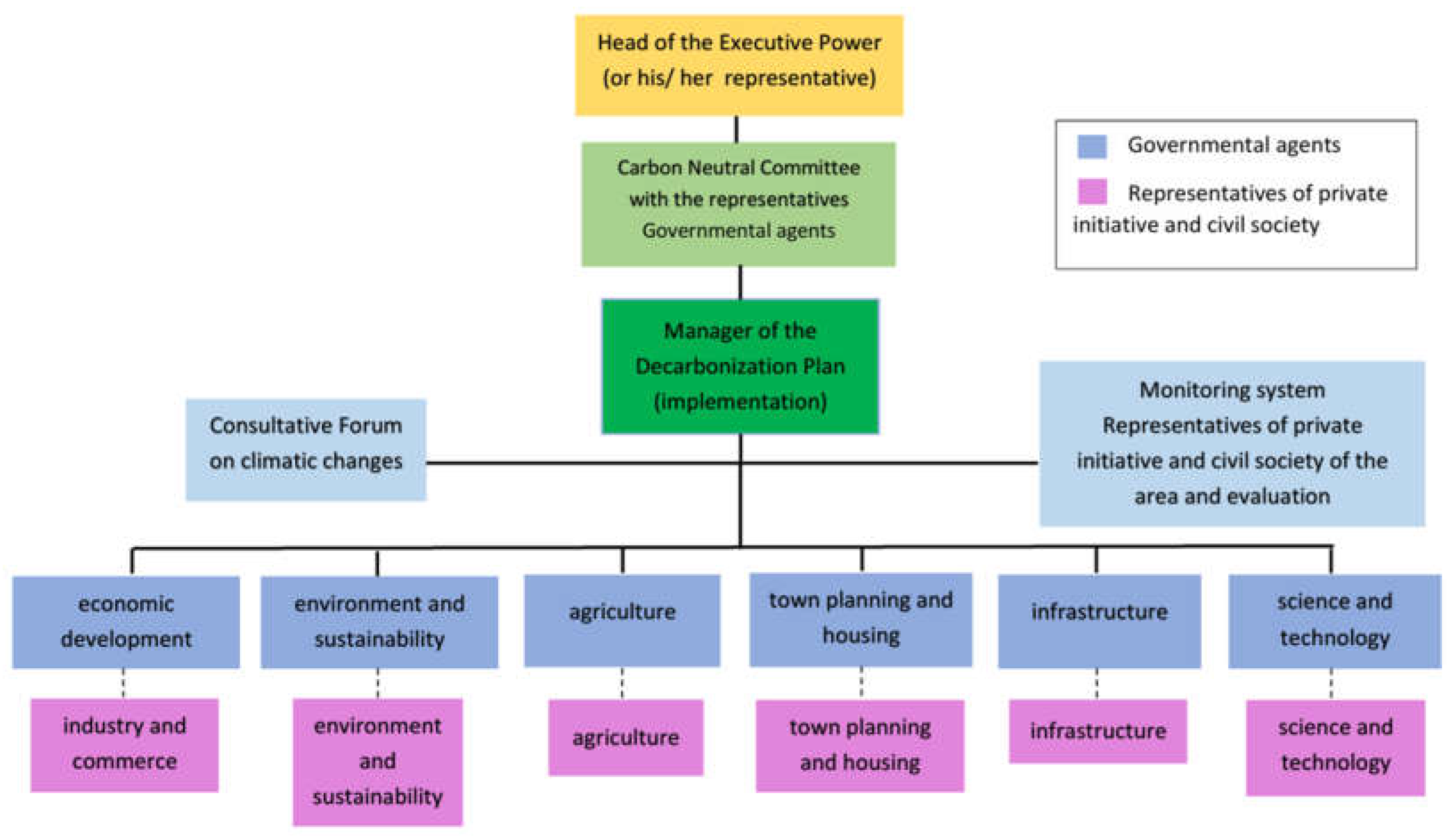
Figure 2.
Steps for preparing pdpe. Source Government of Pernambuco, 2022.
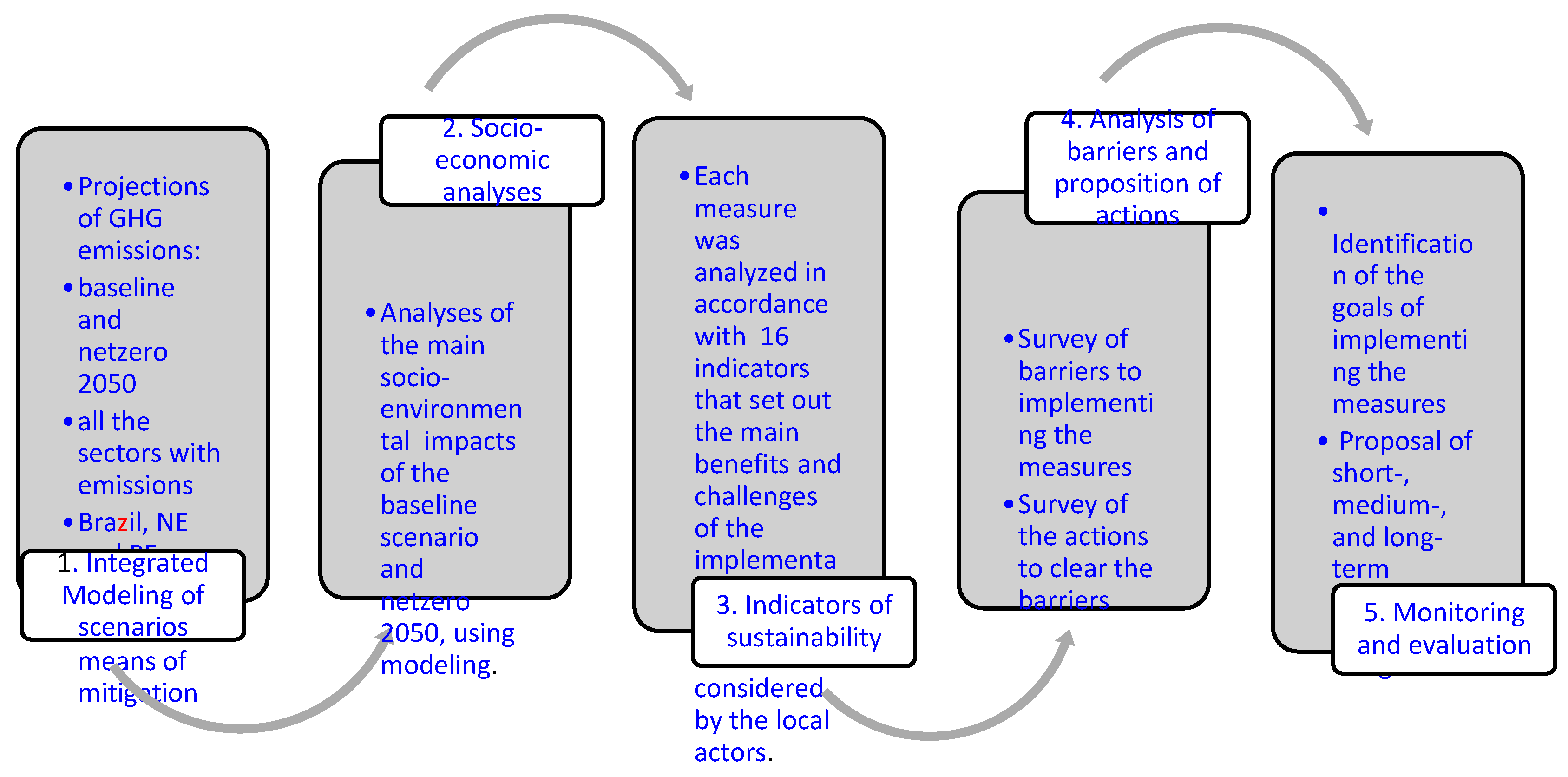
Figure 3.
Decarbonization trajectory. Source: Government of Pernambuco, 2022.
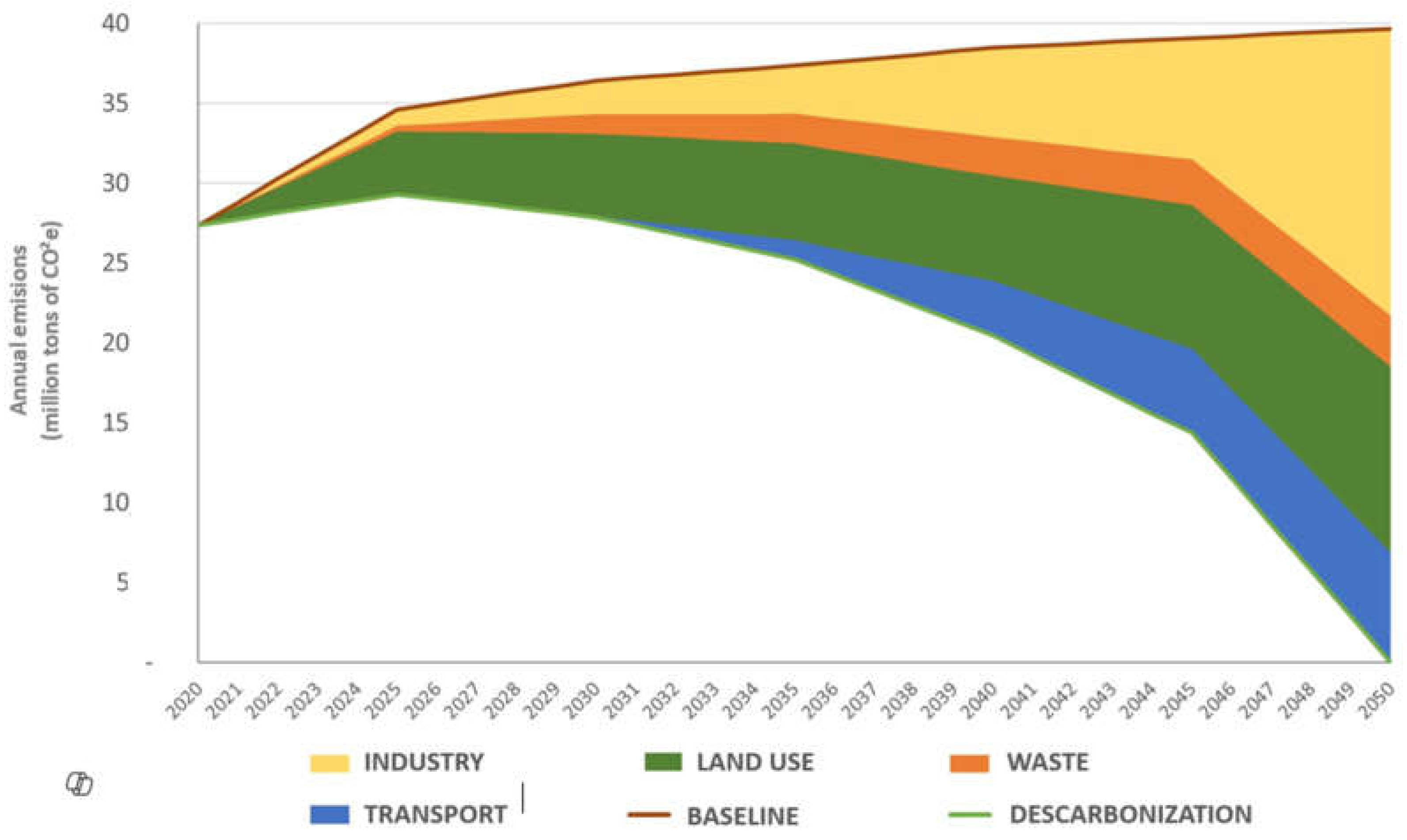
Figure 4.
Flowchart For Applying Pimade.
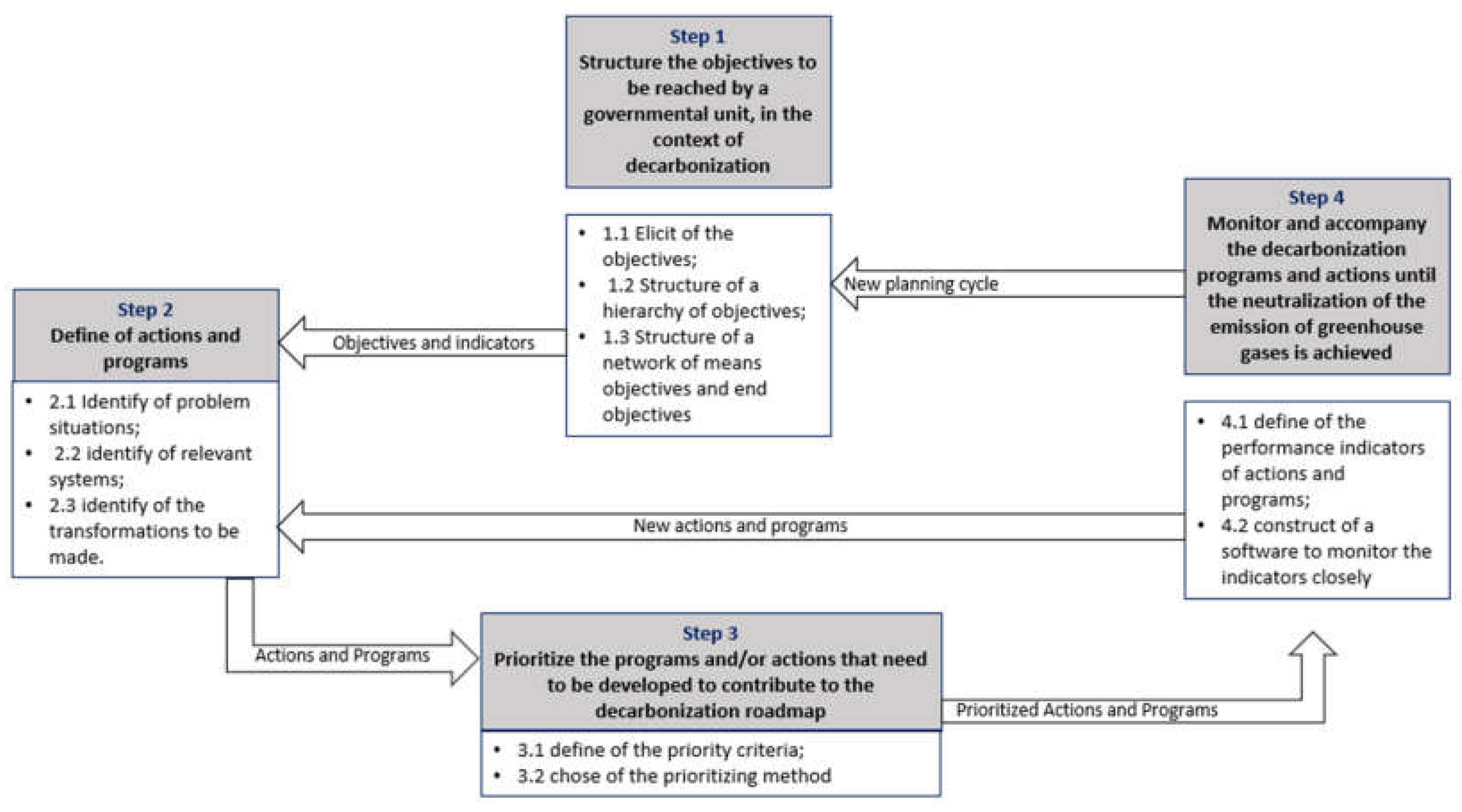
Figure 5.
Hierarchy of Objectives and Network of Means Objectives of Semas.
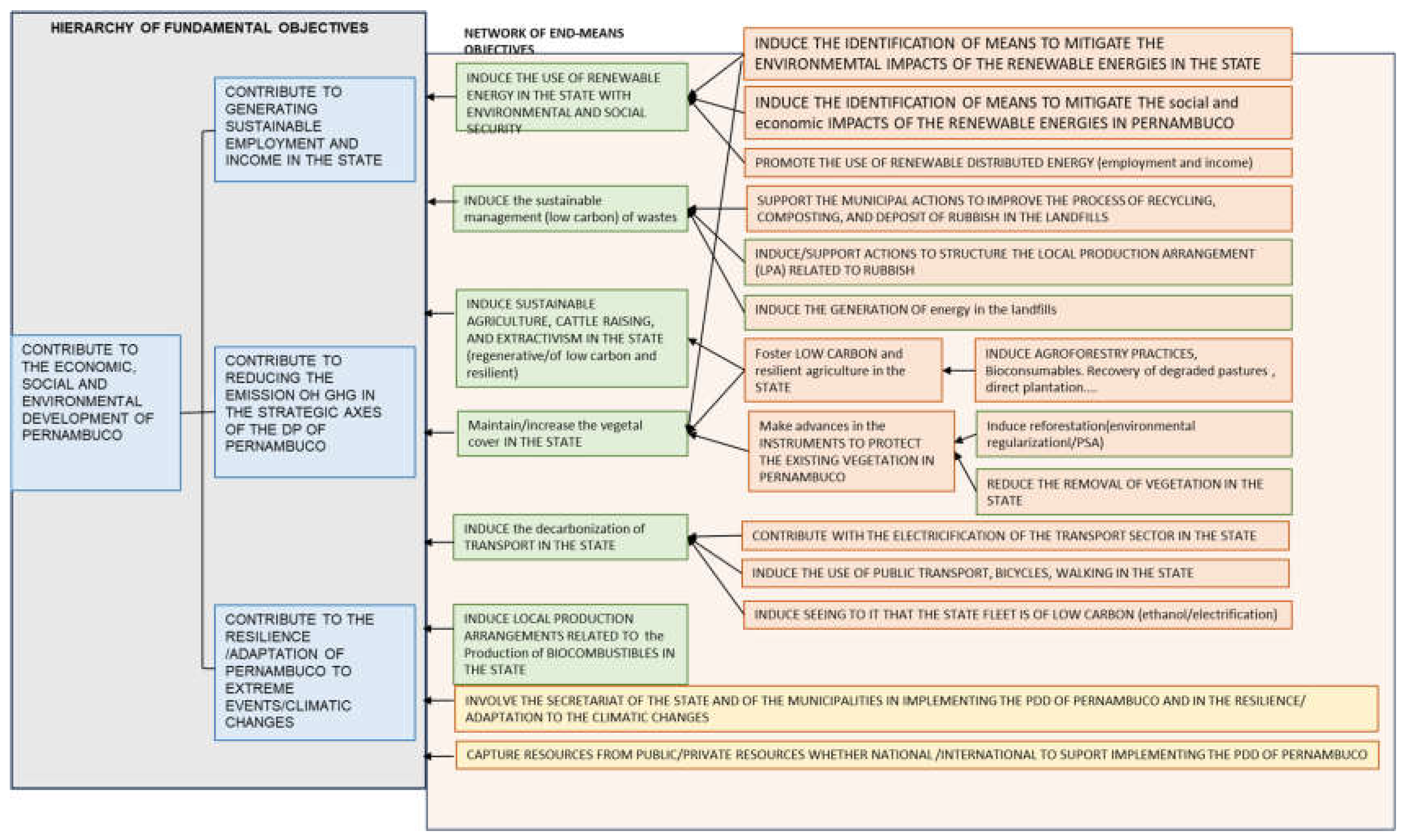

Table 1.
Synthesis of the results of the activities of design science research.
| Process of Design Science Research | Stages of the Development of the Procedure |
| Activity 1 and 2. Identify the problem (motivation) and objectives of the solution. |
Constructing a methodology for implementing decarbonization strategies is necessary when it is realized that the actions described in the strategies involve many agents over whom the government has no control. The literature does not present roadmaps for implementing decarbonization strategies. It is essential to propose a methodology that integrates all the agents involved and enables the recommendations of the strategies to be implemented. |
| Activity 3. Develop the artifact. |
The methodology needs to provide instruments that guarantee the involvement of all the agents mentioned. The government must act as a promoter, regulator and inspector of the decarbonization actions. It must verify the actions being implemented and what still needs to be done, according to the recommendations of the decarbonization strategy. It must map the perception of the agents involved and create alternatives that enable implementation of the decarbonization strategies. |
| Activity 4. Demonstration. |
This entire process needs to be instrumentalized and to be accessible by developing an information system that allows the monitoring and follow-up of the actions for implementing the decarbonization strategies. |
| Activity 5. Evaluation. |
The proposed methodology must be discussed and validated by representatives of the agents involved in implementing the decarbonization strategies. |
| Activity 6. Communication. |
The proposed methodology must be publicized. |
Table 2.
Problem Situation and Relevant Systems/Root Definition Identified.
| Problem Situation | Relevant Systems/Root Definition |
| 1-Use of renewable energy | (a) Centralized generation system/Need to promote the expansion of centralized renewable energy generation while reducing socio-environmental impacts. |
| (b) Distributed generation system/Need to promote the expansion of the generation of distributed renewable energy. | |
| 2-Management of wastes | (a) Waste management system/Need to improve the management of urban solid waste (education, separation, recycling, composting). |
| (b) Biofuel generation system/Need to advance in the recovery and use of biogas (in landfills and sewage treatment plants). | |
| 3-Use of the land | (a) Land use management system/Need to adopt sustainable, resilient and low-carbon production systems (agroforestry systems, crop-livestock-forest integration), increased productivity, without increasing the area under cultivation, high added value, efficient mechanisms for accessing markets, energy use of waste). |
| (b) Rural property management system/Need to ensure the regularization of rural properties by applying the legal definitions of permanent protection areas and of legal reserves of native forests. | |
| 4-Conservation of the vegetation | (a) Native vegetation management system/Need to create monetization opportunities to maintain native areas preserved. |
| (b) Reforestation control system/Need to reduce deforestation (inspection and environmental education). | |
| (c) Conservation systems/Need to conserve the Caatinga and Atlantic Forest in the form of Conservation Units protected by specific Law. | |
| 5-The use of low carbon transport | (a) Transportation system/Need to improve low-carbon transportation alternatives for the population. |
| (b) Biofuel use system/Need to create opportunities to increase and diversify the use of biofuels in the state’s transportation. | |
| (c) Urban logistics system/Need to stimulate the systemic management of urban logistics in the state’s municipalities. | |
| (d) Electrification system/Need to create opportunities for the use of electrification in the state’s transportation. |
Table 3.
Actions Identified Semas.
| A1. Liaise with the Department of Agriculture actions to promote the use of solar energy on family farms (income generation, energy security) |
| A2. Liaise with the Department of Infrastructure for the use of distributed energy in public buildings |
| A3. Liaise with funding bodies for facilitated credits for the acquisition of equipment for generating distributed energy (farmers, companies, homes) |
| A4. Liaise with technology and education centers for training in the use of distributed renewable energy |
| A5. Liaise with the Department of Economic Development to attract new ventures/investments for the generation of renewable energy in the state/and negotiations with the federal government on transmission lines, grants and auctions; |
| A6. Work on regulating centralized renewable energy generation projects to ensure a reduction in socio-environmental impacts; |
| A7. Liaise with the Department of Science and Technology to encourage universities and technology and research centers to provide training and qualifications in the area of renewable energy and research to make the use of new sources viable in Pernambuco; (e.g., Green Hydrogen) |
| A8. Support the Department of Agriculture in training farmers to adopt sustainable low-carbon technologies and practices for breeding and cultivation/- Technical Assistance and Rural Extension |
| A9. Promote, together with the Department of Agriculture and regional development banks, programs for access to credit to finance low-carbon technologies; |
| A10. Support the Department of Agriculture in developing projects to improve agricultural products that generate greater added value |
| A11. Support initiatives to increase the flow of agricultural products into the markets |
| A12. Implement a structure to enable the validation of rural environmental records |
| A13. Develop a program to support the reforestation of Legal Reserve areas and Permanent Preservation Areas on rural properties |
| A14. Seek strategies with the Department of Agriculture to advance land regularization/documentation of rural properties |
| A15. Promote and support studies and projects that seek to monetize environmental assets, resulting in a financial return for owners who maintain preserved native vegetation |
| A16. Improve the structure of environmental inspection; |
| A17. Develop mechanisms to discourage illegal deforestation; |
| A18. Promote environmental education; |
| A19. Work with municipalities to strengthen inspection and environmental education actions at the municipal level; |
| A20. Create conservation units for native biomes. |
| A21. Create ecological corridors |
| A22. Propose an Ecological-Economic Zoning that directs enterprises to degraded areas and establishes severe restrictions in areas important for conservation |
| A23. Work with municipalities to strengthen selective collection in urban and rural areas |
| A24. Work with municipalities to strengthen collectors’ associations |
| A25. Work with companies to advance the implementation of reverse logistics |
| A26. Support municipalities in raising funds to make waste management actions viable |
| A27. Work with sanitary landfills to establish mechanisms to encourage the use of biogas generated in landfills |
| A28. Work with the Infrastructure Secretariat to establish mechanisms to encourage and use biogas in treatment plants |
| A29. Plan and develop, together with the Urban Development Secretariat and other actors involved in the theme, a program that aims to guide the state’s municipalities in implementing actions aimed at improving low-carbon transportation alternatives in towns, the purpose being to intensify their use by the population (including measures to promote active transportation—such as bike paths, thermal comfort/tree planting, improvement in safety conditions—improvement of public transportation, low-carbon transportation collective, among others…) |
| A30. Plan and develop a program to identify sources of resources for municipalities to develop actions aimed at improving low-carbon transportation alternatives in towns. |
| A31. Liaise with the Infrastructure Department to develop a program for integrating modes of transport. |
| A32.Promote work with the Science and Technology Department to develop studies and technologies for local production and use of biofuels and green fuels. |
| A33. Promote work with the Infrastructure Department to develop studies and regulations to enable the use of biofuels (e.g., ethanol in the public fleet). |
| A34. Liaise with the Infrastructure Department to develop studies and plans for implementing optimized systemic management of urban logistics (installation of distribution centers, freight transportation outside urban centers, active freight transportation within municipalities). |
| A35. Liaise with the Department of Science and Technology to promote research for technological development aimed at reducing costs associated with electrification (including the viability of local wind and solar production to directly supply the vehicle charging system) |
| A36. Liaise with/support the Department of Infrastructure to promote dialogue between manufacturers/private initiative and other stakeholders seeking to foster the installation of infrastructure for electric vehicles |
| A37. Liaise with the Department of Infrastructure to prepare studies to increase the number of electric metro lines |
| A38. Liaise with the Department of Infrastructure to prepare studies and standards for the electrification of public transport (buses) |
Table 4.
Actions Prioritized by Semas.
| ● (A1) Liaise with the Department of Agriculture to promote the use of solar energy on family farming properties (income generation, energy security) |
| ● (A2) Liaise with the Infrastructure Secretariat on the use of energy distributed in public buildings |
| ● (A13) Develop a program to support the reforestation of Legal Reserve areas and Permanent Preservation Areas of rural Properties |
| ● (A16) Improve the environmental inspection structure |
| ● (A17) Develop mechanisms to discourage illegal deforestation |
| ● (A20) Create conservation units for native biomes |
| ● (A21) Create ecological corridors |
| ● (A15) Promote and support studies and projects that seek to monetize environmental assets, resulting in a financial return to owners who keep native vegetation preserved |
| ● (A3) Liaise with funding bodies for facilitated credits so as to purchase equipment for generating distributed energy (farmers, companies, homes) |
| ● (A4) Liaise with technology and education centers for training in the use of distributed renewable energy |
Disclaimer/Publisher’s Note: The statements, opinions and data contained in all publications are solely those of the individual author(s) and contributor(s) and not of MDPI and/or the editor(s). MDPI and/or the editor(s) disclaim responsibility for any injury to people or property resulting from any ideas, methods, instructions or products referred to in the content. |
© 2025 by the authors. Licensee MDPI, Basel, Switzerland. This article is an open access article distributed under the terms and conditions of the Creative Commons Attribution (CC BY) license (https://creativecommons.org/licenses/by/4.0/).
Copyright: This open access article is published under a Creative Commons CC BY 4.0 license, which permit the free download, distribution, and reuse, provided that the author and preprint are cited in any reuse.