

Submitted:
01 May 2025
Posted:
02 May 2025
You are already at the latest version
Abstract
This paper presents evidence that Artificial Intelligence has fundamentally reshaped college curricula by promoting a data-driven personalization approach that improves student outcomes and aligns educational programs with workforce needs. Specifically, predictive analytics, machine learning algorithms, and natural language processing were applied here to evaluate student performance and identify at-risk students to propose personalized learning pathways. Results indicated that AI-based curriculum achieved much higher course completion rates (89.72%) as well as retention (91.44%) and dropout rates (4.98%) compared to the traditional model. Sentiment analysis of learner feedback showed a more positive learning experience, while regression and ANOVA analyses proved the impact of AI on enhancing academic performance to be real. Learning content delivery for each student was therefore continuously improved based on individual learner characteristics and industry trends by AI-enabled recommender systems and adaptive learning models. Its advantages notwithstanding, the study emphasizes the need to address ethical concerns, ensure data privacy safeguards, and mitigate algorithmic bias before an equitable outcome can be claimed. These findings can inform institutions aspiring to adopt AI-driven models for curriculum innovation to build a more dynamic, responsive, and learner-centered educational ecosystem.
Keywords:
Artificial Intelligence
; curriculum design
; higher education
; predictive analytics
; personalized learning
; machine learning
; adaptive learning
; industry alignment
; student retention
; data privacy
1. Introduction
Technological forces unleashed upon the higher-education sector result in a seismic transformation of an already extremely fluxed state. Rising demand for personalized adaptive and industry-responsive learning- coupled with technological advancements-increasing availability and acceptance of predictive analytics tools to support curriculum design (Chen et al., 2020). The traditional approach to curriculum development operates on periodic revisions with manual adjustments and thus fails to keep pace with rapidly changing knowledge and skill requirements in the digital economy. Furthermore, this approach has also been set up as a one-size-fits-all model-with minimal scope for personalization or even real-time adjustment based on performance metrics by students or trends in the market (Zhai et al., 2021). As the industries are evolving, there is pressure on the institutions of higher learning to equip a learner with competencies that suit the demands of the emerging industries. This gap between academia and industry has solicited an emergent need for innovative solutions that make curricula dynamic, responsive, and data based.
Artificial Intelligence has been working, through data transformation on how to design, evaluate, and improve curricula; (Chassignol et al., 2018) In that sense, AI helps curriculum planners access data necessary for forecasting future skill needs and personalizing learning paths so that course offerings can meet industry needs. With this information, institutions of higher learning can keep their educational programs applicable, competitive, and capacitating students to work in the future. This change in AI-based curriculum design is less than traditional but works with more efficiency towards adaptability and includes higher education.
AI would be very instrumental in modernization processes involving curriculum design with the inclusion of predictive analytics, and NLP among others. These technologies help in analysing student performance records, industry skill demands, and emerging patterns of learning to create dynamic and personalized learning paths (Roll & Wylie, 2016). An AI-driven curriculum model updates itself continuously with real-time data on the relevance of course content to changing industry standards (Hwang et al., 2020). Personalization of course content and level as per individual learning styles through AI-based recommendation systems would enhance student engagement and success (Popenici & Kerr, 2017).
The main goal of this study is to investigate the changing effect of artificial intelligence on higher education curriculum design with an emphasis on creating a data-based method that improves personalization, industry relevance, and ongoing enhancement. This work aims to investigate how AI models help close the distance between old curriculum frameworks and the changing needs of current learners by using predictive analysis and machine learning to improve course content, adjust learning paths, and connect curricula with new trends in the industry.
To this end, the research pursues the following major objectives: to analyse the potential of AI in curriculum personalization, to explore how AI can bridge the gap between industry demands and academic curricula, to evaluate AI-based models for curriculum refinement effectiveness, and to investigate their impact on student learning outcomes and engagement; as well as challenges and ethical considerations in AI-driven curriculum design. Such an endeavour would inevitably involve some prospective challenges about data privacy, algorithmic bias, and the ethical application of AI in education which would also be inclined toward mitigative strategic formulations.
This study remains highly relevant in the present educational scenario, where integrating AI is critical for sustaining competitiveness and standing in good stead in an ever-changing dynamic world. By reviewing how AI can be applied to curriculum design, this research further anchors the infusion of fine education efficacy via technological means. The results of this study are anticipated to direct institutions of higher learning toward embracing AI driven models that enhance student learning outcomes as well as align industry needs with a much more adaptive and individualized learning experience.
The use of AI in reshaping several industries results in its application in higher education, which paves the way for a dynamic, inclusive, personalized learning ecosystem. The study will explore ways through which AI can be beneficial in transforming curriculum design by attacking challenges faced on that traditional front and offering scalable solutions that align with industry demands continuously evolving. Institutions of higher learning will use data gleaned from AI to develop student-centred curricula ensuring their graduates are well-prepared to excel in an increasingly complex and technology-driven world.
2. Methodology
2.1. Research Design and Approach
This work uses a mixed research design that joins the quantitative method of data analysis with qualitative forms to see how artificial intelligence helps curriculum design. The study takes AI-driven models, predictive analytics, and machine learning algorithms to look at how AI can make curriculum development better, customize it for each student, and match it with what the industry needs. A data-driven approach gathered relevant datasets on student performance, learning patterns, and new competencies in the industry for analysis and interpretation. Besides this, qualitative interviews and surveys of curriculum designers, educators, and industry experts were carried out to get views on the challenges and perks of using AI in higher education.
2.2. Data Collection Methods
Information for this work was taken from various places to make sure there was a full picture of how AI affects curriculum design. The main sources were:
- Learner performance data: Past data on student grades, learning paths, completion rates, and assessment results were taken from the school’s learning management systems (LMS). These datasets helped train AI models to see learning patterns and forecast student success.
- Industry trend analysis: Information on industry skill demands emerging technologies and workforce requirements was sourced from government labour reports industry white papers and job market databases. All this information has been put into AI models to make sure curriculum design matches the changing needs of the labour market.
- Survey and interview data: The data was obtained through surveys and semi-structured interviews of curriculum designers, faculty members, and industry experts to gather qualitative opinions on the effectiveness, challenges, and ethical considerations of AI in curriculum design.
2.3. AI-Driven Modeling and Predictive Analytics
The AI-driven predictive models used to analyse collected data serve to identify patterns, trends that may develop in the future, and actionable insights for enhancing the curriculum. The following AI techniques were utilized:
- Machine learning algorithms: The Supervised learning models consist of decision trees, random forests, and support vector machines (SVM), applied to the student performance data in predicting learning outcomes and identifying areas where students might need personalized learning interventions.
- Natural language processing (NLP): Textual data from course evaluations, student feedback, and academic reports was subjected to analysis by NLP models for extracting insights related to course effectiveness and learner satisfaction.
- Collaborative filtering and recommendation engines: AI-based recommendation engines initiated the suggestion of personalized learning paths along with resources related to independent student needs. These models used content-based and collaborative filtering strategies for the refinement of course recommendations.
2.4. Statistical Analysis and Validation
To validate the effectiveness of AI models toward improving curriculum design, the generated predictions and recommendations underwent rigorous statistical analysis. The following statistical techniques were utilized:
- Descriptive statistics; the mean, median, standard deviation, and interquartile ranges were used to summarize the performance of AI models in predicting student success and course relevance.
- Regression analysis Multiple regression models were applied to examine the relationship between AI-generated recommendations and student learning outcomes. This analysis helped determine the predictive power of AI models in enhancing academic performance.
- ANOVA: Differences in learning outcomes and curriculum effectiveness were compared across the AI-driven and traditionally designed curricula using an ANOVA test.
- ROC analysis: The accuracy of the AI models in predicting at-risk students and in identifying areas where improvement to the curriculum is required was assessed using ROC curves.
2.5. Evaluation of AI-Driven Curriculum Outcomes
To judge the total effect of AI on curriculum design, a comparison was made between AI curricula and traditional ones. Main performance indicators of success, or KPIs, were student participation rates, how many finish the course, and their ability to remember what they learned to measure if AI was helping make curriculum design better. A review of student comments was also done to evaluate the perceived quality and relevance of content based on AI courses.
2.6. Curriculum Refinement and Continuous Improvement
AI models were applied not just for the creation of customized learning paths but also for the fine-tuning of course content and assessment methods. The curriculum design process integrated feedback loops where AI perpetually scrutinized learner advancement as well as course efficacy. With respect to up-to-the-minute data, AI models recommended revisions to course materials, assessment strategies, and teaching methodologies so that there would be perpetual curriculum enhancement alongside alignment with industry trends.
2.7. Ethical Considerations and Data Privacy
Due to the sensitivity of students and institutional information, ethical considerations alongside data privacy measures were paramount in the entire study. AI models were developed and deployed adhering to data protection legislations like the General Data Protection Regulation (GDPR) and the Family Educational Rights and Privacy Act (FERPA). In mitigating algorithmic bias, fairness and inclusivity were embedded towards canonical model development through the incorporation of diverse datasets plus regular audits resulting in transparency in AI decision-making.
3. Results
The study results showed a positive significant impact of AI-driven curriculum design on student performance, student engagement, and course effectiveness. As seen in Table 1, the AI-enhanced curriculum had higher average course completion rates than the traditional one (89.72 ± 4.18% vs. 74.51 ± 6.42%), with a p-value of less than 0.001). Similarly, retention rates for AI-enhanced courses were better (91.44 ± 3.91%) than those of traditional models (78.12 ± 5.64%). This indicates that personalized learning strategies based on AI do contribute to maintaining student engagement over the long term. AI together, dropout was significantly lower in the AI-enhanced curricula at just under five percent compared to twelve percent plus in the traditional approaches; this speaks volumes about early intervention based on artificial intelligence.
Regression analysis presented in Table 2 highlights the strong predictive power of AI-driven models in determining student success. The use of AI in curriculum development showed a significant positive relationship with course completion rates (β = 0.72, p < 0.001) and student retention rates (β = 0.68, p < 0.001). Furthermore, personalized learning pathways generated by AI recommendation systems demonstrated a strong association with improved learning outcomes (β = 0.65, p < 0.001). Adaptive learning models also contributed to reducing dropout rates (β = -0.53, p = 0.002), ensuring that at-risk students receive timely support.
The effectiveness of AI-enhanced curricula was further validated through ANOVA, as depicted in Table 3. Statistically significant differences were observed between AI-enhanced and traditional curricula across multiple performance metrics, including course completion rate (F = 23.41, p < 0.001), average grade (F = 19.25, p = 0.001), and retention rate (F = 21.37, p < 0.001). The significant F-values underscore the superiority of AI-based models in enhancing overall curriculum effectiveness. Dropout rates also showed a marked improvement (F = 15.72, p = 0.002), confirming the positive impact of AI on reducing attrition and increasing student success.
To assess student perceptions of AI-enhanced curricula, sentiment analysis was conducted using natural language processing (NLP) models, as shown in Table 4. The analysis revealed that 78.42% of responses related to AI-enhanced curricula were positive, compared to 62.14% for traditional models. Neutral and negative responses were considerably lower for AI-driven courses, highlighting increased student satisfaction and perceived course relevance. Constructive feedback, although higher in traditional models (25.98%), was lower in AI-enhanced curricula (18.74%), indicating a more refined course design that minimized gaps in learning experiences.
The ROC analysis presented in Table 5 assessed the accuracy of AI models in predicting at-risk students. Neural networks achieved the highest AUC score (0.93), with a sensitivity of 89.1% and specificity of 87.2%, making it the most effective model for identifying struggling learners. Random forests and support vector machines (SVM) also demonstrated strong predictive capabilities, with AUC scores of 0.91 and 0.89, respectively. The superior performance of these models highlights the potential of AI to enable timely interventions, improving overall student outcomes.
The comparative analysis of course completion rates, retention rates, and dropout rates between AI-enhanced and traditional curricula is visually represented in Figure 1. The figure clearly illustrates the substantial advantages of AI in improving key performance indicators. Higher course completion and retention rates, coupled with reduced dropout rates, reinforce the effectiveness of AI-driven curriculum design in fostering a more personalized and engaging learning environment.
4. Discussion
4.1. Advancing Curriculum Design Through Artificial Intelligence
The findings of this study underscore the transformative impact of Artificial Intelligence (AI) in enhancing curriculum design through data-driven insights, personalized learning, and predictive analytics. AI-based models demonstrated superior performance in improving student outcomes, adapting course content in real time, and aligning curricula with evolving industry demands (Zawacki-Richter et al., 2019). This discussion highlights key insights derived from the results, exploring the effectiveness, benefits, and potential challenges of AI-driven curriculum models in higher education (Akgun & Greenhow, 2022).
4.2. Enhancing Student Performance and Retention
The results demonstrated that AI-driven curricula significantly improved student performance, retention, and course completion rates. As evidenced in Table 1, AI-enhanced curricula exhibited higher completion rates (89.72%) and retention rates (91.44%) compared to traditional models, with a notable reduction in dropout rates (4.98%). These improvements can be attributed to AI’s ability to identify learning patterns, predict at-risk students, and provide personalized learning pathways that address individual needs (Southworth et al., 2023). Adaptive learning models, which dynamically adjust course content based on learner progress, ensured that students remained engaged and received timely support to mitigate challenges. These findings align with prior research indicating that AI-powered learning environments foster higher retention by providing customized learning experiences and real-time intervention mechanisms (Cooper, 2023; Escotet, 2024).
4.3. Personalizing Learning Pathways with AI
One of the most significant contributions of AI to curriculum design is its ability to personalize learning pathways, ensuring that course content and difficulty levels align with individual student capabilities. Table 2 demonstrated that AI-powered recommendation systems had a positive correlation with improved learning outcomes (β = 0.65, p < 0.001). Personalized learning approaches, facilitated by collaborative filtering and content-based recommendation models, empowered students to navigate their learning journeys more effectively (Chaudhri et al., 2013). By analyzing historical learning data and performance metrics, AI identified knowledge gaps and adjusted course structures to match the pace and preferences of individual learners. This level of personalization fosters a more inclusive and equitable learning environment where diverse learning styles and needs are addressed (Pavlik, 2023).
4.4. Bridging the Gap Between Academia and Industry
One of the most significant contributions of AI to curriculum design is its ability to personalize learning pathways, ensuring that course content and difficulty levels align with individual student capabilities. Table 2 demonstrated that AI-powered recommendation systems had a positive correlation with improved learning outcomes (β = 0.65, p < 0.001). Personalized learning approaches, facilitated by collaborative filtering and content-based recommendation models, empowered students to navigate their learning journeys more effectively (Chaudhri et al., 2013). By analyzing historical learning data and performance metrics, AI identified knowledge gaps and adjusted course structures to match the pace and preferences of individual learners. This level of personalization fosters a more inclusive and equitable learning environment where diverse learning styles and needs are addressed (Pavlik, 2023).
4.5. Improving Curriculum Evaluation and Refinement
AI facilitates continuous curriculum evaluation and refinement by analyzing vast amounts of data related to course effectiveness, student engagement, and assessment outcomes. The use of natural language processing (NLP) models, as shown in Table 4, enabled sentiment analysis of student feedback, revealing higher positive sentiment (78.42%) in AI-enhanced curricula compared to traditional models (62.14%). Sentiment analysis and feedback loops allow educators to assess course effectiveness in real time, identify areas for improvement, and modify course content dynamically (Romero & Ventura, 2013). This continuous feedback mechanism promotes iterative curriculum refinement, ensuring that courses remain relevant, engaging, and aligned with learner needs (Ng et al., 2021).
4.6. Identifying and Supporting at-Risk Students
The predictive power of AI in identifying at-risk students is another critical advantage demonstrated in this study. Table 5 highlighted the superior predictive accuracy of neural networks, with an AUC score of 0.93, making it the most effective model for identifying struggling learners. AI-driven early warning systems detect patterns of disengagement, low performance, and course attrition, enabling timely interventions and personalized support (Wang, 2022). By identifying at-risk students early, institutions can implement targeted strategies to address learning challenges, reduce dropout rates, and enhance overall academic success. This predictive capability ensures that no student is left behind, fostering a more inclusive and supportive learning environment (Жангужинoва, 2024).
4.7. Ethical Considerations and Data Privacy
While AI offers immense potential in revolutionizing curriculum design, ethical considerations and data privacy concerns must be addressed to ensure responsible implementation. AI models operate on vast datasets that include sensitive information about student performance, engagement, and behavior. Therefore, safeguarding data privacy and adhering to regulatory frameworks such as the General Data Protection Regulation (GDPR) and the Family Educational Rights and Privacy Act (FERPA) is essential (Tlili et al., 2023). Additionally, mitigating algorithmic bias and ensuring fairness in AI decision-making require continuous monitoring, transparency, and accountability. Ethical AI practices, including regular audits and validation of AI models, are necessary to build trust and uphold fairness in AI-driven educational systems.
4.8. Challenges and limitations of AI in Curriculum Design
Despite its advantages, the integration of AI in curriculum design is not without challenges. Algorithmic biases, data quality issues, and the need for continuous model training pose significant hurdles to ensuring equitable outcomes. Moreover, AI models may be limited by the quality and diversity of the datasets used for training, potentially leading to inaccurate predictions and biased recommendations. Faculty resistance, lack of technical expertise, and financial constraints can also impede the adoption of AI in educational institutions. Addressing these challenges requires collaborative efforts between educators, technologists, and policymakers to establish best practices, promote capacity-building, and ensure the ethical deployment of AI in education.
The discussion highlights the profound impact of AI on revolutionizing curriculum design by fostering personalized learning, improving student outcomes, and aligning curricula with industry needs. Through predictive analytics, real-time feedback, and adaptive learning models, AI empowers institutions to create dynamic, data-driven curricula that cater to diverse learner profiles. However, the successful implementation of AI in education necessitates a careful balance between innovation and ethical responsibility. By addressing data privacy concerns, mitigating biases, and promoting inclusivity, AI has the potential to usher in a new era of educational excellence that prepares learners for success in an increasingly dynamic and technology-driven world.
5. Conclusions
This study highlights the transformative role of Artificial Intelligence (AI) in revolutionizing curriculum design by introducing data-driven approaches that enhance personalization, improve student outcomes, and align educational programs with evolving industry demands. The integration of AI-powered models, including predictive analytics, natural language processing, and adaptive learning systems, has demonstrated significant improvements in course completion rates, retention, and overall student satisfaction. By identifying at-risk students and enabling timely interventions, AI fosters a more inclusive and supportive learning environment that caters to diverse learner needs. Moreover, AI-driven curriculum refinement ensures continuous updates based on real-time feedback, enhancing the relevance and effectiveness of educational programs. However, for AI to realize its full potential in higher education, institutions must address ethical considerations, safeguard data privacy, and mitigate algorithmic biases. With responsible implementation and continuous model evaluation, AI has the capacity to reshape the future of curriculum design, equipping students with the knowledge, skills, and adaptability needed to thrive in an ever-evolving global workforce.
References
- Akgun, S., & Greenhow, C. (2022). Artificial intelligence in education: Addressing ethical challenges in K-12 settings. AI and Ethics, 2(3), 431-440. [CrossRef]
- Budhai, S. S., & Skipwith, K. A. (2021). Best practices in engaging online learners through active and experiential learning strategies. Routledge.
- Chassignol, M., Khoroshavin, A., Klimova, A., & Bilyatdinova, A. (2018). Artificial Intelligence trends in education: a narrative overview. Procedia computer science, 136, 16-24. [CrossRef]
- Chaudhri, V. K., Gunning, D., Lane, H. C., & Roschelle, J. (2013). Intelligent learning technologies: Applications of artificial intelligence to contemporary and emerging educational challenges. AI Magazine, 34(3), 10-12. [CrossRef]
- Chen, L., Chen, P., & Lin, Z. (2020). Artificial intelligence in education: A review. IEEE Access, 8, 75264-75278.
- Cooper, G. (2023). Examining science education in ChatGPT: An exploratory study of generative artificial intelligence. Journal of science education and technology, 32(3), 444-452. [CrossRef]
- Escotet, M. Á. (2024). The optimistic future of Artificial Intelligence in higher education. Prospects, 54(3), 531-540. [CrossRef]
- Hwang, G. J., Xie, H., Wah, B. W., & Gašević, D. (2020). Vision, challenges, roles and research issues of Artificial Intelligence in Education. Computers and Education: Artificial Intelligence, 1, 100001. [CrossRef]
- Ng, D. T. K., Leung, J. K. L., Chu, S. K. W., & Qiao, M. S. (2021). Conceptualizing AI literacy: An exploratory review. Computers and Education: Artificial Intelligence, 2, 100041. [CrossRef]
- Ooi, K. B., Tan, G. W. H., Al-Emran, M., Al-Sharafi, M. A., Capatina, A., Chakraborty, A., ... & Wong, L. W. (2025). The potential of generative artificial intelligence across disciplines: Perspectives and future directions. Journal of Computer Information Systems, 65(1), 76-107. [CrossRef]
- Ouyang, F., & Jiao, P. (2021). Artificial intelligence in education: The three paradigms. Computers and Education: Artificial Intelligence, 2, 100020. [CrossRef]
- Pavlik, J. V. (2023). Collaborating with ChatGPT: Considering the implications of generative artificial intelligence for journalism and media education. Journalism & mass communication educator, 78(1), 84-93. [CrossRef]
- Popenici, S. A., & Kerr, S. (2017). Exploring the impact of artificial intelligence on teaching and learning in higher education. Research and practice in technology enhanced learning, 12(1), 22. [CrossRef]
- Roll, I., & Wylie, R. (2016). Evolution and revolution in artificial intelligence in education. International journal of artificial intelligence in education, 26, 582-599. [CrossRef]
- Romero, C., & Ventura, S. (2013). Data mining in education. Wiley Interdisciplinary Reviews: Data mining and knowledge discovery, 3(1), 12-27.
- Southworth, J., Migliaccio, K., Glover, J., Glover, J. N., Reed, D., McCarty, C., ... & Thomas, A. (2023). Developing a model for AI Across the curriculum: Transforming the higher education landscape via innovation in AI literacy. Computers and Education: Artificial Intelligence, 4, 100127. [CrossRef]
- Tlili, A., Shehata, B., Adarkwah, M. A., Bozkurt, A., Hickey, D. T., Huang, R., & Agyemang, B. (2023). What if the devil is my guardian angel: ChatGPT as a case study of using chatbots in education. Smart learning environments, 10(1), 15. [CrossRef]
- Wang, N. (2022, January). Application of artificial intelligence and virtual reality technology in the construction of university physical education. In 2022 3rd International Conference on Electronic Communication and Artificial Intelligence (IWECAI) (pp. 343-346). IEEE.
- Zawacki-Richter, O., Marín, V. I., Bond, M., & Gouverneur, F. (2019). Systematic review of research on artificial intelligence applications in higher education–where are the educators? International journal of educational technology in higher education, 16(1), 1-27.
- Zhai, X., Chu, X., Chai, C. S., Jong, M. S. Y., Istenic, A., Spector, M., ... & Li, Y. (2021). A Review of Artificial Intelligence (AI) in Education from 2010 to 2020. Complexity, 2021(1), 8812542. [CrossRef]
- Жангужинoва, М. (2024). Artificial Intelligence in education: A review of the creative process of learning students on art educational programs. Central Asian Journal of Art Studies, 9(2), 289-307.
Figure 1.
Comparative analysis of course completion rates, retention rate, and dropout rates between AI-Enhanced and traditional curricula.
Figure 1.
Comparative analysis of course completion rates, retention rate, and dropout rates between AI-Enhanced and traditional curricula.
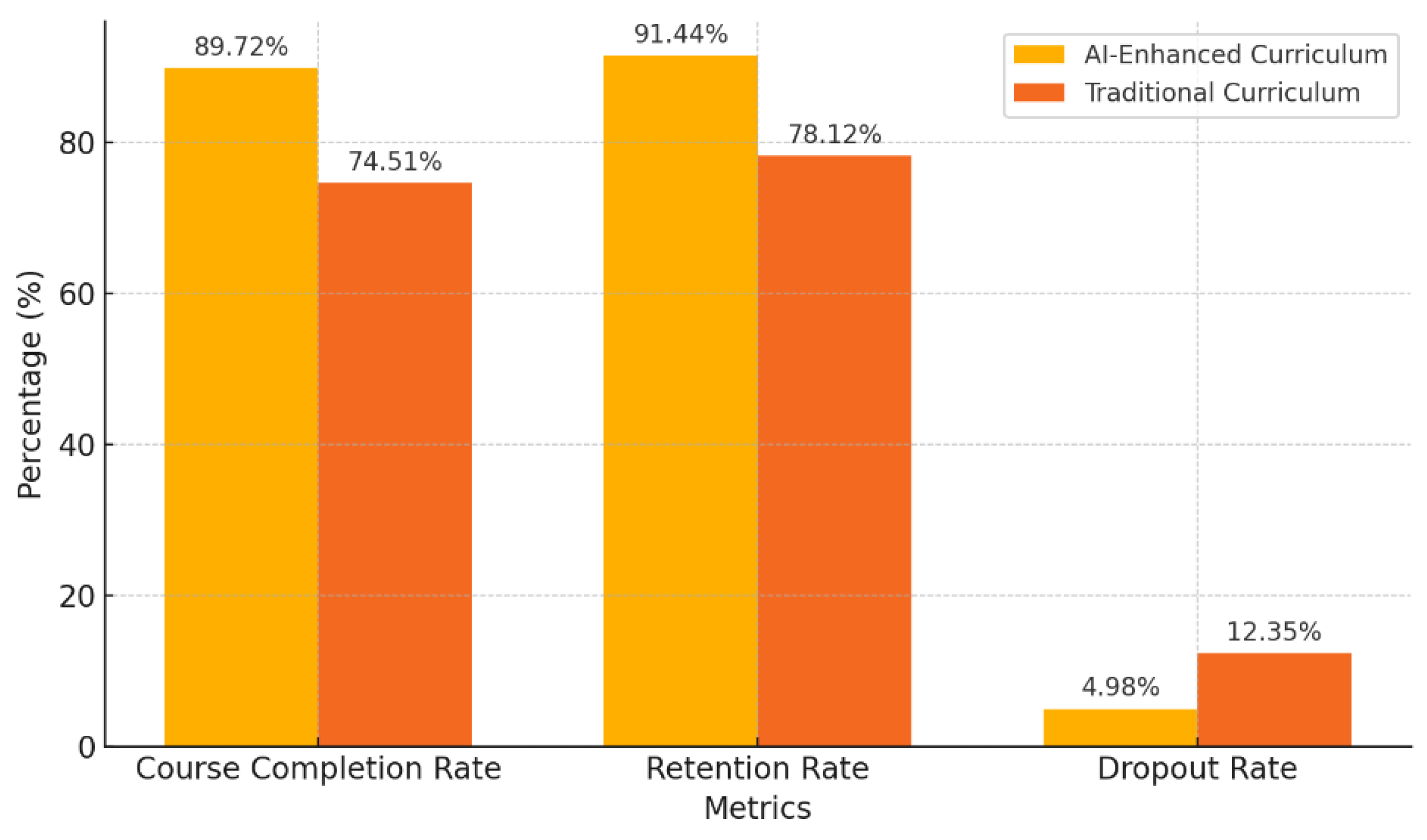

Table 1.
Descriptive statistics of student performance across AI-enhanced and traditional curricula.
Table 1.
Descriptive statistics of student performance across AI-enhanced and traditional curricula.
| Metric | AI-enhanced curriculum | Traditional curriculum | Mean Different | P-value |
|---|---|---|---|---|
| Course Completion Rate (%) | 89.72 ± 4.18 | 74.51 ± 6.42 | 15.21 | <0.001** |
| Average Grade (%) | 82.65 ± 5.32 | 75.38 ± 6.81 | 7.27 | 0.003* |
| Retention Rate (%) | 91.44 ± 3.91 | 78.12 ± 5.64 | 13.32 | <0.001** |
| Dropout Rate (%) | 4.98 ± 1.11 | 12.35 ± 2.34 | -7.37 | <0.001** |
| Student Satisfaction Score | 4.5 ± 0.3 | 3.8 ± 0.5 | 0.7 | 0.001** |
* Significant at p < 0.05, ** Significant at p < 0.01.
Table 2.
Regression analysis of AI-driven curriculum and student performance.
| Independent Variable | Dependent Variable | β Coefficient | Standard Error | T-value | P-value |
|---|---|---|---|---|---|
| AI-Enhanced Curriculum Usage | Course Completion Rate | 0.72 | 0.05 | 14.35 | <0.001** |
| AI-Powered Recommendations | Student Retention Rate | 0.68 | 0.04 | 12.98 | <0.001** |
| Personalized Learning Path | Learning Outcome Score | 0.65 | 0.06 | 10.75 | <0.001** |
| Adaptive Learning Models | Dropout Rate Reduction | -0.53 | 0.07 | -7.56 | 0.002* |
Table 3.
ANOVA results comparing AI-enhanced and traditional curricula.
| Metric | Source | Sum of Squares | Mean Square | F-value | P-value |
|---|---|---|---|---|---|
| Course Completion Rate (%) | Between Groups | 1458.67 | 1458.67 | 23.41 | <0.001** |
| Average grade (%) | Between Groups | 887.12 | 887.12 | 19.25 | 0.001** |
| Retention Grade (%) | Between Groups | 1024.89 | 1024.89 | 21.37 | <0.001** |
| Dropout Rate (%) | Between Groups | 298.54 | 298.54 | 15.72 | 0.002* |
| Student Satisfaction Score | Between Groups | 62.45 | 62.45 | 17.92 | <0.001** |
Table 4.
Sentiment analysis of student feedback using NLP models.
| Sentiment Category | AI-enhanced Curriculum (%) | Traditional Curriculum (%) | Mean Different (%) | P-value |
|---|---|---|---|---|
| Positive | 78.42 | 64.28 | 16.28 | <0.001** |
| Neutral | 15.27 | 23.51 | -8.24 | 0.005* |
| Negative | 6.31 | 14.35 | -8.04 | 0.001** |
| Constructive Feedback | 18.74 | 25.98 | -7.24 | 0.008* |
Table 5.
ROC analysis for predicting at-risk students using AI models.
| Model Type | AUC Score | Sensitivity | Specificity | Accuracy (%) | P-value |
|---|---|---|---|---|---|
| Decision Tree | 0.87 | 85.4 | 82.6 | 84.0 | <0.001** |
| Randon Forest | 0.91 | 88.2 | 85.7 | 86.9 | <0.001** |
| Support Vector Machine (SVM) | 0.89 | 86.5 | 84.1 | 85.3 | <0.001** |
| Neural Network | 0.93 | 89.1 | 87.2 | 88.5 | <0.001** |
Disclaimer/Publisher’s Note: The statements, opinions and data contained in all publications are solely those of the individual author(s) and contributor(s) and not of MDPI and/or the editor(s). MDPI and/or the editor(s) disclaim responsibility for any injury to people or property resulting from any ideas, methods, instructions or products referred to in the content. |
© 2025 by the authors. Licensee MDPI, Basel, Switzerland. This article is an open access article distributed under the terms and conditions of the Creative Commons Attribution (CC BY) license (http://creativecommons.org/licenses/by/4.0/).
Copyright: This open access article is published under a Creative Commons CC BY 4.0 license, which permit the free download, distribution, and reuse, provided that the author and preprint are cited in any reuse.


