

Submitted:
09 November 2026
Posted:
11 November 2026
You are already at the latest version
Abstract
We characterize compact Calabi–Yau manifolds of complex dimension at least two admitting free isometric or holomorphic circle actions by flat bundles over parallel transverse Calabi–Yau bases. Over a fixed such base, the integral Euler classes are exactly torsion. We construct prime-order examples, classify free unitary linear models and fixed-metric imaginary self-dual flux pairs, and derive normalized curvature and spectral formulas. Genuine noncompact Hopf constructions are given explicitly.
Keywords:
Hopf fibrations
; Calabi–Yau manifolds
; characteristic classes
MSC: 53C25; 55R25; 14J32
Scope of this revision
This mathematical review revision develops the geometric and topological subjects of the preceding manuscript with explicit hypotheses. Classical results are credited to their sources. New derivations and counterexamples are proved in the text. Proposed applications to flux vacua, arithmetic and quantum gravity are stated separately from the established bundle theorems. The discussion does not assert a finite classification of all Calabi–Yau orbifold fibrations, a universal exact spectral gap, a numerical count of flux vacua, or a solution of the distance or cobordism conjectures. Those conclusions do not follow from the arguments available here.
The terms Calabi–Yau, Hopf fibration, principal bundle, holomorphic fibration and isometric fibration are distinguished throughout. A smooth circle quotient has an odd-dimensional real base; it is not a holomorphic fibration over a Kähler base. Integral Euler classes and their rational or real images are never identified without qualification. These distinctions change several claims of the preceding version.
0.0.0.1. Foundations and constructions
1. The Problem and the Categories of Fibrations
Classical Hopf maps connect a concrete quotient construction with characteristic classes, homotopy groups and linking. On a Calabi–Yau manifold these ideas meet a further requirement: the complex structure and the Ricci-flat metric must be compatible with the proposed quotient. Topological existence, holomorphic existence and isometric existence are different questions. A construction in one category does not answer the other two.
The starting point is the classical family
Its total space is odd dimensional. Consequently this sphere, by itself, is not a complex Calabi–Yau manifold. The radial extension is a construction on ; a compactification of this punctured space is an additional problem. A link at infinity is likewise different from a bundle defined on the entire complete manifold.
Definition 1
(Terminology). Aprincipal circle bundleis a smooth locally trivial bundle with a free right circle action whose orbits are the fibres. Asphere bundleis a locally trivial bundle with fibre a specified sphere and structure group acting on that sphere. Aclassical Hopf fibrationis one of the usual quotient fibrations associated to the normed division algebras. We useHopf-type local modelonly when a specified region or link carries one of these fibrations, or a specified finite quotient of it.
Whenever a model is defined only outside a compact set, that restriction is included in the statement. General spherical fibrations are distinguished from the specified classical Hopf bundles.
1.1. Calabi–Yau Conventions
All compact manifolds in the theorems are understood to be without boundary. For compact manifolds we use the broad differential-geometric convention: a compact Kähler manifold with trivial canonical bundle, equipped with a Ricci-flat Kähler metric. Existence in each Kähler class follows from Yau’s theorem [23]. A manifold with full holonomy is a special case. Complex tori, products of lower-dimensional examples, and the flat threefold constructed below belong to the broad category but do not have full holonomy.
On a noncompact complex manifold, trivial canonical bundle alone does not supply a complete Ricci-flat Kähler metric. Completeness, asymptotic conditions and the metric equation must be checked separately. The Euclidean metric on the punctured affine space is Ricci flat but incomplete at the removed origin. Taub–NUT and Eguchi–Hanson supply complete noncompact examples with special local or asymptotic fibre geometry.
1.2. What a Compact Obstruction Can Prove
The compact theorem established below concerns isometric or holomorphic circle actions. Its proof is the Bochner identity for a Killing field, together with uniqueness of the Ricci-flat metric in a Kähler class. It does not assume a complex structure on the odd-dimensional orbit space. It also does not say that the integral Euler class is zero: flat bundles can have nonzero torsion Euler class.
A purely smooth circle action need not preserve the chosen metric or the complex structure. The Bochner argument cannot be applied to its generator without proving that it is Killing. This hypothesis cannot be inferred merely from Ricci flatness of some other metric on the same manifold.
2. Classical Hopf Maps in Coordinates
2.1. The Complex Hopf Bundle
Write and restrict to . Scalar multiplication by is free: if and , then . Each orbit is a complex line intersected with the unit sphere. The orbit map is
For , choose the representative of norm one whose jth coordinate is positive real. This is a smooth local section. The resulting local product charts prove local triviality, rather than only identifying the set of orbits.
On the unit sphere use the real one-form
The fundamental vector satisfies and has period . Invariance under scalar multiplication makes a connection. Its curvature is basic. With the orientation of the base chosen accordingly, is the positive generator x of . Reversing the bundle orientation changes its sign. Thus all Euler signs below refer to the declared bundle orientation, not to an unmentioned convention for the tautological line bundle.
Proposition 1
(The radial extension). There is a principal bundle
The Euclidean total space has trivial canonical bundle and a Ricci-flat Kähler metric. Its Euler class is the pullback of x.
Proof.
The map is a diffeomorphism with . The circle acts on the second factor, and the local sections just constructed extend independently of the radial coordinate. The standard complex form is nowhere zero. The flat Euclidean metric is Kähler and Ricci flat. The class statement follows by pullback from the sphere bundle. □
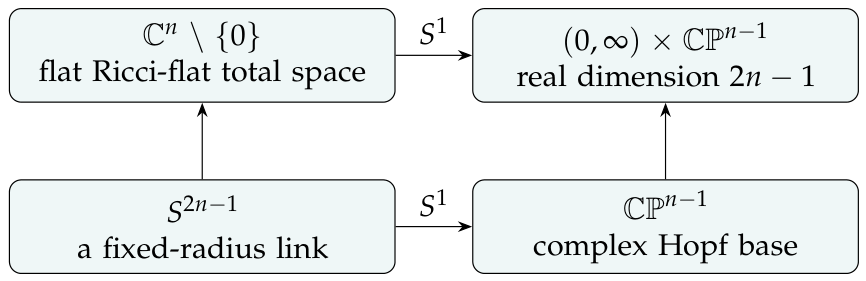
Figure 1.
The radial Hopf construction. The vertical maps include a fixed-radius slice. The upper base is an odd-dimensional real manifold.
Figure 1.
The radial Hopf construction. The vertical maps include a fixed-radius slice. The upper base is an odd-dimensional real manifold.
2.2. The Quaternionic Hopf Bundle
For with , define
The squared norm of the image is
Right multiplication by leaves H unchanged and is free. Conversely the image determines the quaternionic line generated by , so the fibres are these orbits. Local charts on give
Identifying with gives a corresponding radial construction on a punctured flat Calabi–Yau fourfold. It does not make the projection to holomorphic; that base has real dimension five.
The octonionic Hopf fibration is a sphere fibration, but the fibre is not a Lie group. Treating it as a principal bundle would introduce a nonexistent associative group structure. Adams’ Hopf-invariant-one theorem is a theorem about maps ; it does not restrict the complex projective Hopf family to [1,3].
3. Connections, Characteristic Classes and Normalization
Choose circle coordinate of period . On a local section a connection is . On an overlap, after choosing the compatible convention for the transition function. The functions are defined modulo ; on triple overlaps their sums are times integers. These integers form a Čech representative of the Euler class. The curvature patches to a global closed two-form on the base and represents .
The real form does not see torsion. In particular does not imply that the bundle has a global section. Conversely in integral cohomology classifies the underlying principal bundle as topologically trivial, but a chosen flat connection on it can still have nontrivial holonomy. That distinction will reappear in the spectral calculation.
Proposition 2
(Classification over a fixed base). For a paracompact manifold B, isomorphism classes of principal circle bundles over B are classified by . The statement fixes the base and concerns isomorphism classes, not a finite list of total spaces.
Proof.
3.1. A Necessary Euler-characteristic Test
A free circle action has a nowhere-zero vector field. For a compact oriented total manifold P, the Poincaré–Hopf theorem implies . This is a necessary condition for a smooth action; no invariance of a complex structure is needed. A K3 surface has Euler characteristic 24 and therefore admits no free smooth circle action. A smooth quintic threefold has Euler characteristic , so it also admits none. Euler characteristic zero is not a sufficient condition.
3.2. Why the Tangent-Sequence Argument Needs a Category
For a holomorphic submersion , there is an exact sequence of complex bundles
and . A principal circle quotient instead has a real vertical line and an odd-dimensional base. There is no complex tangent sequence of this form unless a further structure is supplied, and the Euler class of the principal circle bundle is not of its real vertical tangent line. That vertical line is trivial, generated by the fundamental vector field.
These elementary checks are useful before any appeal to holonomy, a spectral sequence or a quantum correction. They eliminate degree and category mismatches without pretending to settle existence in a different geometric category.
I. Exact proofs, counterexamples and scope of the classification
4. Conventions for the Statements in This Revision
A compact Calabi–Yau manifold in this part is a compact Ricci-flat Kähler manifold with trivial canonical bundle, unless full holonomy is imposed. Full holonomy is a stronger condition. A principal circle bundle need not have a complex total space. Conversely the quotient of a complex n-fold by a free circle action has real dimension and cannot be Kähler. A holomorphic submersion has even-dimensional real fibres.
Statements designated research targets below retain directions of the preceding version for which a proof is missing. The proved results distinguish genuine bundle constructions, compact obstructions, and the arithmetic or physical structures that would need additional hypotheses.
5. The Compact Obstruction and Its Integral Qualification
Theorem 1
(Bochner obstruction). On a connected compact Ricci-flat manifold every Killing field is parallel. A nontrivial isometric circle action has a nonzero parallel dual one-form and is locally free. If , or X has full holonomy with , no such action exists. The same conclusions hold for a holomorphic circle action on a compact Ricci-flat Kähler manifold.
Proof.
The integrated Killing-field identity is
It follows by commuting derivatives in the Killing equation and integration by parts. Thus . A nonzero parallel field has constant positive length, and its dual is a nonzero harmonic one-form. Full holonomy has no nonzero fixed real vector.
A holomorphic circle acts by maps isotopic to the identity and so fixes the Kähler class. Every pullback of the Ricci-flat form is a Ricci-flat representative in that class. Uniqueness in Yau’s theorem [23] makes the form invariant. Together with invariance of the complex structure this makes the action isometric. □
Theorem 2
(Flat connection). For a free action as above, normalize the fundamental vector to period . Then
The Euler class vanishes over and , and the integral Euler class is torsion. Integral vanishing need not hold.
Proof.
The one-form is parallel and invariant, and its normalization makes it a connection. Its curvature divided by represents the real image of the Euler class. The integral cohomology of the compact base is finitely generated, so the kernel of its map to real cohomology is its torsion subgroup. □
Example 1
(An order-two Euler class). Let and let be the first real coordinate of . The group acts on by
This is a group action since and coincide modulo . It is free, properly discontinuous, and cocompact. In the complex coordinate the maps are holomorphic affine isometries. They preserve because there are two minus signs on the z coordinates. Thus the quotient is a compact flat Kähler threefold with trivial canonical bundle. Translation of u is a free circle action. The base is the mapping torus of on a four-torus.
The flat monodromy is . The base fundamental group’s abelianization is . A homomorphism into kills its torsion, while χ does not. In the coefficient sequence , the connecting class is therefore nonzero. It is the Euler class of this flat circle bundle and has order two. The total space has reducible holonomy.
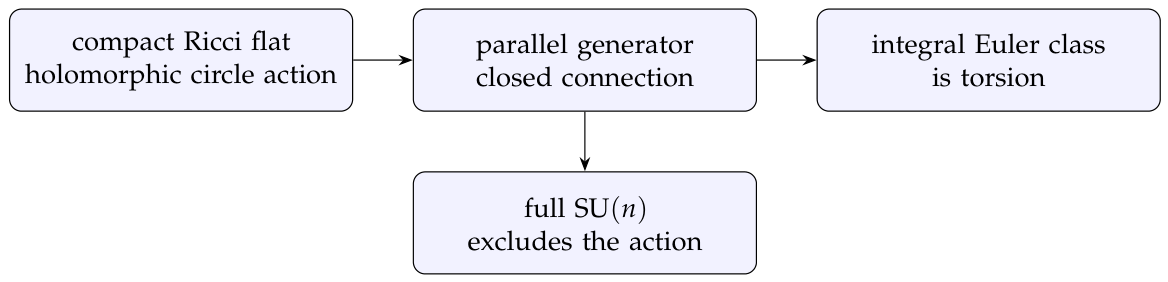
Figure 2.
Proved implications for compact manifolds. The flat example shows why integral torsion must be retained.
Figure 2.
Proved implications for compact manifolds. The flat example shows why integral torsion must be retained.
6. A Complete Normal Form in the Compact Isometric Category
Fix and the circle parameter to have period . A parallel transverse Calabi–Yau structure on a Riemannian -manifold consists of a parallel unit vector , its dual , a parallel orthogonal complex structure I on , and a nowhere-zero parallel complex -form on E. Forms on E are extended to by contraction with equal to zero. We include explicitly among the base hypotheses.
Theorem 3
(Compact normal form). The following constructions are mutually inverse, up to equivariant isomorphisms preserving the displayed geometric data.
- 1.
- Start with a connected compact Ricci-flat Kähler n-fold , a nonzero parallel holomorphic volume form Ω, and a free isometric circle action with fundamental vector K.
- 2.
- Start with a connected compact Ricci-flat -manifold carrying a parallel transverse Calabi–Yau structure , a flat principal circle bundle , and a constant .
From the first description, is constant,
The field descends to ξ, and descends to Ψ. Conversely define and set
These formulas give the Ricci-flat Kähler metric and trivial canonical bundle in the first description. In particular, this compact category is parameterized by the specified parallel base data, a positive radius, and a flat circle connection, rather than by a finite list of isotropy types.
Proof.
The Bochner identity makes K parallel. It follows that r is constant, the horizontal distribution is parallel, and its connection form is closed. Locally choose a fibre coordinate with . The metric is then the local product , so the quotient is Ricci flat. The vector is parallel and orthogonal to K; it is invariant under the circle flow and descends to a parallel unit field on the base.
The horizontal complement of the real plane spanned by and is parallel and J-invariant. Its descended complex structure I is therefore parallel. Since K and are parallel, the form is parallel, horizontal and invariant. It vanishes when one argument is because is complex multilinear and alternating. Hence it descends to the nonzero transverse complex volume form . The decomposition follows by evaluating it on and on the transverse complex hyperplane.
Conversely, flatness gives local coordinates in which . All the tensors in the proposed complex structure are parallel for the local product metric. Consequently J is a global parallel orthogonal complex structure: it is integrable, and its associated two-form is closed. The metric is Ricci flat because the base metric is. The displayed form is global, nowhere zero, of type , and parallel, so it is holomorphic and trivializes the canonical bundle. Compactness follows from compact base and fibre. The formulas recover every datum used to extract the base structure, so the constructions are inverse. □
Every nowhere-zero holomorphic volume form on a compact Ricci-flat Kähler manifold is parallel, after a constant normalization: its logarithmic norm has vanishing Laplacian and hence is constant, and the induced canonical-bundle Chern connection is flat. Thus choosing above is compatible with the broad Calabi–Yau convention of this manuscript.
6.1. Equivalence of the Geometric Data
The circle orientation and its period are fixed. Two normal-form data sets give equivariantly isometric total spaces preserving J and if and only if their radii agree and a base isometry preserves the parallel vector, transverse complex structure and transverse volume form while pulling back one holonomy character to the other. To prove necessity, recover r, and the horizontal metric from g and the fundamental field K; recover the transverse tensors by and contraction with . An equivariant isometry must preserve these recovered tensors and parallel transport. Conversely the stated base isometry and character equality identify the flat bundles with their connections; the reconstruction formulas then identify the metric and Calabi–Yau tensors. If the circle parameter may be reversed, character inversion and the corresponding sign changes must also be included.
This is a geometric normal-form characterization based on classical Bochner and flat-bundle arguments. The base geometries remain parameters. It is not a finite enumeration of all Calabi–Yau manifolds, and no claim of priority for the underlying classical structure is made.
Corollary 1
(Flat-connection parameters over a fixed base). For fixed connected base data and radius, flat principal circle bundles with flat connection are classified by their holonomy characters
The integral Euler class is the Bockstein of χ, up to the fixed associated-bundle sign convention. It is torsion. This parameterization includes continuous holonomy data even when the underlying topological Euler class is zero.
Proof.
Parallel transport around loops gives the holonomy representation. Conversely the quotient of by has the required flat connection. A flat bundle with the specified holonomy is isomorphic to this quotient by parallel transport from a fixed fibre. Since is abelian, no conjugacy quotient changes the character. The characteristic-class identification is the coefficient Bockstein, and its real image is zero because the curvature vanishes. □
Proposition 3
(Finite topological trivialization). Let a flat principal circle bundle over a connected compact manifold have integral Euler class of exact finite order . There is a connected base cover of degree q on which the underlying principal bundle is topologically trivial. Its given connection need not be a product connection on that cover.
Proof.
Write for the holonomy character. Since , exactness of the coefficient sequence gives a real-valued class a whose image in equals . Then has values in the qth roots of unity and satisfies . Its image has exact order q: otherwise the order of would divide a proper divisor. The connected cover corresponding to has degree q and kills the Euler class. Classification of principal circle bundles makes the pulled-back bundle trivial. It does not assert that the pullback of the original character is zero. □
Example 2
(No finite connection-product cover). On the two-torus with of period , let
with c irrational. The bundle is topologically trivial and its connection is flat. Its base holonomy is , which has infinite order. On a degree-d base cover the holonomy is . Hence no finite base cover trivializes the specified flat connection. In particular, a metric-product theorem preserving this circle fibration does not follow just from or from torsion of e.
Proposition 4
(Direct universal-cover splitting). In the compact normal-form theorem, the universal cover admits an isometric splitting with . Each deck transformation has the form
where is an isometry. The lift of one full circle period is the central deck transformation .
Proof.
The unit dual form to lifts to a closed form on the simply connected complete universal cover, hence equals . Its gradient is the complete parallel unit vector . Its flow increases f by time, so it identifies with the whole cover, isometrically, because the vector and its orthogonal distribution are parallel. Deck transformations preserve this lifted vector and its dual form, so they shift f by a constant and restrict to isometries of the level factor after compensating for that shift. The lifted circle flow at time is a deck transformation and, in the product coordinates, is exactly the indicated pure translation. Such translations commute with every displayed deck transformation. □
The normal form classifies the compact free isometric circle category with all its specified data. It does not classify every smooth spherical fibration, singular fibre, orbifold, or noncompact Calabi–Yau geometry. The distinction is essential when stating the scope of any claimed complete classification.
Corollary 2
(Exactly the torsion topologies over a fixed base). Fix a base with the parallel geometric data of 3. The principal circle-bundle topologies occurring in that construction are exactly .
Proof.
Necessity follows from zero curvature. Conversely the coefficient exact sequence gives
Every torsion class is in the image of and is realized by a flat character bundle. The normal-form construction supplies a Calabi–Yau total space for that bundle. Topological classification over B then accounts for every underlying principal bundle in this category. □
Proposition 5
(No isometric semisimple action). A connected compact semisimple Lie group has no nontrivial isometric action on a connected compact Ricci-flat manifold. In particular no free isometric principal action exists there.
Proof.
All Killing fields are parallel, so the bracket of any two is zero. The induced Lie algebra map from a semisimple Lie algebra to this abelian Lie algebra kills every commutator. A semisimple Lie algebra is its own commutator algebra, so the infinitesimal action vanishes. A connected Lie group is generated by its one-parameter subgroups, and its action is therefore trivial. This excludes an isometric principal quaternionic Hopf action, not arbitrary nonisometric bundles or noncompact links. □
7. Exact Bundle Bookkeeping
Theorem 4
(Transgression and the homotopy boundary). For an oriented principal circle bundle , in the integral Leray–Serre sequence, in compatible orientations. The Gysin sequence is
The boundary evaluates e on spherical classes. Also for every principal circle bundle.
Proof.
Use naturality from the universal circle bundle, in which the degree-one fibre generator transgresses to the universal first Chern class [5,15]. Multiplication by e between the two fibre rows and the filtration give the Gysin sequence. A pullback on is obtained by clutching two trivial hemispheres. The degree of the equatorial clutching function is both the Euler evaluation and the boundary in homotopy. Finally the pullback bundle on P has the diagonal section and is trivial. □
Over a nonzero integral Euler class gives nonzero while . Integral torsion can be invisible rationally. Thus nonzero transgression need not imply a nonzero homotopy boundary, and is an identity rather than a Calabi–Yau obstruction.
Proposition 6
(Covering degree). For a bundle map covering , equivariant for on the fibres, .
Proof.
The associated line bundle of the fibre-degree-k pushout is the kth tensor power. Its first Chern class is multiplied by k. Pullback supplies f. □
Theorem 5
(Relative odd-sphere model). Suppose an oriented -fibration has rational relative model , with , and . If , the substitution identifies it with the product model. The obstruction includes decomposable classes of the base.
Proof.
The change of generator is invertible and . As a counterexample to discarding decomposables, let L be the hyperplane line bundle on , . The sphere bundle of has transgression . The base minimal model has no generator in degree , and that fact does not force the transgression to vanish. □
Proposition 7
(Holomorphic spherical fibres). There is no proper holomorphic submersion from a Kähler manifold with trivial canonical bundle having a positive-dimensional compact spherical-space-form fibre.
Proof.
The restriction of the Kähler form makes the fibre Kähler. The tangent sequence along a smooth fibre has trivial normal bundle, so its canonical bundle is the restriction of the ambient canonical bundle and is trivial. Odd real dimension is impossible. In even real dimension at least four a spherical space form has zero real , incompatible with the nonzero top power of a Kähler form. In real dimension two an oriented spherical-space-form complex curve is , whose canonical bundle is nontrivial. □
8. Genuine Hopf Examples in the Noncompact Category
On flat scalar multiplication gives on every radius sphere. The radial coordinate adds to the total and base spaces. For and , respectively, there are also the complex and quaternionic Hopf sphere maps. The complex Hopf bundle at has target and is distinct from a map of Hopf invariant one between spheres.
Proposition 8
(Lens bundles). For , dividing the fibres of by gives with Euler number k. If and , then
This is a rational secondary integral on the specified lens space.
Proof.
The Euler number follows from 6. Normalize a connection to have fibre integral one, so . Then and fibre integration gives . A different primitive changes the integral by zero by Stokes’ theorem. At this is not the integer Hopf invariant of a map with source . □
The Eguchi–Hanson end has link , with the displayed rational integral . The covering Hopf map on has integral one. In a general orbifold quotient both the base form and its normalization must be specified before stating a quotient Hopf integral.
8.1. Complete Classification of Free Unitary Linear Models
Theorem 6
(Unitary linear circle actions). Let act linearly on , with circle parameter of period . Its action is free if and only if all its integer weights are or . Up to unitary conjugacy with this circle parameter fixed, the free actions are classified by the number of positive weights. Each underlying smooth principal bundle is equivariantly isomorphic to the radial complex Hopf bundle after a real orthogonal change of coordinates. The standard holomorphic volume form is invariant exactly when .
Proof.
A commuting family of unitary matrices is simultaneously unitarily diagonalizable. Its one-dimensional characters have the form with . A nonzero vector on the jth coordinate axis has stabilizer the th roots of unity when , and the whole circle when . Freeness therefore requires for every j. Conversely, a circle element fixing any nonzero vector fixes at least one nonzero coordinate of weight or and must equal the identity.
Unitary conjugacy preserves character multiplicities and can permute the weight spaces, giving precisely the parameter a. Complex conjugation in every negative-weight coordinate changes that weight to and is a real orthogonal equivariant diffeomorphism with the standard scalar action. It need not be holomorphic for the fixed complex structure. Finally the pullback of is multiplied by , proving the volume-form condition. □
In particular, the ordinary all-positive scalar Hopf action is holomorphic and isometric but rotates the standard holomorphic volume form. In odd complex dimension no free unitary linear circle action on the entire punctured affine space preserves that form. In even dimension there is exactly one such free linear type up to unitary conjugacy, with equally many positive and negative weights. These are complete statements in the linear category; nonlinear actions and complete nonflat metrics are outside their hypotheses.
9. A Quantitative Connection-Curvature Identity
For the fundamental circle field of period , take
with r constant. Put in an orthonormal horizontal frame.
Theorem 7
(Vertical Ricci identity). For this connection metric,
For compact base and harmonic real Euler form ,
Equality in the last estimate holds precisely when F is harmonic.
Proof.
Within the compact Ricci-flat category . The class has no positive sharp coefficient of the proposed curvature-norm type. Moreover under the base two-form norm square scales as while the ambient Riemann-curvature norm square scales as . Their ratio scales as . A scale-free universal coefficient therefore requires additional length normalization. Ricci flatness does not imply vanishing of the full Riemann tensor.
II. Integral calculations and rational homotopy
10. The Two-Row Spectral Sequence
For a principal circle bundle the action on is trivial. Thus
The only possibly nonzero differential is , given by multiplication by e on the upper row, with the usual graded sign convention. No for can connect the two occupied rows. Therefore as a bigraded group. This does not eliminate additive or multiplicative extension problems over the integers.
Over , put and
The two rows and the total Betti numbers are
All out-of-range terms are zero. The rank inequalities are immediate. They are necessary conditions on a proposed page table, not a realization theorem for an arbitrary list of ranks.
Proposition 9
(Kernel and cokernel bookkeeping). For every j there is an exact sequence
If the right-hand group is free abelian the sequence splits as abelian groups, without a canonical splitting.
Proof.
Take the corresponding four consecutive maps of the Gysin sequence. Exactness identifies the kernel of fibre integration with the indicated cokernel and its image with the indicated kernel. A short exact sequence with free quotient splits because lifts of a free basis define a right inverse. □
10.1. Circle Bundles over a Two-Sphere
For Euler number , the total space is the oriented lens bundle up to the chosen orientation convention. The integral cohomology is
For the bundle is . For the total space is . Rational cohomology alone cannot distinguish the different nonzero values of . In contrast, the integral Euler number and the fundamental group do.
10.2. Bundles over a Product of Two Spheres
Let , with generators and , and write . Let . The two nonzero cup maps are
Their cokernels are and . The second map has a rank-one kernel. Hence
These are five-dimensional smooth total spaces. They are not complex Calabi–Yau total spaces; the calculation is a bundle benchmark.
11. Bundles over K3 Surfaces
Let S be a K3 surface and its rank-22 unimodular lattice. For , let d be the positive generator of the set of pairings . Unimodularity makes this also the divisibility of e as a lattice vector. Thus
The Gysin sequence yields the following complete additive answer.
Theorem 8
(K3 base). For the principal circle bundle with nonzero class e,
If e is primitive, is simply connected.
Proof.
Use and in 9. The only nonzero cup maps are and pairing with e. Their kernels and cokernels are the groups displayed above. For the last assertion, the Hurewicz map is an isomorphism because S is simply connected. A primitive vector in a unimodular lattice pairs to one with some integral vector. Thus the homotopy boundary is surjective. The homotopy exact sequence gives . □
The theorem constructs a smooth five-manifold from a Calabi–Yau base. It does not construct a Calabi–Yau structure on that odd-dimensional total space. It is compatible with the separate fact that the compact K3 surface itself cannot be the total space of a free circle action.
12. Bundles over the Smooth Quintic Threefold
Let be a smooth quintic, with hyperplane class h. The standard integral cohomology calculation gives
Choose and so that and . In particular . The factor five is essential in integral calculations.
Theorem 9
(Quintic base). Let have Euler class , . Then
Its total rational Betti number is 410. For the total space is and its total rational Betti number is 416.
Proof.
In the bases , cup multiplication by is multiplication by k, and k in degrees . The degree-three group maps to zero because . Apply 9. In degree four the free quotient makes the extension split; this is the only nonzero free quotient in the middle calculation. The remaining groups follow directly. The rational Betti numbers at are , with sum 410. At the Künneth formula gives , with sum 416. □
12.1. An Independent Check of the Quintic Input
The normal sequence and the Euler sequence give
Since , the Euler characteristic is . The Lefschetz hyperplane theorem determines the Betti numbers away from the middle degree: and . Hence , so . Integral torsion-freeness is the standard smooth-hypersurface result; the rational calculation and the cup products already verify every rational number used in the theorem.
Figure 3.
Integral cup maps for a quintic circle bundle. The middle factor produces the torsion in . These seven-dimensional total spaces are bundle examples, not Calabi–Yau threefolds.
Figure 3.
Integral cup maps for a quintic circle bundle. The middle factor produces the torsion in . These seven-dimensional total spaces are bundle examples, not Calabi–Yau threefolds.

13. What Rational Homotopy Recovers
For a simply connected space of finite rational type with minimal Sullivan model ,
The differential is decomposable and is part of the input. A list of Betti numbers alone does not determine it. Compact Kähler manifolds are formal by the theorem of Deligne, Griffiths, Morgan and Sullivan [7]; this allows the cohomology algebra, with its multiplication, to be used as a rational model. It does not replace that algebra by its dimensions.
13.1. The First Two Stages
For a simply connected formal space, start with closed degree-two generators spanning . Degree-three generators have two roles: closed generators represent , and nonclosed generators kill the kernel of
This gives an exact low-degree formula.
Proposition 10
(Low-degree rank formula). For a simply connected finite-type formal space,
For a K3 surface this gives and . For the smooth quintic it gives and .
Proof.
In degree two there are no decomposable elements or boundaries. In degree three, closed new generators are required for and one new degree-three generator with independent differential is required for each independent degree-four relation among the degree-two generators. No generator in a higher degree can change this count. For K3 the intersection form maps the 253-dimensional symmetric square onto , leaving kernel dimension 252. For the quintic the map is an isomorphism over , so that kernel is zero. □
13.2. Why a Rank-Growth Plot Is Not a Proof
A minimal model for has generators x in degree two and y in degree three, with . Its rational homotopy is supported in exactly these two degrees. Repeated formal expansion of or counting all monomials would therefore give a false prediction of infinitely many homotopy groups. The model differential, not the growth of the cohomology-ring presentation, determines the answer.
A model for is ; a model for an even sphere is , with degrees and . These benchmarks are useful for testing a reconstruction program [10]. Agreement of a few successive numerical truncations is evidence of stability only in those degrees. A bound on all higher stages requires an independent theorem.
14. Primitive Forms and Legitimate K Ähler Tests
Proposition 11
(Primitive real forms). Let B be a compact Kähler manifold of complex dimension and let u be a real primitive harmonic form. Then
If the displayed intersection number is zero, .
Proof.
The pointwise Hodge-star identity for a primitive form is . Integrate . A nonnegative norm square can vanish only when the form vanishes identically. □
The sign is negative for a real primitive form. This criterion applies on a Kähler base of even real dimension when such a base exists. It does not apply to the odd-dimensional orbit space of a circle acting on a complex manifold. It also proves vanishing of the real class; it cannot detect a torsion integral Euler class.
III. Metrics, spectra and geometric evolution
15. Noncompact Hyperk Ähler Constructions
15.1. The Gibbons–Hawking Ansatz and Its Domain
Let and let be harmonic. Suppose a principal circle connection has curvature , with its period chosen to make this curvature integral in the bundle normalization. The Gibbons–Hawking metric is
The harmonic function is not arbitrary global bundle data: the periods of around punctures determine whether such a circle bundle exists. The metric is defined where ; smooth completion at a pole must be checked in addition.
Proposition 12
(Closed hyperkähler forms). With , the forms
are closed and form an orthogonal basis of the hyperkähler two-forms, each of squared norm two. After choosing the orientation of this triple, the associated complex structures obey the quaternionic relations. They define the hyperkähler structure of (4).
Proof.
For example,
The other two identities are cyclic permutations. In the coframe , , they are . The ordered triple gives the usual quaternionic multiplication convention for . For completeness, write the induced connection on this rank-three bundle of self-dual or anti-self-dual two-forms as an -valued one-form. The three equations , expressed in the orthonormal coframe, force that connection to vanish: the linear system obtained by wedging the connection one-forms with the three basis forms is invertible in dimension four. Thus all three forms are parallel, and the associated almost complex structures are integrable. This is the usual local derivation of the Gibbons–Hawking construction [11]. □
15.2. Single-centre Taub–NUT
Take , . In a polar gauge one may use , for which . The fibre coordinate has period . The change of radial variable gives, to leading order near the centre,
The leading angular metric is the unit round metric on in Hopf coordinates. The prescribed period gives a smooth nut, rather than a conical quotient. The full standard Taub–NUT metric extends smoothly there and is complete. At infinity the circle length approaches while the base is asymptotically Euclidean. The large spheres carry the ordinary Hopf circle bundle up to orientation.
Neither freeness at the nut nor a global principal bundle over all of is claimed. The action has a fixed point at the completed centre. Away from that point it is the specified principal circle bundle over .
15.3. Multi-Centre Metrics and Lens Links
For with distinct centres and equal positive charges, the same period makes each nut smooth. On a large surrounding two-sphere, the curvature period is the sum of the centre contributions. Thus the circle bundle has Euler number s, up to orientation, and its three-dimensional link is a lens space. When the usual metrics have ALE ends; when they have ALF ends. These are explicit constructions, not a classification of all hyperkähler four-manifolds.
15.4. Eguchi–Hanson
The Eguchi–Hanson metric [9] can be written
The standard period of the angular coordinate makes the apparent degeneration at a smooth two-sphere bolt. The completed manifold is the cotangent bundle of with its standard hyperkähler metric. At infinity the link is . Its circle bundle over has Euler number two and its normalized secondary integral is , as proved in 8. The period and quotient must not be suppressed when comparing this integral with the integer Hopf invariant on .
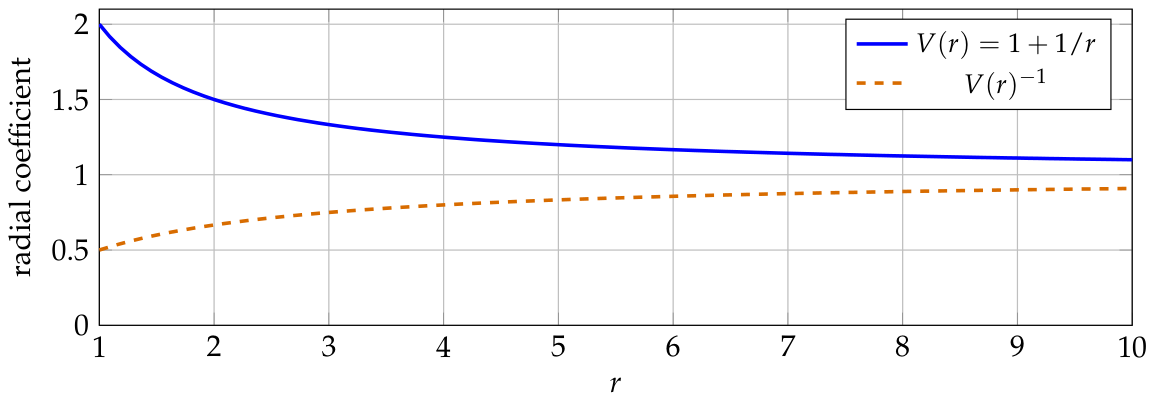
Figure 4.
Exact radial coefficients for a Taub–NUT ansatz with . This graph plots the displayed functions, not simulated topology or a measured spectrum.
Figure 4.
Exact radial coefficients for a Taub–NUT ansatz with . This graph plots the displayed functions, not simulated topology or a measured spectrum.
16. The Scalar Spectrum of a Connection Metric
Let B be closed and connected and let have the connection metric of 7, with constant fibre radius . The scalar Laplacian is the nonnegative operator defined by its Dirichlet form. Work on complex-valued functions to use the Fourier decomposition of the circle action.
Theorem 10
(Magnetic decomposition). There is an orthogonal decomposition , where the circle acts on with weight m. In a local trivialization a weight-m function is . On that component,
The sections s patch as sections of the corresponding associated line bundle. In particular, if is the bottom of the magnetic spectrum,
Proof.
The circle representation is unitary and its characters are complete, giving the orthogonal Fourier decomposition. The horizontal lift of a base vector X is . Acting on u gives , while the unit vertical derivative is . The horizontal and vertical parts are orthogonal, so
The norm has the same constant factor . The quadratic form therefore gives the asserted self-adjoint operator on each summand. At its kernel consists of constants and its first positive eigenvalue is . For the vertical term is strictly positive. Taking the bottom of these orthogonal summands proves (5). Since , only finitely many weights can lie below any fixed energy. □
Corollary 3
(A normalized bound). For this constant-radius connection metric,
The lower bound need not be an equality, even when the connection is flat and the total metric is Ricci flat.
Proof.
Use in (5); the upper bound follows by pulling back a base eigenfunction. The example below proves strictness of the lower bound. □
Example 3
(Flat holonomy changes the gap). Let both have period , and set
on a two-torus. This constant metric is flat; with its induced oriented complex structure it is a Calabi–Yau onefold. Here , the base circle has first eigenvalue one, the fibre circle has first eigenvalue , and . The scalar eigenfunctions have eigenvalues
For the first positive value is one. For odd m the horizontal term is at least , and the minimum is at . For even nonzero m the vertical term is at least one. Hence . A formula that replaces the magnetic term by the untwisted base spectrum, or depends only on F through the local O’Neill tensor, would miss this flat holonomy.
Proposition 13
(All equality cases of the normalized gap bound). For a nonzero weight m, if and only if the weight-m associated connection has trivial holonomy. For a flat original connection with holonomy of exact finite order q, this is equivalent to ; if its holonomy has infinite order, no nonzero weight has .
If , the scalar gap equals . If , the equality holds if and only if the original connection has trivial holonomy, in which case the connection metric is a global product .
Proof.
The lowest magnetic eigenvalue is attained on the closed base. Its quadratic form vanishes exactly for a nonzero parallel section. Such a section has constant positive norm and trivializes its line bundle and connection. Conversely a connection with trivial holonomy admits a global parallel section by path-independent parallel transport. At weight m the curvature and holonomy are multiplied and raised to the mth power, respectively. The claims about a flat character follow.
The first gap case follows by combining the upper and lower bounds. In the second case, weights with have energy at least , while the base gap is larger than . Thus equality is possible precisely at or with . This means trivial holonomy for the original connection. A global parallel section then identifies the bundle, connection and metric with the product. The product also plainly attains equality. □
17. Heat Traces and Adiabatic Limits
For a closed Ricci-flat manifold X of real dimension , the scalar heat trace has the standard expansion
The coefficient follows from the general integrated scalar coefficient
since the integrated divergence term is zero on a closed manifold. The general heat expansion is an analytic input from heat-kernel theory, not a consequence of the bundle topology [12]. The Ricci-flat coefficient is , not .
For , the spectral zeta function is
Meromorphic continuation requires subtracting the short-time expansion. An adiabatic family also requires uniform remainder bounds before the order of a collapsing-parameter limit and the heat integral can be exchanged. A formal expansion alone supplies neither an exact spectrum nor an exact determinant.
17.1. The Dirac Index Does Not Vanish Just from Ricci Flatness
For a spin manifold the Lichnerowicz formula is . At scalar curvature zero its zero modes are parallel spinors; it does not force their chiral difference to vanish. For a K3 surface, . In the complex orientation this also follows from and . Thus a blanket vanishing of a fibre Dirac index based on Ricci flatness is false. Family index and eta-form statements need the specified operator, kernel bundle and boundary conventions.
18. Mean Curvature Flow under a Submersion
We take the mean curvature vector to be the trace, not the average, of the second fundamental form.
Theorem 11
(Lift of mean curvature flow). Let be a Riemannian submersion with minimal fibres. For an immersed submanifold , its inverse image has mean curvature equal to the horizontal lift of the mean curvature of C. Consequently a smooth mean curvature flow lifts to a mean curvature flow of the inverse images, up to tangential reparametrization.
Proof.
The tangent bundle of consists of the entire vertical bundle and the horizontal lifts of . Its normal bundle is the horizontal lift of the normal bundle of C. Trace the second fundamental form in an orthonormal frame made of horizontal lifts and vertical vectors. The normal part of the horizontal trace is the lift of by the horizontal submersion formula. The normal part of the vertical trace is the corresponding component of the mean curvature of the fibre, hence zero. This proves the mean curvature identity. A choice of lifted parametrization can add a tangential velocity, which changes only the parametrization of the evolving submanifold. □
Example 4
(A singularity without fibre collapse). For , in the product , let
The product projection has geodesic, hence minimal, fibres, so 11 applies. The singular time is and
This is a Type I singularity, while the circle radius stays equal to r. A local parabolic blow-up unwraps the circle to a line. Thus Type I does not imply collapse of the Hopf or circle fibre to a point. The example is local and can be placed inside a flat product torus for times during which the spherical factor lies in a flat coordinate ball.
Along a smooth family of identified principal bundles, the Euler class is unchanged. At a singular time, a statement about a new Euler class requires a specified surgery and a specified new base. Mean curvature flow by itself does not provide such a topological operation. Type III terminology concerns a long-time curvature rate; it is not a synonym for a conifold transition.
IV. Deformations, categorical structures and applications
19. Smooth Deformations and Characteristic Data
Let be a principal circle bundle, with I an interval. The restrictions to have the same Euler class under the natural identification with . This follows either by homotopy invariance or by naturality of the classifying map. It needs no Hodge theory.
For a family with varying base, the same statement requires a smooth trivialization or a specified parallel transport of integral cohomology. Harmonic representatives may change continuously with the metric while the integral class stays fixed. A rank or pairing can change only if the relevant map, local system or identification changes; continuity alone is not a general proof that all geometric obstructions are constant.
19.1. Kuranishi Theory Has a Deformation Complex
In a holomorphic deformation problem, infinitesimal deformations and obstructions are governed by a specified sheaf or differential graded complex. For a real circle quotient of a complex manifold, the vertical real line is not automatically a holomorphic tangent sheaf. Thus notation such as must first define the sheaf, the coefficient field and the deformation category.
The vanishing of a single first-order Kodaira–Spencer class at one parameter does not imply local triviality of the entire family. An elementary analogy is a nonconstant curve with zero first derivative at the origin. A local triviality theorem requires the appropriate deformation-theoretic hypotheses, not just a zero tangent vector. On a noncompact manifold, decay spaces, gauge choices and a Fredholm linearization are additional data.
20. Holomorphic Fibres, Twistor Spaces and Special Holonomy
20.1. The Holomorphic Obstruction Is a Different Theorem
The absence of compact spherical fibres in 7 follows by restricting a Kähler form and the canonical bundle to a smooth fibre. It does not classify all algebraic fibre spaces on Calabi–Yau varieties. Elliptic, abelian and K3 fibrations are not spherical fibrations. A rational variety does not in general have the rational cohomology ring of projective space: blowing up a point on a rational surface already changes .
20.2. Twistor Geometry
For a hyperkähler manifold , the twistor space has a complex structure of complex dimension and a holomorphic projection to . Its other projection is smooth with two-sphere fibres; it is not a holomorphic map to M equipped with one fixed complex structure. A twistor line has normal bundle , so
The complex deformation space has dimension ; the compatible real structure selects the real -dimensional family parametrized by M. These standard facts are discussed in [14]. The class on a twistor line is not the Euler class of a principal circle bundle ; that map has fibre .
20.3. Principal Bundles
For a principal bundle , the associated complex rank-two bundle E has . Its unit sphere bundle is an bundle and its transgression lies in , represented by up to orientation. Its homotopy boundary evaluates that class on spherical four-cycles. An arbitrary nonzero class in need not have a nonzero spherical evaluation.
The characteristic identity for its underlying real four-plane bundle is
The real vertical tangent bundle of a principal bundle is trivialized by fundamental vector fields on the total space. Its Pontryagin class must not be identified with the associated four-plane class on the base.
For an oriented rank-five vector bundle, its unit bundle has Euler transgression in degree five, not degree four. In a fibration over a four-dimensional base that class vanishes for degree reasons. A putative identity integrating the square of a degree-four base class over that four-dimensional base is likewise not a top-degree characteristic number.
20.4. and Structures
Associative, coassociative and Cayley conditions are calibration conditions on tangent planes. They do not by themselves produce a fibration or an O’Neill curvature identity. The stabilizer of an associative three-plane in is isomorphic to ; replacing it automatically by discards part of the structure group. A further reduction needs a proof.
A proposed exceptional-holonomy fibration therefore requires an explicit torsion-free structure, a smooth submersion, and verification of the calibrated tangent planes. The existence of an asymptotic circle in one complete model does not classify all such manifolds or prove an identity with an extra term. These directions remain geometric construction problems.
21. Derived Categories and Stability
Proposition 14
(An adjunction cone). Let be a morphism for which and act on the specified derived categories. For any object F the counit defines a distinguished triangle
If the unit is an isomorphism for , then .
Proof.
Every morphism in the derived category admits a mapping cone. Apply to its triangle. The triangular adjunction identity says that the counit, after pushforward, is a left inverse to the unit on . Under the stated unit-isomorphism hypothesis it is an isomorphism. Its cone therefore vanishes. □
For instance, suitable projection-formula hypotheses together with can supply the required unit isomorphism. Without such a condition the cone is defined but no annihilation property follows. A real spherical quotient is not automatically a morphism of smooth projective varieties to which this discussion applies.
21.1. Wall Crossing Does Not Change the Class of a Fixed Object
For a fixed object E, its class in is independent of a change in stability condition. What can change is which objects of a prescribed class are stable and the corresponding enumerative invariants [6]. If an exact functor is defined by the cone
then the defining triangle gives
in . This is an operation on objects, not the effect of merely moving a stability parameter. A spherical object in complex dimension n has self-Ext groups like , rather than in all dimensions.
21.2. Mapping Spaces and Shifted Structures
The classifying statement 2 concerns of . For a connected finite CW base, the higher homotopy groups of a component include
Thus the full moduli space is not a discrete or contractible set just because its isomorphism classes are classified by cohomology.
The shifted-symplectic mapping-stack theorem of Pantev, Toën, Vaquié and Vezzosi starts with an n-shifted symplectic target and an appropriately oriented source of dimension d; the resulting shift is [19]. A Calabi–Yau volume form on an ordinary target is not by itself that shifted symplectic structure. No application of this theorem to a proposed Hopf mapping stack is claimed without these inputs.
22. Flux Sectors: a Fixed-Metric Finiteness Theorem
This section is a finite-dimensional theorem in the Hodge lattice. It is useful for distinguishing a genuine positive-norm argument from a count inferred solely from a tadpole pairing. Its hypotheses fix the metric throughout. The broader physics of compactification and flux counting is reviewed in [2,13].
Let X be a fixed closed oriented Riemannian six-manifold. Work with harmonic representatives of
If , there are no positive-tadpole triples. In what follows assume . The Hodge norm is positive definite and on three-forms. Put when this lattice is nonzero. Let with and .
Theorem 12
(Fixed-metric ISD classification and finiteness). Fix . All nonzero triples with satisfying
and the stated bounds on and are obtained as follows. Choose and
and retain exactly those pairs for which , and . Each retained pair has the unique parameter . There are finitely many such pairs, with bounds
Proof.
Set . The real and imaginary parts of are
They are equivalent because . A nonzero solution has , and therefore
Here H and are orthogonal and have the same norm: since the degree is odd. Projecting F onto these two vectors recovers exactly the displayed , proving necessity and uniqueness. Conversely a lattice pair in this plane with the displayed projections satisfies and hence the ISD equation. Its tadpole is the displayed N, so the listed inequalities are also sufficient.
As , gives and . Finally
The bounded lattice sets are finite. This proves the complete fixed-metric parametrization and finiteness. □
The theorem does not allow the Hodge metric to degenerate. Along varying moduli the shortest lattice length may tend to zero, and the displayed finite bounds then lose uniformity. The theorem also does not prove the existence of a solution for any prescribed pair, stabilize all moduli, or count 2741 vacua on a quintic.
Example 5
(The tadpole pairing alone is insufficient). If is an integral three-class, the pairs satisfy for every integer n, since over the real numbers. Thus a pairing bound without positivity or an ISD condition need not bound the norms of the fluxes.
23. Branes, Periods and Degree Checks
An integral degree-j characteristic class pairs numerically with a j-cycle. An Euler class in cannot be evaluated on a four-cycle to produce a scalar; one must specify another class or use a cohomology-valued operation. Similarly a four-form flux is integrated on a four-cycle, not on a five-dimensional circle bundle without an additional contraction or fibre integration.
For a spin spacetime the M-theory flux quantization law contains the gravitational shift with [22]. In suitable units its cohomological form is . It is not an identity supplied by a circle bundle. The topology, normalization and field equations of the physical model remain separate inputs.
If a Riemannian submersion has constant fibre volume, the volume of a full inverse image of a base cycle is the fibre volume times the base-cycle volume. This follows by integrating its Riemannian volume element. It is an exact geometric identity in that metric; an unspecified positive A-tensor correction is not part of the formula. Turning such a volume into a BPS mass requires the brane tension, calibration and physical compactification data.
23.1. Conifold Geometry and Topology Change
For the ordinary threefold node , the smoothing has a vanishing three-sphere and the small resolution has an exceptional two-sphere. The corresponding link is five dimensional. It is not the three-dimensional lens link of a complex surface singularity; the conifold physics uses a five-dimensional link as in [16].
The nearby smoothings with parameters and are biholomorphic by . Changing that parameter’s sign is not a small resolution. A local surgery replacing by admits an oriented seven-dimensional handle trace, assuming the given framed local embedding. This is a smooth cobordism statement. It is not a proof that the endpoints admit prescribed Calabi–Yau structures or that every string compactification can be connected by such transitions.
24. Arithmetic Statements with Their Actual Hypotheses
24.1. Finite-field Cohomology and Factorization
For a smooth proper variety over , the cohomological zeta expression is
The eigenvalue weights in the smooth projective case are governed by Deligne’s theorem [8]. A topological circle fibration on the complex points is not automatically a morphism or a Frobenius-stable decomposition of this cohomology.
Proposition 15
(A legitimate determinant factorization). Let V be a finite-dimensional vector space with endomorphism T and a finite T-invariant filtration. Then
Proof.
Choose a basis adapted to the filtration. The matrix of T is block upper triangular, with diagonal blocks its induced operators on the successive quotients. The determinant of is the product of the determinants of those blocks. □
Thus an arithmetic factorization needs an invariant filtration with the asserted graded pieces. No Hecke character or functional-equation sign is determined just by the parity of a topological Euler number. No Birch–Swinnerton-Dyer-type conclusion for K3 surfaces follows from the circle-bundle calculations here.
24.2. A P-Adic Convergence Statement That Can Be Proved
If and , then converges in a complete extension of : its terms have norm at most , which is the convergence criterion for a non-Archimedean series. The same conclusion holds for coefficients of uniformly bounded p-adic norm. A root of unity has norm one, so substituting a root of unity is not justified by this argument. Geometric instanton coefficients require their own definition and bounds; this elementary power-series result does not construct a crystalline Euler class for an arbitrary real bundle.
25. Physical Proposals That Remain Open
The earlier manuscript connected Hopf geometry to BPS wall crossing, instanton sums, Chern–Simons levels, entropy corrections, de Sitter vacua, holographic monotonicity, mirror symmetry, moonshine and distance towers. Those subjects remain possible applications rather than corollaries of the geometric results proved here. A precise construction needs the following additional data.
- For an instanton series, define the invariant being counted, its moduli problem and an actual coefficient bound. Integer phases equal one for integral pairings and cannot by themselves change the series.
- For a wall-crossing formula, specify the category, stability conditions, charge lattice and counting invariant. A local lens space alone does not determine them.
- For a Chern–Simons level or entropy correction, give the action, normalization, quantum matter content and the stated counting or anomaly calculation. No universal logarithmic coefficient is inferred from an Euler number.
- For a distance tower or a holographic monotonicity theorem, give the family of metrics, kinetic metric, spectrum and field equations. The exact Kaluza–Klein masses for a product circle are not a proof for every Calabi–Yau degeneration.
- For de Sitter or flux-vacuum existence, verify the equations of motion, tadpoles, source conditions and moduli stabilization. The fixed-metric lattice theorem does not do so.
Stating these requirements retains the research directions while separating them from the proved compact and noncompact bundle statements.
Part V
Appendices: calculations, corrections and remaining questions
A. Flat Bundles with Arbitrarily Large Torsion Order
The order-two example in 1 can be extended to prime torsion by an explicit lattice construction. The complex dimension varies in the following statement; it is not a claim about arbitrarily large torsion order in one fixed complex dimension.
Theorem 13
(Prime-order flat examples). For each odd prime p there is a compact flat Kähler manifold of complex dimension p, with trivial canonical bundle, and a free holomorphic isometric circle action whose integral Euler class has exact order p.
Proof.
Let and let be the companion matrix of
It satisfies and has no eigenvalue one. Its determinant is one because r is even and . On use the lattice . The real matrix A is complex linear and preserves . Averaging any positive Hermitian form under the finite group generated by A gives an A-invariant flat Hermitian metric.
The integral module is , with A acting by multiplication by t. Evaluation at modulo p gives a surjective character
Extend it to by taking the real part and ignoring the imaginary integral coordinates. On let act by
Invariance of makes this a group action. Nonzero k translates s, while an element with and translates z. Thus it acts freely and properly discontinuously, and the quotient is compact. With , all transformations are holomorphic affine isometries preserving
because . The quotient is therefore a flat Kähler manifold of complex dimension with trivial canonical bundle.
Translation in u gives the asserted free circle action. Its base is the mapping torus of A on . Its fundamental group abelianizes to
On each real or imaginary copy of the lattice,
The character is nonzero on this torsion. It cannot lift to a homomorphism , since such a homomorphism kills every torsion element of the abelianization. The Bockstein is consequently nonzero. Since , its order divides p and hence equals p. Up to the orientation sign, is the Euler class of the constructed flat circle bundle. □
The theorem exhibits the precise limitation of a real-cohomology vanishing theorem. It also explains why a statement about full holonomy must not silently be extended to the broad Calabi–Yau category. Each of these examples has finite reducible holonomy, not full holonomy.
B. A Direct Normalized Hopf Integral
Write a unit point of as
The circle of simultaneous phase has period and connection
Choose the total orientation so that is positive. Its integral is
Thus the normalized primitive has Hopf integral one. This is the differential-form normalization of the Hopf invariant [21]. For the lens quotient the covering degree and the normalization of the base area form give , as in 8. Keeping both normalizations avoids identifying two different secondary integrals.
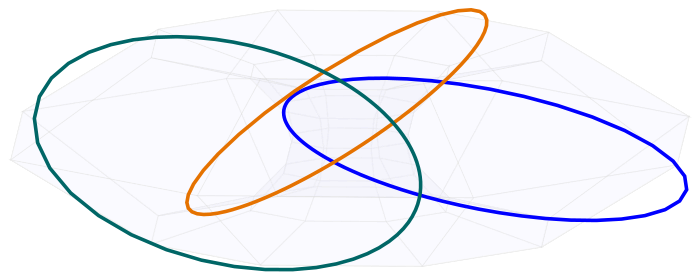
Figure 5.
A three-dimensional projection of genuine Hopf fibres. Stereographic projection of the Clifford torus gives . The three curves set for . This depicts a link in , not an embedding of an entire Calabi–Yau manifold into three-space.
Figure 5.
A three-dimensional projection of genuine Hopf fibres. Stereographic projection of the Clifford torus gives . The three curves set for . This depicts a link in , not an embedding of an entire Calabi–Yau manifold into three-space.
C. Deriving the Vertical Curvature without a Sign Guess
In the connection metric, write and take horizontal basic vector fields commuting with K. The bracket has vertical part . Koszul’s formula gives
Hence . Because K is Killing of constant length, . The mixed sectional curvature is the square ; alternatively it follows by inserting these connection coefficients into . If , then
This factor two gives the coefficient in 7. It is different from a convention that defines the two-form norm by summing over all ordered pairs without the usual factor .
On a compact base, for a one-form . Orthogonality of harmonic and exact forms yields
This is the entire inequality step. The fibre length supplies the final integration coefficient, with no dimension-dependent universal “sharp constant” left to infer.
C.1. Scaling as an Error Detector
If a tensor inequality compares quantities from different dimensions, their scaling must agree. For a two-form on a -dimensional base, the squared norm scales as under length rescaling by a. For ambient curvature in real dimension , its squared norm scales as . A universal ratio therefore carries inverse-length units. The explicit factor in the Ricci identity has exactly the required units when the vertical vector is unit normalized and one integrates Ricci rather than its norm square.1
D. Rational Models: Two Exact Worked Examples
D.1. Projective Space and an Odd-Sphere Fibre
The minimal model of is
For a sphere bundle with an added generator u of degree and , , the target is a nonzero decomposable cohomology class. There is no base generator of degree to list, yet the twisting is nontrivial. This explicitly disproves the inference from a missing indecomposable generator to a split fibration.
For , is exact in the base model. Then is closed, and the relative model is a product after this change of variable. The criterion is exactness of the full transgression class in the model, not its monomial length.
D.2. A Complete-Intersection Toy Model
Let Q be a nonzero homogeneous polynomial in the degree-two variables . The differential algebra
has even cohomology and zero odd cohomology: multiplication by Q is injective in the polynomial ring, so no nonzero odd cocycle exists. If Q is quadratic, its minimal model has exactly r degree-two generators and one degree-three generator. The rational homotopy rank in degree three of this toy model is one, not . A K3 surface has a quite different cohomology algebra, with 252 independent quadratic relations at the first relevant stage, as calculated in 10.
The Sullivan construction and its relation to rational homotopy are classical inputs [10,20]. No claim of a polynomial-time algorithm for arbitrary finite presentations is made. Exact computation needs a finite specification of the differential, the coefficient field and the range to which the model has been certified.
E. A Reproducible Finite Verification Record
The supplementary script uses exact rational and integer arithmetic for the numerical consequences of the formulas in this text. It checks the two-row Betti formulas for the quintic and K3 bases, the first minimal-model dimension counts, the Taylor coefficient of through degree three, the flat-torus spectral minimum in a provably sufficient finite box, and the determinant in representative small prime cases.
The finite spectral search is justified rather than extrapolated: for the example , all have vertical energy at least one, while at every nonzero j has energy at least one. To find an eigenvalue below one it therefore suffices to test , and the nearest integer choices for j. The value is then exact. The script does not certify differential-geometric existence, the general Bochner theorem or an infinite classification; those statements use the written proofs and their declared classical inputs.2
F. Corrections to the Preceding Claims
| Earlier claim or inference | Correct statement in this revision |
| Nonzero integral Euler class excluded on every compact Calabi–Yau total space | For free isometric or holomorphic circle actions, the real Euler class vanishes. Integral torsion can be nonzero; ?? give constructions. |
| Circle orbit space treated as Kähler | Its real dimension is odd. Kähler identities on a base require a separate even-dimensional complex base. |
| used as a special obstruction | This holds for every principal circle bundle, because the pullback bundle has a diagonal section. |
| Nonzero implies nonzero boundary | The boundary tests spherical classes only. A bundle on is a counterexample to the proposed implication. |
| No generator in the target degree implies rational splitting | Decomposable cohomology classes can be nonzero transgressions. Exactness in the full base model is the appropriate splitting criterion. |
| Finite numerical rank proxies | The K3 low-degree ranks are and the quintic ranks are in degrees two and three. Higher ranks require further model construction. |
| Sixteen orbifold types and at most forty-seven total spaces | No global finite classification with those counts is established. Local cyclic Calabi–Yau quotient groups have unbounded order. |
| Scale-free sharp constant | The proved constant-radius connection identity is 7; its radius normalization is essential. |
| An exact spectral gap from base and fibre spectra and local A tensor | The magnetic operators and their holonomy enter (5). The flat-torus example disproves the proposed universal simplification. |
| All Type I flow singularities collapse the fibre | The shrinking product example has Type I curvature blow-up while the circle radius stays fixed. |
| Ricci-flat fibre implies zero Dirac index | K3 has . Ricci flatness permits parallel spinors. |
| Exactly 2741 quintic flux vacua | No verified enumeration or completeness proof is available. 12 proves a finite statement for a fixed Hodge metric and specified ISD condition. |
| Crepant resolution preserves local rational homotopy | The quotient surface is contractible, whereas its crepant resolution retracts to . The new exceptional class changes cohomology. |
| Smooth phase change gives a universal cobordism theorem | An explicit framed local surgery has a handle trace; this supplies no global connectivity theorem for Calabi–Yau compactifications. |
| Euler parity supplies an arithmetic BSD or functional-equation theorem | An arithmetic factorization needs Frobenius-invariant cohomological data. No such general conclusion is proved here. |
F.1. Local Cyclic Groups Are Not a Compact Classification
For every , the matrix
generates a local Calabi–Yau quotient group of order k. It preserves the holomorphic volume form and commutes with the scalar circle action. Thus the linear and volume-preserving conditions alone do not restrict the local group orders to a finite list. These local quotients need not globalize to a compact orbifold satisfying a specified fibration hypothesis. A global finiteness theorem would require additional geometric bounds and a proof; neither direction can be inferred from the other.
G. Precise Remaining Questions
The proved compact obstruction completely settles the stated isometric or holomorphic action problem at full holonomy. The explicit noncompact Hopf bundles and the flat torsion examples also give complete constructions under their stated hypotheses. They do not settle the following broader problems.
- Classify spherical or singular fibrations satisfying a specified global Calabi–Yau compatibility condition, particularly when no invariant Ricci-flat metric is given.
- Obtain geometric finiteness theorems for compact orbifold fibrations under explicit dimension, topology and metric bounds.
- Control spectral and deformation limits when fibre size varies, singularities form or the background metric degenerates.
- Extend the fixed-metric positive-norm flux bound uniformly over a stated moduli region, including its boundary, and solve the remaining physical vacuum equations.
- Construct an arithmetic or categorical realization before assigning arithmetic factors, wall-crossing invariants or quantum observables to a topological Hopf sector.
These research directions require additional constructions beyond the bundle and metric results established here.
Funding
No external funding was received.
Institutional Review Board Statement
Not applicable. This is a theoretical mathematical study and involves no human participants, animal experiments or identifiable personal research data.
Informed Consent Statement
Not applicable; no participant data or identifying participant materials are included.
Data Availability Statement
The figures are generated from explicit formulas in the source. Exact finite arithmetic checks are supplied in the accompanying script. No observational or experimental data are used. No Lean formalization is claimed.
Acknowledgments
The exposition uses the work of Hopf, Whitehead, Adams, Chern, Bochner, Sullivan, Deligne, Griffiths, Morgan, Yau, O’Neill, Gibbons, Hawking, Eguchi, Hanson and other authors cited in the bibliography. The distinction between these classical inputs and the derivations presented here is maintained in the theorem statements and proofs.
Conflicts of Interest
The authors declare no competing interests.
Use of Artificial Intelligence
The authors report using tools identified as Claude Code Opus 5.5, Fable 5.1, GPT-6.1 Sol and GPT-6 Astra in manuscript preparation and review. Tool-assisted output does not constitute proof certification. The human authors retain responsibility for the mathematical arguments, citations and final text. These systems are not listed as authors.
References
- Adams, J. F. On the non-existence of elements of Hopf invariant one . Ann. Math. (2) 1960, 72, 20–104. [Google Scholar] [CrossRef] [PubMed]
- Ashok, S. K.; Douglas, M. R. Counting flux vacua . J. High Energy Phys. 2004, no. 1, 060. [Google Scholar] [CrossRef]
- Baez, J. C. The octonions, Bull. Amer. Math. Soc. (N.S.) 39 (2002), 145–205; errata, 42 (2005), 213. doi:10.1090/S0273-0979-01-00934-X. Corrected author version: https://math.ucr.edu/home/baez/octonions/.
- Besse, A. L. Einstein Manifolds . In Ergebnisse der Mathematik und ihrer Grenzgebiete (3); Springer, 1987; vol. 10. [Google Scholar] [CrossRef]
- Bott, R.; Tu, L. W. Differential Forms in Algebraic Topology . In Graduate Texts in Mathematics; Springer, 1982; vol. 82. [Google Scholar] [CrossRef]
- T. Bridgeland, Stability conditions on triangulated categories. Ann. Math. (2) 2007, 166, 317–345. [Google Scholar] [CrossRef]
- Deligne, P.; Griffiths, P.; Morgan, J.; Sullivan, D. Real homotopy theory of Kähler manifolds . Invent. Math. 1975, 29, 245–274. [Google Scholar] [CrossRef]
- P. Deligne. La. Conjecture De Weil I, Publ. Math. IHÉS 1974, 43, 273–307. [Google Scholar] [CrossRef]
- Eguchi, T.; Hanson, A. J. Self-dual solutions to Euclidean gravity . Ann. Phys. 1979, 120, 82–106. [Google Scholar] [CrossRef]
- Félix, Y.; Halperin, S.; Thomas, J.-C. Rational Homotopy Theory . In Graduate Texts in Mathematics; Springer, 2001; vol. 205. [Google Scholar] [CrossRef]
- Gibbons, G. W.; Hawking, S. W. Gravitational multi-instantons . Phys. Lett. B 1978, 78, 430–432. [Google Scholar] [CrossRef]
- Gilkey, P. The spectral geometry of operators of Dirac and Laplace type, author-hosted chapter version for. Handb. Glob. Anal. 287–324. Available online: https://pages.uoregon.edu/gilkey/dirPDF/E27Handbook.pdf.
- Graña, M. Flux compactifications in string theory: A comprehensive review . Phys. Rep. 2006, 423, 91–158. [Google Scholar] [CrossRef]
- Ellingsrud, G.; Ranestad, K.; Olson, L.; Strømme, S. A. (Eds.) Calabi–Yau Manifolds and Related Geometries, lectures by M. In Universitext; Springer, 2003. [Google Scholar] [CrossRef]
- A. Hatcher, Algebraic Topology Author’s book page and corrected edition; Cambridge University Press, 2002; Available online: https://pi.math.cornell.edu/~hatcher/AT/ATpage.html.
- Klebanov, I. R.; Witten, E. Superconformal field theory on threebranes at a Calabi–Yau singularity . Nucl. Phys. B 1998, 536, 199–218. [Google Scholar] [CrossRef]
- Milnor, J. W.; Stasheff, J. D. Characteristic Classes . In Annals of Mathematics Studies; Princeton University Press, 1974; vol. 76, ISBN 9780691081229. [Google Scholar]
- O’Neill, B. The fundamental equations of a submersion . Mich. Math. J. 1966, 13, 459–469. [Google Scholar] [CrossRef]
- Pantev, T.; Toën, B.; Vaquié, M.; Vezzosi, G. Shifted symplectic structures . Publ. Math. IHÉS 2013, 117, 271–328. [Google Scholar] [CrossRef]
- Sullivan, D. Infinitesimal computations in topology . Publ. Math. IHÉS 1977, 47, 269–331. [Google Scholar] [CrossRef]
- Whitehead, J. H. C. An expression of Hopf’s invariant as an integral . Proc. Natl. Acad. Sci. USA 1947, 33, 117–123. [Google Scholar] [CrossRef] [PubMed]
- Witten, E. On flux quantization in M-theory and the effective action . J. Geom. Phys. 1997, 22, 1–13. [Google Scholar] [CrossRef]
- Yau, S.-T. On the Ricci curvature of a compact Kähler manifold and the complex Monge–Ampère equation I, Comm. Pure Appl. Math. 1978, 31, 339–411. [CrossRef]
| 1 | Rescaling does not prove every proposed geometric inequality false; it identifies the length or volume normalization that must be supplied for the statement to be meaningful. |
| 2 | A passing finite calculation should always state which infinite reduction makes that calculation sufficient. Without such a reduction it is evidence in a finite range only. |
Disclaimer/Publisher’s Note: The statements, opinions and data contained in all publications are solely those of the individual author(s) and contributor(s) and not of MDPI and/or the editor(s). MDPI and/or the editor(s) disclaim responsibility for any injury to people or property resulting from any ideas, methods, instructions or products referred to in the content. |
© 2026 by the authors. Licensee MDPI, Basel, Switzerland. This article is an open access article distributed under the terms and conditions of the Creative Commons Attribution (CC BY) license (http://creativecommons.org/licenses/by/4.0/).
Copyright: This open access article is published under a Creative Commons CC BY 4.0 license, which permit the free download, distribution, and reuse, provided that the author and preprint are cited in any reuse.