

Submitted:
22 April 2025
Posted:
27 April 2025
You are already at the latest version
Abstract
Interval linear programming (ILP) reserves many interesting considerations when it is applied to real problems that are not easily describable by a robust uncertainty modeling. In this paper we apply the comparison index for interval ordering based on the generalized Hukuhara difference to compare solutions in the ILP and we discuss the robustness of the introduced methodology.
Keywords:
interval linear programming
; generalized Hukuhara difference
; interval analysis
1. Introduction
In the mathematical theory of linear programming (LP) models, established by Dantzig [1], the coefficients of the objective function, of the constraint matrix and of the right-hand sides of the constraints are assumed to be constant when uncertainty does not affect the description of a phenomenon. However, uncertainty is unavoidable when a real phenomenon is the object of interest and one of the possibilities if to replace constant coefficients with intervals of possible values (on the basis of seminal Moore’s book [2]); on this way, the area of interest becomes ILP (interval linear programming) allowing the modelling of several possible scenarios and the description of the best and worst cases (as it is explained in [3] also in the case of the inverse problem).
In this paper we compare the objective solutions in the ILP by adopting the comparison index introduced in [4] and [5] that is based on the generalized Hukuhara difference for intervals; in the two mentioned papers we show that the index summarizes the order relations proposed and analyzed by Ishibuchi and Tanaka in [6] where they consider the coefficients in mathematical programming problems as intervals and introduce five order relations for ranking two intervals. We provide evidence of the superiority of the comparison index in terms of errors and of worst case loss in many optimization models. The same index has also been tested in the research of the average rate of return for investment appraisal in uncertain conditions (see [7]).
A rich literature is devoted to ILP, here we summarize some crucial contributions. Optimization problems in which the coefficients of the objective function and the constraints are interval numbers have been investigated in a seminal paper by Tong in [8]: the interval of the solution is deduced by taking the maximum value range and minimum value range inequalities as constraint conditions. Sengupta and Pal, in [9], studied the same problem and proposed the concept of the acceptability index; see also reference [10], an extended presentation of many contributions around the main theme.
A unified scenario for optimal solutions is introduced in [11] where necessary and sufficient criteria for testing a class of optimality are developed according to the Karush-Kuhn-Tucker conditions.
Hladik in [12] presents conditions for necessary efficiency in interval multiobjective linear programming and in [13] he studies robustness of optimal solutions in terms of their capability to stay optimal when perturbations occur; Alolyan investigates interval constraints in [14].
In [15] an ensemble framework for assessing solutions of interval programming problems is developed when interval dominance rules are defined and their correlations are described via exclusion, inclusion and equivalence.
The optimal solution set of ILP is deduce as the intersection of regions arising from best and worst scenarios in [16]; in [17], a review of some methods for solving ILP (Interval Linear Programming) models with inequality constraints is presented; in [18] some existing methods for solving interval linear programming problems are described when the model is transformed into two submodels and improvements about them are studied. In [19] an algorithm useful for large-scale problems is introduced and it is based on the construction of an interval linear equations system that is the union of linear equations coming from the binding constraint indices of the optimal solution.
In [20], a nonlinear interval programming problem is studied when coefficients are uncertain and the key methodology adopted to solve it is to convert the interval single-objective problem into a two-objective problem, which considers both of the average value and the robustness of the design.
An extended overview of the different approaches reported in the literature to deal with uncertainty in multiple objective linear models through interval programming can be found in [21] and the research of efficient solutions is focused in [22] with evidence on some practical financial aspects.
A new method for solving fully fuzzy linear programming problems with inequality constraints and parameterized fuzzy numbers, by means of solving multiobjective linear programming problems, is presented in [23]. Previously, Arana-Jiménez in [24] proposes an algorithm, that does not use ranking functions, to find the fuzzy optimal (nondominated) solutions of fully fuzzy linear programming problems with inequality constraints, with triangular fuzzy numbers and not necessarily symmetric, via solving a multiobjective linear problem with crisp numbers.
A unique optimal solution for linear programming problem is obtained in [25] through a lexicographic ranking-based solution methodology.
Finally, a general study for studying interval optimization problems is developed in [26].
The paper is organized as follows: after the introduction, in the second section we recall the main properties about the way to compare interval numbers. Section three is devoted to the introduction of linear programming solutions when costs are modelled through interval numbers. Numerical examples and sensitivity analysis are collected in section four and section five closes the paper.
2. Interval Numbers Comparison
An order relation for the ranking of interval numbers has been introduced in [4] and then it has been detailed in [5]. Basically we need the following notation:
an interval with has a midpoint-radius representation that is defined by the following values
where and such that:
Canonical operations are defined in both notations:
and if is a scalar then:
We need also the generalized Hukuhara difference (detailed in [27]) that is defined as
in order to define the index for interval numbers comparison:
Definition 1.
Given two distinct intervals , the gH-comparison index (of order 2) is defined as
where is the gH-difference,
is the midpoint value and
is the Hausdorff distance.
A comparison index ratio can be defined when as:
and the relationship between the two indexes is:
where the sign + holds when and − when .
The index satisfies some properties as the invariance of scale and the invariance to interval translation.
In [5] we also show how it is possible to extend the definition of a comparison index to fuzzy intervals.
When comparing overlapping intervals and if the choice is based on the midpoint values and then two kinds of risk arise and they can be focused as follows:
Definition 2.
A type I risk is defined to be the possible worst-case loss when, comparing A and we choose A but there exist elements in B which are better than all elements of A.
Definition 3.
A type II risk is defined to be the possible worst-case loss when, comparing A and we choose B but there exist elements in A which are worst than all elements of B.
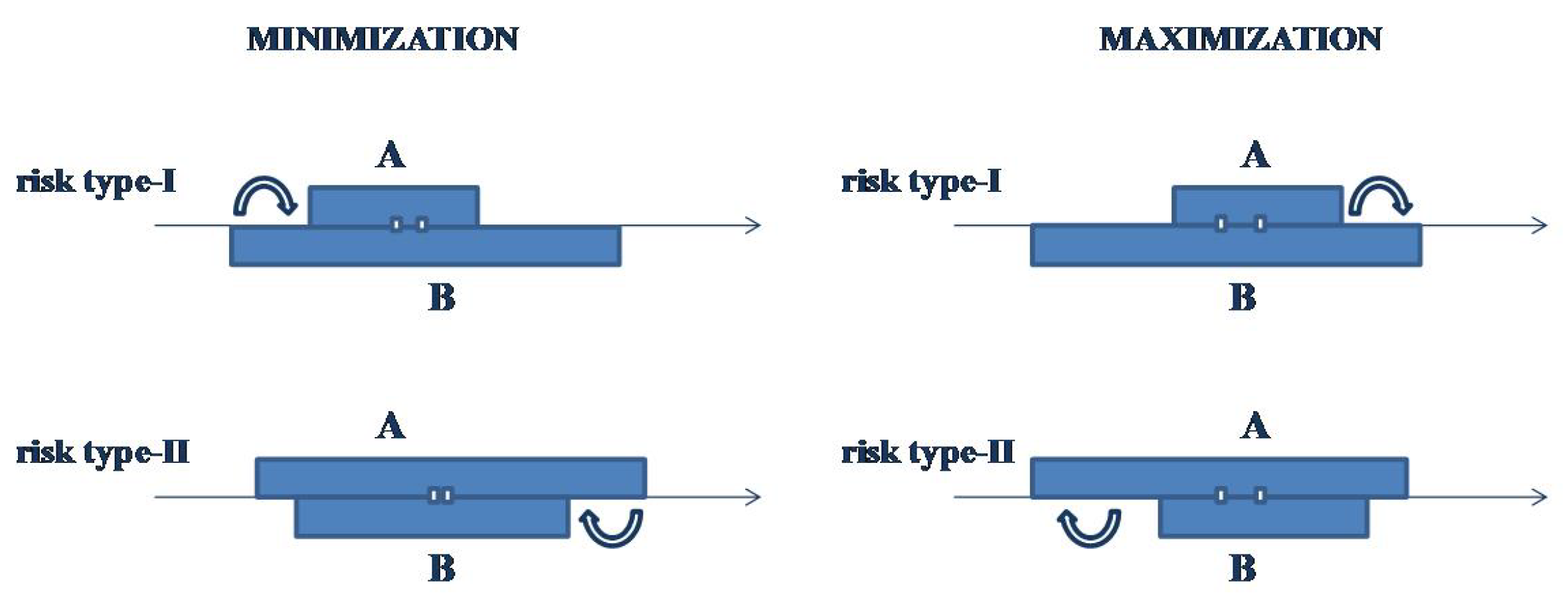
Figure 1.
The type-I and type-II risks may occur in minimization and maximization problems.
The defined value enables the definition of a "risk" measure that is detailed in [5] and that we recall as follows:
in a case of a minimization problem, we have a preliminary preference for A against B if (for the moment ) because the difference represents the mid-point gain if we choose A. On the other hand, taking into account the uncertainties given by and , two possible bad situations may arise
(i) , i.e. , and this means that there exist values such that for all ;
(ii) , i.e. , and this means that there exist values such that for all .
In case (i) the positive quantity measures the possible regret, relative to the midpoint gain;
in case (ii) a measure of the possible regret is given by the positive quantity .
In terms of the the comparison index ratio , then, the relative regret measure is positive if or if and the regret measures increases if increases far from the threshold 1 (case (i)) or decreases far from the threshold (case (ii)).
In the presence of worst case loss for the two types of risk, the value can be limited by two fixed values and such that and a new order relation can be introduced:
Definition 4.
Given two intervals and and , we define the following (strict) order relation, denoted ,
It is immediate to see that the relation with , is antisymmetric and transitive; furthermore, there are specific values of and which make the order relation (12) equivalent to the most cited order relations in literature known with the acronyms as it is shown in the following definition.
Definition 5.
and
Let A and B be two intervals with and then it holds that
1)
2)
3)
4)
5) .
By varying the two parameters , , we obtain a continuum of strict (partial) order relations for interval. The set of real intervals with the order relation defined by or ) with is a complete lattice
Consequently, the decision making midpoint representation can be defined as follows:
Definition 6.
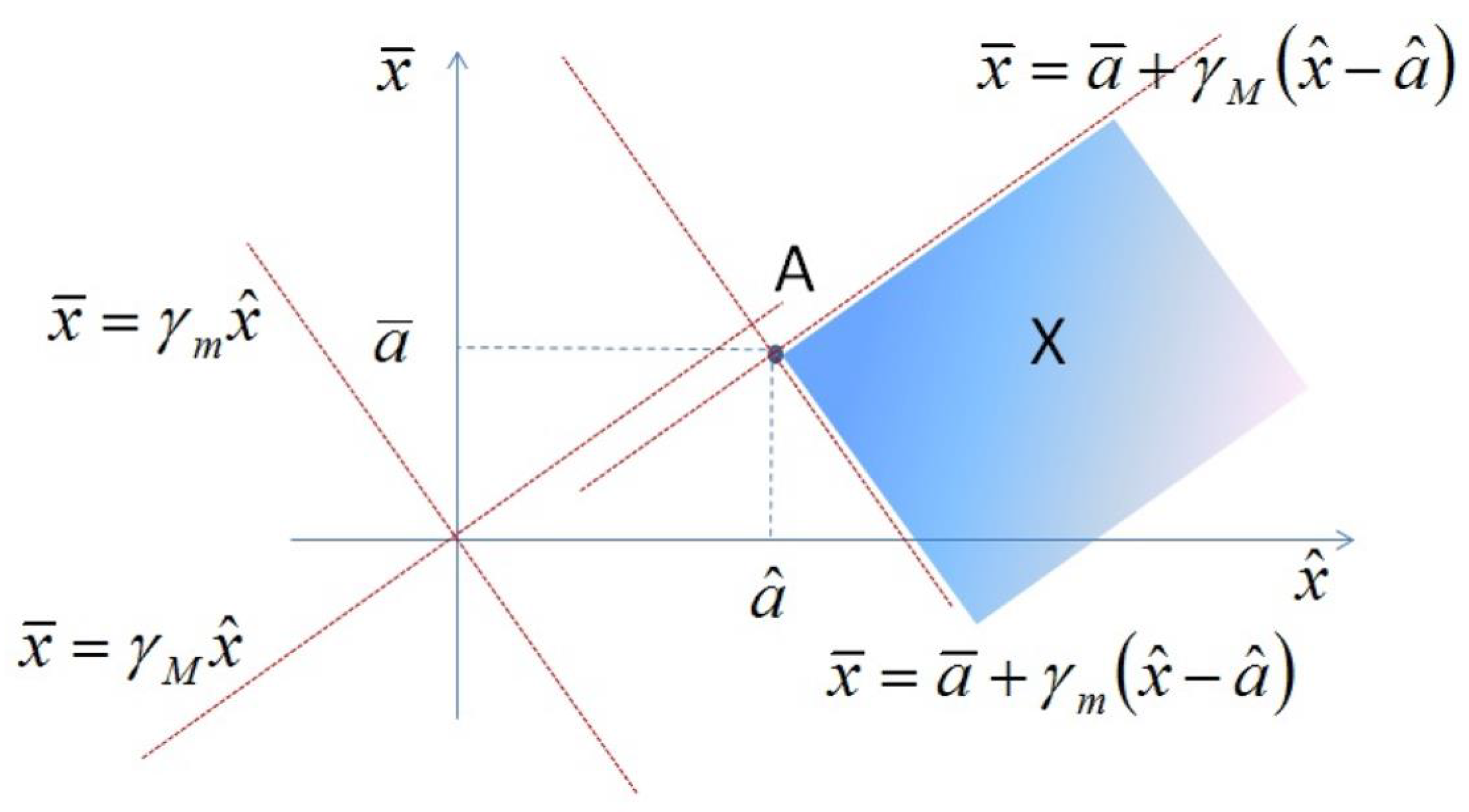
For a given interval , consider the set of intervals
Proposition 7.
For any real and (the slopes of the tangent lines) and any intervals , we have
1. if and only if , and
2. if and only if .
Given a family of intervals (for any finite or infinite index set ) the infimum and the supremum operators with respect to partial order , respectively and , are defined by the two intervals (in mid-point notation) and
where are
and are
Remark 8.
To focus on the interest for an interval ordering index, we mention that the acceptability index for inequality , introduced by Sengupta and Pal (see [9,10]) and defined by (assuming )
is successfully used to convert an interval inequality , with into a "crisp equivalent" form as follows
where is an assumed fixed (optimistic) threshold; substituting the expression for we obtain
This set of inequalities, being , implies that and does not imply a control on the possible worse case losses. In fact we can see that is not equivalent to in the sense that the one can not be transformed into the other.
The comparison index can be applied when a variable interval of the form is compared with a fixed interval B;.two possible worst case losses may occur and they are related to the value of . Supposing it follows that the value of for the inequality is:
In order to control the extent of the possible worst case loss for the two types of risk, we can require that the value be controlled for the type I risk and/or for the type II risk. To do this, we fix two values and and we require that valid values of x satisfy and
The two types of risk are eliminated when and The values and , if negative, give the relative worst case loss with respect to .
In terms of (12), we can write:
If we are minimizing and we do not accept a risk of type II, we may require that (we eventually accept only a risk of type I) and we choose , ; a risk of type II represents the possibility that we realize values in that are greater than all values in B. Similarly, if we do not accept a risk of type I, then we choose , ; a risk of type I represents the possibility that we realize values in B that are less than all values in . If and no risk of the two types is accepted. It follows that the use of the acceptability index does not avoid the two types of risk that are controlled using the order relationship (12).
3. Interval Costs in Linear Programming
We apply the order relation to linear programming with interval costs (ILP problem) that has the following general form:
where A is a matrix with m rows and n columns, b is m-vector of right-hand side terms, , are n intervals representing the coefficients of the linear objective function to be minimized that is represented by an interval
where and are given by
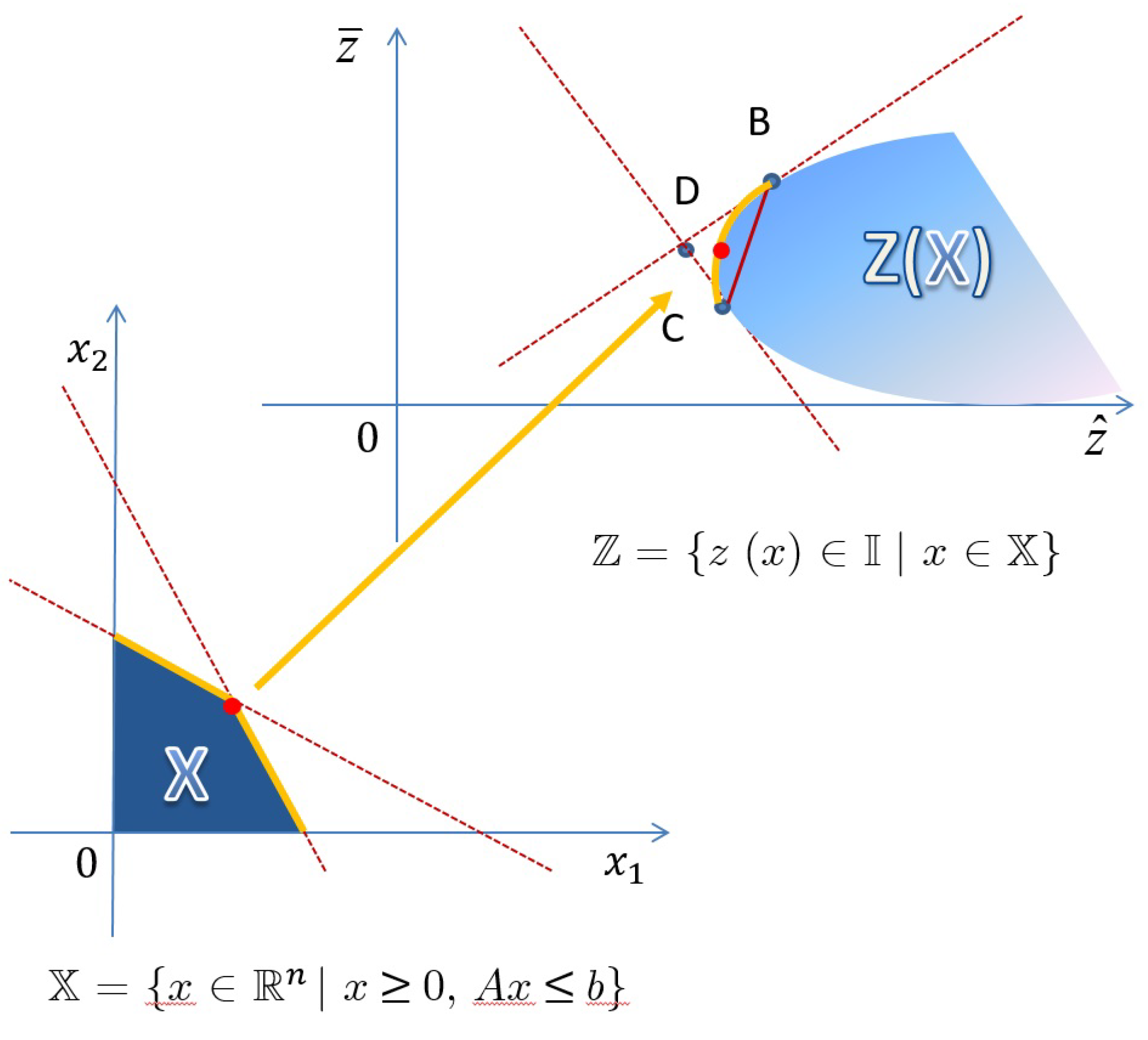
Figure 3.
Visualization of the process from the feasible convex set to the feasible objective intervals
Figure 3.
Visualization of the process from the feasible convex set to the feasible objective intervals
An optimal solution is computed with the corresponding objective value: where x is in the feasible convex set:
and the set of feasible objective intervals is again a convex set:
Remark 9.
It is well known that is a convex polygon in and this implies that is a convex polygon in the space of intervals.
Definition 10.
If are two feasible solutions and are the corresponding objective interval values then dominates (or in other words dominates if and only if
The search of a solution requires the following method: among all the feasible objective values, the not dominated values, with respect to the interval relation order (with fixed , ) have to be selected . In particular, given two feasible solutions and with the corresponding objective intervals given by: and the problem is to chose the best interval between them. Three possible situations may occur:
Given two feasible solutions and with the corresponding objective intervals given by: and the best interval between them corresponds to three cases:
- is better than (dominates) or equivalently
- is better than (dominates) or equivalently
- and are not comparable because of the incomparability between and
Consequently, a solution x is called efficient if there is no feasible solution such that dominates x. It follows that, as it is shown in Figure 2, the tangent lines to determine the ideal objective interval that has values between the tangent points called and
The main interpretation of the expression is that:
- dominates in the variable space X
- dominates in the space of interval object
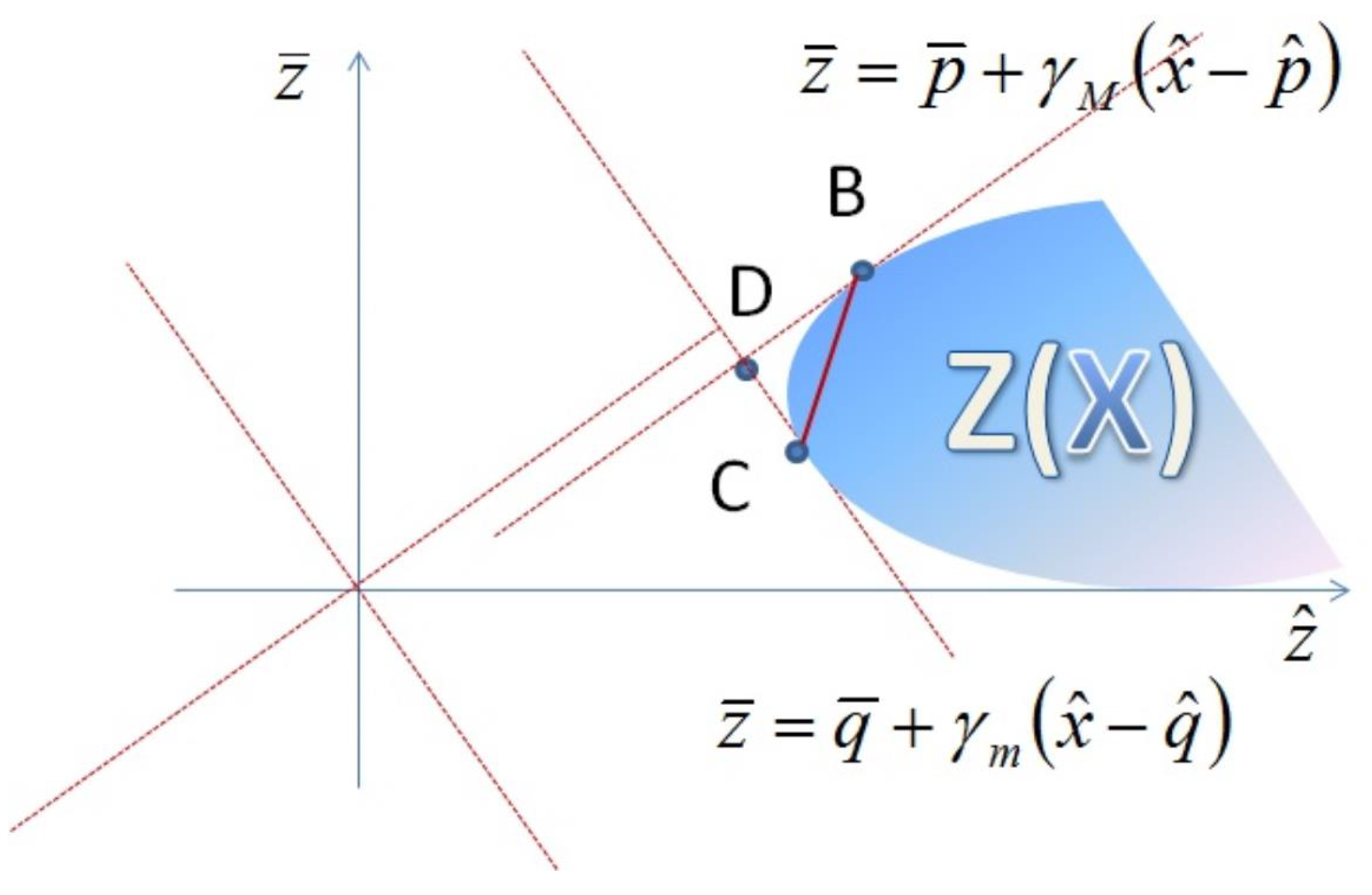
The DBC triangle construction provides two important information :
- the efficient boundary of the LP problem, in the target value space , is inside the triangle DBC;
-
value D identifies the ideal objective solution, it is unique in , but not necessarily in and this impliesGreatest Lower Bounded respect toif then D is unique and is the ideal solution
The efficient frontier is determined by two "tangent" lines or better "support lines":
1) where P is feasible,
and with such that is the largest.
2) where Q is feasible,
and with such that is the smallest.
The intersection between tangent lines is the ideal solution
It follows that:
- if (it is feasible) that it can be considered the optimal solution;
- if (it is not feasible) then a goal programming technique is applied in order to find the feasible solution with the smallest distance to , i.e. the optimal feasible solution that solves the following optimization problem:
A solution x is efficient if there is no feasible solution such that dominates x.
Tangent lines ( support lines ) to determine the ideal objective interval that has values between the tangent points called and
The interval valued LP optimal solution is
- if (it is feasible) that it is the unique optimal solution;
- if (it is not feasible) then a goal programming technique is applied in order to find the feasible solution with the smallest distance to , i.e. the optimal feasible solution that solves the following optimization problem:
4. Numerical Examples and Sensitivity Analysis
We now apply the mentioned results to some linear programming problems with interval costs and we extend preliminary results shown in [28]. An exahustive scenario of properties concerning calculus of interval-valued functions can be found in [29,30].
Example 1. The first example is specified with the following data:
Figure 4 shows the two red tangent lines and the third red line connecting the tangent points. The area described by blue lines is the feasible set, D is in () that does not belong to the feasible set and it requires the mentioned goal programming technique to identify the minimum value as
The sensitivity analysis for the optimal solution is carried out through a scatter plot where values of the two variables and and their frequencies are shown in order to observe the robustness of the solution. The vertical and horizontal histograms show the distribution of the values of and around the optimal solution.
Example 2. The second example comes from [31] where the optimization problem is described as follows ():
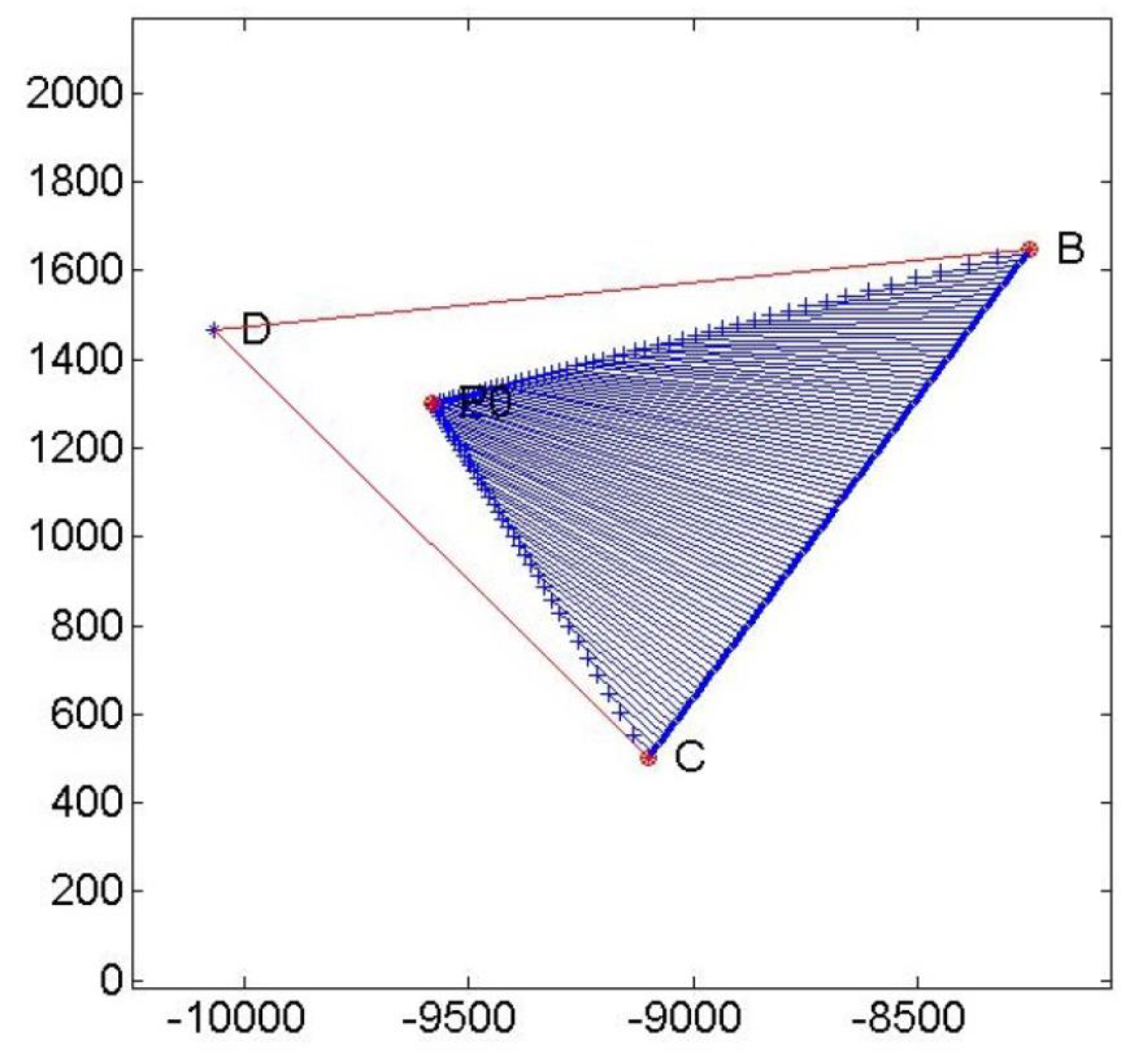
Figure 5.
Ideal and optimal solution of example 1 are shown
We have solved the problem in the minimization form so that the midpoint values of the objective function are negative. Figure 2 shows the minimum value obtained with the slope of tangent lines specified as follows: and . The point is the minimum obtained in [31] and it is the same a the one obtained by our method (as the nearest interval to the ideal solution corresponding to the chosen values of and . The second solution suggested by Chanas and Kuchta is , obtained by our method with the partial order generated by and and represented in Figure 3.
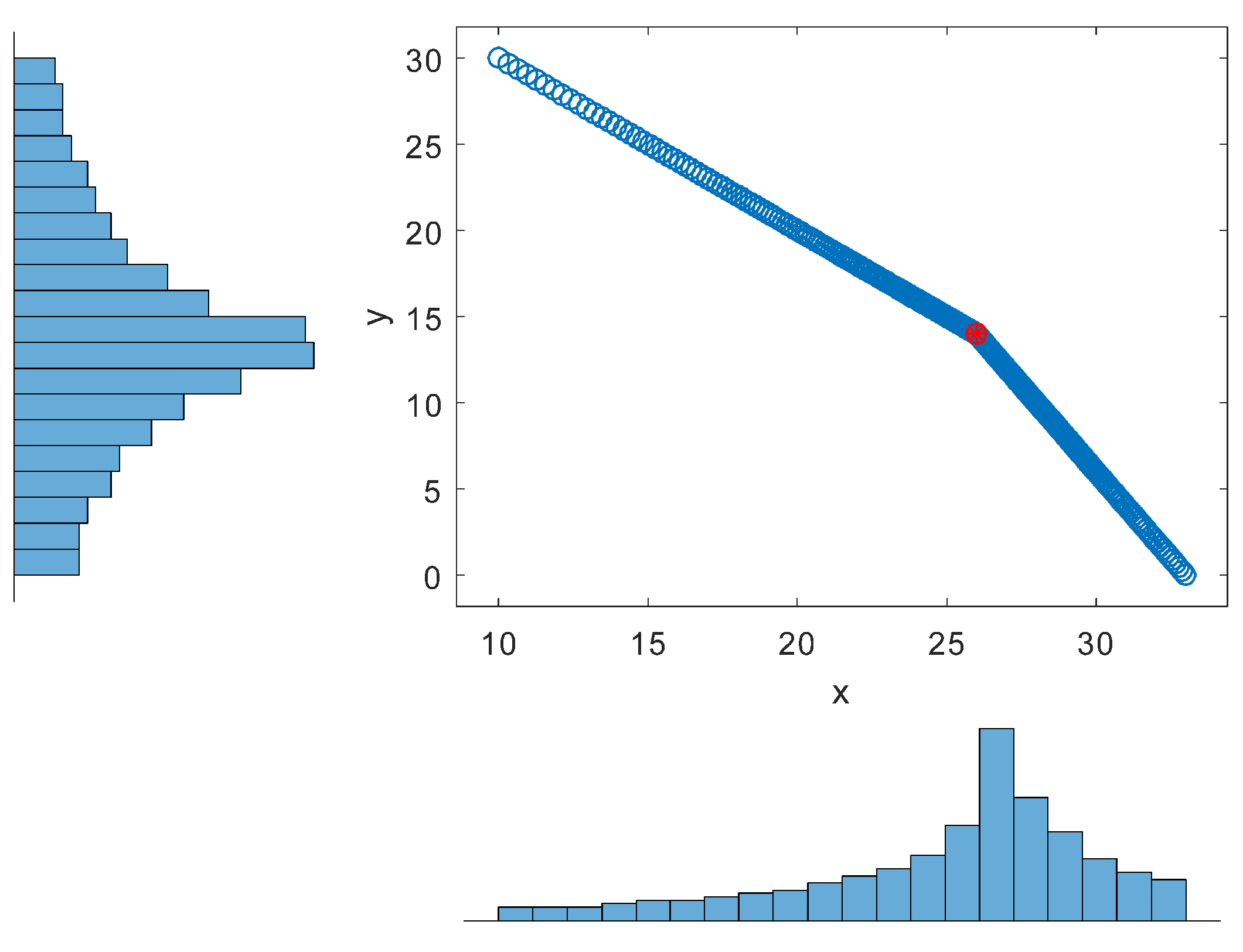
Figure 6.
Sensitivity analysis for example 1
Example 3. The third numerical example is a problem called ITPMPF (Interval-valued Transportation Problem with Multiple Penalty Factors) that comes from chapter 7 of the book [10] and it is defined as:
where
We chose and In Figure 3, is the minimum obtained with our methodology, and are the minima obtained with the reduction into a standard LPP structure as in [10] and is the solution of the same problem obtained in [32]. We remark that the solutions , and are not on the efficient frontier of the feasible objective values.
The figure shows that is the closest to the ideal minimum stressing the goodness of our methodology.
A further example is the same as in papers [15,18]; they consider a numerical interval linear programming example as follows:
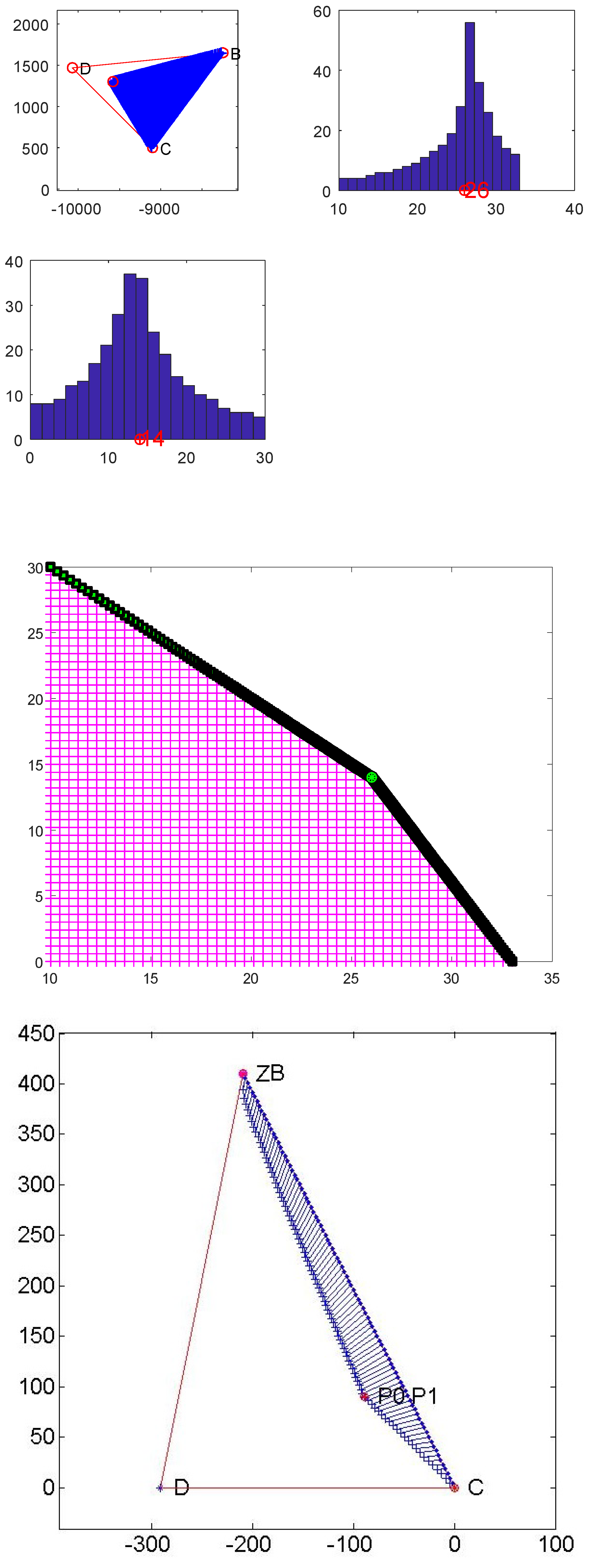
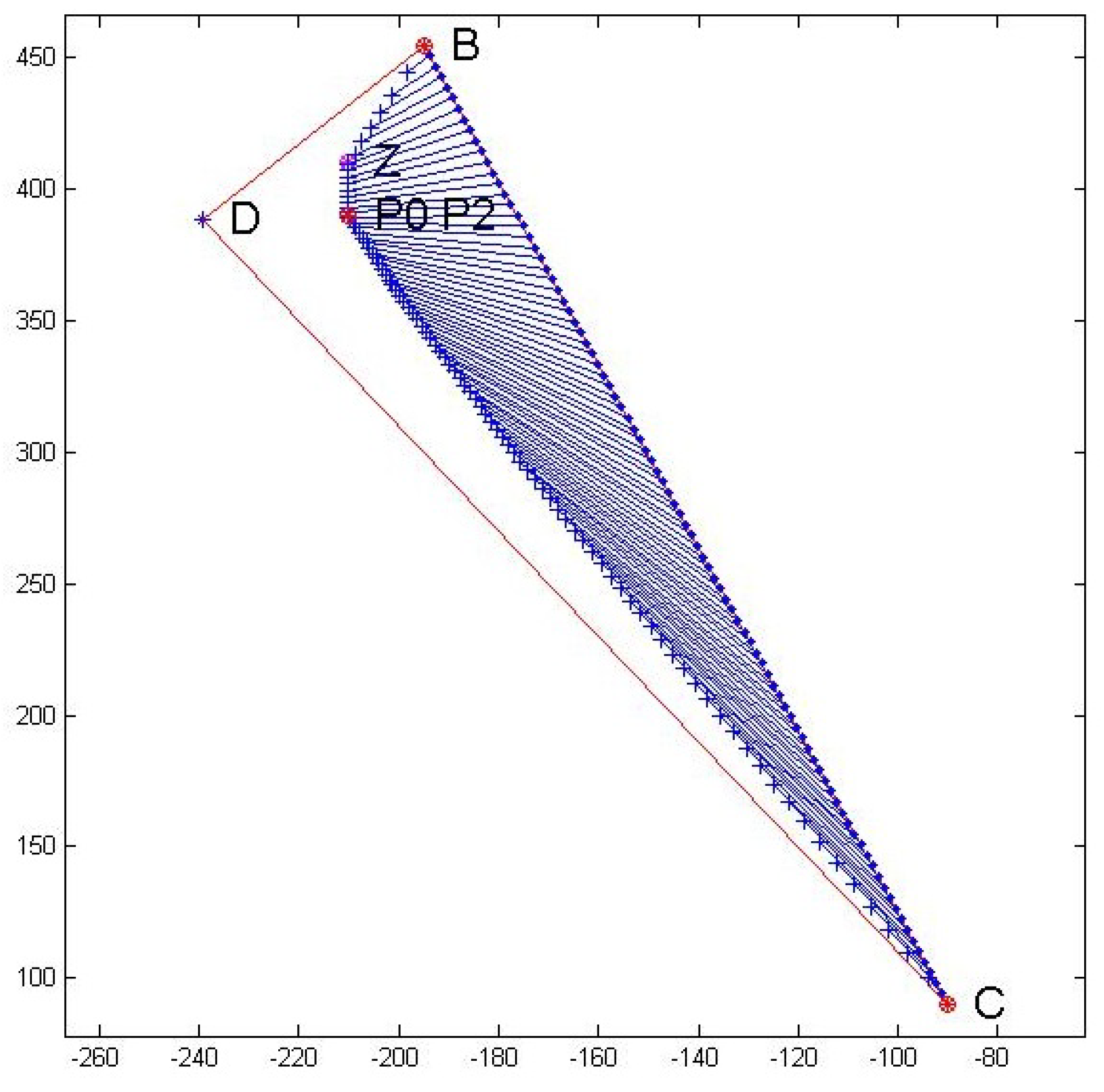
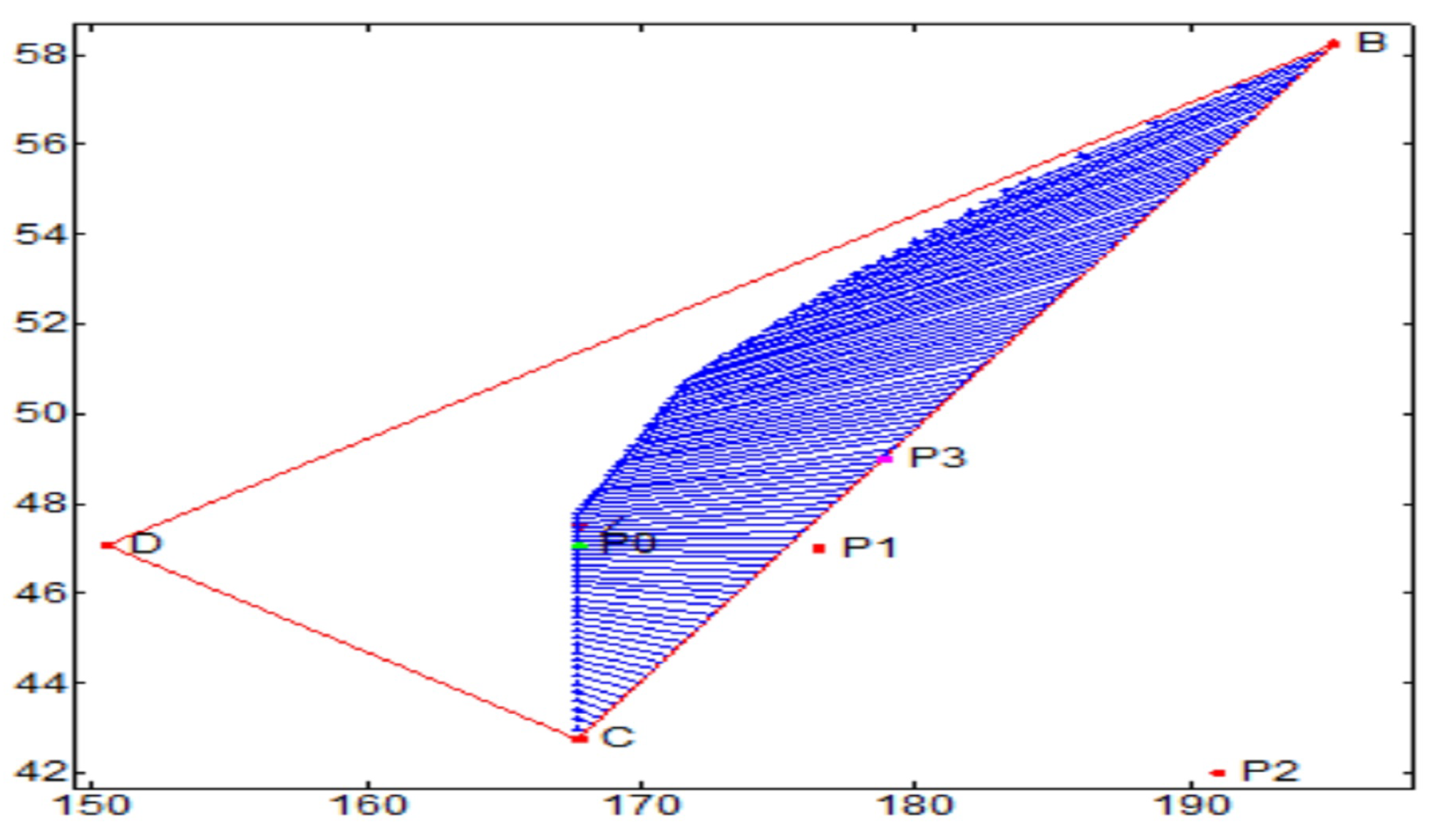
Figure 7.
Numerical example n.2 (Chanas and Kuchta) with = 0, = 5.0
Figure 8.
Numerical example n.2 (Chanas and Kuchta) with = −2, = 1.5
Figure 9.
Numerical example 3. (Sengupta and Pal)
5. Further Directions and Conclusions
The application of the comparison index in interval linear programming is the main topic of the present paper. The preliminary results seem to encourage some additional research due to the numerical efficiency and robustness of the suggested methodology and to the large number of possible applications in many areas.
When intervals are not enough to model a more complex uncertainty, then coefficients can be replaced by fuzzy numbers. Fuzzy linear programming (FLP) was born in 1970 with the seminal work on Decision Theory by Bellman and Zadeh ([33]) but FLP problems were formally born in 1974 when Tanaka et al. ([34]) and Zimmermann ([35]) published their works modelling the set of constraints in LP as fuzzy sets. Ramík extensively worked on the topic and in [36] he introduces a class of fuzzy optimization problems with objective function depending on fuzzy parameters; in [37] it is underlined that FLP can tackle highly complex situations in an elegant and efficient way.
Acknowledgments
This work is supported by the program MUR PRIN 2022 “Modeling and valuation of financial instruments for climate and energy risk mitigation.” funded by the European Union - NextGenerationEU under the National Recovery and Resilience Plan (PNRR) M4C2 - proposal code 2022FPLY97 - CUP J53D23004530006.
References
- G. B. Dantzig, Linear Programming and Extensions, Princeton University Press, 1963.
- R. E. Moore, Methods and Applications of Interval Analysis, Philadelphia, PA: Society for Industrial and Applied Mathematics, 1979.
- A. Mostafaee, M. Hladík b, M. Černý, Inverse linear programming with interval coefficients, Journal of Computational and Applied Mathematics 292 (2016) 591–608. [CrossRef]
- M.L. Guerra, L. Stefanini, A comparison index for interval ordering, IEEE SSCI 2011, Symposium series on Computational Intelligence (FOCI 2011), 53-58.
- M.L. Guerra, L.Stefanini, A comparison index for interval ordering based on generalized Hukuhara difference, Soft Computing, 16, 11 (2012) 1931-1943. [CrossRef]
- H. Ishibuchi, H. Tanaka, Multiobjective programming in optimization of the interval objective function, European Journal of Operational Research 48 (1990) 219-225. [CrossRef]
- M.L.Guerra, C.A. Magni, L.Stefanini, Interval and fuzzy average internal Rate of Return for investment appraisal, Fuzzy Sets and Systems, 257 (2014) 217 – 241. [CrossRef]
- S. Tong, Interval number, fuzzy number linear programming. Fuzzy Sets and Systems, 66 (1994) 301-306. [CrossRef]
- A. Sengupta, T.K. Pal, On comparing interval numbers, European Journal of Operational Research 127 (2000) 28-43. [CrossRef]
- A. Sengupta, T.K. Pal, Fuzzy Preference Ordering of Interval Numbers in Decision Problems, Springer-Verlag, Berlin, Heidelberg, 2009.
- H. Li, Necessary and sufficient conditions for unified optimality of interval linear program in the general form, Linear Algebra and its Applications, 484, 1 (2015) 154-174. [CrossRef]
- M. Hladík, Complexity of necessary efficiency in interval linear programming and multiobjective linear programming, Optimization Letters, 6 (2012) 893–899. [CrossRef]
- M. Hladík, Robust optimal solutions in interval linear programming with forall-exists quantifiers, European Journal of Operational Research, 254, 3, 1 (2016) 705-714. [CrossRef]
- I. Alolyan, Algorithm for Interval Linear Programming Involving Interval Constraints, Proceedings of WCECS 2013, San Francisco 2013.
- J. Sun, D. Gong, X. Zeng, N. Geng, An ensemble framework for assessing solutions of interval programming problems, Information Sciences, 436–437 (2018) 146-161. [CrossRef]
- M. Allahdadi · H. Mishmast Nehi, The optimal solution set of the interval linear programming problems, Optimization Letters, 7 (2013) 1893–1911. [CrossRef]
- M. Allahdadi, H. Mishmast Nehi, H. A. Ashayerinasab, M. Javanmard, Improving the modified interval linear programming method by new techniques, Information Sciences, 339, 20 (2016) 224–236. [CrossRef]
- H. Mishmast Nehi, H. A. Ashayerinasab, M. Allahdadi, Solving methods for interval linear programming problem: a review and an improved method,Operational Research (2018). [CrossRef]
- H. A. Ashayerinasab, H. Mishmast Nehi, M. Allahdadi, Solving the interval linear programming problem: A new algorithm for a general case, Expert Systems with Applications, 93 (2018) 39-49. [CrossRef]
- C. Jiang, X. Han, G. R. Liu, G. P. Liu, A nonlinear interval number programming method for uncertain optimization problems, European Journal of Operational Research, 188, 1 (2008) 1-13. [CrossRef]
- C. Oliveira, C. Henggeler Antunes, Multiple objective linear programming models with interval coefficients – an illustrated overview, European Journal of Operational Research 181 (2007) 1434–1463. [CrossRef]
- A. Bata, M. Allahdadi, M. Hladík, Obtaining Efficient Solutions of Interval Multi-objective Linear Programming Problems, International Journal of Fuzzy Systems (2020). [CrossRef]
- M. Arana-Jiménez, C. Sánchez-Gil, On generating the set of nondominated solutions of a linear programming problem with parameterized fuzzy numbers, Journal of Global Optimization, 77 (2020) 27–52. [CrossRef]
- M. Arana-Jiménez, Nondominated solutions in a fully fuzzy linear programming problem.Math.Methods, Appl. Sci. 41 (2018) 7421–7430. [CrossRef]
- M. Manisha, S.K. Gupta, M. Arana-Jiménez, Developing solution algorithm for LR-type fully interval-valued intuitionistic fuzzy linear programming problems using lexicographic-ranking method, Computational and Applied Mathematics, 42, (2023) 274. [CrossRef]
- I. Aguirre-Cipe, R. López, E. Mallea-Zepeda, L. Vásquez, A study of interval optimization problems, Optimization Letters. [CrossRef]
- L. Stefanini, A generalization of Hukuhara difference and division for interval and fuzzy arithmetic, Fuzzy Sets and Systems, 161, 11 (2010),1564-1584. [CrossRef]
- M.L. Guerra, L.Sorini, L. Stefanini, A new approach to linear programming with interval costs, IEEE International Conference on Fuzzy Systems, Naples 2017, Article number 8015661.
- L. Stefanini, M. L. Guerra, B. Amicizia, Interval Analysis and Calculus for Interval-Valued Functions of a Single Variable. Part I: Partial Orders, gH-Derivative, Monotonicity, Axioms, 8, 4 (2019) 113. [CrossRef]
- L. Stefanini, L. Sorini, B. Amicizia, Interval Analysis and Calculus for Interval-Valued Functions of a Single Variable—Part II: Extremal Points, Convexity, Periodicity, Axioms 2019, 8, 4 (2019) 114. [CrossRef]
- S. Chanas, D. Kuchta, Multiobjective programming in optimization of interval objective functions - A generalized approach, European Journal of Operational Research 94 (1996) 594-598. [CrossRef]
- S.K. Das, A. Goswami, S.S. Alam, Multiobjective transportation problem with interval cost, source and destination parameters, European Journal of Operational Research 117, 1 (1999) 100-112. [CrossRef]
- R. E. Bellman, L. A. Zadeh, Decision-Making in a Fuzzy Environment, Management Science, 17, 4 (1970) 141-164. [CrossRef]
- H. Tanaka,T.Okuda, K.Asai, On Fuzzy-Mathematical Programming,Journal of Cybernetics 3(4) (1974) 37-46.
- H.-J. Zimmermann, Fuzzy programming and linear programming with several objective functions, Fuzzy Sets and Systems, 1, 1 (1978) 45-55. [CrossRef]
- J. Ramik, Fuzzy Linear Programming, In W. Pedrycz, A. Skowron, V. Kreynovich (Eds), Handbook of Granular Computing, J. Wiley & Sons (2008) 689-718.
- J. L. Verdegay, Progress on Fuzzy Mathematical Programming: A personal perspective, Fuzzy Sets and Systems, 281(2015) 219–226. [CrossRef]
Disclaimer/Publisher’s Note: The statements, opinions and data contained in all publications are solely those of the individual author(s) and contributor(s) and not of MDPI and/or the editor(s). MDPI and/or the editor(s) disclaim responsibility for any injury to people or property resulting from any ideas, methods, instructions or products referred to in the content. |
© 2025 by the authors. Licensee MDPI, Basel, Switzerland. This article is an open access article distributed under the terms and conditions of the Creative Commons Attribution (CC BY) license (http://creativecommons.org/licenses/by/4.0/).
Copyright: This open access article is published under a Creative Commons CC BY 4.0 license, which permit the free download, distribution, and reuse, provided that the author and preprint are cited in any reuse.


