

Submitted:
26 April 2025
Posted:
28 April 2025
You are already at the latest version
Abstract
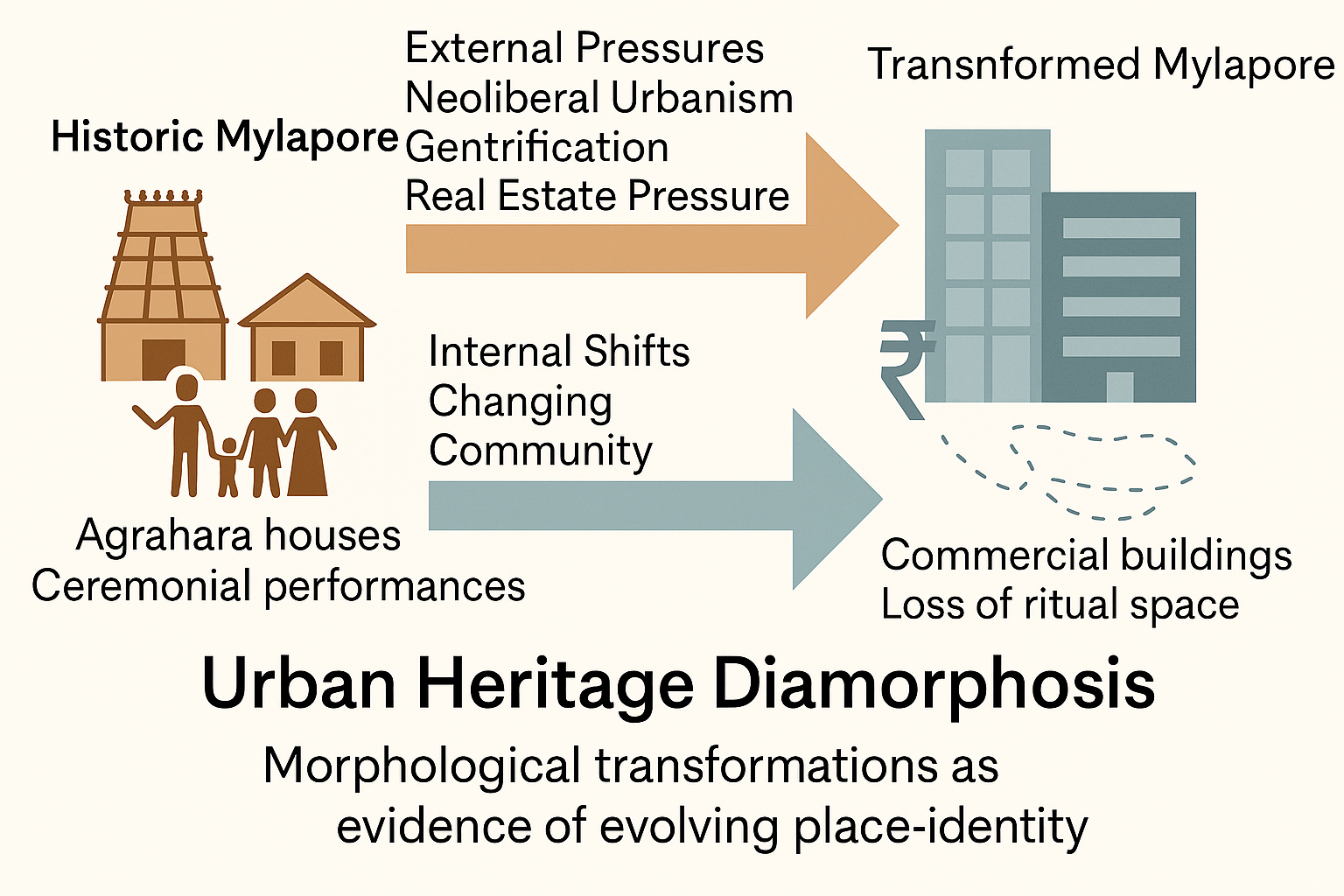
Mylapore, in Chennai, India, known for its cultural and historical significance, is caught between its historical legacy and contemporary urban pressures. This paper engages with the morphological and cultural transformations unfolding in the Kapaleeshwara Temple precincts, where development initiatives coexist with efforts to preserve cultural memory. Through field observations, urban morphology mapping, and unstructured interviews conducted over two months, the study traces how shifts in the built typology reflect changing patterns of traditional performances and everyday experiences. Drawing on Aldo Rossi’s theories of urban artefacts, collective memory, and the analogical city, alongside Smrithi Srinivas’s concept of the urban performative complex, the paper examines how built morphology and public performances together shape evolving place-identity. It introduces the idea of ‘Urban Heritage Diamorphosis’- the morphological transformations that register evolving community values and place-associations under the combined influence of internal socio-cultural shifts and external development pressures. The paper concludes that recognising morphological change as evidence of evolving heritage values is essential for more community-centred heritage management practices.
Keywords:
place-identity
; urban performative complex
; urban artefact
; collective memory
; urban heritage diamorphosis
1. Introduction
“Also, among all the localities of contemporary Chennai, it is the one that has that old-world charm the most…Mylapore has a certain architecture to it, and that is vanishing today because of construction of newer buildings.”Nanditha Krishna, historian and environmentalist
“What is more than 200 years old here? Most of the old structures have been redone and the actual ones don’t exist anymore. Mylapore temple gopuram was done in 1900 and so was the pond. Of course, they are named in Devaram of the 8th century, but the structures mentioned in it don’t exist anymore.”Venkatesh Ramakrishnan, historian and novelist
The public opinion about the proposal for seeking UNESCO World Heritage tag for Chennai’s Mylapore, under the intangible cultural heritage category, is divided. These quotes, taken from a Times of India article (2016), reveal mixed reactions from stakeholders. While some appreciate the initiative to celebrate the area’s cultural legacy, there are discernible concerns about the ‘vanishing charm’ and rampant ‘commercialization’. It is this public debate in the news media that triggers our interest in the transformation of the historically significant neighbourhood of Mylapore, Chennai, India.
Mylapore, located in the southern part of Chennai in the Indian state of Tamil Nadu, is a historically and culturally significant neighbourhood. It is mentioned in ancient texts, including the Sangam literature, which dates to the 1st to 4th centuries CE. The neighbourhood’s name is believed to be derived from “Mayil arparikum oor,” which means “the land of the peacock’s scream” (Aranha, 2011). The 17th century Kapaleeshwarar Temple, dedicated to Lord Shiva, is one of the neighbourhood’s most iconic landmarks. It exemplifies Dravidian architecture and is a focal point for religious and cultural activities. The San Thome Basilica, built over the tomb of St. Thomas the Apostle, holds religious importance for Christians. The neighbourhood’s cultural legacy extends to literature, music and dance traditions, and various other festivals described later. The streets are adorned with traditional Tamil architecture, including intricate woodwork, colorful facades, and carved pillars, which contribute to the neighbourhood’s visual appeal and cultural significance (Prasad, 1994). However, in recent years, Chennai’s embrace of neoliberal aspirations (Vincent, 2017) has led to notable changes in the various parts of the city’s urban landscape, including historically significant areas like Mylapore (Harini and Kitchley, 2021).
Anne Maassen and Madeleine Galvin (2019) describe urban transformation as a systemic, structural, irreversible, non-linear, and contextually and politically influenced process. Neoliberal economy is a key driver of urban form changes, impacting even historical neighbourhoods through privatization, deregulation, and market-driven development. This context raises critical questions: To what extent does public opinion influence urban transformation in heritage precincts? What evidence indicates dynamic changes in a community’s heritage value system? And, should changing place-associations inform urban heritage management policies? Balancing preservation and development in urban heritage transformation is a ‘wicked problem’ (Rittel & Webber, 1973) due to its interplay of historical, political, cultural, socio-economic factors, stakeholder conflicts, uncertainty of long-term impacts, and unintended consequences. While some advocate for strict conservation, valuing nostalgia and authenticity, others emphasize development and adaptation. Historical neighbourhoods rich in cultural heritage can become commodities for investors, leading to increased property values and displacement of residents. Gentrification ultimately alters these areas’ physical and cultural fabric. Some scholars warn against excessive change and stress on the need to preserve the integrity and authenticity of heritage precincts. Proponents of change argue that financial feasibility is essential for heritage sites to remain relevant to local communities. It is widely accepted now that traditional conservation approaches overlook ordinary people’s lived experiences and their relationship with the built environment in favor of expert opinions (Court and Wijesuriya, 2015). Personal, spiritual, and political connections between communities and historic places are vital for heritage preservation (Weise, 2013). In contemporary times, there are official decisions to prioritize people-centric approaches on paper. Yet, community engagement often remains an afterthought in heritage management, leaving communities feeling excluded. Balancing these issues requires open dialogue among stakeholders to respect heritage values while meeting contemporary urban living needs. The key challenge is finding a common value system. This opinion paper situates itself within this academic debate on shifting heritage values, while focussing on the transformation of Mylapore.
Claim and Argument Structure
We consider theoretical frameworks that explore transformations in urban heritage precincts, and the impact of neoliberal urbanism on their vulnerability. We examine the static qualities of tangible heritage alongside the dynamic ways in which urban built heritage is lived and experienced in both sacred and secular public life. The material expression of public life as heritage is understood as a socially produced set of evolving values and urban morphology mapping becomes a critical tool for documenting these shifts. In this study, we analyse the changing patterns of ritual-centric public life in the Kapaleeshwara Temple precincts of Mylapore, observing how they manifest as morphological changes in the area. This evidence leads us to introduce the concept of “Urban Heritage Diamorphosis” (UHD), which posits that morphological changes are a critical measure of evolving community place-associations and changing patterns of urban life within historic neighbourhoods. The UHD framework prioritises mapping actual ground conditions and recognising changing spatial configurations of the built environment as records of how people perform public life and interact with historic urban spaces. Urban heritage conservation has long moved beyond a monument-centric approach to encompass the broader precinct fabric and larger systems. The UHD approach recognises that people’s perceptions of heritage, aspirations, and community activities significantly influence morphological changes. We advocate for incorporating UHD into urban heritage management practices, to acknowledge evolving value systems.
2. Theoretical Framework: Vulnerability and Transformation of Urban Heritage Precincts
Neoliberal urbanism prioritizes corporate interests through market-oriented development, often leading to the privatization of spaces, gentrification, and the displacement of marginalized communities (Brenner, Marcuse and Mayer, 2012). Scholars like Neil Smith, David Harvey, and Saskia Sassen explore neoliberal urban dynamics, and highlight the vulnerability of older neighbourhoods to neoliberal pressures. David Harvey’s concept of “commodification of space” and “spatial fix” may explain how heritage precincts are altered for profit (Harvey, 1989). Sharon Zukin (1995) and Laurajane Smith examine how neoliberalism erodes cultural authenticity and commodifies heritage. Pushing for tourism, as Michael Porter (2006) notes, often sacrifices local culture for economic gain. Cultural events are also popularly used for cultural economy-led regeneration. Urban heritage management is thus complex. In this paper, we synthesise two distinct theoretical concepts to offer an unconventional lens for understanding it.
Theorising Urban Built Heritage: ‘Urban Artefacts’ and ‘Urban Performative Complex’
“I would define the concept of type as something that is permanent and complex, a logical principle that is prior to form and that constitutes it.”Aldo Rossi, The Architecture of the City 1966, p. 40.
Aldo Rossi’s work is highly regarded for its lasting impact on the theory of urban form. Rossi conceptualises urban artefacts, such as buildings, as repositories of collective memory and cultural significance. These structures embody a city’s history and identity, and thus foster a sense of continuity and belonging. He links architectural types, like schools and theatres, to life, death, and imagination, suggesting that a building’s use is independent of its form. His concept of the Analogical City integrates historical monuments with anonymous urban elements, which reflect collective memory and identity. Rossi acknowledges cities’ evolution and artefacts’ transformative nature, shaping the “locus solus,” or essence, of city regions, which perpetuate a sense of permanence amid constant change (Rossi, 1982).
Complementing Aldo Rossi, writing from a Southern context, Smrithi Srinivas (2001) proposes “urban performative complex” which is a ‘multi-centered network’ linking spatial arenas, social constituencies, and civic history. Urban performance spaces host religious and non-religious cultural expressions, shaping a city’s ‘place identity.’ UNESCO’s 2003 convention acknowledges such cultural activities as intangible heritage. In “Landscapes of Urban Memory,” Srinivas examines how narratives, rituals, and performances in Bangalore create a kinesthetic imagination, where urban spaces have symbolic and political roles. Rituals empower marginalized communities to reshape city history and affect spatial and narrative dimensions. This ‘urban performative complex’ connects cult centres with multiple performances and networks of locational sacrality. The idea links spatial arenas, social groups, and civic history. These elements are interconnected through three axes- a multi-dimensional representation of Bangalore’s sacred landscape (Srinivas, 2001).
Urban heritage is a dynamic process of meaning-making and cultural expression, influenced by people, their beliefs, and their built environment. Aligning with Srinivas’ view of cities as evolving entities and Rossi’s concept of intersecting past and present, we advocate for using morphological analysis to examine the interplay between enduring and evolving urban heritage ideas and elements. Scholars should uncover how lived experiences and perceptions shape heritage values through socio-spatial empirical analysis. The “Right to the City” emphasizes inclusive urban development and decision-making (Lefebvre, 1996). Communities shape their environment through negotiation, cementing power relations. Morphological analysis can provide empirical evidence of these changes by examining architectural elements, spatial configurations, and historical contexts.
3. Methodology and Empirical Evidence from Kapaleeshwara Temple precincts
This paper draws from a postgraduate Urban Design dissertation based on a two-month qualitative inquiry. Using the Urban Design reportoire of tools- including field observations, urban morphology mapping, and unstructured open-ended interviews- street activity patterns and transformation of built forms were studied as urban artefacts (Rossi) and performative spaces (Srinivas) to uncover the socio-spatial dynamics shaping evolving place-identity.
The scope of this conference paper does not allow for a detailed inventory of built heritage transformation and related public activities, rituals and place- associations of Mylapore. Table 1 covers a few prominent aspects of public ritual performances around Kapaleeshwara Temple precincts and the spatial and morphological dimensions of the same.
Reading Morphological Transformations
The evolution of Kapaleeswara Street in Mylapore, Chennai, illustrates significant shifts in urban form and function as seen in Figure 1 and Figure 2. Historically, Kapaleeswara Street served as a ceremonial pathway to the main entrance of the Kapali Temple, adorned with the imposing Raja Gopura and a central mantapa for preparing the deity’s procession. Today, however, the street is primarily used for parking, as practical needs overshadow its historical and religious significance. Originally, agrahara dwellings featured front yards (thinnai), pitched roofs, jali walls, and decorated wooden doors, facilitating communal events and gatherings. These houses reflected a blend of classical influences, including Corinthian, Indo-Islamic, and Indian architectural elements. The introduction of concrete in the 1930s marked a shift toward modern architectural styles, with geometric designs, cantilevered fins, and curved corner windows. In contrast, contemporary Mylapore is dominated by large commercial buildings with glass facades and aluminium composite panels, signaling a departure from traditional architectural elements and communal openness.
Rossi’s theory of urban types and collective memory champions preserving enduring architectural elements that reflect a community’s cultural identity. The shift from residential agrahara houses to commercial structures in Mylapore highlights a transition toward economic priorities over communal heritage. Traditional architectural features are concealed by advertisement boards, and stylized houses are replaced with standardized commercial templates. Smriti Srinivas’s concept of the “urban performance complex” frames urban spaces as stages for social and cultural performances. The transformation of Kapaleeswara Street from a ceremonial pathway to a parking area diminishes its role in facilitating ritual performances and communal gatherings. The evolution from traditional agrahara dwellings to modern commercial buildings reduces spaces for communal-friendly design and ritual performances. The closure of commercial buildings during major processions restricts the movement of people and hinders traditional communal activities. The shift also represents a loss of visual and architectural cues that once supported cultural gatherings.
4. Urban Heritage Diamorphosis: A Conceptual Exploration
Urban Heritage Diamorphosis (UHD) describes how cumulative morphological changes in historic urban neighbourhoods signal shifts in community place-associations and collective perceptions of heritage. UHD occurs when built heritage is altered through community agency, navigating the relationship between physical transformations and shared values. Morphological changes mirror the community’s evolving understanding of heritage. Neoliberalism, characterised by privatisation, market-driven urban development, and cultural commodification, poses a major threat to cultural heritage preservation globally. UHD highlights how both external real-estate pressures and internal value-shifts reshape a neighbourhood’s built form and public life, affecting place-identity. In India, changes in old neighbourhoods have historically been gradual, shaped by a system of checks and balances that allowed organic adaptation. This aligns with the idea of cultural resilience, where communities evolve while preserving essential heritage and identity. However, historical cores today are increasingly vulnerable to neoliberal urbanism’s disruptive influence.
Traditional heritage management often accommodates community engagement as an afterthought. Government initiatives like HRIDAY and PRASAD emphasise community involvement on paper and adaptive reuse to meet modern urban demands. UHD offers an alternative approach by proposing that morphological change be documented as evidence of community will shaped by both external and internal forces. UHD reframes heritage discourse by acknowledging inevitable change in historic neighbourhoods, aligning with concepts like heritage as a process, discourse, and social practice. It prioritizes community will, allowing monuments to remain relevant while recognizing that architectural and urban forms can evolve and still retain cultural value. UHD acknowledges heritage as a site of contestation, where different voices and value systems intersect, requiring periodic re-examination when morphological changes demand closer and more critical academic inspection. This approach fosters public awareness, research collaboration, and inclusive decision-making for sustainable heritage preservation, integrating lived experiences and the socio-economic role of historical precincts. Ultimately, UHD provides empirical evidence of evolving community values and place identity, ensuring heritage values are preserved while accommodating inevitable change.
References
- Aranha, P., 2011. From Meliapor to Mylapore, 1662-1749: The Portuguese presence in São Tomé between the Quṭb Shāhī conquest and its incorporation in British Madras. In: Portuguese and Luso-Asian Legacies in Southeast Asia: The Making of the Luso Asian World: Intricacies of Engagement. Vol. 1, pp. 67-82. [CrossRef]
- Brenner, N., Marcuse, P. and Mayer, M., eds., 2012. Cities for people, not for profit: Critical urban theory and the right to the city. London: Routledge.
- Court, S. and Wijesuriya, G., 2015. People-centred approaches to the conservation of cultural heritage: Living heritage. Rome: ICCROM.
- Harini, S. and Kitchley, J.L., 2021. Social sustainability in a culturally sound but disrupted urban fabric: The case of Mylapore. Journal of Engineering Science and Technology Special Issue on STAAUH, (November), pp.193-208.
- Harvey, D., 1989. The condition of postmodernity: An enquiry into the origins of cultural change. Oxford: Blackwell.
- oseph, A.I., Suganth, M. & Sharanya, C.R., 2016. Mylapore, a UNESCO cultural heritage site?. Times of India. Available online: http://timesofindia.indiatimes.com/articleshow/54427242.cms?
- Maassen, A. and Galvin, M., 2019. What does urban transformation look like? Findings from a global prize competition. Sustainability, 11(17), p. 4653. [CrossRef]
- Lefebvre, H., 1996. Writings on Cities. Edited by E. Kofman and E. Lebas. Oxford: Blackwell.
- Prasad, D., 1994. The traditional settlement of Mylapore. Architecture + Design, Gurgaon, India, pp. 24-25.
- Rittel, H.W.J. and Webber, M.M., 1973. Dilemmas in a general theory of planning. Policy Sciences, 4(2), pp.155-169. [CrossRef]
- Rossi, A., 1982. The architecture of the city. Cambridge, MA: MIT Press.
- Smith, L., 2006. Uses of heritage. London: Routledge.
- Srinivas, S., 2001. Landscapes of urban memory: The sacred and the civic in India’s high-tech city. NED—New edition. Minneapolis: University of Minnesota Press.
- Vincent, D.S., 2017. Mylapore: Succumbing to real estate pressure, needs preservation. Retrieved July 10, 2021. Available online: http://www.epaper.newindianexpress.com.
- Weise, K., 2013. Discourse. In: K. Weise, ed. Revisiting Kathmandu: Safeguarding Living Urban Heritage. Kathmandu: UNESCO Kathmandu Office, pp. 1–52. Available online: https://publik.tuwien.ac.at/files/publik_229747.pdf.
- Zukin, S., 1995. The cultures of cities. Cambridge, MA: Blackwell.
Figure 1.
Built Typology then & now.

Figure 2.
Socio-Spatial and Morphological Dimensions of Brahmotsavam (Panguni Festival) including the Arubathimoovar.
Figure 2.
Socio-Spatial and Morphological Dimensions of Brahmotsavam (Panguni Festival) including the Arubathimoovar.
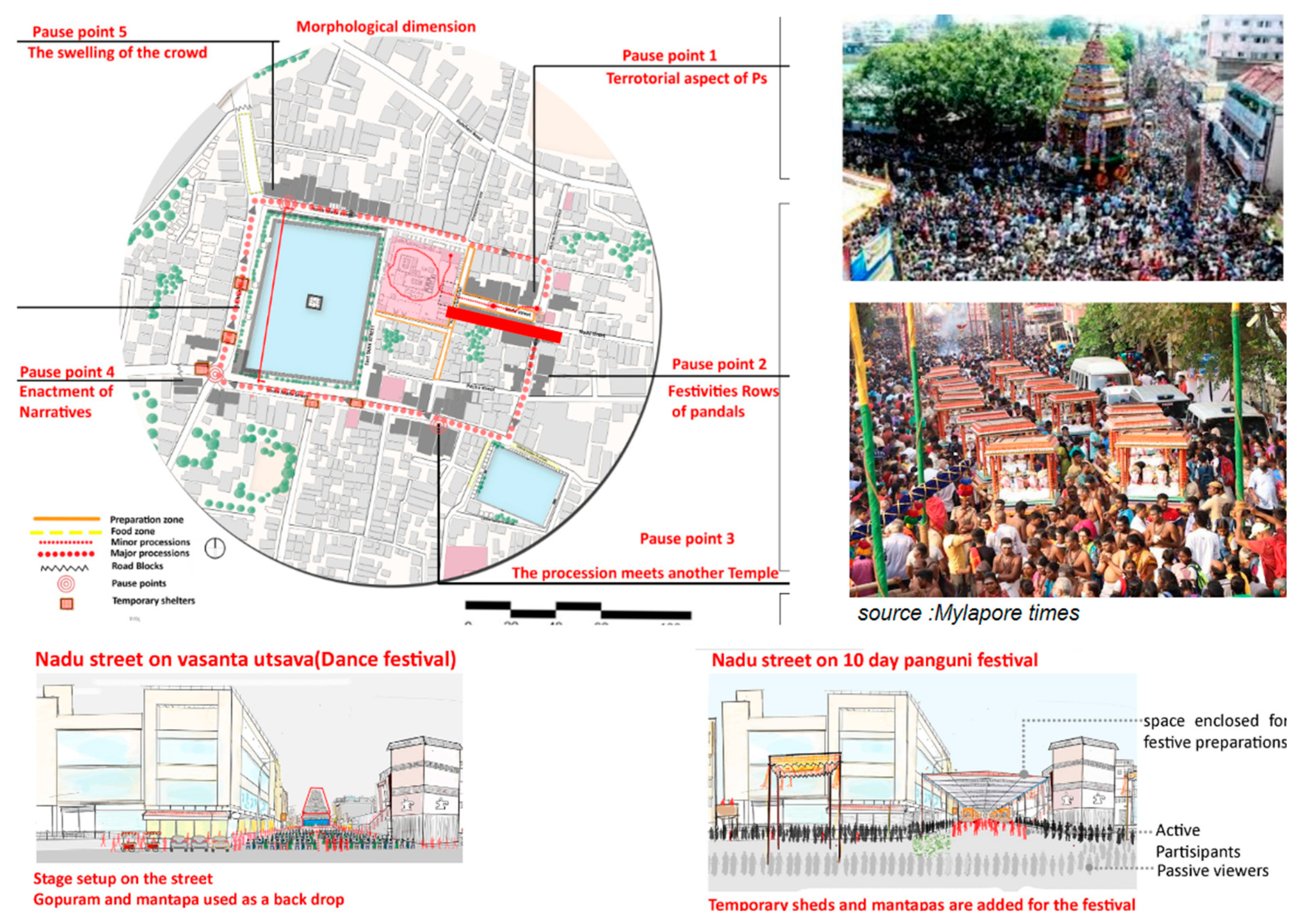

Table 1.
Empirical Evidence of Urban Heritage Diamorphosis.
| Traditional Urban Public Life | Socio-Spatial Dimensions of Transformation |
|---|---|
| The tradition of "Veedhi Bhajans," or on-street devotional music processions, has been a musical heritage for centuries, occurring during the holy month of Margazhi from December to January. These processions take place at dawn, with hymns from sacred scriptures creating a spiritual experience. Bhajan mandalis like Haridasa Giri, Paapanasa Shivan, and Gnanananda Mandali participate, singing devotional hymns while circumambulating the Kapaleeshwara Temple. Passersby often join in, and performances usually conclude in front of the temple, followed by breakfast at a local devotee's home. | Residents draw kolams in front of their houses to honor the musicians. Traditional houses featured porticos or platforms for resting during the bhajans. The Agraharam's concentric road network defines the bhajans' procession path. Community participation has shifted over the years; while locals once warmly welcomed participants, today's backdrop sometimes features closed shops and deserted streets. The bhajans, traditionally encircling the temple, now extend to neighbouring communities, inviting broader participation. |
| The Palkudam, or Milk Pot Festival, is a one-day celebration during Chitirai Pournami in Mylapore, Chennai, involving hundreds of women carrying pots of milk in a vibrant procession to the Mundaga Kanni Temple for abhisheka, a sacred bathing ritual believed to heal diseases. | During the festival, streets are adorned with neem leaves, flowers, and other natural items, symbolizing the deity's healing qualities. A total of 101 pots, each smeared with turmeric and filled with milk, are offered to the goddess Mundaga Kanni after a neighbourhood procession. The Palkudam festival highlights the local community's active participation in preserving and celebrating their heritage. |
| During February, Mylapore hosts the vibrant tradition of Samudra Snanam (Shore Processions). Accompanied by musical instruments and Vedic chants, deities are taken from their temples to the sea for immersion, a significant religious event typically lasting one or two days. | Festivities include erecting pandals at the temples and the seashore. Processions start at various temples, winding through neighbourhoods before reaching the sea, symbolizing the historical link between the temples and the sea. Residents welcome the deity with flowers along the way. The redevelopment of Marina Beach lacks dedicated facilities to accommodate these large gatherings. |
| In Mylapore, the Shivaratri celebrations are a one-night festival that has a unique temporal character, lasting for a single night but filled with vibrant activities. | During Shivaratri, pandals are erected near the seven Sapta Shiva temples, creating a festive atmosphere. Temple roads are adorned with lights to guide devotees. Pandals are built ten days prior, with road corners becoming workshops for bamboo crafts. Devotees undertake a symbolic pilgrimage, visiting all seven temples on foot. Cultural programs are held in playgrounds and open spaces, forming territorial zones near temples, as people stay awake to enjoy performances. Recently, celebrations have moved to auditoriums, and traditional routes connecting the temples have changed. |
|
Brahmotsavam, or the Panguni Festival, is a 10-day celebration in March at the Kapaleeswara Temple precincts, with the Ther temple car festival as its highlight on the 7th day. During the Ther, a tall, ornate temple car is paraded through the four mada streets. Devotees eagerly await the first glimpse of the deity on the chariot, considered very auspicious. The procession includes sounds of conches, instruments, drums, and cymbals, with devotees pulling the chariot using large ropes. It pauses at key locations like the temple tank and Velleeswarar Temple for spiritual enactments, drawing massive crowds (Thinamani Deepavali Malar). The Arubathimoovar Festival on the 8th day features a grand procession of palanquins bearing the 63 Nayanmars, revered Tamil Shaivite saints. The procession includes active participation from local residents who carry the palanquins. The route is lined with shops offering food and beverages, including buttermilk, to the devotees. |
The tall temple car contrasts with surrounding low-rise buildings, with balconies and front yards becoming vantage points. Residents along the Mada Streets host relatives to watch the procession, showering water and flowers on participants. Temporary pandals and shops create a bustling atmosphere, with maps of the procession route marking pause points and food distribution areas. Traffic restrictions ensure attendee safety. However, streets along the route have transformed into tall commercial buildings, obstructing views, especially on north Mada Street. Overcrowding has disrupted the peaceful flow and led to the discontinuation of story enactments, musical concerts, and cultural elements. Changing building typology has eliminated front yards for viewing, and the participation of elephants and horses, once significant, has been halted due to excessive crowds. |
| Karthigai Deepam, celebrated in December, is a four-day festival marking Lord Kartikeya's birthday. On the first day, known as Karthigai Deepam, residents light up to 10,000 deepas along the temple tank's edge for four days, creating a mesmerizing spectacle. | As the festival unfolds, temporal changes occur around the temple and tank. Tables are set up, and hundreds of volunteers arrange the deepas (oil lamps). The low-height walls around the temple tank offer convenient access for devotees to view the rituals. The full moon night transforms the temple tank bed into a breathtaking sight, with the glow of the lamps casting a radiant aura. The temple tank has a rich history as an ancient rainwater harvesting method, providing a vital resource for Agrahara residents. |
| The Teppa Utsava, or Temple Tank Festival, is held in January. The sacred idol is processed around the temple before being set afloat in the temple tank on a specially crafted boat that can accommodate up to 100 people. On the first day, there is an oorvalam (procession) of the Kapaleeswarar deity, followed by processions of Lord Murugar with Deivanai and Valli on the next two days. A highlight of the festival is the illuminated raft casting its glow on the water, accompanied by Vedic chants from the mantapa at the tank's center, creating a mystical experience. | In preparation, large drums are brought to the temple, and a raft is constructed. The five mantapas around the tank are decorated, and the tank's edges are adorned with bright lights. However, the festival faces challenges: temporary shops encroach on one side of the tank, reducing visibility from nearby roads. Restricted access to the tank area limits participation, and the poorly maintained tank edge further hinders visibility. |
Disclaimer/Publisher’s Note: The statements, opinions and data contained in all publications are solely those of the individual author(s) and contributor(s) and not of MDPI and/or the editor(s). MDPI and/or the editor(s) disclaim responsibility for any injury to people or property resulting from any ideas, methods, instructions or products referred to in the content. |
© 2025 by the authors. Licensee MDPI, Basel, Switzerland. This article is an open access article distributed under the terms and conditions of the Creative Commons Attribution (CC BY) license (http://creativecommons.org/licenses/by/4.0/).
Copyright: This open access article is published under a Creative Commons CC BY 4.0 license, which permit the free download, distribution, and reuse, provided that the author and preprint are cited in any reuse.


