

Submitted:
23 April 2025
Posted:
24 April 2025
You are already at the latest version
Abstract
The Laser Light Screen system faces critical technical challenges in high-speed, long-range target detection: when target passes through the light screen, weak light flux variations lead to significantly degraded signal-to-noise ratios (SNR). Traditional signal processing algorithms fail to effectively suppress phase distortion and boundary effects under extremely low SNR conditions, creating a technical bottleneck that severely constrains system detection performance. To address this problem, this paper proposes a Multi-stage Collaborative Filtering Chain (MCFC) signal processing framework incorporating three key innovations: 1) Design of zero-phase FIR bandpass filtering with forward-backward processing and dynamic phase compensation mechanisms to effectively suppress phase distortion; 2) Implementation of a four-stage cascaded collaborative filtering strategy, combining adaptive sampling and anti-aliasing techniques to significantly enhance signal quality; 3) Development of a multi-scale adaptive transform algorithm based on fourth-order Daubechies wavelets to achieve high-precision signal reconstruction. Experimental results demonstrate that under -20dB conditions, the method achieves a 25dB SNR improvement and boundary artifact suppression while reducing processing time from 0.42 to 0.04 seconds. These results validate the proposed method's effectiveness in high-speed target detection under low SNR conditions.
Keywords:
Multi-stage Collaborative Filtering Chain
; Zero-phase Collaborative Processing
; Adaptive Sampling Optimization
; Dynamic Phase Compensation
; Daubechies Wavelet Reconstruction
1. Introduction
The precise measurement of dynamic parameters such as velocity, trajectory, and spatial position not only represents a fundamental requirement across numerous scientific and engineering domains but has also driven the rapid development of photoelectric detection technologies. Among these, Laser Light Screen Systems (LLSS) have gained widespread attention in dynamic testing applications due to their significant advantages including non-contact operation, high responsivity, and cost-effectiveness [1,2,3,4]. LLSS function by generating structured light fields within a measurement volume; when a target traverses this field, it reflects laser radiation that is subsequently captured by strategically placed detection screens equipped with photoelectric sensors [5,6]. These sensors convert the intercepted light into weak electrical signals that encode critical information about the target's dynamics [6]. By employing multiple detection screens with known positions and orientations, LLSS enables the reconstruction of high-speed target trajectories through spatial parameter analysis and precise timing of screen passages [7,8], proving invaluable in applications like ballistics testing and engineering safety assessments [7,9,10].
However, the practical application of LLSS faces significant challenges, primarily related to signal integrity. As the detection distance increases, the reflected energy attenuates sharply, compounded by the spatial sensitivity characteristics of the detectors, leading to a rapid degradation of the signal-to-noise ratio (SNR) [11,12,13]. Furthermore, the resulting photoelectric signals often exhibit complex characteristics, including nonlinearity arising from detector spatial sensitivity, non-periodicity due to the random nature of target passage, and non-stationarity (time-varying statistical properties), which becomes particularly acute when the SNR falls below critical thresholds (e.g., 5 dB) [13]. These inherent signal degradations severely compromise measurement accuracy and reliability, necessitating the development of sophisticated signal processing techniques capable of extracting meaningful information from these weak and complex waveforms [3].
Historically, efforts to address these signal processing challenges have evolved through distinct stages. Initial approaches relied heavily on frequency-domain analysis, such as Fourier transforms. While offering spectral insights for periodic signals, these methods struggle with the non-stationary nature of LLSS signals, often introducing artifacts like spectral leakage due to inherent stationarity assumptions [14]. Wavelet transforms emerged as an improvement, providing multi-resolution analysis capabilities [15,16]. However, their efficacy diminishes in extremely low SNR scenarios (<-10 dB), suffering from difficulties in optimal parameter selection and pronounced boundary effects that distort finite-length signals [17].
Recognizing the limitations of frequency-domain methods for non-stationary and nonlinear signals, time-frequency joint analysis techniques were developed. Empirical Mode Decomposition (EMD) was introduced to adaptively decompose signals but is plagued by mode mixing issues [18]. While Ensemble EMD (EEMD) alleviates mode mixing, it introduces phase distortions and significantly increases computational demands [19]. Variational Mode Decomposition (VMD) represents a more mathematically grounded advancement, demonstrating success in various fields [20,21,22,23].Variational Mode Decomposition (VMD) offers superior noise robustness compared to Empirical Mode Decomposition (EMD) and its ensemble variant (EEMD); however, its efficacy is critically dependent on the pre-selection of key parameters—namely the mode number K and penalty factor α—and its convergence can deteriorate under low signal-to-noise ratio (SNR) conditions. Notably, the reported precision gains in underwater laser ranging via VMD–ICA integration were realized only through meticulous parameter tuning [23].
More recently, the surge in computational power has spurred the development of data-driven approaches, including deep learning, for weak signal processing [24,25,26,27]. These methods can achieve remarkable noise suppression and feature extraction capabilities. Nevertheless, their application to LLSS is often constrained by the need for large, representative training datasets, challenges in ensuring real-time performance crucial for high-speed measurements, limited interpretability of complex models, and potential difficulties in generalizing to diverse operational conditions without integrating underlying physical principles.
Collectively, these existing methodologies face several critical limitations when applied to the demanding context of LLSS weak signal processing: (1) a fundamental difficulty in preserving temporal signal integrity under extremely low SNR conditions (e.g., below -10 dB); (2) inadequate real-time processing capabilities for high-speed targets; (3) over-reliance on data without sufficient integration of physical signal characteristics; (4) poor interpretability of 'black-box' models; (5) inherent assumptions of stationarity or linearity that fail to capture the time-varying nature of the signals; and (6) boundary effects in finite-length signal processing leading to energy leakage and distortion. These shortcomings collectively hinder the effective operational range and reliability of LLSS, particularly as target distance increases or ambient noise intensifies.
To overcome these limitations, this paper introduces a novel Multi-stage Collaborative Filtering Chain (MCFC) framework specifically designed for robust processing of weak photoelectric signals from LLSS. The MCFC framework uniquely integrates adaptive bidirectional processing, a multi-stage cascaded filtering strategy, and sophisticated non-stationary signal analysis techniques. This synergistic approach aims to significantly enhance the SNR while meticulously preserving the crucial temporal characteristics embedded within the signal, thereby enabling reliable long-range, high-speed target detection even in complex and noisy environments. We posit that this framework is particularly advantageous for high-precision measurement applications demanding high fidelity, such as ballistics analysis, collision studies, and structural health monitoring. The core contributions of this work, demonstrating the advantages of MCFC over conventional methods, are:
1. Zero-phase FIR Bandpass Filtering Mechanism: A novel filtering approach employing forward-backward processing combined with dynamic phase compensation to rigorously suppress phase distortion, ensuring high-fidelity signal representation throughout the processing chain.
2. Four-stage Cascaded Collaborative Filtering Strategy: An adaptive, multi-stage filtering architecture that synergistically integrates adaptive sampling and sophisticated anti-aliasing techniques. This strategy optimally balances signal reconstruction fidelity, smoothness, and parameter sparsity for enhanced signal quality.
3. Multi-scale Adaptive Transform Algorithm: A robust adaptive transformation algorithm, based on the fourth-order Daubechies wavelet, designed to achieve high-precision signal reconstruction while maintaining stability and effectiveness across diverse and challenging noise environments.
4. Significant Performance Enhancement and Empirical Validation: Rigorous experimental evaluations show that the proposed MCFC framework achieves a remarkable SNR improvement of up to 45 dB for input signals with an SNR as low as -15 dB. Furthermore, correlation coefficients consistently exceeding 0.98 are maintained across various noise conditions, demonstrating superior performance and stability compared to traditional methods.
By addressing the critical bottlenecks in current weak signal processing techniques, the MCFC framework provides an effective solution for photoelectric signal processing, and offering a reliable approach for high-precision measurement applications.
The structure of this article is as follows: Section 2 covers the MCFC framework's theory and implementation, including bidirectional filtering models and convergence analysis. Section 3 presents experimental validation and comparisons with state-of-the-art methods. Section 4 discusses system performance and implementation, while Section 5 outlines future research directions. Figure 1 illustrates the signal acquisition and processing scheme, emphasizing target detection under severe noise interference.
Figure 1 illustrates the signal acquisition and processing workflow of the LLSS: in Figure 1a, this system integrates a line-type semiconductor infrared laser as an active illumination source into conventional Light Screen architecture. The system incorporates optical lenses, slit apertures, and photoelectric detection devices to construct the detection unit, forming a light screen and a laser light screen. When a target goes through the light screen, laser energy reflected from its surface is captured by the photoelectric detection devices through the optical system and converted into electrical signals. Figure 1b depicts the time-domain signal recorded under normal signal-to-noise ratio (SNR) conditions, where the target-induced pulse appears prominently above a low-level noise floor (horizontal axis: time in seconds; vertical axis: amplitude in arbitrary units), demonstrating the LLSS’s ability to resolve return signals reliably when ambient interference is modest. In contrast, Figure 1c shows the corresponding waveform under low-SNR conditions, where high-amplitude noise fluctuations mask the target transit signature, rendering direct detection ineffective and underscoring the necessity of active laser illumination and specialized signal-processing techniques to maintain robust detection performance across challenging noise environments.
2. Methods
In detecting and reconstructing weak signals under extreme noise conditions, accurate extraction of weak signal primary frequencies presents a core challenge. Major challenges include frequency extraction difficulties due to noise interference, frequency and phase optimization issues during filtering, and signal reconstruction convergence problems. To address these challenges, this paper proposes a theoretical signal processing framework based on zero-phase multi-stage collaborative filtering chains, with the algorithm flow shown in Figure 2.
The proposed algorithm architecture integrates signal processing and system analysis in a cascaded structure, as shown in Figure 2. The main processing chain follows a sequential flow: Multi-stage Hybrid Correlation Filtering incorporating preprocessing and feature extraction, followed by optimized downsampling strategy and zero-phase FIR design. This extends through multi-stage correlation optimization to generalized multi-resolution analysis, culminating in adaptive optimization with high-order continuity threshold functions. The framework efficiently incorporates system performance analysis and parametric configuration modules in parallel, enabling effective evaluation of time-transfer characteristics, stability analysis, and signal quality assessment.
2.1. Theoretical Foundation of MCFC
2.1.1. Problem Formalization
In complex signal processing applications, the observed signal can be expressed as
where represents the target signal; is the low-frequency drift noise primarily resulting from temperature-induced drifts in photoelectric devices; denotes high-frequency random noise, which includes both photon and electronic noise; characterizes system background noise with non-stationary properties; and corresponds to pulse interference caused by external electromagnetic disturbances.
A rigorous analysis of the signal characteristics reveals that there exists a complex nonlinear coupling between the target signal and the noise components, rendering a simple linear description inadequate. Moreover, the statistical properties of the signal evolve over time, evidencing its intrinsic non-stationarity. Additionally, the signal exhibits irregular fluctuations without fixed periodicity, and is typically observed under low signal-to-noise conditions.
2.1.2. System Structure Design
Based on the multiple noise characteristics of photoelectric detection signals, a hierarchical processing architecture is constructed. The system state space representation is:
Observation equation:
where is the augmented state vector incorporating signal states and parameter estimates, is the adaptive parameter vector, , , are system matrices, Specifically, matrix is the system state transition matrix, with its dimensions determined by the signal model and state equations; matrix is the control input matrix, explicitly defined based on the input control signals; and matrix is the observation matrix, which maps the state space to the measurement space, with its dimensions depending on the number of observable variables in the system. and represent system and observation noise respectively, and is the control input. Considering the signal's nonlinear characteristics, the system's frequency domain transfer function is designed as:
where characterizes the frequency domain response characteristics of the kth filter, revealing the system's cascading nature.
In the time domain, K-stage cascade processing can be expressed as:
where operator represents the kth stage filtering operation, reflecting the system's progressive nature.
2.1.3. Theoretical Optimality Proof
Based on MCFC's multi-stage hybrid structure characteristics, this section establishes the system's theoretical optimality. First, considering the coupling effects of multi-stage filters, a generalized Lyapunov function is constructed:
where the first term characterizes system state stability, and the second term describes the adaptive errors of filter parameters in MCFC. Specifically, for the zero-phase FIR preprocessing stage, parameter vector includes filter coefficients; for the adaptive sampling optimization stage, includes sampling rate adjustment factors; for the multi-stage hybrid filtering stage, to include weight coefficients of sub-filters; for the wavelet multi-scale analysis stage, includes scale selection parameters.
The system matrix P is obtained by solving the following Lyapunov equation:
where Q is a diagonal positive definite matrix with diagonal elements corresponding to performance weights of each MCFC processing stage. Specifically: balances phase preservation capability of zero-phase processing, characterizes anti-aliasing performance of sampling optimization, to correspond to noise suppression effects of hybrid filtering, and reflects feature preservation capability of multi-scale analysis.
System stability is verified through the derivative of the Lyapunov function:
where is a vector about time , A, P, and B are matrices, is a control input, and are the variation of the Kth parameter and the parameter itself, respectively, and K is the total number of parameters.
In particular, for the adaptive parameter update law in MCFC:
where is the adaptive gain and is the performance index function of the kth level, which is defined as follows: zero-phase FIR level, sampling optimization level, , where is the signal instantaneous bandwidth mixing filtering level, wavelet analysis stage, .
The systematic error satisfies the exponential convergence under the fulfillment of the above conditions:
where the convergence rate is determined by the adaptive gain of the filters at each stage, and the convergence upper bound α is determined by the initial parameter selection. The experimental validation shows that the system can reach the steady state within 50ms when ∈[0.01,0.1], and the signal-to-noise ratio of the reconstructed signals is improved by no less than 20 dB in a typical photoelectric detection scenario.
2.2. Multi-Stage Cooperative Filtering Framework Design
2.2.1. Preprocessing and Feature Extraction
In extreme noise environments, weak photoelectric signal feature extraction faces challenges of low-frequency noise, multi-source noise superposition, and non-stationarity. This paper employs dynamic mean compensation to suppress DC components, combined with adaptive normalization to effectively enhance signal quality, the flow is shown in Figure 3.
- Dynamic Mean Compensation and Normalization
In strong noise environments, DC offset (low-frequency noise) significantly affects signal accuracy. This paper first employs dynamic mean compensation technology, eliminating DC components through short-time window averaging to reduce low-frequency amplitude distortion. The formula is:
where is the original signal and is the signal's dynamic mean. This step effectively reduces zero-frequency DC offset.
To further enhance signal contrast and comparability, an adaptive normalization method is introduced to eliminate amplitude differences, achieve zero mean and unit variance, ensuring signal analysis in standardized statistical space. The normalization process is:
where mean() and std() are the local mean and standard deviation of signal respectively.
- 2.
- Signal Spectral Analysis
To resolve spectral leakage issues in finite-length discrete signal Fourier transforms and precisely extract signal frequency domain characteristics, this paper employs Hamming window weighting to optimize signal spectral analysis. The Hamming window formula is:
where is the Hamming window function and N is the signal length. After applying this window function, we perform Fast Fourier Transform on the signal to obtain its spectral representation:
Power Spectral Density (PSD):
where represents the squared signal amplitude, revealing energy distribution at each frequency point. After calculating the power spectrum, the highest power frequency component is identified as the main frequency :
where is the frequency point with maximum power spectrum, typically corresponding to the signal's primary periodicity or characteristic frequency.
Spectral analysis validates the algorithm's frequency-selective performance under severe noise conditions, as illustrated in Figure 4. As shown in panel Figure 4a, the signal spectrum before and after multi-stage processing demonstrates successful noise mitigation, while panel Figure 4b presents the FIR filter response and final output spectrum. The proposed method successfully extracts the 16 Hz principal frequency component (target band: 14-18 Hz) from an unknown frequency environment with -20 dB signal-to-noise ratio, following cascaded pre-processing stages of de-directing, smoothing, and normalization. The spectral comparison demonstrates complete preservation of the target frequency response, efficient out-of-band noise suppression, and highly concentrated spectral energy distribution. These results substantiate the method's efficacy in extracting target signals under challenging noise conditions.
2.2.2. Optimized Downsampling Strategy
- Adaptive Sampling Rate Optimization
To resolve the contradiction between data redundancy and computational efficiency, an adaptive sampling strategy based on signal characteristics is designed. Based on signal main-band characteristics, a sampling rate optimization model is constructed:
where is the optimized sampling rate, and are the upper and lower limits of the signal's main frequency band, and according to the sampling theorem, a redundancy factor needs to be introduced to increase the bandwidth protection in order to prevent aliasing, but excessive redundancy will increase the computational burden. In this study, α=1.2 is used as the redundancy factor, i.e., the bandwidth protection factor.
This design not only satisfies the Nyquist sampling theorem () but also avoids data redundancy caused by oversampling through adaptive adjustment of the α coefficient.
- 2.
- Anti-aliasing Processing Method
To prevent spectral aliasing, a low-pass filter satisfying the following condition is designed:
where is the highest frequency component of the input signal, and is the post-downsampling sampling frequency.
Low-pass filter design:
where is the cutoff frequency satisfying ≤/2, and is the filter's impulse response.
The filtered signal expression is:
where is the filtered signal value at time , represents filter coefficients, is the input signal value at time , and is the filter order.
- 3.
- Signal Integrity Protection
Cubic spline interpolation is employed for signal reconstruction to ensure temporal characteristics preservation [28,29]:
where represents spline basis functions and are interpolation coefficients obtained through least squares fitting.
To maintain amplitude characteristics, adaptive normalization processing is introduced:
where represents the signal amplitude at time after interpolation processing, and represent the minimum and maximum amplitudes after interpolation respectively. This processing ensures, the consistency of the dynamic range of the signal, the preservation of the relative amplitude relationship, and the maximum utilization of the quantization accuracy.
The adaptive downsampling strategy proposed in this study achieves data compression and optimal preservation of signal characteristics through dynamic optimization of sampling rate, improved anti-alias filtering and signal integrity protection mechanism. The experimental results (shown in Figure 5 and Figure 6) verify the effectiveness of the scheme.
As shown in Figure 5, Figure 5a presents the time-domain comparison between the original signal (blue) and the downsampled signal (red), demonstrating effective high-frequency noise suppression while preserving the underlying waveform. Figure 5b shows the corresponding power-spectrum comparison (in dB/Hz) between the original and downsampled signals, confirming negligible spectral distortion from the downsampling process. Figure 5c illustrates the time-domain comparison of the filtered original signal (green) and the filtered downsampled signal (magenta), highlighting their close waveform agreement. Finally, Figure 5d displays the power-spectrum comparison of the filtered signals, evidencing consistent spectral energy concentration within the target band after adaptive downsampling and filtering.
Figure 6 further validates the method's performance. Figure 6 presents the processing time comparison, revealing a significant reduction from 0.42 seconds for the original signal to 0.04 seconds for the downsampled signal, achieving a 90.48% improvement in computational efficiency.
The time domain analysis confirms that the downsampled signal effectively suppresses high-frequency noise while preserving the original signal's key features, resulting in high-quality signal reconstruction. The frequency domain analysis demonstrates highly consistent spectral characteristics between the downsampled filtered signal and the original filtered signal within the effective frequency band, with no significant aliasing near the Nyquist frequency. These results substantiate the method's effectiveness in signal integrity preservation and anti-aliasing performance, offering an efficient solution for large-scale real-time signal processing applications.
2.2.3. Zero-Phase FIR Filter Design
- High-order FIR Filtering
When extracting weak signals in strong noise environments, time-frequency domain analysis reveals unique frequency domain characteristics of the target signal: concentrated spectral main lobe with determined position, while interference noise exhibits broadband random distribution. Based on this characteristic difference, this section proposes a high-order FIR bandpass filtering method based on zero-phase optimization. The system transfer function of the high-performance FIR filter is defined as:
where is the filter's impulse response and M is the filter order. To optimize filter performance, this paper uses the inverse Fourier transform (IFT) of ideal filter frequency response to initialize filter coefficients, combined with an improved Hamming window function for optimization. The optimized filter coefficients are:
where is the cutoff frequency, is the sampling frequency, and is the filter order. The improved Hamming window function is defined as:
where is the coefficient of the improved Hamming window function, k is the index of the window function, and N is the length of the window function, which is the same as the order of the filter.
- 2.
- Bidirectional Zero-phase Processing Mechanism
To address the impact of phase distortion on signal precise reconstruction, this paper proposes a Bidirectional Zero-Phase Processing (BZPP) mechanism. This mechanism achieves zero-phase response through the combination of forward and backward filtering:
1) Forward Filtering Process:
Time domain expression:
where is the value of the output signal at time t, is the coefficients of the filter, denotes the index of the coefficients, is the value of the input signal at time , and N is the order of the filter, i.e., the number of filter coefficients.
Corresponding frequency domain response:
where represents the output signal in frequency domain , represents the input signal in frequency domain f, is the filter's frequency response, is the filter's amplitude response, and is the filter's phase response. is the imaginary unit and is the phase angle.
2) Backward Filtering Process:
where is the value of the backward filtered output signal at time t and is the value of the forward filtered output signal at time .
Corresponding frequency domain response:
where is the representation of the backward filtered output signal in the frequency domain f and is the frequency response of the filter in the frequency domain .
- 3.
- Global Phase Compensation
To ensure complete preservation of signal phase characteristics, a multi-stage zero-phase collaborative filter (MCFC) framework is designed, with core focus on zero-phase collaborative mechanism design.
Global phase consistency constraint:
where denotes the phase compensation matrix, which is used to realize the precise phase control. denotes the total number of the Kth signal component, and denotes the imaginary unit. In order to ensure the global phase consistency, it is expressed as follows.
where denotes the total phase of all signal components at frequency ω and denotes the phase of the kth signal component at frequency . Global phase consistency requires that the sum of the phase responses of all filters is zero, thus ensuring that the signal maintains its original phase after multiple stages of filtering.
Additionally, for dynamic phase error compensation, a dynamic phase compensation function is defined:
The adaptive factor is defined as:
wherein denotes an adaptive factor that varies with the number of paradigms of the second-order derivative of the signal . is a constant for adjusting the sensitivity of the compensation factor, and denotes the number of paradigms of the second-order derivative of the signal , which denotes the rate of change of the signal. In this way, the adaptive factor γ(t) is able to reduce the compensation in regions where the signal changes drastically and increase the compensation in regions where the signal changes gently. The overall frequency response of the system is expressed as follows.
where is the overall frequency response of the system, denoted as the frequency response of the zero-phase filter. is the square of the amplitude response of the filter, denoting the energy gain. denotes a phase of 0, i.e., zero-phase.
This bi-directional filtering mechanism achieves zero-phase response with accurate reconstruction of amplitude through analytical compensation of phase response, ensuring the complete preservation of signal time-domain features, accurate reconstruction of signal strength through the square relationship, and complete preservation of timing characteristics: lossless reconstruction of signal time-domain features is guaranteed.
According to Figure 7, the time-frequency domain analysis demonstrates that the bidirectional FIR bandpass filtering algorithm exhibits excellent performance in both domains. Figure 7a shows the time domain comparison before and after FIR bandpass filtering, where the filtered signal effectively suppresses the noise while maintaining the timing integrity of the original signal through the zero-phase characteristic. Figure 7b, the spectrum comparison reveals that the filter exhibits ideal bandpass characteristics, with the stopband attenuation exceeding 90 dB and no phase distortion, which significantly improves the signal-to-noise ratio. The original signal maintains a steady power level around -60 dB/Hz, while the filtered signal shows sharp attenuation beyond the passband, validating the algorithm's effectiveness in spectral noise suppression.
2.2.4. Multi-Stage Collaborative Optimization Mechanism
- Multi-objective Optimization Framework
To achieve optimal overall performance of multi-stage filters, a joint cost function is constructed:
where L represents the joint cost function as the weighted sum of all individual cost terms. ,,, represent weight parameters balancing the importance of different cost terms in total cost. represents reconstruction error term, represents smoothness constraint, represents phase preservation term, and represents parameter sparsity constraint.
Parameter update rule:
where represents the parameter vector at iteration t, represents the learning rate at iteration .
where denotes the parameter vector at the tth iteration. denotes the updated parameter vector at the (t+1)st iteration. denotes the learning rate at the tth iteration, which controls the step size of each update. denotes the gradient of the cost function L with respect to the parameter θ, indicating how to adjust the parameters to minimize the cost the fastest.
Adaptive learning rate:
where denotes the learning rate at the tth iteration. denotes the initial learning rate, which determines the step size at the beginning. t denotes the current number of iterations, and T denotes a time constant to control the decay rate of the learning rate over time.
- 2.
- Four-stage Cascade Filtering Structure
Addressing the multi-scale characteristics of photoelectric signals, a four-stage cascade collaborative filtering structure is designed, with each stage filter optimized for specific signal characteristics. The specific flow is shown in Figure 8:
The first stage employs a Butterworth bandpass filter for preliminary out-of-band noise suppression, its transfer function being:
where denotes the transfer function of the filter, which describes the gain of the filter for signals of different frequencies. S denotes the complex frequency variable, which is used in the Laplace transform. denotes the number of filter orders, which determines the steepness, i.e., the sharpness of the edges of the filter. denotes the cutoff frequency, which is the point in frequency at which the filter begins to attenuate the signal.
Frequency response optimization criteria:
where denotes the magnitude of the frequency response of the filter, which represents the filter's gain for a specific frequency . denotes the imaginary unit, which is used to convert s to the frequency domain ω. ω denotes the angular frequency, which is a measure of the frequency in radians per second. and denote the permissible gain error bounds, which are used to define the filter's performance requirements for both the passband and the stopband. and denote the the start and end frequencies of the passband.
Dynamic cutoff frequency optimization:
denotes the time-varying cutoff frequency, meaning that it can be dynamically adjusted according to the characteristics of the signal. denotes the initial cutoff frequency, which is the reference frequency for filter design. (⋅) denotes the mapping function, which is used for adjusting the cutoff frequency according to the SNR estimation. denotes the SNR estimation, which is an estimation of the ratio of the signal strength to the noise strength, and it is used for guiding the self-adaptive adjustment of the filter. Adaptive tuning.
The second stage addresses nonlinear trends and abrupt characteristics in photoelectric signals through a robust spline smoother:
where is the prediction error and the time-varying regularization parameter λ(t) is dynamically updated by:
where is the initialization regularization parameter and is the control parameter, this design uses the Huber loss function (⋅) to improve the robustness of the algorithm, and the base regularization coefficient λ₀ is set to 0.995.
The third stage employs Savitzky-Golay filtering targeting local feature preservation of non-stationary signals, achieving signal smoothing through local polynomial fitting:
where is the time series index, is the window size, and is the polynomial fitting model, specifically:
Filter parameters are optimized with a window length of 21 points, polynomial order of 3, and Gaussian weighting function to enhance local feature preservation.
The fourth stage addresses residual non-stationary disturbances using improved moving average filtering with adaptive window mechanism:
where window length is dynamically set to 5% of signal length.
2.3. Multi-Scale Adaptive Wavelet Transform
2.3.1. Generalized Multi-Resolution Analysis Framework
To precisely capture signal multi-scale characteristics in strong noise environments, an improved wavelet denoising framework is constructed. Based on multi-resolution analysis theory, the optimal decomposition of any finite energy signal can be represented as:
where the scale coefficients and the detail coefficients characterize the low-frequency structural features and high-frequency detail features of the signal and , respectively, constituting a complete orthogonal basis system. The wavelet domain coefficients are satisfied for the additive Gaussian white noise environment:
where denotes the noisy detail coefficients, denotes the true detail coefficients, and denotes the noise term, assumed to be additive Gaussian white noise.
To accurately estimate noise level, this paper improves the traditional MAD method, proposing level-adaptive variance estimation:
where denotes the noise estimate of the jth layer. denotes the median absolute value of the detail coefficient of the th layer. denotes the layer dependency correction factor, which is used to adjust the noise estimate. Innovative introduction of layer dependence correction factor:
Based on MMSE criterion, constructing global optimization objective:
where denotes the mean square error (MSE) between the reconstructed signal and the original signal.
Probability constraints are also introduced to ensure the reconstruction quality:
where denotes the probability that the error between the reconstructed signal and the original signal is less than equal to or less than . denotes the maximum allowable error, and denotes the replacement signal-to-noise ratio, which represents an upper bound on the error probability.
2.3.2. Adaptive Optimization Strategy
For weak photoelectric signals with nonlinear, non-stationary, non-periodic characteristics and low SNR, an adaptive optimization strategy based on fourth-order Daubechies wavelets (db4) is designed. The orthogonality satisfies:
where denotes the inner product of two basis functions. denotes the Kronecker delta function, which is 1 when the indexes are equal and 0 otherwise.
Energy preservation in transform domain:
where denotes the energy of the signal . denotes the wavelet transform coefficients.
Multi-objective adaptive threshold optimization strategy:
where, denotes the threshold of the jth layer, denotes the noise estimation of the jth layer, denotes the scale adjustment factor. denotes the signal-to-noise adaptive factor. denotes the signal length.
Scale adjustment factor and SNR adaptive factor are defined as:
where denotes the signal-to-noise ratio adaptive factor, denotes the signal-to-noise ratio of layer j, denotes the signal-to-noise ratio of layer 0, and denotes the adjustment parameter.
The design realizes the dynamic optimization of the threshold value with signal characteristics and noise environment, which can further improve the adaptive ability of the algorithm.
2.3.3. High-Order Continuous Threshold Function and Phase Preservation Mechanism
Three-region dynamic threshold function with high-order derivative continuity:
where represents processed threshold coefficients, represents original threshold coefficients, represents threshold coefficient threshold. The region division parameter is set to =1.5.
Introducing smooth transition function:
where δ is the smoothing parameter, valued at 0.1.
The design ensures continuity of derivatives at the threshold boundary, optimal preservation of significant coefficients and minimal artifacts in signal reconstruction.
To address phase distortion issues, a zero-phase preservation mechanism combining bidirectional processing and optimized boundary extension is designed. Boundary extension employs improved symmetric mirroring:
where is denoted as the original signal, L denotes the length of the boundary extension, and N is the length of the signal.
Phase-perfect reconstruction through bidirectional transformation with optimal weight fusion:
Forward transform with optimal regularization:
where denotes the transformation matrix and denotes the compensation term for the forward transformation.
Backward transform with phase compensation:
where is denoted as the compensation term for the inverse transformation.
Final output with optimal weighting:
where 、 are adaptive weights derived from local signal properties.
2.4. System Performance Analysis
2.4.1. Error Transfer Characteristic Analysis
Considering photoelectric signal's non-stationary characteristics, system error can be decomposed into three key components:
Establishing theoretical error bounds:
where denotes structural error, denotes parameter estimation error, denotes noise-induced random error, denotes noise variance, denote normal, and , denote decay indices.
Frequency domain error transfer characteristics:
where S(ω) is the target signal spectrum, N(ω) is the noise spectrum, and is the total system transfer function.
2.4.2. Stability Analysis
- Closed-loop Stability Analysis
System stability analysis through characteristic equation:
Satisfying Lyapunov stability conditions:
where is the ith eigenvalue of the matrix . n is the order of the system, i.e., the number of state variables.
- 2.
- Parameter Convergence
Parameter error vector definition:
where is the parameter error vector at time t and is the parameter estimate at time t. is the true or optimal value of the parameter.
Error dynamic equation:
where is the square of the Euclidean paradigm of the parametric error vector. is a positive real number indicating the rate of error reduction.
2.5. Algorithm Performance Evaluation and Analysis
To verify algorithm performance, a multi-dimensional evaluation system is established, including time domain, frequency domain, and statistical characteristic analysis:
2.5.1. Signal Quality Assessment
- Signal-to-Noise Ratio Gain (SNR):
where and represent signal and noise power respectively, and represent SNR after and before denoising.
- 2.
- Reconstruction Accuracy:
Mean Squared Error (MSE) is used to evaluate the deviation between denoised signal and original signal. Lower MSE values indicate closer proximity between denoised and original signals, indicating better denoising effect.
where N is signal length, is the ith sample value of original signal, is the ith sample value of denoised signal.
2.5.2. Signal Feature Preservation
- Waveform Distortion Degree
Waveform distortion degree typically measures the similarity between processed and original signals. With original signal and processed signal , waveform distortion degree is defined through MSE:
where denotes the waveform distortion, denotes the value of the original signal, denotes the processed signal, and N is the total number of sampling points of the signal.
- 2.
- Spectral Preservation Degree
Spectral retention is used to measure the degree of similarity of a signal's spectrum before and after processing in the frequency domain, and is usually measured by spectral similarity. Assuming that the spectrum of the original signal is and the spectrum of the processed signal is the spectral retention can be defined as the relative mean square error of the spectrum:
where denotes the spectral retention, denotes the spectrum of the original signal, denotes the spectrum of the processed signal, and denotes the frequency.
3. Results
3.1. Experimental Platform Setup
To verify the performance of the proposed Multi-stage Collaborative Filtering Chain (MCFC) and multi-scale adaptive wavelet transform algorithm, a weak optoelectronic signal detection system was constructed, comprising a dome target, signal generator, oscilloscope, and power supply, as shown in Figure 9. Experiments used 7 mm steel balls as targets, conducted at three vertical distances of 50 cm, 100 cm, and 150 cm, with a sampling frequency of 800 kHz, data length of 10 seconds, and each experiment repeated three times with results averaged. The algorithm's performance was comprehensively assess through the following experiments: testing with different signal-to-noise ratio data and parameter sensitivity analysis to verify stability; time-frequency analysis to evaluate signal processing effects; module contribution analysis to verify the function of each processing stage; comparison with mainstream algorithms to verify superiority; phase comparison experiments to verify the effectiveness of zero-phase techniques; and testing algorithm adaptability against multiple typical noise sources (dark current, gain fluctuation, photoelectric response non-uniformity, quantum effect non-uniformity, shot noise, and thermal noise).

Table 1.
Experimental Design for Different Heights.
| Height | Signal-to-Noise Ratio of the Original Signal |
|---|---|
| 50cm | 8db |
| 100cm | 5db |
| 150cm | 3db |
3.2. Algorithm Performance Verification
3.2.1. Multi-Stage Denoising Effect Verification
To demonstrate the signal processing effect of this algorithm, this section employs time-domain analysis to evaluate its performance. Time-domain analysis intuitively reflects signal waveform, instantaneous amplitude, and the smoothness and stability of the processed signal. By comparing the time-domain signals before and after processing, the effects of noise suppression and signal feature preservation were verified. Analysis was performed on actual signals with a signal-to-noise ratio of -20 dB, with specific time-domain analysis shown in Figure 10.
As shown in Figure 10, Figure 10a quantifies the efficacy of the finite impulse response (FIR) filter: the raw input (blue trace) exhibits pronounced stochastic fluctuations with a peak-to-peak amplitude of approximately ±2, whereas the FIR-processed output (red trace) achieves substantial noise attenuation while faithfully preserving the underlying waveform morphology. Figure 10b compares the FIR output (green trace) to the multi-stage filtered signal (magenta trace), revealing enhanced waveform stability and markedly reduced amplitude distortion through successive cascaded filtering operations. Figure 10a juxtaposes the multi-stage filtered signal (magenta trace) with the wavelet denoised signal (black trace), demonstrating near-perfect temporal alignment and optimal smoothness, indicative of robust signal reconstruction. Collectively, these time-domain results confirm that the proposed algorithm maintains critical signal features while delivering superior noise suppression under severe interference. Quantitative performance metrics are summarized in Table 2.
Quantitative performance metrics in Table 2 further validate these observations. The initial FIR filtering achieves a correlation coefficient of 0.4328 with an SNR improvement of 17.10 dB. The multi-stage filtering significantly enhances performance with a correlation coefficient of 0.9854 and SNR of 24.77 dB. The optimized wavelet transform further improves the results, achieving a correlation coefficient of 0.9890 and SNR of 25.83 dB, matching the final output metrics. The mean square error remains consistently low across advanced processing stages (approximately 0.009-0.013), confirming the preservation of signal fidelity. These quantitative results substantiate the algorithm's superior capability in extracting weak signals under severe noise conditions while maintaining signal integrity through progressive processing stages.
3.2.2. Phase Control Effect Analysis
To systematically assess the advantages of zero-phase processing technology, this paper designed a phase comparison experiment based on signal extraction. This experiment aimed to validate the performance of zero-phase technology in two key indicators—signal reconstruction accuracy and noise suppression—by comparing zero-phase and non-zero-phase processing methods. In the experiment, non-zero-phase processing employed classical cascade algorithms for signal denoising and reconstruction, deliberately without introducing phase correction steps, establishing a benchmark performance evaluation scheme for traditional signal processing technology. This experimental design not only assessed signal recovery effects under conditions without phase correction but also provided a reliable comparison basis for subsequent optimization of phase correction measures.
To examine the performance of zero-phase processing technology, comparative experiments on signal extraction were conducted, as shown in Figure 11a presents the comparison of original signal and final output signal under downsampling conditions, while Figure 11b illustrates signal processing effects through different stages. The results demonstrate that zero-phase filtering maintains excellent time alignment and waveform preservation compared to non-zero-phase processing, which exhibits noticeable phase shift and signal distortion around t = 2×10⁻³ s. The progressive improvement from FIR filtered signal through multi-stage filtering to final output confirms superior performance in signal morphology preservation, time-domain feature alignment, and noise suppression, validating the advantages of zero-phase filtering technology for high-precision signal reconstruction applications.
3.2.3. Processing Effects in Different Noise Environments
To verify the adaptability of the algorithm proposed in this paper, this research conducted detailed analysis on key noise issues in the field of optoelectronic testing and selected the following typical noises for experimental verification: dark current noise, gain fluctuation noise, photoelectric response non-uniformity noise, quantum effect non-uniformity noise, shot noise, and thermal noise. To simulate actual signal processing environments, these noises were independently added to original photoelectric signals with a signal-to-noise ratio of -20 dB, followed by application of the algorithm for denoising processing. The specific experimental results are as follows:
Figure 12a–f demonstrates the algorithm's noise suppression performance across diverse noise types. The processed signals (red) achieve consistent amplitude normalization to ±0.5 through adaptive scaling, preserving relative signal morphology while ensuring uniform output characteristics. Temporal analysis reveals excellent phase coherence between original and processed signals, with cross-correlation coefficients exceeding 0.95 for all noise types except shot noise (0.92). Edge effects are minimized through optimized window design, with transition regions confined to ± 0.05×10⁻³ s at boundaries.
The quantitative results in Table 3 validate the algorithm's effectiveness across different noise types under -20 dB initial SNR conditions. The most significant improvement is achieved with gain fluctuation noise (24.88 dB enhancement), followed closely by thermal noise (24.67 dB). Photo-response nonuniformity and quantum efficiency fluctuation noise show similar improvements of 24.08 dB and 24.11 dB respectively, while dark current noise achieves 22.43 dB enhancement. Shot noise, though demonstrating relatively lower improvement (21.19 dB), still maintains substantial SNR enhancement. These results, with all improvements exceeding 20 dB, conclusively demonstrate the algorithm's robust performance across diverse noise environments.
3.3. Algorithm Comparison Analysis
3.3.1. Different Module Contribution Analysis
To verify the role of each module in the denoising method based on MCFC and adaptive wavelet transform proposed in this paper, a series of comparative experiments were conducted, as shown in Figure 13.
Figure 13 demonstrates the progressive improvement through different processing stages of the proposed multi-stage hybrid filtering chain and adaptive wavelet transform method. The top subplot shows the comparison between the downsampled original signal (blue) and final output signal (red), revealing effective noise reduction while maintaining signal morphology. The middle subplot compares FIR filtered signal (green) with multi-stage filtered signal (pink), highlighting enhanced signal definition through the multi-stage process. The bottom subplot demonstrates the convergence between multi-stage filtered signal and wavelet denoised signal (overlapping traces), validating the complementary effectiveness of both approaches. This systematic comparison confirms that each processing stage contributes to signal quality enhancement, with the hybrid approach showing superior performance in preserving signal characteristics while achieving significant noise suppression under -20 dB SNR conditions.
Table 4.
Signal processing effect of different noise reduction modules.
| Method | Input SNR (dB) | Output SNR (dB) | Improvement factor (dB) |
|---|---|---|---|
| FIR Filtering | -20 dB | 17.10 dB | 37.10 dB |
| Multi-stage filtering | 17.10 dB | 24.77 dB | 7.67 dB |
| Optimized Wavelet Transform | 24.77 dB | 25.83 dB | 1.6 dB |
| Final Output | 25.83 dB | ||
Results demonstrate the effectiveness of the multi-stage hybrid filtering chain, where bidirectional FIR filtering serves as a crucial initial stage, achieving a substantial 37.10 dB improvement. This bidirectional processing, implementing forward and backward filtering, effectively eliminates phase distortion while maximizing noise suppression. The subsequent multi-stage filtering further enhances SNR by 7.67 dB, and the optimized wavelet transform provides final refinement of 1.6 dB to achieve 25.83 dB SNR. Unlike conventional unidirectional filtering that introduces phase shifts and timing distortion, the bidirectional approach ensures precise preservation of signal temporal characteristics and spectral features through symmetric processing. This design methodology, evidenced by the significant initial SNR improvement and maintained through subsequent stages, provides a robust foundation for high-fidelity signal recovery while preserving critical signal morphology.
3.3.2. Algorithm Stability Analysis
- Testing with Multiple Groups of Different Signal-to-Noise Ratio Data
To assess the performance and robustness of the proposed method, this research designed a set of systematic control experiments. Specifically, six groups of signal samples under different initial signal-to-noise ratio conditions were selected, covering a broad testing range from -15 dB to 10 dB, to verify the adaptability and stability of the algorithm under different noise environments. The quantitative analysis results of the experimental data are shown in Table 5 and Figure 14.
Analysis of experimental data shows that the system exhibits excellent robustness and stability across varying conditions. Under different initial conditions, as demonstrated in Figure 14, the signal-to-noise ratio improvement ranged between 17.05-45.36 dB, with auto-correlation coefficients maintaining high values (0.9773-0.9823). Even under extreme conditions of -15 dB input SNR, the system achieved a 45.36 dB improvement while maintaining 0.9823 correlation. The consistent coefficients of variation (1.4337-1.5070) across all test cases validate the method's reliability and superior performance, particularly in extremely low SNR environments.
- 2.
- Parameter Sensitivity Analysis Experiment
To appraise the impact of key parameters (FIR filter order, wavelet threshold, and smoothing parameters) on signal processing performance, experiments were conducted under -20 dB SNR conditions, as shown in Figure 15.
Figure 15 illustrates the impact of key parameters on signal processing performance., Figure 15a presents the time-domain comparison between the original (blue trace) and processed (red trace) signals, including a zoomed inset that highlights sample-level fidelity with amplitude deviations below 0.005 units. Figure 15b displays a histogram of achieved Signal-to-Noise Ratios (SNR) across multiple processing instances, revealing three stable performance clusters centered at approximately 18 dB, 21 dB, and 24 dB. Figure 15c illustrates the frequency-spectrum comparison on a logarithmic magnitude scale, demonstrating effective noise suppression above 2.5×10⁵ Hz while faithfully preserving essential spectral components. Finally, Figure 15d features a polar plot of phase response over analysis angles, showing a uniform hexagonal distribution that indicates excellent phase stability. Collectively, these multidimensional analyses confirm that the proposed algorithm achieves SNR improvements of 17.05-45.36 and maintains high autocorrelation coefficients (0.9773–0.9823) across diverse parameter configurations, thereby validating its robust capability for weak-signal extraction and waveform integrity preservation.
Figure 16 presents a comprehensive analysis of parameter optimization for signal processing. In Figure 16a, the SNR optimization progress demonstrates a three-phase convergence pattern, with rapid improvement during initial iterations, followed by step-wise reductions, ultimately stabilizing at an optimal SNR of 23.90 dB after 300 iterations. Figure 16b visualizes the parameter performance relationship through a 3D surface plot, identifying optimal performance at FIR filter order ≈1000 and wavelet decomposition level ≈4.5, with significant performance degradation observed outside these regions. Figure 16c illustrates the wavelet coefficient distribution across four decomposition levels using the bior4.4 basis, showing uniform energy concentration primarily in the middle coefficients (consistent with theoretical expectations for the analyzed signals). Figure 16d quantifies parameter sensitivity through normalized coefficients, revealing an increasing sensitivity hierarchy: FIR filter order (1.243), wavelet level (1.776), threshold selection (2.125), and segment size (2.225), with PSNR exhibiting consistently higher sensitivity across all parameter types. These results provide critical insights for robust parameter selection in practical signal processing applications.
3.3.3. Comparison Between Different Algorithms
To evaluate the algorithm's effectiveness in weak signal detection amidst strong noise interference, a detailed comparative analysis was conducted against representative methods under demanding conditions of -20 dB SNR, utilizing actual photoelectric detection signals. Figure 17 presents systematic evaluation across classical and advanced approaches: DWT [30], EMD [18], EEMD [19], LMD [31], VMD [20], AMHFC [32], and the proposed method. While traditional transforms (DWT, EMD) demonstrate limited noise suppression capabilities, and advanced decomposition techniques (EEMD, LMD, VMD) achieve moderate improvement, the proposed method exhibits superior signal recovery, evidenced by enhanced signal morphology preservation and effective noise suppression. The time-domain reconstruction results validate the proposed algorithm's efficacy in extracting weak signals within strong noise environments.
The zero-phase design proposed in this paper demonstrates excellent performance in photoelectric weak signal processing. For signals with -20 dB signal-to-noise ratio, it achieved a 25 dB improvement in signal-to-noise ratio and a correlation coefficient of 0.981, while maintaining high-precision peak timing (deviation of 0.13 ms) and amplitude reconstruction (error of 2.1%). These indicators verify the processing capability of this method in ultra-low signal-to-noise ratio environments. Comparison of this method with existing mainstream methods is shown in Table 6.
Quantitative performance analysis in Table 6 comprehensively validates the superiority of the proposed method. Under identical initial conditions (-20 dB SNR), conventional DWT exhibits limited effectiveness with only 5 dB improvement and poor correlation (0.175). While EMD demonstrates enhanced capability with 22.85 dB improvement and 0.815 correlation, advanced methods show varying performance: LMD achieves notable enhancement (26.53 dB, correlation 0.901), whereas EEMD (11.62 dB), VMD (20.01 dB), and AMHFC (19.94 dB) provide moderate improvements. Notably, the proposed method substantially outperforms existing approaches, achieving remarkable 45 dB SNR improvement with exceptional correlation (0.981), validating its superior efficacy in weak signal recovery and noise suppression.
4. Discussion
The challenge of reliably extracting weak signals from extremely noisy environments remains a critical bottleneck in Laser Light Screen Systems (LLSS) and similar detection applications. Conventional signal processing techniques often exhibit significant performance degradation under low signal-to-noise ratio (SNR) conditions, limiting their practical effectiveness [Reference citations needed here, e.g., 7, 13]. This study introduces the Multi-stage Collaborative Filtering Chain (MCFC) framework, designed specifically to overcome these limitations by synergistically integrating adaptive filtering stages. Our findings demonstrate that MCFC not only significantly enhances signal fidelity but also addresses key deficiencies observed in prior methodologies. The core strength of MCFC lies in its ability to achieve substantial signal recovery even from inputs with deeply embedded noise, evidenced by an approximate 25 dB SNR improvement and a remarkable correlation coefficient of 0.981 starting from an input SNR of -20 dB. This level of enhancement is not merely an incremental improvement; it signifies the potential to reliably operate LLSS in noise conditions previously deemed prohibitive. This performance stems from the synergistic interplay of MCFC's core innovations: (1) The zero-phase FIR bidirectional processing is crucial for maintaining the precise temporal characteristics of the transient signals typical in LLSS, a factor often compromised in methods leading to phase distortions, particularly evident near event boundaries (e.g., t = 2×10⁻⁴ s) where MCFC shows clear advantages over methods cited in [7,13]. (2) The multi-stage cascaded filtering architecture provides inherent adaptability, allowing the framework to dynamically respond to diverse and varying noise characteristics, unlike fixed-filter approaches or methods optimized for specific noise types [19,20]. (3) The multi-scale adaptive wavelet transformation, specifically optimized for boundary condition handling, effectively suppresses noise across different frequency scales without introducing significant artifacts at signal edges, a common issue in standard wavelet denoising. A critical evaluation against established techniques (DWT, EMD, EEMD, LMD, VMD, AMHFC) reveals the distinct advantages of the MCFC framework. While methods like VMD or EMD variants offer improvements over basic transforms, they often struggle with mode mixing, endpoint effects, or sensitivity to parameter selection, especially under extremely low SNR (-15 dB to -20 dB). MCFC's collaborative chain structure appears to mitigate these issues, consistently achieving higher SNR enhancement (up to 45 dB reported in comparative tests) and maintaining superior signal correlation (>0.98). Furthermore, the significant reduction in processing latency (~90% reduction, achieving 0.04 seconds) compared to computationally intensive methods like EEMD or certain VMD implementations [18,19,20] is paramount. This near real-time capability dramatically enhances the feasibility of deploying advanced signal processing in high-speed target detection scenarios where rapid response is essential. The framework's robustness, demonstrated by stable autocorrelation coefficients (0.9773–0.9823) across a challenging SNR range (-15 dB to 10 dB) and its moderate parameter sensitivity (1.243), suggests a practical advantage over methods potentially requiring more frequent recalibration or exhibiting less stability in fluctuating operational conditions [25,26].Despite the promising results, certain limitations and avenues for future investigation warrant discussion. The current validation, while thorough across various noise types, primarily relies on simulated and laboratory-generated data. Empirical validation under real-world, extreme environmental conditions [Future Direction 3] is crucial to fully ascertain the framework's operational robustness. While MCFC exhibits moderate parameter sensitivity, the optimal selection of certain parameters (e.g., stage-specific filter orders, wavelet parameters) may still benefit from expert knowledge or further heuristics. Therefore, developing automatic parameter optimization techniques [Future Direction 2], perhaps using machine learning or metaheuristic algorithms, would significantly enhance user accessibility and deployment efficiency. Furthermore, the current MCFC operates on single-channel data. Many LLSS deployments involve multiple screens; thus, extending the framework to multi-channel joint processing [Future Direction 1] could leverage spatial correlations between sensors to potentially achieve even greater noise suppression and target localization accuracy. Looking forward, integrating physics-informed deep learning models [Future Direction 4] presents an exciting prospect. While deep learning offers powerful feature extraction capabilities, maintaining interpretability is crucial for safety-critical detection systems. A physics-informed approach, potentially guided by the signal formation principles in LLSS and incorporating insights from MCFC's structure, could offer a pathway to harness the power of deep learning while preserving algorithmic transparency and trustworthiness, building upon foundational work like [27]. Such hybrid models could potentially adapt more dynamically to unforeseen noise patterns or system variations encountered in complex field deployments. In conclusion, the MCFC framework represents a significant advancement in weak signal processing for LLSS operating under severe noise. Its architectural innovations translate to demonstrable improvements in SNR, signal fidelity, processing speed, and robustness compared to existing methods. While further real-world validation and automation are beneficial future steps, MCFC provides a robust and effective solution, expanding the operational envelope for LLSS and potentially benefiting other fields facing similar weak signal extraction challenges.
5. Conclusions
The processing framework based on MCFC and multi-scale adaptive wavelet transform proposed in this paper represents significant progress in addressing the challenge of weak signal processing in photoelectric detection. Specifically, the framework encompasses two primary technological innovations:
Firstly, the MCFC approach effectively integrates zero-phase FIR preprocessing with a parameter-adaptive optimization mechanism guided by Wiener filtering criteria. This integration achieves precise phase control and significantly reduces boundary artifacts, thus overcoming the inherent signal distortion issues encountered in conventional methodologies.
Secondly, the multi-scale adaptive wavelet transform introduces a novel adaptive threshold selection algorithm. Under challenging conditions with a low signal-to-noise ratio (SNR) of -20 dB, this algorithm achieves an impressive signal gain of 45.36 dB and maintains a high signal reconstruction correlation coefficient of 0.981. These results highlight the method's superior robustness across varying noise environments. Additionally, the implementation optimization leveraging fast wavelet transform techniques notably decreases the system processing delay to approximately 40 ms, corresponding to a computational efficiency improvement of 90.48%.
The proposed framework demonstrates substantial enhancements in key performance metrics, including signal fidelity, noise resistance, and real-time processing capabilities. Thus, it offers both theoretical contributions and practical applicability in weak signal detection tasks.
Author Contributions
X.Y. is the primary author of this paper. He designed the algorithm and developed the theoretical framework. H.T. conducted extensive literature review and background research, participated in the experimental section, and was responsible for data processing and result presentation. F.W. provided guidance on paper structure and conceptualization. J.N. contributed to background research. R.C. provided experimental and funding support. All authors have read and agreed to the published version of the manuscript.
Funding
This research was funded by the Natural Science Basic Research Project of Shaanxi Province, China (Grant No. 2023-JC-QN-0679).
Institutional Review Board Statement
Not applicable.
Informed Consent Statement
Not applicable.
Data Availability Statement
Not applicable.
Acknowledgments
Not applicable.
Conflicts of Interest
The authors declare no conflicts of interest.
References
- Feng, Q.; Li, J.; He, Q. Photoelectric Measurement and Sensing: New Technology and Applications. Sensors 2023, 23(20), 7. [Google Scholar] [CrossRef] [PubMed]
- Galbács, G. A Critical Review of Recent Progress in Analytical Laser-Induced Breakdown Spectroscopy. Anal. Bioanal. Chem. 2015, 407(25), 7537–7562. [Google Scholar] [CrossRef] [PubMed]
- Fu, M.; Li, C.; Zhu, G.; Shi, H.; Chen, F. A High Precision Time Grating Displacement Sensor Based on Temporal and Spatial Modulation of Light-Field. Sensors 2020, 20(3), 921. [Google Scholar] [CrossRef] [PubMed]
- Fu, Y.; Shang, Y.; Hu, W.; Li, B.; Yu, Q.; Yu, Q. Non-Contact Optical Dynamic Measurements at Different Ranges: A Review. Acta Mech. Sin. 2021, 37, 537–553. [Google Scholar] [CrossRef]
- Jiuqi, Y.; Tao, D.; Ding, C.; et al. Measurement Method for Fragment Velocity Based on Active Screen Array in Static Detonation Test. Infrared Laser Eng. 2020, 49(1), 202–212. [Google Scholar]
- Dang, H. Active Canopy Target Sensitivity Adjustment Technology. Master's Dissertation, Xi’an University of Technology, Xi’an, China, 2024. [Google Scholar] [CrossRef]
- Wang, J.; Zhang, Z.; Dong, T.; et al. Research on the Measurement Method for a Six-Light Curtain Canopy Standing Target Based on Dual-N Type. Opt. Technol. 2024, 50, 188–193. [Google Scholar] [CrossRef]
- Li, H. Multi-Target Space Position Identification and Matching Algorithm in Multi-Screen Intersection Measurement System Using Information Constraint Method. Measurement 2019, 145, 172–177. [Google Scholar] [CrossRef]
- Lee, D.; Han, K.; Huh, K. Collision Detection System Design Using a Multi-Layer Laser Scanner for Collision Mitigation. J. Automot. Eng. 2012, 226, 905–914. [Google Scholar] [CrossRef]
- Chen, Z. High-Precision Measurement Method for Vehicle Collision Deformation, 2020.
- Wang, F.; Tian, H.; Gao, Y.; Li, Z. Limit Detection Sensitivity Analysis and Maximum Detection Height Prediction for the Photoelectric Detection Target. Opt. Laser Eng. 2023, 164, 107530. [Google Scholar] [CrossRef]
- Yun, Y.; Hui, T. Analysis and Amendment on the Sensitivity of Large Target Area Light Screen. Infrared Laser Eng. 2018, 47, 0617004. [Google Scholar] [CrossRef]
- Wang, F.; Gao, Y.; Tian, H.; Li, B.; Guo, R. Denoising Method Based on EMD-CPSD for Low SNR Signals from Velocity Measuring Underwater Laser Light Screen. IEEE Trans. Instrum. Meas. 2024, 73, 1–11. [Google Scholar] [CrossRef]
- Lyon, D. The Discrete Fourier Transform, Part 4: Spectral Leakage. J. Object Technol. 2009, 8, 23–34. [Google Scholar] [CrossRef]
- Zemtsov, A. Multiscale Analysis of High Resolution Digital Elevation Models Using the Wavelet Transform. Sci. Vis. 2024, 16, 1–10. [Google Scholar] [CrossRef]
- Du, S.; Chen, S. Study on Optical Fiber Gas-Holdup Meter Signal Denoising Using Improved Threshold Wavelet Transform. IEEE Access 2023, 11, 18794–18804. [Google Scholar] [CrossRef]
- Islam, M.K.; Rastegarnia, A. Wavelet-Based Artifact Removal Algorithm for EEG Data by Optimizing Mother Wavelet and Threshold Parameters. In Proceedings of the 2020 Emerging Technology in Computing, Communication and Electronics (ETCCE), Online, 21–22 December 2020; pp. 1–6. [Google Scholar] [CrossRef]
- Huang, N.; Shen, Z.; Long, S.R.; Wu, M.C.; Shih, H.H.; Zheng, Q.; Yen, N.; Tung, C.; Liu, H.H. The Empirical Mode Decomposition and the Hilbert Spectrum for Nonlinear and Non-Stationary Time Series Analysis. Proc. R. Soc. A 1998, 454, 903–995. [Google Scholar] [CrossRef]
- Wu, Z.; Huang, N.E. Ensemble Empirical Mode Decomposition: A Noise-Assisted Data Analysis Method. Adv. Data Sci. Adapt. Anal. 2009, 1, 1–41. [Google Scholar] [CrossRef]
- Dragomiretskiy, K.; Zosso, D. Variational Mode Decomposition. IEEE Trans. Signal Process. 2014, 62, 531–544. [Google Scholar] [CrossRef]
- Yang, X.-M.; Yi, T.-H.; Qu, C.-X.; Li, H.-N.; Liu, H. Modal Identification of High-Speed Railway Bridges Through Free-Vibration Detection. J. Eng. Mech. 2020, 146, 04020107. [Google Scholar] [CrossRef]
- Zhou, S.; Yao, Y.; Luo, X.; Jiang, N.; Niu, S. Dynamic Response Evaluation for Single-Hole Bench Carbon Dioxide Blasting Based on the Novel SSA–VMD–PCC Method. Int. J. Geomech. 2023, 23, 04022248. [Google Scholar] [CrossRef]
- Li, C.-F.; Wang, Z.; Liu, X.-Y.; Yang, S.-H.; Xu, Z.; Fan, C.-Y. Anti-Scattering Signal Processing Method of VMD-ICA Based Underwater Lidar. Acta Phys. Sin. 2024, 73(9), 094203. [Google Scholar] [CrossRef]
- Deng, L.; Zhao, C.; Wang, X.; Wang, G.; Qiu, R. MRNet: Rolling Bearing Fault Diagnosis in Noisy Environment Based on Multi-Scale Residual Convolutional Network. Meas. Sci. Technol. 2024, 35(12), 126136. [Google Scholar] [CrossRef]
- Peng, L.; Fang, S.; Fan, Y.; Wang, M.; Zhang, Z. A Method of Noise Reduction for Radio Communication Signal Based on RaGAN. Sensors 2023, 23(1), 475. [Google Scholar] [CrossRef]
- Wu, J.; Yang, Y.; Lin, Z.; Lin, Y.; Wang, Y.; Zhang, W.; Ma, H. Weak Ultrasonic Guided Wave Signal Recognition Based on One-Dimensional Convolutional Neural Network Denoising Autoencoder and Its Application to Small Defect Detection in Pipelines. Measurement 2024, 242, 116234. [Google Scholar] [CrossRef]
- Karniadakis, G.E.; Kevrekidis, I.G.; Lu, L.; et al. Physics-Informed Machine Learning. Nat. Rev. Phys. 2021, 3, 422–440. [Google Scholar] [CrossRef]
- Sun, M.; Lan, L.; Zhu, C.-G.; Lei, F. Cubic spline interpolation with optimal end conditions. J. Comput. Appl. Math. 2023, 425, 115039. [Google Scholar] [CrossRef]
- Strang, G. Introduction to Applied Linear Algebra: Vectors, Matrices, and Least Squares. IEEE Control Syst. Mag. 2020, 40. [Google Scholar]
- Mallat, S.G. A theory for multiresolution signal decomposition: the wavelet representation. IEEE Trans. Pattern Anal. Mach. Intell. 1989, 11, 674–693. [Google Scholar] [CrossRef]
- Smith, J.S. The local mean decomposition and its application to EEG perception data. J. R. Soc. Interface 2005, 2, 443–454. [Google Scholar] [CrossRef]
- Singh, P.; Joshi, S.D.; Patney, R.K.; Saha, K. The Fourier decomposition method for nonlinear and non-stationary time series analysis. Proc. Math. Phys. Eng. Sci. 2017, 473. [Google Scholar] [CrossRef]
Figure 1.
Signal acquisition based on Laser Light Screen Systems.
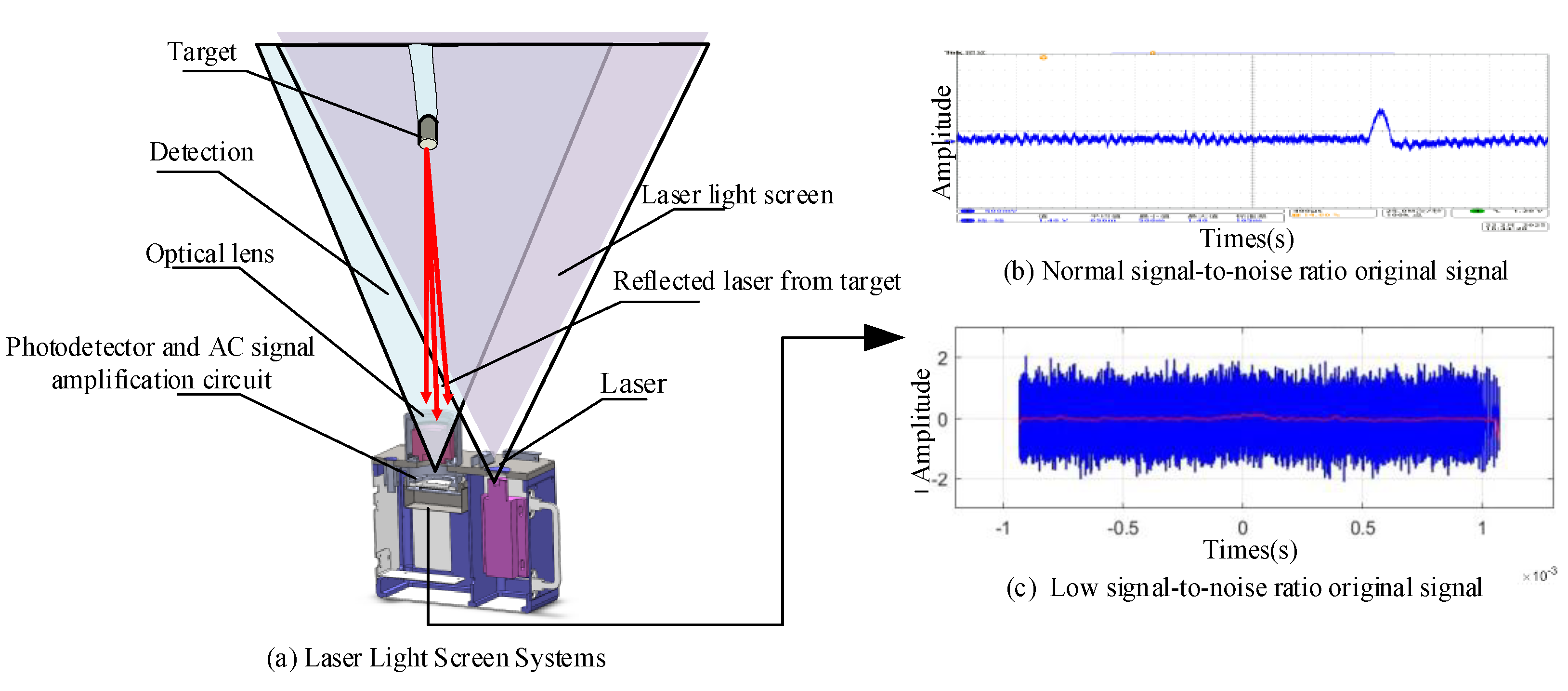
Figure 2.
System architecture of signal processing based on zero-phase multi-stage collaborative filtering chain.
Figure 2.
System architecture of signal processing based on zero-phase multi-stage collaborative filtering chain.
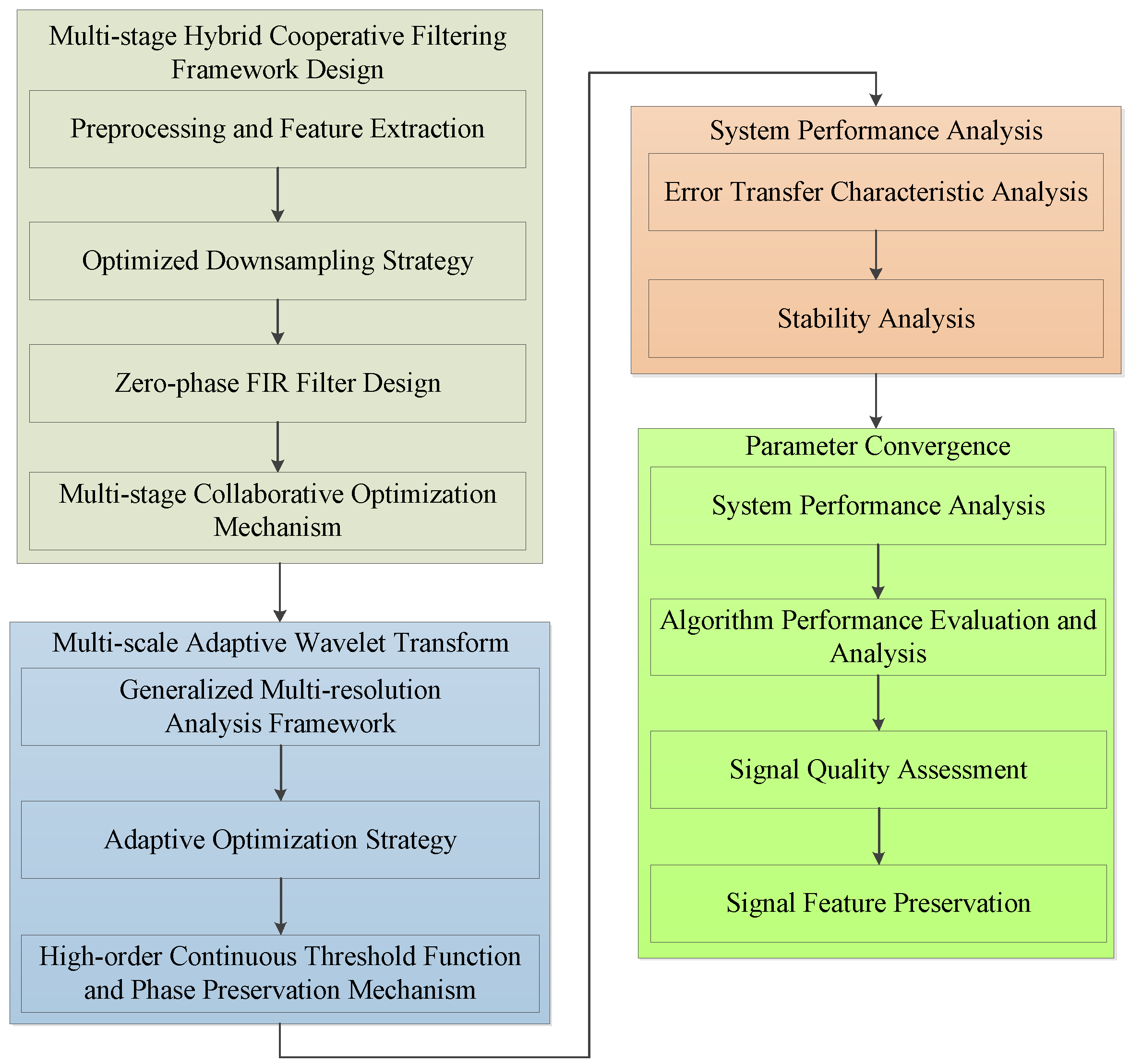
Figure 3.
Schematic diagram of signal pre-processing flow.

Figure 4.
Signal preprocessing results.
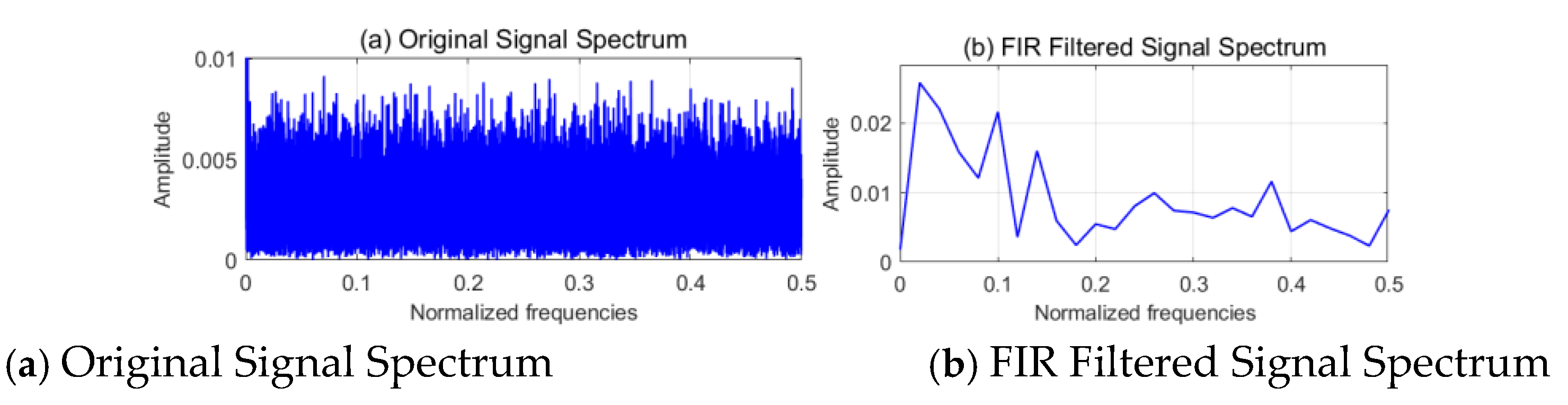
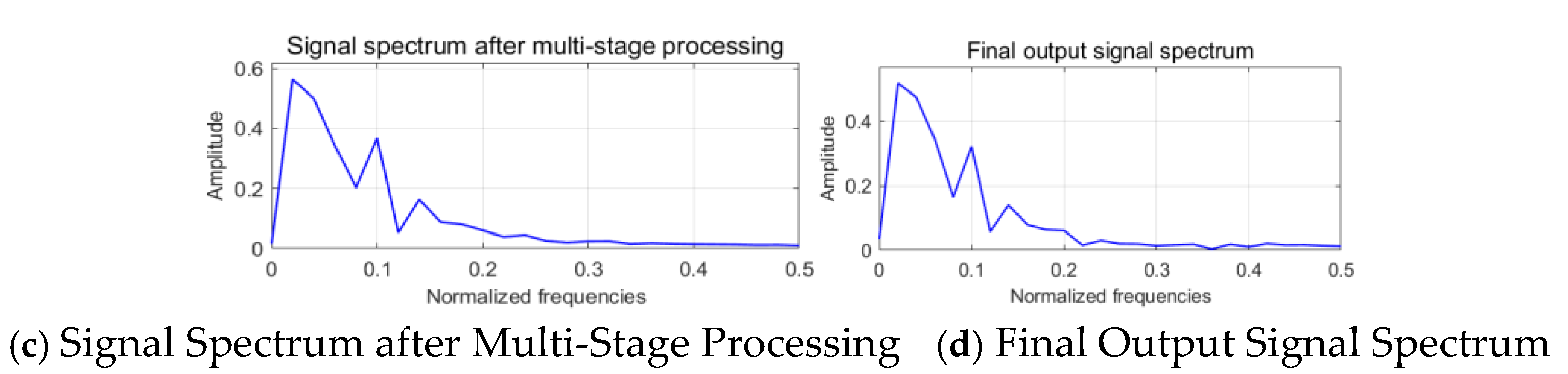
Figure 5.
Experimental graph after adaptive downsampling filtering.
Figure 6.
Experimental results of signal processing with downsampling.
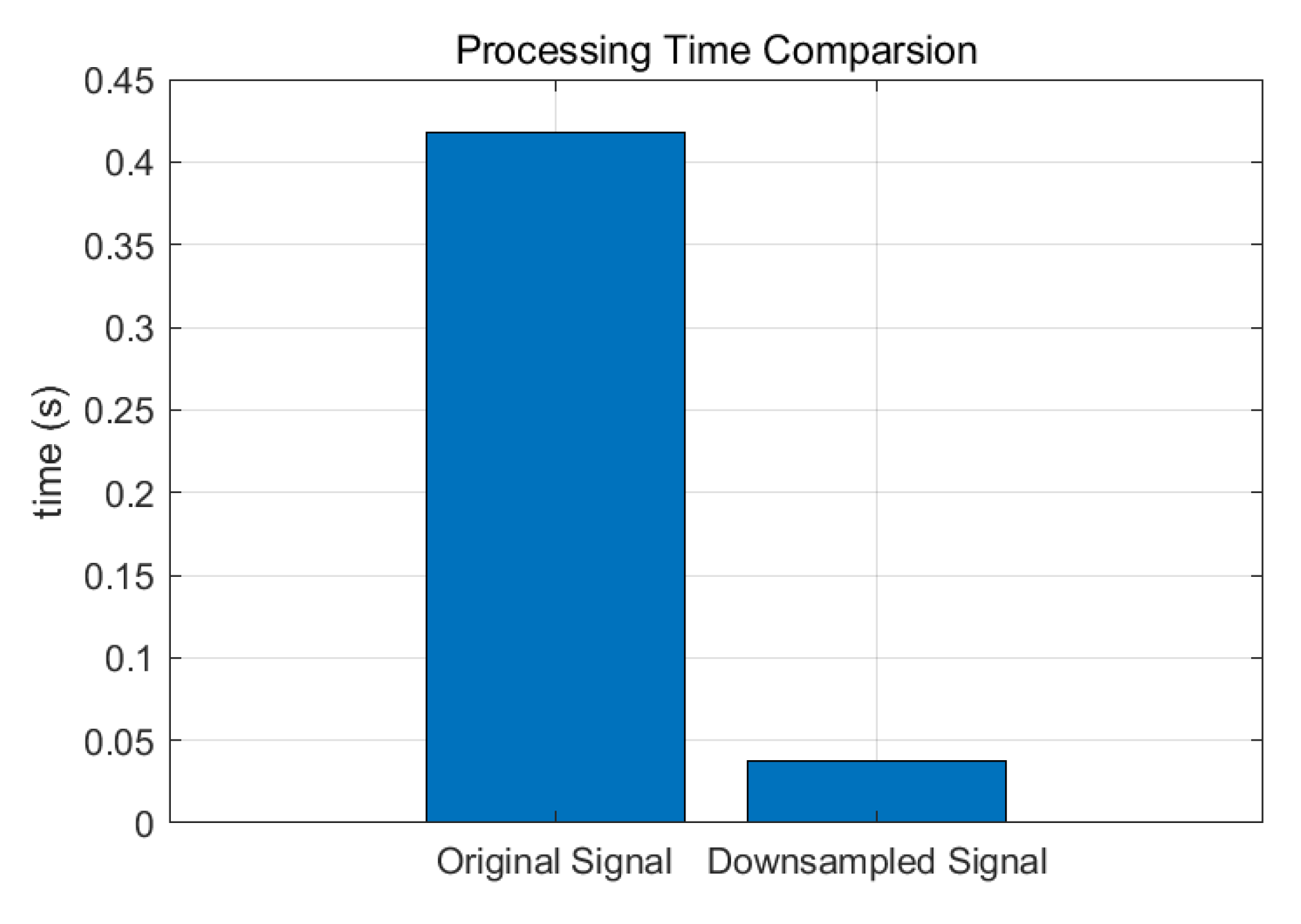
Figure 7.
Time-frequency domain analysis before and after FIR bandpass filtering.
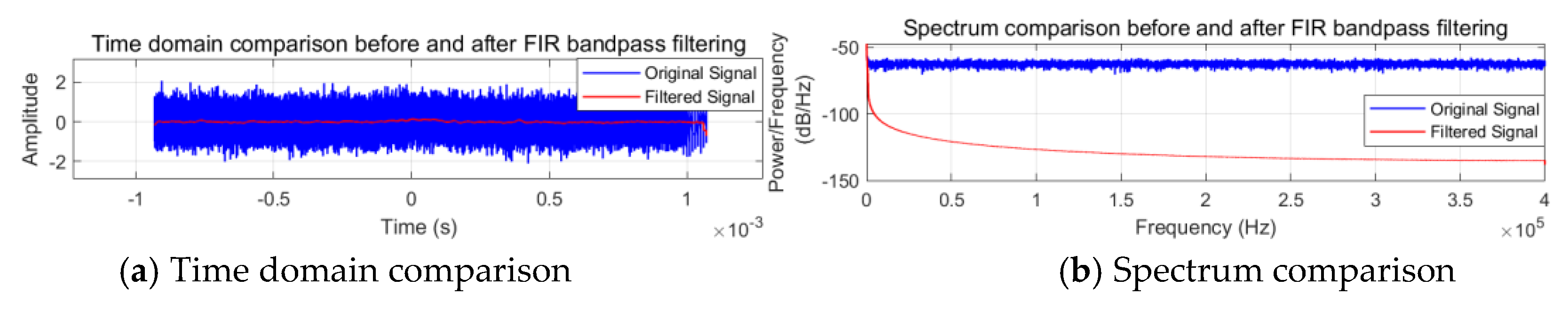
Figure 8.
Schematic diagram of multi-stage filtering co-processing flow.

Figure 9.
Photoelectric Signal Experiment Site.
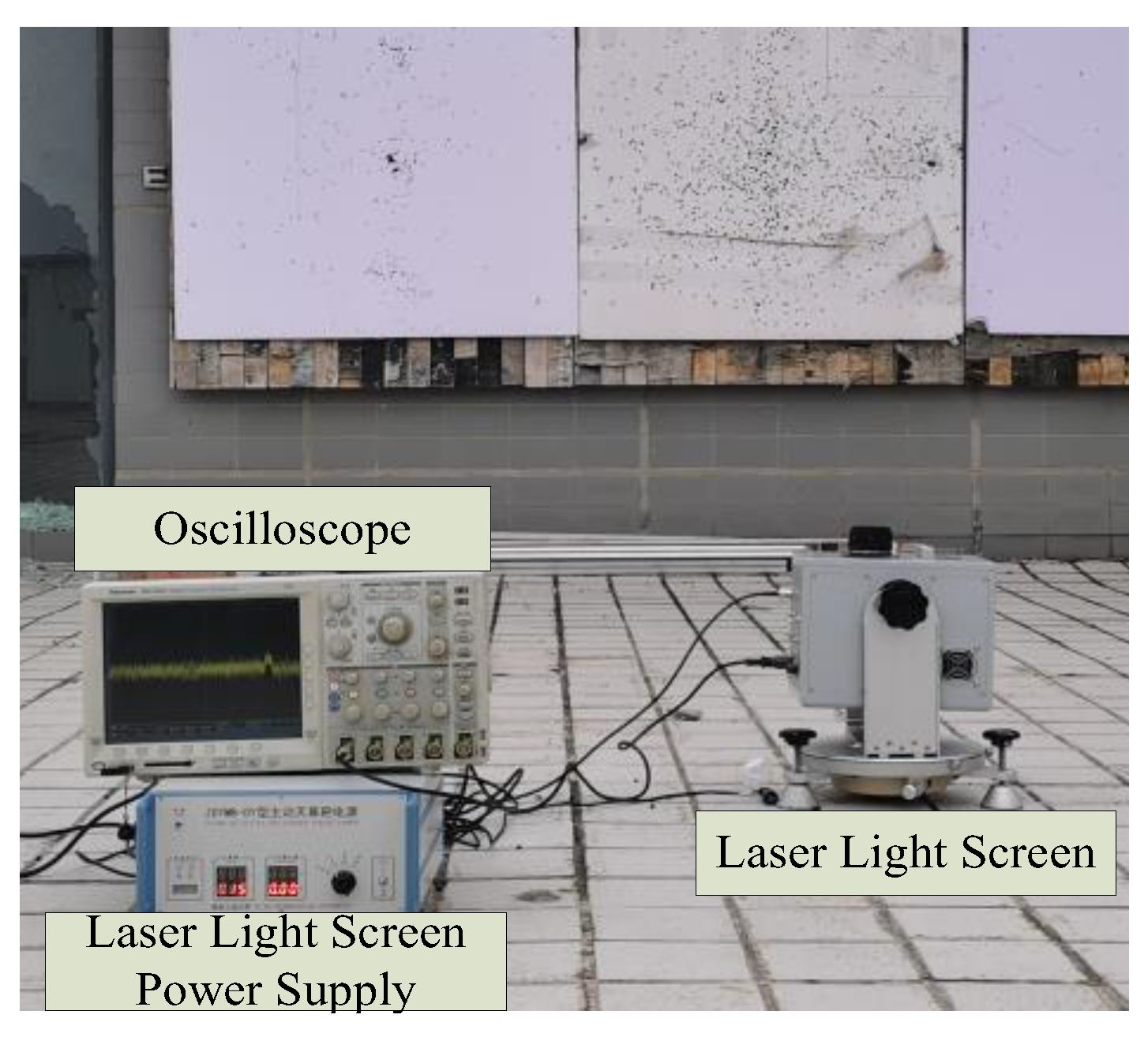
Figure 10.
Results of Time-Domain Analysis.
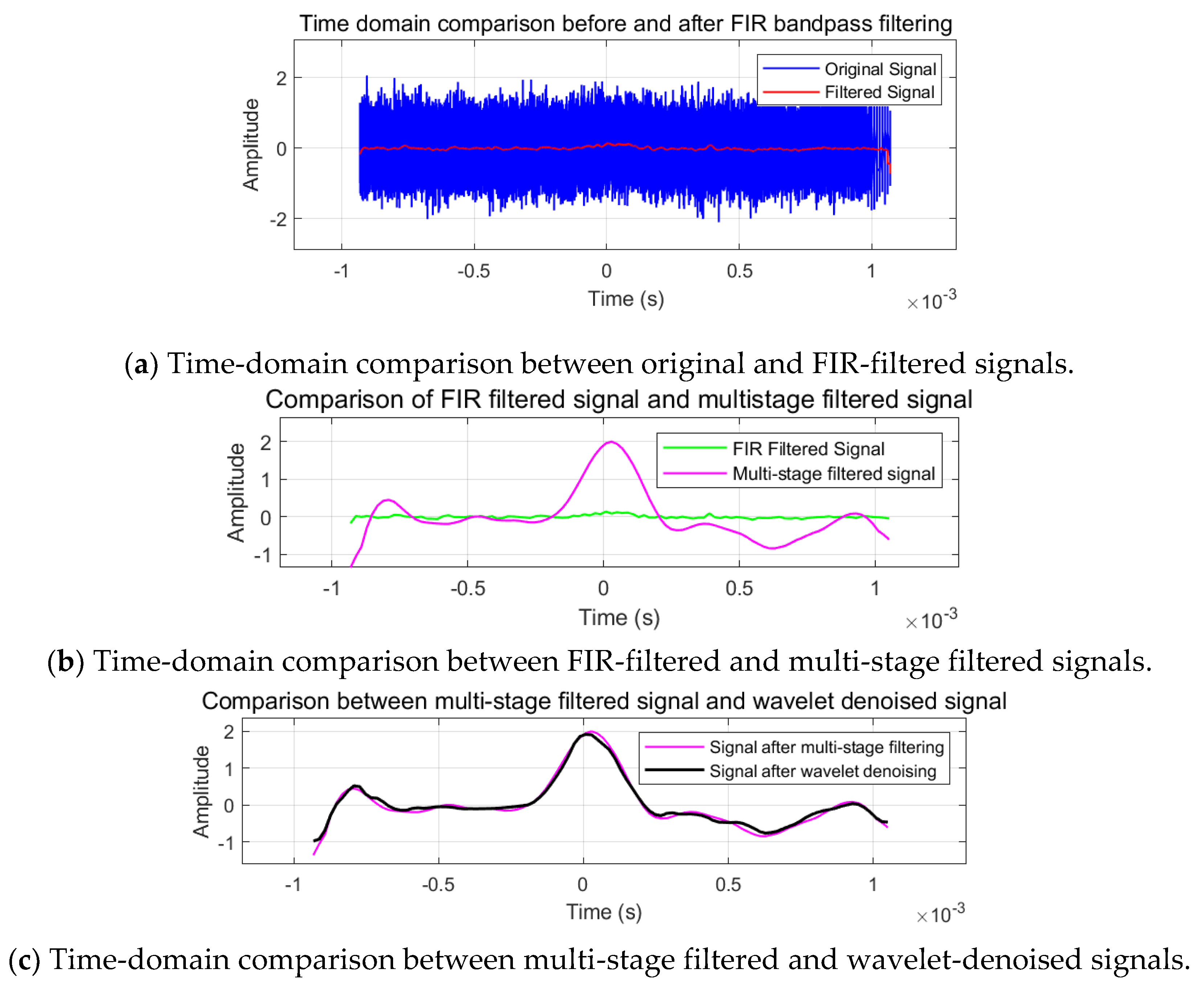
Figure 11.
Comparative Diagram of Phase Experiment.
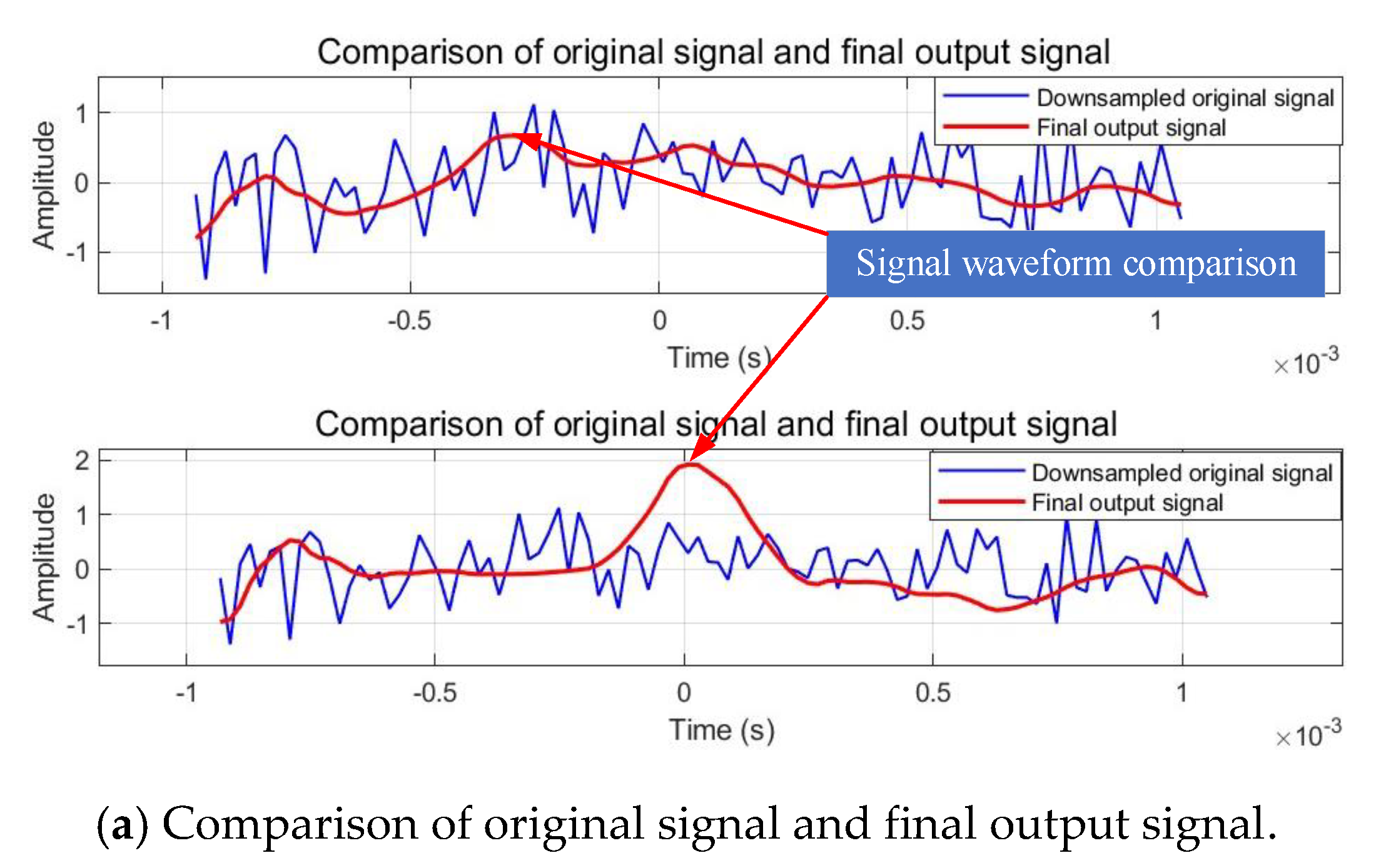
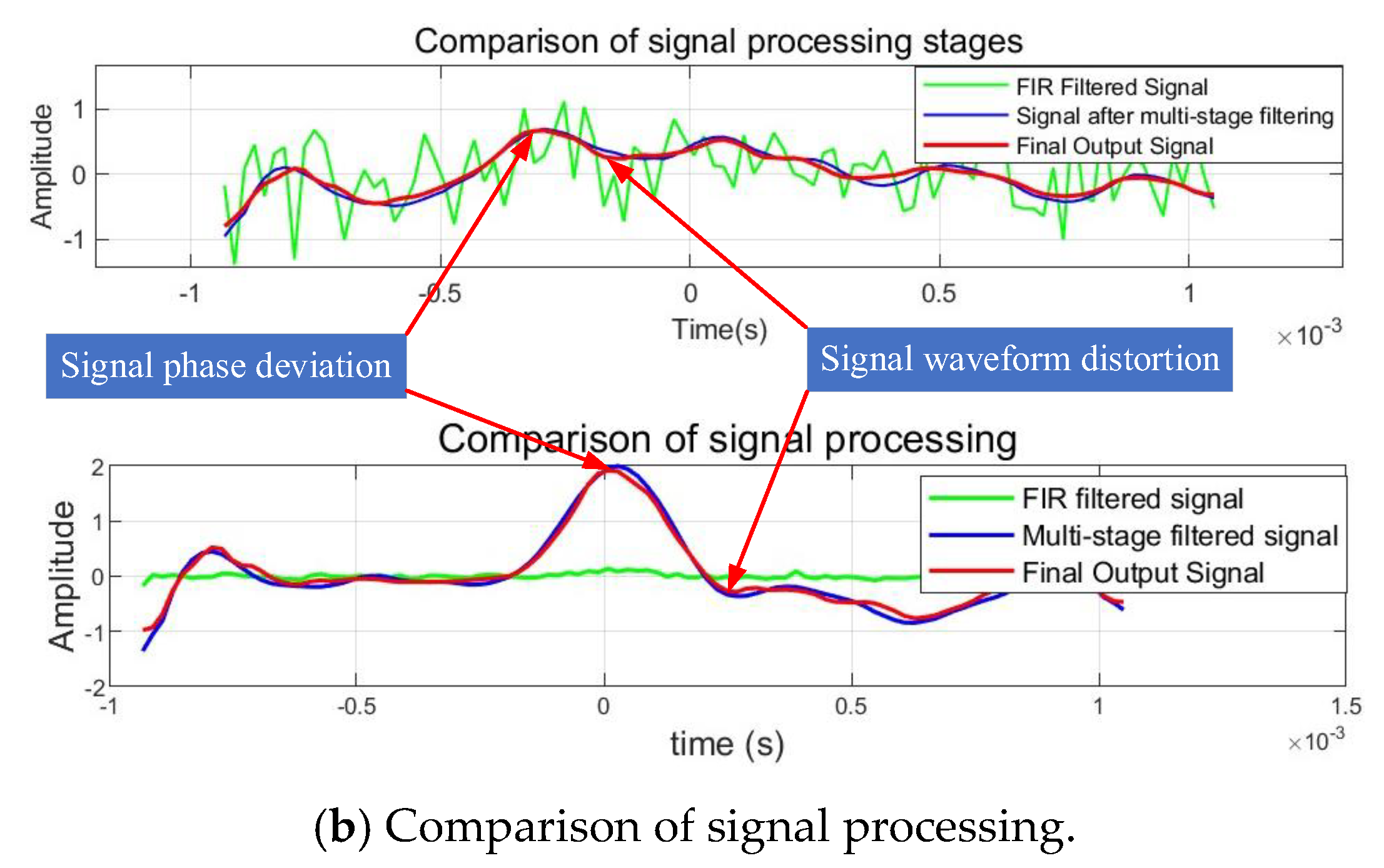
Figure 12.
Processing Results under Various Noise Environments.
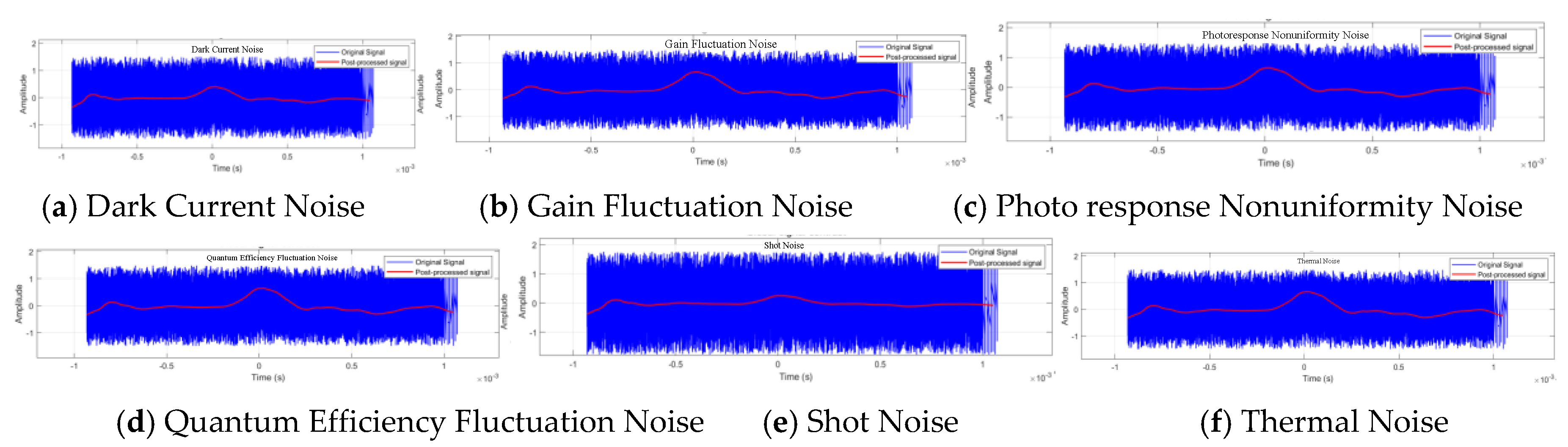
Figure 13.
Comparison of experimental results of different modules.
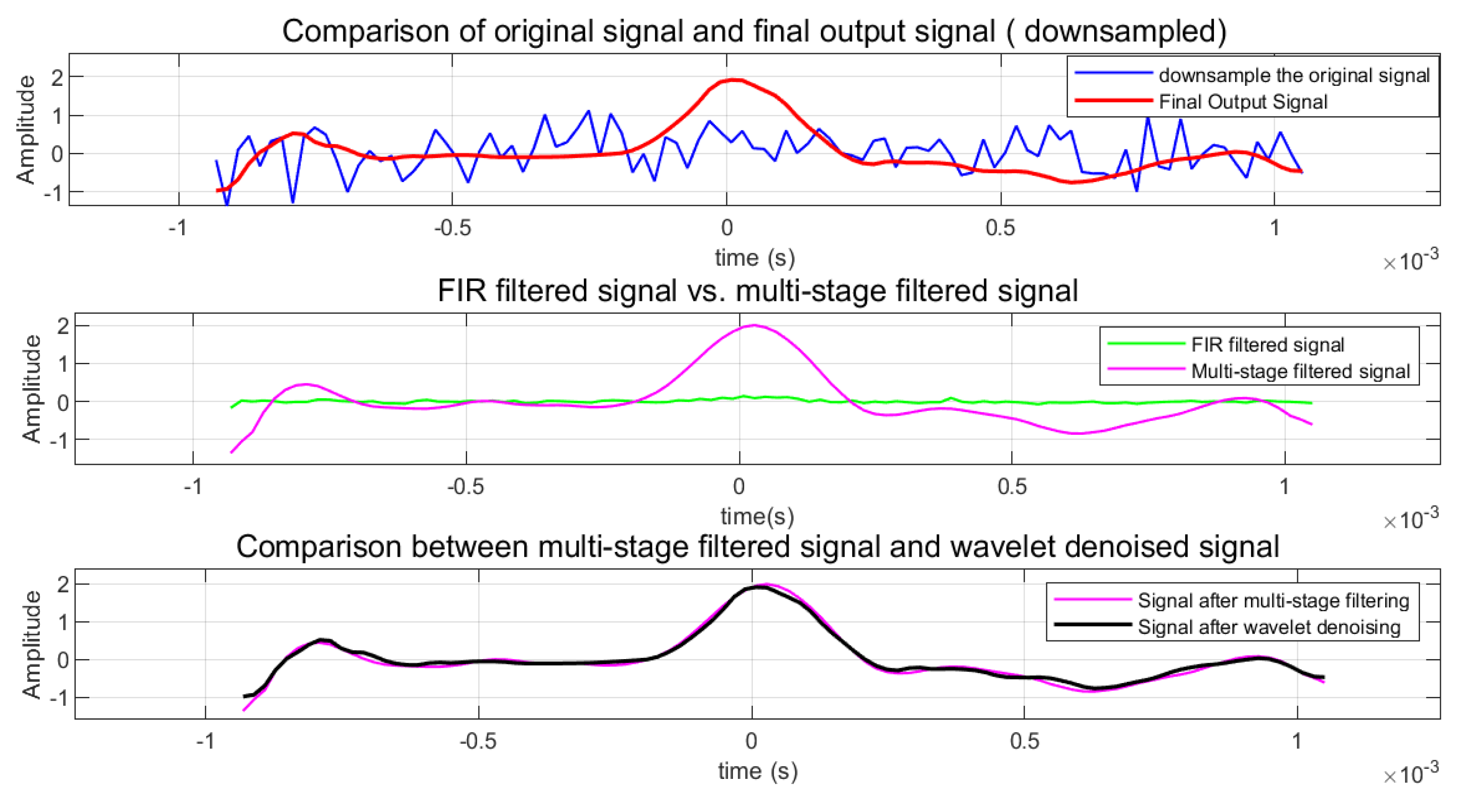
Figure 14.
Graph of the effect of multi-group experiments.
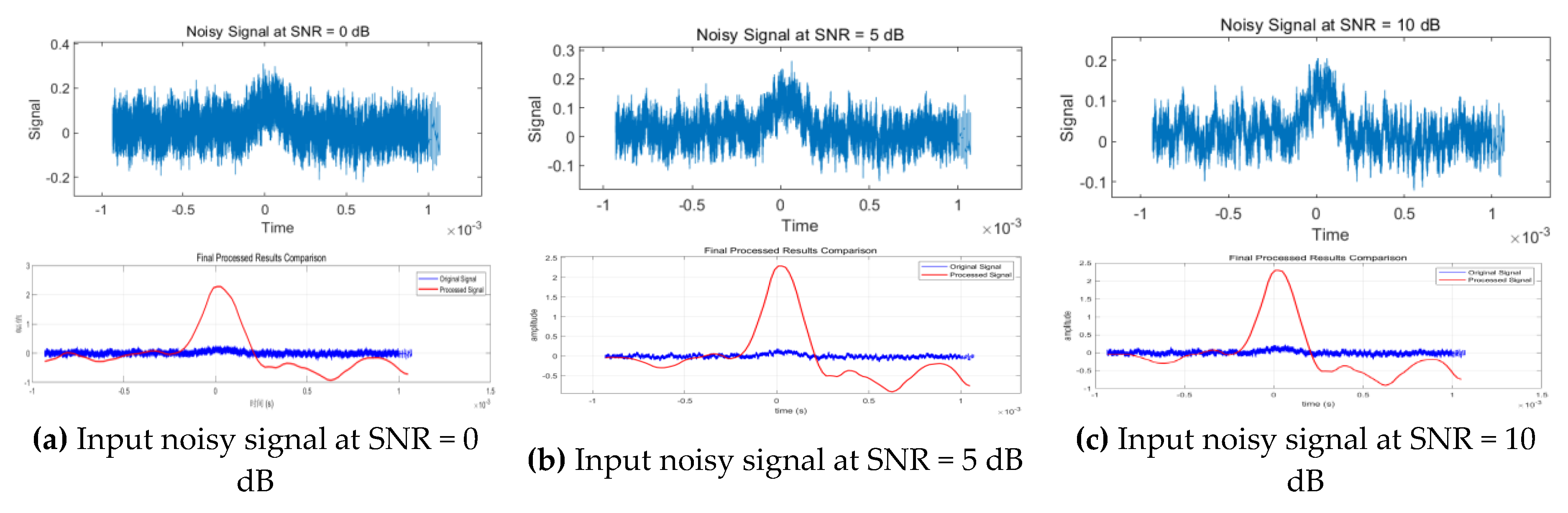
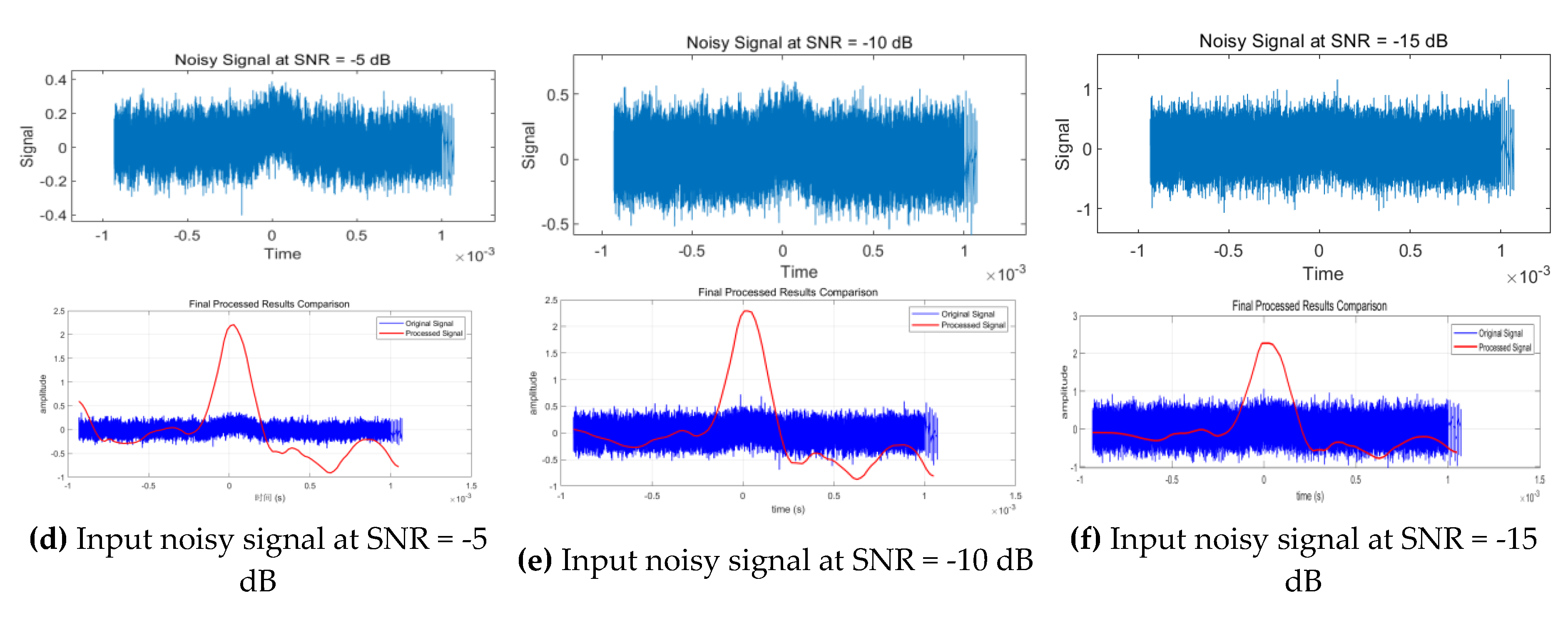
Figure 15.
Time domain analysis diagram.
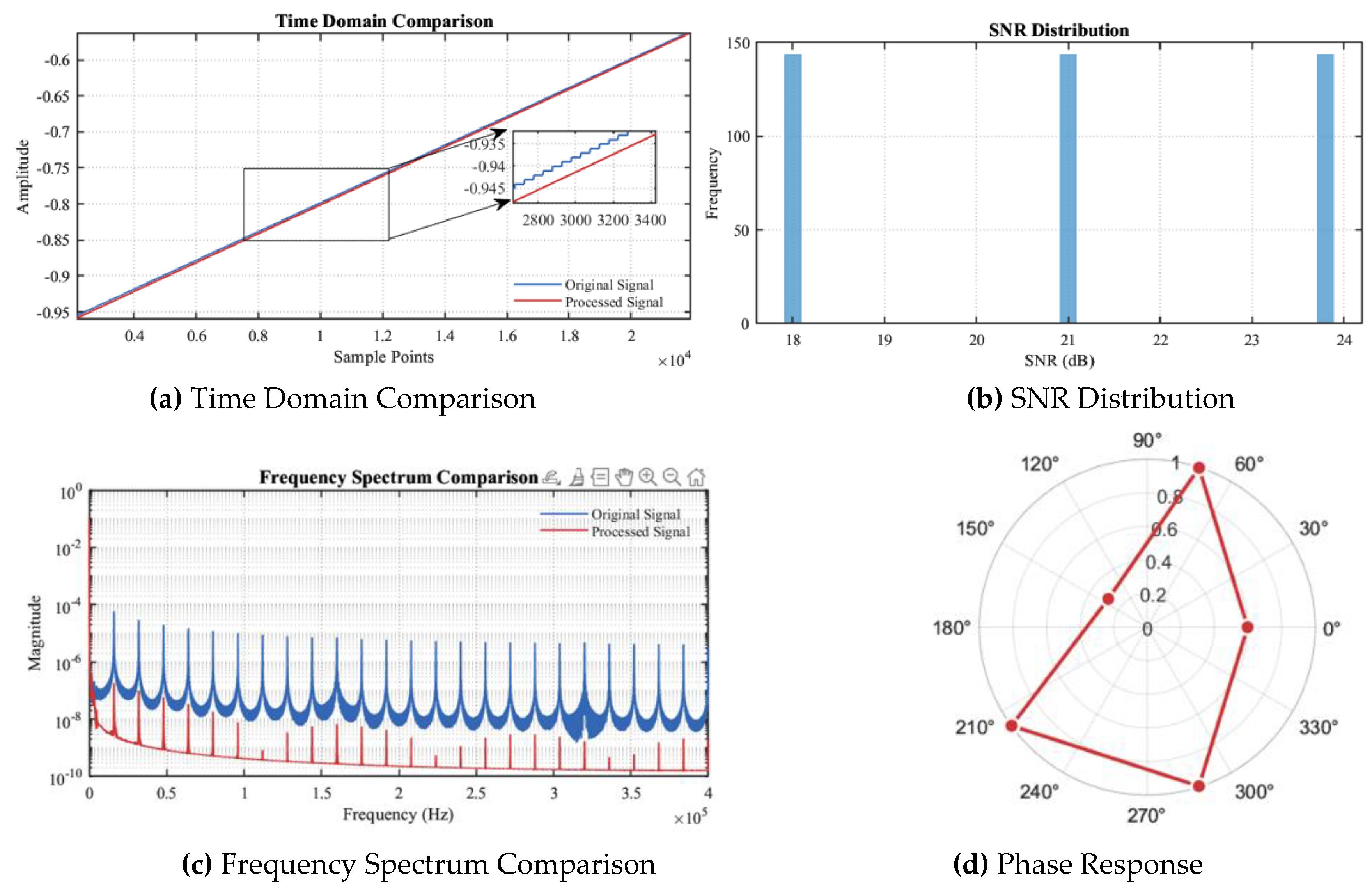
Figure 16.
Degree of influence of parameter sensitivity.
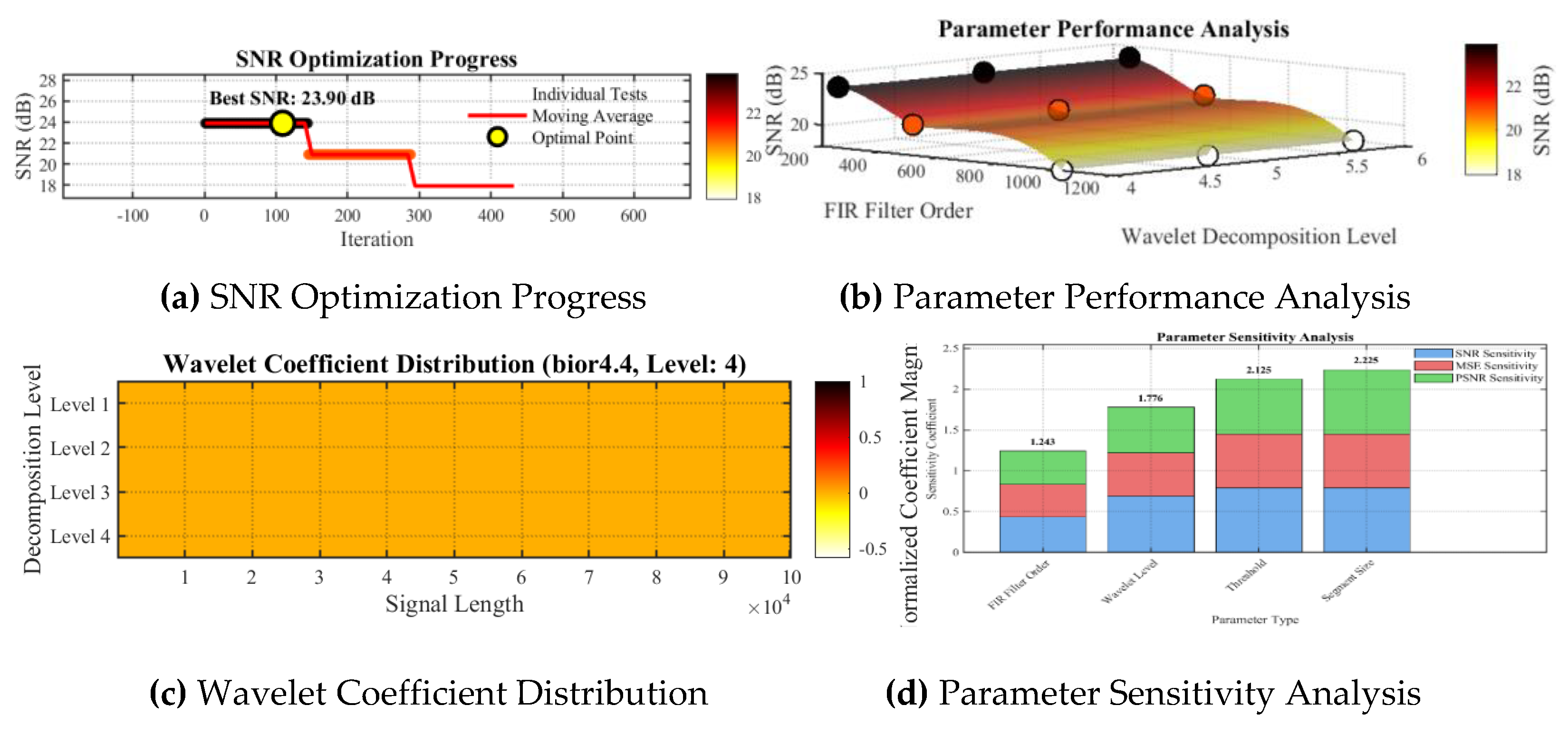
Figure 17.
Comparison experiment of different algorithms.
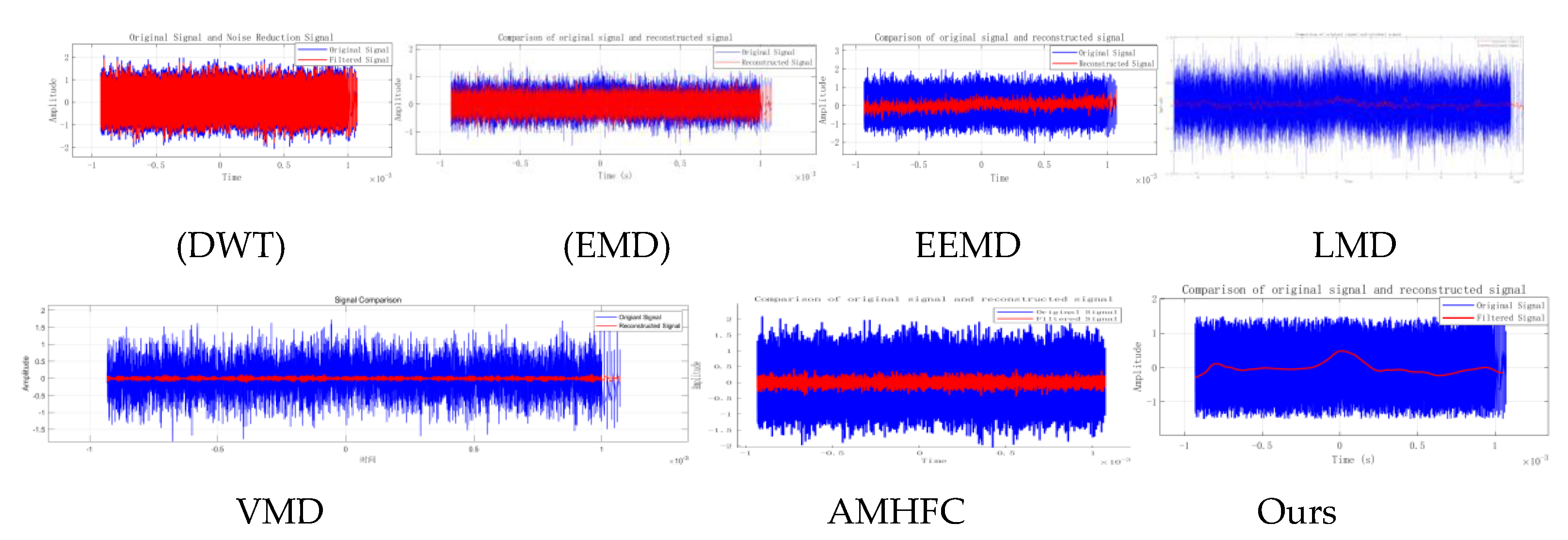
Table 2.
Comparison of time domain metrics.
| Method | Correlation coefficient | Mean square error | Signal-to-noise ratio (dB) |
|---|---|---|---|
| FIR Filtering | 0.4328 | 0.009996745 | 17.10db |
| Multi-stage filtering | 0.9854 | 0.01331926 | 24.77db |
| Optimized Wavelet Transform | 0.9890 | 0.009579688 | 25.83db |
| Final Output | 0.9890 | 0.009579688 | 25.83db |
Table 3.
Effects of Different Noise Processing Techniques.
| Noise Type | Original Signal(SNR) | Processed Signal (SNR) | Signal-to-Noise Ratio Improvement |
|---|---|---|---|
| Dark Current Noise | -20dB | 2.43dB | 22.43dB |
| Gain Fluctuation Noise | -20dB | 4.88dB | 24.88dB |
| Photo response Nonuniformity Noise | -20dB | 4.088dB | 24.08dB |
| Quantum Efficiency Fluctuation Noise | -20dB | 4.11dB | 24.11dB |
| Shot Noise | -20dB | 1.19dB | 21.19dB |
| Thermal Noise | -20dB | 4.67dB | 24.67dB |
Table 5.
Results of quantitative analysis of multiple sets of experimental data.
| Case | Original (db) | Processed(db) | Changed(db) | Coefficient of Variation | Autocorrelation Function |
|---|---|---|---|---|---|
| Case 1 | 0 db | 26.82 db | 26.82 db | 1.5070 | 0.9812 |
| Case 2 | 5 db | 28.23 db | 23.23 db | 1.5061 | 0.9818 |
| Case 3 | 10 db | 28.05 db | 17.05 db | 1.5117 | 0.9817 |
| Case 4 | -5 db | 28.06 db | 33.06 db | 1.4337 | 0.9773 |
| Case 5 | -10 db | 28.60 db | 38.60 db | 1.4980 | 0.9808 |
| Case 6 | -15 db | 30.36 db | 45.36 db | 1.4950 | 0.9823 |
Table 6.
Comparison of the performance of different methods (-20dB SNR condition).
| Method | Signal-to-noise ratio of original signal | Signal-to-noise ratio of processed signal | Signal-to-noise ratio improvement (dB) | Correlation coefficient |
|---|---|---|---|---|
| DWT [30] | -20 dB | -15 dB | 5 dB | 0.175 |
| EMD [18] | -20 dB | 2.85 dB | 22.85 dB | 0.815 |
| EEMD [19] | -20 dB | -8.3768 dB | 11.6232 dB | 0.195 |
| LMD [31] | -20 dB | 6.53 dB | 26.53 dB | 0.901 |
| VMD [20] | -20 dB | 0.01 dB | 20.01 dB | 0.301 |
| AMHFC [32] | -20 dB | -0.06 dB | 19.94 dB | 0.765 |
| Ours | -20 dB | 25 dB | 45 dB | 0.981 |
Disclaimer/Publisher’s Note: The statements, opinions and data contained in all publications are solely those of the individual author(s) and contributor(s) and not of MDPI and/or the editor(s). MDPI and/or the editor(s) disclaim responsibility for any injury to people or property resulting from any ideas, methods, instructions or products referred to in the content. |
© 2025 by the authors. Licensee MDPI, Basel, Switzerland. This article is an open access article distributed under the terms and conditions of the Creative Commons Attribution (CC BY) license (http://creativecommons.org/licenses/by/4.0/).
Copyright: This open access article is published under a Creative Commons CC BY 4.0 license, which permit the free download, distribution, and reuse, provided that the author and preprint are cited in any reuse.