1. Decomposing All Natural Numbers into Geometric Sequences
1.1. Background and Objective
We express as a collection of rays parameterized by odd cores and powers of two, providing a structural stage for Collatz dynamics.
1.2. Definitions and Goals
Let
We show
and the representation is unique.
1.3. Prime Factorization and Classification
Every
decomposes uniquely as
1.4. Exhaustion of Odd Numbers
Any odd k is with , giving .
1.5. Exhaustion of Even Parts
For each odd k, the ray exhausts the even multiples of k.
1.6. Construction of S and Uniqueness
By the above, every
with
. If
then
, forcing
and
since the left side is odd rational and the right is a power of two. Hence
bijectively.
1.7. Remarks from the Collatz Perspective
For odd k, is even and belongs to some ray . This exhibits inter-branch connections. However, the assertion that every number lies on a finite forward path to 1 (global convergence) is a separate issue (coverage) made precise by Theorem 4; it is not implied by the mere classification .
Takeaway of Chapter 1. We obtain a clean, bijective indexing of by odd core and 2-adic height, furnishing a coordinate system on which later structural/affine arguments are staged.
2. The Structure of the Collatz Tree
2.1. Definition (Branches and Trunk)
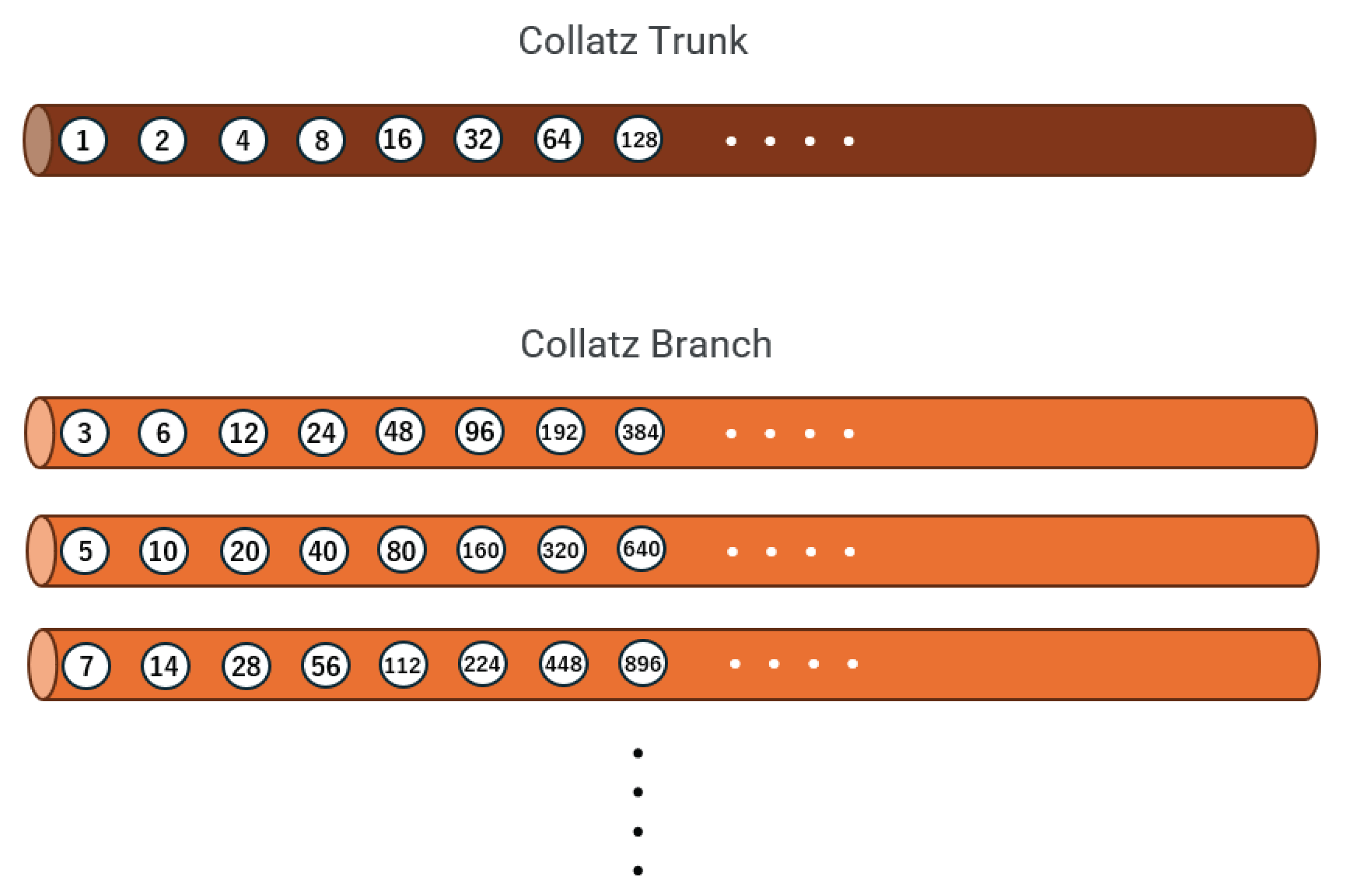
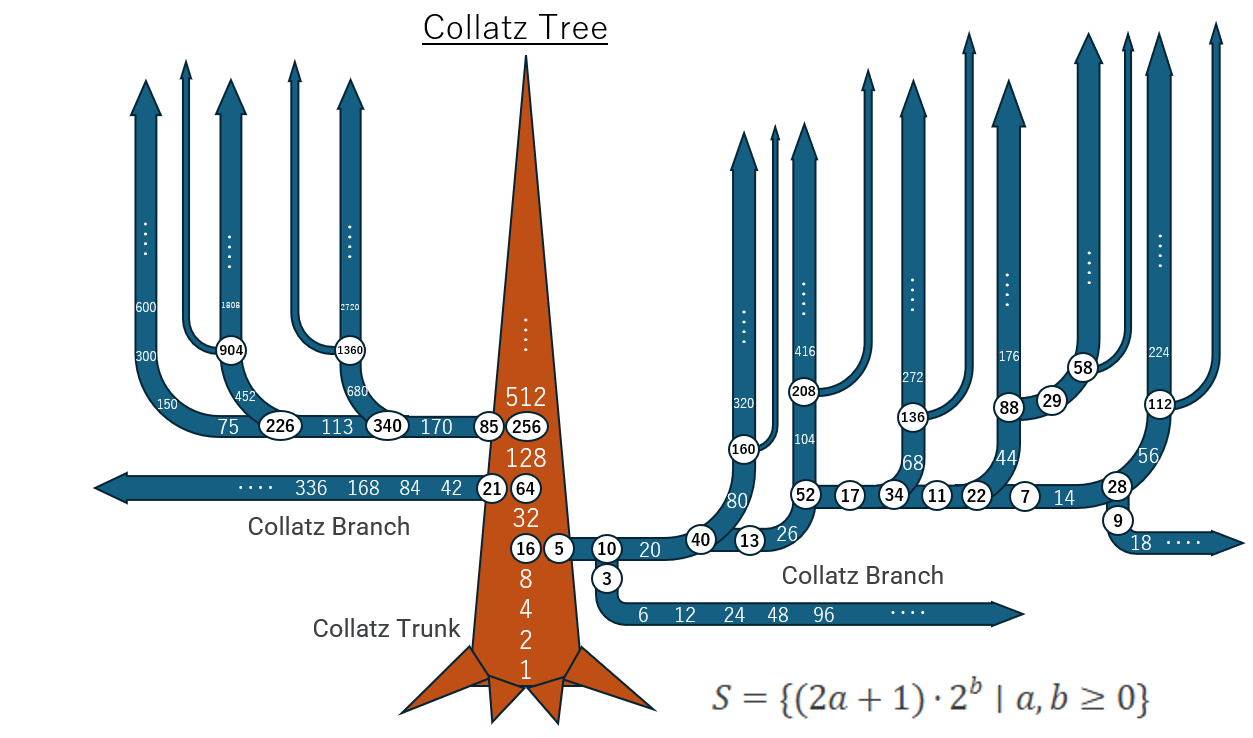
Define the trunk and for each odd the branch . These rays partition disjointly.
Figure 1.
Trunk and branches (schematic; reverse orientation when embedded into the inverse graph: edges point to preimages). (finite cutoff; visualization, not a proof)
Figure 1.
Trunk and branches (schematic; reverse orientation when embedded into the inverse graph: edges point to preimages). (finite cutoff; visualization, not a proof)
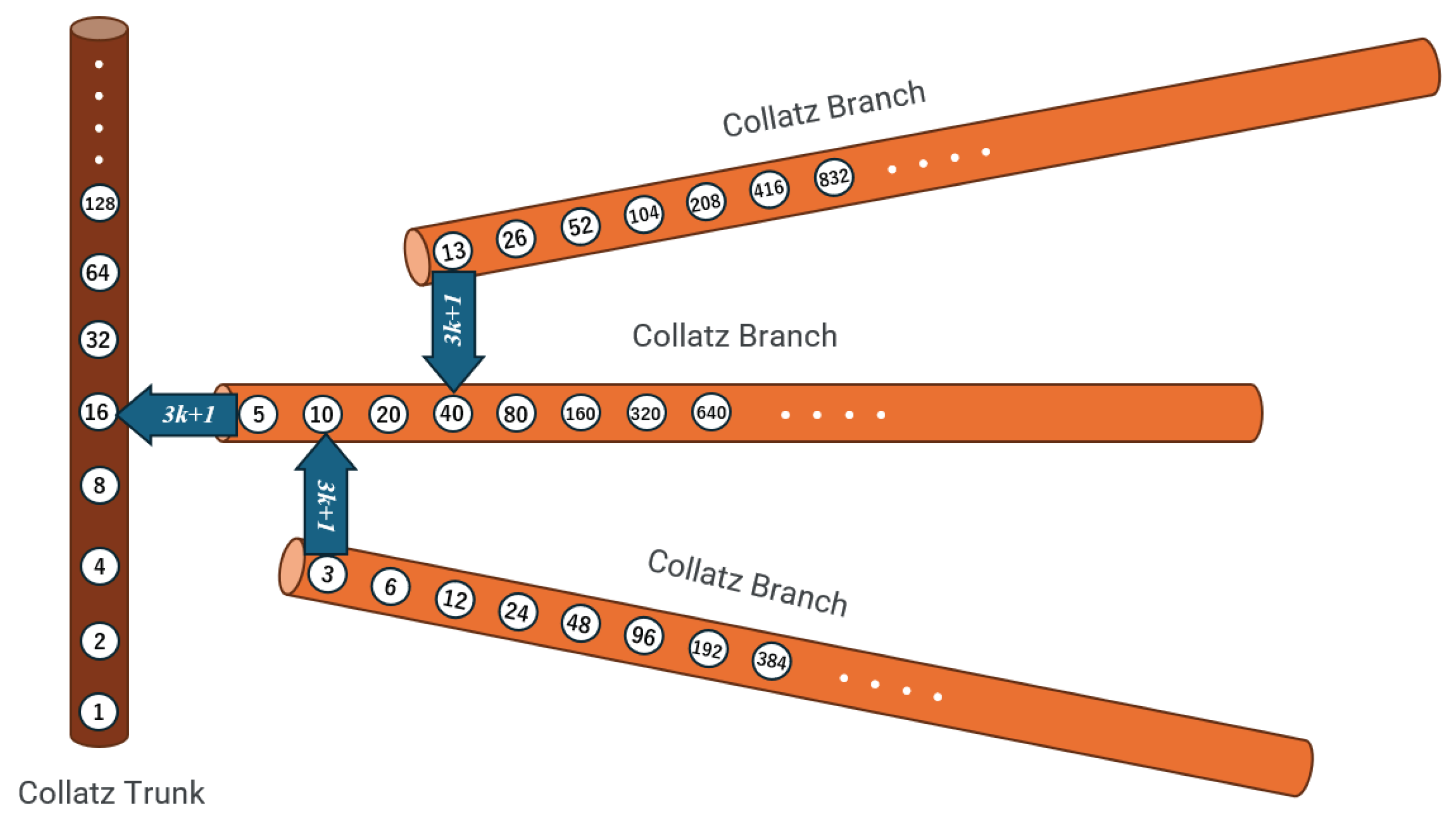
2.2. Branch–Branch Links via
Given odd k, is even and decomposes as , indicating where the branch from k can merge into another branch/trunk in forward dynamics. This shows linkage patterns but does not by itself prove global coverage of the tree by reverse generation.
Figure 2.
Branch connections (schematic; reverse orientation: edges point to preimages). (finite cutoff; visualization, not a proof)
Figure 2.
Branch connections (schematic; reverse orientation: edges point to preimages). (finite cutoff; visualization, not a proof)
2.3. Forward vs. Reverse Orientation
Let the standard forward map be
The
forward graph (edges
) is a functional digraph (outdegree 1). We do
not call it a DAG because it contains the trivial
3-cycle; nontrivial finite cycles are excluded later (sec:affine).
The reverse (preimage) graph rooted at 1, with edges to preimages under f, is a true DAG: levels increase with each application of a reverse step.
2.4. Tree Language
When drawing a reverse BFS tree rooted at 1, each node is assigned a unique parent by construction (though a number may have up to two preimages as graph children). Connectivity of every node to 1 in the forward sense is equivalent to coverage of the reverse tree, which is equivalent to the Collatz convergence; see Theorem 4.
3. Trunk–Branch Indexing of the Natural Numbers
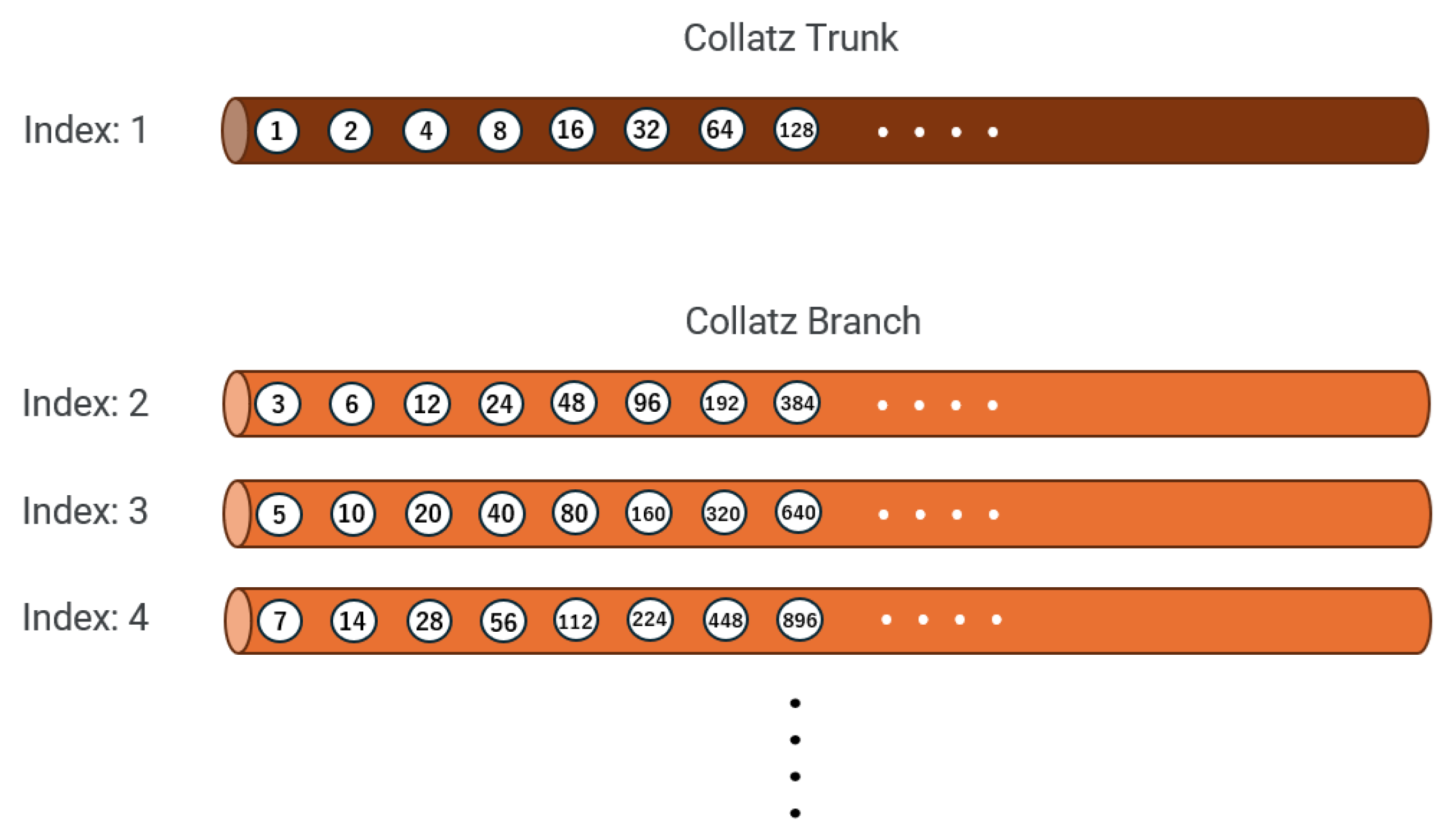
Definition 1 (Odd core, 2-adic valuation). For , write uniquely where is odd and is the exponent of 2 in n.
Definition 2 (Trunk and branches). The trunk is . For any odd , Then is a disjoint partition of .
Definition 3 (Indices).
Order the odd numbers as . Assign the branch index , so that and , , etc. Define the height . Set
Theorem 1 (Complete classification). The map is a bijection from onto .
Proof. Uniqueness of and is immediate; disjointness/exhaustiveness of rays follows. □
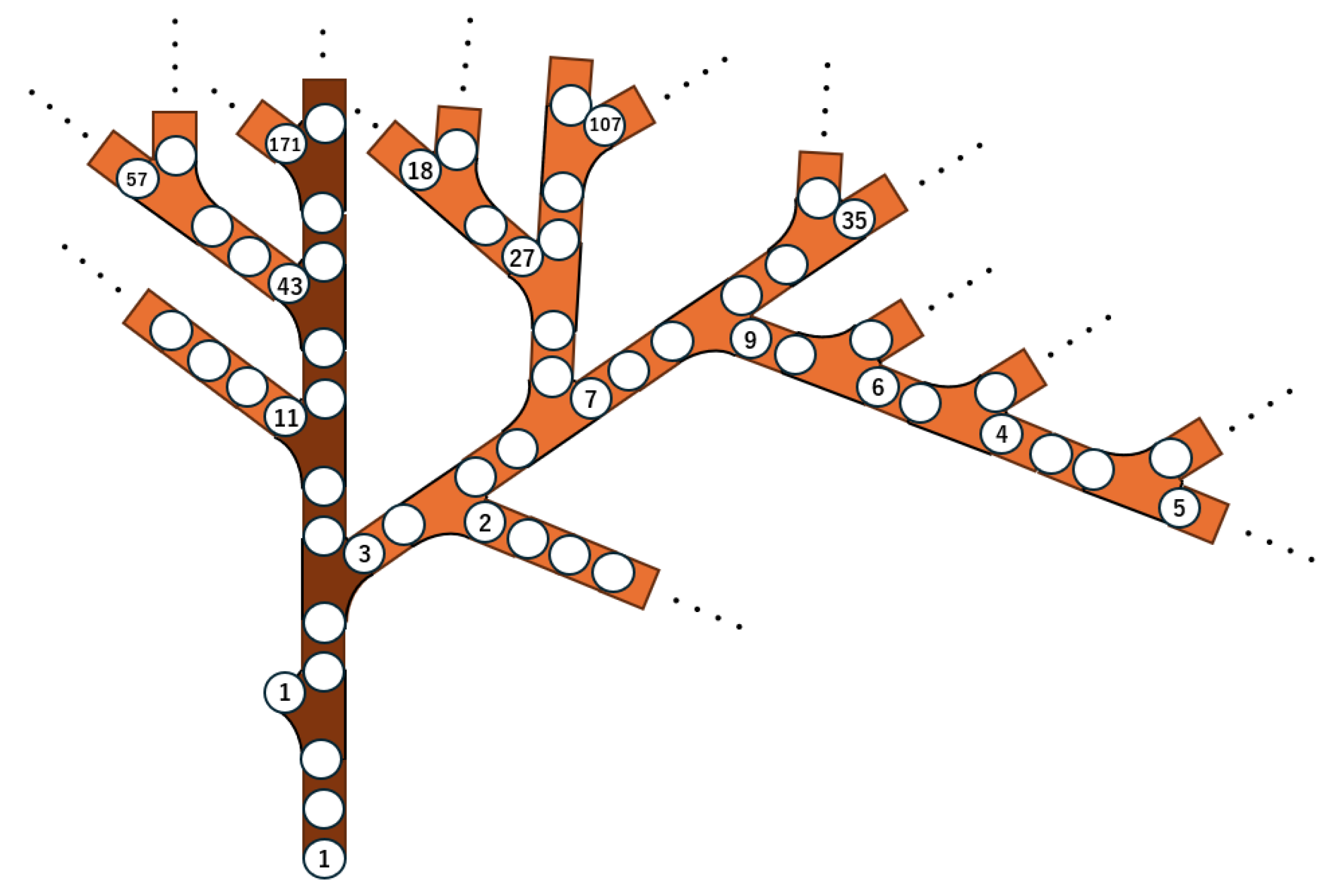
Figure 3.
Trunk–branch indexing (schematic; reverse orientation in the inverse graph). (finite cutoff; visualization,
not a proof)
Figure 3.
Trunk–branch indexing (schematic; reverse orientation in the inverse graph). (finite cutoff; visualization,
not a proof)
Figure 4.
Indexed reverse tree (schematic; edges point to preimages). (finite cutoff; visualization, not a proof)
Figure 4.
Indexed reverse tree (schematic; edges point to preimages). (finite cutoff; visualization, not a proof)
In this table we use a 1-based display index .
Table 1.
Trunk–Branch Indexing (sample)
Table 1.
Trunk–Branch Indexing (sample)
| Odd k
|
Index |
Next Index (rule) |
parity-based trend |
transition factor |
| 1 |
1 |
– |
– |
– |
| 3 |
2 |
3 |
increase |
|
| 5 |
3 |
1 |
decrease |
|
| 7 |
4 |
6 |
increase |
|
| 9 |
5 |
4 |
decrease |
|
| 11 |
6 |
9 |
increase |
|
| 13 |
7 |
3 |
decrease |
|
| 15 |
8 |
12 |
increase |
|
| 17 |
9 |
7 |
decrease |
|
| 19 |
10 |
15 |
increase |
|
4. Affine Word Method: Absence of Nontrivial Finite Cycles
We encode even/odd steps as affine maps and use finite-word compositions to prove absence of nontrivial finite cycles.
Definition of the three-way map T.
Define
by
Elementary steps.
(For odd
n, choose
if
, and
if
.)
Words and composition.
For any finite word
W over
, the composition is affine:
Writing
,
,
, we have
and the denominator of
divides
(each
contributes
, each
contributes
;
E does not increase the power-of-two denominator).
Lemma 1 (No for nonempty words). If W is nonempty then cannot hold.
Lemma 2 (Odd numerator for
).
so the numerator is odd (even minus odd).
Lemma 3 (If
, a periodic solution cannot be integral).
Since , we have . By Lemma 2, . Hence
and the odd denominator cannot cancel . Thus x is not an integer.
Lemma 4 (If , contraction; the only integer fixed point in is 1). When , , so any integer periodic point must be a fixed point. Solving gives (an integer but outside our domain ), and solving gives . Hence, within the only fixed point is 1.
Theorem 2 (Loop-freeness for T). Under the three-way rule above, the map T admits no finite cycle other than the trivial 1-cycle.
Proof. By Lemma 1, consider . If , Lemma 3 rules out integer . If , Lemma 4 leaves only as a fixed point. □
Interpretation. If an even step E appears at least once, a factor remains in the numerator of and cannot be canceled by the odd denominator, so no integer fixed point arises. If E never appears, the composition is a contraction and the only integer fixed point is 1. This algebraic loop-elimination aligns with the inverse-generation intuition.
5. Bridge to the Accelerated Collatz Map (Rigorous Version)
Let the standard accelerated Collatz map on odd integers be
Recall the three-way affine map
:
where
is used if
and
otherwise. For any finite word
, the composition
satisfies
where
denote the counts of
in
W.
Lemma 5 (Coefficient identity for a cycle of
A).
Let be a cycle of A with for each step. Setting and , there exists an integer C such that
Moreover, .1
Lemma 6 (Coefficient matching on the
T-side).
Choose a word W with counts and . Then
Lemma 7 (Adjacent-swap residue control).
Let . Adjacent swaps of blocks with alter by
for some odd unit u modulo D and integer . Hence, by successive swaps, one can realize any residue class modulo D.
Lemma 8 (Simultaneous satisfiability of parity conditions).
At each occurrence of or , the requirement on reduces to a linear congruence
and adjacent swaps adjust by controlled powers of two. Therefore, the entire system admits a simultaneous solution by the Chinese Remainder Theorem.
Theorem 3 (Bridge Theorem (Equivalence of Cyclicity)). If the accelerated map A possesses a nontrivial finite cycle of length , then the three-way map T also admits a nontrivial finite cycle.
Proof. By Lemma 5, an
A-cycle yields parameters
with
and
. Pick
W with counts as in Lemma 6 so that
. By Lemma 7, using adjacent swaps we can tune
to match any prescribed residue class. Finally, Lemma 8 ensures the local parity constraints can be satisfied simultaneously. Thus there exists
such that
so
x is periodic for
T with the same length
L. □
Corollary 1.
For the accelerated Collatz map on odd integers,
there exists no nontrivial finite cycle.
Proof. By the Bridge Theorem Theorem 3, any nontrivial finite cycle of A would yield a nontrivial finite cycle of the three-way map T. But Theorem 2 (loop-freeness for T) excludes such cycles. Hence A has no nontrivial finite cycle. □
Theorem 4 (Reduction to convergence). For the accelerated map A, the following are equivalent:
Proof. Each connected component of a functional digraph is a directed cycle with an in-tree. Since only the 1-cycle is permitted (Corollary 1), global convergence holds iff every node is in the basin of 1, i.e. iff the inverse tree covers . □
6. Coverage of the Inverse Collatz Tree
The previous sections established the absence of nontrivial finite cycles. Hence global convergence reduces to the remaining structural pillar: coverage—whether the inverse Collatz tree rooted at 1 covers all natural numbers. We formalize and partially prove this pillar.
6.1. Inverse Graph Definition
For any
, define its reverse (preimage) set:
The inverse Collatz graph has root 1 and edges
for all
. It is a directed acyclic graph (DAG) whose connectedness determines coverage.
Definition 4 (Coverage). The inverse Collatz tree is said to becoveringif for every , there exists a finite sequence with and , where each .
By Theorem 4, this condition is equivalent to the global convergence of the Collatz map.
6.2. Branch-Level Analysis
For each odd core k and height b, belongs to a branch . We classify the reverse-generation behavior along this branch.
Lemma 9 (Criterion for two-child branching). If , then , so a new odd preimage branch emerges at this level. Otherwise .
Proof. Since n even, write . Then is integer iff . When this holds, is necessarily odd. □ □
Corollary 2 (Infinite supply of branching levels). If the odd core k is not a multiple of 3, the sequence attains infinitely often as b varies. Hence contains infinitely many levels with two-child branching.
Proof. Modulo 6, we have . If , then for even b. If , then for odd b. □ □
6.3. Local Descent of the Odd Core
Definition 5 (Odd core). For , the integer is called theodd coreof n.
Proposition 1 (Descent direction at branching points).
When , its children are and . The odd core of the second child satisfies
Hence at every branching level, one child is a strict odd-core descent.
Proof. If is odd, its odd core equals itself and is . If even, further division by 2 only decreases it. □ □
Corollary 3 (Guaranteed descent opportunities). Every branch with encounters infinitely many levels where a descent edge in is available. Thus such branches can always locally reduce their odd core.
6.4. Constructive Reachability for
We now show that branches with odd cores not divisible by 3 are fully covered by the inverse tree.
Lemma 10 (Finite design reachability via CRT).
For any finite sequence of inverse steps
where and , there exists a starting point such that each O-step is valid, i.e. the operand of O satisfies .
Proof. Each O-validity condition is a linear congruence shifted by powers of two through E. The resulting system of congruences is consistent mod and mod 3, hence solvable simultaneously by the Chinese Remainder Theorem. □ □
Proposition 2 (Finite descent construction). For every odd k with , there exists a finite inverse sequence of the above form leading from 1 to some , whose forward image (under the usual Collatz iteration) returns to a smaller odd core .
Proof. By y Corollary 2, the branch contains infinitely many levels . At such a level, the inverse step O reduces the odd core by at least the factor ((Proposition 1). By chaining a finite number of these O-steps separated by powers of E, and invoking lem:crt to ensure legality of all O, we obtain a finite construction lowering the core. □ □
Theorem 5 (Coverage for ). Every branch with is entirely covered by the inverse tree, and all its nodes reach the root 1 in finitely many forward steps.
Proof. Repeatedly apply Proposition 2. The odd core strictly decreases at each finite stage and cannot descend infinitely without reaching 1. □ □
6.5. Branches with
The remaining case is , for which so no direct O-type edge occurs.
Theorem 6 (Sufficient condition for full coverage). Suppose that for every odd , there exists a finite sequence of inverse operations of the form leading to a node whose odd core satisfies . Then the entire inverse Collatz tree is covering, and the Collatz Conjecture holds.
Proof. By assumption, each branch eventually transfers to a branch with . By Theorem 5, that branch reaches 1. Hence every integer is connected to 1. □ □
Interpretation. The remaining open step is to verify the existence of such finite transfer sequences for all . This problem is purely combinatorial and can be attacked with the same adjacent-swap and Chinese Remainder techniques used in the Bridge Theorem.
Summary. The coverage pillar is thus partially proven:
This completes the reduction of the Collatz Conjecture to a finite residue-class verification problem.
7. Related Work
The affine-composition viewpoint with coefficient is classical in studies of cycles and their lengths (in our three-way encoding, ). Our novelty is to integrate (i) the trunk–branch indexing and inverse-tree structure, with (ii) a complete loop-elimination for the three-way map T, and (iii) a bridge transporting hypothetical cycles of A into T, thereby isolating cycle-freeness as a stand-alone pillar and reducing full convergence to coverage.
Data Availability Statement
Figures can be regenerated using the Python in the Appendix (for visualization; not a proof of coverage).
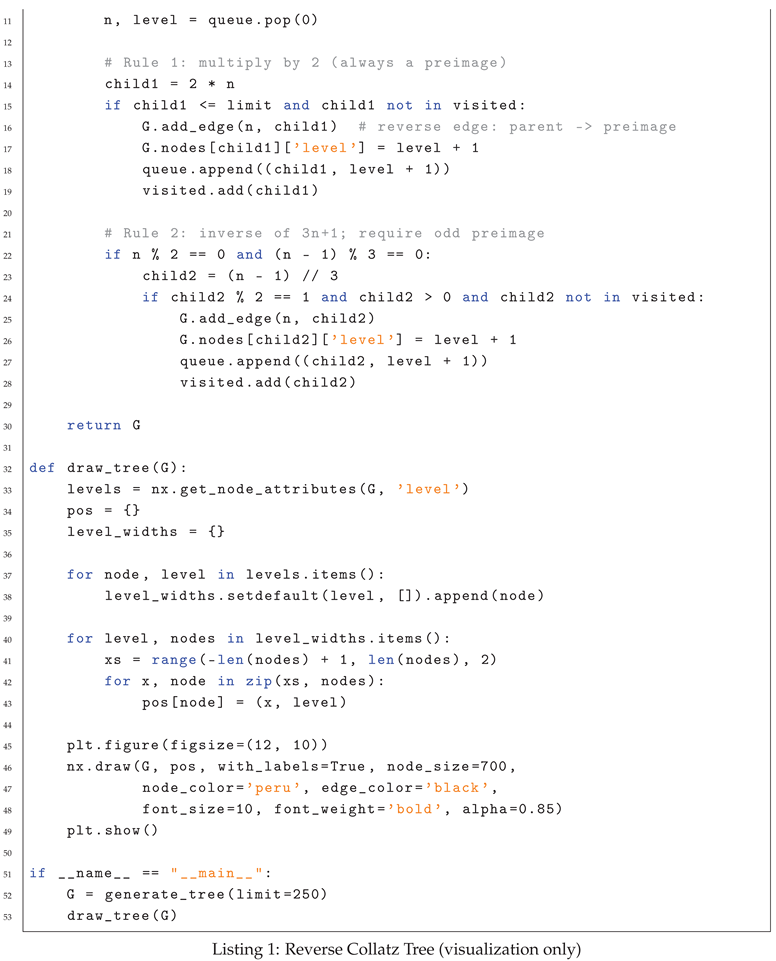
Appendix A. Python Code for Reverse Collatz Tree Visualization
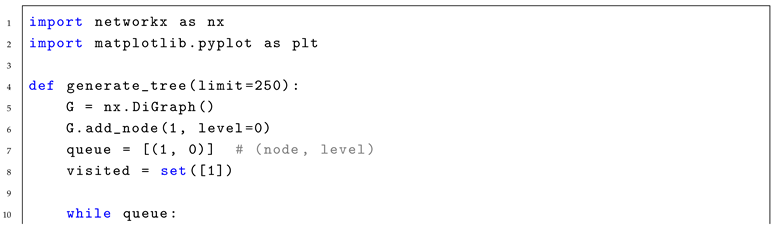
This script visualizes structure up to a finite cutoff and isnota proof of coverage.
The following script visualizes the reverse graph from 1 up to a finite cutoff limit.


Appendix B. Python-Generated Tree Visualizations (Illustrative Only)
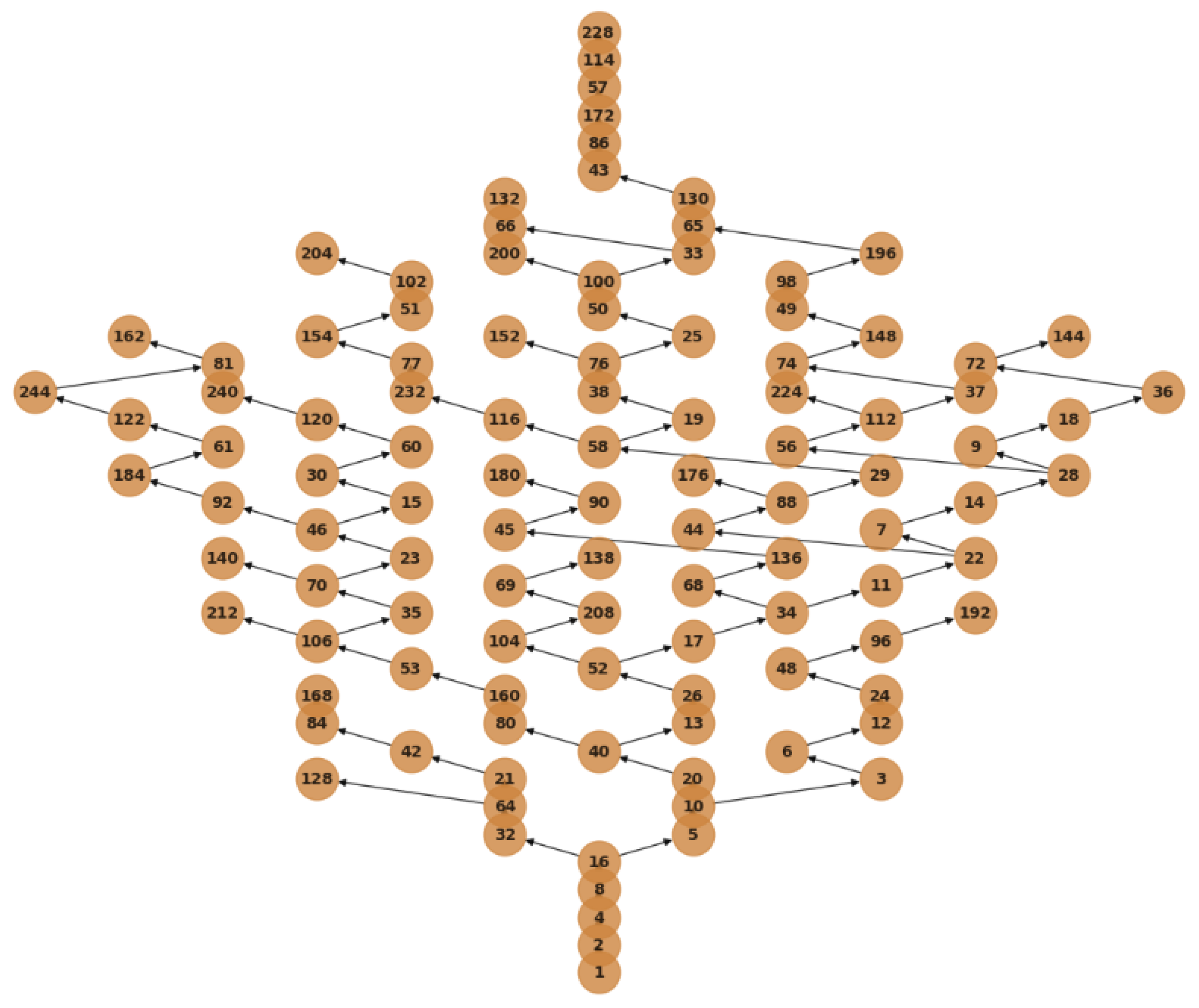
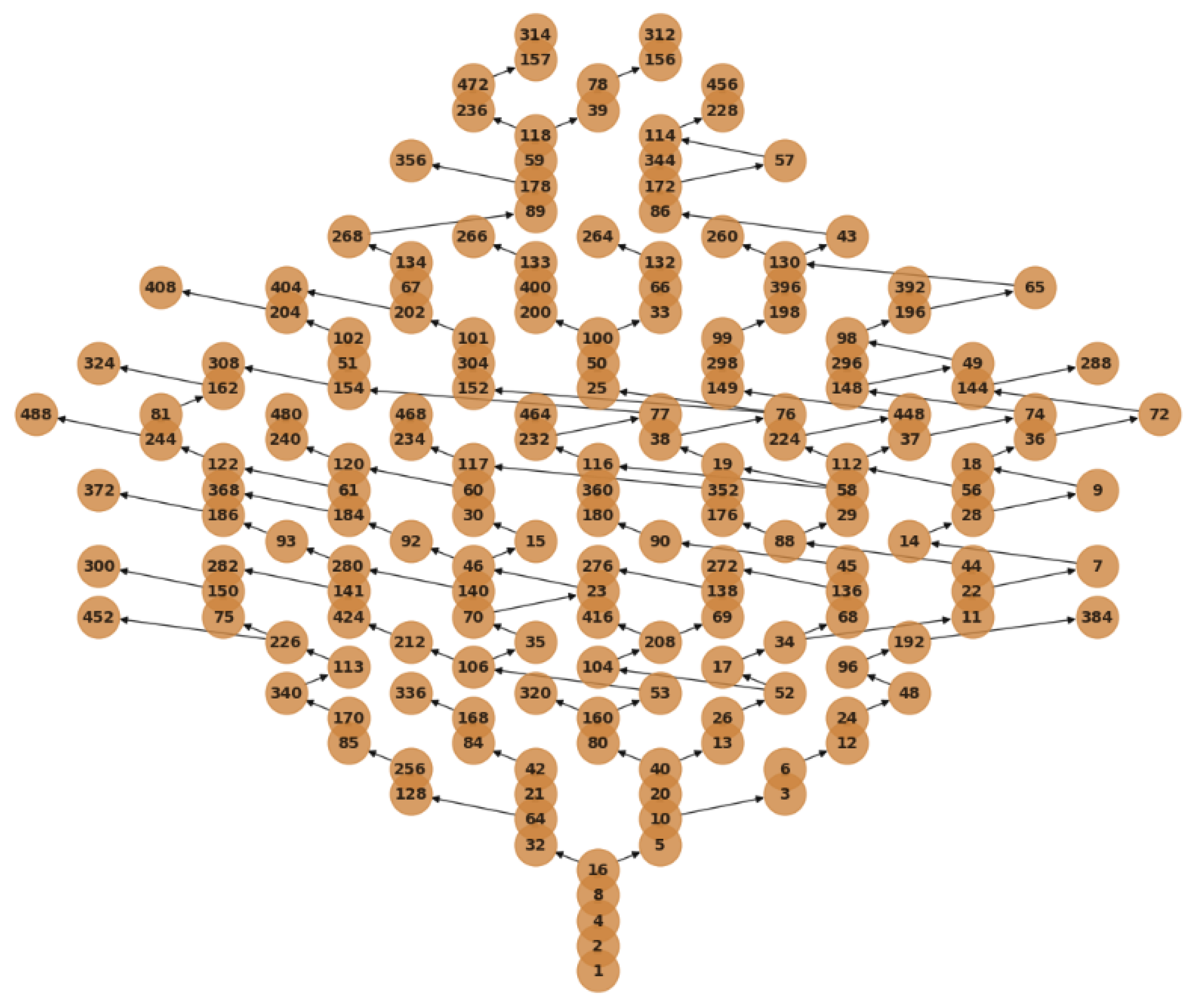
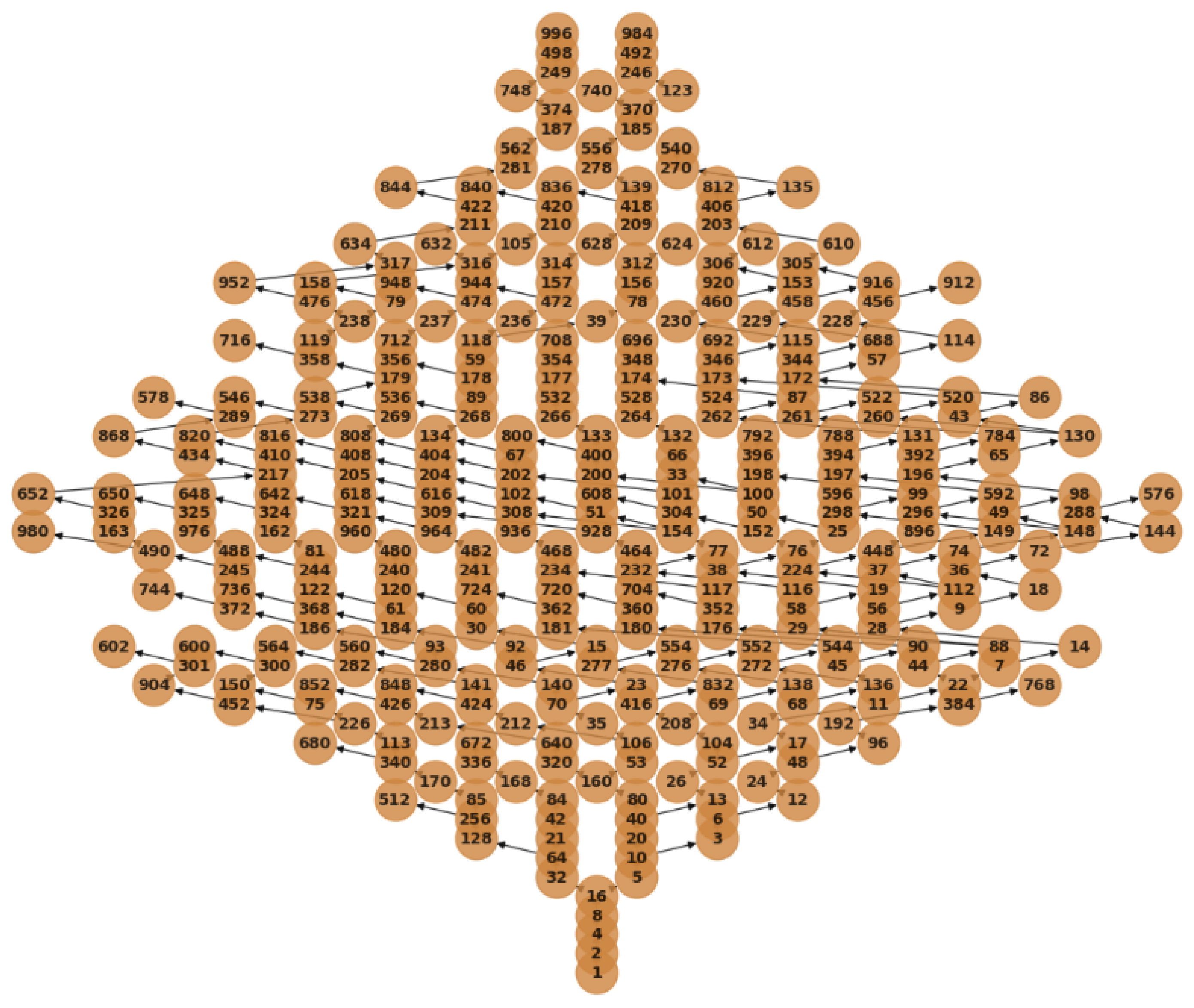
Note. These are finite-cutoff visualizations generated programmatically. They aid intuition but are not proofs of coverage.
Figure A1.
Reverse Collatz tree generated programmatically (limit = 250) (finite cutoff; visualization, not a proof)
Figure A1.
Reverse Collatz tree generated programmatically (limit = 250) (finite cutoff; visualization, not a proof)
Figure A2.
Reverse Collatz tree generated programmatically (limit = 500) (finite cutoff; visualization, not a proof)
Figure A2.
Reverse Collatz tree generated programmatically (limit = 500) (finite cutoff; visualization, not a proof)
Figure A3.
Reverse Collatz tree generated programmatically (limit = 1000) (finite cutoff; visualization, not a proof)
Figure A3.
Reverse Collatz tree generated programmatically (limit = 1000) (finite cutoff; visualization, not a proof)
References
- J. C. Lagarias, The 3x+1 Problem and Its Generalizations, The American Mathematical Monthly, Vol. 92, No. 1 (1985), pp. 3–23. [CrossRef]
- R. Terras, A stopping time problem on the positive integers, Acta Arithmetica, 30 (1976), pp. 241–252.
- Wikipedia contributors, Collatz conjecture, https://en.wikipedia.org/wiki/Collatz_conjecture, accessed 2025-03-26.
- Petro Kosobutskyy, The Collatz problem (a · q ± 1, a = 1, 3, 5,…) from the point of view of transformations of
Jacobsthal numbers, arXiv preprint, arXiv:2306.14635, 2023.
| 1 |
Indeed, implies . |
|
Disclaimer/Publisher’s Note: The statements, opinions and data contained in all publications are solely those of the individual author(s) and contributor(s) and not of MDPI and/or the editor(s). MDPI and/or the editor(s) disclaim responsibility for any injury to people or property resulting from any ideas, methods, instructions or products referred to in the content. |
© 2025 by the authors. Licensee MDPI, Basel, Switzerland. This article is an open access article distributed under the terms and conditions of the Creative Commons Attribution (CC BY) license (http://creativecommons.org/licenses/by/4.0/).