

Submitted:
25 March 2025
Posted:
10 April 2025
You are already at the latest version
Abstract
Trust is studied based on the idea that it is a topic whose importance can be said to date back to the emergence of Man, but whose analysis by scientists is relatively recent: This article records the contribution of various social sciences to the development of the construct ‘trust’, seeking to arrive at a unified conceptualization of the concept, organizing the phenomenon of trust into two essential dimensions: trust as an attitude, a dimension in which the cognitive process has a more emotional support; and a dimension more based on measurable perceptive indicators, more operationalizable and less affected by emotional factors. The study of these two dimensions of the concept is carried out on two levels: bibliographical research of the most significant authors who have attempted to define the concept, in the various perspectives from which it can be approached; questionnaire research, to characterize the representation of the concept of trust and its socioeconomic and cultural impact, by a sample of subjects of various ages, backgrounds and professions, with privileged preparation on the subject. The expected result is to outline the facets of the trust construct, to make the concept operational for the study of relational contexts at the individual, organizational and societal levels as a whole, in a context of response to the expansion of AI systems in various productive activities.
Keywords:
Artificial Intelligence systems
; Humann employment
; Knowledge Societies
; Trust
1. Introduction
Knowledge societies are complex societies that face multiple challenges, including technological innovations that lead them to establish scientific knowledge as their most important asset, both individually and collectively. Consequently, research has become a core activity and innovation a highly important cultural value. The innovations that revolutionized production systems in the past were mainly focused on tools and processes for transforming energy and matter: giving human operators facilities for executing and manipulating objects that created a sense of power and security in their living standards. The innovations that we are witnessing today are systems based on information processing and intelligent action on the energy, matter and information resources that we usually use. This radical change in technological focus means that every day we hear news of innovations in almost all fields of human activity, with a special focus on innovations in the field of Artificial Intelligence (AI) systems. It is no longer just about instruments that guarantee greater speed, precision and quality for the human operator, but about systems that do much of what the human operator is used to doing, which implies challenges that we still do not know how to define precisely.
Effectively addressing these challenges requires sociocultural instruments capable of keeping pace with the innovations that will shape future societies. The construction of appropriate responses can be supported by a culture of trust, which provides the appropriate support for the development of these instruments: the attitudes and skills required to deal with the technologies and organizational and social patterns that await us.
The scientific literature on trust shows that the study of its nature, its role, and its origins and consequences has been segmented and associated with each branch of the social sciences, which is why its conceptualization has been very diverse, both in terms of focus and angle of analysis, and even in the various definitions proposed (Finuras, 2013). Based on a relatively extensive literature review on the subject, empirical research was conducted with the aim of obtaining answers that identify the factors that promote trust, at the interpersonal, institutional, and societal levels, and allow us to explore to what extent a culture of trust will be a good support for facing complex challenges, such as those posed by the accelerated expansion of artificial intelligence systems in the economy and in the multiple activities of human life.
2. The Two Major Challenges of AI and Two Types of Response
The current technological supercycle, as Amy Webb puts it (2024), based on the combination of artificial intelligence, connected ecosystems of things and biotechnology, promises the accelerated expansion of an economy heavily based on them, which will undoubtedly be a challenge for our current way of life. In an interview conducted in 2023, the CEO of Mercedes Benz points out a series of major changes in all sectors of society: - Rapid legal advice, with 90% accuracy (compared to 70% for human lawyers); - Self-driving cars: when we need them, freeing up traffic on urban roads; - In healthcare, a device (like the “Tricorder” from the Star Trek series) that will work on a mobile phone and analyze 54 biomarkers, preventing health-related actions; - In education, 70% of all human beings are expected to own a smartphone: which will give them access to world-class education; - In agriculture, affordable agricultural robots will emerge: even in the least developed countries, farmers will be able to manage their own production. The interview shows that the interviewee has a fantastically positive view of the truly radical changes that, in his opinion, are coming. But the change may not be so positive Kai-Fu Lee (2018), a well-known AI expert, describes the four waves in which AI is evolving and occupying more and more spaces: internet AI, business AI, perception AI and finally, autonomous AI. It is the fourth wave, that of autonomous AI, that interests us in this case: when AI systems have learned to see and hear people, they will be able to identify them and define behaviors that correspond to each person’s expectations. Scholars of this problem consider that the expansion of AI systems in the field of productive activities places us before a bifurcation with two contexts:
- Context A: the decrease in human employment will be limited (20% to 30% of the current number), maintaining the idea that we will work in collaboration with AI systems.
- Context B: an extreme reduction in human employment, with only 10% to 20% of the current number of jobs remaining in human hands, with the majority of human operators left without a defined productive occupation.
The two contexts create situations that naturally require different responses. But both require a proactive, intelligent response, since either of them require significant changes in socioeconomic structures and processes and in the multiple contexts of human life. Context A, however, is less of a departure from current socioeconomic structures and processes than seems inevitable in context B; since the response to the challenges will be the development of the skills and attitudes essential for the effectiveness of mixed teams, humans and AI systems, while at the same time reducing the anxiety of human operators. Many scholars even believe that this attitude and the skills that accompany it are the most effective means of putting AI systems at the service of humanity.
Context A: Developing the essential skills and attitudes for the effectiveness of mixed teams - humans and AI systems Several studies have shown that mixed teams of humans and AI systems achieve better results than those obtained by teams consisting solely of robotics or solely of humans (Christian, 2020; Klumpp et al., 2019; Woo and Kubota, 2016). DARPA (Defense Advanced Research Projects Agency) itself has programs in this sense, seeking to build algorithms that, in addition to approaching human decision-making methods and thus facilitating interaction with human operators, respond to their concerns and reduce their anxiety and stress (DARPA, 2023). The objective of this perspective is to prepare human beings for the challenges of the complexity of the current and future world, through comprehensive training, which is not limited to preparing ultra-specialized technicians in a single technology, but rather human operators capable of a global vision and interdisciplinary reasoning. Those responsible for complex democracies will promote educational programs that increase knowledge across the full range of physical, social and behavioral sciences, integrating technical and organizational innovations into a reflection committed to the search for an increasingly human meaning of life. Table 1 lists these skills and attitudes obtained in three studies on the subject.
It is certainly interesting that three completely independent studies have identified, roughly speaking, the same set of skills and attitudes that will enable us to deal with the expansion of AI systems in the economy of the future. And it is the acquisition of these skills and attitudes that will be facilitated by the constitutive factors of a culture of trust, as we hope to show with the research carried out.
What if things do not go so well and employment is reduced to 10 or 20% of what it is today?
We will fall into context B and we will have no choice but to start by keeping in mind Harari’s (2018) desire, expressed in writings and interviews on the subject:
To face the unprecedented economic and technological disruptions taking place in this century, we need to develop new economic and social models as quickly as possible, guided by the principle of protecting humans, not jobs... Our focus must be on protecting people’s needs, their well-being and their social status.
Context B: an extreme reduction in human employment In the case of context B, more than developing the appropriate skills, it is necessary to invent innovative solutions, sufficiently complex and creative to adapt to the structures and processes of a radically new context. This is the second line of response that we will have to put into practice if we want to safeguard the quality of human life contexts: increasing our cognitive flexibility and our level of interdisciplinary knowledge of reality. Our previous studies (Parreira and Lorga da Silva, 2021) have shown that the practice of the Complex Reasoning Paradigm (PARC) and its translation into technologies based on in-depth interdisciplinary knowledge of the physical sciences and social sciences is essential for raising the cognitive level. PARC is first based on Kurt Gödel’s (1931) studies on undecidables (propositions that are true but undemonstrable within the system of which they are an essential part); was complemented by theoretical contributions from prominent authors, such as Prigogine (Prigogine & Stengers, 1984), with the idea of bifurcation, to give rise to new social structures, or based on power or based on information; and Morin (who developed the fundamental data of the Complexity Paradigm (Morin, 1967; 1984; 1990; 2011). PARC raises our level of knowledge and interdisciplinary vision of reality, increases our emotional intelligence in facing and seeking solutions to problems, and allows us to act with an objectivity as rich in information as possible, as established in PARC postulate 4: To understand a system or solve a problem with a certain level of informational complexity, a cognitive complexity of a level equal to or greater than the informational complexity of that system or problem is required. It is at this level of cognitive complexity that the preventive and intervention actions required to effectively face emerging problems in context B must be situated. And in this case too, a culture of trust appears as a solid support for the learning of these attitudes and skills.
Context B: Preventive Actions
First: to analyze in depth the contribution of the various facets of work to maintaining our quality of life: not only as a source of subsistence, but as a context for learning skills, establishing personal relationships and an activity that co-defines the meaning of our lives, to name just the main ones.
Second: given the likely reduction in human work in companies, it would be sensible to reduce weekly working hours, in order to minimize the stress of the people affected and safeguard their quality of life.
Intervention Actions
The intervention measures would aim to directly help the affected people overcome the condition of unemployment, keeping them in diverse activities, as would be normal if they had a job. Various activity profiles may coexist, but the central core of all of them will be skills development programs that favor different types of social integration, from carrying out occasional work to training as entrepreneurs, who are expected to play a relevant role in knowledge societies.
In order to verify to what extent a culture of trust can be a favorable instrument for implementing the measures set out for contexts A and B, research was conducted on the construct of trust, in an effort to integrate into a single, comprehensive concept the contributions of the various authors who dedicated themselves to its study. This concept was then subjected to empirical research on the factors that constitute it and generate trust behavior, thus answering the research question that is the origin of the research carried out in this article.
The Multiple Facets of Trust: The Interpersonal, Institutional and Societal Planes
Trust can be public or private, reflect a moral commitment or be the result of a simple arrangement of circumstances, or be seen as a public good, a “hidden wealth” (Halpern, 2010) or a true “invisible tax” when absent (Fukuyama, 1996). It is this multiplicity of planes that we will review, in search of the unifying concept of the different perspectives.
The Interpersonal Dimension of Trust
Psychologists have approached trust primarily as an individual characteristic (Rotter, 1967; Novelli, Fisher and Mazzon, 2006). From this perspective, Hardin (1992) observes that the rational interpretation of trust includes two central elements: knowledge of the other, which allows one to trust him/her; and the incentives of the trusted person (Finuras, 2013), by showing that he/she will honor the trust placed in him/her. Kuo and Yu (2009) also assert that the development of trust is strongly based on interpersonal relationships; and Cruz et al. (2018) point out that inclusion is a very strong attribute of trust, measured based on interactions established between people. A study carried out by Marina Barros (Barros, Formiga and Vasconcelos, 2021) confirms this result, making it quite clear that emotional closeness is a relevant psychological factor in the emergence of trust: trust is greater between family members (91% of respondents), then between friends (78%), then between neighbors and between coworkers (67%). Baier (2004) also assumes that goodwill is the crucial element for interpersonal trust; and Nooteboom (1992) and Putnam (2001) point out, in addition to goodwill, trust in competence, that is, the ability to act according to expectations, as a complement to good faith and rectitude of intentions. In this way, the interpersonal dimension of trust seems to be well established.
Trust from the Perspective of Social Processes
Economists, sociologists and political scientists have studied trust as an institutional phenomenon with extrinsic value and with a real impact on the economy and transaction costs. Zand (1972), for example, states that trust is a way of regulating our dependence on others, and Luhmann (1995) confirms that, in situations of interdependence, it allows for the reduction of uncertainty. Anthropologists have analysed it as a cultural phenomenon, indicating that in societies with more ‘individualistic’ and ‘universalist’ cultural values there seems to be more trust than in societies with more ‘collectivist’ or ‘exclusivist’ cultural values (Hofstede Hofstede and Minkov, 2010; Minkov, 2011; Uslaner, 2002). an economic perspective, trust is identified as “having faith in the ability and intention of a buyer to pay in the future for goods provided without payment in the present” (Sabourian and Anderlini, 1992); and Fukuyama (1996) insists that the greater the trust in institutions and relationships, the lower the transaction costs. McAllister, (1995), in turn, suggests that trust is a fundamental element for the development of economies, social relations and society in general. Fukuyama (2002), finally, argues that the formation of trust is inherent to the environment and the culture that shapes it, elevating trust to the position of a driving factor in cycles of social and economic development. In the field of politics, Almond and Verba (1963, p. 211) showed that a culture conducive to democracy presupposes a feeling of “trust and confidence” in the social environment; and, therefore, Power and Jamison (2005) argue that the design of the institutions themselves is a factor to consider: if the design of a political institution makes citizens see authorities as distant and, consequently, impossible to be held accountable, or even scrutinized, trust in these institutions diminishes. Therefore, a more complete understanding of trust requires a deeper understanding of the various expressions of the phenomenon itself, since empirical evidence supports that they are facets of trust that form a coherent construct of the phenomenon.
Barbara Misztal (1996) suggests that three dimensions should be distinguished in the analysis of trust: 1) stability (which represents the predictability, reliability and legibility of social reality); 2) cohesion (which can be seen as a dynamic of normative integration); and 3) collaboration (which refers to social cooperation). Nooteboom (2006), in turn, proposes, in agreement with Misztal, that two major dimensions should be distinguished: trust (an attitude of felt trust) and confidence (a calculated level of trust). And although there is a certain tendency among social scientists to merge both terms, many recall the German proverb Vertrauen ist gut, Sicherheit noch besser (trust is good, certainty is better), to distinguish the cognitive and emotional states of the constructo
Towards an Integrative Concept of the Core Dimensions of Trust
The contribution of these authors leads us to propose a synthesis that integrates the topics highlighted by each one into two specific types of trust:
- trust as an attitude, based on emotional expectation, created in a personal relationship with a positive tone;
- trust as creditation or accreditation, with various levels of certainty, based on the assessed probability of certain behavior,
The first type of trust - trust as an attitude based on an intersubjective relationship - is more emotional and characteristic of human interactional contexts, between actors who have the identity of subjects, of people, aware of their own motivations and objectives, drivers of a self-constructed destiny. The second type of trust - trust as accreditation - is more cognitive and allows for two levels of security, which are part of the structural security: the techno-scientific level, specifically the responsibility of experts; and the user level, whose trust is much more subjective and is based on the probability of obtaining responses that facilitate the achievement of their objectives and the results that the user wants. The two dimensions of trust are present every time we express it in relation to someone or some entity. What varies, depending on the situation, is the proportion of each component in the trust that we express, a proportion that may be more or less appropriate to the moment and the context. The choice of an appropriate combination of the two dimensions will be a useful tool if we know how to characterize the type of actor with whom we are establishing a relationship: we will be able to face more intelligently the various types of problems encountered in the socioeconomic contexts of today’s complex societies.
It is this theme of trust that was the subject of the empirical research presented below, with the aim of evaluating whether the factors that promote trust, at the interpersonal, institutional and societal levels, and the impact of trust patterns on the quality of social relations will be a good support for facing the challenges posed by the accelerated expansion of artificial intelligence systems.
3. Empirical Research; Factors of a Culture of Trust and Their Impact on Responding to AI Challenges
The empirical research on the topic of trust had two phases: bibliographic exploration of texts on the topic, aiming to create a theoretical support that would ensure a correct interpretation of the data obtained and support the development of a questionnaire with construct validity; and the development of the questionnaire - QUEST-CONF - with the aim of obtaining responses that identify the factors that promote trust, at the interpersonal, institutional and societal levels, and assess the impact of trust patterns on the quality of relationships, at these three levels.
Research Question
To what extent do the structuring factors of a culture of trust favor the learning of attitudes and skills that ensure the consistent practice of the two lines of action necessary to effectively face the challenges of the two contexts (A and B) that the expansion of AI systems in the economy and in life in general pose to human agents.
Based on this question, two guiding hypotheses were defined:
H1 - A culture of trust creates an environment favorable to the development of appropriate skills to respond to the challenges of an economic context of type A.
H2 - A culture of trust creates the appropriate environment for the development of the attitudes and skills necessary for the construction of structures and processes required by the current socioeconomic conditions in a context of type B.
Methodological Analysis Procedures
Qualitative analysis of the data and its interpretation, based on the criteria of the trust model, on the criteria defining complex democracy and its implications for the regulation of the various types of market; and statistical analysis of the variables and factors of trust, with Stata (StataCorp. 2023).
The Questionnaire
The questionnaire used has two parts: the first, in the form of a semantic differential (Osgood & Tannenbaum, 1957), on the factors that can contribute to the creation of a culture of trust in today’s societies (33 items); the second, on the impact of trust on social processes (16 items). The items of the two parts of the scale are evaluated based on an interval scale, created and validated in previous studies (Parreira, 2003; Parreira and Lorga da Silva, 2014; 2016). The questionnaire was sent and answered online, through Google Forms.
The Sample
For the purposes of applying the questionnaire interviews, an intentional sample was used consisting of qualified respondents in Brazil and Portugal (university professors and technicians working in activities related to the Social Sciences), totaling 106 respondents (Table 2).
The characteristics of the sample allow us to assume that the responses on the role of trust are well-informed. They will thus allow us to consider that the behavioural patterns identified by the respondents as constituting a culture of trust facilitate the adoption of intelligent measures to respond to the challenge posed by AI systems: - first, to the accelerated development of human skills necessary for the adoption of collaborative practices with AI systems and, consequently, favourable to the sustainability of human employment (context A, pp. 6-8) - second, to the innovative effort required to creatively adapt to an extreme scenario of drastic reduction in productive human work, developing and consolidating behavioural patterns that may be even more favourable to the quality of human life.
The Culture of Trust and Dealing with the Innovations That Will Shape Our Future
The techno-social innovations currently underway will tend to create one of two contexts (A and B) identified above as the two probable lines of socio-economic reorganization of current societies. The first question in this regard is to know to what extent a culture of trust favors the acquisition of diversified competence patterns that enable human operators to deal with AI systems, first in the productive activities of context A, in which the reduction of human employment will be limited and the economy will be based on extensive collaboration between human operators and AI systems.
The Role of a Culture of Trust in Building Adaptive Responses to Context A
Table 1 highlights the skills identified in three studies for this type of context; and Table 3 highlights the factors of a culture of trust that appear to be most conducive to the adoption of attitudes and skills conducive to the creation of collaborative teams of human operators and AI systems. High averages in the factors conducive to a culture of trust indicate greater support for the idea that a culture of trust provides a context conducive to the development of the attitudes and skills necessary for a positive response to the expansion of AI systems.
The averages achieved in these factors are all very high: the amplitude of the scale is between 0.37 (not at all) and 9.49 (extremely), i.e., 9.12; as all the factors are above (and almost all very above) the mathematical average of the scale (4.56), we consider the result to confirm H1, especially since the sample data are consistent with the interpretation of the results. Only one of the variation coefficients is slightly superior to 0,3 and other concerning “The greater the trust, the less waste of material and human resources” is superior to 0,3 (both bold signaled), showing a elevate dispersion concerning this last response ≈0,5.
The second guiding hypothesis of the research concerns context B, characterized by an extreme reduction in human employment in economic activities. It is a context radically different from the current one, which requires a set of large-scale changes in structure and social behavior, implemented in incremental but also radical innovations (Laranja, 1996). The actions to respond to these changes were described above as preventive and intervention actions (pp.10-13): they require, mainly from leaders, but also from citizens, an attitude and a range of skills that are less linked to the operational level and more to the strategic level, such as complex critical thinking; creativity, individual and collective resilience; the ability to improvise and high citizenship behavioural patterns, particularly in the factors of altruism, initiative and conscientiousness.
In relation to these attitudes and behavioural patterns, the culture of trust can be an even more sustainable support, as can be inferred from the content of the factors presented in Table 4: they show that a culture of trust among citizens and in society in general will be one of the greatest factors impacting the capacity to adapt to the conditions of context B (extreme reduction in employment).
- The free circulation of information will certainly be an extremely fertile ground for innovative solutions, especially if accompanied by transparency in decisions and easy contact between different people; and the promotion of innovative decisions is all that is needed when problems are complex.
- The prompt ‘confrontation of problems and the rapid implementation of important decisions’ (item 11) is another factor that is highly favorable to the effectiveness of the response to complex challenges with risky consequences, as Beck (1992) highlighted; and we know that this is the case with the problems associated with the expansion of AI systems in the most diverse areas of the Economy.
- Avoiding mistakes (item 36) and making more objective decisions (item 49) are undoubtedly crucial factors for intelligent responses to the challenges to be faced, in any of the contexts, but particularly in context B. These results are such as to validate H2, since they contribute to increasing the quality of decisions and the confrontation of challenges and problems, thus contributing to the acceptance and implementation of measures capable of responding to the problems created in context B, if this materializes in the near future.
4. Conclusions
The confluence of meanings between the factors that create trust, and the skills and attitudes required for effective responses to the challenges of the future paves the way for a two-way prospective conclusion on the role of a culture of trust in the sustainability of human actions:
- The first results from the recognition of the potential positive impact of a culture of trust on the quality of social relations and even the creativity of the groups that experience it;
- The second has to do with the possibility of developing this culture of trust in human societies and, consequently, benefiting from its positive impact on our quality of life. In fact, the social sciences of the knowledge society now have scientific models of action and technologies capable of implementing projects to implement this culture among the various components of society.
Our researchers are already preparing some projects in this direction, aware that it is necessary to move forward in this direction, even if the first steps may be a little less certain than desired.
Author Contributions
“Conceptualization, Artur Parreira. and Rui Moura.; methodology, Artur Parreira and Ana Lorga.; software, Ana Lorga.; validation, Ana Lorga and Artur Parreira.; formal analysis, Ana Lorga.; investigation, Artur Parreira.; writing—original draft preparation, Artur Parreira, Rui Moura and Ana Lorga
Conflicts of Interest
“The authors declare no conflicts of interest.
References
- Almond, G. & Verba, S. (1989). The civic culture: Political attitudes and democracy in five nations. Princeton: Princeton University Press.
- Amy Webb (2024) Tech Trends Report: Technology Supercycle. What’s that? Why could it obliterate your business? (Or save it?).
- Baier, Annette (1986) Trust and Antitrust, Ethics vol. 96, no. 2, pp. 231–260.
- Barros, M. B., Formiga, N. S., & Vasconcelos, C. R. M. (2021) Research, Society and Development, v. 10, n. 5, e53610515299, 2021, (CC BY 4.0) | ISSN 2525-3409 |. [CrossRef]
- Beck, U. (1992). Risk society. London: Sage.
- Christian, Brian (2020). The alignement Problem – How can Artificial Intelligence Learn human values? London: Atlantic Books.
- Churchland, P. (2011). Braintrust: what neuroscience tells us about morality. Oxford: Princeton University Press.
- Cruz, G. A. M., Moriya-Huzita, E. H., Feltrim, V. D., & Arsenal G. S. D. (2018). A framework for trust estimation in virtual teams based on sentiment analysis. Information and Software Technology, 95, 46-61.
- DARPA (Defense Advanced Research Projects Agency) (2023), programa ASIST para construir sistemas de IA com as competências necessárias a uma efetiva colaboração homem-máquina.
- Finuras, P. (2013) Confiança nas Instituições e Valores Culturais (estudo em 4 países lusófonos). Tese doutoramento, Universidade Lusófona de Humanidades e Tecnologias.
- Forbes Newsletter 14.09.22.
- Fukuyama, F. (1996). Confiança. Variação internacional de valores, pp. 97-118. Lisboa: Gradiva-Publicações Lda.
- __________, (2002). Capital Social. In: Harrison, L; Samuel, Huntington Cultura Importa: Os valores que definem o progresso humano. Rio de Janeiro: Record.
- Giddens, A. (1984). The constitution of society. Cambridge: Polity Press.
- Giddens, A. (1991). Modernity and Self-Identity.Standford: University Press.
- Gödel, K. (1931) Über formal unentscheidbare Sätze der Principia Mathematica und verwandter Systeme; (English version by Solomon Feferman, (ed. 1986) On formally undecidable propositions of Principia Mathematica and related systems in Kurt Gödel Collected works, Vol. I. Oxford University Press:144-95.
- Halpern, D. (2010). The hidden wealth of nations. Cambridge: Polity Press.
- Harari, Yuval Noah (2018) 21 Lessons for the 21st Century Publisher: Spiegel & Grau.
- Hardin, R. (1992). Morality within the limits of reason. Chicago: University of Chicago Press, Johns Hopkins University Press.
- Hofstede, G., Hofstede, G. J. & Minkov, M. (2010). Cultures and organizations; Software of the mind. Intercultural cooperation and its importance for survival (Revised and expanded third edition). London: McGraw Hill.
- Kai-Fu Lee (2018): AI Super Powers – Cina, Sillicon Valley and the new world order. N.Y.; Houghton Mifflin Harcourt.
- Klumpp, M. ; Hesenius, M.; Meyer, O.; Ruiner, C. & Gruhn, V. (2019) Production logistics and human-computer interaction: state-of-the-art, challenges and requirements for the future. International Journal of Advanced Manufacturing Technologies, [s. l.], v. 105, p. 3691-3709, 2019. https://doi.org/10.1007/s00170-019-03785-0.
- Kuo, F. & Yu, C. (2009). An exploratory study of trust dynamics in work-oriented virtual teams. Journal of Computer-Mediated Communication, 14, 823–854.
- Laranja, M. (1996) - Inovação tecnológica. Texto Editora. Porto.
- Luhmaan, N. (1995). Social systems. Stanford: University Press.
- McAllister, D. J. (1995) Affect- and cognition-based trust as foundations for interpersonal cooperation in organizations. Academy of Management Journal, v.38, n, 1, p. 24-59, Georgetown University.
- Mckinsey Global Institute (2017, December 6). Jobs Lost, Jobs Gained: Workforce Transitions in a Time of Automation. MGI-Jobs-Lost-Jobs-Gained-Report-December-6-2017.pdf.
- Minkov, M. (2011). Cultural differences in a globalizing world. London: Emeralg Group Publisching.
- Misztal, Barbara (1996) Trust in Modern Societies: The Search for the Bases of Social Order Cambridge, Mass.: Polity Press.
- Morin , E. (1977) La Methode 1. La Nature de la Nature. Paris: Éditions du Seuil.
- _________(1990) Introduction à la pensée complexe ESF, Paris.
- ________ (2001) L’Humanité de l’humanité (t. 5), L’identité humaine, Paris: Le Seuil.
- ________ (2011), Mes Philosophes Paris: Éditions Germina.
- Musk, E. (2024) Palestra-entrevista no VivaTech de Paris (22-25 de Maio, 2024).
- Nooteboom, B. (1992). Towards a dynamic theory of transactions. Journal of Evolutionary Economics, 2, 281-99.
- Nooteboom, B. (2006). Social Capital, Institutions and Trust. (Tilburg University, CentER Discussion Paper; Vol. 2006-35).
- Novelli, J. G. N., Fisher R.M. e Mazzon, J. A. (2006) Fatores de confiança interpessoal no ambiente de trabalho. RAUSP, São Paulo, 41(4), 442-452.
- Osgood, Ce.; Sucl G.J. y Tannenbaum, P.H. (1957).The measurement of meaning. Urbana: Univer. Of Illinois Press.
- Parreira, A. & Lorga da Silva (2014) A Study of an Interval Scale for a Motivation Test. Proceedings of SMTDA Congresso pp.579-592, 14 June, Lisboa.
- ________________ (2016) The use of numerical value of quantity and frequency adverbs in the measurement of behavior patterns: transforming ordinal scales into interval scales. Revista Ensaio – Avaliação e Políticas Públicas em Educação, Vol. Nº 90 p.109-126. ISSN 1809-4465.
- Parreira, A., Lehmann, L. & Oliveira, M. (2921) O desafio das tecnologias de inteligência artificial na Educação: percepção e avaliação dos professores. Ensaio: Aval.Pol.Públ.Educ.,Feb 22, 2021 pp 975-999 ISSN 0104-4036. [CrossRef]
- Parreira, A.& Lorga da Silva ,A. (2021) The Complexity Paradigm: towards a Model for the Analysis od Social Systems and Problems. Facta Universitatis, Series Economics and Organizations, Vol. 18, Nº 5, Belgrade University.
- Power, T.J. & Jamison, G. D. (2005). Desconfiança política na América Latina. Revista Opinião Pública, v. 11, n. 1, p. 64-93.
- Prigogine, I. & Stengers, I. (1984). Order out of Chaos: Man’s new dialogue with nature. Flamingo.
- Putnam, R. (2001). Social Capital: Measurement and consequences. In The contribution of human and social capital to sustained economic growth and well-being. International Symposium Report, OECD / HRDC.
- Rotter, J. B. (1967). A new scale for the measurement of interpersonal trust. Journal of Personality, 35(4), 651–665.
- Sabourian, H., Anderlini, N. (1992). Exchange and value: An anthropological approach. Cambridge: Cambridge University Press.
- StataCorp. 2023. Stata Statistical Software: Release 18. College Station, TX: StataCorp LLC.
- Uslaner, E. (2002). The moral foundations of trust. New York: Cambridge University Press.
- Woo, Jinseok & Kubota, Naoyuki (2016), Human-Robot Interaction Design, Using Smart Device Based Robot Partner International Journal of Artificial Life Research Volume 6 Issue 2, pages 23-43, IGI Publishing Hershey, PA, USA.
- Zand, E.E. (1972). Trust and managerial problem solving. Administrative Science Quarterly, v.17, n.2, p.229-239.

Table 1.
List of essential skills for the future, in three studies.
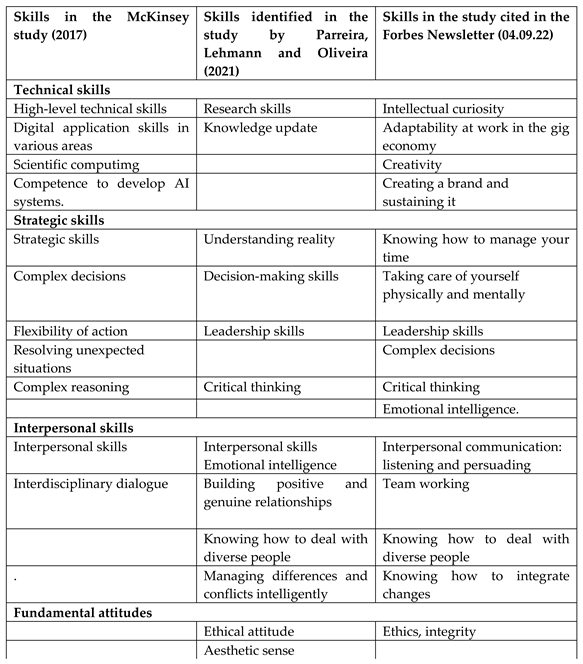
Source: the authors from the quoted texts.
Table 2.
Sample characterization.
| Gender | Age | Education | Study area | ||||
| F | 44 | 21- 30 | 0 | High School | 4 | Engineering, Finance Accounting | 4 |
| 31-40 | 7 | Bachelor’s degree | 21 | Social Sciences, Psychology, Education | 29 | ||
| 41-50 | 6 | Master’s degree | 9 | Philosophy, Literature | 4 | ||
| I > 50 | 31 | PhD | 10 | Health Sciences | 3 | ||
| M | 62 | 21- 30 | 2 | High School | 3 | Engineering, Finance Accounting | 19 |
| 31-40 | 5 | Bachelor’s degree | 12 | Social Sciences, Psychology, Education | 31 | ||
| 41-50 | 12 | Master’s degree | 19 | Philosophy, Literature | 6 | ||
| I > 50 | 43 | PhD | 28 | Health Sciences | 10 | ||
| Total | 106 | 106 | 106 | ||||
Source: the authors.
Table 3.
Trust culture factors most associated with positive responses to context A (collaborative): mixed human and AI teams.
Table 3.
Trust culture factors most associated with positive responses to context A (collaborative): mixed human and AI teams.
| Average | Standard Deviation | Variation Coefficient | |
|---|---|---|---|
| Leaders in all areas of government and production use resources sustainably, avoiding waste as much as possible | 9,25 | ,672 | 0,072 |
| Most people place great value on respect and ethical behavior in relationships between people | 9,29 | ,449 | 0,048 |
| There must be an effective culture of professional pride, dedication and competence in society | 8,88 | 1,983 | 0,223 |
| Candidates for important roles in society should always be chosen based on demonstrated skills and not on games of interest | 8,54 | 2,602 | 0,304 |
| The greater the level of trust in a relationship, the fewer mistakes are made | 7,01 | 2,161 | 0,308 |
| The greater the trust, the more genuine the social relationships | 8,61 | 1,403 | 0,163 |
| When there is trust, relationships between people become deeper | 8,21 | 1,847 | 0,225 |
| Trust facilitates the creation of productive synergies | 8,75 | 1,173 | 0,134 |
| The greater the trust, the easier it is for innovative ideas to emerge | 7,76 | 2,239 | 0,288 |
| The greater the trust, the less waste of material and human resources | 5,58 | 2,775 | 0,497 |
Source: The authors.
Table 4.
Factors associated with positive responses to the context of extreme reduction in human employment.
Table 4.
Factors associated with positive responses to the context of extreme reduction in human employment.
| Average | Standard Deviation | Variation Coefficient | |
|---|---|---|---|
| To be free circulation of information and freedom of opinion, without centralized control by governments | 8,04 | 3,123 | 0.388 |
| Transparency in actions and decisions being common practice among political, social and economic leaders | 9,09 | ,739 | 0,081 |
| Diversity of people and conditions (race, gender, age, religion, opinion) is well accepted, without rigid barriers between groups and classes | 9,05 | 0,968 | 0,106 |
| To be great ease of contact between people, through various channels and virtual networks | 8,70 | 1,302 | 0.149 |
| Political leaders have the habit of making decisions on time, not postponing important decisions. | 9,75 | 1,130 | 0,129 |
| Government leaders should demonstrate an effective ability to solve problems, even complex ones | 9,08 | 0,581 | 0,06 |
| Leaders should encourage innovative attitudes and the search for effective solutions to problems | 8,84 | 1,162 | 0,131 |
| The greater the trust between people, the more objective the decisions taken together are. | 7,85 | 2,012 | 0,26 |
Disclaimer/Publisher’s Note: The statements, opinions and data contained in all publications are solely those of the individual author(s) and contributor(s) and not of MDPI and/or the editor(s). MDPI and/or the editor(s) disclaim responsibility for any injury to people or property resulting from any ideas, methods, instructions or products referred to in the content. |
© 2025 by the authors. Licensee MDPI, Basel, Switzerland. This article is an open access article distributed under the terms and conditions of the Creative Commons Attribution (CC BY) license (http://creativecommons.org/licenses/by/4.0/).
Copyright: This open access article is published under a Creative Commons CC BY 4.0 license, which permit the free download, distribution, and reuse, provided that the author and preprint are cited in any reuse.