
Submitted:
07 April 2025
Posted:
08 April 2025
You are already at the latest version
Abstract
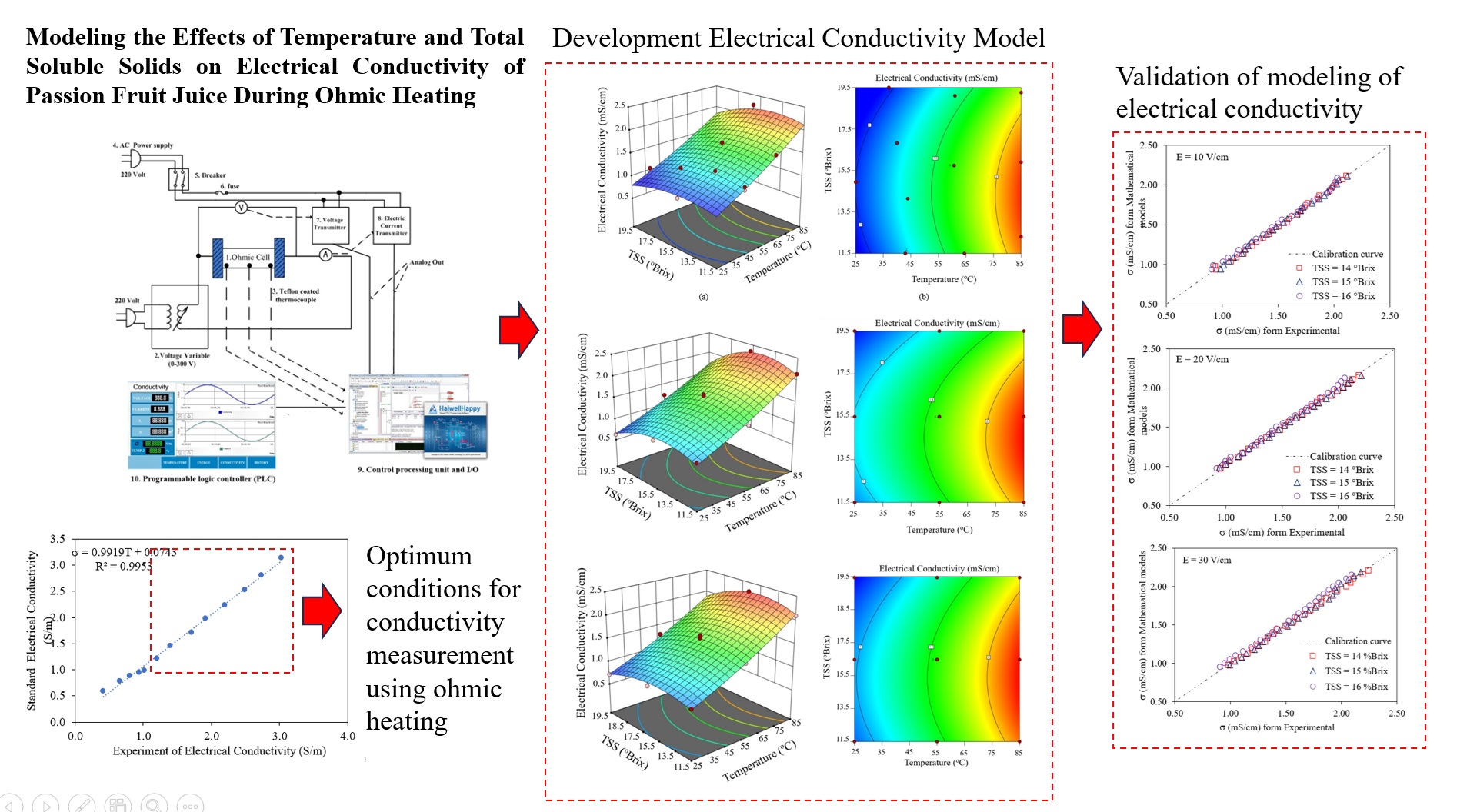
This study examines the impact of temperature and total soluble solids (TSS) on electrical conductivity (EC) of passion fruit juice during ohmic heating to establish predictive mathematical models. Experiments were carried out on juice samples with a TSS of 11.5, 15.5, and 19.5 °Brix, exposed to voltage gradients of 10, 20, and 30 V/cm, and heated from 25°C to 85°C. The results indicated that EC increased with temperature and was nonlinearly related to TSS. High TSS increased conductivity at first, but excess TSS decreased EC due to higher viscosity, less free water, and ion-sugar interactions. Linear and nonlinear regression models were tested for predicting EC. A second-order polynomial model that included temperature, TSS, and their interaction terms exhibited the highest accuracy, with R² values as high as 0.9974, coupled with low RMSE and χ² values. The research validates ohmic heating as a means of electrical conductivity behavior determination in fruit juices and provides a model that has been validated to enable process optimization and control in passion fruit juice thermal processing and vacuum evaporation. The model serves as a tool for real-time process control and can be applied to industrial-scale ohmic heating systems in tropical fruit juice processing.
Keywords:
ohmic heating
; passion fruit juice
; electrical conductivity
; mathematical models
; nonlinear regression
1. Introduction
Heating is a critical operation for food safety, extended shelf life, and product stability. Traditional heating methods such as conduction and convection are usually beset with inefficiencies such as non-uniform heating, long processing time, and product degradation, particularly for heat-sensitive products such as fruit juice [1-2]. These inefficiencies have driven growing focus on other technologies that can heat faster, uniformly, and with less impact on nutritional and sensory attributes.
Ohmic heating, a high-tech thermal process, applies electric current directly on the food for the sole purpose of inducing energy dissipation internally. Ohmic heating offers a number of advantages relative to conventional processes, for example, volumetric heating, reduced surface degradation, and improved retention of color, flavor, and antioxidant content [3-4]. Ohmic heating has been effectively utilized on a wide range of liquid and semi-liquid foods during the last few years, and thus, it is a suitable answer for high-quality thermal processing for the juice industry [5]. One of the most significant factors governing the performance of ohmic heating is the electrical conductivity (EC) of the food matrix. EC determines the generation of heat and is a function of the physicochemical factors such as temperature, ionic content, viscosity, and compositional factors [6]. EC is increased with increasing temperature due to greater mobility of ions and lower viscosity [7]. EC is not linearly correlated with total soluble solids (TSS), a measure of soluble sugars, acids, and minerals. Increased concentration of ions at lower levels of TSS is beneficial. But at higher levels of Afraz et al [3-], nonlinear behavior is attributed due to factors such as increased viscosity, lower free water content, interactions of ions with the solutes, and electrostatic crowding, which hinder the mobility of charge [7-8].
While previous studies have explored EC variation with other juices, most analyze a single factor or apply linear models that fail to capture interaction and nonlinear effects [9-12]. Empirical relationships have been proposed for EC as a function of concentration of the solutes and temperature, but few of these deal with their combined effect under dynamic conditions of ohmic heating. Furthermore, tropical fruits like the passion fruit (Passiflora edulis), with their high citric acid and mineral content, display unusual physicochemical behavior, making EC prediction challenging. Nevertheless, the available EC models tend to be limited to fixed composition and not validated for the whole operational range of the TSS and voltage gradients, particularly for tropical juice systems like the passion fruit [13-14]. Passion fruit juice is a complex matrix of organic acids, soluble sugars, and mineral ions with dynamic electrothermal behavior. These constituents influence the dissociation of ions, the hydration, and the charge transport, particularly under increasing gradients of concentration and temperature. As such interactions become compounded by the application of ohmic heating, EC variation under these coupled factors is important for the accurate modeling and control of the process. Furthermore, the lack of validated models for the wide operational range hinders the application of the technology into tropical fruit processing.
The aim of this work is to analyze the combined effect of total soluble solids (TSS) and temperature on the electrical conductivity of passion fruit juice under the conditions of ohmic heating with varying voltage gradients (10, 20, and 30 V/cm). Nonlinear regression was employed for the formulation of empirical models from experimental data for the ranges of 25–85 °C of temperature and 11.5–19.5 °Brix of TSS. The proposed second-order polynomial model with the effects of the factors and interaction terms was validated for precision with statistical measures (R², RMSE, χ²). The nonlinear EC response with these factors not only deepens the understanding of the physicochemical aspects but also provides the groundwork for the optimization of the application of ohmic heating for the processing of tropical juice. The validated model can be utilized as a predictive tool for equipment design and dynamic process control of the processes of pasteurization and concentration of fruit juice with the application of ohmic heating.
2. Materials and Methods
2.1. Materials
The passion fruit utilized in this study was sourced from the Royal Project Development Center located in Mae Hae, Mae Hae District, Chiang Mai Province, Thailand. The passion fruit was cleaned, and the pulp and juice were extracted separately. Total soluble solids (TSS) were measured using a digital refractometer (Hanna Instruments, HI 96801, Woonsocket, RI, USA).
The measured value was determined to be 11.5 °Brix. The passion fruit juice was subjected to evaporation using a rotary vacuum evaporator (Heidolph Instruments, Hei-VAP Core, P/N: 573-01300-00, Schwabach, Germany) at 40 °C until the total soluble solids (TSS) reached 15.5 and 19.5 °Brix respectively. The concentrated passion fruit juice samples were contained in 5-liter aluminum foil bags and maintained at -18°C prior to experimentation.
2.2. Ohmic Heating System
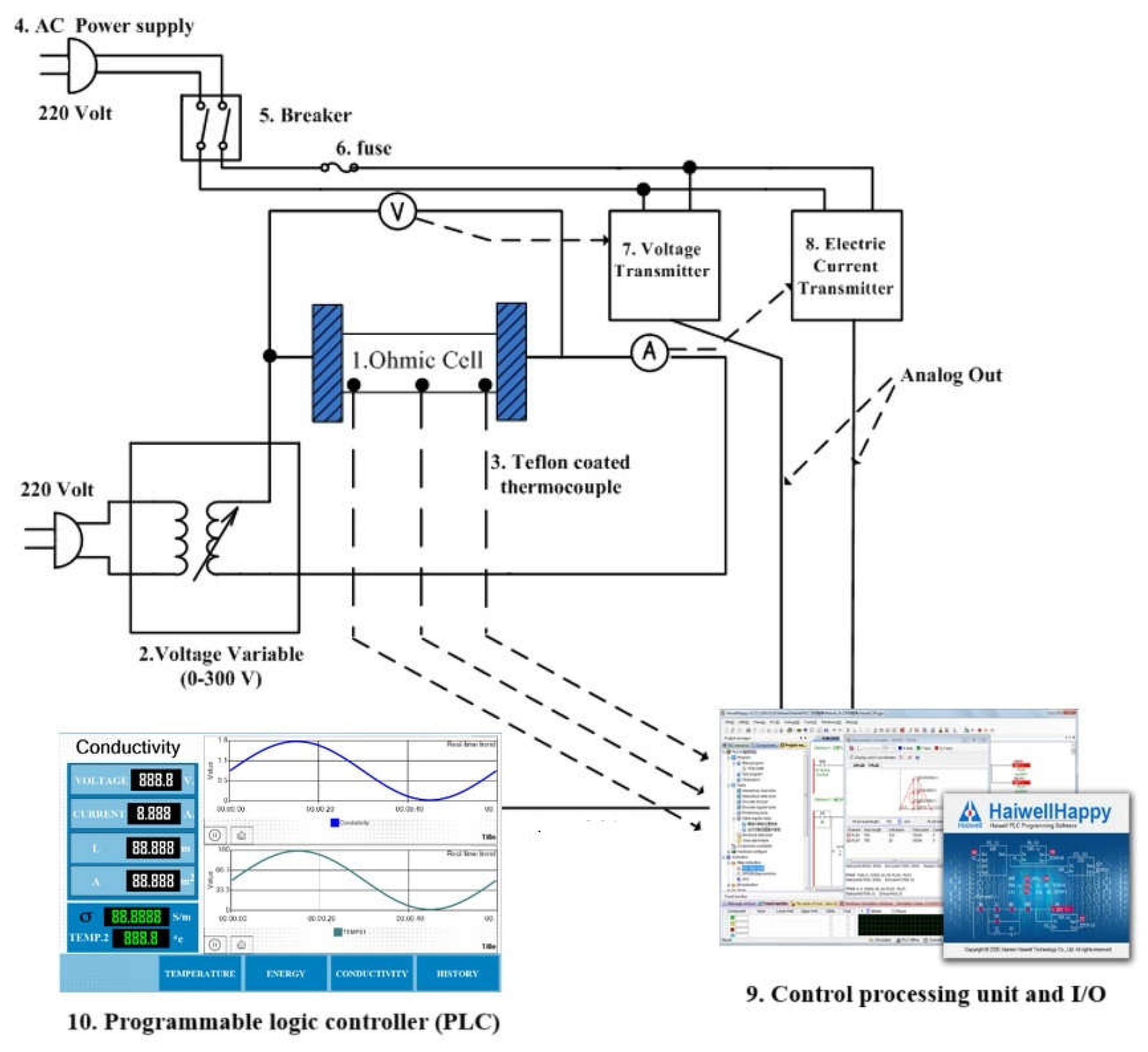
The Maejo University Faculty of Engineering and Agro-Industry in Thailand developed a laboratory-scale ohmic heating system to measure fruit juice electrical conductivity. The system has three main parts: A voltage regulator (0–220 V, 50 Hz) powers the electrodes, and a low-resistance digital ammeter measures current precisely. Ohmic Cell: Made of acrylic tube (25 mm diameter, 10 mm length, 3 mm thickness), it features SUS316 stainless steel electrodes (60 × 150 × 1 mm) and three centrally placed temperature sensors for precise thermal monitoring. Processed with programmable logic controller (Haiwell model D7-G, China) measurement system records temperature, current, and voltage in real time for accurate data analysis.
Figure 1.
Diagram of conductivity measurement system during ohmic heating. 1) Ohmic cell 2) Voltage variable 3) Thermocouple 4) Power supply 5) Circuit breaker 6) Fuse 7) Voltage transmitter 8) Current transmitter 9) Control processing unit and I/O 10) Programmable logic controller
Figure 1.
Diagram of conductivity measurement system during ohmic heating. 1) Ohmic cell 2) Voltage variable 3) Thermocouple 4) Power supply 5) Circuit breaker 6) Fuse 7) Voltage transmitter 8) Current transmitter 9) Control processing unit and I/O 10) Programmable logic controller
2.3. Electrical Conductivity of Fruit Juices Under Different Conditions
The measurement of electrical conductivity during the ohmic heating of fruit juices attracted attention due to its implications for the efficiency of the heating. Studies indicate that conductivity changes are related to thermal processes, improving the conservation of fruit juice [6,15]. The application of an electric field induces ion migration within an electrolyte toward electrodes of opposite charge, resulting in Joule heating. Similarly, when an alternating current is applied to a food sample positioned between two electrodes, internal heat generation occurs due to ionic movement. Electrical conductivity (σ, S/m) is a fundamental parameter in this process and can be determined from voltage and current measurements using the following equation:
where L represents the distance (m) between two electrodes, V voltage (volts), I current (amps), and A represents the liquid contact area (m2) of the electrode.
2.4. Electrical Conductivity Model
A mathematical model was created to forecast the variation in electrical conductivity of passion fruit juice during ohmic heating across a temperature range of 20 to 85°C and three total soluble solids (TSS) levels: 11.5, 15.5, and 19.5°Brix. The electrical potential was systematically adjusted to 10, 20, and 30 V/cm, respectively, utilizing non-linear regression analysis conducted with SPSS. The model structure was defined as:
where: A, B, C, D, and E are The coefficients of mathematical models were estimated utilizing the Levenberg–Marquardt algorithm.
Linear: σ (mS/cm) = A+ B (T) + C (TSS)
Two-Factor Interaction: σ (mS/cm) = A+ B (T) + C (TSS) + D (T) (TSS)
Polynomial: σ (mS/cm) = A+ B (T) + C (TSS) + D (T) (TSS) + E (TSS)2
The mathematical model's validity was assessed through the coefficient of determination (R²), alongside the lowest chi-square (χ²) and root mean square error (RMSE) values. The coefficients and regression statistics of the chosen models were subsequently ascertained through multiple regression analysis. The best way to predict electrical conductivity was found by finding the coefficient of determination (R²) with the highest value. Chi-square (χ²) and root mean square error (RMSE) were used to check how well each model fit the data. The statistical parameters, specifically χ² and RMSE, can be calculated utilizing Equations (4) and (5), as cited by various researchers.

 where: σ experiment is the experimentally observed electrical conductivity; σprediction is the predicted electrical conductivity, N is the number of observations and np is the number of constants in the model.
2.5. Statistical Evaluation
Nonlinear regression analysis using the Levenberg–Marquardt algorithm was used to create empirical models for predicting electrical conductivity (EC) as a function of temperature (T) and total soluble solids (TSS). Three models of regression linear, two-factor interaction, and polynomial were compared. Model performance was assessed by the coefficient of determination (R²), root mean square error (RMSE), and chi-square statistic (χ²). The most optimal model with highest R² and lowest RMSE and χ² was taken as the best fit. Statistical fitting was performed through SPSS software version 26.0 under three voltage gradients (10, 20, and 30 V/cm) to check the robustness of the model.
3. Results
3.1. Ohmic Heating Electrical Conductivity Calibration and Accuracy
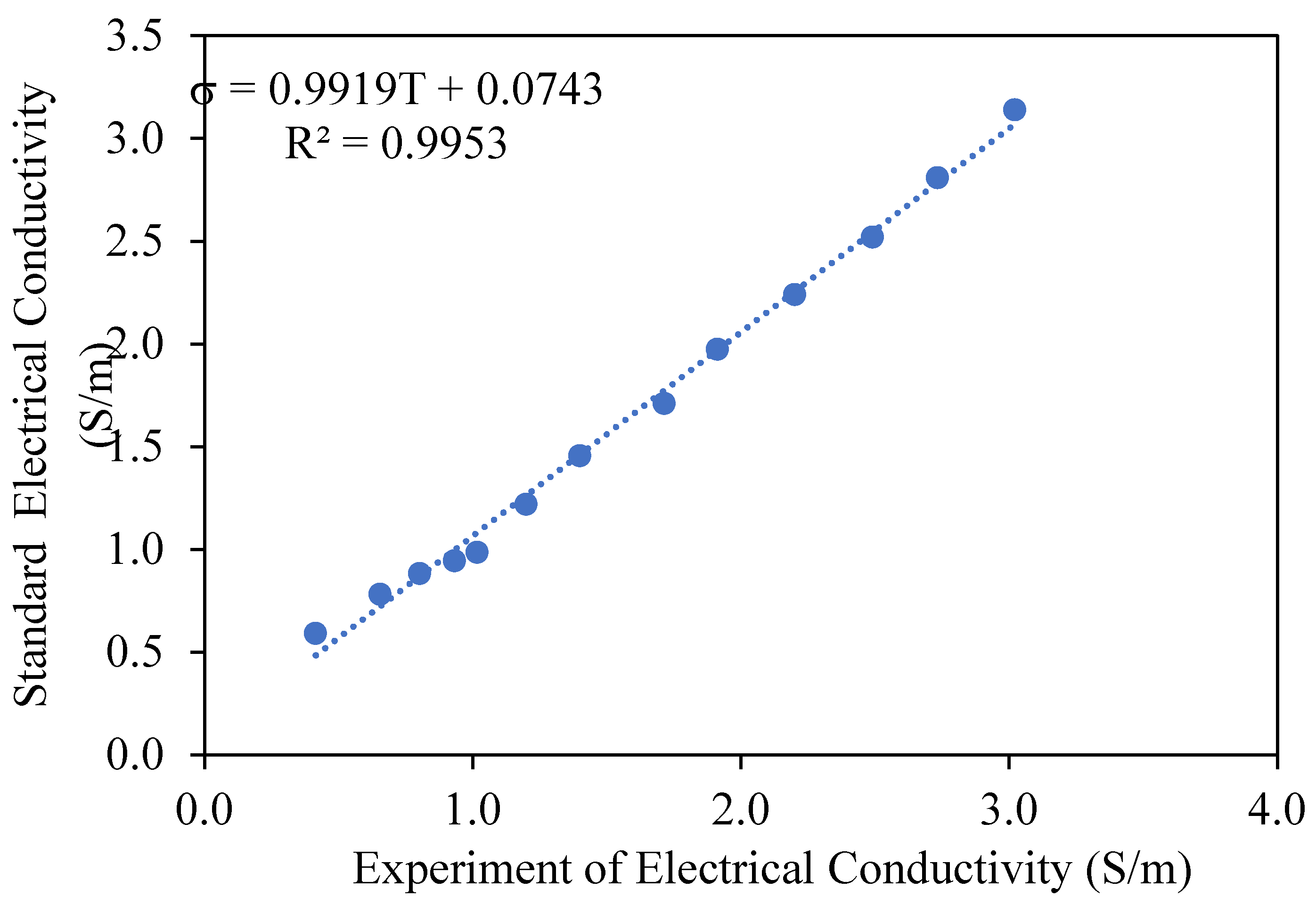
Electrical conductivity is a critical characteristic of food systems, directly affecting the efficacy of ohmic heating. The accuracy of electrical conductivity measurement is crucial for optimizing thermal processing conditions, ensuring consistent heating, and enhancing energy efficiency. This study examines the validation of conductivity measurement precision utilizing a 0.1 M NaCl standard solution, a thoroughly characterized electrolyte with consistent conductive properties. The experiment entailed evaluating conductivity values within a temperature spectrum of 25–85°C, juxtaposing experimental measurements with theoretical values to ascertain the relative percentage error. The results demonstrated a linear increase in conductivity with temperature, attributed to improved ion mobility and reduced solution resistance, as described by the equation σ = 0.9919T + 0.0743 (R² = 0.9953). At temperatures below 20°C, the relative percentage error surpassed 10%, due to diminished ion kinetic energy and heightened viscosity, which impeded ionic mobility and measurement precision. The results indicate that ohmic heating is an effective method for assessing electrical conductivity in liquid food systems, especially within the 20–85°C range, where measurement precision markedly enhanced, decreasing the relative percentage error to 2.21%. The findings align with prior studies [7,16], confirming that temperature significantly influences the accuracy of conductivity measurements. This study emphasizes the importance of accurate calibration methods and temperature regulation to reduce errors, particularly at low temperatures where hydration effects and heightened viscosity affect conductivity. The validated methodology endorses the use of ohmic heating as an accurate instrument for real-time monitoring of conductivity variations in thermal processing [17-18].
Figure 2.
Evaluation of the precision of conductivity measurements during ohmic heating utilizing a standard solution, 0.1 M saline solution.
Figure 2.
Evaluation of the precision of conductivity measurements during ohmic heating utilizing a standard solution, 0.1 M saline solution.
3.2. Determination Modeling of Electrical Conductivity During Ohmic Heating
Ohmic heating is a thermal processing technique that employs electric current to traverse food materials, leading to swift and uniform internal heating. The electrical conductivity (EC) of the food matrix is a crucial factor affecting the efficiency of this process. Consequently, precise modeling of EC is crucial for optimizing energy input and ensuring efficient process control. The electrical conductivity of liquid foods is affected by several physicochemical factors, such as chemical composition, temperature, ionic concentration, and availability of free water. The interplay of temperature and total soluble solids (TSS) significantly affects electrical conductivity (EC) in fruit juices, notably in passion fruit juice, as these factors directly influence heating behavior and product quality. Ohmic heating is esteemed for its capacity to improve the electrical and physicochemical characteristics of fruit-based systems. Hardinasinta et al [19] indicated that the rheological properties and electrical conductivity of mulberry purée significantly improved under ohmic conditions, demonstrating enhanced thermal and mass transfer. Total soluble solids (TSS), associated with sweetness and flavor intensity in passion fruit juice, also influence electrical conductivity (EC), as elevated TSS levels generally enhance ionic strength and conductivity [8]. Furthermore, Doan et al [5] illustrated the efficacy of ohmic heating in maintaining antioxidant compounds and color stability in red-climbing dragon fruit juice, underscoring the significance of temperature optimization during processing. Increased temperatures have been demonstrated to markedly augment electrical conductivity, thus enhancing heating efficiency and decreasing energy consumption [4].
Recent advancements underscore the potential of amalgamating machine learning with physicochemical measurements to forecast dielectric and electrical properties, facilitating enhanced control over processing conditions [20]. Thus, a comprehensive understanding of the interactions among TSS, temperature, and EC not only enhances predictive modeling techniques but also fosters advancements in process design and product development. Ultimately, this knowledge enhances the sensory qualities and nutritional integrity of juice products [21].
Results indicated that the electrical conductivity of passion fruit juice augmented with increasing temperature during ohmic heating at a voltage gradient of 10 V/cm. The increase in electrical conductivity was measured at 0.01983 ± 0.00082, 0.02002 ± 0.00063, and 0.01781 ± 0.00061 mS/cm for juice samples with total soluble solids (TSS) of 11.5, 15.5, and 19.5 °Brix, respectively. At elevated voltage gradients of 20 and 30 V/cm, the electrical conductivity values for samples with total soluble solids (TSS) levels of 11.5, 15.5, and 19.5 °Brix were 0.019458 ± 0.00037, 0.022185 ± 0.00091, and 0.018473 ± 0.00082 mS/cm, and 0.020613 ± 0.00041, 0.023308 ± 0.00045, and 0.01922 ± 0.00037 mS/cm, respectively. The findings suggest that the voltage gradient exerted a negligible influence on the improvement of electrical conductivity. While augmenting the voltage gradient in ohmic heating systems can initially enhance electrical conductivity by raising temperature and improving ion mobility, the advantages typically wane at elevated voltage levels. This phenomenon can be ascribed to factors including localized ion depletion, electrochemical reactions at the electrodes, and compositional alterations within the system, which together lead to non-linear trends or reductions in conductivity. Consequently, meticulous optimization of the voltage gradient is crucial for sustaining conductivity stability and ensuring efficient and uniform thermal processing of passion fruit juice.
Figure 3.
Three-dimensional surface (a) and contour plot (b) illustrating the effect of temperature and total soluble solids (TSS) on electrical conductivity of passion fruit juice during ohmic heating at 10 V/cm.
Figure 3.
Three-dimensional surface (a) and contour plot (b) illustrating the effect of temperature and total soluble solids (TSS) on electrical conductivity of passion fruit juice during ohmic heating at 10 V/cm.
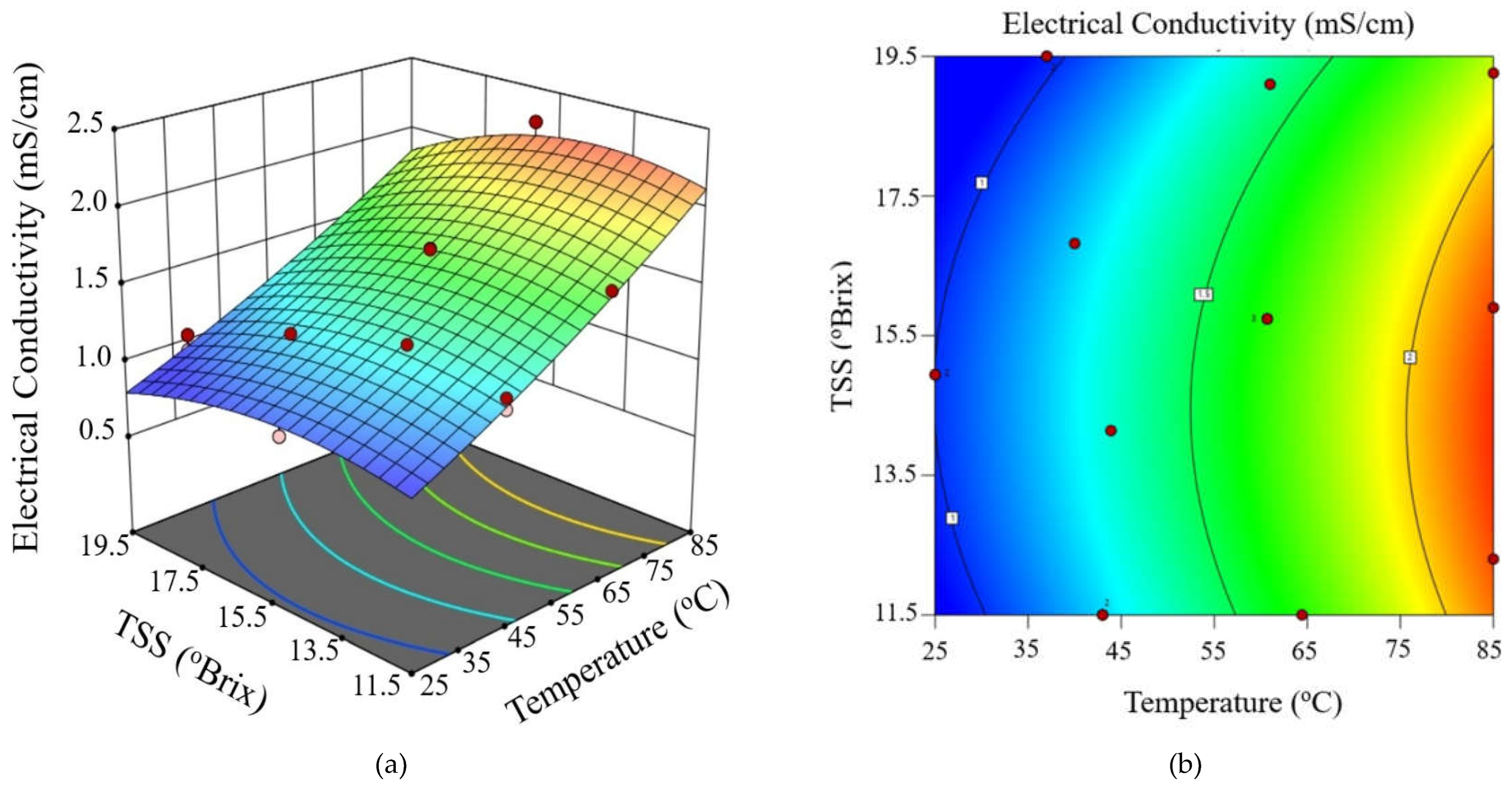
Figure 4.
Three-dimensional surface (a) and contour plot (b) illustrating the effect of temperature and total soluble solids (TSS) on electrical conductivity of passion fruit juice during ohmic heating at 20 V/cm.
Figure 4.
Three-dimensional surface (a) and contour plot (b) illustrating the effect of temperature and total soluble solids (TSS) on electrical conductivity of passion fruit juice during ohmic heating at 20 V/cm.
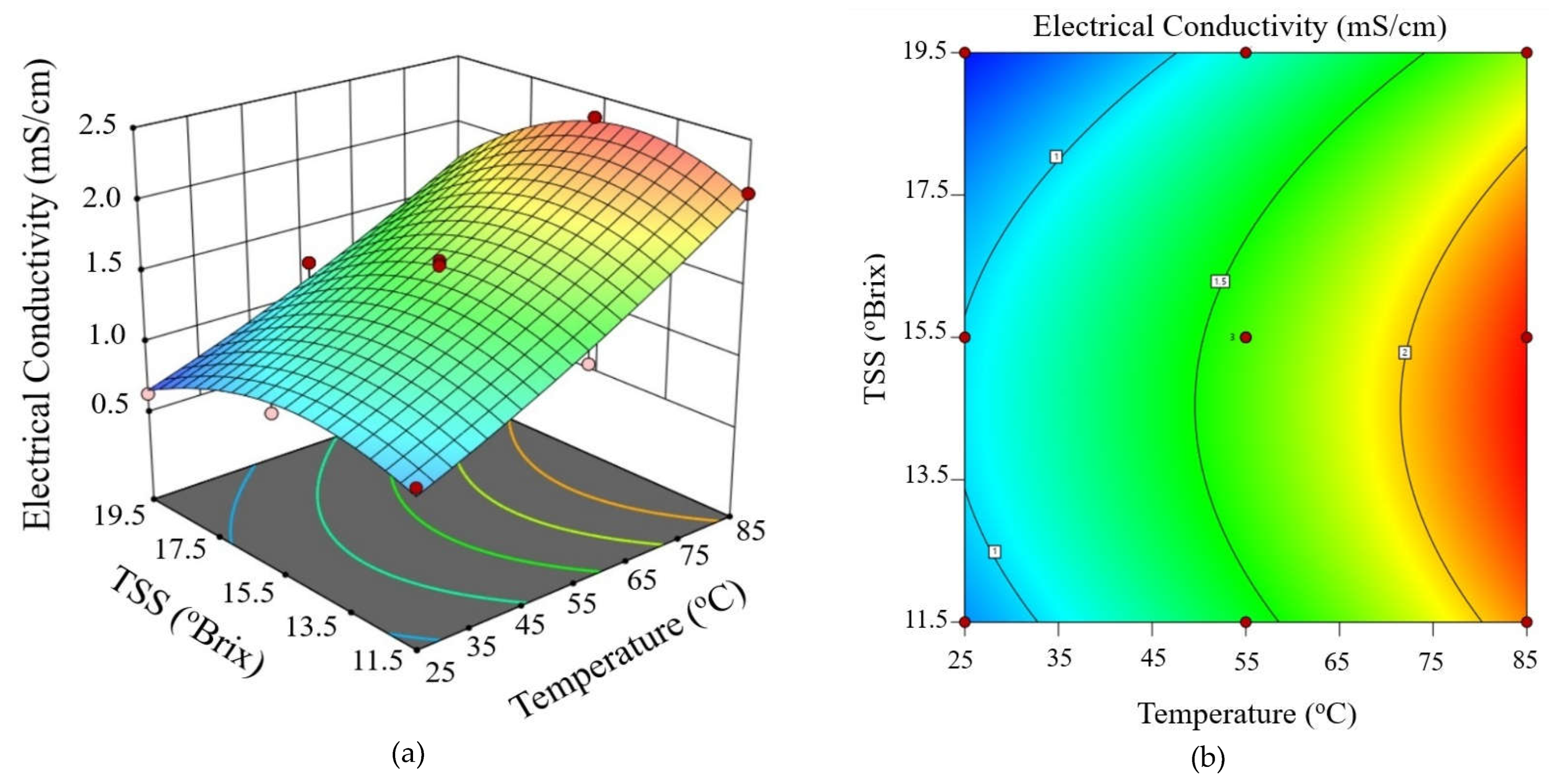
Figure 5.
Three-dimensional surface (a) and contour plot (b) illustrating the effect of temperature and total soluble solids (TSS) on electrical conductivity of passion fruit juice during ohmic heating at 30 V/cm.
Figure 5.
Three-dimensional surface (a) and contour plot (b) illustrating the effect of temperature and total soluble solids (TSS) on electrical conductivity of passion fruit juice during ohmic heating at 30 V/cm.

Increased temperature significantly increases the electrical conductivity of passion fruit juice, mainly through mechanisms involving ion mobility, organic acid dissociation and viscosity reduction. High temperatures facilitate ion mobility as the kinetic energy of molecules increases, leading to better conductivity [20]. This ion mobility is even more influenced by the thermodynamic properties of the organic acids present in the juice. As the temperature increases, organic acids dissociate faster, increasing the concentration of free ions and thus increasing conductivity [22]. Recent studies suggest that the dissociation of polysaccharides and other organic compounds of passion fruit can also contribute to this phenomenon [23-24]. Notably, viscosity also plays a crucial role; Reduced viscosity at higher temperatures allows ions to move more freely [25]. Advances in techniques, such as pulsed electric fields and ohmic heating, correlate well with these conductivity improvements, showing the interaction between thermal and electrical properties [26-27]. Collectively, these findings emphasize the importance of temperature in optimizing conductive properties in fruit juices, particularly in passion fruit [28-29].
Total soluble solids (TSS) in passion fruit juice reflect both the sweetness and concentration of dissolved constituents, which significantly influence its electrical conductivity [7-21, 29-30]. The ionic content, primarily derived from soluble sugars and organic acids, plays a pivotal role in determining the juice’s conductivity [14]. As TSS increases, conductivity may initially rise due to the enhanced availability of charged particles and ionizable compounds [31]. This correlation is further supported by studies examining the physicochemical properties of juice and the effects of thermal or non-thermal treatments [30,32]. However, the relationship between TSS and electrical conductivity (EC) is nonlinear and varies across TSS concentration ranges. In the low to moderate TSS range (11.5–15.5 °Brix), EC increases as more dissociated ions—such as hydrogen (H⁺) and citrate (C₆H₅O₇³⁻)—from organic acids like citric acid become available. The dissolution of salts and minerals also elevates ionic strength, facilitating efficient charge transfer without significantly hindering ion mobility [33]. Conversely, at higher TSS levels (15.5–19.5 °Brix), EC begins to decline. This reduction is attributed to reduced free water, increased viscosity, and the formation of ion–sugar interactions that trap or slow ionic movement. Additionally, ion crowding and electrostatic shielding hinder ion transport, thereby decreasing conductivity despite the higher concentration of dissolved solids.
The research indicated that the electrical conductivity of passion fruit juice was affected by total soluble solids (TSS) and temperature. Table 1 presents the estimation model obtained from multiple linear regression analysis. These equations distinctly demonstrate that the temperature coefficient is inferior to that of TSS across all three voltage gradients, signifying a more substantial impact of TSS on the electrical conductivity values. The fluctuation in electrical conductivity of passion fruit juice can be precisely characterized through empirical correlations with temperature and total soluble solids (TSS). The models' predictive errors were assessed using chi-square (χ2) and root mean square error (RMSE), in accordance with research on red grape juice [12], guava pulp [9], and glucose syrup [13]. The proposed mathematical model for forecasting electrical conductivity achieved the highest correlation coefficient (R2) and the lowest χ2 and RMSE values, indicating its superior predictive accuracy. In all experiments, the model performance metrics exhibited the following ranges: R2 from 0.9961 to 0.9992, χ2 from 0.0003 to 0.0051, and RMSE from 0.0173 to 0.0538, respectively.
3.3. Validation of Modeling of Electrical Conductivity
Ohmic heating yielded empirical data that we compared with computed results to validate the accuracy of the mathematical model predicting the electrical conductivity of passion fruit juice. We prepared passion fruit juice samples from vacuum evaporation, varying and keeping their total soluble solids (TSS) between 14–16 °Brix. Using multiple linear regression, the coefficients for the predictive model were obtained whose performance measures are given in Table 2. The model was characterized by a high correlation coefficient (R²) and low chi-square (χ²) and root mean aquare error (RMSE) values, thereby making it an extremely good predictive model.
Figure 6, Figure 7 and Figure 8 shows a plot of the modeled values of conductivity against the experimental values for passion fruit juice using a voltage gradient of 20 V/cm. This was done to validate that the model is correct. The same modeling procedure was applied for passion fruit juice samples of 14 °Brix and 16 °Brix with temperature range 30–80°C and a homogeneous electric field of 20 V/cm. The plot of forecasted and measured data along a 45° reference line through the origin validated the model's capability to reproduce the actual variation in electrical conductivity. The high density of data points near the identity line was indicative of a very good agreement between forecasted and measured values, which definitely supports the validity and relevance of the model. These results validate that the developed model is applicable for the description of passion fruit juice electrical conductivity evolution during ohmic heating and can be utilized as an acceptable method of process control and optimization
The statistical metrics derived from the validation dataset, as presented in Table 2, affirm the robust reliability and generalization ability of the established polynomial model. The model demonstrated consistently high coefficients of determination (R² > 0.98) for all tested TSS levels (14, 15, and 16 °Brix) and voltage gradients (10, 20, and 30 V/cm), signifying that over 98% of the variability in electrical conductivity was accounted for by the model under diverse conditions. The maximum R² (0.9967) and minimum RMSE (0.0060) were recorded at 20 V/cm and 14 °Brix, indicating optimal model performance at intermediate voltage gradients and moderate total soluble solids (TSS). This indicates that, under these conditions, ionic mobility and composition demonstrate relatively consistent electrothermal behavior. A minor reduction in model accuracy was noted at 30 V/cm and 16 °Brix (R² = 0.9825; RMSE = 0.0307), presumably attributable to heightened system non-linearity and constraints imposed by ion crowding and viscosity effects at elevated TSS levels. The findings highlight the model's robustness and versatility within the operational range of the ohmic heating system, confirming its suitability for real-time process control, dynamic optimization, and industrial design. The low χ² values further validate that the discrepancies between experimental and predicted EC values were statistically insignificant, thereby reinforcing the model's relevance to passion fruit juice processing at varying concentration levels.
4. Discussion
This study demonstrates that ohmic heating offers precise electrical conductivity (EC) information for 25–85 °C liquid food matrices since it shows robust correlation against 0.1 M NaCl reference standards. This proven method was then utilized to characterize the electrical conductivity response of passion fruit juice under varied total soluble solids (TSS). Experimental findings facilitated the derivation of a second-order polynomial model with temperature, TSS, and their interaction. The model had excellent predictability (R² > 0.99, lowest RMSE, and χ²) and hence ensured its effectiveness to describe non-linear EC behavior as well as facilitated accurate control of processes in thermal food processing plants with ohmic heating.
5. Concluding Remarks
The assessment of electrical conductivity (EC) of passion fruit juice over the temperature spectrum of 25–85 °C using an ohmic heating apparatus shown remarkable precision in comparison to the typical NaCl 0.1 M solution. A mathematical model was created to forecast EC, expressed as a second-order polynomial model. This model had a high coefficient of determination (R²) together with low chi-square (χ²) and root mean square error (RMSE) values, signifying robust prediction accuracy. The model's predictions closely corresponded with the experimental EC values recorded at TSS levels ranging from 14 to 16 °Brix. The electrical conductivity of passion fruit juice enhanced with temperature owing to improved ion mobility, less viscosity, and heightened dissociation of organic acids like citric acid, all of which facilitate ionic conduction. In contrast, elevating TSS from 11.5 to 19.5 °Brix produced a non-linear effect: EC rose at low to moderate TSS levels but declined beyond around 15.5 °Brix. The drop was ascribed to diminished free water availability, heightened viscosity, ion-sugar interactions, and ion crowding elements that combine obstruct ionic mobility and restrict electrical conduction within the juice. The mathematical model for prediction conductivity variations based on these experimental results establishes a foundation for process regulation and the design of devices and systems for ohmic heating applications in future industrial contexts.
Author Contributions
Conceptualization, R.A.; methodology, R.A. and S.T.; software, R.A.; validation, R.A. and S.T.; formal analysis, S.T.; investigation, R.A.; resources, R.A.; data curation, R.A.; writing—original draft preparation, R.A.; writing—review and editing, R.A.; visualization, R.A.; supervision, R.A.; project administration, R.A. All authors have read and agreed to the published version of the manuscript.
Funding
This research received no external funding.
Data Availability Statement
The original contributions presented in the study are included in the article, further inquiries can be directed to the corresponding authors.
Conflicts of Interest
The authors declare no conflicts of interest
References
- Kaur, M.; Kumar, S.; Samota, M.K.; Lalremmawii. Ohmic Heating Technology Systems, Factors Governing Efficiency and Its Application to Inactivation of Pathogenic Microbial, Enzyme Inactivation, and Extraction of Juice, Oil, and Bioactive Compounds in the Food Sector. Food Bioprocess Technol. 2024, 17, 299–324. [Google Scholar] [CrossRef]
- Salari, S.; Jafari, S.M. The Influence of Ohmic Heating on Degradation of Food Bioactive Ingredients. Food Eng. Rev. 2020, 12, 191–208. [Google Scholar] [CrossRef]
- Sastry, S.K.; Barach, J.T. Ohmic and Inductive Heating. J. Food Sci. 2000, 65, 42–46. [Google Scholar] [CrossRef]
- Javed, T.; Oluwole-Ojo, O.; Zhang, H.; Akmal, M.; Breikin, T.; O’Brien, A. System Design, Modelling, Energy Analysis, and Industrial Applications of Ohmic Heating Technology. Food and Bioprocess Technology 2025, 18, 2195–2217. [Google Scholar] [CrossRef]
- Doan, N.K.; Lai, D.Q.; Le, T.K.P. Ohmic Heating: Its Current and Future Application in Juice Processing. Food Rev. Int. 2023, 39, 6908–6933. [Google Scholar] [CrossRef]
- Cevik, M. Electrical Conductivity and Performance Evaluation of Verjuice Concentration Process Using Ohmic Heating Method. J. Food Process Eng. 2021, 44, e13672. [Google Scholar] [CrossRef]
- Kamonpatana, P.; Sastry, S.K. Electrical Conductivity of Foods and Food Components: The Influence of Formulation Processes. J. Food Process Eng. 2022, 45, e13992. [Google Scholar] [CrossRef]
- Afraz, M.T.; Xu, X.; Zeng, X.A.; Zhao, W.; Lin, S.; Woo, M.; Han, Z. The Science behind Physical Field Technologies for Improved Extraction of Juices with Enhanced Quality Attributes. Food Phys. 2024, 1, 100008. [Google Scholar] [CrossRef]
- Athmaselvi, K.A.; Viswanathan, R.; Balasubramanian, M.; Roy, I. The Effects of Concentration and Type of Electrode on Electrical Conductivity of Guava Pulp during Ohmic Heating. J. Food Res. Technol. 2014, 2, 113–123. [Google Scholar]
- Srivastav, S.; Roy, S. Changes in Electrical Conductivity of Liquid Foods during Ohmic Heating. Int. J. Agric. Biol. Eng. 2014, 7, 133–138. [Google Scholar] [CrossRef]
- Lamsal, B.; Jindal, V. Variation in Electrical Conductivity of Selected Fruit Juices during Continuous Ohmic Heating. KMUTNB Int. J. Appl. Sci. Technol. 2014, 7, 47–56. [Google Scholar] [CrossRef]
- Assawarachan, R. Estimation Model for Electrical Conductivity of Red Grape Juice. Int. J. Agric. Biol. Eng. 2010, 3, 52–57. [Google Scholar] [CrossRef]
- Sabanci, S.; Kaya, K.; Göksu, A. Modeling the Electrical Conductivity Value of the Model Solution. An. Acad. Bras. Ciênc. 2023, 95, e20210062. [Google Scholar] [CrossRef] [PubMed]
- de Oliveira Militão, A.; da Silva, T.I.; do Nascimento, A.M.; da Costa, F.B.; de Castro, A.K.G.; Macêdo, L.F.; Santos, S.C.L. Storage Increases Soluble Sugars and Decreases Bioactive Compounds in Wild Passion Fruit (Passiflora cincinnata). Horticulturae Environ. Biotechnol. 2025, 1, 1–16. [Google Scholar] [CrossRef]
- Icier, F.; Yildiz, H.; Sabanci, S.; Cevik, M.; Cokgezme, O.F. Ohmic Heating Assisted Vacuum Evaporation of Pomegranate Juice: Electrical Conductivity Changes. Innov. Food Sci. Emerg. Technol. 2017, 39, 241–246. [Google Scholar] [CrossRef]
- Sastry, S.K.; Li, Q. Modeling the Ohmic Heating of Solid–Liquid Mixtures: Model Development and Validation. J. Food Eng. 1996, 27, 241–260. [Google Scholar] [CrossRef]
- Abdulstar, A.R.; Altemimi, A.; Al-HiIphy, A.R.; Watson, D.G.; Lakhssassi, N. Water Distillation Using an Ohmic Heating Apparatus. Int. J. Ambient Energy 2022, 43, 2748–2758. [Google Scholar] [CrossRef]
- Wiroonsri, P.; Wattanachant, S. Electrical Conductivity as a Precise Method for Salt Content Estimation in Raw and Cooked Tuna Meat. J. Food Compos. Anal. 2025, 137, 106953. [Google Scholar] [CrossRef]
- Hardinasinta, G.; Salengke, S.; Mursalim, M.; Muhidong, J. Effect of Ohmic Heating on the Rheological Characteristics and Electrical Conductivity of Mulberry (Morus nigra) Puree. Pol. J. Food Nutr. Sci. 2021, 71, 289–297. [Google Scholar] [CrossRef]
- Cavalcanti, R.N.; Barbosa, V.P.; Gut, J.A.W.; Tadini, C.C. Predicting Dielectric Properties of Fruit Juices at 915 and 2450 MHz Using Machine Learning and Physicochemical Measurements. Meas. Food 2024, 14, 100158. [Google Scholar] [CrossRef]
- Zia, H.; Slatnar, A.; Košmerl, T.; Korošec, M. A Review Study on the Effects of Thermal and Non-Thermal Processing Techniques on the Sensory Properties of Fruit Juices and Beverages. Front. Food Sci. Technol. 2024, 4, 1405384. [Google Scholar] [CrossRef]
- Qiu, X.; Zhang, Y.; Zhou, Y.; Li, G.H.; Feng, X.S. Progress in Pretreatment and Analysis of Organic Acids: An Update Since 2010. Food Chem. 2021, 360, 129977. [Google Scholar] [CrossRef] [PubMed]
- Yu, S.; Yan, J.K.; Jin, M.Y.; Li, L.Q.; Yu, Y.H.; Xu, L. Preparation, Physicochemical and Functional Characterization of Pectic Polysaccharides from Fresh Passion Fruit Peel by Magnetic-Induced Electric Field-Assisted Three-Phase Partitioning. Food Hydrocoll. 2024, 156, 110292. [Google Scholar] [CrossRef]
- Du, H.; Olawuyi, I.F.; Said, N.S.; Lee, W.Y. Comparative Analysis of Physicochemical and Functional Properties of Pectin from Extracted Dragon Fruit Waste by Different Techniques. Polymers 2024, 16, 1097. [Google Scholar] [CrossRef]
- Huo, D.; Dai, J.; Yuan, S.; Cheng, X.; Pan, Y.; Wang, L.; Wang, R. Eco-Friendly Simultaneous Extraction of Pectins and Phenolics from Passion Fruit (Passiflora edulis Sims) Peel: Process Optimization, Physicochemical Properties, and Antioxidant Activity. Int. J. Biol. Macromol. 2023, 243, 125229. [Google Scholar] [CrossRef]
- Brito, I.P.C.; Silva, E.K. Pulsed Electric Field Technology in Vegetable and Fruit Juice Processing: A Review. Food Res. Int. 2024, 173, 114207. [Google Scholar] [CrossRef] [PubMed]
- Khuenpet, K.; Jittanit, W. The Effects of Pasteurization by Conventional and Ohmic Heating Methods and Concentration Processes on the Madan (Garcinia schomburgkiana Pierre) Juice Properties. Appl. Eng. Agric. 2020, 36, 205–219. [Google Scholar] [CrossRef]
- Zhang, Z.; Chen, Y.; Cheng, Y.; Gao, Z.; Qu, K.; Chen, Z.; Guan, W. Effects of Pulsed Electric Field and High-Pressure Processing Treatments on the Juice Yield and Quality of Sea Buckthorn. Foods 2024, 13, 1829. [Google Scholar] [CrossRef] [PubMed]
- Sarbatly, R.; Sariau, J.; Krishnaiah, D. Recent Developments of Membrane Technology in the Clarification and Concentration of Fruit Juices. Food Eng. Rev. 2023, 15, 420–437. [Google Scholar] [CrossRef]
- Chutia, H.; Begum, F.; Rohilla, S.; Mahanta, C.L. Impact of Thermosonication Treatment on Passion Fruit Juice: ANN/GA Optimization, Predictive Modelling for Shelf Life and Quality Changes during Storage. Int. J. Food Eng. 2024, 20, 463–474. [Google Scholar] [CrossRef]
- Saruan, N.; Abdullah, N.; Malik, N.H.; Muhammad, N. Effect of Ultrasound Treatment on the Physicochemical Properties and Bioactive Compounds of Yellow Passion Fruit Juice. In Proceedings of the 5th International Conference on Agricultural and Food Engineering (CAFEi2022), No. 1, 030012. Melaka, Malaysia, 21–23 February 2022; AIP Publishing: Melville, NY, USA, 2023; Volume 2682. [Google Scholar] [CrossRef]
- Angami, T.; Assumi, S.R.; Kalita, H.; Saloi, B.; Singh, K.S.; Touthang, L.; Tasung, A. Preparation and Evaluation of Fresh Pineapple, Passion Fruit and Ginger Blended Ready-to-Serve Drink. Environ. Conserv. J. 2023, 24, 63–66. [Google Scholar] [CrossRef]
- Khorshidian, N.; Yousefi, M.; Zendeboodi, F.; Mirsaeedghazi, H. Effect of Membrane Clarification on the Physicochemical Properties of Fruit Juices: A Review. Iran. J. Chem. Chem. Eng. 2022, 41, 51–66. [Google Scholar]
Figure 6.
Experimental vs predicted EC of passion fruit juice (14–16 °Brix) at 10 V/cm.
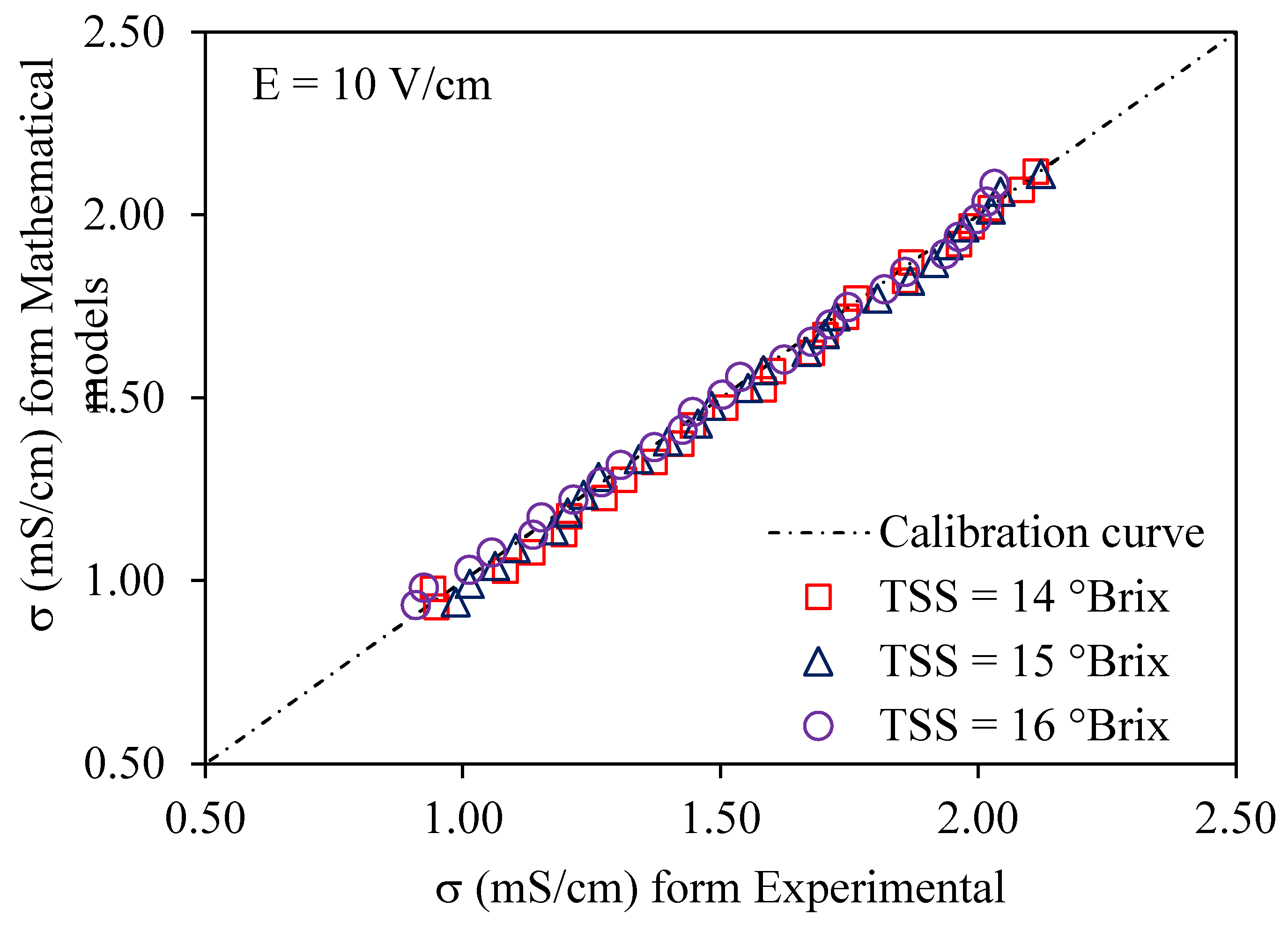
Figure 7.
Experimental vs predicted EC of passion fruit juice (14–16 °Brix) at 20 V/cm.
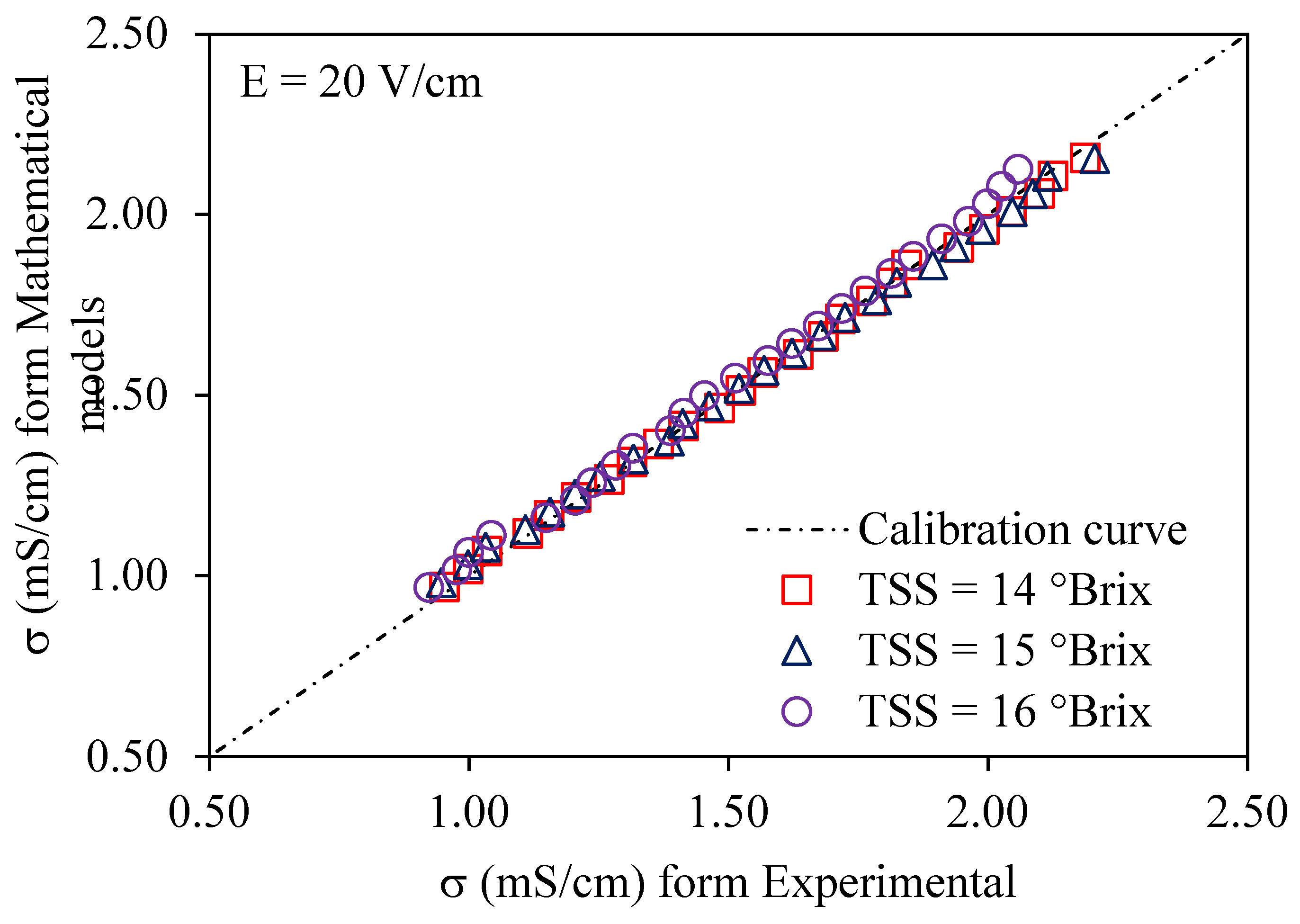
Figure 8.
Experimental vs predicted EC of passion fruit juice (14–16 °Brix) at 30 V/cm.
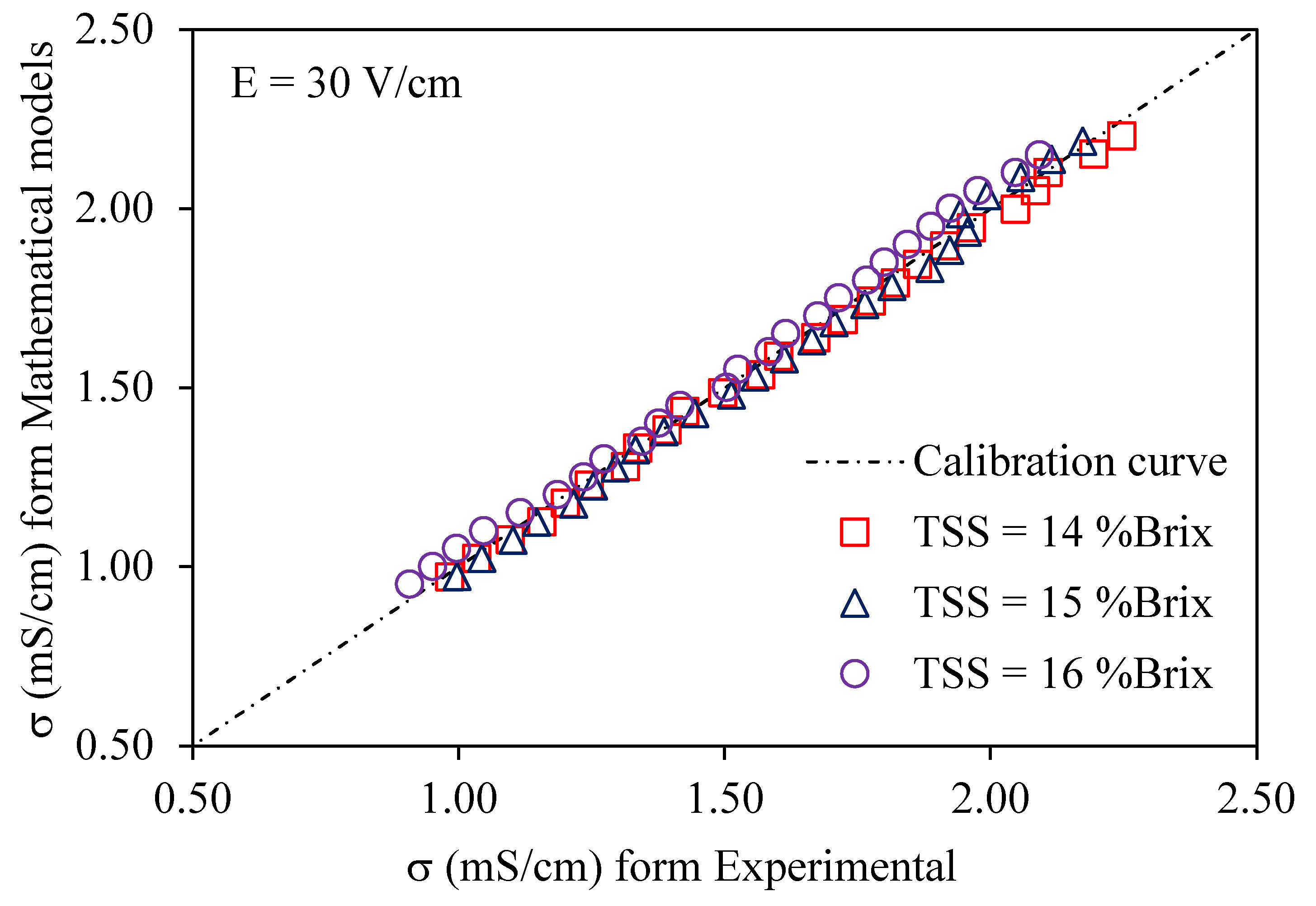

Table 1.
Regression Models and Fit Statistics for Predicting EC of Passion Fruit Juice under Ohmic Heating at Different Voltages.
Table 1.
Regression Models and Fit Statistics for Predicting EC of Passion Fruit Juice under Ohmic Heating at Different Voltages.
| Model Type | Regression Equation | Voltage gradient |
R2 | χ² | RMSE |
|---|---|---|---|---|---|
| Linear: | σ (mS/cm) = 0.6163+ 0.0193 (T) -0.0174 (TSS) |
10 V/cm | 0.9111 | 0.2129 | 0.0879 |
| σ (mS/cm) = 0.6624+ 0.02007 (T) -0.02065 (TSS) |
20 V/cm | 0.8791 | 0.2763 | 0.1028 | |
| σ (mS/cm) = 0.7933+ 0.0202 (T) -0.0282 (TSS) |
30 V/cm | 0.9471 | 0.2037 | 0.0918 | |
| Two-Factor Interaction | σ (mS/cm) = 0.3422+ 0.0243 (T) - 0.0002 (TSS) - 0.00032 (T)(TSS) |
10 V/cm | 0.9481 | 0.2041 | 0.0857 |
| σ (mS/cm) = 0.4535+ 0.0239 (T) -0.0072 (TSS) - 0.00025 (T)(TSS) |
20 V/cm | 0.9562 | 0.2542 | 0.0988 | |
| σ (mS/cm) = 0.5635+ 0.0243 (T) -0.0134 (TSS) + 0.00027 (T)(TSS) |
30 V/cm | 0.9488 | 0.1999 | 0.0903 | |
| Polynomial model | σ (mS/cm) = -2.2007+ 0.0243 (T) +0.3436 (TSS) - 0.00032 (T)(TSS) - 0.0111 (TSS)2 |
10 V/cm | 0.9974 | 0.0112 | 0.0191 |
| σ (mS/cm) = -2.486+ 0.0233 (T) + 0.3917 (TSS) - 0.00025 (T)(TSS) - 0.01287 (TSS)2 |
20 V/cm | 0.9948 | 0.0211 | 0.0298 | |
| σ (mS/cm) = -1.9071+ 0.0243 (T) +0.3203 (TSS) - 0.00027 (T)(TSS) - 0.0108 (TSS)2 |
30 V/cm | 0.9901 | 0.0265 | 0.0323 |
Note: The regression models were developed using linear, two-factor interaction, and second-order polynomial equations. The statistical indices were calculated based on experimental EC values across TSS levels and temperature range (25–85 °C).
Table 2.
Model Validation for EC Prediction of Passion Fruit Juice during Ohmic Heating (TSS 14–16 °Brix).
Table 2.
Model Validation for EC Prediction of Passion Fruit Juice during Ohmic Heating (TSS 14–16 °Brix).
| Voltage gradients |
TSS ( oBrix) | R2 |
χ² |
RMSE |
|---|---|---|---|---|
| 14 | 0.9871 | 0.0380 | 0.0256 | |
| 10 V/cm | 15 | 0.9950 | 0.0240 | 0.0088 |
| 16 | 0.9953 | 0.0234 | 0.0095 | |
| 14 | 0.9967 | 0.0204 | 0.0060 | |
| 20 V/cm | 15 | 0.9956 | 0.0238 | 0.0091 |
| 16 | 0.9880 | 0.0367 | 0.0234 | |
| 14 | 0.9948 | 0.0260 | 0.0095 | |
| 30 V/cm | 15 | 0.9924 | 0.0295 | 0.0127 |
| 16 | 0.9825 | 0.0446 | 0.0307 |
Note: Validation performed using EC data at 14, 15, and 16 °Brix under voltage gradients of 10, 20, and 30 V/cm. Goodness-of-fit evaluated using R², RMSE, and χ².
Disclaimer/Publisher’s Note: The statements, opinions and data contained in all publications are solely those of the individual author(s) and contributor(s) and not of MDPI and/or the editor(s). MDPI and/or the editor(s) disclaim responsibility for any injury to people or property resulting from any ideas, methods, instructions or products referred to in the content. |
© 2025 by the authors. Licensee MDPI, Basel, Switzerland. This article is an open access article distributed under the terms and conditions of the Creative Commons Attribution (CC BY) license (http://creativecommons.org/licenses/by/4.0/).
Copyright: This open access article is published under a Creative Commons CC BY 4.0 license, which permit the free download, distribution, and reuse, provided that the author and preprint are cited in any reuse.


