
Submitted:
28 March 2025
Posted:
31 March 2025
You are already at the latest version
Abstract
A graph of size 2q is even harmonious if its vertices can be labeled distinctly from the labels 0,1,2,...,2q-2 such that the set of edge labels obtained by adding the vertex labels modulo 2q is {2k, 2k+2,..., 2k+2q-2}. Proving that a graph is not even harmonious is not an easy task. In this paper, we give some families of non-even harmonious graphs.
Keywords:
graph labeling
; harmonious graphs
; even harmonious graphs
1. Introduction
We follow Chartrand and Lesniak [2] and Gallian [4] for basic notations in graph theory and known results of graph labeling. In particular, we will consider a finite simple graph. For positive integers and with , we denote by and the set by , where and have the same parity, that is , Let denote the group of integers modulo . For a graph if , we call is a graph. In this section, we mention some related definitions and some variations of the definition of the even harmonious labeling and expose some of the known results that we may use in the paper.
Definition 1.1. [8] A graph with is called harmonious if there is an injection function such that the induced function defined as for all edge is a bijection. If is a tree, exactly two vertices are having the same label. A labeling function is called a harmonious labeling of the graph .
Graham and Sloane [8] proved the following.
Theorem 1.1. If is a harmonious of even size and , , for every vertex , then .
Since Graham and Sloane [8] proved that is harmonious if and only if is odd, it obvious that the necessary condition in Theorem 1.1 is not sufficient for cycles.
There are few general results on harmonious labeling. Most papers focused on classifications of the harmoniousness of some families of graphs. Youssef [11] proved the following results:
Theorem 1.2. If is a harmonious graph, then is harmonious for all odd positive integer
Theorem 1.3. If is a harmonious graph, then (the graph consisting of disjoint union copies of with one fixed vertex in common) is harmonious for all odd positive integer
Lee, Schmeichel and Shee [9] gave a generalization of the harmonious labeling in the following definition.
Definition 1.2. [9] A graph is called felicitous if there exists an injection such that the induced function defined as for all edge is a bijection.
Lee, Schmeichel and Shee [9] showed that the cycle graph is felicitous if and only if . Figueroa-Centeno et al. [3] conjectured that the disjoint union is felicitous if and only if and is felicitous if and only if
Chang, Hsu and Rogers [1] and independently Grace [7] have introduced subclasses of harmonious graphs and independently by Chang, Hsu and Rogers [1] have given a subclass of felicitous graphs as well in the following definition.
Definition 1.3. [1,7] A graph is called strongly -harmonious (resp. strongly -elegant) if there exists an injective function (resp. ) and a positive integer such that the induced function defined as for all edge is a bijection.
By taking the edge labels of a strongly -harmonious labeled graph with edges modulo , we obviously obtain a harmoniously labeled graph. It is not known if there is a graph that can be harmoniously labeled but not strongly k-harmonious labeled.
Recently many variations of even harmonious labeling were introduced. We deal with the variation of the even harmonious labeling when the vertex labels of a graph of size are from the set .
Definition 1.4. [4] A graph with edges is called even harmonious if there exists an injective function from to such that the induced function defined as for all edge is a bijection.
Note that in a connected even harmonious graph all the vertex labels must have the same parity, while in case of disconnected even harmonious graph of c components, the vertex labels of each competent must have the same parity, that is all are even or all are odd. As an example the graph is even harmonious via the vertex labels 0,2, and 10 for one copy of and by the vertex labels 1,3, and 5 for the other copy.
The following theorem shows that we may change the parity of the vertex labels of connected even harmonious graphs from even to odd and vice versa.
Theorem 1.4. Let be a connected graph of edges. If is an even harmonious labeling of , then so is , where is an invertible element of and is any element of .
One consequences of the above theorem, is we can assume that in any connected even harmonious graph , the vertex labels are all even and any vertex of can be assigned the label zero. We formulate this in the following result.
Corollary 1.5. Any vertex in an even harmonious graph can be assigned the label zero.
The following result gives a necessary condition for certain families of graphs to be even harmonious.
Theorem 1.6.[12] If is a connected even harmonious graph with is even and , , for every vertex , then .
However, in the following theorem we give a necessary condition in case of disconnected graphs.
Theorem 1.7. [13] If is a disconnected even harmonious -regular graph, having an even number of edges and the order of each component of is even, then is divisible by .
Youssef and Aljouiee [14] gave the following result.
Lemma 1.8. Every felicitous (resp. harmonious) graph is an even harmonious (resp. strictly even harmonious) and the converse is true if connected.
Definition 1.5. [5, 6, 13] A graph with edges is said to be strongly even -harmonious (resp. strongly even -sequential, strongly even -elegant) if there exists an injective function (resp. ,) and a positive integer such that the induced function defined as for all edge is a bijection.
We observe that if is a connected strongly even -harmonious (resp. strongly even -sequential, strongly even -elegant), then all the vertex labels of are even or all are odd, while if is a disconnected graph, then the vertex labels of some components are even or are odd.
Youssef and Aljouiee [14] proved that is even harmonious if and only if and showed also that if and are odd integers with , then is even harmonious if .
Gallian and Schoenhard [5] conjectured that is even harmonious for all positive integer This conjecture was proved by Youssef [12]. Youssef and Aljouiee [14] showed the following results:
Theorem 1.9. is even harmonious for all .
Theorem 1.10. For all and , is not even harmonious if is odd.
Proving that a graph is not even harmonious is a hard problem. We have to show that no injective function satisfying the property of even harmoniousness. There are a huge number of injective functions as the number of edges increase. In the following section, we deal with giving some families of non-even harmonious graphs.
2. Non-Even Harmonious Graphs
For proving a specific connected graph is not even harmonious, we have only a parity condition in Theorem 1.6. For example, the cycles of order congruent to 2 modulo 4 are not even harmonious. Otherwise, for other graphs it is not an easy task to show that they are not even harmonious. In this section, we give some families which are not even harmonious.
The next result shows that the cycles of order congruent to 0 modulo 4 are not even harmonious besides the cycles of order congruent to 2 modulo 4 which comes from the parity condition in Theorem 1.6 and Theorem 1.7 shows that if a 2-regular graph consisting of disjoint union of cycles each of even order is even harmonious, then its size is congruent to 0 modulo 4.
Theorem 2.1. If is even harmonious, then is odd.
Proof. Let be an even harmonious labeling of .We may assume that all vertex labels of are even. Then
On the other hand,
Combining (1) and (2), we get
, which implies that . Hence, is odd.
The dragon( also called ballon, kite, or tadpole) graph is the graph obtained by identifying an end vertex of the path of size to a vertex of the cycle as in the figure below.
Theorem 2.2. If is odd, then is not even harmonious.
Proof Let be described as in Figure 1. Suppose that has an even harmonious labeling , then
On the other hand,
Combining (1) and (2), we get
If is odd, we will get , which contradicts the assumption that is injective. Hence is not even harmonious when is odd.
Figure 2 shows an even harmonious labeling of . We note that not all dragons of even order are even harmonious as we will show in Theorem 2.4. The following results show the even harmoniousness of some families of unicyclic graphs.
Theorem 2.3. Let be the graph
Figure 3.
then G is even harmonious if and only if .
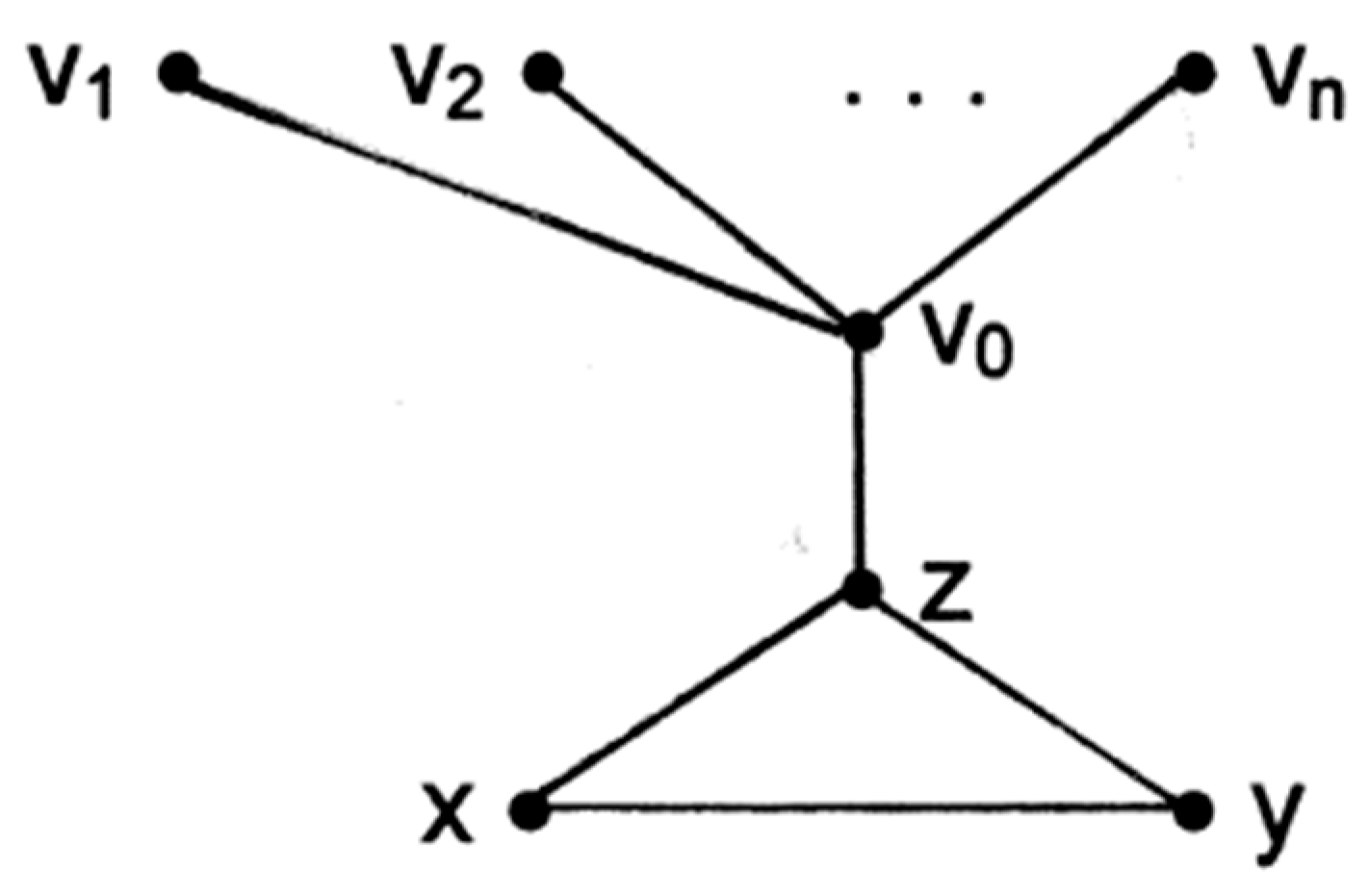
Proof Let
Suppose that has an even harmonious labeling with , then there must exist distinct even positive integers such that
. Hence and . Therefore and have the same parity and must be even, then .
Suppose that . Define a bijection such that . Then one can easily checks that is onto as well.
Theorem 2.4. Let be the graph
Figure 4.
then G is not even harmonious for all .
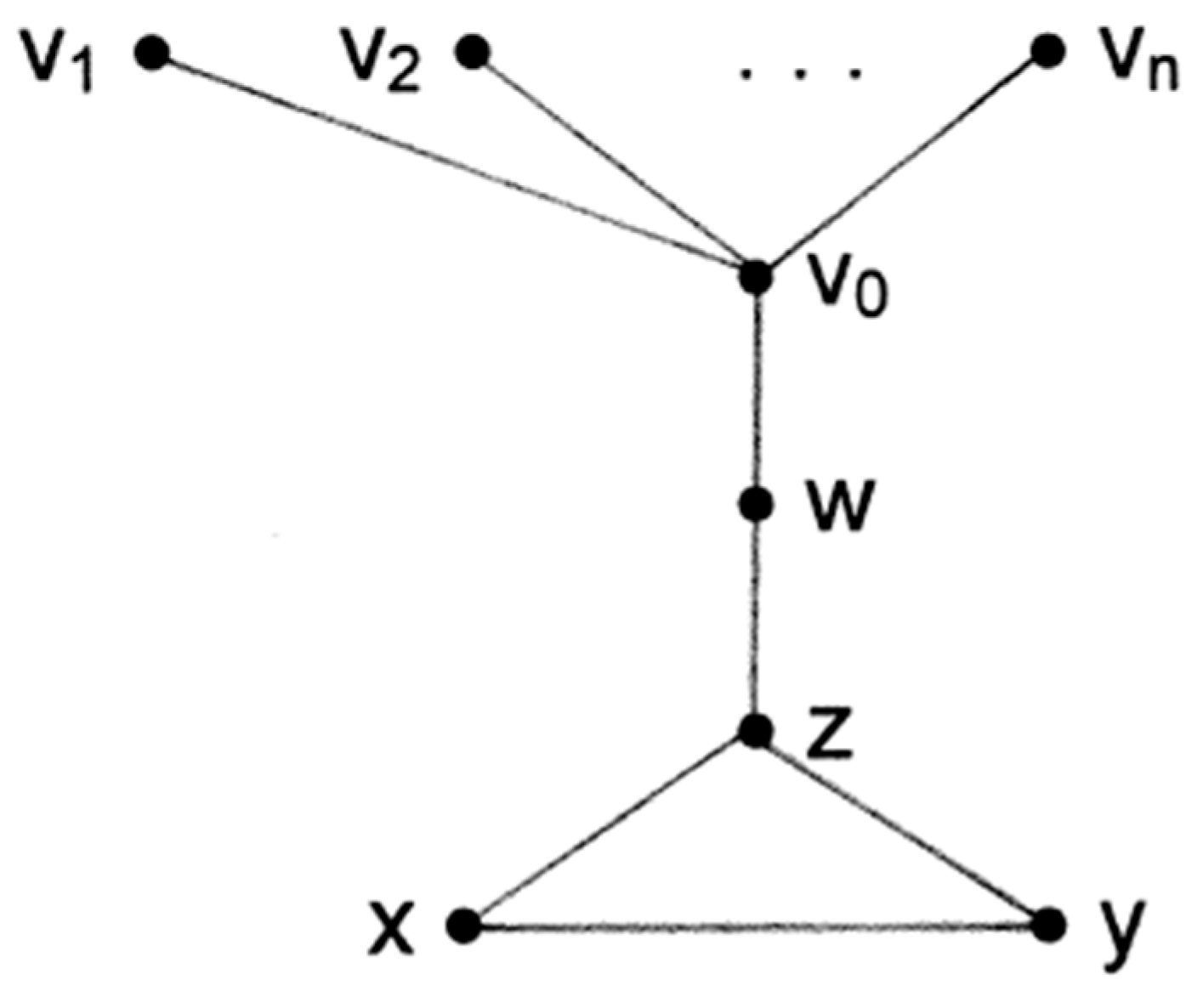
Proof Let Suppose that has an even harmonious labeling with , then there exist distinct even positive integers such that Suppose that has an even harmonious labeling with , then there must exist even positive integers such that
Or
The first line gives which is absurd and the second line gives which is absurd as well.
Let be the graph consisting of the two cycles of lengths and with one vertex in common. The even harmonious property of such graphs is investigated in the next two theorems.
Theorem 2.5. If is even harmonious then
Proof Suppose that is even harmonious and let be the common vertex of the two cycles. Then ia again even harmonious, where Put By Corollary ….. there exists a harmonious labeling with , so that
If is odd, we get , which is absurd. Our result follows since is not even harmonious if by Theorem …..
Theorem 2.6. is even harmonious if and only if
Proof Necessity follows from Theorem …. For sufficiency, suppose that and where and are the two vertices of the cycles in . Define the function
by
Clearly, is injective. We have
and
Hence is onto as desired.
The graph is harmonious if and only if is odd [4], while it is even harmonious for every positive integer [13]. Also the graph is harmonious for odd [11], but is even harmonious for every positive integer [13]. In the following theorem we show that the graph is not harmonious, although this graph is even harmonious by labeling the vertices of by the labels 0,2,4, and 8 and the vertices of by the labels 5 and 9. Also the graph is even harmonious by labeling the vertices of by the labels 0, 4, and 6, and 8 and the vertices of by the labels 7, 9, and 11.
Theorem 2.7. is not harmonious.
Proof Let and suppose that is an even harmonious of where the labels of the vertices of are and of the vertices of are . We may assume that , so that
and
Hence and for some , which is absurd.
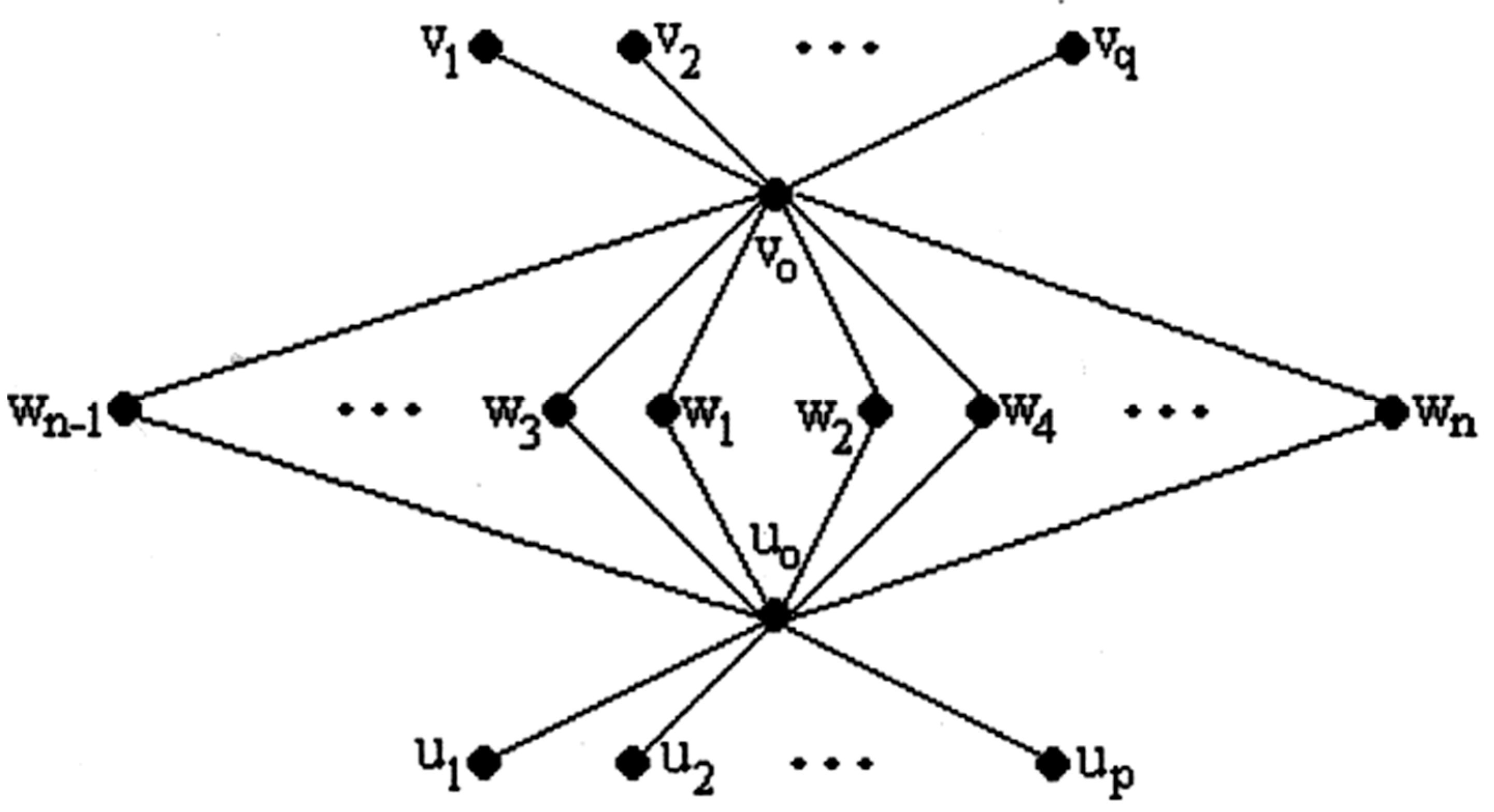
Theorem 2.8. The graph obtained by attaching and pendant edges to the two vertices of degree of the graph is not even harmonious.
Proof Let be the graph appearing in Figure 5. The graph consisting of edges. Suppose that is even harmonious, Since every vertex in even harmonious graph can delivered the label zero, we may label the vertex by 0, and we label all the remaining vertices of the graph with the labels from to except the vertex which will be labeled . Now, the edge label can never be obtained, since if we could obtain the label , then there would exist a vertex label to one of the vertices or such that
which is impossible, and hence the graph is not even harmonious.
Funding
This work was supported and funded by the Deanship of Scientific Research at Imam Mohammad Ibn Saud Islamic University (IMSIU) (grant number IMSIU-DDRSP2502).
References
- Chang, G.J.; Hsu, D.F.; Rogers, D.G. Additive variations on a graceful theme: some results on harmonious and other related graphs. Congressus Numer. 1981, 32, 181–197. [Google Scholar]
- Chartrand, G.; Lesniak-Foster, L. Graphs and Digraphs, 3nd ed.; CRC Press: Boca Raton, FL, USA, 1996. [Google Scholar]
- Figueroa-Centeno, R.; Ichishima, R.; Muntaner-Batle, F.; Oshima, A. A magical approach to some labeling conjectures, Discuss. Math. Graph Theory 2011, 31, 79–113. [Google Scholar] [CrossRef]
- Gallian, J.A. A dynamic survey of graph labeling, Elect. J. Combin., (2024) #DS6. http://www.combinatorics.org/ojs/index.php/eljc/article/view/DS6.
- Gallian, J.A.; Schoenhard, L.A. Even harmonious graphs. AKCE Int. J. Graphs Combin. 2014, 11, 27–49. [Google Scholar]
- Gallian, J.A.; Stewart, D. Properly even harmonious labelings of disjoint unions with even sequential graphs. J. Graph Labeling 2015, 1, 1–10. [Google Scholar]
- Grace, T. On sequential labelings of graphs. J. Graph Theory 1983, 7, 195–201. [Google Scholar] [CrossRef]
- Graham, R.L.; Sloane, N.J.A. On additive bases and harmonious graphs. SIAM J. Alg. Discrete Methods 1980, 1, 382–404. [Google Scholar] [CrossRef]
- Lee, S.M.; Schmeichel, E.; Shee, S.C. On felicitous graphs. Discrete Math 1991, 93, 201–209. [Google Scholar] [CrossRef]
- Sarasija, P.B.; Binthiya, R. Even harmonious graphs with applications. Int. J. Comput. Sci. Infor. Security 2011, 9, 161–163. [Google Scholar]
- Youssef, M.Z. Two general results on harmonious labelings. Ars Combin. 2003, 68, 225–230. [Google Scholar]
- Youssef, M.Z. Note on even harmonious labeling of cycles. Utilitas Math. 2016, 100, 137–142. [Google Scholar]
- Youssef, M.Z. On even harmonious labelings. Utilitas Math. 2019, 110, 243–253. [Google Scholar]
- Youssef, M.Z.; Aljouiee, A. Even harmonious labeling of disjoint cycles, preprint.
Figure 1.
The dragon .
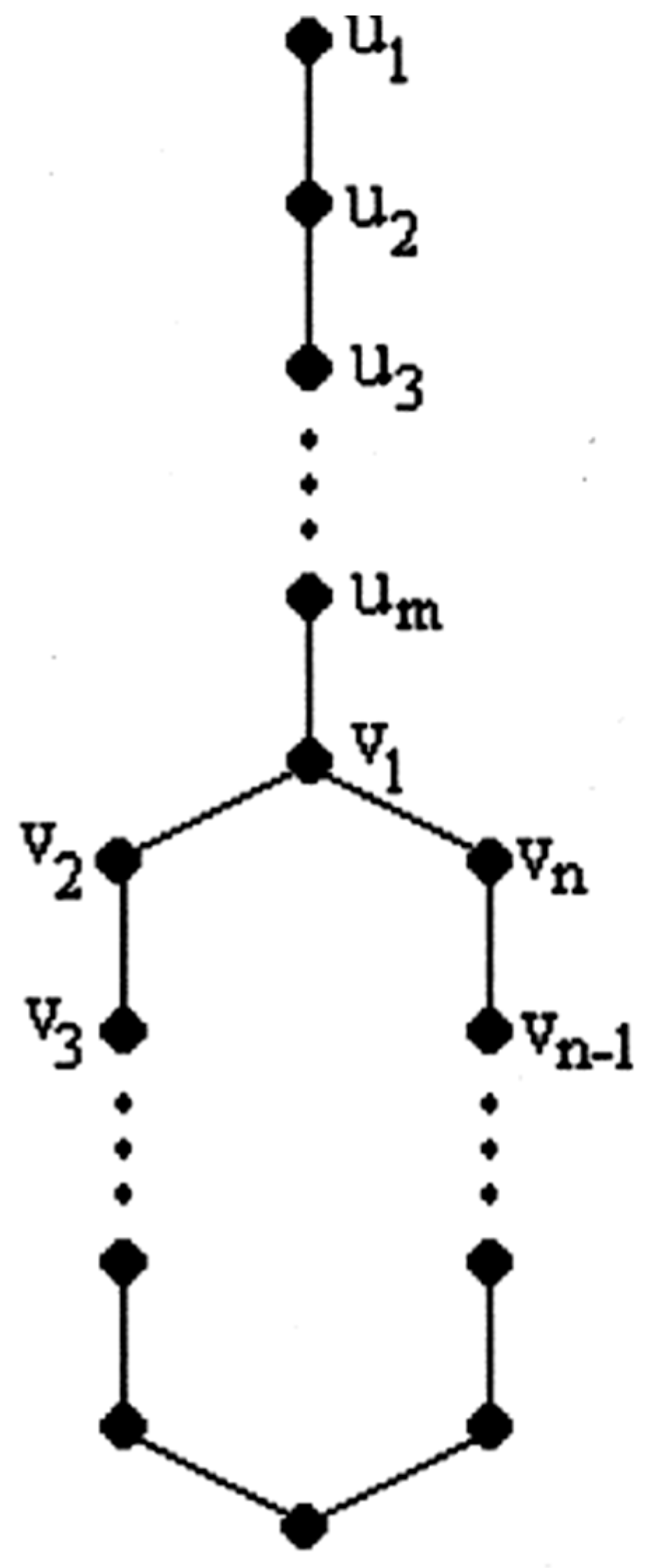
Figure 2.
Even harmonious labeling of .
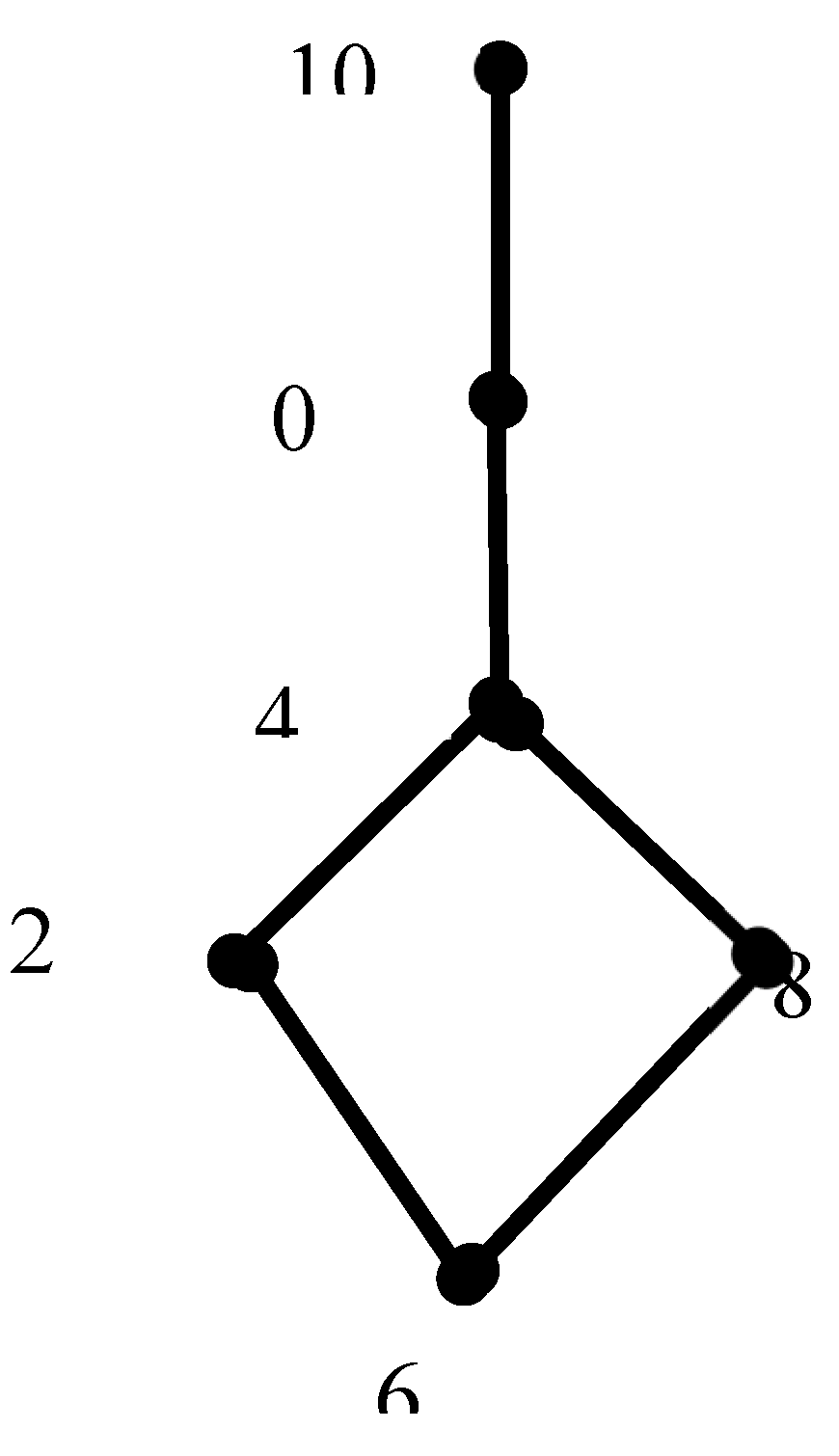
Figure 5.
xx.
Disclaimer/Publisher’s Note: The statements, opinions and data contained in all publications are solely those of the individual author(s) and contributor(s) and not of MDPI and/or the editor(s). MDPI and/or the editor(s) disclaim responsibility for any injury to people or property resulting from any ideas, methods, instructions or products referred to in the content. |
© 2025 by the author. Licensee MDPI, Basel, Switzerland. This article is an open access article distributed under the terms and conditions of the Creative Commons Attribution (CC BY) license (https://creativecommons.org/licenses/by/4.0/).
Copyright: This open access article is published under a Creative Commons CC BY 4.0 license, which permit the free download, distribution, and reuse, provided that the author and preprint are cited in any reuse.


