

Submitted:
20 March 2025
Posted:
20 March 2025
You are already at the latest version
Abstract
This paper presents an algorithm for evaluating the environmental impact of clothing swaps, promoting extended use and responsible consumption. Implemented in an online swapping platform, the algorithm quantifies reductions in environmental impact due to extended clothing lifespan and avoided purchase of new garment, promoting swapping activities. Developed through scientific literature analysis, Life Cycle Assessment (LCA), and swapping practice studies, the algorithm uses key environmental indicators: carbon footprint, water use, energy consumption, and land use. It integrates consumer behaviour insights and uses both default and user-entered clothing data to calculate environmental savings. Results show that clothing impact varies by fabric. Viscose and polyester garments have the lowest environmental impact, while swapping cotton and wool items yields the highest savings, as these materials are more resource intensive. The platform-integrated algorithm recorded 251 swaps over two months, preventing 4,137 kg CO₂ emissions, 6,809 m³ of water use, 3.08 m²a crop eq of land use, and 87.23 GJ of energy consumption. These findings highlight the significant environmental benefits of prolonging clothing use through swapping instead of throwing clothes away.
Keywords:
clothing
; swapping
; environmental impact
; extended lifespan
; reuse
1. Introduction
The textile industry is a significant contributor to environmental pollution, with each stage of a garment’s life cycle producing different types of pollutants. This impact stems from the high consumption of natural resources and energy, extensive use of chemicals, water pollution, greenhouse gas emissions, and waste generation [1,2,3]. The supply chain of textiles is extensive and complex, with substantial environmental impacts that differ according to fabric type covering in raw fiber, yarn anf fabric production, clothing manufacturing, use, and end-of-life (EOL) stages [4,5,6,7].
For example, raw cotton fiber production involves cotton cultivation and the use of agrochemicals, which contribute to water consumption, land use, and terrestrial ecotoxicity [8,9]. Polyester yarn and fabric production, on the other hand, significantly contributes to global warming potential and fossil resource scarcity because spinning and weaving stages are energy-intensive [8,10]. Dyeing and finishing processes of all kinds of fabrics may be particularly harmful, releasing persistent coloring pollutants, heavy metals, and other toxic chemicals into water bodies, leading to high chemical oxygen demand (COD) and biochemical oxygen demand (BOD) in wastewater [11]. The textile industry is a major source of microfiber pollution, which occurs during synthetic yarn and fabric production, use, and disposal, posing a growing environmental risk [12,13]. The use phase of textile products also contributes significantly to environmental impacts, particularly through water use, energy and chemicals consumption, and CO2 emissions, which are influenced by consumer behavior such as washing and drying practices [14,15,16]. The EOL stage further adds to the environmental burden, especially if textile waste ends up in landfills [4]. Reuse and recycling are proposed as the best options for EOL while reuse has significant environmental savings compared to recycling [4,17].
The rise of fast fashion has not only increased consumption rates but also altered perceptions around clothing longevity and value, leading to a culture of disposability that exacerbates waste generation and resource depletion [18].
The linear model of production and consumption affects negatively the environment [19] and efforts to mitigate it include the development of sustainable practices such as eco-labeling, which encourages the production and consumption of eco-friendly textiles [3]. Innovative recycling and circular economy models are being explored to reduce resource use and waste, however, challenges remain in achieving their widespread adoption [20,21].
According to [4,22], life cycle assessment (LCA) is crucial for understanding and reducing the environmental impacts of clothing, guiding towards more sustainable practices. Also, LCA is a critical method providing a holistic view from raw materials to EOL stages [23,24]. LCA's ability to provide detailed insights into each stage of the textile production process, such as fiber production, yarn manufacturing, and fabric dyeing, makes it invaluable for identifying environmental hotspots and potential areas for improvement [8,25]. Moreover, LCA supports the transition towards circular economy practices by evaluating the benefits of recycling and reuse, which are essential for reducing the environmental footprint of textiles [24].
The Europen Commission has adopted the EU Strategy for Sustainable and Circular Textiles to extend clothing life-cycle loops via reuse and repair activities [26,27] For instance, business models that focus on selling secondhand clothes or renting garments can effectively displace the need for new clothing, thus decreasing the environmental burden of production processes [28].
According to [29,30] the transition to a circular economy in the textile industry that involves recycling and reusing materials can mitigate environmental impacts by reducing water stress, the need for virgin resources, fossil fuel consumption, and pollution through greenhouse gas emissions and waste. Increasing the lifespan of clothing can dramatically reduce these impacts [5,31] because extending textile use requires less frequent replacement and thus lower overall impacts [32]. Thus, reuse models are crucial to mitigate environmental impacts and promote sustainability within the textile industry.
The reuse practices of selling, renting, repairing, and swapping used clothes each offer distinct approaches to extending the lifespan of garments and reducing environmental impacts, yet they differ significantly in their implementation and consumer engagement [33]. Used clothes reselling involves selling pre-owned clothing through physical or online stores including monetary transactions [34]. Renting practice allows consumers to temporarily use clothing items for a fee. It appeals to those interested in clothing variety without the commitment of ownership [34,35]. Repairing clothes encourages consumers to maintain and care for their garments, though it requires a shift in consumer behavior towards valuing longevity over newness [36]. Swapping involves exchanging clothing items with others for free, often facilitated by events or online platforms without purchasing new items, often informally. It is driven by social interaction but can be limited by unfamiliarity and materialism [37,38].
One way to encourage consumers to adopt one or another reuse option is to demonstrate the environmental benefits of doing so. This requires having targeted calculation tools and presenting them in a way that is acceptable to consumers.
The examples of existing calculators are the RREUSE tool, the Consumer Donations Calculator, and the Textile Eco Calculator, which are integrated into the websites of organizations engaged in reuse: social enterprise network RREUSE [39], charitable organization Charitable Reuse Australia [40], and textile waste management company group TexCycle [41], respectively. These websites do educational work, providing consumers with opportunities to check the possibble reduction in environmental impact when choosing used clothing over new. Another example is the used clothing resale platfom ThreadUp [42], where the environmental impact is measured on the scale of an entire personal wardrobe using the Fashion Footprint Calculator. Here reuse is just one of the aspects evaluated, and the result is not presented separately. The impact of a wardrobe is similarly assessed using the Personal Fashion GHG Footprint Calculator on the website of consulting company GreenStitch‘s [43], where for educational purposes, clients can learn about the environmental impact of their existing clothing.
One more example is Selflessclothes platform [44] selling new clothes and encouraging consumers to choose those that are sustainable. They provide the calculation of reduction of environmental impact of using sustainable garments vs those manufactured traditionally. Such an approach of comparing two items can serve as an idea for calculating environmental benefits of clothing swapping, just in the latter case a comparison should be made between new and swapped clothing.
The review of existing calculators showed that some platforms dealing with the resale of used clothes assess the environmental impact of garments, including the aspect of reuse. In case of other reuse models (rental, repair, swapping), such a practice was not identified. Selling unnecessary clothes, renting, or repairing them creates a clear monetary value—the clothing or the related service is priced and sold to an interested consumer, thus generating a financial reward for the reused item. In the swapping model, monetary value disappears. Thus, our study explores what other value, potentially important to users, is created through clothing swapping platforms. That value is environmental value: the reduction of environmental impact.
This study aims to contribute to understanding how extending the lifespan of clothing through clothing swaps can mitigate environmental impacts. Specifically, the stydy was conducted in cooperation with an online swapping platform [45]. This allowed us to combine theoretical research with practical insights into the behavior of users of clothing offered for swapping, and to have the real-world implementation and testing of environmental impact calculations. As a result, an algorithm to calculate the environmental impact reduction through swapping was developed, and the calculation results are presented to customers in order to promote swapping practices instead of throwing clothes away or buying new clothes.
2. Materials and Methods
The method for the development of an algorithm to calculate the environmental impact of clothing swaps represents an approach to understanding and quantifying the environmental consequences of this practice. This integrates insights from scientific literature, swapping practice analysis, and LCA using SimaPro software to assess fabric impacts, creating a database with constant (default) and variable data to calculate and display changes in environmental impact for individual garments, user wardrobes (group of garments provided for swaps), and platform-wide activity. The algorithm subtracts the impact of swapped items from the impact of new ones, refining the process via continuous input analysis and improvements.
The methodology for the development and implementation of an algorithm is presented in Figure 1, which explains the steps of development (green fields) and the logic of algorithm performance (red fields). An explicit description of each stage and step is presented further.
2.1. Algorithm Development
At this stage, the algorithm logic and formula were established, the necessary data and their sources were identified, a database of default data used in calculations was created, and interaction between default and user-entered data was found.
2.1.1. Review of Scientific Literature
A review of scientific literature served to identify factors that influence the environmental impact of clothing, and relevant environmental impact categories that further provided the basis for the logic of the algorithm and the development of the database.
The search strategy for the literature review involved the use of online databases such as Scopus, ScienceDirect Journals, and Springer LINK Journals. The literature from 2014 to 2024 was reviewed to capture the most current studies related to the environmental impact of clothing reuse. The review was structured around a specific set of keywords grouped into three categories: environmental impact assessment, clothing, and reuse. Key search terms included "life cycle assessment”, "environmental impact categories”, "clothing", "garment", "apparel", "textile", "consumption", "reuse", “extended lifespan”, and "swapping".
Articles were first filtered to include only research articles (243 articles) containing data, methods, and results relevant to the categorized keywords. A second screening (88 articles) focused on the relevance of the papers, particularly those related to life cycle assessment, environmental impact, and reuse practices, with unrelated articles being eliminated. The final selection involved a thorough review of the full papers (21 articles), with eliminations based on the lack of life cycle inventory data, the lack of impact assessment in every life cycle stage, and no key environmental categories, life cycle stage and clarity of data, such as the clarity of data sources, and data collection methods. Analysis of the literature review is summarized in Chapter 3.1.1, highlighting the most significant impact categories and the reasons behind these impacts, as well as documenting reuse and swapping practices.
2.1.2. Analysis of the Swapping Practice
The analysis of the clothing swap online platform was conducted in the online swapping platform GiverTag [45] which was established in July 2022, focusing on free clothing swaps among registered users. The users upload photos of their unwanted wardrobe contents (clothes, shoes, small leather goods, accessories) to the platform, providing requested information (brief description, category, condition, size, brand, location), thus creating their virtual closets to swap clothes among each other. During the study period (August 2023 to June 2024), the platform was in the testing stage, with several dozen members registering and forming their wardrobes. There were initial trial swaps of approximately 900 clothes, and user feedback was provided to GiverTag creators.
Given the iterative approach of the study, at first, the surveyed platform users helped to clarify which fabrics dominate and, therefore, are relevant to be included in the algorithm. The platform was later supplemented with questions that allow for the collection of all other information necessary for calculations, the need for which was identified during the literature analysis and formula development.
The summarized results of the analysis of swapping practices - the dominant composition of clothing by fabric and other data required by the algorithm - are presented in Chapter 3.1.2.
2.1.3. Development of Algorithm Database with Default Data
By developing the formula and analyzing the swapping practice, it became clear which data should be entered into the algorithm database as defaults and how it correlates with the information provided by users.
A database with default data needed for calculations was created. To do this, the following steps were implemented:
- Data were collected for the default database based on scientific literature;
- o
- the environmental impact of 1 kg of new fabrics (covering raw materials extraction, production, distribution and retail, first use, and EOL lifecycle stages);
- o
- the environmental impact of 1 kg of swapped fabrics during their use stage. The environmental impact of the swapped garment occurs only during its secondary use stage, and with each new owner, the wear time decreases by 33 percent, which also reduces the frequency of washings [49];
- o
- clothing transportation back and forth to the store or swapping point and home is included into the first and second use lifecycle stages; distribution and retail include transportation to retail store;
- o
- the use, in addition to the mentioned transportation to and from the store or swap, includes washing, drying and ironing.
2.1.4. Algorithm formulation
The algorithm formula was developed in parallel with the other steps of this stage, adding or excluding relevant data. During this stage, the algorithm logic (Figure 2) was refined, and an algorithm formula was created based on it. Default parameters from database and varying data entered by users are required for calculations (Chapter 3.1.4).
The algorithm's logic is based on the product displacement principle that a swapped garment eliminates a need for a new garment. In the traditional case, the first user would simply throw away the purchased garment when he/ she no longer wanted it, even though it was still suitable for wearing. The second user would buy a new garment when he/ she needed it. Thus, we would have a case where two new garments are purchased, both of which go through a full lifecycle (extraction of raw materials, production, distribution, use, disposal). In the case of swapping, instead of throwing away the garment, the first user submits it to a swap: this avoids the disposal stage. The second user takes over this garment: this extends the use stage, at the same time avoiding the extraction of raw materials and the production stage; the disposal stage is postponed to a later time.
These considerations result in the following calculations:
2.2. Algorithm Performance
At this stage, the algorithm was integrated into the swapping platform. It was implemented and tested as a key component of the IT solution. The environmental reductions were subsequently evaluated to ensure accuracy and functionality.
3. Results
3.1. The Development and Implementation of Algorithm
3.1.1. Review of Scientific Literature
Literature review outlined the direction in which the algorithm should be developed, i.e. what aspects should be included in the calculation of the environmental impact of clothing.
The environmental impact of clothing is influenced by various factors throughout its lifecycle, from raw material extraction, manufacturing, retail and distribution, and use to EOL disposal. For example, 80% of the total climate impact of Swedish clothing consumption is linked to its production mostly provided by fossil fuels and water scarcity, and 14% is linked to the usage stage including transport back and forth from the store and laundering due to energy use [50]. Clothing manufacturing processes, including spinning, weaving, dyeing, and finishing, release harmful chemicals and wastewater, with approximately 2,000 chemicals involved, particularly in wet processing [4].
Which environmental impact category is most affected depends on the fabric produced. [51]. Cotton production, unlike other fabrics, demands substantial water, pesticides, and fertilizers, leading to water scarcity, soil degradation[4,52] energy demand and land occupation [53] Wool production, particularly in the farming stage, contributes heavily to greenhouse gas emissions, while water stress and energy demand impacts are distributed across fiber production and fabric processing [5].Viscose, a man-made cellulose fiber, is evaluated for its primary energy demand, water use, and land use, with variations in impact depending on the production region, as seen in comparisons between viscose produced in Asia and Austria [5,54].
Polyester, a synthetic fiber derived from fossil fuels, has a notable impact on terrestrial ecotoxicity, fossil resource scarcity, greenhouse gas emissions, with minor effects on stratospheric ozone depletion [8,55,56,57]. In 2018, global textile fiber production exceeded 107 million tons, with synthetic fibers comprising nearly two-thirds and expected to rise further [58], together with the environmental impact attributable to synthetic fibers.
Another significant lifecycle stage – use - involves washing, drying, and ironing, which consumes water, energy, and detergents, releases microplastic emissions when laundering polyester clothes, and significantly contributes to environmental impacts [52,57]. Frequent washing, especially with inefficient machines, and extensive use of dryers increases energy and water consumption, highlighting the potential for environmental improvement through reduced laundering frequency and more efficient care practices [59,60]. In the jeans LCA case [4], the use stage accounted for around 58% of overall energy use while fabric production and cutting/sewing consumed 21% and 10% of total energy, respectively.
One of the most preferable ways to significantly reduce the environmental impact of textiles is to extend their lifetime, for which the design of the textile and practices of domestic use are of great importance. More durable textiles are worn for longer and encourage the increased development of circular textile business models, such as reuse, rent and repair, end-of-life collection services, and second-hand clothing retailing, which at the same time provide consumers with opportunities for savings [26,50]. Prolonging the wearing time can dramatically reduce the overall environmental impact, as demonstrated in studies on wool sweaters where increased garment use led to a substantial decrease in impacts [31]. Also, the choice of fiber affects the clothing’s durability while durable fibers that support longer garment lifespans can reduce the need for frequent replacements, thereby lowering overall environmental impacts [61]. According to WRAP research [62], extending the lifespan of clothing by an additional nine months can lead to a reduction in carbon, water, and waste footprints by 20 to 30%; if garments were worn twice as often, greenhouse gas emissions would drop by about 4 times.
To summarize, results of the literature analysis indicate that it is advisable to develop a clothing swapping algorithm by calculating environmental reduction based on the type of clothing fabric. Fabric selection is crucial in determining the environmental impact of clothing and varies significantly with the type of fiber used, influencing resource use, emissions, and waste throughout their lifecycle.
In life cycle assessment, environmental impacts can be assessed approximately in up to 18 categories depending on the chosen method, for example, ReCiPe 2016 [63] , CED [64] or IPPC 2013/GWP100a (Global Warming Potential) [64]. In line with literature analysis the key environmental impacts include:
- Carbon Footprint: Production processes, particularly those using fossil fuels, significantly contribute to greenhouse gas emissions. Materials like polyester, but also conventional cotton, are notable for their high carbon outputs during manufacturing and processing phases;
- Water Consumption: The textile industry is water-intensive, especially in the cultivation of cotton and the processing phases like dyeing and finishing or home washing which can lead to water scarcity and pollution;
- Energy Consumption: From manufacturing to consumer care, energy demand is substantial. Synthetic fibers and inefficient laundering practices increase the energy footprint dramatically;
- Land Use: Cultivation of natural fibers like cotton and viscose production requires considerable land, impacting land availability and health through pesticide and fertilizer use.
3.1.2. Analysis of the Swapping Practice
A situation analysis of the clothing swap online platform identified what data must be collected to build a dataset to calculate environmental impact reduction.
Since the literature analysis found that clothing fabric is important in assessing environmental impact, platform users were instructed to provide an information on the fabric composition of the clothing being swapped. 68 out of 532 swapped clothes didn’t have a label, making it impossible to identify the type of fabrics accurately. In this case, it was decided to develop the algorithm in such a way that the average composition of all blended-fiber fabric garments included in the algorithm development practice was used.
In addition to the provided information on fabric composition, users also provided information about clothing categories.
Table 1 shows the flow of the swapped units of clothing and composition of fabrics.
The other relevant data include:
- The clothing category and weight – the weight depends on the category, and the amount of fabric in the garment depends on the weight;
- The number of wear cycles for both new and used clothing – this affects the number of washes, ironing, and drying cycles, which in turn impacts the environmental effect during the use phase of the life cycle;
- The condition of the cloth being swapped – both unused and used clothes could be swapped;
- How the swapped clothing was acquired – whether it was purchased new or used. If purchased new, after the swap, it is passed to the second owner; if purchased second-hand, it is passed to at least the third owner;
- The environmental impact assessment results of the fabrics to evaluate the environmental savings in both new and used clothing contexts.
Literature review and the swap platform analysis resulted in a list of data that must be considered when calculating how much the environmental impact is reduced due to clothing being swapped instead of the first user throwing away the garment and the second user buying a new one (Table 2).
3.1.3. The Developed Algorithm Database
Based on data relevant to the development of the algorithm (Table 2), at this stage, using SimaPro software, a life cycle assessment was performed for eleven fabrics (cotton, polyester, viscose, wool, acrylic, linen, silk, leather, elastane, polyamide and rubber for shoe soles) taking 1 kg of fabric as a functional unit. Ecoinvent v.3.8 database along with literature (polyester [52], cotton [52], viscose [52], leather [68], wool [69], acrylic [69], elastane [52], polyamide [52], rubber [70], linen [71], silk [72]) were used as inventory data sources for LCA calculations.
Frequency of wear, laundering practices, and the average weight of garments in every clothing category were taken from literature [49,52,65,66,67] and entered into the algorithm database as default values.
According to LCA calculations, viscose and polyester have the lowest environmental impact of all the assessed fabrics, while cotton, wool and leather have the highest impact on the environment. Thus, when swapping, the best results, i.e., the biggest impact reductions, are achieved for clothes made of the latter fabrics (Table 3). LCA results for all fabrics, when considering an average number of launderings from all clothing categories, are shown in Supplementary Materials Table S1.
3.1.4. The Formulated Algorithm
The formula (1) was designed to calculate environmental impact reductions (ER) in each environmental impact category, achieved by swapping clothes and prolonging their lifespan instead of purchasing new ones, according to the logic presented in Chapter 2.1.4.
ER = (2 × (IRawMat+IManuf+IDistr+INewUse+IEOL))-(IRawMat+IManuf+IDistr+INewUse1+ISwappedDistr+ISwappedUse+IEOL) =
(IRawMat+IManuf+IDistr+INewUse+IEOL) – (ISwappedDistr+ISwappedUse) = INW – ISW
(IRawMat+IManuf+IDistr+INewUse+IEOL) – (ISwappedDistr+ISwappedUse) = INW – ISW
ER – environmental impact reduction;
IRawMat, IManuf, IDistr, INewUse, IDisp – impact of raw materials extraction, manufacturing, retail/ distribution, use of new clothing, and disposal stages, respectively;
IEOL – impact of disposal stage (does not differ for new and swapped clothing);
ISwappedDistr and ISwappedUse – environmental impact of distribution (transportation) and use of swapped clothing;
INW – impact of the new clothing;
ISW – impact of swapped clothing.
Thus, the net environmental reduction (ER) is calculated by subtracting the environmental impact of the swapped clothing from the impact of the new clothing. The result, ER, indicates how much environmental impact is reduced due to clothing being swapped instead of the first user throwing away the garment and the second user buying a new one.
INW is calculated by multiplying the proportion of different fabrics ( in the clothing by mass in kg (PFCm) with the environmental impact of the life cycle stages (production, retail/distribution, use, EoL) of the new garment (LCA1) for 1 kg of relevant fabric:
INW = (PFCm1 × LCA1) + (PFCm2 × LCA1) + …
LCA1 is the sum of the impact of the new garment's use stage from driving/return from the shop (USE1), and the impact of use stage from washing, drying and ironing (USE2) multiplied by the number of these cycles for new clothing (WSH1), and the sum of impacts from production (P), retail/distribution (R), and EoL (W):
LCA1 = USE1 + (USE2 × WSH1) + P + R + W
ISW is calculated by multiplying the proportion of different fabrics (in the clothing by mass in kg (PFCm) with the environmental impact of the life cycle stages (second use) of the swapped garment (LCA2) for 1 kg of relevant fabric:
ISW = (PFCm1 × LCA2) + (PFCm2 × LCA2) + …
LCA2 is determined by adding the impact of garment use phases related to washing, drying, and ironing (USE2) multiplied by the number of these cycles for swapped clothing (WSH2) to the impact of the garment's use phase from driving/return from the shop (USE1):
LCA2 = (USE × WSH2) + USE1
PFCm1 and PFCm1 calculates the proportion of fabrics in clothing by mass (kg) using the average clothing category weight (CWm) and the proportion of fabrics in the cloth (%).
PFCm1 = (CWm × PFC%) / 100
The algorithm along with the created database of default data was integrated into an online platform to assess the environmental impact reductions at the clothing, virtual wardrobe, and platform levels. The operation of the algorithm and the results obtained are described in the following section.
3.2. Algorithm Performance to Calculate Environmental Impact Using the Developed Algorithm Implemented at an Online Clothing Swapping Platform
The compiled datasets of default data have been integrated into the platform as a permanent database. The algorithm was implemented in such a way that user inputs through the algorithm are linked with database data, allowing users to immediately see the environmental impact savings of the clothing they offered for swap and the clothing they wished to acquire in swap. The public disclosure and evaluation of users' clothing impact on the environment fosters healthy competition among platform users, contributing to their environmental awareness and responsible consumption. Additionally, presenting a summary of the platform's contributions to environmental impact reduction allows to monitor the trends and motivates users to further improve their environmental practices.
Figure 3.
Representation of the calculated environmental impact reduction of a sample swapped clothing in the online platform (carbon footprint - kg CO2 eq, water consumption - m3, energy consumption - MJ, and land use -m2a crop eq.
Figure 3.
Representation of the calculated environmental impact reduction of a sample swapped clothing in the online platform (carbon footprint - kg CO2 eq, water consumption - m3, energy consumption - MJ, and land use -m2a crop eq.
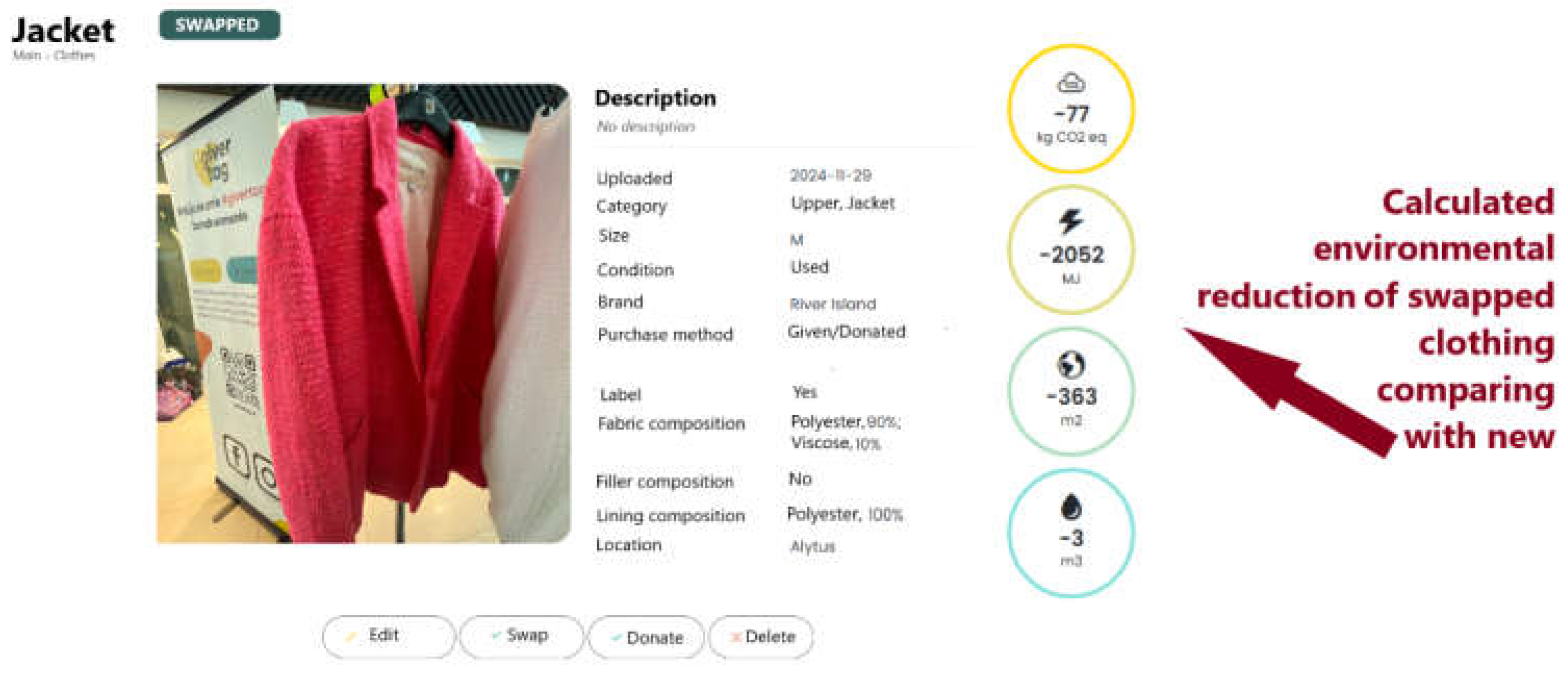
After the algorithm integration into the platform, it was calculated that 251 clothing items were swapped over two months. These swaps avoided emissions of 4,137 kg CO2 eq and consumption of 6,809 m3 of water, 3.08 m2a crop eq of land, and 87.23 GJ of energy.
4. Discussion
The developed algorithm calculates environmental impact reduction achieved through clothing swapping, creating additional value and promoting swaps as an alternative option to traditional resale models that focus on monetary exchange. Swapping can be viewed as a collaborative consumption pattern. Formal swapping is organized and structured through events, apps, online platforms, whereas informal swapping is more casual and spontaneous and occurs in community settings, emphasizing social interaction and personal networks [37,73,74].
Within two months after implementing the algorithm on the platform, 20 new users joined, and 251 garments were swapped. The most swapped items were dresses (25%), shirts/blouses (23%), jeans/pants (15%), skirts and sweaters (each 7%), jackets (5%), and footwear (3%). The least swapped items included outerwear, vests, swimsuits, and various accessories.
Clothing made from single-fiber fabrics dominated, accounting for about 70% of all swapped items, with the remainder (30%) being blended-fiber fabric garments. Among single-fabric garments, polyester (40%), cotton (30%), viscose/natural leather (7% each) and wool/linen (4 % each) were predominant.
Comparing the environmental impact reductions of the most popular swapped clothing depending on the fabric, the results varied by environmental impact category. The highest environmental reductions were observed in:
- Carbon footprint: a cotton dress saves 98 kg CO2 eq;
- Energy consumption: a silk dress saves 2858 MJ;
- Land occupation: silk and natural leather dresses save 1750 m2a crop eq and 5000 m2a crop eq, respectively;
- Water consumption: a cotton and silk dresses save 10 m3 and 9 m3, respectively.
The lowest environmental reductions were:
- Carbon footprint: wool and silk dresses save 1 kg CO2 eq and 64 kg CO2 eq, respectively;
- Energy consumption: natural leather dress saves 507 MJ;
- Land occupation: wool dress saves 84 m2a crop eq;
- Water consumption: wool (2 m3), viscose (3 m3), polyester (3 m3), and linen (4 m3) dresses.
Evaluating a dress made of blended fabrics, it reduces the environmental impact by an average carbon footprint – 95 kg CO2 eq , energy consumption – 2480 MJ, land occupation – 569 m2a crop eq and water consumption – 5 m3.
According to the results, silk dresses are the most worth swapping, i.e. extending the lifespan. Only a few percent of silk clothing is swapped on the platform, so when comparing the most popular fabrics, cotton dresses are the most worth to swap, as well as other cotton clothing, because they create the biggest savings in two categories – carbon footprint and water consumption.
The algorithm currently uses standardized washing data for all clothing types but needs updating to account for garments requiring specific care like dry cleaning and hand washing. Future enhancements should include diverse maintenance practices for more accurate environmental impact calculations. Users must specify if clothing is second-hand, and due to system limitations, ownership history beyond three swaps isn't tracked. The introduction of Digital Product Passports could improve this by providing precise production dates. Additionally, with the rise of sustainable and alternative fibers, there is a need of integrating recycled or organic fabric categories.
When analysing reuse, the substitution rate, i.e., the amount of new clothes that are replaced by reuse, is an important indicator. In Europe, it varies from 0.3 to 0.6, in Africa or Asia countries – 0.8 [17]. The high substitution rate means consumers buy used clothes because of socioeconomic reasons or environmental awareness, the low rate means reuse is a side option to purchase new clothes and therefore reuse impact can be lower than expected [75].
The developed algorithm to calculate environmental reduction through clothing swaps is a good starting point to have a reliable and convenient tool for users to evaluate and compare different clothes for swap, and assess the environmental impact of their consumption. The analysis showed that algorithm also has possibilities for improvement, and most of the mentioned aspects are continuously analyzed by the authors of this paper, with the main intention to foster a transition towards circular textile systems through the innovations in extending the lifespan of clothing.
5. Conclusions
A scientifically grounded algorithm designed to assess the environmental impact of clothing swaps was developed, highlighting the potential of swaps to offer an alternative to traditional resale models focused on monetary exchange. This algorithm, integral to the online platform, calculates environmental savings by evaluating the impact avoided through extended use of swapped clothing and avoided purchase of new clothing, thereby fostering more sustainable consumption practices. The development of the algorithm was significantly aided by careful data collection, which emphasized the importance of fiber selection and the environmental impacts of various fabric types. However, the research uncovered areas needing improvement, such as incorporating diverse maintenance practices and expanding the fabric categories in the algorithm's database to enhance precision and utility. Moreover, the study reveals the limitations of the current algorithm, especially in tracking the clothing lifecycle beyond three owners, and suggests future enhancements like Digital Product Passports for textiles. The developed algorithm can also be adapted to other reuse practices such as retailing, rental platforms, swapping events, etc. This algorithm not only provides a platform for users to make informed choices but also underscores the potential for future research to refine the tools available for promoting reuse practices in the fashion industry.
Supplementary Materials
The following supporting information can be downloaded at: Preprints.org, Table S1: LCA results of new and swapped 11 fabrics and swapping environmental reduction per 1 kg of fabric.
Author Contributions
Conceptualization, A.J. and I.G.; methodology, A.J.; software, A.J.; validation A.J., I.G. and J.K.; formal analysis, A.J.; investigation, A.J.; resources, I.G., and A.J.; data curation, A.J.; writing—original draft preparation, A.J.; writing—review and editing, I.G., and J.K.; visualization, A.J.; supervision, J.K. All authors have read and agreed to the published version of the manuscript.
Funding
This research was funded by The Ministry of Economy and Innovation of the Republic of Lithuania Under the Economic Transformation and Competitiveness Development Program 2020-2030, grant number 02-006-K-0136.
Conflicts of Interest
The authors declare no conflicts of interest. The funders had no role in the study's design; in the collection, analyses, or interpretation of data; in the writing of the manuscript; or in the decision to publish the results.
Abbreviations
The following abbreviations are used in this manuscript:
| BOD | Biochemical Oxygen Demand |
| CED | Cumulative Energy Demand |
| COD | Chemical Oxygen Demand |
| EOL | End of Life |
| GWP | Global Warming Potential |
| LCA | Life Cycle Assessment |
References
- ETC/CE. Textiles and the Environment The Role of Design in Europe’s Circular Economy, 2022. Available online: https://www.eionet.europa.eu/etcs/etc-ce/products/etc-ce-products/etc-ce-report-2-2022-textiles-and-the-environment-the-role-of-design-in-europes-circular-economy (accessed on 1 March 2024).
- Yılmaz, K.; Aksu, I.O.; Göçken, M.; Demirdelen, T. Sustainable Textile Manufacturing with Revolutionizing Textile Dyeing: Deep Learning-Based, for Energy Efficiency and Environmental-Impact Reduction, Pioneering Green Practices for a Sustainable Future. Sustainability 2024. [Google Scholar] [CrossRef]
- Plakantonaki, S.; Kiskira, K.; Zacharopoulos, N.; Chronis, I.; Coelho, F.; Togiani, A.; Kalkanis, K.; Priniotakis, G. A Review of Sustainability Standards and Ecolabeling in the Textile Industry. Sustainability 2023. [Google Scholar] [CrossRef]
- Moazzem, S.; Crossin, E.; Daver, F.; Wang, L. Environmental Impact of Apparel Supply Chain and Textile Products. Environ Dev Sustain 2022, 24, 9757–9775. [Google Scholar] [CrossRef]
- Wiedemann, S.G.; Biggs, L.; Nebel, B.; Bauch, K.; Laitala, K.; Klepp, I.G.; Swan, P.G.; Watson, K. Environmental Impacts Associated with the Production, Use, and End-of-Life of a Woollen Garment. Int J Life Cycle Assess 2020, 25, 1486–1499. [Google Scholar] [CrossRef]
- Niinimäki, K.; Peters, G.; Dahlbo, H.; Perry, P.; Rissanen, T.; Gwilt, A. The Environmental Price of Fast Fashion. Nat Rev Earth Environ 2020, 1, 189–200. [Google Scholar] [CrossRef]
- Sofeast. Lifecycle Impact on the Environment of Textiles and Garments [Analysis], 2023. Available online: https://www.sofeast.com/resources/green-manufacturing/lifecycle-impact-on-environment-of-textiles-garments/ (accessed on 9 December 2024).
- Gonzalez, V.; Lou, X.; Chi, T. Evaluating Environmental Impact of Natural and Synthetic Fibers: A Life Cycle Assessment Approach. Sustainability 2023, 15. [Google Scholar] [CrossRef]
- Baydar, G.; Ciliz, N.; Mammadov, A. Life Cycle Assessment of Cotton Textile Products in Turkey. Resour Conserv Recycl 2015, 104, 213–223. [Google Scholar] [CrossRef]
- Zhang, Y.; Kang, H.; Hou, H.; Shao, · Shuai; Sun, X.; Qin, C.; Zhang, S. Improved Design for Textile Production Process Based on Life Cycle Assessment. Clean Technol Environ Policy 2018, 20, 1355–1365. [CrossRef]
- Kishor, R.; Purchase, D.; Saratale, G.D.; Saratale, R.G.; Ferreira, L.F.R.; Bilal, M.; Chandra, R.; Bharagava, R.N. Ecotoxicological and Health Concerns of Persistent Coloring Pollutants of Textile Industry Wastewater and Treatment Approaches for Environmental Safety. J Environ Chem Eng 2021, 9, 105012. [Google Scholar] [CrossRef]
- Liu, J.; Liu, Q.; An, L.; Wang, M.; Yang, Q.; Zhu, B.; Ding, J.; Ye, C.; Xu, Y. Microfiber Pollution in the Earth System. Rev Environ Contam Toxicol 2022, 260. [Google Scholar] [CrossRef]
- Ramasamy, R.; Subramanian, R.B. Synthetic Textile and Microfiber Pollution: A Review on Mitigation Strategies. Environ Sci Pollut Res 2021, 28, 41596–41611. [Google Scholar] [CrossRef]
- Steinberger, J.K.; Friot, D.; Jolliet, O.; Erkman, S. A Spatially Explicit Life Cycle Inventory of the Global Textile Chain. Int J Life Cycle Assess 2009, 14, 443–455. [Google Scholar] [CrossRef]
- Muthu, S.S. Environmental Impacts of the Use Phase of the Clothing Life Cycle. In Handbook of Life Cycle Assessment (LCA) of Textiles and Clothing, Woodhead Publishing Series in Textiles, Muthu, S.S., Eds.; Elsevier / Woodhead Publishing, 2015, pp. 93–102. [CrossRef]
- Luo, Y.; Wu, X.; Ding, X. Environmental Impacts of Textiles in the Use Stage: A Systematic Review. Sustain Prod Consum 2023, 36, 233–245. [Google Scholar] [CrossRef]
- Koligkioni, A.; Parajuly, K.; Sørensen, B.L.; Cimpan, C. Environmental Assessment of End-of-Life Textiles in Denmark. Procedia CIRP 2018, 69, 962–967. [Google Scholar] [CrossRef]
- Singh, A.; Goel, A. Design of the Supply Chain Network for the Management of Textile Waste Using a Reverse Logistics Model under Inflation. Energy 2024. [Google Scholar] [CrossRef]
- Stefan, D.S.; Bosomoiu, M.; Stefan, M. Methods for Natural and Synthetic Polymers Recovery from Textile Waste. Polymers 2022, 14. [Google Scholar] [CrossRef] [PubMed]
- Rubik, F.; Nebel, K.; Klusch, C.; Karg, H.; Hecht, K.; Gerbig, M.; Gärtner, S.; Boldrini, B. Textiles on the Path to Sustainability and Circularity—Results of Application Tests in the Business-to-Business Sector. Sustainability 2024, 16, 5954. [Google Scholar] [CrossRef]
- Tummino, M.L.; Varesano, A.; Copani, G.; Vineis, C. A Glance at Novel Materials, from the Textile World to Environmental Remediation. J Polym Environ 2023, 31, 2826–2854. [Google Scholar] [CrossRef]
- Li, C.; Zhang, T.; Zhou, X.; Cheng, Z.; Xu, T.; Li, Z.; Hong, J. Carbon–Water–Energy Footprint Impacts of Dyed Cotton Fabric Production in China. J Clean Prod 2024, 467, 142898. [Google Scholar] [CrossRef]
- Fonseca, A.; Ramalho, E.; Gouveia, A.; Henriques, R.; Figueiredo, F.; Nunes, J. Systematic Insights into a Textile Industry: Reviewing Life Cycle Assessment and Eco-Design. Sustainability 2023. [Google Scholar] [CrossRef]
- Abagnato, S.; Rigamonti, L.; Grosso, M. Life Cycle Assessment Applications to Reuse, Recycling and Circular Practices for Textiles: A Review. Waste Manag 2024, 182, 74–90. [Google Scholar] [CrossRef]
- Islam, S.; Hasan, A.K.M.M.; Bhuiyan, M.A.R.; Bhat, G. Evaluation of Environmental Impacts of Cotton Polo Shirt Production in Bangladesh Using Life Cycle Assessment. Sci Total Environ 2024, 172097. [Google Scholar] [CrossRef]
- COM(2022) 141 final EU Strategy for Sustainable and Circular Textiles. Available online: https://eur-lex.europa.eu/legal-content/EN/TXT/?uri=CELEX%3A52022DC0141 (accessed on 26 May 2022).
- COM/2020/98 final Communication from the Commission to the European Parliament, the Council, the European Economic and Social Committee and the Committee of the Regions. A New Circular Economy Action Plan For a Cleaner and More Competitive Europe. Available online: https://eur-lex.europa.eu/legal-content/EN/TXT/?qid=1583933814386&uri=COM:2020:98:FIN (accessed on 29 April 2022).
- Gray, S.; Druckman, A.; Sadhukhan, J.; James, K. Reducing the Environmental Impact of Clothing: An Exploration of the Potential of Alternative Business Models. Sustainability 2022, 14. [Google Scholar] [CrossRef]
- Furferi, R.; Volpe, Y.; Mantellassi, F. Circular Economy Guidelines for the Textile Industry. Sustainability 2022, 14. [Google Scholar] [CrossRef]
- Harmsen, P.; Scheffer, M.; Bos, H. Textiles for Circular Fashion: The Logic behind Recycling Options. Sustainability 2021, 13. [Google Scholar] [CrossRef]
- Wiedemann, S.; Biggs, L.; Nguyen, Q. Van; Clarke, S.J.; Laitala, K.; Klepp, I.G. Reducing Environmental Impacts from Garments through Best Practice Garment Use and Care, Using the Example of a Merino Wool Sweater. Int J Life Cycle Assess 2021, 26, 1188–1197. [Google Scholar] [CrossRef]
- Laitala, K.; Klepp, I.G.; Henry, B. Does Use Matter? Comparison of Environmental Impacts of Clothing Based on Fiber Type. Sustainability 2018, 10, 2524. [Google Scholar] [CrossRef]
- Gwozdz, W.; Steensen Nielsen, K.; Müller, T. An Environmental Perspective on Clothing Consumption: Consumer Segments and Their Behavioral Patterns. Sustainability 2017, 9. [Google Scholar] [CrossRef]
- Brand, S.; Jacobs, B.; Taljaard-Swart, H. I Rent, Swap or Buy Second-Hand – Comparing Antecedents for Online Collaborative Clothing Consumption Models. Int J Fash Des Technol Educ 2023, 16, 1–13. [Google Scholar] [CrossRef]
- Armstrong, C.M.; Niinimäki, K.; Lang, C.; Kujala, S. A Use-Oriented Clothing Economy? Preliminary Affirmation for Sustainable Clothing Consumption Alternatives. Sustainable Development 2016, 24, 18–31. [Google Scholar] [CrossRef]
- Maguire, H.; Fahy, F. Unlocking Insights in the Everyday: Exploring Practices to Foster Sustainable Maximum Use of Clothing. Clean Respons Consum 2023, 8, 100095. [Google Scholar] [CrossRef]
- Laitala, K.; Klepp, I. Clothing Reuse: The Potential in Informal Exchange. Clothing Cultures 2017, 4, 61–77. [Google Scholar] [CrossRef]
- Weber, S.; Lynes, J.; Young, S.B. Fashion Interest as a Driver for Consumer Textile Waste Management: Reuse, Recycle or Disposal. Int J Consum Stud 2017, 41, 207–215. [Google Scholar] [CrossRef]
- RREUSE CO2 Emissions Calculator. Available online: https://rreuse.org/ (accessed on 9 November 2024).
- Charitable Reuse Australia Consumer Donations Calculator. Available online: https://www.charitablereuse.org.au/reusecalculator/ (accessed on 9 December 2024).
- TEXCYCLE Textile Eco Calculator. Available online: https://texcycle.bg/en/eco-calculator/ (accessed on 9 December 2024).
- ThreadUP TreadUp. Available online: https://www.thredup.com/fashionfootprint/ (accessed on 9 December 2024).
- GreenStitch. Personal Fashion GHG Footprint Calculator. Available online: https://greenstitch.io/personal-footprint-calculator (accessed on 1 March 2025).
- Selfless Clothing Sustainability Rank. Available online: https://www.selflessclothes.com/ (accessed on 9 March 2025).
- Givertag Apie Mus Available online:. Available online: https://givertag.lt/ (accessed on 9 December 2024).
- ISO. Environmental Management — Life Cycle Assessment — Requirements and Guidelines. Available online: https://www.iso.org/standard/38498.html (accessed on 24 January 2025).
- SimaPro About Us. Available online: https://simapro.com/meet-the-developer/ (accessed on 9 December 2024).
- Ecoinvent Ecoinvent Version 3.8. Available online: https://support.ecoinvent.org/ecoinvent-version-3.8 (accessed on 5 May 2024).
- Laitala, K.; Klepp, I. Clothing Longevity: The Relationship Between the Number of Users, How Long and How Many Times Garments Are Used. Available online: https://www.researchgate.net/publication/352993692 (accessed on 1 March 2025).
- ECOS. Durable, Repairable and Mainstream: How Ecodesign Can Make Our Textiles Circular, 2021. Available online: https://ecostandard.org/publications/report-durable-repairable-and-mainstream-how-ecodesign-can-make-our-textiles-circular/ (accessed on 29 May 2024).
- ETC/WMGE. Textiles and the Environment in a Circular Economy, 2019. Available online: https://www.eionet.europa.eu/etcs/etc-wmge/products/etc-wmge-reports/textiles-and-the-environment-in-a-circular-economy (accessed on 10 November 2024).
- Sandin, G.; Roos, S.; Spak, B.; Zamani, B.; Peters, G. Environmental Assessment of Swedish Clothing Consumption-Six Garments, Sustainable Futures, 2019. Available online: https://research.chalmers.se/en/publication/514322 (accessed on 13 March 2025).
- Nguyen, Q. Van; Wiedemann, S.; Simmons, A.; Clarke, S.J. The Environmental Consequences of a Change in Australian Cotton Lint Production. Int J Life Cycle Assess 2021, 1–18. [Google Scholar] [CrossRef]
- Shen, L.; Worrell, E.; Patel, M.K. Environmental Impact Assessment of Man-Made Cellulose Fibres. Resour Conserv Recycl 2010, 55, 260–274. [Google Scholar] [CrossRef]
- Van Der Velden, N.M.; Patel, M.K.; Vogtländer, J.G. LCA Benchmarking Study on Textiles Made of Cotton, Polyester, Nylon, Acryl, or Elastane. Int J Life Cycle Assess 2014, 19, 331–356. [Google Scholar] [CrossRef]
- Braun, G.; Som, C.; Schmutz, M.; Hischier, R. Environmental Consequences of Closing the Textile Loop—Life Cycle Assessment of a Circular Polyester Jacket. Applied sciences 2021, 11, 2964. [Google Scholar] [CrossRef]
- Filho, W.L.; Dinis, M.A.P.; Liakh, O.; Paço, A. do; Dennis, K.; Shollo, F.; Sidsaph, H. Reducing the Carbon Footprint of the Textile Sector: An Overview of Impacts and Solutions. Text Research J 2024. [Google Scholar] [CrossRef]
- ETC/WMGE. Plastic in Textiles: Potentials for Circularity and Reduced Environmental and Climate Impacts, 2021. Available online: https://www.eionet.europa.eu/etcs/etc-wmge/products/etc-wmge-reports/plastic-in-textiles-potentials-for-circularity-and-reduced-environmental-and-climate-impacts (accessed on 1 March 2024).
- Laitala, K.; Klepp, I.G. What Affects Garment Lifespans? International Clothing Practices Based on a Wardrobe Survey in China, Germany, Japan, the UK, and the USA. Sustainability 2020, 12, 1–47. [Google Scholar] [CrossRef]
- Laitala, K.; Klepp, I.G.; Kettlewell, R.; Wiedemann, S. Laundry Care Regimes: Do the Practices of Keeping Clothes Clean Have Different Environmental Impacts Based on the Fibre Content? Sustainability 2020, 12, 7537. [Google Scholar] [CrossRef]
- Wiedemann, S.G.; Clarke, S.J.; Nguyen, Q. Van; Cheah, Z.X.; Simmons, A. Strategies to Reduce Environmental Impacts from Textiles: Extending Clothing Wear Life Compared to Fibre Displacement Assessed Using Consequential LCA. Resour Conserv Recycl 2023, 198, 107119. [Google Scholar] [CrossRef]
- Cooper, T.; Hill, H.; Kinmouth, J.; Townsend, K.; Hughes, M. Design for Longevity: Guidance on Increasing the Active Life of Clothing, 2013. Available online: https://www.researchgate.net/publication/313479112_Design_for_Longevity_Guidance_on_Increasing_the_Active_Life_of_Clothing (accessed on 12 June 2024).
- ReCiPe 2016 LCIA: The ReCiPe Model. Available online: https://www.rivm.nl/en/life-cycle-assessment-lca/recipe (accessed on 1 May 2024).
- SimaPro. SimaPro Database Manual. Available online: https://support.simapro.com/s/article/SimaPro-Methods-manual (accessed on 11 January 2025).
- WRAP. How to Use the Clothing Longevity Protocol, 2014. Available online: https://www.wrap.ngo/resources/guide/extending-clothing-life-protocol (accessed on 1 March 2024).
- WRAP. Citizen Insights - Clothing Longevity and CBM Receptivity in the UK, 2023. Available online: https://www.wrap.ngo/resources/report/citizen-insights-clothing-longevity-and-circular-business-models-receptivity-uk (accessed on 12 March 2025).
- Bianco, I.; Picerno, G.; Blengini, G.A. Life Cycle Assessment (LCA) of Worsted and Woollen Processing in Wool Production: ReviWool® Noils and Other Wool Co-Products. J Clean Prod 2023, 415, 137877. [Google Scholar] [CrossRef]
- Bruno, N.; Puig, R.; Raggi, A.; Fullana-i-Palmer, P.; Tassielli, G.; Camillis, C.; Rius, A. Life Cycle Assessment of Italian and Spanish Bovine Leather Production Systems. Afinidad -Barcelona- 2011, 68(553), 167–180. Available online: https://www.researchgate.net/publication/248707414_Life_Cycle_Assessment_of_Italian_and_Spanish_Bovine_Leather_Production_Systems (accessed on 13 April 2024).
- Torres, C.B. Life Cycle Assessment of Raw White, Dyed and Pigmented Acrylic Fibres and Proposals for the Improvement of Environmental Performance. Available online: http://hdl.handle.net/10362/109862 (accessed on 12 July 2024).
- Gottfridsson, M.; Zhang, Y. Environmental Impacts of Shoe Consumption Combining Product Flow Analysis with an LCA Model for Sweden. Available online: https://hdl.handle.net/20.500.12380/218968 (accessed on 12 June 2024).
- Gomez-Campos, A.; Vialle, C.; Rouilly, A.; Hamelin, L.; Rogeon, A.; Hardy, D.; Sablayrolles, C. Natural Fibre Polymer Composites - A Game Changer for the Aviation Sector? J Clean Prod 2021, 286. [Google Scholar] [CrossRef]
- Astudillo, M.F.; Thalwitz, G.; Vollrath, F. Life Cycle Assessment of Indian Silk. J Clean Prod 2014, 81, 158–167. [Google Scholar] [CrossRef]
- Armouch, F.; Paulin, M.; Laroche, M. Is It Fashionable to Swap Clothes? The Moderating Role of Culture. J Consum Behav 2024, 23, 2693–2719. [Google Scholar] [CrossRef]
- Cobb, T.S. Share, Don’t Shop: Exploring Value, Sociality and the “alternative” at Clothing Swaps. JOMEC Journal 2022, 17. [Google Scholar] [CrossRef]
- Andersson, S.; Algurén, P.; Bergman, E.; Blomqvist, E.; Friedl, H.; Hennessy, J.; Johansson, A.; Linder, M.; Mcallister, I. Second-Hand Is [Currently] Bad for Global Sustainability, 2024. Available online: https://www.misolutionframework.net/publications/second-hand-is-currently-bad-for-global-sustainability (accessed on 12 December 2024).
Figure 1.
The methodology for developing and implementing the algorithm for assessing the change in environmental impact through clothing swaps.
Figure 1.
The methodology for developing and implementing the algorithm for assessing the change in environmental impact through clothing swaps.
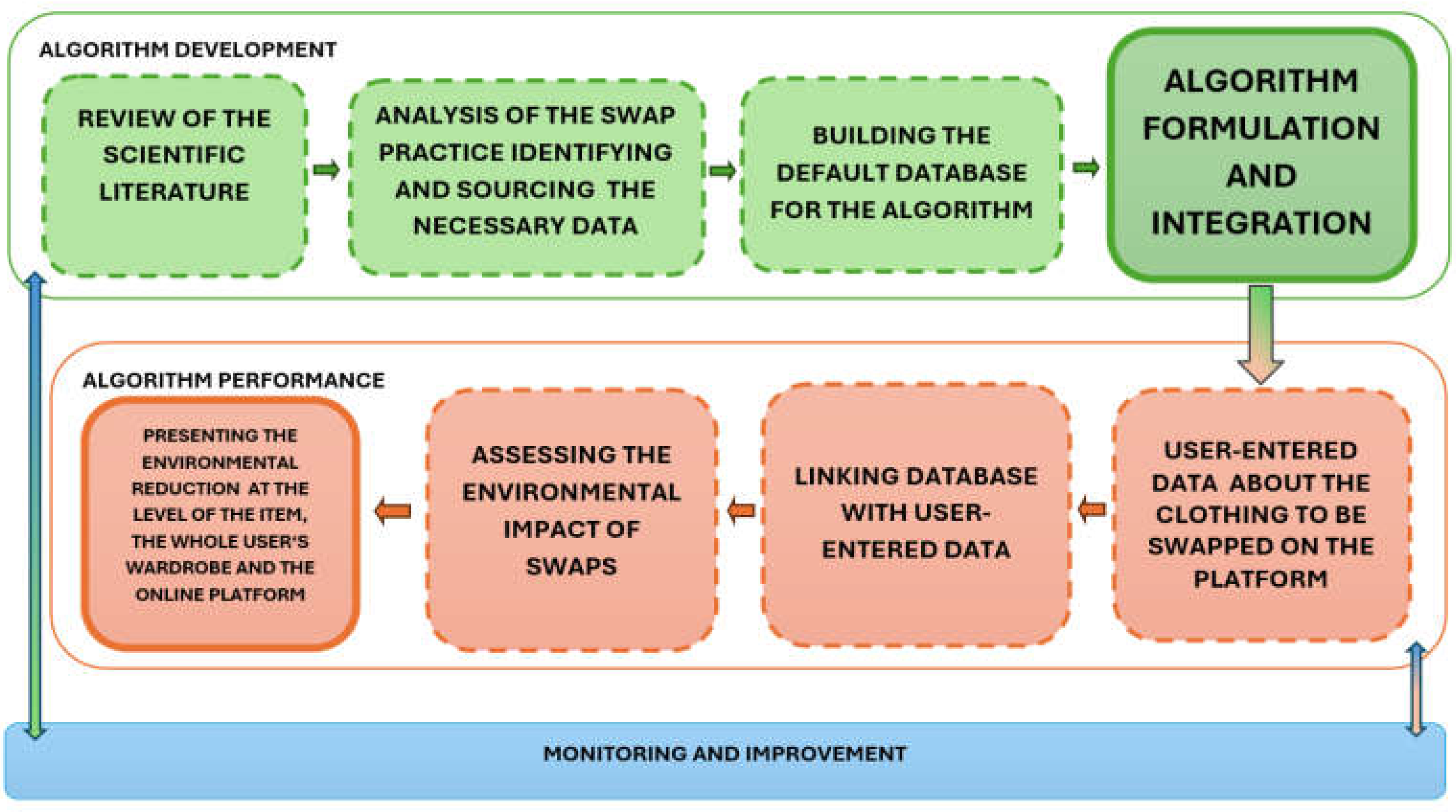
Figure 2.
The logic of the algorithm for calculating environmental impact reduction through clothing swaps.
Figure 2.
The logic of the algorithm for calculating environmental impact reduction through clothing swaps.
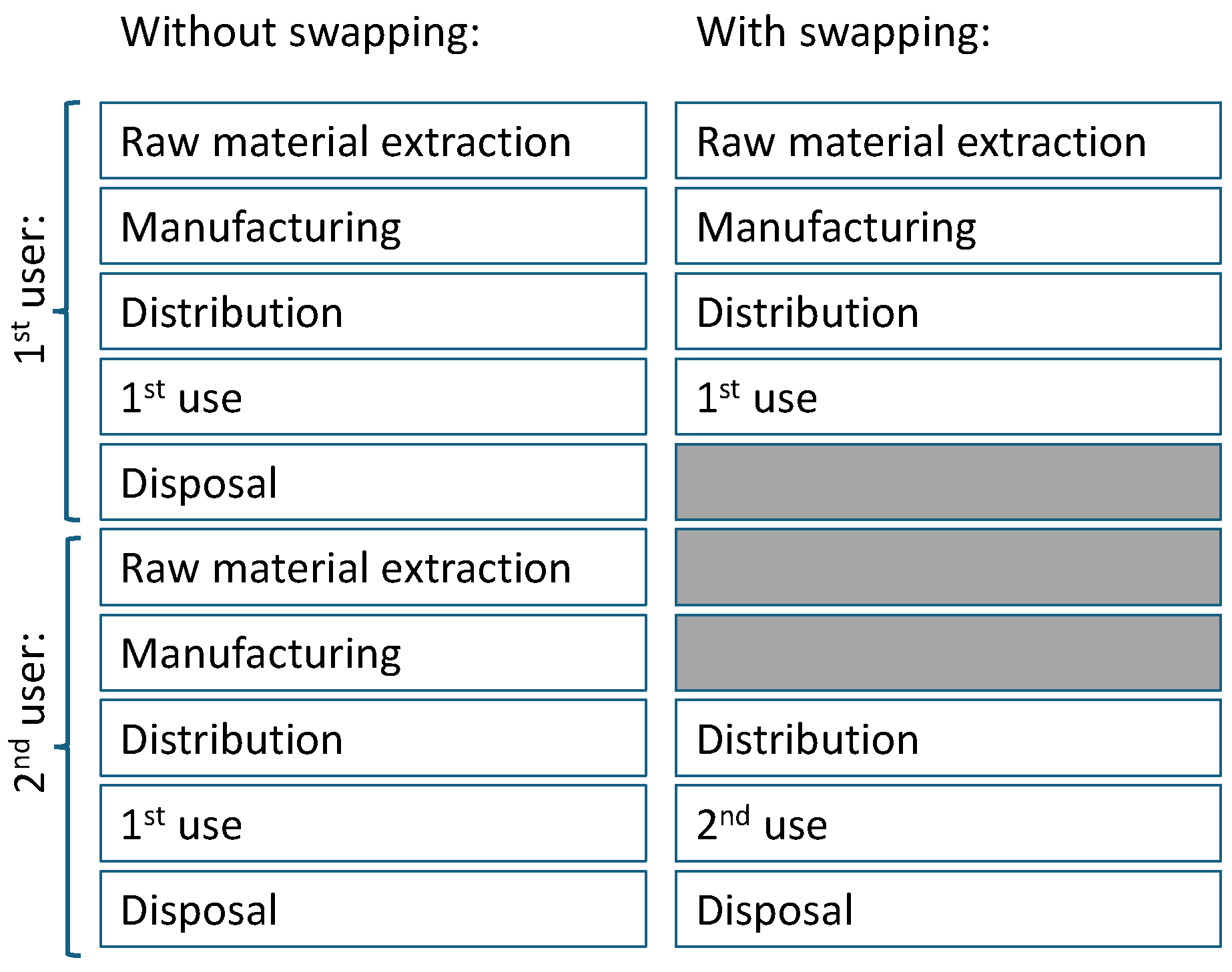

Table 1.
Data on clothing swapping flows and fiber composition (based on data submitted to the platform during its testing phase).
Table 1.
Data on clothing swapping flows and fiber composition (based on data submitted to the platform during its testing phase).
| Swapped*, units | Share of the category out of all swapped clothing units*, % | Swapped*, kg | Share of the category out of all swapped clothing units, mass %* | |||
|---|---|---|---|---|---|---|
| Swapped overall | 532 | 100 | 197,523 | 100 | ||
| Labeled clothing | 464 | 87 | 165,901 | 84 | ||
| Single-fiber fabric composition | 262 | 56 % of which | Polyester – 37.5% Cotton – 29.9% Acrylic – 10.9% Wool – 5.5% Viscose – 4.9% Other** – 11.3 % |
117,483 | 71 | |
| Blended-fiber fabric composition (average composition of all blended clothing) | 202 | 44 % of which | Polyester – 31.6% Cotton – 29.8% Viscose – 15.1% Acrylic – 5.5% Wool – 4.0% Other** – 14.0 % |
48,418 | 29 | |
| Unlabeled | 68 | 13 | 29,616 | 15 | ||
| Clothing categories (28) | Jumper, jeans, trousers, waistcoat, T-shirt, tunic, sweater, blouse, skirt, dress, shorts, jacket, leggings, outdoor vest, raincoat, coat, jacket, underwear, footwear, belt, hat, swimsuit, swimwear, sleepwear, gloves, handbag, scarf, socks. | |||||
*55 wardrobes with an average of 9.7 garments each; ** Other fabric or materials - linen, silk, polyamide, elastane, leather, rubber (shoe sole).
Table 2.
Data relevant to algorithm development in the online platform case.
| User entered/ default | Data needs |
|---|---|
| User entered data | Composition of clothing fabric, %; Clothing category; Garment condition (unused, worn); Purchase method (purchase as new or worn, gifted/swapped). |
| Default data entered into the database | Average clothing weight depending on category, kg; Frequency of wear, number of times during ownership; Frequency of washing, number of times during ownership; 11 fabrics LCA (new and used) data per 1 kg in four impact categories. |
Table 3.
LCA results of new and swapped fabrics and environmental impact reduction due to swapping, per 1 kg of fabric
Table 3.
LCA results of new and swapped fabrics and environmental impact reduction due to swapping, per 1 kg of fabric
| Average environmental impact of SWAPPED fabrics during the second use*, for 1 kg | |||||||||||
|---|---|---|---|---|---|---|---|---|---|---|---|
| Impact | ACRYLIC | COTTON | LEATHER | POLYESTER | WOOL | VISCOSE | |||||
| Global warming, kg CO2 eq | 22.8 | 22.8 | 4 | 22.8 | 22.8 | 22.8 | |||||
| Water consumption, m3 | 0.8 | 0.8 | 0.01 | 0.8 | 0.8 | 0.8 | |||||
| Energy demand, MJ | 608 | 608 | 84.76 | 608 | 608 | 608 | |||||
| Land use, m2a crop eq | 107.5 | 107.5 | 0.08 | 107.5 | 107.5 | 107.5 | |||||
| *Average laundering (washing, drying, ironing) time per second user 9.5 times. Leather use includes just cleaning with appropriate cleaners. Use includes also transportation to and from the swap. | |||||||||||
| Average environmental impact of NEW fabrics, during raw material extraction, production, retail and distribution, first use**, and EoL stages, for 1 kg | |||||||||||
| Impact | ACRYLIC | COTTON | LEATHER | POLYESTER | WOOL | VISCOSE | |||||
| Global warming, kg CO2 eq | 64 | 85.2 | 469.4 | 73.2 | 136.3 | 65.5 | |||||
| Water consumption, m3 | 1.9 | 15 | 2.1 | 1.9 | 2.2 | 2 | |||||
| Energy demand, MJ | 1549.4 | 1911 | 1358.4 | 1626.4 | 2161.9 | 1592 | |||||
| Land use, m2a crop eq | 224.1 | 1102.9 | 10460.6 | 224.7 | 552.1 | 225.3 | |||||
| **Average laundering (washing, drying, ironing) time per first user 19.4 times. Leather use includes just cleaning with appropriate cleaners. Use includes also bringing the garment home. | |||||||||||
| Average environmental impact reduction due to clothing swapping, by fabric type, for 1 kg | |||||||||||
| Impact | ACRYLIC | COTTON | LEATHER | POLYESTER | WOOL | VISCOSE | |||||
| Global warming, kg CO2 eq | -41.2 | -62.4 | -465.4 | -50.4 | -113.4 | -42.7 | |||||
| Water consumption, m3 | -1.1 | -14.2 | -2.1 | -1.1 | -1.4 | -1.2 | |||||
| Energy demand, MJ | -941.5 | -1303 | -1273.7 | -1018.4 | -1553.9 | -984 | |||||
| Land use, m2a crop eq | -116.6 | -995.3 | -10460.6 | -117.2 | -444.6 | -117.8 | |||||
Disclaimer/Publisher’s Note: The statements, opinions and data contained in all publications are solely those of the individual author(s) and contributor(s) and not of MDPI and/or the editor(s). MDPI and/or the editor(s) disclaim responsibility for any injury to people or property resulting from any ideas, methods, instructions or products referred to in the content. |
© 2025 by the authors. Licensee MDPI, Basel, Switzerland. This article is an open access article distributed under the terms and conditions of the Creative Commons Attribution (CC BY) license (http://creativecommons.org/licenses/by/4.0/).
Copyright: This open access article is published under a Creative Commons CC BY 4.0 license, which permit the free download, distribution, and reuse, provided that the author and preprint are cited in any reuse.


