

Submitted:
14 March 2025
Posted:
17 March 2025
You are already at the latest version
Abstract
In view of the complex spatiotemporal dynamic characteristics of public opinion dissem-ination in social networks, this paper proposes a public opinion dissemination prediction model based on the integration of dynamic time-weighted Rényi entropy (DTWRE) and graph neural networks. By incorporating a time-weighted mechanism, the model devises two tiers of Rényi entropy metrics—local node entropy and global time-step entropy—to effectively quantify the uncertainty and complexity of network topology at different time points. Simultaneously, by integrating DTWRE features with high-dimensional node em-beddings generated by Node2Vec and utilizing GraphSAGE to construct a spatiotemporal fusion modeling framework, the model achieves precise prediction of link formation and key node identification in public opinion dissemination. The model was validated on multiple public opinion datasets, and the results indicate that, compared to baseline methods, it exhibits significant advantages in several evaluation metrics such as AUC, thereby fully demonstrating the effectiveness of the dynamic time-weighted mechanism in capturing the temporal evolution of public opinion dissemination and the dynamic changes in network structure.
Keywords:
dynamic time-weighted Rényi entropy
; graph neural networks
; spatiotemporal fusion modeling
; node embeddings
; public opinion prediction
1. Introduction
The scale-free nature of social networks and the cascading effect of information dissemination have made them a central medium for the evolution of public opinion in modern society. With the exponential growth in network scale, the complexity of information dissemination paths has increased significantly. Research indicates that more than 78% of information spread on social networks adheres to a power-law distribution [1], and this uneven mode of propagation allows public opinion on sudden incidents to cascade network-wide within hours; notably, during emergent public health events, the spread rate of misinformation can be as much as six times higher than that of accurate information [2]. Given that the creation and spread of misinformation occur with astonishing rapidity, they can rapidly affect the sentiments and actions of many users, which may not only trigger social panic and mislead public decisions but also damage the reputations of governments or businesses, ultimately resulting in economic and social instability [3,4].
In contrast to conventional media channels, the decentralized characteristics of social networks enable every user to become a source of information, creating an environment conducive to the proliferation of misinformation. The underlying mechanism of viral rumor diffusion encompasses not only the heterogeneity in user behavior [5] but is also intricately linked to the dynamic entropy variations in network structure [6,7] and the evolution of community organization [8]. In public opinion propagation modeling, existing approaches have evolved through three stages: early studies primarily employed differential equation models based on propagation dynamics [9], but their oversimplified assumptions regarding network structure limited predictive accuracy; intermediate graph network approaches enhanced modeling capabilities by incorporating community structure and node centrality [10], yet they failed to address the integration of dynamic features; and recent machine learning techniques have achieved breakthroughs using graph embedding [11,12] and temporal modeling [13], although challenges remain in managing the causal relationships [14] and heterogeneity [15] of propagation paths.
In recent years, the application of graph entropy has extended beyond merely measuring network complexity to include predicting information propagation paths and identifying key nodes. In particular, in scenarios such as public opinion dissemination [16] and virus transmission [17], graph entropy helps in understanding and forecasting the interactions among nodes and their information dissemination processes. Serving as a metric for network complexity, graph entropy is capable of depicting the global and local attributes of networks through the lens of information theory. Dehmer and Emmert-Streib investigated the application of graph entropy in complex networks, suggesting that by measuring characteristics like network topology and node distribution, graph entropy effectively captures network complexity [18]. While static network analyses utilizing Shannon entropy [19] can characterize structural stability, they are limited in their ability to portray dynamic evolutionary processes [20]. Conversely, Rényi entropy—a generalization of Shannon entropy—enables control over sensitivity through tuning the parameter α, making it adaptable to diverse network structures, though its application in forecasting public opinion propagation has yet to be thoroughly investigated.
Additionally, numerous investigations have started leveraging machine learning—especially graph-based deep learning techniques—to model and forecast information spread in networks, thereby overcoming the limitations of conventional public opinion dissemination models in coping with complexity and dynamism. Graph Neural Networks (GNNs) have emerged as a significant breakthrough in network-structured data analysis in recent years. Notably, GraphSAGE (Graph Sample and Aggregation) stands out for its excellent inductive learning ability by aggregating features from neighboring nodes to learn node representations, thereby enabling the handling of large-scale graph data [21]. [22] introduced a GraphSAGE-based dynamic spatiotemporal graph convolutional network for traffic forecasting, which adeptly captures the dynamic spatiotemporal interdependencies in traffic networks and improves prediction precision. When applied to public opinion dissemination prediction, GraphSAGE effectively detects inter-node relationships and propagation potentials, especially in social networks where it manages network heterogeneity, node attributes, and structural information. The authors of [23] employed a weighted version of GraphSAGE to develop a rumor detection model called GSMA, which significantly improved the accuracy of rumor detection on the Weibo platform. In [24], the researchers introduced a temporal graph neural network (TGN) model that effectively analyzes the dynamic variations in the process of information propagation.
Moreover, by combining features including graph structure, transmission chains, and user behavior metrics [25], researchers have further enhanced the predictive performance of their models. In order to improve both the predictive capability and stability of the model, this research incorporates graph embedding methods to achieve feature fusion. The Node2Vec algorithm [26], as a graph embedding method, generates neighborhood information for nodes through random walks, thereby learning low-dimensional representations that offer a novel perspective for analyzing complex networks. Within graph neural networks, the node embeddings produced by Node2Vec are used as input features, transforming intricate network structures into a format accessible to machine learning models, thereby aiding in the effective capture of latent relationships between nodes [27]. This approach has seen extensive application in public opinion propagation and link prediction tasks.
Current research on public opinion dissemination prediction faces key challenges. Firstly, existing models are unable to adequately consider the temporal dynamic characteristics of network-based public opinion propagation—traditional models, largely based on static network assumptions [19,28], struggle to capture the time-varying nature of node interactions. Although graph embedding techniques optimize node representations through random walk strategies, they remain insufficient in modeling time decay effects [29] and causal relationships [30]. Secondly, assessments of node influence depend excessively on static indicators like degree centrality [31] and tend to concentrate on local node characteristics, overlooking the quantifiable contribution of dynamic entropy in forecasting propagation routes. For instance, the entropy-based influence model proposed in [32] can capture interaction frequency characteristics, yet it fails to consider the topological evolution along the temporal dimension. Thirdly, feature fusion remains limited as many approaches concentrate exclusively on single-dimensional attributes—like text sentiment [33] or community structure—failing to collaboratively integrate multi-dimensional features.
To address the aforementioned challenges, our research introduces a network public opinion dissemination prediction model that leverages dynamic time-weighted Rényi entropy (DTWRE) alongside deep learning. By fusing node time-weighted Rényi entropy features with Node2Vec embeddings, the model forms an innovative spatiotemporal fusion framework based on graph entropy theory and deep learning. Its core advantage lies in combining network topology with propagation complexity, which enables a more comprehensive characterization of public opinion dissemination patterns. This integration not only enhances the accuracy of public opinion dissemination prediction but also accounts for temporal dynamics, rendering the prediction results more interpretable and practically valuable. The graph neural network-based public opinion dissemination prediction model, by combining network structural information, node features, and propagation history data, can effectively uncover the underlying patterns in public opinion spread. Firstly, a dynamic Rényi entropy measurement system is constructed based on generalized graph entropy theory [34], introducing a time-weighting factor to jointly model network structural complexity and propagation dynamics. By tuning the entropy order α, this metric can flexibly capture the entropy variations present within diverse network structures and across various temporal windows. Secondly, by integrating the strengths of Rényi entropy features with those of graph embedding techniques during node embedding, and by fusing network structure, node attributes, and historical dissemination data, a predictive model is developed that automatically uncovers key insights embedded in the network and effectively captures the dynamic evolution of complex network structures. Lastly, an assessment framework is constructed by integrating metrics including node Rényi entropy, global Rényi entropy across time steps, and timeliness evaluations, which validates the model’s superior performance in detecting key nodes and predicting propagation paths.
- In summary, the principal contributions of this research are as follows:
- The introduction of dynamic time-weighted Rényi entropy furnishes a quantitative metric to capture the temporal dynamics and intrinsic structural complexity of network dissemination.
- A dual-level Rényi entropy framework is devised at both local node and global time-step scales, thereby facilitating the integrated modeling of localized and global structural complexity alongside propagation dynamics.
- The confluence of propagation temporal complexity and graph topology is exploited to establish a comprehensive spatiotemporal fusion model.
- The model's generalizability is rigorously validated across multiple real-world public opinion datasets, advancing innovative methodologies for key node detection and propagation pathway prediction.
2. Methods
This study presents a network public opinion propagation prediction model that integrates DTWRE with GraphSAGE. Its core concept is to quantify the varying complexity of the network structure at different time points using time-weighted Rényi entropy, and to combine this entropy feature with node feature vectors derived from graph embedding techniques, which are subsequently input into a downstream graph neural network for link prediction tasks, ultimately achieving public opinion propagation forecasting. This section provides a detailed overview of the innovative methodologies employed in this research, including the computation of time-weighted Rényi entropy and the construction of an integrated GraphSAGE model framework.
2.1. Spatiotemporal Fusion Modeling
Within the domain of public opinion propagation prediction, Node2Vec employs random walks to learn the network’s topological information, effectively capturing both local and global node associations as well as the structural characteristics of dissemination paths. Although the low-dimensional vectors generated retain substantial structural details, they inherently lack the capacity to represent the temporal evolution of public opinion, rendering them unable to distinguish between recently established and older connections. Moreover, a notable limitation of the Node2Vec algorithm is that its data-driven vector representations are difficult to interpret in terms of physical significance—such as node importance or dissemination capacity—a shortcoming that is effectively mitigated by the incorporation of Rényi entropy features.
The novel time-weighted Rényi entropy introduced herein quantifies the uncertainty inherent in node propagation by incorporating the temporal dimension, thereby deepening the model’s predictive capability and elucidating the evolutionary trends of public opinion dissemination. As a metric for assessing propagation uncertainty, Rényi entropy—when augmented by a tailored time-weighting mechanism—provides a refined portrayal of the dynamic complexity of nodes during public opinion dissemination. This approach further facilitates the modeling of the relative importance of different temporal phases, enabling the differentiation between early influencers and later disseminators, and thereby advancing the spatiotemporal exploration of public opinion propagation.
However, a solitary entropy measure is insufficient to encapsulate the full spectrum of network structural characteristics, potentially yielding a lower informational content compared to the high-dimensional embeddings generated by Node2Vec. Consequently, by integrating the complementary strengths of both approaches, Node2Vec is employed to capture the global network topology and discern the topological nuances of dissemination pathways. The incorporation of time-weighted Rényi entropy introduces temporal dynamic information, enabling the model to effectively perceive the evolving patterns of public opinion dissemination over time. GraphSAGE is capable of concurrently learning spatial topological relationships and temporal evolution trends, thereby mirroring the propagation patterns observed in actual social networks. The complete spatiotemporal fusion modeling process is illustrated in Figure 1. By leveraging the high-dimensional topological information from Node2Vec together with the temporal dynamic features of Rényi entropy, and training through GraphSAGE, the network structure and propagation characteristics are seamlessly integrated. This fusion enhances prediction accuracy, generalizability, and interpretability, while bolstering model stability—ultimately yielding a superior predictive framework for social network public opinion analysis.
2.2. Definition of Dynamic Time-Weighted Rényi Entropy
Owing to the adjustable entropy order (α) in Rényi entropy, sensitivity to varying network structures can be fine-tuned. This facilitates entropy computation at both local node and global network levels, rendering the model more adaptable to diverse temporal instances and varying public opinion dissemination scenarios (such as emergent events or gradually unfolding topics).
Based on the definition of Rényi entropy, two entropy indicators—Local Node Entropy (LNE) and Global Time-Step Entropy (DTWRE)—have been designed to characterize the multiscale information complexity inherent in public opinion propagation. These indicators are subsequently employed as features for training the GraphSAGE model. DTWRE comprehensively accounts for both the propagation characteristics of individual nodes and the influence of the network’s cumulative dissemination history on its current state, thereby providing an effective metric for modeling the complexity of public opinion propagation.
Rényi entropy is a generalized entropy measure used to assess the uncertainty inherent in network structures. The mathematical definition of LNE is provided in [35] as follows:
Here, denotes the set of neighbors for node v at time step t; represents the normalized probability distribution of an information metric (such as node degree or dissemination influence) for neighbor node u—with normalized probabilities derived from both node degree and PageRank values employed for comparative experiments—and α is the order parameter of Rényi entropy, which modulates sensitivity to varying degrees of distribution sparsity. To enhance predictive performance, a temporal factor is introduced via a time-weighting function that aggregates entropy values from different time snapshots, thereby ensuring that more recent dissemination information exerts a greater influence on the overall entropy—closely mirroring the mechanisms of actual public opinion propagation. The formulated computation for DTWRE is as follows:
Here, indicates the entropy of the network snapshot at time . is the time weight function, using exponential attenuation weight:
Here, λ > 0 governs the contribution of each time step to the final entropy value; a larger λ emphasizes recent dissemination, whereas a smaller λ allows for consideration of public opinion propagation over a more extended temporal range. Subsequently, LNE and DTWRE will be integrated with Node2Vec embedding features to furnish the downstream learning model with enriched feature inputs.

Table 1.
Multi-level time-weighted entropy definition algorithm.
| Algorithm 1: DTWRE based on time weighting and time step segmentation. |
| Input: A directed graph G = (V, E) with timestamps for each edge; LNE parameter α; decay factor for time weighting λ; maximum time step after dividing timestamps by a chosen time window T. Output: A trained GraphSAGE-based method for link prediction. 1 Ti ← Split time step 2 for v ∈ V do p(v) ← (Node_degree(v) / Sum(Node_degree(vi))) for each t in [0...T] do ← ComputeLNE(Subgraphs[t], p, α) ← Sum() ← ComputeDTWRE(, λ) end end 3 Combined_features ←Concatenate(Weighted_Entropy, Node2Vec_embeddings) 4 GraphSAGE-Entropy-based link prediction method(Combined_features) |
2.3. GraphSAGE for Public Sentiment Prediction
To leverage graph-structured information for public opinion propagation forecasting, the GraphSAGE framework is employed for this task. Among the prevalent graph neural network architectures, Graph Convolutional Networks (GCNs) and GraphSAGE are two pivotal models. Both models are designed to extract meaningful patterns and features from graph data by training on extensive datasets, thereby acquiring parameters that enable accurate predictions across various graphs, facilitating tasks such as node classification and link prediction through comprehensive processing of node and edge information.
GCNs learn vertex embeddings by integrating topological structure with vertex attribute information. However, GCNs require learning embeddings within a fixed graph and cannot directly generalize to vertices unseen during training—a hallmark of transductive learning. This necessitates retraining the model when new nodes emerge, leading to high computational costs and rendering such approaches less suitable for dynamic or large-scale graph data.
In contrast, GraphSAGE constitutes an inductive learning framework capable of efficiently generating embeddings for unseen vertices by leveraging vertex attribute information. Its core concept is to learn an aggregation function that synthesizes the representations of neighboring vertices to yield the embedding vector of a target vertex, as depicted in Figure 2. The principal features of this approach include:
- Neighbor Sampling: Given that social networks typically manifest as large-scale, sparse graphs, GraphSAGE randomly samples a fixed number of neighbors for each node to curtail computational complexity—an essential strategy for managing extensive graph datasets.
- Feature Aggregation: For each node u, GraphSAGE aggregates features from its neighboring nodes and updates its own representation accordingly, as delineated in the following formulation:
Where: is the feature representation of node u at layer k. Aggregate{} is an aggregation function, where mean aggregation is used. is a trainable parameter. σ is a nonlinear activation function, where ReLU is used.
3. Final representation: After multi-layer aggregation, the final representation of node v is:
In this study, we add DTWRE as an additional feature to the input of GraphSAGE, so that the model can learn the temporal dynamic characteristics in the propagation process.
3. Experiments
This section delineates the experimental procedures and results of the proposed deep learning-based public opinion propagation prediction model, which integrates DTWRE with Node2Vec embeddings, evaluated on real-world data. The experiments were conducted on the PyCharm platform, utilizing development tools such as PyTorch and the Deep Graph Library (DGL). DGL is a deep learning framework specifically designed for graph neural networks, offering efficient, flexible, and user-friendly tools for GNN research and development. To comprehensively assess the model's performance, comparisons were made with existing link prediction methods, demonstrating its superior results across various evaluation metrics.
3.1. Datasets and Data Preprocessing
For evaluation purposes, the following datasets were employed during both the validation and empirical phases:
CollegeMSG Dataset: A classic dataset from SNAP comprising private messages exchanged on an online social network. As a temporal network widely used in research, it was employed during the validation phase to facilitate performance comparisons with other methodologies.
Real-world Social Network Dataset: Chinese rumor data, including repost and comment information, scraped from the Sina Weibo misinformation reporting platform. Predicting these rumors aids in characterizing the propagation patterns of misinformation, thereby providing theoretical support for combating false information on social networks.
The following data preprocessing steps were applied to the aforementioned raw datasets:
- ▪
- Time labels were standardized by converting them into timestamp format.
- ▪
- Data augmentation procedures were applied, taking into account the large scale of the real-world social network dataset.
- ▪
- Isolated nodes, which do not participate in information dissemination, were removed to ensure graph connectivity and to uphold the validity of Rényi entropy computations.
- ▪
- From the real-world social network dataset—which includes the content of rumor-related Weibo posts, the publishers, records of reposts and comments, and interaction timestamps—filtering was conducted to extract the rumor originators along with the corresponding interaction relationships (comments and reposts) to construct a public opinion propagation network.
- ▪
- Temporal window segmentation was performed by partitioning dissemination data into multiple time windows based on timestamps; each window corresponds to a time step with gradually varying weights. Different datasets were segmented into time steps according to empirical criteria, as illustrated in Figure 3.
The objective of the public opinion propagation prediction task is to forecast potential future links based on the known network structure. The ratio of positive to negative samples impacts both model training and generalizability. The construction of these samples is as follows:
• Positive samples: Connected node pairs (u, v) extracted from the actual network.
• Negative samples: A negative sampling strategy was employed to randomly select unconnected node pairs (u, v) from the set of non-existent edges, that is, .
Here, E denotes the set of actual edges in the network.
However, real-world networks are typically sparse—with the majority of potential edges absent—posing challenges for negative sample selection. Inadequate negative sampling can lead to data imbalance and diminish the model's discriminative power. To address this issue, oversampling was applied to the negative samples.
3.2. Feature Engineering
In this study, a multidimensional feature set is constructed to comprehensively capture both the dynamic information and structural characteristics inherent in public opinion propagation, serving as the input to the GraphSAGE model. The primary features utilized are categorized into two groups: entropy-based features and node embedding features.
3.2.1. Rényi Entropy Feature
As previously described, these features encompass both local and global dimensions. Local Node Entropy (LNE) quantifies a node’s propagation potential and local structural complexity within a given time step—each node v is characterized by its LNE at time t—while Dynamic Time-Weighted Rényi Entropy (DTWRE) measures the overall network complexity at a specific time step. Their integration yields a holistic evaluation of the complexity of public opinion dissemination across various propagation stages.
3.2.2. Node2Vec Embedding Features
To further capture the semantic and structural relationships among nodes, the Node2Vec algorithm is employed to generate node embeddings, following these specific steps:
- Graph Conversion: Transform the graph constructed with DGL into NetworkX format and convert it into an undirected graph to satisfy the requirements of Node2Vec.
- Embedding Computation: Perform random walk sampling on the network using the Node2Vec model, and generate continuous vector representations for nodes via the Skip-Gram model, with the embedding dimension set to 64.
- Normalization: To eliminate scale discrepancies, normalize the generated node embeddings using MinMaxScaler and convert them into Tensor format to ensure consistency with other features.
These node embedding features effectively complement the limitations of entropy-based metrics in capturing local structural nuances and semantic relationships, thereby enriching the node representations for the link prediction task.
3.2.3. Feature Fusion
In the final feature construction phase, the LNE, DTWRE, and Node2Vec embeddings are concatenated to form a comprehensive feature vector.
This fusion approach integrates multiscale information: LNE captures the uncertainty of individual nodes within local structures, DTWRE reflects the network’s overall complexity at each time step, and node embeddings supply high-dimensional semantic details among nodes. Moreover, the incorporation of a time-weighting strategy allows the model to flexibly account for the influence of historical dissemination on the current state, thereby enhancing the capture of temporal dynamics in public opinion propagation. The resultant composite feature vector provides the GraphSAGE model with a more comprehensive input, facilitating more precise discrimination between positive and negative samples in link prediction and ultimately improving predictive accuracy.
3.3. Model Construction and Training
The detailed process for model construction and training is outlined below:
-
Model Architecture: The proposed model is comprised of two principal components:
- (1)
- Feature Input Layer: This layer ingests the extracted node features—both entropy-based and embedding features—as input.
- (2)
- Graph Neural Network Layer: Employing GraphSAGE, this layer aggregates features from neighboring nodes to update node representations, thereby generating embeddings for nodes across distinct time windows.
- Predictor and Loss Function: To facilitate effective link prediction, a multilayer perceptron (MLP) is employed as the predictor. Comprising multiple fully connected layers, the MLP is designed to capture nonlinear relationships among node features and ultimately outputs a prediction score that quantifies the likelihood of a link forming. The binary cross-entropy loss function is used to optimize the predicted link probabilities for node pairs. Specifically, given a node pair (u, v), the model forecasts whether these nodes will establish a connection within a future time window. The formulation is as follows:
- 3.
- Training Process: The training phase employs the Adam optimizer—recognized for its adaptive learning rate and rapid convergence—with hyperparameters refined via cross-validation. The model is trained over 100 epochs to minimize the loss function, thereby achieving optimal performance.
3.4. Evaluation Metrics
To facilitate comparisons with other approaches and to comprehensively assess the model's performance, the following commonly used evaluation metrics are adopted:
AUC (Area Under the ROC Curve): This metric gauges the model’s ability to differentiate between positive and negative samples; higher values indicate superior predictive performance.
Precision: Precision reflects the proportion of correctly predicted positive node pairs among those predicted as positive, with higher precision denoting greater accuracy.
Recall: Recall measures the proportion of actual positive node pairs that are successfully identified by the model, with higher recall indicating enhanced coverage of positive instances.
F1-Score: The F1 score, defined as the harmonic mean of precision and recall, provides a balanced evaluation of the model's predictive capability.
Temporal Performance: Considering the pronounced temporal evolution in public opinion propagation, the model's performance is assessed across varying time steps to monitor accuracy fluctuations over time.
In summary, the key experimental steps encompass data processing, feature engineering, model training, and evaluation, as illustrated in Figure 4.
3.5. Experimental Parameter Setting
During both training and evaluation, extensive experimental configurations and hyperparameter tuning were conducted to optimize model performance. The following parameters were systematically refined:
1. Temporal Window Size: This parameter affects the model's ability to learn sequential information. Empirically determined window sizes were applied for different datasets to more effectively capture the dynamic nature of public opinion propagation.
2. α Value (Entropy Order for LNE): This parameter determines the flexibility of the entropy calculation. A grid search approach was utilized to optimize α and select its optimal value.
3. λ Value (Temporal Weighting Parameter): λ was tuned based on the characteristics of different time steps and historical public opinion propagation data.
4. Negative Sampling Ratio: A specified proportion of negative samples was drawn during training. Various ratios were experimented with to evaluate their impact on model performance.
To validate the effectiveness of the proposed approach, multiple baseline models were implemented for comparative analysis against the following classical prediction methods:
① Traditional Node Degree-Based Method;
② Traditional Node PageRank-Based Method;
③ Node2Vec-Based Method Utilizing Node Embeddings;
④ Traditional Static Rényi Entropy-Based Method.
These baselines effectively corroborate the innovation of the proposed method while providing a balanced comparison of the contributions of various features to overall model performance.
4. Results
This section delineates the experimental findings of the proposed network public opinion propagation prediction model, which integrates DTWRE with deep learning, as evaluated on benchmark datasets. Through comparative experiments, performance assessments, temporal analyses, and extensions using real-world public opinion data, the efficacy of the proposed approach in predicting network public opinion propagation has been validated, with a detailed analysis of the various factors influencing model performance. The results indicate that the graph neural network model augmented with DTWRE attains higher accuracy and superior temporal responsiveness compared to traditional approaches.
4.1. Model Performance Comparison
The experiment compared the four baseline methods mentioned above, and the comparison results of evaluation indicators are as follows:
According to the findings in Table 2 and Figure 5, the innovative DTWRE method achieved the highest AUC (0.9742), demonstrating its capacity to better capture the latent dynamic propagation characteristics within the network, thereby enhancing its discriminative ability in distinguishing positive from negative samples. Moreover, DTWRE attained the highest precision at 0.9259, indicating that the vast majority of predicted positive samples correspond to genuine links. This outcome further substantiates the effectiveness of node embeddings in capturing semantic and structural nuances, while also highlighting the limitations of relying solely on embeddings to fully represent the dynamic aspects of public opinion propagation. In terms of recall, both DTWRE (0.9144) and Rényi entropy (0.8970) outperform methods based on node degree (0.8618) and PageRank (0.8613), indicating that the incorporation of entropy features enables a more comprehensive detection of existing links, thereby reducing false negatives. The novel approach achieved the highest F1-Score (0.9201), signifying an optimal balance between precision and recall. When compared to Node2Vec's F1-Score (0.9062), this result corroborates the superior overall performance conferred by the time-weighted mechanism. With an accuracy of 0.9207, DTWRE consistently outperforms all alternative methods, thereby demonstrating its robust performance in comprehensive link prediction tasks.
In summary, given that the influence of information at various time steps on network structure is heterogeneous during public opinion propagation, Rényi entropy enriches the dissemination information available to nodes, thereby enabling a more effective capture of latent structural features. Furthermore, time-weighted entropy features adeptly adjust to the evolving characteristics of public opinion propagation, enhancing the model’s performance in dynamic dissemination scenarios. The proposed DTWRE method, by incorporating exponential decay weights to effectively integrate information across different time steps, surpasses all baseline methods across various metrics, thereby demonstrating its efficacy and state-of-the-art performance in network public opinion propagation prediction.
4.2. Model Parameter Analysis
To further elucidate the impact of key parameters on link prediction performance, extensive experiments were conducted on the DTWRE order α, the temporal weighting factor λ, and the positive-to-negative sample ratio, with the effects of varying these parameters on model performance illustrated via comprehensive visual charts.
4.2.1. Impact of DTWRE Order α
We explore the effect of DTWRE order α on the model performance by changing it. The consequences are as follows:
Figure 6 illustrates that when α is set to 0.2, the AUC reaches 0.950, indicating a relatively low sensitivity in the entropy calculation that may inadequately capture the structural diversity among neighboring nodes. As α increases to 0.6, the AUC sharply ascends to 0.966, demonstrating that the entropy metric more effectively reflects the distributional uncertainty among node neighbors, thereby enhancing the model’s ability to differentiate between positive and negative samples. With further increases in α to 1, 1.5, 2, and 5, the AUC declines to 0.959, 0.955, 0.952, and 0.944 respectively, suggesting that excessively high α values overly accentuate the high-probability components of the distribution while neglecting lower-probability information, which in turn degrades the overall discriminative capability. Precision peaks at 0.922 when α is 0.6, followed by a slight decline as α increases further. The trends in recall and F1-Score mirror that of precision, achieving their optimum at α = 0.6, while both lower and higher values of α fail to attain an optimal balance. This variation indicates that an α value of 0.6 allows the entropy measure to effectively capture the diversity of a node's propagation potential, thereby enabling more precise discrimination between positive and negative samples; conversely, values that are too low or too high tend to induce information loss or introduce noise, thereby impairing overall performance. The accuracy trend parallels that of the AUC, rising from 0.888 at α = 0.2 to 0.916 at α = 0.6, and then gradually falling to 0.904 at α = 5, further substantiating that an optimal α value is 0.6.
Consequently, it can be concluded from the results that all performance metrics peak when α is 0.6, which aligns with the anticipated advantages of DTWRE features in capturing the dynamics of public opinion propagation. These data variations highlight the distinctive role of entropy in elucidating node influence and propagation uncertainty, offering a more comprehensive depiction of the complexity inherent in public opinion diffusion compared to conventional metrics that solely consider node degree.
4.2.2. Impact of the Temporal Weighting Parameter λ
The parameter λ within the time-weighting function—an integral innovation of the DTWRE approach—warrants examination regarding its effect on model performance. The results are as follows:
Figure 7 presents a comparative analysis of experimental data obtained under varying values of λ, revealing the following trends: When λ is set to a low value (e.g., 0.1), the insufficient emphasis on historical information results in overall suboptimal model performance; as λ increases from 0.1 to moderate values (ranging from 0.4 to 1.2), all performance metrics exhibit a marked improvement, indicating that moderately amplifying the weight of recent information facilitates the capture of dynamic public opinion propagation characteristics; at λ = 1.2, the model attains optimal levels in AUC, Recall, F1-Score, and Accuracy, thereby achieving the best overall performance; when λ is further increased to 2, although Precision and Accuracy experience a modest rise, Recall declines slightly, and overall metrics remain relatively stable, suggesting that an excessively high λ may lead to an overemphasis on recent data at the expense of historical information.
4.2.3. Impact of the Positive-to-Negative Sample Ratio
In this study, careful consideration is given to the positive-to-negative sample ratio, since severe imbalance may bias the model toward the predominant class, whereas an optimal ratio facilitates the effective learning of intrinsic data patterns and enhances overall model performance and predictive accuracy. The figure below (Figure 8) illustrates the impact of varying positive-to-negative sample ratios on performance metrics.
Analysis of Figure 8 reveals that the positive-to-negative sample ratio exerts a significant influence on model performance. When the ratio is set to 2—indicating an excess of negative samples—Precision is high, yet Recall declines markedly, resulting in lower overall F1-Score and Accuracy; conversely, when the ratio is set to 0.5 (fewer negative samples), Recall is elevated but Precision is insufficient. The optimal positive-to-negative sample ratio is approximately 0.75, at which point the model demonstrates the best performance in AUC, F1-Score, and Accuracy, thereby achieving an ideal balance between positive and negative samples.
4.2.4. Temporal Performance Evaluation
To validate the model's ability to capture the temporal dynamics of public opinion propagation, experiments were designed with varying time step lengths. Specifically, under constant conditions for other parameters such as λ, α, and the positive-to-negative sample ratio, the effect of different time step lengths on model performance was compared. The experimental results presented in the table below display performance metrics corresponding to time steps of 1.75 days, half a week, and one week.
Figure 9.
Temporal performance evaluation results.
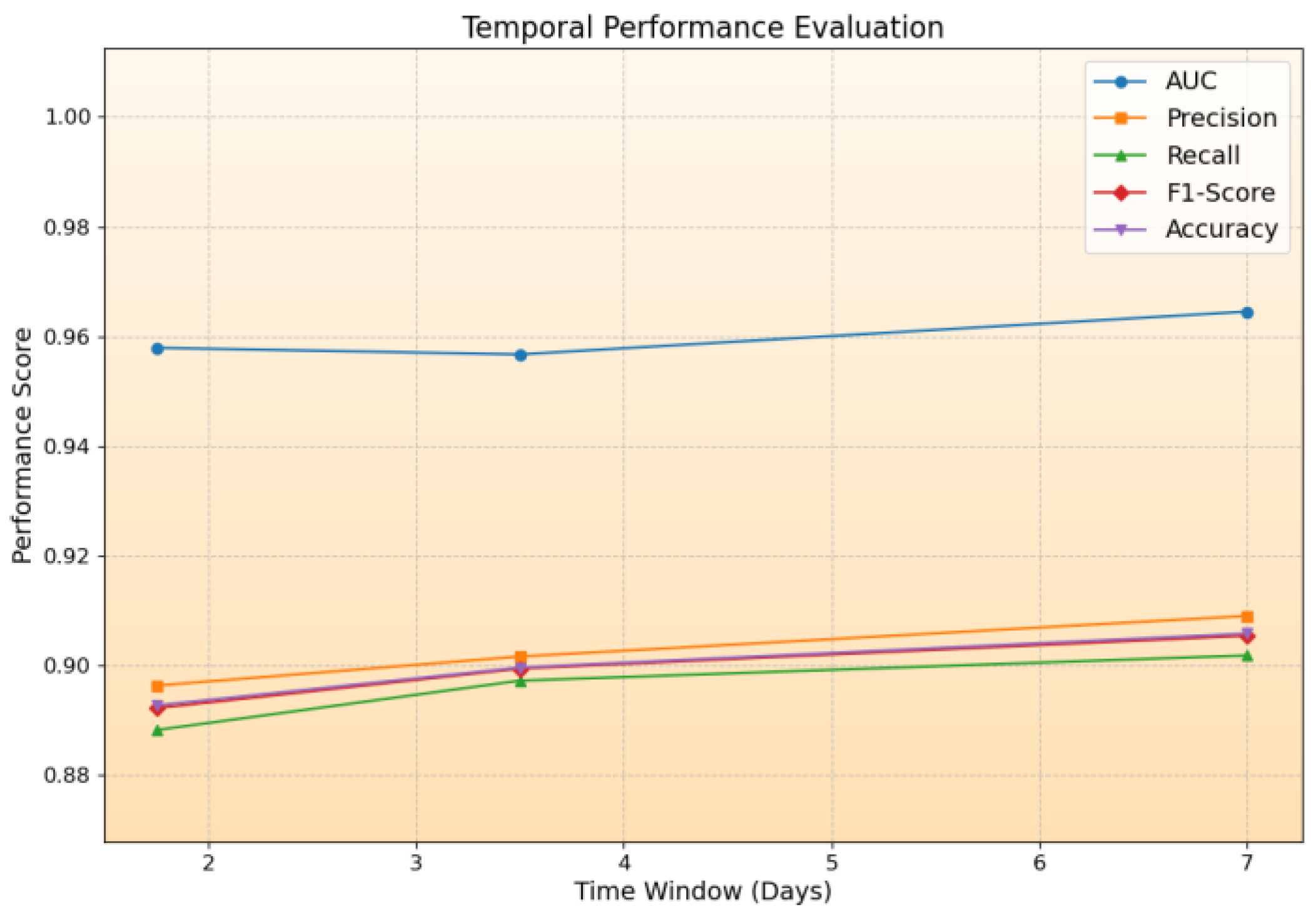
As depicted in the figure, when the time window aligns with the overall temporal span of the dataset, employing a longer window offers a distinct advantage. Specifically, when a time window of 604,800 seconds (7 days) is employed, all performance metrics significantly outperform those obtained with shorter windows of 302,400 and 151,200 seconds. This indicates that a 7-day window can effectively capture the dynamic evolution of public opinion propagation and supply ample information for predicting link formation, whereas shorter windows may yield insufficient data, thereby diminishing overall performance. It is noteworthy that the 7-day window was determined based on the dataset’s total temporal span and empirical considerations; thus, only three appropriate window lengths were examined. Consequently, from a temporal performance standpoint, employing a longer time window is more conducive to robustly capturing the dynamics of network propagation.
4.3. Prediction of Real Social Network Public Opinion
Following the model's excellent performance on the benchmark dataset, further analysis was conducted on a real-world Weibo dataset to assess its generalizability in capturing public opinion propagation. This dataset encompasses interactive information such as reposts and comments related to rumors among Weibo users. To investigate the dissemination mechanisms of false public opinion, the innovative advantages of the DTWRE method were leveraged to analyze the rumor data, with the results presented as follows:
Figure 10 illustrates the evolution of performance metrics over training epochs for the real-world public opinion dataset. Overall, the performance curves exhibit a rapid initial ascent, then gradually converge and stabilize around the 50th epoch at relatively high levels, reflecting the model’s robust capability to comprehensively distinguish between positive and negative links (i.e., public opinion propagation relationships) in the dataset.
Figure 11 reveals a "center-periphery" structure within the social public opinion network, where red nodes in the central region exhibit high entropy values and are identified as key nodes that form a densely connected core, rapidly disseminating information to peripheral nodes and warranting focused attention in public opinion management. The significance of these nodes is further validated by retrospectively tracing their diffusion pathways within the original dataset. Red lines denote links predicted as positive—indicating edges where actual connections or information flows are more likely to occur during public opinion propagation. It is evident that the red lines radiate outward from the center, confirming the model’s identification of diffusion pathways from key nodes to ordinary nodes.
5. Conclusions
This study addresses the critical issue of network public opinion propagation prediction by integrating machine learning techniques, complex network theory, and graph entropy analysis. A novel prediction model is proposed, which leverages dynamic time-weighted Rényi entropy to capture the evolving complexity of network dissemination, and harnesses the benefits of Node2Vec graph embeddings. These features are jointly fed into a GraphSAGE-based graph neural network to facilitate accurate public opinion forecasting. Extensive experimental results demonstrate that the proposed method consistently outperforms existing approaches across multiple datasets. Its unique advantage is particularly evident when handling network data with temporal dependencies, leading to a significant enhancement in the accuracy of public opinion propagation predictions. Moreover, this research offers a novel perspective on public opinion propagation prediction and introduces an innovative approach for applying time-weighted entropy features in complex network analysis, thereby holding substantial theoretical and practical significance. Future investigations may extend the applicability of dynamic time-weighted Rényi entropy to various network environments—such as biological networks and recommendation systems—and explore the integration of additional node features and propagation mechanisms to further enhance model generalizability. In addition, incorporating multimodal data (e.g., textual content and social interaction metrics) into public opinion propagation prediction could yield more precise predictive models and robust decision support systems in relevant fields.
Author Contributions
All authors made substantial contributions to conception and design and writing of the article, and approved publication of the final version. All authors have read and agreed to the published version of the manuscript.
Funding
This research was funded by ‘Key R&D Program Project of Shaanxi Province, China, grant number 2024NC-YBXM-217’, ‘Science and technology plan project of Xi'an, China, grant number 22GXFW0124’, and ‘Xi 'an University of Posts and Telecommunications Graduate Innovation Fund, grant number CXJJYL2024010’.
Data Availability Statement
All data sets used in this research can be found on https://snap.stanford.edu/data/index.html and https://github.com/yeren66/ChineseRumorDataset.
Conflicts of Interest
The authors declare no conflicts of interest.
Abbreviations
The following abbreviations are used in this manuscript:
| DTWRE | Dynamic Time-Weighted Rényi Entropy |
| LNE | Local Node Entropy |
References
- Huberman, B.A.; Adamic, L.A. Information dynamics in the networked world. In Complex networks; Springer Berlin Heidelberg: Berlin, Heidelberg, 2004; pp. 371–398.
- Yang, W.; Wang, S.; Peng, Z.; et al. Know it to defeat it: Exploring health rumor characteristics and debunking efforts on Chinese social media during COVID-19 crisis. In Proceedings of the International AAAI Conference on Web and Social Media; 2022; Vol. 16, pp. 1157–1168. [CrossRef]
- Cui, L.; Wang, S.; Lee, D. Same: sentiment-aware multi-modal embedding for detecting fake news. In Proceedings of the 2019 IEEE/ACM International Conference on Advances in Social Networks Analysis and Mining; 2019; pp. 41–48.
- Jain, L. An entropy-based method to control COVID-19 rumors in online social networks using opinion leaders. Technology in Society 2022, 70, 102048. [CrossRef]
- Wang, G.; Wang, Y.; Li, J.; et al. A multidimensional network link prediction algorithm and its application for predicting social relationships. Journal of Computational Science 2021, 53, 101358. [CrossRef]
- Schmeling, J. Time weighted entropies. Colloquium Mathematicum 2000, 84(1), 265–278.
- Zhao, K.; Karsai, M.; Bianconi, G. Entropy of dynamical social networks. PLoS One 2011, 6(12), e28116.
- Chen, N.; Liu, Y.; Chen, H.; et al. Detecting communities in social networks using label propagation with information entropy. Physica A: Statistical Mechanics and its Applications 2017, 471, 788–798. [CrossRef]
- Tian, J.; Fan, H.; Hou, Z. Research on the prediction of popularity of news dissemination public opinion based on data mining. Computational Intelligence and Neuroscience 2022, 2022(1), 6512602. [CrossRef]
- Kim, H.; Anderson, R. Temporal node centrality in complex networks. Phys. Rev. E 2012, 85(2), 026107. [CrossRef]
- Xu, M. Understanding graph embedding methods and their applications. SIAM Review 2021, 63(4), 825–853. [CrossRef]
- Grover, A.; Leskovec, J. node2vec: Scalable feature learning for networks. In Proceedings of the 22nd ACM SIGKDD International Conference on Knowledge Discovery and Data Mining; 2016; pp. 855–864.
- Wang, Y.; Chang, Y.Y.; Liu, Y.; et al. Inductive representation learning in temporal networks via causal anonymous walks. arXiv preprint arXiv:2101.05974, 2021.
- Huang, X.; Li, J.; Yuan, Y. Link Prediction in Dynamic Social Networks Combining Entropy, Causality, and a Graph Convolutional Network Model. Entropy 2024, 26(6), 477. [CrossRef]
- Gao, L.; Wang, H.; Zhang, Z.; et al. HetInf: social influence prediction with heterogeneous graph neural network. Frontiers in Physics 2022, 9, 787185. [CrossRef]
- Li, W.; et al. Internet public opinion diffusion mechanism in public health emergencies: based on entropy flow analysis and dissipative structure determination. Frontiers in Public Health 2021, 9, 731080. [CrossRef]
- Gao, T.; Li, T.; Xu, P. Risk analysis and assessment method for infectious diseases based on information entropy theory. Scientific Reports 2024, 14(1), 16898. [CrossRef]
- Dehmer, M.; Emmert-Streib, F. The role of graph entropy in complex network analysis. Entropy 2016, 18(12), 1–18.
- Rödder, W.; Brenner, D.; Kulmann, F. Entropy based evaluation of net structures–deployed in social network analysis. Expert Systems with Applications 2014, 41(17), 7968–7979. [CrossRef]
- Zhao, K.; Karsai, M.; Bianconi, G. Entropy of dynamical social networks. PLoS One 2011, 6(12), e28116.
- Hamilton, W.; Ying, Z.; Leskovec, J. Inductive representation learning on large graphs. In Advances in Neural Information Processing Systems; 2017; Vol. 30.
- Liu, T.; et al. GraphSAGE-based dynamic spatial–temporal graph convolutional network for traffic prediction. IEEE Trans. Intell. Transp. Syst. 2023, 24(10), 11210–11224. [CrossRef]
- Ma, M.; Zhang, C.; Li, Y.; et al. Rumor detection model with weighted GraphSAGE focusing on node location. Scientific Reports 2024, 14(1), 27127. [CrossRef]
- Zhang, L.; Wu, H.; Chen, Y.; Liu, J. Hierarchical Graph Neural Networks for Cascading Behavior Prediction in Social Networks. In Proceedings of the AAAI Conference on Artificial Intelligence; 2022; pp. 6543–6550.
- Li, X.; Zhang, J.; Wang, Y. Incorporating User Behavior and Network Structure for Predicting Information Diffusion with Graph Neural Networks. In Proceedings of the IEEE International Conference on Data Mining (ICDM); 2021; pp. 1593–1598.
- Rossi, R.A.; Ahmed, H.F. The network data repository with interactive graph analytics and visualization. In Proceedings of the 29th AAAI Conference on Artificial Intelligence; 2015; pp. 4292–4293.
- Kojaku, S.; et al. Network community detection via neural embeddings. Nat. Commun. 2024, 15(1), 9446. [CrossRef]
- Geng, L.; et al. Modeling public opinion dissemination in a multilayer network with SEIR model based on real social networks. Eng. Appl. Artif. Intell. 2023, 125, 106719.
- Xu, D.; Ruan, C.; Korpeoglu, E.; et al. Inductive representation learning on temporal graphs. arXiv preprint arXiv:2002.07962, 2020.
- Wang, X.; Li, Q.; Yu, D.; Huang, W.; Li, Q.; Xu, G. Neural causal graph collaborative filtering. Inf. Sci. 2024, 677, 120872. [CrossRef]
- Tutzauer, F. Entropy as a measure of centrality in networks characterized by path-transfer flow. Social Networks 2007, 29(2), 249–265. [CrossRef]
- Peng, S.; Li, J.; Yang, A. Entropy-based social influence evaluation in mobile social networks. In Algorithms and Architectures for Parallel Processing: 15th International Conference, ICA3PP 2015, Zhangjiajie, China, November 18–20, 2015, Proceedings, Part I; Springer International Publishing: 2015; pp. 637–647.
- Cui, L.; Wang, S.; Lee, D. Same: sentiment-aware multi-modal embedding for detecting fake news. In Proceedings of the 2019 IEEE/ACM International Conference on Advances in Social Networks Analysis and Mining; 2019; pp. 41–48.
- Dehmer, M.; Mowshowitz, A. Generalized graph entropies. Complexity 2011, 17(2), 45–50. [CrossRef]
- Rényi, A. On measures of entropy and information. In Proceedings of the Fourth Berkeley Symposium on Mathematical Statistics and Probability, Vol. 1: Contributions to the Theory of Statistics; University of California Press: 1961.
Figure 1.
Schematic diagram of the spatiotemporal fusion modeling process.
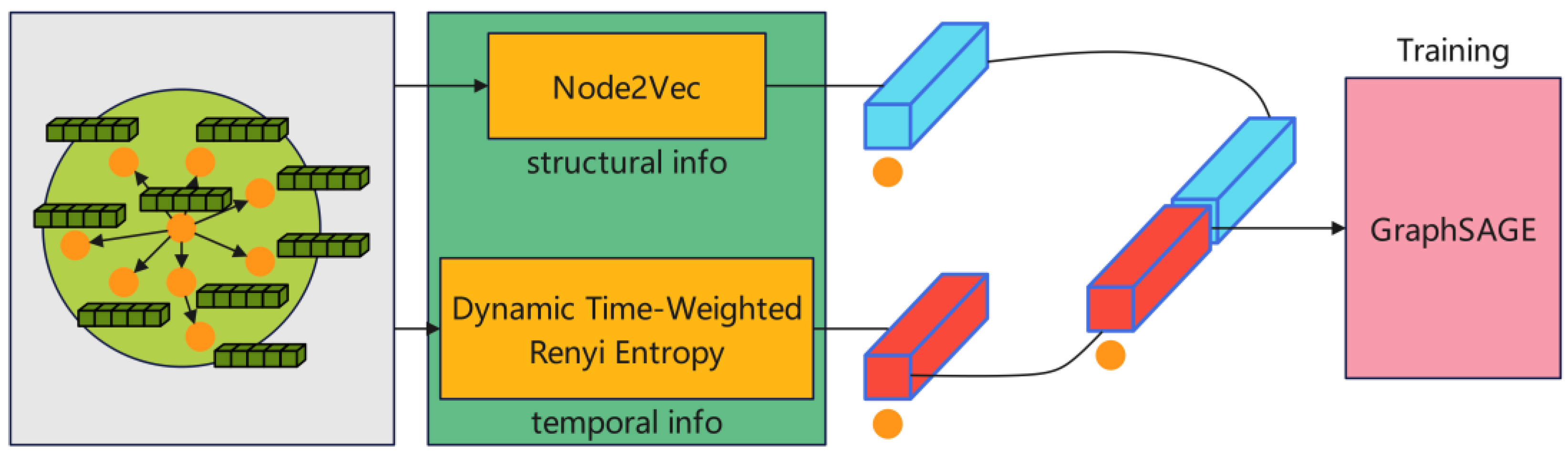
Figure 2.
Schematic diagram of the GraphSAGE sampling and aggregation process.
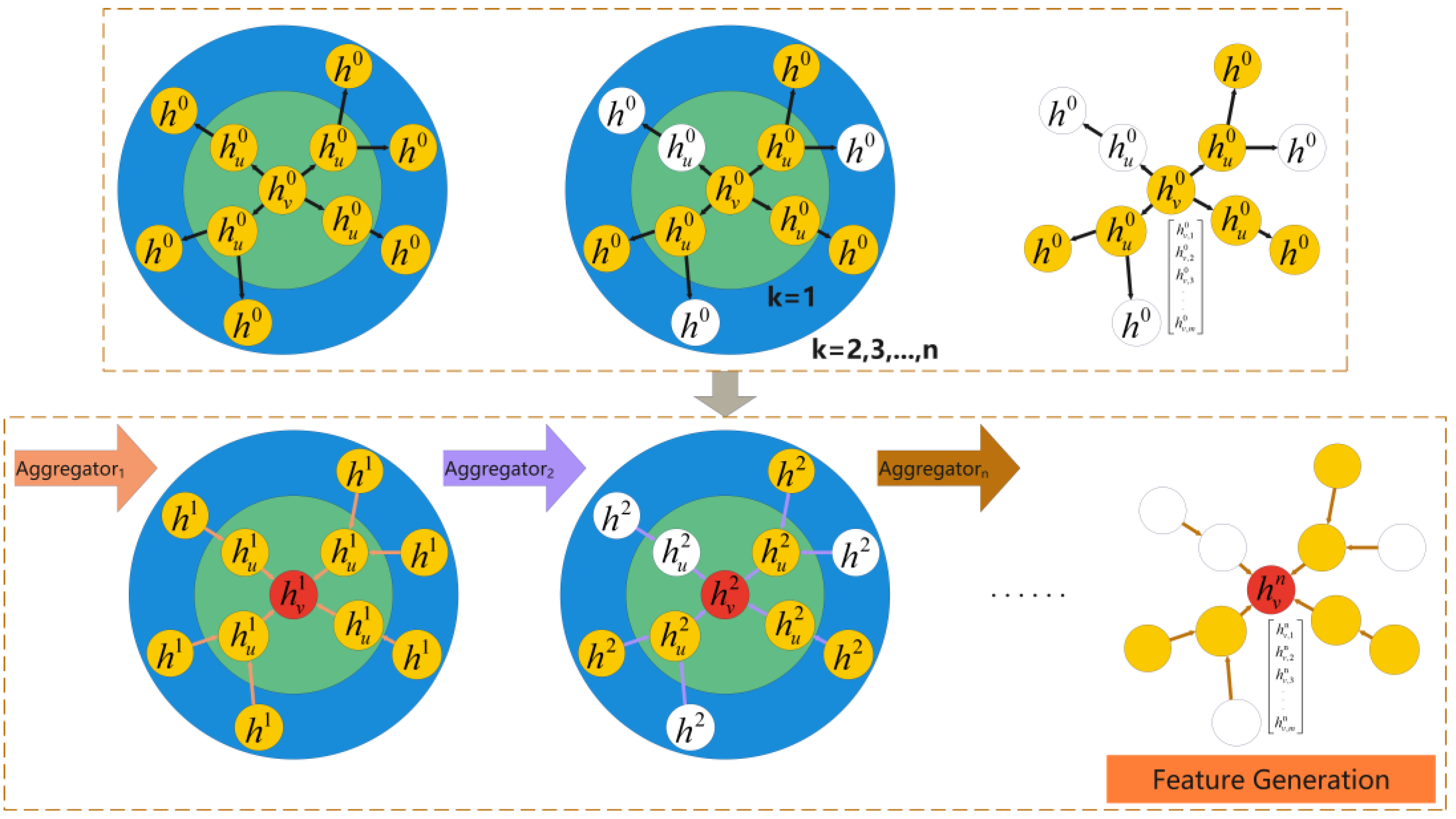
Figure 3.
Schematic diagram of dynamic time weighting mechanism.
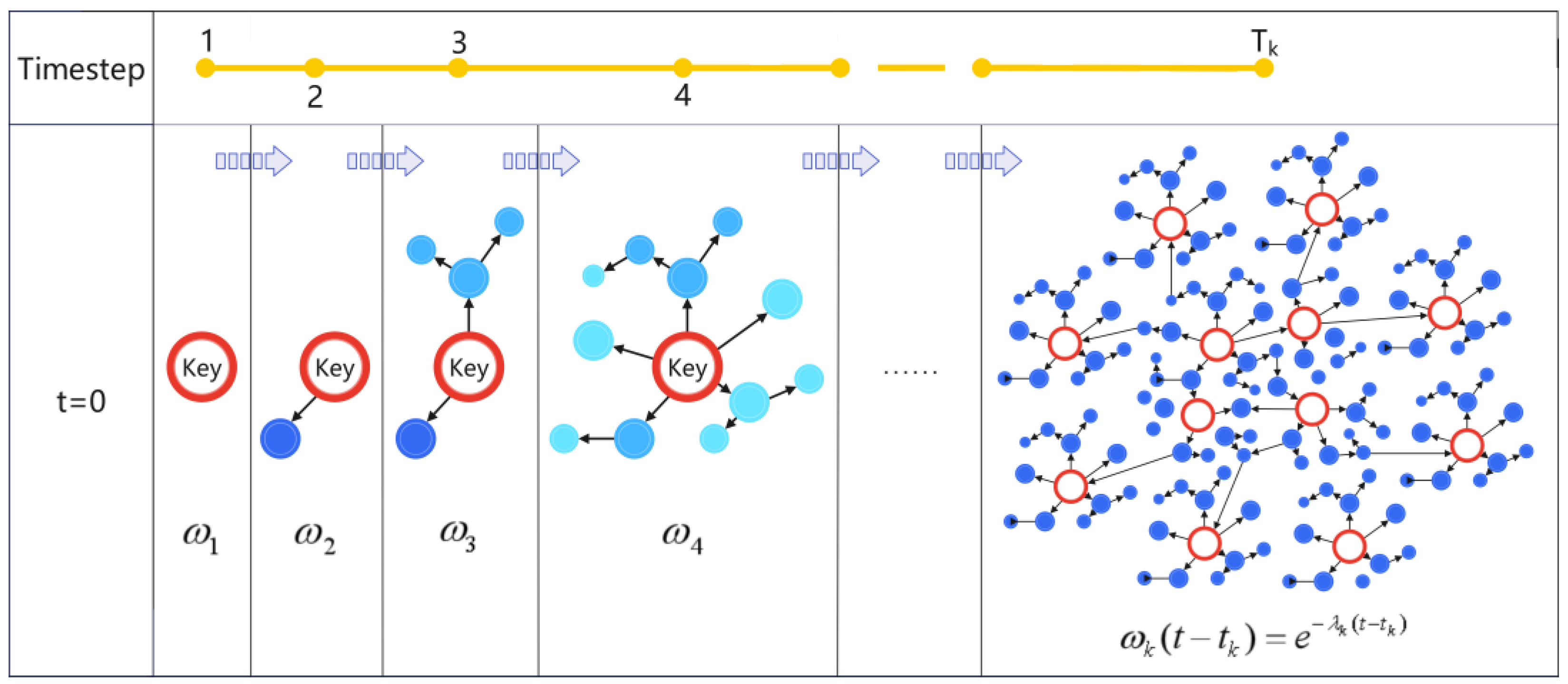
Figure 4.
Experimental procedure of the innovative model on real-world public opinion datasets.
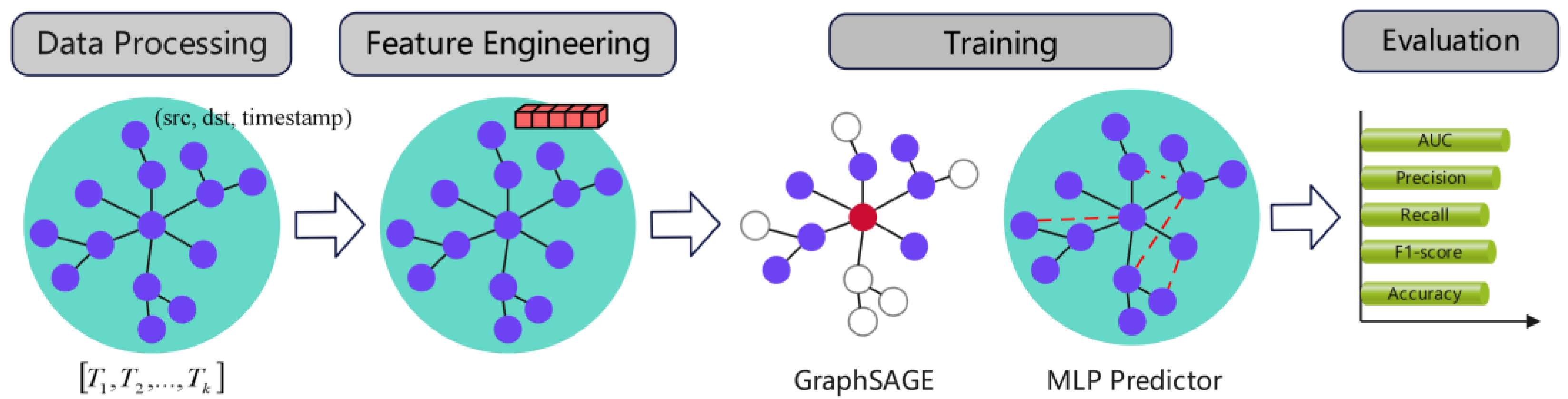
Figure 5.
Performance comparison between innovative method and baseline method.
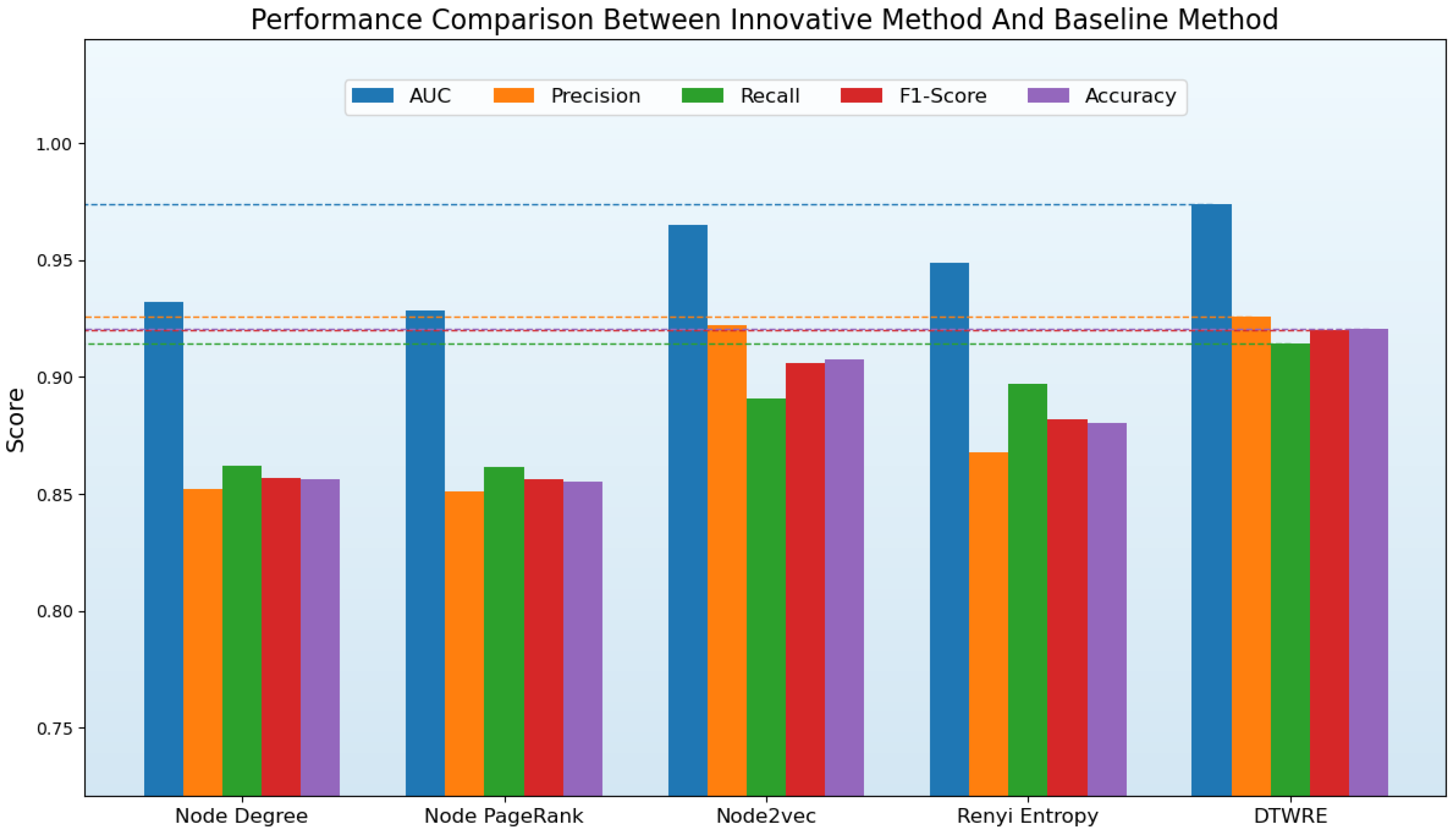
Figure 6.
Impact of DTWRE order α on model performance.
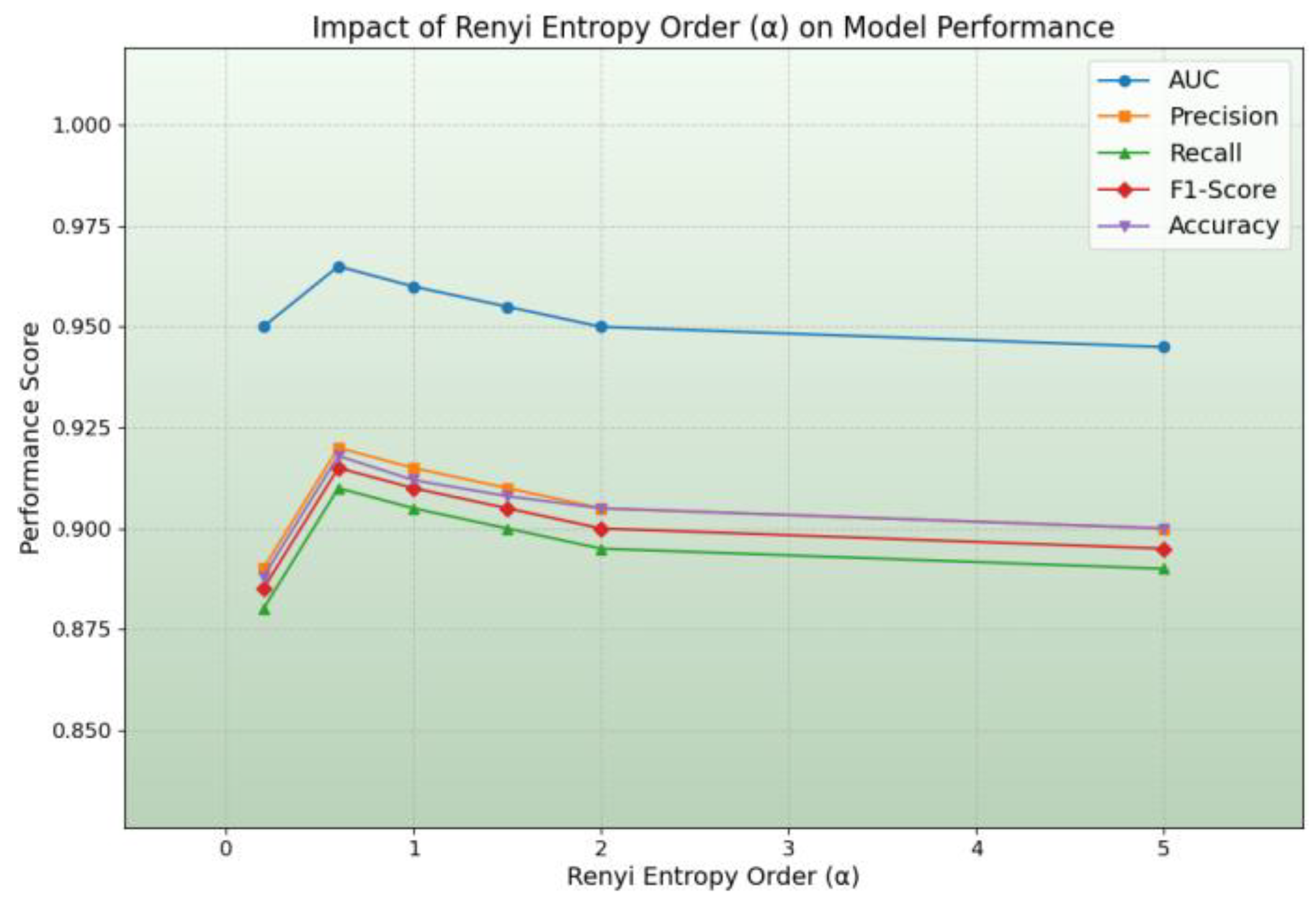
Figure 7.
Impact of time-weighted parameter λ on model performance.
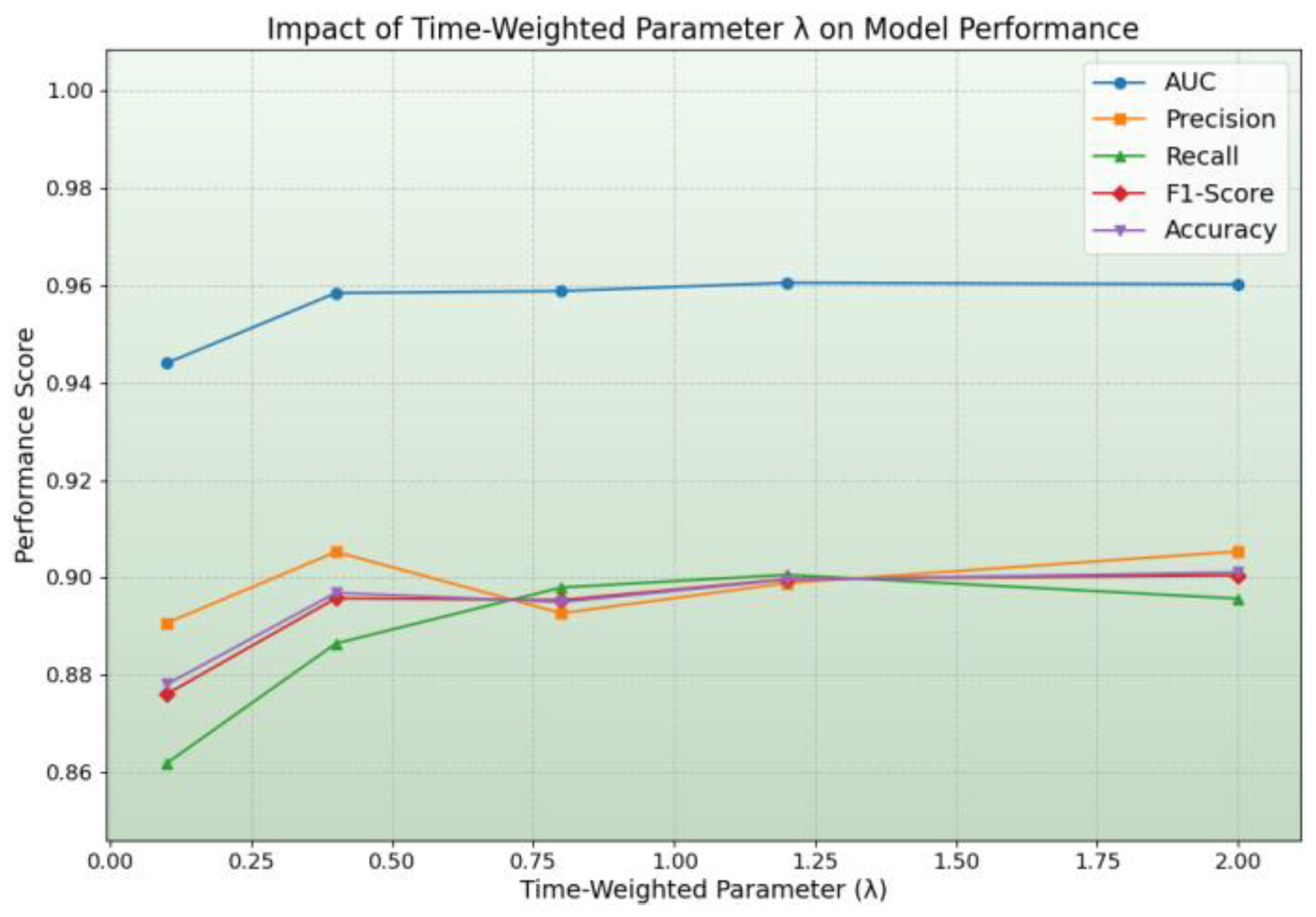
Figure 8.
Impact of positive-to-negative sample ratio on model performance.
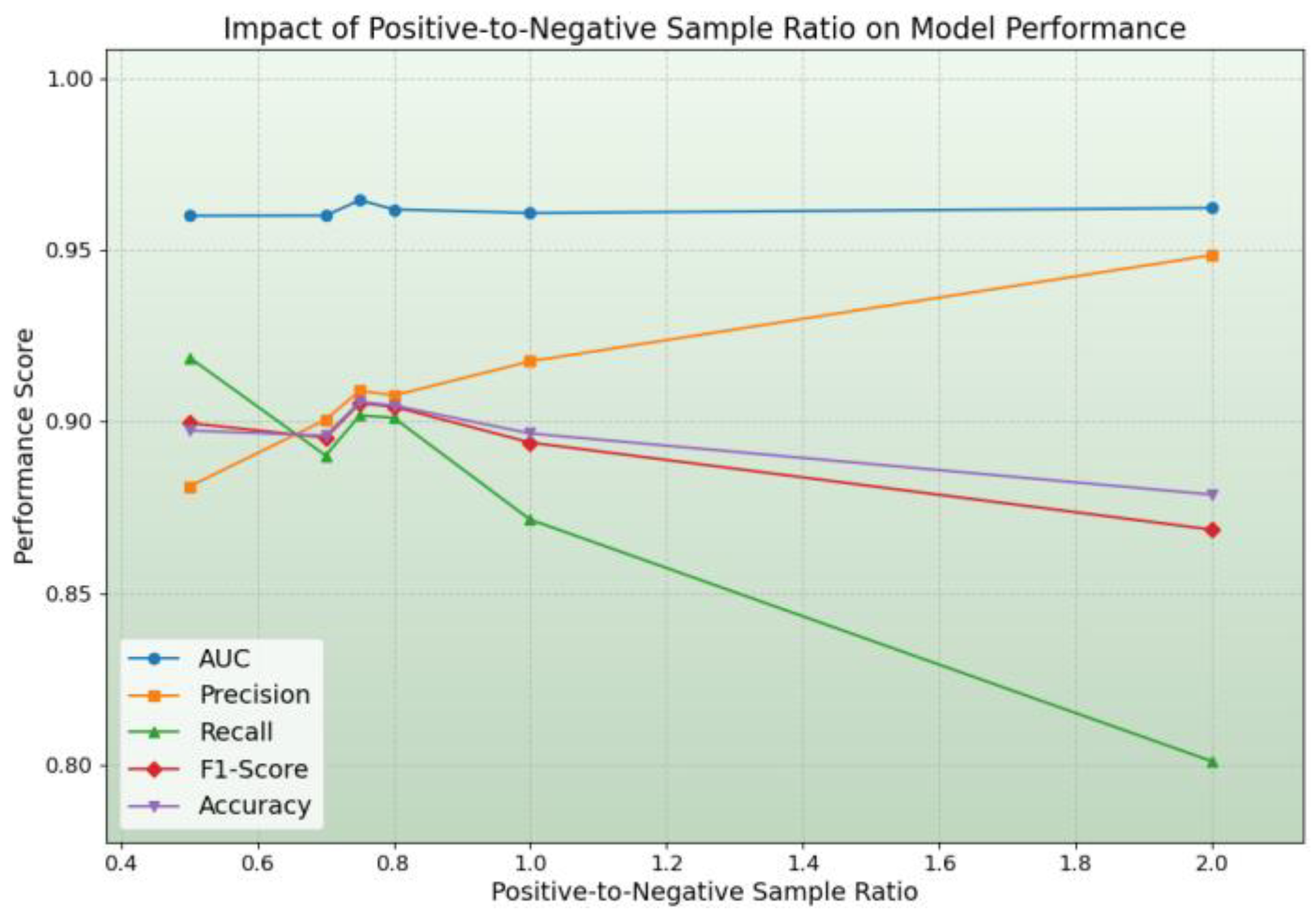
Figure 10.
Results of the variation of performance metrics of the model in 100 training epochs.
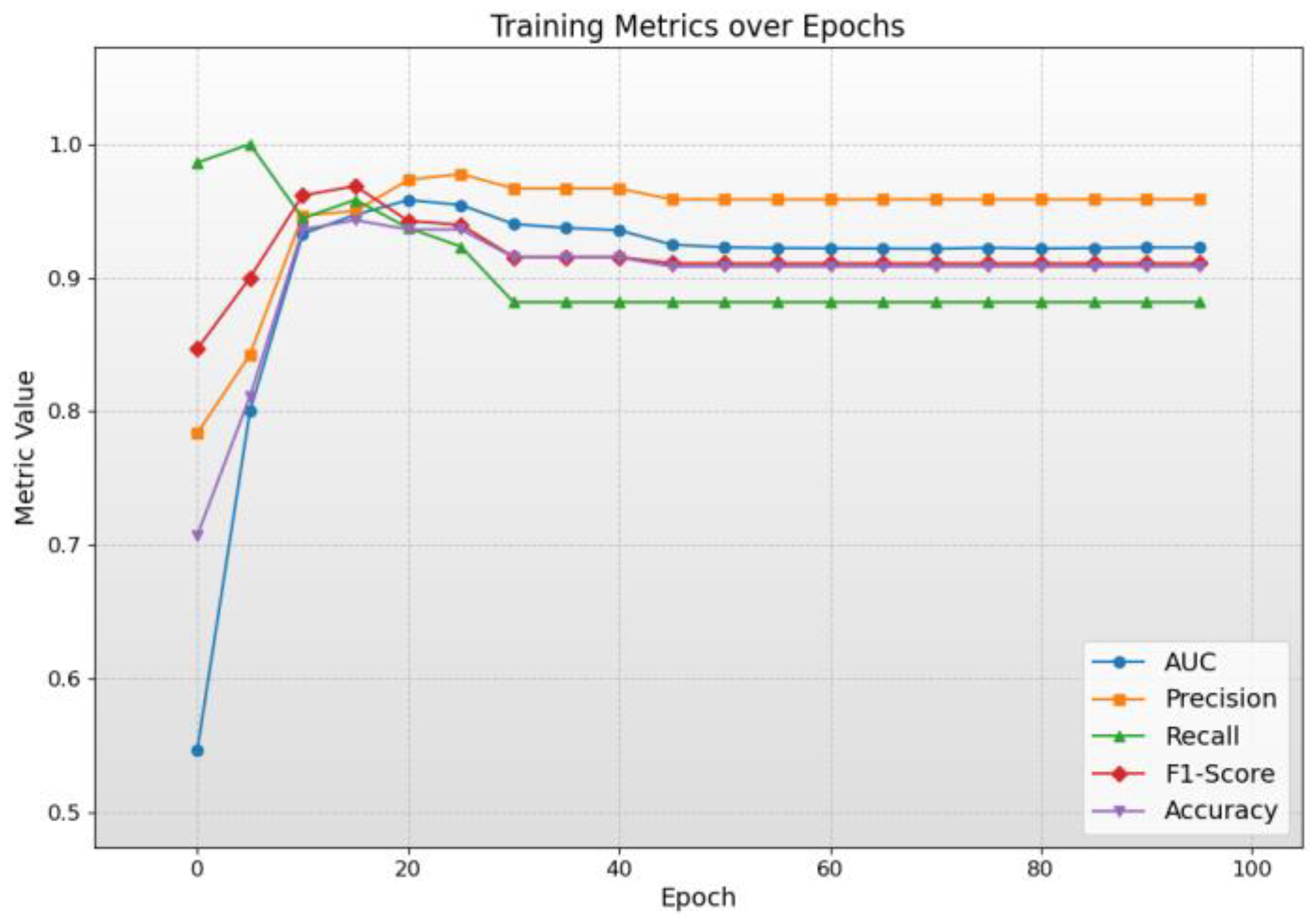
Figure 11.
Visualization of model prediction results in real social network public opinion datasets.
Figure 11.
Visualization of model prediction results in real social network public opinion datasets.
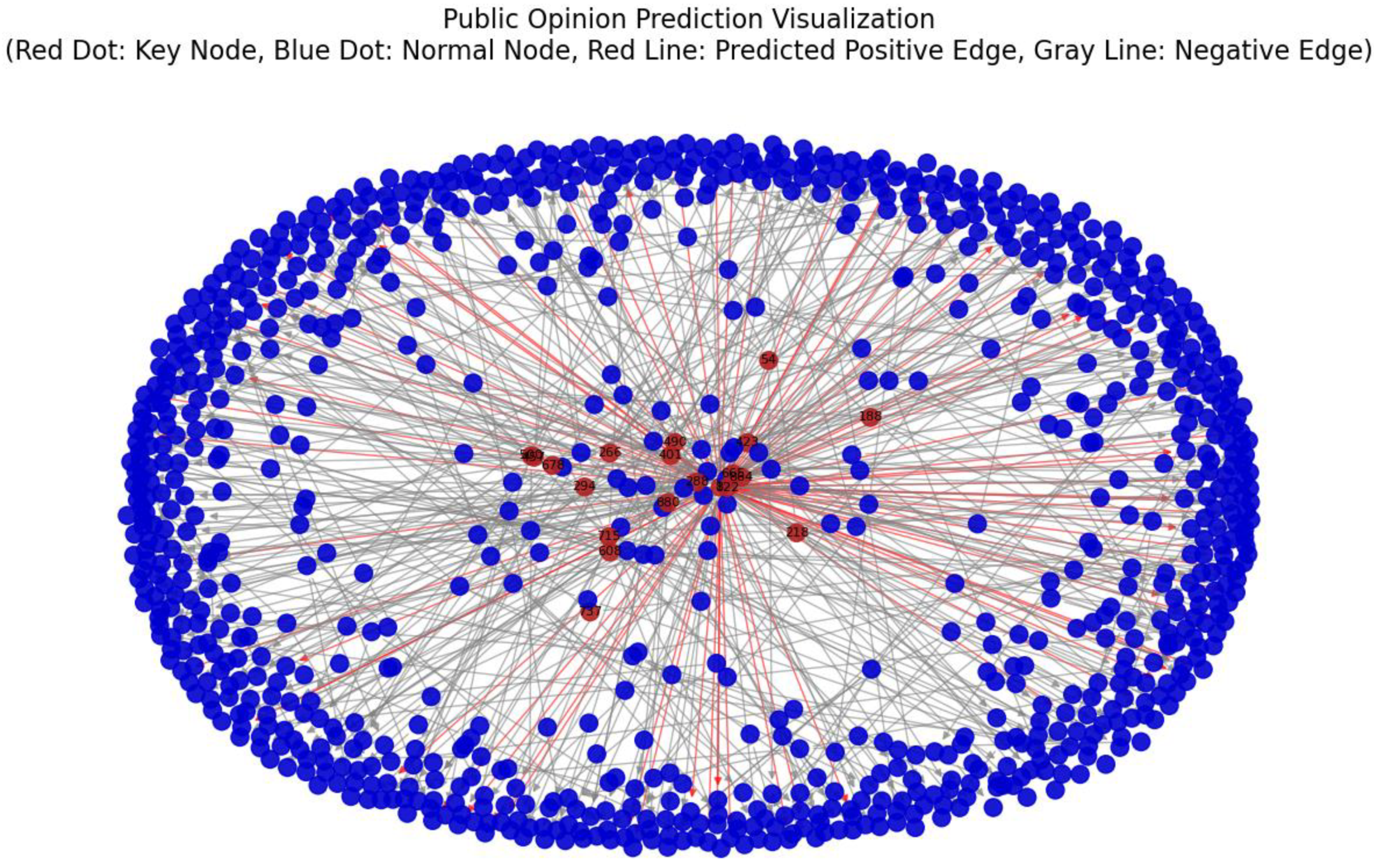
Table 2.
Comparison of the experimental results between the innovative method and the baseline method.
Table 2.
Comparison of the experimental results between the innovative method and the baseline method.
| Baseline Methods | AUC | Precision | Recall | F1-Score | Accuracy |
| ① | 0.9323 | 0.8522 | 0.8618 | 0.8570 | 0.8562 |
| ② | 0.9285 | 0.8509 | 0.8613 | 0.8561 | 0.8552 |
| ③ | 0.9649 | 0.9221 | 0.8909 | 0.9062 | 0.9078 |
| ④ | 0.9487 | 0.8677 | 0.8970 | 0.8821 | 0.8802 |
| DTWRE | 0.9742 | 0.9259 | 0.9144 | 0.9201 | 0.9207 |
Table 3.
Impact of the time step length on temporal evaluation.
| Time step length | AUC | Precision | Recall | F1-Score | Accuracy |
| 604800 | 0.9680 | 0.9159 | 0.9044 | 0.9101 | 0.9107 |
| 302400 | 0.9567 | 0.9016 | 0.8972 | 0.8994 | 0.8996 |
| 151200 | 0.9579 | 0.8963 | 0.8882 | 0.8922 | 0.8927 |
Disclaimer/Publisher’s Note: The statements, opinions and data contained in all publications are solely those of the individual author(s) and contributor(s) and not of MDPI and/or the editor(s). MDPI and/or the editor(s) disclaim responsibility for any injury to people or property resulting from any ideas, methods, instructions or products referred to in the content. |
© 2025 by the authors. Licensee MDPI, Basel, Switzerland. This article is an open access article distributed under the terms and conditions of the Creative Commons Attribution (CC BY) license (http://creativecommons.org/licenses/by/4.0/).
Copyright: This open access article is published under a Creative Commons CC BY 4.0 license, which permit the free download, distribution, and reuse, provided that the author and preprint are cited in any reuse.