

Submitted:
05 March 2025
Posted:
06 March 2025
You are already at the latest version
Abstract
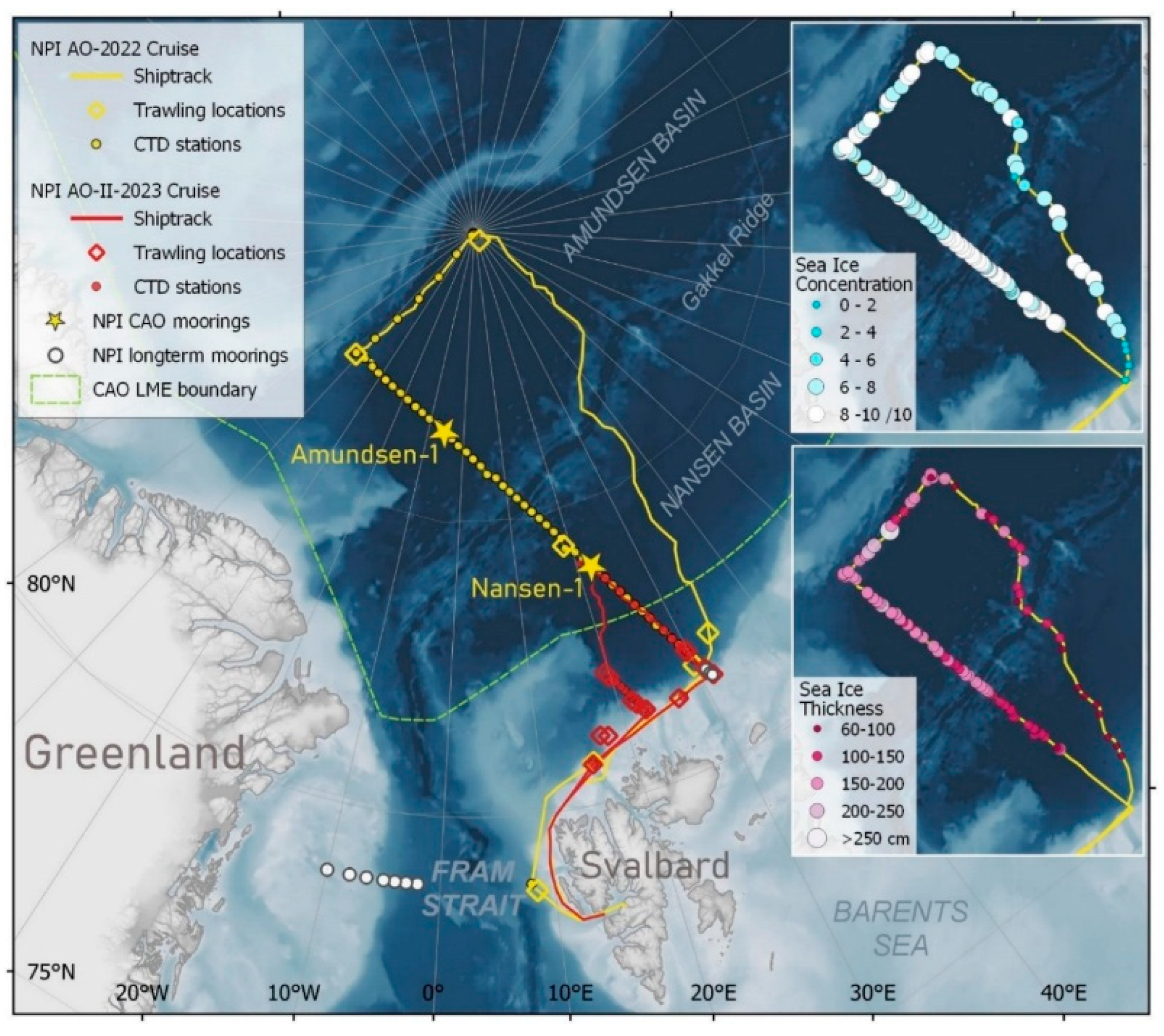
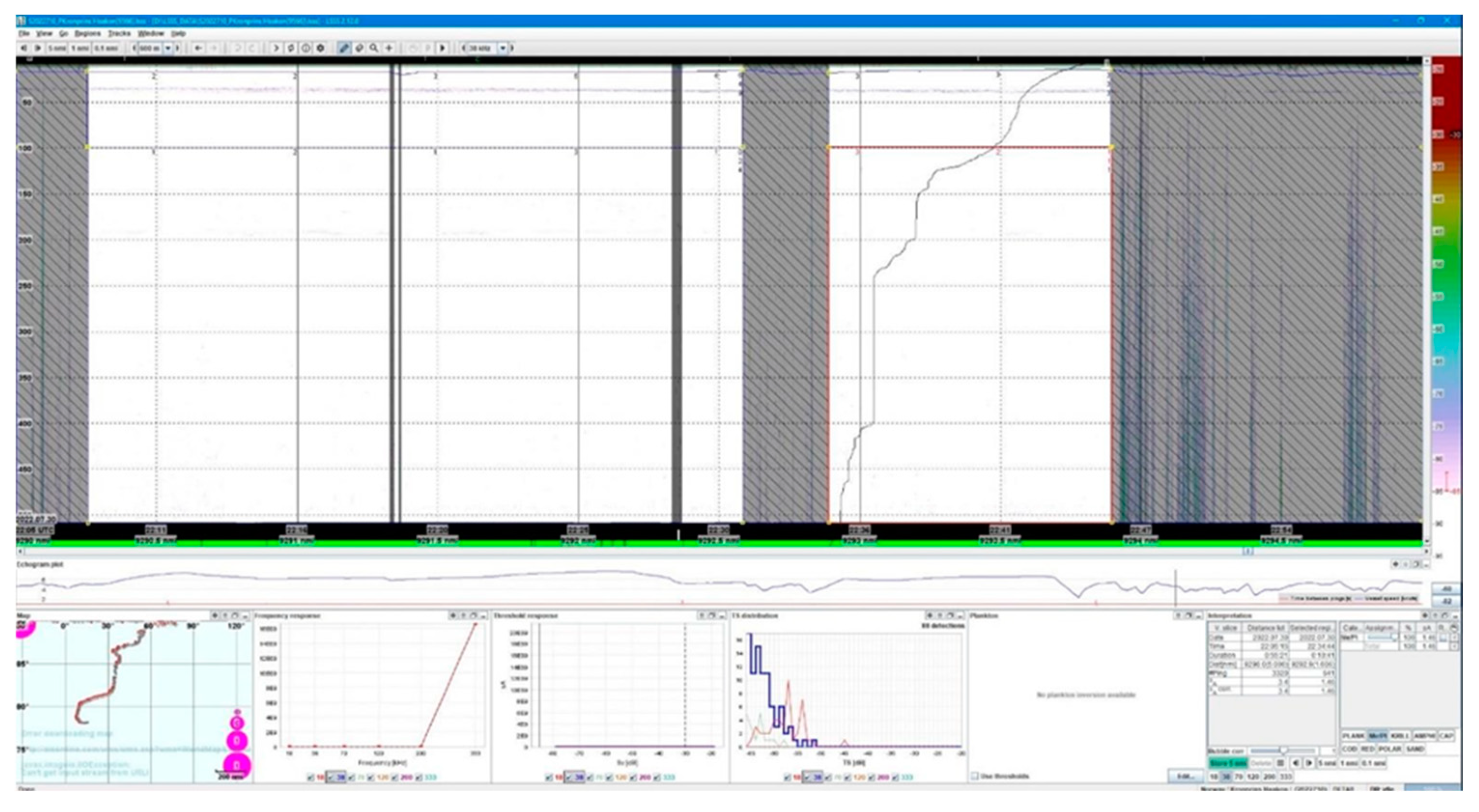
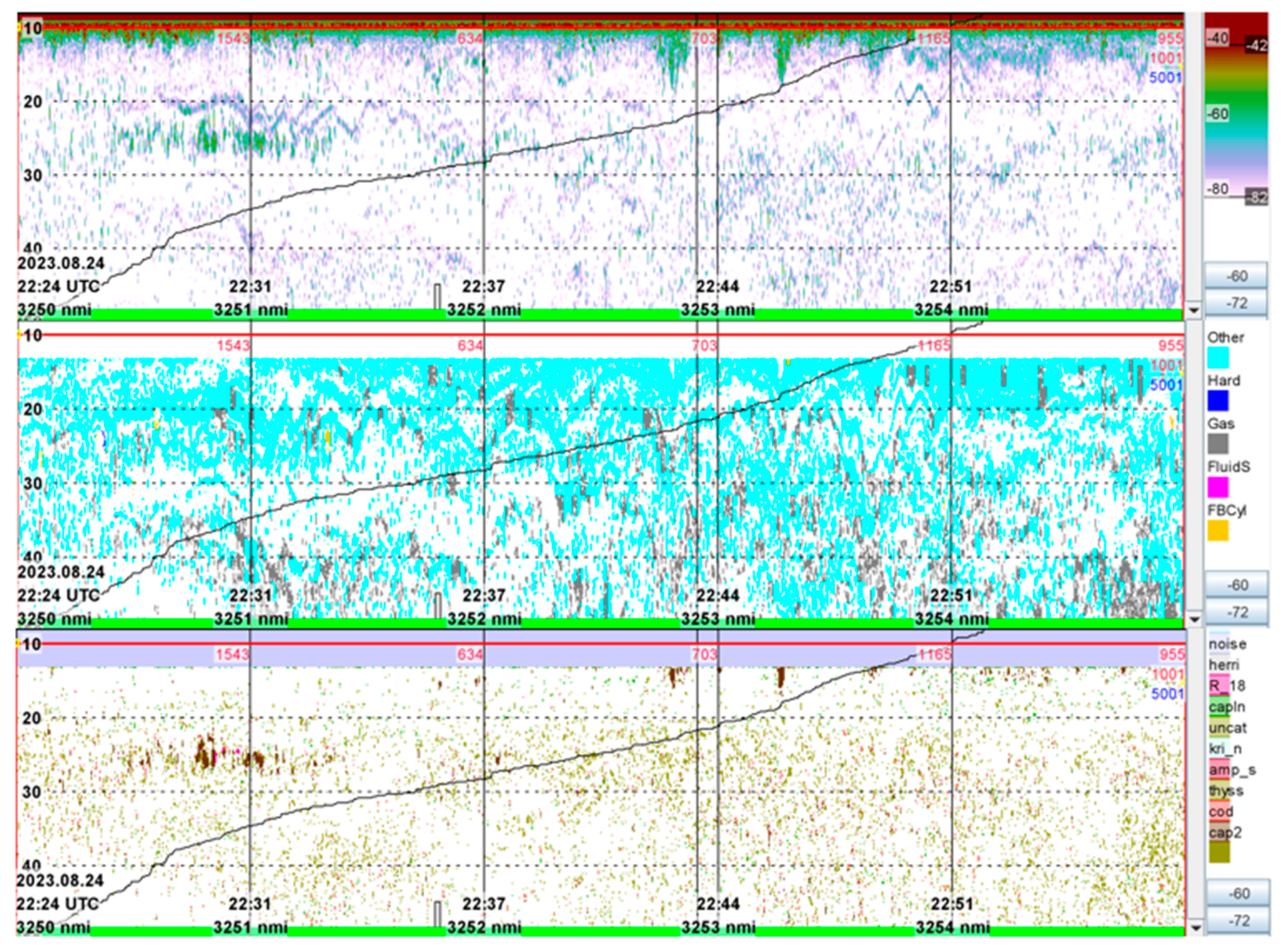
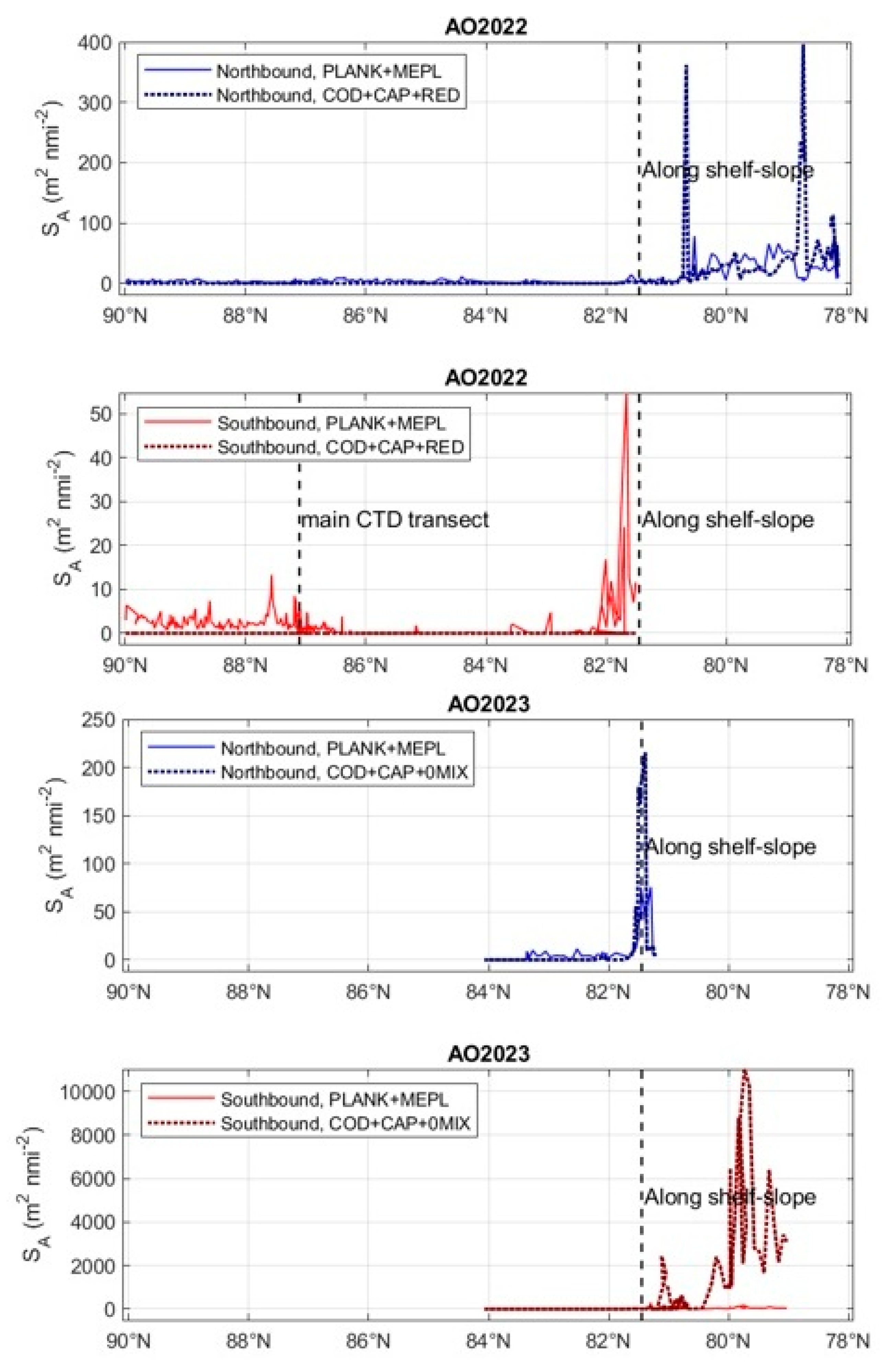
As the sea ice reduces in both extent and thickness and the Arctic Ocean opens, there is substantial interest in mapping the marine ecosystem in this remote and until now largely inaccessible ocean. We have used R/V “Kronprins Haakon” during surveys in the central Arctic Ocean in 2022 and 2023, to record the marine ecosystem using modern fisheries acoustics and net sampling. The 2022 survey reached all the way to the North Pole. In a first, rather manually based post-processing of these acoustic recordings using the Large-Scale Post Processing System (LSSS), much effort was used to remove segments of noise due to ice-breaking operations. In a second, more sophisticated post-processing, the KORONA module of LSSS with elements of machine learning was applied for further noise reduction and to allocate the area back-scattering recordings to taxonomic groups as order, families and even species of fish and plankton organisms. We discuss our results with a perspective of underpinning the need for further development of post- processing systems for direct allocation of back-scattered acoustic energy to abundance of categories and even species of marine organisms.
Keywords:
1. Introduction
2. Materials and Methods
2.1. Post Processing - General Protocol and Principles
2.2. Post Processing of Echo Sounder Recordings from the Arctic Ocean
3. Results
4. Discussion
Author Contributions
Funding
Data Availability Statement
Acknowledgements
Conflicts of Interest
Abbreviations
| AO2022 | Arctic Ocean cruise 2022 |
| AO2023 | Arctic Ocean cruise 2023 |
| CAO | Central Arctic Ocean |
| IMR | Institute of Marine Research |
| KPH | R/V “Kronprins Haaakon” |
| NASC | nautical area back scattering strength, sA with the unit (m2/(nautical mile)2 |
References
- Foote, K.G. Acoustic scattering by marine organisms. In Encyclopedia of Ocean Sciences (Third edition); Cochran, K., Bokuniewics, H., Yager, P.L., Eds.; Academic Press, 2019; pp. 260-273. [CrossRef]
- Holliday, D.V.; Pieper, R.E.; Kleppel, G.S. Determination of Zooplankton size and distribution with multifrequency acoustic technology. J. Cons. 1989, 46, 52–61. [Google Scholar] [CrossRef]
- Misund, O. A. Underwater acoustics in marine fisheries and fisheries research. Rev. Fish Biol. Fish. 1997, 7, 1–34. [Google Scholar]
- Simmonds, E. J and MacLennan, D. N. Fisheries Acoustics: Theory and Practice, 2nd edn. Fish and Fisheries Series, Blackwell Publishing, Oxford, 2005, 456 p.
- Dragesund, O.; Olsen, S. On the possibility of estimating year-class strength by measuring echo-abundance of O-group fish. FiskDir. Skr. Ser. Havunders. 1965, 13, 48–62. [Google Scholar]
- Foote, K.G. 1987. Fish target strengths for use in echo integrator surveys. J. Acoust. Soc. Am. 1987, 82, 981–987. [Google Scholar] [CrossRef]
- Blindheim, J. , Eide, P.K., Knudsen, H.P. and Vestnes, G. A ship-born data logging and processing system for Acoustic Fish Surveys. Fish. Res. 1982, 1, 141–153.
- Knudsen, H.P. Long-term evaluation of scientific-echosounder performance. ICES J. Mar. Sci. 2009, 66, 1335 – 1340.
- Mitson, R.B. and Knudsen, H.P. 2003. Causes and effects of underwater noise on fish abundance estimation. Aquatic Living Resources, 16: 255 – 263.
- Knudsen, H.P. The Bergen Echo integrator – an introduction. J. Cons. 1990, 47, 167–174. [Google Scholar] [CrossRef]
- Foote, K.G.; Knudsen, H.P.; Korneliussen, R.J.; Nordbø, P.E.; Røang, K. Postprocessing system for echo sounder data. J. Acoust. Soc. of Am. 1991, 90, 37–47. [Google Scholar]
- Myriax. Echoview@. Hobart, TAS, 2024, Available online at http://echoview.com.
- Korneliussen, R.J. The Bergen echo integrator post-processing system, with focus on recent improvements. Fish. Res. 2004, 68, 159–169. [Google Scholar]
- Korneliussen, R.J.; Heggelund, Y.; Macaulay, G.; Johnsen, E. Acoustic identification of marine species using a feature library. Meth. Oceanogr. 2016, 17, 187–205. [Google Scholar] [CrossRef]
- Mathisen, S. (ed.). “Kronprins Haakon”, Orkana, 2019, 1-190 (In Norwegian).
- Andersen, L.N. , Chu, D.Z., Heimvoll, H., Korneliussen, R., MacCaulay, G.J. and Ona, E. Quantitative processing of broadband data as implemented in a scientific splitbeam echosounder. arXiv2021: 2014.07248. [CrossRef]
- Dodd P, Nikolopoulos A, Buckley S et al. Arctic Ocean 2022 Cruise report, 19 July-23 August 2022. 98 pp. https://hdl.handle.net/11250/3013026.
- Ingvaldsen, R.B.; Eriksen, E.; Gjøsæter, H.; Engås, A.; Schuppe, B.K.; Assmann, K.M.; Cannaby, H.; Dalpadado, P.; Bluhm, B.A. Under-ice observations by trawls and multi-frequency acoustics in the Central Arctic Ocean reveals abundance and composition of pelagic fauna. Sci. Rep. 2023, 13:1000. [CrossRef]
- Hop H, Wold A, Misund O (eds.). NPI Arctic Ocean Cruise II. 1-29 August 2023. 98 pp.
- Midttun, L.; Nakken, O. On acoustic identification, sizing and abundance estimation of fish. FiskDir. Skr. Ser. Havunders. 1971, 16, 36–48. [Google Scholar]
- Korsbrekke, K.; Misund, O.A. On subjectivity in the judging of acoustic records: comparison of degree of homogeneity inn allocation of echo values by different teams. International Council for the Exploration of the Sea, Copenhagen, 1993.
- Fall, J.; Gjøsæter, H.; Tvete, I.F.; Aldrin, M. Classification of acoustic survey data: A comparison between seven teams of experts. Fish. Res. [CrossRef]
- Stanton, T.K.; Wiebe, P.H.; Chu, D.; Goodman, L. Acoustic characterization and discrimination of marine zooplankton and turbulence. ICES J. Mar. Sci. 1994a.51, 469–479. [CrossRef]
- Stanton, T.K.; Wiebe, P.H.; Chu, D.; Benfield, M.C.; Scanlon, L.; Martin, L.; Eastwood, R.L. On acoustic estimates of zooplankton biomass. ICES J. Mar. Sci. 51, 505–512. [CrossRef]
- Demer, D.A.; Conti, S.G. Validation of the stochastic distorted wave Born approximation model with broad bandwidth total target strength measurements of Antarctic krill. ICES J. Mar. Sci. 2003, 60, 625–635. [Google Scholar] [CrossRef]
- Misund, O.A. Why should scientists lead? To underpin policy on marine and polar ecosystems. ICES J. Mar. Sci. 2024, 81, 823–832. [Google Scholar] [CrossRef]
Disclaimer/Publisher’s Note: The statements, opinions and data contained in all publications are solely those of the individual author(s) and contributor(s) and not of MDPI and/or the editor(s). MDPI and/or the editor(s) disclaim responsibility for any injury to people or property resulting from any ideas, methods, instructions or products referred to in the content. |
© 2025 by the authors. Licensee MDPI, Basel, Switzerland. This article is an open access article distributed under the terms and conditions of the Creative Commons Attribution (CC BY) license (http://creativecommons.org/licenses/by/4.0/).


