
Submitted:
03 March 2025
Posted:
03 March 2025
You are already at the latest version
Abstract
Enhancing the green production efficiency of cotton contributes significantly to achieving carbon neutrality and agricultural sustainability. Based on county-level panel data from 2002 to 2020 and daily average temperature and precipitation data from 53 meteorological stations in Xinjiang, this study employs a non-desirable output super-efficiency slacks-based measure model, Malmquist index, and Moran’s Index to analyze the temporal and spatial changes in the green production efficiency of cotton across counties in Xinjiang. From a dynamic evolution perspective, without considering non-desirable outputs, the overall cotton production efficiency at the county level exhibits an upward trend; however, when non-desirable outputs are taken into account, the green production efficiency of cotton shows a declining trend, with a general convergence trend among counties (cities). From 2002 to 2020, the overall green production efficiency of cotton in Xinjiang counties decreased from 0.531 to 0.442, with an annual average decline rate of -0.882%. Spatially, as temperatures rise in northern Xinjiang and rainfall increases in the west, high-value areas for cotton green production efficiency have shifted northward and westward, transforming the spatial distribution pattern from “high in the south and low in the north” to “high in the north and low in the south.” The spatial clustering effect among counties is significant, exhibiting a “clustered distribution” pattern. To improve the green production efficiency of cotton, it is recommended to promote ecological protection efforts, implement differentiated strategies, leverage spatial clustering effects, disseminate advanced agricultural technologies, and optimize planting structures.
Keywords:
Climate Change
; Cotton Green Production Efficiency
; Non-desirable Output Super-efficiency Slacks-Based Measure Model
; Malmquist Index
; Moran’s Index
1. Introduction
The 20th National Congress of the Communist Party of China (CPC) proposed to actively address climate change and advance carbon peaking, pollution reduction, afforestation, and economic growth in a coordinated manner, pursuing development that is resource-saving, intensive, green, and low-carbon. This aims to foster harmonious coexistence between humanity and nature and achieve sustainable agricultural development. However, in recent years, the intensification of climate change has introduced many uncertainties into the cotton production process, significantly impacting the sustainable production of cotton [1,2,3]. As the world’s largest consumer and importer of cotton, and the second-largest producer, China’s cotton industry plays a crucial role in both national economic development and the global cotton market [4]. Therefore, studying the green production efficiency of cotton under the backdrop of climate change holds significant importance.
Existing studies have demonstrated that cotton production is highly dependent on climatic conditions, and the impacts of climate change on cotton production are primarily reflected in three aspects. Firstly, climate change has led to a northward shift and expansion of areas suitable for cotton cultivation. Research indicates that under the influence of climate change, cotton planting regions initially showed a trend of migrating towards the northern Yellow River basin, subsequently expanding further into the northwest region, eventually establishing Xinjiang’s dominant position in cotton production [5,6,7,8]. Secondly, climate change significantly affects the growth and development cycles of cotton. Under the backdrop of climate change, the growing season for cotton has shown a clear trend of extension. Specifically, there is a tendency for its sowing date, emergence date, squaring date, flowering date, and boll opening date to advance, while the harvest date tends to be delayed [9,10,11,12]. Thirdly, climate change will have an impact on water, heat, and other conditions during the growth period of cotton. During its growth and development phases, essential conditions for cotton such as temperature, humidity, light, and CO2 concentration are altered due to climate change, thereby affecting its growth [13,14,15,16]. Due to differences in study regions, study periods, and other factors, the academic community has not yet reached a consensus on the direction of the impact of climate change on cotton production, but almost all studies agree that climate change has a significant impact on cotton production.
In the context of the above realities and academic backgrounds, regardless of whether cotton production benefits from or is harmed by climate change, ignoring its impact will lead to biases in the assessment of cotton’s green production efficiency. Therefore, when constructing an evaluation index system for cotton’s green production efficiency, it is essential to incorporate climate factors—a consideration often overlooked in previous studies.Based on this, this paper integrates daily temperature and precipitation records from meteorological stations with socio-economic datasets to examine the spatiotemporal variations in the green production efficiency of cotton, taking into account the influence of climatic factors. Additionally, given that China joined the World Trade Organization (WTO) in 2001, this study analyzes changes in cotton production from 2002 to 2020 (the latest year covered by the Xinjiang Statistical Yearbook), focusing on trends and characteristics following China’s accession to the WTO.
2. Materials and Methods
2.1. Study Area
Xinjiang, located in the northwest border region of China and the heart of the Eurasian continent (73°20′E to 96°25′E, 34°15′N to 49°10′N), covers one-sixth of China’s total land area, making it the largest of China’s provincial-level administrative regions [17] (Figure 1). The region features a complex topography that includes high mountains, basins, rivers, lakes, deserts, Gobi plains, and oases [18]. Xinjiang has a temperate continental arid climate, with an annual average temperature ranging from 6.2°C to 9.0°C and annual precipitation between 93.2 mm and 205.8 mm [19]. It benefits from abundant light and heat resources but suffers from low rainfall and high evaporation rates, making it one of China’s most climate-sensitive and ecologically vulnerable areas [20]. Thanks to its unique geographical and climatic conditions, advancements in science and technology, and strong national policy support, Xinjiang achieved remarkable success in cotton production [21]. In 2022, Xinjiang planted cotton on 2.5 million hectares, accounting for 83.2% of the national planting area, with a total output of 5.394 million tons, representing 90.2% of the national total. The yield reached 2,016.0 kg per hectare, the highest in the country. In 2023, the total cotton production was 5.112 million tons, exceeding 90.0% of the national total, establishing Xinjiang’s position as China’s most important cotton-producing region [22].
2.2. Methods
2.2.1. Undesirable Output Super-Efficiency Slacks-Based Measure Model
The Undesirable Output Super-Efficiency Slacks-Based Measure Model is an advanced Data Envelopment Analysis method used to evaluate the efficiency of multiple decision-making units. Taking into account undesirable outputs, it provides a refined measurement of production efficiency by considering the excess or shortage of inputs and outputs [23]. By introducing the Undesirable Output Super-Efficiency Slacks-Based Measure Model, the purpose is to measure the green production efficiency of cotton in various counties and cities in Xinjiang. The formulas are as follows [24]:
In the formula, λj ≥ 0; where i = 1, 2, ..., m; j = 1, 2, ..., n; s = 1, 2, ..., r1; q = 1, 2, ..., r2. Here, ρ represents the green production efficiency of cotton; n stands for the number of decision-making units; m represents the inputs; r1 represents the desirable outputs; r2 represents the undesirable outputs; x represents the elements in the input matrix; yd represents the elements in the desirable output matrix; and yu represents the elements in the undesirable output matrix.
2.2.2. Malmquist Index
The Malmquist index is a commonly used indicator in economics to measure the dynamic changes in production efficiency, allowing for the calculation of the degree of efficiency change from period t to period t + 1. By introducing the Malmquist index, the objective is to assess the temporal variations in green production efficiency of cotton [25]. The formulas are as follows:
In the formula: (xt, yt) represents the input-output vector of cotton green production at period t; (xt+1, yt+1) represents the input-output vector of cotton green production at period t+1; denotes the distance function at period t; denotes the distance function at period t+1.
MI (Malmquist Index) stands for the Malmquist Productivity Index from period t to period t+1. A value greater than 1 indicates an increase in productivity; a value equal to 1 indicates no change in productivity; and a value less than 1 indicates a decrease in productivity [26].
TC (Technical Change) represents technological progress or regression; EC (Efficiency Change) reflects changes in overall technical efficiency; PEC (Pure Efficiency Change) represents changes in pure technical efficiency; and SEC (Scale Efficiency Change) reflects changes in the degree of scale. Values greater than 1 indicate an improvement in the indicator compared to the previous stage; values equal to 1 indicate that the indicator remains consistent with the previous stage; and values less than 1 indicate a decrease in the indicator compared to the previous stage [27].
2.2.3. Moran’s I
(1) Global Moran’s I
The Global Moran’s I is a statistical indicator that measures the global spatial autocorrelation of geospatial data. It is used to analyze whether the spatial distribution of cotton green production efficiency across counties (cities) in Xinjiang exhibits clustering, randomness, or uniformity [28]. The formula for calculating the Global Moran’s I is as follows:
N represents the number of counties (cities) in Xinjiang; xi and xj represent the observed values of the geographical attribute for the ith and jth counties (cities) respectively; is the average value of the geographical attribute for all counties (cities) in Xinjiang; wij is an element in the spatial weight matrix, reflecting the spatial relationship or proximity between spatial units i and j; W is the sum of all spatial weights; and I is the value of the Global Moran’s I.
If I > 0, it indicates a positive spatial correlation, meaning similar values tend to cluster together; if I < 0, it indicates a negative spatial correlation, meaning different values tend to be adjacent; if I = 0, it indicates that the attribute data is randomly distributed spatially [28].
(2) Local Moran’s I
The Local Moran’s I serves as a supplement to the Global Moran’s I, used to identify the spatial autocorrelation characteristics of cotton green production efficiency across counties (cities) in Xinjiang. Specifically, it can pinpoint which specific areas in the data exhibit significant spatial clustering or dispersion patterns. In this paper, the Local Moran’s I is employed to identify regions with high values clustering with high values (High-High clusters) and low values clustering with low values (Low-Low clusters) in terms of cotton green production efficiency [29]. The formulas are as follows:
Ii represents the Local Moran’s I for the ith spatial unit; S2 denotes the sample variance; and the meanings of the other symbols are the same as those in the Global Moran’s I.
2.3. Indices and Data
2.3.1. Study Period
Since China joined the World Trade Organization (WTO) in 2001, cotton production has undergone a series of adjustments and gradually exhibited more stable patterns of change [30]. Therefore, this study selects 2002 as the starting year for analysis to more accurately observe and evaluate the trends and characteristics of cotton production following China’s accession to the WTO. Given that the latest data available in the Xinjiang Statistical Yearbook are for 2020, this study ends in 2020.
2.3.2. Input Indices
Climatic Indicators for Cotton Production. Multiple studies have demonstrated that temperature and precipitation significantly influence cotton production [5,6,7,8,9,10,11,12,13,14,15,16]. This study adopts the method used by Gao, M. to handle climatic variables, selecting temperature and precipitation as the two indicators affecting the green production efficiency of cotton in Xinjiang [31]. Meteorological data are sourced from the China Meteorological Administration (https://www.cma.gov.cn/). The meteorological database includes daily meteorological data recorded by 53 observation stations covering Xinjiang, specifically daily average temperatures and daily precipitation amounts. Following the matching method proposed by Shuai, C [32], this study connects county-level databases with meteorological databases based on the shortest spatial distance between county center coordinates and meteorological station coordinates.
General Input Indicators for Cotton Production. General input indicators typically refer to various input factors related to cotton production or processing, excluding climatic factors. In this study, land, labor, machinery, electricity, and fertilizer are selected as general input variables [31,33,34,35,36,37,38,39,40,41]. Fertilizer is included while pesticides are excluded from the general input indicators for two main reasons: ①Pesticides and fertilizers play distinct roles in cotton production. Fertilizers primarily provide essential nutrients to plants, directly promoting crop growth and development, whereas pesticides are mainly used to control pests and diseases, protecting crops from damage. ②Pesticide usage data in Xinjiang’s statistical yearbooks are not continuous, and their availability and stability are relatively poor. Including pesticides in the input indicator system might negatively impact overall data quality due to discontinuity and volatility. Electricity is included in the general input indicators primarily because of the specific agricultural context in Xinjiang. As a large agricultural region with relatively scarce labor resources, electricity has become an indispensable substitute and supplement in cotton cultivation. Data for general input variables are sourced from the Xinjiang Statistical Yearbook (2003-2021), Xinjiang Statistical Bulletin, and China Rural Statistical Yearbook.
2.3.3. Output Indices
Desirable Outputs. Cotton yield is used as the desirable output. Data on cotton yield are sourced from the Xinjiang Statistical Yearbook (2003-2021). Missing values are supplemented using linear interpolation and trend fitting methods. To ensure data quality, counties with more than 10% missing values are excluded. This process results in a final dataset of desirable cotton output for Xinjiang from 2002 to 2020.
Undesirable Outputs. In agricultural production processes, the primary factors contributing to carbon emissions primarily include the use of agricultural chemicals and farmland management activities [42]. According to the climate input indicators employed in this study, the main sources of carbon emissions are fertilizer input and land use. Given the limitations of data availability and continuity, this study selects fertilizer application rate as a indicator of carbon emissions from agricultural chemical use, and irrigation area as a proxy indicator for a key aspect of farmland management activities. With reference to the research conducted by Hui, Y and Fawen, Y [42], the carbon emission coefficients for fertilizer application and irrigation area are 0.8956 (kg/kg) and 312.6 (kg/km²), respectively.
3. Results
3.1. Analysis of Temporal Changes of Cotton Green Production Efficiency
3.1.1. Characteristics of Temporal Variation in Green Production Efficiency of Cotton
(1) Despite an Upward Trend in Cotton Production Efficiency, Green Production Efficiency Exhibited a Downward Trajectory.
As shown in Table 1, despite a sharp increase in Xinjiang’s green cotton production efficiency to 0.549 in 2014, which remained relatively stable between 2016 and 2020, the overall trend of green production efficiency from 2002 to 2020 exhibited a downward trajectory. The peak green production efficiency of 0.549 in 2014 represented the highest value recorded over the 19-year period. This notable surge in 2014 coincided with the implementation of the "Cotton Target Price Reform Pilot" policy in Xinjiang. Although primarily aimed at adjusting price mechanisms and securing farmers’ incomes, this policy indirectly enhanced green production efficiency by motivating improvements in production efficiency, facilitating adjustments in planting structures, and guiding market orientation. Between 2016 and 2020, the Chinese government actively promoted green agricultural development through various measures, including reducing fertilizer usage, enhancing efficiency, and advancing ecological agriculture, all of which were aimed at fostering sustainable development within the cotton industry. These initiatives indirectly or directly contributed to stabilizing and improving green production efficiency. However, the average green production efficiency for cotton in Xinjiang declined from 0.531 in 2002 to 0.442 in 2020, with an annual average decline rate of -0.882%. The decline can be attributed to farmers’ intensive use of chemical fertilizers and other agricultural chemicals in pursuit of higher yields and production efficiency. This practice has resulted in soil degradation and environmental pollution, both of which are detrimental to green cotton production.
(2) Decreasing Disparities in Green Production Efficiency Among Counties (Cities).
From 2002 to 2020, the cotton green production efficiency values in Wusu City, Jinghe County, Yuli County, and Shaya County were all above 1, indicating that these areas were able to maintain high cotton yields while effectively controlling or reducing undesired outputs. In Balikun Kazak Autonomous County, Yiwu County, Changji City, Fukang City, Hutubi County, Jimusar County, Shawan City, Toli County, Hoboksar Mongol Autonomous County, Korla City, Luntai County, Yanqi Hui Autonomous County, Hejing County, Bohu County, Kuche City, Awati County, Keping County, Atushi City, Yingjisha County, and Yuepuhu County, the cotton green production efficiency exhibited an upward trend, with Hutubi County, Shawan City, Korla City, Luntai County, and Keping County specifically increasing their cotton green production efficiency values from below 1 to above 1. Conversely, the green production efficiency in Shanshan County, Toksun County, Manas County, Chabuchar Xibo Autonomous County, Huocheng County, Bole City, Ruoqiang County, Qiemo County, Heshuo County, Aksu City, Wensu County, Xinhe County, Wushi County, Aketao County, Shufu County, Shule County, Zepu County, Shache County, Yecheng County, Makit County, Jiashi County, Bachu County, Hotan County, Moyu County, Pishan County, Luopu County, Cele County, and Yutian County showed a downward trend.
3.1.2. Dynamic Analysis of Green Efficiency Changes in Cotton Production in Xinjiang
(1) Instability in the Change of Green Production Efficiency of Cotton.
According to Table 2, from 2002 to 2020, the MI, EC, and TC in Xinjiang were 0.948, 0.969, and 0.994, respectively, all of which were less than 1. This indicates that although the overall performance of cotton production in Xinjiang is close to the optimal state, there is still room for improvement. The value of MI (0.948) indicates that there is still some room for improvement in the average efficiency of cotton production in Xinjiang from 2002 to 2020, that is, it has not reached the optimal state; EC (0.969) indicates that although cotton production in Xinjiang has relatively high technological application, it has not yet reached a fully effective state, reflecting certain resource waste or unrealized technological potential; TC (0.994) is very close to 1, which shows that Xinjiang’s cotton production has achieved considerable technological progress, but there is still room for improvement. PEC (1.003) is greater than 1 and greater than SEC (0.969), indicating that during the inspection period, the production unit’s performance in improving technology utilization and management efficiency surpassed its ability to adjust production scale for a more optimal scale. The production unit achieved greater efficiency gains through improvements in internal technology and management efficiency. All of the MI, EC, and TC show a fluctuating downward trend, indicating that the development speed of green production efficiency in cotton is slowing down. This slowdown is related to the fragile ecological environment in Xinjiang, and a suitable green development path should be established to alleviate the contradiction between economic development and environmental protection, thus enabling the steady and continuous improvement of green cotton production efficiency.
(2) Divergence in Green Production Efficiency of Cotton Across Various Counties and Cities.
From the perspective of MI, from 2002 to 2020, 19 counties (cities) including Bohu County, Hutubi County, Korla City, Awati County, Yingjisha County, Qiemo County, Luntai County, Changji City, Bachu County, Wusu City, Manas County, Yuepuhu County, Atushi City, Aksu City, Bole City, Shawan City, Kuche City, Wensu County and Pishan County had MI values greater than 1 (Table 3), indicating that these regions have generally achieved positive growth in production efficiency and achieved positive results in agricultural economic development. From the perspective of TC, 26 cities including Awati County, Manas County, Jiashi County, Wusu City, Bachu County, Korla City, Hutubi County, Yuli County, Bohu County, Qiemo County, Aksu City, Bole City, Shaya County, Yuepuhu County, Luntai County, Shache County, Atushi City, Yecheng County, Wensu County, Changji City, Shawan City, Heshuo County, Xinhe County, Shule County, Ruoqiang County, and Keping County have TC values greater than 1, reflecting their significant progress and positive achievements in technological innovation. From the perspective of EC, the EC values of 22 counties (cities) in Bohu County, Yingjisha County, Hutubi County, Pishan County, Korla City, Changji City, Luntai County, Awati County, Qiemo County, Kuche City, Atushi City, Bachu County, Yuepuhu County, Shawan City, Wusu City, Huocheng County, Moyu County, Aksu City, Bole City, Hoboksar Mongol Autonomous County, Hejing County and Manas County were greater than 1. Breaking down the EC, the PEC is generally better than the SEC, indicating that compared to the problem of economies of scale, each county (city) in Xinjiang has more effectively utilized existing resources at the current level of technology.
3.2. Analysis of Spatial Pattern of Cotton Green Production Efficiency
3.2.1. Overall Spatial Characteristics of Cotton Green Production Efficiency
The ARCGIS software was used to generate spatial distribution maps of cotton green production efficiency. The natural breaks classification method was applied to categorize the efficiency levels into five classes: low efficiency, sub-low efficiency, medium efficiency, sub-high efficiency, and high efficiency. Spatial distribution maps for cotton green production efficiency in Xinjiang counties (cities) were created for six selected time points: 2002 2006 2010 2014 2018, and 2020 (Figure 2).
(1) The distribution characteristics of high-value counties (cities) and low-value counties (cities) are apparent.
As can be seen from Figure 2, counties (cities) with high cotton green production efficiency are mainly concentrated in the southern part of Northern Xinjiang and in Southern Xinjiang. The southern region of Northern Xinjiang boasts richer thermal resources necessary for cotton growth compared to its northern counterpart. Southern Xinjiang, characterized by its vast territory and sparse population, boasts large planting areas and a relatively flat and open terrain, which facilitates the operation, circulation, and large-scale management of agricultural machinery, thus contributing to higher cotton green production efficiency. However, Southern Xinjiang is inherently water-scarce. The long-term continuous planting of cotton and excessive use of chemical fertilizers have led to soil salinization, impacting soil health and cotton quality, and consequently reducing green production efficiency.
Low-value cities are primarily clustered in the northern part of Northern Xinjiang, the southern part of Southern Xinjiang, and eastern Xinjiang. In the northern part of Northern Xinjiang, the winters are colder, the spring warming is delayed, and there is a high risk of frost, which not only affects the sowing and growth cycle of cotton but may also shorten the growing season, impacting both yield and quality. Although Southern Xinjiang enjoys abundant sunshine overall, some southern regions face more extreme drought and high temperatures, with extremely scarce water resources and a high degree of dependence on groundwater. The long-term continuous cropping of cotton has caused soil salinization and ecological degradation, affecting green production. In eastern Xinjiang, spring winds and sandstorms are frequent, which is detrimental to seedling preservation. Additionally, the region experiences numerous hot summer days and frequent dry and hot winds, resulting in severe cotton boll shedding. Furthermore, soil and moisture conditions are less ideal compared to other cotton-growing regions, hindering the efficient use of resources (Page 192 of Volume 30 in General Chronicles of Xinjiang: Agricultural Chronicles.).
(2) The green production efficiency is gradually transitioning from a pattern of "high in the south and low in the north" to "high in the north and low in the south".
Between 2002 and 2020, Shawan City in Northern Xinjiang improved from sub-high efficiency to high efficiency, while Hutubi County also rose from medium efficiency to high efficiency. Hoboksar Mongol Autonomous County, Changji City, and Fukang City saw improvements from low efficiency, low efficiency, and sub-low efficiency respectively to medium efficiency, demonstrating a trend of high-efficiency cities radiating and driving their surrounding counties (cities) to gradually enhance cotton green production efficiency. In Southern Xinjiang, Aksu City fell from high efficiency to sub-high efficiency; Bachu County, Jiashi County, and Xinhe County declined from high efficiency to medium efficiency; while Yecheng County, Zepu County, Shache County, and Ruoqiang County dropped from high efficiency to sub-low efficiency. Meanwhile, Keping County and Luntai County in Southern Xinjiang rose from medium efficiency to high efficiency; Kuche City improved from medium efficiency to sub-high efficiency; and Hejing County and Bohu County increased from low efficiency to sub-low efficiency. This indicates that while the high-efficiency areas for green production in Southern Xinjiang are contracting towards the north and west, the high-efficiency cities in the northern counties (cities) of Southern Xinjiang are radiating and driving the development of surrounding counties (cities). The dynamic changes in various counties (cities) suggest that as temperatures rise in Northern Xinjiang and rainfall increases in the west, the high-efficiency areas for green production in Xinjiang are also showing a characteristic of shifting northwards and westwards.
3.2.2. Spatial Correlation of Cotton Green Production Efficiency
(1) Global Spatial Autocorrelation Analysis
According to Table 4, the global Moran’s I values for cotton green production efficiency in Xinjiang from 2002 to 2020 were all positive, ranging between 0.095 and 0.284, with Z-values greater than 1.055. Except for the years 2012 2014, and 2015, all other years had passed the significance test. This indicates that the cotton green production efficiency of various counties (cities) in Xinjiang exhibits positive spatial autocorrelation in spatial distribution, meaning that high-value counties (cities) and low-value counties (cities) are geographically adjacent to each other.
Further analysis reveals that the global Moran’s I values for cotton green production efficiency across counties and cities in Xinjiang exhibit a characteristic of initially rising, then declining, and subsequently rising again, indicating that the degree of spatial correlation is unstable. From 2002 to 2010, the global Moran’s I increased and reached its maximum value. During this period, modern agricultural technologies and green production practices (such as drip irrigation technology and biological control) were widely adopted across counties and cities in Xinjiang, leading to synergistic effects among neighboring counties and cities in adopting similar strategies and technologies, and the degree of agglomeration continued to strengthen. From 2010 to 2014, the global Moran’s I showed a downward trend and reached its minimum value. Over time, continuous high-intensity production increased ecological and environmental pressures, exacerbated pests and diseases, and led to a continued increase in the use of agricultural chemicals such as fertilizers. This resulted in diminishing marginal benefits of cotton production and increased spatial variability. From 2014 to 2020, Moran’s I once again showed an upward trend. During this period, the government vigorously promoted and implemented integrated water and fertilizer management, the substitution of organic fertilizers for chemical fertilizers, and green pest control technologies, which mitigated the contradiction between cotton production and resource exploitation, indirectly or directly promoted sustainable cotton production, increased the positive externalities of cotton green production efficiency, and narrowed the differences in green production efficiency among neighboring counties and cities.
(2) Local Spatial Autocorrelation Analysis
The "high-high" type areas exhibit a cluster of high cotton green production efficiency characterized by "high in the center and high around" (Figure 3). In 2002, the high-high type areas for cotton green production efficiency in Xinjiang were distributed in Kuche City, Yuepuhu County, Shaya County, and Qiemo County. In 2006, they were located in Qiemo County, and Yuli County, showing a trend of northward movement in geographical location for the high-high type areas. By 2010, they were found in Kuche City, Shaya County, and Yuli County, with a notable northwestward shift in the high-high type areas for cotton green production efficiency. In 2014, they were distributed in Kuche City and Yingjisha County. In 2018, they were in Jinghe County, Shawan City, Kuche City, and Xinhe County, marking the first appearance of high-high type areas for cotton green production efficiency in Northern Xinjiang. By 2020, they were located in Kuche City and Xinhe County. In these "high-high" type areas, the large diurnal temperature variation helps cotton accumulate more dry matter, improving the quality and yield of cotton fiber. Despite the relative aridity, the stable irrigation water sources from melting snow and glaciers in high mountains and groundwater ensure the water needed for cotton growth. Under the combined effects of natural conditions, technological advancements, management levels, and policy support, the cotton green production efficiency has developed to a high level.
The "low-low" type areas exhibit a cluster of low cotton green production efficiency characterized by "low in the center and low around." In 2002, there were no low-low type areas for cotton green production efficiency in Xinjiang. In 2006, they clustered in Hotan County, Balikun Kazak Autonomous County, and Yiwu County. By 2010, they were distributed in Hotan County, Fukang City, and Balikun Kazak Autonomous County. In 2014, they clustered again in Hotan County and Balikun Kazak Autonomous County. In 2018, they were distributed in Hotan County and Chabuchar Xibo Autonomous County. By 2020, they remained concentrated in Hotan County.
4. Conclusions and Suggestions
This section is not mandatory but can be added to the manuscript if the discussion is unusually long or complex.
4.1. Conclusions
This study employs a non-desirable output super-efficiency Slack-Based Measure model to measure the green production efficiency of cotton at the county level in Xinjiang, incorporating climate factors. The following conclusions are drawn:
From a temporal perspective, despite a sharp increase in Xinjiang’s green cotton production efficiency to 0.549 in 2014, which remained relatively stable between 2016 and 2020, the overall trend of green production efficiency from 2002 to 2020 exhibited a downward trajectory. the MI (Malmquist Index), EC (Efficiency Change), and TC (Technical Change) in Xinjiang were 0.948, 0.969, and 0.994, respectively, all of which were trending downwards. When decomposing the EC (Efficiency Change), it was found that PEC (Pure Efficiency Change) generally outperformed SEC (Scale Efficiency Change). Many counties (cities) in Xinjiang have effectively utilized existing resources under current technology levels, but attention must be paid to addressing issues related to economies of scale to achieve greater improvements in green production efficiency.
From a spatial perspective, the green production efficiency of cotton in Xinjiang counties (cities) primarily concentrated in southern North Xinjiang and the South Xinjiang region. With rising temperatures in northern Xinjiang and increased rainfall in the west, high-efficiency areas for green production efficiency have shown a trend of shifting northward and westward, transforming the spatial distribution from "high in the south and low in the north" to "high in the north and low in the south". From a holistic perspective, both high-efficiency and low-efficiency counties (cities) exhibit adjacent spatial distributions, but the degree of spatial correlation is unstable, showing a pattern of first increasing, then decreasing, and increasing again. Locally, high-efficiency clusters tend to migrate northward and westward, while low-efficiency clusters mainly concentrate around Hotan County in South Xinjiang and Balikun Kazak Autonomous County in East Xinjiang. Overall, the green production efficiency of cotton shows a "cluster distribution" pattern.
4.2. Suggestions
Based on the aforementioned research conclusions, this paper proposes the following policy recommendations:
(1) Promote ecological conservation efforts to achieve concurrent green and high-quality development.
Firstly, adhere to ecological compensation and restoration. To address potential ecological and environmental issues arising from the expansion of cotton cultivation, such as land degradation and water scarcity, implement an ecological compensation mechanism to encourage farmers to participate in ecological conservation projects. Meanwhile, strengthen the restoration of already damaged ecosystems. Secondly, enhance awareness of ecological and environmental protection. Raise awareness throughout the entire industry chain regarding green production, starting from reducing waste generation and encouraging the cultivation of organic cotton, to build a green supply chain. Thirdly, provide policy support and incentive mechanisms. Offer incentives such as subsidies for technological upgrading to encourage enterprises and farmers to invest in green production technologies and equipment. Additionally, establish and improve a certification system for green agricultural products to enhance market recognition and added value of green cotton products.
(2) Promote advanced agricultural technologies to optimize planting structures and scales.
Firstly, promote advanced agricultural technologies. Given the good performance in pure technical efficiency, further increase the application of modern technology in cotton cultivation, such as intelligent irrigation systems, precision fertilization techniques, and biological pest control, to improve resource utilization efficiency, reduce the use of chemical fertilizers and pesticides, and minimize environmental impact. Secondly, optimize planting structures and scales. Through scientific planning, rationally adjust planting structures and scales to achieve a balance between economies of scale and environmental protection. Further leverage the advantages of new agricultural business entities such as cooperatives and family farms to enhance organizational level, share resources, and reduce costs.
(3) Implement differentiated strategy allocation to achieve precise governance.
Firstly, formulate differentiated green development strategies based on the natural conditions, technological foundations, and production efficiency characteristics of different regions. For the northern Xinjiang region, the focus is on consolidating and expanding technological advantages, continuing to promote technological innovation and application, such as smart agriculture and water-saving irrigation, while strengthening environmental protection measures to ensure sustained and efficient green production. For the southern Xinjiang region, it is necessary to increase investment in infrastructure and technology introduction to improve local technological levels, particularly in soil improvement and water resource management. Secondly, advance the process of precise management. Utilize information technologies such as big data and cloud computing to conduct detailed analyses of soil, climate, and water resources for cotton cultivation in various regions, formulate targeted planting plans and management measures, optimize the input of production materials such as fertilizers, and reduce resource waste and environmental pollution.
(4) Leverage spatial agglomeration effects to promote coordinated development across the entire region.
Firstly, optimize industrial layout. Based on the natural conditions and resource advantages of various regions, scientifically plan cotton cultivation areas to form an industrial layout with distinct characteristics and complementary advantages. Concentrate on developing cotton cultivation in suitable areas to achieve scale and intensive management, improving resource use efficiency and green production efficiency. Secondly, establish green production demonstration parks. Set up green production demonstration parks in areas with higher green production efficiency and a good technological foundation to showcase advanced green production models and successful cases, providing replicable and scalable experiences for surrounding regions. Thirdly, build regional cooperation platforms. Promote the establishment of cross-county (city) cooperation alliances for green cotton production, sharing resources, technologies, information, and markets. Through regional collaboration, form a joint force to jointly promote the research and application of green production technologies, achieving rapid dissemination and large-scale application of technological achievements.
Author Contributions
Y.Y. designed the experiments and analyzed the results. W.C. assisted in paper design and review. K.K.J. translate this paper from Chinese to English. All authors have read and agreed to the published version of the manuscript.
Funding
This research was supported by the National Social Science Fund of China (12CJY052), High-level Talent Program of Shihezi University (KX019102).
Conflicts of Interest
The authors declare no conflicts of interest.
References
- IPCC. Climate change 2021: The physical science basis. Contribution of’ working group I to the sixth assessment report of’ the intergovernmental panel on climate change. New York: Cam-bridge University Press 2021.
- Golcher, S.C.; Visseren-Hamakers, J.I. Framing and integration in the global forest, agriculture and climate change nexus. J. Environment and Planning C: Politics and Space, 2018, 36, 1415–1436. [Google Scholar]
- LI, R.; Geng, S. Impacts of Climate Change on Agriculture and Adaptive Strategies in China. J. Journal of Integrative Agriculture, 2013, 12, 1402–1408. [Google Scholar]
- Wang, X.; Maeda, K.; Hokazono, S.; et al. Measuring the Effects of a Sliding Scale Duty System on China’s Cotton Market: A Spatial Equilibrium Approach. J. Agribusiness, 2014, 30, 345–365. [Google Scholar]
- Zhu, Y.Q.; Sun, L.; Luo, Q.Y.; Chen, H.Y.; Yang, Y.D. Spatial optimization of cotton cultivation in Xinjiang: A climate change perspective. J. INTERNATIONAL JOURNAL OF APPLIED EARTH OBSERVATION AND GEOINFORMATION 2023, 124, 103523. [Google Scholar]
- Shanqing, Z.; Zongchao, P.; Jinglin, L.; et al. Changes in cotton planting zoning in southern Xinjiang under the background of climate warming. J. China Agricultural Meteorology 2015, 36, 594–601. [Google Scholar]
- Xiaoyan, T.; Xiaoheng, Z.; Liangzhi, Y. The impact of natural factors and policy interventions on the transformation of cotton production layout in China. J. Agricultural Technology and Economics 2020, 300, 79–93. [Google Scholar]
- Pengpeng, S. Climate Change and Cotton Planting Promotion in the Yellow River Basin during the Yuan Dynasty. J, 2024; 64. [Google Scholar]
- Huang, J.; Ji, F. Effects of climate change on phenological trends and seed cotton yields in oasis of arid regions. J. International Journal of Biometeorology 2015, 59, 877–888. [Google Scholar]
- Wang, H.; Gan, Y.; Wang, R.; et al. Phenological trends in winter wheat and spring cotton in response to climate changes in northwest China. J. Agricultural and Forest Meteorology, 2008, 148, 1242–1251. [Google Scholar]
- Luo, Q.; Bange, M.; Clancy, L. Cotton crop phenology in a new temperature regime. J. Ecological Modelling, 2014, 285, 22–29. [Google Scholar]
- Han, W.; Liu, S.; Lei, Y.; et al. Climate warming accelerates cotton growth while cultivar shifts extend the growth period. J. Field Crops Research 2023, 293, 108850. [Google Scholar]
- Yang, Y.; Yang, Y.; Han, S.; et al. Prediction of cotton yield and water demand under climate change and future adaptation measures. J. Agricultural Water Management 2014, 144, 42–53. [Google Scholar]
- Gérardeaux, E.; Sultan, B.; Palaï, O.; et al. Positive effect of climate change on cotton in 2050 by CO2 enrichment and conservation agriculture in Cameroon. J. Agronomy for Sustainable Development, 2013, 33, 485–495. [Google Scholar]
- Naveed, M.; Hongshi, H.E.; Shengwei, Z.; et al. Spatial Pattern of Cotton Yield Variability and Its Response to Climate Change in Cotton Belt of Pakistan. J. Chinese Geographical Science 2023, 351–362. [Google Scholar]
- Li, N.; Li, Y.; Yang, Q.; et al. Simulating climate change impacts on cotton using AquaCrop model in China. J. Agricultural Systems, 2024, 216, 103897. [Google Scholar]
- Abuduwaili, J. The climatic and hydrological changes and environmental responses recorded in lake sediments of Xinjiang, China. J. Journal of Arid Land 2011, 3, 1–8. [Google Scholar]
- B.Q.W.A.; A.P.M.Z.; C.D.H.Q. New perspectives on ‘warming–wetting’ trend in Xinjiang, China. J, 2020; 11.
- Cao, K. ; J., Gao. Assessment of climatic conditions for tourism in Xinjiang, China. J, 14.
- A.X.L.T.; B.X.L.; C.Y.H. Features of climate change and their effects on glacier snow melting in Xinjiang, China - ScienceDirect. J, 2013.
- Lin, S.; Wang, Q.; Deng, M.; et al. Assessing the influence of water fertilizer, and climate factors on seed cotton yield under mulched drip irrigation in Xinjiang Agricultural Regions. J. European Journal of Agronomy 2024, 152, 127034. [Google Scholar]
- China National Bureau of Statistics China Statistical Yearbook. M, 2023.
- Xue, L.; Qu, A.; Guo, X.; et al. Research on Environmental Performance Measurement and Influencing Factors of Key Cities in China Based on Super-Efficiency SBM-Tobit Model. J. Sustainability, 2024, 16, 4792. [Google Scholar]
- Yang, T.; Chen, W.; Zhou, K.; et al. Regional energy efficiency evaluation in China: A super efficiency slack-based measure model with undesirable outputs. J. Journal of Cleaner Production, 2018, 198, 859–866. [Google Scholar]
- Wentsao, P.; Meier, Z.; Yingying, Z.; et al. Research on sustainable development and efficiency of China’s E-Agriculture based on a data envelopment analysis-Malmquist model. J Technological Forecasting & Social Change 2021, 1621, 20298. [Google Scholar]
- Asmild, M.; Baležentis, T.; Hougaard, L.J. Multi-directional productivity change: MEA-Malmquist. J. Journal of Productivity Analysis, 2016, 46, 109–119. [Google Scholar]
- W. L.M.; Nicolette, M.; T.Y.B. Decomposition of Green Agriculture Productivity for Policy in Africa: An Application of Global Malmquist–Luenberger Index. J. Sustainability, 2023, 15, 1645–1645. [Google Scholar]
- Perry, M.E.; Dezzani, J.R.; Seavert, F.C.; et al. Spatial variation in tree characteristics and yield in a pear orchard. J. Precision Agriculture, 2010, 11, 42–60. [Google Scholar]
- Jiaxing, P.; Hengji, L.; Chengpeng, L.; et al. Regional Differences and Dynamic Evolution of Carbon Emission Intensity of Agriculture Production in China. J. International journal of environmental research and public health, 2020, 17, 7541. [Google Scholar]
- Xinyao, W.; Dan, L.; Yue, Y. Current Situation and Optimization Countermeasures of Cotton Subsidy in China Based on WTO Rules. J. Agriculture, 2022, 12, 1245–1245. [Google Scholar]
- Gao, M. Re estimation of Agricultural Productivity under Climate Change. J. China Soft Science 2018, 5, 26–39. [Google Scholar]
- Shuai, C.; Jintao, X.; Haipeng, Z. The Impact of Climate Change on China’s Grain Production: An Empirical Analysis Based on County level Panel Data. J. China Rural Economy 2016, 5, 2–15. [Google Scholar]
- Aytop, Y. Determination of Energy Consumption and Technical Efficiency of Cotton Farms in Türkiye. J. Sustainability, 2023, 15, 11194. [Google Scholar]
- Arif, M.W.; Amin, M. Measuring efficiency of cotton cultivation in Pakistan: a restricted production frontier study. J. Journal of the science of food and agriculture, 2014, 94, 3038–45. [Google Scholar]
- Candemir, S. Efficiency and Functional analysis of cotton production in Turkey: case of Kahramanmaras Province. J. custos e agronegocio on line 2021, 17, 100–122. [Google Scholar]
- Grkem, rük. Measurement of Input Usage Efficiency in Cotton Production in Diyarbakir Province, Turkey. J. Custos e Agronegocio 2020, 16, 55–71.
- Cobanoglu. ; Ferit. Measuring the technical efficiency of cotton farms in Turkey using stochastic frontier and data envelopment analysis. J. Outlook on Agriculture 2013, 42, 125–131. [Google Scholar]
- Oruk, G.; Baran, M.F. Measurement of technical efficiency in cotton production in Batman Province, Turkey: a comparison of DEA and SFA. J. custos e agronegocio on line 2022, 18, 271–284. [Google Scholar]
- Theriault, V.; Serra, R. Institutional Environment and Technical Efficiency: A Stochastic Frontier Analysis of Cotton Producers in West Africa. J. Journal of Agricultural Economics 2014, 65, 383–405. [Google Scholar]
- Shafiq, M.; Rehman, T. The extent of resource use inefficiencies in cotton production in Pakistan’s Punjab: an application of Data Envelopment Analysis. J. Agricultural Economics, 2000, 22, 321–330. [Google Scholar]
- Theodoridis, A.; Hasanov, S.; Abruev, A. Efficiency and Productivity Change Analysis of Cotton Production in Uzbekistan. J. Outlook on Agriculture, 2014, 43, 259–263. [Google Scholar]
- Hui, Y.; Fawen, Y. Research on Green Total Factor Productivity of Cotton in China - Based on Malmquist Luenberger Index Analysis. J, 2019; 10. [Google Scholar]
Figure 1.
Research area.
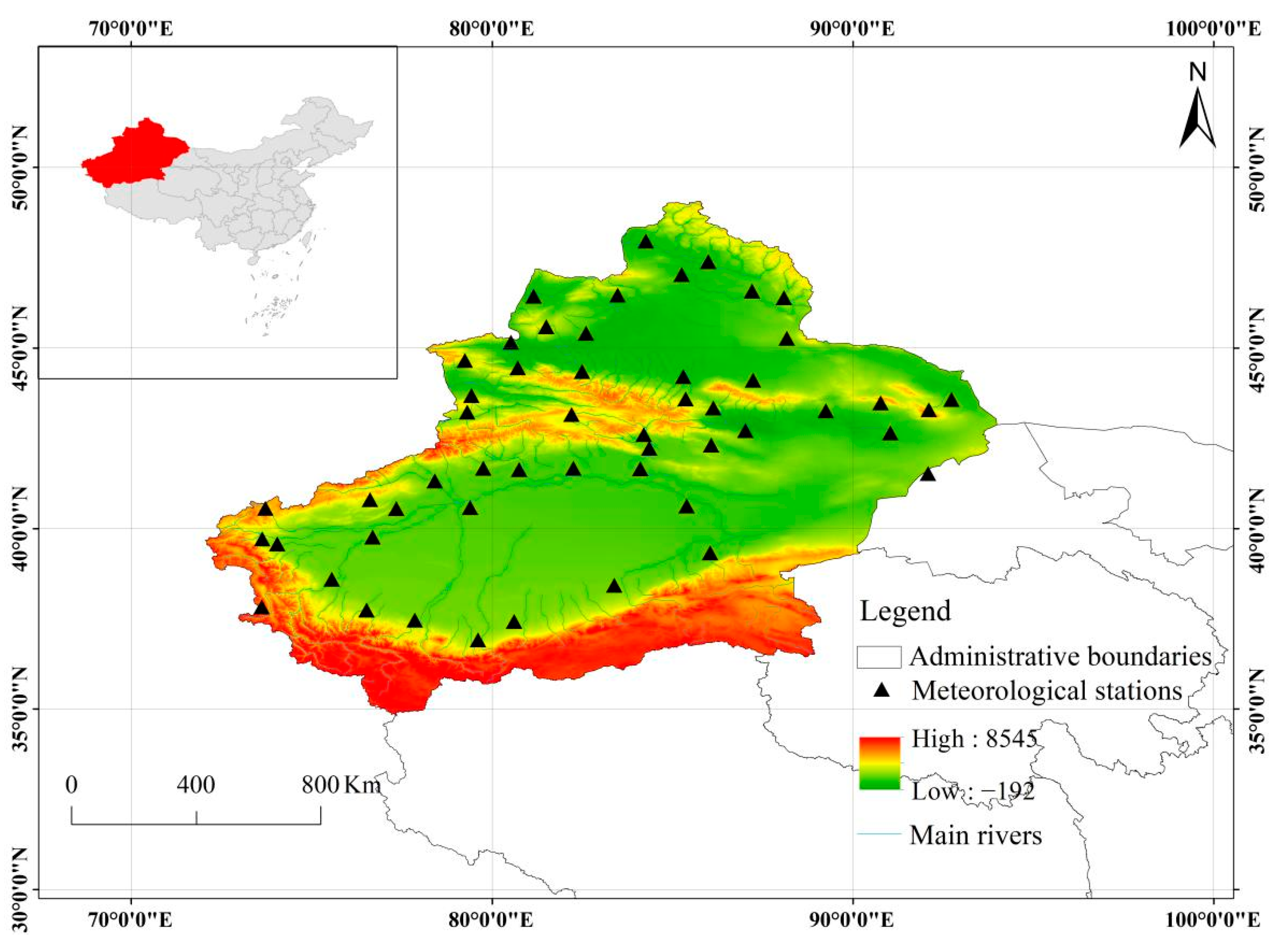
Figure 2.
Distribution Map of Green Production Efficiency of Cotton in Counties (Cities) of Xinjiang.
Figure 2.
Distribution Map of Green Production Efficiency of Cotton in Counties (Cities) of Xinjiang.
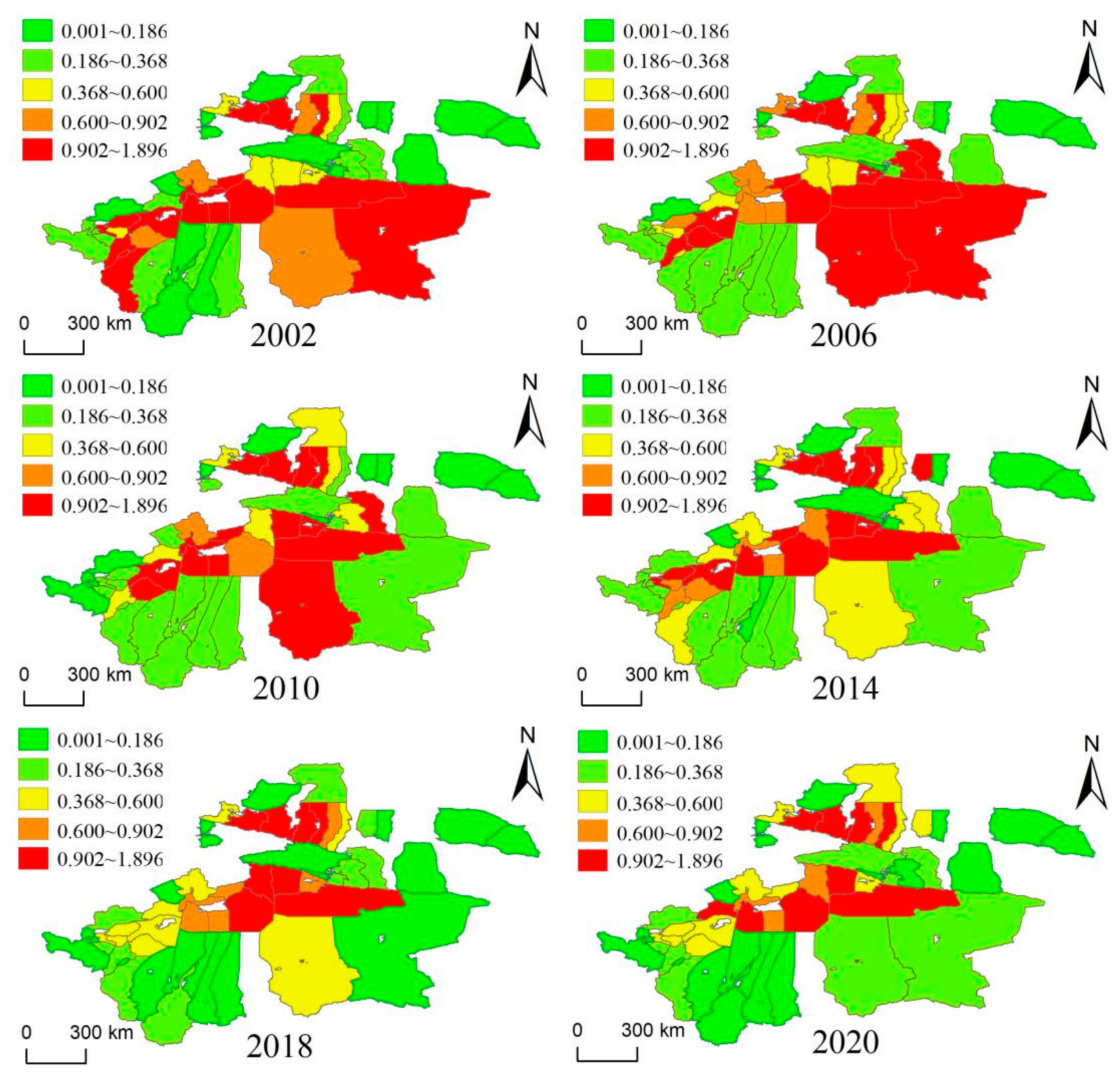
Figure 3.
LISA Cluster Map of Green Production Efficiency of Cotton in Counties (Cities) of Xinjiang.
Figure 3.
LISA Cluster Map of Green Production Efficiency of Cotton in Counties (Cities) of Xinjiang.
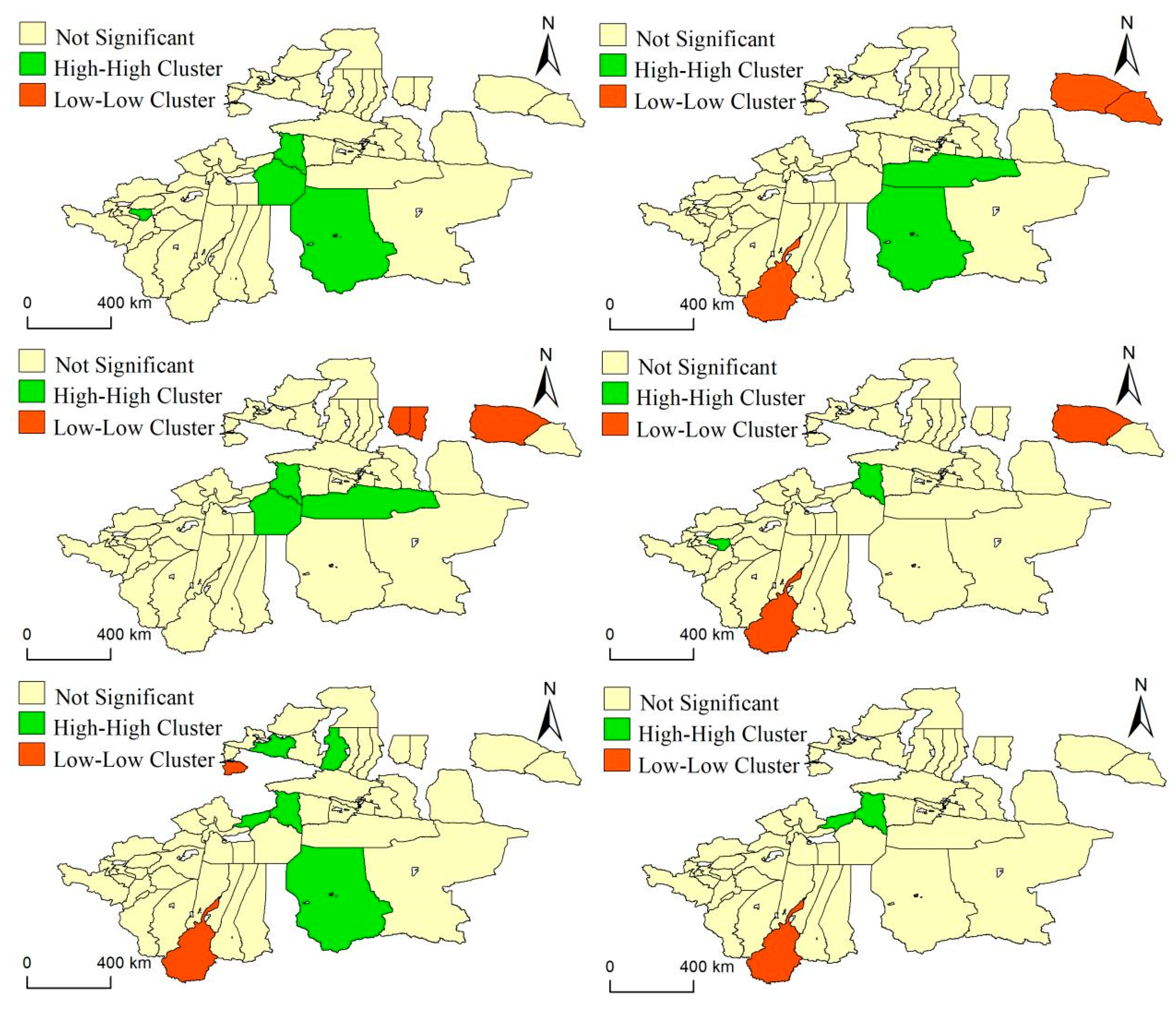

Table 1.
County-level green production efficiency of cotton from 2002 to 2020.
| 2002 | 2004 | 2006 | 2008 | 2010 | 2012 | 2014 | 2016 | 2018 | 2020 | |
| Shanshan County | 0.134 | 0.260 | 0.255 | 0.270 | 0.197 | 0.194 | 0.204 | 0.025 | 0.124 | 0.105 |
| Toksun County | 0.242 | 1.019 | 1.005 | 1.076 | 1.020 | 0.329 | 0.433 | 0.133 | 0.209 | 0.226 |
| Balikun Kazak Autonomous County | 0.126 | 0.071 | 0.058 | 0.112 | 0.123 | 0.121 | 0.109 | 0.006 | 0.134 | 0.132 |
| Yiwu County | 0.107 | 0.112 | 0.085 | 0.076 | 0.062 | 0.088 | 0.068 | 0.002 | 0.097 | 0.133 |
| Changji City | 0.233 | 0.348 | 0.401 | 0.402 | 0.368 | 0.495 | 0.401 | 0.141 | 0.420 | 0.408 |
| Fukang City | 0.129 | 0.152 | 0.189 | 0.079 | 0.081 | 1.089 | 1.126 | 0.007 | 0.271 | 0.379 |
| Hutubi County | 0.398 | 0.633 | 0.537 | 0.609 | 0.417 | 0.478 | 0.538 | 0.206 | 0.684 | 1.006 |
| Manas County | 1.098 | 1.061 | 1.009 | 1.047 | 1.018 | 0.773 | 1.003 | 0.403 | 1.002 | 0.794 |
| Jimusar County | 0.093 | 0.127 | 0.126 | 0.069 | 0.001 | 0.081 | 0.058 | 0.011 | 0.134 | 0.111 |
| Chabuchar Xibo Autonomous County | 0.135 | 0.155 | 0.211 | 0.341 | 0.200 | 0.188 | 0.108 | 0.004 | 0.101 | 0.107 |
| Huocheng County | 0.131 | 0.142 | 0.149 | 0.116 | 0.083 | 0.109 | 0.104 | 0.008 | 0.087 | 0.109 |
| Wusu City | 1.047 | 1.045 | 1.130 | 1.207 | 1.039 | 1.020 | 1.419 | 1.353 | 1.863 | 1.253 |
| Shawan City | 0.713 | 0.654 | 0.717 | 0.662 | 1.006 | 1.051 | 1.025 | 1.068 | 1.020 | 1.015 |
| Toli County | 0.032 | 0.096 | 0.102 | 0.093 | 0.115 | 0.110 | 0.119 | 0.010 | 0.129 | 0.137 |
| Hoboksar Mongol Autonomous County | 0.196 | 0.308 | 0.367 | 0.416 | 0.471 | 0.532 | 0.216 | 0.096 | 0.362 | 0.395 |
| Bole City | 0.588 | 1.001 | 0.628 | 0.565 | 0.492 | 0.653 | 0.445 | 0.455 | 0.477 | 0.505 |
| Jinghe County | 1.201 | 1.095 | 1.081 | 1.326 | 1.012 | 1.159 | 1.097 | 1.125 | 1.049 | 1.003 |
| Korla City | 0.554 | 1.013 | 1.041 | 0.696 | 1.005 | 0.838 | 1.077 | 1.436 | 0.750 | 0.600 |
| Luntai County | 0.525 | 0.595 | 0.522 | 0.655 | 1.019 | 1.064 | 1.047 | 1.001 | 1.175 | 1.008 |
| Yuli County | 1.896 | 1.554 | 1.343 | 1.477 | 1.384 | 1.449 | 1.289 | 1.260 | 1.291 | 1.477 |
| Ruoqiang County | 1.023 | 1.039 | 1.023 | 0.413 | 0.357 | 0.271 | 0.211 | 0.029 | 0.156 | 0.205 |
| Qiemo County | 0.759 | 1.120 | 1.089 | 1.651 | 1.312 | 1.084 | 0.487 | 0.228 | 0.443 | 0.331 |
| Yanqi Hui Autonomous County | 0.069 | 0.084 | 0.109 | 0.096 | 0.091 | 0.142 | 0.117 | 0.001 | 0.090 | 0.095 |
| Hejing County | 0.114 | 0.170 | 0.254 | 0.228 | 0.302 | 0.280 | 0.158 | 0.000 | 0.099 | 0.224 |
| Heshuo County | 0.274 | 0.443 | 1.013 | 0.627 | 0.451 | 0.468 | 0.403 | 0.047 | 0.248 | 0.139 |
| Bohu County | 0.103 | 0.168 | 0.326 | 0.326 | 0.248 | 0.239 | 0.185 | 0.035 | 0.192 | 0.224 |
| Aksu City | 1.028 | 1.016 | 0.718 | 0.815 | 1.117 | 1.038 | 0.706 | 1.471 | 0.631 | 0.702 |
| Wensu County | 0.785 | 0.601 | 0.644 | 0.655 | 0.735 | 0.690 | 0.499 | 1.166 | 0.415 | 0.374 |
| Kuche City | 0.593 | 0.662 | 0.585 | 0.496 | 0.516 | 0.593 | 0.902 | 1.192 | 1.233 | 0.757 |
| Shaya County | 1.030 | 0.818 | 1.001 | 0.752 | 0.777 | 0.789 | 1.057 | 1.635 | 1.158 | 1.457 |
| Xinhe County | 1.176 | 1.034 | 0.940 | 1.050 | 1.379 | 0.580 | 1.017 | 1.112 | 0.671 | 0.598 |
| Wushi County | 0.177 | 0.143 | 0.193 | 0.279 | 0.190 | 0.173 | 0.092 | 0.002 | 0.089 | 0.140 |
| Awati County | 1.009 | 1.005 | 0.836 | 0.709 | 1.013 | 1.365 | 1.386 | 0.441 | 0.781 | 1.045 |
| Keping County | 0.213 | 0.408 | 0.507 | 0.481 | 0.410 | 0.445 | 0.559 | 0.312 | 0.441 | 1.010 |
| Atushi City | 0.147 | 0.162 | 0.186 | 0.162 | 0.152 | 0.145 | 0.213 | 0.172 | 0.195 | 0.242 |
| Aketao County | 0.282 | 0.308 | 0.278 | 0.239 | 0.180 | 0.188 | 0.210 | 0.057 | 0.163 | 0.169 |
| Shufu County | 0.289 | 0.243 | 0.254 | 0.230 | 0.157 | 0.160 | 0.273 | 0.015 | 0.138 | 0.163 |
| Shule County | 1.018 | 1.006 | 0.552 | 0.395 | 0.317 | 0.422 | 1.308 | 1.235 | 0.410 | 0.475 |
| Yingjisha County | 0.204 | 0.316 | 0.334 | 0.298 | 0.271 | 0.195 | 0.331 | 0.183 | 0.229 | 0.279 |
| Zepu County | 1.015 | 0.620 | 0.538 | 0.446 | 0.200 | 0.202 | 0.293 | 0.067 | 0.161 | 0.177 |
| Shache County | 1.029 | 0.686 | 1.285 | 1.357 | 0.527 | 0.462 | 0.798 | 0.366 | 0.293 | 0.333 |
| Yecheng County | 1.045 | 0.358 | 0.360 | 0.389 | 0.224 | 0.233 | 0.414 | 0.202 | 0.254 | 0.290 |
| Makit County | 0.847 | 0.768 | 1.107 | 1.022 | 1.241 | 0.689 | 0.857 | 1.277 | 0.529 | 0.448 |
| Yuepuhu County | 0.550 | 0.355 | 0.497 | 0.326 | 0.339 | 0.335 | 0.711 | 0.546 | 0.547 | 0.566 |
| Jiashi County | 1.025 | 0.456 | 0.665 | 0.564 | 0.331 | 0.346 | 1.038 | 0.414 | 0.565 | 0.502 |
| Bachu County | 1.095 | 1.267 | 1.080 | 1.102 | 1.003 | 0.662 | 1.042 | 0.362 | 0.555 | 0.474 |
| Hotan County | 0.156 | 0.236 | 0.234 | 0.207 | 0.191 | 0.188 | 0.254 | 0.089 | 0.214 | 0.069 |
| Moyu County | 0.148 | 0.249 | 0.232 | 0.216 | 0.199 | 0.179 | 0.211 | 0.081 | 0.115 | 0.093 |
| Pishan County | 0.209 | 0.306 | 0.297 | 0.269 | 0.258 | 0.206 | 0.246 | 0.104 | 0.115 | 0.131 |
| Luopu County | 0.260 | 0.298 | 0.284 | 0.263 | 0.213 | 0.165 | 0.174 | 0.009 | 0.079 | 0.046 |
| Cele County | 0.146 | 0.236 | 0.300 | 0.291 | 0.263 | 0.209 | 0.226 | 0.036 | 0.113 | 0.138 |
| Yutian County | 0.194 | 0.215 | 0.251 | 0.339 | 0.285 | 0.208 | 0.264 | 0.057 | 0.129 | 0.160 |
| The average green production efficiency | 0.531 | 0.543 | 0.556 | 0.538 | 0.507 | 0.484 | 0.549 | 0.417 | 0.439 | 0.442 |
| The average production efficiency | 0.249 | 0.287 | 0.331 | 0.331 | 0.257 | 0.282 | 0.383 | 0.334 | 0.295 | 0.298 |
Table 2.
The county-level of Malmquist indices and their decompositions for each year in Xinjiang.
| year | MI | TC | EC | PEC | SEC |
| 2003 | 1.085 | 1.075 | 1.010 | 0.990 | 1.020 |
| 2004 | 1.168 | 1.115 | 1.047 | 0.996 | 1.051 |
| 2005 | 0.939 | 0.991 | 0.947 | 1.016 | 0.932 |
| 2006 | 1.177 | 1.111 | 1.060 | 0.979 | 1.082 |
| 2007 | 1.065 | 1.107 | 0.962 | 1.197 | 0.803 |
| 2008 | 0.917 | 0.952 | 0.964 | 0.808 | 1.193 |
| 2009 | 0.825 | 0.835 | 0.988 | 1.083 | 0.912 |
| 2010 | 0.900 | 0.950 | 0.948 | 0.951 | 0.997 |
| 2011 | 1.066 | 1.084 | 0.984 | 1.075 | 0.915 |
| 2012 | 0.986 | 1.022 | 0.964 | 1.005 | 0.960 |
| 2013 | 0.889 | 0.915 | 0.972 | 0.944 | 1.031 |
| 2014 | 1.360 | 1.221 | 1.113 | 1.163 | 0.957 |
| 2015 | 0.680 | 0.771 | 0.882 | 0.950 | 0.928 |
| 2016 | 0.733 | 1.479 | 0.495 | 0.915 | 0.541 |
| 2017 | 0.708 | 0.572 | 1.238 | 1.077 | 1.150 |
| 2018 | 0.779 | 0.862 | 0.905 | 0.990 | 0.914 |
| 2019 | 0.870 | 0.855 | 1.017 | 0.967 | 1.052 |
| 2020 | 0.925 | 0.978 | 0.946 | 0.940 | 1.007 |
| Average | 0.948 | 0.994 | 0.969 | 1.003 | 0.969 |
Table 3.
Malmquist indices and their decompositions for cotton in each County (City) of Xinjiang.
| MI | TC | EC | PEC | SEC | |
| Shanshan County | 0.945 | 0.905 | 0.951 | 1.136 | 1.086 |
| Toksun County | 1.011 | 1.109 | 1.065 | 1.019 | 0.868 |
| Balikun Kazak Autonomous County | 1.127 | 1.022 | 0.971 | 1.000 | 0.995 |
| Yiwu County | 1.070 | 0.941 | 0.994 | 0.858 | 0.929 |
| Changji City | 1.090 | 1.054 | 1.086 | 1.041 | 1.014 |
| Fukang City | 1.153 | 0.937 | 0.981 | 1.102 | 0.932 |
| Hutubi County | 1.127 | 1.039 | 1.120 | 1.049 | 1.039 |
| Manas County | 1.054 | 1.072 | 1.033 | 1.013 | 0.998 |
| Jimusar County | 0.948 | 0.864 | 0.939 | 1.046 | 0.813 |
| Chabuchar Xibo Autonomous County | 0.977 | 0.828 | 0.969 | 1.003 | 0.973 |
| Huocheng County | 0.993 | 0.950 | 0.949 | 1.056 | 1.026 |
| Wusu City | 1.092 | 1.036 | 1.073 | 1.050 | 1.014 |
| Shawan City | 1.082 | 1.090 | 1.021 | 1.012 | 1.003 |
| Toli County | 1.123 | 0.989 | 0.923 | 0.951 | 0.878 |
| Hoboksar Mongol Autonomous County | 1.139 | 1.071 | 0.994 | 1.006 | 0.988 |
| Bole City | 1.035 | 1.036 | 1.010 | 0.985 | 1.019 |
| Jinghe County | 1.044 | 1.134 | 0.948 | 1.001 | 0.947 |
| Korla City | 1.055 | 1.039 | 1.051 | 1.062 | 1.020 |
| Luntai County | 1.076 | 1.025 | 1.058 | 1.038 | 1.023 |
| Yuli County | 1.008 | 1.042 | 0.995 | 1.012 | 1.001 |
| Ruoqiang County | 0.966 | 0.988 | 0.890 | 1.007 | 1.018 |
| Qiemo County | 0.990 | 1.038 | 0.982 | 1.093 | 1.028 |
| Yanqi Hui Autonomous County | 1.032 | 0.935 | 0.892 | 1.238 | 1.116 |
| Hejing County | 0.991 | 0.942 | 1.000 | 1.072 | 0.999 |
| Heshuo County | 1.038 | 1.002 | 0.964 | 1.020 | 1.057 |
| Bohu County | 1.158 | 1.017 | 1.015 | 1.092 | 1.031 |
| Aksu City | 1.047 | 1.034 | 1.012 | 1.021 | 0.989 |
| Wensu County | 1.012 | 1.011 | 0.995 | 1.004 | 0.992 |
| Kuche City | 1.090 | 0.988 | 1.040 | 1.041 | 1.001 |
| Shaya County | 1.057 | 1.023 | 1.033 | 0.965 | 1.077 |
| Xinhe County | 1.065 | 1.018 | 1.042 | 0.998 | 1.026 |
| Wushi County | 0.854 | 0.753 | 0.851 | 1.122 | 0.848 |
| Awati County | 1.067 | 1.045 | 1.069 | 1.050 | 1.021 |
| Keping County | 1.067 | 0.990 | 1.112 | 1.047 | 1.226 |
| Atushi City | 1.098 | 1.065 | 1.032 | 1.014 | 1.024 |
| Aketao County | 0.941 | 1.010 | 1.047 | 1.045 | 1.027 |
| Shufu County | 0.847 | 1.030 | 0.941 | 1.032 | 0.931 |
| Shule County | 1.001 | 1.048 | 0.967 | 1.044 | 1.053 |
| Yingjisha County | 0.941 | 1.071 | 0.995 | 1.057 | 1.032 |
| Zepu County | 0.931 | 1.017 | 1.009 | 0.993 | 1.030 |
| Shache County | 0.968 | 1.066 | 0.961 | 1.086 | 0.986 |
| Yecheng County | 0.896 | 1.056 | 0.983 | 1.047 | 1.023 |
| Makit County | 0.862 | 0.966 | 0.896 | 0.966 | 0.912 |
| Yuepuhu County | 0.955 | 1.048 | 1.046 | 1.038 | 1.023 |
| Jiashi County | 0.862 | 1.033 | 0.905 | 0.987 | 1.014 |
| Bachu County | 1.010 | 1.035 | 1.046 | 1.032 | 0.997 |
| Hotan County | 0.995 | 0.998 | 0.993 | 1.056 | 0.950 |
| Moyu County | 0.931 | 0.980 | 1.002 | 1.049 | 0.955 |
| Pishan County | 0.978 | 0.999 | 1.004 | 1.084 | 1.062 |
| Luopu County | 0.743 | 0.757 | 0.870 | 1.124 | 0.911 |
| Cele County | 0.971 | 0.884 | 0.956 | 1.198 | 1.122 |
| Yutian County | 1.029 | 1.054 | 0.954 | 1.167 | 1.073 |
Table 4.
Moran’s I values for green production efficiency of cotton in Counties (Cities) of Xinjiang.
Table 4.
Moran’s I values for green production efficiency of cotton in Counties (Cities) of Xinjiang.
| 2002 | 2003 | 2004 | 2005 | 2006 | 2007 | 2008 | 2009 | 2010 | ||
| Moran’s I index | 0.162 | 0.181 | 0.149 | 0.217 | 0.294 | 0.239 | 0.251 | 0.224 | 0.284 | |
| Z-value | 1.970 | 1.846 | 1.815 | 2.215 | 2.878 | 2.395 | 2.519 | 2.277 | 2.794 | |
| P-value | 0.049 | 0.065 | 0.070 | 0.027 | 0.004 | 0.017 | 0.012 | 0.023 | 0.005 | |
| 2011 | 2012 | 2013 | 2014 | 2015 | 2016 | 2017 | 2018 | 2019 | 2020 | |
| Moran’s I index | 0.249 | 0.140 | 0.172 | 0.095 | 0.125 | 0.238 | 0.229 | 0.282 | 0.197 | 0.190 |
| Z-value | 2.508 | 1.475 | 1.776 | 1.055 | 1.320 | 2.372 | 2.302 | 2.846 | 2.004 | 1.948 |
| P-value | 0.012 | 0.140 | 0.076 | 0.292 | 0.187 | 0.018 | 0.021 | 0.004 | 0.045 | 0.051 |
Disclaimer/Publisher’s Note: The statements, opinions and data contained in all publications are solely those of the individual author(s) and contributor(s) and not of MDPI and/or the editor(s). MDPI and/or the editor(s) disclaim responsibility for any injury to people or property resulting from any ideas, methods, instructions or products referred to in the content. |
© 2025 by the authors. Licensee MDPI, Basel, Switzerland. This article is an open access article distributed under the terms and conditions of the Creative Commons Attribution (CC BY) license (http://creativecommons.org/licenses/by/4.0/).
Copyright: This open access article is published under a Creative Commons CC BY 4.0 license, which permit the free download, distribution, and reuse, provided that the author and preprint are cited in any reuse.


