Preprint
Article

This version is not peer-reviewed.

Dynamic Risk Transmission in the Chinese Hospitality Industry: A Time-Varying Analysis

A peer-reviewed article of this preprint also exists.

Submitted:

27 February 2025

Posted:

28 February 2025

You are already at the latest version

Abstract

Comprehending the dynamics of risk spillover across the value chain is indispensable for effective risk management, especially amid increasing economic and geopolitical uncertainty. This study investigates the mechanics of risk transmission within the value chain of Chinese hospitality industry, employs a (TVP-VAR) model, using daily data from January 2015 to December 2023. The research identifies key sub-sectors, hotel resort and luxury cruise, film and entertainment, mall and supermarket, environmental and facilities services, air freight and logistics, and road transportation, as significant risk transmitters that affect the overall stability of the industry. Conversely, sectors such as restaurant, liquor and wine, leisure services and railway transport are designated as risk receivers. The results offer critical insights for stakeholders, emphasizing the necessity of comprehensive risk management strategies to reduce negative spillover effects, particularly in the context of economic shocks like the COVID-19 pandemic and geopolitical events like the Russia-Ukraine conflict.

Keywords: 
;  ;  ;  ;  ;  ;  ;  ;  ;  ;  

1. Introduction

The vulnerability of hospitality industry to external disruptions, such as economic downturns, global health emergencies, and geopolitical disputes, underscores the need for a comprehensive analysis of the risk dynamics inside it. In the context of interconnected global markets, the discourse on risk transmission has garnered significant attention in recent years. The ongoing discussion has transitioned from disputing the need for the challenge to examining the methods of accomplishing it, mitigating the adverse socioeconomic impacts, and identifying the crucial economic sectors that will spearhead this undertaking [1]. The Chinese hospitality industry, which is a fundamental component of economic growth, is extremely vulnerable to economic, political, and environmental threats. Chinese hospitality industry has become a significant worldwide player in recent years, showcasing the country’s strong economic expansion and rising consumer expenditure. However, this expansion has also resulted in increased susceptibility to systemic hazards, primarily due to the interdependence of many sub-sectors, including hotel resort and luxury cruise, restaurant, liquor and wine, film and entertainment, mall and supermarket, leisure services, environmental and facilities services, air freight and logistics, railway and road transportation, have a significant impact on the value chain of the hospitality industry. Many others are apprehensive of the increased enthusiasm for these transport sectors, arguing that focusing simply on hotels and entertainment does not provide a complete knowledge of the hospitality value chain. A complex network of variables and environmental and facilities services that may help understand the Hospitality industry may show systemic dangers related to financial institutions, business risks, and failures.
Risk spillover refers to the situation where the level of uncertainty or risk in one specific area or sub-sector increases and affects another area or sub-sector. Connectedness is utilized by researchers to comprehend the risks associated with networks. According to [2], connectedness refers to the level of interconnections and interdependencies among the parts of a system. The study conducted by [3] suggests that the connectivity technique has the ability to forecast future crises. Modern portfolio theory combines risk management and diversification by examining the relationship between financial theory and portfolios [4]. Studying the impact of system-wide connectedness and systemic risk on the financial system is a fascinating endeavor [5]. Therefore, risk management necessitates establishing connections, particularly in terms of default, return, and portfolio diversification. The connectedness model offers a comprehensive explanation of systemic risk by utilizing a network of elements. The system component linkage ratio is estimated. These models are able to identify the entities that transmit and receive systemic shocks, as well as detect the overall interconnectedness and accumulation of contagion within a system. In order to effectively manage risks in the financial market and monitor potential systemic dangers, it is crucial to accurately define the routes and forms via which stock sector risks are transmitted.
Dissecting risk transfer in Chinese hospitality industry is valuable. Over three decades of expansion and progress, China’s stock market has grown in size and scale. However, the Chinese stock market has grown slowly and is still immature, causing fast and substantial volatility [6]. Many risk contagion studies have focused on financial markets, not hospitality. In recent years, spillovers and connectedness research has concentrated on financial market risk [7]. This has led to a growing body of research on the interconnectivity of other variables. This includes studies on uncertainty connectedness [8] and transport price transmissions to commodity, currency, and stock markets [9]. People employ static models that may not effectively portray risk spread over time. This gap in the literature allows researchers to examine hospitality industry subsectors’ interconnections using more advanced and timely methods [10]. Within the hospitality industry, this can lead to financial hardship, predominantly in the hotel and lodging industry, which in turn harms the travel and tourism industry, or vice versa [11]. The Chinese hospitality industry’s subsectors impact the economy. These include employment creation, foreign trade, revenue generation, and GDP contribution [12]. In the past, the hospitality industry has been cognizant of economic recessions, client preferences, environmental challenges, and global health emergencies [13]. The economy is affected by COVID-19, with some subsectors less vulnerable and others more affected by China’s constraints. The pandemic has shown this susceptibility, affecting all hospitality industries [14].
The relationships between value chain subsectors in the Chinese hospitality industry are important yet understudied, especially in terms of risk transmission. There has been research on the overall effects of economic shocks on the hospitality industry, but not on how they spread across submarkets like hotel resort and luxury cruise, restaurant, liquor and wine, film and entertainment, mall and supermarket, leisure services, environmental and facilities services, air freight and logistics, railway transport and road transport. Effective risk management requires a thorough understanding of the complex mechanisms that transfer risks in the value chain.
The COVID-19 pandemic has altered the spread of risks, but there is less understanding of how hospitality businesses transfer risks within their value chains. [15] conducted a study that examined how changes in uncertainty affect the stocks of the European travel and leisure sector. The study used the copula-based conditional Value-at-Risk (CoVaR) technique and found a notable transfer of risk. [16] conducted a study on the relationship between US-based tourism companies during the COVID-19 pandemic. They discovered evidence of increased risk contagion, particularly in extreme cases, and observed that tiny tourism firms had gained more significance in the overall system. In a similar vein, [17] employed TVP-VAR to determine that hotels, transportation, and recreational-based enterprises have a net effect of transmitting spillovers to other sectors inside the United States. In addition, [18] demonstrate that certain sub-sectors within the tourism industry are more impacted than others, with restaurants and airlines being notably affected. In their study, [19] examined the impact of COVID-19-related news on the return and volatility of four regional travel and leisure companies. Their findings suggest that the shocks in these stocks are primarily influenced by short-term variations.
The precise mechanisms by which risk is transmitted across the value chain of the Chinese hospitality industry before, during, and after the COVID-19 pandemic and the Russia-Ukraine war remain unresolved despite the manifest repercussions of both events. The impact of the epidemic and the Russia-Ukraine war has necessitated a fresh analysis of the inter-industry ties within the Chinese hospitality industry to reassess the risk management strategies. This study examination of the interrelationship between various subsectors of the Chinese hospitality industry value chain, both prior to and in the aftermath of the pandemic as well as the Russia-Ukraine conflict to identify subsectors that are prone to risk and vulnerability fills the above identified gap in the literature.
The use of the Time-Varying Parameter Vector Autoregression (TVP-VAR) [20] model for this study is based on its exceptional capacity to represent the dynamic and developing nature of risk transmission within the Chinese hospitality industry. The TVP-VAR model differs from standard models like GARCH or DCC-GARCH by allowing the coefficients to fluctuate dynamically, capturing real-time fluctuations and shifts in risk interdependencies among sub-sectors, instead of assuming static correlations between variables over time. This aspect is especially vital considering the swiftly evolving economic environment and the occurrence of substantial external disruptions, such as the COVID-19 epidemic and the Russia-Ukraine conflict, which have had deep and time-critical effects on the sector. The TVP-VAR model’s ability to capture these dynamic interactions makes it a valuable tool for analyzing how risk is communicated during periods of increased volatility and for identifying the individual sub-sectors that play a key role in transmitting or receiving risk over time. The study employs TVP-VAR [20] methodology to offer a more detailed and precise analysis of risk dynamics, providing useful insights that are crucial for stakeholders involved in risk management and policy development in the hospitality sector.
This study highlights the significance of analyzing the spillovers and interconnections among ten Chinese hospitality indices which comprehensively covers the value chain of Chinese hospitality industry, namely Wind Environmental and Facilities Services Industry Index (E&FS-I), Wind Air Freight and Logistics Industry Index (AF&L-I), Wind Railway Transport Industry Index (RAIL-TI), Wind Road Transportation Industry Index (ROAD-TI), Wind Hotel Resort and Luxury Cruise Industry Index (HR&LC-I), Wind Leisure Facilities Industry Index (LF-I), Wind Restaurant Industry Index (REST-I), Wind Film and Entertainment Industry Index (F&ENT-I), Wind Mall and Supermarket Industry Index (M&S-I), and Wind Baijiu Liquor and Wine Industry Index (BL&W-I). The study examines the time frame from January 05, 2015 to December 26, 2023, which includes significant events such as the stock market crash in China in 2015, the coronavirus pandemic in 2019, and the Russia-Ukraine war in 2022. Its objective is to provide insights into the ongoing discussions about the significance of spillovers and interconnectedness applications.
The findings indicate a notable and fluctuating disparity in the distribution of risks among various hospitality stocks in China. The empirical research discovered that the Air Freight and Logistics Industry (AF&L-I), Road Transportation Industry (ROAD-TI), Hotel Resort and Luxury Cruise Industry (HR&LC-I), Environmental and Facilities Services Industry (E&FS-I), Film and Entertainment Industry (F&ENT-I), and Mall and Supermarket Industry (M&S-I) act as channels for the transmission of risk. The Baijiu Liquor and Wine Industry (BL&W-I), Railway Transport Industry (RAIL-TI), Leisure Facilities Industry (LF-I), and Restaurant Industry (REST-I) face several risks. Furthermore, notable political and economic advancements have a profound impact on the uneven transmission of returns, altering the magnitude and direction of the transmission between different sectors.
This study makes numerous substantial contributions to the current body of literature on the economic stability and risk transmission within the hospitality industry, with a particular emphasis on the Chinese market. Initially, it introduces a novel application of the Time-Varying Parameter Vector Autoregression (TVP-VAR) [20] model to accurately represent the dynamic and evolving nature of risk transmission across various sub-sectors of the hospitality industry. This method enables a more precise and nuanced comprehension of the manner in which risk is disseminated throughout the industry, particularly pre, during, and after periods of increased economic and geopolitical instability, such as the Russia-Ukraine conflict and the COVID-19 pandemic. Secondly, the research identifies and classifies critical sub-sectors as either transmitters or receivers of risk, providing novel insights into the structural vulnerabilities and interdependencies of the industry. These findings have practical implications for the development of investment strategies, risk management, and policy formulation, offering stakeholders actionable insights to improve the resilience and stability of the hospitality sector. Thirdly, the research offers policymakers insights into the instruments that can be used to advance sustainability in the transportation, environmental and facilities and other hospitality sectors. Finally, the study contributes to the current body of knowledge by incorporating the examination of global events and their influence on the transmission of industry-specific risks. This closes a lacuna in the literature and establishes the foundation for future research on comparable phenomena in other industries or regions.
It is of the utmost importance for industry stakeholders, investors, and policymakers to acquire a thorough comprehension of these spillage processes within the Chinese hospitality industry, particularly in order to develop effective strategies to manage crises and mitigate risks. Further, there is an increasing tendency among investors to distribute sector assets, which has led to the occurrence of segment volatility clustering. As a result, the values of numerous stock sectors frequently fluctuate in tandem. This implies that the interconnections between various sectors are becoming more robust, which is facilitating the convergence and dissemination of financial risks. The investigation examines the mechanisms of resilience and the strategies of adaptation that these sub-sectors employ in response to the transmission of risks. We aim to provide valuable information that can improve the strategies for risk management and crisis response in the hospitality industry.
In the subsequent sections, we will examine the pertinent literature, delineate our approach, provide the empirical findings, and explore their ramifications for stakeholders. In conclusion, we provide suggestions for future studies and possible approaches to reduce the effects of risk spillovers in the Hospitality industry.

2. Background and Literature Review

Clarifying systemic risk’s precise meaning in the context of the stock market should come first before putting it through a thorough measurement process. Since earlier research on the topic focused more on the issue of economic system from the perspective of the overall rather than on a particular segment, there is currently no agreed-upon, standard description of systemic risk in the financial market [21]. Systemic risk is defined by [22] as the likelihood that the majority or all of the system’s components will move in tandem to cause a breakdown. [23] posits that market risk manifests as a series of adverse economic events, such as noteworthy losses incurred by financial organizations or fluctuations in market prices resulting from a trigger occurrence. [1] defines the systemic risk as the likelihood that utmost investors would agonize sizable losses all at once. The arguments mentioned above, although lacking a clear definition, share several common characteristics that help us identify non- diversifiable risk in the stock market includes: (i) a broad rather than a focused impact; (ii) a chain reaction that amplifies the initial shock throughout the entire market; and (iii) unfavorable repercussions, whereby every sector of the stock market collectively suffers from the detrimental consequences of a market collapse.
An important focus in studying the spread of risk is the precise and effective detection and measurement of systemic risk. There are two methods for assessing systemic risk: one involves constructing indicators based on asset returns or conducting stress tests; the other entails calculating risk dependency to evaluate the transmission of risk between financial institutions and their impact on market risk [24]. The mechanism that is most frequently used to evaluate the risk of assets is the Value-at-Risk (VaR) approach, specifically focusing on the potential losses in extreme scenarios. However, this method fails to consider the interconnectedness of several assets and focuses solely on the risk associated with an individual asset. CoVaR is a metric that evaluates the value of the financial system at risk by taking into account the likelihood that an institution would experience problems. Furthermore, market risk is quantified by employing Δ CoVaR, which is characterized as a difference between CoVaRs in regular circumstances and extraordinary situations[25]. [26] states that the contagion mechanism facilitates the spread of hazards across the entire system, and the main factor contributing to the imperfect nature of risk in the stock market is the interconnections between industry sectors. [2] introduced a cutting-edge technique to statistically assess spillover effects via connectedness by analyzing the variance decomposition of forecast errors. The network approach has a significant potential to portray the interconnectivity in the financial markets [2]. The time-varying parameters vector autoregressions method was first developed by [27] and is subsequently improved upon by [20].The TVP-VAR framework [20] is employed in conjunction with the FEVD-based connection technique [2]. The study also uses [2] the network approach to fully understand the risk transmission mechanism of the Chinese hospitality industry.
According to [28] the financial market is a reliable gauge of the state of the economy’s finances and future prospects. One of the hottest topics in financial study is volatility, which gauges turbulence and unpredictability in financial markets. According to [29] market uncertainty, institutional problems, and economic factors can all contribute to volatility in the financial markets. Crisis periods cause markets to become more erratic. The performance of stock markets is typically poisoned by any crisis or uncertainty in the global markets [30]. Researchers usually try to figure out how a crisis affects stock markets whenever one happens. The relationship between stock market volatility and crises has been the subject of extensive investigation. Global financial markets suffered as a result of the 1997 Asian crisis, which sent shockwaves through the whole economy [31].The US subprime mortgage business caused the US subprime lending crisis in July 2007, causing significant disruption to global financial markets and international stock exchanges [31]. The Great Depression of 1929-1939 is thought to have been less severe than the global financial crisis of 2007-2009. Developed and developing nations both were affected by the economic slump during this crisis [31]. The writers discovered that the banking industry was the most adversely affected. The financial sector experienced a sudden surge in volatility, leading to the failure or imminent collapse of several financial institutions [31]. In 12 countries, the study found a link between uncertainty in economic policies and tourism[32]. [33] found global data indicating that economic policy uncertainty results in reduced tourist spending. This is due to visitors traveling more frequently but spending less money per trip, indicating that these trips are primarily to neighboring countries. Tourism companies are very sensitive to infectious diseases. [34] have shown how SARS affected restaurants and motels. Several studies have provided in-depth analysis of the unique sector-specific attributes of the US and Chinese economies amid the epidemic, with a thorough emphasis of tourism industry. The recent surge in COVID-19 cases is likely to result in a rapid decline in both incoming and outbound tourism due to the health hazards posed by virus-related infections stemming from virus epidemics. Tourists avoid visiting particular geographical places as a result of government restrictions. Health crises in the study environment may lead to substantial market changes in impacted regions when travelers intentionally choose to steer clear of certain crises [35]. Travellers’ attitudes and decisions may be influenced by the perceived health hazards [36]. The expression ’crisis’ refers to unexpected and sudden happenings which could end in civic unrest and public danger. Disease outbreaks in such situations posed challenges for people across various geographical regions or globally [37]. One particular region showed a health issue before it spread nationwide or worldwide, like the recent COVID-19 pandemic [38]. Tourists should go for less congested locations to practice social distancing [35]. Travelers might anticipate a restricted employee-client interaction when it comes to accommodation facilities. [39] found that manager was required to predict the expansion of hotels post-COVID-19 and concentrate on preparing for future crisis situations. [40] comprehensively analyzed aviation, airline, and hotel impacts worldwide. They researched historical plagues and pandemics and COVID-19’s travel limitations and lockdown effects. The authors [40] assert that pandemics or epidemics can have significant effects on tourism, domestic economies, and societies as confirmed by empirical data. Illness outbreaks are anticipated to exacerbate the strain on tourism and other businesses that sustain the most impoverished economies worldwide. Modifying the working behaviors of hotel staff could worsen the negative consequences. [41] anticipated gradual adjustments in travel, hospitality, and related sectors after the COVID-19 pandemic. [41] concluded that hotels with limited capacity needed government subsidies that varied greatly. [42] stated that the current COVID-19 epidemic is the most damaging tourist catastrophe, surpassing prior setbacks. Every decline in a certain area prompted inquiries about the industry’s future outlook. Main concerns were primarily focused on the cruise industry. An authoritative study showed that China was the first country struck by COVID-19, which had a unidirectional impact on global stock markets due to their interconnection [43]. The study was crucial for investors to determine whether industry did better or worse in comparison to others in order to make informed decisions for short or long-term investments alongside equity returns. During COVID-19, tourism was seen as a very susceptible business. During COVID-19, a strong connection between these sectors was expected, which worsened industrial performance [44].

3. Research Design and Sample

3.1. Sample
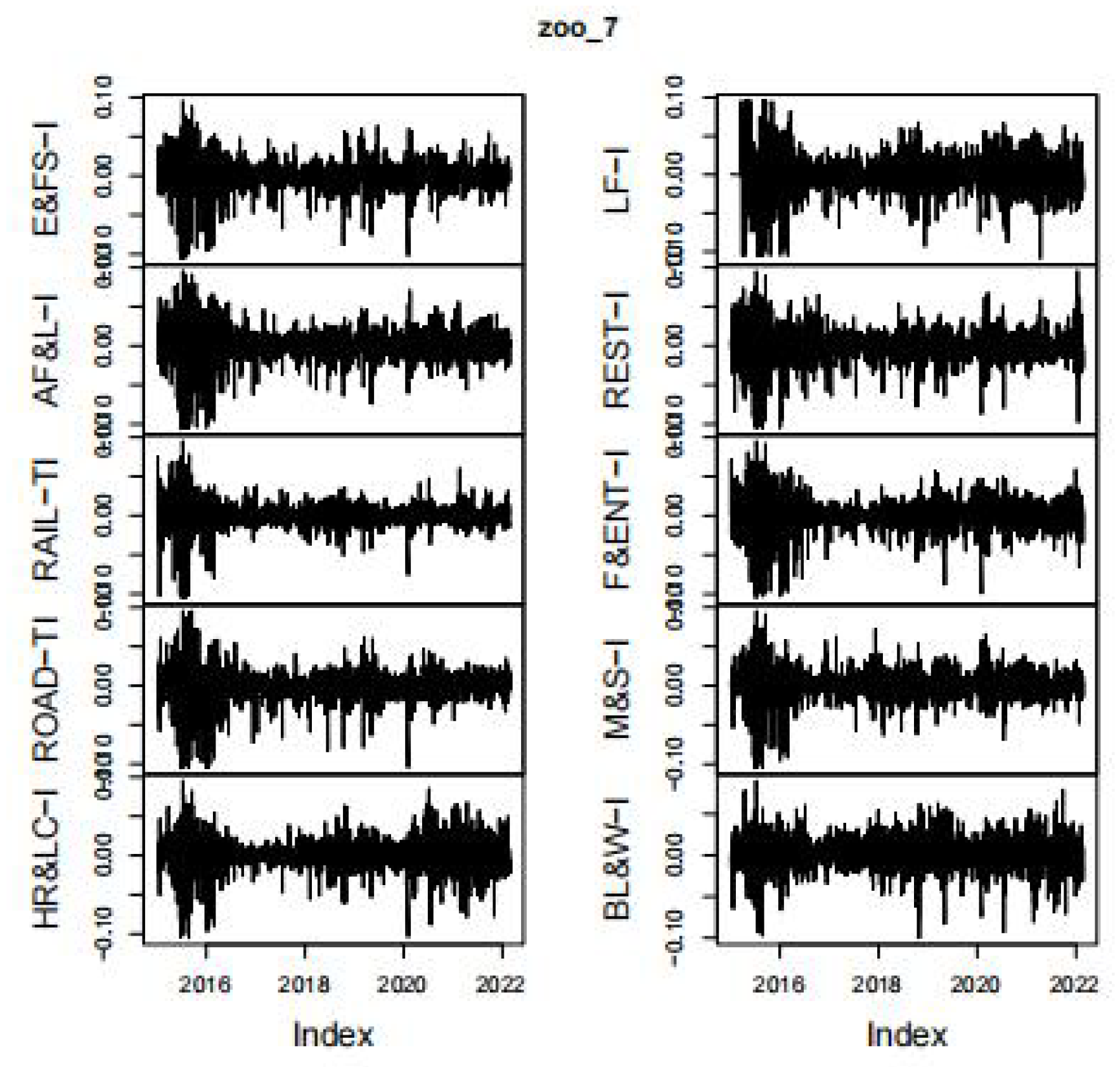
Our database consists of a variety of hospitality stock index prices with daily frequencies from January 05, 2015 to December 26, 2023. The details of the stock indexes are as Table 1.
Multiple financial crises transpired during this period, encompassing the stock market crash in China in 2015, coronavirus pandemic in 2019, and Russia-Ukraine war in 2022. The data is collected from the wind database.
Data variability is stabilized by converting prices into log yields by the following process: The equation R t represents the logarithmic change in P t , which is the natural logarithm of the ratio between P t and ( P t 1 ).
R t = Δ ln ( P t ) = ln P t P t 1
In this equation, R t denotes the returns that correspond to date t. P t represents the price series that corresponds to a specific day, t.
Figure 1. Stock Returns.
Preprints 150763 g001

3.2. Descriptive Statistics

The [45] and [46] statistics are utilized to measure skewness and kurtosis. The JB test, developed by [47], is used to assess the normality of a distribution. The ERS unit root test, developed by [48] is used to test for stationarity. Q (20) and Q 2 (20) are statistical measures that assess serial correlation in the returns and squared series, respectively. These measures are calculated using the weighted Ljung-Box statistic [49].
Table 2 presents the statistical measures that describe the changes in price for ten stock indexes in the hospitality industry. The average returns for all stock indices are close to zero. All return series have negative skewness values, indicating that they are left-skewed. The kurtosis values are elevated, suggesting a leptokurtic pattern. The Jarque Bera statistics indicate that the null hypothesis of normal distributions is rejected. The empirical statistics from the Ljung-Box test provide evidence of autocorrelations in the series of returns. The ADF unit root tests indicate that all return series exhibit stationarity.

3.3. Correlation Analysis

Furthermore, correlation coefficients are shown in Table 3.
The hospitality stock market sectors have unconditional correlation coefficients ranging from 0.224 to 0.472. Nonetheless, it is significant that the correlation coefficients correlations between hospitality stocks are positive but less than .5. This result is in line with the features of the Chinese market, which has a low to moderate degree of connectedness of hence smaller associations between cross-sectors than within ones [11].
Table 3 displays a moderately positive link -— a correlation coefficient of .465 between the E&FS-I sector and AF&L-I. On the other hand, there appears to be little correlation between the BL&W-I and E&FS-I, as indicated by the correlation coefficient of only 0.224. The earliest indication of the assorted landscape of associations inside the Chinese economic system comes from these dissimilarities in the pairwise cross-market connections between the hospitality markets.
However, the correlation coefficient merely offers a static explanation of the relationship.

3.4. Research Design and Methodology

[27] initially proposed the time-varying parameters vector autoregressions method, which is implemented in this manner. We implement the TVP-VAR framework [20] in combination with [2] connection approach, which is based on FEVD. [20] accomplished this by permitting the variance-covariance matrix to fluctuate via a Kalman filter estimation with disremembering factors, following [50]. The multitude of advantages offered by the TVP-VAR framework positions it as our preferred model compared to other competitors, such as GARCH, DCC-GARCH, VAR-GARCH and BEKK.
A few shortcomings of competing methods are as follows:
(a)
These models are not appropriate for estimating time-varying spillovers.
(b)
Estimations through these models can be challenging due to convergence concerns [51].
However, the time-varying parameters vector autoregressions method effectively incapacitates the constraints of competing methods.
Moreover, a significant benefit of this method is its ability to allow the variances to dynamically adjust over time with the utilization of a Kalman filter estimation, which depends on decay factors. Therefore, the TVP-VAR technique effectively tackles the limitations associated with the random selection of the rolling window size. An inappropriate choice of the rolling window size could result in inconsistent or constant parameters, which can ultimately lead to a loss of important data [52]. In conclusion, the time-varying parameters vector autoregressions is more efficient to [2] approaches since it preserves important observations without losing them because of the rolling window [53].
The time-varying parameters vector autoregressions (p) method can be expressed in the succeeding manner:
x t = A t x t 1 + ϵ t , where ϵ t Ω t 1 N ( 0 , M t )
A t = A t 1 + μ t , where μ t Ω t 1 N ( 0 , L t )
with
x t 1 = x t 1 x t 2 x t p , A t = A 1 t A 2 t A p t
The variables in the Equation (1) and Equation () are defined as follows:
Ω t 1 describes that all information is available until t 1 , x t represents a vector with dimensions ( N × 1 ) , A t and A i t is a matrix of time-varying coefficients with dimensions ( N × N p ) and ( N × N ) respectively, x t 1 represents a lagged vector of dependent variables with dimensions ( N p × 1 ) , ϵ t is a vector of error disturbances with dimensions ( N × 1 ) , and M t is a time-varying variance-covariance matrix with dimensions ( N × N ) . The parameter A t is dependent on their previous lag values of A t 1 and the parameter μ t indicates an error disturbance matrix with dimensions ( N p 2 × 1 ) . Time-varying variance-covariance matrix L t has ( N p 2 × N p 2 ) dimensions. [2] estimate the generalized connectedness procedure using time-varying coefficients and error covariances. [54] and [55] developed generalized impulse response functions (GIRF) and generalized forecast error variance decompositions (GFEVD). Converting the VAR model to its vector moving average (VMA) representation allows us to calculate the GIRF and GFEVD.
This transformation uses Wold representation theorem.
x t = A t x t 1 + ϵ t
x t = β t ϵ t
β 0 , t = I
β i , t = A 1 , t β i 1 , t + + A p , t β i p , t
Where A t = [ A 1 , t , A 2 , t , , A p , t ] and B t = [ B 1 , t , B 2 , t , , B p , t ] are ( N × N ) dimensional parameter matrices.
The GIRFs, or impulse response functions, represent the reactions of all variables following a disturbance in variable i. In the absence of a structural model, we determine the differences in the H-step forward forecast when variable i is perturbed and when variable i is not perturbed.
The disparity can be ascribed to the variable i, which can be computed by:
GIRF t ( H , δ j , t , Ω t 1 ) = E ( x t + H ϵ j , t = δ j , t , Ω t 1 ) E ( x t + H Ω t 1 )
U j , t g ( H ) = β H , t M t ϵ j , t S j j , t · δ j , t S j j , t δ j , t = s j j , t
U j , t g ( H ) = β H , t M t ϵ j , t S j j , t 1 2
Where H represent the prediction horizon, δ i , j represent the selection vector with a value of one on the j t h position and zero otherwise, and Ω t 1 represent the information set till t 1 .
Next, we calculate the Generalized Forecast Error Variance Decomposition (GFEVD), which represents the proportion of variance that one variable explains on the others. The shares of these variances are then normalized, so that each row sums up to one. This means that all variables together explain 100% of the forecast error variation for variable i. This is calculated as follows:
Ψ ˜ i j , t ( H ) = t = 1 H 1 U i j , t 2 , g j = 1 N t = 1 H 1 U i j , t 2 , g
with
j = 1 N Ψ ˜ i j , t g ( H ) = 1 and j = 1 N Ψ ˜ i j , t g ( H ) = N
By utilizing the GFEVD, we create the total connectedness index.
C t g ( H ) = i , j = 1 i j N Ψ ˜ i j , t g ( H ) i , j = 1 N Ψ ˜ i j , t g ( H ) × 100 = i , j = 1 i j N Ψ ˜ i j , t g ( H ) N × 100
The interconnectivity technique demonstrates how a disturbance in one variable has a cascading effect on other variables.
Initially, we examine the scenario in which variable i communicates its shock to all other variables j. This is referred to as the total directional connectivity to others and is defined as:
C i j , t g ( H ) = j = 1 i j N Ψ ˜ j i , t g ( H ) j = 1 N Ψ ˜ j i , t g ( H ) × 100
Next, we compute the directional connectedness variable i which is derived from variables j called total directional connectedness from other variables.
C i j , t g ( H ) = j = 1 i j N Ψ ˜ i j , t g ( H ) j = 1 N Ψ ˜ i j , t g ( H ) × 100
Finally, we subtract total directional connectedness to others from total directional connectedness from others to obtain the net total directional connectedness,
C i , t g ( H ) = C i j , t g ( H ) C i j , t g ( H )
A positive net total directional connectedness of variable i suggests that variable i exerts a stronger influence on the network than it receives from it. Conversely, a negative net total directional connectedness suggests that variable i is affected by the network.
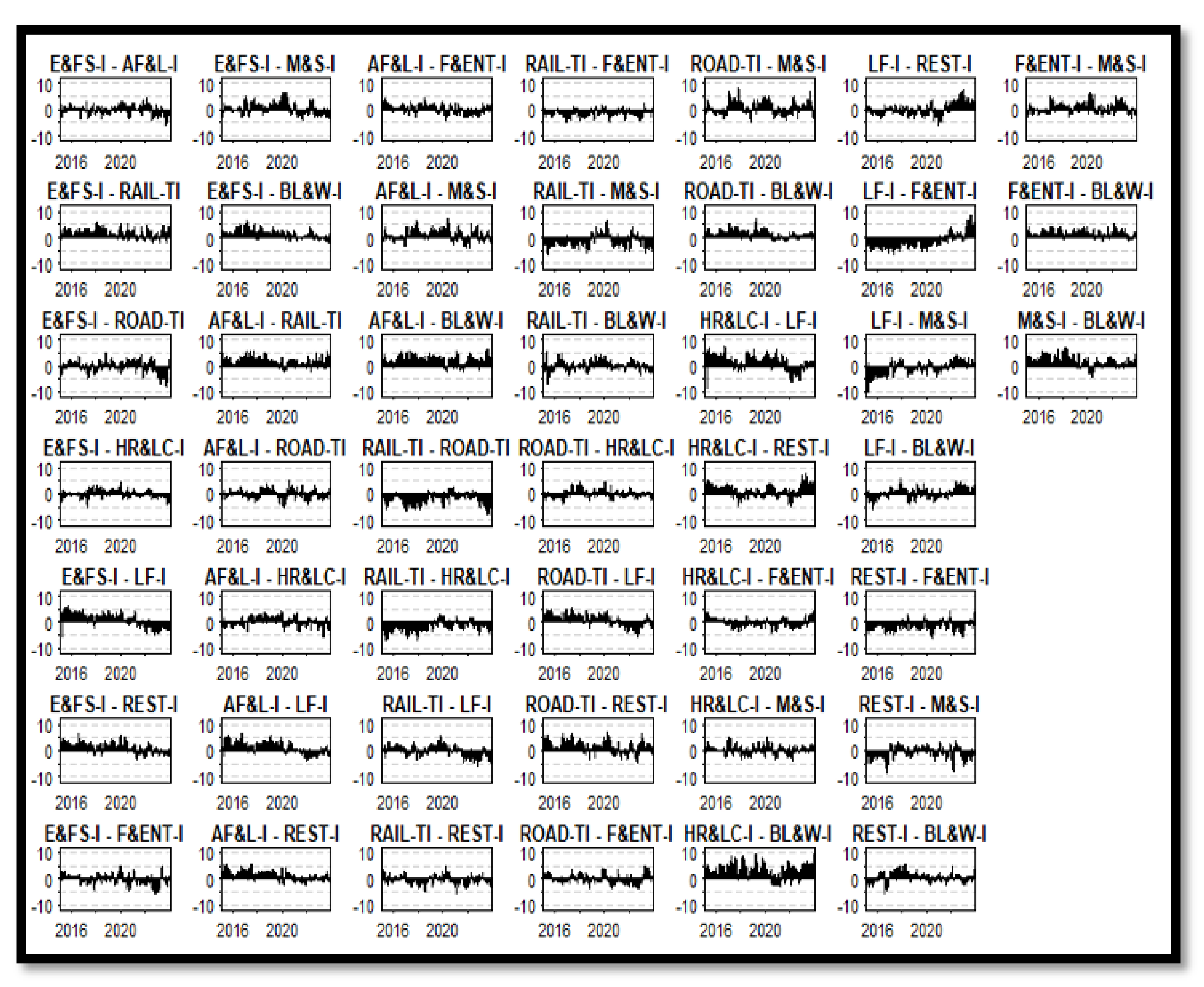
Net pairwise directional connectedness is calculated to break down the net total directional connectedness to view the bidirectional relationships as follows:
NPDC i j , t g ( H ) = Ψ ˜ j i , t g ( H ) Ψ ˜ i j , t g ( H ) × 100
If NPDC i j , t g ( H ) > 0 , it reflects the variable i sends more shocks to variable j and (vice versa).

4. Empirical Results and Discussion

The findings are derived from a TVP-VAR model with a lag length determined by the Bayesian Information Criterion (BIC) and a 12-step-ahead generalized prediction error variance decomposition.

4.1. Detail Discussion

We present the results of our empirical study on the relationships between stocks in the hospitality sector using [20] model. Firstly, we display (TCI) across whole period. This report conveys a thorough investigation of the interconnections and uneven transmission of returns between several industries, including stocks in the hospitality business. Furthermore, it analyses the correlation between the transportation and hotel industries.
The static measure provides a thorough comprehension of the overall interconnectedness of various sectors. Subsequently, we analyse the fluctuating trends of the TCI in correlation with economic and political occurrences, encompassing the susceptibility of asset values. This enables us to examine the fluctuations in the degree of interdependence among various sectors in reaction to particular economic and political occurrences within a designated timeframe. This technique is crucial for assessing the fluctuations in the correlation across hospitality equity markets that are impacted by external events.
Nevertheless, the TCI findings offer a restricted viewpoint, concentrating on the general level of connectivity rather than the precise interactions of sectoral industrial stocks. In order to tackle this issue, we will now give the outcomes of net directional connectivity, focusing on hospitality sectors. Additionally, we will examine the NPDC and pairwise connection between different sectors. This research enables us to comprehend the asymmetrical relationships and mutual interconnectedness of specific sectors of hospitality industry. Through the analysis of these indicators, we acquire an inclusive comprehension of the process by which interconnections are established between specific sectoral industrial stocks. Our research starts by calculating the average connectivity metrics inside the sector network, using all the observations available.
The average connectivity index for stocks is provided in Table 4.
Table 4 displays the shocks that have an impact on various sectors in non-diagonal elements, whereas the principal diagonal elements represent shocks that are specific to the innovation itself. For instance, the column/row with the highest value of 38.69 in the Baijiu Liquor and Wine Industry (BL&W-I) reflects the extent to which its innovations affect the variability of the forecast inaccuracy.
The column and row residual values show shock transmission between the Baijiu Liquor and Wine Industry and other sectors, both sending and receiving. The "To" and "From" connectedness indices are shown by the non-diagonal element totals in each column and row. These indexes measure each sector’s overall directional influence. The "NET" connectedness index row illustrates the sector spillover impact by comparing the "TO" row with the "FROM" column.
Baijiu Liquor and Wine Industry has the highest net connectedness index of (-11.04) indicating that it receives the most connections. On the other hand, Hotel Resort and Luxury Cruise and Air Freight and Logistics sector has the strongest net sending capacity with a net connectivity value of 7.14 and 7.09 respectively.
Furthermore, the study period consistently shows a negative net connectedness index for Baijiu Liquor and Wine Industry (BL&W-I), Railway Transport Industry (RAIL-TI), Leisure Facilities Industry (LF-I), and Restaurant Industry (REST-I), This suggests that the stock market provides more information to the markets about the performance of the static connectivity index than it receives from them. Therefore, it is crucial to focus on the influence of fluctuations in stock prices within the industry on the prices of these sectors.
This is vital for investigating the transmission mechanism among hospitality sectoral stocks during the crisis periods. Furthermore, it functions as the main focal point of investigation in this work. The lower right corner the Table-4 shows the TCI which measures the percentage of FEVD that can be ascribed to cross-segment innovation within the network.
The total connectedness index (75.88%) designates a high degree of interconnectivity amongst sectors within this grid. To scrutinize the correlations among stock markets in the hospitality sector, our analysis primarily concentrates on the interplay between transportation and hospitality industry equities.
This analysis examines the impact of the interconnectedness of stocks between different hospitality industries stocks. The TCI between industry stocks, is found to be 75.88.
Furthermore, the row labeled "To" in the connectedness index emphasizes the cumulative impact of each sector’s directional shocks on all other sectors, whereas the "From" connectedness row focuses on the opposite direction.
The index column represents the cumulative impact of external shocks from various sectors. We see that the transfer of new ideas between different sectors of hospitality industry is not equal in both directions. The term "connectedness" refers to the interdependence of several subsectors within the China hospitality industry. This indicates the mechanism via which changes in one subsector might affect the stocks of other subsectors. The connectivity is established at 75.88, signifying considerable interconnectedness between subcategories within the hospitality industry. Significantly, the empirical research discovered that the Air Freight and Logistics Industry (AF&L-I), Road Transportation Industry (ROAD-TI), Hotel Resort and Luxury Cruise Industry (HR&LC-I), Environmental and Facilities Services Industry (E&FS-I), Film and Entertainment Industry (F&ENT-I), and Mall and Supermarket Industry (M&S-I) act as risk transmitters. The following sectors, namely the Baijiu Liquor and Wine Industry (BL&W-I), Railway Transport Industry (RAIL-TI), Leisure Facilities Industry (LF-I), and Restaurant Industry (REST-I), are exposed to risk. The likely reason for the whole transfer of Air Freight and Logistics Industry (AF&L-I), Road Transportation Industry (ROAD-TI), Hotel Resort and Luxury Cruise Industry (HR&LC-I), Environmental and Facilities Services Industry (E&FS-I), Film and Entertainment Industry (F&ENT-I), and Mall and Supermarket Industry (M&S-I) is rooted in their interdependence. These sectors are interdependent within the tourism business. The facts indicate that the involvement of hotels, entertainment and transportation has a direct influence on job development, with one out of every four individuals being eligible for employment. According to the estimate, the hospitality sector contributed 10.8% to the GDP. In comparison, the entire global job creation represents 10.6%. Three Additional findings on recreational services reveal that the outdoor recreation sector contributes merely 1.8% to the present China Gross Domestic Product (GDP, with minimal fluctuations observed among the primary states.
Conversely, entities that benefit from spillovers include Baijiu Liquor and Wine Industry (BL&W-I), Railway Transport Industry (RAIL-TI), Leisure Facilities Industry (LF-I), and Restaurant Industry (REST-I), along with other subsectors within the China hospitality business. The receiver characteristics of these tourist subsectors reveal that Baijiu Liquor and Wine Industry (BL&W-I), Railway Transport Industry (RAIL-TI), Leisure Facilities Industry (LF-I), and Restaurant Industry (REST-I) are the most vulnerable to external situations, such as global economic and financial considerations. Hence, the fluctuating economic conditions, geopolitical dangers, and global pandemics significantly influence the interconnections between different sectors within the tourism business. Therefore, the subsectors that showed the greatest susceptibility to external influences are the ones that receive the most spillover effects.
In summary, our findings on the net interconnectivity of China hospitality subsectors indicate that the Air Freight and Logistics Industry (AF&L-I), Road Transportation Industry (ROAD-TI), Hotel Resort and Luxury Cruise Industry (HR&LC-I), Environmental and Facilities Services Industry (E&FS-I), Film and Entertainment Industry (F&ENT-I), and Mall and Supermarket Industry (M&S-I) sectors are the primary sources of spillovers, as they make significant contributions to the China economy and create a big number of jobs. Furthermore, these six subsectors exhibit a strong interdependence, with each subsector enhancing the others in a significant manner. Therefore, these specific subsectors transfer spillover effects to other subsectors. In contrast, the remaining subsectors in the hospitality industry get more spillovers than they generate. This indicates that they are particularly affected by external factors such as economic, financial, and geopolitical concerns. Thus, the remaining subsectors are exposed to risk transmission from the Air Freight and Logistics Industry (AF&L-I), Road Transportation Industry (ROAD-TI), Hotel Resort and Luxury Cruise Industry (HR&LC-I), Environmental and Facilities Services Industry (E&FS-I), Film and Entertainment Industry (F&ENT-I), and Mall and Supermarket Industry (M&S-I) subsectors in a systematic fashion.

4.2. Network Diagram

Moreover, Figure 2 shows six graphs that display networks corresponding to sectoral hospitality business stocks fixed pairwise directed connection over important time periods:
(a)
The entire sample period (January 05,2015 to December 26,2023);
(b)
Pre-Covid-19 and Stock market crisis (January 05, 2015 to December 31, 2019);
(c)
The Covid-19 pandemic (January 01, 2020 to February 23, 2022);
(d)
Post-pandemic Covid-19 (January 01,2020 to December 26,2023);
(e)
Pre- Russia Ukraine War (January 05,2015 to February 23,2022);
(f)
Recent Russia-Ukraine war (February 24,2022 to December 26, 2023);
The graphs demonstrate node size, node color, and line properties to accurately depict the market’s qualities. For example, the nodes size shows the economic significance of the interconnection among the hospitality sectors.
The nodes color in network indicates whether they are recipients or senders. Yellow nodes represent recipients, whereas blue nodes represent senders. The thickness of arrows and edges linking the nodes indicate the directed connections strength.
Our analysis shows that Baijiu Liquor and Wine Industry (BL&W-I), Railway Transport Industry (RAIL-TI), Leisure Facilities Industry (LF-I), and Restaurant Industry (REST-I) the generally receives more shocks than it gives during important political and economic events. Mall and Supermarket Industry (M&S-I) and Environmental and Facilities Services (E&FS-I) generally transmits more risks than it receives during political and economic events.
However, the Russia-Ukraine war triggered a change in this trend. Mall and Supermarket Industry (M&S-I) and Environmental and Facilities Services(E&FS-I) becomes receiver rather than transmitter and Leisure Facilities Industry (LF-I) becomes contributer of risk rather than receiver.
It resulted in higher global energy prices, which made the transport sector net contributors instead. Additionally, there was a notable increase in the impact of these changes on other sectors. Furthermore, the magnitude of reciprocal effects across sectors is less pronounced compared to the effects between stock sectors.
Moreover, the era after the crisis demonstrates a more robust level of interconnectedness between different sectors. The inter-nodal links in sub-graphs have thicker curves. Nevertheless, the connections between different sectors fluctuate in times of crises with varying causes. Amidst the stock market crisis in 2015, the turbulence in the stock market extended over the entirety of the market. During the Covid-19 financial crisis, which presented a worldwide systemic risk, the association between nodes shown increased intensity. The Baijiu Liquor and Wine Industry node exhibits a pronounced coarsening, showing a robust correlation between other sectors.
Nevertheless, the aforementioned research only offers a fixed viewpoint of the possible interconnections within the sectoral hospitality industry stock networks, and fails to provide understanding of the changing dynamics of hospitality industry in China. Furthermore, given the effect of significant economic and political events on the interconnectedness of sector networks across the observed period, it is essential to employ a time-varying dynamic analysis methodology. This method enables a more thorough comprehension of the asymmetrical relationships across sectors and offers useful acumens into the dynamic nature of hospitality industry.

4.3. The concept of Dynamic Total Connectivity

Over the past twenty years, significant transformations have occurred in the worldwide economy, resulting in an emerging economy china and become a leading economy globally and dominating the tourism industry. The responsiveness of China’s market has significantly increased as a result of dynamic economic and political conditions.
The connectedness table shows the possible level of interconnectedness across shares in the sectoral hospitality industry. However, it does not have the ability to monitor deviations in inter-market connectivity over time or the effect of peripheral shocks on interconnectedness. It is crucial to create a framework for analyzing the changing dynamics over time in order to effectively study how important events have affected the interconnection of sector networks in China’s economic and financial development during the past ten years. This approach will function as an empirical benchmark for market participants.
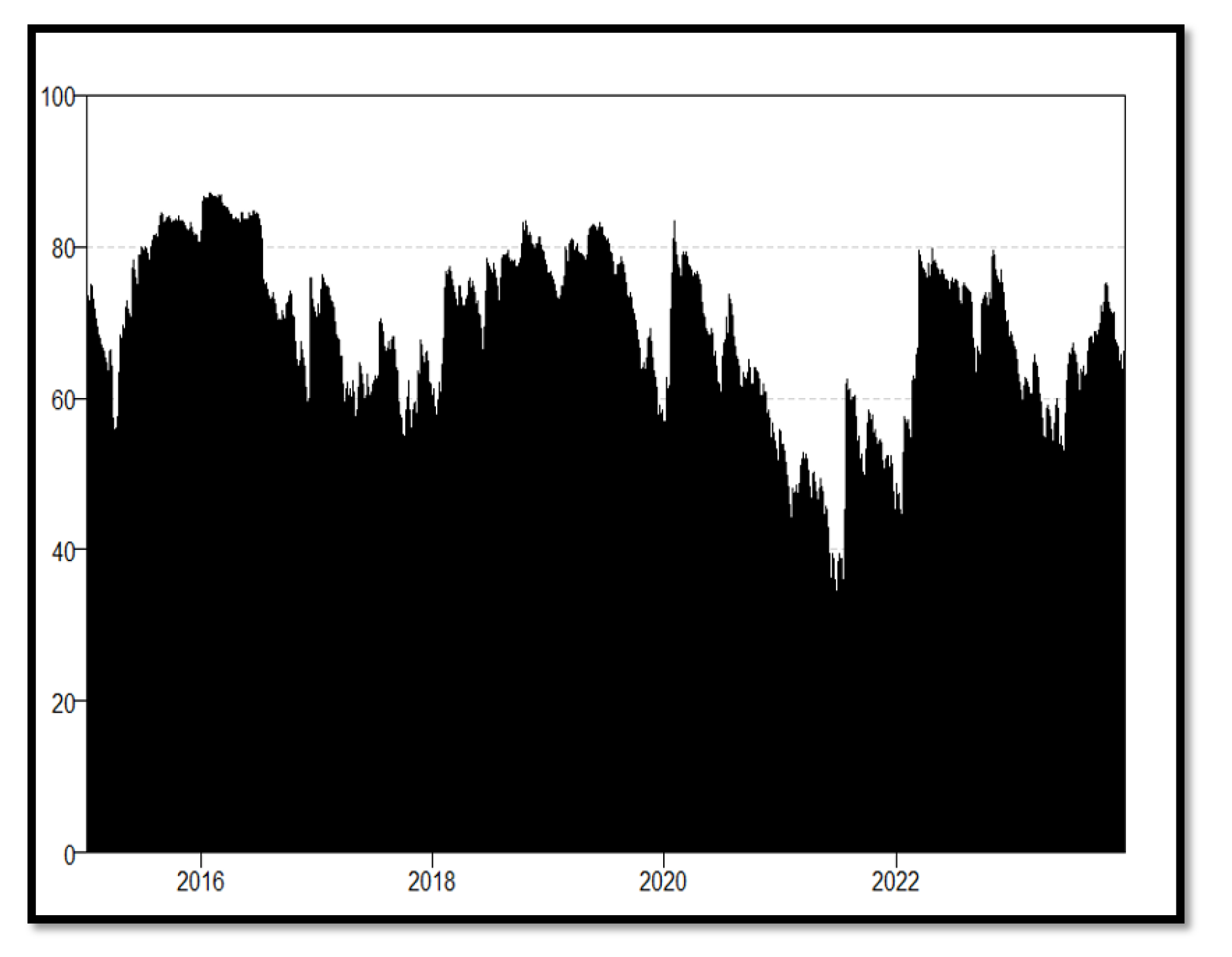
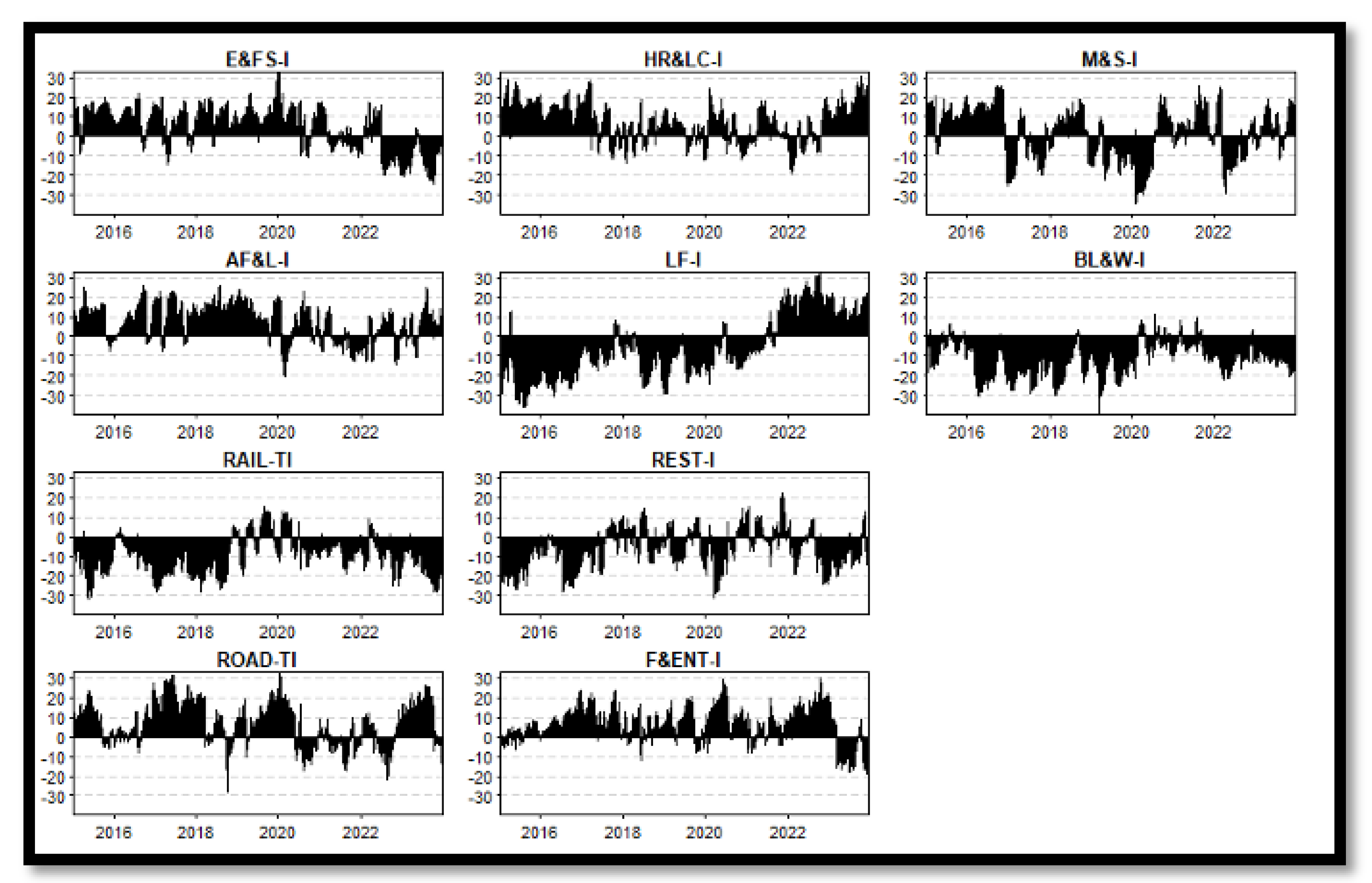
Figure 3 and Figure 4 display dynamic spillovers. Figure 3 depicts the temporal evolution of the overall interconnection among different sectors of the hospitality stock market. The grey region reflects the bilateral connectivity, encompassing both favorable and unfavorable returns. The variability of the total connectivity swings between 5% and 86%, signifying that it is impacted by events and exhibits a recurring trend. There are three clearly defined periods of dynamic connectedness: the initial period spans from the beginning of the 2015 to 2019, the second period spans from 2019 to 2021, and the third period begins in 2022 and is ongoing. Notable events like the stock market collapse had an effect on these cycles, as did other incidents that led to systemic anxiety like the US-China trade spat, the COVID-19 pandemic, and the Russia-Ukrainian war.
Figure 4 highlights asymmetry even more, illustrating the prevailing influence of negative returns interconnectedness. This dominance is a result of the inherent randomness of negative shocks and the fact that investors, particularly those who are cautious about taking risks, are more responsive to negative information than to good information. The COVID-19 pandemic in 2020 was a black-swan event that demonstrated the highest degree of asymmetric connectedness. During this time, investors absorbed a significant amount of negative information and made changes to their investment allocations. This finding supports [16] findings of uneven pandemic spillover effects on US stock market sectors. They say bad spillover shocks are more influential than favorable ones.

4.4. Time Varying Connectedness

Figure 3 illustrates the fluctuating level of interconnection across China hospitality stocks throughout the observed timeframe. More precisely, the time-varying features quantify the fluctuations within different sectors of hospitality that hinder its advancement and growth.
Each point in the diagram corresponds to a specific irregular occurrence that contributes to the interdependence of the hospitality subsectors, resulting in an increase in the (TCI) over time. It shows that there are significant fluctuations that occur consistently during the whole duration of the sample. There were significant swings in the TCI (about 81.38% and 62.91%) between 2015 and 2020 due to concerns about the covid 19 crisis. This was particularly relevant for tourist destinations such as China, which were facing sanctions. The TCI experienced a notable increase in 2020, which can be attributed to the Covid-19. While the Chinese government continued to offer assistance to the private sector, including the hospitality industry. As a result, trepidation permeated the stock market, leaving investors uncertain about the corporations’ ability to sustain their recovery post-crisis.
Our analysis reveals that the TCI remained relatively stable with minor variations around its average from 2015 to 2018 which had a significant influence on the hospitality subsectors. A decrease in the Tourism Confidence Index (TCI) indicates the return of the tourism sectors to their usual state following an unpleasant incident [56].
Moreover, the TCI experienced a following increase consistent with the significant expansion in the stock market, occasionally encountering oscillations, until the outbreak of the pandemic in 2019 in China. The pandemic eruption has resulted in the total connectedness reaching an unprecedented level, over 80%. This exemplifies the substantial influence of the covid-19 on the entirety of the hospitality sector and validates the conclusions of [56]. In conclusion, our research demonstrates that the hospitality business is vulnerable to global risks across the studied period.
This section demonstrates the overall level of interconnectivity among China hospitality stocks by utilizing the changing characteristics within the specified time period. The level of interconnectedness is represented by Table 2, which identifies the primary sources and recipients of spillover effects. According to Figure 4, Air Freight and Logistics Industry (AF&L-I), Road Transportation Industry (ROAD-TI), Hotel Resort and Luxury Cruise Industry (HR&LC-I), Environmental and Facilities Services Industry (E&FS-I), Film and Entertainment Industry (F&ENT-I), and Mall and Supermarket Industry (M&S-I) are the primary sources of spillovers, as spillovers are predominantly found in positive areas.
Hotel Resort and Luxury Cruise Industry (HR&LC-I) consistently experienced a significant negative impact on their financial performance during the observed time period, with just two brief exceptions: during the Us-China trade dispute and at the beginning of the COVID-19 pandemic in 2020. Similar observations may be seen about Road Transportation Industry (ROAD-TI), as they are also propagating spillover effects to other subsectors. The net transmitters are explained by referring to the statistics presented in Table 3. The table demonstrates the interconnectedness of Air Freight and Logistics Industry (AF&L-I), Road Transportation Industry (ROAD-TI), Hotel Resort and Luxury Cruise Industry (HR&LC-I), Environmental and Facilities Services Industry (E&FS-I), Film and Entertainment Industry (F&ENT-I), and Mall and Supermarket Industry (M&S-I), and how they contribute to the revenue production and employment creation in the China GDP. In contrast, the remaining sectors of the China hospitality industry, including Baijiu Liquor and Wine Industry (BL&W-I), Railway Transport Industry (RAIL-TI), Leisure Facilities Industry (LF-I), and Restaurant Industry (REST-I), consistently experience the effects of spillover shocks over the whole time of analysis, with most of these spillovers being negative in nature. The primary reason why certain individuals benefit the most from the China tourism industry is due to their exposure to several distinct scenarios.
Overall, we observed that Hotel Resort and Luxury Cruise Industry (HR&LC-I), Environmental and Facilities Services Industry (E&FS-I), Film and Entertainment Industry (F&ENT-I), and Mall and Supermarket Industry (M&S-I) experienced a significant transfer of spillover effects, which confirms our expectation that risk is transmitted by subsectors directly linked to the hospitality industry in China.
Furthermore, our findings support the previous empirical investigations conducted by [56].
In contrast, subsectors that are most vulnerable to external factors and global shifts are the ones that receive the most risk spillovers.
We apply this result to the research of inter-sector spillover (connectedness) that includes the hospitality market.
The research scrutinizes the interdependence of industry stocks in China, as well as the effect of geopolitical risk on the connectivity of the sector network. The dynamic total connectivity is influenced by both event-driven and cyclical factors, which in turn impact the stock market during crisis periods.

4.5. Directional Connectivity

Examining the interconnections between various sectors, namely, Air Freight and Logistics Industry (AF&L-I), Road Transportation Industry (ROAD-TI), Hotel Resort and Luxury Cruise Industry (HR&LC-I), Environmental and Facilities Services Industry (E&FS-I), Film and Entertainment Industry (F&ENT-I), Mall and Supermarket Industry (M&S-I) , Baijiu Liquor and Wine Industry (BL&W-I), Railway Transport Industry (RAIL-TI), Leisure Facilities Industry (LF-I), and Restaurant Industry (REST-I) ,we analyze their relationship with all industry stocks. The utilization of a sectoral method facilitated a targeted analysis of the interconnectedness between certain sectors within the hospitality industry. This enabled stockholders to devise efficient investment tactics.
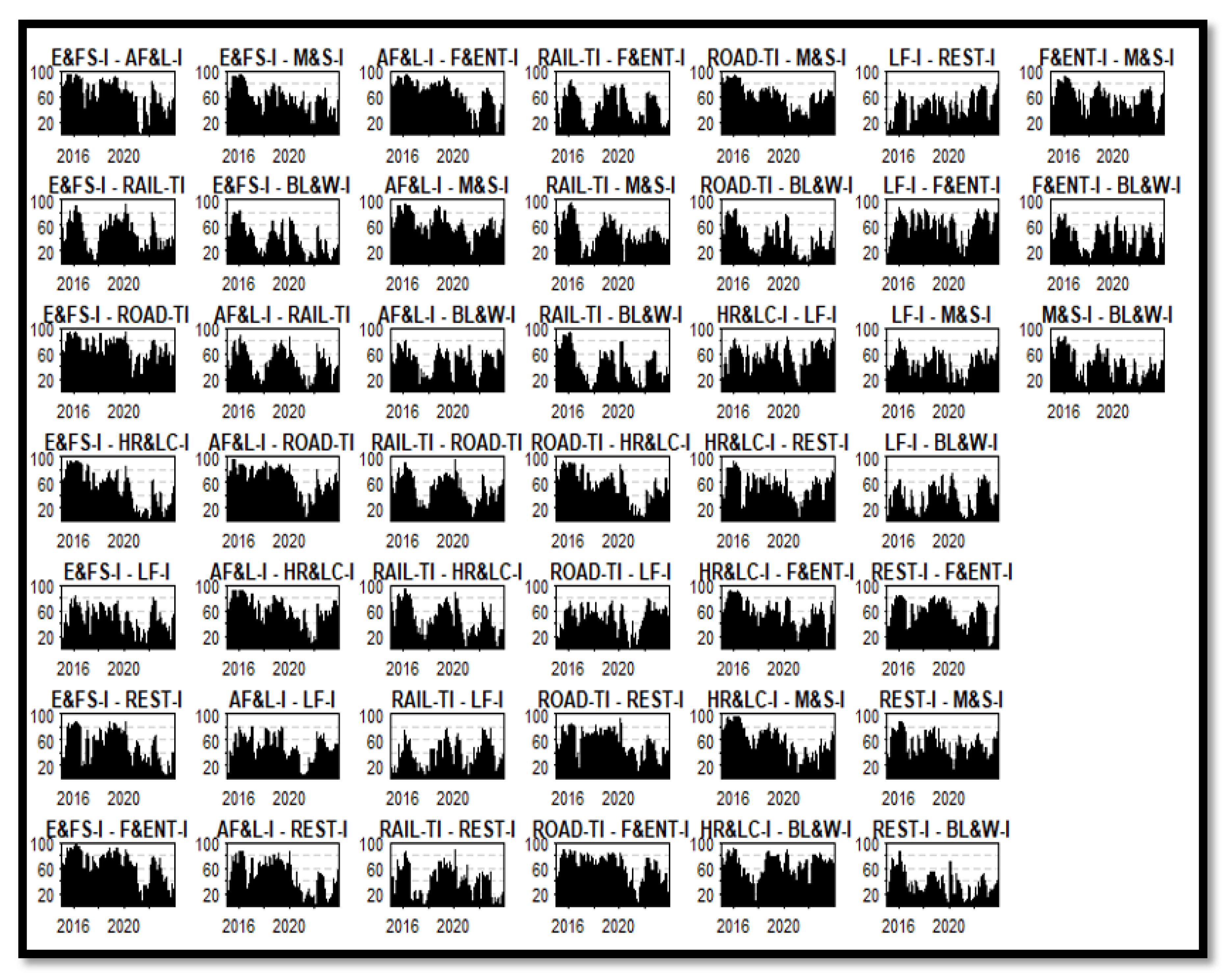
In Figure 5 and Figure 6, we illustrate the dynamic directional connectivity between sectoral industrial stocks, as well as their varying asymmetric spillover. This analysis will emphasize the variations in the overflow patterns and their evolving strength and orientation between different sectors of stock markets.
Figure 5 illustrates the overall interconnection between the ten industries. Positive numbers indicate individuals or entities that are sending more than they are receiving, while negative values indicate individuals or entities that are receiving more than they are sending.
During the whole study period, all stocks in different sectors received net stock market return spillovers, which is consistent with earlier findings. Nevertheless, the disparity in the transmission of returns between different sectoral stocks is distinct from the overall dynamic connectedness. The trend described was especially noticeable during the 2015 decline of the China stock market. This was evidenced by a decrease in the connectedness index and a substantial narrowing the gap between returns.
Although hospitality sector stocks received net spillovers, they did not encounter a rise in negative spillovers during the era of economic upheaval. Conversely, these events caused a transfer of money from the stock market, leading to a decrease in the interdependence of returns and an increase in the prevalence of positive returns. This discovery implies that including Baijiu Liquor and Wine Industry (BL&W-I), Railway Transport Industry (RAIL-TI), Leisure Facilities Industry (LF-I), and Restaurant Industry (REST-I) in a diverse portfolio is advantageous, especially in periods of turbulence.
The epidemic had a profound effect on the financial market, resulting in an unparalleled shock and widespread panic in stock markets. Furthermore, Figure 5 provides estimations of the bidirectional connectivity indices, which measure the extent of spillover effects in both directions, specifically to and from stock indexes.
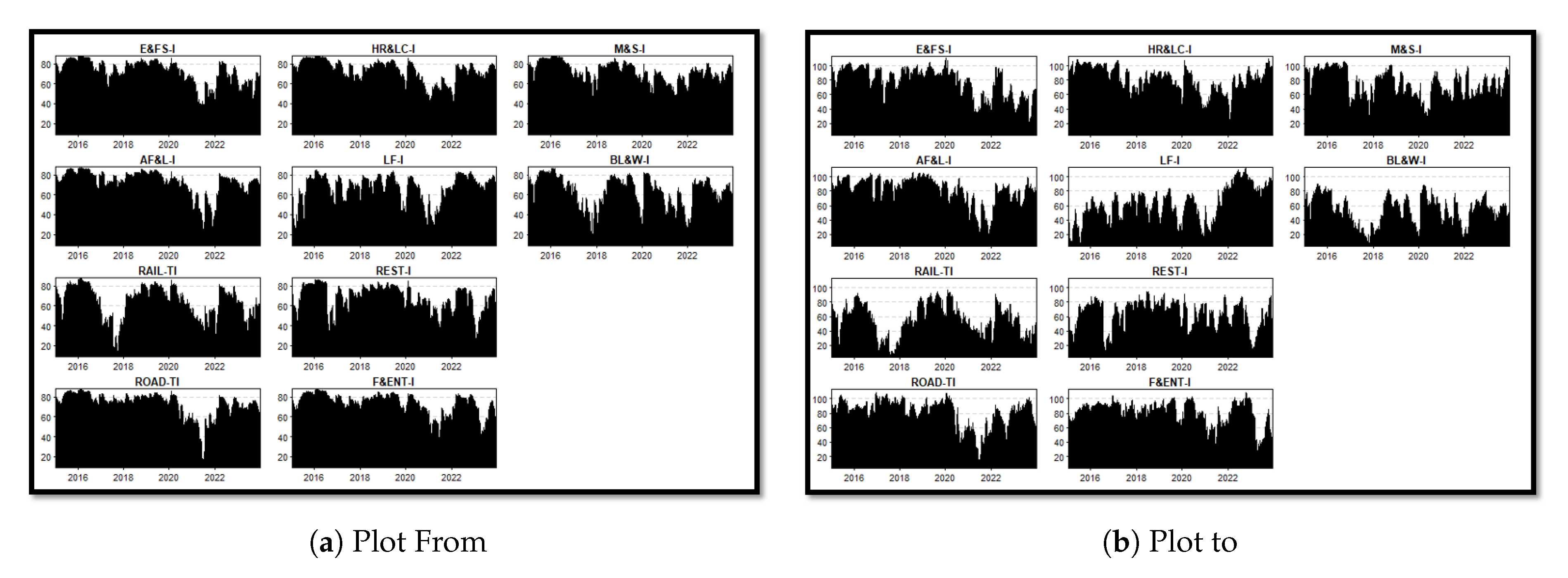
Figure 7 displays the ten subplots which show the dynamics and directional connectedness of each sector, based on industrial stocks that correspond to the "FROM" and "To" columns in Table 3.
The results have verified the significant influence of pandemic and Russia-Ukraine war on interconnection between hospitality stock markets, specifically from a viewpoint of individual sectors. Unlike the spillover of transport sector to hotel stock market, the spillover of industry stocks from specific sectors of the stock market.
Furthermore, with relation to the one-way transfer of returns from specific stocks in different sectors to stock markets, it was observed that from 2015 to 2023, there was a prevalence of positive returns in the asymmetric directional connectedness. The conflict between Russia and Ukraine had a substantial influence on worldwide oil and food prices, thus impacting the stock market. The outcome was a robust positive correlation among industry stocks, as evidenced by the TO directional connectedness.
Our analysis highlights the significance of taking into account specific sectors of hospitality when examining the effects of spillovers or quantifying the interconnectedness between Chinese stock markets. This is due to the lack of substantial investment options in China and the dominance of individual investors.
The heightened interconnectedness between hospitality stock markets in China is mostly attributed to the transmission of net information spillovers between stock markets. Various political and economic events have impacted it, leading to notable disparities in the interconnectedness between sectoral stock markets. Understanding the unique features of China’s financial sector, including its limited financialization, can offer useful insights to investors and regulators who wish to manage risks and find possibilities for diversification.

4.6. Robustness Tests

The study analyzed robustness using the [57] connectedness technique in Appendix A. Table 5 confirms our Table 4 findings using TVP-VAR [20].

5. Conclusions

This study investigates the transmission of returns and interconnections between hospitality stocks of China. The findings demonstrate noteworthy and fluctuating sinch of returns between hospitality industry stocks.
Specifically, the research discovered that the Air Freight and Logistics Industry (AF&L-I), Road Transportation Industry (ROAD-TI), Hotel Resort and Luxury Cruise Industry (HR&LC-I), Environmental and Facilities Services Industry (E&FS-I), Film and Entertainment Industry (F&ENT-I), and Mall and Supermarket Industry (M&S-I) act as risk transmitters and the Baijiu Liquor and Wine Industry (BL&W-I), Railway Transport Industry (RAIL-TI), Leisure Facilities Industry (LF-I), and Restaurant Industry (REST-I), are exposed to risk. This suggests that the interconnectedness between stocks is influenced by business connections or the level of demand. This highlights the extensive prevalence and variety of these spillovers across other industries, surpassing the direct commercial connection and impacting the wide-ranging consumer markets. Additionally, we noticed a considerable disparity in interconnectedness, characterized by a high occurrence of return spillovers. These spillovers were inclined to geo political and economic shocks. Contrary to expectations, there were no negative return spillovers observed during eras of economic uncertainty. In contrast, geo political and health issues led to enhance the overall interconnection and a transformation to a predominance of bad outcomes. This emphasizes the intricate interrelationships and the effect of particular events like Covid-19 and Russia- Ukraine war on uneven hospitality stocks interconnections.
Moreover, the research recorded the fluctuating characteristics of specific subsectors within the Chinese hospitality industry, where the occurrence of spillovers was particularly pronounced during periods of significant geopolitical and health hazards. Following then, there is a decrease in the overall connectivity index under regular situations, and it eventually stabilizes. The time-varying connectivity in the network confirms that the Resort and Luxury Cruise Industry (HR&LC-I), Environmental and Facilities Services Industry (E&FS-I), Film and Entertainment Industry (F&ENT-I), and Mall and Supermarket Industry (M&S-I) activities sectors are responsible for sending significant risk spillovers to the other subsectors. Nevertheless, the economic indicators demonstrate a substantial and favorable influence on the interdependence of the various subsectors within the Chinese hospitality industry. Furthermore, we have conducted a further examination and determined that our outcomes remain vital when applying connectivity method developed by [57]. The findings of this investigation have substantial practical implications for stakeholders in the Chinese hospitality sector, particularly in the domains of policy development, investment strategy, and risk management. The identification of key risk transmitters, such as the Hotel Resort and Luxury Cruise Industry and the Air Freight and Logistics Industry, accentuates the importance of improved risk mitigation strategies in these critical sub-sectors for industry leaders and managers. Additionally, this may involve investing in technologies that enhance operational resilience, diversifying income streams, and implementing more robust contingency plans. For investors, the results offer valuable insights into the risk-return dynamics of various sub-sectors, which facilitates more informed decision-making and portfolio diversification, particularly during periods of economic uncertainty. For policymakers and regulatory organizations, these outcomes can also be utilized to develop targeted interventions that stabilize the most vulnerable sectors during crises, thereby diminishing the overall risk contagion within the industry.
Based on these findings, we suggest practical recommendations for policymakers, the China government, the China hospitality industry and its subsectors, market participants, investors, and portfolio managers. Policymakers and regulatory organizations have the ability to revise their existing regulations regarding the Chinese hospitality business, considering the ongoing pandemic’s disruptive impact worldwide, which is now hindering the industry’s full recovery. Therefore, implementing novel and revised exigence campaigns for the revival of the Chinese hospitality business would be advantageous in restoring its previously held position, for overall and too specific subsectors of Chinese hospitality industry. The government of China and hospitality business may utilize the conclusions to recognize their primary hospitality businesses that are particularly vulnerable to economic shocks. Strategically analyzing and developing each subsector within the hospitality industry can provide long-term benefits by mitigating the negative impacts of unpredictable conditions. Market participants and stakeholders in the Chinese hospitality industry can also benefit from findings to identify the business that demonstrated lower vulnerability to the current pandemic and war situation and previous periods of geo political uncertainty. Investors and portfolio managers in the Chinese hospitality and related businesses have valuable insights from the study to examining the performance of their companies and their ability to generate good returns, especially under unfavorable market conditions. An effective strategy to safeguard mainstream investments from declining impacts is to evaluate the advantages and disadvantages of each subsector and assign appropriate risk weights to them. Therefore, portfolio managers, as well as, stockholders, may benefit from the results of the study to manage the risk and can protect the investments during moments of severe market volatility. By comprehending the time-varying nature of risk transmission, stakeholders can adopt a more proactive and adaptive approach to risk management, thereby contributing to the long-term stability and sustainability of the Chinese hospitality industry.

References

  1. Benoit, S.; Colliard, J.E.; Hurlin, C.; Pérignon, C. Where the risks lie: A survey on systemic risk. Review of Finance 2017, 21, 109–152. [Google Scholar] [CrossRef]
  2. Diebold, F.X.; Yılmaz, K. On the network topology of variance decompositions: Measuring the connectedness of financial firms. Journal of Econometrics 2014, 182, 119–134. [Google Scholar] [CrossRef]
  3. Yu, H.; Fang, L.; Sun, W. Forecasting performance of global economic policy uncertainty for volatility of Chinese stock market. Physica A: Statistical Mechanics and its Applications 2018, 505, 931–940. [Google Scholar] [CrossRef]
  4. Markowitz, H. PORTFOLIO SELECTION. The Journal of Finance 1952, 7, 77–91. [Google Scholar] [CrossRef]
  5. Barunik, J.; Kocenda, E.; Vacha, L. Asymmetric connectedness on the U.S. stock market: Bad and good volatility spillovers. Journal of Financial Markets 2016, 27, 55–78. [Google Scholar] [CrossRef]
  6. Chen, W.; Hou, X.; Jiang, M.; Jiang, C. Identifying systemically important financial institutions in complex network: A case study of Chinese stock market. Emerging Markets Review 2022, 50, 100836. [Google Scholar] [CrossRef]
  7. Barunik, J.; Krehlik, T. Measuring the Frequency Dynamics of Financial Connectedness and Systemic Risk. Journal of Financial Econometrics 2018, 16, 271–296. [Google Scholar] [CrossRef]
  8. Gabauer, D.; Gupta, R. On the transmission mechanism of country-specific and international economic uncertainty spillovers: Evidence from a TVP-VAR connectedness decomposition approach. Economics Letters 2018, 171, 63–71. [Google Scholar] [CrossRef]
  9. Lin, A.J.; Chang, H.Y.; Hsiao, J.L. Does the Baltic Dry Index drive volatility spillovers in the commodities, currency, or stock markets? Transportation Research Part E: Logistics and Transportation Review 2019, 127, 265–283. [Google Scholar] [CrossRef]
  10. Hadi, D.M.; Naeem, M.A.; Karim, S. The exposure of the US tourism subsector stocks to global volatility and uncertainty factors. Current Issues in Tourism 2023, 26, 603–616. [Google Scholar] [CrossRef]
  11. Hadi, D.M.; Naeem, M.A.; Karim, S. Impact of COVID-19 on the connectedness across global hospitality stocks. International journal of hospitality management 2022, 104, 103243. [Google Scholar] [CrossRef] [PubMed]
  12. Aharon, D.Y.; Demir, E.; Ersan, O. Where do tourism tokens travel to and from? Current Issues in Tourism 2023, 27, 2561–2583. [Google Scholar] [CrossRef]
  13. Carter, D.; Mazumder, S.; Simkins, B.; Sisneros, E. The stock price reaction of the COVID-19 pandemic on the airline, hotel, and tourism industries. Finance Research Letters 2022, 44, 102047. [Google Scholar] [CrossRef] [PubMed]
  14. El Rifai, O.; Ozatac, N.; Taspinar, N. Volatility spillovers among major tourism stock indices during Covid 19 pandemic. Current Issues in Tourism 2022, 26, 2075–2082. [Google Scholar] [CrossRef]
  15. Kumar, D. European travel and leisure sector and uncertainties: A risk spillover analysis. Tourism Economics 2023, 29, 48–67. [Google Scholar] [CrossRef]
  16. Shahzad, S.J.H.; Hoang, T.H.V.; Bouri, E. From pandemic to systemic risk: contagion in the US tourism sector. Current Issues in Tourism 2022, 25, 34–40. [Google Scholar] [CrossRef]
  17. Hadi, D.M. Travel and leisure stocks exposure to exchange rates. Annals of Tourism Research Empirical Insights 2023, 4, 100111. [Google Scholar] [CrossRef]
  18. Abdelsalam, O.; Aysan, A.F.; Cepni, O.; Disli, M. The spillover effects of the COVID-19 pandemic: Which subsectors of tourism have been affected more? Tourism Economics 2023, 29, 559–567. [Google Scholar] [CrossRef]
  19. Hu, Y.; Lang, C.; Corbet, S.; Wang, J. The impact of COVID 19 on the volatility connectedness of the Chinese tourism sector. Research in International Business and Finance 2024, 68, 102192. [Google Scholar] [CrossRef]
  20. Antonakakis, N.; Chatziantoniou, I.; Gabauer, D. Refined Measures of Dynamic Connectedness based on Time-Varying Parameter Vector Autoregressions. Journal of Risk and Financial Management 2020, 13, 84. [Google Scholar] [CrossRef]
  21. Goyal, K.; Kumar, S. Financial literacy: A systematic review and bibliometric analysis. International Journal of Consumer Studies 2021, 45, 80–105. [Google Scholar] [CrossRef]
  22. Kaufman, G.G.; Scott, K.E. What is systemic risk, and do bank regulators retard or contribute to it? The independent review 2003, 7, 371–391. [Google Scholar]
  23. Lin, S.L. Conditional risk and return in Asian emerging markets: evidence from the banking sector. Applied Economics 2008, 40, 3173–3183. [Google Scholar] [CrossRef]
  24. Avesani, R.; Garcia Pascual, A.I. A New Risk Indicator and Stress Testing Tool: A Multifactor Nth-to-Default CDS Basket. SSRN Electronic Journal 2006. [Google Scholar] [CrossRef]
  25. Adrian, T.; Brunnermeier, M. CoVaR: Measuring systemic risk contribution. In Proceedings of the Proc. 3rd Unicredit Group conf. on banking and finance (Rome, 2009., 17–18 Dec. 2009). URL: https://www. unicreditgroup. eu/content/dam/unicreditgroup/documents/inc/press-and-media/Session4_Adrian. pdf (accessed 11.06. 2017). [Google Scholar]
  26. Smaga, P. The concept of systemic risk. Systemic Risk Centre Special Paper 2014. [Google Scholar]
  27. Primiceri, G.E. Time Varying Structural Vector Autoregressions and Monetary Policy. The Review of Economic Studies 2005, 72, 821–852. [Google Scholar] [CrossRef]
  28. Ratcliffe, A.; Taylor, K. Who cares about stock market booms and busts? Evidence from data on mental health. Oxford Economic Papers 2015, 67, 826–845. [Google Scholar] [CrossRef]
  29. Hartwell, C.A. The impact of institutional volatility on financial volatility in transition economies. Journal of Comparative Economics 2018, 46, 598–615. [Google Scholar] [CrossRef]
  30. Diebold, F.X.; Yilmaz, K. Measuring financial asset return and volatility spillovers, with application to global equity markets. The Economic Journal 2009, 119, 158–171. [Google Scholar] [CrossRef]
  31. Goyal, P.; Soni, P. Stock markets volatility during crises periods: a bibliometric analysis. Qualitative Research in Financial Markets 2024. [Google Scholar] [CrossRef]
  32. Brida, J.G.; Cortes-Jimenez, I.; Pulina, M. Has the tourism-led growth hypothesis been validated? A literature review. Current Issues in Tourism 2016, 19, 394–430. [Google Scholar] [CrossRef]
  33. Nguyen, C.P.; Schinckus, C.; Su, T.D. Economic policy uncertainty and demand for international tourism: An empirical study. Tourism Economics 2020, 26, 1415–1430. [Google Scholar] [CrossRef]
  34. Chen, M.H.; Jang, S.S.; Kim, W.G. The impact of the SARS outbreak on Taiwanese hotel stock performance: An event-study approach. International Journal of Hospitality Management 2007, 26, 200–212. [Google Scholar] [CrossRef]
  35. Seraphin, H. COVID 19: an opportunity to review existing grounded theories in event studies. Journal of Convention amp; Event Tourism 2020, 22, 3–35. [Google Scholar] [CrossRef]
  36. Reichel, A.; Fuchs, G.; Uriely, N. Perceived Risk and the Non Institutionalized Tourist Role: The Case of Israeli Student Ex Backpackers. Journal of Travel Research 2007, 46, 217–226. [Google Scholar] [CrossRef]
  37. Akhtaruzzaman, M.; Boubaker, S.; Sensoy, A. Financial contagion during COVID–19 crisis. Finance Research Letters 2021, 38, 101604. [Google Scholar] [CrossRef]
  38. Albulescu, C.T. COVID-19 and the United States financial markets’ volatility. Finance Research Letters 2021, 38, 101699. [Google Scholar] [CrossRef] [PubMed]
  39. Wen, J.; Kozak, M.; Yang, S.; Liu, F. COVID-19: potential effects on Chinese citizens’ lifestyle and travel. Tourism Review 2021, 76, 74–87. [Google Scholar] [CrossRef]
  40. Gössling, S.; Higham, J. The low-carbon imperative: Destination management under urgent climate change. Journal of Travel Research 2021, 60, 1167–1179. [Google Scholar] [CrossRef]
  41. Tsionas, M.G. COVID-19 and gradual adjustment in the tourism, hospitality, and related industries. Tourism Economics 2021, 27, 1828–1832. [Google Scholar] [CrossRef]
  42. Dolnicar, S.; Zare, S. COVID19 and Airbnb Disrupting the Disruptor. Annals of Tourism Research 2020, 83, 102961. [Google Scholar] [CrossRef]
  43. Najaf, K.; Chin, A. The impact of the China stock market on global financial markets during COVID 19. International Journal of Public Sector Performance Management 2024, 13, 100–114. [Google Scholar] [CrossRef]
  44. Abbas, J.; Mubeen, R.; Iorember, P.T.; Raza, S.; Mamirkulova, G. Exploring the impact of COVID-19 on tourism: transformational potential and implications for a sustainable recovery of the travel and leisure industry. Current Research in Behavioral Sciences 2021, 2, 100033. [Google Scholar] [CrossRef]
  45. D AGOSTINO, R.B. Transformation to normality of the null distribution of g1. Biometrika 1970, 57, 679–681. [Google Scholar] [CrossRef]
  46. Anscombe, F.J.; Glynn, W.J. Distribution of the Kurtosis Statistic b 2 for Normal Samples. Biometrika 1983, 70, 227. [Google Scholar] [CrossRef]
  47. Jarque, C.M.; Bera, A.K. Efficient tests for normality, homoscedasticity and serial independence of regression residuals. Economics Letters 1980, 6, 255–259. [Google Scholar] [CrossRef]
  48. Elliott, G.; Rothenberg, T.J.; Stock, J.H. Efficient Tests for an Autoregressive Unit Root. Econometrica 1996, 64, 813. [Google Scholar] [CrossRef]
  49. Fisher, T.J.; Gallagher, C.M. New Weighted Portmanteau Statistics for Time Series Goodness of Fit Testing. Journal of the American Statistical Association 2012, 107, 777–787. [Google Scholar] [CrossRef]
  50. Koop, G.; Korobilis, D. A new index of financial conditions. European Economic Review 2014, 71, 101–116. [Google Scholar] [CrossRef]
  51. Arouri, M.E.H.; Jouini, J.; Nguyen, D.K. On the impacts of oil price fluctuations on European equity markets: Volatility spillover and hedging effectiveness. Energy Economics 2012, 34, 611–617. [Google Scholar] [CrossRef]
  52. Antonakakis, N.; Cunado, J.; Filis, G.; Gabauer, D.; Perez de Gracia, F. Oil volatility, oil and gas firms and portfolio diversification. Energy Economics 2018, 70, 499–515. [Google Scholar] [CrossRef]
  53. Yousaf, I.; Yarovaya, L. Herding behavior in conventional cryptocurrency market, non fungible tokens, and DeFi assets. Finance Research Letters 2022, 50, 103299. [Google Scholar] [CrossRef]
  54. Koop, G.; Pesaran, M.; Potter, S.M. Impulse response analysis in nonlinear multivariate models. Journal of Econometrics 1996, 74, 119–147. [Google Scholar] [CrossRef]
  55. Pesaran, H.; Shin, Y. Generalized impulse response analysis in linear multivariate models. Economics Letters 1998, 58, 17–29. [Google Scholar] [CrossRef]
  56. Gil-Alana, L.A.; Poza, C. The impact of COVID-19 on the Spanish tourism sector. Tourism Economics 2022, 28, 646–653. [Google Scholar] [CrossRef]
  57. Diebold, F.X.; Yilmaz, K. Better to give than to receive: Predictive directional measurement of volatility spillovers. International Journal of Forecasting 2012, 28, 57–66. [Google Scholar] [CrossRef]
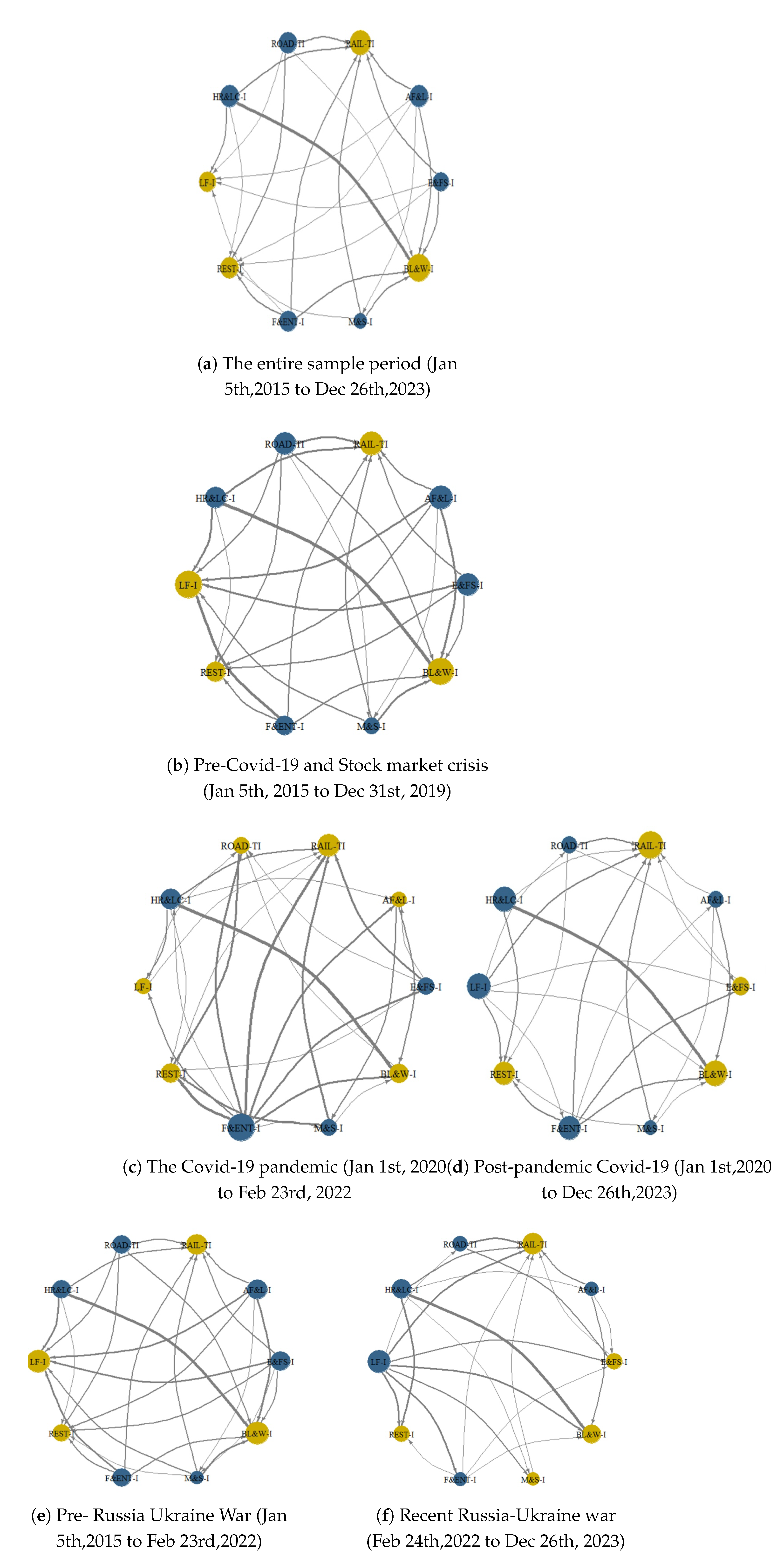
Figure 2. Networks corresponding to sectoral hospitality business stocks fixed pairwise directed connection over important periods.
Preprints 150763 g002
Figure 3. Dynamic Total Connectedness.
Preprints 150763 g003
Figure 4. Net Directional connectedness.
Preprints 150763 g004
Figure 5. Pairwise Directional Connectedness.
Preprints 150763 g005
Figure 6. Net pairwise Directional Connectedness.
Preprints 150763 g006
Figure 7. Plot From and Plot To.
Preprints 150763 g007
Table 1. Description of Indexes.
Sr.No Name Abbreviation
1 Environmental and Facilities Services Industry Index E&FS-I
2 Air Freight and Logistics Industry Index AF&L-I
3 Railway Transport Industry Index RAIL-TI
4 Road Transportation Industry Index ROAD-TI
5 Hotel Resort and Luxury Cruise Industry Index HR&LC-I
6 Leisure Facilities Industry Index LF-I
7 Restaurant Industry Index REST-I
8 Film and Entertainment Industry Index F&ENT-I
9 Mall and Supermarket Industry Index M&S-I
10 Baijiu Liquor and Wine Industry Index BL&W-I
Table 2. Descriptive Statistics.
E&FS-I AF&L-I RAIL-TI ROAD-TI HR&LC-I LF-I REST-I F&ENT-I M&S-I BL&W-I
Mean 0 0 0 0 0 0 0 0 0 0.001
**
0.447 0.847 0.576 0.894 0.674 -0.82 0.929 0.701 0.832 0.047
Variance 0.000
***
0.000
***
0.000
***
0.000
***
0.000
***
0.001
***
0.001
***
0.001
***
0.000
***
0.000
***
skewness 0.764
***
0.516
***
0.760
***
0.762
***
0.305
***
0.012
***
0.278
***
0.417
***
0.504
***
0.250
***
0 0 0 0 0 0.811 0 0 0 0
kurtosis 5.933
***
5.057
***
9.035
***
6.211
***
3.368
***
3.719
***
3.080
***
3.442
***
5.333
***
2.431
***
0 0 0 0 0 0 0 0 0 0
JB 3418.549
***
2426.014
***
7645.428
***
3725.244
***
1067.003
***
1259.770
***
891.987
***
1142.351
***
2683.589
***
561.230
***
0 0 0 0 0 0 0 0 0 0
ERS 19.617
***
18.987
***
22.871
***
18.358
***
20.120
***
20.269
***
20.072
***
20.002
***
20.061
***
20.939
***
0 0 0 0 0 0 0 0 0 0
Q(20) 62.369
***
90.460
***
55.559
***
89.541
***
35.205
***
12.256 49.497
***
52.847
***
40.098
***
14.534
***
0 0 0 0 0 0.288 0 0 0 0.142
Q 2 (20) 1958.242
***
2993.411
***
1805.277
***
3637.350
***
1312.271
***
1452.744
***
1113.669
***
1890.041
***
2262.129
***
250.180
***
0 0 0 0 0 0 0 0 0 0
Notes: * p-value less than 0.1; ** p-value less than 0.05; *** p-value less than 0.01.
Table 3. Pairwise unconditional correlation between sub-sectors.
Kendall E&FS-I AF&L-I RAIL-TI ROAD-TI HR&LC-I LF-I REST-I F&ENT-I M&S-I BL&W-I
E&FS-I 1.000
***
0.465
***
0.319
***
0.472
***
0.342
***
0.318
***
0.332
***
0.466
***
0.401
***
0.224
***
AF&L-I 0.465
***
1.000
***
0.311
***
0.449
***
0.416
***
0.318
***
0.325
***
0.442
***
0.421
***
0.308
***
RAIL-TI 0.319
***
0.311
***
1.000
***
0.339
***
0.318
***
0.243
***
0.259
***
0.299
***
0.332
***
0.281
***
ROAD-TI 0.472
***
0.449
***
0.339
***
1.000
***
0.364
***
0.304
***
0.369
***
0.415
***
0.430
***
0.234
***
HR&LC-I 0.342
***
0.416
***
0.318
***
0.364
***
1.000
***
0.367
***
0.355
***
0.390
***
0.391
***
0.439
***
LF-I 0.318
***
0.318
***
0.243
***
0.304
***
0.367
***
1.000
***
0.297
***
0.396
***
0.305
***
0.237
***
REST-I 0.332
***
0.325
***
0.259
***
0.369
***
0.355
***
0.297
***
1.000
***
0.362
***
0.351
***
0.226
***
F&ENT-I 0.466
***
0.442
***
0.299
***
0.415
***
0.390
***
0.396
***
0.362
***
1.000
***
0.401
***
0.260
***
M&S-I 0.401
***
0.421
***
0.332
***
0.430
***
0.391
***
0.305
***
0.351
***
0.401
***
1.000
***
0.303
***
BL&W-I 0.224
***
0.308
***
0.281
***
0.234
***
0.439
***
0.237
***
0.226
***
0.260
***
0.303
***
1.000
***
Notes: * p-value less than 0.1; ** p-value less than 0.05; *** p-value less than 0.01.
Table 4. Connectedness Table.
E&FS-I AF&L-I RAIL-TI ROAD-TI HR&LC-I LF-I REST-I F&ENT-I M&S-I BL&W-I FROM
E&FS-I 29.4 10.22 6.25 11.62 6.92 6.39 6.53 10.54 8.17 3.95 70.6
AF&L-I 9.97 28.37 5.44 10.27 9.11 5.94 6.11 9.76 8.7 6.33 71.63
RAIL-TI 7.72 6.94 37.93 8.33 7.82 5.3 5.66 6.68 7.57 6.06 62.07
ROAD-TI 11.28 10.31 6.55 28.21 7.18 6.45 7.69 9.31 8.94 4.09 71.79
HR&LC-I 6.97 9.21 6.21 7.22 28.31 8.41 7.18 8.06 8.03 10.4 71.69
LF-I 7.39 7.1 5.1 7.31 9.64 34.95 6.85 10.24 6.64 4.79 65.05
REST-I 7.65 7.29 5.28 9.13 8.32 6.95 33.77 8.81 8.34 4.46 66.23
F&ENT-I 10.34 9.89 5.38 9.35 7.93 9.03 7.52 27.73 8.19 4.63 72.27
M&S-I 8.57 9.62 6.28 9.6 8.46 5.92 7.5 8.74 29.73 5.57 70.27
BL&W-I 5.18 8.15 6.11 5.28 13.44 5.13 4.96 5.98 7.09 38.69 61.31
TO 75.06 78.72 52.62 78.12 78.82 59.52 59.99 78.12 71.67 50.27 682.91
Inc.Own 104.46 107.09 90.55 106.32 107.14 94.47 93.76 105.86 101.39 88.96 cTCI/TCI
NET 4.46 7.09 -9.45 6.32 7.14 -5.53 -6.24 5.86 1.39 -11.04 75.88/68.29
NPT 6 9 1 8 5 3 2 7 4 0
Table 5. Diebold & Yilmaz 2012 Connectedness Table.
E&FS-I AF&L-I RAIL-TI ROAD-TI HR&LC-I LF-I REST-I F&ENT-I M&S-I BL&W-I FROM
E&FS-I 22.02 12.44 7.09 12.72 7.26 5.66 6.29 11.78 10.49 4.26 77.98
AF&L-I 12.32 21.5 6.97 11.79 9.15 5.21 5.97 10.91 10.45 5.74 78.5
RAIL-TI 9.4 9.14 28.02 10.5 8.82 3.82 5.66 7.72 9.87 7.06 71.98
ROAD-TI 13.01 12.17 7.98 21.4 7.87 4.8 6.95 10.18 11.11 4.54 78.6
HR&LC-I 7.98 10.13 7.36 8.61 23.68 6.73 7.1 8.99 9.22 10.2 76.32
LF-I 8.6 8.15 4.4 7.4 9.46 33.16 6.3 10.45 7.54 4.53 66.84
REST-I 8.73 8.4 5.79 9.71 8.96 5.64 29.8 9.14 9.34 4.47 70.2
F&ENT-I 12.28 11.63 5.95 10.56 8.55 7.1 6.98 22.59 9.84 4.52 77.41
M&S-I 10.88 11.02 7.81 11.47 8.77 5.09 7.09 9.78 22.38 5.72 77.62
BL&W-I 6.12 8.64 7.96 6.65 13.93 4.51 4.88 6.43 8.26 32.62 67.38
TO 89.33 91.72 61.32 89.42 82.76 48.56 57.21 85.37 86.12 51.04 742.84
Inc.Own 111.34 113.22 89.33 110.82 106.44 81.72 87.01 107.96 108.5 83.66 cTCI/TCI
NET 11.34 13.22 -10.67 10.82 6.44 -18.28 -12.99 7.96 8.5 -16.34 82.54/74.28
NPT 8 9 3 7 4 0 2 5 6 1
Disclaimer/Publisher’s Note: The statements, opinions and data contained in all publications are solely those of the individual author(s) and contributor(s) and not of MDPI and/or the editor(s). MDPI and/or the editor(s) disclaim responsibility for any injury to people or property resulting from any ideas, methods, instructions or products referred to in the content.
Copyright: This open access article is published under a Creative Commons CC BY 4.0 license, which permit the free download, distribution, and reuse, provided that the author and preprint are cited in any reuse.
Prerpints.org logo

Preprints.org is a free preprint server supported by MDPI in Basel, Switzerland.

Subscribe

Disclaimer

Terms of Use

Privacy Policy

Privacy Settings

© 2025 MDPI (Basel, Switzerland) unless otherwise stated