

Submitted:
27 February 2025
Posted:
28 February 2025
You are already at the latest version
Abstract
Many public PyTorch repositories implement Local Normalized Cross-Correlation Loss (LNCC) using five sequential convolution operations. This implementation is, however, slow, failing to utilize modern hardware's performance potential fully. By simply replacing these convolutions with one single group convolution, we found the training time of LNCC-based deep registration models can be halved without affecting the numerical results, leading to notable cost savings. We hope that this simple approach will be beneficial to the community. An example code is available at \url{https://github.com/xi-jia/FastLNCC}.
Keywords:
Image Registration
; Local Normalized Cross-Correlation
; Deformable
; Efficient
1. Introduction
Local Normalized Cross-Correlation Loss (LNCC)[1], measuring the negative correlation of two input images in a sub-window manner, has been widely adopted for deformable image registration tasks [2,3]. Specifically, for a pair of source image I and reference image J, it is defined as
where:
Following the traditional convolution-based implementation [1], many PyTorch-based registration models, such as VoxelMorph [4,5]1, DeepReg [6]2, SYMNet[7] 3, MultiPropReg [8]4, TransMorph [9]5, LKU-Net[10]6, MONAI [11]7, RAN [12]8, WiNet [13]9 and Rethink-Reg [14]10, just to name a few, implement LNCC using five sequential convolution operations, as outlined in Algorithm 1. We, however, found that the computations may be accelerated.
| Algorithm 1: LNCC loss calculation with five sequential convolutions |
Require:I (input image), J (reference image), w (window size)
|
2. Implementation
2.1. Pseudo Code
The approach in Algorithm 1 uses five consecutive convolutions to compute the LNCC loss, which fails to fully leverage the parallel computing capabilities of modern hardware. We propose to replace the five consecutive convolutions with one single group convolution, as illustrated in Algorithm 2. This simple change can rapidly reduce the computational time on modern hardware (as illustrated in Figure 1), while the numerical results are not affected. (The computed loss values and gradients will be identical.)
| Algorithm 2: LNCC loss calculation with one group convolution |
Require:I (input image), J (reference image), w (window size)
|
Additionally, this approach may be applicable to other similarity measures that require repeated sliding window-based computations, such as the Structural Similarity Index Measure (SSIM).
2.2. Runtime Analysis
In Figure 1, we compare the training time of a deep registration model taken using the previous Algorithm 1 and the new Algorithm 2. Our experimental setup is as follows:
- Data: 403 training pairs from the IXI dataset (https://brain-development.org/ixi-dataset/) pre-processed by TransMorph [9] are selected as training data.
- Training: Each one of the five models is trained in five epochs using the Algorithm 1 and the new Algorithm 2, respectively.
- Results: The training time required for each epoch is reported to compare the difference between the two algorithms.
- Others: The batch size of all networks is set to 1. The sub-window of LNCC is fixated at . All models are trained on the same Nvidia A100-40G GPU with Pytorch. (More experiments are in the Appendix A.)
We can observe that the runtime of the new LNCC implementation (Algorithm 2) is consistently and significantly less than the Algorithm 1 on all compared architectures. Specifically, the average training time on 5 epochs is reduced 52.49%, 51.72%, 47.54%, 43.69%, and 37.61% for VoxelMorph-1, VoxelMorph-2, , , and TransMorph. (Detailed numbers are included in Table 1.) The trend is easy to interpret as the feed-forward and back-propagation will account for more computations in larger models, making the computations of LNCC less critical.
3. Conclusion
We are gaining access to millions of scans from various imaging modalities to develop AI-driven healthcare applications, of which, image registration is often a fundamental step [15]11. Researchers in the registration community contrive to accelerate the registration process for such large-scale cohorts.
Many deep image registration models have proven that their inference time can be orders of magnitude faster than conventional models, while the lengthy training time for deep models is the elephant in the room. Using a single group convolution, the training time for LNCC-based deep registration models can be nearly halved on modern hardware such as Nvidia A100 GPU, significantly accelerating the development of more advanced registration and downstream medical analysis models. We hope this approach will demonstrate practical value to the community.
Acknowledgments
The authors would like to acknowledge the funding from Novo Nordisk to support this work.
Appendix A

Table A1.
Average runtime for one epoch on different GPUs
| GPU | Quadro-rtx8000-48g | P100-sxm2-16gb | ||||
|---|---|---|---|---|---|---|
| Algorithm1 | Algorithm2 | Reduced(%) | Algorithm1 | Algorithm2 | Reduced(%) | |
| VM-1 | 669.5427791 | 395.2477166 | 40.97 | 1002.45329 | 640.9769462 | 36.06 |
| VM-2 | 701.1765172 | 426.4876567 | 39.18 | 1079.542767 | 716.4298012 | 33.64 |
| 731.4320591 | 455.3439657 | 37.75 | 1160.251004 | 797.7661547 | 31.24 | |
| 1022.4765293 | 748.9222134 | 26.75 | 1616.234878 | 1254.400603 | 22.39 | |
| TM | 878.5947878 | 603.5537508 | 31.30 | 1241.964152 | 880.458546 | 29.11 |
Except for the runtime results on the Nvidia A100-40G GPU, we have trained the two algorithms on two other GPUs, i.e., Quadro-rtx8000-48g and P100-sxm2-16gb. The (reduced) training time for the five architectures is included in Table A1. Across all GPU and configurations, Algorithm 2 consistently shows a reduction in runtime compared to Algorithm 1. The reduction in runtime varies across different configurations, ranging from 22.39% to 40.97%.
References
- Cachier, P.; Bardinet, E.; Dormont, D.; Pennec, X.; Ayache, N. Iconic feature based nonrigid registration: the PASHA algorithm. Computer vision and image understanding 2003, 89, 272–298. [Google Scholar] [CrossRef]
- Avants, B.B.; Epstein, C.L.; Grossman, M.; Gee, J.C. Symmetric diffeomorphic image registration with cross-correlation: evaluating automated labeling of elderly and neurodegenerative brain. Medical image analysis 2008, 12, 26–41. [Google Scholar] [CrossRef] [PubMed]
- Lorenzi, M.; Ayache, N.; Frisoni, G.B.; Pennec, X.; (ADNI, A.D.N.I.; et al. LCC-Demons: a robust and accurate symmetric diffeomorphic registration algorithm. NeuroImage 2013, 81, 470–483. [Google Scholar] [CrossRef] [PubMed]
- Balakrishnan, G.; Zhao, A.; Sabuncu, M.R.; Guttag, J.; Dalca, A.V. An unsupervised learning model for deformable medical image registration. In Proceedings of the Proceedings of the IEEE Conference on Computer Vision and Pattern Recognition (CVPR), 2018, pp.
- Balakrishnan, G.; Zhao, A.; Sabuncu, M.R.; Guttag, J.; Dalca, A.V. VoxelMorph: a learning framework for deformable medical image registration. IEEE Transactions on Medical Imaging 2019, 38, 1788–1800. [Google Scholar] [CrossRef] [PubMed]
- Fu, Y.; Brown, N.M.; Saeed, S.U.; Casamitjana, A.; Baum, Z.M.C.; Delaunay, R.; Yang, Q.; Grimwood, A.; Min, Z.; Blumberg, S.B.; et al. DeepReg: a deep learning toolkit for medical image registration. Journal of Open Source Software 2020, 5, 2705. [Google Scholar] [CrossRef]
- Mok, T.C.; Chung, A.C. Fast Symmetric Diffeomorphic Image Registration with Convolutional Neural Networks. In Proceedings of the IEEE/CVF Conference on Computer Vision and Pattern Recognition (CVPR), June 2020. [Google Scholar]
- Liu, R.; Li, Z.; Fan, X.; Zhao, C.; Huang, H.; Luo, Z. Learning deformable image registration from optimization: perspective, modules, bilevel training and beyond. IEEE Transactions on Pattern Analysis and Machine Intelligence 2021, 44, 7688–7704. [Google Scholar] [CrossRef] [PubMed]
- Chen, J.; Frey, E.C.; He, Y.; Segars, W.P.; Li, Y.; Du, Y. TransMorph: Transformer for unsupervised medical image registration. Medical Image Analysis, 1026. [Google Scholar]
- Jia, X.; Bartlett, J.; Zhang, T.; Lu, W.; Qiu, Z.; Duan, J. U-net vs transformer: Is u-net outdated in medical image registration? In Proceedings of the International Workshop on Machine Learning in Medical Imaging. Springer; 2022; pp. 151–160. [Google Scholar]
- Cardoso, M.J.; Li, W.; Brown, R.; Ma, N.; Kerfoot, E.; Wang, Y.; Murrey, B.; Myronenko, A.; Zhao, C.; Yang, D.; et al. Monai: An open-source framework for deep learning in healthcare. arXiv preprint arXiv:2211.02701, arXiv:2211.02701 2022.
- Zheng, J.Q.; Wang, Z.; Huang, B.; Lim, N.H.; Papież, B.W. Residual Aligner-based Network (RAN): Motion-separable structure for coarse-to-fine discontinuous deformable registration. Medical Image Analysis 2024, 91, 103038. [Google Scholar] [CrossRef] [PubMed]
- Cheng, X.; Jia, X.; Lu, W.; Li, Q.; Shen, L.; Krull, A.; Duan, J. WiNet: Wavelet-based Incremental Learning for Efficient Medical Image Registration. In Proceedings of the International Conference on Medical Image Computing and Computer-Assisted Intervention. Springer; 2024; pp. 761–771. [Google Scholar]
- Jian, B.; Pan, J.; Ghahremani, M.; Rueckert, D.; Wachinger, C.; Wiestler, B. Mamba? In Catch The Hype Or Rethink What Really Helps for Image Registration. In Proceedings of the International Workshop on Biomedical Image Registration. Springer; 2024; pp. 86–97. [Google Scholar]
- Hering, A.; Hansen, L.; Mok, T.C.; Chung, A.C.; Siebert, H.; Häger, S.; Lange, A.; Kuckertz, S.; Heldmann, S.; Shao, W.; et al. Learn2Reg: comprehensive multi-task medical image registration challenge, dataset and evaluation in the era of deep learning. IEEE Transactions on Medical Imaging 2022, 42, 697–712. [Google Scholar]
| 1 | |
| 2 | |
| 3 | |
| 4 | |
| 5 | |
| 6 | |
| 7 | |
| 8 | |
| 9 | |
| 10 | |
| 11 |
Figure 1.
Training time (in seconds) required for every epoch (out of 5 epochs) using Algorithms 1 and 2, respectively. The latter reduces the training time significantly.
Figure 1.
Training time (in seconds) required for every epoch (out of 5 epochs) using Algorithms 1 and 2, respectively. The latter reduces the training time significantly.
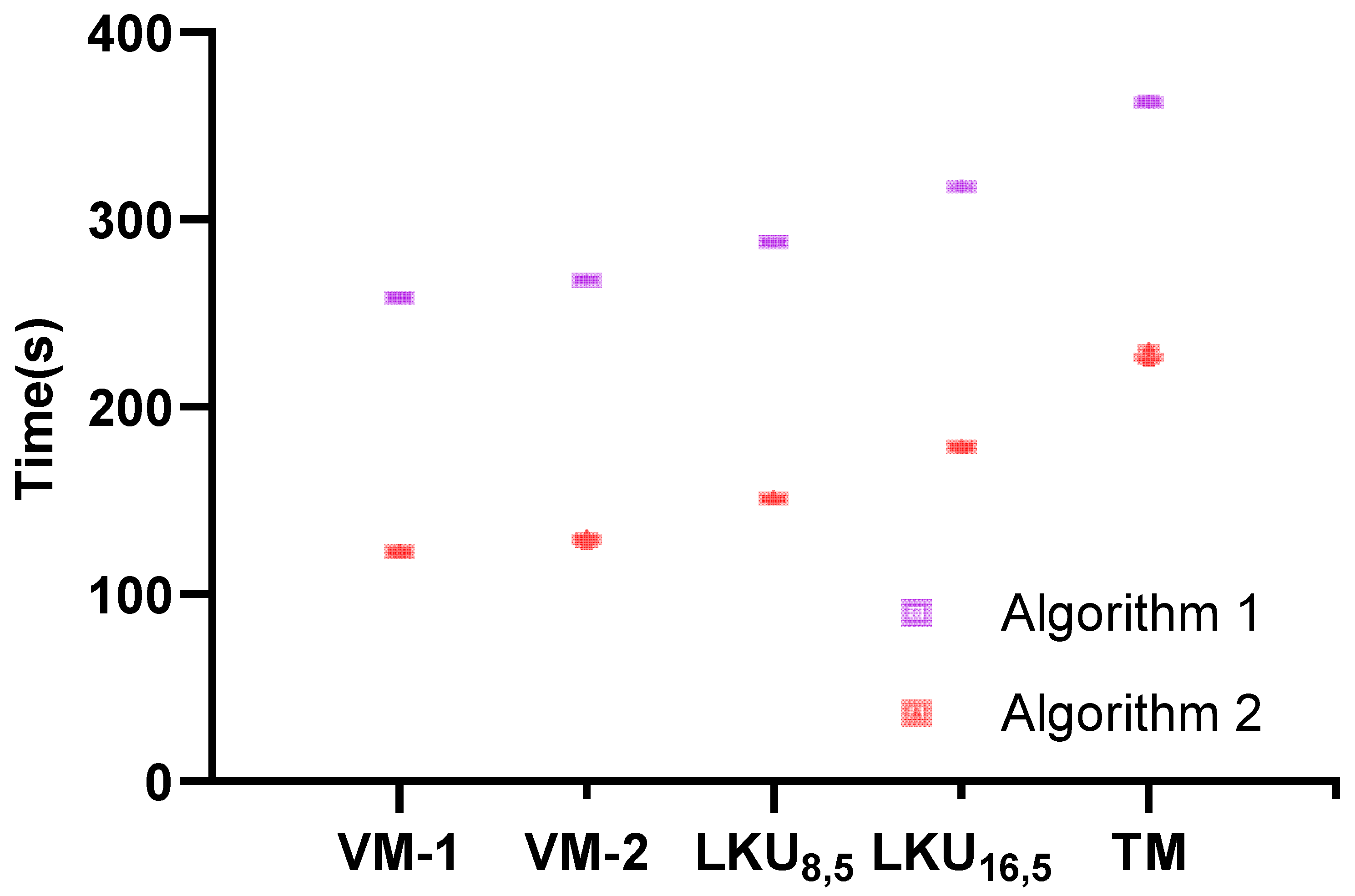
Table 1.
Training time in seconds. Left: Algorithm 1; Right: Algorithm 2.
| Models | Epoch1 | Epoch2 | Epoch3 | Epoch4 | Epoch5 | Avg | Epoch1 | Epoch2 | Epoch3 | Epoch4 | Epoch5 | Avg | |
| VM-1 | 258.95 | 258.07 | 257.69 | 258.02 | 257.62 | 258.07 | 123.37 | 122.31 | 122.40 | 122.52 | 122.46 | 122.61 | |
| VM-2 | 267.78 | 267.57 | 267.64 | 267.67 | 267.90 | 267.71 | 131.07 | 129.66 | 129.66 | 129.10 | 126.77 | 129.25 | |
| 288.10 | 287.61 | 287.95 | 287.90 | 287.67 | 287.84 | 152.01 | 150.71 | 150.85 | 150.70 | 150.72 | 151.00 | ||
| 319.11 | 316.98 | 316.94 | 316.97 | 317.01 | 317.40 | 179.67 | 178.49 | 178.47 | 178.71 | 178.28 | 178.72 | ||
| TM | 364.44 | 362.00 | 361.99 | 361.95 | 362.01 | 362.48 | 231.30 | 224.78 | 224.59 | 225.09 | 225.08 | 226.17 |
Disclaimer/Publisher’s Note: The statements, opinions and data contained in all publications are solely those of the individual author(s) and contributor(s) and not of MDPI and/or the editor(s). MDPI and/or the editor(s) disclaim responsibility for any injury to people or property resulting from any ideas, methods, instructions or products referred to in the content. |
© 2025 by the authors. Licensee MDPI, Basel, Switzerland. This article is an open access article distributed under the terms and conditions of the Creative Commons Attribution (CC BY) license (http://creativecommons.org/licenses/by/4.0/).
Copyright: This open access article is published under a Creative Commons CC BY 4.0 license, which permit the free download, distribution, and reuse, provided that the author and preprint are cited in any reuse.