

Submitted:
26 February 2025
Posted:
27 February 2025
You are already at the latest version
Abstract
Andisols are highly productive soils generated from the progressive weathering of volcanic products. This study evaluates Andisols from two volcanic zones of central and southwestern Colombia to compare the soil characteristics and to determine the influence of volcanic products on soil components in the region. For this, 54 sites were sampled within the volcanic fields: the Tapias-Guacaica (TGMVF) and the Guamuez-Sibundoy (GSMVF) monogenetic volcanic fields. The sampling included a range of systems, such as secondary forests, pines and blackberry crops, cut grass and paddock. Subsequently, analysis of variance was performed for statistically evaluated cells, cluster analysis and principal component analysis. Results indicate that the TGMVF soils exhibit a neutral pH, good cation exchange capacity, structural stability, macroporosity, adequate water and nutrient drainage, but difficulty in retention. In contrast, the GSMVF soils exhibit elevated levels of organic matter, carbon, nitrogen, phosphorus, microporosity, mesoporosity, efficient water and nutrient mobility, and fixation. Based on these parameters, the variance analysis showed two and three distinctive groups for the TGMVF and GSMVF, respectively. It is proposed that the behavior of the physicochemical variables, mainly Pr, ρa, ρr, CEC and SS, can be affected by external forces such as animal trampling, and internal forces such as soil wetting and drying cycles, especially in the paddock system of both volcanic fields. Overall, the physicochemical variation of soils has been influenced by factors such as geological time, soil management, vegetation, climate, topography and parent material. These results establish the basis for promoting appropriate agricultural practices in the fields.
Keywords:
Andisol soils
; Soil physicochemical variables
; Tapias-Guacaica Monogenetic Volcanic Field
; Guamuez Monogenetic Volcanic Field
1. Introduction
Soils formed from the progressive weathering of volcanoclastic deposits and lava flows from volcanic eruptions have been classified as Andisols [1,2,3]. These soils have physical and chemical characteristics rarely found in soils derived from other materials [4,5]. Thus, these soils are characterized by several distinct properties. Their bulk density tends to be less than 0.8 g/cm3, while their permeability and porosity tend to be high (greater than 1.3 x 10⁻⁵ cm/s and 60 vol.%, respectively); the soils also exhibit a characteristic stable microaggregate assembly structure, characterized by elevated water and nutrient fixation capacity due to the presence of organic material and colloidal fracturing dominated by alumina-humus or allophane/imogolite complexes [6].
Additionally, they have a high cation and anion exchange capacity, elevated phosphorus retention, and significant aluminum and iron contents. Acidity varies with depth, ranging from moderate in the deeper horizons (pH: 6.1 - 6.5) to strong in the shallower horizons (pH: 5.1 - 5.5) [7]. As a result of the characteristics described above, Andisol soils contribute significantly to agricultural and forestry production [8,9,10]. However, the intensive management of these soils has resulted in the degradation of their physical and chemical properties, which generates negative impacts that significantly reduce their quality and productive capacity [5,11,12,13].
The Andes are home to a great diversity of soils [14]; the factors that influence their formation are climate, geology and topography [15]. In general, the soils of the Andes are classified into four groups: Andisols, Inceptisols, Ultisols, and Oxisols [16]. Of these soils, the Andisols cover around 4.5 vol.% (around 5.2 million hectares) of the mountain range [15]. In Colombia, located in the northern Andes, the distribution of the Andisols covers mountainous landscapes, foothills, alluvial plains, and occasionally fluviomarine areas [17]. In this research, Andisol soils were sampled from the center and southwest of the Central Cordillera of the Colombian Andes (Figure 1a), with Andisol soils constituting 57.6 vol.%, 44 vol.% and 8.9 of the territory, respectively [13,18,19,20]. Specifically, the Andisols analyzed in this work are associated with two volcanic zones of the country, corresponding to the Tapias-Guacaica Monogenetic Volcanic Field (TGMVF) [21] and the Guamuez-Sibundoy Monogenetic Volcanic Field (GSMVF) [22].
The TGMVF is located between Manizales city and Neira town, in the department of Caldas (Figure 1b and c). The climate is determined by temperatures ranging between 17 and 22°C, with precipitation varying between 2000 and 2200 mm/year, humidity fluctuating be-tween 75 and 90%, and average altitude between 1000 and 4200 masl [23]. On the other hand, the GSMVF is located in the Upper Amazon Basin, between the La Cocha lake in the department of Nariño, and the Sibundoy Valley in the department of Putumayo (towns of Santiago, Colón, Sibundoy, and San Francisco) (Figure 1 d y e). The climate is characterized by an average temperature of 11.6°C, annual precipitation between 1562 and 1852 mm/year, relative humidity between 83 and 87%, and average altitude between 2000 and 3400 masl [24].
This study describes the results of the physical and chemical properties of Andisols in two different regions in Colombia, where volcanic products have influenced the soils for thousands of years. Furthermore, it discusses the impact of major components on nutrient distribution. This study provides information that could enable communities located in the vicinity of the study areas to make well-informed decisions about appropriate conservation practices about this natural resource.
2. Materials and Methods
2.1. Physicochemical properties of Andisol soils
Physicochemical properties were evaluated in a total of 54 sampled lots (Table 1). Of these, 20 were collected in the TGMVF and 34 in the GSMVF. The samples were extracted from a variety of habitats, including secondary forests, pine plantations (Pinus sylvestris), blackberry crops (Rubus glaucus), and paddocks.
2.1.1. Physical properties of Andisol soils.
For the sampling process, a box with dimensions of 30 x 30 x 40 cm was created. Furthermore, two beveled rings of known volume (4.8 cm in diameter, 2.5 cm in height, and 2 mm in thickness) were used to collect samples at depths of 0-20 and 20-40 cm. These samples were taken to determine bulk density (ρa), hydraulic conductivity (HC), gravimetric moisture (GM), and volumetric moisture (VM). At these same depths, two 500 g samples were taken to calculate the real density (ρr), structural stability, pore distribution, texture, and soil color. Additionally, 1 kg of soil was collected to determine structural stability (SS). These samples were transferred to the soil laboratories of the Instituto Tecnológico del Putumayo (ITP) and the Universidad de Nariño (UDENAR), to obtain the results of the physical variables of the soils of both monogenetic volcanic fields.
2.1.2. Chemical properties of Andisol soils.
Ten sampling points were taken for each of the 54 lots evaluated. These ten points were randomly arranged to cover the largest possible area. Each of these points were then collected in a “V” shape to cover the majority of the soil profile. The 10 sampled portions were mixed and a representative sample of 1 kg was extracted. These representative samples were labeled and sent to the soil laboratory of the Corporación Colombiana de Investigación Agropecuaria (AGROSAVIA), where the chemical variables of the evaluated soils were determined.
2.2. Statistical analysis
A general linear mixed model MLGyM was fitted for the analysis of the field variables, with the fixed factors comprising a volcanic field of origin (locality), system, and their interaction. The residual variance was modeled to include different variances according to the heteroscedasticity observed in the fixed effects, while the residual correlation for successive observations made on a monogenetic volcanic field or the same system was contemplated using a compound symmetry model. The Akaike (AIC) and Bayesian (BIC) criteria were used for the selection of the structure of variances and residual correlations. The mixed model fitting was performed using the lme function of the nlme library of R, under the interface implemented in InfoStat [25].
The analysis of the interactions was conducted through a comparison of means for the combinations of the levels of all evaluated factors, using the Di Rienzo, Guzmán and Casanoves DGC methodology; [25], with a significance of 5%. Similarly, a cluster analysis was performed employing the Ward’s method and Euclidean distance to examine the relationships between the groups of variables evaluated concerning the production systems under study. All these statistical tests were run in the InfoStat program, version 2019 [25].
Principal Component Analysis (PCA) was used to investigate the correlation between the soil physicochemical variables and the production systems in the two study areas. The analysis was performed using the “FactoMineR” package [26] and the “factoextra” package [27] (Kassambra et al. 2020). In addition, the Monte Carlo test with all permutations was employed to evaluate the overall effect of sampling sites on the analyzed physicochemical variables, using the “Ade4” package [28] (Dray and Dufour 2007). All analyses were performed using the R version 4.2.0 [28] (R Core Team 2024) and the RStudio version 1.3.1 [30] (Posit Team 2024).
3. Results
3.1. Physicochemical properties of Andisol soils
Highly significant variations were observed in the different physicochemical variables of Andisol soils in the two monogenetic volcanic fields (Table 2). Additionally, there were considerable differences in the interactions observed in more than 20% of the variables evaluated. In 56% of the cases, there was a very significant effect of the field of origin of the samples (location), and in 44% of the cases, exhibited differences related to the evaluated management systems.
Regarding the mean values of the physical variables (Table 3), no significance is established in the different evaluated systems of the TGMVF. In contrast, in the GSMVT, the variables of MiPr, MaPr and MePr of the secondary forest system are significant, constituting 30% of the qualitative physical variables, as well as the variable GH of the pasture system is significant with 10% (Table 3). However, the average values of the physical variables indicate that in the TGMVF, the pasture system exhibits the highest averages in ρa, MiPr, MePr and HC while the secondary forest system presents the highest value in the Pr and SS variables. Conversely, the pine crop exhibits better averages in ρr, GH, and VH. In the GSMVF, the pasture system obtained the highest results in Pr, SS, GH, and VH, whereas the secondary forest obtained significant results in MiPr, MePr, and CH. The pasture prevails in ρr and MaPr, and in the blackberry crops, the highest values were obtained in the ρa and SS variables (Table 3).
Similarly, significant variations were also observed in the chemical variables of the monogenetic volcanic field systems. The pine cultivation system in the TGMVF exhibits high significance in EC, corresponding to ≈4.2%, while the other systems and chemical variables evaluated are not significant (Table 3). For the GSMVF, the secondary forest, paddock, and blackberry crops systems showed a significance of ≈41.6% in the variables EC, P, CEC, Ca, Mg, Fe, Cu, Zn, and the Ca:Mg and K:Mg ratios (Table 3). It is important to note that, in Mg, the secondary forest and cutting pasture systems show significant differences compared to the paddock and blackberry cultivation systems, although they do not show significance among themselves. Likewise, in Fe, the paddock and cutting pasture systems are significantly different from the secondary forest and blackberry cultivation treatments but do not show significant differences between these two. Regarding the physical variables, in the TGMVF there are no significant differences in the variables, while in the GSMVF the secondary forest and paddock systems show important differences of 40% in the variables of MiPr, MaPr, MePr, and GH. The physical property of MaPr has a significant difference in the cutting grass, paddock, and blackberry cultivation systems concerning the secondary forest system, but it is not significant between the first three systems mentioned.
The highest averages of chemical variables of the soils evaluated in the TGMVF were found in the paddock system, with a higher content of C, OM, TN, DN, P, B, A, Al, Zn and the Ca:K and (Ca+Mg)/K ratios (Table 3). In the secondary forest system, pH, EC, S, CEC, Ca, K, and the Ca:Mg and K:Mg ratios were higher, while the pine plantation had a higher percentage of Fe, Cu, Mn and the Mg:K ratio. In the TGMVF, the pine plantation presents the lowest pH result, followed by the paddock. On the other hand, in the GSMVF the highest averages were found in the cutting grass system, where a predominance is established concerning the systems, in variables such as pH, EC, C, OM, TN, DN, P, S, CEC, Ca, Mg, K, Fe, Cu, Zn, and the Ca:Mn, Ca:K and (Ca+Mg)/K ratios. However, the secondary forest system exhibits a higher value in the variables of B, Mn and the Mg:K ratio. In addi-tion, the paddock system has the highest Al content. Similarly, the blackberry crops have a higher significance in the K:Mg ratio. Besides, in the GSMVF, the systems with the lowest pH values, and thus the most acidic, are the paddock followed by the blackberry crops (Table 3).
3.3. Multivariate statistical analysis
The CA was carried out using Ward’s method and the Euclidean distance for the physicochemical variables of the evaluated soils. The results showed the formation of two groups in TGMVF and three groups in the GSMVF. The first group in TGMVF is represented by the secondary forest and the paddock production systems, which presented the best soil quality values in the evaluated variables. The second group, which corresponds to the pine plantation production system, presents lower quality in the composition of the soil physicochemical properties (Figure 2a). The first group in the GSMVF is represented by the blackberry crop system, followed by the second group corresponding to the secondary forest and the paddock production systems, which presented the best quality values in the evaluated variables. The third group was the cut paddock system, which presented the best quality in the composition of the soil physicochemical properties (Table 3; Figure 2b).
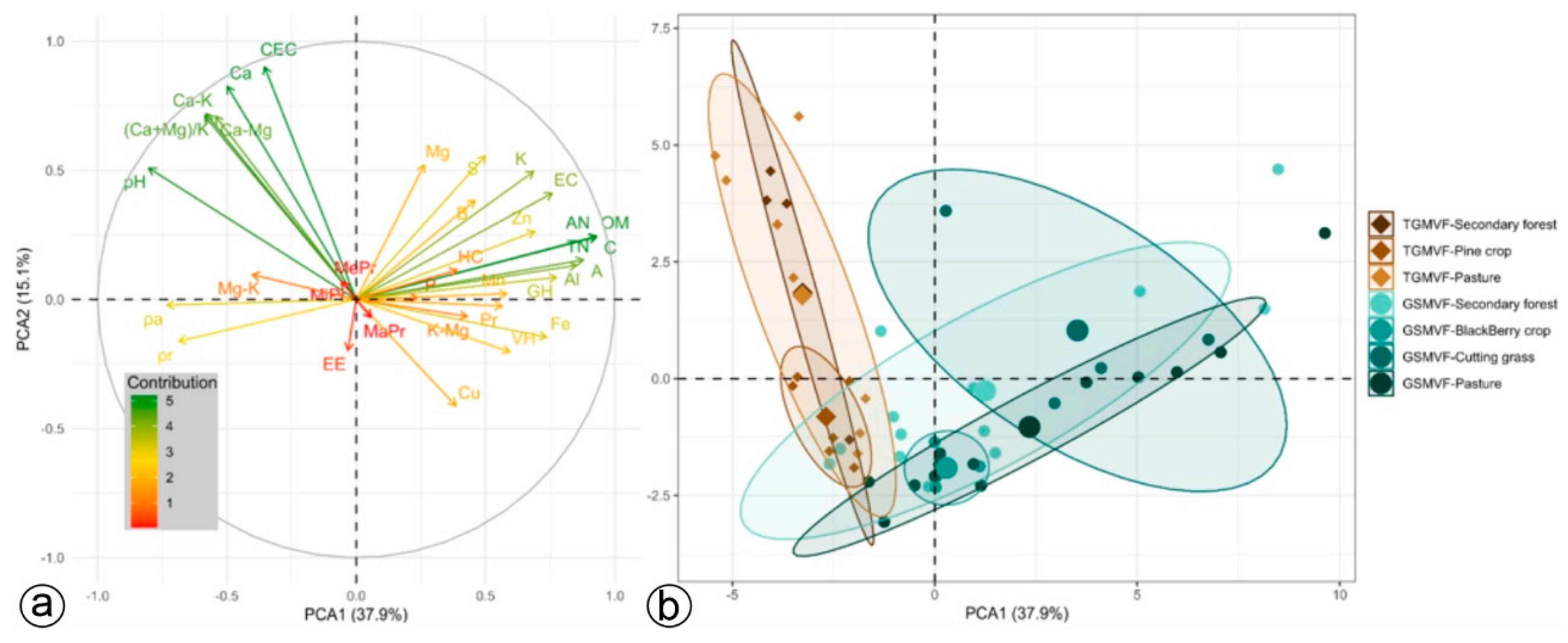
In addition, the relationship between the soil physicochemical variables and the systems evaluated in the two monogenetic volcanic fields (TGMVF and GSMVF) is presented using PCA. The first two PCA components account for 53% of the variance, with the soil physicochemical variables clustered into two groups concerning the evaluated locations (p < 0.0001; 37.9% of the variance explained). The initial principal component (CP1) presents characteristic roots greater than unity, capturing 37.9% of the data. When analyzing the coefficients of the vectors associated with the first two components, it was found that the variables of greatest importance, in order, were C, OM, TN, ρa, and VH.
According to Figure 3, the first principal component (CP1) with a contribution of 37.9% separated the ρa, ρr, SS, CEC, Ca, and pH variables, the Mg-K, Ca-K, (Ca+Mg)/K, and Ca-Mg ratios to the negative end of that component associated with the paddock, the sec-ondary forest, and the pine crop production systems of the TGMVF. While the Pr, GH, VH, S, K, Mn, Zn, P, EC, DN, C, OM, Al, TN, A, Fe, Cu, and CH variables are associated with the positive end of the said component correlated with the paddock and the paddock production systems in the GSMVF. In contrast, the second component (CP2), with a contribution of 15.1%, divided the secondary forest variables MiPr, MePr, Mg and B of the GSMVF into the positive end of this component. Whereas, the variables MaPr and K-Mg ratio, associated with the blackberry crop systems of the GSMVF, were divided into the negative end of this component.
Figure 5.
Projection of soil physicochemical properties and observations from the PC1/PC2 ordination plane of the Principal Component Analysis (PCA), grouped according to the production systems of the Tapias-Guacaica and Guamuez-Sibundoy Monogenetic Volcanic Fields: (a) Correlation circle of the soil physicochemical variables; the color of the vectors indicates the contribution of the variables to the PCs; (b) Sampling sites. Significance was determined by the Monte Carlo test with all disturbances. Apparent density (ρa); Real density (ρr); Total porosity (Pr); Microporosity (MiPr); Macroporosity (MaPr); Mesoporosity (MePr); Structural stability (SS); Gravimetric humidity (GH); Volumetric humidity (VH); Hydraulic conductivity (HC); Potentiometric pH; Electrical Conductivity (EC); Organic Carbon (C); Organic Matter (OM); Total Nitrogen (TN); Disposable Nitrogen (AN); Phosphorus (P); Sulfur (S); Cation Exchange Capacity (CEC); Boron (B); Acidity (A); Aluminum (Al); Calcium (Ca); Magnesium (Mg); Potassium (K); Iron (Fe); Copper (Cu); Manganese (Mn); Zinc (Zn); Ca: Mg; Mg:K ratio; K:Mg ratio; Ca: K; Ratio (Ca+Mg)/K.
Figure 5.
Projection of soil physicochemical properties and observations from the PC1/PC2 ordination plane of the Principal Component Analysis (PCA), grouped according to the production systems of the Tapias-Guacaica and Guamuez-Sibundoy Monogenetic Volcanic Fields: (a) Correlation circle of the soil physicochemical variables; the color of the vectors indicates the contribution of the variables to the PCs; (b) Sampling sites. Significance was determined by the Monte Carlo test with all disturbances. Apparent density (ρa); Real density (ρr); Total porosity (Pr); Microporosity (MiPr); Macroporosity (MaPr); Mesoporosity (MePr); Structural stability (SS); Gravimetric humidity (GH); Volumetric humidity (VH); Hydraulic conductivity (HC); Potentiometric pH; Electrical Conductivity (EC); Organic Carbon (C); Organic Matter (OM); Total Nitrogen (TN); Disposable Nitrogen (AN); Phosphorus (P); Sulfur (S); Cation Exchange Capacity (CEC); Boron (B); Acidity (A); Aluminum (Al); Calcium (Ca); Magnesium (Mg); Potassium (K); Iron (Fe); Copper (Cu); Manganese (Mn); Zinc (Zn); Ca: Mg; Mg:K ratio; K:Mg ratio; Ca: K; Ratio (Ca+Mg)/K.
4. Discussion
4.1. Physical properties
Structural stability in both volcanic fields is similar, however, the TGMVF soils exhibit slightly better structural stability due to less soil disturbance or a higher presence of stable aggregates [31,32]. Nevertheless, in the rest of the physical properties, the GSMVF soils present significant advantages in several aspects such as lower ρa and ρr, higher porosity, and better water-holding capacity. The lower bulk and true density indicate a looser and more aerated soil structure, which is beneficial for water infiltration and retention [33,34]. However, this same structure may be more susceptible to compaction under intensive agricultural practices or heavy machinery, reducing porosity and affecting soil aeration [33,35]. The higher total porosity and macroporosity in GSMVF favors better water and air dynamics in the soil, but may also increase susceptibility to erosion on slopes or under intense rainfall [36]. Higher gravimetric and volumetric moisture levels in GSMVF are indicative of better water-holding capacity, crucial for agriculture in volcanic areas. However, these soils may be prone to saturation and waterlogging under high rainfall conditions, which could negatively affect plant growth [37,38]. Higher hydraulic conductivity in GSMVF suggests better soil permeability, facilitating water movement through the soil profile, but may also imply a higher risk of nutrient and contaminant leaching, especially in soils with lower cation exchange capacity [39,40]. These physical characteristics must be properly managed to maintain soil productivity [36].
4.2. Chemical properties
4.2.1. Association of soil chemistry with parent material.
Soil formation occurs as a progressive process of parent material erosion over time and the interaction of this process with different local environmental factors [41,42]. The classification of Andisol soils is dependent upon the characteristics of their parent material within 12 established soil orders [43,44]. Thus, Andisols formed from volcanic parent material, regardless of composition [5]. Due to the extent of dispersion, most volcanic soils develop from volcaniclastic deposits of intermediate to acidic compositions [5,45,46,47]. This is exemplified by the Andisol soils evaluated in this study.
The geological characterization conducted in the field indicates that the Andisol soils analyzed in the TGMVF were formed from the degradation of pyroclastic fall deposits associated with the eruptive activity of Cerro Bravo and Nevado del Ruiz cf. [48]. In contrast, the soils at the GSMVF were formed from the degradation of both pyroclastic fall deposits of unknown origin cf. [49]. The deposits of both regions are composed of pumice fragments, volcanic lithics, and free crystals of plagioclase, amphibole, and biotite. The weathering of these pyroclastic fragments has resulted in a reduction of elements such as Si, Fe, Mg, Ca, K, P, and Al, which has led to an enrichment of the resulting soil e.g., [50,51,52,53,54], as evidenced by the results of this study.
4.2.2. Acidification.
Weathering of a fall deposit contributes to soil acidification in the long term (months or years), possibly affecting soil pH, due to the oxidation of S compounds (elemental S) present in the fall deposits that form sulfuric acid cf. [46,55]. Thus, considering the lithology of the parent material, especially the presence of glass (amorphous aluminosilicate), the Andisol soils analyzed here indicate that regardless of the management system, the TGMVF soils are in the neutral to moderately acidic range (pH 5.80 ± 0.43 to 7.24 ± 0.47), and GSMVF soils are strongly acidic (pH 5.08 ± 0.19 to 5.26 ± 0.33).
4.2.3. Contrast of chemical variables
A comparative analysis between the chemical variables obtained in the soils of the study zones for similar management systems, such as the secondary forest and paddock, indicates that the Andisol soils from the TGMVF have a lower content of OM, C, TN, P, B, Al, Fe, Cu, Mn and Zn, compared to the GSMVF soils (Table 5).
The geographic region where the TGMVF is located is characterized by precipitation ranging from 2000 to 2200 mm per year and humidity between 75 and 90% (Arias-Díaz et al. 2023). In contrast, the GSMVF region experiences precipitation ranging from 1000 to 2500 mm per year and humidity between 83 and 87% [24,49]. Therefore, both areas are characterized by having a rainy and humid climate, mountainous topography, and slopes that range from moderate to highly steep [23,49]. Climate, topography, and environmental variables control the relative degree of weathering and soil development and do not represent a significant difference between these two areas e.g., [5,56,57,58]. For instance, although these factors may contribute to the genesis of the Andisol soils analyzed here, they do not appear to be the primary elements controlling their characteristics.
An additional element that defines soil characteristics is time. Studies conducted in Andisol soils have shown that through a chrono-sequential analysis, it is possible to understand the development of soil through time [59,60,61,62]. Under different ages of formation, but with similar climatic, topographic, and vegetation conditions, a positive relationship has been established between C accumulation and the abundance of poorly crystalline and non-crystalline minerals [5,63]. Also, an increase in C, TN, and P in Andisol soils from 300 to 20,000 years BP and a reduction of these properties from 150,000 years BP onward have been demonstrated cf. [64]. Considering that TGMVF soils are influenced by volcanic inputs associated with the volcanic activity of the Central Cordillera (ca. 2000 ka BP), GSMVF soils have developed mainly on deposits originated ca. 15,000 ka BP cf. [22,48]. The chemical variation in the secondary forest and paddock systems is likely related to the temporal difference of the parent material. Thus, GSMVF soils have higher OM, C, TN, P, B, Al, Fe, Cu, Mn, and Zn contents compared to TGMVF soils.
Variations in chemical properties between the two monogenetic volcanic fields may also be due to soil management and predominant vegetation. In the TGMVF, the near neutral pH and low OM and C concentrations in the secondary forest and cutting pasture systems may reflect a higher rate of decomposition and mineralization due to soil moisture conditions in a medium climate and/or different management practices [7,65,66]. In contrast, the GSMVF with systems such as secondary forest, paddock, and blackberry crops exhibited the highest levels of acidic soils, which could be linked to a higher presence of decomposing of OM and leaching of basic cations caused by relatively higher rainfall [33,68]. The high EC observed in some crops, especially blackberry, could indicate an accumulation of salts, possibly derived from excessive fertilization practices [69]. The higher C and OM levels in the GSMVF suggest a higher accumulation of plant residues and a lower mineralization rate, which may be associated with a denser vegetation cover, climatic conditions (cold climate with an average temperature of 11.6°C), or management practices [69]. This high OM rate may also indicate a risk of slow decomposition under waterlogged conditions, affecting nutrient availability. High TN and DN levels reflect that, in systems such as blackberry crops, there may be more intensive fertilization [70], and in the secondary forest, a higher biological activity could also indicate a risk of nitrate leaching in soils with low retention capacity [66].
4.3. Impact of major components on nutrient distribution.
In Andisols soils, nutrient mobility, gas exchange, microbial activity, water retention and transport, and root growth are mainly facilitated by the soil pore system [45,71,72,73]. It is not uncommon for Andisols soils to be able to retain more than 30% of plant available water, because they generally have high Pr that allows them to retain a large amount of water under different stress [7,74,75]. The development of weathering processes (alteration of geological material over time) results in an increasing in porosity [4]. These processes contribute to the development of a porous structure with high stability, which is caused by the increase of noncrystalline materials, coming from pumice fragments and free crystals, and the OM content of the soil, forming porous aggregates [73,76]. Thus, it is expected that the Andisol soils of the TGMVF, which are younger than those of the GSMVF, will exhibit a lower percentage of Pr, due to their lower development of OM and C. In addition, it has been demonstrated that weathering processes cause young soils to be associated with MaPr, while older soils are associated with MePr and MiPr [4,45,74]. Consequently, the soils of the TGMVF present macropores that can facilitate the gravitational accommodation of air, water, and nutrients. However, these soils also present issues with the retention and mobility of these essential materials. In contrast, the moderately old soils of the GSMVF are more optimal for retaining and distributing water and nutrients available for plants, balancing aeration, and maintaining soil moisture in times of drought cf. [77]. On the other hand, in Andisol soils, Mg, N, and B can be strongly retained in the micropores, especially in the presence of OM and allophane [78]. This can lead to a sustained but slow availability of these nutrients in the soils of volcanic fields, especially in the GSMVF cf. [79]. The high CEC of Andisols allows good retention of both nutrients [80]. Therefore, the secondary forest system tends to enhance soil MiPr and MePr due to OM accumulation [81,82], improving the retention and availability of nutrients such as Mg, N, and B. Regarding the GSMVF blackberry cropping system, intensive agriculture can reduce MePr and increase MaPr [83], which may lead to the dominance of runoff (or leaching of nutrients such as K) [84,85].
A productive relationship between the Andisol soil and the production system requires high Pr and a low ρa [4,86,87]. Therefore, a moderate to high ρa represents a drawback for soils associated with TGMVF systems, as it results in a limited development of a porous soil structure. This, in turn, negatively affects the distribution of nutrients from the soil to the roots of the plants cultivated in each system [42]. The behavior of the physicochemical variables, mainly Pr, ρa, ρr, CEC and SS, can be affected by external forces such as animal trampling, and internal forces such as soil wetting and drying cycles [47,87,88] especially in the paddock system of both volcanic fields. Furthermore, the probable intensive agriculture of blackberry cultivation in the GSMVF affects the percentage of MePr in the soil differentially, resulting in low availability of nutrients for this system [89].
5. Conclusions
The Andisol soils of the two studied areas have been generated from the degradation of different pyroclastic fall deposits of intermediate to acidic composition. In the case of the Andisol soils of the TGMVF, the parent material, approximately 2000 years BP, originates from polygenetic volcanoes such as Cerro Bravo and Nevado del Ruiz. Meanwhile, the soils of the GSMVF are associated with fall deposits of 15,000 years BP, although their source remains currently unknown.
The moderate to strongly acidic pH of these soils is likely related to their parental genesis or, in the case of blackberry crops, to the type of management soil practices. Likewise, the content of Fe, Mg, Ca, K, P and Al may also be attributed to the parent material, predominantly as a result of the weathering of free crystals.
Significant statistical differences were observed in the 24 chemical and 12 physical variables evaluated. In more than 20% of the evaluated variables, highly significant differences were present in the interactions between location and system. Further-more, in 56% of the variables, a very significant effect of the field of origin was evident, and 44% of significance in the systems of both volcanic fields.
Finally, the physicochemical variations observed may be mainly due to factors such as geological time, the management of each system and vegetation. These factors may be favored by common aspects observed in the two monogenetic volcanic fields, such as the temperate to cold climate, the mountainous topography and the parent material.
Author Contributions
All authors contributed to the study conception and design. Material preparation, data collection and analysis were performed by Adriana del Socorro Guerra-Acosta, Ricardo Javier Aguillon-Estacio, Gina Bolaños-Cabrera, Maira Alejandra Bastidas-Bacca, and Brayan Ronaldo Gómez-Gómez. The first draft of the manuscript was written by the authors previously, together with Edgar Martínez-Moyano and Hugo Murcia. All authors read and approved the final manuscript.
Funding
This study was funded by Ministerio de Ciencias, Tecnología e Innovación (MINCIENCIAS) (call 890, 2020), Colombia. The funds were managed by Instituto Colombiano de Crédito Educativo y Estudios Técnicos en el Exterior - Mariano Ospina Pérez (ICETEX), Colombia
Informed Consent Statement
The authors declare that they read and approved the manuscript.
Data Availability Statement
All data that were produced and analyzed in this research are included in this manuscript.
Acknowledgments
This study was carried out in the frame of the project titled: “Vulcanismo en el centro y suroccidente del país: Implicaciones de origen, evoluci’on, amenaza, relación con el desarrollo de suelos volcánicos y potencial geoturístico”, funded by Ministerio de Ciencias, Tecnología e Innovación (MINCIENCIAS) (call 890, 2020), Colombia and granted to the “Grupo de Investigación en Estratigrafía y Vulcanología (GIEV) Cumanday”, Universidad de Caldas, Manizales, Colombia, “Grupo de Investigación en Recursos Naturales Amazónicos (GRAM), Instituto Tecnológico del Putumayo, Sibundoy, Colombia, and “Grupo de Gestión y Turismo”, Universidad del Pacifico, Buenaventura, Colombia.
Conflicts of Interest
The authors certify that no conflict of interest exists.
References
- Soil Survey Staff (1999) Soil taxonomy. Second edition (USDA NRCS & Agriculture Handbook, Eds.; Second edition). [CrossRef]
- Dahlgren, R.A., Saigusa, M., Ugolini, F.C. (2004) The Nature, Properties and Management of Volcanic Soils. Advances in Agronomy, 82, 113–182. [CrossRef]
- Wilson, S.G., Lambert, J.J., Nanzyo, M., Dahlgren, R.A. (2017) Soil genesis and mineralogy across a volcanic lithosequence. Geoderma, 285, 301–312. [CrossRef]
- Nanzyo, M. (2003) Unique Properties of Volcanic Ash Soils. Global Environmental Research-English Edition, 6(2), 99–112.
- Delmelle, P., Opfergelt, S., Cornelis, J.T., Ping, C.L. (2015) Volcanic Soils. The Encyclopedia of Volcanoes, 1253–1264. [CrossRef]
- Echeverri, T.L., Estévez, V.J.V., Bedoya, P.J.G. (2014) Caracterización física, química y mineralógica de suelos con vocación forestal protectora región Andina Central Colombiana. Revista Facultad Nacional de Agronomía Medellín , 67 (2), 7335–7343. [CrossRef]
- Saigusa, M.F., Shoji, S., Nakaminami, H. (1987) Measurement of water retention at 15 bar tension by pressure membrane method and available moisture of andosols. Japanese Journal of Soil Science and Plant Nutrition, 58(3).
- Takahashi, T., Dahlgren, R.A. (2016) Nature, properties and function of aluminum–humus complexes in volcanic soils. Geoderma, 263, 110–121. [CrossRef]
- Valle, S.R., Carrasco, J. (2018) Soil quality indicator selection in Chilean volcanic soils formed under temperate and humid conditions. Catena, 162, 386–395. [CrossRef]
- Lobos-Ortega, I., Alfaro-Valenzuela, M., Martínez-Lagos, J., Pavez-Andrades, P. (2021) Chemical characterization of volcanic soils using near infrared spectroscopy (NIRS). Chilean J. Agric. Anim. Sci., Ex Agro-Ciencia, 37(1), 32–42. [CrossRef]
- Takahashi, T., Shoji, S. (2001) Distribution and classification of volcanic ash soil. Global Enviornmental Research, Volcanic Ashes and Cheir Soils, 6(2), 83–98.
- Torres, D., Rodríguez, N., Yendis, H., Florentino, A., Zamora, F. (2006) Cambios en algunas propiedades químicas del suelo según el uso de la tierra en el sector el Cebollal, Estado Falcon, Venezuela. Bioagro, 18(2), 123–128.
- Jaurixje, M., Torres, D., Mendoza, B., Henríquez, M., Contreras, J. (2013) Propiedades físicas y químicas del suelo y su relación con la actividad biológica bajo diferentes manejos en la zona de Quíbor, Estado Lara. Bioagro, 25(1), 47–56.
- Morgan, R.P.C. (1986) Soil Erosion and Conservation. Longman Scientific and Technical, New York.
- Sánchez, E.J.A., Rubiano, S.Y. (2015) Procesos específicos de formación en Andisoles, Alfisoles y Ultisoles en Colombia. Revista EIA, SPE2, 85–97.
- Buol, S.W., Southard, R.J., Graham, R.C., McDaniel, P.A. (2011) Soil Genesis and Classification: Sixth Edition. Soil Genesis and Classification: Sixth Edition. [CrossRef]
- Ávila-Pedraza, E.A. (2005) Los suelos de Colombia y sus estadísticas más recientes. Análisis Geográficos, 29, 13–21.
- Instituto Geográfico Agustín Codazzi (2012) Colombia, un país con una diversidad de suelos ignorada y desperdiciada. https://igac.gov.co/es/noticias/colombia-un-pais-con-una-diversidad-de-suelos-ignorada-y-desperdiciada.
- Instituto Geográfico Agustín Codazzi (2014) Mapa Digital de Suelos del Departamento de Nariño, República de Colombia. Escala 1:100.000.
- IUSS Working Group, W.R.B. (2006) World reference base for soil resources 2006: a framework for international classification, correlation and communication. In World Soil Resources Reports No. 103. FAO.
- Vargas-Arcila, L., Murcia, H., Osorio-Ocampo, S., Sánchez-Torres, L., Botero-Gómez, L.A., Bolaños-Cabrera, G. (2023) Effusive and evolved monogenetic volcanoes: two newly identified (~ 800 ka) cases near Manizales City, Colombia. Bulletin of Volcanology, 85(7), 42. [CrossRef]
- Murillo-Orobio, L.T., Chapuel-Cuasapud, D.L., Botero-Gómez, L.A., Murcia, H. (2024) Análisis morfo-estructural del Campo Volcánico Monogenético Guamuéz-Sibundoy (sur de Colombia). Geofísica Internacional, 63(4).
- Arias-Díaz, A., Murcia, H., Vallejo-Hincapié, F., Németh, K. (2023) Understanding Geodiversity for Sustainable Development in the Chinchiná River Basin, Caldas, Colombia. Land, 12(11). [CrossRef]
- Mendoza-Sabogal, J.E., García-Portilla, J., Forero-Amaya, J.C., Castro-Robledo, I., Canal-Albán, F.J., Rojas-Orjuela, D.R.., Carrizosa-Umaña, J., Guerrero-Barrios, V., Montealegre-Bocanegra, J.E., Rodríguez-Roa, A., Martínez-Chaparro, C.A., Espejo, Ó.J., Guio, A.D. (2014) Bogotá y Cundinamarca frente al cambio climático: plan regional integral de cambio climático región capital, Bogotá Cundinamarca: síntesis estratégica del proceso y principales resultados. Instituto de Hidrología, Meteorología y Estudios Ambientales (IDEAM).
- Di Rienzo, J.A., Casanoves, F., Balzarini, M.G., Gonzalez, L., Tablada, M., Robledo, C.W. (2020) InfoStat. Insfostat. Córdoba, Ar.: Centro de Tranferencia InfoStat, FCA, Universidad Nacional de Córdoba, Argentina.
- Husson, F., Josse, J., Le, S., Maintainer, J.M. (2020) Package “FactoMineR”. Multivariate Exploratory Data Analysis and Data Mining.
- Kassambara, A., Mundt, F. (2020) Factoextra: Extract and Visualize the Results of Multivariate Data Analyses. R Package Version 1.0.7. https://CRAN.R-project.org/package=factoextra.
- Dray, S., Dufour, A.B. (2007) The ade4 Package: Implementing the Duality Diagram for Ecologists. Journal of Statistical Software, 22(4), 1–20. [CrossRef]
- R Core Team (2024) R: A Language and Environment for Statistical Computing. R Foundation for Statistical Computing. https://www.r-project.org/.
- Posit Team (2024) RStudio: Integrated Development Environment for R. Posit Software, PBC: Boston, MA, USA. https://posit.co/.
- Fernández de Andrade, L. (2014). Aplicación del índice de estabilidad estructural de Pieri (1995) a suelos montañosos de Venezuela. Terra, 30(48), 143–153.
- Lobo, D., Pulido, M. (2006) Métodos e índices para evaluar la estabilidad estructural de los suelos. Venesuelos, 14(1), 22–37.
- Kientz, D.G., Salazar, M.R., Pérez, E.M. (2000) Propiedades físicas y químicas de un suelo volcánico bajo bosque y cultivo en Veracruz, México. Foresta Veracruzana, 2(1), 31–34.
- Cruz, A.B., Barra, J.E., Castillo, R.F., Gutiérrez, C. (2004) La calidad del suelo y sus indicadores. Ecosistemas, 13(2).
- Yin, X., Zhao, L., Fang, Q., Ding, G. (2021) Differences in Soil Physicochemical Properties in Different-Aged Pinus massoniana Plantations in Southwest China. Forests 2021, 12(8), 987. [CrossRef]
- Volverás-Mambuscay, B., Merchancano-Rosero, J.D., Campo-Quesada, J.M., López-Rendón, J.F. (2020) Physical soil fertility in the sowing system in wachado on Nariño, Colombia. Agronomía Mesoamericana, 31(3), 743–760. [CrossRef]
- Arias, F., Alvarado, A., Mata, R., Serrano, E., Laguna, J. (2010) Relación entre la mineralogía de la fracción arcilla y la fertilidad en algunos suelos cultivados con banano en las llanuras aluviales del Caribe de Costa Rica. Agronomía Costarricense, 34, 223–236.
- Rica, C. (2009) Método gravimétrico para determinar in situ la humedad volumétrica del suelo. Agronomía Costarricense, 33(1), 121–124.
- Nissen, M.J., Quiroz, S.C., Seguel, S.O., MacDonald, H.R., Ellies, A. (2006) Flujo Hídrico no Saturado en Andisoles. Revista de La Ciencia Del Suelo y Nutrición Vegetal, 6(1), 9–19. [CrossRef]
- Sandoval, E.M., Castillo, S.C., Zagal, V.E., Stolpe, L.N., Undurraga, D.P. (2007) Parámetros hidráulicos determinados en un Andisol bajo diferentes rotaciones culturales después de diez años. Revista de La Ciencia Del Suelo y Nutrición Vegetal, 7(2), 32–45. [CrossRef]
- Gallego, G.D., Marín-Toro, J.J., Alzate-Buitrago, A. (2023) Parent material effect’s and physical-mechanical properties on soil fertility. Universidad Libre Seccional Pereira.
- Nanzyo, M., Shoji, S., Dahlgren, R. (1993) Physical Characteristics of Volcanic Ash Soils. Developments in Soil Science, 21(C), 189–207. [CrossRef]
- Bockheim, J.G., Gennadiyev, A.N., Hartemink, A.E., Brevik, E.C. (2014) Soil-forming factors and Soil Taxonomy. Geoderma, 226–227(1), 231–237. [CrossRef]
- Soil Survey Staff (2010) Keys to Soil Taxonomy (11th ed.). USDA-NRCS.
- Shoji, S., Nanzyo, M., Dahlgren, R.A. (1993) Volcanic ash soils: genesis, properties and utilization. Volcanic Ash Soils: Genesis, Properties and Utilization. [CrossRef]
- Ayris, P.M., Delmelle, P. (2012) The immediate environmental effects of tephra emission. Bulletin of Volcanology, 74(9), 1905–1936.
- Dec, D., Dörner, J., Balocchi, O., López, I. (2012) Temporal dynamics of hydraulic and mechanical properties of an Andosol under grazing. Soil and Tillage Reseacrh, 125, 44–51. [CrossRef]
- Picón, K., Herrera, K., Avellán, D.R., Murcia, H., Botero-Gómez, L.A., Gómez-Arango, J. (2024) Radiocarbon dating, eruptive dynamics, and hazard implications of four Holocene Plinian-type eruptions recorded in Manizales city, Colombia. Natural Hazards, 120(6), 5561–5578.
- Medina-Castellanos, E.A., Sánchez-Espinosa, J.A., Cely-Reyes, G.E. (2017) Genesis and evolution of the Valle del Sibundoy soils. Ciencia y Agricultura, 14(1), 95–105. [CrossRef]
- Schott, J., Berner, R.A., Sjöberg, E.L. (1981) Mechanism of pyroxene and amphibole weathering I. Experimental studies of iron-free minerals. Geochimica et Cosmochimica Acta, 45(11), 2123–2135. [CrossRef]
- White, A.F. (2002) Determining mineral weathering rates based on solid and solute weathering gradients and velocities: application to biotite weathering in saprolites. Chemical Geology, 190(1–4), 69–89. [CrossRef]
- Rasmussen, C., Brantley, S., Richter, D., Blum, A., Dixon, J., White, A.F. (2011) Strong climate and tectonic control on plagioclase weathering in granitic terrain. Earth and Planetary Science Letters, 301(3–4), 521–530. [CrossRef]
- Bray, A.W., Oelkers, E.H., Bonneville, S., Wolff-Boenisch, D., Potts, N.J., Fones, G., Benning, L.G. (2015) The effect of pH, grain size, and organic ligands on biotite weathering rates. Geochimica et Cosmochimica Acta, 164, 127–145. [CrossRef]
- Brantley, S.L., Chen, Y. (1995) Chemical weathering rates of pyroxenes and amphiboles. Reviews in mineralogy, 31, 119–172. [CrossRef]
- Cronin, S.J., Hedley, M.J., Neall, V.E., Smith, R.G. (1998) Agronomic impact of tephra fallout from the 1995 and 1996 Ruapehu Volcano eruptions, New Zealand. Environmental Geology, 34(1), 21–30.
- Bockheim, J.G., Gennadiyev, A.N., Hammer, R.D., Tandarich, J.P. (2005) Historical development of key concepts in pedology. Geoderma, 124(1–2), 23–36. [CrossRef]
- Rasmussen, J., Nørremark, M., Bibby, B.M. (2007) Assessment of leaf cover and crop soil cover in weed harrowing research using digital images. Weed Research, 47(4), 299–310. [CrossRef]
- Ugolini, F., Dahlgren, R.A. (2002) Soil development in volcanic ash. Airies, 69, 1–13.
- Huggett, R.J. (1998) Soil chronosequences, soil development, and soil evolution: a critical review. Catena, 32(3–4), 155–172. [CrossRef]
- Wardle, D.A., Walker, L.R., Bardgett, R.D. (2004) Ecosystem properties and forest decline in contrasting long-term chronosequences. Science, 305(5683), 509–513.
- Walker, L.R., Wardle, D.A., Bardgett, R.D., Clarkson, B.D. (2010) The use of chronosequences in studies of ecological succession and soil development. Journal of Ecology, 98(4), 725–736. [CrossRef]
- Gallardo, M.B., Pérez, C., Núñez-Avila, M., Armesto, J.J. (2012) Desacoplamiento del desarrollo del suelo y la sucesión vegetal a lo largo de una cronosecuencia de 60 mil años en el volcán Llaima, Chile. Revista Chilena de Historia Natural, 85(3), 291–306. [CrossRef]
- Harden, J.W. (1982) A quantitative index of soil development from field descriptions: Examples from a chronosequence in central California. Geoderma, 28(1), 1–28. [CrossRef]
- Crews, T.E., Kitayama, K., Fownes, J.H., Riley, R.H., Herbert, D.A., Mueller-Dombois, D., Vitousek, P.M. (1995) Changes in Soil Phosphorus Fractions and Ecosystem Dynamics across a Long Chronosequence in Hawaii. Ecology, 76(5), 1407–1424. [CrossRef]
- Broquen, P., Candan, F., Falbo, G., Girardin, J.L., Pellegrini, V. (2005) Impact of Pinus ponderosa on acidification at forest-steppe transition soils, SW Neuquén, Argentina. Bosque (Valdivia), 26(3), 63–74. [CrossRef]
- Julca-Otiniano, A., Meneses-Florián, L., Blas-Sevillano, R., Bello-Amez, S. (2006) La materia orgánica, importancia y experiencia de su uso en la agricultura. Idesia (Arica), 24(1), 49–61. [CrossRef]
- Sandoval-Aparicio, J.C., Gutiérrez-Castorena, M., Cruz-Flores, G., Ortiz-Solorio, C.A. (2022) Reservas de carbono y micromorfología de la materia orgánica en suelos ribereños en tres ecosistemas de alta montaña: volcán Iztaccíhuatl. Madera y Bosques, 28(2). [CrossRef]
- Marín, S., Bertsch, F., Castro, L., Marín, S., Bertsch, F., Castro, L. (2017) Efecto del manejo orgánico y convencional sobre propiedades bioquímicas de un Andisol y el cultivo de papa en invernadero. Agronomía Costarricense, 41(2), 26–46. [CrossRef]
- Cortés, D., Pérez, J., Camacho-Tamayo, J.H. (2013) Relación espacial entre la conductividad eléctrica y algunas propiedades químicas del suelo. Actualidad y Divulgación UDCA, ISSN-e 0123-4226, ISSN 2619-2551, 16(2), 401–408.
- Gutiérrez, D.J.S., Cardoma, W.A., Monsalve, C.O. (2017) Potencial en el uso de las propiedades químicas como indicadores de calidad de suelo. Una revisión. Revista Colombiana de Ciencias Hortícolas, 11(2), 450–458. [CrossRef]
- Nimmo, J.R. (2005) Porosity and pore-size distribution. Encyclopedia of Soils in the Environment, 4, 295–303. [CrossRef]
- Bartoli, F., Regalado, C.M.. Basile, A., Buurman, P., Coppola, A. (2007) Physical properties in European volcanic soils: a synthesis and recent developments. Soils of Volcanic Regions in Europe, 515–537. [CrossRef]
- Dörner, J., Dec, D., Feest, E., Vásquez, N., Díaz, M. (2012) Dynamics of soil structure and pore functions of a volcanic ash soil under tillage. Soil and Tillage Research, 125, 52–60. [CrossRef]
- Furuhata, A., Hayashi, S. (1980) Relation between soil structure and soil pore composition: Case of volcanogenous soils in Tokachi district. Research Bulletin of the Hokkaido National Agricultural Experiment Station.
- Meza-Pérez, E., Geissert-Kientz, D. (2006) Estabilidad de estructura en Andisoles de uso forestal y cultivados. Terra Latinoamericana, 24(2), 163–170.
- Parfitt, R.L., Hemni, T. (1980) Structure of Some Allophanes from New Zealand. Clays and Clay Minerals 1980, 28(4), 285–294. [CrossRef]
- Hillel, D. (2003). Introduction to Environmental Soil Physics. Introduction to Environmental Soil Physics, 1–494. [CrossRef]
- Zagal, E., Rodríguez, N., Vidal, I., Flores, A.B. (2002) La fracción liviana de la materia orgánica de un suelo volcánico bajo distinto manejo agronómico como índice de cambios de la materia orgánica lábil. Agricultura Técnica, 62(2), 284–296. [CrossRef]
- Amézquita, E. (1999) Propiedades físicas de los suelos de los Llanos Orientales y sus requerimientos de labranza. Palmas, 20(1), 73–86.
- Malagón, D., Pulido, C., Llinas, R. (1991) Génesis y taxonomía de los Andisoles colombianos. Instituto Geográfico Agustín Codazzi. Investigaciones, 3(1), 118.
- Christensen, B.T. (1996) Matching measurable soil organic matter fractions with conceptual pools in simulation models of carbon turnover: Revision of model structure. In Powlson D. S., P. Smith, and J. Smith (eds). Evaluation of soil organic matter models using long-term datasets. Springer, 38, 144–160.
- Graham, M.H., Haynes, R.J., Meyer, J.H. (2002) Soil organic matter content and quality: effects of fertilizer applications, burning and trash retention on a long-term sugarcane experiment in South Africa. Soil Biology and Biochemistry, 34, 93–102. [CrossRef]
- Volverás-Mambuscay, B., Amézquita, E., Campo, J.M. (2016) Indicadores de calidad física del suelo de la zona cerealera andina del departamento de Nariño, Colombia. Corpoica Ciencia & Tecnología Agropecuaria, 17, 361–377. http://doi.org/10.21930/rcta.vol17_num3_art:513” Thank you for reaching out.
- Hofstede, R. (2001) El Impacto de las actividades humanas sobre el páramo. En: Mena, P., Medina, G., & Hofstede, R. Los páramos del Ecuador, particularidades, problemas y perspectivas. Abya-Yala, Proyecto Páramo, 311, 161–182.
- Hernández, F., Triana, F., Daza, M. (2009) Efecto de las actividades agropecuarias en la capacidad de infiltración de los suelos del páramo del Sumapaz. Ingeniería de los Recursos Naturales y del Ambiente, 8, 29–38.
- Clunes, J., Dörner, J., Pinochet, D. (2021) How does the functionality of the pore system affects inorganic nitrogen storage in volcanic ash soils? Soil and Tillage Research, 205, 104802. [CrossRef]
- Dörner, J., Dec, D., Peng, X., Horn, R. (2010) Effect of land use change on the dynamic behaviour of structural properties of an Andisol in southern Chile under saturated and unsaturated hydraulic conditions. Geoderma, 159(1–2), 189–197. [CrossRef]
- Reszkowska, A., Krümmelbein, J., Gan, L., Peth, S., Horn, R. (2011) Influence of grazing on soil water and gas fluxes of two Inner Mongolian steppe ecosystems. Soil and Tillage Research, 111, 180–189. [CrossRef]
- Ceballos, D., Hernández, O., Vélez, J.A. (2010) Efecto de la labranza sobre las propiedades físicas en un andisol del departamento de Nariño. Revista de Ciencias Agrícolas, 27(1), 40-48. ISSN-e 2256-2273.
Figure 1.
Location map of the study areas: (a) Northern continental margin of the Andes Mountain range; (b) Illustration of the Tapias-Guacaica Monogenetic Volcanic Field; (c) Panoramic photograph of the Tapias-Guacaica Monogenetic Volcanic Field; (d) Illustration of the Guamuez-Sibundoy Monogenetic Volcanic Field. 1. Campanero. 2. Victoria. 3. Manoy. 4. Mijoy. 5. Bijinchoy. 6. Fuisanoy. 7. Mujundinoy Norte-Mujundinoy Sur. 8. Corota. 9. Yaku. 10. Guayapungo. 11. Encano. 12. Guamuez. 13. Estero. 14. Patascoy. 15. Taita Muchivioy-Mama Muchivioy. 16. Laurel. 17. Santa Teresita; (e) Panoramic photograph of the Guamuez-Sibundoy Monogenetic Volcanic Field.
Figure 1.
Location map of the study areas: (a) Northern continental margin of the Andes Mountain range; (b) Illustration of the Tapias-Guacaica Monogenetic Volcanic Field; (c) Panoramic photograph of the Tapias-Guacaica Monogenetic Volcanic Field; (d) Illustration of the Guamuez-Sibundoy Monogenetic Volcanic Field. 1. Campanero. 2. Victoria. 3. Manoy. 4. Mijoy. 5. Bijinchoy. 6. Fuisanoy. 7. Mujundinoy Norte-Mujundinoy Sur. 8. Corota. 9. Yaku. 10. Guayapungo. 11. Encano. 12. Guamuez. 13. Estero. 14. Patascoy. 15. Taita Muchivioy-Mama Muchivioy. 16. Laurel. 17. Santa Teresita; (e) Panoramic photograph of the Guamuez-Sibundoy Monogenetic Volcanic Field.
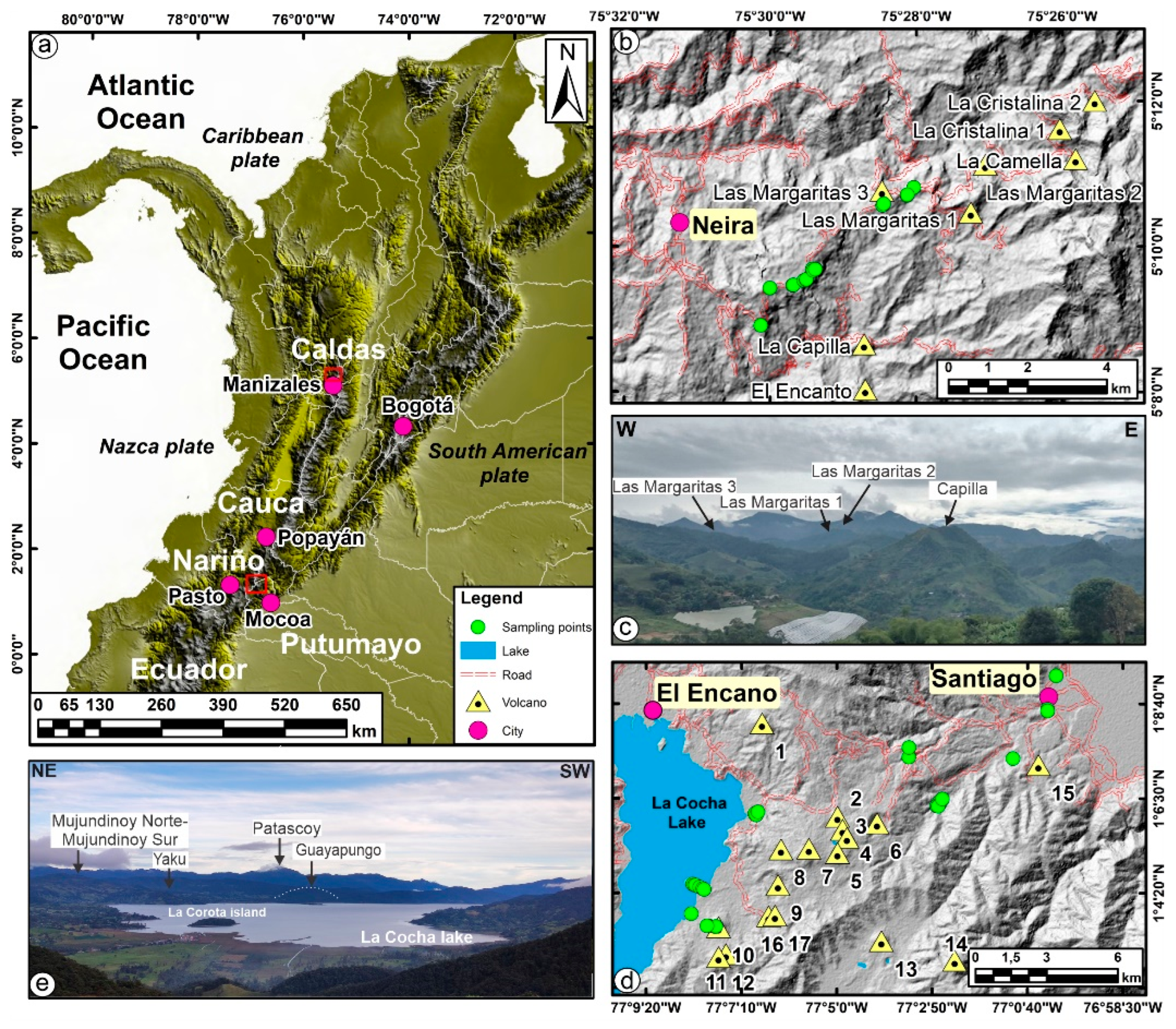
Figure 2.
Cluster analysis by Ward’s method and Euclidean distance for the physicochemical variables of the production systems (a) Tapias-Guacaica Monogenetic Volcanic Field; (b) Guamuez-Sibundoy Monogenetic Volcanic Field.
Figure 2.
Cluster analysis by Ward’s method and Euclidean distance for the physicochemical variables of the production systems (a) Tapias-Guacaica Monogenetic Volcanic Field; (b) Guamuez-Sibundoy Monogenetic Volcanic Field.


Table 1.
Physicochemical properties evaluated and method of determination.
| Physicochemical variables | Method of determination | Unit |
|---|---|---|
| Bulk density (ρa) | Cylinder of known volume | g.cm-3 |
| True density (ρr) | Pycnometer | g.cm-3 |
| Total porosity (Pr) | % | |
| Gravimetric humidity (GH) | 105 °C stove | % |
| Volumetric humidity (VH) | % | |
| Hydraulic conductivity (HC) | Constant head permeameter | cm/hour |
| Structural stability (SS) | dry sieving | DPM-mm |
| Microporosity (MiPr) | Calculation | % |
| Macroporosity (MaPr) | Calculation | % |
| Mesoporosity (MePr) | Calculation | % |
| Color in wet soil | Munsell Table | - |
| Texture | To the touch | - |
| pH | Active acidity/pH in soils GA-R-46, version 06, 2021-10-25. | Units ofpH |
| Electrical conductivity (EC) | NTC 5596:2008 Method B. | dS/m |
| Organic Carbon (C) | Determination of organic carbon in soil GA-R-119 version 4, 2021-10-25. | g/100g |
| Organic Matter (OM) | Calculation according to NTC 5403 Walkey & Black. | g/100g |
| Total nitrogen (TN) | Calculation | % |
| Disposable nitrogen (DN) | Calculation | % |
| Disposable phosphorus (P) | Available phosphorus in soils GA-R-48, 07, 2021-10-25 version. | mg/kg |
| Disposable sulfur (S) | Calcium monobasic phosphate | mg/kg |
| Cation Exchange Capacity (CEC) | Calculation | cmol(+)/kg |
| Disposable boron (B) | Calcium monobasic phosphate | mg/kg |
| Acidity (Al+H; A) | KCl | cmol(+)/kg |
| Interchangeable aluminum (Al) | KCl | cmol(+)/kg |
| Disposable calcium (Ca) | Interchangeable bases on GA-R-50 version 9, 2021-10-25 floors. | cmol(+)/kg |
| Disposable magnesium (Mg) | Interchangeable bases on GA-R-50 version 9, 2021-10-25 floors. | cmol(+)/kg |
| Disposable potassium (K) | Interchangeable bases on GA-R -50 version 9, 2021-10-25 floors. | cmol(+)/kg |
| Disposable Olsen iron (Fe) | NTC 5526:2007 Method D. | mg/kg |
| Disposable Olsen copper (Cu) | NTC 5526:2007 Method D. | mg/kg |
| Disposable Olsen manganese (Mn) | NTC 5526:2007 Method D. | mg/kg |
| Disposable Olsen zinc (Zn) | NTC 5526:2007 Method D. | mg/kg |
| Ca-Mg ratio | Calculation | - |
| Mg-K ratio | Calculation | - |
| K-Mg ratio | Calculation | - |
| Ca-K ratio | Calculation | - |
| Ratio (Ca+Mg)/K | Calculation | - |
Table 2.
Analysis of variance of fixed effects related to the physical and chemical quality of soils from the Tapias-Guacaica and Guamuez-Sibundoy Monogenetic Volcanic Fields and five management systems in central and southwestern Colombia.
Table 2.
Analysis of variance of fixed effects related to the physical and chemical quality of soils from the Tapias-Guacaica and Guamuez-Sibundoy Monogenetic Volcanic Fields and five management systems in central and southwestern Colombia.
| Variable | L | S | Lx S |
|---|---|---|---|
| ρa | <0.0001*** | 0.5432ns | 0.0785* |
| ρr | 0.0001*** | 0.9360ns | 0.9954ns |
| Pr | 0.0002*** | 0.2720ns | 0.0425* |
| MiPr | 0.6703ns | 0.0484* | 0.0051* |
| MaPr | 0.6703ns | 0.0484* | 0.0051* |
| MePr | 0.6703ns | 0.0484* | 0.0051* |
| SS | 0.4251ns | 0.6782ns | 0.0080* |
| GH | <0.0001*** | 0.0287* | 0.0688* |
| VH | <0.0001*** | 0.1011ns | 0.1245ns |
| HC | 0.0679* | 0.4410ns | 0.2463ns |
| pH | <0.0001*** | 0.494ns | 0.6947ns |
| EC | 0.2214ns | 0.0059* | 0.2553ns |
| C | 0.0004*** | 0.1034ns | 0.9646ns |
| OM | 0.0004*** | 0.1034ns | 0.9786ns |
| TN | 0.0004*** | 01034ns | 0.9786ns |
| DN | 0.0004*** | 0.1034ns | 0.9786ns |
| P | 0.7391ns | <0.0001*** | 0.7999ns |
| S | 0.772ns | 0.5979ns | 0.9849ns |
| CEC | <0.0001*** | 0.41ns | 0.7612ns |
| B | 0.2461ns | 0.1797ns | 0.5336ns |
| A | 0.002*** | 0.4534ns | 0.9265ns |
| Al | 0.5034ns | 0.5034ns | 0.6616ns |
| Ca | <0.0001*** | 0.542ns | 0.677ns |
| Mg | 0.8157ns | 0.0251* | 0.158ns |
| K | 0.4507ns | 0.0186* | 0.9115ns |
| Fe | 0.0003*** | 0.0214* | 0.1051ns |
| Cu | 0.0008*** | 0.0003*** | 0.1241ns |
| Mn | 0.0011*** | 0.0479* | 0.1254ns |
| Zn | 0.4529ns | 0.0001*** | 0.8184ns |
| Ca-Mg | <0.0001*** | 0.8178ns | 0.4424ns |
| Mg-K | 0.3275ns | 0.0335* | 0.1079ns |
| K-Mg | 0.2686ns | 0.0004*** | 0.187ns |
| Ca-K | 0.3639ns | <0.0001*** | 0.5845ns |
| (Ca+Mg)/K | <0.0001*** | 0.3223ns | 0.5411ns |
*P<0,05): *** high significant, * significant, ns: not significant. Location (L), representing the values of each field as a whole. System (S) and their interaction (LxS). Apparent density (ρa); Real density (ρr); Total porosity (Pr); Microporosity (MiPr); Macroporosity (MaPr); Mesoporosity (MePr); Structural stability (SS); Gravimetric humidity (GH); Volumetric humidity (VH); Hydraulic conductivity (HC); Potentiometric pH; Electrical Conductivity (EC); Organic Carbon (C); Organic Matter (OM); Total Nitrogen (TN); Disposable Nitrogen (AN); Phosphorus (P); Sulfur (S); Cation Exchange Capacity (CEC); Boron (B); Acidity (A); Aluminum (Al); Calcium (Ca); Magnesium (Mg); Potassium (K); Iron (Fe); Copper (Cu); Manganese (Mn); Zinc (Zn); Ca: Mg; Mg:K ratio; K:Mg ratio; Ca: K; Ratio (Ca+Mg)/K.
Table 3.
Mean values ± standard deviation DE for the physical and chemical properties of the Andisol soils studied in the Tapias-Guacaica and the Guamuez-Sibundoy Monogenetic Volcanic Fields, according to their significance for each management system evaluated.
Table 3.
Mean values ± standard deviation DE for the physical and chemical properties of the Andisol soils studied in the Tapias-Guacaica and the Guamuez-Sibundoy Monogenetic Volcanic Fields, according to their significance for each management system evaluated.
| Variable | TGMVF | GSMVF | |||||
|---|---|---|---|---|---|---|---|
| Secondary forest | Pine crop | Pasture | Secondary forest | Paddock | Cutting pasture | Blackberry crop | |
| ρa | 0.79 ± 0.10 | 0.87 ± 0.09 | 0.89 ± 0.07 | 0.57 ± 0.07 | 0.38 ± 0.07 | 0.42 ± 0.12 | 0.60 ± 0.12 |
| ρr | 2.29 ± 0.16 | 2.37 ± 0.15 | 2.24 ± 0.12 | 1.87 ± 0.11 | 1.82 ± 0.11 | 1.93 ± 0.19 | 1.81 ± 0.19 |
| Pr | 65.47 ± 3.20 | 63.13 ± 2.92 | 60.67 ± 2.39 | 69.67 ± 3.02 | 78.67 ± 3.02 | 78.13 ± 5.45 | 66.20 ± 5.45 |
| MiPr | 17.94 ± 0.64 | 18.80 ± 0.59 | 19.93 ± 0.48 | 20.25 ± 0.58 b | 18.48 ± 0.58a | 18.10 ± 1.05a | 16.39 ± 1.05a |
| MaPr | 14.13 ± 1.28 | 12.39 ± 1.17 | 10.14 ± 7.03 | 9.50 ± 1.16 a | 13.04 ± 1.16b | 13.81 ± 2.09b | 17.21 ± 2.09b |
| MePr | 17.94 ± 0.64 | 18.80 ± 0.59 | 19.93 ± 0.48 | 20.25 ± 0.28b | 18.480 ± 0.58a | 18.10 ± 1.05a | 16.39 ± 1.05a |
| SS | 1.94 ± 0.69 | 1.47 ± 0.63 | 0.31 ± 0.51 | 0.66 ± 0.19 | 1.07 ± 0.19 | 0.45 ± 0.35 | 0.90 ± 0.35 |
| GH | 81.72 ± 21.63 | 89.20 ± 19.75 | 82.16 ± 16.12 | 185.84 ± 41.04a | 340.90 ± 41.04b | 233.50 ± 73.99a | 120.57 ± 73.99a |
| VH | 62.46 ± 7.03 | 70.07 ± 6.42 | 60.72 ± 5.24 | 81.06 ± 5.58 | 99.22 ± 5.58 | 94.54 ± 10.07 | 72.44 ± 10.07 |
| HC | 0.07 ± 0.12 | 0.22 ± 0.11 | 0.26 ± 0.09 | 0.39 ± 0.07 | 0.37 ± 0.07 | 0.32 ± 0.13 | 0.12 ± 0.13 |
| pH | 7.24 ± 0.47 | 5.80 ± 0.43 | 6.88 ± 0.35 | 5.22 ± 0.19 | 5.08 ± 0.19 | 5.26 ± 0.33 | 5.17 ± 0.33 |
| EC | 0.72 ± 0.08b | 0.44 ± 0.07a | 0.65 ± 0.06b | 0.68 ± 0. 22a | 1.11 ± 0. 22a | 1.98 ± 0.99b | 0.76 ± 0. 39a |
| C | 4.04 ± 0.31 | 3.70 ± 0.29 | 4.34 ± 0.23 | 9.48 ± 1.46 | 9.64 ± 1.46 | 11.20 ± 2.63 | 7.30 ± 2.63 |
| OM | 6.97 ± 0.55 | 6.38 ± 0.50 | 7.41 ± 0.41 | 16.32 ± 2.51 | 16.63 ± 2.51 | 19.31 ± 4.53 | 12.31 ± 4.53 |
| TN | 0.35 ± 0.03 | 0.32 ± 0.02 | 0.37 ± 0.02 | 0.82 ± 0.13 | 0.83 ± 0.13 | 0.97 ± 0.23 | 0.62 ± 0.23 |
| DN | 7.0E-04±5.5E-05 | 6.4E-04 ± 5.0E-05 | 7.4E-04 ± 4.1E-05 | 1.6E-03 ± 2.5E-04 | 1.7E-03 ± 2.5E-04 | 1.9E-03 ± 4.5E-04 | 1.2E-03 ± 4.5E-04 |
| P | 10.67 ± 3.18 | 14.95 ± 2.90 | 16.17 ± 2.37 | 13.37 ± 4.09a | 16.70 ± 4.09a | 71.10 ± 7.38b | 24.92 ± 7. 38a |
| S | 13.34 ± 1.27 | 10.03 ± 1.16 | 12.97 ± 0.94 | 12.40 ± 3.56 | 11.90 ± 3.56 | 20.45 ± 6.42 | 10.75 ± 6.42 |
| CEC | 32.42 ± 7.92 | 10.26 ± 7.23 | 27.46 ± 5.91 | 8.97 ± 1. 58a | 6.43 ± 1. 58a | 18.19 ± 2. 86b | 4.94 ± 2. 86a |
| B | 0.18 ± 0.02 | 0.15 ± 0.03 | 0.22 ± 0.03 | 0.35 ± 0.07 | 0.23 ± 0.07 | 0.25 ± 0.13 | 0.07 ± 0.13 |
| A | 0.00 ± 0.04 | 0.00 ± 0.04 | 0.07 ± 0.03 | 2.25 ± 0.74 | 2.46 ± 0.74 | 2.42 ± 1.33 | 1.43 ± 1.33 |
| Al | 0.00 ± 0.03 | 0.00 ± 0.03 | 0.05 ± 0.02 | 1.44 ± 0.58 | 1.99 ± 0.58 | 1.84 ± 1.05 | 1.05 ± 1.05 |
| Ca | 30.86 ± 7.88 | 8.96 ± 7.20 | 25.84 ± 5.88 | 4.41 ± 1. 41a | 2.64 ± 1. 41a | 13.68 ± 2.54b | 2.18 ± 2. 54a |
| Mg | 1.07 ± 0.17 | 1.00 ± 0.16 | 1.12 ± 0.13 | 1.44 ± 0.18b | 0.94 ± 0. 18a | 1.57 ± 0.32b | 0.43 ± 0. 32a |
| K | 0.44 ± 0.06 | 0.24 ± 0.06 | 0.35 ± 0.05 | 0.49 ± 0.07 | 0.42 ± 0.07 | 0.73 ± 0.13 | 0.33 ± 0.13 |
| Fe | 118.06 ± 36.69 | 186.21 ± 33.50 | 124.22 ± 27.35 | 248.33 ± 70. 67a | 490.54 ± 70.67b | 568.37 ± 127.41b | 220.93 ± 127.41a |
| Cu | 1.77 ± 0.37 | 2.14 ± 0.34 | 1.56 ± 0.28 | 2.53 ± 0. 43a | 3.74 ± 0. 43a | 5.89 ± 0.77b | 3.45 ± 0. 77a |
| Mn | 1.94 ± 0.54 | 3.39 ± 0.50 | 1.96 ± 0.41 | 26.69 ± 4.77 | 12.06 ± 4.77 | 9.93 ± 8.60 | 8.26 ± 8.60 |
| Zn | 3.78 ± 1.01 | 4.22 ± 0.92 | 4.88 ± 0.75 | 5.10 ± 1.24a | 5.61 ± 1.24a | 15.74 ± 2.24 b | 4.73 ± 2.24a |
| Ca-Mg | 29.07 ± 7.74 | 9.32 ± 7.06 | 23.71 ± 5.77 | 3.02 ± 0.60a | 3.23 ± 0.60a | 7.67 ± 1.09b | 5.25 ± 1.09a |
| Mg-K | 2.79 ± 0.70 | 4.24 ± 0.64 | 3.57 ± 0.52 | 3.26 ± 0.36 | 2.47 ± 0.36 | 2.35 ± 0.65 | 1.34 ± 0.65 |
| K-Mg | 0.41 ± 0.06 | 0.26 ± 0.05 | 0.34 ± 0.04 | 0.38 ± 0.06a | 0.48 ± 0.06a | 0.52 ± 0.10a | 0.81 ± 0.10b |
| Ca-K | 66.82 ± 21.27 | 41.63 ± 19.42 | 74.82 ± 15.86 | 10.91 ± 2.93 | 7.72 ± 2.93 | 21.62 ± 5.28 | 7.45 ± 5.28 |
| (Ca+Mg)/K | 69.61 ± 21.55 | 45.87 ± 19.67 | 78.39 ± 16.06 | 14.17 ± 3.19 | 10.19 ± 3.19 | 23.97 ± 5.76 | 8.79 ± 5.76 |
The means in each column that share the same letter are not significantly different (DGC test) p<0.05. Apparent density (ρa); Real density (ρr); Total porosity (Pr); Microporosity (MiPr); Macroporosity (MaPr); Mesoporosity (MePr); Structural stability (SS); Gravimetric humidity (GH); Volumetric humidity (VH); Hydraulic conductivity (HC); Potentiometric pH; Electrical Conductivity (EC); Organic Carbon (C); Organic Matter (OM); Total Nitrogen (TN); Disposable Nitrogen (AN); Phosphorus (P); Sulfur (S); Cation Exchange Capacity (CEC); Boron (B); Acidity (A); Aluminum (Al); Calcium (Ca); Magnesium (Mg); Potassium (K); Iron (Fe); Copper (Cu); Manganese (Mn); Zinc (Zn); Ca: Mg; Mg:K ratio; K:Mg ratio; Ca: K; Ratio (Ca+Mg)/K.
Disclaimer/Publisher’s Note: The statements, opinions and data contained in all publications are solely those of the individual author(s) and contributor(s) and not of MDPI and/or the editor(s). MDPI and/or the editor(s) disclaim responsibility for any injury to people or property resulting from any ideas, methods, instructions or products referred to in the content. |
© 2025 by the authors. Licensee MDPI, Basel, Switzerland. This article is an open access article distributed under the terms and conditions of the Creative Commons Attribution (CC BY) license (http://creativecommons.org/licenses/by/4.0/).
Copyright: This open access article is published under a Creative Commons CC BY 4.0 license, which permit the free download, distribution, and reuse, provided that the author and preprint are cited in any reuse.


